Help Egypt to know herself, and to know what she has done. When millions of people vote, this should be straightforward.
But how many millions? In one sense it doesn’t matter, as Abdel Fattah al-Sisi was elected with 97 percent of the vote. Spoiled ballots outpaced his only challenger.
With referendum-like numbers, however, turnout means everything. Some put the figure as low as 10 percent, but officially it reached 47. Local sparring exit polls are not always the most reliable, but during the contest the Egyptian media was in a frenzy over empty polling stations. Last minute decisions by the official election commission granted a national holiday for day two, and then decided to extend the vote to a third day.
If truly 47 percent, Sisi’s total is a respectable number, indicating widespread support. By contrast, Morsi’ election victory of Shafik in a highly contested race was only four percentage points higher.
If truly less, God, two scenarios are possible. First, a still popular Sisi had people fraudulently inflating his numbers to make up for an apathetic public. Second, his popularity itself is inflated, the people are not behind him, and perhaps are still behind Morsi.
But official numbers are official for a reason, and must be demonstrated false no matter the impression. The European Union’s observation team appears to validate the figure.
God, if there is fraud, expose it. Build Egypt on a solid foundation, that her house not collapse in the sand at the first onset of storm.
But if by contrast, God, you have exposed the fraud of the Brotherhood and rallied Egyptians around a better foundation, give confidence to the people and state to move forward together.
Either way, God, once he is inaugurated, bless President Sisi. May he be a wise and true man who governs well. Refine him, and may the people and state hold him accountable for all faults, preventing any to come. Help him to fulfill his charge.
And may he encourage the structuring of a system that builds institutional accountability, for a stronger foundation than that of any man.
To build well takes time, God, but it also takes skill and sincerity of intention. Give Egypt all that is necessary, and include in this blueprint a deep knowledge of where she stands.
For it is not just the turnout over one man’s candidacy, God, nor the hope millions have invested that he can put things right. It is still over the essential questions of identity, justice, and empowerment – which have plagued Egypt for years.
Unite Egypt around what is right and true, God. If uniting around Sisi is a first step, bless it and grant a second. If it is a false step, hold her footing that she may regroup. Either way, give peace and stability and discernment of spirit. Bless Egypt, her state, and all her people.
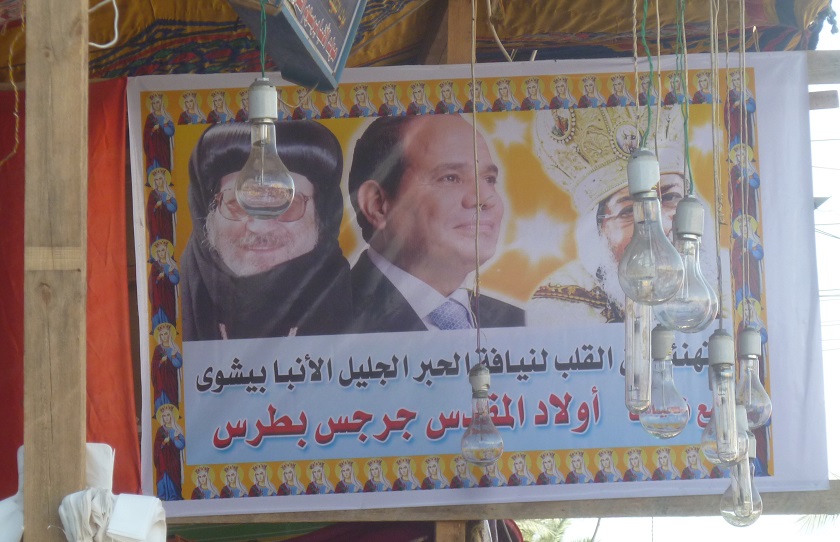
Sisi, flanked by Bishop Bishoy (L) and Pope Tawadros (R)
Yesterday I linked to my article on Christianity Today about the role of Copts in the current presidential elections season. It is a true article, but space limits the ability to probe the full issue of how they have been involved, particularly through leadership in the Coptic Orthodox Church. Here is a longer treatment, excerpted from my article at Arab West Report:
By appearances, the Coptic Orthodox Church is doing everything wrong. But appearances can be deceiving; officially, they are doing everything right.
But there is a messy in-between which casts doubt on it all. As convoluted as Egypt’s post-June 30 transition has been following the popular deposing of President Muhammad Mursī, the church has matched it step-by-step.
The appearances are obvious. Posters are seen throughout Cairo bearing pictures of Pope Tawadros alongside the front running military candidate. Some call out to the faithful: “The Lord Jesus calls you to support Field Marshal ‘Abd al-Fattāh al-Sīsī to preserve national unity.” Others give the reason “to stamp out terrorism,” and a third, “to stamp out the Brotherhood.”
Text messages have also been sent bearing similar slogans, calling on Christians to give their vote to Sīsī. This is confirmed by Ihāb al-Kharrāt, a Coptic founding member of the Egyptian Social Democratic Party, who in an interview with the author on May 15, 2014 called it “an abuse.”
The question is, by whom? The identity of sponsors is unknown, and the church has publicly denied any relation to the campaign on its Facebook page. Instead, as early as January 28, 2014 Pope Tawadros was rebutting rumors he was supporting a presidential candidate, and on May 4, 2014 he reiterated the church’s stance of neutrality. The church has no political role, he said on May 13, 2014 and his presence in Mursī’s removal on stage with al-Sīsī and Sheikh Ahmad al-Tayyib of the Azhar reflected national institutional backing for the pulse of the street. Thereafter, priests are instructed not to directly support any candidates.
If this official position is clear and correct enough, there is a convoluted undercurrent. On March 23, 2014 Pope Tawadros was quoted by Kuwait’s al-Watan TV channel saying al-Sīsī had a national duty to run for president. Tawadros praised him as having the discipline necessary to run the country, though everyone was free to choose the one deemed most suitable. During the interview he also disparaged the Arab Spring, describing it as a conspiracy to break up the region into smaller states.
The next day the pope backtracked, telling al-Shurūq newspaper that he had not made any official statements or given any interviews over the past 10-14 days. Notably, he did not deny the content of the interview, though this was implied. But the video of his interview was later released stating the opinions in question, though the footage is not of great quality and appears edited, possibly doctored. Even so, it appears the church made a misstep in revealing its private convictions.
But even its public stance is open to interpretation. The Facebook page which denied relation to the posters called on Egyptians to participate in the presidential elections. This itself is a political step, though perhaps legitimate in terms of fulfilling national obligations. But to what end is this participation designed?
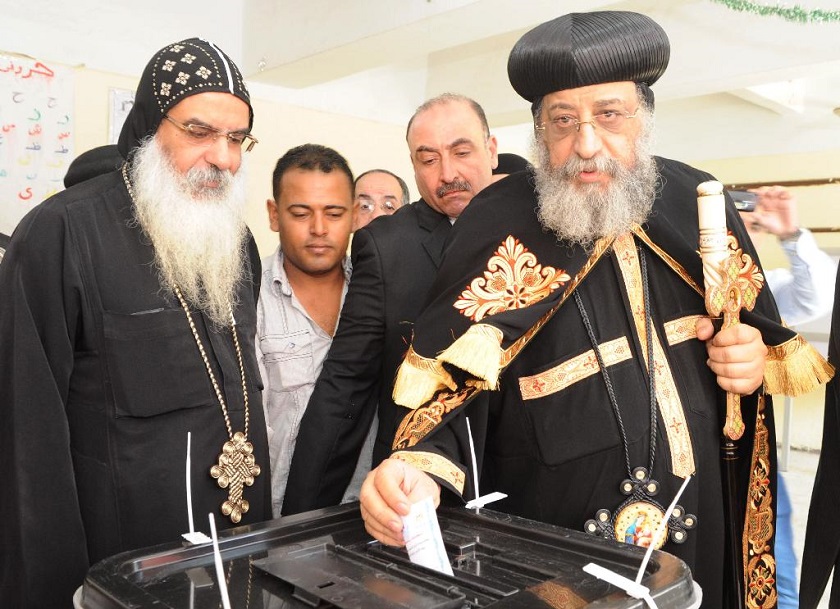
It is these national obligations Pope Tawadros once again emphasized on May 27, 2014 the last day of voting before polls were unexpectedly extended to a third day. In the face of a Muslim Brotherhood-backed boycott campaign joined at least passively by many youth, he declared this to be unacceptable negativity and urged people to vote.
But the government campaign begs interpretation that this election is less a contest between candidates than a quest for the legitimacy of turnout. 51 percent of the eligible electorate participated in the 2012 second round vote that installed Mursī over Ahmad Shafīq as president. Mursī received roughly 13 million votes. In his presumed victory al-Sīsī would want to at least match these numbers to validate officially his popular support beyond the many substantial street rallies which buttressed the popular overthrow.
Having given many signals of favor toward al-Sīsī, official or otherwise, is church neutrality now only a superficial position? In calling for participation, is it simply echoing the state call to support, in effect, a referendum on al-Sīsī? If his opponent Hamdīn Sabbāhī stands little chance of winning, should the church position be interpreted otherwise?
It is useful to look back at Pope Tawadros’ papacy to judge the fine line he has walked between involvement in and abstention from politics.
The article continues by examining the pope’s statements about and within the political arena, since his selection in November 2012. Judging from this history, the conclusion tries to examine the current situation:
The pattern that emerges gives an indication of what it means. Despite earlier stated intention to remove the church from politics and allow civil society to speak on behalf of Copts, Pope Tawadros was quickly drawn in. His remarks largely, though not exclusively, pertained to issues that affect the Coptic community. The 2012 constitution opened space for a threatening Islamism, and the attack on the cathedral in April 2013 was unprecedented and largely ignored by Mursī, despite initial condemnation. Statements of allowance for Coptic citizens to protest suggested an effort to stay within church matters, in the spirit of the January 25 revolution in which Copts acted without church direction, even if he earlier discouraged demonstrations.
But in endorsing the protest against Mursī a day before military action against him, Pope Tawadros took a political stand. It was not necessary, and it compromises his interpretation of appearing with al-Sīsī a day later. Yes, his appearance was a national statement of unity, but he appears an eager participant. It was a full endorsement of the order to come, and a condemnation of what came before.
But fair enough, it was a national action. Subsequent reception of al-Sīsī can be seen as honoring a national hero. And endorsement of the constitution can be seen as in line with support for the national roadmap and overall stability. They can also be seen otherwise, but this is the fine line he is walking.
Therefore, urging participation in presidential elections can be seen as more of the same. It is a national measure to rebuild the state, and it can be imagined he will do similarly with coming parliamentary elections. What will be tested then will be his opinion of candidates, as there is likely to be significant Islamist participation through the Salafi Nour Party. They are currently allies against Mursī; will the church be similarly neutral between candidates then, officially?
But this narrative is complicated by the controversial statements to al-Watan, along with the semi-denial. Having tightrope-walked for so long on the borders of political-religious legitimacy, it is not surprising to see such a mistake. But it is not enough to undue his official rhetoric. The church is neutral toward all political candidates; it simply plays its role as a national institution to support the state and encourage popular participation in governance.
To say otherwise requires descending into a conspiracy that may well be present but must be proven. But even without the conspiracy, it is possible to criticize the church for playing this national political role. This can be on the basis of principle – that religion should stay out of politics altogether. It can be on the basis of wisdom – that if there is a reversal in favor of the Islamists the church now has an entrenched enemy. Or it can be on the basis of the common good – that Egypt and her Christians are served better by active Coptic citizenry, not clergy.
But this calls for a vocal Coptic lay leadership that is emerging, but not yet mature. This is unsurprising given the decades of church paternalism under Pope Shenouda, encouraged by the long authoritarianism of Mubārak. Perhaps Pope Tawadros is being pushed back into the old paradigm; perhaps he is willing and eager. Perhaps there is little alternative yet and he acts against his better principles. Noteworthy also is that Pope Shenouda began his papacy as a vocal critic of Islamist policies, under President Sādāt. Banished for 40 months in a desert monastery, he returned much more subdued and cooperative under President Mubārak. It can be estimated that contrary to his predecessor, Pope Tawadros was victorious in his criticism; how will he now conduct himself under President al-Sīsī?
Like the meaning of the church’s call to vote in presidential elections, these questions are matters of his intentions, which cannot be known fully. Appearances are not good, but official stances are reasonable. It is the in-between that rightly confuses observers.
Within a still messy revolution, anything other would be surprising. The church and its pope are fully Egyptian, and Egypt is still convoluted.
Please click here to read the full article at Arab West Report.
For Egyptian Christians, today’s presidential election is not much of a contest.
Most support General Abdel Fattah al-Sisi in appreciation for his role in deposing previous president Mohamed Morsi and ending the rule of the Muslim Brotherhood. A smaller, younger contingent leans toward leftist politician Hamdeen Sabbahi out of appreciation for the revolution and skepticism of another military leader. But most on both sides expect Sisi will win handily, and most welcome the new era to come.
“This election [brings] great expectations to welcome a new Egypt with Muslims and Christians as equal citizens,” said Fawzi Khalil, a pastor at Cairo’s Kasr el-Dobara Church, the largest evangelical congregation in the Middle East.
But while most Christians are solidly in the camp of Sisi, many are taking advantage of the opening of political space after the January 2011 revolution to win leadership positions in a variety of political parties.
The article highlights one Christian woman who has become the first to head a political party in Egypt, supporting Sabbahi, and a man who is a founding member of another, supporting Sisi. A third figure is a human rights advocate seeking fair treatment for the Muslim Brotherhood, standing against the tide.
Please click here to read the full article at Christianity Today.
Monday and Tuesday Egyptians will vote for their next president, or, will not vote. Some of the latter will actively boycott, others will passively stay at home—satisfied, resigned, or uninterested. Some of the former will cast for the frontrunner, others will vote for the underdog—believing, protesting, or building an opposition.
And a few days thereafter, Egypt will know its president. Results are likely to return a decisive victory for General Sisi; yet unknown is the turnout on which much legitimacy will rest.
But full legitimacy is preemptively called into question by data from the latest Pew Research poll. After surveying a thousand Egyptians in face-to-face interviews, 54 percent are revealed in favor of Sisi and the removal of Morsi from power. This is far lower than domestic perception suggests.
Only 38 percent have a favorable opinion of the Muslim Brotherhood. This is far lower than a year earlier, but still substantial. Surveys in Egypt are generally perceived as unreliable, but Pew is respected for its methodology and experience elsewhere in the world.
But God, it matters little what people say in an interview. May this coming election send a message through the actions of citizens.
Give them safety, God, if there are threats against participation.
Give them wisdom, God, to choose the candidate of their inclination.
Give them courage, God, to positively contest if contrary to their conviction.
But encourage the passive to take up a cause, and deny safety of presence to those who will damage. Give wisdom to authorities to secure the life and dignity of all besides.
If Egypt is divided, God, may the next president unite. May his conduct in office be winsome and effective. May Egypt progress under his watch, and those in opposition press him for even greater accountable gains.
But if the poll skews an already great unity, may the next president heal. There are still many in opposition, of a kind unhealthy for progress. Honor their convictions, God, and bring justice for all. But may they still build Egypt even as they reject. Assist the president to integrate them within the boundaries of law.
In these two days of campaign silence before elections, God, help Egypt to reflect. Then, and thereafter, help her to act. Bless the president, and may his leadership bless the people. Together, may they bless you—active, satisfied, and believing.
Many have argued that Abdel Fattah al-Sisi’s likely election as Egypt’s next president is an indication of a return to Hosni Mubarak-era policies. However apt the comparison may or may not be, the analysis overlooks one key advantage Sisi lacks. There is no longer a National Democratic Party (NDP), the party faithful to ousted president Mubarak, through which the presumed President Sisi can enact policy. He is on the record to neither form nor join a party through which to govern.
In its place exist a large number of smaller parties, which are in one sense a result of the revolution and its aim to diffuse presidential power. Sisi will need to work closely with these elected representatives; according to Article 146 of the constitution his choice of prime minister and the cabinet he is tasked to form must meet with legislative approval. Otherwise, the majority party will form the government.
The old NDP did not threaten Mubarak’s choices, for it was less an ideological vehicle than a means of access to executive favor. The coming parliament stands to be different, for most parties have already staked out distinct positions in electoral competition. But the phenomenal pull of Sisi is exposing fault-lines within these parties, blurring the lines of ideological distinction.
This is the joint explanation of the recent defection of thirty-one members of the Egyptian Social Democratic Party (ESDP) to the Free Egyptians Party (FEP). Both parties were created after the 2011 revolution. They ran together as the Egyptian Bloc in the first post-Mubarak parliamentary elections, and were equal partners in the National Salvation Front to overthrow former President Mohamed Morsi.
The article continues to analyze why the defection occurred and what it means for political life and the coming parliament. It quotes extensively from a founding member in each party, and touches also on the Salafi challenge.
From the conclusion:
But until the political situation stabilizes, there is little likelihood of ideology coming to the forefront of campaigns. With the Brotherhood sidelined, the question of religion is largely replaced by the question of Sisi, and his discourse of security and stability. Should he win, the interplay between him parliament may determine whether or not the decay of ideological distinction continues.
Please click here to read the full article at Egypt Source.
Having backed the popularly-led military overthrow of President Morsi, the party ensured at least its short- to mid-term survival, and did not go the way of the Brotherhood. But in doing so they have fractured their internal cohesion and invited the derision of many Islamists, their natural constituency. The results of their gamble remain to be witnessed, likely in upcoming parliamentary elections.
But here is an interesting excerpt about leadership in the Salafa Dawa, the socio-religious preaching association that gave rise to the Nour Party:
The movement’s controversial support for the military has also heightened internal divisions. The initial division that weakened the movement followed a disagreement between Emad Abdel Ghaffour, the former leader of the Nour Party, and Yasser Borhami, deputy head of the Salafi Dawa, that led to the former splitting off to form his own Watan Party in January 2013. Nour’s backing of the military and the crackdown on the Brotherhood deepened the rifts between those remaining in the party. A number of the original founders of the Salafi Dawa have stopped attending its meetings, such as Dr. Said Abdel-Azeem, who before June 30 had announced that he believed in “the legitimacy of President Mohammed Morsi.” Abdel-Azeem stayed the course after July 3 and appeared on the speakers’ podium at the Rabia al-Adawiya protest repeatedly; he has been against the Nour Party’s support of the military since the crisis between Nour and the Brotherhood began in January 2013. Dr. Mohammed Ismail al-Muqaddam has also been absent from the movement since July 3, declining to appear in public or speak about politics.
Even more illustrative of the fragmentation within the Salafi leadership is the sermon given by prominent Salafi figure Dr. Ahmed Farid at a mosque in the Amiriyya district of Alexandria on February 28, in which he called for “returning to our origin.” He added that “for 40 years, we have wanted to return to missionary work (al-dawa) and forget politics,” even though only a few days earlier he himself had participated in a political conference supporting the latest constitution. Even though a majority of the Salafi Dawa leadership is sympathetic to these dissenters, Borhami, the most powerful figure in the movement, continues his efforts to convince his followers that the political Salafi Dawa organization is emerging from the current crisis stronger than before. Borhami has sent his pupils and followers throughout Egypt’s provinces to rally Nour Party supporters and convince them of the wisdom of nominally condemning the use of violence against pro-Brotherhood protesters while tacitly accepting it by supporting the military regime, including Nour’s recent endorsement of Abdel Fattah el-Sisi for president and calls for their followers to vote for him.
I have no evidence to the contrary, but I am curious how the author judges the majority to be sympathetic to dissenters. Is it an emotional sympathy, or something more? If more, might they be letting Borhami take the lead, watching to see what happens, but ready to let him take the fall if necessary?
Under this speculation, ‘if necessary’ could come from two directions. The first, as the author makes clear, is the possibility that Nour Party support for the transition may still not be enough to preserve their political presence. If they are denied a continuing place in politics under Article 74 of the new constitution, Borhami would be the one to hold accountable.
Less likely, but still the goal of many Brotherhood-sympathetic Islamists, is that the military overthrow of Morsi might still be reversed. If so, Borhami could be highlighted as the traitor while those keeping quiet now quickly seek to mend fences.
In any case, the interactions are fascinating. Read the full article linked above to get a good overview of the situation.
Nine days from presidential elections, Egypt allows its expats to cast an early tally. But those in prison must choose other options to make their voice heard. Two are said to be close to death after prolonged hunger strikes.
But if the presidential contest is not anticipated to be a battle to the death, it still feels so to many Egyptians. Three years of upheaval make many feel a vote for Sisi is vote to save the nation, while others stress Sabbahi is a vote to save the revolution.
One hunger striker, however, is the Egyptian-American son of a Brotherhood leader. He says he is charged while innocent, just to get to his father. Another is not charged at all. An al-Jazeera journalist has been detained since the break-up of the pro-Morsi sit-ins. Their only vote is with their stomach, hoping it might save something.
Preserve their lives, God. Honor their commitment, highlight their cause, establish all justice. Grant wisdom to the authorities to deal with them wisely. If they die, may it be with peace of heart, and contribute, somehow, to the peace of Egypt.
But for all those with simpler options, God, may they choose with discernment. Free all minds from the contaminations of rumor to select the man best suited to govern Egypt. May they sense the importance of this moment – whether from idealism or realism, hope or concern – but may no falsity enlarge the contest.
And for those who find the contest false altogether, give them alternate options to express their voice and build their nation. Allow no further destruction, whether to property, body, or soul.
For Egypt has suffered much, has chosen often, and still has little to show for it. Of those abroad and those in prison, give them all an idealism grounded in reality. Give them a spirit of sacrifice to serve their homeland.
And give them a taste, soon, of a nation that moves forward leaving none behind. Coming elections will soon dwarf their various options into near insignificance. But nothing is insignificant to you, God.
May all share in the struggle, as best they are able. Redeem each and every goodness, right each and every wrong. Death has been far too common an option in Egypt; deny it an ultimate victory.
But may its sting fuel vigilance toward liberty. For those who know it abroad, for those who lack it at home, and for the ordinary millions beside, may these be their eternal options.
At the end of the school year – and yes, somehow in Egypt, we are already at the end – our girls’ school puts on an assembly for parents that includes an English language play.
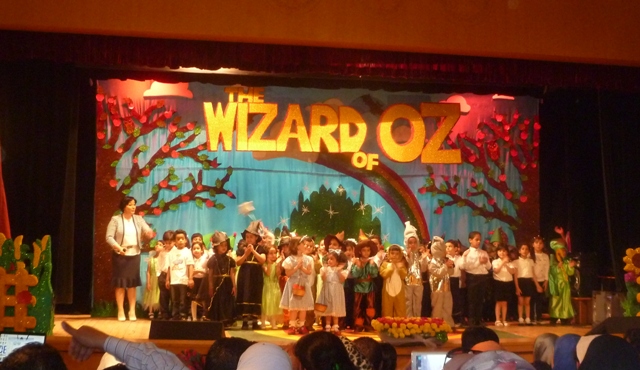
This year Hannah, our kindergartener, has been selected for the leading role in the Wizard of Oz.
But when we say it is in English, we mean Egyptian English. We suspect Hannah was chosen because she is the only native English speaker in her class. Nonetheless, she memorized – and pronounces – the lines as they were taught to her by her teachers.
In fact, she memorized everyone’s lines. Here is an exclusive preview of her performance, running through the script in about five minutes.
And just in case, we provide subtitles if her accent cannot be fully understood. Don’t worry, she speaks good American English also.
Finally, here are some pictures from the big event:
And, though it is hard to understand, a snippet from the actual performance:
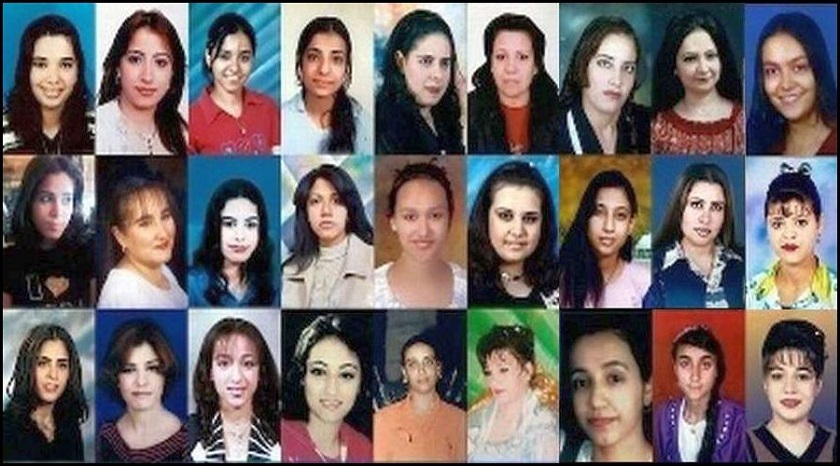
Seeking commonality with the outrage over the schoolgirls kidnapped in Nigeria by Boko Haram, Ebram Louis and the Association of Victims of Abductions and Enforced Disapperances (AVAED) is launching a hashtag of his own. #BringBackOurCopticGirlsEgypt.
I might advise to remove the ‘Egypt’ from the hashtag, thinking ‘Coptic’ builds sufficiently on the now viral #BringBackOurGirls. But Ebram is a dedicated advocate and researcher, and the issue of kidnapped Coptic women is longstanding.
Here I share some recent reflections on the issue, from an article in Arab West Report, excerpting my reflection on the difficulty of this research:
One of the greatest horrors that can befall a family is the sudden disappearance of their child. No country in the world could doubt such tragedy. Why then does controversy surround Coptic minors?
There are two prominent reasons, and both relate to the contested sectarian nature of Egyptian society. While Muslims and Christians live side by side as neighbors, colleagues, and often friends, there is an undercurrent of tension among many, stemming from religious identity. During a moment of crisis or a community dispute, sides can be drawn along religious lines.
Many Christians harbor suspicions that the Islam in a Muslim will push an otherwise friendly neighbor to discrimination, or worse. Many Muslims harbor criticisms that Christians are actually treated better than the average Muslim in society, yet complain constantly. While this tension is generally unspoken a disappearance can shatter the peace.
The first reason is due to an often heard accusation: The girl was kidnapped, with blame assigned to extremist Salafi Muslims. Salafis are understood to be very traditional, and though not necessarily anti-Coptic in essence, often hold a viewpoint assigning non-Muslims a secondary status as if in the historical Islamic caliphate. They also believe in early marriage for women, often below the Egyptian legal age of consent of eighteen. Combining these two characteristics it is posited that some Salafis will kidnap Coptic minors and convert them to Islam to weaken their community, and then marry them off within the Muslim fold.
Setting aside for now the legitimacy of this accusation, it is easy to comprehend its inflammatory nature within a sectarian-laced society. Muslims would be horrified to imagine that such a crime is committed, but furthermore, that it is committed on a religious rationale. But at the same time the alleged crime touches the nerve points of Coptic consciousness, molded over centuries of living within that historical secondary status. Raising the accusation offends Muslims, denying it embitters Christians.
The second reason is due to the social setting surrounding the accusation of kidnapping. Much of Egypt maintains a patriarchal attachment to women, attaching their purity to the family or community’s status of honor and shame. If a woman loses her virginity outside of marriage the offense is felt by the community. A woman who disappears puts their honor at risk, no matter the reason for her absence.
This charged setting is amplified if the suspected disappearance crosses religious lines, in any direction. But first imagine the situation is not one of forced disappearance, but simply of individual choice. The decision of a female to attach herself in relationship outside of family approval is a scandal; it is even greater if the relationship is with a man of a different religion. The reasons can be many and are essentially human: Often they are of love, money, or the desire to escape a difficult home situation. The temptation can therefore be very strong for a family to defend its damaged honor by claiming their daughter has been kidnapped.
These two reasons help explain the controversy, but there is a third factor that may or may not be equally sectarian. The Egyptian state, especially outside of the major population centers, is notoriously weak. Police investigations are often feeble, and the judicial system takes years to process a case. Community transgressions are often left to be solved by the community – with security looking on – and if the crime takes place across religious lines the two sides are encouraged-cum-compelled to ‘reconcile’.
What is more difficult to say is if there is an additional sectarian aspect in police conduct. Christians often accuse security of paying even less attention to crimes against their community. In cases of disappearance of minors, sometimes they fail to investigate at all. Is this due to individual fanaticism, institutional bias, or simply a common indifference?
But the end result for many families is they may have no idea if their daughter was kidnapped or not. She is simply gone. It could be she ran away from home to join her boyfriend. It could be she ran away, but then is met with a host of barriers denying her ability to return. Among these, it is claimed, is the pressure placed on her by the Muslim family, implying the horrors of what will happen to her if she goes back, having violated her family’s honor. Whatever violence she might face, she knows the shame she brought them.
Or, perhaps she was outright kidnapped. Especially following the revolution kidnapping has become a potentially lucrative career given the security vacuum. But if the police do not give due diligence to the cries of a distraught family, what conclusions can they draw? Even if she wishes to marry freely, even if she wishes to convert to Islam freely, the law prohibits these actions until she is eighteen. As a minor, she must be returned to her family. Very often, the law fails.
And also the fact that in a country of more than 85 million people, any one person’s individual problem is drowned in a sea of difficulty and inequity. In order to get the attention of authorities, one must yell louder than everyone else. ‘Kidnapping’ makes for a very loud scream.
Given all the above, this is why proper research into a disappearance is essential. Without it, not only can religious and social taboos be violated, but far worse, the girl may never return home.
But when research must take place independent of the properly invested authorities, it also acquires an air of advocacy. But what can be more appropriate? The task is to put right a wrong, not study sociology.
As such, Ebram Louis is both a researcher and an activist.
The rest of the article profiles his work through the Association for Victims of Abductions and Forced Disappearances. I have written about him earlier, and you can additionally click here for more information.
Ebram Louis
But the article closes with his idea for solving the issue. One of his colleagues proposed going through the newly formed Ministry of Transitional Justice, to right past wrongs. Louis, however, wishes to resurrect an old practice:
One possible solution can help sort through the vagary, and is endorsed thoroughly by AVAED. In 2004 in a case similar to that of Camīliah Shihātah, Wafā’ Constantine, another wife of a priest, sparked rumors and demonstrations when she disappeared. Eventually she was returned to the church, but the antagonism that developed between the church and security led to canceling the then-mandatory ‘counseling sessions’ for anyone wishing to convert to Islam.
These sessions were instituted in order to make certain that anyone expressing interest in Islam did so from their full and free will. The would-be convert would meet with a priest under supervision of security, and express his or her desire. The priest had the opportunity to counsel the individual back to the faith, and the presence of security ostensibly ensured an atmosphere of non-coercion.
Reinstituting these counseling sessions would not eliminate the problem of disappearances, but it would carve out space to explore the argument that these young Coptic women are converting to Islam freely. Of course, this only applies when they are of age; otherwise, the law must rule and return all minors to their families. But in the controversial cases where an initial love relationship becomes complicated, a formal procedure to evaluate and process a conversion to Islam would remove much ambiguity from the controversy of disappearances.
Of course, rule of law and freedom of religion are much more basic solutions, but given the nature of Egyptian reality, they are unfortunately not simple solutions. Except for the basic fact that families do not know where their children are, little about this issue is simple.
Please click here to read the full article at Arab West Report.
From Slate, a unique first-person account of travels to Upper Egypt, to witness the alleged surge in weapons trading. The journalists find a sleepy town filled with older arms models, feuding families, and unengaged police, but little evidence of proliferation.
But they do encounter a local thug:
A man in a karakul hat—a favorite with Soviet party leaders and Bond villains—strides up to our table and sits next to the omda [village mayor]. He regards us with a rather unctuous smile, revealing his coffee- and nicotine-stained teeth.
Before he arrived we had been talking about government negligence. He offers us a curious anecdote. We’re, it seems, in the company of a kidnapper.
He is a kidnapper armed with what he and the omda’s pals think is unassailable logic. That is, without loans from agricultural banks—who refuse them on “security grounds”—he and other farmers are left without a steady income. Kidnapping, being a very lucrative trade, allows him and others like him to purchase property and build.
“Some ask why we target Christians and not Muslims,” he says with a smirk, looking at my colleague and me. “Because our [Muslim] men are not worth as much.”
He turns to one of the omda’s friends, a Christian who is seated at the table. “It’s nothing personal.”
Often amid the evidence of Christian persecution in Egypt is the tragedy of Christians being kidnapped. Many times the stories say the victims, usually underage girls, are forced to marry and convert to Islam. Surely some of these stories are true, sometimes perhaps not.
But this anecdote reminds us the reality is very complex. Some might use this version alone to deny the more obvious persecution accounts. But a single, simple narrative is best to advance a cause, on whatever side of the issue you advocate.
Meanwhile, muddying the waters in complexity works well to promote confusion and immobility, denting outrage through a fog of uncertainty. It elevates the status of the ‘expert’, but does little to help everyday realities.
God help us. The task is a commitment to both truth and justice. Truth includes the diversity of anecdotes, testing every narrative to divide the wheat and the chaff. Justice proceeds further, to process the wheat and cast off the chaff. The former is made useful into sustaining bread; the latter deemed worthless and thrown to the wind or fire.
May we remember, and act accordingly. And, may all kidnapping cease.
Bless both Sisi and Sabbahi, as they make themselves known to the Egyptian electorate.
This is different than making themselves known to Egypt, for both already possess developed reputations. Sabbahi has been in an election before and his views are public. But though only 18 months ago, it was a very different time. Why should we vote for you now?
And while Sisi also has been constantly in the media as he deposed President Morsi after popular outcry, his test is different now. His leadership is public, but his views are less clear. On what basis should we vote for you?
This week, both sat down for extended interviews on national television.
It is hard to judge reaction, but at least a reaction was prompted. With official campaigning started the candidates must put themselves before the people.
May they judge wisely, God, with full discernment.
Help them to know the weight of the times. Egypt is three years since revolution, with little progress or stability since. Which candidate can handle the responsibilities of state and right the ship?
Help them to know the depth of the visions. Egypt has been full of wild promises and empty platitudes. Which candidate can convince the public he has thought through the chaos and can enact solutions?
Help them to know the heart of the candidates. Egypt has seen acts of great sincerity and great manipulation, but the prevalence of rumors call all into question. Which candidate has an honest intention to serve the people through transparent means?
Perhaps none fit the bill exactly, God. If so, judge if a boycott will help or hinder the nation.
For many Egyptians are divided between these three choices. But in the three weeks to come, test each idea thoroughly. Run the candidates through the crucible of public scrutiny, that a winner may come out refined.
May Egypt get to know them, and may the candidates truly know the people. In both directions, guide above perceptions into substance, and help all do what is right.
More than 175 Christian leaders crossed denominational and political divides this week to urge the United States government to do more to help the rapidly diminishing, historic Christian populations of Syria, Iraq, and Egypt.
The solidarity pledge—signed by National Association of Evangelicals (NAE) president Leith Anderson, Focus on the Family founder James Dobson, Southern Baptist Theological Seminary president Al Mohler, and Samaritan’s Purse president Franklin Graham, among other prominent names—presented on Capitol Hill asks for the appointment of a special envoy on Middle East Religious Minorities, a review of foreign aid, and refugee and reconstruction assistance.
“These defenseless religious communities are facing an existential crisis, which threatens their very survival in the lands they have inhabited for centuries,” said Rep. Frank Wolf (R-VA), a longtime religious freedom advocate who helped create the U.S. Commission on International Religious Freedom (USCIRF) in 1998. “The faith leaders … recognize that unless the American church begins to champion this cause, the foreign policy establishment will hardly lead the way. They are committing to be their ‘brother’s keeper,’ whether in Nineveh, Cairo or Homs.”
But Egyptian Christians have a longstanding reticence about outside help:
“We value so much the prayers and concerns of our Christian brethren around the world, and in the U.S. especially,” said Fawzi Khalil, pastor at Kasr el-Dobara Church in Cairo, the largest evangelical congregation in the Middle East. “But we don’t believe outside pressure would be best for our daily life with our Muslim friends. The government of Egypt with local Christian leaders are best suited to fix our problems.”
Please click here to read the full article at Christianity Today, including testimony from other Egyptian Christians and one US Copt who is a signatory.
From my recent article at Arab West Report, continuing a series of interviews with members of the Committee of Fifty which wrote the constitution:
Seeking to represent all sectors of Egyptian society, the Egyptian Committee of Fifty to amend the constitution of 2012 was light on political parties. Only four seats were assigned, two for liberals and two for Islamists. This was in contrast to the Committee of One Hundred that wrote the 2012 constitution, which was heavily populated by political figures from the Islamist Freedom and Justice and Nour Parties.
After the fall of Morsi, however, few Islamists remained on the formal political scene. The Nour Party was the most prominent, representing the Salafi trend. One seat went to them, but who could represent the Brotherhood trend, with the Brotherhood boycotting the process? Announced as a representative of the Islamist trend was Kamal Hilbāwī, a former Brotherhood member who resigned in 2012 in protest of the group’s decision to field a candidate for president.
Helbawi was a member of the drafting subcommittee which was responsible to merge all articles into one contiguous text. To do so they changed articles according to language and syntax, but did not hesitate to also adapt the meanings.
But one of the most interesting points of his testimony concerns the negotiations with the Nour Party that resulted in the former Article 219, defining the principles of the sharia, moved in essence into the preamble and made subject to the Supreme Constitutional Court:
But in a compromise agreement the definition of the principles of sharī‘ah was moved to the preamble, with the term of reference being the collected rulings of the Supreme Constitutional Court. These are about 4-5 cases, he estimated, involving sharī‘ah interpretation issued by the highest court in the land since 1985. Having a definition makes sense, Hilbāwī believed, for someone might want to know what the principles of sharī‘ah are. These cases were entered into the official transcript of the constitutional proceedings, and the preamble of the constitution has equal weight with its articles, according to Article 227.
But reference to the rulings of the SCC raised the issue of why Article 219 was necessary in the first place, if the court already defined the principles of sharī‘ah. Perhaps the legislature did not adhere adequately to these rulings, but if the legal basis was there, what was the big deal? And in any case, if the language of 219 was in the SCC rulings, does this explain why the Nour Party was satisfied?
Hilbāwī dismissed the criticism by liberals of Article 219 that it would have opened up the entire corpus of sharī‘ah legal history to implementation in legislation or in court rulings. But in referring to the charge of Safwat al-Bayādī, confirmed in his testimony of the response of Sa’d al-Dīn al-Hilālī, that the testimony of Christians might not be given equal weight to Muslims, as was once in Islamic history, Hilbāwī said ‘perhaps’, in recognition of Hilālī’s rejection of 219 and his status as a very good scholar. There are still shaykhs in Egypt, mentioning Abū Islām and Mahmūd Shabān in particular, who advocate very retrograde rulings. But given the firm guarantees on equality present throughout the constitution, Hilbāwī does not expect any sharī‘ah-based impingement on general freedom.
The article also contains a first effort to understand what the religious language of sharia interpretation means. Please click here to read this and the whole article at Arab West Report.
Few people reading this reflection know Bassem Sabry, of course. I didn’t know him myself. We may have exchanged tweets two or three times over the past three years. But when I saw the news of his death – on that same Twitter medium – it filled me with dread. They’re keeping score, I thought, and they’re coming to get you.
Sabry was one of the first Egyptian voices of the revolution I became familiar with. He kept a popular blog in the early days when people still weren’t sure what was happening, if it was good or bad, or where it was going. Sabry believed it was good, was never wild in his predictions, but had a keen sense of what was happening. In those confusing days, still confusing now, his was a lucid analysis that was simultaneously authentic. He was here, living it.
As was I.
My situation was much different, to be sure. He was a participant, an advocate, one whose level-headed hope was contagious. Mine sought to convey the situation correctly, weigh between differing explanations, but be tinged all the while with a positive sympathy that sought to identify with all sides, to the degree possible. Among many, I identified with Bassem.
But it is a mark of the psychological weight of Egypt in these days that I briefly identified too far. The first report I read said Bassem, aged 31, died in a fall from his balcony window.
Cairo is a city of high rise apartments, with balconies overlooking both narrow, crowded streets and wide expanses overlooking the Nile. Rich or poor, the balcony equates as one of the few places that can lift one above and give safe outside space above the bustling, often chaotic world below.
Safe, however, is only a matter of speaking. Every mother fears for her children, no matter how high the wall. Our one-and-a-half year old is proving quite adept at climbing, combining stools and chairs to rappel himself up onto heights he has no business reaching.
But those in Egypt are also aware that the balcony has been a not-infrequent place of untimely, suspicious death. The stories are not necessary to tell here, but rumors circulate of celebrity accidents from years earlier, or from sectarian tensions, or or or.
How does a 31 year old fall from a balcony?
The next day’s reports related from his friends that Bassem suffered a diabetic dizzy spell that caused him to lose his balance and fall. None of the numerous tributes I have read suspect foul play.
He just died. In Egypt, these days, that is strange enough.
People die every week now in scenes no less unnatural than falling from a balcony. Protestors are shot. Policemen are bombed. And despite the simplicity of these sentences there are the conspiracies that swirl and complicate. Demonstrators shoot their own colleagues to enrage and further the cause. The state blows up its own security to demonize the opposition. And on and on.
So a situation that is evil in its own right becomes even more sordid by the alleged manipulations and deceptions. Those who are good, as Bassem appeared, are easy to imagine as having been eliminated. He would not be the first on this imaginary list.
Of course, I imagine myself as good as well. And given the handful of foreigners who have also suffered as witnesses to the revolution, it is easy for the imagination to extrapolate in fear. They, whoever they are, are keeping watch.
But this is a psychology, not the reality in which I live. The reader outside Egypt should know that I and my family pass each day in safety. We have kind friends and normal lives.
This weekend there were reports of clashes in Helwan, an industrial city to the south of Cairo. I was there that afternoon. I enjoyed tea with a friend and then an uneventful church service. At one point the television showed footage, and my friend quickly inquired about which neighborhood. Everyone else was calm and went about their business. A ten minute microbus ride could have brought us to the two or three street radius of troubles; everywhere else in this poor, lower-class district was fine.
Yet at the same time, Egypt suffered four bombings yesterday and another handful of protestors died. All is not well, even though it is.
Living in this tension takes a toll. It is a good toll, one I am privileged to be able to offer. It is fulfilling, exhilarating, and offers much temptation to pride and self-importance. It conjures drama and imagines conspiracies, even as it dispels them. It suffers, while remaining apart. It makes a difference, while making none. Negotiating these tensions is essential for peace of mind; trying to do so can drive you crazy.
For there are thousands of Egyptians striving for the success of their interpretation of the revolution, and thousands more wishing they would all go away. And there are hundreds of foreigners offering better and more courageous analysis, and hundreds more who just live here and get along.
I, whatever I am and offer, am a drop in the bucket.
As was Bassem Sabry. His was a larger and more influential drop, but now he is gone and the world marches on. The world is less without him, as it will one day be less without me, and you, and your neighbor, and everyone else.
But Bassem lived well, analyzed well, explained well, did his best to politick well, but above all, gave hope. For those who have any sense of belonging to Bassem, this is the worthy imitation.
Recent court decisions in Egypt beg for pause and reflection. But too often even the suggestion thereof raises tensions and accusations. So much is at stake that the chosen path must continue. All opposed simply stand in the way. Any who question risk wholesale collapse.
And God, this is the attitude on both sides.
The revolutionary April 6 youth movement was dissolved by court order, finding them guilty of espionage and defaming the state. One of the primary forces behind the original revolution, they were briefly lauded before falling again afoul of all subsequent governments. They have been critical of all, and have links with movements abroad. But are these crimes?
683 people have been sentenced to death for rioting and the death of a police officer in Upper Egypt. Six hundred and eighty-three. Among them is the supreme guide of the Muslim Brotherhood. But also among them, it is said, are an uninvolved Christian and the already dead. Crimes were committed and many are guilty. But is this justice?
Perhaps the answer to both questions is ‘yes’, God. Egypt asserts an independent judiciary in which interference is impossible. In an earlier mass sentencing of over five hundred, the standard review reduced the death penalty to 37, which still is not final. And April 6 members have been in and out of prison several times over the past three years. Immediate judgment is unwise in law, but this slows the rush of few.
Among them are international analysts and politicians, which are piling criticism upon Egypt. Even among backers of the current order, some are daring to criticize.
For maybe the answer to both questions is ‘no’, God. Or ‘maybe’, or ‘mixed’. Maybe they are guilty, but of other charges entirely. Maybe they are political sentences, maybe it is just incompetence. Maybe, maybe, maybe.
God, help Egypt to know. Demonstrate guilt and innocence transparently. But how long must this prayer be uttered until the lack of transparency becomes damning? Let there be no rush to judgment, but judgment must be issued eventually.
Will a new president, after elections, set the record straight? How long should he have?
Transparency and accountability do not come from structured power, God, but from good men and women who press upon it, and enter in it. Raise up this strength, and aid in the structuring of justice and good governance. Then protect them from falling victim to the same ills.
But today, more Egyptians have simply fallen. Bombs have targeted policemen, and by the end of the day who knows but that some may have died in protest clashes. With blood on the ground, week after week, who can pause and reflect?
Is it a terrorist conspiracy to be routed, God? Is it a vicious coup to be resisted? In reflective pause, allow none to sink into the morass of ‘maybe’. Hold steady in conviction, give wisdom and courage towards action, but humility and openness for continual revision.
May accusations be pure; may tensions be righteous. But whatever chosen path Egyptians adopt, may they also find yours.
Sixteen thousand Muslim Brotherhood prisoners launched a mass hunger strike yesterday, protesting against torture and other human rights abuses, according to local sources. Haitham Abu Khalil, the movement spokesman, says many more individuals are unlawfully detained.
The same day a lone Coptic hunger striker, unaffiliated and unsympathetic to the Brotherhood, ended his own hunger strike after twenty two days.
Unlike the others, he did so as a free man.
‘People are dying, hatred is increasing, justice is absent, and prices are rising,’ said Dr Hanny Hanna, an archaeologist and general director in the Egyptian Ministry of Antiquities. ‘We have had no revolutionary government, the same regime is with us until now.’
Three years ago Hanna had more hope. As the world celebrated images of Christians protecting Muslims at prayer in Tahrir Square, less known was the reverse. One of the first Copts to join the revolution of 25 January, Hanna became known as ‘the preacher of the revolution’ for leading protestors in Christian prayers and songs.
Polarized
But these days of unity are long gone. ‘Everyone is tearing down the other no matter what side you are on,’ Hanna told Lapido Media. ‘The polarisation has become so high.’
And with it the body count.
According to figures reported by the Carnegie Endowment for International Peace last month, over three thousand Egyptians have been killed in political violence since 3 July, the day former president Mohamed Morsi was deposed.
Over 2500 of these deaths have been the result of protests and clashes, while over 500 have died from terrorism and other militant actions, according to government statements.
Seventeen thousand have been injured in these events, and nearly 19,000 have been arrested. Of these, several hundred have already been on hunger strike to protest their ill treatment in prison.
Hanna, during a brief hospitalization
Hanna, who while drinking only water continued his normal responsibilities, criticized the violence of many protestors which has landed them in detention. But he also condemned the government and its protest law which has imprisoned many innocents beside them.
As the revolution appeared to be slipping away with resurgent autocracy first under the Brotherhood and now more severely against them, the preacher in him grappled with a response.
‘Should I go to the media and just say, “Love each other?” he asked. ‘It is easy to talk but it is stronger to take an action.’
Hunger strikes have largely been an individual action in Egypt since the 1970s, said Osama el-Ghazoly, a senior Egyptian journalist. The mass prison protest is a more recent development, but few have done so outside of jail.
Unlike most, Hanna’s hunger strike had no demands. Instead, it was his chosen action to communicate a message that all is not well and the revolution has not succeeded.
He even takes aim at Egyptian icon General Abdel Fattah al-Sisi, the front running presidential candidate. Hanna resurrects the memory of the Maspero massacre when 28 Coptic protestors were killed, either shot or crushed under military vehicles in October 2011. Sisi was the director of military intelligence at the time.
‘If Sisi wants my support he should make it clear what was his role in these events,’ said Hanna. ‘If he is clean, then fine. If not, he can go to hell.’
Critisism
But these messages do not sit well with his fellow Copts. Most are overjoyed at Sisi’s popularly endorsed removal of Morsi’s Muslim Brotherhood government, and anticipate the new constitution will usher in a democratic order.
Even Hanna’s personal Facebook page, filled with good wishes about his intentions, drew criticism. Comments lamenting the timing, method, and relevance of his protest mirrored the responses of political, religious, and revolutionary Coptic leaders.
‘I wish he would be more patient,’ said Naguib Abadir, a Coptic founding member of the Free Egyptians Party, one of the leading liberal flag bearers. ‘We are in a very difficult period with people trying to hijack our roadmap before it can be achieved.’
‘The body is not our own, it is the temple of God and we are responsible to protect it,’ said Revd Fawzi Khalil of Kasr el-Dobara Church, located just behind Tahrir Square, who demonstrated with Hanna from the early days of the revolution.
‘We are able to express our views in ways that do not threaten our life.’
Abadir and Khalil both told Lapido Media that Hanna should save his strength and take up politics, criticising him for picturing everything as negative. But even revolutionary colleagues see him as an idealist, who is harming himself in vain.
Mina Magdy
‘He is a good person working for peace,’ said Mina Magdy, general coordinator of the mostly Coptic Maspero Youth Union, which suffered heavily in the massacre. ‘But he is giving slogans and this does not work, we need specific demands.
‘Hanna’s message will reach neither the regime nor the people,’ he said. ‘No one cares about him.’
But this unhappy critique is categorically untrue. His wife and three daughters have stood by his side, and over ten friends have promised to join him on a future hunger strike, if necessary, in exchange for stopping now.
Hanna believes most of his critics misunderstand him and have succumbed to a culture that neither values the individual nor believes one person can make a difference.
‘In the beginning no one listens,’ he said. ‘But as you continue more people start to pay attention.
‘The fruit is seen as they change toward the good.’
Still a preacher, but now with his body, this is Hanna’s contribution to continue the revolution.
This article was originally published at Lapido Media.
Egypt has yet to experience an issue-based electoral contest. Of course other nations, even with deep political history, are known also to sensationalize campaigns and demonize opponents. But as Egypt learns the best and the worst from these international examples, with which of these two commentators do you side?
Hamzawy (L), Sisi (C), Abou Taleb (R)
In recent op-ed articles, both Hamzawy and Abou Taleb see media manipulation as the central feature of Sisi’s candidacy. But they aim in different directions.
Hamzawi, writing in Egypt Source, ‘Dismantling the Myth of the Candidate of Necessity’:
There is a myth now being promoted by intellectual, political and media groups who favor the regime that followed the July 3 2013 overthrow of Mohamed Morsi, and support former Defense Minister Field Marshal Abdel Fattah al-Sisi’s run for president. While this myth deals with Egypt’s current situation, its structure is far from new. In fact, consecutive ruling elites have relied on this myth since the 1950s to justify oppression, human rights violations, restriction of freedoms, autocracy, and lack of democracy and sustainable development.
The “candidate of necessity” myth reduces Egypt and its issues to one person, the hero-savior, being introduced to the public before the presidential elections as “the only candidate” capable of “rescuing the nation from the current danger” and “the last hope” for “saving the nation from the evils and harms of the enemies, inside and out” and achieving its greater goals and objectives.
Abou Taleb, writing in Ahram Online, ‘Speaking about Rights, but Aiming for Chaos’:
We all know Egypt is being targetted and it is no longer a mere suspicion or hypothetical conspiracy theory but a reality we live day and night. This includes statements and threats by the terrorist alliance, sabotage and murder, and the ultimate goal — that will never materialise, God willing — of pushing Egypt into chaos and ruin.
Media personalities, politicians and alleged clergy who want Egyptians to believe this targeting is temporary and contingent on the removal of one very popular presidential candidate are a key and fundamental part of the plot to disrupt Egypt, and raise the price of transitioning into political and institutional stability. They also send a misleading message to Egyptians that their salvation is contingent on abandoning this candidate. But these people do not realise the majority of Egyptians have matured politically and now have an innate ability to sift through the political din.
One of the commentators speaks the language of the international community, the other the domestic. That alone does not lend credence in either direction. But it is noteworthy that their central argument is essentially the same: There is deep manipulation in framing the candidacy of Sisi.
One frames in favor, the other against. Both commentators indirectly expose the other. The reader is invited to provide the round-by-round scorecard for these two heavyweights, as both sides have come out swinging…
Easter, and the national celebration of Shem al-Naseem the following day, were both quiet in an otherwise quiet week. But even quiet palpitations within can be heard and affect the national scene. For good, God, only for good.
Because all events are subject to your evaluation, even if natural to those involved. For some used Easter to celebrate politics, while others used politics to denigrate Easter. Judge between them, God, but only in mercy.
For political candidates visited the papal cathedral to join in on Easter; one in particular received a rousing ovation. All candidates were Muslims, who believe neither in Jesus’ death nor resurrection. Their presence can be seen as a great gesture of solidarity, or, a great exploitation of an electorate.
What is the proper place of Easter in Egypt, God? Should it be made equal with other religious feasts and become a national holiday? Or should it be left an oddity for minority Christians, neither prevented nor acknowledged? Is anything in-between viable, or a capitulation?
For a political movement opposed to these candidates put the holiday’s name in quotation marks. Criticizing a supposed normalization between the Orthodox Church and Israel, it described pilgrims going to Jerusalem to celebrate “what is called ‘the feast of the resurrection’.” The pilgrims did go but the church did not sanction; the rumor reported served only to discredit – church and Easter alike.
Show Egypt the level of value to give Easter, God, independent of belief. It cannot be easily shared, but can it be communally honored? Jesus unites Egyptians even as he divides. Help society to emphasis the former, with all appropriate allowance for the latter. Guard this balance, God, even as you guard the disputed truth.
But show also the believers in Easter the proper relation of their faith to society. At times they are honored; at others, marginalized. Give them wisdom in both situations.
Is the cathedral a place of political judgment, God? Or does your sovereignty demand the voice of faith in politics as in all else? As Muslims debate this issue, let Christians do the same. Lead each individual to the candidate of choice, and if a community coalesces, discern between them. For good, God, and with mercy.
Allow all holidays in Egypt to pass quietly, and their palpitations to be joyous. May all celebrations, national or otherwise, enrich the national scene.
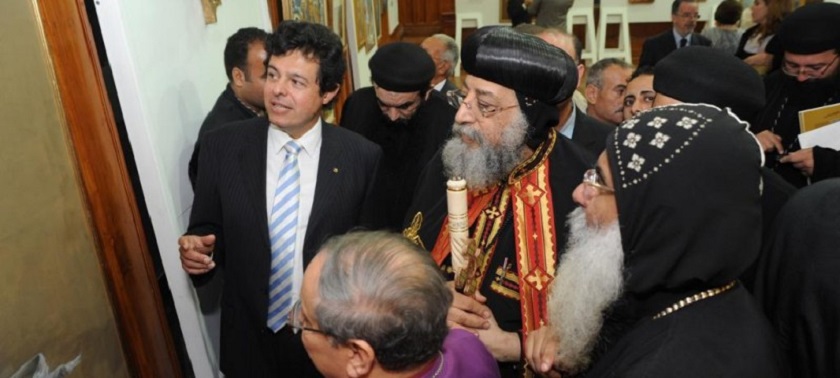
In a historic visit, Pope Tawadros II of the Coptic Orthodox Church inaugurated ‘The Way of Salvation: Exhibition of Christian Art,’ organized by the Anglican Church of Egypt as part of the celebrations of 75th anniversary of All Saints Cathedral. Eleven artists submitted 28 works of painting, sculpture, and relief to express the Christian message of salvation culminating in the death and resurrection of Jesus.
‘I truly appreciate the role played by art in spiritual meditation and inspiration of acts of good will,’ wrote Tawadros in the official program. ‘For this reason the church through the ages has encouraged all fields of art as an important tool to illustrate the stories of the Bible and the life of the saints.’
In his opening remarks, Bishop Mouneer Hanna of the Anglican Church honored the Orthodox as the ‘mother church’ of Egypt, and expressed his appreciation for the pope’s visit.
‘The pope believes in the unity of the churches, which Jesus prayed for,’ he said. ‘With his presence he emphasizes the spiritual work and the love between the churches.’
Since his consecration as pope in November 2012, Tawadros has sought to lessen tensions between Egyptian Christian denominations and publicly esteem their common faith. This was his first visit to the Anglican cathedral, and in March 2013 he attended the inauguration of Bishop Ibrahim Isaac as the new Coptic Catholic patriarch.
Rarely in history has the Coptic Orthodox pope visited other churches in Egypt, confirmed Fr. Bishouy Helmy, secretary-general of the Egypt Council of Churches.
‘This visit carries the values of an open mind and faith in ecumenical work with other churches,’ he said. ‘It also expresses appreciation and honor for the arts.’
Pope Tawadros spent over an hour in the exhibition, studying each piece and communicating with the artists.
‘Selecting the ten participating artists was done through a lot of prayer,’ wrote Dr. Farid Fadel, the exhibition’s curator and eleventh participant. Care was taken to ensure each artist would submit works that expressed the message of salvation, he said, as some artists belong to schools which desecrate holy subjects.
‘What you see today is the collective outcome of their labor of love.’
All Saint’s Cathedral in Zamalek will display the exhibition until 8 May 2014, 10:30am to 8pm
This article was originally published at the Anglican website. The opening photo is credited to the diocese.
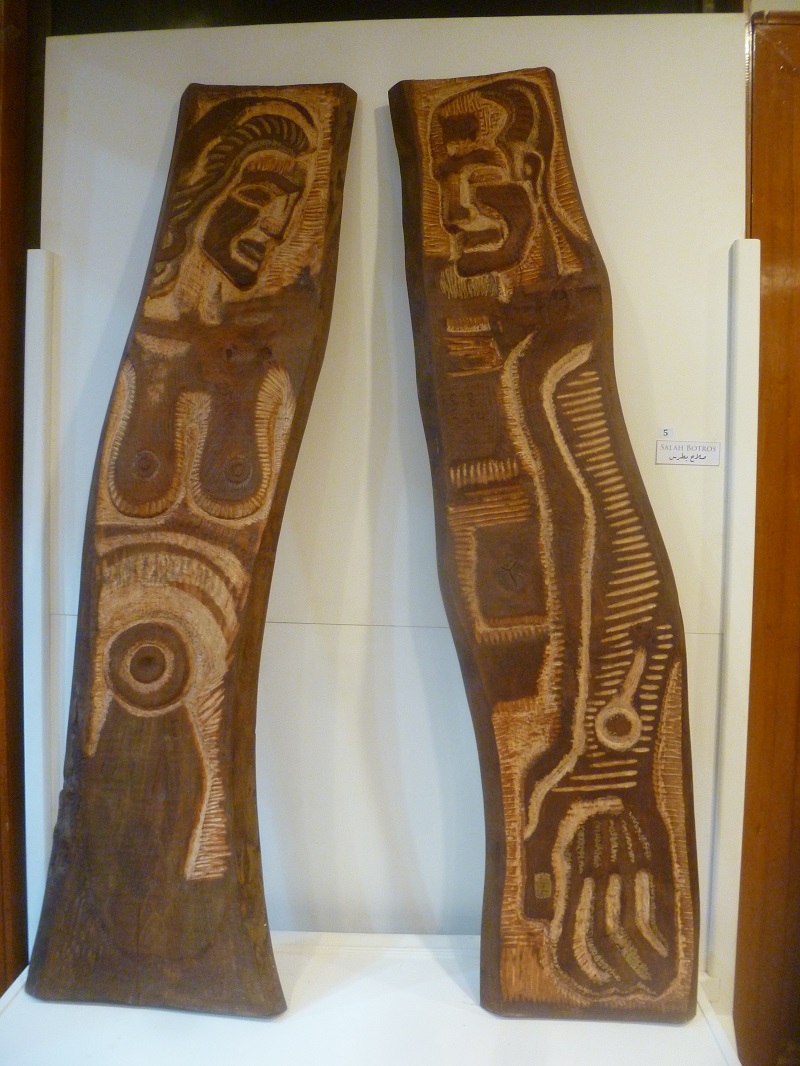
These were my favorite pieces from the show:
‘The Fall of Adam and Eve’, by Salah Botros‘Sinai, Holy Land’, by Gamal Lamie‘Born to be Crucified’, by Wagdy Habashy‘Cross of Shame’, by Nathan Doss
A friend of mine, a politically liberal Muslim with little attachment to religion, has often accused the Muslim Brotherhood of seeking to create a Protestant type of Islam. It is a little difficult to catch the connections, as well as to tell if he believes such a transformation would be good or bad for Egypt. He certainly thinks Brotherhood control of this situation would be bad, but I’m less sure as concerns the greater idea.
This article in The Immanent Frame helps explain what might have been happening along these lines, before the overthrow of Morsi.
First, the context of Islam in Egypt:
In this respect, the law and court rulings do not recognize the existence of a congregation of Muslims who can worship—that is, engage in formal rites—outside the bounds of the state. This legal status seems to be a vestige of the Islamic caliphate (دولة المسلمين, “state of Muslims”), where the congregation of Muslims was conceived as a politico-religious entity, as it first took shape under the leadership of the Prophet Muhammad. While this conception often accrues to the power and advantage of Muslims in the aggregate, it restricts the religious freedom of Muslim groups or individuals who do not wish to align themselves to the political or religious orientation of the political authority.
Post-Morsi, the state has been working diligently to reassert control over the system of mosques, seeking to eliminate divergent Muslim Brotherhood voices. Incidentally, the article states Morsi’s government treated unorthodox voices similarly, continuing the policy of preventing Shi’ite or some extreme Sufi trends from operating local mosques.
But the Muslim Brotherhood also wanted to cement its control over mosques already within its influence, and gain control over mosques that were not. To do so it revived an old government practice of establishing boards to administer mosque affairs, appointed by the state, but with no influence on its religious discourse or choice of imam. The government started this program in the 1980s for the practical reason of its limited resources for direct control, but abandoned it altogether a decade later due to arising conflicts and competition.
When the Brotherhood government assumed control of the Ministry of Endowments, reviving the role of the mosque boards was on the agenda of the Freedom and Justice Party (FJP), the Brotherhood’s political arm. Minister Talaat Afifi issued a decree reconstituting the boards under the name “mosque development boards,” giving them prerogatives similar to those of the old boards. The boards still had no influence over religious and preaching activity, which remained the exclusive purview of the ministry, but, controversially, the boards were to be elected.
In doing so, the Brotherhood established a system in which they could not be accused of appointing their cronies to administer mosques, but instead take advantage of their powerful network through which ‘the people’ would exercise control. But, who are the constituent ‘people’?
But how to determine which Muslims possessed the right to vote in elections for this or that board? The official decree stipulated that “a general assembly of mosque patrons” be created from among registered residents of the neighborhood in which the mosque was located, as well as those who applied to the ministry-appointed imam to affirm that they were regular attendees and registered as members of the general assembly.
Of course this move created a great deal of controversy and opposition, notably from the existing system of imams who saw the risk of their power diminishing. But there was a great religious objection as well, not tied to politics:
The decree also raised the hackles of imams and scholars who believed that it would give rise to local “churches” in Islam; churches have a discrete membership and members have certain prerogatives.
The decision to elect mosque development boards did not resolve the problem or mitigate conflicts, but only inflamed them further, partly because the idea was grafted on to a centralized administrative order and partly because it ran up against the idea of “every mosque for every Muslim”—a central tenet of Islam—making it “every mosque for every Muslim in this neighborhood.”
Morsi’s government suspended the decision to elect boards, and after his overthrow even the appointed boards were dissolved and reconstituted with traditional Azhar scholars and local patrons opposed to the Brotherhood. Politics is a determining factor, certainly, but the philosophical decision seems to have been correct, or at least consistent with traditional reasoning:
There is a traditional Islamic discourse that takes pride in the fact that there is no central religious authority in Islam—no church, no priesthood, no clerical class to govern the religious (and certainly not political) lives of Muslims. This discourse is well grounded in doctrine and Islamic jurisprudence, which indeed contain no reference to the specific shape of Muslims’ religious communities or clerical prerogatives. Historical practice also holds no precedents.
But to return to the central question about whether or not such a Protestantizing of Islam would be ‘good’ for Egypt:
The problem is that Islamic doctrine, jurisprudence, and historical practice do, in fact, both assume and fundamentally rely on the existence of a single Muslim polity with authority over Muslims’ religious affairs and the religious scholar class. The alternative is to abandon the Muslim state for a modern nation-state that fully embraces the concept of citizenship, which would entail the disappearance of political authority over religious affairs and open the door to religious freedom. Otherwise, the modern state will continue to draw on this legacy of religious authority inherited from the caliphate.
…
In engineering its policies for managing Islam, the state proceeds from the belief that Muslims’ religious unity is part and parcel of preserving political unity and the patriotic line, and it legally suppresses any activity or attempt on the part of Muslim groups or individuals to freely worship outside the bounds of the centralized state administration or beyond the scope of a centralized, religious orthodoxy described as “proper religion.”
Here in Egypt the Coptic Orthodox Church behaves similarly. A Christian is at home, theoretically, in one church building as he is in another. A man appointed deacon may show up in any church, don his robe, and join in serving communion. There is the thought in Christianity that the priest should only serve this communion to one who is in good standing – requiring local relationships to know – but this does not seem to be practiced. Instead, the confessional relationship may occur with a priest from any church, diocese, or monastery. The judgment of receiving communion is usually left to the conscience of the believer.
In majority Christian lands where the Protestant Church is established in relationship with the government, perhaps there is a parallel as well. But in America as well as Egypt the pattern is toward local independence with varying levels of denominational cooperation. The multitude of Protestant denominations certainly contributes, which is a phenomena not generally mirrored in Islam.
But Islam exhibits great diversity, certainly cultural diversity in its many international expressions. What it does not generally do is sanction this diversity as an option for local communities of Muslims. Outside the Muslim world it certainly exists, as mosques are established for minorities along lines of freedom given to churches, and generally funded by the community or by donations from abroad. Such freedom, however, is not extended by many Muslim states to their majority Muslim populations. In this, it seems, they follow not necessarily the rule of Muhammad, but the ideal practice of the faith current during his time.
And perhaps they dare not do otherwise, for equally historical reasons. After Muhammad the early caliphal period and afterwards witnessed an explosion of Muslim diversity that nearly tore the nascent state apart. Many of these movements were political in orientation, no matter how much religious piety and practice played a role. It took all the skill of ‘the rightly guided caliphs’ to hold things together, and the task fell to later jurists to shape sharia so as to allow a degree of diversity to law schools while maintaining the overall unity of the faith. It also fell to later caliphs to secure the support of scholars to maintain legitimacy for their rule. These processes evidence elements of manipulation and duplicity alongside sincere devotion to faith, a legacy that continues in the mosque-state relationship to this day.
Can it be developed differently along Protestant lines? Should it be? Perhaps the Muslim Brotherhood tried, and as in many of their efforts, failed. In a neutral environment, if such freedom existed, Muslim Brotherhood groups would gain control over certain mosques in certain neighborhoods – maybe many. But would the success of allowing full local control of mosques contribute to a greater climate of freedom, or simply initiate a religio-political anarchy that would tear government and society apart?
As with most experiments, all that awaits is the trying. Will Egypt, or similar nations succeeding the caliphal system, dare take the risk? Or is the very idea inimical to Islam altogether?
Please feel free to weigh in with your own ideas and experiences.











 Jayson Casper