Categories
Excerpts

Does Egypt Still Matter?

Egypt drawn on gray map.

As America under Trump re-determines its policies in the Middle East, the feelings of the region’s people matter very little. ‘Hearts and minds,’ sure, but cold-calculating interests generally rule geopolitical considerations.

All the same, I can imagine the Egyptian angst in reading this recommendation by the Hoover Institute for Washington to re-up its cooperation with Cairo. Most of the article is an essay in explanation of why Egypt no longer matters, at least in the manner it once did.

Does Egypt today still matter? Some in Washington have been arguing otherwise.

True, rights of passage through the Suez Canal are helpful and so are flights over Egyptian airspace, but the United States can survive without both. Egypt’s control of the Arab League is no longer as strong as in the past and in all cases the Arab League is irrelevant anyway.

Maintaining the peace treaty with Israel is in Egypt’s own interests and not dependent on U.S. support. Al Azhar holds no sway over the world’s Muslim population, and Egypt’s cultural decline leaves it with limited soft power capabilities over Arabic speaking peoples.

From Syria to Yemen and even in neighboring Libya, Egypt has lost its ability to impact its surroundings. Even regional allies are growing frustrated with Egypt and its president. Those in the Gulf dreaming of Egypt becoming a counterbalance to Iran are realizing the futility of their investments.

In all cases Egypt is increasingly deteriorating under the weight of its own troubles and Washington has no ability to change that.

So cut the cord? Absolutely not.

Is it time then for the United States to abandon Egypt? The answer is a resounding no.

It is precisely because of Egypt’s movement towards the regional abyss that the United States needs to reinvest in the American-Egyptian relationship. Egypt is no longer a regional player but rather a playing field where local, regional and international powers are in competition over the country’s future.

The country may no longer be a contestant for regional hegemony, but it is today the primary contested prize in a struggle over the region’s future. If the Westphalian order is to be defended in the Middle East amidst state collapse and the rise of Caliphate revivalist movements, this defense has to start with the most natural of the Arabic speaking states. With ninety two million people, a state collapse in Egypt would lead to a refugee crisis of historical proportions.

No one wants a Somalia on the Nile, a Libya on Israel’s borders, or a Syria in control of the Suez Canal, the United States least of all.

This would require a policy shift, oddly enough, away from the traditional cold-calculating interests of Camp David and the Suez Canal. Instead, the US must strengthen (read: prop up?) the state.

U.S. interests in Egypt are [in] … strengthening state institutions to make sure a regime collapse does not lead to a state collapse.

Instead of focusing on military cooperation, the United States needs to develop a new partnership with Egypt that addresses the growing terrorist threat in the country, the collapse of the rule of law, the failed economic policies, the educational vacuum, and the growing sectarian hatreds that threatens the fate of the Middle East’s largest Christian community.

If US banks can stomach a ‘too large to fail’ bailout strategy, why can’t Egypt? This is easy enough to imagine from an ocean away, but locally many liberal-leaning Egyptians feel US ‘assistance’ (read: interference) has been too much, not too little.

But at the same time, this type of Egyptian assesses the problem similarly. The state is weak, they say, the economy is faltering, and education is low on the totem pole of priorities. They imagine, perhaps rightly, that sectarian issues will dry up if these failings are addressed.

So calling it a ‘bailout’ likely isn’t right. It is a call to strengthen a weakened longstanding partner, in a manner that moves beyond one or two points of American national interest.

So how to cooperate? The article referenced is meant to persuade Americans, not Egyptians. But in Cairo the tone taken risks being tone-deaf to local pride, let alone a legacy of bilateral mistrust.

Perhaps Trump, with his shock-value strategy of resetting all relations, can change that. And as stated earlier ‘feelings’ don’t matter. That’s good, because Trump puts little stock in the value of tactful rhetoric.

Just don’t imagine Egypt will be happy about it. ‘You matter because you’re a headache’ is an insult not an encouragement. The author, who identifies himself as a ‘native son of the land’, can swallow it.

I suspect few other Egyptians can do so readily. If America wishes to pursue this policy, it calls for a task even greater than the discredited ‘nation-building’ efforts seen elsewhere.

It calls for culture-influencing. And that requires real mutuality and engagement, much of it without control. Culture requires freedom, and freedom requires trust.

Whether or not Egypt warrants these in US policy eyes is one thing. Whether or not Trump’s ‘America first’ can prioritize it is another.

Egypt matters. So does every other nation and people. How any state relates to another is an indication of national character. Whatever policy chosen — and diplomats must be nimble — may both America and Egypt prove worthy.
Categories
Americas Christianity Today Published Articles

What Arab Church Leaders Think of Trump Prioritizing Persecuted Christian Refugees

qaraqosh-christians
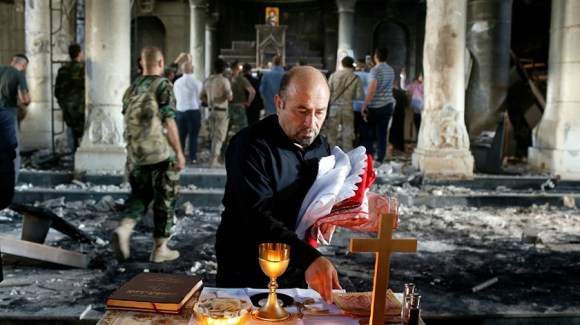
Ahmed Jadallah / Reuters Preparation for Qaraqosh’s first Sunday mass since the Iraqi Christian town was recaptured from ISIS (October 30, 2016).

This article was first published at Christianity Today on January 30, 2017.

Married in December to a Syrian woman with American citizenship, Fadi Hallisso went to Beirut to apply for a green card.

A Syrian Christian, Hallisso has worked with refugees in Lebanon since 2012. Funded by different American agencies, he was no stranger to the US government. He even testified about the situation in Syria to the US State Department and to Harvard Divinity School.

But this week, Hallisso was told he was no longer welcome to apply. The new US administration said so.

“It is very humiliating to be put in the category of potential terrorist,” said Hallisso. “Just because I carry a certain passport.”

As more details of President Donald Trump’s new security policies emerge—including a promise to prioritize Christian refugees for resettlement in America—much appears lost in translation.

“This executive order has created a new atmosphere very hostile to people in the region,” said Chawkat Moucarry, World Vision’s director for interfaith relations—and Hallisso’s uncle. “Unwritten rules seem to be implemented as a result.”

Is Trump’s executive order on refugees a de facto “Muslim ban”? Is it not? Is it prudent? Is it overdue? As American Christians debate these questions from the small towns of Middle America to the nation’s major airports, so also Arab Christians are trying to figure out what is going on.

“I read the executive order,” said Adeeb Awad, chief editor of al-Nashra, the monthly magazine of the Presbyterian Synod of Syria and Lebanon. He remarked…

Please click here to read the full article at Christianity Today.

Categories
Prayers

Friday Prayers for Egypt: Trumping Protest

Flag Cross Quran

God,

Bless the president-to-be of the United States of America. May he govern wisely. May he engage Egypt well.

But though many are troubled in America at his arrival, many in Egypt welcome his opposition to the Brotherhood and his favor expressed toward Sisi.

And he comes at a moment when many in Egypt are troubled. An inflationary economy. A protest threatened.

A protest fizzled. A few answered mostly anonymous calls to fill the squares and overthrow the government. They were quickly subdued.

Among political forces only the Brotherhood endorsed the effort. The streets fell silent, save for the bustle of those who went about their business.

Issues remain, God, though an IMF cash infusion has been approved. May it begin to restore equilibrium, starting with those who need it most.

Until then, God, help many make due. Give them voice, that they might help shape policy.

And give wisdom to Trump, by whom so many in the world will now be affected. May America, and Egypt, to all be a blessing.

Amen.


Categories
Excerpts

Trump, Clinton, and Egypt

Trump Egypt
(via http://www.businessinsider.com/donald-trump-ben-carson-pyramids-grain-2015-11)

We are often asked what Egyptians think about current American politics and the presidential race. Our answer tends to fall into these categories:

  • Many hate Hillary Clinton due to her support for the Brotherhood.
  • Many think it doesn’t matter because US foreign policy never changes.
  • Many see in Donald Trump an American version of Middle Eastern demagogues.

This al-Monitor article provides a nice first preview, focusing on the views of certain political and business elites. As such, our category three is missing. But it is often helpful, and at the least entertaining, to see how they see us.

Here are a few excerpts:

Trump’s position on the Brotherhood has led to some voicing their support for him in Egypt, most notably well-known billionaire businessman Naguib Sawiris. In June, Sawiris confirmed that he backs Trump because, in his view, Clinton supports the Brotherhood.

During an interview with Al-Monitor, former Egyptian Foreign Minister Nabil Fahmy responded to a question about which candidate would be better for achieving cooperation with Egypt by saying, “The rhetoric adopted by US presidential candidate Donald Trump vis-a-vis Islam and Muslims is unacceptable and greatly offensive. On the other hand, Hillary Clinton carefully chooses her words and is a ‘veteran politician,’ with all the positive and negative connotations associated with such a characterization.”

Former deputy Foreign Minister Gamal Bayoumi said, “In superpowers like the United States, the president operates according to general policies set by state institutions and forces that have influence in political life. While the president may play a role in changing the approach, the policies remain fixed.”

In statements to Egyptian daily El-Balad June 9, Cairo’s former Ambassador in Washington Abdel Raouf El Reedy said that, overall, Clinton would be the better president for Egypt, despite her having what he called some unfavorable positions on Egypt and the Arab world. He noted that Clinton’s policies on Egypt and the Arabs would be an extension of Obama’s current policies, while attempting to avoid a repeat of the current president’s mistakes.

More testimony is needed, but will any of these voices sway your vote?

Categories
Excerpts

Muslims are not Islam is not Muslims

Muslims Not Islam
(from https://www.youtube.com/watch?v=II42IpzskRI)

From an article at the Zwemer Center, written by a philosopher fed up with popular coverage of Muslim issues:

One philosophical distinction that may help navigate this discussion is between essentialism and nominalism.

Don’t stop reading, he makes it simpler, distinguishing between Islamic religiosity and Muslim religiosity. Ok, that still sounds complicated, but here is the test to see if a pundit weighs forth well on Islam:

  1. Give an account of what the authoritative texts seem to say about a given issue. Quote them as they are without resorting to interpretation.

  2. Describe the various interpretations offered by individual Muslims and groups of Muslims through time.

Failing to take step #1 results in ignoring the authoritative primary sources of authority for Muslims. Failing to take step #2 results in ignoring the history of interpretation of those primary sources of authority and the rich diversity among Muslims on issues.

Still hard for the non-specialist? Yes, I presume so. So here are the crib notes on how each side of the US media spectrum fails (with a special shout-out to you-can-guess-who):

Failing to take step #1 results in understanding Muslim thought as a mere form of individual or cultural relativism, which it isn’t. Now when MSNBC ignores step #1, you can fault them.

Failing to take step #2 results in forming gross generalizations that perpetuate ignorance and prejudice. Now when FOX News or Donald Trump ignore step #2, you can fault them.

Actually, both MSNBC and FOX News fail on both counts, as do many, if not most, of our politicians.

Allow me to take the issue from media analysis to personal kindness and broadminded generosity. Grant Muslims the dignity of belonging to an ancient tradition they strive to navigate in diverse ways. And grant Islam the dignity of diverse followers who cannot be reduced to a single interpretation.

Criticize both freely, as necessary. But do not reduce one to the other. Our identities are true, but they do not define us. Our religions posit truth, but we do not define them. This is as true of Muslims as anyone else.

Should this last thought grow too philosophical, the author reminds us even the professional ones know how to make fun of themselves:

If the distinction doesn’t help you, then chalk it up to another example of confusion about what a philosopher does and still one more example of wondering why anyone in the world would want to do what we do.

Have a wonderful day, once you have set forth the necessary and sufficient conditions for what it means to ‘have a day’ and what could possibly be the conditions for it to be ‘wonderful’.

Smile, but take his words seriously. America, hopefully in correctable ignorance, is taking a dangerous path.


Categories
Excerpts

Trump is the New…

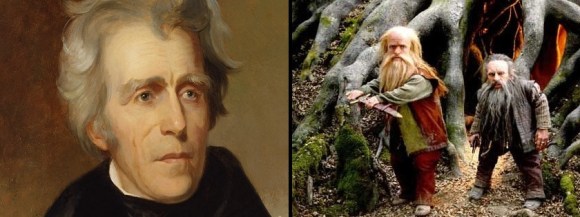
Andrew Jackson Nikabrik TrumpIdentifying the alter ego of the front-running Republican candidate appears to be American’s favorite parlor game these days. An early winner is Adolph Hitler, with Benito Mussolini making a late charge. I have even seen some suggest Jesus.

But here are two more insightful comparisons.

T. Greer goes back in American history to find the first populist candidate to upset the establishment:

In truth, we do not need to look to foreign climes to understand Trumpism. Donald Trump is not America’s Hitler. Donald Trump is the 21st century’s Andrew Jackson.

Like Trump, Andrew Jackson ran for office at a time when an entrenched political aristocracy had controlled the American political system for decades.

Like Trump, Jackson’s supporters had lost their faith in this system and felt utterly isolated from its ruling class.

As with Trump, Jackson was a fantastically well off in comparison to the average American, but still a considered a complete outsider in elite circles because he was crass, rude, vulgar, and stupid–in other words, a joke, someone not to be taken seriously until it was too late.

Like Trump, Jackson’s success was built upon getting the people who the existing system excluded or ignored engaged in politics in a way they had not been their entire lives. In both cases these people tended to be less educated, not too well off, and of Scots-Irish descent.

Like Trump, Jackson was a nativist, a nationalist, and fairly racist. Both are in essence majoritarians, and their policy is to materially improve the livelihoods of the majority demographic, even if that comes at the expense of other groups.

Like Trump, Jackson used these voters to hijack a party coalition traditionally associated with limited government; like Trump, Jackson paid lip service to this philosophy (and sometimes, as with the banks, acted on his words) but possessed a temperament that put him at odds with it.

Like Trump, Jackson did not have a firm grasp of all the issues at hand on the campaign trail (compared to his opponents, who were quite wonkish), and had a pronounced tendency to personalize all political disputes.

Like Trump, this was one of his greatest selling points with the public: Jackson was someone who spoke as a common man did while being greater than any common man was. He “told it like it is.” Both understood the media technology and news cycles of their time, and took advantage of them in novel ways to “tell it like it is” to far more people than his opponents thoughts possible. You could say that Jackson, like Trump, pioneered a new style of campaigning. By doing so he quickly learned how to outmaneuver his political opponents into oblivion.

Like Trump, attacks that came against Jackson in response only seemed to make him stronger, and like Trump, most of these attacks were focused less on his ideas–which were always rather nebulously defined on the campaign trail, painted in broad strokes, so to speak–than against his character, especially his (or his family’s) alleged lechery, gaudiness, stupidity, or savagery.

I could go on, but you get the point.

Greer continues to compare the two eras to imagine what America might expect from a Trump presidency. In short, populism is a corrective for a political establishment that has fallen out of touch with a great part of the electorate. But the presidency is a much more powerful institution than it used to be, so the curbs on Jackson’s power may not restrain Trump as effectively.

In the second comparison, Gina Dalfonzo leaves history and enters fiction. Fans of C. S. Lewis may appreciate her warning, imagining Trump to be supported by Nikabrik:

In the story, you may remember, Narnia is in a desperate situation. The Telmarines have taken over, and the citizens of Narnia have been persecuted, silenced, and driven into hiding. When Prince Caspian—a Telmarine himself, but one who sympathizes with the Narnian cause—joins forces with them, this leads to a fresh round of attacks from the other Telmarines and their king, Miraz. The Narnians try to summon help by using Queen Susan’s horn—and they are successful, though not all of them realize it right away.

Drawn to Narnia by the call of the horn, Peter and Edmund and their guide, the dwarf Trumpkin, come upon a handful of Narnians meeting with Prince Caspian. Nikabrik, another dwarf, is angry that apparently no help has come from Aslan or the old kings and queens of Narnia. While others argue that “help will come” if they can wait patiently, Nikabrik contends that there is no time to wait: They are running out of food and reinforcements.

If Aslan won’t help, Nikabrik adds, perhaps another power will:

“The stories tell of other powers besides the ancient Kings and Queens. How if we could call them up?”
“Who do you mean?” said Caspian at last.
“I mean a power so much greater than Aslan’s that it held Narnia spellbound for years and years, if the stories are true.”
“The White Witch!” cried three voices all at once. . . .

This, of course, is the same Witch who killed Aslan in The Lion, the Witch, and the Wardrobe. Nikabrik has already gone so far as to recruit a sorceress to raise the Witch from the dead. But the others are horrified—so horrified that a battle ensues, joined by the Pevensies and Trumpkin. By the time it’s over, Nikabrik and his allies are dead themselves.

How could one of the good guys in this story become corrupt enough to seek help from someone whose greed, brutality, and lust for power were legendary? As Lewis well knew, it can happen more easily and quickly than one might think. It’s been happening throughout history, ever since the first time the Israelites turned to a godless nation for help instead of trusting God to save them.

One can make a case that it’s happening right now within the conservative movement in the United States.

The article does not chastise Nikabrik unduly. He has admirable characteristics and noble sentiments. But fear and concern for one’s own can blind human nature to a multitude of faults, if packaged as an answer to set things right.

These are not the only comparisons out there, but rather than engaging in the dismissive accusation of fascism, consider also these critiques on the presumptive red state candidate.