When it comes to Egyptian education and Islam, Christiane Paulus is both a critic and supporter. So much so, she adopted both.
Paulus is a German national, resident in Egypt since 1998. She is currently a professor of Islamic studies and Protestant theology at the Azhar University, through the medium of the German language. Her journey here is a story all its own.
Paulus studied Protestant theology and postmodern philosophy in Marburg, Germany, with the intention of becoming a Lutheran minister. But in 1988, before her final tests, she married her husband, an Egyptian Muslim. Unless he converted to Christianity, the church ruled she could not receive her preaching license, as both spouses needed to be of the faith.
Years thereafter Paulus remained in her Christian faith, even after moving to Egypt with her family.
Paulus does describe what she finds are the culturally derived faults of the Egyptian education system, with consequences falling directly on religious and political relations:
Dialogue, Paulus believes, is a subject of the social sciences – a discipline largely ignored in Egyptian education. Curriculum, methodology, and pedagogy have remained stagnant since the Nasser era, when a resistance to new ideas was the norm. Since then, however, both students and teachers have sought to escape the system. At the basic level this involves the reliance on private tutors; for those able it means enrollment in private or foreign schools.
Women, she noted, are in general educated relationally. This equips them for dialogue more readily than men. But in addition to educational lacking, the Egyptian culture is bound by concepts of honor and shame. Together with pride, this produces an atmosphere of ‘not talking’. An Upper Egyptian husband, for example, will ignore his wife and stay silent with her when upset. Outside the family, discord produces the same result. The first casualty of Egypt’s political division is a lack of communication between liberals and Islamists.
But her focus in presentation was on what drew her to Islam as a religion. Much of this was due to the influence of her husband and his family, but it was also from historical study:
In 2005 Paulus read a book by the Egyptian Muslim theologian Amin al-Kholy, an active intellectual in the early 20th Century. ‘Islam and the Connection to Christian Reform’ summarized his presentation on the Protestant Reformation, representing the Azhar at the 1935 Brussels conference on the religious sciences.
Kholy noted that the early Protestant reformers – prior to Luther – emerged from areas long occupied by Muslims. From Spain under the Reconquista, Lyon, and Monaco, figures such as Peter Waldus and William of Ockham adopted ideas originating in Islam, translated them into Latin, and began applying them to criticize European Catholic Christianity. The Muslim populations of these areas had been forcibly converted into Christianity but retained their Islamic beliefs in secret. A few centuries later, Islamic-cum-Protestant ideas such as no mediation between man and God, private reading of the Scriptures, and clerical marriage began to take hold.
But she remains critical of prevalent Islamic thinking as well, which generally leaves their received religious heritage unquestioned:
Of course, a great deal of irrationality has entered the Muslim world, too. Where education is lacking the religious discourse takes over everything. Contrary to the prevailing religious spirit, Paulus says each individual Muslim has the right to read and evaluate Islam’s religious sources – the Qur’an and Hadith – weighing their value. The condition is to keep the Islamic culture of discussion respectful, objective, and academic.
This individuality also comes out in Paulus’ decision not to wear a headscarf.
Paulus is a charming person who is clearly a deep and sensitive thinker. Her testimony was given in a presentation with brief time for questions and answers; otherwise, it would have been useful to probe many of her arguments further. Please click here to discover them by reading the whole article on Arab West Report, and here for an Arabic language article on Paulus.
But less interesting than arguments is the story of an individual human being, seeking to make sense of the world. Tomorrow I hope to post a link to another recent article I have written, this time in the other direction.
From my new article on Christianity Today, published December 28, 2012:
Egyptian Christians spent this year’s Advent season awaiting more than the celebration of Jesus’ birth. Christmas Day dawned with Copts still processing the rushed passage of a new Islamist-backed constitution and its implications.
Days before voting began on the hastily completed charter—which, despite only 33 percent turnout and accusations of fraud, passed December 25 with 64 percent of the vote—more than 10,000 Christians gathered at an interdenominational prayer vigil in Cairo’s famous “Cave Church.”
Please click here and here for more information about this prayer gathering. But the article continues:
“Morsi has not kept his promises to be a president for all Egyptians when he had a chance to do so, and he is losing credibility,” said Ramez Atallah, president of the Bible Society of Egypt. “When the leader is not working for consensus, it makes it very hard for anyone else to do so.”
Yet Atallah still advises Christians to remain politically active while grounding their expectations in the necessary dual perspective of Christianity.
“We must be good citizens,” he said. “This panic is not justified in our faith, even if it may be justified in terms of politics.
And here is a section on liberal ‘hope’ for political reversal in the midst of anticipated economic difficulty:
But as liberals have consistently failed to win at the polls, some place a morose hope in Egypt’s expected financial difficulties to aid their parliamentary campaign.
“There is an economic disaster coming,” said Michael Nabil, an Egyptian accountant. Since the revolution, Egypt has lost more than half of its foreign currency reserve fighting inflation and devaluation. “This will affect the situation negatively for the Muslim Brotherhood and give the opposition more credibility,” he said.
I had hoped to write this week’s Friday Prayers for Egypt about the economy, but was unable to. Perhaps after the climax of the constitution nothing this week seemed so urgent for prayer. That is not true, of course, but like many in Egypt, I feel somewhat drained, and this week was a week of recovery. Western Christmas celebrations helped.
The main issue for the prayers would have been the feared coming economic collapse. It may well happen, but is also tinged with manipulative rumors that seem almost designed to produce a panic.
Finally, a quote on what seems a very proper perspective for Egyptian Christians:
“There is no connection to political stability and the success of the gospel,” said Atallah. “In fact, the opposite might be true: People depend more on God in difficult times.”Maybe God will use the Muslim Brotherhood to do his will in Egypt, even if we don’t want them to be in charge,” he said.
Please click here to read the entire article on Christianity Today.
From the Peace Fountain and Biblical Garden, New York City
I would honestly say that if I could choose a religion, I would choose Christianity and its ideal of universal acceptance, love, and forgiveness. It is all so beautiful. It is just so unfortunate that the history of Christianity has nothing to do with these ideas.
Eyad Sarraj, head of the Gaza Community Mental Health Program and of the Palestinian Independent Commission for Citizens’ Rights
This quote comes from a book I have been reading, entitled ‘The Body and the Blood’, which I referenced once before in this post, concerning Palestinian refugees and the ‘right of return’. The book is a journalistic account of the exodus of Christians from the Middle East, focusing on Palestine. When I finish I hope to write a short book review, but for now, I will only highly recommend it.
One of the author’s themes highlights that the Middle East has witnessed violence upon violence, in the form of Israeli occupation, Muslim resistance, and terrorism. Yet while Christians have also at times joined in the violence, their religion’s focus on nonviolence could potentially equip this minority to assume a role of peace, either in highlighting the injustice of occupation, or in rebuking the assault upon it through stones, suicide bombers, and rocket fire. Yet the Christian exodus from the area not only removes this voice from the equation, it also allows for popular Western definition of the struggle as between Muslims and Jews, in which both get dismissed as the problem then appears both foreign and intractable.
The above quote means to put the issue of nonviolence before the Western Christian audience. Not for Palestine per se, but for world history and current Christian attitudes. Eyad Sarraj is introduced as a secular Muslim from a deeply religious family. Conversion is not an issue as the entrenched religious lines of Palestine do not allow for movement between faiths, certainly not toward Christianity, and in any case as a secular individual he might not see religion as an important personal matter. The issue is his perception. Within his Islamic heritage and Palestinian politics he speaks boldly about the beauty of the Christian message. Unfortunately, he does not see its historic reality.
May the question be asked: What would have to change in order to change his perception?
Without pretending that Western governments represent Christian values, should Christians better pressure their governments according to nonviolent principles? What might this do to world affairs? What might it do for the Christian message? What kind of nonviolence is intended? What are its limits? Does nonviolence as a principle apply to groups as opposed to individuals? Does it apply to nations?
The author highlights that Jesus’ principle of ‘turn the other cheek’ is often misunderstood. Rather than passive acceptance of violence, it is an assertion of equality. To strike the right cheek, as the gospel emphasizes, requires a backhand slap from the aggressor’s right hand. In the culture of the time, this was a great insult. It was punishable by law if administered to an equal, but legally permissible if targeting an inferior. Jesus’ teaching says to turn to him the left cheek, in order to receive a proper blow. The invitation is to be struck as an equal, yet all the while not returning the violence.
If this interpretation is correct, it forces reevaluation of Jesus’ teaching of nonviolence, but also removes the popular notion that is it ethereal and hopelessly pious. It may yet be foolish, but it becomes foolishness with a purpose. It is a foolishness from utter strength, no matter how much it forsakes the worldly use of strength.
Yet what does this interpretation say to the one who possesses strength in the worldly sense? This is the position of most Western nations, and many Western Christians. Perhaps it is only to note that Jesus does not address these, at least in this passage. His interests lie elsewhere. They lie with the suffering and oppressed. Interestingly, his message is not to rebel, but it is to resist the status quo of their position. It is to stand strong.
Certainly Jesus would care for all, the strong and the mighty among them. Yet may the contemplation of these questions, regardless of where the answers lie, help Christians evaluate with whom they stand. Where Christians exist among the strong, may they exercise this strength on behalf of those not yet standing.
The aftermath of the January 25 Revolution has brought unprecedented hope to all Egyptians, including Christians, but has also resulted in significant challenges. One of the chief challenges has been navigating the increasing incidences of sectarian tension. From one angle, the spirit of Tahrir Square is still evident, as people extol that Muslims and Christians are ‘one hand’; from another, violence has targeted Christian locations. Egyptian Christians have been caught between these two realities, and many are losing heart.
Losing heart, however, is the absolute wrong response, according to Fr. Eliya, a Coptic Orthodox priest of Sts. Mina and Augustus Church, in Dar al-Salaam, Cairo. He outlined a checklist of activity that Egyptian Christians must undertake, in order to live properly after the revolution. Like most Egyptians, Christians were confined to a passive role under the Mubarak regime. This posture must change, and these are the actions that will help change it:
1) Pray.
The first and foremost responsibility for a Christian, prayer has power to change realities. The priest spoke that Christians must pray boldly, as did the New Testament church, whose prayers freed Peter from prison, and as did the medieval Copts, whose prayers split Muqattam Mountain in Cairo, demonstrating the power of the Gospel to the oppressive caliph.
2) Allow anger.
But in your anger, do not sin. Many acts of aggression have been suffered by Copts since the revolution; anger is an appropriate response. Yet instead of anger leading to frustration, violence, and loss of hope, it must be channeled. From anger Christians must demand their rights, but if done in anger they risk transgressing both Christian and social bounds.
3) Dialogue.
This must be at all levels, but especially with reasonable and moderate Muslims in order to establish common bonds. Furthermore, it must be with the rulers, so these have contact with the Christian community and know its concerns. Too often it is assumed dialogue falls on deaf ears, or does not result in significant change. Perhaps, but this attitude is self-defeating if the effort is not made.
4) Participate.
Under Mubarak, Christians had largely taken cover – socially and politically – under the protection of the church, allowing it to represent them. It is now required that individual Christians emerge from that seclusion and participate in society. They must join political parties and vote in elections. They must be viable citizens. After all, other Egyptians are doing so; their negative inertia risks them being left behind.
5) Be optimistic.
Many Christians look around them at the political situation, and fear the worst. These fears are legitimate legal concerns, but Christians spot the wrong mark. It is not the progress of democracy in which hope is placed, but the sovereignty of God. God is preparing the best future for the church, which may well be greater democracy and freedom, but may also be greater suffering. The personal attitude of each Christian must be positive, reflecting faith in God’s goodness, no matter which way his will leads them.
6) Expel fear.
While fear is natural, it can also be binding. Unsure of the new path to tread, many Christians seem troubled. Yet the Bible says perfect love drives out fear, and this is necessary for Christians to move wholeheartedly in society. Those wreaking havoc in society toward Christians desire to drive them back into the walls of the church, to find safety there. Christians overcame fear to join the revolution and come out from the walls; they must still overcome fear in order to stay there.
7) Be aware.
Fear should not be combated in naïve belief there are no threats. Rather, some do wish to harm national unity. This is not the vast majority, but even those who do are not the enemy; Satan is. Yet the devil’s schemes move against the church and Christians must be vigilant to stand against them.
8) Meditate.
The above actions reflect spiritual truths, as well as socio-political ones. The spiritual health required for implementation, however, must be nurtured. Within their difficult circumstances, Christians must reflect on God’s character and their own faith needs. The deliberate practice of meditation will strengthen Christians for the challenges ahead.
9) Change.
Some Christians have bad habits, including a negative attitude toward Muslims in general. One specific change is simply to exercise caution in how they feed their mind. While Egyptian Christian satellite channels highlight Coptic concerns in a moderate way, many foreign channels broadcast in Egypt enflame tensions and reinforce stereotypes. Avoid these; do not let the mind be poisoned.
10) Be prepared.
Ultimately, this is for the possibility of martyrdom. The Egyptian church celebrates its history of accepting death for the sake of faith, and modern Christians must not shrink back from the possibility. Yet while this attitude must be present, it should not be foremost. Rather, Christians must consider, if they are to die, they should die having lived correctly.
This checklist does not represent simple spiritual theorizing; it is the message the priest has been preaching to his flock. Whether or not it takes hold is up to his congregation, and beyond them, the Christian community of Egypt. Many points apply equally to Muslims. In times of trouble, there can be a tendency to find hope and comfort in one’s religion. While this may increase religious identity and fervor, it can also divide and isolate. The hope of this list is that the opposite occurs. In this specific case, Christian faith must drive the individual closer, not only to God, but also to society. In post-revolution Egypt, this seems the solution necessary for all.
For an introductory essay to this text, please click here.
On August 19, 2010 AWR interviewed Dr. Rafik Habib, an Egyptian Christian scholar who has devoted his research to the realm of Christianity and Islam contemplating on Muslim-Christian relations, Islamic civilization, and the role of the state in the Egyptian society.
Dr. Rafik Habib was born in 1959 in Minya, Upper Egypt, into the family of Samuel Habib, an evangelical pastor who later became the President of the Evangelical Denomination in Egypt (1980-1997). Dr. Habib refers to himself as an ordinary Christian who came to Cairo to attend ‘Ain Shams University after finishing his secondary education in his hometown. He obtained a masters degree in psychology (1985) and later a PhD in the same field (1988). During his studies Dr. Habib researched significant issues in the Christian community, and later published Psychology of Religiosity for Copts in Egypt. He has since published over twenty other titles. Despite this, though he sought work in a university or academic research center such as al-Ahram, he was never accepted. Many suggested that it was due to the fact that he is a Christian. But, Dr. Habib is of a contrary opinion:
I found it to be a matter of social relationships. To have someone support you in this kind of issue is more important, in many cases, than if I am a Christian or a Muslim.
Dr. Rafiq Habib has been influenced by his family, as he himself acknowledges, and his father was a leading evangelical personality in Egypt at that time. Nonetheless, he is well-known for his ideological affiliation with the Muslim Brotherhood, an entirely Muslim organization.
Dr. Habib has never attempted to join the organization, nor would he be able to, but his adherence to its ideas led him to join the Wasat Party, a political organization based on the moderate ideas of the Muslim Brotherhood. As he points out, religious movements (be they Islamic or Christian) are exclusive to their denomination, but organizations working at the political or social level should be open for anyone.
Yet being a Christian and a scholar, he has sought out dialogue with the political Islamists. Dr. Habib has been interacting with the Muslim Brotherhood, al-Jama’a al-Islamyyia, and other Muslim groups since 1989. His has primarily involved himself with the peaceful groups, but has also received criticism for engaging with violent entities. He is quick to distinguish nuances:
At that time, it is important to notice that this organization (Islamic Jihad) was violent, when they murdered Anwar Sadat. But after that, they continued to be a preaching organization with a militant wing, a very weak one. (…) You could meet a member in al-Jama’a al-Islamyyia, who is not a militant. (…) In my opinion al-Jihad was a revolutionary organization from its basis, but al-Jama’a al-Islamyyia is in its basis a preaching group in its organization.
Nevertheless, Dr. Habib maintains that for a researcher is important to learn about the different groups, even those that are militant. Dialogue, however, is not possible with militant personalities, only with those who are peaceful within a militant organization. According to Dr. Habib, extremists reject dialogue altogether, making them inaccessible.
Who are the extremists? What is extremism for Dr. Habib?
Dr. Habib finds this difficult to answer as the term is drawn from western definition. Nevertheless, he asserts that extremism is not a permanent condition but a temporary phenomenon. In his opinion, most of the Islamic movements are becoming more moderate. But,
(Extremism is a) part of the Islamic project, where some make the most clear-cut points; all issues are white and black, even the values and variables. (…) Similarly some take a clear-cut position towards Christians, thinking the Islamic society is for Muslims only. For these, Christians can be present in an Islamic state, but only within their Christian community subsumed by Islamic society, not as a part of Islamic society.
How do Christians have a place in Islamic society? Dr. Habib offers his perspective based on his doctoral study of the national character of the Egyptian society. He maintains that Egypt is a part of Islamic culture and civilization, which is in fact a continuation of Pharaonic culture and civilization. Religion (first Christianity, later Islam) did not destroy the ancient culture, but rather reshaped it. Therefore, he argues that:
I think that the national character, culture, and values of the Christians in Egypt are similar to that of the Muslims, and I found that Christians themselves belong to the Islamic character and culture of Egypt. Muslims and Christians have the same national character and identity.
Based on the argument that Muslims and Christians in Egypt share the same national identity Dr. Habib believes that:
We can have a chance in the future for Christians and Muslims to discover their shared values and rebuild the Islamic culture together.
Nowadays, their mutual relations are negatively affected by developments of the 1970s. Dr. Habib argues that at the time of Anwar Sadat Egyptian society began to dissolve. Both communities began to develop separate religious identities leading to the enclosure of Christian community within the Church and to the establishment of numerous Islamic movements. These communities preferred their particular religious identity (Muslim or Christian) over the prior Islamic-Egyptian cultural identity. According to Dr. Habib, the separation of the communities happened because the state was unable to represent both Christians and Muslims in the same value system. Instead the state pushed a secular agenda foreign to both religious groups.
In order to restore the previous order – to bridge both communities again – Dr. Habib suggests a controversial idea:
The Egyptian society will continue to be an Islamic society and the Christians must return to their conservative identity and join it in one identity as happened before. If we go back 50 years, the whole society looked conservative and very Islamic, though the Christians were a little cautious of the Islamic identity. But if we go more than 100 years back, we find that Christians were unified with the Islamic society under Islamic Sharia and under the Islamic state and there was no problem.
Dr. Habib identifies the main obstacles to such a return as the secular nature of the state, the pressure from Western countries to secularize further, and the Christian community that wants to protect itself under secularization.
The core idea of Dr. Habib theory is that the revival of Islamic state would bridge the communities again. Originally, the Muslim Brotherhood aimed to restore the Islamic state following the end of Ottoman caliphate and the establishment of an imposed secular nation-state model. Dr. Habib argues that the secular state model did not reflect the religiosity of the society which rebelled against it. The Brotherhood rallied such opposition, but was double crossed:
The Nasserists came to the power with the support of the Muslim Brotherhood. It turned out to be a historical mistake, when they supported Gamal Abdel Nasser. Because after he took power with their support, he said I am not building an Islamic state.
Nasser introduced instead his own nationalistic vision of Arabism that was, to some extent, related to Islamism, in that Arabic identity can shelter both Christian and Muslim identity. The development of Arabism was, however, stopped by the 1967 defeat to Israel. The Six Day War significantly challenged the existing societal and political order in Egypt, initiating deep consequences:
When you’re defeated you return back to your deep, deep identity, and try to protect yourself inside the protection-point: your identity and social consciousness. And, the strong protection-point in our society is the religion. Then both Christians and Muslims returned back to their religions.
Dr. Habib provides an example of the daily routine at the universities in the 1970s:
If you entered a classroom, there was a special place for Christians guarded by members of the “Coptic Family” and for Muslims guarded by the “Religious Group”. But there was no conflict or violence between them; it came spontaneously. The different societies wanted to feel secure, and they turned to religion.
Therefore, Dr. Habib maintains that in order to bridge the communities again, it is necessary to return to the Islamic culture, value system, and civilization as the identity of the society, as both Christian and Muslim values in Egypt have been shaped by the same surroundings. Dr. Habib argues that these conservative religious values are embodied in the Egyptian society and therefore the existing project of the secular nation-state is failing. To succeed, the state must reflect the value system of the society which it is not the case in Egypt:
I think that this model (the secular nation-state) will not work in Egypt or in other Arabic countries, because it depends on the power of law, whereas society depends on the power of religion, which means the power of morals. If you want to organize society by the power of law, the society will not obey it. (…) All society thinks of the state as an enemy, because the state will not accept the societal identity; the state is meaning of law. (…) There is no reason for Egyptian Arab Muslims to obey the secular state, because the reason which is to be found in Western countries is not here. Western societies obey the state instead of the church. They obey the state, because it is the way of progression, and they think that if they obey the church, they will not progress.
Dr. Habib’s argument is based on the significant role religion plays in the societal order. He assumes that:
If the state obeys religion, then the people will obey the state. Because people will always obey the religion in their life, they will not obey anything other than religion, and if you want them to obey the state the state must obey the religion.
Conversely, if the state does not obey religion, the people do not find the justification to obey the laws imposed by the state. In Islam, people are to obey the ruler, even a corrupt one, as long as he applies Islamic Sharia. According to Dr. Habib, the Egyptian state fails to apply Islamic Sharia, even though it is embodied in Article 2 of the constitution.
If the present state applied Article 2 it would not be an issue, because Sharia as a basis can reshape the nation-state to Islamic state in 2 or 3 years if applied.
The proper application of Article 2 would enable the establishment of the Islamic state – an ideal type – restoring the harmony between society and the state. Dr. Habib goes further arguing that the society would be more free and powerful. The church, al-Azhar, and NGO’s would all be independent, as well as the fields of health care and education policy. There would be no interference of the state in civic society. The ideal form of the Islamic state would be a completely decentralized parliamentary system. In sum, it would mean less government in all sectors of society.
When society becomes powerful, it builds its frame of reference and it chooses its ultimate values, and then the state is obliged to behave according to these values.
Nonetheless, Dr. Habib notifies that there are several models of the Islamic state, e.g. the Iranian or Saudi models that are not desirable. He prefers the concept of the civil Islamic state where the authority is political, maintaining only the Islamic value frame of reference. Religious authority would be non-existent as there is no religious authority in Sunni Islam. The state would be governed by the rules of religion, but no one would have religious authority. Islamic scholars would have the right to say their opinion, but the people would have the right to choose which opinion to follow. Once both scholars and society agree upon something, it would become enforced.
Understandably, the question what the position of religious minorities would be like in the Islamic state arises. Dr. Habib offers two rationales that would secure the position of Christians in the Islamic state scenario. First, the freedom of confession would be guaranteed:
Nowadays Christianity exists inside the church but is limited to the Christian community. Thus, secularism surrounds Christianity and the church and weakens its role in society. Under the Islamic state it can be completely different because the main function of the Islamic state is to protect religion, not to restrict it.
Second, the majority of those significantly influencing the character of the state are moderate Muslims with moderate thoughts representing the underlying idea of the Islamic culture. Therefore, Dr. Habib maintains that it is essential for Christians to interact with the moderate mainstream (implicitly meaning the Muslim Brotherhood):
I call on Christians to interact or just even dialogue with the mainstream, because if you are against the mainstream, you make the extremists more powerful. I have a problem here, because the state and the secular elite are always against the mainstream. By weakening the mainstream and having a powerful nation-state, the extremists will take the state.
Dr. Habib defeats the plea that dialogue between Christians and Islamists is difficult to achieve, utilizing a love-your-enemy argument:
Because of Christian values you must love all of Egyptian society, not only your neighbor or the persons you know. Within Christianity there is the fundamental idea that the Christian is to love his enemy. If we apply Christian values in that way with our traditions, which are very social, we can make bridges with the Muslim community, Islamic movements, and other trends. But, the political issue here is ruining the whole situation, especially when the church became in coalition with the state, as the role of the church should be societal.
Accordingly, the current linkage of the church and the secular state harms the reestablishment of harmony between the two religious communities. Dr. Habib claims that once the church accepted the coalition with the state, it became a part of a secular political agenda which completely contradicts the Islamist movements. Dr. Habib asserts that:
The state knows that if the Christian community agreed upon a project with the Islamic movement the secular state will end. This is because the secular discourse here in Egypt uses the existence of Christians as a reason why the Islamic state cannot be established, and the government uses Christianity to say that they are protecting it and therefore the West must support it.
By maintaining a relationship with the government the church adopts the position of a supporter of the secular nationalistic model of state. As such, the Christian community is now in a unique situation: It is separated from society, preaching and practicing Christian love inside its own community, implicitly or explicitly supporting western interference in its homeland. Finding a way out of this situation, according to Dr. Habib, is very difficult.
Dr. Rafik Habib is a unique Egyptian Christian scholar who has not been afraid to stand out and address sensitive issues in Muslim-Christian relations in Egypt. He has devoted his academic career to enhance the mutual understanding of both groups. Though his findings might be controversial, it should not be forgotten that all has been done in his best belief to contribute to a better and healthier atmosphere between Christians and Muslims in Egypt.
The thought of loving your enemy with any practicality at all is nearly unfathomable for most people. Though Christians may be among the few to state the effort is even commendable, it is safe to gather that many hold the virtue as proof their faith is more sublime than others, rather than as a lived habit or lifestyle choice. But who can blame them? How does one even begin to consider what might be done otherwise? Perhaps one can curb retaliation, but to actively do good? Anticipated consequences immediately shut down all efforts. These are obvious enough – evil advancing as the victim enables – but there are unanticipated consequences as well, as shall be seen with one man who tried.
In Egypt there is no public, or even private, talk of enemies. Christians are in a minority position, and though they encounter various difficulties as a community, they also know that using a pejorative term like ‘enemy’ would only make matters worse. Yet there is an undertone of sentiment that throws its frustration in various directions – Muslims, Islam as a system, government – in a manner not far from common understandings of ‘enemy’. This is not true of all, of course, and may not even be justified. But it exists.
Many Christians strive to secure their rights by promoting a secular state and open civil society. As such, the political enemy, or at least boogeyman, is the Muslim Brotherhood. In Egyptian politics the Brotherhood is known as a somewhat moderate Islamist movement, forswearing violence in their effort to shape an Islamic society and state. There are other movements less so, though the government has stamped most of them out. Yet Christians and Muslim secularists consistently hold the Brotherhood as the foil against their democratic reform efforts. For Christians the reason is clear, even if the reality is not necessarily so: A Brotherhood triumph will make Christians second class citizens.
Christians are not without cause in fearing the Brotherhood, but like many political movements, it is difficult to sort out the rhetoric from the reality. Muslim Brothers today do not speak out against Christians, and claim they desire an open civil society as well. Is this a temporary ploy to curry favor and secure power, after which their true colors will be seen? This is the fear. Certainly there is valid enough fear to understand why Christians engage the group as if they are the enemy. Again, though, the term is never invoked.
One man, however, refuses this wholesale rejection. Rafik Habib is the son of a now-deceased prominent evangelical Christian leader. Samuel Habib directed CEOSS, the Coptic Evangelical Organization for Social Services. This group enjoys a good reputation in Egypt, both for its work among the evangelical poor, but also for their cross-service to other Christians and the Muslim community.
Rafik, however, directed his efforts toward academia. Specifically, he wished to uncover the core culture of Egypt, made up of different strands from Pharaohnic, Mediterranean, and Arab influences. Additionally, he made purposeful effort to dialogue with the Islamist elements of Egypt, entertaining the question of the place of Christians in an Islamic state.
His findings will be summarized in the post to follow. I had the chance to interview Rafik Habib, and an intern from Arab West Report wrote the summary of our conversation. As a preview, however, suffice it to say that nearly no Christian in Egypt sympathizes with him, nor shares his perspective on interreligious matters of governance. It has been wondered if he is, in fact, a Muslim himself.
In his confession, he is not, he is a Christian. Yet his effort to engage ‘the enemy’ of many of his co-religionists has marginalized him among his own community. When I met him I had the feeling I was speaking with a man alone. Alone with his convictions, to be sure; a source of strength that was also apparent.
What was not apparent was if he was alone in his love. Rafik Habib did not explain himself in this terminology, preferring to stay in the technical language of academia. Therefore, while I might read this motivation into his conduct, it would be unfair to attribute it to him.
If it was not love, however, it was conduct not far removed, unless deeper and more cynical explanations become unearthed. Regardless, two consequences are revealed in his life.
One, he has suffered rejection from his own kind. There are certainly different types of love, one of which focuses on the self-preservation of the group. This love is real, and will protect the group, even sacrificially, when its interests are threatened. The love that reaches out to the other, however, can be seen to jeopardize the group, removing barriers of distinction. The bridge of love, extending to an enemy, can be burned from either direction.
Two, though this will be seen more clearly in the interview to follow, Rafik has been changed through his interactions. Love is often said to be blind; perhaps, but it also has eyes to see what others cannot. This consequence can help justify one’s group in their rejection, but can also weigh heavily on the individual seeking to love. Bearing the burden of a new version of reality can be a troubling task. It can be hard to serve two masters, especially when they are at odds with one other.
Christians, and lovers of God from different confessions, have only one master. Yet that master wishes them to have many objects of their service. The decision to love may result in rejection, but will almost certainly result in the transformation of self. The promise, however, is that it may also result in the transformation of the other. Be it the enemy or the group, the one who loves must be prepared to suffer. It may well be, as Jesus demonstrates for Christians, that the suffering is essential. Egyptian Christians and Islamists alike, as humanity everywhere, stand in need of transformation. May many more, like Rafik Habib, stand accordingly.
Note: This article is based on an interview conducted with Habib before the revolution. I would very much like to follow up with him upon our return to Egypt, to see how he interprets the current situation.
Sunday, February 6 witnessed a peculiar exhibition amidst the drama unfolding in Tahrir Square. Christian Egyptians publically conducted a prayer service, honoring their fallen co-demonstrators who have died in the effort to topple the Mubarak government. Calling them ‘martyrs’, as is common Egyptian custom to designate all who perish in a cause or as a result of oppression, the opportunity was also used to demonstrate religious cohesion among all protestors. ‘Eid Wahida!’ – ‘One Hand!’ was the most popular chant uttered, exclaiming the essential unity between Muslims and Christians. Within context, a similar chant began when the Egyptian army took to the streets to restore order to society after the disappearance of the police, and was greeted with open arms by the protestors. They cried, ‘The people and the army are one hand.’ No less was the sentiment today confessed along religious lines.
This text was not composed based on first-hand experience, although the author was able to personally witness two days of previous demonstrations. Rather, it is compiled based on nearly eighteen minutes of footage posted on YouTube by the Coptic website Yar3any.com, and an additional two and a half minutes posted by BBC Arabic. It is also bolstered by the first-hand account of Dr. Amin Makram Ebeid, a board member of the Center for Arab West Understanding, which cooperates with Arab West Report.
It is noteworthy to begin by stating that each day’s protests have not been monolithic. Tahrir Square is a large area, and protestors have by necessity grouped together in several ‘stations’, each pressed up against the next. Other protestors ring the square in procession, and the chants that break out in one location soon dissipate into the cries of the next one over. Dr. Ebeid, who went specifically to attend the announced prayer service, had much difficulty finding the right location.
Nevertheless, the YouTube videos demonstrate that the crowd assembled was very sizeable. Christians, despite the Orthodox Church stance against participation, and the statements of Pope Shenouda on state television to end the protests and support President Mubarak, have joined in the thousands from the very beginning. During the service these were accompanied by many Muslims, who stood with their Christian co-demonstrators, holding the Bible and Qur’an aloft together.
This spirit of unity was exhibited by the service leaders. The popular Christian chorus ‘Peace, Peace’ had a line changed from ‘Peace to the people of the Lord in every place’ to ‘Peace to the Egyptian people’. Jesus was addressed as both ‘Yesua al-Masih’ (Jesus the Messiah, in Christian parlance) and ‘Eisa ibn Maryam’ (Eisa, the son of Mary, the preferred Islamic title). Some of the chants were political in nature, including the ubiquitous ‘Irhal’ – Leave! Others emphasized common human rights, proclaiming ‘Life, freedom, and the principles of humanity’, and the nationalistic ‘Egypt for all Egyptians’.
Excerpts from the spoken portions of the service included:
Egypt is free: Muslims, Christians, and those of no particular faith. Freedom and peace to everyone; we are looking for a civil state.
Let us pray together for the martyrs, help us to love each other and to love Egypt. Preserve Egypt, and its Muslims and Christians.
Quoting John 10:10 – I have come that they may have life and have it more abundantly. Christianity, Islam, and all religions want this; we are all together, we do not fear each other.
Many of these types of statements led to the repetition of Eid Wahida, Eid Wahida, and the Christians celebrated together with their Muslim partners. One statement, however, led to an odd proclamation. When the speaker proclaimed, ‘We stand with the martyrs, in a spirit of love, chanting for peace, standing for peace’, the crowd erupted in ‘Allahu Akbar’, the typical Muslim chant confessing ‘God is great!’ Apparently, as is possible theologically, both Christians and Muslims asserted this truth.
It seemed that this chant unnerved the service leaders somewhat, and they proceeded to lead the crowd once more in singing the popular Christian chorus, ‘Bless my country’. Other aspects of the service were more distinctively Christian, which did not seem to unnerve the crowd at large. One song declared ‘Son of God, you are our king’, despite the Muslim abhorrence at the thought that God might have a son. A prayer invoked ‘Our Lord and Savior Jesus Christ’, despite the Muslim belief that Jesus was only a prophet, however elevated. Even so, it seemed the organizers were very careful to be Christian yet not offensive and supportive of the protests. A main line in the sermon quoted I John 4:18, proclaiming, ‘The Gospel says that perfect love casts out all fear; we saw this love on January 25[1] and on January 28.[2] Let us cast out all our fear in the name of the martyrs’.
Yet even so, Christian principles cannot simply serve the celebrated status quo. At one point the service leaders spoke the Lord’s Prayer, and after each line the people responded ‘Amen’. Upon the conclusion, however, the leader asked for God to forgive President Mubarak, and the people shouted, ‘No, no, no!’ Again, apparently, Christians and Muslims in attendance were united.
At this point it will be fair to introduce the service leader. He was Dr. Hany Kharrat, a psychologist and an elder in the Anglican Church. The flavor of the meeting was fully evangelical, lacking the gravity of the Orthodox mass, as well as its identifiable priestly leadership with its black robes and long beards. Instead, the service employed a guitar and was led by youth, representative of the makeup of the protests in general. It resembled a revival meeting in its fervor and participation. Yet it insisted on speaking on behalf of all Christians in Egypt, as Dr. Kharrat insisted, ‘All denominations of Egyptian Christians have come to share with you and to pray with you’.
This is less clear in conversation with official leadership. The bishop of the Anglican Church in Egypt is Bishop Mounir Anis, also a board member of CAWU. He has also taken a cautious approach to the protests, stating that most Christians fear that extremist elements will take these peaceful demonstrations in ultimately untoward directions. Instead of shouting slogans, he has encouraged his people to pray, which they have done in abundance. He believes people should be gracious to President Mubarak, though he supports a civilized transfer of authority. Otherwise, there might be chaos.
Rev. Radi Atallah is an evangelical pastor in Alexandria, who has worked extensively with local Muslims to secure dialogue and understanding, especially following the bombing in his city on New Year’s Eve. He also expressed concern that the protests were the organizational work of the Muslim Brotherhood, and worried they could go down a wrong path. Even so, he encouraged individual Christians to follow their conscience concerning participation. Meanwhile, the Egyptian Committee for Peace and Justice, associated with the Council of Catholic Patriarchs and Bishops, has stated that these peaceful demonstrations are as important as the nonviolent resistance of Gandhi in India and as the emancipation of American slaves. Ezzet Boules, a Coptic Orthodox activist living in Switzerland, believes that if Christians shy away from participation, it will lead only to their further isolation from society. Church efforts to prevent this, he believes, are counterproductive.
As such, the absence of Coptic Orthodox official representation at the Tahrir prayer service is noteworthy, especially given Bishop Anis’s comments that some were present at the pro-Mubarak rallies organized on behalf of the government. What should be made of their abstention?
The Coptic Orthodox Church represents the vast majority of Christians in Egypt, who represent perhaps 6-8% of the overall population. Since sectarian troubles began plaguing Copts in the 1970s, Pope Shenouda has taken a leadership role in speaking on behalf of the Christian community, seeking to secure its political rights and its protection against extremist Muslim elements. Though the relationship has been wobbly, Pope Shenouda has largely succeeded in crafting a positive political stance vis-à-vis the government of President Mubarak.
Having molded Coptic opinion behind his leadership, however, Pope Shenouda has faced accusations of turning the church into ‘a state within a state’, while President Mubarak has been accused of allowing the inflammation of sectarian tension when necessary to achieve political goals, either against the church or in larger society. Whether or not these opinions have merit, they do not mask the essential reality that all groups in society depend on the power of the state for police protection and preservation of order. Neither do they mask the Biblical reality that calls Christians to ‘honor the king’.
Therefore, though the reasons and motivations behind abstention may be many, it may be true that Pope Shenouda early on expressed sentiments similar to Hillary Clinton when she declared the Egyptian government to be ‘stable’, and when Vice-President Joe Biden declared President Mubarak to be a longstanding ally. Inertia in relationships is difficult to overcome. Falling on the wrong side of the state could be a great miscalculation.
Yet as a hierarchical organization, the Coptic Orthodox Church is built upon obedience and respect for the positions of its pope and bishops. In this regard some bishops have condemned the ‘spirit of insurgency’ that is pitted in some quarters against Pope Shenouda. The spontaneous and widespread Christian riots following the bombing of the church in Alexandria was interpreted by some as church leadership losing its grip on its youth. Youth participation in the Tahrir protests may rightly be seen as a second blow. Whether or not the Coptic Orthodox Church is right or wrong in its decision to abstain from the demonstrations, on February 6 they yielded ground to the evangelicals.
Long term, and even short term, this should not be understood as a significant challenge to Orthodox hegemony in Egypt. Although occasional flare-ups occur between the leaders of the Christian denominations, many ordinary Egyptian Christians dismiss the importance of distinctions. For these, when Christians represent less than 10% of the population, insistence on doctrinal divisions takes on less importance. They will not deny the specifics of their peculiar creed, but they will also not shy away from cross-participation in different congregations, and especially not from warm individual relationships of respect. A Christian, they believe, is a Christian.
In Tahrir, this has been extended to assert that a Christian, like a Muslim, is an Egyptian. What does this mean for the widespread fear that these demonstrations bear an Islamic stamp that will marginalize Christians in the end? Bishop Anis reflected the testimony that over time the composition of the protests has changed, and that some groups are trying to ‘take advantage of the youth’. Is this the case?
During the protests on February 1, the March of a Million, I witnessed one of the changes. As compared to the demonstrations on January 28, the Day of Rage, there was this time a large contingent of Muslim sheikhs, distinguishable by their deep crimson fez. Between 30 and 50 such individuals grouped themselves together in a section of the square, and led those around them in chants of ‘Allahu Akbar’ and calls for the implementation of God’s law (sharia). Yet they declared at the same time that this was a demonstration representing all of Egypt, and that God’s law grants freedom to Muslim, Christian, and non-religious alike. A sign upheld celebrated the fact that since the protests began, not one church in all of Egypt had been attacked.
After Islamic prayers there was a pause, and I sat down to discuss their message with Sheikh Mukhtar, one of the primary chant leaders. He is an employee of the Ministry of Endowments, which oversees mosques and religious establishments in Egypt. His particular position is as a ‘caller’ to Islam, that is, to full practice of Muslim religious requirements.
His testimony reflected anger at the government and its corruptions. He called for the deposing of all figures appointed by the government, including the Grand Sheikh of the Azhar, Ahmad al-Tayyib, the highest Muslim religious authority in Egypt. He bore no malice whatsoever toward Christians or non-practicing Muslims, but, emboldened by the successes of the demonstrations, now desired to take part. As an Egyptian, no matter an Islamist, he wished to display his share. He recognized, though, that leadership was in the hands of the youth, and he was a latecomer.
I asked him about his chanting of ‘Allahu Akbar’. I confessed that many either through ignorance or willful distortion seek to disfigure the Islamist position, especially in reference to these protests and this chant. Yet all the same, Allahu Akbar is an Islamic cry. If he was insisting that these demonstrations were Egyptian, and not Muslim, why employ it? Would it not only serve to confuse Westerners and scare Egyptian Christians? Would this not be against your own interests?
His reply initially suggested that he had never considered such a question. Among Muslims, the Allahu Akbar cry is near-instinctual, and does not necessarily convey a call to jihad. When there is a cause to rally behind, however, it is jihadic in all positive senses (and at times negative as well), and comes quickly to their lips.
Upon reflection, though, he stated that in this situation Allahu Akbar does not express a sense of belonging to a particular creed. Rather, it is a challenging directive against the government. It is meant to state deep, religious dissatisfaction against a power believed to have violated the Islamic principles of justice, equity, and good governance. Besides, in its meaning, he stated, a Christian should not disagree. God is great. Apparently, at the February 6 prayer service, many Christians agreed, and cried Allahu Akbar all the same.
The impression received across the board is that protestors are eager, even desperate, for validation. They know their movement is subject to suspicion, criticism, and accusation – certainly from the government but also from Western liberal supposed allies who fear an Islamist imprint. For the past several decades religion has been a dividing point between Muslims and Christians. Many, however, have insisted these difficulties are invented or engineered, not reflecting the essential national unity that exists between the two groups. Among the makeup of Tahrir protestors, this certainly reflects their reality.
Yet they go forward to make certain this message is heard. When Muslims bow during their prayer times, Christians have encircled them to offer protection. Now, when Christians conduct a prayer service, Muslims participate freely. Has protection been necessary? Yes, but have attacks been immanent? No. Are such sentiments sincere? Yes. Are they meant to be a picture representation before the outside world, and therefore at least partially staged? Perhaps. Should they be criticized for this? No. Should the outside world consider its guilt in assuming religious relations are bad, therefore making these exhibitions necessary? Probably.
What does all of this mean for the uprising? What does it mean for Christian participation? As throughout Egyptian society, opinions are divided. The question now appears to be congealing into a discussion for the long haul. Protestors have established control over Tahrir Square, and the government is in negotiations over demands and concessions. The atmosphere, only a few days earlier a war zone, is now conducive to church services. Things change rapidly, and wisdom is necessary. Will good come about, and if so, who should define it? What should a Christian do? What should an Egyptian do? These are monumental, historical days for a six thousand year old civilization. Rarely does life have such weight. When it does, what is demanded?
Perhaps the Western reader’s life does not bear such weight at the moment, but allow your mind to process the questions as if you shared in the Egyptian experience. How should you think? Who should you support? How should you pray?
We do not share in their struggles, but we share in their humanity. Where does the good of all lie?
Note: I wrote this piece shortly after Western Christmas, but a few lines needed more consideration, and we delayed publishing. Then, Alexandria happened, and I forgot all about it. Even so the theme, if not exactly the title, is fitting with what has taken place in this country.
——
One of the topics I am most interested to discover here in Egypt is how the Christian population might begin to love and serve their Muslim neighbors without agenda, especially those who are understood to oppose them, such as the Muslim Brotherhood or other Salafi / Wahhabi influenced groups. Characteristic of most Christians I have met here is an attitude of suspicion and a pattern of withdrawal. This is not to say that good relations do not exist between many Muslims and Christians, of course, but the general Coptic community perspective is negative.
Most of my Christian relationships here, however, have been with the Orthodox community. This is not unusual, as most Egyptian Christians are Orthodox, and we have been worshipping at the local Orthodox Church in our neighborhood. On Christmas we joined some foreign friends for a dinner celebration, and they invited two of their Protestant Egyptian Christians along. I love learning perspectives, and with them individually I raised this greater question.
The interesting angle is that each one almost immediately spoke of Muslims becoming Christians, though in a very disjointed manner. Neither one spoke of any personal involvement or activity to promote conversion, either on their part or of the church in general. Yet the topic of love and service prompted a conversation leap directly into the fact of religious identity change. Notably, there was little considered on how to get there.
With the first Protestant conversation developed toward the Muslim Brotherhood, and I asked if he thought they were an organization of crooks. I have heard this not infrequently among both Christian and Muslim Egyptians, who see them as businessmen who use religion to either line their pockets or make political gains.
This gentleman stated this was his perspective as well. I countered, though, that perhaps some of them were sincere. Perhaps many, even, were dedicated to God as they understood him, even if their ideology is to be rejected.
He did not disallow the possibility, but the thought shifted him in another direction. Unprompted by the flow of conversation, he stated that if a Muslim Brother was truly sincere, if he was truly trying to serve God, then God would make clear to him the path of Jesus upon which salvation rests. Up until this point, I did not know the denominational adherence of the gentleman, but this language was certainly Evangelical. I wondered if he might be an unusual sort of Orthodox, but when I asked if he was Protestant, he responded ‘Baptist’.
The second individual, a lady, never clearly revealed her particular denominational affiliation, but her history revealed a mixed heritage of Orthodoxy and Protestantism, some in America, with an admiration for both. Our conversation was much more in depth, and she spoke of the good old days in Egypt when there was both more religious tolerance and personal initiative in pursuit of development. She commented that many Christians have given up hope that things would get better, but that she, though tempted to do the same, felt that as a Christian she was bound to behave as if she had hope, and press on.
Her attitude intrigued me, and when I asked about tangible actions of love and service, she offered simple but poignant advice – interact with them, and do not disparage them. Apparently, she thinks the Christian community is failing here.
Perhaps I have grander ideas unformulated in my head, but the basic humanity expressed in her words is at least the minimum of what is called for, and any more could become a deprecating ‘strategy’. Yet while I as a foreigner might have an awareness of the need for community-wide responses of love, only an Egyptian can say what this would look like. So I pressed on – what love and service could Christians in general offer to those whose ideologies desire conservative application of sharia law?
Again, a jump occurred. I do not fault any Egyptian Christian for not having an answer; it is hard for them to imagine possibilities so opposite of their prevailing mindset. Her answer, though, was education, but through the means of Christian satellite television. She immediately began telling stories of Christians on these broadcasts who had formerly been Muslims. Though some were harsh in their manner of conversation about Islam, there were hundreds, she related, who were learning about the true nature of Islam and the comparable attractiveness of Christianity, Jesus specifically.
Many, perhaps most Egyptians are satisfied in their religion and content to let their neighbors believe their personal doctrines in peace. Yet it is not uncommon for believers of any religion to be interested in the conversion of others. This can be from genuine concern for eternal destiny or temporal happiness, or from a baser instinct of community ‘rightness’ as opposite the other. On the whole, however, Egyptians are aware of the high social cost faced by any convert in either direction.
Yet I was a bit confused by the speed of connection between the initiative of love and the result of conversion, offered independently in separate conversations. By any standard, Muslims in Egypt are not rapidly converting to Christianity, if at all, so it is not as if they are describing a trend. Why then would the conversation move so abruptly in this direction?
If the reason lies in denominational difference, it could be that Orthodox have been a minority in Egypt for hundreds of years, and as such are more focused on preservation of their community, rather than expansion. Not a few Orthodox I have met have also spoken of these satellite channels and the Muslim converts they portray. Most of these have also had some experience in the West with greater levels of freedom, and specifically religious freedom. Protestants, meanwhile, have comparatively greater Western exposure, and with it a more natural connection with the Evangelical focus on evangelism.
Perhaps the Protestant religious priority of evangelism, coupled with a generally perceived Coptic experience of religious difficulties, causes the jump. The presumably real stories of Muslim converts on satellite television nurture the evangelical dream, and talk of ‘love’ reminds such Protestants of their religious obligations, along which the path of conversion treads. That they do not know this path may reflect why the abrupt connection between love and conversion has few details of action.
Or it may be specifically that almost no one even considers loving the more conservative groups of Muslims. Therefore, if conversation suggests this, it will be God’s miracle to bring them to Christianity. As such, details of action are not even necessary, and have never been contemplated.
I certainly have had far too few conversations with Egyptian Protestants to confirm these musings. Yet the congruity of conversation in this instance was striking. Perhaps the best conclusion is found in the thought of the Egyptian lady of mixed denominational heritage. Interpreting her words, engage one another as neighbors, and respect one another’s views. In a society of much religious distrust, these simple ideals have become somewhat revolutionary. Is this sufficient, for either Muslims or Christians, to fulfill the words of Jesus to love the supposed enemy? Interestingly enough, Jesus’ words in context are unconnected to the issue of conversion. Instead, his followers are to imitate God, who sends rain to both the just and unjust. Certainly God desires all to become just, but sometimes his followers can run ahead of him. Or, more consistently with this text, jump.
How is Christmas held in mourning? For the Coptic community of Egypt, Christmas is traditionally a time of celebration. Midnight on Christmas Eve ends a forty-three day period of fasting, concluded during mass in which the Eucharist is served. Afterwards, families congregate and break the fast joyfully, eating the meat, fish, milk, and eggs from which they had previously abstained. Early the next morning parents return to church with their children, who play games and receive gifts, all wearing their new holiday outfits. And since 2003, Christmas has been a national holiday, with all Egyptians receiving a day off from work. Along with Easter, it is a centerpiece of the religious year.
Yet all this merriment was threatened one week earlier when a bomb ripped through worshippers at a Coptic Orthodox Church in Alexandria at the conclusion of the New Year’s Eve mass. Twenty-three people were killed, dozens more injured, and threats were issued for continuation at Christmas. At first Pope Shenouda, pope of the Coptic Orthodox Church, considered cancelling Christmas celebrations altogether. In the end, the church decided to push forward, although the churches of Alexandria decided only to conduct the Christmas Eve mass, and cancel the next day celebrations. How can Christmas be held in mourning?
If one returns to the Biblical story, there was little joy in the coming of the first Christmas. Forced into a difficult period of travel, Mary gave birth to her child in the dingiest of circumstances. Later, that child would grow, and warn his friends of his coming death, promising them their grief would turn to joy. Approaching Christmas, few Copts could anticipate a similar transformation. Even if they attended mass in defiance of terrorist threats, it would be in the shadow of death and the fear of repetition. Grief, not joy, would mark Christmas 2011.
A woman giving birth to a child has pain because her time has come.
St. Mark’s Coptic Orthodox Church in Maadi, Cairo has become our church home in Egypt. It has not been easy adjusting to Orthodox traditions, and though an open, friendly spirit exists among the congregants, they are not used to making foreigners welcome in their midst. Over time, though, our girls have attended the church preschool, and we have made friends. Of course we would attend Christmas Eve mass.
The newspapers had warned that extensive security procedures would be in place, so as we walked to church, passports in pockets, we did not know if we would be allowed entry. There had been a groundswell of support from Muslims in Egypt, condemning the bombing and seeking to stand in solidarity with their brother Christians. Many had expressed a desire to attend Christmas Eve mass, either in defense of the church, or else to die together. Yet rumors abounded that either security or the church would not allow Muslims entrance. Pope Shenouda strongly refuted their rejection, but who could know? If Muslims were to be barred, what about foreigners? While we are known to church leadership, and the regular guards outside the church see us every week, what about their amplified staff? Would they risk the death of foreigners on top of all the other bad press associated with this terrorist crisis?
Approaching the church, we marveled at its military headquarters-like appearance. St. Mark’s Church occupies a place on al-Nahda Circle, between two side roads which receive regular, but minimal, traffic. Since the Alexandria attack took place outside the church, originally believed to be from a car bomb, traffic barriers were placed along a full half of the circle. No cars were allowed to park anywhere, and the two side roads were cordoned off entirely. The barriers were erected to also serve as a channel for approaching pedestrians. As we stepped forward, we were asked for identification.
The checkpoint experience was strangely odd. Security personnel were all around, but we were inspected by plain clothes individuals with badges hanging from their necks. As it turns out, the church had organized its own security team, which helped identify regular congregants from questionable interlopers. We did not recognize the woman who took our passports, but in retrospect there seemed a note of awareness in her eye. Whatever the reality, we were allowed to pass.
But when her baby is born she forgets the anguish because of her joy that a child is born into the world.
We arrived at the church about 8:00pm, hopeful that by arriving early we would secure a good seat in the balcony. Instead, there was hardly a place to be found. Though we found a place in the last row of the side balcony, by the end of the evening every place was taken, as well as every step in every ascending aisle. Two lower rooms were also packed, watching the mass projected live on screen. Terrorist threats, security concerns – at St. Mark’s, at least, Copts were observing, if not celebrating, Christmas.
I have heard reports that in many churches the congregants wore black, to symbolize their mourning. Here, the term ‘celebrating’ may not be inappropriate. Many people were dressed to the nines; new outfits were visible in abundance. St. Mark’s in Maadi has a reputation as one of the more well-to-do churches in Cairo; economic stability allows festive possibilities. All the same, people seemed determined to defy terrorism not only through presence, but also through insistence on celebration. Surely their hearts were heavy, but life, including holiday, must continue unabated.
As we scanned the audience we noticed what appeared to be two Muslim women, distinguishable by hijab, seated in the upper opposite corner from us. We wondered if there were others, as religious identity is not determined by physical characteristics. Everyone else seemed to blend together. As will be seen, this was quite appropriate.
The mass continued as it always does, and always has, for hundreds of years. There seemed to me to be more Coptic language chanting than normal, which could result from a desire during times of crisis to reassert original community identity. As a language, Coptic fully gave way to Arabic in about the 14th Century, and the tongue withered away until its liturgical revival in the 20th Century. Or, the Coptic chants may have meant nothing special in particular – I should reemphasize our newness to the tradition. All the same, along with the Muslims in the corner, it felt like a slight divergence from the norm.
As the time for the sermon approached, it was introduced, as normal, by a reading from the Psalms and the Gospels. Then, an unusual but timely procession advanced. Twenty-three individuals, each carrying a lone candle, advanced toward the pulpit and sat down in a vacated pew. One, we noticed, was wearing a hijab.
When they sat Fr. Boutrus began his sermon. This Christmas was wrapped in sorrow, he spoke, but we must always look in hope for good to arise from evil. Indeed, he continued, Jesus promised his followers that there would be grief, but that grief would be turned to joy. Just as a mother suffers labor pains, so Egypt is groaning under the weight of this tragedy. The newborn baby, however, displaces the pain. What will displace the pain of Egypt? Where is the new baby to be born? It is here, in this church, in churches throughout Egypt. It is Muslims greeting us in peace and consolation. It is a national unity that will emerge from the challenge of sectarian tension. I have received so many phone calls and messages, he said, from Muslim friends who have wanted to be a part of our celebration tonight. It is their presence here that fills me with joy. In fact, I must say, today is the happiest Christmas I have had in my life.
Fr. Boutrus acknowledged that there were differences, but he spoke of Jesus on the cross demolishing the dividing wall of hostility, making the two one. We each have our faith, and we must respect each other. Yet we may all follow Jesus in good works, among which is the ministry of reconciliation. Fr. Boutrus thanked the Muslims who had joined us, and reiterated his feelings again: It is right that Egypt is in a period of mourning, but today, in what develops, this is the happiest Christmas of my life.
Ask, and you will receive, and your joy will be complete.
As Fr. Boutrus ended his sermon, the procession of twenty-three, representing those who perished in the bombing, exited down the center aisle from which they came. As they did, tens of others from around the sanctuary also rose and exited. Caught off guard, we realized, these were Muslims seated everywhere in our midst.
It is traditional in the Coptic Orthodox mass that non-Christians are welcome. Visible in the ancient monasteries, but not so much the modern churches, the sanctuary was divided into sections. Up front is the place for the priests to administer sacraments, and behind them are the deacons who facilitate. Next come the believers, who are in fellowship with the church, living Christian testimony. Behind them are other Christians, but mixed also with the curious of other or no faith. These Christians are the ones who do not partake of the Eucharist, due to issues of unconfessed sin and evidence of broken fellowship. Known as the ‘Preached-to Ones’, they with non-believers listened to the Bible readings and the sermon. Immediately afterwards in the liturgy proceeds the preparation for the Eucharist and the transubstantiation of the host. Only baptized Orthodox believers may partake. Traditionally, everyone else leaves.
The tradition is not hard and fast in the modern world. We are not baptized Orthodox, and as such we do not advance for Communion, but neither are we expected to leave. In fact, not all Muslims left either; a few hijab-ed women were seen remaining in the pews. Yet it is customary for figures of state to attend Pope Shenouda-led masses during holidays, and at the appropriate moment, he acknowledges them, and they leave. For years this was a perfunctory, if admirable, feature of church-state relations; today, at St. Mark’s, it seemed poignant and appreciated. Officials from the governorate and district, friends of the priests, friends of the people – all were welcomed, and present in abundance.
In this world you will have trouble, but take heart, I have overcome the world.
After the Muslims’ exit, the liturgy proceeded as normal, but towards its conclusion we were reminded of reality. Before serving the Eucharist the priests asked each congregant not to leave their shoes behind in their seat as is customary. (Coptic Orthodox remove their shoes at Communion.) Instead, they distributed plastic bags in which they could carry their shoes while taking Communion. Following the bread and wine, they were to exit the church, don their shoes, and leave quietly one by one.
It is common following a midnight mass for the Copts to congregate outside the church as they wait for their friends to finish Communion. Having fasted, having waited through a lengthy liturgy, they finally meet up together and begin Christmas celebrations. It was this fact that led to so much destruction in Alexandria. Many people had exited church early, and were just hanging around outside when the bomb detonated. Anxious to avoid the same fate, the priests and security agreed to have each person leave immediately after their Eucharistic share.
Not all did, but many obliged. As we left we filtered through a subdued, porous crowd amidst reminders from the priests to leave. We passed through the gate, navigated the erected corridor, thanked a few security guards as we left, and headed home. It was a somber evening, despite the signs of hope and promise. The questions could not be dismissed: Will this same encampment be present next week? Will the terrorists simply delay until the next mass when both people and security let their guard down? Can the guard ever be let down? What about tomorrow morning, when celebrations should take place?
We woke early to bring our girls to the festivities. Indeed, they were festive. A puppet show was arranged for the youngest children. All age groups had activities going on. The high school students prepared to visit a local home for orphans. As before, people were dressed well, decked out in new outfits. It was enough to make me forget the circumstances; upon seeing some friends, I asked an impertinent question.
One’s guard is lowered quickly. The same security layout was present as the day before. Once again we presented our passports for a security check. At the gate Fr. Boutrus greeted each coming congregant, standing with a contingent of policemen. One policeman, though, produced a pink flower he offered to our four year old daughter. Throughout the day I saw several sporting theirs somewhere on their person. Greetings were exchanged; children played and laughed. Christmas was here, held amidst mourning.
I stumbled. “Are you having a joyous holiday?” My friends lost their smiles produced upon our meeting and replied, “Half and half.”
—–
Perhaps Jesus has overcome the world. Perhaps if these Copts ask, their joy will be complete. Did Fr. Boutrus speak from a sincere heart, or was he trying to will his words into reality? Has a newborn baby entered into the world?
One year ago six Christians and a Muslim security guard were killed in Nag Hamadi when alleged Muslim assailants opened fire upon Christian worshippers exiting Christmas Eve mass. Following the incident many similar expressions of condolences were offered by Muslims, and national unity was asserted in the face of tragedy. One knowledgeable Muslim journalist friend stated that he felt something was changing in society. The outcries were louder, more sincere; he expected the sectarian situation to improve. Yet the year that followed was filled with incident after incident of tension and conflict. This can be traced to a number of factors, far broader than religious difference. If at that time, though, the baby was stillborn, what gives hope this one will survive?
Certainly this occasion is different. The scale is far more serious and the stakes far higher. The past year was filled with recriminations, each to the other. Perhaps, on their part, the Copts never asked. They rallied, they worked, they sought legislation – did they seek God?
In his sermon Fr. Boutrus praised the Muslims, quoting Scripture: “He who loves, knows God.” He continued, expressing his wish, “May they be brought to complete unity to let the world know that you sent me and have loved them even as you have loved me.”
The message is Christian, but its borders are porous. Have Copts sought unity? Have they loved? The tragedy in Alexandria has brought substantial love to them; what will they do with it?
Certainly some of this love is perfunctory. Some of it is surface level condolence. But much of it is sincere. It is a love that brought Muslims to enter a church so as to express their solidarity, in the middle of heightened tensions and personal risk.
A Christian skepticism is warranted. They came, but they left early; the bomb would have gone off near the end. If they don’t condemn the massacre they will be perceived as supporters of it. It is the reputation of Islam they are concerned to defend primarily, not us. If they entered a church under normal circumstances, they would run afoul of security, and we would be accused of evangelizing.
Perhaps. But what Copts do next is of the utmost importance. If rebuffed, those Muslims who have sought reconciliation will have little reason to try again. The cycle of mistrust and mutual accusation will begin anew. Can they, with Jesus, overcome the world? Can they overcome themselves?
It is no easy task, but the life of a newborn baby is at stake. The mother, however, remains in critical condition.
How long do experiments last? What does commitment mean in an experiment? Is it right to experiment with church?
Having returned from a short vacation in America, we are now beginning our second year of life in Egypt. The first year was very good, and we are happy to return. While acknowledging our status as foreigners, we like to live as Egyptian a life as possible, which includes worshiping in the Orthodox Church. Orthodoxy is the denomination of the vast majority of Egyptian Christians, and though it is not our own, last year we joined in as best we could. God’s church is one, and though we may or may not agree with all of Orthodoxy’s distinctive tenets, we desire to signal our support and serve Christ’s body.
Our reception has been welcoming, but tepid. While we have described this in the past, beginning again in year two we face again the same reality. By now more than a few people know and greet us, and we have learned better the rhythm of the service and the liturgical year. We are not yet comfortable, in the way an old shoe is comfortable, but we are still not sure if the new shoe fits. Still, it is better than being barefoot.
In our estimation, being a Christian is expressed in a significant way through commitment to a local congregation of believers. Namely, we go to service, we get to know people, we explore opportunities to serve. These actions, and others, are necessary, but they are not the essence of commitment. Rather, commitment is an attitude that says, ‘This is my church.’ The response of others may make this easier or harder, but commitment is a decision dependent only on one’s self.
But have we committed? We began our attendance as an experiment, to see if the church could serve as our spiritual home in Egypt. We desired it to be; it is consistent with the sense of belonging that drives our attitude toward overseas life. I think it is clear, though, that experimentation and commitment are not synonyms. Perhaps beginning year two, we are realizing this. What does it mean for us?
An attitude of experimenting can be a means of resisting full commitment, but it is not the only one. I have previously described the non-uniform Coptic tendency to leave early or come late. In fact, it is a common habit of many Copts here to enter the Mass near its conclusion, partake of communion – necessary as the literal body and blood of Jesus – and then leave, or, enjoy meeting up with their friends and socializing.
Today one of the priests deviated from the timeless repetition of the Mass. As the congregants were approaching to receive the host, he announced that the entire Mass was holy, and the Bible readings and sermon (done earlier in the service) were also necessary for the life of the Christian. One should not take communion unless he attended the whole Mass.
The whole Mass is very long. It begins around 7am, and ends around 11am. Perhaps aware of this, yet frustrated by the many deliberate latecomers, he did not speak absolutely. Rather, he ended his interjection by saying that no one would be denied Christ’s body and blood, but that each person was responsible for himself.
We, meanwhile, may not partake, as we have not been baptized Orthodox. By now we are quite used to this, and I do not write from frustration. Neither do I wish to trigger in the reader any sense of injustice. I mean, perhaps, to highlight that belonging depends on more than commitment.
As a note, we aim to arrive at Mass at least by 9am, in time for the Gospel reading and sermon. Our commitment, as exposed by the priest, is partial at best.
The latecomers, technically, in the Orthodox theological sense, belong to the church, even if their commitment is lacking. Yet their commitment is there – they do come. We, in the Orthodox theological sense, do not belong to the church, even if our commitment is present and our belonging is desired.
We are not Orthodox, but we are able to accept them as fellow Christians. By and large, they are able to do the same with us. Yet we are not the same, and in this reality there is that which keeps us viewing ourselves as if in a glass, darkly. Will it keep us ever experimenting, no matter our commitment? Must belonging at church involve mutual acceptance? If we are barred from communion, the central act of Orthodox worship, can we belong? We can commit, we can serve, we can attend. Can we be one? Is the church truly so? Is it all an experiment? Is this appropriate, for either them or us?
Year two begins with such questions. Please feel free to share your impressions.
Note: This post today was originally written in February of 2010, but never published on the blog, only at Arab West Report. I was reminded of it by the controversy in recent weeks concerning the proposed Muslim community center / mosque at Ground Zero. The leader of the project visited Egypt several months ago, and I attended his lecture. Imam Faisal Abdul Raouf was not a household name at that time, though the Ground Zero plans were already contemplated, if not underway.
The essay which follows has nothing to do with his Ground Zero plans, but addresses the larger question of the place of Islam in the West. The post is a bit lengthy, but I hope you progress through to the end to read along with my efforts to look inward at the psyche of America, indeed my own misgivings and hope, in order to find the best way forward. I wish that in light of the issues being raised at Ground Zero, my conclusion might help us find that way.
On a lighter note before we begin, I have experimented with placing a survey at two places in the post. I’ll be very interested to see your vote, and will look forward to any comments you have to offer. Thanks.
In recent days I have had the opportunity to encounter a picture of Islam as a message of love and tolerance from two very different Muslim voices, Imam Faisal Abdul Raouf and Sheikh Ahmad al-Sayih. Imam Faisal is head of the Cordoba Initiative, an independent organization seeking to promote international understanding and acceptance between the Western and Islamic worlds. He is the son of Egyptian sheikhs from al-Azhar, but was educated in Great Britain and served many years as an imam in a New York City mosque. He visited Egypt and presented his work at the Sawy Culture Wheel, sponsored by the US Embassy, in which he outlined his vision, distributed an Arabic translation of his book, and sought to recruit support and partners for his international organization. A summary of his presentation can be found here.
Sheikh Ahmad, meanwhile, is an Egyptian sheikh from al-Azhar, now retired. He has taught in Egypt, Qatar, and Saudi Arabia, and currently is concerned to combat the growing Wahhabi influence on Islam, both in Egypt and worldwide. He believes this is a corruption of Islam as it tends to reject the religious other, whereas Islam in its essence is the same message as that which was revealed in the earlier religions. Sheikh Ahmad is from the region near Nag Hamadi, where six Christian young men were recently killed exiting Christmas mass, along with one Muslim police officer, and has spoken out against this crime. I interviewed him in this context, hoping both to better understand the situation and gain counsel on how to assist in peacemaking there. A summary of this interview can be found here.
This essay will be an attempt to compare and contrast these two Muslim voices based on the reactions they produce, first in their Arabic audience, second in me, as a Western Christian. Though I was unable to interview Imam Faisal, the question and answer period of his presentation revealed the controversy his ideas elicited from the predominantly Egyptian audience. Conversely, though I have not personally witnessed the effect of Sheikh Ahmad’s teachings on Egyptian public opinion, he himself highlighted much of the controversy he has engendered. As mentioned above, both men preach a message of Islamic love and tolerance. Why should love and tolerance produce any controversy at all?
This essay will begin from the starting point of Islam as a world religion, and therefore like all its peers it is comprised of vast and flexible source material. Believers in Islam can find ample texts to support a variety of positions, and while each may argue with the other over best interpretations, inasmuch as they work from the same basis and maintain the accepted boundaries of faith—themselves open to dispute at times—they represent a message which is intrinsically Islamic. As a non-Muslim it is not my place to comment on the message of love and tolerance as opposed to extremist thought; it will be the perspective here that Islam, like all religions, can support many emphases, which can be highlighted or downplayed according to the person, movement, culture, or age.
Both Imam Faisal and Sheikh Ahmad highlight Islam as a message of love and tolerance. They differ widely, however, in their presentation and audience. Imam Faisal, though born to Azhari Egyptian parents is thoroughly comfortable in the Western cultural world, to which he speaks primarily. His English pronunciation is perfect and his dress impeccable. He declared that his motivation to help Americans understand Islam grew exponentially after the attacks of September 11, 2001, when he and his community were put to the test in defending their faith against the actions of Islamic terrorists. He discovered that America was not necessarily against Islam, but needed to see an Islam which was not a threat, first to its safety, second to its cultural values. In the course of explaining the true message of Islam over and over he saw also the need for Muslims in the West to practice their faith within this culture, so as to win a place of natural being and acceptance. Concerning the controversy in Switzerland over the building of minarets, he urged Swiss Muslims to build Swiss mosques, acceptable to the culture so as to become part of the established and normal landscape. His message was for Islam to become Swiss. He noted, also, that in his presentations he discovered a growing Western hunger for spirituality, which many were finding in Islam.
Sheikh Ahmad, meanwhile, speaks no English whatsoever, dresses like a traditional Azhari scholar, and converses even informally in Arabic diction fit for the Friday pulpit. Through his many years teaching in the Persian Gulf states he became very familiar with Wahhabi teaching, which he grew more and more to find was poisoning the precious Islamic message of love and tolerance. He writes and speaks extensively to expose the false foundations of Wahhabi thought, which he finds grounded in some of the traditions of the Prophet Muhammad, most of which his scholarly study has found to be baseless. Among these traditions is source material for violent and separatist preaching highlighted by some Muslims today, which in actuality, he believes, were composed when the later Islamic community was growing apart from the Christian milieu of the fading Byzantine Empire which it had largely conquered. His message was to return to the original preaching of Muhammad, which emphasized the community with and respect for other religions, Christianity in particular. He had special praise for the monks of Makarius Monastery in Egypt, in whom he found the real Islamic spirit of love and tolerance.
The controversy of Sheikh Ahmad’s views is found in his calling into question many of the inherited traditions of Islam. In doing so he disturbs the traditional acceptance which many Muslims have given to the traditions in general, potentially prompting a reevaluation of the faith, as so much currently accepted as Islam is built from this source. Sheikh Ahmad declares, actually, that 60% of current Islam stems from faulty traditions, and therefore must be jettisoned. This is not an easy message for ordinary Muslims to hear.
The controversy Imam Faisal’s views produced was different, as he questioned not the religious sources of Islam, but its cultural ones. Though only a quarter of the world’s Muslims are Arabs, its foundations are still largely Arabic, certainly through the language, and also through the culture of Arabia which birthed the faith and established its early patterns, generally accepted as normative. Imam Faisal, however, highlighted that in history Muslims have always adapted their faith to the local culture, and urges Muslims today to do the same in the West. If Islam there remains foreign—Arab, Pakistani, etc.—it will not become accepted. Though not as controversial as the source criticism of Sheikh Ahmad, for the Muslims of Egypt attending the Sawy Culture Wheel presentation, proud of their self-identity as leaders of the Arab world, this is not an easy message to hear.
Therefore, though the vast majority of the Egyptian Muslim audience of both Muslim voices would agree with the message of Islam as love and tolerance, the manner of establishment was discomforting for many. One called into question the accepted cultural basis of the religion, the other the accepted religious basis. The discomfort should not be surprising, for most believers of any religion inherit their values without much thought or questioning. For these, Islam is love and tolerance. Practitioners of religion, however, especially those who are forced to consider their faith outside its comfortable context, must deal with the faith in its entirety and complexity. Imam Faisal has found the fear of Islam in the West to be tied to the foreignness of the culture of its adherents. By removing the cultural component the message of love and tolerance is better received. Sheikh Ahmad, however, has found that Islam is threatened by Wahhabi emphasis on certain traditions. By invalidating this religious component the message of love and tolerance is better established. Yet in explaining why Islam is a message of love and tolerance to those who already believe this, they cause ordinary believers to think about their received faith, and examine it. This is not an easy process to bear, and controversy is the natural result.
Thinking about received traditions is not limited to Egyptian Muslims, and this Western Christian found himself in similar territory. This next section of the essay is meant as exploration of psyche, and not necessarily evaluation of ideas, certainly not confidence of convictions. Yet as I was interacting with both Muslim voices I found myself drawn to and favorable toward one, while I was questioning of and guarded against the other. I wonder which the reader, especially the Muslim reader, might suspect of me before I continue. In which ways have my biases been experienced so far?
It is important to emphasize that the message of Islam as love and tolerance is an easy one for the Western Christian to accept, and the promotion of this message within Islam would certainly call for rejoicing. The Western Christian, inasmuch as he or she knows Islam, either condemns it as a religion of violence or commends it as a religion of peace and tolerance. The more generally educated Western Christian comment on Islam may be seen in that thought with which I began this essay: Islam is composed of vast and flexible source material, from which self-described Muslim voices draw both messages. The Western Christian may or may not be as conscious that both the Western and the Christian traditions are similarly variable, but this fact is true of almost all world systems of thought. It is impossible for worldviews to hold historical and international sway unless they are of this nature.
Therefore, the Western Christian of any ideology would be glad to find love and tolerance promoted within Islam. For the Westerner, this means that adherents of the religion will not threaten us, in either our safety or our cultural values. For the Christian, this means that the dominant expression of faith can find common ground in what is often seen as a rival, and thus oppositional, religion. In theory, though practice is always a different and more difficult matter, joint declarations of love and tolerance presents Islam as an ally of both.
Yet the voice of Sheikh Ahmad is much easier to digest. From this point forward I must state that I am describing my own palpitations of heart; though I believe these to be representative of an average Western (or at least American) Christian, I can speak with no certainty about this matter. Each is invited to speak for himself.
Sheikh Ahmad dares to critique the received traditions of Islam, commenting directly on the sources which promote interpretations of violence. Should the Western Christian crassly rejoice in the long awaited exposure of Islam, he or she does so poorly. Sheikh Ahmad is purifying Islam from what he believes are false accretions from pure religion; yet what remains is still pure Islam. Still, he speaks to the Western Christian fear that violence, though certainly not the only message of Islam, exists truly within the heart of this faith. By stating it does not, he puts his foreign audience at ease. We have no idea if he is or is not correct in his assessment, but we are glad to hear it nonetheless.
Drawing only from the presentation of Imam Faisal, combining with experiences of other Western Muslim preachers, this thorny issue of sources is often left unaddressed. The message of love and tolerance is appreciated, but if background issues of both textual and historical violence remain only in the background, the Western Christian remains wary. Is love and tolerance the message of Islam when it is a minority faith, or in a weakened state, which will give way to sources, emphasized currently by some adherents of Islam, which highlight differences and propose superiority, when its foundations are stronger? Put another way, is Islam about love and tolerance in its essence, or is this a means to attract enough support until power is adequately accumulated? At that point, of course, love and tolerance will not disappear, but other messages may come out from the background. All religions must answer this question; given the complex relationship between the Western Christian and the Islamic worlds throughout history, it is asked contemporarily of Islam. Perhaps Muslims should also ask it of us.
The question I wished to pose to Imam Faisal during his presentation was this: Pope John Paul II had been a leading critic of Western violence, as in the current Iraqi war. He has also strongly condemned and apologized for Christian uses of violence, as in the Crusades, Inquisitions, and Christianization of Latin America. Most Muslims and you today condemn the attacks of September 11; are Muslims in general, and are you in particular, ready to condemn those who have committed violence in the name of Islamic empire, common to all empires, as being against the nature of true Islamic faith? Specifically, were the wars of Islamic expansion (al-futuhat al-Islamiya), in violation of Islam? Middle Age believers of both faiths mixed religion and empire without apology. Many 21st Century Christians now apologize for this; are 21st Century Muslims able to do the same?
I wavered considerably in asking this question. In the end I decided against it, for I felt I would be asking not of sincere inquiry, but of combativeness and challenge. The question may be valid, but I would not have been asking from a proper spirit. Furthermore, my question would rightly be seen as a trap. If he were to answer ‘no’, he would undue his message of love and tolerance in the eyes of the West, authenticating the suspicion of it being the message of Islam as minority or weakened faith alone. Yet if he were to answer ‘yes’, especially given his Egyptian audience, he would likely unleash a torrent of controversy, as Muslims rightly celebrate their golden ages of civilizational superiority. Yet would Islam in essence declare the manner of establishing this civilization as faulty, flawed, and sinful?
Yet there is another, more pernicious question that gets raised in the heart of the Western Christian, one which undermines his own values of love and tolerance. The message of Sheikh Ahmad is more easily digested because Sheikh Ahmad, no matter the symmetry of his values and those of the Western Christian, remains ‘other’. He remains foreign. Imam Faisal, on the other hand, is a Westerner. He is one of us, but he is a Western Muslim. Does being a Westerner overpower his Muslim identity, making it easier to accept him as ‘us’? Or is his Western state simply a garb under which beats a Muslim soul, making his acceptance more difficult, threatening to group him with ‘them’? Yet, regardless of his constitution, why do these questions concern us so?
The values of Western Christian civilization have in recent ages extended a welcome to people of all faiths. Freedom of religion is a cherished and inviolable right, and nations of the West added to their melting pot Muslims, Hindus, Buddhists, Jews, Sikhs, and allowed all to build their houses of worship, practice their rites, and even spread their religious beliefs. Perhaps America has integrated these communities better than Europe, but all have held that religion should not be a barrier to welcome and participation in society. If the reality falls short of the rhetoric it reveals the sublime ideal for which to aim.
Yet despite the declining significance of religion in Western life the cultural foundation maintains its Christian basis. This is an understated value for Westerners in general, though it is present below the surface, but it is cherished by the Western Christian. The inclusion of foreign faiths has not bothered either group, for until now they have been welcomed as full participants in society—but here is the unspoken reality—as long as their faiths remain foreign. The Muslim in the West is generally free to construct a mosque, conduct his prayers, and fast as he wishes. Yet these values, no matter if the response is of condescension or respect, remain imported, cherished by a welcomed ethnic group, but belonging to them and not to us. This Muslim may play on the work sports team, join in the national day neighborhood celebrations, and attend parent-teacher meetings at school. He is free to be an Arab, or Pakistani, or whatever citizen of the West. His Islam, or his Buddhism, or whatever, is his own, and not ours.
This is a very delicate matter, and it would not be spoken like this publically. The discourse esteems the right of religion, and the Westerner, including the Western Christian, will rejoice that the Muslim is free to have his or her Islam. Imam Faisal, however, has recognized that the natural result of immigration is transformation of culture; his efforts threaten to disturb the balance by making Islam ‘ours’.
This is not an accusation against him; in his focus and words he is very wise. More so, his discourse is inevitable. As long as communities of Muslims exist in the West, no matter their place of origin, there will emerge a Western Islam. This speaks back to the opening premise of religion as being vast and flexible. Western values and Islamic values have been and will increasingly negotiate together to produce a new, and viable, interpretation of the religion, one which will likely express itself in congruity with the greater host culture. Imam Faisal wishes to speed up this process, but it will happen with or without him. All families wish to live in peace with those around them; as Muslim families live in peace with Western culture, they will invariably be shaped by it. Their expression of Islam will likewise bend to this reality. In dominant Islamic cultures the purists, though they be misnamed, may protest, as was seen at the presentation of Imam Faisal, but these cries will be futile, falling on the deaf ears of an emerging Muslim community.
The careful reader, however, will notice that the second half of the familiar couplet has fallen out of the last paragraph. This is what will happen in the West, but what is the effect on the Western Christian? He can only be confronted by his schizophrenia. As a Westerner he is powerless to protest, for the process of assimilation is a cherished part of his being. His own ancestors negotiated this path long ago, between Protestants, Catholics, and Jews, and of which he or she is a result. Yet as a Western Christian this assimilation of other religious groups undermines the particular Christian nature of the culture. Perhaps with Islam this is felt more deeply because of ingrained historical attitudes between the faiths. If Islam becomes Western then it becomes ‘us’. Yet there is that within Christianity, as with exclusivist tendencies in all religions, to restrict ‘us’ to those likeminded. The Western Christian has no problem inviting the Muslim to become ‘us’ in a Western sense, but this entails leaving Islam as his personal, foreign expression of faith.
This is further complicated by uncertainties about Imam Faisal, here and hereafter used as an expression of Western Islamic preaching. Is he a missionary? He is free to be, of course; Western Christian values demand this. When the odd Westerner converts to Islam and dons a traditional robe, grows a long beard, and changes his name to Muhammad so-and-so, this causes little concern, for every individual is free, and he has clearly left many expressions of his culture to adopt those of the peculiar foreigners. Yet Imam Faisal is urging Western Muslims to become, and presumably to remain in the case of a convert, Western. It is more of a challenge to accept the reality of Jeremy Smithson, Muslim, wearing a three piece suit, or perhaps jeans, t-shirt, and baseball cap.
Therefore Imam Faisal is open to the challenge: Is his bridge building work done in order to make fertile ground for Islam, so that over time Islam becomes part of the Western cultural identity, and more and more Westerners find peace within its fold? Again, it is his right, but is this his message? If it is, is it admitted? The Westerner may feel the suspicion under the surface, whereas the Western Christian may be immediately more defensive. Yet how can one know? It is uncharitable to toss around accusations, and as a Westerner, the Christian cannot protest. He can only lament the declining status of his faith within his own culture, at least inasmuch as Christianity is the primary, or among the leading, informants of the culture.
Of course there are several other options available. The Western Christian can adjust and resign himself to the inevitable social demographic patterns of life. He or she can renew internal Christian energy and seek re-evangelization of the culture and the inhabitants thereof. He or she can become angry and hostile toward these new Muslim interlopers, and seek the defamation of their faith, warning of the hidden agenda behind the slogans of love and tolerance. At least, this can be done within the allowable limits of Western culture. Passing special favor onto a man like Sheikh Ahmad might be seen as a clever passive-aggressive expression of this last option.
I dare not choose between these options listed, but if there is a path to be proclaimed as ideal, it may have to decouple two of the often used expressions of this essay. The first to be dissolved is ‘Western Christian’. In doing so it leaves each identity free to be honest with its own nature, and exposes the unholy alliance between the two. Western Christian culture is the last remaining remnant of Western Christendom, which coupled Christian faith with temporal power. It is not as if there was no good produced from this union; the humanistic values of the West were ultimately formed in negotiation between faith and power. Perhaps the same could be said of the great and tolerant Islamic civilizations of history. Yet in clinging to the desire for Christian culture the Western Christian is longing for superiority, dominance, and control. Though never to be expressed in this way, when spoken in these terms it exposes the distinct unchristian nature of this desire.
This does not mean that Western and Christian should become oppositional; on the contrary they make keen allies. Yet why should not Islam, or Hinduism, or Buddhism also become allies in this endeavor? Most Western Christians have already transformed the once despised Jews into participants in an acclaimed ‘Judeo-Christian culture’. The questions posed to Islam in this essay are essential for determining if indeed this religion can become an ally in the equation, but is there any reason to suspect that possessors of a vast and flexible religious heritage could not become as such?
The second decoupling involves the epithet ‘love and tolerance’. Tolerance is a negative virtue. It speaks to the right to leave one alone to do as he wishes and to believe what he will, provided respect is granted similarly for the rights of others. As such, it is the perfect, correct, and cherished value of Western culture. The Western Christian, however, needs to evaluate where his truest identity lies. Christianity speaks not of tolerance—though it is not absent from the discourse—but of love. Love extends welcome. Love shares resources. Love forgives faults. Love hopes for the best. Love humbles itself. Love sacrifices for the success of others. Love is willing to perish rather than deny its nature.
It is difficult to translate these sentiments into practical reality, but I believe this is the necessary attitude Western Christians must adopt toward the emerging Muslim communities within their midst, as well as toward Islam worldwide, and all other religious adherents beside. If in the end these prove themselves ungracious recipients then this is the risk associated with love itself. It is poured upon all, worthy and unworthy. Christians should be conscious of their own tradition which declares them to be unworthy recipients of the love of God; how then can they be miserly toward others? If these take such love and trample upon it, undoing the very nature of the societies which welcomed them then this is the risk associated with love itself. Christians should be conscious of their own tradition in which Christ, in obedience to love became obedient to death, even death on a cross.
At this the Western Christian will long again for the Western nature of his identity; after all, from this base of power he or she can find protection. The answer of God, however, is resurrection and redemption. This hope, however, is only in God; it is the attitude of Christ which Christians must hold.
Within this arrangement the Christian, now potentially free of his limiting couplet, must face the question earlier posed to Imam Faisal: Are you a missionary? The Christian is free to be, of course, inasmuch as anyone is free to be a salesman for a preferred commodity. In fact, the commodity is valuable, both for the individual and for the world. It would do well to be marketed. Love, however, seeks not its own. The Christian must consider long and hard his motivations. Is a desire to see one’s faith in the lives of others emerging from the natural and human desire for strength, importance, and triumph, however defined? If so, these are the very attitudes denounced by Christian faith. If not from love nothing is gained, though mountains be moved in the process. Given the vagaries of the human condition, who can confess to a pure heart? God is gracious; he will redeem all which comes from love, and allow all else to be burned as chaff. Where in this equation falls the desire to see ‘love’ proclaimed by the lips of others? May each Christian, may each human, submit this question only to God.
It is imagined, not unreasonably, that Sheikh Ahmad, Imam Faisal, and the author of this essay trust that within ourselves there is the desire to please God; though this be submitted to him, it is only through our actions these desires become of use to people around us. Please judge, but be charitable. May we all extend such charity to one another.
Tonight I attended the weekly service at the local international evangelical church. We attend there sporadically, maybe once every three months, as we have been worshipping at the Orthodox Church, hoping to learn more and participate in the primary church of Egypt.
Since it was the first Sunday of the month, as is typical in many evangelical churches I know, it was also communion Sunday. It was the first time in awhile that I had taken communion, which is somewhat strange since this is offered every week in the Orthodox Church. Due to doctrinal differences, however, but mainly to the fact that we haven’t been baptized Orthodox, while we are welcome to attend the service, we are not welcome to partake in communion.
It was an interesting experience for me after being away from it for so long, and witnessing a different tradition in the meantime. Many thoughts ran through my head:
“Oh yes, the first Sunday of the month … communion Sunday.”
“The pastor said we would come to the front to take communion … something a little different. Why is it that the churches who do communion less frequently (such as evangelical churches who often do this once a month) are the ones who find the need to ‘change up’ the method of distributing communion? Meanwhile, the church which does this every week, or even more than that, will never change the way it is done. Ironic.”
“The Orthodox firmly believe that the elements become the physical body and blood of Jesus. They believe they are participating in Jesus’ suffering on the cross as they take into themselves the holy body and blood of Jesus. They can’t let a crumb drop to the ground so they cover their mouths with a napkin after the priest puts a piece of bread in their mouth. And yet that is not my tradition. I simply see these elements as representing Jesus’ body and blood. Something He told us to do to remember His suffering. So as I put the juice-dipped bread in my mouth, I asked myself, or rather, asked Jesus, ‘Who is right? Are you pleased with this? What is the point of this ceremony?’”
I have often struggled with seeing Jesus’ death on the cross in a real way. Sure, I believe it happened and I believe He did it for me, and it was a horrible, painful thing for Him. But I’ve rarely been able to really appreciate what He went through for me. I think it comes from growing up in the church and Jesus’ death on the cross being part of my life from childhood … it has become so familiar. So I understand my evangelical friends who try to “change up” the way communion is presented so that it doesn’t become rote and without meaning. We don’t want to be passive and do things out of habit. Making us get out of our seats and walk to the front of the church gets us somewhat involved, rather than waiting for the elements to be passed to us. And yet, we can still remember Jesus’ death in a real way, as we wait for the elements to come to us in their silver plates and miniature cups.
Another experience I’ve had was in Jordan. Jayson and I really enjoyed our times of communion at the church we attended there. This evangelical church followed many Brethren practices, so we had communion every week. It was a small, intimate service which included hymn-singing and a short challenge, followed by all of us, anywhere from 15-40 people, gathered around the Lord’s table, passing along a piece of bread and breaking off a bit for ourselves. Then we would pass around the common cup of wine, drink a sip, and wipe off the cup for the next believer to partake. There was something special about standing there in a circle, being able to see the faces of our fellow worshippers, reciting together the passages from Corinthians regarding Paul’s teaching on the Lord’s Supper and partaking from the same loaf of bread and common cup. Maybe I felt more of the fellowship of the saints, rather than the suffering of the Saviour, but it was a special time.
And now, unable to be part of such a fellowship on a regular basis, does this keep me from remembering Jesus’ death? How often should I specifically seek to remember his death? He told us to “remember His death ‘til he comes.” My tradition seeks to do this once a month. Others partake of the Lord’s Supper each week. Either method leaves room for forgetting Him in between, or doing this out of habit. Lord, let me remember your death daily, thanking you and serving you for your sacrifice for me.
Postscript: Following a post a few days ago on a similar subject – This Also is True – an Orthodox reader from the United States commented with an impassioned and Biblical defense of their view of communion. For those interested in this subject, I encourage you to take a look and consider what he says. Unfortunately, we cannot provide a link directly to his comment, but if you click on the title above and scroll down, you will find the dialogue between us. Here or there, please feel free to join in, be it to reflect and consider, support, or challenge what he has to say.
The central feature of the Coptic Orthodox liturgy is the celebration of communion. Consumed as the final element of the mass, much of what comes before is preparation. Early on, before most people arrive, are Bible readings and traditional hymns, followed by a sermon aimed to connect both to the Gospel text of the day and the lives of the Coptic faithful. By then most are in attendance, and priests and congregation alike repeat the words establishing the foremost mystery – Jesus present in body and blood.
As the priest prepares the host he chants from the passage in Luke in which Jesus institutes the Lord’s Supper:
Take, eat of it, all of you, for this is my body, which is broken for you and for many, to be given for the remission of sins. Do this in remembrance of me.
The people reply: This is true. Amen.
Then follows the presentation of the cup, and the priest proclaims:
Take, drink of it, all of you, for this is my blood of the new covenant which is shed for you and for many, to be given for the remission of sins. Do this in remembrance of me.
The people reply: This also is true. Amen.
As an aside, before returning to this mystery, then follows my favorite part of the mass, in which the congregation sings:
Amen. Amen. Amen. Your death, O Lord, we proclaim. Your holy resurrection and ascension, we confess. We praise you, we bless you, we thank You, O Lord, and we entreat you, O our God.
These sentiments are repeated throughout the mass: I believe, I confess, this is true. The priest states an understanding of the Eucharist, and the people respond: Amen, amen, amen… Lord have mercy. It is as if the utter impossibility of the event itself – bread and wine becoming flesh and blood, and that of a crucified man nearly 2,000 years ago – demands constant sublimation of the message. Appropriately, at a certain interval, all are invited to prostrate before the holy host. Many are familiar with the sight of Muslims with forehead bowed in reverence to God; though pew position disallows most Copts from complete prostration, most adjust their bodies to the degree possible. In monasteries, lacking any impediments, all humble themselves with their face to the ground.
Raised in Protestant tradition, I have little connection to these pious practices. Communion is a time of remembrance, not an infusion of the transubstantiated Son of God into my being. I label them pious; upon observing the mass many would be excepted. The congregation is prompted to confirm, “This also is true” – quite a few mutter along unengaged. At the moment of prostration, group ethics demand a response, but some heads are bowed only minimally. Among the worshippers seated on the sides of the church (and thus not facing east as demanded by tradition), a good percentage fail to turn their bodies appropriately.
In these observations no disrespect is intended; the repetition of any established pattern naturally lessens the experience of its import. What I would like to highlight is the degree to which an incident today demonstrated unequivocally that Jesus’ presence is a matter of deep conviction.
When communion commences, the men line up at the left of the church, the women at the right, and they receive a cloth napkin. Upon reaching the iconostasis the priests emerge to place the bread in the mouths of the supplicants, after which they proceed to the central aisle where another priest spoons the wine. After each element is received the napkin is placed over their mouths lest anything fall to ground.
In this particular church, women tend to outnumber the men, and as such the last few minutes consist of the final few ladies making their way through the line, some of whom carry their babies who also partake. Today it so happened that one of these babies received his portion of bread, but when the mother lowered him toward the priest to pour from the spoon, the bread, unrestrained in his toothless mouth, fell to the floor.
I cannot tell if the congregation noticed. By this time most are shuffling back into their seats or even out the door. Communion is the point of church – though there are a few minor rituals remaining, many have stopped paying attention. The priest, woman, and those around, however, were jolted into confusion. Immediately the priest bent down and placed the morsel back in the baby’s mouth, as his mother looked on horrified. When it fell again the mother quickly descended to pick it up. The priest, though, was quicker, and pushed the woman’s hand away. This time he put the bread into the woman’s mouth, and mother and child filed away into the anonymity of the crowd.
This woman was the next-to-last participant, and the one after her received the wine without incident, and the priest returned behind the curtain to join his colleagues and the deacons in cleaning the communion implements. This final worshipper, however, was still a little unsettled. She looked down at the ground where the bread had fallen, stepped to the side, and walked around. She took all care that her feet would not trample on Jesus, should any of his presence remain where he fell.
What should be made of such faith? That which struck me the most was that this belief was real. Not in the sense of intellectual credence, but of tangible reality. I cannot say if these women love their families, are considerate to others, or pray on a daily basis. Do they know God? Do they love him?
They know however, at the deepest core of their being, that Jesus is present in the bread and the wine. Maybe this is not true; maybe it is only a constructed social mechanism. Yet a further question is this: Assuming, of course, that God and Jesus somehow go together, does this faith please God?
According to Biblical testimony, God seems quite ready to receive flawed faith. Elisha the prophet bid the healed leper Naaman on his way with a barrelful of dirt on which to worship God in the manner of his idolatrous understanding. Jesus healed the paralytic at the pool of Bethesda who had no one to help him in when the angel descended to stir the waters. Surely other examples could be gathered.
Perhaps the most relevant example, though, should come from an essayist who believes that God loves and accepts him, yet cannot refrain from wondering at the legitimacy of the faith of others. No matter how orthodox my creedal faith, such an attitude betrays a pride and superiority unbefitting a creature of God. That he welcomes me into his family, despite such flaws, should give hope to us all. There may be many pretty sentiments I can conjure, but until I perceive God’s presence as fully as the women I observed today, I must remain their pupil.
For the first time in the history of modern Egypt Muslims and Christians engaged in public dialogue at the popular level. On May 15 an evangelical pastor and a Muslim preacher discussed the topic: The Concept of Salvation in Christianity and Islam. Nearly 250 people crowded into the downtown lecture hall of the Sawy Culture Wheel on the banks of the Nile River in Cairo. They received a complete presentation, replete with Bible and Qur’anic verses, and were given ample time for questions and answers. An event with almost no precedent, it proceeded with both excitement and respect, in sharp contrast to general practices of inter-religious communication.
Representing the Christian position was Pastor Nagy Maurice of the largest evangelical church in Egypt and the Arab world, Qasr al-Dobara, located in the heart of downtown Cairo. Initiative for the seminar, however, came from the Muslim preacher Fadel Soliman, director of Bridges Foundation, an organization dedicated to the peaceful worldwide presentation of Islam, and long time leader of a mosque in New Jersey. Knowing the difficulty Islam has to gain a hearing in the Western world he did not want the same error repeated in Egypt. When first approached to lecture on this topic he insisted a Christian leader join him to speak about his faith. Perhaps normal in the West, the Sawy Culture Wheel agreed to take this risk.
An increasing religiosity among both Muslims and Christians has made the discussion of religion among the most sensitive topics in society. On the one hand, dialogue between top level religious dignitaries projects the image of national harmony, which correctly describes historic relations and official policy but downplays a growing sectarian tension. On the other hand satellite preachers from both religions frequently engage the opposing creed with polemics and occasional vitriol. The result is a wary culture that knows the topic can lead easily to troubles, and a government that desires to avoid these troubles at all costs.
Soliman first sought out a representative from the Coptic Orthodox Church, which composes 90-95% of the Christians in Egypt. His overtures were met with caution and then polite refusal, prompting his frustration. “They are missing an opportunity to speak of their faith. They have created in their minds a belief of persecution, and then act according to it.” Yet according to Sawsan Gabra, director of the Center for Arab West Understanding, “Orthodox would only welcome such an event if it were held in the church. They do not like public gatherings.” Indeed, there was no official Orthodox representation, even in the audience, reluctant to join an unsanctioned event. According to Sheikh Sa’d al-Din Fadel, director of religious programming at the Sawy Culture Wheel, though their events are published in advance, “We did not inform the authorities of this seminar, being unsure about their reaction.”
Each presenter was given twenty minutes to describe the position of his faith, and then five minutes for summation. The moderator emphasized this was a dialogue, not a debate, and pressed the need for respect upon the audience. Fadel estimated the crowd to be about 75% Muslim, but was likely more as it included over 100 Muslim women clothed in hijab, the head covering seen as normative by most Egyptian Muslims. By the time Maurice began his remarks the original chairs were all filled, and organizers were busy trying to accommodate the overflow, which spilled into the aisles making for standing room only.
The atmosphere was both expectant and curious, as people listened attentively to Maurice and Soliman present clearly the message of salvation as described in the divergent scriptures. Neither disparaged the beliefs of the other, and applause was given to all in the end. There was nary a disruption in the audience from either side.
During the question and answer period the majority of queries elicited further explanation about Christian theology. According to Mohamed Hassan, an Islamic Studies Masters student in the audience, this was appropriate. “Most people in Egypt are unable to discuss religion without it leading to trouble, because they are ignorant of the other’s beliefs. Today we started to break down this wall.” The normalization of religious dialogue is quietly but historically underway.
Note: This text was prepared recently but recalls a personal trip I took with my family to visit Maghagha during the Coptic Christmas holiday in January 2010. While there we visited Holy Family sites, but also a rapidly developing pilgrimage center focused on the memory of Fr. Abd al-Masih al-Manahari. Upon watching the film produced by the church commemorating his life, these two sources combined to inform this text, replete with personal reflection and photos.
The Coptic Orthodox Church possesses a strong monastic spirit which esteems abandoning the pleasures of this world in preference to those of the hereafter. Yet even in this world God is believed to compensate his servant with spiritual riches which satisfy far greater than any earthly lucre. Not all are called to this life; few can even imagine themselves in pursuit of it. Nearly all Copts, however, find in those who dedicate their lives entirely to God a source of spiritual proof of faith, for which glory is given to God, much of which flows through his servant. This human-directed commemoration is known as al-magd al-batil, or vainglory, which these servants spend their life escaping. Upon their death, however, they can no longer flee.
The Egyptian countryside is dotted with churches built upon or in proximity to the tombs of these saints. Most of these figures lived centuries ago, during the times of monastic establishment or widespread martyrdom. Certain saints have more modern origins, such as during the Islamic ages even through the colonial period. The sites have become places of pilgrimage to which Copts journey to remember their lives, seek their intercession, and receive their miracle-working power. In an earlier essay I wrote about our first encounter with such miracle stories, in which the bodies of many of these saints are preserved from decay. Westerners in general find it difficult to give credence to these stories, imagining them to be vestiges of a bygone era in which scientific inquiry was less developed. Even Western Christians, who are more inclined to believe in the possibility of the miraculous, find little similarity between this understood pre-modern faith and their own. Yet the saying is often repeated here: God never leaves himself without a witness.
The witness to faith through miracles is not understood as a foundational phenomenon only. The first Christians preached Jesus, “who was a man accredited by God to you by miracles” (Acts 2:22), and their own authority was established as “everyone was filled with awe, and many wonders and miraculous signs were done by the apostles” (Acts 2:43). Salvation, “first announced by the Lord, was confirmed to us by those who heard him … testified by signs, wonders, and various miracles” (Heb. 2:3-4). Paul confirms that these miracles are, in fact, “the things that mark an apostle” (II Cor. 12:12). Copts celebrate their communion in “one holy, catholic, apostolic church”, and trace the succession of their leadership all the way back to Mark, through the ages in direct connection to this apostolic authority. Christianity was confirmed in the beginning through miracles, and its proof continues to be found in God’s concern exhibited through his saints, both living and dead. This witness elevates Christianity from a philosophy to a divine reality, incumbent for belief by all humanity. The level of witness may ebb and flow, but it never disappears.
Scanning the modern age in Egypt, however, may question this conviction. The tombs of the saints are testified to as places of miracle, drawing even Muslims to petition God through these Christian wonder-workers. Yet where are the living witnesses? At one time these saints were flesh and blood humans—devoted, no doubt, to the complete service of God, but no different than their common neighbor. That is not a fair claim, however, for they were different from most men in their voluntary poverty, and if the stories are to be believed, in their ability to petition God for direct and indubitable intervention in the lives of those around them.
This dependence upon the miraculous, coupled with a scarcity of living saints, has contributed to the growing popularity—and wealth—of locations surrounding the holy tombs. When one asks for intercession it is usually accompanied with a vow to be fulfilled sometime after the miracle has been received. This can be in the form of a service rendered, prayers offered, or money donated to the church housing the tomb. There is no scandal here; no one is getting rich off of these stories. Monies are applied to build and repair the church of the saint, with legitimate concern to accommodate the ever increasing number of pilgrims, as well as to assist the poor in the area. Yet the living saint would have cowered at the thought of receiving ‘compensation’ for his expression of grace, let alone the attention which would be afforded him. This is al-magd al-batil which kept most of these saints ever in search of obscurity. With their bodies in the ground, no matter how well preserved, the magd can finally accumulate.
During the season of Coptic Christmas we had opportunity to travel to Maghagha to stay with Fr. Yu’annis, a priest who introduced us to many of the Christian sites of the area. You can read about these accounts here. He also spoke with us about the best practices for church building as well as what Christians should do following the horrific events of Nag Hamadi, which you can read here and here. He also brought us to a modern day pilgrimage site, such as described above, located in the village of Manahara. The story which follows is an account of the life of Abd al-Masih al-Manahari, as depicted in a film, produced under the supervision of Bishop Mina of the diocese of Girga, who researched his life and recorded the stories attributed to this remarkable man.
Abd al-Masih al-Manahari was born in 1892 near the village of Mattai, in the governorate of Minia, located 150 miles south of Cairo. As the only son in a family with several daughters, he caused much consternation to his father for his preference to visit the local monastery over devotion to the family farm. Yet God blessed the production of the farm for his oversight, and whenever his father would limit his time in the monastery several cattle would die. As he grew older he wished himself to become a monk, but could not obtain his father’s permission. Though he loved his boy, he knew that monks neither married nor owned property, so the farm would pass to others, and who would care for him as he aged? In desperation the father brought him a young woman who offered herself to his son, but he refused, sending her away with great pain in her stomach until she publically repented in front of his father, at which point he prayed for her and she was cured. Angry with his father, but knowing also his fears, he asked if he could be released to the monastery if God granted his mother a son in his stead. When his father said yes, he declared it would be so, and shortly thereafter a second boy was born to the family.
Abd al-Masih, which translates into ‘Slave of the Messiah’, then traveled to the Monastery of Fr. Makarius, located in Wadi Natrun in the desert between Cairo and Alexandria. Here he studied from the established monks, serving them but also distinguishing himself as a man of spiritual insight. Here he learned the lesson of al-magd al-batil, which oddly enough drove him away from the monastery. Knowing the honor received by monks he sought to flee to become a hermit in the desert. Upon his return, however, he overheard people speaking about him as the great monk dedicated only to God. Paradoxically, he thought the only place to escape was the world, so he departed to live in the village of Manahara, dressing as a monk, but under the guise of tomfoolery.
Everywhere he went Abd al-Masih mentioned he wished to get married. For a monk this was akin to giving up his vows, so he presented the image of a man with worldly wishes. He always turned down any proposal received, but his reputation began to be established in the village. Furthermore, he would pay the children a small amount of money to dance around him and call him ‘the crazy monk’. Yet at the same time his concern for the people around him became known through small miracles he would work on their behalf. He would present an amount of money to a needy family, matching exactly their debt without any details being exchanged. He would restore a chicken to life when it died in advance of the holiday. He would even be witnessed praying through the night with holy lights surrounding him, once even being seen in communication with the Virgin Mary.
Some of his miracles were for his own benefit, as God enabled. On one occasion he knelt by the river bed and asked the fish to jump directly into his basket. Another time he demonstrated he was as the holy saints of the monastic establishment, able to traverse great distances in minimal time by transforming himself into a bird. To cap his life he gave two great prophesies, which established his recognition by God as a saint. In the first he was comforting a fellow monk who was overlooked for service, telling him he would be appointed a bishop when the otherwise unknown monk so-and-so became pope. No one believed him, but not long afterwards Pope Kyrillos VI was installed, and he appointed Bishop Mina, the very one mentioned above, to his post.
In the second Abd al-Masih received two visitors in approach of the Easter feast, each one vying to invite the monk to his home. Abd al-Masih refused them both, declaring he had a prior engagement, in that he was to be married on Easter, and in fact, one of the two was to join him that day. The colleague in question nodded solemnly, for by now it was well known that this was no crazy, deviant, marriage-bent monk, but a man fully dedicated to God. As predicted, Abd al-Masih’s desire was finally fulfilled, as on Easter, April 14, 1963, he was wedded to his beloved, joining the saints in communion as the bride of Christ. His friend died that same day.
While Abd al-Masih lived in Manahara he occupied only a small room in which he would sleep, eat, and pray. When we visited his now vast and grand pilgrimage site, this room is preserved in its original form, as a reminder of his poverty and humility. It is a stark contrast to the grandeur of the palatial church and complex now surrounding it, especially the bookstore which sells tacky trinkets with his face printed on mugs, ornaments, and pictures of remembrance.
According to local testimony, however, the place deserves its laud. Fr. Yu’annis told me the story of how this complex came to be. One day after Abd al-Masih’s death, the regionally unknown saint appeared in a vision to a local embroiderer named Mukhtar. He had been praying for a cure for his cancer, and in his moment of despair Abd al-Masih materialized before him, and handed over his shawl, telling him to lay it on his stomach and he would be healed.
In the film this shawl figured prominently in Abd al-Masih’s first miracle, which began cementing his reputation in the village. A young girl was suffering from a violent illness and was at the point of death. The family had brought doctors but each one left saying that the matter was now in God’s hands. The girl’s mother implored her husband to call upon the village monk, of whom it was said he was one of God’s saints, but he resisted knowing him only as the ‘crazy monk’. When her pressings finally caused him to yield Abd al-Masih came and knelt beside her, laying his shawl on her head, and prayed to God. Miraculously, the girl arose, and the two of them exited the room together to be met by the rejoicing parents.
With Mukhtar, however, Abd al-Masih gave not only a healing, but also a commission. Upon granting his shawl he spoke to Mukhtar, authorizing him to use it for the healing of all who needed help, accepting no money. At the end of his instructions he disappeared, but left the shawl behind. With this word Mukhtar began his thereafter daily practice of taking the shawl to Abd al-Masih’s grave, entrusting it to the religious authorities for application of healing according to their wisdom, returning at the end of the day to take it home with him again. It is said that upon his death, Mukhtar will bequeath the shawl to the bishop.
Over time Abd al-Masih became far more famous in death than he had ever been in life, and the miracles performed through his shawl outnumbered those performed during his days on earth. Fr. Yu’annis confirmed personally the miraculous healings. On one occasion he invited Mukhtar to come with him, with the shawl, to his village of Qufada. One woman there had been suffering from a steady hemorrhage, but upon being touched in faith by Abd al-Masih’s shawl she was healed, and remains in good health to this day. Furthermore, Fr. Yu’annis declared that the body of Abd al-Masih has been miraculously preserved by God from decay, and is displayed publically once a year on the anniversary of his death. In this manner God honors in perpetuity the glory of his saints.
Be it God’s intention or not, this process also contributes to the glory of their surroundings. Here is a picture of the residence in which Abd al-Masih spent his days:
Following the work of Mukhtar and Abd al-Masih’s shawl, in the late 1960s this church was built on the site:
By no means is this an ostentatious display, but it does depict a progression from the single room residence and decrepit church (no picture) in which Abd al-Masih worshipped. Consider, however, the most recent building project on the site of this mendicant holy man’s grave:
In addition, consider how this man, once ever on the run from al-magd al-batil, is now commemorated throughout the site. Here is his original photo compared with the iconic image by which Coptic Christians choose to remember him:
Other images from the pilgrimage site include:
Here are his relics, to which people come to seek his intercession. Behind the priest on the green board is the Arabic text of a song of praise to Abd al-Masih, which commemorates his virtues.
It is difficult to reconcile these images with the reality of his life. A man of simplicity, poverty, and humility becomes the focal point of a dazzling, luxurious, personal cultic center. Yet at the same time, the extraordinary nature of his life suggests the appropriateness of commemoration. Certain questions demand further study:
Did Abd al-Masih al-Manahari truly conduct the miracles attributed to him in the film? These are verified through the research of Bishop Mina, but how thorough were his methods? Such an account can be built only upon personal testimony; were the subjects of his inquiry predisposed to interpret events as miraculous? Could they have invented certain tales fitting within the known pattern of saintly powers? Is there any hint of duplicity, if not for personal benefit then for that of the church and the faith? Or was Abd al-Masih truly one of God’s witnesses?
Is the story of the apparition to Mukhtar to be believed? How did the shawl come into his possession? It existed previously somewhere after the death of Abd al-Masih; wherever that place was, presumably it is no longer there. What of the continuing miracles? In at least one case, there is a credible personal testimony, received by a friendly priest in whom no duplicity was noticed. Is there a power of belief that itself produces miraculous results? Once the history/legend is sufficiently produced, can the best examples of these accepted tales fuel a continuing mania? Is his body truly preserved? April 14, apparently, produces yearly verification.
Supposing these accounts to be true, what does it mean? If Abd al-Masih was a saint, commended by God in both life and death, is this for his memory, or for a greater purpose of establishing the veracity of Orthodox Christianity? To what does Abd al-Masih witness? Orthodox Christianity generally holds itself to be the true expression of God’s religion, as spoken before, attributed by miracles. Yet how should the miracles of other expressions of faith be considered? Is there a difference in degree between the Christian Protestant faith healers and the Islamic Sufi awliya’ salihiin (literally, good guardians, functioning in a role similar to that of Christian saints)? Are all non-Orthodox, or at least all non-Christian, miracles demonic? Does God need this witness at all, from anyone?
Finally, what interpretive light does this phenomena shed on the miraculous in historical religion? Firstly, is Abd al-Masih a verification of the stories of the centuries old saints, such as Anthony, George, Bishoy, and Abanoub? Or might he serve as a modern example of how their reputations were created and preserved? Secondly, does the comparison carry backwards even to the founding of the faith in the miraculous stories of Jesus and the Apostles? Historical and apologetic studies have dealt with the second question in depth; presumably anthropological and sociological studies have dealt with the first. What are the results?
Without having studied the modern disciplines of the first question, and with some previous reading in the theological and critical disciplines of the second, I see four possible answers. The first is that of complete verification; Abd al-Masih, like the apostolic witnesses before him, was used by God to demonstrate the ‘rightness’ of Christianity. The second is its opposite; though many involved may have been honestly duped, Abd al-Masih, or at least the religious leaders who co-opted his story, was a charlatan and a deceiver. The third returns to a religious response, but one less exclusivist. God has mercy on humanity through many paths; Abd al-Masih was his agent to serve the Orthodox Christians of Manahara and Upper Egypt, though other figures are equally his ‘witnesses’. The fourth seeks to preserve the sincerity of the stories with respect to scientific realities. Psychological and psychophysical studies are necessary to determine how such events can be unanimously testified but yet scientifically impossible; Abd al-Masih tapped into a power that is part of humanity but as of yet is alien to measurement.
For now evaluation of these results is not possible, as further study would be required. What is most interesting is the picture of Abd al-Masih as an example of Coptic spirituality. Celibate, mendicant, and sensitive to the divine, he represents the ideal Christian picture which most are not able to replicate. In return for his sacrifices he enjoyed special favor, which was used primarily to bless others, but from which he enjoyed extraordinary communion with God. Upon his death this favor continued, at which time his legend rapidly spreads. The Christians who are not able to follow his example signal their approval by visiting his grave, seeking his intercession, and donating to his remembrance. In a world lacking an abundance of saints (is it not always?), men like Abd al-Masih can receive the adulation of many. That this adulation results in a complete upheaval of the values they practiced while alive is simply one of the paradoxes of Coptic Christianity.
Easter in Egypt is a negotiated reality; this is true for both the nation’s Christians and myself.
All last week at work I wondered about the holiday schedule. Ours is a multi-religious and liberal office; if someone wishes a religious holiday, they can pretty much have it. The Copts who work with us would take the day off and go to be with family, some traveling six hours away by train to Upper Egypt. What about the foreigners, though? Or the Muslims, would they be expected to work? Unlike Christmas, Easter is not a national holiday in Egypt. Islam celebrates the birth of Jesus from the Virgin Mary, but denies the resurrection indirectly, for it denies first the crucifixion, believing Jesus ascended into heaven before his arrest. Though the government is not Islamic, in this matter it toes the line with the Muslim majority by not confessing the holiday.
Toeing the line is partial, however, as I discovered at work. National law allows Christians to take the day off from work en masse, but reckons it as a claimed vacation day. Given the reality of a national holiday the day after Easter – Shem al-Naseem, or literally, ‘Smelling the Breeze’ – this policy allows Christians to celebrate their holiday, but allows all citizens to create for themselves a four day weekend. Shem al-Naseem is a cultural vernal festival dating back to Pharaonic times; Muslims and Christians celebrate it equally, though I have not yet researched why it is tied to the Easter holiday. Some Copts see this as an implicit national recognition of Easter, though it is missing from the official calendar.
An event at our office disclosed to me another shade of Easter in Egypt. We have been trying to arrange an interview with a prominent Muslim scholar from al-Azhar University, and my supervisor told me we would meet Tuesday after Easter. I was quite happy with the news, but she continued adding that he originally asked for Saturday evening, but we proposed Tuesday instead. This news meant little to me, though I was somewhat glad not to have a work appointment on the weekend. I shrugged my shoulders however, saying, “OK, whatever the sheikh wants would have been fine.” I figured we should bow to his schedule, but at this my supervisor, a Coptic Christian, was aghast. “What,” she exclaimed, “don’t you celebrate Easter?” It took me a few seconds of puzzlement, but then I remembered that church celebrations always occur on the eve of a holiday, not the day of. The day of is a feast; a day to indulge after weeks of fasting. Children gather at the church to play and the priests open their offices to receive the well wishes of visitors, but there is no mass.
In the West we celebrate Christmas Eve, but there is no such thing as Easter Eve. Yet if you remember the events of Nag Hamadi, the murderer targeted the church around midnight the day before Christmas. As there is no correlation between Coptic Christmas and the Western calendar of December 25, this fact can easily be lost on the non-Orthodox reader. This year it so happens that Coptic and Western Easter fall on the same date. Yet even I, living here now for eight months and more tuned in than most foreigners to Orthodox affairs, was caught off guard by an Easter Eve service.
Unfortunately, once I had learned of it I was not that excited. We experienced the Christmas Eve service in Maghagha, which was wonderful as we enjoyed it with the family of a local priest in his small village. Yet we arrived by train halfway through the service, so we did not have to endure a four hour mass ending at midnight with two squirming, sleep deprived children. Managing them for an hour and a half was enough, but once it was over we went to the priest’s home and enjoyed a sumptuous feast of meat, meat, and more meat. You can read about this experience here.
Easter Eve in Maadi had none of these advantages. Though we have been attending the local Orthodox Church since shortly after arrival, we have yet to make good friends there. In saying this I do not blame them; there are many legitimate reasons for this, which I describe here. Yet even so, the celebration for us would be the four hour mass, with two children, and no meat. We decided to pass.
I continued to waver. I was fully agreed that our girls should sleep and Julie would be home with them, but what about myself? I could go alone. In the days leading up to it I went back and forth on this decision several times. As a family we went to the international church Good Friday service, and we were content to let that be our Easter church attendance. We figured we would join the children’s escapades on Easter morning at the Orthodox Church, and in the afternoon a Coptic friend from the Bible Institute had invited us to join them for lunch Easter afternoon. So all in all we set aside time for the holiday, both by ourselves, with foreigners, and with Egyptians. I could appreciate a quiet evening home on Saturday, so why bother with another mass?
On the other hand I kept being jabbed by a conscious that reminds me we are trying to belong to the Coptic Orthodox Church. Who could confess this desire and yet ignore Easter, the holiest of holidays? There is a virtue in discipline, but I will not claim it here, for my assessment of personal motivation is far too cloudy, with a likelihood of showers. Is worshipping God and being thankful for the Resurrection anywhere near my decision making process? Hardly. Part of the reluctance of going alone is that there will be no ‘credit’. Usually, my daughter Hannah sits on my lap during the service, so I get ‘credit’ for being a good and spiritual father. Furthermore, the service will be packed and any individual will be lost among the crowd. Somewhere in my mind is the idea that if I am faithful in attendance over time I will be noticed and get ‘credit’ in this quest for acceptance and belonging. There would be none of that on Saturday. Worse, I was fully conscious that I could get at least get ‘credit’ in this blog, which would be impossible if I didn’t go. I will not bother to untangle these threads of condemnation, but in the end, go I did.
As I approached the church I was glad I did. I arrived at 8:45, less than an hour after it had begun. On most occasions the church would be about quarter full at this juncture in the mass, but tonight I noticed they had set up two outside areas with live feeds supplying the action on big screen TVs. These already had numerous people sitting comfortably in the cool evening breeze, but I pressed inside anyway and found a seat on the stairs leading upwards in the balcony. If nothing else, this was to be an experience.
As I took my place I noticed my supervisor with a friend of hers in the opposite corner. Ah, credit! The evening was starting out great. About half an hour later it got even better. During this time most of the mass, unfortunately for me, was held in Coptic. Coptic is a dead language except in liturgy, but it has been aggressively promoted in recent decades by church leadership seeking to strengthen Christian identity by, among many other methods, resurrection of the ancient Egyptian vernacular tongue. Many in the audience were chanting along, having memorized the hymns, reciting along with words they would otherwise have no idea of the meaning.
Suddenly, they switched into Arabic, chanting, as slowly as possible as the lights dimmed and the curtain was drawn across the opening in the iconostasis, “al-Masih qaam, bil-haqiqati qaam,” translating the phrase any Easter-going Christian would recognize, “Christ is risen; he is risen indeed.” Except that in accounting for the solemn, deliberate rendering it would more be like this: Chri-i-i-i-i-i-ist is rise-e-e-en; he-e-e-e-e-e-e is ri-i-i-i-s-e-e-e-e-en i-i-i-i-i-i-i-i-i-inde-e-e-e-e-e-e-e-e-e-e-e-e, e-e-e-e-e-e-e-e-ed. It was eerie, but effective.
Meanwhile, in the Orthodox Church the iconostasis serves to separate the altar from the congregation, holding icons of Jesus, Mary, and the twelve disciples on a lattice which allows preparation of the Eucharistic host to be viewed by all. The main view, however, is through a wide opening in the center, which as mentioned was closed by a curtain as the lights dimmed. Symbolizing the curtain in the ancient Jewish temple which divided the sanctuary from the Holy of Holies, which only the high priest could enter once a year, the mass continued for several minutes in near darkness. Then, with the loud clash of cymbals the lights flashed on and the priest reopened the curtain, setting off a spell of ululation from the women congregants. The curtain was torn in two; Christ had risen from the grave. The mass continued, appropriately, with the reading of the Gospel account of the empty tomb.
I wish I could say the euphoria continued, at least in me. Sadly, though ultimate responsibility rests only in my own human heart, I can find blame in all others around. Allow me to explain.
As I described, I was getting caught up in the presentation. Before the darkness the Bible readings were of such inspiring passages as the resurrection body of I Corinthians, the first Pentecost sermon in Acts, and the Petrine celebration of Christ’s once-for-all death and descent into Hell to preach there the Gospel. When the lights dimmed I was caught completely by surprise, but found myself one with the worshippers even shedding a tear in the darkness. Why, then, did I find the flood of light just a little bit cheesy? Why did the ululation ring hollow, and end sooner than it seemingly should have? For me this was a first time experience, but for everyone else it was observed for however many years that person had been alive. In the darkness, there is no choice but to be silent; with the light comes rejoicing, but who can fake an excitement when it is completely expected? Worse, once the lights came back on several in the congregation began to exit.
I could only guess that most of these were women who needed to get back home to prepare the after mass feast. Surely they were to be excused, but their number increased as the mass continued on. Another large contingent left after the sermon, and the congregation dwindled to about the size of a normal, non-holiday mass. I looked at the time and noticed there was still another two hours to go, and the original ideas of wishing a quiet evening at home as opposed to yet-another-mass returned. If everyone else was leaving, why shouldn’t I? If only from stubbornness to see it through to the end, I stayed.
As I anticipated, it became just an ordinary mass, only on speed, which made things worse. Because of the additional events of the holiday the rest of the liturgy was accelerated to make sure everything ended by midnight. This included my favorite sing-along hymns, which stood in stark contrast to the earlier ‘He is risen’ solemnities. Not only was I conscious of everyone leaving, wondering why I was there, I was also growing tired and sleepy. Still I soldiered on – not the best attitude for worship, but still.
At the end communion was distributed, which surprised me, since there was no communion at the Christmas Eve service. For Lent the Orthodox will fast all day Friday, and then again for eight hours on Easter Eve leading up to the midnight Eucharist. After all had partaken the priest turned to address the congregation, rebuking them for failing to maintain an attitude of reverence in the church, beginning early their Easter revelry. With this, announcements were given, holy water was sprinkled on all, the Lord’s Prayer recited, and everyone exited.
I had told Julie that if offered I would accept an invitation to join someone for the Easter midnight feast. I did not really expect one to be given, but neither did I go out of my way to be friendly. Perhaps this is either a virtue or vice – I was not engaging but at least I held back from worming my way into someone’s hospitality. Instead I went forward to greet the priests, again straddling the line between sincerity and duplicity. On Easter one is to call all friends and wish them a happy holiday, and doing so in person now with the priests I whom I know additionally from the Bible Institute is an even better gesture. Of course, it also grants me the ‘credit’ I earlier was not expecting, grand manipulator that I am. Pausing to see if the third priest I know was also available (he was not), I made way to leave.
Exiting the church I maneuvered between a wonderful scene of Copts dressed to the nines, mingling with friends and exchanging Easter greetings in the cool air of 12:15am. I also exited to witness two other scenes which return to the theme of Easter negotiation in Egypt. Stretched grandly across the street between the trees of the traffic circle was hung a cloth banner impossible to ignore. In bold lettering it wished the brother Christian Copts of Egypt a ‘Glorious Resurrection Holiday’, to translate literally, presented by Muhammad Murshidi and Hussain Magawir, members of the national parliament. Remembering the earlier statement of Islam about Easter, these two Muslim names can either be praised for their commitment to tolerance and national unity or else admonished for shameless pandering for votes. In my opinion, I think the first is more likely, and this was my initial reaction, nearly causing another tear to trickle.
The second scene dried it up, though further reflection might stimulate the tear duct further. As I was walking away back home I saw on the other side of the banner six policemen keeping watch in the center of the traffic circle. I stopped to count; altogether around the church I found sixteen policemen on patrol. For context, churches in Egypt are always under guard, but only two or three are usually to be found, at least in Maadi. It was a clear and immediate reminder of Nag Hamadi, and the efforts of the government to prevent any similar tragedy from marring a second Christian holiday. Praise God, all was fine, as things are 99% of the time in Egypt. It is the 1%, however, which reminds the Egyptian Christian, and this foreign observer, that Easter is a holiday necessary to negotiate with a Muslim majority nation.
Another report I had earlier prepared, published in www.arabwestreport.info and on our peacemaking project webpage at www.enawu.com, is now posted here. This is a fascinating tale about how Christians can build churches in Egypt. This is a controversial subject, and human rights lawyers from both Islam and Christianity highlight the lack of one law to guide both mosque and church construction. Even so, the story told here of Fr. Yu’annis, who earlier was featured for his comments on Nag Hamadi, shows the power of personal relationships in getting a job done in Egypt. For those of you who have heard that in Egypt a presidential decree is necessary even to change a light bulb in a church, you are encouraged to read on…
On January 6 six Coptic Christians were murdered as they exited Christmas Eve mass in the town of Nag Hamadi, Qena. This event followed recent attacks on Christians in the towns of Farshut, Dayrut, Izbet Bushra, and elsewhere. While events like these are usually tied to other issues in the communities in which they occur, and not simply devices of persecution aimed at the Christian population, many Copts have interpreted these events as evidence of the weakness of the government in providing protection, if not willful negligence of their rights. They then succumb to the idea that the nation is Islamic and against them, and this attitude colors their every perception, including the advantages which Copts enjoy today.
Another area which mobilizes Coptic frustration against the state is in its policy of church building. Since early Islamic times the so-called Pact of Omar, the third caliph of the Islamic state, allowed Christians many freedoms of worship in their own community, but forbade the construction of new churches or the renovation of old ones, without the specific authorization of the head of state. While this policy has been unevenly applied throughout history, it is true that Christians have suffered because of it. Often cited in more recent history is the Hamayonic Script, which was employed in the Ottoman Empire to regulate ecclesiastic matters. Although popular consciousness, both Muslim and Christian, still operate under the assumption of this ruling, according to Dr. Nabil Luka Bebawy, a Coptic member of the Shura Council, it has no standing whatsoever in Egyptian law.
Nevertheless, it is apparent that the difficulty experienced in building churches differs from the relative ease in which mosques are constructed. Christians complain that even when permission to build a church is granted, the local security authorities will often prevent them. While this can be in fear of offending local Muslim sentiments and bringing on sectarian strife, Christians sometimes accuse security itself of Islamic bias in preventing construction. Human rights advocates, both Muslim and Christian, have called on the government to pass the Unified Law for Building Houses of Worship, which would streamline the process and place each community on equal footing. Though this issue has stalled in Parliament, the approval for building churches was shifted from the national authority to the regional, and each governor is now responsible for issuing or denying the request to build.
The following story is about Fr. Yu’annis of Qufada, a village in the bishopric of Maghagha and the governorate of Assiut. It will illustrate the frustrations of the Christian community, but also provide an example of how they can be transcended. While the difficulties faced in building churches are true and real in many parts of the country, the conduct of Christians can make a difference in alleviating them. At the very least, it will demonstrate that discrimination against Christians is not systematic, and that building churches to meet community needs is possible.
In 1996, Fr. Yu’annis was a forty year old priest. Though he was still relatively young he had already acquired seventeen years of experience, serving in the historic Holy Family site and village of Shanin al-Nasara. This village was then in the bishopric of Beni Suef, under the authority of Bishop Athanasius. After the death of the bishop in 2001 the bishopric was divided into five smaller districts, and Fr. Yu’annis found himself situated in the newly created bishopric of Maghagha. The successes of Fr. Yu’annis, however, all date previous to the bishop’s death, which was to be an ominous date for another reason in the story to be told.
Bishop Athanasius was acclaimed as a wise and generous leader, looking beyond the interests of the Christian community. He was aware not only that Muslims suffered the same difficulties as Christians—unemployment, underdevelopment, unsanitary conditions—but also that the best way to ensure Christian success in the area was to knit the two religious communities together. In the neighboring governorate of Assiut there had been a rise in Islamic militancy, and had produced a counter-reaction of Christian withdrawal from society. In hopes of alleviating this social trend, Bishop Athanasius created a charitable non-governmental organization, Better Life, which though administrated by Christians actively and intentionally served both communities. As a result, Bishop Athanasius enjoyed great popularity and influence in the region.
During his tenure Bishop Athanasius consecrated many priests, many of which followed his example. Fr. Yu’annis was one of them, and spoke very highly of his bishop, whose lead he tried to follow. The recognition of the importance of good relations with the authorities, however, did not come right away, though ignorance or naiveté may have been a cause.
As mentioned earlier, Shanin al-Nasara is a Holy Family site, reputed to be the first landing place of Jesus, Mary, and Joseph in Upper Egypt after they departed from Maadi, Cairo. Here they rested seven days, and drank from a well whose location is still preserved today. Due to this fact the town receives thousands of pilgrims every year, and local leadership under the initiative of Fr. Yu’annis decided it would be fruitful to build a conference center adjacent to the ancient church. As construction began, however, security immediately arrived and stopped the building. Fr. Yu’annis was taken to the police station for questioning. He would later testify that he did not think he was doing anything wrong, as he was not building a church, but a center for services.
The police did not see it that way. According to Fr. Yu’annis he spent the night in the station, not behind bars but yet under guard. The next day the policeman interrogated him very harshly, insulting both him and his mother. Upon insisting he was not building a church the officer mocked him, “President Clinton insisted he did nothing with Monica, and we should believe that you are telling the truth?” Nevertheless, after several hours Fr. Yu’annis affixed his name to a document stating his intentions for the building, and was released.
Fr. Yu’annis left the station and traveled immediately to Cairo. In typical modern day Coptic fashion he was thinking, in all probability correctly, of demanding his rights. Knowing a Christian there who had a relationship with the Ministry of the Interior, Gen. Habib Adli, he asked for an audience. Though the minister was unavailable he did succeed in meeting his deputy, Gen. Rida al-Habbal, and told him what had happened. The general responded sympathetically to his story, and sent him back to Minia to meet Gen. Muhammad Sadek, an inspector for State Security. Incidentally, the two men’s wives were sisters to each other.
Gen. Sadek received Fr. Yu’annis warmly and asked him what was wrong. Upon recounting the incidents he began to cry, and the general placed his hand on the priest’s shoulder, telling him he would take care of everything. Security clearance to build the service center was granted, and the officer who maltreated him was docked pay, reassigned elsewhere, and reduced in rank. The greatest offer, however, came next.
Gen. Sadek asked Fr. Yu’annis if the church was experiencing any other difficulties with its houses of worship. “Most certainly,” he replied, and he began telling the officer about each one. Upon completion he was asked if he wished to be the official church representative before the security agency, so that there would be good contact between them and the church. Fr. Yu’annis smiled broadly, and took his leave to present this idea to Bishop Athanasius.
The bishop was of course pleased by this arrangement, and sent Fr. Yu’annis back to meet Gen. Sadek, presenting him with an ornate Qur’an, complete with gold tinged pages and raised lettering, as an expression of thanks. The general accepted this gift, and their relationship began. Bishop Athanasius had earlier explained to Fr. Yu’annis that there is an important distinction between a blessing and a bribe. A bribe is given when one asks for that which is outside his right; a blessing is given as encouragement and thanks for one who will help obtain that right. A Christian should have no part in the former, but the latter is quite normal and necessary in Egypt. As the years went by Fr. Yu’annis and Gen. Sadek would mutually exchange several gifts, including sheep and chocolate on the occasions of holiday. They maintain their friendship to this day.
Each time Fr. Yu’annis would approach Gen. Sadek with a church building issue he would present the facts, making certain to be accurate, never exceeding that which was necessary for Christian worship in a particular community. With this report the security would investigate the area in question, agree on the assessment of the church, and grant authority to build, renovate, or expand under certain conditions. As all—bishop, priest, and security—were conscious of the sensibilities of local Muslims and their possible disturbance by the building of a church, everything was done through consensus and avoidance of ostentation. The church tower, for example, was kept below the height of the village mosque minaret. Aware that the church was a tool for worship, not for projection of identity, neither the bishop nor the priest had any objections, which kept also the objections of local Muslims at bay. In the positive atmosphere previously created by the social development activities of Bishop Athanasius, Fr. Yu’annis helped facilitate the approval of building, renovating, or expanding twenty-four churches, which will be listed below.
These churches were built over a period of five years which ended in 2001. This year marked two unfortunate occurrences for the area. First, Bishop Athanasius died, and his bishopric was divided into smaller districts. The bishops newly consecrated for these areas by definition lack the experience and insight of their predecessor, and have not yet been able to earn the same level of respect. Second, Gen. Sadek was promoted outside of the area to a position in Cairo, and Fr. Yu’annis has not succeeded in cultivating as close a relationship with his successor. Perhaps personal mistakes have been made; perhaps the sectarian climate affects both Muslims and Christians. The result, however, is that since 2001 there have been only two authorizations granted for building activity in the area.
This story lends credence to both sides of the Coptic debate about the society they live in. On the one hand, it both begins and ends with the fact of difficulty in obtaining authorization. There is no Unified Law for Building Houses of Worship, and everything seems to depend on the whims of personal relationship. Yet on the other hand the reality of personal relationship suggests that Christians can find wide freedom to erect structures as necessary, provided they consider the contexts in which they live. Though this does not provide the clear cut rule of law which so many desire, it is fitting with Egyptian society at all levels; Egypt is not a country of rules but of relationships. Within these relationships Christians, like all Egyptians, can live and worship freely. Without them Christians, like all Egyptians, can be lost.
Churches in Maghagha
1) The Church of the Archangel
2) The Church of St. Dimyana
3) Lighthouse Church of the Holy Virgin
4) The Church of St. Mark – Seat of the Bishopric
Village Churches around Maghagha
5) The Church of St. Mark, Abbad Sharuna
6) The Church of the Archangel, Sharuna
7) The Church of St. George, Gazirat Sharuna
8) The Church of St. George, Belhasa
9) The Church of St. George, Sheikh Masud
10) The Church of St. George, Barmasha
11) The Church of the Holy Virgin, Beni Walims
12) The Church of St. Mark, Nazlet Asr
13) The Church of St. George, Sheikh Ziyad
14) The Church of the Archangel, Dahrut
15) Social Service Building, Shanin al-Nasara
16) The Church of the Holy Virgin and Bishop Samuel, Izbet Rizq
One of the most interesting projects and papers which have been produced over the past few months was a survey of diocesan priests we conducted under the authority of the bishop of Beni Suef. This was done following the incident at Izbet Bushra, described in the last post, in an effort to determine how this was experienced by other priests in the area. More importantly, it asked a number of questions concerning their community interactions with Muslims. From this we made an elementary statistical analysis which produced insightful finding for good practices which lead toward peace. I have printed the abstract below, under which is a link to the full report, which is quite a bit shorter than previous ones to which I have linked. I hope you enjoy.
The clashes between Muslims and Christians in Izbet Bushra on June 21, 2009 resulted from a dispute in the village over using a private residence for community prayer services. Though details from the event are hard to confirm, it appears that Christians anticipated many difficulties in gaining permission to build a traditional church structure, and therefore used deception to build a residence for the priest with a prayer hall under the guise of being a factory. Though much critique has been leveled at the government of Egypt concerning the right of Christians to build churches, from the example of Izbet Bushra and elsewhere, this paper seeks to look at the issue from another perspective. What are the community patterns necessary to avoid the occurrence of religious tension? Though the practical question is not addressed it is a worthy introduction: Had there been good relations between the Muslims and Christians of Izbet Bushra to begin with, might the Christian desire to build a church have engendered any controversy at all?
In the aftermath of the conflict we obtained permission from Bishop Stephanos of Beba and el-Fashn to conduct a survey of the priests in his diocese. In it we asked a number of questions designed to discover the patterns of relationship between the Christian and Muslim communities within each priest’s jurisdiction. We also asked a number of questions concerning their knowledge and opinion of the incident which took place in Izbet Bushra.
From the survey results we were able to make basic observations establishing several patterns to the key question asked each priest: How are would you describe relations between Muslims and Christians in your area of service? The three options given were: Improving, About the Same or Stable, and Deteriorating. There are definite correlations which emerge when studying the data. Among the questions asked are:
Does your area employ private residences for worship?
What is your relationship like with the area imam?
Are there joint projects between Muslims and Christians in your area?
Do Christians in your area serve in the police or security forces?
Do Muslims and Christians frequent the same area shops?
What is your method for dealing with clashes?
Who is the first person you would inform in the case of a clash?
What is the demographic data from your area, population of Muslims and Christians, number of mosques and churches, registration status of each, etc.
These questions and others produce observations which make strong suggestions about ideal community practices which lead toward improving religious relations or away from a condition of deterioration. As such, they are offered as suggestions to the Christian community in general, in hope of producing interreligious harmony which may prevent the incident of violent conflict over the normal and natural disputes which occur whenever people exist together in community. One may easily surmise that community involvement and personal interaction lead toward improving relations between residents of an area; this paper presents statistical information which demonstrates the correlation.
“Don’t cry for me, mother; to a martyr you’ve given birth. Murderers killed your son, on a night of Christmas mirth.”
These lines of poetry were crafted for the fortieth day memorial service held for the six young Egyptian Christians randomly gunned down while exiting a Coptic Christmas Eve mass, January 6, 2010, in Nag Hamadi, three hundred miles south of Cairo. They reflect the worries of the Christian community of Egypt that their situation as citizens, even in terms of safety, is steadily declining.
The particular use of the word ‘martyr’, however, carries a strong implicit message. It is common in Egypt for both Christians and Muslims to use this word for anyone in their community who dies unnaturally, regardless of cause. Beneath this general usage, though, is a Coptic remembrance of the hundreds of martyrs celebrated daily in the liturgy, who suffered death for their Christian faith. The message is given that these young men were killed for their faith in Christ, and this at the hand of a killer alleged to have cried while firing, “I avenge my Muslim sister!”
The vengeance in question refers to an event two months earlier in a nearby village, where a Christian man is alleged to have raped a 12 year old Muslim girl. This is the opinion of Sheikh Ahmad al-Sayih, retired professor of Islamic doctrine and philosophy at Azhar University, who grew up in a village fifteen miles from Nag Hamadi. While he condemns the murder on Islamic grounds, he sees it as part of the culture of revenge killings for which the area is known. In this understanding, shared by many Muslims, the attack was simply an expression of tribal justice, having nothing to do with sectarian strife.
Amin Makram Ebeid, a retired doctor and Coptic intellectual, disagrees. He sees the incident as part of an unorganized but increasing pattern of sectarian violence against the Christians of Egypt. He doubts the account of rape, as well as the status of the girl as a minor. He states that tribal revenge would be executed only against family members, not random worshippers exiting a church on the holiest of Christian holidays. These considerations indicate the sectarian nature of the crime, and in these matters he echoes the opinions of many Copts.
Governor Magdi Ayoub of Qena, in which Nag Hamadi is located, is the only Copt among the twenty-nine governors of Egypt. Instead of being acclaimed by his religious community, however, he is reviled as being subservient to Muslim interests so as to maintain his post. Though he states that he is an Egyptian governor first and a Copt second, many Copts reject him for failing to address Christian concerns in deference to his position in what is seen as an increasingly Islamic state. Viewing religious discrimination as part and parcel of true Islamic religion, more than a few Copts anticipate further violence as a coming inevitability.
A different explanation is offered by Osama al-Ghazoly, a prominent Egyptian journalist. He agrees that violence in Egypt is increasing, but this is true of society in general, independent of sectarian tension, though it is certainly an aspect of it. He criticizes both Muslims who deny that sectarian violence exists at all, as well as Christians who view it only through this lens. Regardless of the origin, it is only the government which can extend protection to any citizen, Christians included. Copts may do well to criticize the governor’s performance, but not his position.
The Egyptian government is treating the attack as a non-sectarian isolated incident and increased its promotion of national unity. Egyptian society, however, remains divided about the causes and necessary responses to the attacks in Nag Hamadi, though all have categorically denounced the violence. Yet as the interpretations of the killing vary so dramatically between the two communities, the religious divide threatens to grow deeper. As the forty day commemoration service is a shared practice of both Muslims and Christians, and given the mingled blood of the young Christians with the Muslim policeman also killed in the attacks, perhaps this occasion may serve as a reminder that peace and the future of Egypt is built upon both religious communities.
What do you notice in this picture? Try to identify subtle messages before you read on.
This picture was a product of craft time in our home. Julie distributed several coloring sheets printed from the internet, and Emma and I were taking daughter-daddy time sitting at the dinner table applying color to white spaces. Emma’s work, seen on the margins of the picture, was added during a previous session, while daddy can limit the usefulness of this togetherness by getting caught up in the artwork. In any case, I hope you like it.
While Emma and Hannah’s artwork gets hung on the wall, my occasional contributions usually just linger around. There is no need to add it to their gallery, but there is something that says you just can’t toss creativity into the garbage. Since our table has more space than the four of us need for meals, the picture sat quietly at the other end, always within my eyeshot.
One day I noticed something interesting that may never have dawned on me if not for time in the Orthodox Church. Icons hang from all corners of the sanctuary; pictures are painted in almost all available spaces, even the ceiling. One dominant image is of the theotokos, Mary, the mother of God.
She is a majestic, towering figure, holding the baby Jesus in her bosom. Like Mary, Jesus is upright; though an infant he is ruling the world from his mother’s lap. Despite her prominence, the theotokos is still a secondary image. The central icon behind the altar is of a risen Jesus, the pantocrator, the ruler of all.
Mary maintains her high place, however, in the esteem of the Orthodox Church. One of the central prayers during mass has the congregation in chant with the priest:
Through the intercession of the Mother of God, Saint Mary,
O Lord grant us the forgiveness of our sins.
We worship You, O Christ,
With Your good Father and the Holy Spirit,
For You have come and saved us.
The mercy of peace, the sacrifice of praise.
Such devotion of Mary is of common knowledge to Western audiences through the Catholic Church as well. Protestant reaction is also familiar to most. Believing that an individual has direct access to God through Jesus, the Protestant wonders why such intercession is necessary. As such, the role and prominence of Mary is significantly decreased. Consider, therefore, the message of the picture.
Imagining, though not knowing, this internet coloring picture was designed by Protestants, notice first the folded hands of Mary. This was the image which first captured my attention. Her hands are folded in prayer to the baby Jesus. In stark contrast to the proud figure of Mary carrying the divine child, this humble figure emphasizes her subjection. In addition, she is drawn in equal proportion to Joseph, again marginalizing her importance. Furthermore, though both are kneeling, Joseph’s hands are not folded. It is the prayers of Mary that are emphasized. The message is subtle, but pictures communicate. The artist is directly imbuing the coloring child with Protestant theology.
I have sought to write this post so far without a coloring theology of my own. Of Protestant heritage, I maintain the question for Orthodox audiences: Why are these intercessions necessary? I understand and appreciate the overarching idea of the communion of the saints. The Orthodox challenge their Protestant brothers with irrefutable logic: If you ask your living sister to pray to God for whatever issue you are facing, why would you refrain from asking your ever-living sister, Mary, in heaven?
The theology of prayer is difficult in any case, intercessions or not. Why does God sometimes answer prayer, and sometimes seemingly ignore the pure petitions of his faithful? Answers are numerous, and I will not go into them here. Yet whatever answer is given to address one part of the equation always seems to violate a different scriptural precept. Prayer, if analyzed, can be very frustrating.
This, though, is where the Protestant undoes the Orthodox rebuttal. Perhaps this is a mark of American Protestantism, but most people I know who ask others to join them in prayer are not requesting intercession as much as they are asking for them to share in their suffering. The thought is not that if you also pray for me then perhaps God will now grant my request, as if it were a matter of addition. It is the natural human inclination to seek out support in time of need. Of course, since we do not know the mind of God, the prayers offered could not hurt. Depending on how great the need, perhaps the supplicant is indeed keeping count. God, answer me.
Prayer is one of the deepest expressions of human existence. The disciplined, regular prayers that we conduct with our children before meals and bedtime are pale comparisons. So also are our efforts to teach them to pray to God in their time of need, most recently expressed during occasional nightmares.
When Emma truly wakes with a nightmare it is obvious. She cries out and needs immediate consolation. Whoever put her to bed that night will go in and comfort, and then pray with her. Emma has learned this lesson, though, and will sometimes call out just fifteen minutes after going to bed, that she “had a bad dream about a rabbit.” Or, a bear, or cat, or sharks, etc. Our patience wears thin, and we will call from the door, “Did you pray to God about it?”
Clearly, our concern is more for our quiet than her relationship with God. Though the concept is good, we make a mockery of prayer, using it as a tool to wean her dependence off us, not for her spiritual development, but for our few moments of quiet at the end of the day.
What is most interesting is her usual response. “Daddy, I want you to pray to God for me.” Granted, she has heard far more prayers than she has been encouraged to utter, but the question is there: Is the desire for intercession wired into the human soul? If it is, is this positive or negative, a quality to encourage or one from which to mature? The answer may depend partially on the denomination.
Yet even in the Protestant understanding, why should one not seek to share one’s suffering with Mary, or with any other saint? Of course the Protestant cannot conjure this, any more than can be done with a stranger on the street, or perhaps more fittingly, a character from a story. The Biblical figures and the spiritual giants from bygone eras have past from living conscious into the tales of history and the register of heaven. In neither do they impact the Protestant’s daily life, nor enter the circle of relationships. Such a one should not be pressed to do so, for every relationship takes time. Does the lack of feeling toward this cloud of witnesses, however, betray a missing hue of Protestant theology?
On the other hand, if the Protestant has a warm relationship with Jesus, of whom the Bible states specifically intercedes for people before the Father, for what cause is appealing to Mary necessary? Once an Arab Catholic friend remarked, “If you can’t get what you want from someone, who better to go to than his mother!” This is interesting cultural insight as to the strong and continuous relationship an Arab man has with his mother, but contained therein is a point worthy to ask the Catholic/Orthodox: Your theology agrees with the superiority of Jesus and the access of every believer to him; do you indeed have such a relationship, or are you afraid of approaching the throne of grace? If the answer is yes there is no shame; every Protestant trembles as well that a supplication will be rejected. To ask is to risk; it is better to stay silent than to face the possibility of disappointment.
Of course, few of our prayers carry risk. Offers of thanksgiving and requests for well-being are well within our own power to accomplish; asking God’s help is good form, and cements the importance of humility, however feigned in actuality. A true supplication, however, empties the soul. Or, rather, it emerges from a soul which has been emptied. If God is the only answer left, how terrifying it is if he also fails.
This is no different than in any relationship; approaching anyone in weakness strikes at the core of our independence and self-satisfaction. Yet while we loathe our abasement, suffering is stronger in calling out for consolation. Be it for help, or for company, this is the truest of prayers. Jesus promised, “Blessed are the poor in spirit, for they shall inherit the kingdom of heaven,” and the Hebrew prophet before him, “I live in a high and holy place, but also with him who is contrite and lowly in spirit.” The prayer, it seems, is given a promise.
Ah, but what if it proves untrue? Is this an explanation of the practical side of Catholic/Orthodox appeal to saintly intercession? Is God held innocent if I only ask of Mary? I cannot answer this question, having no inherited reality of this world. If true, however unconscious, it is only parallel to the Protestant gymnastics which explain God’s inaction toward our cries for help. More likely, we fail to answer this question since we have never truly cried; our soul is not yet empty. The gymnastics are a tool to avoid the contrite and lowly spirit necessary to know God’s comfort.
I ask the Catholic/Orthodox for patience, since I am yet unable to enter this world. We both ask patience from the skeptic and secular, who scoffs at this whole conversation. It is hard to understand that which you do not know, and it is hard to know without entering in. Yet the hands of Mary, folded in the picture, illustrate both the dilemma and its solution. Hands clasped together can hold on to nothing else. This is prayer in its truest form. Though each person kneels alone before God, how much more comforting if we are joined by others. May we each so offer ourselves to those around us; may it be we also profit from those who have gone before?


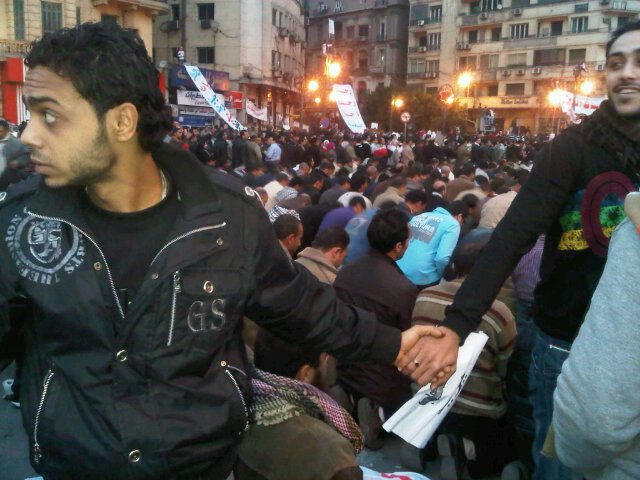


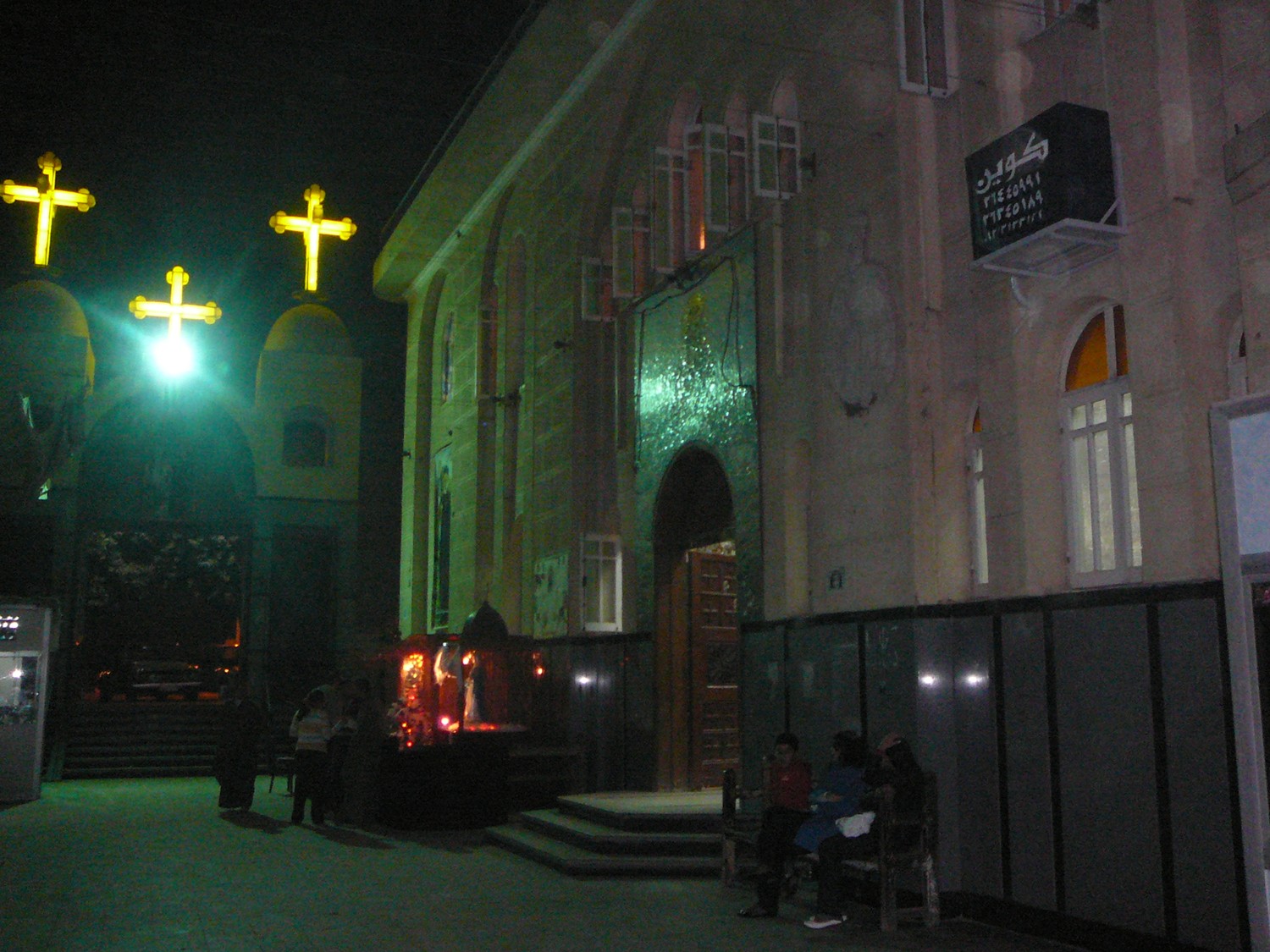




 Jayson Casper


