Categories
Arab West Report Middle East Published Articles

Dar al-Ifta’: The House of Fatwa

Ali Gomaa, the Grand Mufti

The fatwa is commonly known in the West as a death sentence. Among Muslims, the fatwa can be among the most powerful tools of Islamic populism. On a third front, the fatwa is simply a bureaucratic function. Which definition encompasses reality?

Since the dawn of Islam the scholar has had a place of prominence, celebrated for his command of the Quran, the traditions, and mastery of the sharia. For this reason, the state has always wanted to remain on good terms with the scholars, and if possible, to co-opt or institutionalize them.

What makes a scholar? There is a threshold of necessary knowledge, without which any claimant would be exposed as a fraud. But scholars must also be linked to networks, or else they would simply sit at home issuing fatwas to themselves. It is these networks which are under redefinition in Egypt and much of the Arab world today.

For example, the Muslim Brotherhood has a mufti – the Arabic term for one who gives a fatwa. Is he legitimate? What about each and every Salafi preacher around whom the people congregate? If someone appears on television, is he fit to issue a fatwa?

Conversely, though the state conveys legitimacy on many aspects of society, does it also pertain to religious life? Islamic societies have historically treaded carefully here, wary of the corrupting possibility of power but keen to preserve the stability of the nation.

For centuries, in Egypt especially but also throughout the Sunni Muslim world, the Azhar established itself as the pinnacle of Islamic scholarship. Its graduates secured both popular and institutional credibility. Yet in 1961 President Nasser brought the prestigious university under state control.

The process to diversify – and perhaps dilute – the influence of the scholars was already long underway, however. In the 19th Century under British occupation the Dar al-Ifta’ was created to issue official fatwas. The institution survived the 1952 revolution and was used at times thereafter to obtain favorable rulings for controversial state policies.

As both Sheikh al-Azhar and the Grand Mufti are positions appointed by the president, many have criticized the venerable bodies as being little more than mouthpieces for the ruling regime. It has not been uncommon, however, for many criticisms to issue from scholars of either dubious representation or extremist trends. Is not the state the societal organ best fit to establish proper regulations and qualifications?

Ibrahim Nagm

Though not a justification, Dr. Ibrahim Nagm explains the functions of Dar al-Ifta’. Serving as senior advisor to the Grand Mufti, he seeks to make understandable the concept of ‘fatwa’, which has been sensationalized due to what he would say is its frequent misuse.

Nagm defines a fatwa as ‘non-binding religious advice given by a qualified scholar in response to a question asked by a member of the public’. He then proceeds to unpack the meaning of each key phrase.

Non-binding: A fatwa carried no legal authority or compulsion of implementation. This invalidates the popular idea that a fatwa is a summons to kill a particular individual, for example.

Qualified: Though anyone can give their religious opinion, only a certified scholar is permitted to issue a fatwa. Dar al-Ifta’ insists upon deep Islamic scholarship from a respectable university (such as al-Azhar), and then provides three additional years of training before accrediting anyone.

Question: A fatwa must be spontaneous, issued in response to a real life issue submitted by the public. It cannot be internally generated according to policy. Every day the Dar al-Ifta’ receives +500 personal fatwa requests and +2000 by phone in up to nine languages from around the world.

To handle these requests, the Dar al-Ifta’ has about 50 accredited scholars working in its administration, with an additional 50 scattered throughout Egypt.

Each fatwa issued conforms to the basic methodology of Islamic scholarship, which Nagm outlined as the following:

1)      Consult the Islamic sources: These include the Quran, the sunna, and the legacy of Islamic scholarship. Look for precedents and consider their application.

2)      Understand the person and the issue: Fatwas are expected to apply differently according to circumstances. The legal texts are incomplete without full knowledge of the problem.

3)      Issue the fatwa: To be done in a manner bridging tradition and reality.

As an example, Nagm described a request for a fatwa to see if it was permitted for a particular man to take a second wife. After consulting the sources, the indications were yes – it is permitted for a Muslim to marry up to four wives.

Yet after consulting the situation, the person requesting the fatwa was discovered to be residing in a non-Muslim nation which forbids polygamy. Bridging between the tradition and the reality, Dar al-Ifta’ issued a fatwa instructing the requester to submit to the laws of the country he lived in, and not marry again.

In another example a farmer requested a fatwa to permit or forbid the use of certain chemicals in the fertilization process. Nagm indicated clearly this was a matter beyond the competence of the institution. They referred the question to scientific specialists, who indicated the mentioned chemicals were harmful. Armed with this knowledge, it was a simple matter to issue the fatwa forbidding their use.

Returning to the question of Islamic legitimacy, Nagm does not answer the question, but does paint Dar al-Ifta’ as a thoroughly bureaucratic institution. Its methods are sound, but reflect the dry, thorough work of professionalism.

Professionalism is good, of course, but Nagm frequently contrasted it to academia, which is not enough. It is not scholarship that makes a mufti, but training.

Of course, training is also good. Nagm commented that Osama bin Laden was an engineer, and Ayman al-Zawahiri was a doctor. No matter how substantial their personal study of Islamic jurisprudence, they are not part of a credible, established network.

In terms of establishment, this is certain. But credibility is in the eye of the beholder. Dar al-Ifta’ walks the fine line between professional accountability and state submission. Yet this is no different from the family of Islamic scholars throughout history who have navigated the same challenge.

After all, though scholarship is immensely valuable, it puts no food on the table. It must market its knowledge somewhere. The public trusts the scholar, while marketing, to remain faithful ultimately to God.

That trust is his only credibility.

Related Posts:

Categories
Arab West Report Middle East Published Articles

Non-Traditional Justice in Upper Egypt

Throughout Egypt the justice system is known to be very slow. Though it has a long and respectable history, as the population exploded and litigation increased, many turn to non-traditional methods to avoid spending a year or more in court.

Sometimes, a non-traditional method can be thuggery. A landlord, for example, might expel by force a legal tenant and deal with the consequences later – whenever the court gets around to hearing the case.

Sometimes, a non-traditional method can be arbitration. Egypt, mindful of the slowness of its judiciary, has established a limited number of licensed arbiters, especially for commercial and business disputes.

Yet for many, especially in Upper Egypt, the non-traditional method of choice is the reconciliation session. Completely outside the law, two aggrieved parties turn to a respected man of the community, and set their dispute before him.

Reconciliation sessions have a deserved bad reputation, especially as pertains to sectarian conflicts. Rather than ruling by law, the police enforce calm in an enflamed village, and then Muslim sheikhs and Christian priests sit together to ‘reconcile’ their people. Perhaps a local dispute – where a Christian may very well be at fault – escalates and a Muslim mob distributes group punishment by burning shops and homes.

If the judiciary in Egypt is slow, the law is weak. The efficient solution is to engage the sheikhs and priests to determine monetary compensation for the Christians and then make a public display of reconciliation. Valuable as this may be, too often it covers over smoldering resentment and rarely punishes wrongdoers.

Yet far more frequent in occurrence are the ordinary instances of two parties settling their grievance amicably. This does not always mean a happy ending, nor is it free of questionable rulings. But where a flawed legal system is the norm, it works.

I encountered two examples recently which help give perspective. These examples hear from only one side, and both involve Christians exclusively. At the very least, they indicate how Christians are not simply the victims of reconciliation sessions, as often portrayed in the media. On the contrary, they are willing participants mirroring exactly their Muslim neighbors.

In the first example, a Christian family consisting of three adult brothers suffered tragedy when the third brother died young. That he also died unmarried added conflict to the tragedy.

What to do with his share of the family inheritance? To whom should he leave it? If the simple answer is to divide it equally, the equation is complicated by the fact he lived with one of the brothers as a semi-dependent.

Yet the other brother stated he paid ‘rent’ to the first brother to help offset costs. In the end, they took their problem to the church. The two priests of the village convened, heard the stories, and pronounced a simple 50-50 division between the surviving brothers. All were satisfied, and life carried on.

In the second example the dispute involved the church – that is, the priests themselves. The family of the priest in question inherited a large tract of land, complete with ownership papers establishing their right. Further distant relatives, however, received no share but believed they were entitled. Yet as the church was complicated in the conflict, the petitioning family decided to go to a Muslim village sheikh.

This particular Muslim sheikh is very well respected as a non-traditional ‘reconciler’ in the village, by both Muslims and Christians. He is said to deal according to the right, and not by religion or benefit. Yet he also draws a fee for his services; it is not simply a service provided. His authority comes only from village reputation. He has no license from the government.

This fee can reach up to several hundred dollars, and is traditionally paid by the disputant who first appeals to arbitration, win or lose. Trusting the judgment of the sheikh, who has been known by both parties since childhood, the landowning family agreed.

In the end, the sheikh ruled for the landowners – their names were on the legal documentation; it was a simple case. But in doing so the sheikh put himself in a quandary. The landless family was poor; they had no means to pay his fee unless they won the judgment.

In saying so, care here must be taken since the sheikh’s perspective is not known. Yet it is said of him he was on watch for any impropriety on the part of the landowners, so as to extract from them a fee for ‘contempt’.

Apparently, the landowner believed the sheikh was listening too favorably to the complainant’s cause, and not letting him speak. At one point he interrupted angrily, ‘Shut up, sheikh!’

With this highly culturally insensitive remark, the sheikh fined the landowner the several hundred dollars which should have been his fee from the original litigant. Whether or not this swayed his understanding of the case, he then ruled according to what appears to be justice.

Of course, the winning Christian family finds this an example of injustice, but once the non-traditional reconciliation session is begun, its judgments are final.

It is reported the sheikh has spoken privately to other members of the family, saying he will return the fee if the insulting party simply apologizes, or even has his landowning relative do so for him. Both refuse.

These examples are not complete pictures of non-traditional justice in Upper Egypt. They do not include the issues of vendetta, honor killings, or the messy intersection of these with sectarian conflict.

What they provide instead is a picture of the normalcy and unremarkable nature of Christian participation in reconciliation sessions. It is not simply the headline-making instances of miscarriage of justice that characterize the practice.

Swift justice and rule of law would be better. In their absence, however, non-traditional methods work reasonably well.

Related Posts:

Photo Credit: al-Masry al-Youm

Categories
Arab West Report Middle East Published Articles

Teaching Evangelism in Egypt

Evangelical Theological Seminary of Cairo

‘Should we sacrifice evangelism for coexistence, or coexistence for evangelism? This debate will concern us for the next several years.’

This quote from Rev. Andrea Zaki ended a presentation by the Evangelical Theological Seminary of Cairo. Founded in 1863 by American Presbyterian missionaries, preaching the Gospel has been a core component of the Coptic evangelical identity since its inception.

Perhaps this is not appreciated by the Western evangelical church. The common perception is that Muslim dominance over Egypt has prevented Christian witness. They see a church shrinking, not growing. On the contrary, the assumption is the church has abandoned evangelism in order to survive. The Western church is sympathetic, but wonders if in forsaking the Great Commission to preach the Gospel to all peoples, Egyptian Christianity is doomed to wither away.

In the choice above, many in the Western church see settling for coexistence is a death warrant for Christian vitality. Better the sacrifice of martyrdom than the slow and steady decline of accommodation. Most Western evangelicals do note the juxtaposition of this thought with the reality of their religious freedom.

Atef Gendy

Dr. Atef Gendy would protest the false choice of evangelism or coexistence. As president of the seminary, he oversees that both are taught. The Missions Department of ETSC has courses in dialogue and in evangelism.

‘We have adopted the holistic approach,’ says Gendy. ‘We encourage dialogue, we preach the Gospel through ethics, service, and ministry, but we also support direct evangelism.’

Yet he noted that dialogue was absolutely necessary, given the social reality in Egypt. A seminary professor polled both Muslims and Christians concerning values. The three worst sins in descending order ranked: 3) Killing someone, 2) Changing religion, 1) Committing adultery.

Such an order does not bode well for the convert, let alone the evangelist.

Therefore, Gendy takes pride in the good relations the seminary enjoys with Muslim leaders, especially the Azhar, the pinnacle of Islamic learning in the Sunni Muslim world. They not only frequently attend interreligious dialogue meetings, they also cooperate practically.

‘We try to develop the religious speech of both Christian and Muslim leaders. We emphasize a shift away from simple ritual and surface issues to focus on ethics and transformation.’

Gendy celebrates much which took place during the Egyptian revolution, but also is worried about increased restrictions on freedom in an Islamic context. Yet for this he emphasizes the strategic decision the seminary has taken in theological education.

‘We must recall our theology in incarnation, crucifixion, and resurrection. This is to challenge our leaders to empower the church. Why should Christians emigrate? Maybe we will suffer – along with many Muslims – but this is only a precursor to our resurrection!’

Within any potential suffering, love must push Egyptian Christians to stand by their Muslim neighbors, but love in the evangelical understanding implies more than just solidarity.

‘We must testify, amidst all sensitivities. But we must also show our love through service.’

In Egypt, the future is unknown, but this is fitting with evangelism, whose outcome is also unknown. Gendy’s hope is in God in both cases. Whether or not the church is declining, he knows his duty as an evangelical Christian.

‘We do not have the responsibility to convert anyone, this is for God. We only must witness to our faith.’

Perhaps he, along with Egypt’s Christians might add, ‘and coexist at the same time’. Over the next several years this will be the vital challenge facing the church.

This article was originally published on August 3, 2012 in Idea Magazine.


Related Posts:

Categories
Arab West Report Middle East Published Articles

Blind Sheikh’s Family Hosts Celebration for Freed Prisoners

Hassan Khalifa

At an open fast-breaking meal outside the sit-in protest for Omar Abdel Rahman at the US Embassy, Hassan Khalifa shed tears of joy as he concluded his ten minute speech.

‘I apologize for going long, but forgive me, it has been nineteen years that I have been in prison,’ he said.

On June 21 President Mohamed Morsy issued a pardon for 572 prisoners convicted in military trials. Of these, 25 were members of al-Jama’a al-Islamiyya or Islamic Jihad, groups still designated as ‘terrorist’ by the United States. Hassan Khalifa, now in a wheelchair, had been sentenced to death.

‘I praise God; I have never stopped speaking on behalf of al-Jama’a my entire life,’ he said, before switching to intercede for the Blind Sheikh.

‘Omar Abdel Rahman’s only crime was that he was the greatest one in worshipping God. He never ascribed to Islam anything that did not belong to it.’

Essam Derbala, who fifteen years ago led al-Jama’a in its Non-Violent Initiative to unilaterally give up terrorist techniques, presented Khalifa and others with a commemorative Qur’an.

Embraced in freedom

Others honored included:

  • Ahmed Abdel Qadir
  • Amr Gharib
  • Abdel Hamid al-Aqrab
  • Sheikh Abu al-Ai’ila
  • Ahmed Hammam
  • Atef Moussa
  • Attia Abdel Sami’
  • Mohamed al-Fouly
  • Hussein Fayed
  • Shawki Salama
  • Mohamed Yousry

Each of these warrants further investigation as to their crimes. I hope after further investigation to describe if these individuals were directly involved in terrorist activity and efforts to overthrow the government. Large numbers of al-Jama’a members and sympathizers were imprisoned upon association with the group, or even to pressure family members more deeply involved.

Essam Derbala

‘The United States has to stand with the people of the revolution and its demands, which include the release of Omar Abdel Rahman,’ said Essam Derbala. ‘Al-Jama’a will continue to exert all effort to obtain his freedom.’

Abdullah Omar Abdel Rahman (L), with brother Mohamed

Abdullah Omar Abdel Rahman, the Blind Sheikh’s son, added, ‘We congratulate the members of al-Jama’a al-Islamiyya who were released from prison. May God reward you for what you have endured.’

Abdel Rahman also relayed the testimony he received from Ahmed Raghib, the deputy minister for Egyptian affairs abroad in the Foreign Minister. Raghib told him Omar Abdel Rahman’s file was complete, awaiting only the signature of the military council or President Morsy. Once authorized, he said the Blind Sheikh would be back in Egypt ‘within hours’.

Mohamed al-Saghir

Mohamed al-Saghir, an Azhar sheikh and member of al-Jama’a’s Building and Development Party, added, ‘We tell the US administration, if you want to turn a new page with the Egyptian people, let us see your good intentions and release Omar Abdel Rahman.’

‘He was in solitary confinement for 19 years, but did nothing except call people to God.’

Abdel Akhir Hammad

Abdel Akhir Hammad is an Islamic legal scholar for al-Jama’a, and interceded for the Blind Sheikh as well.

‘They lie when they say he is responsible for the explosion of the World Trade Center in 1993; they are the first to know he is innocent.

‘We are not weaker than the government of Yemen which was able to secure the return of Mohamed al-Muayyid back to their country, from an American prison.

‘I call on Morsy to fulfill what he promised and pressure that oppressive nation which claims it defends human rights.’

Nageh Ibrahim

Nageh Ibrahim is another long-term leader of al-Jama’a al-Islamiyya. Along with Derbala and others he shaped the group’s Non-Violent Initiative.

‘We never expected a president who was part of the Islamist movement, but that day has come,’ he said.

‘From the first days of our initiative we have been waiting patiently for some of these people to be released.

‘But their release will not make us forget Omar Abdel Rahman.’

Nasr Abdel Salam

Nasr Abdel Salam is president of al-Jama’a’s Building and Development Party. He focused his words for prayer on the Blind Sheikh’s behalf, especially in the month of Ramadan.

‘God works with us as we work with him,’ he said. ‘So we must aid the right and God will aid us.

‘Let us return to God and ask him to support Muslims everywhere and free Omar Abdel Rahman from prison.’

As God is sovereign in all affairs, may he honor justice, have mercy, and bless those dedicated honestly to their cause.

Related Posts:

Categories
Lapido Media Middle East Published Articles

Copts Split over Boycott of Clinton over Support for ‘Islamo-Fascism’ in Middle East

This article was originally published at Lapido Media on August 1, 2012.

US Secretary of State Hillary Clinton declared religious freedom in Egypt to be ‘quite tenuous’ following the releaseof the 2011 International Religious Freedom Report. Despite chronicling several instances of sectarian violence against Coptic Christians, their community finds itself increasingly divided over its longstanding support for America.

At issue is Clinton’s alleged support for the nation’s first Islamist president, Mohamed Morsy.

The Orthodox Church and Coptic politicians boycotted a recent meeting with Clinton as she visited the fledgling democracy. Some Copts, meanwhile, demonstrated at the US Embassy against her visit.

Bishoy Tamry

‘We believe there is an alliance between the Obama administration and the Muslim Brotherhood, which supports fascism in the Middle East,’ said Bishoy Tamry, a leader in the primarily Coptic Maspero Youth Union, formed following post-revolution attacks on Cairo churches.

‘The US thinks the Brotherhood will protect their interests in the region but it will be over our bodies as minorities.’

President Morsy won a highly contested election rife with rumors of fraud and behind the scenes negotiation between the Brotherhood, Egypt’s military council, and the United States.

‘We knew the next president must have US support,’ said Tamry, ‘because the military council rules Egypt and the US pays the military council.’

Egypt receives $1.3 billion annually in US military aid, compared with $250 million in economic assistance.

Yet, according to Youssef Sidhom, editor-in-chief of the Coptic newspaper Watani, Copts have been disproportionately affected by these rumours.

‘Copts fell victim to the conspiracy theory that said Morsy did not win and Shafik [his opponent] was in the lead. I found no compelling evidence of this conspiracy.’

Nevertheless, Copts find reason to believe the US is taking sides in an Egyptian political question. Muslim Brotherhood deputy leader Khairat al-Shater stated his group’s priority is a ‘strategic partnership’ with the United States.

Clinton, meanwhile, urged President Morsy to assert the ‘full authority’ of his office. Egypt is currently undergoing a struggle between the Brotherhood and the military council over the political transition to democracy.

Bishop Thomas

Bishop Thomas of the Coptic Orthodox Church told Lapido Media, ‘We did not meet with Clinton because of the unclear relationship with the Brotherhood and the support they have given it.

‘Things are not settled in Egypt,’ he said. ‘Why was she in such a hurry to come?

‘The current administration does not understand the agenda of the Brotherhood which has been clear for decades – to revive the caliphate and apply shariah law.’

Emad Gad is one of two Copts elected to the now dissolved parliament. He received an invitation to meet with Clinton, but refused.

‘In exchange for Morsy’s being named president,’ he said, ‘the Brotherhood is expected to protect Israel’s security by pressuring Hamas – the Brotherhood’s branch in Palestine – not to launch military attacks against Israel, and even accept a peace agreement with Tel Aviv.’

Sameh Makram Ebeid

Sameh Makram Ebeid, the second Coptic parliamentarian, gives a different emphasis. Though not invited to the meeting with Clinton, he agreed with the refusal of Gad and other Coptic politicians.

He told Lapido: ‘There are two objections to her visit. The liberal forces say – true or false I don’t know – the Americans were in cahoots with the Brotherhood and handed them the country.

‘The second is that you should not meet with the Copts as Copts, but as part of the liberal movement, as the third way between military and Islamist.

‘She wanted to meet with individual liberal politicians, but they were all Christians,’ he said. ‘If you start segregating the country you’re making a big mistake.’

Segregating and dividing the country was also a concern of Revd. Safwat el-Baiady, president of the Protestant Council of Churches. In an interview with Lapido, he said the Orthodox clergy withdrew from the meeting only one hour before it started, but that Protestants, Catholics, and Orthodox laity attended.

Baiady told Clinton of Coptic fears of a repetition of Iraq, where Christians fled the country following American interference. He also spoke of Egyptian concerns the US would divide Egypt, especially the Sinai, using it as a solution for the problem of Hamas.

‘She is a good listener and took many notes,’ said Mr Baiady.

‘Clinton said we have to back the winners and those who lead the country. They have the best organization and power on the ground, based on the parliamentary elections.

‘We have to support the people, she said, and not oppose them.’

Raed Sharqawi, a reporter present at the Coptic demonstration, agrees with Clinton.

‘America has relations with every nation in the world,’ he said. ‘The US is also the shield for the Copts, and always will be. This protest is foolish.’

As Egypt’s transition muddles forward, there is ample room for confusion. The military and the Brotherhood emerged as the two strongest forces, making Copts wonder about their future. Within this mix, Clinton’s visit in support of Morsy has led to this near unprecedented rupture in Coptic-American relations.

‘The US will make us into another Pakistan,’ said Tamry as the protest continued. ‘We have come to say don’t interfere in our business.’

Related Posts:

Categories
Arab West Report Middle East Published Articles

Coptic Protest Falls Flat amid Worrying Constitutional Developments

Translation: Bread, Freedom, Social Justice; a Constitution for All Egyptians for the Sake of Egypt; No to the Constituent Assembly

The call went out in the media, Facebook, and by text message: The Maspero Youth Union summons Copts for a mass demonstration at the cathedral to demand the church withdraw from the constituent assembly. In the end, twenty people came. Most were members of the Maspero leadership.

The constituent assembly consists of 100 members chosen by the now dissolved parliament to write the constitution. It represents the second effort, after the first assembly was itself dissolved by the courts for appointing parliamentarians and failing to properly represent the full spectrum of Egyptian society. Many believe the second assembly fails similarly, though a court decision has been postponed.

While the assembly exists in limbo it is continuing its work, along with its delegates chosen by Egypt’s churches. Many liberal politicians have withdrawn in protest of Islamist domination, but unlike the first assembly, the church has not yet followed. The Maspero Youth Union demands they do.

From a Coptic and liberal perspective there are worrying signs. The current wording of the draft keeps the word ‘principles’ concerning Islamic sharia as the main source of legislation. Yet it also designates a religious authority – the Azhar – to define what ‘principles’ means. Though the Azhar is currently understood as a moderate Islamic bulwark, the current wording places religious scholars above elected legislators in crafting law. Furthermore, the Azhar is subject to change in membership; it may not always be moderate.

Furthermore, the current draft defines Egypt as a ‘consultative’ state, alongside other modifiers such as democratic, constitutional, and modern. ‘Consultative’ is not clearly defined, but is derived from an Islamic concept in which people advise the ruler. It may be benign, but was insisted upon by Salafi groups who also argued against inclusion of the modifier ‘civil’.

Additionally, Egypt as a country is defined as ‘part of the Arabic and Islamic nation and tied to the African continent’. The previous constitution labeled Egypt an Arab republic, and mentioning Africa is perhaps a useful recognition in comparison to the neglect of the Mubarak regime. Yet whereas Islam had previously been designated the state religion, labeling Egypt as part of a larger Islamic entity opens possibilities toward wider integration. It certainly tightens the identity of the nation along a particular religious expression.

Perhaps the church has not yet withdrawn its representatives due to the draft inclusion of another phrase: ‘Christians and Jews shall resort to legislation derived from their own religions.’ Though many argue the current constitutional reference to sharia law already grants Christians and Jews this right, others say it is necessary to codify the principle. Is it possible the church has agreed to the other phrasings in exchange for this right of independence vis-à-vis the state?

The Islamist leanings in the initial draft compelled the Maspero Youth Union to pressure the church to withdraw from the constituent assembly. They called for a protest at noon on Friday, following the church service held in the cathedral.

That only twenty people came is an indication in search of an explanation. The Union formed following attacks on churches in the initial months following Mubarak’s resignation. At their height they mobilized thousands to protest the destruction of a church in Upper Egypt, which led tragically to the Maspero massacre at the hands of the military. Since then they have had little public presence, though their spokesmen have continued to comment in the media.

Could high noon heat have kept protestors away? Are the issues in the assembly insufficiently known to the general Coptic community? Is the protest premature? Does a pending court ruling on the assembly’s dissolution persuade most that street politics is unnecessary?

It is uncertain. The result, however, suggests the Union has lost a great deal of its popular legitimacy and mobilizing ability. Anonymous critics present at the demonstration suggested the church was even using the Union in search of provide popular cover for their desire to withdraw, though perhaps all did not know this. If true, and if the Union was playing a requested role, the call for a protest rings hollow. Might the common Copt have noted a lack of authenticity?

In the end, the protest was rather inauthentic. Organizers did their best to shout slogans for the few cameras and assembled media, but there was no audience to rally.

Mina Thabit

‘We came to express our objection to the church continuing in this assembly,’ said Mina Thabit, a founding member of the Maspero Youth Union. ‘These are religious representatives for the church, and do not politically represent the Copts.

‘They do not have the wisdom or experience to deal with this situation. The constitution will wind up being far from the principles of human rights, and represent racism, ethnicity, and discrimination between people.’

Indeed, these are worrying concerns. It is too bad no one came to share them with.

Related Posts:

Categories
Aslan Media Middle East Published Articles

Escalating Pressure for the Blind Sheikh

Omar Abdel Rahman, the ‘Blind Sheik’

On Thursday, July 26, the family of Omar Abdel Rahman ratcheted up their rhetoric in their awareness campaign to free their father. The family issued five demands to President Morsy and invited speakers to comment, some of whom threatened America harshly.

Otherwise known as the ‘Blind Sheikh’, Abdel Rahman is imprisoned in America for involvement in the 1993 World Trade Center bombing. His family claims Abdel Rahman’s arrest was political, as the US yielded to Egyptian demands to silence him from criticizing Mubarak. The family has conducted an open-ended sit-in protest outside the American Embassy in Cairo since August of last year.

Abdullah Omar Abdel Rahman, one of the Blind Sheikh’s sons, called for a press conference and invited political leaders to speak on his father’s behalf. He desired to put pressure on President Morsy to intercede in the case, to fulfill his promise made during his inaugural address from Tahrir Square. Morsy identified Abdel Rahman as a ‘political prisoner’ and vowed to work for his release, along with hundreds of other prisoners in Egyptian jails, who were jailed for their revolutionary activity.

Morsy pardoned or otherwise freed over 500 Egyptian prisoners on the eve of Ramadan. He has backtracked, however, on promises to secure Abdel Rahman’s release.

Abdullah issued five primary demands:

  • For President Morsy to form an urgent committee to visit Abdel Rahman in his American prison and check on his health and the state of his confinement
  • For President Morsy to immediately authorize legal advisors to challenge the Justice Department’s use of an antiquated law to keep Abdel Rahman in solitary confinement for 19 years
  • For President Morsy to give the green light to the Foreign Ministry to begin diplomatic efforts to return Abdel Rahman to his country
  • To apply the principle of reciprocity on every American prisoner in Egypt and subject them to solitary confinement as is done to Egyptian prisoners in the US
  • For the presidency to allow some of Abdel Rahman’s family members continual visitation rights in America until he returns to his country

Political leaders in attendance were mostly from al-Gama’a al-Islamiyya, Abdel Rahman’s original group which is designated a terrorist organization in the United States. In the 1990s al-Gama’a formally forswore violent methods. Following the Egyptian revolution it has created a political party, called Building and Development, which cooperated with Salafi parties during the recent parliamentary elections.

Abbud al-Zumur

Abbud al-Zumor was the keynote speaker. A leader in al-Gama’a, he is unapologetic for his role in assassinating President Sadat in 1979.

‘Abdel Rahman was among the strongest to call against Mubarak and it resulted in his being exiled from Egypt,’ he said. ‘Eventually he went to America where he found no human rights, let alone the rights of a domesticated animal.

‘The matter is now in Morsy’s hands and he must move quickly to return Abdel Rahman safely to his family, as he is very sick.’

Mohamed Shawki al-Islamboli

Mohamed Shawki al-Islamboly is also a leader in al-Gama’a, whose brother was the actual assassin of Sadat. He recently returned to Egypt after spending many years abroad in Iran as a political refugee.

‘Abdel Rahman exposed the Egyptian regime so it pressed the US to arrest him in violation of its proclaimed human rights,’ he said. ‘This is a shame upon America.

‘We say to Morsy it is your responsibility to seek the freedom of every Egyptian who opposed Mubarak, whether inside or outside Egypt.’

Nasr Abd al-Salam

The most incendiary comments, however, were issued by Nasr Abdel Salam, president of al-Gama’a’s Building and Development Party.

‘Americans spend millions of dollars every year to improve their image in the Muslim world, but it has only gotten worse,’ he said.

‘If anything happens to Abdel Rahman, America and its people will pay the price. The criminals in the administration and the embassies will pay the price.

‘Abdel Rahman’s dignity is the dignity of every Egyptian.’

The final al-Gama’a speaker was Ezzat al-Salamony. He spoke of the need to ‘lay siege’ to the American Embassy, but Abdullah, the Blind Sheikh’s son, clarified these remarks afterwards.

Next Thursday, Abdullah said, there will be an open Ramadan fast-breaking meeting at the sit-in at the US Embassy. At that time he said they would announce the date for a massive demonstration at the complex, but there were no intentions to permanently close the embassy.

Salamony, meanwhile, clarified Abdel Salam’s remarks about ‘paying the price’. Speaking with him afterwards, he stated there were all sorts of means to pressure the American administration. Specifically he mentioned an economic boycott and sending fighters to Afghanistan to oppose the US military there. The objective would be to do to the US what was done to Russia, resulting in America’s loss of dignity in the world. This is the ‘price’ the American people would pay.

Salamony emphasized nothing would be done to American civilians, as this was against sharia law.

Other speakers outside al-Gama’a included Hanny Hanna, a Copt known as the ‘preacher of the revolution’ for leading Christian prayers from Tahrir Square.

‘The only way for Abdel Rahman to return to his children and grandchildren is to establish Egypt as a national regime,’ he said. ‘We must strive to return all Egyptians from foreign prisons as a humanistic demand.

‘As I love the Messiah I must also love the prisoner.

‘President Morsy has not dealt with his situation in wisdom. When he mentioned it at Tahrir he made the US think it was at the top of his agenda, and he made them aware of the importance of this issue. If he had been quiet and waited two years and asked then it would have been much simpler to secure his release quietly.’

Kamal al-Helbawi

Kamal al-Helbawi is a former member of the Muslim Brotherhood who resigned when the group nominated a candidate for president, believing they had betrayed the revolution.

‘We as Muslims must defend the right in every place, whether it is for a Muslim or a non-Muslim,’ he said. ‘I helped defend Nelson Mandela in South Africa, so how can I not defend our sheikh Omar Abdel Rahman?

‘We must mobilize Muslims and non-Muslims, Islamists and seculars, so as to make Abdel Rahman a national cause.

‘America is not a democratic nation; it is a nation of criminals. What they are doing in Iraq and Afghanistan was not even done by the Mongols or the Tartars. But we do not fear America, we fear God.’

Finally, Yahya Ismail is a religious scholar from the Azhar university.

‘We must support Abdel Rahman from every mosque, every institution, every political party, and even the Azhar itself,’ he said. ‘We must put his picture everywhere and host seminars and raise awareness. What have we done for him so far? He is being persecuted by the Zionists and Crusaders.

‘God has permitted war in the case of aggressing against religious scholars. A nation’s peace rests in the peace of its religion, and the peace of its religion rests in the peace of its religious scholars.’

Chants issued during the press conference included:

  • Oh al-Gama’a, oh al-Gama’a, we want a million-man demonstration!
  • Oh America, collect your dogs, we are tired of your terrorism!

But the microphone for the chant leader malfunctioned shortly afterwards and chants were abandoned.

Following the conference I spoke with Safwat Kamal, an unaffiliated Islamist from the neighborhood of Imbaba, Cairo. With Abdullah Omar Abdel Rahman standing beside, he spoke of the need to escalate the cause.

‘It has been a year now, and the people are getting angry,’ he said. ‘I have told Abdullah many times already, we must storm the embassy or kidnap a few Americans. But every time he says no.’


Related Posts:

Categories
Arab West Report Middle East Published Articles

Sameh Makram Ebeid: On the Wafd, Hillary Clinton, and Current Conspiracies

Sameh Makram Ebeid

Sameh Makram Ebeid handed me his business card with the words, ‘I hope I get to use this again.’ Underneath his name it spelled out ‘Member of Parliament’. He took it back momentarily and penciled in an additional word in Arabic: ‘Dissolved’.

‘I don’t have the right to disagree with a court ruling. We were never MPs; this is what the court said. But I will run again for parliament and make a fight for my district.’

Ebeid is one of two elected Coptic parliamentarians, and won his seat from the Red Sea district under the banner of the Egyptian Bloc. The choice of the Red Sea was personal – he owns a home there and likes the region – but also political. Ebeid estimates 75% of governorate residents hail from Qena in Upper Egypt, which is his family home.

The choice of the Egyptian Bloc as a liberal coalition was natural, as Egyptian politics post-revolution evolved into a secular-Islamist confrontation.

The Bloc is a coalition consisting of the Free Egyptian Party, the Egyptian Social Democratic Party, and the Tagammu’ Party. Under Egyptian law, however, Ebeid does not have to belong to any of these parties. Though his official parliament membership papers list him as a member of the Bloc he ran with them as an independent candidate.

Perhaps this is fitting. Ebeid hails from the historic Egyptian family associated with the Wafd Party in opposition to British colonialism. Saad Zaghloul, a Muslim, and Makram Ebeid, a Copt and Ebeid’s ancestor, contributed to the founding of modern Egyptian politics along nationalist lines without any religious distinction. The party’s logo depicts both the Christian cross and the Muslim crescent.

‘The Wafd is the secular party of Egypt.’

Ebeid had previously served as the Wafd Party’s assistant secretary general and member of the political bureau, but resigned during the chairmanship of Sayyid el-Badawi, who won party elections in 2010.

‘He became very autocratic and wanted to run the party the way he wanted. He was vengeful against everyone who was there before him. He never represented the true Wafd Party which I belonged to.’

Ebeid’s major source of contention was Badawi’s cooperation with the Muslim Brotherhood. He brought on prominent Islamist Suad Salah, and sought to place her on the religion and human rights committee. Compromises such as these turned the Wafd, he said, into a typical ‘wishy-washy’ party.

After the revolution Badawi entered the Wafd into a coalition with the Brotherhood, though they withdrew at the last minute.

Badawi’s election was ‘clean’, states Ebeid, but like the parliamentary and presidential elections, this does not mean they were not manipulated.

‘The elections were not rigged but the road to the ballot was unfair; if you promise people heaven or buy their votes, this is not fair.’

Ebeid is critical of the electoral machinery of the Muslim Brotherhood which distributed food packages in poor areas before elections. Similarly, many Salafi sheikhs stated voting for Islamists was part of obeying God’s will.

Yet Ebeid testifies that in his election monitoring he did not discover fraud; certainly not in comparison to past elections. For this he puts no stock in the conspiracies which say Ahmed Shafiq was the actual winner of presidential elections over Mohamed Morsy.

‘As long as Shafiq did not contest the election, I have to accept it as correct.

‘If he knew the elections were rigged and he did not voice this, it is treason and he should be court-martialed.

‘There were 13,000 polling stations; did he not have this many volunteers to count the vote as the Brotherhood did?’

Even so, Ebeid took issue with the recent visit of Hillary Clinton to Egypt. His critique was not about clandestine US support for the Brotherhood, as many liberals and Copts advanced. On the contrary, in coming to Egypt the secretary of state was just doing her job.

‘I don’t see any reason why Clinton should not visit the president of Egypt; these are the true forces of Egypt. Did they push SCAF to accept Morsy? I don’t know and nobody knows. But it is actually her job and duty to come.

‘I think we should meet with the Americans and tell them what we think right to their face.’

As a politician Ebeid has the right to be frank. His criticism of Clinton, conversely, is in her conduct as a diplomat.

‘There has been a lack of tact on the part of Clinton and her team.’

The failure in tact concerned the nature of her visits to political forces. It was right for her to meet Morsy and the Brotherhood, Ebeid believed. It was right for her to meet with Salafis. It was right for her to meet with the military. But it was not right for her to meet with ‘Copts’.

‘You should not meet with the Copts as Copts, but as part of the liberal movement, as the third way between military and Islamist, and bring in non-Christians.

‘If you start segregating the country you’re making a big mistake.

‘She wanted to meet with individual politicians, but they were all Christians.’

For this reason, Ebeid believes it was correct for liberal and Coptic forces to boycott the meeting with Clinton. He himself did not receive an invitation, but he supported the decision of those who did.

As for the current political situation in Egypt, especially on President Morsy and the Muslim Brotherhood, Ebeid is critical as well.

‘There is no such thing as the Freedom and Justice Party. They call themselves the political arm of the Muslim Brotherhood, which is the real force.

‘So far I have not seen Morsy act as the president of Egypt. We have to see if he will elevate himself above parties to be the president of all Egypt. I hope he will do this.

‘The Brothers have a special agenda and we have a different agenda. If he is representing the Brotherhood then he is not my president, he’s the president of the Muslim Brotherhood. He should be the president of everyone.’

Though Morsy is not directly involved in the crucial issue of the constitution, Ebeid witnesses the Brotherhood special agenda here especially.

‘The constituent assembly [which will write the constitution] was a trick. It was agreed to be a 50-50 Islamist-secular split, but they did not go into the details about parties or people.

‘The Wasat Party and the Reform and Development Party of al-Jama’a al-Islamiyya are Islamist parties, are they not? They must be counted as part of the Islamists. But what the Brotherhood is saying is that we never said it, we said 50% for MB and Salafis. As the Americans say, the devil is in the details.’

Ebeid’s criticism is not just of the Brotherhood, but of the process itself.

‘The whole process was flawed. We should have gone through the list person by person; defining by position means nothing. We could stipulate the selection of a judge of a court, but if he is an Islamist this makes the difference.’

As media reports the progress the constituent assembly makes on the constitution, Ebeid prefers not to comment on details until he sees an official text. Yet he is not reticent to make his views known on certain issues.

‘The first three articles are most important as they define the identity of Egypt. What are we, a secular country or an Islamic country?

‘What does the word shura [‘consultative’, proposed by Islamists as part of the definition of the state] mean? It has been debated for the last fourteen centuries. Putting the word there is not just semantics, it means something.

‘As for the right of Christians and Jews to refer to their own sharia: What about non-believers, what if we have an Egyptian Buddhist?

‘We should have a presidential system for the first two terms, and then move into a semi-presidential like the French. We’re not ready for a semi-presidential system yet.’

Within the debate of these issues, Ebeid was careful never to assert, or even speculate, secret deal-making between political powers. The accusation that someone was an agent of America, for example, has been a political tactic for the last thirty or forty years, he stated. He wanted nothing to do with this pattern.

Yet there was one area where he opened the door just a little. It is the crucial error which resulted in the muddled transition Egypt is experiencing.

‘If there was a deal, the deal that harmed Egypt was made in March of last year in the national referendum. This reversed everything, putting parliament first, then president, then constitution.

‘Deal, negotiation, agreement, whatever; this is what destroyed the whole eighteen month process.

‘The whole thing is a series of errors, whether intentional errors or a lack of knowledge I’m not sure.’


Related Posts:


Categories
Aslan Media Middle East Published Articles

Spinning the Muslim Brotherhood

In politics, spin is inevitable. But in times of great political struggle spin is often transformed into misrepresentation. In Egypt these days, as seen in the press, the Muslim Brotherhood is spun virtually into a dervish.

Consider first this article from al-Akhbar, ‘Egypt’s Muslim Brotherhood Reassures Washington’, published April 7, 2012. Though it details current Brotherhood efforts to portray itself as a moderate political force, the article opens with a similar effort from 2005.

Muslim Brotherhood Deputy General Guide Khairat al-Shater penned an article in the Guardian following the group’s victory of one-fifth of the parliamentary seats. US President George Bush had been pushing the region towards democracy, but now the West was fearful of the results.

The article carries Shater’s words, saying:

He added that they only ran for 150 seats out of 444 (in the people’s assembly), because they “recognize that the provision of a greater number of candidates will be considered a provocation to the system” and lead it to “falsify the results.”

Here, the picture Shater paints is of the Brotherhood as a keen political player, limiting their rightful ambition for the greater democratic transition. Rather than provoke the autocrat Mubarak, they will do just enough to keep nudging democracy along.

Fair enough. Only it isn’t the truth. Or, sort of. The Brotherhood alluded as such last month.

At the time there were rumors the Brotherhood had ‘cut a deal’ with the regime for partial political representation. The win-win gave a measure of political representation to the Brotherhood, while Mubarak could complain to the West about the results of ‘democracy’ and continue to rule autocratically. If true, it worked. The Bush administration fell silent and dropped its democracy rhetoric.

These days as well the Brotherhood is accused of ‘cutting a deal’ with the military council.

Therefore it is very interesting to consider the new spin the Brotherhood gives to the 2005 elections. Egypt Independent carried the news of their ‘confession’, on June 13, 2012.

According to ‘an official statement’, the Brotherhood:

Confessed to meeting with the State Security Investigations Service (SSIS) in 2005, saying in an official statement on Wednesday that it attended the meeting “in order to avoid a string of arrests that would have affected hundreds of Brotherhood members.”

The Brotherhood said the SSIS had summoned a number of the group’s members to its headquarters after it nominated 160 candidates for the 2005 parliamentary elections.

In its statement, the Brotherhood said that during the meeting, SSIS leaders asked them to withdraw a large number of candidates and to only compete for thirty seats in Parliament. However, according to the statement, the Brotherhood heads refused the request.

“We said, ‘Let the people elect 40, or more or less. This is their right. We do not expect all 160 candidates to win and no one will withdraw.’” The statement went on to say that the group was threatened, but that they were not intimidated by the threats.

There is plausibility to this story, but it is a different tale than was given by Shater at the time. No longer is the Brotherhood the self-limiting democratic champion, but rather a political player negotiating with the regime for what it can get. There may well be spin in this presentation as well, as it fits with the post-revolution acceptability of exposing Mubarak’s ills. The Brotherhood, in this presentation, is a victim – though not powerless. They stood up to authority to the level possible.

It is noteworthy, though, to notice numbers. The Brotherhood confessed to seeking 40 representatives in this ‘deal’, however coerced it was. Somehow, they wound up winning 88.

In light of similar Brotherhood post-revolutionary promises to ‘limit’ their political representation, it is curious to watch the pattern repeat itself. To what extent in both 2005 and 2011 was the Brotherhood pressed to limit their ambition, and how in either case did they exceed the deal/expectation?

Perhaps they simply play the political game better than anyone else.

This fact becomes clear when examining the spin that is marshaled against them. The Egypt Independent ended its article:

The statement came after repeated accusations from presidential candidate Ahmed Shafiq that the Brotherhood used to meet with and have friendly relations with the Mubarak regime.

Here, the writer does a good job of not endorsing the accusation, putting it in context, but also leaving the impression in the reader’s mind. It is a slight use of spin, but it is there.

Far less subtle is this example from Aswat Masr, published July 19, 2012. The headline reads, ‘The General Guide Commenting on the Death of Omar Suleiman: God, Save us from the Helpers of the Deposed [Regime]’.

Closer examination of the article, however, shows the Brotherhood statement has no direct relation to Suleiman whatsoever.

An indirect relation is possible. July 19 is the day Suleiman died. He was widely reviled for his alleged roles in torturing prisoners, and especially in his efforts to curtail the Muslim Brotherhood and other Islamists.

During the revolution Mubarak appointed Suleiman as vice-president, but only a few days later he fell with the regime. When Suleiman briefly resuscitated his political career in a failed attempt to run for president, he fit well into the secular-Islamic dichotomy and was hailed by some as a hero. Upon his death he was given a military funeral.

While some Islamists have praised his death, the Brotherhood has been more cautious. President Morsy permitted the military funeral, but kept his distance and did not attend. It is judicious for them to keep their silence and not gloat over the fall of their long time enemy.

In this light the headline of Aswat Masr is better understood. It paints the Brotherhood as celebrating Suleiman’s death, and wishing similarly for salvation from those still alive.

Perhaps the writer has divined the Brotherhood’s intentions, but he has not accurately conveyed their words. The article takes from a written, weekly statement issued by the General Guide, Mohamed Badie. The text opens with Ramadan and praise of the Qur’an.

Only later on does the headline quotation occur, and Suleiman is never mentioned. Instead, Badie asks God:

Save us from tyrants, the corrupt, and the helpers of the dead, deposed regime. Aid our president in leading the ship of the nation to safe shores.

This statement can very much be read into the current political struggle between the Brotherhood and the military/old regime. The headline, however, makes the reader think it is an attack on Suleiman, painting the group as a vindictive entity worthy of Suleiman’s attempts at suppression.

When spin is present, it is best to find truth, however difficult.

According to my best and current understanding, the Muslim Brotherhood and the old regime danced together, awkwardly. There were periods of oppression and jailing, and periods of limited freedom of operation. On the whole, the group was free to function socially, but restricted politically. The regime always had the upper hand, but the Brotherhood knew how to exploit its limitations and slowly develop its legitimacy.

Omar Suleiman was a loyal employee, tasked with protecting the state from violent Islamists, and protecting the regime from political challenges. I suspect the tales of oppression are true.

What is still unclear, due the presence of spin from all sides, is if the Muslim Brotherhood is a legitimate democratic governing party. There is a great political struggle underway, and nearly all focus rests on this question.

The Brotherhood is spun, but also spins itself. Perhaps soon the dust will clear.

Even a dervish eventually stops.

Related Posts:

Categories
Christianity Today Middle East Published Articles

Muslim Creativity Comes to Church in Alexandria

One of over 40 award winning pictures taken by Muslim photographers at a recent exhibition at an Alexandria cultural center. All photos were of some aspect of the historic church which hosts the center.

This article was first posted on Christianity Today on July 19, 2012.

Alexandria, Egypt, was once a lighthouse for Christianity, emanating from the southern shore of the Mediterranean Sea. Now it is a stronghold of the Muslim Brotherhood and the even more conservative Salafi Muslims.

So a Christian opening a cultural center for Muslim and Christian artists in Alexandria—within the walls of an Anglican church—demonstrates a stroke of boldness in a city where some 23 Coptic Christians were killed in a church bombing on New Year’s Day 2011.

“For many Muslims,” says Nader Wanis, founder of the Corners for Creativity cultural center, “it was the first time in their life they [had] entered a church. They were astounded we let them in; then they go and invite others.”

Please click here to continue reading at Christianity Today.


This article was very fun to research and write; it was a nice break from politics and the challenge of understanding what is happening in Egypt.

This is Our City’ is a new feature of Christianity Today, highlighting Christians who are working not just for the good of their church or the good of their faith, but the good of the whole city. It focuses on six American locales – Portland, Richmond, Detroit, New York, Phoenix, and Palo Alto – and then a ‘7th City’ which can draw on good examples from anywhere.

So when I heard about this particular cultural center in Alexandria, I inquired if Christianity Today was interested in highlighting an international effort.

They were. Bangkok, Thailand was first to the pole, but I am glad to help Egypt get the silver medal.


Related Posts:

Categories
Christian Century Middle East Published Articles

Wary of Morsy

This article was originally published in the Christian Century on July 17, 2012.

President Mohamed Morsy’s decision to reinstate the dissolved parliament has set off a firestorm of debate in Egypt. Is Morsy fighting for full democracy against a military regime? Or is he trying to institute a full Islamist takeover of government? Christians worry about the second possibility.

“There are attempts to take control of all state institutions,” said Karam Ghobrial, an activist with the Coalition of Egypt’s Copts, “and the biggest proof is Morsy’s decision to bring back parliament.” Ghobrial is one of many lawyers who filed an injunction against the president’s ruling. Ghobrial’s comments reveal a deep-seated Coptic distrust of Islamists. “There should be international attention from the United Nations to protect minorities,” he said, “because Morsy broke his oath to respect and uphold the law.”

Morsy’s presidency did not start off this way. “We as Egyptians, Muslims and Christians,” he proclaimed in his victory speech…

Please click here to continue reading at the Christian Century.

Categories
Arab West Report Middle East Published Articles

Clinton Visits Morsy amid Coptic Protests

Outside the US Embassy in Cairo

Traditionally, it is the Copts who look to America for support of their minority rights. With the Muslim Brotherhood now in the presidency, though not in full power, some Copts wonder if the United States is switching sides.

The statement of ‘looking to America’ should not be taken as normative. The Orthodox Church and most leaders of influence insist on Egyptian solutions to Egyptian problems. They believe an appeal to the West would brand Copts as traitors in their own land. Average Copts, however, often state a sentiment of longing for America – either for pressure on Cairo or as an escape through emigration.

Amid frequent meetings between Islamists and members of the US administration, however, some Copts believe Washington’s interests are beginning to trump its commitment to human rights.

Bishoy Tamry

‘We believe there is an alliance between the Obama administration and the Muslim Brotherhood,’ stated Bishoy Tamry, a member of the political bureau of the Maspero Youth Union, a mostly Coptic revolutionary group formed after attacks on Egyptian churches. ‘This alliance is to support fascism in the Middle East.

‘The US thinks the Muslim Brotherhood will protect their interests in the region, but this will be over our bodies as minorities.’

The revolutionary character of the Maspero Youth Union plays a role in seeing the United States making a deal with the devil.

‘We knew the next president must have US support,’ Tamry continued, ‘because the military council rules Egypt and the US pays the military council.’

Most of the United State’s foreign aid to Egypt is in the form of military support, with smaller percentages given to economic and civil society development.

A few hundred people gathered at the US Embassy in Cairo to protest the visit of Hillary Clinton, the US Secretary of State. Early chants at the demonstration included, ‘The people and the army are one hand’, but these were silenced by Maspero Youth Union leaders. Tamry explained their group called for an open protest, and some attendees see the military council as the best means to limit or even depose Islamist rule.

One such group is the supporters of Egyptian television presenter Tawfiq Okasha, somewhat comparable to America’s Glenn Beck. These are strong supporters of the military council and clashed briefly with assembled protestors when they arrived, according to Ramy Kamel, an independent Coptic activist helping organize the demonstration. This drove the protest ten minutes south to the Four Seasons Hotel.

According to Nader Shukry, the media spokesman for the Maspero Youth Union, the United States is looking to preserve its interests after the Arab Spring shook their control of local governments. Yet their eye is not on the region’s good, but on its destruction.

‘[The US] knows Islamist rule will bring ruin to these countries, and the best evidence of this is their previous experience.’

As for proof of this alliance, it is found in their frequent meetings.

‘We see evidence in the pre-election visits of US representatives to the Muslim Brotherhood headquarters,’ said Tamry. ‘If the US was looking simply to political representatives it would have visited their Freedom and Justice Party.’

Others see this reasoning as absurd.

‘The United States has relations with every nation in the world,’ said Raed Sharqawi, an investigative journalist present at the demonstration.

‘The United States is also the shield for the Copts, and always will be. This protest is foolish.’

During Clinton’s visit she asked President Morsy to ‘assert the full authority of his position’. The president is currently engaged in a struggle with the military council over the dissolution of parliament. His party, the FJP is also pushing him to confront the military over its supplementary constitutional declaration to preserve some of its powers until a new constitution is written. Clinton did state the details of the transition should be left to the Egyptian people to determine, but urged the military return to its role of protecting the borders.

It is an open and contested question if the military is seeking to preserve its power and resist the revolution, or if it is defending democracy against a premature Islamist takeover of all institutions of government.

Nevertheless, whether the demonstrations against Clinton are foolish or astute, it is a dramatic step for a segment of the Coptic community to turn against the United States so publicly.

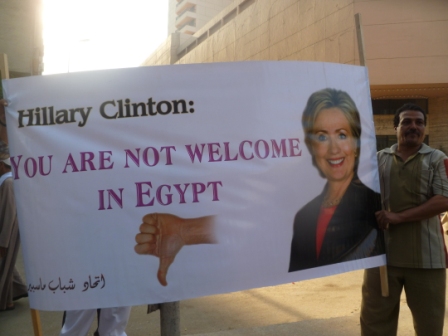
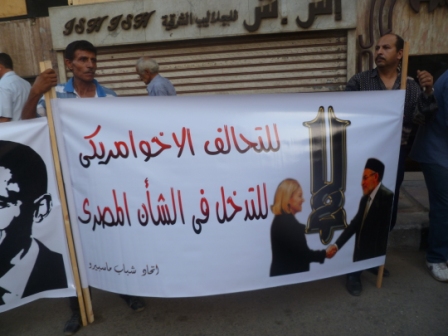
Translation: No to the Brotherhood-American Alliance to Interfere in Egyptian Issues. (Pictured: Hillary Clinton and MB General Guide Mohamed Badie)

Related Posts:

Categories
Arab West Report Middle East Published Articles

Fatimid Egypt, Built on Tolerance

The Azhar Mosque, built by the Fatimids

Note: This is an article from two years ago, never posted on the blog but presented now in memory of Dr. Ahmad al-Sayih, the primary subject. Last week was the year anniversary of his death. He was a good man.

On February 18, 2010 the Jaffa Center hosted a forum entitled, “The Fatimid State: Protecting the Holy Places of Mecca and Jerusalem”. The Jaffa Center is directed by Dr. Rifaat Ahmad, who was previously interviewed concerning the practice of reconciliation sessions in Egyptian society. He is concerned with combating the spread of Wahhabi thought in Egypt, as is one of the main contributors to the forum, Sheikh Ahmad al-Sayih, who was previously interviewed about Nag Hamadi. Upon receiving kind invitations from both gentlemen to attend the forum, I accepted in hope of strengthening relationships and seeing each in a natural environment.

Ten presenters participated in the forum, each one associated with the Jaffa Center, which aids in their research. The Libyan owned, Egyptian based satellite television channel, al-Sa’a, broadcast the proceedings. Dr. Ahmad served as moderator, and each researcher had ten minutes to present his study. Though topics varied, most presentations focused on the political relations at the time, both internal and external. Fatimid Egypt was described as a strong military and economic state, founded upon scientific inquiry, and welcoming of other religious viewpoints. The leadership of the state was composed of Shi’a Muslims originally from Tunisia, but ruled over a predominantly Sunni Muslim majority. They created al-Azhar University as a tool to promote Shi’a thought, but made little effort, it was claimed, to transform the religious loyalties of the people. Most senior military officials, in fact, were Sunni Muslims loyal to the Shi’a state. Together, they resisted the Crusader’s efforts to reclaim the Holy Land.

Sheikh Ahmad developed this line of thought in his presentation, celebrating the Fatimids for opposing the spirit of denominationalism. Instead, they promoted humanist thinking of the highest degree, espousing tolerance, dialogue, and moral consciousness throughout their territory. They combined respect for scripture with an open minded commitment to reason, welcoming Christian participation in their cause. Sheikh Ahmad highlighted that the Fatimids constructed five churches for the Christian community in Cairo, churches which remain standing to this day. These are in the area of Zuwaila bil-Jamaliyya, near the mosque of al-Hussain.

Sheikh Ahmad proceeded from the historical model to extend pronouncements about the needs of Muslims in the contemporary world. Modern Islamic thought and practice, he declared, are in great need of rediscovery of these sublime principles from the Fatimid era. The denominational spirit is alive today, dividing Muslims and other religious adherents alike. This fanaticism kills both religious and humanistic values, as well as a closed mind which is not fitting for Islamic civilization. It leads some, in fact, to imagine that Islamic civilization built itself upon religious values alone. This is nonsense, Sheikh Ahmad declared, there is no civilization but that which has taken and developed ideas and structure from that which existed before it. This is why, he concluded, modern civilizations must respect and cooperate together. None stands independent; all and mutually benefit through the exchange of culture, ideas, and viewpoints.

I am not a scholar of the period, but the presentations surprised me in two directions. First, my limited knowledge of the Fatimid period was built upon the impression that it was a Shi’a enterprise. Though I had known the population remained loyal throughout its rule to Sunni principles, I had previously only heard negative words spoken of this state. Perhaps this is not unexpected given my residences in Sunni nations alone, but most Muslims with whom I conversed dismissed the Fatimids as a historical exception, finally put right by the Sunni champion Salah al-Din al-Ayyubi, known as Saladin in the West. It was strangely disorientating to hear such positive words uttered on their behalf.

The second surprise was the depth of such thoughts, compared to a particular feature of history which I have heard, but do not know well. The researchers were unanimous in proclaiming the tolerance of the Fatimid state, but it had been my impression that this was the period in which the Copts of Egypt were treated most harshly. While this requires more and thorough research on my part, I had heard this was the era in which the then still majority Christian population, along with the Jews, were forced to wear their distinctive clothing and mount only inferior donkeys for their transport. Many have understood these developments not to be intrinsic to Islam itself but reactions to Crusading Christian pressures which unbalanced internal religious relationships. It seemed, however, from the testimony that these persecutions took place under the reign of Caliph Hakim bil Amr Allah, who described as being an oddity having a personality which constantly changed his opinions and policies. It was said he later succumbed to insanity. As mentioned, these surprises came only from impressions, and impressions are unstable ground for the study of history. I was glad to have received another dimension to my understanding.

Though the study and discussion of history is enjoyable, it was not the purpose for which I attended the forum. Instead I had hoped to develop the relationship with two gentlemen with whom we have been growing in dialogue and cooperation. I had also wished to witness if the call to peace and tolerance from our private meetings would be given with the same enthusiasm in a public setting. Though I did not doubt the sincerity of the earlier testimony of either, I was pleased to see the same enthusiasm expressed amidst a group of their peers. May we all with such consistency both speak and live our convictions.


Related Posts:

Categories
Arab West Report Middle East Published Articles

Taming the Islamists

A friend of mine asked me the other day what I think of this quote from the Economist:

‘The best way to tame the Islamists, as Turkey’s experience shows, is to deny them the moral high ground to which repression elevates them, and condemn them instead to the responsibilities and compromises of day-to-day government.’

For a while now, even reflecting on the situation in Palestine where the West helped overturn election results bringing Hamas to power, I have had sympathy with this viewpoint. But there are a few other nuances to highlight.

As concerns ‘condemned to rule’, we should not start by saying that governance is a curse. On the contrary, it is a privilege, a trust. That Islamists have this now is their opportunity, even if the thrust of the quote is true.

As concerns ‘tame’, it must be distinguished from another sentiment often lying underneath such analysis. Many would substitute subconsciously the word ‘defeat’.

The capriciousness of government will keep Islamists from extremism – this is how they are tamed. But it has also lessened their popularity, as they do lose the moral high ground. Many find the military has yielded power to Islamists first in parliament to give them opportunity to discredit themselves. That they now have the presidency is only further rope with which to hang themselves.

So if the author of the quote is quietly hoping for such an outcome, there is another sense in which being in power is not ‘condemnation’ – it is their opportunity to cement themselves in the system.

While on the one hand it is fine and good for Islamists to gain credibility as a political player, it is also widely suspected the Brotherhood will use its opportunity to infiltrate the system and get their people in every nook and cranny.

Then, even if ‘defeated’ at some stage in the political process, having been yielded governance even for a spell, it will have advanced their overall cause. I have no evidence other than anti-Brotherhood testimony this is their plan, but the testimony is ample and often specific.

Finally, taking Turkey as an example – the Islamists might just do well in terms of governance, and then they win.

This is a good outcome for Egypt, of course, as Turkey is an example of improved economy and civil society. But Turkey is also not the best example. From what I understand, Turkey is among the worst nations in terms of freedom of the press.

While Islamists might keep winning free elections there, and by extension in Egypt, questions exist as to how they may be softly manipulating society. This is very different from the hard corruption of a dictator, but is less than free and open democracy in a transparent system.

Finally, it should be stated that Islamism is different from the Muslim Brotherhood. Islamism in general simply represents the idea that religion should play a definitive role in shaping the political system. The Brotherhood is an organization dedicated to this goal, which may or may not be acting honestly for the good of society independent of itself. It is quite possible to be an Islamist outside the structure of the Brotherhood.

In any case, these are more questions to explore than convictions I possess. As to the overall aptness of the quote above, if these points are taken into consideration, I think it is on the whole correct.

Related Posts:

Categories
Aslan Media Middle East Published Articles

Morsy Reinstates Egypt’s Parliament

Military Council head Tantawi (L) and President Morsy

That was fast.

After only one week in office, President Morsy has picked his first fight – he issued a decree to reinstate the dissolved parliament.

Shortly before the run-off election the Supreme Constitutional Court ruled parliament to be unconstitutional based on procedural grounds, and the military council issued a decree to dissolve it.

Morsy, now with the executive power of the presidency, has undone the decree of the council.

Moreover, he threatens the legislative power the military council afforded itself in the interim period between the dissolution of parliament and the writing of the constitution after which new elections will be held.

Morsy promised the return of parliament from his victory speech in Tahrir Square. He used language, however, which left him wiggle room to fulfill this promise simply with new, eventual elections.

When he took his oath of office in front of the constitutional court, however, it seemed he was accepting the court decision and military prerogative to set the path of transition until a new constitution was written.

When he was seen repeated hobnobbing with the generals, it gave the impression a deal, or at least an understanding, had been reached. That is, Morsy made his ‘revolutionary’ speech, but now was getting down to business in cooperation with the military.

He is certainly getting down to business now.

The ruling to dissolve parliament was questionable, but it was issued by the ‘independent’ court. Whether or not it is, of course, is also questionable, but Morsy pledged to uphold the law and respect the judiciary.

On the other hand, many observers see the court ruling and subsequent constitutional declarations by the military as a power grab, or at the least as an effort to balance the power of the president and an Islamist parliament. Yet both president and parliament were elected democratically – though perhaps this is also among the questionable issues of Egypt’s transition.

This statement is not necessarily to cast doubts on the results, only to reflect the common perception that Egyptian’s votes are only an aspect of the power struggles underway in the country.

Morsy’s move comes one day before the High Administrative Court was set to issue a ruling on the legality of parliament’s dissolution. It is unclear if this case will docket as scheduled. The military council is holding an emergency meeting at present.

Two items to cast shades of conspiracy. One, some suspect this is a continuation of play acting between the Brotherhood and military council. A few months ago they railed against the performance of the government and threatened to withdraw confidence. They never did, but used the episode to justify going back on their promise not to field a presidential candidate. Under this theory, the crisis was engineered then, and is engineered now to present the Brotherhood as a revolutionary force deserving of popular and international support. The military, it is posited, is simply being a foil for the emerging power, with which they are fully in cahoots.

Two, it is noteworthy that in the last day or two President Morsy received a letter specially delivered by the undersecretary of state, William Burns. Its contents were not made public, but the timing is suspicious. The released text, incidentally, narrates the parliament before the constitution.

‘It will be critical to see a democratically elected parliament in place, and an inclusive process to draft a new constitution that upholds universal rights.’

According to conspiracy, however, ‘secret’ instructions could either supplement the theory above, or, more deviously, could be telling the Brotherhood the US has your back in a move against the military.

Away from conspiracy, the next moves may be telling. Morsy’s move is a definitive challenge to the military’s authority. If there was a deal, it seems clear he is violating it.

The military’s position is difficult. It will be hard pressed to go against the executive authority of a popularly elected leader. Indeed, it is the right of the executive to implement – or ignore – administrative aspects of the state.

It was assumed, if there was a deal, that the military possessed a number of cards which could be played against Morsy, with which to hold him in check. There is a court case pending, for example, to dissolve the Muslim Brotherhood as an organization. There may also be challenges to the legality of his campaign. He, like all other candidates, violated rules. He may also – though this is speculated popularly – have received foreign funding.

After all that has transpired, it would be difficult to imagine any of these legal measures unseating a president, but Egypt has had surprise rulings before.

And at the end of the day, a coup d’etat is ever on the table.

It was not imagined Morsy would move against the military so quickly. The expected path was to accommodate and slowly squeeze them from power, as in Turkey, and to a degree, in Latin America.

It seems Morsy will play his cards now, however. Coming days will reveal either his flush or his bluff.

Related Posts:

Categories
Lapido Media Middle East Published Articles

As President Morsy Preaches Peace, Muslim Brotherhood Sanctions Jihad

Morsy hailed at Tahrir Square

In both his presidential campaign and inaugural addresses, President Mohamed Morsy has assured the world of Egypt’s commitment to peace. Yet in the run-up to the final election on June 14, the Muslim Brotherhood published an Arabic article calling this commitment into question.

‘How happy would Muslims be if the leaders of the Muslims … would make recovery of al-Aqsa Mosque [in Jerusalem] their central issue – to cleanse it from the filth of the Zionists and impose Islamic sovereignty over all quarters of Palestine,’ wrote General Guide Mohamed Badie, the group’s top leader.

Furthermore, he referenced a fatwa given by ‘Muslim scholars’ without further designation, ‘Jihad with life and money for the recovery of al-Aqsa Mosque is an individual duty incumbent on every Muslim.’ The article was published on IkhwanOnline, the official website of the Muslim Brotherhood.

This message is very different from the public statements of Morsy, who emerged from the Brotherhood to win Egypt’s first free democratic presidential election.

‘We will preserve all international treaties and charters,’ said Morsy. ‘We come in peace.’

Though Israel was never mentioned by name, the inference was obvious.

The international community is watching closely as importance lies in what Morsy does, not in what he says. Still, his assurance is understood as one of the necessary guarantees to the Egyptian military as well as the United States to not stand in the way of a Brotherhood presidency.

Yet the principle of action over rhetoric is necessary also concerning domestic Brotherhood politics. As US-MB delegations were in continual contact, Badie’s article sanctioning jihad betrays little intention to honor a peace treaty. On the other hand, at this point, they are just words, not actions.

Which words should be believed?

According to Sheikh Osama al-Qusi, an Egyptian Salafi scholar with no love for the Brotherhood, the word jihad does not necessarily imply fighting. ‘The term with life designates that one must be ready to give his life for the cause of Islam. It may include engaging in battle, but this is not demanded.’

Even so, al-Qusi links ‘jihad with life and money’ to its Qur’anic source, where God instructs the Muslims, ‘Allah has purchased from the believers their lives and their properties [in exchange] for that they will have Paradise. They fight in the cause of Allah, so they kill and are killed.’

Speaking with Lapido Media, Muslim Brotherhood spokesman Mahmoud Ghozlan makes a different distinction. ‘As a citizen I am different from the state or the presidency,’ he says.

‘Just because we have gained the presidency should we give up on our principles concerning Palestine, including that Jerusalem is for us?’

Ghozlan then reiterated Morsy’s assurances that Egypt would respect all international treaties. Indeed, the rest of Badie’s article references non-violent methods to expose Israeli occupation of Palestine, such as the ‘Miles of Smiles’ aid convoys from March 2012 to break the blockade of Gaza.

Dr. Nadia Mostafa, professor of international relations at Cairo University, agrees with this non-violent interpretation. ‘We can make jihad,’ she told Lapido Media, ‘in a different way.

‘It does not mean to make a suicide bomb. Jihad with life means we must offer everything in our life for the just cause, even to the last extent in which I die.’

Badie’s article, indeed, does not call specifically for jihad. It urges patience on the Palestinian people and a focus on reconciliation between Fatah and Hamas.

Yet it also urges persistence, that they should make their ‘motto and starting point the confrontation of the Zionists’. That is, perhaps, it is a Palestinian struggle, even if they should be encouraged that ‘every sincere Muslim mujahid in every nation of the world stands with you’.

For Mostafa, Palestine is the issue which will decide the presidency of Morsy. But it must not be allowed to distract from critical domestic issues, including overcoming the secular-Islamist divide. She expects, however, a firm rejection of the Gaza blockade.

‘The Brotherhood will say what they have to say, but we must separate between them and the presidency, and I believe Morsy understands this well.’

Mohamed Morsy formally ended his membership in the Muslim Brotherhood following his official declaration as president.

As president, however, he is not expected to have much love for Israel, no matter his international obligations. Political analyst Sameh Fawzy expects a zero-tolerance strategy towards Israel.

‘Egyptians have had a very limited margin of normalization with Israel over the last decades,’ Fawzy told Lapido Media. ‘This margin is expected to be even narrower than before.’

Therefore, while the Muslim Brotherhood may well continue its strident rhetoric, Fawzy believes the Israel file will remain in the hands of the foreign ministry and security apparatus.

While these cabinet positions are still being negotiated, many analysts believe these ministries will remain firmly under military supervision, if not direct control.

This combination is not predisposed to result in war, but the consequence may well be a continuation of the status quo. For Fawzy, the bilateral outlook is bleak.

‘Cold peace is the expected option.’


Published first at Lapido Media.


Related Posts:

Categories
Christianity Today Middle East Published Articles

What Egyptian Christians Think about their New Islamist President

Morsy celebrating victory

My article on Morsy’s victory was originally published at Christianity Today on June 25, 2012.

In the most democratic elections since 1952, the people of Egypt have freely chosen their leader. And for the first time in history, that leader is a native-born Islamist.

Mohamed Morsy of the Muslim Brotherhood captured 51 percent of the vote, narrowly defeating his rival Ahmed Shafik (widely perceived as the candidate of the former regime) who gathered 48 percent. Jubilant crowds in Tahrir Square celebrated into the night, though for diverse reasons.

Many rejoiced at the triumph of the candidate of Islam, one who had pledged to implement Shari’ah law. Others, nervous at the prospect of Muslim Brotherhood rule, nevertheless exulted in the triumph of the revolution, first deposing Mubarak and then defeating his former minister.

Some, though not likely in Tahrir, quietly exhaled at a democratic election and rotation of power, hopeful these gains will not be reversed.

Meanwhile, at a Christian retreat center outside of Cairo, a number of Coptic women shed tears of despair over their community’s future, as they huddled around a television and watched Morsy be proclaimed the winner.

Some of the men tried to find the positive…

Please click here to continue reading at Christianity Today


Related Posts:

Categories
Christian Century Christianity Today Middle East Published Articles

Write-Ups in the Run-Up to the Run-Off

Egyptians vote today, but I am having trouble deciding if I wish or am able to make a prediction (especially after the last disaster). I think probably I will, but my mind is still spinning from recent events, so in all likelihood I’ll wait until tomorrow and gauge the mood after day one.

In the meanwhile I can share with you some articles published elsewhere in advance of the run-off elections.

From Christianity Today: A primer explaining who the Copts are.

This weekend, Egypt will choose as its president either Mohamed Morsy of the Muslim Brotherhood or Ahmed Shafik of the former Hosni Mubarak regime. (That is, unless fallout from a high court’s invalidation yesterday of the nation’s parliament cancels the election.) Few Egyptians are excited about these choices—including many of the nation’s Copts.

But who are the Copts? Generally understood as “the Christians of Egypt,” Copts comprise Orthodox, evangelicals, and Catholics who total 10 percent of Egypt’s 80 million people. (Egypt also has a sizeable population of Christian refugees from Sudan.) Both the euphoria and disappointment of the Arab Spring have brought these branches of Christianity in Egypt closer together as a community.

However, defining the Copts concretely is more difficult, explains Mark Nygard, director of graduate studies at the Evangelical Theological Seminary in Cairo (founded in 1863 by American Presbyterian missionaries).

“Copts are the historical Orthodox Church of Egypt. It is a fuzzy term, but strictly speaking it refers to those under the pope’s authority,” he said.

Click here to continue reading at Christianity Today.

From Christian Century: Asking if Copts did, and now will, vote for the old regime candidate.

Coptic Christians, who constitute about 10 percent of Egypt’s population, were in a unique position to influence the first round of the presidential elections on May 23–24, the first election ever in Egypt without a predetermined outcome. It appears that they sided primarily with a representative of the old regime.

The top two vote-getters were Ahmed Shafik, who was appointed prime minister by Hosni Mubarak in a last-ditch effort to save his position, and Mohamed Morsi, the candidate of the Muslim Brotherhood. With Morsi and Shafik set to compete in a runoff election June 16–17, the election seems drawn as a competition between the old regime and the Muslim Brotherhood.

Morsi and Shafik each advanced with about 24 percent of the total, edging out Hamdeen Sabahi, who finished third. Sabahi is a long-standing opposition figure and a moderate socialist and Egyptian nationalist. As the centrist candidacies of Abdel Moneim Aboul Fotouh and Amr Moussa waned, Sabahi’s popularity exploded, especially among the youth, including many Copts. Fotouh is a former Brotherhood member who sought to be a bridge between Islamists and liberals. He attracted some Copts until receiving the endorsement of ultra-conservative Salafi groups, which scared many away. Moussa is a former foreign minister who fell out of favor with Mubarak, which increased his credibility. He attracted Copts who were sympathetic to the revolution but wary of drastic changes.

Youssef Sidhom, editor-in-chief of the Coptic newspaper Watani, estimated that about 60 percent of Christians voted for Shafik, 30 percent for Sabahi, and 10 percent for Moussa. As the votes were counted, one Sabahi campaign activist lashed out at Christians, claiming that they killed the revolution. He was quickly quieted down.

Yet is the charge true? Did Copts vote solidly for the most counterrevolutionary candidate? One must also ask: Did they feel the threat of the Brotherhood compelled them to make this decision?

For Sidhom, the choice has become clear. “The revolution is now in the hands of political Islam, and Copts must make a bitter choice to support the civil state. I expect Moussa’s supporters will easily shift to Shafik, but how will we be able to convince the youth, who were so dedicated to the revolution, to do so as well?”

Click here to continue reading at Christian Century.

Finally, for any Spanish speaking readers of this blog, please click here to access the Deia newspaper from Spain which is following the Coptic perspective on elections, and interviewed me in the process.

Best wishes and success to all Egyptians.

Related Posts:

Categories
Aslan Media Middle East Published Articles

The Goal of the Muslim Brotherhood

The Muslim Brotherhood is a difficult subject to tackle. Some of this is the fault of others – there appears to be significant bias against them in many quarters. Some of this is their own fault – they are a closed organization accountable to no government oversight.

Some of it is due to the nature of their task. Their goal – to be examined below – is currently being pursued in the arena of politics. It is the nature of politics to appeal to as many as possible, presenting one’s ideas in as amenable a form as possible. The general public is left wondering what is real and what is spin, though usually most politicians can be pegged somewhere along a definitive spectrum.

This is true of the Brotherhood as well, which has fully embraced the vagaries, if not the hypocrisy, of the political game. After the revolution they appeared as centrists, seeking to unite all political powers in cooperation with the military’s transition plan. Though unity broke down, their strategy was successful as they won the lion’s share of seats in the parliament.

As the first round of presidential elections approached, they turned to their base. They gathered conservative Salafi scholars around them and spoke of sharia law, while their handlers rallied the crowds with chants against Israel and the establishment of the caliphate. Again, they were successful, as a splintered electoral field yielded just enough votes to advance to the run-off elections.

Now, with the final round of elections only days away, the Brotherhood positions itself as a revolutionary force. Running against the ‘old regime’ candidate of Ahmed Shafik, they are mostly assuming the support of conservative, non-political Muslims while trying to assuage the substantial non-regime, non-MB electorate they will be inclusive in government and faithful to the nation. Time will soon tell if they will be successful again.

Yet despite these changing postures and the confusion it engenders, almost everyone understands the Muslim Brotherhood to be a conservative, religious entity seeking greater integration of Islam into the fabric of society and government.

The difficulty is in establishing what this means. Detractors make them out to be fascists, while promoters paint them as democrats. Brotherhood rhetoric – tailored to the audience – can lend credence to either extreme.

Therefore, the best solution is to examine what the Brotherhood says to itself. Earlier I partially translated and analyzed a book distributed by the Brotherhood which assembles excerpts from the speeches of Hassan al-Banna, the group’s founder. More recently I came across the transcript of an address given by Khairat al-Shater, the MB’s chief financier and one-time presidential candidate. The video and translation are available online.

This speech was delivered in Alexandria on April 21, 2011, significantly before current political machinations yet after revolutionary euphoria had settled. Much of the speech concerns issues of internal organization and the importance of unity and obedience. It describes a group battered by security during the previous decades, which now has finally been able to rebuild itself. Now that the democratic moment has arrived, the group must double its effort to maintain cohesion and discipline, so as to accomplish the goal of Nahda – renaissance.

This is now the Brotherhood’s presidential slogan: Renaissance… the Will of the People.

Before exploring this goal in more detail it is useful to examine why this internal cohesion is so necessary. On the one hand, Shater compares it to party discipline found in every political movement:

‘[Political] parties always talk about partisan commitment, which is synonymous with obedience; meaning that people hear and execute the party’s policy and commit to its instructions, so the analogous term we have for partisan commitment is obedience.’

Yet it is clear that Shater does not see the political arm of the Brotherhood – the Freedom and Justice Party – as an end in itself:

‘The party is a vessel born of the Western idea which has a particular nature within particular limitations; it is designed and conceived, as manifested by everything from its philosophy to its methods, for the political process which is only one part of the greater Nahda project in politics, economy, society, education, morals, values, behavior, children, women, the elderly, the young.’

Stated even more clearly:

‘It is an instrument or a vessel for the deliberation of power in the political space, an instrument for [engaging in] the conflict for the sake of obtaining power.’

Yet obtaining political power is not necessarily the end goal:

‘Our one and only concern is for there to be a government that is faithful to the method of our Lord Almighty, a government keen on establishing the lives of people on the basis of Islamic reference, whether it be us or someone else. We are different from other parties; the issue is not that we ourselves need to govern as some think.’

So while the party is only an instrument, the group – the Brotherhood itself – is the focus. Interestingly, though, it also is only an instrument:

‘The Gama’a [group – the Muslim Brotherhood] is thus an instrument and not a long-term goal. It is an instrument or means to Islamize life in its entirety and institute religion.’

In this line of thought the Brotherhood is conceived as a vanguard, but Shater is clear the responsibility for renaissance is not theirs alone, it is upon all:

‘When we talk about developing the Ummah’s [nation, in collectivity of Muslims] Nahda on the basis of Islamic Reference, we don’t mean that the Muslim Brothers are the Ummah’s representatives in developing the Nahda, but rather that they think, plan, spread awareness, and market the idea. The entire Ummah participates in developing its Nahda because the responsibility falls on the shoulder of the Ummah as a whole.’

Therefore, while the Muslim Brotherhood seeks power in order to implement this renaissance, it does not imply the monopolization of power. Current political events may or may not argue otherwise, but establishment of a dictatorship is not part of the essential Brotherhood program:

‘[We desire the revolution] to guarantee that the current government or any future government commits to the interests of the people, to building a stable political life including peaceful rotation of power, independence of the judiciary, rule of law, security, and attempts to develop the country and people and fix [their] problems.’

Yet while these aims are democratic and for the good of the nation, the group as an instrument is clearly a vanguard, derived not from useful political philosophy but from God’s method in establishing Islam, exclusively along this vision:

‘The Muslim Brotherhood’s method is that of the Prophet’s, and thus we say that the Muslim who is connected to the Gama’a and the method must believe and realize that he is on the right path and that he must not be on a path other than this one. One of the fundamental prerequisites to develop the Brother within the Gama’a is to realize that you are on the right path and that you must not be on a path other than this one.’

This vision is also necessary:

‘We say Islam disappeared from life, thus preachers of the Ikhwan [Brotherhood] undertook the work of restoring Islam in its all-encompassing conception to the lives of people, and they believed that this would only come by way of the strong Gama’a … Whoever studies the jurisprudence of instituting religion as established by our master the prophet will find that the instrument which our he used was the Gama’a.’

The stakes are high, for without this group religion itself cannot exist:

‘Omar Bin Al-Khattab [the second caliph in Islam], which some scholars attribute to the prophet himself, stated, “There is no religion without a Gama’a, no Gama’a without an Imam [leader], and no Imam without obedience.”’

Therefore, as seen above, the goal of the Muslim Brotherhood is to ‘restore Islam’. Here is how Shater states it clearly, at the opening of his address:

‘You all know that our main and overall mission as Muslim Brothers is to empower God’s religion on Earth, to organize our life and the lives of people on the basis of Islam, to establish the Nahda of the Ummah and its civilization on the basis of Islam, and to subjugate the people to God on Earth.’

The word ‘subjugate’ should not imply compulsion, for Shater says at the end of his speech:

‘Every human is free in his choice because a Gama’a is based on voluntary commitment. We chose this path; no one forced it upon us, and if our Lord Almighty said, “No compulsion is there in religion,” then definitely there is no compulsion in the Muslim Brotherhood’s method.’

But subjugation does have a clear worldwide connotation. It is achieved through the concept of Ustathia, best translated as ‘professorship’.

‘Therefore, the path was clear, thus the Rashidun [rightly-guided] Caliphs continued the stage of the Global State of Islam, and so its domain expanded, and the Persian and Roman (Byzantine) States fell as the new state of Islam emerged on the global level. This state arrived after some time to the point where it became the strongest state in existence, and therefore Ustathia was actualized in reality.’

The crisis for Muslims came centuries later:

‘The last form of the Islamic Caliphate was the Ottoman government, but last century, it first lost the state of Ustathia which had been present but in a weak form. Hence we lost Ustathia and then after this the caliphate itself collapsed.’

The Muslim Brotherhood is a patient organization, and it recognizes that preparatory work must be done in stages. Yet the end goal is clear:

‘As Ikhwan we have spent a long time working on the individual, walking along this line, working on the household, working on society. So we are now developing the Muslim individual and God willing we will continue. We are developing the Muslim household and God willing we will continue. We are developing the Muslim society and God willing we will continue. We are preparing for the stage of Islamic government after this because it is what follows the stage of society.’

While nothing Shater mentions in his speech demands the use of military force, his analogy to the Prophet allows it, seeking application of Ustathia outside the realm of the peoples of Islam:

‘We have reviewed the stages from the Individual to Ustathiya, but where are we now along these stages? I mean are we now at the stage of the Individual, Household, Society, Government, Global Islamic State or Ustathiya? To answer this question we look at our situation and our history. His Eminence the Prophet, before he met his creator, had already made headway for the Muslim Gama’a under his leadership, regarding the household, individual, and society stages, and he established the Islamic state in Medina. He then began to expand this state to cover the Arabian Peninsula, and then began the launch of the Global State of Islam; and the evidence is that Ghzawat [raid] Mo’tah took place in his time, and we all know that Mo’tah is in Jordan and not in the Arabian Peninsula.’

Shater does not speak in detail of what Ustathia would imply if realized. It seems fair, however, to translate the concept as ‘leadership of the world’. A few final comments are necessary in conclusion, therefore.

It must be remembered that while this speech was given to Brotherhood members, these ideas are discussed publically. As seen in the video above, popular preacher Safwat Hegazi interpreted this vision as anticipating a march of millions of martyrs to Jerusalem to establish the United Arab States.

Yet when asked about the idea of caliphate by Western audiences, the Brotherhood refers to ideas like the European Union or the gradual economic integration of Islamic nations. Asked specifically about Hegazi, they emphasize he is not a Brother, does not speak for the group, is not based in reality, and in any case they have enough to worry about in Egypt.

But there is no denial; the dream is simply pushed back a hundred years or more.

It is not a matter of timing since God is on their side. Long or short, they follow the path of the Prophet and will in the end be victorious.

For non-Muslims, then, or non-Brotherhood Muslims, what should the response be? It is hard to gauge.

There is no reason a nation should be prevented from integrating their religion into the fabric of society if this is the will of their people.

Furthermore, there is no reason sovereign states should be prevented from consolidation if this is the will of their people.

Then, when a civilization establishes itself it is fully natural for it to seek a place of primacy in leadership and the promotion of principle consistent with its interests.

In each of these aspects Western nations, indeed Western civilization, can see itself reflected. If it criticizes the Brotherhood, does the pot call the kettle black?

Recognizing this reality, there are three areas worthy of discussion in which to take caution concerning the Brotherhood.

First, though a sensitive topic, Islam itself must be considered – at least in the sense the Brotherhood interprets it. Do the values of Islam in their entirety, since the Brotherhood calls for full implementation, befit the world and the principles of human rights?

Second, this consideration begs the following. Is the Brotherhood a worthy vanguard? By embracing the duplicity of politics do they show themselves as true Muslims or as frauds and manipulators? This is essentially a question for Muslims within their lands of influence.

Third, whether or not Islam is a power for good in this world, the discourse of the Brotherhood reinforces the narrative of a clash of civilizations. They are clearly engaged in a civilizational struggle in which Islam must obtain worldwide leadership. Many in the West are very guilty of the same; the question is if all must desist.

The above is rendered in hopeful education about the Muslim Brotherhood’s purpose. Loud cries from many are issued with little consideration to be fair toward their intentions. Others fail to consider these matters at all, either from ignorance, complicity, or dismissal.

Neither attitude serves the public. I am hopeful this article honors their words and contributes to the better discussion of proper domestic and international response.


Related Posts:
Categories
Aslan Media Middle East Published Articles

What’s Behind the Mubarak Verdict?

Mubarak, transferred to Tora prison

The headlines in the West will read, ‘Mubarak sentenced to life imprisonment.’ They may also say, ‘Egyptians take to the street in protest.’ Confused?

Unless one reads more deeply the obvious connection must be that protestors wanted his head, literally. The reality is rather simple, just not within the headlines.

Mubarak and the former Minster of the Interior Habib al-Adly were convicted, but the chiefs of the Ministry of the Interior were declared innocent. The statement says there was insufficient evidence to link them to the charge of killing protestors during the revolution.

So the primary revolutionary reaction sees a political ruling pure and simple. Mubarak and Adly were thrown under the bus – though many fear the case may be overturned on appeal. Meanwhile the figures on the ground who represent the backbone of the old regime are let free. The cry is that the regime is rebuilding itself, just in time for presidential elections.

To add salt to the wound, Mubarak, his two sons, and other financial cronies were declared innocent on corruption charges.

Therefore, this is where Egypt currently stands. A year and a half after the revolution, the president is in jail, but still no one knows who actually killed the protestors.

What is far more curious is the estimation of what is going on behind the scenes. It is little coincidence that the verdict was issued today; closing arguments were presented months ago. The only difficulty is deciphering what the coincidence means.

To preface, however, it must be stated first and foremost this may have simply been a ruling according to the evidence. Sufficient or otherwise, all involved may be honest men. It is noteworthy few voices are asserting this at the moment, though some have celebrated the achievement of a guilty verdict being issued against a former Arab strongman. Like the trial itself, it is a marked change in the traditional status quo.

But it is much more fun to engage in conspiracy, however sad the fact it is still the traditional status quo.

There are three main variations espoused:

The immediate judgment, for which thousands have now descended to Tahrir Square, is that the old regime is defending its own henchmen, though Mubarak has outlived his usefulness. Fitting in with halting efforts at implementing social justice and real democracy, protestors see this judgment as one more nail in the revolution’s coffin. The final one will occur with the election of Ahmed Shafiq, by hook or by crook. Many of this ilk judge his presence in the run-off elections as due either to their outright interference, or to the fostering of conditions prejudicing the people to desire the return of law and order.

How does the confusing judgment against Mubarak aid the Shafiq campaign? This removes the conspiracy one step beyond the revolutionaries who have been sucked in. Conspiracy number two has two prongs, the second nastier than the first.

The first prong states the verdict was made exactly to draw protestors back into the square. Over the past eighteen months the legitimacy of street politics has been whittled away as the people grow tired of endless protest. Given the revolution is still largely leaderless, protestors can be relied upon to trip over themselves in greater and greater radicalization. If not, well-placed infiltrators will foul things up for them. This pattern has been seen over and over again. Repeated once more on a large scale, the public will say – ‘But they convicted Mubarak, what more does the revolution want?’

Then they will go to the booths and elect Shafiq.

The second prong posits the conspiracy is not working solely for the preservation of old regime or military council power, but for a United States and Israel who desire to see Egypt devolve into utter chaos. Here, the powers-that-be are accomplices, but the Mubarak trial and the presidential elections are simply means to pull the rug out from under those whose appetite was whet for reception of power.

This could be the socialists, or it could be the Islamists. The point, as mentioned before, is radicalization. A coming corollary to the manipulation of Mubarak’s trial could be the ruling on the constitutionality of parliament, or on the constitutionality of parliament’s law to isolate Shafiq politically, not yet applied. Any number of vague, unclear, or manipulative judgments on these issues could get people back to the streets en masse. Take care to watch if somehow or other the presidential run-off elections are ‘postponed’.

At what point will aggrieved parties take up arms? This prong of the conspiracy is salivating at the question.

The final conspiracy batted about is not nearly as nasty but nearly equal in cynicism. This has been heard most often by Coptic voices and some liberals, finding a scheme in the works to bring the Muslim Brotherhood to power.

To introduce this strand of thought, it is noteworthy the Brotherhood has called upon members to take to the street in protest of the Mubarak verdict.

Of course, drawing the Brotherhood in fits well with the different prongs of conspiracy two. Back before parliamentary elections the Brotherhood stood aside while revolutionaries were being killed on Mohamed Mahmoud St. They feared a trap, and did not want to jeopardize the elections in which they were poised to do well.

As it turns out, pragmatically, they made the right decision. But though they won the great plurality of seats, they lost almost all of their revolutionary legitimacy. Now deeply committed to the presidential election, the Brotherhood is trying to claim it back. As Shafiq is clearly a non-revolutionary candidate, they must capture the revolutionary constituency if they wish to win.

Now back at the square, they can either be discredited or radicalized, but conspiracy three posits otherwise. It notes the Brotherhood has been in close collaboration with the military/intelligence service since the revolution began. It furthermore asserts that Brotherhood-regime bickering has been mostly a show.

The point at hand is in order to cede power to the Brotherhood legitimately, the population must embrace them democratically, and by a wide margin. A wary public and international scene would demand no less. Step one engineered the victory of Shafiq, to the detriment of other candidates with more revolutionary cred. Step two is to engineer crises in order to get the Brotherhood to lay claim to revolutionary leadership.

Most revolutionaries have not bought any of the Brotherhood’s efforts at rebranding, but this does not matter much. They have already been strong-armed into at least a boycott if not grudging support for Morsy out of their deep conviction against the old regime. They have little appetite for an Islamist project, even if some to many have Islamic sympathies. But they feel they can deal with the Brotherhood whereas a Shafiq victory will crush them.

But revolutionaries have no nationwide electoral weight, though the revolution bears much electoral sympathy. The conspiracy states the public is being shown every reminder of old regime corruption – gas shortages, shady court cases, financial fraud, and even the reconstituting of the Ministry of Interior – in order to lend their vote to anyone but Shafiq. Who would this be now, after the run-off? Only the Muslim Brotherhood, as all other revolutionary forces have been set aside.

Since this scenario is so counter-intuitive to the traditional status quo, the question must be asked about why. The simple answer is that in order to remake the old regime, it needs the Muslim Brotherhood. Mubarak’s political power rested in the National Democratic Party, which was thoroughly dismantled – and headquarters burned – after the revolution. No suitable party exists to take its place, except the formerly hated Islamists.

Of course, if this conspiracy is true, there are even more possibilities. The first is that the presidency is given to the Brotherhood for the same reason parliament was given – to discredit them in the eyes of the people. Perhaps the old regime, not truly in cahoots with them, will give four years to watch them fail in handling every crisis they inherit, and others to be provoked along the way. Then, finally, Islamism can be dismissed without weapons or prison terms – the ineffective methods of the traditional status quo.

The second and third possibilities return the conspiracy to the international scene. The United States (Israel features less prominently here) desire Islamist rule perhaps to foster regional stability in accordance with democratic principles. Egypt is Muslim, let the pro-business and pragmatic Brotherhood rule, and we can get on with our lives without incessant instability from Cairo.

Or, in the apocalyptic scenario, the United States desires another eventual enemy. The war on terrorism is running thin, with the only current conflicts parried about through drone warfare. The military-industrial complex needs more than that. The region – through Islamism – must become stronger to at least enable another Cold War. This will permit defense contracts to remain plumb parcels of every budget for years to come.

Unfortunately, this scenario works well to prove the depth of depravity to which conspiracy thinking leads. Unfortunately further, this is the reality in which Egypt is currently operating.

Perhaps the Mubarak verdict was perfectly just given the standards of law. The standards of revolution, however, are always murkier.


Related Posts: