Categories
Personal

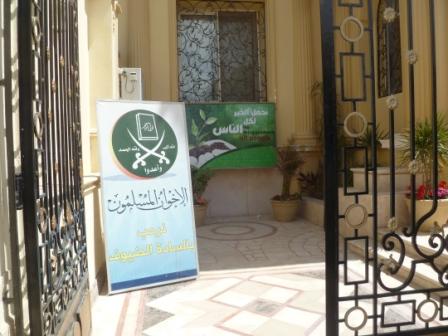
The Muslim Brotherhood in Syria: Covenant and Charter

Translation: The Muslim Brotherhood, Syria

Egypt’s revolution, however noble and good, has been fraught with propaganda, manipulation, and conspiracy. Deciphering truth from falsehood is a near impossible task; distinguishing the ‘good guys’ from the ‘bad guys’ is a landscape of shifting sand.

At least Egypt is not Syria. There as well these complications exist, but with new reports of killing every day. If I were there I’d be pulling my hair out. On the other hand, if I were there it might be easier to identify ‘bad guys’, at the least.

I will not attempt to sort through Syria’s issues here, but I discovered an interesting document issued by the Syrian Muslim Brotherhood. As they compose a substantial part of the opposition to the Assad regime, it is useful to see their vision for a free Syria, here translated into English by the group on Facebook.

Whether it is true or simply further propaganda is anyone’s guess, however worthy of analysis. If I ever have clarity I’ll be sure to share.

—————

In the name of God the Merciful

Covenant and charter

For a free country, free life for every citizen. In this crucial stage of the history of Syria, where the dawn is born from the womb of suffering and pain, on the hands of the Syrian heroes, men and women, children, youth and old men, in a national overwhelming revolution, with the participation of all components of the Syrian people, for all the Syrians.

We, the Muslim Brotherhood in Syria – from Islam’s religion true principles, based on freedom, justice, tolerance and openness – we present this covenant and charter, to all of our people, committed to it in the letter and spirit, a covenant which safeguards rights, and a charter which dispels fears as a source of reassurance and satisfaction.

This covenant and charter represents a national vision, common denominators, adopted by the Muslim Brotherhood in Syria, and introduced as a new social contract, establishing a modern and safe national relationship, among the Syrian society components, with its all religious and ethnic factions, and all current intellectual and political currents.

The Muslim Brotherhood in Syria is committed to Syria in the future to be:

1- A civil modern state with a civil constitution, coming from the will of the Syrian people, based on national harmony, written by a freely and impartially elected constituent assembly, protecting the fundamental rights of individuals and groups from any abuse or override, ensuring an equitable representation to all components of society.

2- A democratic pluralistic deliberative country according to the finest modern thoughts of humanity; a representative republic, in which people choose those who govern and represent through the ballot box, in an impartial free transparent election.

3- A state of citizenship and equality, in which all people are equal, regardless of their ethnicity, religion, ideology, or orientation, going by citizenship principles which are the basis of rights and duties, in which all citizens are allowed to reach the highest positions, based on the rule of elections and efficiency.

4- A country that respects human rights – as approved by God’s laws and international charters – of dignity and equality, freedom of thought and expression, of belief and worship, of media, political participation, equality of opportunities, social justice and providing the basis needed for a decent living. In which no citizen is oppressed in his belief or worship, or restricted in a private or general matter. A country that refuses discrimination, prevents torture, and criminalizes it.

5- A country based on dialogue and participation, not on exclusivity, exclusion, or transcendence, all its people participate equally, in building and protecting it, enjoying its wealth and goods, committing to respecting all its ethnic, religious, and sectarian component, and the privacy of those components, with all their civilizational, cultural, and social dimensions, and the expression of these components, considering this diversity an enriching factor, an extension to a long history of co-existence, in a generous frame of human tolerance.

6- A state in which people govern themselves, choose their way, determine their future, with no guardianship of any autocratic ruler or one party system, and be their own decision makers.

7- A country with respect for institutions, based on the separation of the executive, legislative, and judicial powers, where the officials are in the service of people, and their permissions and following mechanisms are specified in the constitution, and the military and security departments responsibility is protecting homeland and people not protecting authority and regime, and do not interfere in the political competition between parties and national groups.

8- A country that renounces terrorism and fights it, and respects international covenants, charters, treaties and conventions, as a factor of security and stability in its regional and international perimeter. Establishes the best equal relations with its friends, in the forefront its neighbor Lebanon, for its people suffered – as the Syrian people – from the scourge of the system of corruption and tyranny, and works on achieving its people’s strategic interest and restoring its occupied land in all legal means, and supporting the legal demands of the Palestinian brotherly people.

9- A state of justice and law, where there is no room for hatred, revenge, or retaliation. Even those whose hands are contaminated with people’s blood, of any part, it is their right to have a fair trial, before an impartial and independent tribunal.

10- A country of intimacy and love, between the sons of the big Syrian family, in the light of a massive reconciliation, [forsaking] all false pretexts adopted by the system of corruption and tyranny, to intimidate the citizens of one nation of each, to prolong his rule and to sustain its control on everyone.

This is our vision and aspiration for our desired future, our covenant in front of God, and our people, and in front of all people. A vision that we assure today, after a history full of national working for decades, since the founding of the brotherhood, by the hands of Dr. Mustafa Assiba’ey, God’s mercy be upon him, in 1945.

We presented its features clearly and ambiguously, in the National Honor Charter in 2001, and in our political project in 2004, and in the official papers approved by the Brotherhood, on various social and national issues. And these are our hearts opened, our hands outstretched to all our brothers and partners in our beloved homeland, for it to take its decent position between the civilized human societies.

“Help one another in virtue, righteousness and piety, and do not sin or commit aggression.”


Muslim Brotherhood Movement in Syria

25-03-2012

(I edited here and there for clarity, but left the structure of the document as is.)


Related Posts:

Categories
Personal

Morsy at Tahrir

Addressing the crowd

Amid the celebrations, and worry, over Egypt’s new president, there has been a small crisis over where President-elect Morsy will swear his oath of office.

The military’s supplemental constitutional declaration says that in lieu of parliament, he must swear in at the Supreme Constitutional Court.

Many Islamists, however, fail to recognize this declaration and the dissolution of parliament, and insist he swear his oath in front of the chosen delegates of the people.

Revolutionaries, on the other hand, demand he swear his oath in front of them at Tahrir Square.

Mosry has chosen the balancing act, honoring two of three.

Seemingly submitting to the military dictate, Morsy is due to take his oath of office tomorrow. Many interpret this as a tacit acknowledgement of recent military decisions, or worse, indicative of a ‘deal’ or power-sharing arrangement.

Others say Morsy is simply playing along by the rules of the military in order to obtain the presidential office, at which point he will slowly, but surely, work to reverse their accumulated power. Under this scenario, he is currently cementing his revolutionary and centrist credentials so as to keep a popular mandate to resist, and then press against, the military.

Along this path, today Morsy pledged his allegiance to the Egyptian people at Tahrir.

During his 45 minute speech, he gave a little bit to everyone.

To the establishment he said he comes with a message of peace and Egypt will not attack anyone. Israel was not mentioned specifically but the intention was clear enough.

To the centrists he mentioned he would be the president of all Egyptians. He placed Muslim next to Christian, specified tourism workers, and included those who opposed him, and still do.

To liberals he pledged Egypt would be a civil, national, constitutional, and modern state.

But for the revolutionaries he saved his theatrics, worthy of Mario Balotelli’s pose. In the middle of his speech, Morsy left the podium and addressed the crowd directly. He then opened his jacket to reveal a plain blue shirt, and more importantly, no bulletproof vest. He trusted in God, and in the Egyptian people.

The triumphant pose against Germany
The dramatic pose at Tahrir

Morsy led chants honoring the ‘free revolutionaries who will continue the path’. He vowed not to accept any limitation on the powers of the president, implied in the supplementary constitutional declaration.

More poignantly, he pledged retribution for the martyrs and injured of the revolution. He did not specify, but most revolutionaries finger the military.

And when he finished his address, the official chanter boomed, ‘Field Marshal [Tantawi], tell the truth. Is Morsy your president or not?’ It was a direct challenge.

The only group left out of the above was the Islamists. There were no calls for sharia.

But he did tack them on at the end, almost as an afterthought. After referencing the large banner near the stage, he took up the cause of Sheikh Omar Abdel Rahman. Known as the Blind Sheikh, he sits in an American prison for conspiring in the 1993 World Trade Center bombing. From here he promised to work for the release of all prisoners incarcerated during the revolution, and included the Blind Sheikh in their number.

And finally, he called the people to unite in their love for Egypt. Yet to this he added such unity and love would ‘promote the cause of the umma’. Umma is an Arabic term generally taken to denote the Muslim nation as a whole. He did not elaborate, but perhaps hinted at, or subconsciously expressed, the greater aims of the Muslim Brotherhood project.

Reviewing Twitter later in the day, it was clear many Egyptians, even those opposed to the Brotherhood, were impressed. Perhaps not being raised in the arts of Arabic rhetoric I could not appreciate it, but I found the speech a bit rambling and repetitive. At the same time, however, it was a stark departure from the autocrat norm. Morsy was comfortable, engaged, and theatric. He reveled in his moment.

As for the content, a politician is often judged successful by how many constituencies he can please. In this case, he hit the mark. Morsy had to shy away from his base, but even the Omar Abdel Rahman reference can possibly be understood as one of justice, as I have written here, here, and here. At the least, a nation should be expected to lobby on behalf of its citizens jailed abroad, even its guilty ones. Still, the reference will give fodder for analysts to focus on Morsy’s extremist agenda, as well it possibly might suggest.

More likely it was a bone thrown to the Salafis and al-Jama’a al-Islamiyya, but who knows?

Another bone might concern the wrangling over the powers of the president. It is a key revolutionary demand, and of the Brotherhood as well. But largely it is nonsensical. Without a constitution, the powers of the presidency are undefined, yet to be determined by the people. That Egypt has reached this point is the fault and possible manipulation of many; but here, it is a rallying cry more than an issue of substance. That is, unless the charge is true the Brotherhood wish to gain control of everything.

In the end the largest question remains unanswered: Is their conflict or cooperation between the military and the Brotherhood? At Tahrir, did Morsy throw down the gauntlet, or simply pose for dramatic effect? Or, somewhat in between, was he establishing a bargaining chip? It is hard to tell. One’s answer here depends on the reading given to the revolution as a whole, not just on today’s speech.

A speech, which was on the whole successful. Is it his high-water mark, or is the best yet to come? Stay tuned, as the revolution continues. (Or not, depending on your interpretation…)

Post-script: After Morsy’s speech, Tunisian Prime Minister Rashed Ghannouchi addressed the crowd.[Ed. note: Ghannouchi leads al-Nahda Party, but is not prime minister.]Among other remarks he praised the martyrs of both the Tunisian and Egyptian revolutions. To their number he added Hassan al-Banna, the founder of the Muslim Brotherhood, who was assassinated, allegedly on orders of the government.

He then added Sayyid Qutb, who was hung following trial Nasser. While perhaps a victim of military rule, Qutb represent a strand of strident Islamism that employed violence and questioned the faith of Muslims who differed from his vision. Ghannouchi’s mention thereof, like Morsy’s reference to the umma, may reveal more beneath his public agenda. Or not; perhaps he just knew his audience.

Categories
Personal

Praying for a President

President-elect Morsy

In the last few days, President-elect Mohamed Morsy has made very encouraging signs about his inclination to govern from the center. He has met with Christian leaders, revolutionary icons, and even issued directions to not hang his picture in government buildings throughout Egypt, as was done under Mubarak.

Of course, critics may say it is only posturing. A coming battle looms to pit him against the military, over the restrictions to his power made only days before the election. To assert his will, he will need the full scope of moral support from both domestic, and probably foreign, forces. The critic may point to a video like this one about what Morsy truly represents, if he wins.

Regardless of the truth of Morsy’s intentions, I am not fretting much. Instead, I have been trying to rest in the prayer I have repeated for months: God, give Egypt a good president, give Egypt a good government.

This matter of the presidency, in addition to trying to write my best analysis of events, has had me walk the tightrope of all the contradictions imposed by a foreigner’s sense of belonging.

We want the best for Egypt, and wish to enter into the struggle for it. Though, we do not know the best for Egypt, and even if we did, it is not fitting to enter into the particulars of the struggle.

Yet I read, speak with people, form my inclinations, and try to test and communicate what I learn – both with readers and with Egyptians. Faithful visitors to this blog likely have a sense of where my biases, convictions, and opinions lie.

Beneath all of this, however, is a hopeful faith. ‘Hopeful’ in that it imagines the best for the future; ‘hopeful’ further in that I wonder over this faith’s strength and reality.

This faith, I trust, undergirds the prayer. It is not specific – ‘Give Egypt a good president now, with my favored characteristics.’ Nor is it idealistic – ‘Give Egypt a good president someday, who will do all things well and in accordance with your full and complete will.’

The cynic may well say the lack of specifics or ideals means only that my prayer cannot be disappointed. I would rather say it is reflective of the balancing act required of a sense of belonging.

I want a good president for Egypt; I don’t know exactly what this looks like.

Will God answer this prayer, honoring my sincere heart? Has he answered it already? Is Morsy the man? Or is he only a stage necessary for the eventual fulfillment of this request?

I trust that faith and humility gives this sort of answer: Yes, and I don’t know. I will trust this president is the working of God’s best for Egypt, while confessing my inability to know with absoluteness the will of God.

Therefore, within the contradictions, may God bless and guide President Morsy. And as the question of God’s will shall remain forever unanswerable with him or any man, may God bless and guide Egypt.


Related Posts:

Categories
Personal

Egypt’s Military: Seizing Power or Extending Transition?

MB’s Badie vs. SCAF’s Tantawi

Recent moves by the military council have put in question their commitment to democracy and the democratic transition. The popularly elected parliament has been dissolved, policing powers have been extended to the army, and an addendum to the constitutional declaration has afforded the council legislative powers, independence from the president, and a substantial role in overseeing the constitution.

These steps have been called by many a ‘soft coup’, and they may well be. It may represent the army’s effort to protect its influence in Egypt no matter the coming president, but especially if it yields to Mohamed Morsy of the Muslim Brotherhood.

There is another way to view these maneuvers, however, which posits the army as the guardian of democracy and the democratic transition.

Due to failures of the political powers, Egypt has not yet formed a constitution. For all those clamoring for the army to yield power, should it put the president – whoever he may be – in charge without defined responsibilities? Should the president have the chief role in shaping the ongoing democratic transition? Were not Mubarak’s nearly unchecked powers a chief cause of the revolution to begin with?

In this manner, the army has positioned itself as the balance of power for the coming president. Asserting its neutrality, the army will give responsibility to running the internal affairs of the nation to the president, but will act as the legislature until a new body is elected. Along with the president, prime minister, and the constitutional court, the military will also hold veto power over the coming constitution, to assure it is written according to consensus.

The addendum to the constitutional declaration states the military will retain this power until the new constitution is formed and approved by the people. At that time the transition will be complete and the military will abide by the new charter.

Understood in this explanation, the military’s moves are much more reasonable.

Not that they are immune from doubt, not in the least. Many argue the chief reason the political process has been muddled has been the military playing one party off against another. The extended transition envisioned by the military allows ample room for this policy to continue. The transition may be extended, and extended, and extended…

Additionally, even under this military-favored explanation, there seems little reason for the army to re-assume policing powers, as if it were a state of emergency. In advance of announcing the election results, the army has deployed throughout the country.

Meanwhile, the explosion of rumors has made everyone suspect. Conspiracies abound, and the military is not exempt, nor should it be.

Yet it should not be declared that the military has ‘seized power’. It may, but it has not done so yet.

It, like everyone else in the political scene, does appear to be maneuvering and manipulating. Surely there is much back-room discussion and public venting of rhetoric, sincere or otherwise. The Brotherhood has set up a confrontation scenario, while it pledges not to use violence under any circumstances. Even though other Brotherhood statements predict a violent backlash if their candidate does not assume office.

Their vote count appears legitimate and has been verified by independent sources. Yet their proclamation of victory, before consideration of electoral appeals, is a political move to establish the status quo viewpoint on their behalf. It is shrewd, but also suspect.

As is the military. Observers should be careful not to take sides as both have opened themselves to accusation. Instead, the facts must be presented as best determination allows, even in the midst of deep confusion.

Such is the apt description of all Egypt. May confusion pass and all judgments be established on solid evidence. Such indeed would be a revolution.

Related Posts:

Categories
Personal

The MB’s Organizational Structure: Any Christian Similarity?

Today the court postponed ruling on a case calling for the dissolution of the Muslim Brotherhood as an entity. It will be reviewed again on September 4, at which point the group may be declared illegal and forced to disband.

The following is an effort to understand the structure of the Muslim Brotherhood, as well as an effort to compare it to a more familiar Western expression of religion: The small group Bible study. Too often the Brotherhood is only seen from its top administrative levels, which fill the headlines of newspapers and command cries of conspiracy and caliphate. It is hoped a greater understanding of its organizational reach can provide perspective about the group as a whole, through which the current legal questions are being asked.

Please feel free to skip a few paragraphs if the following details become tedious.

The lowest level of organization in the Muslim Brotherhood is called the ‘family’. This consists of between 5-9 people who meet regularly, led by an established member. It focuses on general education into the Brotherhood ‘way’, so to speak. Membership in a family is not permanent; people are shuffled so as to build better and wider community. But every Muslim Brother, no matter how lofty his title, is constituted into a regular family meeting somewhere.

The family, however, is not an administrative structure. Instead, members of families in a particular neighborhood or district comprise a ‘branch’, which numbers no more than 90 people. Once it expands beyond this number the district is divided into two branches.

The up-to-90 members of a branch then elect 40 of their number to serve on the Branch Consultative (Shura) Council. In turn, the council elects 7-9 members for the Branch Administrative Council. See this geographically, for example, as the Maadi neighborhood of Cairo.

This pattern will repeat itself as the organization moves upward in hierarchy. The basic idea is that the Administrative Council runs and supervises the activities of the Brotherhood within its geographical scope. These activities include preaching, youth, politics, religion, students, service, etc. The Consultative Council is the group with its ear to the ground, running the different programs, so that the Administrative Council can make decisions and filter information upwards in the chain of command.

Every 3-4 branches then constitute a Region. Members of the Consultative Council in each branch elect 40 members to serve on the Region Consultative Council. These 40 then elect between 9-11 individuals to be on the Region Administrative Council. Geographically, this could represent South Cairo, for example.

Next, between 8-12 regions are grouped together, and the respective Consultative Councils elect 80-90 members for Administrative Office’s Consultative Council. This group proceeds to elect 13-15 members of the Administrative Office, which runs the affairs of the Brotherhood on roughly the governorate level. At this point the geographical scope might include all of Cairo.

At the highest level of the Muslim Brotherhood, The Administrative Office’s Consultative Council elects around 100 members to the General Consultative Council. This body elects and advises the Guidance Bureau, which currently has 18 members. Finally, the Guidance Bureau elects the General Guide, sometimes called the Supreme Guide. This is the position currently occupied by Dr. Mohamed Badie. For past leaders of the Brotherhood, click here.

Those who skipped ahead can pick up reading again now.

The important consideration now is to find an understandable parallel to the Muslim Brotherhood from Western culture. Along these lines it may be easier to consider whether or not the group should be dissolved on legal grounds.

From the lowest ends of Brotherhood bureaucracy, their ‘family’ appears to be akin to the concept of a small group Bible study. For those unfamiliar with American evangelical Christian culture, these Bible studies usually comprise up to ten individuals who meet weekly to monthly to study and discuss a predetermined passage of the Bible, often with the aim of finding application in one’s life. Yet within the religious discipline is the development of fellowship, knitting the group together in mutual and oftentimes local service.

These Bible studies are often but not always connected to a local church, but have no obligation to register with the authorities in any formal way. In fact, such oversight would be interpreted immediately as a curb on religious freedom and an invasion of privacy, representing ‘Big Brother’ government at its worst.

Now, it is not uncommon for these independent small group Bible studies to use pre-developed study guides or curriculums. There are numbers of options to choose from – Beth Moore, John Piper, Wild at Heart. Sometimes there can even be leadership training options offered to small groups, sponsored by these larger organizations. Sometimes there are regional conferences which celebrate unity and build fellowship among a larger constituency.

Moreover, many churches, especially larger ones, work to create extensive networks of these small group Bible studies. Inasmuch as the pre-developed study guides offer their resources for cost, however minimal, they are registered with the government as a business or a charity. These churches also are registered with the government. The network of Bible studies, however, is not. These are simply composed of ordinary citizens who open their homes to friends and neighbors.

But what would happen if these small group networks began to informally advocate for a particular presidential candidate? Or, along other lines, what if they collected donations to organize clothing drives for poor neighborhoods in their communities? Or, what is the situation if these networks spill over national borders into Mexico or Canada?

The situation is not exactly parallel, but at increasing levels of organization and complexity the question is fair: At what point should government regulation begin?

When the Muslim Brotherhood began, Hassan al-Banna utilized this ‘small group Bible study’ methodology to spread the message of Islamic renewal throughout Egypt. He wished to see the individual, family, society, and eventually state return to the principles advocated in the Quran and prophetic traditions. It was, first and foremost, a preaching organization, composed of small groups linked together creating common identity and purpose.

At different times in its history, the Muslim Brotherhood has moved away from its roots in preaching to consider politics, or even violence. Following the January 2011 revolution the group’s leadership was faced with a choice – to remain primarily a preaching and service organization or to enter full force into the political struggle.

There were voices on each side, but the majority opinion was to create a political arm – the Freedom and Justice Party. This party pushed against the limits of Egyptian law which stated no political party may be based on religion. But the final government ruling was that the party’s ‘Islamic reference’ was sufficient distance from Islam to allow its formation. This ruling is being challenged in court, also postponed to September. Nevertheless, the political party is fully registered and accountable to government oversight.

The Muslim Brotherhood is not. It never has been.

What is the Muslim Brotherhood, then? Is it simply a collection of ‘small group Bible studies’ with a developed administrative network? No members of the bureaucracy described above receive any salary for their leadership and administration. They collect dues and use these to finance programs and activities, but individuals do not profit financially from their association; they are volunteers.

As such, it is more fitting to call the Brotherhood a non-governmental organization, perhaps along the lines of the Rotary Club. Yet given the level of financial arrangement (with international donations circulating as rumors) along with the Brotherhood’s influence on the ground, government oversight would seem necessary and acceptable.

The Brotherhood has stated it will register under the NGO law, once a new government is formed and the restrictive, perhaps oppressive laws of the past are annulled. It also states that it could never file in the past due to the efforts of the Mubarak regime to discriminate against them.

Yet one reason for such discrimination is because, ultimately, the Brotherhood does not believe in the concept of the modern nation-state. While working for the good of Egypt, the group clearly advocates for some conception of a revival of the caliphate. Not only did they consider the rule of Mubarak illegitimate, they also worked toward a future in which such national boundaries become irrelevant.

Here, we move beyond the small group Bible study model. Even if such networks were to advocate for a certain presidential candidate or the reform of certain laws, none to my knowledge are calling for a return to Christendom.

This is not to argue in favor of a court ruling against the Muslim Brotherhood come September. In the middle of revolutionary struggles over legitimacy, it is quite possible the verdict could be a political move to silence opposition. Or, it could be a threat to hang over the group’s head in effort to control their actions, if not their rhetoric. Too much is going on between all parties to draw strict lines of black and white.

Yet it is not unreasonable to ask the Muslim Brotherhood to behave transparently. To a great degree, they do. The information above was supplied freely by Islam al-Bishlawi, Central Cairo Secretary for Youth in the Freedom and Justice Party, to whom thanks is offered. Yet to my knowledge, their finances are not open for public view. Billing themselves a ‘Muslim’ organization, does such secretiveness befit Islam or run counter to its sense of ethics or morality?

In September, perhaps, the court will decide.


Related Posts:

Categories
Personal

Confrontrations Brewing between Brotherhood and Military

Saad al-Katatny, speaker of parliament

Early results of the presidential elections show Morsy the likely victor, with a small 51% to 48% margin. Official results will not be issued until Thursday, though Morsy has declared victory. Shafik is mostly silent, though he protests Morsy’s declaration.

As news of Morsy’s victory was emerging, the military council issued a supplementary constitutional declaration. It gives them the rights of the legislature following the dissolution of parliament, as well as near veto power over the coming constitution. It isolates the military from the command of the president, and establishes martial law powers for the military police.

The presidential elections settle very little.

Tomorrow is a very key day in the continuing struggle. First of all, the Muslim Brotherhood is challenging the right of the military leadership to execute the decision of the court to dissolve parliament. It claims, following past precedent but iffy legal standing, that the people must ratify this decision through a referendum.

If it was just legal challenges all would be back page news. Tomorrow, however, represents a normal working day for parliament. The Brotherhood – it is unclear though unlikely other parties would follow – is threatening to march its elected representatives to the building, so as to enter. Meanwhile, police have barricaded the entrance, fitting with the official dissolution.

What sort of protest will this become?

Even more far reaching could be a legal decision expected to be issued on the same day. A court will rule if the Muslim Brotherhood itself must be dissolved.

The Brotherhood had long been dubbed a ‘banned’ organization under Mubarak, but was allowed freedom of operation since the revolution. Yet it never registered. It is a non-state entity operating independently of all government oversight and regulation.

This was the same situation of the US and other NGOs shut down several months ago. They were allowed to operate in a quasi-legal arrangement in which registration was never granted. However much their closure represented a crackdown on pro-democracy activity, it was in accordance – somewhat – with the law.

Such is the situation of the Brotherhood now, only that unlike the Western NGOs, the MB never sought registration to begin with. It is hard to know if this is just a threat raised against the group or a card to pressure them with. But if there is a true and absolute struggle between the military council and the Muslim Brotherhood, this court decision could be a critical blow.

It is not certain what a ruling against the Brotherhood would do to a Morsy presidency, but it appears the political arm of the group would be allowed to stay. The Freedom and Justice Party did register successfully following the revolution, as did every other political party. Of course, few consider the FJP to be independent of the Brotherhood, so the separation between the two is sure to be murky.

Egypt never ceases to be interesting.

Related Posts:

Categories
Personal

My Egyptian Run-Off Election Prediction

To open, and to be clear, I have no idea who will win this election. Both Ahmed Shafik and Mohamed Morsy took about equal shares in the first round, the revolutionaries are divided between them and many are boycotting, and who knows what the average Egyptian wants, or if he chooses to vote at all.

Of course, this is simply the difficulty from the polling perspective. Things are equally unclear about the suspicions of manipulation. The status quo opinion, especially after the dissolution of parliament, is that that state is working on behalf of Ahmed Shafik. This is reasonable, but it is also open to other conspiracies.

So amidst this mass of confusion I will wade: Mohamed Morsy will be Egypt’s next president.

First, from simple vote analysis: Both Shafik and Morsy captured about 25% of the electorate. Running amidst many other candidates, it is fair to say this represents the natural constituency of both.

In third place was Hamdeen Sabbahi, who represented the non-regime, non-MB vote. A great proportion of his supporters will boycott, and the rest will likely be split equally between the two as their conscience settles on the lesser of two evils.

In fourth place was Abdel Munim Abul Futuh, and somewhat significantly behind him was Amr Moussa. Abul Futuh’s votes will likely go to a fellow Islamist, while Moussa’s will shift to the civil state advocate. It’s probable most of these voters also are not thrilled about their final choice, but there are more of Islamist ilk, so Morsy gets the edge.

That leaves the undecided. Actually, these might not matter at all. Turnout for the first round of elections was only 46%; it is expected to be lower for the run-off. Both Shafik and Morsy have powerful political machines, so these will probably cancel each other out.

But if the non-committed voter chooses, I think he will have more inclination to lean toward Morsy. Shafik does not have a project; his campaign is based on the promise of a return to stability with a heavy dose of accusation against the Muslim Brotherhood.

The Brotherhood has lost a significant portion of its popularity since their triumph in parliamentary elections, but this sentiment is probably weakest (or least recognized) among the non-politicized voter. For these, Morsy represents either 1) the choice of a ‘Muslim’ president, or 2) the choice of change.

I think these factors will push the edge to Morsy in the end.

Second, no prediction is worth its weight unless it deals also with the underlying issues of interest and possible manipulation. Again, though murky, here is my best shot.

The first issue concerns outright vote fraud. In all that follows, I have no evidence to present, but only a reading of the tea leaves. I do not expect state sponsored cheating.

The reason is legitimacy. The military council won legitimacy by protecting the revolutionaries during the initial eighteen days of protest against Mubarak. They have since lost most of this legitimacy as they have navigated the transition, but their promise was to deliver civilian rule through a democratic process.

The only way for the military to salvage legitimacy is to fulfill their promise. Fraud would evaporate it. So would brute force or coup d’etat. The military likely desires to continue playing a role in Egypt’s politics behind the scenes. The only way for this to occur is to preside over legitimate elections, no matter the outcome.

Have they steered the outcome, through the apparatus of the state? Perhaps. The question is toward whom.

It is easier to guess at whom they have steered it away from. The first elimination was of strong, independent candidates. Omar Suleiman (of the intelligence services), Khairat al-Shater (of the Muslim Brotherhood), and Hazem Abu Ismail (of the Salafis) were all disqualified on procedural grounds – all with legitimate, explainable, though somewhat tenuous reasoning.

The second elimination was the most challenging. This was the electoral contest which promoted the strident partisan candidates over revolutionary centrists. It is far too uncertain to assert the military ‘arranged’ or even ‘steered’ this outcome. Yet it is reasonable they were not displeased by the winning candidacies of Shafik and Morsy, both of whom represented the major players of the old regime.

For the second issue, it is in this context the recent dissolution of parliament and likely assumption of constitution writing can be understood.

If Shafik wins, the constitution will be written under friendly circumstances, while the election of a new parliament would likely see a less dominant Islamist presence.

If Morsy wins, the constitution still stays out of the hands of Islamists, while the absence of a parliament denies the Brotherhood a second source of legitimacy. In this scenario, Islamists are even less likely to win parliament, as the people – already wary of the MB – will keep them from having a strong mandate.

A Morsy victory will set off alarm bells among many, and for those unfavorable toward the Brotherhood there is reason for concern. The presidency will allow gradual Islamist population of the general bureaucracy. A Brotherhood triumph could set a pattern for other nations, and their success could transform the map of the Middle East. The alarm for many will be that geopolitics has shifted, and the powers-that-be (i.e., the US) now favor Islamist rule.

While shifting alliances are possible, even on a legitimate basis of popular rule, my gut still imagines it not to be the case. I think the US and the Egyptian military are fundamentally averse to the Brotherhood.

This blog has done a good job at making the case why the military might not mind, or even favor, a Morsy victory. Chief among them is that it gives the military a cover for a civilian – and in particular an Islamist – to take the fall for all coming problems, natural or instigated.

A popular theory in Egypt claims that the military yielded parliament to the Brotherhood to give it just enough rope to hang itself. Indeed, their popularity has suffered as observers discovered them as a manipulating faction dedicated to the preservation and increase of its own power.

This theory can be extended to give them the presidency in order to complete the job. Losing parliament and the constitution divests them of the tools necessary to cement their control, and leaves the president to flail in the wind.

If indeed the powers-that-be want to rid the region of the specter – and promise – of the Brotherhood, this may be a far better strategy than repression.

Unfortunately, it is a dangerous and illegitimate game – if it is being played at all. The point here is to examine why a Morsy victory may be allowed, or may be accepted, or may even be encouraged.

Of course, Shafik could win, either along the lines of status quo conspiracy, or along the lines of popular legitimacy.

Parliament may have been dissolved because it violated the law. The constitution may revert to the military because political parties could not agree on the writing committee. One should never dismiss the simple and obvious explanations.

Yet even these, I venture to guess, will lead to a Morsy presidency.

Unfortunately, too often in Egypt, there is an angle behind every obvious. This will continue until Morsy, or Shafik, or the continuation of the revolution is able to install transparency as a hallmark of government.

May this day come, through the rule of whomever.

Related Posts:

Categories
Personal

Missing Prayers for Egypt

Apologies to all for not getting up a Friday Prayers for Egypt this past weekend. On one count I was traveling in Upper Egypt, and when I returned home I was quite fatigued and fell ill.

But on another count I hardly knew what to pray for.

Faithful readers of this theme will notice that the prayers are often similar, no matter how current political events shape them. I pray for what is right and just to triumph. I pray for those men of ill intent or selfish ambition to be exposed. I pray for the Egyptian people to live in freedom and sovereignty. I pray for peace and honor to be exchanged by all.

I try not to let my own interpretations of these matters enter the prayers, for these are only seen through a glass darkly. I thank you for praying along with me, and adding the details as you see fit.

But last Friday – albeit hampered by sickness – I had nothing.

We should be able to pray in all circumstances, of course, and to a degree I did. But finding the words to help shape your prayers for Egypt was too tricky.

Why? One, the repetition of the themes of these prayers seemed empty, for whatever reason. Two, the reason could be that so much is now out of the hands of the people and main players, and in the hands of the law.

It is harder to pray for the law.

Presidential run-off elections between the candidate of the old regime and the candidate of the Muslim Brotherhood are scheduled for June 16-17. Since I am not praying at this moment, I can be candid in stating neither one of these choices is especially appealing – a fact recognized by about half of Egyptians as well. So asking prayer for the right choice – and either candidate may the choice of God’s best – while necessary, is difficult and somewhat depressing.

But that is not what killed the prayer. On June 14 there are two court cases due which may dramatically alter the Egyptian landscape.

One concerns the constitutionality of parliament. If the technicality is applied, which has precedent in Egyptian law, parliament could be dissolved. This may throw Islamists, perhaps revolutionaries, and some liberals into a fit.

The other concerns the constitutionality of the candidate of the old regime. Parliament quickly issued a law – targeting him – to bar high placed figures from Mubarak’s government. On June 14 the court will rule if the law is applied. If so, it eliminates him as a candidate, but no one knows exactly what would happen next.

So back to the prayer – how do you offer prayer for an event that may not even take place?

With a few more days of reflection I can say we can pray for these decisions; perhaps one or the other is best for Egypt’s transition. We can certainly pray for the heart of the judges who must navigate the corridor of what the law says, what is best given the revolutionary situation, and whatever pressures are put to them, if any. There situation is not enviable.

But even here, from my vantage point the legal pretexts seem flimsy, and the question of the independence and integrity of the judiciary is under heavy suspicion. Like much in Egypt, few if any know the full truth amidst propaganda, manipulation, and lies. And in the end, all conspiracies may well be empty.

But these circumstances are poison for event-specific prayer life.

Which returns the prayers, if offered, back to the repetition of general themes:

I pray for what is right and just to triumph. I pray for those men of ill intent or selfish ambition to be exposed. I pray for the Egyptian people to live in freedom and sovereignty. I pray for peace and honor to be exchanged by all.

God intends us not only to pray without ceasing, but also to make our prayers like the incessant cries of a widow demanding her rights from an unjust judge.

I will leave the formulation to you this week, but thank you for carrying this baton, if not this cross. Egypt is certainly in need in these coming days.

Even then, if all is normal, they then have a presidential election two days later.

God, be merciful.

Amen.


Categories
Personal

Early History of Islamism in Egypt

(L) Hassan al-Banna, (R) Sayyid Qutb

Egyptian presidential campaigns have entered the mudslinging stage. Ahmed Shafiq has been on the defensive since his entry into the race, in which he is accused of being a member of the former regime and seeking to reconstitute it. He has also faced charges of financial corruption during his time as Minister of Civil Aviation.

In recent days he has hit back, especially against the Muslim Brotherhood. He has accused them of working with Qatar to sell/lease the Suez Canal to the Gulf state, and working with Mubarak to make secret deals in exchange for a proportion of parliament seats. In terms of the revolution he said they are the often-touted third party who killed protestors and burned police stations.

As best I can follow, no conclusive evidence has been issued to support his charges. Yet the political climate reminded me of a project I have been working on to establish a chronology of Islamism in Egypt since the dawn of the Muslim Brotherhood. The following list is disputed in points, and is compiled from a book entitled ‘Islamic Fundamentalism in Egyptian Politics’, by Barry Rubin. It outlines moments in history where Islamists have been violent, and others where they have shied away.

Shafiq asserts we are now in another violent period. I have significant doubts, but as with all things revolutionary, anything is possible, even plausible.

  • 1929 – Muslim Brotherhood founded by Hassan al-Banna
  • 1930-39 – MB grows to tens of thousands of members, including in police, army, and government institutions, and includes a Secret Organization for militant activity and terrorism
  • 1948 – MB raises funds, buys weapons, runs training camps, and sends volunteers to Palestine
  • 1948 – Egypt’s government dissolves the MB using emergency law from Palestine war
  • 1949, February – MB member shoots Prime Minister Mahmoud Nuqrashi, regime retaliates by assassinating Hassan al-Banna
  • 1951 – MB supplies many fighters during the Suez Canal crisis, links with Free Officers in the army including Anwar Sadat
  • 1952, July – Gamal Abdel Nasser overthrows monarchy during revolution/coup d’etat
  • 1952 – Sayyid Qutb returns from America horrified at its society, becomes a leader in the MB and was involved in meetings with Nasser
  • 1952-54 – al-Banna’s successor Hassan al-Hudaybi works as a reformist to prevent consolidation of Nasser’s power, while Qutb plays hardball and promotes seizing power
  • 1954, August – al-Hudaybi opposes Nasser’s treaty with the British over the Suez Canal and is arrested
  • 1954, October – MB member (allegedly) opens fire on Nasser; he survives and takes over as head of state, 6000 arrested as organization is outlawed
  • 1954 – Qutb arrested and sentenced to 25 years in prison, after he developed theory of jahiliyya­, which describes Egyptian society as non-Islamic
  • 1954-64 – Nasser establishes Muslim credentials as mosque building flourishes, Islamic radio is established, the Azhar is incorporated into the state and modernized, and religion is made a compulsory subject in schools
  • 1961 – Nasser undermines Azhar authority and introduces new, non-religious faculties
  • 1964 – Nasser frees MB members in prison in an effort to counter Egyptian Marxists
  • 1965, August – Nasser accuses MB of assassination plot, 27,000 arrested, 26 tortured to death, Qutb, Yusuf Hawash, and Abdel Fattah Ismail hanged
  • 1967 – Egypt suffers humiliating defeat against Israel, undermining Nasser’s legacy and legitimacy
  • 1970-85 – Government supported mosques double their religious programs, with triple student enrollment
  • 1970, October – Anwar Sadat becomes president
  • 1970 – First Islamist association founded in Qasr al-Aini Hospital among doctors and interns who treated Islamists released from prison
  • 1971, May – Sadat purges socialists and frees MB prisoners to combat them, including al-Hudaybi and future leader al-Tilimsani
  • 1971 – MB works with Sadat on new constitution making ‘the principles of the Islamic sharia a principle source of legislation’, but complain it does not make it the sole source of authority
  • 1971 – Shukri Mustafa breaks with the MB following his release from prison, sets up Takfir wa Higra
  • 1971-77 – MB cooperates with Sadat and his ‘Corrective Revolution’, until splitting over his peace initiative with Israel
  • 1973 – al-Tilimsani becomes Supreme Guide of the MB, was a close associate of al-Banna
  • 1974, April – Islamic Liberation Organization, led by Salah Sariyya (a Palestinian) fails in coup d’etat at the Military Technical Academy in Heliopolis, 92 people indicted, including 18 cadets; 30 officers and 100+ soldiers discharged for sympathy
  • 1975, July – Sadat issues full pardon to MB members still in prison
  • 1976 – Sadat creates Arab Socialist Union to open up political life, MB supports him during parliamentary elections; wins right to publish al-Da’wa journal
  • 1977, January – riots breakout over Sadat’s policy to trim food subsidies, MB mocks government for blaming the communists
  • 1977, July – Takfir wa Higra kidnaps and murders former Endowments and Azhar minister Husain al-Dhahabi, who criticized their idea of jahiliyya and isolation from society in preparation for violent overthrow of the government
  • 1978, March – Takfir wa Higra leader Shukri Mustafa hanged with four others, many imprisoned
  • 1978, September – Sadat crafts Camp David Accords with Israel
  • 1978, December – Parliament forms committee to study if current laws comply with sharia
  • 1979, March – Egypt signs peace treaty with Israel, MB opposes it and Camp David harshly, but al-Tilimsani calls on Arab League not to ostracize Sadat
  • 1979, June – Sadat suspends publication of MB’s al-Da’wa journal
  • 1979, July – Sadat accuses al-Hudaybi’s successor Omar al-Tilimsani of trying to overthrow regime
  • 1979 – Islamist independent candidates Sheikh Salah Abu Ismail and Hassan al-Gamal elected to parliament
  • 1979 – Sadat cracks down on Islamic associations, especially in universities, arresting many and limiting freedom of association, criticizing them for Muslim-Christian clashes
  • 1979 – Asyut Islamic association succeeds in forcing university to segregate students by gender
  • 1980 – Army publishes religious magazine for soldiers to keep them from radicalism, increases mosque construction on bases; government publishes two religious magazines, al-Liwa’ al-Islami and al-Urwa al-Wuthqa
  • 1981, June – Muslim-Coptic riots in Zawiya al-Hamra, Cairo; al-Da’wa accuses Copts of slandering Islam and gathering arms to kill Muslims
  • 1981, September – Popular preacher Abdel Hamid Kishk accuses Sadat of betraying Islamic principles, following his sermon Muslims exit and attack neighboring church
  • 1981, September – Sadat arrests 1500 activists, 90% of whom are Islamists, including al-Tilimsani, MB spokesmen Saleh Ashmawi and Mohamad Abdel Qudus, as well as Kishk; also arrests Copts and secular activists; government assumes control over 40,000 privately owned mosques
  • 1981, September – Among the above Sadat arrests brother of Khalid al-Islamboli who was a member of an Asyut Islamic association
  • 1981, October – Sadat assassinated by Khalid al-Islamboli of al-Jihad
  • 1981, November – al-Tilimsani denies the MB ever used violence or terrorism
  • 1982, March – Investigation into Sadat assassination sentences al-Jihad leader Mohamed Abdel Salam Farag (author of ‘The Neglected Duty’ about jihad) to death with four others, five given life imprisonment, twelve long sentences, but Omar Abdel Rahman acquitted, though he authorized the assassination with a fatwa
  • 1982 – al-Tilimsani suggests violent Islamic groups were set up by the government to counter the MB
  • 1982 – Government sends Azhar and MB clerics into the prisons to instruct extremists about proper Islam, program mostly publicity and false reform
  • 1982 – Parliament committee finishes work finding most laws already comply with sharia, the rest should be reformed gradually
  • 1984 – al-Tilimsani secures MB-Wafd Party partnership with Fuad Sirag Eddin to elect MB members through Wafd’s legal structure, wins 15% of the vote with eight seats for MB
  • 1985, February – After Mubarak permits resumption of Islamic associations’ work, Egyptian University Student Federation reestablished
  • 1985 – Wave of bumper stickers spread through Cairo bearing Islamic slogans
  • 1985, June – Hafez Salama, popular war hero, tries to launch a demonstration from his mosque in Abbasiyya, Cairo in support of sharia law, relents, re-launches later, is removed from his pulpit and arrested; MB did not support his efforts
  • 1986, April – Four officers and 29 people arrested for stealing ammunition in a plot to take over the government, linked to al-Jihad
  • 1985, May – Parliament defeats law authorizing sharia as the law of the land
  • 1986, May – al-Tilimsani dies and is succeeded by Mohamed Abu al-Nasr
  • 1986, October – Police foil an armed effort to takeover an Alexandria radio station
  • 1986 – MB breaks with Wafd over internal power struggle, joins with Liberal Party instead; Salah Abu Ismail becomes vice-president and party drops support for Camp David
  • 1986 – Security forces arrest 2500 Islamic radicals, MB raises no protest
  • 1987 – Jihadist group Survivors from Hellfire fail to assassinate al-Musawwar magazine editor Makram Mohamed Ahmed and former interior minister Nabawi Ismail
  • 1987 – Mohamed Abu al-Nasr revises MB history claiming the regime made them out to be violent promoting myths of their earlier insurrection, though he took MB oath fifty years earlier on a Qur’an and a gun
  • 1987, April – Islamist Alliance wins 17% of seats in parliamentary elections with 36 seats to MB
  • 1987, July – MB agreed with ruling NDP to support Mubarak’s bid for second six-year term
  • 1987, Members of Islamic associations sweep student elections at all faculties in Cairo University
  • 1987, MB electoral program calls for ending military cooperation with the United States, but favors Western ‘People of the Book’ over Soviet Russia

Related Posts:

Categories
Personal

My Egyptian Presidential Prediction

From left: Shafiq, Sabbahi, Mousa, Abul Futuh, Morsy

Egypt’s presidential election polls are all over the map. Most have had Amr Moussa and Abdel Munim Abul Futuh in the lead, with Mohamed Morsy of the Muslim Brotherhood trailing significantly.

And then results of the overseas ballots were revealed, putting Morsy significantly in the lead.

More recent polling indicates that the nationalist, semi-socialist candidate Hamdeen Sabbahi is gaining, as he is free from ‘contamination’ either from the former regime or Islamist trends. Meanwhile former Mubarak emergency prime minister Ahmed Shafiq is also gaining, as he projects confidence to restore stability and take the Islamists head on.

And in the last days, Moussa and Abul Futuh are seen as reeling, as their efforts to be centrists crumble as the political scene polarizes. See notable Egyptian blogger Mahmoud Salem – Sandmonkey – for analysis to this effect.

Perhaps a poll off the subject, then, may help to clarify things. Though unlikely, here is the effort. Several months ago Arab West Report authorized a survey consulting five thousand Egyptians through personal interviews throughout the Egyptian republic. They sought citizens’ opinion on Article Two of the Egyptian constitution, which states Islam is the official religion of the state and sharia law is the main source for legislation.

Following the revolution this article became a political hot potato. While some Copts and liberals found it to be a discriminatory element of Sadat-era sectarian politics, it was the conservative Islamist element that made the most use of it. They warned Egyptians at the time of the national referendum in March 2011 that a vote against the army-endorsed transition would result in a wholly new constitution (as opposed to the army-sponsored amendments) which would threaten to remove the article – and the centrality of Islam – from the national identity.

It is unlikely that this campaign affected the referendum results too seriously, but in a nation weaned on identity politics during the Mubarak era, it had an effect.

Arab West Report tested that effect several months afterwards. The results were interesting, and as follows:

  • Only 36% of Egyptians have even heard of Article Two, but once informed…
  • 88% of those polled favored keeping Article Two as it is in the constitution
  • 92% of those favoring desire to preserve Islam as the official religion
  • 43% of those favoring desire for Islamic law to govern all Egyptians
  • 12% of those favoring believe it is too sensitive to change it
  • 9% of those favoring desire a religious, as opposed to a civil, state
  • Only 2% of those polled favored cancelling Article Two from the constitution
  • 6% of those polled favor amending Article Two
  • 74% of those favoring desire to achieve equality between Muslims and Christians
  • 17% of those favoring desire to protect the civil character of the state

Obviously, a vast majority of the population is comfortable with Islam as the designated national religion. Somewhat telling is that of these, a significant plurality desire sharia law to govern as well. Furthermore, a sizable minority wishes outright definition as an Islamic state.

Though ‘significant’ and ‘sizable’, this sentiment remains a minority among the ‘vast’ support for keeping Article Two as is. What might this mean for the elections?

On the one hand, it could mean the victory of an Islamist candidate. Elections are often won by the constituency most dedicated to a particular issue, which can resonate with the population and mobilize their support. 40+% of the population desiring the rule of sharia law perhaps is ripe for activation. (Other polls put this percentage even higher.)

Yet I would argue against this trend, though I am making a prediction based on the unknowns of the Egyptian political landscape, a bet on the average Egyptian citizen.

To run down the candidates, borrowing from Sandmonkey’s analysis, each of the candidates represents a specific element of the general constituency.

Mohamed Morsy of the Brotherhood represents Brotherhood interests, and their very sizable following of adherents. Still, it is a limited and definable circle. The somewhat negative reaction to parliament following the 70+% Islamist victory will hamper their sympathy vote immediately following the revolution.

Ahmed Shafiq represents the interests of old regime, perhaps the military, business and capital, and a large share of Coptic sentiment. He has the potential to win a large number of undecided voters who react negatively to post-revolution instability, and those who favor reform over revolution. Yet over the past year the nation has adopted the idea of Mubarak’s corruption and the validity of the revolution, and he is too tainted with it to succeed.

Abdel Munim Abul Futuh, the other Islamist and former member of the Muslim Brotherhood, represents the general Islamist sentiment which is not comfortable with the Brotherhood. He is poised to capture a significant share of the Salafi vote, if not the majority, but also a significant share of the revolutionary vote. He is on friendly terms with Mohamed el-Baradei, who remains a hero to much of the revolutionary core. The unfortunate matter for him is that this core is generally elite. Though Salafis are not, his popularity is likely limited to the upper crust activists and does not spread to the countryside.

Hamdeen Sabbahi suffers a similar problem. Though a long term opposition figure, the opposition to Mubarak pre-revolution was basically a movement of dissatisfied elites. He represents the interests of many Egyptians who maintain their dissatisfaction – now with the front running choices of Islamist or old regime candidates. This includes a number of revolutionaries, liberals, and Copts, but their numbers are far too small.

This leaves Amr Moussa. A very unsexy candidate, he positioned himself early in the revolution as a candidate for president. He is tainted by association with Mubarak, but is also recognized as not having been a vital cog in the regime’s wheels. He is older in age, satisfying those who desire a transitional figure to guide the movement to democracy. He is a statesman with wide name recognition, striking a presidential figure. His skill in diplomacy suggests he will have few natural enemies, able to navigate all competing interests, both foreign and domestic.

Yet his greatest asset, I argue, is that he does not represent any interests in particular. Though it would be naïve to state this unequivocally, it is clear he is not a partisan.

I argue, neither is the Egyptian citizen.

The development of party interests and zeal is (probably) healthy for Egyptian democracy. If allowed to nurture without any one party taking immediate control, and perhaps dominance of the political scene, these diverse constituencies will mature and coalesce and lose the stridency marking current campaigning. This fanaticism is natural following a revolution, but it is also transitory.

The Egyptian public was depoliticized for sixty years. Though awakening, I do not believe it has been transformed. Moreover, the Egyptian personality is not fanatic or partisan. It is national, it is centrist, it is even, perhaps, accepting of the inevitability of a strong, dare-it-be-mentioned, Pharaonic figure.

If the public support for this election was not so strong, the result would likely be taken by the best organized particular constituency. As with the parliamentary elections, this would likely be an Islamist.

Yet the turnout for the first free, and hopefully fair, elections in Egypt’s history is expected to be overwhelming. If so, the average citizen will come to the forefront. I estimate this average citizen will support Moussa.

Might he be motivated by religious politics, perhaps. Might he be motivated by calls for stability, perhaps.

I expect rather his rejection of particular, well-definable interests. Amr Moussa, for better or worse, is best positioned to win their favor.

Alas, and alleluia, no one knows. This is a virgin electorate, and the glory of Egypt. May her vote be true, and may it be accepted by all.

May it be the beginning of popular and national sovereignty.


Related Posts:

Categories
Personal

The Shrine to Pope Shenouda

Yesterday, in a third attempt, I was able to see the final resting place of Pope Shenouda.

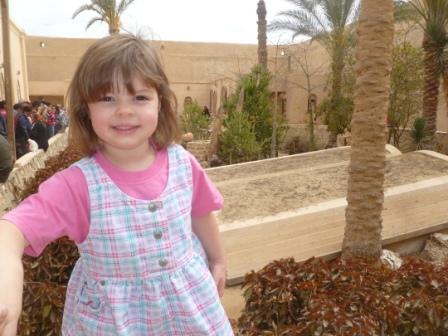
All efforts were arranged by my friend Rashad, who I met through studies at a Coptic Orthodox theological institute, and who regularly organizes group trips to the various monasteries of Egypt. One such ordinary trip was to the Fayyoum region, where I had a daddy-daughter date with my firstborn.

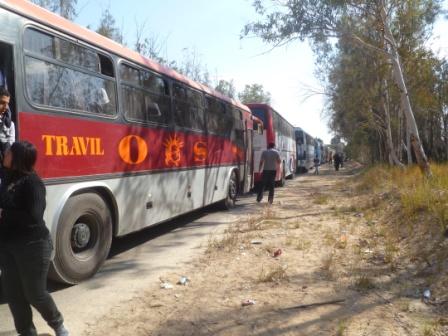
The first attempt was canceled before it started. Rashad realized half the Coptic world was on its way to St. Bishoy Monastery in Wadi Natrun where Pope Shenouda was interred. Though he called around to solicit fellow pilgrims, he called it off later that same day.

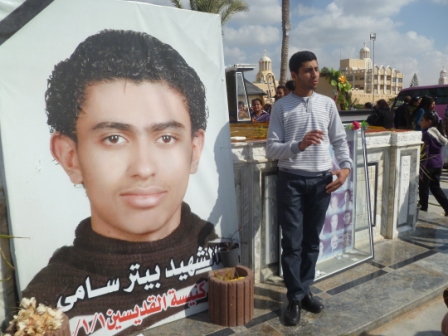
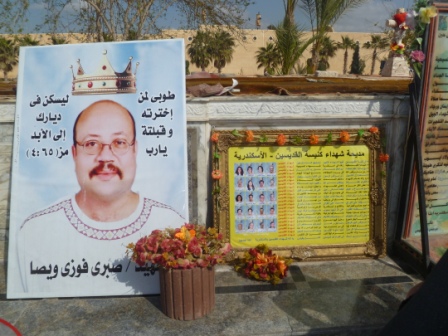
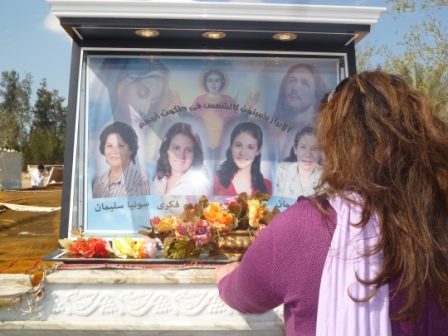
The second attempt was a week later, and my second-born and I made our way to Wadi Natrun before realizing the other half of the Coptic world preceded us. Rashad wavered in continuing on hearing reports of the great traffic; when he heard of several deaths as Copts crushed against each other, he redirected us to the nearby Makarious Monastery instead. I had hoped to write comparing the shrine of Shenouda to that of his predecessor Pope Kyrillos, which I visited just before Shenouda’s death. Instead, I simply reflected on the effort to do so, focusing also on the shrine of the martyrs from the 2010 bombing in an Alexandrian church.

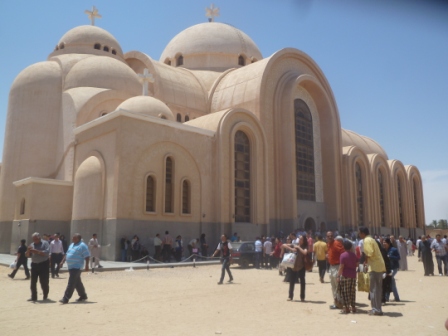
The third attempt succeeded. The trip was relatively uneventful, save for a flat tire on the way. Once again the monastery was packed – the visiting communion attendees filled half of the massive cathedral built on its grounds.

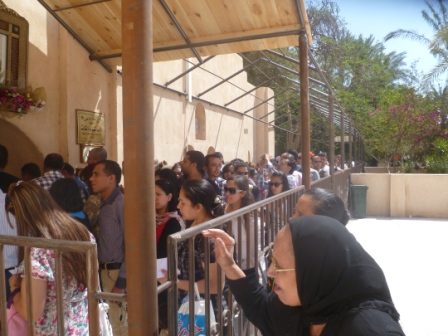
Afterwards we delayed and had breakfast in the monastery cafeteria, allowing everyone else to jostle their way into the shrine. An hour later, we were able to walk through briskly.

Briskly it was. There were attendants inside asking people to keep to their orderly lines and move quickly through the building. People threw prayers written on scraps of paper onto Pope Shenouda’s above-ground tomb, seeking his intercession. As they circled they touched their hands to the marble, seeking his blessing.

If either were to be had, they were had quickly. Within two minutes we were outside again. By now the crowds were low, and I returned for a second circumambulation in order to take the following video.

Click here for the four minute tour, with accompanying commentary.

It was both surprising and impressive to see the guardrails and organization at the pope’s tomb. Thinking back to the news of the deaths by crushing, my curiosity wondered if they were present that day. Unfortunately, I failed to discover an answer. Either way seems possible – the area was very tightly constructed.

St. Bishoy Monastery was Pope Shenouda’s choice for his remains. In 1981 he was banished here by President Sadat. After President Mubarak restored him to the papal throne in 1985, he established a practice of returning regularly for prayer and contemplation.

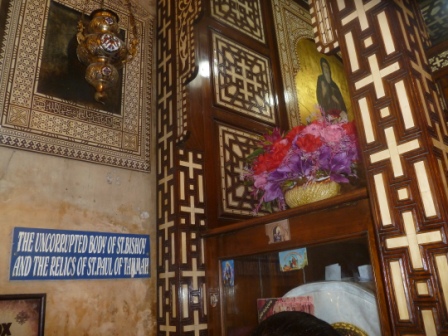
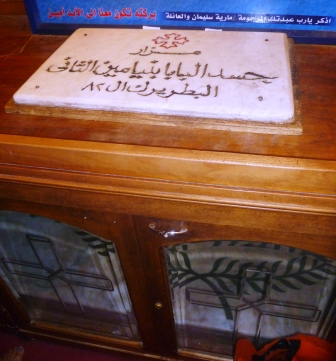
To close, here are a few pictures of the monastery, including other shrines housed therein.

Inside the ancient church of the monastery, which was founded in the 4th Century. These icons likely date back a few centuries.
The shrine of St. Bishoy, which the sign claims contains his uncorrupted remains.
The remains of Pope Benjamin the 8th, 82nd patriarch of the church.
With Rashad, whose living remains are a frequent source of blessing.


Related Posts:

Categories
Personal

Recent Links to Aided Works

Soon to be released documentary on religious relations during the Egyptian revolution

As we have lived in Cairo, we have appreciated the help of many who have taught us the local scene, culture, and political and religious realities. As we approach three years in country, then, it is rewarding to be able to share some of our insights with others who are writing about Egypt.

Freely you have received, freely give.

Of course, if we pat ourselves on the back for commitment to this principle, we violate others by the internet equivalent of standing in the street corners and issuing praise to self.

Do not let your left hand know what your right hand is linking to.

So be it: I hope the following links are helpful in putting forward our opinion on some recent events, as well as introducing the works of others who also are doing their best to make sense of Egypt, write accurately, and hopefully serve her.

Eunice Cunha is a Portuguese researcher in the United States, and inquired recently about the position of Copts in Egypt in light of current circumstances. Here is an excerpt, which she posted on her blog:

Amador Square (AS):
Unlike the Muslim Brotherhood, Copts were there, at Tahrir Square, demanding the ousting of Mubarak’s regime. What has changed for Copts, a year later?

Jayson Casper (JS):
A couple clarifications, first. Though the Muslim Brotherhood was not there officially when the revolution began, many of their youth were. Furthermore they were there officially after January 28.

Similarly, the Coptic Orthodox Church was not there in the beginning, or afterwards, though Christians did contribute from the earliest days. Christian activists I know, however, lament that their fellow believers were so few.

But you refer to the changing euphoria that Copts had following the revolution. Simply, they were dealt a huge blow by the military in the events of Maspero, and the other powers which emerged are mainly Islamist. I don’t think Copts want to go back to the old regime – they recognize the limitations and false freedoms of Mubarak. But they would not mind a reformed continuation of what was, though this creates a dissonance that mutes overt support for the revolution.

Please click here to continue reading at her blog, Amador Square, which explores the connection between Tahrir and Portugal’s own revolutionary history.

A little while before that, I was able to assist in an article exploring the relationship between the Orthodox and Evangelical Church in Egypt, especially in light of numerous but mostly non-official defections to the latter since the revolution. The author, Sarah Carr, is my superior in all things Egypt, but given the subject I was able to provide some perspective, and a quote. Here is an excerpt from the article in Egypt Independent:

There has also been a slight change in relations between the Coptic Orthodox and Protestant churches, with a joint prayer session held in the Saint Samaan Church in Manshiyet Nasser.

“It was a bit strange and out of context that the late Pope Shenouda welcomed that event, after demonizing similar events before and warning “his children” against participating in such events. Maybe it is a sign of a change? Maybe it is politics,” Zekri wonders.

Casper suggests that this unity is a natural reaction to the Islamist resurgence and that the church “can’t stand against the tide of a more inclusive Christianity. The trend is towards saying, ‘we’re all Christians.’”

Please click here to continue reading. Sarah’s own blog, Inanities, is an often humorous look at Egypt from Sarah’s bi-national perspective.

Still earlier, I had the chance to introduce Avi Asher-Shapiro to a young Coptic activist. Avi is a Fullbright scholar who was researching Coptic issues, which resulted in the following article from the Carnegie Endowment, from which an excerpt is given:

Above all, Maspero demonstrated that, even in the face of explicit violence, the church’s hierarchy is not yet willing to break with the SCAF. Many bishops are jockeying to replace the aging Shenouda (rumored to be very ill), and few would risk losing the military’s support in a future bid for the papacy.

But the church is underestimating the damage these SCAF ties are inflicting on its relationship with its young membership. As Coptic activists become increasingly defiant, the church may find it impossible to contain its adherents. According to Ramy Kamal, the best way forward is for the church to withdraw from political maneuverings and salvage its spiritual role. Or, as he told me: “We must save the Church from itself.”

Please click here to continue reading. Other articles from Avi can be found here at Salon.com.

Finally, Johnny and Rebecca Weixler are American filmmakers who visited Egypt to make a documentary about the Arab Spring. Beginning with the Alexandria bombing which unleashed great inter-religious sentiment, they chronicled how ‘One Hand’ became a dominant chant of the revolution. I had the opportunity to introduce them to a few characters who exhibit such sentiment.

Johnny and Rebecca have no article, but their website provides the trailer to their movie, subtitled: The Heroic Struggle for Muslim-Christian Unity in the New Egypt. Please click here to view it.

It has been a privilege to get to know all of the above; may Egypt be better off because of their work.

Categories
Personal

Islamo-Fascism

The term ‘Islamo-Fascism’ has been in vogue for sometime among those who dismiss Islam as a political system, especially on the American political right. For the most part I have never paid attention to their arguments, thinking they were simply a means of discrediting Islam-as-religion with tenuous links to the hated Nazis.

Maybe some, even many, use the term this way. Yet there may be more of a connection to fascism-as-ideology than is properly recognized. Certainly I did not consider this before, due to the over-connection of fascism with the Nazis.

I picked up on this possibility reading a book published in the mid-80s, titled ‘Religious Strife in Egypt: Crisis and Ideological Conflict in the Seventies’. It approaches religious tension from the perspective of social and labor transition within Egypt’s political system. Only a small section addresses the relationship between Islamist groups and fascist ideology, but it was academic, not populist discourse.

The basic idea summarizes fascism as the economic rule of the petty bourgeoisie, as opposed to the wealthy, the lower class, or the administrative technocrats. In order to maintain and maximize their position in society, they must rely on the power of the state. Otherwise, the wealth of the upper class or the populism of the lower class might undue them.

Other definitions contain different nuances, but the following analysis will rely on the book in question, which describes other aspects of fascism as:

  • Intense nationalism
  • Militarism
  • Elitism and chauvinism
  • Emphasis on the role of the family
  • Focus on youth and their regimentation
  • Revolt against ideologies

The book was written in the 80s, and political Islamism has changed, or may have changed. Yet it is intriguing to measure up how today’s candidates – Muslim Brothers and Salafis – fit this criteria.

In terms of economic class, the Brotherhood fits the bill as they are generally understood. While some members are wealthy, most come from the educated middle class which was starved out of real social and political participation during the Nasser-Sadat-Mubarak eras. The Salafis, meanwhile, are considered lower class. They would not immediately fit this key fascist indicator.

As for the other bullet points:

  • Intense nationalism: Both can qualify, especially if nationalism is tweaked to represent the Islamic umma. The MB has toned this down since the revolution, but it is in their blood. Even if it means Egypt alone, both MB and Salafis preach their Islamism is best for the nation.
  • Militarism: Both can qualify, especially if anti-Israel agitation is allowed. There is much rhetoric of liberating Jerusalem, for example. But while it can be argued this aspect is toned down also, it is more apparent true militarism is not a significant characteristic of either movement. It was so for the MB, but they have long adopted more malleable tendencies.
  • Elitism and chauvinism: I would wish to pause on chauvinism lest I make the same mistake I did about fascism. If it is akin to ‘a woman has her place’, then it fits both groups, though the MB is far more ‘liberated’ than the Salafis. As for elitism, there is a palpable MB tendency to look down on and criticize the Salafis, even though there are close ideological links.
  • Emphasis on the role of the family: Dead-on, for both. Earlier this year a MB figure urged MB members to marry only in their group (reflecting on elitism as well). Furthermore, the family unit is preached as the basic organizational principle in society, from which Islam takes root in the community.
  • Focus on youth and their regimentation: For the MB this has always been a characteristic, as the group is highly disciplined and draws members especially among youth with leadership skills. The Salafis are more fuzzy and do not tend to have organizational hierarchies. Theirs is an ideological affiliation, centered around charismatic preachers.
  • Revolt against ideologies: Just above the Salafis were shown not to qualify here, but the MB certainly does. While maintaining a strong commitment to political Islamism as a concept – and with it sharia law – there is not much more in the way of definition. This could change if the group is forced to govern, but they have shown a strong preference for flexibility in ideas. Especially in the 70s they turned away from strong ideologues who wound up in other organizations, many of which were violent.

To summarize, then, there is a legitimacy to discuss Islamo-Fascism. It is not at all clear that this is necessarily true of political Islam as an idea, but a good number of the historical circumstances of the Muslim Brotherhood have affinity. Whether or not it is fair to say this of the current Muslim Brotherhood is another question, as so much is up in the air. Do they mean their words, or are they a means to power before true colors are revealed? Who can say? Their books betray them, but many of their words betray their books.

They could well be on their way to becoming the equivalent of Europe’s Christian Democrats.

While such an outcome is more likely than them becoming Europe’s Nazis, it is far too early to pass judgment on either account.


Related Posts:

Categories
Personal

Applying the Cross (On Your Wrist)

One of the distinctive marks of a Coptic Christian is the cross tattoo worn on the wrist. Sometimes applied as early as forty days after birth (and following baptism), the tattoo is a permanent identification marker signaling to all the faith and community belonging of the bearer.

Girgis Ghobrial

Girgis Ghobrial is an electrical engineer by training and a tattooist by passion. For over twenty-three years he had made a ministry of applying the tattoo to the wrists of Copts.

Translation: Apply Crosses with the Most Modern Medical Procedures

This is his shop at the St. Simon Monastery in the Muqattam Mountains east of Cairo. The location deserves its own description, but in short it is the recently developed church complex dedicated to serving the poor of ‘Garbage City’. This community of Coptic Christians has long been the trash collectors of Cairo, recycling over 90% of collected waste.

Loading trash just outside the monastery complex

Ghobrial contributes to the ministry with his skills and time. He is present at the monastery every Friday and Sunday for services, charging around $4 US for a cross tattoo and $25 US for a more elaborate tattoo, such as in the picture below.

Still bearing the smudges of ink and blood

All proceeds are donated to the monastery, and if a customer is unable to pay, he offers his trade at reduced prices or for free. Ghobrial made certain to emphasize the cleanliness of his operation. Every needle is replaced for each new job.

Smiling freely

Mina, with the cross tattooed on his arm in the picture above, said the operation does not hurt very much. As for motivation, he was getting the same image a friend of his bears. Many of the area youth were milling around the booth. Tattoos, they say, are just a part of the local culture, usually among youths in poorer areas. Most of their friends chose to do so, and they imitate. Being Christians, however, their choices tend to be crosses or images of the saints.

Available templates, all Christian-related

Local priests, they report, do not provide any special encouragement for or against tattoos, even the common one on the wrist. The tattoo booth, however, signals an official acceptance of the practice, and its location is right before the entryways to the two main churches – both in caves in the mountains – which seat tens of thousands of worshippers each.

Friday night evening service

In the Bible, in Leviticus 19:28, the following command is issued:

You shall not make any cuttings in your flesh for the dead, nor tattoo any marks on you: I am the Lord.

It should be noted, however, that a few verses earlier is another command, seemingly much less important:

Nor shall a garment of mixed linen and wool come upon you.

In the New Testament, I Corinthians 6:19 declares the body to be a temple of the Holy Spirit, without any reference to tattoos but with the designation the body belongs to God and is meant for his honor.

Does a tattoo of any nature honor God? Do the tattoos of these Coptic Christians?

If part of the Christian life is the imitation of God, perhaps Isaiah 49:17 is useful to note:

See, I have engraved you on the palms of my hands.

Surely this verse is neither command nor outright license for Christians to get tattoos, but it does put the matter somewhat in perspective. If God signals his love for his people through the image of a tattoo, perhaps the Copts’ love for God displayed on their wrists is equally acceptable.

All the same, I don’t like it very much. Why do something you can never get rid of?

Hmmm, but is that not also the demand, result, and promise of faith?

Demand: Suppose one of you wants to build a tower. Won’t you first sit down and estimate the cost to see if you have enough money to complete it? In the same way, those of you who do not give up everything you have cannot be my disciples. (Luke 14:28, 33)

Result: Or don’t you know that all of us who were baptized into Christ Jesus were baptized into his death? We were therefore buried with him through baptism into death in order that, just as Christ was raised from the dead through the glory of the Father, we too may live a new life. (Romans 6:3-4)

Promise: For I am convinced that neither death nor life, neither angels nor demons, neither the present nor the future, nor any powers, neither height nor depth, nor anything else in all creation, will be able to separate us from the love of God that is in Christ Jesus our Lord. (Romans 8:38-39)

Perhaps a tattoo of faith is easier, but its glory is far less. Either way, let its mark be a choice made in freedom.

Related Posts:

  • Emma’s Saliib (Cross; Emma is our daughter, imitating her friends) – February 26, 2010
Categories
Personal

Statement of the Muslim Brotherhood and the Leaders of the Evangelical Church in Egypt

At head of table: Rev. Bayadi (L) and Dr. Badie (R)

This text is transcribed from documents received from the Coptic Evangelical Organization for Social Services, headed by Dr. Andrea Zaki, a chief participant in this meeting.

The text reads:

Based on a welcoming letter from Dr. Rev. Safwat al-Bayadi, President of the Protestant Community of Egypt and Dr. Rev. Andrea Zaki, Vice-President, sent to the General Guide of the Muslim Brotherhood, which addressed some public opinion issues at this critical stage in Egyptian history after the January 25th Revolution and gained the attention of the Guidance Office of the Muslim Brotherhood, and based on the two parties’ communication, the General Guide called for a meeting to gather the leaders of the evangelical church and the leaders of the Muslim Brotherhood. The meeting took place on February 28, 2012, at the headquarters of the Muslim Brotherhood. The General Guide has agreed to visit the headquarters of the evangelical church upon invitation.

The participants consented on the importance of the current historical moment Egypt is going through after the revolution, which requires everyone to take social and historical responsibility to advance the country. The participants emphasized that Egypt’s future depends on community cohesion and unity, and stressed on the basic values of the Egyptian society that represent its social and cultural identity and brings its citizens together.

The participants agreed on the following:

  • The sons of the country are all partners in one destiny and one future.
  • The joint struggle of all Egyptians of all segments of society, that was manifest in the January Revolution, represents the cornerstone of societal unity; the struggle reflects that full citizenship, based on equality, is the foundation of this society.
  • All sons of the country have the same rights and responsibilities as the constitution states. Equality among all citizens constructs societal unity; efficiency is the only criterion to hold a public position; and equality of economic opportunities is the basis of justice.
  • The Egyptian society is based on solidarity, interdependence and compassion among all people, which represents the bond that includes all citizens without discrimination. Therefore, education should promote the values of tolerance, solidarity and pluralism.
  • Respect for beliefs and sanctities is obligatory. Prevention of any contempt of others’ beliefs and the incitement of hatred is a compulsory social responsibility of loyal citizens.
  • Freedom of belief and religious practices as well as freedom to build or renovate religious houses – in light of the law and the right for citizens to resort to their own religious laws concerning their personal affairs along with other rights mentioned in the Islamic Sharia’ – are all considered part of the values of the Egyptian society and a base for its cultural authenticity.
  • The participation of all citizens in defending the country is the responsibility of all, and it is the crucible where all segments of society are melted and form national unity. This national unity is crucial to fighting all internal and external enemies of Egypt who want to drive a wedge between its societal segments.
  • The religious values are the motives of the renaissance. Therefore, everyone must mobilize these values to achieve a better future for Egypt.
  • Societal responsibility obliges all leaders, institutions and religious movements to fight against all types of strife, intolerance and discrimination, and consolidate the unity of society.
  • The Egyptian society’s identity represents the frame for all its people. All people have made contributions to this identity and deserve its legacy. Protection of societal values is considered the basis of cultural uniqueness and the responsibility of all citizens who contributed to building Egypt’s civilization together over time.

All participants of this meeting made emphasis on the importance of communication between the two parties to promote joint activities, especially among the youth, such as encouraging active participation, advocating for values and religious morals, and carrying the social responsibility of fighting the illness that affected the Egyptian society under the previous regime. This will guarantee everyone the right to participate in building a new Egypt that achieves the demands and dreams of the revolution.

Attendees from the Muslim Brotherhood:

  • Dr. Mohamed Badie (General Guide, Head of the Executive Office)
  • Mr. Mohamed Mahdy Akef (former General Guide)
  • Dr. Rashad Mohamed Bayoumy (Vice-General Guide)
  • Dr. Hosam Abo Bakr al-Seddik (Member of the Guidance Office)
  • Mr. Walid Shalaby (Media Counselor to the General Guide)

Attendees from The Evangelical Church in Egypt:

  • Dr. Rev. Safwat al-Bayadi (President of the Protestant Churches in Egypt)
  • Dr. Rev. Andrea Zaki (Vice-President of the Protestant Churches in Egypt)
  • Rev. George Shaker (Secretariat of the Protestant Churches in Egypt)
  • Rev. Soliman Sadek (Pastor of the Evangelical Church in Fagala)
  • Dr. Rev. Makram Naguib (Pastor of the Evangelical Church in Heliopolis)
  • Dr. Rev. Atef Mehanny (President of the Evangelical Seminary)
  • Dr. Helmy Samuel (Member of the Parliament)
  • Dr. Rafik Habib (Coptic Evangelical Organization for Social Services)
  • Rev. Refaat Fathy (Secretariat of the Evangelical Synod)
  • Dr. Rev. Sarwat Kades (Chairman of the Board of Dialogue of the Evangelical Synod)
  • Dr. Emad Ramzy (Secretariat of the Board of Directors of CEOSS)
  • Rev. Daoud Ebrahim (Member of the Council of the Presbyterian Church in Egypt)
  • Rev. Eid Salah (Member of the Council of the Presbyterian Church in Egypt)
  • Mr. Farouk al-Zabet (Head of the Congregation of the Evangelical Brethren Church)
  • Dr. Fready al-Bayadi (Member of the Council of the Presbyterian Church in Egypt)
  • Rev. Nady Labib (Head of Cairo Presbyterian Council)
  • Rev. Refaat Fekry (Pastor of the Evangelical Church in Ard Sherif)

Please click here to access the agreement in Arabic

Categories
Personal

On Expat Life and a Sense of Belonging

A little while ago the expat facilitation site InterNations featured our blog to help their readers adjust in advance to life in Cairo. Please click on the link to see their article for yourself, but here is the content. It describes a little of our philosophy in living overseas.

1.      Please tell us a little bit about yourself. Who you are, where you come from, when you moved to Egypt, etc.

I am an American writer living in Egypt with my family, having arrived in the summer of 2009. I write primarily with Arab West Report, but also with other outlets on a freelance basis.

2.      When and why did you decide to start blogging about your experiences?

My editor at Arab West Report encouraged me to keep a blog for several reasons. One, it would be a permanent record of our experiences, to draw back upon for all future writings. Two, it would expand awareness for our publication. Third, and most important, it would share our experiences from Egypt in service of increased understanding between cultures.

3.      Do you have any favorite blog entries of yours?

The first post ever is probably the most useful in describing our hopes in expat living and writing. It explains the title of our blog – A Sense of Belonging. Here is the link: http://asenseofbelonging.org/2009/10/04/a-sense-of-belonging/

4.      Tell us about the ways your new life in Cairo differs from that back home. Did you have trouble getting used to the new circumstances? Did you experience culture shock?

Life in Cairo is not our first overseas experience, but it did come with significant differences from other Arab nations we have lived in. Due to the great population, it is challenging to deal with pollution, trash, and the pinch on traditional Arab hospitality caused by people already having a wealth of relationships. These are often family, but with other expats as well. Egyptians are extraordinarily friendly, but it has been harder to make friends here than in other nations.

5.      Do you think you were fully prepared for what awaited you in Egypt? If you could, would you change some decisions/preparations you made?

Well, we weren’t prepared for a revolution! Fortunately, we feel our attitude toward belonging equipped us to adapt, sympathize, and celebrate with the people both then and in their continuing difficult situation, amidst so much hope.

6.      Every expat knows that expat life comes with some hilarious anecdotes and funny experiences. Care to share one with us?

The Cairo metro provides women-only cars in the middle of the train. In my early days I was rushing to catch the metro before it left the station and inadvertently boarded the wrong car. Immediately I was hit by a gamut of angry glares. I nodded, touched my head in apology, and switched cars at the next stop.

7.      Which three tips would you like to give future expats before they embark on their new life in Egypt?

First, realize there are many amenities for the expat community, so not everything of the old lifestyle must be left behind. Second, open your mind and heart to the new lifestyle, because there will be so many differences it can drive you crazy if you don’t aim to embrace it. Third, especially in the beginning, consciously limit making friends among expats, or else the natural bonds of community will squeeze you from making Egyptian friends and entering Egyptian life. If you aim to speak Arabic, do the same and avoid English speaking relationships as much as possible.

8.      How is the expat community in Cairo? Did you have a hard time finding like-minded people or fellow expats?

The expat community is wonderful. There are several social groups, service organizations, churches, and clubs to meet every relational need. Our daughter has especially enjoyed the local (mostly) expat soccer league, as it is difficult for girls to otherwise play sports publicly.

9.      How would you summarize your expat life in Egypt in a single, catchy sentence?

We don’t belong, but we aim to – and in the end we somewhat do.


Related Articles:

Categories
Personal

Is a Man as Good as his Political Islamic Word?

Mahmoud Ghozlan

Yesterday I had the unique opportunity to visit the headquarters of the Muslim Brotherhood in the Muqattam area of Cairo. I interviewed their official spokesman, Mahmoud Ghozlan about a recent document of principles agreed upon by the Brotherhood and the leadership of the Evangelical Churches of Egypt.

It is a very interesting document, and I hope to share a full article about it shortly. For now, I simply wanted to share some pictures of the building as well as brief reflections from the visit.

The MB HQ, labeled in both Arabic and English
From afar; translation: Headquarters of the Muslim Brotherhood
The entryway; translation: The Muslim Brotherhood Welcomes its Guests; We Bring Good to All People (slogan of the MB's Freedom and Justice Party)

This final picture is from the reception area, displaying the nine ‘General Guides’ in Muslim Brotherhood history. Though each of these figures deserves further research, here simply I present their names, from left to right in the picture:

Hassan al-Banna (1928-1949)

Hassan al-Hudaybi (1949-1972)

Omar al-Tilmisani (1972-1986)

Muhammad Hamed Abu al-Nasr (1986-1996)

Mustafa al-Mashour (1996-2002)

Muhammad al-Ma’moun al-Hudaybi (2002-2004)

Muhammad Hilal (uncertain)

Muhammad Mehdi Akef (2004-2010)

Muhammad Badie (2010-present)

Our discussion centered on the document of principles establishing citizenship and religious freedom as common values. Still, I also gained some insight into the current political crisis between the Brotherhood, the military council, and liberal parties. Most interesting was the change in demeanor as we navigated certain topics.

It is not useful to read too much into the following, but when Ghozlan justified the Brotherhood for going back on an earlier pledge not to field a presidential candidate, his manner was humble and seeking an audience. He expressed that the media was engaged in deliberate mischaracterization of the group and its intentions, and appeared hopeful his story would be carried faithfully.

In another setting, I hope to, but while I find his explanations reasonable, I stated that for this article in particular I was not seeking political justification, but religious. If Egyptian Christians wish to have hope in the words of this document, how should they respond now that the Brotherhood has gone back on its word not to field a presidential candidate?

I was keen to not be accusatory, but to seek their mindset.

Strangely, his attitude changed. He immediately straightened and delivered justification from the life of Muhammad. It was no longer an invitation to see their political condition sympathetically, but a pronouncement of their non-culpability in terms of religion. I felt, hopefully wrongly, that he instinctively needed to assert/defend the moral high ground of Islam, or at least of their political Islam.

I had the distinct impression the group feels vulnerable and defensive. Indeed, it appears all are against them these days. Could it also be their conscience is pricked, underneath a Machiavellian exterior?

In the media, at least, it seems this is true of many in the organization, despite the official choice of the majority to go against their pledge.

It may be politically expedient and even necessary for the good of all Egypt. But as Muslims, is it right?

Ghozlan gave justification, even if the Christian or merely moral person might cringe – to be written about shortly. I think the pulse of general Egyptian morality will not permit it, though, no matter what presidential choice they make in the end.

Update: The article is still in process, but here is the full text and list of signatories to the agreement. Please click here.

Related Posts:

Categories
Personal

Reflecting on the Papal Shrines

My daughter, not a pope

Five people were killed yesterday at St. Bishoy Monastery, crushed to death visiting the shrine of Pope Shenouda. I was nearly there, along with my three year old daughter.

It was meant to be part two of my visits to the shrines of the most recent popes. The second leg was not planned with the first; a day before Pope Shenouda’s death I was with Coptic Orthodox friends on a trip to St. Mina Monastery near Alexandria, to visit the shrine of Pope Kyrillos (Cyril VI).

These same friends then organized a trip the first weekend after Pope Shenouda’s burial, but postponed it out of fear of the expected massive crowds. Instead we set off on the second weekend, but ran into similar trouble.

Feeling semi-guilty for disappearing for the second time over three weekends, I volunteered to take my daughter with me. I had done so earlier with the oldest child, and we had an enjoyable outing. Of course, the country wasn’t exploding at the time.

To avoid the early morning rush my organizing friend decided to first stop at the nearby Baramous Monastery for breakfast. This monastery celebrates two Roman Christian brothers born into a wealthy family who left all and went to live in the desert. As per her custom, my daughter enjoyed playing in the dirt after mass, and then we enjoyed our shared meal of fried bean sandwiches, French fry sandwiches, and lentil dip.

Making a monastery of her own
With friends from our group

It was then we sat and waited, and waited. Monastery trips with Copts are usually festive times of visiting ancient sites, buying lots of religious trinkets, and taking blessing from the monks while seeking their intercession. On this occasion, understandably more somber due to the pope’s death, there was simply a discontented confusion.

Our organizer was incessantly on the phone with someone from St. Bishoy Monastery where we were headed. As the minutes ticked by he received more and more encouragement to stay away. At first it was simply too crowded. Eventually we learned they had closed off the area. Finally he was informed that several pilgrims had been killed.

Even so, it was difficult to convince our group not to continue on. The whole point of this trip was to visit the pope’s final resting place, and for many this meant securing a great blessing. The organizer sought to convince them God would reward them according to their intention, and that even Pope Shenouda himself would be displeased if we continued. Should we contribute to the chaos and disruption of his sanctuary, simply for our personal blessing?

Eventually we left to seek blessing from another nearby monastery, St. Makarios. This 4th Century saint lived celibate with his wife (who was forced upon him by his family) until her death, when he was finally free to devote himself to God. He was the first monk to settle in the Wadi Natrun desert, where four historical monasteries now continue.

The line of buses, after half an hour of waiting to get in

It turns out, however, nearly every other would-be St. Bishoy Monastery visitor had the same idea. We sat in our bus for an hour simply waiting to be processed at the gate. After eventually getting inside, we joined the dispirited crowds milling about the premises for about half an hour, until the monks reclaimed their silence and had everyone leave. From here we had our final meal together, and began the trek back home.

Though disappointed to not see the pope’s burial grounds – the whole reason for the trip – I was pleased to go to St. Makarious where I had resided three days in a monk’s cell and had a few friends. But even this hope failed, as one elderly monk told me there was no way he was leaving his quarters to wade through the masses who would surround him looking for blessing. Then I learned a younger monk I knew also could not greet me, as he was recovering from open heart surgery.

The day was not supposed to be like this, and I am glad I had my daughter with me to pass the time and enjoy her company. She was blissfully unaware of everything but the dirt, happily making her own mini-monasteries wherever she could.

It was supposed to me more like part one of the papal shrine tour, only amplified in both numbers and grief. Two weeks earlier I was among a similar crowd of pilgrims, brought to St. Mina’s Monastery the weekend after the celebration of Pope Kyrillos’ death. St. Mina was a Roman Christian soldier who left the army to practice monasticism, and was later martyred. Pope Kyrillos adopted him as his patron saint.

The grounds were packed, the crowds were in revelry.

Here are some photos of his shrine:

And here is the scene around his tomb:

A Coptic priest seeking the pope's intercession
Ordinary Copts, taking blessing from his tomb

Finally, here is a crowd gathered around his ‘hymn of praise’, chanting his virtues and extolling his life. Click here to watch a video of this scene.

It is difficult to know what to make of such devotion. To provide snide evidence of the backwardness of Coptic spirituality, consider this picture:

At the Baramous Monastery this garden scene has water flowing continually from the ceramic pitcher. Without exploring further, I assumed it was a simple hydraulic function common in many suburban fountains. The assumption of several passers-by, overhearing their conversation, was that this was a miracle of the monastery.

Yet to provide sympathetic evidence of the suffering depths of Coptic spirituality, consider these pictures:

Translation: The martyr Mina Wagdy Fakhry
Our group leader, in contemplation
Translation: The martyr Peter Sami
Translation: Verse from Ps. 65:4; the martyr Sabri Fawzi Wissa
Translation: The righteous shine like the sun in the kingdom of their father (Mt. 13:43)

St. Mina’s Monastery hosts also the remains of Christians killed on New Year’s Eve 2010, when a bomb exploded outside the Two Saints Church in Alexandria. I have written earlier about the shrine dedicated to these martyrs inside the church, but I had never seen such a memorial previously.

In the United States one can often see a small cross erected on the side of the road where a loved one was killed in a traffic accident. There are memorials for those killed in war, during 9-11, or in other national tragedies. Yet America, best I know, has no religious martyrs.

Egypt, on the other hand, is full of them. The Coptic calendar dates from 284 AD, when Diocletian became Roman emperor and ushered in the bloodiest period of Christian persecution.

Popes Kryillos and Shenouda died natural deaths, but they provided historical leadership for the church of martyrs. Celebrated saints have interceded through miracles for countless Copts through the centuries. Pope Kyrillos has done the same, and now Pope Shenouda is poised as well.

Perhaps the cynic points out: Could he not then have prevented the deaths of three Copts in Cairo, and five at the monastery – all who were there out of love for him?

As I mentioned, it is difficult to know what to make of such devotion.

For those who share in Christian faith, these are your brothers and sisters. As much as they stand to benefit from Western experience in hydraulics, we stand to benefit from Coptic experience in spiritual immanence.

As Pope Shenouda has placed on the lips of every Egyptian Christian: God is present.

Related Posts:

Categories
Personal

Drawing through the Walls: Artists Beautify Cairo’s Barriers

Over the past several months the military council has erected massive stone barriers during street confrontations around the Interior Ministry near Tahrir Square. They have meant either to separate revolutionaries and police forces engaged in pitched battles, or, as a preventative measure to block the path to the ministry itself.

As a consequence, not only has Cairo’s traffic snarled even further, the city has grown ugly.

Here is an example:

On Qasr al-Aini Street

On March 9 revolutionaries decided to take a different tack, launching a campaign called ‘Drawing through the Walls’. Artists chose the day to set upon the erected barriers with brush, paint, and stencil. Beginning on Qasr al-Aini Street, across Sheikh Rihan, and down the now-(in)famous Mohamed Mahmoud, here is a collection of their work:

Qasr al-Aini Street, redone
Sheikh Rihan Street
Yousef el-Gindi Street, off Mohamed Mahmoud Street, as with all remaining pictures
el-Falaki Street
Mansour Street
Abdel Magid al-Ramali Street
Noubar Street; translation: Beware of the Families of Abideen; No to the Walls; Abideen - Revolutionaries and not Thugs

I’m not sure why this last wall off Mohamed Mahmoud Street didn’t receive the full artistic treatment. Perhaps the thugs, er, revolutionaries of Abideen preferred their warning? 🙂

Click here for a map of the area, and here, for full coverage of the project in the Egyptian English press.

Some of these pictures are rather simple, others reflect quite talented artistry. The striking resonance is of a world now lost. Paintings which extend the street and sidewalk as if all were normal best reflect this theme.

The world is not normal. Many revolutionaries are accused of sowing anarchy; of some this is surely true. Others, however, long for a world of freedom and beauty. They have registered their protest as best they know how, with creativity.

Beauty and creativity are the hallmarks of God. May these artists be honored in their imitation.

Note: This post was delayed about three weeks by Pope Shenouda’s death and other events, but has come back into the news as activists have partially torn down one wall as of yesterday. Click here for the article.

Related Posts:

Categories
Personal

Previous Articles on Egypt’s Constituent Assembly Members

Egypt is currently undergoing a major political stir concerning the formation of the constitution. The referendum in March 2011 assigned parliament the right to elect a 100 member constituent assembly to draft the constitution, which would be put to a popular referendum after fifteen days. Very little instructions were provided on how this should be done, resulting in the current crisis.

Consistent with their powerful parliament majority, Islamist forces have approved an Islamist-dominated assembly. First they apportioned one-half of the membership to be drawn from parliament, which was distributed roughly according to party percentage. As Islamists represent 70% of this body, they immediately commanded a dominating percentage of the assembly as well.

The remaining half of the assembly was to be drawn from civil society, but the Islamist parliamentary majority submitted the final candidate list only one hour prior to voting, and then pushed through their desired candidates. This list includes several prominent non-Islamist figures, but most of these have since resigned in protest over Islamist dominance of the assembly.

The crisis is ongoing, with reformist Islamists seeking to reach out to the disgruntled liberals, while the Muslim Brotherhood engages in an ongoing war of words with the government and military council over the cabinet – which they want dismissed so as to form one themselves (in coalition, they insist, with all political currents) – as well as the presidency. The next few days in Egypt may be very politically telling.

In the meanwhile, this article purposes also to provide brief background on some of them selected members of the constituent assembly I have interacted with or written about in the past.

Only six Coptic members were elected to the body, but one of them is Rafik Habib. He is noteworthy as being a vice-president in the Freedom and Justice Party, the political arm of the Muslim Brotherhood. A Protestant, he cares deeply for the issues of Copts, but wraps their best future in an Islamic vision.

Rafik Habib: On Sharia, State, and Christianity – April 14, 2011

A more traditional Islamist is Nadia Mostafa, who is one of only six women in the 100 member assembly. She is a professor at Cairo University and discussed with me the relationship between Islam and civil society, especially how the promotion of civil society is often to the exclusion of the Muslim religion.

Islam and Civil Society – April 22, 2010

The final figure I have profiled was former Grand Mufti of Egypt, Nasr Farid Wassel. In a short interview I highlighted his statement honoring Osama bin Laden, but then spoke with an official member of the Azhar to dispute his interpretation.

Refuting bin Laden’s Martyrdom – May 24, 2011

It is certainly a unique body of Egyptians. Will they be able to draft a constitution acceptable to the Egyptian consensus? While already in question, the outcome is still to be decided.