Categories
Personal

Thuggery: Inside Testimonies

One of the disturbing aspects of Egyptian politics pre-revolution has been the use of paid thugs to intimidate and disturb the democratic process. Violence had been a recurring feature; counter-thugs were sometimes hired to defend ballot boxes, even as others were used to ensure manipulation.

Thugs also feature prominently in the life of Upper Egyptian tribal relations. An underclass exists within each tribe which will do the dirty work requested by more prominent members. This was one aspect of the murders in Nag Hamadi last year, when six Christians and a Muslim police guard were gunned down exiting Christmas Eve mass. Some say there were political forces at work here also; others allege it was a revenge killing for illicit sexual relations between a Christian man and a Muslim girl. Regardless, it was a well known thug who was convicted and sentenced to death. Did he operate under orders? It is not known, but thugs usually act only under behest – there is no money otherwise.

Certainly poverty plays a role in allowing this underclass to exist; so does the failure to extend fully the rule of law. Will the practice continue post-revolution? It was certainly employed during the ‘Battle of the Camel’ at Tahrir Square at the height of the demonstrations.

The Egyptian newspaper al-Masry al-Youm (English edition) published a very informative interview with two thugs who were involved in those events. The first, actually, was a volunteer on the pro-Mubarak side, but had the wisdom to withdraw before implicating himself. The second claims he along with many others was paid by a local politician to scatter the demonstrators and remove them from the square. He gives an account of the unexpected resolve they encountered, and how quickly he fled once met with resistance. The article can be accessed here.

While these testimonies can be taken at face value, there needs to be care taken that ‘thuggery’ not become the accusation in vogue. When sectarian violence engulfed a Christian neighborhood in Cairo, some blamed it on thugs hired by the now discredited security forces in order to stoke tensions and resist the revolution. This is entirely possible. Or, it could be an effort to preserve the revolution notion, true in its essence, that Muslims and Christians have been at peace during these times.

Others, particularly democratic activists, are accusing the Egyptian military of thuggery. Demonstrations, while allowed on the whole, have at times been broken up by thugs, who have then been arrested by military personnel. Some claim that these ‘thugs’ have been demonstrators themselves, labeled as such to preserve a now known narrative in which the army protects the right of protest. Meanwhile, the arrested complain of torture in military custody. This story has been reported here on CNN.

Is there any credibility to these reports? Or are they invented in the service of competing interests in this transition period? Is the army discredited in order to speed a return to civilian rule and democratic elections, through early elections in which Mubarak’s old National Democratic Party and the Muslim Brotherhood may make gains? Or is thuggery blamed on old regime security forces and political apparatchiks in order to extend military rule, so that new liberal political parties can coalesce and win power later?

Will there be thuggery during the March 19 referendum?

Old habits die hard. It may be that the purity of the revolution may transform Egyptian politics. Or, will the newly politicized population become infected by a longstanding virus? Will they adopt its tactics, or fall away disillusioned? Instead, may they have the strength to do what is right and build credible institutions of transparent democracy, even if the results move against their interests. Even if this is their will, does the power exist to make it happen?

Categories
Personal

Expectations in Maghagha

note: About a week before the revolution, our family took a trip to Maghagha in Upper Egypt. Whereas normally we would have liked to post about our experiences shortly after returning, events took a turn that did not allow much time for reflection. Two months later, Julie is finally able to share our experiences, with quite a few pictures as well.

I am learning more and more that I am not a very flexible person.  I like my schedule, knowing where I will be and what I will be doing, keeping my kids on a normal sleep schedule and having an idea of what is around the next bend.  Sometimes, though, we all know that life isn’t dependable.  This may be compounded by living in another culture, and is especially the case when we take trips out of Cairo.

A year ago, during Coptic Christmas, we traveled for the first time to Upper Egypt, to the town of Maghagha, to stay with a priest’s family for four days.  This priest is a friend of Jayson’s work, and he graciously offered to host us for an “out-of-Cairo” experience.  We learned a lot while there and really enjoyed getting to know his family, and as is always the case with such hospitable Egyptians, the invitation to return was put forth multiple times.

We finally had the chance to return last week for the Orthodox celebration of Jesus’ baptism, or eid il-ghataas.  Since we visited many of the Holy Family sites last year (parts one, two, and three), I imagined that this visit would be more casual and relaxed.  I thought that while Jayson might go out and about with the priest, the girls and I would hang out at the house, talking with the women and learning more about their lives in this Upper Egyptian city.  However, I was in for three surprises.

The first one came as soon as we arrived.  The train ride was fairly uneventful, but our seven-month old Layla, was definitely ready for a nap by the time we pulled into the station.  I was keeping her awake imagining we would be at their home soon so I could set up her crib, and she could get a normal nap while we got reacquainted with the family. Instead, as we were loading the car, Jayson informed me we would be going directly to the village, about 20 minutes away, where the priest’s church is.  I deduced this meant we would spend the whole day there, including the four-hour service at night which ends at midnight.  I was not a happy camper on the ride to the village!

I was right about spending the entire day and half the night at the church, and there were some periods of stress while there, but all in all, it was not so bad.  Layla napped in the car and later on the floor of a reception room we had to ourselves for the day.  We tried to get Emma and Hannah to nap while watching a movie, but the electricity went off and the movie stopped working.  However, they were fairly content to wander around the church grounds, mingling some with the people there, coloring, exploring the church and checking in on Daddy as he talked to various people.

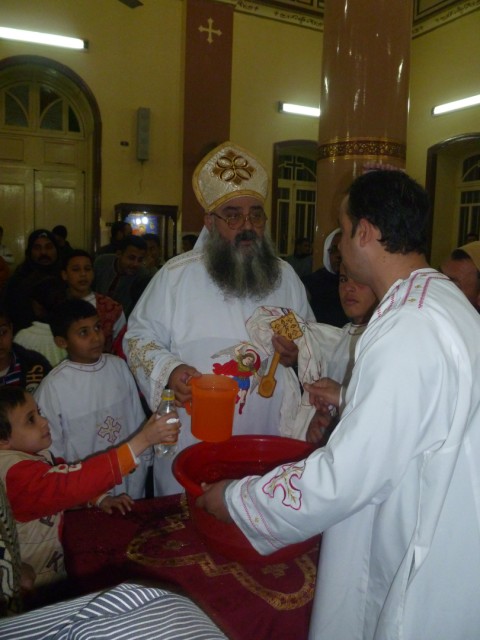
We had an opportunity to visit the mayor of the village’s sister’s house which was a very interesting building to see, and even observed something new at the mass that evening.  There was an added element of water to commemorate Jesus’ baptism.  The priest went around with a towel soaked in the water and touched each congregant’s head with it. The bottles were taken home by people to use and mix in their normal consumption.

Layla slept almost the whole service, and Hannah slept about half the time.  Despite being about the opposite of what I had expected that day, it didn’t turn out so bad.

The night was a little challenging as we returned to the priest’s house around 11:00pm and after greeting the family members, I got the room and crib ready for sleeping as quickly as I could.  Layla transferred to her crib well, but really struggled with sleep for several hours, and ended up sleeping in our bed to give me some shut-eye, and not wake up the rest of the house.  Emma and Hannah joined us for the midnight meal before they went to bed and actually slept well.

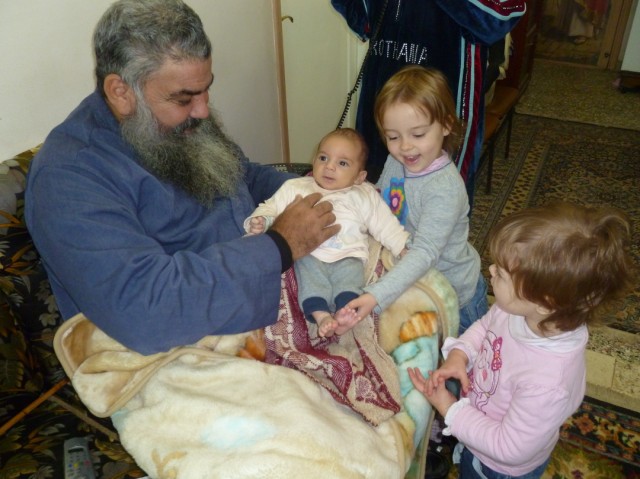
It was great seeing this family again, and meeting the newest member, one-month old grandson, Jason. The mom informed us they named the boy after my husband.

After a leisurely morning, we drove to another priest’s house to spend some time with his family of four.  We had a meal with them during our visit last year, and planned to do the same this time.  Just before our host priest dropped us off, however, he mentioned he would be going to the local hospital for some tests on his heart.  He then planned to pick us up and take the girls and I back to hang out at his home while he and Jayson saw some more sites.  I was very happy with this arrangement as I was hoping to give Layla a normal day so that we could all have a normal night.  I figured we would be at visiting the second priest’s family for about 4 hours, leaving us plenty of time to get all three girls in bed much closer to their 7pm bedtime.

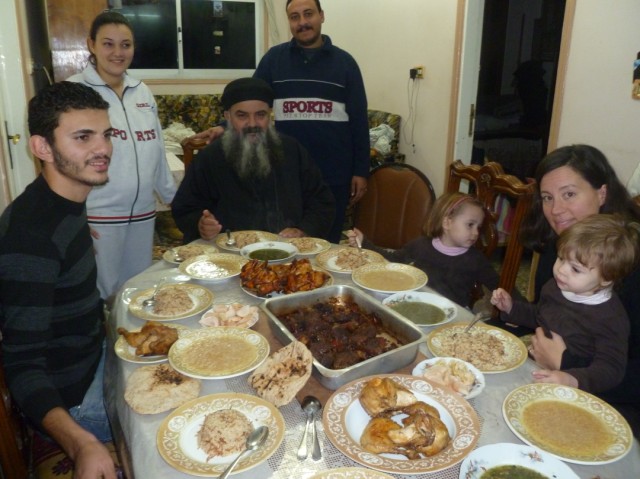
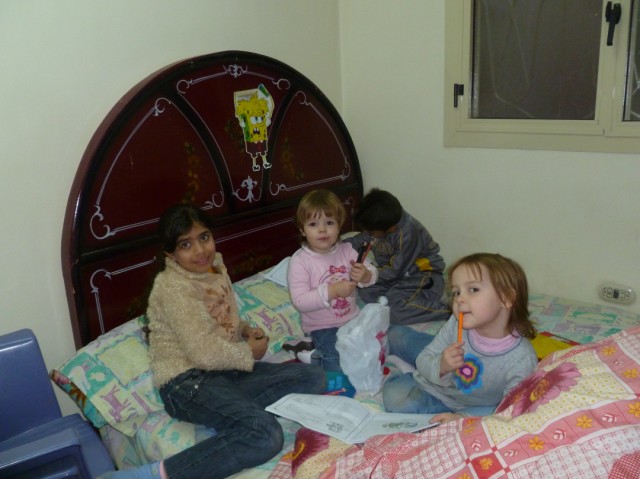
However, such perfectly laid plans were not to be.  We had a good time with the family as we visited with his wife, two children, and some extended relatives.  They were typically hospitable serving us tea upon our arrival and again about an hour later, followed by a delicious meal that was more than we could eat, after which we had bananas, oranges and more tea.  Meanwhile, the kids were having a great time together once our girls warmed up.

It was fun watching Emma speak with the kids in Arabic and really be able to communicate together with them.  I was glad they were enjoying themselves, and it freed me to be with Layla and also visit with the family members.

After about five hours, I started getting a little uptight.  I wondered what happened to the priest and why he wasn’t calling to come pick us up.  I’m sad to say that he wasn’t my main concern, but the clock was ticking and I really wanted to get Layla in her bed early.  Around 6:30 or so, he called and informed us that he would travel to Cairo the next day for a heart procedure so we should stay with the other priest for the night.  Once again, my main concern was for my own little family as I realized that this restless baby would not be in her bed anytime soon!  I thought also of the priest, and was concerned for his health, but my face gave away my frustration at this surprise number two.  By the time we would get our things from the other house and move them here, it would be well past the normal bedtime.  Unfortunately, our new hosts read my face and asked if I was unhappy to stay with them.  I tried to explain that I was very happy to stay with them, but I just needed to get my kids in bed.  It sounded hollow, and I felt bad to have offended them.  For one, most Egyptians think our child-rearing methods are very strange, particularly in the way we feed the kids, and the way they sleep so early.  So they couldn’t understand my concern about the hour, after all, it was only 7pm – not late at all!  Secondly, earlier they had mentioned how they wanted us to stay with them on our next visit, and so they were very excited about hosting us, even though it was a surprise to them too.  To see my visible disappointment was probably quite hurtful.

And once again, this surprise turned out to be better than expected.  Layla did not get into her own bed by 7pm, but at this apartment, the bedrooms were set in the back of the house, away from the living room.  The other apartment was difficult for sleeping because the living room, with all of its noise and light, was just a doorway away from my children who were supposed to be sleeping.  Also, while we really enjoyed our original host’s family, he didn’t have any young kids.  This house came complete with a nine-year old girl and five-year-old boy, and my two girls played happily with them for the next 24 hours.  We all slept better that night, and got some decent rest for the third surprise the next day.

The plan the next day was to visit the younger priest’s father in a nearby village.  This sounded like a nice idea, and through conversation I discovered that even though he is in his 80s, he still farms his fields every day.  Jayson told me we would visit him on the farm, and for some reason, I pictured a nice farmhouse to sit in while the girls ran through the fields.  What a nice treat after living in the city.

When we arrived at the priest’s father’s plot of land, I realized I was right in half of my thinking.  We were surrounded by green fields in every direction—a site for sore eyes coming from the smog of Cairo.

But the surprise was that there was no farmhouse to speak of.  Instead there was a small stone structure built on his land, but the house where he slept at night was a distance away.  So, we had a very casual visit, sitting on bamboo sticks, a log, a white folding chair and a large cloth bag.

Fortunately I had brought Layla’s car seat so she could be contained in a clean place.  But feeding her and trying to encourage the girls not to step in any animal droppings, and then wondering just how long we would be visiting here as Layla’s naptime came and she started to cry heightened my frustrations.

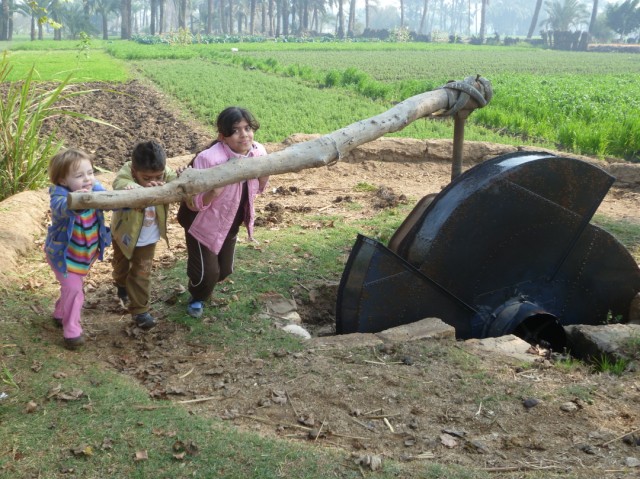
And yet once again, there is a bright side to all of this.  Our girls did enjoy walking through the fields with their friends.  Emma saw a water wheel that irrigates the land.

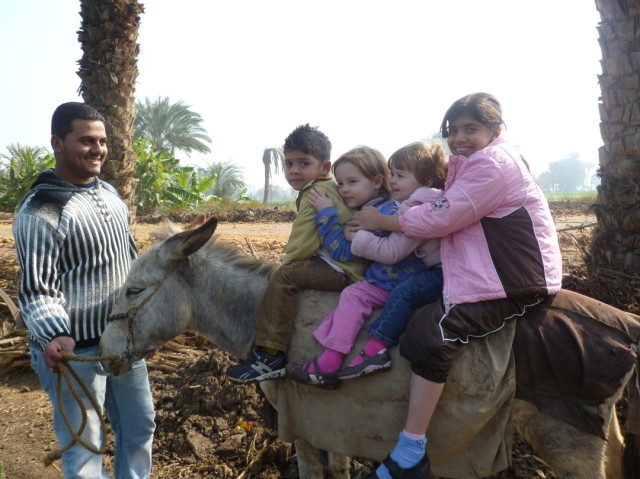
All four kids rode on a donkey.

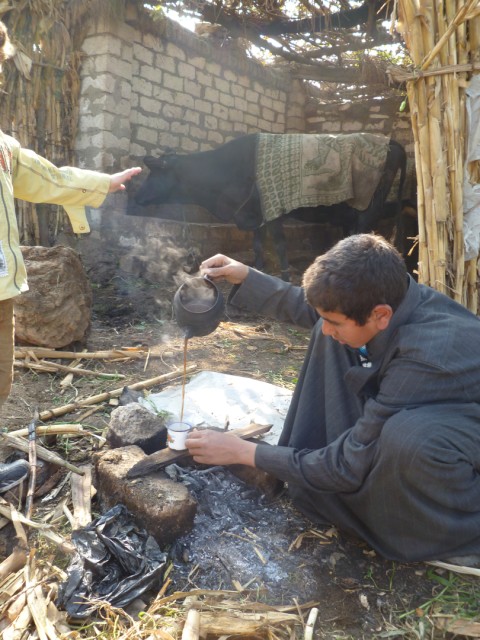
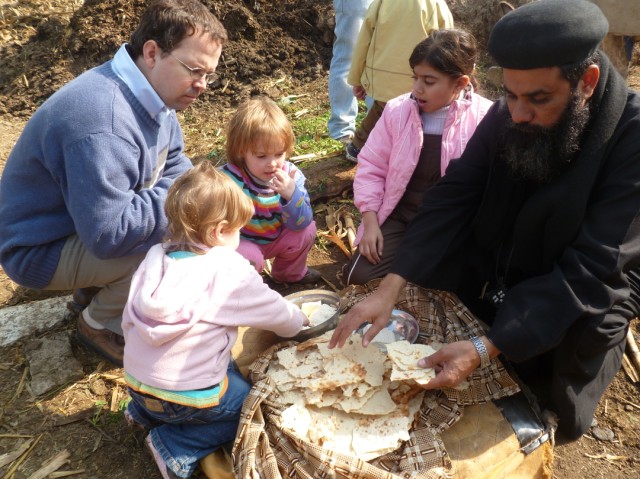
Jayson got to learn more about a village farmer’s life from the 80 year old man.  And for some reason, Layla fell asleep on my shoulder—something that rarely ever happens.  We got to breathe some fresh air and bask in the green of the land.  And in typical Egyptian fashion, we were even served tea, cooked over a fire, as well as bread with cheese.

You just can’t beat Egyptian hospitality.

In some ways, it was a trying and tiring trip, mainly as I was concerned with the behavior and schedules of our three little ones.  But overall, the girls did well being flexible with eating and sleeping, and got to have some new experiences.  As for me, looking back has helped me see the good things that come with surprises, and will help me remember in the future to be a little more flexible, and expect great things.

Categories
Personal

Time Away

Since we left Egypt during the demonstrations our time in the United States has had its ups and downs, and we have not yet decided when to return. It is always fun to return to family and friends, and we have taken great encouragement through times of sharing about our experiences. It has also been difficult to watch events in Egypt from afar, lacking interaction with the people who give depth and reality to the news.

It has also proven difficult to write. Our blog has suffered during this time away. Throughout the world people are familiar with the disruption and disorientation of transition. On the one hand, this blog should continue no matter our location. ‘A sense of belonging’ has no bearing on GPS. Rather, it is our hope to belong to the society in which we find ourselves. For the past year and a half, it has been Egypt. Over the past decade it has been various different Arab states. Why should it not now be America?

Perhaps we taking belonging here for granted. The familiarity level is such that no attention is given to the newness of experience or the lessons learned in life. If so, it is a dangerous warning. Soon, Egypt will also grow familiar. Will we then stop appreciating or learning from life? Will there be no reason to write and share?

On the other hand, transition is time consuming in ways that escape a normal accounting. Routine is disrupted and reflection is shortchanged. This is another factor that has caused our blog to go blank for a short while.

Your patience is appreciated, and we hope it will soon be satisfied. I have been working on a piece for work to describe the recent Egyptian military activity undertaken at three Coptic Orthodox monasteries. It has been a very controversial matter in Egypt, especially among Christians, and has caused a minor stir in the West as well. Tomorrow I will post part one of the report, which will outline the basic story. Part two will establish context to understand deeper issues which influenced each actor. Finally, part three will critique two news reports which were circulated in the English speaking world, revealing how headlines – and perhaps bias – can misrepresent a situation.

It felt good to be writing again; we hope you enjoy following along with our lives and perspectives once more. Thank you.

Categories
Personal

Too Far Away to Celebrate

February 11, 2011 is a day that will go down in history.  The man who has been president of Egypt for 30 years finally took the cue from his people after 18 days of protests and stepped down.  Having lived in Egypt for the past 18 months, we were heavily invested in this story. We rejoice with the Egyptian people at what they have accomplished and how they have accomplished it.  We admire their steadfastness and their commitment to peace over these last two weeks.  And we quietly mourned as we watched the celebrations because we were not there to join them on this joyous day.

In some ways, this is a very selfish reaction.  How can we possibly mourn when the people that we have come to love and identify with are rejoicing?  At the same time, this may show some of the depth to which we wish to belong to them.  How could we leave them in the midst of their suffering?  As Jayson said, “If we didn’t stay with them in their suffering, we don’t deserve to celebrate.”  He agrees this may not be the truth exactly, but it sums up how we feel.

The last 18 days have been an interesting journey for our family.  We anticipated the first day of protests on January 25, police day. We didn’t really know what to expect.  We had followed the events in Tunisia with interest because we had lived there previously and had many friends there.  We were excited for their successes, but also glad not to have been stuck in some of the unrest that took place.  We didn’t really know what might happen in Egypt; would this day be an isolated incident?  And so, we listened to our neighbors and friends and followed the Twitter feed to see what was happening in Tahrir Square on that first day.  More or less, the day went by without too much hype.  Many people showed up for protests in a few parts of Egypt, and most of the population went on with life as normal.  Wednesday morning came, Jayson went to work, the girls went to preschool, and I went shopping.  Would this fizzle out?  Was this a one-time event that didn’t have much effect?

On Thursday we started to hear about the call for nationwide protests following Friday prayers.  There was a hope that people would leave their mosques on Friday and join the protests all over the country.  Again, we weren’t sure what to expect, but we noticed more fear this time among some of our Egyptian friends.  Emma’s afternoon Sunday School class was cancelled in anticipation of the unknown.  I went to a choir practice on Thursday night at our local Coptic church, and while I didn’t understand all the Arabic conversation going around, I definitely sensed fear that things could get out of hand.

Friday morning was the first day of the blacked-out internet.  Not only that, but all cell phones were shut off for the entire day too.  We went to church in the morning as normal, but the crowds were definitely smaller and the priests were urging the people to go straight to their homes following mass, as we didn’t know what would happen by noon.  We obeyed the edict and made ourselves comfortable inside our house.  We have a large mosque right across the street from our house and we noticed the police barricades and extra officers stationed in the area.  Jayson was interested in seeing first-hand what might happen, and walked out the door around 1pm to watch what was coming.  The girls and I stayed inside, watched movies and played.  We didn’t hear anything unusual outside when the prayers were ending, so I figured this thing that was hyped up basically fizzled out before it started.  However, I learned more later after Jayson was able to go along with the protesters and witness both the peacefulness and some of the conflict that occurred when they met up with the riot police.

While he was with the protesters, I was with the girls hanging out in our house.  I actually felt pretty isolated because the internet and cell phones were off; I had no way of communicating with anyone, or finding out what was happening outside of our house. After a few hours, I packed the girls up in our stroller and walked down the street to a friend’s house.  We had planned to have dinner and a playdate with them that evening, so we kept the appointment even though I couldn’t contact them to confirm.  My friend was home alone with her boys as her husband had been out of the country when the unrest began and was unable to get back into Egypt.  She felt for me as well since there was no way for me to contact Jayson in the last four hours since he left the house.  It was comforting to have some fellowship as the kids played together, unaware of both the personal and national events taking place around them.

Fortunately, the TV wasn’t shut down by the government, so we could follow the events through CNN and al-Jazeera English.  We watched as Tahrir Square filled up more and more, as violence increased in clashes with police, and as ultimately, the army rolled into the square and the police disappeared!  It was a little scary to watch as we heard news of tear gas and water cannons, and watched the NDP building burning.  It seemed that things were getting out of control, and even though the square was not that close to our homes in Maadi, we didn’t know how the effects would trickle down.  I was greatly relieved when a little while later, Jayson showed up at the door.  We watched the news together, he ate some dinner, and we packed up to walk back to our house even though it was past the newly established 6pm curfew.

The next few days were a bit crazy, but we did settle into somewhat of a routine.  In the mornings and early afternoons, we tried to get out of the house and walk around our neighborhood.  Jayson went out of his way to say thank-you to the local militia who had organized themselves to protect the houses and shops in the area.  We saw some of the burned out cars and broken glass that were the result of the looting and fighting that was occurring during curfew hours.

I did some shopping and saw most of the shops closed down and boarded up to prevent looting.

The few stores that were opened reminded me of the pre-snow rushes that we’re familiar with in New Jersey when news of a big storm comes.  We tried to schedule play dates for the girls each morning as the preschool was closed and some of our friends were feeling the strain of broken routines with their kids stuck inside all day.  Not only did the kids enjoy the company, but being able to talk together with the other moms was comforting.  We all had our news, stories and questions for each other.  Once the cell phone service resumed, I tried to call many of my friends, both Egyptians and foreigners, to see how they were weathering this storm.  My Egyptian friends thanked me for the call, made sure we were all okay, reminded me NOT to open the door in our home for any stranger, and seemed a little nervous about where things were headed.  Many of my foreign friends were making plans to leave the country as the US started sending evacuation planes for any citizens who wanted to leave.  It was a disconcerting time as we tried to weigh what we should do in this situation.  We felt safe, but more and more people seemed to be leaving, and the protests had a different flavor each day.  It was confusing.

Our curfew times were spent inside the house of course.  Some days this started at 5pm, other days it was 3pm.  People in our building were intent on securing the place and making sure we were all safe.

Some friends who lived closer to a more volatile area in Maadi came to stay with us for two nights before they left Egypt.  The camaraderie was nice.  Jayson took periodic trips upstairs to our neighbor’s house to watch the news as the internet was still off and we had no television.  One night we were warned that the water would be shut off in half an hour, so while trying to get our very tired girls into bed, we were also filling every container we could find with water.  Cooking was tricky as we tried to conserve food in case grocery stores started to run out of food, while at the same time use up perishables in case the electricity was shut off.  We tried not to eat too much food, but didn’t want to waste food if we ended up leaving the country quickly.  For someone who likes to plan ahead, it was hard to not be able to do that.

Jayson had a great experience on Tuesday when he visited Tahrir Square and got to witness first-hand the peaceful and unified protesters.  He really got to feel the spirit of the Egyptians who were gathered in the square … some for the first time, and others who hadn’t left for several days.  He saw the signs and heard the slogans, noticed the families having picnics and talked with some religious scholars about their philosophy.  He took lots of pictures and was eager to share these positive images with others.  On the way back home, though, he was stopped by some local militia who made him delete ALL the pictures on the camera.  This was a huge disappointment for him, and a disconcerting conversation overall, but one that he learned from.  We couldn’t believe the scene just one day later in the square as we watched on television as pro-Mubarak demonstrators began attacking the protesters with rocks, clubs, horses, and camels.  Once again, it felt like things were really getting out of control, and we didn’t know how far this would extend.

During this whole time, we were in conversation with parents and people from our organization regarding the situation on the ground.  I felt like my emotions were all over the place at times, one minute thinking that things were just too unpredictable here and we should get out of Egypt right away.  And the next minute, seeing the stores reopened and men filling the coffee shops, it seemed like life was back to normal and there would be no reason to leave.  We would watch the news and hear from friends about the US encouraging and then urging their citizens to leave Egypt, and we would wonder what information they had that we didn’t know.  It was really hard to know what to do, but in the end, on Thursday morning, Feb. 3, we made the decision to take the last guaranteed US evacuation plane out of Egypt.  There were various factors that went into that decision, but once made at 7:30am, we packed very quickly and left our house by 11am headed for the airport.  Our landlord graciously offered to drive us there, and once there, we were processed quite quickly for the next flight out to Frankfurt, Germany.

Our evacuation experience was really quite smooth, all things considered, and we are grateful to the US embassy workers in Cairo and Frankfurt for all their work.

After deciding to leave Cairo at 7:30am on Thursday, we touched down in Philadelphia by 4pm (local time) the next day.  All four of our parents were there to greet us, and following an hour-long drive where two of the three girls got car sick and three of the three girls fell asleep, we arrived at my parent’s home for the night.  We’ve now had about a week to adjust to the time change and get over our colds and enjoy time with extended family.  We definitely appreciate being here and all the positives that are here.  At the same time, we watch the news and talk to friends in Egypt and wonder if we still shouldn’t be there.

Yesterday was one of those days that we really wished we were in Egypt.  Mubarak’s resignation brought a mixture of joy and sorrow for us.  Joy for the Egyptian people as their commitment to peaceful demonstrations finally brought the downfall of the regime.  And sorrow because we watched from our living room in the US.  We wish we could have been there during the celebrations; maybe not among the tens of thousands in Tahrir Square, but at least among the hundreds in our neighborhood of Maadi.  We rejoiced with them from far away, and hope soon, that we can celebrate with them on their own soil once again.

Categories
Personal

Friday in Egypt: A Decisive Day, a Turn to Religion?

So far the demonstrations in Egypt have been remarkable in that there have been few signs of religion. Though widely reputed as one of the most religious countries in the world, protests have been absent of either Muslim or Christian slogans. Tens of thousands of people have taken to the streets in cities throughout the nation to call for economic reform, lifting the state of emergency, dissolving the Parliament, and dismissing the president. The effort has been driven by social media-savvy youth from the disenfranchised middle and upper classes, but has also involved the urban man on the street. It has not involved Allahu Akbar.

The reality of the secular nature of these protests provides both its strength and its potential weakness. The strength is seen in the unmasking of the typical government plea and Western fear that if democratic change is introduced in the Arab world, the result will be Islamic rule and law, detrimental to Western interests. This position was articulated recently by Egyptian Finance Minster and Copt, Yūsuf Butrus Ghālī, in an op-ed to the Washington Post in the lead-up to the legislative elections. He wrote concerning his ruling National Democratic Party,

The main alternative to our vision is offered by those who would steer the country away from economic liberalism, religious tolerance and social progress and toward greater fundamentalism, eventually creating a religious state in a country that has always embraced diversity. Imagine for a moment an Egypt in the hands of fundamentalist mullahs, fomenting instability and allied with rogue regimes.

Certainly it is too early to tell in which direction these protests will evolve, or if they will succeed at all. The fact that they have not been religious, however, has prevented the government and its allies from squelching the outcry in defense of a secular state. Instead, their call is clear – it is a vote of no confidence in the ruling system, a pining for freedom and democratic reform. Whether they are right or wrong is another matter, but without religious overtones there is no confusion about their purpose.

The potential weakness in the secular nature of the protests is that Egyptians are largely not secular people. This is not to say that the average citizen favors an Islamic state or Christian independence; rather, it is that events and their importance are filtered through a religious lens. Will they rally behind a secular cause?

It is difficult to be precise about the makeup of the demonstrations. Certainly, tens of thousands of people are bound to include elements of every stripe. Yet observations suggest that poorer, lower class Egyptians – the majority of society – have not dominated the scene. This is in line with the general assessment of Egyptian character as anti-revolutionary and fatalistic. Though a generalization to be sure, until sixty years ago Egyptians endured the presence of foreign rulers on their soil since the days of Alexander the Great. Are they liable to join an uprising now? Can an uprising succeed without them?

In the past few days of protests the numbers have dwindled as the opposition has fortified. Friday, however, portends as a decisive day, potentially in one of two directions.

The first direction is signaled by the return of Muhammad al-Barād‘ī. The Egyptian statesman and would-be presidential candidate has drawn the ire of many opposition figures for his extended periods abroad, away from the struggles of the Egyptian street. For his part, he has stated that if the people lead, he will follow, but that otherwise, he cannot take on the ruling party alone. Apparently, enough people are leading, and al-Barād‘ī has announced he will participate in the protests on Friday, and seek to manage the anticipated transitional change. Himself a secular figure, he could prove to be a rallying point and titular head of an otherwise largely leaderless movement. Yet will the Egyptian street support him? It is an open question.

Yet, why return Friday? The second direction is signaled by the social media call of protestors to conduct a nationwide demonstration following the conclusion of Friday prayers. In and of itself, this is not a call to religion, simply to organization. The youth movements driving the protests tend to be secular in orientation in comparison to the population at large. Yet as millions of Muslims gather to pray in the mosques, if mobilized they would be an unstoppable force exiting en masse in demonstration against the government. Here is the key question: What slogans will they be chanting?

Before exploring this question it is useful to survey the few expressions of religion that have emerged around the demonstrations. Following the self-immolation that spurred on the uprising in Tunisia several Egyptians acted similarly. Islamic authorities here, however, were quick to condemn such economic or political suicide on religious grounds. Meanwhile the Muslim Brotherhood put forth an Islamist perspective that the Egyptian regime must quickly reform to preserve its control.

Yet despite initial indications, the Muslim Brotherhood maintained that it did not organize a presence during the Police Day protests. Another group that declined to participate was the church of Egypt in all its denominations, which, though no official statement was made, urged through senior bishops, priests, and pastors that Christians not join in such sedition. Instead, the Orthodox Church held an exceptional mass on Police Day to pray for Egypt. Meanwhile, many Islamic scholars from the Azhar ruled that participation in the protests did not conflict with Islamic law.

As the demonstrations continued but waned in numbers, Twitter chatter created a strategy to regroup from a position of strength, suggesting the next large demonstration organize around Friday prayers. Today this sentiment picked up steam. The Muslim Brotherhood, of which individual members joined in protest but had no official participation, declared it would join in but not seek to dominate the Friday gatherings. The rumor-slash-plan then prompted the government to warn protestors against using the mosque as a launching pad for anti-government activity. Meanwhile, there has been significant Christian backlash against the stance of the church, and many Twitter postings of solidarity with Muslims, to ‘guard their backs’ as they pray. Perhaps some were inspired to reciprocate Muslim efforts to stand as human shields and participate in Christmas mass following the bombing of the church in Alexandria.

It is interesting to note the unique religion-state relationship that exists in Egypt, which makes ironic much of the above news. Islamic institutions such as the Azhar, Dār al-Ifta’, and the Endowments Ministry which supervises all mosque activity are all under the authority of the government. As such, no matter their attainment in scholarship and erudition, these high officials and most imāms in the country can be understood as civil servants. Their job involves representing the government. As such, the allowances granted to join in the protests represent a significant departure from the government position. No one would maintain that official Islamic scholars always toe the line, but in the middle of a crisis of legitimacy, their statement is substantial.

From an opposite perspective, so is the stance of the church. While Islamic institutions and mosques are in some sense an extension of government bureaucracy, the church is fully independent. Its churches and financial endowments exist outside the sphere of government control and supervision. So while the church and state have maintained an often strained but inherently stable relationship of cooperation, the decision of church leadership to abjure participation in the protests was fully voluntary, at least officially. As Rev. Radi Atallah of the Attarine Evangelical Church in Alexandria explained, there are nervous wonderings that these protests could be an activity of the Muslim Brotherhood, but that as a rule, if minorities join protests in the wrong direction, they could lose everything. It is the wiser course of action, he believed, for the church to simply observe. Individual Christians, though, should be allowed diversity of thought and action, as long as their participation remained peaceful at all times.

This comparison calls for a return to the original question: What slogans will they be chanting? Given that the majority of mosques are overseen by government affiliated imāms, it is fully unlikely that Muslims will receive encouragement to protest during the Friday sermon. Scripting guidelines for the sermon will be a tremendous task for the government, which must walk a fine line between not becoming overly political as if it were a press release, while urging the faithful to personal piety and respect for order. In all likelihood, the sermon will be received by most of those itching for protest as irrelevant. Their minds are made up, but will the sermon help or hinder the expansion of the movement? Perhaps for these it will be irrelevant also. The movement has been largely secular; the exit from the mosque as a location will not change this.

Yet, there are hundreds of mosques that are not affiliated with the government. In these the imām simply represents the makeup of his constituency. Many perhaps are simply pious Muslims with no Islamist leanings, but many others are decisively such. These will rally hard against the government, and may whip their followers into a religious frenzy. If these began chanting Islamic slogans, will other normal Muslim protestors follow? Might it marginalize Christian supporters? Could it lead to sectarian clashes?

Some Twitter statements have encouraged Christians to exit their churches into demonstrations, but timing issues will complicate matters. Friday mass typically ends around 11am, while during winter months the mosque sermon and prayers finish around 1pm. Christian numbers will likely be statistically insignificant in and of themselves, if indeed they protest. Yet if they move toward the mosque to wait and possibly defend, how will this be received by security forces? Will there be an effect on the national unity of the protests? Will it change the nature of the slogans?

These are some of the issues at stake for the protestors on Friday. If calmer heads prevail, unofficial leaders of the movement will take all steps possible to limit the religious nature of the demonstration. Having a religious nature is part and parcel of being Egyptian, and thus the addition of religious sanction, no matter how unofficial, can only aid their chance of success. But religious fervor in a charged, highly emotional climate can easily get out of hand. There has been significant sectarian tension in Egypt in recent years, even weeks. There have also been efforts to combat this through emphasized national unity. But if things go wrong, especially in poorer areas, there is potential for clashes. This must not be overstated lest it fuel the fears of authorities and Western analysts. Egyptians, like all human beings, tend towards rationality and moderation. Yet like all human beings, they are capable of error and excess. There is no Egyptian or Islamic predisposition to violence, but all should be wary of simple human nature.

In this vein, to end the text where it began, it is of utmost importance for protestors that their image on Friday does not yield to a preponderance of Islam. This is to speak nothing against the faith; it is that many – through misunderstanding or deliberate distortion – may seize on this transformation to label the demonstrations as a threat to the prevailing world secular order. A sectarian clash would spell the end of world sympathy; even simple Muslim slogans with no vitriol towards Christians could be interpreted as evidence of a sinister plot for Islamic regional dominance. It is understood that in suppressing the protests the government has shot itself in the foot; on Friday, protestors will have opportunity to do the same. In coordinating activity at the mosque they stand the chance to multiply their numbers and influence; they also stand the chance, however limited, that things could spiral out of control.

Besides, the world waits for what will come. Is the Muslim Brotherhood lurking in the background, allowing the idealistic youth the stage so that they with their greater organizational prowess and appeal to religion may win the popular struggle in the end? This is the fear of many Christians. Is it legitimate? Is the Brotherhood democratic, or do they play at democracy? If successful, will the protests lead to greater freedom, or to chaos? Is the ruling system in Egypt the best guardian for the interests of the Egyptian people? On Friday, answers may begin to appear. The day may be decisive, in any number of directions. Religion has been on the sideline of this story so far, but on Friday, it may make an appearance. Tension is high, as are expectations. Let us pray for the good of all. This is right religion; it must also be the foundation for decisive conduct.

Categories
Personal

Egyptian Protests, Day Two

It has been a very surreal two days for us here in Egypt. We live in Maadi, and though there was one early account of a protest, the area has been quiet. Yesterday and today I have been monitoring the Twitter feeds, even after the service went down, allegedly at government behest, though they officially deny this. For those of you who are not Twitter-savvy, like myself, you can follow second-by-second coverage if you go to Google, type #Jan25 into search, and then watch people’s ‘tweets’ scroll down your screen.

Not everything here can be verified, of course, but it puts the urgency and immediacy of the moment right before your eyes. Yet, all around is calm and quiet. Certain websites have live feeds of news reports, carrying the stories that journalists and ordinary citizens report. Whereas yesterday, on Police Day, the protests were large-scale and generally tolerated until late in the evening, today’s reports tell of smaller numbers but greater resistance on the part of security forces.

My take, however ignorant: On Police Day I posted my expectations about the event, written the day before. I spoke about how Egypt was not like Tunisia, because while in Tunis the protests were driven by discontent with economic conditions led by the poor, and only later on joined by the middle class, in Egypt these protests seem to me to be upper and middle class driven. This can be seen by the great role Twitter and Facebook have played in rallying the cry for protest. But I also thought that the impact would fall short of Tunisia for this very reason. Frustrations of the middle class here run deep, but can they gain the numbers and sustain the pressure needed for wholesale change? I wondered, doubting.

As the protests swelled yesterday I, like everyone, including the government apparently, was surprised by the turnout. I was impressed by the generally peaceful nature of demonstrations – opposed to certain signs in Tunisia – as well as the restraint shown by the security forces. By the evening as nightfall came, greater efforts were made to displace the protestors, who seemed determined to stay the night in Cairo’s central square. Tear gas, water cannons, and rubber bullets were employed. At the same time, it could well be interpreted as reasonable efforts to preserve public order. Not that the protestors threatened violence, but that the government was keen to stop the event as carefully as possible, yet stop it all the same.

Today began very quietly. Early efforts to protest fizzled against opposition, but on a day to return to work, the numbers did not seem grand. Whereas the day before I wondered if my posted analysis would be rendered foolish very quickly, by the afternoon it seemed the efforts at demonstration represented an attempt to force the issue, to keep alive a fading spirit.

Yesterday afternoon Julie and I took the girls out to go shopping and for a bit of a walk. We live in a nice neighborhood in Maadi, which is certainly an upper class neighborhood by all standards. But we live not far from where the area blends into a lower class section, which is where Julie often shops at lower prices than if she walks in the opposite direction. As thousands of people were rallying downtown, we enjoyed a normal stroll in the busy streets, the same scenario played out day after day. There were no rumblings of protest, no efforts to stir trouble. It confirmed my thoughts further that this social media revolution might largely be akin to a spoiled teenager railing against a dysfunctional family. The issues are surely serious, but the stakes are not so large.

Further confirmation came with a phone call to the Upper Egyptian city of Maghagha, where we had visited for a few days. We enjoyed time again with our priest-family friends there, and will write about this soon. But in this sleepy, poorer town three hours south of Cairo, there were no demonstrations whatsoever. Most protests have been in Cairo and Alexandria; certainly there are many desperately poor people here, but it is also home to the middle class. Protests elsewhere have been in a Mediterranean costal city known as a labor stronghold, and in the Sinai where there are longstanding issues with the Bedouin. Much of Upper Egypt was quiet, which was not the case during recent legislative elections, when protest demonstrations against alleged electoral corruption were widespread.

Finally, more confirmation came in a visit to the area of Kozzika, which is a poorer neighborhood to the south of Maadi where I go twice weekly for my class in a Coptic Orthodox institute. Again, no signs of anger, trouble, or concern with the world. A local coffee shop had al-Jazeera broadcasting live coverage of an emerging protest in downtown Cairo, and no one paid any attention, as domino tiles slammed down against the table.

But after a few hours away from the computer and Twitter addictions, I came home to survey the news. Protests, it seems, are gaining steam as the night goes on. Security repression seems rather severe, but the result perhaps is to spur on more people to join in. As you follow the news you can get wrapped up in it – here is an especially chilling audio link from a foreign British journalist who was rounded up in the back of a police truck with dozens of protestors. It makes it seems as if the world is on fire.

Perhaps it is – there. Not here. In all I am about 12 kilometers away from what is happening. It might as well be worlds apart. Those there have such passion and fury from their cause in the moment; those here are sleeping peacefully, including my three young daughters. Do I wish to be there? Not really, exciting as it would be. Am I content here? Not quite. Egypt could be changing, or it could be a blip on the screen. Either way, I am disconnected, and the feeling of disconnection is fueled by the constant surveying of others’ passion and fury. Is it true? Is it widespread? Is it good?

Still, it is smaller than yesterday. Will tomorrow be smaller still? It is said that Egyptians are not revolutionary by character. Until about 60 years ago, the nation had been ruled by foreigners since the days of Alexander the Great. They move along in life, deal with economic realities, and do not rock the boat. Yesterday and today, they are trying to. Some, that is. Thousands, actually. Will it make a difference against a resolute government? A government backed by American support?

But, on the other hand, even thousands are but a drop in the bucket. In their non-participation, do the majority of Egyptians signal content relative enough to prove this is not an internal rumbling for democracy, but rather the pining of a frustrated middle class earning to imitate Tunisia and, however legitimately, increase its sphere of freedoms? The government does not do a great job of eradicating poverty, but it heavily subsidizes basic goods. Are the majority of the poor content enough along their historical pattern, unconcerned by exclusion from political life? Will the protests eventually fizzle as the middle class aspirations are beaten down?

By and large, these have been secular protests, and notably, Egypt is a religious society. I would like to explore this question further tomorrow, if possible, but the call is circulating on Twitter that protestors are regrouping, and calling for nationwide participation following Friday prayers. Will Egyptians emerge from the mosque and take to the streets? This is looking like the next big question, unless tomorrow has more surprises. But will the population rally around a non-religious cause? It remains to be seen.

So what is my take, after all of this? It is best to hold judgment. I would encourage all to pray. The president needs wisdom, as do advisors, police chiefs, and protestors. There are deaths and injuries, and these cannot please God. Yet there are aspirations and hopes, and perhaps these do. May he sift the chaff from the wheat and bring about a society pleasing to all. Far less importantly, may he also give armchair observers sitting in Maadi the ability to be as constructive as possible.

Categories
Current Events Personal

Police Day Palpitations

Last year Egypt added a 16th day – Police Day – to its official list of public holidays. It may prove that this designation will backfire on the government.

The day was created to honor the memory of fifty police officers murdered by the British in 1952, which provoked an uprising eventually leading to the Free Officer’s Revolution and establishment of the modern Egyptian Republic. Since then, however, the police have been a primary object of contempt for opposition figures and the general man on the street, who consider them the enforcers of the Emergency Law, by which, it is said, the government squelches all opposition. Others say the Emergency Law is necessary to combat terrorism and drug trafficking, such as government supporters and members of the National Democratic Party. They believe the police allow the people to sleep soundly at night. Many Egyptian Christians, meanwhile, find the police and security forces to be biased and unresponsive when aggression is directed at their community or churches. Regardless of religion, though, the complaint of random arrests and brutality is circulated widely.

Inspired by the recent uprising in Tunisia, and frustrated by what were understood as deeply fraudulent legislative elections, Egyptian opposition figures have chosen to launch nationwide protests on the occasion of Police Day. The reverse symbolism is poignant – demonstrators will demand the repeal of the Emergency Law and the dismissal of the Interior Minister. Additionally, they call for a rise in the minimum wage and terms limits on the presidency. Activists hope that, as seen in Tunisia, initial protests for limited concessions might lead to a wholesale rejection of the regime.

Will they succeed? Over 80,000 Egyptian Facebook users have pledged to participate. So have leaders of the Muslim Brotherhood, the best organized opposition party in Egypt. They will be joined by the Wafd, Karama, and Ghad parties, the movements of April 6 and the National Association for Change, as well as representatives of the labor movement. Reluctant presidential hopeful Muhammad al-Baradei has signaled his approval of the protest, but will not participate.

Trepidation is understandable. The government has announced the demonstration to be illegal, and will deal strictly, though within the law, against any violators. At least three activists have already been arrested for promoting the campaign. Fresh in the minds of any protestor will be the recent deaths in police custody of Khalid Sa’eed, accused of drug dealing but purported to have informed against police corruption in drug deals, and Sayyid Bilal, an Alexandrian Salafi rounded up after the church bombing on New Year’s Eve. Investigations into their deaths are ongoing.

Other objections are raised. The Tagammu Party rejects the protests on the grounds that the nation’s policemen deserve a day of honor. Meanwhile, the ruling National Democratic Party has announced its intention to hold a counter demonstration of loyalty to President Mubarak, in which half a million of its younger members will participate. Additionally, the heads of the Orthodox, Catholic, and Protestant Churches in Egypt have urged their members not to join the protests, but instead to devote the day to prayer asking God to bless Egypt.

The weight and immediacy of the protest is in the air, especially in light of the events in Tunisia. One friend, an older gentleman, believes that nothing substantial will happen, though some may try to force the issue. He said this, however, on his way back from the bank, where he withdrew money ‘just in case’. Another friend spoke of the protest by listing a litany of common Egyptian complaints about the government. A sensible journalist, he spoke with a passion which betrayed his normal demeanor. Yet he has a wife and children, a reasonable income, and much to lose. Even so, he was itching to participate for the benefit of his country. Wisdom is necessary.

Yet where should wisdom lead? Certain factors suggest that a Tunisian style uprising is not imminent. First of all, the Tunisian demonstrations were by all appearances spontaneous developments arising from a disenfranchised lower class. Efforts at imitation in Egypt, however, are led by political elites looking to move the masses. Perhaps they will succeed; public frustration with government is widespread. More likely, however, is though the social media dissemination of dissent is spontaneous among the upper class, it will fail to mobilize greater society to any substantial degree.

Second of all, when the Tunisian demonstrations began to gain steam, they were joined by the middle class, which transformed an originally economic protest into one fully political. Critical mass was reached, and the president fled. Here, however, the middle class will be asked to lead, not support. Their cause is political, not economic. Though certainly the poor in Egypt could stand a drastic improvement in their condition – far more than in Tunisia – will they follow the comparatively rich into an unknown future, for political freedoms that do not generally concern them anyway? Can the family man mentioned above command their allegiance? Will he even be willing to try?

In which light, then, should the decision of the church to abstain from protest be understood? Church leadership is also frustrated with the government, especially following the use of live ammunition on Coptic protesters in Umraniyya, a suburb of Cairo. The Alexandria attack, however, may have served as a reminder that church security is tied to good, secure governance. Perhaps a known stability is preferable to a chaotic, unknown future.

The government can also be seen as solidifying its relationship with the church following the Alexandria bombing. The prime suspect in the Nag Hamadi Christmas killings from last year was recently sentenced to death – the first such sentence rendered against a sectarian criminal in modern Egyptian history. Furthermore, the government has stated that a new law to govern the contentious issue of church building will be introduced soon. For its part, the church has rejected the efforts of the US Congress to conduct a special hearing on the Alexandria attack as interference in domestic affairs – exactly the same language used by the government. The church’s longstanding position is that Coptic affairs are a matter of concern to Egypt only, interpreting even sincere international efforts at assistance as detrimental to the national unity between one people of two religions.

It can also be said that the Bible itself is an anti-revolutionary document. Many verses encourage believers to submit to the king, whether he is just or unjust. While undercurrents of protest exist in Biblical interpretation, the Egyptian church perspective is well within the mainstream of historical Christian understanding. It may well be within the mainstream of wisdom as well, but this is a pragmatic, political matter. Should the church throw its hat in with the uprising? Where will the repercussions be greatest should the effort fail, or succeed?

Fr. Matta al-Miskeen represents a minority position in the church today, but one that has been forged by an intense monastic spirituality. In his book ‘Church and State’, he urges Christians to become full participants in the life of society, and devote themselves spiritually in the life of the church. A mixing of the two identities, however, pollutes the two streams in which Jesus said to ‘render unto Caesar the things that are Caesar, and the things that are God’s, to God’. Though now deceased, he recognized the increasing politicization of the church, and warned against it.

As things stand now, the church is tied to the ruling political establishment, no matter how frustrated it is in this relationship. Alliance with government makes proper sense; after all, having suffered through sectarian and terrorist attacks over the past three decades, it is only the ruling power that controls the forces of security. Witnessing great police commitment to defend the sanctity of churches during Christmas Eve services testifies to this fact.

Yet Matta al-Miskeen hints at the greater strategy. If the church is apolitical, then individual Christians can be as political as they desire. The government can trust the church not to mobilize its members, either for or against government policy. Society, including the Muslim majority, can trust the church to urge its adherents toward morality and cooperation. Then, if a Christian becomes a government loyalist, he is free. If a Christian takes opposition leadership and calls for regime change, he is free. For his actions he is responsible to God, as well as the state and society. Yet this responsibility is his, it does not belong to the church. The church is responsible for nurturing the spiritual life of believers, not securing their political rights.

Police Day is January 25. Tension is afoot. Different strata of society have chosen sides, and the church has declared its allegiance. Perhaps the day will pass insignificantly; perhaps this is the first step towards Tunisia. Will society follow the lead of the elitist agitators, no matter how deep their dissatisfaction with government? Will Christians follow the lead of the church, and continue their submission to the ruling powers? For all involved, where does wisdom lie?

For the good of Egypt, may the right answers become clear. May all have the courage of conviction and the goodness of heart to act on such wisdom.

Categories
Personal

Preparation of Tinder: The Umraniyya Riots as a Prelude to Christian Violence following the Alexandria Bombing

Since the 1970s Christians in Egypt have felt under pressure from a perceived Islamization of society and patterns of discrimination from the government. In recent years they have registered complaints about restrictions in church building, irregularities in prosecuting crimes against their community, and other issues. Until recently, however, Christian criticism was expressed only within their community or with the media. On the rare occasions when they have demonstrated, it has been almost exclusively restricted to within church grounds.

The murder of six churchgoers in Nag Hamadi on Coptic Christmas,  January 6, 2010, provoked small scale demonstrations of Christians in that Upper Egyptian town. This vulgar attack, however, precipitated the beginning of public protest elsewhere, as was witnessed in a peaceful demonstration in downtown Cairo in February. Over the course of the year other events – Christian homes burned in Abu Tisht, public polemics between religious leaders, conversion cases concerning wives of priests – all contributed to a deepening of tensions and a feeling of isolation among Christians. If tinder is present in abundance, only a small spark is necessary to cause an explosion.

November 2010, one month prior to the attacks in Alexandria, the first spark occurred in Umraniyya, a poor, traditional living quarter in a Cairo suburb. Rumors abounded that the church was attempting to transform a service building into a place of worship, and government authorities interfered and stopped the proceedings. This is a common occurrence in Egypt; church building regulations are restrictive, and there is often much subtle maneuvering between the circumvention of law and its enforcement. This time, however, violence exploded. Again, though not regular, this is not uncommon; what distinguished this event was that the violence began with Christian initiative.

At first the demonstration was led by disgruntled Christian workers, according to sources from within the church. Media reports, however, state that they were joined by up to 3,000 area Christian youth. They did not remain on the church grounds, but instead exited and blocked the ring road not far from the church. Reports also describe vandalism against local government buildings and vehicles.

When the security forces arrived to subdue these riots, the result was an exchange of stone throwing between the protestors and the police. Reports also describe Christians hurling Molotov cocktails at the guards. In an excessive show of force, the security responded by using tear gas and live ammunition. Two Christians were killed, dozens wounded, and scores were arrested.

As with most news events in Egypt, determining facts and placing guilt is a difficult matter. Whether or not the Christians, or even the local priests, bear fault, the overwhelming Christian response to the Umraniyya incident was horror at the unnecessary death of two individuals. Many Muslims and other activists also condemned the heavy hand of security in putting down otherwise containable protests, as had happened repeatedly in all nature of demonstrations over the previous year. Christians in particular, however, viewed it as one more piece of evidence that their community is beleaguered, if not persecuted.

This is the prevailing attitude among many Christians of all classes. Yet where this sentiment exists among the lower class and uneducated segments of society, it mixes with the problems of poverty and unemployment to create a dangerous tinderbox. This was seen on a minor scale in Umraniyya. The explosion was witnessed in Alexandria, and then elsewhere in Cairo.

The unprecedented bombing that took place at the church sent immediate shockwaves through the Christian community. How should one react when a place of worship has been desecrated, when fellow religionists have been ripped to pieces? Even if most victims were unknown to the majority of rioters, Alexandria represented an attack on the Christian community, and the spontaneous response in defense of Christian identity was to take to the streets.

Again, it is difficult to be precise. Did security fear the worst and clamp down, provoking the violence which ensued? Were the Christians bent on destruction, and thus needed to be subdued? Were local Muslims agitators, or innocent bystanders swept up in the fury? Certainly the combination of these factors intertwined to produce the riots widely held in Egypt’s urban centers. What is clear is that the preparation of tinder had been underway for some time.

Now that it has burned itself out, will Egypt – Muslims, Christians, and government – be able to find avenues to legitimately express grievances and seek common solutions? If not, the collection of tinder will quietly begin anew.

note: Shortly after the Umraniyya incident I wrote an article for Arab West Report summarizing the official church version of events. Having neglected to post that here originally, if you desire to read more I will look to do so in the next day or so.

Categories
Personal

Quick Thoughts on Tunisia

We lived as a family in Tunisia for two years before accepting my current position at Arab West Report in Egypt. While there we developed a fondness for the country and its people, and as such we have been following closely the political developments. If it has not caught your attention, economic protests have been sweeping the nation, which led to the president of over twenty years fleeing the country. Since then the army has been clamping down, and it is premature to say if there will be any real change in the government, or if it will be a face lift which installs another Western-leaning authoritarian regime.

I would like to say that when the protests began developing in earnest, I was hopeful. While there are many poor people in Tunisia, the country as a whole supported a sizeable emerging middle class. Furthermore, this was built upon their industry, as the nation boasts little in the way of the natural resources which have fueled wealth-building of other Arab states, particularly in the Gulf. This is a testament to the Tunisian national character, which we found to be creative and industrious, in addition to being cultured, intelligent, and open minded.

So while I found much of the protests to be driven by the poorer sections of society, which gave them an appearance of riots, I was hopeful that it would lead to a positive transformation that demanded political change. As the president began making capitulations, it appeared it might be so.

As such, I was quite surprised when he fled. Authoritarian regimes tend to be quite adept at putting down social protest. Furthermore, though the protests were sweeping the nation, he did not appear to be in any danger, and the army would always be available to clamp down. Human rights would be trampled in the process, but eventually, these things tend to die down and life goes back to normal.

I wonder if he fled due to pressure from the army. The president was old, and his steps at placation had the appearances of yielding to the call for an opening of society and an expansion of freedoms. Perhaps fearful, the army may have decided he was a liability, made it clear he was to leave, and began asserting control.

If so, the strategy could be to make the people believe they have won, at which point the fervor will die down and preparations can be made for the government transition. This will give ample time for authorities to perfect election tricks and engineer circumstances so as to keep overall ruling power. There will likely be significant popular pressure to push forward with reforms, but that sort of success is a lot harder to achieve.

Still, I am hopeful. The Tunisian people are of a nature to get it done. Though destructive riots continue and rumors abound of American interference, with al-Qaeda trying to involve itself on the opposing flank, Tunisians are of a dogged, resilient sort. Yes, this could devolve into a Romania-type debacle. Yes, the army might reassert control as things go back to the acceptable, but oppressive status quo. But I would risk a wager on the collective cry for freedom, and trust Tunisia to emerge a stronger nation than before. I hope I’m right.

Categories
Personal

Christmas Conversion Conversations

Note: I wrote this piece shortly after Western Christmas, but a few lines needed more consideration, and we delayed publishing. Then, Alexandria happened, and I forgot all about it. Even so the theme, if not exactly the title, is fitting with what has taken place in this country.

——

One of the topics I am most interested to discover here in Egypt is how the Christian population might begin to love and serve their Muslim neighbors without agenda, especially those who are understood to oppose them, such as the Muslim Brotherhood or other Salafi / Wahhabi influenced groups. Characteristic of most Christians I have met here is an attitude of suspicion and a pattern of withdrawal. This is not to say that good relations do not exist between many Muslims and Christians, of course, but the general Coptic community perspective is negative.

Most of my Christian relationships here, however, have been with the Orthodox community. This is not unusual, as most Egyptian Christians are Orthodox, and we have been worshipping at the local Orthodox Church in our neighborhood. On Christmas we joined some foreign friends for a dinner celebration, and they invited two of their Protestant Egyptian Christians along. I love learning perspectives, and with them individually I raised this greater question.

The interesting angle is that each one almost immediately spoke of Muslims becoming Christians, though in a very disjointed manner. Neither one spoke of any personal involvement or activity to promote conversion, either on their part or of the church in general. Yet the topic of love and service prompted a conversation leap directly into the fact of religious identity change. Notably, there was little considered on how to get there.

With the first Protestant conversation developed toward the Muslim Brotherhood, and I asked if he thought they were an organization of crooks. I have heard this not infrequently among both Christian and Muslim Egyptians, who see them as businessmen who use religion to either line their pockets or make political gains.

This gentleman stated this was his perspective as well. I countered, though, that perhaps some of them were sincere. Perhaps many, even, were dedicated to God as they understood him, even if their ideology is to be rejected.

He did not disallow the possibility, but the thought shifted him in another direction. Unprompted by the flow of conversation, he stated that if a Muslim Brother was truly sincere, if he was truly trying to serve God, then God would make clear to him the path of Jesus upon which salvation rests. Up until this point, I did not know the denominational adherence of the gentleman, but this language was certainly Evangelical. I wondered if he might be an unusual sort of Orthodox, but when I asked if he was Protestant, he responded ‘Baptist’.

The second individual, a lady, never clearly revealed her particular denominational affiliation, but her history revealed a mixed heritage of Orthodoxy and Protestantism, some in America, with an admiration for both. Our conversation was much more in depth, and she spoke of the good old days in Egypt when there was both more religious tolerance and personal initiative in pursuit of development. She commented that many Christians have given up hope that things would get better, but that she, though tempted to do the same, felt that as a Christian she was bound to behave as if she had hope, and press on.

Her attitude intrigued me, and when I asked about tangible actions of love and service, she offered simple but poignant advice – interact with them, and do not disparage them. Apparently, she thinks the Christian community is failing here.

Perhaps I have grander ideas unformulated in my head, but the basic humanity expressed in her words is at least the minimum of what is called for, and any more could become a deprecating ‘strategy’. Yet while I as a foreigner might have an awareness of the need for community-wide responses of love, only an Egyptian can say what this would look like. So I pressed on – what love and service could Christians in general offer to those whose ideologies desire conservative application of sharia law?

Again, a jump occurred. I do not fault any Egyptian Christian for not having an answer; it is hard for them to imagine possibilities so opposite of their prevailing mindset. Her answer, though, was education, but through the means of Christian satellite television. She immediately began telling stories of Christians on these broadcasts who had formerly been Muslims. Though some were harsh in their manner of conversation about Islam, there were hundreds, she related, who were learning about the true nature of Islam and the comparable attractiveness of Christianity, Jesus specifically.

Many, perhaps most Egyptians are satisfied in their religion and content to let their neighbors believe their personal doctrines in peace. Yet it is not uncommon for believers of any religion to be interested in the conversion of others. This can be from genuine concern for eternal destiny or temporal happiness, or from a baser instinct of community ‘rightness’ as opposite the other. On the whole, however, Egyptians are aware of the high social cost faced by any convert in either direction.

Yet I was a bit confused by the speed of connection between the initiative of love and the result of conversion, offered independently in separate conversations. By any standard, Muslims in Egypt are not rapidly converting to Christianity, if at all, so it is not as if they are describing a trend. Why then would the conversation move so abruptly in this direction?

If the reason lies in denominational difference, it could be that Orthodox have been a minority in Egypt for hundreds of years, and as such are more focused on preservation of their community, rather than expansion. Not a few Orthodox I have met have also spoken of these satellite channels and the Muslim converts they portray. Most of these have also had some experience in the West with greater levels of freedom, and specifically religious freedom. Protestants, meanwhile, have comparatively greater Western exposure, and with it a more natural connection with the Evangelical focus on evangelism.

Perhaps the Protestant religious priority of evangelism, coupled with a generally perceived Coptic experience of religious difficulties, causes the jump. The presumably real stories of Muslim converts on satellite television nurture the evangelical dream, and talk of ‘love’ reminds such Protestants of their religious obligations, along which the path of conversion treads. That they do not know this path may reflect why the abrupt connection between love and conversion has few details of action.

Or it may be specifically that almost no one even considers loving the more conservative groups of Muslims. Therefore, if conversation suggests this, it will be God’s miracle to bring them to Christianity. As such, details of action are not even necessary, and have never been contemplated.

I certainly have had far too few conversations with Egyptian Protestants to confirm these musings. Yet the congruity of conversation in this instance was striking. Perhaps the best conclusion is found in the thought of the Egyptian lady of mixed denominational heritage. Interpreting her words, engage one another as neighbors, and respect one another’s views. In a society of much religious distrust, these simple ideals have become somewhat revolutionary. Is this sufficient, for either Muslims or Christians, to fulfill the words of Jesus to love the supposed enemy? Interestingly enough, Jesus’ words in context are unconnected to the issue of conversion. Instead, his followers are to imitate God, who sends rain to both the just and unjust. Certainly God desires all to become just, but sometimes his followers can run ahead of him. Or, more consistently with this text, jump.

Categories
Personal

Contemplating a Terrorist Strike

SUICIDE BOMB
Image by wannaoreo via Flickr

Jayson and I attended St. Mark’s Coptic Orthodox Church here in Maadi, Egypt on Coptic Christmas Eve.  This is not so unusual, as it is the main church we attend weekly, but this particular night was a little different.  You may have heard in the news about the suicide bomber who attacked a Coptic Church in Alexandria, Egypt on New Year’s Eve.  Egypt’s churches had been threatened by terrorists back in November, and on New Year’s Eve, that threat became reality!  The week that followed was interesting reading the news reports and hearing about the heightened security as Coptic Christmas approached.  Each day as I took my girls to preschool across the street from the Coptic Church, I noticed more and more security measures.  The teachers told me about bomb-sniffing dogs and scanners to be put in place for the Christmas Eve service.  We had planned to take a trip three hours south of Cairo for the holiday to celebrate with the same priest’s family we had celebrated with last year, but were advised to change our plans due to the threats.  And yet, we couldn’t forsake the place where we had been striving to belong over the last year.  It was Christmas Eve, the second biggest Christian holiday, and threats or no threats, it was time to attend church.

It was a long day in many ways.  I began work making a “contingency plan” over a year ago, and yet, with the immediate cares of everyday, I usually forgot about it and certainly didn’t make it a priority.  And yet, that day, with the thought of attending church under threat of attack, my thoughts turned to our three little girls, and what information people would need if something happened to Jayson and me.  I finally got around to writing down where our important documents are kept, phone numbers of parents in the states, and contact information for other connections we have.  I even wrote down phone numbers of friends in the country who I knew would be able to help with babysitting, even though I never asked them if they would be on my contingency plan.  It was necessary, but foreboding, to be writing down the girls’ daily schedules:  Emma and Hannah go to bed at 7pm, Layla is eating squash and peas … things people would need to know IF something happened.  But yet, the thought of this information being needed was very disturbing!

I lived that day a little differently I think.  I prayed more.  I hugged my girls more.  I had realized in the past that I didn’t have many pictures of me with the girls simply because I am usually the one taking the pictures.  And I knew I didn’t have any recent pictures of me with Hannah, my second girl.  So, one of the things I did that day was take some self-portrait shots with Emma and with Hannah.  I figured IF something happened, at least the girls would have these photos to hang on to.  How depressing!  But it was the first time I really went through a day thinking, this COULD be my last day.

I even taught the girls a song that day which I had recently remembered when reading Psalms.  I heard this song years ago on one of Steve Green’s Bible Verse Song tapes and it goes, “When I am afraid I will trust in You, I will trust in You, I will trust in You….”  I thought it a perfect song, not only for when they wake up at night with bad dreams, but especially today … IF something happened to me, I wanted them to have a song to sing as they were afraid without their Mommy and Daddy.

I tried not to think about the possibility of this being my last day on earth too much, but it really was a strange feeling.  I wasn’t overcome with fear, but I really did want to be prepared … or have my girls prepared for what COULD happen, without letting them think about what COULD happen.  My “I love you’s” to them when we put them to bed had a little more weight behind them than normal, and I looked at them just a few seconds longer than usual as I left their room.

I wasn’t sure if I would be nervous the whole time we were in the church, as the best time for the attack would be as people were exiting the building, but while I thought about it some, it wasn’t at the forefront of my mind.  I was impressed by the security presence at the entrance.  I was impressed by the number of people who were in the church, and the numbers who just kept coming and made it standing-room-only for a time.  I felt proud to be there and proud of the others who came despite the threats.  I was grateful to the Muslims I noticed in the crowd, for their standing with their Egyptian brothers in a possibly dangerous place.  And I enjoyed what I could understand of the sermon.

I got a little nervous toward the end as the priest made several announcements to the congregants to exit and go straight to their cars following communion.  They reminded them not to stand around and chat either inside or outside the building.  They wanted to cooperate with security as much as possible and get people home safely.  I felt comfortable inside and couldn’t imagine something happening at that point, but still, we had to leave the church and walk through the barriers before we were “safe.”

And you all know, since I am writing this post after the fact, that nothing happened and I am still alive and well and still able to be a Mommy  to Emma, Hannah and Layla, for which I am very grateful. But I now have a good start on our contingency plan, and a good reminder of what it’s like to live more “in the moment,” realizing that any day COULD be my last day here.  I don’t want to live in the depressing “what if’s” of thinking about death, but I want to hug my kids hard each day, tell them I love them truly each day, teach them songs and take pictures with them each day.

I’m thankful for the days God gives me here, but I don’t want to live in awareness of this only when the thought of death becomes a possibility.  Though there are many good things to live for, sometimes we only recognize it when the status quo is threatened. Terrorism can do that to you, but it can also lead to paralysis. Hopefully, in the days to come, we can find the balance.


Categories
Personal

Weekly Meeting with the Pope

His Holiness Pope Shenouda III, Pope of the Co...

Pope Shenouda (87), head of the Coptic Orthodox Church, is a busy man. For 39 years he has presided over the spiritual – and often political – affairs of Egypt’s Christians, having become pope in 1971. Underneath him are over 100 bishops who administrate local and international dioceses as well as specific programs and activities of the church. He spends [in theory] three days a week in Alexandria, the seat of the historic papal see, three days in Cairo, the center of church governance, and one day in the Monastery of St. Bishoy in the desert of Wadi Natroun, for isolation and prayer, though in practice it is sometimes more. Yet each week he takes one evening – Wednesday at 6pm – to be with the people, answer their questions, and deliver a short homily. This past Wednesday we at Arab West Report had the privilege of attendance.

St. Mark’s Cathedral is located in downtown Cairo and is the central church building for the Orthodox of Egypt. It can accommodate several thousand worshipers and was filled to near capacity during our visit. We arrived about one hour early and slipped into the throng which was bottle-necking at the metal detector. Two weeks earlier al-Qaeda in Iraq issued threats against the Coptic Christians of Egypt, and security has been vigilant since then. Entrance was granted only upon presentation of the national identity card with the marking of ‘Christian’ for the religion field, or else the tattoo of a cross on one’s hand. Once inside, however, the masses organized themselves into an orderly line, stretching from the door of the church, out into the courtyard, around the bend and across the top of the stairs, and then down into the parking lot.

Having neither the identity card nor the tattooed cross, our substituted foreign passports afforded us special privilege. We were advanced to the front of the line, were ushered through a second metal detector, and brought to the very first pew, replete with listening devices for translation.

The evening began with the chanting of a choir. Each week a church is selected to supply this ancient Coptic art during the meeting; representation today was from Akhmim, nearly 300 miles to the south of Cairo. About thirty young men and women dressed in purple presented praise to God and prayers for Pope Shenouda. After about an hour of intermittent performance, they moved in procession past the pope, who greeted them individually.

The evening’s events are televised regularly on two Coptic channels – CTV, affiliated with the church and founded by Christian businessman Tharwat Basily, and Aghabi (the Coptic word for ‘love’), owned by Bishop Botros. You can watch online, if desired, at www.ctvchannel.tv. The station honors the pope with the title ‘the teacher of generations’. Certainly in this generation the title is appropriate, as Pope Shenouda, though 87 years old, enjoys rock star status among many Coptic Christians. Egged on by the mounted extension cameras operated by the networks as they scanned the audience, those in attendance would stand, cheer, and wave pictures of the pope above their heads. The scene resembled a professional sporting event more than a religious gathering.

As the pope prepared to speak, however, all were quiet. During the choir performance the pope was handed small slips of paper from the audience, and he read them over as they sang. Over the next hour and a half he read personal questions and gave answers as his wisdom dictated. The pope is known for his sharp wit and sense of humor; though most of the time we failed in translation to appreciate the joke, the audience chuckled regularly.

Pope Shenouda selected a wide range of questions, perhaps forty in all. Some were theological. Question: What will happen to the bodies of those saints who were translated directly into heaven? Answer: They will appear in the last days, be killed, and then rise again in the resurrection.

Question: My priest said that if a man repents of his sin there will be no punishment for it, is he correct? Answer: If a priest says there is no punishment, he himself should be punished. There is forgiveness for sin, but there are also consequences.

Some were political / ecclesiastical.

Question: I read in the paper that the trial of so-and-so had taken place and he was found guilty, is this correct?

Answer: You shouldn’t believe everything you read in the papers (this line generated the greatest applause throughout the night).

Question: My priest says that there are two tithes that must be paid, is this correct?

Answer: No, there is only one tithe, but additional offerings are welcome and blessed by God, but voluntary. Furthermore, priests and bishops also have to pay the tithe, as they are not exempt and should serve as your models (this line generated the second greatest applause throughout the night).

Some were personal.

Question: My brother asked me to quit my job and work with him, but once I did so he failed to pay me my share of the money; what should be done?

Answer: Your brother should pay you the money.

Question: It is very difficult for my mother in Upper Egypt to take care of housework, especially now that her washing machine has broken; what can be done?

Answer: We can buy her a new washing machine, but she should take better care of it than she did the old one.

Eventually, the pope set the papers aside. There was a short break, but then he began his closing meditation. Entitled ‘Its end will come’, he spoke of how our problems in this world may be troubling, but that as our faith tells us God will eventually put everything right, we can endure with patience. He laced his message with several stories taken from the Bible and church history, including Job, David, and Athanasius facing multiple exiles during the Arian controversy.

The end was abrupt. The pope delivered his closing sentence, stood, and was ushered away – slowly, of course, as is appropriate for an 87 year old man. The bishops filtered out in turn, and many in the audience also stood to leave. An official of some nature rose and gave the closing benediction, but few were paying attention. Pope Shenouda had left the building.

Now, the audience faced the same challenge. Several thousand people cannot leave an area quickly. They all filed out into the parking lot, moving like sand in an hourglass trying to pass through the main gate back out into the Cairo streets. A small group of ten to twenty stood on the steps of the building adjacent to the church and chanted for Pope Shenouda, as if they wanted an encore (they received none). Eventually, we found our way out the gate as well, and proceeded home, thankful for the experience, but somewhat out of sorts with what took place.

There is always much to learn, and as foreigners, we must remember it takes us longer than normal to do so here. I was raised in a low church tradition, without religious hierarchy. I know the celebrity certain pastors in the United States have attained, but this surpassed them all. I cannot recall that even the Catholic pope has been so openly adored. Pope John Paul II had the admiration of many, but this level of affection was more akin to that given to Michael Jordan in the NBA.

Furthermore, I cannot say that I was won over by his ‘performance’. The pope’s answers did not seem especially profound, and the homily was simply a listing of stories rather than a deep theological treatise or affecting discourse. Most likely I am yet insufficient in appreciating Coptic spirituality; perhaps it was simply an off night. After all, on occasion even Michael Jordan shot 6 for 19 from the field, but was still applauded wildly. Pope Shenouda has authored over 100 books; his theological and spiritual stature should not be questioned.

Even so, an explanation for the wild approbation may be found in similarity to the aforementioned saint in Pope Shenouda’s message. Athanasius was the 20th pope of the Coptic Orthodox Church (Shenouda is the 117th), but was much more than that. At a time in which Egypt was feeling imperial pressures from Constantinople, the largely Christian population of Egypt found in him a rallying point and embodiment of national sentiment. Arianism as a heresy doubted the divine nature of Christ, but political maneuverings in the post-Constantine Roman Empire raised the question of who was responsible for local ecclesiastical affairs. Athanasius was the people’s choice – defending orthodoxy made him a saint; defending his flock made him a hero.

Many Coptic Orthodox Christians today applaud Pope Shenouda in a similar manner, even though they are now a minority, and  his cause is not the nation. Rather, the pope speaks of himself as ‘the father of his children’, and he is looked to as the defender of Christian interests. Religious identity is on the rise among many Egyptians in both Christianity and Islam, which can almost be explained as a near-nationalism. Very few Egyptians, in fact, speak of a sense of pride in their country. It has been replaced, rightly or wrongly, with religious sentiment.

Pope Shenouda therefore, is at the crest of this sentiment. As many Christians believe their community to be beleaguered by Muslims and government alike, they look to the pope as the one figure who can represent them. Copts have little widely regarded secular leadership; only the pope can fill this role.

During his weekly meeting Pope Shenouda did not appear to pay much attention to his applause. On occasion he waved his hand to quiet them down. Another time he announced that people should descend from the scaffolding (as Zacchaeus with Jesus) so as to avoid injury. Most of the time, he had a wry smile on his face, but never seemed to revel in the moment. At the same time, he did little to stop it, and I had the impression that this happens every week.

Similarly, I am still too inexperienced to know Pope Shenouda’s attitude toward his leadership of the Christian community. Does he know the reality and shoulder the burden? Has he sought this position and defended his territory? As noted, he lays claim to being the spiritual father for his children, but does this go beyond their Christian faith into their public lives?

Good analysis can try to untangle these questions; much analysis has attempted it already. For now I am content in the ambiguity of the question, but being content does not mean being at ease. With Pope Shenouda as with the weekly meeting, there is much to appreciate, but there is a lingering unsettledness. Surely this is natural, as no Christian life is perfect. Yet for the Copts of Egypt, finding that note of serene balance is essential in navigating the challenges before them. May God guide them, and with them all of Egypt.

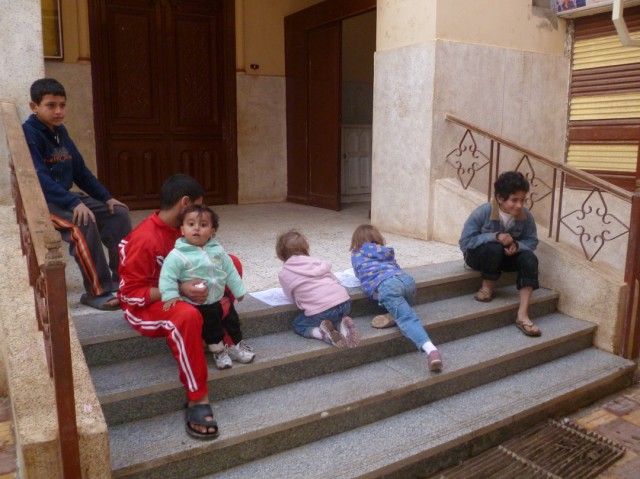
Categories
Personal

How Many Days of Christmas?

The Christmas season is upon us and we are enjoying watching Emma and Hannah learn about the Christmas story.  We are doing a few new things this year with them in mind, and it’s been fun to watch.  At the same time, I wonder what confusion they may be experiencing, particularly with the “days of Christmas” in the land of Egypt. First, a new song.
Last month, a good friend gave the girls a new book called, “The Twelve New Days of Christmas”, by Bonnie Fite.  It’s a great new rendition of the old song many of us are familiar with, but it uses elements from the Bible story instead of some odd combination of birds and musicians.  Emma already has the whole thing memorized and Hannah is close behind (see video here).   What a perfect way to learn all the different parts of Jesus’ story of arrival on this earth.

The song goes like this:

  • On the first day of Christmas, my true Lord gave to me, the Babe in a manger bed.
  • 2nd – two earthly parents
  • 3rd – three wise men
  • 4th – four elder saints (referring to Elizabeth and Zechariah, parents of Jesus’ cousin, John; and also, Simeon and Anna, two saints at the temple)
  • 5th – five Roman guards (referring to the only sad part of the Christmas story where King Herod sends his soldiers to kill the babies in Bethlehem)
  • 6th – six chickens clucking (the author admits to taking some liberties here, but says that certainly there were chickens in the stable with Jesus)
  • 7th – seven kings in waiting (referring to seven good kings in the line of Jesus in the Old Testament days)
  • 8th – eight shepherds praising
  • 9th – nine sheep a-bleating
  • 10th – ten prophets predicting (referring to those who prophesied the coming Messiah)
  • 11th – eleven people sleeping (referring to all the people visiting Bethlehem for the census)
  • 12th – twelve thousand angels (with the shepherds at the manger)

So this started our “days of Christmas” with the idea of twelve days.

Meanwhile, last year we bought a wall hanging Christmas tree that also works as an advent calendar.  We bought it from the people who do handiwork at the recycling center in Muqattam, otherwise known as ‘Trash City’, here in Cairo.   But last year we didn’t use it as an advent calendar as it required some thinking about what could actually fit on the hanging.  My mom and niece and nephews helped out this year and sent us some great little ornaments to pull out each day, so now we can use it and count down the twenty-four days until Christmas!

To add to this number confusion, in Egypt, we will celebrate Christmas on two different dates, December 25 and January 7. Most of Egypt’s Christians belong to the Coptic Orthodox church, and they celebrate Jesus’ birth on January 7.  However, we are Western Christians and have always celebrated on December 25 as much of the world does, and so, we will have some sort of celebration on each of the days.  One other item that is mildly confusing is that many of our Egyptian Muslim friends, and even some Christian ones, seem to assume that we celebrate Christmas on December 31; I suppose this is because the televised celebrations in America are much more pronounced on that day.  They see fireworks and big parties and people “counting down to the New Year” and assume this is our big holiday.  You might say we have three Christmas dates to consider.

So all these things may confuse our preschoolers as to when Christmas actually is, but we’re thankful they are learning more about the Biblical story and less about the ever-present Santa Claus.  This is the first year we put out a play nativity scene which they enjoy every morning, acting out Mary and Joseph in the stable, the angels announcing the baby’s birth, the shepherds coming to see the baby and the wise men going on a long journey to find baby Jesus in Bethlehem.  (We hide the wise men somewhere in the house after they go to sleep.)

Emma and Hannah are learning familiar Christmas carols like “Away in a Manger” and “Joy to the World,” and belting them out for all to hear.  Emma even may sing in her first Christmas concert this year, appropriately enough, on New Year’s Eve.  So whatever date you celebrate and whatever your traditions may be, our family wishes you all a Merry Christmas and a Happy New Year, and then another Merry Christmas.

Categories
Personal

Stopped by a Policeman

Policeman on duty ... sort of.
Image by Ed Yourdon via Flickr

The other day I rode a microbus.  It’s not something I do too often, but there are certain places I go which are on a microbus route so I choose this cheapest option when I can.  On this particular day, I was going to the Carrefour Express market located in nearby “New Maadi.”  The cost for a microbus is 75 qirsh (or about 15 cents) which is significantly cheaper than my return trip which I must do by taxi since I’m laden down with bags of groceries.  By taxi, the cost is usually 10 LE (or approximately $2)—a big difference.

When I took the microbus to Carrefour Express last week, I had a new experience, and one which I can only guess at its meaning.  I arrived at the microbus station and found a vehicle not yet full, but anxious to begin its route and find customers along the way.  I sat in the third bench seat back from the driver with another woman.  Sometimes these microbuses get crowded, and it is best as a woman, if at all possible, to sit next to another woman, which leaves less room for trouble.  So, this driver seemed to take a slightly different route than I was used to, but since I don’t ride it enough to know all the variations, I didn’t think too much of it.  However, while driving down a street which was unfamiliar to me, a police officer walked up to the van and stopped the driver.  This is one of those situations where I wish I could understand when two Egyptians speak to each other.  As a non-native Arabic speaker, it is much easier for me to understand an Egyptian speaking to me because they slow down and say things more simply so I can understand.  However, when two Egyptians are speaking to each other, it’s almost impossible to follow along.

One of the things that made this somewhat easier, was that the officer kept repeating the same thing over and over again, “License … give me your license.  Where’s your license?”  And the driver kept answering, “I’m sorry.  This was the first time I did this.  I won’t do it again.  I’m sorry.”  But it seemed the driver was either without a license or really didn’t want to give the license to the officer.  I can only guess here, but I was thinking the latter was true.  Sometimes, these exchanges can be less than “above par.”  If the driver did have a license with him, and gave it to the officer, it could mean a trip to the station to get it back, or a small payment (aka, bribe) to the officer to return it.  This driver was just hoping to get away without a scratch.

As they continued to exchange the same words over and over again, I began to wonder what to do.  This was the second time I was stuck in a microbus wondering what to do.  The other passengers weren’t making any moves to get out, and I was really hoping, along with the driver, that the officer would just let him go so we could get where we were going.  But then a strange thing happened.  One of the passengers in the front seat got out of the van, and walked over to the officer and asked to talk with him.  Now, I didn’t really know if this was just any passenger, or a friend of the driver or if maybe he was the regular driver of this van and the other guy was just driving a few shifts for some reason.  I had no idea.  But he and the officer walked to the side of the road and talked for a few minutes before the officer returned to the driver and told him to turn the van around and get back on the route and not to deviate again.  (At least, that’s what I think he told him in Arabic.)  So the driver got away without a scratch, and it seems it’s all because a passenger helped him out.

Why?  I have no idea.  Did he just want to get where he was going?  Was the driver a friend?  Why would the officer listen to him?  Did he have some sort of clout?  It’s common in this society to have mediators work things out, rather than working directly with the affected parties.  Did he pay a bribe?  If so, why would he?  I didn’t notice much discussion among the other passengers as we just finished the route in silence and all exited along the way.  The passenger that helped out got out of the van a little while before me, and his leaving didn’t indicate anything special about him or his relationship to the driver.  So, I’m left with many questions about what exactly happened there.  But I am glad I got to the store and back home again without too much of an extra delay.

Categories
Personal

Control Freak

Cairo taxi

Jayson and I had a conversation the other day which confirmed something I had been thinking about for awhile.  He’s been taking the girls to preschool some mornings, and they told me that when they ride the taxi with him, Hannah sits next to the door in the back seat.  However, when they ride with me, which is most of the time, Emma sits next to the door.  Our conversation went something like this:

Me:  When you take the girls to preschool, does Hannah go into the taxi first?

Him:  I guess. Sometimes.

Me:  You mean you don’t tell them who should go in first when the taxi pulls up? (with a hint of incredulity).

Him:  Um, no.  They just get in.  (with a hint of “why would I need to do that?”)

Me:  Oh.  (pause)  I tell them exactly what to do every time the taxi is pulling up.  I say, ‘okay girls, the taxi is coming…when it stops, Emma will go in first and climb all the way to the door and then Hannah you climb in and sit right next to her, and don’t put your feet on the seat, just walk on the floor.  Make sure you move all the way over because I need room with Layla.’  I say that every time!  And then when the taxi stops, I say, ‘okay girls, we are almost home.  When the taxi stops, climb out as quickly as you can so the taxi doesn’t have to wait.’

Him:  (with both of us chuckling at this point) Yeah, I just let them get in the taxi.

Me:  And it works?

Him:  Yeah.

Me:  Hmmm, I guess I am a little controlling.


This is one good example of my type A personality coming out in my mothering.  It started to occur to me that not all moms do things the same when we visited some American friends a few months ago.  This mom has two boys around my girls’ age.  At one point, she brought out finger paints and let her oldest and my two girls go to town.  I was a little nervous at first, wanting to get up and give detailed instructions to my girls about not getting paint anywhere except the paper and not mixing colors up, etc.  But I refrained and just watched, partly in amazement that the mom of the house wasn’t giving more boundaries.  But you know what?   The kids had great fun painting all over their papers, mixing colors and of course, getting paint on their hands, arms and clothes.  But, it’s washable.  So who cares?  They had fun.  I didn’t analyze myself at the time, but later realized that first of all, we don’t even have paint.  (That’s at least partially intentional).  We have markers, but they are only used under supervision!  If I did have paint, I would probably only let one kid paint at a time, they would strip down to their skin, I would carefully explain that they should keep the colors nice and clean, and I would be tense the whole time they had access to paint with their fingers!  Sound like fun?  Not really.

It’s good to have these experiences and conversations as it is showing me some places where I can ease up a bit.  The same friend who let the kids finger paint freely, also encouraged me that I wasn’t too over-the-top with the taxi thing.  She reminded me that it is good for the girls to know what to expect and be prepared for what they should do.  After all, I am the one who is with them most all the time when they are riding the taxi and it is good to have some order.  So, thanks, friend, for your encouragement.  And thanks, Jayson, for laughing with me about this.  And thanks, girls, for being flexible and following my detailed orders most of the time, and teaching me a little more about how to have fun.

Categories
Personal

Islamic Televangelists

Joel Osteen, Joyce Meyer, T.D. Jakes, Amr Khaled. To American Christian readers of this blog, the last name may not be as familiar as the first three. All the same, the phenomenon is similar. Amr Khaled is a popular Islamic television personality, very different than the traditional sheikh dressed in a robe and speaking of fatwas. He dresses sensibly, encourages his listeners in Islamic morality, and relates stories from the Qur’an and hadith to the everyday life of the middle class. In short, he and others like him present Islam to Muslims of the modern age.

As such, he can be very controversial. Islamic sermons are still disproportionately the domain of traditional scholars who may view these modern preachers as a liberal compromise with a culture becoming increasingly ‘Western’. On the other hand, secular Muslims may be troubled by the fervor such preaching instills for Islamic orthodoxy among the middle and upper classes who might otherwise be ‘untroubled’ by religion. Popularity breeds both followers and detractors, and the charge is made that such personalities profit handsomely from their spiritual work.

The topic of these Islamic Televangelists was taken on by one of our interns here at Arab West. The result is a brief but informative study that examines their message and impact on the Arab World. It even includes YouTube footage, though without translation, so you can watch and see if the presentation reminds you of programming available on a Sunday morning or Christian cable television. The link to read the report is here. I hope you enjoy, and get a good picture of what the talented interns at our center can produce.

Categories
Personal

Slaughter and Laughter

Double slaughter
Image by zz77 via Flickr


I never realized how close in spelling those two words were until just now when I wrote them.  Interesting, huh?

I chose this title after walking down a busy street here in a poorer section of Maadi.  This is the season of the Holiday of the Sacrifice, when Muslims who can afford it slaughter a sheep or goat or cow to commemorate the sacrifice that God provided for Abraham when he was about to kill his son.  It’s a good thing to remember, I think.  God can provide the sacrifice when we need it.  Abraham obeyed God’s command to sacrifice his son … crazy as that command must have felt to him.  Abraham trusted God enough to obey him.  The Bible even says that Abraham believed God could raise his son from the dead if need be, so even though he didn’t know why God would ask him to do such a crazy thing, he believed God would still spare his son somehow.  As a Christian, it makes me remember the ultimate sacrifice that God provided through Jesus – the sacrifice that can save all of us from eternal slaughter.  But as Christians, we don’t have vivid ceremonies such as slaughtering a sheep to remind us of God’s provision.  This makes the holiday here a bit hard to stomach at times.  Seeing carcasses hanging from balconies, watching a group of men stripping the skin from a cow, noticing the blood running in the streets, hearing the bleating of the sheep before it’s their turn — all these things are a bit repulsive to my western senses.  After all, I usually buy my meat wrapped in plastic wrap sitting on a Styrofoam plate from the grocer’s shelves.  It doesn’t resemble an animal at all.  And so, as I walked down the street, on this, the second day of the holiday, I kind of chuckled as I noticed two things, almost side by side.

First, I saw the children on the swings.  I remembered that this is common during holiday times.  Someone will come to a busy area of town and set up some amusement rides.  They aren’t so much like the ones we see in America sometimes, that have roller coasters and Ferris wheels set up for a week at a  time for some festival.  These are more basic — a trampoline or large swings … nothing motorized.  I don’t know the cost of a ride as I warned my girls long before they saw them that we aren’t going to go on any rides, we’re just walking by.  I would guess they cost 1-3 Egyptian pounds (.20 – .50 cents) per ride.  And the kids were enjoying themselves on these rides.  Laughter.

And then, as I got closer to the swings, which were easily seen from a distance, I noticed, less than a block from the swings, a small area where people were butchering their sheep.  I made sure not to look too closely, but did see a sheep’s head, complete with round horns, hanging on the front of the little stand.  Slaughter.

I don’t think either station was bothered by the other.  It’s a major religious holiday.  It’s not a holiday without the slaughter.  And since it’s a holiday, it should contain laughter.  In time, proximity, and spelling – it’s interesting that the two words go so well together.

Categories
Personal

Out on the Island

Last week we had a fun opportunity with a small group from the Coptic Church in Maadi.  I have been attending a “family Sunday school” class which consists mostly of women.  This class meets during the time Emma and Hannah are in their Sunday school class, and it is conveniently located in the same building.  This allows me to be available if Emma or Hannah needs something from me during class time.  I have enjoyed in this class, although since Layla was born, it is harder for me to attend and actually listen and understand what is being said.  It has allowed me to get to know a few more people, at least by face, and perhaps not be so strange to them.  When I received an email mentioning a class trip, I got excited for two reasons.  First of all, trips like this always make it easier to get to know people at a deeper level.  Even though people in the class are friendly to me, we haven’t actually talked very much.  Spending all day in a different setting would definitely provide time for conversations.  Secondly, the location of the trip was to be “Jazeerat al-Maadi” or the Maadi Island.  This was a place we had seen on the Nile, and Jayson and I had recently been unsuccessful in visiting it ourselves, as we were not allowed without Egyptians accompanying us.  We would now have an opportunity to visit what looked like a really nice spot.

We were not disappointed in either of our expectations.  When we arrived at the church at 8:30 on Friday morning, my friendly classmates said how glad they were that we were going with them for the day.  They were glad to meet Jayson and see the girls.  Some seem surprised we were attending, but happy nonetheless.  Around 9am, we boarded the bus to take us on the ten-minute drive to the island, and were surprised that the organizer of the trip (who is also responsible for the class in general) seemed quite upset about the few people who were late for the bus.  We have learned that Egyptian appointments aren’t exactly punctual, and didn’t really expect many to be there for the 8:30 meeting time.  But apparently we were supposed to be at the island by 9 for a tour, and the one responsible was not happy that we would be late.  She gave a short lecture about punctuality and how we need to be punctual if we expect our kids to respect this trait themselves.

We left the church and arrived at the island very quickly.  We took the three girls down with our backpacks as we had brought a few snacks and drinks for the kids.

We all just walked right onto the island, although somehow, we stuck out as foreigners because one man did stop us briefly.  We told him we were with the group and he waved us on.  It was nice and quiet on the island as no other Egyptians were there so early in the morning.  In fact, I wondered if we had a private party because I didn’t see anyone outside our group until around 11 or 12.  We all went to a shaded area of tables and chairs right next to a modern and clean playground on grass!

The girls were so excited and immediately began to play.  We found some chairs to sit in and settled Layla, who was sleeping in her carseat, in a quiet corner.  It was a comfortable spot to spend the day.

We took a short ride around the island in what looked like a very long golf cart which could seat about 10-12 people.

There wasn’t too much to see outside of a couple restaurants, lots of green grass, some nice flowers and the Nile.

It was an interesting view … the quiet, serene green of the island with the backdrop of the high-rise apartment buildings right across the busy road.

It seems where we were situated was the main activity hub of the island.  It was good to get a view of the rest of the place, but we didn’t have any need to go there on this day.

Our whole family enjoyed a leisurely afternoon participating in different activities:

Jayson has been teaching the girls how to play chess, so they played a little game with him.

Hannah is learning the names of the pieces … here she wonders where to move the pawn.

Jayson was also challenged to three good matches from some of the men in the group.  He won them all, and even had an audience by the end.

We were surprised at the large collection of bikes they had available to ride.  I think there was normally a charge for them, but ours was included in the cost of the trip.

Emma spent hours riding bikes and jumping on the trampoline.  She came home exhausted and sunburned and got pretty sick that night!

Hannah enjoyed the bikes too, although she couldn’t quite pedal.  She mostly climbed on the playground and went on the swings.  Most of the time she had a few older girls following her around and helping her.  This was a great help for me too as I got to sit and chat with some of the other women.

Even Layla got in on the action.  Whenever she was awake and not eating, she was in someone else’s arms.  She was a big hit, being passed around and photographed.  There are at least three phones taking a picture here.

It was a great trip that we all enjoyed very much. It’s just a shame we can’t visit on our own, but may help us make sure we’re on the lookout for more Egyptian visits!

Categories
Personal

The Concept of Time

The other day I called a doctor’s office to make an appointment for Emma.  The receptionist asked if I would like a morning appointment or an afternoon appointment.  I thought an afternoon appointment could be as late as 4:30 or 5 which would work well after their naps so I asked for an afternoon appointment.

The receptionist said, “Okay, how about eight o’clock.”  Eight o’clock?  Since when is that afternoon?  To me, that’s definitely evening, perhaps nighttime, and besides, its bedtime for the patient, Emma.  So I changed my mind and asked for a morning appointment instead.  After all, 10 or 11 a.m. would still give us plenty of time to get home and get ready for lunch.

“One o’clock,” the receptionist suggested.  One o’clock?  Since when is that morning?!  I agreed to this morning appointment of one o’clock in the afternoon and hung up the phone.  Remember the whole conversation was in Arabic, but she was definitely using the words for morning and afternoon.  I guess for a culture who likes to start the parties at nine p.m. when I am ready to go to sleep, one p.m. could qualify for the morning.

I also realized, after hanging up the phone, that the receptionist didn’t ask for my name or number or anything.  Did I just make an appointment or not?  I guess we’ll see when I show up at their office next week.

Categories
Personal

School Slogans

On my walk to work these days I pass a local school, whose walls are covered with brief slogans promoting morality, health, and other social virtues. This seems to be quite common, actually, and it is interesting to read the messages promoted by the administration. Here are a few pictures highlighting each phrase, with a fairly literal translation underneath.

This is the entrance to the school, and the elaborate calligraphy to the right of the door reads: In the name of God, the merciful, the compassionate. This is a common Islamic invocation, used often to begin a speech or introduce a text. As best I can tell, though, this school is a government school, and therefore consists of both Muslim and Christian students. Government education has mandatory religious classes, which are divided according to religion. So while there is nothing in the invocation on the wall that would offend Christian sensibility, it is recognized as a distinctive Muslim formulation.

In a similar vein, the school near our old apartment was also public in nature, but each day the students were led in opening exercises which included the choral shouting of Allahu Akbar – God is great. Again, while every Christian student would agree, this phrase is recognized as distinctively Islamic. Many Christians, if they can afford it, will pay to put their children in private schools. In addition to being regarded as providing superior education, many of these parents will also complain about a perceived bias towards Islam in the school system. Are their worries legitimate? We have much to learn.

Teach your children swimming, archery, and how to ride horses.

This is a phrase believed to have originated with Omar Ibn al-Khattab, the second caliph of the Islamic state following the death of Muhammad. Omar was among the leaders most successful for spreading Arab governance throughout the Middle East and North Africa. The military implications of his saying are obvious enough. Equally obvious is that no swimming, archery, or equestrian activity whatsoever takes place within the walls of this school.

Today by all appearances the phrase is utilized to demonstrate the early importance of education in the Arab world. The military applications, common to early education practices of many empires throughout history, have given way to the more general invocation to care for the development of children. This will be seen further in the generic phrases given below.

Education: The development of nations is measured by the knowledge of their children.

Fair enough. I imagine there would be a good correlation between test scores in essential subjects and rankings on the world GDP index.

Exercising builds the body and refines one’s morals, so do it!

Despite the appearances, this is not a take on the Nike slogan. Such scholastic marketing would probably be more akin to the American system.

Put a tissue on your nose when you sneeze so you don’t infect your colleagues.

And also this one below:

Fight sickness with personal cleanliness.

The swine flu virus terrified Egypt. I do not know if this slogan predates its onset or not, but there were extensive public education campaigns on how to avoid contagion. Many schools were shut down if certain children tested positive. Upon arrival, airline travelers were asked to submit to a special medical card, and those with fever were pulled aside for further testing. Less effectively, they also killed all the pigs in the garbage district, complicating natural recycling methods. These slogans were meant to promote good hygiene among the students.

Concerning all of these slogans, a colleague of mine remarked that schools are notorious for putting forward a public image that serves to mask the deficiencies – often in the very slogans – of what goes on inside the walls. The hope is that this does not prove true for the final picture:

Be an agent for good and not a reason for evil.

With these children, and all else in Egypt, may it be so.