This article was first published at Christianity Today on April 9, 2017.
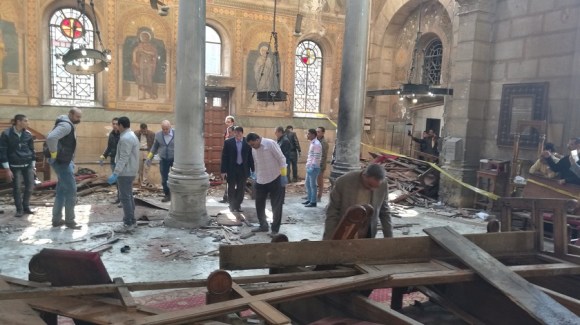
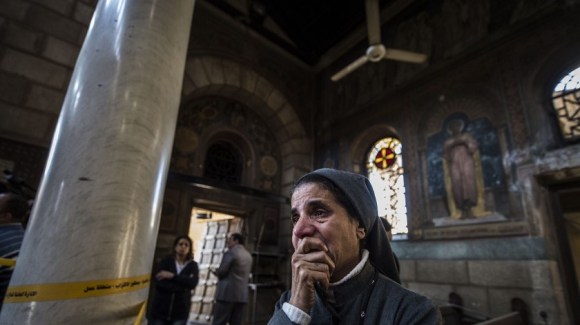
Attacks at two Coptic Orthodox churches in Egypt’s Nile Delta killed more than 40 people and injured more than 100 others during Palm Sunday services—including the one where Pope Tawadros II was worshiping.
ISIS claimed responsibility. In February, the Egypt chapter of the Islamist extremists had released a threatening video calling Coptic Christians “our priority and our preferred prey.” Soon after, about 100 Christian families fled their homes in the Sinai Peninsula amid a string of murders.
Reuters reports more details on the bombing in Tanta at Mar Girgis (St. George) Church, which killed at least 27 and injured more than 70. CNN reports more details on the Alexandria bombing at St. Mark’s Cathedral, which killed at least 16 and injured more than 40. [Before ending its live updates, state media outlet Ahram Online put the final toll from Egypt’s health ministry at 29 dead in Tanta and 18 dead in Alexandria.]
Nader Wanis, director of the Arkan Cultural Center in Alexandria, was worshiping at the Anglican Pro-Cathedral only two streets from St. Mark’s when the bomb went off. “It was only a few minutes before serving communion and it shook our whole church,” he told CT. “We were scared, but insisted to continue.”
Please click here to continue reading at Christianity Today.
This article was first published in the March print edition of Christianity Today. I provided additional reporting.
Egypt’s top Anglican leader is accusing its top evangelical leader of attempting a “hostile takeover” to prevent Egyptian Anglicans from achieving state recognition as an independent national church.
The dispute first surfaced in 2001, but this past summer Egypt’s High Administrative Court ruled against Anglican independence. This means the Anglican Diocese of Egypt must function as a full member of the Protestant Churches of Egypt (PCE).
Representing 18 denominations, the umbrella group coordinates the registration of marriages, deaths, property ownership, visas, and other legal—but not doctrinal—matters.
“The most important thing for me is the unity of the Protestant community,” said Andrea Zaki, president of the PCE and a Presbyterian pastor. “I don’t want it to be divided. This would weaken Protestants, and not develop the strengths we have.”
The Anglicans originally filed their case against the Egyptian government. The PCE says soon after, the court obliged them to join as defendants in the Anglican effort at independence.
After the June 2016 ruling, Anglican bishop Mouneer Anis filed a new suit in a lower court. Zaki followed up with key Egyptian agencies to apply the ruling, and the Ministry of Interior informed the Anglican diocese in September that it needed PCE approval for a visa application for an overseas worker.
At a December court hearing, Anglican attorneys addressed procedural faults in the June ruling. That court did not address their petition for the Egyptian president to recognize their denomination as independent, as they believe the law gives him the right to do.
“We were in Egypt before the Protestant church formed,” said Anis, one of the top leaders among conservative Anglicans in the Global South. When he took office in 2000, the Ministry of Interior ratified his documents; this continued until September 2016, after the PCE asked the ministry to stop.
Please click here to read the full article at Christianity Today.
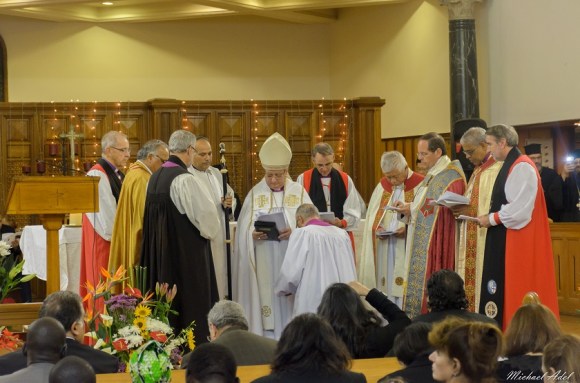
In a moving ceremony at All Saints Cathedral, Cairo on February 27, 2017, Archbishop Mouneer Hanna Anis consecrated his ‘dear brother’ Rev. Samy Fawzy as the first Arab area bishop for North Africa.
Bishop Fawzy succeeds Bishop Bill Musk, who presided over the diocese encompassing Algeria, Tunisia, and Libya since 2008. Bishop Musk was honored and thanked for his time of service, and participated in Fawzy’s consecration.
Joining also to lay hands on the new bishop was Bishop Grant LeMarquand of the Horn of Africa and Bishop Michael Lewis of Cyprus and the Gulf.
Also present were Archbishop Foley Beach of the Anglican Church in North America, Archbishop Rennis Ponniah of Singapore, and other Anglican representatives from around the world.
Bishop Lewis conveyed the congratulations of Archbishop Justin Welby of Canterbury, welcoming Bishop Fawzy into the fellowship of Anglican servant leadership.
Archbishop Welby also praised the Diocese of Egypt for its role as a bridge between Muslims and Christians as well as among the various Christian denominations.
He also issued a firm plea to the government of Egypt to continue recognizing the Anglican Church as an independent denomination, in light of ongoing legal disputes that jeopardize this status.
Archbishop Beach also welcomed Bishop Fawzy, greeting him in the name of GAFCON, and celebrating their partnership in the gospel while assuring of his continued prayers.
Archbishop Ponniah encouraged Bishop Fawzy that in the ‘boat’ of Christian service, it is the Lord Jesus who brings it safely to shore. He also welcomed him into the Global South effort that is catching many fish for the Kingdom of God, celebrating the recent accomplishments in Egypt of a new conference center and administrative buildings for the Alexandria School of Theology.
Congratulations were also offered by Fr. Bishoy Helmy, representing Pope Tawadros of the Coptic Orthodox Church, Rev. Rifat Fehmy, representing Rev. Andrea Zaki of the Protestant Churches of Egypt, and Bishop Kyrillos William of Asyut, representing Patriarch Ibrahim Ishak of the Coptic Catholic Church.
Fr. Helmy in particular praised the appointment of Bishop Fawzy, recognizing him as one with humility, an ecumenical spirit, and dependence upon the Word of God.
Bishop Fawzy graduated from the Faculty of Engineering at Cairo University in 1985, but set aside his career to pursue Christian ministry. Later he obtained a Doctorate in Theology from the University of Wales, and upon returning to Egypt was ordained to serve the church in Alexandria, where he was appointed dean in 2013.
Archbishop Anis remarked Bishop Fawzy was distinguished in his pastoral care, especially “among the wounded, oppressed, and marginalized.” He shared a quote which was dear to him at his own consecration as bishop, written by St. Augustine of Hippo, also from North Africa.
“For you, I am a bishop. But with you, I am a Christian. The first is an office accepted; the second is a gift received. One is danger; the other is safety. If I am happier to be redeemed with you, than to be placed over you, then I shall as the Lord commanded, be more fully your servant.”
Archbishop Anis told Bishop Fawzy he reviews this quote each day, and encouraged him to do the same.
“Truly the church needs trustworthy shepherds who love the Lord with all their hearts, and who will exert every effort to guide the people of God to live out the message of Christ, the message of love,” said Archbishop Anis.
Fayed El-Geziry/NurPhoto / Sipa USA via AP A Christian who fled ISIS brings belongings into the Evangelical Church in Ismailia.
This article was first published at Christianity Today on February 27, 2017.
As Coptic Christians flee Egypt’s Sinai Peninsula in unprecedented numbers, a Protestant church is there to receive them.
“We were the first to respond,” said Atef Samy, associate pastor at Kasr el-Dobara Evangelical Church in Cairo. “Two of those killed were very dear to our church.”
In the last few days, more than 100 families have left their homes in Sinai for the Suez Canal city of Ismailia, 125 miles west.
On February 19, the Egypt chapter of ISIS released a video calling Copts “our priority and our preferred prey.” Three days later, one man was shot and his adult son burned alive.
“This is sheer terrorism,” Samy said. “They want to embarrass the government and claim they can cleanse the Christian presence.”
In recent weeks, seven Copts have been killed. Witnesses say they were murdered in cold blood, with no negotiation, theft, or attempts to convert to Islam.
Hit lists are also reportedly being circulated, warning Christians to leave or die.
“I am not going to wait for death,” Rami Mina, who left Arish on Friday morning, told Reuters. “I shut down my restaurant and got out of there. These people are ruthless.”
Samy declined to name those killed, but identified them as born-again Christians active in ministry. His church quickly mobilized to help others leave, and provided support to the Ismailia church that has assisted dozens. Mattresses, blankets, food, and medical supplies are the most pressing needs.
Adel Shukrallah, responsible for youth ministry in the Evangelical Church of Ismailia, is heading the Protestant relief effort locally.
Please click here to read the full article at Christianity Today.
This article was first published in the Jan-Feb print edition of Christianity Today.
Jesus did not show up to defend ISIS—and the first to celebrate was a Muslim.
“The [ISIS] myth of their great battle in Dabiq is finished,” Ahmed Osman, a Free Syrian Army officer, told Reuters in October after coalition forces drove more than 1,000 extremists from the backwater Syrian city known as the Armageddon of Islamic eschatology. The jihadists had expected the Messiah to appear and bloody his lance on approaching Christian crusaders.
Muslim belief in the end-times return of Jesus may seem surprising, but according to recent polls, they expect him with greater anticipation than do many American Christians.
A Pew Research Center survey in 2012 found that more than half of Muslims in Iraq, Lebanon, and Tunisia—and just under 50 percent in Morocco and the Palestinian territories—believe in the “imminent return” of Jesus. Outside the Arab world, more than half of Muslims in Turkey, Pakistan, Malaysia, and Thailand say Jesus will return to Earth in their lifetime.
By contrast, a 2015 poll by the Brookings Institute found that only 12 percent of US evangelicals believe that Jesus will return in their lifetime.
Past polls communicate a greater expectancy. In 2010, Pew found that 27 percent of US Christians expected Jesus to definitely return within the next 40 years, while another 20 percent found it probable. Among white evangelicals, 34 percent said “definitely” while 24 percent said “probably.”
The Qur‘an alludes to the return of Jesus (accompanied by a figure called the Mehdi), who on the Day of Resurrection will be a witness against Christians who claim him as the Son of God. But Muslim eschatology is derived primarily from Islamic traditions that have varying degrees of canonicity.
The exact timing of events does not tend to be the concern of Muslim theologians. But the general narrative is that Jesus will descend to Earth, kill the pigs, break the crosses, perform the pilgrimage to Mecca, defeat the Christian armies of Rome, kill the Antichrist, and usher in a period of worldwide Islamic prosperity.
Please click here to read the full article at Christianity Today.
Visiting Egypt for the 500th anniversary of the European Reformation, Chris Wright aptly taught on Biblical preaching. And in his public lecture to nearly 300 people on January 26, he focused on the centrality of the Bible for all reformation.
“Ecclesia semper reformanda,” Wright said. “The church must be continually under reformation, renewed by the Bible.”
Bishop Mouneer Hanna Anis of Egypt invited Wright to All Saint’s Cathedral in Cairo to train Anglican clergy how to minister the Word of God in their churches. In a series of four presentations he emphasized godly preaching must be both Biblically faithful and culturally relevant.
Wright is the international ministries director of the Langham Partnership, dedicated to educating pastors toward theological maturity. The ministry began under John Stott, rector of All Souls Church at Langham Place. Wright has a PhD in Old Testament ethics from Cambridge University, and encouraged the clergy not to neglect this great treasure.
“The Old Testament was the Bible of Jesus,” he said. “And if we neglect it we deprive our congregations of a great deal of depth about who Jesus is.”
Wright is the author of more than 15 books, and his Knowing Jesus through the Old Testament is one of ten that have been translated into Arabic.
And in his translated public lecture, he expounded on how Ezra and Nehemiah set a reformation pattern later followed by Luther, Calvin, and other Protestant pioneers.
Expounding on Nehemiah 8-10, Wright outlined four essential movements. The first focuses on the ears, as the Word of God is read and listened to. As Ezra and Nehemiah brought together the whole people, so did Luther make the Bible accessible for the masses. And not just the masses, but political and spiritual leaders also come under its authority.
The second movement focuses on the mind, as the Word of God is translated and taught. As Ezra and Nehemiah helped now-Aramaic speaking Jews understand the original Hebrew, so also Luther translated the New Testament from Greek into the German vernacular. Both also ensured that those they instructed were equipped to teach others.
The third movement focuses on the heart, as the Word of God produces weeping and rejoicing. Ezra and Nehemiah led the people into an understanding first of their sinfulness before God, but also in realization he is their gracious redeemer. Similarly did Luther guide Germans in knowledge of judgment and grace, and provided also a wealth of hymns and liturgy for communal response in praise.
The fourth movement focuses on the hands, as the Word of God prompts finding and doing. Ezra, Nehemiah, and Luther were purposeful students of the scripture, engaging it far beyond the duty of ritual. And as Luther would rediscover that though salvation is through faith alone, he and the Old Testament reformers insisted it is a faith that never stays alone. True faith produces the fruit of transformation as God’s commands are put into practice.
These movements are an essential part of Biblical preaching, as Wright made clear in his seminar lectures as well. In addition to the Anglican Alexandria School of Theology, Bishop Mouneer Anis invited also the Orthodox, Catholic, and Evangelical seminaries to participate. Though expecting around 60 people, 135 attended, including the Archbishop of Sudan and three additional Sudanese bishops.
To all he gave the same message, as relevant in Europe 500 years ago as it is today.
“As heirs of the Reformation,” said Wright, “we must search the scriptures together and respond with all sincerity and joy.”
THREE years after the car bomb that devastated world-famous Museum of Islamic Art, in Cairo, Egyptian culture is thumbing its nose at Islamic terror.
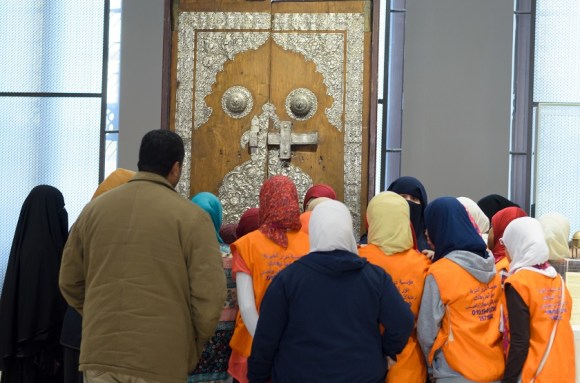
And in pride of place in the central rotunda is a nineteenth-century mosque door carved by Yehuda Aslan, a Jewish craftsman.
On 24 January, 2014 the Museum of Islamic Art (MIA) in Cairo was the secondary casualty of the bomb that killed six, and injured dozens in a blast targeting the Cairo Security Directorate across the street. The attack was claimed by the Sinai Province of the Islamic State.
It also smashed the façade of the historic museum built in 1903, damaging 179 pieces, ten beyond repair.
Two weeks ago the museum reopened in grand ceremony.
‘This is our heritage, not only for Egypt or Muslims, but for humanity,’ said Ahmad al-Shoky, the museum director.
‘If you destroy it, we will rebuild it, and make it better than before.’
Considered the largest museum of Islamic art and artifacts in the world, the MIA holds more than one hundred thousand pieces from throughout the Muslim world.
The earliest dates back to 652AD, a tombstone from year 31 of the Muslim era that bears signs of the Umayyad regime. It is the oldest mark of Islam in Egypt.
Al-Shoky presided over the opening of sixteen additional exhibits, tripling the items on show to the public. The richness of Islamic history, he believes, blunts the appeal of terrorism.
‘The museum is not only about good art, but a good message,’ al-Shoky told Lapido. ‘We have reworked our displays to show how Islamic art contributes to world civilization.’
Tolerance
And a central part of this civilization, he says, is religious and cultural tolerance. The door to the as-Sayyida Zaynab Mosque by Yehudah Aslan is just one example.
Zaynab whose shrine is at the mosque named after her in Old Cairo, was the prophet Muhammad’s granddaughter, and ‘patron saint’ of Cairo.
‘We are not against any religion, and welcome anyone who can produce something for the world,’ said al-Shoky. ‘This message is short, but powerful, and you can find it in many of our halls.’
Umayyad era art (661-750 AD) is introduced with a note of influence from Byzantine, Coptic, and other civilizational sources.
The medicine and science exhibits highlight the contributions of the Christian Bakhtishu family doctors, and the Muslim, Mary the Astrolabe, from the Abbasid era (750-1253 AD).
And the Fatimid era (909-1171 AD) speaks of joint celebrations with ‘Christian fellow citizens’ for the holidays of Epiphany and Maundy Thursday.
Renovations were supported by a £2.1 million equivalent grant from the United Arab Emirates. Additional donations and expertise were shared by the United States, Italy, Germany, Austria, Switzerland, and UNESCO.
Before the explosion, if two hundred visitors came, it would be terrific, al-Shoky said. Since the reopening, the MIA has averaged more than two thousand.
Children
And not only adults. The redesign includes an educational wing for children. Around 150 have come every day.
‘Art teaches children that Islam is not a terrorist religion,’ said Yumna Khalid, a 20-year-old volunteer guide studying Islamic archaeology at Egypt’s Ain Shams University.
‘It is not like what people say now about Islam. No, we have had brilliant artists and scientists.’
Maher Daniel agrees. He is an award-winning cartoonist and animation director for Egyptian state television – and a Christian.
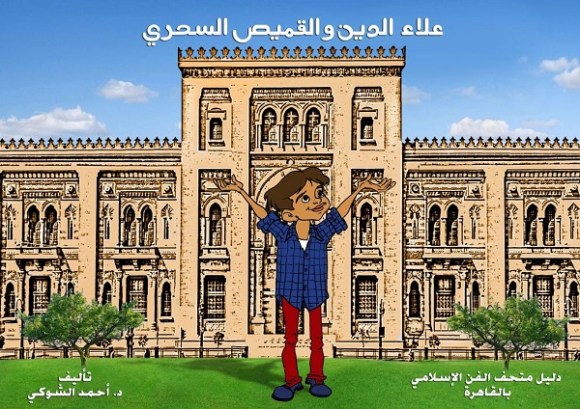
He contributed the illustrations to the children’s guidebook free of charge. Aladdin and the Magic Shirt spins a fantasy tale introducing the reader to the main pieces of each exhibit.
‘Egypt has passed through several crises, and children have not received enough attention,’ says Daniel. ‘The museum strives to address [the child’s] mind, promoting our shared heritage, for both Muslims and Christians.’
This does not mean he whitewashes the past, or the present. But Daniel says the space for extremism in Egypt is shrinking, and if there is an opportunity to help, you must help.
‘Our hope is in the enlightened Muslims, who are seeking reform and trying to shake the dirt from Egypt,’ he said.
‘But God only knows, in history these things ebb and flow.’
Manal Salah brought her twelve-year-old son to see the museum. He particularly liked the hall of weapons, marveling at the ninth-century Ottoman sword bearing the name of Mohamed the Conqueror.
‘The reopening of the museum is a positive sign,’ she said. ‘And we are optimistic for the future. If God wills, all will be well.’
When a bomb ripped through the women and children praying together at the St. Peter and St. Paul Church in Cairo on Dec. 11, the nation’s grief was expressed through a Muslim doll.
The suicide attack claimed by the Islamic State – Sinai Province took place on the national holiday of moulid al-nabi, the Prophet Muhammad’s birthday. The larger Islamic State has since called for bombings of Christian churches in the USA, with the aim of creating “bloody celebrations” there, as well.
Egyptians have begun trying to make sense of this latest wave of violence in Cairo, and the arousa doll has propelled expressions of grief. A popular cartoon depicted the arousa, traditionally given to Muslim girls, weeping in the black clothes of mourning. Behind her stood a somber crucifix.
Twenty-seven people died in the bombing, and their families have been changed forever. The Coptic community is approaching the Christmas season with fear wondering if another church will be targeted.
But does the timing of the attack suggest Muslims also have reason to be afraid?
The moulid, popular with most Egyptians and in particular the mystical Sufi trend, is rejected by many Salafi interpretations of Islam to which the Islamic State belongs.
It is a day for sweets, visiting family, and giving gifts. It is also a day Christian religious leaders congratulate their Muslim counterparts, reciprocated on Christmas.
But celebration of the moulid is condemned by Salafis as a religious innovation.
Coincidence or not, their extremists chose this day to escalate their insurrection and signal their willingness to inflict mass casualties.
“The message could be, ‘You love the moulid, and you like the Christians?’” said Sheikh Alaa al-Din Abul Azayim, head of the Azamiya Sufi order. “’Then on this day we’ll kill your friends – and you are next.’”
Please click here to read the full article at The Media Project.
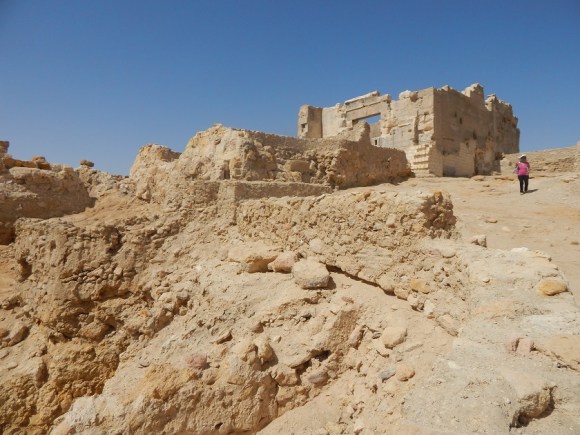
The temple of Jupiter Amun, whose oracle proclaimed Alexander the Great to be a god.
In defiance of his own nation’s restrictions, Cornelis Hulsman not only went to Siwa, he invited international student interns, Egyptian nationals, media professionals, and just about everyone else in Egypt to travel with him.
“Western travel advice to Siwa is insane,” said Hulsman, the Dutch deputy head of the Center for Arab West Understanding (CAWU). “We are taking this trip to make a statement. You say it is unsafe, we’ll show you it is safe.”
On the surface, insanity might look a lot like prudence. Siwa, an oasis in Egypt’s Western Desert, is only 50-70 kilometers from the porous border with Libya. Last year in the Bahariya Oasis, 400 kilometers southeast, eight Mexican tourists were killed accidentally by an Egyptian army hunting for militants. In Sinai on the opposite border, an Islamist insurgency continues to plague the peninsula, with terrorist attacks sporadically spilling over into the mainland. And in broader context, Russia and Britain have restricted flights to Egypt after a Russian airliner crashed in the Sinai desert on October 31, 2015, with responsibility claimed by the Islamic State.
Many nations have responded by issuing various travel restrictions to Egypt in general, and CAWU has compiled a complete list. But The Netherlands, France, and Canada have specifically included Siwa, and Hulsman believes this is preposterous. The successful return of his trip of 29 suggest he may be right. So also do the daily and nightly buses departing from Cairo.
Off the beaten path of traditional Egyptian tourism, Siwa’s remoteness has always been the chief hindrance preventing development of the sector. Ten hours is required to move from Cairo to the North Coast, over to Marsa Matrouh, and then 300 kilometers south through barren and desolate desert.
But compared to Alexander the Great’s eight day journey in 331 BC it is practically instantaneous. Modern day travelers can see the ruins of the Temple of Jupiter Amun, whose oracle declared Alexander a god and blessed him in conquest of the world. They can also visit natural hot springs and sand baths, as well as mingle among the only Berber culture indigenous to Egypt. The Siwan people have guarded their independence for centuries and still speak their own language.
Hulsman has looked for opportunities to link CAWU’s internship program with local organizations such as the Desert Research Center. ‘Amr ‘Abd al-Hamīd, head of the DRC in Marsa Matrouh, told him the government has been cutting funding. But universities in countries applying a travel ban to Siwa are prohibited from sending students to restricted area. Interns on Hulsman’s trip went in their personal capacity, not as part of his official program.
But normal tourists are scared off on their own. One issue is insurance, explained Muhammad Hassan, the owner of Siwa Shali Resort, with 36 years of experience in the tourism industry. If anything goes wrong, whether terrorism or a simple car accident, a policy will not be honored if the tourist went against his own nation’s warning. Egyptian insurance is available, says Hulsman, but would the average tourist know how to find it?
At the height of the Egyptian tourism boom in 2010 and before the Arab Spring, 30,000 international tourists spent part of their summer in Egyptian Mediterranean resorts, Hassan said. Eight thousand of these chose to continue on to Siwa. But by 2015 traffic dried up almost entirely, and only an estimated 300 foreigners visited Siwa from abroad. In 2016, no one.
“When you issue warnings like this, you are waging war against our primary economic sector,” Hassan said. “You harm not the government, but the people, who then get angry with the government. I’m not being political, I’m just a businessman.”
There is no military or police authorization needed to reach Siwa, Hassan noted, though several checkpoints are set up between Marsa Matrouh and Siwa to check identification. But to go into the desert on a safari to surf the dues needs three. He first secures license from military intelligence, border patrol, and the local police before dispatching any tourist.
And the military is in constant surveillance of the desert area between Siwa and Libya, Hassan said. Terrorists go where the land is empty, which might be a problem further south. He has no problem with a travel restriction issued for Jilf al-Kabīr in southwest Egypt, for example, where Libya, Chad, and Sudan come together.
Hulsman also noted the different security atmosphere in Siwa. Apart for the normal tourist policeman assigned to the bus, there was no police convoy. Traveling to Upper Egypt, however, he has had vehicles travel in front or behind.
Similar was the on the ground experience. In Upper Egypt police ask that any large group be kept together, as easier to secure. But the foreigners and Egyptians alike freely roamed the grounds during an annual Sufi festival in Siwa, chatting with locals and wandering off with them. The security apparatus is much more relaxed there than elsewhere, Hulsman said, confident in the area’s safety.
Unfortunately, this is a reality lost on many Western governments. Mounir Neamatalla, Siwa’s wealthiest investor and owner of the Adrere Amellal: Desert Ecolodge that welcomed Prince Charles in 2006, is eager to change this. In early October he flew an 80-plus mostly foreign delegation to Siwa, including ten heads and deputy heads of diplomatic missions. But the message has not yet filtered through to decision makers in Western foreign ministries, and the travel restrictions remain.
Not for long, if Hulsman has his way. And now he has 29 more who can attest to his vision.
Egypt’s Coptic Christians are in a state of mourning after a suicide bomber killed at least 25 people at a Cairo church on Sunday.
“Egypt always tends to rally around Christians at moments like this,” said Jayson Casper, CT’s Middle East correspondent. “But over time, [ISIS is] trying to hammer and hammer and hammer the Christians in Egypt and put so much pressure on the internal government that it itself may collapse.”
But even when suffering does come, the Coptic Church “is equipped to deal with it,” said Casper.
“They can say, ‘This has always happened to us in our history. It is how God has treated us and he perseveres with us through it.’”
While the attack was the worst to target Copts since the 2011 New Year’s bombing of a church in Alexandria that killed 23 people, the population has been the victim of sectarian violence for years. In 2015, ISIS, who also claimed responsibility for the latest attack, beheaded 21 Coptic Christians in Libya.
Casper joined assistant editor Morgan Lee and editor-in-chief Mark Galli this week to discuss the fascinating and important history of Coptic Christians, how the Egyptian church relates to a changing government, and why this most recent attack is unique.
Please click here to listen to the podcast at Christianity Today (38 minutes).
“There has been a bombing at the cathedral,” said the pastor at the local Methodist church in a lower-class area of downtown Cairo. “Several are dead, and we pray for our nation.”
It took me a moment to comprehend, but the gravity of his words indicated more than a simple illustration. I opened my cell phone to check the news and saw the bold headline: 25 dead and 49 injured in an attack on the Coptic Orthodox cathedral. The spiritual center of Egyptian Christianity had been mercilessly violated.
Only a few minutes earlier, the sermon considered John the Baptist and how his life of faithfulness ended with his head on a platter. Here again now was another modern Egyptian example of martyrdom, one more in a long line since the similar bombing of a church in Alexandria six years earlier. Several women sobbed quietly, as the men sat in stunned silence.
But a little later as they exited the service, the collective sense felt more like resignation. The men exchanged pleasantries and went home; the women lingered a little longer in conversation. What was unthinkable at the start of the Arab Spring had become unsurprising. In Alexandria 23 Copts died when a car bomb went off outside the church, but that attack, at least, soon gave way to the hope of a new revolution. The cathedral atrocity gives no inspiration, as Egypt remains muddled in a regional fog of war and terrorism.
In-between the two bombings were the 2013 revenge attacks on dozens of churches throughout the nation, as frustrated Islamists blamed Christians for the overthrow of the Muslim Brotherhood-affiliated President Mohamed Morsi. And the usual stream of sectarian incidents continued apace, as the state failed to hold accountable the mob violence of Muslims objecting to a church in their village, or an interfaith love affair, or any other typical but ill-justified collective form of Coptic punishment. It has been a rough stretch for Egypt’s Christians.
But not nearly as rough as the Christians of Iraq and Syria, or the Muslims of Libya, Yemen, and elsewhere have endured—and the Copts know this. They stand behind their Muslim Brotherhood-vanquishing president, and give much slack to a government they know is under tremendous pressure. Everywhere they turn it seems some new conspiracy is bent on dragging Egypt into the Middle East morass. The economy is in shambles, tourism is nonexistent, and save for the mandatory utterances of support following terrorism, they feel the international community never speaks except in censure. For this reason many have expressed favor at the election of Donald Trump. He likes our president, they say, and at least he’ll leave us alone.
For Copts are tired of being treated as pawns. A few days before the bombing, Foreign Policy ran a story entitled, “How Egypt’s Copts Fell Out of Love with President Sisi.” Even Chuck Colson’s Breakpoint piled on, ostensibly seeking to help by demanding the US president support Egypt’s Christians. “Meet the new persecutor,” said the article subtitle, “same as the old one.” Some on the left seem intent on buttressing the narrative of Copts in the way of a deserved Islamist democratic future. Some on the right seem intent on painting Muslims as sharia-inspired agents of Christian antipathy.
Both articles do well to draw on actual Coptic voices, and important ones. The news they convey is vital to learn in a world where, unless made a pawn, the Copt is often ignored. But they miss the nuance of the Coptic reality. Perhaps they can be forgiven for not knowing enough; perhaps they are guilty of pushing an agenda.
Back in Egypt, the Copts are well aware of incumbent discrimination and state weakness. But they cheer on a president who attends Christmas mass with the pope, and a military that rebuilds the churches Islamists destroyed. A new law for church building may or may not fully address the issues surrounding freedom of worship, but at least this regime—the first in 160 years—issued a law at all.
And following every tragedy, the common Muslim tends to open his or her bosom. Private taxi services Uber and Careem offered free rides to the hospital for blood donations. Many have missed the fact this bombing took place on the birthday of Islam’s prophet, a traditional day of merriment. The attack was therefore an assault on Muslims as well, Christians note. A popular cartoon draws the traditional holiday doll in the black clothes of mourning, as behind her stands a somber crucifix.
Thus between the kindness of the Egyptian soul and the sectarianism latent in an identity-driven society, the Copt is left waiting for national transformation. The rhetoric of the current regime seeks to revive a spirit of Egyptian nationalism, if only it can sludge through current challenges to reach a modicum of stability. Every maltreated Copt who fails to obtain justice is another reminder of how far the country has to go. And the cathedral bombing is another example of the powerful forces that stand against an idealized future.
But from the demonized past and lingering present, the Muslim Brotherhood condemns the bombing in one breath and blames it on regime-church collaboration in another. As long as this is the alternative, Copts find their best option in the preservation of a strong-handed government and a nominally secular society. Some in their community continue faithfully to agitate for human rights and a less political role for the church. Many agree but feel security and economy must be prioritized. Most hope for an open society of enlightened Egyptians, if only a generation away.
The Methodist church sermon that ended with John’s head on a platter began with the miracle that led to his birth. Elderly Zachariah and sterile Elizabeth likely long gave up hope of a child, the pastor surmised. Even so, “Your prayer has been heard,” said the angel. God is faithful, even when his people falter. John, the pastor noted, also doubted the one he baptized.
Where in this parable are Egypt’s Copts? Soon to be beheaded, or of pious prayers fulfilled? Likely somewhere in between, still inclined to pray for their nation.
This article was first published by Christianity Today, on December 11, 2016.
At least 25 people were killed and 49 injured when a bomb exploded around 10 a.m. this morning during a worship service at the spiritual center of Christianity in Egypt.
It is the worst terrorist attack on Copts since the New Year’s bombing of a church in Alexandria in 2011 that killed 23 people.
A worship service of mostly women was targeted in the St. Peter and St. Paul church, adjacent to the St. Mark’s Cathedral and papal residence of Pope Tawadros II, the leader of the Coptic Orthodox community in Egypt and worldwide.
Tawadros was traveling in Greece at the time of the attack. He will cut short his visit and lead funeral prayers tomorrow in the Nasr City district of Cairo.
So far, there has been no claim of responsibility for the attack.
“This is an unbelievable act against Egypt first and Christians second,” Andrea Zaki, president of the Protestant Churches of Egypt, told Christianity Today.
Please click here to read the full story at Christianity Today.
This article was published in the November print edition of Christianity Today.
(via Coptic Solidarity)
Long live the crescent and the cross!” shouted Egypt’s parliament in joy. All 39 Christian members joined the two-thirds majority to vote to end a 160-year practice instituted by the Ottomans requiring Christians to get permission from the country’s leader before building churches. The long-awaited reform was promised by the 2014 constitution after the overthrow of Muslim Brotherhood president Mohamed Morsi.
The new law shifts authority into the hands of the governor, who must issue a decision within four months of an application and give detailed reasons for refusals. The law also established a process to retroactively license hundreds of churches erected without a presidential permit.
“It is a good step,” said Andrea Zaki, president of the Protestant Churches of Egypt, who helped negotiate the draft law with government officials. “If we wanted an agreement to include everything and please everyone, it would have taken 100 years.
“This is the best we can get right now.”
But even as they celebrated, Christians debated if they failed to fully seize a unique opportunity to pursue equal citizenship…
Please click here to read the full article at Christianity Today.
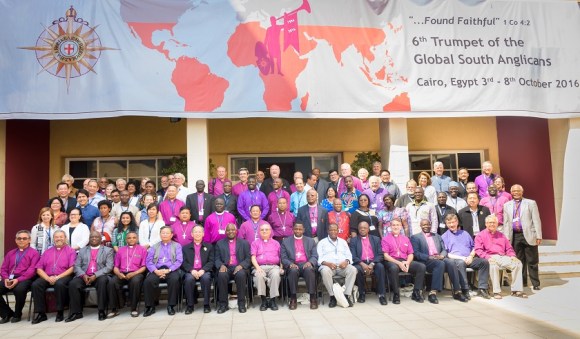
With the release of their ‘Sixth Trumpet,’ Anglicans from the Global South announced their discontent with the state of the worldwide communion. Meeting in Cairo, Egypt from October 3-8, delegates from 16 provinces discussed issues of both unity and mission, addressing the Anglican Church worldwide. This question and answer format highlights the key developments, as well as a primer for essential Anglican terminology.
We know there is a divide in the Anglican Church over issues of homosexuality. What happened in Cairo that is worthy to note?
Among the 34 points of the official communique, three developments are most substantial.
A commitment to work together with GAFCON
A working group to address the need for an enhanced ecclesial responsibility in the Global South
A concern for the revisionist directions which the Church of England could be taking and the impact that could have on other provinces
Thank you, but for non-Anglicans much here needs explanation. What is GAFCON? And similarly, what is the Global South?
The Anglican Communion includes 38 provinces around the world, comprising 85 million people in over 165 nations. It is the third largest Christian denomination after the Roman Catholics and Eastern Orthodox.
The Global South is a grouping of 24 of the 38 Anglican provinces which are largely non-Western in character, but includes also the breakaway Anglican Church in North America. It first met in 1994 and has 61.8 million members, constituting 72 percent of the worldwide Anglican Communion. It is provincially-based and primate led, though clergy and laity have significant input in the general conferences.
By contrast, GAFCON is a reform movement in the Anglican Church as a whole, though also led by a council of primates. It stands for Global Anglican Future Conference, and began in 2008 in Jerusalem, boycotting the traditional worldwide gathering of Anglican bishops in England.
What is, or was, the core disagreement between the Global South and GAFCON?
Both the Global South and GAFCON emphasize the authority of the Bible as the word of God, and in application reject the validity of same-sex unions. They jointly find fault with the Anglican instruments of communion for failing to hold accountable member churches which deviate from this standard.
The 2008 decision to boycott the worldwide gathering, however, was a divisive issue. Though membership in both groups is overlapping, GAFCON includes Western voices. Cultural differences and strategic approaches both contributed to each group developing along its own path, rather than in unity.
In recognition, paragraph 22 of the Global South communique repents of failings in the Global South to hold this unity among themselves. Furthermore it affirms and cherishes the witness of GAFCON, including the statement it issued from Jerusalem in 2008. Paragraph 26, meanwhile, demonstrates this newfound unity in acceptance of a joint Global South-GAFCON statement on human sexuality.
Thank you, this is helpful, but you used Anglican terminology again. What are the instruments of communion?
The instruments of communion are the four internal mechanisms by which Anglicans in all their diversity maintain worldwide fellowship. They include the office of the Archbishop of Canterbury, the spiritual and symbolic leader of the church. To be in the Anglican Communion means to be in fellowship with Canterbury, though he has no authority to discipline or interfere in the administration of sister provinces.
The three other instruments of communion are represented in regularly held gatherings. Convened first in 1867, the Lambeth Conference brings together the Anglican bishops every ten years. The Anglican Consultative Council consists of clergy and laity from each province and meets every three years, first held in 1971. The Primates Meeting is an irregular gathering of province leaders for deep consultation and prayer, begun in 1979.
None of these instruments have legal force among member churches, and are primarily avenues for persuasion. Its official statements, however, represent the voice of the worldwide communion.
So how did the instruments of communion fail?
In 1998 the Lambeth Conference passed Resolution 1.10, upholding the scriptural teaching of marriage between a man and a woman, and declining to advise the blessing of same sex unions or the ordination of homosexual clergy.
Paragraph 25 of the communique notes the actions of some churches violate this resolution, as well as the subsequent 2004 Windsor Report, recommending a moratorium on the appointment of new homosexual clergy. Other statements from primate meetings have urged violating provinces to voluntarily withdraw from participation in the gatherings of communion.
Not only has such appointment continued, but paragraph 30 notes with sadness that the provinces of Scotland, Wales, and Canada have changed canon law to recognize same sex unions.
What does the Global South propose to do about this?
Paragraph 29 states clearly that the instruments of communion are unable to sustain the common life and unity of Anglican Churches worldwide. Paragraph 32 emphasizes the need for enhanced ecclesial responsibility.
The communique did not delineate a new governing structure nor a formal covenant. But in paragraph 33 it expressed the collective will of the Global South provinces to convene a task force for this purpose.
So it recommends a committee? This means the real news is still to come.
Yes, but not entirely. Paragraph 31 recognizes the unique role played by the Church of England in the life of the communion, but then proceeds to issue a stern warning.
Recognizing a potential movement to imitate the churches of Scotland, Wales, and Canada in affirming same sex unions, the Global South stated there would be “serious implications” if it were to occur.
That sounds like a threat for schism. Is it on the agenda?
The implications are unspecified, but it is understandable one might hear a warning shot toward the most foundational Anglican instrument of communion, embodied in the Archbishop of Canterbury. And among many in the Global South there is certainly frustration with the current officeholder.
Understood and appreciated as an evangelical, the archbishop’s recent statement admitting that he knowingly consecrated a celibate but homosexual bishop, amongst other developments, felt like a betrayal of the adopted resolutions and issued statements listed above. The Global South recognizes the great pressure he is under, but prays for him to uphold biblical leadership.
Paragraph 23, however, states clearly that the Anglican heritage is not merely of nostalgic interest to the Global South. Doctrinally and liturgically, it binds the churches together so as to communally discern the movement of the Holy Spirit.
Paragraph 24 then clarifies that modern clear departures from this heritage are causing offending provinces to “sever themselves” from their spiritual roots. It is not the Global South that seeks schism, but others are diverging from communion through unilateral actions.
The general framework of Global South understanding is that new ecclesial structures are needed. Whether this entails a new governing structure or covenant, the idea is for member provinces to adopt this together, and then invite all provinces to join.
It is not meant to create a parallel Anglican Communion. But representing a majority in provinces and population, including substantial support outside the Global South through GAFCON, it would be a clear demonstration of what the Anglican Church stands for. The question of schism would then be put to provinces which fail to uphold the Anglican heritage of biblical and apostolic fidelity.
Was the communique unanimously adopted by the Global South?
Yes, and please click here for a list of reflections by several of the participants.
Father Rafic Greiche, a Catholic priest; Father Bishoy Helmy, an Orthodox priest; and Reverend Rifaat Fikry, a Protestant pastor speak at a meeting of Egypt Council of Churches.
Egypt’s recent church building law was largely negotiated behind the scenes between the government and the three largest Christian denominations: the Orthodox, Catholic, and Protestant churches. Despite concerns over insufficient public dialogue and loopholes which may hinder implementation, many Christians celebrate a formal legal process over the ad hoc nature of security intervention and presidential permits.
And among those who hope to gain are the smaller Christian denominations of Egypt. Largely overlooked in the national discussion, they also have a right to freedom of religion and worship.
Christians are generally estimated to be 10 percent of the population, the vast majority belonging to the Coptic Orthodox Church. But in 2006, the Ministry of the Interior published its most recent major clarification of Christian denominations, recognizing also the Coptic Catholic Church and the National Evangelical Church as “Egyptian” churches. Eighteen others are approved but designated as “foreign,” An additional 17 Protestant denominations are not mentioned specifically in the 2006 statement, but are recognized under the umbrella of the Evangelical Church.
Please click here to read the full article at TIMEP.
Speaking to house mothers at one of the more unique boarding schools in Egypt, Saleem Wassef challenged them to maintain hope with difficult children.
“Repeat yourself over and over again, because it is a long journey to raise a child,” said the administrative director. “Keep teaching them, even though they don’t listen.”
As every father, mother, and teacher knows, this is wise advice. What prompts the added italics is the setting. Technically speaking, the house mothers were not listening either.
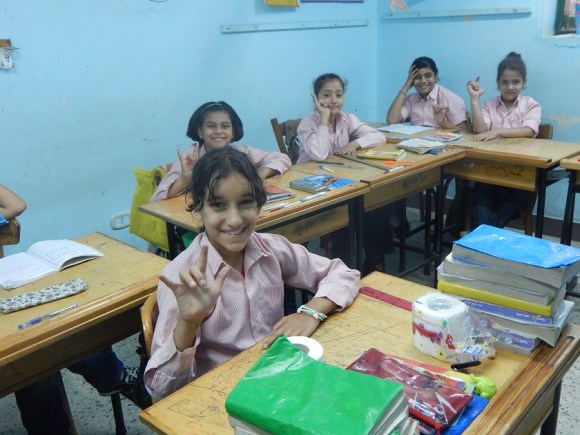
Suzanne, Maryam, and Marina are deaf, graduates of the school in question. They live full time with 45 students at the Deaf Unit, a ministry of the Anglican Church of Egypt located in Old Cairo. One-third are from Upper Egypt, the rest from poor areas of Greater Cairo. Ten others commute from nearby.
Founded in 1982, the Deaf Unit provides essential education to a segment of the population that is often seen as a source of shame. “To have a disability or a disabled child is sometimes seen as punishment from God for the sins of the family,” states the school’s website. “But one of our key objectives is to change these cultural attitudes by working with families and communities to educate them and build relationships.”
According to a 2007 study by the World Health Organization, 16 percent of Egyptians suffer from some degree of hearing loss. The Deaf Unit estimates two million are hard of hearing. The government provides deaf schools, but Wassef, a former director-general in the Ministry of Education, says these are overcrowded and not up to a satisfactory standard.
Marina goes further. Twenty-years-old, she is currently completing her high school degree in the government system. The Deaf Unit offers classes only through elementary, defined in the deaf curriculum as kindergarten through 8th grade.
“Government schools do not work hard enough, with insufficient focus on education,” an annoyed Marina gestured with her hands. “Some of the teachers don’t even know sign language.” She skips classes altogether, learning material through a private tutor while Deaf Unit students are in sessions. The rest of the day she mothers them, finding the sixteen teenagers especially challenging.
At the end of each school year Marina takes her tests in the government system, which for the first time provided a high school equivalency exam for the deaf. Egypt is making progress in attending to the needs of this neglected population, and Cairo University is opening its doors to graduates.
Though the Deaf Unit is not permitted to administer examinations, the government greatly appreciates their service, said Wassef. There is now one Muslim student enrolled after authorities encouraged the diocese to open classes to all. Wassef is currently seeking state authorization to extend classes through the preparatory level, in deaf terms from 9th through 11th grade.
“We have to be a model in front of the children, because they will follow someone and right now the morals of many are low,” Wassef told the three house mothers. “And in the end you will be able to say, ‘We developed these leaders.’”
Serving the whole society is part of the ethos of the Anglican Church, Wassef explained, and special attention is given to employ their students. Suzanne, Maryam, and Marina are examples, but several others work outside of Cairo, where community-based rehabilitation groups operate in Luxor, Minya, and Menouf. An audiology clinic operates at the Deaf Unit, which in two years plans to employ four deaf to administer hearing tests and produce ear molds. In 6 October City the diocese runs a full-scale Vocational Training Center.
Setting their sights at a young age, the Deaf Unit takes a field trip to KFC in Dokki, where a socially-conscious hearing manager has employed several deaf behind the counter. Most customers can only confusedly point to their food selections, but by placing the deaf in the public eye the culture slowly changes.
The Deaf Unit does what it can to speed up the process. Sign language classes are offered once a week to parents, relatives, and the general public, said Ramez, the financial manager, with an intensive course each summer. A native of Old Cairo attending the historic Jesus, Light of the World Church, he was intrigued by the fifty-plus member deaf congregation that also meets at the facility. He studied sign language, and has watched others learn. “Before too long,” he said, “anyone can sign professionally.”
Thirty to fifty Egyptians are trained each year, with special instruction available for non-Arabic speaking foreigners. Courses are offered at minimal charge, but the Deaf Unit stands in need of donations. None of the 55 students pay more than 200 LE ($22 US) per year. Wassef says the per-student yearly cost is 17,000 LE ($2,000 US).
But beyond donations, the Deaf Unit appreciates even non-signing volunteers to help with physical education, computers, and vocational training. And for the truly dedicated, teachers and room mothers are welcome. Suzanne, who has 18 years of experience, recalls with a smile her school days when foreign mothers helped raise them.
None have been on staff since the 2011 revolution, but neither can any replace the authentic model. “Our children like foreigners because they look different and are fun,” she said. “It is like what they see on TV.
“But they prefer the house mothers to be deaf, because we are like them and can understand.”
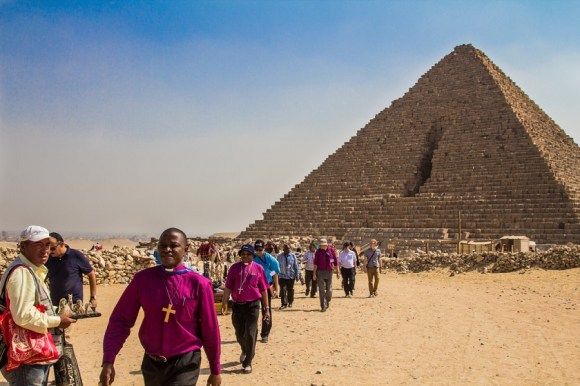
In a defiant gesture of faith from beneath the Pyramids, Anglican bishops sent a message to the world this week: Egypt is safe.
And this on a weekend the UK embassy warned against visiting public places.
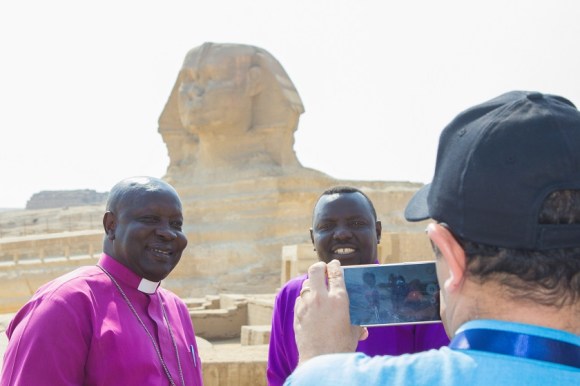
Representing twenty of the more conservative provinces of the worldwide Anglican Communion, delegates to the Sixth Global South conference in Cairo visited the Giza pyramids and dined on the Nile in a show of solidarity.
‘I appeal to you as an Egyptian, please return and visit Egypt,’ Bishop Mouneer Hanna Anis, chairman of the Global South, told delegates.
‘Our economy depends on tourism, and when it is down, thousands of Egyptians cannot earn a living.’
The tourism sector employs roughly four million Egyptians, representing 12.6 percent of the work force. But according to the Central Bank of Egypt, tourism revenue declined by nearly a half – 48.9 percent – year-on-year to September 2016.
The 31 October, 2015 crash of Russian Metrojet Flight 9268 over the Egyptian Sinai desert, claimed by the Islamic State, had a disastrous impact.
Russia, who represented 35 per cent of arrivals, has since barred all flights to Egypt, and the UK at 12 per cent have canceled flights to resort areas in the Sinai.
Ghostlike
Photo: Darren Haley
In Cairo the pyramids stood empty. In Luxor there was just one family at their hotel, where staff threw a party for their one-year-old’s birthday, to show their appreciation.
American Darren Haley said: ‘It was sad to see just how much Egypt has to offer and how few are willing to take the journey. Egypt is history just waiting to be explored.’
Egypt is struggling to promote tourism with an ongoing Islamist insurgency.
The Ministry of Foreign Affairs reacted furiously to UK and other embassy warnings that they said could ‘harm the country’s economy.’
Without identifying the threat, the UK embassy issued a warning 7 October to avoid ‘large gatherings and public spaces,’ specifically mentioning museums.
‘Most terrorist attacks target the security forces,’ reports the embassy website,‘but it’s likely that foreigners, including tourists, will also be targeted.’
So the bishops’ stance is all the more remarkable. ‘I wanted the Anglican delegates to see a different picture of Egypt than what they see in the media,’ Bishop Anis told Lapido.
‘It is unfair to call Egypt unsafe, as we have seen there is no place in the world safe from terrorism.’
Before the Russian airline crash tourism was showing signs of recovery. Revenues had increased 45.3 percent compared to a year earlier.
Rebound
Egypt hopes a second rebound is coming.
Officials are finalizing negotiations with the Russian authorities to restore flights. Egypt Air resumed London-Luxor travel on 3 October.
On 10 October Egypt completed restoration work at the shrine of King Tuthmosis III in Karnak Temple.
Last month the ransacked Mallawi Museum in Upper Egypt was reopened for the first time since pro-Morsi rioting in August 2013.
But even throughout this tumultuous period, tourists have come.
‘We have never had a bad experience, even during the uprisings of the last five years,’ Bishop Timothy Ranji of Kenya told Lapido. Every year since 2004 he has brought thirty clergy to Egypt for religious pilgrimage.
‘Egypt is secure, full of lovely people, and I invite everyone to come,’ said Archbishop Tito Zavala of Chile.
‘I am an ordinary person here. There is no need for bodyguards.’
For the communique, please click here. For the Global South-GAFCON joint statement on human sexuality, please click here.
The following are statements collected from a selection of archbishops and bishops who participated in the conference.
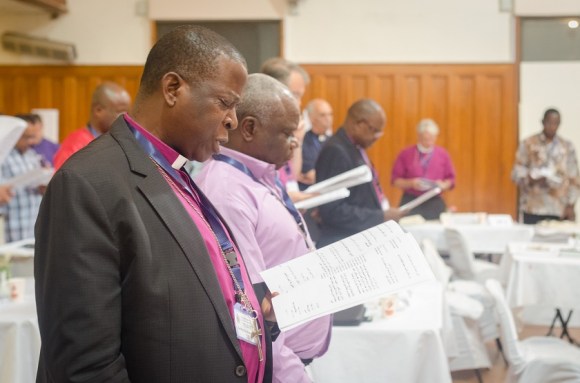
Several months ago we were praying that the Lord would guide us during the conference, specifically that it would not be political, but spiritual, seeking the guidance of the Holy Spirit. We did experience His movement among us, and the communique reflects the love of God, the grace of our Lord Jesus Christ, and the fellowship of the Holy Spirit.
It expressed very clearly where we stand, in a non-aggressive and non-divisive way. On the contrary, it shows how unity among the people of God brings blessing. (Psalm 133)
Archbishop Mouneer Hanna Anis, Province of Jerusalem and the Middle East
It expresses our collective frustration, hope, and counsel to the Anglican Communion leadership on the state of our communion. It shows our faith, determination, and effort to restore this communion to wholeness. And it shows we are getting ready for the possibility of further deterioration, that we should be able to speak and act decisively.
Archbishop Nicholas Okoh, Province of Nigeria
With the confusing messages from the centers of Anglicanism regarding Biblical morality, it clearly communicates our message, allowing us to focus on our mission to lead people to Jesus Christ.
Archbishop Foley Beach, Anglican Church in North America
When we see conflicts and suffering in the world, this communique tells us we have to work faster and more corporately to help. But it also expresses our dissatisfaction and disappointment over the inability of the communion to address fundamental issues which are distracting us from the mission of the church. The truth of the gospel will only have power if it is not compromised.
Archbishop Ng Moon Hing, Province of Southeast Asia
Matthew 5 says that no one lights a lamp and then covers it with a basket. But the Anglican Communion has been covered by darkness due to Satanic power exercised through the decisions of men. This communique has the force to uncover it again so as to be the light of the world, to shine openly for both the Anglican Communion and the world.
Archbishop Stephen Oo, Province of Myanmar
We are united, we are of one mind, and the communique was approved unanimously. One more time we clarified where we are in terms of doctrine and mission. But it also pushes us to keep moving ahead, as our duty is to go and spread the kingdom of God.
Archbishop Tito Zavala, Province of Chile
It captures a revitalized spirit among the Global South churches, with openness and inclusion to those likeminded in the North. I believe this is the first time the Global South and GAFCON have issued a common statement, speaking in one voice. There is a strong sense that God is the prime mover, calling the church to rise up together, as we balance between mission in service of the world, and the battle for truth within the church.
Bishop Rennis Ponniah, Diocese of Singapore
The communique is very touching, as it appeals to all of us to come together. But it also warns of what is happening in the northern churches. If you warn your brother but he continues, there must be a reaction. We are together, but we cannot walk together in this journey. It is very African for brothers to part if they don’t agree, but by the grace of God we will come back together.
Bishop Timothy Ranji, Diocese of Mt. Kenya South, Kenya
The Global South – GAFCON joint statement is outstanding, the most pastorally sensitive statement on human sexuality that I have ever read. It emphasizes the importance of family and marriage, while expressing a genuine love and concern for those who find themselves with homosexual orientation.
I am so appreciative that the Global South has recognized those of us in the Episcopal Church who uphold Holy Scripture and the traditional understanding of marriage, desiring to remain in relationship with us.
Bishop William Love, Diocese of Albany
It represents a very substantive healing of relationships that had previously been strained, mostly because of differences in strategy. I credit Bishop Mouneer, who reached out to everyone and said we must be unified.
The enhanced ecclesial responsibility is critically important because of the failures of the instruments of unity. Those who agree can now pursue mission without having to battle theologically.
Bishop Bill Atwood, International Diocese of the Anglican Church in North America
The communique raises hope for those we lead in Southern Africa, over the authority and authenticity of scripture and the lordship of Christ. For them we pledge to stand and fight, and may the Holy Spirit grant us power and humility to do so. May the church of Christ grow from strength to strength; praise be to his name for the communique.
Bishop Bethlehem Nopece, Diocese of Port Elizabeth, Southern Africa
The Global South and the church must live and apply this communique, so as to make clear the situation in the Anglican Communion. Now we must carry it to society so that it is seen in love as we serve the people living in poverty and amid many other troubles in this world.
Assistant Bishop Hassan Othman James, Diocese of Kadogli, Sudan
If you have not yet read the statements but the above piques your interest, here are the links again.
For the communique, please click here. For the Global South-GAFCON joint statement on human sexuality, please click here.
In cooperation with the Ministry of Tourism, the sixth Anglican Global South conference enjoyed a taste of Egyptian antiquities. Delegates toured the Giza pyramids, a papyrus gallery, and the Egyptian museum, closing the day with a dinner cruise on the Nile River.
“Egypt is safe,” said Archbishop Mouneer Hanna Anis of Egypt, chairman of the Global South Anglicans. “As an Egyptian I appeal to you, please come and visit.”
Anis emphasized to delegates that one-third of the Egyptian economy depends on tourism. Millions of lives are affected by the downturn, he said.
But both bishops and laity smiled as they interacted with local Egyptians, tasted local dishes, and took countless selfies.
Theirs was the absolute opposite attitude of Jonah, who ran from the place to which God called him. Johan was the subject of the morning’s Bible study led by Archbishop Tito Zavala of Chile, on the church and the challenge of world evangelization.
Zavala highlighted several applications from Jonah’s story. God is in control of everything, so no matter the hardship and rebellion, Christians should never give up in their missionary enterprise.
God’s unique character is full of compassion, so Christians also must love all the people of the world, even their enemies.
Some Christians suffer from Jonah Syndrome, getting angry at everything that conflicts with their biases. Zavala asked delegates if they view their cultures similarly. Do they have a missions mindset, or a maintenance mindset?
Instead of simply having the right theology of evangelism, churches must develop actual touchpoints with society. He highlighted the development of his own nation of Chile, where the Anglican work began in the 1820s with foreign expats only.
Today the Anglicans have 100 churches in the country, with 95 percent Chilean leadership funded by 95 percent local tithes. Zavala himself was the first Chilean to be appointed bishop, and now he is the first Latin American to become an Anglican primate.
Many an African Anglican has been accused, and perhaps felt a pang of conscience, of belonging to the church of the colonizer. However much they are thankful for the Gospel, the church in popular understanding remains essentially English.
Little do they know the opposite is true. The Anglican Church is essentially African.
Delegates at the sixth Anglican Global South conference in Cairo heard new research from the foremost scholar of the formational Anglican, Thomas Cramner, the first Protestant Archbishop of Canterbury.
Dr. Ashley Null is an elected fellow of the Royal Historical Society and is currently compiling a five-volume study of Cramner’s private theological notebooks.
What these notebooks reveal is the reformer’s deep dependence on the writings of Augustine. Imagined today as a Latin scholarly giant, in his day Augustine was derided as the son of a Berber who spoke Latin with an African accent. Much like many see Africans today, he was considered an outsider with just enough education to exist on the margins of civilization.
Null encouraged the delegates that the scholarly comparisons continue today. The progressive wing of the Anglican Church believes that God will lead them into all truth, which the church today can perceive better for modern times than those from two thousand years ago.
Yet this was exactly the challenge Cramner faced in his day, taking on Medieval Catholicism. Equating tradition with scripture led the church into all sorts of error, which only a return to the Bible could correct. In many examples Null demonstrated how Cramner’s writings drew from Augustine, who himself distinguished between the holy texts and the illumined church fathers who applied them for their day.
Their interpretation, Cramner echoed Augustine, is to be done by scripture. Yet the flexibility of a changing medium for the gospel is built into the original 39 Articles. Article 34 declares it is not necessary for all ceremonies to be alike in all times, places, and manners, so long as they are not contrary to the word of God.
“An African Anglican is an Anglican, twice,” Null said. “It is not just a great line, it is the truth.” Africans need not replicate an English church. And why should they, when the Anglican Church was designed to be culturally adaptable from the beginning, patterned after the teachings of a Berber?
Null demonstrated this was not just a missiological principle, but the very DNA of Anglicanism. But in the day’s Bible study, an Asian walked delegates through the challenge of mission.
Bishop Rennis Ponniah of Singapore said this is mission wider than world evangelization. It is extending the Kingdom of God through the church to the whole created order, bringing it all under God’s rule of righteousness, justice, and compassion.
Ponniah focused on three primary dimensions of this mission. The first is to proclaim the gospel of Jesus Christ faithfully. The second is to overcome the hostility of evil boldly. And the third is to shine the light of God’s rule winsomely. And all of these should be practically achieved through vibrant local parishes, for this is where the people are.
And on this day the Anglican Global South received the greetings of many parishes around the world. Bishop Paul Butler of Durham, Bishop Tim Dakin of Winchester, and Archbishop Glenn Davies of Sydney all expressed appreciation for support received from their fellow orthodox Anglicans. Bishop Mark Lawrence of South Carolina and Archbishop Foley Beach of the Anglican Church in North America expressed similar sentiment.
But Bishop Bill Love of Albany was unique. A conservative American who has chosen to stay within the Episcopal Church, he described the ‘companion partners’ of the Global South within his province. There are six diocese including his own, Central Florida, Dallas, North Dakota, Springfield, Illinois, and Tennessee. Fifteen bishops identify also, representing 10 percent of the whole, a remnant, Love said, which has not bent the knee. One reason he remains within the Episcopal Church is to remain faithful to them.
Much like Cramner was faithful to Augustine, and Augustine faithful to scripture. Even an American Anglican is African at heart.











 Jayson Casper