Categories
Excerpts

Honor and Humility in the Anglican Communion

OLYMPUS DIGITAL CAMERA

From Bishop Mouneer in his diocesan newsletter, on the recent visit of the Archbishop of Canterbury, Justin Welby:

In the Middle East, Africa, and much of the non-Western world, extending honour is among the chief virtues. Our Anglican Communion is blessed to have a leader who embodies not only this cultural value, but also its Biblical roots.

“Without doubt, the lesser person is blessed by the greater,” writes the author of Hebrews. “Honour one another above yourselves,” writes Paul in Romans. On April 20, our diocese of Egypt was blessed by the visit of Justin Welby, the Archbishop of Canterbury. He came to offer condolences over the martyrdom of 21 Christians killed by ISIS in Libya. But in humility, as a man of the West visiting the East, he proved the reality of these verses in his life and leadership.

In attendance were Coptic Orthodox Bishop Angaelos and Coptic Catholic Bishop Antonius Aziz, themselves men of humble service there to honour his visit. Aware the representatives of these churches could not share in an Anglican Eucharist, the archbishop desired to demonstrate his appreciation for their churches in a land whose children produced such a testimony of faith.

Archbishop Welby left the communion table, knelt before the two bishops, and asked them to pray a blessing for him. Immediately moved in spirit, they knelt as well, and asked the same of him. He then returned and offered body and blood to God’s holy church. Both privately expressed how they were touched by his gesture.

“Whoever wants to become great among you must be your servant,” said Jesus to his disciples. “Those who honour me,” said God in I Samuel, “I will honour.” Following communion, Archbishop Welby joined me in demonstrating this call and promise of God.

For the past seven years, Rev. Drew Schmotzer has worked tirelessly not only as my personal assistant, but also in assuming vacant pastoral positions in Maadi, Menouf, and at All Saints Cathedral. He is now leaving the diocese to return to the United States. Archbishop Welby’s visit was Rev. Drew’s last day in Egypt. During the service, we were able to honour Rev. Drew’s humble service to the Diocese of Egypt. I presented him with the shield of the diocese in gratitude for his ministry.

“God is not unjust,” it is written in Hebrews, “he will not forget your work and the love you have shown him as you have helped his people.” The virtue of honour is one the Eastern Church can share with the Western. Our Anglican Communion is blessed to have so many from all cultures who, in humility, exhibit it already.

Categories
Excerpts

A Jihadi in the Making

Islam Yakan, an Egyptian jihadi, not the character described in this story.

Powerful testimony from Rana Allam, about her former work colleague and fellow Tahrir demonstrator, in Daily News Egypt.

The difference between us, and it was quite minor back then, that he came from a family that believed in the Muslim Brotherhood and he was a religious young man, while I believed in a secular civil state. We never had a problem discussing such matters, and just as he was neither a hardliner nor ultra conservative, we agreed on the basis of democracy.

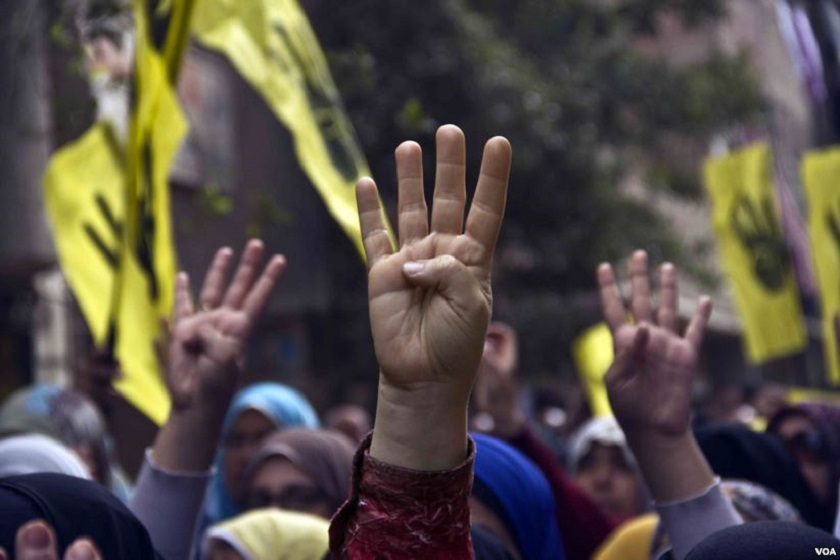
But then Rabaa happened.

Eventually he found his young brother, after weeks of torture at some detention facility. He could tell the torture was brutal by the marks on his brother’s face and body. They were then informed that the student was facing charges of terrorism and that his trial was due in a few days. By then, and because of the extended absence from work along with his psychological status, our friend was out of a job. He did not appear to mind the unemployment much, being too busy with his mother and sister who lost a husband/father and his tortured brother in detention facing terrorism charges.

Other troubles followed, and eventually he fled the country with his family. He is not described as in Syria, as I was expecting. But the attitude is similar.

My genius sweet colleague has become a bloody, vengeful, bitter man. He has joined the flock of those who rejoice at the murder of police officers, judges and soldiers. He is hailing the Almighty every time a death toll is announced. He is praying for God’s strength to be given to those “martyrs” dying for the cause. He goes on and on about jihad in Islam against those infidel murderers. He also calls for the heads of their supporters, from government officials to idiotic pro-army demonstrators. Right now, I do not think he minds killing his neighbour if he was a mere verbal supporter of the regime.

Early on after the fall of Morsi, many Islamists and others warned that in keeping the Brotherhood from democratic gains it would push them into violent efforts for power. I recognize the power of the logic, but have argued against it, though with troubled reservation of spirit. It is too akin to blackmail, even as many principles are violated.

But to the extent this account is an accurate description of the post-Morsi environment, the logic is different, and more unassailable. It is not the whole story of extremism, but Allam sums it up, in rhetoric surprising to appear in Egyptian media, even if in English.

Our rulers still deny this fact and continue to breed violence completely oblivious or uncaring of what that leads to. There are almost five million Brotherhood sympathisers in Egypt, given the parliamentary and presidential elections figures. The number might have decreased after the Brotherhood’s rule indeed, but how much? A few hundred thousands are enough to turn this country upside down. We should also count those who are not Brotherhood sympathisers but had their loved ones go through the same suffering. The families and friends of the tortured, murdered, unjustly imprisoned will be bitter enough to hate everyone else, and hatred is the root of evil. Does no one in this regime see that?

Categories
Excerpts

The Very Definition of Secular

Egypt Secular

Do you remember what the Egyptian revolution was like? In an op-ed on Ahram Online, Hani Shukrallah gives these poignant paragraphs in a long essay considering if Egypt is now less ‘Islamic’.

For background context, he considers the recent call to remove the veil, the emergence of television programs questioning traditional Islamic interpretation, and the renewed effort of the Azhar to assert its prerogative in all such matters. These are reactions to an old paradigm, he believes, that was dealt a blow by the revolution in a peculiar way:

The Egyptian Revolution was profoundly secular, if not secularist. After more than nearly four decades of the inexorable rise of Islamism came a popular revolution of millions that conspicuously made a point of putting religion (with all its uncomfortable impedimenta) on the backburner. Similarly to all the Arab Spring uprisings, Egyptians in motion spoke not of Sharia, rule by what God ordained or the restoration of the Caliphate. As the whole world came to know, the banner of Tahrir was freedom, democracy and social justice. They did not speak of an Islamic nation, but rather reclaimed the flag, redefining Egyptian nationhood as one arising from the fundamental human dignity of its citizens.

It went even further. As if picking up from where the previous popular revolution in their history (the revolution of 1919) had left off, the young men and women of Tahrir and elsewhere around the country took the hitherto stunted notions of citizenship and equality to new and unprecedented heights. Women, veiled or unveiled, were now fully equal to men — their bodies, which for decades had been put at the very heart of the symbolic battle over the nation’s identity, its political, social and cultural makeup, its present and future, were rendered a non-issue. The Egyptian Revolution did not debate the hijab; it ignored it — and in doing so dismantled its very basis, symbolically and practically.

Similarly, Coptic/Muslim Brotherhood was an overriding theme of the Egyptian Revolution. Previously inconceivable images of demonstrators holding aloft the Quran and the Cross, Coptic human shields around Muslims performing their prayers, seemed to roll back, within weeks, decades of effective disenfranchisement of Egypt’s Christian minority, holding Copts hostage to the Islamist/police state contestation, with each side taking a swipe at what had become the country’s preferred whipping boy.

And herein lay a fundamental feature of the Egyptian Revolution (indeed, the whole Arab Spring), which many commentators have failed to grasp. And this is that in neither targeting nor deploying religion, it sidelined it, pushed it out of the political realm, and rendered it politically, ideologically and culturally neutral. It was not anti-Islamic or pro-Islamic; it simply was non-Islamic. Not anti-religious but non-religious.

This is the very definition of secular.

The Egyptian revolution was many things, fueled by many parties with diverse goals. But fundamentally he is right, at least in presentation. All these groups, including the religious ones, largely put forward a secular image if only for pragmatic reasons. It was not named ‘secular’, but acted so.

His is an astute observation in retrospect, however much he longs for it to have been true, or at least, to have continued truly.

Categories
Excerpts

Reporting on Kerdasa

A view shows a damaged police station burnt in a blaze by supporters of former president Mohamed Mursi in Kerdasa, a town 14 km (9 miles) from Cairo in this September 19, 2013 file photograph. REUTERS/Mohamed Abd El Ghany

Here is a recent report from Reuters, showing the difficulty in covering Egypt well. Kudos for going there, but we can only trust the journalist for his/her impressions.

The pronoun is not specified, as he/she requested anonymity. The fear, likely, is of covering anti-regime sentiment. The question is if he/she covered it well.

The brief story is that Kerdasa, Giza was the site of an Islamist take-over following the dispersal of the pro-Morsi sit-ins at Rabaa and Nahda. That day locals stormed the police station with rocket-propelled grenades, killing 12 officers. Authority was not reestablished until a month later. Since then, 185 Brotherhood supporters have been sentenced to death for their role in the violence.

The headline states: Sisi’s Crackdown on Islamists Yet to Win Over Egyptian Village.

Fair enough, as Kerdasa would be a difficult village to win over. The article reports that night raids on suspected Brotherhood members continue, and the police man checkpoints into and out of the village.

But the following first-hand anecdotal description could be found almost anywhere in Egypt:

A look around Kerdasa offers plenty of reminders that arrests and intimidation have never succeeded in silencing enemies of the state.

Idle teenagers who can be easy recruits for jihadists. Women covered from head to toe in black. Profanities scribbled on a burned-out police station insulting President Abdel Fattah al-Sisi and calling for Mursi’s return.

This is one of the troubles in reporting about Egypt — those reading don’t know the commonality of everyday life. Teenagers are idle in every city. Many women wear the full niqab. And anti-Sisi graffiti from the past year and a half has rarely been scrubbed from the walls.

None of this necessarily suggests a dissatisfaction with him, nor ongoing support for Morsi.

Good reporting gets local opinion, on the record. But still the journalist must be trusted in selection of sources. Some quotes against the current atmosphere were given anonymity, but the following are bold in their public criticism:

Ayman al-Qahawi works at Al Azhar, a center of Islamic learning seen by Sisi as an ally in the fight against extremism.

“Kerdasa has become a black spot in our lives even though there are only a small number of criminals. They treat all of us as if we are terrorists,” said the professor, adding that a colleague was not allowed to leave Egypt because his identification card showed he lives in Kerdasa.

Bus driver Sayed Hassan, 31, says that when he went to renew his vehicle license, police stopped him at a checkpoint.

“Pull over you terrorist. You are from Kerdasa. You will spend a lot of time with us,” he quoted an officer as saying.

What should be inferred from these voices? Is Kerdasa so Islamist they don’t fear to give their names, safe in the protection of village solidarity? Or that Kerdasa is in the process of being restored, and thus there is no fear to voice complaint?

Probably no inference is best, but the willingness to go on the record is a positive development.

Of course, the fear of the correspondent is still telling.

Even so, he/she did a good job of balancing opinion:

“We are sure that Mursi is oppressed and his case is political,” said student Abdel Rahman Mohamed, 22.

“The country will not calm down. The only solution is Mursi’s release and the release of the 40,000 people detained since the military coup.”

A pharmacist blamed both sides for the deterioration in Kerdasa and in his finances.

“Please don’t mention my name,” he told a Reuters reporter. “The Brotherhood are already boycotting my pharmacy because I don’t agree with their viewpoint. I don’t want to anger them even more. They are still around.”

Fear, apparently, is shared by many. It makes reporting difficult.

Categories
Excerpts

2500 Year Old Egyptian Scandal, Finally Revealed

Mummy Teeth

‘Be sure your sins will find you out,’ says the ancient wisdom. Perhaps this is the longest application on record.

But it is still incomplete, as the culprit remains hidden by the obscurity of history. Surely he is mentioned in the hieroglyphic records somewhere, but as the all-thumbs sloppy apprentice to the famed embalmer of Thebes.

From The Guardian, describing the CT scan results on a number of ancient mummies, on display in London.

There will be eight mummies in the show. Details of two were revealed yesterday. The unknown Thebes man, mummified around 600BC, is particularly interesting because of the bits of tool that were left in the poor man’s skull.

Daniel Antoine, who is responsible for the museum’s human remains collection, said embalmers had “great skill and knowledge of human anatomy”, managing to extract a brain through a hole no bigger than 2cm by 2cm.

In this case, something went wrong. The embalmer would probably have used a metal rod to break the bones at the top of the nose to then extract the brain with a wooden or perhaps reedy spatula – it is this that somehow broke and remains in the man’s skull.

So what happened? Was this poor man, who was also suffering from severely painful dental abscesses, thrown to the young student for his training? When he made his error, did he just cover it up and trust no one would notice? Did he show such contempt for the afterlife that this poor worker would live his next life with tool bits in his head?

Or does the scandal go deeper? The chief embalmer was a man of great skill, working on the finest of corpses:

Tamut lived in Thebes around 900BC and had a top job as a temple singer, or chantress, of the god Amun. Because of her high status she was given the best possible mummification. Researchers have scanned and made 3D copies of amulets that adorned her body.

They have also detected a pair of small metal plates which cover the incision that the embalmer would have made in her left abdomen to drain out her internal organs. They have on them carvings of a protective eye, presumably to help heal the wound magically.

Would such shoddy student mummification have escaped the notice of this renowned embalmer? It seems more likely there was a love triangle between Tamut, the surgical chief, and the worker with dental issues. The high executive in the mummy office maintained an affair with her, one of the notoriously loose temple singers. As one last expression of high class snobbery, he botched the operation of her jilted working-class husband and left him brain-dead in the afterlife.

Tamut, he planned, would be preserved for him forever.

That is, until his modern-day equivalent in London discovered the scandal. Ancient wisdom proves true after all.

Categories
Excerpts

A Christian Taliban

Ukraine Christian Taliban

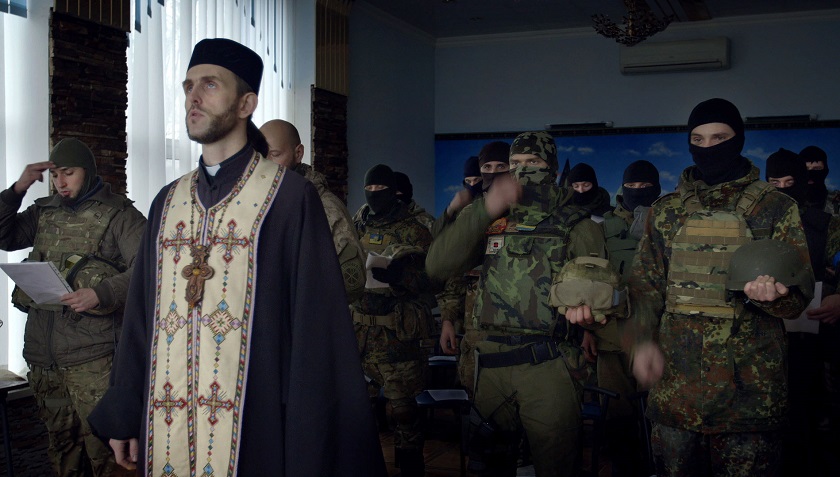
In case anyone needed reminding, the use of religion to further militant political goals is not exclusive to Islam. The Intercept reports from Ukraine, where middle aged Dmytro Korchynsky has formed a private battalion, the Jesus Christ Hundred, dedicated to St. Mary, to fight the Russians.

In the 1990s he fought alongside Muslims in the Caucasus. Now he consciously borrows from them:

Korchynsky points approvingly to Lebanon. There, Hezbollah participates in government as a political party, while its paramilitary wing wages war independent of the state (and is thus considered, by the United States and the European Union, a terrorist organization). Korchynsky believes that sort of dual structure would be beneficial for Ukraine. He sees himself as the head of an informal “revolutionary community” that can carry out “higher order tasks” that are beyond the formal control of government.

That’s the theory. In practice, Korchynsky wants the war in eastern Ukraine to be a religious war. In his view, you have to take advantage of the situation: Many people in Ukraine are dissatisfied with the new government, its broken institutions and endemic corruption. This can only be solved, he believes, by creating a national elite composed of people determined to wage a sort of Ukrainian jihad against the Russians.

“We need to create something like a Christian Taliban,” he told me. “The Ukrainian state has no chance in a war with Russia, but the Christian Taliban can succeed, just as the Taliban are driving the Americans out of Afghanistan.”

The article is long and interesting, but here are his Christian foundations:

Just as Islamic extremists selectively highlight Quranic passages that endorse violence, the St. Mary’s Catechism opens with the words of Jesus from the Gospel of Matthew: “Think not that I am come to send peace on earth: I came not to send peace, but a sword.” The Catechism then adds its own interpretation: “Christianity should be treated like a sword, and not as a pillow.”

And like the jihadi emphasis on the glories of martyrdom and life in the afterworld, the Catechism explains that only those who follow the path prescribed by the Brotherhood shall receive the highest reward in heaven: “The end of the world is joyous, the destruction of the solar system will be a great celebration, and the second coming of Jesus to earth will be unexpected, and the terrible Final Judgment will become joyful. In the name of the Father, the Son and the Holy Spirit, Amen.”

The battalion naturally has a chaplain. Here is how he came to fight:

When the fighting first started, he saw supporters of the separatist Donetsk People’s Republic bullying young girls on Ukrainian Independence Day simply because they wore traditional Ukrainian embroidery. One time, he says, the separatists brutally punished a woman for wearing the embroidery. They drove nails into her feet and forced her to walk through the street.

It was pure evil, he explains, and is why it’s now necessary to fight. Father Volodymyr invoked the words of St. Paul, who said, “if you do that which is evil, be afraid; for he bears not the sword in vain: for he is the minister of God, an avenger to execute wrath upon him that does evil.”

Here is the testimony of one of his fighters:

“Everything with us is based on faith in Jesus Christ,” says Partisan. “We believe that only a religious community can win in today’s world, and in a society where all our values have declined in importance, and only faith survives. War makes this evident. There is no place for atheists when there are mortars and rockets firing.”

In posting this story, I do not wish to claim an equivalency between Christianity and Islam, concerning violence. This topic is deep and nuanced, deserving of careful analysis. But the misuse of religion for any goal is as well known as the inspiration of religion toward any ideal. Drawing the lines between them is crucial.

And besides, Korchynsky does not claim an equivalency either:

I asked what distinguishes his organization from Islamic jihadists. The radical Islamists in Afghanistan and the Middle East are, according to Korchynsky, interested in destroying the world order. Not so with the St. Mary’s Battalion.

“We really like civilization,” he explained. “We want to have hot water in the bath and a functional sewage system, but we also want to be able to fight for our ideals.”

Maybe he has something to teach the Christian pacifists of this world, rightly divining the goals of jihadists through purer methods? Maybe not. Here is the article’s closing quote:

Korchynsky wants to move the war to Russian territory, and he says his people have already formed underground structures there. Like the Islamic State, one day his “brothers” will receive orders and begin their work.

“We will fight until Moscow burns,” he says.

Categories
Excerpts

Escaping ISIS in Libya

From the Pittsburgh Tribune-Review
Osama Mansour (L), from the Pittsburgh Tribune-Review

Consider the horrible ordeal of Coptic Christians in Libya, as the Islamic State stormed their compound. The Pittsburgh Tribune-Review tells how one escaped, helped by his Muslim friend:

Hani Mahrouf awakened at 2:30 in the morning when fists pounded on the door of his housing compound in Sirte, Libya.

It was Islamic State gunmen, searching for Egyptian Christians.

“They had a lot of weapons,” said Mahrouf, 33, a Muslim construction worker. “They asked if we were Muslim or Christian.

“We told them we were Muslim. Then they asked for the rooms of the Christians.

“They threatened us with their guns.”

The article describes how fighters scaled the compound walls, but the story centers on one who got away:

Osama Mansour, a Christian, was sleeping in a room of the first compound when ISIS burst in. Warned of what was happening, he slipped outside and “jumped from fence to fence just ahead of the gunmen,” he said.

He escaped but was left on his own in the dangerous city, separated from his friends.

“I stayed (in Sirte) for 30 days, but I didn’t stay in the same room” from night to night, said the 26-year-old tile worker.

A man he called “Sheikh Ali,” a Muslim from his home province of Assuit, helped Mansour hide and constantly change locations. Eventually, he grew a beard in order to leave Sirte.

“ISIS had two checkpoints that they would move around. I heard they were checking for tattoos” — he pointed to the bluish-black cross that he and many Coptic Christians ink on the insides of their wrists — “and we put a plaster cast on my hand and wrist. Sheikh Ali gave me a Quran and a prayer rug for the trip.

“I had to do this — I can’t have my mother wearing black” for mourning, Mansour said.

The article says most of his companions also eventually returned home, but it does not specify Sheikh Ali. Maybe he is still in Libya, able to work. If so, Osama may be using a pseudonym to protect his friend’s identity there.

One would hope it is not to protect his identity in Egypt. Recent news has some in the village protesting the church President Sisi promised to build in the name of the martyrs.

But in Libya, in this instance, the bonds of relationship and homeland proved stronger than the militant call of extremist religion. Amid constant news of chaos and atrocity, stories like this are precious reminders of humanity.

Unfortunately, guns and ideology can change the equation.

Categories
Excerpts

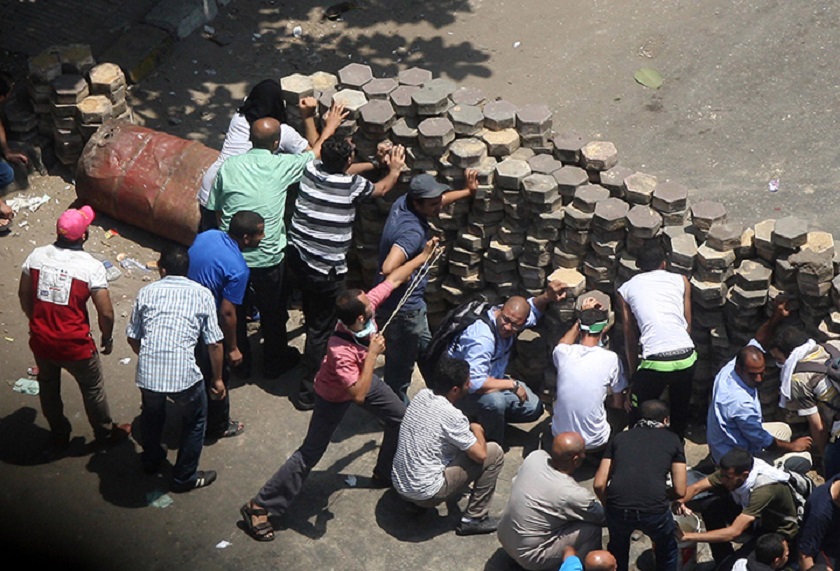
Defending Rabaa

Defending Rabaa

Omar Ashour is an academic at the Brookings Institute who recently published a paper entitled, ‘From Collusion to Crackdown: Islamist-Military Relations in Egypt.’

It is an insightful retelling of two epochal moments in history, the 1952 Free Officers revolution and the 2011 Arab Spring. In both, he details how the military establishment and the Muslim Brotherhood cooperated, maneuvered, and eventually clashed.

History is contested, so those who either lived through or studied carefully these events are invited to weigh in on the anecdote that follows. But in understanding Brotherhood resistance following the June 30, 2013 protests against Morsi, this detail risks being overlooked. I, at least, had missed it.

According to Ashour, the Muslim Brotherhood was an intimate partner with the Free Officers, but then tried to resist Gamal Abdel Nasser as he consolidated power outside of democratic procedures.

At one crucial moment the Brotherhood helped organize a demonstration against him, calling for (among other things) the army to return to its barracks.

Nasser asked Abdul Qadir Audeh, the Secretary-General of the MB, to dismiss the protesters. Audeh complied, hoping to reach a compromise, but was arrested that same night by Nasser’s loyalists in the military police and was executed a year later.

Sound familiar? In 2013 the Muslim Brotherhood did not accept the ouster of Mohamed Morsi on July 3 despite the massive protests against him. Right or wrong in this decision, this is an important distinction between 2013 and 1954. The sit-in in support of Morsi had formed to counter these protests, and continued into mid-August. During this time there were intense negotiations between the two sides, with active participation of foreign diplomats.

During negotiations the Brotherhood was urging on participants to stand firm, even to the point of martyrdom. This is well known. But in connection with the anecdote above, this detail escaped me.

On July 17, 2013, Audeh’s son Khaled, a university professor, reminded the hundreds of thousands of protesters in Rab‘a Square of that mistake. “Our stance here is our way to success. I swear I will never dismiss you like my father, the martyr Abdel-Qadr Audeh, dismissed the protesters on 28 February 1954…. They tricked him and told him to dismiss the protestors and that the army would go back to its barracks and democracy would be resumed. He believed them. And then he was arrested at night and executed afterwards.”

It helps put in perspective the psychology of the Brotherhood.

Ashour’s paper considers the removal of Morsi to be a coup, for those who take offense at this designation. But it also demonstrates the Brotherhood’s claim to be a martyr of democracy is overly simplistic. For example:

By December 1952, Nasser made it clear to the MB that there would be neither free elections nor a re-installation of civilian leadership. In January 1953, the RCC dissolved and banned all political parties in Egypt. The MB did not oppose this decision because it did not affect them (they were not a political party) and also to avoid a costly clash with Nasser’s powerful faction in the RCC and the army, an opportunistic stance that would prove costly in the future.

There is another important difference between the two episodes, as the Brotherhood did not initiate the protests of 2011, joining later. But they soon demonstrated a spirit of collusion with the military, ranging from cooperation to non-confrontation. Different examples are given, but here is one sometimes forgotten.

In June 2012, a SCAF decision dissolved the lower house following a constitutional court ruling that part of the electoral law was “unconstitutional.” This decision vested all legislative powers in the SCAF only days before Egypt’s first civilian president was scheduled to take office on June 30, 2012. It was, in effect, a bloodless coup, one that passed without any international condemnation and limited domestic criticism. Because the winner in the parliamentary elections, the MB, had also won the presidency, it did not mobilize its supporters and coalition partners [against the decision].

The Brotherhood may argue it was trying to be pragmatic, accepting defeat against a stronger foe in hopes of fighting another day with a stronger hand. Perhaps. But the details Ashour provides help recount a history that is not clean and principled. This is important to remember given the righteous garb the Brotherhood now seeks to don.

In the struggle for power in Egypt, democracy is a tool. But it is only one among many. That it is the preferred tool of the Brotherhood should not lend them greater favor. It is a bare-knuckled fight, and right now they are losing badly. But they chose to step into the ring, and have grappled along with the rest.

Without granting good intentions to either the military or the Brotherhood (which may be there), let there be some sympathy. Every fight has its principles. Every struggle for what is right is met with temptation to embrace some wrong.

The Brotherhood sees the military leadership as a dictatorial junta. The military sees the Brotherhood as a radical transnational force. Both see each other as a rival.

Be careful, oh outsider, about taking sides. For Egyptians of course it is a different matter entirely.

Categories
Excerpts

The Muslim Brotherhood in Transition

Muslim Brotherhood in TransitionNeither description is right, says Ibrahim al-Hudaybi. The former Brotherhood member says the organization is not al-Qaeda, but neither is it committed to non-violence. The better reality is that it is in transition, and the future is still uncertain.

His article is translated at Mada Masr, and here is why a non-violent ethic evolved in the years before the revolution:

Socially speaking, the organization mainly includes middle class professionals, and they are conservative by definition and not willing — due to their professional positions — to make choices that might alienate them from society (or justify such an alienation) and lead to grave social consequences.

Furthermore, the organization’s leadership has been — throughout the past decade at least — chiefly composed of businessmen, with economic interests that require protection by preserving a connection with the regime, to a certain extent. This initially led the organization to adopt an extremely conservative stance towards the revolution, reducing it to a limited reformative process, without pushing for any significant changes in economic and social structures.

In addition, the Brotherhood’s social investments, in terms of schools, medical clinics, mosques, and associations, also required maintaining a certain relationship with the government, in order to preserve those investments, eventually eliminating the prospect of violence.

Hudaybi argues that Rabaa radicalized many, and as the state arrested leadership the Brotherhood was increasingly unable to hold to its traditionally tight organizational structure and discipline.

Leaders, however, and especially outside the organization want to preserve the Brotherhood brand of non-violence so as to maintain support from international human rights organizations. But at the same time, they face internal pressure:

Such conflicting motives, combined with weak organization making them unable to control the movement as a whole, some leaders have become aware that pacifism won’t be an option for long. They have tried to prevent the full engagement of members in violent acts by redefining violence, using the now famous slogan: “Anything short of bullets is peaceful.”

And this article from Foreign Policy describes the Ultras Nahdawi, which have taken up the protesting mantle. Its youth say they are not the Brotherhood, though Hudaybi (without mentioning Ultras) describes many of these similar protesting and violent groups have emerged from the younger Brotherhood ranks. But if this connection is somewhat nebulous, here is how it describes the Nahdawi association with violence:

When the police do inevitably attack one of their demonstrations, however, the Nahdawy can rely on a subset of their members to spring into action and engage with police forces: the Maghouleen, or Unknowns.

“The Maghouleen are the ones who meet the police head-on,” Faisal said, lowering his voice. “They’re an anonymous group of front-line fighters. No one knows who they are, but they are armed and will be violent if they need to be.”

So what is the attitude of the Brotherhood leadership? The article quotes a respected analyst:

Political researcher and Brookings fellow H. A. Hellyer said this sort of rhetoric has been at the center of the Brotherhood’s PR strategy since the military takeover: championing dissent but refusing to take ownership of it.

“The reality is that the Muslim Brotherhood has lost tremendously in the last year and a half and everything they’re doing right now is about maintaining a semblance of brand,” Hellyer said. This “brand” is pro-democracy, anti-violence, anti-extremism — and the Ultras don’t quite fit the bill. So even though their ideologies and goals align, the Brotherhood isn’t about to wave the Nahdawy banner.

“It’s also all about redirecting: putting a message out there but not taking responsibility for it,” Hellyer said.

The outcome, according to Hudaybi:

This violent tendency represents the Brotherhood’s “organization” only as much as “their determination to remain peaceful” does. The organization is going through a transitional phase, in which both views of violence and non-violence are being adopted, sometimes by different people, sometimes in different statements (in different languages and on different sites), and at other times by the same people in different situations.

Under this organizational disintegration, there is currently no way to determine who will prevail eventually.

And his somber prognosis:

The more we fail to handle this situation — on the social and ideological level, the first being more important — the more likely it is for the discourse which claims that there is no difference between the Muslim Brotherhood, Al-Qaeda and the Islamic State to become a self-fulfilling prophecy.

Categories
Excerpts

Street Music as Solution

One of the reasons given for the weakness of liberal values in Egypt is that political parties are not active on the street. Politicians tend to be elite, it is said, and are much more comfortable appearing on television and holding conferences in hotels.

This makes a difference, of course, as the media has great influence over the general political atmosphere. But it is not as successful at winning converts and changing culture. Here, the argument goes, Islamist politicians have been much more successful as they win their support through charitable activity.

In this sense, then, this initiative covered by Mada Masr is a step in the right direction:

Balcony Music 1

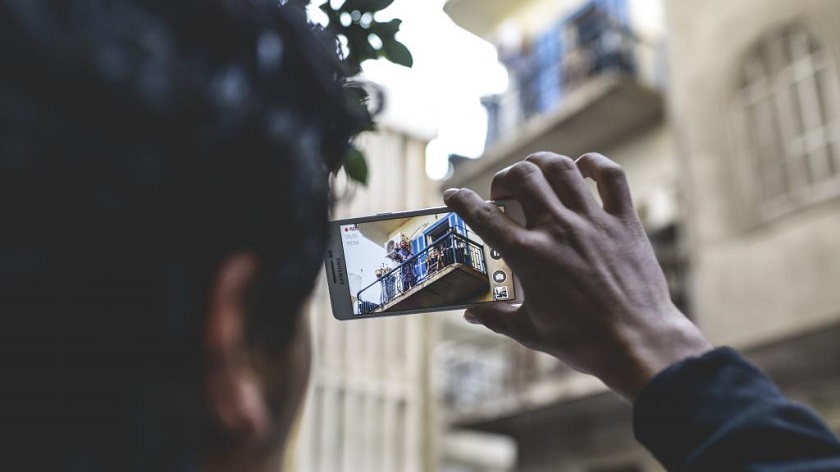
In four Egyptian cities over a weekend this month, one could be walking down the street and all of a sudden hear a violin, a percussion beat and the soulful singing of a trained soprano. This is what’s been happening in Port Said, Damietta, Mansoura and Cairo as part of Mahatat’s third Art of Transit tour, which took place between March 12 and 16.

Here is their goal:

“The idea is very important — to break the barrier of theaters and cinemas, which are closed spaces and charge money to bring art to the people,” Ziad Hassan says. “To reclaim public spaces for the public, so when you walk around you find all kinds of activities, are exposed to different sorts of art and deal with various people.”

Music and culture are not the exclusive domain of liberals, of course, though in Egypt the Islamists show much less interest and at times opposition.

But this outreach and similar efforts are clearly necessary. Anyone with a message must respect the target audience, best shown by going to them.

Balcony Music

Egyptian liberals could learn a lesson.

Categories
Excerpts

Why Egypt Crushes at Squash

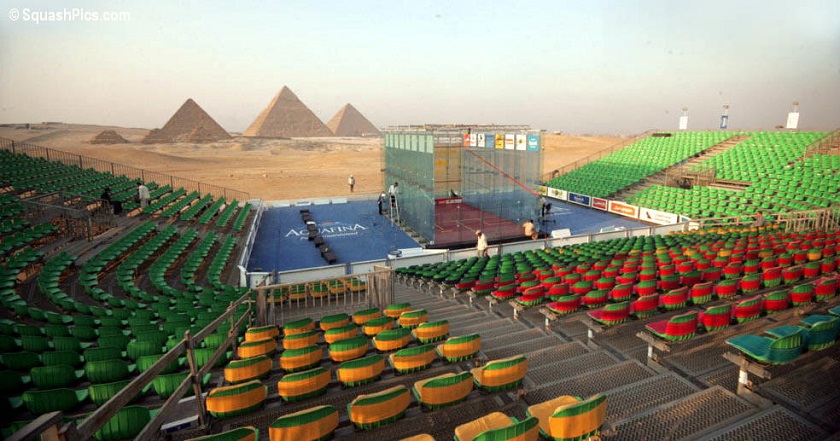
From a tournament Egypt hosted in 2006

From the Atlantic, seeking to explain Egypt’s odd dominance of a sport few Americans play:

On Friday, Egypt’s Ramy Ashour won the squash World Open—basically the Wimbledon of squash. The tournament attracts the best players from around the world. But the final game lacked a certain element of suspense: Both players, Ashour and Mohamed El Shorbagy, were Egyptian.

Even that was predictable. Egyptians dominated the international rankings this year—including El Shorbagy and Ashour, three of the Professional Squash Association’s top five players based on tournament results are Egyptian. As of Friday, Egypt has won seven of the past 12 World Opens—in the history of the tournament, which began in 1976, only Australia and Pakistan have more World Open titles.

Egypt’s prowess in the sport is beginning to extend to international women’s tournaments, junior tournaments, and even American college sports: Egyptian men have won the last three U.S. Intercollegiate Individual Championships, a tournament for the best players attending U.S. universities.

How did so many Egyptians get so good at squash?

Please see the article for details, but then go play yourself, if you can. I learned the game in college. It is far more technical and strategic than racquetball, but a great workout all the same.

Congratulations to Egypt for being the best; if only America cared.

Update: The World Squash Federation decided on March 20 to cancel the world junior championships scheduled this summer in Cairo. The cited concern is the ‘extreme radicalism in the region, not specific to Egypt.’ Unfortunate.

Categories
Excerpts

A Regime-Islamist Reconciliation?

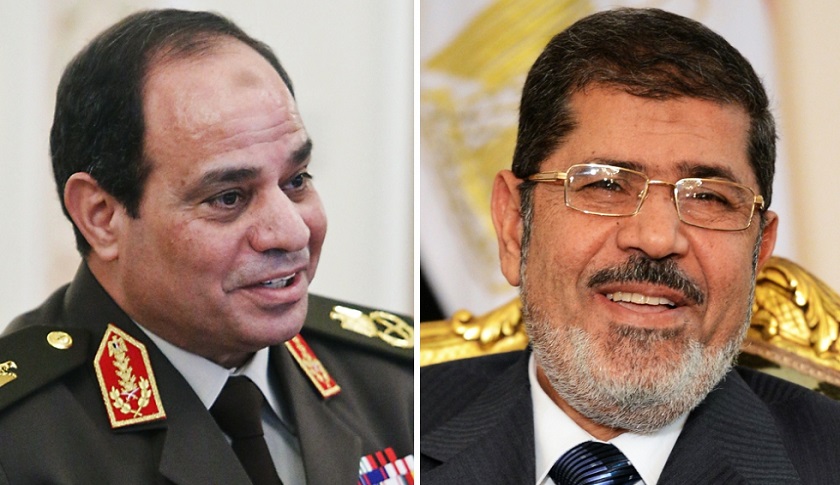
morsi-sisiVery important but under-reported news in this article from al-Ahram Weekly:

Recent developments suggest the possibility of a thaw in relations between the state and political Islam. President Abdel-Fattah Al-Sisi recently met with three members of the Dissident Muslim Brothers, a breakaway group from the Muslim Brotherhood.

There is also a reconciliation initiative, proposed by Tarek Al-Bishri, between the government and the Muslim Brotherhood. The legal scholar, known to be close to the Islamist trend, hopes the initiatives will attract Saudi backing.

After describing recent incidents of terrorism, the article provides perspective from the former Brothers:

Speaking to the press following the meeting between Al-Sisi and Dissident Muslim Brothers, Tharwat Al-Kharbawi said those attending agreed that a reconciliation with the Muslim Brotherhood is unrealistic.

Al-Kharbawi described the three-hour meeting as “an extraordinary meeting with an extraordinary man …You can rest assured that Egypt is in good hands. But we all have to work together to ensure he is not left alone.”

In the background are discussions with Brotherhood members in detention:

Al-Zafrani (ex-MB) told the press that the statements of repentance issued by some detainees was discussed. He said Al-Sisi welcomed the recantations. He quoted the president as saying that the principle of revision, admission of mistakes and repentance is acceptable as long as those issuing the declarations have not committed criminal acts.

Security sources report a growing number of imprisoned Muslim Brotherhood members are renouncing their membership of the group. Muslim Brotherhood leaders deny there is any such trend.

As for the reconciliation initiative, Bishry revealed it to a Turkish newspaper:

He also spoke of the January revolution, parliamentary elections and the importance of safeguarding the Egyptian state. “The continued existence of the state in Egypt is vital … we must preserve and perpetuate it through the participation of the people,” he said.

Al-Bishri argued that the ongoing conflict in Egypt is between three forces: the state and its backbone the army; Islamists and their grassroots organisations; and liberal elites who control the media. “The state, which is the strongest, should reach out to all,” he said.

Brotherhood dissidents dismiss Al-Bishry, finding him inclined to the Brotherhood above all.

After describing the long prison sentences given to many Brotherhood leaders, the article concludes with its analysis. The two sides are simply positioning:

In the confrontation between the state and political Islam, pressure is being sustained, on the one side, by long prison terms for Muslim Brotherhood leaders. On the other, there are bombings and violence being carried out by anti-state, pro-Islamist forces, considered by the state to be linked to the now-banned Muslim Brotherhood.

It is a game of nerves in which each side is seeking to strengthen its hand for whatever negotiations eventually ensue.

Certainly, Al-Sisi’s meetings with leaders from breakaway Muslim Brothers and reports that the new Saudi monarch is eager to settle the situation in Egypt suggest some form of social, if not political, reconciliation is increasingly likely.

Right or wrong in this conclusion, the article is worthy of consideration.

Categories
Excerpts

Talk Peace, Broadcast Violence

Mekameleen TV, a pro-Brotherhood satellite channel broadcast from Turkey

The Washington Post recently published an excellent article detailing the escalation of violent rhetoric between the Muslim Brotherhood and Egyptian state. Language is shocking on both sides, but the government crackdown on the Brotherhood is well-known and admitted, even as accusations of terrorism in the Sinai remain unproven in the eyes of many.

But the Brotherhood actively presents itself in English as committed to a path of non-violent resistance. Consider then this extended excerpt:

In a broadcast from Istanbul, for example, a slick haired television presenter on the Muslim Brotherhood funded and managed Masr al-An (Egypt Now) channel recently delivered an ominous message, “I say to the wife of every officer…your husband will die, your children will be orphaned…these kids [“revolutionaries”] will kill the officers in Egypt.”

This was not an isolated incident of open incitement on Masr al-An. Three other Turkey-based pro-Brotherhood channels (al-Sharq, Mukammilin and Rabaa) echo similar incendiary rhetoric and cheer on the “popular resistance,” hunkering down for confrontation with the regime.

Meanwhile, in Cairo, there is a similar level of vitriol, with the regime-driven media linking the Muslim Brotherhood with the Sinai-based Ansar Bayt al-Maqdis – which refers to itself as the Sinai Province of the Islamic State. The regime has labeled the Brotherhood as an enemy of the Egyptian state, which must be combated, and blames it for various plots against Egyptian interests.

The Islamist and Brotherhood embrace of confrontational rhetoric was evident in a recent “Message to the Ranks of Revolutionaries: ‘and Prepare’” uploaded to an official Web site of the Brotherhood. After a helpful reminder that the group’s logo of two swords and “Prepare” are all “synonyms of strength,” the message continued to remind, “Imam [Hasan] al-Banna [Brotherhood founder] equipped jihad brigades he sent to Palestine to fight the Zionist usurpers. And the second Guide, Hasan al-Hudaybi, restored the ‘secret apparatus’ [paramilitary] formations to attrit the British occupiers.”

It concluded, “We are at the beginning of a new phase where we summon our strength and evoke the meaning of jihad, and prepare ourselves, our wives, our sons and daughters and whoever follows our path for relentless jihad where we ask for martyrdom.” While this controversial essay did not directly call for violence, many Egyptians interpreted it as a departure.

This is exacerbated in that the Brotherhood, in its bid to make its cause a pan-Islamist one, has allowed radical former Brothers and other Islamists to join it on the platform. Inflammatory preachers like Wagdy Ghoneim – who virtually beat everyone else to the punch by deeming Sissi an apostate even before the Rabaa massacre – are hosted on the new pro-Brotherhood channels.

Following Sissi’s January speech on revolutionizing Islam, charges of apostasy are now standard fare on pro-Brotherhood channels. A Brotherhood-tied cleric who served in the Ministry of Religious Endowments under Morsi, Sheikh Salamah Abd al-Qawi, even gave a fatwa that Sissi’s death is permissible and that whoever kills him and dies in the act is a martyr; he received applause from the studio audience.

In another segment, viewers were urged to come out to protest for the “sake of their religion,” a not too surprising refrain after the Brotherhood’s endorsement of the radical call for a “Muslim Youth Intifada” in November 2014. The attempt to make the current conflict one about Islam was casually explained only months following the coup as part of a strategy to rile up quietist Salafis.

Pro-Brotherhood channels also help increase the profile of radical conspiracy theorists like journalist Sabir Mashhur who labels the army as “occupiers” and “crusaders” fighting the “Egyptian Muslims.” He offers such violent advice to the “revolutionaries” that if they hit the first and last tank in the column with rocket propelled grenades (RPGs) the division will melt away. Furthermore, he echoes other increasing calls to follow the path of the Iranian revolution.

Over the past year groups calling themselves “Popular Resistance,” “Execution Movement,” and recently a group called “Revolutionary Punishment,” have carried out everything from drive-by shootings of police officers, sabotage of public utilities and private businesses, to planting small improvised explosive devices (IEDs) that are increasingly deadlier and more sophisticated.

In the weeks leading up to January 25, the fourth anniversary of the Egyptian revolution, the pro-Brotherhood channels fully embraced these groups and even called on them to execute pro-regime media figures.

The article goes to great lengths to show the context of this escalation, as each side blames the other. It also suggests the Brotherhood is trying to straddle the fence between a long-standing policy of de-emphasizing their violent source material, while giving space to enraged youth bent on revenge for slain colleagues.

Perhaps. But as the excerpt above indicates, the Brotherhood is licensing far more than space for troubled youth. It is filling the space with incitement, at least by proxy. They must clearly condemn, and quickly.

Categories
Excerpts

The Sharia of ISIS and Azhar

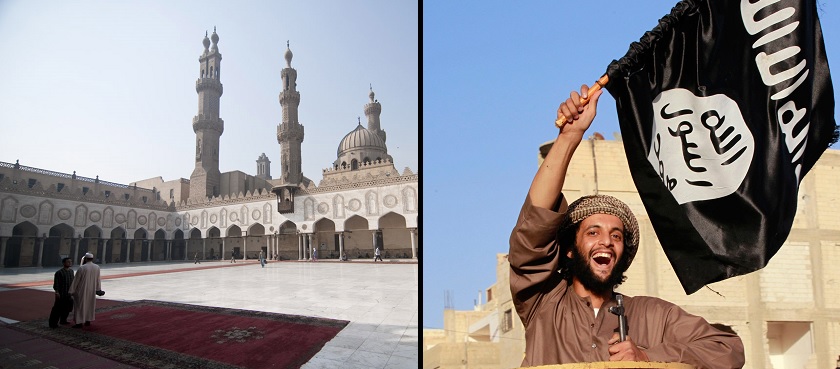
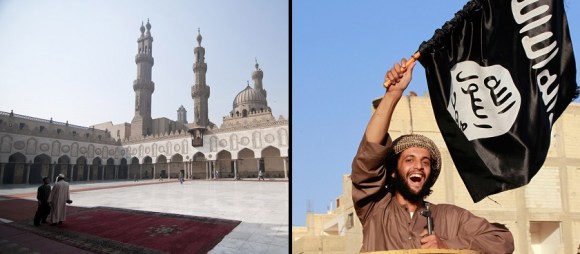
Sharia Azhar ISISDoes the so-called Islamic State represent the essence of Islam, or its perversion? The answer supplied often closely aligns with one’s ideology.

But what does ISIS say for itself? Here is testimony gathered by the Guardian on what is taught in the training camps:

Unlike previous incidents of stoning adulterers and crucifixion, throwing people from high buildings [for homosexuality] did not even inspire criticism of sharia in the Middle East because many did not realise it was a sharia penalty in the first place.

But it is the obscurity of the punishment that makes it particularly valuable for Isis. The purpose is not to increase the volume of violence but also to raise eyebrows and trigger questions about such practices, which Isis is more capable of answering than mainstream clerics, who prefer to conceal teachings that propound such punishments.

Many Isis members were eager to emphasise they were impressed by such obscure teachings, and were drawn to the group by the way Isis presents Islam with absolute lucidity.

Similar is the question of whether or not Islam spread by the sword:

We spread our message by proselytisation and sword. Ibn Taymiyyah said ‘the foundation of this religion is a book that guides and a sword that brings victory’. We guide and the sword brings victory.

“If someone opposes the message of the prophet, he faces nothing but the sword. As the prophet spread the message across the Earth, we are doing the same.”

Another member echoed Abu Moussa’s reasoning. “The prophet said: ‘I have been given victory by means of terror.’ As for slaughter, beheading and crucifixion, this is in the Qu’ran and Sunna [oral sayings attributed to prophet Muhammad].

“In the videos we produce, you see the sentence ‘deal with them in a way that strikes fear in those behind them’, and that verse speaks for itself. One more thing: the prophet told the people of Quraish, ‘with slaughter I came to you’.”

The article claims that mainstream clerics prefer not to address these more sordid matters. But here is very thorough counter-tract, called an Open Letter to Baghdadi, with a 24-point refutation of the Islamic State and its practices.

It is signed by Muslim leaders around the world, exposing either the ignorance or agenda of those who rail against ‘moderate Muslims’ for not condemning ISIS. The punishment of throwing from the rooftops is not mentioned, but here is an excerpt from their section on jihad:

The reason behind jihad for Muslims is to fight those who fight them, not to fight anyone who does not fight them, nor to transgress against anyone who has not transgressed against them. God’s words in permitting jihad are: ‘Permission is granted to those who fight because they have been wronged. And God is truly able to help them; those who were expelled from their homes without right, only because they said: “Our Lord is God”. Were it not for God’s causing some people to drive back others, destruction would have befallen the monasteries, and churches, and synagogues, and mosques in which God’s Name is mentioned greatly. Assuredly God will help those who help Him. God is truly Strong, Mighty.’ (Al-Hajj, 22: 39-40).

Thus, jihad is tied to safety, freedom of religion, having been wronged, and eviction from one’s land. These two verses were revealed after the Prophet ﷺ and his companions suffered torture, murder, and persecution for thirteen years at the hands of the idolaters. Hence, there is no such thing as offensive, aggressive jihad just because people have different religions or opinions. This is the position of Abu Hanifa, the Imams Malik and Ahmad and all other scholars including Ibn Taymiyyah, with the exception of some scholars of the Shafi’i school.

And for the benefit of Egypt’s reputation, here is a list of her signatories, many of whom are affiliated with the Azhar:

4. Prof. Salim Abdul-Jalil, Former Undersecretary for da’wah at the Awqaf Ministry, and Professor of Islamic Civilization at Misr University for Science & Technology

5. Sheikh Wahid Abdul-Jawad, Fatwa Council (Dar al-Ifta’)

6. Dr. Mustafa Abdul-Kareem, Fatwa Council (Dar al-Ifta’)

7. Prof. Ibrahim Abdul-Rahim, Professor of Shari’ah, Dar al-Ulum College, Cairo University

8. Prof. Jafar Abdul-Salam, Secretary-General of the League of Islamic Universities

11. HE Prof. Sheikh Shawqi Allam, The Grand Mufti of Egypt

13. Prof. Mohammad Mahmoud Abu-Hashem, Vice-President of Al-Azhar University and member of the Centre for Islamic Research at Al-Azhar Al-Sharif

16. Prof. Mohammad Al-Amir, Dean of the Faculty of Islamic Studies for Girls, Al-Mansoura University

17. Dr. Majdi Ashour, Fatwa Council (Dar al-Ifta’)

18. Prof. Dr. Abdul-Hai Azab, Dean of the Faculty of Shari’ah and Law, Al-Azhar University

21. Prof. Bakr Zaki Awad, Dean of the Faculty of Theology, Al-Azhar University, Egypt

23. Dr. Sheikh Osama Mahmoud Al-Azhari, Islamic Preacher

35. Dr. Mohammad Abdul Sam’i Budair, Fatwa Council (Dar al-Ifta’)

41. Prof. Jamal Farouq Al-Daqqaq, Professor at Al-Azhar University

44. Prof. Mohammad Nabil Ghanayim, Professor of Shari’ah, Dar al-Ulum College, Cairo University

45. Sheikh Dr. Ali Gomaa, Former Grand Mufti of Egypt

55. HE Prof. Mohammad Al-Hifnawi, Professor of Usul al-Fiqh at the Faculty of Shari’ah and Law at Al-Azhar University, Tanta branch

56. Prof. Sami Hilal, Dean of the College of the Holy Qur’an, Tanta University

57. Prof. Sa’d al-Din Al-Hilali, Head of the Department of Comparative Jurisprudence at Al-Azhar University

63. Dr. Khaled Imran, Fatwa Council (Dar al-Ifta’)

71. Sheikh Ahmad Wisam Khadhr, Fatwa Council (Dar al-Ifta’)

72. Sheikh Muhammad Wisam Khadhr, Fatwa Council (Dar al-Ifta’)

74. Sheikh Mohammad Yahya Al-Kittani, Preacher & Imam

76. Sheikh Amr Mohamed Helmi Khaled, Islamic Preacher and Founder and President of the Right Start Global Foundation

81. Prof. Dr. Abdul Hamid Madkour, Professor of Islamic Philosophy, Dar al-Ulum College, Cairo University

83. Prof. Mohammad Mukhtar Al-Mahdi, Professor of Islamic Studies, Al-Azhar University and President of the Shari’ah Society

85. Sheikh Ahmad Mamdouh, Fatwa Council (Dar al-Ifta’)

89. Prof. Mohammad Abdul Samad Muhanna, Advisor to the Grand Imam of Al-Azhar Al-Sharif

90. Sheikh Mukhtar Muhsen, Fatwa Council (Dar al-Ifta’)

91. Professor Fathi Awad Al-Mulla, Pundit and consultant for the Association of Islamic Universities

96. Mr. Abdul Hadi Al-Qasabi, Grand Sheikh of the Sufi Tariqahs in Egypt

97. Prof. Saif Rajab Qazamil, Professor of Comparative Jurisprudence, Al-Azhar University

99. Sheikh Ashraf Sa’ad, Muslim Scholar

102. Sheikh Mahmoud Al-Sharif, Head of the Association of Sherifs in Egypt

107. Prof. Ismail Abdul-Nabi Shaheen, Vice President Al-Azhar University and Deputy Secretary-General of the League of Islamic Universities

113. Prof. Nabil Al-Smalouti, Professor of Sociology and former Dean of the Department of Humanities, Al-Azhar University

121. Dr. Amr Wardani, Fatwa Council (Dar al-Ifta’)

126. Prof. Zaki Zaidan, Professor of Shari’ah, Faculty of Law, Tanta University

At the time of this writing, Prof. Zaidan is the last of 126 signatories. I am not aware of why it is arranged in this order, but high-ranking Egyptians are listed throughout.

Deeper analysis and further study is needed to either rebut or prove the claim that ISIS is Islam, but these scholars are certain it is far from the religion.

Categories
Excerpts

Orthodox Priest: Better to Abandon Christianity

If this quote is accurate, it is a terrible indication of the divide between the Coptic Orthodox Church and members who wish a divorce for other than adultery:

Orthodox priest Abd al-Masih Basit told Al-Monitor that the church would not interfere in politics and would not take any actions against Christian parliamentary candidates on the Nour list, as some newspapers had reported it would. Yet, he added, “The Nour Party considers the Christians infidels, and therefore, any Christian who participates in the party is giving up his dignity. It is better for those who have a problem with the church regarding the personal status laws — and who view support for Nour as a solution to amending those laws through parliament — to abandon Christianity.”

The context for the article is that election law requires all political parties to field a limited number of Christian candidates. The Nour Party is Salafi, an ultraconservative form of Islam that is described in quote. The article surmises the only way for Nour to attract any Christians is to appeal to a very specific segment — if sharia law is applied to all, Islamic divorce is far easier than Christian.

Abd al-Masih Basit is a very influential theologian and apologist in the Coptic Orthodox Church. It will be necessary to confirm this quote with him before assuming it is true, but if so, it appears he has his priorities in the wrong order. The church desires to control legislation on personal and family affairs, and the constitution gives it the right to do so.

But it would be a shame if the church is willing to sacrifice the faith of its members to preserve its power.

Categories
Excerpts

The Religious Reformation of Islam

Islamic Reformation

Given the terrorism practiced by certain Muslim groups at the head of which is the so-called Islamic State, many are saying – wishing – that a Reformation might come to Islam. An article in the Revealer does an excellent job of explaining it has already come.

For centuries four traditional law schools defined sharia in rather flexible ways according to the circumstances of the time and place. But as the world modernized, sharia interpretation did not. What was flexible became fixed, and none were allowed to interact with the patterns of jurisprudence in new and necessary ways.

Islamic modernism witnessed both this stagnant heritage and the success of Europe, and tried to remedy the situation by going back to the original sources of Islam. One trend attempted to find the foreign values of the West within the Islamic tradition, and adapt accordingly. To do so it bypassed the legal schools and provided its own redefinition of traditional concepts. Shura, for example, always meant the obligation of the ruler to seek the counsel of those he ruled. To liberal Islamic modernists, this became ‘democracy’.

But not all modernists were liberal. Another trend also returned to the original sources of Islam and attempted their reapplication in the modern world. Here, there was no offense at appropriating technology and other tools of nation-states. But the goal was to seek God’s favor through better fidelity to and direct access of his original texts, and the medieval heritage of jurisprudence stood in the way. So conservative Islamic modernists also bypassed these legal schools, and emphasized the individual work of scholars to apply scriptural lessons to contemporary issues, often in illiberal patterns.

Both, in the Protestant sense, represent a ‘Reformation’. And in the article the implications are described well. But there is one section I take issue with:

The battle underway is not primarily between the young and the old, but between radically different approaches to understanding Islam: one that stresses proper legal training and respect for judicial precedent, and one that urges Muslims to open their Qur’ans and decide for themselves. The Reformation, you see, is already here. It just doesn’t look like we hoped it would.

Given the author’s great understanding of this topic, the conclusion surprised me. I think she may have been simplifying so as to better sum up her argument.

But the conservative version of Islamic modernism, which is often called Salafism, does not suffer so much from every Muslim deciding to interpret scripture on his own. Yes, this is an outcome of some trends of the Protestant Reformation, where God’s Spirit is understood to guide each person in interpretation.

Salafism, however, places great emphasis on scholarship and deep knowledge of the sources of Islam. Yes, it bypasses the traditional schools of law, and for this many Muslims criticize. But among themselves Salafis usually defer to the most knowledgeable among the community. Disciples gather around sheikhs, and indeed, these sheikhs can go terribly awry as they operate outside the bounds of traditional scholarship.

But it is not a matter of each Muslim interpreting for themselves. In fact it is the opposite. Salafis tend to defer judgment to their sheikh, even as they discuss and study together.

As for the author’s ultimate conclusion – ‘it just doesn’t look like we hoped it would’ – she displays great understanding of the oft-spoken desire of Westerners to see their own interpretive heritage within the alien world of Islam. The article is recommended.

Categories
Excerpts

Voices against Charlie

Je Ne Suis Pas Charlie

Muslims and Muslim majority nations, including Egypt, have roundly condemned the terrorist attack on the Charlie Hebdo satirical newspaper. But the ideology that informs such an attack is present not just among those with access to weapons. This Mada Masr article contains a full survey of Egyptian reactions, most of which stand against the murders. But interesting are the ordinary voices that express sympathy with the attack:

Many Egyptian social media users were not fully sympathetic toward the cartoonists killed in the incident. Business intelligence consultant Ramy Mahrous, 28, told Mada Masr that he only respects non-Muslims who are respectful of his religion.

“Otherwise, I wish anyone attacking my religion to burn alive, and I would be very happy seeing him burning,” he said.

Twitter user Ahmed Adel told Mada Masr that attacking religious symbols and religion in general is a “red line,” but Muslims generally do not take serious actions against such offenses, while the offending parties “reap the fruit of their actions.”

“Islam forced us to defend our sacred principles. [The shooting] is not an attack, it is self-defense,” he argued.

Adel recounted some incidents from Prophet Mohamed’s life that he interpreted as supportive of his position.

“All of this should make us more ardent [defenders] of our religion, if we love our religion in the first place,” he added.

In a similar vein, Sahar al-Sherbiny told Mada she believes that fervent belief could lead a Muslim to kill someone offending his or her religion.

“I don’t know many details of what happened in France, but if I saw someone offending Prophet Mohamed in front of me and I had a weapon, I would verbally warn him first. If he continued, I would kill him,” she tweeted.

Better would have been interviews with people on the street. Social media provides an artificial atmosphere that encourages the expression of more extreme views. But perhaps the relative safety also allows full disclosure.

It is wrong to generalize a people and their religion, either positively or negatively. But where there is such dissonance between cultures, it is important to see the other as a real person, and hear their real voice. It is only then that alternate policies and perspectives might make a real difference.


Categories
Excerpts

Translation: President Sisi at Christmas Eve Mass

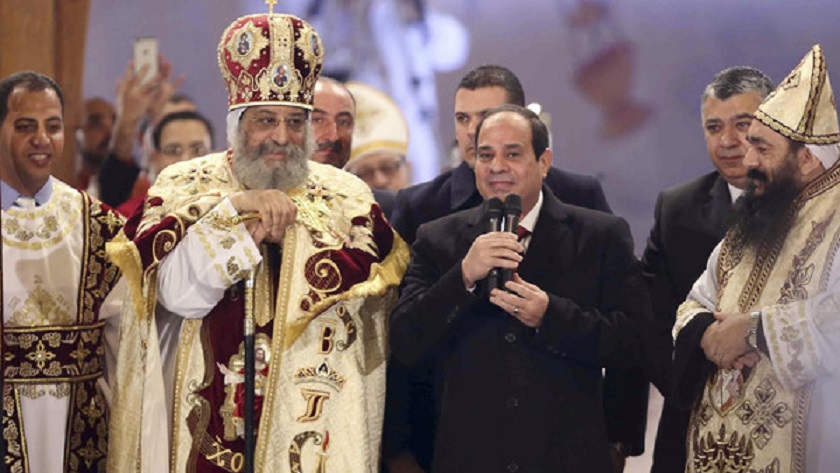
Egyptian President Sisi talks next to Coptic Pope Tawadros II as he attends Christmas Eve Mass at St. Mark's Cathedral in Cairo

Last night on Christmas Eve according to the Coptic Orthodox calendar, President Abdel Fattah al-Sisi became the first ever Egyptian head-of-state to attend the holiday mass.

His appearance lasted for about ten minutes, during which he gave a short speech. The video selection and translation is provided kindly by Paul Attallah.

It was necessary to come and congratulate you for the feast
I hope that I did not interrupt your prayers

Egypt for years taught the civilization to the whole world
and taught the civilization to the whole world
I want to tell you that the world is now waiting from Egypt
in these circumstances…

The people: We love you
Sisi: We love you too!

I thank you because frankly the Holy Pope will be upset!

It’s important that the whole world watch us: the Egyptians.
You noticed that I am not using another word than Egyptians
It could not be something different
We are the Egyptians
Nobody says: what (type of) Egyptian are you?
Listen
We are saying things
We are writing to the world a meaning
and we are opening a window of real hope and light to the people

I am saying that Egypt taught to the world all over the years civilization and humanity
Today we are present to confirm that we are able another time
to teach the humanity
and to teach the civilization once again.
Starting from here
For this reason, we cannot say but: we the Egyptians
We must be only Egyptians
Yes Egyptians

The people: One hand

Yes one hand
I want just to tell you
that with God’s will
we will build Egypt together
we will contain one another
We will love each other
We will love each other in a good way
we will love each other really
so the people can watch

I want to tell again
Happy New Year
and for all Egyptians
and for all Egyptians: greetings for the feast
Holy Pope: Greetings for the feast
Thanks and I will not take from you more time
Greetings

It is certainly a historic occasion. Merry Christmas to all Egyptians.

Categories
Excerpts

Darwin in Arabia (and America)

Darwin in Arabia

From the Times Literary Supplement, a book review on the reception of Charles Darwin’s evolutionary ideas in the Arab world. First, and especially for Arabic students, the trouble of language:

For a long time, the reception of Darwinism was bedevilled by the need to find either neologisms or new twists to old words. As Marwa Elshakry points out, there was at first no specific word in Arabic for “species”, distinct from “variety” or “kind”. “Natural selection” might appear in Arabic with the sense “nature’s elect”. When Hasan Husayn published a translation of Haeckel, he found no word for evolution and so he invented one. Tawra means to advance or develop further. Extrapolating from this verbal root, he created altatawwur, to mean “evolution”. Darwiniya entered the Arabic language. Even ‘ilm, the word for “knowledge” acquired the new meaning, “science”. With the rise of scientific materialism came agnosticism, al-la’adriya, a compound word, literally “the-not-knowing”.

There is generally a great cultural component to knowledge and science, upon which peoples develop a sense of superiority. There are struggles first to appropriate the new ideas into a new setting, and then, to deny (or ignore) the uniqueness of the culture that produced it.

This process is often seen in the Western (American, at least) historical pedagogy that basically skips from Greece and Rome to the colonial era, with a nod in the direction of the Dark Ages that preceded the Reformation and Renaissance.

But our Dark Ages were a period of great Arab advancement, and the rediscovery of Greek thought was translated through the scholars of the then-dominant Muslim civilization. I’m not sure how much education has changed since I was in school, but this is a theme generally left to the specialists at university level or beyond.

Similarly, the modern Arab world has struggled with resurgent Western superiority. This article demonstrates the point through the theory of evolution, and all the controversy surrounding it:

There were those, like the journalist, philosopher and social reformer Shibli Shumayyil (1853–1917), who welcomed Darwinism and, more specifically, the theory of spontaneous generation as reinforcing the materialist case against Islam. Yet there were also apologists who, like Abduh, claimed that Islam was more compatible with science than Christianity, since Islam was less burdened with excess theological baggage and superstition.

Beyond that there were those, like al-Afghani (eventually), who held that not only had Darwin and his allies and rivals come to the right conclusions, but that Muslim Arabs beat them to it. The Kitab al-Hayawan (“Book of Animals”) by the ninth-century Basran essayist al-Jahiz was often compared to The Origin of Species, and al-Mazhar cited al-Jahiz’s account of how two varieties of dung beetles copulated to produce a third kind as prefiguring Darwin. The tenth-century Syrian poet Abu al-‘Ala al-Ma‘arri was another imaginary ancestor of evolutionary theory and Afghani cited a verse of Ma‘arri’s referring to the transformation of minerals into plants and plants into animals as evidence of this. As far as Afghani was concerned, Darwin had merely recycled ancient ideas about evolution.

… The quest for Arab precursors of Darwinism was not solely or even mainly a matter of cultural pride, for there was also a need to make Darwinism more acceptable by inserting it into a familiar cultural tradition.

This is the example of adaptation, but rejection also mirrored Western patterns, though the review, and the book, does not tease this out as much:

Muslim polemicists against Darwinism gratefully borrowed the Protestant theologian William Paley’s analogy of a watch found abandoned on a beach, since the intricate design of such an instrument surely argued irrefutably for a designer.

… As Elshakry notes, enthusiasm for Darwin and his followers fell away after the Second World War and that enthusiasm turned to outright hostility from around 1970 onwards. The reasons for this lie beyond the scope of Reading Darwin in Arabic. Perhaps the intellectual prestige of the British declined as their empire was dismembered. Perhaps Muslim scholars took their lead from American creationists. The rise of a militant political Islam may also have been a factor.

In my years in the Arab world, I have never engaged anyone over evolution at the scientific level, basically because I have not known many scientists. But at a cultural level I have never found it to be an animating issue. Most have just shrugged it off, either dismissing the idea as antithetical to Qur’anic creationism, or with an general sense that all the West has produced in science has precursors in the Qur’an.

A good number have argued passionately about the ‘scientific miracle’ of the Qur’an (whether for, against, or moderating evolutionary ideas), while a few have identified positively with the prevailing views of the scientific community in favor. Maybe these imprecise percentages would be similar to the views of religious conservatives in America?

The difference would be that a literal reading of the Qur’an is used in both directions, for and against evolution. The pro-evolution category of Muslim literalism believes that the scripture is a book of science; that the mind of God produced it and revealed secrets which make sense only centuries later. Muslims generally believe the Qur’an is unmediated by man, and therefore Muhammad and his cultural setting do not need to be decoded to understand the message. Mankind just needs to advance sufficiently to comprehend what is already there, and sometimes non-Muslims do so first.

A literal reading of the Bible, however, is generally only employed against evolution and in defense of creationism. These maintain a similar idea of the Bible as a science book, or at least trustworthy in its historical and scientific offerings, properly understood. But even the idea of ‘properly understood’ reveals the Christian distinctive vis-a-vis Islam that human and cultural factors influence the Biblical text and our understanding, without giving up the doctrine of God’s inspiration.

Christians, then, who accept evolutionary ideas in part or in full do so with Biblical fidelity to ideas like intelligent design, granting theological truth and divine inspiration to the creation account, without literal acceptance of a seven-day historical sequence. The spectrum, and perhaps slippery slope, in which this and similar accommodations is acceptable is greatly debated. Abduh, above, hints at the larger doctrinal issues at stake.

There is much we can learn from each other, from science, from God. In all, humility is necessary, for no learning can take place without it.

Categories
Excerpts

Testing the Salafis

Salafi Madrasa

Who should be allowed to preach in Egypt’s mosques? A recent exam offered by the Ministry of Religious Endowments is accused of seeking a selective answer:

Over the last two months, the Egyptian Ministry of Religious Endowments held two such exams. Many of the questions used are known for being disputed by Salafists, most notably those about the ruling of Islam regarding the military salute, standing during the national anthem, women in the judiciary, the concept of the caliphate, the reconstruction of places of worship for non-Muslims, bank profits, women wearing the veil and the establishment of museums for ancient Egyptian and Pharaonic artifacts. Salafists have well-known and radical opinions about all these issues, as they believe that Islam forbids such things. (from al-Monitor)

An issue-specific approach appears to have won the desired results:

The crisis between the Salafists and the Egyptian Ministry of Religious Endowments escalated when 600 Salafist imams took the ministry’s test and only 18 passed. Their disqualification prompted the Salafist Call to demand that the presidency resolve the crisis and support Salafist imams, who supported the road map on June 30, 2013.

Salafis bet on survival when the backed the overthrow of Morsi, and on this account have received their gains. They do not appear to have profited much beside, to this point. Their ultimate fate is still an open question, but it appears this institution is lined up against them. Should it be? One figure from the ministry is critical:

In a phone interview with Al-Monitor, Sheikh Salem Abdul Jalil, the former deputy minister of Religious Endowments, said the crisis is mostly political, as parliamentary elections are approaching in Egypt. The move is intended to ensure that Salafist clerics are kept away from the pulpits where they win popularity. “Salafist groups have always been a problem for the government, just like the Muslim Brotherhood,” he added.

……

“Unfortunately, both parties have a unilateral message. For instance, the Ministry of Religious Endowments wants the preachers to tell the people that growing a beard is not obligatory, while Salafists want to tell people that having a beard is obligatory. Thus, there are two parties — the first desperately wants to impose its views, and the other is a government party that has no vision and ideology.”

Stay tuned for more wrestling, and if things go sour, potentially for fireworks.