Two years later, how did Mohamed Morsi lose power? What was the political climate like? How large were the protests? Was it a coup?
An Egyptian Christian, Paul Attallah, has provided a recap based on his email newsletter at the time. I often convey his information in my ‘analysis’ page, as his collection of news sources – most of which with links to the original articles – is sprinkled with commentary helpful in understanding the perspective of many in Egypt. It is very long, but lists events and perspectives perhaps forgotten during the momentous three days before.
So for readers interested in recalling those days of significance, Attallah starts his countdown with his original newsletter from June 27:
Rebel towards 30th June
Tamarod launches 30 June Front
In a press conference, a statement was released on behalf of the 30 June Front stating that it had been launched to represent a unified leadership for the coming phase. It added that the front would persist in peaceful demonstrations until achieving the goals of the 25 January Revolution.
Tamarod member Mona Selim stated that the Front resembles an operation room for planned protests, adding that it would start functioning upon its launch on Wednesday and continue until the “regime is toppled”. “The Front is an example of the revolution and not representative of it,” Selim said.
The Front roadmap
The Front offered a roadmap for the phase which follows the hypothetical removal of President Mohamed Morsi.
- The roadmap involves choosing a prime minister from the national figures to take over the presidential powers and form a cabinet of national, efficient ministers. The cabinet’s top mission would be to devise a plan to “salvage” the economy and achieve economic justice.
- The Front’s roadmap would also see the delegation of the Supreme Constitutional Court (SCC) chairman as president; his role would be honorary as the Prime Minister would have the executive powers.
- As for the state’s internal and external security, it would be left to the National Defence Council to handle.
- The 2012 constitution would be stalled and the current Shura Council would be dissolved, the Front’s roadmap dictated. Instead, a constituent assembly comprised of constitutional and legal experts would be formed to draft a new constitution and to temporarily take over the legislative authority.
- The transitional period outlined in the roadmap is due to expire within six months, to be followed by presidential elections held with full judicial monitoring. After electing a president, the people would then move to parliamentary elections.
There is no other roadmap
Khaled Teleima, one of the Front’s founders, stated that this roadmap was structured following a full month of discussions between Tamarod and all “revolutionary and youth movements”.
“We ask of you all to adopt this roadmap and stick to it in the face of any other rival plans in order to preserve our unity,” Teleima said.
Shady Al-Ghazaly Harb, another founding member, stated that this roadmap is the only remaining roadmap for the next phase. “All other roadmaps proposed by other movements were eliminated in this one’s favour,” Harb said. “We had reached consensus with them all.”
Some Front founders
Other Front founders included: currently-detained political activist and blogger Ahmed Douma, former 6 April Movement member Esraa Abdel Fattah, formerly detained 6 April Movement member Zizo Abdo, Tamarod members Mahmoud Badr and Mai Wahba and Mohamed Abdel Aziz, Egyptian Social Democratic Party leading figure Bassem Kamel and Al-Tayar Al-Sha’aby spokesperson Heba Yassin.
El Gendy’s mother
The mother of alleged torture victim Mohamed El-Gendy, was among those who attended the press conference.
“I miss Egypt,” Al-Gendy’s mother said. “Just as I miss my son calling me ‘mother’. My children, would you be able to bring Egypt back to me?”
Morsy’s speech in two words:
He jumped over early elections and new Cabinet issues and talked about a “future” amendment of the Constitution (when we will have a parliament) and a reconciliation (based on what?)
He attacked his enemies:
- The judges (Shafiq’s judge, corruption and fraud)
- Private TV channels who are defaming him.
- The intellectuals (by insulting their dean Makram Mohamed Ahmad (78 years) asking him if he is now a revolutionary). Does he mean that only the revolutionaries have the right to attack him? He is remembering me 6 April movement (this archeological group) who prevented other people to attack MB in Talaat Harb square: we are the only agents who are allowed to attack MB.
- The remnants.
- The army: By putting the responsibility of the actual disaster over Abdel Naser, Sadat, Mubarak and insulting Shafiq.
He presented himself in a new look: I am the army chief and the military ruler of Egypt. Without dismissing El Sissy he stressed that he is El Sissy’s boss. Is he really?
He tried to divide the Egyptian people by enforcing the duality: remnants and revolutionaries. This division is over. Now we have another one more interesting: MB and anti-MB.
He gave very sweet promises to the youth (he lost them already): youth leaders will get high posts in all governorates and ministries.
People’s reactions to the speech
I will start with people’s reactions. Some books you have to read from the bottom to the top to understand something.
One senior Western diplomat in Cairo said the army might try to impose a solution, especially if the political deadlock turns violent
“The margin for a political solution is definitely very narrow,” he said. “If (violence) crosses a certain threshold, the role of the army might become by default more proactive.”
At the International Crisis Group, Egypt analyst Yasser El-Shimy said he still doubted the army wanted, or would try, to take control and was more likely to push parties to compromise.
“What is going to be a game changer,” he said, “is whether the violence is so massive or out of control that the government is unable to function – which might be a scenario that some are hoping for in order to prompt the military to intervene.”
Abdallah Kamal: Morsi’s speech shows that he has deep problems with the army.
The speech reached a point beyond all expectations and a phase exceeding what could be tolerated and dropped to the lowest point of analysis. The president condemned all institutions and attacked all opponents. He fears the former and does not estimate the strength of the others.
Essam el Sherif: Morsy lost his equilibrium as he lost his legitimacy and he has nothing to do but to leave.
Morsy talked about his achievements. But deeply he has no achievements. He is the one who divided the Egyptians and participated in killing them. He is the one who accepted that the nation stands at the limits of an abyss to remain in power.
El Alayly: The events surpassed the opposition and the people decided to overthrow the regime and his brotherhood.
Revolutionary forces coalition: Morsi’s speech is a trial to put divisions between the people who will participate on the 30th of June.
Comment: Excellent comment.
El Aswany: Morsi’s speech presented his crisis with the people as a struggle with the remnants.
Comment: Excellent comment.
Sawiras to Morsy after attacking Shafiq: You too you are wanted by the Justice. I am fed up (from this speech).
Military source: El Sissy presence in Morsi’s meeting was a “protocol” and does not mean that he agrees with his speech.
Sabbahy: Morsy seven decisions show that he does not respect the people’s will.
Sabbahy: Morsy’s speech is boring and his decisions are not worthy to the presidency.
Khaled Ali: Morsy’s speech is disconnected from the reality and the revolt against him is a national necessity.
El Aswany: Morsy’s speech is miserable. You lost your legitimacy and you will be tried.
Mostafa el Naggar: Morsy gave his departure speech.
Abu Hamed commenting Morsi’s speech: The Judiciary, Mass media and the remnants are this regime’s complexes.
Michael Munir: The actual regime is actually the Copts scarecrow. In the beginning of your speech I thought that you will call for early presidential elections.
Sabbahy: Morsy condemned himself in his speech.
Free Egyptians in Red Sea: The president speech is like his clinical death.
Athar el Hakim: 30th June is the last chance for the Egyptians for participating to ask for their rights in a peaceful way or to withdraw from political life.
Ahmad Beder: I hope that the people will go to the street on the 30th of June 30 and will not fear any threats
The judge who had been accused by Morsi of fraud: I will take all legal actions against the president.
Judges will held emergency meeting today to sue the President for the judge accusations.
The speech
Constitution and dialogue
Mursi offers constitution change before protests
President Mohamed Mursi offered opponents a say on Wednesday in amending a controversial new constitution and a forum to seek “national reconciliation”, as he sought to avert a violent showdown in the streets.
He said he was inviting party leaders to meet on Thursday to choose a chairman for an all-party committee that would prepare amendments to the constitution. It was pushed through a referendum late last year with Islamist support, but many in the opposition say the document is flawed and biased against them.
Mursi also said he was forming a committee of leading public figures, including Muslim and Christian clerics, to promote “national reconciliation”.
“I say to the opposition, the road to change is clear,” Mursi said, pointing to parliamentary elections expected later this year. “Our hands are extended.”
Mursi called for calm
“I say to all those planning to take to the streets to keep the protests peaceful and not be dragged into violence as violence will only lead to violence. Protests are a way of expressing an opinion – not imposing one”.
Comment: What he presented for this calm? Nothing but dreams.
Drag: Dostur (constitution) party will not participate in the president dialogue about the constitution amendments.
Is he living in Egypt and in another country? I doubt that he lives in Egypt. The Egyptian people will have the paradise for listening to such speech.
Youth
I will in charge the ministers and the governors to appoint young assistants to them less than 40 years.
“The youth were never given a chance to play a role in the country, and for that I am sorry,” he said. “I will make sure they do soon.”
Mursi acknowledged the hardships many of the young who saw hope in the revolution have had in an economy mired in crisis and offered them reforms and, in time, a higher minimum wage and reductions in unemployment, targeting a drop to 8 percent.
He said he wanted young people to be more involved in politics and promised parliamentary elections.
Remnants
No compromise with the remnants of the former regime even if they will be innocent!
President says former PM Shafiq must return to be tried
Former Prime Minister Ahmed Shafiq has squandered more than 700 million Egyptian pounds in a deal to buy aircrafts during his tenure as minister of civil aviation, President Mohamed Mursi said on Wednesday.
Shafiq must return to be tried in a corruption case involving land plots, Mursi said in a speech aired live on national television.
Shafiq is “wanted for justice”, Mursi added.
Copts
Morsy to the Copts: The former regime presented everything Islamic as a scarecrow and that’s wrong
Morsy new look: the military ruler of Egypt
No divisions or discord between the president and the army: The President is (I am) the Supreme chief of the army (= they must obey to me).
Morsy vows military trials for those who will offend him or offend Egypt and the army.
It’s Mubarak and opposition fault
“I took responsibility for a country mired in corruption and was faced with a war to make me fail,” he said, naming some senior officials, including the man he beat in last year’s presidential run-off, as well as neighbourhood “thugs”. He also slammed some owners of hostile media, accusing one of tax fraud.
Some enemies were abroad, he said, without elaborating.
Opposition fault
In a swipe at opponents who have failed to match his Muslim Brotherhood’s disciplined approach to winning elections, he said politicians who failed to accept his offers to cooperate had left young people with no outlet for opposition but the street.
“Political polarisation and conflict has reached a stage that threatens our nascent democratic experience and threatens to put the whole nation in a state of paralysis and chaos,” he said. “The enemies of Egypt have not spared effort in trying to sabotage the democratic experience.”
Radical measures
“I was right in some cases, and wrong in other cases,” he said. “I have discovered after a year in charge that for the revolution to achieve its goals, it needs radical measures.”
Corruption
“I took responsibility for a country mired in corruption and was faced with a war to make me fail,” he said, naming several officials he believed wanted to “turn the clock back” to the Mubarak era, including politicians, judges and a journalists.
Dividing people in revolutionaries and remnants
He accused former regime figures, such as Mubarak oligarchs Safwat El-Sherif and Zakaria Azmi, of working to destabilise Egypt.
“Soon Safwat El-Sherif and Zakaria Azmi will be considered ‘revolutionaries’ as well. Why not? Everyone has been acquitted,” he said, noting that Egypt’s court system had exonerated most former regime figures implicated in cases of corruption.
He also took a swipe at Ahmed Shafiq, the Mubarak-era’s last prime minister and Morsi’s nemesis in last year’s presidential polls.
“Ahmed Shafiq – is he a ‘revolutionary’? He’s wanted [by the authorities],” the president said, in reference to the host of corruption charges that Shafiq – currently based in the UAE – faces in Egypt.
“He’s based abroad yet continues to call for toppling the [Egyptian] government,” Morsi said of Sahfiq. “Is that not a crime?”
Comment: If both of them are against you, what hell are you doing? Are you dreaming that they will start fighting and leave you in peace? Will you provoke a fight between them through your hidden agents?
Morsy accuses owners of private TV channels to denigrate his image.
Morsy invites political forces for a meeting on Thursday 27 June to discuss the constitution amendments.
Comment: Who is free now for these bullshits?
The army
Military beefs up security ahead of protests
The military will take “all necessary measures” to secure the country ahead of the 30 June protests, the armed forces announced Wednesday amid a nationwide push to reinforce bases, major thoroughfares and vital institutions.
The military began securing Media Production City in Cairo’s 6th of October City on Tuesday evening with armed vehicles and infantry in an effort “to allow media outlets to work with the utmost freedom,” reported state-owned news agency MENA.
On Wednesday the military intensified security in the vicinity of the presidential palace and blocked entry roads, as well as the Maspero state-owned media building and the Central Bank of Egypt.
A plan is in place to protect “vital institutions,” a military official told MENA, including “the exits and entrances” to Cairo and 6th of October City. He added that deployments would be restricted to the outskirts of the major cities. (More…)
Egypt’s military moves troops near cities
Egypt’s military on Wednesday brought in reinforcements of troops and armor to bases near Egyptian cities ahead of weekend protests planned by the opposition to try to force the Islamist president out, security officials said. (More…)
Shafiq
SEC postpones decision on Shafiq’s appeal to Thursday
The Supreme Electoral Commission (SEC) decided on Wednesday to postpone until Thursday its decision on the appeal of former presidential candidate Ahmed Shafiq.
MENA reported on Wednesday that the decision to postpone was due to the death of SEC Head Maher El-Behairy’s brother.
Muslim Brotherhood
Muslim Brotherhood mufti trapped in mosque
A Muslim Brotherhood sermon against participating in upcoming anti-government protests led to an altercation outside a mosque in a town in Sharqiya on Tuesday night. Over 16 people were injured according to an FJP media officer.
Ahmed Ragab, member of the Al-Dostour Party’s high board in Sharqiya, said Brotherhood mufti Abdelrahman Al-Barr gave a sermon at Helmy Mosque in Ibrahimiya in which he stated that those who protest on 30 June are against Islam. People in the vicinity took issue and surrounded the mosque in protest. In response, people inside the mosque barricaded the doors to protect Al-Barr. Ragab said security forces eventually arrived to escort Al-Barr from the mosque and disperse the crowd.
Ragab said: “People are used to this sort of incitement against the protesters when it’s at a national level, but when it takes place inside towns, then you’re inciting violence between the townspeople.”
The Freedom and Justice Party (FJP) media officer in Sharqiya, Ahmed Gaber, presented a different account.
Gaber alleged approximately 300 “thugs”, some armed with shotguns, attacked the mosque. Gaber added that after they attacked the mosque the assailants looted a nearby Muslim Brotherhood office and set fire to several houses of Brotherhood members. Gaber said the attacks continued until the early morning.
“The entire city was incited to come and slaughter the ‘livestock’ in the mosque,” stated Gaber.
Gaber said the violence began before Al-Barr gave his sermon, and accused members of the dissolved National Democratic Party of being responsible.
He added: “This attack could not possibly have anything to do with the opposition. This isn’t politics, this is criminal.”
Morsi’s torture cases
Report: 359 torture cases during Morsi’s first year in power
Three-hundred and fifty-nine torture cases have been recorded since President Mohamed Morsi became president in June 2012, according to an annual report by Al-Nadeem Centre for Rehabilitation of Torture Victims.
The report was released Wednesday to mark the International Day Against Torture and provided a detailed list of torture cases in Egypt over the past year.
Some of the cases included more than one victim; all were tortured during the same incident and thus counted as a single case, said Aida Seif Al-Dawla, psychiatrist at Al-Nadeem Centre. The totals were all based on media reports.
However, as Al-Dawla qualified, “those are only the victims who could be reached.” She added that many more victims exist who were unable to reach out to the media or human rights groups.
Article 126 of the penal code defines torture as any physical or mental pain or torture exercised to extract testimony from detainees.
“It’s not about the figures,” Seif Al-Dawla said. “The point is that torture is still widespread and systematic. It still goes without punishment.”
Free opinion
Maspero fights the presidency
Presenters at state-owned station Radio Misr released a statement Tuesday objecting to what they called “the repeated [political] interference” in their work, stating that they would defend their “right to provide an objective, impartial and professional coverage of the crucial events that the country is experiencing.”
The statement added, “We are being subjected to intense pressures [which] prevent us from accomplishing this duty; hence we dissociate ourselves from any directed, incomplete or not transparent news that is broadcasted via our radio.”
Radio presenter Sarah Abdel Bary said in a Sunday airing of her programme “from the heart of Cairo” that the presidency had interfered in the station’s programming, imposing guests and topics to serve particular political goals.
Mohamed Hassan El-Banna, editor in chief of state-owned newspaper Al-Akhbar, announced his resignation on Tuesday in protest of the interference of certain Muslim Brotherhood figures in the editorial policy of the newspaper.
El-Banna stated in his article on Tuesday that “Egyptian journalism is going through one of the worst periods ever,” adding, “I [present] today my resignation from the position of editor in chief, rejecting any exerted pressures from anyone, particularly those who belong to the Muslim Brotherhood.”
Comment: If the people’s majority are against MB and if this brotherhood is riding the State media, who will buy their newspaper and who will watch their programs, who are the stupid companies who will pay money for publicity and how they will be able to pay people’s salaries? And how could they take people’s money (taxes) to run a MB horn?
Clashes
Egypt factions clash in Alexandria
Supporters and opponents of Egypt’s Mohamed Mursi clashed in the second city of Alexandria, throwing rocks and firing shotguns early on Thursday as the Islamist president made a keynote speech in Cairo.
A Reuters reporter saw dozens of youths approach a rally of Mursi’s supporters in the Mediterranean port and the two sides then fought. There was no immediate information on casualties.
Tahrir square (well comeback)
In Cairo’s Tahrir Square for Morsi speech, protesters divided on army intervention
A few thousand protesters gathered in Cairo’s Tahrir Square Wednesday eveningin anticipation of a national address by Egyptian President Mohamed Morsi scheduled for 9:30pm.
Opinions in Cairo’s flashpoint protest venue varied regarding the prospect of possible military intervention in Egypt’s fraught political stage.
According to Ahram Online correspondents at the scene, a number of placards bore pro-army slogans, including the standard ‘The people and the army are one hand’ – an oft-voiced slogan during and after Egypt’s 2011 uprising.
A smaller group of people arrayed in the square, however, repeated chants against the army, rejecting suggestions that the armed forces reassume administration of the nation’s affairs in the event that Morsi step down.
Some Egyptians are calling on the army to assume executive authority for a temporary period and to appoint a new ‘national unity government’ if Morsi is toppled.
Meanwhile, hundreds have gathered in front of defence ministry headquarters in the eastern Cairo district of Abbasiya to demand that Defence Minister Abdel-Fattah El-Sisi take over power from President Morsi.
People’s voice
Across Cairo, districts brace for 30 June and beyond
Heliopolis, adjacent Nasr City and distant Muqattam districts are set for tense times amid what are likely to be, 30 June, the biggest protest demonstrations since the fall of Mubarak
Ahmad the pharmacist
“We are not sure how things will go. We anticipate that any trouble will be around the presidential palace in Heliopolis, but you never know. The protests might also come to the headquarters of the Muslim Brotherhood, so we are taking precautions here too,” said Ahmed, a pharmacist who works on Street 10 of Muqattam, only a few buildings away from the three-floor headquarters of the ruling Muslim Brotherhood, established after the January 25 Revolution that ended decades of persecution of political Islam.
A few weeks ago, Ahmed recalled, the pharmacy had to shut down its doors when angry protestors amassed on the headquarters to express anger and fury over state mismanagement and excessive partisan bias on the side of the Muslim Brotherhood.
“The thing is that it is Mohamed Morsi who rules, but because it is the conviction of so many people that Morsi is only a puppet that the Muslim Brotherhood moves around, the anger is always directed against the Guidance Bureau — so there is a high probability that Muqattam would have its share of the furor that the nation will see 30 June,” Ahmed added.
Saad
“As Egyptian citizens, we support the demonstrations for sure, because we simply wish to see an end to this economic and security decline. But as residents of Muqattam, we do have our security fears, because for all we know, protests could create enough havoc that might start incidents of looting and harassment. We are working on extra security precautions and we have asked our wives and daughters to be super careful,” said Saad, a resident of the same street of the Muslim Brotherhood headquarters.
Nagla
Nagla, a resident of Heliopolis whose house is only a 10-minute walk away from the presidential palace is also praying for peace and safety. Unlike Ahmed and Saad, Nagla is not speculating about demonstrations but awaiting them, as the call was made for demonstrations to gather in front of the presidential palace in her district.
“We were hoping when Morsi got elected that security measures would be lighter than those of the days of [ousted president Hosni] Mubarak, but we got a much worse set up. In the beginning, things were alright but it did not take them very long before they started to block the streets and introduce tough security measures,” Nagla said.
She added that for her, the worst part is not about the security measures, “because at the end of the day these take a half hour or so and they end. But with the demonstrations you never know when they start and how they would end, and you never know what kind of looting and destruction would come with it.”
Nagla and her husband Mohamed say they fear that their cars would be damaged in the middle of riots. They say they thought about leaving both cars next to Mohamed’s parents house in Dokki, “but then again we thought that we would not easily find taxis that might wish to drive in and out of Heliopolis, so we decided to keep the cars and hope that the demonstrations do not exceed the streets that the palace immediately overlooks,” Mohamed said.
Shops owners
The worry of Nagla and Mohamed over their cars is nothing compared to the worry of the owners of restaurants, hairdressers, jewelers and doctors whose clinics overlook the presidential palace or are not far from it.
Mona clinic assistant
“We are taking 30 June off and we have alerted our patients who are booked for their medical visits on Monday (1 July) to call us in the morning to confirm that the clinic is operating,” said Mona, an assistant at a Heliopolis gynecologist’s clinic not far from the presidential palace.
Mona spoke to Ahram Online after having finished arrangements for Mai, a pregnant lady, to have a hospital reservation booked for her “slightly early planned birth on 28 June.” Mai was supposed to see the birth of her first child during the first week of July, but she thought it not wise to take any risks given that she lives in Heliopolis and that the hospital she is expecting to deliver in is also in Heliopolis. “It is all within this part of Heliopolis, which is not really far from the palace. Better safe than sorry,” she said.
“Better safe than sorry” are exactly the words many people in Heliopolis and its adjacent Nasr City use to justify extraordinary planning for 30 June.
Mariam
Having filled the trunk of her car with piles of groceries, Mariam, said that she could not take any risks on a food shortage “should the protests take longer than just a few days.” “With three children and my mother-in-law living with us, I cannot take the risk. I can live on anything, and my husband too, but this is not the case with children and elderly people,” she said, tipping two assistants from the discount grocery store who had brought the many shopping bags to her car.
“Ramadan is coming upon us and we don’t know how things will go,” she added.
The Muslim fasting month of Ramadan is an occasion for family dinners and it is expected 10 or 11 July.
“We don’t know if things will have ended by then, and anyway we don’t know how things will end. We might end up with a curfew and serious food shortages; the banks may be closed and we may be unable to access our accounts to do our shopping; we simply don’t know how things will develop,” said Nermine, another Nasr City resident who was busy with her grocery shopping.
Nermine
Nermine is particularly concerned because “the Muslim Brotherhood tend to occupy the main streets of Nasr City to protest against the Morsi opposition and we could end up being blocked inside our houses. This is what happened yesterday; I did not dare to leave the house the entire day and prohibited my children from going out.”
Nermine lives not far from Rabia Al-Adaweiyah mosque in Nasr City that was venue of pro-Morsi mass demonstrations Friday. Participants arrived to the mosque as of the early hours of the day in endless buses and would not leave before it was late evening. Nermine, a lawyer, notified the firm she works for that if “they come again on 30 June, and this is what we hear they will be doing, I will be taking time off. I cannot take the risk of being held in the middle of such a crowd.”
Between the Itihadeyya and Al-Kubba Palace
Concerned about being held up in the middle of demonstrations, presidential staff was given an alert that they might be operating from Al-Kubba Palace to avoid being at Al-Ittihadiyah Palace whereby the protests will be. Morsi himself might not be using his Al-Ittihadiyah offices during the early days of the protests, and he might be on an overseas trip, according to a tentative schedule that keeps changing.
There is no clear assessment of the duration of the protests, but according to several key activists it would be no less than three to four days. Many suggest it will not be easy, if even it is possible, to force an agreement from the ruling Muslim Brotherhood to hold early elections.
Equally put on alert are the staff of the Ministry of Defence, with strong expectations that the demonstration that was staged in front of the ministry yesterday demanding a military coup would be repeated on a much larger scale.
Articles
Alaa el dine Abdel Moneim
The Egyptians are welcoming the returned Egypt
On the 30th of June the Egyptian will starts welcoming the returned Egypt into the arms of her children.
Egypt had been hijacked by the extremists since one year. They did not treat this country in a decent way and took from it security and safety. They reduced it to a humiliating poverty and wanted to submit it against its will to their power and their dark ideologies by scaring and terrorizing the people to keep them under their control for ever.
The truth is that all factors are encouraging the Egyptians to go out and welcome Egypt with a decent hospitality which it deserves.
The first factor is this political thick idiocy of MB and their dependencies which succeeded in less than a year to reveal their reality which has been hidden from the people’s majority over the past years,
The second factor which confirms the 30th of June success is that this invitation did not come from the opposition with all its factions but from the promising Egyptian youth capable of protecting it and having no ambition but Egypt’s interests and its people. People believed them in millions.
The third factor is this national attitude of the army towards the people to whom they announced that their loyalty will not be to any political faction but to the people. El Sissy announced strongly that it is not morally accepted that the army leave the people scared without protecting them. He said literally: Is better for us to die.
The generals and officers reaction was clear: all of them stand up to approve the position of their commander.
At the same time the police leaders said it clearly: We will not stand against the people in his uprising but we will defend him.
The fourth factor and the most important is this wonderful insistence of the simple people of Egypt in all the provinces to restore Egypt from those who want to dispel its light and turn off the flame of civilization, dragging it into the morass of poverty, ignorance and backwardness.
Adel Heine
Fuel and fear
Since I have been back, however, I have been warned by Egyptians from all walks of life that the upcoming first anniversary of the presidency is going to bring trouble, of the bloody kind. I have been advised to make sure I have enough food and water in the house if I decide to not leave, to make sure my locks work and maybe add another one and to not venture too far so I can get back inside quickly if needed. And as the day is getting closer the messages of doom are increasing.
The strangest thing of all is that every single cabdriver I met since I returned has ended our conversation with the same phrase, something I never thought I would hear. Make sure to be careful, they tell me, and take this seriously because we are afraid. All of us are afraid.
I never thought I would have to adjust to that.
Farid Zahran
What is the nature of the relationship between the three groups of the political Islamist movement?
The three groups share a common framework, since they all claim that they only observe God’s law, and that their main references are the Quran and Sunnah. However, the members of the Muslim Brotherhood are mainly engrossed in the writings of Hassan Al Banna and Saiyyid Qutb. In addition, Salafis and members of Al-Jamaa Al-Islamiya focus on the writings of their own groups’ sheikhs and imams. Therefore, in each group, the Quran and Sunnah are read in a different way, and therefore explained in three different ways.
(…)
Why didn’t the political-religious conflict ever lead to a permanent clash? There are several explanations, and one of them is that the three groups agree on the main goals or strategy: to establish Muslim rule centred on a Caliphate state and application of Shari’a. Their points of difference mainly revolve around how to face the hostile forces keeping them from attaining their goals. The relationship between owners of the “Islamist Project” and the ruling power or authority is what characterizes the nature of the relationship between the groups’ strategic goals and obstacles. The forces that hinder the Islamist Project are the ruling authorities, and the ruler’s faith determines the tactics and methods used by the project. The conflict between the three groups mainly revolves around whether the ruler is blasphemous or just disobedient. From there, the different tactics are chosen and formed.
As one of their sheikhs informed me when I met him in prison, the conflict lies in the methods that would enable them to apply the Islamist Project. “We excuse each other in conflicts regarding how to attain power because we agree on the necessity of reaching power, regardless of the method, so we can apply the Islamist Project,” he said. I believe that his words are notable, which leads me to believe that the relationship between the three groups is like the relationships between pots that knock into each other in a complex network of canals.
For example, each Salafi can become a Jihadist if he resorts to changing evil in person, instead of just through talk. Meanwhile, the Brotherhood sees Jihadists as overly zealous youth, who does not appreciate the value of preparing society for the application of God’s law. At the same time, many Salafis see the Brotherhood as those who let go of traditions to make political compromises, but they do not pressure the Brotherhood to stop doing that, not as much as they pressure democratic powers to not bother the Muslim Brotherhood. In addition, the Brotherhood makes sure it appears as the victim and the one that always seeks the help of other traditionalist powers such as Salafis or more radical powers such as Al-Jamaa so as to face secular pressures.
(…)
Therefore, the unity of the Islamist political movement is not only logical, and depends on a shared framework and goals, but it may depend on one organised administration through a highly complex method, which relies on the concept of remote control.
Now, from June 28:
Nazi, Fascist political parties and MB
It is interesting to notice that MB had been founded in March 1928 by Hassan el Bana and six of his colleagues, during the same decade in which the Nazi and Fascist parties had been founded.
What happened in Germany and Italy in 1928?
Federal elections were held in Germany on 20 May 1928. The recently reformed Nazi Party contested the elections after their ban ended the previous year. However, the party received less than 3% of the vote and won just 12 seats in the Reichstag.
In early 1925, Mussolini dropped all pretense of democracy and set up a total dictatorship. From that point onward, the PNF was effectively the only legally permitted party in the country. This status was formalized by a law passed in 1928 and Italy remained a one-party state until the end of the Fascist regime in 1943.
What does it mean?
It means that MB had been created from the same Nazi/fascist womb. But unfortunately, MB creature succeeded to see the light after a very long pregnancy of 75 years, a time in which we got internet, twitter, satellites, etc. etc. How those people who are coming from this dark womb would be able to survive in this new era?
Statements of the day
Tawakkol Kurman: Morsi’s speech divided the world in MB and remnants.
Military source: The deployment of military forces was made after consultation between “Sisi” and the Chief of Staff despite Morsi’s reservation especially regarding the Media City.
El Sissy had been surprised by Morsi’s attack on some persons. The speech represents the presidency point of view and not the military institution point of view.
The army position regarding the 30th of June protests did not change. The fact that Morsi is the head of the Supreme Council of the Armed Forces does not mean that the army carried out his orders according to the principle of obedience. The army will not stand in front of the popular will and its mission is to protect peaceful demonstrations.
Watch the army deployment video
Heykal
Ahmad Hassanein Heykal: What is expected from the Egyptian people is to announce firmly his position. We cannot ask the people to get rid of the regime. Other parties must take in consideration and respect this people’s position and decision: The army and foreign countries.
(No reference for this text: I just listened to him yesterday)
The whole interview with Heykal in Arabic.
Minister of Awqaf joined MB choir: We are facing a real attack against Islam. Any person who will consider it in another way is sinner!
Comment: Shame on you Minister of awqaf, responsible of all Egypt’s mosques and preachers. Shame on you! One day people will spit on your face. Disgusting man who said when he had been appointed as minister: I will not tell you now my belonging. Why? Are you working in a bordello?
Eh Shahat (Salafist): We refuse to be in confrontation with the people.
Hamas discusses MB crisis and today’s preaching in Gaza to support the brotherhood.
Comment: Well come back comrades. Failing to convince the Egyptian people, MB are hiring our neighbors in Gaza. Why not? If we accepted the principle that Egypt could send guerillas to Syria to support the Islamists, why are you preventing other guerillas to be sent to Egypt?
Ultras Ahly (after a long silence) to Morsy: El Hassan waived the caliphate to Muawiya to prevent bloodshed
(This is polite way to say to Morsi: we are not with you)
Rumors
Military expert: confirmed information are assuring that MB are preparing a slaughter against the army.
Comment: Nobody will stop us, not even the army. We have already the Syrian experience in which we are fighting against the army and we are the good guys. It seems that this is want Hazem Abu Ismail meant when he said: we will be obliged to refer to the job we have to do, commenting El Sizzy statement in which he defended the Egyptian people.
Islamist today protests
Cairo’s Nasr City to host pro-Morsi rallies on Friday
On Friday, two days before President Mohamed Morsi marks his first year in power, Cairo’s Nasr City will host mass rallies to support the president propelled to power last year by Egypt’s Muslim Brotherhood.
The Brotherhood’s Freedom and Justice Party (FJP) confirmed at a Thursday press conference that it was calling for rallies and an open-ended sit-in on Friday at Cairo’s Rabaa Al-Adawiya Mosque, in a show of support for the embattled president and his “democratic legitimacy.”
At the FJP’s Thursday press conference, senior party figure Gehad El-Haddad echoed the president’s tone, blaming the violence on “thuggery” encouraged by the opposition. He also accused the anti-Morsi ‘Rebel’ campaign of “joining forces with the former regime.”
El-Haddad went on to stress that Friday’s Islamist rallies would avoid Tahrir Square, where anti-Morsi protesters have already begun to erect tents in advance of a planned open-ended sit-in.
We will start demonstrations tomorrow: FJP
The Freedom and Justice Party (FJP) announced it will hold demonstrations starting tomorrow in a countermove to the mass anti-Morsi protests planned for 30 June.
Gehad El-Haddad, a Muslim Brotherhood leader in charge of the Nahda [Renaissance] Project, said in a press conference on Thursday that the demonstrations will be “in support of the democratic path” and the current regime.
He added that the peaceful demonstrations in support of the regime would be held in Nasr City, out of consideration that the anti-Morsi protesters will be in Tahrir, as a precaution to avoid clashes between the two political forces.
The FJP repeatedly criticised the opposition for what it alleges is an unwillingness to take part in the democratic process brought about by the 25 January uprising.
Go to parliamentary elections
“We will not challenge the figures given by the Tamarod movement,” El-Haddad said in reference to Tamarod’s claim that they had gathered 15 million signatures on a petition calling for the ouster of President Morsi. “But if they do have so much support, why not run in the parliamentary elections and then you would be able to form the government, change the constitution, and even challenge the president?”
FJP went on to attack Tamarod for refusing to engage in the official electoral process that is governed by the ballot box, saying that they chose to “put their hands with the former regime and thugs.”
Opposition vs old regime
“It is unacceptable by our standards for an opposition group to align itself with the old regime,” said El-Haddad, who also warned that they would not allow for the petition to lead to the resurgence of the old regime or the spread of violence.
Opposition frustration
“The frustration of the opposition is because they cannot have a say… and that is why we need parliamentary elections as soon as possible,” El-Haddad said, claiming that the voices expressed in the Tamarod movement and 30 June protests should be channelled through parliamentarians rather than signatures on a petition.
Comment: When people are in the street, it means that the ruler immunized his ballot boxes.
Tahrir square
Tents return to Cairo’s Tahrir Square
Some 32 tents were pitched in the middle of the square on Thursday morning and four others were erected near the Egyptian Museum, state news agency MENA reported.
In Pictures: Tahrir square reacts to Morsi’s speech
Protesters in Tahrir square were filled with anger following President Mohamed Morsi’s speech Wednesday night in which he addressed the nation prior to demonstrations calling for his ousting on 30 June. Some held high their shoes as a sign of anger as many chanted “leave” and “liar” during the speech. Ultras fans joined the protesters in the square with their well-known chants, drums and fireworks.
Tahrir masses react to Morsi’s speech
Over one thousand people gathered in Tahrir Square on Wednesday night to listen to a speech by President Mohammed Morsi, in which he deflected criticism of his regime.
Emile Azmy
“Two and a half hours of a headache,” quipped protestor Emile Azmy, summarising the assessment of the viewing crowd, which was generally animated; people laughed and cursed at the president while watching his lengthy remarks on a projector in the square.
Mohamed Atef
Before the speech began, Mohamed Atef, another protester present, commented on the effect of Morsi’s presidency on the nation, saying, “I used to work in a café called Rehab before the Brotherhood closed it. We did parties, and they said if we want to continue working we have to play Quran. Which is fine, but we can’t have Quran on the entire time.”
Atef, who’s brother died during the first 18 days of the revolution in 2011, said that he hasn’t been able to get married due to financial problems; he supports his family, and since he’s constantly looking for jobs, he doesn’t have enough money to get married.
Atef asked, “One kilogram of potatoes used to cost 1LE, now it costs 4LE. Where do I get this money? Where?”
He added, “There’s no good life, no freedom, no democracy, no food.”
Mohamed
Another protester, who identified himself only as Mohamad, said, “Morsi is threatening the people, and he claims to be a man of religion. Is this what religion says?”
Mohamed claimed that people are eating out of the trash now from how bad the conditions have gotten, adding, “people are dying. If these [poor] people came here, they’d eat the walls.”
Mohamed criticised Morsi’s remarks about Syria, asking “shouldn’t you fix the problems in your own country first before you begin to try fixing other countries’ problems?”
Missing two fingers
Another protester, who was missing two his fingers, claimed that he only had 25 pounds in his pocket. He said he feeds his mom, wife, and son, surviving off of odd jobs such as painting.
He said, “It just doesn’t bring enough money in anymore. What am I supposed to do? Steal? It’s not my way.”
Atef and Mohamed didn’t expect much from the president’s speech. Mohamed said that Morsi would not leave until all the protesters take to the street and take action.
Atef said, “I’m not leaving the square. Either Morsi leaves, or I will die here.”
Liar
As the president’s speech began, people crowded closer to the small projector to listen. As the president starting listing his accomplishments in the country, however, some viewers chanted “liar”, a few raised their middle fingers, and several held their shoes in their hands.
Ultras
The Ultras soon made themselves noticeable about halfway through the speech, when they performed their signature shaking-hands gesture facing their shirtless leader, known as one of the “cabohat”, who was hoisted upon a supporter’s shoulder. He directed their chants and songs, and the group later sang those that they created during the military junta’s rule, stating that freedom will be achieved no matter what.
Leave
Many times during the speech, very loud and strong chants erupted, demanding that Morsi leave office. When the audio feed cut due to technical problems, some responded by chanting, “better!”
What is he saying?
Throughout the viewing of the speech in Tahrir, the crowd was over a thousand strong, and although many present cursed the president, others wondered aloud what he was talking about in the first place.
“What is he saying?” A disgruntled looking young man said several times throughout his speech.
A doctor
Salem, a doctor from the square’s field hospital, said after the speech that he refuses to leave the square, adding that he didn’t pay much attention to the President. “[Morsi] needs to leave. None of our demands have been met, and things are just getting worse.”
Could not understand
One protester said that no one understood anything from the speech except that it’s the 17th of Shaa’ban, the Islamic month that comes before the month of fasting- Ramadan.
Atef Naguib
Another protester, Atef Naguib, said that a manager of a factory would be embarrassed to give the same speech that the president gave.
“What do Safwat Sherif and all these people he mentioned have anything to do with us? Where are our demands? But the people now know better. This regime is exactly like the old one.”
By 12,30am there were several tents standing, and people were still chanting with the same amount of energy.
Security forces
Public prosecution warns against assaults on security forces
The public prosecution released a statement on Thursday saying that while it supports the right to peaceful protests, it warned against violations and criminal acts.
The statement, published by state-run Ahram, warned that any assault on a member of the armed forces or police who are tasked with securing public and private property would be met with decisive procedures.
Comment: What about MB and Hamas attack on prisons, police stations and protestors, aren’t they violent actions ya prosecutor? During the confusion of the protests, who will recognize the identity of those who are attacking ya prosecutor? MB supporters could throw some Molotov bombs and your security forces will attach the protestors. And what did you do with the violent actions done in front of the presidential palace ya prosecutor?
Egyptian police divided in run-up to 30 June anti-Morsi rallies
With nationwide mass protests planned on 30 June to oppose President Mohamed Morsi and call for early presidential elections, the role of the police during the protests remains uncertain.
Considering widespread fears regarding planned anti-Morsi rallies on 30 June and the possibility of military intervention or civil war, the Egyptian security apparatus is in a quandary in terms of its response to the planned demonstrations.
Accordingly, Minister of Interior Mohamed Ibrahim was pressed to take a stand, albeit a shaky one.
On 10 June he declared: “Police officers will not be present in protest areas, enabling peaceful protesters to convey their opinions freely.”
The contentious statement was widely criticised. Dalia Youssef, security expert and vice president of the Risk Free Egypt consultancy, like many, highlighted “its absurdity and obvious paradox.”
The announcement was followed by a contradictory statement just days later on 12 June.
“Police forces are legally committed to securing the June 30 protests to ensure the safety of all citizens irrespective of political allegiances,” said Ibrahim.
Experts say the shift was influenced by pressure from high-ranking security officials and opposition forces, such as Egypt’s anti-Morsi ‘Rebel’ campaign.
Away from official declarations and events, in the streets, the deep divisions between and within higher-ranking officers, as well as in the middle and lower ranks, is patent.
Different attitudes among low-ranking officers are indicative of this. Some low-ranking officers like Shafiq, who cautiously refrained from giving his full name, said he was against participating, emphasising the police’s responsibility to remain apolitical and detached from political events.
Others refused to talk to the media and some announced that they would simply adhere to ministerial instructions and work on 30 June, yet also suggested that participation ultimately was the choice of each individual officer.
Conversely, numerous young soldiers, advocates of the ‘Rebel’ campaign, voiced their intention to demonstrate with the people irrespective of orders from the controversial minister of interior.
“We will be with the people on 30 June, wearing t-shirts expressing our support,” explained Ahmed, a young soldier sporting a black Central Security Forces uniform.
According to security expert Ihab Youssef, ex-police officer, secretary-general of the People and Police for Egypt NGO and president of the Risk Free Egypt consultancy, the newfound power of the Brotherhood has been traumatic for the police.
Participation in the imminent demonstrations may also be an attempt to regain police pride and public trust, suggest some experts.
Amir Salem, security expert, renowned lawyer and author of ‘The State of Police in Egypt,’ also cites sentiments of guilt on the part of some officers, concerning their involvement in torture and corrupt practices, as another possible reason for participation.
This guilt, combined with public anger related to police torture, has instigated plans for internal ministerial reform, emphasised Salem.
Ultimately, bearing in mind internal divisions and varied motives, whether and how the Egyptian security apparatus decides to participate on 30 June, public security and protection of government property should remain its priority, assert experts.
“The police must remain neutral and protect all Egyptians, regardless of political or religious inclinations,” stressed Shafiq, while emphasising the importance of protecting state property, which was vandalised during previous demonstrations.
Morsi speech
Morsi’s speech miserable mess: He forgot to mention Rebel campaign and considered the Egyptian people as Mubarak’s remnants.
What is remarkable is the fact that Morsi did not mention the “Rebel” movement who emerged like a phoenix bird from the ashes of the revolution. He did not mention that there are more than 15 million Egyptians who signed the withdrawal of confidence petition and asking for early presidential elections.
Boeing denies Morsi accusations to Shafiq
70.8 million dollars was the price of each airplane (12 airplanes) and not 148 million dollars as Morsi announced to the people and according to this figures he decided to sent him to hell!
Comment: Another crime to send Morsi to jail.
Morsi’s speech had been the longest in Egypt history and had been interrupted 98 times by “Morsi’s supporters”!
Salvation Front: Mursi’s speech reinforces image of incapable president
The speech President Mohamed Mursi gave on Wednesday only makes the National Salvation Front more adamant on calling for early presidential elections to achieve the revolution’s goals.
In a statement it made today, the front expressed its confidence that millions of Egyptians will peacefully demonstrate on June 30 to assert their will and rectify the revolution’s course.
Mursi’s speech entrenches the Egyptians’ belief that he is incapable of assuming power and is unfit for such position, the statement said.
The speech mirrors “a clear inability to admit the harsh reality Egypt is living through due to his failure to run the country since he became president”.
In the statement, the front criticized Mursi’s accusation to all his opponents of supporting the former regime.
Mursi launched an unacceptable attack against the judiciary and the media in a way that subjects him to legal accountability on charges of defamation, the front added.
Russian site: Morsi is living in a planet disconnected from his people.
Egypt opposition rejects dialogue with Morsi
AFP – Egypt’s main opposition coalition Thursday rejected an offer from President Mohamed Morsi for dialogue, repeating its call for early presidential elections and calling for peaceful demonstrations on June 30.
Mohamed ElBaradei, who leads the opposition National Salvation Front, said at a news conference Morsi’s speech on Wednesday was “the opposite of a clear admission that the difficult situation that Egypt is going through is the result of his failure to administer the affairs of the country that he took charge of one year ago”.
ElBaradei, who also heads the liberal Al-Dustur party, read from an NSF statement saying that the opposition “remained determined to call for an early presidential election to bring about the objectives of the revolution, with social justice foremost among them”.
“We are confident the Egyptian people will come out in their millions to hold peaceful demonstrations on all of Egypt’s squares and streets to realise their aspirations and to put the January 25 revolution back on track,” he added.
Interviews
Egypt publisher sees rally as answer to divisive Islamist rule
As manager of Dar Merit, one of Cairo’s most respected publishing houses, he’s been happy to see the spread of a fresh political and cultural awareness since the 2011 uprising that ousted Hosni Mubarak.
But the revolt also ushered in an Islamist-led government that he and other literati view as an autocratic group bent on imposing conservative social views on Egypt’s 84 million people – including the liberals who allied with them against Mubarak.
“This is not a democratic force that believes in elections and the transfer of power,” Hashem, 55, said in an interview in his dusty, book-lined office around the corner from Tahrir Square, centre of the 2011 uprising.
He said Egyptian Islamism “believes in its own religious authority and that there is no authority above it”.
No for free opinion
Egypt slaps travel ban on media owner in tax case
AFP- The owner of Egyptian television station CBC, known for his opposition to Islamist president Mohamed Morsi’s government, was facing charges of tax evasion on Thursday and banned from travelling, official media reported.
The allegations against CBC owner Mohammed al-Amin came after Morsi attacked him by name in a public speech.
The official MENA news agency reported that Amin was facing charges of tax evasion, and that the public prosecutor had decided to ban him from leaving the country.
Comment: Everything is by law but a law not applicable on us.
Minister allegedly fired staffer for hosting Tamarod
A state ministry staffer has claimed Investment Minister Yehia Hamed sacked him because he allowed opposition groups to hold conferences at the Leadership and Management Development Centre.
Yehia Abdel Hady, first undersecretary of the Investment Ministry and director of the conference centre, claimed the Muslim Brotherhood-affiliated minister fired him for political reasons.
Military trials
Morsi military trials claims are false: Rights group
“He claimed no civilians stood trial in military courts during his first year in office – this is untrue,” campaign co-founder Mona Seif said via Twitter after the speech on Wednesday night.
Seif added that she had received calls from relatives of detainees after the speech asking her if their loved ones had been released.
“Mubarak tried Muslim Brothers in military courts because civilian courts acquitted them. Today Morsi is threatening to use the same military courts against his opponents,” prominent activist Wael Ghonim said via Twitter.
Shafiq appeal
Egypt electoral commission recuses itself in Shafiq appeal
Egypt’s Supreme Presidential Elections Commission (SPEC) has made a unanimous decision to recuse itself from overseeing an appeal by Ahmed Shafiq against last year’s presidential election result.
The commission said it felt “unease” at overseeing the appeal but failed to give further details for the decision.
A new commission will be formed on 1 July after the retirement of Judge Maher El-Beheiry, the head of the SPEC and the High Constitutional Court (HCC), and a number of other commission members, at the end of the judicial year on 30 June.
The appeal will be heard after a new commission is formed.
Shias
Amnesty urges Morsi to protect Egypt’s Shias
Amnesty International has warned of rising sectarian violence against Egypt’s Shia Muslims after Sunday’s mob killing in Giza.
The attack took place, allegedly led by Salafist sheikhs, in the village of Zawyat Abu Musalam. Hundreds of people surrounded the house of a local Shia leader after hearing he was hosting a religious gathering. The mob then beat him and his guests and set the house on fire, killing four.
“Egypt’s President Mohamed Morsi must urgently tackle the unprecedented level of sectarian violence against Shia Muslims and ensure they are protected from further attacks,” Amnesty’s statement read.
Mubarak
Cairo court upholds release of Alaa, Gamal Mubarak
The Cairo Criminal Court on Thursday upheld a decision to release Alaa and Gamal Mubarak, pending investigations into allegations that they exploited their father’s influence as president of Egypt to make illicit gains.
They also stand accused – with former presidential candidate Ahmed Shafiq – of buying land at the Pilots Association for less than its real market value.
Articles
Washington Institute
Egypt’s State of Rebellion: four scenarios
Which scenario will it be? I believe the ball is in the people’s court, which was the exact intention of the “Tamarod” campaign’s founders. Egypt is now witnessing a state of rebellion.
First, the millions who signed the “Tamarod” petition will take to the street and stage protests in the squares, stripping the president of his legitimacy and forcing him to make some concessions, the least of which would be a government of national reconciliation, and the most drastic outcome dependent on the strength and steadfastness of the protests.
Second, the protests will turn to clashes, igniting the situation in such a manner that would eventually lead the army to return to power. This scenario, however, I find to be unlikely.
Third, millions will take to the streets, but protests will not escalate. This will trigger the political opposition forces to take advantage of the situation and the dwindling popularity of the MB and rally political support in advance of the parliamentary elections. In this scenario, the civil parties could potentially win a majority in parliament, contesting the power of the presidency. Morsi would then complete his term under pressure from the parliament. In my opinion, this would be the best-case scenario.
Fourth, Morsi will preemptively call for a referendum on his presidency, which would necessarily abort plans for June 30. This would be playing with fire, and I doubt that the MB would take such a risk.
Dialogue of the deaf
The ‘us and them’ mentality will lead to a complete breakdown in Egypt if all parties to the present political showdown are not careful
The odium for the president and the ruling party has not appeared from thin air nor has it occurred overnight. Many who happily voted for Morsi have become disillusioned with the unacceptable actions of the Muslim Brotherhood, from hijacking the drafting process of the constitution to the unfair imprisonment of political activists, to the acquittal of the murderers of the protestors, including those who killed Khaled Said, the iconic symbol of the revolution.
The latest appointment of the founder and “prince” of Al-Gamaa Al-Islamiya, who was responsible for one of the worst terrorist attacks in Luxor in 1997, as new governor of Luxor, shows the extent to which our ability to communicate as a nation has been confounded. Though many Islamists agree that the methods of the ruling party have not been on par with the people’s expectations, they still assert that all should be forgiven in the name of God. After all, it is He who decided to confound our tongues.
The fall of Egypt’s regime and opposition
Over the past weeks, I talked with several Islamist leaders, as well as key liberal and secularist figures, along with my non-stop dialogue with average people on the street. I recorded some general observations that may serve as a doorway to understanding the nature of the ongoing crisis in Egypt, and explore what might happen in the next few days.
First
There is no connection between the current confrontation between the regime and the opposition with democracy or revolution. It is a struggle for existence and a battle of life or death that each side is trying to win. Neither camp can imagine its own survival while the other continues to exist.
In other words, Egypt’s current crisis goes beyond a reasonable political struggle that could be explained within the context of democratic dispute. It is more an attempt to banish and abort one party by the other.
It is a zero-sum game between the two sides, which is reflected in the statements of their respective leaderships and their unwillingness to show any flexibility or desire to sit down, talk or negotiate to defuse the crisis.
Second
The conflict between the two is not limited to power but is also over the state – to shape its identity, spirit and personality, and its intellectual, cultural and civilisational character based on their own whims. Both sides – Islamists and secularists – have a vision of Egypt and the universe that are almost polar opposites of each other.
Islamists believe their main mission is to rectify the identity of the Egyptian state and mold it into an Islamist identity, according to their interpretation of religion, in order to stop the symptoms of Westernisation and moral corruption that have afflicted the state at the hands of modernists and secularists.
Opponents of the Islamists believe the identity of the Egyptian state is under serious threat, and if Islamists continue in power this would mean a relapse into the Dark Ages and ignorance. This, they believe, requires immediate intervention to obliterate the threat before it’s too late – irrespective of the cost.
Thirdly
Neither side is shy about using all possible means and tools to win the battle. For example, the Muslim Brotherhood has no qualms about entering into alliances will Islamist currents – including those who adopt violent radical ideologies against their adversaries.
They have even resorted to using jihadist figures to send messages of fear and terror to political forces who plan to protest on 30 June. It appears the Brotherhood is not concerned about how much damage its image will sustain by identifying with Salafist and radical groups and by trying to use them in their battle with their opponents.
On the other hand, the Islamists’ detractors are not shy about using remnants and figures of the former regime to get rid of the Brotherhood and President Morsi, as if the revolution never took place.
Fourth
The masses have come to terms with the issue of violence, which has started to become part of the culture and general mood in Egypt.
When I talked with a taxi driver about his expectations on 30 June, I found him largely apathetic and cynical about the bloody confrontations that may occur, and the possible violence and death.
It was the same sentiment voiced by several others I talked to about the 30 June protests. This gradual normalisation and actual acceptance of violence is being manipulated and used by both sides.
Fifth
The military is still the only entity capable of defusing the current crisis and containing the political conflict before it evolves into chaos and instability. This is clear in statements by Minister of Defence General Abdel-Fattah Al-Sisi, who called on both sides to hold dialogue about how to exit the crisis.
Al-Sisi also warned against using violence “to terrorise citizens.”
In other words, the military is worried that on 30 June matters will escalate beyond control, which would require it to return to political life.
This would thwart hopes of building a genuine democratic model and force the country into another dark tunnel of ambiguity, chaos and instability. There appears to be a growing gap between the Egyptian presidency and the military, as demonstrated by Al-Sisi’s statements.
Sixth
Each side realises it cannot win the battle no matter how good their ability to mobilise the masses, and neither seems to care about the number of victims and wounded who could fall because of their political conflict.
This strips both camps of any moral cover and exposes them before public opinion. Each side has tried in the past to justify its political discourse and conduct but failed, which means those who will pay the price are the simple Egyptians who support one camp or the other.
In other words, the regime and opposition in Egypt have failed morally and ethically even before the battle of 30 June begins. This failure will not be the last in a series of regressions and setbacks that the Egyptian revolution has witnessed over the last two years.
What to expect on 30 June
Anti-Morsi movement
For the liberal and secular opposition, mainly those under the umbrella of the National Salvation Front (NSF), but other opposition groups such as the ‘Rebel’ (tamarod) campaign and the 6 April Youth Movement, the true barometer of their success is their ability to mobilise the population on June 30, and thereafter, to force the Muslim Brotherhood regime to make political concessions.
It remains to be seen if it will succeed, along with other opposition forces, to translate these signatures into mass rallies in the street on June 30. While all the evidence suggests that the popular mobilisation that day will be very important, the question is whether it will be merely by hundreds of thousands, or by millions of people. These figures are very important because they show the state of popular disaffection vis-à-vis the president in particular and the regime of the Brotherhood in general.
It is a crucial parameter for subsequent events, whether it is the reaction of the regime and the concessions it has to make to respond to the popular demands, or the future policy of the opposition.
Morsi regime
For the regime, the Muslim Brotherhood and its political arm, the Freedom and Justice Party (FJP), it is to overcome the test of 30 June at the lowest cost. What they want primarily is to prevent the outbreak of violence; the first to pay the price in this case would be the regime.
Previous outbreaks of violence, such as in December 2012 outside the presidential palace or in January 2013 on the second anniversary of the revolution, have all put the regime on the defensive, tarnished its image and eroded its popularity, because of police violence or forceful intervention of supporters of the Brotherhood against the demonstrators.
This time, despite the draconian security measures, including the deployment of army units in key locations in the capital, several indications show a very high risk of outbreak of violence due to a climate of high tension and extreme polarisation between the two opposing camps, the liberal opposition and the Islamist current.
On 30 June, the possible eruption of violence will be primarily between protesters and supporters of the Muslim Brotherhood and the Islamist current. The Ministry of Interior has made clear its intention to stay out of any confrontation with the demonstrators.
30 June: A crisis at the doorstep
The Brotherhood, the Islamist current — the Jama’a al-Islamiya and Salafi currents, excluding the Nour Party — and the presidency describe the opposition’s calls for early presidential elections as nonsense and see them as an attempt to overthrow a legitimate regime and abort the Islamist project for the sake of secular, liberal and leftist currents. This view of the protests renders the conflict one centred on religion as well as on politics.
Some of the opposition have described 30 June as a decisive day, one that will put an end to the “rule of the Supreme Guide of the Brotherhood.” Some Islamic preachers have meanwhile said that joining protests to call for Morsy’s ouster is forbidden, that defying Morsy’s rule is an act of disbelief and that this rebellion would be a rebellion against Islam and the Islamic project.
Don’t hate MB
I did never see the people having this whole rancor against a group before. There is a huge difference between your feeling towards somebody who did a mistake against you and your feelings against a person who offended your honor.
Egypt violated by Hamas and other condemnation groups is suffering. The Nile River which is now under the custody of retired terrorists is groaning.
The souls of the martyrs are unrest in the world of secrets watching the dream of freedom and dignity becoming a dark nightmare.
Topple the tyranny. Take revenge for your betrayed revolution from people’s thieves and joy’s robbers.
But not be cruel with our cousins MB sons, they are like the Central Security soldiers. From when is our battle against the poor obedient soldiers?
The Muslim Brotherhood’s aid programs and their implications in the 2011 Egyptian revolution
The absence of the government from the public sphere provided the Brotherhood with an opportunity to win over Egyptians. The Muslim Brotherhood was able to fill an economical, material, social, and spiritual void left by the Egyptian government that had increasingly neglected to address the needs of its citizens. Regardless of these services, the government had still left Egypt in a vulnerable state, which would ultimately lead to a revolt in 2011. Although the Brotherhood’s services provided for Egyptians when the government did not, they ultimately proved to be damaging to what the revolution could have been, and what it is yet to be.
From June 29:
News of the day
The army: We are not looking for power. We are in the street to defend the people’s will without receiving instructions from anybody.
Some parties are announcing that they refuse the return of the army in ruling the country or in political life. These statements are just allegations that are in the profit of a certain party. The army doesn’t want to be involved in political life but is following it very closely and will not allow any sabotage which may destroy the State.
On the 26th of June, Tamarrod campaign presented to the Supreme Constitutional Court the 20 million Rebel petitions which will be considered as a popular mandate to the Court
Ahmad el Fadaly (Tamarrod general coordinator): We did not announce this step before to prevent MB attacks. But now the Court is defended by the people present in all squares.
The Supreme Court will give its verdict on this request at a certain time around the 30th of June. The Court needs to verify on the ground that this majority in the paper correspond to a real majority in the street.
The fact that the Court accepted this request is already a big step. We hope that the Court will not delay in issuing its verdict otherwise it will turn against the Court.
We did not announce this news before because we were waiting for the people’s reaction in the street to give a certain protection to the Court.
Egyptian security arrested a car loaded with rockets, automatic weapons and grenades near Rafah tunnels
MB prepared already lists of persons who will replace all corrupted employees (financially, administratively and executively corrupted) who will be fired in all ministries and governorates.
Comment: The software “MB plus” is continuing its work regardless any reaction. My wisdom is undeniable.
Statements
Bakkar (Noor party): 30th of June failure will transform MB to a beast that nobody would be able to stop.
Dr. Mohamed Morsy’s speech of yesterday only made us more determined in our call for an early presidential vote in order to achieve the goals of the revolution.
ElBaradei condemns all forms of violence: The more peaceful, the stronger we become
Mohamed ElBaradei condemned all forms of violence on Friday following clashes in several Egyptian cities between supporters and opponents of President Mohamed Mursi and the Muslim Brotherhood.
“I strongly condemn violence in all forms against people irrespective of their beliefs or identity. The more peaceful, the stronger we become,” he tweeted.
Comment: That’s right. We want just to say that we don’t want that MB rule us. But what will happen? MB will not move one inch. To remove us you have to kill us.
Egypt clerics warn of “civil war” as rallies begin
Egypt’s leading religious authority warned of “civil war” on Friday and called for calm after a member of the ruling Muslim Brotherhood was killed ahead of mass rallies aimed at forcing the president to quit.
United States
US and Germany positions
“We urge all parties to refrain from violence and express their views peacefully,” US State Department spokesman Patrick Ventrell said.
“And political leaders have the responsibility of taking steps to ensure that groups do not resort to violence.”
In “our opinion, all Egyptians have the right to express their opinions and concerns freely. We’ve urged the government to protect that right.”
Germany warned that Egypt’s fledgling democracy faced a “moment of truth”, and urged Morsi to implement reforms.
John Kerry urges peace in Egypt amid anti-government protests – video
US secretary of state John Kerry asks Egyptian protesters unhappy with their government’s handling of the economy to remain peaceful. Kerry, on a visit to Saudi Arabia, advises Egypt president Mohamed Morsi to improve economic and security measures with fears of weekend rallies leading to further clashes. Egypt’s army has warned it will act firmly if anti-Morsi mass public gatherings become chaotic
With Egypt unrest growing, U.S. Marines placed on ready as precaution
U.S. Marines stationed in southern Europe have been put on alert as a precaution in advance of expected large demonstrations and potential unrest in Egypt this weekend, CNN has learned.
About 200 combat capable Marines in Sigonella, Italy, and Moron, Spain, have been told to be ready to be airborne within 60 minutes of getting orders to deploy, according to two administration officials.
The units have several V-22 tilt-rotor aircraft that would carry troops and infantry weapons to Egypt to protect the U.S. Embassy and American government personnel and citizens if violence broke out against Americans.
The United States expects Egyptian security forces will be able to protect American assets and personnel. No plans for personnel to leave have been announced, State Department spokesman Patrick Ventrell said Friday.
“This is not Libya,” said the third official, alluding to last year’s attack on the U.S. mission in Benghazi.
Rumors
The International MB organization is asking Badie to let Morsy resign before the 30th of June, the flood day in Egypt.
Canadian new-Ahram: US to MB: Your use of violence against Rebel demonstrators will put an end to your brotherhood for ever.
A strong and clear message from the U.S. administration: The use of violence will not only the rule of the Muslim Brotherhood, but will politically eliminate the Muslim Brotherhood forever.
Tamim (new Qatari Emir): MB are people who are outside the history!
Islamists protests
Islamists vow to continue Nasr City protests
Hundreds of Islamist groups returned to Rabaa al-Adaweya Square in Nasr City, Cairo, on Friday morning ahead of mass protests in support of President Mohamed Morsy.
Islamist officials said the protest would continue until 30 June.
Muslim Brotherhood spokesperson Yasser Mehrez announced that Rabaa al-Adaweya protesters would stage a sit-in until Sunday.
Mehrez told the official Freedom and Justice Party (FJP) newspaper on Friday evening: “The sit-in will be peaceful and aims to stress the principles of constitutional legitimacy and emphasize the importance of and need to preserve state institutions, and complete what is not completed.”
Tens of thousands of protesters joined the protest on Friday, dubbing it “Legitimacy is a red line,” aiming to defend the beleaguered president, Morsy.
Two military helicopters surveyed the Islamist demonstration from above.
Among the groups participating in the Nasr City rally are the Muslim Brotherhood’s Freedom and Justice Party, Jamaa al-Islamiya’s Construction and Development Party, the Salafi-oriented Asala Party, the Salafi Watan Party, and others.
Thousands of president’s supporters call his legitimacy a “red line”
“The opposition needs to avoid violence when it demonstrates,” said Assem Amr, a 22-year-old demonstrator who said he had come to Nasr City in support of Morsi’s legitimacy. “They shouldn’t threaten any Islamist group or the president himself,” he added.
“The people chose [President] Morsi and he came by way of the ballot box,” said Mohamed Abdel Baky. “Millions came out and supported him so he needs to be given the amount of time he was promised,” he said. “We need to respect our new constitution, which is a contract between the people and the president.”
Islamists arrested
90 Islamists arrested en route to pro-Morsy rally
Security forces in Qalyubiya governorate on Friday arrested 90 Islamists carrying sticks, Molotov cocktails and gasoline cans en route to a Cairo rally supporting President Mohamed Morsy in Nasr City.
A bus and 3 micro-buses loaded with the 90 Islamists carrying weapons were seized by security forces in collaboration with popular committees at the Kafr Shokr checkpoint, a Qalyubiya Security Directorate statement said Friday.
Following the arrests, one vehicle tried to escape and hit two passers-by.
The injured were transferred to hospital. Hundreds of Kafr Shokr residents imposed a cordon around the police station to prevent the arrested Islamists from escaping.
Comment by a reader
What do the pro-Mursi demonstrators need arms, gasoline cans and Molotov cocktails for while claiming it is an anti-violence protest? And how come opposition party members detected their arms? Wouldn’t that be the job of the police/security forces? And why does it need the help of residents to prevent the “arrested” from escaping. What kind of “arrest” is that if they can easily escape, hitting passers-by on their way?
Tahrir
Thousands rally against Morsy in Tahrir
Thousands flocked to Tahrir Square Friday to demand President Mohamed Morsy’s stand down and hold early presidential elections.
Protesters chanted against Morsy and the Brotherhood.
“Down with the rule of the supreme guide,” demonstrators chanted, echoing calls heard across Egypt on Friday against Muslim Brotherhood Supreme Guide Mohamed Badie. “Leave!” others could be heard chanting.
“The people want to bring down the regime,” the crowds said.
Entrances to Tahrir Square, except the road from Simon Bolivar Square, have been closed since Friday morning with metal barriers.
Traffic has been prevented from entering the square as more marchers join the protests.
Popular committees were stationed at entrances to inspect IDs, in attempts to prevent criminals infiltrating the expressly peaceful protest.
Clashes between demonstrators in “Mohamed Mahmoud for cheering against the military
Popular committees asked them not to protest against the military council. So anti-military protestor took his shoes and bit them. Fights between those who are claiming: The people and the army one hand and the other group.
Death and injuries
US citizen stabbed to death in Egypt’s Alexandria
A US citizen was killed in the Egyptian port city of Alexandria on Friday during clashes between supporters and opponents of President Mohamed Morsi, bringing the city’s total death toll on Friday to two.
The American man died from a stab wound to the chest, according to Amin Ezz El-Din, head of Alexandria’s security directorate.
Ezz El-Din said the young American had been taking pictures with his mobile phone near one of the offices of the Muslim Brotherhood, the group from which President Morsi hails, when he was attacked by unknown assailants.
The victim was rushed to a military hospital where he succumbed to his injuries.
Security sources told Ahram Online’s correspondent that the victim’s name is Victor Andrew. He was a 21-year-old photojournalist.
An Egyptian protester was also killed Friday in Alexandria in clashes between supporters and opponents of President Morsi. “All kinds of weapons, including live fire” were used in the melee, said Ezz El-Din.
Health Ministry: 3 dead after Delta clashes
The Health Ministry has announced a third death in violent street clashes between supporters and opponents of President Mohamed Morsy witnessed in Mansoura on Wednesday.
One dead, five injured in Port Said explosion
One person was killed and five others were injured after an explosion rocked a march in Port Said’s al-Shohadaa Square on Friday night, al-Jazeera Mubasher Misr reported.
Port Said’s security headquarters’ director is investigating the scene of the explosion with a bomb squad.
The total number of injured people is not known yet, deputy head of the Health Ministry in Port Said said.
Governorates protests
Thousands rally against Morsy across Egypt, scores injured in clashes
Alexandria
Thousands of protesters demonstrated in Alexandria after Friday prayers, part of a nationwide wave of rallies calling for President Mohamed Morsy’s resignation which has seen opponents and supporters of the beleaguered Islamist regime clash, injuring scores.
Demonstrators launched a march in front of Alexandria’s Qa’ed Ibrahim Mosque, before heading to the city’s Sidi Gaber area, where hundreds of supporters were gathering in front of the administrative office of the Freedom and Justice Party, the political arm of the Muslim Brotherhood.
Protesters were heard chanting slogans against the regime and the ruling Muslim Brotherhood. They also raised red cards and blowed whistles, while drivers on the corniche sounded their horns.
Clashes meanwhile broke out between a number of Muslim Brotherhood supporters and protesters in Sidi Gaber, while opposition protesters set the Brotherhood Freedom and Justice Party’s (FJP) offices in the city.
Birdshot was reportedly fired, with eyewitnesses confirming that no less than 10 people were injured.
The wounded were transferred to nearby hospitals.
Protesters arrested a pro-Morsy protester who allegedly used birdshot and beat him up before handing him over to security forces in the Northern Military District.
Daqahlia
Nineteen people were also reported injured on Friday afternoon following clashes in Aga City, Daqahlia governorate.
Security sources told Al-Masry Al-Youm that some of the victims sustained birdshots and were transferred to hospitals for treatment.
Protesters against Morsy started a march that roamed the city before heading to the local FJP headquarters which they torched, eyewitnesses said.
The protesters clashed with party members responsible for securing the office.
Gharbiya
Several cities and villages in Gharbiya staged protests after Friday prayers to demand Morsy’s departure. Protesters said Morsy had to leave after he failed to adequately run the country or the economy. Marchers complained of shortage in goods and services such as fuel, electricity and water.
Tens of thousands participated in protests and marches, chanting against the Muslim Brotherhood as well as expressing anger at Morsy’s divisive speech on Wednesday.
Tanta
In Tanta, around 30,000 protesters staged marches and gathered on al-Shohadaa Square demanding Morsy’s departure.
Kafr al Zayyat
In Kafr al-Zayyat, approximately 20,000 protesters gathered on al-Sa’a Square with banners calling for Morsy to leave.
“Down with the rule of the supreme guide,” one read, referring to the leader of the Muslim Brotherhood, Mohamed Badie.
Basyoun
In Basyoun, around 10,000 protesters staged marches in 23 of July Street and gathered at al-Mahatta Square.
Scores of demonstrators attempted to break into the headquarters of the FJP in Basyoun, but Brotherhood supporters stationed inside the building prevented them.
Protesters had marched from Basyoun to the local Islamist party building, later joined by another from al-Qadaba village.
Demonstrators threw stones at the Islamists inside for more than half an hour.
Zagazig
Thousands took part in a march in Zagazig, Sharqiya, raising red cards to demand President Mohamed Morsy’s departure and bringing an end to the Muslim Brotherhood rule.
Hundreds joined the march on its way to the sit-in of revolutionary forces against Morsy in al-Mohafza Street.
They chanted: “I am not an infidel. Down with the rule of the supreme guide.”
Dozens of drivers encouraged protesters with beeps, especially near gas stations. They held red cards while waiting in traffic.
Protesters held 2 symbolic coffins, one for Morsy and the other for Supreme Guide Mohamed Badie. They held images mocking US Ambassador Anne Patterson.
Tamarrod
Tamarod: Young volunteers will secure 30 June protests
Young volunteers will secure entrances to protest and sit-in sites ahead of this weekend’s planned demonstrations, Tamarod spokesperson Hassan Shaheen said.
Groups of volunteers will inspect the IDs of participants entering protest sites, he added.
Shaheen told Al-Masry Al-Youm that the campaign would confront any attempts to stir up trouble among demonstrators in order to keep the rally peaceful.
He pointed out that the Tamarod campaign demanded that all participants raise the flag of Egypt on 30 June only and maintain unity in its stated attempts to call for early presidential elections.
Shaheen called on the police and security forces to carry out their role and protect demonstrators, without bias towards or against any political faction.
Amid accusations by the Brotherhood that the campaign was responsible for the day’s violent clashes, the campaign released a statement via Twitter stressing that the shedding of any Egyptian blood was “wrong,” regardless of religious or political affiliations.
Egyptian army
Military in streets to avert 28 January-like violence: Egypt army spokesman
Armed forces spokesman says Egyptian military has deployed to protect citizenry, property as supporters, opponents of Egypt’s embattled presidency brace for open-ended protest
Military forces currently deployed nationwide are aimed at protecting Egyptian citizens and property, armed forces spokesman Ahmed Ali declared Friday.
“These measures are being taken to avoid a 28 January 2011 scenario,” Ali told Egyptian state news agency MENA, referring to violence that ensued during Egypt’s 2011 mass protests that eventually ousted president Hosni Mubarak.
MB
MB: Calling for early presidential elections is a political infantilism
Brotherhood spokesman: Police, thugs attacked group’s HQs
Muslim Brotherhood spokesman Gehad al-Haddad accused the police, members of the disbanded National Democratic Party and people whom he called thugs of attacking eight headquarters belonging to both the Brotherhood and its Freedom and Justice Party on Friday.
Two headquarters were torched and all were looted, al-Haddad wrote on Twitter.
Eyewitnesses reported that anti-Mursi and -Muslim Brotherhood attacked the Brotherhood’s and its party’s headquarters in Alexandria, Kafr al-Sheikh, Beheira, Daqahliya and Sharqiya.
As the evening drew to a close, leading Muslim Brotherhood member Mohamed El-Beltagi took the stage, calling on Morsi’s opponents to “join us in the revolution, like you did before, and wash your hands of cooperation with remnants of the old regime,” echoing the sentiments of many at the rally.
At pro-Morsi rally, Brotherhood’s top cleric appeals for non-violent protest
Speaking before tens of thousands of supporters of President Morsi in Cairo, Muslim Brotherhood leader Abdel-Rahman El-Bar condemns recent political violence, appeals for ‘peaceful protest’
“We know that the voice of peace is louder than that of the gun,” he said. “We are one
“Your incitement of violence will always haunt you,” he said of leaders of the opposition. “The people will not forget those who incited against Islam and incited violence.”
Comment: Nothing will stop us except the grave.
Muslim Brotherhood, FJP offices attacked throughout Egypt
Offices of the Muslim Brotherhood’s Freedom and Justice Party (FJP) in different Egyptian governorates were reportedly raided and torched on Friday.
In the Nile Delta governorate of Daqahliya, the FJP’s office was set on fire by protesters after the latter claimed to have heard shotguns being discharged from the building, eyewitnesses told Al-Ahram’s Arabic-language news website.
The office remains besieged by thousands of protesters.
Eyewitnesses also told Al-Ahram that the number of injured were estimated at ten, including four who had since been transferred to hospital.
Meanwhile, in Alexandria, which has seen clashes between the two rival camps since Friday afternoon, the FJP’s office in the coastal city’s Sidi Gaber district was set on fire.
A Muslim Brotherhood office was also reportedly attacked in the Nile Delta Beheira governorate.
In a statement issued by Ikhwan Online, the Brotherhood’s official website, the group accused former regime elements and members of the ‘Rebel’ campaign – who they called “thugs” – of being behind the attack in Beheira.
“The attackers looted the office,” the statement read. “Although the party’s young cadres appealed for help, police have refused to intervene.”
The Nile Delta Gharbiya and Kafr Al-Sheikh governorates, meanwhile, also witnessed attacks on the Islamist group’s offices.
The attacks come as rival protests – both for and against President Mohamed Morsi, propelled to power last year by the Muslim Brotherhood – take place in governorates throughout Egypt.
On Saturday, the Islamist group’s office in Morsi’s hometown of Zagazig in the Nile Delta was also attacked, leaving one dead and 26 injured.
On Friday evening, there were reports that the Freedom and Justice Party’s headquarters in Al-Khanka in Qalioubiya governorate were raided by locals, according to state-owned news agency MENA.
According to eyewitnesses, the office was empty at the time of the attack
Eyewitnesses: Residents storm FJP headquarters in Alexandria’s Hadra
Eyewitnesses reported that “snipers” on rooftops of buildings in Sidi Gaber area near the Brotherhood’s administrative office in Alexandria were aiming at the demonstrators.
The snipers disappeared once five Armed Forces aircrafts flew at low altitudes above the area, they said.
FJP: NDP thugs committed violent actions against us under “tamarrod” umbrella.
Assem Abdel Maged: The opposition members are stupid and put their head under the guillotine.
Malek and el Shater are following the events from Hurghada
MB spokesperson apologizes for previous accusations stating that Tahrir square are raising Mubarak phtos.
Comment: so what? If somebody is in love with Mubarak, what’s the matter of his mother?
Judiciary
Judges’ Club to take legal action against Mursi for insulting judiciary
Egypt’s Judges’ Club has decided to take legal action against President Mohamed Mursi because of what the club called his insults to the judiciary in his latest speech, Judge Medhat Yassin, deputy head of the Court of Cassation, said.
“I challenge you, Mursi, to present whatever evidence you have against Judge Ali al-Nemr,” Ahmed al-Zend said at a press conference on Friday.
Free Media
Ministry threatens private television channels with shutdown
Egypt’s Ministry of Investment sent a letter to several private television channels including CBC, Dream and ON TV threatening them with immediate closure without awaiting a court ruling.
The ministry based its threat on a previous administrative court ruling that entitles the ministry to shut down those channels in case of violations such as not committing to the ethics of dialogue, disrespecting objectivity and inciting violence.
In its letter, the ministry said that the public free media zone’s board of directors will remain convened to monitor the media performance of satellite channels.
ONTV among TV channels receiving “warnings” of closure
The General Authority for Investment sent an official statement to ONTV, as well as several other channels, warning of shutting down the channel if “legal limits” concerned with “insulting and offending” figures are crossed.
Gamal El Shennawy, the editor in chief of ONTV said on air that letter set states limits that would “suffocate media outlets”. He also added that the statement highlighted the fact that the authorities will not refer wait for a court ruling to shut the channel but will have to take matters in its own hands.
“As far as I know the statement was not only sent to us but to CBC as well and other channels, anyways we won’t be scared off and we will continue on our path” El Shennawy added.
On Saturday, the channel officials are going to meet with their lawyers to discuss how they will respond, confirmed El Shennawy.
The General Authority for Investment is a government agency that works for the Ministry of Investment and is in charge of private media outlets like ONTV.
Al Faraeen Channel shut down mid-broadcast
Al Faraeen channel was abruptly shut down Thursday night in the midst of a live programme hosted by the channel’s owner Tawfiq Okasha.
During the broadcast Okasha called on viewers for help and protection against the Muslim Brotherhood. “Save me from the terrorists” he said, just minutes before the channel was shut down.
While on air, Okasha also listed names of television presenters and journalists whom, he claimed, the police forces plan to arrest.
According to the Al Faraeen channel’s official twitter account, Okasha has been arrested and cannot be found. Police forces, however, have denied arresting him.
No one at the channel responded to requests for comment.
Hallucinations
‘We will not allow the return of Mubarak officials or military’: Opposition groups
Several opposition forces released a statement on Thursday asserting that they would not accept the return of former Mubarak-era officials to power as an alternative to President Morsi and his regime.
“The revolution will not tolerate any opportunists who aim for personal gain,” the statement read, adding “We will not allow for the return of Mubarak [officials] or the military.”
The opposition forces, which include the April 6 Youth Movement, the Revolutionary Socialists, and the Strong Egypt Party lead by Abdel-Moneim Abul-Fotouh, said that the January 25 Revolution did not end when the Egyptian people brought down Mubarak in 2011.
“The struggle did not stop because we continue to face the same regime, even if it has a military or a religious facade,” the statement read.
Comment: Who is talking about Mubarak’s return? These groups: 6 April, Revolutionary Socialists and Strong Egypt (Abul Futuh) are the hidden MB army. When you read the roadmap you will not find any mention for these stupidities. We will have parliamentary and presidential elections and the people will choose whoever they want. Or maybe they want to put restrictions to the “minor” people?
Whoever will talk about remnants, military and Mubarak in these days want to implement MB strategy to divide the Egyptian people. “We will decide who has the right to protest against MB”. The Egyptian people have also the right to ask some groups to shut up.
One of 6 April leaders (Engi) said that we will confront MB without Mubarak people, without Shafiq supporters, without the military. Is she stupid? Get rid of this nightmare then decide what to do, or maybe they are still adore their big achievement in 25th January to the point that they prefer to eat shit but not to recognize that they had been responsible of taking us to this point?
Videos to watch
VIDEO: Tens of thousands in Tahrir Square demand President Morsi step down
Anti-Morsi protesters in Cairo’s flashpoint Tahrir Square, galvanised by the ‘Rebel’ signature campaign, call for the ouster of Egypt’s embattled Islamist president
Throughout the day, numbers increased in Cairo’s Tahrir Square, as protesters gathered to demand the departure of President Mohamed Morsi. They also called for the temporary handover of executive power to the head of Egypt’s High Constitutional Court until snap presidential elections can be held.
VIDEO: Islamists show support for Morsi in mass rally
PHOTO GALLERY: Political violence erupts in Egypt’s Alexandria
Qatar
Qatar emir to change style but keep father’s policies
In his first address to the nation late on Wednesday, Sheikh Tamim bin Hamad al-Thani focused on what he called his government’s “top priority” of promoting development in the Gulf state.
“Qatar will not change its policy. But it’s normal for a new team to choose a new style in the exercising of power,” said Emirati analyst Abdulkhaleq Abdulla.
Articles
The square recommendations
- Participate.
- Be peaceful.
- Only Egypt’s flag.
- Don’t follow some calls against the army and the police. (By the way, what 6 April understood from Morsi’s speech is that he flattered the army and the police, so down both of them).
- Don’t eat anything from the square, could be polluted and contaminated, let’s remember the “hawawshy meal” in Mohamed Mahmud.
- Stay in the square until we get a result. Don’t forget that it took 18 days for Mubarak to resign. For Morsy maybe we will need a longer or shorter period.
The new government after the reckless (irresponsible) departure
Morsy has three choices:
- To apologize and to surrender to the presidential guard to be tried for all the crimes he committed.
- To escape to his tribe in Hamas or to find a mountain in Sinai and settle there.
- To continue in his stubbornness until he reaches Qadhafi’s fate.
After this preamble the author gave a detailed list for the new government with multiple choices.
The time has come to realize the dreams of the Egyptians, after the removal of those crazy vandals. Let us together kick them out in the history garbage.
The Guardian: Military card
Much of the opposition, who view Morsi as incompetent and authoritarian, hope Egypt’s military will intervene and facilitate a transition of power. Morsi, inaugurated last year as Egypt’s first democratically elected president, emphasised in a speech on Wednesday that he was the army’s commander-in-chief. But a senior military source said the army may act if protests reach the same scale as those that toppled Mubarak in 2011.
Such an outcome would not be taken lying down by Morsi’s supporters. “This would not be like the fall of Mubarak,” said Nathan Brown, professor of Middle Eastern politics at George Washington University. “A lot of people co-operated with the Mubarak regime, but there were very few who would voluntarily and enthusiastically turn out on the streets for him. The Brotherhood is very different.”
To the pupil Mohamed Morsi: try to learn
I sincerely advise you, o man, to listen to the millions gathered in the squares. Understand and learn. You are now in a “repeated exam”. It is not a shame that the president sit as a clever and flexible pupil in the people’s school.




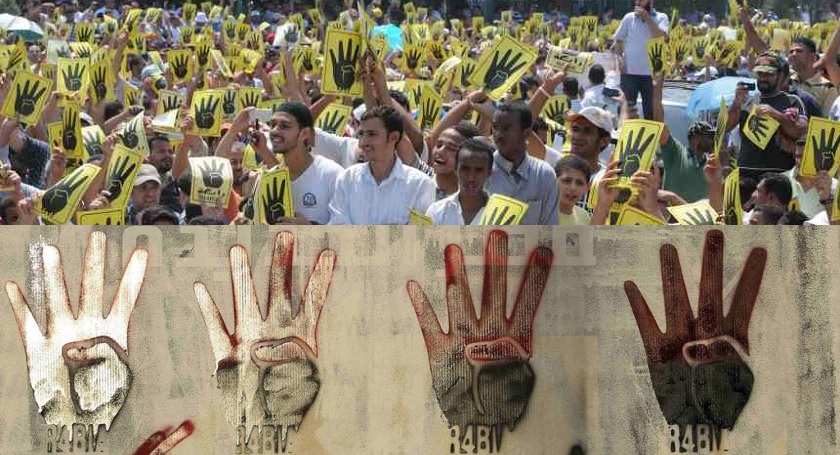



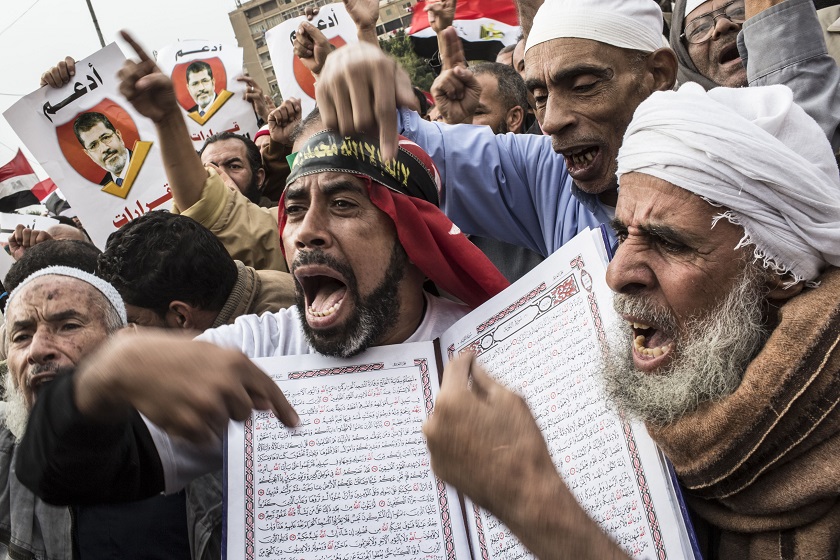


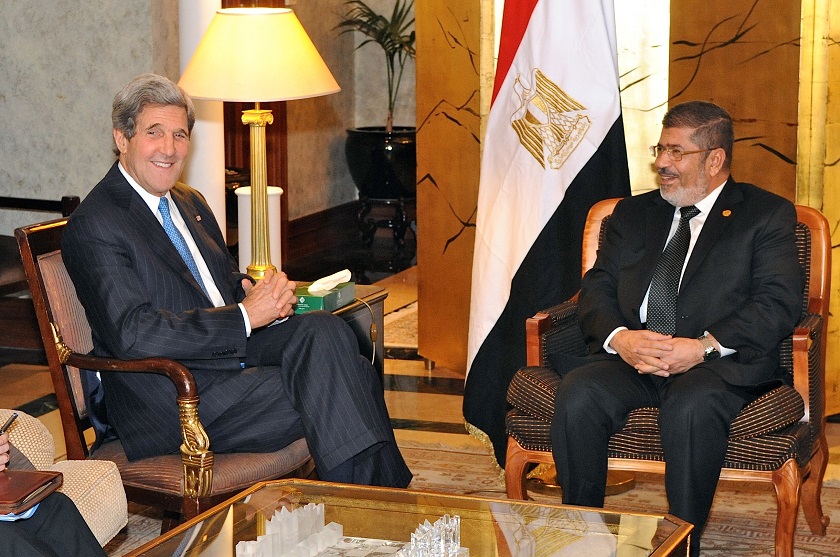
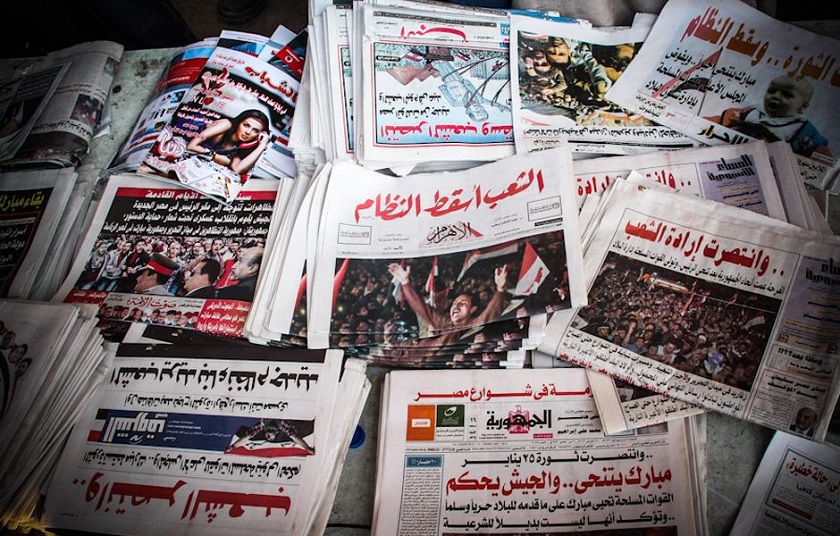



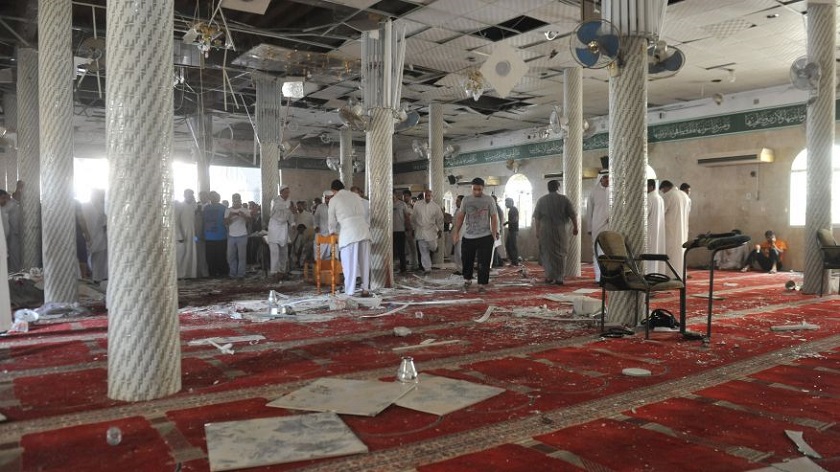
 Jayson Casper