Categories
Excerpts

Is the Brotherhood ‘Rethinking’?

Rethinking Political Islam
(from Brookings)

When Brookings released a new paper from a young Muslim Brotherhood member based in Istanbul within the context of an ongoing series on political Islamism, prominent analyst Eric Trager had a poignant reply on Twitter:

“Brookings’ “Rethinking Islamism” series jumps the shark, features MB who, of course, doesn’t rethink anything.”

I laughed, but upon reading the analysis of Ammar Fayed I also noticed some sections where the group does appear to have reviewed its current situation and its year in power. I will highlight a few sections below.

But Trager also tweeted a comment that rings somewhat true:

“Islamists on Islamism – By casting MBs as research analysts, Brookings is allowing itself to become Ikhwanweb.”

Much of the article is simply a restatement of the Muslim Brotherhood internal narrative. There is no mention of the Turkey-based satellite incitements to violence, and only token mention of the ‘blurry’ line between revolutionary protest and violent means. That the people turned against Morsi is attributed solely to state-controlled media, and current divisions in the group are downplayed against an inherent unity asserted without refuting current outside analysis.

As an insider, Fayed is in a good position to know, and the paper on this count is still very valuable. But perhaps Brooking miscasts it; it is less an analysis than the presentation of one particular trend within the organization.

Unfortunately, it also seems somewhat contradictory. The overall theme is that the Muslim Brotherhood has not turned to wholescale violence because it would contradict the longstanding traditions that favor a social outreach over revolutionary change.

Fayed provides a very useful insider’s view of Brotherhood history, and contrasts the group with more violent actors:

This “model” [of the MB] carries out social services through official institutions subject to the law and operates under the authority of the state. The other carries out social services only to further the direct replacement of an absent or failed state with “Islamic rule.”

I think this is true, but toward his conclusion he says that the group is starting to change in its understanding of its enemy:

The conflict has shifted from a political conflict between the Brotherhood as an opposition group and the ruling regime into a conflict between the Brotherhood and the idea of the Egyptian state itself.

I agree with the author that the Brotherhood has not turned to violence in large swaths. But in contrast to his intended point that this will not likely happen, this point opens up that the MB is warming to a position he cast earlier as the domain of extremists. Within it he also takes a swipe at the Coptic Orthodox Church, stating “in the view of many” they are “abettors to the killings and ongoing repression”.

Earlier, Fayed relates how this state apparatus framed the Brotherhood:

By the end of June 2013, the state succeeded in “factionalizing the Brotherhood,” by portraying them as fifth-columnists separate from the rest of the population with self-serving goals. The message was clear, that the Brotherhood doesn’t have Egypt’s best interests at heart, only its own.

Certainly this was a message mobilizing against the Brotherhood. The author spends much of the paper describing the group’s attitude toward social services, showing how it serves the good of society at large.

But at the start of the paper, describing the Brotherhood founder’s somewhat nebulous and shifting attitudes toward politics, he wrote:

In the opening of the first issue of al-Natheer magazine in May 1938, Hassan al-Banna clearly stated “Until now, brothers, you have not opposed any party or organization, nor have you joined them… but today you will strongly oppose all of them, in power and outside of it, if they do not acquiesce and adopt the teachings of Islam as a model that they will abide by and work for…There shall be either loyalty or animosity.”

Clearly, this us-versus-them mentality is deeply ingrained in the Brotherhood ethos. The ‘loyalty or animosity’ theme is also a hallmark of Islamic extremism.

But this leads to one of the author’s points of reflection. The Brotherhood needs to better cooperate with others:

As long as the Brotherhood’s political imagination is unable to overcome the mindset of “coup versus legitimacy” and develop an alternative political discourse that meets the demands of the disaffected social segments that ignited the January revolution, then the Brotherhood itself may be an obstacle in its efforts to build a new culture of protest.

And in Fayed’s final conclusion, he makes an appeal:

Until now, the group has not formed a clear political vision. Nor does it have the tools to remove the military from its political calculus. Therefore, the group must work with other forces that reject the policies of the current regime.

Such an alliance, he believes, can form a broad national front whose goals and programs are based on the priorities of the revolution at large. This national front could also delineate pragmatic plans to coexist with the political and economic influence of the military for the foreseeable future.

The strategy is sensible, but he fails to state one of the most significant reasons this is not happening. Early on, the national front forces he describes felt betrayed as the Brotherhood collaborated with the military against the revolution. Yet even in this appeal to them now he does the same – imagining pragmatic plans to coexist with the military.

In a sense, this may help prove his point. The Muslim Brotherhood is not a very revolutionary organization. In fact the author’s semi-solution is to consider abandoning the political project and return to its comprehensive social role. If out of politics, he posits, the group could be a powerful force to marshal the populace to push non-Brotherhood politicians toward Islam-inspired positions.

Here is where Fayed’s most powerful rethink takes place:

The Brotherhood’s brief experience of being in power and its subsequent removal by military coup has served to strengthen the idea of separating the Brotherhood’s role as a social institution from its role as a political force …

In hindsight, it appears that the Brotherhood’s direct participation in competitive politics has done substantial damage to decades of social and religious institution building.

But since this social institution building project has been dismantled, as he acknowledges, where can the Brotherhood go now? He doesn’t see the group diving into violence, but acknowledges there is no space for reconciliation with the regime as long as Sisi is in power.

In short, there is a deep impasse in which the Brotherhood can only hope that current conditions deteriorate until the people rise again in revolt. Whatever authority comes next, it seems, might be able to work out an arrangement to restore the group.

In history this has been seen before. After Nasser, Sadat gave an opening. It may be wise to wait. Without stating it so clearly, this may be his real analysis on why the Brotherhood has not resorted to violence.

Of course he also mentions the many Brotherhood members in prison, which makes a difference also. But instead of his focus on internal Brotherhood dynamics, I would propose a different reason:

Army unity did not break, Egypt is demographically homogenous, and the people do not like violence.

For consider, the Muslim Brotherhood in Palestine believes in armed struggle. The Muslim Brotherhood in Syria believes in armed struggle. Every situation is different, of course, but there is nothing intrinsic to the Brotherhood that believes in nonviolence. In Egypt, they made practical decisions on the best way to pursue their objectives within the scope of the possible.

In a vastly more constricted setting, they do the same today.

Had a division of the army broken off, should we imagine the Brotherhood would not have rallied behind it? Had they seized a portion of Upper Egypt, for example, would they not be fighting to defend it?

It is true the Brotherhood has not run off into Sinai, but an insurgency does not control Sinai, it only plagues it. Furthermore, the Brotherhood was never strong there, it would be unfamiliar terrain.

So why are not thousands of Brotherhood members committing individual terrorist acts? I would suggest it takes quite a bit to turn a frustrated political activist into a wanton killer, especially if there is no well-defined endgame. The Egyptian people do not like violence; Brotherhood members are drawn from the people. Besides, there is already a long history of Islamist insurgency from a few decades ago that only served to alienate the masses.

No matter how difficult the situation, they hold to the calculated decision that violence is still not the winning option. Give them at least some credit for this, but not necessarily the honor of principle. They have always been willing to fight, and the Brotherhood has never denied it. Their comprehensive vision of Islam does not sideline the use of force, only regulate it. The Brotherhood are pragmatists.

So what is Ammar Fayed? A very particular viewpoint within the Brotherhood that has won pride of place at an esteemed think tank. It may or may not be their dominant viewpoint, but it is insight into their world, provided the analysis is viewed within the possibility of propaganda.

In this Brookings is providing a very valuable service. It is allowing Islamists to speak into the academic discussion about Islamism. As long as it is properly introduced, I hope there will be more.

Categories
Excerpts

Why the Carnage in Pakistan?

Pakistan Lahore Easter
(via pakistantoday.com)

At least 69 people are dead in the Pakistani city of Lahore, many of them from Christian families celebrating Easter in a public park.

The Pakistani Taliban has claimed responsibility, stating it directly targeted Christians and promises further attacks in the future.

From Lapido Media, an anonymous British NGO worker provides a first-hand account:

A crowd of some 25,000 protesters had gathered in Rawalpindi, Islamabad’s twin city, and after prayers, started marching towards the capital. As night fell they arrived in front of the National Assembly building and fighting broke out.  Tear gas was fired, and the rioters smashed Islamabad’s new metro bus stations, assembled at great expense only a year earlier.

As we drove home from Easter Sunday celebrations we could hear the chanting: thousands of people in the heart of Pakistan’s capital city demanding that the government institute a policy of ethnic cleansing.

A challenging question is why such brutality exists, coupled with hardcore support for a blasphemy law that further targets religious minorities.

The author takes note of many signs of tolerance emerging after the tragedy in Lahore, and finds hope:

While there are Muslims who pray for the rights of Pakistani minorities; while there are Muslims who text me condolences on the Christian lives lost in Lahore; while there are Muslims who risk their lives to demand government action against radical clerics who openly declare their support for Islamic State –while such people exist, there is hope for Pakistan.

But he also lays blame on one man in particular who set it all in motion:

It is not easy to step back from three decades of officially-sanctioned Islamism; the retrogressive reforms of General Zia, who strengthened the blasphemy law and degraded the rights of Pakistani women, cannot be undone without a fight.

At such analysis Countercurrents balks:

There is a tendency among historians and analysts to place most if not all of the blame for the current state of affairs on the shoulders of the US-sponsored dictator General Zia-ul-Haq.

Instead, the author faults the very movement that created Pakistan in the first place:

In the late 1930s, elements within the Muslim elite, motivated by narrow and selfish interests, began to aggressively pursue an agenda involving the creation of a separate state for India’s Muslim population.

The oft-repeated phrase “Jinnah’s Pakistan” should be familiar to even the most casual observers. Those who conjure up this tired slogan whenever minorities are targeted must come to terms with the fact that it was the “Quaid” himself who set the dangerous precedent of using communalist rhetoric for political ends.

Jinnah, a westernized, non-practicing Muslim, cynically raised the cry of “Islam in Danger” as part of his campaign to drive a wedge between Muslims and Hindus and gain support for the partition of the Indian subcontinent among the sections of the Islamic clergy.

Based on the bogus claim that Muslims and Hindus constituted two distinct nations, the partition that gave birth to the “Land of the Pure” was a tragedy of immense proportions, resulting in an orgy of violence and untold suffering for millions of people on both sides of the artificial border.

What is happening is simply the inevitable result of official policy…

… rooted in Pakistan’s creation through the partition, that encourages the identification of Islam with the state, consequently diminishing non-Muslims to second-class status while also fanning the flames of religious fundamentalism and strengthening the power of the clerics.

Quartz, however, wants to absolve Jinnah, quoting:

His speech advanced the case for a secular, albeit Muslim-majority, Pakistan: ‘I cannot emphasize it too much. We should begin to work in that spirit and in course of time all these angularities of the majority and minority communities, the Hindu community and the Muslim community … will vanish.’

And again:

You are free; you are free to go to your temples, you are free to go to your mosques or to any other place of worship in this State of Pakistan. You may belong to any religion or caste or creed—that has nothing to do with the business of the State …

Now I think we should keep that in front of us as our ideal and you will find that in course of time Hindus would cease to be Hindus and Muslims would cease to be Muslims, not in the religious sense, because that is the personal faith of each individual, but in the political sense as citizens of the State.

That this has not happened is a fault that rests in the decline of the state itself:

Pakistan’s most prominent human rights activist, Asma Jahangir, warns that the worst is yet to come. ‘Past experience has shown that the Islamists gain space when civilian authority weakens,’ she pointed out in an article a few years ago.

‘The proliferation of arms and official sanction for jihad have made militant groups a frightening challenge for the government. Pakistan’s future remains uncertain and its will to fight against rising religious intolerance is waning.’

I am no expert in Pakistan, but right or wrong, this is analysis. The greater question is what can be done about it.

Categories
Excerpts

New Developments in Brotherhood Rhetoric

Muslim Brotherhood Child
(from Getty Images; the picture is from Jordan)

The Muslim Brotherhood once had a militant wing. It then spent decades rejecting the use of violence, but continuing to embrace its most strident ideologues.

After the fall of Morsi the Brotherhood must again navigate this heritage, with an old guard that is cautious and concerned about international opinion, and a youth movement that is passionate and concerned about the situation on the ground.

In his recent article for Foreign Affairs, Mokhtar Awad describes the most recent developments with each.

The old guard has made some strides, however, by controlling the Brotherhood’s international financing, which became far more important following Sisi’s severe crackdown on the group’s domestic financial operations.

With the money inside Egypt reportedly dwindling, there were fewer resources available to finance violent operations. Indeed, since the fall of 2015, there has been a noticeable dip in violence perpetrated by these new violent groups in the Egyptian mainland, which is only starting to pick up again.

These new violent groups do need authorization, however, to be sharia-compliant.

Still, the seeds for a radicalized Muslim Brotherhood, a sort of Brotherhood jihadism, have been planted. During the height of the revolutionary wing’s influence in early 2015, some of its leaders, as it is believed, informally commissioned a group of Islamic scholars to write a sharia-based manual on the question of violence.

The result was a 93-page book titled The Jurisprudence of Popular Resistance to the Coup. It was an obvious attempt at ijtihad, or legal reasoning, by non-Salafi jihadist scholars to reconcile Brotherhood creed with a methodology of violence.

These scholars declared that neither Sisi nor his government were apostates but were instead ahl baghy, or seditionists,who had turned against the religiously legitimate leader: Mohamed Morsi.

And since Sisi and his government had used violence against Muslim believers, they were considered enemy combatants who should be slain, according to sharia law.

But even these radicals still feel compunction to stay within the mainstream Brotherhood heritage.

This theoretical dance around the issue of apostasy is an attempt by the authors to reconcile Brotherhood teachings with violence without inviting damaging comparisons to Salafi jihadism.

Egyptians, and most Islamists, in fact, hold very negative views toward those who declare other Muslims apostates, or takfiris. The authors of the book are so careful that the text does not once mention Sayyid Qutb, the infamous Brotherhood ideologue whose takfirist ideas helped inspire modern-day jihadism.

Instead, the authors reference the Brotherhood founder Imam Hassan al-Banna and use his selection of two swords in the group’s logo, as well as his talk of “strength,” as a justification for violence against the state.

Read the full article for greater context, but here is one anecdote that shows how convoluted this heritage can be. It is difficult to esteem both swords and non-violence.

It warns against kidnapping and sexual assault of the women and children of security officers, but says there is no harm in threatening to do such things to scare them.


Categories
Excerpts

Cuba and the World Day of Prayer

World Day of Prayer Cuba

Today, Sunday the 6th, churches around the world will celebrate the World Day of Prayer, officially designated as the first Friday in March. The movement began in the 19th century, led by lay women in the United States. Today more than 170 nations participate.

But Americans may be surprised at the official program this year.

Two years ago the country of focus was Egypt, and I was able to contribute an article to Presbyterian Today. The choice of nation was made four earlier in 2010, before the onset of the Arab Spring, leading many to remark the selection was prophetic.

One might say the same about this year, with a focus on Cuba. At that time relations with the United States were still frozen; now a new light is dawning.

I am not certain when the program was written, but it contains nothing of the thaw. Instead, worshipers were asked to pray this prayer:

Forgive us when we have not created a genuine space for dialogue among those who differ from us; when we have not lifted our voices sufficiently to denounce an injustice like the economic blockade affecting the Cubans for so many years…

And later:

In Cuba, we pray that you transform the walls erected by the economic blockade into wide open doors that are ready to receive.

Perhaps this prayer has now been answered.

The Cuban World Day of Prayer committee did make reference to oblique ‘detention centers’ for undocumented migrants , and in the opening skit one elderly Cuban woman said, ‘My generation has kept the Faith despite much discrimination.’ But a Cuban child praised her school which also teaches her the Bible.

As Americans, we are used to thinking of the Cuban blockade as an essentially just aspect of our foreign policy. It began to stem the tide of communism, and continued to check a human-rights violating dictator.

Certainly the reality is more complicated, on both sides. But it is worth noting that Cuban brothers and sisters in Christ chose to frame the issue as one of injustice.

Today, therefore, let us praise God with them that doors have been opened. Politics is messy; issues are rarely black and white; there is ample room to disagree with the shift in American policy.

But as the Cubans chose to pray, let us join them:

Forgive us … when we have built up walls that have prevented us from giving reason for our faith and hope… Enable each of us to do our part in providing help for the suffering world around us.

Lord, hear our prayer.

WDP Cuba

As a postscript, the 2017 World Day of Prayer will focus on the Philippines. Will the choice again prove to be prophetic?

Then again, the 2015 nation was the Bahamas. Perhaps it skips a year. Take care Suriname.


Categories
Excerpts

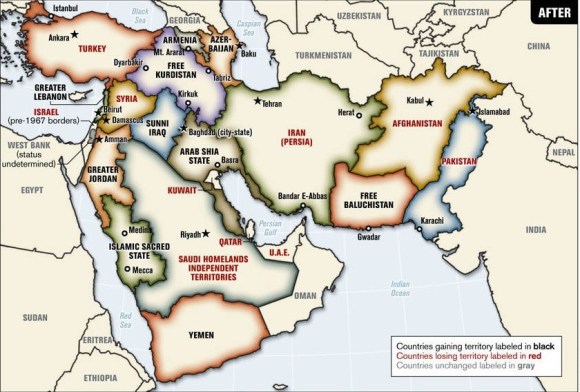
Redraw the Map: A Christian Call for Middle East Peace

Map of New Middle East

This article was published at Providence, on March 4, 2016.

The carnage is so severe, the atrocities so barbaric, and the impasse so intractable. Even when violence targets fellow Christians and their ancient communities, the morass of the Middle East can silence any moral response. Believers are tempted to throw up their hands in despair, for any proposed solution creates further uncomfortable complications.

If America stands with Assad in Syria we back his barrel bombs. If we side with the rebels we empower Islamism. If we stay neutral the killing continues, as friend and foe alike meddle on behalf of their favorite proxy. If we bomb only the Islamic State the core political issues remain. If we commit ground troops the specter of Saddam looms over all. Propaganda shrouds analysis in conspiracy, and regardless of action refugees pour out of a tinderbox ready to spark further war.

It is no wonder Christians are paralyzed to suggest anything.

Into the morass wades Terry Ascott, desperately seeking a way forward. And his solution tramples over one of the region’s most sacred cows, one only the Islamic State has dared address: Redraw the map.

Terry Ascott is the founder and CEO of the Arabic Christian satellite network SAT-7, though he is clear these remarks are personal in nature, unrelated to the work of the SAT-7, which I have written about in the past such as here and here.

I have also previously summarized an article from the London Review of Books that suggests the United States has conspired to create exactly the situation Ascott is calling for.

The article in Providence touches on the fact that a few others have suggested a solution in political division, but in purpose reflects Ascott’s Christian heart and rationale to stop the bloodshed. It also reflects his pessimism that the region can do this on its own.

Please click here to read the full article, and brainstorm with him.


Categories
Excerpts

Trump is the New…

Andrew Jackson Nikabrik TrumpIdentifying the alter ego of the front-running Republican candidate appears to be American’s favorite parlor game these days. An early winner is Adolph Hitler, with Benito Mussolini making a late charge. I have even seen some suggest Jesus.
But here are two more insightful comparisons.

T. Greer goes back in American history to find the first populist candidate to upset the establishment:

In truth, we do not need to look to foreign climes to understand Trumpism. Donald Trump is not America’s Hitler. Donald Trump is the 21st century’s Andrew Jackson.

Like Trump, Andrew Jackson ran for office at a time when an entrenched political aristocracy had controlled the American political system for decades.

Like Trump, Jackson’s supporters had lost their faith in this system and felt utterly isolated from its ruling class.

As with Trump, Jackson was a fantastically well off in comparison to the average American, but still a considered a complete outsider in elite circles because he was crass, rude, vulgar, and stupid–in other words, a joke, someone not to be taken seriously until it was too late.

Like Trump, Jackson’s success was built upon getting the people who the existing system excluded or ignored engaged in politics in a way they had not been their entire lives. In both cases these people tended to be less educated, not too well off, and of Scots-Irish descent.

Like Trump, Jackson was a nativist, a nationalist, and fairly racist. Both are in essence majoritarians, and their policy is to materially improve the livelihoods of the majority demographic, even if that comes at the expense of other groups.

Like Trump, Jackson used these voters to hijack a party coalition traditionally associated with limited government; like Trump, Jackson paid lip service to this philosophy (and sometimes, as with the banks, acted on his words) but possessed a temperament that put him at odds with it.

Like Trump, Jackson did not have a firm grasp of all the issues at hand on the campaign trail (compared to his opponents, who were quite wonkish), and had a pronounced tendency to personalize all political disputes.

Like Trump, this was one of his greatest selling points with the public: Jackson was someone who spoke as a common man did while being greater than any common man was. He “told it like it is.” Both understood the media technology and news cycles of their time, and took advantage of them in novel ways to “tell it like it is” to far more people than his opponents thoughts possible. You could say that Jackson, like Trump, pioneered a new style of campaigning. By doing so he quickly learned how to outmaneuver his political opponents into oblivion.

Like Trump, attacks that came against Jackson in response only seemed to make him stronger, and like Trump, most of these attacks were focused less on his ideas–which were always rather nebulously defined on the campaign trail, painted in broad strokes, so to speak–than against his character, especially his (or his family’s) alleged lechery, gaudiness, stupidity, or savagery.

I could go on, but you get the point.

Greer continues to compare the two eras to imagine what America might expect from a Trump presidency. In short, populism is a corrective for a political establishment that has fallen out of touch with a great part of the electorate. But the presidency is a much more powerful institution than it used to be, so the curbs on Jackson’s power may not restrain Trump as effectively.

In the second comparison, Gina Dalfonzo leaves history and enters fiction. Fans of C. S. Lewis may appreciate her warning, imagining Trump to be supported by Nikabrik:

In the story, you may remember, Narnia is in a desperate situation. The Telmarines have taken over, and the citizens of Narnia have been persecuted, silenced, and driven into hiding. When Prince Caspian—a Telmarine himself, but one who sympathizes with the Narnian cause—joins forces with them, this leads to a fresh round of attacks from the other Telmarines and their king, Miraz. The Narnians try to summon help by using Queen Susan’s horn—and they are successful, though not all of them realize it right away.

Drawn to Narnia by the call of the horn, Peter and Edmund and their guide, the dwarf Trumpkin, come upon a handful of Narnians meeting with Prince Caspian. Nikabrik, another dwarf, is angry that apparently no help has come from Aslan or the old kings and queens of Narnia. While others argue that “help will come” if they can wait patiently, Nikabrik contends that there is no time to wait: They are running out of food and reinforcements.

If Aslan won’t help, Nikabrik adds, perhaps another power will:

“The stories tell of other powers besides the ancient Kings and Queens. How if we could call them up?”
“Who do you mean?” said Caspian at last.
“I mean a power so much greater than Aslan’s that it held Narnia spellbound for years and years, if the stories are true.”
“The White Witch!” cried three voices all at once. . . .

This, of course, is the same Witch who killed Aslan in The Lion, the Witch, and the Wardrobe. Nikabrik has already gone so far as to recruit a sorceress to raise the Witch from the dead. But the others are horrified—so horrified that a battle ensues, joined by the Pevensies and Trumpkin. By the time it’s over, Nikabrik and his allies are dead themselves.

How could one of the good guys in this story become corrupt enough to seek help from someone whose greed, brutality, and lust for power were legendary? As Lewis well knew, it can happen more easily and quickly than one might think. It’s been happening throughout history, ever since the first time the Israelites turned to a godless nation for help instead of trusting God to save them.

One can make a case that it’s happening right now within the conservative movement in the United States.

The article does not chastise Nikabrik unduly. He has admirable characteristics and noble sentiments. But fear and concern for one’s own can blind human nature to a multitude of faults, if packaged as an answer to set things right.

These are not the only comparisons out there, but rather than engaging in the dismissive accusation of fascism, consider also these critiques on the presumptive red state candidate.

Categories
Excerpts

Misguided Ideas on the Egyptian Economy

Mideast Egypt Economy
(AP Photo/Nasser Nasser via skift.com)

Writing in the UAE-based National, Patrick Werr outlines six common motifs that Egypt tends to rely on for the promotion of its economy.

They are dead wrong, he explains, and actually harmful. Here is the list:

  1. A strong currency means a strong Egypt
  2. Egypt has vast desert areas. With only a bit of resolve they can be turned green
  3. Egypt needs to grow its own wheat so it can stop importing
  4. The government needs to build more housing to meet growing demand
  5. The country needs megaprojects to get the economy going
  6. Moving government offices out of the city centre will ease traffic congestion

Werr has worked as a financial writer in Egypt for the past 25 years, so his experience and cultural understanding is extensive. Click on the link above to read his justifications.

But here is one section to highlight. It shows he does not oppose all megaprojects, and proposes a much better investment I heartily agree with:

The good ones, in my opinion, are the Suez Canal corridor project and the rapid expansion of power plants. If only they would add a massive expansion of metro and light rail.

Egypt currently has two operational metro lines, with a third about one-third completed. A fourth line is designed to be fully operational by 2020, with lines five and six envisioned for the future.

As a dedicated urban walker and rider of public transportation, it will be wonderful to access more of the city for the current price of $0.13. Perhaps this must rise in the months or years to come, but to assist a congested Cairo and its lower income residents, I see no better or immediately practical solution.

As for the rest of Werr’s ideas, you be the judge. But to the degree possible, judge in dialogue with Egypt, that she might find her way to a stronger economy for all her citizens.

And as an earlier post speculated, it will also benefit the world.

Categories
Excerpts

Reflections on Obama’s Mosque Visit

Many have praised President Obama’s recent visit to a Baltimore mosque and affiliated school. Others have been critical, but it is important to counter a rhetoric that is increasingly casting shadows upon fellow American citizens.

But here are two Western Arab voices that express a little concern. The first is a UK-based Muslim, Nervana Mahmoud. She cites official White House photos that present a ‘cropped’ picture of American Islam.

Obama Mosque Visit
(Official White House Photo by Pete Souza)

The leader of the West’s strongest nation has opted to strip Islam from its centuries-old, colorful diversities and frame it within a monochromatic conservative style—a self-defeating approach from a man who advocated for diversity among weary Americans who wish to shelter their country from the turbulence of the Middle East. … The lack of non-Hijabi women among the attendees, even among the children, is striking.

Nervana counts herself a liberal Muslim, and wishes this sector had been highlighted. She is confused why a progressive American politician would choose such a mosque for the spotlight.

Non-Islamist Muslims exist in America as well as in their native countries. Iranian Americans, for example, will undoubtedly tell the president tales about oppression, dress code, and the Islamic Republic of Iran. Other liberal Muslims fight against segregation, enforcing Hijab upon children.

Almost all mainstream Muslim scholars agree that Hijab for pre-puberty children is not obligatory. The American leadership that fights the Islamic State’s oppression, however, seems tolerant of such indoctrination of children.

Coptic-American Maged Atiya suggests that no matter the mosque the venue would have been criticized as unrepresentative. But he is disappointed that such a cerebral president offered such an empty speech.

It is heavy on optimism, on declarations of belief in liberal values and tolerance, and on deep faith that fundamental forces will force a happy outcome. In short, that we are destined by the arc of history to a fair, just and tolerant outcome in any struggle.

The trouble with that view is that it offers no guidance to short-term policy that will actually lead to such outcomes in the long run.

… The Baltimore speech does American Muslims injustice by lack of acknowledgement of real barriers that stand between their desire to conform to a conservative version of their faith and yet integrate effectively into American society.

He laments Obama’s missed opportunity to really tackle this issue with substance. If so, he could have addressed the core competing values.

There are major differences between the ethos of conservative Islam with its backward glances and emphasis on community sovereignty and the liberalizing trend of American society with its emphasis on the liberation and autonomy of the individual.

Glossing over these differences leaves all exposed when the conflicts inevitably come to the surface. Bigots among American non-Muslims will insist that Muslims can never be “full Americans”, while bigots among American Muslims will insist that such differences are merely manifestations of irrational hatred of Islam. This is a disservice to any effective understanding and outreach between faiths.

I am sympathetic to both viewpoints, but also willing to propose an explanation.

Whether the choice to not wear hijab or sport a long beard and traditional clothing comes from conviction, compromise, or apathy, many of these Muslims mix easily into Western life. They may or may not believe fully the tenets of Islam, may or may not pray at home or the mosque. But in the panoply of American diversity they look more or less like everyone else, and thus, I imagine, draw neither the ire nor support of culture warriors.

Perhaps Obama chose to highlight such a mosque precisely because it draws such a visual image. You, too, are welcome in America. The vitriol of much political discourse targets you, and must be spoken against. Your clothing choices reflect your faith, and for this there is freedom. We must defend it vigilantly, and publicly.

If this is a sentiment behind Obama’s choice, it may also illumine his speech. The presidency is often more a bully pulpit than a university lectern. As hard as some are hitting Muslims these days, the force of rhetoric must be returned. Where fear and suspicion are preached, let principles and idealism respond.

But the criticism of both authors is fair. The complexity of this issue must be honored, and Muslims come in a million stripes.

But they also come as individual citizens. All but the tiniest minority deserve the full scope of American freedoms. American political leadership should do justice to both these realities.


Categories
Excerpts

Egypt: African Handball Champion

Egypt Handball
(from Egypt2016.com)

Congratulations to the Egyptian national handball team, for winning its sixth continental title on Saturday.

While the national soccer team has slipped in quality since the revolution, the handball team holds steady as one of Africa’s best, defeating Tunisia in a hard-fought 21-19 final on home soil.

Twelve nations took part in the competition, but only three have ever won the title. The sport is dominated by North Africa, with Tunisia and Algeria the other traditional powers.

But this year, Angola shocked defending champion Algeria to claim third place. It was Egypt’s first title since 2008, and now qualifies with Tunisia for the world championships in France.

Many Americans are not familiar with the sport of handball, but I highly recommend it for its fast-paced strategy and athleticism. So also with squash, another sport at which Egypt excels.

But while Egypt takes pride in its success in these sports, it is soccer that moves the national consciousness. A revival on the pitch could significantly contribute to lifting the country’s spirits.

But while waiting, celebrate with Egypt a considerable accomplishment.

Categories
Excerpts

Two Futures of the Arab World

Arab World

Writing in YaleBooks, Tarek Osman pens a long essay on how the region might develop – or devolve. There is an extensive recap of current ills, of which I will highlight two that are less noticeable on the nightly news:

Arab educational institutions have been failing for decades now. No Arab university appears in any serious ranking of international higher-education. The Arab world’s contribution to global research and development, in almost any scientific field, is negligible.

A region with over 300 million people does not have a single newspaper, think tank, or artistic establishment with global reputation, let alone clout. As the public space disappears and the major institutions that used to act as bulwarks of art and culture have crumbled, the mechanisms that in the early and mid-20th century generated major advances in Arab thinking, exposure to the world, and literary and artistic creation have been weakened.

This has reduced the size of the Arab intelligentsia, which has traditionally absorbed and championed political development, economic reform and the empowerment of civil society.

And, after lamenting brain drain to the West:

The Arab world suffers another form of emigration: inward. Scores of talented and liberal Arabs have come to believe that working totally out of the traditional boundaries of their societies will produce better futures for themselves and their families.

Many are isolating themselves from their own societies. They work in enterprises (especially in high-end services) that are connected to the global economy, much more than to the economies of their own countries; they live in gated compounds or leafy suburbs, away from the region’s pulsating cities; they send their children to foreign schools and later western universities; and even in entertainment they ensconce themselves in House of Cards, Breaking Bad and indie cinema.

Mentally, emotionally, and in their values they are becoming aliens in their own societies.

But eventually he transitions to a point of hope. It is fueled by the fact that private enterprise is taking the place of the government-run economy, with knock-on benefits:

Modern digital communications have given them (and others in lower social strata) immense, and unprecedented, exposure to lifestyles and modes of social interaction in other parts of the world. Large groups of young Arabs now expect to live much more fulfilling lives than these of their parents.

This has not only fuelled consumerist tastes; it has also forced some of the region’s regimes to at least pay lip service to concepts such as rule of law, fighting corruption, diluting economic concentration of power, enhancing transparency in decision making and installing checks on executive authority.

It was not a coincidence that all the Arab constitutions which have been drafted or amended in the last four years, have enshrined these concepts. Implementing these remains elusive. But these concepts have been forced on the national agenda in many Arab countries and that many Arab states felt compelled to address them, is a valuable step.

But the author is quite aware that these positive developments will not cover over the many obvious problems of the region. But worse, they may wind up being limited to an isolated few — based on socio-economics, not geopolitics. If so, here is his warning to the world:

Apart from the fragmentation of large parts of the region, this scenario will herald a graver consequence. Here, the Arab world will become irrelevant to the vast majority of human advances in science and technology, and to the new illuminations in human thinking and development.

In this scenario, the Arab world will increasingly become a burden on the world, primarily exporting problems to the global community. Many in the world, and especially in the Arab world’s giant neighbour Europe, will try to distance themselves from it, seeing it not as “a sick man” (as the Ottoman Empire was described in the nineteenth century), but as a “bomb” that the world should always ensure it does not explode – at least because of its large demographics.

International interaction with the Arab world will range from economic assistance or realpolitik cooperation with its strong regimes – different efforts to avoid the explosion of the bomb.

Therefore, what must be done now? The author does not conclude with much more than his previous descriptions, but here is his hope:

The endeavours of the Arab world’s genuine private sector, civil society, and innovative young thinkers and artists can save the Arab world such a painful outcome.

Let us wish them well. But what, if anything, can the outside world offer now, rather than later?

Your ideas are welcome.

Categories
Excerpts

Curing Hepatitis C in Egypt

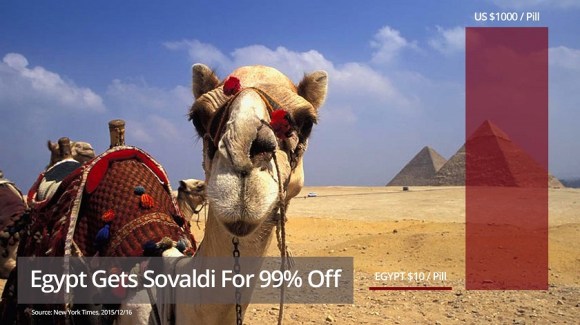
Sovaldi Hepatitis C
(from prescriptionintelligence.com)

A few decades ago a poorly–but widely–administered effort to immunize against a local disease resulted in ten percent of the Egyptian population becoming afflicted with Hepatitis C.

Over the past year several headlines have celebrated the partnership of the Egyptian government with drug companies offering new treatments at a fraction of the cost.

A recent article from the New York Times describes the campaign as a grand experiment to get medicine to the poor while preserving international profit rates for producers.

As the AIDS crisis took world attention in the 1980s, this sector was slammed for abandoning the African continent. In Egypt, they are trying to apply lessons learned.

Worldwide, four times as many people suffer from Hepatitis C than AIDS.

Last year, Gilead Sciences, based in California, offered an alternative.

The company makes sofosbuvir, which since 2013 has been sold in the United States as Sovaldi for about $1,000 per one-a-day pill. A course of the drug, taken with ribavirin and often interferon, usually cures hepatitis C infection in 12 weeks.

Sofosbuvir is an enormous blockbuster; in its first year on the market, the drug earned Gilead more than $10 billion.

But for the past year, Gilead has sold the drug to the Egyptian government for about $10 a pill. The government distributes it to pharmacies across the country, where it is dispensed free to patients.

But here is the catch, to fight the black market:

All pills must be dispensed by government pharmacies, for example, and all patients must turn in an old bottle to get a fresh one. Those receiving new bottles must immediately unscrew the cap, break the seal and take the first pill in front of the pharmacist — making it nearly impossible to resell the bottle.

And though many have criticized on human rights grounds, the government-drug maker partnership understands its audience:

“I agree with this completely,” said Mr. Ellabbad, the air-conditioning repairman. “I’m a poor man. If I did not have to hand in the bottle each time, I might have sold them to buy my son a house.”

The article is thorough and fascinating. Click here to read it in full at the New York Times, and wish Egypt all success.

Categories
Excerpts

The American University in Cairo: Ranking and Pictures

AUC LogoCongratulations to the American University in Cairo for their placement in this year’s QS World University Rankings. Measuring only the top 700 universities in the world, AUC came in at number 345. This is tops in Egypt, with the only other measured institution being the acclaimed Cairo University in the 500-550 range.

It is also the fourth highest ranked African university, behind three from South Africa. MIT, Harvard, and the UK’s Cambridge occupy the top spots worldwide.

But according to the AUC press release, the school scored higher than several prestigious US institutions:

In the 2015 – 2016 QS World University Rankings, AUC ranks ahead of several U.S. universities that are also private, mid-size, four-year liberal arts institutions delivering a curriculum comparable to AUC, including Brandeis University, Wake Forest University, Lehigh University, College of William & Mary and Southern Methodist University.

A while ago I visited the new AUC campus, which is quite a distance from its historic Tahrir Square location, where it still maintains administrative offices, operates a bookstore, and hosts educational and cultural events. Tahrir is easily accessible by metro, whereas students must now commute over an hour to get to class. But a high-quality bus runs on set schedule, mirroring the high-quality campus, all funded by high tuition far outpacing any fees charged by Egyptian private universities.

(Click here for a recent post on fees charged by private high schools operating in Egypt.)

Please enjoy the pictures below:

Upon arriving by bus at the university gates
Showing the extent of campus grounds
A view from the grounds
Though some female students wear hijab, a great number did not, far more than the normal percentage in Egypt
The university provides plenty of open space to sit, relax, and mix -- also somewhat unusual between genders in Egypt
The university provides plenty of open space to sit, relax, and mix — also somewhat unusual between genders in Egypt
There is also a sizable foreign population at AUC
Besides modern buildings, AUC has also created a modern oasis
But here the grass is much more patchy -- imagine the water necessary to create green open space on the outskirts of a desert
But here the grass is much more patchy — imagine the water necessary to create green open space on the outskirts of a desert
A typical and well equipped classroom
But before classes begin, students linger in the main square signing up for different student groups
Afterwards, they will visit this very familiar university site
Finally, no campus is complete with insignia available to purchase and wear
Finally, no campus is complete without insignia available to purchase and wear

Again, congratulations to AUC on their ranking. Click here for the university website and explore on your own. Perhaps some might even come and enroll. Welcome.

Categories
Excerpts

The Transitive Property of Journalism Principle

(from Daily News Egypt)

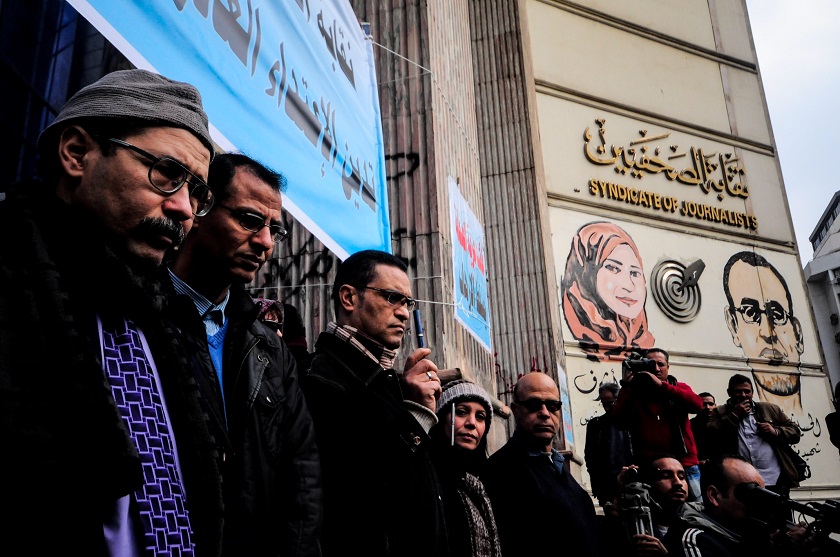
Double standards are human nature, but seem also to be evident among some of Egypt’s journalists. Consider these two articles from Ahram Online.

Two weeks ago President Sisi made a speech in which he criticized the media:

“I heard a media personality saying that the president was holding talks with representatives of foreign companies while Alexandria was sinking. Speaking like that is totally unacceptable. We can’t deal with our problems this way,” he said, referring to TV host Khaled Abu Bakr who criticised him during the flooding in Alexandria.

But the syndicate held its ground, and responded:

“Constructive criticism is the way to build a state with justice and freedom regardless of how strong it is or its nature or the person who is being criticised,” a statement issued by the syndicate read.

All well and good. But consider the syndicate’s reaction when a member receives apparent ‘constructive criticism’:

Egypt’s Press Syndicate announced on Monday its solidarity with the Chamber of Audiovisual Media Industry’s (CAMI) decision to ban lawyer and Zamalek Club chairman Mortada Mansour from appearing on its TV channels.

“We call on all journalists who are members of the syndicate to boycott any pressers held by Mansour as well as not report on any of his statements,” the syndicate said in a statement.

There is a history here, of course:

The Press Syndicate’s statement also announced its solidarity with CBC “especially since Mansour has returned to attacking journalists and media personalities.”

For his part, Mansour decided late Monday to cancel the membership of several prominent journalists at Zamalek Sport’s Club in response to the CAMI and Press Syndicate decision.

Mansour is certainly a firebrand, not averse to making controversial and often ill-founded statements. But what was his concern in this case?

Mansour had accused El-Hadidy of intentionally not giving a voice to his son Ahmed Mortada Mansour while he was running for parliament last month.

Mansour claimed that his son, now an MP, wanted to make a phone call on El-Hadidy’s show, which she refused while at the same time hosting  his rival in the electoral race, Amr El-Shobaki.

At issue, of course, is whether or not the accusation is true. The article gives no indication either way.

But it appears contradictory for the syndicate to insist to the president on the right of free and open coverage, including criticism, when it calls for a media blackout against one who criticism them.

Consult the Sermon on the Mount for more information.

Categories
Excerpts

How Dubious are Egyptians?

Last week I highlighted a poor op-ed from the Washington Post. This article from the New York Times is better, but its headline is well, dubious.

New York Times DubiousEgyptians do thrive on conspiracy theory, though they should be accorded a degree of sympathy given the troubles and outside influences on their region.

Now, writing a headline is almost more art than journalism, sometimes crossing the line into marketing. The author is forgiven, and may not have had say in the final wording.

But the body of the article does not quote one single average citizen to make its point. It opens with President Sisi urging Egyptians to even go without food if necessary in the face of threats. Then the closest it comes to demonstrating popular rejection of the message is this:

After Mr. Sisi’s bellicose talk of going without food, “people are just making fun of him,” said Hisham Kassem, a veteran Egyptian journalist sympathetic to the president. “I am disappointed.”

Hisham Kassem is an important voice. As a journalist he should be expected to have his ear on the street. The author does well to quote him, and builds a case against the Egyptian habit of resorting to conspiracy.

Unfortunately, other voices quoted are from influential Egyptians outside of the country. They are critics of the regime, and some have fled for their safety. Their voices are also important, but they are not well placed to demonstrate the popular reception of government statements.

The article also quotes media figures in Egypt, and even an ordinary citizen, who express criticism of the regime:

During parliamentary elections, one pro-government talk show stunned viewers by broadcasting a call from a woman who said her disappointment with Mr. Sisi had kept her from the polls. She cited a much-hyped economic conference hosted by the president that failed to bolster growth, and an expansion project billed as a “new” Suez Canal, which had resulted in a decline in toll revenue. “I am sorry, but we are kidding ourselves,” she said. “I feel cheated.”

And it ends with a powerful statement from a prominent broadcaster who chastised the recourse to conspiracy and urged Egypt to take responsibility for itself:

Lamees el-Hadidi, one of the most popular pro-government talk show hosts, said in a broadcast that the government was compounding the economic pain from the plane crash by scaring away investors with the detentions of a prominent investigative journalist, Hossam Bahgat, and a newspaper owner, Salah Diab.

“If I am now in a very difficult situation with tourism and a foreign plot, do I need to make another problem with investments and another problem with freedoms?” she asked. “We don’t need a foreign conspiracy. We are the conspiracy itself. We conspire against ourselves!”

But these voices concern a popular discontent over the economy and to a lesser degree, over rights and freedoms. These are present, but they do not speak to a ‘dubious’ attitude towards either the state narrative or the conspiracies that swirl around.

I would say the great majority of Egyptians believe that outside forces are out to get them. And this attitude is shared equally by pro- and anti- regime.

And they have good reason. Right after the Russian airline crash, when early speculation imagined a terrorist missile, the UK’s Daily Mail published a story about a British tourist airliner having to take evasive maneuvers to avoid a similar fate.

Besides enraging the Egyptian public, this article was – to use a British expression – rubbished by the UK government:

UK’s Foreign Secretary Philip Hammond described on Sunday the Daily Mail’s allegations that a British passenger plane “had been seconds” from being struck by an Egyptian rocket last August as a “red herring.”

I have no explanation for the article, but it came amid a media frenzy that has now resulted in the restriction of UK and Russian flights to Egypt, crippling the tourist industry. Already struggling for foreign currency, this crisis is estimated to lose revenue of $280 million per month.

As Salama Moussa has repeatedly written, Egypt must face up to its self-inflicted wounds and take responsibility for itself. Foreign nations can help.

Foreign media has a role to play as well, and the power of shaming – though not appreciated in the Middle East – can be strong. The New York Times article describes well much of what is happening in Egypt.

But it would do better with a proper headline, especially one that is better documented. Perhaps nothing the author could have done would have made a difference, but the result among Egyptians is that this is just one more example of Western media misrepresenting it.

And sadly, they are not short of evidence that can be similarly construed.

Categories
Excerpts

The Price to Sidestep Egyptian Education

Cairo American College (from www.perkinseastman.com)
Cairo American College (from http://www.perkinseastman.com)

Cairoscene recently published a list of the seven most expensive schools in Egypt, with a picture of each. Here is the summary, with all figures in American dollars, per year:

  1. Cairo American College – $22,900
  2. American International School in Egypt – $10,300
  3. British International School in Cairo – $9,285
  4. Modern English School – $8,855
  5. El Alsson – $7,900
  6. The International Schools of Choueifat – $7,450
  7. Canadian International School – $6,990

One of Egypt’s deepest problems is its education system. Schools are overcrowded; teachers are underpaid. Many parents will spend much of their income on tutors to make up for the deficiency and ensure their children can pass exams.

But wealthier Egyptians can sidestep the system entirely, opting for high priced foreign curriculum. Many of these schools also employ international teachers, and pay them accordingly. Expat families also populate these schools, and Egyptian parents are thankful for the all-English education and interaction with foreign speakers.

To avoid government education there are also less expensive options for Egyptians. There is a system of ‘languages’ schools, private institutions that use a government curriculum in Arabic for the humanities and English for the sciences. They can cost several hundred to a couple thousand dollars per year, and are generally all-Egyptian.

There is also a system of religious schools, mostly Catholic, open to all Egyptians and also using the national curriculum. They tend to have a strong reputation for education and discipline, teach French or English alongside Arabic, and can cost significantly less.

The new constitution mandates a percentage increase in overall budget expenditure for education. Hopefully in time it has an effect and gives a solid foundation to all Egyptians, not just those who can pay for it.

Categories
Excerpts

Rudeness and Retort: The Russian Airline Crash in Sinai

(from Egyptian Streets, sharing a screenshot from the Washington Post)

The downing of a Russian tourist plane over Egypt’s Sinai has stirred the emotions of many. An editorial is allowed greater range of expression than that expected of sober journalism, but this analysis by the Washington Post is not only frightfully early, but incredibly rude:

The state media controlled by Messrs. Putin and Sissi have a nasty habit of blaming all disasters on the United States, no matter how far-fetched the theory required. So we won’t be surprised if Russians and Egyptians are told the CIA is somehow responsible for the tragedy in the Sinai. Those seeking a more rational conclusion must consider this somber point: The Egyptian and Russian regimes are far less adept at fighting terrorism than they are at lying.

The above is their conclusion, even though the authors admitted neither Putin nor Sisi have ruled out terrorism. In fact the editorial earlier stated:

As U.S. officials underlined, there are strong indications but so far no conclusive evidence that the plane was bombed.

The Washington Post story caused the independent grassroots publication Egyptian Streets to publish its own editorial demanding an apology:

I find this editorial one of the most sickening pieces I’ve read in my life. The Post, walking the line of most of the western media, believes it has such a high moral stance that it can pass on judgements about a government that lost 224 of its citizens in a plane crash, and another that will suffer severe consequences in its tourism industry due to it. Instead of showing solidarity and support for a country that is struggling to get back on its feet, the western media seems almost cheerful that this accident took place. They are taking the opportunity to politicize the misery, in an attempt to undermine the Egyptian and Russian governments – falling so low as to accuse them of being liars.

The author is clear the Egyptian government has many failings, but that it has indeed made great gains against terrorism. And if the Post wishes to chastise a nation for falsehood in connection with terrorism, it has a far better target:

Under the pretext of the war on terror, the United States and the United Kingdom occupied Iraq with no international mandate, hung its president, dissolved its ruling party, fragmented its military and shed millions of innocent Iraqi lives. The United States government lied about Saddam Hussein having weapons of mass destruction – and no US or UK official has been held accountable for this lie until today. Besides the destruction of the Iraqi State and the killing of over a million innocent civilians, the invasion has also fueled the creation of the very terrorists Egypt is fighting today.

So are the ‘locals’ quick to scapegoat anyone but themselves?

Egyptians are not hysterical people who would continuously blame all of their problems on the United States or the CIA, as the Post alleges. Egyptians have legitimate reasons to be wary of American foreign policy in the region, as they are suffering its catastrophic repercussions today.

I don’t know what is taking place behind the scenes. But the Egyptian government has stated that Western governments have not shared the intelligence being mentioned in the press. Is this also Egyptian blustering? If not, then why is critical evidence being released to the public before going to the sovereign nations responsible to sort out this tragedy? The inquiry the Post labels as stonewalling also includes Irish and French experts. Are these in on it also? Why the rush to judgment?

Of course, about the only good reason would be that they did share it, and Egypt still obfuscates. If it was a bomb, and if the governments are more concerned about their shelf-life than their citizens, countless lives of foreign vacationers could still be at stake. If Egypt was to bury its head in the sand, the media slap in the face might be needed. After all, neither Egypt nor Russia have the best record of transparency.

But such rudeness from a respectable publication?

To start with, it is beyond doubt that the Egyptian government has its flaws in managing the economy, its overflowing and corrupt bureaucracy, and its lack of respect for human rights. But things have come to a point where the western media needs to be put in its proper place.

That place is to report, to investigate, and to hold accountable. That day may come for Sisi’s and Putin’s handling of this tragedy. But until then, take care before calling someone a liar. And show respect to a nation in crisis.

Categories
Excerpts

The Return from Syria

(from Sputnik news)
(from Sputnik news)

Writing for Carnegie, Mukhtar Awad writes a long but thorough history of Islamist radicalization since the movement to oust Morsi as president. Towards the end he issues a warning that might not be on everyone’s radar:

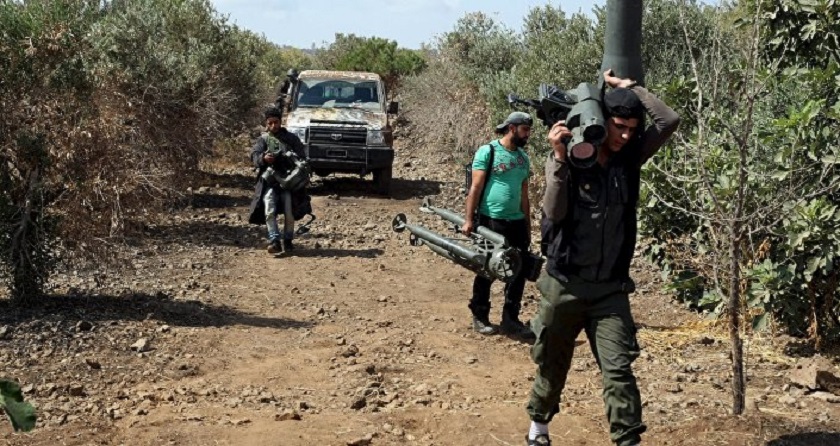
The eventual return of Egypt’s many itinerant jihadists—probably several thousand—is another factor that will likely increase jihadists’ recruitment of Islamist youth and the possibility that nonjihadi violent groups embedded in the Egyptian mainland will turn into active cells of the Islamic State and al-Qaeda. There is a precedent for this. When Egyptian fighters returned from jihad in Afghanistan in the 1980s and 1990s, their actions precipitated the bloodiest years of the previous insurgency.

The brutal and successful Islamic State has inspired many young Islamists to wage jihad, particularly after its conquests in Iraq and Syria and its infliction of significant casualties on the ranks of the Egyptian military. An increasing number of Islamists have joined its ranks, and others have fought under the banner of jihadi groups in Libya. Al-Qaeda also remains a popular touchstone among those who reject the Islamic State’s claim to the caliphate and its gross barbarity. Its branch in Syria, the Nusra Front, is another successful model in the view of young Islamists, and some Egyptians have traveled to join its ranks.

Many Egyptian jihadists who left in the 1980s stayed overseas to fight in regions like the Arab Maghreb—one estimate by a pro-government center run by a retired senior officer puts the number at anywhere between 8,000 and 10,000 Egyptians, though these numbers could not be independently verified.47 Egyptian authorities claim that at least 3,000 Egyptians have traveled to join the Syrian jihad since 2012, a number that peaked during Morsi’s presidency.48 This number is also impossible to verify, but an Egyptian Islamic State fighter based in Syria interviewed for this paper confirmed that the number is likely close to several thousand.

As escalating as Russia’s intervention in Syria has been, having them at the table could ironically serve as a basis for an eventual political solution. Far too much blood has been shed to offer even the faintest praise to anyone, but at least there is coordination among the major powers, including efforts to involve Turkey and Saudi Arabia as well.

If peace can eventually take hold, where will all the foreign fighters go? As Awad states, Egypt has dealt with this scenario already. But in the ongoing effort to regain stability, it would be the oddest of consequences that peace in Syria might throw Egypt off kilter again.

Categories
Excerpts

Can Muslims Reflect Critically on their History?

Artwork depicting the Bulgarian War of Independence, against the Turks

In advance of the Yom Kippour / Ashura holiday, CNN ran a very interesting op-ed written by Haroon Moghul about the links between Jewish and Muslim commemoration. But he drops a hint about history that can be very provocative among Muslims, though he develops it in a direction, that while essential, misses the bigger challenge.

But kudos to him for opening the door. Perhaps he has reflected more fully elsewhere.

He writes:

I know a lot of Muslims who demand the West own up to its sins. They expect Western schools, institutions and leaders to acknowledge the dark side of our history. The expansionism, imperialism, colonialism.

I wonder, though, if we could tolerate the same introspections in our mosques and madrasas. It’s easy to talk about being the victim. It’s a lot harder to talk about doing wrong. It’s easy to talk about what other people do to you. It’s hard to talk about what we do to others. Or what’s done in our name.

His very next paragraph, which I will quote below, provides the hint. But instead of pursuing it he goes on to make still worthy reflective criticism on the merging of Islam and ethno-nationalism and the political use of the religion. For example:

Today, Syrians die by the thousands, attacked by a Ba’athist regime uncritically supported by the Islamic Republic of Iran. A revolution that came to power calling the despotic shah a tyrant has now inaugurated a regime with a more murderous record. Iran, with its allies in Syrian President Bashar al-Assad and Hezbollah, have killed and tortured more than even ISIS has. Like ISIS, too, it happens in my religion’s name.

The author then asks the reader not to take his confession as an opportunity to ‘pile on the Muslim world’, and then offers criticism of American politics and culture, where we walk a similar path. It is good of him to find parallels and challenge toward the pursuit of justice, though readers will be divided if his examples hit the mark.

I beg his patience if the following is interpreted as piling on. But take note of the tense of the original hint: ‘It’s hard to talk about what we do to others,’ he writes. Not what we have done.

Here is the paragraph I delayed quoting:

When I was young, I was taught about Islam as a catalog of battles and conquests, rules and rituals. There was little serious ethical deliberation, not much in the way of cultural direction and precious little spiritual content.

Above, Moghul mentioned the Muslim tendency to ask the West to own up to its sins. Many have. Pope John Paul II, especially, offered apologies for the Christian share in the sins of our history. Perhaps today many conservative Christians must face the reality of how their support for a war in Iraq contributed to the emergence of ISIS. Not many are yet apologizing, but at least some, like Tony Blair, are beginning to reflect.

Let not Christians, or even America, be fully blamed for this tragedy. And similarly, though Moghul is right to ask Muslims to consider how they have permitted a world where Islam is so fully implicated in the most wretched of atrocities, neither Muslims nor Islam are guilty. Only those committing crimes.

But just like Christian history, Muslim history is also full of sin. At least, many Christians can look back and admit this. Are Muslims also able to do so?

Again, Moghul asks for consideration:

The first Caliph, Abu Bakr, died of natural causes. He lucked out: The second Caliph, Umar, was assassinated. The third, Uthman, was killed, too, except by his own troops. The fourth, Hussain’s father, Ali, was assassinated by radical Muslims — the Khawarij, the precursors of ISIS — while in prayer…

Who wants to focus on this history?

In fact, many Muslims near-mythologize their early history altogether. Salafis in particular look back at the first three generations of Muslims in the most uncritical terms. They wish to craft a present based on restoration of this enlightened past. Who has practiced Islam correctly, they ask? The answer is logical: Those who were closest in time to Muhammad.

But these closest in time were also those who launched Islam’s much celebrated wars of expansion. In Arabic they are called al-Futuhat al-Islamiya, the Islamic openings. They are heralded as the beginning of a golden age that saw Muslims reach the pinnacle of world civilization, as nations from Spain to India were enveloped in the fold.

It will be good to remember Moghul’s appeal not to pile on. Nearly every civilization was built upon military might. While the caliphate spread by the sword, most conversions happened voluntarily over time, though with many this-worldly inducements. Muslim history witnessed great examples of chivalry and compares favorably to some of the baser instincts of Christian expansion and crusade. And no matter the time, place, or people, war is hell.

But so was Muslim war and the ambition that fueled much of it, whether ethnic, nationalist, political, or religious. Can Muslims today look back on this period, and apologize? Even as the much needed nuance of justification is offered–and at times accepted–can this history be relegated to its ethnic, nationalist, or political causes, and Islam made innocent?

It seems Moghul’s essay points in this direction, and he knows well the firestorm he would light if the argument is pushed. These thoughts are mine, but does he share them? Can he help lead Muslims to greater critical reflection?

His hint is appreciated.

Categories
Excerpts

Concerning Islamism: Hands On or Off?

(from abc.net.au)
(from abc.net.au)

Shadi Hamid of the Brookings Institute is an insightful analyst of Middle Eastern affairs. Of Islamists in particular, he notes they often moderate under moderate repression, as witnessed under Mubarak. But intrinsically he finds them to be ‘illiberal’ in terms of Western values, though there is a strong undercurrent in his writing that the values of democracy demand they must be allowed to govern anyway.

Writing in the Atlantic, he chides President Obama’s ‘do-nothing’ foreign policy for main of the region’s ills, including allowing Egypt’s military remove the Muslim Brotherhood’s Morsi in a coup d’etat that eventually resulted in hundreds dead during the bloody suppression of the sit-in protest at Rabaa.

America’s relative silence was no accident. To offer a strong, coherent response to the killings would have required a strategy, which would have required more, not less, involvement. This, however, would have been at cross-purposes with the entire thrust of the administration’s policy.

Obama was engaged in a concerted effort to reduce its footprint in the Middle East. The phrase “leading from behind” quickly became a pejorative for Obama’s foreign-policy doctrine, but it captured a very real shift in America’s posture.

It is a fine argument, though others have praised Obama for the wisdom of his foreign policy in a messy region. But beyond not criticizing the removal of Morsi, Hamid chides America for not holding Morsi himself accountable to a more liberal paradigm:

America’s unwillingness to play such a role increased the likelihood that the Muslim Brotherhood, empowered by its conservative base and pressured by its Salafi competitors, would veer rightward and overreach, alienating old and new allies in the process. As demonstrated in Egypt, the governance failures of Islamist parties can have devastating effects on the course of a country’s democratic transition.

Hamid appears to extend the ‘moderate repression’ argument to the realm of international politics. He highlights Turkey as an example:

After coming to power in 2002, the Islamist-rooted Justice and Development Party (AKP) passed a series of consequential democratic reforms. The prospect of membership in the European Union helped incentivize the AKP to revise the penal code, ease restrictions on freedom of expression, rein in the power of the military, and expand rights for the country’s Kurdish minority. But when the threat of a military coup receded, and negotiations with the EU faltered, the AKP government seemed to lose interest in democratization, increasingly adopting illiberal and undemocratic practices.

His essay highlights that what Islamist believe and what they can accommodate pragmatically are often in stark contrast:

In 2006, the Brotherhood’s general guide, Mahdi Akef, told me angrily that “of course” the Brotherhood would cancel Egypt’s peace treaty with Israel if it ever had the chance.

Of course, Morsi did not cancel the peace treaty, though Hamid notes he once called Jews ‘the descendants of apes and pigs’. The Muslim Brotherhood realized its red lines, and even played a functional role in helping broker peace between Israel and Hamas in Gaza, he says.

But I not sure what is his overall argument, or philosophy. He notes Obama’s hands-off strategy, but earlier in the article he criticizes the hands-on support given to the region’s dictators. There is no either-or, of course, and it appears his preference is for the democratizing pressure from the Bush administration circa 2005, that opened up political space in the region, including Egypt, and gave Islamist entities – among others – wider space to operate.

But concerning that ‘illiberal’ nature of Islamism, is his solution altogether continual moderate repression? Whether from domestic or international agents, that seems open to criticism as well. Hamid levels it himself at the Egyptian military [SCAF] after the revolution and through the beginnings of Morsi’s presidency.

SCAF, though, grew increasingly autocratic, culminating in one very bad week in June 2012 when the military and its allies dissolved parliament, reinstated martial law, and decreed a constitutional addendum stripping the presidency of many of its powers.

Hamid calls these ‘egregious violations of the democratic process’, and there is little argument. But it can also be said they were among the few means left of moderate repression to constrain Brotherhood illiberalism. As already noted above, without international pressure from the US the Brotherhood went headlong into the arms of Salafis.

Modern world peace is based strongly on the idea of national sovereignty. Domestic repression is not healthy, while all sorts of pressure exist legitimately in the realm of international relations. Hamid alludes to it as ‘dependency’.

As long as Arab countries are dependent on Western powers for economic and political survival, there will be limits to how far elected governments, Islamist or otherwise, can go.

(If that dependency were to weaken in the long run, Islamists would likely pursue a more ideological, assertive foreign policy. Ideology, to express itself, needs to be freed of its various constraints.)

But if this is his belief, given all that Islamists have said about both domestic and international ideology, should they be given an opening at all? Why risk their partial empowerment? If their moderation came only from modes of repression, will not a true nature reveal itself when no longer constrained?

These are not comfortable questions to ask, let alone answer. But I am curious about Hamid’s answer.

(Note: Hamid’s book, Temptations of Power, likely addresses these issues.)

UPDATE: Hamid has been gracious to respond by Twitter. Below are his comments.

Categories
Excerpts

Fear and Islamism in Egypt

MB England EgyptIs the Muslim Brotherhood really Qutbist? Are frustrated members inclined toward the Islamic State? In an interview with Ahram Online, political commentator Wahid Abdel Maguid both reconsiders assumptions and reminds of reality:

Abdel-Meguid, a member of the Constituency Assembly of Egypt since 2012, is reluctant to endorse alarm concerning a supposed nationwide infiltration of militant Islamist movements. Nor is he willing to corroborate “exaggerated accounts” suggesting militant Islamist groups like ISIS are finding ready recruits in the Brotherhood ranks.

“That is an overblown story. I don’t deny that there’s a sympathy there, or that some young and angry members have defected to ISIS. But their numbers are limited,” Abdel-Meguid says.

Abdel-Meguid says the Brotherhood has not been under the sway of Sayyid Qutb’s radical thinking. Qutb was an early Brotherhood leader with some violent ideas…

“That is security jargon – this Qutbi thinking. It’s popular in security circles and promoted by security-aligned media, in part to excuse the McCarthyism practiced against the Muslim Brotherhood,” Abdel-Meguid opines.

Under the three-decade rule of ousted president Hosni Mubarak, Abdel-Meguid says, the state continued the short-sighted and undemocratic scheme of using the Muslim Brotherhood to serve a political agenda.

Mubarak, however, did not aim to use Islamists groups to defeat other political movements, but rather to present moderate Islamist groups like the Brotherhood as an unsavory option – “the Islamist alternative” to his rule.

“The state allowed the Muslim Brotherhood to function across the social sphere. First within universities then within syndicates and then by establishing some 2000 NGOs – which are now being taken over by the state one-by-one in a McCarthyist campaign,” he says…

For the most part, Islamists tangoed. The Brotherhood continued to act across the social spectrum, contesting parliamentary elections and criticising the regime, “short of criticising Mubarak himself”.

“This was the situation when they started taking part in the slow surge of political activities that started around 2005, but once the demonstrators started to use slogans directly slamming Mubarak they [the Brotherhood] would step back. This was the case until the early hours of the 25 January Revolution,” says the long-time politcal commentator.

The landslide success of all kinds of Islamist candidates at the 2011 parliamentary elections tempted the Brotherhood to go back on that agreement and to fall prey to the “arrogance of power”, says Abdel-Meguid.

This arrogance set off a series of misguided political choices that eventually reminded society of its fear of “the Islamist alternative”, an alternative that had now become reality.

“This explains the attitude of those who were very supportive of the Islamists in 2011 and were subsequently very supportive of the military in 2013,” when elected president Mohamed Morsi, a Brotherhood member, was ousted.

The Islamists’ failure to grasp the political inclinations of society was highlighted when Morsi invited to 6 October celebrations one of the militants convicted of being involved in Sadat’s assassination at the same celebrations just 30 years before.

“What they did was suicidal and it will be a very long time before the damage is rectified, especially with the terrifying expansion of groups like ISIS scaring Egyptians and the wider world,” Abdel-Meguid concluded.