Categories
Personal

Miracle Stories

Can you notice what is ‘wrong’ with this picture?

egypt oct09 130 

Our daughter Emma noticed right away. The picture is a clear inversion of the Gospel story in which Jesus washes his disciples’ feet. Emma asked, “Why is that man washing Jesus’ feet?” and the question is valid. Presented in such a manner the lesson is clear: We are to be servants of Jesus. This is a good message, of course, but it disturbs the radicalism of the Gospel in which Jesus established the basis of leadership to be service to all, especially the lowly.

Had Emma been born in the Orthodox Church, however, she would not have noticed a dissonance. The picture represents Saint Bishoy, who was renowned for his hospitality, and this picture represents the pinnacle establishment of his holiness. One day a visitor came to him, lowly in presentation, dirty from the travel. As was his custom, St. Bishoy stooped down to wash his feet. Only in the assumption of this command of his Lord to repeat his holy practice was the visitor then revealed to be none other than Jesus himself. This manifestation demonstrated God’s favor upon St. Bishoy, and the story was recorded for all history, here preserved in a stunning icon.

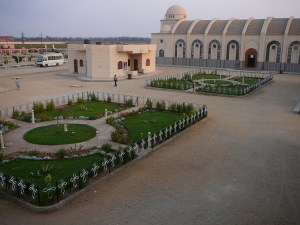
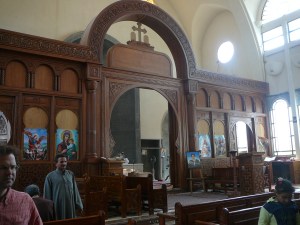
Though any Egyptian Christian child would have recognized this story immediately, I am unable to differentiate St. X from St. Y, or to know how it came to be that St. George killed a dragon. The icon above is from St. George’s Monastery in Khataba, Egypt, about a two hour drive northwest from Cairo. In conjunction with a class I am taking in a Coptic Bible Institute, a story I will have to relate later, I went with my family on a day trip to visit this and a sister monastery only about fifteen minutes further on. It was a wonderful view into Coptic spirituality, which is very monastic in its formation, and we heard many stories about the various saints which populate the Coptic imagination. In each monastery the relics of such-and-such saint were preserved, and prayers were offered at each in commemoration of their life.

egypt oct09 146

I am no longer as disturbed as I once was by the idea of praying to saints. This formulation, however, ‘praying to saints’ may simply be a Protestant slur to blacken the concept; surely we should pray only to God. On the other hand, it may represent the actual practice of many traditional Christians who perhaps feel that they are not worthy to approach God directly, or that a particular saint may more readily grant them favor. But as a concept: If I will not hesitate to ask my living brother to pray for the healing of my sick daughter, why should I hesitate to ask my departed brother now living in heaven? We are surrounded by a great cloud of witnesses watching with interest our terrestrial drama. Can their requests to God not also be marshaled on our behalf?

As I discussed these matters with my classmates—professional employees, university students, businessmen, all committed to God and his service in their church and country—each one was keen to convince me of the legitimacy of these practices. They have heard the critique of rational Western Protestantism, both from within and without Egyptian borders. They would link each practice to either the Bible or early church tradition, and I wish my Arabic was strong enough to fully understand their arguments. As I learn more, I will relate their tales, but inasmuch as these were my first lessons it was hard to grasp all their nuances. The fervency of their justifications, however, was noticed, as they sought to demonstrate they were not backwards, occultist Christians, anticipating an oft-heard criticism before I might voice it. They worship God alone; they pray to God alone. God, however, has left marks of his favor on certain of his saints.

St. Bishoy, for example, had his dead body preserved for centuries after his death as it had been the day he died, soft and supple. This story was repeated for other saints in other locales. This miraculous preservation of the corpse is a signal from God that such a person was particularly holy. In fact, St. Bishoy’s body only decayed in rebuke of a later Pope who departed from God’s favor.

We in the West have heard stories such as this, but largely assign them to the genre of pious legend. Certainly St. X and St. Y were holy people who lived God-pleasing lives. Yet after their death in preservation of their legacy the simple, pre-scientific peoples around them developed all sorts of miracle stories to idolize them. Perhaps this was innocent, perhaps it was sinister—a place of pilgrimage is generally also a place of commerce—but over the centuries the stories remained part and parcel of the saint’s history. Given that the Muslims of Egypt and elsewhere also have their celebrated miracle-working saints, it is easy for us today to dismiss these tales of ancient European and Mediterranean Christianity.

Yet the testimony of these professional, modern-educated lovers of God makes it harder to dismiss. If they were only preservers of ancient tradition, however, they could be excused for following in the credulity of their ancestors. The testimony, though, does not remain in the past.

One of my classmates spoke of the city of Damietta, on the northeastern shoreline of the Nile Delta. In that city is preserved the soft, supple body of a deceased saint from two centuries ago. The body is enclosed in glass casing, allowing the miracle to be witnessed by all. She invited us to join her family some day in the future to take a trip together to see it.

 Furthermore, she spoke of her own village in southern Egypt, which was served by a noble, but uncelebrated priest. One day the priest died of natural causes and was buried in ordinary fashion. Unknown outside of the village he was simply replaced by another priest, and life continued as usual.

egypt oct09 138

One day there was some reconstruction taking place in the village, and the local sewer line was disturbed. The pipes cracked and burst forth, spewing into the cemetery where the priest and many others were buried. It made quite a mess, and necessitated the transfer of the cemetery to another location. At this time, however, in unearthing the grave of the priest, buried traditionally without a coffin, his corpse emerged unchanged from the day of his internment. Soft and supple his body remained. Though not esteemed by man, God gave witness of his favor.

This story resembles the others told in history, but comes with a contemporary witness: My classmate testified she saw this take place with her own eyes.

Perhaps a journalist would probe deeper. Perhaps a sociologist would identify group hysteria. Perhaps we in the West are so terrified of these stories that we immediately seek for alternate explanation. What is the cause for our terror? Stories like this threaten our unconsciously adopted worldview of scientific rationalism. This worldview can make room for sporadic divine interventions, but generally only if there is a clear and logical purpose behind it. Stories such as these, however, make no sense to us. What purpose does God have in the rather morbid preservation of a corpse?

As I will learn the longer we live here, many Orthodox traditions have a sense of the mystical. I have begun getting introductory lessons in transubstantiation, for example. Yet no matter where we draw the line, the mystical cannot be separated from Christianity. At its core is the promise: Christ in you, the hope of glory. It is not my point to either justify or refute the miracle stories that are believed by so many. A faithful record of them, however, is necessary, for the Orthodox in Egypt are brethren in Christ, members of his body. This itself is mystery, a miracle story to be cherished.

egypt oct09 137

Postscript: I am posting this reflection one day before traveling without my family to another monastery, St. Makarius, where I will reside for the next three days. One of the places of conflict I am researching is the Abu Fana monastery, in which monks are prominently involved. It was recommended to me that in due time I stay with the monks there in order to better understand the local realities. That monastery, however, due to the conflict surrounding it, has become a much politicized place, and as such is not the best introduction into monastic life. In preparation for this experience, then, I should first have a taste of a functional monastery, and St. Makarius is by reputation one of the most reputable, though most controversial, in all Egypt. This, though, is a story for another time, hopefully shortly after I return. Your prayers are requested; may they mix with the incense rising from the altar…

egypt oct09 153

Categories
Personal Reconciliation

Scuffling

Back when I was in high school my dad would take us boys on occasion to watch Rutgers University soccer games. They were always fun—for soccer aficionados we even saw Alexi Lalas play—though I was often troubled by the degree to which fans in the stands would berate the referees. Perhaps back then I had a sensitive conscience, but there was always an air of tension surrounding the game. Rutgers was good back then—I have no idea if they are good now—but they often won and everyone went home happy.

One afternoon, however, they lost. Grumbling was expected and the referees were lambasted, but on our way back to the car in an open space of grass behind the playing field two people were yapping back and forth very vehemently. I can only imagine they were opposing fans, perhaps one a student at the rival college, but my memory is that they were both adults, however young. Their raised voices attracted a lot of attention, and the attendees paused in their descent to the parking lot and duly circled around them. There was no “fight, fight!” chanting like you might have with boys on a playground, but the yapping had escalated in the meanwhile and the two had come to blows. Like rubbernecking at an accident it is impossible to look away, but Dad quickly pushed us along and we went our way home.

Before leaving though my conscience had another message. I was struck not only by the wrongness of what was going on, but also by the feeling that something should be done about it. “Blessed are the peacemakers,” is fine to recite, but hard to act upon. Yet I had the urge that I should do something about it. Sometimes in such cases you can imagine yourself the hero; I had no such picture in my head. The only images that came were wandering, alone, into the scuffle, and getting caught in the crossfire, thrown to the ground, and doing no good whatsoever. Perhaps there was a scenario in which this broke the tunnel vision of their rage, but even so the price to pay was the chief element in my mind. I put up no resistance to Dad’s motioning.

That day within me something was either born or died. I’m not sure which. Since then I have been filled with the idealism that calls us to put our lives nonviolently in the line of fire for the sake of ending conflict, even if it is fruitless and painful. I watched with admiration as the people of Christian Peacemaker Teams went to Iraq and, as their motto states, looked to “get in the way.” There story is told here on Wikipedia.Yet the world soon cast their scorn as they were captured by the very Iraqis they went to protect, and then heroically, yet ironically, rescued by the American soldiers they were seeking to obstruct. It says much about our military, but what does it say about them?

Such a group is prepared to pay the same cost in nonviolence that a soldier is prepared to pay in violence. They believe peacemaking calls for sacrifice, commitment, and strategy. In their ordeal the American member of their team died. Another of their group was 74 years old. Yet what is remembered of them? That they put the lives of American soldiers in danger. That they put their noses where they did not belong. They played the part of the fool in the drama which justified the war. What good came from their idealism? Was there any impact in Iraq? Was there any impact anywhere?

Perhaps it could be said that these thoughts here represent growth from the birth of the original experience. Yet if instead the focus is on life, and not thought, it may better be described as death. I have never intervened to bring peace to a situation. I have often nodded in that direction, but never once have I risked suffering in order to reconcile others. I have stood with others around the incident, felt the ping of conscience, and moved on.


Coming home late one evening the other day I was riding the metro and the sensation returned. The car was not overly crowded though there was a small but sizeable group of youth—high school to college—joking around, jostling, drawing attention to themselves but not quite crossing the line in the manner of which their age is so adept. Someone, though, took offense. He was about the same age, but was standing in the corner with a young lady covered in a head scarf. I have no idea what came between them, but before too long one of the group in particular and he were locked in the level of raised voices that precedes a conflict. As per custom, and perhaps per wisdom, I slinked backwards a few steps.

The outcome itself is perhaps not surprising, though it is different. The two became more and more animated, displaying their bravado in closer and closer proximity. Immediately others stepped in. Older men sitting around them reached out to grab the near-combatants by the arm, speaking words of calm. The group of young men rallied around their member, but to pull him back. The yapping continued for a little while, but eventually dissipated as each side separated, and they young men exited at the next stop. Crisis averted.

Having lived in the Arab World for some time now, I knew exactly how this scenario would play out. In this respect my withdrawal was not from cowardice but simply from allowing those who knew how to diffuse tension to play their role. Yet I will not excuse myself from cowardice; I, after all, knew the playbook, and chose not to participate. Still the criticism is not quite fair; though I have seen and could plausibly imitate the role I had seen so many times before, no one else was playing a role.

No one thought, “I should get involved.” The older men did not think, “This word of caution would be appropriate.” They all simply acted, and they acted as one group with one mind. Whereas the mentality back at Rutgers was to circle around and let them fight, the mentality here was to intervene. Whereas the one with a sensitive conscience in America wonders what he might do to change a bad situation, the one here does not exist—the group conscience decidedly takes over.

What does it mean to be a peacemaker?


It is written about Arab culture that conflict is a normal and accepted fact of life, but that group mechanisms exist to keep conflict from spiraling out of control. The sense of being his brother’s keeper is ingrained in Arab thought, and there is no need to romanticize this. It is not driven by a profound sense of morality but rather a consciousness that protects the group in ever-larger concentric circles. There is an Arab proverb which states, “Me against my brother. My brother and I against my cousins.  My cousins and I against the world.” Conflict is allowed and expected, but at a certain level it must cease.

The system, however, is moral. In the West our sense of personal responsibility will not permit the Arab individual any credit for automatic participation in group think, and we are blind to the structural morality that binds them together. Yet we then in opposite fashion suffer the intense burden of the individual peacemaker and are blind to our own structural immorality. Furthermore, since we know the individual can do no good on his own, we are left in despair, immobilized against undertaking any good.

When some, like the brave yet naïve (?) souls of Christian Peacemaker Teams can finally commit themselves to mobilization, everything is marshaled toward their failure. It is no conspiracy theory; it is a reflection of the fact that the world is organized around the principles of power. If power is threatened by power the rules are clear and the victor presides. Morality determines to what degree the labels of “good” or “evil” are applied, and a preference exists, of course, for good. If power, however, is threatened by nonviolence, it puts everyone ill at ease, for both good and evil in this system depend upon it.

This is the way the world works, and the Arabs are no better. They often receive the “evil” label in our classification scheme, but for us this is a label of convenience. We are the possessors of power in the world today, and like all in this position we are loathe to give it up. They from their group mentality at times will reach the end of their concentric circles, and lash out – we are quick to retaliate in kind. Yet it is the same game and the same struggle. Yet the Arab World is worthy of more praise than it receives, for their circles can expand to include humanity at large. For the past two hundred years they have been under the world order of the West, and they have largely played nicely. Even so, our thumb is strong.

What then can be the place of the individual with a sensitive conscience anywhere, but especially in the West? To what degree are we condemned to act alone? Culture cannot be easily changed, but can the principles of peacemaking become generalized? Can a group mentality emerge which curbs conflict before it escalates beyond repair? Can this be applied to our foreign policy? Can it be applied at a soccer game?

It is here where I run out of vision, though perhaps it is more correct that I am scared of the vision. Until now I have been reluctant to speak of Christianity, for these principles have been practiced, albeit rarely by anyone, by non-Christians around the world. We should learn their lessons and hear their rebuke. Yet our primary example, which we are called to imitate, is profoundly individual. Suffering a sensitive conscience aware of the deep division between man and God, Jesus gave up all power and preached a message of love. He gathered others around him, but in the end the powers that be chose him alone for execution. His mission, noble as it was, ended in failure. Looking to intercede between man and God, he was caught in the crossfire, and put to death by both. Yet he was no victim, for he chose his fate, drinking deeply from the cup he was given. Paradox of all paradoxes, it was from his failure that victory emerged. Salvation can be preached to the world, peace can be extended to all, because one man was trampled upon trying to make a difference.

Can we do any differently?

Categories
Arab West Report Middle East Published Articles

The State of the Egyptian Press

A few days ago I was able to provide a look into our work through the full text of our weekly published reports. I was able to attend a lecture at the American University of Cairo featuring Jihan Sadat in which she talked about her husband’s legacy in striving for peace and women’s rights. It was a pleasant tale, though made somber by the fact of his assassination, though it has now been over twenty years since it took place.

 Today’s link to my report discusses a more controversial subject. In the West we can have a nose-in-the-air attitude toward human rights in the rest of world. We are rightly proud of our freedoms and principles, yet while we wish these to be generalized in the whole world, we usually assume that ours is the measuring stick by which other societies are to be judged.

 I do not mean to call this assumption into question, only to point it out. The reality in the rest of the world is complicated. Though independent analysis would likely confirm the greater freedoms found in the West, it would also state the longer heritage we have had in crafting and guaranteeing these freedoms. It would also mark our many missteps along the way.

 Hisham Kassem has spent his life involved in Egyptian journalism. He is uniquely placed to comment on the state of the Egyptian press, and granted access to his viewpoint in a lecture delivered to the Netherlands-Flemish Institute in Cairo. If anything, I was surprised by how few people were there, especially given the importance of his remarks. In addition, most of the audience consisted of foreigners.

 Though his lecture was delivered before that of Jihan Sadat, we debated a little longer about publishing it. His comments are not inflammatory, but journalism is a sensitive subject here, even though, as he states, Egypt is one of the most open nations of the Middle East. In the end we thought to allow it, for they are his comments, not ours. Since he feared not to publish his views, neither should we. The text of the report follows below:


Prior to the revolution of 1952 Egypt had a strong tradition of journalism with independent newspapers driven by a market economy. President Nassar, however, institutionalized the press, giving newspaper licenses only to his close confidents. He also established an official position of state censor… (click here for link)

Categories
Arab West Report Books Middle East Published Articles

My First Report

One of the primary activities of my organization here in Egypt is the translation of articles from the Arabic press into English. We select between twenty to forty articles every week, with an emphasis on religious issues, but not to the exclusion of other factors which also affect Arab-West relations. We also publish our own reports within the weekly selection, which can be analysis of the news, critique of media reporting, or simply a selection of interesting voices which lend toward a broader understanding of the Arab World in general, and of Egypt in particular.

 I am not involved in this process on a regular basis. We have a team of native speaking Arabs who provide the translation, and English speaking foreigners who work on the editing. We also have a variety of interns from around the world, including Egypt, who can write reports such as those described above. Although my work lies elsewhere, on occasion I also will have opportunity to contribute.

 I have provided here a link to my first report. The work I do will not always be put on display, but when it is appropriate I will also provide reference here in the blog. I am glad that some of my work will also help readers here get a better glimpse of Egyptian society, as well as our small participation in it.

 My report summarizes a lecture given by Jihan Sadat, the wife of the former president of Egypt, Anwar Sadat, who was assassinated by Muslim extremists, in no small part due to his signature on the Camp David Accords establishing peace with Israel. Here is the text below:

On October 11, 2009 Her Excellency Dr. Mrs. Jehan Sadat presented a lecture to the Women’s Association of Cairo at the Oriental Hall of the American University of Cairo. Mrs. Sadat served as First Lady of Egypt from 1970 until her husband’s assassination at the hands of Muslim extremists on October 6, 1981. Mrs. Sadat began her lecture by noting the incongruity of this day as paying honor to two disparate concepts:  a celebration of her husband as a man of peace, and a celebration of war as the means to liberate Sinai from Israeli occupation. Though a principled man of peace his whole life, Mrs. Sadat spoke of the October War, launched on October 6, 1973 by her husband, as a necessary step in achieving peace by demonstrating the strength of Egypt. Having won popular acclaim in Egypt and throughout the Arab World, however, Sadat returned to his peaceful constitution, pursuing a policy of rapprochement with Israel in effort to secure peace in the region. In 1978 Sadat visited Jerusalem and addressed the Knesset, fully aware of the implications of his decision. Furthermore, Mrs. Sadat states, he knew upon signing the Camp David Accords with Israel in 1979 that he could pay for this initiative with his life. Nevertheless, he pressed forward, and though his ideas were rejected entirely by his Arab brothers at the time, leading to Egyptian isolation from the Arab League, today his views are accepted by many, and imitated by some. Mrs. Sadat declares that her husband’s methods are not the only way to achieve peace, but they are the only ways which have worked. 

Mrs. Sadat spoke also of her own struggle, stating that she could have fallen into despair and brokenness following her husband’s assassination. She described him as a good husband and father; they traveled everywhere together and considered one another as partners. Yet despite her state, she knew that her husband would be disappointed if she surrendered to her grief, so she has decided to embrace life, looking forward to the day they will be together again, but yet laboring to keep his legacy alive. This she achieves through involvement as a Senior Fellow at the University of Maryland through an endowment for the Anwar Sadat Chair for Peace and Development. She also has written a new book, My Hope for Peace, published in March of this year, to promote her and her husband’s efforts for a better world, focusing on principles for peace, and also on the subject of women’s rights. 

From the Belfour Declaration in 1917 to the 1948 establishment of the State of Israel, continuing through the 1973 October War and its aftermath, Mrs. Sadat declared that her husband recognized the bloodshed, displacement, and hatred which characterized Arab-Israeli relations, resulting in no clear winning side. Though he had achieved success in the war, his faith pushed him to desire more, believing peace was more important than military victory. In pursuit of this goal he developed five principles which guided his conduct during negotiations and the pursuit of peace.

  • All people desire to live in peace
  • Realistic and pragmatic admission of the animosity between conflicting sides
  • Direct and continual involvement of leadership to drive the engine of peacemaking
  • The necessity of forgiveness
  • The brotherhood of Arabs and Jews

 In commenting on the current possibility for peace, Mrs. Sadat expressed hope. Jordan has followed Egypt in signing a peace accord with Israel, and though recent Israeli policy toward the Palestinians has been belligerent, she believes that Palestinians should be able to coexist with Israel. They should have their own state as well, with Israeli assurances of being able to live in peace. Finally, she praised President Mubarak for his continuation of her husband’s policies, working tirelessly to keep the two sides in negotiation. 

Mrs. Sadat also spoke passionately on the subject of women’s rights, highlighting the visit of President Obama to Cairo and his statement that our daughters can contribute to society as much as our sons. She believed that President Obama and her husband would have been good friends. Though her husband shared her convictions on women’s rights, Mrs. Sadat laughed that she continually nagged him about it. “Yes, yes,” he replied, “but I have also to build schools and hospitals; I will get to it eventually.” He did, and the ‘Jehan Laws’, as they are known, helped women achieve greater rights in terms of alimony and child custody following a divorce. Mrs. Sadat declared that women’s rights are not an issue for Islam, rather, it is an issue concerning how certain people practice Islam, and that this is true for any religion. A recent survey conducted by John Esposito of Georgetown University interviewed over forty thousand Muslims in over forty countries, and highlighted that Muslim women around the world want the right to work, to vote, and to serve in government, but are concerned far more about extremism and corruption than they are about issues of dress code. Mrs. Sadat said that religion and rights are not mutually exclusive, and praised the history of feminism in Egypt, urging the current generation to keep their story alive, but noting that their message has been woven into the tapestry of Egyptian culture. She also issued special praise for Mrs. Mubarak for her devotion to the cause of women’s rights, noting that more than ever before Egyptian women are going to school and becoming doctors, ministers, and professionals of all varieties. 

Mrs. Sadat closed her remarks by expressing her personal hope that she has made a difference with her life. She hopes that women get their rights, not because they struggle for them, but because they deserve them. She prays for peace everywhere, not just in Egypt, but also in Sudan, in the Middle East, and wherever there is violent conflict. She hopes to leave behind a better world for her three daughters, eight granddaughters, and four great granddaughters. She has lived a full and worthy life, and though she looks forward to standing again side by side with her husband, she will not retire while so many issues, including her husband’s legacy, stand in need of promotion.

Concerning a direct question about the pursuit of peace and reconciliation in the local context, Mrs. Sadat acknowledged that it is not beneficial to go to a village woman and tell her to change her behavior, giving the example of family planning. It is in the interest of the woman and her family to have many children, since they will be put to work to gain income, though underage labor is against Egyptian law. If instead she can be given a job, this will reduce the necessity for her children to work, creating strides in children’s rights, and will encourage her to have less children, thus achieving the desired change. She also commented that mothers, in addition to the educational system, play a vital role in educating children about peace, helping others, and proper human interaction. For the local context especially, economic projects and education are vital in the dissemination of the message of peace. 

Extrapolating, then, from the principles of President Sadat, Mrs. Sadat’s lecture provided guidance on the pursuit of local peace. In areas of sectarian conflict, first, it is important to remember that at base, all parties wish ultimately to live in peace. The conflict may have been started by misunderstanding or common affront, but as the complications escalate, it is easy to forget this principle. Second, it requires the realistic understanding that each side has hardened against the other, and the pragmatic planning to overcome mutual antagonism. This is where Mrs. Sadat’s comments about a project are especially poignant; a well designed project will bring people together, starting from the recognition they have not begun that way. 

Third, peace and reconciliation is best achieved through the active participation of recognized leadership. Chances of success are few unless local leaders can be convinced to partake, for they have the clout to maintain momentum when individual incidents threaten to derail the process. Outside leadership may be even more powerful. Fourth, forgiveness is absolutely necessary, though this is a message that can only be preached, not enforced. Proponents of peace outside the process must keep forgiveness at the center of their discourse, lest anyone slip into the ease of its neglect in the details of negotiation. Finally, in a similar way, all must hold on to the centrality of the concept of Muslims and Christians as brothers, that this be maintained as an article of faith. Keeping these principles in mind will help guide local peace efforts in the manner they guided President Sadat’s efforts in the international arena. If realized in her own country, it will fulfill Mrs. Sadat’s hopes to have made a difference, to keep her husband’s legacy alive, and to see resolution of her own prayers for peace.

 (click here to read on AWR)

click here to purchase from Amazon: My Hope for Peace

Categories
Personal

First Days in Cairo: Househunting from Jail

Apartment-hunting in Cairo was tough considering Jayson was beginning a new job and we were housesitting in a place which was a 45-minute drive from Maadi, the neighborhood where we hoped to live.  This meant timing our visits there in between or in spite of naps and bedtime for our two girls.  Jayson didn’t have a lot of time to walk around Maadi and look for places, and once he left for the day, I was kind of stuck at the villa.  So, I did what I could from afar and looked in magazines and made some phone calls and even checked the internet.  Surprisingly, one of the best resources for finding an apartment was the ever popular Craigslist site online.

I saw a place on Craigslist on a Monday and tried calling about it, but the person never picked up.  We had been using a lot of real estate agents to find places and this was another one advertising a 3-bedroom place within our budget.  The details of the place sounded good, but we couldn’t do much about it if there was no answer.  I sent an email to the Craigslist address and finally on Friday night, got a reply that he had been out of town but would now answer his phone.  Well, Saturday was the first day of Ramadan…so the first day of the fast…and I tried calling him several times that morning as we were looking to decide on places, but still no answer. We had narrowed our choices down to a simple ground floor place (drawbacks were no bathtub and a very uneven floor…making the table and chairs a bit tipsy) and a 2-bedroom place across from the office (a good spot…but a little small and seemed a bit expensive compared to other places; plus, there were a lot of mice droppings from its short time vacant).  So, we weren’t super happy with either of these two options.  Finally in the afternoon, someone answered the phone.  He had slept in due to the fasting and it’s hard adjusting to the first day…especially since he’s a smoker.  Anyway, we agreed to see the place at 5:30 that evening…an hour before the time of breaking the fast.

We got the girls up from their nap and got ready to go into town.  Since it takes at least 45 minutes to get there from the villa we had to go early…and on the way, the real estate agent texted me to say the key wasn’t available at this time so we had to cancel the appointment.  It was really the only reason we were going all the way into town, so that was no good.  I called him and he thought that we could meet at 8pm and the key would be there.  Plus maybe he could show us some other spots.  So, we arrived in town around 5pm…what to do with three hours?!  Jayson stopped by the office and found there was an interview with some journalists taking place, and his boss invited him to stay for the interview.  Good and interesting for him.  A little hard for us.

It’s hard to keep the girls entertained and somewhat less than filthy, playing outside Jayson’s office building.  You see, the ground and everything outside is always covered by a layer of dust/dirt.  Fortunately Hannah is mostly walking now, but both her and Emma get quite dirty playing outside…and then I get dirty because they sit on my lap or I hold them.  I really can’t get from our house to our next stop in the car with a clean shirt and pants.  Oh well, something to adjust to.  Anyway, back to the time at the office.  So, to avoid the dirt, we played inside Jayson’s office building for a little while, but I didn’t want to make too much noise and disturb the interview. Then we left the office, closing the locked door behind us, only to find that the gate to get out of the building was also locked.  So, we were stuck in the stairwell.  And of course, Hannah crawls up steps, cleaning them as she goes!  We were stuck there for about half an hour, and at one point, Emma said we were in jail…something I hadn’t thought of but seemed fitting to our situation.  We tried to stay occupied by telling stories and singing songs, and we attempted to stay a little less than filthy.  The “little less than filthy” was unsuccessful, but we survived until someone who lived in the building came in and let us out!  We went to the car then for a snack until Jayson was done, then to his boss’ house for a drink.  By the time this was all over, it was about 7pm…still an hour until we meet the real estate agent, and I was quite ready to just go back home!  Enough for one day…but the night was yet young!  We got the girls some yogurt to eat and waited for the agent by our rendezvous spot. He showed up a couple minutes past our appointment time and we continued the adventure.

We didn’t start out at the Craigslist place.  He took us to another apartment building where we were going to see two places.  But instead, we waited and waited and waited and waited for the doorman to come back with the key.  He had gone to the mosque for Ramadan prayers and was coming “any minute.”  This went on for about half an hour.  The good news is, Emma liked this “Amu” (Arabic word for uncle) for some reason and played with him real well despite the fact that it was going on 9pm by the time we finally said, that’s enough waiting, let’s go to the other place.

So, then we were going to see yet another place before the Craigslist place, but this one was on the opposite side of the metro track.  We don’t know why he suggested this, but we parked at one spot, walked up and over the metro (lots and lots of stairs) and then preceded to walk what felt like a mile…remember, 9pm, me carrying Hannah, Jayson carrying Emma, through the dark streets…until we finally got to an apartment where we went to the third floor (no elevator).  Now, what’s frustrating about this is we specifally told the agent we didn’t want a high floor without an elevator…it’s just too hard with the kids.  But, we saw the place anyway.  It was a decent place but didn’t have a bathtub, so that was a problem. (Besides being on the third floor).  Then, while Jayson was looking at the back bedroom with the landlord and agent, the landlord closed the shutters on the window, knocking a beehive open…and bees started to swarm into the bedroom!  Fortunately I didn’t witness this myself, but the owner got stung and Jayson made it out of there without harm.  The landlord felt really bad and assured us he would spray and take care of that problem!

So then onto the place we had been waiting to see for five days or five hours…depending on when you started counting!  Fortunately, we didn’t have to walk too far to the next place, it was just up and over the metro again.

We got to the building and there was a large family gathering taking place in the downstairs aptartment.  Again, it was the first day of Ramadan and the family was celebrating the fast-breaking meal.  And of course, the key was not there, but would be back in about 20 minutes! Ugh!  It was already 10pm!  Well, we came this far, so we had to wait.

The family invited us in…or maybe Hannah just kind of walked in and we had to follow her, and we enjoyed a visit with them…having some dessert and juice and chatting some with the people. It was a large group…uncles, aunts, cousins, etc.  The girls did okay despite the hour, and Emma was a little overwhelmed as people would pick her up when she didn’t want them to…but all in all, it was a nice introduction to the owner of the buildings large family.

So, finally the key came and we went up to look at the place.  I liked it immediately although it was supposed to be a furnished place and there was only some furniture…so that was tricky, but they promised to furnish it if we took it.  We took a look at it and talked some with the brother of the owner, as the owner himself was out of town…and told them we would think about it.  After about 1/2 an hour of looking around and talking, we headed back out…took a taxi back to our car, dropped the agent off, and headed back to the villa…fortunately there wasn’t much traffic and we made good time…both of the girls sleeping from the time we got in the car.

As a postscript: This is the apartment we did finally settle on, just a few days after our crazy night.  It was a good reminder that things take longer to do here…something we need to get used to.  We’re thankful that our kids are flexible, and glad to be done the househunting for the time being.

Categories
Reconciliation

From the Heart the Mouth Speaks

To properly describe the peacemaking work we are trying to undertake here in Egypt would require much background information and many blog posts. It is our hope that over time we can give a proper picture of the many nuances and subtleties which inform our work, but we apologize that this will come piecemeal, and that in our effort to inform we may only further confuse. If this is so, please understand that we ourselves have a lot to learn, and we expect it may be many years until we develop the cultural eyes to appreciate situations as an Egyptian would. Until then, we will stumble along together.

Conflict does not take place in a vacuum. There are many social realities which contribute to a single incident that then is exasperated into a sectarian conflict. Among these is the general poverty of the Egyptian countryside. It has been recommended to us that in seeking to address what may properly be understood as improper mindsets and behaviors, it does little good to simply go to the area and hold a workshop on understanding the other. If such a message is to be delivered with any hope of success, it would be well to wrap it into a project that delivers some social benefit to the area, preferably one which addresses the realities which led to the conflict in the first place.

The benefit of a project in an area in which tension has developed between Muslims and Christians is that it can bring together these communities which, now at odds, have separated themselves. It is a general rule, or at least belief, that people will set aside differences when it comes to the mutual benefit of making money, or educating their children, or securing good health services, etc. Moreover, as people interact they discover their commonalities, realizing the demonized other is not so bad after all, and not so different from myself. Within a project, the message takes hold.

Undertaking the project, however, is difficult, for how are we to know what projects are beneficial to a community so distant from our own. Even our Egyptian partners and advisors do not understand their needs, for they are educated city people, far removed from the issues of the countryside. Given this, it has also been recommended to us that we actively seek to involve the non-governmental organizations, agencies, charities, and associations which are currently working in the area. They know the situation, and even if they are not currently involved in the village at hand, they are familiar with its context. To date, we have found one such organization which has a very good reputation in the area among both Muslims and Christians, having served many communities with both skill and tact.

There is only one problem, and though it is inconsequential for them, it may be a issue for us. This organization is Christian in its formation. It has been recommended to us that because of the sensitivities of foreigners working in religiously-related matters that we are seen as absolutely neutral in our orientation. It matters little our intentions, or even our behaviors; what counts is our appearance. This organization has a mixed Muslim-Christian board of trustees, and employs only Muslims as its field workers. The office staff, however, is entirely Christian, and they would admit themselves that though they deliver their services irrespective of religion, their motivation and orientation is Christian, and the organization is designed to stay that way. Though they are not connected to the church, they would be seen as Christian. Our advisors have not recommended we distance ourselves, though, for they are clearly capable and enjoy wide local support among all. They recommend simply that we work in addition with an organization that is Islamic in its orientation. This will provide the balance that is necessary for our own proper appearance as neutral. Otherwise, our ability to work in these areas may be compromised.

We have been negotiating a project with this organization, even taking a trip to the area to speak with them directly. The other day they were in Cairo and visited us to continue the conversation, and after many positive signals we explained to them the above, asking their recommendation for a similarly oriented Muslim group with which we could also partner. Now, it is granted that such a question could be seen as a threat, not religiously, but professionally. Projects require funding, and surely based on our negotiations so far they could be expecting our contributions, however limited. With the addition of another partner, their share, their influence, and their involvement would naturally decrease. Though not expecting their resistance to our question—they know the other area organizations, work in conjunction if not together, and recognize the value of partnership across religious lines—for the above reason the resistance could be explained. What was evidenced, however, went far deeper.

Up until this time, their representatives were jovial, full of mirth, life, and spiritual commitment. Nearly instantaneously, facial expressions changed, cheeks flushed, arms folded, and when extended ended in a finger pointing in exclamation, “I swear by the Messiah that there is not one Islamic organization that also takes care of the Christians!” They were accused of hypocrisy, speaking kindly to your face only to adopt their own priorities upon receipt of the donation. It was unfortunate in addition that both we and they had a subsequent appointment approaching which forced the rapid communication of ideas. Had we more time such sentiments could have been expressed with more nuance and explanation. While our partnership was not threatened—we ended with agreement to continue our planning—we were warned about seeking out a Muslim group.

It should be reiterated, this is a group that works closely with Muslims; it employs them and trusts them as influential advisors. They serve Muslims without any question of religious affiliation. Yet our question touched a nerve that, though our (Caspers’) experience is limited, seems to be indicative of many Christians here. They can and generally do have beneficial relationships with the Muslim majority. When it concerns the question of Islam, or Muslims as Muslims, however, the hardened heart becomes evident. There is a mistrust and a frustration that prevents genuine charity, both in its contemporary understanding and its original usage as ‘love’. While this organization is serving all, including Muslims, in a commendable manner, it appears that it is for the objective of creating a viable civil society that is inclusive of all, Muslims and Christians as fellow citizens. This is a noble objective, though it is true that some Muslims oppose it, believing Christians to properly be protected, second-class citizens in the Islamic order. This organization serves Muslims in the hope, at least in part, that they will demonstrate their own good will and valuation of communal life. They hope to win for themselves a secure place in society. As admirable as these goals are, and the means by which they hope to achieve them, are they motivated by love, by true Christian charity? Sad as it may seem, are they destined only to be a resounding gong?

Perspective is necessary. Though in Cairo there are many Muslims who share the ideals of civil society and citizenship rights for both Muslims and Christians, perhaps these are far fewer in the countryside. They may be correct; there may not be any Islamic organizations which also serve Christians. They may have tried to partner with some and been burned in the process. They themselves are affected by the perceived rising of religious tensions, and the rhetoric of some Muslims is downright offensive to Christian sensibilities. They must be commended for rising above their predispositions to serve as ably as they do. Surely we from the West cannot comprehend the difficulty of their position.

Perhaps also I am way off base; after all, I am judging from one response from only our second conversation. It is at times like this the foreigner must remember he does not belong, and therefore does not understand.

But I cannot budge from the ideal that God calls us to more than an overcoming of our predispositions against the other. He calls us to do good, as they are doing, but he also gives us a new heart. Lacking this new heart in its full expression, a condition from which we all suffer, our friends invoked the name of Christ in vain. Yet my words expressed here are no better, for they come not from a new heart, but from a new set of ideals. Though these ideals may come from Christ, they will be proved true only when issued from a heart of love that has experienced also the suffering they perceive. May God spare us all from any suffering, but may he preserve, renew, and employ us whenever it occurs.

Categories
Personal

A Trip to Qalzam

Three weekends ago we traveled to the village of Qalzam with a friend of ours from Cairo, whose uncle still lives a traditional, agricultural life. The village was about a twenty minute drive from Shabin al-Qanater, the capital city of the Qalubiya governorate, which is in the Delta region about an hour north of Cairo. Qulzam means ‘fertile ground’ in Coptic, and was the place of his relative’s home and the area church, Archangel Michael. The church was built 250 years ago on the site where the angel appeared to a Christian villager. In those days the area was 75% Christian in composition, but their population has dwindled to only five families today. Over time, most of the families have relocated to Cairo for better work. Nevertheless, there is still significant Christian representation in the area, and during the Friday morning service we attended there appeared to be over 100 people in attendance, perhaps buttressed by a funeral service that coincided with our visit.

                 The church building itself was not 250 years old, but has been rebuilt recently, though it is not quite finished.

2009 06 550

It is a monumental structure, complete with a balcony, but the church is still awaiting donations to paint the icons on the wall dividing the people from the altar.

2009 06 546

My friend asked if I would be willing to help the church solicit. It uses its finances currently to conduct a shuttle service helping the Christians from surrounding villages to get to the church. It also gives the children small toys to encourage them to attend the Sunday school. These lessons follow the main mass, and we participated with them.

                 While Julie took Emma into the younger class where they chanted Arabic hymns and taught the kids to pray making the sign of the cross, I was with Hannah in what I discovered later was the combined class of all older ages. These are usually kept separate, which was a relief to hear, since it was quite chaotic, with few paying attention and much chatter throughout the lesson. I entered late, as I was talking with the ‘college and career’ folk after the mass, only later finding out that they had a class as well. When I entered they were chanting an Arabic hymn, but then to my surprise they sang a popular Arabic praise song, albeit without any instrumentation. They then tried to show a film on the recently obtained screen, which was the very reason every class met together, but sound quality was so poor they abandoned the effort after a few minutes. Then followed a lesson given on powerpoint, which seemed well designed but was way over the heads of the younger kids, and failed to attract the interest of the older ones. I felt sympathy for the teachers.

                 I spoke afterwards with a younger woman who was in charge of the older Sunday school class, but was not the teacher. She serves as Sunday school supervisor for the whole diocese, traveling especially to make certain that Christian daycare centers are well run. Yet Archangel Michael is her home church, and she recruits from the ‘college and career’ to teach the Sunday school classes. I was accompanied most of the visit by the one in charge of the middle school class, who works as a middle school science teacher another village over. He walks to work about a kilometer and a half every day, which is cumbersome only during the winter rains when the dirt roads get muddy.

                 In describing my work to them, the supervisor mentioned the travails of the Christian community in the regional capital, Shabin al-Qanater, in building a church. While relations with the Muslims are fine and official permission is granted for its construction, she claims that the local security forces are preventing the building from beginning. She asked if it was in our capability to investigate. While I was not certain, I reiterated that our group does not intervene for the sake of Christian church building, but we are interested in getting at the whole story from all sides, and my work in particular was towards the aim of building peace in an area. The presence of a foreigner in such a setting, I added, could easily over-encourage some (zealous Christians who think that their story will be told abroad and pressure put on the government) and infuriate others (zealous Muslims who could retaliate if they believe Christians are going outside the system to get help). So I put the request on hold, given also that she had to leave for other responsibilities, preventing further exploration of her story. Following on her comment that she visits Cairo with some regularity, though, I told her to contact me next time through and we would sit with a recorder to get all the details, and then decide from there what was best to do.

                 The rest of the day was spent at the old-style villa of my friend’s family, which was twelve rooms large in sprawling design incorporating much open veranda space.

2009 06 560

Though it was in need of repair in some places, it was elegant and comfortable, full of antiques over 100 years old.

2009 06 557

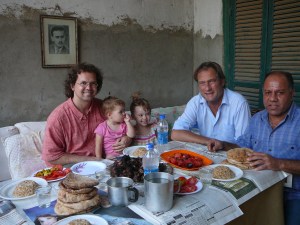
The only person who lived there, though, was his uncle, a young man by appearance but who was a former army officer, and thereafter lived 24 years in Baghdad, owning a restaurant and a few other shops. He lost everything, including his family, due to the First Gulf War, and returned home to Qalzam, where he takes care of his family house, enjoying the quiet life in the countryside, involved also in the church to which he often opens his home. His sustenance comes from the farmland he owns, which he hires others to work for him. There were several relatives and neighbors with us throughout the day, both Muslim and Christian, and he treated us to a traditional barbeque and fatayer meal. The meat was cooked over an ancient grill,

2009 06 587

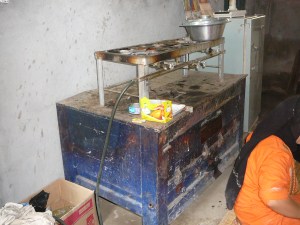
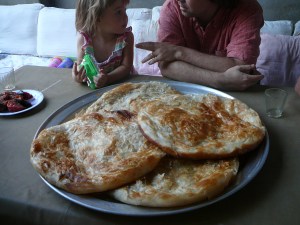
and the fatayer—thin bread folded many times over, each layer coated in butter and honey (click here for video)—was cooked in an oven that seemed right out of the Great Depression.

2009 06 574

Save for the washing machine and television, the whole house was as it was constructed over 150 years ago. While much of the village has been remodeled and built up with modern construction methods, it was very comfortable to enjoy life as it has been lived unchanged for generations. Except, of course, that soon after eating and after Emma declined a chance to ride on a neighbor’s donkey, we instead mounted the car and drove back to modernity.

 2009 06 601

                 The trip was our first outside of Cairo, and it was enlightening to witness life in a traditional setting. Our lives in Maadi are very insulated, and we will do well to continue to travel domestically as much as possible.

2009 06 600

2009 06 597               

            To close this post, allow me to say that my sentence about soliciting is sincere; should anyone be interested please contact us and we can discuss it. Yet at the same time, my friend told me that the priest of the church has increased in wealth since he began serving at the church. While this was not labeled as fraud, according to my friend church policy allows the priest to take a percentage of the gifts for his personal use, and other people have given him property directly. Personally, though I shook his hand, I did not speak with him, and at the request of my friend I put a donation in the box. The services of the church seemed very sincere, however, as did the volunteers with whom I spoke. Please do not understand this paragraph as my request for you to give, but in relaying the story and circumstances, I hope you get a small snapshot of local life.

Categories
Personal

First Days in Cairo: A Dinner Invitation

We moved into our apartment in a nice section of Cairo…Maadi, the town of foreigners, or ex-pats, as we are sometimes called. (To clarify, out of the three million people who live in this town, one million of them are ex-pats…leaving two million Egyptians.)  We moved in on a Sunday evening during Ramadan.  Ramadan is the month of fasting for Muslims, and the majority of Muslims in Egypt fasted from sunrise to sunset…breaking the fast at the call to prayer.  A couple days after we moved in, we passed the doorman and his wife walking on the street.  This was about one hour before the breaking of the fast. 

“Please come and break the fast with us,” the doorman said to Jayson.

“Thank you, thank you,” was the reply.

“Yes, please come and have dinner with us tonight,” added the doorman’s wife.

I kind of looked at Jayson and immediately thought that we couldn’t do it tonight…although I didn’t have a good reason…I’m just not always ready for spontaneity!  “Well, thank you so much.  We can’t tonight.  Um, um, thank you though, you’re so generous,” I kind of stuttered.

Jayson saved me and added, “Thank you for the invitation, God willing, we can join you tomorrow for the fast-breaking.”

The doorman replied, “Yes, God willing, tomorrow.”  And we went on our way.

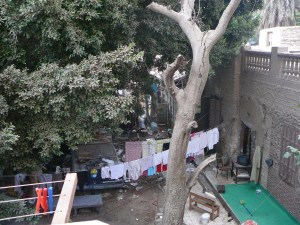
So, sure enough, the next night, we joined them in their home next to our apartment building.  They live in what appears to be a half-knocked down building, but if you don’t mind that the floor above you is half-broken down, it’s really quite big and spacious. 

brokendownhouse

They also have enough land to grow some vegetables and keep farm animals!  As the wife told me, it’s a villa!  We sat outside, on a mat on the ground and shared a simple, yet delicious meal. 

outside viewbawaab

The doorman’s wife was with us for 10 minutes or so before she disappeared inside.  We ate somewhat quickly…as is customary during the fast-breaking meal, and washed our hands as the kids got up to play and the doorman’s daughter got up to clear the “table.”  A little while later, I was invited inside to visit with the wife who had gone to lay down in her bed to rest.  You see, she had had brain surgery about two weeks prior to this night.  Apparently she had a tumor removed.  It’s not appropriate in this culture, to ask too much about sicknesses or if it was cancerous, for example, but I don’t know of any follow-up treatment she is getting so, I am guessing it was benign.  But still, a brain tumor!

So, as I was pondering our dinner invitation a few days later, some things struck me when I realized that I would never have invited ourselves over if I were in their shoes.

Consider:

We are foreigners…wealthy Americans who are, in a sense, their employer, since we live in the building where they work.   Their daughter knocks on our door twice a day to run errands for us and collect our garbage.  Yet, they didn’t mind having someone from a “higher class” and a foreign country, to their simple home for a meal.

The first time they invited us was one hour before the meal!  I don’t know about you, but if I am having someone over, I like to have some notice!  I like to have everything prepared and the house clean and the table set.  But this family, and as is common in this culture, is always prepared for guests…expected or not.  They would have had enough food to serve us if we came at that first invitation.  They are always ready to serve anyone who might show up.  Talk about generous.  And this from a poorer family.

The wife, the woman of the house, had major surgery two weeks ago!  This is the kicker for me.  I can’t think of many women I know who would invite people to their house when they are recovering from brain surgery!  Yes, maybe for a sick visit, but, “Please, come have dinner with us.  I won’t be able to sit with you long, I have to rest because of my recent brain surgery, but please, come, be with us.  Sit with my family.  My daughters will take care of you.  You are welcome here!”  Hmmm, inviting a new family in the neighborhood to my house, in that situation, would not have been the first thing on my mind.

Categories
Personal

Finding Church (part two)

Within the Arab World, no nation contains as many Christians as Egypt. As a nation there are approximately 80 million Egyptians, and it is commonly constituted that 10% of these are Christian. Yet while some Copts (the name of local Christians, and the word from with ‘Egypt’ is derived) occasionally claim that there are even up to 10 or 12 million Christian Egyptians, the true figure may be as low as 6%. The percentage of Christians has steadily declined in the last several decades, due to various factors. Muslims maintain a higher birthrate than Christians, Christians emigrate abroad in greater number than Muslims, and due to complicated social factors, deserving its own blog sometime in the future, it is not uncommon for Copts to convert to Islam for domestic reasons, be it marriage, divorce, or an oppressive family setting. Add these factors together, and similar to Christianity in much of the Middle East, the church is contracting.

                Yet in Egypt at least, unlike in Palestine for example, there is no crisis, if only because any percentage of 80 million people is sizeable. To break down the numbers further, of the Christian population, perhaps 90-95% is Orthodox. Catholics and Protestants have an influence greater than their percentage would suggest, for they can often find support from their international denominations, both in terms of money and theological education, and as such their leaders are accorded national prominence greater than their numerical due.

                 Behind these logistics is the local setting in Maadi, Cairo, where we reside. Maadi is one of the popular areas for internationals to live, and as such, there are a plethora of worship choices. Among the most popular is Maadi Community Church – http://www.maadichurch.com/. As a Protestant non-denominational church, it attracts over 1000 worshipers during three Friday afternoon services, including one especially tailored for African internationals, both professional and refugee. There is another English language service held at St. John’s Anglican Episcopal, which also operates as an interdenominational fellowship, though high church in tradition. They are smaller in size, meet Friday mornings for traditional service and Thursday evenings for contemplative communion, and have a Rector who has written an interesting book on Muslims and Christians, which you can find through the who’s who link at their webpage – http://www.maadichurch.org/. The local Coptic Church, St. Mark’s – http://www.stmarkmaadi.com/ (Arabic site, but interesting pictures if you dare to experiment; place your cursor on the first rollover link on the column to the right, then click on the third option given. Finally, let us know if you succeed so we can applaud you) even has an English mass once a month on Saturday morning. Of course, we have already written about our general attitude toward belonging to the international community, which you can review in our first post.

                 Similar to our situation in Jordan, discussed last post, we have a local evangelical church only five minutes walking distance away from our home. Unfortunately, the only meeting time begins at 7pm on Sunday evening. With care given to Egyptian timekeeping, it often does not really begin until later, and then does not end until 9pm or so. Since church is more than just a service, but rather a web of relationships in a community of people, in order to get to know anyone we would need to stay even later to have any fellowship. In general we put Emma and Hannah to bed at 8pm. We wrote in our first post that we will try to become like them as much as possible, though we know we will never succeed, and it would be foolish to imagine we could. The issue of children’s bedtime exposes us in terms of the latter half of that sentence. It seems to us that Egyptian children have little bedtime expectations. Since the vast majority grow up to be responsible adults anyway, we see just how difficult it is to jettison our own cultural superiority. We should mention that the church does have a good Sunday School program, meeting at 12:30pm on Fridays, which Emma has been enjoying, and even memorized her first verse in Arabic last week, Exodus 15:26.

                 There is also a somewhat famous evangelical church in downtown Cairo, which we could get to by about a 20-30 minute metro ride. They have several services throughout the weekend, some of which have 1000 people at one time. You can check this church out at http://www.kdec.net/, but it is only an Arabic site, it seems. We would prefer a neighborhood church, and one that would be a bit smaller, but still, it is an option.

                 This leaves one last option, which would involve a resurrection of the quest to discover Christian diversity. St. Mark’s Orthodox Church is located about a twenty minute walk away from our home, and has Friday morning services which include a Sunday School time following a children’s mass. Unfortunately, there is much that would need to be written to introduce this option, so we ask your patience in awaiting part three of this theme…

Categories
Personal

Finding Church

The Christian who believes he belongs to God, and who wishes to belong to a particular people, must also believe he belongs to its church.

                 Here in Egypt, however, that is a bit of a complicated matter.

                 The church in general is multifaceted, diverse in styles, practices, doctrines, and denominations. While this has been rife with and deserving of criticism for its putting the lie to the claim of the universal unity of the church – “My prayer is that they may be one, as we are one” – it can also, with not too much difficulty, be interpreted as a strength. The Bible is a flexible document open to various interpretations, most especially in the area of church structure and practice. While the arguments for and against the claims of competing ecclesiology are valid and useful, in general each and every one can be both supported and exposed Biblically. This gives the church worldwide, as well as the local Christian, the freedom and ability to shape and to choose a community of worship as is fitting both with culture and with personality, if bound primarily in principle to the guidance of Scripture.

                 Belonging to a church, however, is at least somewhat an expression of exclusivity. While one may be open to the ideal of Christian unity, in practice, one must belong to a particular local extension of the universal church. It is there that Christian principles are lived and experienced in community, as a place both to serve and to be served, to gain and to give spiritual nourishment. In the messy realities of life together our ideals are put to the test, and while we are often found wanting, we also spiritually develop. This process is impossible apart from organic membership in a flawed, deficient, yet strangely God-inhabited body of believers.

                 It was in Jordan that we first experienced church in an Arabic context. Right down the street from where we lived, after a walk of only five minutes, was a vibrant congregation of Arab believers, in an Evangelical Free denomination that was largely modeled on Brethren polity and, at least for the weekly Sunday evening service of Breaking Bread, practice. I qualify about their practice because the main service on Thursday evening was patterned almost exactly on the typical order of worship in many evangelical churches in America. It was composed of popular worship songs, brief prayer, a sermon, and announcements. Except for the language, it was as if we were back home. Before going to Jordan we were excited to see how Christianity might be expressed in a different culture, but as the similarities were comforting, especially in helping us overcome the language difficulties, we quickly abandoned the quest for discovering Christian diversity.

                 That is not exactly true, though. On one hand, it could be said we never really adopted the quest. We attended once or twice the historic Catholic or Orthodox churches of Jordan, but found them, with apologies to our respected Catholic or Orthodox readers and friends, very dry and boring. Of course, language difficulties made the appreciation of them near impossible. But on the other hand, we did fully delve into the Brethren aspects of the church’s worship, and experienced therein a warm fellowship and weekly experience of Communion for which we have been grateful, and by which we have been affected. We thank God for our time of belonging to that body.

                 Here in Egypt we face again a similar situation. There are international churches in which the language of worship is English. There are evangelical churches which are fully Arab. There are Catholic and Brethren churches which have a long history. Yet it is clear that the dominant expression of Christianity in Egypt is Coptic Orthodoxy. Hopefully in our next post we can continue the story, not yet completed, of where we can find a church in which to belong…

Categories
Personal

The Government Bakery

Today I visited the government bakery for the first time.  The cost of bread there is incredibly cheap.  Here’s how it happened. 

A few weeks ago, when we first moved into the neighborhood, I was walking down the street and noticed a lot of people standing in front of what looked like a jail cell.  There was a throng of people in front of a big barred window.  Not too far from them, several other people were putting pita bread on the ground.  Well, not directly on the ground, but on steps or an elevated area near the barred window.  And then several other people were just standing or sitting near the numerous pita breads strewn about.  I wondered what was the deal with this place, but wasn’t shopping for bread on this outing, so just tucked it away in my mind for the future.

Today was the future.  I’ve been buying bread mostly at the small bakery around the corner from our apartment.  Very convenient.  A few times I have bought bread on the other side of the metro tracks if I was shopping at the market over there.  But today, the only thing I needed was bread, and I thought I would check out this mystery place.

I put Hannah (age 1 ½) and Emma (age 3) in the double stroller, which doubles as our car around here (and conveniently, the words here for car and stroller are the same), and pushed them out to Road 9 heading North.  After a few blocks, I saw the familiar sight: a throng in front of the barred window and others hanging around the pita bread strewn basically on the ground.  I didn’t think I wanted the stuff on the ground, and it didn’t look like anyone was selling that anyway, so I joined the throng, after parking the double stroller right next to me in line.  I watched as the people at the front of the throng got their bread in spurts…as the man behind the bars handed it to them.  After a couple minutes, the man in front of me turned and said to me in basic English, “you should be there.”  I noticed that the throng was divided in two parts: men on the right and women on the left.  Whoops.  I moved to the left line while leaving the stroller parked on the right…albeit within arms’ reach.  Now, I don’t know why the throng is divided into two sections.  The only guess I have is that the concept of a “line” does not really apply in most places in this country.  So, there is a lot of pushing and squeezing your way either in front of people, or simply standing firm on your ground so as not to get squeezed out.  So, my only guess is that it’s better to be doing this pushing and squeezing among the same sex rather than mixing.  I could be way off, though, it’s just a guess.

I kept watching how things were working here while keeping one eye on the stroller.  Eventually I noticed that people weren’t just being handed a bag of bread, as is customary at the other places I bought bread.  So I asked the woman in front of me if I needed my own bag.  She said yes.  The only bag I had brought with me was Emma’s Dora backpack, and I didn’t want to put the bread in that, so I asked the woman where I could get a bag.  She pointed to the small grocery storefront next door.  So, keeping one eye on the stroller again, I walked next door and bought a bag for my bread.  It seemed a little ridiculous to me because had I known I needed a bag, I could have brought one of the 50 plastic bags I have back at the house, but instead, I paid about 5 cents for a plastic bag.  I returned to the line and had my 3 guinea in my hand planning to buy 12 pita breads…because the cost is normally 4 pitas for 1 guinea, which, by the way, translates into 4 pitas for 18 cents. The woman noticed my money or my bag or both, and asked how much I planned to buy.  I told her 3 guinea.  She said that the limit here was 1 ½ guinea and that my bag wouldn’t hold it all!  I said, how much do you get?  She said you get 20 pitas for one guinea!  Wow, talk about savings!  I asked her why it was so much cheaper than other places and she simply answered that it was the government bakery.  I was impressed with the savings and knew Jayson would be too, but I did have to buy another plastic bag for 5 cents in order to hold my 20 pitas (since I decided at this point that 20 would be quite enough for us….especially considering our freezer space.)  So, after I bought the bag and got back in line, a woman behind me said I should move the stroller to the women’s side too, which was a good idea since I was getting deeper into the throng and my line of vision was getting smaller.  I moved the stroller to the women’s side and the girls enjoyed interacting with the other kids around while I waited and waited and waited in the throng.  Probably the whole waiting time, including changing lines and two trips to the next door store was about 30 minutes. 

As I got closer to the front, I made some observations about the bakery.  It was very basic.  Every couple minutes, the man would bring out a large wicker “tray” filled with piping hot pita bread…maybe about 40 pitas on one tray.  Of course, since you can get 20 for a guinea, this would go very quickly so we would have to wait for the next tray and the next tray.  I noticed there were some shelves behind the man…but they had nothing on them.  I wondered if they sometimes had bread on them during the “down” times?  I am not sure if I was there at a busy time or not.  I also noticed about three or four cockroaches on the walls.  Now this scared me a bit.  I started to wonder if I should be buying bread at this establishment.  What would I find inside the pita?  The bugs weren’t moving, but I don’t know if cockroaches can die on a wall, although I’ve seen plenty of dead cockroaches on the floor.  Either way, the ovens were behind the walls so we couldn’t see the condition of them or the flour or anything that went into the bread.  Oh well, sometimes it’s better not to see things.  I also had the thought that if people saw the 100 dead ants on my kitchen floor, they might think my food isn’t clean either, but that’s another story.  I made a mental note to ask my landlord’s wife and doorman’s wife about this bakery.  It only makes sense for everyone to buy their bread here…it’s so much cheaper than anywhere else, but it wasn’t the most convenient place for sure.

Well, once I got to the front of the line, that’s when the pushing and line jostling began in earnest.  I was getting a bit perturbed as I felt people sticking their money up through the bars ahead of me…the rightful holder of “first in line.”  I told myself that if I didn’t have two little ones who I had to keep turning my head to check on, I would be fine with letting others in front of me, but couldn’t they see I should be able to get my bread and go?  Truth is it probably would have grated on me either way!  Finally, the man took my money and I told him I wanted a guinea worth (remember, 20 piping hot fresh pita breads for 18 cents!) and when he brought the next tray out, he dumped them all at me on the counter.  Now, I thought that before me, the man was taking stacks and putting them in people’s bags or on their newspapers…whatever they had brought to carry them in…but this time I was left to put the pita in my bag by myself.  So that’s what I did, but not without burning my fingers!  Were they hot! …especially when I accidentally pierced the pita letting the steam come out!  A nice woman beside me helped with some of them, and I grabbed my two very full bags and made my way out of the throng to the waiting stroller. 

And now I saw previous customers with their pita bread strewn about on the steps and elevated areas, letting their bread cool, and I understood why they were doing that.  (Although I still didn’t like the idea of putting it outside on the ground.)  I just left the pita in the bags, but left them open so steam could escape, and figured that I could lay them around my kitchen (albeit, away from the ants) when I got home.  Will I go back there?  It took a long time and was a hassle, but who can pass up such a deal, especially if I bring my own bags…I’ll save 10 cents from my last visit!

Categories
Personal

A Sense of Belonging

There is a certain alienation that comes from life away from home. Home, of course, can be variously defined. On one extreme it can be wherever I lay my head, on the other it can be the insulated community that either forbids an exit or so transforms its inhabitants that they ever fear it. A better estimation of home is the place of family, but how wide should this circle be drawn, and what of those who through no fault of their own, lack such a centering force? Where is home best located?

I think the feature which can unite all plausible definitions of home is a sense of belonging. Life away from home, however defined, rips one away from all which is dear and precious, and no matter the reward or the adventure involved, places one in the context of those untroubled by the earlier absence, and unconcerned for the continuing presence. While this is rarely true in the absolute sense, one away from home must seek out bonds of belonging for his very psychological welfare. Without them, he is a man adrift.

We, the authors of this blog, are an American family who live in Egypt, a country populated by a race widely celebrated for their welcome to and hospitality toward strangers. We also are beginning a job with an international workforce, and are living in the part of Cairo densely populated by foreigners, including many of our compatriots. All of these factors suggest that we may suffer less than others in developing a new sense of belonging. Yet the quickest solutions are laden with obstacles which may keep a true sense of belonging from ever taking hold.

Absent from the definition above is any mention of place. Home, though not a residence, is an intangible connection to those who reside in a given location. It is a very fluid connection, for over time the individuals in such a location will change, and the locus of one’s residence in the location may shift. Yet for a sense of belonging to emerge and persevere there must be a dual permanence of people and place. For this, the international community is clearly lacking. Most foreigners do not stay long, so the pattern of attachment and detachment corrodes a sense of belonging. In addition, all come from another home, another place. Whether their stay is long or short, how can they ever belong to the land itself? If our need for belonging is met primarily here, it will ever be a temporary exchange of convenience, no matter how true or how deep the friendships become.

We have no guarantees on how long we will be here. We know we will never belong to the land. We know we are guests who have no claim to belong. We can be celebrated or despised, honored or tolerated, exploited or ignored, but these are responses given to those who do not belong. What hope can we have in here finding our home?

Nevertheless we will try. If from desperation we will be unfulfilled. If from agenda we will be rejected. It is our only hope that if from love we may find appreciation. We will seek to speak like them, live like them, become like them. At the same time, we will know that we will never achieve this, and we will not live as if it were not so. It is neither goal nor means; it is a token, offered humbly, of our respect and admiration. It is an exclamation of our desire to belong.

The desire to belong assumes a desire to contribute. Yet this contribution must be for the good of those who naturally belong, from whom we will derive our own benefit. To belong is to care for the common welfare, to participate in search of common solutions. Yet the tension of not-belonging must inherently limit; a guest should be silent and appreciative of what is given. The desire to serve can be experienced as and may indeed be drawn from an inflated self-worth, no matter how kind. Surely the greater blesses the less. The usurpation of a sense of superiority will trump any sense of belonging.

Armed with this knowledge we proceed cautiously. Yet herein lies the secret. We aim for belonging here in our locality because we have experienced belonging in a greater sense. It is our hope and faith that we belong to God. One confident in such a truth can seek to belong wherever he wishes. Confident we are eternally accepted, we can risk rejection in every other arena. This, we hope, is love, which produces service, which without belonging is experienced as paternalism. So, we will serve, we will seek to belong, and if denied, we will hurt. Yet the reward is great. If we belong to them, then they also will belong to us, and the emerging “we” can experience together the grace that belongs alone to God.

“A Sense of Belonging” will chronicle our lives in this reality. It is our hope that as we live and learn, you also may watch and learn with us. Any sense of belonging we may create together is a bonus.