Categories
Current Events Personal

Police Day Palpitations

Last year Egypt added a 16th day – Police Day – to its official list of public holidays. It may prove that this designation will backfire on the government.

The day was created to honor the memory of fifty police officers murdered by the British in 1952, which provoked an uprising eventually leading to the Free Officer’s Revolution and establishment of the modern Egyptian Republic. Since then, however, the police have been a primary object of contempt for opposition figures and the general man on the street, who consider them the enforcers of the Emergency Law, by which, it is said, the government squelches all opposition. Others say the Emergency Law is necessary to combat terrorism and drug trafficking, such as government supporters and members of the National Democratic Party. They believe the police allow the people to sleep soundly at night. Many Egyptian Christians, meanwhile, find the police and security forces to be biased and unresponsive when aggression is directed at their community or churches. Regardless of religion, though, the complaint of random arrests and brutality is circulated widely.

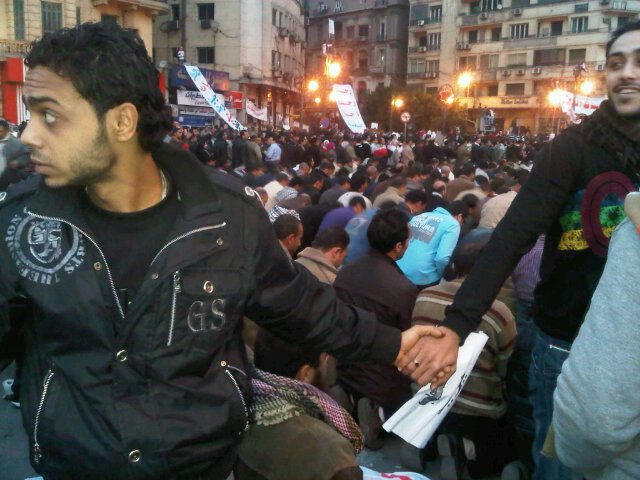
Inspired by the recent uprising in Tunisia, and frustrated by what were understood as deeply fraudulent legislative elections, Egyptian opposition figures have chosen to launch nationwide protests on the occasion of Police Day. The reverse symbolism is poignant – demonstrators will demand the repeal of the Emergency Law and the dismissal of the Interior Minister. Additionally, they call for a rise in the minimum wage and terms limits on the presidency. Activists hope that, as seen in Tunisia, initial protests for limited concessions might lead to a wholesale rejection of the regime.

Will they succeed? Over 80,000 Egyptian Facebook users have pledged to participate. So have leaders of the Muslim Brotherhood, the best organized opposition party in Egypt. They will be joined by the Wafd, Karama, and Ghad parties, the movements of April 6 and the National Association for Change, as well as representatives of the labor movement. Reluctant presidential hopeful Muhammad al-Baradei has signaled his approval of the protest, but will not participate.

Trepidation is understandable. The government has announced the demonstration to be illegal, and will deal strictly, though within the law, against any violators. At least three activists have already been arrested for promoting the campaign. Fresh in the minds of any protestor will be the recent deaths in police custody of Khalid Sa’eed, accused of drug dealing but purported to have informed against police corruption in drug deals, and Sayyid Bilal, an Alexandrian Salafi rounded up after the church bombing on New Year’s Eve. Investigations into their deaths are ongoing.

Other objections are raised. The Tagammu Party rejects the protests on the grounds that the nation’s policemen deserve a day of honor. Meanwhile, the ruling National Democratic Party has announced its intention to hold a counter demonstration of loyalty to President Mubarak, in which half a million of its younger members will participate. Additionally, the heads of the Orthodox, Catholic, and Protestant Churches in Egypt have urged their members not to join the protests, but instead to devote the day to prayer asking God to bless Egypt.

The weight and immediacy of the protest is in the air, especially in light of the events in Tunisia. One friend, an older gentleman, believes that nothing substantial will happen, though some may try to force the issue. He said this, however, on his way back from the bank, where he withdrew money ‘just in case’. Another friend spoke of the protest by listing a litany of common Egyptian complaints about the government. A sensible journalist, he spoke with a passion which betrayed his normal demeanor. Yet he has a wife and children, a reasonable income, and much to lose. Even so, he was itching to participate for the benefit of his country. Wisdom is necessary.

Yet where should wisdom lead? Certain factors suggest that a Tunisian style uprising is not imminent. First of all, the Tunisian demonstrations were by all appearances spontaneous developments arising from a disenfranchised lower class. Efforts at imitation in Egypt, however, are led by political elites looking to move the masses. Perhaps they will succeed; public frustration with government is widespread. More likely, however, is though the social media dissemination of dissent is spontaneous among the upper class, it will fail to mobilize greater society to any substantial degree.

Second of all, when the Tunisian demonstrations began to gain steam, they were joined by the middle class, which transformed an originally economic protest into one fully political. Critical mass was reached, and the president fled. Here, however, the middle class will be asked to lead, not support. Their cause is political, not economic. Though certainly the poor in Egypt could stand a drastic improvement in their condition – far more than in Tunisia – will they follow the comparatively rich into an unknown future, for political freedoms that do not generally concern them anyway? Can the family man mentioned above command their allegiance? Will he even be willing to try?

In which light, then, should the decision of the church to abstain from protest be understood? Church leadership is also frustrated with the government, especially following the use of live ammunition on Coptic protesters in Umraniyya, a suburb of Cairo. The Alexandria attack, however, may have served as a reminder that church security is tied to good, secure governance. Perhaps a known stability is preferable to a chaotic, unknown future.

The government can also be seen as solidifying its relationship with the church following the Alexandria bombing. The prime suspect in the Nag Hamadi Christmas killings from last year was recently sentenced to death – the first such sentence rendered against a sectarian criminal in modern Egyptian history. Furthermore, the government has stated that a new law to govern the contentious issue of church building will be introduced soon. For its part, the church has rejected the efforts of the US Congress to conduct a special hearing on the Alexandria attack as interference in domestic affairs – exactly the same language used by the government. The church’s longstanding position is that Coptic affairs are a matter of concern to Egypt only, interpreting even sincere international efforts at assistance as detrimental to the national unity between one people of two religions.

It can also be said that the Bible itself is an anti-revolutionary document. Many verses encourage believers to submit to the king, whether he is just or unjust. While undercurrents of protest exist in Biblical interpretation, the Egyptian church perspective is well within the mainstream of historical Christian understanding. It may well be within the mainstream of wisdom as well, but this is a pragmatic, political matter. Should the church throw its hat in with the uprising? Where will the repercussions be greatest should the effort fail, or succeed?

Fr. Matta al-Miskeen represents a minority position in the church today, but one that has been forged by an intense monastic spirituality. In his book ‘Church and State’, he urges Christians to become full participants in the life of society, and devote themselves spiritually in the life of the church. A mixing of the two identities, however, pollutes the two streams in which Jesus said to ‘render unto Caesar the things that are Caesar, and the things that are God’s, to God’. Though now deceased, he recognized the increasing politicization of the church, and warned against it.

As things stand now, the church is tied to the ruling political establishment, no matter how frustrated it is in this relationship. Alliance with government makes proper sense; after all, having suffered through sectarian and terrorist attacks over the past three decades, it is only the ruling power that controls the forces of security. Witnessing great police commitment to defend the sanctity of churches during Christmas Eve services testifies to this fact.

Yet Matta al-Miskeen hints at the greater strategy. If the church is apolitical, then individual Christians can be as political as they desire. The government can trust the church not to mobilize its members, either for or against government policy. Society, including the Muslim majority, can trust the church to urge its adherents toward morality and cooperation. Then, if a Christian becomes a government loyalist, he is free. If a Christian takes opposition leadership and calls for regime change, he is free. For his actions he is responsible to God, as well as the state and society. Yet this responsibility is his, it does not belong to the church. The church is responsible for nurturing the spiritual life of believers, not securing their political rights.

Police Day is January 25. Tension is afoot. Different strata of society have chosen sides, and the church has declared its allegiance. Perhaps the day will pass insignificantly; perhaps this is the first step towards Tunisia. Will society follow the lead of the elitist agitators, no matter how deep their dissatisfaction with government? Will Christians follow the lead of the church, and continue their submission to the ruling powers? For all involved, where does wisdom lie?

For the good of Egypt, may the right answers become clear. May all have the courage of conviction and the goodness of heart to act on such wisdom.

Categories
Arab West Report Middle East Published Articles

Umraniyya through the Eyes of the Church

On November 23, 2010, clashes erupted between security forces and Christian demonstrators at the construction site of a church service building in Umraniyya, Giza, just outside of Cairo. The protests began when authorities halted the construction process of a building which was rumored to be transformed into an unauthorized church. The protests were subdued by a show of force resulting in the death of two Christian protestors and the injury of dozens, including security personnel. The clashes attracted national attention, and as with many sectarian incidents, adduced differing interpretations.

This paper will focus on the interpretation of the Coptic Orthodox Church. The official church television channel ‘Aghabi’ devoted the bulk of two episodes of Nabd al-Kanisa (Heartbeat of the Church) to special reporting on the Umraniyya incident. Nabd al-Kanisa is hosted by Shenouda Victor, and describes itself as ‘the official church voice’, bringing ‘the truth from the church to you’. The first episode aired on November 26, and the second a week later on December 3. Supervision for the programming is provided by Bishop Armiya, secretary to Pope Shenouda III.

Reporting on episode one lasted about thirty minutes, twenty of which consisted of an interview with Bishop Theodosius, General Bishop of the Churches in Giza. The rest of the time provided video footage from the scene, clips from Pope Shenouda’s weekly meeting in which he answered questions about the incident, and commentary from the host. Episode two was devoted entirely to Umraniyya, with over an hour of video footage, statements from eyewitnesses, a survey of media coverage, and further commentary. The following will provide the presented summary of events:

The Official Church Perspective

Four years ago the church purchased the land on which the building in question stands. Though there were some complications at that time, the permissions were given to build a church service building, and Bishop Theodosius explicitly denied that there were Muslim-Christian tensions in the area over the issue. Then, in 2009 the church received official license to construct a service building. He also emphasized, though, that many of the common people in Giza cannot differentiate between a service building and a church, and assumed the building was to be a church, as it was on church property. Incidentally, this particular building had no distinguishing church characteristics such as crosses or domes.

Construction proceeded normally, until a violation was recorded and a work stop order given by the local Umraniyya district authorities. The violation concerned a second staircase, anterior to the building, which was not approved in the original blueprints. The bishop questioned why, with building violations all over the city, should an extra safety measure stop the whole project. A local Muslim was also filmed stating the original issue concerned only this secondary staircase.

When the work stop order was issued the workers and craftsmen began their protest. The program emphasized that it was composed of Christians and Muslims together, depicting one holding a sign stating, “I am a Muslim and I refuse the persecution of Copts.”

When the bulldozers came it was interpreted as a threat to destroy work on the building. The workers then, according to the bishop, quickly constructed a dome on the building to give it the appearance of sanctity.

They hoped that demolition workers would respect work done on a building with a ‘churchy’ appearance. During this time the protest began to swell. Certain vehicles from the district government entered the premises to investigate, but were attacked and had their windows smashed in. The bishop emphasized, though, that many of the people there were unknown to the church, and church officials immediately apologized for the damage and offered to replace the car.

As the protest continued, certain of the church priests went to visit the governor, with whom the church, it was stated, had good relations. They returned with a decision of the governor to turn the building into a church as soon as the proper papers were presented to him. The announcement of this decision to the protestors was met with great applause. Footage shown captured the enthusiasm.

That evening, November 22, however, security started to assemble. Dozens of policemen cordoned off the area, and also perched above on an overpass. Early the next morning, the order was given to attack. The bishop stated that he doesn’t know who issued this order. Tear gas was employed, and live ammunition was used. Rocks were thrown, both by protesters and by security. Chaos ensued, and everyone dispersed. Police began arresting the protestors, and eyewitnesses claimed they went around yelling, “You have ‘Christian’ on your identity card? Get in!” Over 100 people were taken into custody. Video and pictures captured that several of these were handcuffed to their beds in the hospital while being treated for their wounds. Two of the wounded later died.

Analysis and Questions

The above sequence of events was culled largely from the interview with Bishop Theodosius. Five eyewitnesses also presented testimony, but none of their names were given, and three were given in silhouette. For one of these, an eye patch – presumably from the attacks – was visible in the black and white profile. In addition, three priests provided brief statements, and official church press releases were read, addressed to the president, parliament, and others. In addition, three different newspaper articles were read, selected from al-Masry al-Youm, al-Uyun, and Nahdat Masr.

Music played a central role in the presentation of images and video. During scenes of violence it was presented in staccato, ominously highlighting shots of police firing tear gas or throwing rocks. During the aftermath of events the music shifted into quieter, mourning melodies, audible against the backdrop of bloody victims or hospitalized patients.

Coverage on the program revolved around three themes:

First, this was not a sectarian conflict. Christians and Muslims worked together in building the church, and protested together when the stop work order was given. Given the preponderance of sectarian issues in recent weeks, and also against the backdrop of elections widely believed to be fraudulent, the program emphasized this was an issue between government and people, not between Muslim and Christian.

Second, this was initiated by security, responding to administrative matters with disproportionate violence. Rumors about changing the building into a church were based only on popular misunderstandings, and violations in the agreed upon blueprints were necessary for safety reasons. A telling segment on the program offered video footage of police violence under the heading ‘for every action…’ followed by scenes of protesters throwing rocks with the heading of ‘there is a reaction’. The main question, however, asked but unanswered, is why such violence was necessary. Even had there been countless violations, could the situation not have been handled differently?

Third, this is a matter to be solved by President Mubarak. Bishop Theodosius stated his confidence in the wisdom of political leadership to solve this crisis. The building under construction displayed large banners with an image of the president, following the governor’s decision to initiate a procedure to license it as a church. One of the anonymous eyewitnesses also dramatically expressed his desire to see President Mubarak’s intervention, stating the president enjoyed ‘all respect, esteem, and love.’

The perspective of the church given during the program served effectively to create a narrative of events that makes sense of what happened. Yet, like any perspective, it left out elements potentially detrimental to the narrative. For example:

It is confusing to determine the status of the building. The bishop emphasized it was not originally meant as a church, and that the dome was not built as part of a transformation project. But when exactly was the dome built? The bishop stated it was after the threat of demolition, but other sources indicate it was the building of the dome which sparked the clashes. Furthermore, if the church did not intend it to be a church, why did the governor issue a statement that he would authorize it to become a church? Additionally, columnist and author Hany Labib notes that only the president can issue license for a church building; governors only have the authority to license repairs or reconstruction. How is the narrative affected by this fact?

It is confusing to determine the size of the crowd and their activity. Videos on the program show gathered protesters in the tens, or perhaps hundreds, and it is implied these were composed mainly of the construction workers engaged in building. The only act of violence admitted is the damage done to visiting vehicles. Yet other sources describe up to three thousand protesters. These are described as marching out to block traffic on the busy overpass near the church, and vandalizing government buildings and property. Without gauging the accuracy of these reports, there is no mention of them at all in the program. Yet a crowd this size, engaging in civil disobedience, might well qualify for a large contingent of security to subdue it. Whether or not the security response was warranted, these details cast doubt on the church narrative of innocent protesters being met by government thuggery.

It is confusing to determine the exchange of violence. The program represents the use of live ammunition as flagrant excess of force, but admits to an exchange of stone throwing between the two sides. Yet other sources picture the protesters as hurling Molotov cocktails at police. Hany Labib, however, emphasizes that Molotov cocktails result in conflagration, and there is no evidence of burned damage from the scene, nor reports of fire in the locality. The program contains no scenes of Molotov cocktails; is this because it would do damage to the greater narrative, or because there were none at all? If absent, who is trying to craft a different narrative of Christian weaponry, and why?

Finally, it is confusing to determine the nature of the protests. The program suggests that they emerged randomly, as workers and local residents took issue with government threats to stop their labor. Hundreds of people, however, and certainly thousands if that number is correct, suggests organization of presence. Furthermore, why were there so many so early in the morning? In addition, the protests took place over a few days, and sources indicate they drew attention to their cause by blocking traffic. Again, organization appears likely, but at the least, could not church authorities have stopped the protests had they wished this? Premeditation offers a different perspective on the narrative than spontaneity.

There is also the larger contextual issue of church service buildings themselves. These began to emerge in the late 1970s and early 1980s in reaction to the sectarian crisis at that time. Beginning on university campuses, there was a trend for students to segregate themselves by religion for social activities. As such, the church began providing places for Christian students to congregate. Mirroring also the actions of the Muslim Brotherhood and others, the church expanded the use of service buildings to provide education, training, and material support for Christians throughout the nation. As these buildings do not have the traditional appearance of a church, they tend to be less controversial in society and receive more easily official government authorization. At times, due to the difficulties in church building regulations, they have been transformed into places of worship.

So while aspects of the church presentation require greater research, some of their questions raised do so as well. For example:

  • Why did these building violations attract the attention of the government, when so many go unheeded throughout the city?
  • Why did security assemble in the dark of night, and why did they attack early in the morning?
  • Why would policemen throw stones at protestors, even if provoked (as seen in video footage)?
  • Why was live ammunition used?
  • Why were so many protestors arrested?
  • Is there any relation between these events and the parliamentary elections scheduled five days later?

Answering the questions raised in this text, unfortunately, are beyond the current resources of the AWR office. Raising the questions, however, serves to highlight a consistent theme: Easy answers and polemic accusations rarely reflect the reality of events. Should the government issue clear regulations for building houses of worship? Likely. Does security react with more force than necessary when dealing with protests? Often. Is the loss of life regrettable, and should those responsible be held accountable? Absolutely.

With this program the church, however, is walking a fine line. On the one hand it seeks to portray itself as an innocent sufferer at the hands of an aggressive security force. On the other hand it seeks to reiterate fidelity to the ruling regime on which it depends, it believes, for protection. Toggling between criticism and loyalty, while ignoring worthy considerations of its culpable role, the church risks giving evidence of acting as a state within a state. This is a damaging accusation against it, and the church would do well to work stridently against the perception.

Even Pope Shenouda has undone part of the greater church narrative. During the parliamentary elections he voted for the oppositional Wafd party candidate, signaling his displeasure with the government’s NDP party. With what, however, is uncertain. Is it simply a protest against government handling of the Umraniyya crisis, or reflective of a deeper change in his convictions? In any case, his personal vote and voice always signal more than that of one man, given his developed representation of all things Coptic.

In his response to a question on the Umraniyya crisis during his weekly meeting, Pope Shenouda quoted Colossians 3:21, applying it to the role of government – “Fathers, do not exasperate your children, so that they do not lose heart.” Though questions abound about the role of the church, ‘exasperation’ – with government, with society – accurately describes the condition of many Copts. Will they lose heart? Only they can decide.

While sectarian issues exist, the church does well in emphasizing this particular conflict is not sectarian in nature. Muslims and Christians alike oppose violence, and express shock at the level of aggression meted out in Umraniyya. As such, perhaps the antidote to losing heart can be found in a Muslim voice, highlighted during the program from an article in al-Masry al-Youm. Recalling the Christian values described in the Sermon on the Mount, Fatima Naout wrote: “We pray for all those who practice violence … so that from us the great love of God may be revealed.” In times of exasperation, greater purpose is needed to lift the sufferer from despair to hope. Perhaps a positive commitment to demonstrate God’s values can suffice. There is no loss of heart in love.

Categories
Personal

Preparation of Tinder: The Umraniyya Riots as a Prelude to Christian Violence following the Alexandria Bombing

Since the 1970s Christians in Egypt have felt under pressure from a perceived Islamization of society and patterns of discrimination from the government. In recent years they have registered complaints about restrictions in church building, irregularities in prosecuting crimes against their community, and other issues. Until recently, however, Christian criticism was expressed only within their community or with the media. On the rare occasions when they have demonstrated, it has been almost exclusively restricted to within church grounds.

The murder of six churchgoers in Nag Hamadi on Coptic Christmas,  January 6, 2010, provoked small scale demonstrations of Christians in that Upper Egyptian town. This vulgar attack, however, precipitated the beginning of public protest elsewhere, as was witnessed in a peaceful demonstration in downtown Cairo in February. Over the course of the year other events – Christian homes burned in Abu Tisht, public polemics between religious leaders, conversion cases concerning wives of priests – all contributed to a deepening of tensions and a feeling of isolation among Christians. If tinder is present in abundance, only a small spark is necessary to cause an explosion.

November 2010, one month prior to the attacks in Alexandria, the first spark occurred in Umraniyya, a poor, traditional living quarter in a Cairo suburb. Rumors abounded that the church was attempting to transform a service building into a place of worship, and government authorities interfered and stopped the proceedings. This is a common occurrence in Egypt; church building regulations are restrictive, and there is often much subtle maneuvering between the circumvention of law and its enforcement. This time, however, violence exploded. Again, though not regular, this is not uncommon; what distinguished this event was that the violence began with Christian initiative.

At first the demonstration was led by disgruntled Christian workers, according to sources from within the church. Media reports, however, state that they were joined by up to 3,000 area Christian youth. They did not remain on the church grounds, but instead exited and blocked the ring road not far from the church. Reports also describe vandalism against local government buildings and vehicles.

When the security forces arrived to subdue these riots, the result was an exchange of stone throwing between the protestors and the police. Reports also describe Christians hurling Molotov cocktails at the guards. In an excessive show of force, the security responded by using tear gas and live ammunition. Two Christians were killed, dozens wounded, and scores were arrested.

As with most news events in Egypt, determining facts and placing guilt is a difficult matter. Whether or not the Christians, or even the local priests, bear fault, the overwhelming Christian response to the Umraniyya incident was horror at the unnecessary death of two individuals. Many Muslims and other activists also condemned the heavy hand of security in putting down otherwise containable protests, as had happened repeatedly in all nature of demonstrations over the previous year. Christians in particular, however, viewed it as one more piece of evidence that their community is beleaguered, if not persecuted.

This is the prevailing attitude among many Christians of all classes. Yet where this sentiment exists among the lower class and uneducated segments of society, it mixes with the problems of poverty and unemployment to create a dangerous tinderbox. This was seen on a minor scale in Umraniyya. The explosion was witnessed in Alexandria, and then elsewhere in Cairo.

The unprecedented bombing that took place at the church sent immediate shockwaves through the Christian community. How should one react when a place of worship has been desecrated, when fellow religionists have been ripped to pieces? Even if most victims were unknown to the majority of rioters, Alexandria represented an attack on the Christian community, and the spontaneous response in defense of Christian identity was to take to the streets.

Again, it is difficult to be precise. Did security fear the worst and clamp down, provoking the violence which ensued? Were the Christians bent on destruction, and thus needed to be subdued? Were local Muslims agitators, or innocent bystanders swept up in the fury? Certainly the combination of these factors intertwined to produce the riots widely held in Egypt’s urban centers. What is clear is that the preparation of tinder had been underway for some time.

Now that it has burned itself out, will Egypt – Muslims, Christians, and government – be able to find avenues to legitimately express grievances and seek common solutions? If not, the collection of tinder will quietly begin anew.

note: Shortly after the Umraniyya incident I wrote an article for Arab West Report summarizing the official church version of events. Having neglected to post that here originally, if you desire to read more I will look to do so in the next day or so.

Categories
Personal

Quick Thoughts on Tunisia

We lived as a family in Tunisia for two years before accepting my current position at Arab West Report in Egypt. While there we developed a fondness for the country and its people, and as such we have been following closely the political developments. If it has not caught your attention, economic protests have been sweeping the nation, which led to the president of over twenty years fleeing the country. Since then the army has been clamping down, and it is premature to say if there will be any real change in the government, or if it will be a face lift which installs another Western-leaning authoritarian regime.

I would like to say that when the protests began developing in earnest, I was hopeful. While there are many poor people in Tunisia, the country as a whole supported a sizeable emerging middle class. Furthermore, this was built upon their industry, as the nation boasts little in the way of the natural resources which have fueled wealth-building of other Arab states, particularly in the Gulf. This is a testament to the Tunisian national character, which we found to be creative and industrious, in addition to being cultured, intelligent, and open minded.

So while I found much of the protests to be driven by the poorer sections of society, which gave them an appearance of riots, I was hopeful that it would lead to a positive transformation that demanded political change. As the president began making capitulations, it appeared it might be so.

As such, I was quite surprised when he fled. Authoritarian regimes tend to be quite adept at putting down social protest. Furthermore, though the protests were sweeping the nation, he did not appear to be in any danger, and the army would always be available to clamp down. Human rights would be trampled in the process, but eventually, these things tend to die down and life goes back to normal.

I wonder if he fled due to pressure from the army. The president was old, and his steps at placation had the appearances of yielding to the call for an opening of society and an expansion of freedoms. Perhaps fearful, the army may have decided he was a liability, made it clear he was to leave, and began asserting control.

If so, the strategy could be to make the people believe they have won, at which point the fervor will die down and preparations can be made for the government transition. This will give ample time for authorities to perfect election tricks and engineer circumstances so as to keep overall ruling power. There will likely be significant popular pressure to push forward with reforms, but that sort of success is a lot harder to achieve.

Still, I am hopeful. The Tunisian people are of a nature to get it done. Though destructive riots continue and rumors abound of American interference, with al-Qaeda trying to involve itself on the opposing flank, Tunisians are of a dogged, resilient sort. Yes, this could devolve into a Romania-type debacle. Yes, the army might reassert control as things go back to the acceptable, but oppressive status quo. But I would risk a wager on the collective cry for freedom, and trust Tunisia to emerge a stronger nation than before. I hope I’m right.

Categories
Personal

Christmas Conversion Conversations

Note: I wrote this piece shortly after Western Christmas, but a few lines needed more consideration, and we delayed publishing. Then, Alexandria happened, and I forgot all about it. Even so the theme, if not exactly the title, is fitting with what has taken place in this country.

——

One of the topics I am most interested to discover here in Egypt is how the Christian population might begin to love and serve their Muslim neighbors without agenda, especially those who are understood to oppose them, such as the Muslim Brotherhood or other Salafi / Wahhabi influenced groups. Characteristic of most Christians I have met here is an attitude of suspicion and a pattern of withdrawal. This is not to say that good relations do not exist between many Muslims and Christians, of course, but the general Coptic community perspective is negative.

Most of my Christian relationships here, however, have been with the Orthodox community. This is not unusual, as most Egyptian Christians are Orthodox, and we have been worshipping at the local Orthodox Church in our neighborhood. On Christmas we joined some foreign friends for a dinner celebration, and they invited two of their Protestant Egyptian Christians along. I love learning perspectives, and with them individually I raised this greater question.

The interesting angle is that each one almost immediately spoke of Muslims becoming Christians, though in a very disjointed manner. Neither one spoke of any personal involvement or activity to promote conversion, either on their part or of the church in general. Yet the topic of love and service prompted a conversation leap directly into the fact of religious identity change. Notably, there was little considered on how to get there.

With the first Protestant conversation developed toward the Muslim Brotherhood, and I asked if he thought they were an organization of crooks. I have heard this not infrequently among both Christian and Muslim Egyptians, who see them as businessmen who use religion to either line their pockets or make political gains.

This gentleman stated this was his perspective as well. I countered, though, that perhaps some of them were sincere. Perhaps many, even, were dedicated to God as they understood him, even if their ideology is to be rejected.

He did not disallow the possibility, but the thought shifted him in another direction. Unprompted by the flow of conversation, he stated that if a Muslim Brother was truly sincere, if he was truly trying to serve God, then God would make clear to him the path of Jesus upon which salvation rests. Up until this point, I did not know the denominational adherence of the gentleman, but this language was certainly Evangelical. I wondered if he might be an unusual sort of Orthodox, but when I asked if he was Protestant, he responded ‘Baptist’.

The second individual, a lady, never clearly revealed her particular denominational affiliation, but her history revealed a mixed heritage of Orthodoxy and Protestantism, some in America, with an admiration for both. Our conversation was much more in depth, and she spoke of the good old days in Egypt when there was both more religious tolerance and personal initiative in pursuit of development. She commented that many Christians have given up hope that things would get better, but that she, though tempted to do the same, felt that as a Christian she was bound to behave as if she had hope, and press on.

Her attitude intrigued me, and when I asked about tangible actions of love and service, she offered simple but poignant advice – interact with them, and do not disparage them. Apparently, she thinks the Christian community is failing here.

Perhaps I have grander ideas unformulated in my head, but the basic humanity expressed in her words is at least the minimum of what is called for, and any more could become a deprecating ‘strategy’. Yet while I as a foreigner might have an awareness of the need for community-wide responses of love, only an Egyptian can say what this would look like. So I pressed on – what love and service could Christians in general offer to those whose ideologies desire conservative application of sharia law?

Again, a jump occurred. I do not fault any Egyptian Christian for not having an answer; it is hard for them to imagine possibilities so opposite of their prevailing mindset. Her answer, though, was education, but through the means of Christian satellite television. She immediately began telling stories of Christians on these broadcasts who had formerly been Muslims. Though some were harsh in their manner of conversation about Islam, there were hundreds, she related, who were learning about the true nature of Islam and the comparable attractiveness of Christianity, Jesus specifically.

Many, perhaps most Egyptians are satisfied in their religion and content to let their neighbors believe their personal doctrines in peace. Yet it is not uncommon for believers of any religion to be interested in the conversion of others. This can be from genuine concern for eternal destiny or temporal happiness, or from a baser instinct of community ‘rightness’ as opposite the other. On the whole, however, Egyptians are aware of the high social cost faced by any convert in either direction.

Yet I was a bit confused by the speed of connection between the initiative of love and the result of conversion, offered independently in separate conversations. By any standard, Muslims in Egypt are not rapidly converting to Christianity, if at all, so it is not as if they are describing a trend. Why then would the conversation move so abruptly in this direction?

If the reason lies in denominational difference, it could be that Orthodox have been a minority in Egypt for hundreds of years, and as such are more focused on preservation of their community, rather than expansion. Not a few Orthodox I have met have also spoken of these satellite channels and the Muslim converts they portray. Most of these have also had some experience in the West with greater levels of freedom, and specifically religious freedom. Protestants, meanwhile, have comparatively greater Western exposure, and with it a more natural connection with the Evangelical focus on evangelism.

Perhaps the Protestant religious priority of evangelism, coupled with a generally perceived Coptic experience of religious difficulties, causes the jump. The presumably real stories of Muslim converts on satellite television nurture the evangelical dream, and talk of ‘love’ reminds such Protestants of their religious obligations, along which the path of conversion treads. That they do not know this path may reflect why the abrupt connection between love and conversion has few details of action.

Or it may be specifically that almost no one even considers loving the more conservative groups of Muslims. Therefore, if conversation suggests this, it will be God’s miracle to bring them to Christianity. As such, details of action are not even necessary, and have never been contemplated.

I certainly have had far too few conversations with Egyptian Protestants to confirm these musings. Yet the congruity of conversation in this instance was striking. Perhaps the best conclusion is found in the thought of the Egyptian lady of mixed denominational heritage. Interpreting her words, engage one another as neighbors, and respect one another’s views. In a society of much religious distrust, these simple ideals have become somewhat revolutionary. Is this sufficient, for either Muslims or Christians, to fulfill the words of Jesus to love the supposed enemy? Interestingly enough, Jesus’ words in context are unconnected to the issue of conversion. Instead, his followers are to imitate God, who sends rain to both the just and unjust. Certainly God desires all to become just, but sometimes his followers can run ahead of him. Or, more consistently with this text, jump.

Categories
Personal

Contemplating a Terrorist Strike

SUICIDE BOMB
Image by wannaoreo via Flickr

Jayson and I attended St. Mark’s Coptic Orthodox Church here in Maadi, Egypt on Coptic Christmas Eve.  This is not so unusual, as it is the main church we attend weekly, but this particular night was a little different.  You may have heard in the news about the suicide bomber who attacked a Coptic Church in Alexandria, Egypt on New Year’s Eve.  Egypt’s churches had been threatened by terrorists back in November, and on New Year’s Eve, that threat became reality!  The week that followed was interesting reading the news reports and hearing about the heightened security as Coptic Christmas approached.  Each day as I took my girls to preschool across the street from the Coptic Church, I noticed more and more security measures.  The teachers told me about bomb-sniffing dogs and scanners to be put in place for the Christmas Eve service.  We had planned to take a trip three hours south of Cairo for the holiday to celebrate with the same priest’s family we had celebrated with last year, but were advised to change our plans due to the threats.  And yet, we couldn’t forsake the place where we had been striving to belong over the last year.  It was Christmas Eve, the second biggest Christian holiday, and threats or no threats, it was time to attend church.

It was a long day in many ways.  I began work making a “contingency plan” over a year ago, and yet, with the immediate cares of everyday, I usually forgot about it and certainly didn’t make it a priority.  And yet, that day, with the thought of attending church under threat of attack, my thoughts turned to our three little girls, and what information people would need if something happened to Jayson and me.  I finally got around to writing down where our important documents are kept, phone numbers of parents in the states, and contact information for other connections we have.  I even wrote down phone numbers of friends in the country who I knew would be able to help with babysitting, even though I never asked them if they would be on my contingency plan.  It was necessary, but foreboding, to be writing down the girls’ daily schedules:  Emma and Hannah go to bed at 7pm, Layla is eating squash and peas … things people would need to know IF something happened.  But yet, the thought of this information being needed was very disturbing!

I lived that day a little differently I think.  I prayed more.  I hugged my girls more.  I had realized in the past that I didn’t have many pictures of me with the girls simply because I am usually the one taking the pictures.  And I knew I didn’t have any recent pictures of me with Hannah, my second girl.  So, one of the things I did that day was take some self-portrait shots with Emma and with Hannah.  I figured IF something happened, at least the girls would have these photos to hang on to.  How depressing!  But it was the first time I really went through a day thinking, this COULD be my last day.

I even taught the girls a song that day which I had recently remembered when reading Psalms.  I heard this song years ago on one of Steve Green’s Bible Verse Song tapes and it goes, “When I am afraid I will trust in You, I will trust in You, I will trust in You….”  I thought it a perfect song, not only for when they wake up at night with bad dreams, but especially today … IF something happened to me, I wanted them to have a song to sing as they were afraid without their Mommy and Daddy.

I tried not to think about the possibility of this being my last day on earth too much, but it really was a strange feeling.  I wasn’t overcome with fear, but I really did want to be prepared … or have my girls prepared for what COULD happen, without letting them think about what COULD happen.  My “I love you’s” to them when we put them to bed had a little more weight behind them than normal, and I looked at them just a few seconds longer than usual as I left their room.

I wasn’t sure if I would be nervous the whole time we were in the church, as the best time for the attack would be as people were exiting the building, but while I thought about it some, it wasn’t at the forefront of my mind.  I was impressed by the security presence at the entrance.  I was impressed by the number of people who were in the church, and the numbers who just kept coming and made it standing-room-only for a time.  I felt proud to be there and proud of the others who came despite the threats.  I was grateful to the Muslims I noticed in the crowd, for their standing with their Egyptian brothers in a possibly dangerous place.  And I enjoyed what I could understand of the sermon.

I got a little nervous toward the end as the priest made several announcements to the congregants to exit and go straight to their cars following communion.  They reminded them not to stand around and chat either inside or outside the building.  They wanted to cooperate with security as much as possible and get people home safely.  I felt comfortable inside and couldn’t imagine something happening at that point, but still, we had to leave the church and walk through the barriers before we were “safe.”

And you all know, since I am writing this post after the fact, that nothing happened and I am still alive and well and still able to be a Mommy  to Emma, Hannah and Layla, for which I am very grateful. But I now have a good start on our contingency plan, and a good reminder of what it’s like to live more “in the moment,” realizing that any day COULD be my last day here.  I don’t want to live in the depressing “what if’s” of thinking about death, but I want to hug my kids hard each day, tell them I love them truly each day, teach them songs and take pictures with them each day.

I’m thankful for the days God gives me here, but I don’t want to live in awareness of this only when the thought of death becomes a possibility.  Though there are many good things to live for, sometimes we only recognize it when the status quo is threatened. Terrorism can do that to you, but it can also lead to paralysis. Hopefully, in the days to come, we can find the balance.


Categories
Arab West Report Middle East Published Articles

The Happiest Christmas of My Life

You will grieve, but your grief will turn to joy.

How is Christmas held in mourning? For the Coptic community of Egypt, Christmas is traditionally a time of celebration. Midnight on Christmas Eve ends a forty-three day period of fasting, concluded during mass in which the Eucharist is served. Afterwards, families congregate and break the fast joyfully, eating the meat, fish, milk, and eggs from which they had previously abstained. Early the next morning parents return to church with their children, who play games and receive gifts, all wearing their new holiday outfits. And since 2003, Christmas has been a national holiday, with all Egyptians receiving a day off from work. Along with Easter, it is a centerpiece of the religious year.

Yet all this merriment was threatened one week earlier when a bomb ripped through worshippers at a Coptic Orthodox Church in Alexandria at the conclusion of the New Year’s Eve mass. Twenty-three people were killed, dozens more injured, and threats were issued for continuation at Christmas. At first Pope Shenouda, pope of the Coptic Orthodox Church, considered cancelling Christmas celebrations altogether. In the end, the church decided to push forward, although the churches of Alexandria decided only to conduct the Christmas Eve mass, and cancel the next day celebrations. How can Christmas be held in mourning?

If one returns to the Biblical story, there was little joy in the coming of the first Christmas. Forced into a difficult period of travel, Mary gave birth to her child in the dingiest of circumstances. Later, that child would grow, and warn his friends of his coming death, promising them their grief would turn to joy. Approaching Christmas, few Copts could anticipate a similar transformation. Even if they attended mass in defiance of terrorist threats, it would be in the shadow of death and the fear of repetition. Grief, not joy, would mark Christmas 2011.

A woman giving birth to a child has pain because her time has come.

St. Mark’s Coptic Orthodox Church in Maadi, Cairo has become our church home in Egypt. It has not been easy adjusting to Orthodox traditions, and though an open, friendly spirit exists among the congregants, they are not used to making foreigners welcome in their midst. Over time, though, our girls have attended the church preschool, and we have made friends. Of course we would attend Christmas Eve mass.

The newspapers had warned that extensive security procedures would be in place, so as we walked to church, passports in pockets, we did not know if we would be allowed entry. There had been a groundswell of support from Muslims in Egypt, condemning the bombing and seeking to stand in solidarity with their brother Christians. Many had expressed a desire to attend Christmas Eve mass, either in defense of the church, or else to die together. Yet rumors abounded that either security or the church would not allow Muslims entrance. Pope Shenouda strongly refuted their rejection, but who could know? If Muslims were to be barred, what about foreigners? While we are known to church leadership, and the regular guards outside the church see us every week, what about their amplified staff? Would they risk the death of foreigners on top of all the other bad press associated with this terrorist crisis?

Approaching the church, we marveled at its military headquarters-like appearance. St. Mark’s Church occupies a place on al-Nahda Circle, between two side roads which receive regular, but minimal, traffic. Since the Alexandria attack took place outside the church, originally believed to be from a car bomb, traffic barriers were placed along a full half of the circle. No cars were allowed to park anywhere, and the two side roads were cordoned off entirely. The barriers were erected to also serve as a channel for approaching pedestrians. As we stepped forward, we were asked for identification.

The checkpoint experience was strangely odd. Security personnel were all around, but we were inspected by plain clothes individuals with badges hanging from their necks. As it turns out, the church had organized its own security team, which helped identify regular congregants from questionable interlopers. We did not recognize the woman who took our passports, but in retrospect there seemed a note of awareness in her eye. Whatever the reality, we were allowed to pass.

But when her baby is born she forgets the anguish because of her joy that a child is born into the world.

We arrived at the church about 8:00pm, hopeful that by arriving early we would secure a good seat in the balcony. Instead, there was hardly a place to be found. Though we found a place in the last row of the side balcony, by the end of the evening every place was taken, as well as every step in every ascending aisle. Two lower rooms were also packed, watching the mass projected live on screen. Terrorist threats, security concerns – at St. Mark’s, at least, Copts were observing, if not celebrating, Christmas.

I have heard reports that in many churches the congregants wore black, to symbolize their mourning. Here, the term ‘celebrating’ may not be inappropriate. Many people were dressed to the nines; new outfits were visible in abundance. St. Mark’s in Maadi has a reputation as one of the more well-to-do churches in Cairo; economic stability allows festive possibilities. All the same, people seemed determined to defy terrorism not only through presence, but also through insistence on celebration. Surely their hearts were heavy, but life, including holiday, must continue unabated.

As we scanned the audience we noticed what appeared to be two Muslim women, distinguishable by hijab, seated in the upper opposite corner from us. We wondered if there were others, as religious identity is not determined by physical characteristics. Everyone else seemed to blend together. As will be seen, this was quite appropriate.

The mass continued as it always does, and always has, for hundreds of years. There seemed to me to be more Coptic language chanting than normal, which could result from a desire during times of crisis to reassert original community identity. As a language, Coptic fully gave way to Arabic in about the 14th Century, and the tongue withered away until its liturgical revival in the 20th Century. Or, the Coptic chants may have meant nothing special in particular – I should reemphasize our newness to the tradition. All the same, along with the Muslims in the corner, it felt like a slight divergence from the norm.

As the time for the sermon approached, it was introduced, as normal, by a reading from the Psalms and the Gospels. Then, an unusual but timely procession advanced. Twenty-three individuals, each carrying a lone candle, advanced toward the pulpit and sat down in a vacated pew. One, we noticed, was wearing a hijab.

When they sat Fr. Boutrus began his sermon. This Christmas was wrapped in sorrow, he spoke, but we must always look in hope for good to arise from evil. Indeed, he continued, Jesus promised his followers that there would be grief, but that grief would be turned to joy. Just as a mother suffers labor pains, so Egypt is groaning under the weight of this tragedy. The newborn baby, however, displaces the pain. What will displace the pain of Egypt? Where is the new baby to be born? It is here, in this church, in churches throughout Egypt. It is Muslims greeting us in peace and consolation. It is a national unity that will emerge from the challenge of sectarian tension. I have received so many phone calls and messages, he said, from Muslim friends who have wanted to be a part of our celebration tonight. It is their presence here that fills me with joy. In fact, I must say, today is the happiest Christmas I have had in my life.

Fr. Boutrus acknowledged that there were differences, but he spoke of Jesus on the cross demolishing the dividing wall of hostility, making the two one. We each have our faith, and we must respect each other. Yet we may all follow Jesus in good works, among which is the ministry of reconciliation. Fr. Boutrus thanked the Muslims who had joined us, and reiterated his feelings again: It is right that Egypt is in a period of mourning, but today, in what develops, this is the happiest Christmas of my life.

Ask, and you will receive, and your joy will be complete.

As Fr. Boutrus ended his sermon, the procession of twenty-three, representing those who perished in the bombing, exited down the center aisle from which they came. As they did, tens of others from around the sanctuary also rose and exited. Caught off guard, we realized, these were Muslims seated everywhere in our midst.

It is traditional in the Coptic Orthodox mass that non-Christians are welcome. Visible in the ancient monasteries, but not so much the modern churches, the sanctuary was divided into sections. Up front is the place for the priests to administer sacraments, and behind them are the deacons who facilitate. Next come the believers, who are in fellowship with the church, living Christian testimony. Behind them are other Christians, but mixed also with the curious of other or no faith. These Christians are the ones who do not partake of the Eucharist, due to issues of unconfessed sin and evidence of broken fellowship. Known as the ‘Preached-to Ones’, they with non-believers listened to the Bible readings and the sermon. Immediately afterwards in the liturgy proceeds the preparation for the Eucharist and the transubstantiation of the host. Only baptized Orthodox believers may partake. Traditionally, everyone else leaves.

The tradition is not hard and fast in the modern world. We are not baptized Orthodox, and as such we do not advance for Communion, but neither are we expected to leave. In fact, not all Muslims left either; a few hijab-ed women were seen remaining in the pews. Yet it is customary for figures of state to attend Pope Shenouda-led masses during holidays, and at the appropriate moment, he acknowledges them, and they leave. For years this was a perfunctory, if admirable, feature of church-state relations; today, at St. Mark’s, it seemed poignant and appreciated. Officials from the governorate and district, friends of the priests, friends of the people – all were welcomed, and present in abundance.

In this world you will have trouble, but take heart, I have overcome the world.

After the Muslims’ exit, the liturgy proceeded as normal, but towards its conclusion we were reminded of reality. Before serving the Eucharist the priests asked each congregant not to leave their shoes behind in their seat as is customary. (Coptic Orthodox remove their shoes at Communion.) Instead, they distributed plastic bags in which they could carry their shoes while taking Communion. Following the bread and wine, they were to exit the church, don their shoes, and leave quietly one by one.

It is common following a midnight mass for the Copts to congregate outside the church as they wait for their friends to finish Communion. Having fasted, having waited through a lengthy liturgy, they finally meet up together and begin Christmas celebrations. It was this fact that led to so much destruction in Alexandria. Many people had exited church early, and were just hanging around outside when the bomb detonated. Anxious to avoid the same fate, the priests and security agreed to have each person leave immediately after their Eucharistic share.

Not all did, but many obliged. As we left we filtered through a subdued, porous crowd amidst reminders from the priests to leave. We passed through the gate, navigated the erected corridor, thanked a few security guards as we left, and headed home. It was a somber evening, despite the signs of hope and promise. The questions could not be dismissed: Will this same encampment be present next week? Will the terrorists simply delay until the next mass when both people and security let their guard down? Can the guard ever be let down? What about tomorrow morning, when celebrations should take place?

We woke early to bring our girls to the festivities. Indeed, they were festive. A puppet show was arranged for the youngest children. All age groups had activities going on. The high school students prepared to visit a local home for orphans. As before, people were dressed well, decked out in new outfits. It was enough to make me forget the circumstances; upon seeing some friends, I asked an impertinent question.

One’s guard is lowered quickly. The same security layout was present as the day before. Once again we presented our passports for a security check. At the gate Fr. Boutrus greeted each coming congregant, standing with a contingent of policemen. One policeman, though, produced a pink flower he offered to our four year old daughter. Throughout the day I saw several sporting theirs somewhere on their person. Greetings were exchanged; children played and laughed. Christmas was here, held amidst mourning.

I stumbled. “Are you having a joyous holiday?” My friends lost their smiles produced upon our meeting and replied, “Half and half.”

—–

Perhaps Jesus has overcome the world. Perhaps if these Copts ask, their joy will be complete. Did Fr. Boutrus speak from a sincere heart, or was he trying to will his words into reality? Has a newborn baby entered into the world?

One year ago six Christians and a Muslim security guard were killed in Nag Hamadi when alleged Muslim assailants opened fire upon Christian worshippers exiting Christmas Eve mass. Following the incident many similar expressions of condolences were offered by Muslims, and national unity was asserted in the face of tragedy. One knowledgeable Muslim journalist friend stated that he felt something was changing in society. The outcries were louder, more sincere; he expected the sectarian situation to improve. Yet the year that followed was filled with incident after incident of tension and conflict. This can be traced to a number of factors, far broader than religious difference. If at that time, though, the baby was stillborn, what gives hope this one will survive?

Certainly this occasion is different. The scale is far more serious and the stakes far higher. The past year was filled with recriminations, each to the other. Perhaps, on their part, the Copts never asked. They rallied, they worked, they sought legislation – did they seek God?

In his sermon Fr. Boutrus praised the Muslims, quoting Scripture: “He who loves, knows God.” He continued, expressing his wish, “May they be brought to complete unity to let the world know that you sent me and have loved them even as you have loved me.”

The message is Christian, but its borders are porous. Have Copts sought unity? Have they loved? The tragedy in Alexandria has brought substantial love to them; what will they do with it?

Certainly some of this love is perfunctory. Some of it is surface level condolence. But much of it is sincere. It is a love that brought Muslims to enter a church so as to express their solidarity, in the middle of heightened tensions and personal risk.

A Christian skepticism is warranted. They came, but they left early; the bomb would have gone off near the end. If they don’t condemn the massacre they will be perceived as supporters of it. It is the reputation of Islam they are concerned to defend primarily, not us. If they entered a church under normal circumstances, they would run afoul of security, and we would be accused of evangelizing.

Perhaps. But what Copts do next is of the utmost importance. If rebuffed, those Muslims who have sought reconciliation will have little reason to try again. The cycle of mistrust and mutual accusation will begin anew. Can they, with Jesus, overcome the world? Can they overcome themselves?

It is no easy task, but the life of a newborn baby is at stake. The mother, however, remains in critical condition.

Bible verses taken from John 16-17.

Categories
Arab West Report Middle East Published Articles

Christian Responses to Alexandria: Irony, Violence, and Love

Irony can emerge from the midst of tragedy. While the world awaits the emergence of good – from somewhere, somehow – irony is often first to make its appearance on the scene.

On Monday, January 3, two days after the horrific bombing at the Church of Two Saints, St. Mark and Pope Peter in Alexandria, the government sent a construction crew to repair damage caused to the church by the blast. Christian demonstrators, however, prevented them from entering the premises, stating that damage and blood must remain until the perpetrators are brought to justice. While their response is understandable in light of the circumstances, other observers may notice another angle: Christians often criticize the government for complicating or preventing church construction, repair, or renovation. In this instance, it is the Christians who prevent the government from restoring the church to its original state.

Since the bombing there have been angry Christian demonstrations throughout Egypt, many of them violent. A representative video, with English subtitles, can be found on the al-Masry al-Youm website. The following is a sampling of recent events. All statements are as reported in various Egyptian newspapers; sources can be tracked by following the links.

Immediately after the bombing area Christians swarmed to the scene and clashed with security forces. It is also reported that they stoned a nearby mosque.

On Monday the demonstrations began in earnest. During the funeral of the deceased, Christians chanted anti-government slogans. Demonstrations broke out at the papal cathedral in Cairo, in which 43 policemen were injured. Three of the most prominent Islamic leaders in the country had come to pay their condolences to the cathedral to Pope Shenouda, but their cars were assaulted while there. 90 people were injured during demonstrations in Shubra, a section of Cairo with a large Christian population. Thousands of Christians joined with activists in a protest in downtown Cairo, during which time 47 were arrested and 20 cars smashed in. One headline read: “Angry Coptic demonstrations sweep Cairo and governorates.” A popular protest chant was: “With our souls and our blood, we will defend the cross.”

On Tuesday the violence continued. In Giza protestors blocked the ring road around the city. In one location in Cairo demonstrations led to the injury of 20 Christians and 37 policemen. Throughout the country 125 policemen were injured.

Immediate context can be traced not only to anger stemming from the bombing, but to Christian anger that has been swelling for some time. The action in Giza to block the ring road is the very same strategy employed a month earlier in late November, to protest what was understood as government interference in a church building project. This, and other more violent Christian protest, eventually led to government security forces using live ammunition which resulted in the death of two protestors and the hospitalization of dozens.

Other events could be summoned in which Christians have been largely passive recipients of violence, at times accusing security forces of lending a hand. Other times still they have been left wondering why justice was never served to perpetrators. In many of these cases the violence was due, at least partially, to normal community tensions, during which religious differences caused the spark that exploded the conflict. All the same, many Christians view security as their problem, rather than their protection.

There is substantial irony in the Christian community, self-understood to be beleaguered by security violence, now violently confronting the security apparatus. Elsewhere, there are emerging signs of good. The sources above also describe significant outpourings of interreligious protest against the bombing. Thousands of Muslims and Christians demonstrated together, in both Cairo and Alexandria. They carried signs uniting the cross and the crescent, lifting high their Bibles and Qur’ans.

Certain Muslim groups have even responded creatively. Eight thousand Muslims have signed up for an initiative to ‘go to the churches and die with them’, proposing to create human shields around church locations. In the aforementioned neighborhood of Shubra, Muslims went to the churches and distributed sweets and flowers to entering churchgoers.

It must be understood that the majority of violent Christian protestors come from poorer and underdeveloped sections of urban Egypt. These tend to be young, and their poverty and lack of education, shared by all Egyptians in their areas, contributes to their easy radicalization. In one particularly disconcerting scene, depicted on the video at about the 3:50 mark, Muslim counter-protestors chanted at Christians, “With our blood and our souls, we defend you Prophet Muhammad.” Though not captured on the video, clashes erupted between Muslims and Christians in circumstances like these. Religion plays a role, but social, political, and economic factors lay the groundwork.

Christian leadership has done its best to counsel patience and calm. Bishop Bisanti of Helwan, a large area on the southern outskirts of Cairo, states that this agitation of Coptic youth is due to shock, and is a temporary phenomenon. Pope Shenouda urges the Christians to have self-control, and priests in general have been urging their congregants to resist anything which leads to further sectarian tensions. This is necessary advice, absolutely required given the circumstances.

It would be difficult to expect more, but the thousands of Christians who have joined Muslims in denouncing the action are beginning to act upon the advice of Bishop Musa, bishop of youth. Imagining the bomber to be an Egyptian, he declared him to be a traitor to the nation, not just a criminal against Christians. Furthermore, he urged the people: Love is the answer.

It is an act of love to join with fellow citizens to set aside religious differences, even religious tensions, and project one voice to renounce violence and assert national unity. But it is also true that this author has not yet seen reports of Christian creative love, such as that evidenced by the Muslims mentioned above. There is little fault, for who can think of blessings when the natural human instinct is to curse?

Yet it is hoped that Christians might be able to find expressions of creative love to offer to those beyond their natural Muslim allies who rallied together with them. Here is one idea:

Currently, collective Christian anger and frustration is aimed at security. Rightly or wrongly, many Christians view the security apparatus as negligent, if not complicit, in their sufferings over the last few decades. Following this attack, one week before Coptic Christmas, the government is sure to place the maximum security presence around each and every church, to prevent a subsequent attack.

Though intensified, this is not a new procedure. Each week as my family goes to church, we pass by two or three security guards at the entrance. These have been assigned their post in precaution; there have been attacks, though far less severe in scale, on churches before. Most all worshippers enter church without giving the slightest pause to their presence. Most often these guards sit idly and stare out into space. They have become part of the established church architecture.

This coming Thursday evening, January 6, Coptic Christmas Eve, everyone will be on full alert, and no Christian will enter church unmindful of the security presence. What will their visceral emotions be?

One year ago to the day, six Christians were shot dead exiting Christmas Eve mass in an attack on a church in Nag Hamadi in Upper Egypt. In this attack a Muslim security guard was also killed. One week ago to the day, a bomb exploded and killed 22 worshippers at a church in Alexandria.

For Christians, will your church be next? For security, will your church be next?

Christians have legitimate space to be frustrated with security as a system, but on January 6, they and the individual security guards at their churches will all be in the same boat. These guards are not volunteers; they are on assignment. All the same, their life is on the line.

Imagine the goodwill that might develop if each Christian worshipper shook the hand of a security guard on his way into the service. Imagine if he stopped, looked the guard in the eye, and thanked him for his service. What if they took a moment, realized the gravity of the situation, and cried together? What if this occurred in every church throughout Egypt?

I am not under the presumption that many Egyptian Christians will read this text. But if you do, and you believe this idea has merit, please sow this seed among your fellow believers. In times like these, hope must be found in creative expressions of love. Egyptian Muslims have taken the lead in certain places; it is fully understandable that Egyptian Christians are lagging behind. More than anything else, they need now to be the recipients of love.

Their faith, though, calls them to more. They believe they have been loved undeservedly by God. Having received, they must now give. In many of their eyes, security is among the least deserving of all Egyptians. May they embrace them unconditionally. May they find greater and deeper expressions that ring far more powerfully than this simple idea. May they transform evil into good.

Otherwise, it is only irony and sadness which will continue to emerge from this tragedy.


Categories
Arab West Report Middle East Published Articles

Reflections on the New Year’s Eve Massacre in Alexandria

By now much of the world has heard of the horrific attacks perpetrated against Coptic Orthodox Christians in Alexandria, Egypt. As of the latest count, 21 people are dead and another 170 are injured following an explosion outside the Church of St. Mark and St. Peter, as the New Year’s Eve mass ended and people were filing out into the streets. It is yet unclear if it was a car bomb or the work of a suicide bomber. Various international terrorist groups have claimed responsibility on the internet, and Alexandria Governor Adel Labib claims that foreign hands are behind the massacre. Investigations, however, are ongoing.

In the aftermath of the October 31 attack on the Our Lady of Salvation Church in Baghdad, al-Qaeda in Iraq issued threats against the Egyptian Coptic Orthodox Church. They warned that due to the presence of Christian women converts to Islam held in monasteries against their will, attacks would commence if their freedom was not granted. The church denied this report, stating that the women in question, Wafa Constantine and Camilia Shehata, both wives of priests, remained Christians of their own free will. Both women were apparently fleeing bad marriages, disappeared, and Christians raised protests about their abduction. While Wafa officially began the process of conversion to Islam before yielding to church admonition, and Camilia is understood to have released a video confirming her adherence to Christianity, neither has appeared publically since the church intervened in their cases. The Coptic Orthodox Church has strict regulations concerning divorce, making allowance only for adultery or conversion to another religion.

While most analysts deny that al-Qaeda has any operational capability in Egypt, there has been intense Muslim protest against the church in certain quarters of the country, especially in Alexandria. This city is known as a stronghold of Salafism, which is a conservative, traditional interpretation of Islam calling for imitation of the Prophet Muhammad and his early companions, as well as reconstruction of society based on the order they created. While not inherently violent, many Salafis recognize Christians as Ahl al-Dhimma, a protected minority which accepts Islamic societal predominance. This was the arrangement for much of Egyptian history, though the modern secular state has disrupted their understanding and crafted equality on the basis of citizenship. Many Christians complain this concept is unevenly applied, but many Salafis see the church’s ‘comeuppance’ as defiance of God’s order. Certainly when Muslim women are prevented from living their faith freely, as they see in the cases of Wafa and Camilia, society has gone wrong.

Certain eyewitnesses in Alexandria have claimed that they heard the cry ‘Haya al-Jihad’ coming from the nearby mosque Sharq al-Madina. The typical closing call from the early morning minaret microphones is ‘Haya al-Salat’, or ‘Come to Prayer’. There is no similar call during the remaining prayer times, making this call to jihad, if accurate, especially chilling.

Rev. Radi Atallah, pastor of the Attarine Evangelical Church in Alexandria, knows nothing about this call, whether it was issued or not. He does report, however, that several non-government affiliated area mosques had preached recently that Muslims should not associate with Christians, a very conservative interpretation of verse 5:51 in the Qur’an:

O you who believe! do not take the Jews and the Christians for friends; they are friends of each other; and whoever amongst you takes them for a friend, then surely he is one of them; surely Allah does not guide the unjust people.

This, however, has rarely been the practice in Egypt, where Muslims and Christians have maintained strong bonds for centuries. Sayyid al-Qimni and Muhammad Sacīd al-cAshmāwī, are among the prominent Egyptian intellectuals who declare this verse is taken out of context, and that other verses in the Qur’an establish the basis of respect, cooperation, and friendship between Muslims and Christians. Nevertheless, it is clear that al-Qaeda figures such as Ayman al-Zawahiri utilize such verses in defense of their ideology. Again, though not equivalent with violence, such Salafi thought is noted to be on in the increase in Egypt.

Coptic Orthodox ideology is rarely understood to conjoin with violence, but recent events have demonstrated that the ideals of faith can run up against the tensions and frustrations of reality. Following the massacre in Alexandria Christians rioted in the street outside the church, near the hospital where many victims were taken, and outside the Sharq al-Madina mosque, with some pelting it with stones. Several policemen were also hit with stones. These demonstrations were broken up by security with tear gas and rubber bullets.

The emphasis on rubber bullets is necessary in light of the recent riots in Giza, only one month earlier.  Christians, protesting security interference in their building of a church service center rumored to be converted into a place of worship, exited church grounds en masse and blocked traffic in a major thoroughfare of the area. They also damaged government buildings and vehicles, and sources claim they also threw Molotov cocktails at security forces which had come to subdue the protest. In their efforts live ammunition was used, resulting in the death of two Christian young men and the injury of dozens more. This incident sparked deep Christian resentment against the government, and even Pope Shenouda expressed his discontent by voting for an opposition party candidate in the recent parliamentary elections.

While in the Giza incident Christians were the aggressors against understood government discrimination, a better parallel is found in the Christian reaction to the Nag Hamadi killings which took place at Coptic Christmas on January 6 of this current year. Three Muslim gunmen randomly fired at worshippers exiting mass, killing six and a Muslim policeman stationed outside the church. In response the Christians there took the street and vandalized the local hospital where they believed the bodies of the victims were being mistreated.

Claims of mistreatment are also associated with the massacre in Alexandria. Some sources quoted the hospital public relations director stating that the Red Crescent refused to give blood bags to the victims. Other sources, however, quoted a hospital physician stating that the hospital ran out of blood bags.

The scene is said to be one of sectarian tensions. Christian protestors are quoted as chanting religious slogans, such as “With our body and blood we will defend the cross!” Meanwhile, Muslim groups are quoted as chanting “Allahu Akbar!” (God is great), which is an historic Islamic battle cry. Christians are also said to have attempted to burn down the local mosque. Christians claim that security beat them with batons in response to their chanting.

Christian testimonies of suffering and injury set the stage for this violence. A YouTube video captured inside the church at the time of the blast also shows the chaos that erupted. It is chilling, but noteworthy, to notice the cries of the priests. “Don’t fear, it’s nothing!” was repeated over and over. Finally, at the end, they respond by spontaneously breaking out into religious psalmody.

The priest is understandably trying to calm the crowd, but the refuge in religious worship is symbolic of an earlier age in Coptic negotiation with state and society. During periods of difficulty Copts were encouraged to respond in prayer and quietism. Thoughts turned to God, and perhaps also to the dangers of taking on a majority culture. In recent years many Copts have imitated an overall, though still marginal, Egyptian trend toward activism. The freedom, and perhaps excesses, of Coptic communities abroad have also encouraged Christians to voice their complaints and strive for their political rights. Within this rubric, confrontation has emerged as a viable Christian option. While usually attempted through legitimate channels, the attitude has opened an avenue for frustrations to boil over into violence.

President Mubarak has noted that both Muslims and Christians died in the massacre, and that this gives evidence that terrorism knows no religion. He vows that the perpetrators of this crime will be found and prosecuted, also alluding to the fact that the origin of the crime comes from outside Egypt. Many Copts will likely receive his words as an empty paean asserting national unity in the middle of obvious sectarian tensions. Yet Copts would do well to not give up the cause, and the overall reality, of national unity. After al-Qaeda issued its warning to the Egyptian Church and the government responded quickly to denounce the threat, Pope Shenouda praised God that the effect of the terrorists was to rally all Egyptians together as one people. Though the government failed in its promise despite measures to bolster security should not result in the wholesale dismissal of the social contract.

The universal human constitution is to cry for justice. This is an unassailable pillar of civilization, that law is respected and lawbreakers punished. Yet at times like this, people of faith must supersede the desire for justice with the cry for love. Justice must not be neglected, and Christians have worthy fears they may once again be disappointed. The mob attacks in al-Koshh in 2000 resulted in 21 deaths, but only the lightest of sentences were meted when individual culprits could not be adequately identified. Furthermore, the trial of the three accused in the Nag Hamadi killings are still awaiting trial one year later, after multiple postponements. Will justice come in Alexandria? If so, who will receive it?

The cry for love demands pause. If this is the work of a foreign infiltrator then there is no direct comment on Egypt’s sectarian issues. If it was a sole Egyptian influenced by al-Qaeda rhetoric then the larger community is to be excused. Regardless, many in the Muslim community have immediately expressed their condolences, with Nagwa Raouf, professor at Cairo University, even apologizing on behalf of her co-religionists. A Muslim, in all likelihood, is guilty. Some Muslims may have been accomplices. Many Muslims may hold an ideology which contributed to the atmosphere of tension in Alexandria. But most Muslims decry violence in the name of their religion, and more generally in the name of humanity. A cry for love must include justice, but it must carefully differentiate.

A cry for love must also seek reconciliation and unity. A fine example of this is demonstrated by Rev. Atallah, who in addition to his pastoral work is a member of the Alexandria Intercultural Dialogue Committee, and the local parliamentary committee on conflict resolution and crisis. In response to the attacks he met with his dialogue group and issued a statement condemning the massacre, urging reconciliation, and petitioning for a clear law against religious discrimination. Furthermore, the group announced the following six steps it would take in light of the incident:

1.       All imams and Muslim leaders in the city are invited to attend the funeral.

2.       A group has been formed to visit the injured in the hospital

3.       The families of those killed or injured will be consulted for any financial support needed in the wake of their suffering and the losses incurred

4.       University leaders will be asked to lead blood donation campaigns

5.       The governor will be asked to designate a citywide moment of silence to honor the slain

6.       On January 26 the first of monthly meetings will be held to unite Muslims and Christians in changing the sectarian climate of Alexandria. Currently, 35 people, including journalists, religious leaders, and young people are committed to attend.

Steps like these are necessary, and provide opportunity for moderate, peace loving people of both faiths to use this tragedy for good and knit relationships of cooperation that will marginalize extremism. May it be that the monthly meetings will create further good ideas to promote understanding and national unity.

Yet the cry for love must not stop there. While many Salafis can likely participate with full sincerity in condemning the massacre and binding together with Christians in dialogue, others will not. The imams, for example, who were recently preaching non-friendship with Christians will likely remain venomous. Average Muslims under their tutelage may condemn the violence but harbor animosity against Christians or Christianity, or even the secular developments of the nation. Somehow, these must be engaged. They will not come to meetings; people of faith must go to them. And when they go, they must go in full commitment to love, to understand, to bless, and to do good. Efforts to change their mindset must be wholly secondary. Perhaps the dialogue groups can consider how.

Yet these Muslims are not the only ones harboring resentment. Christians, too, must be engaged with this cry for love. Many of them have chosen the path of violence in response to their victimization. Those they have harmed, including moderate leaders of their own faith, must treat them with the same patience and commitment necessary for hard-line Salafis. They must walk with them through the difficulties of forgiveness.

This is a monumental, perhaps superhuman task. But in times of crisis the choices are clear. Members of both faiths will shrink back into their own communities and assumptions about the other, or, less negatively but equally futilely curse the darkness that is encompassing them as they band together with interreligious friends. Or else they may find the only meaning possible in suffering, which is the hope of redemption. It is the cry for love that can prevent a heart-hardening emphasis on justice and seek the freedom of those enslaved by violence and its various ideologies. Justice is necessary; interreligious friendship is vital. But love expressed tangibly to the least deserving is transformational.

May Alexandria receive this hope.


Categories
Personal

Weekly Meeting with the Pope

His Holiness Pope Shenouda III, Pope of the Co...

Pope Shenouda (87), head of the Coptic Orthodox Church, is a busy man. For 39 years he has presided over the spiritual – and often political – affairs of Egypt’s Christians, having become pope in 1971. Underneath him are over 100 bishops who administrate local and international dioceses as well as specific programs and activities of the church. He spends [in theory] three days a week in Alexandria, the seat of the historic papal see, three days in Cairo, the center of church governance, and one day in the Monastery of St. Bishoy in the desert of Wadi Natroun, for isolation and prayer, though in practice it is sometimes more. Yet each week he takes one evening – Wednesday at 6pm – to be with the people, answer their questions, and deliver a short homily. This past Wednesday we at Arab West Report had the privilege of attendance.

St. Mark’s Cathedral is located in downtown Cairo and is the central church building for the Orthodox of Egypt. It can accommodate several thousand worshipers and was filled to near capacity during our visit. We arrived about one hour early and slipped into the throng which was bottle-necking at the metal detector. Two weeks earlier al-Qaeda in Iraq issued threats against the Coptic Christians of Egypt, and security has been vigilant since then. Entrance was granted only upon presentation of the national identity card with the marking of ‘Christian’ for the religion field, or else the tattoo of a cross on one’s hand. Once inside, however, the masses organized themselves into an orderly line, stretching from the door of the church, out into the courtyard, around the bend and across the top of the stairs, and then down into the parking lot.

Having neither the identity card nor the tattooed cross, our substituted foreign passports afforded us special privilege. We were advanced to the front of the line, were ushered through a second metal detector, and brought to the very first pew, replete with listening devices for translation.

The evening began with the chanting of a choir. Each week a church is selected to supply this ancient Coptic art during the meeting; representation today was from Akhmim, nearly 300 miles to the south of Cairo. About thirty young men and women dressed in purple presented praise to God and prayers for Pope Shenouda. After about an hour of intermittent performance, they moved in procession past the pope, who greeted them individually.

The evening’s events are televised regularly on two Coptic channels – CTV, affiliated with the church and founded by Christian businessman Tharwat Basily, and Aghabi (the Coptic word for ‘love’), owned by Bishop Botros. You can watch online, if desired, at www.ctvchannel.tv. The station honors the pope with the title ‘the teacher of generations’. Certainly in this generation the title is appropriate, as Pope Shenouda, though 87 years old, enjoys rock star status among many Coptic Christians. Egged on by the mounted extension cameras operated by the networks as they scanned the audience, those in attendance would stand, cheer, and wave pictures of the pope above their heads. The scene resembled a professional sporting event more than a religious gathering.

As the pope prepared to speak, however, all were quiet. During the choir performance the pope was handed small slips of paper from the audience, and he read them over as they sang. Over the next hour and a half he read personal questions and gave answers as his wisdom dictated. The pope is known for his sharp wit and sense of humor; though most of the time we failed in translation to appreciate the joke, the audience chuckled regularly.

Pope Shenouda selected a wide range of questions, perhaps forty in all. Some were theological. Question: What will happen to the bodies of those saints who were translated directly into heaven? Answer: They will appear in the last days, be killed, and then rise again in the resurrection.

Question: My priest said that if a man repents of his sin there will be no punishment for it, is he correct? Answer: If a priest says there is no punishment, he himself should be punished. There is forgiveness for sin, but there are also consequences.

Some were political / ecclesiastical.

Question: I read in the paper that the trial of so-and-so had taken place and he was found guilty, is this correct?

Answer: You shouldn’t believe everything you read in the papers (this line generated the greatest applause throughout the night).

Question: My priest says that there are two tithes that must be paid, is this correct?

Answer: No, there is only one tithe, but additional offerings are welcome and blessed by God, but voluntary. Furthermore, priests and bishops also have to pay the tithe, as they are not exempt and should serve as your models (this line generated the second greatest applause throughout the night).

Some were personal.

Question: My brother asked me to quit my job and work with him, but once I did so he failed to pay me my share of the money; what should be done?

Answer: Your brother should pay you the money.

Question: It is very difficult for my mother in Upper Egypt to take care of housework, especially now that her washing machine has broken; what can be done?

Answer: We can buy her a new washing machine, but she should take better care of it than she did the old one.

Eventually, the pope set the papers aside. There was a short break, but then he began his closing meditation. Entitled ‘Its end will come’, he spoke of how our problems in this world may be troubling, but that as our faith tells us God will eventually put everything right, we can endure with patience. He laced his message with several stories taken from the Bible and church history, including Job, David, and Athanasius facing multiple exiles during the Arian controversy.

The end was abrupt. The pope delivered his closing sentence, stood, and was ushered away – slowly, of course, as is appropriate for an 87 year old man. The bishops filtered out in turn, and many in the audience also stood to leave. An official of some nature rose and gave the closing benediction, but few were paying attention. Pope Shenouda had left the building.

Now, the audience faced the same challenge. Several thousand people cannot leave an area quickly. They all filed out into the parking lot, moving like sand in an hourglass trying to pass through the main gate back out into the Cairo streets. A small group of ten to twenty stood on the steps of the building adjacent to the church and chanted for Pope Shenouda, as if they wanted an encore (they received none). Eventually, we found our way out the gate as well, and proceeded home, thankful for the experience, but somewhat out of sorts with what took place.

There is always much to learn, and as foreigners, we must remember it takes us longer than normal to do so here. I was raised in a low church tradition, without religious hierarchy. I know the celebrity certain pastors in the United States have attained, but this surpassed them all. I cannot recall that even the Catholic pope has been so openly adored. Pope John Paul II had the admiration of many, but this level of affection was more akin to that given to Michael Jordan in the NBA.

Furthermore, I cannot say that I was won over by his ‘performance’. The pope’s answers did not seem especially profound, and the homily was simply a listing of stories rather than a deep theological treatise or affecting discourse. Most likely I am yet insufficient in appreciating Coptic spirituality; perhaps it was simply an off night. After all, on occasion even Michael Jordan shot 6 for 19 from the field, but was still applauded wildly. Pope Shenouda has authored over 100 books; his theological and spiritual stature should not be questioned.

Even so, an explanation for the wild approbation may be found in similarity to the aforementioned saint in Pope Shenouda’s message. Athanasius was the 20th pope of the Coptic Orthodox Church (Shenouda is the 117th), but was much more than that. At a time in which Egypt was feeling imperial pressures from Constantinople, the largely Christian population of Egypt found in him a rallying point and embodiment of national sentiment. Arianism as a heresy doubted the divine nature of Christ, but political maneuverings in the post-Constantine Roman Empire raised the question of who was responsible for local ecclesiastical affairs. Athanasius was the people’s choice – defending orthodoxy made him a saint; defending his flock made him a hero.

Many Coptic Orthodox Christians today applaud Pope Shenouda in a similar manner, even though they are now a minority, and  his cause is not the nation. Rather, the pope speaks of himself as ‘the father of his children’, and he is looked to as the defender of Christian interests. Religious identity is on the rise among many Egyptians in both Christianity and Islam, which can almost be explained as a near-nationalism. Very few Egyptians, in fact, speak of a sense of pride in their country. It has been replaced, rightly or wrongly, with religious sentiment.

Pope Shenouda therefore, is at the crest of this sentiment. As many Christians believe their community to be beleaguered by Muslims and government alike, they look to the pope as the one figure who can represent them. Copts have little widely regarded secular leadership; only the pope can fill this role.

During his weekly meeting Pope Shenouda did not appear to pay much attention to his applause. On occasion he waved his hand to quiet them down. Another time he announced that people should descend from the scaffolding (as Zacchaeus with Jesus) so as to avoid injury. Most of the time, he had a wry smile on his face, but never seemed to revel in the moment. At the same time, he did little to stop it, and I had the impression that this happens every week.

Similarly, I am still too inexperienced to know Pope Shenouda’s attitude toward his leadership of the Christian community. Does he know the reality and shoulder the burden? Has he sought this position and defended his territory? As noted, he lays claim to being the spiritual father for his children, but does this go beyond their Christian faith into their public lives?

Good analysis can try to untangle these questions; much analysis has attempted it already. For now I am content in the ambiguity of the question, but being content does not mean being at ease. With Pope Shenouda as with the weekly meeting, there is much to appreciate, but there is a lingering unsettledness. Surely this is natural, as no Christian life is perfect. Yet for the Copts of Egypt, finding that note of serene balance is essential in navigating the challenges before them. May God guide them, and with them all of Egypt.

Categories
Personal

How Many Days of Christmas?

The Christmas season is upon us and we are enjoying watching Emma and Hannah learn about the Christmas story.  We are doing a few new things this year with them in mind, and it’s been fun to watch.  At the same time, I wonder what confusion they may be experiencing, particularly with the “days of Christmas” in the land of Egypt. First, a new song.

Last month, a good friend gave the girls a new book called, “The Twelve New Days of Christmas”, by Bonnie Fite.  It’s a great new rendition of the old song many of us are familiar with, but it uses elements from the Bible story instead of some odd combination of birds and musicians.  Emma already has the whole thing memorized and Hannah is close behind (see video here).   What a perfect way to learn all the different parts of Jesus’ story of arrival on this earth.

The song goes like this:

  • On the first day of Christmas, my true Lord gave to me, the Babe in a manger bed.
  • 2nd – two earthly parents
  • 3rd – three wise men
  • 4th – four elder saints (referring to Elizabeth and Zechariah, parents of Jesus’ cousin, John; and also, Simeon and Anna, two saints at the temple)
  • 5th – five Roman guards (referring to the only sad part of the Christmas story where King Herod sends his soldiers to kill the babies in Bethlehem)
  • 6th – six chickens clucking (the author admits to taking some liberties here, but says that certainly there were chickens in the stable with Jesus)
  • 7th – seven kings in waiting (referring to seven good kings in the line of Jesus in the Old Testament days)
  • 8th – eight shepherds praising
  • 9th – nine sheep a-bleating
  • 10th – ten prophets predicting (referring to those who prophesied the coming Messiah)
  • 11th – eleven people sleeping (referring to all the people visiting Bethlehem for the census)
  • 12th – twelve thousand angels (with the shepherds at the manger)

So this started our “days of Christmas” with the idea of twelve days.

Meanwhile, last year we bought a wall hanging Christmas tree that also works as an advent calendar.  We bought it from the people who do handiwork at the recycling center in Muqattam, otherwise known as ‘Trash City’, here in Cairo.   But last year we didn’t use it as an advent calendar as it required some thinking about what could actually fit on the hanging.  My mom and niece and nephews helped out this year and sent us some great little ornaments to pull out each day, so now we can use it and count down the twenty-four days until Christmas!

To add to this number confusion, in Egypt, we will celebrate Christmas on two different dates, December 25 and January 7. Most of Egypt’s Christians belong to the Coptic Orthodox church, and they celebrate Jesus’ birth on January 7.  However, we are Western Christians and have always celebrated on December 25 as much of the world does, and so, we will have some sort of celebration on each of the days.  One other item that is mildly confusing is that many of our Egyptian Muslim friends, and even some Christian ones, seem to assume that we celebrate Christmas on December 31; I suppose this is because the televised celebrations in America are much more pronounced on that day.  They see fireworks and big parties and people “counting down to the New Year” and assume this is our big holiday.  You might say we have three Christmas dates to consider.

So all these things may confuse our preschoolers as to when Christmas actually is, but we’re thankful they are learning more about the Biblical story and less about the ever-present Santa Claus.  This is the first year we put out a play nativity scene which they enjoy every morning, acting out Mary and Joseph in the stable, the angels announcing the baby’s birth, the shepherds coming to see the baby and the wise men going on a long journey to find baby Jesus in Bethlehem.  (We hide the wise men somewhere in the house after they go to sleep.)

Emma and Hannah are learning familiar Christmas carols like “Away in a Manger” and “Joy to the World,” and belting them out for all to hear.  Emma even may sing in her first Christmas concert this year, appropriately enough, on New Year’s Eve.  So whatever date you celebrate and whatever your traditions may be, our family wishes you all a Merry Christmas and a Happy New Year, and then another Merry Christmas.

Categories
Personal

Stopped by a Policeman

Policeman on duty ... sort of.
Image by Ed Yourdon via Flickr

The other day I rode a microbus.  It’s not something I do too often, but there are certain places I go which are on a microbus route so I choose this cheapest option when I can.  On this particular day, I was going to the Carrefour Express market located in nearby “New Maadi.”  The cost for a microbus is 75 qirsh (or about 15 cents) which is significantly cheaper than my return trip which I must do by taxi since I’m laden down with bags of groceries.  By taxi, the cost is usually 10 LE (or approximately $2)—a big difference.

When I took the microbus to Carrefour Express last week, I had a new experience, and one which I can only guess at its meaning.  I arrived at the microbus station and found a vehicle not yet full, but anxious to begin its route and find customers along the way.  I sat in the third bench seat back from the driver with another woman.  Sometimes these microbuses get crowded, and it is best as a woman, if at all possible, to sit next to another woman, which leaves less room for trouble.  So, this driver seemed to take a slightly different route than I was used to, but since I don’t ride it enough to know all the variations, I didn’t think too much of it.  However, while driving down a street which was unfamiliar to me, a police officer walked up to the van and stopped the driver.  This is one of those situations where I wish I could understand when two Egyptians speak to each other.  As a non-native Arabic speaker, it is much easier for me to understand an Egyptian speaking to me because they slow down and say things more simply so I can understand.  However, when two Egyptians are speaking to each other, it’s almost impossible to follow along.

One of the things that made this somewhat easier, was that the officer kept repeating the same thing over and over again, “License … give me your license.  Where’s your license?”  And the driver kept answering, “I’m sorry.  This was the first time I did this.  I won’t do it again.  I’m sorry.”  But it seemed the driver was either without a license or really didn’t want to give the license to the officer.  I can only guess here, but I was thinking the latter was true.  Sometimes, these exchanges can be less than “above par.”  If the driver did have a license with him, and gave it to the officer, it could mean a trip to the station to get it back, or a small payment (aka, bribe) to the officer to return it.  This driver was just hoping to get away without a scratch.

As they continued to exchange the same words over and over again, I began to wonder what to do.  This was the second time I was stuck in a microbus wondering what to do.  The other passengers weren’t making any moves to get out, and I was really hoping, along with the driver, that the officer would just let him go so we could get where we were going.  But then a strange thing happened.  One of the passengers in the front seat got out of the van, and walked over to the officer and asked to talk with him.  Now, I didn’t really know if this was just any passenger, or a friend of the driver or if maybe he was the regular driver of this van and the other guy was just driving a few shifts for some reason.  I had no idea.  But he and the officer walked to the side of the road and talked for a few minutes before the officer returned to the driver and told him to turn the van around and get back on the route and not to deviate again.  (At least, that’s what I think he told him in Arabic.)  So the driver got away without a scratch, and it seems it’s all because a passenger helped him out.

Why?  I have no idea.  Did he just want to get where he was going?  Was the driver a friend?  Why would the officer listen to him?  Did he have some sort of clout?  It’s common in this society to have mediators work things out, rather than working directly with the affected parties.  Did he pay a bribe?  If so, why would he?  I didn’t notice much discussion among the other passengers as we just finished the route in silence and all exited along the way.  The passenger that helped out got out of the van a little while before me, and his leaving didn’t indicate anything special about him or his relationship to the driver.  So, I’m left with many questions about what exactly happened there.  But I am glad I got to the store and back home again without too much of an extra delay.

Categories
Personal

Control Freak

Cairo taxi

Jayson and I had a conversation the other day which confirmed something I had been thinking about for awhile.  He’s been taking the girls to preschool some mornings, and they told me that when they ride the taxi with him, Hannah sits next to the door in the back seat.  However, when they ride with me, which is most of the time, Emma sits next to the door.  Our conversation went something like this:

Me:  When you take the girls to preschool, does Hannah go into the taxi first?

Him:  I guess. Sometimes.

Me:  You mean you don’t tell them who should go in first when the taxi pulls up? (with a hint of incredulity).

Him:  Um, no.  They just get in.  (with a hint of “why would I need to do that?”)

Me:  Oh.  (pause)  I tell them exactly what to do every time the taxi is pulling up.  I say, ‘okay girls, the taxi is coming…when it stops, Emma will go in first and climb all the way to the door and then Hannah you climb in and sit right next to her, and don’t put your feet on the seat, just walk on the floor.  Make sure you move all the way over because I need room with Layla.’  I say that every time!  And then when the taxi stops, I say, ‘okay girls, we are almost home.  When the taxi stops, climb out as quickly as you can so the taxi doesn’t have to wait.’

Him:  (with both of us chuckling at this point) Yeah, I just let them get in the taxi.

Me:  And it works?

Him:  Yeah.

Me:  Hmmm, I guess I am a little controlling.


This is one good example of my type A personality coming out in my mothering.  It started to occur to me that not all moms do things the same when we visited some American friends a few months ago.  This mom has two boys around my girls’ age.  At one point, she brought out finger paints and let her oldest and my two girls go to town.  I was a little nervous at first, wanting to get up and give detailed instructions to my girls about not getting paint anywhere except the paper and not mixing colors up, etc.  But I refrained and just watched, partly in amazement that the mom of the house wasn’t giving more boundaries.  But you know what?   The kids had great fun painting all over their papers, mixing colors and of course, getting paint on their hands, arms and clothes.  But, it’s washable.  So who cares?  They had fun.  I didn’t analyze myself at the time, but later realized that first of all, we don’t even have paint.  (That’s at least partially intentional).  We have markers, but they are only used under supervision!  If I did have paint, I would probably only let one kid paint at a time, they would strip down to their skin, I would carefully explain that they should keep the colors nice and clean, and I would be tense the whole time they had access to paint with their fingers!  Sound like fun?  Not really.

It’s good to have these experiences and conversations as it is showing me some places where I can ease up a bit.  The same friend who let the kids finger paint freely, also encouraged me that I wasn’t too over-the-top with the taxi thing.  She reminded me that it is good for the girls to know what to expect and be prepared for what they should do.  After all, I am the one who is with them most all the time when they are riding the taxi and it is good to have some order.  So, thanks, friend, for your encouragement.  And thanks, Jayson, for laughing with me about this.  And thanks, girls, for being flexible and following my detailed orders most of the time, and teaching me a little more about how to have fun.

Categories
Personal

Islamic Televangelists

Joel Osteen, Joyce Meyer, T.D. Jakes, Amr Khaled. To American Christian readers of this blog, the last name may not be as familiar as the first three. All the same, the phenomenon is similar. Amr Khaled is a popular Islamic television personality, very different than the traditional sheikh dressed in a robe and speaking of fatwas. He dresses sensibly, encourages his listeners in Islamic morality, and relates stories from the Qur’an and hadith to the everyday life of the middle class. In short, he and others like him present Islam to Muslims of the modern age.

As such, he can be very controversial. Islamic sermons are still disproportionately the domain of traditional scholars who may view these modern preachers as a liberal compromise with a culture becoming increasingly ‘Western’. On the other hand, secular Muslims may be troubled by the fervor such preaching instills for Islamic orthodoxy among the middle and upper classes who might otherwise be ‘untroubled’ by religion. Popularity breeds both followers and detractors, and the charge is made that such personalities profit handsomely from their spiritual work.

The topic of these Islamic Televangelists was taken on by one of our interns here at Arab West. The result is a brief but informative study that examines their message and impact on the Arab World. It even includes YouTube footage, though without translation, so you can watch and see if the presentation reminds you of programming available on a Sunday morning or Christian cable television. The link to read the report is here. I hope you enjoy, and get a good picture of what the talented interns at our center can produce.

Categories
Personal

Slaughter and Laughter

Double slaughter
Image by zz77 via Flickr


I never realized how close in spelling those two words were until just now when I wrote them.  Interesting, huh?

I chose this title after walking down a busy street here in a poorer section of Maadi.  This is the season of the Holiday of the Sacrifice, when Muslims who can afford it slaughter a sheep or goat or cow to commemorate the sacrifice that God provided for Abraham when he was about to kill his son.  It’s a good thing to remember, I think.  God can provide the sacrifice when we need it.  Abraham obeyed God’s command to sacrifice his son … crazy as that command must have felt to him.  Abraham trusted God enough to obey him.  The Bible even says that Abraham believed God could raise his son from the dead if need be, so even though he didn’t know why God would ask him to do such a crazy thing, he believed God would still spare his son somehow.  As a Christian, it makes me remember the ultimate sacrifice that God provided through Jesus – the sacrifice that can save all of us from eternal slaughter.  But as Christians, we don’t have vivid ceremonies such as slaughtering a sheep to remind us of God’s provision.  This makes the holiday here a bit hard to stomach at times.  Seeing carcasses hanging from balconies, watching a group of men stripping the skin from a cow, noticing the blood running in the streets, hearing the bleating of the sheep before it’s their turn — all these things are a bit repulsive to my western senses.  After all, I usually buy my meat wrapped in plastic wrap sitting on a Styrofoam plate from the grocer’s shelves.  It doesn’t resemble an animal at all.  And so, as I walked down the street, on this, the second day of the holiday, I kind of chuckled as I noticed two things, almost side by side.

First, I saw the children on the swings.  I remembered that this is common during holiday times.  Someone will come to a busy area of town and set up some amusement rides.  They aren’t so much like the ones we see in America sometimes, that have roller coasters and Ferris wheels set up for a week at a  time for some festival.  These are more basic — a trampoline or large swings … nothing motorized.  I don’t know the cost of a ride as I warned my girls long before they saw them that we aren’t going to go on any rides, we’re just walking by.  I would guess they cost 1-3 Egyptian pounds (.20 – .50 cents) per ride.  And the kids were enjoying themselves on these rides.  Laughter.

And then, as I got closer to the swings, which were easily seen from a distance, I noticed, less than a block from the swings, a small area where people were butchering their sheep.  I made sure not to look too closely, but did see a sheep’s head, complete with round horns, hanging on the front of the little stand.  Slaughter.

I don’t think either station was bothered by the other.  It’s a major religious holiday.  It’s not a holiday without the slaughter.  And since it’s a holiday, it should contain laughter.  In time, proximity, and spelling – it’s interesting that the two words go so well together.

Categories
Personal

Out on the Island

Last week we had a fun opportunity with a small group from the Coptic Church in Maadi.  I have been attending a “family Sunday school” class which consists mostly of women.  This class meets during the time Emma and Hannah are in their Sunday school class, and it is conveniently located in the same building.  This allows me to be available if Emma or Hannah needs something from me during class time.  I have enjoyed in this class, although since Layla was born, it is harder for me to attend and actually listen and understand what is being said.  It has allowed me to get to know a few more people, at least by face, and perhaps not be so strange to them.  When I received an email mentioning a class trip, I got excited for two reasons.  First of all, trips like this always make it easier to get to know people at a deeper level.  Even though people in the class are friendly to me, we haven’t actually talked very much.  Spending all day in a different setting would definitely provide time for conversations.  Secondly, the location of the trip was to be “Jazeerat al-Maadi” or the Maadi Island.  This was a place we had seen on the Nile, and Jayson and I had recently been unsuccessful in visiting it ourselves, as we were not allowed without Egyptians accompanying us.  We would now have an opportunity to visit what looked like a really nice spot.

We were not disappointed in either of our expectations.  When we arrived at the church at 8:30 on Friday morning, my friendly classmates said how glad they were that we were going with them for the day.  They were glad to meet Jayson and see the girls.  Some seem surprised we were attending, but happy nonetheless.  Around 9am, we boarded the bus to take us on the ten-minute drive to the island, and were surprised that the organizer of the trip (who is also responsible for the class in general) seemed quite upset about the few people who were late for the bus.  We have learned that Egyptian appointments aren’t exactly punctual, and didn’t really expect many to be there for the 8:30 meeting time.  But apparently we were supposed to be at the island by 9 for a tour, and the one responsible was not happy that we would be late.  She gave a short lecture about punctuality and how we need to be punctual if we expect our kids to respect this trait themselves.

We left the church and arrived at the island very quickly.  We took the three girls down with our backpacks as we had brought a few snacks and drinks for the kids.

We all just walked right onto the island, although somehow, we stuck out as foreigners because one man did stop us briefly.  We told him we were with the group and he waved us on.  It was nice and quiet on the island as no other Egyptians were there so early in the morning.  In fact, I wondered if we had a private party because I didn’t see anyone outside our group until around 11 or 12.  We all went to a shaded area of tables and chairs right next to a modern and clean playground on grass!

The girls were so excited and immediately began to play.  We found some chairs to sit in and settled Layla, who was sleeping in her carseat, in a quiet corner.  It was a comfortable spot to spend the day.

We took a short ride around the island in what looked like a very long golf cart which could seat about 10-12 people.

There wasn’t too much to see outside of a couple restaurants, lots of green grass, some nice flowers and the Nile.

It was an interesting view … the quiet, serene green of the island with the backdrop of the high-rise apartment buildings right across the busy road.

It seems where we were situated was the main activity hub of the island.  It was good to get a view of the rest of the place, but we didn’t have any need to go there on this day.

Our whole family enjoyed a leisurely afternoon participating in different activities:

Jayson has been teaching the girls how to play chess, so they played a little game with him.

Hannah is learning the names of the pieces … here she wonders where to move the pawn.

Jayson was also challenged to three good matches from some of the men in the group.  He won them all, and even had an audience by the end.

We were surprised at the large collection of bikes they had available to ride.  I think there was normally a charge for them, but ours was included in the cost of the trip.

Emma spent hours riding bikes and jumping on the trampoline.  She came home exhausted and sunburned and got pretty sick that night!

Hannah enjoyed the bikes too, although she couldn’t quite pedal.  She mostly climbed on the playground and went on the swings.  Most of the time she had a few older girls following her around and helping her.  This was a great help for me too as I got to sit and chat with some of the other women.

Even Layla got in on the action.  Whenever she was awake and not eating, she was in someone else’s arms.  She was a big hit, being passed around and photographed.  There are at least three phones taking a picture here.

It was a great trip that we all enjoyed very much. It’s just a shame we can’t visit on our own, but may help us make sure we’re on the lookout for more Egyptian visits!

Categories
Personal

The Concept of Time

The other day I called a doctor’s office to make an appointment for Emma.  The receptionist asked if I would like a morning appointment or an afternoon appointment.  I thought an afternoon appointment could be as late as 4:30 or 5 which would work well after their naps so I asked for an afternoon appointment.

The receptionist said, “Okay, how about eight o’clock.”  Eight o’clock?  Since when is that afternoon?  To me, that’s definitely evening, perhaps nighttime, and besides, its bedtime for the patient, Emma.  So I changed my mind and asked for a morning appointment instead.  After all, 10 or 11 a.m. would still give us plenty of time to get home and get ready for lunch.

“One o’clock,” the receptionist suggested.  One o’clock?  Since when is that morning?!  I agreed to this morning appointment of one o’clock in the afternoon and hung up the phone.  Remember the whole conversation was in Arabic, but she was definitely using the words for morning and afternoon.  I guess for a culture who likes to start the parties at nine p.m. when I am ready to go to sleep, one p.m. could qualify for the morning.

I also realized, after hanging up the phone, that the receptionist didn’t ask for my name or number or anything.  Did I just make an appointment or not?  I guess we’ll see when I show up at their office next week.

Categories
Personal

School Slogans

On my walk to work these days I pass a local school, whose walls are covered with brief slogans promoting morality, health, and other social virtues. This seems to be quite common, actually, and it is interesting to read the messages promoted by the administration. Here are a few pictures highlighting each phrase, with a fairly literal translation underneath.

This is the entrance to the school, and the elaborate calligraphy to the right of the door reads: In the name of God, the merciful, the compassionate. This is a common Islamic invocation, used often to begin a speech or introduce a text. As best I can tell, though, this school is a government school, and therefore consists of both Muslim and Christian students. Government education has mandatory religious classes, which are divided according to religion. So while there is nothing in the invocation on the wall that would offend Christian sensibility, it is recognized as a distinctive Muslim formulation.

In a similar vein, the school near our old apartment was also public in nature, but each day the students were led in opening exercises which included the choral shouting of Allahu Akbar – God is great. Again, while every Christian student would agree, this phrase is recognized as distinctively Islamic. Many Christians, if they can afford it, will pay to put their children in private schools. In addition to being regarded as providing superior education, many of these parents will also complain about a perceived bias towards Islam in the school system. Are their worries legitimate? We have much to learn.

Teach your children swimming, archery, and how to ride horses.

This is a phrase believed to have originated with Omar Ibn al-Khattab, the second caliph of the Islamic state following the death of Muhammad. Omar was among the leaders most successful for spreading Arab governance throughout the Middle East and North Africa. The military implications of his saying are obvious enough. Equally obvious is that no swimming, archery, or equestrian activity whatsoever takes place within the walls of this school.

Today by all appearances the phrase is utilized to demonstrate the early importance of education in the Arab world. The military applications, common to early education practices of many empires throughout history, have given way to the more general invocation to care for the development of children. This will be seen further in the generic phrases given below.

Education: The development of nations is measured by the knowledge of their children.

Fair enough. I imagine there would be a good correlation between test scores in essential subjects and rankings on the world GDP index.

Exercising builds the body and refines one’s morals, so do it!

Despite the appearances, this is not a take on the Nike slogan. Such scholastic marketing would probably be more akin to the American system.

Put a tissue on your nose when you sneeze so you don’t infect your colleagues.

And also this one below:

Fight sickness with personal cleanliness.

The swine flu virus terrified Egypt. I do not know if this slogan predates its onset or not, but there were extensive public education campaigns on how to avoid contagion. Many schools were shut down if certain children tested positive. Upon arrival, airline travelers were asked to submit to a special medical card, and those with fever were pulled aside for further testing. Less effectively, they also killed all the pigs in the garbage district, complicating natural recycling methods. These slogans were meant to promote good hygiene among the students.

Concerning all of these slogans, a colleague of mine remarked that schools are notorious for putting forward a public image that serves to mask the deficiencies – often in the very slogans – of what goes on inside the walls. The hope is that this does not prove true for the final picture:

Be an agent for good and not a reason for evil.

With these children, and all else in Egypt, may it be so.

Categories
Personal

Sexual Harassment

750 - Young Arab woman.
Image via Wikipedia

During the past few weeks much of my activity at the office has focused on the supervision of others’ work and report writing. While this, unfortunately, has limited my own contributions, especially in this blog, I have missed the opportunity to link readers here to the reports we have produced. These are published on the Arab West Report home page; I will look to update these a little more regularly.

One such effort we have made is a short report about sexual harassment in Egypt, and some of the recent statistics and new technological efforts that help address the problem. Should we call it a problem? Is it a problem in America? I suppose wherever there are men and women this phenomena will occur, but this paper shows some of the cultural aspects unique to Egypt. Please enjoy, if it is correct to say so…

Click here for the link.


Categories
Personal

A New Wife

Some of you who have been following our blog may remember some of the stories we’ve told about our doorman and his family.  When we moved into our first apartment in Maadi, our doorman’s wife was just recovering from having a brain tumor removed.  That didn’t stop her from inviting us to dinner! (click here)  Unfortunately, we didn’t have much opportunity to get to know her, as a couple months later, the brain tumor returned and eventually took her life.  That was a very sad day when her daughter told me the news, made even more poignant since I didn’t understand what she said the first two times in Arabic (click here).  I attended the “funeral” of sorts, or rather, visitation of the family and was hurting for the two older girls especially as they lost their best friend and didn’t seem allowed to grieve about it.  Shortly after their mother’s death, I talked with different people in the building, and even the two girls about their father remarrying.  It was almost assumed by the Egyptians I spoke with, that he would remarry fairly quickly as he still had kids to raise.  In talking briefly with the doorman himself, he seemed resistant to the idea.  After all, he just lost his wife and it seemed the two had a good, loving relationship.  No one wants to replace their lost love.  Also, he didn’t want another woman coming into his house and making his daughters do all the hard work.  As it was, though, without a mom in the house, the two oldest girls had a lot of responsibility, including cooking, cleaning and helping to care for the two younger kids.  They certainly didn’t want a new mom, but it seemed they wanted a new wife for their father’s sake.

Now that we don’t live in the same apartment building, we don’t naturally see this family and hear their news.  But a few weeks ago, after returning from some time in the states, we visited them to catch up and pass on a few gifts.  I noticed that they had some of the furniture from our old apartment in their house, and I asked about it.  I’m not quite sure what the answer was, but I did understand that they passed on the news of their father’s upcoming marriage next month.  The girls seemed excited as it is a woman they know and knows them.  She is actually the niece of their mom.  She is a bit younger than the doorman, but not unreasonably so.  The girls were happy with the choice, and when I congratulated their dad later, (he was outside with Jayson as I visited the girls inside), he said that he wasn’t marrying for himself, but for the children.  So it kind of seems all of them are being unselfish in this endeavor!

Jayson found out some information about the new wife-to-be.  She had been married before, but it seems she unknowingly became the fourth wife of a man.  Once she found out he had three other wives, she quickly divorced him and returned to her village.  From what the doorman and his daughters say, she’s a good woman.

And so, next month, their Dad will travel to a village outside of Cairo for a small legal ceremony without any pomp and circumstance.  He will marry a new wife and bring her back to Cairo to live in the house next to the apartment building.  In the meantime, he is preparing by buying new bedroom furniture for him and his wife, and probably cleaning and reorganizing the house.  When I asked the girls if they will go with their dad, it seemed they said the younger kids would go, but they would stay.  It sounded like they didn’t really want to go, but I doubt he would leave them at home on their own.  I look forward to meeting this woman and I pray that she fits right into this household and brings some joy to this house once again.