Categories
Personal

Young People in Upper Egypt

From the World Bank:

This study was published about five months ago; I came across it now. Very interesting statistics:

While the great stretch of land from south of the Egyptian capital, Cairo to Lake Nasser on the border with Sudan, the area known as Upper Egypt, has only 40 percent of the country’s population, it is where 80 percent of the severe poverty is concentrated.

Consider also these figures:

  • More than half the population of Upper Egypt is under the age of 29, and one third are between the ages of 15 and 29.
  • Upper Egypt is predominantly rural with 75 percent of its young people living in rural areas.
  • Upper Egypt accounts for only 40 percent of the country’s population but 60 percent of those living in poverty and 80 percent of those living in severe poverty.
  • The country poorest 1,000 villages are almost all concentrated in three governorates in Upper Egypt.
  • Over one third of all young people in Upper Egypt are in the poorest wealth quintile.
  • The official youth unemployment rate in Upper Egypt is 16 percent, which does not count the ‘jobless,’ those neither employed nor seeking work, a state that describes almost half of all young people in Upper Egypt.
  • 70 percent of young women in upper Egypt are jobless.
  • Illiteracy rates for young people in Upper Egypt are at 17 percent, higher than the national average, with illiteracy rates for females more than twice those of males.
  • Less than 4 percent of illiterate females are employed.
  • Returns on education in Upper Egypt are high, with labor force participation rates for female university graduates as high as 58 percent, higher than the national average of 47 percent, and 84 percent for male university graduates.
  • Almost all young women in Upper Egypt with no formal education are jobless.

While it is perhaps fitting the World Bank did not make a point to inquire about the religious affiliation of these youth, it would have been useful to see the results of a scientific study. It did state in the footnotes that nearly 6% of Upper Egyptians are non-Muslims, without providing a link to source or methodology. It also called Upper Egypt one of the areas with greater Coptic concentration.

Certainly Christians here will dispute these numbers, which indicate a weakened, slowly dwindling presence. If their greatest concentrations in numbers reach only 6%, what of the rest of the nation?

Well, most emigrants from Upper Egypt wind up in Cairo or Alexandria, so perhaps scientific studies might show these cities with the greatest concentrations nowadays. It should be a simple matter to establish census figures – every Egyptian has his religion printed on his ID card – but it is too politically and religiously controversial.

On the one hand, it doesn’t matter – Egyptians are Egyptians regardless of religion. On the other hand, it means everything – if 15-20% they are grossly marginalized; if 5-6% their rights are still important but their claims are greatly diminished. Will the state and/or the church have the courage to take this issue on transparently? Or is it best for everyone if it remains purposefully ignored?

On a closing, unrelated note, I was surprised to see a link to my report on the attack on the Coptic sit-in at Maspero. I’m glad that was helpful to the World Bank.

Related Posts:

Categories
Personal

After Caller Insults Morsi, Radio Host Investigated for Defamation

From Egypt Independent:

Samir, an anchor for the Sports and Youth radio station, was hosting a live show on Sunday at 2 am. The program proposed several political issues to discuss with the audience, and one caller allegedly insulted Morsy on the airwaves. The call was cut short by the show’s control personnel, and then Samir thanked the caller and said she would resume the show.

The anchor reported that after her show ended, she was surprised to find that she would be investigated on defamation charges for thanking a caller who insulted Morsy. The Egyptian Radio and Television Union is penalizing Samir by deducting her monthly incentives and banning her from presenting programs alone.

Egypt Independent is an independent newspaper which generally maintains a slant toward liberalism and away from the Islamist trend. Could there be an element of embellishment here?

If not, it is still important to note that an investigation has been launched, not a conviction, thought it appears company discipline has already been applied.

But taking the story at face value, it reinforces what many say is a disturbing encroachment on the practice of press freedom. Surely the press has many excesses, but to punish a host for good manners? The cause for concern is legitimate.

Related Posts:

Categories
Prayers

Friday Prayers for Egypt: Fire and Rain

Flag Cross Quran

God,

Did you send the rain? If so, was it to discredit or diffuse?

The Azhar issued a call to peacefulness, supported by the churches, and attended by nearly all politicians. It was a good call, though it offered – rightly – no political solutions to the crisis.

Did this keep attendance at protests down? Or was it violence from the past week? Or was it simply the rain?

But it did not stop the fire. Clashes continued throughout the country, and at the presidential palace Molotov cocktails were thrown. Now, following the Azhar statements, the opposition appears on the defensive.

Do they deserve to be, God? Surely you have little patience for violence, and while they denied all initiation, they appeared to ride the wave.

But what of the others, God, whoever they are? Last week’s protests – the peaceful ones – were descended upon by teams of sexual harassers. A few demonstrators were killed by drive by shootings. And who knows if those who tossed the Molotovs belonged to the opposition or not.

Do you have patience for them? Are they the current victors, or the result of frustrated failure?

A vigilante-slash-terrorist group has emerged. Is the Black Bloc the source of all mayhem, as some assert? Are they a new boogeyman, to crack down upon? Are they just kids, responding to violence against revolutionaries? Are they a tool of the opposition, or worse?

God, calm Egypt. Settle things down. But can all pray this? Some are seething. Some feel betrayed. Some feel that peacefulness will only entrench power, power they feel has fallen into the wrong hands.

What should they pray, God? May they cry out to you, and may you deliver them. Give them courage, but not rage. Give them determination, but not stubbornness. Save them, first and foremost from themselves, especially if they are in the wrong.

And if they are in the wrong, give patience to those they have offended. May they punish rightly, but not crush. May the law hold.

For if they have harmed others, if they have damaged property – they are in the wrong, God. The fact they have likely been wronged makes no difference. Forgive them, God, and show them the right path, whatever it may be.

And give them something that will heal. For if they are in the right their vengeance will only lead to more destruction. You take no pleasure in death, God, even of the wicked.

Are there wicked present? Spare Egypt from this being true. If there is pride, bring humility. If there is arrogance, bring humbling. If there is manipulation, bring exposure.

But love covers over sins, God. Can love cure? Can love convict? Can love transform? Can love build a functional political system?

God, let your light embarrass all wrong. Yet somehow, have those struggling in the arena to come to a place where they can look their competition in the eye and find respect. Surely to do this you must change all, perhaps some more than others. May your creatures love, God, but may your justice be quick, and mercy be by its side.

If not, all will fall, God. Who will be left to guide Egypt?

May your fire not burn, God, but refine. May your rain not flood, God, but cleanse. May men of righteousness emerge.

May Egypt find peace, stability, and prosperity – and soon.

Amen.


Categories
Personal

Albert Saber: The Brotherhood will Drive the People to Secularism

From Daily News Egypt:

Albert Saber recently fled Egypt on the eve of his conviction to a three year prison sentence for blasphemy. He is of Christian background, but is a public atheist. The following are quotes from the article, do read the whole thing.

How did you decide to become an atheist?

My journey towards this decision was in the period between 2001 and 2005. I had decided that I would not simply inherit religion. Faith here is hereditary; if your parents are Christian, you’re Christian. You have it written on your birth certificate before you can even think. And it is the same for Muslims.

In 2001 I decided to read about other religions. My thinking at the time was that I was born a Christian but I had not actually decided that for myself nor had I considered other religions. I felt like there could be a chance that my religion is the wrong one and that God would punish me for it since I did not seek out all the options first.

I spoke to a lot of people, including religious leaders and clerics from several faiths, I read a lot of books, and eventually I realised that religion was merely a way to find God, but that there were so many different religions, and even inside each religion there were many sects, so why did each claim a monopoly on God? Why did they all claim they were going to heaven and everyone else was not?

The circle then started to get wider. When I first started this journey I felt that religion could be easily disputed but I still believed in the existence of a god, so I had a limit, which was the existence of a creator deity. After reading and researching the issue I started to break out of this limit and think that there might not even be a god at all. I eventually decided that it did not make sense to me and I became an atheist.

Did you face any difficulties in the decision to go public with it?

The Islamists in university subjected me to three assassination attempts.

Their leader and I had a political discussion once on the train and we became friends, I did not know who he was but my friends told me later.

After that I started to gain a reputation for my views that are critical of religion, mostly because of what I said in comparative religion classes. The Islamist youth leader decided that I was too dangerous.

He started sending members of his group after me, they constantly tried to start fights with me so that they could beat me up but I would not rise to their taunts and my friends were also looking out for me.

How, realistically, can Egypt become a secular state, especially in light of Islamist domination of the public sphere?

We have a movement here in Egypt called “secularists” for example and they take to the streets and raise awareness about the issue. I believe in confrontation. I used to debate Muslim Brotherhood members on secularism before the presidential elections.

However, the way to achieve state secularism is through raising awareness. It is the same way we were able to revolt. We raised awareness amongst the people that we are not just silly youth and that our demands were for their benefit. Eventually they joined us or at least stopped opposing us.

Everyone in Egypt is talking politics right now. We should start political campaigns explaining what the word “secularism” actually means. We need to explain separation of religion and state and how the state is an institution and cannot adopt a specific religion. We need to explain things like dictatorship of the majority and how democracy also means protecting the rights of minorities.

Will Muslim Brotherhood rule lead to a religious state, or will it backfire and lead the people to reject religious rule and form a secular state?

I think this has already started. As soon as the Brotherhood appeared openly on the political scene they needed allies such as the Salafis, Al-Jama’a Al-Islamiya, and jihadist groups. They all allied because they speak in the name of religion.

These allies started making a lot of mistakes due to their political inexperience. The people started to reject their domination and move towards secularism. The people are now much more critical of religious leaders and feel that they no longer have a monopoly on religion.

This will lead to a secular state without the people even calling it that.

Categories
Lapido Media Middle East Published Articles

Muslim Brotherhood Launches Development Campaign as Violence Rocks the Nation

MB Helwan Trees

Not all in Egypt is chaotic.

The Muslim Brotherhood are repairing schools, serving the poor and beautifying streets.

While violent protests and political impasse grab the headlines, the Muslim Brotherhood has launched a much quieter campaign to commemorate the two year anniversary of the January 25 revolution.

Hatem Abd al-Akhir is the leader of the Brotherhood’s Freedom and Justice Party (FJP) in the city of Helwan, to the south of Cairo.

‘We wanted to celebrate the revolution in a different way,’ he told Lapido Media. ‘But other parties are trying to interrupt society and start another revolution.’

The Muslim Brotherhood built its reputation on providing social service to the poor. As the economy declines and their popularity diminishes, they peg the opposition as agents of instability.

Ahmed Kamal is the FJP youth secretary in Helwan. ‘We’re trying to get Egypt into a new stage of building and development,’ he said to LM. ‘This is the message we want to convey both inside and outside Egypt.’

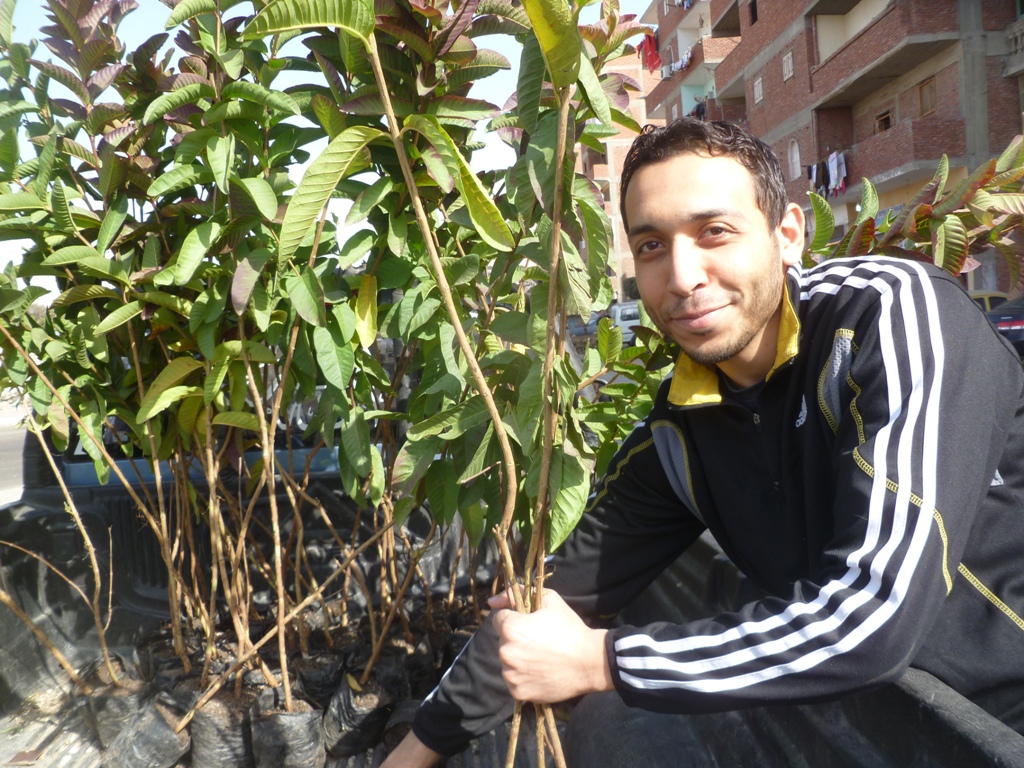
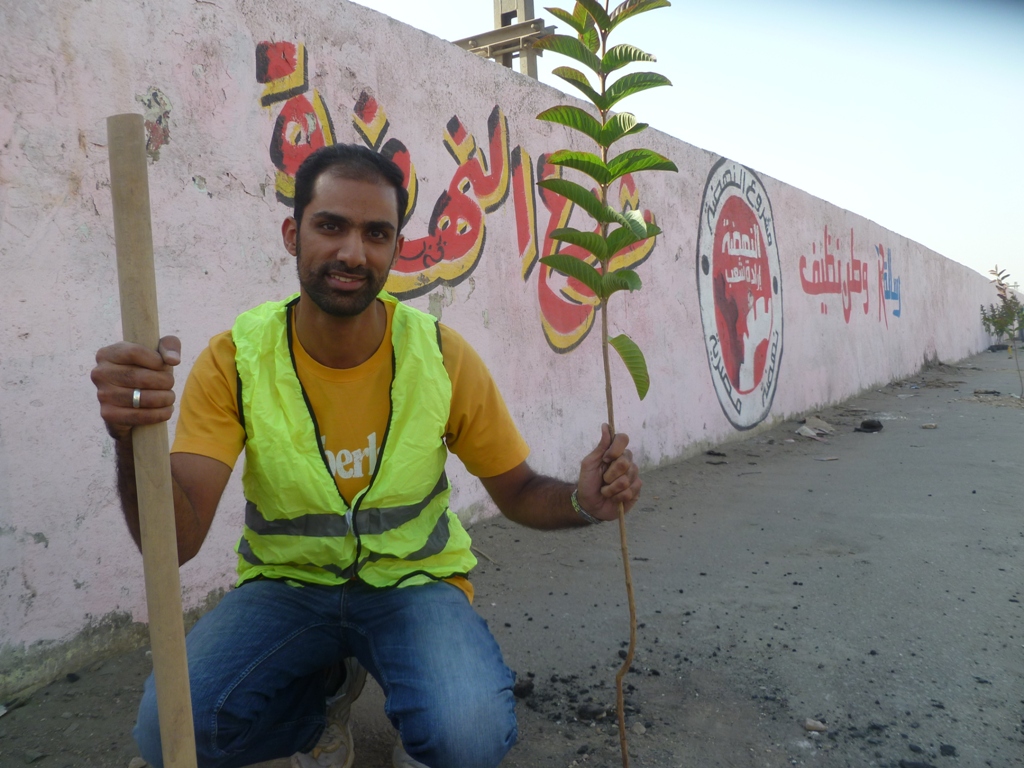
To do so, the Brotherhood is planting one million sapling trees throughout Egypt, one hundred of which are in Helwan. Kamal led teams of youth digging holes in the limited dirt of the urban landscape, boring even into the sidewalk.

Hatem Abd al-Akhir
Hatem Abd al-Akhir

Abd al-Akhir, meanwhile, participated in the effort to provide a million citizens with healthcare. An ophthalmologist, he offered free eye examinations to diabetic patients and at-cost treatment for any operation.

As the manager of the Helwan Eye Center, he assures normal costs for patients are 30 percent below market standard. Yet the centre still makes a small profit, illustrating a mix of business and charity, politics and social good.

‘The Muslim Brotherhood is a logistics service for advertising,’ he said describing the campaign. ‘We want to propagate values in our community which will help keep the peace.

‘When we offer low cost service we oblige others to not raise their prices above what is acceptable.’

But in a time of great social and political upheaval, it is unsurprising some are critical.

Ahmed Ezzalarab is the deputy chairman of the liberal, opposition Wafd Party. ‘They are trying to distract people by giving a different image of development, but it is too late,’ he told Lapido Media. ‘They are being exposed for their secret agenda which the people are rejecting.’

Ezzalarab does not dispute their social work, but recognizes it is necessary to oppose the Brotherhood for their poor record in power. In recent weeks train accidents and building collapses have claimed the lives of dozens of citizens.

‘Governance has never been worse in Egypt’s history,’ he said. ‘They cannot run the country administratively; everything they touch fails.’

But in describing a secret agenda, Ezzalarab appeals to conspiracy.

‘We are completely against the violence, which is working to distract the people from the peaceful nature of the opposition,’ he said. ‘It is being funded by Wahabi and Gulf money, because they are scared to see civil forces come to power.’

Ezzalarab believes the Brotherhood is panicking, fearful the army will step into the violence and unseat them from power. Perhaps he is right.  Brotherhood leaders are clearly propagating the conspiracy theory.

Anas al-Qadi, Brotherhood spokesman said on the official MB website, Ikhwanweb.com: ‘This is the difference between the Muslim Brotherhood marking the memory of the revolution with greatly appreciated services, and so-called civil forces celebrating the revolution with flagrant acts of arson and violence, spreading chaos and destruction and vandalism.’

The website also accused one of the newly organized vigilante groups, Black Bloc, of being an arm of the Coptic Orthodox Church.

Any of the various accusations may be correct, but they are presented without evidence and signal that both social service and social violence are a means to an end.

Ahmed Kamal
Ahmed Kamal

‘If you are trying to apply Islam as you understand it, you have to reach authority by all legal and peaceful means,’ said Kamal. ‘To do this you have to show people why they must support you.’

Kamal was responding to the charge that the Brotherhood is putting good works on display, contrary to Islam.

‘We need to differentiate between being a Muslim and being part of an Islamist program which competes with other parties,’ he said.

‘As a Muslim, you can choose to tell or not tell of your good works, it depends on your intention. If you tell you can be a role model that others will follow, but God will judge you in either case.’

But for now, Egypt is the judge, and the verdict is a cliff-hanger.

This article was first published on Lapido Media.

Related Posts:

Categories
Personal

Grand Mufti Approves Death Penalty for ‘Innocence of Muslims’ Film Producers

From Egypt Independent:

Egypt’s Grand Mufti Ali Gomaa has approved a death sentence delivered in absentia for seven Coptic Egyptian expats accused of producing and acting a movie deemed insulting to Islam.

The declaration was made Tuesday by a judge at the Cairo Criminal Court.

Egypt’s State Security Court had sentenced the defendants in November to death and referred the verdict to the mufti for approval.

I hope politics did not come into this decision. The Mufti is generally known as a wise and moderate figure, who enjoys friendship with many Christian leaders. Among them is Bishop Mouneer of the Anglican Church, who has called for the criminalization of defamation of religion at the UN, but certainly not the death penalty.

The politics could come because the Mufti (as well as the Grand Sheikh of al-Azhar) are targeted figures by the emerging Islamist parties who are salivating over control of Egypt’s religious institutions. Both the Mufti and the Grand Sheikh are holdovers from the Mubarak era. The Mufti may not feel comfortable standing in the way of this decision and watching the Islamists explode. Given that all the accused are resident outside of Egypt, perhaps he feels the damage is limited.

Only the damage will come to Islam in the eyes of the West. Does Islam truly call for the death of all who insult its prophet? Yes, the film was offensive and insulting – its round and absolute condemnation is necessary.

But the Mufti’s decision sets a precedent in the new Egypt. As the new constitution calls for the religious institutions to have a greater role in determining legislation, it is a moderate figure who first authorized one of Islam’s most controversial rulings.

The eyes of the West will be offended, but the real damage to Islam may well resound locally.

Related Post:

Categories
Personal

Egypt’s Protestors Come to Aid of Ransacked Semiramsis Hotel

A harrowing account from Ahram Online:

“We ran to the crisis meeting point on the 4th floor and barricaded ourselves in,” Samak describes, “it unfolded so quickly we followed all our security measures, but no guards of hotels in Egypt are armed. We had to secure guests and colleagues.”

Meanwhile revolutionaries outside the hotel attempted to prevent the thugs from entering the building, reports Ahram Online journalist Karim Hafez who was at the scene.

“When they realised these groups were trying to loot the hotel, protesters shot fire crackers at them as they attacked the building and tried to push them away from the area but these groups were armed with birdshot bullets,” says Hafez.

The assailants also attempted to steal the ATM in front of the hotel.

Journalist Mohammed Mare, who witnessed the event, recounted on his Twitter account that four people arrived in a Lancer car with no licence plate behind the protesters and fired the shots to scare protesters away, before storming the hotel.

The attackers shot at employees and continued to destroy the building for approximately three hours before security forces arrived.

So far there have been no confirmed injuries.

“We are the frontline, I’m still a bit shaky, and the situation is still not resolved. Clashes are starting again,” Samak says, who thanked the revolutionaries that “stood by us last night,” via the hotel’s Twitter account, adding “you are awesome.”

One of my pictures from the previous post is of the entrance to this hotel. One detail I neglected to mention was the pungent effect of tear gas still in the air. I could barely keep my eyes open as I walked through the area. Strangely, this was also true at the Nile River bridge – I would have expected the open air to have dispersed it by then.

This story helps show the complications of Egypt’s situation. Moments earlier these protestors were going hard against the police. But it was the protestors, and not the police, who intervened to save the hotel. [I recall seeing another statement saying the two cooperated to fight back the thugs.]

Egypt’s opposition seems to be banking on the chaos to reverse the president’s extra-legal gains, cause damage to his political chances and reputation, or else have the army step in and reset the situation entirely. Dialogue is so necessary at this moment, but they also have so little reason to trust its fairness. It is a dilemma.

But the opposition in all likelihood does not control the street. A possible outcome is for the president to do what so many Egyptians lament Mubarak is no longer around to do: Crackdown and ensure security.

If this scenario emerges, will it revolution be completely reversed? Will there be another one party system with a handful of loyal opposition parties?

It is far too complicated to say so, and history never repeats itself exactly. But these days, most political parties and ordinary citizens are nervous, expecting the worst. Its just that they define ‘worst’ differently.

Categories
Personal

Photos from the Aftermath of Tahrir Clashes

Cornish Tree
An uprooted tree on the Nile Cornish, just outside of Tahrir Square. Muslim rules of war forbid the wanton destruction of nature.

Egypt has just witnessed some of the fiercest clashes in the revolutionary era, as many protestors appear radicalized. There are still peaceful demonstrations, to be sure, but even these appear to be violently resisted by police. It is hard to blame the police, though, as the lines are blurred.

I missed out on the latest battles. I spent January 25 in Helwan, a city to the south of Cairo at the end of the Metro line. The Muslim Brotherhood was conducting an outreach campaign to counter-program the message of demonstrations and unrest offered in Tahrir. I planned to take the Metro downtown to see these protestors, but on the way the car stopped and sat for five minutes – at the very stop nearest our home in Maadi.

Demonstrators in Tahrir had cut the tracks, causing a backup. Rather than waiting what could be an hour or more, based on previous examples, I left and went home, seeking to catch up on the news of the day, and perhaps go down after a bit.

A minute later, before I was able to exit the station, the Metro started up again. Perhaps it was propitious I had left.

These pictures taken this morning are from my first visit back to Tahrir. The worst clashes occurred in the Suez Canal cities of Port Said, Ismailia, and Suez, where a state of emergency has been declared. It is hard to know precisely what happened anywhere – the consequence of sitting home and following news updates and Twitter bylines. But the pictures to follow give a disturbing indication of where Egypt stands at the moment.

Is this the last gasp of resistance to a new order, or a sign of worse things yet to come? Please pray for Egypt, either way.

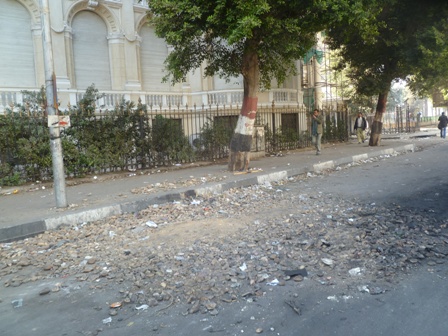
The worst clashes took place on the Nile Cornish. This rock pile is on the road leading there from Tahrir, where protestors would retreat to reload in the volleys against the police.
The worst clashes took place on the Nile Cornish. This rock pile is on the road leading there from Tahrir, where protestors would retreat to reload for their volleys against the police.
At one point during the fighting, armed criminals broke in to the Semiramsis Hotel, smashing this door. According to reports, protestors intervened and beat them off.
Outside on the Cornish clean up crews were hard at work collecting the debris, preparing the road for traffic
Outside on the Cornish clean up crews were hard at work collecting the debris, preparing the road for traffic.
Traffic into Tahrir, however, was blocked by these makeshift barricades.
And on the bridge across the Nile leading into Tahrir, group of protestors were trying to block traffic, as they had over the previous few days. This attempt petered out after about five minutes.
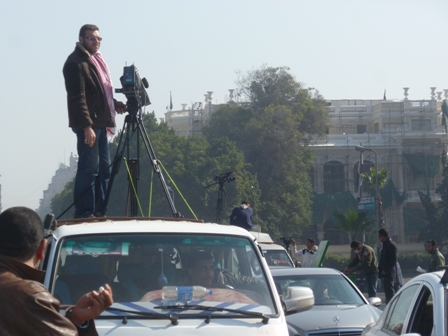
Meanwhile, camera crews were already in place, awaiting the next round of violence.
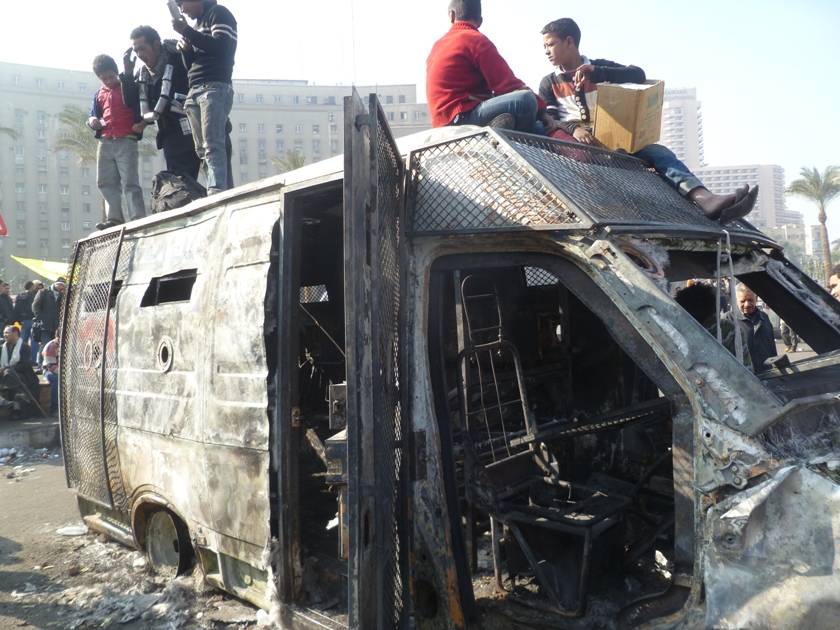
Back in Tahrir, things were calm, as protestors celebrated their previous night's capture off a police van.
Back in Tahrir, things were calm, as protestors celebrated their previous night’s capture off a police van.
Even the local Pizza Hut was open for business - sort of.
Even the local Pizza Hut was open for business – sort of.
Protestors opened their very own Tahrir Museum in the center circle of the roundabout.
Protestors opened their very own Revolution Museum in the center circle of the Tahrir roundabout.
The celebrated statue of Omar Makram had a new round of graffiti.
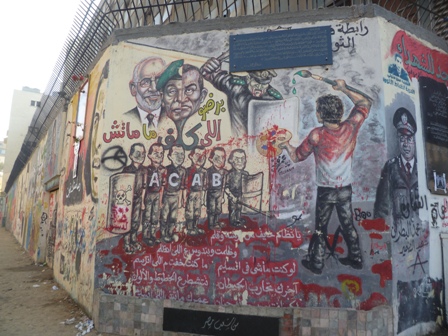
And the walls were updated with the pictures of the latest martyrs and targets of political rejection. Here, the Muslim Brotherhood's General Guide hovers behind a split image of Mubarak and former army General Tantawi.
And the walls were updated with the pictures of the latest martyrs and targets of political rejection. Here, the Muslim Brotherhood’s General Guide hovers behind a split image of Mubarak and former army head General Tantawi. A plaque has been affixed bearing a verse from the Quran.
But at some point since my last visit a huge Egyptian flag had been draped on the side of this building. Perhaps it can be read as a sign of hope.

Related Posts: 

Categories
Personal

Two Years of a Shrunken State

From the Arabist:

This is a useful follow-up to the previous post on diplomacy:

Perhaps the only viable way to get the state to function is for the Brothers to offer the opposition enough reassurance that major political forces together could reach consensus on the illegitimacy of violent protest. If Egypt’s political forces acted in unison — a general appeal for order, or for justice to take its course, or for disputes to be resolved in parliament rather than in the street — these have a powerful calming effect. The Interior Ministry, for example, has called for such an appeal to “patriotic forces” to calm Port Said.

The opposition would probably not try to coax protesters out of Tahrir, nor would it be necessary — the square can probably remain an open-air museum of the revolution as the state rebuilds itself elsewhere. But a joint appeal for order would at least contain street violence and push Egypt’s flare-ups of violence to become less frequent and bloody.

The opposition knows however that to stand alongside the Brothers would be handing Morsi a major concession. The National Salvation Front has demanded as the price for its cooperation that a committee be empowered to amend the constitution. If Morsi’s objective in pushing through the constitution in December was to provide some security for his administration — ie, to prevent the Supreme Court’s from topping off its dissolution of parliament by pushing Morsi out of office, as Brothers said they suspected might happen — then perhaps he would take that risk.

But the first articles targeted would be ones that circumscribe civil rights with religion. The Brothers have in theory agreed to revisiting the constitution. If the Brothers are committed to aggressively Islamicizing society, or if they are worried about having their Islamic credentials challenged by the Salafis, they aren’t going to give the opposition what it wants.

This is an excellent analysis of why the opposition is being somewhat mum on all the street violence. Conspiracy will say they started it, but they are not standing in the way. In fact, rightly in a sense, they lay the burden of responsibility on the state. Ongoing violence is a function of state ineptitude and political intransigence.

So after sidelining the opposition to get what they wanted (i.e. the constitution), Morsi now calls them back for dialogue – but as above – will he be willing to pay the price? It is as if the opposition is saying: You cheated to get your constitution, we’ll cheat to take it back.

Islamists may say the opposition has been cheating from the beginning, but this only opens up the conspiracies even further, which most liberals are happy to slap back at the Brotherhood. It gets Egypt nowhere.

The only thing that will, as the author suggests, is consensus. Can it be found? If not, what is the price?

Categories
Personal

Diplomacy is Dead

From the New York Times:

DIPLOMACY is dead.

Effective diplomacy — the kind that produced Nixon’s breakthrough with China, an end to the Cold War on American terms, or the Dayton peace accord in Bosnia — requires patience, persistence, empathy, discretion, boldness and a willingness to talk to the enemy.

This last point is crucial. One must always talk, and listen. Yes, even the fact of talking grants a measure of legitimacy, and it can be said this should not be freely offered. One reason why Hamas refuses to acknowledge the Jewish State of Israel is that they feel this is must be an end result of negotiation, not its starting point. But even so, Israel and Hamas have been communicating for years, through back channels.

Speaking of Hamas:

Breakthrough diplomacy is not conducted with friends. It is conducted with the likes of the Taliban, the ayatollahs and Hamas. It involves accepting that in order to get what you want you have to give something. The central question is: What do I want to get out of my rival and what do I have to give to get it? Or, put the way Nixon put it in seeking common ground with Communist China: What do we want, what do they want, and what do we both want?

Earlier in the article the author mentioned Egypt as a mini-success of Obama’s diplomacy, and he may have a point. Many here in Egypt’s opposition see the current situation as a negotiated settlement between the US, the military, and the Muslim Brotherhood. Each one has gotten something that they want. The opposition, meanwhile, feels left out in the cold.

But here is where diplomacy’s rubber meets the road. For the idealist, it is painful. But did the opposition get what it wants? There is the beginnings of a democratic system which can be continually contested. They just didn’t win.

Maybe. But to voice their complaint, what did the Brotherhood get? Access to the reigns of power has limits – the army is off limits, as is any real tension with Israel – but comes with great privilege. Some see this privilege extending to be able to manipulate the situation (democratic as it may remain) for their own benefit. What does this give America? As goes the theory, stability in the region.

So, diplomacy, if this picture is true, is it good enough?

For America, perhaps. The task of international diplomacy is to secure the interests, and not the ideals, of the home nation. If Egyptians only get a manipulated democracy that allows the US to check off the accomplishments of its own internal ideals, of what major concern is this to America?

But that is no reason for the Egyptian opposition to accept the situation. They have their own diplomacy to worry about. And part of diplomacy is overstating your case in negotiation. It is conceivable they have quite exaggerated the manipulations of the Brotherhood.

But do the events of yesterday, the second anniversary of the revolution, suggest that the opposition is abandoning diplomacy?

Diplomacy achieves an imperfect solution, but tends to avert war and violence, which usually are far less perfect for all parties involved. But goodness, is it maddening.

Categories
Prayers

Friday Prayers for Egypt: Second Anniversary

Flag Cross Quran

God,

Who will win? Who is fighting? Is the revolution discredited? Is the revolution succeeding? Does this aid Morsi and the Brotherhood? Will it overthrow him/them? Is the National Salvation Front orchestrating? Are they carried along? Is chaos coming?  Is a crackdown coming? Is Egypt being destroyed? Is the old regime being destroyed? Who will win?

God, when so much has been wrong – when so much is wrong – it is not easy to put right. But right can only be built with right. There has been right – there is right – in Egypt. But it has not all been right. A good bit of right doing has been done wrong.

But where, God? Call out righteousness and justice and proclaim it to the people. Anoint men of clear conscience and pure heart to place pure good above all else. Men who will not compromise on the right. Men who will accept failure over hypocrisy. Men who will stand aside that principle may triumph over personality. If these men are already here, God, aid and support them.

Ah, but are such thoughts hopelessly idealistic? Are they futile and self-defeating? Do they pave the way for men of cunning and ambition?

God, bless politics. Bless revolution. Bless every good intention men possess.

Give wisdom. Give courage. Give the power necessary to the necessary people.

But also purge.

Purge good men from the evil within them. Purge good movements from those who seek profit. Purge good ideas from flaw and error. And as purging is always painful, be merciful.

But then restore. May no purge be permanent. May none be excluded. May Egypt rise in cooperation of all her people, all her movements, all her ideas.

God, prayer is not the place for the hard work to make this possible; this is for men in all their counsel. But might it be? If they pray, will you bless Egypt with this solution? If only some pray, will you give it anyway?

God, give Egypt this solution, and give it quickly. Spare her more trouble, but do not leave her with only partial good. Remake her to reflect your perfection, through only that which is good and right. And as long as she falls short, may she repent, regroup, and try again.

Who will win, God? May it be according to your righteous knowledge, however messy it must be to those waiting, striving, and suffering.

Amen.

Categories
Personal

Family in Tahrir

Sidu and Hannah
Sidu and Hannah

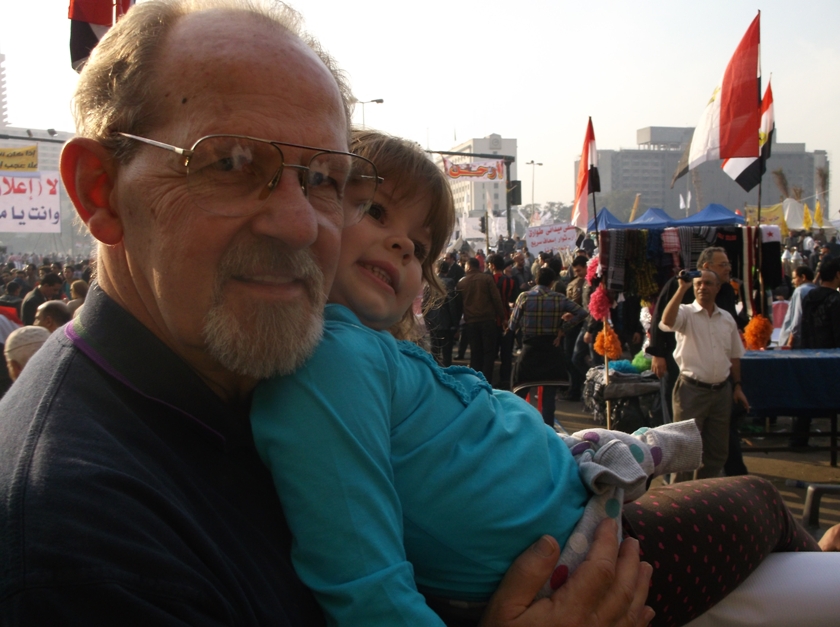
With Egypt on the eve of another potentially massive demonstration, it is time to pull these pictures out from the archive. They are from the day I took my four year old daughter and her grandfather to Tahrir. I didn’t post them immediately, as I didn’t want to scare the rest of the extended family. And to set hearts at ease, I don’t plan to take anyone tomorrow.

It is hard to recall all the events of Tahrir, but on that occasion there were once again clashes – the night before. My parents were visiting to help assist with the birth of our new son; of course my father had to see the famous square. The best time to avoid violence is morning, when all are exhausted from fighting through the night.

‘I smell nail polish remover,’ said Hannah, my daughter. She was sort of right; I had never noticed how it resembled the scent of lingering tear gas.

‘What pretty decorations,’ she said. I looked all around, wondering if she was referring to the graffiti, some of which is rather creative.

‘No, the shiny ones,’ and she pointed toward the middle of the road. Ah, barbed wire.

With a local protestor

Some lessons I explained, others were left unsaid. My children are getting quite an education in Egypt.

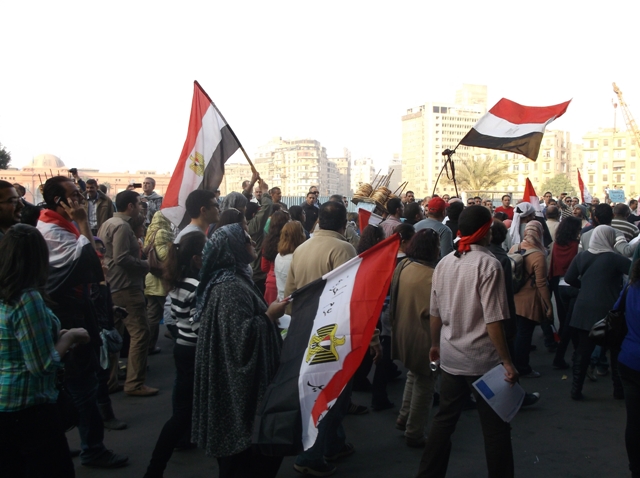
As for my father, he was particularly impressed by an incoming march as we exited the square along Kasr al-Nile Bridge. ‘Such passion,’ he remarked. We even got a quick glance of Hamdeen Sabbahi’s silver locks as he accompanied the procession to Tahrir.

(Sabbahi not visible)

As for tomorrow, the two year anniversary of the start of the revolution, expectations are meaningless. Tahrir could be packed, or victim of protest fatigue and sullen resignation. It could spark a second revolution against the Muslim Brotherhood, or descend violently into anarchy and chaos.

Here’s hoping for a protest without nail polish and decorations.


Related Posts:

Categories
Atlantic Council Middle East Published Articles

Who are the Salafi-Jihadis?

Mohamed al-Zawahiri, brother of the al-Qaeda leader

From my recent article in EgyptSource, following up on the last post of pictures:

Zawahiri is the leader of what has been dubbed the Salafi-Jihadis. Long associated with Islamic Jihad and the Islamic Group, following his release from prison in March 2012 he has positioned himself to the right of the now politically engaged Islamists of the Muslim Brotherhood and traditional Salafis. But who does he represent?

“We are just Muslims, protesting the killing of civilians,” said Walid, one of about 400 demonstrating against French military activity in Mali. “We have no leadership and we don’t belong to al-Qaeda.”

‘Not belonging to al-Qaeda’ was a frequent refrain of protestors.

But there was plenty of sympathy, as well as conspiracy:

Ashraf, who declined to give his last name but consorted comfortably with al-Zawahiri, praised the Benghazi attack which killed the American ambassador, and said more of this nature was needed. But as to the nature of Salafi-Jihadis, he was circumspect.

“There is no such thing as Salafi-Jihadism,” he said. “This name is simply a creation of state security, used to divide Muslims.”

The Egyptian regime, he believes, has always conspired with the Americans to distort Islam. “Is there any Salafism without jihad?” he continued. “Who are the Salafis but the first generations of Muslims, and were these not engaged in jihad?”

By all appearances their numbers are few, but this may not matter much, and surely not all are visible:

Salafi-Jihadis appear to be less an organization than an idea. So while the idea of Islam violently reordering world relations – today focused on Mali – is unable to attract many, it does attract a dedicated few. For Zawahiri, this is enough.

“Over the centuries Muslims have been the victorious ones,” he said, “even when they have had small numbers.”

Please click here to read the full article on EgyptSource.


Related Posts:

Categories
Uncategorized

Christian Center Opens in Iraq

From Ahram Online:

Authorities on Sunday opened what they billed as the first Christian cultural centre in Iraq in a decade, despite a dramatic decline in the country’s once significant Christian population.

The building was inaugurated in the northern city of Kirkuk, home to a diverse population of Arabs, Kurds and Turkmen, and is to host conferences and meetings to promote inter-faith communications between the city’s Muslim and Christian communities.

“This centre is the first of its kind in Iraq since 2003, it sends a message of peace, and promotes the language of dialogue,” said Louis Sakho, Chaldean archbishop of Kirkuk. “The communities of Kirkuk are one family,” he added.

Construction of the cultural centre, which lies next to Kirkuk’s Chaldean church, began in early 2012 and was completed at a cost of around $305,000, officials said.

Iraq’s Christian community is one of the oldest of its kind in the world, but they suffered persecution, forced flight and killings in the aftermath of the 2003 US-led invasion.

Before 2003 there were more than a million Christians living in Iraq. Now they number around 450,000.

Half a community lost in a decade, a nation ruined during the same period (and before). All from a demagogue’s pride, a superpower’s dismantling, and a divided people’s sectarianism.

Perhaps this small step will represent an effort to rebuild from anew, inclusively.

Related Posts:

Categories
Current Events

Egyptian Jeans under the Patronage of the Muslim Brotherhood

From Ahram Online, discussing Qualified Industrial Zones (QIZ) with Israel:

On 9 December, 2004, a report that was published on the Muslim Brotherhood’s website Ikhwan Online titled: “Muslim Brotherhood MPs: QIZ threatens Egypt’s security”, said the Brotherhood parliament bloc warned against the risks of the QIZ agreement that was then due to be signed within days.

The site reported that according to MP questionings and interpellations, “the agreement is a serious threat to national security because it is the first economic and industrial agreement with the Zionist enemy.”

At the time, Brotherhood parliamentarian Hamdi Hassan, said in an interpellation, that the agreement “achieved all that the enemy has sought for decades: controlling the region economically through interfering in the Egyptian economy after it controlled it politically in the wake of the Camp David agreement.”Hassan concluded by saying “you cannot make peace, promises or QIZ with Zionists”.

Earlier the article gives the detail:

On 9 September 2012, in an interview with economic news agency Bloomberg, Qandil [Egyptian prime minister, appointed by Morsi] said that Egypt will meet its commitment to the agreement which opens up the US market for Egyptian products if they have a 10.5 per cent Israeli component of added value (which Morsi’s Egypt wants to reduce to eight per cent).

Qandil also said that “a lot of people  are making good business out of that:  we want to make sure we do the right thing for them to flourish.”

Earlier Ahram Online reported the program was not only continuing, but expanding to new governorates. The current articles provides many figures to describe the economic impact is limited.

I have no idea if these Qualified Industrial Zones are a good idea or not. If one desires normalization with Israel, which it seems most Egyptians do not, the idea of integrating business opportunities seems like a good way to begin.

But with this current expansion, was previous MB opposition principled or rabble-rousing? Is their current support principled or kowtowing to US demands? Politics, politics, with religion added to stir the pot.

Related Posts:

Categories
Personal

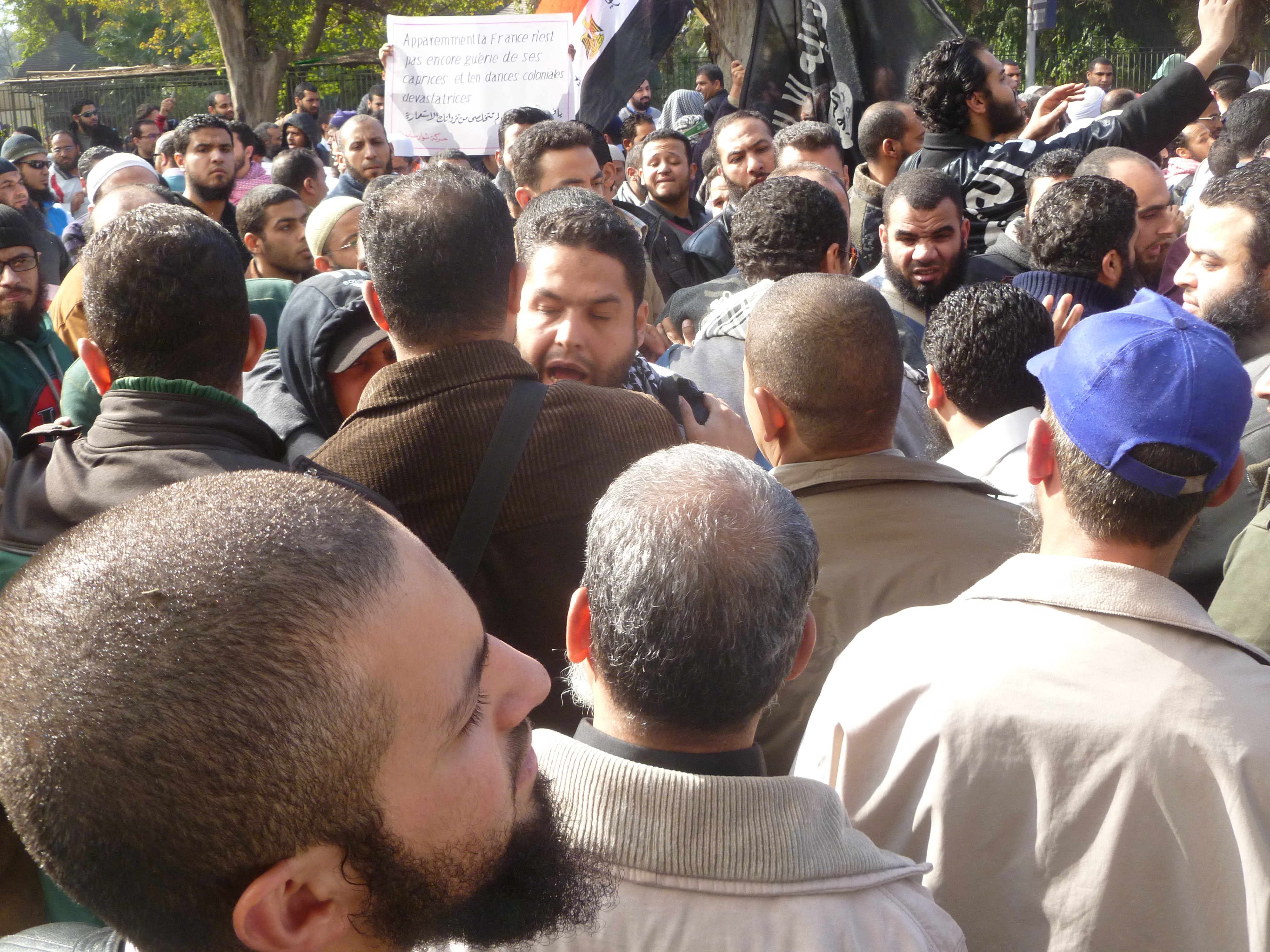
Photos from the Salafi-Jihadi Protest at the French Embassy

There are several strands of Salafism in Egypt, and the differences are not easy to understand. The group which is called Salafi-Jihadi – they do not necessarily call themselves this – is differentiated easily by the second part of their moniker. While many Salafis have joined the political, democratic process in Egypt, these reject it outright. Instead, they favor the continuation of a violent struggle against the Egyptian regime, of which they see the Muslim Brotherhood and other Salafis as selling out to the world anti-Islamic system.

This group held a protest on January 18 against the French military intervention in Mali. In Mali criminal-cum-jihadists have piggybacked onto a tribal Tuareg rebellion in the north. The central government, along with many surrounding Arab and African nations, has sanctioned France’s effort to resist them through force of arms. Salafi-Jihadists, however, support them due to their desire to implement sharia law.

I hope to write more about Salafi-Jihadis soon, but for now, please enjoy the protest through these pictures and video.

Click here for the first video. It is only two minutes long because it represents the length of time necessary for their full march to approach the site. There were only a couple hundred protestors in total.

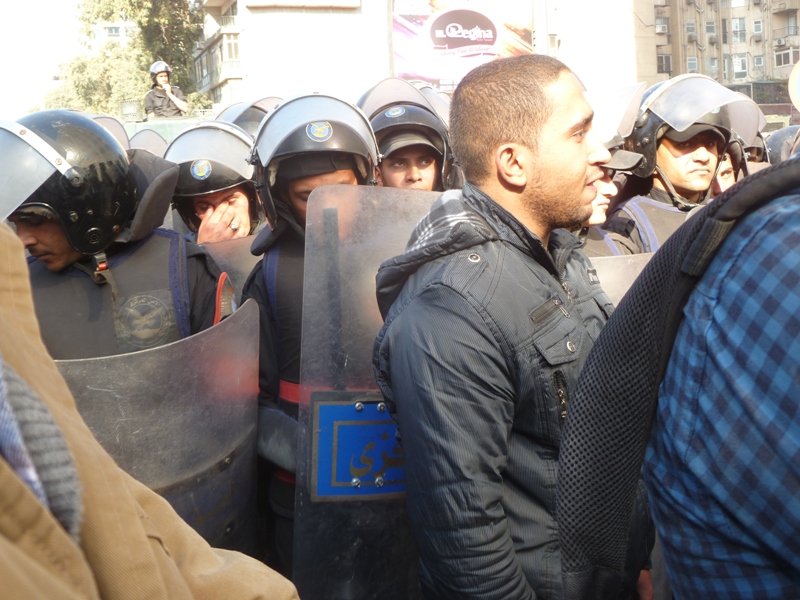
Click here for the second video. It also is only two minutes because this was about the length of time the protestors jostled with police who had set up a barricade preventing them from reaching the embassy. After that they accepted their place about 100 yards further down the street.

Crowd Pressing

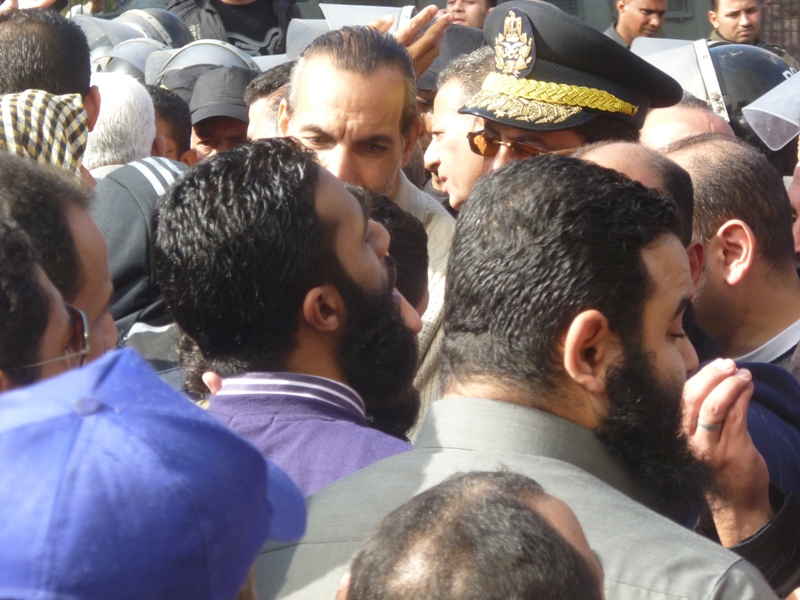
Next to the man in the police cap is Ezzat al-Salamony. He is a leader with the Islamic Group, not the Salafi-Jihadis, and worked to restrain the crowd. He later gave a rousing speech against the French, though, calling for jihad in the lands of the infidels.


Eventually a car drove up with speakers to serve as a platform for speakers. The police maintained their line, but were left in peace from then on.
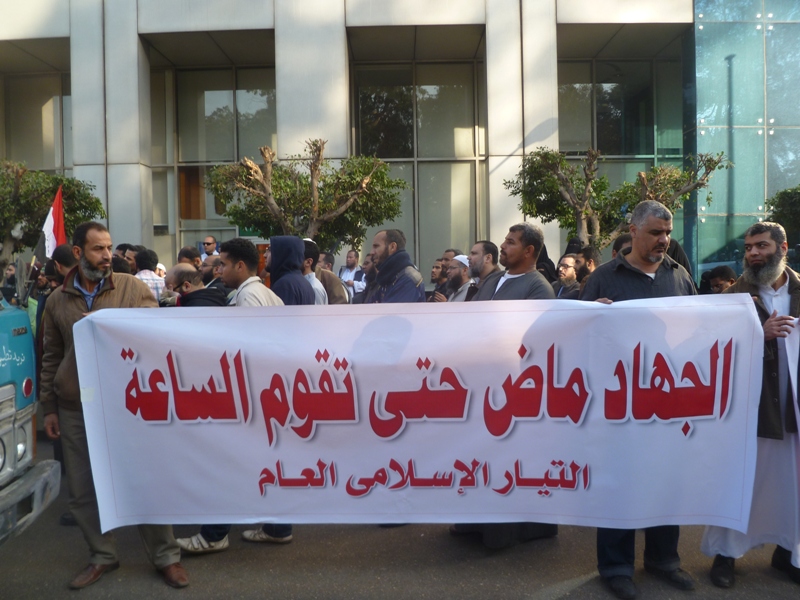
As speakers condemned France, other protestors set up their banners. This one reads: Jihad will continue until the Day of Judgment.
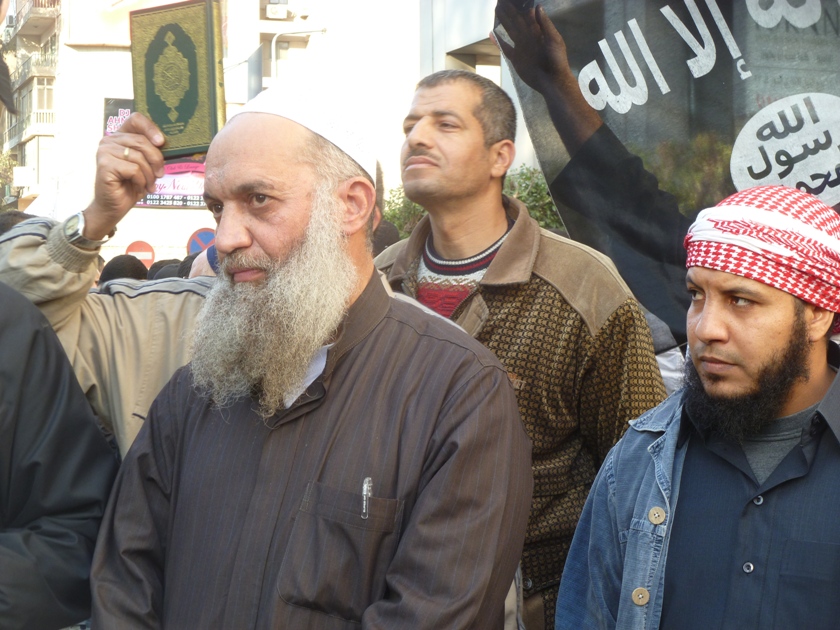
After a little while the star of the show arrived. Mohamed al-Zawahiri is the brother of Ayman, the leader of al-Qaeda. Everyone pressed around him.
As he hung around for hours, eventually the crowds dissipated around him. Here is awaits giving an interview to al-Jazeera.
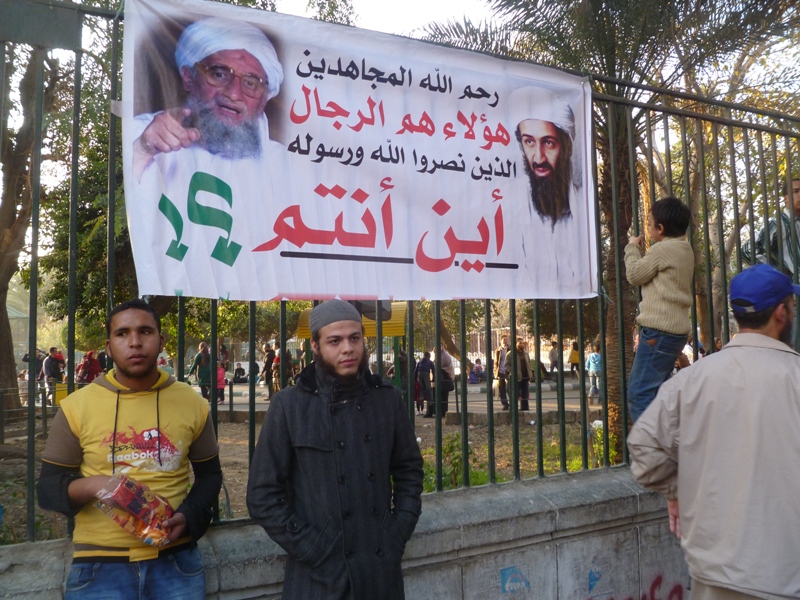
Around 5pm, the police relented and allowed the protestors to advance and demonstrate in front of the embassy, though the police presence guarded it and otherwise surrounded them. Graffiti and other banners were hung in the area, this one across the street on the wall of the Giza Zoo. Pictured are Osama bin Laden and Mohamed's brother Ayman. The sign reads: God have mercy on the jihadists. They are the men who gave victory to God and his prophet. Where are you?!
Around 5pm, the police relented and allowed the protestors to advance and demonstrate in front of the embassy, though the police presence guarded it and otherwise surrounded them. Graffiti and other banners were hung in the area, this one across the street on the wall of the Giza Zoo.
Pictured are Osama bin Laden and Mohamed’s brother Ayman. The sign reads: God have mercy on the jihadists. They are the men who gave victory to God and his prophet. Where are you?!


Related Posts:


Categories
Prayers

Friday Prayers for Egypt: Derailing

Flag Cross Quran

God,

Despite the protests of many, perhaps it can be said that Egypt is now on a political path forward. A constitution is adopted, a legislature is in session, and parliamentary elections are being planned.

But elsewhere, if only symbolically, Egypt is pulling apart at the seams.

A train carrying security conscripts derailed, killing many. Overcrowded, creaking the whole way, it is as if Egypt’s infrastructure is decaying. It follows a similar accident weeks before when dozens of children were killed at a crossing.

Meanwhile, apartment buildings collapse and boats are lost at sea. It has not been a good week.

These accidents are not new, but who can fix them?

From a different direction, sectarian issues threaten to reemerge. A family was arrested for seeking to reconvert to Christianity, allegedly forging identity cards in order to do so. And rumors of child molestation led a crowd of Muslims to surround a church and smash Coptic-owned shops.

On each of these, details are still emerging. But in the sectarian atmosphere from which political ‘stability’ emerged, actual sectarian conflict makes an ill appearance. May it quickly fade.

God, repair Egypt. It is not just the rails, but those who watch over them, build them, and assign the contracts. Teach the people to be accountable, and help them design a system to enforce it.

In each sector of society, give eyes to see where decay exists. Give both courage and know-how to report problems forever ignored. Grant receptivity on the part of authorities to create a culture of responsibility and improvement.

May no more needless deaths occur.

And this is especially so, God, when it comes to neighborly, religious relations. Accidents will always happen. Misunderstanding is common. But spare Egypt more examples of those who rise up as a group against those who believe differently. Allow all to live not only in freedom of conscience and belief, but also in freedom of place and well being. Why must so many fear what is coming?

God, help Egypt get back on track. Where did she get off of it? Was it recently or long derailed? Have mercy, God. Comfort and encourage the people. Help all be well. Preserve her, but more – build anew. May that which is crumbling be renewed before it collapses.

Amen.


Categories
Atlantic Council Middle East Published Articles

The Growing Pains of Salafi Politics

Asala Party Elections (photo: Clara Pak)

From my latest article in EgyptSource:

The Salafi political movement experienced massive transition in the past two weeks, enduring splits, recriminations, and leadership changes. Having long foresworn the political process, it is right and natural for growing pains to characterize their apparent embrace of democracy. Taking stock, three observations describe their current standing.

These are:

  • The process is transparent, but is the result foreordained?
  • The rhetoric is clear, but are they learning spin?
  • The inspiration is worrisome, but does it determine?

From the first:

The main question directed to Islamist politicians is if they truly believe in democracy or simply use it as a ladder to power. Egypt’s constitution declared its governing system to be both democratic and of an undefined shura (consultation). The shura provision was added at the request of Salafis, whose ideas of democracy issue from the selection process of the early Islamic caliphs, which was consensual. If internal elections are any indication, Salafis are willing to be transparent about their leadership choices, but greatly prefer the predetermined aspects of shura.

From the second:

There are reasonable reasons to reject quotas as well as to trust sharia provisions toward non-Muslims. Yet probing beyond the headlines exposes differences of nuance, if not outright contradiction.

Opponents of Salafis do credit them for being straightforward and sincere, unlike their opinion of the Muslim Brotherhood. As they develop political skill, however, it appears Salafis also are learning the unfortunate art of spin.

From the third:

Then effortlessly, unprompted, and without rancor, he slid into a passionless diatribe. “When we reach the stage of our empowerment, we will collect jizia from the Copts.

“Permissible for us are the blood and spoils of those who disbelieve in God and refuse his prophet,” he said. “This is not for the people of the book, as long as they do not fight us. But inside and outside Egypt they are fighting us, taking millions from America to accumulate weapons.”

So when Sheikh Abdel Khaleq Mohamed states at an official party function, “Democratic work is unbelief, but as long as it leads to the victory of God’s religion it is permissible to us,” does he represent its official line? Or does party president Ehab Shiha, who clarified the misquote, adding after ‘unbelief’ the words ‘… as a doctrine’ which were clipped in the article? On the contrary, Shiha accepts the definition of democracy as ‘government by the people, of the people, and for the people’ as long as it does not transgress the laws of God.

Please click here to read the full article on EgyptSource.

Related Posts:

Categories
Uncategorized

Witnesses, Survivors Recount Egypt’s Deadly Badrashin Train Crash

On the horrible accident near Beni Suef in Upper Egypt, from Ahram Online:

Hours after the tragic train crash that killed at least 19 passengers and injured scores of others in the Giza suburb of Badrashin, victims’ relatives and police officials remained gathered at the scene and a military helicopter hovered overhead.

The 12-carriage train, which was carrying 1,328 Central Security Forces (CSF) conscripts, mostly around 20 years old, had been travelling en route to Cairo from Upper Egypt. The conscripts had been preparing for their first military training, when two railway cars – each carrying over 200 soldiers – derailed, hitting a cargo train sitting outside a storage depot.

According to one, the overcrowding may have saved his life, though it surely killed others:

“On the truck I was in, one injured passenger had a broken leg; his leg hung by the skin only. Another had his nose broken, while a third had suffered broken ribs. I’m one of the lucky ones who had been sitting with five others in seats fit for two. Others were crammed into the upper shelves usually reserved for baggage. Those are the ones who died.”

We have traveled by train several times to Upper Egypt, but always in first or second class. Even there, some passengers are allowed to enter and stand in the aisles and open spaces near the door. In other cars we see how people are crowded together, though never this severely.

But on the whole, we have always found train travel in Egypt to be smooth and economical, even when someone in the aisle has his elbow in your ear leaning on the back of the chair. Usually they are kind enough to adjust. I wonder what sort of ticket they bought, if any, and why the attendant allows them to stay.

On the other hand, there is weird and uncomfortable sense of entitlement when we see them crammed in, yet my six year old daughter has a seat. We did pay for it, right?

I remember my days in university, when I would sit in the corner of the train on a huge bag of laundry, traveling from Washington, DC back home to New Jersey. I wonder how many passengers I annoyed.

May God rest the souls of those who died and comfort the many injured. May he guide the government in fixing Egypt’s many problems. Mercy.


Related Posts:


Categories
Personal

Orient and Occident: Winter Edition

Orient and Occident

From my latest article on Orient and Occident:

‘The church in Egypt is better resourced to participate in society than in other countries of the Arab world, whereas in Palestine/Israel it constitutes only 1% of the population,’ says Stephen Sizer, a renowned critic of Christian Zionism, who presented a series of lectures in Cairo, including at the Anglican Cathedral.

Sizer is an Anglican minister from the UK and directs most of his energy combating US evangelical Christians who find Biblical warrant for supporting the Zionist policies of Israel. Instead, Biblical theology should direct the Christian to support the oppressed and stand for justice, on both sides of the separation wall.

Yet local expressions of theology have failed Palestinian Christians as well. In an interview with Orient and Occident Sizer suspects a similar deficiency among many Egyptian Copts.

‘Theology that says, “Stay out of politics and worship quietly; don’t get in the way or cause problems” will lead only to a victim mentality,’ maintains Sizer. ‘We have to get out of our ghetto and show the rule of law applies to everyone.’

Please click here to continue reading the article on Orient and Occident.

Orient and Occident is the bilingual online magazine of the Egyptian Anglican Church, of which I am privileged to be the editor. We seek to highlight voices who are able to articulate how the values of faith – Christian in particular, shared widely with Islam – can be lived practically in society, and in particular the Arab world. We welcome contributions from Christians and Muslims alike.

Please click here to view the Winter edition homepage in English, and here in Arabic. This season’s edition also features the following articles:

While on this blog Julie and I always appreciate your sharing of our thoughts about Egypt, we would like to invite you particularly to share any of these articles you find enjoyable or challenging. We hope Orient and Occident will be a service to the Arab world – both by inspiring its readers inside and by sharing a vision with the world outside. Thanks for any small steps you can take to help it be better known.

Related Posts: