Categories
Excerpts

Darwin in Arabia (and America)

Darwin in Arabia

From the Times Literary Supplement, a book review on the reception of Charles Darwin’s evolutionary ideas in the Arab world. First, and especially for Arabic students, the trouble of language:

For a long time, the reception of Darwinism was bedevilled by the need to find either neologisms or new twists to old words. As Marwa Elshakry points out, there was at first no specific word in Arabic for “species”, distinct from “variety” or “kind”. “Natural selection” might appear in Arabic with the sense “nature’s elect”. When Hasan Husayn published a translation of Haeckel, he found no word for evolution and so he invented one. Tawra means to advance or develop further. Extrapolating from this verbal root, he created altatawwur, to mean “evolution”. Darwiniya entered the Arabic language. Even ‘ilm, the word for “knowledge” acquired the new meaning, “science”. With the rise of scientific materialism came agnosticism, al-la’adriya, a compound word, literally “the-not-knowing”.

There is generally a great cultural component to knowledge and science, upon which peoples develop a sense of superiority. There are struggles first to appropriate the new ideas into a new setting, and then, to deny (or ignore) the uniqueness of the culture that produced it.

This process is often seen in the Western (American, at least) historical pedagogy that basically skips from Greece and Rome to the colonial era, with a nod in the direction of the Dark Ages that preceded the Reformation and Renaissance.

But our Dark Ages were a period of great Arab advancement, and the rediscovery of Greek thought was translated through the scholars of the then-dominant Muslim civilization. I’m not sure how much education has changed since I was in school, but this is a theme generally left to the specialists at university level or beyond.

Similarly, the modern Arab world has struggled with resurgent Western superiority. This article demonstrates the point through the theory of evolution, and all the controversy surrounding it:

There were those, like the journalist, philosopher and social reformer Shibli Shumayyil (1853–1917), who welcomed Darwinism and, more specifically, the theory of spontaneous generation as reinforcing the materialist case against Islam. Yet there were also apologists who, like Abduh, claimed that Islam was more compatible with science than Christianity, since Islam was less burdened with excess theological baggage and superstition.

Beyond that there were those, like al-Afghani (eventually), who held that not only had Darwin and his allies and rivals come to the right conclusions, but that Muslim Arabs beat them to it. The Kitab al-Hayawan (“Book of Animals”) by the ninth-century Basran essayist al-Jahiz was often compared to The Origin of Species, and al-Mazhar cited al-Jahiz’s account of how two varieties of dung beetles copulated to produce a third kind as prefiguring Darwin. The tenth-century Syrian poet Abu al-‘Ala al-Ma‘arri was another imaginary ancestor of evolutionary theory and Afghani cited a verse of Ma‘arri’s referring to the transformation of minerals into plants and plants into animals as evidence of this. As far as Afghani was concerned, Darwin had merely recycled ancient ideas about evolution.

… The quest for Arab precursors of Darwinism was not solely or even mainly a matter of cultural pride, for there was also a need to make Darwinism more acceptable by inserting it into a familiar cultural tradition.

This is the example of adaptation, but rejection also mirrored Western patterns, though the review, and the book, does not tease this out as much:

Muslim polemicists against Darwinism gratefully borrowed the Protestant theologian William Paley’s analogy of a watch found abandoned on a beach, since the intricate design of such an instrument surely argued irrefutably for a designer.

… As Elshakry notes, enthusiasm for Darwin and his followers fell away after the Second World War and that enthusiasm turned to outright hostility from around 1970 onwards. The reasons for this lie beyond the scope of Reading Darwin in Arabic. Perhaps the intellectual prestige of the British declined as their empire was dismembered. Perhaps Muslim scholars took their lead from American creationists. The rise of a militant political Islam may also have been a factor.

In my years in the Arab world, I have never engaged anyone over evolution at the scientific level, basically because I have not known many scientists. But at a cultural level I have never found it to be an animating issue. Most have just shrugged it off, either dismissing the idea as antithetical to Qur’anic creationism, or with an general sense that all the West has produced in science has precursors in the Qur’an.

A good number have argued passionately about the ‘scientific miracle’ of the Qur’an (whether for, against, or moderating evolutionary ideas), while a few have identified positively with the prevailing views of the scientific community in favor. Maybe these imprecise percentages would be similar to the views of religious conservatives in America?

The difference would be that a literal reading of the Qur’an is used in both directions, for and against evolution. The pro-evolution category of Muslim literalism believes that the scripture is a book of science; that the mind of God produced it and revealed secrets which make sense only centuries later. Muslims generally believe the Qur’an is unmediated by man, and therefore Muhammad and his cultural setting do not need to be decoded to understand the message. Mankind just needs to advance sufficiently to comprehend what is already there, and sometimes non-Muslims do so first.

A literal reading of the Bible, however, is generally only employed against evolution and in defense of creationism. These maintain a similar idea of the Bible as a science book, or at least trustworthy in its historical and scientific offerings, properly understood. But even the idea of ‘properly understood’ reveals the Christian distinctive vis-a-vis Islam that human and cultural factors influence the Biblical text and our understanding, without giving up the doctrine of God’s inspiration.

Christians, then, who accept evolutionary ideas in part or in full do so with Biblical fidelity to ideas like intelligent design, granting theological truth and divine inspiration to the creation account, without literal acceptance of a seven-day historical sequence. The spectrum, and perhaps slippery slope, in which this and similar accommodations is acceptable is greatly debated. Abduh, above, hints at the larger doctrinal issues at stake.

There is much we can learn from each other, from science, from God. In all, humility is necessary, for no learning can take place without it.

Categories
Arab West Report Middle East Published Articles

Church Donations in Upper Egypt: Ideals and Reality

Fr. Yu'annis
Fr. Yu’annis

A few excerpts from my recent article at Arab West Report:

Fr. Yu’annis sat in his small office waiting for a delegation to come, fearfully aware it might not. Having made all the arrangements, he was eager for a prominent Coptic businessman to visit the hundred year old church in his village, see the plot of land he had purchased, and envision together how a small hotel could lure religious pilgrims following the route of the Holy Family.

Being a practical priest, Yu’annis put aside the objection that his village of Qufada is not actually on the official route of the Holy Family. Several kilometers from the central city of Maghagha in the governorate of Minya, Qufada is a bit of a backwater. The nearby villages of Ishneen al-Nasara and Dayr al-Garnous are no closer, but they each boast a well from which the Holy Family is said to have sipped.

Unlike these, Qufada is not mentioned in the ancient manuscripts of the church. No matter, thought Yu’annis, given the geography it is certain they passed through. In any event neither Ishneen al-Nasara nor Dayr al-Garnous have a hotel either, so there is an opportunity to exploit. God knows his people need it.

After describing Qufada and Fr. Yu’annis’ local relations, here is a little more about his project and the man he hopes can implement it:

With this in mind, Yu’annis bought a plot of land next to the church in hope his hotel idea might result in tourist income and local employment. He secured Hamdi’s support and pays him a small sum of money each month to secure the premises. That this is necessary undermines somewhat an absolute understanding of Muslim-Christian harmony; Hamdi once remarked in frustration that though Christians are only 15 percent of the village, the one church is larger than all mosques put together. Correct or not in his estimation, it is personal relations and greased wheels which keep communal peace.

But the peace is present, so Yu’annis proceeds. And thus he sits in hope for the arrival of the delegation, which turns to frustration when it does not arrive.

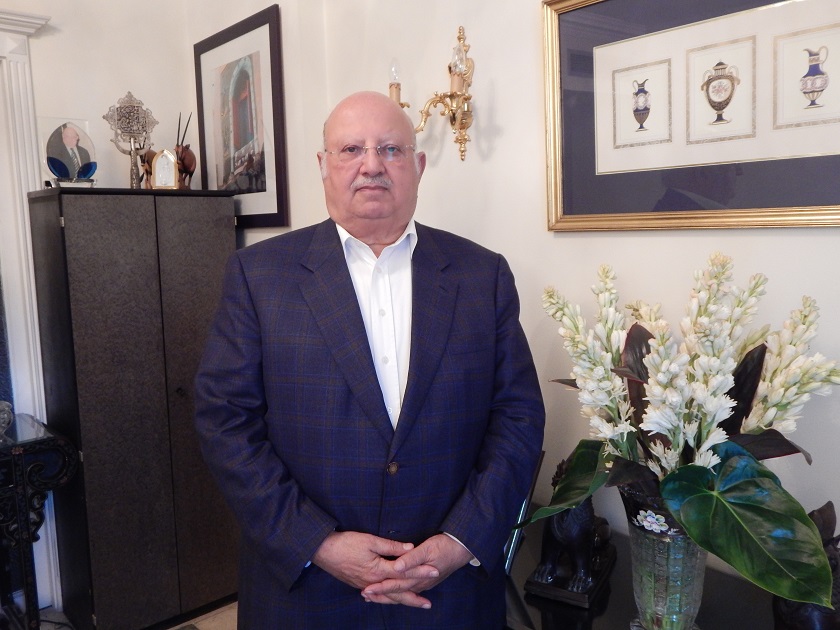
The awaited businessman is Munir Ghabbour, owner of the luxury Sonesta hotel in Cairo and a number of enterprises beside. Now 70 years old, Ghabbour wants to use his wealth to leave behind a Coptic legacy, strengthening that of the Holy Family. Many churches along their route are operational but decaying. Poignantly similar are the Christians; poverty and emigration, not to mention pockets of religious extremism, eat away at what was once a flourishing Coptic presence.

Mounir Ghabbour
Mounir Ghabbour

I wrote about Ghabbour in reference to a new government initiative to promote Holy Family tourism here. The priest and businessman have a relationship stretching back many years, but the key to the project is support of the church:

But the lynchpin for the deal is a different person altogether. Bishop Aghathon heads the diocese of Maghagha for the Coptic Orthodox Church, responsible for all spiritual matters and many temporal ones beside. Yu’annis could not fail to inform his bishop of such a high profile visitor, who promptly requested to receive the businessman in the local cathedral.

Or rather, the old cathedral. Poorly built and suffering severe structural damage, Bishop Aghathon had long petitioned the government for a new building. For years he was frustrated, and thus he went political. Small demonstrations were held and the bishop complained in the press. His demeanor was much different than that of his predecessor Bishop Athanasius of Minya, who died in 2000 and had his diocese divided into several smaller dioceses. Bishop Aghathon was appointed to Maghagha, and proved less adept at fostering local relations.

This, at least, is the opinion of Yu’annis, who found his own success in securing building permits halted after the death of Athanasius and the ascension of Bishop Aghathon. Relations also faltered between the bishop and the priest, as the latter’s attention increasingly focused on his own village. Previously the twenty-four churches he facilitated were scattered throughout the area.

But Bishop Aghathon’s political approach finally proved successful after the revolution. In May 2011 the Maspero Youth Union formed during a massive Coptic sit-in near Tahrir Square, protesting the burning of a church in Cairo. Completely unrelated to events in Maghagha, during negotiations with the then-ruling Supreme Council of the Armed Forces, Coptic youth activists included Bishop Aghathon’s cathedral permit within their list of demands. It was granted, and construction of the new cathedral is currently ongoing.

But in the old cathedral he received Ghabbour and his delegation and planned the events of the day. First would be a visit to Ishneen al-Nasara, then to Dair al-Garnous, and finally, if time permitted, Qufada. Back in his village Yu’annis waited, unable to have a say in the bishop’s ordering of affairs.

He continued to wait, as the bishop showed the businessman other project opportunities. I describe the diocese and local conditions, but then come back to the priest:

All the while, Yu’annis waited in Qufada, making occasional phone calls about the delegation’s whereabouts. Bishop Aghathon urged the businessman back to the cathedral, and said Qufada was an hour away by car, at least. In this he appeared to pad his calculation over estimates in the original schedule, and told Ghabbour he could visit Qufada next time. That village was not on the Holy Family route, he persuaded, and the church had recently been renovated anyway.

It took a comparable amount of time to return to the cathedral, where a multi-course meal awaited. Delicious, time could have been spent in Qufada instead, had the bishop honored the priest’s original intention. Yu’annis himself then traveled to Maghagha, exchanged pleasantries with the bishop, and greeted his friend. They parted ways fifteen minutes later as Ghabbour needed to return to Cairo for an appointment. Yu’annis was disappointed, but understood how the formalities of church hierarchy needed to be honored first.

But it is not simply a matter of formality. In the Coptic Orthodox Church the bishop is one step removed from the pope and near-autonomous within his diocese. No priest can act without his approval; no church project can progress without his oversight. Ghabbour cares little for local squabbles, he simply wants to leave a legacy and assist area development. Working with the bishop can unlock any door.

But for Bishop Aghathon, working with Ghabbour can fund any door. The businessman remains in control of his own money, and will only pay for projects that are viable and fit his vision. The bishop’s pitch appeared to convince him, along with the appearance of the churches. If anyone comes to visit and sees this, he said, we will lose face. But Ghabbour’s vision is larger than churches, and includes his priestly friend. All he needs is land and an idea. Yu’annis has the former, but may need to modify the latter.

All three individuals are looking to intervene in an area of decline, through a tradition that may also be fading. From the conclusion:

Does this mean the Holy Family tradition itself does not have many days left either? To be sure this is not a warning for ‘days’ but years or decades, but as the Christians of Iraq are demonstrating, the existence of community is precarious. Coptic Christianity is not similarly threatened, but if trends continue toward poverty and emigration, will enough remain to care for the churches still being built and renovated? Or will they be the permanent reminder of a bygone era, symbols of a history cherished by believers elsewhere?

Perhaps then the tourists will come, and the hotel will be necessary.

Please click here to read the full article at Arab West Report.

Categories
Excerpts

Testing the Salafis

Salafi Madrasa

Who should be allowed to preach in Egypt’s mosques? A recent exam offered by the Ministry of Religious Endowments is accused of seeking a selective answer:

Over the last two months, the Egyptian Ministry of Religious Endowments held two such exams. Many of the questions used are known for being disputed by Salafists, most notably those about the ruling of Islam regarding the military salute, standing during the national anthem, women in the judiciary, the concept of the caliphate, the reconstruction of places of worship for non-Muslims, bank profits, women wearing the veil and the establishment of museums for ancient Egyptian and Pharaonic artifacts. Salafists have well-known and radical opinions about all these issues, as they believe that Islam forbids such things. (from al-Monitor)

An issue-specific approach appears to have won the desired results:

The crisis between the Salafists and the Egyptian Ministry of Religious Endowments escalated when 600 Salafist imams took the ministry’s test and only 18 passed. Their disqualification prompted the Salafist Call to demand that the presidency resolve the crisis and support Salafist imams, who supported the road map on June 30, 2013.

Salafis bet on survival when the backed the overthrow of Morsi, and on this account have received their gains. They do not appear to have profited much beside, to this point. Their ultimate fate is still an open question, but it appears this institution is lined up against them. Should it be? One figure from the ministry is critical:

In a phone interview with Al-Monitor, Sheikh Salem Abdul Jalil, the former deputy minister of Religious Endowments, said the crisis is mostly political, as parliamentary elections are approaching in Egypt. The move is intended to ensure that Salafist clerics are kept away from the pulpits where they win popularity. “Salafist groups have always been a problem for the government, just like the Muslim Brotherhood,” he added.

……

“Unfortunately, both parties have a unilateral message. For instance, the Ministry of Religious Endowments wants the preachers to tell the people that growing a beard is not obligatory, while Salafists want to tell people that having a beard is obligatory. Thus, there are two parties — the first desperately wants to impose its views, and the other is a government party that has no vision and ideology.”

Stay tuned for more wrestling, and if things go sour, potentially for fireworks.

Categories
Prayers

Friday Prayers for Egypt: China, Elections

Flag Cross Quran

God,

Two fronts are brewing, and both received a push. Egypt is trying to stabilize through its economy and elections.

For the first, President Sisi traveled to China and signed a number of trade agreements. For the second, just before leaving he signed into law the mechanisms for parliamentary elections.

In March is scheduled a major investment summit; around then the polls are expected as well. If both are clean and well supported it will be a sign the nation is moving forward.

God, move Egypt forward, but with more than money and ballots.

Bring investment, but distribute it well. Clean the centers of corruption and ensure fair return for both capital and labor. Egypt recently mandated electronic tax payments for corporations; help the state to receive – and use – its fair share, wisely.

Bring voters, but prepare them well. Give them worthy candidates who will represent their constituencies. Spread a culture of democracy that gives no one a blank check; help the state to facilitate its own accountability.

But God, others are not comfortable with Egypt becoming stable in its current shape. Some are looking to sabotage and disrupt, keep them from causing harm. But others wish for deeper or different justice. Honor the sentiment, God, and weigh the demands.

May Egypt more forward in that which is good.

Seek knowledge as far afield as China, says the hadith. Help the president find one source, but forsake the other. Not all stability is honorable.

Amen.

Categories
Christianity Today Middle East Published Articles

How Egypt’s Goverment is Trying to Get Christians to Follow Jesus

Holy Family in Egypt Icon 1

This article was published at Christianity Today on December 23, 2014.

The sound bomb exploded right behind the Egyptian Museum on Cairo’s Tahrir Square, throwing Ibrahim Morgan’s Swedish tour group into a temporary panic.

Then they settled back down and finished their tea.

This latest tactic in Egypt’s Islamist insurgency is meant to instill terror without harming civilians. It seeks to convey a message to citizen and tourist alike: Egypt is unstable.

This has been the dominant narrative abroad regarding Egypt, thanks to three years of instability, four presidents, and two revolutions. However, some locals like Morgan disagree.

“We know it is nonsense what the media says about Egypt,” Morgan said after the November 28 incident. “This group is here and they have had a great time.” The Swedes nodded in appreciation.

But relatively speaking, they are among the few. Since hitting a highwater mark of 14.7 million visitors in 2010, Egypt’s tourism numbers declined by a third, devastating the economy. The sector represented more than one-tenth of Egypt’s GDP, and tens of thousands have lost their livelihood.

Once stability—or its perception—returns, the numbers will likely rebound. The Giza pyramids, the temples of Luxor and Aswan, and the medieval mosques of Islamic Cairo will long attract international visitors.

But in October, the government launched a unique campaign to increase a segment representing only 1.9 percent of total tourists: Christian pilgrims. To do so, Prime Minister Ibrahim Mehlab and Coptic Orthodox Pope Tawadros II promoted the most noteworthy biblical example.

“Jesus was the first ‘tourist’ to Egypt,” said Tawadros at the launch event, according to AsiaNews. “For us, for our community, his stay in this land has been a blessing for the present and for the future.”

Please click here to read the full article at Christianity Today.

Holy Family in Egypt Icon

Categories
Excerpts

Misrepresenting the Coptic Church and Politics

EGYPT-POLITICS-RELIGION-COPTIC-SISI

The debate is valid: What is the proper role of the Coptic Orthodox Church in the nation’s politics?

It is also an unavoidable debate. Once Pope Tawadros appeared with the Grand Sheikh of al-Azhar to back the popularly-backed military overthrow of President Morsi, he reasserted the church into the political scene.

The decision of the pope can be criticized, but in a recent article for the Carnegie Middle East Center, Georges Fahmi goes much too far. He writes:

With the election of Abdel Fattah el-Sisi as president in June 2014, the Church has attempted to reestablish itself as the monolithic voice of Egypt’s Coptic community. But that role, too, carries risks. Rather than trying to unify Egypt’s Christians under its leadership, the Church should withdraw from the political sphere and allow Copts to defend their interests themselves by joining political parties and movements. The Church should focus on being an institution of civil society that defends universal ideals such as human rights and social justice, and on supporting developmental projects for both Muslims and Christians.

In the essay which follows, Fahmi does an admirable job of summarizing the recent history of the Coptic Church in politics. Within a limited political sphere, President Mubarak allowed Pope Shenouda to represent the Coptic community outside the realm of law. After the revolution Pope Tawadros spoke against a political role for the church, but increasingly found himself drawn in during the Morsi administration. Famhi helps the reader track with an often neglected sub-theme in the Egyptian transition.

But in his summary critique, he makes statements that do not completely gel with my understanding of the situation.

  • Though the church does invest much charity in Christian focused projects, it also benefits local Muslims. Surely it could do more, of course.
  • He recommends the church defend universal ideals, but would this not also be a form of political engagement?
  • Perhaps his wording is poor, but is the church doing anything to disallow Christians from joining political parties and movements?

The church has always presented its participation in the overthrow of Morsi and the backing of the roadmap as a national decision, not a political one. It backed the constitution and the presidential election, but did not back a specific candidate. Again, its decision to speak at all can be criticized, but the nature of its speaking does not represent an attempt “to reestablish itself as the monolithic voice of Egypt’s Coptic community,” as the author accuses.

Here is his evidence:

The Church’s support for the military’s 2013 intervention has given it a privileged position in the new regime, prompting the Church to try to revive the old pact it had with the Mubarak regime. And changes carried out by the state have helped the Church regain its position as the only representative of the Coptic community.

As the new political authority has tightened its control over the public sphere, youth movements, including the Maspero Youth Union, have lost their ability to mobilize. Coptic politicians have also lost their influence, as the new regime seems to see little role for parties; President Sisi has not held any meetings with political parties.

What sort of privilege does the author intend? Is the church any more privileged than the judiciary, or the police, or the administration, or other institutional bodies that backed the overthrow? And where is the evidence of the church’s intention to “revive the old pact”? One can guess at their internal desire, but the author confuses the conduct of the state with the approval of the church.

The Maspero Youth Union lost its ability to mobilize long before the overthrow of Morsi. But it says that despite initial uncertainty it has a good relationship with the church. And within the political parties, Coptic politicians are still quite numerous and influential. Yes, the public sphere has shrunk, and political parties appear marginalized. Yes, the church has not spoken out against this, but few have. This is a national issue, and not one to lay at the foot of the church.

So should the church take a stand? Fahmi argues in his conclusion:

In terms of discourse, the Church needs to differentiate between defending universal values in the public sphere and engagement in deals with the state or political parties. While the first is needed and would improve the Church’s public image among Egyptians, the latter could have drastic consequences because it makes the Church a part of the political regime. The ideals of human dignity, social justice, and human rights need to be integrated into Church discourse. Only by struggling for a political regime that respects these principles will the Copts, together with all Egyptians, receive their full social and political rights.

In this and Fahmi’s other recommendations are found much wisdom. But where he wants to differentiate, I see simply a different involvement. To hold out a discourse for these values would be to very obviously criticize the current regime. Perhaps this prophetic voice is the burden of the gospel, but it is also very political. If the author wishes to accuse the church of hypocrisy for criticizing Morsi and not criticizing Sisi, let him do so. But the stakes for Christians were different, and as mentioned above, the church presented its approach in a national context, not one of religion or politics.

The consequence of its decision, however, is to put the Muslim Brotherhood and Morsi supporters outside the national context. Indeed, Egypt’s Christians are convinced of the terrorist designation with which the government labels them. And Christians suffered much terrorism, as their churches were attacked by Morsi supporters across the nation.

This is a high price to pay for the church, but the author comes very close to blaming the victim.

This leads to a situation in which Church decisions can put the lives and property of any individual Copt at risk, even if he or she did not actually participate in making a political choice.

Earlier he wrote:

The strategies of both the Muslim Brotherhood and the Church in this period have increased the level of religious polarization between Egyptian Muslims and Christians. The result has been a cycle of sectarian violence, with each side accusing the other of attacks on its followers.

Unfortunately, this critique is partially true, but is it a cycle? The Brotherhood has certainly accused the church of a conspiracy, but their manner is deeply sectarian and propagandist. If the church had stayed silent, if Christians were not among the many, mostly Muslim activists who campaigned against the Muslim Brotherhood, perhaps they would not have been targeted.

But did the church stand against Morsi for political gain only, to reset the Mubarak-Shenouda relationship? Or, did they place themselves in jeopardy because they thought it was right – for Coptic liberty, yes, but also for human rights and the good of the nation?

If their intentions were true, which can be debated, then this is exactly the situation Fahmi calls for now, with the church defending universal values as part of its discourse. Many Muslims have spoken positively of the church, for what it has suffered, and many Copts appreciate that the bulk of ‘moderate Muslims’, as they call them, now see Christians in a different and better light.

Like Fahmi, I can read into recent actions of the church a pattern of political engagement and representation of Copts as a community. I lean toward his perspective, wishing Copts as citizens would be in the forefront. But I try to watch carefully for evidence of this being the intention of the church, and I have not yet seen it. Fahmi links considerably to articles which trace history, but he can only interpret on this issue, and not link to any quotes.

Certainly I have not seen the church discourage its people from their own participation in politics. If movements are faltering and parties are weak, is this not their own fault? They have had three years since the revolution to assert themselves, to build apparatus and win support on the street. They have not done so. If Sisi ignores them, as mentioned above, is it because they do not yet have sufficient weight to force their hand.

The church does have weight. Fahmi’s correct question concerns how the church should wield it. The weight of the gospel does call for a prophetic voice, for self-limitation, and the promotion of the common good. Within the sharp political polarization and challenge to state authority, the church has a very difficult line to walk.

It is right to call the church to sublime ideals, but Fahmi’s article misrepresents in its critique. His opening sentence stated:

The Coptic Church’s recent involvement in politics in Egypt has harmed both the Church and the country’s Christian community.

If so, were he in Egypt, he would be one of the very few Christians to say so. Nearly everyone else is overwhelmingly positive about the status quo.

Perhaps this is why his own prophetic voice, even in overstatement, is needed. May his readers in Egypt bristle, but also consider.

Categories
Excerpts

Sisi, ISIS, Tunisia, and Arab Spring Values

Sisi - ISIS

In a recent article at Foreign Policy, Iyad el-Baghdadi described the near-eternal and present dichotomy hoisted upon the Middle East: Support a dictator, or his overthrow via violent Islamism. He finds an ironic symbolism in that the names of Sisi and ISIS are spelled backwards, and describes their evils as parallel.

Near the end of the article he reasserts the hope that motivated many in early 2011:

The Arab Spring is about believing that we don’t have to eternally choose between these two evils, and that we can present a real alternative. Arab Spring activists come from across the political spectrum, but they share a belief in fundamental individual rights, coexistence within one political system, and an open marketplace for ideas. These are the people who represent me — and whom I hope to have successfully, if briefly, represented in a public forum.

These are worthy values, and the author was briefly critical of others beside Sisi and ISIS in his critique:

Both extremes are born out of the same twentieth-century political culture that gave us authoritarian interpretations of just about every ideology: authoritarian Islamism, authoritarian nationalism, authoritarian socialism, and even, yes, authoritarian liberalism. Both view human rights not as inviolable or inherent, but as granted by the state, which can then reduce or suspend them at will. And both envision a state in which some people have less rights than others.

…..

Both sides have a deeply exclusionary, “with us or against us” worldview that manifests itself in a profound refusal to coexist with others. In the run-up to the 2012 elections, we saw the Mubarak-associated figure Shafik hint at banning Islamist parties should he get elected; during Morsi’s term we then watched Islamist discourse squeeze the space for civil society.

It would be worthy to dialogue with Baghdadi (the author, not the caliph!) about his opinion of the Muslim Brotherhood, for his criticism of them is far less severe, at least in this article. Indeed, he has tweeted and written prolifically, so his analysis is available.

But within the opening quote and listing of values comes a very poignant highlight: the open marketplace of ideas. Egypt did experience this open marketplace during its revolutionary period. With full respect to the diverse forces influencing public opinion, Egyptians overwhelmingly chose the Brotherhood and Salafis over the vision Baghdadi presents. Then, perhaps over and against his vision again, they overwhelming rejected Morsi.

The system that could tolerate this pendulum was never established, and perhaps this is Baghdadi’s lament. If left alone, would the Brotherhood have helped its establishment? Or are they just a milder version of ISIS, focused on a long term Islamization inconsistent with Baghdadi’s vision?

One problem is that the system the Brotherhood helped establish through their 2012 constitution enshrined an illiberalism antithetical to this vision. Shadi Hamid has explored this theme in his writing. Islamist organizations tend to moderate while in opposition, but then revert to their extremes when in power. But if such an illiberalism is what people vote for, if it wins the marketplace of ideas, how does it square with Baghdadi’s desire for fundamental individual rights?

He does not want to be forced back into a dichotomy, and this is noble. But would his vision have been able to triumph over time, allowing the people to reject Morsi four years later? Or eight? Or…

Perhaps, though the argument of urgency on the part of anti-Islamists is well known. To summarize, the Brotherhood would do all it could to sink its teeth into the existing system, to gain control of its levers and use it to their own advantage.

Fair or unfair, there is a distinction between the two current camps in the Egyptian struggle. The ideology of the Brotherhood — at its end goal, not necessarily through its stages or current rhetoric — does not support Baghdadi’s vision.

  • Fundamental individual rights: These are curbed by sharia, however variously defined.
  • Open marketplace of ideas: There are religious norms not allowed to be touched.
  • Coexistence within one political system: …

Here is the rub, and am I trying to find a comparison. A socialist versus capitalist vision of the economy can be very divergent. But European nations have navigated a path that has allowed various governments to traverse the path in different directions.

But how much allowance can there be for a democratic versus communistic approach to the state? Should the open marketplace of ideas, ostensibly welcomed in a democracy, allow momentum to build that would overthrow the system that enshrines it?

This later comparison seems closer to the struggle in Egypt. Liberal forces in Egypt have enshrined liberal values (to a degree) in the constitution, however much they recognize the violations used in putting down pro-Morsi protests, understanding also the violations on the part of certain protestors.

The question for this camp is if it will tolerate, or be able to resist, the continual violation. That is, will they accept reversion to Baghdadi’s dichotomy? The Mubarak regime held forward liberal values for thirty years — and all the while implemented a state of emergency that made it easy to circumvent them.

In all this, perhaps Baghdadi, like many, will find hope in Tunisia. The United States, two centuries ago, began a political experiment that removed religion from the sphere of the state, setting up a system meant to guard liberty and freedom. It has endured numerous contradictions along the years, but has been largely successful.

Now, Tunisia is beginning a political experiment that is seeking to integrate a religious, Islamist element. Will it be successful? Many Tunisians are worried, for in creating a system that allowed coexistence they had to beat back Islamist efforts to encode religion into the constitution. Efforts to do so in 2012 with the Brotherhood were not successful – the Brotherhood chose even more conservative Salafis as their partner. But the Brotherhood and the Tunisian Nahda come from the same family tree.

Is Nahda simply postponing a greater Islamizing goal? But more to the point, perhaps, of Baghdadi’s hope: Will the system created allow for the emergence and entrenchment of his Arab Spring values?

Consider the recent anti-liberal political moves of Turkey’s Islamist Erdogan, after an extended period of winning democratic elections. Will Tunisian Islamists consistently nudge and needle against values they have temporarily accepted? Will fear of a similar Islamist agenda lead to preemptive crackdown against them? Time will tell.

But the experiment is on, and perhaps Baghdadi and other activists frustrated with the dichotomy have a fledgling example of a third way.

Categories
Excerpts

Economic Aid to Egypt

Egypt Economic Aid

Curious about who is funding Egypt these days? American military aid gets all the press, but many have contributed to support Egypt’s economy. Daily News Egypt recently provided a detailed breakdown. Except for deposits made to the central bank, I have not listed loan agreements. In some cases it is not clear if the money has been received already or only pledged. For ease of access, here is a simplified list:

United Arab Emirates

  • $10.125 billion in grants, deposits, fuel shipments, and water and micro-enterprise projects

Saudi Arabia

  • $6.3 billion in grants, deposits, fuel shipments, and petroleum and electricity projects

Kuwait

  • $4 billion in grants, deposits, and fuel shipments

World Bank

  • $934.4 million in electricity, economic, and transportation projects

Arab Fund for Economic and Social Development

  • $412 million in energy projects

Joint European Aid

  • $260.7 million in clean water projects

European Union

  • $236.2 million in educational, economic, and various regional projects

France

  • $137.2 million in micro-enterprise projects

Italy

  • $78.5 million in agricultural projects

China

  • $24.4 million in economic projects

African Development Bank

  • $2 million in waste management and micro-enterprise projects

and finally…

Qatar

  • $7.5 billion demanded to be returned from assistance given under the Morsi administration


I suppose there is a fair question: How can anyone in Egypt still be poor?

Categories
Prayers

Friday Prayers for Egypt: Tidying House

Flag Cross Quran

God,

Egypt is trying to redecorate. But beware the house swept clean if it is left unoccupied.

The police force had long been closed to the Muslim Brotherhood, but the revolution opened the door. This week forty students were expelled, for family ties to Brotherhood members. The state had always been wary of infiltration; after a year in public power, it is now easier to find them.

The Azhar was harder to close off to Islamists; conservative Islam can be similar but is not the same. This week 71 students were expelled, for participation in campus protests. The state is seeking calm and a reformed religious discourse; many in disagreement have self-identified.

Downtown Cairo reflected the ethos of the country. Unregulated but entrepreneurial, numerous street cafés catered to fun loving Egyptian. This week many were shut down, pursuant to the law but surely jeopardizing to livelihoods. One café in particular was targeted for its congregating atheists.

And the undercurrent of society had long been left there, undisturbed. But this week the Azhar conducted a ‘count’ of Egypt’s atheists, while the police raided a bathhouse and arrested alleged homosexuals. Politically, commercially, and morally, the nation is housecleaning.

Perhaps. Some say the problems are so entrenched these are only a minor dusting. Others say it misses structural problems altogether.

But even opponents of the state are looking to tidy. Rumors say the Brotherhood is trying to restructure, while Sinai jihadists split over Islamic State affiliation.

God, wash Egypt of all its stains. Repair what is necessary. Gut what is rotten.

Help the police to be of one vision, to serve the law while serving the people. Protect the expelled from unjust accusation, but uncover also if their intentions were ill.

Help the Azhar to be of pure vision, to serve you while serving society. May it navigate well between justice and peace.

Help the economy to stimulate growth, to serve the investor while serving the client. Protect the tax base, but also those of lesser means.

Help the society to stimulate freedom, to serve human rights while it serves cultural norms. May it navigate well between liberty and taboo.

And help state opponents to weigh well their struggle. May they submit to you while submitting to authority, knowing the sometimes difficult balance.

God, you warn when an evil spirit leaves a dwelling, it can come back with seven far worse than itself. No amount of tidying will do, if you do not inhabit it.

Dwell in Egypt, God, and in her people. Dwell in her government, laws, and institutions. Dwell in her culture and commerce. Dwell in her marginalized, and her opponents.

And transform them all. Redeem them. Make Egypt clean.

Amen.

Categories
Atlantic Council Middle East Published Articles

Searching for Youth to Save Education


Joyce Rafla
Joyce Rafla

Egypt has a youth problem. According to official statistics, 31 percent of the population is under the age of 14, and 24 percent of the population is between 18 and 29. Integrating them into the social and political fabric of society is expected to be challenging, especially given the raised expectations of the revolution.

Egypt also has an education problem. According to official statistics, 25 percent of the population over 10 years old is illiterate. According to UNICEF, student participation is generally not encouraged by teachers, and less than ten percent of schools meet national standards for quality education.

Egypt, of course, is well aware of these problems. Twenty-eight year old Joyce Rafla is part of the government’s answer for both. Last May, presidential media advisor Ahmed al-Muslimani handed the ‘White Book’ to President Abdel Fattah al-Sisi. It represented the completion of a project started under interim president Adly Mansour, tajdid al-nukhba, seeking to find new talent to eventually replace the old guard.

The White Book contained the names of 152 Egyptian graduates of top notch universities worldwide. Joyce Rafla was included among ten from Columbia University, alongside Harvard, MIT, Stanford, Moscow, Tokyo, and the Sorbonne, among others.

A year earlier as the government was conducting its search, Rafla was invited with around twenty other graduates from the education field to produce a practical vision for the nation’s education system by 2030. The two month effort was part of an objective to design strategies to place Egypt within the top ten nations by 2050.

Rafla’s work in the committee must have caught the attention of important people. In August 2014 she received a phone call from the president’s office, asking her to be an advisor to Sisi. Three specialized councils have since been formed, all by presidential appointment, seeking balanced age and gender composition. Rafla is one of six females on the Education and Scientific Research Council, and lowers the average age of the eleven members to 40.

Rafla is a pedagogy and assessment officer at the American University in Cairo (AUC), and also a consultant for the Education Support Program funded by USAID. Her international connections may have been a factor in her selection, as with other AUC professors on the council. Tarek Shawki, the council head, has long experience with UNESCO. Malak Zaalouk is associated with UNICEF. And Amal Essawi worked as a researcher in the UK for ten years.

Other council members come from the universities of Cairo, Alexandria, and Ain Shams. Represented also are experts from the National Research Center and the ministries of Education, Higher Education, and Communications. All members on the council are volunteers. Twice weekly meetings and preparation requires nearly two extra days of work on top of their normal responsibilities.

The overall diversity of membership represents a new advisory approach in the Sisi administration. Rafla explained that traditionally the Egyptian president had one advisor in each specialized field, but by contrast, Sisi desires a multiplicity of perspectives coming to consensus. The council stands outside the cabinet ministries, but must seek buy-in from these and other relevant institutions before they present ideas to the president.

And within this body of advice, Rafla speaks for the youth. “I am there to disrupt the normal order of things,” she told EgyptSource, adding that she has never felt overlooked due to her age. “Sometimes there are suggestions that won’t resonate well with a young person, that’s when I jump in.”

But quickly the council faced the accumulated frustrations of previous educational reform efforts. AUC held a panel discussion in November with five members of the council, four of which, including Rafla, are among its staff. The poorly chosen title, ‘Three Immediate Solutions to Egypt’s Education Crisis’ attracted a large crowd, but then their ire.

“I went to an event about education in Cairo this week hoping to hear about solutions,” wrote Amal Abou-Setta in al-Fanar Media. “Instead I felt like, yet again, I only listened to an elaborate description of the problems.”

Rafla admitted the divergence between presentation and title, but clarified the three initiatives. Better investment in teacher training, a licensing system with ongoing testing for university graduates, and merit-based university education providing full scholarship primarily to students who continue to meet minimum benchmarks of success.

These are among 31 short, medium, and long-term projects the council submitted to Sisi on December 2. The meeting lasted two hours, during which the president gave extensive feedback and demonstrated genuine concern, Rafla said. It was their second meeting with Sisi, and they are scheduled to meet with him once every one to two months.

Rafla’s current role is to make an overview of all previous international education projects in Egypt, to recognize patterns of success and failure. She is also conducting field visits outside of Cairo and with relevant civil society organizations to strengthen the necessary cooperative environment.

But will it work? Rafla is optimistic, though fully aware of the challenges. The president has insisted that reform is needed urgently. But amid the criticism of some in her own generation, she sees one of her main tasks as encouragement. She can do so as long as she herself believes.

“If we have a good project, the president has the political will to reform education,” Rafla said. “The minute I feel it is not so, I will lose hope.”


This article was originally published on Egypt Source.

Categories
Middle East Presbyterians Today Published Articles

New Hope in Turbulent Times

A condensed version of this article was printed in the December 2014 edition of Presbyterians Today. Please click the link below to open it in pdf, and here to view the magazine’s feature articles.

New Hope in Turbulent Times (pdf)

WDP Women at Prayer

God’s planning is perfect. In 2008, long before the Arab Spring fixed world attention on the Middle East, the women of the World Day of Prayer International Committee designated Egypt to write the program for their 2014 event, held on March 7. In retrospect, God arranged for the more than 170 member nations to focus on Egypt during this critical time.

“All around the world people are praying for us today, and this should fill us with serenity and thanks,” announced Rev. Emil Nabil to the 300 mostly middle aged women at the main gathering in Cairo, one of over twenty locations hosting a WDP event. But off the podium the assistant pastor of the Heliopolis Evangelical Church, affiliated with the Presbyterian Synod of the Nile, had a somewhat different take.

“This event is not very well known here, even among Christians,” he said. “It has a following among women, but needs better communication.” Meanwhile at the English language service across town, Rev. Chris Chorlton announced tongue-in-cheek, “I asked ten Egyptian friends about the World Day of Prayer, and no one knew anything about it.”

The first World Day of Prayer was held in 1928, and even at that early date Egypt was among the participants. The local Presbyterian church led the efforts, with other denominations joining thereafter. By 1970 the WDP committee of Egypt drew from all national churches, but outside of individual participation the majority Orthodox – 90 percent of Egyptian Christians – remained largely aloof.

“Not many people are ecumenical, especially in the past,” stated Dalia Hanna, one of the younger Presbyterian WDP organizers. “It is getting better now, but there is some fanaticism in all denominations.”

Hannah was raised Orthodox but had a born-again conversion experience in her church sponsored Bible study group. But as her priests bickered over the legitimacy of their small fellowship, she decided to worship near her work at the American University in Cairo, at the famed Kasr el-Dobara, the largest Protestant Church in the Middle East. “The more I got involved the more the Lord led me back to build bridges with other denominations,” she said.

In the process Hanna was challenged with her own inner fanaticism. She traveled with the Egypt delegation to the June 2012 WDP quadrennial meeting in New York City, engaging with women from around the world about the Samaritan woman, the devotional prepared by her team. Hanna was shocked to find that not everyone present considered the object of Jesus’ attention to be a sinner. Similar debate about the nature of Islam confounded her.

“We had cultural differences that could lead to conflict,” she said, “but when you are exposed to such an environment you have to learn to be tolerant of others, even though your first reaction is to say, ‘You are wrong.’”

Similar, if easier transformations were witnessed back in Egypt as the working committees planned the program and the order of service. Mervet Akhnoukh, chairperson of the board of the Coptic Evangelical Organization for Social Service, cherished how Protestant, Catholic, and Orthodox women found common purpose.

“We prayed that our work would be of God, and we became friends,” she said. “The committee was a great ecumenical example, we became like one in the process of working together.”

Her committee included many Orthodox women, but the key toward wider knowledge of the World Day of Prayer rests with the clergy. In preparation for the yearly WDP, organizers hold monthly meetings to plan and pray, rotating through the different denominations. Orthodox priests welcome the group into their halls, but look to the pope for official sanction to be a part of a non-Orthodox service.

Hanna commended the recently deceased Pope Shenouda as a man of God, but described how doctrinal issues sometimes made Orthodox church leadership wary of the other denominations. But the new pope has brought a spirit of openness, she said, and this year it paid dividends.

The WDP committee presented their program to Pope Tawadros at the one year anniversary celebration of the Egypt Council of Churches (ECC), a landmark achievement he inaugurated with the other denominations. The pope gave his blessing, communicated publicly on the ECC Facebook page. And for the first time in many years, an Orthodox priest attended the main gathering, bringing along thirty women from his church, most of them from the younger generation.

Fr. Bishouy of the Orthodox Church, Rev. Makram Naguib of the Heliopolis Evangelical Church (host), and Fr. Rafik Greish of the Catholic Church

“There is more cooperation and more unity among the churches, there is a new spirit to share with one another,” said Fr. Bishouy Helmy, general secretary of the ECC. “If the invitation was received earlier we could have done more, and hopefully next year we can host it in an Orthodox church.”

If Orthodox participation is poised to increase, this will go a long way in fulfilling the longstanding goals of these dedicated prayer activists.

“We want every woman to know she is a member of the body of Jesus and should serve him as much as she can, fully integrated in her family, her church, and her society,” said Nadia Menis, who personally won the papal endorsement and has been involved with the World Day of Prayer since 1967. “We want to uplift women concerning her health, her creation in the image of God, and her equality with men – creating awareness throughout the world.”

The World Day of Prayer is dedicated to such awareness, but this year as a byproduct helped make the world more aware of Egypt. Cinda, a PCUSA staff member working with the Evangelical Theological Seminary of Cairo, joined a WDP event in Canfield, Ohio by Skype video, and related her personal experiences in Egypt. She noted the official program told only of the revolution of 2011, and wanted the church in America to be up-to-date. She focused on the Christian example given after churches were burned throughout the country this past summer.

“These brave Egyptian Christians,” Cinda told them, “it was as if the biggest, meanest bully on the playground smacked that wiry kid with the glasses in the face and the playground monitor looked the other way. The victim just stood up with his bloody nose and his broken glasses and stared back at the bully. No raised fists. No running away.” She related how Pope Tawadros declared the buildings could be considered a burnt offering, if it was necessary for Egyptian freedom.

The troubled national situation dominated the prayers of Egyptian WDP participants. Egyptian Christians have joined the government in condemning the popularly deposed president’s Muslim Brotherhood as a terrorist organization, and deplore Western opinion that calls his removal a coup d’etat. They ask God now for a good president in the upcoming elections, for stability, and for improved economic conditions. They pray for the educational system, and against fanaticism and corruption. They pray for regional peace, the return of tourism, and for all Egyptians to know God’s love. And as appropriate for an ecumenical gathering, they pray for unity and the favor of God.

“Give us wisdom to know how to go through this difficult period,” prayed Fr. Bishouy to close the service. “Fulfill your promise: ‘Blessed be Egypt, my people’, where Jesus drank from our River Nile.”

Three of the organizers led a presentation honoring Egyptian women throughout the ages
Three of the organizers led a presentation honoring Egyptian women through the ages
Categories
Prayers

Friday Prayers for Egypt: Threat and Rumor

Flag Cross Quran

God,

Keep Egypt safe, from both threat and rumor. Help her to distinguish between the two.

Several Western embassies closed their doors this week, citing security threats but giving few details. The government seemed offended, and some claimed conspiracy. Stability comes from both truth and perception.

Leaks were released, with the voice of an army general instructing falsification of documents to make legal the detention of former president Morsi. The government claimed the recording a fake, and some wondered about treachery. Unity in the military is both safeguard and question.

Interpol listed a pro-Brotherhood, elderly Egyptian sheikh in Qatar as wanted by Cairo on criminal charges of inciting murder. The government calls him a terrorist, and some call him a godfather. Polity in Islam is both support and threat.

God, rumors are rampant in Egypt, as are the threats. Defend her from both.

May embassies open, and leaks seal. May transparency serve, and justice rule. May terrorism cease, and stability flourish.

Oppose those who spread rumors, God. Bring their whispers to light and expose their ill intentions.

Oppose those who threaten with anything but justice. But support both a righteous order and a bold critique. Rumors are tools of those who lie, but truth is a threat to all who manipulate.

Rid Egypt of their sins, God, and restore to her sons of honest character. May she wisely distinguish between them.

Amen.

Categories
Personal

Protecting the Bad under Threat of the Worse

US Torture

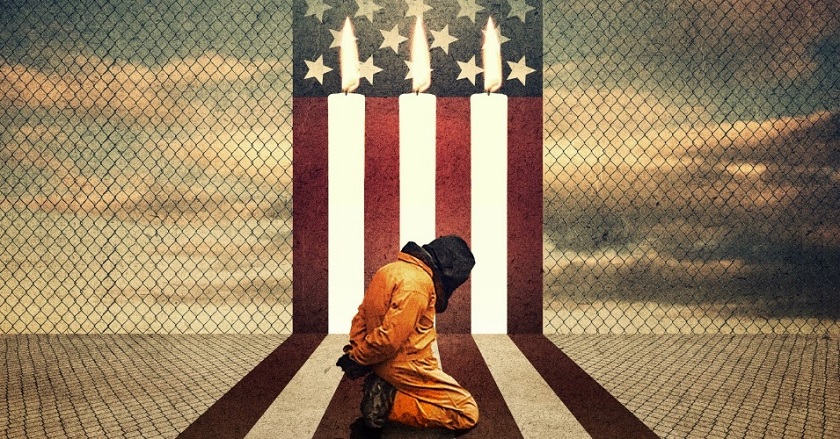
In the United States, torture is no longer an allegation. As the US Senate released findings from thousands of internal CIA memos, the nation confirms — and makes public — the horrific treatment given to detainees.

Some of the debate, however, concerns whether or not the Senate errs by releasing the details. The argument accuses politicians of putting American lives at risk for the sake of political gain. If our enemies see this, they may act out against us. Indeed, as those living abroad, a few days earlier the US embassy put out an alert advising vigilance in the coming days.

It is debated whether or not American torture resulted in intelligence necessary to thwart terrorist threats. The report says no, others say yes.

But the basic premise of the desire to keep sordid details hidden is that transparency would result in greater harm. It is hard to imagine ‘greater harm’ for the human beings tortured, some of whom were innocent, others, certainly less so.

But what is asked is trust that we allow the good guys to do a certain amount of bad, so that the bad guys will not be able to do worse. There is a perverse logic here, and the argument may be true. As an American, I like to believe we are good guys, in the end.

Even in the face of terrible bad.

There is worse, of course, and it does not take much effort to find it. But without transparency, our good guys doing bad may well become the bad guys doing worse. In this case, it seems pretty clear some of them did.

Whether or not it was ‘legal’ is for the courts to decide. But it was immoral, and those responsible should be held accountable. Without accountability, the good to bad to worse progression becomes far more likely.

Is there a message for the rest of the world? Will our [cough] commitment to transparency and accountability inspire others to do the same? Likely not. If anything it will expose us to charges of hypocrisy, and perhaps embolden the worse-doers even more.

Intrepid human rights campaigners around the world are shuddering right now. Their work has always been difficult, even dangerous. Now, any fundamental American interest in the cause has been exposed. We have long been accused of only caring about human rights around the world where we had political benefit in doing so.

When convenient, it is accused, we look the other way. Apparently, we do so within our own borders also. Or, perhaps from shame, we outsource desired torture to others.

But if the rest of the world wants to point fingers at America, it must be noted that fear of the worse protects the bad among many. Here is a long litany of Israeli crimes against Palestinians, addressed to Christians who stand in (poorly informed?) support. Much of the pro-Israel rhetoric says the military action is necessary to defeat terrorism, against the specter of Islamist Hamas.

And I recently spoke to a Coptic activist in Egypt who, while fully opposed to the Muslim Brotherhood, accuses the government of sparking fear in order to ignore demands for greater human rights.

‘Worse’ can be found easily in the so-called Islamic State, or among the drug cartels of Mexico. At what point does our worse begin to approach theirs?

Only when we begin to cover it up, make excuses, or seek its justification. The US Senate has taken the first step of transparency. America’s test now is to continue with accountability.

One school of thought, with a certain wisdom, says to deal with the rest of the world only on the basis of interest. It is foolish to imagine we can force the world to be moral, and we may well need immoral allies.

But we can be moral ourselves. Whether with race or torture, this is an opportunity for national soul searching. It is necessary to confess and repent.


Categories
Excerpts

An Israeli Solution to the US Racial Crisis?

Lieberman Race Protests

With America gripped by conflicting rhetoric over the nature of race relations and police performance, has anyone yet suggested this solution: Just get the African-Americans to go back to Africa?

If so, surely it would be from the political fringe. If anyone knows of a more mainstream source among right-of-center bulwarks like Fox News or Rush Limbaugh-type radio programs, please comment below.

But essentially, this is a talking point on racial issues in Israel. And it is not a marginal viewpoint, but from the center of current government.

A little over a week ago, according to Reuters:

Israeli Foreign Minister Avigdor Lieberman proposed on Friday that Arab citizens of Israel be offered financial incentives to leave the country and relocate to a future Palestinian state.

“Those (Israeli Arabs) who decide that their identity is Palestinian will be able to forfeit their Israeli citizenship and move and become citizens of the future Palestinian state,” he wrote in the manifesto, entitled Swimming Against the Stream, published on his Facebook page and his party’s website.

“Israel should even encourage them to do so with a system of economic incentives,” he said.

Lieberman’s party, Yisrael Beiteinu (Israel, Our Home), captured 11 of 120 parliament seats in the most recent elections, as part of the winning coalition with Benjamin Netanyahu’s Likud.

Encouraging Arabs to leave is not official government policy, but apparently leading Israeli politicians believe it is good rhetoric to rally their base, at the least.

America did have a moment in history when such views were put forward. Certainly the context in Israel today is different than America, both then and now.

But America, despite its faults and residual, often unconscious biases, has forged a society establishing full racial equality in law and in the mindset of most its citizens. The protests today are demanding improvement of an already present good.

The sometime (perhaps often?) poor administration of this good speaks to the widespread triumph of the ideal. Comparing it to other contexts reminds about how fleeting an ideal can be, and how easily it can be threatened.

Israel seeks to navigate two principles not easily combined given its demographic makeup. It wishes to be both a Jewish and a democratic state. As I wrote in an earlier post summarizing the critique of Stephen Sizer, especially as concerns the Occupied Territories, one of these principles seemingly must slide.

Perhaps not. But fortunately America can sidestep the question. It is not a nation for whites, blacks, Jews, Arabs, or anyone in particular. It is a nation for citizens.

Cultural questions still seek definition by many, or perhaps, there should be no definition, for many others. This debate is warranted, within the scope of the Bill of Rights.

But Lieberman’s debate is not. Certainly not in America; morally not, I and many Jews would argue, in Israel.

Or should those who disagree be sent to exile instead?


Categories
Lapido Media Middle East Published Articles

Experimental Egyptian Community Serving Dropouts Reaches Milestone

Sara Hanna
Sara Hanna

Sara Hanna has spent her last five years in a desert oasis, but despite this she is as normal a young adult as you could find anywhere: a 29-year-old university graduate keen to make a difference with her life.

‘I want to do something with meaning, to give my life for other people,’ she told Lapido Media. ‘I have a good education but others haven’t had the chance. I must create these opportunities for others.’

Many restless youth will dabble in volunteer social work for similar reasons. Others will seek a career in the field. But few can match Hanna’s experience on the Cairo-Alexandria desert road, or hope to witness the transformation she will help create.

Her last five years were spent at Anafora, an experimental community created by Bishop Thomas of the Coptic Orthodox Church.

And on 23 November in Anafora, she was one of 26 Egyptian MA graduates of the Catholic University of Lyon, France, in a ceremony coordinated with the community’s fifteenth anniversary.

‘I have lived here because I believe in the vision of Bishop Thomas and the message of Anafora,’ Hanna said. ‘It is to lift up every person.’

The name Anafora means ‘to lift up’ in the ancient Coptic language, and is used of the sacrificial offering presented in the Orthodox liturgy.

Bishop Thomas presides over the diocese of Qusia, 270 kilometers from Cairo in the heart of Upper Egypt. The Asyut governorate where he is based suffers from 70 per cent poverty and 33 per cent illiteracy.

Couple these statistics with a traditional, conservative mentality, and Bishop Thomas concluded that drastic measures were necessary.

Bishop Thomas
Bishop Thomas

‘We wanted to be more free, more relaxed,’ he told Lapido Media. ‘To do this we needed to have Anafora outside their local setting.’

Today around 100 people, mostly from Qusia, have come to work in the retreat centre and various farming and educational programs on the 120 acre property. Hundreds of young people come every year and mix with international visitors, cross-pollinating in cultural exchange.

And like Hanna, some of them stay.

She is from Cairo and now directs the educational programs at Anafora. She supervises the tutoring of 50 high school dropouts, aged 16-41, to prepare them to return to Qusia and complete their high school degree. Fifteen others are in a vocational training program, learning skills through which they can gain employment or start small businesses back home.

In development is a nine-month certificate course in addiction counseling, in cooperation with the NET Institute in Florida.

Sister Partheneya, Hanna’s fellow graduate, estimates 40 per cent of male students in the Qusia ‘Son of the King’ youth program suffer from addiction to drugs, alcohol, cigarettes, or pornography. Five priests are enrolled and plan to create Qusia’s first addiction recovery center, which will be open to all.

But the joint program with the Catholic University is Bishop Thomas’ highest level of educational investment. Hanna and her colleagues received the equivalent of an MA in Local Development and Human Rights.

Furthermore, within five years Hanna will become the leader of an Anafora team and take on all the training. Until then professors will come from France and adapt their teaching to the local context.

It is the first extension program offered by the university, but they hope to replicate it elsewhere.

‘Bishop Thomas is a visionary and helped create a new idea,’ Olivier Frerot, the vice-rector at the Catholic University of Lyon, told Lapido Media. ‘He is creating civil society from the bottom up.’

Anafora Graduation

Among the graduates were 15 priests and two sisters. It is normal in Qusia for the better-educated priests to also serve as community leaders. The next batch of students has much more laity.

‘When you want to implement a new culture and elevate the whole society, you must convince the leaders first,’ said Fr. Angelos Faltas, one of the graduating priests. He partners with Muslim NGOs to combat illiteracy, and has begun an internship program with five local factories to train 100 men for the labour market every three months.

But it is not just the leaders that Bishop Thomas needs to convince. It took 10 years before Anafora finally saw local acceptance of his transformative vision.

One proof is in the prestigious American University of Cairo’s scholarship program. Each year since 2004 the university selects two students from each governorate, and 60 per cent of those from Asyut have come from the diocese of Qusia, said the bishop.

These students are honoured as role models for the community, representing Egypt at the highest levels. The only challenge is to get some to stay. Internal migration draws the best and brightest away from nearly all villages in Upper Egypt.

The priests will stay, as they are bound to the church. But from distant Anafora, Hanna explains her hope for the training.

‘It helps people know how to develop their local community,’ she said. ‘Now they will think how to stay and serve, rather than how to leave.’


This article was originally published at Lapido Media.


Categories
Prayers

Friday Prayers for Egypt: Mubarak Verdict

Flag Cross Quran

God,

The judge ended his 200 page judgment with an appeal to you as Ultimate Judge. Perhaps his conscience was pained after avoiding a ruling.

Mubarak was neither convicted nor acquitted, his case dismissed on a technicality. And a similar reasoning let his security generals off the hook. Since no officers were found guilty in the three years since the revolution, there could have been no top-down order for them to kill.

On some points, God, it seems fair enough. Many deaths occurred in attacks on police stations, which the judge ruled as self-defense.

But it leaves a void of culpability and an emptiness of satisfaction. They may well be innocent, but who is guilty?

Many in are Egypt are convinced he is. After a long revolutionary pause, a few thousand descended to Tahrir Square to protest before being dispersed by security.

Many in Egypt are convinced he isn’t. They place blame on Islamists, accused of opening prisons and killing protestors to enflame sentiment against the police.

And many in Egypt no longer much care. They see Mubarak as old and deserving of sympathy, but the state as imperiled and in need of stability.

God, judge Mubarak rightly in the end, and in the now. Honor the judge, but judge his conscience. Judge the consciences of all who contributed, assembled, and weighed the evidence.

Comfort those who still mourn the blood of their loved ones. May their cries to you be heard in the end, and in the now. Give them perseverance until all facts are known and all crimes convicted. May neither they nor their cause be forgotten.

But neither, God, let it be manipulated. May those who protest seek justice, not retribution. May those who support seek truth, not stability.

But God, in your wisdom, give all the above.

Clean the conscience of Egypt, God. Too many avoid repentance, too many escape guilt.

In their pain, may they appeal to you. Judge.

Amen.

Categories
Excerpts

Who Profits from US Aid to Egypt?

Lockheed Martin

From Global Post, two articles which detail the contracts given out the past two years, and which companies receive them:

Until recently, the United States and Egypt shared a very special arrangement.

Here’s how it went: the US government would collect taxes from the American people. It would give a portion of the proceeds — about $1.3 billion a year — to help Egypt’s military. Egypt’s military would then give that money back to the United States, or at least to the country’s major defense corporations, in return for goods and services.

Would you like to round your budget figures as precisely as the following:

Contract details cited here were compiled from the US Defense Department database, where contracts over $6.5 million are published each business day. Dollar amounts are rounded to the nearest tenth of a million.

And here, without ado, is the beginning of the list:

The list below were the 10 biggest US Defense contracts involving direct military aid to Egypt from 2009 to 2011, according to The Institute for Southern Studies.

See the table at the bottom of the page for full details of the contracts.


1. Lockheed Martin

Amount: $259 million

Boeing (5th) and Raytheon (6th) were the only other names I recognized. It is not that US military spending is improper, it is that US aid must be recognized also for this reality: It is a subsidy to the defense industry.

If we define our terms properly we can have better debate on policy.

Categories
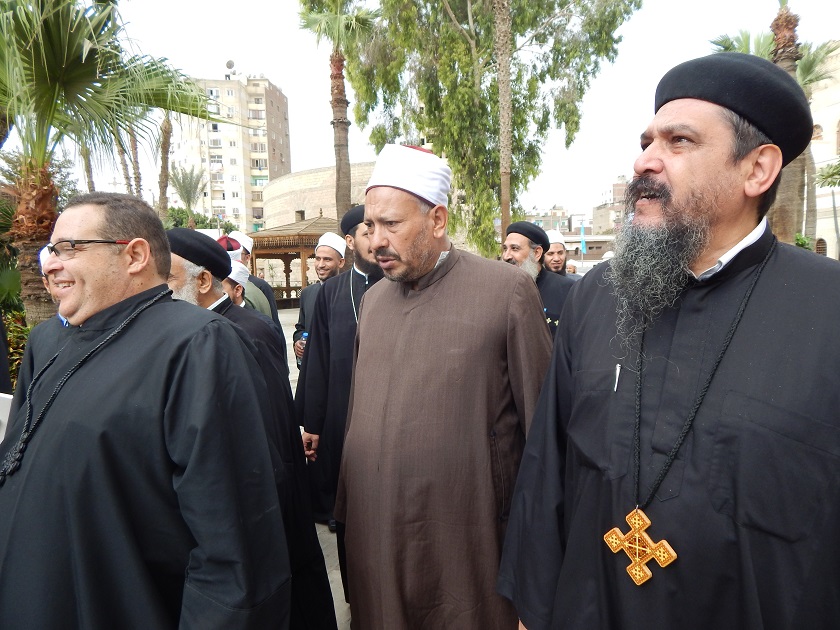
Diocese of Egypt (Anglican) Middle East Published Articles

The Egyptian Family House: Muslims and Christians, Holding Hands

Imam-Priest 1

Of all the slogans of the Egyptian revolution, ‘One Hand’ was among the most popular. At various times it was shouted by the thousands to indicate the unity of Muslims and Christians, or the unity of the people and the army, or more recently in the fight against terrorism.

But along this progression the utopian unity of Tahrir Square has faded. It has been challenged by political struggles and sectarian rhetoric, which have at times intermixed.

Perhaps, then, in recognition of the dual truths of religious unity and diversity, Bishop Mouneer Hanna of the Anglican diocese of Egypt opened the final session of the 2014 Imam-Priest Exchange with a different hand analogy.

‘Let us hold hands together,’ he said, ‘for the sake of Egypt.’

The Imam-Priest Exchange is one of the most dynamic projects of the Egyptian Family House, an entity created in 2011 by the Azhar and Coptic Orthodox Church. The Protestant and Catholic denominations are also vital participants, and the Anglican Church has taken the lead in training religious leaders in dialogue and practical partnership.

The Family House has a mandate to interact with government ministers through its committee work in education, media, youth, and religious discourse. But it is this latter committee which is actively preparing its second mandate: Taking the message of national unity to the grassroots.

For it is here that the real challenge of terrorism and sectarianism must be fought. No matter the international scope of these issues gripping the region, too many Egyptians are drafted into extremism.

‘This session coincides with a bloody period that Egypt is going through, killing Muslims and Christians together,’ said Sheikh Muhi al-Din Afifi, head of the Azhar’s Islamic Research Center. ‘We must spread a culture of citizenship, love, peace, and coexistence.’

The military aspect of this challenge is important, Bishop Mouneer emphasized. ‘But ideology is more important and this is why we are here today,’ he said.

‘I hope and trust this will not be our last meeting, but the beginning of our mutual work.’

Imam-Priest 2

November 3-5 witnessed the final of four sessions during which 35 imams and 35 priests from throughout the country lived together, attended training seminars, and visited local historical and religious sites. Their dialogue, so to speak, was not the formal discussion of religious doctrines, but rather the exchange of life, rubbing shoulders over meals and jokes.

They repeated the program experienced a year earlier by seventy others, to be repeated again in 2015 with seventy more.

The first session concerned how to get to know each other, followed in the second by how to live together. But as participants grew more comfortable the purposes grew more demanding. Session three was on how to cooperate, and session four on how to work together.

‘I beseech you to have joint work together throughout Egypt,’ said Afifi, ‘not just religious but also medical and developmental.’

It was not easy in the beginning. During the first session the 2013 graduates were brought back to testify of their experiences. Imams and priests demonstrated their newfound friendships, as just a year previously they had not known each other.

However, there remains challenges in these relationships. Some spoke that a priest would never be welcome in a mosque, nor an imam in a church. Some emphasized the glories of their own religion, and some described others as not really wanting to be there in the first place.

‘It is very hard work,’ said Saleem Wassef, the project director and a lay minister in the Anglican Church. ‘But I stress to them we are here to emphasize a culture of “me and you together,” rather than simply “me or you.”’

These grumblings, however, were outnumbered by testimonies of interaction. Fr. Mityas of Fayoum visited Sheikh Ali when his wife fell ill. Fr. Suriyal of Ismailia visited schools and hospitals with Sheikh Abdel Rahman. Fr. Kyrillos of Port Said solved sectarian problems with Sheikh Hassan. And Sheikh Hisham of Mallawi visits coffee shops with various priests of his city, asking people their impressions about men of religion.

These social appearances are to Bishop Mouneer one of the most important outcomes of the meetings.

‘We are not here to listen to lectures and visit locations,’ he told participants, ‘but each one after leaving here must look for the closest imam or priest near to him and make relationships, hold seminars, and walk in the street together.’

Imam-Priest 3

Indeed, as imams and priests left their hotel in Dokki they needed to go about four blocks to a main road where the bus could take them to their next location. Onlookers stopped conversations and turned to watch the unusual spectacle.

Some priests confessed they had all but stopped walking alone in the streets of their cities, being subject to insults and even spitting. But walking together makes a great difference.

‘Egyptians love men of religion,’ said Fr. Arsanious of Beni Suef, ‘and if they see a priest and an imam together it influences them to work together and overcome fanaticism.

‘These displays of love are like the leaven that spreads through the whole community.’

Fr. Arsanious wants to help open a regional branch of the Family House in his area. Fr. Mikhail and Sheikh Emad hope to begin work in the Cairo slum of Kilo Arba wa Nus.

If successful, they will follow in the footsteps of the previous class which opened branches in Alexandria, Luxor, Port Said, Ismailia, and Giza. This is where the real work takes place, outside the conferences, which will prove their lasting value. Will the friendships forged between imams and priests over the course of a year carry over into continued cooperation?

In expectant hope, Wassef trained them how to measure the fruit of their friendship. Are they working together as a team? Have they touched all classes of their local area? Have they incorporated others already at work in civil society? And have they written out a plan to accomplish the above, with deadlines?

‘We are working hard to exchange a culture of hatred with a culture of love,’ said Wassef. ‘This is for the welfare of our country, to change the minds of Muslims and Christians toward one another.

‘The project helps reach unreached places.’

Imam-Priest 4

This article was originally published at the website of the Anglican Diocese of Egypt.


Categories
Excerpts

Mubarak Verdict Reactions

Mubarak Verdict

From Paul Attallah, a roundup of reactions to the verdict acquitting former president Hosni Mubarak from responsibility for the deaths of protestors during the January 25, 2011 revolution. His perspective is evident, and he is a decent representative of  local, non-Islamist opinion:

Mixed reaction

According to Professor Said Sadek of California Miramar University, there is a mixed reaction as Egypt Court drops charges against Mubarak. The 86-year-old former leader’s trial generated sympathy after his supporters said the charges against him were a conspiracy against Egypt.

However, Sadek also said some Egyptians are displeased with the court’s ruling. “For the victims of the 2011 revolution and those who feel he was responsible for a lot of the legacy of corruption, religious extremism, bad education system, they feel justice has not been done,” said Sadek.

The people said this revolution was a conspiracy against Egypt’s stability, security, safety and future. “People are fed up with revolutions or any attempt to call for big demonstrations.

Percentage of pro and against Mubarak verdict

What’s the percentage of those who are against Mubarak’s innocence? I would say that it is equal to the percentage Hamdeen Sabahy got during the presidential elections (about 3 to 4%). In fact, Hamdeen Sabahu said: Shame for the tyrants even if they had been unpunished and glory to the martyrs.

This tone cannot get more than 4%.

Negative reactions

It’s amazing to see that the West media goes to the MB, 6 April, Ayman Nour and Alaa el Aswany to get the Egyptian reaction forgetting that they represent just a minority, but a minority which gives to this media the statements they are looking for:

“The politicized decision to acquit Mubarak is a declaration of the collapse of the judiciary,” the Muslim Brotherhood’s Freedom and Justice Party, said on its website. The party called upon what it described as “revolutionary forces” to unite and respond to the ruling in squares. “Rise up to proceed with the revolution and resist injustice,” the statement read.

The April 6 Youth Movement, one of the most prominent activist groups against Mubarak’s rule, said on its Facebook page that one of its members, Mahmoud Hussein, was arrested at Faisal Street in Giza for writing “down with Mubarak” on his bare chest. “Down with Sisi Mubarak rule,” read a post on the page.

“I offer the sincerest condolences to the families of the January revolution martyrs,” Ayman Nour, chairman of Ghad al-Thawra Party, who was jailed following his presidential quest against Mubarak in 2005, said in a tweet. “Justice is dim and injustice is glowing… protesters get 15 years, hundreds are executed for murdering one person, while those who killed hundreds are acquitted.”

“The plan’s last stage is executed successfully. Lobby spies and media drumbeaters. People, never raise your chins before your masters again,” tweeted prominent author Alaa al-Aswany, who is known for his fierce criticism of Mubarak.

Balanced reaction

Wael el Obrashi said that the verdict must not give to the Muslim Brotherhood an opportunity to create divisions and achieve their ambitions.

Egyptian political parties refuse the MB call to protest after Mubarak’s trial

The Muslim Brotherhood are trying to ride the popular anger again to repeat the 25 January revolution scenario. This brotherhood is the real enemy of the Egyptian people

Ahmad Mousa: The Muslim Brotherhood and 6 April are calling for an armed protest in Tahrir square

A Salafi preacher: Mubarak innocence proves that the Muslim Brotherhood are involved in killing the Egyptians

Arab Gulf double reaction

King of Bahrain congratulated Mubarak for the verdict

But, A Qatari Emir, Faysal ben Gasem, incites the Egyptians to start a revolution.

He twitted: The Muslim Brotherhood must put all their weight to support the revolution. They must bandon their slogans (?) and not to make a distinction with the people. By God’s will the revolution will succeed even if thousands killed

(what’s the matter of your mother ya Faysal Ben Gasem)

Mubarak says he committed no crime, calls January 25 Revolution ‘weird’

In his first published comments since being found not guilty of graft and cleared of charges of murdering protesters demonstrating against his rule in 2011, former President Hosni Mubarak said in a phone call with Sada El-Balad TV he “didn’t commit any crime,” and gave no orders during the January 25 Revolution.

Protests

One dead after Egyptian security forces disperse Mubarak verdict protest

One has been confirmed dead and 8 injured according to Health Ministry spokesperson Hossam Abdel-Ghaffar after Egyptian security forces dispersed over 3,000 protesters who had gathered near Tahrir Square on Saturday evening to protest a court verdict that dropped charges against Hosni Mubarak of killing protesters.

The “ultras” tried to occupy Tahrir square and chanted against the regime, the army and the security.

(The “ultras” had been politicized becoming a destructive political group under a Muslim Brotherhood and 6 April control. Actually, all football games are not attended by people).

85 arrested in storming of Abdel Moneim Riad Square protests

Security forces arrested 85 protesters, after storming Abdel Moneim Riad Square on Saturday evening during demonstrations against the acquittal of Hosni Mubarak, according to a Cairo Security Chief Ali al-Demerdash.

Protesters gather near Tahrir Square to denounce Mubarak verdictThe Muslim Brotherhood alliance support calls the members of the alliance to go to Tahrir Square

And, here is an interesting take from blogger Maged Atiya at Salama Moussa, resident in the US but a keen and sympathetic observer of Egyptian affairs:

The author of this blog will note that he never liked Mubarak. It was not a reasoned response, but a visceral reaction. Mubarak seemed to embody the worst aspects of Egyptian male misbehavior, controlling, domineering, occasionally indifferent, sometimes sneering, and at other times self-pitying. The reaction was enough to persuade this former Egyptian to avoid the country for the duration of his rule, and beyond. Mubarak made being born in Egypt a congenital condition worthy of seeking cure in a larger and perhaps less visible identity. Of course, it is wrong to pin all the blame on Mubarak; but he was case 1 of what has gone wrong in Egypt. He lived on to see himself, and by turns, his country humbled. Yet one senses that no grand understanding came his way. His derisive survival mocked his country as poor and humble and incapable of greatness.

There were some positive aspects to the long years of Mubarak. The Army was persuaded to stay away from politics. Infant mortality was reduced dramatically. He made deft moves diplomatically in the 1990s to have the country’s external debt wiped off.  He tried to open up some political room for the Muslim Brotherhood. He made stumbling steps toward liberalizing the economy. Yet, every positive step lived in the shadow of greater errors.  But few of his errors match his performance in February 2011, and none of his successes are as great as his final acquittal in court.

Mubarak insisted that he stood between Egypt and disaster. We are tempted to think of this as the refrain of a humble and limited man who rose above all he ever expected to be, only because he never did much about it. He was not delusional enough to expect immortality, yet he never developed leadership to follow him and stave off disaster. He never even appointed a Vice President, until he was nearly gone. He raised his palms against a nation, insisting that it should not look behind him where abyss looms, but did nothing to point to a better direction. He got away with it because his opponents were too pious or too foolish to point out this simple fact. They railed against him as a dictator, but demonstrated little liberality themselves.

Mubarak’s greatest sin came in February 2011. He attempted to stay in office by a patronizing display of self-pity. He begged his nation to respect him as an elderly father. He should have taken a different tack. He should have simply explained that to shove him off with 6 months remaining in his term would legitimatize arbitrary transfer of power to the Army by street mobs, and God help a country that sets up such a precedent. He should have begged to stay on as the elderly humble Bawab, who would sweep around while younger men built a better structure. His final magic act would have been to finish his term humbled for the sins of his errors. But a man capable of such reach would not have stayed in office for so long, nor left a vacuum in his wake.  His final atonement and redemption would be to offer his country a Shakespearean tragic denouement. He went for the tawdry television serial.

If Mubarak’s greatest error came in February 2011, his final success came afterwards. We should praise him for what he did not do. He did not flee the country. He did not beg for mercy. He stood in court, judged by men we judge inferior, even by his lowered standards. There was indeed the flood after him. A torrential downpour of errors, and blood. Nowhere near as much blood as the rest of the cursed region, but far too much by Egypt’s perceived gentle standards. In the end he was acquitted of charges that could not be proved, but not tried for errors that he demonstrably made. Those errors were that of a nation; formed of its clay and shaped by its humiliation.

In the end Mubarak was acquitted, and acquitted himself perhaps better than the mercurial and damaged country that sought his removal and now longs for his reign.

And finally, here is the reaction of CNN. After recapping the first trial and the political situation at the time, the author concludes:

The defendants appealed and the retrial began in January 2013. It would take more than 50 sessions to arrive at a verdict but this time Mubarak’s trial would be overshadowed by growing turmoil in the country.

Egypt’s Supreme Constitutional Court dissolved the first democratically elected parliament after declaring it unconstitutional. The Egyptian military ousted Morsy on July 3, 2013 following another popular uprising. Security forces began arresting the Muslim Brotherhood’s leadership and thousands of their followers. The following August, security forces would clear Morsy supporters from two squares in Egypt resulting in more than 1,000 people killed. Morsy now stands trial over the death of protesters as well as an array of other charges.

From the chaos emerged Abdel Fatah al-Sisi. He served as the head of military intelligence under Mubarak and was promoted by Morsy to be minister of defense. He oversaw the overthrow of Morsy and handover of power to Adly Mansour, although many believed al-Sisi remained the power behind the throne. In May of this year, Egyptians elected him president and thus the fourth recent leader of Egypt.

Today’s verdict reflects the times. Fewer people were outside the courthouse for the trial. Small bands of protesters took to the streets. Most Egyptians vented their anger online. Talking to Mubarak supporters and protesters on both sides, they did agree on one thing. They told me the revolution is dead.

With whom do you agree?


Categories
Prayers

Friday Prayers for Egypt: Blame and Impose

Flag Cross Quran

God,

The last three years in Egypt have been troublesome. Find a culprit, and force your way.

An early culprit was Mubarak. Today he faces a verdict that may exonerate him.

The current culprit is the Muslim Brotherhood, according to a national fact-finding investigation into the post-June 30 violence. They initiated the violence in the dispersal of their pro-Morsi sit-in, and followed it up against Christians across the nation.

An ongoing culprit is also named. The security services exercised an inordinate and random response, resulting in hundreds of deaths. They have the ire of Islamists who called for nationwide protests this weekend, but did not galvanize.

God, of course there are many to blame. Find them and transparently hold them to account. But blame deflects from one’s own culpability.

Give Egypt humility, and help her hold herself to account.

For it far easier to impose. The state has the strength and is asserting its right. Thousands have been arrested and dissenters marginalized.

But even weakness seeks to impose. A Salafi group, backed by the Brotherhood, called on the masses to impose sharia law and Islamic identity.

Each is trying to fix what went wrong.

The state does not wield the sword in vain, God, you have asked it to maintain justice and order. But the human impulse to blame and impose contradicts other principles you demand. Mercy, patience, confession, and other-centeredness – these are absent among too many.

Preserve goodness in Egypt, God. Protect her against those who wish her ill, but may she not respond in kind. Generate a wide consensus, so that no force is necessary.

Issue no blame, God, and impose no wrath. Forgive, and rebuild Egypt.

Amen.