In the Arab world today, the war in Gaza dominates the news, with its small Palestinian Christian community caught in the crossfire. But over the last decade, ancient churches have faced persecution in Syria and Iraq, while political instability and terrorism have threatened believers in Egypt, Lebanon, and Jordan.
Nevertheless, the church’s activity in this region is about much more than war and persecution, as the Middle East and North Africa (MENA) chapter of the Lausanne Movement’s State of the Great Commission report shows. For example, congregations have cared for refugees, and online ministries have expanded.
One notable development is the numerical growth of Muslim-background believers (MBBs).
The report provides an ominous description of Christianity in the MENA region: “The outlook for all Christian communities is negative.” Yet the section on MBBs concludes with hope amid the devastation, predicting that “a new church, from among the majority people, will rise up from the ashes of the traditional structures.”
CT spoke with Rafik Barsoum—coauthor of the MENA chapter, president of Message to All Nations, and pastor of a digital church initiative launched in 2022—to elaborate on key ideas in the report. He described the difficulties faced by MBBs and Christian-background believers (CBBs) alike, the witness offered by both, and why he dislikes the distinction between them.
Why did the report begin with a negative assessment?
Iraq, for example, is nearly bereft of Christians. The region is experiencing war, famine, terrorism, poverty, instability, and turmoil in every way. And with any turmoil anywhere, minorities are the first to be affected. In nearly every nation, if they are not facing outright persecution, struggles such as these pressure believers to leave the region.
Ancient churches are losing their people. The Middle East was once the beacon of Christian history; now it is at risk of losing its Christian presence.
But these struggles do not suggest a gloomy picture as concerns the work of Christ. We have seen signs of revival in the last decade like never before. But a price has been paid for it that is not often covered by the news or political analysis. We do not want this persecution to continue, but new signs of hope are emerging.
One of these signs of hope is the MBB community, which the report calls a “movement.”
The word movement is a missiological term describing an intangible awareness that God is drawing people to himself in ways we cannot explain, beyond the work of any one church or organization. It is as Jesus told Nicodemus: The wind blows where it will, and we see its effects in the wave that is forming. People are coming to know the truth through dreams and visions, the work of missionaries, the testimony of the church, and online media ministry.
Amid political turmoil, people are challenging taboos and delusions of the past—independently of this movement, but also as they witness Christian love in action. God is doing something unique.
Yet the report calls this movement “small.” How should it be measured?
The MBB movement is…
This article was originally published at Christianity Today on September 26, 2024. Please click here to read the full text.
When Jesus told the 12 disciples to shake the dust off their feet in protest of any town that did not receive them, it is easy to forget their mission was among fellow believers in Yahweh. Jews were speaking to Jews, and the message was simple: The kingdom of God is near.
But Jesus foresaw even greater opposition than rejection, according to Matthew 10. His disciples would be dragged before councils, flogged in the synagogues, and betrayed to death by their own brothers, he warned. “I am sending you out like sheep among wolves.”
Christian discourse on the Holy Land conflict is often similarly contentious.
“A conversation is needed,” said Darrell Bock, senior research professor of New Testament at Dallas Theological Seminary (DTS). “People talk at each other, not to each other. But with the emotion and distance between the two positions, is it even possible to try?”
Not from what another Bible scholar witnessed when each camp gathers alone.
“Their conferences only preach to the choir,” said Rob Dalrymple, course instructor of New Testament and biblical interpretation at the Flourish Institute, the seminary for evangelical Presbyterians in the ECO denomination. “Nothing changes; it only reinforces how bad the other side is.”
Each academic belongs to a community traditionally associated with one or the other side of the Israel-Palestine conflict. DTS teaches dispensationalism, which anticipates the restoration of Jews to the Promised Land before the return of Christ. Presbyterians adhere to covenant theology, which interprets the promises given to Israel—including the land—as fulfilled in Christ.
The Jews of Jesus’ day also had factions. But while “shake the dust off” was the instruction given to disciples in the face of opposition to the gospel, to all who believed in him he gave a very different message in the Sermon on the Mount:
Take the log out of your own eye first.
One group of Bible scholars…
This article was originally published at Christianity Today on October 7, 2024. Please click here to read the full text.
Almost six months have passed since Issa Saliba boarded a bus in Gaza with 15 other Christians to seek safety in Egypt. But he still relishes how they sang, clapped, and danced as they escaped devastation.
The air conditioning cooled his nerves, frayed from the harrowing journey to the border. Later that day, the wayside stop provided his first full meal.
Top of Form
As 1.9 million Palestinians—90 percent of Gaza’s population—remain internally displaced, less known is that 100,000 have managed to take refuge in Egypt. Saliba, allowed to depart because he is enrolled at the American University of Madaba in Jordan, left behind his father, two younger brothers, and the hundreds of other Christians remaining in the war-torn Mediterranean strip.
Saliba’s trip in April took him south along the damaged, dusty coastal road through Israeli checkpoints to the Rafah crossing. Then came a six-hour ride to Cairo. Saliba got out just in time: In May, Israel took control of Rafah’s Philadelphi Corridor and closed the border. The 8-mile-long strip of land remains a key sticking point in current negotiations over a ceasefire.
But from the first days of the Israel-Hamas war, the Egyptian government has resisted overtures to resettle displaced Palestinians in the adjacent Sinai Peninsula. Wary of terrorist infiltration but also fearful Israel will permanently refuse refugee reentry to Gaza, Egypt limited entry to people with medical emergencies, the financial means to pay up to thousands of dollars in fees, and international educational connections, like Saliba.
Evangelicals, though, are becoming known for giving food and supplies to refugees, whether Christian or Muslim. The Egyptian church, partnering with like-minded Palestinians, has even sent aid into Gaza for the believers huddled for safety in churches, as well as thousands of others displaced from their homes in makeshift camp communities.
“We show the love of God to everyone,” said Samuel Adel, chairman of the pastoral, outreach, and missions council of the Evangelical Presbyterian Church of Egypt, also called Synod of the Nile. “When people ask why, we tell them it comes from our love of Jesus.”
Soon after the Israel-Hamas war began on October 7, aid to refugees began…
The article was originally published at Christianity Today on September 16, 2024. Please click here to read the full text.
During Tuesday night’s presidential debate, Kamala Harris accused Donald Trump of a fondness for dictators, alleging that he supported a negotiated settlement with Vladimir Putin following Russia’s invasion of Ukraine. Trump, declining to affirm that a Ukrainian victory would serve US interests, replied that if he were still in the Oval Office, the war would never have happened, and he claimed that he could bring it to an end even as president-elect.
Both candidates failed to address the most salient current issue on Ukraine for evangelicals: religious freedom.
Last month, the Ukrainian parliament overwhelmingly approved a proposal to ban the activities of the Russian Orthodox Church (ROC) and compel the Ukrainian Orthodox Church (UOC) to break all ties with the patriarchate in Moscow. President Volodymyr Zelensky signed the bill into law, hailing his nation’s “spiritual independence.”
Some Republicans, including vice-presidential candidate J.D. Vance, have accused Ukraine of “assault[ing] traditional Christian communities.” Vance linked these alleged violations to the continuation of US military support, stating that military aid should be used as leverage to ensure religious freedom.
The charge is nonsense, said a leading Ukrainian expert in an interview with CT.
The law, said Maksym Vasin, director for international advocacy and research at the Institute for Religious Freedom in Kyiv, is meant to protect Orthodox believers in Ukraine from Russian propaganda. The State Service for Ethnic Policy and Freedom of Conscience (DESS) studied ROC and UOC documents to demonstrate the continuing link between the two churches, despite the UOC’s postwar assertion of independence. Each of the UOC’s 10,000 parishes has now been given nine months to demonstrate that it is not connected to the ROC, subject to court judgment.
However, the GOP is not alone in its concern.
Pope Francis stated last month that no church should be abolished “directly or indirectly” based on how its people pray. The World Council of Churches urged “caution.” And according to variousreports, Ecumenical Patriarch Bartholomew I, considered first among equals in the Orthodox world, sent a delegation to Ukraine to inquire about canonical structure and whether individual UOC parishes are being forcibly transferred to the rival Orthodox Church of Ukraine (OCU).
The state said 1,500 parishes have voluntarily aligned with the OCU since 2018.
In 2019, Bartholomew granted autocephaly (canonical independence) to the OCU, a then-schismatic body that had earlier broken off ties with Moscow. The move, supported by the United States, shifted OCU allegiance to the ecumenical patriarch’s church in historic Constantinople.
Orthodoxy first spread among the Slavic people from Kyiv, which was joined to the ROC in 1686. Following passage of last month’s law, the OCU reached out to the UOC for dialogue, emphasizing the need for unity and reconciliation.
CT spoke with Vasin, who contributed a chapter analyzing an earlier draft of the law in last year’s Security, Religion, and the Rule of Law, about the response of Ukrainian evangelicals, the limits of individual criminal prosecution, and whether the law should be considered a “ban.”
Please explain the aim of the new law.
The law aims to terminate Russian influence on Ukrainian society through Russian religious centers and to limit the propaganda of the chauvinistic ideology of Russkiy Mir (Russian World) in Ukraine. Ever since Soviet times, Russia has systematically used religion and religious centers of various denominations, primarily the ROC, as a tool of propaganda to achieve its military and geopolitical goals.
Churches are then manipulated to exert totalitarian control over their citizens or are closed down if they refuse to cooperate. This repressive policy is clearly visible in the eastern and southern regions of Ukraine, annexed following the Russian invasion. There, the Russian authorities are carrying out brutal repression against Ukrainian Christian churches and religious communities of various denominations, including Muslims and Jews who do not support Russian aggression.
Putin and the Kremlin want to maintain a key instrument of influence in Ukraine, namely the ROC and its affiliated local Orthodox eparchies and parishes. For this reason, Russia is most vocal critic of the Ukrainian government’s initiatives aimed at protecting religious freedom from abuse.
Is the new law a “ban” of the UOC?
It is a ban of the ROC in Ukraine, because of its open support for Russia’s war.
It is not an immediate ban on the activities of the UOC, which is not even directly mentioned. The government will issue directives to break administrative and canonical subordination to the ROC or other Russian religious centers. If a religious community refuses to sever these ties, the government will have the right to apply to the court to terminate the activities of this legal entity, given the danger to national and public security. But if the defendant parish complies during these hearings, the court case will be dismissed.
Thus, it is wrong to say that this law bans the UOC. Instead, the law allows this church and any other religious associations in Ukraine to liberate themselves from the influence of Russian intelligence services and stop being mouthpieces for Russian propaganda.
It is up to the UOC priests and parishioners to decide whether they will continue to agree to be used by the Kremlin or whether they will end their dependence on the ROC and Russian authorities.
Your analysis of an earlier version of the law advised the government to concentrate on individual criminal proceedings against clerics who collaborated with Russia. Why is this not a sufficient safeguard against Russian interference?
Religious communities should not be responsible for the activities of their clerics, and a ban must be the last resort if other measures have been ineffective. But in recent years, it has become increasingly clear that…
This article was originally published at Christianity Today, on September 13, 2014. Please click here to read the full text.
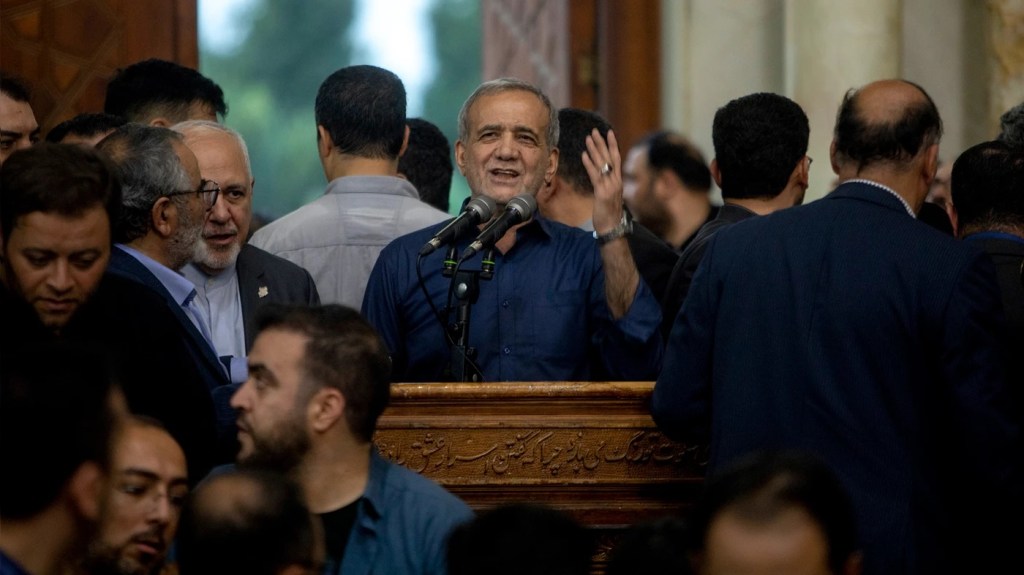
The surprise election in Iran of the sole reformist candidate for president was met with an unsurprising reaction from the United States.
Heart surgeon Masoud Pezeshkian tallied 53 percent of the vote for a clear but narrow victory over hard-line former nuclear negotiator Saeed Jalili in an electoral process the State Department labeled “not free or fair.”
It followed the May 19 death of the previous president in a helicopter crash.
With “no expectation [of] fundamental change,” the perspective from Washington echoed that of Javaid Rehman, the United Nations Special Rapporteur on the Situation of Human Rights in Iran. The Pakistani-British lawyer stated that a new president is unlikely to improve the Islamic Republic’s record.
Iranian Christian sources in the diaspora agree.
“The result highlights a superficial change in leadership,” said Robert Karami, an Iranian Church of England pastor outside London and a board member of Release International, a UK-based advocate for the persecuted church. “It does not matter who holds the presidential office as long as the Supreme Leader remains in power.”
Pezeshkian, age 69, was one of six candidates permitted to run by Iran’s 12-member Guardian Council, appointed by head of state Grand Ayatollah Ali Khamenei. Dozens of candidates were disqualified, including former president Mahmoud Ahmadinejad. Analysts speculated the inclusion of Pezeshkian was intended to increase voter turnout—but if so, the strategy initially failed and may have backfired.
Only 40 percent of the electorate participated in the first round held on June 28, the lowest tally since the 1979 Iranian revolution. It resulted in the first runoff since 2005, leading to a hostile campaign in which leading figures claimed Jalili would rule Iran like the Taliban in Afghanistan. Voters partially responded, as election day on July 5 witnessed an increased turnout of 50 percent.
But not Mansour Borji, who boycotted the diaspora ballot stations in the UK.
“I participated in the election by…
This article was originally published by Christianity Today on July 9, 2024. Please click here to read the full text.
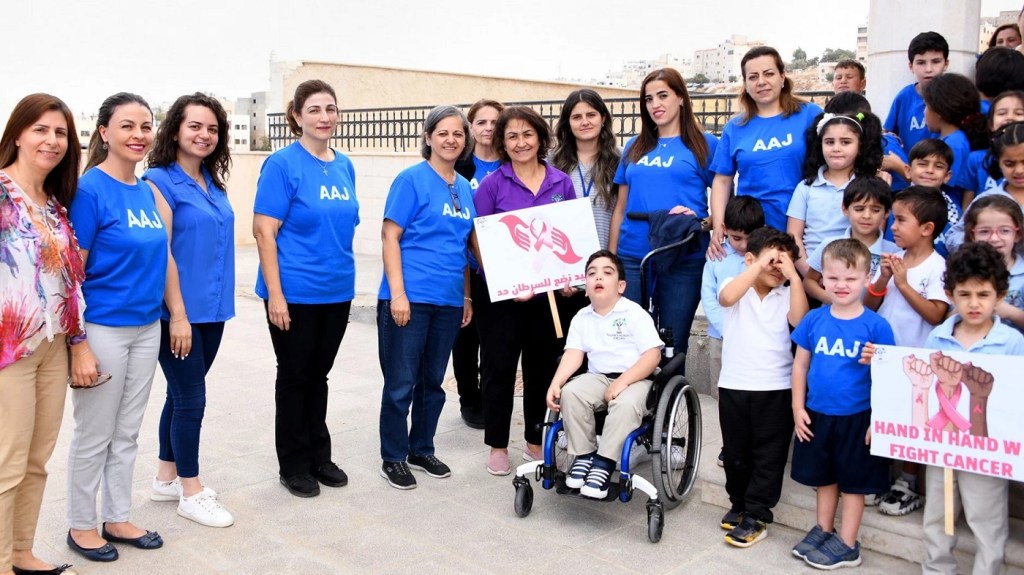
Ten years ago, evangelicals in Jordan helped pioneer inclusive education for students with disabilities. A decade later the minister of education patronized their commencement event.
Founded in 2014, Alliance Academy Jordan (AAJ), owned by the local Christian and Missionary Alliance (CMA) church, began with 54 students in kindergarten through second grade. Adding a grade level each year, its first graduating class of two students completes a now 350-student body—17 of which have disabilities ranging from cerebral palsy to autism and ADHD.
Another 31 have different levels of learning disabilities that require special class support and attention. Over the years, AAJ has enrolled 71 such students altogether.
It is a drop in the bucket.
In 2017, the Jordanian government launched a 10-year plan for nationwide inclusive education. AAJ was on the initial advisory committee of the Higher Council for the Rights of Persons with Disabilities that prepared it.
American funding is helping Jordan meet its goal of 30 public inclusive schools in its major cities by 2025, mandating professional development for all. Another 30 schools are planned for less-developed areas after that.
A 2020 study found that only 19 percent of teachers in Jordan were trained appropriately for special needs education. And while 11 percent of youth above the age of 5 have some sort of disability, 79 percent receive no form of schooling at all.
Last year the Higher Council selected AAJ as one of six members to form a public-private school association to share expertise and help in implementation. With an average class size of 17, AAJ is uniquely positioned to serve special needs students as it aids the national endeavor toward their social integration.
And beginning in 2025, the school plans to offer an American diploma.
CT spoke with AAJ general director Salam Madanat about challenges faced by the school, its diversity beyond disability, and how it maintains a Christian vision.
How did you come to your position?
I was happy in retirement at the time, volunteering in ministry through my church. But in 2019, the CMA asked me to join the AAJ board of trustees, due to my background with the Alliance church and in management and human resources with the Arab Bank. Three years later I was tasked to lead the search for a new school director. The position had been held by an American from the CMA mission since inception, but we were looking to transition to Jordanian leadership.
But as the search tarried, my husband whispered: I think you should do it. I didn’t want to wake at 6 a.m. every day and carry such a heavy weight. But as others shared similar encouragement at the school and in the church, I prayed and God assured me: This is my work, I’m responsible for it.
I am a devout Christian, so I knew he just wanted me to obey. All I could do is place my two copper coins into his hands, trusting him for what I could not see (Luke 21:1–4). But I am confident AAJ was founded by the will of God for a purpose, and it will remain so.
What is this purpose? The goal was to provide affordable education for all children—not just the rich, smart, or able—and show the love of God through this ministry. Many good schools in Jordan…
This article was originally published at Christianity Today on July 2, 2024. Please click here to read the full text.
Amid the war in Gaza, Israel’s most religious Jews threatened to emigrate.
The statement issued by the chief rabbi of the Sephardic community in March had nothing to do with fear of Hamas rockets or the continuing fight against them. Neither was it related to protests over the remaining hostages or calls for ceasefire.
The concern instead was the forced conscription of Haredi Jews, popularly known as the ultra-Orthodox, into the military.
On Tuesday, the Supreme Court of Israel ruled unanimously against them. Though a plan must still be formulated, about 66,000 ultra-Orthodox of draft age are now eligible for enlistment.
Israel requires three years of service for most men and two years for most women. But in 1947, then-prime minister David Ben Gurion exempted 400 yeshiva students who wished to dedicate themselves to prayer and Torah study.
Marked by traditional black-and-white garb with a hat, long beard, and side curls, they call themselves Haredim—derived from Isaiah 66:2, which says God favors those who “tremble” at his Word. The success of Israel, they believe, is tied to Leviticus 26:3, where national flourishing is dependent on their “careful” observance of the law, interpreted as strenuous engagement with the Scriptures.
Today, however, the Haredi community is the fastest-growing in Israeli society and constitutes 13 percent of the population, estimated to increase to one quarter by 2050. Yet while 540 military-eligible Haredi men voluntarily enrolled to fight since October 7, tens of thousands have continued to avoid the draft under Ben Gurion’s exemption.
In 1998, the Israeli Supreme Court ruled a law was necessary to codify this policy, and it was passed in 2002. Israel also established a yeshiva that included military service as well as a special battalion for Haredim males. While thousands have joined, the vast majority rejects the secularizing influence of the Israeli Defense Forces (IDF) as a threat to the uniqueness of their separate religious community.
Most Haredi do not celebrate Independence Day, observed from sundown to sundown May 13–14 this year. While they are not anti-Zionist, they believe that only the coming messiah can reconstitute the nation of Israel in the land. In the meantime, they support the current human endeavor through their prayers.
But in 2017, the Supreme Court ruled the 2002 law was discriminatory and ordered the government to address it. Given strong Haredi influence on politics, the issue was left unresolved until March 28, when judges barred the state from continuing payment of stipends to yeshiva students eligible for the draft. Authorities have stated they will not engage in a mass conscription, but an estimated 55,000 Haredi in over 1,200 yeshivas will lose their funding.
The controversy has sparked protests and counterprotests pitting religious and secular Jews against each other. CT asked Samuel Smadja, the leader of a Messianic Jewish synagogue in Jerusalem, to provide a biblical perspective.
His father, who came to faith among the small Jewish minority in Tunisia, was one of the first messianic believers in Israel, immigrating in 1956. Today Smadja is the regional director for Trinity Broadcasting Network. He founded Sar-El Tours to connect Christians with their Holy Land heritage. He also has Haredi relatives within his family.
Smadja discussed how yeshivas fit within current Israeli politics, whether Haredi prayers are effective, and the best methods to speak about Jesus with an isolated community that equates proselytizing with the agenda of Adolf Hitler.
How do Messianic Jews view the IDF?
The children of Messianic Jews are fully enlisted and striving to be the best soldiers they can be. This is not only to demonstrate our social legitimacy, but to be a light for the gospel and to put forth our testimony.
We want our children to be promoted to the highest posts, as an example.
How do Messianic Jews view the Haredim?
It is better to discuss Orthodox Judaism, as the Haredim are a subset and there is diversity within both. Some join the army, some don’t, and it is hard to generalize since so much depends on which rabbi they follow.
But in general, like Paul said, they fear God but not from knowledge. The Orthodox Jews try to keep the commandments and do their best to climb the ladder of righteousness to get closer to God. And they are willing to pay the price for their convictions, especially during these times of war.
I believe we should respect them.
Yet we disagree with them, even though we have much in common on moral issues such as abortion and the traditional understanding of Judeo-Christian ethics. With many secular Jews, you have to prove God’s existence. But the Orthodox accept the truth of the Bible, and if they are willing to talk, it demands of us a deep knowledge of Scripture.
They know the Old Testament very well, especially the first five books of Moses.
Are they willing to talk?
Much more than they used to be. I grew up in Israel, and 25 years ago the name Yeshua (Jesus) was a terrible word. Messianic Jews were not recognizable because we were so few. Now people know we exist, and that we believe Yeshua is the Messiah.
It makes for an interesting discussion. The debate centers on how to prove the concept of a suffering messiah, and not just from Isaiah 53, for which they have a different interpretation. And then we address God’s complex unity—the Trinity—and the language of John that “in the beginning was the Word, and the Word was with God” (1:1). This concept is mentioned frequently in rabbinic literature, and we discuss if John aligns with it.
Was God’s messiah meant to be divine, or an elevated rabbi? What the average Christian takes for granted we must prove to the Orthodox—just as Jesus did on the road to Emmaus when he opened the Law and the Prophets.
Why is Isaiah 53 insufficient?
Jews say this chapter speaks…
This article was originally published at Christianity Today on June 26, 2024. Please click here to read the full text.
One Friday evening, a young woman sat her toddler on her lap at Christ the King Evangelical Episcopal Church in Ma’alot-Tarshiha, a mixed Arab-Jewish town in northern Israel five miles from the border with Lebanon. Like mothers everywhere, she clapped her hands and beckoned a response.
What does the cow say? “Moo,” the child replied.
What does the dog say? “Woof” came the answer.
What does the bomb say? “Boom,” and they both laughed.
Only a few hours earlier, with Hezbollah rockets flying overhead, intercepted sometimes by Israel’s Iron Dome defense system, church elders had debated meeting at all. When the siren sounded during the service, members wondered if they should enter the concrete basement shelter.
The playful mimicry belies the seriousness of the less-reported conflict in the Galilee region, but it also reveals its everyday normalcy.
“By now the bombs have faded into the background,” said Talita Jiryis, the 28-year-old volunteer youth leader at Christ the King. “Dark humor is our mechanism to cope with fear and the uncertainty of tomorrow.”
That is, for the northern citizens who remain near the border. But a different uncertainty pains the tens of thousands evacuated from their homes. Arab Israeli Christians offered different assessments to CT, but all pray for peace in the land of their citizenship. The war in Gaza affects them too.
On October 8, one day after Hamas crossed the border into southern Israel and killed 1,200 Israelis, Hezbollah—the Shiite Muslim militia similarly aligned with Iran—launched its “support front” from Lebanon.
Daily exchange of rocket strikes and retaliatory fire has continued since.
But compared to Gaza, the casualties have been far fewer. In Lebanon, more than 450 people have been killed, mostly Hezbollah and other militant fighters but including over 80 civilians. In Israel, at least 16 soldiers and 11 civilians have been killed.
Within weeks, Israel ordered 42 northern communities neighboring Lebanon to evacuate, displacing between 60,000 and 80,000 residents with financial compensation provided. An additional 90,000 Lebanese have also fled the fighting, generally restricted to a stretch of land a few miles on either side of the border.
The violence has steadily escalated and expanded, though both Israel and Hezbollah have appeared reticent to engage in an all-out war. Ma’alot-Tarshiha was not ordered to evacuate; neither was nearby Rameh, where Jiryis was born and raised.
Mentioned in Joshua 19:29 as a border town of the tribe of Asher, Rameh lies a mere eight miles from the border. Yet the historically Christian village, populated also by Muslims and Islam’s heterodox Druze community, sits on a hill facing away from Lebanon. During the last outright conflict between Israel and Hezbollah in 2006, rockets struck only the peak or the valley below.
But it is not the relative safety that keeps Arab residents from evacuating. Jiryis said that many in Rameh are originally from nearby Iqrit, where in the 1948 Israeli war of independence, villagers were forced by Jewish soldiers to vacate. A promise they could return within two weeks was not honored; neither was the 1951 Israeli Supreme Court ruling on their behalf. The following Christmas, the Israeli Defense Forces (IDF) demolished each home.
Seventy-three years and one day later, a Hezbollah rocket struck Iqrit’s Greek Catholic church compound, the only building left standing. The rocket injured the 80-year-old caretaker, and nine IDF soldiers were wounded in subsequent fire as they sought to evacuate him.
Aware of the widespread grievance, Israeli authorities have issued only recommendations—not orders—for Arab communities to evacuate, Jiryis said. In the Christian village of Fassuta, women and children left while the men stayed behind, fearful that history might repeat itself.
Christ the King church, however, represents modern cooperation: Its land was donated three years ago by the Israeli government, and its bomb shelter is open to the public. Services are on the Israeli weekend in advance of the Sabbath, as many from the village work in the Jewish sector. Samaritan’s Purse, she added, helped the poor with a $130 food coupon, a first-aid kit, and battery-charged lamps.
“Jesus is the light of the world,” leaders stated during the distribution.
The church’s average attendance is about 80 people, including a dozen youth, mostly teens. Jiryis’s father is the pastor, and she extended his regional Maranatha family conference ministry with an interdenominational youth gathering planned for April. About 70 signed up from northern Brethren and Nazarene congregations, only for all to be thrown into disarray by Iran’s unprecedented missile barrage against Israel a few days prior to the event.
They held the conference anyway.
“We had to fully activate our faith,” she said. “Christians quote, ‘I will fear no evil.’ But this time, we couldn’t afford to pretend.”
Yet many are mentally exhausted, Jiryis said, and bury their fears rather than turn to God. During the week, she lives in the port city of Haifa, 25 miles southwest of her village, where she works as a psychologist in a government hospital. She has applied her skills through arts and crafts for the village children and insisted the adults continue to meet for mutual fellowship. Breathing exercises and emotional awareness are essential, Jiryis tells them.
Yet as she looks at the war, she is angry at injustice from both sides.
Jiryis knows the history at the heart of Jewish fear. Her mother is German; her great-grandfather was forced to fight in World War II. There are no winners in war, only losers was the mantra instilled in his son. This grandfather passed away when she was seven years old, but the sentiment has filtered into her identity today.
Her paternal grandfather was Palestinian, but like many young people of her generation, Jiryis said she struggles with how to define herself. Although she calls herself a Christian Arab citizen, she doesn’t feel fully Israeli because she is not Jewish, nor does she serve in the IDF. With many Arab and Jewish friends, as a rule she avoids politics and says instead, “Call me Switzerland”—a neutral nation where her father did biblical studies. Yet as an evangelical, she is a minority of a minority of a minority.
Her internal conflict is tangible, but she finds a solution.
“I focus on my heavenly identity,” Jiryis said. “But it is difficult here because you have to belong to something.”
She sees the surrender to community narratives even in the body of Christ. Some Messianic Jews admit they will not pray for the “future terrorists”—Palestinian children—who are dying in Gaza. Some Palestinian evangelicals say they cannot pray for a government committing “genocide.” While tension was always under the surface, relationships everywhere are getting worse.
But some, even apart from Jesus, are still praying together.
A Land of Life
Jiryis’s church is an example of believers praying together, having held joint meetings with Messianic Jews. But the identity issues she described are not uncommon in her community.
A 2015 survey of local evangelical leaders conducted by Nazareth Evangelical College (NEC) found that…
This article was originally published at Christianity Today on June 25, 2024. Please click here to read the full text.
Last month, mob violence took the life of Lazar Masih of Pakistan. Hundreds of Muslims responded with brutality to accusations that the 74-year-old Christian had desecrated a Quran—even before he could be tried under the nation’s blasphemy law.
A year earlier, in a similar blasphemy accusation, thousands of rioters burned hundreds of 400 homes and 26 churches, sending Christian villagers fleeing for safety. The US Commission on International Religious Freedom (USCIRF) has consistently condemned this hostile climate as unjust, including in a special update issued last December.
“The brutal killing of Lazar Masih is an alarming reminder of the dangers of merely being suspected or accused of blasphemy in Pakistan,” stated USCIRF chair Stephen Schneck. “The country’s draconian blasphemy law signals to society that alleged blasphemers deserve severe punishment, which emboldens private individuals and groups to take matters into their own hands. Pakistani authorities must hold those responsible for his death accountable.”
Accountability is rare.
In 2011, Pakistan executed the assassin of Salman Taseer, a former governor outspoken in his criticism of such laws. But from 1994 to 2023, 95 individuals were killed in blasphemy-related extrajudicial attacks, according to data compiled by the Lahore-based Centre for Social Justice (CSJ). Stretching back to 1987, at least 2,449 people have faced legal accusations.
USCIRF has recommended Pakistan be classified as a Country of Particular Concern (CPC) since 2002 for its violations of religious freedom. Created by the 1998 International Religious Freedom Act (IRFA), the independent bipartisan watchdog lobbies US policy to press reform on egregious offenders.
In January, Rashad Hussein, the US ambassador-at-large for international religious freedom, commemorated the 25th anniversary of IRFA by honoring CSJ executive director Peter Jacob as one of nine award recipients for his dedication to the cause.
In particular, he praised CSJ for compiling Pakistan’s only comprehensive database of blasphemy-related arrests, prosecutions, and killings. Last year, 329 suffered under the law, and 7 people were killed before ever reaching the court.
But of the accused, only 11 were Christians. High-profile cases such as Masih’s tend to reach Western and persecution-monitoring media, overlooking the 247 Muslims who were overwhelmingly targeted in a nation that is 97 percent Muslim.
Christians still suffer disproportionately, but Jacob works in defense of all. Since CSJ has started tracking data, 52 percent of accusations have been lodged against Muslims, 32 percent against Ahmadis (a heterodox Islamic offshoot founded by a messiah-like figure), 12 percent against Christians, 2 percent against Hindus, and 2 percent are of unconfirmed identity. Nearly 600 people are currently detained in prison.
With such data, Jacob lobbies the government. In advance of last February’s elections, he won concrete pledges to address minority rights issues in the platforms of three major political parties, who went on to win over half of Pakistan’s legislative seats.
Obtaining reform is more difficult.
Last year, parliament voted to increase the punishment for blasphemy offenses from three to ten years’ imprisonment. It also added language to forbid insults against the companions of Muhammad, which can implicitly target minority Shiites.
The US State Department has adopted USCIRF’s CPC recommendation since 2018. Open Doors ranks Pakistan No. 7 on its World Watch List of countries where it is hardest to be a Christian.
Jacob founded CSJ in 2014 and has spent 35 years in human rights work. He obtained a master of laws degree from Notre Dame University and served 18 years as executive director of the National Commission for Peace and Justice, established by the Catholic Bishops’ Conference on Pakistan.
CT asked Jacob about hate speech protections for Christians, why Muslims accuse each other of blasphemy, and how faith sustains him in an uphill battle:
Why are Christians disproportionally accused of blasphemy?
Christians take pride in the fact that their leadership supported the creation of Pakistan, and remain politically and socially active in the country while contributing to its welfare and defense.
But this sentiment is in a direct clash with the monolithic view of Pakistan championed by sectarian parties and extremist groups. Persecuting minorities became politically advantageous in the pursuit of religious nationalism, and as Christians resisted the human rights violations against them, their victimization only increased in scope.
Today, it is the Shiite Muslim sect that is predominantly persecuted. But as blasphemy laws were introduced by the military government in the early 1980s, and especially since 1992 when they were fully activated, Christians have been among the foremost victims.
Are the accusations based on fact?
Given the harsh punishments in the law and an environment of hostile social behavior, it is safe to say that blasphemy, in the real sense, is almost nonexistent. The entire range of cases is either totally or partially fabricated.
Experts widely believe…
This article was originally published at Christianity Today, on June 20, 2024. Please click here to read the full text.
Iranian Christians in the diaspora shed few tears over the death of President Ebrahim Raisi, killed in a helicopter crash along with the foreign minister and six others in the northwest mountains of Iran.
The leadership vacuum will be filled within 50 days by a new election. But it comes at a tumultuous time for the Islamic Republic, which last month launched an unprecedented missile attack against Israel. Coming in the context of the Israel-Hamas war in Gaza, Iran’s other proxies in Lebanon, Syria, Iraq, and Yemen have harassed the Jewish state and its Western allies.
Supreme leader Ayatollah Ali Khamenei declared five days of mourning, assuring there would be no change in the nation’s direction.
Raisi’s term in office was beset by internal protests over religious repression, alongside discontent with an inflationary economy. But while he oversaw restoration of diplomatic ties with rival Saudi Arabia, relations with the West severely deteriorated due to strengthening ties with Russia and China, as Iran enriched its uranium supply in suspected pursuit of a nuclear weapon.
“Countless thousands of Christians are specifically praying for God’s will in Iran,” said Lana Silk, CEO of Transform Iran, which oversees a network of churches in the nation. “I believe his hand is on all these key events.”
She advised the Western church to pray for new God-fearing leadership.
Of the now deceased leader, Christians expressed a diverse emotional response.
“From all of my contacts, the reaction among educated and socially engaged Iranians is joy,” said Shirin Taber, executive director of Empower Women Media, dedicated to the promotion of international religious freedom. “With the potential for change, there is always hope.”
An Iranian-American Christian, she said these deaths demonstrate that…
This article was originally published at Christianity Today, on May 23, 2024. Please click here to read the full text.
Overlooked by crises in Gaza and Ukraine, Sudan has now endured one year of civil war. Nearly 16,000 people have been killed, with 8.2 million fleeing from their homes—including 4 million children. Both figures are globalhighs for internal displacement.
The United Nations stated that the “world’s worst hunger crisis” is looming, warning that one-third of Sudan’s 49 million people suffer acute food insecurity and 222,000 children could die of starvation within weeks. Yet an international emergency response plan, endorsed by UN agencies including the Cindy McCain-led World Food Program, is only six percent funded.
Sudanese Christians feel like “no one cares.”
Five years earlier, they had great hope. In 2019 a popular revolution overthrew longtime dictator Omar al-Bashir, wanted for war crimes against his people. The new civilian government repealed the law of apostasy, removed Islamist elements from the bureaucracy, and implemented other democratic reforms. But in 2021 the general of the army, in cooperation with the leader of the Rapid Support Forces (RSF)—a government-aligned paramilitary group accused of the atrocities in Darfur—deposed the prime minister.
Continuing negotiations with civilian leaders demanded a merger of the two armed forces, but neither general could agree on terms. And while it is not clear who fired the first shot, last year on April 15 the conflict exploded in the capital of Khartoum. Much of the North African nation is now a war zone.
Yet somehow, an evangelical alliance has formed and joined two regional bodies.
Rafat Samir, secretary general of the Sudan Evangelical Alliance, witnessed the outbreak of violence firsthand. Now resident in Egypt, he oversaw the dialogue between his own Evangelical Presbyterian synod and the Sudanese Church of Christ, shuttling between safe havens in his home country and in neighboring Ethiopia.
Earlier this month, these denominational partners, which Samir says represent at least 75 percent of Sudanese evangelicals, successively affiliated with the World Evangelical Alliance (WEA) regional associations for both the Arab world and sub-Saharan Africa. Catholics, Anglicans, Coptic Orthodox, and various Protestant denominations account for about 4 percent of the population of Sudan, which ranks No. 8 on the Open Doors World Watch List of countries where it is hardest to be a Christian.
CT asked Samir about the impact of civil war on the church, why its WEA identity exists in two directions, and why his only remaining hope is in God:
Where were you on April 15 last year?
My home is in the Bahri neighborhood, where both the army and the RSF have bases, and antiaircraft guns were firing right outside my bedroom window, with bombing campaigns morning and night. Electricity and water services were cut. As it was Ramadan, one day I went out at sunset to find food, thinking there would be a lull in the fighting. A bullet missed me by mere centimeters.
I wanted to flee immediately, but my brother preferred to wait it out, as we have witnessed clashes before, and he anticipated it would end after a few days, as previously. Bodies lie dead in the streets, and we covered them with sand to suppress the smell. But after enduring these harsh conditions with his wife and two daughters for 15 days, he agreed to leave when a bomb hit his neighboring house.
How did you escape?
We searched three days just to find a vehicle to get us out of the city, and eventually had to pay $500 USD to travel only two kilometers (1.2 miles). We then negotiated getting a small bus with 40 other people to take us to the Egyptian border, but then the driver upped the price upon our arrival to $10,000 total. We had room only for our personal documents, leaving everything else behind.
But leaving Khartoum was entirely dependent on God’s timing.
The battle was still raging, with barrel bombs damaging the road out of town. An earlier bus was stopped by the RSF, who killed the people and stole their money. We heard that, at an army checkpoint, a later bus experienced the same thing. We were lucky—soldiers only searched our vehicles for weapons and simply wanted a bribe to let us move onward.
A friendly family in the city before Egypt gave us a place to sleep and running water. But the next day, the border was so crowded it took us three days to pass through. Some slept in the mosque, others under the scattered trees. When I finally made it to Aswan, an Egyptian friend met me and gave me a place in the German mission hospital guesthouse. He cried when he saw me.
I didn’t know why until I finally settled in and looked at myself in the mirror.
Where are others in your church?
We have over…
This article was originally published at Christianity Today, on April 16, 2024. Please click here to read the full text.
Muslims in Senegal love to share meat. The country’s Christians share porridge.
Ending their monthlong Ramadan fast this week, the faithful in the Muslim-majority West African nation invited Christian friends to celebrate Korite (Eid al-Fitr), focus on forgiveness and reconciliation, and share a wholesome meal of chicken.
A little over two months later during Tabaski (Eid al-Adha), the mutton from sheep slaughtered in commemoration of Abraham’s sacrificing of his son will likewise be distributed to Christian neighbors. (Both feasts follow the lunar calendar and change dates each year.)
But for Christians, the sign of interfaith unity is the porridge-like ngalakh.
“Senegal is a country of terranga—‘hospitality’—and the sense of sharing is very high,” said Mignane Ndour, vice president of the Assemblies of God churches in Senegal. “Porridge has become our means of strengthening relations between Christians and Muslims.”
Sources told CT the holiday treat is highly anticipated.
In the local language, ngalakh means “to make porridge,” and the chilled dessert marks the end of Lent. Between 3 and 5 percent of Senegal’s 18 million people are Christians—the majority Catholic—and families gather to prepare the Easter fare on Good Friday.
Made from peanut cream and monkey bread (the fruit of the famed baobab tree), these core ngalakh ingredients are soaked in water for over an hour before adding the millet flour necessary to thicken the paste. It is then variously seasoned with nutmeg, orange blossom, pineapple, coconut, or raisins.
Tangy and sweet yet savory, the porridge gets its brownish color from the peanut cream.
The Christian community in Senegal traces its origin back to the 15th-century arrival of the Portuguese. And Jacques Seck, a Catholic priest in the capital of Dakar, stated that ngalakh developed during the period of French colonialism as mulatto servant women prepared their masters a meatless meal during the Lenten fast.
Ndour said that over time the tradition extended to Protestants as well.
Its believers numbering only in the thousands, the Protestant Church of Senegal was founded in 1863, becoming more visible in the 1930s. Lutherans came in the 1970s and are the second-largest Christian denomination today, alongside Methodists, Presbyterians, and newer evangelical groups.
But for some, ngalakh is controversial.
“Evangelicals do not share this tradition,” said Pierre Teixeira, editor in chief of Yeesu Le Journal, an interdenominational monthly publication. “But the rare churches that practice it broadcast a film on the gospel before distribution.”
Teixeira, a former Baptist pastor, grew up in a…
This article was originally published at Christianity Today, on April 11, 2024. Please click here to read the full text.
Maamoul is a buttery cookie baked with semolina and stuffed with dates or nuts—usually walnuts or pistachios. Seasoned with a variety of spices, for centuries it has flavored the Easter holiday for Christians, the end of Ramadan for Muslims, and Purim for the Sephardic Jews of Jerusalem.
Three shapes are common: an elongated oval, a circular ring, and a rounded dome. Patterns are pressed into the dough by tweezer or with a traditional wooden mold, often in the shape of a sunburst and sometimes with a cross.
For Christians, the oval resembles the sponge given to Jesus to drink from. The ring, his crown of thorns. And the dome is shaped like his rock-hewn tomb, sealing its scented treasure within.
“Is that so?” asked Hoda Khoury, a Lebanese mother of three adult children, hard at work preparing the sweet. “That’s nice. That would make maamoul a Christian tradition.”
Not all believers know the deeper meaning.
Recipes vary, as do the names. Called kakh in Egypt, kleicha in Iraq, and kombe in southeast Turkey, experts have differing opinions on the cookie’s origin. Many find traces of Pharaonic or Mesopotamian beginnings, some suggesting the imprinted patterns reflect ancient worship of the sun.
Charles Perry, translator of the medieval Baghdad Cookery Book, says maamoul descends from the Persian kulachag, perhaps reflected in the Iraqi name today. Lebanese historian Charles El Hayek suggests the cookie may have originated in the Neolithic period but that the modern sharing of the sweet began in Fatimid Egypt (A.D. 909–1171).
Ultra-modern is the chocolate filling—promoted by Hershey’s Middle East.
But the tradition of maamoul distribution began in Cairo, Hayek said, when the Islamic caliph ended the Muslim month of fasting by giving cookies to the masses on Eid al-Fitr, stamped with the phrase “eat and be grateful.” Some were even stuffed with gold coins. Eventually the royal generosity was taken over by domestic households, and Hayek believes the modern maamoul recipe developed during the period of Ottoman rule over the Levant.
Khoury continues the tradition today.
Imitating her grandmother, she does double duty with the dough. The first batch of a few hundred maamoul reflects their life in Beirut, the recipe learned from neighbors when her grandfather moved the family to the capital in 1925, long before Khoury was born.
The second batch of a few hundred akraas—a similar half-moon–shaped sweet from her ancestral hamlet of Maghdouche—reflects the diversity of the Middle East’s many religious communities. The Greek Catholic town only 30 miles south of Beirut did not have maamoul at all. Perhaps this is why she did not know the Good Friday symbolism.
But the great quantity she bakes is measured out carefully.
“If we make too much, we have to eat them ourselves—and they are not very healthy,” Khoury said. “But we don’t mind tiring ourselves out; homemade is much more delicious.”
The Arabic word for maamoul means…
This article was originally published at Christianity Today, on March 28, 2024. Please click here to read the full text.
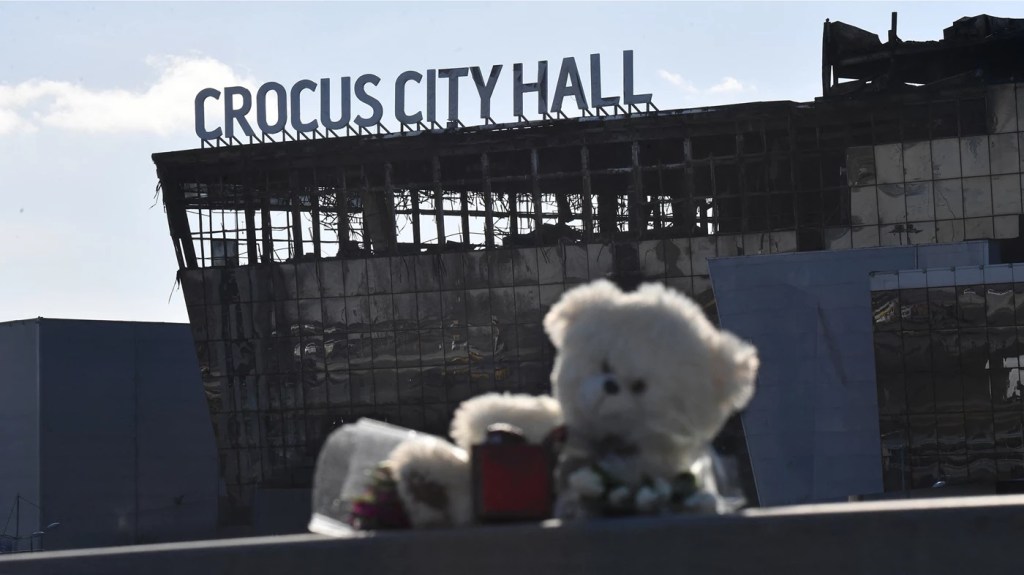
Russian evangelicals used Sunday sermons to condemn a terrorist attack that killed more than 130 people at a Moscow concert hall.
As Russia’s Baptist union prayed for “God’s mercy and protection,” its Pentecostal union conveyed its “bitterness and sorrow.” Vitaly Vlasenko, general secretary of the Russian Evangelical Alliance, called it a “painful shock” that could unleash “unbridled revenge” against terrorism.
But many in Russia are wondering: Who are the terrorists?
The attack on Friday that killed at least 137 people at the 6,200-seat Crocus City Hall was claimed by the ISIS affiliate in Afghanistan’s Khorasan Province (ISIS-K), which seeks an Islamic caliphate in Central Asia. Its statement emphasized it was targeting Christians and came in the “natural framework” of its war against the enemies of Islam.
Earlier this month, the US embassy in Moscow had issued a warning to avoid large gatherings. American officials stated they shared their intelligence with Russia. On March 7, Russia said it thwarted an attack on a synagogue, and a few days prior, security services killed six ISIS-K terrorists during a shootout in the nation’s Muslim Caucasus region.
The group was also linked to the 2017 St. Petersburg metro bombing that killed 15.
ISIS-K was formed by extremists seeking a more violent path than the Pakistani Taliban in 2015, the same year Russia formally intervened in Syria to support President Bashar al-Assad. A Sunni group, ISIS and its affiliates oppose Assad’s Alawite faith as heretical and considers Shiite Muslims as apostate.
In January, ISIS-K killed 95 Iranians in Kerman at a memorial service for Qasem Soleimani, leader of the Islamic Revolutionary Guard Corps who was assassinated by the US in 2020. And as American forces withdrew from Afghanistan in 2021, an ISIS-K attack on the Kabul airport killed 13 US soldiers and 170 civilians.
Analysts stated, however, that ISIS-K was increasingly targeting Russia.
Russia has arrested 11 suspects, with four alleged gunmen from Tajikistan now on trial.
But President Vladimir Putin, reelected March 17 with 88 percent of a vote Western observers declared was neither free nor fair, did not mention Islamic terrorism when he declared a national day of mourning. Official statements of blame have been vague, while the deputy head of Russia’s security council openly speculated that if Ukraine was involved, its leaders “must be tracked down and killed without mercy.”
“Are you sure it’s ISIS?” asked Russia’s foreign ministry spokesperson, suggesting the group was being used as a “bogeyman.” The Russian ambassador to the US denied receiving any advance information from the US. And a nationalist media outlet urged the Kremlin to give Ukrainians 48 hours to evacuate major cities.
Just a few hours prior to the concert hall massacre, in a wide barrage against Ukraine’s civilian infrastructure, Russia had targeted its largest hydroelectric dam, leaving more than one million people without electricity.
Ukraine has denied any involvement in the terrorist attack.
Its military intelligence spokesperson, however, suggested instead that it was a “deliberate act of provocation” by Putin, while President Volodymyr Zelensky stated it was typical of such “thugs” to divert blame. He also alluded to unproven accusations that terrorist attacks in 1999 were a false flag operation, and that Putin considered his own citizens to be “expendables.”
The US stated that ISIS-K alone carried out the attack, with Ukraine uninvolved.
Russian evangelical sources did not comment on the mutual accusations. They emphasized the outpouring of prayer, sympathy for victims, and the need to trust God and resist any urge for revenge.
“Evil is spreading across the earth,” said Alexey Markevich, vice rector for academic affairs for Moscow Theological Seminary, who has criticized the war in Ukraine. “Lord, give us peace, and prevent any of us from being consumed by evil.”
Christians4Peace, an anonymous…
This article was originally published at Christianity Today, on March 25, 2024. Please click here to read the full text.
Government restrictions on religion are at a global high.
Social hostility toward religion, however, has ticked downward.
So concludes the Pew Research Center in its 14th annual analysis of the extent to which 198 nations and territories—and their citizens—impinge on religious belief and practice.
Some sort of harassment of religious groups was recorded in all but eight.
The 2024 report, released earlier this month, draws primarily from more than a dozen UN, US, European, and civil society sources, and reflects conditions from 2021, the latest year with fully available data.
The global median on Pew’s 10-point scale of government restrictions reached 3.0 for the first time ever, continuing a steady rise since the baseline score of 1.8 in 2007. Overall, 55 nations (28%) recorded levels marked “very high” or “high,” only two lower than last year’s total of 57.
Nicaragua was highlighted for harassment of Catholic clergy.
Regional differences are apparent: The Middle East and North Africa (MENA) scored 5.9, up from its baseline score of 4.7. Asia-Pacific scored 4.2, up from 3.2. Europe scored 3.1, up from 1.7. Sub-Saharan Africa scored 2.6, up from 1.7. And the Americas scored 2.1, up from 1.0.
Pew’s 20 measures of government restrictions included efforts to “ban particular faiths, prohibit conversion, limit preaching, or give preferential treatment to one or more religious groups.”
Some pertained to COVID-19, such as Canada’s fines against open churches.
A further 13 measures for acts of religious hostility by individuals or groups included “religion-related armed conflict or terrorism, mob or sectarian violence, harassment over attire for religious reasons, and other forms of religion-related intimidation or abuse.”
Social hostilities toward religion continued to trend downward since a high of 2.0 in 2018, decreasing to 1.6, the lowest score since 1.2 in 2009. But 43 nations (22%) still recorded levels marked “very high” or “high,” though significantly fewer than the 65 offending nations in 2012.
Nigeria was cited for clashes between Muslim herders and Christian farmers.
The order of regional differences in social hostility…
This article was originally published at Christianity Today, on March 18, 2024. Please click here to read the full text.
Can you imagine if Dune took place in the ocean instead of the desert? One Christian novel does.
With Dune: Part Two now in theaters, moviegoers are once again treated to the cinematic spectacle of Frank Herbert’s popular sci-fi epic. Less known is how his 1965 novel bears witness to the influence of Muhammad.
And even less known are the efforts of Christians to translate their Muslim world experience into novels that communicate the gospel.
“We tend … not to recognize how much Islam has contributed to our culture,” stated Herbert in a 1976 radio interview. “But we owe Islam enormous debts of gratitude.”
The American author blended many religious themes into his six-volume series but deliberately filled his sand-infused apocalyptic landscape with tribal conflicts, Shiite concepts, and Bedouin-inspired characters. Hero Paul Atreides becomes the Mahdi, mirroring the Muslim messiah-like figure anticipated at the end of the world. And as he wins acceptance among the nomadic Fremen people, he takes the name Muad’Dib, adapted from an Arabic word for “teacher.”
Their desert religion is called Zensunni , mixing Islam with the Buddhism Herbert eventually adopted.
Dune is often credited as an inspiration for Star Wars and its Eastern cosmology. But there’s similar world-creating literature by three Muslim-world Christian workers writing in the genres of sci-fi, contemporary thriller, and young adult fiction.
Each bears witness to the love of Jesus.
“As far as I am aware, this is the first time that violent Islamists, followers of Jesus from Muslim backgrounds, and science fiction have been combined,” said Steve Holloway, author of Pelagia. “Conveying an Islamic story arc is one of the key motivations for writing the book.”
Set 40 years in the future, Pelagia tells the story of Ben Holden, a special forces agent turned professor of particle physics, and Suliman Battuta, a medical doctor and leader of a clan of nomadic “seasteaders” who herd tuna in the South Pacific Gyre, stretching from the coastlines of Chile to the Micronesian islands.
Holden’s scientist wife is murdered by the New Caliphate, a coalition of land-based Middle Eastern nations who want her project data for their jihadist aims. After surviving a later attack, Holden takes refuge with Battuta’s floating community of third-generation Yemeni followers of Isa al Masih, the Quranic name for Jesus the Messiah. Their status as apostates sets them in search of freedom of belief on the high seas.
Imagine the Wild West in submarines, with the fate of the world at stake.
The science of the novel is within humanity’s grasp today, said Holloway, whose book won the endorsement of Fish Farmer magazine, which called it a combination of films Captain Phillips and Minority Report. Currently overseeing a sea cucumber project in Indonesia, Holloway, senior strategy associate for Frontiers, served 12 years in a Southeast Asian nation where his team nurtured a small underground church as they researched ocean farming for the government, before expulsion from the country in 1998. A marine biologist, he read sci-fi as a kid and loved the world of Dune.
Motivated to show how followers of Jesus from Islamic communities flourish best in their original environment, he wrote Pelagia for a general global audience—including Muslims—and depicts austere jihadis with sympathy. There are no “cartoon bad guys” in his novel.
“It is more Tolkien than Lewis,” Holloway said. “Secular reviewers say it has a spiritual theme that doesn’t get in the way of a good story—I take this as a compliment.”
Yet it does have a conversion story, something missing from Someone Has to Die, book one in a trilogy written by Jim Baton, the pen name of a veteran Christian teacher serving in Indonesia. But whereas the futuristic setting of Pelagia is a step removed from Holloway’s ministry, Baton is still involved in the nitty-gritty of peacemaking.
His nom de plume means “bridge” in Indonesian.
“A thriller novel is perfect for our modern world of terrorism,” Baton said. “But I describe jihadists as human beings who have suffered, long for justice, and want the world to be a better place—and, that God loves them.”
In Someone Has to Die, Abdullah is a former terrorist seeking to atone for his past deeds by…
This article was originally published on February 29, 2024. Please click here to read the full text.
Imagine yourself as Indiana Jones, traversing the narrow, nearly mile-long Siq gorge, with mountain cliffs towering on either side. Turning a corner then reveals the vast expanse of the ancient city of Petra and its majestic Treasury, the first-century rock-carved tomb of an ancient Nabatean king. You pass by the 121-foot-tall structure and its statues of Roman and Egyptian gods, making your way up a steep 800-step ascent to the equally impressive Monastery.
But before reaching Petra’s largest monument, you turn off the path into a different sort of ruin, mosaics lining the floor around half-sized recycled columns as incense wafts through the air. But unlike in the Harrison Ford movie, you do not meet an 11th-century knight preserved by the Holy Grail. Instead, the Greek Orthodox metropolitan of Jordan passes you a cup of Holy Communion.
In January, he offered the first Christian prayers in Petra in 1,400 years.
Other generations of film aficionados may prefer The Mummy Returns, Transformers: Revenge of the Fallen, or even Mortal Kombat: Annihilation. While onsite Hollywood productions provide revenue for Jordan, this is dwarfed by the $5.3 billion the country earns from its tourism industry. In 2022, Petra received 900,000 visitors, nearly one-quarter of the national total.
But now, the Hashemite kingdom is adding a religious component.
“It is a great blessing to be in this holy place in Petra,” said Archbishop Christoforus, before proceeding to offer the bread and wine. “We are not thinking of what surrounds us in stone, but of the saints and spiritual identity in its heritage, history, and civilization—and our great and blessed [Jordanian] homeland.”
In 2021, Jordan launched a five-year national tourism strategy with an emphasis on religious sites, including the Vatican-endorsed pilgrimage locations of Jesus’ baptism at Bethany-beyond-the-Jordan; Mount Nebo, from which Moses viewed the Promised Land; and Mukawir, home to a Herodian palace where John the Baptist may have been beheaded at the biblical Machaerus. Approximately 85 percent of tourists come for cultural and heritage purposes, and one-quarter of baptism site visitors travel from the United States.
With such tourists likely to visit Petra already, Jordan would like to extend their stay.
“Unfortunately, Petra is known mostly for its Treasury and Siq,” said Fares al-Braizat, chief of the Board of Commissioners of the Petra Regional Authority. “There is plenty more it can offer, and the churches are an additional discovery.”
Ten have been discovered so far, with excavations ongoing. But the fifth-century Byzantine cathedral was only discovered in 1990 and fully unearthed eight years later. Restoration has proceeded sufficiently not only to inspire Braizat to add Petra to Jordan’s list of Christian historical sites but also to revive the ancient city’s religious heritage. It only adds to the nation’s reputation as an open-air museum, he said.
Jordan’s evangelical community is appreciative.
“How can you have a historic church site and not bless it with prayer?” said David Rihani, president of the Jordanian Assemblies of God. “Petra shows that the government cares about the history of Christianity in this land.”
The biblical history is even longer. Petra may have been inhabited…
This article was originally published at Christianity Today on February 26, 2024. Please click here to read the full text.
Religious reeducation did not work on Esmaeil Narimanpour.
First arrested by the Iranian government in 2021, he and seven other converts to Christianity were cleared by the state prosecutor, who stated that their change of religion was not a crime under Iranian law. The following year, he was ordered with several others to attend ten sessions with Muslim clerics to “guide” him back to Islam.
Last December, Narimanpour was arrested again, this time on Christmas Eve.
The case is one of several highlighted by “Faceless Victims: Rights Violations Against Christians in Iran,” the 2024 annual report released jointly by advocacy organizations Article18, Open Doors, Middle East Concern, and CSW and presented at the British Parliament.
“This is a great example of agencies working together,” stated Mervyn Thomas, founding president of CSW (formerly Christian Solidarity Worldwide), at the event. “Iran claims to ensure freedom of religion or belief for all; but that is nonsense, as this report shows.”
Not yet convicted, Narimanpour is one of 166 Christians arrested and 103 detained by Iran during the 2023 reporting period. Another 22 have been sentenced, and 21 imprisoned.
While sentencings decreased by 8 from 2022, this year witnessed an additional 32 arrests and 41 detainments. Article18 has tracked incidents in Iran since 2015, when arrests were at a peak of 193. Detainments have fluctuated yearly between 26 in 2018 and this year’s high, while sentencings ranged between 12 in 2015 and a high of 57 in 2020.
The British parliament gathering included testimony from former prisoner Farhad Sabokrooh. Arrested with his wife in 2011, the couple served one year in prison and had their previously registered church closed down after 25 years. Accused of being a spy for Israel and the United States, he told the gathering that he was forced into a false confession, sentenced without his lawyer present, and once released was threatened with death if he did not leave Iran within one month.
“My plea to you is to hold the regime accountable,” Sabokrooh stated. He later noted, “They somehow feel Christians are orphans and have no one to protect them. We have to reverse that.”
The 36-page sixth report was released on February 19 to coincide with…
This article was originally published at Christianity Today on February 21, 2024. Please click here to read the full text.
Last week in Tehran, thousands rallied to commemorate the 45th anniversary of the Islamic revolution that established Iran’s modern theocracy. Last October in London, 130 Iranian Christians gathered to worship and pray, and celebrated a quiet decision to establish an evangelical alliance.
Time will tell which gathering was more consequential.
In 1979, one month after the fall of the shah, 98 percent of Iranian citizens voted to approve a constitution installing an Islamic government. Four decades of religious authoritarianism later, an online poll indicated that only 16 percent of the population would vote for it again.
An earlier survey, furthermore, found that only one-third of Iran’s population call themselves Shiite Muslims. More than half identified as either atheist, agnostic, no religion, vaguely spiritual, or Iran’s ancient Zoroastrian faith.
Those responding “Christian” totaled almost a million.
Thousands more Christians have fled persecution, taking refuge among the extensive Iranian diaspora in the West. Some have established ministries to evangelize among them, while others broadcast satellite TV programs, engage in remote discipleship efforts, or preside over a network of underground house churches.
Many multitask, while few collaborate—until now.
At the London gathering, members from over 40 diaspora churches and ministries voted almost unanimously to partner together in an evangelical alliance. Further votes were taken to choose a seven-member steering committee to represent the whole, tasked to take a year to study and recommend best practices, as an additional 60 leaders observed proceedings online.
Momentum had been building for years. Named the Iranian Leaders Forum (ILF), previous gatherings met in 2015 and 2018 until COVID-19 disrupted the triannual effort. While unity had been discussed previously in principle amid believers of different theological perspectives, 2023 represented the first practical step to formally establish it.
But the first mention of an alliance quieted the room. Gathered leaders—one-third of whom were female—had been beaming with joy at the reunion with colleagues separated by time and space. Hints of lingering tensions were whispered in the hallways, but worship was loud and heartfelt; prayers were passionate and pleading.
The ministries, however, were not used to cooperation, and many wondered what was intended. While a representative ILF steering committee planned the announcement of an alliance, it was not expected by most participants. Would such an alliance seek administrative control, establish a single denomination, or venture into politics?
Over the course of the five-day conference, leaders addressed the uncertainties. The motivation came from Jesus’ prayer for unity, to strengthen the witness of the Iranian church and to allow for one Christian voice where consensus exists. Breakout groups put diverse ministries in communication about what would be acceptable to all. But the purpose, organizers assured, was to agree on the benefit of forming a network of mutual relationships and then to take the time necessary to figure out the details.
A single denomination was ruled out, as was a political party. Currently under discussion is if membership will include only believing Protestants or if those of evangelical conviction in other denominations will also be welcomed. And while much of the house church movement is connected with gathered ministries, only God knows the full extent of the church within Iran.
Participants gave CT their various recommendations for success:
Avoid hierarchical structures and minimize administrative control.
Craft a clear strategy and process for decision-making.
Ensure election of capable and representative leadership.
Facilitate communication channels appropriate for active ministries.
Honor the theological and practical diversity of members.
Be mindful of inherited cultural authoritarian patterns.
Address the impact of Western money and denominational pressure.
Discuss competition over resources and ministry duplication.
Discern the role of women and non-Iranian participation.
Time will tell if the overwhelming agreement will hold. But CT asked a selection of participants to contribute short biographies of their ministries, along with their hopes for what an Iranian evangelical alliance can accomplish. Listed in alphabetical order, prayers are requested for all involved…
This article was originally published at Christianity Today on February 19, 2024. Please click here to read the full text and ministry biographies.
Image: Gavriil Grigorov / Pool / AFP / Getty Images
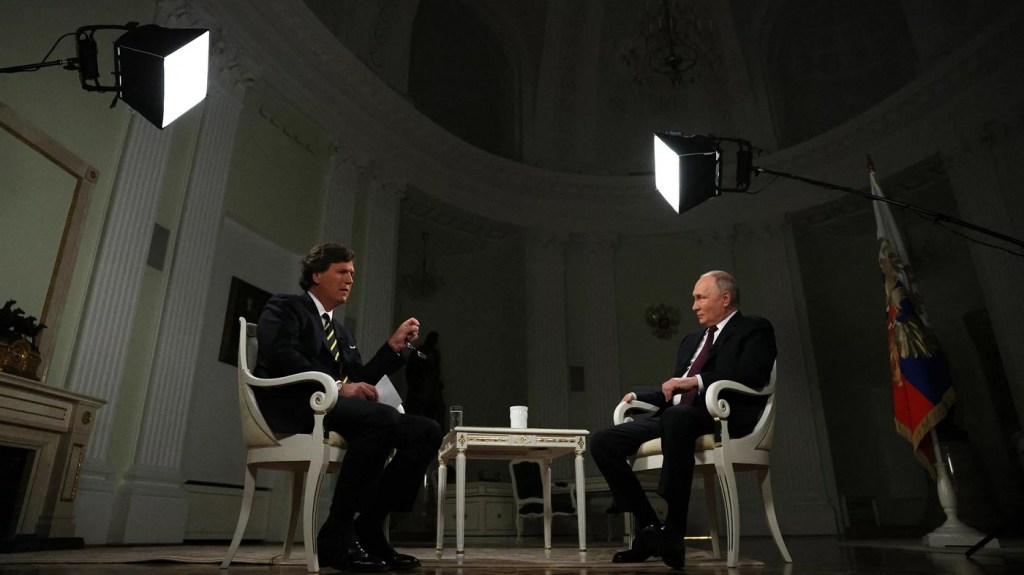
Tucker Carlson is reviving American interest in Ukraine.
Approaching two years since the Russian invasion on February 24, 2022, the Slavic conflict has been eclipsed by the Israel-Hamas war in Gaza in the forefront of US media attention.
Many Americans, however sympathetic they remain, have tired of foreign wars in lieu of pressing domestic issues at home. Others, however, see continued US support for Ukraine as a low-cost check on Russian imperial ambitions.
Carlson, the controversial pundit, is presenting the views of Vladimir Putin.
While many American outlets have requested an interview with the Russian president, Carlson was granted the interview as his perspective “is in no way pro-Russian, it is not pro-Ukrainian,” stated the Kremlin spokesman. “It is pro-American, but at least it contrasts with the position of the traditional Anglo-Saxon media.”
Carlson said it would allow viewers to see the “truth” obscured by Western reporting.
Christianity Today invited Ukrainian evangelical sources to comment on any religious remarks conveyed. Seven stated they had no intention to watch what one called a “propagandist” in conversation with “the killer of my people.”
Putin gave them little to work with during the two-hour interview.
He described of the coming of Christianity to Eastern Europe within a nearly uninterrupted half hour answer detailing Russian history, during which he called Ukraine an “artificial state.” Pressed how as a professing Christian he could order violence, Putin spoke only of Russia’s “moral values.” And probing Putin’s personal faith, Carlson asked him if he saw God at work in the world.
“No, to be honest,” the Russian president replied, after a pause. “I don’t think so.”
To understand any conflict requires knowledge of its background. CT has published articles about how Christianity came to Ukraine and Russia, the 160-year spiritual history behind today’s divide, and why Ukraine calls upon Michael the archangel. Concerning more contemporary pre-war history, CT covered Ukrainian politics and the efforts of evangelicals to win influence, in addition to the tomos of autocephaly that gave ecclesial independence to one-half of Ukraine’s Orthodox church.
But while Ukrainian sources declined to engage Carlson’s effort to understand the war through the rhetoric of Putin, they have informed most of CT’s ongoing coverage.







 Jayson Casper