Categories
Middle East Providence Published Articles

Copts Ring Church Bells for Egyptian Muslims, in Christian Sympathy

My new article for Providence Magazine.

Copts Church Bells Sinai
Photo Credit: Church and mosque in Egypt. By kmf164, via Flickr.

In what is being called the largest terrorist attack in modern Egyptian history, over 235 people were killed at a village mosque. Militants detonated explosives as worshipers exited the Rawda Mosque in Bir al-Abd, 25 miles west of the North Sinai capital of Arish. Several then fired upon the fleeing masses.

There has been no immediate claim of responsibility, but suspicion falls upon the Islamic State. The Rawda mosque is affiliated with the Gaririya Sufi order, and ISIS has previously vowed to attack what it deems to be heterodox Muslims, warning them to stop their distinctive rituals. ISIS represents an extreme Wahhabi interpretation of Islam, and is offended by Sufi practices that seek a mystical connection with God through chants and visits to the shrines of Muslim saints.

In 2013, a Sufi shrine was bombed with no casualties. But in 2016 two prominent Sufi sheikhs were kidnapped and decapitated.

Coptic Christians, who have seen over 100 people killed under an ISIS vow, responded with condemnation and sympathy. The next day, Saturday the 25th, the Coptic Orthodox Church spokesman announced all churches in Egypt would ring their bells in solidarity at noon.

“We pray to God that Egypt is preserved from such unprecedented brutal terrorism,” the church announced in its first statement, released shortly after the bombing. “We offer our sincere condolences to the families of the martyrs, praying for the healing of all who are injured,” stated the second announcement about the bells.

Such a public display of Christianity will only further infuriate ISIS…

Please click here to read the full article at Providence Magazine.


Categories
Americas Christianity Today Published Articles

Christians Could Return to the Middle East, Thanks to Trump (Deportations)

Iraq Trump Deportation

This article was originally published in the October print edition of Christianity Today, co-authored with Griffin Jackson.

When Haitham Jazrawi started working at Kirkuk Presbyterian Church in Iraq in 1991, there were 72 families. Today, there are still 72 families—but only two of the originals remain. During his 26-year tenure as caretaker and then pastor, Jazrawi has seen a turnover of more than 300 families due to emigration.

Such an outward flow has been the norm in churches across the Middle East. In Iraq and Syria, countries ravaged by years of war and the terror of the Islamic State, roughly two-thirds of Christians have fled.

Among Jazrawi’s congregants, 50 percent are internally displaced from elsewhere in Iraq. “They come as refugees from inside our country,” said the Kirkuk pastor, “from the Nineveh Valley, from Nineveh, from other villages and cities.”

Soon, they may also come from outside of Iraq. With the Trump administration threatening to deport more than 1,400 Iraqis, hundreds of whom are Christians, a rare irony may present itself: the forced movement of Christians into the Middle East.

This summer, hundreds of Iraqis were behind bars in holding centers around the United States, slated for deportation to Iraq. The majority were Christians, and most were rounded up in Detroit in a massive June raid executed by Immigration and Customs Enforcement (ICE).

“Not only would they be breaking up families that have been here for decades,” said Nathan Kalasho, a local advocate for the detainees, “but they would be sending an already targeted minority to a country that no longer welcomes them…”

Please click here to read the full article at Christianity Today.

Categories
Prayers

Friday Prayers for Egypt: Fish, Rice, Water, Vice

Flag Cross Quran

God,

Small developments can multiply. Small disagreements can explode. For those involved there is no small. For the nation, wait and see.

The region’s largest fish farm opened in one of the nation’s poorest districts.

The pollution from burning post-harvest rice straw witnessed significant reduction.

The negotiations with Ethiopia over Nile dam construction reached an impasse.

The police brought charges against several creatives threatening social norms.

God, some developments are undoubtedly positive. May the economy strengthen through good food and good jobs. May the environment purify through proper waste management.

But other disagreements are harder to measure.

May two nations find consensus. May society find the same.

You have given Egypt resources, God. Natural and human. May she steward well.

If care is not taken, Ethiopia could bring Egypt to ruin. If morality is not heeded with mercy, Egypt may fall libertine or legalistic.

Spare her these trials. Bless her where she has proved faithful.

With you there is no small. May Egypt wait, but see you multiply.

Amen.

UPDATE: After publishing this post, 155+ people were killed in a combination bomb and gunfire attack at a mosque in Northern Sinai. God have mercy, and may they rest in peace.

Categories
Excerpts

Giving Thanks, for Khartoum and Kennedy

Thanksgiving Khartoum Kennedy
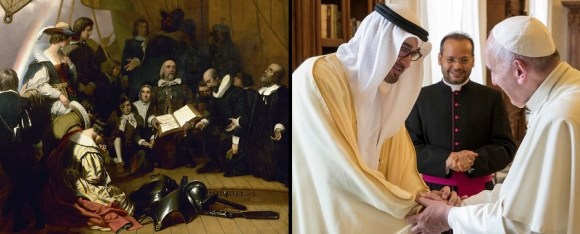
via Mormon Newsroom and Mohamed Al Hammadi / Crown Prince Court – Abu Dhabi

Happy Thanksgiving to all American friends. Religious freedom is one item of gratitude, as well as positive signs it may be developing around the world.

Consider again these promising signs I’ve been privileged to report on the past two years:

Arab Gulf — Why Christianity is Surging in the Heart of Islam

Indonesia — World’s Biggest Muslim Organization Wants to Protect Christians

Morocco — Arab Christians and the Marrakesh Declaration

Egypt — Let My People Build

Bahrain — Saudi Arabia’s Neighbor Defends Religious Freedom of Individuals

Saudi Arabia — The Game of Thrones Christians Should be Watching

Italy — Muslims Work for Religious Freedom


Not all is rosy, of course, and some nations pretend nothing is wrong.

Sudan is one of them. But in recent engagement, the United States has religious freedom on the agenda for improvement of ties and removal of sanctions.

As Crux has reported:

A leading U.S. diplomat visiting Sudan said the United States is willing to work with the Sudanese government to help it achieve the conditions necessary to remove its designation as a “Country of Particular Concern” in the U.S. State Department’s annual International Religious Freedom Report.

Deputy Secretary of State John J. Sullivan was speaking on Nov. 17 at the Al-Neelain Mosque in Omdurman, located on the western bank of the Nile River, which separates it from the national capital.

Sullivan said “supporting human rights, including religious freedom, has been, and will continue to be, a critical part of the United States’ bilateral engagement with Sudan.”

The event at the mosque included leading Muslim and Christian clergy. Sudan is 97 percent Muslim, and the small Christian community has faced harassment, especially since the predominantly Christian and animist south of the country became the independent state of South Sudan in 2011.

The State Department’s 2016 International Religious Freedom Report cited reports of government arresting, detaining, or intimidating Christian clergy and church members, denying permits for the construction of new churches, closing or demolishing existing churches and attempting to close church schools, restricting non-Muslim religious groups and missionaries from operating in or entering the country, and censoring religious materials and leaders.

There is always room for cynicism, and perhaps frequently it is warranted.

Does the United States care more for counterterrorism and military contracts, and will let this item slide if progress is seen elsewhere?

Will Sudan put on a nice face and make superficial improvements, only to squeeze non-Muslim communities once the diplomats leave?

Maybe. But this Thanksgiving, let not cynicism be a landing place. Even the public rhetoric of religious freedom is something to celebrate. It sets a tone; attitudes can adjust over time.

And as the US ambassador told his Sudanese audience, it took a while in America.

“I am the grandson of Irish-Catholic immigrants who arrived in Boston, Massachusetts in the 1880s. At the time they arrived – and for many decades that followed – Catholics in the United States faced widespread prejudice based on their religion,” he said.

“When John F. Kennedy – another Catholic from my home state – ran for president of the United States in 1960, he even had to give a prominent speech to reassure the nation that his faith was compatible with the duties of the office of president.”

Sullivan said recalling such history “seems quaint” today, but added it took many decades – “it was not easy” – to reach the point where it is “nearly unthinkable” that one’s status as a Catholic in the United States would serve as a disadvantage to a person’s ambitions for life.

“The American experience in this regard underscores that respect for the human dignity of every person – regardless of religious belief or origin – is a key component of not only protecting human rights, but also fostering a society that can flourish, build upon each other’s strengths, and move forward together,” he said.

America has had flaws, too. She still has some, and may be developing others.

But today, around the table, give thanks to God for what exists — both at home and abroad.

Those who love God do not need freedom to follow their faith. But ample facilitation makes our world a better place.

Appreciate, and pray for more. And then, enjoy your turkey.

Categories
Excerpts

Must the Muslima Wear a Headscarf?

Hijab Identity Politics

Identity politics are dangerous. Unfortunately Muslims have long been swept up into the fray. Sometimes willingly.

In many traditional and conservative societies, women have covered their heads. This is not exclusive to Islam, whatever the Quran says about it.

But a time came also when Muslims were mobilizing on the basis of faith, using it as a rallying cry. It roughly corresponded with an ascendant European colonialism that weakened the political power Muslims once possessed. It revived in the 1970s, with the surge in popularity of political Islamism.

And one symbol of resistance was the woman. The headscarf became a statement.

It is far more than that, of course. It is a symbol of piety, of faith. It is an act of modesty in an immodest world. Perhaps it is an act of acquiescence to culture, or obedience to husband.

In the end it is a piece of cloth, and from an American perspective we believe a woman should be (mostly) free to wear what she wants.

But to be a good Muslima, must the woman wear a scarf?

I will not delve into the perspectives that say yes, or the traditional interpretations that seem to govern much of the Muslim world. They may well be right.

But in a recent article, the Huffington Post highlighted five scholars who say no. I know some of the names. One is famous and generally well celebrated. Another was marginal and called an apostate.

Here are their arguments.

Khaled Abou el-Fadl

El-Fadl mentions that the illa (operative cause) for the injunction to cover was to protect women from harm and to avoid undue attention from mischief mongers.

He also states that the ma’ruf (generally accepted as good) and the munkar (socially recognized as unacceptable) are based on pragmatic and practical experience.

Therefore, he argues that if the headscarf itself causes women to stand out and put them in the way of harm, and if uncovering the head is not considered socially immodest or licentious, then it would be permissible for Muslim women to not wear the headscarf.

One would hope a well functioning society would not harass women who cover their heads. Does his reasoning then suggest that the headscarf is otherwise an obligation? Should the power of decision be yielded to the mischief mongers?

Javed Ahmad Ghamidi

Like El-Fadl, Ghamidi opines there were injunctions exclusive for the wives of the Prophet. He argues that there are only four instructions that pertain to Muslim women.

These include lowering the gaze, wearing modest clothing, covering the bosom with a piece of cloth, and not displaying ornamental embellishments before unrelated men.

No other injunction other than these has been imposed on Muslim women.

This seems straightforward enough. A general command for modesty may require a headscarf in some cultures, but not in others. But who is to decide? The individual woman? Islam teaches that God judges the individual, so she alone bears the consequences. But who protects society?

Abdullah bin Bayyah

Bin Bayyah adopts an approach based on necessity.

He argues that hardships allow for uncovering of body parts and mentioned how the shins of two of the Prophet’s wives, Aishah and Umm Salamah, were uncovered when they were giving water to wounded soldiers on the battlefield. He also mentions the minority position of Ibn Ashur that women may uncover their hair in public.

Bin Bayyah’s student Hamza Yusuf even asserts that:

“The laws are there to serve human beings; we are not there to serve the law. We are there to serve Allah, and that is why whenever the law does not serve you, you are permitted to abandon it, and that is actually following the law. …

The law is for our benefit, not for our harm. Therefore, if the law harms us, we no longer have to abide by it.”

If uncovering hair is admitted to be a minority position, bin Bayyah’s does not seem a very strong argument. A pillar of sharia law is the consensus of community.

His student Yusuf pulls a principle of Jesus, but the Huffington Post excerpt does not go far enough to demonstrate the validity of the principle in Islam. For now it must be enough that some scholars argue so.

Ahmad Ghabel

The late Shia cleric, who had the prominent title of Hojjat el-Islam (authority on Islam), offered ten arguments in support of the viewpoint that covering the head was not obligatory but recommended.

He opined that there was no consensus amongst jurists as to whether hair constituted the awrah (intimate parts) that must be covered.

For the reader desiring demonstrations of validity, the link will offer an academic treatise. But even if something is only recommended, should it not be done? Perhaps it cannot be enforced, but does the woman risk her standing with little recourse?

But as above, the second claim is more powerful. If there is no consensus on what must be covered, then again we come back to modesty, not compulsion.

Nasr Abu Zayd

According to the late Abu Zayd, both the awrah (intimate parts) and the hijab (veil) are subject to socio-cultural norms and therefore are changeable and not fixed. He opined that both are not legislated by Islam but are rather specific to the Arab culture.

Fair enough, but again, on what basis? Not enough here to tell.

For what it is worth, this is the scholar labeled an infidel by an Egyptian court, and forcibly divorced from his wife. I don’t know his story well enough to say which of his opinions most offended the judge.

All religions impose obligations; all societies have their norms. The former is of individual faith; however related, the latter is not wise to transgress.

But some always will, and society needs their creativity. Just not too much of it. It is difficult to know where the line must be drawn.

If this was the only matter, we would probably work it out. Not to justify any particular outcome, but traditional societies seemed to do so, with diverse application.

Some highlight the hijab as a symbol of oppression. Others compel it as a means of control. Some thrust it in your face demanding respect. Others find ways to seduce men all the same.

Too much of this issue is wrapped in identity politics. Let’s just leave each other alone.

Mostly. Unfortunately, the headscarf at this time hits at a collective world conscience on how to balance rights with freedoms, the individual with society.

Maybe we can’t just leave each other alone, but we can be charitable. How wonderful if this was our collective identity.

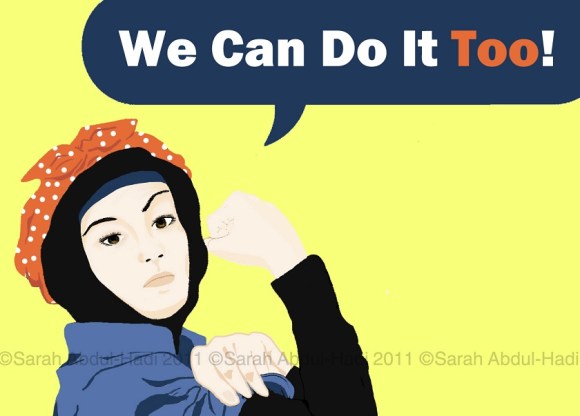
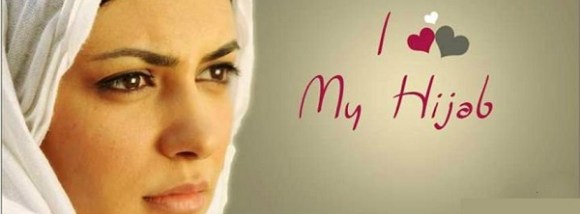
I Love My Hijab

Categories
Prayers

Friday Prayers for Egypt: Princes, Churches

Flag Cross Quran

God,

Help Egypt navigate her way in the world. Help her navigate her way at home.

Ally Saudi Arabia has launched new efforts to curb Iranian influence in the region, while securing power and reform in the kingdom.

There is war in Yemen and Syria. There are palpitations in Lebanon. There is ongoing regional instability.

And then there is Egypt, trying to recover. The president wants peace to prevail. He also has a powerful friend to placate.

God, help Egypt do what is right. Help her protect her interests. May they be the same thing, whatever it is.

Bring peace to the region. End foreign interference. Promote the good of the people. Support freedom and transparency.

May virtue persevere. May vice transform. Give all introspection, and respect for the other.

And if this applies also in Egypt, God, tally the scorecard correctly.

Recently a few churches in the nation have been closed. Some say it is for security reasons. Others speak of license.

A new law heralds a new era. An old issue resurfaces an ongoing frustration.

Egypt welcomes religious freedom for Copts. Sometimes their places of worship find trouble.

God, first and foremost, may the facts be known. What is causing the closures?

Maybe there are neighbors resisting a church in their village. Give power of law to the state; give empathetic consensus to the community.

Maybe there are authorities aligned with old mentalities. Give unity of vision to the state; give real reconciliation to the community.

Maybe there are activists making mountains out of molehills. Give clarity of communication to the state; give patient conviction to the community.

And if there are differing interpretations of your will, give wisdom and insight to all.

God, these issues are tricky, with much on the line. Help Egypt navigate safely, at home in your world.

Amen.

Categories
Christianity Today Middle East Published Articles

The Game of Thrones Christians Should be Watching

Saudi Crown Prince Mohammed bin Salman shakes hands with Lebanese Maronite Patriarch Bechara Boutros Al-Rahi during their meeting in Riyadh
Saudi Crown Prince Mohammed bin Salman shakes hands with Lebanese Maronite Patriarch Bechara Boutros Al-Rahi during their meeting in Riyadh, November 14, 2017. Bandar Algaloud/Courtesy of Saudi Royal Court/Handout via REUTERS

This article was first published at Christianity Today on November 16, 2017.

Before the crown prince of Saudi Arabia stunned the world with his sudden arrest of dozens of fellow princes and millionaires on corruption charges, he stunned many Christians with his stated desire to moderate its version of Islam, commonly dubbed Wahhabism.

Saudi Arabia was founded in 1932 as an alliance between Bedouin warriors of the al-Saud tribe and strict Salafi Muslim scholars following Mohamed ibn Abd al-Wahhab. Discovering oil six years later, it also became one of the Muslim world’s wealthiest nations. The combination has led many religious freedom advocates to blame Saudi petrodollars for funding a worldwide rise in Islamist extremism.

But last month, Mohammad bin Salman said his conservative Muslim country would return to “what we were before: a country of moderate Islam that is open to all religions and to the world…”

Please click here to read the full article at Christianity Today.

Categories
Christianity Today Middle East Published Articles

What Trump’s Evangelical Advisors Took Out of Egypt

Egypt Evangelical Delegation 2
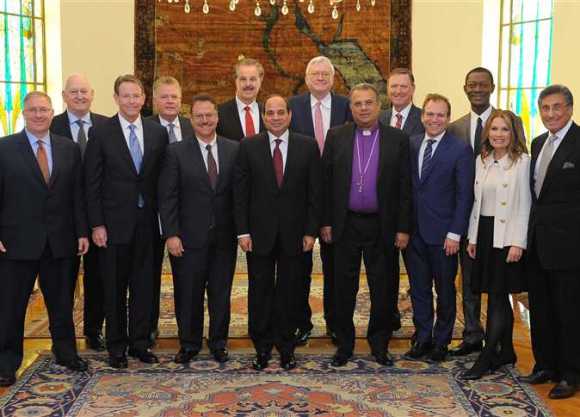
Image: A. Larry Ross US evangelicals meet with Egypt’s grand mufti.

This article was first published at Christianity Today on November 14, 2017.

Jim Garlow walked cautiously through the cavernous halls of Egypt’s Ministry of Islamic Endowments. He prayed: Why am I here, God? What do you want me to see?

The pastor of Skyline Church in San Diego was part of a 12-member delegation of American evangelicals. Their mission: To offer friendship to the president of Egypt.

But as largely a Who’s Who of Christian Zionists and otherwise pro-Israel pastors and ministry leaders, the mission could easily go awry in a majority-Muslim nation where even the Coptic Orthodox Church still officially bans pilgrimage to neighboring Jerusalem.

Mike Evans, founder of the Friends of Zion Heritage Center in Jerusalem, is a lifelong friend of Israeli president Benjamin Netanyahu. Mario Bramnick, senior pastor of New Wine Ministries Church in Florida, is president of the Latino Coalition for Israel. Tony Perkins, president of the Family Research Council, leads tours to Israel. They were assembled by Joel Rosenberg, a Jewish Christian with dual US and Israeli citizenship and author of the fictional The Last Jihad series.

But Rosenberg had recently made a new friend, giving him confidence that this visit might be God’s will.

Last year in March, he spent five days in Jordan as a guest of King Abdullah, who had just read his book. Intrigued after noticing himself as a named character in Rosenberg’s latest series on the ISIS threat, the Muslim ruler wanted to know more. (Rosenberg assured Abdullah that his character didn’t die in the series, which the king went on to finish reading.)

Not long thereafter, God placed on Rosenberg’s heart a different Middle East leader: President Abdel Fattah al-Sisi of Egypt.

Invited as 1 of 60 Middle East experts to a forum held during Sisi’s state visit to President Donald Trump in April, Rosenberg walked up and boldly introduced himself.

“I’m Jewish,” he told CT. “I’ve got some chutzpah.”

Rosenberg thanked Sisi for rescuing Egypt and its Christians from the Muslim Brotherhood. He commended the president for reaching out to Jews and to Roman Catholics.

“But there is one group I don’t see: evangelicals,” he told Sisi. “It’s not your fault; probably we haven’t asked. But would you like us to bring a delegation of leaders to come and visit you?”

Seven months later, Garlow was in Cairo.

“Each step of the way I learned so much,” he said. “There were insights I had never known…”

Please click here to read the full article at Christianity Today.

Egypt Evangelical Delegation
Press el-Sisi: Egyptian President el-Sisi (front center) receives a first-ever delegation of American Evangelical leaders in the Presidential Palace after a frank and transparent dialogue about challenges in the region and opportunities for cooperation.
Categories
Middle East Providence Published Articles

Islamism: Contextualist or Essentialist? Or Both?

My new article for Providence Magazine.

Islamism Contexualist Essentialist
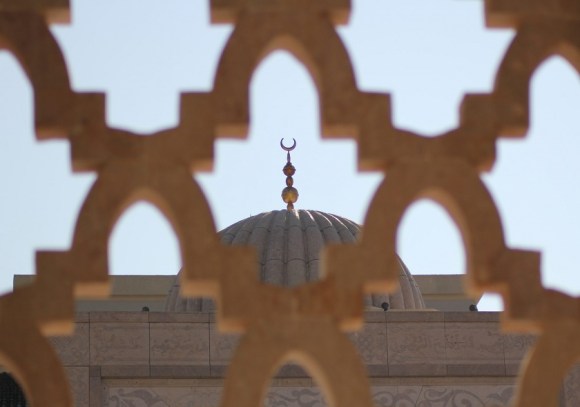
Photo Credit: Mosque in Tunisia. By Tarek, via Flickr.

In an excellent review of Shadi Hamid and Will McCants’ Rethinking Political Islam, Olivier Roy says there are generally two ways to think about Islamism.

Writing in Foreign Affairs, he first briefly introduces three important shockwaves—the Arab Spring, the fall of the Muslim Brotherhood in Egypt, and the emergence of Islamic State (ISIS)—that have affected the debate.

As Hamid and McCants write, “After decades speculating on what Islamists would do when they came to power, analysts, academics—and Islamists themselves—finally have an answer. And it is confusing.”

The confusion tends to be filtered into analysis based on one’s predisposition.

There is a contextual approach, as Roy explains: “The policies and practices of Islamist movements are driven less by ideology than by events and sees such groups as reactive and adaptive.” He elaborates:

Contextualists believe that Islamist groups seek to adapt to circumstances and country-specific norms (for example, by recognizing the monarchies in Jordan and Morocco). The groups’ main goal is to survive as coherent organizations and political actors. And their use of religious rhetoric is often little more than “Muslim-speak”—a way to express a unique identity and articulate grievances, especially against the West.

There is also an essentialist approach: “Islamists are fundamentally ideological and that any concessions they make to secularist principles or institutions are purely tactical.”

A corollary to this argument is the idea—extolled by critics of Islamism but also some of its adherents—that Islamic theology recognizes no separation between religion and politics, and therefore an authentic Islamist cannot renounce his ideological agenda in favor of a more pragmatic or democratic approach.

The presentation is skillful, and after researching Islamist movements and parties across the Muslim world, Roy offers a conclusion…

Please click here to read the rest of the article at Providence Magazine.

Categories
Prayers

Friday Prayers for Egypt: World Youth

Flag Cross Quran

God,

They came from around the world. They discussed much local and regional.

If they paid attention, they watched leaders consult and sign million dollar contracts.

And they lent presence to an effort to give a strong message: Egypt wants to listen to the youth. The world should do the same.

So they should, God. Everyone should listen.

Much of the developing world is demographically skewed. Youth are the majority; leadership is old. This is not a bad thing. Wisdom takes time.

But revolutions have sprung from less. Egypt knows. She is still recovering.

And some are still angry. They see the World Youth Forum as hypocrisy. Far too many are still in jail.

Some have been pardoned. A program is launched to help remove stigma. And the forum itself was sparked by presidential youth meetings.

Only you can judge sincerity, God.

But you can also aid forgiveness. You can also strengthen persistence. You can lead the youth in both, as appropriate.

Perhaps some in opposite directions. There is a wealth of virtues to pursue. But many vices also to waylay.

Youth may rush to judgment. They may wallow in depression.

They do best with guidance, when given sufficient freedom.

God, help Egypt find the balance. Help the youth heal, and thrive.

And with the world present, may they cross-pollinate. May they learn. May they inspire.

They are a challenge, but also a hope. A danger, but also a strength.

May they contribute to both local and regional. May they pay attention.

We have to talk, said the forum. Indeed we do, said the youth. May all messages be heard, and find resolution.

Egypt, and the world, works better together.

Amen.


Categories
Personal

What’s in Your Lunchbox?

Egypt Sandwich

One morning before school, Alexander, our newest kindergartener, was fiddling with Egyptian coins and thinking through options at the school canteen. His eyes lit up when he realized he could buy a milk box … maybe chocolate, maybe strawberry, or maybe banana!

He looked up and asked, as if he had a revelation. “Mom, how do I say, ‘Can I try a sip of that?’ in Arabic?”

My mind immediately thought of a gross juicebox straw that some kid was slobbering all over. Conditioned by American cafeteria germ paranoia, my first answer was, “You can’t ask for a sip of something. Please don’t ever ask for a sip of something, especially at school!”

So instead he asked, “Mom, how do I ask for a bite of something?”

Alexander was just beginning his time on the school playground; clearly this was something he wanted to learn.

But I still wasn’t thrilled. “Iskander [as his name translates in Arabic], do kids ever ask you for a bite? Do they ever ask for some of your food?”

He frowned. “Yes, they always want a pretzel.” At the breakfast table his three sisters immediately chimed in. “Yes, they always want the pretzels!”

It was a cultural revelation. My kids, the Americans, bring weird snacks to school.

Egyptian culture breeds generosity, usually. When a child opens a bag of chips it is common practice to offer to friends. Same with a packet of cookies. What you have is meant to be shared.

Earlier this summer as we visited a school friend, she told her mother, “Layla [our daughter] never brings a sandwich.” She couldn’t comprehend it. She thought we were starving her.

But the system here does not include a lunch break, and to me, a sandwich is lunch. Egyptian kids eat when they get home around between 2-4pm, depending on the traffic.

For them a sandwich is breakfast, eaten at the beginning of the day, often at school.

I grew up on peanut butter and jelly, or perhaps ham and cheese. My kids, meanwhile, have encountered a whole variety of sandwiches, and often get a taste. Usually they are made in a long, thin Kaiser-type roll or pita-type bread.

Inside: French fries. Or scrambled eggs. Perhaps some strange sort of salty white cheese. Maybe liver. Beans, mashed or falafeled.

Our oldest daughter recently attended a church retreat for expat kids. Hosted by Egyptians, she was surprised at the shock other campers had at the French fry sandwiches.

“What could be better to eat for breakfast?” she wondered, telling us over her morning corn flakes.

I am sure our littlest kindergartener will try many “bites” of things in the years to come. Unlike me growing up, hopefully it will expand his palate and encourage him to try new things.

And maybe he’ll also stop frowning when friends ask him for something, and instead, like them, will learn to offer freely.

He has freely received, as the Biblical saying goes.

What’s in your lunch? Can I have a bite?


Categories
Middle East Patheos Published Articles

Secondary Separation, in Islam

Secondary Separation Islam

In fundamentalist Christian circles there is an approach to the world known as ‘secondary separation’. While the Bible notes Christians are not of this world, there is tension when Jesus says they are also in this world, and should not expect to be removed.

Fundamentalism is one expression of this tension, that leans in the direction of withdrawal. A key verse is II Corinthians 6:17, “Come out from them and be separate,” quoting an Old Testament passage focusing on holiness.

Separation from the world is therefore a necessary Christian posture, though defining ‘them’ and ‘separate’ can be difficult. Fundamentalists take it a step further, saying that ‘them’ includes also those Christians who do not separate sufficiently.

This is secondary separation, and it has been most famously applied against Billy Graham. The renowned evangelist has been celebrated by most Christians for his gospel fidelity and salvation message.

But it that ‘most’ that offends this fundamentalist spirit. His crusades have cooperated with too many insufficiently fundamentalist churches, which they believe compromises the call to be separate.

In partnering with those who are not theologically pure, he risks endorsing their relative liberalism.

It is interesting to note a similar approach exists in Islam.

The posture of takfir is the process of declaring someone a kafir, an infidel. Longstanding Islamic jurisprudence says this should almost never be done to a Muslim, unless he or she openly renounces their faith.

But there is a verse in the Quran that provides Muslim fundamentalists, if the term is appropriate, a powerful retort. Sura 5:44 says, “And whoever does not judge by what Allah has revealed, then it is those who are the disbelievers,” using the plural of the Arabic word kafir at the end.

This verse has been applied by Muslim insurrectionists throughout the ages against their Muslim rulers who they accuse of not properly implementing sharia.

Certainly Muslims also struggle with the tension of their texts, and they are invited to provide proper interpretation.

But leave it to ISIS, the so-called Islamic State, to take it a step further.

Should it be necessary: There is little similarity between Christian fundamentalists and Islamic terrorists. But a devotion to God and a commitment to his way may sometimes prompt an antagonistic stance not only to the world, but also to fellow believers.

And from an article in Jihadica, “The Caliphate in Disarray,” there is also a similarity in secondary takfir.

Turki al-Bin’ali, the self-proclaimed ‘Grand Mufti,’ or chief cleric, of ISIS, was killed several months ago in a US airstrike. His death set off a wave of eulogies, but also counter-eulogies and accusations. Some even speculated his location was tipped off to the enemy that he be eliminated as leader.

Takfir is one of the issues that divides ISIS and al-Qaeda, with the latter being slightly more reticent to call non-affiliated Muslims non-believers. It is a sensible position if you are trying to recruit, not to limit your pool of applicants.

Then again, the number willing to die in their cause is considerably limited by their viciousness. Perhaps then it is best to recruit only the purest of the pure. But as seen with Christian fundamentalists, purity is easily nitpicked.

As a result: theological division among those who believe they have already most dedicated to God’s path through jihad.

Al-Bin’ali’s nemesis on this issue, the Meccan-born Ahmad ibn ‘Umar al-Hazimi, preached a rigorous approach to takfir. The following excerpt may be challenging in its Arabic references, but careful reading will establish a clear similarity with secondary separation:

In his lectures, he [al-Hazimi] espoused a controversial doctrine known as takfir al-‘adhir, or “the excommunication of the excuser.”

The notion of takfir al-‘adhir is derived from two concepts in Wahhabi theology. The first is the requirement of takfir; the second is the inadmissibility of al-‘udhr bi’l-jahl, or “excusing on the basis of ignorance.”

According to the founder of Wahhabism, Muhammad ibn ‘Abd al-Wahhab (d. 1792), it is incumbent upon all true believers to excommunicate—that is, to make takfir of—those deemed unbelievers, as well as to excommunicate those who fail to excommunicate them.

As Ibn ‘Abd al-Wahhab stated—and this is the line around which the Hazimi-Bin‘ali debate revolves—“Whoso fails to make takfir of the polytheists, or has doubts concerning their unbelief, or deems their doctrine to be sound, has [himself] disbelieved.”

The duty of takfir is generally accepted in Jihadi Salafism, but there is some debate over al-‘udhr bi’l-jahl, that is, over whether ignorance may serve as a legitimate excuse for holding errant beliefs, and so shield one from the charge of takfir.

For al-Hazimi, who follows the traditional Wahhabi view, al-‘udhr bi’l-jahl is categorically invalid, meaning that the ignorant heretic is to be declared an unbeliever.

Moreover, as he says, anyone who regards ignorance as an excuse for the heretic’s unbelief is also to be declared an unbeliever. Hence the idea of “the excommunication of the excuser.”

Perhaps in truth this is a tertiary takfir, with standard Wahhabism being the secondary. But herein is the problem: Once you start judging a fellow believer’s faith, where does the cycle stop?

Fortunately for Christian fundamentalists, it does not continue to the bombing of a Billy Graham crusade. But there is many a former fundamentalist who has become jaded when he or those he respected found themselves on the wrong side of a Christian fatwa. Sometimes it moves them to a more nebulous evangelicalism; sometimes they leave the faith entirely.

But they are not killed. ISIS, while flip-flopping repeatedly on the issue, did not hesitate to execute proponents of the at-the-time-minority outlook. Others died in airstrikes under what is described as ‘murky circumstances’. The article features more of the back-and-forth diatribe, which revealed also a discontent in ISIS over corruption, dishonesty, unfulfilled prophecies, and the loss of territory.

All the above is a reminder that the tension in religious faith is not only maddening for the sincere believer, but necessary. If God said both this and that, both are true no matter the apparent inconsistency or challenge of application.

It is easy to side with that (or this) most congenial to personal temperament, but mature faith must grapple with both and live accordingly.

In the world, but not of it. Judge by God’s sharia, but don’t judge. The challenge applies to more than we might at first imagine.

My article was first published at Patheos.

Categories
Prayers

Friday Prayers for Egypt: Accountable

Flag Cross Quran

God,

It was too big a disaster. After 16 security personnel were killed in an ambush in the Western desert, several top police and military brass took the fall.

Among them, Sisi’s son’s father-in-law, the chief-of-staff. The message is powerful: All are accountable.

It was too big an opportunity. After contentious debate about two islands and free trade zones with Saudi Arabia, the kingdom announced a new megacity sharing territory with Jordan and Egypt.

Between them, there has been little public discussion. The absence is powerful: Who is accountable?

God, be with Egypt. May she do all things well.

Give the new leadership vision, wisdom, and execution. Help them win this war.

Give the new project efficiency, transparency, and success. Help it grow the economy.

In these and in all, let accountability filter through the state.

The bureaucracy is large, the private sector small. Help merit be rewarded, mediocracy released. There are many barriers, some of them good. People need their jobs.

But God, make them meaningful. May Egyptians work as unto you.

Let your pleasure find expression also in this world. Peace. Prosperity. Dignity.

Your final accounting is coming. Be merciful, now and then.

Amen.

Categories
Americas Christianity Today Published Articles

What Arab Leaders Think of USAID Funding Persecuted Christians

This article first published at Christianity Today on November 2, 2017.

USAID Christians
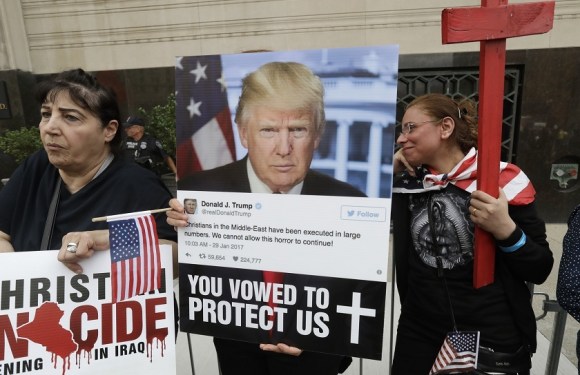
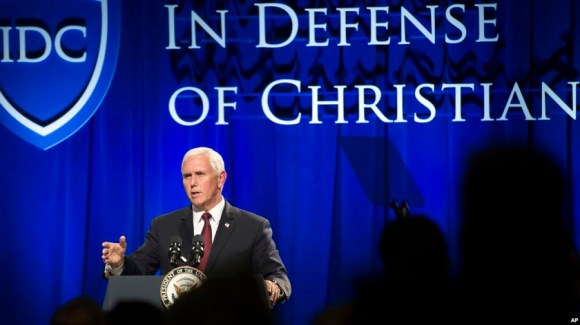
Vice President Mike Pence addresses the In Defense of Christians’ fourth-annual national advocacy summit in Washington, Oct. 25, 2017. Credit: AP, via VOA News.

Here are a few excerpts from my new article.

First, the reason:

Zalal Life distributed 300 food baskets and bottles of water. The government of Hungary donated $2 million in aid for reconstruction. The United Nations wasn’t there.

“People are not happy with the UN; they are using money for administration,” said Bahro. “The help is coming from churches and Christian organizations.”

Second, the condition:

“If the US can help Christian organizations directly, it will be good—if it can be done without discrimination,” he said.

“They must serve Muslims and other minorities also. We live together, and want to remain together in our communities.”

Third, the complication:

“Having the US transfer funds directly to persecuted Christians could be a good thing, but American politics will surely mingle in,” the Israeli Arab Christian said.

“They will want to brag about the aid to show their success, and to prove to the Christian Right that [President Donald Trump] delivers on his promises.”

Fourth, the danger:

Farouk Hammo, pastor of the Presbyterian church in Baghdad, agreed. “The bottom line is that we do not recommend direct aid from the States to Christians,” he said.

“It will agitate our Muslim brothers negatively against the Christian community.”

Fifth, the reality:

But the Jordanian leader respects Trump and is cautiously in support of the USAID policy change if done well, as it will empower the church to do the ministry.

“Maybe we will be targeted more,” he said. “But in some countries, it can’t get worse.”

Sixth, the possibility:

If USAID offered to help, Bitar would accept it—if it is not conditioned on any political agenda. He has little fear of local reaction.

“Muslims will be happy,” he said. “They like to send their children to schools run by Christians.”

Finally, the outcome:

Amid conflicting Christian reactions and unknown Muslim response, the policy change represents a new approach. Will it make things better or worse?

“Here in our area, the Kurdish Muslims trust Christians,” Bahro said. “In Arab areas, I don’t know.”

Please click here to read the full article at Christianity Today.