Categories
Christianity Today Middle East Published Articles

Can a Lebanese Seminary Move Beyond the Liberal-Conservative Impasse?

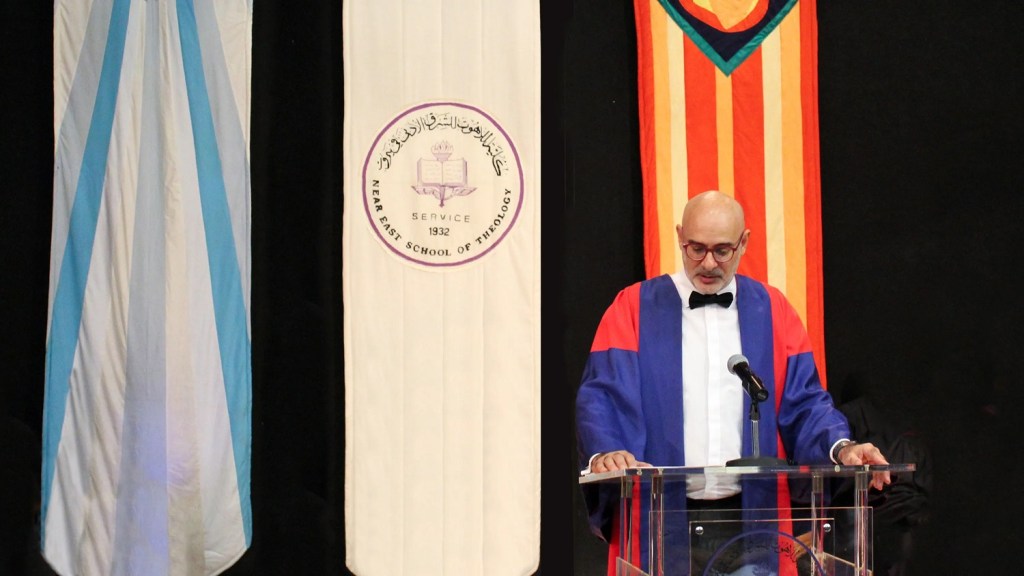
Courtesy of Near East School of Theology

The oldest Protestant seminary in the Middle East has a new vision.

Officially founded in 1932 but with origins dating back to the 19th-century missionary movement, the Near East School of Theology (NEST) is operated by the Presbyterian, Anglican, Lutheran, and Armenian Evangelical denominations.

Installed this week, its 11th president is a nondenominational Lebanese evangelical.

Martin Accad, formerly academic dean at Arab Baptist Theological Seminary (ABTS), was installed on Sunday at the historic institution’s Beirut campus. He graduated from NEST in 1996 with a bachelor of theology degree, eventually earning his PhD from the University of Oxford. Awarded scholarships by the World Council of Churches and the evangelical Langham Partnership, Accad is a locally controversial theologian who, like NEST, straddles the liberal-conservative dichotomy.

Author of Sacred Misinterpretation: Reaching Across the Christian-Muslim Divide, Accad has urged believers to approach Islam in a manner that avoids the twin pitfalls of syncretism and polemics. But before joining NEST he resigned his prior academic position at ABTS to apply his biblical convictions within Lebanon’s contested political scene. Creating a research center, his last four years have been spent in pursuit of reconciliation between Lebanon’s often-divided sectarian communities.

Accad will now bring his vision to a new generation of Middle East seminarians.

Although doing public theology is novel for the institution, NEST has long sought, with some struggle, to balance the two streams of its early predecessors’ commitments to evangelistic outreach and service-oriented witness. Its founding in 1932 resulted from a merger of two programs, each with its own distinctives.

One stream of NEST’s roots dates to 1856, when American missionaries began what Accad describes as a discipleship training program in the mountains of Lebanon. Along with providing pastoral development, it functioned as a mission station for sharing the gospel in local villages with non-Protestant Christians and diverse Muslim communities. Its remote location was also designed to isolate these early “seminarians” from the corruption of city life in Beirut.

American outreach to Armenians and Arabs in the Ottoman Empire (modern-day Turkey) led to the creation of similar schools beginning in 1839. After the Armenian genocide in World War I, these efforts relocated to Athens where they coalesced into a seminary that adopted an ecumenical, Enlightenment-informed model, emphasizing the importance of social service. This was especially true in its approach to Islam—sympathetic and comparative with an eye toward reconciliation.

The merger of these two programs created NEST, which eventually settled in the cosmopolitan Hamra neighborhood of Lebanon’s capital. Although it is situated near three historic Protestant liberal arts colleges—now known as the American University of Beirut (AUB), the Lebanese American University (LAU), and the Armenian-led Haigazian University—early cooperation was shattered by the Lebanese civil war in 1975 and has not been re-established.

Accad wants to restore this collaboration and embody an integration of scholarship and discipleship. CT spoke with him about Protestant distinctives, “electric shock” pedagogy, and how to understand the mainline-evangelical divide in the Middle East.

Why does serving as president of NEST appeal to you?

We need to rethink what it means to be a seminary student today. This question is a key issue globally, but especially in the Middle East. Ideally, the seminary leads the church to be relevant in society. This requires beginning with society and determining its needs. And then the seminary addresses the church—what does the pastor need? Finally, it works backward and designs a program to fit this profile.

Historically, NEST has been an ordination track. This is the traditional model, and it is still necessary if the church believes that it is. But I want to explore with the churches their vision for seminary training, for congregational service, and for regional witness—and how NEST can help prepare leaders to implement this vision.

How do you plan to prepare leaders to serve the church?

Nontraditional, focused tracks are becoming the way people want to learn. Accrediting bodies speak of micro-credentials that may contribute toward academic goals but have value in and of themselves and fit into the bigger puzzle of what students want to do with their lives.

But this system of training should not be only for evangelicals. I want NEST to attract…

This article was originally published at Christianity Today on September 27, 2024. Please click here to read the full text.

Categories
Christianity Today Middle East Published Articles

First Graduates of Persian Seminary Prepared to Serve a Traumatized Iran

Image: Courtesy of Pars Theological Centre

Iran’s Islamic republic is driving its citizens away from religion—and into trauma and depression. But as Christianity grows among a disillusioned public, the church is not exempt from complications, whether at home or in the extensive diaspora.

“Many Iranian Christians struggle with high levels of anxiety and post-traumatic stress disorder, stemming from persecution but also from the general oppression of a totalitarian regime,” said Shadi Fatehi, associate director of Pars Theological Centre. “We see the marks in many of our students.”

Last month, the London-based institute celebrated its first graduating class.

Fifteen students completed the Farsi-language, three-year bachelor’s in theology degree. Accredited as an institution by the World Evangelical Alliance–associated European Council for Theological Education, nearly half of Pars’s over 600 students live in Iran, with almost a third in Turkey.

Its hybrid education model is primarily online, with a yearly residential program.

Located in 23 nations overall, the seminary launched the Pars Counseling Centre five years ago and began deliberately integrating it within the academic program. While the World Health Organization estimates five percent of the world population suffers from depression, peer-reviewed studies describe far greater numbers in Iran.

Between 15–31 percent of Iranians experience some form of mental disorder, with that number increasing to 37 percent in Tehran. Saeed Moeedfar, president of Iran’s Sociological Association, described a “terrifying despair” gripping society, as one in five prescriptions are issued for antidepressants or sleep-inducing medications. And a 2021 study found that political repression “contributes significantly” to mental health problems.

Meanwhile, a 2020 GAMAAN study found that nearly one million Iranians called themselves Christian, while only 32 percent of Iranians identified as Shiite Muslim. Officially, however, Iran puts that number at 95 percent.

Citing oppression and economic troubles, one anonymous secular Tehran-based NGO came up with a somewhat spiritual solution. Fighting a culture of mental health stigma, it combines both pro- and anti-regime patients within group counseling sessions. Alumni describe a “second household” atmosphere and readily volunteer to extend what they call “the chain of love.”

Pars similarly calls its theological model “the centrality of love,” centered around spiritual (love of God), personal (self), communal (church), and missional (world) formation. Many converts to Christianity suffer rejection from their family, Fatehi said, and new life in Christ does not automatically heal their wounds. In fact, given the nature of the Iranian underground church, it can even amplify them.

“Believers often suddenly find themselves as leaders in a house church,” she said. “But only having seen authoritarian models, traumatized people tend to exert controlling power over others out of self-preservation.”

Pars offers three courses in servant leadership, she said.

“Our background in Shiite Islam leads us to believe that the pastor represents the image of God and that we should accept his teachings without question,” said Samira Fooladi, a graduating student in Turkey. “My goal now is to develop healthy women’s leadership.”

Experts say the Iranian church is largely female, reflected in 57 percent of Pars students.

Despite growing up in a religious family in Isfahan, Fooladi followed her older sister to underground services during university studies in Tehran. Non-practicing herself, she compared the Quran and Bible while praying that God would show her the right way. She gave her life to Christ in 2000 at the age of 18. Fooladi quickly became a cell group leader, but it was not until…

This article was originally published at Christianity Today, on November 8, 2023. Please click here to read the full text.
Categories
Asia Christianity Today Published Articles

Afghan Christians Are Very Online

Image: Courtesy of SAT-7

Since the fall of Afghanistan in August 2021, it has been nearly impossible for Afghan Christians to find fellowship.

Not that it was easy before.

“There was no local church where I could explore my questions about God,” said Parwin Hosseini, now living in Turkey. “But once I found answers abroad, I accepted Jesus.”

Her last name has been changed for security reasons, to protect her visa status.

A university graduate from Mazar-i-Sharif, Hosseini left her home country in 2019 and, unlike most local Afghans, is not a refugee. She fled her uncle’s arrangement of her marriage to a man nearly twice her age and obtained residency pursuing a master’s degree in economics. In Istanbul, a Turkish pastor gave her a Bible in Dari, her native language, and introduced her to an Afghan church when she moved to Ankara.

She had heard of the Good Book before. Today, she facilitates its study.

“I want to help evangelize women,” said Hosseini, coordinator for the nascent Afghan Bible College (ABC), “and then equip them for ministry.”

Begun in 2020 by a Korean missionary in Turkey, ABC is an online college with some in-person training. With ten affiliated lecturers, including three with PhDs, it aims to prepare leaders for the next generation of Afghan Christians—estimated to number up to 12,000 before last year’s takeover of their homeland by the Taliban.

No one knows how many remain in Afghanistan—but 12 are ABC students.

Many other Christians joined the national exodus sparked by the US military’s sudden withdrawal. Of the nations welcoming displaced Afghans, southern neighbor Pakistan tops the list, hosting more than 1.5 million Afghan refugees and asylum seekers (and 8 of ABC’s students). Neighboring Iran to the west and Germany follow (with 3 students each), while Turkey hosts 140,000 displaced Afghans (and 20 students). Out of ABC’s 50 students spanning five nations, Hosseini gets to be a mentor to its 15 women. And with the Taliban’s late-December suspension of college education for female students, her cadre is…

This article was originally published at Christianity Today on January 4, 2023. Please click here to read the full text.

Categories
Christianity Today Europe Published Articles

Ukraine’s Evangelical Seminaries Plead for Help

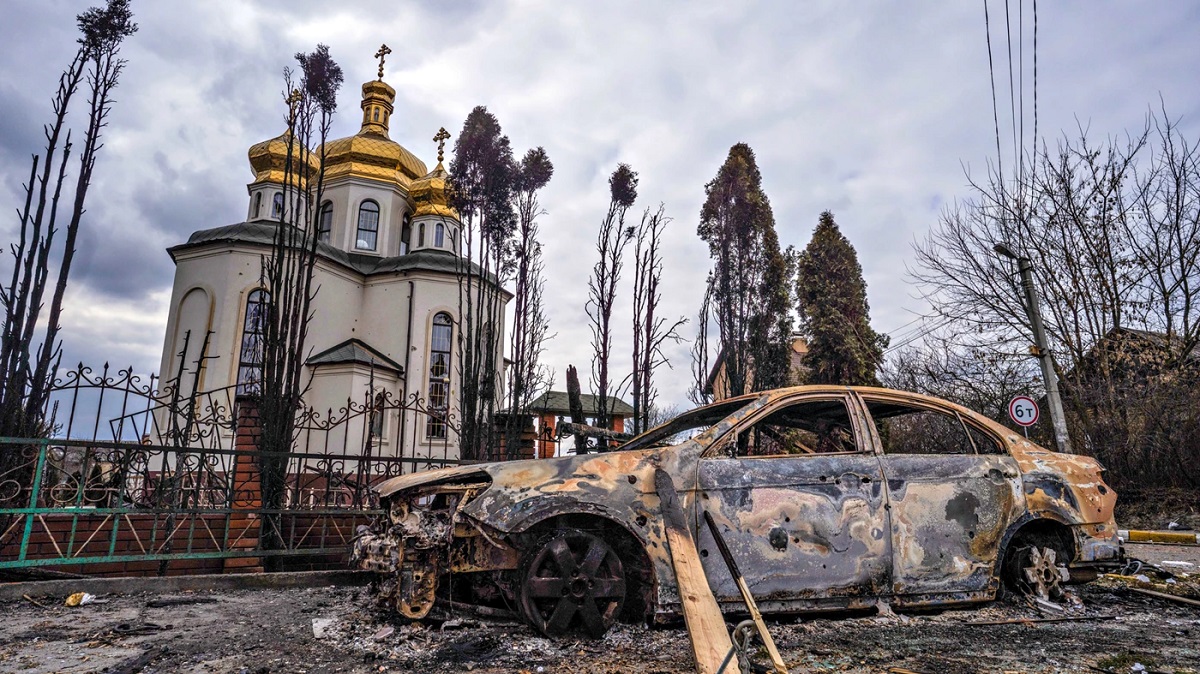
Image: Kaoru Ng / SOPA Images/LightRocket / Getty Images

One month ago, Taras Dyatlik gathered in Moldova with friends and partners for another 10-day round of mundane seminary meetings. Serving as regional director for Eastern Europe and Central Asia for Overseas Council, he was a lynchpin for strategy and funding for a network of theological institutions in Ukraine and Russia.

Three days later, he was desperately scrambling back to Kyiv. Dyatlik’s family—like much of Ukraine—was under Russian military fire. And the only thing louder than the air raid sirens that would soon pervade his sleepless nights was the silence of his Russian colleagues.

“This is not a conflict, or tension, or special operation,” he said, using the terms employed by most Russians—and too many otherwise cautious supporters in the West. “It is invasion and war.”

He emphasized the Bible shows the importance of precision in languague.

“It’s not just that Abel died or that Jesus was just betrayed; Judah betrayed Jesus, Cain killed Abel,” he said. “Not just that a man sinned; Adam and Eve sinned. Biblical truth has names, has a cause-and-effect chain.”

Dyatlik’s charged remarks mirrored others voiced at an online roundtable organized Thursday by the Ukraine-based Eastern European Institute of Theology (EEIT). About 500 supporters, partners, and general wellwishers registered for The Russia-Ukraine War: Evangelical Voices, eager to hear from fellow believers on the front lines.

The attendees, from at least 25 nations and 20 US states, received theological reflection—and raw emotion.

“It’s difficult for us Ukrainians to stay calm when we talk about what is happening in Ukraine,” said Roman Soloviy, EEIT director, who served as moderator. “Most of us men have never cried so much as during the last three weeks. We really need your help, your prayer, and your voice in the world.”

Oleksandr Geychenko, rector of Odessa Theological Seminary (OTS), expressed the shock of all.

“We died with the pregnant woman and her child when the maternity hospital was bombed. We fled with those running from Russian shooting,” he said. “All we were used to is wiped out—now just a wilderness.”

OTS is the oldest of the Ukrainian evangelical seminaries, tracing its history to a 1989 local effort to train preachers and Sunday school teachers. The campus was evacuated at the start of the war as the Ukrainian military took up occupancy in defense of the Black Sea port. But what has puzzled and discouraged Geychenko most is…

This article was originally published by Christianity Today on March 18, 2022. Please click here to read the full text.