Categories
Arab West Report Middle East Published Articles

The Muslim Brotherhood’s Freedom and Justice Party: First Conference and Key Questions

The speakers' platform. Dr. al-Erian is seated in the middle.

Dr. Essam al-Erian, vice-president for the Muslim Brotherhood established Freedom and Justice Party (FJP), officially commenced party activity in a conference in Shubra, Cairo. The location was specifically chosen, he stated, due to the fact it was an area long neglected and marginalized by the former regime. The FJP wishes to see Egypt become completely independent of all foreign powers, especially economically, so that all, especially the poor, may benefit.

Also in attendance were Dr. Mohamed al-Beltagi and Mr. Gamal Shehata of the Muslim Brotherhood, each of whom also gave speeches. They were joined by the Egyptian poet Mohamed Goudah and artist Wagih al-Arabi, as well as Dr. Duaa’ Maghazi, a Muslim sister. Dr. Rafik Habib, the Egyptian Christian researcher and vice-president of the FJP was listed among the presenters, but was not in attendance.
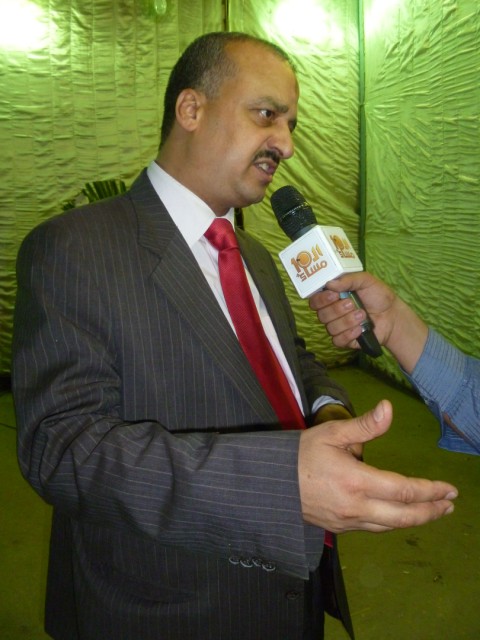
Dr. Mohamed al-Beltagi

Al-Erian railed against the long scope of foreign interference in the Egyptian economy, stretching back to the British occupation, the monastic period of King Farouk, the Free Officers led by President Jamal Abdel Nasser, and culminating in President Mubarak. Each allowed foreign powers to profit off the Egyptian people. Al-Erian insisted that any current loans accepted by the Egyptian state must be completely absent of conditions.

Al-Erian was also critical of the current security situation in Egypt. He made a parallel to the failures of officers in 1973, during which their ranks were purged to remove incapable or corrupt figures. He wondered why this has not yet been done among police following the revolution, when many have been involved in torture and used live ammunition against protestors.

Yet while he was critical of the police, al-Erian offered praise and thanks to the military. First and foremost this was for their role in protecting the people during the revolution, contrary to their orders to fire upon them. He also praised the army for its promise to surrender authority to a civilian, elected government, and awaited its fulfillment in time, with full confidence.

At the same time, al-Erian denied there was an agreement between the Supreme Council of the Armed Forces and the Muslim Brotherhood, stating the FJP would not hesitate to criticize the military if it diverged from its revolutionary mandate. So far, however, their mistakes have been minor.

Speaking to the fears of an Islamist dominated government, al-Erian stated the FJP was not looking for a parliamentary majority. In fact, the party aim is to capture between 30-35% of the seats. Recalling cooperation during the revolution, he stated that the Muslim Brotherhood, nor any other group, would have been able to overthrow Mubarak on its own. The common interests of all political parties are substantial, and they should work together to craft a national unity government. The political system needs strong and diverse parties, reiterating the FJP desires a civil state based on the law.

Dr. al-Erian

Al-Erian spoke briefly about foreign policy, urging the United States to withdraw from Afghanistan, and NATO to cease operations in Libya. The Libyan people are capable to rid themselves of Gaddafi on their own, and NATO strikes only serve to demolish the country and its infrastructure.

Al-Erian closed by assuring the audience the FJP, due to the skills gained by the Muslim Brotherhood, was capable to undertake its political responsibilities and participate in rebuilding Egypt. The party welcomed all in this task, Muslims and Christians, men and women, workers and farmers, the young and the old. Furthermore, it was dedicated to serving the interests of this entire constituency.

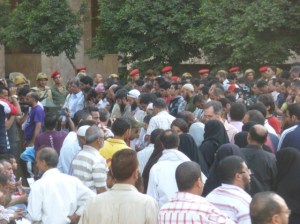
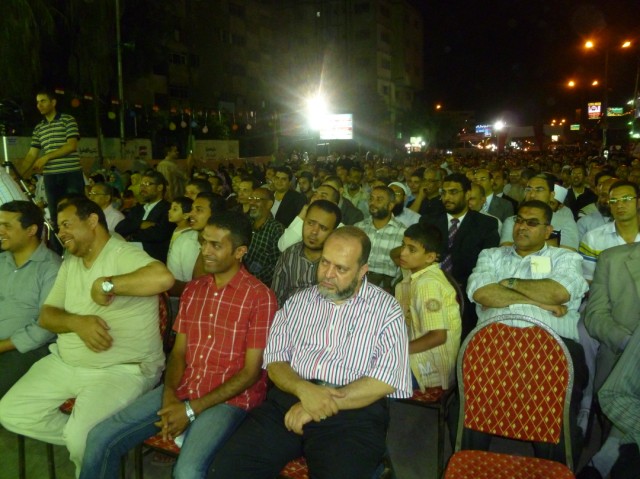
There were approximately 800-1000 people in attendance, seated in a tent erected in a central square of Shubra under the evening sky. Most people appeared to be of lower middle class economic status.
While no space was given for questions and answers, in subsequent research we would like to probe further the relationships between the Freedom and Justice Party, the Muslim Brotherhood, and the Salafi movement. Specifically:

  • What is the relationship between the FJP and the Brotherhood? According to reports it is to be independent in administration and finance, yet its leaders are all Brotherhood veterans, appointed by the group. How will the political party function in practice?
  • What is the role of the FJP headquarters in Manial, Cairo? By appearance this is a small office on the 3rd floor of a nondescript building. Yet inside was a caretaker, with his bed set up near the conference table, with a direct line to al-Erian. The Muslim Brotherhood headquarters, meanwhile, are an impressive stand alone multi-story building recently constructed on a major road in Muqattam, Cairo. Does this suggest a practical subjection of party to greater Brotherhood leadership?
  • To what degree does the FJP include Muslim Brotherhood youth? These are depicted in the media of having disagreements with the traditional Brotherhood leadership. Is this a reality?
  • What is the relationship between the Muslim Brotherhood and Hamas? Several years ago al-Erian was heavily involved in supplying Gaza with medical supplies through the doctors’ syndicate, utilizing Hamas connections.[1] Do official links between the movements exist? Is their coordination or funding involved? However sympathetic with the plight of Gaza, does the Muslim Brotherhood approve of Hamas’ tactics?
  •  What relationships exist between the Muslim Brotherhood and the military council? Through personal conversations between Cornelis Hulsman and Osama Farid, a Muslim Brotherhood senior figure, the group maintains a direct line with senior military officers. What is the extent of their communication? Does it differ from that between the military council and other political or social groups?
  • What links exist between the Muslim Brotherhood and Salafi groups? Will there be political cooperation between the FJP and Salafi parties? Some Brotherhood members have criticized the Salafis, while others have hosted conferences between the two groups. Is there an official stance?
  • What are the different trends among Salafis, who generally are not an organized presence in society? What are their methods of propagation? From where does their funding originate? Do they serve foreign or transnational agendas? Does the Muslim Brotherhood?

Many people, both in Egypt and the west, are asking these questions right now. While both the FJP and the Muslim Brotherhood are working hard to demonstrate they are a moderate, centrist political and social force, their answers to questions like these will go a long way in demonstrating their credibility.

One final note concerning the historical reality of the Muslim Brotherhood, highlighted by Badran, a resident of Shubra and a Brotherhood supporter: in 1948 the Muslim Brotherhood first began conversations with the Egyptian armed forces, which were repeated in 1952. This opened the political space for them, but by 1954 they suffered repression. In 1970 President Sadat, a military official, once again engaged the Muslim Brotherhood, giving wide space for operation, but by 1980 began repression once again.

This pattern is undoubtedly known and feared by the Muslim Brotherhood. Regardless of conspiracy theories which posit military favor for the group, it is certain that once again the Brotherhood has approval to operate openly. This may be one reason behind the constant reassertions of their civil, democratic, moderate intentions. If true, there is no need for repression. Yet it may be asked if they also wonder if their window of opportunity is now open, and that they intend to consolidate power before they are repressed once again.

The political future of Egypt is wide open. May all participants operate from integrity and concern for the nation. The short term horizon will be very interesting, and perhaps foundational. May peace, stability, freedom, and justice mark what is to come, Islamist or otherwise.


[1] From a personal conversation several years ago between al-Erian and Cornelis Hulsman, editor-in-chief of Arab West Report.


Categories
Personal

Optimism from an Egyptian Sandmonkey

The Sandmonkey

Sandmonkey is the name of a popular Egyptian blogger, particularly active during the revolution. He now continues to strive to make sure the revolution’s advances continue toward greater liberty, freedom, and democracy. In one post of his I came across recently, he outlines seven myths about Egypt post-revolution that have been repeated pervasively. These, he believes, are pervasively wrong.

I obviously cannot attest as credibly as he can, but I hope he is correct. I encourage you to read the whole essay, but here is a summary of his analysis.

Myth One: The Army is co-opting the revolution/trying to establish another military dictatorship.

Reality: The army should be viewed as individual generals, and these are old, conservative, and now extremely overworked. Yes, they repeat the patterns of the past, but they hardly know anything else, and are being called on to solve every problem, both domestic and international. They are tired, want to get back to their barracks, and are more afraid of the people than vice versa.

Myth Two: The NDP/Mubarak is still controlling the country.

Reality: They are terribly afraid, each one waiting for their sins to be exposed to the public. Mubarak, in particular, will be deemed the greatest traitor in Egypt’s history when all is said and done. The NDP figures around him will not fare well either.

Myth Three: The Islamists are hijacking the revolution.

Reality: Salafi Muslims are terrifying normal Egyptians with their call to return to the 7th Century, and the Muslim Brotherhood is suffering from terrible internal divisions now exposed by the light after years spent underground. These groups lose popularity by the day. People exhibit condescension when they think the ‘normal Egyptian’ will be swept away by religious rhetoric. They know better, and should be trusted.

Myth Four: New Parties are the only way to save the next elections.

Reality: Existing parties are important, and the new ones will be important in time. But the real power is forming outside this system. The same groups that protected neighborhoods during the revolution have kept their spirit and are becoming social forces seeking change from the bottom up. Not only this, but their perspective is sophisticated, yet their existence is widely unknown to the elites who think ‘awareness campaigns’ are necessary everywhere outside their own backyard.

Myth Five: Amr Moussa / Baradei is the new President.

Reality: While these may pass through the crucible, by all accounts neither figure will be able to survive and pass muster with the Egyptian population. More likely is that a figure emerges closer to the elections, after these two have been long chewed up and discarded.

Myth Six: International forces will destroy the revolution.

Reality: They are trying, but will not succeed. Saudi Arabia and Israel are pushing hard to keep Egypt in an alliance against Iran, but Egypt is now demanding its sovereignty be respected. Their opening to Iran is not a victory against traditional allies, but rather a confidence in the new realities of the region, post-Arab Spring. Regional powers desire the old order, but it is fading fast. More likely is that the old order undergoes its own significant popular changes soon as well. The virus is spreading.

Myth Seven: There is doom and gloom everywhere!

Reality: Optimism is ruling the day. Yes, the economy is ailing, but the state of Egypt is akin to a patient recovering from an extended illness. The side effects of medicine and bed rest produce discomfort, but will restore health. Among other examples, consider how many young people, children even, have had their political consciousness awakened. They see the world differently than their parents ever did. Their voices, as they age, will not be easily suppressed.

My take: In the past few weeks I have been tempted to surrender to many of these myths. Many Egyptians and international observers already have. Yet it is the isolated, contrarian voice that often sees things more correctly.

It could be, though, that this is the perspective of an activist, one who has poured so much into the revolutionary effort. Such people cannot allow themselves a hint of pessimism, lest their personal commitment, on which so much rides, come to naught.

Yet in the greater struggles of life, victory is often won simply by defining the reality in which the struggle takes place. Sandmonkey is keen to highlight positive continuations of the revolution. The negative ones, producing his ‘myths’, are equally true. The Egyptian future may well depend on which perspective moves to the forefront.

Update: Sandmonkey may be fudging a bit on Myth One. Here is his latest post.

Categories
Personal

Day of Rage 2.0

Translation: May 27; underneath is a list of demands

Tomorrow, May 27, could be a portentous day in the development of Egypt, post-revolution. Or, it could come to nothing. Activists, largely those among the earliest demonstrators at Tahrir Square, have returned to social media to call for a 2ndDay of Rage, in order to protest a slowing pace of reform from the ruling military council and interim government. A Facebook page asking for participation attracted 27,000 supporters, but of which only 5,000 said they would participate.

While there have been protests nearly every day since Mubarak stepped down as president, none have been as controversial as this one. The Muslim Brotherhood has declared it will not take part, and has in fact publically condemned the effort. Meanwhile, on the opposite side of the political spectrum, Naguib Siwarus, a wealthy Coptic businessman and founder of the liberal Free Egyptians Party, has also spoken against the demonstration.

At issue is not so much the list of demands; in fact, participants have not exactly put together a unified call. Rather, it is felt that the target of protest is directed at the ruling military council. Many activists have been careful not to directly point their finger at the army, but the understood complaint is reminiscent of the early revolutionary struggle. Protests since the revolution have tended to be about particular issues.

The fear is obvious: The army received unwavering popular support for its role in the revolution, refusing to fire on the people. In light of the violence in Libya, Syria, and elsewhere, Egyptians have been very grateful for army neutrality. Yet the 2nd Day of Rage threatens to drive a wedge between the army and the people. In fact, this is the chief accusation against the activists. If we cannot look to the army to guide our transition, to whom will we turn? The conservative Muslim Salafis, in this regard, have returned to their pre-revolutionary rhetoric – demonstrating against the leader is against Islamic sharia. The Muslim Brotherhood has labeled the activists ‘secularists and communists’, terms sure to draw rejection from a God-fearing population. Rumors are about that the hand of Israel and America are driving participation.

The demands of the activists do suggest dissatisfaction with the military council’s governance. They are frustrated with the slow pace of trials against leading regime figures, especially Mubarak, who only two days earlier was referred to prosecution. They condemn the use of military tribunals, of which human rights activists say up to 10,000 citizens have been subject since the revolution, many of which have been protestors. They call for the replacement of the military council with transitional civilian leadership drawn from all segments of society. Furthermore, they ask for the drafting of a new constitution prior to legislative elections, so as to secure a free and democratic society into which new representatives can be chosen.

This last notion in particular can be judged as somewhat partisan politics. One reason the Muslim Brotherhood is understood to oppose the march is that they are due to fare well in the legislative elections, and will have superior representation from which will constitute the body to craft a new constitution afterwards. Some activists have gone as far to suspect background deals between the military and the Muslim Brotherhood, but this is denied by both parties. Indeed, the Brotherhood seeks to assure Egyptians they seek participation with all political forces, to achieve a civil state. Yet figures from the Brotherhood periodically mention phrases such as ‘sharia law’, and make many wonder if their openness is a temporary strategy rather than a democratic commitment. The Brotherhood, for its part, states there is a media campaign to discredit them and twist words out of context.

With ‘only’ 5,000 people committed to the demonstration, however, will there be much ado at all? Egyptians are tired of protest, focused on the ongoing security lapses and deteriorating economy. If left alone, will the efforts of the activists simply fizzle out?

Perhaps. Yet some activists have been stating that the security lapses and an overemphasis on economy issues is part of the military strategy to slow down revolutionary gains. Youth activists complain they have been squeezed out of the decision making process, as most government pronouncements are issued from behind closed doors. A recent national dialogue has begun, in which many youth were invited. Upon arrival, however, they found senior representation including figures from the disgraced Mubarak regime. Most left in protest, and the dialogue ended abruptly.

Some steam may have been gained today, as four activists were arrested by the military police for distributing flyers calling for participation in the 2nd Day of Rage. The activists’ twitter campaigns went on high alert, mobilizing people immediately to go to their place of detention. They were released later in the day, but individual tweets proclaimed the arrests did the greatest favor for the call to demonstrate. Links to pictures of the flyers rapidly filled cyberspace.

Yet so did a foreboding sense of dread. One activist feared May 27 would come to represent the day the revolution died. Others tried to bring levity by calling on protestors to use humor, as they did so effectively in the beginning. Given the expected high temperatures, some wished to turn Tahrir Square into a beach scene.

On its official Facebook page, the Supreme Council for the Armed Forces stated clearly it would not fire on protestors. Yet it warned that certain shadowy groups might try to infiltrate and bring trouble. The message concluded by stating the army would not be present during the demonstrations, but would be guarding other essential government institutions.

Activists took this as a message that they would be left on their own. One of the young revolutionary groups, the April 6 Movement, declared it would take responsibility for securing the peaceful nature of the demonstration, to prevent any violent infiltrators from sabotage. Yet with the prevalence of ‘thugs’ who have attacked demonstrators previously, might these descend upon activists?

On the one hand, it is feared. On the other, it is feared as a scare tactic to limit participation. Tomorrow has the air of uncertainty that existed on January 24, when Police Day demonstrations were expected. Some of the same questions exist: Will this only be an expression of young, middle to upper class frustration? Will the street care, let alone join in? Regardless, for that protest 80,000 Facebook users committed to participate; the 2nd Day of Rage pales in comparison to previous mobilization.

No one is expecting a 2nd Revolution, though some activists are using that language. What is their expectation, however? How will they know if they win? If their fears are true, and the revolution is being thwarted, can this effort reverse the tide?

My guess is that the 2nd Day of Rage will make a loud protest, but eventually fizzle out. If there is bloodshed, however, will that change the equation? Or, will the popular perception be that they turned against the army, are working against the necessary stabilization of the economy, and will deserve what they get? The former regime tried such a strategy during the infamous ‘Battle of the Camel’; it failed miserably. Conditions are different now; most are still positive about the revolution and thankful for the army. Public relations are probably against the activists.

Does it deserve to be? It has only been four months since the revolution began. Former figures, including Mubarak’s sons, have been sent to prison. Elections are promised, and most analysts believe the military has absolutely no intention of staying in power long term. Meanwhile, security is weakened, as is the economy. The military proved itself trustworthy during the revolution; should it be given the benefit of the doubt during the transition? After all, it has undertaken governance and policing – two tasks absolutely necessary but for which it is ill equipped.

Tomorrow we will see. Yet positions appear to be hardening, creating fissures in the widespread revolutionary unity. Perhaps it was inevitable; it is also dangerous. No one accounts the revolution to be completed yet; might it derail as groups begin to fight for their own vision of success?

It is a very difficult balance fighting for what you believe in, holding others accountable, and maintaining unity at the same time. Perhaps it is too herculean to expect, but it can be pleaded for. May prayers be directed toward safety, sense of partnership, and ultimate freedom and justice to come to Egypt. The nation is still in need.

Categories
Personal

Imbaba: Voices for Peace Present, but Overwhelmed

Onlookers view the burnt Virgin Mary Church in Imbaba

The sectarian attacks in Imbaba on May 7-8 have been widely written about and criticized. Indeed, it was a horrible blemish on Egypt that reeled the nation. Consensus seems to say that the action was planned and executed by Salafi Muslims at the behest of some interest outside of Imbaba. That is, the attack and burning of the church did not spring from neighborhood issues. How far outside of Imbaba is debated, but though the spark came from elsewhere, the fire burned internally. Amidst the condemnations, it is necessary to note it consumed also local Muslim efforts at peace.

These observations were taken from a thorough investigation conducted by the Egyptian Initiative for Personal Rights. This organization has often written about sectarian tensions; in this case, their chief criticism falls on the security forces for failing to get involved to stop the fighting. Yet the testimony they assemble is enlightening. Their report (Arabic only) can be found here.

The basic story is that a group of Salafi Muslims assembled at the St. Mina Church in Imbaba, responding to a request from a spurned Muslim husband that his wife, a Coptic convert to Islam, was being held inside. They demanded to search the premises, Copts began assembling to defend the church, and eventually more and more Muslims filed in, causing multiple deaths and over two hundred injuries. The woman in question did indeed flee from her Muslim husband, was a convert to Islam, but was not present in the church. The episode was a lie propagated to launch an attack on the Christian landmarks of Imbaba.

That the episode was a lie was an early discovery, not of the church or the security forces, but of a Salafi Muslim imam of Imbaba. He heard the story from the belligerent Salafi crowd which originated from outside the area, but announced it to the ordinary people gathering as a falsehood. In what seems to be an unfortunate coincidence, as he was declaring his opinion gunshots were fired, perhaps from the Christian side, if only in the air to dismiss the crowds. Quickly things began to spiral out of control.

Yet not before several other attempts were made to quiet the situation. Local youths banded together and began chanting, ‘Muslim, Christian, one hand!’ while a woman fully covered in niqab shouted, ‘What is happening to Egyptians? Weren’t we all united in Tahrir?’ Yet a group of Salafis broke into their ranks and scattered them, shouting, ‘There is no god but God, and the Christians are the enemies of God!’

Meanwhile, another bearded resident of Imbaba began shouting at them, quoting from the Qur’an, ‘Fitna (spreading religious strife) is worse than killing.’ He continued, ‘Whoever spreads fitna will go to Hell!’, and began to chant, ‘Muslim, Christian, one hand!’

Yet the Salafi group urged the local population otherwise. ‘The Christians have gotten too big for their britches; how can you allow the minority to rule over the majority?’ ‘Muslims, why are you silent? Thirty or forty Muslims have died, and you are silent as the Christians beat us?’

Within the tumult these voices triumphed. By this time Christian families had taken to defend the church and their homes by climbing their roofs and throwing down objects on the attackers. It was probably easy for the ordinary Muslims of Imbaba to get swept up in the rapidly boiling sectarian conflict.

This is not an apology for them. They are guilty for allowing rumor and propaganda to tilt their hearts against their Christian neighbors. This post is only to highlight that there were brave Muslim voices who tried to speak up for the unity of their community. Had this been only a local altercation perhaps they would have succeeded. That it came from outside, from Salafis bent on igniting fitna, it quickly overran and silenced the local voice of reason and tolerance.

In this light, careful encouragement of restraint on the part of the Christians does not exactly hit the mark. If someone is insistent on causing trouble, perhaps there is little that can be done. Yet another aspect of the EIPR report shows how Christians did respond in ways to defend other areas of Imbaba.

Before too long news of the attacks were broadcast on the Christian satellite channel, al-Tariq (The Way). Christians were informed of the efforts to attack all the churches of Imbaba, and urged to assemble in them for their defense. Thousands did, some even coming from other areas. They witnessed small groups of Salafi Muslims driving around in Jeeps, yet when they saw the churches full of people, they passed by. At one location where Salafis still tried to enter and cause damage, they apprehended two and turned them over to the military police. Yet at another location, the Salafis found no Christian crowd, only two church workers behind locked doors. As described in an earlier report, after shooting off the lock, they killed one, another was saved through intervention of a local Muslim, and then they burned the church.

What can one say in retrospect that could have staved off disaster? As EIPR highlighted, the failures of the security forces gave open hand to the assailants. Yet if Christians had not been so quick to fight back, might the Salafi imam’s pronouncement of a lie had been heard? Or would the damage suffered by their community been even greater?

Yet if it is true that outside forces are stimulating conflict in areas more likely to suffer outbreak, how can citizens, both Muslim and Christian, be better prepared should it happen again, elsewhere? Many Christians say privately that Islam in the heart of a Muslim will have him always side against the Christian when conflict arises. This was one of the calls of the Salafi assailants: ‘Muslims, defend your Islam!’ In a crisis situation with limited information, can the ordinary members of a neighborhood resist such a call? Many will rally in the open squares after a tragedy, condemning it and proclaiming, ‘Muslim, Christian, one hand!’ Yet for those, as in Imbaba, who proclaim it into the face of a developing tragedy, can they prove it true and prevent the horrors?

I cannot speak well for what is necessary on the Muslim side. Should I have opportunity to speak with the Salafi sheikh in Imbaba who proclaimed the lie, I will ask him. Yet Christians must overcome their privately confessed fears, and begin public assertions of trust. They must get into their neighborhoods, make relationships, and win friends. All voices in Imbaba have stated that previously relations in Imbaba between Muslims and Christians were fine. I’m sure this is true, but they were not ‘fine’ enough.

Maybe Christians will say they have tried, and it doesn’t help. Perhaps. But it should be remembered, there are thousands of villages and neighborhoods in Egypt that have not ignited in sectarian strife. From fear of Imbaba, knowledgeable that outside forces are at work, ‘fine’ must become ‘strong’, and ‘mutually respectful’. It may not be enough, if some are bent on sowing seeds of fitna. But the effort at resistance cannot be any less than this.

Categories
Personal

Maspero: Moving Toward a Standoff?

Fr. Mattias Nasr, at the Maspero press conference

Yesterday while visiting the Copts at Maspero, Ramy Kamel, General Coordinator of the Maspero Youth Union, beamed with a smile on his face. ‘The sit-in will end tomorrow. They have agreed to our demands.’

Today I saw Kamel again, sitting dejectedly on the sidewalk. ‘There is one church that is not yet opened. They agreed to it, but Salafis are blockading it. If we can’t trust the government to follow through on their demands due to Islamic opposition, what can we do moving forward?’

In a previous report I wrote more comprehensively about the demands of the MYU, but in negotiation it came down to this: Originally, the MYU requested 250 closed churches to be reopened, and that their arrested colleagues from their first sit-in be released. The government stated the opening of 16 churches was possible, and agreed to retry the Copts (and their Muslim colleagues) in custody.

The MYU then agreed to suspend the sit-in provided the sixteen churches were opened within a week, and three churches opened immediately. The St. Yu’annis Church in Beni Mazar did open, and priests and people entered to conduct officially licensed prayers. The bishopric church in Maghagha was approved, but there was a minor official who seemed to be holding things up, but the MYU did not seem overly concerned about problems there.

The issue, it came down to, concerned the Holy Virgin and St. Abram Church in Ain Shams. Agreement was given to open it, but then it was announced Salafis had surrounded the church to prevent it from happening.

This information was provided by Fr. Mattias Nasr, spokesman for the MYU, during a press conference announced earlier in the day. From the expectations of Rami Kamel and others, Copts had begun disassembling their tents, taking down their banners, and cleaning up the area. Now, all was in question again.

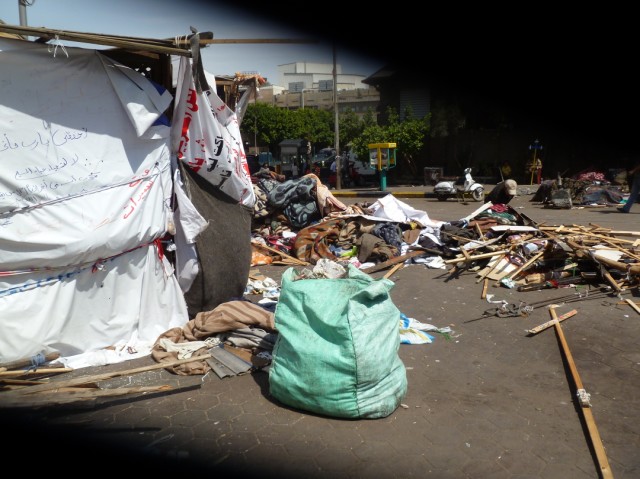
Remains of disassembled tents and banners at Maspero

Many press personnel came in expectation of a closing word that the sit-in was over. The crowd of Copts, however, would have none of this talk, and shouted down the preliminary speakers, including George Ishaq of Kefaya, a veteran reform activist from years before the revolution. He and others spoke of the political compromises necessary in securing rights, especially when 80% of their demands had been met. Not only did the people declare they weren’t leaving – many MYU organizers led them in chanting from the stage. It was a rather disjointed scene.

Fr. Mattias quieted the crowd, and stated that no, the sit-in is not suspended, not until each of the promised three churches are opened.

With this announcement the press conference ended, but information was still coming in real time. The MYU announced over the loudspeaker only a quarter hour later that the promise given to open the Ain Shams Church was oral; the sit-in would continue at least until it was signed and sealed on paper.

I left the area and tried to find my way to the Holy Virgin and St. Abram Church in Ain Shams, which is located on the metro line in northeast Cairo. I learned the church was in an area called Ezbet Atif, and hoped I could find my way from there.

One of the advantages of most Muslim women in Egypt wearing the hijab is that if you are looking for a Christian, you can usually identify their bare-headed women. This woman and her son did not know where the church was, but did bring me to one nearby where surely someone could direct me better.

They did, and helped arrange transportation in a tuk-tuk, a three wheel vehicle operating like a taxi but in crowded city streets.

In my imagination Ain Shams was an urban area, but locating the church in Ezbet Atif reminded me of perhaps a more rural area outside the city. In learning that Salafis were blockading the church, I imagined a ring of people holding their ground in an open area, and that I might be able to speak to someone on the edge to gain their perspective.

As the tuk-tuk driver weaved his way through Ain Shams, I realized the area was even more urban than I imagined. Streets were narrow and crowded; this was a low income area where I had little experience, and stuck out like a sore thumb. Yet along the way the driver told me that Muslims and Christians are one people, and that all get along. He did not know much about the closed church, but he had heard the rumors of the army getting involved somewhere in the area.

I asked him about Salafis. I told him, yes, I’ve lived here a while now, and I know that Muslims and Christians have good relations. But people are saying that Salafis, at least some of them, are making trouble. Do you know of their activity here?

He did not know exactly, but did speak against Salafis as pursuing their individual interest as opposed to that of the nation at large. They are troublemakers, he stated, and may well be being paid to be troublemakers.

Eventually we reached the location, or at least what appeared to be from the commotion. We drove past five or six riot police with shields and batons, walking steadily toward the area but seemingly without strict instructions. The tuk-tuk then could progress no further due to the crowd; when he asked to continue to take me to the church he was told this was impossible; prayer rugs had been lain on the ground, filling the street.

My visit was very short, so any statements must be couched in utmost caution. The carefree tuk-tuk driver suddenly became very concerned for my safety, urging me to get back in so as to take me back to the other church. Why? I asked; he said he would explain along the way.

There was a crowd, and there was tension. But I saw little potential for violence and no sign of the military (though it was possible they were there). When the tuk-tuk initially stopped, a bearded youth in jeans and a button-down shirt took my hand, sensing me immediately to be a journalist.

‘You want to see the church? Come with me. Look. There is no church. There is only a mosque, and the people are praying here. The Christians are trying to make problems, that is all.’

I admit I saw no church. Certainly not the type of church I imagined, that could be surrounded in blockade. The narrow street had all buildings tightly aligned, several stories tall. There was no steeple raised above them, but it was entirely possible one of the buildings was the closed Holy Virgin and St. Abram Church. After all, it was not time for prayers; why would so many people be in the area? Usually only Friday prayers will bring the excess of worshippers that require prayer mats laid on the streets. Today was Thursday.

The youth who took my hand was friendly, and spoke to me in English. I felt comfortable moving forward, but the tuk-tuk driver was not. I pulled away from the youth to pay the driver, but he insisted I get back in the vehicle and move away. Now, I was getting uncomfortable, but around me all seemed calm. Better to trust the local voice, I thought, and we drove away unhampered.

The driver explained that the group there would not be friendly to anyone seeking to photograph the church. I tried to ask him what made him so startled, but I think he misunderstood my question. ‘I am not scared,’ he said. ‘I could leave you there and drive away and be fine, but I am scared for you. They have laid down their prayer mats to fill the street, so that no one can enter the church. They mean business.’

I was very disappointed; thankful for an honest Egyptian guide, but again wondering about principles. I wrote earlier about hesitations in joining the Salafi crowd that protested the killing of bin Laden at the US Embassy. All there was calm also, just like in this crowd, assembled to make their point known, but people all the same. I was approaching seeking information; I have trust in myself to behave in honorable ways, giving honor to all around. I wanted not just their statement; I wanted their trust. Who will go to them and win this, when so many reject them?

Besides, the one who grabbed my hand to lead me wanted me to see the truth, at least his version of it. ‘Don’t be scared,’ he said, seeking to be reassuring. Quickly scanning the crowd, the majority of people seemed to be ordinary lower class Egyptians, not Salafis. These, it is said and is generally true, grow long beards and wear white robes and sandals. They could well have been there, but I did not see them.

Certainly the wise voice is to trust those around you. Time will permit later for learning and relationships. On the way back a Muslim woman in hijab got in the tuk-tuk as well, and my presence as a foreigner sparked conversation between the three of us.

She did not know the area exactly, but did verify there was a church there. Closed or not closed she wasn’t sure, but spoke of their being a problem between steeple and minaret. Specifically, Muslims believed the church would ring its bells during the Islamic call to prayer. This was the only information she had to offer, besides affirming that yes, in general, Muslims and Christians had fine relationships as neighbors. Many of her best friends, she said, were Christians.

We arrived back and I offered the driver double fare, for going and returning. He asked if I had change. ‘We agreed on the price’, he said, ‘I took you back out of concern, not for fare.’ I gave him a bit extra, and thanked him for his help.

Again, my impressions were far too brief to be substantiated. I may well have been on the wrong street. Yet much of this story seems wrong all over.

It is good and right for Christians as citizens to seek equal treatment. Let us suppose the church in Ain Shams was closed improperly. Yet before this, it should be mentioned that many churches in Egypt are built sidestepping the law, rather than in accordance with it. Christians rightly complain the law is a discriminatory encumbrance, and yes, many Egyptians sidestep the law when they feel it unjustly works against them. This is only to say that in the protests of Maspero, Copts demanded the rule of law. It could be that, if applied, not only this church but hundreds of others would need to be closed for their original contravention.

Yet put this aside. At the church which helped arrange my tuk-tuk, I asked how many churches were in Ain Shams. The gentleman there did not give me a number, but listed them one after the other, reaching eight or nine. Ain Shams is a very populated area, and I have no figures on the percentage of Christians. Yet it cannot be said they are without a church.

Maspero and Ain Shams seem a world apart. It is right for the Christians there to demand their churches be opened, but at what cost? Must they demand the army now come and evict these protestors, likely using violence against them? The army has promised not to use violence to evict Copts from their sit-in, and Copts rightfully complained when they reportedly met with violence when ending the sit-in the first time. Must the government’s hand be forced to choose?

Copts desire to see the government choose them over the Salafis, as they interpret events since the revolution to be pointedly in favor of Islamist forces over secular ones, and certainly Christian ones. Right or wrong, they want validation. They feel like they have won in Maspero; if the government does not open the Ain Shams church, they will feel betrayed, and mount even more evidence the government is against them.

It would seem there should be a more Christian way. It is wrong that matters have come to a head; it is wrong that the government is forced to adjudicate in the manner. Again, it is right for Coptic citizens to demand; but is it best for Christian believers to do so?

In their defense, the MYU has consistently stated this is a political action on behalf of citizenship, not a sectarian push for particular rights. Yet now that the heart of the issue is the opening of one church, how political does it remain?

If only Christians might go to the various Salafi sheikhs, make relationships, and seek their intervention. Perhaps Copts will say they have tried; indeed, these churches have been closed a long time and Muslim voices are not loud in clamoring for them to open. Yet the manner of argument has often been confrontational. Many Muslims have joined the Maspero protests, yet for the ordinary ones, opening the church now might seem like giving in to demands, not establishing civil rights. That is not the way the MYU wants the issue to be viewed. Sadly, I think it is viewed this way.

Egypt is at odds with itself, and not just on religious issues. Labor groups, even doctors, are making demands, demands that are probably just. How can these work together to satisfy all?

I am afraid the only answer is trust, and that seems to be in short supply. No, no one should be trusted on face value, but as relationships are built, trust can be gained. Perhaps a small party from the MYU can visit the nearest Salafi mosque, and just listen, asking nothing. All the while, let their political action continue.

Politics, though, makes for compromise and betrayal. Relationships make for trust and consensus. It is hard, currently, for Copts to offer this; they feel they have been let down so many times. Faith, however, demands they continue. If they are able, if they can overcome themselves, perhaps they can lead all Egypt forward. May it so be.

Update: Jielis van Baalen, a Dutch journalist friend, visited the area of the Ain Shams church after I left. He did not reach it due to the large crowds, and stated a local café owner pulled him in to the shop concerned for his safety. Jielis reported seeing few police, no army, but many traditional Salafi outfits. Some of those who moved about were armed. Inside the café was a mixed group of Muslims and Christians. They stated their great annoyance at developments, as many of those wandering around were not from the area. Muslims and Christians get along well, they stated. No one had any issue with the church being opened. After a short while, he also decided to leave.

If Jielis is correct, then it would appear the government would have an obligation to defeat armed gangs imposing their will. This is different than local opposition to a church. The government has stated it will not allow anyone to sow sectarian discord, and has labeled the source of such discord to be counterrevolutionary forces, tied to the former regime. If Ain Shams is an example of this, then the words of the government will be put to the test, in this case in honor of their agreement with the MYU.

Categories
Arab West Report Middle East Published Articles

Attack on the Coptic Sit-In at Maspero: Eyewitness Testimony

Coptic protestors at Maspero suffered two separate attacks on May 14, attacks which included Salafi Muslims along with common ‘thugs’. This report updates a previous text written about the Maspero attack, which was crafted from interviews with leaders the day of May 14, supplemented with media reports the next morning and phone calls to Mina Magdy, the political affairs coordinator for the Maspero Youth Union (MYU). According to witnesses interviewed May 16, a number of the details related in the news have been incorrect, if not outright misleading. This report is unable to corroborate claims independently. Efforts to speak with local army and police personnel on the scene were politely declined, as would be expected, in deference to announcements made by the Supreme Council of the Armed Forces. To my knowledge, they have not commented directly on this event.

Security Measures

Testimony is taken primarily from Emad Farag. Farag is part of the committee for order, tasked with securing the northern entrance to the sit-in near the Foreign Ministry. In my earlier report I wondered why Coptic security measures were so tight, while a simple rope separated the sit-in area from the major thoroughfare running north-south along the Nile River. Farag explained the sit-in had previously cut off this road, but it was reopened through negotiations with Prime Minister Essam Sharaf. In exchange for agreement to retry arrested members of MYU, who were apprehended during the first sit-in, General Coordinator Rami Kamel consented to pull back the protest area.

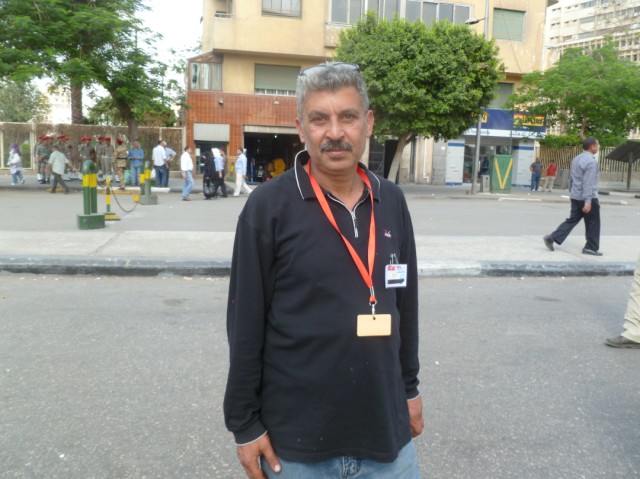
Emad Farag

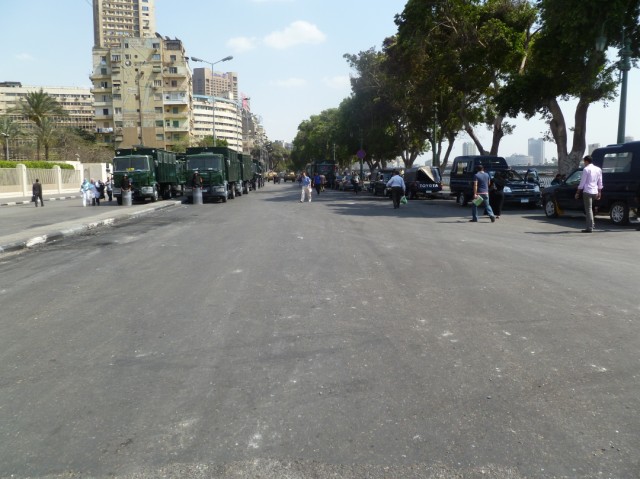
Upon arriving at Maspero on the morning of the 16th, however, I was surprised to find no Coptic security measures at all. Automobile traffic had stopped as dozens of riot police, army personnel, and military vehicles lined the road. Yet pedestrians, including myself, simply walked right through their lines, checked neither for ID nor weapons. Farag explained the army had assumed responsibility for safety after the attacks, and instructed the Copts to desist.

Farag then proceeded to relate the story of the evening attack. Around midnight, while he was stationed at his post, a group of ‘thugs’ began to gather under the May 15th bridge, and began harassing and beating individual Coptic protestors either leaving or joining the sit-in. Shortly thereafter, another group came from over the bridge, and began firing upon the Copts, though from a very far distance of about 1000 meters. When meeting up together, they began to advance toward the sit-in, carrying knives, swords, clubs, and stones, in addition to guns.

Off-ramp from the May 15 bridge. Blackened areas are from where Molotov cocktails burned.

Their approach took the attention of the protestors, but Farag instructed his colleagues in the committee to lock arms in front of the already constructed barbed wire, so as to prevent Copts from running out to meet them. Farag then phoned the captain of the police, who told him his men were ill equipped to meet armed ‘thugs’. They were stationed a few hundred meters to the north of the sit-in, blocking off a side road to the area. Their presence, though, was minimal, and outfitted only with riot shields and batons. The captain told him, however, he would phone the army to bring its weapons truck.

Farag then went personally to speak to an army officer who was stationed with his men at the Radio and TV building at the site of the sit-in. The officer refused to get involved, stating this was the responsibility of the police.

By this time some of the Copts had broken through the human chain and jumped through the barbed wire barricade. They wished to hold the ‘thugs’ far away from the sit-in, since several women were also participating there. Farag called the police captain again, who now responded that they could not get involved because they could not know who was who in the skirmish. Frustrated, Farag returned to his post and told the other assembled Copts to join in the defense, which he himself did as well.

Distance from the bridge to the sit-in area. The round building to the left is the Radio and TV building, where Copts were demonstrating.

Running out to meet the ‘thugs’, Copts broke off tree branches and wooden planks from sidewalk benches. Media reports stated they also broke up the sidewalk so as to obtain concrete to hurl at their assailers. Farag did not think so, but a few meters from the barbed wire was an area, perhaps one meter in diameter, that was pulled up. Perhaps Copts did so, Farag contemplated, but on the whole he believed they simply threw back the projectiles tossed at them. In any case, this was the only evidence of sidewalk destruction, not fitting with the impression of chaos described in some reports.

Sidewalk torn out to secure rocks for the confrontation. See the bench behind no longer with its wooden planks.

The two groups met about halfway between the sit-in area and the off-ramp of the May 15 bridge. There were immediate but brief clashes, after which Copts drove the ‘thugs’ back up the off-ramp where they took refuge on higher ground. From this point onward a buffer zone developed between the two sides, with rock throwing between them but also gunfire coming from the original attackers.

Farag confirmed media reports stating the Copts apprehended one of the ‘thugs’, and turned him over to the army. He was unable to confirm a report that stated the ‘thug’ possessed an ID card linking him to the NDP party of Mubarak. Yet Fadi Philip, foreign media spokesman for the MYU, stated he admitted to being paid 500 LE, the equivalent of slightly less than $100 US, by a sheikh in order to participate in the attacks.

Farag added incidentally that throughout the sit-in the committee for order turned over to the army a number of entrants upon whom were found weapons after being searched. He stated the army confiscated the weapons, but then sent the people on their way.

Given that he was a participant in the defense, Farag did not know exactly how much time had passed until the authorities arrived. He estimated that about an hour after the clash began, a police tear gas truck came from behind the Coptic position and launched its canisters which landed on the Coptic side of the standoff. The tear gas sent all parties scattering; Copts ran back to the sit-in area while the ‘thugs’ ran off into the distance. Farag states neither the police nor the army pursued the assailants. Media reports, however, claim that fifty ‘thugs’ were arrested for their role in attacking Copts during the sit-in. It is possible these were later apprehended.

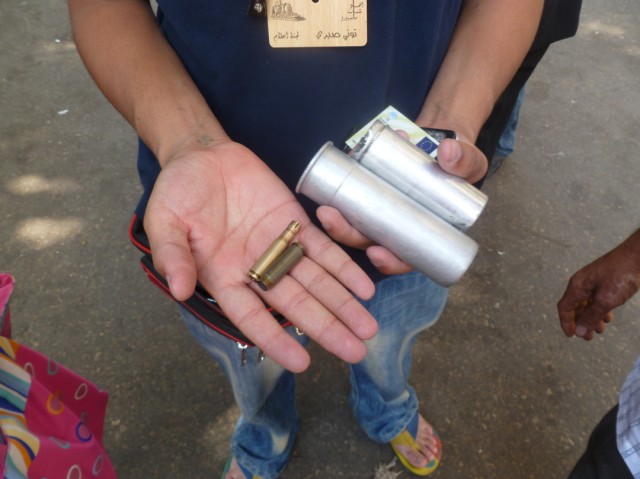
Bullets and Tear Gas Canisters from the Attack

Farag then walked with me to the southern entrance of the sit-in area, to describe the attack which happened earlier. Though he was not present at the beginning, he ran to the scene to investigate when commotion occurred. Around 8pm a group of 100-200 ‘thugs’ descended the on-ramp of the October 6th bridge, and a similar story unfolded. Copts ran out to meet them, suffered injury from gunfire and other weapons, but drove them away after only ten minutes. In my earlier survey of the news, I was not aware of this attack. Farag stated that men in the appearance of Salafis were among the armed in this group as well. Salafi presence had been denied in earlier media reports.

On-Ramp for the October 6 Bridge

Media Manipulations

Along the way he refuted two matters that have been reported in the media. First, he directed attention to the Foreign Ministry and the Radio and TV building. It was claimed that Copts had attacked these building before the altercation, but neither showed signs of damage. It is possible minor damage may have been repaired, as a full day had passed between the altercation and my visit.

The second matter represented what Farag claimed was a propaganda falsehood. On the first floor balcony of the Radio and TV building was erected a video camera pointing to the main stage, but on a swivel pivot. Farag stated the camera was pointed toward empty ground to the side of the stage, and showed this footage on state TV, claiming the sit-in was over.

The Radio and TV Building, with Camera Mounted on the Balcony

Statements concerning the end of the sit-in may well have been believed coming on the heels of Pope Shenouda’s message on TV, apparently urging its abandonment. The pope declared the matter had moved beyond the level of expression, due to infiltration that was ruining the reputation of the protestors, as well as of Egypt. He feared for their safety after the attacks, and said they would be ‘the losers’ if they continued. Furthermore, he stated, the patience of the nation’s leaders was growing thin.

Fr. Mattias Nasr Manqarius, priest of the Virgin Mary Church in Ezbet al-Nakhl, Cairo, is the official spokesman for the MYU, and one of two priests committed to the sit-in. He stated the pope’s words were not meant as a directive for the protestors to leave; in fact, he stated he had visited the pope shortly before his announcement, and was given only encouragement for their ‘normal and righteous’ demands. The next day, however, Bishop Musa, bishop of youth, confirmed the validity of the pope’s encouragement to leave Maspero.

Media manipulations, however, are claimed by the MYU. Before the pope spoke on television, a report emerged from Bishop Musa urging the youth to give up the sit-in. Asked about their refusal to heed his words, Rami Kamel stated the bishop’s words were not conveyed correctly. He knew this from video messages afterwards from the bishop in which he denied asking them to leave. Instead, the bishop offered his blessing. Irresponsibility of the media, claims Philip, was one reason why the MYU chose to demonstrate at the Radio and TV building at Maspero in the first place.

Medical Clinic

Injured Copts from the two attacks were treated at a makeshift clinic. A total of twenty-four doctors, nurses, and pharmacists have set up shifts in order to provide medical care. All medicines have been donated, and George Sidky Eskander, who has taken a vacation from his pharmaceutical company in order to join the sit-in, states supplies and equipment have always arrived at just the right moment, as if from God.

Medicines Stored inside the Clinic

Three of the twenty-four medical team are Muslims, one of which even keeps to the Salafi trend, but rejects the behavior of those practicing violence. Another Muslim is Mustafa Ibrahim. Though possessing no medical education he has been trained in field-based first aid, and has volunteered previously in Tahrir Square and in Libya. He states he is willing to die here with his brothers the Copts. His assistant, the other Muslim Ahmed al-Masry, is a graphic design student at Ain Shams University, but learned medical care from his father, a surgeon. He is disturbed how religious groups are tearing the nation apart, after the experiences of Muslims and Christians together at Tahrir Square. As a revolutionary there, he was shot in the arm by police on January 25, the first day of protests.

Mustafa and George, in front of the Clinic
Ahmed, Showing Where he was Shot in the Arm

Eskander stated that many of the injured refused to be transported to hospitals, out of fear they would be arrested there. Instead, during the attacks of May 14 the clinic tent grew three times in size, treating open wounds and bruises as best they could. Many of the serious cases, such as one skull fracture, were rushed to local hospitals.

Legal Services

Karam Ghubriyal is a Coptic lawyer providing volunteer legal services and documentation for the MYU. He stated that fifty-six people were arrested from two hospitals, and only eight of these were Muslims. It is not known if this number corresponds to the totals announced of those involved in the attack, or has simply been unreported in the media. These arrested were taken from the Coptic Hospital on Ramsis Street and the Police Hospital in the Aguza neighborhood. They were charged with ‘thuggery’, and detained first in a military holding facility, before being transferred to a public jail.

Ghubriyal, working with a team of lawyers including several Muslims, was able to secure the release of thirty-two arrested Copts. Due to the late hour running into the designated curfew of 2am, Ghubriyal made sure those returning to Minya in Upper Egypt did not try to return home and perhaps be rearrested. Instead, the five went back to Maspero and spent the night at the sit-in. He is currently working with his team to secure the release of the remaining sixteen Copts in custody.

Area Management

As the day progressed Maspero appeared more and more chaotic, as pedestrians on foot traversed the area on their way north or south. The army permitted street vendors to enter the area as well, setting up booths for tea or snacks. More and more Copts also arrived simply to join in the demonstration. It was a working day, and thus numbers did not resemble the weekend totals of several thousands, but it was clear many Copts continued to support the effort, despite the message from Pope Shenouda.

Rolla Subhi is a twenty-two year old Coptic woman heading up the committee for order. She supervises the subcommittees for checkpoints, as mentioned earlier with Farag, the speaking state, food, drink, and cleanup, and a very important committee – given the increasing commotion – called ‘rangers’.

Ramon Nadir and Claire Makram are two of the approximately fifty rangers, ten of whom are women. Their responsibility is to roam the area and look for signs of trouble. They communicate with the Egyptian police and army, and were able later in the day to re-setup the separate Coptic checkpoints to ensure no weapons entered the area. They inquire about the hunger, thirst, or fatigue of key volunteers. Perhaps their most important responsibility is simply to check in on crowds. Whenever a group begins to assemble of more than three or four, and certainly if voices are raised, the nearest ranger investigates to see that everything is ok. Rangers make certain disputes are resolved quietly, before escalation. It is impossible to control every Copt who comes to protest, Subhi states; fears exist that less educated or more traditional Copts might respond to an insult given, becoming easily provoked. The ranger team, however, has kept problems to a minimum so far.

Ramon and Claire, to the Left

Conclusion

In his first live television appearance, General Tantawi of the Supreme Council for the Armed Forces addressed the graduating class of the police academy. He stated the most urgent needs of Egypt rest in its economic and security stabilization. He promised he would not allow any forces to divide the national unity of Egyptians along religious lines, mentioning specifically that sit-ins harm the economy and provide opportunity for ‘thugs’ to wreak havoc toward their self-serving goals.

Many at Maspero believe the actions of the army and police, in this and other sectarian instances, to indicate they are against not only the Coptic sit-in, but biased against Copts in general. Coupled with an understanding that Pope Shenouda has declared them to be ‘the losers’ if they continue, the protestors believe more violence will be directed their way, and perhaps they will be evicted by the army. For now, their protest continues, but Fr. Mattias does not paint a pessimistic picture. ‘Yes’, he states, ‘some of our demands have been met. Sixteen closed churches have been promised to be reopened. We believe the authorities when they say they will open them. But we will stay here until it actually happens, so that lower level officials receive pressure from above to make it happen.’

It is difficult to say if the Copts, and several Muslims, at Maspero are correct in their actions. They press on contrary to the leanings, if not will, of both their civil and religious authorities. Yet they are people of conviction, courage, and organization, fighting for the rights of all Egyptians, not just Copts. Their appearance, either if manipulated through the media, or if truly in essence, is of a separatist action. Are they uniting Egyptians, or dividing them? If dividing, is it in positive effort to bring awareness to those in the dark?

Philip sees their struggle as akin to the civil rights movement in the United States. It is not only that laws are bad, but that good laws are not enforced. ‘It is not just for ourselves that we demonstrate,’ he says. ‘If Coptic rights are not respected, then perhaps next to fall will be the rights of Muslims of different persuasion.’

It is too difficult to judge, and furthermore it is not my place. Yet may prayer be asked for wisdom on their behalf, patience for those who grow weary of their voice, and forgiveness for those who violently attack them. May all find place to give blessing to the other, no matter how stridently they wrestle politically.

Categories
Personal

Thoughts and Photos from Friday Protest: National Unity and Palestinian Solidarity

I was present at the Friday, May 13 million man demonstration in Tahrir Square. It has become commonplace for activists of all sorts to call for ‘million man’ demonstrations these days. While impressive in size, it was nowhere near the crowds assembled in Tahrir during the revolution. Rather, about one-third to one-quarter of the square was filled, which has been one of the largest gatherings since the revolutionary days.

Participation was fueled in two directions. In the works had been a solidarity demonstration in advance of May 15, the establishment of the state of Israel, which is called the nakba, or ‘catastrophe’, throughout the Arab world. Egypt has been excited with the newfound independence of its foreign policy, which is widely credited with urging the recent Fatah-Hamas reconciliation.

The other direction came after the horrible attacks on churches in Imbaba. These have been condemned by all sectors of Egyptian society, and many activists and political groups called for Friday to be an assertion of ‘national unity’, the catch phrase that declares Muslims and Christians in Egypt to be one people. It is, depending on perspective, a lofty goal, an essential fact, or an empty expression.

It is laudable to demonstrate for national unity, and it is laudable to demonstrate for Palestinian rights. Bringing the two together, in this instance, left a very bad taste in my mouth.

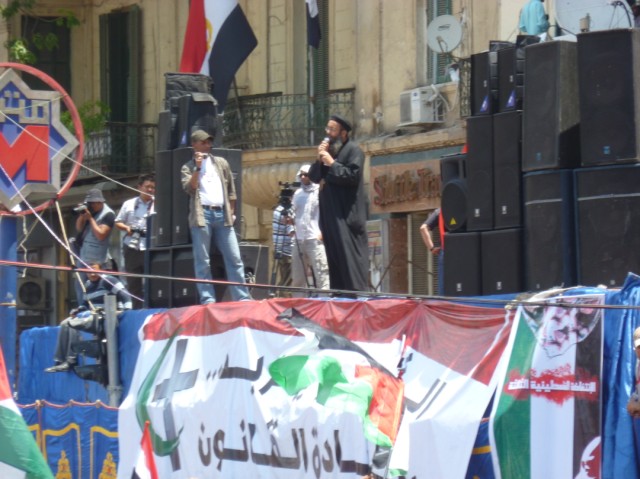
The main stage activities began with a Christian ‘church’ service, followed by Muslim Friday prayers, and a number of statements by religious, political, and activist leaders. I put church in quotes, unpleasantly mindful of the sarcasm, but recognizing the difficulty of the speakers. Apparently representing evangelical traditions, though with one Orthodox priest speaking prominently, their time consisted of efforts to connect with the crowd through chants that mostly fell flat, praise hymns that no one recognized, and assertions of national unity and Palestinian solidarity against Israeli oppression.

Most Arab Christians recognize the Palestinian people as having legitimate rights, and the Israeli government of having oppressed the occupied territories. Yet to an overwhelmingly Muslim audience, significantly representing Islamist groups such as the Muslim Brotherhood and al-Jama’a al-Islamiya, it appeared their main objective was to present their credentials as Palestine supporters. Little was spoken that could be understood as Christian-particular, though one speaker did urge those present to remember the cause for justice must be joined by truth and love.

Contrast their effort with Islamic Friday prayers, which was a masterful performance by the speakers. Islamic to the core, they wowed the audience, weaving assertions of national unity and Palestinian solidarity with cries to continue the revolution and purge the remnants of the Mubarak regime from the nation. The official Friday prayer speaker called for a civil state, and brought many in the audience to tears as he implored God to protect the revolution, save it from religious division, and spread it to other Arab states.

The next speaker represented the Salafi perspective, which equally condemned the Imbaba attacks and promoted national unity. There was little that would represent any of the recent controversial Salafi statements, such as opposition to democracy or the eventual return of the caliphate. There was much anti-Israel rhetoric, however, calling for millions of Egyptians, Muslims and Christians, to pray in their holy sites in Palestine, proclaiming Jerusalem to be their capital alone.

Other speakers continued on the same lines as those above, and I have little argument with either cause, inasmuch as Egyptians have the right to express these perspectives. Two disconcerting trends emerged, however.

First, it seemed that national unity was being built upon the back of a common enemy. Yes, Muslims and Christians can come together to condemn Israel, but will this solve the real domestic, if sometimes exaggerated, issues that produce sectarian conflict? Furthermore, speakers adopted the ‘national unity as fact’ perspective, blaming all problems on ‘the remnants of the NDP and security forces’ for instigating chaos in counter-revolution. There may well be manipulating forces at play in Imbaba and elsewhere; the proclamation of the truth in this conspiracy only masks over real tension. Yet it was not just lingering Mubarak cronies who are to blame; these, it was said, were working, as before, at the behest of Israel and the United States.

Yes, it would seem Israel would benefit from a divided, weakened Egypt. Yes, Israel has manipulated sectarian tension previously, at least within its own borders.[1] Is there evidence of it here in Egypt? I have seen little, but this is the nature of conspiracy. It may well be true, but it is believed as mantra. In the end, it does no good, since it closes the mind and turns a blind eye to one’s own faults.

Second, flowing from this, there was a distinct lack of civility in discussing the issues. Perhaps it is the nature of politics, populist politics in particular. While the speakers generally did not use incendiary words, the chanters from the stage led reprehensible, inflammatory cadence. ‘We demand expulsion of the ambassador of pigs.’ ‘We are going to Tel Aviv as a million martyrs.’ Though not everywhere or fully representative of the crowd, Israeli flags were burned, and an effigy was hung.

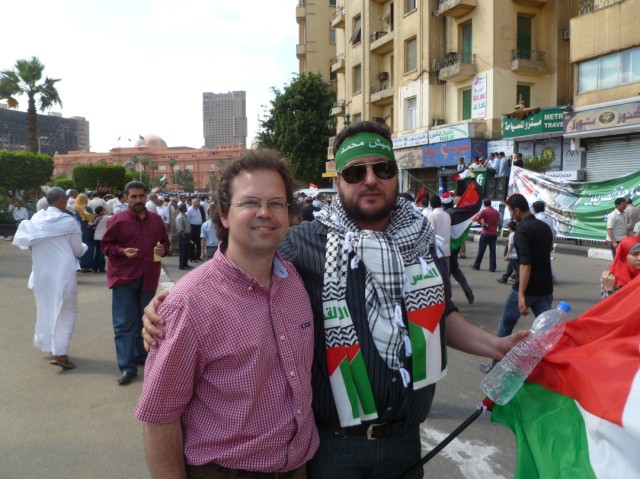
There was also the presence of a green headband-wearing ‘Army of Muhammad’. These proclaimed the eventual formation of an Islamic army that would liberate Palestine. In conversation with one adherent, he made several nuances that delay quick rejection. First, the Arab Spring has taught us that we can have a peaceful army. We will march to Israel, though there will be bloodshed wrought against us. Second, Palestinians are strong enough to win liberation on their own. We must support them by becoming strong ourselves, so as to pressure Israel, not to attack it. Third, we are a distinctive Islamic army, remembering the great Islamic victory over the Jews in Medina. But we will march side-by-side with our Christian brothers in support of this cause.

In this youth there was civility, and it showed in his discussions with Christian protestors who engaged him about the issues of Egypt and national unity. Though both sides championed the same phrase, there was deep division in understanding the problems at hand. One wanted an Islamic state which would protect Christians, the other wanted a civil state which would protect Christians, and others. They could not come together on essentials, but they departed friendly, after giving ear to the explanations of the other.

Perhaps this encounter should give me pause in my uneasiness. The rhetoric of the day was both lofty and base. One worthy cause was emptied of depth; the other was adorned with contempt for an enemy. Yet the people involved – even from extreme interpretations – discussed. There was no violence, no aggression, only the inflammation of public words. This gave me much pause, and interestingly, the Christians were not very good at it (though the Orthodox priest was better). Yet in personal conduct, even with those of completely opposite persuasion, there was peaceful exchange.

If only such exchanges might be had more often – between Muslims and Christians, even with Zionists. Alas, people do not often talk about that which divides them. An event such as this, as uncomfortable as it was to my Western Christian sensibilities, at least gets people talking, and puts them in one arena so as to discuss together. May all have the bravery to stay there, and keep alive the dialogue.

translation: Muslim, Christian – one hand; the people, the army – one hand; Fath, Hamas – one hand
the Palestinian flag, carried through the crowd
an Orthodox priest addressing the crowd
sitting to listen to the Friday sermon in the heat of midday sun; my neighbor shared his newspaper with me, and several others
prostrating during Friday prayers; see some standing away from the crowd; among them, I was asked to politely sit
cheering for Palestine during the speech of a popular Salafi preacher
a side stage rally for Palestine, with a Christian to the left and an ‘Army of Muhammad’ Muslim to the right
an effigy of the State of Israel
burning and stomping on the Israeli flag
the ‘Army of Muhammad’ supporter described in the text…
… and 2nd and 3rd from the left are the two Christians who discussed national unity with him
(note: this last picture was taken from a visit to Maspiro, I hope to post a second text on the attacks tomorrow)

[1] See ‘The Body and the Blood’, Charles Sennot, formerly a journalist for the Boston Globe, for examples he has documented.

Categories
Arab West Report Middle East Published Articles

Attack on Coptic Protest at Maspero: Early Details and Context

Two people were killed and scores were injured following an overnight clash at the site of an ongoing Coptic protest outside the Egyptian Radio and Television building at Maspero, Cairo. According to Mina Magdy, head of the political committee for the Maspero Youth Union organizing the sit-in, hundreds of thugs arrived around 12:30am and began attacking the protestors. Magdy stated the police did not involve themselves immediately, but the attack continued until 1am when police fired live ammunition into the air, and fired tear gas to disperse the attackers. Magdy relates there were around one thousand demonstrators at the time of the attack, and though the numbers have now decreased, the sit-in is continuing.

Egyptian newspaper al-Ahram reports there were 250 attackers, fifty of whom have been arrested by police. Attackers lobbed rocks and Molotov cocktails from an overhead bridge nearby. Al-Masry al-Youm reports the attackers fired ammunition into the demonstrators. CNN reports that the Coptic demonstrators broke up the sidewalk so as to defend themselves by throwing chunks of concrete at their assailants. One, it is reported, was apprehended and beaten badly.

Al-Ahram reports the altercation originated following arguments with the protestors and drivers of vehicles on the major road in front of the protest area. It quotes a protest organizer who stated the driver of the vehicle tried to enter the demonstration area, but refused to be searched for weapons, and tried to instigate trouble. The paper states the attacks were in revenge of this altercation, but the driver is not identified.

None of the reports or Coptic sources at Maspero stated the assailants were Salafi Muslims in their appearance; rather, they were thugs. The identity and motivations, however, are unknown. Salafis stand accused of fermenting and perhaps perpetrating many of the recent attacks on Copts and others since the revolution, though it is also claimed remnants of the former regime and security system have been provoking sectarian conflict.

I was able to visit the Maspero protestors yesterday, before the attacks, and learned of their organization, witnessing the layout of the area.

The protest area at Maspero has three main entrances, each with both army personnel and Coptic guards to search all before they enter. The system is similar to that established at Tahrir Square during the revolution, to ensure all weapons were kept out of the protest area.

Yet despite the precautions taken at the walkway entrances, the protest area stretches parallel with the major north-south thoroughfare running along the Nile River. There was simply a string of rope separating the protest area from the street, and traffic passed smoothly. Several policeman were present, but there was no cordon to separate the protestors from the street. Sporadically protestors would cross over to the opposite sidewalk, and relax on the other side. I witnessed what appeared to be one or two minor altercations with vehicles as they passed by. Nothing transpired, but traffic slowed as protestors emptied into the street inquiring about the vehicle.

The Maspero Youth Union is coordinated by Rami Kamel, a 24 year old law student at Cairo University. It represents a merger of several Coptic organizations which organized following the attacks on a church in Atfih, to the south of Cairo. The conducted a sit-in protest over several days, vacating the premises upon promise of the ruling military council to investigate and rebuild the church. Yet Fadi Philip, foreign media spokesman for the media committee, states their departure was not entirely voluntary, as they were attacked by the army as they were leaving. Nineteen protestors, including three Muslims, were arrested on charges of weapons possession and thuggery. Philip stated these charges were baseless.

The location of Maspero was chosen for three reasons. First, they believed holding their sit-in at Tahrir would be too provocative. Second, the site of the Radio and Television headquarters represented their belief concerning media bias against Coptic affairs, especially in the reporting about the Atfih church. Third, they had established Maspero as a place of protest earlier, following the attacks on Nag Hamadi, in January 2010, and Alexandria, on New Year’s Eve 2010. Before their initiative, Coptic protests had almost universally been within church grounds.

Following the attacks on churches in Imbaba, Copts returned to protest at Maspero, where the sit-in has now continued for over a week. On Friday, the day of protest at Tahrir Square for national unity and Palestinian solidarity, thousands of Copts joined the sit-in protest instead at Maspero, about a ten minute walk to the north of Tahrir Square.

The protest area at Maspero hosts a stage from which speeches are delivered and chants issued. Rami Kamel states the stage is open to anyone; Michael Munir, a youthful activist stated I could speak if I so desired, and introduced me to the committee member who could arrange this. Kamel states even Salafi Muslims are welcome to speak, though none have as of yet. Several Muslims, however, have joined their protests in expression of solidarity.

The Maspero area also houses several tents. One is for medical supplies, another for food, and two for providing space for interviews and committee discussions. Banners proclaiming Coptic slogans are everywhere, also lining the street in front of the area. Among these was a large sign showing sixteen pictures of recent incidents suffered by the Coptic community. Most banners were not provocative, but did emphasize a particular Coptic frame of reference.

Rami Kamel, however, states the efforts of the Maspero Youth Union are to emphasize Coptic rights within a framework of citizenship, far from sectarianism. He desires the sit-in to be seen as political action, not as religious or church based.

Two Coptic Orthodox priests have joined the sit-in, Fr. Philopater Jamil, from Giza, Cairo, and Fr. Mattias Nasr Manqarious, from Ezbet al-Nakhl, Cairo. Kamel states the presence of two priests helps lend legitimacy to the protest in the eyes of the Coptic faithful, but that it is good to have only two priests, and not more, or else the Maspero effort might appear to be more religious than is intended.

Fr. Philopater and Fr. Mattias were among the original Coptic demonstrators which merged into Maspero Youth Union, and Fr. Mattias is the official spokesperson for the group. They are also the editors of al-Katiba al-Tibiya,[1] a Coptic newspaper focused on reporting about grievances suffered by the Coptic community. The newspaper is widely distributed in Coptic Orthodox Churches, and has been understood as enflaming the widespread Coptic perception of persecution. They are linked also to Copts in the United States, which often call for the intervention of the US government or the international community in defense of Egyptian Copts. For their activities they have come under approbation from church hierarchy.

The CNN article quoted Rafiq Hanna, a protestor, as calling for international protection, stating the Copts are threatened all over Egypt. As I visited Maspero, identifying myself as an American, I was often asked why the United States did not intervene, putting pressure on the Egyptian government to secure their human rights. Yet during the national unity and Palestinian solidarity protests in Tahrir Square, Fr. Philopater, officially representing the Maspero Youth Union, addressed the crowd in the strongest language possible: We reject all international interference in Egyptian affairs. The concerns of the Copts are Egyptian concerns only.

Mina Magdy explained this was part and parcel of their Egyptian identity; the continuity of Christianity in Egypt is in their hands alone. If support was sought from a foreign power, this power would only support as long as it was in their interest to do so. Meanwhile, the effort to appeal internationally would be seen as traitorous. One only would have to look to Iraq, he stated, to see how poorly the United States has protected the Christian community there.

I asked Madgy if his position had changed after the attacks on Maspero. It did not, he said. We reject foreign interference in Egyptian affairs.

The goals of the Maspero Youth Union are to work for a civil state, the concept of citizenship, and equal rights and equality for all. Their particular rights, demanded in this sit-in, are for a unified law for building houses of worship, a law against discrimination in any form, the right to be ruled by Christian law in personal affairs (marriage, divorce, inheritance, etc.), opening of churches which had been closed by security prior to the revolution, the release of their imprisoned colleagues, and the release of a nun, Maryam Raghib, who was arrested for adopting children, as adoption is forbidden under the Islamic sharia.

Additionally, the union supports calls, made also by others, for a joint military-civilian council to guide Egypt through its transitional period of government. It seeks the trial of all criminals involved in recent sectarian attacks. It wishes the cancellation of all traditional use of ‘reconciliation committees’ to smooth over sectarian conflicts and release perpetrators. It does not call for removal of Article 2 of the Constitution, which declares Islam to be the official religion of the state, with the principles of Islamic sharia as the source of legislation. Though it finds this article to be contrary to principles of civil government, it believes the removal thereof to be impossible, and is thus not on the agenda of activity.

Kamel stated negotiations with the ruling military council were resulting in progress in crafting an anti-discrimination law, and also in securing the opening of several churches.

The Maspero Youth Union does not advocate any particular political position or party, but rejects official dialogue and cooperation with the Muslim Brotherhood and Salafi groups. This is on the grounds that, whatever individual members of these groups might profess, sincerely or otherwise, as ideologies their written words speak against the concept of citizenship. Therefore, until this changes, the union will not allow itself to be co-opted into the betterment of the Islamist image.

Rami Kamel states that the political and non-religious stance of the Maspero Youth Union is informed by his personal philosophy of liberation theology, in an Orthodox Christian perspective. He emphasized this was not of the Latin American variety which promoted violence; rather, non-violence was the rule though self-defense is permitted. He believes the Christian faith should drive one to strive for social justice, though through means limited by Christian ethics. Specifically, one should submit to violence and not strike back, not cowering from the attack but insisting on one’s rights all the while. Paul the Apostle, in Acts 22, is taken as a model.

Yet it seemed that despite the sincerity of this philosophy among Maspero leadership, it did not necessarily reach the hundreds of ordinary Coptic Egyptians who populated the protest. Kamel stated they do their best to instill this value and reign in the excitement of the protestors. There were not, however, religious activities such as prayer groups or Bible studies, through which commitment and discipline might be achieved. These activities, Kamel stated, would transform the demonstration into a religious activity. He purposed their efforts be seen only as political action, in defense of Coptic rights, but from a position of citizenship, not religion.

The facts of the overnight attack on the Coptic demonstration are still yet to be determined. The day before, Mina, an ordinary protestor, stated that Maspero was suffering from attempts to instigate conflict. He was afraid that if fighting broke out, the army would use this as pretext to evict them from their place. In terms of instigation, this fear now appears justified, but so far, the army has allowed the sit-in to continue.

There is much distrust currently among Copts concerning the direction of the revolution, the space Salafi Muslims have to operate, and the suspected secret intentions of the ruling military council. Many Egyptians of all persuasions have equal concern and confusion, even if their questions are directed differently. May patience and wisdom be sought by all, as they continue to cling to calls for justice. May civility reign as this process, however messily, is determined.


[1] In Coptic history, al-Katiba al-Tibiya was an Egyptian legion from Thebes, fighting for the Roman army in Europe. When demanded to renounce their faith and worship the emperor, the entire legion refused, submitting instead to martyrdom.

The concept of martyrdom is key for the Coptic Orthodox Church; indeed, their church calendar begins from the era of Diocletian, a Roman emperor responsible for the deaths of thousands of Christians. A popular chant of Copts states, ‘with our souls and our blood we will redeem you, oh cross!’ As Kamel explained, this was not an aggressive slogan. Rather, as Jesus redeemed humanity through death, so also are Copts willing to suffer martyrdom for the sake of the cross.

Categories
Personal

Thoughts on Belonging and the Salafi Label

translation: We reject violence…peaceful…peaceful (R); Don’t believe the lying media (L)

The past week has presented opportunity to reflect on interactions with Muslims here in Egypt. More precisely, the reflection has been on my demeanor within these interactions.

On the whole, we are very comfortable and happy to be living in Egypt. We enjoy good relations with friends and neighbors, Muslims and Christians. We do, through the church, have a disproportionate number of Christian friends, but having been several years now in the Arab world, we know the goodness of the Muslims we live among.

Why then has this sense of belonging felt compromised in the last week?

On the one hand the reasons are obvious. My work placed me at a pro-bin Laden demonstration one day, and in an area torn apart by religious strife on another. Following the death of bin Laden warnings were dire his supporters would retaliate, especially against Americans. Following attempts to investigate the religious strife in Imbaba, a CNN reporter told his story of having to run for his life from angry mobs. Tensions are high; there is no room for a cavalier spirit.

Yet is there room for belonging? If so, what would it look like? This is the central question for us, not whether a report can be written or a story conveyed. Can we do these jobs with concern for and commitment to those with whom we interact?

I felt the compromise most on Friday, when I visited both the bin Laden demonstration and the Coptic Orthodox Cathedral. At the cathedral Copts were awaiting the coming of Salafi Muslim protestors; due to several factors, including the bin Laden rally, they never came.

Yet while the Copts demonstrated anyway, I moved among them freely. I asked questions, I took pictures, I shot video – I had nary a thought of concern. I was not demonstrating with them; in fact, I felt quite at odds with what they were doing. But I felt at home; I felt comfortable. I trusted them.

Contrast this to my feelings at the bin Laden protest. It started earlier when I visited the mosque from whence the protest began. I stood at a distance, I held aloof from security, I scoured the area for a place of protection – I had nary a thought of tranquility. I was not watching opposed to them; in fact, I felt sympathy with their effort to honor the dead in defiance of Western scorn. But I felt foreign; I felt alone. I feared their reaction to me as an American.

Fear is not the right word, not if interpreted in terms of safety. But this feeling was amplified later that day when I arrived at their protest in front of the American Embassy. With the Copts, with Christians, I had no thought other than to jump right in. Here, with Salafi Muslims, I kept my distance, watching from the other side of the street. Again, there was no fear – the demonstration was peaceful, and soldiers kept watch of the proceedings – but there was also no belonging.

Perhaps the distinction of religion makes the difference. We aim for a sense of belonging to Egypt; we have a double sense with the Christians here. That second level of belonging is missing with Muslims, particularly with Muslims who practice in confidence. There is no opposition; on the contrary, there is great admiration. We wish to befriend these, learn from them, and should any opposition be found on their account, we wish to overcome it.

This was my attitude visiting Imbaba, but there were Christian sources to pursue first. Our interview was with the priest of the church, and we spent our time within its burned out walls. When certain youthful Copts had a run-in with the army outside, and then their fury was unleashed back inside within ecclesiastic safety, I was overcome with the weight of the situation. The day before, twelve people were killed as churches were attacked. Many feel the army did little to protect them. Witnessing their rage, I was initially paralyzed, but knew there was a place for me to have a role. It is my church also. It is not my struggle, but these are brothers in faith. Eventually, I did my best to offer words of calm and comfort. Again, I felt at home.

After we conducted our interview, I suggested to my Egyptian colleagues that we seek the army’s help in arranging a meeting with a Muslim sheikh. The area was still tense, and it would likely not be right to simply wander around, especially with me as a foreigner. They hesitated; there were time factors involved to be sure. But they too were nervous about the tension in the area, unsure of how they, as Copts, would be received. In the end we returned home.

Our report would have been better if we had Muslim sources to match, but that was not my chief concern, and may have marked a difference of emphasis between me and my colleagues. If I struggle with my lack of second-level belonging to Egyptian Muslims, many Copts, who should bear first-level belonging as Egyptian citizens, lack it altogether. Fine. Many on both sides are polarized, and in this text I am not reflecting upon them.

In this instance I sensed the divisions in the neighborhood, perhaps extending to the world, and wished to overcome it. In the middle of strife, I wished an uninvited American could sit down with, seek the opinion of, and honor the Salafi sheikh in front of him. Who will ever read what I write? Yet there was a chance to build relationships of peace with one in an area currently in need, with one in whom no natural bond existed.

This is the valor I can sometimes summon, but part of my language above gives me away. I stated: It would likely not be right to simply wander around, especially with me as a foreigner.

Why should I have not walked right into the middle of the pro-bin Laden demonstration? Why do I assume I would have little welcome in Imbaba? The external reasons are obvious, and should not be treated lightly. Yet it is the internal reasons which concern me. Where is my sense of belonging?

It is natural to be comfortable with those of like nature. With Egyptian Christians there is a like nature of faith, and with Egyptians in general we have discovered a like nature of humanity.

With both of these groups, however, and especially from my essential nature as an American, there is an assumed and created nature of enmity. Yes, every group defines itself at least partially in opposition to the other, and there is little harm here. Yet my group has demonized bin Laden and his supporters. My group – both American and Egyptian – sit either fearful or suspicious of Salafi Muslims. This, through belonging, is nurtured in my heart also.

Therefore, it is only through belonging that it can be nurtured out. Yes, those groups are demonized because they demonize us; yet which is first, the chicken or the egg? In the end, both become food: Do you prefer to be rotisserie or scrambled?

I have a fear that the label ‘Salafi’ is being appropriated in popular usage to generalize a community and minimize their humanity. Not all Salafis are violent, perhaps most are not. This is an item I must discover through research and relationships. They may bear an ideology many would be right to oppose; they themselves must be treated with dignity and the diversity present in their thought. ‘Salafi’ risks becoming like ‘terrorist’ or ‘Muslim extremist’ – catchphrases utilized to instill fear and rejection, while the content of the label remains nebulous and ill-defined.

We must resist all labels, even as we acknowledge their reality. If we can find in our hearts the desire to belong to those with whom we naturally do not, maybe one day we will. This, perhaps, is the path of peace.

Categories
Personal

From the Burned Church in Imbaba: Fr. Mityas on the Event, Explanation, and Spiritual Response

The Church of the Virgin Mary in Imbaba was burned deliberately by Salafi Muslims, in an effort to spread division in society and culminate ultimately in an Islamic state. This is the testimony of Fr. Mityas Eliyas, priest of the church, in an interview with Arab West Report.

The Event

The attack began at St. Mina Church, two kilometers away from the Church of the Virgin Mary. An originally small group of approximately thirty Salafi Muslims and their sheikhsarrived and demanded to search the church, looking for Abeer, a supposed Coptic convert to Islam held against her will. Church guards consulted by phone with the priests of St. Mina, who authorized the sheikhs to search the church. When they found nothing, they exited but protested further, asserting the church had secret rooms in which she was kept. From here, the basic narrative is known. Scuffles broke out between the armed group and eventually hundreds of local Copts, who had come to its defense making a human chain. The number of assailants multiplied rapidly, and the conflict resulted in twelve deaths and over 200 injuries.

Fr. Mityas then relates the particular story at the Church of the Virgin Mary, which was constructed in 1969, and where he has served since 1981. Approximately 50% of the population around the church is Christian, in his estimation. His testimony comes from eyewitnesses in the church, though he himself was not present until after the fire was ablaze.

While the altercations were concentrated originally at St. Mina Church, three Salafi Muslims came to the Church of the Virgin Mary and began pounding on the doors. Getting no response from the guards inside, they shot at the locks, and eventually used an iron bar to pry open the gate. One guard, Salah, had his throat cut. From the other, Malak, they demanded he turn over the weapons cache of the church. In addition to rumors about captive Coptic women converts to Islam being held in churches and monasteries, rumors exist that Copts keep weapons in their houses of worship.  In the 1970s and periodically since then there has been a pernicious rumor that the churches of Upper Egypt, in Asyut in particular, were storing weapons in preparation for violent efforts to overthrow local government and declare a Coptic state in the region.

Malak insisted there were no weapons, so they accosted him and seized his papers and cash (the equivalent of approximately $300 US). By this time, however, neighbors became aware of the altercation, and local Muslims rescued Malak from harm.

Eyewitnesses report that Salafi Muslims had cartons of flammable material with them, though whether this was gasoline or Molotov cocktails was not known to Fr. Mityas. What is clear is the damage done. The Church of the Virgin Mary occupies a relatively small amount of surface area, but ascends six stories tall. The ground floor houses a simple chapel, with the main sanctuary above it. This sanctuary has two levels of balcony seating, creating a stadium effect in which worshippers are able to look down on proceedings. Above these are two stories of general office space.

The bottom chapel, including the altar and iconostasis, was incredibly charred. The main sanctuary had extensive damage, reaching up to each balcony. Heavy soot plastered the walls. All electrical and mechanical equipment was destroyed; all books and papers were burned. Salah, the church guard, was found ‘as charcoal’, as Fr. Mityas insisted his description be rendered. Remarkably, despite the damage, Sunday, the day after the attack, the church still conducted Holy Communion.

The following are pictures of the fire damage:

The Political Response

Since the attacks, Egypt has rallied to condemn the sectarian outbreak in Imbaba. Mohamed el-Baradei, a presidential candidate, and other civil leaders participated in a 2000 person march through Imbaba to demonstrate solidarity with victims. They asserted the now common chant, ‘Muslim, Christians, one hand!’

Meanwhile, Sheikh Mazhar Shahin, imam of the Omar Makram Mosque near Tahrir Square, visited Maspero and joined the Coptic demonstration there. He stated that Egypt must resurrect the popular committees which protected mosques and churches during the revolution. Safwat Higazi, a Salafi leader, stated the attackers were ‘thugs, not Muslims’. The Muslim Brotherhood, for its part, condemned intolerance and secret hands trying to spread chaos in society. The liberal Wafd Party echoes this claim.

Within Imbaba, Sheikh Muhammad Ali of the Toba Mosque relates his version of the story. He was approached by the husband of Abeer, but did not believe his story. He told Muslims around him the man was a liar, and this group left, chanting Muslims and Christians are one hand. When he went with an official to the church to inform them the issue was concluded, local Christians assumed they were trying to enter the church, and began pelting them with bottles from the balconies. Soon thereafter, gunfire erupted, and the situation spiraled out of control.

The ‘secret hands’ mentioned by the Muslim Brotherhood have been identified by the ruling Supreme Council of the Armed Forces. A military source has revealed the discovery of a plot by remnants of the former regime to plunge the country into civil war through inciting sectarian tensions. 190 people have been arrested, and the death penalty has been threatened. Among the arrested are Abeer’s husband, and a local Christian café owner. The Copt is accused of firing his gun into the air to disperse gathered Muslims, which set off the protests.

The local governorate has pledged that it will rebuild the church, starting within ten days, in an operation that will take three months and over one million US dollars. Victims will be compensated: approximately $1000 US for those killed and $400 US for the injured. Security is being increased at all churches in the governorate.

Claims exist that the Salafi movement in Egypt is funded by Wahhabi Muslim states from the Gulf. The attacks, however, have been condemned by both Saudi Arabia and the United Arab Emirates.

The Explanation

Fr. Mityas has another explanation. He states Abeer, seven months ago, converted to Islam as she married a Muslim, but then ran away from him and returned to Christianity. The whole Imbaba episode, then, developed from the following lie: A call went to Abeer’s husband by someone from the area, stating Abeer claimed she was being held in the church against her will, asking for help to escape. The attack was planned, Fr. Mityas believed, and had no relation to the Camilia Shehata interview a few hours earlier, in which she, though believed by Salafis to be captive in a monastery, declared publically her Christianity. Some have argued the Imbaba troubles gained steam in spontaneous reaction to her appearance on television. Sheikh Muhammad Zughbi, however, seized on the story of Abeer, went on television, and swore three times to God: I will take the people and we will storm the churches and monasteries.

Fr. Mityas posited the slaughter of Salah and the theft of money from Malak was to make the attack appear perpetrated by thugs, rather than Salafis, who are understood to be pious, however strict. Salafis, he said, have a strategy of playacting. While one will light a fire, another will come behind him and help put it out.

Their strategy, Fr. Mityas stated, was to spread sectarian conflict, but then work after the fact to repair relations. This was seen in the instances of previous conflict blamed on Salafis, such as in Qena, where an appointed Christian governor was refused, and in Atfih, where another church had been burned. In each instance Salafi leaders were sent by authorities to settle the situation and preach tolerance. Their message of tolerance, however, is one of protection: Islam guarantees the sanctity of Christians. The implied message, states Fr. Mityas, is that in a democratic civil state there is chaos.

While not blaming the ruling military council directly, Fr. Mityas states that Salafis have been given room to operate. Criticism is leveled, however, for continuing the policy of balance and ‘reconciliation’ conducted by Sadat and Mubarak. If a Muslim is arrested, a corresponding Christian must be arrested. Ultimately, justice is given to none when religious leaders are assembled to pronounce reconciliation, and culprits are released. Indeed, states Fr. Mityas, of the 190 individuals arrested in Imbaba, several were Christians who were taken out of their homes, having never been anywhere near the church. He was, however, was unaware of the total number of Christians taken into custody. Yet he asks, ‘Where is the spirit of 25 January? Where is the rule of law?’

Unfortunately, Arab West Report was unable to visit any Muslim sources during the visit to Imbaba.

The Religious Response

Fr. Mityas insisted that as Christians, Copts should never carry weapons except in the army when called upon to defend their country. ‘We never encourage anyone to violence; we have a religion of love.’

Yet Fr. Mityas also spoke that many people will spiritualize the message of Jesus to his disciples, in which he exhorted them to sell their cloak and buy a sword in Luke 22. Though he later commanded the sword to be left in its place, the principle put forward is that Christians should not allow themselves to be seen as weak. Instead, their enemies must view them as strong. ‘He must know you have a sword, while he also knows you will not use it against him.’

In the context of rumors about Christians possessing weapons, Fr. Mityas made absolutely clear he was not encouraging Copts to arm themselves. Rather, he stated that Copts must be strong in society, not weak, and from this strength their love and virtues would be better respected.

For example, one can only love the enemy from a position of strength. Fr. Mityas stated there were three commands given for how to perform this love, according to Luke 6. First, do good to those who hate you. Second, bless those who curse you. Third, pray for those who mistreat you. This can only be attempted by one who is strong, even if his enemy attacks him.

Fr. Mityas declared that over time, if you offer love, the enemy will feel it and be affected. If blessing and prayer are done in the individual heart, however, only doing good can extend this love so as to be felt. This is done in three ways: by offering food to him if hungry, service if in need, and words of kindness in every instance. This does not result in becoming friends, he clarified. ‘Can I be friends with Muhammad Zughbi? But I can love him and pray for him.’

Yet Fr. Mityas stated it is not true that the only means of positively affecting the enemy are through doing good. Prayer on his behalf can lead him to change his religion, his morals, or his nature. This is God’s work, but the strong Christian can ask God for it to be done.

Are there strong Christians in Imbaba for this to happen? Fr. Mityas stated that he, first and foremost, needed to repent. The church, however, has a weak faith, it has unrepentant sin, and has love which has failed to be expressed. ‘We can blame no one else,’ he said, ‘we are at fault with ourselves.’

As a prime example he listed the Christian man who engaged in a relationship with a Muslim woman in Atfih. This small personal sin later exploded, resulting in the local church being burned. ‘If we all lived as we were supposed to, then lions would be transformed into lambs.’

Epilogue

Upon our arrival in Imbaba we were escorted though the military cordon which cut off traffic from the main road and surrounded the church on the corner of the street. Only a few short moments after sitting down to interview the priest, a flare up began outside. A Coptic passerby raised his mobile phone and took a picture of the church with the soldiers surrounding it. Immediately the soldiers accosted him, a few other Copts became involved, and the priest exited to try and calm the situation and usher everyone inside. The altercation lasted about five minutes, with shouts, commotion, and accusations of abusive treatment. (From my limited vantage point, there was none, though individuals were forcibly detained while resisting.)

When the situation settled outside, it exploded inside. Two Copts raged incessantly against the army, proclaiming they did nothing wrong. Their friends held them back, shouting back at them to calm down, but the pent up rage present in the community had everyone on edge. It was a good fifteen or twenty minutes until peace presided.

The Coptic photographer was released shortly thereafter, and two senior army officials entered the church and apologized to Fr. Mityas for what took place.

There are lions about everywhere, yet there are many lambs among them. May love and right-doing be the purpose of all, that at the very least, the two may lie together.

Categories
Arab West Report Middle East Published Articles

Attack on St. Mina Church in Imbaba, Cairo

Over 10 people were killed and more than 200 injured in an attack on the St. Mina Church in Imbaba, Cairo, which took place overnight on May 7, 2011. The following information is taken directly from the testimony of two Christians of the church, one named Rimon, the other wishing to remain anonymous.

Approximately 4pm following afternoon prayers, Imam Muhammad Zughbi led between 150-200 armed Muslims a distance of one kilometer to the St. Mina Church. There he inquired about a Coptic woman who, he believed, had converted to Islam who, he believed, was being held in the church. Both sources believe this rumor was completely unfounded, and this was only a ruse by these Muslims to instigate conflict.

Shortly after their arrival church officials called the police. The police were invited to enter and search the premises, but found nothing. They carried this report back to the crowd, and then withdrew.

Having originally arrived with weapons of all varieties – clubs, swords, and automatic guns – the Muslim group began to use them. Christians rallied to defend the church, largely weaponless, but with a few simple pistols. One source said local Muslims participated in the defense of the church; the other denied this, saying they joined in the attack. It is possible both reports are true. Sources say that community relations between Muslims and Christians had been good.

Around 5:30pm Muslims from other nearby areas – Warraq, Haram, Faysal, Umraniyya – heard the news and joined the attack, increasing the number to over 400. Eventually their total was estimated at 3,000. The dead and injured were carried into the church, and fighting continued at the local homes as Christian residents hurled stones from their balconies. In all, three homes near the church were burned, and over 50 shops were vandalized in the area.

The army did not arrive until 10pm, at which point it launched tear gas at the church. Sources stated this was aimed at them, even landing inside the walls, rather than at the Muslim attackers. The Muslims also began attacking the army, launching Molotov cocktails. The army responded by firing into the air, and sources stated they did not actively intervene to end the rampage. Instead, they arrested those in the immediate vicinity as they were able, including many Christians.

The presence of the army did disperse the assailants, who then scattered and attacked other area churches. The nearby Church of the Holy Virgin was set ablaze and completely destroyed around 2am. Three other local churches also suffered damage.

Gunshots continued throughout the night. The next day the army placed the area in complete lockdown mode, arresting anyone coming out of their home. Sources say the area around the church also had water and electricity cut. The minister of the interior and governor were set to visit the area, which was under a 24 hour curfew.

Both sources identified the attackers as Salafi Muslims, due to their appearance with beards and white robes, typical of their traditional dress. They cried ‘Allahu Akbar’ during the attacks. Salafi Muslims are adherents of a conservative interpretation of Islam that desires strict application of the sharia in imitation of the era of Muhammad and his companions. Following the revolution they have been vocal in calling for an Islamic state and have been accused of multiple sectarian attacks on both Christians and other Muslims. Though admitting to their particular religious interpretation, Salafi leaders have either denied their involvement or condemned such violent incidents.

Regardless of the original intention of the attack organizers, accusations of the illegal imprisonment of Coptic converts to Islam in churches or monasteries have been rampant both pre- and post-revolution. A woman named Camilia Shehata, to be mentioned below, is the cause célèbre in this effort. Following the attack on a church in Baghdad in October of 2010, al-Qaeda declared Coptic Christians to be fair game for attack for this alleged crime. Yet rumors are also rampant that sectarian conflict in Egypt was stoked by the former security forces under the Mubarak regime, which have allegedly continued this policy since his resignation.

The above testimony was provided by two sources directly involved in the evening’s altercation. Independent verification of their testimony is not possible at this time.

Since the attacks public response has been both swift and polarized. Prime Minister Sharaf cancelled a scheduled visit to the Gulf region and called an emergency cabinet meeting. The army has arrested 190 individuals and will try them in military courts. Furthermore, the Supreme Council of the Armed Forces, currently governing the nation, has threatened the death penalty for anyone found inciting sectarian strife. Salafi leaders and popular preachers, for their part, labeled attackers ‘thugs, not Muslims’, and fully condemned the action. Similarly, many Imbaba Muslims harshly condemned the action as un-Islamic, and said the thugs were tied to the old regime.

Meanwhile, Copts took to the street to protest. A small group went to the US Embassy to demand a meeting with the US ambassador and ask international protection. A much larger and more representative group began assembling at Maspero, site of the Egyptian Radio and Television headquarters. Here, only a few weeks earlier, thousands of Copts protested over several days to demand official inquiry into an attack on a church in Atfih, an area to the south of Cairo. Instinctively, following this conflict, they return again.

Along the way they were met with derision and minor attacks from Muslim youths and other ‘thugs’. Once there, a few suffered injuries as stones were thrown upon them from the balconies above. Yet they were joined by significant numbers of Muslims, including fully covered women, declaring that Muslims and Christians in Egypt were ‘one hand’. Eventually, the opposition settled down and the protest is ongoing.

The rumor about the convert to Islam being protected has received more investigation since the initial altercation. Apparently, a woman named Abeer from Upper Egypt married a Muslim and adopted his faith. Though not required by Islam it is the near cultural necessity, especially in traditional areas, as both religious groups ostracize members who either convert to another faith or marry outside their faith community. Apparently, Abeer later on ran away from her husband, who later received a phone call that she was in hiding near the St. Mina Church in Imbaba. The official version related by the government is that her husband contacted Salafi groups in the area, and asked for their intervention.

Other sources relate that the incident/rumor circulated widely on Facebook and Twitter, identifying the location of the woman by the very street name of the church. The campaign picked up speed, and resulted in large numbers of protestors demanding Abeer’s release. Yet to date, no woman fitting this story has been identified at all.

Of consequence is that the social media campaign began a mere hours after Camilia Shehata appeared on a foreign Christian satellite program, denying she had ever converted to Islam. Previously, Salafi groups had organized seventeen separate demonstrations to demand her release from the monastery where she was allegedly being held. Pictures appeared of her wearing a hijab, but may have been easily Photoshopped. Meanwhile the church released a video of her Christian confession, but this was either ignored or dismissed by Salafis. Poignantly, she never appeared in a live setting to settle the matter once and for all. That is, until this satellite program, which was announced a day before.

Does this suggest the assault on the church was planned in advance, and that the rumor, however true the story of Abeer may be, was constructed to play on the emotions of disturbed Salafis reacting to their mistaken fury over Camilia Shehata?

This is impossible to ascertain at this point, but the location of Imbaba would have been well chosen as a Cairo neighborhood easily ignited by such a spark. Imbaba is one of the poorer districts of Cairo, hastily and haphazardly constructed in the 1970s following large scale population transfers from Upper Egypt to the city. Basic services such as water, sewage, and paved roads were absent, and the poverty combined with the resurgence of strident religious identity drove many toward extremist Islam. The conditions led local Muslim leaders to declare themselves ‘the Emirate of Imbaba’, which successfully secured practical independence from the state, keeping out all unwanted visitors, including police, for a period of weeks. During this time, there were few Christians in the area at all.

After the police broke the siege and reestablished government control, in the 1980s Egypt cooperated with USAID, an American aid agency, to bolster living conditions. The program was largely successful, improving infrastructure and microenterprise, but was also subject to local criticisms. Over time, Upper Egyptian Christians also relocated to Imbaba, and though there were occasional sectarian tensions between them and Muslims, nothing to the extent of this attack had ever been witnessed before. Yet given that community growth was random in constitution, the centuries-long historical bond between Muslims and Christians in traditional village settings, however tested on occasion, was absent from Imbaba.

What is next? It is too difficult to judge all the different conclusions being paraded. Christians are furious at the police and armed forces for taking so long to contain the violence. Accusations are that they deliberately stood aside, yet it may well be they were simply ill equipped to confront such a large, apparently organized attack in an urban setting. Some in Maspero were heard chanting, similar to the revolutionary cry, ‘the people want the downfall of the general’.

Others say this and other sectarian conflicts have been engineered by forces of counterrevolution. Most major former regime members are in prison, and Mubarak himself was recently cleared by doctors to be interred with them as well. Salafis traditionally and in their theology had always sided with the Mubarak government as being established by God. Assumptions abound that they are heavily financed by Saudi Arabia, which was loath to see an autocratic ally ousted from power, and now under judicial trial. With these allegations, the army could either still be implicitly aligned with the old order even as they ‘protect’ the revolution, or, such incidents are meant as a wedge to drive people against the army, invalidating their popular stand with the revolutionaries. Or, it could simply be the interweaving independent errors of misguided action coalescing into deep conspiracy.

Yet on the side of the Christians there is conspiracy-worthy evidence as well. Why was Camilia Shehata silent for so long, only to appear on a foreign, not Egyptian, program? Her lawyer chastised her publically for going against his advice to speak on Egyptian television, and legally with the public prosecutor. This was only days after he procured a photo with her reconciled with her husband, with public documentation he was entitled to speak on her behalf that she was a Christian, never having converted to Islam. Interestingly, even if irrelevantly, the satellite program she appeared on is produced in the United States, and carries frequent testimonies of Muslim converts to Christianity. Provocation could have been anticipated.

Arab West Report has been able to secure an interview with Camilia and her husband. She admitted to marital problems which caused her to run away. Likely ashamed, as often occurs in such situations in Upper Egypt, local Christians and perhaps her family instigated protests claiming she was kidnapped by Muslims. This played into a known narrative which Muslims picked up on, then assuming the reality that she did in fact convert to Islam.

As protests about her increased, Camilia testified she was a Christian online, but this failed to convince the hardened Salafi audience, believing the YouTube video was a fake. She grew and is increasingly terrified for potential violence against her, understandable given the events in Imbaba. All the same, her testimony in this case puts aside the many conspiracy theories surrounding her. She is simple a woman who made a mistake, which amplified exponentially and engulfed a nation.

Yet to return to conspiracy along the same lines, the subsequent Coptic protest at Maspero was their natural destination point. Why then did a few hundred gather at the US Embassy, demanding international protection? This call is consistently rejected by local Christians as being traitorously fatal to their interests as citizens of Egypt. It is heard from Copts abroad, but almost never internally. Simultaneous to their denouncing of the Imbaba attacks, Salafi leaders criticized Copts for appealing to America. Are elements of the Coptic Church or community, perhaps even the United States, also aligned with counterrevolutionary forces?

Or, does all this simply represent the coalescence of error in the midst of confusion? In all likelihood, yes. Deep conspiracy helps to make sense of facts difficult to connect together. Egypt is undergoing significant changes, and these are uncomfortable for all. Conspiracies such as these are on the lips of many, which do not help the effort to foster national unity and democratic development.

Yet it could also be said that once again this tragedy has engendered demonstrations of Muslim support for their Christian kinsmen. The revolution unleashed clear evidence of Muslim-Christian unity from Tahrir Square, confirming the solidarity witnessed after the church bombing in Alexandria. Then, Muslims around the country surrounded churches and joined Copts inside, willing to die with them should the act be repeated.

Now, Christians are worried that Islam in the hearts of Muslims will ultimately make them side against Christians in times of strife. Unfortunately, Imbaba offers evidence of this. Yet even during the hours of attack in Imbaba, groups of Muslims came together in demonstration, proclaiming Muslims and Christians to be ‘one hand’. Post-revolutionary freedom has also unleashed Salafi activity and fervor, threatening the revolution in the eyes of many. Or, could Salafi drum-beating cloud over the essential unity which normal Muslims assert has always been characteristic of Egypt?

Many Egyptians are tired. They have crafted a great revolution but are now running into the realities of their success. Interruption of the national economy has exasperated an already poor multitude. Freedom of expression has brought unwelcome views to the forefront, regardless of perspective. Governance is entrusted to military forces simultaneously valuing stability and seeking to carry out revolutionary demands, all the while having little experience in day to day management and public relations. Political factions argue over issues both major and minor, with consensus rarely apparent.

It is understandable to be tired; yet now more than ever commitment and resolve are necessary. Christians must cling to faith, both in God and their fellow citizens. Democrats must navigate political streams yet maintain unity in the reconstruction of government. Islamists must curb their quest for influence developed over long years of oppression, while continuing sensibly to shape society as they believe God intends. Salafis … I don’t know what is needed here; may God guide them as he guides all the above. May each commit to the other as an Egyptian, and refuse to allow legitimate differences to divide them in essentials. Egyptians have always been one people; perhaps there are forces, both internal and external, which seek their unfastening. Yet these are days of opportunity; a great future is before them. May the issues of Imbaba be brought justice in all its forms; may these be the labor pains following a great revolutionary conception. May belief be held that a baby is soon to be celebrated.

Categories
Current Events

Copts Rally to Resist Salafis at Cathedral, while Salafis Laud bin Laden at US Embassy


Thousands of Copts descended on the Orthodox Cathedral in Abbasiya, Cairo on Friday, May 6, in response to a Salafi Muslim demonstration at the same location a week earlier. Salafi Muslims represent a conservative current in Islam which calls for the strict application of sharia law and rejection of modern, democratic principles, believed to be Western in origin. The previous Friday, April 29, Salafis rallied for the release of Camilia Shehata and other Coptic women believed to have converted to Islam, yet allegedly held illegally in Coptic monasteries. Salafis conducted similar demonstrations repeatedly over the past several months, but this was the first time they gathered at the heart of Orthodox Christianity in Egypt – the papal seat of Pope Shenouda III. They called for the prosecution of the pope, and Copts interpreted many of their chants as insults against him and their community.

Feeling threatened, lay Coptic groups issued a call for a counter demonstration at the cathedral in anticipation of a subsequent Salafi protest. John, a Copt from Matariya, a town to the north of Cairo, stated the demonstration would be held within the walls of the cathedral, not outside. Groups would be stationed at the four gates, to prevent entry should the Salafis so attempt. Yet John instructed his delegation that if the Salafis remained outside and simply hurled insults, Copts should remain silent. Asked if there could be a positive reply, chanting words of blessing of the Salafis, John stated this would nevertheless be received as provocation. Silence would be the best response, and provide the best testimony. If attacked, however, Copts should resist and defend the seat of the pope.

Coptic fears are understandable, while also being an overreaction. Certainly Salafis engaged in provocation by marching at the cathedral. In weeks previous certain Salafi groups desecrated shrines erected at the tombs of Muslim saints, believing these to be heretical accretions to pure Islam. Yet sharia law calls upon Muslims to honor and defend churches and monasteries, and though they demonstrated at the cathedral, they inflicted no material harm. Nevertheless, Salafi groups stand accused of several grievances against the Copts perpetrated since the revolution, and there is a general sense, unproven, that remnants of the former ruling regime and its security forces intentionally stoke sectarian tensions. Yet despite the presence of rumors, it does not seem any threats were directly issued against the sanctity of the cathedral.

On Thursday, a day before the anticipated protest, Yassir Metwali, a leader of the Coalition to Support New Muslims, one of the chief post-revolution organizers in the defense of Camilia Shehata, declared there would be no demonstrations that day. The cancellation was issued late and was not widely known; in any case most Copts had already made their plans to gather. Metwali stated this was unrelated to the Coptic gathering. Unmentioned may have been another factor; Thursday morning the al-Ahram newspaper published photos of Camilia, her husband, son, and Coptic lawyer, seated together happily. The lawyer, well-known activist Naguib Gibraeel, produced documentation stating he was authorized to speak on Camilia’s behalf, who asserted she was happy in her Christianity. Surely this would not satisfy Salafi clamor, as claims and counter-claims of fraud have been exchanged between the two communities. All the same, it may have given them pause.

There have been two other issues dominating Salafi attention since the cathedral protest. The first was an attempt to usurp the pulpit at the Noor Mosque, the largest in Abbasiya. The second was the death of Osama bin Laden.

Shiekh Hafez Salama is a celebrated war hero in Egypt. In his retirement he had dedicated himself to religion, founding the Association for Islamic Guidance, through which the Noor Mosque was built. Yet since the 1970s the Egyptian government has attempted to bring all mosques under the supervision of the Ministry of Endowments. Ostensibly, this was to curb the potential for unaffiliated imams to use their pulpits to spread extremist or terrorist ideology. The effort has been mostly successful, with 95% of mosque imams receiving certification from the official ministry. The current imam, Sheikh Ahmad Turki, has been in place since 2002. Muhammad, a garage attendant in the neighborhood of the Noor Mosque, states he enjoys wide favor and is loved in the community. He also expresses admiration for Hafez Salama.

Hafez Salama, however, reflects Salafi trends, and has sought to inculcate them in the mosque since the revolution. For the first Friday prayers following the success of the revolution, he approached Ahmad Turki to allow popular Salafi preacher Muhammad Hasan to address the people. He acquiesced, provided Salama secure permission from the Ministry of Endowments. He did, it was approved, and all proceeded normally.

On April 22, however, clashes broke out between supporters of Hafez Salama and Ahmad Turki, in which sticks and knives were employed to force Turki to abdicate his position. He has called for intervention from the military to enforce ministry protocol, but in advance of this Friday’s sermon, Salama announced he would lead the Islamic funeral ‘Prayer for the Absent’, in honor of Osama bin Laden.

Police and military personnel maintained a heavy presence both inside and outside the mosque, assuring the ascent of a ministry-approved imam, though not Turki. There were no signs of altercation during the proceedings, but following the sermon and the exit of military personnel, Salama boomed with his powerful voice, honoring the hero and martyr, Osama bin Laden, calling for a march on the US Embassy. As he finished, chants began within the mosque and a crowd exited and assembled, waving banners extolling the fallen al-Qaeda head.

The size of the protest, in comparison to the expanse of the mosque which was filled to capacity, was rather miniscule. Perhaps around two hundred demonstrators committed to the approximately hour walk downtown to the embassy. As they departed, significantly slowing traffic patterns in front of the mosque, a driver stopped and shouted, “They are corrupting the image of Islam! Who are these people and what are they doing to our religion?”

Meanwhile, Copts at the cathedral seemed aimless as their expected challenge never materialized. Several hundred milled about outside the walls of the cathedral, unsure what to do next. A priest and cathedral lay leaders tried to usher them back inside, but to no avail. Military and police personnel kept to their positions, but shortly thereafter a contingent arrived from the Noor Mosque, only a five minute walk away, to guard the flow of traffic.

Within the commotion media began appearing and taking statements from various people. Fr. Basilius, who had arrived from Ma’sara, an area to the south of Cairo, provided commentary. “We are here only to defend our father’s house, as anyone would defend their father’s house,” he said. “The Salafis are not our enemy, only Satan is our enemy. We have no weapons except the cross, and God is our protector.” When asked if there was a way to return blessing upon accusing Salafi chants, he spoke similarly as John, quoted earlier: “If they revile us, we will remain silent. In this way they will see their actions in comparison to ours, and be affected.”

Shortly thereafter, perhaps prompted by the appearance of cameras, several Copts gave up their silence. Several dozen gathered together with placards and banners, and began chanting:

  • With our spirit and blood we will sacrifice for you, oh pope!
  • Christians and Muslims, one hand!
  • Not military and not religious, we want a civil state!
  • Long live Egypt!

Perhaps a hundred or two watched along, as the military kept the protest from blocking traffic. In comparison to the thousand or so protestors who had been inside the cathedral, this demonstration also appeared somewhat minor. Opinion, however, was that Copts would fill the cathedral again next Friday, to be ready should the Salafis return.

Click here for a video clip of the protest. The chanting heard is ‘Muslim, Christian, one hand!”

By now having arrived at the US Embassy, it was clear that the Salafis had maintained their numbers through the heat of the day, but had not increased them. Army personnel did not allow them to gather directly in front of the gate, yet their presence slightly down the street still took place in sight of the waving American flag. Chanting condemned the US military operation which assassinated bin Laden, and called for the release of Omar Abdul Rahman, the blind cleric held in an American prison for involvement in a pre-September 11 attempt to bomb the World Trade Center. Ominously, there was also a chant commemorating an Islamic-era victory over Jews in the Arabian Peninsula, warning Jews that the army of Muhammad would soon return.

Click here for a video clip of the protest. Muslims are engaged in afternoon prayers in front of a military contingent guarding the embassy.

Ayman is a youthful, beardless protestor about twenty years old. He and Ahmad maintained that bin Laden was not involved in the September 11 attacks at all. Al-Qaeda, they said, was against the killing of civilians, though certainly some died as collateral damage in attacks on legitimate American military targets involved in Iraqi and Afghanistan occupations. Furthermore, he never killed other Muslims. Asked about the bombing of a Muslim wedding procession in a hotel in Jordan by al-Qaeda operative al-Zarqawi, they denied he was involved. Instead, in effort to discredit the organization American friendly Arab governments would commit such atrocities. The New Year’s Eve church bombing in Alexandria, they said, was orchestrated by the Egyptian Minister of the Interior, Habib al-Adly.

Tarak is an older protestor, though also beardless, in contradistinction to the great majority of bin Laden supporters present. His opinions were more nuanced: “Yes, Osama bin Laden admitted to the September 11 attacks, and we must not countenance the killing of innocent civilians. But I certainly support bin Laden for his courage in opposing the American military occupations in Iraq and Afghanistan, in which far more innocent civilians perished. For this, bin Laden is an Islamic hero, and he died a martyr.”

It should be noted all three individuals were civil and friendly in their conversation, taking no offense at the presence or questions of an American interlocutor.

As the day closed and the protest ended I walked five minutes from the US Embassy to Tahrir Square to take the metro home. The atmosphere was festive, with many protests going on simultaneously. One was for the release of demonstrators arrested following a military raid on Tahrir in which it appeared rogue soldiers were involved. Another was a sole woman surrounded by a handful of onlookers wailing over an issue I couldn’t quite understand. Another supported the recent Palestinian reconciliation and called for the end of the Israeli occupation. The largest was a rally in solidarity with Arab protests taking place around the region, complete with flags of the different nations of the Arab League.

As I reflected on the day’s events, I called to mind the words of Alaa’, a Muslim guard for a minor government office outside the Noor Mosque, where I purposed to take refuge should the bin Laden demonstration have turned violent. “For thirty years we had almost no freedom of expression. Now, the pressure has given way to an explosion. Soon, things will settle down and get back to normal.” Indeed, protests have multiplied and are scattered over a multitude of issues, many at odds with one another. So much so, any individual protest is lost in the sea of demonstrations, appearing irrelevant in the process. Yet each protest is imbued with utmost fervor, as the group seeks to make its demands and criticisms known.

That this has occurred with the utmost of civility is a testimony to the Egyptian people. May it so continue, and may the balance of justice, in the end, satisfy its many claimants.

Categories
Personal

An Approaching Clash, or the Prevention Thereof?

(translation: I want my sister Camilia, before they kill her; We demand the release of Muslim women captive in the churches; Save us!)

Last Friday, April 29, thousands of Salafi Muslims marched through the Abbasiya neighborhood of Cairo, demanding the release of Camilia Shehata, a Coptic woman believed to have converted to Islam but now allegedly held by the church in one of its monasteries. The rally proceeded from the Fath Mosque to the Noor Mosque, and no altercations were reported, to my knowledge.

During their march they passed by the Coptic Orthodox Cathedral, residence of Pope Shenouda III, and chanted slogans against him.

On Monday a call went out to summon Copts to stage a protest in the cathedral on Friday, in anticipation of another Salafi march. Organizers insist their demonstration will be peaceful, but in light of believed security inadequacies these Copts believe their numbers will be necessary to guard the cathedral space against anticipated Salafi trespassing, or worse. The Coptic effort will alert police and military authorities, so that they might provide the necessary security.

In speaking with some Coptic friends who encourage this popular defense, they say that Salafis are dangerous, prone to violence, kidnap women, and believe the cathedral to be located on originally Muslim land. Yet have there been threats against the cathedral? Their testimony is yes.

I have no confirmation of this, but I have seen the power of rumor to wreak destruction. Only since the revolution, a church in Atfih, south of Cairo, was attacked, at least in part, when local residents believed those inside were casting spells against them. Later in the Muqattam neighborhood of Cairo during a Coptic protest against this attack, rumors spread they would burn a mosque in revenge. This, at least in part, led to gangs of Muslims coming to the area and attacking Copts, their shops, and factories.

Perhaps the Salafi demonstration will pass by the cathedral again, and perhaps they will cast insults and accusations on the Pope, and Christians in general. Last week, however, there were no assaults on church property; do they plan this now?

The problem is that Salafi protests have been escalating steadily since the revolution. Many make no secret of their distaste for democracy and a civil state, calling for the complete application of sharia law. They have had clashes with Sufi Muslims over the destruction of shrines at gravesites, and with the authorities over which imams speak from the mosque. Coptic fear for the cathedral is natural. When thousands of demonstrators are active and angry, it takes only a small spark to start a mob.

My fear is that in the presence of thousands of Copts, this small spark is all the more likely.

What if insults are traded back and forth? What if one side throws a stone? Rumors have been widespread that recent sectarian tension has been manufactured by remnants of the former regime looking to spread instability. What if both sides behave themselves but infiltrators make problems? I fear that despite their published intentions, Copts may bring about the tragedy they seek to avoid.

Perhaps I am wrong. Perhaps a well controlled Coptic demonstration inside and outside the cathedral will fill the space otherwise able to be occupied by Salafis. Perhaps police and military security will provide an adequate cordon between the two sides, allowing a Salafi march to simply pass by, or linger, but with no altercations possible. Perhaps it is good that Copts are taking responsibility in their own hands, rather than simply deferring, as in the past, to the church and the state.

Perhaps all will be fine, but I fear otherwise. Even if there is no clash, would such a demonstration be conducive for better relations, or for the testimony of their faith? Alarmism is never useful, but if it engenders prayer, then good may prevail. May the Salafis pray as well, and may whatever justice resides in their cause come to pass. But may God guide both toward understanding, tolerance, forgiveness, and peace. The largely non-religious revolution exhibited national unity; may the powers of religion not tear it apart.

Categories
Personal

The Islamic Political Landscape

In the aftermath of the Egyptian revolution, many have wondered about the strength of the Islamist movement, and whether or not it would come to power in free elections. A more vital question concerns whether or not it would cede power in subsequent elections, should the population so desire. Yet the diversity within the Islamist movement is often not appreciated. In recent days various groups with Islamic identities illustrate this reality.

The Muslim Brotherhood

The most recognizable organization, at least to Western political awareness, is the Muslim Brotherhood. Founded in the 1920s, this grandfather of the Islamic movement has had a distinct evolution. Both a social organization to call Muslims to God and provide for the needs of the poor, as well as a political institution dedicated to creating a state based on God’s law, the Brotherhood early on violently confronted the state and assassinated public figures. Yet for decades now it has renounced violence, yet still found itself at odds with an autocratic state, resulting in an official ban. As such, Brotherhood activity tended toward a policy of preservation, which caused the once dynamic organization to gentrify and become reactionary in contemporary politics. This helps explain their reticence to join the revolution, as well as their decision to negotiate with the Mubarak regime during its final days in power.

These decisions, however, caused great internal division within the Muslim Brotherhood. Younger members enrolled in the revolutionary struggle, and are credited with a lead role in the defense of Tahrir during the Battle of the Camel, when pro-Mubarak thugs sought to displace the protesters from the square. These younger members have now organized a reformation conference, which has been denounced by senior leadership. The youth claim they are not trying to break rank, but to revitalize the Brotherhood. They argue for greater leadership inclusion of Muslim Sisters, and express divergent views on whether or not the Brotherhood should found a formal political party. Senior leadership has established the Freedom and Justice Party, which is widely viewed as a simple political extension of the Brotherhood. Yet some youths argued that politics must be kept separate so the Brotherhood can focus on its social mission. If a party emerges, it must represent Islamist thought, to be sure, but must include a minimum quota for Christian members as well. One liberal Islamist, Abdel Munim Abdel Futuh, has already violated senior leadership’s dictate that all Brotherhood members must support the Freedom and Justice Party, by announcing the launch of an independent party, Nahdat Masr (Egypt’s Renaissance). Yet perhaps the dominant theme of the youth conference was a call for greater internal democratization. They accuse the group of mirroring the autocracy of the state, even as they rallied against it.

Al-Jama’a al-Islamiyya

Internal democracy, however, is exactly the proclamation of a long suppressed Islamic movement, al-Jama’a al-Islamiyya. During the 1970s when the Muslim Brotherhood renounced violence, al-Jama’a vowed to continue the jihad against the state, and suffered accordingly. They and other extremist groups were pursued ruthlessly by the state security apparatus, and effectively disarmed by the 1990s. Though made marginal, its leadership, led by Akram Zuhdi, also maneuvered into a non-violent posture.

Following the revolution, however, al-Jama’a reentered the political scene, seeking to be part of the emerging system. A key preliminary step is the revitalization of its internal organization. General assembly elections have begun, starting at the local level and proceeding until full governorate positions are chosen by members across the country. Leadership has announced these elections will be fully supervised by Egyptian civil society organizations, which has not been true of the Brotherhood, nor of the Egyptian state. Yet leadership will not consist of Akram Zuhdi, who has resigned from his role following cantankerous internal debates about the direction of the group. He states that he wishes to return to the function of calling people to God; does this signal a reversal of al-Jama’a’s orientation? Perhaps the democratic trend is assuaging, but what of the departure of a dovish leading figure?

The Salafis

If a democratic spirit is emerging in the two Islamic groups mentioned above, it is actively opposed by a third association, the Salafi movement. Similar to and influenced by Wahhabism in Saudi Arabia, the Salafi call is to imitation of Muhammad and his contemporaries in their cultural and political outlook. Politically, this means submission to the ruling powers, and unlike the Brotherhood, Salafis cooperated with the Mubarak regime, even if they would recognize aspects of his governance as un-Islamic. In turn, their preachers were allowed to operate certain mosques, and freedom was given to demonstrate against certain policies of the Coptic Church.

During the recent referendum on constitutional amendments, Salafi preachers urged a ‘yes’ vote, corresponding to the perceived will of the military. Yet they argued their position not on reasoned political grounds, but on the fact that it was God’s will, which should not be opposed. Recently, they have been distributing flyers stating that democracy itself is a perversion of God’s law, taken instead from non-Muslim sources. It is the Islamic scriptural sources, they say, which constitute political authority, and not the will of the people. As such, they oppose a civil state, whereas many Muslim Brotherhood members support it, variously defined. Yet perhaps paradoxically, certain Salafi leading figures have announced their intention to form a political party and advocate for their position. If some fear a reversal of democracy, their apprehensions may have legitimacy here.

The Sufis

In contrast to the above groups, the Sufi movement has historically maintained an inclusive focus. Generally seen to prefer a spiritual over a literal interpretation of religion, Sufis rarely reject other Muslims as apostate, and often have welcoming perspectives on the legitimacy of Christian faith as well. Fittingly, Sufi leader Mohamed Alaa Abul Azayem has called for an initiative to unite these various and divergent streams of the Islamic movement. Though Sufis tend to reject the mixing of religion and politics, Azayem believes they share the commitment of the Brotherhood and the Salafis to call believers to God. He also believes politics has a role in society, and as such has founded his own party, called Tahrir (Liberation).

The Church

Though The Coptic Orthodox Church represents Christian interests, there is interplay with the Islamic movements, though initiative sometimes comes from the outside. The Muslim Brotherhood, especially, is aware of the fear that should they gain power, they will return Copts to a dhimmi-like second class status. As such, sincerely or not (most Coptic Christians believe their assertions to be insincere), many proclaim their desire for a civil state in which Copts would be equal citizens. A major debate within Brotherhood circles currently is whether or not a Copt should be allowed to be president, not whether or not he or she should be allowed a vote.

Within their effort to assuage these fears, the Brotherhood has stated it will conduct official dialogue with the youth of the Orthodox Church. Though Pope Shenouda has denied negotiations have taken place, Brotherhood members state this only represents a misunderstanding, and that discussions will indeed take place. Meanwhile, Pope Shenouda has officially welcomed dialogue with the Azhar, the chief institution of Sunni Islam, but also with the Salafis. The church argues forcibly for a civil state, yet it finds itself intertwined in the politics of Islamist groups as well.


Egypt has now entered the difficult period of post-revolutionary politics. The future is not yet clear, though outlines are emerging in preparation for legislative elections, likely held in September. Islamic groups do not represent all Muslims, nor are they monolithic. Their share in a democratic future is certain, their victory is not. The cooperation, or lack of, which emerges between Islamist, secular, and to a lesser but influential degree, Christian orientations may play a deciding role in the outcome. May God guide all to mutual respect, understanding, and love, even as each legitimately, and hopefully genuinely, pursues its vision of God’s will.