Categories
Personal

Salafi Muslims and American Thanksgiving

Salafi Thanksgiving

From Christianity Today, a very interesting article about an evangelical historian who challenges the received traditions of the Puritans:

In 1623, Plymouth Colony Governor William Bradford proclaimed the first Thanksgiving. “The great Father,” he declared, “has given us this year an abundant harvest…and granted us freedom to worship God according to the dictates of our own conscience.” He directed the Pilgrims to gather that November, “the third year since ye Pilgrims landed on ye Plymouth Rock, there to listen to ye Pastor and render Thanksgiving to ye Almighty God for all his blessings.”

Except Bradford didn’t write that. Someone—we don’t know who—fabricated this “proclamation” in the late 20th century.

The author takes note of how American Christians are at a bit of a crisis point concerning their national history:

American evangelicals seem to have reached a crisis point over the study of history, especially the history of the American founding. For decades, many evangelicals have turned to popular history writers who have presented America, especially of the colonial and Revolutionary era, as a straightforwardly Christian nation.

But take the popular belief that the pilgrims came to America in search of religious freedom. It is not wrong, he argues, but subject to misinterpretation:

He demonstrates that the quest for “religious freedom,” in the modern sense, did not really animate the Pilgrims. Yes, they wanted to find a place where they could worship God according to Scripture and the dictates of conscience. But they had already discovered those conditions in Holland, where a number of English dissenters had gone in the early 1600s.

The most pressing concern that led the Plymouth Separatists to leave Holland was that they found the Netherlands “a hard place to maintain their English identity and an even harder place to make a living.” They did not worry so much about religious persecution (at least not since they left England), but about “spiritual danger and decline.” They worried about the cultural corruption they saw around them in foreign Dutch culture, and struggled to find profitable employment that could nourish their common identity. America seemed to offer both better opportunity and a place to preserve their sense of covenanted community.

And, just to throw in one ugly incident:

We should remember, McKenzie cautions, than not long after the first Thanksgiving—which was indeed a peaceful, if tense meal between the English and their Wampanoag neighbors—the Pilgrims launched a preemptive assault on local Massachusetts Indians that resulted in violence and bitter resentments. The English even placed the severed head of one Native American on a pike outside their fort. Recalling this is telling the truth, not revisionist history.

What does any of this have to do with Salafi Muslims? Nothing at all, except by way of similarity.

The word ‘Salaf’ in Arabic means ‘forefathers’, and Salafi Muslims honor in particular the first three generations of Muslims. This was the golden age of Islam, when the community lived the teachings of the Prophet Muhammad. In all current religious interpretation – even in political and cultural matters – Salafis believe Muslims should study this period and apply its lessons accordingly to modern life.

Many Muslims honor this heritage without calling for the same level of imitation as Salafis. But most all of the faithful prefer not to open this history of these forefathers to questioning.

There are two issues at stake. The ancient challenge was given by Shia Muslims who said the community went wrong right after the death of Muhammad. Leadership, they say, should have been passed to Ali, within family lines. It was only the political scheming of these forefathers that prevented his immediate succession, and it was their further scheming that resulted in the loss of his role as caliph.

Sunni Muslims were the political and numerical victors of early Muslim in-fighting. But the Shia challenge contributed to the sanctification of these early generations who established the caliphate. They were also the assemblers of Muhammad’s sunna, his words and deeds not found in the Qur’an, so demonstrating their honesty was paramount. Just as Muslims find it terribly difficult to accept a word spoken against Muhammad, so do Salafi Muslims, and many beside, take offense if the Companions of Muhammad are questioned.

The modern challenge questions this sacred history as well. Using mostly Muslim sources, increasing numbers of historians are dissembling the received traditions about the development of the early Muslim communities. And similar to scholars who try to trace the human origins of the Bible, some also find other than divine influences in the Qur’an. The consequences can be dire for those engaged in revisionist history, or, let historians judge, telling the truth.

History, of course, is often deeply contested. Defining the past is a good way of determining the future.

For American Christians, revisiting the history of Thanksgiving is not nearly as threatening as the accusation that the Trinity was invented at the Council of Nicea, for example. But for a people confident in the idea that God has blessed America, there is often the implicit assumption that he has done so – from his sovereign purposes, of course – but also because of the Christian faithfulness of America’s founders. There is also often the modern application, with political overtones, that if America returns to her Christian heritage God’s blessing will come again.

It may well. ‘If my people, who are called by my name, will humble themselves and pray and seek my face and turn from their wicked ways, then will I hear from heaven and will forgive their sin and will heal their land,’ God said to Israel. Americans Christians consider themselves part of the family of God, his people. Should the land of America be considered a possible heir to this promise?

Either way, both American Christians and Salafis must face up to any possible ‘fabrications’ of their history. If this is a crisis point for evangelicals, it is hardly a blip on the radar for Salafis. But both groups have invested heavily in the sacred narrative of their secular traditions. As the author closes in his article:

The temptation toward idol-making seems much more pressing with the titans of America’s national history, those who line the mall in Washington, D.C. Jefferson, Lincoln, Washington: These are the ones that, despite limited evidence of orthodoxy, many of us want—or need—to be evangelical Christians, just like us. We desperately need help to know how to think about those Founders.

Similarly, what will Salafis do with the four ‘rightly guided caliphs’ – Abu Bakr, Omar, Uthman, and Ali? There were fine Muslims, surely, but what does it say that three of them were killed? What of other leaders who opposed Muhammad until the near-end, and then switched sides? Muslims are not ignorant of these controversies; in fact, Salafis study them diligently. But no one should go beyond the limits of the historic evaluation given to the Companions of Muhammad; no one should tar their reputation.

I must stop short of proscription for either community. This post began as an attempt to draw parallels between two communities not often associated together. But I am a historian of neither narrative, so I dare not make pronouncements that can be easily countered by the studied. Neither am I a theologian, certainly not of Islam to make cavalier statements about how to interpret God in their history.

But I hold as a conviction that fidelity to God requires fidelity to truth, come what may. The shaping of pious myths may aid in the development of social and cultural faith, but they are acts, ultimately, of manipulators. ‘God will bring to light what is hidden in darkness and will expose the motives of the heart.’

He may take a long time in doing so, but this Thanksgiving, let us be thankful that God will guide us into all truth.

Categories
Atlantic Council Middle East Published Articles

Ebram Louis and the Contested Nature of Coptic Disappearances

Ebram Louis
Ebram Louis

From my recent article on Egypt Source:

Maryam Milad disappeared in 2012. Last seen in the church of St. Anthony in Shubra, her father believes his now eighteen year old daughter has been kidnapped and perhaps married off to a Salafi Muslim somewhere. Police, he says, have been uncooperative.

“I plead with all the authorities in Egypt,” he said at a prayer meeting highlighting more than a dozen similar cases. “Put yourselves in the place of us parents.”

According to Ebram Louis, founder of the Association for the Victims of Abductions and Enforced Disappearances (AVAED), this is just the tip of the iceberg. He has documented 500 such cases since the revolution.

The article describes his process of documentation, and reveals interesting statistics from AVAED’s findings:

But according to AVAED chief field researcher George Nushi, up to 60 percent of all cases are [stemming from initial love relations]. Most of these, he said, involve Muslims of bad intention. The girl becomes infatuated, but then she is told she cannot go home again.

There are violent cases, but they are limited in number. Even so, AVAED sees religious extremism involved prominently:

“We do not say ‘kidnapping’ in the beginning,” he said, “We say ‘disappearance.’” Nushi says only 5 percent of girls suffered violent kidnappings in the traditional sense.

How does he then have such certainty that malevolent, organized Salafi groups are involved? Of their 500 cases, ten have escaped to tell their story. These stories reveal patterns which indicate similar activity, locations, and even phone numbers.

This issue requires deep research and understanding of the Egyptian social and cultural settings, far deeper than the scope of this article. But please click here to read the rest at Egypt Source.

Categories
Prayers

Friday Prayers for Egypt: Delaying Constitutional Confict

Flag Cross Quran

God,

It has been three months since Morsi’s ouster, and the first step in the announced transitional roadmap is still underway. It is, in many ways, the linchpin. The constitution is to be amended and presented to the people in referendum.

When it comes, the Brotherhood will have to make a choice: Vote no or boycott. But the primary Salafi party has made their choice to participate, while deferring the choice of consequence: Yes or no.

Salafis possess nearly inconsequential power in the mechanics of the constitution: They are one vote out of fifty. But they possess great legitimizing power. Without them on board the removal of Morsi is much more easily portrayed as an attack on Islam, or at the least, Islamism.

In exchange they want the religious identity and sharia provisions of the old constitution preserved. As the committee of fifty does its work to revise, they tackle the easier questions first. These are left for later.

God, the Salafi party has been praised for having great political acumen; give them also great wisdom, for they are not necessarily the same.

As the Islam and sharia principles are debated one-by-one, help them to know where to yield and where to stand firm. Where, God, is the proper point of consensus?

And as they go back to their supporters, give them the skill to communicate their choices. Having earlier been maximalist in their demands under Morsi, can they now justify an accepted minimalism? Will it be a valuable political lesson for newly politicized religious conservatives? Or will their earlier rhetoric eat them alive?

Or, might you use these men to lead their supporters deeper into the multi-particular national good?

But God, what if the national good is non-Salafi, as many of the fifty will argue? Give them wisdom if they don’t get enough of their way, or anything at all.

Should they accept? Should they vote no? Should they demonstrate? Should they mount a new revolution?

So give wisdom also to the committee at large. What of Salafi demands is in the national good? To be certain this good involves diligent discussion of a significantly popular viewpoint.

Perhaps there is wisdom, God, in handling easier articles first. There is still time to complete their task. But help the committee to avoid deadline deals from political expediency.

Rather, let this discussion find space now in the national debate: How should the political claims of Islam, as interpreted by some, be incorporated into the political system of a nation, as experienced by all? In their entirety, in continual negotiation, or not at all?

Your answer, God, determines how Egyptians should both pray and politic. Pull as many to your side as possible, in sincere conviction and purity of heart.

And for those who remain in other opinions, honor them also. May they never willfully fight against you, and may they never be fought against as if on your behalf. Knit these together into one nation, where you are present in the messy workings of men, in all their insincerity and impurity.

And in this, God, give them a wise and worthy constitution. Do not delay the conflict, but resolve it in the end, with embraces all around.

Amen.

Categories
Personal

An Unfortunate Song with a Catchy Tune

Ali al-Haggar
Ali al-Haggar

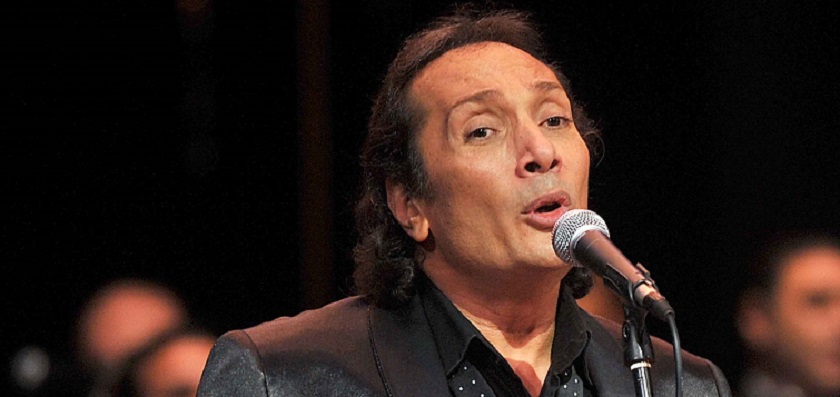
This popular Egyptian song by Ali al-Haggar is titled ‘We are a People’. It was created around the time of the military action to remove President Morsi from power, showing scenes from the protests against him.

Fair enough, but the lyrics do not stop at the title. The refrain continues ‘… and you are a people’.

It is a very thinly veiled contrast of the Egyptian people with Islamists, and in particular the Muslim Brotherhood.

This could possibly, maybe, be fair enough. The Muslim Brotherhood is a transnational organization that aims for the unity of the Muslim peoples. Their opponents accuse them of using Egypt as a launching pad for a new caliphate, rather than being loyal to Egypt as a nation-state.

As such, they are a separate people, or so the song suggests.

This is very dangerous and divisive sentiment. Some may say these are dangerous and divisive times. It is good, they say, the Brotherhood has been removed from power before it is too late.

Perhaps. But the song continues, ‘Despite there being only one God, we have a God, and you have a God.’

One Salafi friend, profiled here, complained bitterly about this line before I was even aware of the song.

Islamists are often accused of being ‘takfiris’ – those who call anyone who does not agree with them an infidel. This song does the same in reverse.

‘Take your fatwas and go far away from our land,’ it sings. Early after the revolution some Salafis told Christians and liberals they could leave Egypt and go to Europe or America if they didn’t like the results of elections.

‘We have ibn Sina and ibn Rushd [two famous Arab philosophers], you have bin Laden [you know who he is],’ it also declared. Since dispersing the pro-Morsi sit-in the media had declared the crackdown on the Brotherhood as a ‘War against Terrorism.’

And perhaps it is. Few things are yet clear, but the dangerous and divisive lyrics of this song are one of them. Whatever criminal conspiracy the Brotherhood has possibly engaged in, there are hundreds of thousands of ordinary Egyptians who are partial, at least, to the slogans and promise of Islamism.

These deserve better than this song offers them.

But it is quite catchy. Propaganda often is.

http://www.youtube.com/watch?v=YJw-miMU0Pc&app=desktop

Categories
Atlantic Council Middle East Published Articles

Another Coup, A Salafi Hope

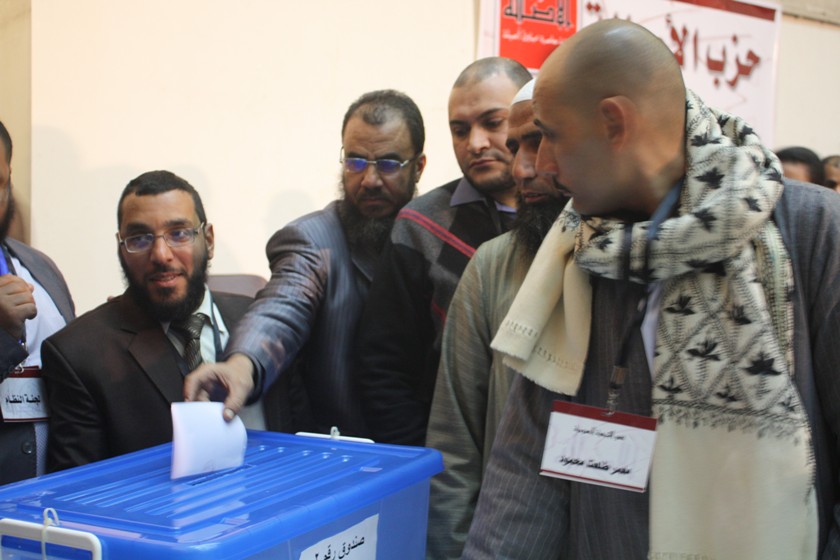
Hani Fawzi casting his ballot in Asala Party internal elections (photo: Clara Pak)

From my recent article in Egypt Source:

In order to reverse a coup d’état, Egypt needs a coup d’état. This, in brief, is the solution to Egypt’s crisis offered by Hani Fawzi, general secretary of the Cairo-based Salafi Asala Party. It must be prompted, however, by massive protests. No longer simply the domain of the Muslim Brotherhood and Salafis, the anti-coup movement is attracting both professionals and Christians – or so he believes.

Rather, this is what he prays for. A few days prior to the violent dispersal of the pro-Morsi sit-in at Raba’a al-Adaweya, Fawzi suffered a massive heart attack while sleeping in the near-by offices of the Asala Party in Nasr City. Found and hospitalized the next morning, unlike some of his colleagues he avoided the violence and mass arrests, but in his recovery has been reduced mostly to seeking divine intercession.

This, according to Fawzi, can come only through the army, as they are the only ones with the power to bring down Abdel Fattah al-Sisi, the Minister of Defense, and Mohamed Ibrahim, the Minister of the Interior. There have been indications, he hears, that not all generals have been pleased with Sisi’s leadership. The rumor mill has churned with such stories; a bearded taxi driver told me the other day that Sisi had three opposing generals killed.

Fawzi doesn’t want to put stock in rumors, but does notice that several generals have been very quiet. Should one of them undo the coup, it should set in motion what Morsi should have done upon his election. On this he admittedly draws on the rhetoric of Salafi firebrand Hazem Abu Ismail, who argued for a radical cleansing of the state apparatus. Fawzi finds him too divisive a figure, but Morsi could have made it work.

The rest of the article explains how, explains why he discounts Morsi’s opposition, and exculpates Islamists from the attacks on churches. Please click here to continue reading at Egypt Source.

Categories
Personal

A Sense of International Attention

One of the privileges of studying Egypt is to be able to be a resource for others who are studying and writing about the region. In recent weeks a few have inquired about my opinion or made use of resources here at A Sense of Belonging. If you wish, and if you have the language, please enjoy the following:

From the Spanish newspaper El Pais, on the relation between the Coptic Orthodox Church and the state in light of the Rebel movement which ousted Morsi:

“Como minoría religiosa, los coptos a menudo creen necesario aliarse estrechamente con el Estado, pues es este el agente de orden en cualquier sociedad”, explica Jayson Casper, un investigador especializado en minorías de Arab West Foundation, un think tank de El Cairo. Tawadros II fue entronizado a principios del pasado noviembre, y la mayoría de analistas subrayaron la dificultad de su labor. Y no solo por ocupar el puesto del carismático Shenuda III después de más de cuatro décadas de papado, sino por hacerlo en un momento de zozobra para la comunidad cristiana, acechada por un creciente número de ataques sectarios.

Durante el debate que precedió a la elección del nuevo patriarca, muchos coptos abogaron por que este tuviera una menor intervención en política. Sin embargo, muchos han ido cambiando de opinión a medida que avanzaba la presidencia de Morsi. “Las primeras señales de que [Tawadros II] sería menos político que su predecesor fueron desapareciendo a medida que los coptos sufrían bajo Morsi. Creo que la mayoría aprecian su posición clara, y estuvieron contentos de ver que está al lado del gran imán de Al Azhar y el consejo militar”, comenta Casper.

From a French blogger, A Student Defends His Faith, writing about this blog’s Friday Prayers:

Jayson Casper, originaire des Etats-Unis et diplômé en économie et en islamologie, vit au Caire en Egypte avec sa femme Julie et leurs trois enfants. Il travaille comme rédacteur pour le magazine Arab West Report et ponctuellement comme journaliste indépendant pour différents médias chrétiens. Sur son blog, il propose des analyses approfondies de la situation politique, sociale et religieuse en Egypte. J’ai découvert son blog lorsque je commençais à m’intéresser à Rafiq Habib (d’ailleurs sa réflexion sur celui-ci (partie 1 et partie 2) vaut vraiment le détour) et depuis, je le visite régulièrement et corresponds aussi avec son auteur. Sur la page de présentation du blog, il écrit (traduit par moi) : “Le souhait de notre famille est d’apprendre à connaître et à apprécier tout ce que l’Egypte a à offrir et de découvrir sa langue, ses habitants, sa culture et ses religions. Nous espérons contribuer, par nos vies, nos amitiés et notre emploi, à la lutte contre les préjugés de nombreux Egyptiens envers les Américains et les chrétiens, et par nos écrits et nos visites aux Etats-Unis, à la lutte contre les préjugés de nombreux Américains envers les arabes, les musulmans et les orthodoxes. Notre prière est que nos vies à l’étranger plaisent à Dieu, qui désire que tous puissent expérimenter sa grâce, vivre en paix et aimer leur prochain.” Leur blog s’inscrit tout à fait dans cette démarche.

Pourquoi un tel titre ? Parce que c’est ce qui résume son appel : parce qu’il vit en Egypte, Jayson Casper veut le meilleur pour l’Egypte et les Egyptiens ; parce qu’il n’est pas lui-même Egyptien, il ne sait pas ce qui est le meilleur pour eux et cherche donc à comprendre ce qu’eux-mêmes pensent plutôt que de leur imposer sa propre vision d’avenir d’Occidental. C’est ce qu’il appelle le “foreigner’s sense of belonging”, le sentiment d’appartenance de l’étranger.

Petit aperçu de quelques-unes de ses analyses les plus intéressantes :
– Le survol le plus complet que je connaisse, en 19 pages (avec un résumé en ligne, le reste étant accessible en PDF), du militantisme copte né de la Révolution égyptienne, avec une description fouillée de tous les principaux mouvements, leur idéologie, leurs alliances et rivalités et leurs relations avec les autres mouvements révolutionnaires.
– Une réflexion pertinente et nuancée sur ce que les chrétiens occidentaux devraient penser du coup d’Etat militaire contre Morsi, entre refus de l’islamisme et attachement aux principes démocratiques.
– Cet interview sur les motivations d’un citoyen égyptien lambda, engagé dans la campagne d’opposition demandant la démission de Morsi.

Par ailleurs, tous les vendredis (jour du culte dans l’islam), Jayson publie une prière pour l’Egypte. Ces prières sont rédigées de façon à ce que tout un chacun, quelle que soit sa religion ou son appartenance politique, puisse l’adresser à Dieu. Dans ses prières, il demande à Dieu de faire triompher la paix, la justice et la vérité, pour tous les Egyptiens. Exemple : le vendredi suivant le coup d’Etat, alors que la très grande majorité des chrétiens égyptiens (sauf certains mouvements de jeunes révolutionnaires, hostiles aux Frères Musulmans mais inquiets du retour de l’armée) ont soutenu le coup d’Etat (cf la photo de l’annonce du coup d’Etat, sur laquelle on voit le pape copte Tawadros apparaître aux côtés du général al-Sissi et du nouveau Président de la transition), Jayson demandait à Dieu de protéger les Frères Musulmans de toute injustice, des arrestations arbitraires et de la marginalisation ! Hier encore, dans sa dernière prière, il demandait la paix et la protection pour tous.

Bref, un blog très intéressant d’une personne très intéressante, que, vous l’aurez compris, je recommande chaudement à tous ceux désireux de mieux comprendre les enjeux complexes des événements actuels en Egypte et au Moyen-Orient.

And finally, Barry Rubin, a researcher and scholar of Islamist movments based in a private university in Israel, referenced this blog in his recent publication on Egypt’s Salafis. I get footnote number 39, on the Asala Party:

There are two other Islamist parties that ran jointly with al-Nour in the parliamentary election and took the same stance in the presidential election.[35] The Asala or Authenticity party was formed after the revolution by Abel Abd al-Maqsoud Afifi. He had an unusual previous career for an Islamist leader, having worked for 33 years in the Egyptian government, mostly in the Immigration and Citizenship Department.[36]

One distinctive aspect of the party’s platform was its foreign policy, advocating that Egypt take leadership in the Islamic world.[37]In general, though, it has no clear reason, other than its personalist nature, for remaining a separate organization.[38] Like the other Islamist political parties, it does not openly advocate violence.[39]

The third Islamist party allied with al-Nour is the Building and Development Party, many of whose key figures were involved as al-Jama’a cadre in the 1990s violence.[40] Indeed, some of its leaders were convicted in 1982 in the assassination of President Anwar al-Sadat and were released from prison by the armed forces’ junta in March 2011.[41] Like the other two, it demands both the implementation of Shari’a while promising Christians and women that their rights will be respected.[42]

Thanks for following along.

Categories
Personal

Christian Killed for Collecting Rebel Signatures

From the AP. Earlier I highlighted the Muslim grassroots leader of the Rebel Campaign which collected a reported 22 million signatures calling for early presidential elections. Here is one of his many activists – a Christian – who has now paid with his life:

With a mob of Muslim extremists on their tail, the Christian businessman and his nephew climbed up on the roof and ran for their lives, jumping from building to building in their southern Egyptian village. Finally they ran out of rooftops.

Forced back onto the street, they were overwhelmed by several dozen men. The attackers hacked them with axes and beat them with clubs and tree limbs, killing Emile Naseem, 41. The nephew survived with wounds to his shoulders and head and recounted the chase to The Associated Press.

The mob’s rampage through the village of Nagaa Hassan, burning dozens of Christian houses and stabbing to death three other Christians as well, came two days after the military ousted Islamist President Mohammed Morsi from power. It was no coincidence the attackers focused on Naseem and his family: He was the village’s most prominent campaigner calling for Morsi’s removal.

Naseem’s friends and family say he was targeted because of his activism against Morsi. In the months before Morsi’s ouster, he was energetically collecting signatures in the village for Tamarod, or “Rebel,” the youth-led activist campaign that collected signatures nationwide on a petition demanding Morsi’s removal. It organized the June 30 protests that brought out millions.

“Emile was the de facto Tamarod leader in the village and that did not escape the notice of the militants,” said Naseem’s best friend and fellow activist Emile Nazeer. “He, like other activists, received threatening text messages for weeks before he was killed.”

“Almost everyone in Nagaa Hassan loved my uncle. He spoke a lot about politics and people listened to what he had to say,” said el-Ameer, Naseem’s nephew. “He paid the price.”

Click here to read the rest of the article and its sordid details. Ugh.

Categories
Prayers

Friday Prayers for Egypt: Easter Greetings

Flag Cross Quran

God,

There is much that Egyptian Muslims and Christians agree upon, much which unites the two and allows them to pray similarly. But at one point the religions are rather irreconcilable: Jesus was not crucified, and therefore was not resurrected. There is no Easter, celebrated by Copts this coming Sunday.

Fair enough. There are plenty of common troubles in Egypt these days. But Easter risks becoming another one, a further point of division in a polarized nation.

God, may it not be so.

The Egyptian status quo of good neighborliness has Muslims and Christians exchange greetings on all their holidays. The Muslim purist status quo of Islamic fidelity forbids congratulating religious error. Both have been around for some time.

The purists have generally been confined to Salafis, but now the Muslim Brotherhood is caught in the middle. Their mufti has given allowance to greet on Christmas, but Easter should be avoided.

The middle ground makes some sense, as Muslims accept Jesus as a prophet born miraculously from the Virgin Mary. But in Muslim eyes Christians are in religious error to hold the prophet born as the Son of God; why should neighborliness cover one and not the other?

God, bless the purists and give them wisdom and discernment. Honor them for fidelity to unpopular conviction, especially as many behave as good neighbors every day of the year. Give them love for these neighbors even as they seek to guide them to the right path. May it be for the sake of truth, and involve no division or discrimination.

God, bless the Copts as they interpret this refusal as a public insult. Honor them for fidelity to minority religion, especially as many esteem Muslims for their faith every day of the year. Give them patience and grace for those who find offense in them. May it result in greater love between all and honest discussion in that which divides.

But for all who play with the issue, God, issue your divine condemnation. Some purists seek to isolate the Copts and those who stand with them. Some non-Islamists seek to demonize their opponents as agents of social disintegration. Where accusations are true may you muffle their voice and end their influence.

The Easter issue does not warrant such rhetoric, God; calm things down. If you gave your son to be crucified your followers can take an insult. If you alone rescued your prophet from violent rejection your followers can allow you to continue this battle.

God, you know best the truths of religion, but you know also the needs of Egypt. Help the people to mind the balance, finding both in love and unity.

Amen.


Categories
Prayers

Friday Prayers for Egypt: Poisoning the Azhar

Flag Cross Quran

God,

So much of Egypt’s identity is tied up in the Azhar. The pinnacle of Islamic learning among Sunni Muslims, the Azhar was one of the world’s first universities. Always straddling the line between fidelity and challenge to the ruler, the institution was muzzled by Egypt’s successive military governments. Now, the controversy is back.

But is it healthy, God? For 500 students suffering from mass food poisoning, the answer is no. For the university president fired after the flare-up, the answer is no. For the place of the Azhar in Egypt’s post-revolutionary transition, the answer remains to be seen.

The Azhar was politicized by the constitution, giving it a role in the process of legislation. The same document guaranteed its independence and the right to select its own leadership. This process has also set off what many observers see as a struggle to gain control of the institution. A prominent Salafi leader publically said as much, admitting their ambition.

But the rumors swirl around the Muslim Brotherhood, prompting them to officially issue a denial of any involvement. But their spokesman did praise the firing of the president, saying this move against corruption proves the revolution is on the right track. Coincidentally or not, he was appointed by the military council, prior to the constitution.

God, so much seems wrong with this situation. First and foremost, heal the sick students. But heal an institution as well, and a political system which has put it in the heart of controversy. Certainly a student protest over sick colleagues can be seen as a spontaneous reaction. But to call so deliberately for the removal of the president – and even of the Grand Sheikh himself – has all the markings of political expediency.

Hold leaders accountable, God, but is this corruption? Investigations are ongoing. Perhaps corruption was part of the old regime everywhere, God, even in the Azhar. If so, then yes, purge. No sin remains hidden forever. Give the institution men of knowledge and integrity, who will prepare the generations to come in an honorable path. In a land where much is religious, men of religion matter deeply.

Therefore, God, protect the Azhar from men who use religion – whoever they may be. Right religion is meant to help us understand you, ourselves, and to secure a society of virtue. But religion can also enrage or sedate, and not always righteously. May religion in Egypt produce humble men; may the Azhar aid in the process.

But now in Egypt, God, the poison seeps everywhere. May this be a wrong diagnosis: Perhaps it is medicine which weakens the body as it kills the contagion. But there is much in Egypt to be healed, God.

You are the healer. May Azhar make this known.

Amen.

Categories
Prayers

Friday Prayers for Egypt: Election Law

Flag Cross Quran

God,

Help Egypt rebuild her political institutions. Help her to do so wisely, and justly.

The law to set regulations for parliamentary elections meandered all week. A first draft was partially declared unconstitutional by the Supreme Court. Amendments were made, but then bypassed the court lest it find further flaws, only postponing the crisis. Accusations of unfairness and gerrymandering abound; many in the opposition threaten a boycott.

And among the most unusual provisions is the fact the elections will be conducted over a four week period.

Added to the political controversies are feuds between the Muslim Brotherhood and the Salafi Nour Party, and disputed attacks on a church in Fayoum. On all accounts the facts are unclear but acrimony appears from all sides. It was a quiet week in Egypt, but tensions simmer.

Lower the boil, God. What is this stalemate producing? Where are you bringing Egypt? Must one side eventually defeat the other completely? Is this preferable to honest compromise?

God, grant the people representatives; give them a working parliament. But may those who populate it come truly from the popular will. Minimize electoral machinery and manipulative campaigning. But have a groundwork laid now in which all can agree on the rules of the game. But God, it seems impossible. Rules were disregarded long ago.

So, perhaps, were sincere political relationships. Heal the rifts between Islamists, and furthermore between all political powers. Where these rifts are caused by transgression, may justice cleanse. Restore the reputation of anyone falsely tarnished; sully the reputation of anyone escaping accountability. Sort out the categories, God, but moreover, reconcile. Egypt needs all.

This includes her Muslims and Christians. God, return this village to its previous anonymity. If there is fanaticism driving events, rebuke its partisans. If there is exaggeration, rebuke as well. Help each to love his neighbor as himself, seeking first the interests of others. Establish humility, but give each his right. Spare the village from further troubles, and may similar happenings not repeat elsewhere.

God, coddle Egypt, if you must. Be a mother who calms a disquiet spirit and a flailing temper. Hold her until she can breathe again freely. But prepare her to roar, righteously. May that day come soon.

Amen.

Categories
Atlantic Council Middle East Published Articles

‘No’ to Political Violence, Because…

Islamist Rally

From my recent article on EgyptSource:

Cynics throughout Egypt could only smirk. Thousands of Islamists protested against the recent wave of political violence, answering the call of one of its most notorious perpetrators, the Jama’a Islamiya. Throughout the 1990s they led an armed campaign against the Mubarak regime, as well as targeting tourists in a bid to discredit the state.

In the early 2000s, beaten and discredited themselves, the Jama’a Islamiya issued its famous ‘Revisions’. Jailed leaders reconsidered their violent philosophy, publishing tomes on the errors of their way. They also reconciled with the government, securing release from prison for many. Since then the group has largely laid low, at least until the revolution.

Like others in the formerly forbidden Islamist trend, the Jama’a Islamiya took advantage of new political freedom to form a party, Building and Development. They allied with the Salafi Nour Party but played second fiddle, offering their popular support especially in Upper Egypt in exchange for a handful of parliamentary seats. But as Egypt descended into a morass of political chaos and violence, it was the Jama’a Islamiya which took the lead in condemnation. The question is, why?

Cynical reasons abound.

The article then seeks to expose some of these cynical reasons through the testimony of protestors:

“When the Jama’a Islamiya says ‘no’ to violence, we have more credibility than anyone else,” said Sharaf al-Din al-Gibali, a party leader in Fayoum. “Why? We engaged in an armed struggle with the regime for over ten years. We finally realized violence is not a suitable path to power, under any circumstances.”

In fact, it is concern for the opposition that is a large part of their motivation. “We have tried this path already,” he continued, “so for those who are trying it now we are worried for them.”

But then other testimony reinforces the cynical:

“What is happening now is the empowerment of Islamists and if God wills he will help us soon to rise against Israel,” said Mohamed Ahmed, an unaffiliated clothes merchant who leans in support of the Jama’a Islamiya. “We are against violence among ourselves; God has forbidden a Muslim to shed the blood of another.”

By ‘among ourselves’ Ahmed meant all Egyptians, even though he labeled the opposition as troublemakers. He believed Mahmoud Shaaban’s recent fatwa authorizing their death was near-appropriate.

“ElBaradei and the others spread corruption in the land and call for rebellion against the authorized leader,” using a traditional phrase from Sunni Muslim jurisprudence. “Sheikh Shaaban simply mentioned the hadith that says such as these deserve death, but those with him on the program convinced him this issue must go to the Azhar.”

Ahmed has a distaste for politics in general, but the times are changing. “There is a jurisprudence of reality; if the people now want ballot boxes, we will use them,” he said.

“We entered into political parties to be able to reach the ability to govern, and not just preach. If you only preach they can shut you down.”

Please click here to read the whole article at EgyptSource.

Categories
Arab West Report Middle East Published Articles

Profile of a Modern Salafi

Ahmed al-Qadri
Ahmed al-Qadri

From my latest article in Arab West Report:

The popular image of Salafi Muslims in Egypt is of a lower-class, older generation, perhaps limited in educational achievement. This is not their fault, many might patronizingly sympathize, as President Mubarak is blamed for letting the school system rot to keep the population ignorant, poor, and non-threatening to his rule. It is commonly stated as well he allowed the Salafi trend to prosper at the expense of the Muslim Brotherhood, because their religious orientation preached obedience to the Muslim ruler, no matter his flaws.

However useful this description may be, it does not comprise the whole of Egyptian Salafism, and a clear example is Ahmad al-Qadri.

At the time of this interview Qadri was an advisor to the Salafi Nour Party in energy affairs. He is now the official English language spokesman for the Salafi Watan Party, which recently split away. These political developments can be read here, but this article is more a profile of him and his worldview.

Here, for example, he describes how he became a Salafi:

For Qadri, his grayness was exposed by life abroad. He studied for his PhD at Strathclyde University in the UK from 2006-2009, and immediately found the local Muslim community to be either black or white, secular or religious. The psychology of minority status pushed immigrant Muslims either to seek integration with the larger culture, or else to dive deeply into their own religious heritage. Glasgow as a city was about 17% Muslim – mostly Pakistani – while the university could be as much as 30%.

From the beginning Qadri was tested. The university committee to welcome new students served wine at their reception. Women freely extended their hands to greet him. Upon polite refusal – as an ordinary Egyptian Muslim, not as a fanatic – he was politely asked why, and what relation Islam had to such social awkwardness.

These experiences pushed him to read subjects he cared little about while growing up. His personal studies led him to the books and YouTube sermons of popular Egyptian Salafi scholars like Muhammad Hassān and Muhammad ‘Abd al-Maqsūd. By 2007 he started growing out his beard. He eventually became vice-president of the Muslim Students Association at his university, which was composed primarily of Salafi students from the Persian Gulf and North Africa.

Qadri differentiates between Islamist groups, especially highlighting mainstream Salafis perspective on jihadists:

Even so, Salafis should be differentiated from other Islamist groups, though all agree on the necessity of applying sharia law. The Muslim Brotherhood has a Salafi orientation, but desires to change society from the top. For this reason they seek political power. The problem will be, however, if they do not perform well society will reject them. This may cause the loss of the whole sharia project.

There are other Islamists who have sought to live according to sharia law in other ways – ways rejected by Salafis. Some, such as Takfir wa Hijrah (Excommunication and Exodus), curse society as non-Muslim and form isolated communities to themselves. Some such groups then move further along into advocating violence to overthrow the government and seize power. Such jihadis are also ‘Salafi’ in the manner of viewing Islam through the lens of the Qur’an and Hadith, but are rejected by the mainstream Salafi movement. Salafi leaders such as ‘Imād ‘Abd al-Ghaffūr and Yūsrī Hammād have traveled to Sinai where many extremist have taken refuge to convince tribal leaders and the youth the jihadi perspective is wrong. Jihadis themselves, however, cannot be talked to at all, as Qadri finds them unwilling to accept anyone as a Muslim except themselves.

His views on religious defamation and the freedom of conversion seem to bounce back and forth between liberal and conservative notions, but where liberal they are surprising and muddle the waters:

Additionally, Salafis support a law against denigration of religions which would apply equally to Christians and Jews. This law, however, would not prevent conversion from one religion to another, or to none at all. Nor would such a law apply to the conversation, or even the printing, of one religion respectfully describing the other. A Christian can freely communicate that for them, Islam is a false religion and Muhammad was a liar. Several years ago a highly visible convert to Christianity, Muhammad Hijāzī, created a stir in the media. Salafi groups raised no case against him.

In this area Qadri was more difficult to understand, for he stated as well that there should be censorship of thoughts that harm the Islamic religion to keep sectarian strife from society. He also defended the case brought against Nasr Abu Zayd, who was sued for his academic writings on Islam. The court referred the case to the Azhar, which ruled they proved him a non-Muslim. As such, he was ordered to divorce his wife, and he fled to the Netherlands for asylum leaving his wife behind.

In explanation, Qadri stated a Muslim is free to become a non-Muslim, but if so he forfeits his rights. A family should be protected from the shame of having their daughter be married to a non-Muslim at any point in her life. Furthermore, the apostate will lose his Islamic inheritance rights. Yet he is free to join another creed, and even free to publish his reasons why.

This privilege does not extend to non-monotheistic religions, however. A Muslim may become a Buddhist in his heart, but no community of Buddhists may build a temple in Egypt. The same applies to Shi’a Islam.

Finally, from the conclusion, asking rhetorically the common doubt toward all articulate Islamsts:

Qadri presents these opinions as shared by the Egyptian Salafi community, many of which are not young, know no English, and are far more comfortable conversing over ancient texts. Is this accurate? Or has Qadri learned the art of speaking to the West, having been tested in the hallowed halls of Scotland academia?

Perhaps there are generational gaps. Perhaps there are educational gaps. Among all peoples there are frauds and charlatans, politicians and propagandists. The testimony here is only that Qadri was a very nice, pleasant individual, who appeared to speak sincerely and passionately about his faith. Judgment on the Salafi movement can only be rendered upon how they benefit – or damage – Egypt, but in his demeanor it is hoped that the Salafi community will demonstrate Qadri to be a standard representative.

Please click here to read the full article on Arab West Report.

Related Posts:

Categories
Personal

Egypt Conflict Alert

From the International Crisis Group, trying to find a solution to the current political mess:

Reversing these dynamics requires efforts on two fronts. Politically, the key is mutual acceptance of two realities: that the Brotherhood’s electoral victories give their rule legitimacy, but that a historic, complex transition in a challenging security and economic context requires exercise of power to be tempered by meaningful consensus-building.

Several steps would help: an end to opposition calls for the president to step down and agreement by Morsi that the constitution, whose adoption was marred by boycotts and low voter turn-out, ought to be revised to allay the apprehensions of non-Islamists and notably the Coptic community. Likewise, the process for designing the elections law — another topic of sharp disagreement, especially on district boundaries and the representation of women — should be revisited to reflect broader agreement among factions. Finally, in the wake of approaching parliamentary elections, parties should seek to form a national coalition, a result that would serve both the Muslim Brotherhood (which would gain from the opposition becoming a responsible stakeholder) and the opposition (which would be better positioned to impede what it views as efforts to institute single party rule).

Very good analysis (if you read the whole thing), and workable solutions. The main monkey wrench could prove to be the Salafis. Amending the constitution implies making it more liberal and less religious. If the Brotherhood signs off on this the Salafis could turn against them quickly, and it is unlikely middle-ground liberals would come to their electoral rescue.

The concerning point is that the best path to power for the Salafis could be in a full chaotic rupture of society, requiring a full military-religious partnership simply to restore order. Certainly not publicly, but does the Brotherhood implicitly threaten the liberals that they (the MB) are the best bet going? Otherwise, we turn the Salafis on you?

But if this is part of the Brotherhood negotiation tactic, it will certainly ring hollow for liberals when the MB turns consistently to Salafis for support. Their rubber-band-like moves from the right to the center must be wearisome to the opposition. What does the Brotherhood want, and what do they represent, truly?

Not that the opposition plays clean or consistently, either, as the article makes clear. But the constitution has soiled all trust and destroyed the middle ground. It would be a shame if the constitution itself is, in fact, the best middle ground that can be obtained. Ugh, as illiberal as portions of it might become.

Related Posts:

Categories
Atlantic Council Middle East Published Articles

Who are the Salafi-Jihadis?

Mohamed al-Zawahiri, brother of the al-Qaeda leader

From my recent article in EgyptSource, following up on the last post of pictures:

Zawahiri is the leader of what has been dubbed the Salafi-Jihadis. Long associated with Islamic Jihad and the Islamic Group, following his release from prison in March 2012 he has positioned himself to the right of the now politically engaged Islamists of the Muslim Brotherhood and traditional Salafis. But who does he represent?

“We are just Muslims, protesting the killing of civilians,” said Walid, one of about 400 demonstrating against French military activity in Mali. “We have no leadership and we don’t belong to al-Qaeda.”

‘Not belonging to al-Qaeda’ was a frequent refrain of protestors.

But there was plenty of sympathy, as well as conspiracy:

Ashraf, who declined to give his last name but consorted comfortably with al-Zawahiri, praised the Benghazi attack which killed the American ambassador, and said more of this nature was needed. But as to the nature of Salafi-Jihadis, he was circumspect.

“There is no such thing as Salafi-Jihadism,” he said. “This name is simply a creation of state security, used to divide Muslims.”

The Egyptian regime, he believes, has always conspired with the Americans to distort Islam. “Is there any Salafism without jihad?” he continued. “Who are the Salafis but the first generations of Muslims, and were these not engaged in jihad?”

By all appearances their numbers are few, but this may not matter much, and surely not all are visible:

Salafi-Jihadis appear to be less an organization than an idea. So while the idea of Islam violently reordering world relations – today focused on Mali – is unable to attract many, it does attract a dedicated few. For Zawahiri, this is enough.

“Over the centuries Muslims have been the victorious ones,” he said, “even when they have had small numbers.”

Please click here to read the full article on EgyptSource.


Related Posts:

Categories
Personal

Photos from the Salafi-Jihadi Protest at the French Embassy

There are several strands of Salafism in Egypt, and the differences are not easy to understand. The group which is called Salafi-Jihadi – they do not necessarily call themselves this – is differentiated easily by the second part of their moniker. While many Salafis have joined the political, democratic process in Egypt, these reject it outright. Instead, they favor the continuation of a violent struggle against the Egyptian regime, of which they see the Muslim Brotherhood and other Salafis as selling out to the world anti-Islamic system.

This group held a protest on January 18 against the French military intervention in Mali. In Mali criminal-cum-jihadists have piggybacked onto a tribal Tuareg rebellion in the north. The central government, along with many surrounding Arab and African nations, has sanctioned France’s effort to resist them through force of arms. Salafi-Jihadists, however, support them due to their desire to implement sharia law.

I hope to write more about Salafi-Jihadis soon, but for now, please enjoy the protest through these pictures and video.

Click here for the first video. It is only two minutes long because it represents the length of time necessary for their full march to approach the site. There were only a couple hundred protestors in total.

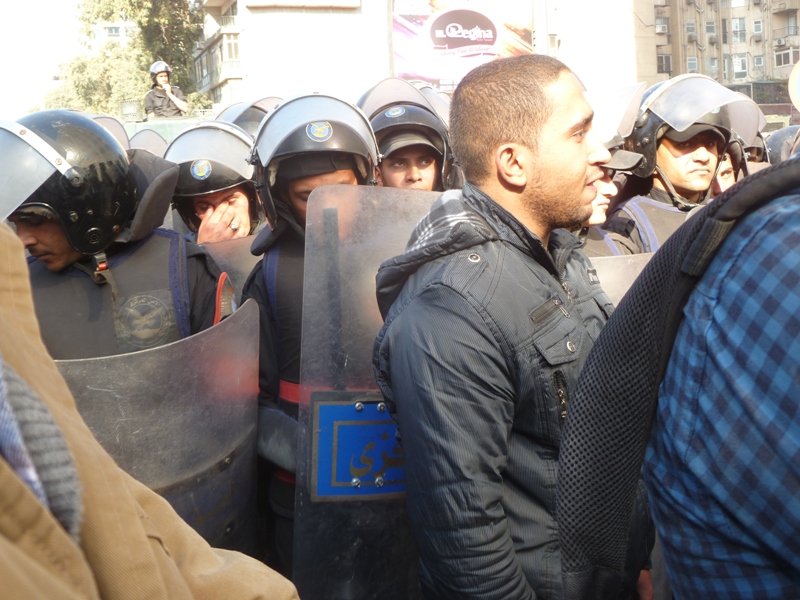
Click here for the second video. It also is only two minutes because this was about the length of time the protestors jostled with police who had set up a barricade preventing them from reaching the embassy. After that they accepted their place about 100 yards further down the street.

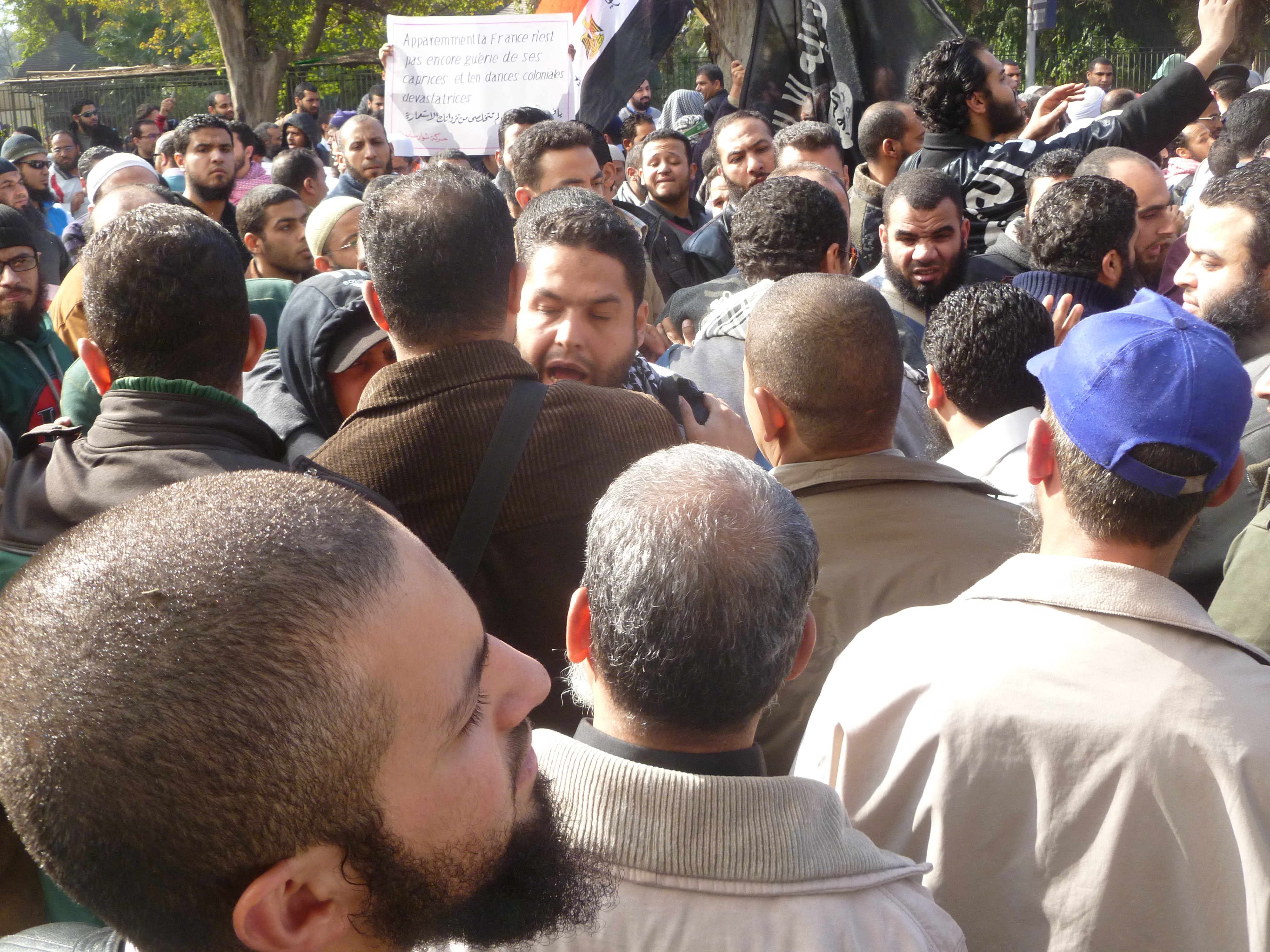
Crowd Pressing

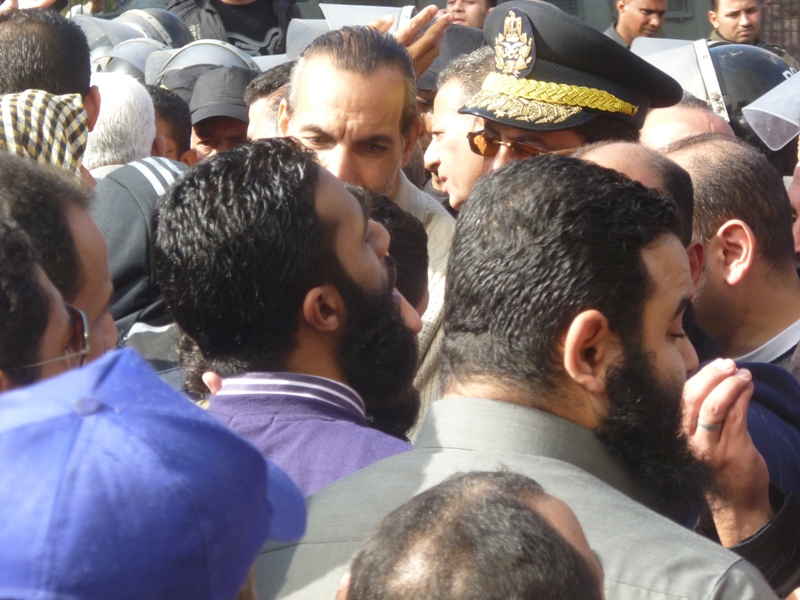
Next to the man in the police cap is Ezzat al-Salamony. He is a leader with the Islamic Group, not the Salafi-Jihadis, and worked to restrain the crowd. He later gave a rousing speech against the French, though, calling for jihad in the lands of the infidels.


Eventually a car drove up with speakers to serve as a platform for speakers. The police maintained their line, but were left in peace from then on.
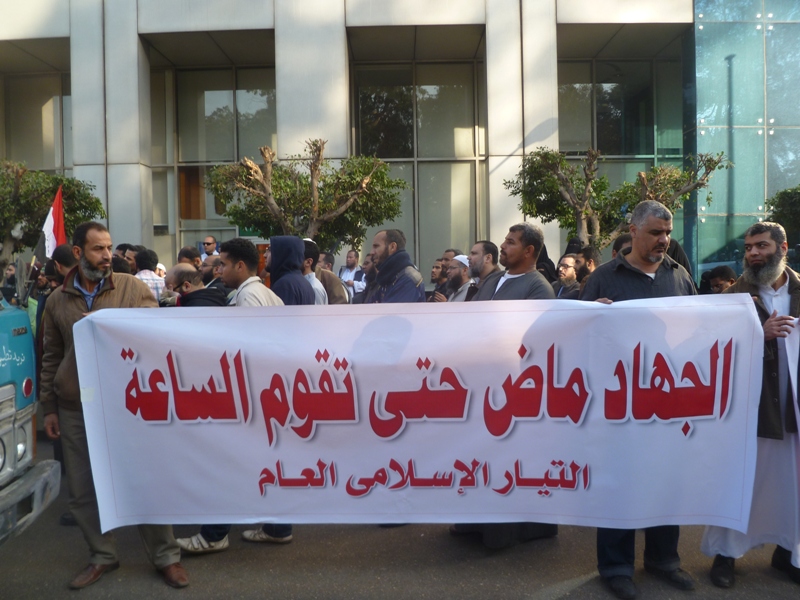
As speakers condemned France, other protestors set up their banners. This one reads: Jihad will continue until the Day of Judgment.
After a little while the star of the show arrived. Mohamed al-Zawahiri is the brother of Ayman, the leader of al-Qaeda. Everyone pressed around him.
As he hung around for hours, eventually the crowds dissipated around him. Here is awaits giving an interview to al-Jazeera.
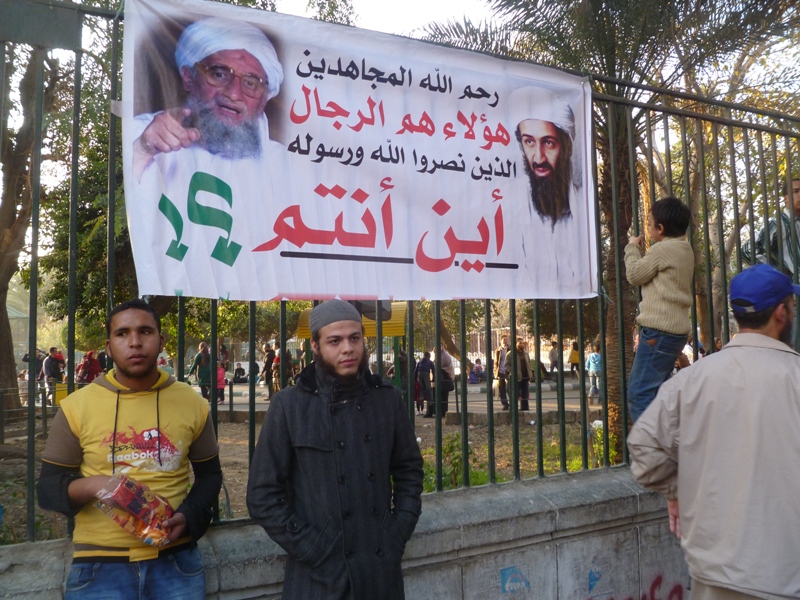
Around 5pm, the police relented and allowed the protestors to advance and demonstrate in front of the embassy, though the police presence guarded it and otherwise surrounded them. Graffiti and other banners were hung in the area, this one across the street on the wall of the Giza Zoo. Pictured are Osama bin Laden and Mohamed's brother Ayman. The sign reads: God have mercy on the jihadists. They are the men who gave victory to God and his prophet. Where are you?!
Around 5pm, the police relented and allowed the protestors to advance and demonstrate in front of the embassy, though the police presence guarded it and otherwise surrounded them. Graffiti and other banners were hung in the area, this one across the street on the wall of the Giza Zoo.
Pictured are Osama bin Laden and Mohamed’s brother Ayman. The sign reads: God have mercy on the jihadists. They are the men who gave victory to God and his prophet. Where are you?!


Related Posts:


Categories
Atlantic Council Middle East Published Articles

The Growing Pains of Salafi Politics

Asala Party Elections (photo: Clara Pak)

From my latest article in EgyptSource:

The Salafi political movement experienced massive transition in the past two weeks, enduring splits, recriminations, and leadership changes. Having long foresworn the political process, it is right and natural for growing pains to characterize their apparent embrace of democracy. Taking stock, three observations describe their current standing.

These are:

  • The process is transparent, but is the result foreordained?
  • The rhetoric is clear, but are they learning spin?
  • The inspiration is worrisome, but does it determine?

From the first:

The main question directed to Islamist politicians is if they truly believe in democracy or simply use it as a ladder to power. Egypt’s constitution declared its governing system to be both democratic and of an undefined shura (consultation). The shura provision was added at the request of Salafis, whose ideas of democracy issue from the selection process of the early Islamic caliphs, which was consensual. If internal elections are any indication, Salafis are willing to be transparent about their leadership choices, but greatly prefer the predetermined aspects of shura.

From the second:

There are reasonable reasons to reject quotas as well as to trust sharia provisions toward non-Muslims. Yet probing beyond the headlines exposes differences of nuance, if not outright contradiction.

Opponents of Salafis do credit them for being straightforward and sincere, unlike their opinion of the Muslim Brotherhood. As they develop political skill, however, it appears Salafis also are learning the unfortunate art of spin.

From the third:

Then effortlessly, unprompted, and without rancor, he slid into a passionless diatribe. “When we reach the stage of our empowerment, we will collect jizia from the Copts.

“Permissible for us are the blood and spoils of those who disbelieve in God and refuse his prophet,” he said. “This is not for the people of the book, as long as they do not fight us. But inside and outside Egypt they are fighting us, taking millions from America to accumulate weapons.”

So when Sheikh Abdel Khaleq Mohamed states at an official party function, “Democratic work is unbelief, but as long as it leads to the victory of God’s religion it is permissible to us,” does he represent its official line? Or does party president Ehab Shiha, who clarified the misquote, adding after ‘unbelief’ the words ‘… as a doctrine’ which were clipped in the article? On the contrary, Shiha accepts the definition of democracy as ‘government by the people, of the people, and for the people’ as long as it does not transgress the laws of God.

Please click here to read the full article on EgyptSource.

Related Posts:

Categories
Atlantic Council Middle East Published Articles

Do Salafi Splits Signal Weakness or a Different Kind of Strength?

Ahmed al-Qadri
Ahmed al-Qadri

From my latest article in EgyptSource:

The Nour Party, the political flagship of Egypt’s burgeoning Salafi movement, is in full damage control over scores of member defections to the new Watan Party. This is appropriate, as the damage is substantial.

The Nour Party lists why it is dismissive of its new rival, but Watan boasts impressive transfer:

According to Ahmed al-Qadri, the English language spokesman for the Watan Party and former vice-president of Nour’s energy committee, the resignations affect the great majority of leadership positions. Besides former party president Emad Abdel Ghaffour and spokesmen Mohamed Nour and Yousry Hammad, nineteen regional offices resigned collectively.

Furthermore, Qadri explained, every single member of Nour’s technical committees has resigned. Including the economic, political, agriculture, energy and other committees, these groups of experts facilitated the work of Nour’s members of parliament. Of Nour’s 107 MPs, 52 have joined Watan, along with sixteen current members of the Shura Council.

The problem is not over doctrine, but over the influence of religion over politics:

“Some people wanted to assign positions based on proximity to leading religious figures,” said Qadri. “One of Nour’s mistakes was that the Salafi Call had the right to interfere in the party and change job descriptions. We want to work to unite all Salafi schools but have a legitimate and independent political party.”

Some Salafis fear – and liberals hope – these divisions will damage the electoral campaign of Islamists. But Qadri sees it differently:

“If the main figures of a party make a mistake, it may cost them votes, but if we have variety in the Salafi trend then those votes can simply shift to another party,” he said.

“If you are only one party you will be too sluggish to promote yourself because there is no competition.”

And from the conclusion, he hinted that this multiplicity might actually distance religion from politics:

“You cannot simply say ‘sharia’ or ‘Islamic state’ because we all believe in this,” he said. “The Egyptian people have learned that no one will any longer give their vote to a flag, but only to those who offer them solutions.”

The coming elections will tell, but unity is always important. Just ask liberals worried over possible splits in the National Salvation Front.

Please click here to read the full article on EgyptSource.

Related Posts:

Categories
Prayers

Friday Prayers for Egypt: Egyptian Jews and Salafi Splits

Flag Cross Quran

God,

Division does not please you. You have created us differently and esteem these differences. We have different opinions and go our different ways. But when we break relationship – forgive us.

As many in the liberal and leftist and revolutionary camps have come together to oppose the Islamists, honor them, even if their unity is temporary and superficial. Help them, God, that it may be otherwise. If they part may they part as friends, having accomplished good for Egypt.

At the same time, many in the Islamist camps are coming apart. The reasons are unclear, but appear to be personal, political, and administrative – not ideological. You know the heart of these leaders, God, but heal the divisions that they have. If ambition or strife stands in the way of worthy ideals, keep their house in order. If they part, may it be as friends, having accomplished good for Egypt.

Judge, God, if the division between these camps is honorable or displeasing. Heal the wounds that exist; correct the assumptions which poison. May each esteem the good in the other, and expose all wrong. Unite them in discernment, that together they may accomplish good for Egypt.

And bless those, God, who are healing historical division. Certain Muslim Brothers have invited Jews of Egyptian origin to leave Israel and reclaim their property and heritage. You know, God, the purpose and sincerity of such remarks, which the presidency has distanced itself from and other Islamists have rejected. But honor at least the symbolism – if not more – that Egypt may be a place of welcome for all people.

Be with Egypt, God. Grant the people a common vision to rebuild their nation. May you be pleased with what they create.

Amen.

Categories
Arab West Report Middle East Published Articles

Protest and Prayer in Egypt

Crowd 6

Rarely has a constitution so divided a nation. Protests, both for and against and sometimes violent, have filled the street. Egypt’s Christians, meanwhile, are caught in the middle. Though united against the proposed draft, their responses have varied considerably.

“It was definitely right for Christians to protest,” said Youssef Sidhom, editor-in-chief of the Coptic newspaper Watani and a long time advocate of cooperation with the Islamist administration.

“But this was not a Christian move, it was a liberal Egyptian protest meant to save the civil state.”

Despite his conciliatory position toward the Muslim Brotherhood, Sidhom had warned the day might come to return to the street if Islamists tried to implement a religious agenda. When President Morsi assumed temporary dictatorial powers to push through this constitution, he believed it was time.

“There are many indirect clauses that can lead to an Islamic state, and a few direct ones as well,” he said. Chief among these is Article 219 which makes traditional Islamic jurisprudence the primary source of legislation. Article 4, furthermore, gives a role to unelected Muslim scholars who must be consulted on laws regarding their conformity with shariah.

But it was the Islamist response to these protests which makes Sidhom believe they have shown their true colors.

“They made vicious remarks stating the protests were 60-80 percent Christian,” he said. “This shows they realize the solidarity that exists between liberals, moderate Muslims, and Christians, and they are trying to break it.”

Indeed, in an effort to mobilize votes for the constitution, the official Muslim Brotherhood website featured a story alleging Christians exchanged SMS messages urging a ‘no’ vote because they wanted ‘a Coptic state’. Safwat Hegazi, appointed by Morsi to the National Council for Human Rights and a fixture during his presidential campaign, warned the church that if it threatened Morsi’s legitimacy Muslims will threaten them ‘with blood’.

Hegazi’s remarks were filmed at a Salafi Muslim sit-in protest at Media Production City, where they believe their image is being disfigured in the press.

“In the sharia, which people do not understand correctly, everyone takes their full rights – the woman, the non-Muslim, everyone,” said Ibrahim Eid, an ophthalmologist and the media coordinator of Students for Sharia, present at the protest. Salafis there were peaceful and friendly.

This message came across to Daniel Wahba, a Coptic taxi driver. Idling in the parking lot, Salafis engaged him winsomely.

“Is there anything in the constitution that will hurt us as Christians?” he said. “Won’t we still be able to go to the church and pray?”

But it was the fear associated with general Islamist domination that affected Susie Fayiz, a Coptic housewife. “I didn’t vote,” she said. “They are just going to rig the referendum in their favor anyway.”

Preliminary results show the ‘yes’ vote in the lead with 56 percent, amid accusations of fraud. Half of Egypt’s electorate is scheduled to vote next week.

Thousands of Christians took to the streets to protest, and thousands of Christians went to the polls to vote. In between, ten thousand gathered to go to their knees in prayer.

The church is led by Fr. Simaan (Simon), who serves the Christian garbage collectors among whom he built this church.
Fr. Simaan

“We are here tonight to pray for Egypt in all that it is going through, and let us pray with tears,” said Fr. Simaan, a Coptic Orthodox priest serving the city’s garbage collectors. Their expansive cathedral is built into a cave in the Muqattam Mountains east of Cairo.

One year earlier, Fr. Simaan conducted a similar prayer gathering for all of Egypt’s Christian denominations, which drew upwards of 40,000 people. Plans to repeat the expression of unity have been in the works for months, but this meeting was only announced one week earlier, scheduled for two days before the referendum.

If there was any intentionality it did not appear during the rally. From 6pm until 6am the next morning, not once was the referendum mentioned. The general state of Egypt, however, was on everyone’s mind.

“Some of us see demonstrations and conspiracies, but I see Egypt going right. I see great days ahead of us,” said Fr. Andrawus, an Orthodox priest from Damanhour in the Nile Delta.

“Some say this country is being destroyed or being stolen. I say God is coming and he will not be late. This coming year will be the best ever for the church. The heavens will open, the church will be united, and we will be freed from fear and learn to love.”

Love is Fr. Simaan’s great emphasis, and he wishes to tell the world Copts love their nation and their fellow citizens. As Egyptian flags flew everywhere, six different satellite channels carried his exhortation.

“We pray for our brothers, both Christian and Muslim.  We pray for our brothers, the Salafis and the Muslim Brothers,” he preached to great applause.

“We pray for them that God will open their hearts and keep them from harm. We are not in a war, we are in prayer.”

The church took no official position on the referendum, other than to encourage people to vote. Many participants, however, freely interpreted the point of these prayers.

“We pray for stability, safety, and a constitution we can all agree on, not one from just one slice of the country,” said Michael Magdy. Others, however, were less specific of divine providence.

“We love Egypt because it is our country, and we love God,” said Amal Samy. “We’re confident he will stand with us and lift this crisis, giving a rescue no one can expect.”

Fr. Simaan does care for a good constitution, but his focus is elsewhere.

“Perhaps the current circumstances are permitted by God as part of his plan,” he said. The Islamists have their sharia and their plans, and God will hold them accountable according to what they have received.

“But he will hold us accountable for how we live with them.”

Protests and prayer have their essential place, but amid the crises of Egypt, perhaps this is the way to peace.

Related Posts:

Categories
Lapido Media Middle East Published Articles

Proposed Constitution Opens Door to an Islamic State

Ibrahim Eid, Students for Sharia

The proposed Egyptian constitution offers something to everyone, and its supporters know how to address the audience.

Article 3 gives Christians and Jews the right to govern their communities according to the internal rules of their religion. Articles 31-80 give liberally-minded citizens assurances on a litany of basic rights, including expression, belief, education, and even playing sports.

Less heard in the West, however, is the local message: articles designed for conservative Salafi Muslims may undermine every other guarantee.

‘This constitution has restrictions [on rights and freedoms] that have never been included in any Egyptian constitution before,’ said Sheikh Yasser al-Burhami, Egypt’s leading Salafi and founder of the Salafi Call, on a YouTube video attempting to convince his community to vote for a document many of them find not restrictive enough.

Ibrahim Eid is another leading spokesman for those who seek to return Egypt to the ancestral ways and beliefs of Arabia. An ophthalmologist and media coordinator for Students of Sharia, a Salafi association, he told Lapido: ‘There are two aspects to this constitution: that which designs a political system, and that which legitimizes it. I reject its legitimacy completely’.

Sovereignty belongs to God alone, he says.

Article 5 is therefore an anathema.  It states: ‘Sovereignty is for the people alone and they are the source of authority. The people shall exercise and protect this sovereignty, and safeguard national unity in the manner specified in the Constitution.’

‘Is it reasonable to justify God’s law by a constitution, or to submit it to a referendum? Not at all!’ he said.

‘But we agree to its political necessity for the sake of the stability of the nation.

‘Let’s move through this crisis, elect a new parliament, and then the first thing they will do is change the defective articles.’

Bishop Mouneer Anis of Egypt’s Episcopal (Anglican) Church finds defective articles as well, but of the opposite kind.

‘This constitution does not lead to social cohesion, but to division,’ he told Lapido Media, as preliminary results of the first round referendum suggested 43 per cent of the population reject it. ‘It does not ensure the freedom of the minority to the extent Egypt was expecting.

‘But it ensures the rule of the majority and has many questionable, vague expressions.’

These are the very expressions Burhami celebrates, witnessed chiefly in the dispute over Article 2, defining the identity of the Egyptian state.

In the previous constitution, Article 2 declared the ‘principles’ of Sharia law to be the primary source of legislation. Egypt’s High Constitutional Court consistently interpreted the word ‘principles’ in a general fashion, avoiding direct reference to specific Islamic laws.

Liberal members of the 100-person Islamist-dominated committee writing the constitution were able to fend off Salafi demands to remove the word ‘principles’ and force legislation toward Sharia alone.

But to satisfy the Salafis, the committee added Article 219, to interpret ‘principles’ in accordance with traditional Islamic jurisprudence. Furthermore, Article 4 assigns an unelected body of Islamic scholars the right of consultation on legislation.

Burhami’s chief pride, however, is in Article 81, concluding the extended section on rights and freedoms. It seeks an elusive compromise.

‘No law that regulates the practice of the rights and freedoms shall include what would constrain their essence,’ reads the text. But what follows defines this essence:

‘Such rights and freedoms shall be practised in a manner not conflicting with the principles pertaining to state and society included in Part One of this constitution.’

Part One however includes Article 2 which is defined by Article 219, subjecting all freedom to Islamic Sharia.

Gamal Nassar, Freedom and Justice Party

‘What is the problem with being an Islamic state? Egypt is Islamic and there is nothing else to be said,’ the Muslim Brotherhood’s Gamal Nassar tells Lapido.

Nassar is a founding member of the Brotherhood’s Freedom and Justice Party. He believes the discussion of these details ignores the agreement on 90 percent of the constitution.

‘No one, even among the liberals, opposes the Sharia. This is at heart a political struggle,’ he said.

‘All freedoms must be regulated and not go against the nature of Egyptian society, which is Muslim.’

Nassar sees the nature of the politics in the behaviour of the church, which resigned from the constitution writing committee.

He accuses church representatives of negotiating the agreement of all articles, including Article 219, and then withdrawing suddenly to cause controversy and discredit the committee’s work.

Revd. Safwat el-Baiady, president of the Protestant Churches of Egypt and one of these official representatives, disagrees – and strongly. He sees a different type of politics at play.

‘This article [219] was added late and not discussed in any sub-committee,’ he told Lapido Media. ‘Because of its controversy it was postponed until the end, and dealt with only in the concluding consensus committee.’

The problem with this he said was that this consensus committee was no consensus at all, but a small number of members handpicked by the assembly head. It included a Christian, but no official members of the church.

Church representatives, and liberal Muslim members, resigned in protest en masse only once it dawned on them that Article 219 and other controversial aspects were to be presented as if it were the will of the entire body – which was not the case.

A constitution is ideally built on consensus, but it is fleshed out though law. Egypt’s constitution, if it passes, gives something to everyone.

The gift to Salafis, offered freely by the Muslim Brotherhood, is an open door to Sharia law and the conformity of legislation to it.

Egypt’s future freedoms hinge on the make-up of the next parliament, tasked with the contentious business of interpretation.

Note: The 2011 Egyptian parliament, dissolved by court order, was led by the Muslim Brotherhood-led Democratic Alliance, claiming 45 per cent of 498 seats. The Islamist Bloc, led by the Salafi Nour Party, finished second with a quarter (25 per cent) of seats. Two liberal parties received roughly 7 per cent each. Two Copts were elected to parliament, and of the ten members appointed by the then-ruling military council, five were Copts.

Article 229 of the proposed constitution declares procedures for electing the new parliament will begin no less than 60 days after it is ratified, possibly this weekend, following the second referendum vote.

This article was first published on Lapido Media.

Related Posts: