Categories
Christianity Today Middle East Published Articles

Does Oman’s Ban on Evangelism Increase Its Religious Liberty?

Anadolu / Contributor / Getty

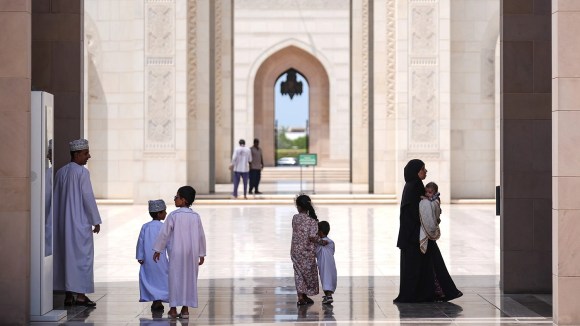
In 2018, authorities in Oman escorted two American college students off a local university campus as they alleged the students were sharing their faith with Muslims. Omani law prohibits proselytism, and its constitution defines Islam as the state religion and declares sharia law as the basis of legislation.

Depending on the nature of their offense, the students could have faced up to 10 years in prison. Alternatively, they could have been found in violation of the law forbidding religious teaching without a government permit—as they were in the country on a tourist visa—and deported. Instead, they were let go with a warning.

Michael Bosch, a persecution analyst with Open Doors, said many foreign Christians who work with Omani converts from Islam have had to leave the country. For security reasons, Open Doors does not give numbers or details of these cases, yet it believes the Omani law hinders religious freedom.

However, Justin Meyers, director of Oman’s al-Amana Center (AAC), an interfaith ministry partnering with the Reformed Church in America, believes the law actually protects the religious freedom of its diverse population. (Part 1 of this series explained AAC’s background.)

After the students’ arrest, the Ministry of Religious Affairs called Meyers, asking him to talk with the students. Realizing they were from his home state of Michigan, Meyers first called local pastors he knew. One contact identified one of the students but had no idea he was in Oman. The sending organization had instructed him not to name the nation of his visit, the student told Meyers, lest he be inadvertently exposed—and possibly killed.

Open Doors ranks Oman No. 32 in its annual World Watch List (WWL) of countries where it is hardest to be a Christian. Its most recent report included an article about a female Omani convert to Christianity living in the US who stated on social media that if she were in her home nation, she would be killed or imprisoned for her faith.

Yet Oman is not on any lists of religious liberty offenders created by the US State Department or the Commission on International Religious Freedom. The State Department’s annual report cites Open Doors’ complaint about the treatment of converts and the monitoring of churches, but also that Christian groups had not reported any incidents of abuse or surveillance.

Meyers counseled one of the students, whom he was able to connect with, to respect the laws of Oman. Both students finished their six-month stays without further incident. Several years later, with the publishing of the 2025 WWL, the Omani government called Meyers again. Would he invite Open Doors for a visit so that officials could address their complaints?

The Open Doors report praised AAC for creating a more tolerant attitude among Omanis toward Christians while citing the Oman government’s support for AAC as an example of the country’s efforts to improve diplomatic relations with the West. Meyers has resided in Oman since 2013, serving as AAC executive director since 2021.

Open Doors had not consulted him and did not immediately respond to the Omani government’s invitation to visit—but Open Doors and AAC have since begun discussions about how to work together.

Since the death of former sultan Qaboos bin Said in 2020, Bosch explained, the new government has intensified its efforts to discover Christians who secretly share their faith. Previously, the authorities only identified those working directly with Omani converts. Now, the interrogation is broader, as authorities try to find networks and funding sources, Bosch said.

According to Open Doors criteria, “dictatorial paranoia” and “Islamic oppression” are two key drivers of local persecution. Although apostacy is not a criminal offense, converts could lose custody of their children under sharia-influenced personal status codes. But another driver is “clan oppression.” Within Oman’s tribal society, converts face shunning from society. And although the report recognizes that violence is not encouraged by the culture, some have been attacked for their faith.

Persecution, Bosch emphasized, is any act of hostility toward faith.

Mohammed al-Shuaili, associate director of AAC, said that Oman’s laws against proselytizing are expressly meant to…

This article was originally published at Christianity Today on October 15, 2025. Please click here to read the full text.
Categories
Middle East Published Articles Christianity Today

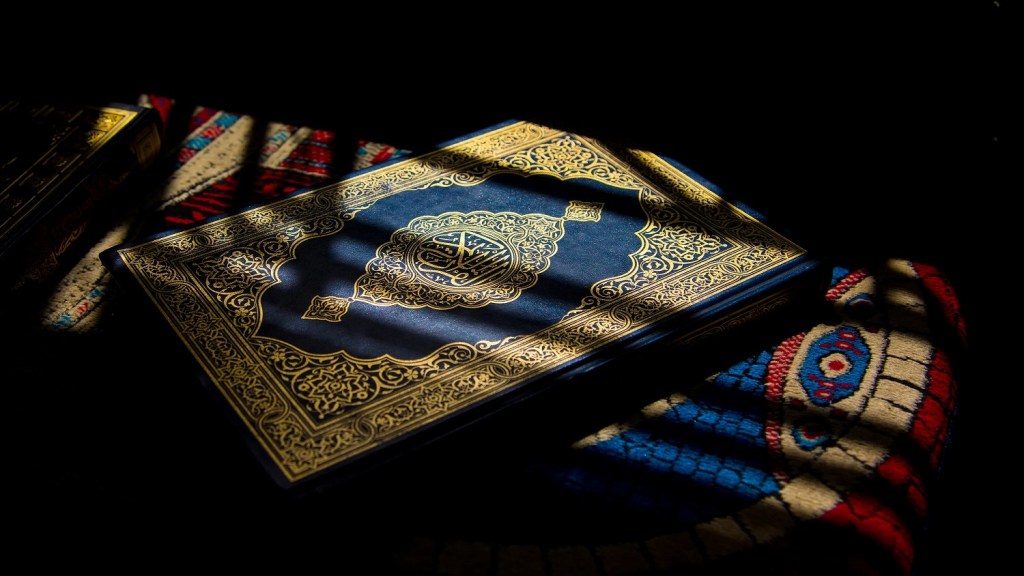
Does the Quran Support Religious Pluralism?

Eric Lafforgue / Art in All of Us / Contributor / Getty

Last month, an obscure jihadist group claimed responsibility for a suicide bombing at the Mar Elias Greek Orthodox Church in Damascus, Syria, that killed 25 people. The attack came as a response, it stated, to the government requiring prior approval of Islamic preaching in the Christian neighborhood. Three months earlier, at the site of the future bombing, austere Salafi Muslims called on residents to convert to Islam, a practice known in Arabic as da’wa. Later, a car drove up and its occupants loudly repeated the call until local Muslims sent them away.

Salafis are known for growing long beards and wearing traditional robes in imitation of the prophet Muhammad. Salafi practice is not inherently violent, and reporting does not draw a clear connection between the incident at the church and the later suicide bombing. But many jihadists emerge from or are drawn to Salafi communities, as both aim to follow the Quran literally in complete devotion to Allah.

The jihadists even adopted a particular verse from the Quran as their slogan: “Fight the polytheists together as they fight together against you.” To them, belief in the Trinity is an offense against Allah’s oneness. In preventing Muslims from proper da’wa, then, both state and church in Syria became worthy of war.

Some experts say Salafis and jihadists represent a reaction—peaceful or otherwise—to reclaim a lost idealized era when Islam governed much of the world. Yet most Muslims are neither Salafis nor jihadists; many have accepted democracy and the nation-state system that formally adopts principles of minority rights and common citizenship.

Still, according to a 2013 survey of Muslims in 38 nations, the sense of Islamic superiority lingers. Like many evangelicals, the most devout Muslims view their faith as the only way to heaven and consider converting others to be a religious duty.

In the West, belief that someone is going to hell has little civic impact, as religious faith tends to be an individual decision. But in the Muslim world, this belief has subjected Christians to a long heritage of second-class citizenship. And the survey reveals that substantial minorities of the most devout want sharia made the law of the land, applied also to non-Muslims.

The modern principle of pluralism holds two ideas in tension: Believers should be free to spread their faith, while minority religions and their beliefs should be respected. As Syria shows, this can be complicated in the Middle East, where the understanding of Islam is a crucial factor for interfaith peace.

One Tunisian Muslim academic, Adnane Mokrani, makes a bold assertion: Islam, when properly understood, is an ally of religious pluralism. Though he concedes this is a minority viewpoint among Muslims, Mokrani, who serves on the Network of Centers for Christian-Muslim Relations advisory board, said that a new generation of theologians are reevaluating the Quran’s understanding of diversity.

The new network, profiled previously this series, doesn’t comment on political events or policies. It recognizes the witness of one’s faith as an essential part of both Christianity and Islam. But it believes that interfaith peace may require setting aside evangelism and da’wa in certain ways and places, though not as an activity of individual believers.

In this case, Mokrani believes the diversity of religions flows intentionally from the divine will, expressing his argument in a recent webinar. He cited this verse from the Quran as evidence: “If Allah had willed, He would have made you one community.” This idea is similar to that of the academic sage in the first article in this series, who lamented the state of conflict and rancor that ensues from religious difference. Yet the passage continues optimistically: Multiple religious communities exist so that they may “compete with one another in doing good.”

Classical Muslim theology, however, divides the world into the “House of Islam” and the “House of War,” as multiple verses in the Quran encourage Muslims to fight unbelievers. Historically, the House of War was the realm of opposing empires, with the Christian Byzantines the most stubborn in resistance.

This theology recognized that Jews and Christians in conquered lands now resided within the House of Islam. The Quran refers to Jews and Christians, along with Muslims, as “People of the Book,” in recognition of a shared scriptural heritage, Mokrani said. Classical Muslim scholars rejected much of the Bible’s content as distorted. Yet the Quran honors its conception of the Torah, given to Moses, and the Gospel, given to Jesus, as “containing guidance and light”—the same terms it uses of itself.

On the ground, this meant that Muslims would not forcibly convert Jews and Christians. Instead, the two religious groups could continue practicing their faiths in exchange for payment of a tax called jizya. Through this, these communities received status as dhimmis, safe from war and given freedom of worship—though not to evangelize. Treatment varied over time, but their second-class status reinforced the Islamic sense of religious superiority.

The historical development of Muslim society led to a gap between the original conciliatory vision of Muhammad and the later, more rigid attitude of scholars, maintains Mokrani, who is also professor of Islamic studies at the Pontifical Gregorian University in Rome. Faced with a growing empire and Christian opposition in war and faith, Muslim scholars’ commentaries on the Quran polemically defined Islam as a religious community distinct from Jews and Christians rather than in continuity with them.

Their interpretive tool was the location of Muhammad’s prophecies.

In Mecca, the prophet preached…

This article was originally published by Christianity Today on July 24, 2025. Please click here to read the full text.

Categories
Americas Christianity Today Published Articles

What Another Trump Presidency Means To Evangelicals Around the World

Illustration by Elizabeth Kaye / Source Images: Getty

As Americans headed to the polls Tuesday, the rest of the world watched to see who would become the 47th president of the United States. The election of Donald Trump affects many evangelical communities around the world in terms of foreign policy, foreign aid, religious freedom, and cultural trends. Nevertheless, Christian leaders in some countries noted that it didn’t make a difference to them who becomes the next president of the US.

CT asked 20 evangelical leaders around the world about their reaction to another Trump presidency and its practical impact on the situation of evangelicals in their countries. The responses are broken up by region: Africa, Asia, Europe, Latin America, North America, and the Middle East. CT will add more responses as they come in.


AFRICA

Nigeria

James Akinyele, secretary general, Nigeria Evangelical Fellowship

Top of Form

In light of Nigeria’s ongoing economic and political difficulties, this US election was not debated locally nearly as much as the prior two. For evangelicals, neither candidate was an easy option. Harris was considered more level-headed, but her strong support of abortion and LGBTQ rights made many uncomfortable. Trump’s moral stances resonated with our core evangelical convictions, but his own lack of morality and perceived white supremacy created some concerns. We hope he will become more open to immigration.

Some Nigerian Christian leaders said Trump’s victory is an answer to our prayers for a US president who will defend the Christian faith in Nigeria and around the world. Others said it should be accepted as God’s will, without positive or negative judgment. But just about everyone hopes he will become less controversial in his rhetoric and personal conduct. And many are sympathetic to his promise to maintain America’s role as the global policeman without being subservient to the rest of the world.

South Africa

Moss Ntlha, general secretary, Evangelical Alliance of South Africa

Trump’s win is a sad day for evangelicalism around the world. Prominent evangelicals in the US came out in full support of Trump, making it appear that to be Bible believing is to be Trump supporting. Their endorsement gives the impression that theological conservatism requires and leads to a right-wing political view that is dictatorial, opposes climate justice, sanctions genocide in the Holy Land, and approves what took place on January 6.

Many in South Africa who know the horrors of apartheid recognize how easily a populist politics that holds to a narrow vision of public morality can harm those on the margins. Trump already declared in his first term that African countries are “s—hole countries.” Lately, he has made it clear that when restored to the presidency, he would make sure that Israel has all it needs to “finish the job,” which many understand as the erasure of Palestinian existence.

We worry that having Trump in the White House will make it difficult to proclaim the gospel that “God so loved the world” that he sent Jesus to die for all, especially our Muslim neighbors. We worry that he will use the immense power of the US government to punish those who pursue foreign policies contrary to his own, such as South Africa for appealing to the International Court of Justice to adjudicate whether what we are witnessing in the Israel–Palestine conflict is genocide.

ASIA

China

A house church pastor in China

Donald Trump’s presidency could impact…

This article was first published at Christianity Today on November 7, 2024. Please click here to read the full text.
Categories
Christianity Today Europe Published Articles

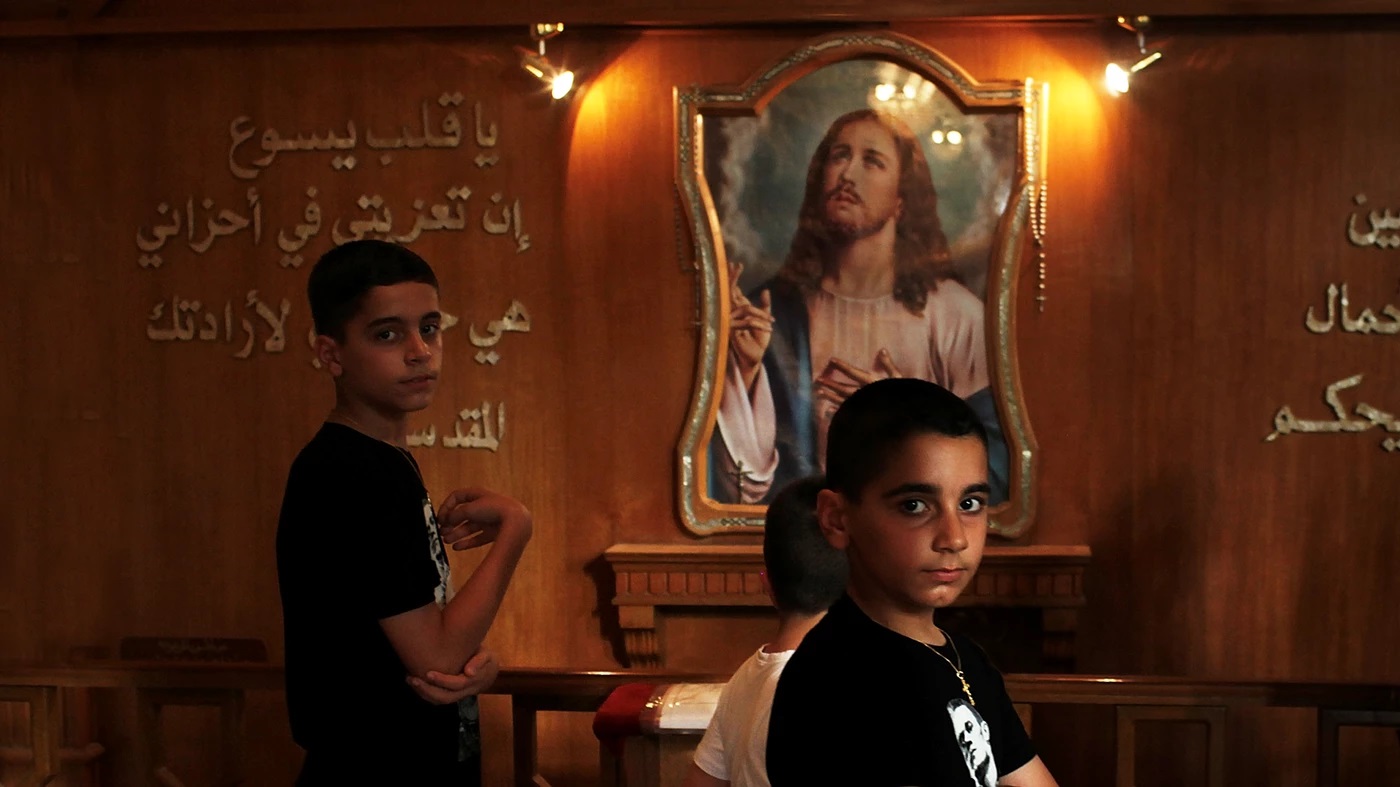
Expert: Ukraine’s Ban on Russian Orthodox Church Is Compatible with Religious Freedom

Roman Pilipey / Stringer / Getty

During Tuesday night’s presidential debate, Kamala Harris accused Donald Trump of a fondness for dictators, alleging that he supported a negotiated settlement with Vladimir Putin following Russia’s invasion of Ukraine. Trump, declining to affirm that a Ukrainian victory would serve US interests, replied that if he were still in the Oval Office, the war would never have happened, and he claimed that he could bring it to an end even as president-elect.

Both candidates failed to address the most salient current issue on Ukraine for evangelicals: religious freedom.

Last month, the Ukrainian parliament overwhelmingly approved a proposal to ban the activities of the Russian Orthodox Church (ROC) and compel the Ukrainian Orthodox Church (UOC) to break all ties with the patriarchate in Moscow. President Volodymyr Zelensky signed the bill into law, hailing his nation’s “spiritual independence.”

Some Republicans, including vice-presidential candidate J.D. Vance, have accused Ukraine of “assault[ing] traditional Christian communities.” Vance linked these alleged violations to the continuation of US military support, stating that military aid should be used as leverage to ensure religious freedom.

The charge is nonsense, said a leading Ukrainian expert in an interview with CT.

The law, said Maksym Vasin, director for international advocacy and research at the Institute for Religious Freedom in Kyiv, is meant to protect Orthodox believers in Ukraine from Russian propaganda. The State Service for Ethnic Policy and Freedom of Conscience (DESS) studied ROC and UOC documents to demonstrate the continuing link between the two churches, despite the UOC’s postwar assertion of independence. Each of the UOC’s 10,000 parishes has now been given nine months to demonstrate that it is not connected to the ROC, subject to court judgment.

However, the GOP is not alone in its concern.

Pope Francis stated last month that no church should be abolished “directly or indirectly” based on how its people pray. The World Council of Churches urged “caution.” And according to various reports, Ecumenical Patriarch Bartholomew I, considered first among equals in the Orthodox world, sent a delegation to Ukraine to inquire about canonical structure and whether individual UOC parishes are being forcibly transferred to the rival Orthodox Church of Ukraine (OCU).

The state said 1,500 parishes have voluntarily aligned with the OCU since 2018.

In 2019, Bartholomew granted autocephaly (canonical independence) to the OCU, a then-schismatic body that had earlier broken off ties with Moscow. The move, supported by the United States, shifted OCU allegiance to the ecumenical patriarch’s church in historic Constantinople.

Orthodoxy first spread among the Slavic people from Kyiv, which was joined to the ROC in 1686. Following passage of last month’s law, the OCU reached out to the UOC for dialogue, emphasizing the need for unity and reconciliation.

CT spoke with Vasin, who contributed a chapter analyzing an earlier draft of the law in last year’s Security, Religion, and the Rule of Law, about the response of Ukrainian evangelicals, the limits of individual criminal prosecution, and whether the law should be considered a “ban.”

Please explain the aim of the new law.

The law aims to terminate Russian influence on Ukrainian society through Russian religious centers and to limit the propaganda of the chauvinistic ideology of Russkiy Mir (Russian World) in Ukraine. Ever since Soviet times, Russia has systematically used religion and religious centers of various denominations, primarily the ROC, as a tool of propaganda to achieve its military and geopolitical goals.

Churches are then manipulated to exert totalitarian control over their citizens or are closed down if they refuse to cooperate. This repressive policy is clearly visible in the eastern and southern regions of Ukraine, annexed following the Russian invasion. There, the Russian authorities are carrying out brutal repression against Ukrainian Christian churches and religious communities of various denominations, including Muslims and Jews who do not support Russian aggression.

Putin and the Kremlin want to maintain a key instrument of influence in Ukraine, namely the ROC and its affiliated local Orthodox eparchies and parishes. For this reason, Russia is most vocal critic of the Ukrainian government’s initiatives aimed at protecting religious freedom from abuse.

Is the new law a “ban” of the UOC?

It is a ban of the ROC in Ukraine, because of its open support for Russia’s war.

It is not an immediate ban on the activities of the UOC, which is not even directly mentioned. The government will issue directives to break administrative and canonical subordination to the ROC or other Russian religious centers. If a religious community refuses to sever these ties, the government will have the right to apply to the court to terminate the activities of this legal entity, given the danger to national and public security. But if the defendant parish complies during these hearings, the court case will be dismissed.

Thus, it is wrong to say that this law bans the UOC. Instead, the law allows this church and any other religious associations in Ukraine to liberate themselves from the influence of Russian intelligence services and stop being mouthpieces for Russian propaganda.

It is up to the UOC priests and parishioners to decide whether they will continue to agree to be used by the Kremlin or whether they will end their dependence on the ROC and Russian authorities.

Your analysis of an earlier version of the law advised the government to concentrate on individual criminal proceedings against clerics who collaborated with Russia. Why is this not a sufficient safeguard against Russian interference?

Religious communities should not be responsible for the activities of their clerics, and a ban must be the last resort if other measures have been ineffective. But in recent years, it has become increasingly clear that…

This article was originally published at Christianity Today, on September 13, 2014. Please click here to read the full text.

Categories
Christianity Today Published Articles

Who Restricts Religion More, Politicians or the People? Pew Crunched the Global Data.

Image: Spencer Platt / Getty / Edits by CT

Government restrictions on religion are at a global high.

Social hostility toward religion, however, has ticked downward.

So concludes the Pew Research Center in its 14th annual analysis of the extent to which 198 nations and territories—and their citizens—impinge on religious belief and practice.

Some sort of harassment of religious groups was recorded in all but eight.

The 2024 report, released earlier this month, draws primarily from more than a dozen UN, US, European, and civil society sources, and reflects conditions from 2021, the latest year with fully available data.

The global median on Pew’s 10-point scale of government restrictions reached 3.0 for the first time ever, continuing a steady rise since the baseline score of 1.8 in 2007. Overall, 55 nations (28%) recorded levels marked “very high” or “high,” only two lower than last year’s total of 57.

Nicaragua was highlighted for harassment of Catholic clergy.

Regional differences are apparent: The Middle East and North Africa (MENA) scored 5.9, up from its baseline score of 4.7. Asia-Pacific scored 4.2, up from 3.2. Europe scored 3.1, up from 1.7. Sub-Saharan Africa scored 2.6, up from 1.7. And the Americas scored 2.1, up from 1.0.

Pew’s 20 measures of government restrictions included efforts to “ban particular faiths, prohibit conversion, limit preaching, or give preferential treatment to one or more religious groups.”

Some pertained to COVID-19, such as Canada’s fines against open churches.

A further 13 measures for acts of religious hostility by individuals or groups included “religion-related armed conflict or terrorism, mob or sectarian violence, harassment over attire for religious reasons, and other forms of religion-related intimidation or abuse.”

Social hostilities toward religion continued to trend downward since a high of 2.0 in 2018, decreasing to 1.6, the lowest score since 1.2 in 2009. But 43 nations (22%) still recorded levels marked “very high” or “high,” though significantly fewer than the 65 offending nations in 2012.

Nigeria was cited for clashes between Muslim herders and Christian farmers.

The order of regional differences in social hostility…

This article was originally published at Christianity Today, on March 18, 2024. Please click here to read the full text.

Categories
Christianity Today Middle East Published Articles

Report: Iran Arrested 166 Christians in 2023, Targeting Bible Distributors

Religious reeducation did not work on Esmaeil Narimanpour.

First arrested by the Iranian government in 2021, he and seven other converts to Christianity were cleared by the state prosecutor, who stated that their change of religion was not a crime under Iranian law. The following year, he was ordered with several others to attend ten sessions with Muslim clerics to “guide” him back to Islam.

Last December, Narimanpour was arrested again, this time on Christmas Eve.

The case is one of several highlighted by “Faceless Victims: Rights Violations Against Christians in Iran,” the 2024 annual report released jointly by advocacy organizations Article18, Open Doors, Middle East Concern, and CSW and presented at the British Parliament.

“This is a great example of agencies working together,” stated Mervyn Thomas, founding president of CSW (formerly Christian Solidarity Worldwide), at the event. “Iran claims to ensure freedom of religion or belief for all; but that is nonsense, as this report shows.”

Not yet convicted, Narimanpour is one of 166 Christians arrested and 103 detained by Iran during the 2023 reporting period. Another 22 have been sentenced, and 21 imprisoned.

While sentencings decreased by 8 from 2022, this year witnessed an additional 32 arrests and 41 detainments. Article18 has tracked incidents in Iran since 2015, when arrests were at a peak of 193. Detainments have fluctuated yearly between 26 in 2018 and this year’s high, while sentencings ranged between 12 in 2015 and a high of 57 in 2020.

The British parliament gathering included testimony from former prisoner Farhad Sabokrooh. Arrested with his wife in 2011, the couple served one year in prison and had their previously registered church closed down after 25 years. Accused of being a spy for Israel and the United States, he told the gathering that he was forced into a false confession, sentenced without his lawyer present, and once released was threatened with death if he did not leave Iran within one month.

“My plea to you is to hold the regime accountable,” Sabokrooh stated. He later noted, “They somehow feel Christians are orphans and have no one to protect them. We have to reverse that.”

The 36-page sixth report was released on February 19 to coincide with…

This article was originally published at Christianity Today on February 21, 2024. Please click here to read the full text.

Categories
Christianity Today Europe Published Articles

Russia Restricts Churches in Ukraine. Divided Orthodox Critique Both.

Image: Photo courtesy of Mission Eurasia

Religious freedom is under threat in Ukraine. Some question by whom?

A Ukrainian delegation to last week’s International Religious Freedom Summit in Washington, DC, had a clear answer: Russia. Led by Sergey Rakhuba, president of Mission Eurasia, it presented “Faith Under Fire,” a December report detailing the crimes of war in eastern Ukraine and elsewhere.

“Faith communities are under incredible pressure in occupied territories,” he told CT. “The ideology of the Russian world is to completely monopolize religion.”

International lawyer Robert Amsterdam, however, warned that Ukraine was attempting the same control over one half of its divided Orthodox church.

Initial legislation passed by the Ukrainian parliament in October, he said, threatened to “ban” the historic Ukrainian Orthodox Church (UOC), the branch canonically linked to the Russian Orthodox Church (ROC) patriarchate in Moscow. In response, Amsterdam sent a 25-page dossier to the US, UK, and European Union heads of state on the UOC’s behalf.

“There is now a very serious question mark over whether Ukraine can meet its commitments to human rights and the rule of law,” the dossier stated. “This will have dire ramifications for Ukraine’s entry into the European Union and its place in the Western world.”

The authors of both reports share a common enemy.

Mykhailo Brytsyn, the lead author of the Mission Eurasia report, is a Ukrainian pastor who was previously arrested by the Russians during a worship service in Melitopol, occupied by Russia since March 2022. He was later exiled, and the army seized his church and turned it into a military base. Amsterdam, a Canadian lawyer with offices in DC and London, was also previously arrested in Moscow for defending Russian dissidents and subsequently banned from the country.

The United Nations is monitoring both Russia and Ukraine.

At a November meeting of the body’s security council, the UN assistant secretary general for human rights noted the yet-to-be finalized law in Ukraine and chided the country for failing to properly investigate 10 documented cases of violence at houses of worship, instigated by the Orthodox Church of Ukraine (OCU) against the Moscow-linked UOC.

The OCU was granted autocephaly—national independence—by Ecumenical Patriarch Bartholomew I of Constantinople in 2019, supported by the United States under the principle of religious freedom. But the move was rejected by the ROC, which continued in ecclesial jurisdiction over the UOC.

The UN official, Ilze Brands Kehris, continued her testimony to state that Russia is violating international norms by applying its own law in occupied territory, detailing restrictions on minority believers.

Rakhuba noted that there are many such restrictions.

“This war is not just territorial, it is ideological,” he said. “Religious freedom is missing from Russian terminology.”

Citing a concept called Russki Miir—“Russian World”—Rakhuba, a Ukrainian who previously worked with the Union of Evangelical Christian Baptists in the Soviet Union, contended that the ROC works hand-in-hand with the Kremlin to marginalize other Christian denominations. Since the invasion, the Russian military authority in the occupied Donbas region has steadily replicated that formula.

Rakhuba described three phases. In the first, from the January 2022 invasion until April of that year, the Russian army…

This article was originally published at Christianity Today on February 6, 2024. Please click here to read the full text.

Categories
Christianity Today Europe Published Articles

Azerbaijan Added to US List of Religious Freedom Offenders

Image: Mozar / Getty / Edits by CT

For the first time, the United States has recognized Azerbaijan as a violator of religious freedom.

Inclusion on the State Department’s second-tier Special Watch List (SWL) subjects the oil-rich Shiite Muslim–majority nation to the possibility of economic sanctions.

The US Commission on International Religious Freedom (USCIRF) has called for the Caucasus nation’s censure each year since 2013. Created by the 1998 International Religious Freedom Act (IRFA), USCIRF’s bipartisan yearly report evaluates “systematic, ongoing, and egregious” violations independent of US foreign policy concerns and tracks government implementation of its recommendations.

Complicating any consequences, Azerbaijan aligns with US foreign policy in certain areas: It cooperates closely with Israel, is aligned against Iran, and agreed to increase oil exports to Europe in the wake of Russia’s invasion of Ukraine.

In a brief statement, US secretary of state Antony Blinken kept unchanged all other 2022 designations mandated by the IRFA. Azerbaijan joins Algeria, the Central African Republic, Comoros, and Vietnam on the SWL, cited for “engaging in or tolerating severe violations of religious freedom.”

Twelve nations—China, Cuba, Eritrea, Iran, Myanmar, Nicaragua, North Korea, Pakistan, Russia, Saudi Arabia, Tajikistan, and Turkmenistan—again received designations as first-tier Countries of Particular Concern (CPC).

USCIRF “welcomed” the designation of Azerbaijan. But it stated there was “no justification” for failing to follow its advice to also label India and Nigeria as CPCs.

India was first recommended from 2002–2004 as a CPC, from 2010–2019 for the SWL, and then again from 2020 onward as a CPC. Nigeria was recommended for the SWL from 2003–2008, and as a CPC since 2009.

While the State Department has never included India, former president Donald Trump listed Nigeria on the SWL in 2019 and as a CPC in 2020. President Joe Biden removed it entirely the following year.

USCIRF called for a congressional hearing over these omissions and further criticized the State Department for issuing sanction waivers for CPC violators Pakistan, Saudi Arabia, Tajikistan, and Turkmenistan.

In a statement to CT, Lilieth Whyte, public outreach chief of the State Department’s Office of International Religious Freedom, cited three main factors.

Azerbaijan’s laws place “onerous registration requirements” on religious groups to register nationally, restricting them further in their right to worship freely and select their own clergy. The government physically abuses, arrests, and imprisons religious activists, she added, while conscientious objectors are not permitted to serve their country in accordance with their beliefs.

Not mentioned was Azerbaijan’s months-long blockade of its Armenian-populated enclave of Nagorno-Karabakh—which Armenians call “Artsakh”—which culminated in an invasion last September that displaced more than 100,000 people.

At the time, Blinken “urged” Azerbaijani president Ilham Aliyev to “immediately cease military actions.” In November, assistant secretary of state James O’Brien told a congressional committee that “there cannot be ‘business as usual’” in US relations.

But last December, the State Department press service clarified that cessation of interaction with Azerbaijan would be…

This article was originally published at Christianity Today, on January 8, 2024. Please click here to read the full text.

Categories
Christianity Today Middle East Published Articles

Evangelical Alliance Accepts Iran Invite. Critics Claim Broken Engagement.

Image: Fabrice Coffrini / AFP / Getty

Last June, the World Evangelical Alliance (WEA) received a peculiar invitation. On the sidelines of the 53rd meeting of the United Nation’s Human Rights Council (HRC) in Geneva, the government of Iran organized a forum entitled “The Role of Religions in Promoting Human Rights.”

The WEA was the only Christian group invited.

Upon its acceptance, the alliance—representing 600 million evangelicals—under UN protocol became an official forum co-sponsor with the Islamic Republic, designated by the United States as a state sponsor of terrorism since 1984.

Ranked No. 8 on Open Doors’ World Watch List (WWL) of the 50 nations where Christians experience the most persecution, Iran also partnered on the event with Pakistan, ranked No. 7 (both are considered “severe” offenders). Another co-sponsor was the Organization of Islamic Cooperation; 35 of its 57 members rank on the 2023 watchlist.

The intersection of topics, however, secured the participation of the HRC itself, the Office of the UN High Commissioner for Human Rights, and the Geneva School of Diplomacy. The official title of the WEA presentation was diplomatically bland: “Harnessing the immense potential of religions in cultivating pluralistic societal cohesion and global peace.”

But behind the scenes, Iran wanted something different.

“They asked us to explain: What can evangelicals contribute to the good of society?” said Thomas Schirrmacher, WEA secretary general. “I would have a bad conscience if we did not use such opportunities to testify in the court of the world.”

American critics of the UN, however, believe “kangaroo” is this court’s most suitable adjective. One month after President Donald Trump’s 2018 withdrawal from the Iran Deal, the US similarly withdrew from the HRC—protesting the hypocrisy of electing China, Cuba, Saudi Arabia, and other dictatorships among its 47 member nations. (Three years later, President Joe Biden reversed Trump’s decision.)

The WEA presentation was delivered by Gaetan Roy, the WEA’s permanent representative to the UN in Geneva. Citing the propriety of his role as a behind-the-scenes actor, Roy declined to be interviewed about his interactions with Iranian diplomats. But Schirrmacher summarized Roy’s remarks as giving specific examples of what evangelicals believe and how they defend the freedom of religion or belief for all.

“It was amazing, a result of our diligent work over many years,” he said. “In many of these countries we are seen as troublemakers, if not terrorists.”

But did the message translate? Iranian press summarized Roy’s remarks as emphasizing “the importance of the role of dialogue.” And some critics lambasted the WEA for “legitimizing” Iran in the public arena, seeming to support its propaganda as a purported defender of human rights.

“The UN is where human rights concerns should be most addressed, and the WEA should be a prophetic voice there,” said Johnnie Moore, who formerly served on the US Commission on International Religious Freedom (USCIRF). “But they are hobnobbing with diplomats and drinking tea, becoming part of the problem.”

Moore co-authored a book about Islamic terrorism in Nigeria, called The Next Jihad, together with current USCIRF chair Abraham Cooper, a Jewish rabbi. Cooper’s associated Simon Wiesenthal Center stated it was “difficult to put into words the damage done” by the WEA.

Coming in the waning days of anti-hijab, women-led protests, the WEA’s public co-sponsorship has emboldened a “murderous” Iranian regime, the center stated. And contrary to the title of the forum, it stated evangelical leaders demonstrated instead how religion can “degrade” human rights.

“For Iran, it means business as usual,” Cooper told CT. “And for the beleaguered innocents, it means their martyrdom, suffering, and muffled pleas are forsaken—by a group they were counting on for public support.”

One such Iranian woman called the WEA’s participation a “comedic drama.”

She requested anonymity as a formerly imprisoned convert from Islam. Though she is now in asylum in Europe, Iranian agents have continued to harass her.

“Every day Christians are arrested, in every corner of Iran,” she said. “WEA participation was not wise, and does not help Christianity at all.”

Also in opposition is Hormoz Shariat, president of the US-based Iran Alive ministry. If the WEA were to engage Iran in such a forum, he said, it should only be if Christian persecution is at the top of the agenda, with a pre-negotiated agreement on the principles of religious freedom.

But even then, it likely would not make a difference.

“Iranians are the masters of deception and manipulation,” Shariat said, himself a convert to Christianity. “And evangelicals are naïve when dealing with Muslims, thinking everyone behaves according to a similar moral code.”

He cited the practice of taqiyya, which he said permits a Shiite Muslim to lie.

Yes, the theological concept exists in Shiite Islam, said Sasan Tavassoli, senior lecturer at the London-based Pars Theological Institute. But its application is disputed and Christians should not be overly concerned. He is a “huge advocate” for dialogue with Iran, and lauds the WEA for seeking to build a positive relationship.

“We can hold Iranian Muslims accountable for their statements, just like everyone else,” he said. “Jesus commands us to love our enemies, and by showing respect in these gatherings, we are following him.”

Having been involved in evangelical interfaith dialogue with Iran since 2004, Tavassoli said the WEA can help “tone down” the common accusations that converts from Islam are part of a deviant cult, an imperialist tool of “Zionist Christianity.” And for former Muslims imprisoned for this reason, such connections can help quietly advocate on their behalf.

Schirrmacher said the WEA has performed this role already, securing the release of several pastors and other believers in Iran. “Such success only follows when…

This article originally published at Christianity Today, on August 10, 2023. Please click here to read the full text.
Categories
Christianity Today Middle East Published Articles

How Should We Then Live Among Muslims? Four Arab Christian Views

Image: JossK / Getty

Two Middle East nations share a city named Tripoli.

They share little else, apart from a Phoenician heritage and mutually near-unintelligible dialects of Arabic. One of their starkest contrasts concerns freedom of religion.

Libya sentenced six Christians to death earlier this month for converting from Islam. Lebanon, despite its sectarianism enshrined in politics, allows free movement between religions.

Libya’s Tripoli was commemorated in the official hymn of the US Marines in homage to American intervention on the shores of North Africa. Lebanon’s was an outpost of an eastern Mediterranean–focused American missionary movement that transformed society through gender-inclusive education.

The Italians colonized Libya; the French, Lebanon. Elsewhere, the Middle East is marked by British influence, Ottoman traditions, petrodollar economies, democratic structures, multicultural kingdoms, autocratic republics, and everything in between.

What unites them all is the preponderance of Islam.

But among the followers of Muhammad there is also difference. Some nations are secular; others enforce sharia. Some protect Christian minorities; others discriminate against them. It is difficult to offer a sweeping synopsis—or uniform lessons learned by local Christians.

Yet CT asked four Arab Christian leaders with deep roots in the region to make an attempt. Two currently live abroad; two live in their nation of origin. Yet each represents a space on the spectrum of strategies on how to best live as a Christian in a Muslim society.

One articulation of the spectrum, crafted by theologian Martin Accad, arranges common Christian responses into five categories: syncretistic (the blurring of faiths), existential (the dialogue of diversity), kerygmatic (the preaching of the apostles), apologetic (the defense of the gospel), and polemical (the interrogation of Islam).

The leaders engaged below were not asked to sort themselves accordingly, nor does this landscape article seek to label them. But each was asked the following question:

Whether in a context of oppression or embrace, how should believers in Jesus witness to their faith, keep social peace, and maintain unity with fellow Christians?

Martin Accad / Najib Awad / Harun Ibrahim / Barshar Warda

This article was originally published at Christianity Today, on May 17, 2023. Please click here to read the full text.

Categories
Christianity Today Middle East Published Articles

Saudi Arabia Embraced Coptic Christmas. Could Its First Church Be Next?

Image: Markas Ishak / The Coptic Orthodox Church Press Office / Getty Image

Saudi Arabia stunned foreign policy observers this month by publicly agreeing to normalize relations with Iran, under Chinese sponsorship. The deal between the neighboring Sunni and Shia arch rivals, known for sectarian proxy fights, is expected to ease tensions within Islam.

Meanwhile, the kingdom has recently taken less publicized steps toward another religious normalization: public Christian faith.

In this case, Egypt is the supporting nation.

“Nine years ago, I was told, ‘Pray, but don’t publicize it,’” said Bishop Marcos of Egypt’s Coptic Orthodox Church. “This time, Saudi Arabia is publicizing it themselves.”

On January 7, Marcos headlined a month-long pastoral visit by celebrating the eastern Christmas liturgy amid 3,000 Coptic Christians residing in the kingdom. Facilitated by the Egyptian embassy, additional services in Riyadh, Jeddah, Dammam, Khobar, and Dhahran were “held under the full sponsorship of the Saudi authorities.”

It was the first public Christmas celebration admitted by the Islamic nation, home to the pilgrimage sites of Mecca and Medina. Muslim traditions cite Muhammad as forbidding the existence of two religions in Arabia, though scholars differ as to the geographic scope.

But Marcos’ trip was not the first Christian worship permitted.

He began praying about visits to Saudi Arabia after being sent in 2012 to help solve a dispute between authorities and an Egyptian Christian migrant worker. Marcos estimates there are about 50,000 Copts in the kingdom, among 2.1 million Christians—mostly Filipino Catholics.

None have a church to worship in. Open Doors’ World Watch List ranks Saudi Arabia No. 13 among the 50 countries where it is most difficult to be a Christian today. Visiting Coptic clergy used to meet the faithful in neighboring Bahrain.

But when Marcos returned in 2014, he said he conducted liturgies for about 4,000 believers. Leaks covered by the Qatari news network Al Jazeera resulted in some attention, but the Saudis told him they were not troubled by it. Weeks-long pastoral trips continued annually, and in 2016 Saudi King Salman bin Abdel Aziz visited Coptic Pope Tawadros II in Egypt.

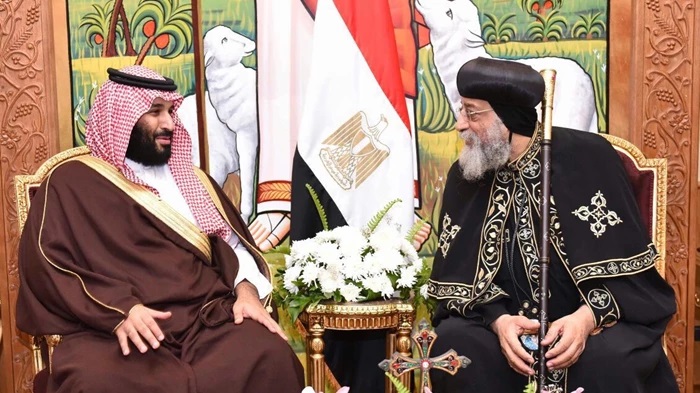
It was 2018 that led to further openness. Crown Prince Muhammad bin Salman (known as MBS) visited the Coptic Orthodox cathedral in Cairo in March, taking a famous photo with Tawadros in front of an icon of Jesus, the Good Shepherd. He invited the Coptic pope to visit Saudi Arabia, while encouraging continuation of Marcos’ visits.

That December, the first liturgies were officially reported. Not everyone was pleased. Medhat Klada, spokesman for the European Union of Coptic Organizations…

This article was originally published at Christianity Today, on March 29, 2023. Please click here to read the full text.
Categories
Christianity Today Europe Published Articles

Will Ukraine’s Threatened Ban on Russia-Linked Churches Violate Religious Freedom?

Image: Jeff J. Mitchell / Getty Images

Ukraine, a bastion of religious freedom, is moving to possibly outlaw a church.

President Volodymyr Zelensky began the month by endorsing a draft law to “make it impossible” for the Ukrainian Orthodox Church (UOC), canonically linked to Moscow, to operate. His December 1 decree followed raids on several monasteries under the UOC’s jurisdiction.

Security services searched over 350 buildings and investigated 850 people.

“We will ensure complete independence for our state. In particular, spiritual independence,” stated Zelensky. “We will never allow anyone to build an empire inside the Ukrainian soul.”

The reaction from Russia was swift—but also illustrated the issue.

“The current Ukrainian authorities have openly become enemies of Christ and the Orthodox faith,” stated Dmitry Medvedev, deputy chairman of the Russian Security Council.

Kremlin spokesman Dmitry Peskov, however, was more specific, accusing Ukraine of “waging a war on the Russian Orthodox Church” (ROC).

His comment prompted a UOC spokesman to assert his church is not Russian.

The raids—centered on the 11th-century Kyiv-Pechersk Lavra complex, known as the Monastery of the Caves—uncovered large amounts of cash, “dubious” Russian citizens, and leaflets calling on people to join the Russian army, according to Ukrainian authorities. Other material cited as evidence included prayer texts of ROC patriarch Kirill and a video of hymn singing that celebrated Russia’s “awakening.”

Kirill has publicly blessed Russia’s invasion of its neighboring nation, even promising forgiveness of sin to soldiers who die in the war. Security services also described finding UOC priests in possession of literature denying Ukraine’s right to exist and contacting Russian intelligence agents.

Sanctions were announced on at least 10 UOC members, including the governor of Kyiv-Pechersk Lavra, a UNESCO heritage site. Another, the archbishop of the Kirovohrad diocese, was accused of subversive activities.

Zelensky stated the government would examine the Lavra’s jurisdiction.

Since then, sanctions have followed on seven additional members, while the UOC stated that local authorities have issued over 70 orders to ban its activities.

In 2019, the newer Orthodox Church of Ukraine (OCU) was formed from a merger of two breakaway jurisdictions from the ROC, after which it was declared an autocephalous (independent) body by Ecumenical Patriarch Bartholomew I of Constantinople.

The new church was rejected by Moscow and accepted by Greece and other national churches, while some in the Orthodox world stayed neutral. The UOC, meanwhile, continued under the leadership of the Moscow patriarchate.

Russia’s invasion in February 2022, however, placed the UOC in a bind. Although it is the largest church in Ukraine with about 12,000 parishes, polls indicate it now receives the support of only 4 percent of the population. As a further sign of its decline in favor, only 13 percent of Ukrainian citizens of Russian ethnicity support the church.

In May, Metropolitan Onufriy, head of the UOC, declared its parishes were no longer subordinate to the ROC, though he maintained Eucharistic communion with Moscow. By then, 387 parishes had already transferred allegiance to the OCU.

Onufriy has consistently spoken out against the war, and last month he deposed three top bishops, two of whom fled to Russia. And following the raids he declared support to UOC chaplains in the Ukrainian army, while the Holy Synod—speaking from the Lavra—reiterated that the church “consistently stands for the preservation of the sovereignty, independence, and territorial integrity of Ukraine.”

After the draft law’s disclosure this month, Ukraine dismissed Elena Bogdan, state official for ethnopolitics and freedom of conscience, reportedly for her opposition to banning the UOC. She had previously confirmed Onufriy’s statement that the church was no longer governed by the ROC.

Zelensky’s decree tasked her office with the determination of UOC’s continuing ties with the Moscow Patriarchate. “Increasingly as the war grinds on and winter advances, the weaponization of religion will continue,” said Catherine Wanner, professor of history, anthropology, and religious studies at Penn State University. “All of these dynamics conspire to clamp down on…

This article was originally published at Christianity Today, on December 21, 2022. Please click here to read the full text.
Categories
Christianity Today Middle East Published Articles

Pope Francis in Bahrain: A Royal Reminder of Religious ‘Freedom of Choice’

Image: Loredana Mantello / Getty Images

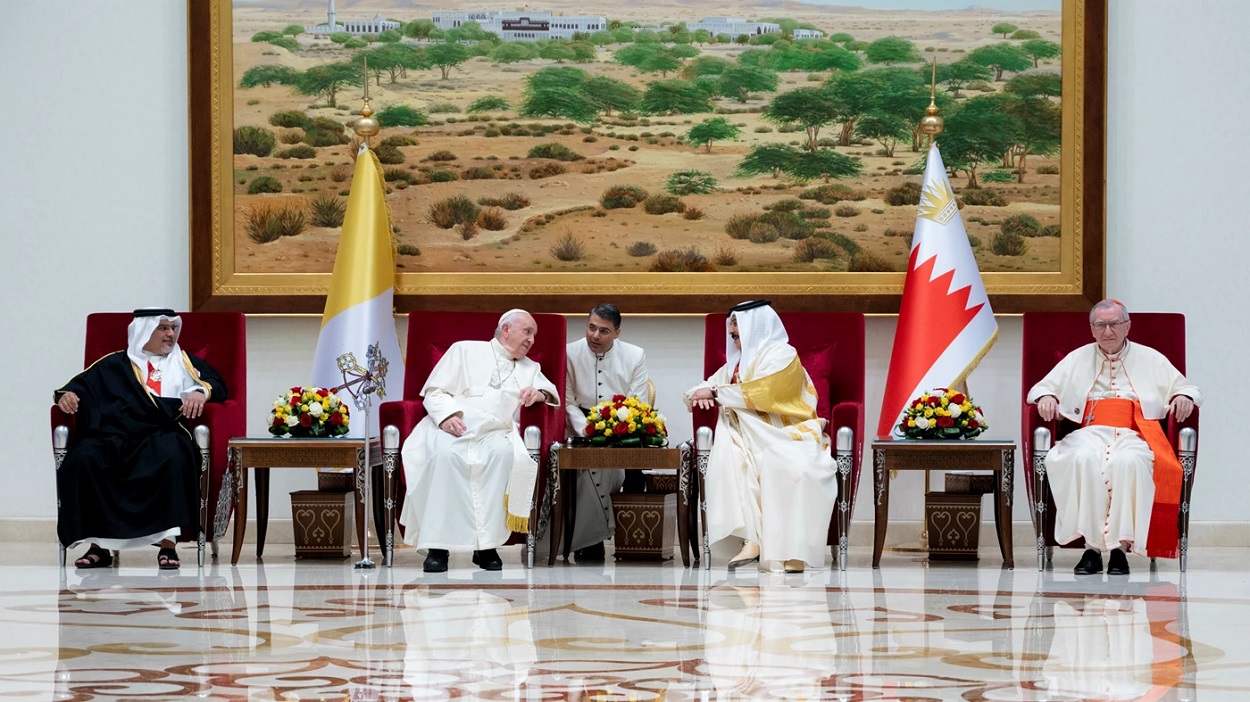
After greeting Pope Francis last week with a red carpet, a 21-gun salute, and a contingent of horses to accompany his humble vehicle, King Hamad bin Isa Al Khalifa highlighted one document to characterize his realm:

The 2017 Kingdom of Bahrain Declaration.

“[Bahrain is] a cradle of mutual coexistence between followers of different faiths,” he said, “where everyone enjoys, under our protection after that of God Almighty, the freedom to perform their rituals and establish their places of worship, in an atmosphere of familiarity, harmony, and mutual understanding.”

With Bahraini flags flying side by side with the Vatican banner, Francis was profuse in his praise. Enduring severe knee pain, he noted the country’s centuries-old “Tree of Life,” a 32-foot acacia that somehow survives in the Arabian desert.

Bahrain honors its roots.

“One thing stands out in the history of this land: It has always been a place of encounter between different peoples,” said Francis. “This is in fact the life-giving water from which, today too, Bahrain’s roots continue to be nourished.”

In the island nation the size of New York City, flanked on either side by Iran and Saudi Arabia, from November 3–6 the pope visited its 160,000 Catholic migrants—primarily from the Philippines and India—living among a population of 1.5 million, evenly divided between foreign workers and citizens.

From 111 nationalities, 30,000 gathered this past Saturday at the national stadium for Mass.

Bahrain is a Sunni Muslim monarchy ruling over a narrow majority of Shiites. Christians comprise 10–14 percent of the population, with up to 1,000 Christian citizens originally from Iraq, Palestine, and Jordan who were present at the time of independence. Alongside a 200-year-old Hindu temple, a renovated synagogue hosts prayer for Bahrain’s few dozen Jewish citizens.

But beside pastoral responsibilities, Francis came prepared to preach.

At the Bahrain Forum for Dialogue: East and West for Human Coexistence, his message was a near homily on the 2017 declaration. Addressing over 200 religious leaders from the Gulf, he urged their leadership and introspection. “It is not enough to grant permits and recognize freedom of worship,” Francis said. “It is necessary to…

This article was originally published at Christianity Today, on November 11, 2022. Please click here to read the full text.

Categories
Middle East

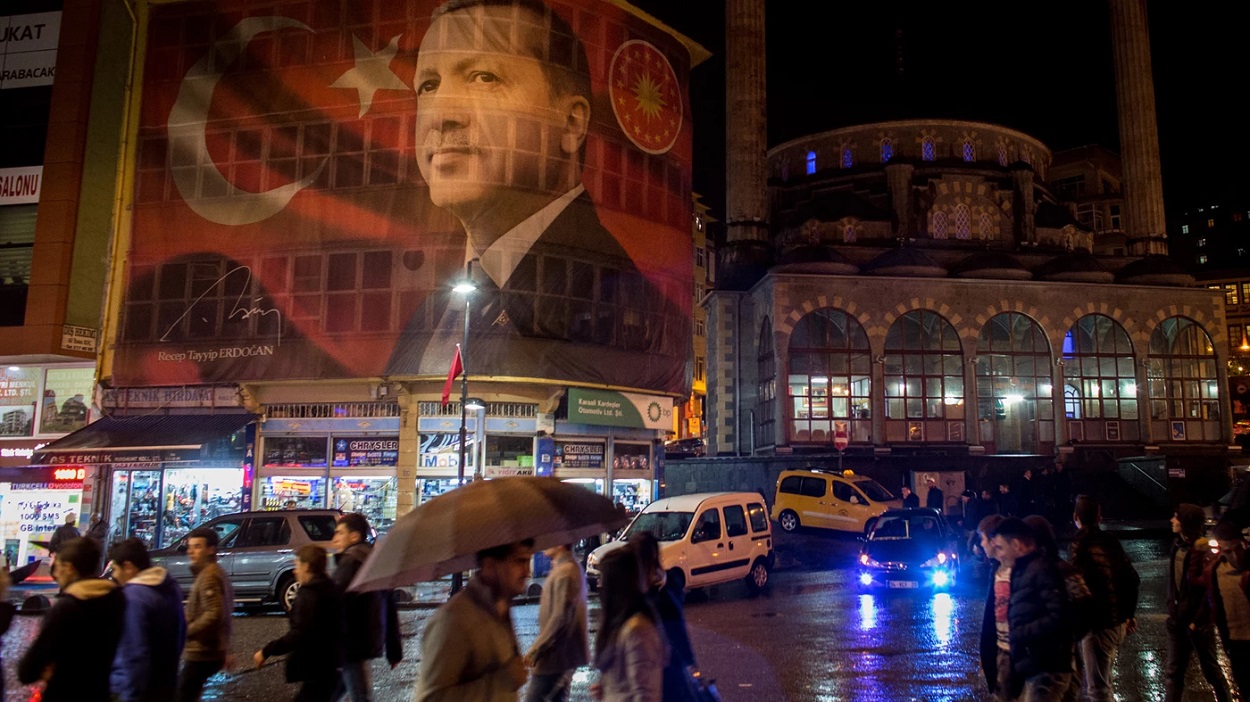
Despite Drop in Deportations, Turkey Still Troubles Christians

Image: Chris McGrath / Staff / Getty

Last year, Protestant Christians in Turkey suffered no physical attacks.

There were no reported violations of their freedom to share their faith.

And there was a sharp reduction in foreign missionaries denied residency.

But not all is well, according to the 2021 Human Rights Violation Report, issued March 18 by the nationally registered Association of Protestant Churches (APC).

Hate speech against Christians is increasing, fueled by social media.

Legal recognition as a church is limited to historic places of worship.

And missionaries are still needed, because it remains exceedingly difficult to formalize the training of Turkish pastors.

“Generally there is freedom of religion in our country,” stated the report. “But despite legal protections, there were still some basic problems.”

Efforts to unite Turkey’s evangelicals started in the mid-1990s, and the APC began publishing its yearly human rights reports in 2007. Today the association, officially registered in 2009, represents about 85 percent of Christians within Turkey’s 186 Protestant churches, according to general secretary Soner Tufan.

Only 119 are legal entities.

And of these, only 11 meet in historic church buildings. The great majority rent facilities following their establishment as a religious foundation or a church association. While generally left alone, they are not recognized by the state as formal places of worship and thus are denied free utilities and tax exemption.

And if they present themselves to the government in pursuit of such benefits, officials often warn they are not a church and threaten closure. Sometimes the authorities even try to recruit informants. And some Christians who have refused have lost their jobs.

Other Turkish Protestants are simply harassed. “Dead priest walking,” said residents of Arhavi to a local pastor as…

This article was originally published at Christianity Today on April 6, 2022. Please click here to read the full text.

Categories
Christianity Today Europe Published Articles

Azerbaijan’s Churches Explain Their Evangelism

Image: Emad Aljumah / Getty Images

Emil Panahov has a vision.

“I want to see 96 percent of Azerbaijanis confess their faith in Christ, and revival often began when the king became a believer,” he said. “But our God is the president of presidents, so the government does not rule over me.”

He has a long way to go.

Panahov, founder of the Vineyard church in Muslim-majority Azerbaijan, arrives at his target by inverting his homeland’s estimated proportion of Christians: 4 percent. Most of these are Russian Orthodox, holdovers from when the Caucasus nation of 10 million was part of the Soviet Union.

But the Azerbaijan Bible Society estimates that 20,000 Azeris have become evangelicals, most within the past two decades. And the government—despite being panned for widespread human rights violations in politics—has earned local plaudits for its level of religious freedom, especially toward Christians and Jews.

Panahov’s own story supports his optimism. But is it wise? Orthodox, Catholic, and Presbyterian leaders offer a word of caution.

From an Azeri Muslim family with a communist father, in 1989 Panahov came to faith at the age of 12 through a local Russian Baptist church. But as he grew interested in the arts and dancing, the conservative Christian community could not accept such worldly activity.

Panahov fell away from the faith as he performed professionally around the world—until in 2007 he tore his meniscus. Doctors in Turkey, where he lived at the time, told him he would never dance again.

It was then he recalled Jesus—whom he said spoke a word of healing to him. But through his Turkish pastor, God also gave him a commission: Return to Azerbaijan, and share what God has done for you.

Panahov was reluctant, knowing his artistic passion was a spiritual offense. But trusting God, he went back and eventually found a new church home. Over the next seven years he worshiped comfortably, started a family, and even found work as a dance instructor. But then he heard again the voice that healed him: Go out and start a house church.

He left his fellowship with tears but knew to obey. In the beginning he met mostly with believing relatives, but four years later their number grew to the 50 required by the authorities for registration. Similar miracles have marked many in the movement, which according to Panahov counts 350 believers in 16 cell groups, spread throughout his Caspian Sea country.

And God has used his artistic talent. His team has drawn hundreds to gospel-themed performances in downtown Baku, the nation’s capital. Media and filmmaking have put the message on the internet. The Vineyard church baptized 64 new Christians during the pandemic, he said, and 36 during Azerbaijan’s victorious war with neighboring Armenia.

“Two years ago, the churches did not believe opportunities for evangelism could reach such a level,” Panahov said. “But I know it is from God, because I don’t have the brains for it.”

It is also from the government, which following many years of suppression now works with church leaders to legalize their fellowships. While noting a positive trend, the US Commission on International Religious Freedom still recommends Azerbaijan for inclusion on the State Department’s Special Watch List for religious freedom violators.

Of concern is the legislation that requires 50 people before legal registration. Many evangelicals celebrate the freedom they do have—and the movement of the Holy Spirit to far surpass this number. But some notice…

This article was originally published by Christianity Today on April 1, 2022. Please click here to read the full text.
Categories
Christianity Today Published Articles

Iran’s House Churches Are Not Illegal, Says Supreme Court Justice (Updated)

The nine converts are officially acquitted. Branch 34 of the Tehran Court of Appeals agreed with the reasoning of the Supreme Court judge who ruled last November that the preaching of Christianity does not amount to acting against Iran’s national security.

On Monday, judges Seyed Ali Asghar Kamali and Akbar Johari accepted the converts’ lawyer’s testimony that their house church was “in accordance with the teachings of Christianity,” where they are taught to live in “obedience, submission, and support of the authorities.”

The precedent is strong, said Mansour Borji, advocacy director for Article 18, because the judges extensively outlined nine reasons in the acquittal, in line with the Iranian constitution and Islamic tradition.

But it may take time until the ruling becomes normative. One of the nine, Abdolreza Ali-Haghnejad, is already back in jail on a six-years-old separate charge of propagating Christianity, for which he was previously acquitted. And two others, Behnam Akhlaghi and Babak Hosseinzadeh, who made video appeals for freedom of worship, were charged with a separate crime of propaganda against the state.

Iranian Christians welcome the verdict, said Borji, but remain wary.

“This ruling is unlike any other of its type that I have seen,” he said. “[But] at least a dozen others … are still in prison—or enforced internal exile—following their own convictions on similar charges.”

This article updates a previously published piece at Christianity Today, from December 3, 2021. Please click here to read the full text.

Categories
Christianity Today Middle East Published Articles

Iran’s House Churches Are Not Illegal, Says Supreme Court Justice (Updated)

Image: Courtesy of Article 18

Update: The 9 converts to Christianity made eligible for release by November’s Supreme Court ruling remain in prison for their faith, according to Mansour Borji, advocacy director for Article 18. The judge had ruled that promotion of Christianity through house churches is not illegal.

But another case is contributing to the establishment of precedent.

A revolutionary court prosecutor in the city of Dezful, 450 miles southwest of Tehran, declined to bring charges against eight converts to Christianity. Four were arrested in April, with four others later added to the case.

Hojjat Khalaf, Esmaeil Narimanpour, Alireza Varak-Shah, Mohammad Ali Torabi, Alireza Zadeh, Masoud Nabi, Mohammad Kayidgap, and Mohsen Zadeh were facing criminal accusations for “propaganda against the Islamic Republic of Iran.”

The judge provided a written explanation on November 30. According to Middle East Concern, he stated that although apostasy is a crime according to Islamic sharia, it is not an offense according to the laws of Iran. Borji said the decision was unrelated to the recent Supreme Court ruling (below), as this case had not yet even made it to court.

“The prosecutor was simply not convinced with made up charges by intelligence officers with no shred of evidence,” he said. “But his reasoning is very important.”

This update was added by Christianity Today on December 21, 2021, for an article originally published on December 3. Please click here to read the full text.

Categories
Christianity Today Middle East Published Articles

Iran’s House Churches Are Not Illegal, Says Supreme Court Justice

Image: Courtesy of Article 18.

Currently at least 20 Christians are jailed in Iran because their faith was deemed a threat to the Islamic republic’s national security. Of the more than 100 Iranian believers imprisoned since 2012, all have faced similar charges.

But a recent decision by a Supreme Court justice gives hope to them all.

“Merely preaching Christianity … through family gatherings [house churches] is not a manifestation of gathering and collusion to disrupt the security of the country, whether internally or externally,” stated the judge, Seyed-Ali Eizadpanah.

“The promotion of Christianity and the formation of a house church is not criminalized in law.”

Two years ago, nine converts from the non-Trinitarian Church of Iran in Rasht, 200 miles northeast of Tehran near the Caspian Sea, were arrested in raids on their homes and church.

Sentenced to a five-year prison term in October 2019, Abdolreza Ali Haghnejad, Shahrooz Eslamdoust, Behnam Akhlaghi, Babak Hosseinzadeh, Mehdi Khatibi, Khalil Dehghanpour, Hossein Kadivar, Kamal Naamanian, and Mohammad Vafadar are now eligible for release.

The ruling, announced November 24, is “unprecedented,” according to multiple Iranian Christians and international advocates.

“The judge’s main argument is what we have been saying for years,” said Mansour Borji, advocacy director for Article 18, a UK-based organization promoting freedom of religion in Iran that tallied the cases noted above from available public records.

“But it astonished us to hear it at such a high level.” It also cuts against the grain of international understanding. The US State Department’s latest religious freedom report on Iran…

This article was originally published at Christianity Today on December 3, 2021. Please click here for the full text.

Categories
Christianity Today Middle East Published Articles

Egypt’s President Promotes Religious Choice During Human Rights Rollout

Image: Mohamed el-Shahed / AFP / Getty Images
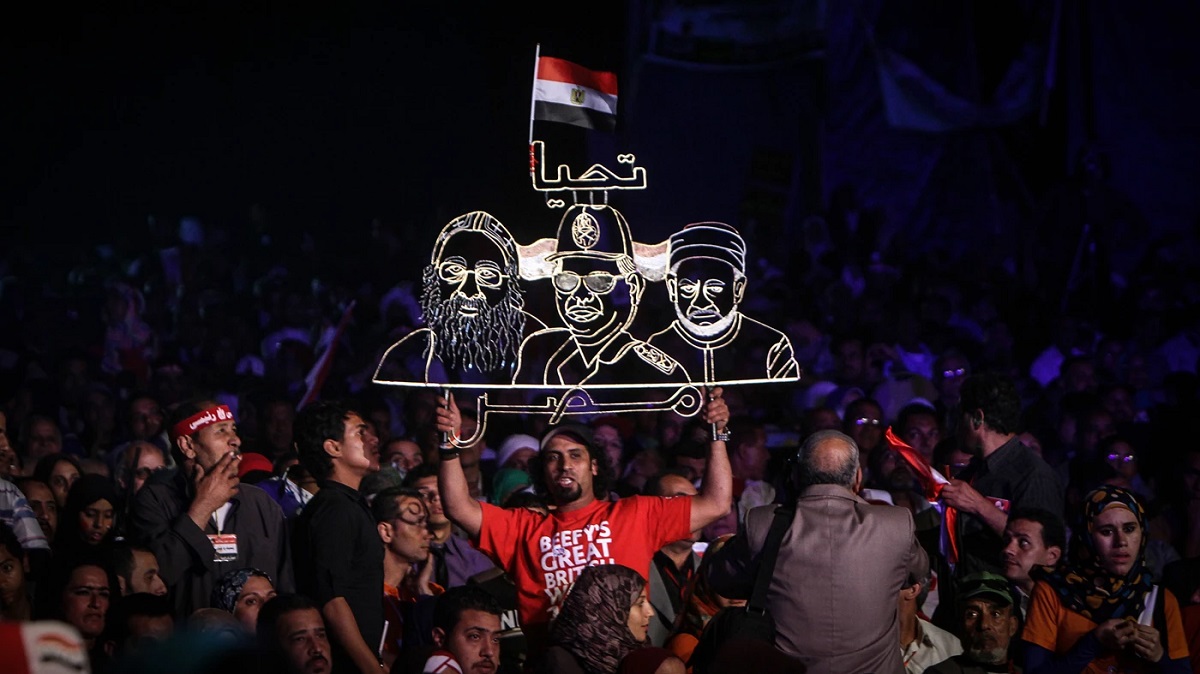
A neon sign portraying now President Abdel Fattah al-Sisi (center) between Coptic Pope Tawadros II (left) and Grand Imam of al-Azhar Shiekh Ahmed el-Tayeb (right) during a rally in Cairo in May 2014.

Committing Egypt to a five-year program of human rights reform, President Abdel Fattah al-Sisi did not mince words about religion.

“If someone tells me they are neither Muslim nor Christian nor a Jew, or that he or she does not believe in religion, I will tell them, ‘You are free to choose,’” he said. “But will a society that has been conditioned to think in a certain way for the last 90 years accept this?”

The comment sent shockwaves through Egyptian society.

“Listening to him, I thought he was so brave,” said Samira Luka, senior director for dialogue at the Coptic Evangelical Organization for Social Services. “Sisi is fighting not only a culture, but a dogma.”

Last month, the government released its first-ever National Human Rights Strategy after studying the path of improvement in 30 other nations, including New Zealand, South Korea, and Finland. The head of the UN Human Rights Council praised the 70-page document as a “key tool” with “concrete steps.”

Egypt’s constitution guarantees freedom of belief and worship and gives international treaties such as the Universal Declaration of Human Rights the force of law. But Article 98 of the Middle Eastern nation’s penal code stipulates up to five years in prison for blasphemy and has been used against atheists and Christians alike.

Will Sisi’s words signal a change?

Since his election in 2014, Egypt’s head of state has consistently spoken about the need to “renew religious discourse,” issuing a challenge to Muslim clerics. And prior to the launch of the new strategy, his comments even hinted at a broader application than atheism.

“We are all born Muslims and non-Muslims by ID card and inheritance,” Sisi stated. “Have you ever thought of … searching for the path until you reach the truth?”

Egypt’s ID card indicates the religion of each citizen. It can be changed to state Muslim in the case of conversion, but cannot be changed to Christian. Prominent public figures have called to remove the label, and debate ensued at the new strategy’s launch. Some argue the ID’s religion field is used by prejudiced civil servants and private businesses to discriminate against the minority religion.

Sisi’s timeframe of “90 years” roughly corresponds to the 1928 founding of the Muslim Brotherhood. And Luka’s “dogma” indicates a widespread social acceptance of interpretations of Islam that privilege the religion’s place in law and culture.

According to a 2013 survey by the Pew Research Center, 88 percent of Egyptian Muslims believe converting away from Islam should be punishable by death.

Calling for the application of sharia law, the Brotherhood won Egypt’s presidency in 2012, only to be overthrown by then-defense minister Sisi the following year after massive popular demonstrations.

Since then, Egypt declared the group to be a terrorist organization, and has moved to eradicate their influence from public life. Thousands—including unaffiliated liberal activists—are in prison or self-imposed exile. Bahey Eldin Hassan, director of the Cairo Institute for Human Rights Studies (CIHRS), called Egypt’s human rights situation “catastrophic.”

Concerned, President Joe Biden withheld $130 million of $1.3 billion in yearly aid to Egypt last month, conditioning it on the release of human rights and civil society activists.

Three days earlier—on September 11—Sisi launched the new human rights strategy to a national television audience. In addition to his comments about religion, he declared 2022 to be the “year of civil society.”

But a new law passed this summer to regulate NGOs was largely panned by human rights advocates. And Hassan stated that the 9/11 timing indicated the document’s primary audience. So too did the fact that the drafting committee was headed by the foreign minister.

“Before it was circulated in Egypt,” he said, “the strategy was published on the webpage of the Egyptian embassy in DC.”

A week later, charges were dropped against four NGOs.

Egyptian Christians, however, are far less critical…

This article was originally published at Christianity Today on October 18, 2021. Please click here to read the full text.

Categories
Christianity Today Middle East Published Articles

Good News for Iraq’s Christians: More Autonomy, Less Dhimmitude

Image: Courtesy of Archbishop Bashar Warda
Chaldean Catholic Archbishop Bashar Warda stands in front of the Catholic University of Erbil, located in the Iraqi Kurdistan capital city’s Ankawa district.

This week, the Christian enclave of Ankawa in Erbil, the capital city of Iraqi Kurdistan, was designated by the autonomous region’s prime minister as an official district, giving believers there administrative autonomy starting next week.

They will directly elect their own mayor, and have charge of security.

Prime Minister Masrour Barzani called Ankawa a home for “religious and social coexistence, and a place for peace.”

Archbishop Bashar Warda, the Chaldean Catholic archbishop of Erbil, called it an “important” and “strategic” decision.

“Our confidence in the future of Kurdistan makes us encourage Christians not only to stay,” he said, “but also to invest in this region.”

Ordained a priest in 1993, Warda was consecrated in his current position in 2010. With Iraq’s hemorrhaging of Christians since the 2003 US invasion, Warda’s bishopric in the autonomous Kurdish region soon became a providential band-aid.

Beginning in 2014, ISIS drove Christians from Mosul and their traditional homeland in the Nineveh Plains, and thousands took refuge in Erbil and other cities in the secure northeast. From 1.5 million Christians in 2003, the Chaldean Catholic church now estimates a population of fewer than 275,000 Christians.

Warda has long been investing to turn the tide.

In 2015, he established the Catholic University of Erbil, and has coordinated relief aid from governments and charities alike. The situation stabilized following ISIS’s defeat in 2017.

But freedom does not come from politics alone. Two years ago, Christians endorsed widespread popular uprisings against the political class. Violently suppressed, the movement’s main celebrated achievement was early elections under a new law designed to promote better local and small-party representation.

Polls open on October 10, and a quota gives Christians five of 329 seats in parliament. However, Warda’s Baghdad-based patriarch has called for a Christian boycott, fearing fraud.

Warda wants a Christian revival. Buoyed by the March visit of Pope Francis, he believes that ISIS broke the fundamental religious and cultural underpinnings of Islamic superiority. Christians no longer are seen as second-class citizens.

In an interview on the sidelines of the IRF Summit convened in Washington in July, Warda told CT about his welcome of missionaries, the Catholic way of witnessing to Muslims, and whether a revived Christian influence in Iraq will lead to future church growth.

Since the defeat of ISIS in Iraq, what challenge has been hardest for the church?

With all the displaced people, images of scattered tents immediately come to mind. But the hard part is not to provide them with food, sanitation, or medical supplies. This is not easy, but it is obvious.

The hard part is to restore their dignity. They understand that ISIS is a criminal gang. And they can bear the wounds of the innocent, knowing they had nothing to do with this dispute.

But their question is “Why?” yet also “What now?”

Men are the providers for the family. Sitting around doing nothing, they tell me, “Bishop, we don’t want money; we want a job. I want to deserve my food.”

Suppose there is aid sufficient to rebuild homes, churches, and schools and even to provide jobs. You have said that this is not enough. It does not establish the basis of citizenship and pluralism.

That is true. But without homes, churches, schools, and jobs, the people will leave the country. And then there are no citizens left.

With a rebuilt community, you can go to the government to speak about the constitution, defending the people’s full rights under the law. There is a link. First have the community; then talk about implementing ideals.

Before ISIS, when the community was stable, were you able to seek your rights?

For 1,400 years there was a sort of social contract: Islam is the religion of the nation, and you are the People of the Book. But know that Islam is the honorable religion of God, which means you are second. In the Quran it says…

This article was originally published at Christianity Today, on August 8, 2021. Please click here to read the full text.