Categories
Arab West Report Middle East Published Articles

Clinton Visits Morsy amid Coptic Protests

Outside the US Embassy in Cairo

Traditionally, it is the Copts who look to America for support of their minority rights. With the Muslim Brotherhood now in the presidency, though not in full power, some Copts wonder if the United States is switching sides.

The statement of ‘looking to America’ should not be taken as normative. The Orthodox Church and most leaders of influence insist on Egyptian solutions to Egyptian problems. They believe an appeal to the West would brand Copts as traitors in their own land. Average Copts, however, often state a sentiment of longing for America – either for pressure on Cairo or as an escape through emigration.

Amid frequent meetings between Islamists and members of the US administration, however, some Copts believe Washington’s interests are beginning to trump its commitment to human rights.

Bishoy Tamry

‘We believe there is an alliance between the Obama administration and the Muslim Brotherhood,’ stated Bishoy Tamry, a member of the political bureau of the Maspero Youth Union, a mostly Coptic revolutionary group formed after attacks on Egyptian churches. ‘This alliance is to support fascism in the Middle East.

‘The US thinks the Muslim Brotherhood will protect their interests in the region, but this will be over our bodies as minorities.’

The revolutionary character of the Maspero Youth Union plays a role in seeing the United States making a deal with the devil.

‘We knew the next president must have US support,’ Tamry continued, ‘because the military council rules Egypt and the US pays the military council.’

Most of the United State’s foreign aid to Egypt is in the form of military support, with smaller percentages given to economic and civil society development.

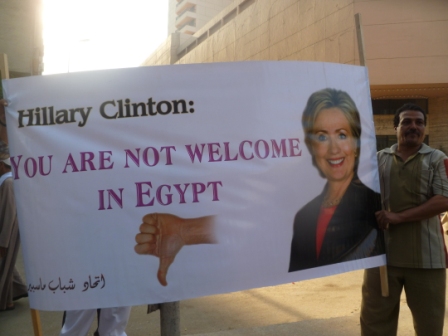
A few hundred people gathered at the US Embassy in Cairo to protest the visit of Hillary Clinton, the US Secretary of State. Early chants at the demonstration included, ‘The people and the army are one hand’, but these were silenced by Maspero Youth Union leaders. Tamry explained their group called for an open protest, and some attendees see the military council as the best means to limit or even depose Islamist rule.

One such group is the supporters of Egyptian television presenter Tawfiq Okasha, somewhat comparable to America’s Glenn Beck. These are strong supporters of the military council and clashed briefly with assembled protestors when they arrived, according to Ramy Kamel, an independent Coptic activist helping organize the demonstration. This drove the protest ten minutes south to the Four Seasons Hotel.

According to Nader Shukry, the media spokesman for the Maspero Youth Union, the United States is looking to preserve its interests after the Arab Spring shook their control of local governments. Yet their eye is not on the region’s good, but on its destruction.

‘[The US] knows Islamist rule will bring ruin to these countries, and the best evidence of this is their previous experience.’

As for proof of this alliance, it is found in their frequent meetings.

‘We see evidence in the pre-election visits of US representatives to the Muslim Brotherhood headquarters,’ said Tamry. ‘If the US was looking simply to political representatives it would have visited their Freedom and Justice Party.’

Others see this reasoning as absurd.

‘The United States has relations with every nation in the world,’ said Raed Sharqawi, an investigative journalist present at the demonstration.

‘The United States is also the shield for the Copts, and always will be. This protest is foolish.’

During Clinton’s visit she asked President Morsy to ‘assert the full authority of his position’. The president is currently engaged in a struggle with the military council over the dissolution of parliament. His party, the FJP is also pushing him to confront the military over its supplementary constitutional declaration to preserve some of its powers until a new constitution is written. Clinton did state the details of the transition should be left to the Egyptian people to determine, but urged the military return to its role of protecting the borders.

It is an open and contested question if the military is seeking to preserve its power and resist the revolution, or if it is defending democracy against a premature Islamist takeover of all institutions of government.

Nevertheless, whether the demonstrations against Clinton are foolish or astute, it is a dramatic step for a segment of the Coptic community to turn against the United States so publicly.

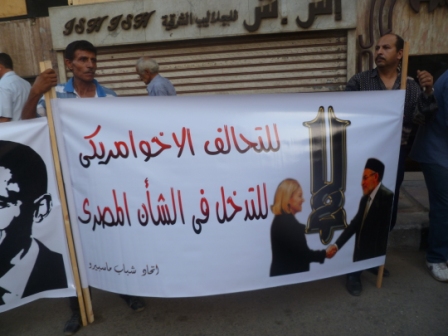
Translation: No to the Brotherhood-American Alliance to Interfere in Egyptian Issues. (Pictured: Hillary Clinton and MB General Guide Mohamed Badie)

Related Posts:

Categories
Current Events

Friday Prayers for Egypt: Parliament’s Brief Return

God,

President Morsy caused a stir this week by recalling parliament in defiance of the Supreme Constitutional Court which ruled it was illegal and the military council which implemented its dissolution. Many were up in arms, though the president explained he was not violating the court ruling, only delaying its implementation. Morsy promised new elections would be held after the new constitution is formed.

There are too many ways to view events, God. Give Egyptians the wisdom to know who tells them the truth, and who is working on their behalf.

It may be that Morsy is defending democracy against a recalcitrant military. It may be Morsy is angling for Islamists to control all state institutions in violation of the law. It may be Morsy is playing along with the military to present the president as a man of the people. Or it may be they agreed to give Morsy a chance to save face publically while submitting privately to ongoing military behind-the-scenes dominance.

For its part, parliament met for only fifteen minutes, taking action only to refer its legal standing back to the courts.

There is a place for play acting, God, but to symbolize an otherwise untenable situation. There is less place for spin, manipulating opinion, or outright deception.

Egypt deserves a parliament, God, and it also deserves the rule of law. But is this parliament what Egypt deserves, and is this rule of law one that is honest and just? These questions are harder to answer, and the balancing of principles is difficult.

Amidst this confusion, God, bring Egypt forward. Keep Egypt from conflict between the military and the Brotherhood, but keep Egypt’s future out of their backroom negotiations. If the United States is involved, may she be a neutral arbiter and not a further manipulator.

Guide President Morsy, God. May he make stands from right principle and defend the right of the people to rule. Guide the military council as well, God. May their stands also be right and good, guarding the democratic transition to democracy from the power of any one element, even their own.

Guide also those who are unaffiliated, God, whose numbers are many. May they find a voice and a worthy leader, to keep this struggle from being defined along two poles only. May they know with whom to take sides, when, and how to switch as necessary. May they be guided also by principle and what is right and best for Egypt.

Bless also the ongoing work on the constitution, God. May this document honor the nation.

Bless Egypt, her people, and her leaders – all together. Chasten as necessary, but spare them from harm.

Amen.

Categories
Personal

A Protestant Pastor with President Morsy

I am currently working on an article summing up the Coptic reaction to President Morsy’s first days in office. Unfortunately, the publisher’s word count means squeezing out a few otherwise indicative quotes.

One interesting quote that didn’t make the cut is from Rev. Mina el-Badry, a Protestant pastor from Minya in Upper Egypt. Responding to my inquiry, he said:

‘Morsy is our president; we are all with him and all behind him, as we want the nation to stabilize. It is not up to Copts to oppose the president – these are political issues. Some will oppose him and some will support him, but as Egyptians.

‘I believe all power and all sovereignty is for God, and he knows best how to protect us – whether the president is Morsy or anyone else.’

The conventional wisdom in Egypt is that Copts are very concerned about Morsy’s presidency, despite encouraging rhetoric I will highlight soon. Yet also important to note are spiritually oriented thoughts such as these. It will be interesting to follow the evolution of Egyptian Christian thinking toward Islamist rule as the years go by … if indeed they have that long.

Note: Ha. I meant by that last statement if Islamists will rule that long. A second glance revealed it could be read if Egyptian Christians survive that long. Which way did you read it, and what might that reading communicate? Gulp. Of me I wonder if it reveals a subliminal schizophrenia.


Related Posts:

Categories
Aslan Media Middle East Published Articles

Morsy Reinstates Egypt’s Parliament

Military Council head Tantawi (L) and President Morsy

That was fast.

After only one week in office, President Morsy has picked his first fight – he issued a decree to reinstate the dissolved parliament.

Shortly before the run-off election the Supreme Constitutional Court ruled parliament to be unconstitutional based on procedural grounds, and the military council issued a decree to dissolve it.

Morsy, now with the executive power of the presidency, has undone the decree of the council.

Moreover, he threatens the legislative power the military council afforded itself in the interim period between the dissolution of parliament and the writing of the constitution after which new elections will be held.

Morsy promised the return of parliament from his victory speech in Tahrir Square. He used language, however, which left him wiggle room to fulfill this promise simply with new, eventual elections.

When he took his oath of office in front of the constitutional court, however, it seemed he was accepting the court decision and military prerogative to set the path of transition until a new constitution was written.

When he was seen repeated hobnobbing with the generals, it gave the impression a deal, or at least an understanding, had been reached. That is, Morsy made his ‘revolutionary’ speech, but now was getting down to business in cooperation with the military.

He is certainly getting down to business now.

The ruling to dissolve parliament was questionable, but it was issued by the ‘independent’ court. Whether or not it is, of course, is also questionable, but Morsy pledged to uphold the law and respect the judiciary.

On the other hand, many observers see the court ruling and subsequent constitutional declarations by the military as a power grab, or at the least as an effort to balance the power of the president and an Islamist parliament. Yet both president and parliament were elected democratically – though perhaps this is also among the questionable issues of Egypt’s transition.

This statement is not necessarily to cast doubts on the results, only to reflect the common perception that Egyptian’s votes are only an aspect of the power struggles underway in the country.

Morsy’s move comes one day before the High Administrative Court was set to issue a ruling on the legality of parliament’s dissolution. It is unclear if this case will docket as scheduled. The military council is holding an emergency meeting at present.

Two items to cast shades of conspiracy. One, some suspect this is a continuation of play acting between the Brotherhood and military council. A few months ago they railed against the performance of the government and threatened to withdraw confidence. They never did, but used the episode to justify going back on their promise not to field a presidential candidate. Under this theory, the crisis was engineered then, and is engineered now to present the Brotherhood as a revolutionary force deserving of popular and international support. The military, it is posited, is simply being a foil for the emerging power, with which they are fully in cahoots.

Two, it is noteworthy that in the last day or two President Morsy received a letter specially delivered by the undersecretary of state, William Burns. Its contents were not made public, but the timing is suspicious. The released text, incidentally, narrates the parliament before the constitution.

‘It will be critical to see a democratically elected parliament in place, and an inclusive process to draft a new constitution that upholds universal rights.’

According to conspiracy, however, ‘secret’ instructions could either supplement the theory above, or, more deviously, could be telling the Brotherhood the US has your back in a move against the military.

Away from conspiracy, the next moves may be telling. Morsy’s move is a definitive challenge to the military’s authority. If there was a deal, it seems clear he is violating it.

The military’s position is difficult. It will be hard pressed to go against the executive authority of a popularly elected leader. Indeed, it is the right of the executive to implement – or ignore – administrative aspects of the state.

It was assumed, if there was a deal, that the military possessed a number of cards which could be played against Morsy, with which to hold him in check. There is a court case pending, for example, to dissolve the Muslim Brotherhood as an organization. There may also be challenges to the legality of his campaign. He, like all other candidates, violated rules. He may also – though this is speculated popularly – have received foreign funding.

After all that has transpired, it would be difficult to imagine any of these legal measures unseating a president, but Egypt has had surprise rulings before.

And at the end of the day, a coup d’etat is ever on the table.

It was not imagined Morsy would move against the military so quickly. The expected path was to accommodate and slowly squeeze them from power, as in Turkey, and to a degree, in Latin America.

It seems Morsy will play his cards now, however. Coming days will reveal either his flush or his bluff.

Related Posts:

Categories
Lapido Media Middle East Published Articles

As President Morsy Preaches Peace, Muslim Brotherhood Sanctions Jihad

Morsy hailed at Tahrir Square

In both his presidential campaign and inaugural addresses, President Mohamed Morsy has assured the world of Egypt’s commitment to peace. Yet in the run-up to the final election on June 14, the Muslim Brotherhood published an Arabic article calling this commitment into question.

‘How happy would Muslims be if the leaders of the Muslims … would make recovery of al-Aqsa Mosque [in Jerusalem] their central issue – to cleanse it from the filth of the Zionists and impose Islamic sovereignty over all quarters of Palestine,’ wrote General Guide Mohamed Badie, the group’s top leader.

Furthermore, he referenced a fatwa given by ‘Muslim scholars’ without further designation, ‘Jihad with life and money for the recovery of al-Aqsa Mosque is an individual duty incumbent on every Muslim.’ The article was published on IkhwanOnline, the official website of the Muslim Brotherhood.

This message is very different from the public statements of Morsy, who emerged from the Brotherhood to win Egypt’s first free democratic presidential election.

‘We will preserve all international treaties and charters,’ said Morsy. ‘We come in peace.’

Though Israel was never mentioned by name, the inference was obvious.

The international community is watching closely as importance lies in what Morsy does, not in what he says. Still, his assurance is understood as one of the necessary guarantees to the Egyptian military as well as the United States to not stand in the way of a Brotherhood presidency.

Yet the principle of action over rhetoric is necessary also concerning domestic Brotherhood politics. As US-MB delegations were in continual contact, Badie’s article sanctioning jihad betrays little intention to honor a peace treaty. On the other hand, at this point, they are just words, not actions.

Which words should be believed?

According to Sheikh Osama al-Qusi, an Egyptian Salafi scholar with no love for the Brotherhood, the word jihad does not necessarily imply fighting. ‘The term with life designates that one must be ready to give his life for the cause of Islam. It may include engaging in battle, but this is not demanded.’

Even so, al-Qusi links ‘jihad with life and money’ to its Qur’anic source, where God instructs the Muslims, ‘Allah has purchased from the believers their lives and their properties [in exchange] for that they will have Paradise. They fight in the cause of Allah, so they kill and are killed.’

Speaking with Lapido Media, Muslim Brotherhood spokesman Mahmoud Ghozlan makes a different distinction. ‘As a citizen I am different from the state or the presidency,’ he says.

‘Just because we have gained the presidency should we give up on our principles concerning Palestine, including that Jerusalem is for us?’

Ghozlan then reiterated Morsy’s assurances that Egypt would respect all international treaties. Indeed, the rest of Badie’s article references non-violent methods to expose Israeli occupation of Palestine, such as the ‘Miles of Smiles’ aid convoys from March 2012 to break the blockade of Gaza.

Dr. Nadia Mostafa, professor of international relations at Cairo University, agrees with this non-violent interpretation. ‘We can make jihad,’ she told Lapido Media, ‘in a different way.

‘It does not mean to make a suicide bomb. Jihad with life means we must offer everything in our life for the just cause, even to the last extent in which I die.’

Badie’s article, indeed, does not call specifically for jihad. It urges patience on the Palestinian people and a focus on reconciliation between Fatah and Hamas.

Yet it also urges persistence, that they should make their ‘motto and starting point the confrontation of the Zionists’. That is, perhaps, it is a Palestinian struggle, even if they should be encouraged that ‘every sincere Muslim mujahid in every nation of the world stands with you’.

For Mostafa, Palestine is the issue which will decide the presidency of Morsy. But it must not be allowed to distract from critical domestic issues, including overcoming the secular-Islamist divide. She expects, however, a firm rejection of the Gaza blockade.

‘The Brotherhood will say what they have to say, but we must separate between them and the presidency, and I believe Morsy understands this well.’

Mohamed Morsy formally ended his membership in the Muslim Brotherhood following his official declaration as president.

As president, however, he is not expected to have much love for Israel, no matter his international obligations. Political analyst Sameh Fawzy expects a zero-tolerance strategy towards Israel.

‘Egyptians have had a very limited margin of normalization with Israel over the last decades,’ Fawzy told Lapido Media. ‘This margin is expected to be even narrower than before.’

Therefore, while the Muslim Brotherhood may well continue its strident rhetoric, Fawzy believes the Israel file will remain in the hands of the foreign ministry and security apparatus.

While these cabinet positions are still being negotiated, many analysts believe these ministries will remain firmly under military supervision, if not direct control.

This combination is not predisposed to result in war, but the consequence may well be a continuation of the status quo. For Fawzy, the bilateral outlook is bleak.

‘Cold peace is the expected option.’


Published first at Lapido Media.


Related Posts:

Categories
Personal

Morsy at Tahrir

Addressing the crowd

Amid the celebrations, and worry, over Egypt’s new president, there has been a small crisis over where President-elect Morsy will swear his oath of office.

The military’s supplemental constitutional declaration says that in lieu of parliament, he must swear in at the Supreme Constitutional Court.

Many Islamists, however, fail to recognize this declaration and the dissolution of parliament, and insist he swear his oath in front of the chosen delegates of the people.

Revolutionaries, on the other hand, demand he swear his oath in front of them at Tahrir Square.

Mosry has chosen the balancing act, honoring two of three.

Seemingly submitting to the military dictate, Morsy is due to take his oath of office tomorrow. Many interpret this as a tacit acknowledgement of recent military decisions, or worse, indicative of a ‘deal’ or power-sharing arrangement.

Others say Morsy is simply playing along by the rules of the military in order to obtain the presidential office, at which point he will slowly, but surely, work to reverse their accumulated power. Under this scenario, he is currently cementing his revolutionary and centrist credentials so as to keep a popular mandate to resist, and then press against, the military.

Along this path, today Morsy pledged his allegiance to the Egyptian people at Tahrir.

During his 45 minute speech, he gave a little bit to everyone.

To the establishment he said he comes with a message of peace and Egypt will not attack anyone. Israel was not mentioned specifically but the intention was clear enough.

To the centrists he mentioned he would be the president of all Egyptians. He placed Muslim next to Christian, specified tourism workers, and included those who opposed him, and still do.

To liberals he pledged Egypt would be a civil, national, constitutional, and modern state.

But for the revolutionaries he saved his theatrics, worthy of Mario Balotelli’s pose. In the middle of his speech, Morsy left the podium and addressed the crowd directly. He then opened his jacket to reveal a plain blue shirt, and more importantly, no bulletproof vest. He trusted in God, and in the Egyptian people.

The triumphant pose against Germany
The dramatic pose at Tahrir

Morsy led chants honoring the ‘free revolutionaries who will continue the path’. He vowed not to accept any limitation on the powers of the president, implied in the supplementary constitutional declaration.

More poignantly, he pledged retribution for the martyrs and injured of the revolution. He did not specify, but most revolutionaries finger the military.

And when he finished his address, the official chanter boomed, ‘Field Marshal [Tantawi], tell the truth. Is Morsy your president or not?’ It was a direct challenge.

The only group left out of the above was the Islamists. There were no calls for sharia.

But he did tack them on at the end, almost as an afterthought. After referencing the large banner near the stage, he took up the cause of Sheikh Omar Abdel Rahman. Known as the Blind Sheikh, he sits in an American prison for conspiring in the 1993 World Trade Center bombing. From here he promised to work for the release of all prisoners incarcerated during the revolution, and included the Blind Sheikh in their number.

And finally, he called the people to unite in their love for Egypt. Yet to this he added such unity and love would ‘promote the cause of the umma’. Umma is an Arabic term generally taken to denote the Muslim nation as a whole. He did not elaborate, but perhaps hinted at, or subconsciously expressed, the greater aims of the Muslim Brotherhood project.

Reviewing Twitter later in the day, it was clear many Egyptians, even those opposed to the Brotherhood, were impressed. Perhaps not being raised in the arts of Arabic rhetoric I could not appreciate it, but I found the speech a bit rambling and repetitive. At the same time, however, it was a stark departure from the autocrat norm. Morsy was comfortable, engaged, and theatric. He reveled in his moment.

As for the content, a politician is often judged successful by how many constituencies he can please. In this case, he hit the mark. Morsy had to shy away from his base, but even the Omar Abdel Rahman reference can possibly be understood as one of justice, as I have written here, here, and here. At the least, a nation should be expected to lobby on behalf of its citizens jailed abroad, even its guilty ones. Still, the reference will give fodder for analysts to focus on Morsy’s extremist agenda, as well it possibly might suggest.

More likely it was a bone thrown to the Salafis and al-Jama’a al-Islamiyya, but who knows?

Another bone might concern the wrangling over the powers of the president. It is a key revolutionary demand, and of the Brotherhood as well. But largely it is nonsensical. Without a constitution, the powers of the presidency are undefined, yet to be determined by the people. That Egypt has reached this point is the fault and possible manipulation of many; but here, it is a rallying cry more than an issue of substance. That is, unless the charge is true the Brotherhood wish to gain control of everything.

In the end the largest question remains unanswered: Is their conflict or cooperation between the military and the Brotherhood? At Tahrir, did Morsy throw down the gauntlet, or simply pose for dramatic effect? Or, somewhat in between, was he establishing a bargaining chip? It is hard to tell. One’s answer here depends on the reading given to the revolution as a whole, not just on today’s speech.

A speech, which was on the whole successful. Is it his high-water mark, or is the best yet to come? Stay tuned, as the revolution continues. (Or not, depending on your interpretation…)

Post-script: After Morsy’s speech, Tunisian Prime Minister Rashed Ghannouchi addressed the crowd.[Ed. note: Ghannouchi leads al-Nahda Party, but is not prime minister.]Among other remarks he praised the martyrs of both the Tunisian and Egyptian revolutions. To their number he added Hassan al-Banna, the founder of the Muslim Brotherhood, who was assassinated, allegedly on orders of the government.

He then added Sayyid Qutb, who was hung following trial Nasser. While perhaps a victim of military rule, Qutb represent a strand of strident Islamism that employed violence and questioned the faith of Muslims who differed from his vision. Ghannouchi’s mention thereof, like Morsy’s reference to the umma, may reveal more beneath his public agenda. Or not; perhaps he just knew his audience.

Categories
Personal

Praying for a President

President-elect Morsy

In the last few days, President-elect Mohamed Morsy has made very encouraging signs about his inclination to govern from the center. He has met with Christian leaders, revolutionary icons, and even issued directions to not hang his picture in government buildings throughout Egypt, as was done under Mubarak.

Of course, critics may say it is only posturing. A coming battle looms to pit him against the military, over the restrictions to his power made only days before the election. To assert his will, he will need the full scope of moral support from both domestic, and probably foreign, forces. The critic may point to a video like this one about what Morsy truly represents, if he wins.

Regardless of the truth of Morsy’s intentions, I am not fretting much. Instead, I have been trying to rest in the prayer I have repeated for months: God, give Egypt a good president, give Egypt a good government.

This matter of the presidency, in addition to trying to write my best analysis of events, has had me walk the tightrope of all the contradictions imposed by a foreigner’s sense of belonging.

We want the best for Egypt, and wish to enter into the struggle for it. Though, we do not know the best for Egypt, and even if we did, it is not fitting to enter into the particulars of the struggle.

Yet I read, speak with people, form my inclinations, and try to test and communicate what I learn – both with readers and with Egyptians. Faithful visitors to this blog likely have a sense of where my biases, convictions, and opinions lie.

Beneath all of this, however, is a hopeful faith. ‘Hopeful’ in that it imagines the best for the future; ‘hopeful’ further in that I wonder over this faith’s strength and reality.

This faith, I trust, undergirds the prayer. It is not specific – ‘Give Egypt a good president now, with my favored characteristics.’ Nor is it idealistic – ‘Give Egypt a good president someday, who will do all things well and in accordance with your full and complete will.’

The cynic may well say the lack of specifics or ideals means only that my prayer cannot be disappointed. I would rather say it is reflective of the balancing act required of a sense of belonging.

I want a good president for Egypt; I don’t know exactly what this looks like.

Will God answer this prayer, honoring my sincere heart? Has he answered it already? Is Morsy the man? Or is he only a stage necessary for the eventual fulfillment of this request?

I trust that faith and humility gives this sort of answer: Yes, and I don’t know. I will trust this president is the working of God’s best for Egypt, while confessing my inability to know with absoluteness the will of God.

Therefore, within the contradictions, may God bless and guide President Morsy. And as the question of God’s will shall remain forever unanswerable with him or any man, may God bless and guide Egypt.


Related Posts:

Categories
Christianity Today Middle East Published Articles

What Egyptian Christians Think about their New Islamist President

Morsy celebrating victory

My article on Morsy’s victory was originally published at Christianity Today on June 25, 2012.

In the most democratic elections since 1952, the people of Egypt have freely chosen their leader. And for the first time in history, that leader is a native-born Islamist.

Mohamed Morsy of the Muslim Brotherhood captured 51 percent of the vote, narrowly defeating his rival Ahmed Shafik (widely perceived as the candidate of the former regime) who gathered 48 percent. Jubilant crowds in Tahrir Square celebrated into the night, though for diverse reasons.

Many rejoiced at the triumph of the candidate of Islam, one who had pledged to implement Shari’ah law. Others, nervous at the prospect of Muslim Brotherhood rule, nevertheless exulted in the triumph of the revolution, first deposing Mubarak and then defeating his former minister.

Some, though not likely in Tahrir, quietly exhaled at a democratic election and rotation of power, hopeful these gains will not be reversed.

Meanwhile, at a Christian retreat center outside of Cairo, a number of Coptic women shed tears of despair over their community’s future, as they huddled around a television and watched Morsy be proclaimed the winner.

Some of the men tried to find the positive…

Please click here to continue reading at Christianity Today


Related Posts:

Categories
Personal

Egypt’s Military: Seizing Power or Extending Transition?

MB’s Badie vs. SCAF’s Tantawi

Recent moves by the military council have put in question their commitment to democracy and the democratic transition. The popularly elected parliament has been dissolved, policing powers have been extended to the army, and an addendum to the constitutional declaration has afforded the council legislative powers, independence from the president, and a substantial role in overseeing the constitution.

These steps have been called by many a ‘soft coup’, and they may well be. It may represent the army’s effort to protect its influence in Egypt no matter the coming president, but especially if it yields to Mohamed Morsy of the Muslim Brotherhood.

There is another way to view these maneuvers, however, which posits the army as the guardian of democracy and the democratic transition.

Due to failures of the political powers, Egypt has not yet formed a constitution. For all those clamoring for the army to yield power, should it put the president – whoever he may be – in charge without defined responsibilities? Should the president have the chief role in shaping the ongoing democratic transition? Were not Mubarak’s nearly unchecked powers a chief cause of the revolution to begin with?

In this manner, the army has positioned itself as the balance of power for the coming president. Asserting its neutrality, the army will give responsibility to running the internal affairs of the nation to the president, but will act as the legislature until a new body is elected. Along with the president, prime minister, and the constitutional court, the military will also hold veto power over the coming constitution, to assure it is written according to consensus.

The addendum to the constitutional declaration states the military will retain this power until the new constitution is formed and approved by the people. At that time the transition will be complete and the military will abide by the new charter.

Understood in this explanation, the military’s moves are much more reasonable.

Not that they are immune from doubt, not in the least. Many argue the chief reason the political process has been muddled has been the military playing one party off against another. The extended transition envisioned by the military allows ample room for this policy to continue. The transition may be extended, and extended, and extended…

Additionally, even under this military-favored explanation, there seems little reason for the army to re-assume policing powers, as if it were a state of emergency. In advance of announcing the election results, the army has deployed throughout the country.

Meanwhile, the explosion of rumors has made everyone suspect. Conspiracies abound, and the military is not exempt, nor should it be.

Yet it should not be declared that the military has ‘seized power’. It may, but it has not done so yet.

It, like everyone else in the political scene, does appear to be maneuvering and manipulating. Surely there is much back-room discussion and public venting of rhetoric, sincere or otherwise. The Brotherhood has set up a confrontation scenario, while it pledges not to use violence under any circumstances. Even though other Brotherhood statements predict a violent backlash if their candidate does not assume office.

Their vote count appears legitimate and has been verified by independent sources. Yet their proclamation of victory, before consideration of electoral appeals, is a political move to establish the status quo viewpoint on their behalf. It is shrewd, but also suspect.

As is the military. Observers should be careful not to take sides as both have opened themselves to accusation. Instead, the facts must be presented as best determination allows, even in the midst of deep confusion.

Such is the apt description of all Egypt. May confusion pass and all judgments be established on solid evidence. Such indeed would be a revolution.

Related Posts:

Categories
Personal

My Egyptian Run-Off Election Prediction

To open, and to be clear, I have no idea who will win this election. Both Ahmed Shafik and Mohamed Morsy took about equal shares in the first round, the revolutionaries are divided between them and many are boycotting, and who knows what the average Egyptian wants, or if he chooses to vote at all.

Of course, this is simply the difficulty from the polling perspective. Things are equally unclear about the suspicions of manipulation. The status quo opinion, especially after the dissolution of parliament, is that that state is working on behalf of Ahmed Shafik. This is reasonable, but it is also open to other conspiracies.

So amidst this mass of confusion I will wade: Mohamed Morsy will be Egypt’s next president.

First, from simple vote analysis: Both Shafik and Morsy captured about 25% of the electorate. Running amidst many other candidates, it is fair to say this represents the natural constituency of both.

In third place was Hamdeen Sabbahi, who represented the non-regime, non-MB vote. A great proportion of his supporters will boycott, and the rest will likely be split equally between the two as their conscience settles on the lesser of two evils.

In fourth place was Abdel Munim Abul Futuh, and somewhat significantly behind him was Amr Moussa. Abul Futuh’s votes will likely go to a fellow Islamist, while Moussa’s will shift to the civil state advocate. It’s probable most of these voters also are not thrilled about their final choice, but there are more of Islamist ilk, so Morsy gets the edge.

That leaves the undecided. Actually, these might not matter at all. Turnout for the first round of elections was only 46%; it is expected to be lower for the run-off. Both Shafik and Morsy have powerful political machines, so these will probably cancel each other out.

But if the non-committed voter chooses, I think he will have more inclination to lean toward Morsy. Shafik does not have a project; his campaign is based on the promise of a return to stability with a heavy dose of accusation against the Muslim Brotherhood.

The Brotherhood has lost a significant portion of its popularity since their triumph in parliamentary elections, but this sentiment is probably weakest (or least recognized) among the non-politicized voter. For these, Morsy represents either 1) the choice of a ‘Muslim’ president, or 2) the choice of change.

I think these factors will push the edge to Morsy in the end.

Second, no prediction is worth its weight unless it deals also with the underlying issues of interest and possible manipulation. Again, though murky, here is my best shot.

The first issue concerns outright vote fraud. In all that follows, I have no evidence to present, but only a reading of the tea leaves. I do not expect state sponsored cheating.

The reason is legitimacy. The military council won legitimacy by protecting the revolutionaries during the initial eighteen days of protest against Mubarak. They have since lost most of this legitimacy as they have navigated the transition, but their promise was to deliver civilian rule through a democratic process.

The only way for the military to salvage legitimacy is to fulfill their promise. Fraud would evaporate it. So would brute force or coup d’etat. The military likely desires to continue playing a role in Egypt’s politics behind the scenes. The only way for this to occur is to preside over legitimate elections, no matter the outcome.

Have they steered the outcome, through the apparatus of the state? Perhaps. The question is toward whom.

It is easier to guess at whom they have steered it away from. The first elimination was of strong, independent candidates. Omar Suleiman (of the intelligence services), Khairat al-Shater (of the Muslim Brotherhood), and Hazem Abu Ismail (of the Salafis) were all disqualified on procedural grounds – all with legitimate, explainable, though somewhat tenuous reasoning.

The second elimination was the most challenging. This was the electoral contest which promoted the strident partisan candidates over revolutionary centrists. It is far too uncertain to assert the military ‘arranged’ or even ‘steered’ this outcome. Yet it is reasonable they were not displeased by the winning candidacies of Shafik and Morsy, both of whom represented the major players of the old regime.

For the second issue, it is in this context the recent dissolution of parliament and likely assumption of constitution writing can be understood.

If Shafik wins, the constitution will be written under friendly circumstances, while the election of a new parliament would likely see a less dominant Islamist presence.

If Morsy wins, the constitution still stays out of the hands of Islamists, while the absence of a parliament denies the Brotherhood a second source of legitimacy. In this scenario, Islamists are even less likely to win parliament, as the people – already wary of the MB – will keep them from having a strong mandate.

A Morsy victory will set off alarm bells among many, and for those unfavorable toward the Brotherhood there is reason for concern. The presidency will allow gradual Islamist population of the general bureaucracy. A Brotherhood triumph could set a pattern for other nations, and their success could transform the map of the Middle East. The alarm for many will be that geopolitics has shifted, and the powers-that-be (i.e., the US) now favor Islamist rule.

While shifting alliances are possible, even on a legitimate basis of popular rule, my gut still imagines it not to be the case. I think the US and the Egyptian military are fundamentally averse to the Brotherhood.

This blog has done a good job at making the case why the military might not mind, or even favor, a Morsy victory. Chief among them is that it gives the military a cover for a civilian – and in particular an Islamist – to take the fall for all coming problems, natural or instigated.

A popular theory in Egypt claims that the military yielded parliament to the Brotherhood to give it just enough rope to hang itself. Indeed, their popularity has suffered as observers discovered them as a manipulating faction dedicated to the preservation and increase of its own power.

This theory can be extended to give them the presidency in order to complete the job. Losing parliament and the constitution divests them of the tools necessary to cement their control, and leaves the president to flail in the wind.

If indeed the powers-that-be want to rid the region of the specter – and promise – of the Brotherhood, this may be a far better strategy than repression.

Unfortunately, it is a dangerous and illegitimate game – if it is being played at all. The point here is to examine why a Morsy victory may be allowed, or may be accepted, or may even be encouraged.

Of course, Shafik could win, either along the lines of status quo conspiracy, or along the lines of popular legitimacy.

Parliament may have been dissolved because it violated the law. The constitution may revert to the military because political parties could not agree on the writing committee. One should never dismiss the simple and obvious explanations.

Yet even these, I venture to guess, will lead to a Morsy presidency.

Unfortunately, too often in Egypt, there is an angle behind every obvious. This will continue until Morsy, or Shafik, or the continuation of the revolution is able to install transparency as a hallmark of government.

May this day come, through the rule of whomever.

Related Posts:

Categories
Christian Century Christianity Today Middle East Published Articles

Write-Ups in the Run-Up to the Run-Off

Egyptians vote today, but I am having trouble deciding if I wish or am able to make a prediction (especially after the last disaster). I think probably I will, but my mind is still spinning from recent events, so in all likelihood I’ll wait until tomorrow and gauge the mood after day one.

In the meanwhile I can share with you some articles published elsewhere in advance of the run-off elections.

From Christianity Today: A primer explaining who the Copts are.

This weekend, Egypt will choose as its president either Mohamed Morsy of the Muslim Brotherhood or Ahmed Shafik of the former Hosni Mubarak regime. (That is, unless fallout from a high court’s invalidation yesterday of the nation’s parliament cancels the election.) Few Egyptians are excited about these choices—including many of the nation’s Copts.

But who are the Copts? Generally understood as “the Christians of Egypt,” Copts comprise Orthodox, evangelicals, and Catholics who total 10 percent of Egypt’s 80 million people. (Egypt also has a sizeable population of Christian refugees from Sudan.) Both the euphoria and disappointment of the Arab Spring have brought these branches of Christianity in Egypt closer together as a community.

However, defining the Copts concretely is more difficult, explains Mark Nygard, director of graduate studies at the Evangelical Theological Seminary in Cairo (founded in 1863 by American Presbyterian missionaries).

“Copts are the historical Orthodox Church of Egypt. It is a fuzzy term, but strictly speaking it refers to those under the pope’s authority,” he said.

Click here to continue reading at Christianity Today.

From Christian Century: Asking if Copts did, and now will, vote for the old regime candidate.

Coptic Christians, who constitute about 10 percent of Egypt’s population, were in a unique position to influence the first round of the presidential elections on May 23–24, the first election ever in Egypt without a predetermined outcome. It appears that they sided primarily with a representative of the old regime.

The top two vote-getters were Ahmed Shafik, who was appointed prime minister by Hosni Mubarak in a last-ditch effort to save his position, and Mohamed Morsi, the candidate of the Muslim Brotherhood. With Morsi and Shafik set to compete in a runoff election June 16–17, the election seems drawn as a competition between the old regime and the Muslim Brotherhood.

Morsi and Shafik each advanced with about 24 percent of the total, edging out Hamdeen Sabahi, who finished third. Sabahi is a long-standing opposition figure and a moderate socialist and Egyptian nationalist. As the centrist candidacies of Abdel Moneim Aboul Fotouh and Amr Moussa waned, Sabahi’s popularity exploded, especially among the youth, including many Copts. Fotouh is a former Brotherhood member who sought to be a bridge between Islamists and liberals. He attracted some Copts until receiving the endorsement of ultra-conservative Salafi groups, which scared many away. Moussa is a former foreign minister who fell out of favor with Mubarak, which increased his credibility. He attracted Copts who were sympathetic to the revolution but wary of drastic changes.

Youssef Sidhom, editor-in-chief of the Coptic newspaper Watani, estimated that about 60 percent of Christians voted for Shafik, 30 percent for Sabahi, and 10 percent for Moussa. As the votes were counted, one Sabahi campaign activist lashed out at Christians, claiming that they killed the revolution. He was quickly quieted down.

Yet is the charge true? Did Copts vote solidly for the most counterrevolutionary candidate? One must also ask: Did they feel the threat of the Brotherhood compelled them to make this decision?

For Sidhom, the choice has become clear. “The revolution is now in the hands of political Islam, and Copts must make a bitter choice to support the civil state. I expect Moussa’s supporters will easily shift to Shafik, but how will we be able to convince the youth, who were so dedicated to the revolution, to do so as well?”

Click here to continue reading at Christian Century.

Finally, for any Spanish speaking readers of this blog, please click here to access the Deia newspaper from Spain which is following the Coptic perspective on elections, and interviewed me in the process.

Best wishes and success to all Egyptians.

Related Posts:

Categories
Prayers

Friday Prayers for Egypt: Pending Trials

God,

The nation has settled into the reality of an election between the Brotherhood and a figure from the old regime. They have not settled in happily, nor have they particularly made up their mind. But as the candidates negotiate for support and endorsements, seeking the middle as they only last week were seeking their base, even the final ballot is not yet guaranteed.

But if firm, God, guide the politics. Give wisdom to the electorate to make a sincere and honorable choice. May you reveal the nature of each candidate over the next few weeks.

But tomorrow could be a disruption, or it could be a collective yawn. The verdict in Mubarak’s trial is scheduled to be delivered – on live TV.

God, may justice be done. May the nation recognize the legitimacy of the verdict, and may the various partisans remain calm. Prevent opaqueness and manipulation, but care first for those on trial, and those who await recompense for past ills. In the end, God, bring reconciliation and healing to Egypt.

A little further off lies another trial, in which the constitutional court will rule if the regime figure is a legal candidate. The Parliament passed quickly a law to prevent him from running, but it was referred to the court and he was allowed to proceed.

What is best for Egypt, God? That he continues to the runoff as per the will of the people? That he be eliminated by the law as per the will of the parliament, and by extension, the will of the people?

Should Egypt be spared the choice of an old regime member and have the number three qualifier take his place? Or would his disqualification throw the whole process for a loop? Would the Brotherhood candidate run unopposed? Would the whole first round need to be redone, extending the transition?

So many interests are wrapped up in the possibility, God. Please ensure the process is transparent and the judiciary is independent. May they rule according to the law, but is the law fair? Post-revolution, is there even a law? There isn’t yet a constitution. Who can judge what is right?

Beyond these trials, there are the further pending judgments over the legitimacy of parliament, and even the legitimacy of the military council’s constitutional declaration. Any blow to these foundations could shake Egypt further. There is no timing, seemingly, but are held in abeyance.

God, honor Egypt with justice, with truth, and with transparency. Give her the right to rule over her land, to choose the people most accountable to her will. May these lead with integrity and righteousness in the weeks, and years, to come.

Make Egypt whole, God. Make her vibrant. May she reflect the glory you have given her ancient land.

Amen.

Categories
Christianity Today Middle East Published Articles

Egyptian Christians Back to Square One

Coptic priest casting his ballot

Posting to the blog has been a little scarce these days, after a furious run-up to the elections. The good news is that the writing focus has been directed to publications seeking coverage, and the first of these was published this afternoon at Christianity Today. I hope another one will come due next week, but for now, please enjoy this preview, and if it grabs you click below to conclude the reading on their site.

…..

After a year of new forms of political engagement, why do Copts still face the same ‘bitter choice’ of old regime vs. Islamists?

Despite the best efforts of Christian and Muslim revolutionaries, the first free presidential election in Egypt’s history has resulted in an all-too-familiar choice: old regime vs. Islamists.

The nation’s Supreme Presidential Electoral Commission confirmed on Monday that the Muslim Brotherhood’s Mohamed Morsy advanced to the run-off election against Ahmed Shafik, former president Hosni Mubarak’s last-ditch appointee as prime minister during the revolution’s early days. Both candidates gathered nearly 25 percent of the vote. Only a few percentage points behind was Hamdeen Sabbahi, whose late surge as the revolutionary choice was not enough to displace Egypt’s traditional combatants.

The majority of Copts voted for Shafik, according to Mina el-Badry, an evangelical pastor in Upper Egypt. “Not from love, but to oppose the Islamists,” he said, “because [Shafik] is from the army and will know how to run the transition, and because he is clear and firm in his word and decision.”

Youssef Sidhom, editor-in-chief of Coptic newspaper Watani, also sees the necessity of Christians supporting Shafik. “The revolution is now in the hands of political Islam,” he said, “and Copts must make a bitter choice to support the civil state.”

Yet many Copts wonder why this bitter choice has returned.

Click here to continue reading at Christianity Today.


Related Posts:

Categories
Current Events

Friday Prayers for Egypt: Presidential Elections

God,

Thank you for a successful first round of voting. Preserve Egypt these next three weeks and through the final run-off.

Thank you for the voice of the people being expressed, being free, and being diverse. May it still be heard, and may it still be decisive. May it stay free and diverse – though united – in the years and elections to come.

Yet as the election is worthy of celebration, the results – still preliminary – give pause to many. The top two candidates represent the Muslim Brotherhood and the old regime. This is the standard dichotomy, the voice of the people did not move away from it. Will a win for either be decisive, or simply prolong the struggle?

God, honor the partisans of both these sides. Recognize and honor their dedication, in many cases, to oppose their opposite. Each bears flaws, and each hosts virtue. May their struggle refine and not destroy.

But God, give wisdom to those of neither side. What would you have them do? If the see the choice as between two evils, which is the less? Must they choose? Does such a choice exercise the necessary wisdom and responsibility you give each person? Or does it make them complicit in the flaws of either?

Should love push them to embrace one or the other, clinging to the virtues they find? Is there any way to embrace both? Or is a boycott their best and most honorable option?

Egypt has succeeded today, God, but not completed its task. It is likely to remain unfinished even after the run-off. If the struggle continues, in either direction, may it not be lengthy, debilitating, or violent. May Egyptians honorably rebuild their state.

May they find you a help and support, and not a source of division. May all dichotomy end on the side of right.

Amen.

Categories
Lapido Media Middle East Published Articles

Brotherhood Faces Both Ways as Egypt Votes for President

Mohamed Morsy

The Islamist front-runner in today’s historic presidential election in Egypt, the Muslim Brotherhood’s Mohamed Morsy, has ‘clarified’ the Islamic position on conversion, in what could be seen as an appeal to liberal election watchers.

He said on the popular al-Nahar satellite TV station, on 17 May, in Arabic: ‘There is a wrong concept widely misunderstood, that the apostate [convert] is subject to Islamic punishment. This needs clarification,’ he said on the eve of the first free elections in Egypt’s history.

The man described by the Times today as an ‘uncharismatic party bureaucrat’ was not the Brotherhood’s original candidate, but emerged after the interim authorities banned Khairat al-Shater, who had spent time in jail under the Mubarak regime.

His pronouncement is startling since apostasy – renouncing Islam – carries the death penalty in much of the Muslim world.  It is not proscribed by the constitutional law in Egypt, although citizens can bring cases against those suspected of contravening any aspect of the sharia which is still the primary source of law.

Opportune

Morsy’s own conversion has come at an opportune time, on the eve of the second day of polling.  He believes he has found a new perspective on what is widely seen as the root cause of oppression in the Islamic world:  ‘The Egyptian citizen, between himself and God, if he wants to change his faith or his doctrine, he has complete freedom.’

Morsy, like all candidates, in appealing to as many voters as possible, speaks the language of Islam, with competition fierce between him, other Islamist candidates such as Abdul Moneim Abou El Fotouh and secular figures like former Foreign Minister Amr Moussa.

Current polls show Morsy trailing in as low as third or fourth position, but few people doubt the organizational capabilities of the Brotherhood to get out the vote.

For his part, Morsy predicted he would capture 60 per cent of the vote in first round elections which began yesterday (23 May) but there would be a run-off if any candidate failed to win 50 per cent-plus-one of the electorate, between the top two, on 16/17June.

He has clearly chosen this issue due to its high symbolic value among human rights advocates, with two cases of Muslims converting to Christianity currently going through the courts, according to the 2011 US Department of State International Religious Freedom Report.

A third case concerns around 100 Coptic applicants seeking re-conversion to Christianity, having previously adopted Islam.

Countries where conversion is treasonable are Iran, Saudi Arabia, Mauritania, Qatar, UAE, according to the Amman Center for Human Rights Studies’ 5th annual report in 2010, and this has a chilling effect on Egyptian religious freedom.

A case can be made against any Egyptian citizen for any crime against Islam and a judge has the ability to accept or deny that case.

In the past decade, a number of judges have taken it upon themselves to rule according to Islamic law regardless of what the constitutional law says, and have imposed draconian punishment ranging from imprisonment and torture to enforced divorce and loss of position.

The apparent arbitrariness of this as a system – since Sharia is so widely interpreted in the Muslim world – accounts for the insecurity felt by many.

Revd Fayez Isack is a pastor at the evangelical church of Kasr el-Dobara in Cairo, the largest Protestant church in the Arab world. He maintains these legal cases are only the tip of the iceberg, but there is no sound research on precise numbers.

He finds little comfort in Morsy’s statement.

‘This is typical of the way they talk. The apostate has all the rights until he becomes a threat to the system of God, and then the law of God is applied,’ he said.

According to other Protestant sources, who asked not to be named for the sake of security, there are hundreds of thousands of ‘secret believers’ who have converted to Christianity. For these, the ‘clarification’ Morsy mentioned is important.

Morsy contends that religion is a private matter – up to a point.  He stated:  ‘Anyone who keeps his trouble in his home, to himself – no one has the legal or Islamic right to knock on his door and ask what he’s doing. But when the home begins to affect society, this is where the law and the sharia have the right to interfere.’

Official Brotherhood spokesman Mahmoud Ghozlan backs up Isack’s critique. ‘Egyptian society is not like the West; calling to a different religion causes social strife, even if just one person to another.’

Jerusalem

Morsy’s appeal to liberal voters contrasts with other MB efforts to reach conservatives with a pan-Islamic vision that has horrified some commentators in the wake of the Revolution.

Sheikh Safwat Hegazi, a popular television preacher who appears frequently with Morsy at rallies, was banned from entering France in April.

Safwat Hegazi

Endorsing Morsy, he declared recently before thousands at Cairo stadium: ‘We can see how the dream of the Islamic caliphate is being realized, God willing, by Dr. Mohamed Morsi.

‘Our capital shall not be in Cairo, Mecca or Medina; millions of martyrs march toward Jerusalem.’

Ghozlan dismissed these comments, but stopped short of condemning them.

‘Egypt is a sinking ship, and we need to get back on our own feet before we can worry about regional issues.

‘This is less a strategy than a dream, and his comments are not based in any reality.

‘We are part of the Arab world and we believe in Arab unity and greater integration both politically and economically, but we would need to wait decades, even centuries, before we can see a caliphate realized.

‘Wisdom says let the statement go and seek to clarify, rather than embarrassing the person who came to support you.’

Yet another MB commentator, Hassan Abdel Sattar Mohamed, member of the media committee of the Brotherhood for south Cairo, is clearer.  He stated: ‘Hegazi sees in Morsy one who will apply the goals of sharia, and who has a vision for the unity of Arab and Islamic states.

‘We refuse the Zionist entity which occupies al-Aqsa [in Jerusalem], and we support the Palestinian cause.

‘It is the ultimate goal to have Jerusalem as the capital and to march for its liberation, but reality does not permit this now.’

Politicians around the world seek ‘big tent’ politics, but often by default fall back on the strength of their base. Seeking the centre, the Muslim Brotherhood has made countless statements on their intention to create a civil state with full citizenship rights for all.

The question that remains to be resolved is whether such statements as these on apostasy and the caliphate represent an appeal for votes – or core policy objectives.

This piece was originally published on Lapido Media.


Related Posts:

Categories
Aslan Media Middle East Published Articles

Felool and Islamists, in my Home

With Ahmed Shafiq

‘Felool’ is the Arabic word designating ‘remnants of the regime’, that is, those who lost power and influence after the revolution, having formerly benefited by proximity to Mubarak and his circles of influence. An Islamist favors a system of government in which sharia law plays a principle role in determining legislation. What then are they doing in my home?

Well, they belong there. They are my two oldest daughters, aged 5 and 4. Our youngest, age 2, does not yet have political consciousness.

Once the revolution began becoming politics, ‘felool’ expanded in meaning to include those who support some continuation of the old regime, perhaps saying things like, ‘It wasn’t so bad,’ or, ‘Not everyone in it was corrupt.’

But in many cases, ‘felool’ also served as an accusation to throw around against political opponents deemed not sufficiently revolutionary, or sufficiently Islamist.

In its final incarnation, used thereafter in this article, it applies specifically to the candidacies of Ahmed Shafiq and Amr Moussa, and their supporters.

So why is my oldest daughter felool? Here is the imagined explanation, sufficiently plausible.

The Egyptian political spectrum has evolved into basically three camps. The first camp is Islamist. Mohamed Morsy represents the Muslim Brotherhood, and while Abdel Munim Abul Futuh has sought to position himself as a centrist, he still identifies as an Islamist. Having gained the endorsement of many Salafis, he has scared away a number of former centrist or revolutionary supporters.

The second camp, as mentioned above, is felool. Ahmed Shafiq was Mubarak’s last-ditch prime minister, appointed to stem the tide of the protests. He carried on for a little while after Mubarak stepped down, but continued protests in Tahrir forced Shafiq’s sacking as well. Running for president, he does not outright call for a return to the days of Mubarak, but he does call for a return of stability and opposition to Islamists, with lip service to the youth of the revolution.

Amr Moussa is less felool, having served in Mubarak’s cabinet early in his administration but having more detachment from the regime while serving as chairman of the Arab League up until the outbreak of the revolution. Still, he is old, and certainly a product of the Mubarak era. He will be gentler with diverse political parties, most likely, but still represents stability and non-Islamism, as well as a vote toward ‘reform’ rather than ‘revolution’.

The third camp says a pox on both your houses. Hamdeen Sabbahi is an old school Nasserist, which means he is a nationalist with socialist tendencies. His campaign has been advancing as of late as many voters are fed up with the above choices. They have rejected Mubarak, but don’t trust Islamists.

This is where my daughters come in. We are an American Christian family living in Egypt. We have attempted to live in the culture, speaking the language as best we can. Within this choice we worship at the Coptic Orthodox Church, and my daughters both attended preschool therein. The oldest just completed kindergarten as the only non-Egyptian in her private school.

If you tweak out the demographics of this simple description of our lives, you will find we are predisposed to supporting the felool, and to a lesser degree, Islamists.

We are Westerners, and Islamist candidates unnerve us no matter how many reassurances they issue. (Living here, we can also see the opposite of these reassurances at times.)

Yet we also see the conservative religious make-up of much of Egyptian society, and recognize the right of a people to be governed according to its mores. Islamism should not be dismissed in principle, though certain interpretations may be.

We are comparatively wealthy, having our daughter in a private school. Those who benefitted economically from the Mubarak era are more inclined to support felool candidates.

Yet Islamists are also successful businessmen in Egypt, having much support among the middle class, which populates the private school our daughter attends.

We are Christians, and rub shoulders with the Copts. This community is desperately worried about the possibility of Islamist rule, especially the Muslim Brotherhood. Their oft-spoken preference is for Ahmed Shafiq.

As is the preference of my oldest daughter.

Yet we also place high respect on the values which drove much of the Egyptian revolution, and recognize the corruption and lack of representation characterizing much of the Mubarak regime. We sympathize with those who desire an Islamist, yet revolutionary candidate, and their oft-spoken preference is for Abul Futuh.

As is the preference of my second daughter.

My daughters do not know the names of any other candidates. Perhaps they simply picked up on the name their Western, school, and Coptic friends banter about, who themselves have picked up on the name uttered by their parents.

That is the plausible, though invented explanation. The reality is much simpler.

Driving about in a taxi the other day a Shafiq supporter tossed his political brochure into the vehicle. A little further on a truck full of Shafiq partisans beeped their horns loudly, flew high his banner, and chanted as they drove, ‘Ahmed Shafiq! Ahmed Shafiq!’

Now my daughters do the same, even the Abul Futuh supporter.

Many Egyptians have shown political acumen far beyond their nation’s democratic experience. Others, perhaps, have made their decision in a similar matter, gauging the preference of those in the area, or gravitating to the candidate with the greatest name recognition.

Surely, however, they have not done as my second daughter.

Each candidate sports a symbol to help illiterate voters find their preferred candidate on the ballot. Mohamed Morsy, of the Brotherhood’s Freedom and Justice Party, has the scales of justice. Sabbahi, the Nasserite nationalist, bears an eagle akin to that on the Egyptian flag.

My four-year-old, simply, likes Abul Futuh’s orange horse.

Translation: Abul Futuh, for president of Egypt; Number 5

As a foreigner I escape the responsibility, and privilege, of having to decide. Yet my respect and admiration goes to the Egyptian people seeking to craft the future of their nation amidst diverse paths.

At times the rhetoric has been strident, and there is sufficient cause for worry in multiple directions. Yet as we have learned much from the Egyptian people, we hope there is at least one lesson we may offer them:

Felool and Islamists may reside peacefully in the same home.


Related Posts:

Categories
Personal

My Egyptian Presidential Prediction

From left: Shafiq, Sabbahi, Mousa, Abul Futuh, Morsy

Egypt’s presidential election polls are all over the map. Most have had Amr Moussa and Abdel Munim Abul Futuh in the lead, with Mohamed Morsy of the Muslim Brotherhood trailing significantly.

And then results of the overseas ballots were revealed, putting Morsy significantly in the lead.

More recent polling indicates that the nationalist, semi-socialist candidate Hamdeen Sabbahi is gaining, as he is free from ‘contamination’ either from the former regime or Islamist trends. Meanwhile former Mubarak emergency prime minister Ahmed Shafiq is also gaining, as he projects confidence to restore stability and take the Islamists head on.

And in the last days, Moussa and Abul Futuh are seen as reeling, as their efforts to be centrists crumble as the political scene polarizes. See notable Egyptian blogger Mahmoud Salem – Sandmonkey – for analysis to this effect.

Perhaps a poll off the subject, then, may help to clarify things. Though unlikely, here is the effort. Several months ago Arab West Report authorized a survey consulting five thousand Egyptians through personal interviews throughout the Egyptian republic. They sought citizens’ opinion on Article Two of the Egyptian constitution, which states Islam is the official religion of the state and sharia law is the main source for legislation.

Following the revolution this article became a political hot potato. While some Copts and liberals found it to be a discriminatory element of Sadat-era sectarian politics, it was the conservative Islamist element that made the most use of it. They warned Egyptians at the time of the national referendum in March 2011 that a vote against the army-endorsed transition would result in a wholly new constitution (as opposed to the army-sponsored amendments) which would threaten to remove the article – and the centrality of Islam – from the national identity.

It is unlikely that this campaign affected the referendum results too seriously, but in a nation weaned on identity politics during the Mubarak era, it had an effect.

Arab West Report tested that effect several months afterwards. The results were interesting, and as follows:

  • Only 36% of Egyptians have even heard of Article Two, but once informed…
  • 88% of those polled favored keeping Article Two as it is in the constitution
  • 92% of those favoring desire to preserve Islam as the official religion
  • 43% of those favoring desire for Islamic law to govern all Egyptians
  • 12% of those favoring believe it is too sensitive to change it
  • 9% of those favoring desire a religious, as opposed to a civil, state
  • Only 2% of those polled favored cancelling Article Two from the constitution
  • 6% of those polled favor amending Article Two
  • 74% of those favoring desire to achieve equality between Muslims and Christians
  • 17% of those favoring desire to protect the civil character of the state

Obviously, a vast majority of the population is comfortable with Islam as the designated national religion. Somewhat telling is that of these, a significant plurality desire sharia law to govern as well. Furthermore, a sizable minority wishes outright definition as an Islamic state.

Though ‘significant’ and ‘sizable’, this sentiment remains a minority among the ‘vast’ support for keeping Article Two as is. What might this mean for the elections?

On the one hand, it could mean the victory of an Islamist candidate. Elections are often won by the constituency most dedicated to a particular issue, which can resonate with the population and mobilize their support. 40+% of the population desiring the rule of sharia law perhaps is ripe for activation. (Other polls put this percentage even higher.)

Yet I would argue against this trend, though I am making a prediction based on the unknowns of the Egyptian political landscape, a bet on the average Egyptian citizen.

To run down the candidates, borrowing from Sandmonkey’s analysis, each of the candidates represents a specific element of the general constituency.

Mohamed Morsy of the Brotherhood represents Brotherhood interests, and their very sizable following of adherents. Still, it is a limited and definable circle. The somewhat negative reaction to parliament following the 70+% Islamist victory will hamper their sympathy vote immediately following the revolution.

Ahmed Shafiq represents the interests of old regime, perhaps the military, business and capital, and a large share of Coptic sentiment. He has the potential to win a large number of undecided voters who react negatively to post-revolution instability, and those who favor reform over revolution. Yet over the past year the nation has adopted the idea of Mubarak’s corruption and the validity of the revolution, and he is too tainted with it to succeed.

Abdel Munim Abul Futuh, the other Islamist and former member of the Muslim Brotherhood, represents the general Islamist sentiment which is not comfortable with the Brotherhood. He is poised to capture a significant share of the Salafi vote, if not the majority, but also a significant share of the revolutionary vote. He is on friendly terms with Mohamed el-Baradei, who remains a hero to much of the revolutionary core. The unfortunate matter for him is that this core is generally elite. Though Salafis are not, his popularity is likely limited to the upper crust activists and does not spread to the countryside.

Hamdeen Sabbahi suffers a similar problem. Though a long term opposition figure, the opposition to Mubarak pre-revolution was basically a movement of dissatisfied elites. He represents the interests of many Egyptians who maintain their dissatisfaction – now with the front running choices of Islamist or old regime candidates. This includes a number of revolutionaries, liberals, and Copts, but their numbers are far too small.

This leaves Amr Moussa. A very unsexy candidate, he positioned himself early in the revolution as a candidate for president. He is tainted by association with Mubarak, but is also recognized as not having been a vital cog in the regime’s wheels. He is older in age, satisfying those who desire a transitional figure to guide the movement to democracy. He is a statesman with wide name recognition, striking a presidential figure. His skill in diplomacy suggests he will have few natural enemies, able to navigate all competing interests, both foreign and domestic.

Yet his greatest asset, I argue, is that he does not represent any interests in particular. Though it would be naïve to state this unequivocally, it is clear he is not a partisan.

I argue, neither is the Egyptian citizen.

The development of party interests and zeal is (probably) healthy for Egyptian democracy. If allowed to nurture without any one party taking immediate control, and perhaps dominance of the political scene, these diverse constituencies will mature and coalesce and lose the stridency marking current campaigning. This fanaticism is natural following a revolution, but it is also transitory.

The Egyptian public was depoliticized for sixty years. Though awakening, I do not believe it has been transformed. Moreover, the Egyptian personality is not fanatic or partisan. It is national, it is centrist, it is even, perhaps, accepting of the inevitability of a strong, dare-it-be-mentioned, Pharaonic figure.

If the public support for this election was not so strong, the result would likely be taken by the best organized particular constituency. As with the parliamentary elections, this would likely be an Islamist.

Yet the turnout for the first free, and hopefully fair, elections in Egypt’s history is expected to be overwhelming. If so, the average citizen will come to the forefront. I estimate this average citizen will support Moussa.

Might he be motivated by religious politics, perhaps. Might he be motivated by calls for stability, perhaps.

I expect rather his rejection of particular, well-definable interests. Amr Moussa, for better or worse, is best positioned to win their favor.

Alas, and alleluia, no one knows. This is a virgin electorate, and the glory of Egypt. May her vote be true, and may it be accepted by all.

May it be the beginning of popular and national sovereignty.


Related Posts:

Categories
Lapido Media Middle East Published Articles

Does God Permit a Muslim to Break a Promise?

Mahmoud Ghozlan

The Muslim Brotherhood set Egyptian politics ablaze recently with their decision to nominate their chief financier, Khairat al-Shater, for the presidency. Though he has since been disqualified, they continue to run with their backup candidate, Mohamed Morsy. All political groups recognize the right of the group to do so but many have criticized them harshly, recalling their promise from early in the revolution.

The Brotherhood assured both revolutionary forces and Western observers they had no intentions for the presidency, anxious to calm fears of an Islamist takeover. They even expelled a prominent member, Abdel Munim Abul Futuh, who declared his candidacy early on.

MB Spokesman Mahmoud Ghozlan explained to me this promise was necessitated by fear the West would extinguish the revolutionary movement. Now the reversal is necessary to protect the revolution from former regime members seeking the presidency.

Perhaps this political analysis is reasonable, but the Brotherhood are not simply politicians; they are also Muslims. An anxious West expects men of religion to keep their promises.

Pressed on this question, Ghozlan was quick to answer.

‘If you want religious justification, the Prophet said: “If someone swears by his right hand, saying, ‘By God I will do this or that…’, but then sees something better than it, he may atone for his right hand, and do that which is better.”

‘There is a difference between matters of principle and political decisions. Politics is firstly concerned with the general benefit.’

Yet as the Brotherhood defines this benefit in accordance with their own, they risk confirming fears the group cannot be trusted, which some in the West extend to Muslims in general.

I inquired of scholars of three different Islamic trends to test Ghozlan’s interpretation. All three confirm the message of the tradition, though they differ in application.

Mohamed Omar Abdel Rahman

Mohamed Omar Abdel Rahman is a veteran jihadist who fought in Afghanistan. He is also the son of Omar Abdel Rahman, better known as the Blind Sheikh, currently serving a life sentence in the United States for plotting the 1993 bombing of the World Trade Center.

He contrasts two examples,

‘There is a difference between a pact and a promise. A pact is an agreement between two parties and cannot be changed without common agreement, as in the Camp David Accords between Egypt and Israel.

‘This tradition of Mohamed refers to a promise and applies only to one’s self. So this can be changed if something better emerges or if circumstances change, which the Brotherhood clearly believes has happened.’

Osama al-Qusi

Osama al-Qusi is a Salafi scholar, trained under Wahhabi thought in Saudi Arabia and Yemen. He is controversial in Egypt, however, for his oft-criticized liberal interpretations.

He believes Ghozlan is misusing Mohamed’s words.

‘There is a big difference in what I say between me and God, which is the meaning of this tradition, and what I say to other people.

‘This is a religious mistake, no matter how politically justifiable it might be.’

Abdel Muti al-Bayyoumi is a member of the Islamic Research Academy and a traditional Azhar scholar. He and his institution represent mainstream Muslim thought throughout the Sunni world.

Like Abdel Rahman, he clarifies as to the nature of the Brotherhood’s commitment. ‘This tradition does not apply because they did not swear to God but only made a promise.

‘In terms of a promise the right to change it depends on their intention; if it was good it is acceptable.

‘The matter is between them and God, but they have to offer their justification, which if good should be accepted.’

Yet Bayyoumi, like many in Egypt, find neither their intention nor their justification acceptable.

‘It appears to me they want to consolidate power. They are aiming for the presidency, the parliament, the constitution, and who knows what else.’

While a man’s word should be his bond, most admit honest circumstances can free one from a pledge. For many in the West, though, religion in politics risks staining the former and manipulating the latter.

The Muslim Brotherhood, however, believes Islam and politics to be compatible, even inseparable.

How they navigate the quagmire will affect not only their own political fortunes, but also the greater Western perception of Islam.

This article was originally published at Lapido Media.


Related Posts: