Categories
Arab West Report Aslan Media Middle East Published Articles

Early Election Observations in Egypt

The Pink Pinky of Voting

I took a stroll through our neighborhood this morning to see the early activity surrounding our four public schools hosting parliamentary elections. Polls opened at 8am, and I crossed the street, walked a block, and began to observe.

A few things stuck me immediately. First, a long line. Over 100 people were in cue, side by side. Second, they were all men. I thought this was peculiar. Third, the guard. About four or five soldiers manned the entrance to the school, while two or three policemen monitored traffic and paid general attention to the surroundings.

Fourth, the propaganda. Opposite the school were about twenty volunteers for the Muslim Brotherhood’s Freedom and Justice Party, distinguished by their bright yellow hats with the party logo. Some were distributing leaflets, some seemed around just to establish presence. The main contribution, however, was to set up a table with two laptop computers, helping voters identify their polling station.

Some have complained about the odd distribution of voters through various districts, with family members in one home often in three different places. Still, the government has established a website in which one’s national ID number will provide the exact location for voting. The Muslim Brotherhood effort provides an uninformed voter which neighborhood school to visit. It also provides them with a leaflet for the party, on the back of which their volunteers write down the polling station info, to help with ease of access. Last Friday at church two laptops were set up in the courtyard to provide a similar service, without the leaflets.

Interestingly, the electricity to run the laptops was provided by the private school across the street, where our daughter attends kindergarten. Private schools do not serve as polling stations.

Leaving this location I walked down the street for about three blocks to visit a second school, which cleared up my confusion about gender participation. Actually, two schools here were back to back, both receiving only women voters. Two lines were formed, each having at least 200 people. I saw a few people from church, waiting their turn, optimistic and excited about this their first vote ever.

Returning back home I passed by the first school with the men, with the line just as long as when I left it. I noticed a fourth school around the corner, however, which also serviced male voters. Only about 50 were in line here, however.

Standing on the corner keeping observation there are two other minor events to relate. First, a campaign car for Mohamed Amara of the Salafi Nour (Light) Party drove by, with a prominent sticker of his mug shot on both back windows. This helped identify him as he stepped out, shook the hands of one of the Muslim Brotherhood volunteers, got back in his car, and drove away. To note, Amara is the lead local candidate on the Islamist Alliance for Egypt list, headed by the Nour Party, which is in competition with the Democratic Alliance, headed by the MB’s Freedom and Justice Party. Liberal and other parties are also in competition, of course.

Second, our elderly neighborhood gardener saw me standing around and motioned that I follow him away from the area. The presence of a foreigner, he stated, might concern and worry the people. In addition, there are police around in civilian clothes taking note, which he could see but I would be unaware of. Having seen enough anyway, it is best to follow the advice of a friendly Egyptian, so I left with him, as he was himself off to vote at a station three metro stops to the south. The Freedom and Justice Party helped him find his way.

Three final observations. First, though the Muslim Brotherhood volunteers were out in force, they were not the only ones. Many party representatives were distributing leaflets and information. I received information additionally from the moderate Islamist Wasat (Centrist) Party, the liberal Egyptian Bloc electoral alliance, and a couple independent candidates as well. I am not familiar with all campaign laws, but I have read that each of these propagandists are breaking the law forbidding party promotion at the polling stations 48 hours to the lead up of elections.

Second, given that in Egypt one’s religion can be outwardly identifiable, I can make some very rudimentary and cautious exit poll guesses. In the men’s line, about 20% of the people wore long robes, had heavy beards, or prominent prayer calluses on their foreheads. These are often signs of being a conservative Muslim, particularly of the Salafi trend. A beard and robe can be worn by any Muslim, of course, many of whom do not support political Islam. Many Brotherhood supporters, meanwhile, do not necessarily have distinctive dress, and many ordinary non-Islamist Egyptians may vote for the Freedom and Justice Party, given their longstanding role as an opposition party and the relative newness of other liberal entities.

As for the women, perhaps around 30% of those in line were non-veiled. This indicates in general that there are Coptic, or else Muslims willing to resist the cultural pressures to wear a head covering. This segment of society would be unlikely to vote Islamist, though some may. To note, only about 10% or less of the population is Coptic, and though I have no official estimates, non-veiled Muslim women appear to be a similar minority. On the other hand, wearing a veil is no necessary indicator of political affiliation. I saw only a handful of women wearing the niqab, which covers all but the slit over the eyes. This could be reflective of conservative tendency, but as in all the above deductions, caution is needed above all.

Third, everything concerning the vote seemed orderly and peaceful. Yesterday’s rains made the environment wet and muddy, but turnout was impressive and lines were respected – which is not always true in Egypt. Voters were let into the school a couple at a time, and everyone behind waited their turn. In our neighborhood at least, early signs are promising.

There may yet be surprises of many sorts, let alone in results. From what I understand, results from the individual election competitions will be announced on Wednesday, followed by runoff elections as needed. Results from the list-based competition, however, will wait until all three election stages are completed, geographically arranged across the country. Most pundits expect a plurality of votes for Islamist parties. Meanwhile some predict their victory will be overwhelming, while others think they will receive surprisingly little support. Now has begun the process to tell, for the first time in modern Egypt. May it be the first of many.

Categories
Personal

Corridor 18, Plot 86 – A Coptic Funeral

I woke up this morning to a troubled phone call from a friend. His mother, with whom he is very close and of whom he is the primary caretaker, died sometime during the night. There were only a few hours until the whirlwind of a Coptic funeral began.

My friend, at the level of my daughter, during happier times

He told me the prayer service would begin at 11:30am, and I arrived with mutual friends having met coincidentally at the microbus line taking us into a poorer area of Maadi. St. George’s Coptic Orthodox Church is a smaller structure sandwiched between commercial buildings along the route, and was where my friend and his family worshiped for many years. We sat in the courtyard waiting for the main group to arrive.

Around noon the family entered. The women were dressed completely in black; several were wailing. The men were more subdued, and a number carried the casket into the church, placing it on a platform in front of the iconostasis, behind which is the sacramental altar. When the priest arrived, mass began.

Mass followed its basic structure, including recitations of the Lord’s Prayer and the Nicene Creed. One gentleman read from the resurrection passage of I Corinthians 15, while my friend labored valiantly through the reading in John where Jesus states he is the resurrection and the life. The priest reminded that all will die, and our reaction should be to prepare now to face judgment. The traditional Egyptian funeral greeting – ‘the remainder (of the deceased’s life) to your life’ – is suspect, however, as it posits a life ended before its time. Death is only a door to eternity, he clarified, in which there is no remainder.

At the close of prayers all exited, with the men carrying the casket to load into the hearse. Surely enough, its license plate read ‘Cairo, under request’. This was explained to me previously in the context of the Coptic protest march from Shubra to Maspero, in which some wore white garb stenciled with the hearse’s label signaling their readiness for martyrdom. Prophetically, many of the protestors did die; a moving memorial tribute march occurred yesterday. A video news clip can be seen here.

My friends and I followed the hearse in a taxi, going downtown to Old Cairo to the Latin Cemetery. As best I could tell, there were no plots in the earth. Instead the grounds were filled with mausoleums, the cheapest of which could be purchased for 30,000 LE, approximately $5,000 US. Each unit then became the property of the family to be passed down through the generations. Caskets would be piled on top of each other until they would dry rot with the passing of time. They would then be removed, the bones inside placed in a box which would then be interred in a common area, with no special marking. Interestingly, many names in this ceremony were of foreign origin – Italian, French – though Egyptian names were prevalent also. Catholic in origin, the cemetery accepted anyone. Somewhere in history my friend’s Orthodox ancestors purchased space – in corridor 18, plot 86.

When the mourners arrived they either did not know this number or else did not know how to navigate the grounds. One in charge then quickly led the pallbearers who hustled under the weight of the heavy casket. Once there, what appeared as chaos erupted. The casket was carried into the crypt, as the wailing of the women began again. One of the male relatives had to be physically removed from inside, not wishing to depart from the beloved matriarch. Other men cried out, including my friend: Goodbye, mama. Everything happened so fast, and then the door was shut.

Whoever did so then reapplied the plastic-bag-like covering to the lock, to avoid corrosion so another body might enter, at the next appointed time. Mourning individuals huddled together, still inconsolable, but calm settled over the majority. When the priest arrived (though he had no responsibility), the men formed a greeting line around the corner from corridor 18. We walked quickly through, shaking the hands of each. We whispered condolences, but nothing of ‘remainder’. Following the lead of friends, I kissed my friend on both cheeks.

With this, everyone left. The time was about 2:00pm. The intensity of grieving must stem from the compacted burial schedule. The mother died sometime during the night; prayers were lifted by noon; she was buried only two hours later.

I cannot say why culture or religion dictates such a rapid process, but its implications were observed following the deaths at the Maspero protest. Church tradition and priests seeking to be helpful urged the families of the victims to take their bodies quickly and bury their dead. Activists on hand, however, assumed the terrible task of convincing grieving loved ones to delay these rites and have their dead undergo autopsy. As such, public record now indicates the number of dead by gunshot or crushing, under the weight of government armored personnel carriers. Fears existed these would otherwise have been swept under the rug.

My friend’s mother was no victim; there was no need for an autopsy. She was simply a kind woman who received the devotion of her family, and the appreciation of us as foreigners who were blessed on occasion by her hospitality. Women of her kin will continue to wear black for some time, and in forty days a commemoration service will be held. The moment of grief is explosive, but time is allotted for more gradual mourning.

Yet my friend is confident that death is only a door to eternity. When he called me with the news he stated, with broken voice, that his mother had ‘relocated’. With Muslims, the standard and commendable reply is, ‘God have mercy upon her.’ Copts have their own special phrase, connoting something like, ‘God prepare her for Paradise.’

The mourning is no less severe, nor the need for consolation. Hope, however, springs eternal. ‘I go to prepare a place for you…’

Categories
Personal

Customary Formation of Politics: Muslim and Christian Examples

The Pink Finger Signals a Vote Cast

Generally speaking, the customary rules of politics issue and evolve from hard earned consensus historically and informally negotiated among public figures and society. Eventually these are crafted into constitutions and laws to formalize the political system along grounds to which all agree. The success of the political system rests in the degree to which all political forces submit to the system and recognize its equity.

Under the nearly thirty year presidential administration of Mubarak customary rules of politics did exist, and political forces largely submitted to the system. Even the Muslim Brotherhood, though outside the formal structure of politics, acceded informally to the relationship between society and state. Few, however, either inside the system or outside it – and the vast majority of the Egyptian population was outside – recognized its equity. Eventually this disquiet, among many other factors, led to the Egyptian revolution.

Now eight months into the transition to democracy, the rupture caused to customary politics has not yet been repaired. Egypt does have a liberal democratic tradition to recall, but its benefit is largely in legacy, as the experience was lost through successive autocratic presidencies. Meanwhile, there is great debate over the nature of the constitution to come, let alone the specific formal rules of the political system. Depending on the rhetoric, civil and Islamic political forces either agree in substance on nearly all but nomenclature, or else have vastly different visions for the future polity of Egypt. This is natural, for building anew a political system forces even the most fundamental questions to be reconsidered. Who are we, and how will we get along to balance our interests?

During this interim period one of the old rules of the system was recalled, though perhaps customarily adjusted to new realities. It has long been forbidden in Egypt for a political party to be based on religion. This was one of the difficulties facing the Muslim Brotherhood, and caused their candidates for parliament to formally run as independents. There was no deception, for everyone knew the nature of the arrangement, which also signaled essential Brotherhood submission to customary politics, even as they railed against it.

Post-revolution, then, though it was clear the Muslim Brotherhood would no longer be an outlawed political force, what structure would emerge to legalize them, and others like them? Guarding the fabric of religious life and protecting national unity, the ruling military council maintained the law forbidding religious political parties. The nuance which emerged, however, allowed for political parties with a religious reference. The difference is not at all clear, but a practical result has been an effort to enroll at least some Christians into the new Islamic-reference parties. The Muslim Brotherhood’s Freedom and Justice Party, for example, includes a Christian vice-president, and boasts 100+ Copts among their 10,000 members. Though I am unaware if other Islamic-reference parties also have Christian members, the precedent set for the Freedom and Justice Party of the Brotherhood has led also to a party for al-Jama’a al-Islamiya and various Salafi trends. No semblance of a Coptic party has yet emerged, but the Free Egyptian Party, financed by wealthy Coptic businessman Naguib Siwaris, is composed 30% of Copts, far above their percentage in population.

Like their Muslim counterparts, Egyptian Copts have been long depoliticized. Many are fearful of the Islamist developments in politics, at least partially explaining their membership in the Free Egyptian Party, representing liberal trends. Yet the effort to draw Copts further into the emerging political system has been slow going, and leads also to an anecdote illustrating the in-flux nature of customary and legal politics.

My family and I attend St. Mark’s Orthodox Church in Maadi, Cairo. My wife regularly attends a mostly women’s Sunday School meeting, and on this particular day it advertised the speaker would address the topic of ‘Raising Political Consciousness’. Eager to hear how the topic would be presented, I also joined in the meeting.

The speaker was a member of the church, though not of the meeting, and delivered an engaging lecture on the basics of civics. There are different types of political systems, he explained, and went through the basics of American democracy, various European examples, as well as the Egyptian system under President Mubarak. He explained the technical aspects of the new election laws, in which half of the representatives would be selected in a winner-take-all election, and the other half in a list-based party arrangement. As an American, I recognized our standard winner-take-all individual candidacy approach, but I took closer interest in the unfamiliar list-based system, used more frequently in Europe.

Under this arrangement, political parties submit a list of candidates for election, which may be done in coalition with other parties. Voters then select one entire list among the different choices offered, and the percentage of votes received determine the percentage of candidates elected. If the list contained ten names and this party received 30% of the total vote, for example, the top three candidates named on the list would be victorious.

It is still unclear how the combination of winner-take-all and list-based elections will exist side-by-side, and most political parties are unsatisfied with the system issued by the military council and interim government. Yet the speaker tried to educate the group about a possible deception which might occur as parties lobby for Coptic votes, especially on the part of Islamic-reference trends. For example, the Freedom and Justice Party (not specifically named by the speaker) might place a few of its hundred Coptic members on their official list, and proclaim how they are not just a Muslim party but also seeking election of Coptic representatives. Yet if these Coptic names appear near the bottom of the list, it will be extremely unlikely they will reach the percentage threshold necessary to be elected. If a party placed a Coptic candidate near the top of a list, or in the winner-take-all election, that would be a different gesture entirely.

In conclusion, the speaker recommended that his listeners do indeed take part in shaping the emerging political system, especially as many are fearful their rights could be trampled upon if the next government is Islamic. Up until now the lecture was basic, educational, and a very valid plea to overcome lingering de-politicization. When he stated clearly they should enroll in liberal political parties, however, my American ears began perking up. When he further mentioned the political party of his participation, and invited anyone to come and take literature about it, my eyes began to bulge.

In American politics it is both customary and illegal for churches to endorse particular parties or candidates. There is customary leniency on issues, but the non-profit and tax-exempt church is forbidden from using its religious leverage to serve a political cause. As stated earlier, the laws in Egypt are still emerging, and customary procedures are under debate.

To be certain, the literature made available was rather innocuous. It stated very little about the particular party, and instead was a general call to recognize politics as an essential part of life – the best means to defend your rights. In fact, it specifically states,

It is not important that you become a member in a party, it is important that you work for the benefit of your neighborhood.

Furthermore,

If there is any respectable man you would be honored to have him represent you, encourage him to nominate himself. If the ideas of any party impress you, join it.

By no means was this partisan literature, yet the name, logo, and contact information for the party were clearly and prominently visible. The speaker was careful not to be forceful in his invitation; rather, he was almost sheepish. He stated later, however, that he did not take permission before making the party literature available. No one in the audience seemed to be offended; some approached for literature while others left and went their way. One person I asked later did state that the action was a bit controversial, and may have been uncustomary, but that it was not a big deal.

St. Mark’s Orthodox Church in Maadi is in an upscale neighborhood, and many of its members have lived or studied in foreign countries, and are familiar with (and envious of) their political cultures. To a degree this may help explain the hesitation experienced in the meeting. Yet according to many media reports, such decorum is completely missing in many of Egypt’s mosques. This is not surprising, given that Western, Christian influenced societies have largely accepted the notion of separation of church and state. Many Muslims, however, and especially Islamists, believe that politics is an essential component of religion, as Islam encompasses all of life.

The upshot was most visible during the constitutional referendum of March 19, in which the population was asked to either validate or reject the military council roadmap to amend the current constitution, paving the way for legislative elections, which would select the council to draft a new constitution, followed by presidential elections.

Though it is true the referendum was somewhat hastily organized, and the consequences of either choice were not clear, many Islamist leaders urged Muslims to vote ‘yes’, with a few even declaring it to be a religious duty. Not a few liberals also voted yes, finding the rapid return of the military to its barracks to be the best outcome of the transitional process. Still, the religious influence was unquestionable (though probably not decisive), and 77% of voters approved the referendum.

Following the approval of this roadmap, liberals realized the gain made by Islamist parties. Weak liberal penetration into the countryside and among the poor was well known, and likely Islamist success in elections was admitted. Yet the roadmap dictated the current uncertain rules of politics during the transition would be formalized by the coming parliament. If the legislature would be dominated by Islamists, perhaps they would craft laws to their advantage, and in establishment of an Egyptian Islamic identity. Or, maybe they would not, and would respect the will of the revolution and promises made to liberal parties to establish a civil democratic state through cooperation. Egyptian politics has since been dominated by the elusiveness of this answer, with most liberals leaning toward distrust.

America endured thirteen years from its declaration of independence to the ratification of its constitution. This period was full of sharp rhetoric between federalist and anti-federalist political camps, each with a radically divergent belief on the best shape of governance. America inherited a customary political process from England, but its formalization was much more difficult, negotiated in light of her particular history. In the end the federalist position triumphed, and political forces fell in line. Significant evolution in American democracy has continued to the present day.

It is hoped this history may be of encouragement to Egypt. Yes, issues being discussed now are of vital and foundational importance. After seven months, however, the renegotiation of customary politics into formalized structures has only just begun. It is contentious, and it should be. It requires, however, all parties to play the game, and eventually to fall in line. If not there will be either a reemergence of autocracy or a descent into anarchy. Politics being the art of compromise, though it may take significant time, all things being equal, Egypt will find its way.


Categories
Personal

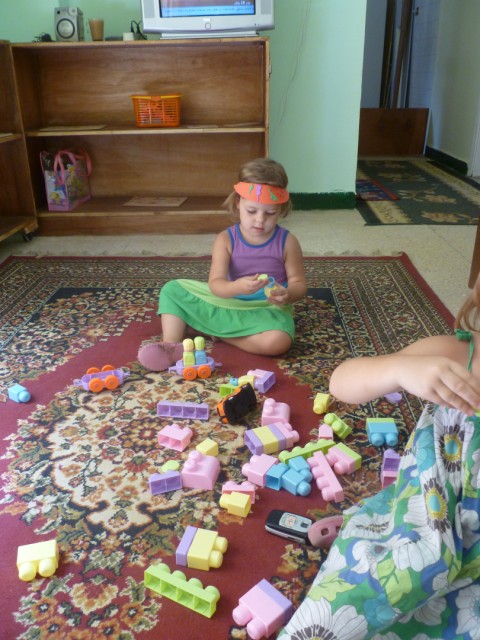
The Walk to Preschool

With blocks in the preschool

Our family lives in the Cairo suburb of Maadi, which is an upper to upper-middle-class neighborhood composed of many foreigners. Our particular house, however, is toward the border region consisting of more ordinary Egyptians, living at a lower-middle-class neighborhood. We featured this area in an earlier post following the sectarian attacks in Imbaba, Cairo, wondering if something similar could take place nearby.

We would like to present the following video walk through our neighborhood, following the path from our home to where our middle daughter goes to preschool. In a previous post we described the circumstances forcing us to move our children from the Coptic Orthodox Church preschool, when it closed down. We did a previous walking video tour to this preschool (from our old home), which you can watch here.

The new preschool was opened just recently by one of the teachers from the church preschool, and we are happy to keep our daughters in her care. She opened the preschool in the ground floor apartment owned by the family, where she lives above. This area, however, causes us to ‘cross the tracks’, so to speak. It is an area we are not fully familiar with, but in time, walking this route, we will become so. Hopefully people also become accustomed to us.

Video One (nine minutes) – Starting off until the dividing road

Video Two (four minutes) – An unexpected pause in videoing

Video Three (three minutes) – Inside the preschool

For an epilogue, first watch the videos, and then read on …

At the door of the preschool garden
Categories
Personal

A Date on Public Transportation

The ubiquitous Cairo microbus

Last week Jayson and I got a chance to spend time together … just us.  Since it is summer in Egypt where the weather is not so conducive to lots of outdoor walking, and it was also Ramadan which means no stopping for water breaks, we decided to go hang out at a mall for awhile where we could walk around in air conditioning and enjoy a nice meal as well.  After settling the girls with a babysitter, we had five hours all to ourselves.  We decided to take the cheaper and more exciting way to the mall, rather than simply hop in a taxi for the 30-minute ride.

We got directions from our neighbor who works out by the mall and could tell us which microbuses to get on and where.  This is important since routes are not posted but one just has to learn from experience where these blue and white Volkswagen vans go.  This is definitely a cheaper way to travel, but often involves more time as you must wait until a van fills up before it starts on its route, and your destination may not be directly on its route.  As for us, we were supposed to walk 10 minutes to board the first minivan, then ride that to the end of the route where we were to walk a few minutes to find the next minivan to take us the rest of the way, dropping us off on the highway near the mall.  I say, “supposed to” because we only followed the first half of the directions.

We started off from our house and crossed the metro tracks a little earlier than normal just to try a different route.  We found that it was an interesting place to walk, but not necessarily the easiest route.  Our double stroller would not have fared well on some of the paths, so we were glad to be free of the baby gear for this trek.  We found the first microbus easily enough and boarded it to wait about 10 minutes before it filled up to leave.  It was warm out and the microbuses depend on open window a/c only, so we were hot at times, but I realized during the ride that it was better on the microbus for couple time, as at least here we would sit together.  In a taxi, Jayson sits up front and I’m in the back.  One point for the microbus!

We got to the end of the line and the others riding along let us know that this was the place to get off.  Jayson briefly asked one man to direct us to the next microbus going the direction of the mall.  We thought we could see which direction to go, but he insisted we go another way as he was going to the same area and would accompany us.  As we’ve learned in this culture, it’s not unusual for someone who is giving you directions, to actually walk with you to your destination to make sure you get there.  I hoped this man was actually going our direction, and not just going out of his way for us.  As we walked the 15 minutes between the last stop and our next vehicle, the man complimented Jayson on his Arabic and asked basic get-to-know-you questions.  He was friendly and surprised to find an American speaking his language so well.  He made a brief stop at a store and then we waved down a bus going our way.

Again, as is common to what we’ve found, this man who took us under his wing to show us where we were going also paid the bus fare for both of us when we boarded the bus.  He directed us to move forward in the bus and pointed out an empty seat for me.  Jayson exchanged phone numbers with him, his name was Anwar, and briefly asked him what time we would need to be sure to leave the mall in order to find a taxi before the fast-breaking time of day when life stops briefly for people to eat.  Anwar didn’t answer the question, but instead asked why in the world we would take a taxi when we could go by bus and microbus!  Truth is, these other modes are so much cheaper, but we also didn’t want to be late getting back to the girls.

Before long, we saw the mall on the side of the highway, but Anwar told us to wait until the bus turned off the road and actually let us off quite close to the entrance.  We thanked him for his help and got off the bus, amazed to realize that we both got this far for the mere cost of 1.50LE (about 30 cents).  We entered the mall and were refreshed by the air conditioning from the start.  We spent about three hours walking around, eating dinner, walking some more and ending our time there with some ice cream.  It was so nice to be able to start and finish conversations without interruption as well as have a leisurely meal without feeding anyone else!  A nice break from the norm!

We left the mall about an hour before we hoped to be home just in case we ran into trouble finding a taxi.  We had decided to take a taxi back thinking that would be simplest, but at the same time were open to other options if we found them.  Our friend had said it was hard to find a microbus coming back toward Maadi with empty seats and we didn’t want to stand by the highway and wait forever.  However, before we even climbed all the way to the highway we saw some maroon microbuses parked along the road.  Jayson asked if these were going to the area where we had switched modes of transportation before and they said yes.  So, we climbed in, waited a few minutes and took off, enjoying the breeze that took our breath away.

The intersection we were dropped in the middle of

Five minutes down the road, the van pulled over on the side of the highway, but no one made a move to get out.  Then I saw the driver looking at us in his rearview mirror and he told us this was our stop.  It wasn’t quite what we expected, but he pointed down the on-ramp and said the area we wanted was down there.  We kind of laughed together about this as we weren’t expecting to just be dropped on the side of the road, but the driver never said he actually goes to the drop-off area.  So we carefully walked down the on-ramp, admiring some grassy areas, overloaded trucks and people traffic as we walked.  Once at the bottom, we had some busy roads to cross before we arrived at another set of microbuses.

Overlooking scenic Cairo

These weren’t going into Maadi, but could drop us off near a metro stop, and so we agreed and climbed in the front.  It was fun to be riding in these areas that I don’t usually get to see.  We passed a several block section of marble/stone workers where there were large pieces of rock stacked up to sell.  There were many piles of various garbage and under one particular bridge there must have been about 20 old microbuses that were discarded there forever.  At one point, we pulled over to let people out and noticed a stairwell built that would take people directly to the other busy road underneath us.  This was one of those instances where it was reinforced that you have to know your route and where the microbuses go.  So many people were going up and down these stairs because they knew this is the place to find transport.

This wasn’t the place, however, where we got out.  We went a little further up and the driver pulled over and pointed out the metro station at the bottom of the on-ramp.  Once again, we got out and navigated our way down the side of the road, past the piles of garbage, the shop selling garden decorations and the graffiti-covered walls of the metro until we found the entrance to the station.  We briefly considered walking the 2 ½ stops to our house, but decided it may take too long and we don’t even know the way exactly.  So, we bought our tickets and sat on a bench until the metro came.

It was about 6:30 by this time and fast-breaking was approaching quickly.  Things were mostly quiet at the station and the metro itself wasn’t too full.  We boarded and found a seat and enjoyed the last leg of our journey.  At the stop before ours, someone threw something into the windows of our car.  Others around us distributed the small bag of 3 dates and we got them too.  As we exited the metro at our stop, we noticed a couple men filling cups and handing them out to metro passengers.  People give away a lot during Ramadan and this was one example we saw up close.

We completed our journey by walking the final 10 minutes to our house where our three girls happily played with our wonderful babysitter.  We had again made our way back for a pretty inexpensive amount, but even more importantly, enjoyed a little adventure together and saw a little more of this interesting city.

A sunset to end a romantic outing
Categories
Personal

My School is Locked

Off to school and preschool

Emma and Hannah have been attending a local preschool here in Maadi, for the last two years.  Emma started just a few months after we arrived in Cairo, and Hannah joined her sister when she turned 2 ½.  One of the main reasons we chose to send the girls to preschool is to help them learn Arabic in a natural way.  We searched several preschools and found that many quality ones focused on teaching the kids English.  We wanted the quality and the good care associated with these preschools, but didn’t want the English teaching that was included.  We eventually found a preschool maintained by one of the local Coptic churches, which had a basic program, but caring teachers.  One of the most important factors for us was that the teachers and children were all Egyptian Arabic speakers.  We knew our girls would be immersed in the language.

At the beginning, Emma, then age 3+, didn’t really know any Arabic.  But since she was so young, we figured she would be able to function without language until she just assimilated into it.  I got encouraging reports from the teachers frequently as they told me that she was understanding them, then understanding the children and finally, communicating with the children in Arabic.  She didn’t speak with us in Arabic often, but we would try to gauge her understanding by asking her what she learned different days and different vocab words.

By the time Hannah joined Emma, I knew that the big sister would be able to communicate anything necessary for the little one.  Hannah was excited to join Emma as she went with me everytime I picked Emma up or dropped her off.  She already knew the teachers and some of the kids.  And so they both attended three days a week for half a day.

Volunteering in the classroom

Over the months, I got to know the teachers more and eventually did a little volunteer teaching in English/music once a week.  It was a fun challenge for me teaching preschoolers who don’t speak English.  It stretched my Arabic and gave me a chance to teach some fun things to my own girls too!  It was a good situation and we were happy to stick with it for Hannah once Emma enters school in the fall.

This was until a few weeks ago when I took Hannah into school in the morning and only the two aides were present.  They asked me if I had been to the parents’ meeting the night before and I told them I hadn’t heard there was one.  They then proceeded to tell me what was going on.

Apparently, one of the little girls in the class had gotten out of the classroom one day the previous week without the teachers noticing.  Now this classroom is located inside a building which is set back a ways from the main gate of the facility.  This building is by no means set up to be a preschool as it belongs to the villa-coffeeshop of the Coptic Church across the street, but it works.  I couldn’t quite understand from the conversation, all of it in Arabic, if the girl had just gotten out of the classroom, only to be apprehended by someone sitting in the coffeeshop portion of the facility, or if she made it all the way out the gate before being noticed by a passerby and then returned to the room.  There is a difference here, of course, as the second scenario is more serious especially given that a busy traffic circle is close to the gate, and also that a stranger returned her.  I am thinking this is what happened.  Praise the Lord there was no harm to the little girl, but you can imagine her parents’ fear and anger when they learned what happened.  This news quickly reached the school’s supervisor and then ultimately, the bishop in charge of preschools in the area.  By the time I talked with the teacher aides that morning, they were planning on all being fired even though some had served there for more than 20 years.

I was really sorry to hear this story and the plight of the teachers.  Yes, it is definitely an oversight which could have been catastrophic, but I don’t know where all the blame lies.  Ultimately, the teachers are responsible for each one of the children during the day, and so, the fault lies with them.  At the same time, they felt they were being taken to task without any chance for answering for themselves, or any consideration for their previous years of service.  I felt bad for them and told them I would give a good word for them if asked.

I immediately had the opportunity for this as I left the room that morning, leaving Hannah in the classroom with just a few other children whose parents either hadn’t heard the news or trusted the teachers anyway.  I ran into one of the men responsible for the preschool program and he told me the story once again after apologizing for not informing me of the parents’ meeting, but he didn’t have my phone number.  He was definitely upset with the teachers and said two things needed to be done: 1) reconfigure the classroom to keep the children contained, moving the bathroom within the facility; and 2) replace the teachers.  I did my best to support the teachers saying that if they fixed the first problem, then this shouldn’t happen again.  He didn’t seem convinced, but let me know the preschool would remain open the rest of the week before closing for a period of time.

Hannah finished out the week with the two teachers aides as the two teachers themselves refused to return to the place where they were being treated unfairly.  I was told that I could check back within about a month to see when they would re-open.  Or at least, that is what I understood them to say in Arabic.  By this time, Emma had begun a summer course, so she was at that five days a week, and now Hannah was home with me and Layla five days a week!  The first few days were rough for her as she couldn’t wait to go pick Emma up from school so she had a playmate!  It had been a long time since she wasn’t with Emma during the day, and she wasn’t sure what to do with herself.  We did get some quality time in, going shopping and cooking lunch, but I did have to restructure my day from what I was used to.

After a few weeks, I returned to the villa to check on the progress.  I ran into one of the teacher aides who was now working the cash register at the coffee shop.  The other aide had found work in the baby section of the preschool and the two teachers were hoping to open their own preschool within a couple months.  I was glad that there was some reshuffling rather than everyone being totally let go, but this aide told me that the preschool would not re-open at all.  That was a surprise to me, but that was the decision that was reached.  She then told me about the other preschool opening and gave me the teacher’s number.  I was glad to hear of that option as I really had developed a relationship with the other two teachers and the girls and I were all comfortable with them.

So that is where we are today.  After talking to the teacher on the phone, she said I can come see her new place in a couple weeks and decide if Hannah will attend or not.  In the meantime, I’ve told Emma and Hannah what happened at their old preschool, and they seem to understand to a point.  The other day, Hannah related the story to her grandmother this way: “My school is locked.  A kid got out and the policeman brought her back.”  Hopefully she can have a new school soon.

Categories
Personal

A Tour of the Caspers’ Second Apartment

In front of our home

Last year we made a video of our home here in Maadi, Cairo, Egypt.  While it was the perfect spot for us at the time, we knew our time there was limited since the landlord’s son was slotted to take it over once he got married.  So in anticipation of that event, we searched on and off for our second place in Maadi.

We desired to find an apartment with a yard within our price range, but Cairo is a major city, and even in the green, upper-middle class neighborhood of Maadi, private yards are not so affordable.  But we tried our luck and called a real estate agent with our price limit as well as the requirement of some sort of garden.  Within a day or two, he called us back and offered to show us what is now our current home.  We decided within a few days to move in, and our first landlord agreed to let us out of the contract early, as well as return our security deposit – two things which rarely happen here – as he was eager to begin getting the apartment ready for his son.  And so, with our newborn baby and two toddlers in tow, we moved down the street about five blocks.

We were able to borrow a friend’s car for the gradual move, and this allowed us to move almost all of our things to the new apartment over five trips in five days.  I would take two girls in our double stroller, with a few things in the basket underneath, while Jayson took a car-load and one girl to the new place.  He usually beat me there, but not always!  Sometimes walking in Cairo is faster than driving.  And by the end of the week, one truckload of furniture completed our move.

We have now been in this apartment for a whole year, and have renewed our lease for the coming year.  It has been a good place for us.  We look forward to what the next year brings here in Egypt and in our home on Road 73.

Please click here for the tour.

Categories
Personal

Too Much Homework

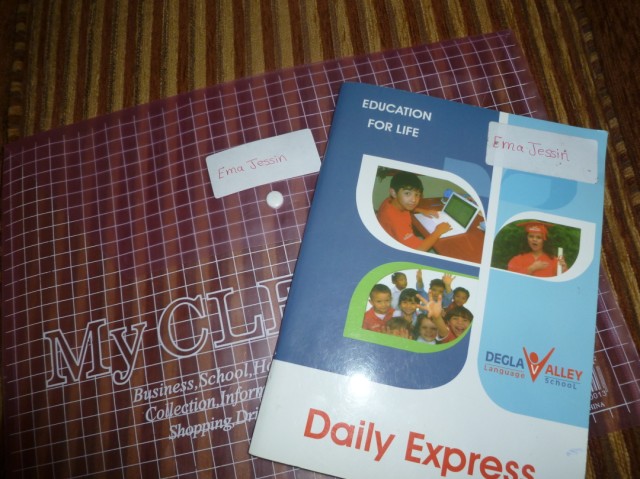
Two of the curriculum books at Emma's new school.

The middle of July is an odd time to be writing about too much homework, but our oldest, Emma, has just begun summer school and is having her first experience with homework.

This all started because we missed getting Emma into the school we had chosen for her last year.  In Egypt, the schools follow a British system where the children attend two years of kindergarten, KG1 and then KG2.  At many schools, children can begin as early as 3½, although the average age is probably 4.  At the school we preferred, however, they would not accept Emma last year even though she was 4 in September. Due to the high demand for that school, they accept only older children, only going as low as 4½ for KG1.  We didn’t mind this since our American system starts kids at age 5, we preferred waiting.  The problem came this spring when I went to register her at our chosen school.

We had left Egypt for a few months due to the revolution and shortly after we came back, I went to the school to confirm which papers I would need when I came to register her in the month of June.  It is well-known that the kindergarten registration in schools here is in June, so I figured going in May was getting a good jump on things.  However, when I went to the school, the secretary told me that the registration was done and closed; there were no more places.  I was so surprised and told them I thought registration was in June!  They seemed to confirm that that was the norm, but this year they did it in March.  They told me I could try calling them sometime in June, and if someone has withdrawn their registration, maybe Emma would have a chance.  I left the school wondering what we would do now!

I talked with many Egyptians in the next few weeks, all of whom confirmed that registration should be in the month of June.  Many questioned whether I understood the secretary correctly and encouraged me to return to the school.  Others asked if I knew anyone important who might help us get in even though they said classes are full.  The only people we knew were other parents at the school, but this was not good enough.  I went there three times and each time was told the same story.  The last time I went, the secretary told me to bring our next daughter in March if I wanted to register her for the following year.  It looked like we had to give up on that possibility, at least for this year.

In the meantime, we continued to look for other possibilities, but quickly learned that we had a problem.  Since we had “held Emma back” from starting due to the requirements of the one preferred school, she was now a whole year older than her potential classmates at most other schools we would choose.  I was told it would be best if she could skip KG1 and enter the second year of kindergarten in the fall.

Being a foreigner and having no experience with what KG1 entails, I had no idea if Emma could really skip a grade.  Our main concern was the Arabic that she would already be behind in.  The schools we were looking at were called “languages” schools and basically taught most of the subjects in English, while reserving the Arabic language for the subjects of Arabic, religion and social studies.  At the same time, we were trying to choose schools where the language of the kids would be Arabic.  This way Emma would be immersed in Arabic during recess and in the lunchroom with the goal of her being comfortably fluent in Arabic, as well as making Egyptian friends.  So she had a great advantage over most children as she would excel in the English-language subjects due to that being her native tongue; but we didn’t want her to immediately fall behind in Arabic.

One of the schools we found, and the one we are planning on her attending this fall, is called Degla Valley Language School.  One of the great benefits of this school is that it is one block from our house.  Not only does this make it easy to drop her off and pick her up, but it will hopefully make it easier for me to be involved in her school in some way.  I am not looking to teach anything, although being a native English speaker I could easily get a job. I want to be able to interact with her teachers and really be on top of what is going on in her school.  Of course location is only one factor to consider.  We visited the school and felt the facilities were not as good as the preferred school, but were decent.  We liked that the kindergarten section of the school is separate from the older grades which will help with kid-traffic as well as be less intimidating for the little ones.  The program and curriculum looked modern and thorough, and the staff was friendly.

Another benefit of this school was the built-in possibility for Emma to skip KG1 by doing one or two months of a summer course.  For some reason, this school offers the option to parents to enroll their children in the summer course in lieu of KG1.  I haven’t had a chance to ask the other parents why they would choose this route; we are only doing it because of extenuating circumstances.  But Emma has about 10-15 kids in class with her, all seemingly looking to skip their first year.  And this is where the homework comes in.

It seems that the children learn the Arabic and English alphabets as well as their numbers, colors and shapes, during KG1.  Learning the letters means writing the letters, and that is most of the homework that Emma has brought home.  She is not so overwhelmed by writing the English letters, but every day that she has Arabic class, she has to write a new letter along with the three vowels of Arabic, and it turns out to be a bit much.  I am trying to learn what motivates her to help her push through and finish her homework each day.  It has been an adjustment going from the carefree life of preschool to five days a week “real” school with homework.  And it may not help that the weather is usually in the 80s or 90s by the time we are finished lunch and ready to begin the homework.

All in all it’s been a positive experience, but I’m sure we have just as much to learn as Emma does.  She will be learning her ABCs and 123s while we learn how exactly this Egyptian school system works.  For example, I was impressed when I saw the school assignment book that Emma brought home the first day, but a bit amused by the way they wrote her name on the front.

Should read: Emma Jayson, but foreign names are difficult.

In Egypt, everyone, girls included, uses their father’s name as their second name.  Therefore, Emma is known as Emma Jayson in her school.  Both names are foreign to them, but now they have seen them written by me, and at least spell Emma right on her crafts.

Emma’s daily schedule was posted in her book and it let me know which subjects and which “specials” she would have each day.  She has English, math and Arabic three times a week as her subjects, and then other things like swimming, cooking, music and art.  However, I’ve learned that cooking and art don’t mean the kids do anything in those areas.  Rather, on Art day, Emma brought home a really cute Elephant bag which the teacher gave her at the end of the day. She didn’t even watch them make it.  And when Emma complained that they didn’t do any cooking on the designated day, I asked the teacher the morning of the next cooking day what was in store.  She said they would be making pizza that day.  I asked if the kids help make it or if they just eat it, and she confirmed my guess that they just eat it.  So really it should be called “special snack” day, rather than “cooking.”

Teacher-made elephant bag.

So we are only beginning our journey here, and I am sure there will be more blog posts on the subject of school as we go down this road.  For now, we are working on the alphabets and trying to keep cool as Emma completes her first year of school in two months.  Guess that justifies all the homework!

Categories
Personal

Could Imbaba Happen in Maadi?

An upscale home in Maadi

It used to seem that sectarian conflict occurred in distant regions of Egypt, mostly centered in the traditional towns of the south. In recent years these have been creeping closer and closer to Cairo, though still isolated mainly in poorer, fragmented neighborhoods which maintain a traditional Upper Egyptian mentality. Yet the question is fair: Is the trend indicative, and may such incidents affect even the cosmopolitan areas?

My family and I live in the neighborhood of Maadi, a southern suburb of Cairo which has always been and remains an upper class enclave, populated by many foreign residents. Muslims and Christians living here are well-off, well-educated, and lament any hint that the two religions cannot get along. Furthermore, safeguarding the economic interests of the community, police presence is strong, crime is minimal, and life is a level above the struggles faced in other areas of the city.

Yet our home lies somewhat on the border of a lower to middle class neighborhood called Hadayak al-Maadi. Literally translated ‘the gardens of Maadi’, there is little greenery to be seen at all, in contradistinction to the grassy circles and plentiful trees slightly south in Maadi proper. We do much of our shopping here, finding prices to be lower than in the import-focused markets of Maadi elites. We also enjoy the descent into what feels like ‘real Egypt’, though our populist notions might be dismissed by the suggestion of living there. People, however, have always been friendly, and we do not feel out of place.

Yet if a sectarian conflict were to envelop Maadi, Hadayak might seem like more fertile ground for it to begin. Despite our ventures into the area, we don’t know it well. Do Muslims and Christians get along? Are they neighbors and friends, or does each community tend to itself? I approached Fr. Arsanius, one of two priests serving at the Coptic Orthodox Church of Abu Sayfain. This church is about a fifteen minute walk from our home, located in the heart of the Hadayak area.

Relations are good here, he assures. He would not expect a sectarian conflict to arise in the neighborhood. His answer in elaboration, however, is not only nuanced, it is near contradictory.

Approximately 2,200 Christian families live in the area, and these enjoy good relations with their neighbors. In this part of town everyone knows everyone else, which confidently leads Fr. Arsanius to state there are no ‘thugs’ in Hadayak. In recent sectarian conflict in other parts of Egypt, thugs have borne the brunt of condemnation, along with Salafi Muslims of extremist ideology. Accusations continue in that the thugs in question have been brought from elsewhere to attack an area. There is nothing to be done about this, Fr. Arsanius states, but local relations would not yield to it. Furthermore, in terms of Salafis, he has seen a few resident in Hadayak, but they have no centers of activity here, and illustrate no evidence of violence.

Directly across the street from the church is the Maghfara (Forgiveness) Mosque. After the Alexandria church bombing on New Year’s Eve, one week later on Coptic Christmas local Muslims encircled the church, and several went inside during the service to express solidarity with their Christian brothers. Then, during the days of revolution the imam called publically for Muslims to protect the church, calling it ‘our church’. A few days after Mubarak stepped down, the mosque organized public speeches in celebration, to which he invited Fr. Mercurious of the church to also address the crowd. For its part, the church organized a local garbage clean-up effort; young Christians went to the mosque and asked for assistance, and many Muslim youth joined in.

Yet despite the sincere and appreciative words of Fr. Arsanius, he also expresses concern about the mosque, beginning from its very inception. Abu Sayfain Church was built in 2001, along the pattern of many church construction projects in Egypt. A local Christian owned land and in coordination with church authorities began constructing a house of worship. He did not bother seeking prior permission, as many Christians believe this is an endless process leading nowhere. The effort did not meet resistance, however, and since then the church has been fully functioning. It is currently seeking funds to construct a service building on the plot of land next to the church, hopefully to house a small medical clinic among other activities.

While the construction did not meet opposition, it did engender competition. The land across the street from the church was owned by a Muslim with Muslim Brotherhood sympathies. During this time the Muslim Brotherhood was an outlawed, but tolerated, group. Similarly, it was unable to build houses of worship through official channels. Building a mosque in general, however, is easy. It was constructed under the supervision of the officially registered NGO al-Gama’iyya al-Shara’iyya (the Religiously Legitimate Association), which some accuse of promoting Islamist ideology. This NGO is nationwide, controlling hundreds if not thousands of mosques, and operating charitable service centers. While a good number of the mosque imams would be under the supervision also of the government, ensuring moderate interpretations of Islam, Fr. Arsanius did not know if the imam here was so linked.

He did know, however, the centrality of the mosque in Hadayak Muslim Brotherhood activity. While some understand the post-revolution Muslim Brotherhood to be a centrist political organization working for a civil state, albeit with an Islamic reference, Fr. Arsanius disagreed. Yes, some of their members present a moderate, even liberal vision. Others, including important leadership, call for full implementation of sharia law, an Islamic state, and even resurrection of the caliphate. Besides, what does ‘an Islamic reference’ in a civil state even mean? To him their discourse seems disingenuously vague.

Fr. Arsanius’ son was a revolutionary in Tahrir Square. There he rubbed shoulders with youthful members of the Muslim Brotherhood, many of which seem to be in opposition to their leadership. Fr. Arsanius recognized this, and was hopeful the bonds created in Tahrir between Christians, Muslims, and even Islamists might hold true. Yet whatever the future portends, Fr. Arsanius notes the concerns of the present, tying them specifically to the Maghfara Mosque.

Over the years, it has not been uncommon for the imam to refer to Christians as kuffar, or infidels. During Muslim holidays they choose to pray outside, publically asserting their religious identity, filling the street in front of the church. When this falls on a Christian day of worship, usually one of the service times has to be cancelled since people cannot enter through the crowds. When I asked if he could introduce me to the imam, he politely declined. Though they are known to each other, Fr. Arsanius could not remember his name, but said the people of the mosque do not like America. How might they then interpret my effort, within their superficial relationship, to bring them an American?

At the heart of the Islamic religion, Fr. Arsanius declares, is the teaching to kill the non-Muslim. Oddly, this was the first comment he made as we opened our discussion. Thereafter, he proceeded to tell me about all the good relations notwithstanding.

When I asked him to explain this psychological tension in Coptic views toward their Muslim neighbors, he related the following anecdote. Last year, isolated criminal activity took place on the street in front of the church, and in the altercation the police officer assigned to guard the church shot and killed the perpetrator. Word spreads quickly in a traditional neighborhood such as Hadayak; the word which was spread, however, was that the ‘church guard’ shot and killed a Muslim. In no time at all, hundreds of neighborhood Muslims surrounded the church, perhaps seeking to burn it. Quickly the doorman closed the front gate, and other policemen came to investigate, eventually dismissing the crowd.

Were these hundreds representative of the thousands of Muslims in Hadayak, Fr. Arsanius asked rhetorically? No, we enjoy good relations with the Muslims of our area. Yet in an incident, when tensions are high along religious lines, there is an Islamic saying obliging Muslims to ‘support your brother, whether he is oppressed or oppressing’. Even if among a few, this spirit can overpower good relations.

There is tension permeating society, and the situation is fragile. Fr. Arsanius stated clearly that it is not appropriate for Copts to confront agitators head on, such as Salafi Muslims or the Muslim Brotherhood; this is not a Christian response, even if Copts appear to be increasingly adopting a confrontational stance, however non-violent. Yet he is not sure what the proper response is. How might love be extended to such as these? How might it be lived in relation to the Maghfara Mosque?

In any case, the church is committed to good relations, and Fr. Arsanius is confident these do exist. A sectarian incident is not likely to occur in Maadi. May his confidence be properly placed, both in God, and in the goodness of surrounding neighbors.


Note: It is my hope to visit also the imam of the Maghfara Mosque, and seek his perspective on community relations. I will write about this further following our discussion.

Categories
Personal

Whose Wedding is it Anyway?

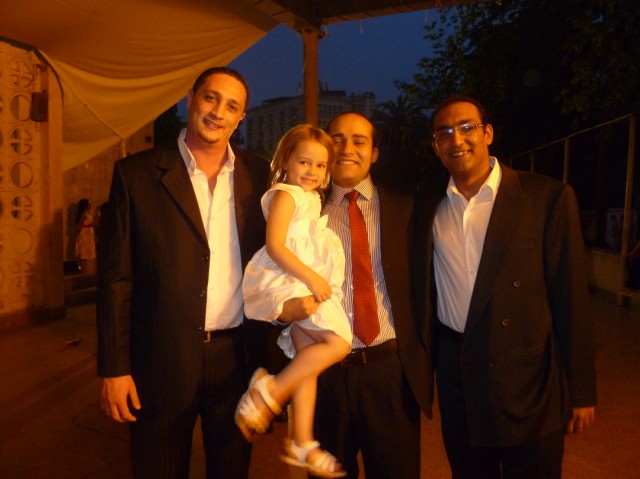
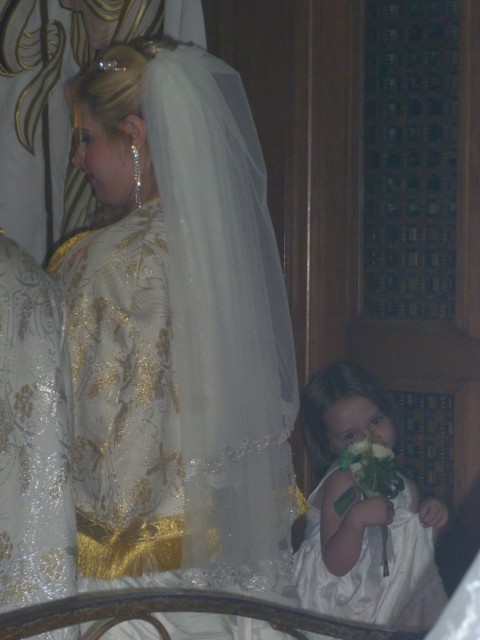
Last night Emma and Hannah were in their first Egyptian wedding as “ashbiinaat.”  This is basically the equivalent of the western “flower girl” or “ring bearer.”  I still can’t tell you the name of the bride or the groom, but I can tell you how it came about and how it played out.

About three weeks ago, one of the Sunday School teachers at the Arabic Evangelical Church of Maadi approached me to ask if Emma could be in the wedding of a fellow teacher.  She mentioned the name of the teacher, but said she wasn’t present that day so she couldn’t introduce me.  I told the teacher that I would ask Emma, but didn’t think she would want to be in the wedding as she had recently been saying she didn’t want to be in any weddings.  Both girls had preformed beautifully as flower girls in their Uncle Aaron’s wedding last fall, but Emma had decided she didn’t like the attention and chose not to be in any more weddings.  I promised the teacher I would talk about it with Emma, and as long as the white dress still fit from the previous wedding, I had no objection to her taking part.

Emma surprised me by quickly agreeing to be in this wedding and once we tried on the dress and learned that both hers and Hannah’s still fit, I took that information to the teacher the following week at Sunday School.  I cautioned that while Emma agreed, she may change her mind under pressure as everyone is staring at her, taking pictures and getting in her face.  I suggested that if there was trouble, maybe Hannah could join her at that moment and it might make Emma feel more comfortable.  I really wasn’t trying to push for Hannah to be in the wedding, but who knows how they understood it.  In any case, she came back to me a few minutes later, after talking with the bride, and they wanted both girls to now be in the wedding.  At this point I got to meet the bride, who I kind of recognized as one of the teachers, but I can’t remember her name now.  I still don’t really know why she asked Emma to be in the wedding, as she has no relationship with her; I can only assume she wanted a cute foreign kid in her wedding.  And now she had two!

The wedding took place on Sunday night, the day after our enjoyable, yet long, rihla to Anafora.  The girls had both gone to preschool that day, then had lunch, then Emma did her homework, and then they played outside a bit before it was time for dinner and getting in their white dresses.  Both girls were excited about their role and telling our neighbors all about it.  The wedding was supposed to start at 6:00, and we were told to arrive between 5:30 and 5:45.  Being the punctual foreigners, we ate dinner, dressed the girls, combed their hair, and hopped in a taxi, arriving at the church around 5:35.  The florists were there decorating the church and the videographer and photographer looked to be present, but there wasn’t any sign of anyone else, let alone the organizers.  I had the girls sit down on the white aisle runner and snapped a few pictures before anyone arrived.

And then we waited, and waited, and waited.  People very slowly started arriving, and Emma and Hannah danced around outside as Layla toddled around inside the church.  As it got closer to 6:00, and it became obvious that this was not going to start on time, Jayson and I wondered about allowing our girls to be in weddings of people we don’t know.  It’s one thing to do this for friends or acquaintances, but strangers?

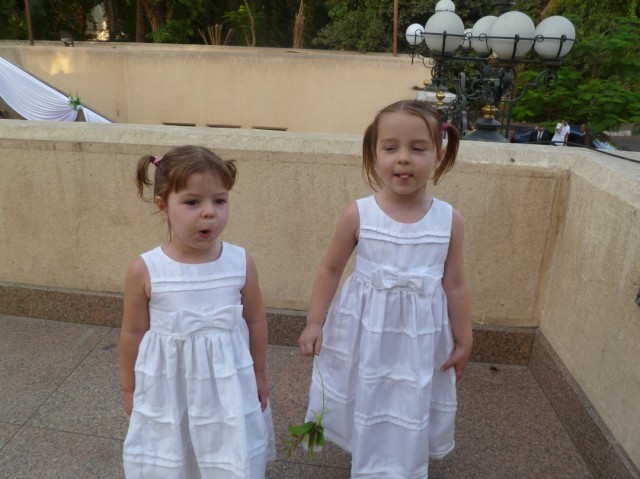
As we waited for more people to come, we watched the road for signs of the bride’s car.  Emma and Hannah practiced their Egyptian wedding call, which is called the “zigruut.”  It involves moving your tongue back and forth inside your mouth very rapidly while making noise. I’m sure they will be experts at this by the time they are 8, if not earlier.

You may notice that Emma and Hannah have their hair in pigtails.  Perhaps this isn’t the dressiest thing to do with hair, but I am not the best when it comes to styling hair.  Also, the girls’ hair is fine and light so   I don’t feel like there is much I can do with it.  So, for something different, I put it in pigtails.  This is their last picture in pigtails, because when the bridesmaid, Miss Mary, arrived, she asked me to let their hair down.  Emma’s worked okay, despite the fact that I had no comb with me.  But poor Hannah has very little hair in the back, and once it is in pigtails, it keeps that shape for a long time!

It was about 5:50 when Miss Mary arrived and explained to the girls exactly how to walk with her.  It turns out there were other children in the wedding as well, and they would all walk in formation with the one bridesmaid who would be accompanying the bride from the car, up the stairs, and into the church.  Once they got into the church, the role of the children was over.

As we waited for the bride to arrive, the many children who were attending the event, posed for pictures with some of the Sunday school teachers who were also present.

And then, finally, we heard the familiar “honk—honk—honk-honk-honk” of the bride’s car as it approached the front of the church.

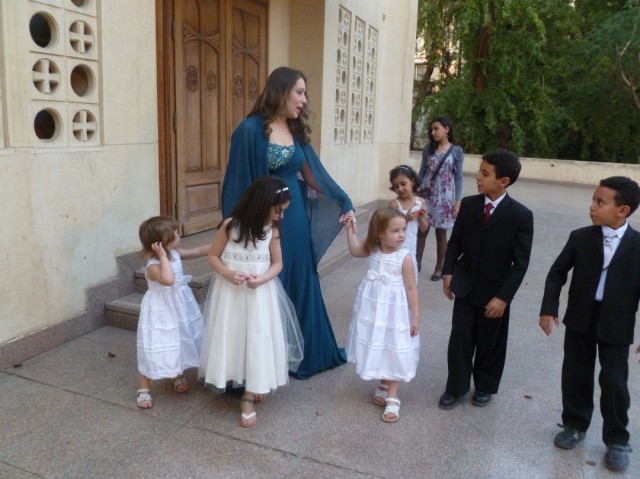
The kids lined up with Miss Mary to welcome the bride.

Emma had told me she would smile nicely for the wedding, and I especially notice it in this picture as that is not her natural look.  I also notice that this is when Hannah really started to fade.  Due to the long trip the previous day, she was wiped out and ready for bed already.  She did make it all the way to the inside of the church, but just barely.

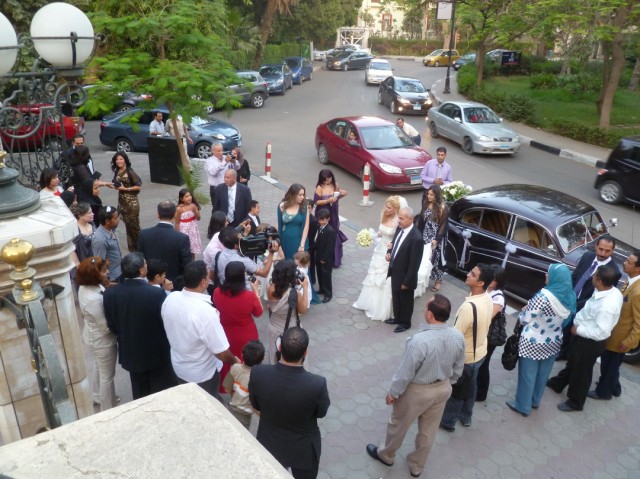
As the bride exited the car, led by her father, I barely recognized her as the woman I spoke with two weeks prior.  For one, her hair had been brown, and she wore glasses.  The amount of make-up was quite different from her normal look as well.  This is all to be expected on the wedding day, but the change of hair color really threw me.  The kids lined up in front of the bride, ready to lead her up the stairs.  All the guests surrounded the procession and the big mob moved into the back of the sanctuary.

At this point, Miss Mary and the kids stopped as the bride and groom continued to the front stage.  Emma and Hannah came back to me and they were free to do as they pleased.  Hannah, who was very tired, chose to sit with us, which quickly turned to lying down on a pew.  Emma, who was still excited about the whole wedding thing, wanted to sit in the front where she could see better.  I let her go, figuring she would behave well.  I also realized that these weddings are different from our traditional western weddings where the wedding party and pastor may be on stage, but everyone else is sitting in the pews.  Perhaps the photographer or videographer move about inconspicuously, but as much as possible, no one blocks the view of the bride.  You may be able to see from this picture that these events are much more informal as some gather as close to the stage as they can.  Also, the pictures and video of the wedding is of utmost importance, and the professionals do not need to stay out of sight.

Among the crowd, the groom is standing on the right edge of the photo, and the bride is next to him, outside the frame.

Emma spent most of the ceremony as close as she could to the bride.  At one point, Jayson went to the front to take pictures and told me she was standing next to the iconostasis.  I couldn’t believe she felt comfortable up front and center where all the attention was focused.  Perhaps because it was her choice to be there, she felt okay.  I also wondered if it was okay with the bride that Emma was right next to her.  I was told later that it was no problem.

Around 6:30, Jayson took Hannah home to put her to bed, and I pushed Layla around the church in the stroller to keep her content.  Emma came to the back of the church about 5 minutes before the ceremony ended and told me that she now wanted to play outside, as many of the other kids were doing.  She also wanted chips like the other kids.  So, we took one last picture with three of her teachers (at top of post) and bought a bag of chips for the taxi ride home.  She had done a great job in performing her duty, and even enjoyed a close-up view of the ceremony.  Now it was time to have a snack and get home to bed as she returned to being a normal schoolgirl the next morning.  Maybe one day we will learn the names of the bride and groom, but until then, we’ll be thankful it was a good experience for our girls.

Categories
Personal

Total Lunar Eclipse in Egypt

Today we witnessed the lunar eclipse, standing on a bridge over the Cairo metro, just a two minute walk from our home. Here are two pictures:

Scientists say lunar eclipses occur two to four times per year, but they are not visible everywhere. On this occasion, the Middle East was a beneficiary, while North America missed out. The red color is due to the red portion of the color spectrum bending around the Earth at the correct angle to highlight the moon. Look elsewhere for a better scientific explanation, though, we just enjoyed the view.

Our pictures are from about 45 minutes before the peak of the total eclipse, making the moon appear as if a bit has been taken out of it. At the peak time the moon was fully red, but from our angle it was too dark to capture in a photograph. Alas.

Categories
Personal

Overwhelmed by Belonging

Today was our first Friday back at the regular worship services at St. Mark’s Coptic Orthodox church.  We came back to Egypt almost three weeks ago now, but due to special services because of Easter, plus our own trip to Portugal, we didn’t have a regular Friday until today.

We’ve seen some of our friends and others who know us during this time, but when we went to church today, it seemed that almost everyone we know from there showed up. The first friends we saw were across the balcony from us and Emma enjoyed waving to them.  We met up with them a little later down at the villa where they were eating breakfast before Sunday school. We parted ways to take the kids to their respective classes and I sat with the girls a few minutes to get their snacks ready.  Emma was asking me to stay with her for a few minutes, and I realized she might have trouble this morning after a couple months away from this environment.  While I prepared their juice boxes, the teacher was welcoming us back, asking us if we traveled to America due to the Revolution, asking  if we left because we were afraid, and probably multiple other questions that I didn’t quite understand due to the language.  I answered as best as I could, assuring him that we weren’t afraid, but had a complicated visa situation, and then I ran into almost the same conversation as one of the female teachers passed me on my way out.

When I left the classroom and returned to the table where I had left the carseat, I found another friend I hadn’t yet seen since we’d been back.  She greeted me warmly, commented on how Layla had grown, welcomed us back from our travels and asked how we were all doing.  I only spoke with her a couple minutes before Emma came out from her class asking me to come back in and sit with them.  I sat her on my lap a minute to talk to her, but this quickly turned dangerous as Layla, who was on my other knee, pulled a few strands of Emma’s hair out.  Since she was already upset about the class, she immediately started crying.  About that time, one of the nuns whom I’ve talked to a number of times, saw me and came to say hi.  And of course, she asked what was wrong with Emma.  At the same time, the teacher who brought her out to me asked what was wrong, and several kids were staring at her as she cried.  I really couldn’t answer them all at once, nor was it super easy to explain to everyone standing around, so I just turned my attention to her.  She told me she was scared and we talked about why.  She didn’t really have a reason, but at 4 1/2, it’s hard to understand moving between cultures and what might make you feel uncomfortable for no obvious reason.  We walked back into the classroom together, and I had to ask another little girl to switch seats so Emma could sit next to Hannah before I left again.

This time, Layla and I made it a little farther.  I went around the corner of the building where the adult Sunday School class meets, and from what I understood, was planning a party today.  Several people greeted me warmly when they saw me, welcomed me back from travels and asked how everyone was doing.  They weren’t long conversations, but it was nice to be missed.  A few minutes later, Emma showed up with her teacher. I agreed to sit in her class for five minutes before I returned to my own.

I sat there for a few minutes before yet another friend greeted me, welcomed me back to Egypt, asked how all of us were doing, and apologized for not calling to get together sometime, etc.  I was beginning to feel like we maybe knew TOO many people here as we kept having the same conversation over and over again.

Once again I left the kids’ classroom and headed back to the adults’ classroom, but on my way out of the first room, I notice the box of chocolate-filled croissants that would be given to the kids at the completion of the class.  I made a mental note to use that as my ultimatum for Emma if she chose to leave again.  My tea was a drinkable temperature at this point, and as I started to drink, two things happened.  First of all, a friend from class came to me to fill me in on the game we were currently playing.  When she did, Layla reached for her, so she took Layla with her back to the front of the class.  I had hoped I could get Layla to nap during this class, but could see that was not going to happen.  Secondly, another friend, who is also a neighbor and had visited me a few times since we’d been back, walked into the class and greeted me warmly.  I was feeling very popular!  And only a couple minutes later, Emma was back, and this time, Hannah was with her. This time it didn’t take too long to convince them that they should return to class.  I told them if they don’t stay until the end, they will not get cake.  It worked; they went back and stayed until I picked them up.

Around 11am, the party ended and it was time to buy lunch, find a place to sit and pick up the girls.  Jayson usually joins us at the villa around this time as church is also letting out, but it is a bit stressful at times especially because the tables and chairs are often filled by the time I come out of the class.  And now that the weather is warmer, sitting in a shaded spot is a necessity.  As I came out of class, I ran into Jayson coming into the villa, and he ran into some friends who started the conversation: “Welcome back, happy holidays, how are you, how are the girls, were you traveling, were you afraid, etc.”  I left the car seat with him and took Layla to buy food and pick up the girls since they are in the same basic area.  Fortunately the line was quite short since church got out a little early so I didn’t have to wait long to order and pay, but unfortunately, the usually ordinary food I ordered was apparently a specialty today and had to be made fresh.  This meant a long wait.  In the meantime, the girls finished class and I sent them out to find Jayson while I waited for the food.  Hannah came back a few minutes later and said she hadn’t found him.  I hoped that Emma had.

While waiting for the food, a friend who I had seen in the kids’ class came to say we could sit with them, and then she waited for the food with me.  We finally got it and walked outside to find their table very close to the door.  Right next to them was a couple we knew through mutual friends, and then it turned out the mutual friends were sitting there too.  As we went to sit down, we realized we needed more chairs so my friend continued to bring chairs as our tables kind of grew into one big one.  Jayson enjoyed a conversation with the husbands in the group while I handed out our falafel sandwiches to the girls and hung onto Layla.  My friend was trying to get her 3 year old son to eat his sandwich, but he just kept running away.  Fortunately, the villa is enclosed and pretty safe.  That is, unless her son decides to run out the gate toward the street, which he did once.

It was as we were sitting here, girls eating, guys talking, kids running around, that I realized we had had a full morning of activity.  It was stressful at times as Layla wouldn’t sleep and the girls wouldn’t stay in their class, but we were really starting to belong here.  Maybe.  We had been gone for over two months, and people noticed.  Some people told me they tried to call my cell phone several times but it was shut off.  People welcomed us back, and gave us a spot at their table.  There have been weeks in the past when I couldn’t find a place to sit on a Friday.  People were friendly, yes, some of them, at least, but not offering for us to share their table.  Today, we were surrounded by friends on all sides, and sharing the table with three families.  At times today it was overwhelming when people were approaching from all sides, and conversations repeated themselves, but in the end, it felt good.

We finished eating and the clock told us it was time to get to the next Sunday School class for the kids at the Evangelical Arabic church, so we tried to excuse ourselves.  Our friends immediately offered us a ride despite the fact that we were five people, a double stroller, umbrella stroller, car seat and a couple bags!  I doubted everything would fit in their car, and we were more than ready to walk the 15 minutes to the next church, but they insisted, and in the end, we all fit in their car.  Belonging.  If it means a place at the table and a ride home, we’re making big strides!

Categories
Personal

Too Far Away to Celebrate

February 11, 2011 is a day that will go down in history.  The man who has been president of Egypt for 30 years finally took the cue from his people after 18 days of protests and stepped down.  Having lived in Egypt for the past 18 months, we were heavily invested in this story. We rejoice with the Egyptian people at what they have accomplished and how they have accomplished it.  We admire their steadfastness and their commitment to peace over these last two weeks.  And we quietly mourned as we watched the celebrations because we were not there to join them on this joyous day.

In some ways, this is a very selfish reaction.  How can we possibly mourn when the people that we have come to love and identify with are rejoicing?  At the same time, this may show some of the depth to which we wish to belong to them.  How could we leave them in the midst of their suffering?  As Jayson said, “If we didn’t stay with them in their suffering, we don’t deserve to celebrate.”  He agrees this may not be the truth exactly, but it sums up how we feel.

The last 18 days have been an interesting journey for our family.  We anticipated the first day of protests on January 25, police day. We didn’t really know what to expect.  We had followed the events in Tunisia with interest because we had lived there previously and had many friends there.  We were excited for their successes, but also glad not to have been stuck in some of the unrest that took place.  We didn’t really know what might happen in Egypt; would this day be an isolated incident?  And so, we listened to our neighbors and friends and followed the Twitter feed to see what was happening in Tahrir Square on that first day.  More or less, the day went by without too much hype.  Many people showed up for protests in a few parts of Egypt, and most of the population went on with life as normal.  Wednesday morning came, Jayson went to work, the girls went to preschool, and I went shopping.  Would this fizzle out?  Was this a one-time event that didn’t have much effect?

On Thursday we started to hear about the call for nationwide protests following Friday prayers.  There was a hope that people would leave their mosques on Friday and join the protests all over the country.  Again, we weren’t sure what to expect, but we noticed more fear this time among some of our Egyptian friends.  Emma’s afternoon Sunday School class was cancelled in anticipation of the unknown.  I went to a choir practice on Thursday night at our local Coptic church, and while I didn’t understand all the Arabic conversation going around, I definitely sensed fear that things could get out of hand.

Friday morning was the first day of the blacked-out internet.  Not only that, but all cell phones were shut off for the entire day too.  We went to church in the morning as normal, but the crowds were definitely smaller and the priests were urging the people to go straight to their homes following mass, as we didn’t know what would happen by noon.  We obeyed the edict and made ourselves comfortable inside our house.  We have a large mosque right across the street from our house and we noticed the police barricades and extra officers stationed in the area.  Jayson was interested in seeing first-hand what might happen, and walked out the door around 1pm to watch what was coming.  The girls and I stayed inside, watched movies and played.  We didn’t hear anything unusual outside when the prayers were ending, so I figured this thing that was hyped up basically fizzled out before it started.  However, I learned more later after Jayson was able to go along with the protesters and witness both the peacefulness and some of the conflict that occurred when they met up with the riot police.

While he was with the protesters, I was with the girls hanging out in our house.  I actually felt pretty isolated because the internet and cell phones were off; I had no way of communicating with anyone, or finding out what was happening outside of our house. After a few hours, I packed the girls up in our stroller and walked down the street to a friend’s house.  We had planned to have dinner and a playdate with them that evening, so we kept the appointment even though I couldn’t contact them to confirm.  My friend was home alone with her boys as her husband had been out of the country when the unrest began and was unable to get back into Egypt.  She felt for me as well since there was no way for me to contact Jayson in the last four hours since he left the house.  It was comforting to have some fellowship as the kids played together, unaware of both the personal and national events taking place around them.

Fortunately, the TV wasn’t shut down by the government, so we could follow the events through CNN and al-Jazeera English.  We watched as Tahrir Square filled up more and more, as violence increased in clashes with police, and as ultimately, the army rolled into the square and the police disappeared!  It was a little scary to watch as we heard news of tear gas and water cannons, and watched the NDP building burning.  It seemed that things were getting out of control, and even though the square was not that close to our homes in Maadi, we didn’t know how the effects would trickle down.  I was greatly relieved when a little while later, Jayson showed up at the door.  We watched the news together, he ate some dinner, and we packed up to walk back to our house even though it was past the newly established 6pm curfew.

The next few days were a bit crazy, but we did settle into somewhat of a routine.  In the mornings and early afternoons, we tried to get out of the house and walk around our neighborhood.  Jayson went out of his way to say thank-you to the local militia who had organized themselves to protect the houses and shops in the area.  We saw some of the burned out cars and broken glass that were the result of the looting and fighting that was occurring during curfew hours.

I did some shopping and saw most of the shops closed down and boarded up to prevent looting.

The few stores that were opened reminded me of the pre-snow rushes that we’re familiar with in New Jersey when news of a big storm comes.  We tried to schedule play dates for the girls each morning as the preschool was closed and some of our friends were feeling the strain of broken routines with their kids stuck inside all day.  Not only did the kids enjoy the company, but being able to talk together with the other moms was comforting.  We all had our news, stories and questions for each other.  Once the cell phone service resumed, I tried to call many of my friends, both Egyptians and foreigners, to see how they were weathering this storm.  My Egyptian friends thanked me for the call, made sure we were all okay, reminded me NOT to open the door in our home for any stranger, and seemed a little nervous about where things were headed.  Many of my foreign friends were making plans to leave the country as the US started sending evacuation planes for any citizens who wanted to leave.  It was a disconcerting time as we tried to weigh what we should do in this situation.  We felt safe, but more and more people seemed to be leaving, and the protests had a different flavor each day.  It was confusing.

Our curfew times were spent inside the house of course.  Some days this started at 5pm, other days it was 3pm.  People in our building were intent on securing the place and making sure we were all safe.

Some friends who lived closer to a more volatile area in Maadi came to stay with us for two nights before they left Egypt.  The camaraderie was nice.  Jayson took periodic trips upstairs to our neighbor’s house to watch the news as the internet was still off and we had no television.  One night we were warned that the water would be shut off in half an hour, so while trying to get our very tired girls into bed, we were also filling every container we could find with water.  Cooking was tricky as we tried to conserve food in case grocery stores started to run out of food, while at the same time use up perishables in case the electricity was shut off.  We tried not to eat too much food, but didn’t want to waste food if we ended up leaving the country quickly.  For someone who likes to plan ahead, it was hard to not be able to do that.

Jayson had a great experience on Tuesday when he visited Tahrir Square and got to witness first-hand the peaceful and unified protesters.  He really got to feel the spirit of the Egyptians who were gathered in the square … some for the first time, and others who hadn’t left for several days.  He saw the signs and heard the slogans, noticed the families having picnics and talked with some religious scholars about their philosophy.  He took lots of pictures and was eager to share these positive images with others.  On the way back home, though, he was stopped by some local militia who made him delete ALL the pictures on the camera.  This was a huge disappointment for him, and a disconcerting conversation overall, but one that he learned from.  We couldn’t believe the scene just one day later in the square as we watched on television as pro-Mubarak demonstrators began attacking the protesters with rocks, clubs, horses, and camels.  Once again, it felt like things were really getting out of control, and we didn’t know how far this would extend.

During this whole time, we were in conversation with parents and people from our organization regarding the situation on the ground.  I felt like my emotions were all over the place at times, one minute thinking that things were just too unpredictable here and we should get out of Egypt right away.  And the next minute, seeing the stores reopened and men filling the coffee shops, it seemed like life was back to normal and there would be no reason to leave.  We would watch the news and hear from friends about the US encouraging and then urging their citizens to leave Egypt, and we would wonder what information they had that we didn’t know.  It was really hard to know what to do, but in the end, on Thursday morning, Feb. 3, we made the decision to take the last guaranteed US evacuation plane out of Egypt.  There were various factors that went into that decision, but once made at 7:30am, we packed very quickly and left our house by 11am headed for the airport.  Our landlord graciously offered to drive us there, and once there, we were processed quite quickly for the next flight out to Frankfurt, Germany.

Our evacuation experience was really quite smooth, all things considered, and we are grateful to the US embassy workers in Cairo and Frankfurt for all their work.

After deciding to leave Cairo at 7:30am on Thursday, we touched down in Philadelphia by 4pm (local time) the next day.  All four of our parents were there to greet us, and following an hour-long drive where two of the three girls got car sick and three of the three girls fell asleep, we arrived at my parent’s home for the night.  We’ve now had about a week to adjust to the time change and get over our colds and enjoy time with extended family.  We definitely appreciate being here and all the positives that are here.  At the same time, we watch the news and talk to friends in Egypt and wonder if we still shouldn’t be there.

Yesterday was one of those days that we really wished we were in Egypt.  Mubarak’s resignation brought a mixture of joy and sorrow for us.  Joy for the Egyptian people as their commitment to peaceful demonstrations finally brought the downfall of the regime.  And sorrow because we watched from our living room in the US.  We wish we could have been there during the celebrations; maybe not among the tens of thousands in Tahrir Square, but at least among the hundreds in our neighborhood of Maadi.  We rejoiced with them from far away, and hope soon, that we can celebrate with them on their own soil once again.

Categories
Personal

Egyptian Protests, Day Two

It has been a very surreal two days for us here in Egypt. We live in Maadi, and though there was one early account of a protest, the area has been quiet. Yesterday and today I have been monitoring the Twitter feeds, even after the service went down, allegedly at government behest, though they officially deny this. For those of you who are not Twitter-savvy, like myself, you can follow second-by-second coverage if you go to Google, type #Jan25 into search, and then watch people’s ‘tweets’ scroll down your screen.

Not everything here can be verified, of course, but it puts the urgency and immediacy of the moment right before your eyes. Yet, all around is calm and quiet. Certain websites have live feeds of news reports, carrying the stories that journalists and ordinary citizens report. Whereas yesterday, on Police Day, the protests were large-scale and generally tolerated until late in the evening, today’s reports tell of smaller numbers but greater resistance on the part of security forces.

My take, however ignorant: On Police Day I posted my expectations about the event, written the day before. I spoke about how Egypt was not like Tunisia, because while in Tunis the protests were driven by discontent with economic conditions led by the poor, and only later on joined by the middle class, in Egypt these protests seem to me to be upper and middle class driven. This can be seen by the great role Twitter and Facebook have played in rallying the cry for protest. But I also thought that the impact would fall short of Tunisia for this very reason. Frustrations of the middle class here run deep, but can they gain the numbers and sustain the pressure needed for wholesale change? I wondered, doubting.

As the protests swelled yesterday I, like everyone, including the government apparently, was surprised by the turnout. I was impressed by the generally peaceful nature of demonstrations – opposed to certain signs in Tunisia – as well as the restraint shown by the security forces. By the evening as nightfall came, greater efforts were made to displace the protestors, who seemed determined to stay the night in Cairo’s central square. Tear gas, water cannons, and rubber bullets were employed. At the same time, it could well be interpreted as reasonable efforts to preserve public order. Not that the protestors threatened violence, but that the government was keen to stop the event as carefully as possible, yet stop it all the same.

Today began very quietly. Early efforts to protest fizzled against opposition, but on a day to return to work, the numbers did not seem grand. Whereas the day before I wondered if my posted analysis would be rendered foolish very quickly, by the afternoon it seemed the efforts at demonstration represented an attempt to force the issue, to keep alive a fading spirit.

Yesterday afternoon Julie and I took the girls out to go shopping and for a bit of a walk. We live in a nice neighborhood in Maadi, which is certainly an upper class neighborhood by all standards. But we live not far from where the area blends into a lower class section, which is where Julie often shops at lower prices than if she walks in the opposite direction. As thousands of people were rallying downtown, we enjoyed a normal stroll in the busy streets, the same scenario played out day after day. There were no rumblings of protest, no efforts to stir trouble. It confirmed my thoughts further that this social media revolution might largely be akin to a spoiled teenager railing against a dysfunctional family. The issues are surely serious, but the stakes are not so large.

Further confirmation came with a phone call to the Upper Egyptian city of Maghagha, where we had visited for a few days. We enjoyed time again with our priest-family friends there, and will write about this soon. But in this sleepy, poorer town three hours south of Cairo, there were no demonstrations whatsoever. Most protests have been in Cairo and Alexandria; certainly there are many desperately poor people here, but it is also home to the middle class. Protests elsewhere have been in a Mediterranean costal city known as a labor stronghold, and in the Sinai where there are longstanding issues with the Bedouin. Much of Upper Egypt was quiet, which was not the case during recent legislative elections, when protest demonstrations against alleged electoral corruption were widespread.

Finally, more confirmation came in a visit to the area of Kozzika, which is a poorer neighborhood to the south of Maadi where I go twice weekly for my class in a Coptic Orthodox institute. Again, no signs of anger, trouble, or concern with the world. A local coffee shop had al-Jazeera broadcasting live coverage of an emerging protest in downtown Cairo, and no one paid any attention, as domino tiles slammed down against the table.

But after a few hours away from the computer and Twitter addictions, I came home to survey the news. Protests, it seems, are gaining steam as the night goes on. Security repression seems rather severe, but the result perhaps is to spur on more people to join in. As you follow the news you can get wrapped up in it – here is an especially chilling audio link from a foreign British journalist who was rounded up in the back of a police truck with dozens of protestors. It makes it seems as if the world is on fire.

Perhaps it is – there. Not here. In all I am about 12 kilometers away from what is happening. It might as well be worlds apart. Those there have such passion and fury from their cause in the moment; those here are sleeping peacefully, including my three young daughters. Do I wish to be there? Not really, exciting as it would be. Am I content here? Not quite. Egypt could be changing, or it could be a blip on the screen. Either way, I am disconnected, and the feeling of disconnection is fueled by the constant surveying of others’ passion and fury. Is it true? Is it widespread? Is it good?

Still, it is smaller than yesterday. Will tomorrow be smaller still? It is said that Egyptians are not revolutionary by character. Until about 60 years ago, the nation had been ruled by foreigners since the days of Alexander the Great. They move along in life, deal with economic realities, and do not rock the boat. Yesterday and today, they are trying to. Some, that is. Thousands, actually. Will it make a difference against a resolute government? A government backed by American support?

But, on the other hand, even thousands are but a drop in the bucket. In their non-participation, do the majority of Egyptians signal content relative enough to prove this is not an internal rumbling for democracy, but rather the pining of a frustrated middle class earning to imitate Tunisia and, however legitimately, increase its sphere of freedoms? The government does not do a great job of eradicating poverty, but it heavily subsidizes basic goods. Are the majority of the poor content enough along their historical pattern, unconcerned by exclusion from political life? Will the protests eventually fizzle as the middle class aspirations are beaten down?

By and large, these have been secular protests, and notably, Egypt is a religious society. I would like to explore this question further tomorrow, if possible, but the call is circulating on Twitter that protestors are regrouping, and calling for nationwide participation following Friday prayers. Will Egyptians emerge from the mosque and take to the streets? This is looking like the next big question, unless tomorrow has more surprises. But will the population rally around a non-religious cause? It remains to be seen.

So what is my take, after all of this? It is best to hold judgment. I would encourage all to pray. The president needs wisdom, as do advisors, police chiefs, and protestors. There are deaths and injuries, and these cannot please God. Yet there are aspirations and hopes, and perhaps these do. May he sift the chaff from the wheat and bring about a society pleasing to all. Far less importantly, may he also give armchair observers sitting in Maadi the ability to be as constructive as possible.

Categories
Personal

Contemplating a Terrorist Strike

SUICIDE BOMB
Image by wannaoreo via Flickr

Jayson and I attended St. Mark’s Coptic Orthodox Church here in Maadi, Egypt on Coptic Christmas Eve.  This is not so unusual, as it is the main church we attend weekly, but this particular night was a little different.  You may have heard in the news about the suicide bomber who attacked a Coptic Church in Alexandria, Egypt on New Year’s Eve.  Egypt’s churches had been threatened by terrorists back in November, and on New Year’s Eve, that threat became reality!  The week that followed was interesting reading the news reports and hearing about the heightened security as Coptic Christmas approached.  Each day as I took my girls to preschool across the street from the Coptic Church, I noticed more and more security measures.  The teachers told me about bomb-sniffing dogs and scanners to be put in place for the Christmas Eve service.  We had planned to take a trip three hours south of Cairo for the holiday to celebrate with the same priest’s family we had celebrated with last year, but were advised to change our plans due to the threats.  And yet, we couldn’t forsake the place where we had been striving to belong over the last year.  It was Christmas Eve, the second biggest Christian holiday, and threats or no threats, it was time to attend church.

It was a long day in many ways.  I began work making a “contingency plan” over a year ago, and yet, with the immediate cares of everyday, I usually forgot about it and certainly didn’t make it a priority.  And yet, that day, with the thought of attending church under threat of attack, my thoughts turned to our three little girls, and what information people would need if something happened to Jayson and me.  I finally got around to writing down where our important documents are kept, phone numbers of parents in the states, and contact information for other connections we have.  I even wrote down phone numbers of friends in the country who I knew would be able to help with babysitting, even though I never asked them if they would be on my contingency plan.  It was necessary, but foreboding, to be writing down the girls’ daily schedules:  Emma and Hannah go to bed at 7pm, Layla is eating squash and peas … things people would need to know IF something happened.  But yet, the thought of this information being needed was very disturbing!

I lived that day a little differently I think.  I prayed more.  I hugged my girls more.  I had realized in the past that I didn’t have many pictures of me with the girls simply because I am usually the one taking the pictures.  And I knew I didn’t have any recent pictures of me with Hannah, my second girl.  So, one of the things I did that day was take some self-portrait shots with Emma and with Hannah.  I figured IF something happened, at least the girls would have these photos to hang on to.  How depressing!  But it was the first time I really went through a day thinking, this COULD be my last day.

I even taught the girls a song that day which I had recently remembered when reading Psalms.  I heard this song years ago on one of Steve Green’s Bible Verse Song tapes and it goes, “When I am afraid I will trust in You, I will trust in You, I will trust in You….”  I thought it a perfect song, not only for when they wake up at night with bad dreams, but especially today … IF something happened to me, I wanted them to have a song to sing as they were afraid without their Mommy and Daddy.

I tried not to think about the possibility of this being my last day on earth too much, but it really was a strange feeling.  I wasn’t overcome with fear, but I really did want to be prepared … or have my girls prepared for what COULD happen, without letting them think about what COULD happen.  My “I love you’s” to them when we put them to bed had a little more weight behind them than normal, and I looked at them just a few seconds longer than usual as I left their room.

I wasn’t sure if I would be nervous the whole time we were in the church, as the best time for the attack would be as people were exiting the building, but while I thought about it some, it wasn’t at the forefront of my mind.  I was impressed by the security presence at the entrance.  I was impressed by the number of people who were in the church, and the numbers who just kept coming and made it standing-room-only for a time.  I felt proud to be there and proud of the others who came despite the threats.  I was grateful to the Muslims I noticed in the crowd, for their standing with their Egyptian brothers in a possibly dangerous place.  And I enjoyed what I could understand of the sermon.

I got a little nervous toward the end as the priest made several announcements to the congregants to exit and go straight to their cars following communion.  They reminded them not to stand around and chat either inside or outside the building.  They wanted to cooperate with security as much as possible and get people home safely.  I felt comfortable inside and couldn’t imagine something happening at that point, but still, we had to leave the church and walk through the barriers before we were “safe.”

And you all know, since I am writing this post after the fact, that nothing happened and I am still alive and well and still able to be a Mommy  to Emma, Hannah and Layla, for which I am very grateful. But I now have a good start on our contingency plan, and a good reminder of what it’s like to live more “in the moment,” realizing that any day COULD be my last day here.  I don’t want to live in the depressing “what if’s” of thinking about death, but I want to hug my kids hard each day, tell them I love them truly each day, teach them songs and take pictures with them each day.

I’m thankful for the days God gives me here, but I don’t want to live in awareness of this only when the thought of death becomes a possibility.  Though there are many good things to live for, sometimes we only recognize it when the status quo is threatened. Terrorism can do that to you, but it can also lead to paralysis. Hopefully, in the days to come, we can find the balance.


Categories
Arab West Report Middle East Published Articles

The Happiest Christmas of My Life

You will grieve, but your grief will turn to joy.

How is Christmas held in mourning? For the Coptic community of Egypt, Christmas is traditionally a time of celebration. Midnight on Christmas Eve ends a forty-three day period of fasting, concluded during mass in which the Eucharist is served. Afterwards, families congregate and break the fast joyfully, eating the meat, fish, milk, and eggs from which they had previously abstained. Early the next morning parents return to church with their children, who play games and receive gifts, all wearing their new holiday outfits. And since 2003, Christmas has been a national holiday, with all Egyptians receiving a day off from work. Along with Easter, it is a centerpiece of the religious year.

Yet all this merriment was threatened one week earlier when a bomb ripped through worshippers at a Coptic Orthodox Church in Alexandria at the conclusion of the New Year’s Eve mass. Twenty-three people were killed, dozens more injured, and threats were issued for continuation at Christmas. At first Pope Shenouda, pope of the Coptic Orthodox Church, considered cancelling Christmas celebrations altogether. In the end, the church decided to push forward, although the churches of Alexandria decided only to conduct the Christmas Eve mass, and cancel the next day celebrations. How can Christmas be held in mourning?

If one returns to the Biblical story, there was little joy in the coming of the first Christmas. Forced into a difficult period of travel, Mary gave birth to her child in the dingiest of circumstances. Later, that child would grow, and warn his friends of his coming death, promising them their grief would turn to joy. Approaching Christmas, few Copts could anticipate a similar transformation. Even if they attended mass in defiance of terrorist threats, it would be in the shadow of death and the fear of repetition. Grief, not joy, would mark Christmas 2011.

A woman giving birth to a child has pain because her time has come.

St. Mark’s Coptic Orthodox Church in Maadi, Cairo has become our church home in Egypt. It has not been easy adjusting to Orthodox traditions, and though an open, friendly spirit exists among the congregants, they are not used to making foreigners welcome in their midst. Over time, though, our girls have attended the church preschool, and we have made friends. Of course we would attend Christmas Eve mass.

The newspapers had warned that extensive security procedures would be in place, so as we walked to church, passports in pockets, we did not know if we would be allowed entry. There had been a groundswell of support from Muslims in Egypt, condemning the bombing and seeking to stand in solidarity with their brother Christians. Many had expressed a desire to attend Christmas Eve mass, either in defense of the church, or else to die together. Yet rumors abounded that either security or the church would not allow Muslims entrance. Pope Shenouda strongly refuted their rejection, but who could know? If Muslims were to be barred, what about foreigners? While we are known to church leadership, and the regular guards outside the church see us every week, what about their amplified staff? Would they risk the death of foreigners on top of all the other bad press associated with this terrorist crisis?

Approaching the church, we marveled at its military headquarters-like appearance. St. Mark’s Church occupies a place on al-Nahda Circle, between two side roads which receive regular, but minimal, traffic. Since the Alexandria attack took place outside the church, originally believed to be from a car bomb, traffic barriers were placed along a full half of the circle. No cars were allowed to park anywhere, and the two side roads were cordoned off entirely. The barriers were erected to also serve as a channel for approaching pedestrians. As we stepped forward, we were asked for identification.
The checkpoint experience was strangely odd. Security personnel were all around, but we were inspected by plain clothes individuals with badges hanging from their necks. As it turns out, the church had organized its own security team, which helped identify regular congregants from questionable interlopers. We did not recognize the woman who took our passports, but in retrospect there seemed a note of awareness in her eye. Whatever the reality, we were allowed to pass.

But when her baby is born she forgets the anguish because of her joy that a child is born into the world.

We arrived at the church about 8:00pm, hopeful that by arriving early we would secure a good seat in the balcony. Instead, there was hardly a place to be found. Though we found a place in the last row of the side balcony, by the end of the evening every place was taken, as well as every step in every ascending aisle. Two lower rooms were also packed, watching the mass projected live on screen. Terrorist threats, security concerns – at St. Mark’s, at least, Copts were observing, if not celebrating, Christmas.

I have heard reports that in many churches the congregants wore black, to symbolize their mourning. Here, the term ‘celebrating’ may not be inappropriate. Many people were dressed to the nines; new outfits were visible in abundance. St. Mark’s in Maadi has a reputation as one of the more well-to-do churches in Cairo; economic stability allows festive possibilities. All the same, people seemed determined to defy terrorism not only through presence, but also through insistence on celebration. Surely their hearts were heavy, but life, including holiday, must continue unabated.

As we scanned the audience we noticed what appeared to be two Muslim women, distinguishable by hijab, seated in the upper opposite corner from us. We wondered if there were others, as religious identity is not determined by physical characteristics. Everyone else seemed to blend together. As will be seen, this was quite appropriate.

The mass continued as it always does, and always has, for hundreds of years. There seemed to me to be more Coptic language chanting than normal, which could result from a desire during times of crisis to reassert original community identity. As a language, Coptic fully gave way to Arabic in about the 14th Century, and the tongue withered away until its liturgical revival in the 20th Century. Or, the Coptic chants may have meant nothing special in particular – I should reemphasize our newness to the tradition. All the same, along with the Muslims in the corner, it felt like a slight divergence from the norm.

As the time for the sermon approached, it was introduced, as normal, by a reading from the Psalms and the Gospels. Then, an unusual but timely procession advanced. Twenty-three individuals, each carrying a lone candle, advanced toward the pulpit and sat down in a vacated pew. One, we noticed, was wearing a hijab.

When they sat Fr. Boutrus began his sermon. This Christmas was wrapped in sorrow, he spoke, but we must always look in hope for good to arise from evil. Indeed, he continued, Jesus promised his followers that there would be grief, but that grief would be turned to joy. Just as a mother suffers labor pains, so Egypt is groaning under the weight of this tragedy. The newborn baby, however, displaces the pain. What will displace the pain of Egypt? Where is the new baby to be born? It is here, in this church, in churches throughout Egypt. It is Muslims greeting us in peace and consolation. It is a national unity that will emerge from the challenge of sectarian tension. I have received so many phone calls and messages, he said, from Muslim friends who have wanted to be a part of our celebration tonight. It is their presence here that fills me with joy. In fact, I must say, today is the happiest Christmas I have had in my life.

Fr. Boutrus acknowledged that there were differences, but he spoke of Jesus on the cross demolishing the dividing wall of hostility, making the two one. We each have our faith, and we must respect each other. Yet we may all follow Jesus in good works, among which is the ministry of reconciliation. Fr. Boutrus thanked the Muslims who had joined us, and reiterated his feelings again: It is right that Egypt is in a period of mourning, but today, in what develops, this is the happiest Christmas of my life.

Ask, and you will receive, and your joy will be complete.

As Fr. Boutrus ended his sermon, the procession of twenty-three, representing those who perished in the bombing, exited down the center aisle from which they came. As they did, tens of others from around the sanctuary also rose and exited. Caught off guard, we realized, these were Muslims seated everywhere in our midst.

It is traditional in the Coptic Orthodox mass that non-Christians are welcome. Visible in the ancient monasteries, but not so much the modern churches, the sanctuary was divided into sections. Up front is the place for the priests to administer sacraments, and behind them are the deacons who facilitate. Next come the believers, who are in fellowship with the church, living Christian testimony. Behind them are other Christians, but mixed also with the curious of other or no faith. These Christians are the ones who do not partake of the Eucharist, due to issues of unconfessed sin and evidence of broken fellowship. Known as the ‘Preached-to Ones’, they with non-believers listened to the Bible readings and the sermon. Immediately afterwards in the liturgy proceeds the preparation for the Eucharist and the transubstantiation of the host. Only baptized Orthodox believers may partake. Traditionally, everyone else leaves.

The tradition is not hard and fast in the modern world. We are not baptized Orthodox, and as such we do not advance for Communion, but neither are we expected to leave. In fact, not all Muslims left either; a few hijab-ed women were seen remaining in the pews. Yet it is customary for figures of state to attend Pope Shenouda-led masses during holidays, and at the appropriate moment, he acknowledges them, and they leave. For years this was a perfunctory, if admirable, feature of church-state relations; today, at St. Mark’s, it seemed poignant and appreciated. Officials from the governorate and district, friends of the priests, friends of the people – all were welcomed, and present in abundance.

In this world you will have trouble, but take heart, I have overcome the world.

After the Muslims’ exit, the liturgy proceeded as normal, but towards its conclusion we were reminded of reality. Before serving the Eucharist the priests asked each congregant not to leave their shoes behind in their seat as is customary. (Coptic Orthodox remove their shoes at Communion.) Instead, they distributed plastic bags in which they could carry their shoes while taking Communion. Following the bread and wine, they were to exit the church, don their shoes, and leave quietly one by one.

It is common following a midnight mass for the Copts to congregate outside the church as they wait for their friends to finish Communion. Having fasted, having waited through a lengthy liturgy, they finally meet up together and begin Christmas celebrations. It was this fact that led to so much destruction in Alexandria. Many people had exited church early, and were just hanging around outside when the bomb detonated. Anxious to avoid the same fate, the priests and security agreed to have each person leave immediately after their Eucharistic share.

Not all did, but many obliged. As we left we filtered through a subdued, porous crowd amidst reminders from the priests to leave. We passed through the gate, navigated the erected corridor, thanked a few security guards as we left, and headed home. It was a somber evening, despite the signs of hope and promise. The questions could not be dismissed: Will this same encampment be present next week? Will the terrorists simply delay until the next mass when both people and security let their guard down? Can the guard ever be let down? What about tomorrow morning, when celebrations should take place?

We woke early to bring our girls to the festivities. Indeed, they were festive. A puppet show was arranged for the youngest children. All age groups had activities going on. The high school students prepared to visit a local home for orphans. As before, people were dressed well, decked out in new outfits. It was enough to make me forget the circumstances; upon seeing some friends, I asked an impertinent question.

One’s guard is lowered quickly. The same security layout was present as the day before. Once again we presented our passports for a security check. At the gate Fr. Boutrus greeted each coming congregant, standing with a contingent of policemen. One policeman, though, produced a pink flower he offered to our four year old daughter. Throughout the day I saw several sporting theirs somewhere on their person. Greetings were exchanged; children played and laughed. Christmas was here, held amidst mourning.

I stumbled. “Are you having a joyous holiday?” My friends lost their smiles produced upon our meeting and replied, “Half and half.”

—–

Perhaps Jesus has overcome the world. Perhaps if these Copts ask, their joy will be complete. Did Fr. Boutrus speak from a sincere heart, or was he trying to will his words into reality? Has a newborn baby entered into the world?

One year ago six Christians and a Muslim security guard were killed in Nag Hamadi when alleged Muslim assailants opened fire upon Christian worshippers exiting Christmas Eve mass. Following the incident many similar expressions of condolences were offered by Muslims, and national unity was asserted in the face of tragedy. One knowledgeable Muslim journalist friend stated that he felt something was changing in society. The outcries were louder, more sincere; he expected the sectarian situation to improve. Yet the year that followed was filled with incident after incident of tension and conflict. This can be traced to a number of factors, far broader than religious difference. If at that time, though, the baby was stillborn, what gives hope this one will survive?

Certainly this occasion is different. The scale is far more serious and the stakes far higher. The past year was filled with recriminations, each to the other. Perhaps, on their part, the Copts never asked. They rallied, they worked, they sought legislation – did they seek God?

In his sermon Fr. Boutrus praised the Muslims, quoting Scripture: “He who loves, knows God.” He continued, expressing his wish, “May they be brought to complete unity to let the world know that you sent me and have loved them even as you have loved me.”

The message is Christian, but its borders are porous. Have Copts sought unity? Have they loved? The tragedy in Alexandria has brought substantial love to them; what will they do with it?

Certainly some of this love is perfunctory. Some of it is surface level condolence. But much of it is sincere. It is a love that brought Muslims to enter a church so as to express their solidarity, in the middle of heightened tensions and personal risk.

A Christian skepticism is warranted. They came, but they left early; the bomb would have gone off near the end. If they don’t condemn the massacre they will be perceived as supporters of it. It is the reputation of Islam they are concerned to defend primarily, not us. If they entered a church under normal circumstances, they would run afoul of security, and we would be accused of evangelizing.

Perhaps. But what Copts do next is of the utmost importance. If rebuffed, those Muslims who have sought reconciliation will have little reason to try again. The cycle of mistrust and mutual accusation will begin anew. Can they, with Jesus, overcome the world? Can they overcome themselves?

It is no easy task, but the life of a newborn baby is at stake. The mother, however, remains in critical condition.

Bible verses taken from John 16-17.

Categories
Personal

Stopped by a Policeman

Policeman on duty ... sort of.
Image by Ed Yourdon via Flickr

The other day I rode a microbus.  It’s not something I do too often, but there are certain places I go which are on a microbus route so I choose this cheapest option when I can.  On this particular day, I was going to the Carrefour Express market located in nearby “New Maadi.”  The cost for a microbus is 75 qirsh (or about 15 cents) which is significantly cheaper than my return trip which I must do by taxi since I’m laden down with bags of groceries.  By taxi, the cost is usually 10 LE (or approximately $2)—a big difference.

When I took the microbus to Carrefour Express last week, I had a new experience, and one which I can only guess at its meaning.  I arrived at the microbus station and found a vehicle not yet full, but anxious to begin its route and find customers along the way.  I sat in the third bench seat back from the driver with another woman.  Sometimes these microbuses get crowded, and it is best as a woman, if at all possible, to sit next to another woman, which leaves less room for trouble.  So, this driver seemed to take a slightly different route than I was used to, but since I don’t ride it enough to know all the variations, I didn’t think too much of it.  However, while driving down a street which was unfamiliar to me, a police officer walked up to the van and stopped the driver.  This is one of those situations where I wish I could understand when two Egyptians speak to each other.  As a non-native Arabic speaker, it is much easier for me to understand an Egyptian speaking to me because they slow down and say things more simply so I can understand.  However, when two Egyptians are speaking to each other, it’s almost impossible to follow along.

One of the things that made this somewhat easier, was that the officer kept repeating the same thing over and over again, “License … give me your license.  Where’s your license?”  And the driver kept answering, “I’m sorry.  This was the first time I did this.  I won’t do it again.  I’m sorry.”  But it seemed the driver was either without a license or really didn’t want to give the license to the officer.  I can only guess here, but I was thinking the latter was true.  Sometimes, these exchanges can be less than “above par.”  If the driver did have a license with him, and gave it to the officer, it could mean a trip to the station to get it back, or a small payment (aka, bribe) to the officer to return it.  This driver was just hoping to get away without a scratch.

As they continued to exchange the same words over and over again, I began to wonder what to do.  This was the second time I was stuck in a microbus wondering what to do.  The other passengers weren’t making any moves to get out, and I was really hoping, along with the driver, that the officer would just let him go so we could get where we were going.  But then a strange thing happened.  One of the passengers in the front seat got out of the van, and walked over to the officer and asked to talk with him.  Now, I didn’t really know if this was just any passenger, or a friend of the driver or if maybe he was the regular driver of this van and the other guy was just driving a few shifts for some reason.  I had no idea.  But he and the officer walked to the side of the road and talked for a few minutes before the officer returned to the driver and told him to turn the van around and get back on the route and not to deviate again.  (At least, that’s what I think he told him in Arabic.)  So the driver got away without a scratch, and it seems it’s all because a passenger helped him out.

Why?  I have no idea.  Did he just want to get where he was going?  Was the driver a friend?  Why would the officer listen to him?  Did he have some sort of clout?  It’s common in this society to have mediators work things out, rather than working directly with the affected parties.  Did he pay a bribe?  If so, why would he?  I didn’t notice much discussion among the other passengers as we just finished the route in silence and all exited along the way.  The passenger that helped out got out of the van a little while before me, and his leaving didn’t indicate anything special about him or his relationship to the driver.  So, I’m left with many questions about what exactly happened there.  But I am glad I got to the store and back home again without too much of an extra delay.

Categories
Personal

Slaughter and Laughter

Double slaughter
Image by zz77 via Flickr


I never realized how close in spelling those two words were until just now when I wrote them.  Interesting, huh?

I chose this title after walking down a busy street here in a poorer section of Maadi.  This is the season of the Holiday of the Sacrifice, when Muslims who can afford it slaughter a sheep or goat or cow to commemorate the sacrifice that God provided for Abraham when he was about to kill his son.  It’s a good thing to remember, I think.  God can provide the sacrifice when we need it.  Abraham obeyed God’s command to sacrifice his son … crazy as that command must have felt to him.  Abraham trusted God enough to obey him.  The Bible even says that Abraham believed God could raise his son from the dead if need be, so even though he didn’t know why God would ask him to do such a crazy thing, he believed God would still spare his son somehow.  As a Christian, it makes me remember the ultimate sacrifice that God provided through Jesus – the sacrifice that can save all of us from eternal slaughter.  But as Christians, we don’t have vivid ceremonies such as slaughtering a sheep to remind us of God’s provision.  This makes the holiday here a bit hard to stomach at times.  Seeing carcasses hanging from balconies, watching a group of men stripping the skin from a cow, noticing the blood running in the streets, hearing the bleating of the sheep before it’s their turn — all these things are a bit repulsive to my western senses.  After all, I usually buy my meat wrapped in plastic wrap sitting on a Styrofoam plate from the grocer’s shelves.  It doesn’t resemble an animal at all.  And so, as I walked down the street, on this, the second day of the holiday, I kind of chuckled as I noticed two things, almost side by side.

First, I saw the children on the swings.  I remembered that this is common during holiday times.  Someone will come to a busy area of town and set up some amusement rides.  They aren’t so much like the ones we see in America sometimes, that have roller coasters and Ferris wheels set up for a week at a  time for some festival.  These are more basic — a trampoline or large swings … nothing motorized.  I don’t know the cost of a ride as I warned my girls long before they saw them that we aren’t going to go on any rides, we’re just walking by.  I would guess they cost 1-3 Egyptian pounds (.20 – .50 cents) per ride.  And the kids were enjoying themselves on these rides.  Laughter.

And then, as I got closer to the swings, which were easily seen from a distance, I noticed, less than a block from the swings, a small area where people were butchering their sheep.  I made sure not to look too closely, but did see a sheep’s head, complete with round horns, hanging on the front of the little stand.  Slaughter.

I don’t think either station was bothered by the other.  It’s a major religious holiday.  It’s not a holiday without the slaughter.  And since it’s a holiday, it should contain laughter.  In time, proximity, and spelling – it’s interesting that the two words go so well together.

Categories
Personal

Ramadan Wanderings

Ramadan lanterns from below, Road 9, Maadi, Ca...
Image via Wikipedia

It was 11pm and I had 40,000 Egyptian pounds (approx. $8000) in my bag sitting on the seat beside me in the taxi, which was stuck in traffic.  This was another night out during Ramadan.

Having three young children, I don’t go out much after dark as their bed time is 8pm.  But during the month of Ramadan here in Egypt, stores change their schedules to accommodate the fasting that occurs during daylight, and feasting that takes place during dark.  Whereas the best time for me to run errands is in the morning after dropping Emma off at preschool, some stores don’t open until noon or 2pm, and then they close for a few hours as people break the fast and conduct their special Ramadan prayers, only to open again from 9pm until midnight or later.  So a few times this month, I found myself walking the streets of Maadi after dark running errands.

A couple times I ventured into a slightly lower class area in north Maadi, not far from our new home, where I was trying to get a blender fixed and some pants shortened.  My attempts to buy ice cream at a place I recently found had mixed results.  I was successful two times when I went around 10pm, but the day I went during daylight I was told they only sold ice cream at night after everyone broke their fast.

I had an idea that our family should take a walk one night after fast-breaking so the girls could see some of the lights that decorate the houses during Ramadan, and so Jayson could see one of the main streets in our new neighborhood.  The plan was to walk to the main street around 7:30pm, an hour after fast-breaking, and then get ice cream at the local shop which has great ice cream for only two Egyptian pounds a scoop (approx. 40 cents).  Can’t beat that deal when it comes to an ice cream store!  So, all day long, I told the girls we were going for a walk that night and would have a “surprise.”  So after dinner, the girls climbed into the big stroller (double) and the small stroller (umbrella) and took off north for about a ten minute walk.  We pointed out the decorations on people’s houses and the girls enjoyed that.  Every time she saw a light on a house, Hannah would say, “Ramadan!”  Jayson got to see the main street which was only starting to liven up now that people had eaten their main meal.  After another hour or so, the street would be busy with people shopping and drinking tea.  Unfortunately, when we arrived at the ice cream store, the surprise was on me!  They weren’t going to open until after Ramadan prayers … maybe 8:30 or so, and we really didn’t want to wait for half an hour or more at that point.  So, I walked across the street and bought some nasty ice cream novelties which saved the surprise for the girls, but didn’t really appease my sweet tooth!  Chalk it up to a learning experience.

Another night Jayson and I got to enjoy the spirit of Ramadan as his work colleagues took a trip downtown to break the fast all together.  We met at some outdoor tables right outside Khan-al-Khalili, the famous market bazaar of Cairo, and enjoyed a delicious and quickly-served meal.  As the call to prayer sounded, everyone in the whole courtyard began to eat at once.  It was a fun atmosphere and surprisingly good food.  We topped the evening off with a wonderful performance by the Tannoura group not too far from where we ate dinner.  This was a free show of Sufi singing, dancing, twirling, and instrumentalists.  Some of their stuff was pretty amazing.  I would definitely recommend it.  All in all, the night wasn’t too late as we were home by about 11:30.

And now onto this night.  We would be traveling in just a few days, and Jayson needed some help with work errands as he had more than he really had time for before leaving.  I offered to take the Euros he withdrew from the bank for work expenses, and exchange it at the moneychanger.  Again, hours of operation weren’t totally conducive to my schedule with three young girls.  So, this was the night I could venture out at 10pm to change the money.  Unfortunately, with all of the shopping and feasting at night, the traffic is pretty heavy, so as we slowly crawled along, I considered getting out and walking home.  I could probably walk it in about half an hour.  But since I had so much money in my bag and it was 11pm, I thought it would be safer to stay in the taxi.  Besides, I didn’t really feel like walking by this point in the day; I would rather have been sleeping!

I eventually made it home on this, my last night of Ramadan wanderings.  Or, at least until next year, when we may attempt another night out for ice cream, and see what errands take me out on the streets of Maadi way past my bedtime!

Categories
Personal

Moving

We moved this past weekend.  Not too far, just down the street, but the work involved in changing houses is incredible.  I guess that’s true if you have a lot of things.  Or maybe just if you do it yourself.  I am trying to remember how many times I’ve moved in the past.  After spending my first 17 years in the same house, I wasn’t really used to moving.  Now, in the second 17 years of my life, I’ve moved quite a bit.

The move to college is a normal, expected one for an American teen, so maybe that shouldn’t count.  My first real  move was following college, when I moved an hour from my college town to attend grad school. This was my first apartment, cooking for myself, paying rent, buying furniture, dealing with a landlord.  My stuff was minimal, and following two years of grad school, I brought it all back east in a small U-haul trailer attached to my Chevy Lumina, which henceforth overheated in the mountains of PA.  But I made it back with all my stuff.

Next it was my first job, and with it, relocating to New Jersey.  I actually started my job before finding a place to live, living instead with my former principal’s family.  Great people.  Good job.  Hard to find affordable housing in New Jersey, but eventually, found some roommates and a good apartment right on Main Street in Somerville, right above a Chinese restaurant.  Too bad I’m not a big fan of Chinese food.  That was my residence for only a year, as my roommate wanted to be closer to New York for her commute, so we moved to Metuchen.  A nice town, with a walkable main street.  We lived here for three years, before I got married and moved not too far away to Piscataway.

Jayson and I were quite spoiled here.  This was the top story of a split level house.  We bought some furniture from newspaper ads and set up our first home, temporary as we knew it would be, nicely.  It even had a pool in the backyard.  Our elderly, widowed landlady lived downstairs.  She was an interesting person, hailing from Nazi Germany where she was part of the Nazi Youth movement.  She gave some interesting insight into Germany at that time, but was currently a diehard US Republican.

That place housed us for two years before our first overseas move together.  In one sense, it is easier to move overseas, because this time, we were limited to four 50-pound suitcases, unless we wanted to pay extra.  A couple with no kids and a simple lifestyle didn’t need more than 200 pounds of stuff, so we managed with our allotted luggage.  Once in Jordan, we found an apartment and bought furniture and household goods, and moved in.  Again, a good place.  Looking back, we didn’t realize how nice it was at the time.  Ground floor with a play area out back, but of course, we never needed that in Jordan.  Now it’s something we think about.  Another two years there and we were selling our furniture and household goods, or divvying them up among some of our Jordanian friends, and repacking our four suitcases to head to the states for six months.  Another move.  This time into a furnished home where we would welcome our first baby before heading back overseas.

A baby can bring with it a lot more stuff!  This time we moved overseas with six 50-pound suitcases, although some of them were overweight.  This time in Tunisia, we started out in a furnished place in Sfax, the large city in the south of the country.  It had its peculiarities including no oven but a large Jacuzzi-like bathtub.  Emma slept in our room to begin with, until we convinced our landlord to let us put her crib in their storage room in our house.  It was a great place for language-learning as we shared the property with two Tunisian families.  Very generous people.  Again, we didn’t realize the value of the outside courtyard.  A nice, tiled area for kids to run around.  But, that place lasted about nine months before we headed north to the capital and searched high and low for the perfect spot in the suburb of Manouba.  After a few days of searching, we realized we needed a ground floor apartment to accommodate our double stroller, and found the perfect spot after a bit.  This time it was unfurnished, so, we bought furniture and household goods and set up house again.  We anticipated this place being our home for awhile and began to bring things from our storage in America, because of course, we owned more than 300 pounds of stuff.  I guess you could call Jayson’s parents’ garage in New Jersey a second home for us since that has housed our things since our first overseas move!  As fate would have it, we set up a nice home for only about one year before moving out of Tunisia.  Again, selling our stuff, packing more suitcases than we came with; of course, we also added a child in Tunisia … add a child, add more stuff!  Back to the states for another six months.  This time, we didn’t really move; we just lived with Jayson’s parents.

And then on to Egypt.  Our luggage allowance keeps getting bigger as we add more children, but this time, we opted to pay for some extra luggage too.  Partly because of the children, partly because of what we’ve learned in the other two countries.  Some things are just better and cheaper to bring with you.  So, we probably brought about nine 50-pound suitcases this time.  We lived in a temporary place for a month, so didn’t really unpack too much, and then onto our current place which was furnished.  Only needed to buy minimal house goods.  But somehow, now that we’re moving just down the street, that “nine 50-pound suitcases” has multiplied exponentially.  All told, we’ve taken 6 carloads and 2 pick-up truck loads of goods to our new place.  Again, we added a child.  We bought some furniture both for guests, and for ourselves.  People have been very generous and given us things … toys, house goods, knick knacks.  It all adds up.  So why move again with all it entails?

We knew from the time we took our first apartment here in Maadi, that our landlord’s son would take it from us at the end of a year as he anticipated getting married.  And so I had a year to look around for apartments.  I looked online just about every day to see what was available through Craigslist, since that is how we found our original apartment here.  As the summer approached and we narrowed down exactly what we were looking to move into, I started to call realtors and give them our specs.  Most of them told me that to find an apartment on the ground floor with a small garden in the neighborhood near Jayson’s work and within our budget was near impossible.  However, we stuck with our budget and eventually, a realtor found our new place.  The landlord wanted us to take it right away rather than let it sit empty, and our current landlord graciously agreed to let us out of our contract a couple months early.  We really felt we needed to grab an apartment when it came available as there is a great influx of foreigners at the end of the summer making the apartment search a bit harder.

And so, we move now.  Not the most opportune time in many ways.  Less than two months after having a baby, and rearranging our old apartment for our two houseguests, Mom and Mother-in-law, for a month.  Right toward the end of World Cup action.  In the midst of job transitions for Jayson at work.  And in the middle of an Egyptian summer which translates into lots of sweat.  But, now is the time, so move we will.

Well, I haven’t counted, but there were lots more moves in my second 17 years compared to my first!  And who knows where the next one will be, but I really hope it’s not for a long while now.  Funny thing is, my parents are in the process of moving now too.  They have been in the same home, my childhood home, for 38 years!  Talk about accumulating stuff!  Well, we are too far away to help them with their car and truck loads of things, but now that we are in our own new place, I have plenty myself to unpack and arrange!