Categories
Personal

Making Sense of Syria

Translation: We are all with you.

Much of the world has been aghast at news coming out of Syria, as the demonstrations now common in much of the Arab world have been brutally suppressed. Government sources, however, claim they are fighting an armed insurgency. Media, notably, has been blocked from the country, lending credibility to the idea that the government has something to hide.

We have been in Jordan for a short visit, and while here I was able to meet with a Syrian Christian resident in Amman. She is originally from Allepo, and was able to provide some of her perspective on the matter. It is only one opinion, of course, but provides a local perspective that goes beyond claims and counter-claims. For a good journalistic account of Syria, here is a link from The Economist. Here is another account from Christianity Today, focusing on the Syrian Christian perspective. It will resemble much of what follows.

The source, who preferred not to be named, will be called Samiya. She did not believe she was under any suspicion, but was planning a trip to Syria to take care of some administrative matters, and thought best to keep her name out of the news.

In short, Samiya believed both accounts to be true. The Syrian people have been steadfast in their peaceful protest for national reform. The government has been countering this group with violent repression, but as in protests elsewhere, they carry on.

At the same time, certain groups within Syria have undertaken violent militia action against the regime, and have mixed in with the protestors. These have been putting certain villages under pressure, and the Syrian army has had several bloody encounters with them. Samiya believed Jisr al-Sughur, on the Turkey border not far from Aleppo, fell into this category.

Within this struggle, she believed, lies were being told on both sides. Certainly the government is not being honest concerning its suppression of peaceful protest, using the militias as an excuse for further crackdown. Yet the tales of horror have also been exaggerated by the reform party. Several weeks ago a terrible tale spread on the internet about a boy who had died in the hands of security, revealing severe torture and mutilation of his body. Samiya, however, heard statements from relatives in the boy’s family, stating that while the boy did die at the hands of security, the torture marks were administered after he was handed over to his family. They (or those within the violent opposition) desecrated him in an effort to rally more of the population against the regime.

Samiya believed these militia groups, and the families associated with them, were hardline Sunni/Salafi parties funded and encouraged by Saudi Arabia. Knowing Syria to be a key ally of Iran, Saudi Arabia would greatly wish to see the fall of the regime. In the aftermath, the minority Shia Alawite autocratic rule would give way to some sort of Sunni governance. This would also likely lead to an end of funding of the Hizbollah party in Lebanon; interestingly, the head of Hizbollah is among the only personalities to rally to the defense of the regime.

Though they have not rallied to the defense, Samiya understands Israel, oddly enough, to quietly resist the fall of the regime. Though Syrian political rhetoric is strongly anti-Israeli, there has been almost no conflict on Israel’s northern border during the Bashar al-Assad presidency. While Syria does support Hizbollah, Samiya claimed this was to create a resistance force on the border against possible Israeli expansion. Lebanon is a weak government, and Hizbollah makes difficult any future advance into Beirut – which Israel has attacked before. From there, it is only a few dozen kilometers to Damascus. In any case, while Israel considers Hizbollah a thorn in its side, it fears more greatly the chaos which might prevail should the regime fall. As with worries in Egypt, better the enemy you know, than the one you don’t.

Samiya believed that one of the reasons for Western hesitation in Syria reflects the above difference in perspective. Many believe that politics in the Middle East is orchestrated around the US-Saudi Arabia-Israel alliance. Within this set-up, Egypt is largely a pawn (though possibly now seeking more independent foreign policy), Turkey is an emerging player, and Iran is the enemy. During the Egyptian revolution the US was quick to call for the fall of Mubarak, trusting that Egypt would remain within this overall structure.

Yet with Syria, the United States finds itself between two allies. Saudi Arabia would like the Iranian ally to fall, while Israel is reticent. American equivocation can be explained by its middle position between the two. It may well be the future of Syria lies mainly in the hands of the Assad family and the protestors against it. But it also may be the future will be shaped by the direction the United States eventually leans.

As for the actual interaction between the Assad family and the protestors, Samiya believed that Bashar was not naturally a butcher, and was not the prime mover behind the repression. Rather, she believed that however he may desire to reform (though he has had several years to do so previously), family military and business forces cannot contemplate losing the primary role the Alawites maintain in society. In this repression, then, Bashar is complicit, but also too weak to do anything otherwise.

Finally, Samiya spoke of the Christian participation in the demonstrations. They have been present, but many Christians have been reluctant to speak against the regime. The Alawite minority has ruled Syria by co-opting other minority groups, including Christians, and backing the dominant Sunni upper-to-middle class. Some fear there could be sectarian war against Alawites, Christians, and Druze, should chaos grip the state while a power vacuum sorts itself out.

Samiya played down this possibility, but did state her personal preference for the regime to stay while carrying out significant reforms that would change the system over time, though democratic participation. The regime is brutal, and Samiya could not understand why more Christians, on humanitarian grounds, did not enroll in greater numbers within the peaceful demonstrations. Reform is absolutely necessary, but many Christians are standing on the sidelines.

To repeat the earlier warning, it should be understood that Samiya is only a source – outside of the country at that – and does not fully understand what is happening within Syria. Her perspective, however, helps put together information that come through piecemeal in the headlines. In truth, a jigsaw puzzle has only one correct solution, but until all pieces are collected, multiple constructed realities are possible.

May God grant peace to the Syrian people and bring about a just resolution with as little bloodshed as possible. As it is already too late, may forgiveness and grace characterize all parties in the days to come.

Categories
Personal

1967 and the Right of Return

The Israeli Separation Wall

Much of the political discourse following President Obama’s speech concerning the Arab Spring centered on his direct statement that the 1967 lines should serve as the starting point for negotiations between Israel and Palestine. His phrasing included ‘with mutually agreed swaps of land’, but was largely ignored in the subsequent hubbub. Commentators noticed that the 1967 lines, though serving as the basis of American policy for decades, had never been so publically stated by a US president.

Yet Prime Minister Netanyahu made a public statement, which, though serving as the basis of Israeli policy for decades, I had not remembered being stated so unequivocally. He proclaimed, ‘The Palestinian refugee problem will be solved outside the borders of Israel.”

Within the context of various political responses to this issue, I simply wish to remind readers of the very human lives involved in the refugee issue. Some of these were our friends when we lived in Jordan.

During the 1948 war following the declaration of the State of Israel by the United Nations, the first wave of refugees was created. War creates chaos and destruction; in the midst of this many ordinary Palestinians, with no stake in the fighting, chose to flee.

Yet many others, also with no stake in the fighting, were forced from their homes as whole villages were uprooted under threat of death. This was not a systematic Israeli policy, but neither were these isolated incidents. Yet while international law calls for the right of refugees to return to their homes, official Israeli policy following the war forbade this. Currently, it is treated as a negotiation point; that is, until Netanyahu made explicit what had previously been assumed. The ‘demographic realities’ of Palestinian refugees threaten the existence of Israel as a ‘Jewish’ state.

Among our friends in Jordan not all desired to return. Muhammad, a barber, told me his family now possessed Jordanian citizenship and had a decent middle-class life, with his children in school. He had great sympathy for the refugees struggling in camps, still possessing the keys to their grandfathers’ homes, but for himself, why would he leave? Besides, the homes for those keys no longer exist, long since turned into modern Israeli settlements.

Many say the poverty of the Palestinian refugee camps is due to Arab exploitation. Wishing to maintain an issue with which to accuse Israel, these governments fail in their humanitarian duties to incorporate Palestinian citizens into their own national fabric. These claims appear largely true. There are few saints in this dispute.

Yet there are human beings. These were the pawns in a struggle which originally were swept aside in effort to secure a Jewish predominance in the new state of Israel. They are the pawns who exist in squalor while the politics of peace rumble onward to nowhere. They will remain the pawns of a policy that denies their rights under international law, under auspices of demographic politics. Perhaps a compromise of settlement in an eventual Palestinian state will satisfy. Even so, the moral struggle is compromised as well.

What should be thought of the rhetoric of a ‘Jewish’ state? This is a difficult question since ‘Jewish’ reflects both ethnicity and religion. Many Jews in Israel are secular or atheist. Many Israeli citizens are of Arab ethnicity, Jewish, Christian, or Muslim. Does a Jewish state correspond to the unquestioned legitimacy of a French state or an Egyptian state? Does it parallel the nationalistic hopes of a Kurdish state or a Palestinian state?

Demographic realities are changing the world, challenging the ethnic block notions of nationalism on which current world politics were assembled. In certain parts of the US, ‘white’ no longer represents a majority of the population, especially as the Hispanic population increases through immigration and higher birth rates. In France, the Muslim population increases rapidly, threatening (potentially) its secular foundation. Meanwhile, certain smaller emirates in the Gulf have only a fraction of the population as national citizens, the rest being foreign workers. What do these realities spell for national heritage, and its preservation?

Americans, conceptually, can swallow demographic changes easier than other nations, as we embrace the alternate descriptions of ‘melting pot’ and ‘salad bowl’. Though degrees of diversity are debated in these expressions, both imagine that the end result is a common endeavor toward national values of freedom, liberty, and democracy.

Along American history we have swept away an indigenous people, questioned if we can integrate Catholics or blacks, but in the end our values triumphed over our prejudices. Yet currently we wonder about the threat to so significant a national identity marker as language. Can we allow demographic changes to supplant, or at least saddle alongside, our English tongue?

Along existing notions of statehood, it seems right that the ‘Jews’ should have a nation. Yet it seems wrong that they engineer their demographics to maintain an ethnic (or religious) majority for themselves. Critics of Israel invoke apartheid South Africa; though the comparison is not fair, does the policy of denying ‘right of return’ resemble a similar insistence on maintenance of ethnic power?

Israel is in a very difficult position. They can yield to a Palestinian state, in which they lose control over the area and open themselves to security threats. Or, they can simply annex the land they now occupy and lose the population battle, putting tension between their twin values of ‘Jewish’ and ‘democracy’, in which one might have to yield to the other.

Instead, it appears the policy is to maintain the status quo, no matter how much President Obama declares it to be ‘unsustainable’. Certainly Fatah and Hamas, as well as the other Arab states, share complicity in the problem. Hamas’ charter and other language to ‘wipe Israel off the map’ do not contribute to fruitful negotiations.

Yet while Palestinians suffer internally and in refugee camps, Israel profits through continued expansion of settlements and superior access to water resources. Yes, it risks nurturing the hatred given to an occupier, as well as international approbation. Yet so far, these have not been enough to push her towards a settled peace. Yet, having been invaded multiple times, on what basis can Israel trust a peace?

Yes, Israel’s position is difficult, but so is that of the ordinary Palestinian individual. Since 1948 the thousands of refugees have now become millions. Can Israel be expected to absorb these? It is the hard work of politics that does not allow sentimental morality to dictate solutions. Yet when the hard work systematically denies people their rights, and this on the basis of dubiously moral ‘demographic realities’, perhaps the sentimentality should be given more sympathy. In whatever position you take on Israel, remember the refugee who simply wants to go home.

Unfortunately, over the years on both sides, ‘home’ has become for many a zero sum game.

Categories
Personal

Thoughts and Photos from Friday Protest: National Unity and Palestinian Solidarity

I was present at the Friday, May 13 million man demonstration in Tahrir Square. It has become commonplace for activists of all sorts to call for ‘million man’ demonstrations these days. While impressive in size, it was nowhere near the crowds assembled in Tahrir during the revolution. Rather, about one-third to one-quarter of the square was filled, which has been one of the largest gatherings since the revolutionary days.

Participation was fueled in two directions. In the works had been a solidarity demonstration in advance of May 15, the establishment of the state of Israel, which is called the nakba, or ‘catastrophe’, throughout the Arab world. Egypt has been excited with the newfound independence of its foreign policy, which is widely credited with urging the recent Fatah-Hamas reconciliation.

The other direction came after the horrible attacks on churches in Imbaba. These have been condemned by all sectors of Egyptian society, and many activists and political groups called for Friday to be an assertion of ‘national unity’, the catch phrase that declares Muslims and Christians in Egypt to be one people. It is, depending on perspective, a lofty goal, an essential fact, or an empty expression.

It is laudable to demonstrate for national unity, and it is laudable to demonstrate for Palestinian rights. Bringing the two together, in this instance, left a very bad taste in my mouth.

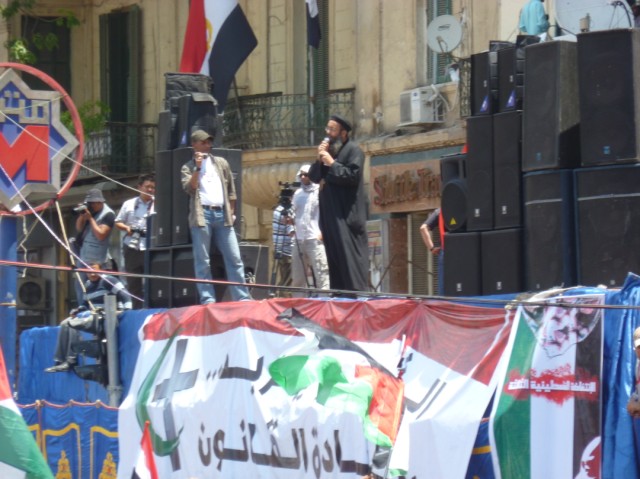
The main stage activities began with a Christian ‘church’ service, followed by Muslim Friday prayers, and a number of statements by religious, political, and activist leaders. I put church in quotes, unpleasantly mindful of the sarcasm, but recognizing the difficulty of the speakers. Apparently representing evangelical traditions, though with one Orthodox priest speaking prominently, their time consisted of efforts to connect with the crowd through chants that mostly fell flat, praise hymns that no one recognized, and assertions of national unity and Palestinian solidarity against Israeli oppression.

Most Arab Christians recognize the Palestinian people as having legitimate rights, and the Israeli government of having oppressed the occupied territories. Yet to an overwhelmingly Muslim audience, significantly representing Islamist groups such as the Muslim Brotherhood and al-Jama’a al-Islamiya, it appeared their main objective was to present their credentials as Palestine supporters. Little was spoken that could be understood as Christian-particular, though one speaker did urge those present to remember the cause for justice must be joined by truth and love.

Contrast their effort with Islamic Friday prayers, which was a masterful performance by the speakers. Islamic to the core, they wowed the audience, weaving assertions of national unity and Palestinian solidarity with cries to continue the revolution and purge the remnants of the Mubarak regime from the nation. The official Friday prayer speaker called for a civil state, and brought many in the audience to tears as he implored God to protect the revolution, save it from religious division, and spread it to other Arab states.

The next speaker represented the Salafi perspective, which equally condemned the Imbaba attacks and promoted national unity. There was little that would represent any of the recent controversial Salafi statements, such as opposition to democracy or the eventual return of the caliphate. There was much anti-Israel rhetoric, however, calling for millions of Egyptians, Muslims and Christians, to pray in their holy sites in Palestine, proclaiming Jerusalem to be their capital alone.

Other speakers continued on the same lines as those above, and I have little argument with either cause, inasmuch as Egyptians have the right to express these perspectives. Two disconcerting trends emerged, however.

First, it seemed that national unity was being built upon the back of a common enemy. Yes, Muslims and Christians can come together to condemn Israel, but will this solve the real domestic, if sometimes exaggerated, issues that produce sectarian conflict? Furthermore, speakers adopted the ‘national unity as fact’ perspective, blaming all problems on ‘the remnants of the NDP and security forces’ for instigating chaos in counter-revolution. There may well be manipulating forces at play in Imbaba and elsewhere; the proclamation of the truth in this conspiracy only masks over real tension. Yet it was not just lingering Mubarak cronies who are to blame; these, it was said, were working, as before, at the behest of Israel and the United States.

Yes, it would seem Israel would benefit from a divided, weakened Egypt. Yes, Israel has manipulated sectarian tension previously, at least within its own borders.[1] Is there evidence of it here in Egypt? I have seen little, but this is the nature of conspiracy. It may well be true, but it is believed as mantra. In the end, it does no good, since it closes the mind and turns a blind eye to one’s own faults.

Second, flowing from this, there was a distinct lack of civility in discussing the issues. Perhaps it is the nature of politics, populist politics in particular. While the speakers generally did not use incendiary words, the chanters from the stage led reprehensible, inflammatory cadence. ‘We demand expulsion of the ambassador of pigs.’ ‘We are going to Tel Aviv as a million martyrs.’ Though not everywhere or fully representative of the crowd, Israeli flags were burned, and an effigy was hung.

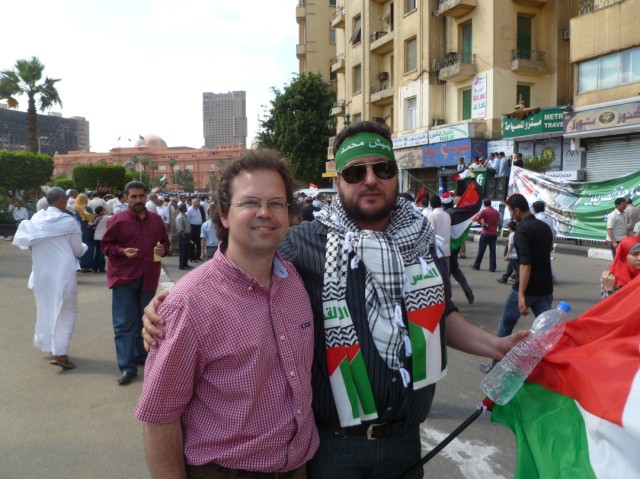
There was also the presence of a green headband-wearing ‘Army of Muhammad’. These proclaimed the eventual formation of an Islamic army that would liberate Palestine. In conversation with one adherent, he made several nuances that delay quick rejection. First, the Arab Spring has taught us that we can have a peaceful army. We will march to Israel, though there will be bloodshed wrought against us. Second, Palestinians are strong enough to win liberation on their own. We must support them by becoming strong ourselves, so as to pressure Israel, not to attack it. Third, we are a distinctive Islamic army, remembering the great Islamic victory over the Jews in Medina. But we will march side-by-side with our Christian brothers in support of this cause.

In this youth there was civility, and it showed in his discussions with Christian protestors who engaged him about the issues of Egypt and national unity. Though both sides championed the same phrase, there was deep division in understanding the problems at hand. One wanted an Islamic state which would protect Christians, the other wanted a civil state which would protect Christians, and others. They could not come together on essentials, but they departed friendly, after giving ear to the explanations of the other.

Perhaps this encounter should give me pause in my uneasiness. The rhetoric of the day was both lofty and base. One worthy cause was emptied of depth; the other was adorned with contempt for an enemy. Yet the people involved – even from extreme interpretations – discussed. There was no violence, no aggression, only the inflammation of public words. This gave me much pause, and interestingly, the Christians were not very good at it (though the Orthodox priest was better). Yet in personal conduct, even with those of completely opposite persuasion, there was peaceful exchange.

If only such exchanges might be had more often – between Muslims and Christians, even with Zionists. Alas, people do not often talk about that which divides them. An event such as this, as uncomfortable as it was to my Western Christian sensibilities, at least gets people talking, and puts them in one arena so as to discuss together. May all have the bravery to stay there, and keep alive the dialogue.

translation: Muslim, Christian – one hand; the people, the army – one hand; Fath, Hamas – one hand
the Palestinian flag, carried through the crowd
an Orthodox priest addressing the crowd
sitting to listen to the Friday sermon in the heat of midday sun; my neighbor shared his newspaper with me, and several others
prostrating during Friday prayers; see some standing away from the crowd; among them, I was asked to politely sit
cheering for Palestine during the speech of a popular Salafi preacher
a side stage rally for Palestine, with a Christian to the left and an ‘Army of Muhammad’ Muslim to the right
an effigy of the State of Israel
burning and stomping on the Israeli flag
the ‘Army of Muhammad’ supporter described in the text…
… and 2nd and 3rd from the left are the two Christians who discussed national unity with him
(note: this last picture was taken from a visit to Maspiro, I hope to post a second text on the attacks tomorrow)

[1] See ‘The Body and the Blood’, Charles Sennot, formerly a journalist for the Boston Globe, for examples he has documented.

Categories
Personal

American Interest in Egypt

A surefire way to determine a person’s priorities is to look at his or her budget and expenditures. The necessities of life demand their share, to be sure, but what becomes of disposable income? Check your own most recent bank statement, and take stock of the results. Are they what you would wish, or did you stumble into a situation you would like to revise?

Can the same test hold true for nations? If so, do the results reflect determined policy or simple inertia?

Many Egyptian activists have criticized the decision of President Obama’s administration to cut funding for the promotion of democracy by $5 million. Furthermore, these funds must be directed to NGOs and civil society organizations registered and approved by the government. On one hand this seems only natural – should the US government allow foreign donations to be received by quasi-legitimate Islamic charities, for example, which may or may not have ties to terrorist agencies?

On the other hand these same Egyptian activists would flip this comparison in their favor, stating that the government views ‘civil society’ as a threat in the same manner the US would look at these under-the-radar charities. Though this is a stretch, they maintain that Mubarak’s government only admits registration to those organizations which will not contest its rule. By funding only registered NGOs, it is said, the US ‘promotion of democracy’ only further entrenches the effective one party system which has existed since the military revolution of 1952.

The $5 million reduction is a full one-fifth decline from the previous allotment of $25 million. For all the grief President Bush received in Egypt for his policy in Iraq, Afghanistan, and Israel, many of these activists will praise him for the pressure he placed on the Mubarak government which, they say, genuinely opened the civil society field and resulted in greater freedoms across the board. Conversely, President Obama stands accused, at least by one prominent activist, as returning to the days in which the US openly ‘coddled dictators’.

When one discusses numbers in the millions a sense of precision can be lost. I live here; I have a general sense of what civil society organizations do. I have no idea, however, where even a reduced figure of $20 million is being expended. Though I don’t know who does or does not receive US aid, there are good organizations doing good work. $20 million is a staggering sum; add it up here and there and surely it can be found. It would be a fair question to research, though: However defined, does the investment result in $20 million of ‘good’?

This discussion is interesting enough, but the opening thought begged a look at priorities. A $5 million reduction suggests the Obama administration is less interested in the promotion of democracy than his predecessor. ‘Less interested’ is found to be a matter of degree, however, when the rest of US government aid to Egypt is considered:

$20 million – promotion of democracy

$35 million – education ($10 million of which is for Egyptians studying in the US)

$250 million – economic aid

Now wait…

$1.3 billion – military aid

Suddenly, $5 million becomes a drop in the bucket.

Israeli prime minister Menachem Begin and Egyp...
Image via Wikipedia

Egypt solidified its status as a close ally of the US with the signings of the Camp David accords, resulting in the reception of such aid packages every year thereafter. Since that time Egypt has fought no wars, with Israel or anyone else; why is this aid necessary?

While the Obama administration has been accused in the US as favoring Arab interests over Israeli, longstanding American policy, Obama’s rhetoric notwithstanding, has given Israel almost free reign to extend its will in the Palestinian territories. Those who push the envelope, however, suggesting Israel to be America’s 51st state, or more cynically, America’s boss, do not realize the significance of this military aid.

A strong Egyptian military is a necessary counterbalance to the weight of Israeli forces. Both are bankrolled by the US, of course, but if there was not a readiness in Cairo to engage in military combat, Israel would have to pay no attention whatsoever to international (including US) cries for a just settlement of the Palestinian issue. US military aid to Egypt maintains at least a semblance of regional balance of power.

Returning to cynicism, however, there can be another deduction from the breakdown of US aid to Egypt. Where are US priorities? Promotion of democracy? Yes. Education and economics? Yes.

Stability of a regional player? Absolutely. The US maintains genuine interest in political reform and expansion of freedoms. Why else would it invest millions of dollars otherwise available to domestic interests? Cynicism may respond that when differentiation is lost in the understanding of ‘millions and billions’, even the drop in the bucket can appear as a sizeable investment. This number can be paraded to US voters who view America as the city upon a hill with missionary mandate to make the world safe for democracy. At the same time, the other (larger) number can assure the establishment that such idealism will only go so far.

I wish never to surrender to cynicism. Accounting, however, is another matter. As an idealistic American, I do not wish to believe our pangs for worldwide freedom are insincere. A brief look at our foreign policy, however, makes hopeful belief difficult. How do idealism and the pursuit of national interests mix in Iraq, Afghanistan, or Yemen? The world is a complex place, and realpolitik is the mastery of complexity.

If, however, these international engagements have been completely devoid of pure motivation underneath its justifying rhetoric, faith in our system, this great experiment, is severely tested. Let us then surrender to the ways of the world, the quest for empire, and ultimately, a few pages in the textbook of history for the coming centuries.

No, America is good. I will hold this like a tenet of faith. When faith is measured, though, will it be found to equal $20 million? Slightly more (if adding in education funding), or slightly less (after accounting for inefficiency and corruption)?

What does this mean for Egypt? I’m sure this is not a revelation to experts in the field who have followed US-Egyptian relations for years, but it can be disheartening for the idealistic neophyte wishing good for all. America does care (I trust) for the gradual political reform of Egypt, but it cares far more deeply for the preservation of the existing state of affairs. President Mubarak is aging, there is no clear successor, and no viable opposition. The only candidate currently attracting attention (legitimately mobilizing a popular longing for change) is constitutionally bound from running for president unless he joins an existing political party, which he has stated he will not do. What is coming next?

There is no need for fear, or hope. The ruling system stems from the power of the military, whose strongest ally is the US government. A radical departure from the status quo is highly unlikely.

Simply balance the checkbook and see.

Categories
Books Personal

Egypt and the Triumph of Islam

Egypt and the Triumph of Islam is the subtitle of “No God but God”, written by Geneive Abdo, chronicling the ascendancy of the Islamic spirit in the land of the Nile. The Islamic creed declares, “There is no god but God,” uniting all of Egypt’s believers, but continues, “and Muhammad is his prophet,” isolating Egypt’s non-Muslim community. For centuries Egypt has existed in between these two statements of the creed, reflecting a society which is united in the primacy of religion, providing space for the monotheistic general, yet leaning toward the Islamic particular. Yet in scaling down the creed even further, “No God but God” highlights the transformation that is taking place in Egypt. No god, no philosophy, no political system, no economic theory – may take the rightful place of God as master of human existence.

Islam has always declared God’s ultimate authority, as has Christianity of course, but Egypt until recently has always accommodated a less than perfect Islamic ideal. Since the Islamic period began, and in fact since Alexander the Great, Egypt has been governed by foreigners. Romans, Byzantines, Arabs, Turks, French, and finally British have occupied the throne for 2,000 years. The majority of these two millenniums have been under at least tacit Islamic governance. The first Egyptian to rule since the Pharaohs, Gamal Abd al-Nasser, came to power in a military coup in 1952, but like the rulers before him moderated between the Islamic identity of the masses and his own political agenda. He preached secular socialism and Arab nationalism, seeking to modernize Egypt while balancing between the Cold War East and West. His successor, Sadat, tried to welcome Islamic sentiment while economically titling Egypt into the capitalist orbit. While both for long periods enjoyed great public popularity, there was a lingering discontent that existed beneath the surface.

There is within Islam an understanding that God’s favor implies civilizational superiority. This is natural to explain from history, as following the death of Muhammad within 100 years his political successors established an empire which stretched from Spain to India. From the fall of the Roman Empire to the end of World War I the Islamic Empire, though suffering sporadic periods of decline, was constituted the dominant power on earth. Then, all of a sudden, Europe was king. Muslims asked internally, what happened to God’s favor? The answer tended in one of two directions. First, it was said that Muslims had neglected their religion. As such, God withdrew his favor. Second, it was said that Muslims had become too religious. Instead of pursuing the technological creativity which had characterized them for centuries, they entered instead into divisive theological controversies, and neglected the developments going on in the rest of the world. So while some urged religious revival, others urged imitation of the West. Most, of course, sought a balance.

This time of questioning coincided with, or rather was engendered by, the period of French and British colonization. This chafed at the Egyptian psyche, for while they had always been ruled by foreigners, at least they were ruled by Muslim foreigners. France’s colonial age in Egypt was very short, but the British, though seen as seeking the modernization of Egypt, were also seen as completely self-serving. The foreign Islamic powers simply demanded the payment of a yearly tax, which, though at times oppressive, generally did not disturb the regular patterns of traditional life. In addition, if anyone cared, it was in the service of Islam and the predominance of its order. The British, however, upset everything. While the elite learned to play along, and profited exorbitantly, their modernization efforts touched the soul of society. Furthermore, the best of the profits were pocketed by the foreign carpetbaggers and their international companies, with their upper-class lackeys in tow. When World War II ended and colonialism collapsed in the wake of United States preaching about the right of each people to self-determination, enshrined in membership in the United Nations, the former colonial powers assisted their elitist allies in accession to power, ensuring their continued economic dominance, if not exactly their political.

Gamal Abd al-Nasser was the one to finally succeed in throwing off this yoke, but inherited the same condition. As a Muslim, as an Egyptian, and aided by the fact of being a very charismatic leader, he was celebrated by his people, and in fact by many Arabs around the region. Egyptians, like all people at the time, were awash in a newly celebrated nationalism. Nasser did not emphasize religion; he, of course, ruled over both Muslims and Christians, and the latter had played a substantial part in the long struggle for independence (though not in the coup). It seemed based on his initial successes that Egypt was entering a new and successful age. The religious question of God’s favor was muted, though never jettisoned by all. For his part, Nasser answered it implicitly by continuing Egypt’s modernization. He crafted a modern military. He built the Aswan dam, touching the lives of the Egyptian peasants far more than any Brit had ever done, by ending the eternal cycle of Nile flooding. The effect, though, sent a boom through Egypt’s economy, and Nasser’s socialist impulses made effort to see that all would benefit. God’s favor had returned; Egypt was a major player on the international scene, in the forefront of leadership among the Cold War non-aligned states. All this, furthermore, was done without the banner of religion, let alone Islam.

The favor, should it be so called, would not last. The revamped Egyptian army was routed by Israel in the 1967 war. The socialist economy went flat. Nasser floundered though his sheer force of personality kept most Egyptians rallied around him. The voices that began calling for a deeper return to religion became more strident, only to be silenced by crackdown. The tide was starting to turn.

Nasser’s successor, however, reversed course and kept the Islamist voice at bay. Sadat took over the state and turned Egypt both toward a resurgent religiosity and then toward the capitalist West. In the first he waged the 1973 war against Israel under the cry of ‘Allahu Akbar’, the Muslim chant, and great gains were won as he broke through to reclaim Sinai. In the second he propped up the faltering economy by encouraging private ownership and opening the country to significant foreign investment. Like his predecessor, Sadat also enjoyed great popularity.

The successes, however, were superficial, and soon faded. Careful analysis would show that though far more capable than previous military exploits, the gains in Sinai were tenuous, and the ‘no peace, no war’ situation that followed was a constant reminder of the lingering Israeli presence. The religious element originally welcomed by Sadat was shown to be only for political expediency. It helped rally the nation—though not the Christians—for the war, and was a foil to the leftist politics of Nasser from which Sadat needed to escape. The economic gains were also only partial; the upper class benefited far more than the common Egyptian, and the middle class seemed pressed at both ends. Though still enjoying the support of the people, Sadat realized he was teetering. This led him to take his boldest move yet, for which he would be both praised and vilified, the implications of which are still felt in Egypt today.

The motivations of Sadat are hotly debated today. Was he a champion of peace or a Machiavellian politico? Regardless of the answer the outcome is the same. In 1978 Sadat visited Jerusalem, and in 1979 he signed the Camp David Accords with the Israeli Prime Minister through the brokerage of the American President Jimmy Carter. The advantages were enormous. The economically and psychologically draining policy of ‘no war no peace’ with Israel could be put to an end. Egypt recovered unequivocally all land previously lost in Sinai during the 1967 war. Sadat was hailed as a visionary in the Western press, resulting in increasing confidence in the soundness and stability of the Egyptian economy. The peace accord also was encouraged by millions of dollars in foreign aid, received year after year.

The disadvantages, however, were disastrous on the regional and domestic front. The Arab League broke with Egypt which resulted in complete political and economic isolation. The Egyptian population also roundly condemned the pact, for Israel was the sworn enemy, the oppressor of the Palestinians. While ordinary Egyptians could see the benefits of the peace with Israel, and the more affluent could profit from the ensuing calm, even those in favor could only interpret it as a deal with the devil, so no popularity emerged from his historic risk.

The religious element in Egypt was horrified. Already frustrated with Sadat for not following through on his initial openings for an increased role for Islam in society, this drove them over the edge. Like Nasser before him, Sadat responded harshly, jailing many in large sweeps taking in those with Islamist sympathies, examining later if they were truly guilty of any crimes. By this time Islamist voices were fully in division with their identity. While some urged jihadist aggression to violently overthrow an infidel government, many others were eschewing violence for preaching, hoping to win over the masses for a gradual transformation of society. Again the question of motivation can be asked: Was this sincere or pragmatic, idealistic or calculating? The resulting split, however, became clear in the months which followed.

In 1981 Sadat was gunned down during a military parade by elements of the militarist faction within the Islamists. Though there was little mourning for the fallen leader, there was also round condemnation of the assassination. The jihadist ideas fell increasingly out of favor with the Egyptian people, though they were never popular to begin with, but the moderate Islamist voice emerged victorious. As those with religious leanings were often grouped in one lump with the criminals, society began to see them as martyrs. At the least they were perceived as sincere believers who were being punished by the government for their beliefs. A persecuted idealism is always attractive.

This sums up the background for the ‘triumph of Islam’ as proclaimed by “No God but God.” In answering the question of where was God’s favor, society leaned toward the latter religious answer. For two centuries the political leaders tried to recapture old glory by imitation of the West. Certainly to a great degree their policies were successful; Egypt was transformed into a modern nation. Yet the promise of civilizational superiority was never fulfilled; Egypt and the Arab World together lagged behind the United States, Europe, and even emerging economies in Asia. They played by the rules established for nation-states, why at least were they not as successful as Japan, Korea, China, and the like? The only wealthy Arab nations were Gulf States, and they were religiously conservative in orientation. Pre-revolution Egypt was run by the heirs of colonialist puppets, Nasser led the nation in Arab nationalism and socialism, Sadat pushed his people into Western-leaning capitalism—all failed. Muslims of all stripes began asking, “Why such imitation of foreign ideologies, why not give Islam a try?”

“No God but God” continues this story, showing how the Islamist voice has become so influential in Egypt today. Abdo is careful to insist that the Islamist voice is moderate, not militant, but all the same it is unceasing in its demand that all of life, including politics, economics, and dress code, be governed by the commands of God. She highlights Islamist gains on the street, in al-Azhar seminary, in the unions, in the universities, in the courts, and among women. Though not claiming Islamists have captured the hearts and minds of the majority, she does highlight how much better primed for success is the Islamic experiment in Egypt than in Iran. In Iran the revolution was imposed from the top down. Though welcomed by many, it was achieved politically. In Egypt the vision of the moderate Islamists is bearing true; by transforming individuals, families, and neighborhoods first the political victory can come later. Let God rule in the heart, and then in the hearts of others. Only then can he rule properly in the heart of society.

Click here to purchase from Amazon: No God but God: Egypt and the Triumph of Islam

Categories
Arab West Report Books Middle East Published Articles

My First Report

One of the primary activities of my organization here in Egypt is the translation of articles from the Arabic press into English. We select between twenty to forty articles every week, with an emphasis on religious issues, but not to the exclusion of other factors which also affect Arab-West relations. We also publish our own reports within the weekly selection, which can be analysis of the news, critique of media reporting, or simply a selection of interesting voices which lend toward a broader understanding of the Arab World in general, and of Egypt in particular.

 I am not involved in this process on a regular basis. We have a team of native speaking Arabs who provide the translation, and English speaking foreigners who work on the editing. We also have a variety of interns from around the world, including Egypt, who can write reports such as those described above. Although my work lies elsewhere, on occasion I also will have opportunity to contribute.

 I have provided here a link to my first report. The work I do will not always be put on display, but when it is appropriate I will also provide reference here in the blog. I am glad that some of my work will also help readers here get a better glimpse of Egyptian society, as well as our small participation in it.

 My report summarizes a lecture given by Jihan Sadat, the wife of the former president of Egypt, Anwar Sadat, who was assassinated by Muslim extremists, in no small part due to his signature on the Camp David Accords establishing peace with Israel. Here is the text below:

On October 11, 2009 Her Excellency Dr. Mrs. Jehan Sadat presented a lecture to the Women’s Association of Cairo at the Oriental Hall of the American University of Cairo. Mrs. Sadat served as First Lady of Egypt from 1970 until her husband’s assassination at the hands of Muslim extremists on October 6, 1981. Mrs. Sadat began her lecture by noting the incongruity of this day as paying honor to two disparate concepts:  a celebration of her husband as a man of peace, and a celebration of war as the means to liberate Sinai from Israeli occupation. Though a principled man of peace his whole life, Mrs. Sadat spoke of the October War, launched on October 6, 1973 by her husband, as a necessary step in achieving peace by demonstrating the strength of Egypt. Having won popular acclaim in Egypt and throughout the Arab World, however, Sadat returned to his peaceful constitution, pursuing a policy of rapprochement with Israel in effort to secure peace in the region. In 1978 Sadat visited Jerusalem and addressed the Knesset, fully aware of the implications of his decision. Furthermore, Mrs. Sadat states, he knew upon signing the Camp David Accords with Israel in 1979 that he could pay for this initiative with his life. Nevertheless, he pressed forward, and though his ideas were rejected entirely by his Arab brothers at the time, leading to Egyptian isolation from the Arab League, today his views are accepted by many, and imitated by some. Mrs. Sadat declares that her husband’s methods are not the only way to achieve peace, but they are the only ways which have worked. 

Mrs. Sadat spoke also of her own struggle, stating that she could have fallen into despair and brokenness following her husband’s assassination. She described him as a good husband and father; they traveled everywhere together and considered one another as partners. Yet despite her state, she knew that her husband would be disappointed if she surrendered to her grief, so she has decided to embrace life, looking forward to the day they will be together again, but yet laboring to keep his legacy alive. This she achieves through involvement as a Senior Fellow at the University of Maryland through an endowment for the Anwar Sadat Chair for Peace and Development. She also has written a new book, My Hope for Peace, published in March of this year, to promote her and her husband’s efforts for a better world, focusing on principles for peace, and also on the subject of women’s rights. 

From the Belfour Declaration in 1917 to the 1948 establishment of the State of Israel, continuing through the 1973 October War and its aftermath, Mrs. Sadat declared that her husband recognized the bloodshed, displacement, and hatred which characterized Arab-Israeli relations, resulting in no clear winning side. Though he had achieved success in the war, his faith pushed him to desire more, believing peace was more important than military victory. In pursuit of this goal he developed five principles which guided his conduct during negotiations and the pursuit of peace.

  • All people desire to live in peace
  • Realistic and pragmatic admission of the animosity between conflicting sides
  • Direct and continual involvement of leadership to drive the engine of peacemaking
  • The necessity of forgiveness
  • The brotherhood of Arabs and Jews

 In commenting on the current possibility for peace, Mrs. Sadat expressed hope. Jordan has followed Egypt in signing a peace accord with Israel, and though recent Israeli policy toward the Palestinians has been belligerent, she believes that Palestinians should be able to coexist with Israel. They should have their own state as well, with Israeli assurances of being able to live in peace. Finally, she praised President Mubarak for his continuation of her husband’s policies, working tirelessly to keep the two sides in negotiation. 

Mrs. Sadat also spoke passionately on the subject of women’s rights, highlighting the visit of President Obama to Cairo and his statement that our daughters can contribute to society as much as our sons. She believed that President Obama and her husband would have been good friends. Though her husband shared her convictions on women’s rights, Mrs. Sadat laughed that she continually nagged him about it. “Yes, yes,” he replied, “but I have also to build schools and hospitals; I will get to it eventually.” He did, and the ‘Jehan Laws’, as they are known, helped women achieve greater rights in terms of alimony and child custody following a divorce. Mrs. Sadat declared that women’s rights are not an issue for Islam, rather, it is an issue concerning how certain people practice Islam, and that this is true for any religion. A recent survey conducted by John Esposito of Georgetown University interviewed over forty thousand Muslims in over forty countries, and highlighted that Muslim women around the world want the right to work, to vote, and to serve in government, but are concerned far more about extremism and corruption than they are about issues of dress code. Mrs. Sadat said that religion and rights are not mutually exclusive, and praised the history of feminism in Egypt, urging the current generation to keep their story alive, but noting that their message has been woven into the tapestry of Egyptian culture. She also issued special praise for Mrs. Mubarak for her devotion to the cause of women’s rights, noting that more than ever before Egyptian women are going to school and becoming doctors, ministers, and professionals of all varieties. 

Mrs. Sadat closed her remarks by expressing her personal hope that she has made a difference with her life. She hopes that women get their rights, not because they struggle for them, but because they deserve them. She prays for peace everywhere, not just in Egypt, but also in Sudan, in the Middle East, and wherever there is violent conflict. She hopes to leave behind a better world for her three daughters, eight granddaughters, and four great granddaughters. She has lived a full and worthy life, and though she looks forward to standing again side by side with her husband, she will not retire while so many issues, including her husband’s legacy, stand in need of promotion.

Concerning a direct question about the pursuit of peace and reconciliation in the local context, Mrs. Sadat acknowledged that it is not beneficial to go to a village woman and tell her to change her behavior, giving the example of family planning. It is in the interest of the woman and her family to have many children, since they will be put to work to gain income, though underage labor is against Egyptian law. If instead she can be given a job, this will reduce the necessity for her children to work, creating strides in children’s rights, and will encourage her to have less children, thus achieving the desired change. She also commented that mothers, in addition to the educational system, play a vital role in educating children about peace, helping others, and proper human interaction. For the local context especially, economic projects and education are vital in the dissemination of the message of peace. 

Extrapolating, then, from the principles of President Sadat, Mrs. Sadat’s lecture provided guidance on the pursuit of local peace. In areas of sectarian conflict, first, it is important to remember that at base, all parties wish ultimately to live in peace. The conflict may have been started by misunderstanding or common affront, but as the complications escalate, it is easy to forget this principle. Second, it requires the realistic understanding that each side has hardened against the other, and the pragmatic planning to overcome mutual antagonism. This is where Mrs. Sadat’s comments about a project are especially poignant; a well designed project will bring people together, starting from the recognition they have not begun that way. 

Third, peace and reconciliation is best achieved through the active participation of recognized leadership. Chances of success are few unless local leaders can be convinced to partake, for they have the clout to maintain momentum when individual incidents threaten to derail the process. Outside leadership may be even more powerful. Fourth, forgiveness is absolutely necessary, though this is a message that can only be preached, not enforced. Proponents of peace outside the process must keep forgiveness at the center of their discourse, lest anyone slip into the ease of its neglect in the details of negotiation. Finally, in a similar way, all must hold on to the centrality of the concept of Muslims and Christians as brothers, that this be maintained as an article of faith. Keeping these principles in mind will help guide local peace efforts in the manner they guided President Sadat’s efforts in the international arena. If realized in her own country, it will fulfill Mrs. Sadat’s hopes to have made a difference, to keep her husband’s legacy alive, and to see resolution of her own prayers for peace.

 (click here to read on AWR)

click here to purchase from Amazon: My Hope for Peace