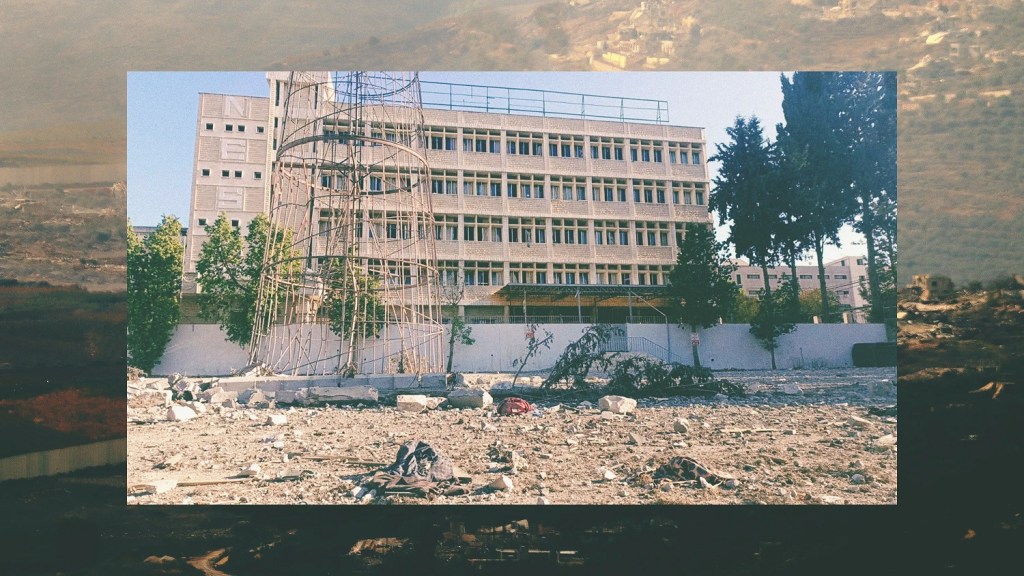
The predominantly Shiite city of Nabatieh in southern Lebanon once boasted the nation’s largest Christmas tree, erected to symbolize good relations between local Muslims and the tiny Christian minority of only 20 families.
The local evangelical school—with a 99 percent Shiite student body—had celebrated the holiday for years, and in 2018 it built a 100-foot wrought-iron conic structure topped with a radiant star. (The use of natural firs or pines is uncommon in Lebanon). Several of the hundreds of students, parents, neighbors, and dignitaries in attendance wore Santa hats. Many had trees in their homes and gifts to open on Christmas day.
Earlier that December, Ahmed Kahil, the Hezbollah-affiliated president of the municipality, continued the annual tradition of erecting a smaller tree in the souk, the traditional marketplace and heart of the city. And at both events—alongside Shadi El-Hajjar, the principal of the National Evangelical School of Nabatieh (NESN), heads of other private schools in the city, and various government and religious officials—Kahil wished Christians a Merry Christmas.
Top of Form
Lebanon’s economic crisis made 2018 the last year NESN could afford to erect its massive Yuletide construction. But over the following years, elementary school classrooms still featured Christmas trees, students exchanged secret Santa gifts, and teachers enjoyed the annual holiday dinner. “If Christmas isn’t found in your hearts,” the school reminded, “you won’t find it under a tree.”
But there was no Christmas celebration in Nabatieh last month, after over a year of war between Israel and Hezbollah. On October 8, 2023, the Shiite militia launched rockets into Israel in support of Hamas following its attack that killed 1,200 Israelis and took around 250 hostages. The subsequent daily missile exchange drove tens of thousands from the border regions of both nations.
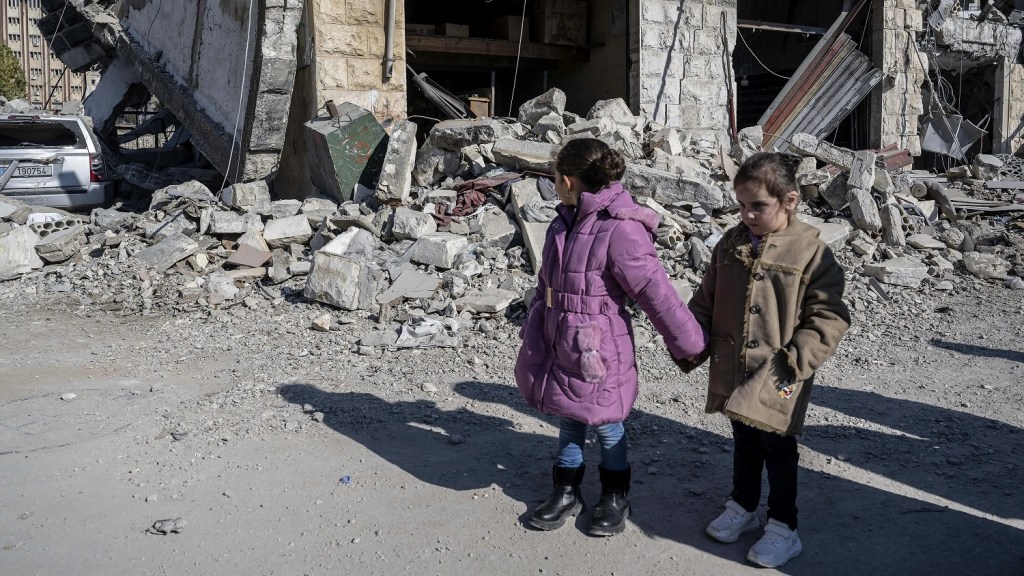
A year later, most of Nabatieh’s 80,000 residents fled their homes as Israel intensified its military campaign against Hezbollah. On October 16, an Israeli missile killed Kahil and 10 others at the Nabatieh town hall as they coordinated the daily distribution of food and medicine to the 200 families who remained in the largely evacuated city.
Initially, NESN stayed open for its 1,400 students. Located 35 miles south of Beirut and only 7 miles from Israel, the historic evangelical institution won local respect over the years by offering a nonreligious but values-based educational environment that consistently ranked among the top high schools in Lebanon. The September 2024 pager attack delayed the start of the academic year, and the exodus from the city eventually shifted education online. But within a week NESN opened its doors as a shelter for the locally displaced.
Over the course of the war, its staff stood by the Shiite community, including one who rescued Kahil’s colleague after the October 16 strike.
“When you see your hometown destroyed and the damage at the school,” Hajjar said, “you have to ask: Why is this happening to those who are not involved?”
A safe haven
In the early stages of the war, Nabatieh mostly…
This article was originally published at Christianity Today on January 31, 2025. Please click here to read the full text.
In early October, in a Christian village in southern Lebanon, “Samira” (we’re using pseudonyms due to the political situation) decided to water her lemon trees. The autumn winds were dry this season. Rain was less frequent. The frail, hunched-over grandmother filled her bucket and went outside.
Samira’s husband had died two years earlier. Her children had long ago moved away, seeking better opportunities in Beirut, but her daughter owned the house next door and made frequent trips back, recently refurnishing the interior with modern decor. Samira loved the home’s colorful bedspreads in the rooms where her great-grandchildren often stayed.
But such visits were infrequent these days. A year earlier, Hezbollah had entered the Israel-Hamas war in Gaza by shooting missiles into Israel. Israel had pushed back, and the exchange of fire between the Shiite militia and Israel drove thousands from their homes on both sides of the border. And in late September, Israel increased its bombing campaign against suspected Hezbollah sites throughout the country. Nevertheless, Samira had remained, adamant that her Christian village was not a target.
Samira had just begun watering her lemon trees when everything went black…
This article was originally published at Christianity Today, on January 8, 2025. Please click here to read the full text.
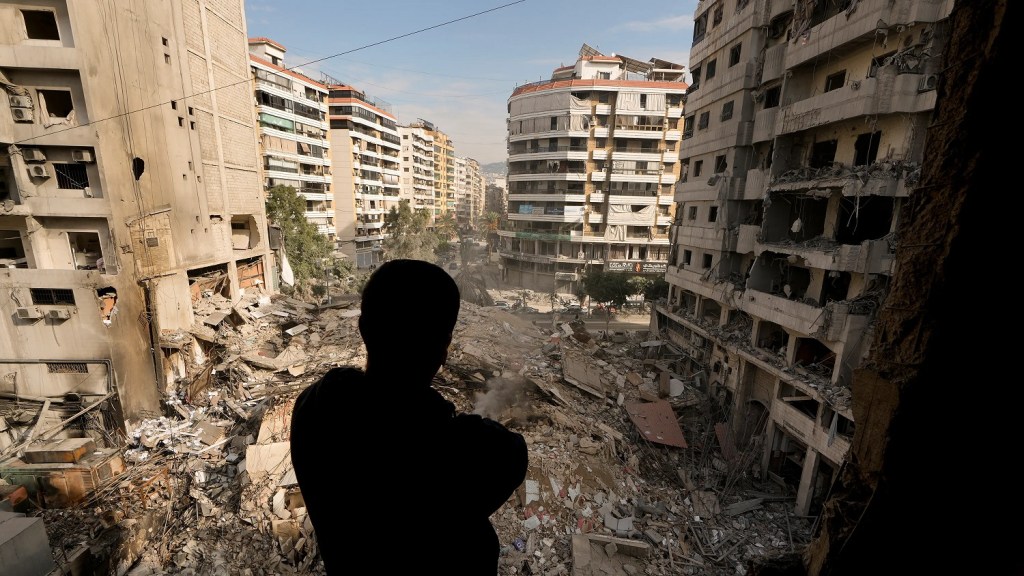
While an explosion reverberated across the valley from Beirut to the foothill village of Mansourieh, two men puffed on their cigarettes in resignation. Israeli jets were striking another apartment building in the Dahiyeh region of Beirut, Lebanon’s capital city, likely killing a Hezbollah militant or targeting an underground weapons depot within the tightly packed urban area.
Neither man cared about politics or the war, brought to their doorstep by last year’s decision of the Shiite Muslim militia to launch rockets into Israel to support Hamas. Tit-for-tat attacks had crossed the southern border for the 11 months that followed, as neither side wanted to engage in a larger conflict. That fighting displaced tens of thousands on both sides while leaving the rest of Lebanon largely unscathed—yet ever worried about an escalation.
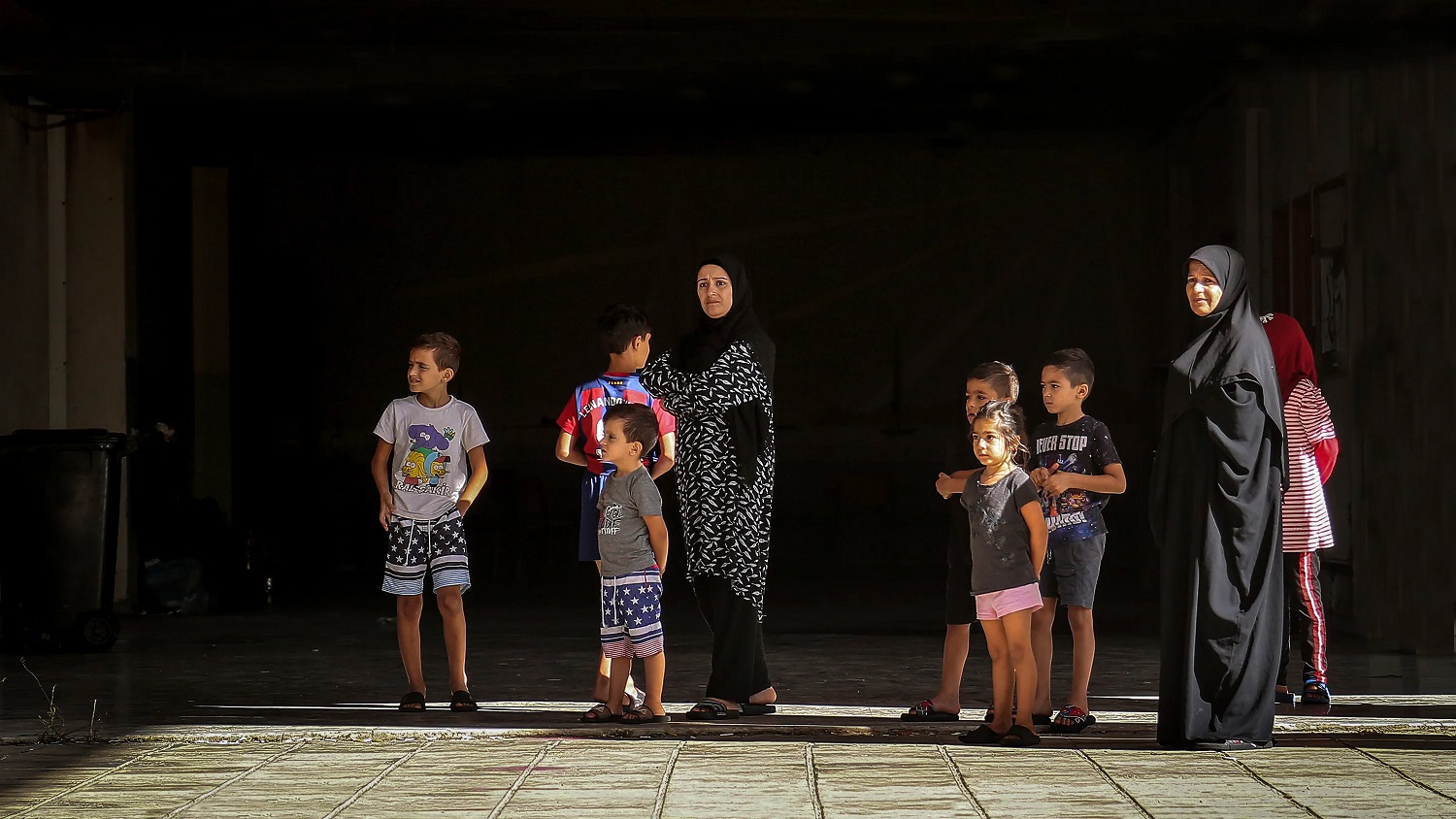
It came in September. On the 17th, Israel declared the return of northern citizens to their homes to be an official war goal. Hours later, an Israeli sabotage operation exploded Hezbollah pagers, killing 13 and wounding around 4,000 militia-linked individuals. Then, on September 23, Israeli missiles struck throughout Lebanon, and hundreds of thousands fled their homes. Lubnan Assaf, a 42-year-old Shiite Muslim, and Awad Saab, a 72-year-old Greek Catholic, somehow found their way to the Arab Baptist Theological Seminary (ABTS) guesthouse—and became friends. At its peak, the evangelical institution housed almost 250 displaced individuals, about one-third of whom were fellow Christians.
ABTS offered daily chapels and provided three meals a day—but no televisions. Isolated from the news and away from static entertainment, couples walked in the seminary gardens while children rode scooters down the access road from the library. Assaf and Saab played a Rummy-like card game until 10 p.m., exchanging details about their abandoned neighborhoods.
Assaf gave Saab the daily update that his auto-accessory shop on the edge of Dahiyeh had not been looted. Saab replied that his eight-month pregnant daughter, one of 15 people who remained in their southern village on the frontline of the Israeli ground invasion, was still doing all right. Both whittled away the hours in relative boredom, as each over time expanded his spiritual horizons.
Assaf’s Story
Assaf’s apartment in the working-class Shiite neighborhood of Ouzai, located in Dahiyeh near the Beirut airport, overlooks a local café and the Mediterranean Sea. His shop serviced mostly middle-class Christians who frequented the area, well-known for its inexpensive furniture and manufactured goods.
Over the years, Assaf saved up enough money to build a home in his family village of Younine, 11 miles northeast of Baalbek, an ancient Roman city preserved in the Bekaa Valley, Lebanon’s agricultural heartland. Driving from Beirut means passing by marijuana fields that fuel an unofficial economy run by local Shiite tribes that reportedly collaborate loosely with Hezbollah.
Artful calligraphy from the Quran adorns the walls of Assaf’s home. His wife, Mira, and their 15-year-old daughter wear the hijab. When war came to Dahiyeh, they relocated for safety, while Assaf returned to Beirut to oversee his shop. The next day, an Israeli missile…
This article was originally published at Christianity Today on December 20, 2024. Please click here to read the full text.
Illustration by Elizabeth Kaye / Source Images: Getty
As Americans headed to the polls Tuesday, the rest of the world watched to see who would become the 47th president of the United States. The election of Donald Trump affects many evangelical communities around the world in terms of foreign policy, foreign aid, religious freedom, and cultural trends. Nevertheless, Christian leaders in some countries noted that it didn’t make a difference to them who becomes the next president of the US.
CT asked 20 evangelical leaders around the world about their reaction to another Trump presidency and its practical impact on the situation of evangelicals in their countries. The responses are broken up by region: Africa, Asia, Europe, Latin America, North America, and the Middle East. CT will add more responses as they come in.
AFRICA
Nigeria
James Akinyele, secretary general, Nigeria Evangelical Fellowship
Top of Form
In light of Nigeria’s ongoing economic and political difficulties, this US election was not debated locally nearly as much as the prior two. For evangelicals, neither candidate was an easy option. Harris was considered more level-headed, but her strong support of abortion and LGBTQ rights made many uncomfortable. Trump’s moral stances resonated with our core evangelical convictions, but his own lack of morality and perceived white supremacy created some concerns. We hope he will become more open to immigration.
Some Nigerian Christian leaders said Trump’s victory is an answer to our prayers for a US president who will defend the Christian faith in Nigeria and around the world. Others said it should be accepted as God’s will, without positive or negative judgment. But just about everyone hopes he will become less controversial in his rhetoric and personal conduct. And many are sympathetic to his promise to maintain America’s role as the global policeman without being subservient to the rest of the world.
South Africa
Moss Ntlha, general secretary, Evangelical Alliance of South Africa
Trump’s win is a sad day for evangelicalism around the world. Prominent evangelicals in the US came out in full support of Trump, making it appear that to be Bible believing is to be Trump supporting. Their endorsement gives the impression that theological conservatism requires and leads to a right-wing political view that is dictatorial, opposes climate justice, sanctions genocide in the Holy Land, and approves what took place on January 6.
Many in South Africa who know the horrors of apartheid recognize how easily a populist politics that holds to a narrow vision of public morality can harm those on the margins. Trump already declared in his first term that African countries are “s—hole countries.” Lately, he has made it clear that when restored to the presidency, he would make sure that Israel has all it needs to “finish the job,” which many understand as the erasure of Palestinian existence.
We worry that having Trump in the White House will make it difficult to proclaim the gospel that “God so loved the world” that he sent Jesus to die for all, especially our Muslim neighbors. We worry that he will use the immense power of the US government to punish those who pursue foreign policies contrary to his own, such as South Africa for appealing to the International Court of Justice to adjudicate whether what we are witnessing in the Israel–Palestine conflict is genocide.
ASIA
China
A house church pastor in China
Donald Trump’s presidency could impact…
This article was first published at Christianity Today on November 7, 2024. Please click here to read the full text.
Illustration by Christianity Today / Source Images: Getty / Courtesy of Brent Hamoud, Emad Botros, and Daniel Suter
The warning issued by the American embassy on October 14 could not have been clearer: US citizens in Lebanon are strongly encouraged to depart now. But this message, coming as Israel increased its attacks on Hezbollah, was only the latest in several weeks of diplomatic efforts to reduce the American presence.
Back on July 31, already fearing an escalation of violence, the embassy was discouraging would-be tourists with its highest of four alert levels: Do Not Travel. For those inside Lebanon, it urged: The best time to leave a country is before a crisis, if at all possible. Major airlines had already canceled flights to and from Beirut, leaving only the national carrier to facilitate evacuation—and its outbound flights were booked weeks in advance.
Ever since Hezbollah—a Shiite Muslim militia designated by the US as a terrorist entity—launched missiles across the border in support of Hamas’s attack last October, foreigners have lived under a cloud of uncertainty that Israel might eventually bomb the airport, as it did in the month-long war in 2006 that left many expats stranded. Americans would have little hope of leaving through Syria, and Lebanon has no official relationship with Israel to permit crossing the southern border.
And then Hezbollah pagers exploded throughout the country.
With dozens dead and thousands injured, the next day, September 18, the embassy warned of a reduction in routine care at hospitals. On September 21, it told citizens the Lebanese government could not ensure their safety, mentioning the possibility of increased crime, sectarian violence, or targeted kidnapping.
And on September 28, one day after a massive Israeli airstrike killed Hezbollah leader Hassan Nasrallah, the embassy sent its nonessential personnel home and opened registration for US citizens to request assistance in leaving.
Several US citizens paid thousands of dollars to place their families on private yachts to nearby Cyprus. Others frantically called Middle East Airlines (MEA) to secure embassy-reserved seats to anywhere else. And among the missionary community, the chatter was incessant: Are you leaving? What are your contingency plans? Will your organization make you go?
Some decided to stay.
CT interviewed four Christian foreigners to learn how they made the decision to remain in times of war.
Each had already endured the constant hum of Israeli drones hovering over their neighborhoods. They learned to distinguish between the noise of warplanes deliberately breaking the sound barrier and the similarly ear-popping sound of a missile strike bringing down a Beirut apartment complex. And some have wondered if they might become a target of random Shiite anger or if the Islamist kidnappings of foreigners during Lebanon’s civil war decades earlier could be repeated.
The sources represent different categories of Christian workers.
A Swiss family living in the foothills outside Beirut believes that angels closed their ears of their children at night, allowing for consistent sleep even when explosions—slightly muffled by the distance—woke the parents consistently at 3 a.m. An Egyptian with Canadian citizenship said the blasts were so loud he sometimes thought they had happened just across the street—only to look out the window and see smoke plumes rising across the valley two miles away, not far from his church outside Beirut.
An American married to a Lebanese woman said that while the bombings did not threaten him directly, he was deeply troubled as each missile resulted in more deaths and displaced families. And a single American woman raised in urban poverty amid gang warfare stated casually, “I grew up rough, but gunshots and bombs are not the same thing.”
A Shared Resilience
This woman, a Black millennial from Ohio, has…
This article was originally published at Christianity Today on November 1, 2024. Please click here to read the full text.
On September 23, Mustafa put his family of five on a small motorbike and drove seven hours north from Tyre to a village in the Lebanese mountains, weaving slowly through lines of gridlocked vehicles. Some in those cars—like his brother Hussein’s family of six—would not arrive for another two days.
The path normally takes two hours.
Mustafa, and thousands like him, were frantically fleeing Israeli bombs aimed at Hezbollah, the Shiite militia designated by the US government as a terrorist organization. Until that moment, he and his brother had been agricultural workers in a farm outside the city, living in a spartan two-bedroom apartment provided by his employers.
Top of Form
CT agreed to withhold his family name for security reasons. Mustafa is a Christian originally from Afrin, a Kurdish area in northwest Syria. Asked if he shared his brother’s faith, Hussein said, “Not yet.”
Their home nation does not recognize converts from Islam. And while Lebanon is the only Arab nation to grant freedom of conversion, Tyre is a socially conservative Shiite city under the political sway of Hezbollah.
This was Mustafa’s second displacement. In 2013, he and his brother fled the Syrian civil war. But over the past five years, as poverty rates tripled in Lebanon, the nominal Sunni Muslims found support from a local Christian ministry offering aid.
Eighteen months ago, Mustafa professed faith in Christ.
“I follow Jesus,” he said. “He saved me.”
When Israel began its ground invasion of Lebanon, it issued evacuation orders to both Muslim and Christian villages in the south. But the large majority of the displaced come from Shiite areas suspected of housing weapons depots and underground tunnels—where resident Shiites may or may not align with Hezbollah’s Islamist ideology.
According to a survey conducted in early 2024, while 78 percent of Shiites viewed positively the militia’s role in regional affairs, only 39 percent said they felt closest to Hezbollah among Lebanon’s political parties, compared to 37 percent of Shiites who felt closest to none.
Only 6 percent of Christians had “a lot of trust” in the Shiite militia.
Within these realities, Christians are eager—and cautious—to help. Gospel commitments and national solidarity require hospitality. Sectarian guardedness encourages suspicion. And Israel’s bombing campaign creates fear that welcoming the displaced might make them a target.
Many are helping anyway.
Mustafa and Hussein found shelter in living quarters offered by an evangelical church in the mixed Muslim-Christian village where they sought refuge. A plastic rug covered half of the cement floor in their private allotment, with thin mattresses pressed up against the walls. Blankets and pillows strewn about were evidence of their children’s fitful night of sleep.
“This is our message: to show love in action as we lead people to Christ,” the church’s pastor said. (CT is granting him anonymity due to the uncertain political situation in Lebanon.) “As they receive, we teach them to give.”
His congregation currently hosts about 100 people, displaced from their homes in the south and in Lebanon’s Bekaa Valley. More than half are from neighboring Syria; the rest are primarily Lebanese Shiites. The pastor said 60 percent of the total are believers in Jesus. Others, like Hussein, are their relatives or Muslims already closely connected to churches in their original area.
They all pitched in to prepare 500 tuna sandwiches for local distribution.
Not Just Talk
Hezbollah’s current conflict with Israel began last year on October 8, one day after Hamas invaded from Gaza and killed approximately 1,200 Israelis, taking 250 hostages. The Lebanese militia initiated what it called a “support front” for Hamas, launching missiles that caused 80,000 Israelis to flee from villages near the border.
A similar number of Lebanese also fled from Israel’s retaliation, and for 11 months the two sides had kept their missile exchange relatively contained, aiming to avoid a larger and perhaps regional conflict with Iran, which backs both Hamas and Hezbollah as proxy forces.
That status quo held despite…
This article was originally published at Christianity Today on October 17, 2024. Please click here to read the full text.
When Jesus told the 12 disciples to shake the dust off their feet in protest of any town that did not receive them, it is easy to forget their mission was among fellow believers in Yahweh. Jews were speaking to Jews, and the message was simple: The kingdom of God is near.
But Jesus foresaw even greater opposition than rejection, according to Matthew 10. His disciples would be dragged before councils, flogged in the synagogues, and betrayed to death by their own brothers, he warned. “I am sending you out like sheep among wolves.”
Christian discourse on the Holy Land conflict is often similarly contentious.
“A conversation is needed,” said Darrell Bock, senior research professor of New Testament at Dallas Theological Seminary (DTS). “People talk at each other, not to each other. But with the emotion and distance between the two positions, is it even possible to try?”
Not from what another Bible scholar witnessed when each camp gathers alone.
“Their conferences only preach to the choir,” said Rob Dalrymple, course instructor of New Testament and biblical interpretation at the Flourish Institute, the seminary for evangelical Presbyterians in the ECO denomination. “Nothing changes; it only reinforces how bad the other side is.”
Each academic belongs to a community traditionally associated with one or the other side of the Israel-Palestine conflict. DTS teaches dispensationalism, which anticipates the restoration of Jews to the Promised Land before the return of Christ. Presbyterians adhere to covenant theology, which interprets the promises given to Israel—including the land—as fulfilled in Christ.
The Jews of Jesus’ day also had factions. But while “shake the dust off” was the instruction given to disciples in the face of opposition to the gospel, to all who believed in him he gave a very different message in the Sermon on the Mount:
Take the log out of your own eye first.
One group of Bible scholars…
This article was originally published at Christianity Today on October 7, 2024. Please click here to read the full text.
Almost six months have passed since Issa Saliba boarded a bus in Gaza with 15 other Christians to seek safety in Egypt. But he still relishes how they sang, clapped, and danced as they escaped devastation.
The air conditioning cooled his nerves, frayed from the harrowing journey to the border. Later that day, the wayside stop provided his first full meal.
Top of Form
As 1.9 million Palestinians—90 percent of Gaza’s population—remain internally displaced, less known is that 100,000 have managed to take refuge in Egypt. Saliba, allowed to depart because he is enrolled at the American University of Madaba in Jordan, left behind his father, two younger brothers, and the hundreds of other Christians remaining in the war-torn Mediterranean strip.
Saliba’s trip in April took him south along the damaged, dusty coastal road through Israeli checkpoints to the Rafah crossing. Then came a six-hour ride to Cairo. Saliba got out just in time: In May, Israel took control of Rafah’s Philadelphi Corridor and closed the border. The 8-mile-long strip of land remains a key sticking point in current negotiations over a ceasefire.
But from the first days of the Israel-Hamas war, the Egyptian government has resisted overtures to resettle displaced Palestinians in the adjacent Sinai Peninsula. Wary of terrorist infiltration but also fearful Israel will permanently refuse refugee reentry to Gaza, Egypt limited entry to people with medical emergencies, the financial means to pay up to thousands of dollars in fees, and international educational connections, like Saliba.
Evangelicals, though, are becoming known for giving food and supplies to refugees, whether Christian or Muslim. The Egyptian church, partnering with like-minded Palestinians, has even sent aid into Gaza for the believers huddled for safety in churches, as well as thousands of others displaced from their homes in makeshift camp communities.
“We show the love of God to everyone,” said Samuel Adel, chairman of the pastoral, outreach, and missions council of the Evangelical Presbyterian Church of Egypt, also called Synod of the Nile. “When people ask why, we tell them it comes from our love of Jesus.”
Soon after the Israel-Hamas war began on October 7, aid to refugees began…
The article was originally published at Christianity Today on September 16, 2024. Please click here to read the full text.
Amid the war in Gaza, Israel’s most religious Jews threatened to emigrate.
The statement issued by the chief rabbi of the Sephardic community in March had nothing to do with fear of Hamas rockets or the continuing fight against them. Neither was it related to protests over the remaining hostages or calls for ceasefire.
The concern instead was the forced conscription of Haredi Jews, popularly known as the ultra-Orthodox, into the military.
On Tuesday, the Supreme Court of Israel ruled unanimously against them. Though a plan must still be formulated, about 66,000 ultra-Orthodox of draft age are now eligible for enlistment.
Israel requires three years of service for most men and two years for most women. But in 1947, then-prime minister David Ben Gurion exempted 400 yeshiva students who wished to dedicate themselves to prayer and Torah study.
Marked by traditional black-and-white garb with a hat, long beard, and side curls, they call themselves Haredim—derived from Isaiah 66:2, which says God favors those who “tremble” at his Word. The success of Israel, they believe, is tied to Leviticus 26:3, where national flourishing is dependent on their “careful” observance of the law, interpreted as strenuous engagement with the Scriptures.
Today, however, the Haredi community is the fastest-growing in Israeli society and constitutes 13 percent of the population, estimated to increase to one quarter by 2050. Yet while 540 military-eligible Haredi men voluntarily enrolled to fight since October 7, tens of thousands have continued to avoid the draft under Ben Gurion’s exemption.
In 1998, the Israeli Supreme Court ruled a law was necessary to codify this policy, and it was passed in 2002. Israel also established a yeshiva that included military service as well as a special battalion for Haredim males. While thousands have joined, the vast majority rejects the secularizing influence of the Israeli Defense Forces (IDF) as a threat to the uniqueness of their separate religious community.
Most Haredi do not celebrate Independence Day, observed from sundown to sundown May 13–14 this year. While they are not anti-Zionist, they believe that only the coming messiah can reconstitute the nation of Israel in the land. In the meantime, they support the current human endeavor through their prayers.
But in 2017, the Supreme Court ruled the 2002 law was discriminatory and ordered the government to address it. Given strong Haredi influence on politics, the issue was left unresolved until March 28, when judges barred the state from continuing payment of stipends to yeshiva students eligible for the draft. Authorities have stated they will not engage in a mass conscription, but an estimated 55,000 Haredi in over 1,200 yeshivas will lose their funding.
The controversy has sparked protests and counterprotests pitting religious and secular Jews against each other. CT asked Samuel Smadja, the leader of a Messianic Jewish synagogue in Jerusalem, to provide a biblical perspective.
His father, who came to faith among the small Jewish minority in Tunisia, was one of the first messianic believers in Israel, immigrating in 1956. Today Smadja is the regional director for Trinity Broadcasting Network. He founded Sar-El Tours to connect Christians with their Holy Land heritage. He also has Haredi relatives within his family.
Smadja discussed how yeshivas fit within current Israeli politics, whether Haredi prayers are effective, and the best methods to speak about Jesus with an isolated community that equates proselytizing with the agenda of Adolf Hitler.
How do Messianic Jews view the IDF?
The children of Messianic Jews are fully enlisted and striving to be the best soldiers they can be. This is not only to demonstrate our social legitimacy, but to be a light for the gospel and to put forth our testimony.
We want our children to be promoted to the highest posts, as an example.
How do Messianic Jews view the Haredim?
It is better to discuss Orthodox Judaism, as the Haredim are a subset and there is diversity within both. Some join the army, some don’t, and it is hard to generalize since so much depends on which rabbi they follow.
But in general, like Paul said, they fear God but not from knowledge. The Orthodox Jews try to keep the commandments and do their best to climb the ladder of righteousness to get closer to God. And they are willing to pay the price for their convictions, especially during these times of war.
I believe we should respect them.
Yet we disagree with them, even though we have much in common on moral issues such as abortion and the traditional understanding of Judeo-Christian ethics. With many secular Jews, you have to prove God’s existence. But the Orthodox accept the truth of the Bible, and if they are willing to talk, it demands of us a deep knowledge of Scripture.
They know the Old Testament very well, especially the first five books of Moses.
Are they willing to talk?
Much more than they used to be. I grew up in Israel, and 25 years ago the name Yeshua (Jesus) was a terrible word. Messianic Jews were not recognizable because we were so few. Now people know we exist, and that we believe Yeshua is the Messiah.
It makes for an interesting discussion. The debate centers on how to prove the concept of a suffering messiah, and not just from Isaiah 53, for which they have a different interpretation. And then we address God’s complex unity—the Trinity—and the language of John that “in the beginning was the Word, and the Word was with God” (1:1). This concept is mentioned frequently in rabbinic literature, and we discuss if John aligns with it.
Was God’s messiah meant to be divine, or an elevated rabbi? What the average Christian takes for granted we must prove to the Orthodox—just as Jesus did on the road to Emmaus when he opened the Law and the Prophets.
Why is Isaiah 53 insufficient?
Jews say this chapter speaks…
This article was originally published at Christianity Today on June 26, 2024. Please click here to read the full text.
One Friday evening, a young woman sat her toddler on her lap at Christ the King Evangelical Episcopal Church in Ma’alot-Tarshiha, a mixed Arab-Jewish town in northern Israel five miles from the border with Lebanon. Like mothers everywhere, she clapped her hands and beckoned a response.
What does the cow say? “Moo,” the child replied.
What does the dog say? “Woof” came the answer.
What does the bomb say? “Boom,” and they both laughed.
Only a few hours earlier, with Hezbollah rockets flying overhead, intercepted sometimes by Israel’s Iron Dome defense system, church elders had debated meeting at all. When the siren sounded during the service, members wondered if they should enter the concrete basement shelter.
The playful mimicry belies the seriousness of the less-reported conflict in the Galilee region, but it also reveals its everyday normalcy.
“By now the bombs have faded into the background,” said Talita Jiryis, the 28-year-old volunteer youth leader at Christ the King. “Dark humor is our mechanism to cope with fear and the uncertainty of tomorrow.”
That is, for the northern citizens who remain near the border. But a different uncertainty pains the tens of thousands evacuated from their homes. Arab Israeli Christians offered different assessments to CT, but all pray for peace in the land of their citizenship. The war in Gaza affects them too.
On October 8, one day after Hamas crossed the border into southern Israel and killed 1,200 Israelis, Hezbollah—the Shiite Muslim militia similarly aligned with Iran—launched its “support front” from Lebanon.
Daily exchange of rocket strikes and retaliatory fire has continued since.
But compared to Gaza, the casualties have been far fewer. In Lebanon, more than 450 people have been killed, mostly Hezbollah and other militant fighters but including over 80 civilians. In Israel, at least 16 soldiers and 11 civilians have been killed.
Within weeks, Israel ordered 42 northern communities neighboring Lebanon to evacuate, displacing between 60,000 and 80,000 residents with financial compensation provided. An additional 90,000 Lebanese have also fled the fighting, generally restricted to a stretch of land a few miles on either side of the border.
The violence has steadily escalated and expanded, though both Israel and Hezbollah have appeared reticent to engage in an all-out war. Ma’alot-Tarshiha was not ordered to evacuate; neither was nearby Rameh, where Jiryis was born and raised.
Mentioned in Joshua 19:29 as a border town of the tribe of Asher, Rameh lies a mere eight miles from the border. Yet the historically Christian village, populated also by Muslims and Islam’s heterodox Druze community, sits on a hill facing away from Lebanon. During the last outright conflict between Israel and Hezbollah in 2006, rockets struck only the peak or the valley below.
But it is not the relative safety that keeps Arab residents from evacuating. Jiryis said that many in Rameh are originally from nearby Iqrit, where in the 1948 Israeli war of independence, villagers were forced by Jewish soldiers to vacate. A promise they could return within two weeks was not honored; neither was the 1951 Israeli Supreme Court ruling on their behalf. The following Christmas, the Israeli Defense Forces (IDF) demolished each home.
Seventy-three years and one day later, a Hezbollah rocket struck Iqrit’s Greek Catholic church compound, the only building left standing. The rocket injured the 80-year-old caretaker, and nine IDF soldiers were wounded in subsequent fire as they sought to evacuate him.
Aware of the widespread grievance, Israeli authorities have issued only recommendations—not orders—for Arab communities to evacuate, Jiryis said. In the Christian village of Fassuta, women and children left while the men stayed behind, fearful that history might repeat itself.
Christ the King church, however, represents modern cooperation: Its land was donated three years ago by the Israeli government, and its bomb shelter is open to the public. Services are on the Israeli weekend in advance of the Sabbath, as many from the village work in the Jewish sector. Samaritan’s Purse, she added, helped the poor with a $130 food coupon, a first-aid kit, and battery-charged lamps.
“Jesus is the light of the world,” leaders stated during the distribution.
The church’s average attendance is about 80 people, including a dozen youth, mostly teens. Jiryis’s father is the pastor, and she extended his regional Maranatha family conference ministry with an interdenominational youth gathering planned for April. About 70 signed up from northern Brethren and Nazarene congregations, only for all to be thrown into disarray by Iran’s unprecedented missile barrage against Israel a few days prior to the event.
They held the conference anyway.
“We had to fully activate our faith,” she said. “Christians quote, ‘I will fear no evil.’ But this time, we couldn’t afford to pretend.”
Yet many are mentally exhausted, Jiryis said, and bury their fears rather than turn to God. During the week, she lives in the port city of Haifa, 25 miles southwest of her village, where she works as a psychologist in a government hospital. She has applied her skills through arts and crafts for the village children and insisted the adults continue to meet for mutual fellowship. Breathing exercises and emotional awareness are essential, Jiryis tells them.
Yet as she looks at the war, she is angry at injustice from both sides.
Jiryis knows the history at the heart of Jewish fear. Her mother is German; her great-grandfather was forced to fight in World War II. There are no winners in war, only losers was the mantra instilled in his son. This grandfather passed away when she was seven years old, but the sentiment has filtered into her identity today.
Her paternal grandfather was Palestinian, but like many young people of her generation, Jiryis said she struggles with how to define herself. Although she calls herself a Christian Arab citizen, she doesn’t feel fully Israeli because she is not Jewish, nor does she serve in the IDF. With many Arab and Jewish friends, as a rule she avoids politics and says instead, “Call me Switzerland”—a neutral nation where her father did biblical studies. Yet as an evangelical, she is a minority of a minority of a minority.
Her internal conflict is tangible, but she finds a solution.
“I focus on my heavenly identity,” Jiryis said. “But it is difficult here because you have to belong to something.”
She sees the surrender to community narratives even in the body of Christ. Some Messianic Jews admit they will not pray for the “future terrorists”—Palestinian children—who are dying in Gaza. Some Palestinian evangelicals say they cannot pray for a government committing “genocide.” While tension was always under the surface, relationships everywhere are getting worse.
But some, even apart from Jesus, are still praying together.
A Land of Life
Jiryis’s church is an example of believers praying together, having held joint meetings with Messianic Jews. But the identity issues she described are not uncommon in her community.
A 2015 survey of local evangelical leaders conducted by Nazareth Evangelical College (NEC) found that…
This article was originally published at Christianity Today on June 25, 2024. Please click here to read the full text.
In an age of polarization and strong opinions, a sizable share of American Christians are still “not sure” what they think about issues within the Israel-Hamas war.
A recent Lifeway Research survey, sponsored by the Philos Project, found significant convictions among self-identified believers: Strong majorities support Israel’s right of self-defense (83%), but also the Palestinian right of self-determination (76%) and the goal of a two-state solution (81%).
But many questions revealed uncertainties about the complexity of the conflict:
15% are not sure about the optimal outcome.
17% are not sure if Gazans are responsible for Hamas’s attacks.
18% are not sure if armed Palestinian rebellion is a natural response to mistreatment.
24% are not sure if Israel’s blockade of Gaza has oppressed Palestinians.
24% are not sure if Israeli control of the West Bank and Gaza is illegal occupation.
26% are not sure if most Gazans support Hamas’s fight against Israel.
31% are not sure if Israeli settlements beyond agreed-upon borders are illegal.
Furthermore, 41 percent hover between somewhat positive (25%) and somewhat negative (16%) in their overall perception of Israel, while 11 percent are not sure at all.
For each of these issues, of course, pluralities had an opinion on one side or another, as CT noted last week. To parse out the meaning of these diverse American Christian perspectives, CT asked four evangelical experts—two from peace-focused organizations in the US, and a Palestinian Christian and a Messianic Jewish leader from Israel—to describe what they found most surprising, concerning, and encouraging about the survey results…
This article was originally published at Christianity Today, on December 21, 2023. Please click here to read the full text. Contributions from:
Robert Nicholson, president of the Philos Project (“promoting positive Christian engagement in the Near East in the spirit of the Hebraic Tradition”)
Todd Deatherage, executive director of the Telos Group (“a pro-Israeli, pro-Palestinian, and pro-peace movement seeking dignity, freedom, and security for all”)
Dan Sered, chief operating officer of Jews for Jesus and president of the Lausanne Consultation on Jewish Evangelism
Botrus Mansour, Nazareth-based chairman of the Convention of Evangelical Churches in Israel, in his personal capacity as a Palestinian Israeli Christian writer and lawyer
When Benjamin Netanyahu announced the launch of ground operations in Gaza on October 28, weeks after Hamas terrorists murdered 1,200 civilians and abducted 240 hostages on October 7, he summoned the memory of an ancient foe.
“Remember what Amalek did to you,” the Israeli prime minister stated. “We remember and we fight.”
It was a reference his audience would understand.
In the Exodus narrative, the Amalekites attack the Hebrew people in the wilderness and are defeated in a dramatic conflict where Moses raises his arms over the battlefield. Later, in Deuteronomy 25:17–19, Moses exhorts the Israelites to “remember what the Amalekites did to you” and, after they have come into possession of the Promised Land, to “blot out the name of Amalek under heaven.” Finally, in 1 Samuel 15, God ordered King Saul to “totally destroy” the Amalekites, including women, children, and infants. Saul defeats the enemy, but is condemned for sparing their king and cattle.
Rabbinic commentary came to identify Amalek as a kind of paradigm for any enemy of the Jews that seeks their total destruction. Netanyahu had previously hinted the “new Amalek” could be a nuclear-armed Iran, and one of his advisors explained the word is used as a stand-in for “existential threat.” It has been invoked in reference to the Romans, the Nazis, and the Soviets.
Christians made the biblical comparison with Hamas even before Netanyahu, however, prompting discussion of responsible biblical interpretation in the midst of war.
Shortly after October 7, the International Christian Embassy Jerusalem (ICEJ) said the Hamas attack was “rooted in the demonic realm as a manifestation of the Spirit of Amalek.” The ICEJ invited Christians around the world to “ascend to our spiritual vantage point and join in this battle, just as Moses prayed while Joshua was fighting Amalek on the ground.”
Some Messianic Jewish leaders have agreed.
“In every generation the hatred of Amalek rises up in an attempt to annihilate the Israelites,” said Ariel Rudolph, director of operations for Jerusalem Seminary, citing Exodus 17:16. “Once one understands the spirit of hatred for God’s chosen, that originates from Satan, one understands that evil of hatred must be eradicated.”
Rudolph criticized Christians who call for mercy on Hamas and the salvation of terrorists as failing to recognize the biblical principle to eliminate any threat that would wipe out the people of Israel.
Other Messianic Jewish leaders are more conflicted.
“On the one hand, something must be done to prevent Hamas from repeating anything like what happened on October 7,” said Ray Pritz, a retired pastor of a Messianic Jewish congregation between Tel Aviv and Jerusalem. “But on the other hand, the great loss of life in Gaza is sad beyond words.”
With a PhD in early Jewish Christianity from Hebrew University, Pritz clearly critiqued Hamas’s equation with Amalek. “Anyone making the connection must rely heavily on interpretation,” he said. “With a preconception and a concordance, it is possible to prove almost anything you want from the Bible.”
The text does not say that…
This article was originally published at Christianity Today, on December 15, 2023. Please click here to read the full text.
Two weeks ago, two Christian women sheltering at the Catholic church in Gaza received phone calls from the Israeli Defense Forces (IDF). The soldiers told them—and by extension the rest of their Christian community—to flee their places of shelter within five days. They must go south, like the rest of Gaza’s civilian population.
Today is Day 15, and a four-day temporary cease-fire has now been extended.
An IDF official told CT there was no specific directive given to Gazan Christians. Those who remain will not be targeted, but their safety cannot be guaranteed.
But despite the calm of the last six days, most are choosing to remain in the two largest churches that shelter Gaza’s roughly 1,000 Christians. Some believers briefly returned to their homes to gather supplies and warmer clothes, according to CT sources. Several found their homes destroyed.
Both Saint Porphyrius Greek Orthodox Church and Holy Family Catholic Church are located in the north end of the strip, in its capital of Gaza City.
Under original terms of the truce, 50 Israeli hostages will be traded for 150 Palestinian prisoners. Israel stated a one-day extension is possible for every additional 10 hostages released—but that it will continue its military pursuit of Hamas once the truce expires.
Despite the danger—in fact, because of it—one Christian leader in regular contact with Christians in Gaza wants them to stay put.
“The body of Christ all over the world should work hard on maintaining, providing for, protecting, and helping the Christians inside the Gaza Strip,” Nashat Falamon, director of the Palestinian Bible Society, told CT prior to the truce. “I don’t think they should be encouraged to leave, because leaving is extremely scary and dangerous. There are no guarantees they will make it. Their protection should be our top priority.”
For Gaza’s Christian community, fleeing south had been a near-impossible demand. War is raging, fuel is scarce, and transportation networks are disabled. Sources said about 75 people have managed to evacuate on foreign passports, including the wife, children, and parents of the former pastor of Gaza Baptist Church. Others have relocated to functioning hospitals, while about 20 have died—either from an October 19 airstrike or from disease and illness.
“Our hearts are broken, and we are full of fear and sadness,” said a Palestinian Christian mother of two whose testimony was circulated by a US-based Gaza ministry. “We are peaceful Christians and reject violence from both sides. Love, as Christ taught us, is the most effective weapon for peace.”
The woman, who requested anonymity in order to protect her family, lost her best friend, cousins, nieces, and nephews when an Israeli missile struck near Saint Porphyrius. She bemoaned the psychological state of her children, impacted especially by the lack of sufficient food. Sources said much of the reserve stock was damaged in the blast.
“We see death everywhere. We smell death everywhere,” she said. “[But] in the midst of sadness, pain, and heartbreak, we look at the face of Jesus Christ.”
The Palestinian Bible Society has been able to…
This article was originally published at Christianity Today, on November 29, 2023. I contributed additional reporting, and please click here to read the full text.
There will be no Christmas lights in Bethlehem this year.
In solidarity with the suffering in Gaza due to the Israel-Hamas war, last week Christian leaders and municipal authorities in the West Bank city decided to cancel all public festivities. For the first time since modern celebrations began, the birthplace of Jesus will not decorate the Manger Square tree.
It is “not appropriate,” stated local authorities.
But the Bethlehem decision is only the most recent. One week earlier, the Patriarchs and Heads of the Churches in Jerusalem asked Christians in the Holy Land to refrain from “unnecessarily festive” Christmas activities. Catholic churches in Galilee requested the same, as did the Council of Local Evangelical Churches in the Holy Land.
“Due to the thousands killed—and in prayer for peace,” said its president, pastor Munir Kakish, “we will only hold traditional services and devotionals on the meaning of Christmas.”
The initiative, however, came first from Jordan, home to the world’s largest concentration of Palestinian refugees—many of whom have become citizens. On November 2, the Jordan Council of Church Leaders (JCCL) announced the cancellation of Christmas celebrations.
Christmas is a public holiday in the Muslim-majority nation, with many city squares and shopping malls feted with seasonal decorations. But congregations throughout the country will now forgo the traditional festivities of public tree lighting, Christmas markets, scout parades, and distribution of gifts to children.
Religious services in all locations will continue.
“In our homes we can celebrate, but in our hearts we are suffering,” said Ibrahim Dabbour, JCCL general secretary and a Greek Orthodox priest. “How can we decorate a Christmas tree?”
The formal Jordanian Christian declaration reflected respect for the “innocent victims” and denounced the “barbaric acts” of the Israeli military. It recognized the “difficult time” in both Gaza and all Palestine, noting the destruction of homes, schools, hospitals, and places of worship.
It pledged that offerings collected last weekend would be donated to Gaza.
Dabbour, whose parents were refugees from the now-Israeli cities of Ramla and Jaffa in the 1948 war, was born in Amman and serves as the chairman of the Jordan Bible Society. He linked the current war to that original displacement, calling for dialogue rather than further fanaticism-inducing violence.
But beyond solidarity within the depressed national mood, Dabbour said the council, representing 130,000 Christians in the Hashemite kingdom, had another purpose in the declaration.
“Many Muslims do not know the history of Christianity, thinking we are a people of the West,” he said. “But we are the sons of St. Peter, here for 2,000 years. We want to show society that we are one people.”
Jordan’s evangelicals believe they have a further obligation.
“We have a role to speak to our friends in the West,” said David Rihani, president and general superintendent of the Assemblies of God Church of Jordan. “Jesus did not teach us to blindly side with anyone against another.”
He cited a widely shared video of Tennessee-based pastor Greg Locke calling on Israel to turn Gaza into a “parking lot” and to blow up the Dome of the Rock to make room for the Third Temple and usher in the return of Jesus. Local evangelicals, Rihani said, refuse to be associated with such Christian Zionism.
Adherence to the Christmas decision, however, issues from Jordanian culture.
Growing up 10 miles northwest of Amman in the traditional city of Salt, a UNESCO World Heritage site, Rihani recalled that both Muslims and Christians would frequent any neighborhood wedding celebration—no invitations necessary. But if there was a funeral, any previously scheduled wedding would be either postponed or held quietly among the family.
Weddings mid-war are now treated the same.
“The announcement was not even necessary,” said Imad Mayyah, president of the Jordanian Evangelical Council (JEC). “No Jordanian is celebrating anything.”
Founded in 2006 and representing the Assemblies of God, Baptist, Nazarene, Free Evangelical, and Christian and Missionary Alliance denominations, the JEC released its own statement on Tuesday.
“The Christmas holidays, when we remember the birth of our savior Jesus Christ, comes upon us while we are in the midst of a human tragedy that is ravaging our region,” stated the evangelical council. “In obedience to the Holy Word of God and in line with [both Christian and public sentiment, the JEC] has decided to limit the celebrations of Christmas to religious ceremonies and church prayers within our churches.”
The JEC also prayed for…
This article was originally published at Christianity Today on November 22, 2023. Please click here to read the full text.
The Palestinian wife of the Egyptian former pastor of Gaza Baptist Church had been sheltering in the Saint Porphyrius Greek Orthodox Church with her three children and 350 others—but not her husband. Two weeks before the October 7 Hamas terrorist attack on Israel, Hanna Maher had traveled temporarily back to Egypt, where he had to remain after the war broke out.
Despite the horrors of suffering 43 days of bombardment by herself, as CT previously reported, the family separation is the reason why Janet and her children are now safely in Egypt, reunited with Hanna. But first they had to undergo a harrowing journey that began with tearful goodbyes to a hallowed community.
“I spent weeks with these people and am broken by the experience,” Janet said. “But everyone pleaded: If you get out, tell the world about our situation.”
The death toll in Gaza exceeds 11,000, including more than 5,000 children, according to statistics released by the ministry of health in the Hamas-run enclave and last updated November 10. But save for the shrapnel and scattered remains of human carcasses flying over the walls of the church compound, little of this was known to the Christians inside.
With no television or internet and only intermittent connection to the cell phone network, Janet and her fellow sheltering Gazans knew only the daily reality of war. Most of the day was spent trying to figure out how to procure food, with the young men tasked with trips outside to the local market.
Most often, the day would begin with bombing—sending the people scurrying away from windows and doors to the center of the room. Three times a week, the priest would lead morning prayers. Frequently, they would gather for impromptu singing, simply to calm their nervous spirits. Some would read the Bible; others cried alone in the pews.
They would clean often. Dust and debris settled after every explosion, while most people suffered some form of illness—coughing, fever, stomachaches—with flies everywhere, flitting about from the corpses in the street.
With no breakfast or dinner, most daily meals consisted of lentil soup with occasional rice or macaroni. Water was seldom clean, though the clergy obtained some by trading available gasoline to the neighboring mosque, which used the fuel to run its well-pumping generator.
“Once, the priest was able to find chocolate,” Janet said. “It was like Christmas.”
But after eating around 4 p.m., the darkness settled. With no electricity, everyone moved to their mattresses for a fitful night of sleep. As 100 other people in the funeral hall of the church tucked in, Janet read Psalm 23 to her children. But she relied on the more militant realities of Psalm 91 to settle her own anxious thoughts.
“A thousand may fall at your side, ten thousand at your right hand,” Janet recited. “If you say, ‘The Lord is my refuge,’ and you make the Most High your dwelling, no harm will overtake you, no disaster will come near your tent.”
She has ample personal experience to prove it. Before moving her family to the shelter, Janet left her apartment in search of food. Finding none at the market, she returned home. Five minutes later…
This article was originally published at Christianity Today on November 22, 2023. Please click here to read the full text.
Rabih Taleb looked out from the pulpit at the 30 nervous believers gathered at the Evangelical Presbyterian Church of Alma al-Shaab in southern Lebanon, located less than one mile from northwest Israel. One day earlier, Hamas terrorists had killed 1,200 mostly civilian Israelis 125 miles south on the Gaza border.
That Sunday morning, Hezbollah, the Lebanese Shiite militia designated as a terrorist entity by the United States government, fired rockets into the disputed Sheba Farms enclave occupied by Israel but claimed by Lebanon. And as Israel began its massive bombing campaign against Hamas in Gaza, it also shelled Hezbollah positions 35 miles east of Alma al-Shaab.
A few families immediately fled, including the elder who leads worship, forcing the hymns into a cappella. The rest of the congregation pressed Taleb for a shortened service, all eager to return home and prepare for the worst. But the sermon topic—the second in a series on distinctives of Reformed faith—appeared divinely appointed. Little adjustment was needed to discuss original sin, suffering, and pain.
“They ask me: Why are we always facing these difficulties?” Taleb said. “We are believers. Why is there always war, war, war?”
Sources said this was their seventh displacement in the last 50 years.
Alma al-Shaab, one of about a dozen entirely Christian villages near the Israeli border, has a year-round population of about 700 people, Taleb said. Today only about 20 remain, including the Maronite Catholic priest who conducts services—now welcoming all sects—when there are lulls in the fighting.
Taleb and his family left Alma al-Shaab on October 9 when a bomb fell in a field only a three-minute drive from his church, rattling his parsonage home. Most of its 40 Presbyterian families relocated to stay with relatives in Beirut, with others fleeing within Lebanon to the biblical cities of Sidon or Tyre. The local synod, serving seven Presbyterian churches near the border with Israel, opened its retreat center in Zahle in case of further escalation.
So far, only three families have stayed behind.
Taleb has returned to his home village in Minyara, 115 miles north near the border with Syria. But every day he consults with elders about the condition of his scattered flock, and every 7–10 days he returns to visit Alma al-Shaab, violence permitting.
While the war rages in Gaza…
This article was originally published at Christianity Today on November 16, 2023. Please click here to read the full text.
As civilian casualties mount in Gaza in collateral damage from the Israeli-Hamas war, 16 evangelical alliances and fellowships are calling for an immediate humanitarian ceasefire.
But their November 1 statement of lament, repentance, and condemnation aims deeper.
“We call on the Church and people of faith to increase and intensify just peacemaking in the region which promotes restorative justice in the region, and to do so while demonstrating empathy and humility,” the group stated. “Peace can only be achieved when the cycles of violence are broken and when perpetrators and victims are set free from their sinful desire for vengeance.”
Signed by World Evangelical Alliance (WEA) regional associations in the Middle East, Asia, and Latin America, endorsements included representative bodies from Algeria, Egypt, Ethiopia, India, Iraq, Jordan, Kenya, Kurdistan, Nepal, Qatar, South Africa, and Sri Lanka, as well as an Arabic-speaking alliance in Europe.
Recognizing their “incomplete” understanding of geopolitical complexity and God’s eschatological purposes, the statement lamented the tragic loss of life, repented of insufficient support for peacemaking, and denounced the global community for failing to “ensure respect” of international humanitarian law.
But the joint call, posted by WEA affiliates in India and Latin America, was also clearer in areas where other statements on the war have been accused of falling short.
The alliances condemned all forms of antisemitism, called on Hamas to release all hostages, and repudiated as “deplorable and despicable” the “largest killing of Jewish civilians on a single day since the Holocaust.”
Yet it also states that “Israel, in pursuit of Hamas, has caused more civilian deaths.” And it situated the violence within a “decades-long” conflict in which, “without ensuring justice, equality, and flourishing to all in the Holy Land, no people group will achieve security.”
This message, many believed, is why other statements have fallen short.
“We joined in this effort to bring attention to the varying perspectives within the global evangelical community,” said Vijayesh Lal, general secretary of the Evangelical Fellowship of India, a charter member of the WEA. “Primarily for a comprehensive understanding, but also to promote peace, there is a need to present diverse viewpoints other than the ones that normally get labeled as ‘the evangelical position.’”
South Africa said…
This article was originally published at Christianity Today, on November 3, 2023. Please click here to read the full text.
Image: Illustration by CT / Source Images: Courtesy of Hanna Maher
Trapped in Gaza, Janet Maher has not had a shower for two weeks. She feeds her three children one meal a day, often no more than bread and cheese.
Her cousin perished from damage caused by an Israeli missile, shielding his seven- and five-year-old boys from the collapsing wall at St. Porphyrius Orthodox Church. The two families had been sheltering together, and the younger boy was friends with her son in kindergarten.
But amid the horrors of life under siege, perhaps the worst is this: Janet’s husband is trapped in Egypt.
“I feel like Moses’ mother and sister after they put him in the bulrushes,” said Hanna Maher, former pastor of Gaza Baptist Church. “All I can do is watch from afar.”
Born in Sohag in Upper Egypt, Maher pastored the evangelical congregation from 2012–2020. Single upon arrival, he married Janet, daughter of an Orthodox father and Baptist mother, during his first year of service in Gaza. Though he was called to “the hard places,” ministry was taxing—as was navigating the permissions for complicated entry and exit procedures under Israeli occupation.
Since 2007, Israel and Egypt have imposed a blockade on the 140-square-mile coastal strip.
Every family vacation to Egypt began with the feeling that he should never return to Gaza. But until 2020, each trip ended with Maher’s renewed sense of commitment to mission. That year, he accepted the pastorate at the Presbyterian church in Beni Suef, 90 miles south of Cairo, and Janet—who had always desired to stay close to her extended family—felt at peace.
Maher did not. Three years later, with Janet’s blessing to renew his calling, he resigned from his position, and last May the family returned to Gaza. Since he is no longer a funded missionary, he used the extended vision trip to explore service opportunities apart from the pulpit. Contemplating an educational or small business development center, on September 28 he returned alone to Egypt to seek denominational partnerships.
Less than two weeks later the war began, with no one allowed in or out.
“I can’t concentrate, I have no energy, and I couldn’t sleep after the attack on the church,” said Maher. “I just watch the news and pray for my family.”
Much of his day is devoted to trying to call them. From morning until night he rings Janet’s cell phone, but with communication networks damaged in the bombing, it takes hours to get a connection. At best, they have a five-minute conversation—but are usually cut off after about 60 seconds.
Once, his son forced a reluctant chuckle: It’s fantastic, daddy, there is no school.
Maher’s smile passed quickly amid the morbid statistics. Over 8,000 people have been reportedly killed in Gaza, including at least 3,324 children, with another 6,000 children injured. The ministry of public works reported that 43 percent of all housing units have been destroyed or damaged, with more than 1.4 million out of a population of 2.2 million displaced from their homes.
And prior to Israel restoring flow to the second of three main water pipelines, water for drinking, cooking, and washing was estimated at 3 liters per day per person, far below the World Heath Organization recommendation of 100 liters.
Maher’s Tel al-Hawa neighborhood in Gaza City came under extensive Israeli bombing. Living near the al-Quds Hospital—accused of being a Hamas hideout—where about 10,000 displaced Gazans have taken refuge, Janet was unable to find food on the local grocery shelves.
Israel has accused Hamas of hoarding essential water, food, and fuel. Janet left to take refuge at the Greek Orthodox church five days after the war began, when…
This article was originally published at Christianity Today, on November 3, 2023. Please click here to read the full text.
Since the outbreak of war after unprecedented terror attacks on Israel by Hamas, Middle Eastern churches, councils, and leaders have expressed their outrage over the killing of thousands of innocent civilians.
Many Arab Christian groups have issued public statements. Most emphasized the Christian call to be peacemakers. Several have been criticized for what some see as calls not specifically addressing the suffering of civilian Jews targeted for death by terrorists.
Originating from Palestine, Egypt, Jordan, and Lebanon—with most prompted by the tragic bombing of the Anglican hospital in Gaza—the public statements range in focus and intensity. Some assert the international community overlooks the context of occupation by the Israeli state; others remind the global church of the continued Christian presence in the land.
CT studied texts from nine Arab and four Western organizations, most of evangelical conviction, and queried the perspective of an Israeli Messianic Jew and a Lebanese Armenian evangelical. The review found that few Middle Eastern statements have named Hamas as the perpetrator of terrorism, while many specifically criticize Israel itself.
One of the most recent statements is from Musalaha, which names both.
The Jerusalem-based reconciliation ministry works with Israelis and Palestinians from diverse religious backgrounds using biblical principles to engage the issues that divide them in pursuit of peace. After two weeks painfully watching the widespread carnage, its public statement centered on “lament” and called for a reconciling response.
“We lament people who, in the name of justice, have allowed rage to perpetuate the cycle of dehumanization and excuse bloodshed; as seen with Hamas’ attacks and the Israeli army’s response,” stated Musalaha. “We invite both Palestinians and Israelis to see the dignity and humanity of the other by non-violently co-resisting together for a better future.”
The region’s most representative Christian body, however, was bluntly specific about the suffering it asserts the Jewish nation-state is imposing on Gaza.
“What the Palestinian people are exposed to in Gaza is not a military reaction to a military action,” stated the Middle East Council of Churches (MECC), “but rather a genocide and ethnic cleansing, targeting the detainees of the largest prison in human history—and with premeditation.”
Its statement, the starkest of the nine Arab ones surveyed, called the war a “war of extermination,” and called for “all honorable people” to intervene.
Michel Abs, secretary general of the MECC, told CT he recognized that what he calls “the Zionist entity” was attacked and responded—and that it should have stopped there.
The MECC focused on denouncing Israel for cutting off water in the densely populated coastal strip, the destruction of medical infrastructure, and the collateral deaths of defenseless citizens. It called to stop the aggression, to lift the siege of Gaza, and to hold what Abs called “the occupying forces” accountable.
Member churches in the MECC include Catholic, Orthodox, and many Protestant denominations—most of which are called “Evangelical,” per local usage. Yet while “mainline” differences known in the American Christian landscape are not as distinct in the Arab world, the World Evangelical Alliance (WEA) incorporates bodies not represented in the MECC.
“We are generally in agreement [with the MECC statement], without necessarily adhering to each word,” said Paul Haidostian, acting president of the Union of Armenian Evangelical Churches in the Near East, a reformed church of pietistic expression and not a WEA affiliate. “But are there elements of extermination in the current war? I would think yes.”
Jack Sara, general secretary of the regional Middle East and North Africa evangelical alliance, helped craft the official WEA response to the “Holy Land conflict.” But he agreed with the MECC statement as well.
“With thousands of Palestinians dying nonstop, it clearly describes the facts on the ground,” he said. “If anything, it falls short in beseeching the world to intervene.”
Analysts have noted that Hamas embeds itself in civilian areas, and that the Israel Defense Forces (IDF) often issues warnings before striking residential structures. In preparation of an anticipated ground invasion, the IDF called on noncombatants to evacuate northern Gaza; Hamas told them to remain in place.
The United Nations, however, has stated that Gaza already represents a humanitarian catastrophe with more than 6,500 killed and a million displaced as of October 26, according to the Palestinian Health Ministry. Responding to Hamas terrorism and the deaths of 1,400 citizens, mostly civilians, Israel’s dilemma is stark, as the urban warfare necessary to pursue terrorist leaders in Gaza will further deteriorate local conditions and increasingly inflame much global opinion.
But watching many in the United States and wider evangelical world rally behind Israel, Sara’s Bethlehem Bible College (BBC) cosigned a Palestinian Christian statement of significant rebuke, calling “Western church leaders and theologians” to repent.
It opened by quoting the prophet Isaiah: Learn to do right; seek justice; defend the oppressed (1:17). “Western attitudes towards Palestine–Israel suffer from…
This article was originally published at Christianity Today, on October 27, 2023. Please click here to read the full text.
Image: picture alliance / Ahmad Hasaballah / Stringer / Getty / Edits by CT
With at least 1,200 Israelis and 1,100 Palestinians slain, it is not simply the Israel-Hamas war’s stunning casualty total that has outraged the world, but also the brutality of Hamas.
More than 200 youth were killed at a concert festival, villages and farms were raided and terrorized, and an estimated 150 hostages have been threatened with death if Israeli air strikes on the coastal strip do not cease.
With such cessation unlikely, casualty numbers will most assuredly increase.
Israel has called up 360,000 reservists, poised to begin a ground campaign into Gaza. Consistent with military strategy to meet terrorism with overwhelming force, past conflicts in the beleaguered 25-mile strip have previously produced striking totals, including 2014 clashes that resulted in 73 Israeli and 2,100 Palestinian deaths.
All the while, many Israelis have lived in fear. Since the September 2005 unilateral Israeli withdrawal from Gaza, the Jewish Virtual Library has counted 334 terrorism deaths and at least 20,648 rockets and mortars launched into Israeli territory.
Amid the stark tallies, there are signs of balance between local believers across the ethnic divide. Christianity Today interviewed three Messianic Jews, three Palestinian evangelicals, and two Gazan Christians currently outside their native strip.
Shared astonishment
“The level of hatred and evil displayed in these acts is truly shocking,” said Eli Birnbaum, a branch director for Jews for Jesus in Tel Aviv and Jerusalem. “It is unlike anything we have seen in decades and has deeply shaken the population.”
Attacks in his neighborhood have been so intense, he said, that people are remaining indoors. In constant communication with family, friends, and 50 full-time staff members, he said his community is doing its best to stay connected and offer encouragement.
On the Saturday of the attack, Birnbaum’s congregation came together to pray. Unsure of what to do, they distributed prayer sheets for the safe return of hostages. Some members simply lit candles.
Jews for Jesus collected supplies for displaced families and soldiers at the border.
At least one Messianic Jew has died for his nation. David Ratner was called a war hero by his commander, saving the lives of five fellow soldiers as their post was stormed by 400 Hamas fighters. Shot in the neck, he continued in combat for the next eight hours.
Birnbaum counseled his children to stand strong against the desire for hatred. He challenged Israelis to seek justice without vengeance. And he asked everyone to remain genuinely concerned for Jew and Palestinian alike—while praying for Gaza and its liberation from Hamas.
“What can we do to represent the Lord as our nation is in crisis?” he asked. “Please pray for us, that we choose wisely how to shine his light in a very dark place right now.”
Grace Al-Zoughbi, a Palestinian theological educator, is also searching for his light.
“The church is trying to cling to any glimmers of hope it can find,” she said. “The situation is deeply disturbing, the atrocities appalling.”
She also was shocked by rocket fire, landing from the opposite direction near her home in Bethlehem. Families rushed to the grocery store to stock up on goods, fearful of escalation. Representative of an already struggling population under lockdown, she said the loss of tourism will further devastate the economy as the church seeks to help as much as possible.
Its immediate reaction was fervent prayer to end the conflict.
“Lord, take all the evil, smash it as glass, and grind it to nothing,” Al-Zoughbi pleaded. “In this we hold our hope, that one day soon your ways will prevail.”
She asked believers on both sides to be peacemakers. She asked international Christians to avoid “evil misrepresentations.” And for herself, she focused on Psalm 122: Pray for the peace of Jerusalem. May all who love you be secure.
Shared distance
Hanna Massad, the former pastor of Gaza Baptist Church, turned himself to the terse psalm that follows: Have mercy on us, Lord, have mercy on us, for we have endured no end of contempt (123:3). Following 30 years of service as the first locally born pastor…
This article was first published at Christianity Today on October 11, 2023. Please click here to read the full text.









 Jayson Casper