Categories
Americas Christianity Today Middle East Published Articles

How Coptic Martyrs—and Migrants—Inform our Christian Faith

Prayers in Deir El-Garnouse Coptic church in Egypt for victims of a terrorist attack: NurPhoto / Contributor / Getty

The Coptic Orthodox church marks time by its martyrs. Its ecclesial calendar begins in AD 284, year 1 Anno Martyrii (Year of the Martyrs), when Emperor Diocletian ascended to the throne and put 800,000 Egyptian Christians to death, according to tradition. The most famous martyr of this era, military leader Saint Maurice, famously defied commands to kill fellow Christians, only for the emperor to murder his legion of over 6,000 soldiers. 

Persecution waned after Constantine declared Christianity the Roman Empire’s official religion. But during the Byzantine era, some emperors imposed the largely European understanding of Christology upon what eventually became an Oriental Orthodox church. Subsequent Islamic rule restored the Coptic patriarch and provided some religious toleration. But it also legally established Christians as second-class citizens, known as dhimmis. The number of martyrs declined, but the Middle Age Mamluk era was particularly violent.

Coptic fortunes fluctuated during the Ottoman and colonial eras, giving way to a modern state that has struggled to define the balance between equal citizenship and a Muslim majority. Among other incidents, in 2000 in the village of Kosheh, rioters killed 20 Copts following a disagreement between a Muslim and a Christian shopkeeper. After the New Year’s Eve service in 2010 in the Mediterranean city of Alexandria, a car bomb outside a church killed 21. And in 2015 in Libya, ISIS beheaded 20 Copts and one Ghanaian Christian.

Fearing the Muslim Brotherhood’s rise following the 2011 Arab Spring, 100,000 Copts fled Egypt to the US, quadrupling the size of the local diaspora. Large communities exist also in Canada, France, and Australia. Egypt ranks No. 40 on Open Doors’ World Watch List of countries where it is hardest to be a Christian. Similar reports and subsequent immigration have contributed to a common assumption that Copts experience constant persecution.

The story is far more nuanced than the flight from religious intolerance, however, says anthropologist Candace Lukasik. Her book, Martyrs and Migrants, represents 24 months of fieldwork among Upper Egyptian Copts, transnational Orthodox clergy, and recent immigrants to the United States. Not only do most Copts emigrate for reasons other than persecution, she told CT; upon arrival they often trade one set of difficulties for another.

Born a Polish Catholic in Buffalo, New York, Lukasik, assistant professor of religion at Mississippi State University, reencountered God in the Coptic Orthodox church and was baptized into its faith in 2012. Through her encounters with the church in Egypt, she believes the Coptic tradition offers tools for all believers to understand and confront the suffering and hardship of everyday life. This interview has been edited and condensed.

Why does the Coptic Orthodox Church emphasize martyrdom?

For Coptic Christians, the blood of martyrs symbolizes both Christ’s triumph over death and an eternal spiritual belonging in the body of Christ. The Coptic calendar notably doesn’t begin with Christ’s birth or the start of Christian Egypt. Instead, it starts with the Era of the Martyrs, commemorating the widespread persecution of Christians under the Roman emperor Diocletian.

During the early Islamic expansion in Egypt, stories of martyrs and persecution became crucial for the Coptic church to maintain its institutional strength as the community’s social structure evolved. And new martyrs are incorporated into the Coptic Orthodox Church’s Synaxarium, or Life of the Saints, and linked to the sacrifice of Christ on the cross. These stories of saints serve as powerful reminders of Coptic identity and reinforce their resilience and distinctiveness, whether under Arab and Islamic rule or other governments.

Coptic Christianity is a perpetually minority tradition, and Copts practice their faith through this orientation. Yet martyrdom not only is more than a symbol to give meaning to suffering and death; it represents a way of life that entails everyday sacrifice and deep connection to God.

What does this sacrifice mean for ordinary Copts?

It takes on different forms depending on social status. A middle-class Copt in Cairo experiences everyday martyrdom quite differently than an agricultural worker in rural Upper Egypt. For the former, Copts may be discriminated against at university, such as in biased grading, or face difficulties at work, such as exclusion from positions of leadership.

For the latter, arguments with a Muslim neighbor…

This article was originally published at Christianity Today, on May 29, 2025. Please click here to read the full text.

Categories
Asia Christianity Today Published Articles

How Should Christians Respond to Christchurch Mosque Massacre?

Christchurch Mosque
Jorge Silva, REUTERS | A police officer is pictured outside Masjid Al Noor mosque in Christchurch, New Zealand, March 17, 2019

This article was first published at Christianity Today on March 18, 2019.

Last Friday, Muslim worshipers at two mosques in Christchurch, New Zealand, suffered a terrorist attack at the hands of an avowed white supremacist. 50 people were killed, with another 50 injured.

Prior to the attack, the citizen of Australia posted a lengthy manifesto to social media, filled with anti-immigrant and anti-Muslim themes. He then proceeded to livestream the shooting. Some victims originally hailed from Pakistan, Turkey, Saudi Arabia, Jordan, Bangladesh, Indonesia, and Malaysia.

Given recent attacks on Christians in their places of worship, including many in Muslim nations, CT invited evangelical leaders to weigh in: How should Christians respond to Christchurch?

Richard Shumack, director of the Arthur Jeffery Centre for the Study of Islam at Melbourne School of Theology, Australia:

The thing that came to mind immediately is Jesus’ beatitudes. How should Christians react to Christchurch? With mourning, a hunger for justice, and peacemaking. Christians must mourn with their Muslim brothers and sisters, thirst for the perpetrators of this heinous crime to be brought to justice, and put every possible effort into brokering peace in an age of furious tribalism.

I also embrace wholeheartedly the poignant wisdom of Dostoevsky quoted by the Anglican bishop of Wellington, New Zealand: At some ideas you stand perplexed, especially at the sight of human sins, uncertain whether to combat it by force or by humble love. Always decide, “I will combat it with humble love.” If you make up your mind about that once and for all, you can conquer the whole world. Loving humility is a terrible force; it is the strongest of all things and there is nothing like it.

Mark Durie, Anglican pastor from Melbourne, Australia, and author of books on Islam:

Alexander Solzhenitsyn observed…

Please click here to read the full article at Christianity Today.

Categories
Americas Christianity Today Published Articles

What Arab Church Leaders Think of Trump Prioritizing Persecuted Christian Refugees

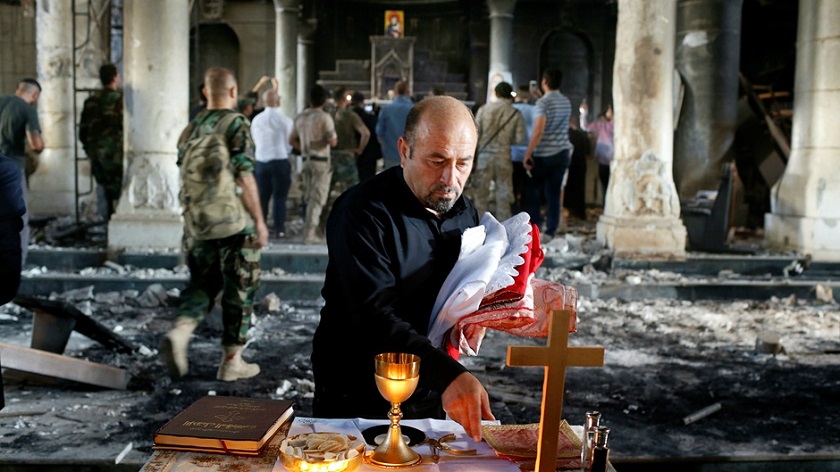
qaraqosh-christians
Ahmed Jadallah / Reuters Preparation for Qaraqosh’s first Sunday mass since the Iraqi Christian town was recaptured from ISIS (October 30, 2016).

This article was first published at Christianity Today on January 30, 2017.

Married in December to a Syrian woman with American citizenship, Fadi Hallisso went to Beirut to apply for a green card.

A Syrian Christian, Hallisso has worked with refugees in Lebanon since 2012. Funded by different American agencies, he was no stranger to the US government. He even testified about the situation in Syria to the US State Department and to Harvard Divinity School.

But this week, Hallisso was told he was no longer welcome to apply. The new US administration said so.

“It is very humiliating to be put in the category of potential terrorist,” said Hallisso. “Just because I carry a certain passport.”

As more details of President Donald Trump’s new security policies emerge—including a promise to prioritize Christian refugees for resettlement in America—much appears lost in translation.

“This executive order has created a new atmosphere very hostile to people in the region,” said Chawkat Moucarry, World Vision’s director for interfaith relations—and Hallisso’s uncle. “Unwritten rules seem to be implemented as a result.”

Is Trump’s executive order on refugees a de facto “Muslim ban”? Is it not? Is it prudent? Is it overdue? As American Christians debate these questions from the small towns of Middle America to the nation’s major airports, so also Arab Christians are trying to figure out what is going on.

“I read the executive order,” said Adeeb Awad, chief editor of al-Nashra, the monthly magazine of the Presbyterian Synod of Syria and Lebanon. He remarked…

Please click here to read the full article at Christianity Today.

Categories
Personal

The Immigration of Roots

Over the past several years, and increasingly over the past several months, Iraq has nearly been emptied of its historical Christian population. This short film by the newspaper al-Badeel explores how Egyptian Christians contemplate the issue of immigration. It is subtitled in English, and provides a very good overview of how many Copts view the subject.

Egypt, of course, has not faced nearly the same level of chaos and disintegration as Iraq. But the film is full of images of burned churches that remind of the difficulty the nation has endured. Egypt also comprises a far higher population – both overall and of Christian citizens – which make it better able to withstand a gradual emigration which has resulted in Coptic Orthodox churches the world over.

But emigration takes its toll, usually robbing a nation of its best and its brightest who can afford to move overseas and stand a decent chance at finding work. This theme is stated often by those interviewed, while the theme of religious persecution is generally nuanced though it lingers.

Have sympathy, and enjoy the window into a slice of Coptic consciousness. Alas.