Categories
Arab West Report Middle East Published Articles

A Christian Face to the Protests

Translation: Christian + Muslim = Egypt

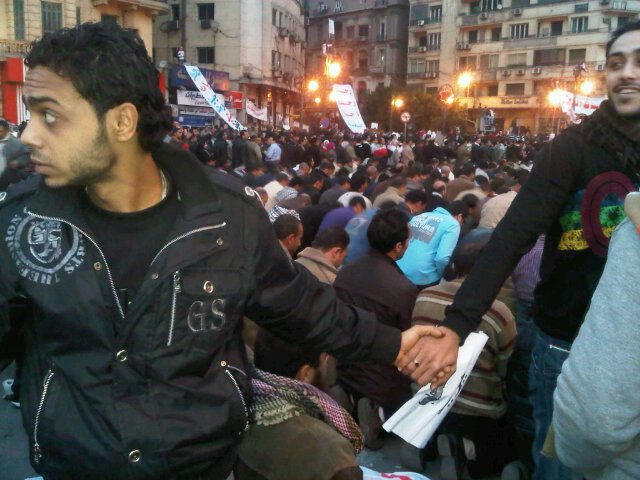
Sunday, February 6 witnessed a peculiar exhibition amidst the drama unfolding in Tahrir Square. Christian Egyptians publically conducted a prayer service, honoring their fallen co-demonstrators who have died in the effort to topple the Mubarak government. Calling them ‘martyrs’, as is common Egyptian custom to designate all who perish in a cause or as a result of oppression, the opportunity was also used to demonstrate religious cohesion among all protestors. ‘Eid Wahida!’ – ‘One Hand!’ was the most popular chant uttered, exclaiming the essential unity between Muslims and Christians. Within context, a similar chant began when the Egyptian army took to the streets to restore order to society after the disappearance of the police, and was greeted with open arms by the protestors. They cried, ‘The people and the army are one hand.’ No less was the sentiment today confessed along religious lines.

This text was not composed based on first-hand experience, although the author was able to personally witness two days of previous demonstrations. Rather, it is compiled based on nearly eighteen minutes of footage posted on YouTube by the Coptic website Yar3any.com, and an additional two and a half minutes posted by BBC Arabic. It is also bolstered by the first-hand account of Dr. Amin Makram Ebeid, a board member of the Center for Arab West Understanding, which cooperates with Arab West Report.

It is noteworthy to begin by stating that each day’s protests have not been monolithic. Tahrir Square is a large area, and protestors have by necessity grouped together in several ‘stations’, each pressed up against the next. Other protestors ring the square in procession, and the chants that break out in one location soon dissipate into the cries of the next one over. Dr. Ebeid, who went specifically to attend the announced prayer service, had much difficulty finding the right location.

Nevertheless, the YouTube videos demonstrate that the crowd assembled was very sizeable. Christians, despite the Orthodox Church stance against participation, and the statements of Pope Shenouda on state television to end the protests and support President Mubarak, have joined in the thousands from the very beginning. During the service these were accompanied by many Muslims, who stood with their Christian co-demonstrators, holding the Bible and Qur’an aloft together.

This spirit of unity was exhibited by the service leaders. The popular Christian chorus ‘Peace, Peace’ had a line changed from ‘Peace to the people of the Lord in every place’ to ‘Peace to the Egyptian people’. Jesus was addressed as both ‘Yesua al-Masih’ (Jesus the Messiah, in Christian parlance) and ‘Eisa ibn Maryam’ (Eisa, the son of Mary, the preferred Islamic title). Some of the chants were political in nature, including the ubiquitous ‘Irhal’ – Leave! Others emphasized common human rights, proclaiming ‘Life, freedom, and the principles of humanity’, and the nationalistic ‘Egypt for all Egyptians’.

Excerpts from the spoken portions of the service included:

  • Egypt is free: Muslims, Christians, and those of no particular faith. Freedom and peace to everyone; we are looking for a civil state.
  • Let us pray together for the martyrs, help us to love each other and to love Egypt. Preserve Egypt, and its Muslims and Christians.
  • Quoting John 10:10 – I have come that they may have life and have it more abundantly. Christianity, Islam, and all religions want this; we are all together, we do not fear each other.

Many of these types of statements led to the repetition of Eid Wahida, Eid Wahida, and the Christians celebrated together with their Muslim partners. One statement, however, led to an odd proclamation. When the speaker proclaimed, ‘We stand with the martyrs, in a spirit of love, chanting for peace, standing for peace’, the crowd erupted in ‘Allahu Akbar’, the typical Muslim chant confessing ‘God is great!’ Apparently, as is possible theologically, both Christians and Muslims asserted this truth.

It seemed that this chant unnerved the service leaders somewhat, and they proceeded to lead the crowd once more in singing the popular Christian chorus, ‘Bless my country’. Other aspects of the service were more distinctively Christian, which did not seem to unnerve the crowd at large. One song declared ‘Son of God, you are our king’, despite the Muslim abhorrence at the thought that God might have a son. A prayer invoked ‘Our Lord and Savior Jesus Christ’, despite the Muslim belief that Jesus was only a prophet, however elevated. Even so, it seemed the organizers were very careful to be Christian yet not offensive and supportive of the protests. A main line in the sermon quoted I John 4:18, proclaiming, ‘The Gospel says that perfect love casts out all fear; we saw this love on January 25[1] and on January 28.[2] Let us cast out all our fear in the name of the martyrs’.

Yet even so, Christian principles cannot simply serve the celebrated status quo. At one point the service leaders spoke the Lord’s Prayer, and after each line the people responded ‘Amen’. Upon the conclusion, however, the leader asked for God to forgive President Mubarak, and the people shouted, ‘No, no, no!’ Again, apparently, Christians and Muslims in attendance were united.

At this point it will be fair to introduce the service leader. He was Dr. Hany Kharrat, a psychologist and an elder in the Anglican Church. The flavor of the meeting was fully evangelical, lacking the gravity of the Orthodox mass, as well as its identifiable priestly leadership with its black robes and long beards. Instead, the service employed a guitar and was led by youth, representative of the makeup of the protests in general. It resembled a revival meeting in its fervor and participation. Yet it insisted on speaking on behalf of all Christians in Egypt, as Dr. Kharrat insisted, ‘All denominations of Egyptian Christians have come to share with you and to pray with you’.

This is less clear in conversation with official leadership. The bishop of the Anglican Church in Egypt is Bishop Mounir Anis, also a board member of CAWU. He has also taken a cautious approach to the protests, stating that most Christians fear that extremist elements will take these peaceful demonstrations in ultimately untoward directions. Instead of shouting slogans, he has encouraged his people to pray, which they have done in abundance. He believes people should be gracious to President Mubarak, though he supports a civilized transfer of authority. Otherwise, there might be chaos.

Rev. Radi Atallah is an evangelical pastor in Alexandria, who has worked extensively with local Muslims to secure dialogue and understanding, especially following the bombing in his city on New Year’s Eve. He also expressed concern that the protests were the organizational work of the Muslim Brotherhood, and worried they could go down a wrong path. Even so, he encouraged individual Christians to follow their conscience concerning participation. Meanwhile, the Egyptian Committee for Peace and Justice, associated with the Council of Catholic Patriarchs and Bishops, has stated that these peaceful demonstrations are as important as the nonviolent resistance of Gandhi in India and as the emancipation of American slaves. Ezzet Boules, a Coptic Orthodox activist living in Switzerland, believes that if Christians shy away from participation, it will lead only to their further isolation from society. Church efforts to prevent this, he believes, are counterproductive.

As such, the absence of Coptic Orthodox official representation at the Tahrir prayer service is noteworthy, especially given Bishop Anis’s comments that some were present at the pro-Mubarak rallies organized on behalf of the government. What should be made of their abstention?

The Coptic Orthodox Church represents the vast majority of Christians in Egypt, who represent perhaps 6-8% of the overall population. Since sectarian troubles began plaguing Copts in the 1970s, Pope Shenouda has taken a leadership role in speaking on behalf of the Christian community, seeking to secure its political rights and its protection against extremist Muslim elements. Though the relationship has been wobbly, Pope Shenouda has largely succeeded in crafting a positive political stance vis-à-vis the government of President Mubarak.

Having molded Coptic opinion behind his leadership, however, Pope Shenouda has faced accusations of turning the church into ‘a state within a state’, while President Mubarak has been accused of allowing the inflammation of sectarian tension when necessary to achieve political goals, either against the church or in larger society. Whether or not these opinions have merit, they do not mask the essential reality that all groups in society depend on the power of the state for police protection and preservation of order. Neither do they mask the Biblical reality that calls Christians to ‘honor the king’.

Therefore, though the reasons and motivations behind abstention may be many, it may be true that Pope Shenouda early on expressed sentiments similar to Hillary Clinton when she declared the Egyptian government to be ‘stable’, and when Vice-President Joe Biden declared President Mubarak to be a longstanding ally. Inertia in relationships is difficult to overcome. Falling on the wrong side of the state could be a great miscalculation.

Yet as a hierarchical organization, the Coptic Orthodox Church is built upon obedience and respect for the positions of its pope and bishops. In this regard some bishops have condemned the ‘spirit of insurgency’ that is pitted in some quarters against Pope Shenouda. The spontaneous and widespread Christian riots following the bombing of the church in Alexandria was interpreted by some as church leadership losing its grip on its youth. Youth participation in the Tahrir protests may rightly be seen as a second blow. Whether or not the Coptic Orthodox Church is right or wrong in its decision to abstain from the demonstrations, on February 6 they yielded ground to the evangelicals.

Long term, and even short term, this should not be understood as a significant challenge to Orthodox hegemony in Egypt. Although occasional flare-ups occur between the leaders of the Christian denominations, many ordinary Egyptian Christians dismiss the importance of distinctions. For these, when Christians represent less than 10% of the population, insistence on doctrinal divisions takes on less importance. They will not deny the specifics of their peculiar creed, but they will also not shy away from cross-participation in different congregations, and especially not from warm individual relationships of respect. A Christian, they believe, is a Christian.

In Tahrir, this has been extended to assert that a Christian, like a Muslim, is an Egyptian. What does this mean for the widespread fear that these demonstrations bear an Islamic stamp that will marginalize Christians in the end? Bishop Anis reflected the testimony that over time the composition of the protests has changed, and that some groups are trying to ‘take advantage of the youth’. Is this the case?

During the protests on February 1, the March of a Million, I witnessed one of the changes. As compared to the demonstrations on January 28, the Day of Rage, there was this time a large contingent of Muslim sheikhs, distinguishable by their deep crimson fez. Between 30 and 50 such individuals grouped themselves together in a section of the square, and led those around them in chants of ‘Allahu Akbar’ and calls for the implementation of God’s law (sharia). Yet they declared at the same time that this was a demonstration representing all of Egypt, and that God’s law grants freedom to Muslim, Christian, and non-religious alike. A sign upheld celebrated the fact that since the protests began, not one church in all of Egypt had been attacked.

After Islamic prayers there was a pause, and I sat down to discuss their message with Sheikh Mukhtar, one of the primary chant leaders. He is an employee of the Ministry of Endowments, which oversees mosques and religious establishments in Egypt. His particular position is as a ‘caller’ to Islam, that is, to full practice of Muslim religious requirements.

His testimony reflected anger at the government and its corruptions. He called for the deposing of all figures appointed by the government, including the Grand Sheikh of the Azhar, Ahmad al-Tayyib, the highest Muslim religious authority in Egypt. He bore no malice whatsoever toward Christians or non-practicing Muslims, but, emboldened by the successes of the demonstrations, now desired to take part. As an Egyptian, no matter an Islamist, he wished to display his share. He recognized, though, that leadership was in the hands of the youth, and he was a latecomer.

I asked him about his chanting of ‘Allahu Akbar’. I confessed that many either through ignorance or willful distortion seek to disfigure the Islamist position, especially in reference to these protests and this chant. Yet all the same, Allahu Akbar is an Islamic cry. If he was insisting that these demonstrations were Egyptian, and not Muslim, why employ it? Would it not only serve to confuse Westerners and scare Egyptian Christians? Would this not be against your own interests?

His reply initially suggested that he had never considered such a question. Among Muslims, the Allahu Akbar cry is near-instinctual, and does not necessarily convey a call to jihad. When there is a cause to rally behind, however, it is jihadic in all positive senses (and at times negative as well), and comes quickly to their lips.

Upon reflection, though, he stated that in this situation Allahu Akbar does not express a sense of belonging to a particular creed. Rather, it is a challenging directive against the government. It is meant to state deep, religious dissatisfaction against a power believed to have violated the Islamic principles of justice, equity, and good governance. Besides, in its meaning, he stated, a Christian should not disagree. God is great. Apparently, at the February 6 prayer service, many Christians agreed, and cried Allahu Akbar all the same.

The impression received across the board is that protestors are eager, even desperate, for validation. They know their movement is subject to suspicion, criticism, and accusation – certainly from the government but also from Western liberal supposed allies who fear an Islamist imprint. For the past several decades religion has been a dividing point between Muslims and Christians. Many, however, have insisted these difficulties are invented or engineered, not reflecting the essential national unity that exists between the two groups. Among the makeup of Tahrir protestors, this certainly reflects their reality.

Yet they go forward to make certain this message is heard. When Muslims bow during their prayer times, Christians have encircled them to offer protection. Now, when Christians conduct a prayer service, Muslims participate freely. Has protection been necessary? Yes, but have attacks been immanent? No. Are such sentiments sincere? Yes. Are they meant to be a picture representation before the outside world, and therefore at least partially staged? Perhaps. Should they be criticized for this? No. Should the outside world consider its guilt in assuming religious relations are bad, therefore making these exhibitions necessary? Probably.
What does all of this mean for the uprising? What does it mean for Christian participation? As throughout Egyptian society, opinions are divided. The question now appears to be congealing into a discussion for the long haul. Protestors have established control over Tahrir Square, and the government is in negotiations over demands and concessions. The atmosphere, only a few days earlier a war zone, is now conducive to church services. Things change rapidly, and wisdom is necessary. Will good come about, and if so, who should define it? What should a Christian do? What should an Egyptian do? These are monumental, historical days for a six thousand year old civilization. Rarely does life have such weight. When it does, what is demanded?

Perhaps the Western reader’s life does not bear such weight at the moment, but allow your mind to process the questions as if you shared in the Egyptian experience. How should you think? Who should you support? How should you pray?

We do not share in their struggles, but we share in their humanity. Where does the good of all lie?


[1] Police Day, on which the protests began.

[2] The Day of Rage, the Friday on which protestors emerged from the mosques and marched downtown.

Categories
Personal

Communion

Tonight I attended the weekly service at the local international evangelical church.  We attend there sporadically, maybe once every three months, as we have been worshipping at the Orthodox Church, hoping to learn more and participate in the primary church of Egypt.

Since it was the first Sunday of the month, as is typical in many evangelical churches I know, it was also communion Sunday.  It was the first time in awhile that I had taken communion, which is somewhat strange since this is offered every week in the Orthodox Church.  Due to doctrinal differences, however, but mainly to the fact that we haven’t been baptized Orthodox, while we are welcome to attend the service, we are not welcome to partake in communion.

It was an interesting experience for me after being away from it for so long, and witnessing a different tradition in the meantime.  Many thoughts ran through my head:

“Oh yes, the first Sunday of the month … communion Sunday.”

“The pastor said we would come to the front to take communion … something a little different.  Why is it that the churches who do communion less frequently (such as evangelical churches who often do this once a month) are the ones who find the need to ‘change up’ the method of distributing communion? Meanwhile, the church which does this every week, or even more than that, will never change the way it is done.  Ironic.”

“The Orthodox firmly believe that the elements become the physical body and blood of Jesus.  They believe they are participating in Jesus’ suffering on the cross as they take into themselves the holy body and blood of Jesus.  They can’t let a crumb drop to the ground so they cover their mouths with a napkin after the priest puts a piece of bread in their mouth.  And yet that is not my tradition.  I simply see these elements as representing Jesus’ body and blood.  Something He told us to do to remember His suffering.  So as I put the juice-dipped bread in my mouth, I asked myself, or rather, asked Jesus, ‘Who is right?  Are you pleased with this?  What is the point of this ceremony?’”

I have often struggled with seeing Jesus’ death on the cross in a real way.  Sure, I believe it happened and I believe He did it for me, and it was a horrible, painful thing for Him.  But I’ve rarely been able to really appreciate what He went through for me.  I think it comes from growing up in the church and Jesus’ death on the cross being part of my life from childhood … it has become so familiar.  So I understand my evangelical friends who try to “change up” the way communion is presented so that it doesn’t become rote and without meaning.  We don’t want to be passive and do things out of habit.  Making us get out of our seats and walk to the front of the church gets us somewhat involved, rather than waiting for the elements to be passed to us.  And yet, we can still remember Jesus’ death in a real way, as we wait for the elements to come to us in their silver plates and miniature cups.

Another experience I’ve had was in Jordan.  Jayson and I really enjoyed our times of communion at the church we attended there.  This evangelical church followed many Brethren practices, so we had communion every week.  It was a small, intimate service which included hymn-singing and a short challenge, followed by all of us, anywhere from 15-40 people, gathered around the Lord’s table, passing along a piece of bread and breaking off a bit for ourselves.  Then we would pass around the common cup of wine, drink a sip, and wipe off the cup for the next believer to partake.  There was something special about standing there in a circle, being able to see the faces of our fellow worshippers, reciting together the passages from Corinthians regarding Paul’s teaching on the Lord’s Supper and partaking from the same loaf of bread and common cup.  Maybe I felt more of the fellowship of the saints, rather than the suffering of the Saviour, but it was a special time.

And now, unable to be part of such a fellowship on a regular basis, does this keep me from remembering Jesus’ death?  How often should I specifically seek to remember his death?  He told us to “remember His death ‘til he comes.”  My tradition seeks to do this once a month.  Others partake of the Lord’s Supper each week.  Either method leaves room for forgetting Him in between, or doing this out of habit.  Lord, let me remember your death daily, thanking you and serving you for your sacrifice for me.

Postscript: Following a post a few days ago on a similar subject – This Also is True – an Orthodox reader from the United States commented with an impassioned and Biblical defense of their view of communion. For those interested in this subject, I encourage you to take a look and consider what he says. Unfortunately, we cannot provide a link directly to his comment, but if you click on the title above and scroll down, you will find the dialogue between us. Here or there, please feel free to join in, be it to reflect and consider, support, or challenge what he has to say.

Categories
Arab West Report Middle East Published Articles

On Religious Tension in Egypt, from Leading Thinkers

Note: Sorry for a lack of new news and stories. There a number of good ideas floating around in my head, three texts in production, but nothing finalized yet. Instead, here is an interesting review I wrote for Arab West Report from a few months ago. It depicts the nature of discourse on the religious question in Egypt, as described by some of its leading thinkers. I hope you enjoy.

There is no religious strife (fitna) in Egypt, but there is religious tension; there is no Christian persecution in Egypt, but there is Christian discrimination. This, in summary, was the message presented in a seminar organized by the Coptic Evangelical Organization for Social Services (CEOSS), hosted by the Evangelical Church of Heliopolis, on February 17, 2010. The session was moderated by Dr. Nabil Abadir, secretary general of CEOSS, and included three prominent members of Egyptian society. Dr. Mustafa al-Fikki is the president of the committee for foreign relations in parliament, and was described as a leader in promoting national unity, being a member of the National Council for Human Rights. Dr. Abd al-Muti al-Bayoumi is professor of philosophy and Islamic law at al-Azhar University, and is greatly concerned with the renewal of Islamic thought in the modern age. Dr. Makram Naguib is pastor of the Heliopolis Evangelical Church, and maintains friendly relations with both of these figures. Each of these distinguished guests participated in the seminar under the title, “Social and Sectarian Tensions: Towards Societal Peace”.

Dr. Abadir opened the seminar by stating that Egyptian society is changing. Whether these changes come from inside or outside the country is open for debate and is often a point of contention; what is clear, however, is that these changes have religious implications. The tension which is gripping Egypt in many sectors is social tension. Though it cannot be tied directly to the religious differences which exist between Muslims and Christians, it takes residence within them, presenting the tension as a religious issue. The important question is how to resist these negative changes while keeping respect to society, culture, human rights, and civil society? How can national peace be preserved?

Dr. Fikki supported the words of Dr. Abadir that sectarian troubles are a part of social troubles in general, adding that these stem from a lack of political transparency and social stagnation. The government, he declared, bears responsibility over the long run for its failures to purify the educational curriculum and political discourse from sectarian spirit. Education and military service are the two primary means of instilling national unity into the population, as it provides a place of contact and cooperation between members of the two religions. Instead, the government has allowed the language of absolutes—religion, to mix with the language of relativism—politics. The government is not the primary perpetrator, but it has stood by while this societal transformation has taken place. Citizens, meanwhile, remain largely ignorant of one another and of the other’s religious beliefs. Such knowledge, however, are the building blocks of good relationships. Dr. Fikki ended his presentation with a renewal of the call for the government to pass a unified law for building houses of worship. This could be done within twenty-four hours if the will was found, and is a crucial step in signaling to the nation the equality of all citizens. Political changes can lead the way for subsequent social advancement.

Dr. Bayoumi opened his address by confirming that there is no religious strife in Egypt, but that tension certainly exists. He believed this was due to the national project being lost among many in society, having been replaced by certain elements[i] with a religious project for the nation. Islam, however, does not support this change. Religion, as Dr. Fikki mentioned, is the realm of absolutes, and Islam defines God and religion in these terms. At the same time, the religion demands interaction with the world, and as such there are elements of Islamic practice which are relative to ages, countries, and cultures. Dr. Bayoumi esteemed common origin of all Abrahamic religions, stating that God in Islam exhorted Christians and Jews to follow the teachings of their books. Muslims have erred in calling these groups ‘unbelievers’ and their books ‘corrupted’. They have erred further in seeking political rule over them in particular and over society in general. Prophetic government was a civilian rule; Islamic government is found in the application of its principles. As Muhammad Abdu has stated, Islamic government is often found among non-Muslims (Editor: Dr. Bayoumi wrote his PhD about Muhammad Abdu, an Islamic reformer of the first part of the 20th century). Dr. Bayoumi closed his remarks with a call for renewing the educational system, which currently focuses on rote memorization. Though this is necessary for all of society it is also imperative for Islamic scholars, that they may be freed from the tyranny of the text in order to share in a necessary cultural revolution, which allows religion to change with the times and ceases to divide its particular adherents.

Dr. Naguib confirmed the importance of Dr. Bayoumi’s religious remarks by asserting that the pattern of co-existence is the norm for human relations, from the first chapters of Genesis, but that it is so easily disturbed, as seen in the story of the Tower of Babel. The problem in Egypt is similar, as Muslims and Christians speak the same language but cannot understand each other. This is due to the fact that society has become increasingly religious, a process aided by government procrastination in taking real measures consistent with its positive rhetoric. The slowness in creating democracy and civil society is causing many to lose faith, and these take refuge in their religion, both Islam and Christianity. It is not that Egypt has made no effort in this direction; on the contrary it has a long history of liberal values. The problem is that Egypt is like Sisyphus; once it has nearly rolled the rock of a civil state to the summit it crashes back down. From here, the agenda of the civil state starts again, but unfortunately it begins at ground zero, with nothing gained from previous attempts. Dr. Naguib expressed his fear that the crisis of co-existence will only become more dangerous in the days to come, and urged the government to decisively reform the educational curriculum. All ideas of religious absolutism and particularism—for any religion—must be removed in favor of engendering the multiplicity of thought, which will lead to a culture which embraces all.

Following the presentations there was an extended time of audience participation, asking questions and presenting their comments. Though it seemed that Christians represented a majority of the audience as seen through the questions posed, the general theme of response was supported also by Muslim inquiries. These included criticism of the media, print and television, for failing to support national unity and educate about Christian belief. There was also a general questioning of the effort to insist on unity between the religions. Rather than seeking for commonality, would it not be better to simply admit differences but accept each other anyway? Egypt in general, it was said, lacked a culture of accepting differences. Finally, there were proposed various criticisms of the government, and wonderings about who would implement the fine words of this seminar.

This final point was my lasting impression of the time spent. Though I was pleased to hear the dialogue both from the presenters and from the audience, I wondered about the point of the meeting. What good would any of this do? My impression, given the location in upper class Heliopolis and furthermore in a church, was that it was a service for airing grievances among those discouraged but distant from the tensions in society, especially the Christians among them. The seminar provided an opportunity for prominent members in government linked agencies like the Azhar and the National Council for Human Rights to express their opposition to societal trends. Such a word could provide comfort for troubled hearts, as well as evidence that within government voices exist for co-existence, national unity, and social development. This is necessary and useful civil society behavior.

Yet what good will it do? I suppose that the voices which spoke today have been speaking for some time, and will continue to speak. Yet my focus is not on actualizing change in the government but in society. Specifically, how will the value of these words reach those who are engaged in sectarian tensions—the grassroots people who give worry to the denizens of Heliopolis? Proposed solutions offered included the reform of the education system, the passing of a unified law for building houses of worship, and changing the culture of traditional Islamic education. While each solution is good and will have an effect over time, who is preaching the message of co-existence to the masses? Government and civil society organizations bear much responsibility for the long term trends and the institutional constructs. Who, however, is touching human hearts? Seminars such as these renew the political discourse, but who is renewing social integration and cooperation? Furthermore, where are the plans to do so?

Certainly each sphere has its due, and is deserving of encouragement. Yet I am eager to meet those implementing such ideals on the ground. I was glad to have been in attendance, for I met some of the major spokesman of these ideals. It is the macro picture wherein power and influence lie. Perhaps becoming familiar with this world will assist in understanding how it works, and provide introductions to those who labor in the grassroots. It is in the micro that change and redemption take place. Though by the end I was weary of words, words play an important role in motivating deeds. May these words find connection with living hands and feet.


[i] It was not clear to the author, perhaps for language reasons, if he defined what these ‘certain elements’ were or who was behind them.

Categories
Personal

A Protestant on Peacemaking

A little while ago I had an opportunity to dialogue with Rev. Safwat al-Bayyadi, who is the President of the Protestant Churches of Egypt. My summary of this conversation has been published on Arab West Reports, which you can access by clicking here.

As I remarked once before, it is a great benefit of my work that I get to meet such influential people. Rev. al-Bayyadi was able to provide me with a bird’s-eye perspective on Christianity in Egypt, encompassing all but especially from a Protestant perspective. While the title for the reverend is correct – President of the Protestant Churches of Egypt – it is interesting to note that generally speaking the Protestant churches here all go by the name of ‘Evangelical’. I haven’t yet asked enough questions to know why, but it may be that within Egypt ‘Protestant’ could seem like a foreign entity, brought from the West, and therefore suspect, while ‘Evangelical’ is more of Biblical terminology. Though this decision was made long ago, in recent years the ‘Evangelical’ title may result in negative association with the Bush administration and the general support the American Evangelical Christian community gives to foreign policy in Iraq and Israel.

If only from a small outsider’s perspective, I would note that in calling their denomination ‘Evangelical’, Egyptian Protestants may have done themselves a disservice. While the motivation I have briefly come in contact with is laudable, it may have unfortunate consequences. In America, ‘Evangelical’ is an adjective, describing a certain understanding of Christianity. While my rendering here is off-the-cuff, it generally refers to an understanding that is centered on the Bible above tradition, focused on a personal expression of faith, and accepts the necessity of communication of the Gospel message. Thus in America while ‘Evangelical’ is generally understood to be Protestant but not mainline, and has also acquired conservative political associations, in terms of the definition given it is not unusual to find evangelical Catholics, Orthodox, or otherwise. I wonder if in naming themselves ‘Evangelical’ Egyptian Protestants may unwittingly limit the description of the definition from being applied also to the larger Orthodox community. Like I said, I haven’t explored this much yet, but I wonder.

In any case, though Protestant and Orthodox relations here seem mainly positive, there have been recent examples of accusations thrown cross-denominationally. Specifically, at times Orthodox leadership sees Protestants as ‘sheep stealers’, conducting organized efforts to ‘turn Egypt Protestant’ by winning over the youth. You can read a press review on this topic by clicking here.

On the other hand, in my personal interactions with individual Orthodox Egyptians, almost everyone has expressed appreciation for the Protestant Church here. While they hold to their distinctive doctrines, they commend the Protestants for their skills in Bible memorization, vibrant sermons, praise music, and youth ministry. They emphasize that there is only one faith, shared by all denominations, though particular understandings of faith differ, and may reflect the truth closer or farther from correct Biblical understanding. Many families have members in each denomination, and many others worship in both churches. Julie has also found that Emma is not unique in attending the Sunday School sessions of both the local Protestant and Orthodox Church. 

In any case, I am making comments that could be better developed into another post later. For now, please accept my encouragement to read what Rev. al-Bayyadi has to say about the vital task of peacemaking in Egypt. His perspective is both noteworthy and gained from personal experience. If you didn’t do so earlier, you can click here for the text.

Categories
Personal

The Value of Monasticism

At Wednesday noontime I traveled to Shubra, Cairo to meet Fr. Basilius in the offices of the St. Mark’s Bookstore. While our meeting was ostensibly to discuss the arrangements for my stay in the Makarius Monastery, we discussed extensively the role of monasticism in the church, with an eye toward the issues of the Abu Fana Monastery, which has fallen into sectarian conflict. The following is a summary of our conversation.

Before our meeting I had written a long list of questions for Fr. Basilius concerning the details of my stay in his monastery. How long should I stay? What should I bring? Where would I sleep? What should I wear? What time are prayers? These and many other concerns filled my practical head, but I had a few other questions as well about the monastery and things I had heard about it. Nevertheless, our conversation turned instead to introductions, which led quickly into substantial discussions about monasticism and its role in society and the church.

I briefly described my role in the Center for Arab West Understanding as a continuation of the work done by Cornelis Hulsman in unearthing the real, often non-religious origins of sectarian conflict, but seeking in our new project to move beyond reporting into proactive contributions to the reconciliation effort, in areas, for example, such as Abu Fana. Fr. Basilius spoke warmly of Mr. Hulsman and mentioned instances of their prior cooperation. He then asked me what I thought of the Abu Fana situation. I replied that I was new to this country and preferred to hear from him what he thought, but that I was able to state the findings of Mr. Hulsman, of which he was aware. Fr. Basilius was reluctant to say much, but the nature of our conversation signaled an implicit understanding that the role of the monks in Abu Fana was negative.

“Has anyone tried to communicate with them about their position?” I asked. Fr. Basilius was unaware of any efforts, but stated that he doubted anyone was able. The monks are entrenched in their position and in general were supported by their leadership. What benefit could be gained from words by an outsider? The situation was beyond redemption in any case, for the surrounding population, including government officials, had developed a hatred for the monks in their intransigent attitudes. “But if a message was to be delivered, what would it be?”

Fr. Basilius paused for what seemed a long time, and I was not sure he was going to answer. I had asked variations on the two questions above a few times already, revealing perhaps a strange urgency. He had been engaging, kind, but perhaps not inappropriately vague. When he did answer, it was in recollection of a story, “We have dealt with a similar issue ourselves.”

President Anwar Sadat decided in the late 1970s to grant Makarius Monastery over one thousand acres of land. He had noticed the commendable job the monks had done in reclaiming desert land for agriculture, and, as the country was experiencing phenomenal population growth the government realized such projects were extremely necessary, so he tripled their workload. The abbot at the time, Fr. Matta al-Miskeen (Matthew the Poor) was honored at the gift but wondered, we can barely keep up with our three hundred acres, what can we do with so much? There was much internal debate and reluctance to receive this gift, but in the end, they accepted their charge, and began working the land.

The process of registration of the land in the name of the monastery, however, did not go smoothly, despite even a later presidential rebuke of his ministers. They faced endless delays in getting the proper paperwork, but pressed on anyway with their cultivation. During their efforts to navigate Egyptian bureaucracy, President Sadat was assassinated. In the next meeting with government officials Fr. Matta was told that the monks had no claim to the land, as the promise from President Sadat was only oral, and not in writing. Discouraged but accepting, Fr. Matta returned to the monastery, and informed his fellow monks of the decision.

As time passed the monks returned to their own fields, but a little later there came word of a general presidential initiative. This one was meant to encourage all university graduates to find land in reward for their studies, as many were entering a work force devoid of substantial openings. As the monastery was populated by dozens of monks with university degrees, each one applied for the position, and not long thereafter the monastery had recovered, now officially, all the land originally promised. These lands were in the names of the monks, not the church, but that mattered little since the monks had forsworn all worldly possessions. The monks had been promised wealth, but showed no excitement; they had been ill-treated, but put up no protest. Finally, after accepting patiently the will of God, God had restored to them their previous honor.

Fr. Basilius gave no direct answer to my question about Abu Fana, but said succinctly, “Perhaps the monks at Abu Fana have not been able to have a teacher as wise as Fr. Matta al-Miskeen.”

I shifted course after this story with a personal inquiry. I communicated that I was a Christian, raised in a Protestant tradition, and surely he was aware of our critique of monasticism. “Yes,” he replied quickly, “you think we are lazy and do nothing but pray all day.” He smiled as he said this.

I countered, however. While some may think so, this was not the impression I had growing up. Monks were imagined to be among those who love God most fervently, and are dedicated in their prayers, and, in places, in their work. Their fault, it is claimed, is that perhaps they love God too much. They can be seen as selfish in their spirituality, for they are so enraptured in his love that they neglect relationships with the rest of the world. They hole themselves away with others of like mind, and experience neither the hardships of communion with ordinary people nor the necessity of service to those around them. They live only to God, and therefore in a sense, only to themselves.

I assured Fr. Basilius that this was a perspective I have inherited, but it was absent of the attitude which often accompanies it. I have a healthy respect for Orthodoxy in general, and am confident that they have an answer for such accusations. Having never heard the reply, however, I asked him to respond. I told him it was my purpose to better understand and appreciate monasticism in general, but with an eye toward Abu Fana in particular. The monks there are bent on the acquisition of land surrounding the recently rediscovered ancient monastery. Though there have been regrettable actions on both sides, the monks have shown little regard for their neighbors. Yet if the nature of monasticism is internal in focus, walled around a community closed to the outside, how can these monks receive a message of reconciliation with their neighbors?

Fr. Basilis began by commenting on Protestantism, stating, “Your living of the Gospel is based entirely on preaching.” I interrupted, stung by his choice of pronoun, for this is a critique I share of our denomination. “Not entirely,” I offered, and perhaps he recognized the legitimacy of my qualification. It should be mentioned that as he continued he gave no indication of ill will. If he was offended by the repetition of Protestant critique, he did not show it. Instead, his manner was warm and friendly, yet intent on edification.

Protestants will criticize us, he explained, because we isolate ourselves and do not preach. Meanwhile, they express their service to God in their positions in business, education, and a host of other occupations, but in reality, neither do they preach. Even in the Protestant services one can see the emphasis on preaching – there is a lengthy sermon, a few hymns, and a couple prayers. We in the Orthodox Church have a different understanding of Gospel responsibilities. We do preach, but the sermon is only a smaller part of our mass. Most of our time spent in worship is dedicated to prayer.

As monks, this is our dedicated heritage. We do not occupy positions in society which take time away from prayer. We have forsaken family, wealth, fame, and reputation to dedicate ourselves to the kingdom of God. Our prayers support the work of the church in all other areas, including preaching. Furthermore, since we have no children to support we can offer all the proceeds from this monastery as gifts to the poor. We have a calling, as others in the church have a calling. Ours, however, is for prayer, both to God in praise, and for others, in supplication.

I thanked Fr. Basilius for these words, and acknowledged their Biblical nature. I assured him I would be pleased to convey such thoughts to my fellow Protestants. Yet what of Abu Fana, how can this message be communicated to its monks? “This is difficult,” he replied. “They will not receive this message from you,” he smiled, “a Protestant. And we in this monastery are not accepted by many in the church.” “But what of those among you who are called to preach? Who could deliver such a vision? The messenger is not as important as the message. Besides, it is the work of God to change hearts, not of man. It is men, though, that must communicate the message. But what should the message be? ”

Fr. Basilius gave pause again. This time he answered. Though brief, it encompassed all. “The first priority of Christianity, and the second, and the third, is love. Perhaps the monks of Abu Fana have neglected this.”

Time was escaping us. Though I could have spent the rest of the afternoon with him, he had details to attend to for which he had come to Cairo, neglecting his monastery. The exigencies of my upcoming stay required a bit of mundane conversation, after which we departed. The value of the encounter, however, will last, and is the best place at which to end this account. May God grant peace to the people and area of Abu Fana; may his love be communicated to all.

Categories
Personal

Finding Church (part two)

Within the Arab World, no nation contains as many Christians as Egypt. As a nation there are approximately 80 million Egyptians, and it is commonly constituted that 10% of these are Christian. Yet while some Copts (the name of local Christians, and the word from with ‘Egypt’ is derived) occasionally claim that there are even up to 10 or 12 million Christian Egyptians, the true figure may be as low as 6%. The percentage of Christians has steadily declined in the last several decades, due to various factors. Muslims maintain a higher birthrate than Christians, Christians emigrate abroad in greater number than Muslims, and due to complicated social factors, deserving its own blog sometime in the future, it is not uncommon for Copts to convert to Islam for domestic reasons, be it marriage, divorce, or an oppressive family setting. Add these factors together, and similar to Christianity in much of the Middle East, the church is contracting.

                Yet in Egypt at least, unlike in Palestine for example, there is no crisis, if only because any percentage of 80 million people is sizeable. To break down the numbers further, of the Christian population, perhaps 90-95% is Orthodox. Catholics and Protestants have an influence greater than their percentage would suggest, for they can often find support from their international denominations, both in terms of money and theological education, and as such their leaders are accorded national prominence greater than their numerical due.

                 Behind these logistics is the local setting in Maadi, Cairo, where we reside. Maadi is one of the popular areas for internationals to live, and as such, there are a plethora of worship choices. Among the most popular is Maadi Community Church – http://www.maadichurch.com/. As a Protestant non-denominational church, it attracts over 1000 worshipers during three Friday afternoon services, including one especially tailored for African internationals, both professional and refugee. There is another English language service held at St. John’s Anglican Episcopal, which also operates as an interdenominational fellowship, though high church in tradition. They are smaller in size, meet Friday mornings for traditional service and Thursday evenings for contemplative communion, and have a Rector who has written an interesting book on Muslims and Christians, which you can find through the who’s who link at their webpage – http://www.maadichurch.org/. The local Coptic Church, St. Mark’s – http://www.stmarkmaadi.com/ (Arabic site, but interesting pictures if you dare to experiment; place your cursor on the first rollover link on the column to the right, then click on the third option given. Finally, let us know if you succeed so we can applaud you) even has an English mass once a month on Saturday morning. Of course, we have already written about our general attitude toward belonging to the international community, which you can review in our first post.

                 Similar to our situation in Jordan, discussed last post, we have a local evangelical church only five minutes walking distance away from our home. Unfortunately, the only meeting time begins at 7pm on Sunday evening. With care given to Egyptian timekeeping, it often does not really begin until later, and then does not end until 9pm or so. Since church is more than just a service, but rather a web of relationships in a community of people, in order to get to know anyone we would need to stay even later to have any fellowship. In general we put Emma and Hannah to bed at 8pm. We wrote in our first post that we will try to become like them as much as possible, though we know we will never succeed, and it would be foolish to imagine we could. The issue of children’s bedtime exposes us in terms of the latter half of that sentence. It seems to us that Egyptian children have little bedtime expectations. Since the vast majority grow up to be responsible adults anyway, we see just how difficult it is to jettison our own cultural superiority. We should mention that the church does have a good Sunday School program, meeting at 12:30pm on Fridays, which Emma has been enjoying, and even memorized her first verse in Arabic last week, Exodus 15:26.

                 There is also a somewhat famous evangelical church in downtown Cairo, which we could get to by about a 20-30 minute metro ride. They have several services throughout the weekend, some of which have 1000 people at one time. You can check this church out at http://www.kdec.net/, but it is only an Arabic site, it seems. We would prefer a neighborhood church, and one that would be a bit smaller, but still, it is an option.

                 This leaves one last option, which would involve a resurrection of the quest to discover Christian diversity. St. Mark’s Orthodox Church is located about a twenty minute walk away from our home, and has Friday morning services which include a Sunday School time following a children’s mass. Unfortunately, there is much that would need to be written to introduce this option, so we ask your patience in awaiting part three of this theme…

Categories
Personal

Finding Church

The Christian who believes he belongs to God, and who wishes to belong to a particular people, must also believe he belongs to its church.

                 Here in Egypt, however, that is a bit of a complicated matter.

                 The church in general is multifaceted, diverse in styles, practices, doctrines, and denominations. While this has been rife with and deserving of criticism for its putting the lie to the claim of the universal unity of the church – “My prayer is that they may be one, as we are one” – it can also, with not too much difficulty, be interpreted as a strength. The Bible is a flexible document open to various interpretations, most especially in the area of church structure and practice. While the arguments for and against the claims of competing ecclesiology are valid and useful, in general each and every one can be both supported and exposed Biblically. This gives the church worldwide, as well as the local Christian, the freedom and ability to shape and to choose a community of worship as is fitting both with culture and with personality, if bound primarily in principle to the guidance of Scripture.

                 Belonging to a church, however, is at least somewhat an expression of exclusivity. While one may be open to the ideal of Christian unity, in practice, one must belong to a particular local extension of the universal church. It is there that Christian principles are lived and experienced in community, as a place both to serve and to be served, to gain and to give spiritual nourishment. In the messy realities of life together our ideals are put to the test, and while we are often found wanting, we also spiritually develop. This process is impossible apart from organic membership in a flawed, deficient, yet strangely God-inhabited body of believers.

                 It was in Jordan that we first experienced church in an Arabic context. Right down the street from where we lived, after a walk of only five minutes, was a vibrant congregation of Arab believers, in an Evangelical Free denomination that was largely modeled on Brethren polity and, at least for the weekly Sunday evening service of Breaking Bread, practice. I qualify about their practice because the main service on Thursday evening was patterned almost exactly on the typical order of worship in many evangelical churches in America. It was composed of popular worship songs, brief prayer, a sermon, and announcements. Except for the language, it was as if we were back home. Before going to Jordan we were excited to see how Christianity might be expressed in a different culture, but as the similarities were comforting, especially in helping us overcome the language difficulties, we quickly abandoned the quest for discovering Christian diversity.

                 That is not exactly true, though. On one hand, it could be said we never really adopted the quest. We attended once or twice the historic Catholic or Orthodox churches of Jordan, but found them, with apologies to our respected Catholic or Orthodox readers and friends, very dry and boring. Of course, language difficulties made the appreciation of them near impossible. But on the other hand, we did fully delve into the Brethren aspects of the church’s worship, and experienced therein a warm fellowship and weekly experience of Communion for which we have been grateful, and by which we have been affected. We thank God for our time of belonging to that body.

                 Here in Egypt we face again a similar situation. There are international churches in which the language of worship is English. There are evangelical churches which are fully Arab. There are Catholic and Brethren churches which have a long history. Yet it is clear that the dominant expression of Christianity in Egypt is Coptic Orthodoxy. Hopefully in our next post we can continue the story, not yet completed, of where we can find a church in which to belong…