Categories
Arab West Report Middle East Published Articles

A Call to Coptic Weaponry, from Abroad

As a quick update, I am working on a new text concerning the development of Christianity in Egypt that could be ready in a little while. In the first days following a new birth, replete with requisite sleepless nights (worse for Julie than for me), it is a little harder to write. In the meanwhile, I remembered this text I wrote following the Nag Hamadi incident which we published in Arab West Report, but I neglected to post it until now. It exemplifies part of our work which is a media critique of the local press, along with a personal reflection. I hope you enjoy.

The January 27th edition of Akhir Sa’a, an Egyptian weekly newsmagazine affiliated with the government, printed the bold headline “Expatriate Copts Encourage Egyptian Christians to Carry Weapons against Muslims and Security.” The story, complete with pictures of handguns, rifles, and peaceful demonstrations both inside and outside Egypt, commands immediate attention from the reader, especially given the charged sectarian atmosphere following the tragedy of Nag Hamadi, in which six Christians were gunned down randomly upon exiting Coptic Christmas Eve mass, January 6, 2010. This incident has drawn condemnation from all sectors of Egyptian society, but many Copts view it as but one more example in an extended progression of violence against their community. Though this aggression is unorganized, its perceived increasing frequency is causing great alarm. It has not, however, caused any domestic call to arms.

Expatriate Copts are a controversial topic in Egypt. Wealthier and more politically active than their compatriots in Egypt, many seek to lobby their adopted governments to put international pressure on Egypt to defend Christian well being. Through their bilingual websites they are able to inform both Western and Egyptian populations of Coptic issues, but from a position of advocacy, not news. Pope Shenouda has at times condemned their excessive reactions and demonstrations, which threaten to disturb the generally peaceful, though at times uncertain, attitude that prevails between Christians and Muslims, and between Christians and the government. At the same time, the results of their advocacy are popularly seen in many Egyptian Copts who rely on their foreign ‘reporting’ over a distrusted local press, which results in an increasing attitudinal divide between them and their perceived ‘Islamic’ neighbors and government. Naturally, Muslims and government are disturbed by the generalist and sensationalist characterizations of these expatriate Coptic websites, and an article which exposes their stridency is certain to sell copy.

The article itself appears to be fairly balanced, but builds only on one article and one comment to a different article, both posted on the website of the ‘US Copts Association’ – www.copts.com. The comment comes from an article written by Rafat Samir, who identifies himself as a human rights activist, lamenting the November 2009 attack on Christians in the village of Farshut, in which shops were looted and homes were burned. Significantly, he does not call for Christians to arm themselves in response. The Akhir Sa’a article, however, quotes from a comment posted to the article, which states:

It is necessary for Copts to arm themselves as quickly as possible, with immediate training also for women in the use of weapons. Priests must also carry weapons to defend themselves against Muslim attacks and those from the Islamic police. The only solution is that every Christian martyr be followed by the killing of ten Muslims.

In choosing this comment, the most vitriolic reaction among the fourteen comments posted, Akhir Sa’a selects simply the voice of a common man, but amplifies him as a representative of ‘expatriate Copts’. The second source for the magazine comes from an article written by Father Yuta, a pseudonym used by an otherwise unknown figure, who represents himself as a priest of the Coptic Orthodox Church. Though official church pronouncements have stated that this voice in hiding does not represent church opinion, he is a frequent commentator to the US Copts Association website. Again, the magazine references him as someone who is calling for general armament to meet the threat posed by atrocities such as Farshut and Nag Hamadi. Though his statements will be presented later, it is interesting to note that of the 104 comments which follow Father Yuta’s article, of those which present a clear opinion, nearly 75% speak against him. Below it will be clear why this is the case.

The magazine is wholly out of line in transforming these two voices into the general headline ‘expatriate Copts’, but it can posit an excuse in the tagline of the US Copts Association: Representing all Christians of Egypt. This, however, is clear exaggeration on the part of the website, for which neither expatriate nor Egyptian Copts bear responsibility. While the article fails to quote an official church representative about the personality of Father Yuta, it does quote Sameh Fawzy, director of Citizens for Development and a well-known Coptic commentator who declares,

This type of language bears no relation to Christian identity, which forbids the use of violence or the answering of violence with violence. Certainly it is not possible for Copts to interact with these ideas.

It is interesting to note that among the team which prepared the article was an attendee of our recent media workshop, which trained in the techniques of balanced and objective journalism. The article was structured fairly, giving space to all sides for expression. That this was an article at all, however, is an example of irresponsible reporting. One article and a reader comment do not equate to the general ‘expatriate Copts’ proclaimed in bold lettering. Though the headline may not have been under his control, he is making a mountain out of a molehill. The voices he presents are worthy to be highlighted, but expatriate Copts do not deserve to be lumped together with them.

There is little story here at all. Egyptian journalist Osama al-Ghazoly notes that Akhir Sa’a is among the least influential and least read newsmagazines, and in the month since publication there has been no development of the story whatsoever. Yet a stark headline such as this one demands attention, as well as arrest of the idea. The call is shocking and immediately prompted our office to call for an article in response.

Regardless of the differing Christian stances toward self-defense, practical, social, and legal considerations all demand the condemnation of the call to armament. Copts represent less than 10% of the population of Egypt. These exceptional expatriate voices are calling for a general attitude of armed opposition toward both neighbors and government, and are urging wealthy expatriate Copts to fund the enterprise. Even if increasing, the acts of aggression against Christians almost always have an additional social interpretation, and represent isolated incidents from among thousands of peaceful villages. A general armament would likely be viewed by the population at large, living in peaceful coexistence if not complete social integration with Christians, as an act of aggression. Any exchange of violence would result in a bloodbath for the Copts. How much more so since the call is for Christians also to arm themselves against the government! It is the state which is best equipped to provide protection and equality of citizenship, yet these voices urge it to be viewed as the enemy.

It would be one thing to state that these voices call only for the use of weapons in self-defense, but even this is uncertain. Instead, Father Yuta states, in an article published on the US Copts Association website in Arabic, though noticeably absent in its English version,

I completely shoulder the responsibility before God, and I understand the Scriptures very well when I tell Copts that they have to respond strongly to Muslims’ attacks. Christianity prohibits its followers from attacking anybody; however, it does not prohibit them from defending themselves. Therefore I call on every Copt who finds himself before a Muslim who wants to assault or kill him, to kill that Muslim to defend himself. Similarly, if you find yourself before a Muslim trying to kill another Copt, you must hurry to prevent that Muslim from killing the Copt. If a Muslim attempted to burn a Copt’s home, Copts should put that Muslim’s home on fire. Every Copt should cooperate with the other Copts. If Muslims put a church on fire, then Copts should put the nearest mosque to that church on fire too.

Furthermore,

Copts should not hide in their homes leaving Muslims to burn their houses! They should go out and defend their homes using all the means and possible weapons to defend themselves. If a soldier shoots a Copt, all Copts should attack all the security officers and take weapons to shoot the security officer and police officer of the highest rank in the site, because he is responsible for giving fire orders against Copts. If this happened no officer will give a shooting order against Copts, because the price will be so high.

And finally, if anyone is concerned that in these actions he will be sinning against God,

I tell all Copts of Egypt that there is no absolution and no blessing for he who does not defend himself and the life of his Coptic brethren who are attacked or assaulted by Muslims or by the Egyptian security apparatus. To all Copts in Egypt I say: You have the absolution and the blessing if you defend yourselves against Muslims. To those who fear punishment if they are killed attacking Muslims I say: If you think you are committing a sin then I carry it for you on the Day of Judgment, and hence you are innocent before God who gave us the power to bind and to release.

A case can be made that there is logic behind this call, but it appears to be far from a Christian ethic. While Christians are divided about the right and extent of legitimate self-defense, Father Yuta is advocating an eye for an eye, and more. Yet Jesus declared in Matthew 5 that an eye for an eye was no longer valid, commanding his followers to not resist an evil person, but to turn the other cheek. It is correct that Christians should not shrink back from attack, but Father Yuta puts forward his idea of resistance in neglect of Hebrews 10:32-39, which speaks directly to the situations Copts have faced in Farshut and elsewhere:

Remember those earlier days after you had received the light, when you stood your ground in a great contest in the face of suffering. Sometimes you were publicly exposed to insult and persecution; at other times you stood side by side with those who were so treated. You sympathized with those in prison and joyfully accepted the confiscation of your property, because you knew that you yourselves had better and lasting possessions. So do not throw away your confidence; it will be richly rewarded. You need to persevere so that when you have done the will of God, you will receive what he has promised. For in just a very little while, “He who is coming will come and will not delay. But my righteous one will live by faith. And if he shrinks back, I will not be pleased with him.” But we are not of those who shrink back and are destroyed, but of those who believe and are saved.

While no Copt should submit meekly to the confiscation of a home, abandoning completely the rule of law in a modern state, these verses praise the Christians in question for maintenance of their joy during their trials. It calls for perseverance, not resistance, for their confidence in eternal possessions will be rewarded regardless of the state of their temporal goods. In fact, undue attachment, signaled through resistance, is the very ‘shrinking back’ which Father Yuta proposes. It results in God’s displeasure, not approbation.

Yet a proper question is addressed to the US Copts Association: Why have you published such an opinion? In their mission statement, accessible from both the Arabic and English webpages, they state:

We would like to make it very clear that we aim to realize these objectives solely through peaceful and legitimate means.

Instead, in this article it is clear that Copts are called, when attacked, to vigilante collective retributive justice. This call runs counter to common sense, Biblical mandate, and the website’s own mission statement. It deserves an official retraction.

As stated earlier, the call to armament is not heard in Egypt; it is only uttered by the few, frustrated voices which operate within the confines of safety and freedom of Western democracies, or else behind the mask of anonymity. Though their advice is clear, their judgment is in question. Yet at the same time, they make clear to Copts in Egypt the path that lies before them. Armed resistance in international geopolitics can at times be understood for oppressed and occupied ethnic minorities, seeking freedom from a dominating power. This is not at all the description of the situation for Copts in Egypt. Coptic Christians and their Muslim neighbors are equally Egyptian, and national law regards all with equality, however uneven in occasional misapplication.

Yet even if the situation did reflect ‘oppression and occupation’, Copts would need to choose their greater identity. Would they wish to exist as a political—even military—bloc, seeking rights and protection in the carnal ways of the world? Or would they wish to live and behave according to higher ethical ideals, as would be expected in their identity as Christians? It is not suggested that these positions are absolutely exclusive; Christians maintain membership in two worlds, the temporal and the eternal, and life demands negotiation between the two. Yet whereas Father Yuta urges Egyptian Christians in one direction, spokesmen are necessary to urge the opposite response, toward peace, forgiveness, and love. Unfortunately, as concerns publications like Akhir Sa’a and other media, this alternate formulation of Coptic identity sells far fewer newspapers.
Categories
Personal

Already a Part of Me

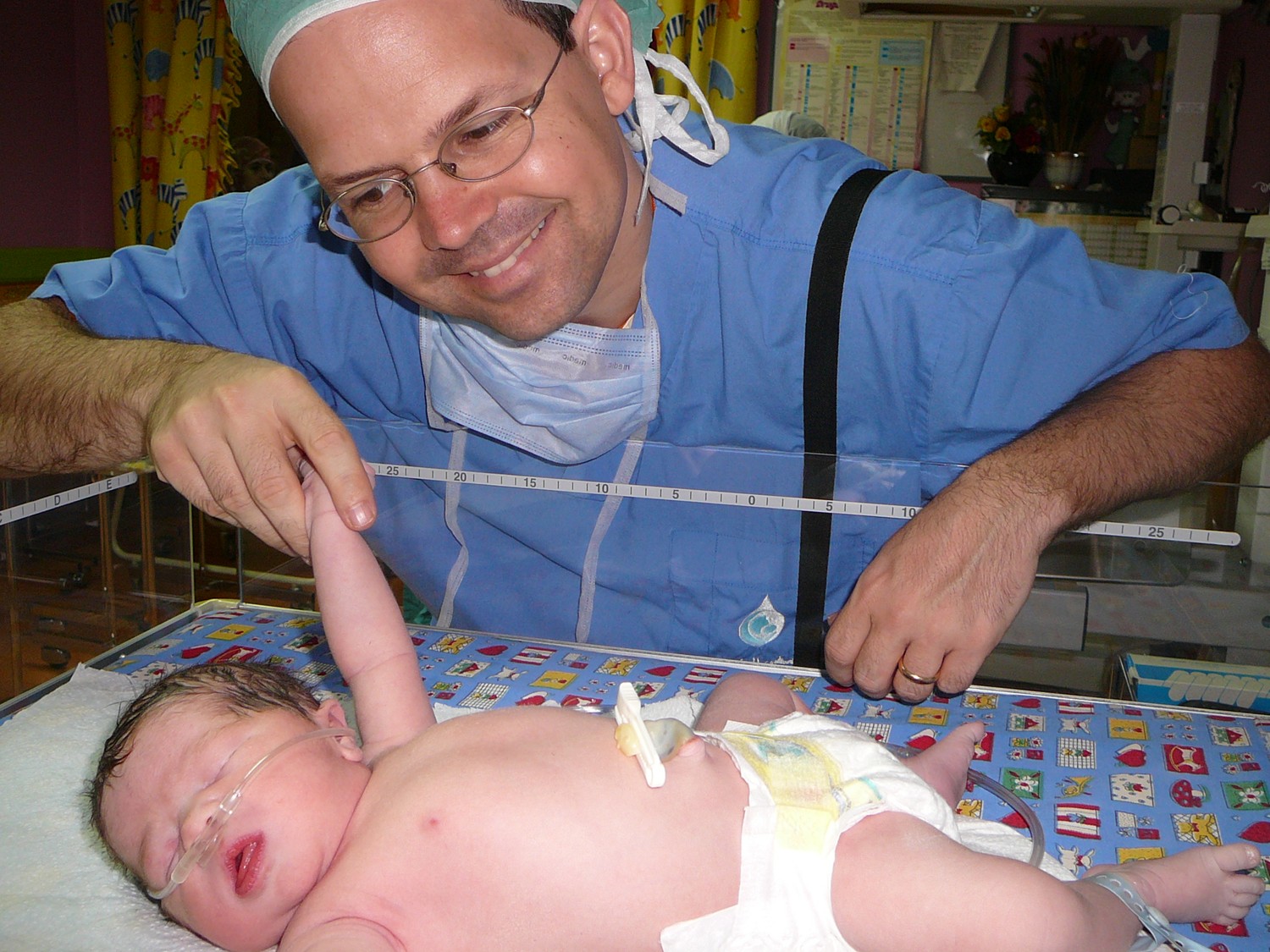
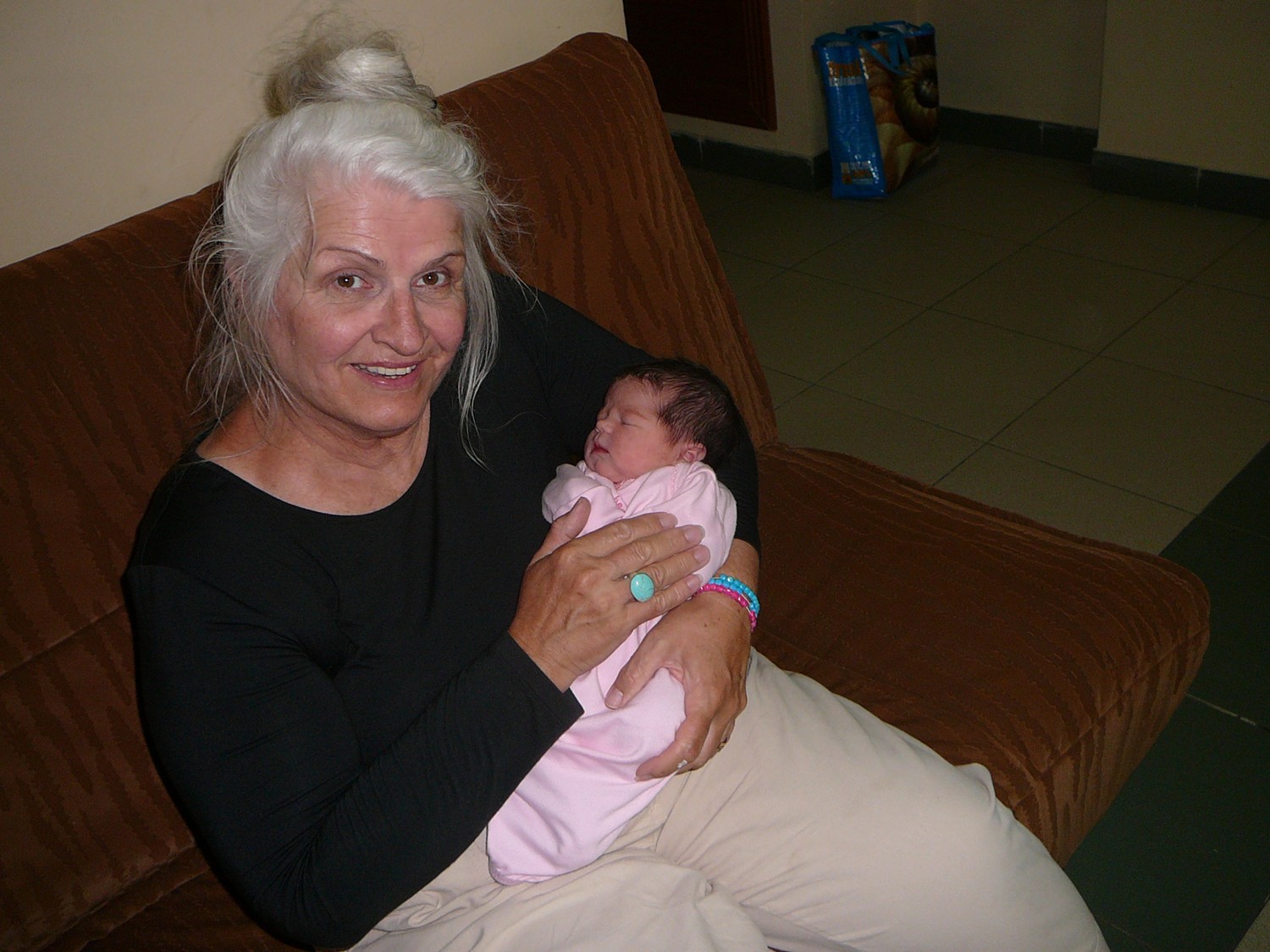
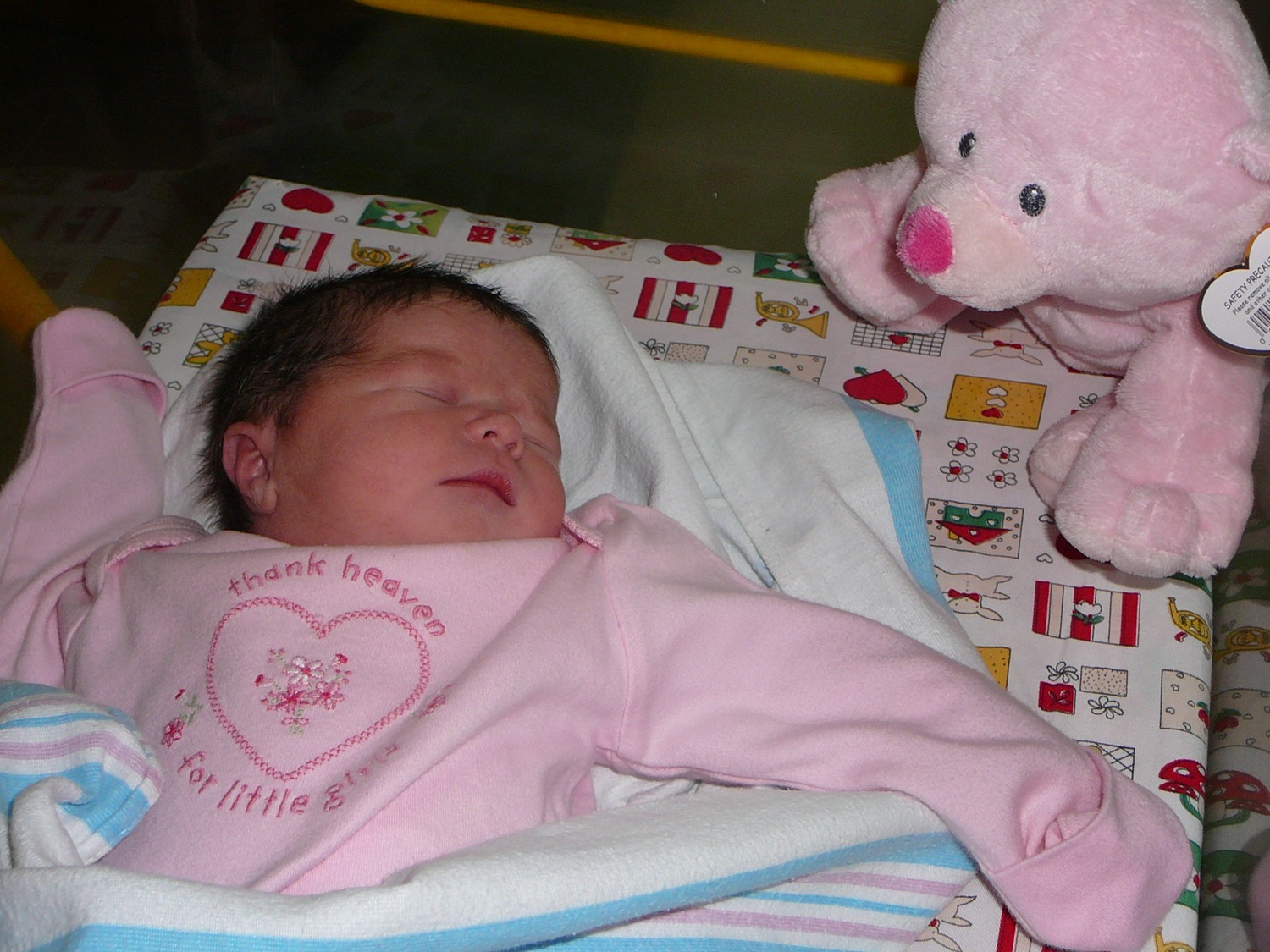
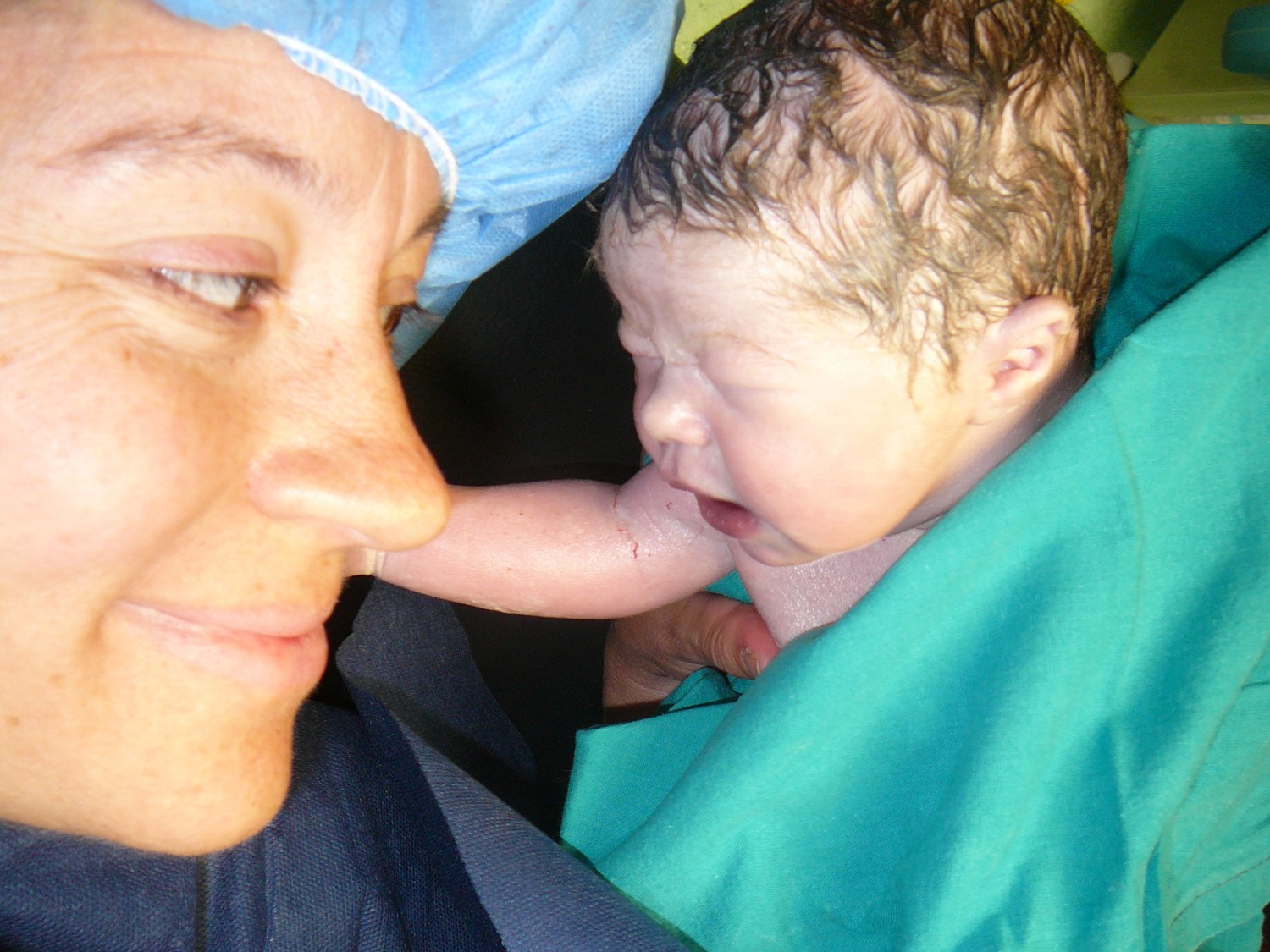
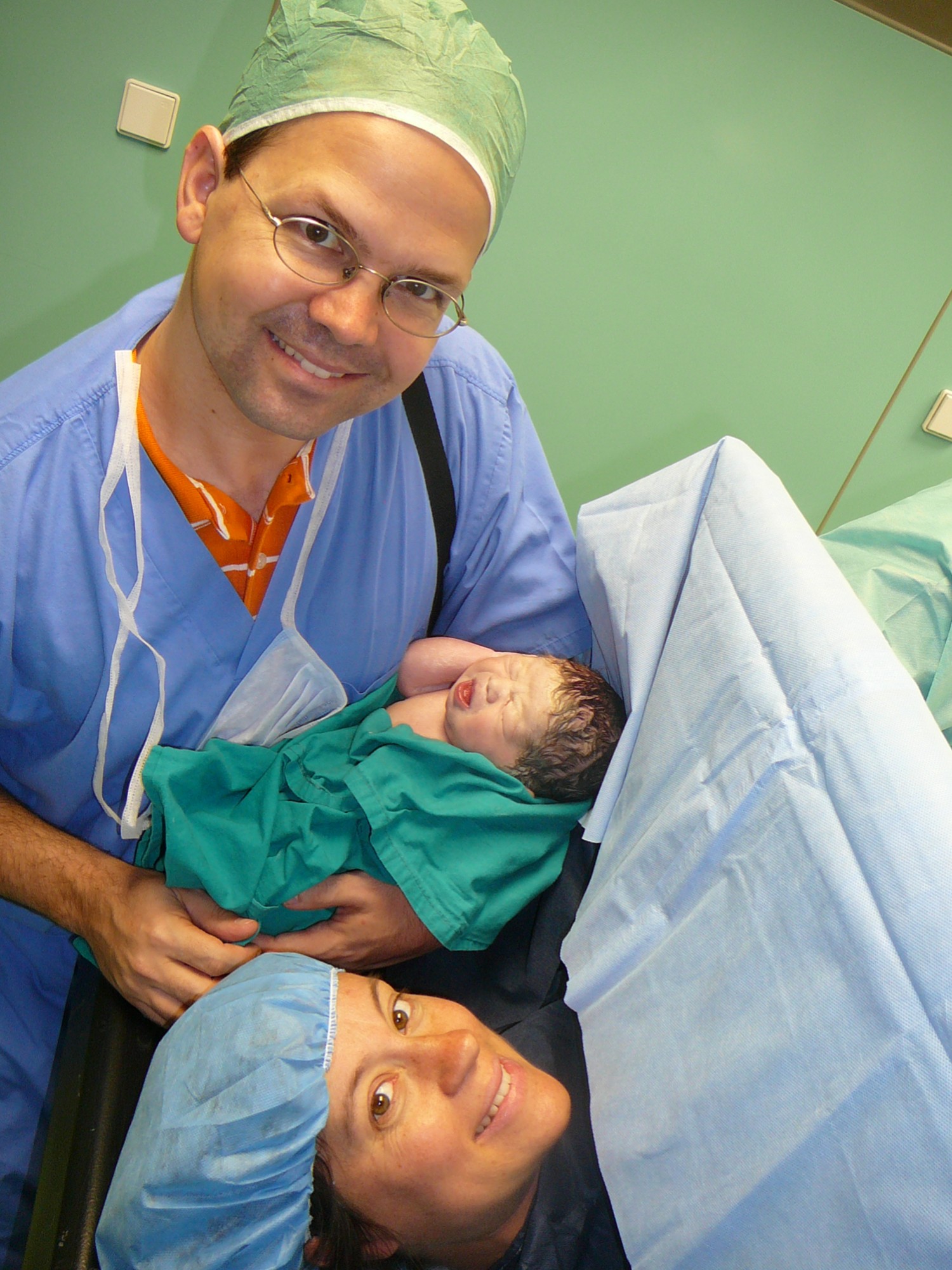
Born today was our third daughter, Layla Peace. She entered this world at 12:30pm. She weighed 6.8 pounds, and measured 19.3 inches. These are the statistics.

Of more importance is her reception. The lead-up to her birth was quite strange for us. Emma was anticipated to be a natural birth, but found the umbilical cord around her neck which prompted an unexpected but necessary c-section. With Hannah we knew that a c-section was a possibility, but walked and walked and walked in the days set before the deadline by the doctor. Not eager to exit, she was removed at knife point.

A second c-section meant that all subsequent children would be so delivered. From the first pregnant visit to the doctor we set the birth date, and waited for it to come. The soon arrival of our daughter was a number on a calendar, not a period pregnant with anticipation. Perhaps the excitement wanes for everyone after the miracle has been experienced more than once. Perhaps there are latter born children who have grown to resent their timing on the scene.

May God preserve us from such complacency; likely, he has already done so. In each of the previous two c-sections I have dutifully stood by Julie’s side, though positioning renders the expression more accurately as ‘sat by Julie’s head’. Draped between her neck and her bosom is large cloth, rendering mute any visual of the proceedings. I have not had inclination to peer beyond. On the one hand, it is best to stay behind and offer support. One the other, should I faint at the sight of my wife’s inner organs the complications added to major surgery surely would not be appreciated.

For baby number three, however, the cloth was barely the size of a handkerchief. While blocking Julie’s view, all was open and exposed for me to see. In order to avoid it I would have to cower nearly cheek-to-cheek at the level of her gurney.

Interestingly, Julie not only encouraged me to look, but also to take pictures. The conversation has not yet begun as to making these public, but we will start any such post with suitable warning. I suppose after three times behind the curtain, she was curious as to what they were doing to her. No shame in that, of course.

Now, I know. To be honest, it was fascinating. I will save the details for later, just in case we do write about it. Layla, though, will never lack for something special. She was the one I watched come out.

Of course, any parent will say – I believe – that they fell in love with their child the first he/she laid eyes on him/her. Keeping that sentence grammatically neutral somewhat ruins the sentiment, but maybe that is fair. Does not one have to say such things? Julie agreed, but put it more sincerely, less romantically, but more poetic: She was already a part of me; the love was already there. I agree.

Maybe you have been wading through this prose waiting to get to the pictures, so I will make you wait no longer. Please enjoy a few of Layla’s first photos.

Now, a video of Layla for 45 seconds in the first hour of her life.

Finally, one of Emma and Hannah enjoying their new sister.

Categories
Personal

Tabulations and Clues

One day left to go, so here are some statistics and a final picture.

There were 20 people who responded with guesses.

Among these there were 29 guesses.

None got both names right.

No one guessed the first name correctly.

The middle name was guessed correctly.

The most popular first name was Sarah, at 24%.

The most popular middle names were Grace (41%) and Joy (34%).

Neither of these choices are correct.

The correct first name contains two letters twice each.

One letter is found in Julie’s name, the other in both Emma’s and Hannah’s.

Another letter is found in Jayson’s name.

Further guesses are welcome.

The answer, God willing, to be given tomorrow.

Categories
Personal

Assigning Names

To be born on Thursday, God willing, will be our third daughter. Number one was born in the United States, though conceived in Jordan. Number two was born in Tunisia, and in a few days a third birthplace enters our family. The Arabs call such terminology ‘masqat ras’, or literally, ‘the place your head falls. If all goes well, it will simply be into the hands of the doctor.

In Julie’s family every child – five altogether – was born in the same town; in mine, three of four of us were born in different states. We are taking it a notch up by changing up the countries. While we don’t know the laws in detail, let us anticipate an oft-asked question: No, our children do not have dual citizenship. From what we have learned, our kids are Americans, though we hope of course that they will consider themselves more than that.

We are aware such nonchalance is open to critique: We get the privileges of our nationality, should we not take more pride in this association? We are glad to be Americans, and we look to represent her well overseas. There is a certain perspective, though, that moderates one’s patriotism while living overseas.

While this seems unavoidable to us, we have seen others who do their best to resist. This comes in two forms. Either one becomes a super-patriot, or else winds up near-denouncing every flaw exposed in cultural comparison.

We hope we can avoid either extreme, and the ‘sense of belonging’, we think, is an aspect of appreciation. Belonging need not be singular; since we have the freedom to belong to the place we reside, we can also belong to the place of passport. These are not mutually exclusive, though there is mutual negotiation between these and our other identities.

So when we say above that we hope our daughters ‘will consider themselves more than’ Americans, it is in hope that a particular identity will predominate. This is that they belong to God, even while they can belong to the cultures in which they live and move and have their being. We hope the names we give them contribute to this.

With daughter number one, we chose the name long before birth, and told everyone in advance to the point she became a relationship with all even at four or five months in utero. With daughter number two, we played a game letting family and friends guess between five names we liked, and the whole while we even wavered ourselves, privately, as to which we would choose. Daughter number three is a child of the blog, and thus we will put this out there for all to see and participate in. Poor girl.

In any case, please play along. The names we choose need to be at least somewhat manageable in both English and Arabic. That may not be a great clue for too many of you, but it is something to work with. The other hint is that it will follow the pattern set by our first two, though we leave it to you to figure out how. I’d say it’s a loose pattern, to save you mathematical minds from computing the numerology.

Emma Hope Casper

Hannah Mercy Casper

We really couldn’t think of a prize, especially given that this ‘contest’ is open to our general readership, so if you would like to suggest your reward along with your guess, all reasonable offers will be considered. Please leave your name choice in the comments, and everyone can join in the fun. Especially us.

Categories
Personal

A Hint of Belonging

A few days ago I came across some interesting articles in the newspaper that had to do with statistics on smoking in Egypt. The next day there was an article on a government program to encourage removal of high polluting older model taxis with more recent, higher efficiency models. Tie the two together under the title of ‘Exhaust’ or something like that, and I figured there could be an interesting blog post.

Today at the office we were discussing the design of a revised editorial policy we wish to highlight for our electronic magazine. Arab West Report has an emphasis in presenting and analyzing articles from the Egyptian press, and occasionally elsewhere, which encourage greater understanding in the twin realms of Arab-West relations and Muslim-Christian relations. Within this discussion I wondered if the blog post mentioned above would ‘fit’ under our revised policy. After all, neither smoking nor taxis are essential matters for increased understanding in our world.

On the one hand I was interested to know my audience. A blog post can be very informal, whereas a report for our publication should be written more academically. On the other hand I wanted to know when I should write it. If it is a blog post I should write on my own time, whereas a report can be researched and composed during office hours. It was a tongue-in-cheek conversation, as there is plenty of overlap between the two categories, but it was also a useful discussion for the application of our policy.

Both the editor and I were trying to find ways to make it work, during which time I had an enlightening moment elucidating our efforts to belong to Egypt. Searching for an angle, I mentioned that an aspect of life in Cairo is that it is very polluted, which can negatively impact the reputation of Egypt abroad. “An article like this,” I said, “highlighting efforts to reduce pollution levels, could help them understand us better over here.”

I do not smoke, and I do not often ride in taxis. Yet for some reason the stream-of-consciousness dialogue produced the pronoun ‘us’ in identification with Egypt’s problems and a concern to represent her well. I recognized this immediately, and both laughed and marveled, which may suggest this sense of belonging is not yet fully ingrained. Only when we are oblivious will we truly belong. Still, it was a small hint that progress is being made.

Note: By the way, we have a baby coming soon, in all likelihood one week from today. Watch for updates, including a contest to guess the name. Next posting, I’ll give some hints…

Categories
Personal

The New York Times in Cairo: Michael Slackman

Michael Slackman is the Cairo Bureau Chief for the New York Times, having served in this position for the past five years. Previously he worked in Albany, Los Angeles, and Russia, and this summer he will be ending his stay in Egypt to become bureau chief of Berlin. This move is forced upon him, as he has become blacklisted in Iran, and all but blacklisted additionally in Syria, Libya, and Algeria. Covering the Middle East is nearly impossible if the doors to these nations are closed. He leaves sadly, but with full appreciation for life abroad and the privileges it brings in being able to see the world through the eyes of another.

This is the perspective Slackman spoke of during a public lecture the evening of April 15 at the Abraham Forum. This initiative was developed by St. John’s Church as an effort to build bridges between East and West, Muslim and Christian, at the point of intersection in the church’s backyard of Maadi, Cairo. Rev. Paul-Gordon Chandler introduced Slackman with these words, believing the reflections of such a high placed journalist would help enlighten the local expatriate community about realities in the Middle East.

Slackman began his presentation by remarking that if those in attendance had done a Google search on his name, they may not have been interested to come. Spoken tongue-in-cheek, he explained how his work has come under much criticism. He has always made it his ambition to engage people in a free and open exchange of ideas, allowing the subjects he covers to be able to express themselves in a forum otherwise impenetrable. Unless the media carries their voices, the people of the Middle East will remain unheard.

Though Slackman emphasized he only reports, never advocates, this interest in conveying faithful representation has engendered significant controversy. He tries to show the cultural and political nuances of the word ‘terrorism’. He depicts wide questioning of the Holocaust. He even writes how the oft-perceived trash dump is in reality a loosely organized but effective recycling center. In all matters he defends his practice as both good journalism and in the interests of the United States. Should not a policy maker desire to know the reality of what people are thinking?

Slackman gains his perspective through the challenging but rewarding work of face-to-face journalism, certainly with political figures but primarily with people on the street. Though he requires the use of a translator he states that it is very easy to get to know Egyptians. As he has “hung out” with them he has sensed that they desire to make themselves known. Both here and elsewhere this gives him an appreciation for the “little things” that make such a difference in understanding a people and their culture.

Unfortunately, he states, these little things were lost on the United States during the invasion of Iraq. Everyone who lives in the Arab world understand that the hand signal for ‘slow down’ is to turn your palm upward and put your fingers together, bobbing it up and down. The US military signal, however, is to raise your fist and knock, as if against a door. Slackman stated he was reticent to say what this signal meant to the people of Iraq, as it was quite uncouth, but this failure to communicate caused countless incidents as Iraqis approached checkpoints and each misunderstood the ‘go slow’ signals of the other. Add this to the fact that the military could not comprehend that the “We love Bush” slogans they received were only the knee-jerk reaction mirroring the “We love Saddam” chants offered to the prior ruling power, and Iraq was a disaster waiting to happen, but could have been prevented.

A vital difference highlighted by Slackman which goes far beyond the “little things” is the role of religion in society. In the United States it is common that a newspaper have a religion reporter, who occupies a rather minor and generally limited sphere of importance. This pattern though is impossible in Egypt and the Middle East, where religion touches upon and intertwines with every subject imaginable. For most people of the region the first identity is ‘Muslim’, second is the particular nationality, and third is ‘Arab’. Any reporting must take these factors into consideration.

Unfortunately, not only is it difficult for many Western reporters to appreciate the primacy of religion, the nature of religious perspective is also incomprehensible to them. His first example was from conversation with Fayyoumi fisherman near the Cairo island of Manial. When asked what religion meant, they esteemed the traditional pillars of Islam – prayer, fasting, etc. – but emphasized it was that God had placed a ceiling on their life, and they were to be content therein. Questioned if this indicated they did not have to work hard they disagreed. Within their allotment they must work hard to succeed. Transcending their position in life, however, was impossible. It is, as is always heard, in sha’ allah – if God wills. Due to this fact, and the fleeting nature of life, the only solution is to pray.

The second example was from Saudi young men who accompanied him on trips to the desert. Over time he got them to open up and from them he learned much about their society. One such lesson, however, was quite disturbing. One young man accused Slackman of being reckless. When asked why, he responded that he did not consider the danger joining these young men in the desert accompanied by his female translator. Should he wish, the man stated he would get rid of Slackman and then sexually approach the woman, raping her if she resisted. The other young men all nodded along, none disturbed or offended by this line of communication. When asked how this fit into their understanding of morality and religion, they stated that the mistake of a man stays in his pocket, but the mistake of a woman shames the whole tribe. Apparently, for him, this was enough.

On a third occasion Slackman was being asked about his religion, and he responded with admirable notions: I try to be a good person, I look to help others, I maintain a good family. To his surprise this was responded to with the follow-up question, “So you don’t believe, then?” Since then Slackman has utilized his lesson from the fisherman, and now answers, “Life is fleeting, so what is there to do but pray?” This answer has received much better reception. Reflection on these episodes, however, has led Slackman to criticize much Western religious reporting as focused on ritual, rather than on spirituality; unfortunately, as he finds in many Middle Easterners, this is how they manifest their religion.

When asked specifically about religious relations in Egypt, Slackman compared the situation to race relations in the United States. When whites are polled about the state of relations most hold that things are just fine. Most blacks, however, state they are the same as always and not getting better. It is a matter of majority-minority difference in perceptions. Without confirming local Coptic opinion, he has experienced, and conveys, that they almost universally decry their position.

In proceeding to describe the murders committed at Nag Hamadi he indicated sympathy for some of their complaints. After the atrocities the government in issuing its condemnation clearly and unequivocally stated that this was not a sectarian incident. Yet when it put forward its explanation, it did so in clear and unequivocal sectarian language. They did not put it that an Egyptian took revenge against an Egyptian rapist, but instead it was for the Christian rape of a Muslim girl. Unless the government acknowledges that sectarian tension is a problem, Slackman insisted, things will never improve.

Throughout his lecture Slackman often reiterated his great privilege of living overseas in general and in the Middle East in particular. This has not been for the Pyramids, or the Nile, but because of the nature and friendliness of the people themselves. He ended his presentation, however, with a statement of disappointment. The first is that he had to leave the region due to blacklisting, and that in particular he would not again be allowed to enter Iran. It is such an interesting country, the most pro-American of any regional population.

His second disappointment was that he was never able to interview President Mubarak. Had he the chance, he would have asked two questions. First, what do you believe is your legacy? Secondly, with all seriousness, why can you not pick up the garbage? These questions best summed up the political and social coverage he has devoted to Egypt. Michael Slackman was faithful to the people of Egypt and devoted to cover both breaking news and slice-of-life stories. The next Cairo Bureau Chief will have big shoes to fill, and at least these two questions to pursue.

To read a recent article by Michael Slackman on the health of President Mubarak and the future of Egypt, click here.

Categories
Personal

Arrival Complications

In our last post we described the arrival of our moms to stay with us for a month during which time Julie will deliver our third child. Their flight was smooth enough, a direct flight from JFK airport in New York, landing about an hour and a half late, but with no complications.

Getting to the airport – and getting home again, was a bit more complicated. We have acquired a list of phone numbers for local taxi drivers and airport shuttles, so we called around and got the best deal. (Incidentally, the hour ride to the airport is only about $20 – round trip.) We stated the time, got the price, fixed the passenger number, declared the amount of luggage, and asked for a car with a roof rack to facilitate the ride home. Right on time the car parked at my office, and all was ready.

Except for the roof rack. The car was comfortable enough – four doors, roomy, and air conditioned. It even had a big trunk. Big, as it turned out, fit two large suitcases plus a smaller carry-on, but this left two other large suitcases and a smaller carry-on to be manipulated inside, around a driver, me, and two not-yet-elderly grandmothers. Perturbed at the failure to procure the requested transportation, we took off anyway, as the plane was due to land shortly.

As I mentioned earlier, the plane was late, we got there early, there was a mix-up with the airport restaurant lunch I bought to eat and pass the time, and when they finally arrived, I saw them behind the glass, just standing there, for what seemed like forever.

Our moms had successfully bought their visas, moved through passport control, and maneuvered through the twists and turns of the airport like professionals, putting to rest their initial fears about doing so without their husbands. Reaching baggage claim their suitcases rolled off the conveyor belt one right after the other, and they mounted them on the luggage cart, provided free by the Cairo airport. Except, that is, for one bag, for which they waited, and waited, and waited, and waited.

This is where I spied them through the tinted glass on the other side of customs. I could tell they had their bags, but wondered why they were just standing there. There was no official holding them up, and having waited far longer than I had planned already, I was getting both tired and anxious.

As it turns out, the last bag was held up in New York by the generally reliable (read on) Transportation Security Administration for a hand search. This was not discovered until they got home and opened it, finding a small note from the TSA describing the procedure. At the time they simply rejoiced that the bag finally arrived, as did I, and we stuffed ourselves into the car for the hour ride home.

The next day I went to work as normal, and did the same Thursday morning. I began the day by reading the daily Egyptian news, when among the regular musings about the Mubarak presidency and protests about this or that, I was astonished to find this headline:

NY Passenger with Lethal Weapons in Luggage Detained at Cairo Airport

As it turns out an Egyptian professor of botany in a New York university was arrested for trying to pass two handguns, hundreds of bullets, two swords, and eleven daggers through customs on his way out after picking up his bags. There is no speculation about his purposes, but there was never any fear he had intentions for the airplane. Nevertheless, there is an interesting question to ask:

How did he get these weapons past the formidable TSA? Score one for security in the Arab world!

On a personal note, what would this incident have done to the arrival process one day earlier with our moms on board? Reading the article put my trivial complaining described above in proper perspective. We are glad our moms are visiting, and thankful as well they arrived safe and sound.

You can read the original article here. (Don’t worry, it’s in English.)

Categories
Personal

Mother-in-Law x2

Hama Hama, Lo Malak as-Sama

A mother-in-law is a mother-in-law, even if she is an angel of heaven.

(Egyptian proverb)

As Julie is due to deliver our third child later this month, my mom and her mom arrived today to help out with whatever they can. They will stay with us two weeks before and two weeks after, raising the eyebrows of many of our Egyptian friends.

The attitude of Americans to a mother-in-law is probably well known to most of our readers; the proverb above signals this may be an international sentiment. In traditional Arab/Egyptian culture the mother-son bond is very strong, trumping even the relationship between a husband and wife. In fact, it is not uncommon (though this is changing) that a newlywed couple move directly into the housing compound, if not the family home of the husband itself. This puts a new wife in subjection to the mother of the groom, and a competition can develop for the son’s/husband’s affection. Furthermore, marriages traditionally were encouraged/arranged to be within the extended family or tribe. Close proximity of relatives is seen as a societal strength; it can also be a stimulant for mother-in-law friction.

No cultural explanation is necessary to wonder about how two mothers-in-law might jostle over the attention of grandchildren. Both will wish to help; both may have different ways of helping, or more dangerously, different advice about child rearing in general. The wife-mother-mother-in-law triangle can be difficult to navigate. Spread this out over a month … we have received sympathies from both sides of the Atlantic.

To put the reader at ease, and moreover any family which might be reading, my mom and Julie’s mom have a good relationship. They come from two different but neighboring states, but as they live near the common border the two families have exchanged visits even when we are not around. Both have left husbands behind to themselves; neither has traveled extensively alone. We anticipate this visit will have a positive bonding experience between the two, and with two and soon a third grandchild to go around, there will be ample opportunity to divide the affections. Both Julie and I enjoy the other’s family, including the mother-in-law. People raise their eyebrows, but we just chuckle and express our appreciation for them coming.

Of course, we will know better in a month. We think they are angels; might the Egyptians have a clearer perception?

Categories
Arab West Report Books Published Articles

What’s Right with Islam

A few weeks ago I had the opportunity to attend a public lecture given in Cairo, featuring Imam Faisal Abdul Rauf and his wife Sally Khan in a gathering sponsored by the US Embassy. Though not necessarily a household name, he has been in the news recently for efforts to build a mosque and community center near Ground Zero in New York City (see story here). Imam Faisal is the son of Egyptian Azhar scholars, but was born in Kuwait and raised in the United States. He is the chairman of the Cordoba Initiative which is an independent effort to engage both governmental and non-governmental entities in promoting a new vision of Islam for the modern age as well as breaking down barriers which exist between Muslim majority nations and the West. The initiative also sponsors programs to foster youth and women’s empowerment, in twin initiatives entitled Muslim Leaders of Tomorrow and Women’s Islamic Initiative in Spirituality and Equality. He is also the author of a book — What’s Right with Islam: A New Vision for Muslims and the West — of which an Arabic translation was presented free of charge to all in attendance. His book deals with explaining the basic message of Islam to a Western audience steeped in misunderstandings and suspicions. Yet it also speaks of the necessary modern translation of Islam into Western culture, many aspects of which will challenge the traditional interpretations held by so many in the Arab and Islamic worlds. The bringing together of all these diverse groups and ideas is a principle cherished by Imam Faisal, as well as the Sawy Culture Wheel, and the interview conducted between the imam and Mohamed Sawy, founder of the center, provided details about this vision.

Imam Faisal acknowledged that there were substantial forces opposing a broader rapprochement between the Islamic world and the West, but that even though the problems facing this goal are deep, he holds hope that there is no problem that cannot be solved if proper resources are dedicated to it. The scientific knowledge necessary for sending a man to the moon, he mentioned, existed over 200 years ago, but it took the vision, commitment, and resource allocation of President Kennedy to make it a reality. Imam Faisal hopes that he may play a similar role in creating a reality of peace between these two mutually misunderstood civilizations. Solutions are never easy, but history has shown they can sometimes appear out of nowhere, even from the unlikeliest of sources. If we do not commit our best thinkers to this goal, from every diverse ideology and interest group, we may find, somewhere, the ‘science’ to the solution, but the commitment to create the new reality will be missing. As in a soccer game, however, the closer a team comes to scoring a goal, the more resolute the defense becomes.

Imam Faisal has hope for this solution. He recognizes that the West already understands that Islam is not the enemy, as President Bush declared in a mosque shortly after September 11, 2001. On the contrary, whenever he speaks in churches, synagogues, universities, or think tanks, he is always impressed by the intellectual curiosity of Americans. They want not only to know what Islam is, but also what it ‘feels like’ to be a Muslim. Even those who have critical questions always do their best to understand and get to the root of the issues. This quality has also led some in the West to find spiritual peace in Islam. Having been disappointed by the material message preached in the West, they find the answer to their heart’s hunger for the face of God in the Muslim religion. Inevitably, through these but more so through the Muslim immigrants and their descendents in the West, Islam will become Western, in thought, culture, and values, all the while holding on to its Islamic essentials.

The obstacle to this mostly lies with Muslims themselves. Though 99% of the world’s Muslims, he claims, are peaceful people who only want a decent life for themselves and their families, the political movements in the Islamic world have increasingly borne a religious character. This frightens the West; though they understand political liberation movements of all varieties, this religious element leads many to believe such violent struggle is a necessary feature of the religion. This fear is amplified by the increasing demographic expansion of Islam in Western societies, especially Europe. Many believe they will be overrun by a foreign culture that is at odds with their own. These are legitimate fears, Imam Faisal believes, and Muslims must work hard to correct them.

This issue is seen in a nutshell over the controversy of building minarets in Switzerland. The government has decreed that minarets, though not mosques, may not be constructed, causing an uproar in many parts of the Islamic world. Rather than criticizing the Swiss for supposed intolerance—criticism in any sense only creates enemies and decreasing the chance for your message to be heard—he calls on Swiss Muslims to build Swiss mosques. What this should look like is unknown, but the challenge is not. In every country in which Islam took root the features of the religion adopted the culture, architecture, and ethos of the society. Yet in Western countries the features of Islam remain Eastern, as immigrant people transfer their culture abroad. Instead, they must strive to translate Islam to a new society, so that it can be acceptable and trusted among the majority people. This is the way Islam has always behaved, but modern Muslims are failing in this regard.

Towards the end of the presentation Imam Faisal and his wife spoke of their various initiatives, recruiting Egyptians to join their efforts. They spoke of their great desire to unite Muslims of all varieties, liberal and conservative, modern and traditional, Sufi and Salafi, so that their interactions would first produce understanding and acceptance, even amidst difference, and secondly spark a creativity which might locate solutions to problems faced by all, without demanding that one solution fit for all involved. Egyptians were invited to participate in this network, and many submitted their names for further information.

Imam Faisal spoke, however, to an Egyptian concern about himself. He stated unequivocally that he was not an agent of the US government. In fact, he has turned down a position offered him so that he may stay independent. Governments cannot take the lead in this cause, he said, because governments have their own interests which they must represent and protect. Nevertheless, he cooperates closely with government, since in finding resources for the cause these can aid substantially. He wishes to find friends wherever possible, and governments are among his friends, because they pursue together the cause of peace. Without peace there is no security and no development; increased peace in the world, especially between the Islamic world and the West, is a cause that everyone can rally around.

In a closing remark he illustrated the power of ideas within a collaborative network. In his book, What’s Right with Islam, he included a chapter on ideal American foreign policy, given the struggles which exist between the two civilizations, and the reaction which results in the defamation of America around the world. These ideas, he claimed, featured prominently in informing the speech of President Obama delivered in Cairo shortly after his election. While the American government will always follow its own interests—as it should—he was pleased that his ideas helped guide the current administration in determining these interests, and the manner in which they should be pursued.

In summary, Imam Faisal presented a picture of Islam translated into the Western world. While familiar to American ears, it prompted much thought and a bit of controversy among the mostly Egyptian audience. This, it is believed, was his very purpose. Time will illustrate if the gains he seeks will be realized, in whose interests these may be, and if from them further good may come to the world.

Categories
Personal

From Poverty to Riches

Note: This text was prepared recently but recalls a personal trip I took with my family to visit Maghagha during the Coptic Christmas holiday in January 2010. While there we visited Holy Family sites, but also a rapidly developing pilgrimage center focused on the memory of Fr. Abd al-Masih al-Manahari. Upon watching the film produced by the church commemorating his life, these two sources combined to inform this text, replete with personal reflection and photos.

The Coptic Orthodox Church possesses a strong monastic spirit which esteems abandoning the pleasures of this world in preference to those of the hereafter. Yet even in this world God is believed to compensate his servant with spiritual riches which satisfy far greater than any earthly lucre. Not all are called to this life; few can even imagine themselves in pursuit of it. Nearly all Copts, however, find in those who dedicate their lives entirely to God a source of spiritual proof of faith, for which glory is given to God, much of which flows through his servant. This human-directed commemoration is known as al-magd al-batil, or vainglory, which these servants spend their life escaping. Upon their death, however, they can no longer flee.

The Egyptian countryside is dotted with churches built upon or in proximity to the tombs of these saints. Most of these figures lived centuries ago, during the times of monastic establishment or widespread martyrdom. Certain saints have more modern origins, such as during the Islamic ages even through the colonial period. The sites have become places of pilgrimage to which Copts journey to remember their lives, seek their intercession, and receive their miracle-working power. In an earlier essay I wrote about our first encounter with such miracle stories, in which the bodies of many of these saints are preserved from decay. Westerners in general find it difficult to give credence to these stories, imagining them to be vestiges of a bygone era in which scientific inquiry was less developed. Even Western Christians, who are more inclined to believe in the possibility of the miraculous, find little similarity between this understood pre-modern faith and their own. Yet the saying is often repeated here: God never leaves himself without a witness.

The witness to faith through miracles is not understood as a foundational phenomenon only. The first Christians preached Jesus, “who was a man accredited by God to you by miracles” (Acts 2:22), and their own authority was established as “everyone was filled with awe, and many wonders and miraculous signs were done by the apostles” (Acts 2:43). Salvation, “first announced by the Lord, was confirmed to us by those who heard him … testified by signs, wonders, and various miracles” (Heb. 2:3-4). Paul confirms that these miracles are, in fact, “the things that mark an apostle” (II Cor. 12:12). Copts celebrate their communion in “one holy, catholic, apostolic church”, and trace the succession of their leadership all the way back to Mark, through the ages in direct connection to this apostolic authority. Christianity was confirmed in the beginning through miracles, and its proof continues to be found in God’s concern exhibited through his saints, both living and dead. This witness elevates Christianity from a philosophy to a divine reality, incumbent for belief by all humanity. The level of witness may ebb and flow, but it never disappears.

Scanning the modern age in Egypt, however, may question this conviction. The tombs of the saints are testified to as places of miracle, drawing even Muslims to petition God through these Christian wonder-workers. Yet where are the living witnesses? At one time these saints were flesh and blood humans—devoted, no doubt, to the complete service of God, but no different than their common neighbor. That is not a fair claim, however, for they were different from most men in their voluntary poverty, and if the stories are to be believed, in their ability to petition God for direct and indubitable intervention in the lives of those around them.

This dependence upon the miraculous, coupled with a scarcity of living saints, has contributed to the growing popularity—and wealth—of locations surrounding the holy tombs. When one asks for intercession it is usually accompanied with a vow to be fulfilled sometime after the miracle has been received. This can be in the form of a service rendered, prayers offered, or money donated to the church housing the tomb. There is no scandal here; no one is getting rich off of these stories. Monies are applied to build and repair the church of the saint, with legitimate concern to accommodate the ever increasing number of pilgrims, as well as to assist the poor in the area. Yet the living saint would have cowered at the thought of receiving ‘compensation’ for his expression of grace, let alone the attention which would be afforded him. This is al-magd al-batil which kept most of these saints ever in search of obscurity. With their bodies in the ground, no matter how well preserved, the magd can finally accumulate.

During the season of Coptic Christmas we had opportunity to travel to Maghagha to stay with Fr. Yu’annis, a priest who introduced us to many of the Christian sites of the area. You can read about these accounts here. He also spoke with us about the best practices for church building as well as what Christians should do following the horrific events of Nag Hamadi, which you can read here and here. He also brought us to a modern day pilgrimage site, such as described above, located in the village of Manahara. The story which follows is an account of the life of Abd al-Masih al-Manahari, as depicted in a film, produced under the supervision of Bishop Mina of the diocese of Girga, who researched his life and recorded the stories attributed to this remarkable man.

Abd al-Masih al-Manahari was born in 1892 near the village of Mattai, in the governorate of Minia, located 150 miles south of Cairo. As the only son in a family with several daughters, he caused much consternation to his father for his preference to visit the local monastery over devotion to the family farm. Yet God blessed the production of the farm for his oversight, and whenever his father would limit his time in the monastery several cattle would die. As he grew older he wished himself to become a monk, but could not obtain his father’s permission. Though he loved his boy, he knew that monks neither married nor owned property, so the farm would pass to others, and who would care for him as he aged? In desperation the father brought him a young woman who offered herself to his son, but he refused, sending her away with great pain in her stomach until she publically repented in front of his father, at which point he prayed for her and she was cured. Angry with his father, but knowing also his fears, he asked if he could be released to the monastery if God granted his mother a son in his stead. When his father said yes, he declared it would be so, and shortly thereafter a second boy was born to the family.

Abd al-Masih, which translates into ‘Slave of the Messiah’, then traveled to the Monastery of Fr. Makarius, located in Wadi Natrun in the desert between Cairo and Alexandria. Here he studied from the established monks, serving them but also distinguishing himself as a man of spiritual insight. Here he learned the lesson of al-magd al-batil, which oddly enough drove him away from the monastery. Knowing the honor received by monks he sought to flee to become a hermit in the desert. Upon his return, however, he overheard people speaking about him as the great monk dedicated only to God. Paradoxically, he thought the only place to escape was the world, so he departed to live in the village of Manahara, dressing as a monk, but under the guise of tomfoolery.

Everywhere he went Abd al-Masih mentioned he wished to get married. For a monk this was akin to giving up his vows, so he presented the image of a man with worldly wishes. He always turned down any proposal received, but his reputation began to be established in the village. Furthermore, he would pay the children a small amount of money to dance around him and call him ‘the crazy monk’. Yet at the same time his concern for the people around him became known through small miracles he would work on their behalf. He would present an amount of money to a needy family, matching exactly their debt without any details being exchanged. He would restore a chicken to life when it died in advance of the holiday. He would even be witnessed praying through the night with holy lights surrounding him, once even being seen in communication with the Virgin Mary.

Some of his miracles were for his own benefit, as God enabled. On one occasion he knelt by the river bed and asked the fish to jump directly into his basket. Another time he demonstrated he was as the holy saints of the monastic establishment, able to traverse great distances in minimal time by transforming himself into a bird. To cap his life he gave two great prophesies, which established his recognition by God as a saint. In the first he was comforting a fellow monk who was overlooked for service, telling him he would be appointed a bishop when the otherwise unknown monk so-and-so became pope. No one believed him, but not long afterwards Pope Kyrillos VI was installed, and he appointed Bishop Mina, the very one mentioned above, to his post.

In the second Abd al-Masih received two visitors in approach of the Easter feast, each one vying to invite the monk to his home. Abd al-Masih refused them both, declaring he had a prior engagement, in that he was to be married on Easter, and in fact, one of the two was to join him that day. The colleague in question nodded solemnly, for by now it was well known that this was no crazy, deviant, marriage-bent monk, but a man fully dedicated to God. As predicted, Abd al-Masih’s desire was finally fulfilled, as on Easter, April 14, 1963, he was wedded to his beloved, joining the saints in communion as the bride of Christ. His friend died that same day.

While Abd al-Masih lived in Manahara he occupied only a small room in which he would sleep, eat, and pray. When we visited his now vast and grand pilgrimage site, this room is preserved in its original form, as a reminder of his poverty and humility. It is a stark contrast to the grandeur of the palatial church and complex now surrounding it, especially the bookstore which sells tacky trinkets with his face printed on mugs, ornaments, and pictures of remembrance.

According to local testimony, however, the place deserves its laud. Fr. Yu’annis told me the story of how this complex came to be. One day after Abd al-Masih’s death, the regionally unknown saint appeared in a vision to a local embroiderer named Mukhtar. He had been praying for a cure for his cancer, and in his moment of despair Abd al-Masih materialized before him, and handed over his shawl, telling him to lay it on his stomach and he would be healed.

In the film this shawl figured prominently in Abd al-Masih’s first miracle, which began cementing his reputation in the village. A young girl was suffering from a violent illness and was at the point of death. The family had brought doctors but each one left saying that the matter was now in God’s hands. The girl’s mother implored her husband to call upon the village monk, of whom it was said he was one of God’s saints, but he resisted knowing him only as the ‘crazy monk’. When her pressings finally caused him to yield Abd al-Masih came and knelt beside her, laying his shawl on her head, and prayed to God. Miraculously, the girl arose, and the two of them exited the room together to be met by the rejoicing parents.

With Mukhtar, however, Abd al-Masih gave not only a healing, but also a commission. Upon granting his shawl he spoke to Mukhtar, authorizing him to use it for the healing of all who needed help, accepting no money. At the end of his instructions he disappeared, but left the shawl behind. With this word Mukhtar began his thereafter daily practice of taking the shawl to Abd al-Masih’s grave, entrusting it to the religious authorities for application of healing according to their wisdom, returning at the end of the day to take it home with him again. It is said that upon his death, Mukhtar will bequeath the shawl to the bishop.

Over time Abd al-Masih became far more famous in death than he had ever been in life, and the miracles performed through his shawl outnumbered those performed during his days on earth. Fr. Yu’annis confirmed personally the miraculous healings. On one occasion he invited Mukhtar to come with him, with the shawl, to his village of Qufada. One woman there had been suffering from a steady hemorrhage, but upon being touched in faith by Abd al-Masih’s shawl she was healed, and remains in good health to this day. Furthermore, Fr. Yu’annis declared that the body of Abd al-Masih has been miraculously preserved by God from decay, and is displayed publically once a year on the anniversary of his death. In this manner God honors in perpetuity the glory of his saints.

Be it God’s intention or not, this process also contributes to the glory of their surroundings. Here is a picture of the residence in which Abd al-Masih spent his days:

Following the work of Mukhtar and Abd al-Masih’s shawl, in the late 1960s this church was built on the site:

By no means is this an ostentatious display, but it does depict a progression from the single room residence and decrepit church (no picture) in which Abd al-Masih worshipped. Consider, however, the most recent building project on the site of this mendicant holy man’s grave:

In addition, consider how this man, once ever on the run from al-magd al-batil, is now commemorated throughout the site. Here is his original photo compared with the iconic image by which Coptic Christians choose to remember him:

Other images from the pilgrimage site include:

Here are his relics, to which people come to seek his intercession. Behind the priest on the green board is the Arabic text of a song of praise to Abd al-Masih, which commemorates his virtues.

It is difficult to reconcile these images with the reality of his life. A man of simplicity, poverty, and humility becomes the focal point of a dazzling, luxurious, personal cultic center. Yet at the same time, the extraordinary nature of his life suggests the appropriateness of commemoration. Certain questions demand further study:

Did Abd al-Masih al-Manahari truly conduct the miracles attributed to him in the film? These are verified through the research of Bishop Mina, but how thorough were his methods? Such an account can be built only upon personal testimony; were the subjects of his inquiry predisposed to interpret events as miraculous? Could they have invented certain tales fitting within the known pattern of saintly powers? Is there any hint of duplicity, if not for personal benefit then for that of the church and the faith? Or was Abd al-Masih truly one of God’s witnesses?

Is the story of the apparition to Mukhtar to be believed? How did the shawl come into his possession? It existed previously somewhere after the death of Abd al-Masih; wherever that place was, presumably it is no longer there. What of the continuing miracles? In at least one case, there is a credible personal testimony, received by a friendly priest in whom no duplicity was noticed. Is there a power of belief that itself produces miraculous results? Once the history/legend is sufficiently produced, can the best examples of these accepted tales fuel a continuing mania? Is his body truly preserved? April 14, apparently, produces yearly verification.

Supposing these accounts to be true, what does it mean? If Abd al-Masih was a saint, commended by God in both life and death, is this for his memory, or for a greater purpose of establishing the veracity of Orthodox Christianity? To what does Abd al-Masih witness? Orthodox Christianity generally holds itself to be the true expression of God’s religion, as spoken before, attributed by miracles. Yet how should the miracles of other expressions of faith be considered? Is there a difference in degree between the Christian Protestant faith healers and the Islamic Sufi awliya’ salihiin (literally, good guardians, functioning in a role similar to that of Christian saints)? Are all non-Orthodox, or at least all non-Christian, miracles demonic? Does God need this witness at all, from anyone?

Finally, what interpretive light does this phenomena shed on the miraculous in historical religion? Firstly, is Abd al-Masih a verification of the stories of the centuries old saints, such as Anthony, George, Bishoy, and Abanoub? Or might he serve as a modern example of how their reputations were created and preserved? Secondly, does the comparison carry backwards even to the founding of the faith in the miraculous stories of Jesus and the Apostles? Historical and apologetic studies have dealt with the second question in depth; presumably anthropological and sociological studies have dealt with the first. What are the results?

Without having studied the modern disciplines of the first question, and with some previous reading in the theological and critical disciplines of the second, I see four possible answers. The first is that of complete verification; Abd al-Masih, like the apostolic witnesses before him, was used by God to demonstrate the ‘rightness’ of Christianity. The second is its opposite; though many involved may have been honestly duped, Abd al-Masih, or at least the religious leaders who co-opted his story, was a charlatan and a deceiver. The third returns to a religious response, but one less exclusivist. God has mercy on humanity through many paths; Abd al-Masih was his agent to serve the Orthodox Christians of Manahara and Upper Egypt, though other figures are equally his ‘witnesses’. The fourth seeks to preserve the sincerity of the stories with respect to scientific realities. Psychological and psychophysical studies are necessary to determine how such events can be unanimously testified but yet scientifically impossible; Abd al-Masih tapped into a power that is part of humanity but as of yet is alien to measurement.

For now evaluation of these results is not possible, as further study would be required. What is most interesting is the picture of Abd al-Masih as an example of Coptic spirituality. Celibate, mendicant, and sensitive to the divine, he represents the ideal Christian picture which most are not able to replicate. In return for his sacrifices he enjoyed special favor, which was used primarily to bless others, but from which he enjoyed extraordinary communion with God. Upon his death this favor continued, at which time his legend rapidly spreads. The Christians who are not able to follow his example signal their approval by visiting his grave, seeking his intercession, and donating to his remembrance. In a world lacking an abundance of saints (is it not always?), men like Abd al-Masih can receive the adulation of many. That this adulation results in a complete upheaval of the values they practiced while alive is simply one of the paradoxes of Coptic Christianity.

Categories
Maadi Messenger Published Articles

School Kids and Microbuses

A few weeks ago we provided a look into our local neighborhood here in Maadi, Cairo, during a seven minute video tour from our apartment to my work. Click here if you missed it or would like to see it again. Today we provide an extended look at one of the more lively sections of this walk, taken from our balcony depicting the street below.

Julie provides the commentary at the moment the kids from the boys’ school exit out onto the street, which also happens to be the beginning point of local public transportation in which microbuses carry residents from a nearby neighborhood back and forth. Our street is not always as noisy as the video will show, but neither is what she will show you unusual.

Please click here to enjoy the video on Vimeo (sorry, we had trouble with YouTube).

Note: Should the microbuses in particular strike your fancy, please pay attention for a coming post Julie is preparing which features another aspect of these, our illustrious neighbors…

Categories
Personal

Metro Etiquette

Tonight I rode on the metro here for the first time WITH the kids and WITHOUT Jayson.  I’ve taken the metro by myself, and with Jayson, and with Jayson and the kids, but not on my own with the kids.  It actually went quite smoothly as the girls cooperated beautifully.

I am always impressed on public transportation at people’s kindness to the stranger.  I first noticed it in Tunisia when we would ride the bus.  When I entered the bus with a small child (or two), inevitably, someone would rise from their seat and offer it to me.  I haven’t ridden public transportation in the US ever, so I don’t know if the same rules apply there, but I always appreciated being able to sit down with the little one(s).

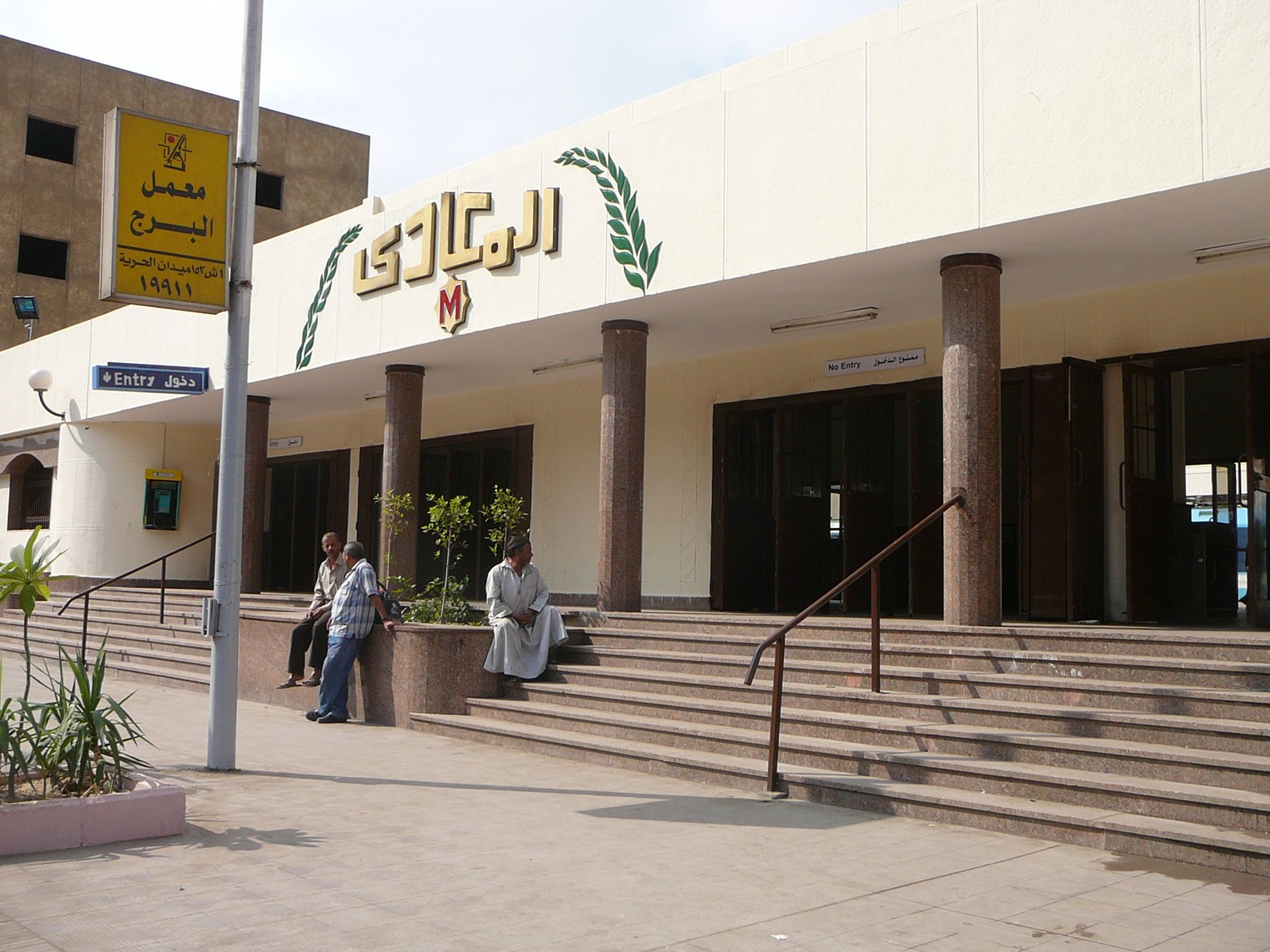
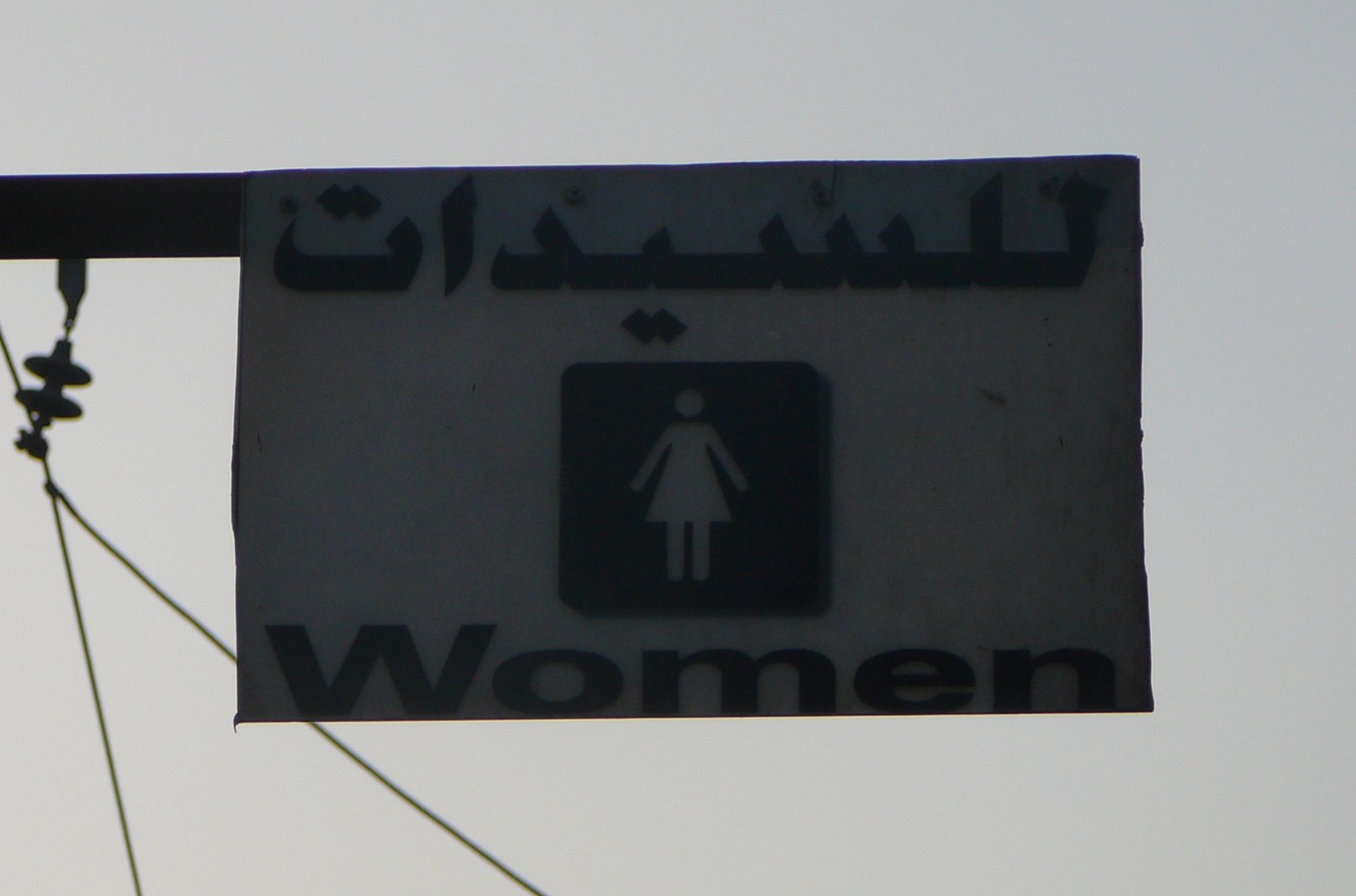
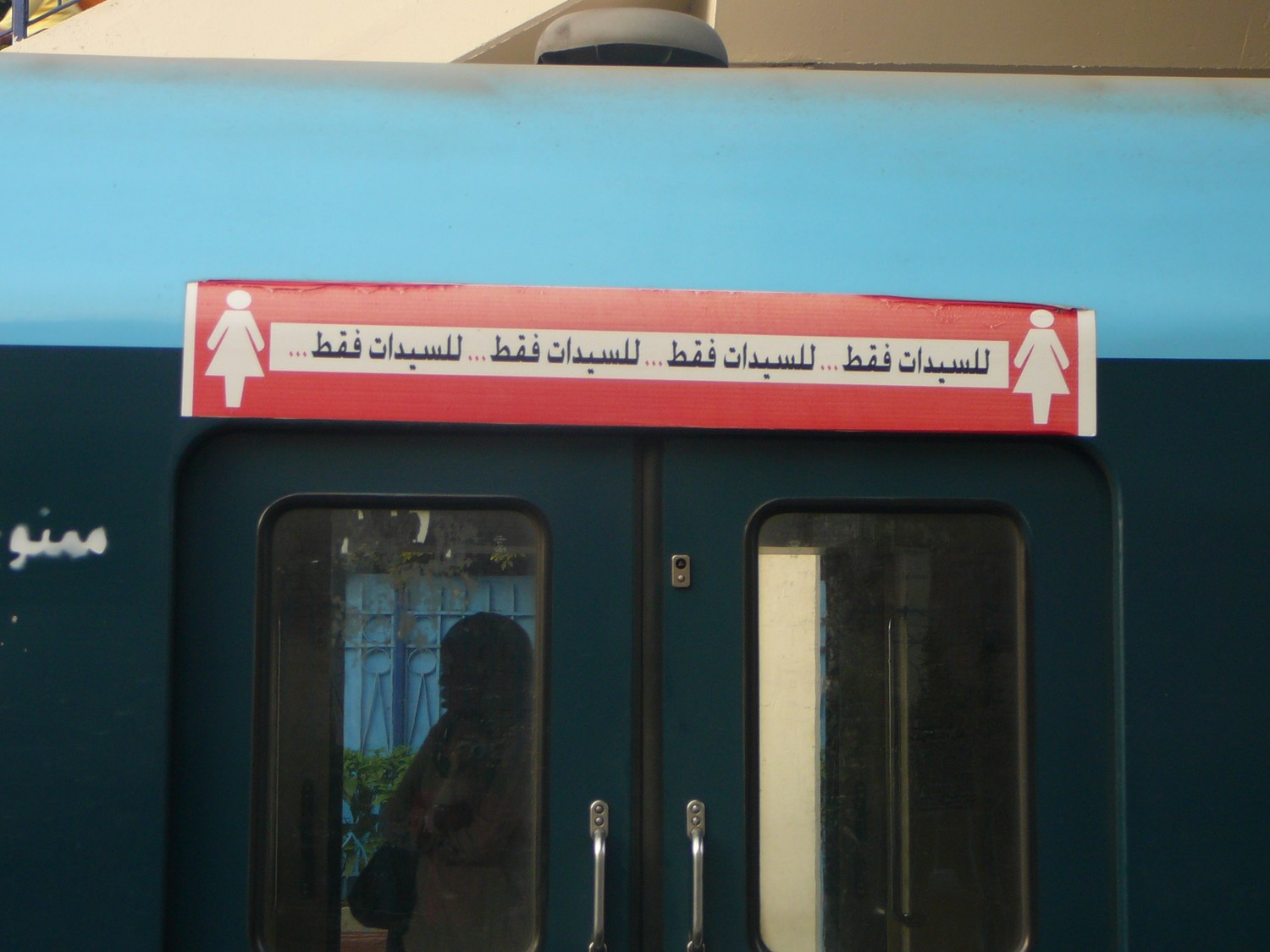
I think the same rules apply here in Egypt, but there is an interesting twist here.  One of the best features of the Egyptian metro system is their inclusion of a “ladies only” car.

Actually, there are two cars on each metro that are just for women.  I believe they differ slightly in that one of the cars allows men after a certain hour, but the other one is only for women all the time.  This is nice since the metro is often crowded, and at times crowded conditions can invite unwelcome attention.  Knowing one can enter a car reserved for just women gives a certain peace of mind.

I’ve ridden the metro by myself only a couple times, and have always chosen the women’s car at those times.  I was surprised a couple times to see some men in this car, but they definitely kept their distance from the women.  I could see that the women ruled in this car, and sometimes they would tell the men they shouldn’t be there.  Other times it seemed the men were with the women, but again, they kept their distance from the women they didn’t know.  The whole science of the “ladies only” car would be an interesting one to study if I had time to just ride the metro whenever I wanted.

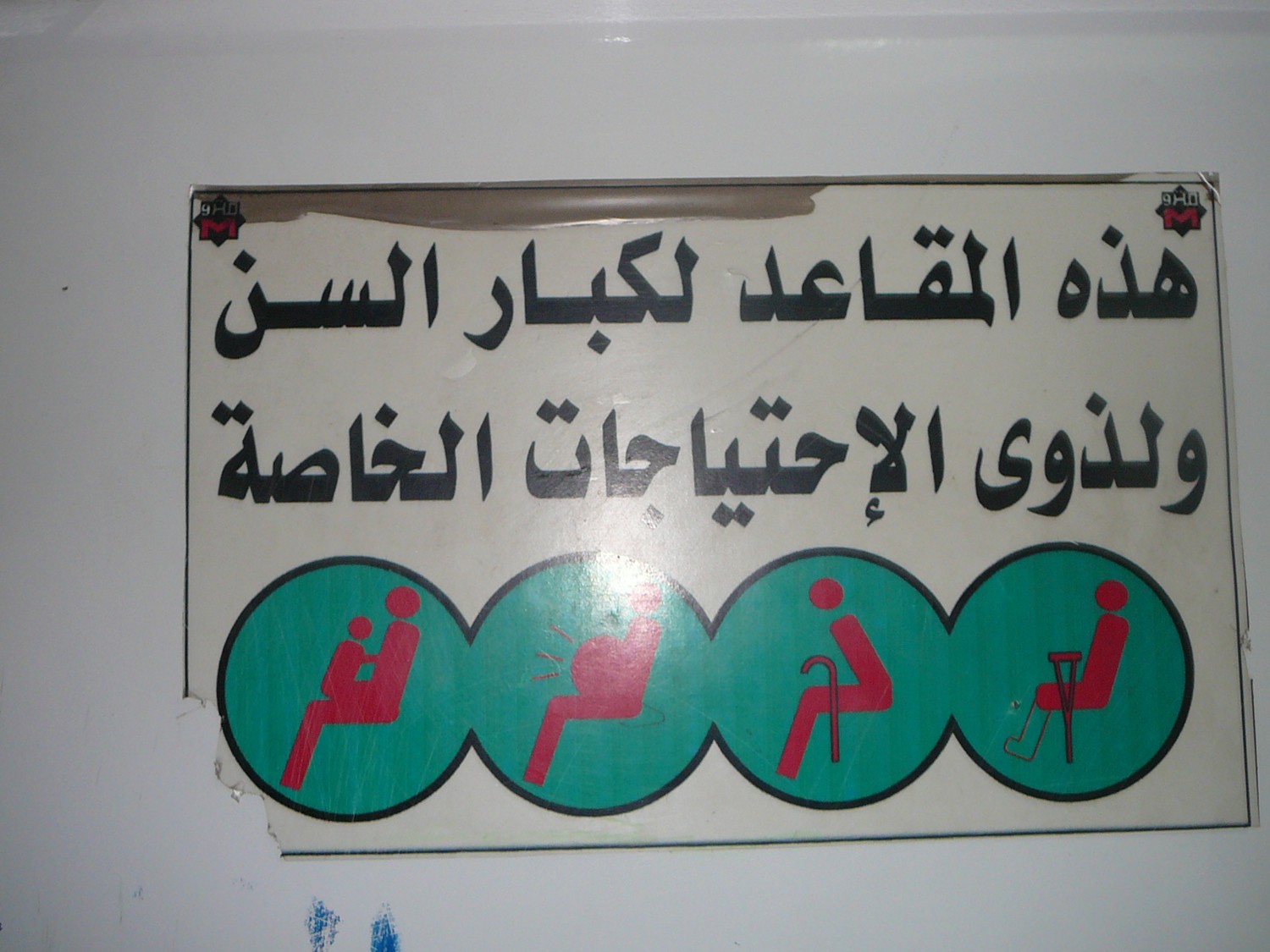
But, alas, I don’t.  I can, however, make some observations from what I saw tonight. Jayson had a meeting downtown so we took the first leg of the journey together on the men’s car.  When I was on the first leg of the journey someone gave their seat up for me pretty quickly.  Later on, after Jayson left, I wondered if that might be one of the negatives of the ladies car.  I think that in general, the men might feel a little more obliged to give their seat up for a woman with small children, but for some reason, other women might not.  In some ways, you would think that they would feel more sympathy and offer their seat more readily, but I think there is something inside a man that just wants to help a woman in “distress.”  Anyway, at least on the first leg, someone offered me a seat.  I sat down with Hannah on one leg as it’s hard to put her in the middle of my lap as baby #3 is taking up more space these days.  Emma wanted to sit on her own so she sat right next to me.  I remember thinking at that point that it was nice to be in this position.  I never really had to think about getting up to offer someone a seat, as long as I had two little ones with me.  After all, there is a sign there which indicates the seats are there for, to translate literally, people with special needs: the elderly, the pregnant, women with young children, and the handicapped.

I didn’t even have to notice others’ needs as long as I was one of the needy ones.  As such, we had a nice, comfortable ride all the way to the first stop where we switched metros and Jayson went on his way.

The second leg took a little more work, but not too much.  These particular women must not have believed in the “woman in distress” theory, because when I boarded with two children in tow, and a third in my belly, no one made a motion to move.  Instead, an American twenty-something woman, who was also standing, noticed me, and asked someone if I could take her seat.  The sitting woman readily got up for me, but again, she didn’t do it on her own.  So we got to sit for that leg of the journey as well.

The return trip, also in a women’s car, went pretty well as someone got off their seat almost immediately and let me sit in a seat.  The girls were able to enjoy some lollipops that I had promised them during this twenty minute leg of the journey before we had to switch metro lines one last time.  We got on our last metro at a main station, so even the women’s car was quite crowded, and I as I looked around at the women seated, trying not to make eye contact exactly, but trying to notice if anyone made any slight motion to me, I realized that no one was making a move to get up.  Oh well. I did my best to keep my balance holding two little hands.  But nearby was a woman dressed in the niqab (a head covering that also covers the whole face except for two eye holes), and holding a toddler on her lap.  Her six year old daughter may have been on her lap as well, I didn’t notice at first, but almost immediately she saw my need and offered half her lap for one of my children.  Emma refused, so I put Hannah there instead where she played fairly happily for most of the ride.  I kind of marveled at the woman’s kindness as I thought about my ride earlier that evening when I didn’t even look for other people in need since I was the needy one.  I was grateful for her kindness and she even got up halfway through the ride when Hannah refused to sit on her lap any longer, and offered her seat to me.  Granted, she was getting out earlier than I was, but still, she gave up her space for me.

This was a good lesson for me to not just expect other’s kindness, and in some ways, demand it of them as I fit the description of a “needy passenger.”  Instead, I should look for ways that I can help others in need. I owe a big ‘thanks’ to the stranger in the niqab for teaching me about seeing others’ needs above my own.

Categories
Arab West Report Middle East Published Articles

Islam and Civil Society

Dr. Nadia Mostafa is a professor of international relations and the director of the Program for Civilizational Studies and Dialogue at Cairo University. A devoted Muslim, she shared her thoughts about building and developing civil society in Egypt. The conversation began with Dr. Mostafa’s efforts to discover at bit about me and how I had come to visit in her office. While discussing briefly my association with Arab West Report she also asked about my education, and I answered stating at the end my master’s pursuit in Islamic Studies. She was intrigued, and we talked about this for a while. Within this subject we talked about her friendship with, but not membership in, the Moral Rearmament Association, a local Egyptian non-governmental organization, as well as her participation in multi-party efforts at civil society construction.

Dr. Mostafa admires the work of groups like the MRA for seeking to craft an ethical basis for civil society. This is a good and worthy endeavor, but she hesitates to commit herself to their effort because, being a political scientist, she cannot accept their indifference to political aspects. In taking this civil stance they still are making a political decision. Morality is an important part of civil society discourse, but there are realities of power which must be addressed, both nationally and internationally. Specifically, she takes aim at the Egyptian government for stifling political debate within the country. All groups, whether Communist, Socialist, or Islamist, should have full political participation in shaping public policy. The failure to include them results in the increase of violent protest as well as the lethargy in public political participation in general.

Dr. Mostafa also commented that though she freely and eagerly cooperates with non-governmental initiatives to strengthen civil society, she also takes issue with many of their presumptions. First, she mentioned that nearly all of the groups working on behalf of this shared goal were Christian or Western. Islamic groups tend to exclusively work in charity, and she implicitly criticized Muslims for neglecting this important task, while qualifying this is due to the constraints and pressures the authorities put on their activities. Second, the Christian and Western groups which rightly aim at strengthening civil society tend to view Islam as the problem which needs to be addressed. While partnering extensively with Muslims, they see Islam as deficient in promoting a worldview of tolerance, acceptance, and diversity. This, however, is faulty; Islam has proved a source of human rights more than any other thought or religious system. On an international and national government plane, this bias is utilized within the human rights discourse to exclude a priori any Islamist participation in politics. Though this is not the stated goal of non-governmental Christian and Western groups, they are often aligned with the government in pursuit of a secular order, which they label a “civil state”. Islam, however,  though rightly understood as more than a religion by the West, is also more than a political system. Islam promotes a strong human ethic and social justice commitment which admits plurality and the legitimacy of difference. The Islamic world view does not challenge the West as such, but the materialistic, hegemonic faces of modernization and globalization. Therefore, “civil society” should not be addressed as the opposite of religion or as having a religion-free frame of reference. Islamic visibility in the public sphere is not a threat to multiculturalism and civility.

At this I looked to probe a little deeper, and I referenced our earlier discussion about my Islamic studies. I highlighted that one aim of my research was to demonstrate that what is called ‘liberal’ Islam, that is, a Western preference for Muslims who also favor principles of democracy, tolerance, and human rights, etc., has a legitimate connection to Islam as a religion. It is often seen that liberal political Muslims may also be seen, perhaps by the more conservative faithful, as also being liberal religious Muslims, in that they have moved away from aspects of their faith. My claim was not to assert that either conservative or liberal Islam is the proper interpretation, only that liberal political Islam does not need to be seen as apostate – it may be embraced as a faithful expression of interpretation in the modern world.

Dr. Mostafa appreciated this line of study, but I asked her perspective on areas where I am still lacking. In defense of Christian and Western civil society proponents, while their bias may be evident, can it be understood, and perhaps justified? Specifically, the goal of civil society is to create the principles of citizenship. Many, however, see within Islam a call for dhimmitude. Admitting that the dhimmi system was superior to Western treatment of minorities for much of history, it is clear that the principles of the system do not equal the principles of citizenship. Proposing the question, is dhimmitude a necessary part of Islam, or is it a historical divergence from the religion?

Dr. Mostafa responded by speaking of the true persecution suffered by minorities under dhimmitude during certain epochs of history, but related this to Muslim-Christian geopolitical struggle, which then rebounded upon the Christians within Islamic territory. When Muslim nations have been strong, however, she stated that minorities were treated well. While her analysis was correct, I wondered if it contained an essential defense of the system. She distinguished between dhimmitude as a principle, norm and value, and dhimmitude as a system of procedures that organizes the state of non-Muslims. The earlier reflects a religious Muslim recognition of other previously revealed religions. So their adherents should be respected and fully protected as human beings who enjoy complete religious freedom. The latter is not fully described in Quran; it has been influenced, positively or negatively, according to the national or international context, but the negative one was an exception in history. Currently, when prominent Islamist thinkers and activists talk about citizenship, their ijtihad (reasoning) is not taken seriously by secular or by Coptic extremists. These stress Islamic visibility in the public sphere as a threat to their citizenship rights, which is fully wrong.

In a similar manner Dr. Mostafa had earlier criticized President Obama’s speech in Cairo in a slight way. While his delivery was good and positive, it was incomplete, for it presented only a peaceful, largely personal vision of Islam, in accordance with Western appreciation for religion in general. He avoided, she said, any reference to jihad, which though widely misunderstood as forceful imposition of personal belief, is part and parcel of true Islamic thought, and should not be apologized for. Jihad is incumbent as armed defense of their faith when Muslims are under oppression and occupation. Though this confession was clearer than that of dhimmitude, Dr. Mostafa revealed, openly and proudly, her Islamic core.

Yet at the same time, Dr. Mostafa denied that dhimmitude is a necessary expression of Islam in the modern world, and lives out this belief by her enthusiastic participation in crafting civil society. Islam, she believes, is open, tolerant, and accepting of others, and is not a clerical system like that found in Iran. Instead, the caliphate has always been a political phenomenon, and politics is subject to change. While she never issued an absolute claim that dhimmi status categorically is against the principles of Islam, she gives strong assurance to Christians and proponents of human rights that Muslims and their religion share equal goals as equal members of a society to be built upon the foundation of citizenship.

These Christian and Western groups, however, often go too far, specifically in their demand to cancel article two of the Egyptian constitution which establishes Islam as the religion of the state and the principles of Islamic Sharia as the main source of legislation. Every society has its order which defines the state, and by attacking the constitution in this way some extremist Copts are attacking the order of society.

Furthermore, Christian and Western groups do more harm than good as they constantly discuss civil society in terms of overcoming religious sectarianism. Religious relations in Egypt are healthy and strong; this over-focus only highlights the aberrant incidents, and communicates they are more prominent than in reality. As a consequence, civil society is weakened as accusations are exchanged across religious lines, rather than seeing these incidents as usually non-religious in their origin.

As we progressed we were conscious of the time, and I thanked Dr. Mostafa for sharing her views and helping my Egyptian education, but I also wanted to discuss some aspects of our work. I spoke of her colleague who informed me of the reconciliation sessions held in the Dar al-Ifta’ for Muslims who find themselves in personal conflicts with each other, be it business, family, or otherwise. She tracked with me in that if such a sheikh could be paired with a respected representative of the church, perhaps such reconciliation meetings could also be held between Muslims and Christians. She suggested, however, a different source of information. She told me of the Coptic Evangelical Organization for Social Services, who arranges extensive interreligious dialogue and cooperation. She believed they might be a better path to arrange inquiries about our peacemaking efforts. I agreed this was a good idea, but that our sources, unfortunately, are already primarily Christian, and it would be good also if she would not mind helping to arrange a meeting with the sheikh.

She did not mind, and gave me his phone number also. The man in question is the director of training in the Dar al-Ifta’, and she has worked with him previously, though not currently. She, with others, had assisted in helping imams expand their knowledge base from simply Islamic jurisprudence and Islamic studies to also include awareness of culture, politics, and society. Apparently, somewhere along the way this program was scaled back, so that this aspect of it no longer exists. Dr. Mostafa was not currently aware of what the remaining training program entailed, or for whom it was designed. In the past however, it was not just for aspiring imams before their appointment, but included even the imams of prominent mosques.

With this I thanked Dr. Mostafa once more for her time and assistance. Though we did not speak extensively of the subject for which I came, she did supply me with the requested reference, and I had opportunity to make a relationship with one who is often mentioned as a sympathetic supporter of our organization.

Categories
Personal

Civil Society

A few months ago I was able to interview a professor at Cairo University who is the head of the program for civilizational studies and dialogue. She has been a friend of our center for many years, and in our introduction we were able to discuss a favorite topic of hers – the role of Islam in civil society. In particular we discussed dialogue between Muslims and Christians concerning citizenship, tolerance, peace, and acceptance of the other. I hope to post this interview next, perhaps in a few days. I have held off on doing so for a little while, however, wanting first to write about the concept of civil society. This is a term I had not encountered until I came to Egypt, so I am presuming a similar ignorance on the part of many readers. Your forgiveness is asked upon my faulty underestimation.

One of the reasons, I believe, that the term civil society is not part of common parlance in America is that it is part of common life. Civil society represents the interactions of ordinary citizens which serve to strengthen the democratic character of the nation’s fabric. Democracy is not primarily the process of elections in which voters select their representatives. While this is true, this definition is built upon the foundation of a populace which joins freely into public associations which support the common good. As this is a regular feature of much American life, there is no need to speak of civil society; it is already there.

Many observers lament that this is not true of Egypt. More than lamenting, however, they have made civil society the goal for which they strive. Not neglecting the importance of crafting democratic governmental structures, they posit that the implementation of democratic measures is mostly fruitless unless the people already think and act democratically. What is a participatory government if the people are non-participatory in society? One indication of a strong civil society is found in the number of active non-governmental organizations. These can be charity groups, scrapbooking clubs, unions, or voluntary associations of any nature. One expert in the field told me that among an Egyptian population of 80 million there are only 500 of these groups active in the whole country.

I cannot say how many groups are active in the United States, but such volunteerism has been present from the founding of the nation. Having the advantage of a country built by population transfer, involving initiative and personal sacrifice simply to arrive, the United States crafted civil society far more rapidly than the nations of Europe which needed first to overcome the cultures of aristocracy and serfdom. Religious observance also played a leading role. Alexis de Tocqueville wrote in 1835 in ‘Democracy in America’ about the associational nature of the country centering in near universal church attendance. Though the power of belief has waxed and waned in national history Americans have always been people to bond together, join a cause, and support the common welfare.

Welfare is an apt word for civil society, for the question centers in who is responsible for it. The modern welfare state is a noble invention, striving to share the nation’s resources with those less fortunate. Yet at the same time it necessarily introduces the thought that it is the government’s responsibility to tend to the welfare of its citizens. I wish to make no absolute statements about the rightness or wrongness of this policy; certainly there are examples of both good and poor administration. The point is that the assumption of welfare locates the power base of a people; to the degree that in the modern state welfare is entrusted to / controlled by / abandoned to the government, civil society suffers accordingly.

At the dawn of the last century Egypt was awash in nationalist fervor as both Muslims and Christians actively participated, together, in the cause of complete independence from the British and Turkish powers. Budding enterprises of political parties, unions, newspapers, and broadcasting were built by the elite and began to filter down into popular consciousness. This process, if not arrested, was thereafter controlled by the state after the free officers’ revolution on 1952. Enacted to rid the country of corruption and lingering dependence on foreign powers, like all modern nation-states the ruling system assumed to itself the care of the people. Altruism, expediency, or Machiavellian power machinations can all be argued about the origin of state motivation; the result is that many Egyptians fault the state, perhaps rightly, for failing to deliver on its promises of care. Welfare, however, is still left to centralization.

The civil society movement is an attempt to change this attitude. Of course there are many charitable organizations and religiously motivated groups throughout the country. Yet whereas America was founded on initiative and participation, Egypt has a six thousand year history of peasantry governed by a ruling elite. The elite have experienced cycles of ascendancy and decline; the population cycles of prosperity and hardship. Civil society existed during these millennia; especially during the Mamluke and Ottoman periods the mercantile guilds wielded influence which eventually led to the modernization project of Mohamed Ali. Sufi orders also gave religious structure to society. The abortive participatory experiment of the early 19th Century, however, did not produce roots deep enough to maintain a lasting civil spirit.

If America looks askance, it should be careful; civil spirit is not a right of inheritance. Robert Putnam has remarked in his book ‘Bowling Alone’ that civil society in the United States is declining. Conservative commentators may immediately place the blame on the growing welfare state of America; the message of this essay may provide them fuel. Yet simply identifying the problem puts them only in the position of the Egyptian critics who decry their government yet neglect civil participation. A more likely American culprit is the spirit of independence and self-reliance, foreign to Egypt, which while rightly encouraging the individual to ‘pull himself up by his bootstraps’ wrongly chastises the lesser for failure to do so, leaving him to his own devices. Egyptian society is remarkable for the preservation of the lower classes amidst poverty and population explosion, all because at the most basic level everyone knows that welfare is the responsibility of family and community. None are left to fend for themselves, no matter the alleged scandal of government neglect.

Civil society, then, is a middle class phenomenon, as well as a middle class necessity. It is uncharitable to condemn the American welfare state critic as was done a paragraph earlier, for in all likelihood such a one gives to charity, goes to church, and votes in elections. What is uncertain is the degree to which his or her participation extends to the larger society. The question is not of direct visits to an orphanage or soup kitchen; it is about coaching soccer, mothers’ associations, and general neighborliness. Yet the rebuttal is heard and understood: Who has time for more than job and family basics? Perhaps the more accurate critique is of a spirit of materialism that demands maintenance of a certain social or financial level that renders free time a scarcity. It is a fair question to ask the extent to which ‘community’ even exists in American neighborhoods, at least in suburbia. Economic factors are certainly real; but they are equally complained in both the United States and Egypt.

One final comment about Egyptian civil society is necessary before yielding the floor to the professor from Cairo University about the place of Islam. Much of the civil society initiative in Egypt, either in dialogue between Muslims and Christians or more generally, between Islam and the West, has been espoused by Coptic Christians. Their efforts point in two directions. The first is toward their own people. I wrote in a recent essay about the failure of Copts to participate in Egyptian elections. This is but one symptom of a growing tendency to retreat into the church and their own community. The Coptic Orthodox church offers a wealth of meetings, services, and social activities for Christians, but the revival this has accentuated generally requires participation within the walls of the church. Historic American church attendance strengthened the bonds of community, but America was a largely mono-religious society. Catholic numerical expansion later in history had its own church centered activities, but these differently religious citizens were able to fit into an already existing non-religious civil society network, built upon a common Christian heritage. In Egypt the situation is different for the time and relational investment given to the church and to fellow Christians is accompanied by a parallel reduction in social bonds created with Muslim neighbors. These exist, of course, and are good, but simple neighborliness is not social integration. Christian advocates of civil society recognize this, and are doing their best to change this emerging pattern. Strengthening civil society strengthens citizenship, and this is a key Christian concern, leading to their second directional effort.

Among the interpretations of Islam is a civil system which calls for the protection, yet subjugation, of religious minorities. Christians and Jews should have full right of worship in an Islamic order, with freedom to structure and conduct their own affairs, yet they should not share fully as equal participants in the running of government and society. Actual practice of this system has varied widely in Islamic, and specifically Egyptian, history. Christians have been both a repressed and humiliated minority and possessors of important ministerial posts, especially in finance. It is only in the modern age, however, that they have been citizens, equal under the law. Viewing a resurgence of Islam in recent decades many Copts view civil society, built upon a secular foundation, as the best safeguard against the return of dhimmitude. The idea is not anti-Islamic per se, but it is motivated by a fear of Islamic encroachment into the public square.

Yet why should not Muslims, as religious citizens, also share in the crafting of civil society? As they represent over 90% of the population, is it not appropriate that their moral values shape the nation in which they live? Dr. Nadia Mostafa of Cairo University summarizes Muslim frustration with secular and Christian dominance of civil society discourse, though she herself is an active participant. Her testimony will follow in the next post.

Categories
Personal

Joseph and the Sheep, part two

Click here to read part one.

The next morning Joseph arose, opened the wolf’s cage and placed a rope around his neck. He led him to the sheepfold and opened the gate, then beckoned the sheep to pasture. Obediently as always, though with a sense of apprehension, they moved forward. Still and silent, the wolf looked on.

The day progressed as each day before, with the lone exception being the wolf sitting at Joseph’s side. The sheep milled about, each to his own business, eating grass as hunger dictated. By midday Joseph signaled for all to advance to the river and led the procession with wolf in tow. Once arrived, they all drank.

The afternoon held more of the same. Joseph stood solemnly with the wolf by his side as the sheep would graze. Yet for some reason the wolf grew more and more agitated. It started slowly with a low, guttural bellow. A little while later his tail began to sway, slightly more than usual. Sometime later, he began to twitch.

The two sheep who earlier had tried to communicate with the wolf were the first to notice the change in constitution. Sympathetically, they approached to inquire and offer their greetings. They had realized that all morning the wolf had been neglected, as each sheep, including themselves, had simply pursued their normal routine. The wolf, they thought, had behaved all day, but was never extended a welcome.

Just as the sheep were gaining their awareness, the wolf was losing his. The twitching had become a full on shake; he was not suffering from loneliness, but from hunger. Denied his prey the day before, it had been far too long since he had eaten. The sheep’s grass did not appeal at all.

As the sheep sauntered closer his instincts kicked in. Explosively he launched himself at the tender sheep who froze in their tracks. Inches away from descending upon them he jerked back, as Joseph held the rope taut. The wolf collapsed and whimpered in pain as the sheep, cautiously, gathered around.

At this point in the story Emma spoke up. “Maybe they should kill a kharouf, or a baqara.” I cannot tell if she knew exactly what she was saying, but she gave me the ending necessary. The word baqara is Arabic for cow, but kharouf is Arabic for sheep.

Joseph gathered the extended rope and began again to tie the wolf’s mouth and front legs. Just then an older sheep moved forward sadly, but deliberately. He spoke to Joseph while looking at the wolf, “It is true a wolf must eat meat. We sheep love you Joseph, and enjoy the meadow and the river and the sheepfold. But we also know that the day will come when we are slaughtered so that men can eat. I am the oldest sheep here, and therefore the next to die. Take me now, sacrifice me, and give my meat to the wolf. Then he can stay with us, be filled, and not attack.”

Joseph looked at his sheep with compassion; all nodded their heads in agreement, implicitly knowing their time would also come. Joseph drew his knife and cut up the generous sheep.

That evening the wolf ate more deliberately than he ever did before. As Joseph led the sheep back to the fold he brought the wolf, bound now only by the original rope around his neck, back to the cage. He entered, sheepishly, and Joseph spoke to him. “Tomorrow you will come out with us again, only this time, there will be no rope. You will be fed by the meat provided yesterday, and drink with the sheep from the river. You will stay by my side, and I will watch you. Take care, but join our flock.”

The next morning the sheep went out again, walking with one eye askance at the wolf who was walking unbound by Joseph’s side. During the morning grazing the two sheep wandered but then remembered to greet the wolf. From afar they made their way towards him, making sure their approach kept Joseph in between the two parties. Taking notice of them the wolf’s ears shot up. He burst past Joseph, knocking him down as he raced in their direction. The sheep had imagined being less timid, but their primal fear resurfaced as the wolf’s fangs emerged. As he leaped their “Baaaaaaa” hung in the air like an icy chill but then trailed off as the wolf, strangely, missed his mark. The sheep looked back to find the wolf covered in blood, his jaw clenched around the throat of a jackal which had moved against the sheep from behind.

Joseph came quickly and all the other sheep looked on. He rubbed his hand against the fur of the wolf and whispered his thanks into his ear. Then he collected the carcass of the jackal to prepare later for food, redeeming the life of the now-oldest sheep, if only for a time. The two sheep, meanwhile, had recovered from their shock and nestled their noses into the wolf’s side. “Next time,” they said as they smiled, “perhaps you can talk to him first; maybe he would be friendly. But you will have to be very brave…”

Note: ‘cut up’ is the language Emma uses for how sheep die. To find out why, read this earlier post.

Categories
Personal

Joseph and the Sheep

Sometimes I like to tell Emma and Hannah stories. I ask Emma for a subject and then Hannah for one, and try to combine the two into a tale or song. On this occasion, just before Julie was to put them to bed, Emma asked for Joseph, as in the one with the fancy colored coat, and Hannah asked for sheep. As I take liberty with the story, the tale which follows has no resemblance to the Biblical Joseph save for his name. I hope you enjoy; the ending will have a question I hope you find insightful, and for which your comments are appreciated.

One day Joseph was out tending his sheep. He brought them to green grass which he had them eat, and to sparkling waters which he had them drink. (Emma and Hannah were sitting on the floor as I sat on the bed, and they were encouraged to bend to the floor to eat and drink as well. Feel free to do the same.)

One day as they were enjoying their normal day the sheep spotted a wolf in the distance. They were scared, and looked to Joseph to know what to do.

Joseph was a kind shepherd with a good heart; not only did he love his sheep he wanted all animals to live in peace. He brought two sheep in close to speak with them privately.

“I would like you two sheep to be very brave,” he said. “When the wolf comes I would like you to stand your ground and not run away. As he approaches greet him simply, and say ‘hello’. I will go and hide behind that nearby tree. If the wolf greets you back and is friendly, all will be well. If not, I will jump out from behind the tree so that he does not harm you. Can you do this?”

The sheep were afraid, but trusted Joseph. As the wolf descended the hill they stepped forward timidly, so as to be the first sheep he would come across in the flock. As the wolf noticed this, the rapid pace of his bounding slowed; it was not often the sheep would come to him.

“H-h-hello Mr. Wolf, h-h-how are you?” the sheep initiated nervously.

The wolf stopped, but gave no reply. His back legs coiled and his lips drew back revealing the pointed tips of his fangs. Just as he was about to spring upon his prey Joseph leaped out from behind the tree, catching the wolf in mid-air, and wrestled him to the ground. He took out his rope and bound his mouth and his front legs. As the sheep cheered, Joseph took a peg and tied the wolf to the stake in the ground, and each sheep went back to his grazing.

As the day progressed Joseph led the sheep to other pastures, taking the wolf along with them, and several hours later returned to the river to drink. The two sheep watched curiously as Joseph walked the wolf, still bound by the rope, everywhere they went. As he untied his mouth and allowed him also to drink, however, they could no longer hold their peace.

“Why are you taking that wolf with us wherever we go?” they asked. “He tried to kill us all, you should have left him bound, tied to the ground to die. Yet now you even loosen his mouth to give him to drink? Why are you helping him?”

The wolf raised his pointed ears as he continued to lap up the river water. “It is true this wolf tried to kill you, but we must show him kindness even so. It may be that if we do not treat him as he deserves that he will change and also be kind in return. You were very brave when you tried this at first; you must continue to be brave. But do not be afraid, I will not let him harm you. Tomorrow I will take him with us again out to pasture. I will even let him run freely, though he will stay connected to my rope. If he cannot change, I will take him far away from you, so that he will not bother you again. But this is something which we must try.”

The sheep nodded warily, and Joseph led the flock back into their fold. The wolf he pulled aside to put into a separate cage. As he closed the gate he looked sympathetically at the wolf.

“Tomorrow we will return to the fields,” he spoke as he untied the rope from his mouth and front legs, which had been reapplied after leaving the river. “I will even keep these ropes away from you, save for this long one around your neck. You will be with us and I will treat you kindly as I treat my sheep, but I will watch you closely. I will send you far away, back to the wild, should you try to harm them.”

The wolf nodded, Joseph left, and the sheep bleated in the distance. After pacing about his cage for what seemed like an eternity, the wolf went to sleep.

Tell me, what should happen next? Emma and Hannah were engrossed in the story, and I was thankful it was time for them to go to sleep themselves. To be honest, I had no idea where to go next. Should the wolf reform and join the flock? Should he lash out once more and be banished forever? More importantly, what lesson should be woven into this tale?

Up until now I have had no qualms with the implicit sermonizing. It is good to stand firmly, but friendly, against an oppositional threat. Once subdued, kindness must be offered instead of revenge. I will be very proud if my daughters behave this way.

Yet there are wolves in this world, and generally speaking, they do not change. If the story continues with a repentant wolf, will I be painting a false idealism which will set them up for failure and pain? Or, if the wolf resumes his attack in the morning – worse if he pretends to be reformed – will I confirm, to modify the metaphor, that a leopard cannot change his spots, and therefore we should always be guarded?

It is only a story, and it will fade from memory. Life teaches the best lessons. Stories, however, provide the interpretive context.

The next morning the girls awoke and immediately desired the conclusion of the story. Not knowing exactly what to do, I began by retelling the story from the beginning. Along the way, Emma provided the answer…

Part two will follow in a couple days. Until then, if you have suggestions for how the story should continue and end, please feel free to share in the comments.

Categories
Personal

Stop and See the Flowers

Autumn has always been my favorite time of year.  Maybe it’s because the weather is cooling; maybe it’s because my birthday falls in October; or most likely, it’s because of the beautiful colors one can see in our home area of Pennsylvania and New Jersey.  I remember when I lived in Jordan and was asked what my favorite season was.  A few people told me that “autumn” is a strange answer.  There really wasn’t anything too special about autumn in Amman, and it just signaled the beginning of the cold, rainy weather.  If my Jordanian friends could see the fall foliage in my neck of the woods, however, they would understand my preference.

I may be developing a new favorite season, and if so, it is thanks to my two little girls, Emma and Hannah.  Emma, at 3½, pretty much knows all her colors, but Hannah (almost 2) is just learning to differentiate what is green, blue, purple, pink, orange, etc.  It seems she knows what some of them are, but just when we think she’s getting it, we ask her what color the tree is and she says, “Blue.”  Oh well.  It takes time.

The other day, as we were walking through our neighborhood taking Emma to her preschool, one of us noticed some of the colorful flowers that have begun to bloom here in Maadi.  I have never been a big fan of plants and flowers and don’t know the names of them, but for the first time, I started to notice the colors surrounding us.  As we walked along, the girls excitedly pointed out the pink and orange and purple flowers.  After a few minutes Hannah, especially, got excited every time she saw a color.  “Look Mommy!” she would exclaim.  Her enthusiasm is so wonderful as she kicks her feet in the stroller and points toward the tree, “Pink!”  What a wonderful way to learn colors!  Of course, God’s painting involves more than basic colors, and I find myself saying, “Well, yes, that is kind of purpley-pink,” or, “yellowish-orange,” or whatever, but hopefully she will slowly get the idea.

Thanks to my girls for showing me some of the natural beauty that surrounds us here in Maadi.  I know we’re blessed being in this part of the city where there is grass and trees and flowers; it’s not the norm in Cairo.  Of course, kids can see beauty in anything, and today as we walked, they were noticing the different colors of the cars parked along the street.  I might rather have noticed the dents, scratches, and rust. It’s a good reminder to appreciate what you see around you … whether that’s God’s handiwork in creation, or man’s creativity in imitation!

Categories
Arab West Report Middle East Published Articles

Easter, Reluctantly

Easter in Egypt is a negotiated reality; this is true for both the nation’s Christians and myself.

All last week at work I wondered about the holiday schedule. Ours is a multi-religious and liberal office; if someone wishes a religious holiday, they can pretty much have it. The Copts who work with us would take the day off and go to be with family, some traveling six hours away by train to Upper Egypt. What about the foreigners, though? Or the Muslims, would they be expected to work? Unlike Christmas, Easter is not a national holiday in Egypt. Islam celebrates the birth of Jesus from the Virgin Mary, but denies the resurrection indirectly, for it denies first the crucifixion, believing Jesus ascended into heaven before his arrest. Though the government is not Islamic, in this matter it toes the line with the Muslim majority by not confessing the holiday.

Toeing the line is partial, however, as I discovered at work. National law allows Christians to take the day off from work en masse, but reckons it as a claimed vacation day. Given the reality of a national holiday the day after Easter – Shem al-Naseem, or literally, ‘Smelling the Breeze’ – this policy allows Christians to celebrate their holiday, but allows all citizens to create for themselves a four day weekend. Shem al-Naseem is a cultural vernal festival dating back to Pharaonic times; Muslims and Christians celebrate it equally, though I have not yet researched why it is tied to the Easter holiday. Some Copts see this as an implicit national recognition of Easter, though it is missing from the official calendar.

An event at our office disclosed to me another shade of Easter in Egypt. We have been trying to arrange an interview with a prominent Muslim scholar from al-Azhar University, and my supervisor told me we would meet Tuesday after Easter. I was quite happy with the news, but she continued adding that he originally asked for Saturday evening, but we proposed Tuesday instead. This news meant little to me, though I was somewhat glad not to have a work appointment on the weekend. I shrugged my shoulders however, saying, “OK, whatever the sheikh wants would have been fine.” I figured we should bow to his schedule, but at this my supervisor, a Coptic Christian, was aghast. “What,” she exclaimed, “don’t you celebrate Easter?” It took me a few seconds of puzzlement, but then I remembered that church celebrations always occur on the eve of a holiday, not the day of. The day of is a feast; a day to indulge after weeks of fasting. Children gather at the church to play and the priests open their offices to receive the well wishes of visitors, but there is no mass.

In the West we celebrate Christmas Eve, but there is no such thing as Easter Eve. Yet if you remember the events of Nag Hamadi, the murderer targeted the church around midnight the day before Christmas. As there is no correlation between Coptic Christmas and the Western calendar of December 25, this fact can easily be lost on the non-Orthodox reader. This year it so happens that Coptic and Western Easter fall on the same date. Yet even I, living here now for eight months and more tuned in than most foreigners to Orthodox affairs, was caught off guard by an Easter Eve service.

Unfortunately, once I had learned of it I was not that excited. We experienced the Christmas Eve service in Maghagha, which was wonderful as we enjoyed it with the family of a local priest in his small village. Yet we arrived by train halfway through the service, so we did not have to endure a four hour mass ending at midnight with two squirming, sleep deprived children. Managing them for an hour and a half was enough, but once it was over we went to the priest’s home and enjoyed a sumptuous feast of meat, meat, and more meat. You can read about this experience here.

Easter Eve in Maadi had none of these advantages. Though we have been attending the local Orthodox Church since shortly after arrival, we have yet to make good friends there. In saying this I do not blame them; there are many legitimate reasons for this, which I describe here. Yet even so, the celebration for us would be the four hour mass, with two children, and no meat. We decided to pass.

I continued to waver. I was fully agreed that our girls should sleep and Julie would be home with them, but what about myself? I could go alone. In the days leading up to it I went back and forth on this decision several times. As a family we went to the international church Good Friday service, and we were content to let that be our Easter church attendance. We figured we would join the children’s escapades on Easter morning at the Orthodox Church, and in the afternoon a Coptic friend from the Bible Institute had invited us to join them for lunch Easter afternoon. So all in all we set aside time for the holiday, both by ourselves, with foreigners, and with Egyptians. I could appreciate a quiet evening home on Saturday, so why bother with another mass?

On the other hand I kept being jabbed by a conscious that reminds me we are trying to belong to the Coptic Orthodox Church. Who could confess this desire and yet ignore Easter, the holiest of holidays? There is a virtue in discipline, but I will not claim it here, for my assessment of personal motivation is far too cloudy, with a likelihood of showers. Is worshipping God and being thankful for the Resurrection anywhere near my decision making process? Hardly. Part of the reluctance of going alone is that there will be no ‘credit’. Usually, my daughter Hannah sits on my lap during the service, so I get ‘credit’ for being a good and spiritual father. Furthermore, the service will be packed and any individual will be lost among the crowd. Somewhere in my mind is the idea that if I am faithful in attendance over time I will be noticed and get ‘credit’ in this quest for acceptance and belonging. There would be none of that on Saturday. Worse, I was fully conscious that I could get at least get ‘credit’ in this blog, which would be impossible if I didn’t go. I will not bother to untangle these threads of condemnation, but in the end, go I did.

As I approached the church I was glad I did. I arrived at 8:45, less than an hour after it had begun. On most occasions the church would be about quarter full at this juncture in the mass, but tonight I noticed they had set up two outside areas with live feeds supplying the action on big screen TVs. These already had numerous people sitting comfortably in the cool evening breeze, but I pressed inside anyway and found a seat on the stairs leading upwards in the balcony. If nothing else, this was to be an experience.

As I took my place I noticed my supervisor with a friend of hers in the opposite corner. Ah, credit! The evening was starting out great. About half an hour later it got even better. During this time most of the mass, unfortunately for me, was held in Coptic. Coptic is a dead language except in liturgy, but it has been aggressively promoted in recent decades by church leadership seeking to strengthen Christian identity by, among many other methods, resurrection of the ancient Egyptian vernacular tongue. Many in the audience were chanting along, having memorized the hymns, reciting along with words they would otherwise have no idea of the meaning.

Suddenly, they switched into Arabic, chanting, as slowly as possible as the lights dimmed and the curtain was drawn across the opening in the iconostasis, “al-Masih qaam, bil-haqiqati qaam,” translating the phrase any Easter-going Christian would recognize, “Christ is risen; he is risen indeed.” Except that in accounting for the solemn, deliberate rendering it would more be like this: Chri-i-i-i-i-i-ist is rise-e-e-en; he-e-e-e-e-e-e is ri-i-i-i-s-e-e-e-e-en i-i-i-i-i-i-i-i-i-inde-e-e-e-e-e-e-e-e-e-e-e-e, e-e-e-e-e-e-e-e-ed. It was eerie, but effective.

Meanwhile, in the Orthodox Church the iconostasis serves to separate the altar from the congregation, holding icons of Jesus, Mary, and the twelve disciples on a lattice which allows preparation of the Eucharistic host to be viewed by all. The main view, however, is through a wide opening in the center, which as mentioned was closed by a curtain as the lights dimmed. Symbolizing the curtain in the ancient Jewish temple which divided the sanctuary from the Holy of Holies, which only the high priest could enter once a year, the mass continued for several minutes in near darkness. Then, with the loud clash of cymbals the lights flashed on and the priest reopened the curtain, setting off a spell of ululation from the women congregants. The curtain was torn in two; Christ had risen from the grave. The mass continued, appropriately, with the reading of the Gospel account of the empty tomb.

I wish I could say the euphoria continued, at least in me. Sadly, though ultimate responsibility rests only in my own human heart, I can find blame in all others around. Allow me to explain.

As I described, I was getting caught up in the presentation. Before the darkness the Bible readings were of such inspiring passages as the resurrection body of I Corinthians, the first Pentecost sermon in Acts, and the Petrine celebration of Christ’s once-for-all death and descent into Hell to preach there the Gospel. When the lights dimmed I was caught completely by surprise, but found myself one with the worshippers even shedding a tear in the darkness. Why, then, did I find the flood of light just a little bit cheesy? Why did the ululation ring hollow, and end sooner than it seemingly should have? For me this was a first time experience, but for everyone else it was observed for however many years that person had been alive. In the darkness, there is no choice but to be silent; with the light comes rejoicing, but who can fake an excitement when it is completely expected? Worse, once the lights came back on several in the congregation began to exit.

I could only guess that most of these were women who needed to get back home to prepare the after mass feast. Surely they were to be excused, but their number increased as the mass continued on. Another large contingent left after the sermon, and the congregation dwindled to about the size of a normal, non-holiday mass. I looked at the time and noticed there was still another two hours to go, and the original ideas of wishing a quiet evening at home as opposed to yet-another-mass returned. If everyone else was leaving, why shouldn’t I? If only from stubbornness to see it through to the end, I stayed.

As I anticipated, it became just an ordinary mass, only on speed, which made things worse. Because of the additional events of the holiday the rest of the liturgy was accelerated to make sure everything ended by midnight. This included my favorite sing-along hymns, which stood in stark contrast to the earlier ‘He is risen’ solemnities. Not only was I conscious of everyone leaving, wondering why I was there, I was also growing tired and sleepy. Still I soldiered on – not the best attitude for worship, but still.

At the end communion was distributed, which surprised me, since there was no communion at the Christmas Eve service. For Lent the Orthodox will fast all day Friday, and then again for eight hours on Easter Eve leading up to the midnight Eucharist. After all had partaken the priest turned to address the congregation, rebuking them for failing to maintain an attitude of reverence in the church, beginning early their Easter revelry. With this, announcements were given, holy water was sprinkled on all, the Lord’s Prayer recited, and everyone exited.

I had told Julie that if offered I would accept an invitation to join someone for the Easter midnight feast. I did not really expect one to be given, but neither did I go out of my way to be friendly. Perhaps this is either a virtue or vice – I was not engaging but at least I held back from worming my way into someone’s hospitality. Instead I went forward to greet the priests, again straddling the line between sincerity and duplicity. On Easter one is to call all friends and wish them a happy holiday, and doing so in person now with the priests I whom I know additionally from the Bible Institute is an even better gesture. Of course, it also grants me the ‘credit’ I earlier was not expecting, grand manipulator that I am. Pausing to see if the third priest I know was also available (he was not), I made way to leave.

Exiting the church I maneuvered between a wonderful scene of Copts dressed to the nines, mingling with friends and exchanging Easter greetings in the cool air of 12:15am. I also exited to witness two other scenes which return to the theme of Easter negotiation in Egypt. Stretched grandly across the street between the trees of the traffic circle was hung a cloth banner impossible to ignore. In bold lettering it wished the brother Christian Copts of Egypt a ‘Glorious Resurrection Holiday’, to translate literally, presented by Muhammad Murshidi and Hussain Magawir, members of the national parliament. Remembering the earlier statement of Islam about Easter, these two Muslim names can either be praised for their commitment to tolerance and national unity or else admonished for shameless pandering for votes. In my opinion, I think the first is more likely, and this was my initial reaction, nearly causing another tear to trickle.

The second scene dried it up, though further reflection might stimulate the tear duct further. As I was walking away back home I saw on the other side of the banner six policemen keeping watch in the center of the traffic circle. I stopped to count; altogether around the church I found sixteen policemen on patrol. For context, churches in Egypt are always under guard, but only two or three are usually to be found, at least in Maadi. It was a clear and immediate reminder of Nag Hamadi, and the efforts of the government to prevent any similar tragedy from marring a second Christian holiday. Praise God, all was fine, as things are 99% of the time in Egypt. It is the 1%, however, which reminds the Egyptian Christian, and this foreign observer, that Easter is a holiday necessary to negotiate with a Muslim majority nation.  

Categories
Arab West Report Middle East Published Articles

On Building Churches

Another report I had earlier prepared, published in www.arabwestreport.info and on our peacemaking project webpage at www.enawu.com, is now posted here. This is a fascinating tale about how Christians can build churches in Egypt. This is a controversial subject, and human rights lawyers from both Islam and Christianity highlight the lack of one law to guide both mosque and church construction. Even so, the story told here of Fr. Yu’annis, who earlier was featured for his comments on Nag Hamadi, shows the power of personal relationships in getting a job done in Egypt. For those of you who have heard that in Egypt a presidential decree is necessary even to change a light bulb in a church, you are encouraged to read on…

On January 6 six Coptic Christians were murdered as they exited Christmas Eve mass in the town of Nag Hamadi, Qena. This event followed recent attacks on Christians in the towns of Farshut, Dayrut, Izbet Bushra, and elsewhere. While events like these are usually tied to other issues in the communities in which they occur, and not simply devices of persecution aimed at the Christian population, many Copts have interpreted these events as evidence of the weakness of the government in providing protection, if not willful negligence of their rights. They then succumb to the idea that the nation is Islamic and against them, and this attitude colors their every perception, including the advantages which Copts enjoy today.

Another area which mobilizes Coptic frustration against the state is in its policy of church building. Since early Islamic times the so-called Pact of Omar, the third caliph of the Islamic state, allowed Christians many freedoms of worship in their own community, but forbade the construction of new churches or the renovation of old ones, without the specific authorization of the head of state. While this policy has been unevenly applied throughout history, it is true that Christians have suffered because of it. Often cited in more recent history is the Hamayonic Script, which was employed in the Ottoman Empire to regulate ecclesiastic matters. Although popular consciousness, both Muslim and Christian, still operate under the assumption of this ruling, according to Dr. Nabil Luka Bebawy, a Coptic member of the Shura Council, it has no standing whatsoever in Egyptian law.

Nevertheless, it is apparent that the difficulty experienced in building churches differs from the relative ease in which mosques are constructed. Christians complain that even when permission to build a church is granted, the local security authorities will often prevent them. While this can be in fear of offending local Muslim sentiments and bringing on sectarian strife, Christians sometimes accuse security itself of Islamic bias in preventing construction. Human rights advocates, both Muslim and Christian, have called on the government to pass the Unified Law for Building Houses of Worship, which would streamline the process and place each community on equal footing. Though this issue has stalled in Parliament, the approval for building churches was shifted from the national authority to the regional, and each governor is now responsible for issuing or denying the request to build.

The following story is about Fr. Yu’annis of Qufada, a village in the bishopric of Maghagha and the governorate of Assiut. It will illustrate the frustrations of the Christian community, but also provide an example of how they can be transcended. While the difficulties faced in building churches are true and real in many parts of the country, the conduct of Christians can make a difference in alleviating them. At the very least, it will demonstrate that discrimination against Christians is not systematic, and that building churches to meet community needs is possible.

In 1996, Fr. Yu’annis was a forty year old priest. Though he was still relatively young he had already acquired seventeen years of experience, serving in the historic Holy Family site and village of Shanin al-Nasara. This village was then in the bishopric of Beni Suef, under the authority of Bishop Athanasius. After the death of the bishop in 2001 the bishopric was divided into five smaller districts, and Fr. Yu’annis found himself situated in the newly created bishopric of Maghagha. The successes of Fr. Yu’annis, however, all date previous to the bishop’s death, which was to be an ominous date for another reason in the story to be told.

Bishop Athanasius was acclaimed as a wise and generous leader, looking beyond the interests of the Christian community. He was aware not only that Muslims suffered the same difficulties as Christians—unemployment, underdevelopment, unsanitary conditions—but also that the best way to ensure Christian success in the area was to knit the two religious communities together. In the neighboring governorate of Assiut there had been a rise in Islamic militancy, and had produced a counter-reaction of Christian withdrawal from society. In hopes of alleviating this social trend, Bishop Athanasius created a charitable non-governmental organization, Better Life, which though administrated by Christians actively and intentionally served both communities. As a result, Bishop Athanasius enjoyed great popularity and influence in the region.

During his tenure Bishop Athanasius consecrated many priests, many of which followed his example. Fr. Yu’annis was one of them, and spoke very highly of his bishop, whose lead he tried to follow. The recognition of the importance of good relations with the authorities, however, did not come right away, though ignorance or naiveté may have been a cause.

As mentioned earlier, Shanin al-Nasara is a Holy Family site, reputed to be the first landing place of Jesus, Mary, and Joseph in Upper Egypt after they departed from Maadi, Cairo. Here they rested seven days, and drank from a well whose location is still preserved today. Due to this fact the town receives thousands of pilgrims every year, and local leadership under the initiative of Fr. Yu’annis decided it would be fruitful to build a conference center adjacent to the ancient church. As construction began, however, security immediately arrived and stopped the building. Fr. Yu’annis was taken to the police station for questioning. He would later testify that he did not think he was doing anything wrong, as he was not building a church, but a center for services.

The police did not see it that way. According to Fr. Yu’annis he spent the night in the station, not behind bars but yet under guard. The next day the policeman interrogated him very harshly, insulting both him and his mother. Upon insisting he was not building a church the officer mocked him, “President Clinton insisted he did nothing with Monica, and we should believe that you are telling the truth?” Nevertheless, after several hours Fr. Yu’annis affixed his name to a document stating his intentions for the building, and was released.

Fr. Yu’annis left the station and traveled immediately to Cairo. In typical modern day Coptic fashion he was thinking, in all probability correctly, of demanding his rights. Knowing a Christian there who had a relationship with the Ministry of the Interior, Gen. Habib Adli, he asked for an audience. Though the minister was unavailable he did succeed in meeting his deputy, Gen. Rida al-Habbal, and told him what had happened. The general responded sympathetically to his story, and sent him back to Minia to meet Gen. Muhammad Sadek, an inspector for State Security. Incidentally, the two men’s wives were sisters to each other.

Gen. Sadek received Fr. Yu’annis warmly and asked him what was wrong. Upon recounting the incidents he began to cry, and the general placed his hand on the priest’s shoulder, telling him he would take care of everything. Security clearance to build the service center was granted, and the officer who maltreated him was docked pay, reassigned elsewhere, and reduced in rank. The greatest offer, however, came next.

Gen. Sadek asked Fr. Yu’annis if the church was experiencing any other difficulties with its houses of worship. “Most certainly,” he replied, and he began telling the officer about each one. Upon completion he was asked if he wished to be the official church representative before the security agency, so that there would be good contact between them and the church. Fr. Yu’annis smiled broadly, and took his leave to present this idea to Bishop Athanasius.

The bishop was of course pleased by this arrangement, and sent Fr. Yu’annis back to meet Gen. Sadek, presenting him with an ornate Qur’an, complete with gold tinged pages and raised lettering, as an expression of thanks. The general accepted this gift, and their relationship began. Bishop Athanasius had earlier explained to Fr. Yu’annis that there is an important distinction between a blessing and a bribe. A bribe is given when one asks for that which is outside his right; a blessing is given as encouragement and thanks for one who will help obtain that right. A Christian should have no part in the former, but the latter is quite normal and necessary in Egypt. As the years went by Fr. Yu’annis and Gen. Sadek would mutually exchange several gifts, including sheep and chocolate on the occasions of holiday. They maintain their friendship to this day.

Each time Fr. Yu’annis would approach Gen. Sadek with a church building issue he would present the facts, making certain to be accurate, never exceeding that which was necessary for Christian worship in a particular community. With this report the security would investigate the area in question, agree on the assessment of the church, and grant authority to build, renovate, or expand under certain conditions. As all—bishop, priest, and security—were conscious of the sensibilities of local Muslims and their possible disturbance by the building of a church, everything was done through consensus and avoidance of ostentation. The church tower, for example, was kept below the height of the village mosque minaret. Aware that the church was a tool for worship, not for projection of identity, neither the bishop nor the priest had any objections, which kept also the objections of local Muslims at bay. In the positive atmosphere previously created by the social development activities of Bishop Athanasius, Fr. Yu’annis helped facilitate the approval of building, renovating, or expanding twenty-four churches, which will be listed below.

These churches were built over a period of five years which ended in 2001. This year marked two unfortunate occurrences for the area. First, Bishop Athanasius died, and his bishopric was divided into smaller districts. The bishops newly consecrated for these areas by definition lack the experience and insight of their predecessor, and have not yet been able to earn the same level of respect. Second, Gen. Sadek was promoted outside of the area to a position in Cairo, and Fr. Yu’annis has not succeeded in cultivating as close a relationship with his successor. Perhaps personal mistakes have been made; perhaps the sectarian climate affects both Muslims and Christians. The result, however, is that since 2001 there have been only two authorizations granted for building activity in the area.

This story lends credence to both sides of the Coptic debate about the society they live in. On the one hand, it both begins and ends with the fact of difficulty in obtaining authorization. There is no Unified Law for Building Houses of Worship, and everything seems to depend on the whims of personal relationship. Yet on the other hand the reality of personal relationship suggests that Christians can find wide freedom to erect structures as necessary, provided they consider the contexts in which they live. Though this does not provide the clear cut rule of law which so many desire, it is fitting with Egyptian society at all levels; Egypt is not a country of rules but of relationships. Within these relationships Christians, like all Egyptians, can live and worship freely. Without them Christians, like all Egyptians, can be lost.

Churches in Maghagha

1)      The Church of the Archangel

2)      The Church of St. Dimyana

3)      Lighthouse Church of the Holy Virgin

4)      The Church of St. Mark – Seat of the Bishopric

Village Churches around Maghagha

5)      The Church of St. Mark, Abbad Sharuna

6)      The Church of the Archangel, Sharuna

7)      The Church of St. George, Gazirat Sharuna

8)      The Church of St. George, Belhasa

9)      The Church of St. George, Sheikh Masud

10)   The Church of St. George, Barmasha

11)   The Church of the Holy Virgin, Beni Walims

12)   The Church of St. Mark, Nazlet Asr

13)   The Church of St. George, Sheikh Ziyad

14)   The Church of the Archangel, Dahrut

15)   Social Service Building, Shanin al-Nasara

16)   The Church of the Holy Virgin and Bishop Samuel, Izbet Rizq

17)   The Church of the Holy Virgin, Abasiya

Beni Mazar

18)   The Church of the Apostles, Ashruba

19)   The Church of the Holy Virgin, al-Mahtan

20)   The Church of the Holy Virgin, Nazlet Gulf

21)   The Church of the Holy Virgin, Batruga

Mattai

22)   The Church of St. Athanasius, Kafur

23)   The Church of the Holy Virgin, al-Kawadi

Samalut

24)   The Church of the Archangel, al-Qatusha

Categories
Arab West Report Middle East Published Articles

An Azhar Sheikh on Nag Hamadi

Continuing a viewing of material which we prepared for our peacemaking project reporting which has not yet been posted here on the blog, I here list below an interview I had with a fairly prominent and controversial sheikh from the Azhar University. During our conversation we spoke about two subjects primarily: First, his very modern and reformist views of Islam; second, his opinion on the events which took place in Nag Hamadi. For the first comments I encourage you simply to read on; for the second I can preview that he provides an insightful view of how many Muslims of Egypt view this tragedy. For a balancing perspective on how most Christians view the event, please click here for an interview I had with a Cairo bishop in the Orthodox Church. If you would like to read my reflection on these divided perspectives, you may click here. Now follows the report from the Azhar sheikh, for your reading pleasure:

Dr. Ahmad al-Sayih is a controversial figure in Egypt, though I was not aware of this before seeking an interview with him. Instead, I had met him informally for the first time at a meeting of the Moral Rearmament Association, an Egyptian NGO with which he is friendly, but not a member, during which he made very open comments about Islam and Christianity being one religion and of the necessity cooperation between them. This put the idea in my head of speaking with him about potential assistance with the Center for Arab West Understanding in our efforts to promote social peace and reconciliation in Egyptian areas which have experienced conflict. Though I filed this information away for later use, a more pressing reason to interview him came after the incidents of Nag Hamadi, in which six Christians were killed upon exiting Christmas Eve mass, along with a Muslim policeman assigned to guard the church. Shortly thereafter I learned Sheikh Ahmad was from the governorate of Qena in which Nag Hamadi is located; might he be an acceptable spokesperson to travel and speak of peace?

As it turns out, Sheikh Ahmad is from a small village which bears his family name, situated only 30 kilometers from Nag Hamadi. Izbet al-Sayih, where he is from, has only five to six Christian families—which live in peace with their more numerous Muslim neighbors who guarantee their safety—but is part of the larger community of al-Qara, which is one-third Christian. Sheikh Ahmad testified that local Christians speak of him as ‘their’ sheikh. Continuing up the administrative ladder, al-Qara is connected to Abu Tisht, which is equal in level and population to Farshut, where it is reported that a Christian young man raped a Muslim girl, leading in the belief of many to the violence experienced both there and in Nag Hamadi. Abu Tisht, meanwhile, is connected to the regional capital of Qena.

Sheikh Ahmad received me in his home in Madinat Nasr, a suburb of Cairo, and immediately gave me insight into his prodigious volume of authorship as well as his favored subjects of controversy. He has written 157 books and hundreds of articles in Arabic newspapers and journals around the world. Many of these books are concerned with commentary on the Qur’an or on commentators of the Qur’an, resurrecting ancient manuscripts and updating their language and relevance to the Islamic community. The other prominent subject of his attention is combating the un-Islamic nature of Islamist movements, most notably the Wahhabis of Saudi Arabia and many strains of the Muslim Brotherhood. This critique would be controversial enough, as their ideas have wide if not full acceptance by many in Egypt. He proceeded, however, to carve deeper into general Muslim understanding.

Sheikh Ahmad produced for me two recent newspaper articles which conveyed this thoughts—and the strong reactions against them—declaring both polygamy and the ‘torture of the grave’ to be heretical. Common Islamic belief holds that a man may marry up to four wives at one time, provided he can care for them equally, and that upon death all people, including Muslims, undergo a ‘squeezing’ as the angels interrogate them about their faith, measuring them against true doctrine. These ideas, especially the latter, have been debated among Muslims for centuries but are widely held today as correct belief. Sheikh Ahmad challenges these prevailing ideas, and furthermore declares that 60% of what Muslims believe today to be accumulated superstition (khurafa).

These superstitions were attributed to falsified words and stories attributed to the Prophet Muhammad by his early followers. He specifically blamed the Gnostic sect (al-Ghunusia) for many of these forgeries, which have worked their way into the holy sources of Islam through authenticated collections of these hadith. I asked if the great researchers of these collections, including Bukhari and Muslim, were part of this ‘conspiracy’. He nodded in great enthusiasm that I had understood him properly.

These were not always the beliefs of Sheikh Ahmad, though the story of his ‘conversion’ was not discussed during this interview. After leaving Qena he studied directly at al-Azhar University, and was in time enrolled among its professors. After many years he was seconded for five years to a university in Qatar, where he drew the attention of Um al-Qura University in Mecca. Al-Azhar was unwilling to allow him to transfer under a similar arrangement asking him instead to teach five years in Egypt before taking the post. With this understanding he completed his doctoral studies in Islamic doctrine and philosophy and attained the position of dean in the faculty of dawa (the call to Islam). Thereafter he resigned to take the more lucrative paying post in Saudi Arabia, where he taught for nine years. He spoke of his deep exposure to Islamist ideas during his time abroad, with which he grew increasingly frustrated. He also commented that he had attended over fifty international Sufi conferences, professing a great preference for this line of though, though he himself was not a Sufi as he was not attached to a teacher (murid) in an established school (tariqa). He described how in a visit to Makarius Monastery in Wadi Natrun, Egypt, he recited the opening sura of the Qur’an over the relics of John the Baptist and Elisha, praying in their churches, and esteemed the Christian monks there and elsewhere as the truest of Sufis, who are the best of all Muslims.

Following our discussion of Islamic doctrine I asked Sheikh Ahmad specifically about Nag Hamadi. He mentioned three main tribes, but concentrated on two of them, one of which he divided into three smaller tribal units. He spoke first of the Arab, which he divided into the Qulaiyat, of which he is a member, Washishat, and Samaana groupings. He stated that there were over three million Qulaiyat spread throughout Upper Egypt, but that 60% of the governorate of Qena was from the Ashraf tribe, which claims descent from the Prophet Muhammad. Historically the Ashraf were at odds with all tribes in the region, but are no longer characterized as such. The other tribe he described was the Hawara, who had originally migrated from the Maghreb many generations ago, and with whom the Arabs still have tension. Christians, he described, are not related to these tribes by blood, as they predate the tribes, but come under association with the dominant tribes of their village. This gives them status of near-members, and the Christians associate themselves proudly with the village they occupy as well as with its prominent tribe. Christians will participate in defending the honor of the village and the Muslim tribes provide protection for the Christian inhabitants. Sheikh Ahmad described this as the normal set of relations.

In this context I offered the question that there was no sectarian struggle in Nag Hamadi, and Sheikh Ahmad immediately agreed, stating that the whole affair was first the fault of a Christian, and secondarily of the government. Once the promiscuous relationship between the Muslim girl and the Christian young man, who was an employee of her family, was discovered in her village of al-Shaqifi, traditional customs called for the death of both. This would be regardless of their relationship being consensual or not, or if the girl was underage or not. As to these matters Sheikh Ahmad professed no knowledge. The honor of the family was violated, however, so the young man should be killed, after which the girl would be killed by her own father, as all marriage prospects would hereafter be forfeit.

The young man is from a village called Qum al-Ahmar, which has only one or two Christian families. If he had been killed straightaway none of the subsequent troubles would have happened. He, however, fled to his relatives in Farshut to seek protection. Tribal revenge was then exacted on Christian businesses in the city. The sheikh himself volunteered the information that the Christian businessmen of Farshut are very wealthy and control area finances, but when I asked him if there was financial motive in the attack or else a deliberate play against Christian influence, he denied this, stating that the only establishments attacked belonged to the young man’s relatives. This would be an important indication of the validity of his analysis, which needs to be verified through other sources.

During this time the young man was arrested, coming under police protection, making the customary right of the family to take revenge impossible. Sheikh Ahmad placed much blame on the local security forces for miscalculations and lack of consideration of the consequences of their arrest. Had they allowed tribal custom to run its course, meaning he would have been killed, all would have been fine. I asked him about the relationship of Islam to these customs, and he strongly asserted that there was none. Why then, I questioned, could he state this? Granted that it is the reality of the situation, with which all people must adapt, but as a man of religion how could he believe this was the best situation? Sheikh Ahmad agreed that while Islam would call for the punishment of a sex offender, the religion called for this to carried out by legitimate authorities, not by vendetta.

The situation became further complicated when the families of the Christian young man fled from Qum al-Ahmar to the seat of the bishopric in Nag Hamadi. Here they received welcome and protection, but according to the sheikh also made the bishopric a viable target for revenge, as it had interfered in a blood feud. This, he believed, is why the church was subsequently attacked.

This explanation prompted two serious questions. First, why did the families flee the village if they were under the protection of the dominant Arab tribe? Sheikh Ahmad had previously explained that Qulayiat would prevent the entrance of any foreign tribal element that sought to harm local inhabitants. Regardless of the guilt or innocence of the young man, the village would protect its own, and avenge any act perpetrated against its sons or daughters, Christian or Muslim.

Sheikh Ahmad did not have a satisfactory answer for this question. He imagined that perhaps someone in the bishopric convinced the families they would be better off under its protection, as life in the city of Nag Hamadi was less governed by the dominance of tribal altercations. Still, though an understandable sentiment it made me wonder about the realities of protection offered to the Christians of the area. A previous testimony from Nag Hamadi, from the Coptic community, described the Christians in good relations with the Hawara tribe, which was at odds with the Arabs, who among the tribes were the most antagonistic toward the Christians. Without putting too much confidence in his description, might the Arab Qulaiyat of Qum al-Ahmar been divided in their tribal loyalties? The Muslim girl also belonged to the tribe of Qulaiyat. Aware of any hint of vacillation perhaps the Christian families felt their safety strongest in the church? Of course, the testimony of the sheikh about the refuge of these families in the bishopric demands confirmation, as it is the first we have heard of this connection to the attacks of Christmas Eve.

The second question was answered more confidently. Many commentators, both Coptic and Muslim, have questioned the attack on the church as a violation of tribal custom. They state that revenge must be enacted upon the extended family of the accused; never would shots be fired recklessly into a crowd of innocents. Even if the families were stationed inside, the gunmen opened fire randomly. Many have alleged this is not traditional tribal practice.

Sheikh Ahmad related a story which may refute this line of argument. A few years ago a policeman in the region assaulted a villager, kicking him repeatedly in the groin and stomach, inflicting injuries from which he later died. The police officer was from outside the area but his origin was known; the villager was a member of the Washishat tribe of the Arabs. Shortly thereafter the Washishat organized an attack on the local police headquarters where this officer was stationed. No effort was made to travel to seek out his family. It was sufficient to attack the symbol of his authority and exact revenge on the group, even though his fellow officers were not relatives and had nothing to do with the excesses of the guilty policeman. Perhaps being frustrated in their inability to kill the young man the sense of revenge was then turned against the symbol of his community.

I asked Sheikh Ahmad about another item of information learned earlier, that the ‘Baltaga’, the violent underclass which was responsible for most civil unrest, and from whom, it is said, the gunman of Nag Hamadi originated, had great representation among the Arab tribe.  He agreed that this was correct, but added that all the tribes had their ‘Baltaga’. Asked about their self-identity he related that these would view themselves as heroes (abtal). They are the ones who carry out the dirty work of tribal revenge, which this element takes very seriously. They could alternatively be described as guns-for-hire. Sheikh Ahmad stated that it would not be fitting for a respectable member of the tribe to take a gun himself and exact revenge if the honor of his family demanded it. Instead, he would commission the ‘Baltaga’ to do the job, and it would get done. There are known families famous for their participation in this ‘trade’, and when I suggested the word ‘mafia’ he signaled that I had understood.

Earlier in our conversation Sheikh Ahmad stated his desire to travel to Nag Hamadi with members of the Moral Rearmament Association as soon as the security situation would allow. He mentioned that he wished to speak about the message of humanity which binds all men together, and not simply of Islam, no matter its true relation to the principles of humanity. He wished to emphasize that Muslims and Christians were brothers and that such a crime was an assault against all. Despite his understanding of tribal customs in no manner did he wish to communicate his support; after all, the Prophet declared that the life of a person was more inviolable than the sanctity of the Ka’aba.

I esteemed this message, but emphasized that a general message of religious tolerance did not seem to be necessary based on his assessment of interreligious relations in the area. Instead the situation appeared to call for a religious assault on the culture of revenge killings, emphasizing patience and forgiveness over the desire to retaliate. Might it be possible, for example, to go to the ‘Baltaga’ and instruct them about their violation of Islam in fulfilling their tribal customs? This, he conjectured, would be useless. These patterns have been ingrained in the population since Pharaonic times, and could not be changed through personal communication. His solution was gradual and broad, of which he was optimistic in its success. It would take fifty years, he declared, but the greater culture of openness and tolerance is already spreading in Upper Egypt. There was a time, as previously mentioned, that the Ashraf tribe was at war with everyone; now, they live in peace with the others. His own tribe until recently forbid intermarriage with other groupings, and even maintained a practice of slavery. Today these remnants of traditional culture have passed away. This transformation is slowly penetrating even smaller villages, and it will not be long until a better moral consciousness has settled into the majority. Though this infiltration is happening primarily through television and media, he is hopeful that his general message soon to be delivered may play a role, however small.

With this comment we exchanged good wishes for success and cooperation as we jointly wish to promote this general culture of peace. Sheikh Ahmad referenced the similar work being done through Dr. Rifaat Ahmad of the Jaffa Center, with whom we have had previous acquaintance. He also agreed to provide a review for the peacemaking paper summarizing our findings in preventing and assuaging incidents of conflict, provided we translate the document into Arabic. In all of these matters it is hoped that we may have found another friend in contributing to a network of social peace and reconciliation, one who has been involved far longer than we have. No matter how controversial some of his views may be, we desire to work with all, and Sheikh Ahmad appears to be a powerful contributor.