Help Egypt rebuild her political institutions. Help her to do so wisely, and justly.
The law to set regulations for parliamentary elections meandered all week. A first draft was partially declared unconstitutional by the Supreme Court. Amendments were made, but then bypassed the court lest it find further flaws, only postponing the crisis. Accusations of unfairness and gerrymandering abound; many in the opposition threaten a boycott.
And among the most unusual provisions is the fact the elections will be conducted over a four week period.
Added to the political controversies are feuds between the Muslim Brotherhood and the Salafi Nour Party, and disputed attacks on a church in Fayoum. On all accounts the facts are unclear but acrimony appears from all sides. It was a quiet week in Egypt, but tensions simmer.
Lower the boil, God. What is this stalemate producing? Where are you bringing Egypt? Must one side eventually defeat the other completely? Is this preferable to honest compromise?
God, grant the people representatives; give them a working parliament. But may those who populate it come truly from the popular will. Minimize electoral machinery and manipulative campaigning. But have a groundwork laid now in which all can agree on the rules of the game. But God, it seems impossible. Rules were disregarded long ago.
So, perhaps, were sincere political relationships. Heal the rifts between Islamists, and furthermore between all political powers. Where these rifts are caused by transgression, may justice cleanse. Restore the reputation of anyone falsely tarnished; sully the reputation of anyone escaping accountability. Sort out the categories, God, but moreover, reconcile. Egypt needs all.
This includes her Muslims and Christians. God, return this village to its previous anonymity. If there is fanaticism driving events, rebuke its partisans. If there is exaggeration, rebuke as well. Help each to love his neighbor as himself, seeking first the interests of others. Establish humility, but give each his right. Spare the village from further troubles, and may similar happenings not repeat elsewhere.
God, coddle Egypt, if you must. Be a mother who calms a disquiet spirit and a flailing temper. Hold her until she can breathe again freely. But prepare her to roar, righteously. May that day come soon.
Cynics throughout Egypt could only smirk. Thousands of Islamists protested against the recent wave of political violence, answering the call of one of its most notorious perpetrators, the Jama’a Islamiya. Throughout the 1990s they led an armed campaign against the Mubarak regime, as well as targeting tourists in a bid to discredit the state.
In the early 2000s, beaten and discredited themselves, the Jama’a Islamiya issued its famous ‘Revisions’. Jailed leaders reconsidered their violent philosophy, publishing tomes on the errors of their way. They also reconciled with the government, securing release from prison for many. Since then the group has largely laid low, at least until the revolution.
Like others in the formerly forbidden Islamist trend, the Jama’a Islamiya took advantage of new political freedom to form a party, Building and Development. They allied with the Salafi Nour Party but played second fiddle, offering their popular support especially in Upper Egypt in exchange for a handful of parliamentary seats. But as Egypt descended into a morass of political chaos and violence, it was the Jama’a Islamiya which took the lead in condemnation. The question is, why?
Cynical reasons abound.
The article then seeks to expose some of these cynical reasons through the testimony of protestors:
“When the Jama’a Islamiya says ‘no’ to violence, we have more credibility than anyone else,” said Sharaf al-Din al-Gibali, a party leader in Fayoum. “Why? We engaged in an armed struggle with the regime for over ten years. We finally realized violence is not a suitable path to power, under any circumstances.”
In fact, it is concern for the opposition that is a large part of their motivation. “We have tried this path already,” he continued, “so for those who are trying it now we are worried for them.”
But then other testimony reinforces the cynical:
“What is happening now is the empowerment of Islamists and if God wills he will help us soon to rise against Israel,” said Mohamed Ahmed, an unaffiliated clothes merchant who leans in support of the Jama’a Islamiya. “We are against violence among ourselves; God has forbidden a Muslim to shed the blood of another.”
By ‘among ourselves’ Ahmed meant all Egyptians, even though he labeled the opposition as troublemakers. He believed Mahmoud Shaaban’s recent fatwa authorizing their death was near-appropriate.
“ElBaradei and the others spread corruption in the land and call for rebellion against the authorized leader,” using a traditional phrase from Sunni Muslim jurisprudence. “Sheikh Shaaban simply mentioned the hadith that says such as these deserve death, but those with him on the program convinced him this issue must go to the Azhar.”
Ahmed has a distaste for politics in general, but the times are changing. “There is a jurisprudence of reality; if the people now want ballot boxes, we will use them,” he said.
“We entered into political parties to be able to reach the ability to govern, and not just preach. If you only preach they can shut you down.”
Please click here to read the whole article at EgyptSource.
From Ahram Online, an op-ed arguing on behalf of Islamists, that Islam is essentially political:
A final point. Some of the opposition figures keep invoking the term “political Islam,” as if the term were a source of shame to Islamists.
Well, political Islam is not the invention of the Muslim Brotherhood or other Islamists. It is rather solidly rooted in Islam and its holy scripture, the Quran.
I am not going to discuss certain arguments made by anti-Islam secularists who claim that the rule of Sharia is not a must upon Muslims and that Muslims might opt for modern Western-style democracy without violating the tenets of their faith. These arguments are quite nonsense, even for first grade Muslim children.
But I do want to point out that one cannot reject political Islam as a matter of principle, without rejecting Islam itself.
Yes, one might disagree with certain Islamist modalities, behaviours and interpretations. We all reject violence and terror committed in the name of religion. And we all would like to see a kinder and gentler practice of Islam everywhere.
But we must never allow ourselves as Muslims to compromise the main principles of our faith in order to appear more in tune with the age, and more acceptable to the West.
As a non-Muslim, it is never wise to argue what Islam is or is not. This, ultimately, is for Muslims to decide. But just as many demonize Islam saying it is a terrorist and illiberal religion, others assert the opposite, making it a personal faith akin to the Christianity of the West.
Religion and culture easily bleed together; certainly many Western Muslims do practice a personal faith. This voice, however, asserts that Islam is inherently political. It may be (and is) able to live peacefully as a minority faith, but it is not content here.
Consider a similar example: Does the word ‘Jew’ represent a faith or an ethnicity? Many Jews are agnostic or atheist; some convert to Christianity yet still consider themselves Jews. Perhaps there are few converts to Judaism outside of the ethnicity, but the line is sufficiently blurred to be confusing. Are you an anti-Semite if you deny the historicity of Moses?
Along the same lines, is Islam a faith or an ideology? Many Muslims are non-political, but does the faith demand more? Those who have claimed the mantle of leadership in the Arab Spring overwhelmingly say yes. Do they distort their religion? Or, do they compromise the many western Muslims who are forced to defend themselves from polemicists suspicious of them as a fifth column?
Judaism was birthed as the religion of a chosen family, marked by circumcision, wary of outsiders. Islam was birthed as the religion of a state, marked by confessions of loyalty, enveloping the outsider. Each one today houses the paradoxes of its emergence.
Can anyone attempt a similar consideration of Christianity?
The new realities of Egypt, buttressed by its new constitution, place religion front and center in politics and policy. This means a new and developed importance to all her religious leaders.
The newest of these is the mufti, elected for the first time by the council of senior scholars in the Azhar. The Azhar, of course, holds prominence among all sheikhs, first in history, now in law. The institution must be consulted on all matters which touch the Islamic sharia.
But the mufti also is influential. He heads Dar al-Ifta’, responsible for issuing hundreds of religious rulings each day, as Muslims inquire. These range from the mundane to the controversial; in the past, even the presidential.
As could be anticipated, God, the position was contested. A prominent Muslim Brother was a nominee, a less well-known Brother finished second. Not much is known widely about the winner, though he is suspected to be generally non-political. He may not be able to remain so much longer.
Give him wisdom, God. But give even greater wisdom to Egypt. Do you desire those who speak in your name to influence and possibly determine the path of the state? Will this bring the best scholars forward, or corrupt those who dare advance?
In light of his appointment, bless him and all others who serve you through their religious traditions. Political or otherwise, they help shape the worldview and ethics of many in Egypt.
For the pope of the Coptic Orthodox Church, guide his stewardship of Egypt’s Christians. Give him wisdom to spiritually guide his community amid the many challenges Egypt faces. Give him discernment for when his guidance must also be political – or if it should never be. May he be a man of peace and unity; bless him especially among his family of bishops. Help them to encourage their flock toward humility, grace, and love.
For Egyptian Christian priests and pastors of other denominations, encourage them in their particulars while remaining organic with the whole. May they honor and respect the Orthodox, even as they present alternatives. May their interactions mutually benefit the spirituality of all communities.
For the Grand Sheikh of al-Azhar, the Grand Mufti, and local imams within their oversight, grant them understanding of the changing nature of Egypt. May they lead their faithful in piety and prayer. May they study their sources to encourage right conduct toward state and society. May they present a vision of Islam that corresponds with your desire. Bless them and aid them in enriching the fabric of Muslim and interreligious relations.
For the Supreme Guide of the Muslim Brotherhood and Salafi sheikhs that have emerged politically, honor their insistence that values of religion belong in the public square. Guide them in their interactions with those who define this differently, that consensus and respect might result. Bless their efforts to encourage Egyptians to be upright, faithful, and God-fearing. May they nurture a renaissance that blesses all.
God, may all the above know your will for themselves and their communities. Endow Egypt with the virtue of faith; spare her the vice of fanaticism.
Help Egyptians to know the difference, to know you, and to know what you require of them – in this world and the next.
Egypt is not Lebanon. Though the political transition leads increasingly to polarization and bouts of violence, almost no one seriously warns of a fate resembling Lebanon in the 1970-80s. Lebanon is a conglomeration of religious sects concentrated in distinct geographical areas and topographical terrain. Egypt is one people, with Muslims and Christians interspersed everywhere along the flatbed of the Nile.
Even so, former combatants from Lebanon’s civil war – now reconciled – are very concerned.
Muhi al-Din Shihab was a leader in one of the Sunni militias, while Assaad Chaftari was the number two man in the Falange, a Christian militia.
“We wanted to kill the Lebanese ‘other’, which was primarily the Christian,” he [Shihab] said. “But as the war went on we discovered more and more ‘others’ we had to fight – Israel, multinational forces, and various Islamic sects.”
…
“I went to see the Christian quarters and saw the results of the violence,” he said. “I had seen them as the enemy, as conspirers with Israel and sons of the Crusaders.
“But I was surprised to see how ignorant I was. Most of them were opposed to Israel. They were not wealthier than we were; they were not semi-French. They were Arabs just like we were.
“I thought I was engaged in jihad,” he said, “but who else was responsible for this bloodshed?”
Chaftari also tells his story:
“Our civil war was built on the prejudicial thoughts each one had toward the other,” Shaftarī said. “We thought Lebanon was ours because the French gave it to us, while they thought of Lebanon only as a transitory country until the Muslim ummah is established.
“We viewed Muslims as our guests. We called them our brothers, but accepted them as lesser brothers.”
…
“Eventually I looked in the mirror and stopped seeing myself as good and perfect.
“Instead, I saw the ‘other’ in the mirror. He had a name, a life, and a family. Like me, he loved Lebanon.”
But the most insightful comment concerning Egypt was a confession by Chaftari:
“I deliberately created spins and lies, especially filtering the data about our enemies,” he said. “I disregarded what did not help my cause and accepted, amplified, and spread data that confirmed my political vision of the others. I did this because I believed it was necessary to create fear of the other.
“Then I would turn fear into hate, and use hate to turn people in fighting machines.”
The article then briefly considers the contradictory narratives when Muslim Brotherhood members and opposition protestors clashed at the presidential palace in December:
Obviously, someone is lying. It is not the point here to determine the guiltiest party – there is testimony and video evidence aplenty on the internet. But like in Lebanon, locked in desperate political struggle, parties play fast and loose with the truth to support their objectives. It is an all too common human characteristic.
May God bring all guilty parties to account, but then, as in Lebanon with Shihab and Chaftari, to reconciliation. Lebanon has yet to fully recover, and Egypt is yet nowhere near its example.
The parallel, however, is worrisome.
Please click here to read the full article on Arab West Report.
From EgyptSource, a personal testimony of growing up in the Muslim Brotherhood:
The Guidance and Light School, in which I spent my third year of preparatory school after our return from Kuwait, was a Brotherhood school which my father helped establish. Since the 1980s, schooling and educational services had become a key aspect of Brotherhood activities and a means of proselytizing. We followed the same curriculum as the public schools, except that we took two additional courses twice per week; one was entitled ‘The Holy Quran’ and the other was a mixture of Islamic stories and proverbs. The only other change was that Music class was replaced with another class titled ‘Hymns.’
Except for drums and tambourines, musical instruments were banned and discouraged. Flyers and posters hung on the school’s walls warning about the dangers of listening to stringed instruments. The hymns which we were forced to memorize consisted of the most widely known nationalist melodies and songs except any mentions of ‘Egypt’ were replaced with ‘Islam.’ The school was of course populated with the children of local Muslim Brotherhood leaders in addition to other Muslim students of diverse backgrounds.
Only now do I realize that until the age of fourteen, I had never once met a Christian. I was in an exclusive world with its own moral values, worldviews, and perspectives on what it meant to be a good person.
There are many similarities to traditional Christian upbringing in the United States. I never found it to be as insular as described here, but there are parallels. It is important to remember that there is a good and proper place for the inculcation of values, which should happen early before being balanced by a broad and diverse education. Of course, it matters what values are being inculcated.
Here is an example of what the author learned, and why he finally broke from the group:
A Brother brought several copies of the newspaper Elshaab and placed them beside him. Like any other meeting, that day’s session began with one Brother reciting from the Holy Quran, followed by a second interpreting a hadith, and a third explaining an aspect of Islamic jurisprudence. Then the Brother opened the newspaper and read it aloud to the group.
He read that the Egyptian Ministry of Culture had published a novel by the Syrian writer Haidar Haidar. Aside from sexual references, the novel contained heretical insults directed at God and the Prophet Muhammad (Peace be upon him). In response, preparations for public rallies were made which would protest the publication of the novel and demand it be burned.
Word for word, this is what the Brother demanded, and I instantly objected. At that time I was the group’s writer, and I refused to write any chants which called for the burning of this book or any other book for that matter.
To this day, I do not know what compelled me to take this firm stance.
I showed one of them some excerpts from Haidar Haidar’s novel which were published in Elshaab. From what I read, I found his writings ridiculous, but I insisted that this in no way justified it being burned. I entered into a long discussion with the Brothers which developed into shouting. The argument between me and the group’s leader grew increasingly sharp, and in an angry outburst he forbade me from taking such a stance. The argument grew even more hostile, and he told me, “Either give up these books you read and your stance on them, or do not meet with us!”
I left the room, and never went back.
I remember growing up in a culture where the ‘secular humanists’ were out to destroy religion, where popular music was a tool of the devil, and I felt like a rebel because I did a report on Jean-Paul Sarte in high school.
Looking back, I am very thankful for my upbringing, which was full of love and nurture. I went to youth group, memorized Bible verses, attended Christian summer camps, and idealized Ronald Reagan. I recognize in my adult worldview many shades of agreement with the pronouncements of danger I received growing up. I can only imagine many of the Muslim Brothers have similar experiences and warm memories. I’m sure this author does.
There are many points to compare and contrast, and I hope to do so later on in a full essay. But I’m glad to read this very human picture of what it is like to grow up in the Brotherhood. Please do read the whole article.
My life in Cairo is spent mostly in our house and the surrounding area of Maadi, which is about half an hour from the famous Tahrir Square. Friends and family in the states get nervous when they see the violence and flare-ups in Egypt, but the reality for me is generally far removed. Last week, however, we needed to take a family trip through the heart of the uprising.
Our destination was the American Embassy in Garden City, normally only a five-minute walk from the Square. Our son, Alexander, was born in Cairo three months ago, and it has taken us this long to secure an appointment with the embassy for his “Certificate of Birth Abroad” (the equivalent of a US birth certificate) and his first passport. We originally had an appointment at the embassy on the 29th of January, but that was a particularly unstable week around the embassy due to ongoing clashes, and so it closed for several days. All appointments were postponed. We were hoping for calm now, so we could get this process started. I didn’t like not having a passport for our baby, as I wasn’t sure what would happen if we were forced to travel.
Since our two oldest girls were still on school break, we ended up taking the whole family downtown for our adventure. We left our house around 8am with the hopes of arriving in time for our 9am appointment. Of course, when you are two adults accompanied by three smaller walkers, plus a baby slung snuggly on your chest, it takes a bit longer than normal to get places. We had an uneventful walk from our house to the closest metro station.
Unfortunately we were traveling during rush hour which meant the metro was packed. Emma, our oldest, gets a little nervous getting on and off the metro. She seems to have a fear of our family being split up as some of us get on the train, and others get shut out behind the door. This has never happened to us, but I understand her fear considering getting on and off the metro can be a real battle due to the sheer number of people.
As we saw the train approach, we noticed that the cars were all quite full. When the train stopped and the doors opened, we quickly pushed our way in, crowding together with those already in the car. The trip from our station to downtown is about 20 minutes, and it looked at first, like we would all be standing for that whole time. But as is common in Egypt, others in the car noticed our small children, and offered me and my baby-in-carrier a seat. I put Layla on one knee and Hannah on the other until a few minutes later, another seat was offered to Emma and Hannah.
As we rode along, I looked around me and realized there were no other women that I could see in this particular car. In fact, I was totally surrounded by men. I was really glad my husband was among them. Not only was I surrounded, though, but the men had made a barrier of space between me with my kids and everyone on the train. That was much appreciated considering that where we were standing earlier, there was no space around anyone. My thoughts went to the many articles I have been reading of violent attacks on women in Tahrir Square. They sound awful, and the men involved sound like barbarians. This, on the other hand, was an example of what my family usually experiences: considerate people who look out for the sick, elderly, and moms with young children.
When we arrived at Sadat station, the metro stop under Tahrir Square, I was glad to notice the absence of tear gas. I have never actually experienced tear gas, but Jayson has on several occasions, and so have some other family members when he has taken them to visit the Square. I had heard that over the last week, the tear gas was quite palatable in the station, and I was most concerned for our three-month old son if there were any lingering fumes. I was glad not to notice any.
We exited the metro, Jayson carrying Hannah and Layla, Alexander strapped to me, and Emma holding tightly to my hand. We quickly escaped the traffic that was exiting with us, regrouped in an open space, and walked toward the turnstiles. We then followed the crowd through the narrow door, up the steps, and into the open air.
I looked around and saw the white tents covering the center of the traffic circle. We considered taking a family picture, but, being that we were an American couple with three blonde daughters and a new baby, we didn’t want to linger and attract any more attention than we naturally do wherever we go in Cairo. We headed toward the embassy.
Photo from a few months ago; no cars dare park in the area now.
Normally this walk would take us only 5 minutes, even with the little ones in tow. However, due to the recent fighting, several walls have been constructed over the last few weeks. These walls are made of large concrete blocks, each one is probably 3 feet by 3 feet. The blocks are then stacked 3 or 4 high, and they cover the entrance to streets, blocking the thoroughfares to cars and people. This meant we had to walk out to the road which runs along the Nile, past the Semiramsis Hotel, which was sadly boarded up at every door and window due to the attacks from last week.
We walked two more blocks until we finally came to a road without a wall. Turning left, we walked another block to the road the embassy is on. People were milling about normally, and we noticed several police trucks and tens of riot police walking around, perhaps preparing for coming protests. The line at the embassy, on the non-American services side, was perhaps slightly shorter than normal, but long, as always. On the American services side, however, we got right inside once we showed the guard our appointment paper.
The embassy is a comfortable place to sit as you first wait for your number to be called, and then for the staff to get your paperwork started once you’ve submitted it. The girls enjoyed playing various games in the spacious waiting area. It is one of the few places in Cairo that I have seen a water fountain … the kind you drink from. The embassy also had done a good job preparing us for exactly what forms we would need to get the birth certificate and passport. We were able to submit the papers without any trouble, and look forward to seeing Alexander’s passport in a couple weeks.
Once the work was done, we headed back outside after grabbing our cell phones from security, and decided to walk back to a different metro stop since the Tahrir stop wasn’t as close as it used to be. Jayson is much more familiar with downtown than I am, so he led the way and eventually we found the stop were looking for.
The ride back home on the metro was a lot less-crowded. The whole family got a seat and we were glad to have accomplished what we set out to do. It even included a glimpse of the downtown scene.
Dozens of Copts assembled in front of the governorate building, over incidents such as these:
Adel Wadie Fahmi said his house was seized by eight thugs, who forged contracts to prove ownership of the house land, and asked him to pay two million Egyptian pounds, roughly 300,000 USD, to give the house back to him. Fahmi said that he filed a report with the Samalout police.
The security services inspected Fahmi’s house and managed to arrest one of the thugs and Samalout prosecutor remanded him in custody for 15 days pending investigation, but Fahmi’s house has yet to be restored to him.
Medhat Lewis Guirguis said a group of thugs demolished a wall encircling a plot he owns, and when he objected they showed him a false contract of their ownership of the land. Said thugs called on Guirguis to pay 450,000 pounds to leave the land. Upon filing a report with Samalout police, five of the accused were arrested and imprisoned for 15 days pending investigation. Guirguis, however, has received new threats urging him to pay the required amount.
Other incidents are listed as well. The above is a good example of wishing you could be in all places at once. Many stories described as kidnapping reflect simply a young woman who has run away with a lover. Even when this is the case, however, there are often breaches of law that go ignored by authorities. If someone was there, they could better investigate.
So we are left with this investigation, which probably is only a recounting of the claims of those demonstrating. Might some be claiming sectarian discrimination over simple land disputes, perhaps even if they are in the wrong?
Maybe, but there is no joy in being a cynic. Rather, this demonstration is a warning about the real possibility of sectarian aggression against Copts, especially in Upper Egypt. The region has always been rather lawless; amid further decline, might some encroach further, taking advantage of lax enforcement and a slow or absent judiciary, to enrich themselves at the expense of Copts?
Do similar instances happen among Muslims, but are as infrequently reported in the regular press and altogether ignored in Christian-focused publications such as this one? Does Islamist dominance of the public square mean such incidences against Christians will be less rebuffed than normal? Why should it, are there not simple matters of right and wrong at stake? Do Islamists care only about advancing their fellow Muslims? Or should they not be men of principle more than the earlier administrations, and take a stand to investigate and stop such transgression?
So many questions. Would I be able to know better the answers if I was there? I am in Cairo, and there is so much here I don’t know, so why would it be different?
But I wish someone did, and there was a publication that could be trusted. Thank you, MidEast Christian News, for bringing these stories to attention, but I wish you investigated more thoroughly.
From EgyptSource, arguing this is the best bet for the opposition, where dialogue should become shura (official consultation):
On the first point, the prevailing opinion – which may even be the consensus – is that Shura is mandatory. Hence, in Islam, the ruler must resort to Shura to obtain the opinion of experts, politicians, and scholars. National dialogue, in fact, is a form of Shura. The second point, and this is the crux of the matter, revolves around the results of the Shura — whether this opinion is binding on the ruler or merely “a consultative opinion” (in contemporary jargon) or “a guiding opinion” (in the vocabulary of Islamic jurisprudence). This issue has many nuances, and this article lacks room to address all of them, but the prevailing opinion among jurists and Islamic scholars is that Shura is binding on the ruler. This means that the opinion resulting from consultation or dialogue is a binding opinion on the ruler, and he must enact it regardless of whether the opinion was the consensus or majority opinion of those consulted.
Curious to see if the opposition sees it this way, as an opportunity. Curious further to see if Morsi does, as an obligation.
There is no way around political discourse in Egypt involving Islam. The question for secularists is how much does even useful recourse to Islam establish the playing ground on Islamist footing?
The popular image of Salafi Muslims in Egypt is of a lower-class, older generation, perhaps limited in educational achievement. This is not their fault, many might patronizingly sympathize, as President Mubarak is blamed for letting the school system rot to keep the population ignorant, poor, and non-threatening to his rule. It is commonly stated as well he allowed the Salafi trend to prosper at the expense of the Muslim Brotherhood, because their religious orientation preached obedience to the Muslim ruler, no matter his flaws.
However useful this description may be, it does not comprise the whole of Egyptian Salafism, and a clear example is Ahmad al-Qadri.
At the time of this interview Qadri was an advisor to the Salafi Nour Party in energy affairs. He is now the official English language spokesman for the Salafi Watan Party, which recently split away. These political developments can be read here, but this article is more a profile of him and his worldview.
Here, for example, he describes how he became a Salafi:
For Qadri, his grayness was exposed by life abroad. He studied for his PhD at Strathclyde University in the UK from 2006-2009, and immediately found the local Muslim community to be either black or white, secular or religious. The psychology of minority status pushed immigrant Muslims either to seek integration with the larger culture, or else to dive deeply into their own religious heritage. Glasgow as a city was about 17% Muslim – mostly Pakistani – while the university could be as much as 30%.
From the beginning Qadri was tested. The university committee to welcome new students served wine at their reception. Women freely extended their hands to greet him. Upon polite refusal – as an ordinary Egyptian Muslim, not as a fanatic – he was politely asked why, and what relation Islam had to such social awkwardness.
These experiences pushed him to read subjects he cared little about while growing up. His personal studies led him to the books and YouTube sermons of popular Egyptian Salafi scholars like Muhammad Hassān and Muhammad ‘Abd al-Maqsūd. By 2007 he started growing out his beard. He eventually became vice-president of the Muslim Students Association at his university, which was composed primarily of Salafi students from the Persian Gulf and North Africa.
Qadri differentiates between Islamist groups, especially highlighting mainstream Salafis perspective on jihadists:
Even so, Salafis should be differentiated from other Islamist groups, though all agree on the necessity of applying sharia law. The Muslim Brotherhood has a Salafi orientation, but desires to change society from the top. For this reason they seek political power. The problem will be, however, if they do not perform well society will reject them. This may cause the loss of the whole sharia project.
There are other Islamists who have sought to live according to sharia law in other ways – ways rejected by Salafis. Some, such as Takfir wa Hijrah (Excommunication and Exodus), curse society as non-Muslim and form isolated communities to themselves. Some such groups then move further along into advocating violence to overthrow the government and seize power. Such jihadis are also ‘Salafi’ in the manner of viewing Islam through the lens of the Qur’an and Hadith, but are rejected by the mainstream Salafi movement. Salafi leaders such as ‘Imād ‘Abd al-Ghaffūr and Yūsrī Hammād have traveled to Sinai where many extremist have taken refuge to convince tribal leaders and the youth the jihadi perspective is wrong. Jihadis themselves, however, cannot be talked to at all, as Qadri finds them unwilling to accept anyone as a Muslim except themselves.
His views on religious defamation and the freedom of conversion seem to bounce back and forth between liberal and conservative notions, but where liberal they are surprising and muddle the waters:
Additionally, Salafis support a law against denigration of religions which would apply equally to Christians and Jews. This law, however, would not prevent conversion from one religion to another, or to none at all. Nor would such a law apply to the conversation, or even the printing, of one religion respectfully describing the other. A Christian can freely communicate that for them, Islam is a false religion and Muhammad was a liar. Several years ago a highly visible convert to Christianity, Muhammad Hijāzī, created a stir in the media. Salafi groups raised no case against him.
In this area Qadri was more difficult to understand, for he stated as well that there should be censorship of thoughts that harm the Islamic religion to keep sectarian strife from society. He also defended the case brought against Nasr Abu Zayd, who was sued for his academic writings on Islam. The court referred the case to the Azhar, which ruled they proved him a non-Muslim. As such, he was ordered to divorce his wife, and he fled to the Netherlands for asylum leaving his wife behind.
In explanation, Qadri stated a Muslim is free to become a non-Muslim, but if so he forfeits his rights. A family should be protected from the shame of having their daughter be married to a non-Muslim at any point in her life. Furthermore, the apostate will lose his Islamic inheritance rights. Yet he is free to join another creed, and even free to publish his reasons why.
This privilege does not extend to non-monotheistic religions, however. A Muslim may become a Buddhist in his heart, but no community of Buddhists may build a temple in Egypt. The same applies to Shi’a Islam.
Finally, from the conclusion, asking rhetorically the common doubt toward all articulate Islamsts:
Qadri presents these opinions as shared by the Egyptian Salafi community, many of which are not young, know no English, and are far more comfortable conversing over ancient texts. Is this accurate? Or has Qadri learned the art of speaking to the West, having been tested in the hallowed halls of Scotland academia?
Perhaps there are generational gaps. Perhaps there are educational gaps. Among all peoples there are frauds and charlatans, politicians and propagandists. The testimony here is only that Qadri was a very nice, pleasant individual, who appeared to speak sincerely and passionately about his faith. Judgment on the Salafi movement can only be rendered upon how they benefit – or damage – Egypt, but in his demeanor it is hoped that the Salafi community will demonstrate Qadri to be a standard representative.
Please click here to read the full article on Arab West Report.
The gunshot rang out from Tunisia, but its reverberations are felt here too. There, an outspoken opponent of Islamists was killed outside his home; here, a sheikh pronounced legality on the same for Egypt’s opposition, calling them out by name.
Egyptian Islamist politicians immediately condemned the killing, even those whose organizations committed assassinations in the past. Many called to prosecute the sheikh, and the president spoke firmly against any political violence. But is all well?
No. On the small scale, younger activists have been killed in and around the various protests at Tahrir and the presidential palace. While clashes have been ongoing, their mourning friends give evidence they were targeted. Some blame the Islamists, but here all firm evidence is lacking.
God, the prayer is obvious, keep all safe. But assassination casts a long shadow. Strengthen and encourage those of like mind to the deceased, that they may not shirk back in fear. Challenge those who promote a culture of domination to the exclusion of others. May the political system continue along in development.
For those who target, God, bring justice. For those who condemn, rightly, may they do more. Help them to not just to disassociate with such vile acts, but assist in exposing this ugly underbelly.
But God, the cynic notes a winner does not profit from assassination. The right words may be spoken, the right deeds offered, but is the heart still hard? Only you can know, so forgive the cynic. Among the opposition, soften their hearts to receive condolences. Help them to embrace all that is right rather than wallowing in the mire of bitter frustration.
And certainly, keep any of their sympathizers from equal reaction and retaliation.
God, it is a sad development for the region. Reverse it. Have Egyptians build up and not destroy; give life, rather than kill. Resurrect what is dying; revive what is stagnating.
May Egypt come alive with hope and expectation. So much works against this, God, but strengthen her soul. May conscience triumph over interest, and may all soon be well.
Nawara Nagm is a revolutionary activist who believes one of the main flaws of the Muslim Brotherhood as an organization is that they do not know how to talk to the Egyptian people. Correct or not in her assessment of the Brotherhood, her article is very humorous and offers great insight into Egyptian culture. There are many lessons here for those willing to learn (and, God forbid, exploit).
Here is a good excerpt:
The Muslim Brotherhood’s problem is that they do not resemble the Egyptian character in any way, they don’t have the Egyptians’ light touch and don’t understand the nature of the Egyptians whom they are trying to rule amidst this turbulence. They don’t understand Egyptian taste in food, clothes or arts. It is a “yes, master” organization ruling a people that only park their cars under “No Parking” signs; a highly organized group ruling a people who spray water in front of shops to cool things off; a dour organization ruling a people that never stops laughing at its own misfortunes; an organization that says “die in your rage” ruling a people that does not fear death even when crossing the street and that does not die when it is in rage, but takes revenge on those who inspired their rage and makes a joke out of them; it is a bureaucratic organization ruled by an official with a family, branch and bureau[3] all above him ruling a people that manages things on the fly.
What’s worse, the Brotherhood deals with us on the basis that we’re an “ill-bred” people and they want to teach us some manners. There’s no greater proof of that than the text of the constitution that the Brotherhood drafted, putting in every article expressions like “cultivation,” “morals,” and “values.” The only thing left for them was to put: “The people must brush their teeth and clip their nails.”
I don’t know what the reason is behind this naïveté on the part of the Brotherhood. Your Excellency the President, Mr. General Guide [of the Brotherhood], Mr. Khairat al-Shater, have you never driven a car on the streets of Egypt? If you do something wrong, smile at the person you wronged and say: “Sorry, I owe you an apology,” he will break out in a smile and say: “May God ease things for you, brother!” And if the other person is in the wrong and you open your yap at him, he’ll say: “Why are you shouting? Don’t I have a voice same as you…that’s not the way to do things…to hell with you.”
Easy… easy… Showing one’s anger doesn’t work with Egyptians. Egyptians are not afraid of a raised voice, since God has blessed them with a throat such that when they whisper in your ear in Imbaba, they’re heard in al-Tagammu al-Khamis,[4] and they don’t get startled or shaken. It’s through gentle coaxing that you gain our affection.
Reversing these dynamics requires efforts on two fronts. Politically, the key is mutual acceptance of two realities: that the Brotherhood’s electoral victories give their rule legitimacy, but that a historic, complex transition in a challenging security and economic context requires exercise of power to be tempered by meaningful consensus-building.
Several steps would help: an end to opposition calls for the president to step down and agreement by Morsi that the constitution, whose adoption was marred by boycotts and low voter turn-out, ought to be revised to allay the apprehensions of non-Islamists and notably the Coptic community. Likewise, the process for designing the elections law — another topic of sharp disagreement, especially on district boundaries and the representation of women — should be revisited to reflect broader agreement among factions. Finally, in the wake of approaching parliamentary elections, parties should seek to form a national coalition, a result that would serve both the Muslim Brotherhood (which would gain from the opposition becoming a responsible stakeholder) and the opposition (which would be better positioned to impede what it views as efforts to institute single party rule).
Very good analysis (if you read the whole thing), and workable solutions. The main monkey wrench could prove to be the Salafis. Amending the constitution implies making it more liberal and less religious. If the Brotherhood signs off on this the Salafis could turn against them quickly, and it is unlikely middle-ground liberals would come to their electoral rescue.
The concerning point is that the best path to power for the Salafis could be in a full chaotic rupture of society, requiring a full military-religious partnership simply to restore order. Certainly not publicly, but does the Brotherhood implicitly threaten the liberals that they (the MB) are the best bet going? Otherwise, we turn the Salafis on you?
But if this is part of the Brotherhood negotiation tactic, it will certainly ring hollow for liberals when the MB turns consistently to Salafis for support. Their rubber-band-like moves from the right to the center must be wearisome to the opposition. What does the Brotherhood want, and what do they represent, truly?
Not that the opposition plays clean or consistently, either, as the article makes clear. But the constitution has soiled all trust and destroyed the middle ground. It would be a shame if the constitution itself is, in fact, the best middle ground that can be obtained. Ugh, as illiberal as portions of it might become.
This study was published about five months ago; I came across it now. Very interesting statistics:
While the great stretch of land from south of the Egyptian capital, Cairo to Lake Nasser on the border with Sudan, the area known as Upper Egypt, has only 40 percent of the country’s population, it is where 80 percent of the severe poverty is concentrated.
Consider also these figures:
More than half the population of Upper Egypt is under the age of 29, and one third are between the ages of 15 and 29.
Upper Egypt is predominantly rural with 75 percent of its young people living in rural areas.
Upper Egypt accounts for only 40 percent of the country’s population but 60 percent of those living in poverty and 80 percent of those living in severe poverty.
The country poorest 1,000 villages are almost all concentrated in three governorates in Upper Egypt.
Over one third of all young people in Upper Egypt are in the poorest wealth quintile.
The official youth unemployment rate in Upper Egypt is 16 percent, which does not count the ‘jobless,’ those neither employed nor seeking work, a state that describes almost half of all young people in Upper Egypt.
70 percent of young women in upper Egypt are jobless.
Illiteracy rates for young people in Upper Egypt are at 17 percent, higher than the national average, with illiteracy rates for females more than twice those of males.
Less than 4 percent of illiterate females are employed.
Returns on education in Upper Egypt are high, with labor force participation rates for female university graduates as high as 58 percent, higher than the national average of 47 percent, and 84 percent for male university graduates.
Almost all young women in Upper Egypt with no formal education are jobless.
While it is perhaps fitting the World Bank did not make a point to inquire about the religious affiliation of these youth, it would have been useful to see the results of a scientific study. It did state in the footnotes that nearly 6% of Upper Egyptians are non-Muslims, without providing a link to source or methodology. It also called Upper Egypt one of the areas with greater Coptic concentration.
Certainly Christians here will dispute these numbers, which indicate a weakened, slowly dwindling presence. If their greatest concentrations in numbers reach only 6%, what of the rest of the nation?
Well, most emigrants from Upper Egypt wind up in Cairo or Alexandria, so perhaps scientific studies might show these cities with the greatest concentrations nowadays. It should be a simple matter to establish census figures – every Egyptian has his religion printed on his ID card – but it is too politically and religiously controversial.
On the one hand, it doesn’t matter – Egyptians are Egyptians regardless of religion. On the other hand, it means everything – if 15-20% they are grossly marginalized; if 5-6% their rights are still important but their claims are greatly diminished. Will the state and/or the church have the courage to take this issue on transparently? Or is it best for everyone if it remains purposefully ignored?
On a closing, unrelated note, I was surprised to see a link to my report on the attack on the Coptic sit-in at Maspero. I’m glad that was helpful to the World Bank.
Samir, an anchor for the Sports and Youth radio station, was hosting a live show on Sunday at 2 am. The program proposed several political issues to discuss with the audience, and one caller allegedly insulted Morsy on the airwaves. The call was cut short by the show’s control personnel, and then Samir thanked the caller and said she would resume the show.
The anchor reported that after her show ended, she was surprised to find that she would be investigated on defamation charges for thanking a caller who insulted Morsy. The Egyptian Radio and Television Union is penalizing Samir by deducting her monthly incentives and banning her from presenting programs alone.
Egypt Independent is an independent newspaper which generally maintains a slant toward liberalism and away from the Islamist trend. Could there be an element of embellishment here?
If not, it is still important to note that an investigation has been launched, not a conviction, thought it appears company discipline has already been applied.
But taking the story at face value, it reinforces what many say is a disturbing encroachment on the practice of press freedom. Surely the press has many excesses, but to punish a host for good manners? The cause for concern is legitimate.
Did you send the rain? If so, was it to discredit or diffuse?
The Azhar issued a call to peacefulness, supported by the churches, and attended by nearly all politicians. It was a good call, though it offered – rightly – no political solutions to the crisis.
Did this keep attendance at protests down? Or was it violence from the past week? Or was it simply the rain?
But it did not stop the fire. Clashes continued throughout the country, and at the presidential palace Molotov cocktails were thrown. Now, following the Azhar statements, the opposition appears on the defensive.
Do they deserve to be, God? Surely you have little patience for violence, and while they denied all initiation, they appeared to ride the wave.
But what of the others, God, whoever they are? Last week’s protests – the peaceful ones – were descended upon by teams of sexual harassers. A few demonstrators were killed by drive by shootings. And who knows if those who tossed the Molotovs belonged to the opposition or not.
Do you have patience for them? Are they the current victors, or the result of frustrated failure?
A vigilante-slash-terrorist group has emerged. Is the Black Bloc the source of all mayhem, as some assert? Are they a new boogeyman, to crack down upon? Are they just kids, responding to violence against revolutionaries? Are they a tool of the opposition, or worse?
God, calm Egypt. Settle things down. But can all pray this? Some are seething. Some feel betrayed. Some feel that peacefulness will only entrench power, power they feel has fallen into the wrong hands.
What should they pray, God? May they cry out to you, and may you deliver them. Give them courage, but not rage. Give them determination, but not stubbornness. Save them, first and foremost from themselves, especially if they are in the wrong.
And if they are in the wrong, give patience to those they have offended. May they punish rightly, but not crush. May the law hold.
For if they have harmed others, if they have damaged property – they are in the wrong, God. The fact they have likely been wronged makes no difference. Forgive them, God, and show them the right path, whatever it may be.
And give them something that will heal. For if they are in the right their vengeance will only lead to more destruction. You take no pleasure in death, God, even of the wicked.
Are there wicked present? Spare Egypt from this being true. If there is pride, bring humility. If there is arrogance, bring humbling. If there is manipulation, bring exposure.
But love covers over sins, God. Can love cure? Can love convict? Can love transform? Can love build a functional political system?
God, let your light embarrass all wrong. Yet somehow, have those struggling in the arena to come to a place where they can look their competition in the eye and find respect. Surely to do this you must change all, perhaps some more than others. May your creatures love, God, but may your justice be quick, and mercy be by its side.
If not, all will fall, God. Who will be left to guide Egypt?
May your fire not burn, God, but refine. May your rain not flood, God, but cleanse. May men of righteousness emerge.
May Egypt find peace, stability, and prosperity – and soon.
Albert Saber recently fled Egypt on the eve of his conviction to a three year prison sentence for blasphemy. He is of Christian background, but is a public atheist. The following are quotes from the article, do read the whole thing.
How did you decide to become an atheist?
My journey towards this decision was in the period between 2001 and 2005. I had decided that I would not simply inherit religion. Faith here is hereditary; if your parents are Christian, you’re Christian. You have it written on your birth certificate before you can even think. And it is the same for Muslims.
In 2001 I decided to read about other religions. My thinking at the time was that I was born a Christian but I had not actually decided that for myself nor had I considered other religions. I felt like there could be a chance that my religion is the wrong one and that God would punish me for it since I did not seek out all the options first.
I spoke to a lot of people, including religious leaders and clerics from several faiths, I read a lot of books, and eventually I realised that religion was merely a way to find God, but that there were so many different religions, and even inside each religion there were many sects, so why did each claim a monopoly on God? Why did they all claim they were going to heaven and everyone else was not?
The circle then started to get wider. When I first started this journey I felt that religion could be easily disputed but I still believed in the existence of a god, so I had a limit, which was the existence of a creator deity. After reading and researching the issue I started to break out of this limit and think that there might not even be a god at all. I eventually decided that it did not make sense to me and I became an atheist.
Did you face any difficulties in the decision to go public with it?
The Islamists in university subjected me to three assassination attempts.
Their leader and I had a political discussion once on the train and we became friends, I did not know who he was but my friends told me later.
After that I started to gain a reputation for my views that are critical of religion, mostly because of what I said in comparative religion classes. The Islamist youth leader decided that I was too dangerous.
He started sending members of his group after me, they constantly tried to start fights with me so that they could beat me up but I would not rise to their taunts and my friends were also looking out for me.
How, realistically, can Egypt become a secular state, especially in light of Islamist domination of the public sphere?
We have a movement here in Egypt called “secularists” for example and they take to the streets and raise awareness about the issue. I believe in confrontation. I used to debate Muslim Brotherhood members on secularism before the presidential elections.
However, the way to achieve state secularism is through raising awareness. It is the same way we were able to revolt. We raised awareness amongst the people that we are not just silly youth and that our demands were for their benefit. Eventually they joined us or at least stopped opposing us.
Everyone in Egypt is talking politics right now. We should start political campaigns explaining what the word “secularism” actually means. We need to explain separation of religion and state and how the state is an institution and cannot adopt a specific religion. We need to explain things like dictatorship of the majority and how democracy also means protecting the rights of minorities.
Will Muslim Brotherhood rule lead to a religious state, or will it backfire and lead the people to reject religious rule and form a secular state?
I think this has already started. As soon as the Brotherhood appeared openly on the political scene they needed allies such as the Salafis, Al-Jama’a Al-Islamiya, and jihadist groups. They all allied because they speak in the name of religion.
These allies started making a lot of mistakes due to their political inexperience. The people started to reject their domination and move towards secularism. The people are now much more critical of religious leaders and feel that they no longer have a monopoly on religion.
This will lead to a secular state without the people even calling it that.
The Muslim Brotherhood are repairing schools, serving the poor and beautifying streets.
While violent protests and political impasse grab the headlines, the Muslim Brotherhood has launched a much quieter campaign to commemorate the two year anniversary of the January 25 revolution.
Hatem Abd al-Akhir is the leader of the Brotherhood’s Freedom and Justice Party (FJP) in the city of Helwan, to the south of Cairo.
‘We wanted to celebrate the revolution in a different way,’ he told Lapido Media. ‘But other parties are trying to interrupt society and start another revolution.’
The Muslim Brotherhood built its reputation on providing social service to the poor. As the economy declines and their popularity diminishes, they peg the opposition as agents of instability.
Ahmed Kamal is the FJP youth secretary in Helwan. ‘We’re trying to get Egypt into a new stage of building and development,’ he said to LM. ‘This is the message we want to convey both inside and outside Egypt.’
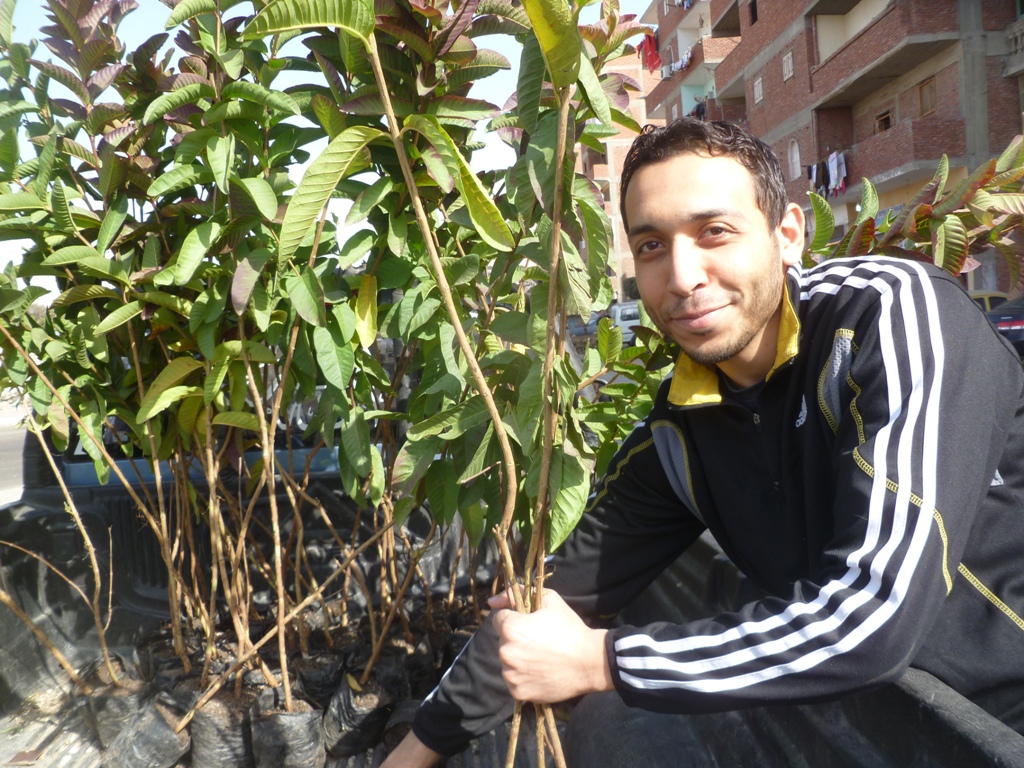
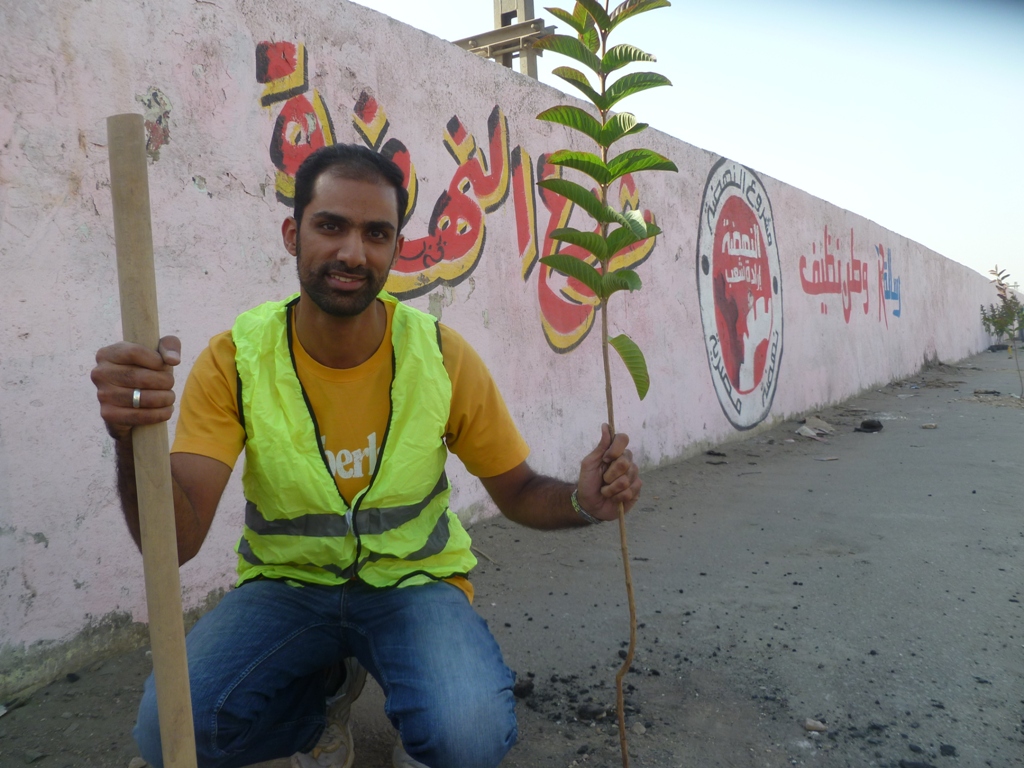
To do so, the Brotherhood is planting one million sapling trees throughout Egypt, one hundred of which are in Helwan. Kamal led teams of youth digging holes in the limited dirt of the urban landscape, boring even into the sidewalk.
Hatem Abd al-Akhir
Abd al-Akhir, meanwhile, participated in the effort to provide a million citizens with healthcare. An ophthalmologist, he offered free eye examinations to diabetic patients and at-cost treatment for any operation.
As the manager of the Helwan Eye Center, he assures normal costs for patients are 30 percent below market standard. Yet the centre still makes a small profit, illustrating a mix of business and charity, politics and social good.
‘The Muslim Brotherhood is a logistics service for advertising,’ he said describing the campaign. ‘We want to propagate values in our community which will help keep the peace.
‘When we offer low cost service we oblige others to not raise their prices above what is acceptable.’
But in a time of great social and political upheaval, it is unsurprising some are critical.
Ahmed Ezzalarab is the deputy chairman of the liberal, opposition Wafd Party. ‘They are trying to distract people by giving a different image of development, but it is too late,’ he told Lapido Media. ‘They are being exposed for their secret agenda which the people are rejecting.’
Ezzalarab does not dispute their social work, but recognizes it is necessary to oppose the Brotherhood for their poor record in power. In recent weeks train accidents and building collapses have claimed the lives of dozens of citizens.
‘Governance has never been worse in Egypt’s history,’ he said. ‘They cannot run the country administratively; everything they touch fails.’
But in describing a secret agenda, Ezzalarab appeals to conspiracy.
‘We are completely against the violence, which is working to distract the people from the peaceful nature of the opposition,’ he said. ‘It is being funded by Wahabi and Gulf money, because they are scared to see civil forces come to power.’
Ezzalarab believes the Brotherhood is panicking, fearful the army will step into the violence and unseat them from power. Perhaps he is right. Brotherhood leaders are clearly propagating the conspiracy theory.
Anas al-Qadi, Brotherhood spokesman said on the official MB website, Ikhwanweb.com: ‘This is the difference between the Muslim Brotherhood marking the memory of the revolution with greatly appreciated services, and so-called civil forces celebrating the revolution with flagrant acts of arson and violence, spreading chaos and destruction and vandalism.’
The website also accused one of the newly organized vigilante groups, Black Bloc, of being an arm of the Coptic Orthodox Church.
Any of the various accusations may be correct, but they are presented without evidence and signal that both social service and social violence are a means to an end.
Ahmed Kamal
‘If you are trying to apply Islam as you understand it, you have to reach authority by all legal and peaceful means,’ said Kamal. ‘To do this you have to show people why they must support you.’
Kamal was responding to the charge that the Brotherhood is putting good works on display, contrary to Islam.
‘We need to differentiate between being a Muslim and being part of an Islamist program which competes with other parties,’ he said.
‘As a Muslim, you can choose to tell or not tell of your good works, it depends on your intention. If you tell you can be a role model that others will follow, but God will judge you in either case.’
But for now, Egypt is the judge, and the verdict is a cliff-hanger.
Egypt’s Grand Mufti Ali Gomaa has approved a death sentence delivered in absentia for seven Coptic Egyptian expats accused of producing and acting a movie deemed insulting to Islam.
The declaration was made Tuesday by a judge at the Cairo Criminal Court.
Egypt’s State Security Court had sentenced the defendants in November to death and referred the verdict to the mufti for approval.
I hope politics did not come into this decision. The Mufti is generally known as a wise and moderate figure, who enjoys friendship with many Christian leaders. Among them is Bishop Mouneer of the Anglican Church, who has called for the criminalization of defamation of religion at the UN, but certainly not the death penalty.
The politics could come because the Mufti (as well as the Grand Sheikh of al-Azhar) are targeted figures by the emerging Islamist parties who are salivating over control of Egypt’s religious institutions. Both the Mufti and the Grand Sheikh are holdovers from the Mubarak era. The Mufti may not feel comfortable standing in the way of this decision and watching the Islamists explode. Given that all the accused are resident outside of Egypt, perhaps he feels the damage is limited.
Only the damage will come to Islam in the eyes of the West. Does Islam truly call for the death of all who insult its prophet? Yes, the film was offensive and insulting – its round and absolute condemnation is necessary.
But the Mufti’s decision sets a precedent in the new Egypt. As the new constitution calls for the religious institutions to have a greater role in determining legislation, it is a moderate figure who first authorized one of Islam’s most controversial rulings.
The eyes of the West will be offended, but the real damage to Islam may well resoundlocally.
“We ran to the crisis meeting point on the 4th floor and barricaded ourselves in,” Samak describes, “it unfolded so quickly we followed all our security measures, but no guards of hotels in Egypt are armed. We had to secure guests and colleagues.”
Meanwhile revolutionaries outside the hotel attempted to prevent the thugs from entering the building, reports Ahram Online journalist Karim Hafez who was at the scene.
“When they realised these groups were trying to loot the hotel, protesters shot fire crackers at them as they attacked the building and tried to push them away from the area but these groups were armed with birdshot bullets,” says Hafez.
The assailants also attempted to steal the ATM in front of the hotel.
Journalist Mohammed Mare, who witnessed the event, recounted on his Twitter account that four people arrived in a Lancer car with no licence plate behind the protesters and fired the shots to scare protesters away, before storming the hotel.
The attackers shot at employees and continued to destroy the building for approximately three hours before security forces arrived.
So far there have been no confirmed injuries.
“We are the frontline, I’m still a bit shaky, and the situation is still not resolved. Clashes are starting again,” Samak says, who thanked the revolutionaries that “stood by us last night,” via the hotel’s Twitter account, adding “you are awesome.”
One of my pictures from the previous post is of the entrance to this hotel. One detail I neglected to mention was the pungent effect of tear gas still in the air. I could barely keep my eyes open as I walked through the area. Strangely, this was also true at the Nile River bridge – I would have expected the open air to have dispersed it by then.
This story helps show the complications of Egypt’s situation. Moments earlier these protestors were going hard against the police. But it was the protestors, and not the police, who intervened to save the hotel. [I recall seeing another statement saying the two cooperated to fight back the thugs.]
Egypt’s opposition seems to be banking on the chaos to reverse the president’s extra-legal gains, cause damage to his political chances and reputation, or else have the army step in and reset the situation entirely. Dialogue is so necessary at this moment, but they also have so little reason to trust its fairness. It is a dilemma.
But the opposition in all likelihood does not control the street. A possible outcome is for the president to do what so many Egyptians lament Mubarak is no longer around to do: Crackdown and ensure security.
If this scenario emerges, will it revolution be completely reversed? Will there be another one party system with a handful of loyal opposition parties?
It is far too complicated to say so, and history never repeats itself exactly. But these days, most political parties and ordinary citizens are nervous, expecting the worst. Its just that they define ‘worst’ differently.




 Jayson Casper