Categories
Books

Egypt, the Army, and the Early Christian Ethic of Life

by Ron Sider
by Ron Sider

From Christianity Today, an interview with Ron Sider, who compiled every early church writing on the subject of killing:

It’s not just just-war theory versus pacifism. The book covers war, capital punishment, gladiatorial games, infanticide, abortion, and so forth. Did the early Christian writers tie those together, or did they treat them as separate ethical issues?

They definitely tied them together. A number of times different authors—like Lactantius writing at the time of the Diocletian persecution, and earlier writers—are very clear. They explicitly say we don’t kill, and that means we don’t go to gladiatorial games, we’re opposed to abortion, capital punishment is not acceptable, and we don’t kill in war.

Did the early Christians oppose capital punishment as a social institution? Or did they just say that a Christian couldn’t be an executioner or a magistrate who might give someone a death sentence?

For early church fathers, a Christian could not have a political or judicial office where he would have the authority to pronounce a judgment of capital punishment.

They clearly stated the latter. They said Christians cannot participate in capital punishment. For them, a Christian could not have a political or judicial office where he would have the authority to pronounce a judgment of capital punishment.

Similarly, in the unanimous testimony of early Christian writers, this means Christians should not join the army:

Let’s talk about the reasons early Christians abstained from bloodshed: They talked about Jesus’ command to love our enemies, about the Mosaic command not to kill, and about the prophecy of messianic peace. Is any one of those reasons foundational to the rest?

Their most frequent statement is that killing is wrong. Killing a human being is simply something that Christians don’t do, and they’ll cite the Micah passage or Jesus’ “love your enemies” to support that. But the clear statement that Christians don’t kill is the foundation.

The most frequently stated reason that Christians didn’t join the army and go to war is that they didn’t kill. But it’s also true that in Tertullian, for example, idolatry in the Roman army is a second reason for not joining the military. But it’s not true that idolatry is the primary or exclusive reason that the early Christians refused to join the military. More often they just say killing is wrong.

But here is the rub for Egypt. The Coptic Orthodox Church honors the early church fathers, and I have not interacted with this issue to know how they treat this testimony. I would imagine that as the Catholic Church in the Roman Empire eventually came close enough to the centers of power, the Copts also developed a just war doctrine. Certainly they have a number of ‘soldier saints’ among their martyrs.

But for modern day Copts, the fact of participation in the army is often touted by political Islamists as the chief justification why the Islamic jizia tax is no longer required.

Sharia law required ‘People of the Book’ to submit to their Muslim rulers and exempted them from participation in the military in exchange for this tax. Within this system they were given the promise of domestic protection and freedom of worship within the status of second-class citizenship.

But those wars were for the benefit of the Muslim caliphate. The modern state of Egypt has a national army for defense of the borders. Two hundred years ago jizia was abolished and Copts served alongside their Muslim neighbors in the army.

But if per Sider’s testimony that proper Biblical understanding, as evidenced by the early church fathers, forbids a Christian from killing, this ‘arrangement’ is undone. If Copts sense they should abstain from war, does this open the door for the radical Islamist argument of restored jizia?

No Copt that I know of argues for conscientious objection, which does not exist in Egypt anyway, as best I know. Of course, like most Egyptians, like most humans, Copts are very reticent to kill. But they do not forbid it in the context of national duty.

But for any Christian pacifists outside of Egypt, which would you choose? You are only a pacifist out of conviction, of course, so I suspect it is unlikely you would balk at the imposition of a special tax for your refusal to fight. But would you accept the ‘second-class citizen’ part? Would you accept to be ruled by sharia law?

Even in the early days Christians faced the pragmatic question on pacifism. Here is the less than pragmatic answer:

It’s significant that Origen in the middle of the third century, 248–250, responds to the pagan critic Celsus. Celsus said, If everybody was like you Christians, the Roman Empire would collapse. Origen responded, if everybody was like us, the Roman Empire would be safe, and we wouldn’t need to kill people. So in the middle of the third century, the most prominent Christian author writing at the time responded in a way that only makes sense if Christians by and large didn’t join the military.

But the idea ‘if everyone was like us’ is woefully unrealistic. It is as if they say, please, join our movement and usher in the fall of our Empire.

Would an imagined pacifist Copt similarly argue to usher in the fall of our citizenship?

I am curious to know how church leaders today would interact with this issue.

Categories
Prayers

Friday Prayers for Egypt: Delaying Constitutional Confict

Flag Cross Quran

God,

It has been three months since Morsi’s ouster, and the first step in the announced transitional roadmap is still underway. It is, in many ways, the linchpin. The constitution is to be amended and presented to the people in referendum.

When it comes, the Brotherhood will have to make a choice: Vote no or boycott. But the primary Salafi party has made their choice to participate, while deferring the choice of consequence: Yes or no.

Salafis possess nearly inconsequential power in the mechanics of the constitution: They are one vote out of fifty. But they possess great legitimizing power. Without them on board the removal of Morsi is much more easily portrayed as an attack on Islam, or at the least, Islamism.

In exchange they want the religious identity and sharia provisions of the old constitution preserved. As the committee of fifty does its work to revise, they tackle the easier questions first. These are left for later.

God, the Salafi party has been praised for having great political acumen; give them also great wisdom, for they are not necessarily the same.

As the Islam and sharia principles are debated one-by-one, help them to know where to yield and where to stand firm. Where, God, is the proper point of consensus?

And as they go back to their supporters, give them the skill to communicate their choices. Having earlier been maximalist in their demands under Morsi, can they now justify an accepted minimalism? Will it be a valuable political lesson for newly politicized religious conservatives? Or will their earlier rhetoric eat them alive?

Or, might you use these men to lead their supporters deeper into the multi-particular national good?

But God, what if the national good is non-Salafi, as many of the fifty will argue? Give them wisdom if they don’t get enough of their way, or anything at all.

Should they accept? Should they vote no? Should they demonstrate? Should they mount a new revolution?

So give wisdom also to the committee at large. What of Salafi demands is in the national good? To be certain this good involves diligent discussion of a significantly popular viewpoint.

Perhaps there is wisdom, God, in handling easier articles first. There is still time to complete their task. But help the committee to avoid deadline deals from political expediency.

Rather, let this discussion find space now in the national debate: How should the political claims of Islam, as interpreted by some, be incorporated into the political system of a nation, as experienced by all? In their entirety, in continual negotiation, or not at all?

Your answer, God, determines how Egyptians should both pray and politic. Pull as many to your side as possible, in sincere conviction and purity of heart.

And for those who remain in other opinions, honor them also. May they never willfully fight against you, and may they never be fought against as if on your behalf. Knit these together into one nation, where you are present in the messy workings of men, in all their insincerity and impurity.

And in this, God, give them a wise and worthy constitution. Do not delay the conflict, but resolve it in the end, with embraces all around.

Amen.

Categories
Excerpts

The Shape of ‘Terrorism’ Outside Cairo

Following on the heels of Morsi’s trial, it is difficult to see how the Muslim Brotherhood is called a terrorist organization from within the urban settings of Cairo. But this article from the Daily Beast describes the embattled position of police elsewhere:

“We never imagined that the violence could reach this point,” said Qadry Said Refay as he lay in the police hospital. The 37-year-old cop based in Fayoum, about 60 miles south of Cairo, had multiple head wounds, a broken right arm, and a deep, guttural cough.

On the morning of August 14, the same day the Brotherhood demonstrators were cleared away by Al-Sisi’s forces in Cairo, Refay reported for duty as usual in the ancient farming town near Egypt’s biggest oasis. The police station got a call: Brotherhood sympathizers were massing for an attack. Refay thinks there were thousands of them. Probably the numbers were smaller than that. But the four officers and 20 cops soon found themselves under attack by men with guns and Molotov cocktails closing in on all four sides of their little compound. After several hours the mob started coming over the walls and breached one of the gates.

I was sure I would lose my life,” said Refay.  In the middle of the fray he took off his uniform shirt, untucked his t-shirt, and put his gun in the back of his belt. He tried for a few seconds to reason with the attackers, but they swarmed over him. They took his pistol. They slashed his face with knives. “The last thing I can remember,” he said, “is one of them reaching to the ground, picking up a stone, and smashing it on my head.”

To what degree is the Brotherhood responsible for such violence? There is a culture of revenge in Upper Egypt that is far more intrinsically grassroots than any social support for political Islam.

At the same time, when security forces recaptured some of the villages seized by local Islamists, Brotherhood statements portrayed them as peaceful villagers under police attack. Surely it was bloody on all sides, and revenge from both cannot be discounted. But the Brotherhood publicly stood with those who raided police stations and committed the atrocities described above.

The burned-out police station, its walls pocked with bullet holes, was covered with graffiti—“This is the price for injustice. God will have victory,” and “Sisi, you are next.”

But one Brotherhood leader paints the picture as one of simple revenge, and his organization as a restraining force:

“Families in Upper Egypt are not accepting condolences,” said El Magd. “So they will take vengeance. So I think killing will start in Upper Egypt. And I don’t think the [Brotherhood] movement can control this. In Upper Egypt, if families don’t accept condolences for their dead, then they set their minds to vengeance.”

El Magd had the practice of tha’r in mind. “This cannot be controlled. Nobody can control Upper Egypt vengeance. And now everybody has guns. They have guns in Kirdasah.  I am not saying that it will be civil war. But at least Upper Egypt will go back to the ‘70s or ‘80s, where people were shooting at police officers just because they were police officers.”

Upper Egypt is hard to understand. What is the difference between a blood feud and terrorism? Does the distinction even matter?

Truth, justice, and reconciliation are urgently needed in Egypt. Will Morsi’s trial be the beginning of this process, or just one more obfuscation to keep it from happening?

Categories
Excerpts

Egypt for Expats… Ugh?

Expat Map

We like it here, but many people don’t, it seems. From the Washington Post, reporting on a survey by HSBC bank:

The worst of these 34 countries to be an expat is Egypt, which has seen xenophobia rise considerably since this summer’s military coup and wave of populist nationalism.

East Asian nations rank highest, and among the lowest are Western European. The Middle East doesn’t fare well in general:

Middle Eastern countries tend be worse places for expats, owing to legislation that makes it tougher for foreigners to own property and to formal and informal social restrictions that can cut back on quality of life. The exceptions are Bahrain and Qatar, two very wealthy and very small Gulf states whose governments work to attract the wealthy expats they see as crucial to building businesses there. It should go without saying that HSBC’s study does not consider “guest workers” in its measurements. Gulf states, particularly Qatar, have notorious reputations for mistreating migrant laborers from South and Southeast Asia, who work in difficult conditions and with few protections.

Egyptians often ask us: We all want to leave, why did you come here? Let’s just say we’re suckers for xenophobia and populist nationalism, and leave it at that.

Why does anyone live anywhere? God ‘determined the times set for them and the exact places where they should live.’ What is more important is how to live wherever you are. For our thoughts on that matter, please read the opening post to our blog, also titled ‘A Sense of Belonging‘, and this post also considering our expat status, ‘The Sole of Belonging‘.

What does HSBC know anyway? Egypt is great.

Categories
Excerpts

Kerry’s Visit, as Reported in Cairo and Washington

First from Ahram Online, in very negative tones:

US Secretary of State John Kerry met with top Egypt officials to convey Washington’s “deep concern” about the transitional period and to offer the US’s goodwill should developments move “on the right track,” according to Western diplomats.

But on CNN, the focus brushes over any difficulties at all:

U.S. ties with Egypt go deeper than aid, America’s top diplomat said Sunday.

“Let me make it clear here today: President Obama and the American people support the people of Egypt,” U.S. Secretary of State John Kerry said. “We believe this is a vital relationship.”

Both articles report the general thrust of the speech, but their opening leads are indicative. The US wants to avoid a crisis while Egypt wants to project one.

I cannot speak very well about the messaging coming from Washington, but Egypt is currently filled with belief that the US backed the Muslim Brotherhood and is even now working behind the scenes against the popularly backed military move to depose President Morsi.

After all, for many here, the timing of Kerry’s visit is auspicious. He arrives one day before Morsi’s trial is to begin.

Categories
Prayers

Friday Prayers for Egypt: Trial, Satire

Flag Cross Quran

God,

Egypt’s tests continue. Popular talk show satirist Bassem Youssef returned to the air after a long absence and subsequently lost a lot of his popularity. Praised and hated for poking fun at President Morsi and fellow Islamists, he turned his attention to the adoration mania surrounding military leader General Sisi.

Not only did many complain, lawsuits are threatened.

Meanwhile, this week a more critical lawsuit begins. Deposed President Morsi stands trial on charges of espionage and inciting violence. Widespread protests are expected, as unlike the trial of Mubarak, Morsi maintains a significant social base. How the trial is handled may have much to say about the reality of the democratic transition.

God, help Egypt to pass these tests.

Youssef is pioneering, bringing the celebrated Egyptian humor to public expression, challenging the ingrained taboos on insulting authority. His popularity and international profile, perhaps, has kept him safe so far. Give him wisdom, God. Does he drag Egypt forward, or backwards?

He exposes hypocrisy and doublespeak, God, and this is deeply needed in Egypt, as everywhere. But he also undermines respect for authority, and this is deeply dangerous in Egypt, as everywhere.

But what if the authority does not deserve respect, having engaged in hypocrisy and doublespeak? This question, perhaps, is on trial with the president.

Validate or convict him, God, according to the truth. Just as important, may this truth be transparent. Give courage to the judge to fear you alone. May he stand strong, should pressure come from above or below. May he rule rightly.

But for those below, hold fast the discipline of their protest. Keep Morsi’s supporters peaceful; protect them from any external breach of the peace.

God, guide Egypt. Refine her culture, refine her politics, refine her dispensing of justice. In all her trials may she prove righteous.

Protect her from being an object of satire.

Amen.

Categories
Personal

Changes in the Neighborhood

Maadi Street

We spent a good part of this past summer in the United States, far away from the explosive political situation. As we prepared to return, nearly everyone asked a similar question: Is it safe?

It was a fair question. Hundreds of supporters of the deposed president were killed while security dispersed their sit-in. Dozens of churches across the country were attacked, with many burned. It was a volatile situation.

But it was also a geographically limited situation. As we inquired about our own neighborhood of Maadi, we were constantly assured that things were safe and that violence was taking place in known locations.

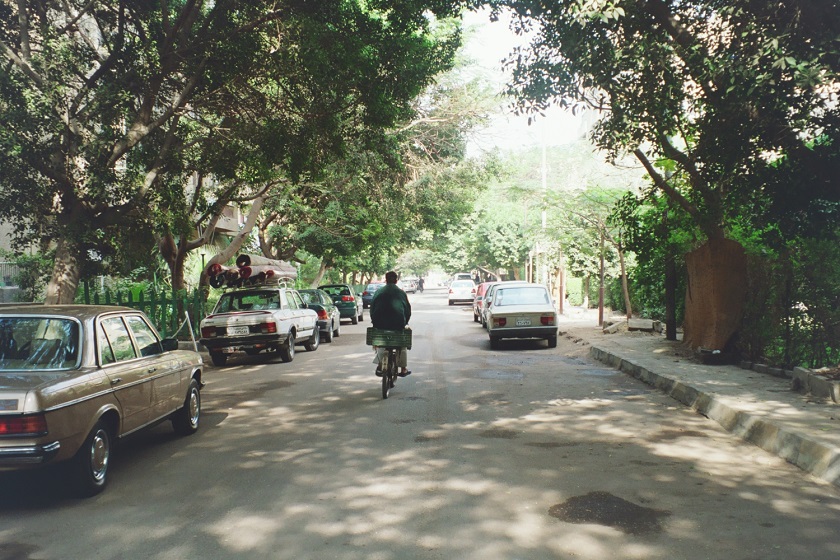
After several weeks back, we made this video showing local slices of life. There have been changes, and we note them. But we also hope you get the idea that life moves as normal. We’re glad also you get a small window into this our normal life, and can rest assured we are doing well.

Categories
Personal

Surveying Foreign Christian Residents in Egypt on the Interpretation of Political Events

St. John's Church Maadi

In Egypt’s current political struggle both sides are using the media to highlight their interpretation of events. State media is accused of turning the nation against the democratically elected president and his backers in the Muslim Brotherhood. Meanwhile, anti-Islamists target Western media in particular of having a bias toward the Brotherhood, against the military, and neglect the popular role in Morsi’s overthrow.

This survey was designed to test one overlapping segment within this struggle to establish a media narrative: foreign Christian residents.

Two assumptions were made of this community. First, they would be sympathetic to local Coptic opinion, which is strongly anti-Islamist. Second, they would be consumers of Western media and generally trust their journalistic professionalism.

Thirty-three individuals were surveyed, including both leaders and laity of the Catholic and Protestant foreign communities of Egypt. They were asked fifteen questions concerning recent political events beginning with the election of Mohamed Morsi as president. Each question was provided various options, reflecting the opinions and conspiracies of both camps.

Participants were allowed to choose more than one answer, if multiple interpretations were possible. They were asked only to choose according to their leanings and perceptions, not according to an elusive certainty or proof. Not all participants answered each question. In the results which follow, this explains why some percentages are provided with the qualifier ‘among those responding’.

Here are the questions as they were posed to participants:

1.      Did Mohamed Morsi legitimately win the presidential election?
2.      Were Egypt’s political problems caused by:
The desire of the Muslim Brotherhood to dominate
The deliberate non-cooperation of opposition parties
Normal competition after a revolution
3.      Were Egypt’s economic problems caused by:
Morsi’s mismanagement
State sabotage of gas and supplies
Continuing deterioration since the revolution
4.      Did Western powers support Morsi because:
He was the legitimately elected president
They desired the Muslim Brotherhood to replace Mubarak
They desired Islamist rule to weaken Egypt
They desired to discredit Islamism by letting it rule temporarily
5.      Did Morsi and the Brotherhood desire:
To turn Egypt into an Islamic state
To recreate the Mubarak regime
To shepherd in a civil democracy
6.      Was the Rebellion (tamarrud) Campaign:
A grass-roots movement expressing popular rejection
Aided by the military/state/businessmen
A conspiracy to end the Morsi presidency early
7.      Should the military have:
Intervened to depose Morsi as actually happened
Waited longer to see how things would develop
Not intervened at all
8.      Was the military action a coup d’etat?
9.      Was the removal of Morsi:
Mostly positive for Egypt
Mostly negative for Egypt
Both positive and negative in different ways
Necessary for Egypt
10. Should the Rabaa al-Adawiya protest site:
Have been dispersed
Have been relocated to another area
Have been left to protest indefinitely
11. Why did so many people die:
Because of deliberate excess force used by the security services
Because of poor training in crowd control
Because of pro-Morsi armed resistance
12. Were the widespread attacks on Christians and their churches:
Orchestrated by the Muslim Brotherhood
A spontaneous reaction by pro-Morsi supporters
The action of criminals exploiting the situation
A conspiracy by the state to tarnish the Islamists
13. Should the Muslim Brotherhood:
Be labeled as a terrorist organization, banned, and prosecuted
Be invited into national reconciliation
Be allowed to participate in the new democratic roadmap
Be forbidden from politics but allowed a social role
14. Does the military desire:
To rule directly (perhaps through a retired general)
To have influence and guardianship from behind the scenes
To maintain its economic privileges
To secure a true and open democratic transition
To destroy the Muslim Brotherhood
To prevent Islamist rule in general
15. Will the coming months/years in Egypt witness:
The development of an emerging democracy
The return of an autocratic state
New economic prosperity
Continued economic deterioration
A reversal back to Islamist rule (democratic or otherwise)
Low-level, but violent Islamic insurgency
War (either civil or regional)


Each possibility was given a ‘yes’ or ‘no’ choice to indicate the perception of the participant.

Here are the key findings:

Did Mohamed Morsi legitimately win the presidential election?

  • 52% said yes, 48% said no, roughly mirroring his percentage of winning

Egypt’s political problems were caused by:

  • 97% of all surveyed believed it was due to the MB’s desire to dominate
  • 45% also blamed deliberate non-cooperation on the part of the opposition
  • 36% attributed it to normal competition after a revolution

Egypt’s economic problems were caused by:

  • 82% blamed Morsi’s mismanagement
  • 42% also blamed a state policy of sabotage
  • 82% believed the poor economy following the revolution played a role

Western powers supported Morsi because:

  • 73% believed it was because they recognized him as the legitimately elected leader
  • 24% believed they desired the MB to continue Mubarak’s policies, with 9% support for other conspiracy theories

The political desire of the Muslim Brotherhood was:

  • 100% to turn Egypt into an Islamic state
  • 0% to turn Egypt into a civil democracy

The Tamarud Campaign was:

  • 82% believed it to be a grass roots campaign
  • But 67% believed it also to be sponsored by the army, state, or businessmen
  • Even so, respondents divided evenly if it was a conspiracy to remove Morsi from power, though only 30% of everyone surveyed indicated this

On military intervention to depose Morsi:

  • 70% agree with their decision to do so, as opposed to waiting longer or doing nothing
  • But 47% call it a coup anyway, while 53% believe it does not deserve that label
  • 93% of those responding believe this action was mostly positive for Egypt
  • 75% find that it was also somewhat negative
  • 85% believed it was necessary

On dispersing the pro-Morsi sit-in:

  • 79% agreed with the decision to do so
  • 88% believe that many people died due to the MB’s decision to resist with arms
  • 45% also believed the security forces deliberately used excess force
  • 48% believed poor training on the part of the security forces contributed

On the subsequent attacks on churches:

  • 76% believe these were orchestrated by the Muslim Brotherhood
  • 58% believe it was a spontaneous action by Morsi supporters
  • 48% also thought criminal elements were involved
  • 9% believe it was at least also a state conspiracy to make Islamists look bad

The Muslim Brotherhood should be:

  • 42% believed it should be labeled a terrorist organization and banned
  • Only 27% opposed this designation
  • Responders were roughly divided between inviting them to national reconciliation and allowing them political participation in the new elections, with slightly more positive response

The military desires:

  • Of those responding, 59% did not believe the military wants to rule directly
  • But 73% believe they want to maintain significant influence behind the scenes, and 52% to maintain their economic interests (0% opposition to this idea)
  • Of responders, 60% believe the military wants to conduct an open democratic transition, but 40% do not
  • 48% believe they want to destroy the Muslim Brotherhood, and 61% believe they want to prevent Islamist rule in general

The future holds:

  • 48% of all and 73% of responders are confident a real democracy will begin to emerge
  • At the same time, of those responding, half fear the return of another autocratic system
  • 55% believe the economy will continue to deteriorate, with only 27% predicting new prosperity
  • Only 3% predict a return to Islamist rule, but 79% predict a continued low-level Islamist insurgency
  • 9% predict war in Egypt’s near-term future

In quick summary, therefore, this sample of foreign Christian residents of Egypt indicates the community largely accepts the anti-Islamist narrative concerning the Muslim Brotherhood, while at the same time displaying significant, but not universal, distrust about the role and intentions of the military and state.

Determining whether their perceptions are correct or incorrect was not the goal of this survey. Rather, results indicate the following possibilities:

  • Foreign Christian residents are disproportionately influenced by local anti-Islamist sentiment or their own anti-Islamist inclinations
  • Western media has not exhibited sufficient pro-Islamist bias to sway their interpretation of events, but has contributed to a distrust of local actors
  • As residents, these foreign Christians are well placed to interpret local events.

Other interpretations are also possible, including combinations of these three.

Western media is understood to be professional in its coverage, though subject to the ability to find suitable local spokesmen to convey perspectives. Most actors in Egypt are polarized and subject to their own biases.

Egyptian state media, however professional, is understood to be the voice of the government, and independent media has been drawn into the local dispute. Pro-Islamist media has largely been shut down.

In wading between the two, one further assumption is necessary concerning foreign Christian residents: They will represent the truth as they perceive it. The value of this survey consists therein.

Categories
Prayers

Friday Prayers for Egypt: Wedding Terror

Flag Cross Quran

God,

Of the troubles that Copts face, this may portend the worst. A wedding celebration in a working-class Cairo neighborhood church suffered a drive-by shooting. Five died, including two children and the mother of the groom.

Church buildings have been attacked. Land disputes may be disguised criminal aggression. But rarely has anyone shot to kill.

God, may this attack be only an exception. Against Copts, and against anyone, do not let political frustrations boil over into random acts of pointed violence.

Frustrations are many. Islamist groups condemned the attack, blaming security instead for failing to secure the church. But as frustrated as these groups are with the security clampdown against them, their opponents are frustrated by Islamist obstinacy in the face of widespread rejection.

And within this mix is continued anti-Coptic sentiment.

God, purify the political scene. For the sake of so much more, but including this, bring Egypt a new prosperity that restores both hope and civil participation. Sort out the right and the wrong between Islamists and the state, but keep the people from descending into hatred.

For surely it is hatred which drove someone to this crime.

Help the Copts to forgive, God. Transform their grief and anger into something redemptive. Bind together all in the aggrieved neighborhood, and produce a subsequent unity that will amaze the nation.

But also bring justice. Do it with transparency so that all my see the sin and recoil from it. Otherwise accusations may simply multiply the political frustrations contributing to this downward spiral.

For if such acts continue the nation may halt. Keep terror far from the people. Keep the peace in Egypt, God.

Keep every bride from looking over her shoulder.

Amen.

Categories
Excerpts

An Alternate History for Pope Tawadros

From Salama Moussa, writing with deep respect for the Coptic pope and the impossible leadership position thrust upon him during divisive political times. Still, he wonders if things could have been different:

Three months after the July 3 events it is still impossible to criticize Pope Tawadros II presence on the stage with General Sisi and Sheikh Al Azhar. It is, however, possible to think of an alternative history. In that history the Pope would have indicated his support privately but refrained from the public display to lessen his political burden, one that he insisted he did not want in the first place.

He could have also indicated privately that while disapproving of the ideology of the Muslim Brotherhood, and not wishing them an exclusive role in running Egypt, he could not sanction the killing of either the innocent or the guilty. In doing so he would have assumed the role of a father to the Muslim Brothers, of whose behavior he surely disapproves, but whom he must love as children of God. It is a tough task, fit only for a Patriarch.

Would such a stance have lessened the attacks against the Copts?  Probably not. Would it have made the state serve them less? Possibly. The current feeble efforts can still be weaker. It would have placed the Pope among the ranks of the most exceptional men of the new century, and possibly given a template for reconciliation to the hardened hearts of the Egyptian political class. There is no doubt of the risk of such actions toward the Copts of Egypt, but maybe it is time for the Coptic Church to aim wider than just Egypt, and higher than just its needs.

It would also have been Christian in the literal sense; the sense that Christ’s ministry aimed for the fallen and deluded.

Moussa is cautious about issuing his opinions from afar, not being in Egypt. But perhaps this vision can still be considered, and not just viewed as a missed opportunity.

Categories
Christianity Today Middle East Published Articles

A Tale of Two Weddings

Burned Church Wedding

From my new article at Christianity Today, published October 23, 2013, on why protesting a drive-by shooting is complicated for Egypt’s Christians:

The wedding party stood outside the church, eagerly awaiting the ceremonious arrival of the bride. Instead, drive-by shooters killed four, including two children and the groom’s mother, and injured 18.

Beyond its poignancy, the attack in Cairo’s industrial neighborhood of Warraq was significant for being one of the first to target Egypt’s Christians specifically, versus the now-common attacks on their church buildings.

“Since the revolution, this is the first instance Coptic people were targeted randomly in a church, with weapons,” said Mina Magdy, general coordinator for the Maspero Youth Union, a mostly Coptic revolutionary group formed in response to church burnings in 2011 after the fall of President Hosni Mubarak.

Please click here to read the rest of the article at Christianity Today, which describes the pulling back of protests so as not to be associated with anti-‘coup’ sentiment. There is also a video of the second wedding, held in a burnt-out church in Upper Egypt, which you can watch here (4:14 mark).

Categories
Current Events

Egyptian Writer May Face Jail for Defaming Religion

From Ahram Online, telling a story that is not unusual:

Saber says those who filed the lawsuit took his words out of context, adding that he did not defame religion in his short stories.

“In my stories, the characters are wondering where God is in the face of all the grievances and evils that they face. It’s like they’re asking him to interfere; this is not in contempt of religion, it is merely posing a question,” Saber explained.

Here is an angle, though, what while also not unusual, is less known by many:

According to a statement made by a coalition of Egyptian right human rights organisations, the prosecutors undertaking the investigation consulted the church in Beni Suef as well as Al-Azhar to seek out their opinion as to whether the accusations were correct.

The church told the prosecution that the content of Saber’s literary work contradicted divine religions, ridiculed the divine, and invented stories that stray from noble and sophisticated literature.

Al-Azhar affirmed the church’s stance, stating that the work destroys intellectual values and tears apart the fabric of Egyptian society.

The church in Egypt is a very conservative institution that is not shy to seek the power of the state as a defense against encroachment on religious values. I do not know anything about the content of the book, if it targets Islam, Christianity, or religion in general. The author’s name also does not infer his religious background.

But the church would do well to review its own literature. Habbakuk the prophet does little but rail against God’s apparent inaction in the face of injustice:

How long, Lord, must I call for help,
but you do not listen?
Or cry out to you, “Violence!”
but you do not save?
Why do you make me look at injustice?
Why do you tolerate wrongdoing?
Destruction and violence are before me;
there is strife, and conflict abounds.
Therefore the law is paralyzed,
and justice never prevails.
The wicked hem in the righteous,
so that justice is perverted.

And his answer is simply to trust God, even when he does not ‘deliver’:

Though the fig tree does not bud
and there are no grapes on the vines,
though the olive crop fails
and the fields produce no food,
though there are no sheep in the pen
and no cattle in the stalls,
yet I will rejoice in the Lord,
I will be joyful in God my Savior.

It is unfortunate when religious leaders ‘protect’ their flock from the very same doubts and questions that fill their scriptures. But this, also, is not an unusual story.

Categories
Prayers

Friday Prayers for Egypt: Eid Disappointment, and Disappointment?

Flag Cross Quran

God,

The Eid holiday should be one of rejoicing. Abraham’s dutiful obedience in sacrificing his son is replaced with elation as a substitute is given. Muslim families slaughter a sheep in celebration, distributing a third to the poor, a third to neighbors and relations, and enjoying a feast with the rest.

But this Eid opened with severe disappointment, if ultimately trivial compared to the state of the nation. There is fear it may close with disappointment as well, though far from trivial for the future of the nation.

Egypt has not participated in the World Cup since 1990, despite unparalleled success in the African Cup. This year all that stood in their way was a home-and-home series with Ghana. On the first day of the Eid, away, the Pharaohs lost 6-1. Their hopes are all but shattered.

The final days of the Eid brought a significant statement. A leader in al-Gama’a al-Islamiya and a staunch supporter of Morsi declared a political solution to Egypt’s divisions would soon emerge after the holiday. Negotiations were ongoing between the Muslim Brotherhood and the army, he said, with both realizing they cannot defeat the other. A compromise could be in the works.

God, perhaps this is the sensibility and breakthrough Egypt needs. Perhaps not. It is this latter thought that will have millions of Egyptians disappointed should it come to pass.

Non-Islamists have rejoiced, God. The nation is finally rid of the poisonous Brotherhood.

Islamists have fumed, God. The nation was usurped by the murderous army.

So if instead they cut a deal, what will become of the partisans who rallied on both sides? Can they accept their fervor was engineered and used as a negotiating tactic?

God, in whatever side is right, wherever there is right, bring transparency and justice. At the same time, bring dialogue and consensus. Holding together all these principles, sort out the details in fairness and respect.

But heal the souls of Egyptians torn asunder in this dispute. Honor their zeal, but assuage their anger. Reveal whatever is ugly in their pursuit of Egypt’s best.

Egypt could have benefitted from World Cup joy, God, but your providence did not see fit to yield it. Maybe the panacea would only mask the hurt the nation still suffers. Give them a real unity soon.

Perhaps the Eid was this beginning. Egyptians prayed together in squares and mosques throughout the country. Few tensions were reported. For a moment all was quiet.

May it last, God. Pursue all criminals. But may the good people of Egypt find ways to transcend their differences in a spirit of peace and humility.

Many Egyptians have been willing to sacrifice all they have, even their lives, for the triumph of a particular vision. Give them a fitting substitute, God. Give them all reason to rejoice.

Amen.

Categories
Personal

Humble Wrestling: The Only Solution for Islamists and Christians?

I believe events like this conference in Jordan, excerpted below, are absolutely necessary, even if they don’t really go anywhere. But agreement can never be achieved unless they go at all. Here, from al-Monitor, is an example illustrating absolutely different worldviews:

So an obvious question was posed to the Islamists: Do you accept, alongside your Islamic laws and alongside the personal status laws for other communities, that in your countries there is also one civil personal status law that is optional? In other words, do you accept that a person is given the choice to either follow the laws of his sect or leave his sect and resort to the civil law under the confines and protection of the state?

Faced with this question, the Islamists did not hesitate to assert their absolute refusal of the proposal: a civil law, even if optional, is forbidden — a person may not leave his religion. By “person” they mean a “Muslim,” because current laws allow non-Muslims to convert to Islam. Sometimes they even encourage it as a means to either escape harassment or obtain a government job reserved for Muslims, in addition to dozens of other reasons.

In lieu of agreement, the article states attendees suffered ‘a vicious cycle of pleasantries’. Such a description characterizes much inter-religious dialogue, and is useful in its own right. Pleasantries can lead to friendship.

But what is necessary, especially in Egypt, is for Christians and Islamists to wrestle over the future of their nation. Christians may not be able to force their way, but if Islamists were to seek their blessing, and do all that is necessary to get it, they just might succeed.

The Islamists did not hesitate to confirm they have the right to reach power as they see it and practice it. They kept repeating the following mantra: “We will only resort to democracy that emanates from the ballot box.” Many tried to explain to them that democracy is not just the ballot box, but the Islamists did not pay them much attention. The Islamists’ main concern was to assert their rejection of what happened in Egypt and confront the rule of the “coupists,” as they call Gen. Abdel Fattah al-Sisi’s rule, against the legitimate authorities. Regarding the concerns of their fellow Christian citizens, it seemed to a large extent to not be part of their concerns today or tomorrow.

Unfortunately, this has largely been Egypt’s experience.

It is hard for anyone to be humble. Many Islamists might find it even more difficult to seek this Christian blessing, as they see themselves as the possessors of the completed and perfected faith, and furthermore, they are numerically superior. How arrogant, they might think, of Christians not to yield. Don’t we give them protection under sharia law?

Ah, but this means little to them:

One last example that illustrates the dialogue’s difficulties was the discussion about personal status laws in countries dominated by Islamists. The Islamists usually try to show that they are open to other groups by supporting, as a rule, that other sects are given their own personal status laws — whereby every sect is given its own laws governing marriage, divorce, inheritance, adoption, transfer of ownership and other family matters. But at the same time, the Islamists insist that Islamic law is a “major” or a “principal” source of legislation of the state. Discussion by Christian participants at the conference showed that this rule is not sufficient, fair or balanced. In fact, it often conceals a gradual process to subdue non-Muslim citizens in those countries by degrading the minorities’ demographic and geographic presence, Islamicizing society and eliminating pluralism.

Islamists either smile slyly at this complaint, choose to ignore it, or else they cannot even comprehend it – confident in their understanding of God’s will in sharia law as best both for them and for Christians. True humility is harder for the one who believes that he already humbly and generously gives to his ‘lesser’. They have a point, but humility does not prove points. It loves and embraces.

So what should humility look like for the Christians? No one must ever abandon principles and convictions. Humility is not a game of power and pressure. Rather, it must come in an acknowledgment that Islamism is a strong societal impulse, and those who possess it are their fellow citizens.

Here is where it is easy, and necessary, for me to duck out of the discussion. If both sides came humbly, what would they decide? Here, I have no say. Even in asking both sides to come to the table I have nearly gone to far. Why should they yield even that initial bargaining position, when sides are viewed in mutual distrust?

I don’t know, and I can’t convince them. All I can do is trust that it is ‘right’. All I can hope for is that God would honor it, and dishonor all who seek first their particular benefit.

After all, the status quo is not working. Christians are often ignored or used as pawns, and Islamists have failed to successfully establish their project anywhere there is religious diversity.

It is not dialogue that is necessary, though it is helpful. It is wrestling. It is the sort that, like Jacob with the angel, would not let go until he secures a blessing. It is the sort that engages in respect and will not cease until it is mutual.

I don’t know, maybe that is not humility at all. But humility might be able to avoid Jacob’s fate. Though he obtained his blessing, he lived the rest of his life with a dislocated hip.

Christians and Islamists have dislocated far more. Perhaps it cannot be otherwise. Perhaps their ideas are completely incompatible.

Fair enough. Ideas cannot be humble, they can only seek their own. But people are more flexible. People can wrestle.

People can bless. It is time Christians and Islamists begin this strategy with one another, even if unilaterally.

Categories
Personal

An Unfortunate Song with a Catchy Tune

Ali al-Haggar
Ali al-Haggar

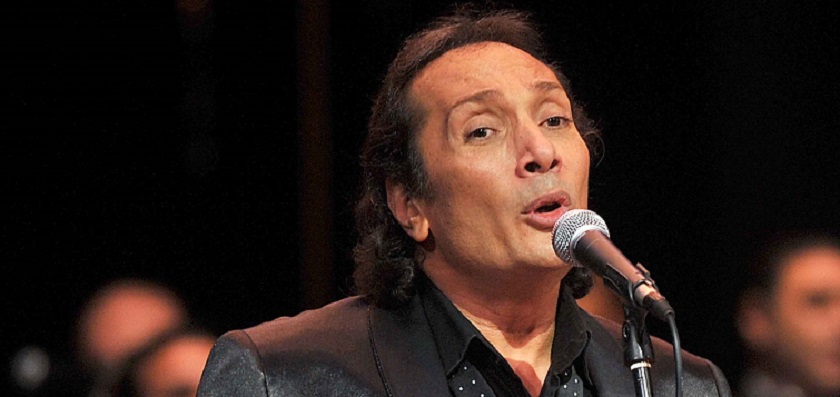
This popular Egyptian song by Ali al-Haggar is titled ‘We are a People’. It was created around the time of the military action to remove President Morsi from power, showing scenes from the protests against him.

Fair enough, but the lyrics do not stop at the title. The refrain continues ‘… and you are a people’.

It is a very thinly veiled contrast of the Egyptian people with Islamists, and in particular the Muslim Brotherhood.

This could possibly, maybe, be fair enough. The Muslim Brotherhood is a transnational organization that aims for the unity of the Muslim peoples. Their opponents accuse them of using Egypt as a launching pad for a new caliphate, rather than being loyal to Egypt as a nation-state.

As such, they are a separate people, or so the song suggests.

This is very dangerous and divisive sentiment. Some may say these are dangerous and divisive times. It is good, they say, the Brotherhood has been removed from power before it is too late.

Perhaps. But the song continues, ‘Despite there being only one God, we have a God, and you have a God.’

One Salafi friend, profiled here, complained bitterly about this line before I was even aware of the song.

Islamists are often accused of being ‘takfiris’ – those who call anyone who does not agree with them an infidel. This song does the same in reverse.

‘Take your fatwas and go far away from our land,’ it sings. Early after the revolution some Salafis told Christians and liberals they could leave Egypt and go to Europe or America if they didn’t like the results of elections.

‘We have ibn Sina and ibn Rushd [two famous Arab philosophers], you have bin Laden [you know who he is],’ it also declared. Since dispersing the pro-Morsi sit-in the media had declared the crackdown on the Brotherhood as a ‘War against Terrorism.’

And perhaps it is. Few things are yet clear, but the dangerous and divisive lyrics of this song are one of them. Whatever criminal conspiracy the Brotherhood has possibly engaged in, there are hundreds of thousands of ordinary Egyptians who are partial, at least, to the slogans and promise of Islamism.

These deserve better than this song offers them.

But it is quite catchy. Propaganda often is.

Categories
Atlantic Council Middle East Published Articles

Another Coup, A Salafi Hope

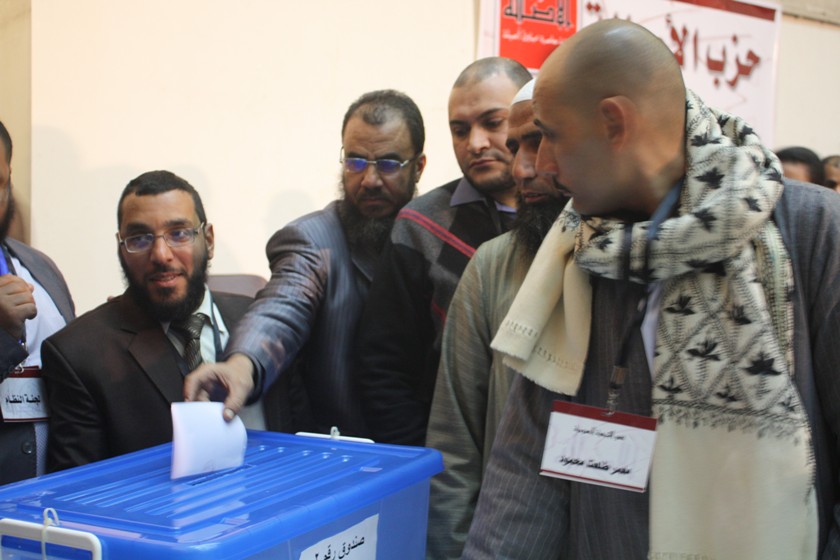
Hani Fawzi casting his ballot in Asala Party internal elections (photo: Clara Pak)

From my recent article in Egypt Source:

In order to reverse a coup d’état, Egypt needs a coup d’état. This, in brief, is the solution to Egypt’s crisis offered by Hani Fawzi, general secretary of the Cairo-based Salafi Asala Party. It must be prompted, however, by massive protests. No longer simply the domain of the Muslim Brotherhood and Salafis, the anti-coup movement is attracting both professionals and Christians – or so he believes.

Rather, this is what he prays for. A few days prior to the violent dispersal of the pro-Morsi sit-in at Raba’a al-Adaweya, Fawzi suffered a massive heart attack while sleeping in the near-by offices of the Asala Party in Nasr City. Found and hospitalized the next morning, unlike some of his colleagues he avoided the violence and mass arrests, but in his recovery has been reduced mostly to seeking divine intercession.

This, according to Fawzi, can come only through the army, as they are the only ones with the power to bring down Abdel Fattah al-Sisi, the Minister of Defense, and Mohamed Ibrahim, the Minister of the Interior. There have been indications, he hears, that not all generals have been pleased with Sisi’s leadership. The rumor mill has churned with such stories; a bearded taxi driver told me the other day that Sisi had three opposing generals killed.

Fawzi doesn’t want to put stock in rumors, but does notice that several generals have been very quiet. Should one of them undo the coup, it should set in motion what Morsi should have done upon his election. On this he admittedly draws on the rhetoric of Salafi firebrand Hazem Abu Ismail, who argued for a radical cleansing of the state apparatus. Fawzi finds him too divisive a figure, but Morsi could have made it work.

The rest of the article explains how, explains why he discounts Morsi’s opposition, and exculpates Islamists from the attacks on churches. Please click here to continue reading at Egypt Source.

Categories
Prayers

Friday Prayers for Egypt: US Aid

Flag Cross Quran

God,

Perhaps the United States felt she needed to take a stand. Perhaps this is a new wrinkle in an old story of feigned antagonism. Perhaps she backs the Muslim Brotherhood. Perhaps she backs democracy.

Perhaps she is against the killing of protestors. Perhaps she is muddled and has little idea of how to engage Egypt.

Whatever the reality, God, she has suspended aid.

Not all, of course, and not permanently. But it is a significant step of disengagement from a nation with which she has an entrenched political and military partnership. What will come of it?

Make Egypt, God, a country that needs no aid. Help her to stand on her feet, supply her own needs, and craft her own policies. May these be wise and righteous; may she be generous and able to aid others instead.

Make Egypt, God, a country free from external leverage. Help her to defend her nation as necessary, stand tall in balance of power, and speak into issues of regional justice. May she be strong and welcoming; may she love peace and pursue it.

But these are ideals, God. And even if achieved, Egypt will remain part of the global community in which none are independent. Within this web, she is more often a fly than a spider; give her reprieve.

US aid is the reality in which she lives. Help Egypt’s leaders to respond correctly. May good relations with America persist, even as they evolve. But may all stipulations be negotiated fairly, from strength to strength, on what is right and proper rather than from interest and pressure.

For Egypt can certainly pressure back. Perhaps you deem America immoral, God, as many Egyptians do. But there are certainly other immoralities to flirt with; may Egypt not run from one lover to the next.

There is a certain stability in the world, filled with injustices but facilitating peace as the absence of war. Egypt, if she wishes, can undo some of this. Suez, Sinai, Israel – her contribution to the web is substantial. Make right the injustices, God, but preserve and enhance any peace that exists.

And God, if American aid and leverage has positive ideals behind it, may a principled stand produce principled results. Domestically, hold leadership accountable to the demands of the people. Grant Egypt consensus and a governmental system that represents it.

The United States may be acting from any number of motivations, so give Egypt discernment. But whether aid is restored, lessened, made conditional, or eliminated, help Egypt also to take a stand.

For Egypt, may there be no wrinkles. May there be no antagonism. May there be no backed political entity. May there be no engineered democracy. May there be no killing. May there be no need for protests.

May there be no muddle. God, engage Egypt, and do not suspend your aid.

Amen.

Categories
Excerpts

What Happens if US Aid to Egypt is Cut?

As the US administration has decided to suspend some foreign military assistance to Egypt, consider this article from Reuters, carried by Ahram Online, from a few weeks previous:

Richard Genaille, deputy director of the Pentagon’s Defense Security Cooperation Agency, said he hoped the Obama administration reached a decision soon on whether to continue $1.23 billion in U.S. military assistance to Egypt, given the large number of weapons shipments in the pipeline.

“We’re kind of antsy about that,” Genaille said after a speech at the ComDef industry conference in Washington. “There’s a whole bunch of contracts out there. The bills keep coming in and we’ve got to be able to pay them somehow otherwise we go in default.”

….

Funding for the weapons sales must be finalized or “obligated” by September 30, when the U.S. government’s 2013 fiscal year ends, or the funds will revert to the U.S. Treasury, officials say.

“We’re kind of hoping that sometime pretty soon they’ll make a decision one way or another – either we terminate or they actually give us some more of the Egyptian (foreign military funding) so we can pay the bills,” Genaille said.

He said the administration was trying to sort through the potential costs associated with terminating contracts, but the amount would be “substantial – in the billions.”

US ‘aid’ to Egypt is a useful foreign policy tool, worthy to be debated as a legitimate budget expenditure. But it is important to remember this aid is essentially a subsidy to the defense industry. It’s just nice to hear the Pentagon brass say so.

Categories
Christianity Today Middle East Published Articles

Remembering Egypt’s Maspero Massacre through its Most Prominent Martyr

Marry Daniel
Marry Daniel

This article was originally published at Christianity Today on October 9, 2013.

I never met Mina Daniel, but today many in Egypt consider him a hero and a martyr. Recently, I met his sister.

Two years ago this week, the 20-year-old Daniel was gunned down during a peaceful Coptic protest outside the Maspero state TV headquarters in downtown Cairo on October 9, 2011. More than 25 others died and scores were injured by military vehicles swerving through the crowded demonstration, or by local thugs who attacked the scattering remnants.

To this date, only a few low-level officers have been handed sentences, ranging from two to three years in prison.

Commemorating the massacre, Copts gathered in the Cave Church of Muqattam in the mountains outside Cairo, a scene of many interdenominational prayer services. Last year, on the first anniversary, thousands of Muslims and Christians marched together to Maspero from Shubra, a northern Cairo district with a high percentage of Coptic residents.

The religious unity of both events was just as Daniel would have wanted it.

“Mina didn’t care if you were a Mina [a typical Coptic name] or a Muhammad,” his sister Marry told me. “He dealt with everyone as created in the image of God.”

Please click here to read the rest of the article at Christianity Today.


Categories
Excerpts

Revolution and Happiness

To those young men and women and idealists of all sorts who looked longingly at the first wave of the Arab Spring:

Here, courtesy of the United Nations via Ahram Online, is a sobering statistic:

A report published by the United Nations’ Sustainable Development Solutions Network has listed Egypt as the 130th most happy nation out of 156 surveyed.

Egypt’s happiness rate dropped by 21.2 percent in comparison with 2005-2007, according to the 2013 World Happiness Report which was published in September.

According to the report, countries in the Middle East and North Africa have witnessed a decrease of nearly 60 percent in their “happiness rate.”

In today’s day and age, much of what can be considered happiness is tied to the feeling of belonging to and working for good in something greater than oneself. I certainly understand how the heroic example of the Arab Spring qualifies.

For those living this reality, however, it is not working out so well.

This is a good reminder of two things: Commitment must outlast the temporary vagaries of ‘happiness’, and, it is very important to chose that commitment wisely.