Categories
Personal

Ostrich Eggs and Coptic Easter

On Easter in much of the Christian world, believers celebrate Jesus’ resurrection by painting chicken eggs in various colors. The tradition is old and has been extensively secularized, enjoyed now without a necessary reference to faith.

In Egypt it is the same; one day after Easter is Shem al-Naseem, an ancient Pharaonic holiday enjoyed by both Muslims and Christians. Both enjoy painting eggs and other traditions that are not as common in the West, such as eating near-raw, salty fish. It is good not everything translates across cultures.

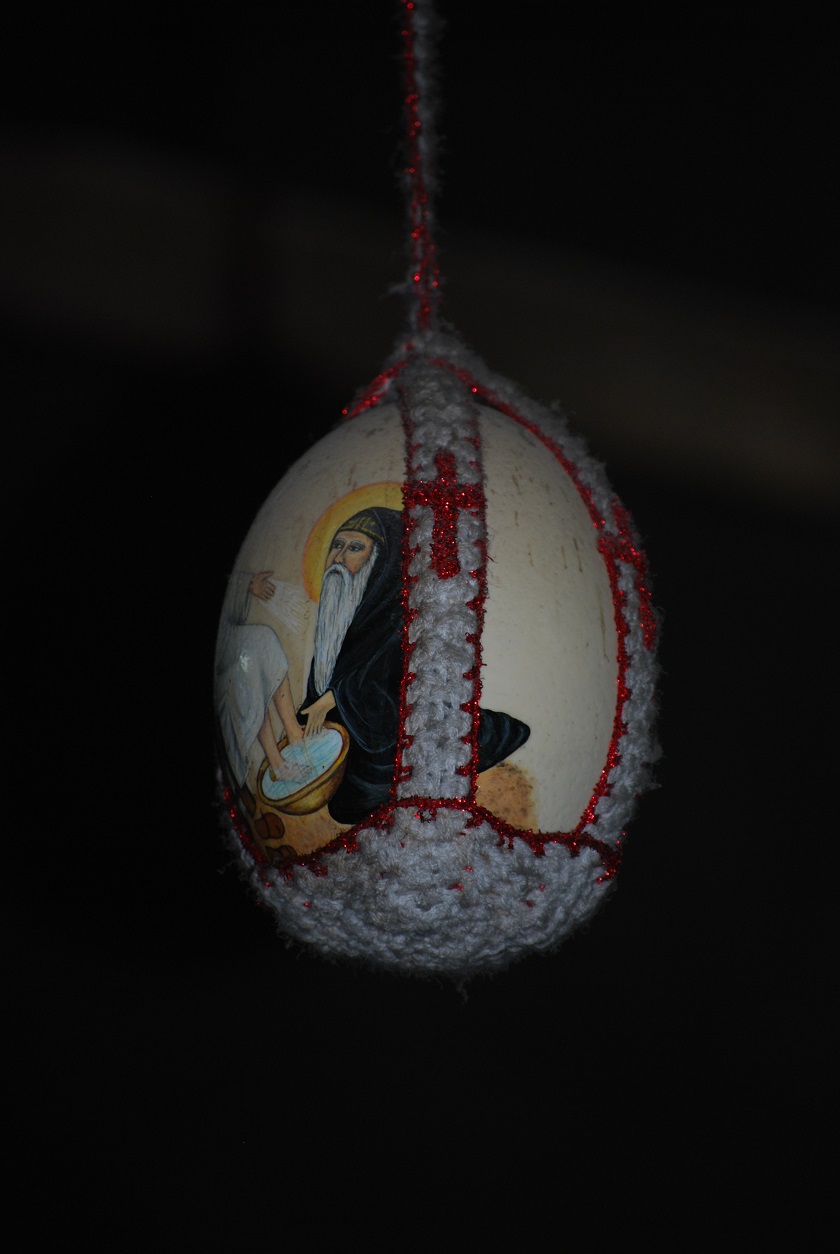
But imagine the artistry – or, envisioning children, the mess – if an ostrich egg was used instead. A bigger canvas invites more elaborate design, as seen in this egg hung from a church in the Monastery of St. Bishoy in Wadi Natroun.

Bishoy Ostrich Egg

St. Bishoy is the one pictured, washing the feet of Jesus according to one of the Coptic traditions. It is hung today in front of the altar as a reminder of God. This is common in many Coptic churches and meshes with other Egyptian traditions carried over into the Christian era.

Four ostrich eggs hung from the church in St. Makarios Monastery in Wadi Natroun.

In ancient Egyptian mythology the ostrich had an association with Amenti, the jackal-headed goddess of the dead. The egg in many cultures symbolizes easily the emergence of life from death, and the Coptic church took it as a pointer toward resurrection. Additionally the ostrich was believed to hatch her eggs through intense staring and concentration, a fitting description of the spiritual life and the attitude of worship recommended at mass.

So if you paint your eggs this Easter, wherever you are, cherish your own traditions, marvel at others, and remember how much we share without even knowing it.

The opening picture and much research for this post are received with thanks to Viveka Anderton.

Categories
Prayers

Friday Prayers for Egypt: Building, Barring Opposition

Flag Cross Quran

God,

While it is still early in choosing Egypt’s next president, there is also not much time left. The first round is scheduled for May 26-27, giving little over a month to the two candidates who have collected the necessary endorsement signatures: Abdel Fattah al-Sisi and Hamdeen Sabbahi.

Sisi is the overwhelming favorite, and though Sabbahi benefits from name recognition and revolutionary pedigree, it is not anticipated he will do well.

The Constitution Party, however, has given him a boost. One of the central liberal parties formed after the revolution, its membership has chosen to endorse him. Their vote was overwhelming; Sisi took only ten percent with a dissenting thirty percent opting for boycott.

But like many parties, their social reach is yet undetermined. Their members are activists, and they represent a revolutionary perspective that has been increasingly questioned by the average Egyptian.

You know, God, if they act from principle. And you know further if Egypt needs to build strong parties regardless. But aid Egypt in the creation of a system that channels activism into polity. Through this party or others, through any and all candidates, translate legitimate partisanship into national benefit.

At the same time, some partisanship has been deemed illegitimate. An Alexandria court has forbidden Muslim Brotherhood candidacies in the elections.

In concept this is not new; under Brotherhood influence, among others, many members of the old ruling regime were similarly barred. The tables have now turned.

You know, God, if they act from principle. And you know further if Egypt needs a restriction on religious parties in general, or on the Brotherhood in particular. But aid Egypt in the societal conversation about the relation between religion and politics, between Islam and the state. Through Islamists or others, through any and all candidates, asses the virtues of religion within acceptable political benefit.

But it is not just Islam in question. Some Christian clergy have indicated political preference, while some Christian activists are building opposition. The pope of the church supports the current crackdown, while ‘the preacher of the revolution’ is on a hunger strike.

Religion can complicate politics, God, but politics is needed. Politics can dirty, while religion can clean, but both are subject to corruption. Both, also, can enable great good.

So in the coming president, God, may good be witnessed. But moreover, establish this good in the choosing. Create parties that will represent society and hold authorities accountable, even as they produce them.

May a ruling party govern strongly, and may an opposition challenge powerfully. In both, help Egyptians to choose wisely.

Build many, God, and bar few. While there is always time, there is precious little. Create the Egyptians you desire to strengthen this country.

Amen.

Categories
Arab West Report Middle East Published Articles

How Salafis Supported the Constitution in Upper Egypt

Hamdi Abdel Fattah of the Nour Party

Post-Morsi, some say, the Salafi Nour Party was pushed into a corner. Others say they played their cards perfectly. In any case they supported the 2014 constitution despite its removal of religious provisions they largely orchestrated only two years earlier. While the Muslim Brotherhood and most other non-Nour Salafis railed against what they called the ‘coup and its constitution’, the Nour Party nimbly tried to navigate the landscape.

So what did they do, and what was their rhetoric? In an interview with Arab West Report Sheikh Hamdi ‘Abd al-Fattah provided perspective from Maghagha, a city in the governorate of Minya.

The party held one large mass conference in Minya, in which Mohamed Ibrahim Mansour, Nour’s representative on the Committee of Fifty which wrote the constitution, joined Sheikh Sharif al-Hiwari from Alexandria, and the local deputy of the Endowments Ministry formed a panel. The party’s approach to the constitution was explained by Mansour and others; Mansour himself spoke for an hour and answered questions for an hour and a half more. Everything was done in full transparency, ‘Abd al-Fattah stated.

From the government to the district level, such as in Maghagha and Beni Mazar, the Nour Party organized marches and had small four-to-five delegations circulate in the streets. Both were meant to give opportunity for people to speak face-to-face with party leaders and have their concerns answered.

For more details, and to discover the reasoning behind their controversial support, please click here to read the full article.

Categories
Arab West Report Middle East Published Articles

Nadia Mostafa: The Hypocrisy of the Coup and its Constitution

Nadia Mustafa
Nadia Mustafa

From my recent article at Arab West Report, continuing a series on the composition of Egypt’s constitution. Nadia Mostafa is the former director of the Program for Dialogue and Civilizational Studies at Cairo University. She is also an Islamist, though not a formal supporter of the Muslim Brotherhood. But she is a severe critic of the events which removed him from power.

She did not want to even discuss the content of the constitution, unfortunately, deeming it illegal. But she was very willing to express her displeasure with several contributing forces:

Chief among them are the very Salafis the Brotherhood cooperated with, in error. In supporting their demand for Article 4, giving the Azhar a role in legislation, and Article 219, defining the principles of sharī‘ah, the Brotherhood gave into unnecessary, non-historical, and ultimately fear-inducing intimations of a religious state. But when the Salafis sided with the coup leaders, Mustafá notes, look how quickly they dropped these two articles. All the Nour Party desired, it seems, is to take the place of the Brotherhood in the political spectrum.

Next she takes aim at the liberals:

Early in the transitional period these same liberals bemoaned the extremism of the Salafis and the interference of their Saudi Arabian backers. Now, they speak of the Salafis as possessing political acumen and of the Saudis as important financial backers for Egypt.

Similarly, liberals rejected the constitution of 2012 because it was an unrepresentative document crafted by an Islamist majority. But this did not prevent them from orchestrating an unrepresentative majority of their own, which all but excludes political Islamists, except for those who play by the measure of the coup. And as for their rhetoric saying the Muslim Brotherhood was invited but refused, what sort of invitation can be accepted when the president and his aides are held incommunicado, and the organization brandished as terrorists? Their goal, Mustafá believes, is to eliminate political Islam, or at the least any political Islam that has leverage.

Finally, she criticizes the church:

Excited by the possibility of gains in the constitution, some Coptic groups threatened to boycott or urge a ‘no’ vote if they did not win a special parliamentary quota. But when this failed to materialize, Pope Tawadros stepped in to support a ‘yes’ vote in the referendum. Christians, Mustafá believes, are not seeking their rights but to limit the rights of political Islamists, allied with seculars against the Islamic identity of the country.

But she also has critical words for the Brotherhood:

She and others of similar mind advised the presidency that Mursī was leaning too heavily on the support of Salafis rather than maintaining unity with liberals and other moderates. She believes there should be a separation between the preaching of a religious organization and the rhetoric of its political spinoff. A civil system must allow for religion in the public square, but politicians should not play with religion for political gain. When many call for the leadership of the Brotherhood to leave, she agrees, provided the same be true for current leadership across the board. The old guard, everywhere, must yield to the youth.

Please click here to read the full article at Arab West Report.

Categories
Atlantic Council Middle East Published Articles

Anti-Coup Terrorism: License and Reluctance

Street Terrorism

From my recent article on Egypt Source. Here is the license:

Recently on the Istanbul-based pro-Brotherhood channel named Raba’a Sheikh Afifi called on Muslims to resist the coup, but not with weapons. “This will enable them to commit their crimes against us with full freedom,” he said.

It is not that the use of weapons is wrong, however. Afifi quotes the 10th Century jurist Ibn Hazm to say that such fighting is prohibited if it will not prove victorious. Since the security forces are better armed, this strategy will backfire, he explains.

“All we can try to do is terrorize them,” Afifi continues, “by burning their cars, threatening them, burning their homes, and other such efforts.” He says this is consistent with peaceful resistance and alleges it is legitimate under sharia law.

And here is the reluctance:

Even so, the idea is uncertain to at least one of the sheikh’s followers. “It is a way among many ways to resist the coup,” said Hani Fawzi, general-secretary of the Asala Party, very hesitantly. “But maybe it will work only five or ten percent.”

Please click here to read the full article at Egypt Source.

Categories
Prayers

Friday Prayers for Egypt: Absolute Peacefulness

Flag Cross QuranGod,

Accusations circulate, trials continue, but the question remains: What is the relationship of the Muslim Brotherhood to violence?

In response to the ongoing climate of terrorism, vandalism, and demonstrations-cum-clashes, the group put out a long statement asserting their ‘absolute peacefulness’. They have no relation to recent attacks, they said, and none of their members resort to violence even in defense.

Numerous anecdotes refute this statement, God, so what should be understood from it? Thank you that it is made, at least. May it serve to combat a culture of violence that is spreading among many in their attitude of resistance.

And protect the Brotherhood and its members from any undue maligning. Egypt is still in a crisis period, where recourse to propaganda is an easy temptation for all. Place men of conscience in the courtrooms, in the police stations, and in the media, to deal justly with each Brother who comes their way.

But God, if this is their own propaganda, make known the reality. The Syrian Brotherhood is engaged in civil war, Hamas in armed resistance. However just their causes may be in your sight, they are violent. Does this Egyptian statement reveal a commitment, a tactic, or an outright lie?

Outsiders have not been reticent to give their opinion, God. Turkey and Qatar assert the group’s legitimacy; Saudi Arabia and the Emirates call them terrorists. Now England is to take up the challenge. Having now and long given refuge to Brotherhood dissidents, they will investigate any illegal activities or relationships with those who commit them.

Transparency, God, and all due process. If the aforementioned nations do not have the best reputation in terms of freedom and human rights, allow England to live up to its reputation. But inasmuch as that reputation is trashed by others who see espionage in the heart of London, make clear all evidence against the Brotherhood, if any.

Forgive our world, God, where truth is contested and interests trump justice. And even where values are held and defended, many will do evil that good may prevail. Where in this the Brotherhood falls, God, make known to everyone. May the moral high ground truly be moral.

And in this also, forgive the revolutionaries who have succumbed to the same. Whether against Mubarak, the army, Morsi, the army, or against the state and security in general, many have lashed out within their peacefulness. With some it is provoked, for others it is cover. But where there is a struggle for true freedom and justice, cause these ideals to prevail.

And implement them, within a state licensed to employ violence legally, though judiciously. Hold authorities accountable for all excesses, but give them firmness also to enforce the right.

Teach Egypt, God, the meaning of absolute peacefulness. The ongoing climate presents many challenges, but honor those only who stand firm to the end.

Amen.

Categories
Arab West Report Middle East Published Articles

How to Amend the Egyptian Constitution

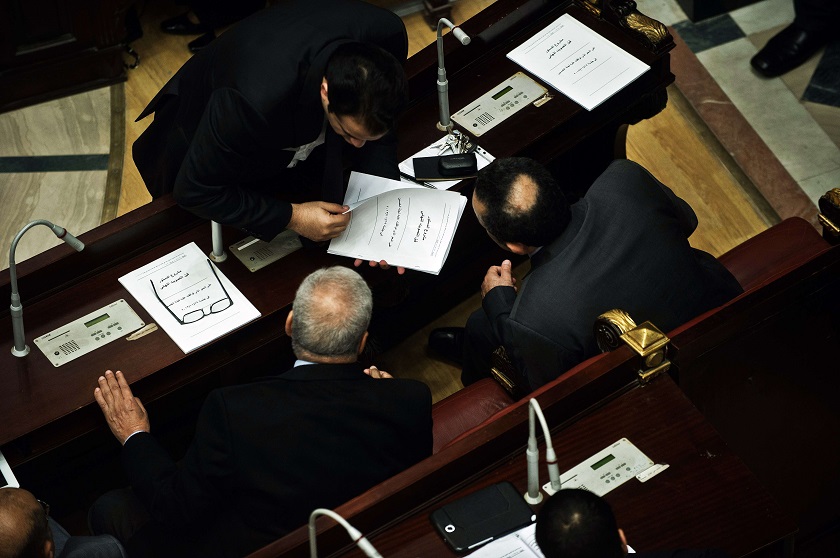
During final discussions over the constitutional text

From my recent article at Arab West Report, continuing a series on the development of Egypt’s constitution:

Following the passage of the 2012 Egyptian constitution in a disputed and divisive referendum, Muslim Brotherhood leader Muhammad al-Biltājī praised the text and tried to assuage opponents of any flaws it might contain.

Calling it a human effort, and therefore not without errors, he said, “I hope we all seek to implement what is good for the people of this homeland. Certainly, we will amend whatever future days will prove needs amendment.”

Shortly before passage of the 2014 Egyptian constitution in a largely uncontested referendum due to opposing boycotts, supporters praised the text and tried to assuage those unconvinced due to a few controversial articles.

Lamīs al-Hadīdī, a prominent television news anchor, rallied for a yes vote and said, “This is not a divine document, and by the way, this document can be amended. If you are fine with 80 percent of the constitution, or even 60 percent, then you have to go and vote yes.”

Apart from their propagandist intent, these statements beg the question: What is the process for amending the constitution? Both documents are remarkably similar, drawing on the 1971 constitution, but with one key difference added in 2014.

The article seeks to describe the procedure, but this excerpt from the conclusion will simplify and describe the difference in question, the key difference in both 2012 and 2014 from the 1971 text, and why both might be there:

To summarize, then, with basic context, it appears the authors of the two constitutions following the January 25 revolution recognized the necessity of giving hope to popular opposition to certain articles in their proposed charters. By lowering the initiation process from one-third to one-fifth, both constitutions allowed a minority presence in the parliament to stimulate constitutional change.

It is unclear why two discussion periods of debate are necessary, but in preserving the general process of constitutional amendment, the authors of both texts maintained the overall difficulty of securing an amendment, as is reasonable.

On the other hand, without an established tradition of a balanced parliament it may be argued that passing an amendment is a relatively easy process. Given the dominant Islamist makeup of the first post-revolution parliament, perhaps they intended the ability to further Islamize the constitution beyond what was negotiated among political forces. Similarly, given the popular turn against the Muslim Brotherhood, perhaps civil forces anticipated reducing further the tinge of religion negotiated with the Islamist Nour Party. In either case, no public referendum in Egypt has ever been defeated [and requires only 50 percent approval].

Any discussion of intentions is purely speculative, but it appears the authors of the 2014 constitution were cognizant of the possibility of Nour Party or old regime electoral domination, either of which might chip away at their constitutional text. Perhaps aware of their own to-date failings to mobilize politically, these liberal authors added the clause to prevent any circumscribing of freedom and equality. It is unclear, however, the manner in which this clause will be interpreted.

Analysis aside, the process of amending the Egyptian constitution remains remarkably consistent over time. Securing the stability of the constitutional order will require the development of a diverse parliament, from which all future changes will need to find substantial cross-party agreement. This assessment, however, may be overly optimistic given that neither post-revolutionary constitution was passed with widespread societal consensus.

Please click here to read the whole article at Arab West Report.

Categories
Excerpts

Building Democratic Polity in the Face of Islamism

From The Immanent Frame, an article describing where democracy went wrong in Egypt, and doesn’t blame the Islamists. The author draws on James Madison’s assertion that factionalism cannot be destroyed without destroying freedom, and that the only path is to create democratic governmental mechanisms that prevent a certain faction from taking over the state.

This, unfortunately, never took place in Egypt. Non-Islamist political forces, for one reason or another, were never able to develop the kind of broad and cohesive coalitions that could have effectively represented them. After the constitutional crisis of the fall of 2012, moreover, they effectively threw in the towel, and formed the National Salvation Front.

The article states the NSF sought to undermine the government rather than seek to compete with it.

Even if it is true that the Muslim Brotherhood is essentially an anti-democratic movement, it could not have threatened an Egyptian democracy, at least as long as other Egyptian political movements played their role in such a democracy by organizing their supporters into cohesive parties that could effectively compete at the ballot box. Even if it took a couple of rounds of electoral losses before they successfully organized themselves, it would have been worth it to build a genuine democratic coalition.

The question the opposition might give in response is that the Brotherhood showed inclination not to reform the state and open up a democratic polity, but to inherit the Mubarak state and maintain its relative authoritarianism. The author admits the Brotherhood’s illiberal leanings, but finds it would not ultimately have mattered.

In short, so long as there is at least the credible prospect of a politically competitive system, there is no reason to believe that the principles underlying the median voter theorem would not have applied to restrain the Muslim Brotherhood until such time as the non-Islamist opposition could have organized itself more effectively. Ironically, then, it may very well be the case that the biggest problem facing Egyptian democracy is not that the Egyptian Muslim Brotherhood is too committed to its own organization, as many Egyptian commentators have suggested, but rather that other Egyptian groups lack the internal discipline necessary to form an effective nationwide coalition.

This seems too rosy an application of Madison, but spot on concerning the fault of the opposition. But there is more strong critique to come.

Success at the ballot box is not mere “ballotocracy,” to be casually dismissed, as many Egyptian liberals have claimed. An inability to form an electoral majority signifies an inability to govern—at least in the absence of overwhelming force.

So what then? Here is the author’s hindsight analysis:

The fact that there is no credible liberal democratic political party does not mean, however, that Omar Suleiman was right. It only means that Egypt has not yet produced such a party. The existence of such a party is not, however, a precondition for a functioning electoral democracy; it is the product of the practice of democracy over multiple rounds and iterations.

It is too late now, unless it isn’t too late. This would be the claim of the liberals, that the democratic order is now coming under a strong and guiding hand. The author disagrees, and thinks they took the easy way out.

As a result of their short-sighted strategies, Egypt faces at least several years of renewed authoritarianism. Instead of attempting to exclude their competitors from politics, Egyptians need to embrace competitive politics and accept the substantial costs of building a competitive electoral system from the ground up, even if that requires letting your opponents win from time to time.

Ironically, his advice may have been heeded by an unintended audience. The Salafi Nour Party may have sensed what was coming, took their licks, and ensured their coming place in the order – democratic or otherwise.

If not democratic, Muslim governments have long had their ‘sultan’s sheikhs’, as the Nour Party is now derogatorily called by pro-Morsi Islamists. But if democratic, they stand ready to inherit the Islamist mantle. Perhaps they will lose elections to come, but by building up the polity, their bet is for the long haul.

Who knows the developing political orientation of the people, but if Gulf funding is any indicator, these Salafis may be the best students of Madison.

Categories
Prayers

Friday Prayers for Egypt: Coal and Lead

Flag Cross Quran
God,

You have given humanity flesh and blood, the softest of elements. How easily they are damaged by substances harder, also of your creation. Be it self-destruction or directed, how frequently this occurs.

Frequent power cuts and energy shortages are partially assuaged by coal substitution, polluting the air.

Frequent protests and police presence are partially assaulted by lead transformation, polluting politics.

Demonstrators are arrested and put behind bars. A journalist is killed by a debated bullet. A nail bomb rips through a university gate – and a policeman’s heart.

Not all the world is hard, God. There are oceans and trees and flowers and dirt. But Egypt has precious little of these. Your great gift, the Nile, has 90 million people crammed alongside.

Egypt has sand and cement. These hem in the nation and threaten her humanity. Give her to drink.

Give her draughts of compassion. Give her currents of mercy. Give her the freedom that is far deeper than slogan.

In lieu of these, God, does she need the iron rod? The king enacts justice with his scepter; there is no escaping the need of metal. It too is from your bounty.

But may it be employed rightly. Strike down those who would manipulate your creation for their own ends.

Even then, God, toward repentance and restoration. Heal Egypt from her wounds, both deep and recent. May she find the strength that comes from your least tangible of elements – the spirit.

Your spirit enlivens, it empowers, it creates. Breathe into this nation respect for all that is soft. The fabric of community. The web of relationships. The fruit of virtue.

Law may be on a tablet of stone, but write it into the beating of hearts.

And soon, God. Test Egypt no longer. May her flesh and blood triumph over her coal and lead. May she cling to her humanity, know your divinity, and find united the wholeness therein.

Amen.


Categories
Current Events Lapido Media Middle East Published Articles

The Egyptian-Canadian Surgeon Going Home to Serve the Poor

Dr. Sherif Hanna
Dr. Sherif Hanna

From my new article in Lapido Media:

A new collaboration – in an old mission hospital – will train Egyptian surgeons to serve in rural settings.

Sixty per cent of Egyptian doctors work abroad – but a unique collaboration will fight this trend.

Incredibly perhaps, Egyptian Christian Dr Hanna Sherif is relocating from an élite life in Toronto, Canada to the small village of Menouf in the Nile Delta for the next five years, in defiance of a US State Department warning of ‘risks of travel’.

An acclaimed liver surgeon and academic, Sherif is returning to his country of birth after a forty three year absence to run a new in-country surgical training programme…

Here is a brief excerpt about what he will do, and the motivation thereof:

Harpur’s resident trainees will benefit from 10-15 visiting surgeons each year, and will spend six months of their programme in large hospitals in Kenya, Cameroon, and South Africa.

In exchange the residents will work at least one year in the handful of PAACS-accredited Christian hospitals in Egypt for every year they are financially supported.

Rural hospitals, including old mission hospitals, are often not well equipped and generally pay low salaries, said Hanna. As such they fail to attract well-trained surgeons.

In addition, Dr Amr al-Shoury, a leading figure in the ongoing partial doctors’ strike in Egypt, the government system pays abysmally poor wages to medical professionals.

He told Ahram Online this drives 60 per cent of doctors abroad.

Thompson believes maintaining the standards of care for the poor under these circumstances in the least attractive districts requires a special commitment.

‘Christian hospitals will go out of business if they cannot hire well-trained specialists that are committed to their values,’ said Thompson. ‘Ours is to honour and glorify Christ in his command to care for the sick.’

Please click here to read the full article at Lapido Media.

Categories
Arab West Report Middle East Published Articles

Hagag Oddoul: Nubia Recognized in the Egyptian Constitution

Hagag Oddoul
Hagag Oddoul

From my recent article at Arab West Report, continuing a series of interviews with members of the Committee of Fifty which wrote the constitution. Hagag Oddoul is a novelist of Nubian origin, and an advocate for their cause. The article describes his background as well as that of his people, and this excerpt defines that cause as it became defined in the constitution:

Article 236, however, was his crowning achievement, and he did not have to play the withdrawal card to win it. It specifically refers to Nubia as a geographical area:

The state shall develop and implement a plan for the comprehensive economic and urban development of border and underprivileged areas, including Upper Egypt, Sinai, Matrouh, and Nubia. This is to be achieved by the participation of the residents of these areas in the development projects and the priority in benefiting from them, taking into account the cultural and environmental patterns of the local community, within ten years from the date that this Constitution comes into effect, in the manner organized by law.

The state works on developing and implementing projects to bring back the residents of Nubia to their original areas and develop them within 10 years in the manner organized by law.

It should be noted the term ‘right of return’ does not appear in this article, and that is fine with Udūl. He recognized this expression was charged with connections to the Palestinian issue, which would only serve to distract the discussion. It is the concept he advocated for, and he faced little opposition from his colleagues.

Recognition that the border areas of Egypt needed development that involved local residents was easily achieved, the language of which pleased Udūl as a great achievement. But there was some discussion about how to term the responsibility of the state in returning the residents of Nubia to their original areas. He personally wanted the state to be ‘obligated’, while a lesser wording ‘to secure’ was also rejected. In the end he was satisfied with ‘works’, because it was accompanied by a timeframe of ten years. Being measurable, it must happen.

Oddoul also describes the negotiations over anti-discrimination articles and those pertaining to culture. Please click here to read the rest of the article at Arab West Report.

Categories
Prayers

Friday Prayers for Egypt: Candidate Sisi, 529

Flag Cross QuranGod,

The inevitable came right after the unthinkable. General Abdel Fattah al-Sisi finally declared his candidacy for president and resigned from the army. Two days earlier an Egyptian court ruled 529 Morsi supporters worthy of the death penalty, implicated in the murder of a single police officer. Somewhat surprisingly, neither decision prompted massive demonstrations.

But both prompted massive commentary. With Sisi it was more in line with profile, as the debate about him largely revisits the issue of coup vs. popular revolution, as it has since July. The mass judicial ruling, however, resulted in waves of celebration, explanation, and condemnation in the various press.

In both there is much to analyze, God. But there is more to lay before you. For the 529, give each their individual due. Perhaps some are innocent completely. Perhaps some are guilty of lesser charges. Someone was killed, and at least one is culpable.

But all deserve a thorough examination, as does the nation. May it start with the judge who is said to have violated court regulations. May it continue with the accused in accordance with the law. May it finish with the system which permitted its occurrence. May the coming appeals make clear what is generalized differently in all the above, that justice may prevail. May the people have confidence in this vital institution.

Perhaps of greater vitality, God, is the institution of the presidency. Over the next few months give wisdom to the people to discern their options. Whether Sisi, Sabbahi, or a pox on both their houses, help the different partisans to campaign winsomely and effectively.

Cause candidate Sisi to emerge from both his auras of popularity and contempt, to be judged on the basis of his leadership, platform, and vision for the nation. Maintain and enlarge this popularity if he is deserving; otherwise, may the people see and expose any disqualifying flaws.

But inasmuch as both Sisi and the 529 provoked only their base, renew the belief of the Egyptian people. Belief need not be witnessed on the streets, but stimulate citizens to take hold of their political future. Channel the undeniable energy of the past three years into mechanisms to secure the popular will. May they ever hold their system accountable, or perhaps more aptly, may they truly begin to.

Prevent both a surrender to an imagined inevitable and an acceptance of a once unthinkable. However these are defined, God, judge accordingly. But bless Egypt in all that comes.

Amen.

Categories
Personal

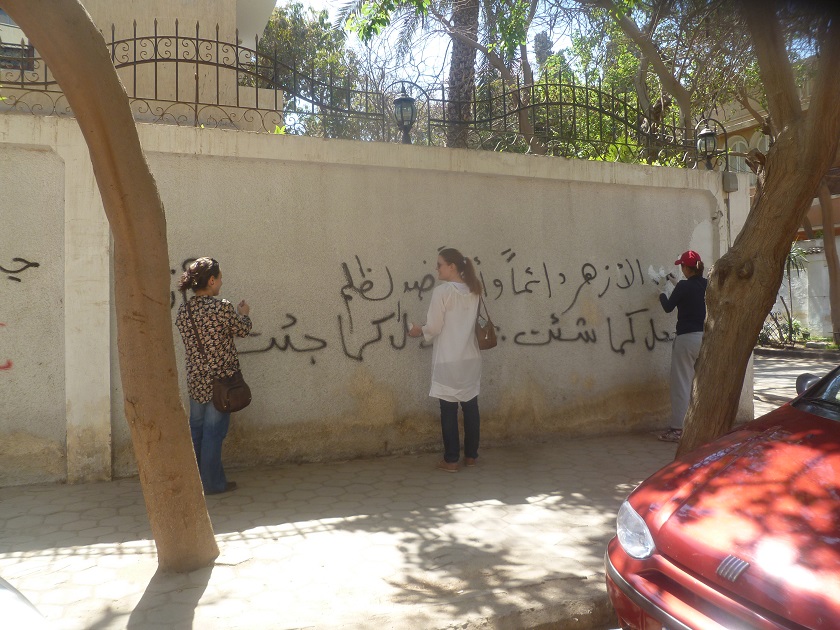
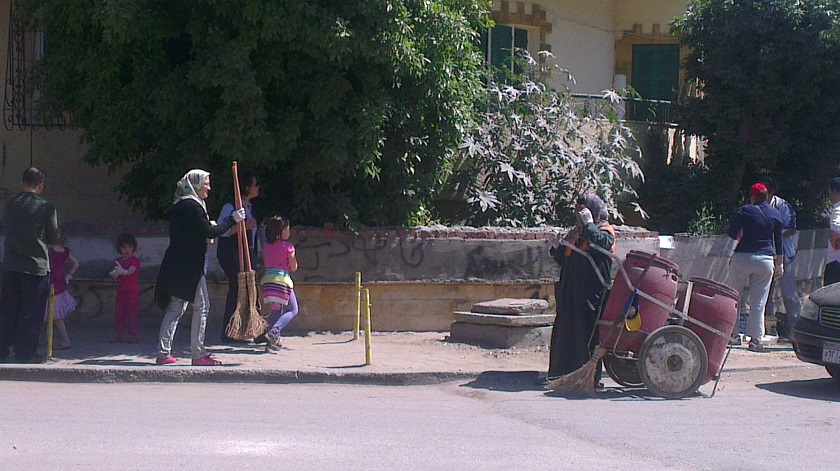
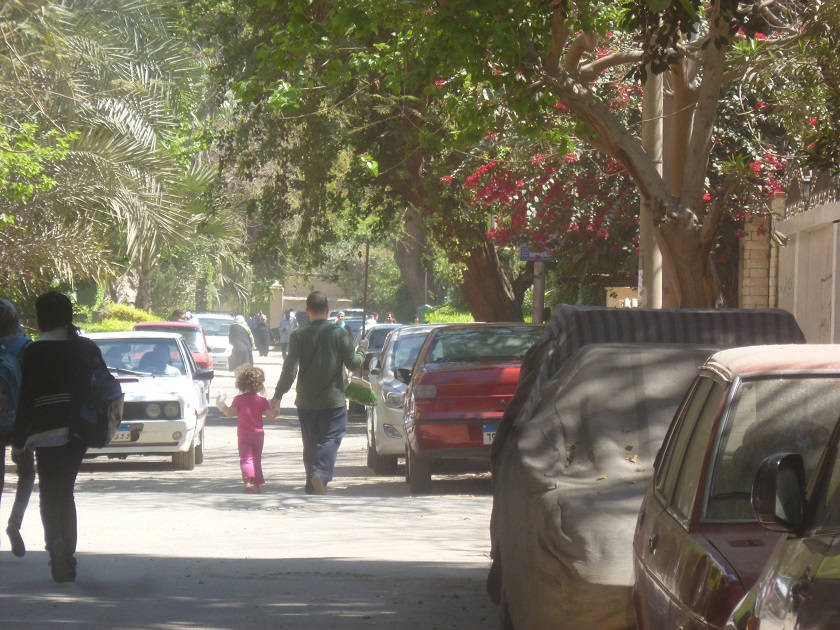
Yalla Maadi Clean-Up Day

Following the success of the January 25, 2011 revolution, Egypt witnessed a great wave of civic activism. One of the most popular manifestations was in campaigns to clean the city streets, often accompanied by vibrant artwork and pro-Egypt graffiti. But as the enthusiasm waned and the political situation became more and more polarized, citizens went back to their lives as normal. Worse, the official public services of police and trash collection broke down as main streets were transformed into garbage dumps. Every now and again a faithful public servant or enterprising resident might try to clean things up, but it was a losing battle nationwide.

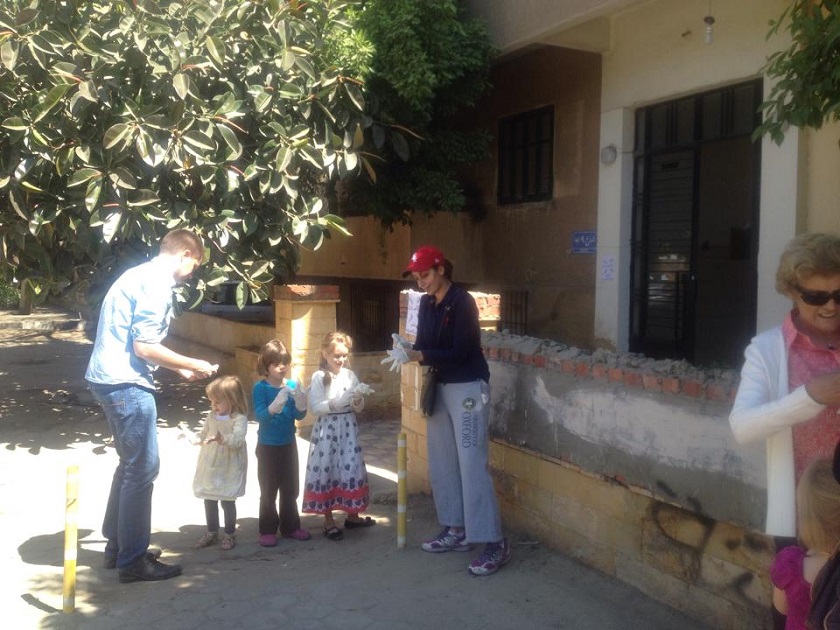
So it is with encouragement we joined a group of Maadi ladies on a local clean-up campaign they advertised on Facebook. Among many Egyptians the mood is brighter following the removal of President Morsi and his Muslim Brotherhood, and the anticipated presidency of army general Abdel Fattah al-Sisi. Others, of course, are horrified at the turn the nation has taken, due either to their approval of the Islamist agenda or their advocacy of liberal principles violated in the crackdown against it. But for a great number, after the chaos and disintegration of the past three years, they just want things to go back to normal. With this hope dawning, the spark of civic activism returned.

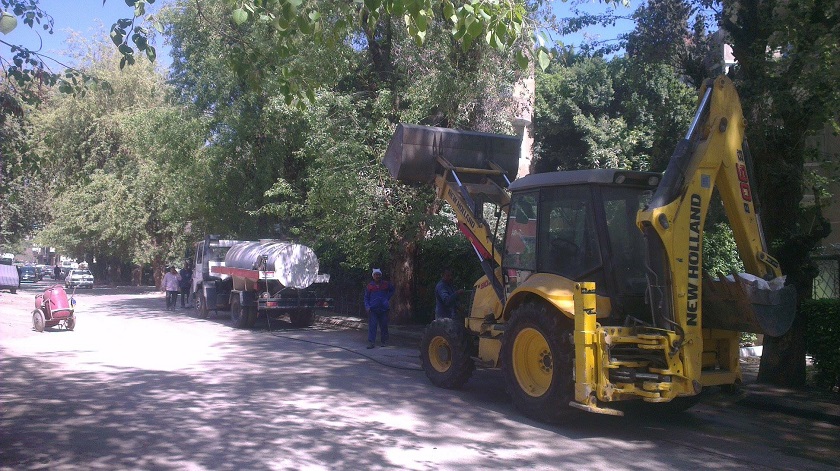
But only a spark. The Facebook page yielded a few volunteers, but did animate the local municipality. The mayor made a public appearance and authorized the use of heavy equipment to remove built-up dust and trash along street curbs in our few block section of the neighborhood. At least for these past few days, since March 22, the spark of the ladies’ initiative has resulted in the sparkle of a clean community.

But that sparkle may only be in our eyes who now wish to see things more beautiful than they were. Likely, things will go back to normal once again, though there is hope that police and trash collectors are now providing more faithful service. But the normal was never beautiful in and of itself; if there was beauty it was because neighbors had a stake in the uniqueness of the Maadi area. Trash is still thrown on the street, and worse, building code violations continue as highrises impinge upon the villas and family apartments mixed in with tree-lined sidewalks. Maadi benefits from its upper-class standing, so few real complaints can be issued when poorer sectors push against the posh.

But whether upper or lower class, the beauty of a neighborhood is in the eyes of its residents, and how they collectively view and tend to their immediate area. The ladies of Maadi were encouraged by their opening salvo; there is talk of continuing the practice once a month. Yalla Maadi, let’s have more join in next time. God knows where the revolution will take Egypt next, but ownership of the streets never rests with a political power beyond the imagination, or apathy, of those who walk them.

It just depends on initiative. Here are a few pictures to honor those who got us moving.

Getting ready, from the Facebook page.
Getting ready (from the Facebook page)
Perhaps more effective than the children, but less inspiring (from Facebook)
But first the streets needed to be swept
First the streets needed to be swept
Hannah Clean-Up Day
Then the curbs of Road 73 were painted
Others painted over recent graffiti sprayed on the walls of local residences
The local trash collectors lent their aid (from Facebook)
Then we walked down the street to start again

Please click here to like the Yalla Maadi Facebook page, and for fellow locals, get notification for future events. Hope to see you there.

Categories
Prayers

Friday Prayers for Egypt: Judicial Independence

Flag Cross Quran

God,

Not one conviction was levied against those who killed protestors during the January 25 revolution. This fact is still not yet fully explained, but raised questions of whether or not Egypt’s judicial system functions independently of the powers-that-be.

These questions continue today. But this week a few Muslim Brotherhood members were found innocent of certain minor charges. More significantly, an officer was given a ten year sentence when 37 detainees from the pro-Morsi sit-ins were killed inside a police van. It may be that the law is blind.

The coming months will demonstrate. The president referred the fact-finding report from the sit-in dispersal to the judiciary, with its accusations of ‘excess force’. More serious trials against Muslim Brotherhood members continue. Will they judge impartially?

God, you know where justice lies; men make at best approximations. But may those of the judiciary be men of conscience. May they weigh the evidence and act accordingly. May they remember they hold the life of fellow human beings in their hands.

For the weight of accusation is against them, no matter how many are upright. The Judge’s Club has been called financially corrupt by the nation’s top auditor. The onus of revolutionary killings lingers. And while some detained sit in prison for months without trial, others are convicted straightaway. Many view judges as politicized, at the least.

What can be prayed for, God, but the above? The judiciary is but one of many state institutions that is still in flux since the revolution. Purge it from all impropriety. Make transparent its proceedings. Let the people trust its arbitration.

Through them or otherwise, God, bring justice to Egypt. Justice for victims of these transitional years. Justice for victims of the old regime. Justice against all who have manipulated the system for their own benefit.

Through them or otherwise, God, but may it be through them. May Egypt, and its judiciary, be fully independent.

Amen.

Categories
Arab West Report Middle East Published Articles

Debating Religious Freedom in the Constitution: European Concerns and Egyptian Realities

L: Amr Moussa, head of Egypt's constitutional committee; R: Catherine Ashton, EU representative for foreign affairs
L: Amr Moussa, head of Egypt’s constitutional committee; R: Catherine Ashton, EU representative for foreign affairs

From my recent article at Arab West Report, focusing on the critique of Dr. Wolfram Reiss, professor of historical and comparative studies of religions at the University of Vienna, and the response of Bishop Antonios of the Coptic Catholic Church:

Reiss believes that the post-Mursī constitution of 2014 removed the worst features of the 2012 charter, in particular the role given to the Azhar in review of legislation in Article 3, and the definition of sharī‘ah along traditional lines of jurisprudence in Article 219.

Yet despite the amendment and removal of certain articles, Reiss finds that the constitution of 2014 does not provide a sufficiently new basis for any of the urgent questions which have long prompted interreligious debate. The question of the building and repair of churches is postponed, religious freedom is guaranteed only for already recognized groups, the question of apostasy is not addressed, and the mention of political representation for Christians is very vague.

“I do not see any progress concerning religious freedom and the status of the Christians in Egypt,” he wrote in an email to Cornelis Hulsman. “So I see the ‘new’ constitution as a preservation of the status quo only. I would be grateful if you (or H.G. Anba Antonius) could convince me that I am wrong.”

The article elaborates his concerns and adds Hulsman’s description of background context. Reiss had read the full transcript of an earlier interview with Bishop Antonios, and responds:

As for the articles specifically discussed concerning religious freedom, Bishop Antonios both agreed and disagreed with the comments of Reiss. “Anything in the world might not be done correctly and could go wrong,” he said. “There has to be a public will for the constitution to be applied.”

This was his comment specifically about Article 53 on discrimination, but it concerns also the issues of apostasy and the rights of non-monotheistic religious adherents. The constitution states that freedom of belief is ‘absolute’, improving and strengthening the language of earlier versions. Of course this means one has the right to change religions. Concerning Baha’is in particular, Article 6 on citizenship states that obtaining official papers proving his personal data is a right, so how can the religion field be recorded incorrectly? But, he understood, the reality for both could be different.

Reality also dictated the acceptance of Articles 2 and 3, as well as 235 on church building. His personal opinion is with Reiss, that it would be better if the language of the constitution did not differentiate by religion. This even included Article 244 on Copts in parliament. Bishop Antonios is against quotas of any kind.

On this article he agreed with Reiss that the language was vague, but that this provided flexibility. It may be preferable to have a certain system to promote Copts in parliament given current realities about the lack of familiarity with democracy, but the law on this matter can change year by year as the reality changes. Ongoing political dialogue, as well as the will of the public, will determine implementation.

Please click here to read the full article at Arab West Report.

Categories
Arab West Report Middle East Published Articles

Salafi-Jihadis, Sinai, and the Anticipation of Terrorism

L: Mohamed al-Zawahiri, R: Mohamed Morsi

This post recalls two articles published last year at Arab West Report but not referenced on the blog, on the SalafiJihadis. The testimony is poignant based on current developments:

“We are distinguished from other Islamic trends by not accepting partial solutions,” he said. “The Brotherhood has understandings with the Americans, and they are not working on behalf of the shar’īah but to keep power for themselves.” As for the Salafīs, “They were a pure religious movement, far from politics, but when we see how the Nour Party has behaved after the revolution we see a great similarity to the state security apparatus, finding consensus with the military and even with the liberals.”

This jihad, however, does not target the West directly, though he lauds al-Qā’idah, justifies the Benghazi operation, and warns Americans their blood is not safe in Muslim lands. In fact, though his rhetoric is violent – “We have come to smash the pillars which the people have gotten used to” – the Salafī-Jihadi effort consists entirely of preaching, however much the State Department says otherwise.

“We do not carry weapons in Egypt,” he said. “We are engaged only in an intellectual battle. The security wants to charge us with being armed, but we reject this completely.”

The above quotes from Ahmed Ashoush, a colleague of Mohamed al-Zawahiri. They are accused of links with the Muslim Brotherhood and of fueling Sinai-based terrorism to protest his removal from power.

The second article reflects an email exchange with two experts on Islamist movements, Khalil al-Anani and Ahmed Zaghloul. Here is an excerpt from the latter, on the propensity of different groups toward violence:

Do you believe they are engaged in or preparing for an armed struggle and/or terrorist activity in Egypt or the region?

A large number of the remaining Jihad Organization has renounced violence; so has Jamā’at al-Islāmīyah following their ‘Revisions’ and created a political party with members in the Egyptian parliament. These are the classic organizations associated with violence.

But the idea of using violence is still present and will never disappear. There are a number of vine-like organizations in the Sinai which have conducted violent operations recently. There are others who have adopted the ideas of al-Qā’idah in Egypt.

But the source of danger is not the known groups but the sleeping cells who maintain the idea of jihad. Some of these have traveled to Iraq, Libya, or Syria for the jihad there. As long as there are places subject to aggression there will be suitable areas for these cells to be active.

Reality changes frequently, as does the ability to accept comments at face value. But these testimonies are offered in the ongoing effort to determine what is happening in Egypt, for the good of the country. Please click here to read the full articles at Arab West Report.

Categories
Excerpts

Is a Third of the Sinai Lost?

Last week I offered excerpts from a report describing the amateur terrorism campaigns in the Nile Delta. Here are excerpts about the professionals, via Reuters:

In a rare visit to eight villages in Northern Sinai last week, a Reuters reporter saw widespread destruction caused by army operations, but also found evidence that a few hundred militants are successfully playing a cat-and-mouse game with the Arab world’s biggest army and are nowhere near defeat. It is increasingly difficult for foreign correspondents to openly enter conflict zones in the Sinai.

Residents say the militants – a mix of Egyptian Islamists, foreign fighters and disgruntled youth – have seized control of about a third of the villages in the region and are now taking their fight closer to Cairo.

The article obtain testimony from an anonymous militant revealing their local strategy:

“At the start of the fighting we used to hide in mountains but now we are present in the villages among residents, because it is safer there,” he said. “When we were in the mountains it was easy for the army to strike us with helicopters. But as long as we are with the people it is hard to reach us.”

S.A. said that he and his fellow fighters use simple home-made bombs such as jam jars stuffed with dynamite. The devices are hidden in olive trees or on the side of road, with desert sand covering detonation cords. He said the militants wait on hilltops for military convoys to pass and then detonate their bombs by remote control, using cellphone identification cards.

“We use cooking cylinders and water jugs and we will pack them with explosives, and connect them to timers and a SIM card and we plant them on roads we know are used by the army,” said S.A.

The threat of roadside bombs has prompted the army to cut mobile phone networks and the Internet during daylight hours when military vehicles move around.

Local residents describe how militants infiltrate, and the response it sometimes brings from the army:

Ahmed Abu Gerida, who lives in al-Bars village, said militants sometimes hide in civilians’ houses to avoid detection. “They hang up women’s clothes, including bras and underwear, because they know the army will hesitate to approach Bedouin women,” he said. “One time soldiers entered one of these homes and found a storage place for explosives and blew up the house.”

Air strikes, launched almost daily since Mursi’s fall, have hammered villages like al-Lafitaat, where all 12 single-storey cement houses have been destroyed or heavily damaged over the past few months. Some were reduced to a few beams, while others were burnt out, their ceilings collapsed. Residents fled, leaving behind a handful of sheep.

One woman named Ni’imaa stood next to the remnants of her house with her two children, after returning a few days earlier to retrieve her belongings. She collected a pillow, a mattress, some dishes and a small stove and placed them in a pick-up truck. She said the army killed her husband, who she said was not a militant, four months ago.

These poor local people, who feel frustratingly paralyzed:

Even residents who are opposed to militants say they are scared to cooperate with the army, which has appealed for tips to find the fighters.

Sheikh Hassan Khalaf, who heads the Sawarka tribe in Sinai, said 35 Sinai residents who gave the army information on militants had been shot dead in the past three months. The army confirmed the shooting, but not the numbers involved.

Many people feel trapped between both sides.

“We are between two fires. If we report the terrorists to the army, the militants will kill us the next day,” said Subayha, a Bedouin who said that she and her children struggle to sleep because of army shelling in her village of al-Mahdiya. For safety, they sometimes sleep outside the gates of a building that houses international peacekeepers, she says.

“If we remain silent the army considers us allies of the terrorists and can start attacking our villages,” said Subayha.

And here are the offerings on responsibility:

Khalaf, the Sawarka tribal leader, said he saw Mohamed al-Zawahri, the brother of al Qaeda chief Ayman al-Zawihri, in a presidential car. Sinai police were not allowed to approach the convoys or meetings, said Khalaf.

Senior Muslim Brotherhood official Mohamed Saleh told Reuters: “There is no evidence of this. It is all lies spread in an attempt to hurt the reputation of the Muslim Brotherhood. We have never associated in our history with any groups that hurt Egypt.”

Wael Haddara, a senior adviser to Mursi while he was president, said Mursi’s public “efforts to reach out to bona fide tribal elders and leaders” might now be “cast as a meeting with terrorists”. The Brotherhood has said it released prisoners when it was in power because the prisoners had been unfairly tried or had served their sentences.

At the same time, senior Brotherhood leader Mohamed el-Beltagy said last year after Mursi’s fall that the violence in the Sinai would stop if the army reversed what the Muslim Brotherhood calls a coup.

Zawahiri is a Salafi-Jihadi, of whom I wrote these reports, and two other previously written pieces will be posted later. From the other side, here is a report I wrote from a security source with deep experience in the Sinai.

From what I understand, Morsi did release militants, but the military council released more after the revolution but before Morsi’s presidency. Many had served their full sentence and were being held on continuing security grounds.

And additionally, Morsi did either conduct or permit several delegations out outreach to the Sinai. The point was to change the security-solution-outlook that traditionally ruled the area, into one of dialogue and reconciliation, convincing residents to give up violence on a religious basis. Perhaps other more sinister conversations took place, but the details are lost amid the vagaries of Sinai, and of Egypt in general.

But regardless, if Reuters summarized correctly, the situation is not encouraging, especially for residents. Does anyone have any solutions to propose?
Categories
Prayers

Friday Prayers for Egypt: Prison Conditions

Flag Cross Quran

God,

Reports have been ample from Egyptian prisons with accounts of mistreatment, even torture. And this week smuggled video purported a look inside, picturing squalid conditions and cramped quarters. The government denies the veracity of these sources, insisting that after the revolution a commitment to human rights has reformed the system. A visit from the National Council for Human Rights yielded conflicting testimony.

Meanwhile the broader issues of respect for human rights and the detention of thousands has taken the attention of several at the United Nations. Twenty-seven countries issued a statement against the government, and had their ambassadors summoned in return, warning them against meddling in Egypt’s internal affairs.

God, these are trying times in Egypt, with conspiracies swirling and legitimacies contested. But a nation is known by how it treats the least of its citizens. Bless those in prison. Comfort them in their troubles. Convict them of their sins. Visit them with your presence.

Give them their rights, God, and do so through the government. Do so through their lawyers. Do so through journalists and human rights activists. Egypt has a long and sordid history to overcome, and if the revolution has changed the discourse, reform will face many challenges. Empower those in the Interior Ministry who will abide by the right.

But where there is ill-treatment, and where there is fabrication, rid Egypt of both. Establish transparent systems that can hold all accountable. Remove the fog of uncertainty that clouds so many issues, that citizens of the nation would discern all truth.

And inasmuch as foreign nations claim to see clearly, may they find the log in their own eyes first. But use them, God, to pressure Egypt appropriately. It feels too much to ask the whole world system to reflect your will, but thank you that human rights are an international concern. Where there is hypocrisy, expose it. Where there is opportunism, void it. But let the light shining on Egypt reveal both its virtue and vice, that all may be clean.

May it be, God, that Egypt’s prisons are free of abuse – both now and in the future. Bless those there on both sides of the bars. No prison is wholesome, but may all emerge so. Let coming testimonies reflect this reality.

Amen.

Categories
Excerpts

The Nature of the Insurrection

From McClatchy, an article full of interesting anecdotes on the Islamist youth committing violence in the Nile Delta:

In Sharqia province, which sits just between Cairo and the restive Sinai, eight police officers have been killed in just three weeks, each by a motorcyclist who pulled up to them in traffic and shot them, usually in the head, according to Mohammed el Khatib, the general coordinator of the police union.

This is what makes the news, but testimonies of the youth reveal something a little different:

In December, they tried to set a police officer’s car on fire but were so inexperienced they failed. Then last month, they decided to launch three attacks on the same day, to distract the police from their protests. In addition to setting the police officer’s home ablaze, they planned to bomb a train. But they couldn’t trigger the explosion, so they settled for setting it on fire.

The third attack came when Saleh pointed a gun at nearby residents while his friends set a stationary shop belonging to Mohsen Said Mtwaly, 65, a retired general who’s a supporter of Field Marshall Abdel Fatah el-Sissi, the minister of defense who engineered Morsi’s ouster and now is the presumed front-runner for still-to-be-set presidential elections. A photo of Sissi sits in the store’s display window.

The interviewed youth say they have no share in the killing of officers, and this is what proves their methods as ‘peaceful’.

Interesting also is why they supported the presidency of Morsi, quite opposite from the international rhetoric of the Brotherhood:

The three young men said they first organized during Morsi’s presidency when he called for projects to renew Egypt. They hoped to create an Islamic caliphate, they said. They felt that if Egypt could be ruled by Islamists, then other countries would follow and soon the region would become one big caliphate. But they never got a chance to start their movement.

Debutantes in violence may become more professional, as many of the terrorist attacks in Egypt have proven. More disturbing is this account of local police efforts to stop it:

As he cleaned up the debris three weeks after the attack, Mtwaly was unapologetic about urging residents to reject Morsi’s administration.

“I know the Muslim Brotherhood very well and they have no national agenda,” Mtwaly said. “I used to tell people they are not good for you. They want to steal the country.”

Mtwaly said he backs the police and is confident they will find the men who set fire to his shop, unaware that McClatchy already had tracked them down.

Categories
Arab West Report Middle East Published Articles

Bishop Antonious: A Full Transcript on Constitutional Proceedings

Bishop Antonios

Bishop Antonious Aziz of the Coptic Catholic Church served as his church’s representative on the Committee of Fifty which rewrote Egypt’s constitution. He agreed to an interview with Arab West Report on December 10, 2013, shortly after the final text was approved by the committee and just over one month before ratification by the Egyptian people in a referendum on January 14-15. In the interview he provided clear and frank insight into the inner workings of the committee.

Arab West Report has provided a full transcript of the interview, available here. To summarize, Bishop Antonious described the process of his selection by the president and church, and the subcommittees on which he served. Each member assigned himself a place in one or more of five groupings: Basic Components of the State, Rights and Freedoms, System of Governance, Listening, and Drafting.

The bishop worked in the first and last of these subcommittees, making him uniquely qualified to comment on the passage of the key religious articles, from start to finish.

The listening committee received proposals from hundreds of citizens, forwarding these to members of the appropriate group. The group would interact with these alongside their own proposals, taking internal votes to forward their consensus text to the drafting committee. The drafting committee would then amend both wording and content as they saw fit, sending the article back to the subcommittee to produce a consolidated text. This text would then be debated by the full Committee of Fifty, which after agreement would enter a final, non-binding review by the Committee of Ten. These ten were constitutional experts who provided the Committee of Fifty the initial amended copy of the 2012 constitution, from which to work. Finally, every article required a 75 percent vote of approval to merit placement in the constitution, and the majority of articles passed without difficulty.

Getting to the place of passage, however, often entailed much difficulty. This was nowhere more evident than the religious identity articles which lead the constitutional text. Because of the difficulty, these were postponed until the end.

Bishop Antonious described the interaction between the church, Azhar, and Salafi Nour Party representatives. In Article 1, should Egypt be part of the Muslim nation (ummah)? Should Article 2, making sharī’ah the primary source of legislation, remain in the constitution? Should it be further interpreted, as done in Article 219 of the 2012 constitution?

Should Article 3, giving rights in personal status and religious organization to Christians and Jews, be extended to non-Muslims in general? Should Article 7 maintain language from 2012 giving the Azhar a role in the process of legislation? In all these articles and more, Bishop Antonious provided insight into the manner of discussion which eventually produced agreement. He also describes the personal interaction and attitudes experienced along the way.

Not everything in the final text met with Bishop Antonious’ agreement, and he is frank about some of these areas. But even so, the end result is a constitution with which he is deeply satisfied. Please click here to read the full transcript of the interview at Arab West Report.

Photo credit: ACN