Categories
Arab West Report Middle East Published Articles

A Coptic Demonstration

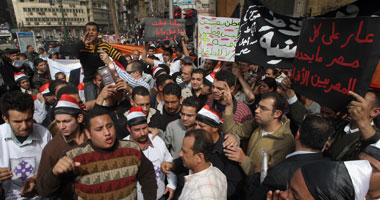
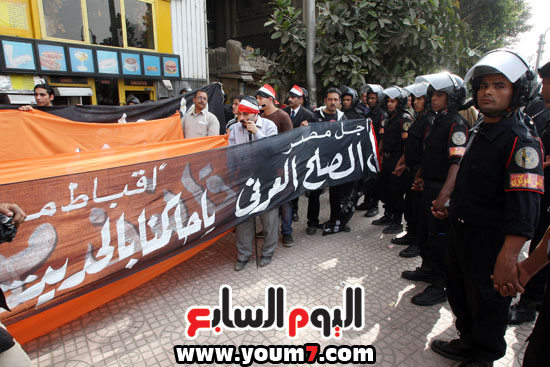
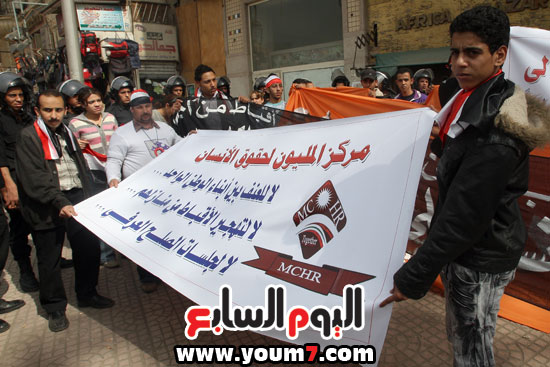
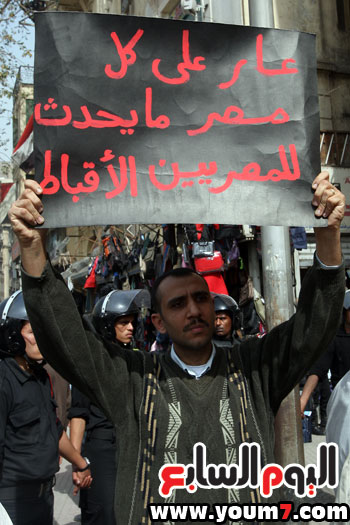
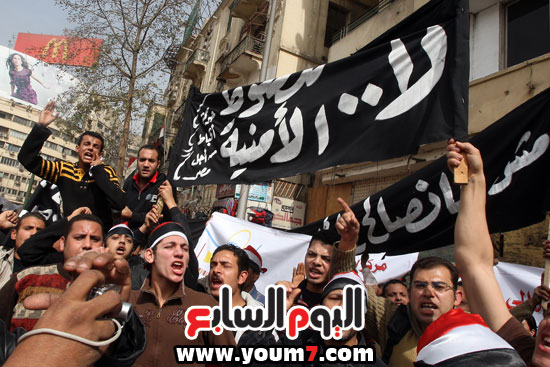
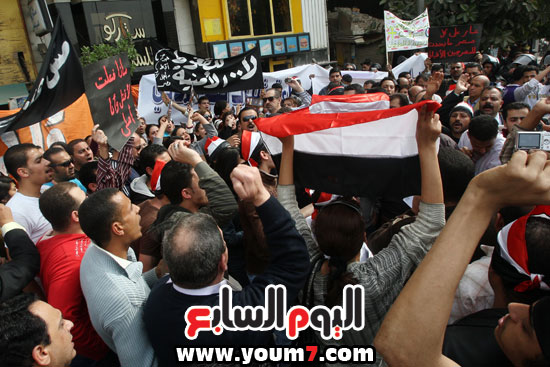
Two days ago the Coptic community of Egypt witnessed a unique event. On Sunday, February 14, Valentine’s Day, a rally was organized downtown by over two hundred Coptic participants in protest over the Nag Hamadi killings on Christmas Eve and the subsequent handling of the case by the government. Here below is an email which described the event with illuminating pictures (the text is from the email except for translations):

(translation: Shame on Egypt for what is happening to Egyptian Copts)


Pictures .. 200 Christians demonstrated in Tahrir Square

Sunday, February 14th, 2010 – 17:43 

 More than 200 Christians today in Tahrir Square, led by the Liberal Party of Egypt and the Copts of Egypt and the Center for a million of human rights, and demanded an end to attacks on the Copts.
The demonstrators chanted slogans against Abd al-Rahim al-Ghoul, MP and accused of being behind the crime of Nag Hammadi.For his part, he said Hani Jazeeri Chairman of the Movement “Copts of Egypt to” go to the Peoples note was provided by Dr. Fathi Sorour, Speaker of the People, calling for the adoption of discussion of the bill Uniform Building places of worship in the current session and cancel meetings of peace and the rule of martial law and bring the perpetrators to the actual trials fair and accountability form of political and public leaders and security events in the Nag Hammadi and other sectarian incidents.


(translation: The traditional reconciliation sessions govern us with a rule of iron)

(translation: The Million Center for Human Rights – No to violence among the children of one homeland… No to forcing the Copts to vacate their homes… No to traditional reconciliation sessions…)

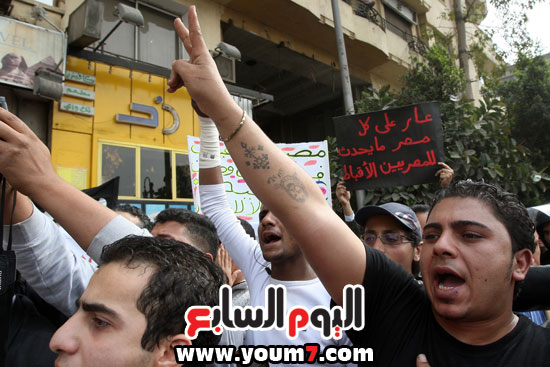
(translation: Shame on all of Egypt for what is happening to Egyptian Copts)

(translation of the black sign with white letters in the previous pictures: No to pressures from security)


There are many factors here which need brief explanation. Notice first the tattoos on this man’s arm, and in other pictures. Nearly all Copts tattoo a simple cross on their right wrist or hand, but this man’s tattoo is very elaborate, with also a picture of a Christian saint. It is expressive of a deep identity allegiance to Coptic Christianity.

MP Abd al-Rahim al-Ghul is a local politician in Nag Hamadi which was not supported in the previous election cycle by the bishop, resulting in the Christian vote going to his opponent who then won the election. Furthermore, after he denied any relationship with the alleged killer who gunned down the Christians exiting the church, a photo surfaced in which he was pictured standing side-by-side with him. It is important to note that the investigations continue but the trial of the alleged killer has not yet begun.

Reconciliation sessions are a traditional way of adjudicating disputes outside the rule of the law. While innocent in and of themselves, many Copts feel that previous incidents like Nag Hamadi have been ‘solved’ through these ‘reconciliation’ sessions which have been forced upon them by the security forces. In many cases though compensation has been paid by the government to victims the criminals who attacked Christian homes or churches have gone free. In defense of the government it is often difficult to establish guilt in a mass action, and therefore criminal proceedings are difficult.

The uniform bill for building houses of worship is a legislative proposal to stipulate the same regulations and freedoms for both mosque and church construction. Currently, while there is great freedom and simple regulations for building a mosque, it requires the permission of the governor to build, expand, or repair a church. Human rights activists of both religions have called for this bill, and a recent survey by Watani International, a Christian owned daily newspaper, declares that 60% of MPs support the bill as currently drafted, while a further 29% support it with some reservations. Nevertheless, the issue has stalled, and in light of the Nag Hamadi incidents the government has promised to revisit the bill in next year’s legislative session.

Focusing on the demonstration itself, however, there are interesting points to note. Official permits for demonstrations are rare given in Egypt, though demonstrations can begin and have an effect without quick putdown by the government. As is seen in the pictures the police are standing guard, but obviously not breaking up the proceedings. It is unknown, though unlikely, that permission for this demonstration was received beforehand, but prior warning may have been given to secure a police presence, or else security became aware through monitoring the public online organizational activity. Later information revealed that the demonstration proceeded from Tahrir (Liberation) Square, which is the center of downtown Cairo, to the nearby Parliament building, but upon the movement of the demonstration the crowd was dispersed by the authorities.

Arabs outside of Egypt have remarked about the substantially greater freedom enjoyed here than in other nations of the region. As such, as a political event, does this rally speak well of Egypt? Obviously, it is protesting the conduct of the government in the handling of the Nag Hamadi case, but in allowing the at least temporary gathering does this indicate a growing allowance for freedom of expression?

At the same time, it is noteworthy that only three newspapers covered this event. While this could be understandable by the government newspapers this is odd for the party press and independent dailies. These often carry a moderated anti-government message in the selection and presentation of the news. Why would this event not receive their attention?

This question is more significant given the unprecedented nature of the demonstration. While the Western reader is likely accustomed to every interest group holding protests here and there, not only is such demonstration rare in Egypt in general, it is almost unheard of among the Christians. The demonstrations which do occur are almost exclusively held on church property. Expatriate Copts in America, Europe, and Australia often hold demonstrations abroad, seeking to pressure the governments of their adopted countries to pressure the Egyptian government in turn. In general these efforts are not appreciated by Coptic Orthodox Church leadership, which seeks to cultivate a positive relationship with the government, which is very critical of outside interference in its affairs. Nevertheless, individual Copts often look with longing at the freedom enjoyed by their oversees compatriots, and revel in the criticism leveled at a government which is increasing viewed as being ‘Islamic’ or at least discriminatory against Christian interests. For the first time, it seems, Christians in Egypt have adopted these methods locally.

It is an open question to consider if this is a positive or negative development for local Christians. On the one hand, they are taking an active role in the political process, carefully navigating the uncertain allowance of the government to publicly air their complaints. By all indications the demonstration was peaceful. Furthermore, it is an internal and not international response. The protest was joined by local human rights organizations and organized by an opposition political party. The demonstration reveals a growing sphere of civil society participation to be enjoyed by many, if not all, and Christians are among those benefiting. This appears to be a positive development for both Egypt and its Christian community.

On the other hand, is this the best method for airing Christian grievances? In all indications the activity was political; should this be the domain of church-related issues? Furthermore, though the demonstration was peaceful, it was not full of peace. Notice the faces and postures of the demonstrators. These are angry and confrontational, and the slogans are provocative, anti-government in implication if not in direct formulation. Is this proper Christian behavior?

The Christian is here faced with his dual identity as members both of a state, in which he or she enjoys the common rights of citizens, and members of a religion, in which he or she is called to high standards of conduct in preference to the interests of others over his own, and is chiefly called to represent God and Jesus over earthly concerns. While it is good and beneficial, most Christians agree, for Christians to participate actively in the affairs of this world, most Christians also agree the manner of this participation must be regulated by the teachings of Jesus and other Scriptures.

It is difficult to imagine a public demonstration of protest which does not protest, or an angry litany of complaint which is not angry. This demonstration straddles the line between the rights of a citizen and the responsibilities of a Christian. It is difficult to know the balance. It is a negotiation Egyptian Christians have been involved in for some time, but now face a new field of application; may God give them grace. Concerns of the government and the Muslim majority also play a substantial role in their choices; no activity is conducted in a vacuum. These choices will provoke reactions and consequences which could go in any number of directions. Wisdom is called for, with prayerful consideration. Or, perhaps there has been too much prayer already – now is the time to act!

Biblical examples are multifaceted. Christians can find examples of prayerful resignation to circumstances, pious submission to government, astute political maneuvering, decisive claiming of rights, and zealous upheaval of the status quo. Which, if any, of these options is best for the Christians of Egypt? Which is best for the nation as a whole? Who should make this decision? Can various groups answer the question differently? What are the consequences of each? What are the potential benefits? Which best cements the rights of citizens? Which best testifies to the love of God?

May God grant Egypt his blessing, and its citizens his wisdom.

Categories
Personal

Finding Church (part three)

In early October we began this blog, and after the opening post our next two entries were about the challenge of finding a local church in which to worship. In part one we described our general attitude toward this process, and in part two we described some of the local options from which to choose. I had imagined at the time that part three would follow shortly thereafter, but as you can tell it is now mid-February, and we have gained almost four months experience from where we were. It is high time for an update.

At the end of part two I previewed that we would describe our thoughts toward the Coptic Orthodox Church, which is the primary church of Egypt. Back then it was to be a philosophical description of the value of discovering a new tradition, one which reached back to the earliest days of Christianity. It was to promote the idea of belonging to the church in its local form, feeding and being fed with a people now our own. It may have mentioned the ideal of each Christian possessing something which would strengthen the neighborhood body, wondering what it could be that they might gain from us. It would have admitted the anticipated difficulties of finding spirituality in liturgy, but been hopeful that this was the pattern among millions, and for centuries, so why should we not also find our way?

This is what I would have written; I might yet still. In the previous four months we have had confirmed the troubles described in part two in worshipping late night with the Evangelicals, as we prefer to put our girls to bed early. We have gone several times to stay only for the worship, which has been enjoyable, but has been short of church. At night, however, at the end of a long working day (Sunday), it has been very easy to let this experiment slip.

In the previous four months I have also joined a Coptic Orthodox Bible Institute which—this class at least—is focused on how to extend Christian belonging to those on the fringes of the church. I wrote about a recent conference with this group here. This has been a very good experience for rubbing shoulders with real, believing Orthodox Christians of Egypt. While I do not learn as much about Orthodoxy as I had hoped, it is invaluable for learning of the things which are important to them. I have been received well, despite a Protestant background—many are often concerned about Protestant inroads into the Orthodox Church—and will speak well of them to you.

Finally, as for introduction, in the previous four months we have been a part of their traditional Friday mass community. While mass itself begins at 7:00am, many people do not show up until much later, and the sermon begins between 8:30 and 9:00. Communion is served around 10:15 and not finished until a few minutes before 11:00 when everyone has been served. Thereafter there are closing prayers and the sprinkling with holy water—a practice I must describe one of these days in its own right. At 11:00 the mass ends, and people exit.

Outside of the mass there is a children’s mass in a separate hall which begins at 8:30, followed by Sunday school at 9:30. This ends also at 11:00, at which point the families come back together, and many cross the street to the church owned villa where drinks and food are available for purchase. As best we can tell this area is open throughout the week, and people hang out all day on Friday.

Our pattern has been to go to church and sit together in the main mass from about 8:30 to the beginning of Sunday school. Emma and Julie tried the children’s mass early on but it was crowded and Emma did not have a very good experience. So I take Hannah on my lap and sit on the men’s side, while Julie takes Emma and sits on the ladies’ side. Actually, we both sit in the balcony which seems to be less divided, but we do stay apart in hope this would be easier for our girls to be still. So far, they have both behaved admirably.

Julie then takes Emma across the street to the villa which houses Emma’s age Sunday school. At times she sits outside with the other mothers, but recently has discovered a ladies’ class in the neighboring room. Meanwhile Hannah and I remain in the mass, after which Hannah enjoys getting down from my lap and sitting in all the chairs, climbing through all the wooden pews. After a little while, during which most of the church empties, we cross the street to rejoin Julie and Emma, who have since bought for all an early lunch. We split falafel sandwiches and French fry sandwiches, and sometimes find other families with which to talk, sometimes not. The same goes for our girls and playing with the other kids. We usually leave around 11:45 or so, and cross back to the church, where we take a few kids books—Arabic and English—from the library, unchain our double stroller, and walk to second Sunday school.

Second Sunday school is at the Evangelical church closer to our home, where Emma enjoys her class and Julie stays around and watches from the side. Quite a few of the Orthodox children also attend the Evangelical Sunday school classes, or, perhaps it is the other way around. In any case, Emma likes both and Julie has been getting to know some of the bi-denominational mothers.

 It has been very educational for me to be part of the mass. I have even enjoyed it. Since I am experiencing everything in Arabic (and Coptic) there is that which makes me concentrate more than if all was in English. It has taken time, but I have become familiar with the patterns of liturgy and the communal prayers, even if I don’t always capture every word. At the same time, with Hannah on my lap there is ample room for distraction, which does not seem to be a problem to those around us. The same program, more or less, is repeated week after week, and has been for two millennia. It does not seem to matter if here or there a baby cries or people rise to leave mid-service. The traditions go on as they always have.

This aspect of the service has been enjoyable, as it also allows me time to daydream. By this I mean spiritually daydream, as I contemplate ancient rituals and contemporary importance. If this is what church was in its earliest days, does this carry forward in establishing legitimacy? Or is this church doomed to increasing irrelevance in favor of a growing worldwide contemporary evangelicalism? Do evangelicals do well or poorly in shaping church so closely to culture? Would Orthodox benefit from adding variety to their worship? Since Orthodox believe the bread and wine are truly Jesus’ body and blood, how does this affect their partaking? Do they truly believe, or are they going through the motions? If that is a poor way to ask, are they repeating ritual with sincerity? When they prostrate themselves before the elements, do they ‘feel’ God? He is, after all, present in all his holiness. What would it be like to feel this? Should I even try? Will it happen one day by itself? Do I believe at all? Is what I am doing worship? Am I just an observer, a sociologist? Does any of this, in them or in me, please God at all?

These are fun questions to consider, even if they are troubling at times. Add these to the icons, the incense, the architecture, and the cymbals, and the time goes very quickly. In moments here and there I have been moved; never have I been bored.

This week, however, was a setback.

One week ago we contacted one of the priests who had previously invited me and my wife to sit down and discuss Orthodoxy. He mentioned that though everyone seeks to speak with him after Friday mass, the Saturday services are less regularly attended, especially the English mass celebrated the first of every month. So we called him to reserve a time, made arrangements for a babysitter to watch the girls, and gave our Saturday morning to this endeavor.

He didn’t show up.

I learned later that he forgot, and asked if we wished to meet with him next week. He didn’t seem particularly disturbed that he forgot, nor was he particularly inviting, though not insincere, in his offer. Of course he did not know the troubles we undertook to meet the first time, but his attitude revealed something that was lingering in the back of our heads during the previous four months. There is little welcome extended in the Egyptian Coptic Orthodox Church.

I can imagine that our presence there in the first place is very odd for people. Maadi, Cairo is full of foreigners, but we are the only ones I can notice in the church. Orthodoxy is not a Western tradition, so this is not unusual, and therefore our attendance is. Nevertheless, in four months almost no one has asked why we are there, or offered to help in understanding the liturgy, or even greeted us as the service ends. There are plenty of admiring stares at our girls, and at the villa people are friendly if we approach them, but it seems most people seem to believe we wish to be left alone. Perhaps they are accustomed to this being the normal Western attitude.

If the reader here senses some frustration, it may not be far off, but that is not the point. One other comment on the setback, however, before I get to it.

Getting up for church has been a fabled difficulty in America for a long time, so there is nothing unique in this anecdote. Nevertheless, it is a little different from the norm, for Sunday church in America follows the chance to sleep in on Saturday following the workweek. Here, Friday church is the next day after the Sunday through Thursday workweek, so after rising early for the boss, a Westerner like myself feels entitled to take a day of rest, but finds instead we have to rise again early, this time for God.

A mistake with the snooze button today led to an extended morning rest, and then a few snoozes more. Before we knew it it was clear that we would be late for the sermon at church. Whereas we don’t strive to get there for the start of mass, it is beneficial to hear a sermon, and all the readings from the Bible take place before the sermon. Afterwards, it is all liturgical preparation for communion.

Having had four months of getting used to the liturgy, and having attended the English liturgy the week before, suddenly all desire to go to church was gone. I have not mentioned yet this post that non-Orthodox are barred from taking communion. I will explain more about this sometime in the future when I learn more, but only baptism at the hands of a priest qualifies one to take part in sharing the body and blood of Jesus. We have known this since the beginning, and have not allowed it to bother us or prevent our efforts to belong. I would rather partake with them, and will explore any opportunities for this, but during the extended communion time Hannah and I simply watch the others move forward to receive.

Therefore, no sermon, known liturgy, and no communion equal little desire. We went anyway, of course, going to church has been an established habit since I can remember. It was again as it has always been, which is both good and bad.

Therein lies the point. It is as it has always been. This is a difficult aspect of Orthodoxy to get used to. As for the lack of a felt welcome, we are measuring this against the hyper-seeker-sensitive American evangelical church. If I say ‘hyper’ here many American readers will immediately nod their heads in agreement, thinking of that flashing lights megachurch that gets all the attention. No, I mean your church. Most churches give instruction to certain people to make certain they approach any noticeable newcomer. They must not be overly friendly, lest they be scared away, but they must feel welcomed, lest they complain afterwards no one talked to them. It is a tightrope walking game the American church has almost mastered.

Furthermore the very idea which informs this blog—a sense of belonging—is nearly established dogma in Western society, and as such in the church as well. We want to feel, to experience, to be loved, to be wanted, and we expect our churches to provide this for us. Of course, we need a top notch children’s program as well, so they can share in all of these ‘needs’. This is written with a touch of critique, but it also is both positive and Biblical. The church is a body, full of relationships.

Before moving on it would also be wise to mention the cynical flip side of this arrangement. People must be welcomed, of course, so that they may with us receive the benefit of salvation, if they do not know it, but then can also grow spiritually through sound teaching and service opportunities. This is true and real. It does not stop the critique, however, that we welcome them in pursuit of church growth, either for the crass but real idea of gaining donations to perpetuate existence, or for the slightly improved but still suspect notion that bigger is better. I know this world well; no one thinks this way, but these concerns are never far from the surface. The practice of religion is rarely far from the practice of capitalism. We fail to consider this mammon at our peril.

I am highlighting these features of American church to provide a stark contrast to the Coptic Orthodox Church. Surely there are negative pictures here as well, which I will share with you as I learn them. For now, however, consider the simple fact of continuity. The church here has existed for two thousand years. It has birthed Christianity in many other countries, started worldwide monastic movements, won an entire nation to the faith, become famed for spectacular miracles, experienced waves of bloody persecution, witnessed numerous theological controversies, given way to a dominant rival faith, lost its ancestral language, descended into dry and lifeless repetition of rituals, and experienced unprecedented spiritual revival. Throughout all this the mass has stayed—so as best I can say at this time—exactly the same.

The church is as it was, and presumably will be. Each and every church is the same. Though one priest may differ in style from another, there is no competition between bodies. Deacons, like priests, are appointed by a regional bishop, and may preside over mass in any church to which they come. Worshippers may go to one church one week and another the next. Mass is the same if it is full of people, or attended by only one or two. Outside the sermon and communion, the priest’s back is turned to the congregation almost the entire time. The presence of any one individual makes no difference at all.

In this description I am focusing on the mass; church in Egypt does appear to have a web of relationships and activity that we have not yet been privy to. Perhaps it would be better to say that Christians of Egypt have this network, which is centered on the church. I plan to write a post about this soon.

The mass, however, is timeless worship. As in the Bible, where the same words have informed Christians for generations, so does the liturgy inform Christian spirituality and definition. I have been looking for a sense of belonging, and somewhat been hoping for a give and take from the church. With all patience I have realized our acceptance may take a long while, as would our own ability to know how to belong. The setback of the last week has made me wonder about this expectation, indicating I have aimed incorrectly. The mass is not set up as a give and take with the church, it is set up only for God. The congregation gives itself in worship; it takes an immaterial blessing. God, presumably, will welcome all who prostrate before him; those who come on their own terms are left to themselves.

We do not know what these thoughts will do for our hope to find church soon. These four months have not been sufficient to decide where our family should worship. It remains a request in our personal prayers; to the extent you wish to join in these we are thankful. Church has been part of our family for a long time, and we desire it to be a foundation of our lives here as well. Where we choose to belong we will strive to give ourselves fully. However informed by American Christian culture we are in this respect, we hope it is still our prostration to God, of whose welcome we desire. May it be with Egyptians of all convictions that we gain a sense of belonging, which is the immaterial blessing we seek from God. We pray this is on his terms, and not our own.

Categories
Personal

Coptic Conference, Egyptian Triumph

The two items in the title today bear no relation to one another except for the day. In the end, it was a true Egyptian experience.

This past weekend the class I am with at the Coptic Bible Institute – its actual name is the Institute for Orthodox Doctrine and Spiritual Guidance – had its winter retreat at a former monastery turned conference center in Beni Suef, the first major city to the south of Cairo, about a two hour drive away. Julie and the girls were able to come, as did the families of other students in the class, which made for a nice atmosphere for all. We were put together in a single room in a typical dorm style residence facility, and while I participated in the activities Julie was free to roam around the grounds with the kids, not quite a babysitter, but not exactly comfortable with the hands-off attitude which prevailed. The retreat lasted three days and two nights, and was a nice break from the routine of the city.

The program of the conference focused on communication skills, body language, and the five love languages, which may be known to some readers of this blog as a popular study in many churches. It surprised me somewhat to see it in an Egyptian Orthodox retreat program, but much of American Christianity has come to Egypt through its Protestant churches, and then works its way as well into the greater Orthodox majority. Each day had two lectures and a study group, which I was able to ‘feel’ as normal retreat procedure, but the rest of the activity reminded me I was among those of a different tradition.

We did not necessarily wake early, but the day started with prayer, which was not the common ‘everyone give a request and talk to God’ procedure during Protestant sessions. Instead, we worked through the Orthodox prayer book. Traditionally, and still present in monastic practice, Christians would pray seven times daily. These prayers are scripted, though there seemed to be some variety in the selections. I was more confused than would ordinarily be expected, for instead of breaking for prayer seven times, we combined two prayer sessions into one, ending the day with the single, seventh prayer, and according to a pattern everyone knew except me, intermingled the selections from the two readings.

Within each session there consisted the Lord’s Prayer, the Apostle’s Creed, a ‘Lord have mercy – Kyrie Elasion’ reading, a Psalm, a reading from a Gospel, and general other intercessions. It was all very scriptural, but it was very fast. In part this was because my Arabic reading is still slow, and I was trying to keep up with unfamiliar material, but it also seemed like readers rushed through the selection given them to read. Some seemed like they had memorized the portions, others were less confident, but some read in a sing-song that was very beautiful. We stood standing the whole time, about twenty to thirty minutes, and faced East. I would say that East is the direction of Jesus’ second coming, but that doesn’t sound exactly right, as early Christianity expanded in all directions around Jerusalem, and his return, though to be seen by the whole world, will be, according to his own word, on the Mount of Olives. Nevertheless, within the Orthodox liturgy is a directive to ‘Look to the East’; I will need to ask a bit more to find out why.

 The other activity was also unfamiliar; following the prayer we learned a Coptic hymn. Though most of Coptic Orthodox liturgy is now conducted in Arabic, and has been for centuries, there is a conscious effort on the part of Orthodox Christians to maintain the use of their original tongue. It is only a liturgical language, but its study is mandatory for all priests and monks, though no one speaks it at home and only the learned would be able to follow along except for the known and familiar passages. At the Orthodox church we attend they put the words of the liturgy on a screen; on one side is the Arabic text, on the other is the Coptic language, written in Arabic script.

This hymn was being taught in preparation for the coming Easter fasting session, for it is used only near the end of Lent, if I understood correctly. It contained also an interesting theological twist. The opening lines praise Jesus for his fast, which he undertook for us. I had not heard this notion before. The question of why Jesus chose to fast forty days is a question not really answered definitively in the Bible, but the general answer that I have heard was that it was in preparation for his public ministry, which began immediately after he emerged from the desert. For Protestants who rarely fast, this is seen as a commendable but exceptional event, but one that is designed to draw one especially close to God, and as such, it is understood that Jesus did this for himself.

I am not yet sure of all the formulations, but Orthodox do fast regularly, almost half the year in varying levels of severity, and it has an element of repentance from sin. I may be wrong in this, but if I am not, they do have Biblical warrant. Yet since Jesus had no sin of which to repent, nor need to draw closer to God, the Orthodox may be more pressed in this understanding to figure out why Jesus fasted in the first place. The answer I received, as the hymn celebrates, is that he fasted for us. He undertook his fast to teach us to fast, and in some way, to perfect and complete the fasting required of his followers. Christians are said in the Bible to be ‘in Christ’; as such their lives are mixed with his, and his deeds also become theirs. I was nervous that this made Jesus’ life somewhat of a theater, in which he was playing a role rather than living his life in a real way. The Orthodox believe, of course, that Jesus was both fully human and fully divine, and that during his fast he suffered greatly, as any human would. The motivation, however, seems peculiar. Again, I will have to ask more questions.

Less people were familiar with the hymn than with the prayers, and people seemed less eager to participate in the learning thereof. I thought it was fun in the beginning, but I tired of it as the retreat went on, realizing I was never going to memorize it, and even if I could, would I even recognize it during the few weeks it entered into the liturgy? Perhaps other people felt the same way.

As a note, I have by now memorized some of the more celebrated parts of the liturgy that are repeated every week. It is fun to be able to participate fully during these parts of the service, whereas so much else is still unfamiliar. I keep in the back of my mind, however, the traditional Protestant critique of liturgy. It may well be fine and Biblical, but does the eternal repetition lead to routine monotony? I would like to be inclined to believe it does not have to, but this is an answer I can only discover in time through experience. By the visible participation of many during the mass I can see they are engaged; by the visible participation of many others, there is little indication.

During the retreat, however, mass was the one thing we failed to participate in fully. Justifying ourselves that this was a retreat and thus a good time to catch up on some needed rest, we slept in, resisting the knock at our door which was given to all at around quarter to seven. We did arrive a good half an hour before it ended at 11:00, so who knows what type of credit we received if we were found in attendance following communion. I suppose for full disclosure we should also admit to not participating in the seventh late night prayer, performed at around 10:30pm. We may be striving for a sense of belonging, but we are not yet Egyptians, we need our sleep.

Following Sunday mass and a final group session we were due for lunch and then departure at 3:00pm. This is a key detail, for Sunday was also to be the final of the African Nations Cup. Egypt had defeated hated rival Algeria (see this post, from Julie, and this one, from Jayson) in the semifinal, 4-0, and the country was awash in excitement in advance of the final match against Ghana. In addition, having won the past two African Nation Cups, but missing out on qualification for the upcoming World Cup, this was a chance at national redemption. Our bus was scheduled to leave with plenty of time allotted to return to Cairo before the match began.

Of course, nothing in Egypt goes according to schedule. Lunch was prepared by a classmate’s family who lived in the area. Though delicious, it was an hour late. Then when we had finished, the bus to return had still not arrived. When it came, it was smaller than the one which brought us, causing extra delays in trying to fit everyone and their luggage (we did, somehow). Meanwhile, three of our group had gone into the city for some reason, and needed to be picked up along the way out, except that they were not where they were supposed to be, and we had to search for them. At long last we got on the road, and it was clear we would not make it home in time for the start of the match.

In vain we tried to find the match broadcast on the radio. The best we could do was find a station which gave updates every few minutes, but the frequency was not clear. Fortunately, we were in the first row, so we could hear the time pass with confirmation of the same result, no score. We had no indication of the time elapsed, however, but it seemed likely we could make it home before it ended, and certainly for the overtime which seemed likely.

Then, the bus had an accident. It was no real accident, but there was no reason for it, as best I could tell. We were so close to home and the driver pulled into what seemed like a strip mall. I think he was looking for a shortcut to get over to the main road to take us back to the church, realized he made a mistake, but then backed up into another car. Five or six of the men of our group got out with the driver to investigate, and another lengthy delay ensued. I let things be and stayed in my seat, otherwise I could fill in the details, but I have seen the confrontations that sometimes occur over fender benders, and thought the presence of a foreigner might not help things. In any case, about fifteen minutes later we were on our way again, as there seemed to be no complications from the accident.

During the final approach back to church we saw evidence of the result. People were slowly but increasingly swarming into the streets to celebrate. Those in cars began honking their horns incessantly, including what seemed to be a wedding party in convoy. Children were dancing while waving flags over their heads. Others were shooting off fireworks. Every club or café we passed was emptying. The nation was in euphoria.

We learned in the taxi ride on the way home that Egypt had scored in the final five minutes, and then held off the Ghanaian attack to win 1-0. The next several hours were filled with horn honking throughout the city. Egypt, seven times champion, three in a row. I am glad we attended the Coptic conference, wished we would have been able to watch the match, but at least witnessed the emergence of celebration. We witnessed true Egypt, from the first experience to the last.

Categories
Arab West Report Middle East Published Articles

Stubborn Ideologies and Uncertain Details

In the wake of the Nag Hamadi killings prevailing Egyptian sentiment has asserted the essential unity between Muslim and Christian, presenting the Christmas massacre as an aberration of the norm. The dominating idea is that Egypt is a country with two religions, but one culture. Muslims and Christians have studied and worked, suffered and prospered, and lived and died as one people, sharing in communal bonds of fraternity, celebrating jointly their religious feasts. Though this is an idealized presentation, it is also largely the truth, and the promotion thereof can be a powerful reminder to all sides as they reel from the weight of this tragedy. Easily the Christian can now see himself under attack; easily the Muslim can see his religion being hijacked. If the idea of ‘two religions but one culture’ can take hold of the popular consciousness it can prove to keep these communities united in the face of sectarian dissent or denial, as will be seen below. The ideologies of the two communities, however, may prove a stubborn barrier. 

Popular unity can only be celebrated if it is believed, and many Coptic sentiments lament its absence. For these, the events of Nag Hamadi are simply further confirmation of the deteriorating state of Coptic acceptance in society. They see a culture and governance which is increasingly Islamic, and picture themselves outside of it. They believe the cries of national unity to be hollow, uttered by politicians worried more about preserving the national image than preserving the safety and rights of its Coptic citizens.

Indicative of this ideological stranglehold is a conversation recently conducted with a prominent Coptic intellectual. This is a fine man with interreligious friendships and respect for his government. In discussing the Nag Hamadi incident, however, he was adamant about this being an example of persecution against Christians by militant Islamist elements within his country. He is careful not to label the action ‘Islamic’, for he esteems the Muslim interpretation of faith offered by his colleagues, which he admits is known as ‘liberal’. Whereas many have seen the aggression instead as an expression of tribal sentiment in reaction to the shame incurred from the rape of a 12 year old girl in a nearby village, he rejects this explanation. He has heard it said—and from a Muslim source—that it was not a rape but consensual relations, and not with a minor, but a legal adult. He has heard this; he has no confirmation. Nevertheless the ‘refutation’ of the claim of rape takes away the possibility of tribal honor killing. The only possible scenario remaining is that of religious extremism. Inasmuch as the killing took place at a church on the holiest of holidays, the subtleties of the rape account are easily brushed aside in the preservation of a prevailing ideology. 

While many Muslims have a real belief in their essential unity with Christians in the fabric of their country, they have other issues to confront. Namely, how could such a crime be committed by Muslims, with that religious identification emphasized over the epithet ‘Egyptian’ as the attack was upon a church, during Christmas? The external appearance of the incident is entirely sectarian; having moved through a period of active and admitted Islamic violence in the previous decades, the average Muslim is loathe to witness its reappearance. They believe their religion to be essentially peaceful and such aggression to be against the faith. Acts such as Nag Hamadi, if understood in sectarian light, could provoke a crisis of faith.

Indicative of this ideological stranglehold is a conversation recently conducted with an average but pious Muslim young woman. This is a fine woman with interreligious friendships and respect for the Christian religion. In editing a text from the Coptic intellectual I asked her to help me supply some of his missing references to Qur’anic verses. The author had identified several verses which encourage Muslims toward peace and coexistence, for which he had supplied the references, but also spoke of other messages which some extremists utilize to preach violence. Here he gave no references, and the process of editing required they be supplied. 

My colleague became very reluctant. Rightfully claiming that she was not a scholar, she was slow to state what verses might be intended, lest a wrong understanding be given of her religion. “Of course,” I said, “we just need references, you know, the verse that says ….” “But that verse does not mean violence,” she defended, “the Prophet said …” “It is not our viewpoint, we are only editing,” I replied, “we carry the voices of everyone, no matter what their opinion.” She continued to demur, wondering if in doing this work we would be aiding the writer in this wrong interpretation of Islam. She did see enough of the writer’s text to admit that he was being balanced and only describing the views of certain Muslims, but the simple motion toward anything which might attach violence to Islam was nearly paralyzing.

This attitude can be seen specifically in the popular rush to identify the attack at Nag Hamadi with the rape of the 12 year old girl. If such a heinous crime can be attributed to distant tribal customs then Islam bears no responsibility, only the Muslim—if he can be called that—who perpetrated it. The general, peaceful Muslim then can carry on in the conviction that his religion is peaceful without having to be disturbed by an act of violence that carries all the markings of sectarianism. This is not to say that Islam supports violence, it only suggests the complications in the text for crafting one’s internal theology. As concerns the attack on the church and motivations involved, the subtleties of the crime can be easily brushed aside in the preservation of a prevailing ideology. 

The facts of Nag Hamadi are not clear. The motivations of those involved are less so. The facts of the rape in the nearby village are not clear. The connections to the killings in Nag Hamadi are less so. This scenario has not stopped pundits, commentators, lawyers, human rights activists, expatriate Copts, politicians, journalists, priests, and foreign media from pronouncing their opinion. This chorus has been joined by others who issue statements without sources, and others still who labor to report only the facts. This is normal in such a tense and explosive atmosphere; it will take time to sort through the chaff to get to the wheat. Even then, among many the official pronouncements will lack credibility, sending the issue back into the morass of presuppositions and rumors.

Who among us does not hold to an ideology through which he or she interprets reality? The reader is invited to critique the ideology which has informed this article. Nevertheless, in an issue as charged and vital to Egyptian peace as Nag Hamadi, it proves difficult for even the best of humanity to set aside an ideology before the facts are in place. Instead, indications and deductions, however logical, cement the established viewpoint and establish the discourse of each community. Egypt is a country of two religions; the analysis of reactions of both demonstrates that it is also a country of one culture.

Categories
Arab West Report Books Middle East Published Articles

Two Thousand Years of Coptic Christianity

Two thousand years of Coptic Christianity is the title of a book by Otto Meinardus, a renowned scholar on the history, practice, and theology of the Coptic Orthodox Church. His work is widely accepted as the standard reference book for all inquiries into the development of this particular expression of faith. Upon reading it, I could only agree.

My strongest agreement, however, is expressed in its description as a reference book. When I asked a well read friend to recommend me a book with which to understand the Coptic Church, he immediately thought of Meinardus. While gladly loaning me his copy, though, he added, but this is a book you must eventually buy for yourself. I didn’t understand this at the time; like with most books I wished to read it, profit from it, and then give it back to its owner. Rarely if ever does a book get read twice – why should anyone ever purchase?

Upon my reading I discovered why, though the jury is still out if I will eventually buy it for myself. The first half of the book is a comprehensive survey of Coptic history, beginning not even with Mark—believed to be the founder of Christianity in Egypt—but with Jesus. The Gospels tell the story of the Holy Family’s flight to Egypt to escape the sword of King Herod. While the Gospel details are few, Coptic legend-slash-history thoroughly establishes their itinerary, proceeding even to sites hundreds of kilometers from Palestine in Upper Egypt. At each significant place of their travel there is a church dedicated to the event. These churches have an ancient history, lending credibility to antiquity of the tradition.

Meinardus does not judge. Though he comments often on this progression, he generally presents the details and leaves the historical queries to other works. His treatment of subsequent Christian development is similar. He tells the tales that surround the preaching and martyrdom of Mark, and of the first communities of Christians that began the transformation of the Pharaohnic character of Egypt. Elements of this story involve the miraculous, which does not stop with the end of the apostolic age. Meinardus continues to list the traditions surrounding the acts of prominent bishops and monks, and especially the martyrs from the eras of persecution. Monasteries and martyrdom are among the pillars of Coptic Christianity, and Meinardus provides a window into the worldview of the church.

He also delves into the development of theology, which is easier to document. Treatment is given to the great Christological debates which divided the early church, but proceeds into the production of Coptic canon law. The great figures who wrote these documents and the ancient liturgies, so obscure to Western readers, are given their names and accomplishments in print. Meinardus has respect to the cloud of witnesses which has gone before, and honors their legacy.

Yet not all the names are obscure. Athanasius, the great champion of orthodoxy against the Arian heresy and compiler of the Biblical canon of Scripture, was the pope of the Coptic Church. Cyril and Gregorius are not as well known, but are still familiar names to students of church history. St. Anthony, the founder of monasticism, was Egyptian, as was the Thebian Legion whose memory is enshrined in many European cities for their refusal to deny their Lord and subsequent martyrdom. Coptic Christianity, in fact, lies behind much of the history of Christianity in Europe, as their monks and missionaries carried the Gospel throughout the continent, and to Ireland especially. Many people are aware of the vital role played by the Irish in the Christianization of Europe; less known is that the origin is Coptic. Meinardus supplies the names and stories of the Egyptian contributors.

Meinardus continues the story into the middle and modern ages, describing the interactions of the church with Islam, during both its tolerant and repressive epochs. Less detail than I desired was given to the question of why the church declined over time, but this is a difficult issue to address; histories are written of triumph and progression—who records the record of loss? Nevertheless, Meinardus provides a window into this near-unknown era, and understanding of the history will take many readings simply to establish familiarity. This becomes easier as modernity approaches, and Meinardus describes Coptic dealings with successive Turkish, French, and British empires. Special attention is given to the deep revival of the church during the 20th Century, which continues to this day. A blog post all its own is necessary, however, to do justice to this phenomenon.

All that is listed above was both interesting and worthy of owning as a personal record, though the story in its broad strokes may be told elsewhere. The second half of Meinardus’ book, though, both establishes and possibly condemns it to serve as a reference book. From here on Meinardus becomes a list-maker, as nearly every monastery, church, and saint’s shrine is given a place in his text, complete with details of the relics therein. I read the majority of the book while I was staying at Makarius Monastery in Wadi Natrun, which is home also to additional historic monasteries established as early as the 4th Century. It was fascinating to read the history of where I was. The other chapters were a chore to read, however, simply because I have no context to appreciate them. If I anticipate a future visit to such-and-such village in Upper Egypt I will open Meinardus and read of the churches there, but otherwise, what good does this information do me?

I hope, however, to visit such-and-such village. I imagine that our work will take me throughout Egypt to discover the many different facets of Egyptian life, Christian and otherwise. To view the foundational facts will require reference to Meinardus, and for this his book seems essential to own. I would recommend the first half of the book to anyone interested in Coptic Christianity, but I will likely in time find better, or at least equal, books to recommend. As a reference book, however, Two Thousand Years of Coptic Christianity will likely stand alone. It is recommended to anyone desiring to study Coptic Christianity, and for long term life in Egypt, if there is a desire to honor its Christian heritage, it is a must.

Click here to purchase from Amazon: Two Thousand Years of Coptic Christianity

Categories
Personal

Today is Not Christmas…

… but neither am I Scrooge. Well, that could be interpreted as a matter of opinion, as may be seen.

Perhaps many of you are aware that in Egypt, Christmas is celebrated on January 7. I imagine there are deep and profound historical reasons for this, but to date I have not cared particularly enough to research them. Coptic Orthodoxy split apart, or rather was expelled, from the to-become Catholic faith at the time of the Chalcedonian creed, I believe in 451. One of the consequences was a divergence in fixing the celebration of Jesus’ birth, which for early Christians was never regarded with any importance. Easter also became separately marked, though this was of greater import, both biblically and liturgically.

We discovered while living in Jordan that the Christians there created a novel solution. The Coptic and Orthodox branches of Christianity, about evenly split in the country, agreed to celebrate Western Christmas on December 25, and Eastern Easter according to the lunar rites of the Orthodox Church. I would wish that the worldwide church might make such an agreement as well. For our part in America I imagine this would be easy. Ubiquitous Western culture has established December 25 as Christmas even throughout the non-Christian world, and none of us can ever figure out when Easter is going to be anyway. What would be the difficulty in uniting with our Eastern brothers in faith by celebrating Easter according to their calendar? I doubt anyone would even know the difference.

This could be harder for the Orthodox, however, as it could be seen as yielding to the very unchristian culture which surrounds the birth of Jesus. What should stop the Western world, however, from making a unilateral gesture of unity to Orthodoxy by taking up their Easter? Perhaps the Pope could champion this cause from the Catholic side; if he did, would Protestants go along? Or, under what scenario could the initiative emerge from the Protestant community; who might lead us forward? Might any of you propose such a measure this year in your churches? Might you develop a sufficient sense of belonging to the worldwide church so as to contemplate it?

Our sense of belonging to Egypt, however, has created in us a bit of a quandary. When is our Christmas? Most foreigners here simply celebrate December 25 as they always have, and the local expatriate community churches host Christmas Eve services and have times of caroling. For those spending time abroad away from home, certainly this is a welcome reminder of valued traditions.

But it completely misses Egypt. The non-Orthodox Egyptian Christian community is but a small percentage of the millions of Coptic faithful. Again, I lack the history of why and if this was always so, but the Egyptian Catholic and Protestant Churches celebrate Christmas in unity with their brethren, on January 7. Though Jordan also was a predominantly Muslim country, there were still Christmas lights hanging from the windows of Christian apartments and manger scenes set up among the families we would visit. Here, there is nothing. Not only is there no Christmas cheer, but the Orthodox precede Christmas with fifty-five days of fasting. As we went to sleep last night, it was almost eerie to imagine the excitement among children back in America, and the labors of parents to run the gauntlet through that most sacred of national institutions, the mall. Here, save for the sounding of the call to prayer, there is silence.

This is not quite true, however, and it creates a confusion that is quite palpable. The Orthodox are proud of their traditions and history; why then are there so many trappings of Western Christmas? Last Friday at the Orthodox Church we attend was held the annual church bazaar. There were Santa Clauses being sold, wreathes to buy, and a big sign proclaiming, “Merry Christmas and Happy New Year!” Why was this not reversed in order? Are the Egyptians yielding in fact to the inevitability of Western cultural dominance? Or, is there simply no escape?

There is a possible explanation in that this church in particular was consecrated on either December 24th or 25th, and from the coincidence of Christmas the two celebrations blend together. Another explanation is that the Christians also celebrate New Year, and the holiday festivities start early, continue through the end of 2009, and pick up steam as true Christmas approaches. Perhaps, but later this evening we will attend the choir concert at this church, which will feature carols in both Arabic and English. We do not have the benefit of familiarity over time; is this normal, both here and throughout Egypt?

In any case, what should we do? The principles of belonging suggest that we should do as the Egyptians do and celebrate according to their calendar. No one claims that Jesus was actually born on this day, so what does it matter? We also have the benefit of having children young enough not to be traumatized by a different date. We could just ignore the 25th and then let the momentum build in both family and country in expectation of the 7th. Yet if this can be interpreted as the noble solution, what do we do in the face of the ignoble bowings to yuletide found among so many Copts? Do they themselves open our door to the legitimacy of Western celebrations?

 Regardless, the noble solution may not be the easiest, or even healthiest. While our children may be able to switch with little difficulty, we ourselves cannot. Furthermore, what of the phone calls back to family in America? These will not stop, but how will they be defined? We have taken to saying, “It is Christmas in America,” but this is forced. I nearly prayed this morning at breakfast, both unconsciously and with a smirk on my face, “Thank you God that Jesus was born in America today.” Of course I will not play with such blasphemy, but is this a duality that can be maintained?

If only for year one in Egypt, we will try to maintain it. Perhaps our children will grow up bragging, “We get to celebrate two Christmases!” Our current solution is to avoid the expatriate church focus on the 25th, in the manner which we generally avoid this church anyway. Still, we will wake on Western Christmas and have a special breakfast, after which we will open our stockings. Before lunch we will participate with other foreign friends by taking a boat ride on the Nile. Later in the day we will call our families to join in their celebrations, and will close the day at the aforementioned Orthodox choir sing. All this will be Christmas, in very nature and being.

Yet it will not be Christmas, amen and amen. Eastern Christmas is still to come. I am not sure what this will entail in terms of participation in the greater life of the Coptic community. For ourselves, though, we will leave the opening of presents until this day, when we will also have a cake to celebrate Jesus’ birthday. Perhaps this suggests that we will treat the 7th as ‘true Christmas’. So be it. We can never leave behind our own culture, nor should we try. Yet we should give ourselves as completely as possible to those we live among, and the sole celebration of the 25th would be tantamount to insisting, “We are not of you, we remain foreigners.” It is doubtful that anyone would care; they expect foreigners to remain so. Yet we hope that if only in a symbolic way some might see our holiday adoption, albeit short of transfer, as an expression of love and appreciation.

The celebration of Christmas, on either the 25th or the 7th, is a celebration of incarnation. The word of God took on flesh, and dwelt among us. Following this pattern, all who follow him can take on the flesh of those they live among. As he remained God, so we will remain American, and all will keep the identity they possess. None of this need be set aside, but so much more can be added. For the good of Egypt, for the good of all the communities in which we live, and for the good of our very souls, may such incarnation take hold.

Categories
Personal

A Protestant on Peacemaking

A little while ago I had an opportunity to dialogue with Rev. Safwat al-Bayyadi, who is the President of the Protestant Churches of Egypt. My summary of this conversation has been published on Arab West Reports, which you can access by clicking here.

As I remarked once before, it is a great benefit of my work that I get to meet such influential people. Rev. al-Bayyadi was able to provide me with a bird’s-eye perspective on Christianity in Egypt, encompassing all but especially from a Protestant perspective. While the title for the reverend is correct – President of the Protestant Churches of Egypt – it is interesting to note that generally speaking the Protestant churches here all go by the name of ‘Evangelical’. I haven’t yet asked enough questions to know why, but it may be that within Egypt ‘Protestant’ could seem like a foreign entity, brought from the West, and therefore suspect, while ‘Evangelical’ is more of Biblical terminology. Though this decision was made long ago, in recent years the ‘Evangelical’ title may result in negative association with the Bush administration and the general support the American Evangelical Christian community gives to foreign policy in Iraq and Israel.

If only from a small outsider’s perspective, I would note that in calling their denomination ‘Evangelical’, Egyptian Protestants may have done themselves a disservice. While the motivation I have briefly come in contact with is laudable, it may have unfortunate consequences. In America, ‘Evangelical’ is an adjective, describing a certain understanding of Christianity. While my rendering here is off-the-cuff, it generally refers to an understanding that is centered on the Bible above tradition, focused on a personal expression of faith, and accepts the necessity of communication of the Gospel message. Thus in America while ‘Evangelical’ is generally understood to be Protestant but not mainline, and has also acquired conservative political associations, in terms of the definition given it is not unusual to find evangelical Catholics, Orthodox, or otherwise. I wonder if in naming themselves ‘Evangelical’ Egyptian Protestants may unwittingly limit the description of the definition from being applied also to the larger Orthodox community. Like I said, I haven’t explored this much yet, but I wonder.

In any case, though Protestant and Orthodox relations here seem mainly positive, there have been recent examples of accusations thrown cross-denominationally. Specifically, at times Orthodox leadership sees Protestants as ‘sheep stealers’, conducting organized efforts to ‘turn Egypt Protestant’ by winning over the youth. You can read a press review on this topic by clicking here.

On the other hand, in my personal interactions with individual Orthodox Egyptians, almost everyone has expressed appreciation for the Protestant Church here. While they hold to their distinctive doctrines, they commend the Protestants for their skills in Bible memorization, vibrant sermons, praise music, and youth ministry. They emphasize that there is only one faith, shared by all denominations, though particular understandings of faith differ, and may reflect the truth closer or farther from correct Biblical understanding. Many families have members in each denomination, and many others worship in both churches. Julie has also found that Emma is not unique in attending the Sunday School sessions of both the local Protestant and Orthodox Church. 

In any case, I am making comments that could be better developed into another post later. For now, please accept my encouragement to read what Rev. al-Bayyadi has to say about the vital task of peacemaking in Egypt. His perspective is both noteworthy and gained from personal experience. If you didn’t do so earlier, you can click here for the text.

Categories
Arab West Report Middle East Published Articles

‘Massacre’ in ‘Assiut’

Did the title of this post get your attention? If so, that is part of the problem of journalism in general, and of the press in Egypt in particular.

Among our work at Arab West Report is the translation of articles from the Egyptian press from Arabic into English. These are then put online, but while the summaries are generally only available to subscribers, occasionally I will be able to share some full text reports.

I have selected this link today about an incident which took place in Dayrut, in Upper Egypt several hours south of Cairo. While the articles we select often, though not always, have to do with religion, they represent the whole spectrum of life in Egypt in both Muslim and Christian thought and identity. Sometimes, however, the articles have to do with conflict between the two groups, and I have chosen this story both because it affected me personally and because it illustrates some of the realities about our life and work.

Please click on this link first.

Here you see illustrated the often sensationalist journalism that easily damages interreligious relationships. The author called this incident ‘a massacre’. Granted, it is a sordid story, but only two people died, though the gunfire was intense. The word ‘massacre’ however takes your attention. Indeed, I selected it first from among the thirty or forty articles we translated last week simply due to this title. The place-name in the title is also of consequence: Assiut. This is a large city in the south of Egypt with large concentrations of Christians, moderate members of the Muslim Brotherhood, and extremist Muslim splinter groups. Recent history has witnessed violent conflict in this area. Daryut is a village in proximity to Assiut, but is not even on its outskirts.

Once read, however, the author has done his job, even if the story does not measure up to the lead-in. Unfortunately, however, the title plays up the idea of sectarian conflict – Muslims ‘massacred’ Christians in ‘Assiut’. While the incident was nothing of the kind, this is the impression that is left in people’s mind, especially if they, like many of us, do not continue to get the whole story. It is a much more interesting headline than a revenge killing in some obscure village. In fact, such a story would likely not even warrant a headline.

But now read this link.

I paid attention to this story not just because of the word ‘massacre’ but also because our work involves the difficult goal of peacemaking between communities in tension. After reading the first story my mind moved on, but then the next day this report was issued, and my heart sunk.

There is so much I do not understand. After having lived in the Arab World for some time I do understand the concept of an honor killing. The first story made sense to me, though it is a world removed from our experiences in the West. Still, certainly someone who would violate the honor of my daughter would stir within me the desire for revenge acted upon in Dayrut. This second story, however, is incomprehensible.

Why would this incident escalate to the point that it did? It was a horrible crime, an honor killing came in response, and the matter should have been settled. What did the failure to release the killer incite in the community at large? Why would they respond this way against their innocent Christian neighbors?

I realize that sectarian conflict exists, but it should not have been ignited here. In our work we strive to understand the root issues involved, doing our best to always make the worst incidents understandable in context, even if justification is impossible. We also strive to remain neutral; we do not represent the church, we do not side with the Christians, we do not proclaim persecution. In reading this story, however, I was dumbstruck. The Christian identity in me, which is true and undeniable—its cancelling is not requested in our work, either from us or from our Muslim colleagues—proposed the word ‘barbarism’. Burning houses, destroying shops – what could cause this act of rage? Or was it an act of intentionality or opportunism? Either way, it calls out for the label of ‘barbarism’; the only question is the matter of degree.

Still, there must be some qualifying factors. It was clear from the first article that the author was sensationalist in choosing the word ‘massacre’. Here, the word better applies, though thankfully no one was killed. Surely they could have been; does this suppose that this was a targeted message and not a simple act of rage? Or can we picture it in appreciation of the culture that will allow violence but stops short of the taking of life? Our own culture can learn a lesson here, even in the midst of such ‘barbarism’. 

I wondered further, what does it mean that they burned houses? The picture in my head is of my parents’ home being reduced to ashes. Is that the reality? Or were the fires from smaller scale Molotov cocktails? Or of the shops which were destroyed; does this refer to rocks thrown through the windows? The reporting is full of detail, but especially as a foreigner the context is lacking. Though surely this is a regrettable occurrence, might it be the random activity of disenfranchised youth? From the article this could be the case. Or, it could be simple barbarism. Or, it is more likely something in between.

I have no picture yet of what that in between might be. This, however, is much of our work. This article succeeded in stimulating within me the type of Christian reaction which only worsens the situation. My immediate assumption was one of barbarism, and though this will not poison within me my estimation of Muslims, it may color my perception of the Muslims of Upper Egypt. But why should I allow a journalist to dictate my reactions?

Our work must move beyond our emotions to get at the true story, inasmuch as this is possible. We must look for the benefit of the doubt, but in the end, we must also call a spade a spade. Yet our work intends to go beyond good reporting, as necessary as this is. We wish to aim for peacemaking, but if we cannot without prejudice approach both sides in a spirit of understanding and in a commitment to truth, we will fail. We may fail anyway, but with spirit and truth, we may at the very least, hope.  

Postcript: Since these incidents took place there has been more reporting about Dayrut. Click here for a more detailed account of the atrocities, published by a Coptic newspaper in Egypt, Watani International. (‘Watani’ means ‘my country’ or ‘my homeland’ in Arabic). Finally, click here to read a press review of several newspapers, which provides a more even-handed treatment of the issue, including the most recent information.

Categories
Personal

The Value of Monasticism

At Wednesday noontime I traveled to Shubra, Cairo to meet Fr. Basilius in the offices of the St. Mark’s Bookstore. While our meeting was ostensibly to discuss the arrangements for my stay in the Makarius Monastery, we discussed extensively the role of monasticism in the church, with an eye toward the issues of the Abu Fana Monastery, which has fallen into sectarian conflict. The following is a summary of our conversation.

Before our meeting I had written a long list of questions for Fr. Basilius concerning the details of my stay in his monastery. How long should I stay? What should I bring? Where would I sleep? What should I wear? What time are prayers? These and many other concerns filled my practical head, but I had a few other questions as well about the monastery and things I had heard about it. Nevertheless, our conversation turned instead to introductions, which led quickly into substantial discussions about monasticism and its role in society and the church.

I briefly described my role in the Center for Arab West Understanding as a continuation of the work done by Cornelis Hulsman in unearthing the real, often non-religious origins of sectarian conflict, but seeking in our new project to move beyond reporting into proactive contributions to the reconciliation effort, in areas, for example, such as Abu Fana. Fr. Basilius spoke warmly of Mr. Hulsman and mentioned instances of their prior cooperation. He then asked me what I thought of the Abu Fana situation. I replied that I was new to this country and preferred to hear from him what he thought, but that I was able to state the findings of Mr. Hulsman, of which he was aware. Fr. Basilius was reluctant to say much, but the nature of our conversation signaled an implicit understanding that the role of the monks in Abu Fana was negative.

“Has anyone tried to communicate with them about their position?” I asked. Fr. Basilius was unaware of any efforts, but stated that he doubted anyone was able. The monks are entrenched in their position and in general were supported by their leadership. What benefit could be gained from words by an outsider? The situation was beyond redemption in any case, for the surrounding population, including government officials, had developed a hatred for the monks in their intransigent attitudes. “But if a message was to be delivered, what would it be?”

Fr. Basilius paused for what seemed a long time, and I was not sure he was going to answer. I had asked variations on the two questions above a few times already, revealing perhaps a strange urgency. He had been engaging, kind, but perhaps not inappropriately vague. When he did answer, it was in recollection of a story, “We have dealt with a similar issue ourselves.”

President Anwar Sadat decided in the late 1970s to grant Makarius Monastery over one thousand acres of land. He had noticed the commendable job the monks had done in reclaiming desert land for agriculture, and, as the country was experiencing phenomenal population growth the government realized such projects were extremely necessary, so he tripled their workload. The abbot at the time, Fr. Matta al-Miskeen (Matthew the Poor) was honored at the gift but wondered, we can barely keep up with our three hundred acres, what can we do with so much? There was much internal debate and reluctance to receive this gift, but in the end, they accepted their charge, and began working the land.

The process of registration of the land in the name of the monastery, however, did not go smoothly, despite even a later presidential rebuke of his ministers. They faced endless delays in getting the proper paperwork, but pressed on anyway with their cultivation. During their efforts to navigate Egyptian bureaucracy, President Sadat was assassinated. In the next meeting with government officials Fr. Matta was told that the monks had no claim to the land, as the promise from President Sadat was only oral, and not in writing. Discouraged but accepting, Fr. Matta returned to the monastery, and informed his fellow monks of the decision.

As time passed the monks returned to their own fields, but a little later there came word of a general presidential initiative. This one was meant to encourage all university graduates to find land in reward for their studies, as many were entering a work force devoid of substantial openings. As the monastery was populated by dozens of monks with university degrees, each one applied for the position, and not long thereafter the monastery had recovered, now officially, all the land originally promised. These lands were in the names of the monks, not the church, but that mattered little since the monks had forsworn all worldly possessions. The monks had been promised wealth, but showed no excitement; they had been ill-treated, but put up no protest. Finally, after accepting patiently the will of God, God had restored to them their previous honor.

Fr. Basilius gave no direct answer to my question about Abu Fana, but said succinctly, “Perhaps the monks at Abu Fana have not been able to have a teacher as wise as Fr. Matta al-Miskeen.”

I shifted course after this story with a personal inquiry. I communicated that I was a Christian, raised in a Protestant tradition, and surely he was aware of our critique of monasticism. “Yes,” he replied quickly, “you think we are lazy and do nothing but pray all day.” He smiled as he said this.

I countered, however. While some may think so, this was not the impression I had growing up. Monks were imagined to be among those who love God most fervently, and are dedicated in their prayers, and, in places, in their work. Their fault, it is claimed, is that perhaps they love God too much. They can be seen as selfish in their spirituality, for they are so enraptured in his love that they neglect relationships with the rest of the world. They hole themselves away with others of like mind, and experience neither the hardships of communion with ordinary people nor the necessity of service to those around them. They live only to God, and therefore in a sense, only to themselves.

I assured Fr. Basilius that this was a perspective I have inherited, but it was absent of the attitude which often accompanies it. I have a healthy respect for Orthodoxy in general, and am confident that they have an answer for such accusations. Having never heard the reply, however, I asked him to respond. I told him it was my purpose to better understand and appreciate monasticism in general, but with an eye toward Abu Fana in particular. The monks there are bent on the acquisition of land surrounding the recently rediscovered ancient monastery. Though there have been regrettable actions on both sides, the monks have shown little regard for their neighbors. Yet if the nature of monasticism is internal in focus, walled around a community closed to the outside, how can these monks receive a message of reconciliation with their neighbors?

Fr. Basilis began by commenting on Protestantism, stating, “Your living of the Gospel is based entirely on preaching.” I interrupted, stung by his choice of pronoun, for this is a critique I share of our denomination. “Not entirely,” I offered, and perhaps he recognized the legitimacy of my qualification. It should be mentioned that as he continued he gave no indication of ill will. If he was offended by the repetition of Protestant critique, he did not show it. Instead, his manner was warm and friendly, yet intent on edification.

Protestants will criticize us, he explained, because we isolate ourselves and do not preach. Meanwhile, they express their service to God in their positions in business, education, and a host of other occupations, but in reality, neither do they preach. Even in the Protestant services one can see the emphasis on preaching – there is a lengthy sermon, a few hymns, and a couple prayers. We in the Orthodox Church have a different understanding of Gospel responsibilities. We do preach, but the sermon is only a smaller part of our mass. Most of our time spent in worship is dedicated to prayer.

As monks, this is our dedicated heritage. We do not occupy positions in society which take time away from prayer. We have forsaken family, wealth, fame, and reputation to dedicate ourselves to the kingdom of God. Our prayers support the work of the church in all other areas, including preaching. Furthermore, since we have no children to support we can offer all the proceeds from this monastery as gifts to the poor. We have a calling, as others in the church have a calling. Ours, however, is for prayer, both to God in praise, and for others, in supplication.

I thanked Fr. Basilius for these words, and acknowledged their Biblical nature. I assured him I would be pleased to convey such thoughts to my fellow Protestants. Yet what of Abu Fana, how can this message be communicated to its monks? “This is difficult,” he replied. “They will not receive this message from you,” he smiled, “a Protestant. And we in this monastery are not accepted by many in the church.” “But what of those among you who are called to preach? Who could deliver such a vision? The messenger is not as important as the message. Besides, it is the work of God to change hearts, not of man. It is men, though, that must communicate the message. But what should the message be? ”

Fr. Basilius gave pause again. This time he answered. Though brief, it encompassed all. “The first priority of Christianity, and the second, and the third, is love. Perhaps the monks of Abu Fana have neglected this.”

Time was escaping us. Though I could have spent the rest of the afternoon with him, he had details to attend to for which he had come to Cairo, neglecting his monastery. The exigencies of my upcoming stay required a bit of mundane conversation, after which we departed. The value of the encounter, however, will last, and is the best place at which to end this account. May God grant peace to the people and area of Abu Fana; may his love be communicated to all.

Categories
Reconciliation

From the Heart the Mouth Speaks

To properly describe the peacemaking work we are trying to undertake here in Egypt would require much background information and many blog posts. It is our hope that over time we can give a proper picture of the many nuances and subtleties which inform our work, but we apologize that this will come piecemeal, and that in our effort to inform we may only further confuse. If this is so, please understand that we ourselves have a lot to learn, and we expect it may be many years until we develop the cultural eyes to appreciate situations as an Egyptian would. Until then, we will stumble along together.

Conflict does not take place in a vacuum. There are many social realities which contribute to a single incident that then is exasperated into a sectarian conflict. Among these is the general poverty of the Egyptian countryside. It has been recommended to us that in seeking to address what may properly be understood as improper mindsets and behaviors, it does little good to simply go to the area and hold a workshop on understanding the other. If such a message is to be delivered with any hope of success, it would be well to wrap it into a project that delivers some social benefit to the area, preferably one which addresses the realities which led to the conflict in the first place.

The benefit of a project in an area in which tension has developed between Muslims and Christians is that it can bring together these communities which, now at odds, have separated themselves. It is a general rule, or at least belief, that people will set aside differences when it comes to the mutual benefit of making money, or educating their children, or securing good health services, etc. Moreover, as people interact they discover their commonalities, realizing the demonized other is not so bad after all, and not so different from myself. Within a project, the message takes hold.

Undertaking the project, however, is difficult, for how are we to know what projects are beneficial to a community so distant from our own. Even our Egyptian partners and advisors do not understand their needs, for they are educated city people, far removed from the issues of the countryside. Given this, it has also been recommended to us that we actively seek to involve the non-governmental organizations, agencies, charities, and associations which are currently working in the area. They know the situation, and even if they are not currently involved in the village at hand, they are familiar with its context. To date, we have found one such organization which has a very good reputation in the area among both Muslims and Christians, having served many communities with both skill and tact.

There is only one problem, and though it is inconsequential for them, it may be a issue for us. This organization is Christian in its formation. It has been recommended to us that because of the sensitivities of foreigners working in religiously-related matters that we are seen as absolutely neutral in our orientation. It matters little our intentions, or even our behaviors; what counts is our appearance. This organization has a mixed Muslim-Christian board of trustees, and employs only Muslims as its field workers. The office staff, however, is entirely Christian, and they would admit themselves that though they deliver their services irrespective of religion, their motivation and orientation is Christian, and the organization is designed to stay that way. Though they are not connected to the church, they would be seen as Christian. Our advisors have not recommended we distance ourselves, though, for they are clearly capable and enjoy wide local support among all. They recommend simply that we work in addition with an organization that is Islamic in its orientation. This will provide the balance that is necessary for our own proper appearance as neutral. Otherwise, our ability to work in these areas may be compromised.

We have been negotiating a project with this organization, even taking a trip to the area to speak with them directly. The other day they were in Cairo and visited us to continue the conversation, and after many positive signals we explained to them the above, asking their recommendation for a similarly oriented Muslim group with which we could also partner. Now, it is granted that such a question could be seen as a threat, not religiously, but professionally. Projects require funding, and surely based on our negotiations so far they could be expecting our contributions, however limited. With the addition of another partner, their share, their influence, and their involvement would naturally decrease. Though not expecting their resistance to our question—they know the other area organizations, work in conjunction if not together, and recognize the value of partnership across religious lines—for the above reason the resistance could be explained. What was evidenced, however, went far deeper.

Up until this time, their representatives were jovial, full of mirth, life, and spiritual commitment. Nearly instantaneously, facial expressions changed, cheeks flushed, arms folded, and when extended ended in a finger pointing in exclamation, “I swear by the Messiah that there is not one Islamic organization that also takes care of the Christians!” They were accused of hypocrisy, speaking kindly to your face only to adopt their own priorities upon receipt of the donation. It was unfortunate in addition that both we and they had a subsequent appointment approaching which forced the rapid communication of ideas. Had we more time such sentiments could have been expressed with more nuance and explanation. While our partnership was not threatened—we ended with agreement to continue our planning—we were warned about seeking out a Muslim group.

It should be reiterated, this is a group that works closely with Muslims; it employs them and trusts them as influential advisors. They serve Muslims without any question of religious affiliation. Yet our question touched a nerve that, though our (Caspers’) experience is limited, seems to be indicative of many Christians here. They can and generally do have beneficial relationships with the Muslim majority. When it concerns the question of Islam, or Muslims as Muslims, however, the hardened heart becomes evident. There is a mistrust and a frustration that prevents genuine charity, both in its contemporary understanding and its original usage as ‘love’. While this organization is serving all, including Muslims, in a commendable manner, it appears that it is for the objective of creating a viable civil society that is inclusive of all, Muslims and Christians as fellow citizens. This is a noble objective, though it is true that some Muslims oppose it, believing Christians to properly be protected, second-class citizens in the Islamic order. This organization serves Muslims in the hope, at least in part, that they will demonstrate their own good will and valuation of communal life. They hope to win for themselves a secure place in society. As admirable as these goals are, and the means by which they hope to achieve them, are they motivated by love, by true Christian charity? Sad as it may seem, are they destined only to be a resounding gong?

Perspective is necessary. Though in Cairo there are many Muslims who share the ideals of civil society and citizenship rights for both Muslims and Christians, perhaps these are far fewer in the countryside. They may be correct; there may not be any Islamic organizations which also serve Christians. They may have tried to partner with some and been burned in the process. They themselves are affected by the perceived rising of religious tensions, and the rhetoric of some Muslims is downright offensive to Christian sensibilities. They must be commended for rising above their predispositions to serve as ably as they do. Surely we from the West cannot comprehend the difficulty of their position.

Perhaps also I am way off base; after all, I am judging from one response from only our second conversation. It is at times like this the foreigner must remember he does not belong, and therefore does not understand.

But I cannot budge from the ideal that God calls us to more than an overcoming of our predispositions against the other. He calls us to do good, as they are doing, but he also gives us a new heart. Lacking this new heart in its full expression, a condition from which we all suffer, our friends invoked the name of Christ in vain. Yet my words expressed here are no better, for they come not from a new heart, but from a new set of ideals. Though these ideals may come from Christ, they will be proved true only when issued from a heart of love that has experienced also the suffering they perceive. May God spare us all from any suffering, but may he preserve, renew, and employ us whenever it occurs.