Categories
Africa Arab West Report Middle East Published Articles

Early Warning and Early Response Training in Cairo and Alexandria

Imam Mohamed Ashafa describing Alternative Dispute Resolution

Disagreements abound in every society. Properly handled, they result in consensus, healthy competition, and increased understanding between diverse groups. Improperly handled, they result in tension, conflict, and civil discord. If religious overtones come to characterize the disagreements, the effect can be even more troublesome. This negative description came to characterize relations in Nigeria, in which Muslims and Christians descended into rioting and violence in response to claimed affronts, both material and religious. Yet within this environment two leaders, Imam Mohamed Ashafa and Pastor James Wuye, were able to overcome their own differences, forgive each other, and work together for peace.

While the Nigerian reality does not resemble the situation in Egypt, Ashafa and Wuye have developed techniques useful in addressing disagreements in any society. Beyond the power of their personal testimony – Wuye had his right hand chopped off in militia fighting, while Ashafa’s spiritual teacher was murdered by such militias – they are able to enter diverse locations, share the tools of their peacemaking efforts, and leave practical application to the nation’s citizens. Disagreements exist in Egypt, as they exist everywhere. It is the hope of Ashafa and Wuye that Early Warning and Early Response (EWER) Training will prevent disagreements in Egypt from deteriorating into outright conflict.

It is in this spirit that the Center for Arab West Understanding, an Egyptian NGO, invited Imam Ashafa and Pastor Wuye to conduct two workshops in Egypt, in collaboration with Initiatives of Change in the UK and its Egyptian sister organization, the Moral Rearmament Association. The first workshop was in Alexandria, June 13-14, hosted by the Alexandria Intercultural Dialogue Committee. The second workshop was in Cairo, June 15-16, hosted by the Center for Arab-West Understanding and the Goethe Institute. Over sixty people received training at these locations.

Introduction

Ashafa and Wuye repeated the same training course in both Alexandria and Cairo. They began with a description of alternative dispute resolution stages, seeking to emphasize the need for Early Warning and Early Response in effort to head off the more damaging stages as conflict escalates. They then proceeded to describe Conflict Mapping Tools, which are useful in breaking down a disagreement into manageable parts which divest it of the emotional fervor so often preventing understanding and agreement. Along these lines, they helped each person gauge his or her readiness to participate in the process through self-evaluation along different Levels of Identity and the Ladder of Tolerance.

Ashafa and Wuye then moved directly into the concept of Early Warning and Early Response, describing it as a systematic collection and categorization of social indicators, in order to anticipate and prevent escalation of problems. They spoke of the Cyclone of Conflict, describing why it is best to intervene early. They also encouraged efforts to engender EWER, to include all segments of society. They led participants in outlining the structures of EWER unique to Egypt, and concluded by getting participants to self-organize into an EWER Committee. Each of their training techniques will be described below.

Following the summary of their presentation will be examples of interaction the participants had with the ideas of EWER as presented by Ashafa and Wuye. In both questions and breakout groups Egyptian applications were sought by those in attendance. Finally, to close the report, testimonials from the participants will be listed, highlighting the chief gains and areas for improvement for any coming workshops.

Alternative Dispute Resolution

The importance of an Early Warning and Early Response system is clear when one considers the natural progression of conflict. Initially, all disagreements are dealt with in the communication stage, in which matters are discussed rationally and on friendly terms. Only slightly more complicating is the collaboration stage, in which parties admit the presence of an issue to solve together, and then seek win-win scenarios all can agree to willingly.

If this effort breaks down, parties enter the negotiation stage. At this level things are still friendly, but now each side must consider what must be given up in order to reach an agreement. Win-win is still a possibility, but in all likelihood it involves some loss.

Should the losses become unbearable, the next stage involves mediation. The disputants call on the assistance of a mutually acceptable third party to help them work through the issue. If necessary, this can develop into a hybrid mediation/arbitration stage, in which the parties agree to be bound by his or her decision. While this may solve the issue, should the ruling fail to satisfy one or both parties, they enter into strict arbitration in a court of law. Should that ruling fail to suffice, litigation/adjudication takes over as both sides hire lawyers to represent their interests. By now they are a long way from friendly communication and collaboration.

Unfortunately, there are stages of devolution still possible. If the court ruling fails to bring agreement, parties may seek their interest through violence or, even worse, war [this last stage does not apply to Egypt as Egypt has never entered that stage] Violence often results in neighboring parties leveling sanction against the disputants, in order to end the conflict, but which also humiliates and possibly impoverishes the two sides.

At this level, with all possible resolution strategies exhausted, the only option is for the two parties to be forced back all the way to the beginning: They must communicate. This fact reveals the near futility of ratcheting up the pressure to secure one’s interest; while solution can be found at any level, at each step more and more control is lost over the proceedings. Furthermore, more and more damage is done to the relationship between the two parties.

With this schema in mind, parties to a disagreement will realize the great importance of solving their issues in the early stages of communication and collaboration. Having now received Early Warning and Early Response training, those walking alongside them can help them to see this likely progression. By itself, it may encourage all parties to peace.

Tools for Mapping Conflict

Once the necessity of alternative dispute resolution is understood, tools are needed to move the disagreement from the level of emotion to the level of analysis. What is the issue, and what is at stake? Ashafa and Wuye led participants through four analysis methods: the Onion, the ABC Triangle, the Carpet, and the Circles.

The Onion

In order to get to the center of an onion, layer after layer must be pulled back, and the operation can be somewhat unpleasant and tear-inducing. Similarly, most problems are not immediately apparent at first glance, and there can be resistance to digging deeper.

The first level of the issue is a person’s position. This seems straightforward, but it masks the real issues. This layer must be peeled back, so that a person’s interest is revealed. Why does the individual or party state their position so? What interest are they pursuing? Even this level is not sufficient for conflict resolution, however; the essential need must be discovered. If an issue can be reduced to one’s interpretation of legitimate need, communication now proceeds on the basis of reality, not propaganda. When the need of each one is similarly identified and discussed, solutions become possible.

The ABC Triangle

The three parts of the triangle are labeled attitude, behavior, and context. The usual first look into a disagreement finds attitudes entrenched and behaviors counterproductive. Efforts to change either of these – though of worthy intention – will not succeed long term. Instead, context is at the head of this interconnected triangle. If change can be brought to the context of the issue, then the behavior of the disputants will change as well. Similarly, once behavior begins to change, hostile attitudes will also begin to give way. The key point for EWER is a matter of perspective. Resist the temptation to judge a situation by the attitudes and behavior of those involved. Analyze the context of the issue, and the others will more readily fall into place.

The Carpet

The picture of a carpet illustrates how various parties of a dispute interact. In the center of the carpet is the issue at hand, and the two disputants sit opposite each other, close to the issue. Conflict, however, is usually not isolated between two parties; others come alongside to support or oppose, with some relation to the issue in the center, though a bit farther removed from it. What drives this interaction?

Along the thread line that connects each party to the issue should be noted the interests, fears, and needs of each participant. Such analysis again serves to de-emotionalize a disagreement, but also is useful to judge the involvement of parties in alignment with the main disputants. As such mapping provides clarity to the reality underneath appearances, finding solutions becomes less difficult.

The Circles

Drawing circles is a method to connect and illustrate the various relationships amidst a disagreement. The manner of drawing signals the nature of relationship. Each circle represents a person or party, and a line between them designates a relationship exists.

The larger the circle size, the more power is held by the party encircled. An arrow between two circles illustrates the direction this power is exercised. Meanwhile, a zig-zag line signals conflict exists between the two parties, whereas a double line represents an alliance. If the line between is dotted, this shows a weak relationship, and for all lines, if an issue exists between the two parties, it is written in a box connecting the two circles.

A circle drawn with dotted lines indicates the presence of a ‘shadow’. A shadow party is not actually there in the field of the dispute, but influences surrounding relationships all the same. These can have great effect on the outcome, but can easily fail to be identified if the analysis is not objective.

Drawing circles, in addition to the other tools mentioned above, allow for all parties to achieve a description of the disagreement in terms as objective as possible. As they communicate their findings with each other, discoveries are sure to occur revealing differences of perspective. Yet within the effort to depict reality, a basis is created for finding the essential solutions that meet the needs of all involved.

Essential Self-Analysis

These tools are useless, however, in the hands of an unprepared craftsman. Yes, they can be utilized in order to help conflicting sides come to terms. But what about the bias of the to-be peacemaker employing EWER? He or she must first self-reckon on two levels. First, what is his or her understanding of self-identity, from which help is offered to others in navigating theirs? Second, what level of tolerance or intolerance does he or she harbor? Many times disagreements escalate due to conflicts in identity; without self-analysis the peacemaker may trip up.

The Levels of Identity

Ashafa and Wuye explained that the human identity is a fluid amalgamation of several relationships. Everyone negotiates these differently, and manages them according to circumstances and context. Yet if one gets stuck or overemphasizes a particular aspect of identity, it can cause conflict with the self or with others. While the order to be described should not be held as hard and fast, generally speaking, as one moves up the levels, he or she becomes better equipped to negotiate all of them.

The most basic and essential level of identity is family. One’s identity then expands to include tribe/language groupings, in which the individual moves about comfortably. Then comes the larger community group of a particular area, taking greater geographical scope in nation. In these labels it is clear to see how one conducts relationships of peace in wider and wider comfort zones, the more one’s overall identity expands.

The next levels of identity are gender, race, and profession. These bonds help one to further traverse barriers in identity, as a woman might easily take refuge in another woman, no matter the national differences. Professional bonds can do similarly. Yet while race as an identity marker can also help one broaden relational ties, it and others below can be found to divide and separate, rather than unite.

For this, the last two levels represent higher planes: Humanity and spirituality. To the degree that individuals see each other as fellow humans, rather than through defining and limiting lower identities, they are able to build bonds of peace. Spiritual identity, grounded in the paths of the great religions, also help to overcome lesser identities, uniting the individual beyond the material human nature into the fabric of the cosmos. It is at these levels the EWER peacemaker does best to ground his or her identity, granting patience for those worked with as they negotiate their essential identity level.

The Ladder of Tolerance

The Ladder of Tolerance asks the individual to consider his relation vis-à-vis the other, however defined. The relationship can issue from the fear of the unknown, driving attitudes and behavior downward toward intolerance. At a basic level this issues forth rejection, but can increase in severity producing oppression, dehumanization, murder, and genocide.

It is not likely the participants at the conference suffer from placement on the intolerant side of the ladder, but depending on the other in question, a review of their positive tolerance level is beneficial. First and foremost, an open posture toward the other results in examination of differences. As one ascends the ladder he or she is able to welcome the place of the other in acceptance. Still higher develops the posture of learning from the other, with the differences in question.

More difficult to achieve, however, is the valuing of the other. At this level one’s self identity can be challenged, threatening the comfort zone of associations lower than that of humanity. The peak step in the ladder culminates in celebration of the other, especially of all commonalities discovered. It is here that solutions to disagreement are all the easier to achieve. Getting there, however, requires work and vigilance, both internal to self and external in society.

Early Warning and Early Response

As mentioned above, Early Warning and Early Response is a systematic collection and categorization of social indicators, in order to anticipate and prevent escalation of problems. Escalation can be visually depicted through a cyclone, as early effects do not appear severe, but widens in scope and severity until all are aware of the problem. The most essential work, therefore, is to be done at the pre-conflict stage when the cyclone has not yet developed. This work can be thankless, as few people at this stage are even aware of a problem. Yet it is vital; once the cyclonic conflict is underway, many people look to help but the damage has already been done.

Ashafa and Wuye also encouraged participants to involve all segments of society into the effort to head off conflict before it explodes. Specifically, this means deliberately enrolling women in the effort. Women often suffer the most in times of conflict, and have great influence on their families, especially the young, to curb emotional, destructive tendencies. But it also means creative thinking to involve other groups as well; Wuye, having lost his hand, emphasized the role of the handicapped in keeping conflict at bay.

The Structures of EWER

Ashafa and Wuye led the participants through sessions in which they discussed their local context, trying to put their fingers on indicators that could potentially lead to conflict. The brainstorming was useful to get people thinking, but it led into a basic question: From where do you obtain your information, and to whom do you pass it on? Ashafa and Wuye emphasized the success of Early Warning and Early Response depends upon contact with sources of information, as well as contact with sources of authority. EWER is an effort to connect the two – to be a social middleman in the management of conflict.

Early Warning

The following is very basic, but unless one thinks deliberately to connect with sources of information, he or she will likely overlook vital indicators. Where does one hear about possible troubles to come? Here is the assembled list of participants: Media, the street, church and mosque, social clubs, NGOs, schools, previous research, taxi drivers, family meetings, cafés, cybercafés, public transportation, work, market, on the beach, restaurants, hospitals, conferences, jokes, the street, foreign media, posters/flyers/pamphlets, family meetings, friends, markets, SMS messages, advertising, cultural centers, and professional syndicates.

While it may be difficult for any one person to monitor all these outlets of information, this demonstrates that EWER must be a group effort. More will be described about this below, but Ashafa and Wuye emphasized that those concerned to be on the watch for early warnings of conflict must have sources in all these areas. Together, it is not difficult, for these are all normal facets of everyday life. The key is simply being connected.

As an important aside, Ashafa and Wuye also took the time to address the difference between EWER and intelligence gathering. They emphasized that intelligence is the realm of spies who work in secret, on the behest of the state and its security. EWER, however, is done openly by volunteers who work in conjunction with the state for the security of society. While there are lines not to be crossed, assurances were given this work is not illegal, especially if reported properly, as described next.

Early Response

Similarly, a list of viable outlets to inform amidst signs of conflict is also basic. While the ordinary citizen has little power or authority to curb negative indicators, he or she is connected to several community organs which do possess influence and strength. Participants listed the following possibilities: Community leaders, government, NGOs, journalists, religious leaders, God, colleagues, courts/lawyers, teachers, lobbying groups, policy makers, political leaders, specialist institutes, media, activists, businessmen, social media groups, syndicate bodies, famous people, tribal/family heads, and parents.

Again, few people can maintain active contact with such a diverse group. What is essential is that those concerned with EWER group together, comparing sources on who knows which authority. In combination, all of these groups can be covered, and must be renewed in contact at least once a month.

Thus, when trouble emerges, rumors are heard, or palpitations are sensed on the street, EWER volunteers will seek intervention through the appropriate channel. Choosing the correct channel is important, so that the one informed actually has influence to rectify a situation. If the problem is urgent then obviously all concerned citizens will contact police to pacify the situation. It is the not-quite-right scenario, however, which activates EWER in its formal sense, described next.

Central and Subcommittees

Those committed to EWER must move beyond the plane of individual awareness. Though the tools provided produce a conscientious citizen, he or she can do little alone. Instead, Ashafa and Wuye sought to give participants a group identity, asking them to divide into subcommittees from which they can monitor developments in their community.

Three subcommittees were suggested: Youth, women, and political/religious. Participants signed up based on their interest and preference, but with an eye toward their area of influence. What circles do you already inhabit, and what contacts do you already have?

Once these subcommittees become active, they should choose among their members to designate a few for participation also in the central committee. The central committee can be of variable makeup – five, seven, eleven members, etc. – but is tasked with the decision making authority for the EWER team. It is the central committee which should convey any early warning to authorities, assisting them in taking the necessary early response.

Each subcommittee is tasked with finding the spark which can ignite a fire in its community, and to put it out before damage is done. These should be people already involved on the ground, who know how to feel the ebb and flow on the street. They should be connected to local community and religious leaders, so as to be able to act quickly in times of budding tension.

Conversely, the central committee should be composed of individuals with credibility, leadership, responsibility, and experience. They should have developed contacts with higher level authority figures, to help bridge the gap that often exists between administration and the street. Information, strategy, and creative solutions should flow frequently between the subcommittees and the central committee, but decisive and official communication must be delivered by the central committee leaders.

By the conclusion of the two workshops participants were excited about their potential roles in the EWER effort. Leadership and continuity, however, were left for later development. CAWU will first submit the report of the workshop to the ruling Supreme Military Council, and will coordinate any future planning under the auspices of the proper authorities. A foundation, however, has been laid among the now-trained participants; it is for them, as concerned Egyptian citizens, to continue and enroll others in the process.
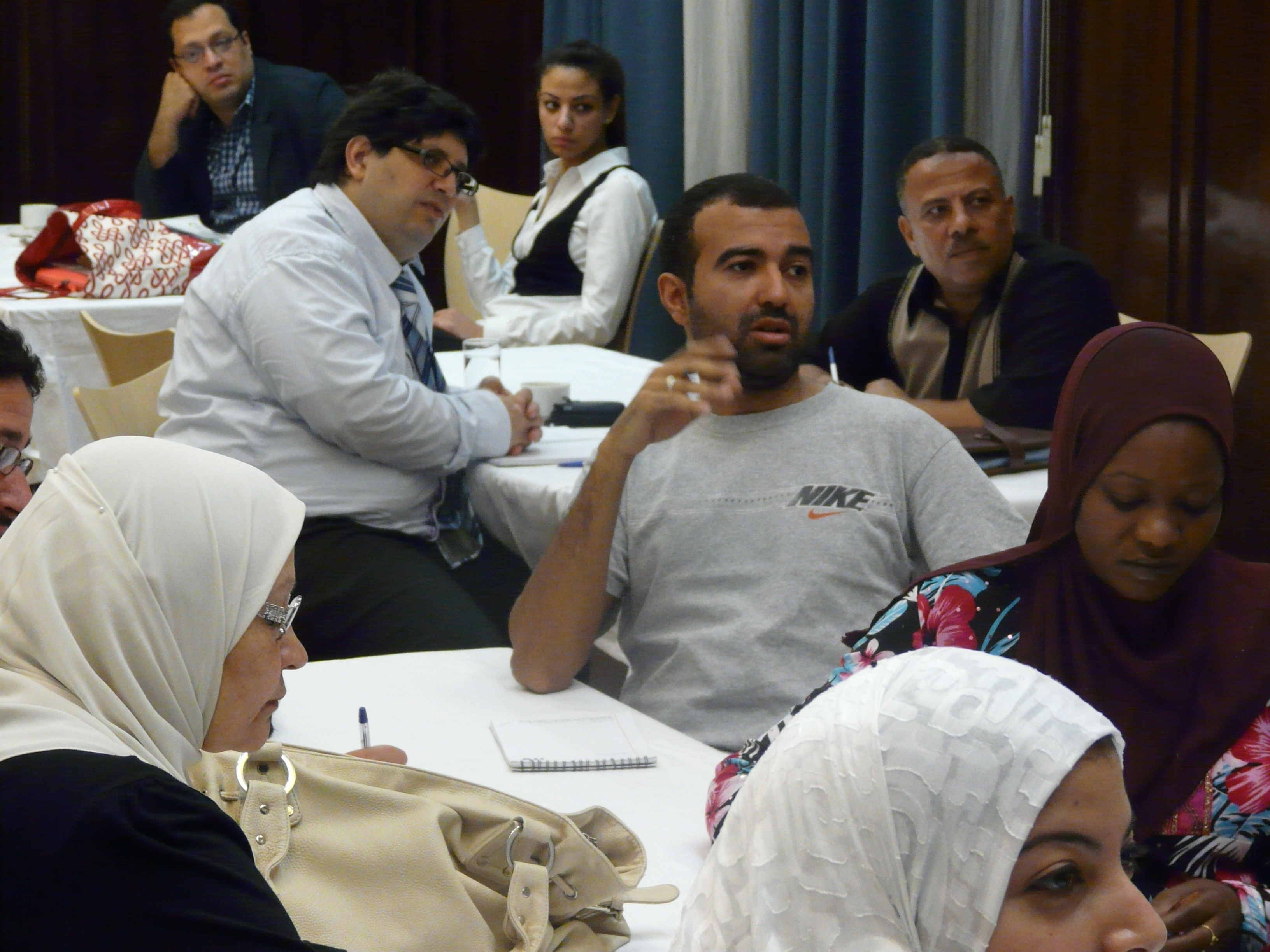
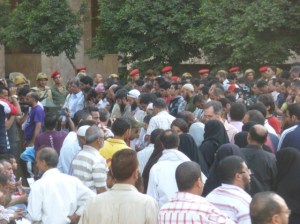
Attendees listening attentively

Egyptian Interactions

Throughout the workshops Ashafa and Wuye encouraged participants to ask questions and respond creatively to the material based on their Egyptian context. Early on they were asked about the concept of Early Warning and Early Response, and what this meant to them. Several aspects were given, both in terms of tremors that could be sensed early on, as well as structural issues requiring efforts at reform.

In terms of early warning signs, participants mentioned the presence of extremists in an area, rumors, and manipulative teaching coming from places of worship. Broader issues included poverty, unemployment, discrimination, draconian laws, lack of security, lack of transparency, and a lack of social justice. Given the latter, the early warning signs become more critical, and necessitate action.

Participants also interacted with Ashafa and Wuye over two well known Egyptian religious issues: mixed marriages and conversion. Concerning mixed marriages, they counseled simply to obey the dictates of religion, which cannot be changed, and which encourage husband and wife to be of the same faith. They did give an example from Nigeria, however, which illustrates how they worked through a tense situation.

A Christian woman married a Muslim man and converted to his religion, and they lived in peace with neighbors all their life. At the woman’s death, however, a dispute arose whether to bury her in the Muslim burial plot, as per her religion, or the Christian burial plot back in her original village, as per her tribal affiliation. The woman’s tribal family demanded the body, and Muslims of the area were also prepared to fight for it.

The issue was heated especially in that Muslim rites call for a burial within twenty-four hours, but negotiation could not resolve the issue that quickly. Ashafa and Wuye invoked the Muslim law of necessity, postponing burial until harmony could be achieved, given that the body will rest until the Day of Resurrection. In the end, after two days, an agreement was crafted to allow the tribal family its burial customs, but to also allow respect to the woman’s chosen faith, and have Muslims perform Islamic burial rites there. This decision was accepted by all, and a potential crisis was averted.

In terms of conversion, participants mentioned that especially sensitive in Egypt is the movement of a Christian into Islam. Applying the principles learned in the workshop, the Alexandria delegation decided they should divide the city into different regions, and seek wise Muslims and Christians in each who are non-political and accepted by the majority. For the neighborhood in question, then, whenever a rumor surfaces about a conversion, they wise leaders must be informed, and investigate together. Regardless of the details, they then must speak publically into the rumor, to disarm it, and promote peaceful solutions acceptable to the community.

Ashafa and Wuye allowed time during the workshop for the participants to divide into groups and discuss issues and possible EWER solutions. They were asked to especially consider Egypt as they knew it in their local environments.

One group considered the presence of a religious extremist in an area, disseminating hateful teachings. The solution was to be able to inform mainstream religious leaders about this quickly, so they could formally denounce and religiously counter such thought. Then, the media should be employed so that these moderate voices receive primacy in contradistinction to the extremist preacher, who gets discredited.

Another group considered a situation in which a threat is issued against a place of worship. Should even a rumor about this be heard, residents should quickly be assembled to create a popular committee to protect it, while security forces are contacted to also be on alert.

A third group referenced the recent trend in which some Christians have placed the sign of a fish – an ancient Christian symbol – on their cars as an expression of religious identity. They then related that some Muslims have responded by placing a shark sticker on their vehicles. While no violence has been committed, it is a worrisome sign of increased division.

This group recommended that NGOs be utilized to advance peace education, hoping to counter the drifting apart of communities. They also promoted the government use of reconciliation committees headed by recognized religious leaders, following incidents of tension. This latter solution, however, was not accepted by all, as some believe this practice only contributes to the sectarian issues of Egypt, by setting aside the rule of law necessary to punish infractions.

Another topic of discussion concerned how to work with extremist elements of society. Ashafa and Wuye spoke of two possibilities. In the first, the extremist leader is motivated by greed and/or power. In this situation there is not much that can be done with the leader himself, but instead they go to his followers, and educate them about how they are being used. They have also made local monitoring groups, so as evidence is gained about his ill motivation, it can be exposed to the people.

In the case of an extremist in sincere ideology, however, they do not move away from him. Instead, they stay in dialogue, admitting that intra-religious peace is often harder to craft than inter-religious peace. Ashafa and Wuye have been criticized as traitors by their respective religious communities, or else as compromisers who benefit from funding from the West. The majority, though silent, believes they are doing the right thing.

Another participant noted Wuye’s artificial right hand, suffered in clashes with Muslims, and wanted to know what Wuye would do if he met that individual. Wuye stated he had no idea who cut off his hand, given that the clashes were mob violence, but that if he were to meet him, he would forgive him. He stated that earlier he had hate, but that God changed him, and now he would seek to love that individual – excessive love is the means to disarm an enemy.

Along similar lines Ashafa sought to answer the best way to deal with your enemy. He stated that he no longer had enemies in this world, only friends he has yet to meet. To adopt this attitude you must break the barriers of fear and insecurity, but the best way to defeat an enemy is to turn him into a friend.

A particularly astute participant, in a different context, gave practical application to these ideas. He recommended that following any sectarian conflict, efforts should be made cross-religiously to visit the victims of violence. Others spoke positively of the Family House initiative, which aims to bring together the heads of Egypt’s various religious communities. Some, however, emphasized while love and dialogue are good, it is the rule of law and better education which must be cornerstone for diffusing interreligious tensions.

Conclusion

Imam Ashafa and Pastor Wuye have been successful in implementing such techniques in communities throughout Nigeria and other countries, and in some areas have curbed violence almost entirely. As they and the participants of the two workshops emphasized, Nigeria is not Egypt. Yet it should be clear from the description of the training that these are location-neutral tools which can be applied regardless of context.

Egypt has witnessed community tension since the revolution; given the breakdown of security provision it is not surprising some disagreements have sparked wider conflict. This situation helps explain the great usefulness behind EWER as a community based strategy. Egyptians have already grouped themselves into popular neighborhood communities during the revolution to protect their homes and properties. If marshaled and trained, this same spirit can provide increasing levels of cushion to keep both ordinary disagreements and targeted bigotry from escalating and dividing the citizenry. It can be a safety valve to keep authorities aware of the situation on the ground, but yet find solutions before they must become actively involved.

EWER is a tool to keep the community peace. If effective, its necessity will never be noticed. If absent, its necessity may become painfully obvious. EWER is only one tool among many, yet it is hoped the principles therein may become successfully translated to address perfectly the needs of Egypt. Nigeria is like Egypt, and like nations everywhere, in that they are filled with ordinary people, with ordinary disagreements. Though circumstances differ, the solution is common: Community cooperation keeps disagreements from becoming divisions. Early Warning and Early Response encourages this reality.

Categories
Personal

My School is Locked

Off to school and preschool

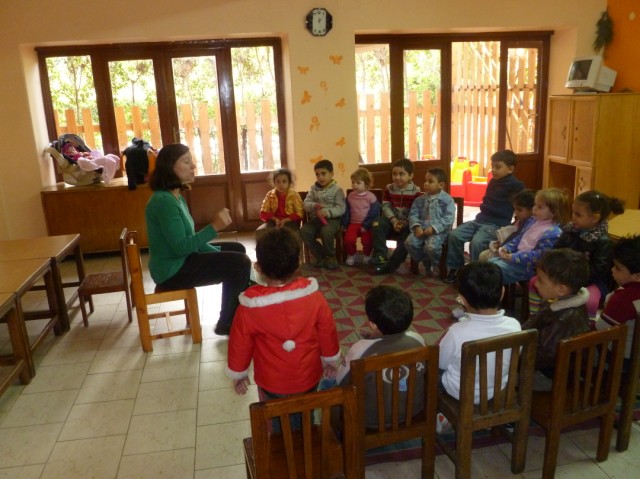
Emma and Hannah have been attending a local preschool here in Maadi, for the last two years.  Emma started just a few months after we arrived in Cairo, and Hannah joined her sister when she turned 2 ½.  One of the main reasons we chose to send the girls to preschool is to help them learn Arabic in a natural way.  We searched several preschools and found that many quality ones focused on teaching the kids English.  We wanted the quality and the good care associated with these preschools, but didn’t want the English teaching that was included.  We eventually found a preschool maintained by one of the local Coptic churches, which had a basic program, but caring teachers.  One of the most important factors for us was that the teachers and children were all Egyptian Arabic speakers.  We knew our girls would be immersed in the language.

At the beginning, Emma, then age 3+, didn’t really know any Arabic.  But since she was so young, we figured she would be able to function without language until she just assimilated into it.  I got encouraging reports from the teachers frequently as they told me that she was understanding them, then understanding the children and finally, communicating with the children in Arabic.  She didn’t speak with us in Arabic often, but we would try to gauge her understanding by asking her what she learned different days and different vocab words.

By the time Hannah joined Emma, I knew that the big sister would be able to communicate anything necessary for the little one.  Hannah was excited to join Emma as she went with me everytime I picked Emma up or dropped her off.  She already knew the teachers and some of the kids.  And so they both attended three days a week for half a day.

Volunteering in the classroom

Over the months, I got to know the teachers more and eventually did a little volunteer teaching in English/music once a week.  It was a fun challenge for me teaching preschoolers who don’t speak English.  It stretched my Arabic and gave me a chance to teach some fun things to my own girls too!  It was a good situation and we were happy to stick with it for Hannah once Emma enters school in the fall.

This was until a few weeks ago when I took Hannah into school in the morning and only the two aides were present.  They asked me if I had been to the parents’ meeting the night before and I told them I hadn’t heard there was one.  They then proceeded to tell me what was going on.

Apparently, one of the little girls in the class had gotten out of the classroom one day the previous week without the teachers noticing.  Now this classroom is located inside a building which is set back a ways from the main gate of the facility.  This building is by no means set up to be a preschool as it belongs to the villa-coffeeshop of the Coptic Church across the street, but it works.  I couldn’t quite understand from the conversation, all of it in Arabic, if the girl had just gotten out of the classroom, only to be apprehended by someone sitting in the coffeeshop portion of the facility, or if she made it all the way out the gate before being noticed by a passerby and then returned to the room.  There is a difference here, of course, as the second scenario is more serious especially given that a busy traffic circle is close to the gate, and also that a stranger returned her.  I am thinking this is what happened.  Praise the Lord there was no harm to the little girl, but you can imagine her parents’ fear and anger when they learned what happened.  This news quickly reached the school’s supervisor and then ultimately, the bishop in charge of preschools in the area.  By the time I talked with the teacher aides that morning, they were planning on all being fired even though some had served there for more than 20 years.

I was really sorry to hear this story and the plight of the teachers.  Yes, it is definitely an oversight which could have been catastrophic, but I don’t know where all the blame lies.  Ultimately, the teachers are responsible for each one of the children during the day, and so, the fault lies with them.  At the same time, they felt they were being taken to task without any chance for answering for themselves, or any consideration for their previous years of service.  I felt bad for them and told them I would give a good word for them if asked.

I immediately had the opportunity for this as I left the room that morning, leaving Hannah in the classroom with just a few other children whose parents either hadn’t heard the news or trusted the teachers anyway.  I ran into one of the men responsible for the preschool program and he told me the story once again after apologizing for not informing me of the parents’ meeting, but he didn’t have my phone number.  He was definitely upset with the teachers and said two things needed to be done: 1) reconfigure the classroom to keep the children contained, moving the bathroom within the facility; and 2) replace the teachers.  I did my best to support the teachers saying that if they fixed the first problem, then this shouldn’t happen again.  He didn’t seem convinced, but let me know the preschool would remain open the rest of the week before closing for a period of time.

Hannah finished out the week with the two teachers aides as the two teachers themselves refused to return to the place where they were being treated unfairly.  I was told that I could check back within about a month to see when they would re-open.  Or at least, that is what I understood them to say in Arabic.  By this time, Emma had begun a summer course, so she was at that five days a week, and now Hannah was home with me and Layla five days a week!  The first few days were rough for her as she couldn’t wait to go pick Emma up from school so she had a playmate!  It had been a long time since she wasn’t with Emma during the day, and she wasn’t sure what to do with herself.  We did get some quality time in, going shopping and cooking lunch, but I did have to restructure my day from what I was used to.

After a few weeks, I returned to the villa to check on the progress.  I ran into one of the teacher aides who was now working the cash register at the coffee shop.  The other aide had found work in the baby section of the preschool and the two teachers were hoping to open their own preschool within a couple months.  I was glad that there was some reshuffling rather than everyone being totally let go, but this aide told me that the preschool would not re-open at all.  That was a surprise to me, but that was the decision that was reached.  She then told me about the other preschool opening and gave me the teacher’s number.  I was glad to hear of that option as I really had developed a relationship with the other two teachers and the girls and I were all comfortable with them.

So that is where we are today.  After talking to the teacher on the phone, she said I can come see her new place in a couple weeks and decide if Hannah will attend or not.  In the meantime, I’ve told Emma and Hannah what happened at their old preschool, and they seem to understand to a point.  The other day, Hannah related the story to her grandmother this way: “My school is locked.  A kid got out and the policeman brought her back.”  Hopefully she can have a new school soon.

Categories
Personal

A Tour of the Caspers’ Second Apartment

In front of our home

Last year we made a video of our home here in Maadi, Cairo, Egypt.  While it was the perfect spot for us at the time, we knew our time there was limited since the landlord’s son was slotted to take it over once he got married.  So in anticipation of that event, we searched on and off for our second place in Maadi.

We desired to find an apartment with a yard within our price range, but Cairo is a major city, and even in the green, upper-middle class neighborhood of Maadi, private yards are not so affordable.  But we tried our luck and called a real estate agent with our price limit as well as the requirement of some sort of garden.  Within a day or two, he called us back and offered to show us what is now our current home.  We decided within a few days to move in, and our first landlord agreed to let us out of the contract early, as well as return our security deposit – two things which rarely happen here – as he was eager to begin getting the apartment ready for his son.  And so, with our newborn baby and two toddlers in tow, we moved down the street about five blocks.

We were able to borrow a friend’s car for the gradual move, and this allowed us to move almost all of our things to the new apartment over five trips in five days.  I would take two girls in our double stroller, with a few things in the basket underneath, while Jayson took a car-load and one girl to the new place.  He usually beat me there, but not always!  Sometimes walking in Cairo is faster than driving.  And by the end of the week, one truckload of furniture completed our move.

We have now been in this apartment for a whole year, and have renewed our lease for the coming year.  It has been a good place for us.  We look forward to what the next year brings here in Egypt and in our home on Road 73.

Please click here for the tour.

Categories
Personal

Total Lunar Eclipse in Egypt

Today we witnessed the lunar eclipse, standing on a bridge over the Cairo metro, just a two minute walk from our home. Here are two pictures:

Scientists say lunar eclipses occur two to four times per year, but they are not visible everywhere. On this occasion, the Middle East was a beneficiary, while North America missed out. The red color is due to the red portion of the color spectrum bending around the Earth at the correct angle to highlight the moon. Look elsewhere for a better scientific explanation, though, we just enjoyed the view.

Our pictures are from about 45 minutes before the peak of the total eclipse, making the moon appear as if a bit has been taken out of it. At the peak time the moon was fully red, but from our angle it was too dark to capture in a photograph. Alas.

Categories
Personal

Imbaba: Voices for Peace Present, but Overwhelmed

Onlookers view the burnt Virgin Mary Church in Imbaba

The sectarian attacks in Imbaba on May 7-8 have been widely written about and criticized. Indeed, it was a horrible blemish on Egypt that reeled the nation. Consensus seems to say that the action was planned and executed by Salafi Muslims at the behest of some interest outside of Imbaba. That is, the attack and burning of the church did not spring from neighborhood issues. How far outside of Imbaba is debated, but though the spark came from elsewhere, the fire burned internally. Amidst the condemnations, it is necessary to note it consumed also local Muslim efforts at peace.

These observations were taken from a thorough investigation conducted by the Egyptian Initiative for Personal Rights. This organization has often written about sectarian tensions; in this case, their chief criticism falls on the security forces for failing to get involved to stop the fighting. Yet the testimony they assemble is enlightening. Their report (Arabic only) can be found here.

The basic story is that a group of Salafi Muslims assembled at the St. Mina Church in Imbaba, responding to a request from a spurned Muslim husband that his wife, a Coptic convert to Islam, was being held inside. They demanded to search the premises, Copts began assembling to defend the church, and eventually more and more Muslims filed in, causing multiple deaths and over two hundred injuries. The woman in question did indeed flee from her Muslim husband, was a convert to Islam, but was not present in the church. The episode was a lie propagated to launch an attack on the Christian landmarks of Imbaba.

That the episode was a lie was an early discovery, not of the church or the security forces, but of a Salafi Muslim imam of Imbaba. He heard the story from the belligerent Salafi crowd which originated from outside the area, but announced it to the ordinary people gathering as a falsehood. In what seems to be an unfortunate coincidence, as he was declaring his opinion gunshots were fired, perhaps from the Christian side, if only in the air to dismiss the crowds. Quickly things began to spiral out of control.

Yet not before several other attempts were made to quiet the situation. Local youths banded together and began chanting, ‘Muslim, Christian, one hand!’ while a woman fully covered in niqab shouted, ‘What is happening to Egyptians? Weren’t we all united in Tahrir?’ Yet a group of Salafis broke into their ranks and scattered them, shouting, ‘There is no god but God, and the Christians are the enemies of God!’

Meanwhile, another bearded resident of Imbaba began shouting at them, quoting from the Qur’an, ‘Fitna (spreading religious strife) is worse than killing.’ He continued, ‘Whoever spreads fitna will go to Hell!’, and began to chant, ‘Muslim, Christian, one hand!’

Yet the Salafi group urged the local population otherwise. ‘The Christians have gotten too big for their britches; how can you allow the minority to rule over the majority?’ ‘Muslims, why are you silent? Thirty or forty Muslims have died, and you are silent as the Christians beat us?’

Within the tumult these voices triumphed. By this time Christian families had taken to defend the church and their homes by climbing their roofs and throwing down objects on the attackers. It was probably easy for the ordinary Muslims of Imbaba to get swept up in the rapidly boiling sectarian conflict.

This is not an apology for them. They are guilty for allowing rumor and propaganda to tilt their hearts against their Christian neighbors. This post is only to highlight that there were brave Muslim voices who tried to speak up for the unity of their community. Had this been only a local altercation perhaps they would have succeeded. That it came from outside, from Salafis bent on igniting fitna, it quickly overran and silenced the local voice of reason and tolerance.

In this light, careful encouragement of restraint on the part of the Christians does not exactly hit the mark. If someone is insistent on causing trouble, perhaps there is little that can be done. Yet another aspect of the EIPR report shows how Christians did respond in ways to defend other areas of Imbaba.

Before too long news of the attacks were broadcast on the Christian satellite channel, al-Tariq (The Way). Christians were informed of the efforts to attack all the churches of Imbaba, and urged to assemble in them for their defense. Thousands did, some even coming from other areas. They witnessed small groups of Salafi Muslims driving around in Jeeps, yet when they saw the churches full of people, they passed by. At one location where Salafis still tried to enter and cause damage, they apprehended two and turned them over to the military police. Yet at another location, the Salafis found no Christian crowd, only two church workers behind locked doors. As described in an earlier report, after shooting off the lock, they killed one, another was saved through intervention of a local Muslim, and then they burned the church.

What can one say in retrospect that could have staved off disaster? As EIPR highlighted, the failures of the security forces gave open hand to the assailants. Yet if Christians had not been so quick to fight back, might the Salafi imam’s pronouncement of a lie had been heard? Or would the damage suffered by their community been even greater?

Yet if it is true that outside forces are stimulating conflict in areas more likely to suffer outbreak, how can citizens, both Muslim and Christian, be better prepared should it happen again, elsewhere? Many Christians say privately that Islam in the heart of a Muslim will have him always side against the Christian when conflict arises. This was one of the calls of the Salafi assailants: ‘Muslims, defend your Islam!’ In a crisis situation with limited information, can the ordinary members of a neighborhood resist such a call? Many will rally in the open squares after a tragedy, condemning it and proclaiming, ‘Muslim, Christian, one hand!’ Yet for those, as in Imbaba, who proclaim it into the face of a developing tragedy, can they prove it true and prevent the horrors?

I cannot speak well for what is necessary on the Muslim side. Should I have opportunity to speak with the Salafi sheikh in Imbaba who proclaimed the lie, I will ask him. Yet Christians must overcome their privately confessed fears, and begin public assertions of trust. They must get into their neighborhoods, make relationships, and win friends. All voices in Imbaba have stated that previously relations in Imbaba between Muslims and Christians were fine. I’m sure this is true, but they were not ‘fine’ enough.

Maybe Christians will say they have tried, and it doesn’t help. Perhaps. But it should be remembered, there are thousands of villages and neighborhoods in Egypt that have not ignited in sectarian strife. From fear of Imbaba, knowledgeable that outside forces are at work, ‘fine’ must become ‘strong’, and ‘mutually respectful’. It may not be enough, if some are bent on sowing seeds of fitna. But the effort at resistance cannot be any less than this.

Categories
Arab West Report Middle East Published Articles

Attack on the Coptic Sit-In at Maspero: Eyewitness Testimony

Coptic protestors at Maspero suffered two separate attacks on May 14, attacks which included Salafi Muslims along with common ‘thugs’. This report updates a previous text written about the Maspero attack, which was crafted from interviews with leaders the day of May 14, supplemented with media reports the next morning and phone calls to Mina Magdy, the political affairs coordinator for the Maspero Youth Union (MYU). According to witnesses interviewed May 16, a number of the details related in the news have been incorrect, if not outright misleading. This report is unable to corroborate claims independently. Efforts to speak with local army and police personnel on the scene were politely declined, as would be expected, in deference to announcements made by the Supreme Council of the Armed Forces. To my knowledge, they have not commented directly on this event.

Security Measures

Testimony is taken primarily from Emad Farag. Farag is part of the committee for order, tasked with securing the northern entrance to the sit-in near the Foreign Ministry. In my earlier report I wondered why Coptic security measures were so tight, while a simple rope separated the sit-in area from the major thoroughfare running north-south along the Nile River. Farag explained the sit-in had previously cut off this road, but it was reopened through negotiations with Prime Minister Essam Sharaf. In exchange for agreement to retry arrested members of MYU, who were apprehended during the first sit-in, General Coordinator Rami Kamel consented to pull back the protest area.

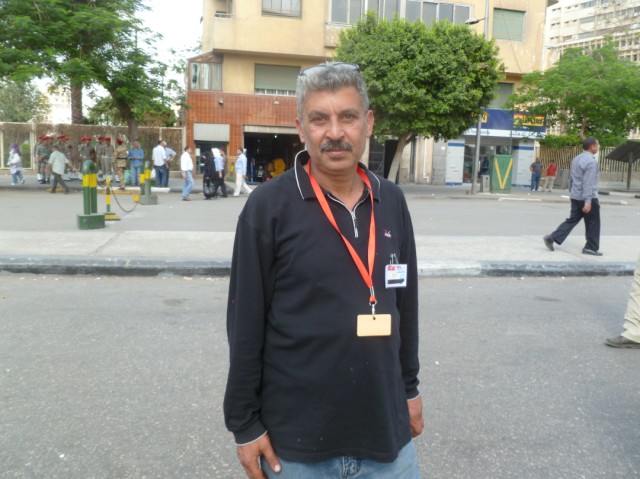
Emad Farag

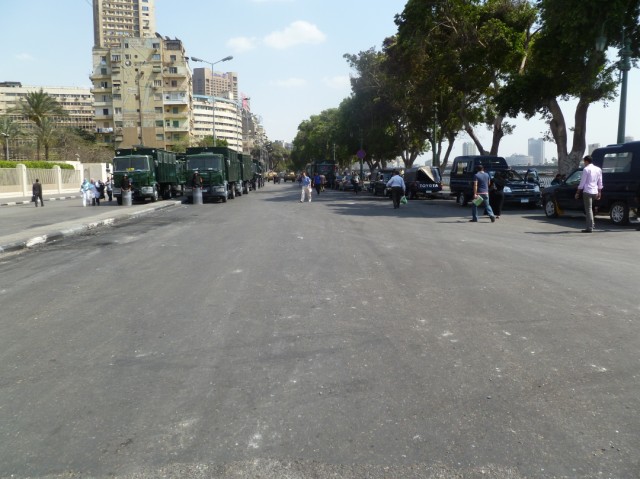
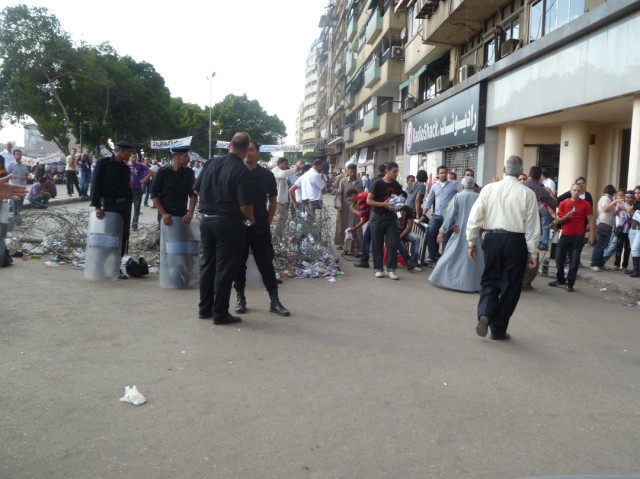
Upon arriving at Maspero on the morning of the 16th, however, I was surprised to find no Coptic security measures at all. Automobile traffic had stopped as dozens of riot police, army personnel, and military vehicles lined the road. Yet pedestrians, including myself, simply walked right through their lines, checked neither for ID nor weapons. Farag explained the army had assumed responsibility for safety after the attacks, and instructed the Copts to desist.

Farag then proceeded to relate the story of the evening attack. Around midnight, while he was stationed at his post, a group of ‘thugs’ began to gather under the May 15th bridge, and began harassing and beating individual Coptic protestors either leaving or joining the sit-in. Shortly thereafter, another group came from over the bridge, and began firing upon the Copts, though from a very far distance of about 1000 meters. When meeting up together, they began to advance toward the sit-in, carrying knives, swords, clubs, and stones, in addition to guns.

Off-ramp from the May 15 bridge. Blackened areas are from where Molotov cocktails burned.

Their approach took the attention of the protestors, but Farag instructed his colleagues in the committee to lock arms in front of the already constructed barbed wire, so as to prevent Copts from running out to meet them. Farag then phoned the captain of the police, who told him his men were ill equipped to meet armed ‘thugs’. They were stationed a few hundred meters to the north of the sit-in, blocking off a side road to the area. Their presence, though, was minimal, and outfitted only with riot shields and batons. The captain told him, however, he would phone the army to bring its weapons truck.

Farag then went personally to speak to an army officer who was stationed with his men at the Radio and TV building at the site of the sit-in. The officer refused to get involved, stating this was the responsibility of the police.

By this time some of the Copts had broken through the human chain and jumped through the barbed wire barricade. They wished to hold the ‘thugs’ far away from the sit-in, since several women were also participating there. Farag called the police captain again, who now responded that they could not get involved because they could not know who was who in the skirmish. Frustrated, Farag returned to his post and told the other assembled Copts to join in the defense, which he himself did as well.

Distance from the bridge to the sit-in area. The round building to the left is the Radio and TV building, where Copts were demonstrating.

Running out to meet the ‘thugs’, Copts broke off tree branches and wooden planks from sidewalk benches. Media reports stated they also broke up the sidewalk so as to obtain concrete to hurl at their assailers. Farag did not think so, but a few meters from the barbed wire was an area, perhaps one meter in diameter, that was pulled up. Perhaps Copts did so, Farag contemplated, but on the whole he believed they simply threw back the projectiles tossed at them. In any case, this was the only evidence of sidewalk destruction, not fitting with the impression of chaos described in some reports.

Sidewalk torn out to secure rocks for the confrontation. See the bench behind no longer with its wooden planks.

The two groups met about halfway between the sit-in area and the off-ramp of the May 15 bridge. There were immediate but brief clashes, after which Copts drove the ‘thugs’ back up the off-ramp where they took refuge on higher ground. From this point onward a buffer zone developed between the two sides, with rock throwing between them but also gunfire coming from the original attackers.

Farag confirmed media reports stating the Copts apprehended one of the ‘thugs’, and turned him over to the army. He was unable to confirm a report that stated the ‘thug’ possessed an ID card linking him to the NDP party of Mubarak. Yet Fadi Philip, foreign media spokesman for the MYU, stated he admitted to being paid 500 LE, the equivalent of slightly less than $100 US, by a sheikh in order to participate in the attacks.

Farag added incidentally that throughout the sit-in the committee for order turned over to the army a number of entrants upon whom were found weapons after being searched. He stated the army confiscated the weapons, but then sent the people on their way.

Given that he was a participant in the defense, Farag did not know exactly how much time had passed until the authorities arrived. He estimated that about an hour after the clash began, a police tear gas truck came from behind the Coptic position and launched its canisters which landed on the Coptic side of the standoff. The tear gas sent all parties scattering; Copts ran back to the sit-in area while the ‘thugs’ ran off into the distance. Farag states neither the police nor the army pursued the assailants. Media reports, however, claim that fifty ‘thugs’ were arrested for their role in attacking Copts during the sit-in. It is possible these were later apprehended.

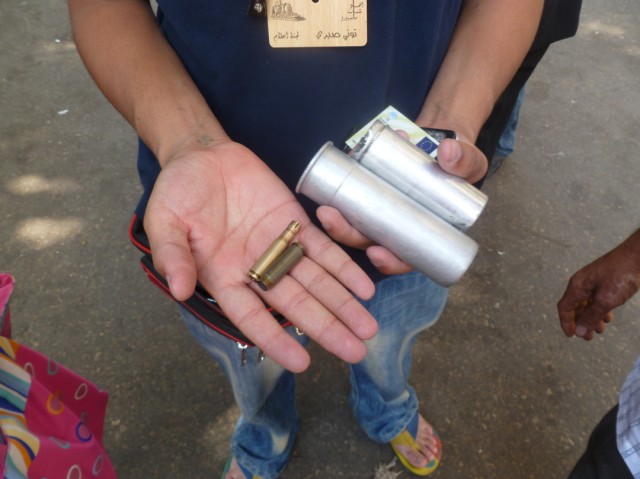
Bullets and Tear Gas Canisters from the Attack

Farag then walked with me to the southern entrance of the sit-in area, to describe the attack which happened earlier. Though he was not present at the beginning, he ran to the scene to investigate when commotion occurred. Around 8pm a group of 100-200 ‘thugs’ descended the on-ramp of the October 6th bridge, and a similar story unfolded. Copts ran out to meet them, suffered injury from gunfire and other weapons, but drove them away after only ten minutes. In my earlier survey of the news, I was not aware of this attack. Farag stated that men in the appearance of Salafis were among the armed in this group as well. Salafi presence had been denied in earlier media reports.

On-Ramp for the October 6 Bridge

Media Manipulations

Along the way he refuted two matters that have been reported in the media. First, he directed attention to the Foreign Ministry and the Radio and TV building. It was claimed that Copts had attacked these building before the altercation, but neither showed signs of damage. It is possible minor damage may have been repaired, as a full day had passed between the altercation and my visit.

The second matter represented what Farag claimed was a propaganda falsehood. On the first floor balcony of the Radio and TV building was erected a video camera pointing to the main stage, but on a swivel pivot. Farag stated the camera was pointed toward empty ground to the side of the stage, and showed this footage on state TV, claiming the sit-in was over.

The Radio and TV Building, with Camera Mounted on the Balcony

Statements concerning the end of the sit-in may well have been believed coming on the heels of Pope Shenouda’s message on TV, apparently urging its abandonment. The pope declared the matter had moved beyond the level of expression, due to infiltration that was ruining the reputation of the protestors, as well as of Egypt. He feared for their safety after the attacks, and said they would be ‘the losers’ if they continued. Furthermore, he stated, the patience of the nation’s leaders was growing thin.

Fr. Mattias Nasr Manqarius, priest of the Virgin Mary Church in Ezbet al-Nakhl, Cairo, is the official spokesman for the MYU, and one of two priests committed to the sit-in. He stated the pope’s words were not meant as a directive for the protestors to leave; in fact, he stated he had visited the pope shortly before his announcement, and was given only encouragement for their ‘normal and righteous’ demands. The next day, however, Bishop Musa, bishop of youth, confirmed the validity of the pope’s encouragement to leave Maspero.

Media manipulations, however, are claimed by the MYU. Before the pope spoke on television, a report emerged from Bishop Musa urging the youth to give up the sit-in. Asked about their refusal to heed his words, Rami Kamel stated the bishop’s words were not conveyed correctly. He knew this from video messages afterwards from the bishop in which he denied asking them to leave. Instead, the bishop offered his blessing. Irresponsibility of the media, claims Philip, was one reason why the MYU chose to demonstrate at the Radio and TV building at Maspero in the first place.

Medical Clinic

Injured Copts from the two attacks were treated at a makeshift clinic. A total of twenty-four doctors, nurses, and pharmacists have set up shifts in order to provide medical care. All medicines have been donated, and George Sidky Eskander, who has taken a vacation from his pharmaceutical company in order to join the sit-in, states supplies and equipment have always arrived at just the right moment, as if from God.

Medicines Stored inside the Clinic

Three of the twenty-four medical team are Muslims, one of which even keeps to the Salafi trend, but rejects the behavior of those practicing violence. Another Muslim is Mustafa Ibrahim. Though possessing no medical education he has been trained in field-based first aid, and has volunteered previously in Tahrir Square and in Libya. He states he is willing to die here with his brothers the Copts. His assistant, the other Muslim Ahmed al-Masry, is a graphic design student at Ain Shams University, but learned medical care from his father, a surgeon. He is disturbed how religious groups are tearing the nation apart, after the experiences of Muslims and Christians together at Tahrir Square. As a revolutionary there, he was shot in the arm by police on January 25, the first day of protests.

Mustafa and George, in front of the Clinic
Ahmed, Showing Where he was Shot in the Arm

Eskander stated that many of the injured refused to be transported to hospitals, out of fear they would be arrested there. Instead, during the attacks of May 14 the clinic tent grew three times in size, treating open wounds and bruises as best they could. Many of the serious cases, such as one skull fracture, were rushed to local hospitals.

Legal Services

Karam Ghubriyal is a Coptic lawyer providing volunteer legal services and documentation for the MYU. He stated that fifty-six people were arrested from two hospitals, and only eight of these were Muslims. It is not known if this number corresponds to the totals announced of those involved in the attack, or has simply been unreported in the media. These arrested were taken from the Coptic Hospital on Ramsis Street and the Police Hospital in the Aguza neighborhood. They were charged with ‘thuggery’, and detained first in a military holding facility, before being transferred to a public jail.

Ghubriyal, working with a team of lawyers including several Muslims, was able to secure the release of thirty-two arrested Copts. Due to the late hour running into the designated curfew of 2am, Ghubriyal made sure those returning to Minya in Upper Egypt did not try to return home and perhaps be rearrested. Instead, the five went back to Maspero and spent the night at the sit-in. He is currently working with his team to secure the release of the remaining sixteen Copts in custody.

Area Management

As the day progressed Maspero appeared more and more chaotic, as pedestrians on foot traversed the area on their way north or south. The army permitted street vendors to enter the area as well, setting up booths for tea or snacks. More and more Copts also arrived simply to join in the demonstration. It was a working day, and thus numbers did not resemble the weekend totals of several thousands, but it was clear many Copts continued to support the effort, despite the message from Pope Shenouda.

Rolla Subhi is a twenty-two year old Coptic woman heading up the committee for order. She supervises the subcommittees for checkpoints, as mentioned earlier with Farag, the speaking state, food, drink, and cleanup, and a very important committee – given the increasing commotion – called ‘rangers’.

Ramon Nadir and Claire Makram are two of the approximately fifty rangers, ten of whom are women. Their responsibility is to roam the area and look for signs of trouble. They communicate with the Egyptian police and army, and were able later in the day to re-setup the separate Coptic checkpoints to ensure no weapons entered the area. They inquire about the hunger, thirst, or fatigue of key volunteers. Perhaps their most important responsibility is simply to check in on crowds. Whenever a group begins to assemble of more than three or four, and certainly if voices are raised, the nearest ranger investigates to see that everything is ok. Rangers make certain disputes are resolved quietly, before escalation. It is impossible to control every Copt who comes to protest, Subhi states; fears exist that less educated or more traditional Copts might respond to an insult given, becoming easily provoked. The ranger team, however, has kept problems to a minimum so far.

Ramon and Claire, to the Left

Conclusion

In his first live television appearance, General Tantawi of the Supreme Council for the Armed Forces addressed the graduating class of the police academy. He stated the most urgent needs of Egypt rest in its economic and security stabilization. He promised he would not allow any forces to divide the national unity of Egyptians along religious lines, mentioning specifically that sit-ins harm the economy and provide opportunity for ‘thugs’ to wreak havoc toward their self-serving goals.

Many at Maspero believe the actions of the army and police, in this and other sectarian instances, to indicate they are against not only the Coptic sit-in, but biased against Copts in general. Coupled with an understanding that Pope Shenouda has declared them to be ‘the losers’ if they continue, the protestors believe more violence will be directed their way, and perhaps they will be evicted by the army. For now, their protest continues, but Fr. Mattias does not paint a pessimistic picture. ‘Yes’, he states, ‘some of our demands have been met. Sixteen closed churches have been promised to be reopened. We believe the authorities when they say they will open them. But we will stay here until it actually happens, so that lower level officials receive pressure from above to make it happen.’

It is difficult to say if the Copts, and several Muslims, at Maspero are correct in their actions. They press on contrary to the leanings, if not will, of both their civil and religious authorities. Yet they are people of conviction, courage, and organization, fighting for the rights of all Egyptians, not just Copts. Their appearance, either if manipulated through the media, or if truly in essence, is of a separatist action. Are they uniting Egyptians, or dividing them? If dividing, is it in positive effort to bring awareness to those in the dark?

Philip sees their struggle as akin to the civil rights movement in the United States. It is not only that laws are bad, but that good laws are not enforced. ‘It is not just for ourselves that we demonstrate,’ he says. ‘If Coptic rights are not respected, then perhaps next to fall will be the rights of Muslims of different persuasion.’

It is too difficult to judge, and furthermore it is not my place. Yet may prayer be asked for wisdom on their behalf, patience for those who grow weary of their voice, and forgiveness for those who violently attack them. May all find place to give blessing to the other, no matter how stridently they wrestle politically.

Categories
Personal

Thoughts and Photos from Friday Protest: National Unity and Palestinian Solidarity

I was present at the Friday, May 13 million man demonstration in Tahrir Square. It has become commonplace for activists of all sorts to call for ‘million man’ demonstrations these days. While impressive in size, it was nowhere near the crowds assembled in Tahrir during the revolution. Rather, about one-third to one-quarter of the square was filled, which has been one of the largest gatherings since the revolutionary days.

Participation was fueled in two directions. In the works had been a solidarity demonstration in advance of May 15, the establishment of the state of Israel, which is called the nakba, or ‘catastrophe’, throughout the Arab world. Egypt has been excited with the newfound independence of its foreign policy, which is widely credited with urging the recent Fatah-Hamas reconciliation.

The other direction came after the horrible attacks on churches in Imbaba. These have been condemned by all sectors of Egyptian society, and many activists and political groups called for Friday to be an assertion of ‘national unity’, the catch phrase that declares Muslims and Christians in Egypt to be one people. It is, depending on perspective, a lofty goal, an essential fact, or an empty expression.

It is laudable to demonstrate for national unity, and it is laudable to demonstrate for Palestinian rights. Bringing the two together, in this instance, left a very bad taste in my mouth.

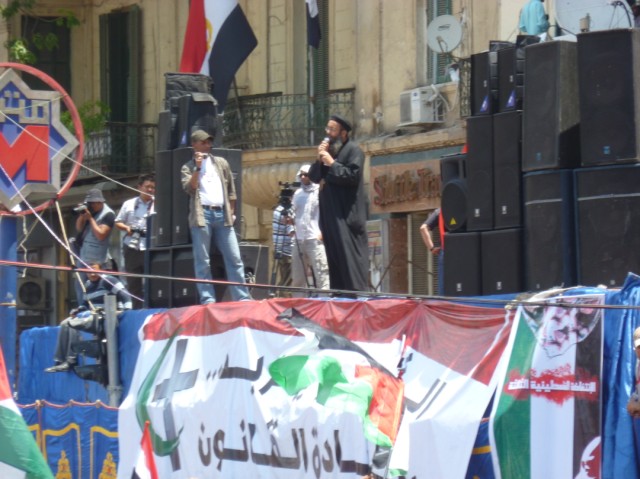
The main stage activities began with a Christian ‘church’ service, followed by Muslim Friday prayers, and a number of statements by religious, political, and activist leaders. I put church in quotes, unpleasantly mindful of the sarcasm, but recognizing the difficulty of the speakers. Apparently representing evangelical traditions, though with one Orthodox priest speaking prominently, their time consisted of efforts to connect with the crowd through chants that mostly fell flat, praise hymns that no one recognized, and assertions of national unity and Palestinian solidarity against Israeli oppression.

Most Arab Christians recognize the Palestinian people as having legitimate rights, and the Israeli government of having oppressed the occupied territories. Yet to an overwhelmingly Muslim audience, significantly representing Islamist groups such as the Muslim Brotherhood and al-Jama’a al-Islamiya, it appeared their main objective was to present their credentials as Palestine supporters. Little was spoken that could be understood as Christian-particular, though one speaker did urge those present to remember the cause for justice must be joined by truth and love.

Contrast their effort with Islamic Friday prayers, which was a masterful performance by the speakers. Islamic to the core, they wowed the audience, weaving assertions of national unity and Palestinian solidarity with cries to continue the revolution and purge the remnants of the Mubarak regime from the nation. The official Friday prayer speaker called for a civil state, and brought many in the audience to tears as he implored God to protect the revolution, save it from religious division, and spread it to other Arab states.

The next speaker represented the Salafi perspective, which equally condemned the Imbaba attacks and promoted national unity. There was little that would represent any of the recent controversial Salafi statements, such as opposition to democracy or the eventual return of the caliphate. There was much anti-Israel rhetoric, however, calling for millions of Egyptians, Muslims and Christians, to pray in their holy sites in Palestine, proclaiming Jerusalem to be their capital alone.

Other speakers continued on the same lines as those above, and I have little argument with either cause, inasmuch as Egyptians have the right to express these perspectives. Two disconcerting trends emerged, however.

First, it seemed that national unity was being built upon the back of a common enemy. Yes, Muslims and Christians can come together to condemn Israel, but will this solve the real domestic, if sometimes exaggerated, issues that produce sectarian conflict? Furthermore, speakers adopted the ‘national unity as fact’ perspective, blaming all problems on ‘the remnants of the NDP and security forces’ for instigating chaos in counter-revolution. There may well be manipulating forces at play in Imbaba and elsewhere; the proclamation of the truth in this conspiracy only masks over real tension. Yet it was not just lingering Mubarak cronies who are to blame; these, it was said, were working, as before, at the behest of Israel and the United States.

Yes, it would seem Israel would benefit from a divided, weakened Egypt. Yes, Israel has manipulated sectarian tension previously, at least within its own borders.[1] Is there evidence of it here in Egypt? I have seen little, but this is the nature of conspiracy. It may well be true, but it is believed as mantra. In the end, it does no good, since it closes the mind and turns a blind eye to one’s own faults.

Second, flowing from this, there was a distinct lack of civility in discussing the issues. Perhaps it is the nature of politics, populist politics in particular. While the speakers generally did not use incendiary words, the chanters from the stage led reprehensible, inflammatory cadence. ‘We demand expulsion of the ambassador of pigs.’ ‘We are going to Tel Aviv as a million martyrs.’ Though not everywhere or fully representative of the crowd, Israeli flags were burned, and an effigy was hung.

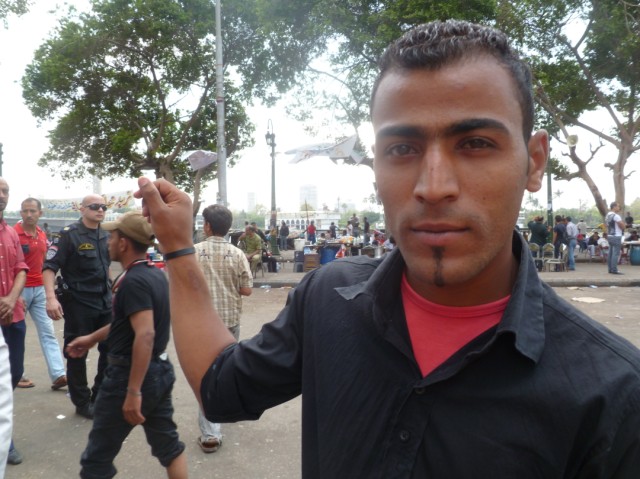
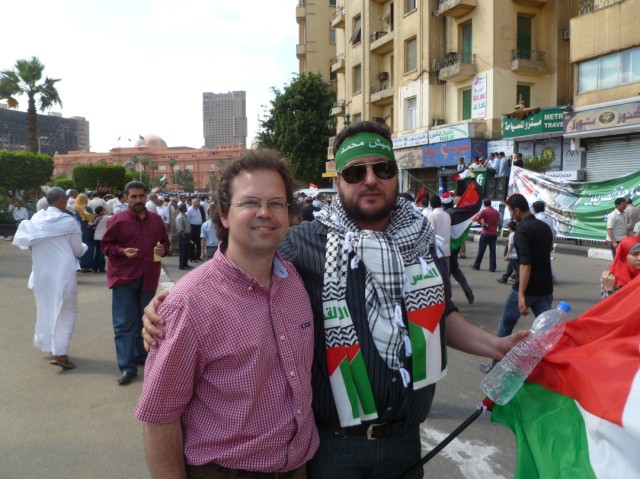
There was also the presence of a green headband-wearing ‘Army of Muhammad’. These proclaimed the eventual formation of an Islamic army that would liberate Palestine. In conversation with one adherent, he made several nuances that delay quick rejection. First, the Arab Spring has taught us that we can have a peaceful army. We will march to Israel, though there will be bloodshed wrought against us. Second, Palestinians are strong enough to win liberation on their own. We must support them by becoming strong ourselves, so as to pressure Israel, not to attack it. Third, we are a distinctive Islamic army, remembering the great Islamic victory over the Jews in Medina. But we will march side-by-side with our Christian brothers in support of this cause.

In this youth there was civility, and it showed in his discussions with Christian protestors who engaged him about the issues of Egypt and national unity. Though both sides championed the same phrase, there was deep division in understanding the problems at hand. One wanted an Islamic state which would protect Christians, the other wanted a civil state which would protect Christians, and others. They could not come together on essentials, but they departed friendly, after giving ear to the explanations of the other.

Perhaps this encounter should give me pause in my uneasiness. The rhetoric of the day was both lofty and base. One worthy cause was emptied of depth; the other was adorned with contempt for an enemy. Yet the people involved – even from extreme interpretations – discussed. There was no violence, no aggression, only the inflammation of public words. This gave me much pause, and interestingly, the Christians were not very good at it (though the Orthodox priest was better). Yet in personal conduct, even with those of completely opposite persuasion, there was peaceful exchange.

If only such exchanges might be had more often – between Muslims and Christians, even with Zionists. Alas, people do not often talk about that which divides them. An event such as this, as uncomfortable as it was to my Western Christian sensibilities, at least gets people talking, and puts them in one arena so as to discuss together. May all have the bravery to stay there, and keep alive the dialogue.

translation: Muslim, Christian – one hand; the people, the army – one hand; Fath, Hamas – one hand
the Palestinian flag, carried through the crowd
an Orthodox priest addressing the crowd
sitting to listen to the Friday sermon in the heat of midday sun; my neighbor shared his newspaper with me, and several others
prostrating during Friday prayers; see some standing away from the crowd; among them, I was asked to politely sit
cheering for Palestine during the speech of a popular Salafi preacher
a side stage rally for Palestine, with a Christian to the left and an ‘Army of Muhammad’ Muslim to the right
an effigy of the State of Israel
burning and stomping on the Israeli flag
the ‘Army of Muhammad’ supporter described in the text…
… and 2nd and 3rd from the left are the two Christians who discussed national unity with him
(note: this last picture was taken from a visit to Maspiro, I hope to post a second text on the attacks tomorrow)

[1] See ‘The Body and the Blood’, Charles Sennot, formerly a journalist for the Boston Globe, for examples he has documented.

Categories
Arab West Report Middle East Published Articles

Attack on Coptic Protest at Maspero: Early Details and Context

Two people were killed and scores were injured following an overnight clash at the site of an ongoing Coptic protest outside the Egyptian Radio and Television building at Maspero, Cairo. According to Mina Magdy, head of the political committee for the Maspero Youth Union organizing the sit-in, hundreds of thugs arrived around 12:30am and began attacking the protestors. Magdy stated the police did not involve themselves immediately, but the attack continued until 1am when police fired live ammunition into the air, and fired tear gas to disperse the attackers. Magdy relates there were around one thousand demonstrators at the time of the attack, and though the numbers have now decreased, the sit-in is continuing.

Egyptian newspaper al-Ahram reports there were 250 attackers, fifty of whom have been arrested by police. Attackers lobbed rocks and Molotov cocktails from an overhead bridge nearby. Al-Masry al-Youm reports the attackers fired ammunition into the demonstrators. CNN reports that the Coptic demonstrators broke up the sidewalk so as to defend themselves by throwing chunks of concrete at their assailants. One, it is reported, was apprehended and beaten badly.

Al-Ahram reports the altercation originated following arguments with the protestors and drivers of vehicles on the major road in front of the protest area. It quotes a protest organizer who stated the driver of the vehicle tried to enter the demonstration area, but refused to be searched for weapons, and tried to instigate trouble. The paper states the attacks were in revenge of this altercation, but the driver is not identified.

None of the reports or Coptic sources at Maspero stated the assailants were Salafi Muslims in their appearance; rather, they were thugs. The identity and motivations, however, are unknown. Salafis stand accused of fermenting and perhaps perpetrating many of the recent attacks on Copts and others since the revolution, though it is also claimed remnants of the former regime and security system have been provoking sectarian conflict.

I was able to visit the Maspero protestors yesterday, before the attacks, and learned of their organization, witnessing the layout of the area.

The protest area at Maspero has three main entrances, each with both army personnel and Coptic guards to search all before they enter. The system is similar to that established at Tahrir Square during the revolution, to ensure all weapons were kept out of the protest area.

Yet despite the precautions taken at the walkway entrances, the protest area stretches parallel with the major north-south thoroughfare running along the Nile River. There was simply a string of rope separating the protest area from the street, and traffic passed smoothly. Several policeman were present, but there was no cordon to separate the protestors from the street. Sporadically protestors would cross over to the opposite sidewalk, and relax on the other side. I witnessed what appeared to be one or two minor altercations with vehicles as they passed by. Nothing transpired, but traffic slowed as protestors emptied into the street inquiring about the vehicle.

The Maspero Youth Union is coordinated by Rami Kamel, a 24 year old law student at Cairo University. It represents a merger of several Coptic organizations which organized following the attacks on a church in Atfih, to the south of Cairo. The conducted a sit-in protest over several days, vacating the premises upon promise of the ruling military council to investigate and rebuild the church. Yet Fadi Philip, foreign media spokesman for the media committee, states their departure was not entirely voluntary, as they were attacked by the army as they were leaving. Nineteen protestors, including three Muslims, were arrested on charges of weapons possession and thuggery. Philip stated these charges were baseless.

The location of Maspero was chosen for three reasons. First, they believed holding their sit-in at Tahrir would be too provocative. Second, the site of the Radio and Television headquarters represented their belief concerning media bias against Coptic affairs, especially in the reporting about the Atfih church. Third, they had established Maspero as a place of protest earlier, following the attacks on Nag Hamadi, in January 2010, and Alexandria, on New Year’s Eve 2010. Before their initiative, Coptic protests had almost universally been within church grounds.

Following the attacks on churches in Imbaba, Copts returned to protest at Maspero, where the sit-in has now continued for over a week. On Friday, the day of protest at Tahrir Square for national unity and Palestinian solidarity, thousands of Copts joined the sit-in protest instead at Maspero, about a ten minute walk to the north of Tahrir Square.

The protest area at Maspero hosts a stage from which speeches are delivered and chants issued. Rami Kamel states the stage is open to anyone; Michael Munir, a youthful activist stated I could speak if I so desired, and introduced me to the committee member who could arrange this. Kamel states even Salafi Muslims are welcome to speak, though none have as of yet. Several Muslims, however, have joined their protests in expression of solidarity.

The Maspero area also houses several tents. One is for medical supplies, another for food, and two for providing space for interviews and committee discussions. Banners proclaiming Coptic slogans are everywhere, also lining the street in front of the area. Among these was a large sign showing sixteen pictures of recent incidents suffered by the Coptic community. Most banners were not provocative, but did emphasize a particular Coptic frame of reference.

Rami Kamel, however, states the efforts of the Maspero Youth Union are to emphasize Coptic rights within a framework of citizenship, far from sectarianism. He desires the sit-in to be seen as political action, not as religious or church based.

Two Coptic Orthodox priests have joined the sit-in, Fr. Philopater Jamil, from Giza, Cairo, and Fr. Mattias Nasr Manqarious, from Ezbet al-Nakhl, Cairo. Kamel states the presence of two priests helps lend legitimacy to the protest in the eyes of the Coptic faithful, but that it is good to have only two priests, and not more, or else the Maspero effort might appear to be more religious than is intended.

Fr. Philopater and Fr. Mattias were among the original Coptic demonstrators which merged into Maspero Youth Union, and Fr. Mattias is the official spokesperson for the group. They are also the editors of al-Katiba al-Tibiya,[1] a Coptic newspaper focused on reporting about grievances suffered by the Coptic community. The newspaper is widely distributed in Coptic Orthodox Churches, and has been understood as enflaming the widespread Coptic perception of persecution. They are linked also to Copts in the United States, which often call for the intervention of the US government or the international community in defense of Egyptian Copts. For their activities they have come under approbation from church hierarchy.

The CNN article quoted Rafiq Hanna, a protestor, as calling for international protection, stating the Copts are threatened all over Egypt. As I visited Maspero, identifying myself as an American, I was often asked why the United States did not intervene, putting pressure on the Egyptian government to secure their human rights. Yet during the national unity and Palestinian solidarity protests in Tahrir Square, Fr. Philopater, officially representing the Maspero Youth Union, addressed the crowd in the strongest language possible: We reject all international interference in Egyptian affairs. The concerns of the Copts are Egyptian concerns only.

Mina Magdy explained this was part and parcel of their Egyptian identity; the continuity of Christianity in Egypt is in their hands alone. If support was sought from a foreign power, this power would only support as long as it was in their interest to do so. Meanwhile, the effort to appeal internationally would be seen as traitorous. One only would have to look to Iraq, he stated, to see how poorly the United States has protected the Christian community there.

I asked Madgy if his position had changed after the attacks on Maspero. It did not, he said. We reject foreign interference in Egyptian affairs.

The goals of the Maspero Youth Union are to work for a civil state, the concept of citizenship, and equal rights and equality for all. Their particular rights, demanded in this sit-in, are for a unified law for building houses of worship, a law against discrimination in any form, the right to be ruled by Christian law in personal affairs (marriage, divorce, inheritance, etc.), opening of churches which had been closed by security prior to the revolution, the release of their imprisoned colleagues, and the release of a nun, Maryam Raghib, who was arrested for adopting children, as adoption is forbidden under the Islamic sharia.

Additionally, the union supports calls, made also by others, for a joint military-civilian council to guide Egypt through its transitional period of government. It seeks the trial of all criminals involved in recent sectarian attacks. It wishes the cancellation of all traditional use of ‘reconciliation committees’ to smooth over sectarian conflicts and release perpetrators. It does not call for removal of Article 2 of the Constitution, which declares Islam to be the official religion of the state, with the principles of Islamic sharia as the source of legislation. Though it finds this article to be contrary to principles of civil government, it believes the removal thereof to be impossible, and is thus not on the agenda of activity.

Kamel stated negotiations with the ruling military council were resulting in progress in crafting an anti-discrimination law, and also in securing the opening of several churches.

The Maspero Youth Union does not advocate any particular political position or party, but rejects official dialogue and cooperation with the Muslim Brotherhood and Salafi groups. This is on the grounds that, whatever individual members of these groups might profess, sincerely or otherwise, as ideologies their written words speak against the concept of citizenship. Therefore, until this changes, the union will not allow itself to be co-opted into the betterment of the Islamist image.

Rami Kamel states that the political and non-religious stance of the Maspero Youth Union is informed by his personal philosophy of liberation theology, in an Orthodox Christian perspective. He emphasized this was not of the Latin American variety which promoted violence; rather, non-violence was the rule though self-defense is permitted. He believes the Christian faith should drive one to strive for social justice, though through means limited by Christian ethics. Specifically, one should submit to violence and not strike back, not cowering from the attack but insisting on one’s rights all the while. Paul the Apostle, in Acts 22, is taken as a model.

Yet it seemed that despite the sincerity of this philosophy among Maspero leadership, it did not necessarily reach the hundreds of ordinary Coptic Egyptians who populated the protest. Kamel stated they do their best to instill this value and reign in the excitement of the protestors. There were not, however, religious activities such as prayer groups or Bible studies, through which commitment and discipline might be achieved. These activities, Kamel stated, would transform the demonstration into a religious activity. He purposed their efforts be seen only as political action, in defense of Coptic rights, but from a position of citizenship, not religion.

The facts of the overnight attack on the Coptic demonstration are still yet to be determined. The day before, Mina, an ordinary protestor, stated that Maspero was suffering from attempts to instigate conflict. He was afraid that if fighting broke out, the army would use this as pretext to evict them from their place. In terms of instigation, this fear now appears justified, but so far, the army has allowed the sit-in to continue.

There is much distrust currently among Copts concerning the direction of the revolution, the space Salafi Muslims have to operate, and the suspected secret intentions of the ruling military council. Many Egyptians of all persuasions have equal concern and confusion, even if their questions are directed differently. May patience and wisdom be sought by all, as they continue to cling to calls for justice. May civility reign as this process, however messily, is determined.


[1] In Coptic history, al-Katiba al-Tibiya was an Egyptian legion from Thebes, fighting for the Roman army in Europe. When demanded to renounce their faith and worship the emperor, the entire legion refused, submitting instead to martyrdom.

The concept of martyrdom is key for the Coptic Orthodox Church; indeed, their church calendar begins from the era of Diocletian, a Roman emperor responsible for the deaths of thousands of Christians. A popular chant of Copts states, ‘with our souls and our blood we will redeem you, oh cross!’ As Kamel explained, this was not an aggressive slogan. Rather, as Jesus redeemed humanity through death, so also are Copts willing to suffer martyrdom for the sake of the cross.

Categories
Current Events

Copts Rally to Resist Salafis at Cathedral, while Salafis Laud bin Laden at US Embassy


Thousands of Copts descended on the Orthodox Cathedral in Abbasiya, Cairo on Friday, May 6, in response to a Salafi Muslim demonstration at the same location a week earlier. Salafi Muslims represent a conservative current in Islam which calls for the strict application of sharia law and rejection of modern, democratic principles, believed to be Western in origin. The previous Friday, April 29, Salafis rallied for the release of Camilia Shehata and other Coptic women believed to have converted to Islam, yet allegedly held illegally in Coptic monasteries. Salafis conducted similar demonstrations repeatedly over the past several months, but this was the first time they gathered at the heart of Orthodox Christianity in Egypt – the papal seat of Pope Shenouda III. They called for the prosecution of the pope, and Copts interpreted many of their chants as insults against him and their community.

Feeling threatened, lay Coptic groups issued a call for a counter demonstration at the cathedral in anticipation of a subsequent Salafi protest. John, a Copt from Matariya, a town to the north of Cairo, stated the demonstration would be held within the walls of the cathedral, not outside. Groups would be stationed at the four gates, to prevent entry should the Salafis so attempt. Yet John instructed his delegation that if the Salafis remained outside and simply hurled insults, Copts should remain silent. Asked if there could be a positive reply, chanting words of blessing of the Salafis, John stated this would nevertheless be received as provocation. Silence would be the best response, and provide the best testimony. If attacked, however, Copts should resist and defend the seat of the pope.

Coptic fears are understandable, while also being an overreaction. Certainly Salafis engaged in provocation by marching at the cathedral. In weeks previous certain Salafi groups desecrated shrines erected at the tombs of Muslim saints, believing these to be heretical accretions to pure Islam. Yet sharia law calls upon Muslims to honor and defend churches and monasteries, and though they demonstrated at the cathedral, they inflicted no material harm. Nevertheless, Salafi groups stand accused of several grievances against the Copts perpetrated since the revolution, and there is a general sense, unproven, that remnants of the former ruling regime and its security forces intentionally stoke sectarian tensions. Yet despite the presence of rumors, it does not seem any threats were directly issued against the sanctity of the cathedral.

On Thursday, a day before the anticipated protest, Yassir Metwali, a leader of the Coalition to Support New Muslims, one of the chief post-revolution organizers in the defense of Camilia Shehata, declared there would be no demonstrations that day. The cancellation was issued late and was not widely known; in any case most Copts had already made their plans to gather. Metwali stated this was unrelated to the Coptic gathering. Unmentioned may have been another factor; Thursday morning the al-Ahram newspaper published photos of Camilia, her husband, son, and Coptic lawyer, seated together happily. The lawyer, well-known activist Naguib Gibraeel, produced documentation stating he was authorized to speak on Camilia’s behalf, who asserted she was happy in her Christianity. Surely this would not satisfy Salafi clamor, as claims and counter-claims of fraud have been exchanged between the two communities. All the same, it may have given them pause.

There have been two other issues dominating Salafi attention since the cathedral protest. The first was an attempt to usurp the pulpit at the Noor Mosque, the largest in Abbasiya. The second was the death of Osama bin Laden.

Shiekh Hafez Salama is a celebrated war hero in Egypt. In his retirement he had dedicated himself to religion, founding the Association for Islamic Guidance, through which the Noor Mosque was built. Yet since the 1970s the Egyptian government has attempted to bring all mosques under the supervision of the Ministry of Endowments. Ostensibly, this was to curb the potential for unaffiliated imams to use their pulpits to spread extremist or terrorist ideology. The effort has been mostly successful, with 95% of mosque imams receiving certification from the official ministry. The current imam, Sheikh Ahmad Turki, has been in place since 2002. Muhammad, a garage attendant in the neighborhood of the Noor Mosque, states he enjoys wide favor and is loved in the community. He also expresses admiration for Hafez Salama.

Hafez Salama, however, reflects Salafi trends, and has sought to inculcate them in the mosque since the revolution. For the first Friday prayers following the success of the revolution, he approached Ahmad Turki to allow popular Salafi preacher Muhammad Hasan to address the people. He acquiesced, provided Salama secure permission from the Ministry of Endowments. He did, it was approved, and all proceeded normally.

On April 22, however, clashes broke out between supporters of Hafez Salama and Ahmad Turki, in which sticks and knives were employed to force Turki to abdicate his position. He has called for intervention from the military to enforce ministry protocol, but in advance of this Friday’s sermon, Salama announced he would lead the Islamic funeral ‘Prayer for the Absent’, in honor of Osama bin Laden.

Police and military personnel maintained a heavy presence both inside and outside the mosque, assuring the ascent of a ministry-approved imam, though not Turki. There were no signs of altercation during the proceedings, but following the sermon and the exit of military personnel, Salama boomed with his powerful voice, honoring the hero and martyr, Osama bin Laden, calling for a march on the US Embassy. As he finished, chants began within the mosque and a crowd exited and assembled, waving banners extolling the fallen al-Qaeda head.

The size of the protest, in comparison to the expanse of the mosque which was filled to capacity, was rather miniscule. Perhaps around two hundred demonstrators committed to the approximately hour walk downtown to the embassy. As they departed, significantly slowing traffic patterns in front of the mosque, a driver stopped and shouted, “They are corrupting the image of Islam! Who are these people and what are they doing to our religion?”

Meanwhile, Copts at the cathedral seemed aimless as their expected challenge never materialized. Several hundred milled about outside the walls of the cathedral, unsure what to do next. A priest and cathedral lay leaders tried to usher them back inside, but to no avail. Military and police personnel kept to their positions, but shortly thereafter a contingent arrived from the Noor Mosque, only a five minute walk away, to guard the flow of traffic.

Within the commotion media began appearing and taking statements from various people. Fr. Basilius, who had arrived from Ma’sara, an area to the south of Cairo, provided commentary. “We are here only to defend our father’s house, as anyone would defend their father’s house,” he said. “The Salafis are not our enemy, only Satan is our enemy. We have no weapons except the cross, and God is our protector.” When asked if there was a way to return blessing upon accusing Salafi chants, he spoke similarly as John, quoted earlier: “If they revile us, we will remain silent. In this way they will see their actions in comparison to ours, and be affected.”

Shortly thereafter, perhaps prompted by the appearance of cameras, several Copts gave up their silence. Several dozen gathered together with placards and banners, and began chanting:

  • With our spirit and blood we will sacrifice for you, oh pope!
  • Christians and Muslims, one hand!
  • Not military and not religious, we want a civil state!
  • Long live Egypt!

Perhaps a hundred or two watched along, as the military kept the protest from blocking traffic. In comparison to the thousand or so protestors who had been inside the cathedral, this demonstration also appeared somewhat minor. Opinion, however, was that Copts would fill the cathedral again next Friday, to be ready should the Salafis return.

Click here for a video clip of the protest. The chanting heard is ‘Muslim, Christian, one hand!”

By now having arrived at the US Embassy, it was clear that the Salafis had maintained their numbers through the heat of the day, but had not increased them. Army personnel did not allow them to gather directly in front of the gate, yet their presence slightly down the street still took place in sight of the waving American flag. Chanting condemned the US military operation which assassinated bin Laden, and called for the release of Omar Abdul Rahman, the blind cleric held in an American prison for involvement in a pre-September 11 attempt to bomb the World Trade Center. Ominously, there was also a chant commemorating an Islamic-era victory over Jews in the Arabian Peninsula, warning Jews that the army of Muhammad would soon return.

Click here for a video clip of the protest. Muslims are engaged in afternoon prayers in front of a military contingent guarding the embassy.

Ayman is a youthful, beardless protestor about twenty years old. He and Ahmad maintained that bin Laden was not involved in the September 11 attacks at all. Al-Qaeda, they said, was against the killing of civilians, though certainly some died as collateral damage in attacks on legitimate American military targets involved in Iraqi and Afghanistan occupations. Furthermore, he never killed other Muslims. Asked about the bombing of a Muslim wedding procession in a hotel in Jordan by al-Qaeda operative al-Zarqawi, they denied he was involved. Instead, in effort to discredit the organization American friendly Arab governments would commit such atrocities. The New Year’s Eve church bombing in Alexandria, they said, was orchestrated by the Egyptian Minister of the Interior, Habib al-Adly.

Tarak is an older protestor, though also beardless, in contradistinction to the great majority of bin Laden supporters present. His opinions were more nuanced: “Yes, Osama bin Laden admitted to the September 11 attacks, and we must not countenance the killing of innocent civilians. But I certainly support bin Laden for his courage in opposing the American military occupations in Iraq and Afghanistan, in which far more innocent civilians perished. For this, bin Laden is an Islamic hero, and he died a martyr.”

It should be noted all three individuals were civil and friendly in their conversation, taking no offense at the presence or questions of an American interlocutor.

As the day closed and the protest ended I walked five minutes from the US Embassy to Tahrir Square to take the metro home. The atmosphere was festive, with many protests going on simultaneously. One was for the release of demonstrators arrested following a military raid on Tahrir in which it appeared rogue soldiers were involved. Another was a sole woman surrounded by a handful of onlookers wailing over an issue I couldn’t quite understand. Another supported the recent Palestinian reconciliation and called for the end of the Israeli occupation. The largest was a rally in solidarity with Arab protests taking place around the region, complete with flags of the different nations of the Arab League.

As I reflected on the day’s events, I called to mind the words of Alaa’, a Muslim guard for a minor government office outside the Noor Mosque, where I purposed to take refuge should the bin Laden demonstration have turned violent. “For thirty years we had almost no freedom of expression. Now, the pressure has given way to an explosion. Soon, things will settle down and get back to normal.” Indeed, protests have multiplied and are scattered over a multitude of issues, many at odds with one another. So much so, any individual protest is lost in the sea of demonstrations, appearing irrelevant in the process. Yet each protest is imbued with utmost fervor, as the group seeks to make its demands and criticisms known.

That this has occurred with the utmost of civility is a testimony to the Egyptian people. May it so continue, and may the balance of justice, in the end, satisfy its many claimants.

Categories
Personal

An Approaching Clash, or the Prevention Thereof?

(translation: I want my sister Camilia, before they kill her; We demand the release of Muslim women captive in the churches; Save us!)

Last Friday, April 29, thousands of Salafi Muslims marched through the Abbasiya neighborhood of Cairo, demanding the release of Camilia Shehata, a Coptic woman believed to have converted to Islam but now allegedly held by the church in one of its monasteries. The rally proceeded from the Fath Mosque to the Noor Mosque, and no altercations were reported, to my knowledge.

During their march they passed by the Coptic Orthodox Cathedral, residence of Pope Shenouda III, and chanted slogans against him.

On Monday a call went out to summon Copts to stage a protest in the cathedral on Friday, in anticipation of another Salafi march. Organizers insist their demonstration will be peaceful, but in light of believed security inadequacies these Copts believe their numbers will be necessary to guard the cathedral space against anticipated Salafi trespassing, or worse. The Coptic effort will alert police and military authorities, so that they might provide the necessary security.

In speaking with some Coptic friends who encourage this popular defense, they say that Salafis are dangerous, prone to violence, kidnap women, and believe the cathedral to be located on originally Muslim land. Yet have there been threats against the cathedral? Their testimony is yes.

I have no confirmation of this, but I have seen the power of rumor to wreak destruction. Only since the revolution, a church in Atfih, south of Cairo, was attacked, at least in part, when local residents believed those inside were casting spells against them. Later in the Muqattam neighborhood of Cairo during a Coptic protest against this attack, rumors spread they would burn a mosque in revenge. This, at least in part, led to gangs of Muslims coming to the area and attacking Copts, their shops, and factories.

Perhaps the Salafi demonstration will pass by the cathedral again, and perhaps they will cast insults and accusations on the Pope, and Christians in general. Last week, however, there were no assaults on church property; do they plan this now?

The problem is that Salafi protests have been escalating steadily since the revolution. Many make no secret of their distaste for democracy and a civil state, calling for the complete application of sharia law. They have had clashes with Sufi Muslims over the destruction of shrines at gravesites, and with the authorities over which imams speak from the mosque. Coptic fear for the cathedral is natural. When thousands of demonstrators are active and angry, it takes only a small spark to start a mob.

My fear is that in the presence of thousands of Copts, this small spark is all the more likely.

What if insults are traded back and forth? What if one side throws a stone? Rumors have been widespread that recent sectarian tension has been manufactured by remnants of the former regime looking to spread instability. What if both sides behave themselves but infiltrators make problems? I fear that despite their published intentions, Copts may bring about the tragedy they seek to avoid.

Perhaps I am wrong. Perhaps a well controlled Coptic demonstration inside and outside the cathedral will fill the space otherwise able to be occupied by Salafis. Perhaps police and military security will provide an adequate cordon between the two sides, allowing a Salafi march to simply pass by, or linger, but with no altercations possible. Perhaps it is good that Copts are taking responsibility in their own hands, rather than simply deferring, as in the past, to the church and the state.

Perhaps all will be fine, but I fear otherwise. Even if there is no clash, would such a demonstration be conducive for better relations, or for the testimony of their faith? Alarmism is never useful, but if it engenders prayer, then good may prevail. May the Salafis pray as well, and may whatever justice resides in their cause come to pass. But may God guide both toward understanding, tolerance, forgiveness, and peace. The largely non-religious revolution exhibited national unity; may the powers of religion not tear it apart.

Categories
Personal

Egyptian Protests, Day Two

It has been a very surreal two days for us here in Egypt. We live in Maadi, and though there was one early account of a protest, the area has been quiet. Yesterday and today I have been monitoring the Twitter feeds, even after the service went down, allegedly at government behest, though they officially deny this. For those of you who are not Twitter-savvy, like myself, you can follow second-by-second coverage if you go to Google, type #Jan25 into search, and then watch people’s ‘tweets’ scroll down your screen.

Not everything here can be verified, of course, but it puts the urgency and immediacy of the moment right before your eyes. Yet, all around is calm and quiet. Certain websites have live feeds of news reports, carrying the stories that journalists and ordinary citizens report. Whereas yesterday, on Police Day, the protests were large-scale and generally tolerated until late in the evening, today’s reports tell of smaller numbers but greater resistance on the part of security forces.

My take, however ignorant: On Police Day I posted my expectations about the event, written the day before. I spoke about how Egypt was not like Tunisia, because while in Tunis the protests were driven by discontent with economic conditions led by the poor, and only later on joined by the middle class, in Egypt these protests seem to me to be upper and middle class driven. This can be seen by the great role Twitter and Facebook have played in rallying the cry for protest. But I also thought that the impact would fall short of Tunisia for this very reason. Frustrations of the middle class here run deep, but can they gain the numbers and sustain the pressure needed for wholesale change? I wondered, doubting.

As the protests swelled yesterday I, like everyone, including the government apparently, was surprised by the turnout. I was impressed by the generally peaceful nature of demonstrations – opposed to certain signs in Tunisia – as well as the restraint shown by the security forces. By the evening as nightfall came, greater efforts were made to displace the protestors, who seemed determined to stay the night in Cairo’s central square. Tear gas, water cannons, and rubber bullets were employed. At the same time, it could well be interpreted as reasonable efforts to preserve public order. Not that the protestors threatened violence, but that the government was keen to stop the event as carefully as possible, yet stop it all the same.

Today began very quietly. Early efforts to protest fizzled against opposition, but on a day to return to work, the numbers did not seem grand. Whereas the day before I wondered if my posted analysis would be rendered foolish very quickly, by the afternoon it seemed the efforts at demonstration represented an attempt to force the issue, to keep alive a fading spirit.

Yesterday afternoon Julie and I took the girls out to go shopping and for a bit of a walk. We live in a nice neighborhood in Maadi, which is certainly an upper class neighborhood by all standards. But we live not far from where the area blends into a lower class section, which is where Julie often shops at lower prices than if she walks in the opposite direction. As thousands of people were rallying downtown, we enjoyed a normal stroll in the busy streets, the same scenario played out day after day. There were no rumblings of protest, no efforts to stir trouble. It confirmed my thoughts further that this social media revolution might largely be akin to a spoiled teenager railing against a dysfunctional family. The issues are surely serious, but the stakes are not so large.

Further confirmation came with a phone call to the Upper Egyptian city of Maghagha, where we had visited for a few days. We enjoyed time again with our priest-family friends there, and will write about this soon. But in this sleepy, poorer town three hours south of Cairo, there were no demonstrations whatsoever. Most protests have been in Cairo and Alexandria; certainly there are many desperately poor people here, but it is also home to the middle class. Protests elsewhere have been in a Mediterranean costal city known as a labor stronghold, and in the Sinai where there are longstanding issues with the Bedouin. Much of Upper Egypt was quiet, which was not the case during recent legislative elections, when protest demonstrations against alleged electoral corruption were widespread.

Finally, more confirmation came in a visit to the area of Kozzika, which is a poorer neighborhood to the south of Maadi where I go twice weekly for my class in a Coptic Orthodox institute. Again, no signs of anger, trouble, or concern with the world. A local coffee shop had al-Jazeera broadcasting live coverage of an emerging protest in downtown Cairo, and no one paid any attention, as domino tiles slammed down against the table.

But after a few hours away from the computer and Twitter addictions, I came home to survey the news. Protests, it seems, are gaining steam as the night goes on. Security repression seems rather severe, but the result perhaps is to spur on more people to join in. As you follow the news you can get wrapped up in it – here is an especially chilling audio link from a foreign British journalist who was rounded up in the back of a police truck with dozens of protestors. It makes it seems as if the world is on fire.

Perhaps it is – there. Not here. In all I am about 12 kilometers away from what is happening. It might as well be worlds apart. Those there have such passion and fury from their cause in the moment; those here are sleeping peacefully, including my three young daughters. Do I wish to be there? Not really, exciting as it would be. Am I content here? Not quite. Egypt could be changing, or it could be a blip on the screen. Either way, I am disconnected, and the feeling of disconnection is fueled by the constant surveying of others’ passion and fury. Is it true? Is it widespread? Is it good?

Still, it is smaller than yesterday. Will tomorrow be smaller still? It is said that Egyptians are not revolutionary by character. Until about 60 years ago, the nation had been ruled by foreigners since the days of Alexander the Great. They move along in life, deal with economic realities, and do not rock the boat. Yesterday and today, they are trying to. Some, that is. Thousands, actually. Will it make a difference against a resolute government? A government backed by American support?

But, on the other hand, even thousands are but a drop in the bucket. In their non-participation, do the majority of Egyptians signal content relative enough to prove this is not an internal rumbling for democracy, but rather the pining of a frustrated middle class earning to imitate Tunisia and, however legitimately, increase its sphere of freedoms? The government does not do a great job of eradicating poverty, but it heavily subsidizes basic goods. Are the majority of the poor content enough along their historical pattern, unconcerned by exclusion from political life? Will the protests eventually fizzle as the middle class aspirations are beaten down?

By and large, these have been secular protests, and notably, Egypt is a religious society. I would like to explore this question further tomorrow, if possible, but the call is circulating on Twitter that protestors are regrouping, and calling for nationwide participation following Friday prayers. Will Egyptians emerge from the mosque and take to the streets? This is looking like the next big question, unless tomorrow has more surprises. But will the population rally around a non-religious cause? It remains to be seen.

So what is my take, after all of this? It is best to hold judgment. I would encourage all to pray. The president needs wisdom, as do advisors, police chiefs, and protestors. There are deaths and injuries, and these cannot please God. Yet there are aspirations and hopes, and perhaps these do. May he sift the chaff from the wheat and bring about a society pleasing to all. Far less importantly, may he also give armchair observers sitting in Maadi the ability to be as constructive as possible.

Categories
Personal

Sexual Harassment

750 - Young Arab woman.
Image via Wikipedia

During the past few weeks much of my activity at the office has focused on the supervision of others’ work and report writing. While this, unfortunately, has limited my own contributions, especially in this blog, I have missed the opportunity to link readers here to the reports we have produced. These are published on the Arab West Report home page; I will look to update these a little more regularly.

One such effort we have made is a short report about sexual harassment in Egypt, and some of the recent statistics and new technological efforts that help address the problem. Should we call it a problem? Is it a problem in America? I suppose wherever there are men and women this phenomena will occur, but this paper shows some of the cultural aspects unique to Egypt. Please enjoy, if it is correct to say so…

Click here for the link.


Categories
Personal

A New Wife

Some of you who have been following our blog may remember some of the stories we’ve told about our doorman and his family.  When we moved into our first apartment in Maadi, our doorman’s wife was just recovering from having a brain tumor removed.  That didn’t stop her from inviting us to dinner! (click here)  Unfortunately, we didn’t have much opportunity to get to know her, as a couple months later, the brain tumor returned and eventually took her life.  That was a very sad day when her daughter told me the news, made even more poignant since I didn’t understand what she said the first two times in Arabic (click here).  I attended the “funeral” of sorts, or rather, visitation of the family and was hurting for the two older girls especially as they lost their best friend and didn’t seem allowed to grieve about it.  Shortly after their mother’s death, I talked with different people in the building, and even the two girls about their father remarrying.  It was almost assumed by the Egyptians I spoke with, that he would remarry fairly quickly as he still had kids to raise.  In talking briefly with the doorman himself, he seemed resistant to the idea.  After all, he just lost his wife and it seemed the two had a good, loving relationship.  No one wants to replace their lost love.  Also, he didn’t want another woman coming into his house and making his daughters do all the hard work.  As it was, though, without a mom in the house, the two oldest girls had a lot of responsibility, including cooking, cleaning and helping to care for the two younger kids.  They certainly didn’t want a new mom, but it seemed they wanted a new wife for their father’s sake.

Now that we don’t live in the same apartment building, we don’t naturally see this family and hear their news.  But a few weeks ago, after returning from some time in the states, we visited them to catch up and pass on a few gifts.  I noticed that they had some of the furniture from our old apartment in their house, and I asked about it.  I’m not quite sure what the answer was, but I did understand that they passed on the news of their father’s upcoming marriage next month.  The girls seemed excited as it is a woman they know and knows them.  She is actually the niece of their mom.  She is a bit younger than the doorman, but not unreasonably so.  The girls were happy with the choice, and when I congratulated their dad later, (he was outside with Jayson as I visited the girls inside), he said that he wasn’t marrying for himself, but for the children.  So it kind of seems all of them are being unselfish in this endeavor!

Jayson found out some information about the new wife-to-be.  She had been married before, but it seems she unknowingly became the fourth wife of a man.  Once she found out he had three other wives, she quickly divorced him and returned to her village.  From what the doorman and his daughters say, she’s a good woman.

And so, next month, their Dad will travel to a village outside of Cairo for a small legal ceremony without any pomp and circumstance.  He will marry a new wife and bring her back to Cairo to live in the house next to the apartment building.  In the meantime, he is preparing by buying new bedroom furniture for him and his wife, and probably cleaning and reorganizing the house.  When I asked the girls if they will go with their dad, it seemed they said the younger kids would go, but they would stay.  It sounded like they didn’t really want to go, but I doubt he would leave them at home on their own.  I look forward to meeting this woman and I pray that she fits right into this household and brings some joy to this house once again.

Categories
Personal

Ramadan Wanderings

Ramadan lanterns from below, Road 9, Maadi, Ca...
Image via Wikipedia

It was 11pm and I had 40,000 Egyptian pounds (approx. $8000) in my bag sitting on the seat beside me in the taxi, which was stuck in traffic.  This was another night out during Ramadan.

Having three young children, I don’t go out much after dark as their bed time is 8pm.  But during the month of Ramadan here in Egypt, stores change their schedules to accommodate the fasting that occurs during daylight, and feasting that takes place during dark.  Whereas the best time for me to run errands is in the morning after dropping Emma off at preschool, some stores don’t open until noon or 2pm, and then they close for a few hours as people break the fast and conduct their special Ramadan prayers, only to open again from 9pm until midnight or later.  So a few times this month, I found myself walking the streets of Maadi after dark running errands.

A couple times I ventured into a slightly lower class area in north Maadi, not far from our new home, where I was trying to get a blender fixed and some pants shortened.  My attempts to buy ice cream at a place I recently found had mixed results.  I was successful two times when I went around 10pm, but the day I went during daylight I was told they only sold ice cream at night after everyone broke their fast.

I had an idea that our family should take a walk one night after fast-breaking so the girls could see some of the lights that decorate the houses during Ramadan, and so Jayson could see one of the main streets in our new neighborhood.  The plan was to walk to the main street around 7:30pm, an hour after fast-breaking, and then get ice cream at the local shop which has great ice cream for only two Egyptian pounds a scoop (approx. 40 cents).  Can’t beat that deal when it comes to an ice cream store!  So, all day long, I told the girls we were going for a walk that night and would have a “surprise.”  So after dinner, the girls climbed into the big stroller (double) and the small stroller (umbrella) and took off north for about a ten minute walk.  We pointed out the decorations on people’s houses and the girls enjoyed that.  Every time she saw a light on a house, Hannah would say, “Ramadan!”  Jayson got to see the main street which was only starting to liven up now that people had eaten their main meal.  After another hour or so, the street would be busy with people shopping and drinking tea.  Unfortunately, when we arrived at the ice cream store, the surprise was on me!  They weren’t going to open until after Ramadan prayers … maybe 8:30 or so, and we really didn’t want to wait for half an hour or more at that point.  So, I walked across the street and bought some nasty ice cream novelties which saved the surprise for the girls, but didn’t really appease my sweet tooth!  Chalk it up to a learning experience.

Another night Jayson and I got to enjoy the spirit of Ramadan as his work colleagues took a trip downtown to break the fast all together.  We met at some outdoor tables right outside Khan-al-Khalili, the famous market bazaar of Cairo, and enjoyed a delicious and quickly-served meal.  As the call to prayer sounded, everyone in the whole courtyard began to eat at once.  It was a fun atmosphere and surprisingly good food.  We topped the evening off with a wonderful performance by the Tannoura group not too far from where we ate dinner.  This was a free show of Sufi singing, dancing, twirling, and instrumentalists.  Some of their stuff was pretty amazing.  I would definitely recommend it.  All in all, the night wasn’t too late as we were home by about 11:30.

And now onto this night.  We would be traveling in just a few days, and Jayson needed some help with work errands as he had more than he really had time for before leaving.  I offered to take the Euros he withdrew from the bank for work expenses, and exchange it at the moneychanger.  Again, hours of operation weren’t totally conducive to my schedule with three young girls.  So, this was the night I could venture out at 10pm to change the money.  Unfortunately, with all of the shopping and feasting at night, the traffic is pretty heavy, so as we slowly crawled along, I considered getting out and walking home.  I could probably walk it in about half an hour.  But since I had so much money in my bag and it was 11pm, I thought it would be safer to stay in the taxi.  Besides, I didn’t really feel like walking by this point in the day; I would rather have been sleeping!

I eventually made it home on this, my last night of Ramadan wanderings.  Or, at least until next year, when we may attempt another night out for ice cream, and see what errands take me out on the streets of Maadi way past my bedtime!

Categories
Personal

Bureaucracy and a Baby

A few days ago, I remembered something just before falling asleep.  I’m so glad I did because who knows what problems it would have caused in September when we try to travel to the states for a few weeks.  I remembered that we needed to get our 10-week old baby girl, Layla, an Egyptian entry stamp in her passport.  Without it, she may not leave the country.  And seeing as our flight is at 3am, I don’t know what would have happened if her passport was blank.

When Layla was born here in Cairo a couple months ago, we followed the procedures that were clearly outlined on the US Embassy page about obtaining a US birth certificate and passport for her.  It required three trips to the embassy, but not too much hassle.  At the time, we also read that an American baby born in Cairo requires an entry stamp in her US passport in order to leave the country.  We had a lot going on at the time we picked up her new passport, though, so we forgot about that little detail until the other night.

Today was the day I tried to take care of that detail, and it required a trip to the dreaded “mugamma” in downtown Cairo.  This was my first time to experience the place where all foreigners must go to renew visas, apply for residency, etc.  Apparently, it is also the place for Egyptians to go for marriage licenses and the like, so, a lot of paperwork goes through that place in a day.  Previously Jayson has taken care of visas and such at the mugamma, but this is a very busy time at work for him, and it just wasn’t possible for him to take care of this errand.

So, this morning, I packed Emma and Hannah a breakfast and lunch and sent them both to preschool.  Hannah is always looking for opportunities to stay with Emma at preschool, and today was the perfect time for that.  I took Layla with me and boarded the metro for the quickest and cheapest ride downtown.

I’ve written about the metro before (click here) and once again, boarded the women’s car for the ride.  Immediately, a woman rose from her seat for me to sit down, and as I was sitting down, she preceded to try to cover Layla with the thin blanket I had.  I thanked her, but unwrapped Layla right away as the temperature here is in the 90s, and I felt that Layla was plenty warm.  Later on in the trip, another woman asked me to reposition Layla as she felt like her head was not comfortable.  Very kind and doting women watching out for my baby.  It’s nice.

We arrived at Sadat square without a problem and took the exit that brings you up right in front of the massive building which is the mugamma. I went to the entrance where they had walk-through metal detectors which didn’t seem to be on, as well as bag screeners which I almost had to put my backpack on until I told the woman I didn’t have a camera.  Apparently that was the only security concern.  I went inside and up the stairs where Jayson had described is the Immigration and Visa section.  I got to know the path up the stairs and around the winding hallway past about 50 windows very well as I walked it several times in the next few hours.

After walking almost to the end of the hallway, reading the signs above the 50 windows and trying to figure out which one applied to me, I finally talked to someone at window 12.  She sent me downstairs to make copies of some papers first of all, then told me to fill out the application and take it to window 32.  So, I went all the way back down the hallway, past the 50 windows and downstairs to the copy center for my copies.  Then back up the steps, past 32 windows until I came to the one she told me about which said “refugee” processing.  Wasn’t sure that’s what I needed, but the person in window 33 was helpful.  Unfortunately, it seemed I needed another document.  She told me to go to “Ism Abdeen” to get a computerized birth certificate for Layla.  We had the written one we received shortly after her birth here, but apparently that wasn’t good enough.  After asking the name of the place several times so I could tell a taxi driver where I needed to go, I took my envelope of passports and important documents, my backpack and little Layla down the stairs, outside and to the street to find a taxi.

The taxi driver was helpful, but not sure exactly where I needed to go.  We decided to go to the police station in Abdeen and ask from there.  We then realized that we needed to go to “qism Abdeen” whose name makes more sense.  Arabic speakers may be familiar with the Egyptian habit of dropping the “Qaph” sound which in this case made it sound like a different word to my untrained ear.  Anyway, we found the place and the driver told me it should just take me 5 minutes, that it is a simple procedure to get the computerized document.

I went inside and up two flights of steps to the one place in all of Cairo where you must go for a computerized birth certificate.  It wasn’t too crowded, but the woman behind the window told me the computer wasn’t working currently and to sit and wait.  In the meantime, though, I could walk to the post office, about two blocks away, to buy a 20 pound stamp (about $4) for my original copy.  So, I went back down the flights of stairs, outside and followed her directions, stopping in one store to be sure I was going the right way, and after five minutes, arrived at the post office.  This was the nicest building I was in all day … not too crowded, air-conditioned, and very clean.  It was easy to purchase the stamp and head back to the other building.

When I arrived, I checked with the woman again who told me it still wasn’t working, but that I should keep waiting.  By this time it was about 10am and close to Layla’s feeding time.  She was sleeping peacefully on my shoulder and I wasn’t sure how much time I would have to sit and feed her there.  It was a fairly comfortable spot and it could have been done, but I opted to wait a bit and feed her later.  I was hoping to do all the running around necessary and then feed her while I waited for any processing they had to do at the mugamma.

In the meantime, I had a nice conversation with the woman sitting next to me who told me it was her third trip to this office in the last few days as each time the computers weren’t working and she needed a certificate for her son by tomorrow for college.  She told me this was the only place that printed this document which was a problem since there was no recourse if the computers didn’t work.  What I gathered from talking to her was that you need this document for many things: school registration, college entrance, or even registering for the army.  But it seems like it’s a more recent requirement as previously all birth certificates were hand-written.  I’m not sure how long the computerized ones have been around, but she recommended getting several copies to have them just in case.

After about 20 minutes, there was some movement in the room as somehow someone learned that computers were working again.  A line quickly formed and I had just decided to start feeding Layla, so I figured I would do that, then the line would die down and I would get my papers and go.  Instead, the initial woman I talked to behind the window, came out to me, got the handwritten certificate and took it behind the counter where she immediately printed me 5 copies.  It was very kind and very quick, but I felt a little uncomfortable with the seemingly preferential treatment.  Here I was getting my copies, while everyone else stood in line next to me.  I’m not sure why she did that.  Was it because I was the only foreigner in the room, or because I was carrying my 10-week old baby?  Either way, I was grateful, postponed Layla’s feeding longer, and headed downstairs to catch a taxi back to the mugamma.

I went in the entrance, once again telling the security there that I had no camera in my backpack, and back upstairs, and past the first 32 windows.  This time the place was considerably more crowded than earlier.  All the seats lining the walls were filled, and people were standing everywhere.  I wondered where I might sit to feed Layla when I got the opportunity.  At window 32, the woman I had talked to previously, looked at my papers, did some arranging, and then directed me to an officer at a desk slightly behind me for a signature.  This is where the “waiting in line” became a bit annoying—mainly because there weren’t really any lines.  A crowd was gathered around the desk, each one pleading his case, and I was just standing there waiting for a signature.  I didn’t speak up, but held my spot by the desk, trying to show I had a baby in my arms, and eventually I got noticed.  He signed my paper and sent me to window 6.

An interesting thing I noticed in the mugamma was the “No Smoking” signs posted all over the walls.  I saw them earlier, but had also smelled smoke, but wasn’t sure I had actually seen anyone smoking.  When I was waiting in line for the officer to sign my paper, there was a “No Smoking” sign directly behind him, and a cigarette in his mouth.  I realized that if I visited the mugamma the very next day, which was the first day of Ramadan, there would be no smoking in the whole place.

As I waited in the next several lines, I have to admit, I wanted preferential treatment once again.  After all, I was holding a baby.  However, my baby was very content even though it was getting more and more past her regular feeding time, she slept or sucked her thumb the whole time.  At the same time, I had to remind myself, that everyone waiting here probably had a reason that they, too, should get preferential treatment.  And besides, I had just been treated to a bump-up in line that probably saved me half an hour back at the other office.  These were good things to remember as the pushing and line-jumping and general standing and waiting got long at times.

I arrived at window 6 and waited for a couple minutes wondering if this would be my last window to wait at, but when I got to the front, they told me I was supposed to be at a different window 6 down a different corridor.  Ugh.  So, I went to the other window 6 and eventually, it was my turn.  The woman did some things and gave me some directions for what was next in rapid Arabic, and all I really understood was that I needed another signature from an officer, but not the same one as before.  So, I went around the corner and found an officer sitting at a nice desk in an air-conditioned office speaking to another couple.  After a couple minutes, I hesitatingly entered the office, and sure enough, this was the right place.  He signed something and sent me to window 41.

When I got there, several people were in line and I wasn’t positive this was the right window.  By that point, I really didn’t want to wait in any wrong lines, but after a couple minutes, I got to the front, the woman wrote some things on the paper and said “you’re finished” in English.  I questioned her as no one had put anything in Layla’s passport yet and that’s what I came for, and apparently what she meant was that I was finished with this window and could go back to the window 6 I had recently come from.

So, back to window 6, but fortunately, an officer was standing in that area trying to expedite things.  He gave my application to a young soldier who went to find out where I needed to go next.  I ended up back near the “refugee” window where I had started out, and the woman behind the counter wrote some things in a couple different books and asked when we were traveling.  Meanwhile, the six or seven ladies behind her, sitting at a table, noticed Layla and started talking about her.  After a couple minutes, one of the ladies came out to where I was and took Layla from me, and walked away.  I kind of asked where she was going, but I also knew.  Layla was getting her turn behind the counter.

Kids attract a lot of attention in these countries, and I remember Emma being taken behind the counter at the telephone company in Tunisia multiple times.  She would sometimes sit on the counter while one of the employees let her play with the phone or a pen.  A couple times, she was taken behind a door and came out a few minutes later with a cookie or cake or something sweet.  These ladies who worked at the telephone company watched my belly grow when I was pregnant with Hannah so after she was born and finally came out of the stroller, they took her back there to show her off as well.  This is why I didn’t react too strongly when they came and took Layla from me.  We’re kind of used to it.

So finally after about ten minutes at this window, the woman handed me Layla’s passport and told me to come back in one week to get the stamp.  In the meantime, they have the application and a copy of the passport.  I’m not sure what they are going to do in a week’s time, or why they couldn’t just put a stamp in the passport right there, but I am hoping that my trip to the mugamma next week is short and sweet.  It was a lot of hassle, but not as dreadful as some have said.  And when I thought about why I was there, it’s a small price to pay to be able to take our baby with us when we leave the country!

Categories
Personal

Soccer, Twitter, and Electricity

With one day to go regarding the USA World Cup match tomorrow afternoon, I thought I would give a short summary of our experience with the last game, a last minute 1-0 triumph over Algeria.

I wish there was a lot to say. There could have been on two fronts.

On the first we are at fault. Having attended and reported on the England-Algeria match from a local coffee shop, I would have been curious to see who local Egyptians rooted for in the US-Algeria game. Would they finally find solidarity with their North African cousins, so that soccer animosity be overcome in antipathy against the United States?

I cannot say. A 5:00pm local start time suggested we end the day a little early at work, and my English colleague and I organized an office viewing at a local trendy restaurant, with few Egyptians present. It was a great place to watch the game – big screen TV and surround sound – but little cultural flavor.

On the second front the power grid is to blame. Our group from work, plus Julie and the girls and one other wife, numbered about ten, with seven Americans, but all pulling for the Yanks. For those who watched, you know the game was tense, and all were riveted to the screen.

(A drama reducing pause and clarification is needed, though. Shortly after intermission Julie and the girls went down to play on the playground, and were joined later by the other wife. So, not all were riveted. Even so, this was a good sign, for the US comeback against Slovenia commenced once my family similarly descended for the slides and swings.)

With about twenty minutes to play, the power went out. This is a frequent summer occurrence in Maadi. There is a disproportionately higher middle to upper class population, both foreigner and Egyptian, and the air conditioner use will overload the power grid, which will blackout a neighborhood or apartment building from anywhere to five minutes to an hour or longer.

This was not to be of the five minute variety.

Fortunately, Egypt is better equipped in another variety of technology. One colleague had a Blackberry and was able to pull in from the wide 3G network updates on his Twitter account. As the clock ticked, we stared at the black screen, waiting for resumption, but also getting 140 character status reports on the ever increasing missed American chances. Huddled mostly silent around a cell phone, we also lamented the loss of the air conditioning, trapped inside in 100 degree heat.

As all was lost, suddenly a colleague received a phone call from a friend informing of the winning goal. As we wondered in disbelief if it was a prank, seconds later Twitter confirmed the victory. Our cheer roared, informing the rest of the clientele about the result, and all went home happy, if bittersweet at missing the classic moment. Still, it is a story to be remembered forever.

Tomorrow I will bypass the restaurant in favor of a downtown café. With the US game not starting until 9:30pm local time, it will not be a family affair. Instead, I will join friends in the heart of Cairo, taking in my first game there, hoping also to find the pulse of the city for the World Cup in general. US-Ghana is not a powerhouse matchup, but will it take the imaginations of local Cairenes nonetheless? If there is a story to tell, be sure I will relate it. I just hope that the ending is happy.

Categories
Personal

The Government Bakery, Part Two

Note: For part one, click here; it was the first post Julie wrote on our blog. This post, for those concerned, was actually written before Julie gave birth, and is just being published now. I have stood in line myself by now a few times. Maybe as you read you will be more concerned, but that is for you to decide…

I went to buy some bread this morning.  I’ve been back to the government bakery many times since that first visit back in September.  We learned that really, it was the closest, and in some ways, most convenient place to buy bread.  I am almost feeling like an expert in this department, although I’m sure I have a lot to learn.  I’ve actually started shopping at a different government bakery than the first one with the bars and cockroaches, but those things are not the reasons I switched.  As I was learning my way in the neighborhood, one day I walked past the original government bakery and down a few blocks I saw more pita bread laying on the ground.  (Well, mostly on newspaper on the ground, or ledges above the ground.)  I thought it strange to see another bakery because this was literally less than three minutes walk from the first bakery, but I also noticed that the bread looked lighter than the other place.  I wasn’t too crazy about the other bread for some reason; it wasn’t like the bread we had in Jordan, maybe too much wheat?  Guess that’s more healthy, but when I saw this bread, it looked like it may be tastier.  So, I determined to try it the next time we needed bread.

Unfortunately, it took me a few trips to realize that this bakery does not have the same hours as the other one, and they close at 3 in the afternoon.  I had learned that if I visited the other bakery in the evening, maybe 6 or 7, I usually didn’t have to wait for bread at all.  That was wonderful, but it didn’t sound like I had that option here.  I would have to decide if the better taste was worth the longer wait.  So once I finally was able to visit this bakery while it was open, I found the order of things much the same as the other bakery.  When I asked the man who gave out the bread what time was the best to come, so as not to wait too long, he said that all times were the same … busy.  Oh well.

So, this morning I went to this second bakery to buy bread.  It opens at 7am, and as Egyptians in general like to stay up late at night, they don’t always rise so early in the morning.  I do think that the closer to 7am I can get there, the less wait time I will have.  Of course, I don’t really want to get up that early either, just to buy bread.  But, I got there around 7:30 and waited about half an hour before I got my turn in line.  This time also allows me to leave the girls at home with Jayson, if I go on a Saturday, and that saves them having to sit in the stroller for half an hour watching the people go by.  I noticed some new things this time.

First of all, they had a delivery happening at the time.  A large flatbed truck drove up with about 50 bags on it.  Two men walked back and forth with large hooks in their hands … carrying 50-kilo bags of flour (over 100 pounds).  They would stick the big hook in the bag then turn around as they kind of twisted the bag up onto their back and shoulders.  Looked like a lot of heavy work to me!  But they unloaded the whole truck before I got my bread.

When I first arrived, several ladies were sitting around waiting for their turn, and I walked to the line to get my place and one of the ladies there told me that two of the sitting ladies were before me.  I kind of liked how they had a system that allowed people to rest if they needed too.  Being 6 months pregnant, I wasn’t sure I wanted to stand in line for half an hour, but being American, I felt like I needed to keep my place in line.  I didn’t exactly trust their system.  It worked, though, although I noticed that I got a little more stressed as people ahead of me were getting their bread, and my place in line wasn’t moving too much, and I felt like those ladies who were sitting should come stand in their place so we could move forward and assure that no one else would take our spot.  I didn’t ever lose my spot, but I did discover that there are actually three sections to the line, rather than two that I noticed before.  There is a men’s line and women’s line, as I mentioned last time, but these lines are for the people who want to buy about 20-30 pitas.  For those who only want to buy five pitas (for 4 cents) they can go right to the front of the line calling out their small order.  When I was there today, there were several of those women and they made their own line in between the men’s and women’s lines.  I don’t think I’ve mentioned that besides being the only non-Egyptian there, I am also the only non-head covered woman in the line.  At least that has been my experience every time I’ve bought bread.  One of these days I will have to ask some of my Christian Egyptian friends if they ever visit the government bakery.  So far, I haven’t noticed any.

So that’s the update on the bakery.  It’s the best deal in town for bread, although it does cost a bit of time.

Categories
Personal

Arrival Complications

In our last post we described the arrival of our moms to stay with us for a month during which time Julie will deliver our third child. Their flight was smooth enough, a direct flight from JFK airport in New York, landing about an hour and a half late, but with no complications.

Getting to the airport – and getting home again, was a bit more complicated. We have acquired a list of phone numbers for local taxi drivers and airport shuttles, so we called around and got the best deal. (Incidentally, the hour ride to the airport is only about $20 – round trip.) We stated the time, got the price, fixed the passenger number, declared the amount of luggage, and asked for a car with a roof rack to facilitate the ride home. Right on time the car parked at my office, and all was ready.

Except for the roof rack. The car was comfortable enough – four doors, roomy, and air conditioned. It even had a big trunk. Big, as it turned out, fit two large suitcases plus a smaller carry-on, but this left two other large suitcases and a smaller carry-on to be manipulated inside, around a driver, me, and two not-yet-elderly grandmothers. Perturbed at the failure to procure the requested transportation, we took off anyway, as the plane was due to land shortly.

As I mentioned earlier, the plane was late, we got there early, there was a mix-up with the airport restaurant lunch I bought to eat and pass the time, and when they finally arrived, I saw them behind the glass, just standing there, for what seemed like forever.

Our moms had successfully bought their visas, moved through passport control, and maneuvered through the twists and turns of the airport like professionals, putting to rest their initial fears about doing so without their husbands. Reaching baggage claim their suitcases rolled off the conveyor belt one right after the other, and they mounted them on the luggage cart, provided free by the Cairo airport. Except, that is, for one bag, for which they waited, and waited, and waited, and waited.

This is where I spied them through the tinted glass on the other side of customs. I could tell they had their bags, but wondered why they were just standing there. There was no official holding them up, and having waited far longer than I had planned already, I was getting both tired and anxious.

As it turns out, the last bag was held up in New York by the generally reliable (read on) Transportation Security Administration for a hand search. This was not discovered until they got home and opened it, finding a small note from the TSA describing the procedure. At the time they simply rejoiced that the bag finally arrived, as did I, and we stuffed ourselves into the car for the hour ride home.

The next day I went to work as normal, and did the same Thursday morning. I began the day by reading the daily Egyptian news, when among the regular musings about the Mubarak presidency and protests about this or that, I was astonished to find this headline:

NY Passenger with Lethal Weapons in Luggage Detained at Cairo Airport

As it turns out an Egyptian professor of botany in a New York university was arrested for trying to pass two handguns, hundreds of bullets, two swords, and eleven daggers through customs on his way out after picking up his bags. There is no speculation about his purposes, but there was never any fear he had intentions for the airplane. Nevertheless, there is an interesting question to ask:

How did he get these weapons past the formidable TSA? Score one for security in the Arab world!

On a personal note, what would this incident have done to the arrival process one day earlier with our moms on board? Reading the article put my trivial complaining described above in proper perspective. We are glad our moms are visiting, and thankful as well they arrived safe and sound.

You can read the original article here. (Don’t worry, it’s in English.)

Categories
Personal

Microbus Fiasco

We have a microbus stop outside our apartment building.  What this means is that anywhere from one to twenty minivans are parked in one or two lines, just a few feet from our front door, and they snake around the corner toward the main road.  It sometimes means a lot of noise and people traffic as there are busy times for people to be riding this mode of public transport.  Also there are small scuffles at times among the drivers and perhaps passengers, which involve yelling and frequent honking of horns.  For us personally, it means more air pollution, and sometimes, a longer walk to the main road if we choose to take the clean-air route and go all the way around the block.  All in all, it’s not terribly inconvenient or bothersome most of the time, but it would be nicer if this microbus stop was in another location.

We have rarely ridden on this microbus line as it goes to a section of town that we usually have no need to frequent.  It’s a poorer, more crowded neighborhood a little north of Maadi.  But the other day, on Easter, in fact, we planned to ride the microbus to the end of the line to have dinner at the home of one of Jayson’s friends.  It was quite an experience.

We exited our building and found a long line of microbuses, as usual, but we also found our doorman, our landlord’s son, and a police officer right outside the gate of our building.  We didn’t notice right away that there was a problem, but as Jayson spoke with the officer, who has a friendly relationship with him, and I was briefly talking to the doorman, there was some commotion around us, and the officer told Jayson he was busy at the moment.  A minute later, our landlord’s son got into his large white car, and backed it up and parked it blocking the entire line of microbuses.  He got out of the car, slammed the door and walked away from it.  Meanwhile, the doorman is saying to him, “Hey, no, this is wrong.  Give me the keys.”  But the son ignored him and walked around in a huff.  I thought, hmmm, this is interesting, we were just ready to board the microbus to meet our friend.  Hope he moves his car soon.  Surely, the police officer will do something about this.

So, Jayson and I, with the two girls, our bag, and a bag of chocolates for our host, boarded the microbus and waited.  And waited and waited and waited.  The microbus was full, as were the four or five that were surrounding us, but no one was moving because the big white car totally blocked the possibility.  The landlord’s son was standing on the street yelling and talking with the doorman, and some of the microbus drivers were yelling too.  Many of the passengers were looking around wondering what was happening and what they should do.  Jayson and I just sat there, with our girls in our laps, watching the scene.  Another son came down from their apartment to either watch or help, but his car stayed parked there for about ten minutes while the people who wanted to ride the microbus waited and questioned and fumed and threw their hands up.  At one point, most of the people in our microbus exited and walked away to find another way to their destination.  We didn’t really know where our destination was; we just had instructions to ride the microbus to the end of the line, and besides, we were interested in what would happen in this situation, so we stayed put.

I wondered where our landlord was, and thought that she could intervene and talk some sense into her son.  I mean, it seemed he had some problem with the drivers, but what about all these poor passengers who were now stuck?  I was also getting nervous for him as the crowds were gathering and tensions were getting high.  Jayson wondered at one point if he should get out and ask what was happening, and perhaps the presence of a foreigner would kind of shame the son into doing what’s right.  I wondered if he knew we were sitting inside one of the microbuses waiting to go, if that would make him move.  I mean, this is a guy who is often sitting in his parent’s living room while I visit with his mom.  Would he want to inconvenience his parents’ tenants?  But, we thought it best to just watch and learn.

After about ten minutes, he got in his car and drove off, swerving a bit wildly, down the street and screeching around the corner.  Well, I thought, now he’s safe from the crowds for the time being, and we can finally get moving.  But, the microbuses did not move.  It seems the drivers were quite upset about this whole thing and kind of went on strike for a little while.  At one point, one of the drivers who had been yelling and very agitated, started to run back behind us in the line of vans.  Two of the girls in our microbus got very nervous at that point and were afraid he was going to get into his bus and do something drastic.  So they quickly exited, along with some others.  But just as they were getting out, he ran up the sidewalk with a club in his hand.  I thought it would be best to stay in the van!  As is typical in Egyptian fashion, some of the other men around calmed him down enough to keep him from doing anything with that club (click here for a cultural explanation and personal reflection).  It was a little scary for a minute, and as the crowds continued to gather, since the microbuses had now been standing still for fifteen minutes, I wondered what could happen.  The drivers were angry, and surely the passengers would start to get angry that now the path was cleared and the drivers refused to go.  What a mess.

Meanwhile, Jayson called his friend and apologized for our delay and tried to explain the situation to him.  After he hung up, and it seemed there was no movement to go anywhere, we finally got out ourselves, and walked to the end of the street where we found a taxi who was taking a few other passengers to our destination.  Once inside the taxi, we asked one of the other passengers if she knew what the problem was.  She explained that one of the people who lives in the building by the microbuses (we knew who that was) was upset because the microbuses are loud and bothersome day after day and he finally got fed up and parked his car in their way.  Wow, I thought.  Yes, I could agree that they are sometimes louder and more bothersome than they need to be, but what good did it do for him to put his car there?  Surely this would not encourage the drivers to be more concerned for his comfort and well-being by keeping things quieter and not beeping incessantly when it wasn’t necessary.  No, instead it seems he just made stronger enemies who would now probably go out of their way to bother him.

We don’t know how long things were at a standstill on our street.  We arrived at our destination via taxi and had a nice dinner and time with Jayson’s friend, and by the time we were ready to return home, the microbuses were up and running again.  We haven’t seen our landlord or talked to the doorman about the situation, and we probably wouldn’t bring it up.  It is a curious thing, though, and provided a bit of entertainment and cultural insight on an otherwise nice, normal holiday.  Happy Easter.

Footnote:  A few days later I visited another neighbor who lives upstairs.  It seems she may have been home during this fiasco, and perhaps watching from her balcony.  She explained that maybe the son had a little more justification in doing what he did.  It seems he was parked on the side of the street and a microbus hit his car.  Whether this was on purpose or just because the driver was being a little careless, I don’t know.  But when he yelled at the driver, it seems the driver hit it a second time, intentionally for sure.  So, that is what started the whole thing.  When I asked my neighbor about all the innocent passengers who were inconvenienced, that didn’t seem to matter too much to her.  Her feelings are that the microbus drivers are generally not nice people.  She says they talk crudely to each other, but I don’t notice it because I don’t understand what they are saying.  She complains that they cause a lot of problems on our street, and it would be best if they could go somewhere else.  She wants to write a petition, signed by the residents of our building, and if Jayson and I sign on, she thinks it will go a long way in moving this line somewhere else.  We’ll see if anything happens with this plan.

Categories
Arab West Report Middle East Published Articles

Coptic Participation in Elections

Samir Zaki is an employee of the Egyptian National Bank, but his passion associates him with the Bishopric of Youth under the leadership of Bishop Musa, in which he encourages Coptic Christians to fully participate in society. On January 2, 2010 he was invited to present a lecture at St. Mark Church in Maadi, Cairo on the necessity for Copts to participate in Egyptian elections. For two weeks previous Fr. Ishaq had closed the Friday mass with an invitation to the church to attend this important lecture. He stressed that this was vital to the life of Copts in Egypt, noting the success of Copts abroad in affecting American politics due to their coordinated efforts. Though St. Mark Church boasts a regular attendance of five hundred people, only fifty came to attend the lecture, mostly from the older generation. Perhaps this is enough indication of Coptic neglect of elections, and an apt foreshadowing of what was to come.

Samir began his address discussing religion, asking in reference to the Coptic mass, do we pray for Christians alone or do we pray for the whole world? Everyone nodded in agreement that Coptic prayers implore God’s blessing on all, and Samir followed up by asking rhetorically if it were to be that Muslims were slaughtering other Muslims, would we not pray for them? All agreed that of course they would. The church, he maintains, teaches us that we belong to the communities in which we live, and we are to care for that world in which we find ourselves. Christians, Jesus declares, are the salt of the earth; salt is an agent of preservation. Just as food without salt tastes bad, so this world without Christian participation leaves it lacking. Samir implored the audience to present a good taste to those around them.

Following this introduction he moved into history. Beginning with Muhammad Ali he mentioned the major political figures in modern Egyptian history, celebrating them for their modernizing influences and allowance of Coptic participation in society. Sa’id Pasha allowed Copts to participate in the army and lifted the payment and stigma of jizia (an Islamic tax on non-Muslim peoples) from both Christians and Jews. Later, when the British occupied the country Copts followed the leadership of Muslim leaders Mustafa Kamal and Sa’d Zaghlul in resistance and nationalism. The Wafd party enjoyed wide Coptic membership, and the unity flag of cross and crescent flew over the city streets. During this time Cops occupied influential posts, even as foreign minister and leader of Parliament. It was a golden age, but an age that was brought about as Copts invested themselves in the national cause.

This positive situation continued but then reversed itself over time. The causes may be numerous, but from an era in which 15% of the Parliament was represented by Copts, today there is but one percent. At this point Samir shifted his focus and addressed the audience. He asked how many of the fifty present had voted in the last elections. Only ten people raised their hands.

At the beginning of the presentation Samir distributed a small handout encouraging Copts to register in the upcoming elections. Now he referred to the paper, which also contained instructions on how to complete the form required at the police office. He said a voter registration card is a symbol of citizenship. Copts are proud of their current status as citizens of Egypt, but they neglect this important expression of citizenship.

He continued, however, asking questions which revealed the depth of their neglect. How many people have run for a position on the school board? Four people raised their hands. How many have sought a leadership position in a non-church related NGO? One person raised his hand. How many have run for leadership in their professional union? Zero.

Having exposed their flaws, he sharpened his critique, turning to social participation. He asked how many people have even ten Muslims that they know well, even Muslims with whom they exchange friendly greetings? Perhaps the audience was battered; perhaps the question did not demand an answer. Silence was a sufficient confession.

Applying his point he spoke with pathos to the audience—we complain about our situation, but we have isolated ourselves, and have withdrawn from society. If this situation continues, he assured, in fifteen years there will likely appear a government minister, a preacher, a television announcer, someone who will declare, “Look at these Copts, they stand alone, keeping to themselves. They care nothing for us.” This sentiment, he warned, could become fatal.

He explained further. If you know a Muslim, he assured, he can see you as a friend, or at least a good person. Yet if he does not know you he will not think of you at all, and will likely think nothing of you. Why should he be blamed? He has nothing upon which to build a good opinion.

At this point one in the audience could not take it any longer. He protested, and Samir gave him the microphone. It is not we who have withdrawn, he lamented; it is they who have refused us.

Samir commiserated. There is a fanaticism which exists in society, and it exists even in sectors of the government. Yet at the same time, there is much room for us to participate—areas in which we suffer no hindrances. Even here, however, we are absent.

With this comment one woman countered angrily. In the faculty of medicine in the university certain Christians sought to cooperate together to improve things, especially since many of their members had good relations with the higher authorities. Yet when there were accusations of fraud the authorities ignored them, refusing even to launch an investigation. When we do participate, she argued, we are discriminated against, and our good standing does nothing to help us. Is there any question why there is increasing apathy?

Samir admitted that these incidents occur, but he raised a different issue, this time in the doctors’ union. Copts make up 35% of the membership, while those associated with the Muslim Brotherhood constitute only 6%. Why then did the 6% win? One reason was that many of the 35% did not even bother to vote, reflective of a larger malady in which Copts lack a culture of elections. Each and every member of the 6% was organized, not just in making sure to cast a ballot, but to maneuver behind the scenes with the legal tricks that can swing the outcome if properly manipulated. Copts are ignorant of these methods, largely because they have abandoned politics to others.

By the time he had finished this explanation, many in the audience were clearly murmuring. One spoke out. Why is our attitude negative, he asked? It is because we have tried to participate, but it has been to no avail.

The communal discontent was growing, and Samir’s partner approached to take the microphone. With the new speaker everyone fell silent, and Michael introduced his words with a confession of his comparative youth in view of the audience, but agreement with Samir. Do not be surprised, he counseled, Jesus has promised that we will be persecuted. Yet as we are a minority, we must keep to a positive attitude. We must be the ones who bring the social, or electoral, or union agenda which is superior to that of anyone else. If our plan is better, we will gain influence, respect, and votes, even from Muslims. Who will not support the best ideas for the community at large? Instead, he expressed, we bring nothing.

Samir built upon his words. Look at us, he said, we have the maglis al-milli, the denominational council, and we do not even participate in this! Why do we vote for nothing?

A younger woman advanced to take the microphone. She spoke with understanding of his message, but related that as a young woman she is afraid. Elections sometimes turn violent; it is better simply to stay away.

Samir answered sympathetically. Yes, he agreed, but this is mainly a phenomenon in Upper Egypt; in Cairo we do not face this difficulty.

The protest in the pews became palpable. The woman who spoke earlier of the faculty of medicine spoke again. She personally had gone to vote in an election, and was physically barred from entering. This was not just Cairo, it was Maadi!

Others told similar stories or raised other protests, and Samir tried to answer them all, but he was losing the audience. One person supported him—there are two thousand Copts living in Maadi, and the elections here are always close. If we vote with one mind we will swing the vote to whomever we wish. Another person simply stood and left in protest. Fr. Ishaq advanced to the podium and everyone quieted down. Samir understood the time was soon to end, and delivered his practical message.

The deadline for registration in the upcoming elections is January 31, he explained, and following this there is an election in June, another in October, and then a presidential election next January. Please, he implored, go to the police station and register, but do not go alone. Take your family, your friends, your co-workers with you. Whatever you think about this discussion today, go and register, and make yourself eligible to vote. You can consider what you want to do afterwards.

Fr. Ishaq took the microphone, and thanked Samir for coming. He continued emphasizing the importance of Coptic participation in the society in general, and in the elections in particular. He ended the evening with Samir’s earlier technique: Now with all we have heard, how many of you will go to be registered? Fifteen raised their hands.

I wondered about Samir’s opinion afterwards. Did this evening represent a victory of five, or a colossal failure? It is a struggle he clearly believes in, but it appears to be an uphill battle. As I left I greeted him, though he was pressed to leave. “May God encourage you,” I spoke in comfort. “It’s ok,” he replied, “I have been at this now for fifteen years.”