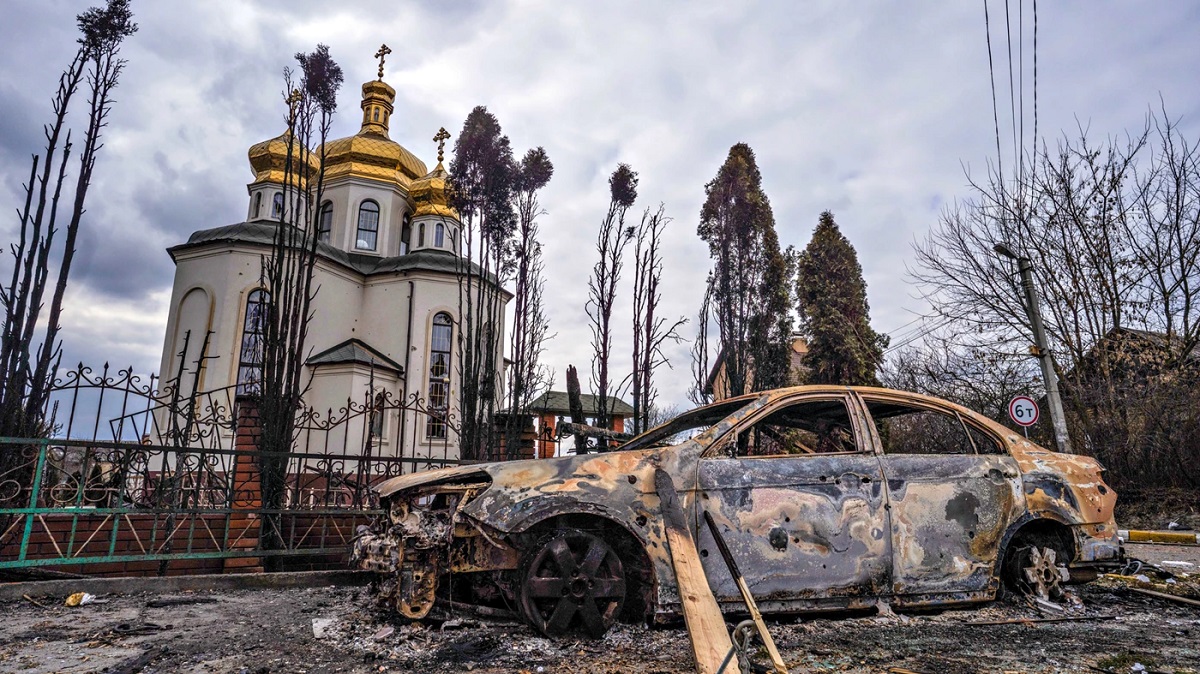
The atrocities are shocking. Ukrainian authorities have said 410 civilians were killed in the suburbs of Kyiv, discovered after the Russian army withdrew from its positions. At least two were found with their hands bound; several were shot in the head.
Many bodies were burned.
One resident said the occupiers were polite, and shared their meal rations. But others told of ransacked apartments; one was tied to a pole and beaten. Soldiers even shot a cyclist, who had dismounted and turned a corner on foot.
It could have been Ivan Rusyn.
President of Ukrainian Evangelical Theological Seminary (UETS), he had been coordinating aid from a safe house in Kyiv. But riding his bicycle into Russian-controlled Bucha to deliver medicine to a neighbor, he became an eyewitness to the atrocities.
Russia has called the images fake; satellite evidence contradicts. Christianity Today interviewed Rusyn to hear his firsthand report. He spoke about the spiritual impact, becoming a more authentic church, and how evangelicals have been helping the reclaimed suburbs—where he lived the past eight years:
Tell me about your neighborhood.
If you look at Bucha on Google Maps, I live in one of the five apartment blocs opposite Toscana Grill. It is an expensive restaurant, but sometimes I have eaten there. I run in the municipal park nearly every day, and with friends on Saturday. The seminary in Kyiv is six miles away, and it would take me 25 minutes to drive there, with traffic.
I noticed Google now says it will take an hour and a half.
The bridge was destroyed on the second day of the war. Russian helicopters and soldiers landed first at the Hostomel airport, three miles from our home. There was heavy combat, and I took shelter in my basement for the next five days. Then I left to the seminary, following that Google Maps route to skirt around Kyiv to the northeast. After two days we evacuated, and I found my way to a safe house in the city.
Now when we bring food and provisions into Bucha, Irpin, and Hostomel, we see many destroyed Russian tanks. The bridge is still out, but we can navigate it carefully with minibuses. It is dangerous, but if you go slow the journey now takes about one hour.
When did you return? Four days ago (April 3). We were escorted by police because…
This article was originally published by Christianity Today, on April 7, 2022. Please click here to read the full text.
Craig Simonian had a vision. It landed him in a war zone.
Raised in an Armenian-American Orthodox family, he came to know Jesus personally at university. He served as a Vineyard church pastor in New Jersey for nearly two decades but continued to embrace his Apostolic church heritage.
It laid the foundation of his faith—but also of his nation of origin.
“The reason Armenia still exists is because of the church,” he said. “It kept our shattered people together, especially in the diaspora.”
As a child, Simonian’s grandmother witnessed her father and mother murdered in the Armenian Genocide, killed by Turks in the waning days of the Ottoman Empire.
When she eventually arrived in America, it was the Apostolic church that embraced their family. Simonian recalled kindly visits by priests of their Oriental Orthodox tradition who—in the face of tragedy and devastation—gave him a deep appreciation of the sovereignty of God.
It was his evangelical awakening, however, that drew him back to Armenia—and in particular to its church. He relocated in 2018 to a nation locked in a cold war with neighboring Azerbaijan. A self-professed “oddball,” he longed for the Apostolic church to embrace fully the gospel he had discovered.
“If we are going to reach this generation, we can’t do it without them,” Simonian said. “I will call people to Jesus but never to leave their church.”
But two years later, the war turned hot.
Azerbaijan invaded the Armenian-controlled enclave of Nagorno-Karabakh in October 2020. The territory is recognized internationally as belonging to Azerbaijan, yet the residents of what Armenians call Artsakh voted for independence in 1991. For three decades Armenia held the upper hand but was routed in a 44-day war through superior drone technology that Turkey and Israel supplied to Azerbaijan.
Russian intervention enforced a ceasefire, with Nagorno-Karabakh demolished and Armenians holding a fraction of their previous territory. The nation felt numb after its defeat, and many found refuge in the Apostolic church.
Today, Simonian provides ad hoc spiritual care as he builds relationships with evangelicals and Orthodox alike.
His primary worship is through Yerevan International Church. But few in his personal circles have saluted his efforts to attend the Divine Liturgy and cultivate relationships with Orthodox clergy. Many evangelicals are soured by years of the older tradition labeling the newcomers a sect, or worse, a cult. But neither has Simonian yet found in the Apostolic church the fellowship that characterized his diaspora youth.
“The warm fuzzies I had growing up are completely void here,” he said. “The church is not so much a community.”
Simonian understands. Soviet communism purged the church, replacing clergy with compliant leadership. Following Armenia’s independence in 1991, this generation still exists but is giving way to a spiritual cadre that he says recognizes the church needs more than ancient traditions.
“We do not need to re-evangelize Armenia,” said Shahe Ananyan, dean of Gevorkian Theological Seminary in the Apostolic holy see of Etchmiadzin, 13 miles west of Yerevan. “Our main task is to wisely consider how to bring both Eastern and Western traditions together in synthesis.”
The church is still discussing application, he said. But he recognized that modern life for many has crowded out liturgical attendance and Bible reading. Forging forward anyway is…
This article was originally published by Christianity Today on April 1, 2022. Please click here to read the full text.
“I want to see 96 percent of Azerbaijanis confess their faith in Christ, and revival often began when the king became a believer,” he said. “But our God is the president of presidents, so the government does not rule over me.”
He has a long way to go.
Panahov, founder of the Vineyard church in Muslim-majority Azerbaijan, arrives at his target by inverting his homeland’s estimated proportion of Christians: 4 percent. Most of these are Russian Orthodox, holdovers from when the Caucasus nation of 10 million was part of the Soviet Union.
But the Azerbaijan Bible Society estimates that 20,000 Azeris have become evangelicals, most within the past two decades. And the government—despite being panned for widespread human rights violations in politics—has earned local plaudits for its level of religious freedom, especially toward Christians and Jews.
Panahov’s own story supports his optimism. But is it wise? Orthodox, Catholic, and Presbyterian leaders offer a word of caution.
From an Azeri Muslim family with a communist father, in 1989 Panahov came to faith at the age of 12 through a local Russian Baptist church. But as he grew interested in the arts and dancing, the conservative Christian community could not accept such worldly activity.
Panahov fell away from the faith as he performed professionally around the world—until in 2007 he tore his meniscus. Doctors in Turkey, where he lived at the time, told him he would never dance again.
It was then he recalled Jesus—whom he said spoke a word of healing to him. But through his Turkish pastor, God also gave him a commission: Return to Azerbaijan, and share what God has done for you.
Panahov was reluctant, knowing his artistic passion was a spiritual offense. But trusting God, he went back and eventually found a new church home. Over the next seven years he worshiped comfortably, started a family, and even found work as a dance instructor. But then he heard again the voice that healed him: Go out and start a house church.
He left his fellowship with tears but knew to obey. In the beginning he met mostly with believing relatives, but four years later their number grew to the 50 required by the authorities for registration. Similar miracles have marked many in the movement, which according to Panahov counts 350 believers in 16 cell groups, spread throughout his Caspian Sea country.
And God has used his artistic talent. His team has drawn hundreds to gospel-themed performances in downtown Baku, the nation’s capital. Media and filmmaking have put the message on the internet. The Vineyard church baptized 64 new Christians during the pandemic, he said, and 36 during Azerbaijan’s victorious war with neighboring Armenia.
“Two years ago, the churches did not believe opportunities for evangelism could reach such a level,” Panahov said. “But I know it is from God, because I don’t have the brains for it.”
It is also from the government, which following many years of suppression now works with church leaders to legalize their fellowships. While noting a positive trend, the US Commission on International Religious Freedom still recommends Azerbaijan for inclusion on the State Department’s Special Watch List for religious freedom violators.
Of concern is the legislation that requires 50 people before legal registration. Many evangelicals celebrate the freedom they do have—and the movement of the Holy Spirit to far surpass this number. But some notice…
This article was originally published by Christianity Today on April 1, 2022. Please click here to read the full text.
Image: Edits by Christianity Today / Source Images: NurPhoto / Jeff J Mitchell / Getty
Of Ukraine’s more than 4 million refugees, 90 percent are women and children. Of the 6.5 million internally displaced Ukrainians, 54 percent of adults are women. Men ages 18-60 are required to stay and resist the Russian invasion. And thus it is men who usually tell the public tales of war.
Women are often kept to private forums, such as their journals. Including:
32 days of war.
Fall asleep while checking the news on your phone.
See nightmares about concentration camps, bombing, dead people.
Wake up from a nightmare and remember it is not just a bad dream.
Check your phone with the thought: I hope everyone I love is alive.
Kiss a sleeping husband thinking about the fragility of life.
Wash your face. Put your clothes on.
Go to work. Wear a smile as a mask. Distance your emotions from pain. Physically hear pain turn into white noise in your head.
Check on your family during a 15-minute break at work. Cry on your break.
Six seconds: breathe in. Eight seconds: breathe out.
Feel grateful for being away from your phone eight hours a day at work. Feel helpless about being away from your phone eight hours a day at work.
So began the March 27 entry of Tetiana Dyatlik Dalrymple, suffering vicariously from afar in Washington, DC. Her father, Taras, sensed that such female perspectives have been missing from coverage of the war.
As regional director for Eastern Europe and Central Asia for Overseas Council, he recruited six Ukrainian women leaders who could tell their story. In partnership with the Eastern European Institute of Theology, ScholarLeaders International, and four affiliated seminaries, they sought to correct the critical observation of Svitlana Alexievich, a Belarussian novelist who won the Nobel Prize for literature in 2015.
“All that we know of war,” she said, “is told by men’s voices.”
Too few international supporters care to notice. The theological educators’ second webinar, The Russia-Ukraine War: Women Voices, drew only about 200 registrations yesterday, less than half of the first by male seminary leaders.
Marina Ashikhmina, vice rector for educational work at Tavriski Christian Institute, said the distinction is patently unfair. Women in war have a “double responsibility.” Underappreciated in society is…
This article was originally published by Christianity Today, on April 1, 2022. Please click here to read the full text.
Suffering freezing temperatures during the long winter cold in the Caucasus Mountains, this month Armenians in Nagorno-Karabakh had no heating for three weeks. The natural gas “malfunction,” stated Azerbaijan’s state-run energy distribution company, has now been repaired.
It is not often that pipeline maintenance draws international concern.
The European Union and Freedom House bothcalled for quick resumption of the supply in order to avert a humanitarian crisis. Over 100,000 residents in the contested enclave rely on Armenian natural gas that passes through Azerbaijani territory.
Nagorno-Karabakh, which Armenians call Artsakh, lies within the internationally recognized territory of Azerbaijan. Armenians accused Azerbaijan of deliberate disruption, prevention of repair, and installation of a new valve with which they can shut off gas flow at will.
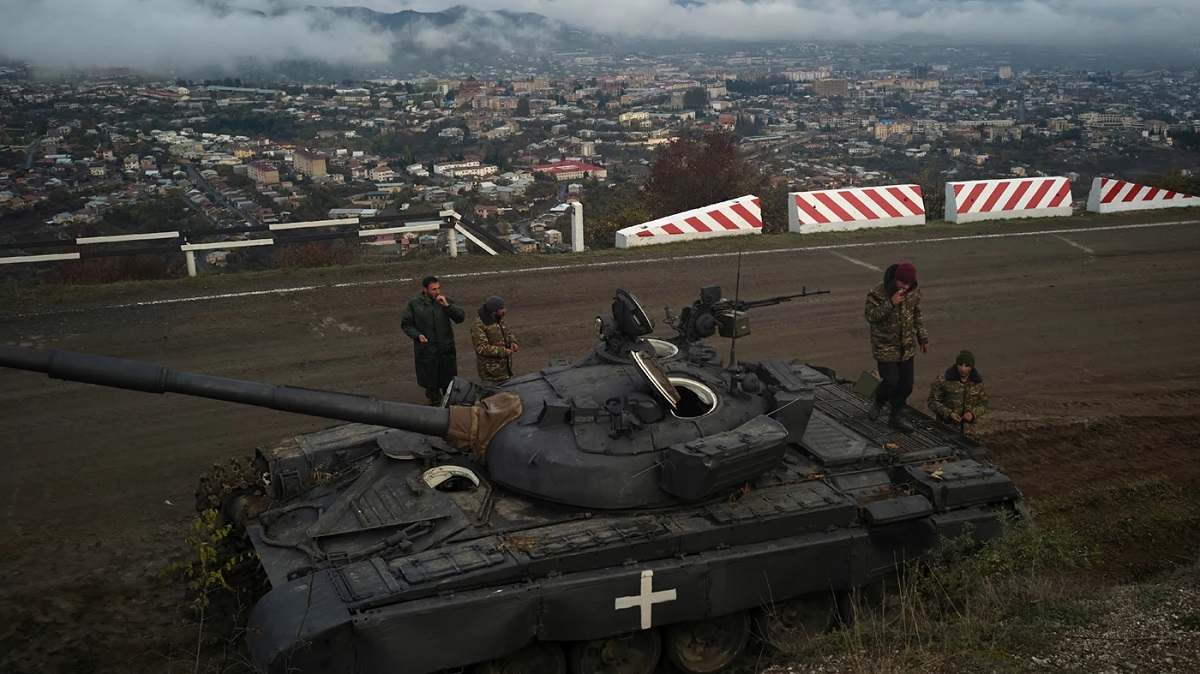
Secured by Armenians backed by Armenia’s military following the fall of the Soviet Union, Artsakh sought independence for three decades while controlling six buffer zones in depopulated Azerbaijani lands. Negotiations failed to resolve the dispute, until Azerbaijan launched a 44-day war in 2020 that recovered significant territory.
A Russian-brokered ceasefire ended active hostilities.
Yet skirmishes continue, and Azerbaijan accuses Armenia of instigation. Last November, Armenia stated an Azerbaijani incursion occupied 15 square miles of sovereign territory. Christianity Today was reporting from one of the liberated buffer territories at the time.
And in the month prior to the pipeline issue—with the world’s attention focused on Ukraine—Russia officially accused Azerbaijan of breaking the terms of the ceasefire. Monitors recorded at least four incidents of firing toward Armenian villages. Three soldiers were reportedly killed by an Azerbaijani drone; another was shot by a soldier across the border.
After years of holding the upper hand in Nagorno-Karabakh, the reversal suffered in the war has Armenians fearful of genocide. Now victorious, Azerbaijan President Ilham Aliyev has pledged to develop the area economically and to treat Armenians as equal citizens.
The recent conduct makes many doubt these promises.
“They openly can’t go for a full-blown war today since Russian peacekeepers are deployed here,” stated an Armenian journalist. “So they do everything to disrupt normal life and make people leave their homeland.”
But it goes beyond “Artsakh.” To emphasize its sovereignty over the region, Azerbaijan has…
This article was originally published at Christianity Today on March 31, 2022. Please click here to read the full text.
Ibrahim Baghirov died as an infant. His mother, Mary, had read in the Gospels about Jesus and Lazarus, so she prayed for God to raise her child from the dead. He did, she says. Doctors in Baku, the capital of Azerbaijan, confirmed the miracle to her, which also confirmed her fledgling faith as a Muslim-background Christian.
Two decades later, Baghirov is an emerging preacher in the church that meets in the family’s home.
But in September 2020, as Azerbaijan launched what would become a 44-day war against neighboring Armenia, Mary’s faith faltered. Having once trusted God where medicine failed, she hastily made her son an appointment for an unnecessary surgery in hopes of keeping him from conscription. He gently rebuked her.
“I will go wherever God takes me,” said Baghirov, now 26 years old. “There are ways to keep me here, but there will be no blessing in that.”
He deployed within weeks to the front lines in the snowcapped peaks of Nagorno-Karabakh, a swath of land about the size of Delaware that is encircled by present-day Azerbaijan and has been contested for centuries.
Along the way, Baghirov said he received a word from God: None of his fellow soldiers would die, and he would be their minister. His country is predominantly Muslim, and several of his comrades shunned him after his pocket New Testament fell from his backpack. Others asked questions, though, and became friends.
Azerbaijan, with a reputation as one of the most secular countries in the Muslim world, is tolerant of its long-established Christian minority community. But its long-standing animosities toward Christian Armenia are a different story.
The two countries’ generations-old dispute over Nagorno-Karabakh—a majority-Armenian territory whose modern borders were established in 1923 when Joseph Stalin made it part of Azerbaijan—has been fierce. The worst atrocities of the early 20th century killed thousands, leveling villages and leaving blood on both Armenian and Azeri hands. Relations were more neighborly for several decades, until the Soviet Union disintegrated and triggered a new round of massacres beginning in the late 1980s. Thousands were displaced from their homes as each nation purged its opposing ethnic minority, while Armenia depopulated a buffer zone around the territory to protect it from attacks.
In 1991, Nagorno-Karabakh voted for independence, and Armenia-backed forces eventually secured control of the region, dubbing it the Republic of Artsakh. (Neither Azerbaijan nor the international community has recognized Artsakh’s sovereignty.) Skirmishes between the countries smoldered for decades during a languishing peace process led by the US, France, and Russia.
But in 2020, Azerbaijan conscripted soldiers and advanced on the territory in yet another conflict. Baghirov was assigned to an artillery unit, a post that spared his tender pastoral heart from one adversity, at least: He would not engage in direct combat against the fellow Christians he and his military were slowly overtaking.
But Baghirov said he heard another word from God, another promise: Not one Armenian would die from his hand.
On the other side of the lines, shivering in the snow, fighters in an Armenian unit were also talking to God. An embedded priest from the Apostolic Church, the national church of Armenians, carried a relic of the holy cross and encouraged them as they knelt. They beseeched God for their fellow soldiers, surrounded by Azerbaijani forces and pounded by missiles and suicide drones.
“Don’t lose hope,” said Menuk Zeynalyan. “Our struggle is for our holy church and holy land.”
A married father of four, Zeynalyan left a comfortable parish among the Armenian minority in the neighboring nation of Georgia and signed up for military chaplaincy in 2019. Before the war, he led soldiers in three weekly Bible lessons. Many came from irreligious homes, raised by parents under the banner of Soviet atheism. But within two months, he said, everyone knew the catechism.
His highlight was the prayer of dedication prior to the soldier’s oath. Before swearing the secular pledge to defend the nation, Zeynalyan tied their patriotism to the Lord. After all, tradition had it that Thaddeus and Bartholomew preached the gospel in Armenia. And their country had become the world’s first officially Christian nation in the year 301, long before the Roman Empire followed suit.
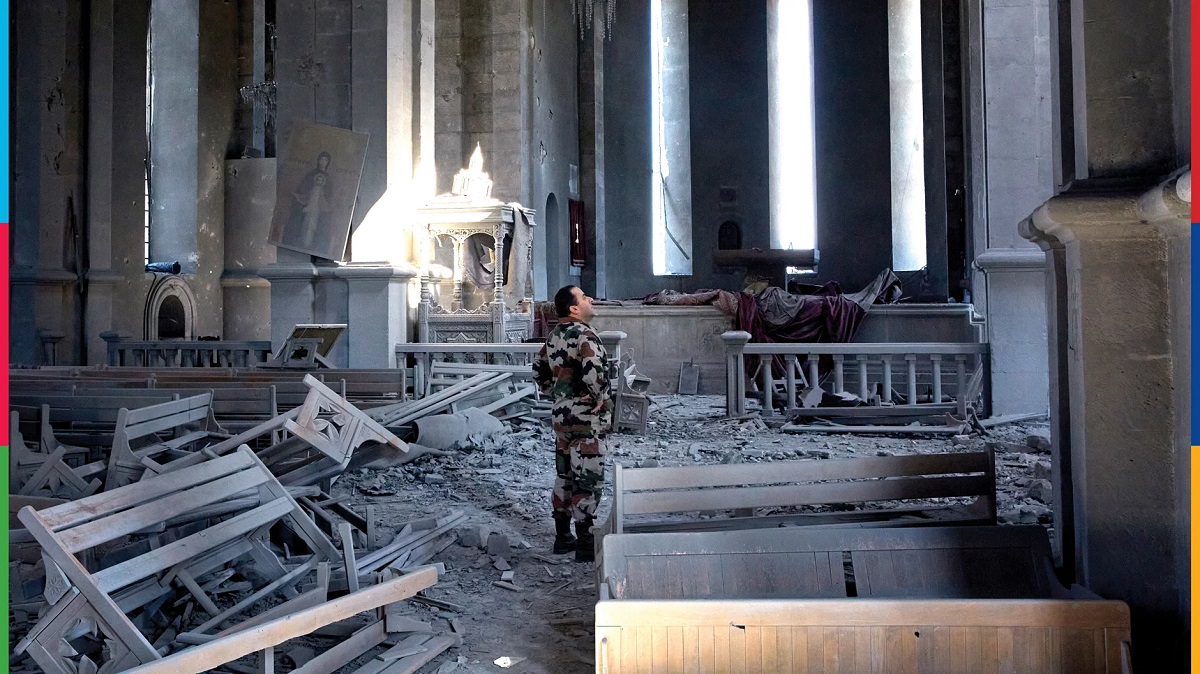
Miraculously, Zeynalyan’s prayers were answered, and his beleaguered colleagues emerged from the battle unscathed. Zeynalyan said he witnessed many examples of divine intervention in 2020. He was at the Ghazanchetsots Cathedral in the city of Shusha—known to Armenians as Shushi—on October 8, when two missiles struck within five hours in an attack Human Rights Watch deemed a possible war crime.
In early December 2020—with the Armenian lines broken and at least 6,000 soldiers confirmed killed—a Russia-brokered ceasefire ended hostilities. Shusha, the crown jewel of Nagorno-Karabakh, was back under Azerbaijani control, and their military was poised to seize the regional capital of Khankendi, known to Armenians as Stepanakert.
“It was pure joy to recapture our land,” Baghirov said. “For three decades, it was a heavy burden in our hearts, and finally our people can return to their homes.”
Officially, however, it is a ceasefire and not a capitulation. Armenia maintains control over Stepanakert and about a third of the disputed territory, protected by Russian peacekeepers. And while the mood is somber in the Armenian capital of Yerevan, about five hours away, Zeynalyan keeps his faith.
“No matter how much land we lose,” the chaplain said, “we are God’s people and will remain here until the second coming of Christ.”
Christianity Today spoke with more than two dozen sources during a visit to both nations one year after the war. It’s an open question how, if at all, they will reconcile their intense differences.
But for a few Christians in Armenia and Azerbaijan, a more personal question nags. Isn’t there a unity in Christ that transcends geopolitical grievances?
And if there is, should Christians wait for their governments to make peace? Or should they start themselves, by making peace with fellow believers behind enemy lines? For hundreds of years, the Caucasus region has been…
This article was originally published in the March print edition of Christianity Today. Please click here to read the full text.
As Ukraine continues to be battered by Russia, Syrian refugees know what to pray for better than most.
“This is what happened to us,” said refugee students at the Together for the Family center in Zahle, Lebanon. “We don’t want it to happen to others.”
Born in Homs, Syria, to a Baptist pastor, Izdihar Kassis married a Lebanese man and then founded the center in 2006. She shifted her ministry to care for “her people” when the Syrian civil war started in 2011. About 50 traumatized teenagers find counseling there every year, and 300 have graduated from the center’s vocational programs.
As the refugees discussed the “horrible” situation in Europe during the weekly chapel service, Kassis suggested intercession. Bowing their heads, the 40 children and 30 Syrian staff and volunteers knew better than anyone what to ask for.
But one child wanted to be sure the Ukrainians would know of their solidarity. He went outside into the cold and snow of the Bekaa Valley, where most of Lebanon’s 1.5 million Syrian refugees take shelter.
His sign proclaimed, “Praying for peace.”
Since the invasion, about 4 million of Ukraine’s population of 43 million have become refugees. Another 6.5 million are internally displaced.
Yet 11 years since its civil war, most of Syria’s 6.8 million refugees—out of a population of 20 million—still live in limbo. Europe largely shut its doors, certainly in comparison to its warm welcome of those fleeing Russian aggression.
Many have taken offense.
“There is the perennial double standard and selective outrage of global news media, Western governments (and, sadly, even Western Churches) when it comes to reporting on wars, conflicts and the plight of refugees,” stated Vinoth Ramachandra from Sri Lanka, a senior leader with the International Fellowship of Evangelical Students (IFES), affiliated with InterVarsity.
“If Ukrainians were not blonde and blue-eyed, would their plight have occasioned [this] outpouring of compassion?”
It is a fair question. Is European hypocrisy—even racism—on full display?
Arab Christians are not quick to judge.
Born in Syria, Joseph Kassab today heads the Beirut-based Supreme Council of the Evangelical Churches in Syria and Lebanon. He notes the more than one million countrymen taken in by Europe—Western Europe, primarily. Eastern nations, he said, are still recovering from the communist era and have not yet developed the same sense of human rights.
There should be no discrimination, yet even this he understands. The early church struggled to open its mission to non-Jews.
“Racism is in every society,” Kassab said. “But Europeans have been more welcoming to the Syrians than many Lebanese.”
Being Muslim is a factor, said Elie Haddad, president of Arab Baptist Theological Seminary in Beirut. But also important is that most are rural, uneducated farmers. Legitimate or not, people are uncomfortable with difference.
Europe is a bit hypocritical, but so is he.
“If a faculty member needs shelter, I will open my home,” Haddad said. “For a stranger, not so much.” One who did open his home is a Frenchman…
This article was originally published at Christianity Today on March 25, 2022. Please click here to read the full text.
Image: Kaoru Ng / SOPA Images/LightRocket / Getty Images
One month ago, Taras Dyatlik gathered in Moldova with friends and partners for another 10-day round of mundane seminary meetings. Serving as regional director for Eastern Europe and Central Asia for Overseas Council, he was a lynchpin for strategy and funding for a network of theological institutions in Ukraine and Russia.
Three days later, he was desperately scrambling back to Kyiv. Dyatlik’s family—like much of Ukraine—was under Russian military fire. And the only thing louder than the air raid sirens that would soon pervade his sleepless nights was the silence of his Russian colleagues.
“This is not a conflict, or tension, or special operation,” he said, using the terms employed by most Russians—and too many otherwise cautious supporters in the West. “It is invasion and war.”
He emphasized the Bible shows the importance of precision in languague.
“It’s not just that Abel died or that Jesus was just betrayed; Judah betrayed Jesus, Cain killed Abel,” he said. “Not just that a man sinned; Adam and Eve sinned. Biblical truth has names, has a cause-and-effect chain.”
Dyatlik’s charged remarks mirrored others voiced at an online roundtable organized Thursday by the Ukraine-based Eastern European Institute of Theology (EEIT). About 500 supporters, partners, and general wellwishers registered for The Russia-Ukraine War: Evangelical Voices, eager to hear from fellow believers on the front lines.
The attendees, from at least 25 nations and 20 US states, received theological reflection—and raw emotion.
“It’s difficult for us Ukrainians to stay calm when we talk about what is happening in Ukraine,” said Roman Soloviy, EEIT director, who served as moderator. “Most of us men have never cried so much as during the last three weeks. We really need your help, your prayer, and your voice in the world.”
Oleksandr Geychenko, rector of Odessa Theological Seminary (OTS), expressed the shock of all.
“We died with the pregnant woman and her child when the maternity hospital was bombed. We fled with those running from Russian shooting,” he said. “All we were used to is wiped out—now just a wilderness.”
OTS is the oldest of the Ukrainian evangelical seminaries, tracing its history to a 1989 local effort to train preachers and Sunday school teachers. The campus was evacuated at the start of the war as the Ukrainian military took up occupancy in defense of the Black Sea port. But what has puzzled and discouraged Geychenko most is…
This article was originally published by Christianity Today on March 18, 2022. Please click here to read the full text.
There is an “epidemic” of military coups in Africa, says the head of the United Nations. The past year and a half witnessed the overthrow of governments in Mali (twice), Chad, Guinea, Sudan, and Burkina Faso. At least three additional attempts were thwarted in Madagascar, the Central African Republic, and Niger.
Averaging two per year for the last decade, this is Africa’s largestsurge since 1999.
What should Christians in these nations do about it?
Abel Ngarsouledé of Chad, where roughly 45 percent of the Muslim-majority nation is Christian, is walking it through.
“It is not for me to support a military coup in my country,” said the secretary general of the doctoral program at the Evangelical University of Chad. “But if God wants to remove a king from his throne, [God] uses all the means in his power to restore his fear and justice in the land.”
When Chad’s president was killed on the battlefield last April, the army moved quickly to place his son in charge of a 15-member Transitional Military Council that would govern for 18 months, renewable once. Pledging to hold a national dialogue, invitations were sent to rebel groups, politicians, civil society, academics, and religious leaders.
Ngarsouledé accepted.
With the council now delayed until May, he serves on two committee in a process designed to lead to reconciliation, social cohesion, and new elections. There are no guarantees any of these will happen, he says, and asks for prayer.
Also deputy director of the Council of Theological Institutions in Francophone Africa, Ngarsouledé recalled that at times in Old Testament history, God used prophets or priests to depose kings. Though today prayer should be employed, he is not so concerned about the end result.
“The form of the state is not the subject of biblical teaching,” he said, noting God’s priority for peace and justice. “It is men who adopt this or that form of governance, according to the orientation of their hearts.”
If Ngarsouledé’s opinion does not reflect the ironclad American Christian defense of democracy, he is not the only African Christian leader failing to do so. “Between democracy and autocracy, democracy seems to be the best suited at the moment,” said…
This article was originally published at Christianity Today, on March 17, 2022. Please click here to read the full text.
In the highest-profile statement yet of its kind, the leader of the Russian Evangelical Alliance has announced his “bitterness and regret” over decisions taken by his government.
Will it be enough to rebuild bridges with fellow Ukrainian believers across the border?
“I mourn what my country has done in its recent military invasion of another sovereign country, Ukraine,” stated REA general secretary Vitaly Vlasenko in a March 12 open letter. “In the worst-case scenario, I could not imagine what is now being observed.”
His language is precise, but also careful.
On March 4, the Russian parliament amended its criminal code to impose prison terms for up to 15 years for spreading “fake news” that “discredits” the military.
Notably, Vlasenko did not use the Russian government’s designated label of “special military operation” to describe the violence in Ukraine. Utilizing “conflict” and “invasion” instead, he avoided describing it—though he did imply—with terms that have been officially banned, such as “war.” And alongside recognition of Ukraine’s fear of “occupation,” he cited Russia’s goal of “demilitarization.”
Two days earlier, a Russian court fined an Orthodox priest 35,000 rubles [$261] for discrediting the army during his Sunday sermon. His congregation helped pay the fine.
Russian media lawyers are debating whether the law prevents citizens from questioning the “special military operation” or calling for it to end.
Vlasenko’s statement [full text below] toes the line.
“Everything I could do to prevent war, I did,” Vlasenko lamented. “I apologize to all those who have suffered.” Chief among his efforts was…
This article was originally published at Christianity Today, on March 14, 2022. Please click here to read the full text.
The Ukrainian church needs support. But so do the individuals who shepherd the body of Christ. Too often they are lost behind the headlines, stories, and statistics of war. Even their quotes fail to convey the full depth of their struggle.
Christianity Today asked Ukrainian evangelical leaders to help readers enter their war-torn world by sharing a glimpse of it. Each provided a Bible verse that has proven meaningful for perseverance, prayer requests for both concrete personal needs and more profound spiritual longings, and links to how readers can get involved.
Currently supporting a network of Ukrainian seminaries, Dyatlik has identified three stages of need. The immediate need is to evacuate, relocate, and find safe locations to save the lives of students, staff, and faculty. In another week or so, their situation must become stabilized in longer-term accommodations. And then, pending the developments of war, they will figure out how to continue theological education.
The Bible verse helping him persevere:
Mark 14:27–28 – “‘I will strike the shepherd, and the sheep will be scattered.’ But after I have risen, I will go ahead of you into Galilee.”
Sometimes we find ourselves with Jesus, not because we followed him, but because he comes to us—as now, in our brutal war with Russia. And he asks us as he asked Peter at the Sea of Galilee: “Do you love me?” (John 21:16–17). Still, this comes after breakfast, when he has taken care of us, first. Even when we fail in the challenges of this war, his friendship is available for us to revive in.
What he’s praying for:
I am praying for my wife and many other wives who refused to be evacuated while their husbands stayed behind. But I am also praying that this war will shake the conscience of humanity and the theology of the church. No longer can we elevate a nationalism that so often requires others to be brought low, as we see so many Christians adopting now in Russia.
United World Mission has been a decades-long partner of OTS, located on Ukraine’s western Black Sea shore. As his fellow seminary heads in other cities have turned their campuses into places of refuge, Geychenko has been trying to evacuate the school’s staff and students and provide for them as best he can.
The Bible verse helping him persevere:
1 Corinthians 12:26–27 – If one part suffers, every part suffers with it; if one part is honored, every part rejoices with it. Now you are the body of Christ, and each one of you is a part of it. Last Sunday, we celebrated our monthly Lord’s Supper for the first time since the war began. The high point was…
This article was originally published at Christianity Today on March 11, 2022. Please click here to read the full text.
Image: Illustration by Mallory Rentsch / Source Images: WikiMedia Commons
The first cleric has fallen to Russia’s new law.
Ioann Burdin of Resurrection Church in Kostroma, 215 miles northwest of Moscow, was arrested for “discrediting the Russian armed forces” in his Sunday sermon.
His parish also allegedly shared an anti-war petition.
“We, Christians, cannot stand idly by when a brother kills brother, a Christian kills a Christian,” the statement said, as reported by the BBC’s Russian service. “Let’s not repeat the crimes of those who hailed Hitler’s deeds on Sept. 1, 1939.”
Does Russia—and the world—need more like him?
Christianity Today previously reported the frustration of Ukrainian Christian leaders that their Russian counterparts should be like Dietrich Bonhoeffer. The famous German theologian was executed in the waning days of the Third Reich for complicity in an assassination plot against the Fuhrer.
Ukrainian evangelicals want Russian evangelicals to at least speak out.
Hundreds have. But is it fair to ask them to do so? Russia’s new law, passed March 4, provides penalties of up to 15 years in prison for simply calling Putin’s “special military operation” a “war.”
Five European evangelical leaders advised CT on which should be paramount: safety or solidarity.
Esther in the Bible, and Bonhoeffer in history, are exceptional examples of faith. But are they normative for Christians—especially Christian leaders—in times of conflict?
Leonardo De Chirico, chair of the theological commission of the Italian Evangelical Alliance:
In a sense, the whole church has been given a prophetic responsibility to denounce evil and injustice. Then there are specific prophetic callings that individuals receive from God, and they are ready to pay the price of exposing themselves to retaliations and persecutions.
Not all of us are called to be Esthers and Bonhoeffers in all circumstances, but some should. And all should support them in the priestly role of prayer and solidarity.
Loyalty to our nations is good, although it can become an idol. But loyalty to God and his global church takes precedence. I hope and pray that believers across the nations involved will show that their unity in Christ is stronger than their national allegiances.
Marc Jost, general secretary of the Swiss Evangelical Alliance: I was very pleased and encouraged to hear…
This article was originally published at Christianity Today on March 11, 2022. Please click here to read the full text.
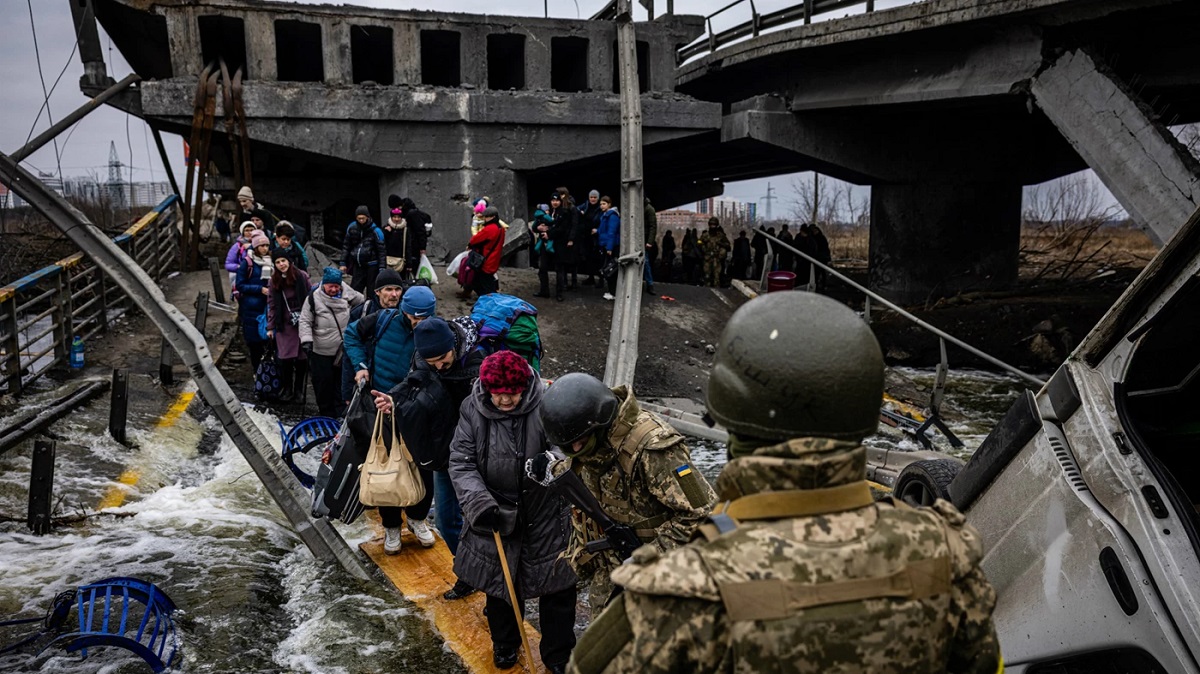
Image: Dimitar Dilkoff / AFP / Getty Images Evacuees cross a destroyed bridge as they flee the city of Irpin, northwest of Kyiv.
Anatoly, a 26-year-old member of Irpin Bible Church (IBC), is with the Lord.
His last act on earth was to carry the suitcase of a young mother and her two children, hurrying them across Irpin’s collapsed bridge to safety from Russian shelling.
All four died, when a bombshell landed in the middle of their would-be humanitarian corridor. Eight total died in the suburb of Kyiv yesterday, as Russian troops pressed hard to encircle the Ukrainian capital.
“Anatoly was deeply spiritual, with a good Christian character,” said his pastor, Mykola Romanuk. “When he saw a need, he tried to help.”
Negotiations over the weekend led to several ceasefires for civilian evacuation, only to be quickly broken. Each side blamed the other, and Russia has denied targeting civilians.
But Ukrainian sources describe cities now littered with bombed schools, hospitals, and residential districts—not least in Irpin, known in evangelical circles as the “Wheaton of Ukraine.”
After the fall of the Soviet Union, Ukraine’s “evangelical patriarch” Gregory Kommendant invited Christian ministries to join him in his hometown, 16 miles northwest of the capital, where he served as president of the All-Ukraine Baptist Union.
As of a few days ago, about 25 ministries operated out of Irpin, including Child Evangelism Fellowship, Youth With a Mission, Youth for Christ, the International Fellowship for Evangelical Students, and Samaritan’s Purse.
Once home to a single evangelical church, Irpin now boasts 13.
“We were here for 20 years, and neighbors never set foot in our church,” said Romanuk. “Now they are living in our basement, praying with us, and have become our friends.”
Describing Irpin as “secular,” Romanuk described his 700-member Baptist congregation as the largest church in the city of 60,000 people. But now, only a team of five remain, called to stay behind and minster to those under siege.
Led by the head of the missions committee, a deacon’s wife—a real estate agent—is the chief cook. She prepares three meals a day for 200 people, as others volunteer to evacuate the shellshocked citizens to western Ukraine.
Since the war began, the church has transported 100-200 evacuees every day, Romanuk said. As the Russians approached, they bused out 3,000. Early on, the government took notice of their efforts and thereafter directed everyone to the church.
Anatoly was one who returned. Originally from Luhansk in the Donbas region, he…
This article was originally published at Christianity Today on March 7, 2022. Please click here to read the full text.
Image: Contributor / AFP / Getty Images A woman holds a “Stop the war” placard in central Moscow during a protest against Russia’s invasion of Ukraine, on March 3, 2022.
Ukrainian evangelicals have had enough.
Battered by a week of war, they have heard numerous prayers for peace uttered by their Russian colleagues. But they did not hear condemnation.
“Your unions have congratulated Putin, giving thanks for freedom of belief,” said Taras Dyatlik, the Overseas Council regional director for Eastern Europe and Central Asia. “The time has come to make use of that freedom.”
As Kyiv, Kharkiv, Kherson, and other cities have suffered missile strikes, the United Nations reports the death of more than 200 civilians. Ukraine’s State Emergency Service reports more than 2,000. The military casualties are disputed, with both nations claiming thousands of fatalities among the other’s ranks.
But rather than focusing on the numbers, Dyatlik, who coordinates a regional network of dozens of Protestant seminaries, turned to the Bible.
“Remember Mordechai and Esther,” he wrote March 1 in an open letter. “Do not be like Jehoshaphat, who entered into an alliance with Ahab, and was silent when God spoke through the prophet Micaiah.”
Dyatlik accused his Russian colleagues of buying into national rhetoric—first in 2014, when Russian-backed forces invaded the eastern region of Donbas—and again today. But “begging on my knees,” he leveraged his reputation with the heads of Russia’s evangelical unions—while acknowledging their difficult reality.
“You fear prison,” he said. “[But] do not be faithful to Putin. Be faithful to the body of Christ.”
A new draft law proposes a 15-year prison sentence for “fake” claims about the violence in Ukraine, as authorities crack down on Russians who call the “military operation” a “war.” The Russian parliament, the Duma, is scheduled to discuss such measures on Friday.
Dyatlik was not the only one frustrated. But instead of drawing from Scripture, his colleague Valerii Antoniuk appealed to history.
“Where are your Bonhoeffers, where are your Barths?” asked the head of the All-Ukrainian Union of Churches of Evangelical Christians-Baptists. “Your silence now is the blood and tears of Ukrainian children, mothers, and soldiers—that is on your hands.”
Pavel Kuznetsov, meanwhile, simply wants the correct word used—law or no law.
“Many believers in Russia are praying about the ‘situation’ in Ukraine. The situation is called WAR,” the pastor of Word of Life church in Boyarka, 15 miles southwest of Kyiv, wrote on Facebook. “And when you pray again, tell God it’s war, and we are being killed here.”
As of publication, more than 300 Russian evangelicals had reportedly received the message.
“The time has come when each of us must call things by their real names, while we still have a chance to escape punishment from above, and prevent the collapse of our country,” stated an open letter signed by a group of Russian pastors and other Protestant leaders. “We call on the authorities of our country to stop this senseless bloodshed!”
Their message was also biblical. It quoted…
This article was originally published at Christianity Today on March 3, 2022. Please click here to read the full text.
The nine converts are officially acquitted. Branch 34 of the Tehran Court of Appeals agreed with the reasoning of the Supreme Court judge who ruled last November that the preaching of Christianity does not amount to acting against Iran’s national security.
On Monday, judges Seyed Ali Asghar Kamali and Akbar Johari accepted the converts’ lawyer’s testimony that their house church was “in accordance with the teachings of Christianity,” where they are taught to live in “obedience, submission, and support of the authorities.”
The precedent is strong, said Mansour Borji, advocacy director for Article 18, because the judges extensively outlined nine reasons in the acquittal, in line with the Iranian constitution and Islamic tradition.
But it may take time until the ruling becomes normative. One of the nine, Abdolreza Ali-Haghnejad, is already back in jail on a six-years-old separate charge of propagating Christianity, for which he was previously acquitted. And two others, Behnam Akhlaghi and Babak Hosseinzadeh, who made video appeals for freedom of worship, were charged with a separate crime of propaganda against the state.
Iranian Christians welcome the verdict, said Borji, but remain wary.
“This ruling is unlike any other of its type that I have seen,” he said. “[But] at least a dozen others … are still in prison—or enforced internal exile—following their own convictions on similar charges.”
This article updates a previously published piece at Christianity Today, from December 3, 2021. Please click here to read the full text.
As Russian troops met stiffer resistance than expected from Ukrainian soldiers and citizens in Kyiv and other cities, pastors in both nations adapted Sunday worship services appropriately.
“The whole church prayed on their knees for our president, our country, and for peace,” said Vadym Kulynchenko of his church in Kamyanka, 145 miles south of the capital. “After the service, we did a first-aid training.”
Rather than a sermon, time was given to share testimonies from harrowing days of air raids. Many psalms were offered, and Kulynchenko’s message centered on Proverbs 29:25. Fear of man will prove to be a snare, but whoever trusts in the Lord is kept safe.
Both disruption and ordinary life were on display at Calvary Chapel of Svitlovodsk.
Andrey and Nadya, displaced from Kyiv by the Russian missile barrage on Thursday, exchanged wedding vows amid great celebration.
Scheduled to be married this weekend in the capital, the couple was instead sent fleeing to Nadya’s home church 185 miles southeast along the Dnieper River—with a request for an impromptu wedding.
“In the middle of a war? That doesn’t make sense!” said Benjamin Morrison, with irony. “But during war is when it makes the most sense. What better reminder that even war cannot stamp out love. And what better way to say that we serve a higher King than to rejoice in the midst of chaos?”
They were married on Saturday, as planned.
On Sunday, the congregation of about 80 people—just beginning to swell with newcomers seeking refuge—regathered to hear a sermon on David and Goliath.
“Yes, David still had to fight. Yes, it was still hard and scary—but God was his confidence,” concluded Morrison, an American missionary veteran of 20 years and married to a Ukrainian.
“May he be ours as well, and may he cut off the head of the enemy.”
Ukraine claimed today that 3,500 Russian soldiers have been killed so far. Russia has not released an official casualty figure.
Regarding its own losses, Ukraine’s Health Ministry counted more than 350 civilians dead and almost 1,700 wounded as of Sunday night. The reported tally combines civilian and military casualties, but broke out 14 child deaths and 116 wounded.
Taras Dyatlik, regional director for Eastern Europe and Central Asia at Overseas Council, did the math. If correct, in three days of fighting 40 Russian soldiers died every hour; one soldier every minute and a half.
“These are mostly 19- to 25-year-old children,” he lamented. “The depth of our human brokenness can only be healed by the Holy Spirit.” Metropolitan Epiphanius, head of the Ukrainian Orthodox Church (UOC), pleaded for…
This article was originally published at Christianity Today on February 27, 2022. Please click here to read the full text, including several testimonies from Russian pastors.
Image: Courtesy of Ukrainian Bible Society Ukrainians praying in the central square of Kharkiv, Ukraine.
As Russia invaded Ukraine today [yesterday], pressing near even to the capital of Kyiv, a Baptist home was destroyed and a seminary shaken by nearby blasts. Local sources told CT, however, that no churches or Christian buildings had been attacked so far.
President Vladimir Putin announced his forces were targeting only military installations. He also asserted that Ukraine does not truly exist as a nation.
Igor Bandura, vice president of the Baptist Union, the largest Protestant body in Ukraine, heard about collateral damage to the home of a Baptist in Donetsk during a Zoom call with his 25 regional superintendents.
Minus one. On the front lines of the eastern Donbas region, the Baptist leader from the occupied territory of Luhansk was unable to join.
But from the town of Chasov Yor on the front lines in neighboring Donetsk—in an area then still under Ukrainian government control—Bandura learned the local assessment.
“People don’t want to be under Russian control,” he was told. “But they feel helpless. What can ordinary people do?”
Pray. And remain calm.
This was the message put out by the Ukrainian Council of Churches and Religious Organizations (UCCRO), a day after its appeal to Putin went unanswered.
Ukraine’s chief rabbi invited Christian leaders to recite Psalm 31 together.
“We urge you to remain calm, not to give in to panic, and to comply with the orders of the Ukrainian state and military authorities,” stated the UCCRO. “The truth and the international community are on the Ukrainian side. We believe that good will prevail, with God’s help.”
Thousands of Ukrainians fled west as Russian missiles hit targets throughout the nation. Ukraine’s Ministry of Internal Affairs reported hundreds of instances of shelling.
President Volodymyr Zelensky announced by video shortly after midnight that 137 Ukrainians died during the invasion’s first day. “They are killing people and transforming peaceful cities into military targets,” he said, according to The New York Times. “That’s villainous and will never be forgiven.”
Valentin Siniy, president of Traviski Christian Institute (TCI) in Kherson, about 50 miles from Crimea, had to evacuate his seminary along with a team of Bible translators as Russian helicopters attacked local targets. “The majority of old pastors…
This article was originally published at Christianity Today, on February 24, 2022. Please click here to read the full text.
Image: Illustration by Rick Szuecs / Source images:Joe Raedle / Staff / Carl Court / Staff / Getty / Frank Mckenna / Unsplash / Wikimedia Commons
A group of academic Christians in the Middle East has thrown down the gauntlet: The local church, bound in fear to its minority mindset, needs to walk afresh in the Holy Spirit.
“We must tell the truth and call for freedom,” said Souraya Bechalany, coauthor of “We Choose Abundant Life,” a document released last September that makes 20 recommendations. “We are powerful in Jesus Christ, but too often we don’t believe it.”
Bechalany, a professor of theology and ecumenism at the University of St. Joseph in Lebanon, joined 14 other scholars across the region to challenge local Christians to give up their self-understanding of being a minority and to work for the rights of citizenship for all in a changing society.
Local clergy, they say, have instead often wedded themselves to the regimes.
Surveying experience from the Ottoman Empire onward, the document laments how many Christians have taken refuge in sectarianism, turning their vision inward toward survival.
Arab nationalism provided an escape, as Christians took leading roles in developing a common political discourse independent of religion. So did relationships with Western churches, as Catholics and Protestants pioneered modern education and built hospitals to serve society.
But as the region’s nation-states increasingly sacrificed democratic norms in favor of political stability—whether secular or Islamic—church leaders tended in one of two directions: Ally with the authorities, or plead to patrons in the West.
“If we continue in this direction,” said Gabriel Hachem, a Melkite Catholic priest and editor in chief of the French-language journal Proche Orient Chretien, “there is no future for us in the region.”
For now, the regimes are winning, as the challenge of ISIS and political Islam have pushed Christians to support the pillars of authority in alliances of minorities. But in doing so, they sided against human rights and dignity. This is inherently unstable, Hachem said, and Christians suffer also.
Their rate of emigration is rapidly increasing. The ecumenical Abundant Life is the product of a three-year consultation involving…
This article was originally published at Christianity Today, on February 23, 2022. Please click here to read the full text.
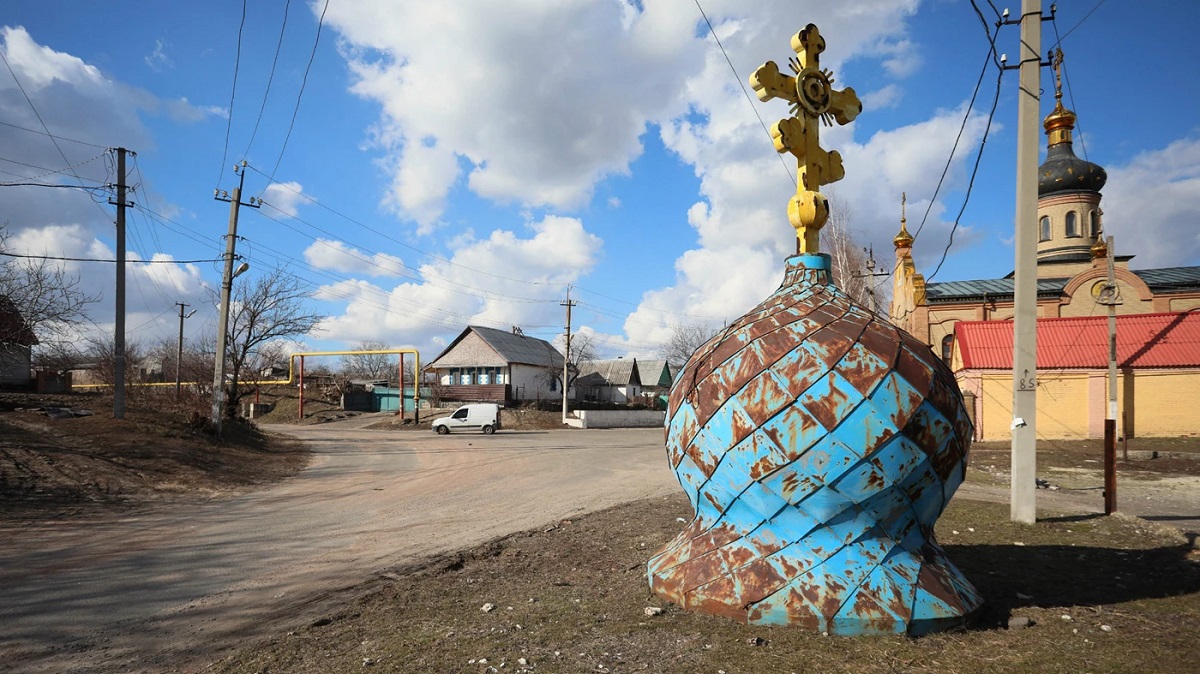
Image: Aleksey Filippov / AFP / Getty Images A cupola of a destroyed Orthodox church is seen in the Donetsk region on Ukraine’s frontline with Russia-backed separatists on February 21, 2022.
Facing imminent war, Ukrainian evangelicals preached peace the day before Russian President Vladimir Putin dramatically escalated tensions by recognizing the independence of two separatist regions on Monday evening.
“Go closer to meet those who are against you or fighting you,” Yuriy Kulakevych, foreign affairs director of the Ukrainian Pentecostal Church, told his congregation on Sunday, February 20, at God’s Peace Pentecostal Church in the capital, Kyiv.
“We are not only to enjoy peace ourselves, but to share it.”
Preaching on the Sermon on the Mount’s injunction toward peacemaking, Kulakevych continued his laser-sharp focus on the possible Russian invasion. Five weeks ago, as the separatist conflict in the eastern Donbas region began to escalate, he surveyed the Bible for its teaching on “wars and rumors of war.”
He followed that with an application of “Do not let your hearts be troubled” and, on the next Sunday, a treatise on worry. Last week, he tried shifting to include more mundane examples in a sermon on Jesus calming the storm, such as pandemic, career, and relationship difficulties. But the Russian threat did not dissipate.
“Protect yourself and your family by all possible means,” Kulakevych told the church. “And serve as a mentor for people in a bad state.”
The latter spirit is also animating Ukraine’s Baptists.
“Pastors in the gray area are not leaving the area,” said Igor Bandura, senior vice president of the Baptist Union of Ukraine, describing the frontline. “Christians are determined to take an active part in the needs of the people around them.”
They have already, planting 25 churches in the past five years. For weeks the Eastern European nation has lived in tension as an…
This article was originally published at Christianity Today, on February 21, 2022. Please click here to read the full text.
Elijah Brown, with Maronite Patriarch Bechara al-Rai.
The value of Lebanon’s largest denomination of lira is now worth $4. It used to be able to purchase a ticket to a Broadway show. Today, amid a currency crisis that has pushed poverty rates to 82 percent, it can buy a gallon of milk.
The minimum wage—pummeled by the world’s third-worst inflation rate—is now barely $20 a month. And the worst suffering is in the nation’s north, where 6 in 10 children are regularly skipping meals.
Lebanon’s Baptists called for help.
“We came to express our deep concern for the suffering of Christians, and everyone,” said Elijah Brown, the US-based general secretary for the Baptist World Alliance (BWA), who visited mid-January.
“You are in our prayers.”
His words were directed to Bechara Boutros al-Rai, patriarch of the Maronite Church, an Eastern Rite Catholic community. Expressing solidarity with the 81-year-old cardinal and leader of Lebanon’s largest Christian denomination was a priority to the local Baptist convention, and Brown came with an invitation.
The BWA will call America’s 40 Baptist colleges to a conference in the US focused on supporting Lebanese education. Cohost with us, Brown asked, in partnership with US Catholic universities.
“It is a way to strengthen one another,” he said, “sending a message of unity and nonsectarianism.”
Lebanon is divided roughly in thirds: Sunni Muslim, Shiite Muslim, and Christian. Evangelicals represent about 1 percent of the 6 million population, far behind Maronites, Greek Orthodox, and other sects.
But Protestant-heritage schools like American University of Beirut and Lebanese American University stand alongside the Catholic St. Joseph’s University and the Orthodox Balamand University, akin to the Ivy League elite. All have been suffering, as few students can afford tuition.
And it is similar for Lebanon’s children. Over 700,000 of 1.2 million students attend the Christian-dominated private school system—including 20,000 within 35 evangelical schools. But the economic situation has pulled 3 in 10 students out of school altogether, and 13 percent of families sent their children to work.
Lebanon’s Notre Dame University (NDU) is eager for partnership.
“We want to help develop the Baptist mission in Lebanon,” said Bechara Khoury, president of NDU. “Struggling with a very crucial situation, bridges with others will give us the oxygen we need.”
Fully accredited by the New England Commission of Higher Education, in 2020 NDU began a partnership with the Baptist SKILD program for students with special needs. It is an “added value” for the inclusive university, said Khoury, as 46 students receive support in their college studies.
The BWA provided $35,000 last year to SKILD, Beirut Baptist School, and other aid programs to support struggling Lebanese and Syrian refugees. While Brown promised to continue to raise the issues of Lebanon among Baptist donors worldwide, he assured the patriarch with a message of advocacy. He will press US lawmakers…
This article was originally published at Christianity Today, on February 4, 2022. Please click here to read the full text.










 Jayson Casper