Categories
Personal

My Jihad: This Video will Restore your Faith in Humanity

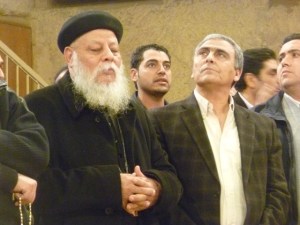
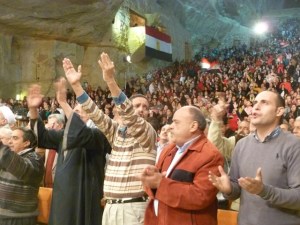
The title is a little bit much (to be explained below), but it is a nice scene. The video is taken from a Christmas celebration in Kasr el-Dobara Church in downtown Cairo, right behind Tahrir Square. The imam of Tahrir’s mosque pays a visit to wish his Christmas greetings to a congregation that shared with him the trials and courage of the revolution. The video is 15 minutes long, and subtitled, but you don’t have to watch the whole thing to get the gist.

Please click here to go to YouTube.

The gesture is very important in contemporary Egypt, as the Salafi current of Islam has forbidden Muslims to wish Christians a merry Christmas. On one hand this is fine – why should they honor a supposed incarnation they reject?

On the other hand it is horrible – it strikes at the fabric of national unity which has been nurtured in Egypt over generations, amid instances of sectarian tension. Every Egyptian knows their religions are not the same, but they greet each other warmly nonetheless.

But if there is one comment against the video, its production (not its content) strikes too much as propaganda in the other direction. ‘My Jihad’ is an English language campaign designed to redefine the American understanding of jihad.

Again, this is well and good. Jihad does encompass the meaning of warfare for the cause of Islam. But it also, and for most Muslims around the world who are at war with no one, signifies the struggle to improve one’s soul and the world around them. It would serve many Americans well to be more aware of this.

But using Egypt as an example to restore faith in humanity? Directly after a campaign for their constitution laden with religious rhetoric, much of which labeled their opponents – and sometimes Christians – as unbelievers and the enemy? As the war cry ‘Allahu Akbar’ rang out from podiums urging the triumph of God’s religion?

Do not make these worrisome developments out to be more than they are, but do not make this appearance of a sheikh in a church out to be more than it is, either. Yes, it is a necessary and valuable gesture, received to great applause by the Christian audience.

But if one wishes to be cynical, after Islamists used religion to divide Egypt and get their constitution, may they now want to use religion (and religious unity) to govern from the center amid expected economic difficulties? Even if not, forgive the nation’s Christians and non-Islamist Muslims for feeling rather jaded.

These events are far removed from the American consciousness, which is generally ready to move on from Egypt after being consumed with its transition for the past two years. It is hoped the My Jihad campaign, as necessary as it must be, is not painting a purposefully imprecise picture to take advantage.

Categories
Personal

2012 Blog Statistics Review

Family Photo

At the end of each year, our blogging platform – WordPress – provides a summary of the year’s activity. It gives us the chance to say ‘thank you’ to all of you who read our blog, looking backwards while looking forwards. Please click here if you would like to see our review post from 2011. Strangely, as you’ll notice, there is some overlap.

The busiest day on the blog this year was September 12. This was around the time Salafi Muslims breached the US Embassy in Cairo, burned the American flag, and replaced it with a black flag of Islam. Many of you turned in to check our safety; others just came to see the news. All was well, as I hope our post conveyed. To review, please click here for Salafis, Muslim Youth Protest anti-Muhammad Film at US Embassy.

This post, however, was only the third most popular over the course of the year. Top honors went to:

  • Applying the Cross (On Your Wrist) – Written in April, this post featured a tattoo parlor in a local Coptic Orthodox church. Most Coptic Christians mark their religious identity with a permanent imprint, something our four year old daughter imitated with pen ink in 2010. Click here for that post, which was a favorite from 2011, falling to 6th in 2012.
  • Christians in the Sinai – Written in January, this post featured information gained from the Coptic Orthodox bishop resident near the Gaza border. At the time of its writing there was low level tension in the area, but as the year went on and troubles increased, Google searches brought many readers here. It may be one of the few articles that describes the Christian community there.
  • Statement of the Muslim Brotherhood and the Leaders of the Evangelical Church in Egypt – Written in April, this is simply a copy of an otherwise little-known agreement between the two. Many different publications picked up on it and linked to it from here, as it is not available elsewhere on the internet. But if tension continues to increase between the Brotherhood and Egypt’s Christians, it will be good to come back here and see if they are honoring their promise.
  • Rafik Habib: On Sharia, State, and Christianity – Written in April 2011, this is a repeat winner from last year’s most popular blogs. Habib has been in the news first as a Christian VP of the Brotherhood’s Freedom and Justice Party, and then again when he resigned during the controversy over President Morsi’s power grab to avoid judicial oversight. Perhaps he will not repeat again in 2013 if he drops out of the limelight, but please click here to read my essay lauding his presence among the Islamists.

2012 was a very noteworthy year for Egypt, and perhaps it brought more attention to this blog that would otherwise be warranted. But we can celebrate with you that daily viewership doubled over the same period from 2011, which had previously doubled over 2010. Thank you very much!

WordPress also began tracking the location of visitors starting in February of this year. The United States, perhaps fittingly given our nationality, was by far in the lead. Egypt, we are thankful to report, was second, followed by the UK, Australia, and Candad.

Among other Arab nations Jordan ranked 7th, the UAE 14th, Saudi Arabia 18th, and Lebanon 26th. Though not Arab, we even had one reader from Tajikistan.

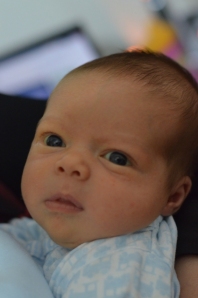
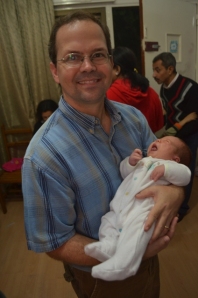
Of course, the blogging highlight of the year was welcoming our son Alexander to Egypt. In this post we introduced his possible names, here we revealed the choice and first pictures, and here we shared his Subuu3 party with friends from around the world.

In the coming year we are trying to make up our mind about keeping or shelving the News Links and Arabic Links updates listed at the top of the blog. These are very useful for me to review, and don’t take that much time to copy and paste. But not too many people click on them, so if you find them helpful, please let me know.

We may also see about providing smaller updates featuring interesting news developments, without pictures. These would appear beneath the slideshow banner, which was fun to add this year. That section would continue to feature longer articles and excerpts from those published professionally.

Do you have any other suggestions for us this coming year? We’re happy to share what we learn about Egypt, reflecting the very precious sense of belonging we have for this nation. May God bless Egypt and all our readers in 2013.


Related Posts:

Categories
Personal

Alexander’s Subuu3

Alexander Eyes Open

About six weeks ago, we welcomed baby Alexander into our lives. According to Egyptian tradition, one week later we should have given him a Subuu3.

Subuu3 is related to the Arabic word for ‘week’, and the number three at the end represents an Arabic letter absent in English. We delayed his party, however, until his eighteenth day of life, until both sets of grandparents could arrive. But this is acceptable according to the local traditions, as Egyptians tend to be very, um, flexible, on matters of time.

Yu'annis and Alexander

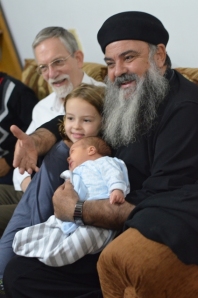
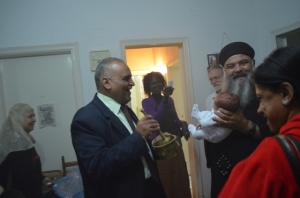
Our good friend, a Coptic Orthodox priest, Fr. Yuennis, traveled three hours one way from Upper Egypt to perform the religious rites of what is essentially a cultural baby party – received from the Pharaohs. We weren’t really sure what these rites included, though, until he was about fifteen minutes from our home.

My friend, who had already arrived, told me I needed to have a basin prepared for the priest to bathe Alexander in. I racked my brain, but couldn’t think of anything appropriate. Fortunately our neighbors upstairs had a foot bath which worked perfectly for the event.

I learned after the fact that we should have had a similar party the previous night where Alexander was also bathed. This time, all the guests would have thrown an Egyptian coin or two into the water, and the lucky woman who was chosen to bathe the baby would then collect that money. It is up to the family to choose, but the main criterion is that she is an older woman. My friend told me that for the Subuu3s done for her two children, the women took 100 and 150 Egyptian pounds (US $17 and $25) respectively. Not a bad fee for giving a baby a bath!

Yu'annis Leading Ceremony

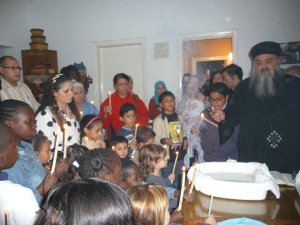
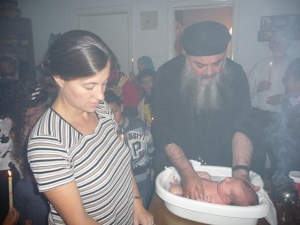
Instead, our party began with the arrival of the priest, who chanted prayers before taking Alexander from me to bathe him. The point is to bless the baby; it is not a baptism. In the Orthodox tradition boys are baptized forty days after birth, and girls eighty.

Yu'annis Bathing Alexander

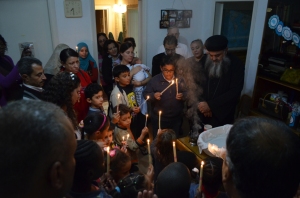
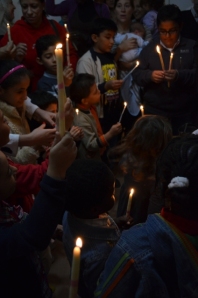
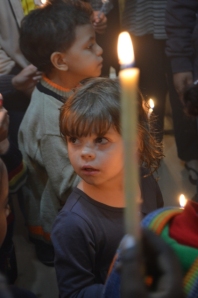
I have to admit that I was quite distracted during the priest’s words since we had about fifteen children, ages 3-9, holding lit candles and standing very close to each other and many other flammable items! Even when I took Alexander to get him ready for his bath, I was very conscious of the candles behind my back and prepared to catch on fire at any minute!

Later, when I asked my friend about the craziness of putting lit candles in young children’s hands, she just laughed and said this was a key part of the ceremony, and that, unlike our party, the children should have marched around the whole apartment holding the candles.

(Please click here to watch a video clip from the religious part of the ceremony. Translated subtitles are provided, though we are not yet able to translate the parts in Coptic. You may need to select ‘captions’ from the YouTube screen.)

Group with Candles

Kids and Candles

Hannah and Candle

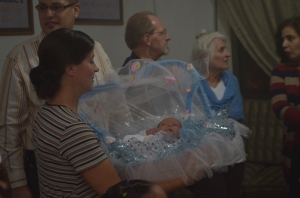
After getting cleaned up and dressed in white, as is customary, Alexander got to experience the most stimulating part of the evening. First, he was put into a special bed made for the occasion. Then we put him and his bed on the floor and I stepped over him seven times, showing my authority over him as his Mother. Next he was taken by my friend and shaken a bit in his bed.

Alexander in Basket

If that didn’t wake him enough, another friend took a mortar and pestle and made lots of noise right next to him. As it rang out, she chanted something like, “Listen to your mother, listen to your father, listen to your aunt, but don’t listen to your grandfather.” They will say several variations on this, always joking around by adding the “don’t listen to” part. When I asked the ‘why’ behind all this, I was told that it helps him not be afraid in the future when he hears a loud noise. Having been put through this ordeal, the rest of life should be much easier.

Making Noise

This is all followed by walking around the room in a circle with the noisemaker in his ear while the guests chant something like, “Lord, be with him and grow him; may he have the prettiest gold in his ear.” This is said regardless of gender, for some reason.

(Please click here to watch a video clip from the cultural part of the ceremony. While there is lots of chatter, no subtitles are necessary – just take in the hubbub.)

Circling the Room

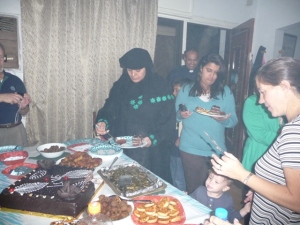
Once all this was done, it was time for the food. In general, Egyptians are very generous and great at hospitality, so we wanted to be sure we had more than enough food as well as a nice-looking spread. It probably wasn’t enough, but with a lot of help from the four grandparents, we mixed ready-made Egyptian favorites with American items.

Baby Party Spread

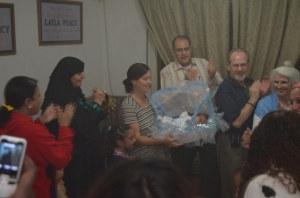
The final aspect of the traditional baby party is the party favor, also called a Subuu3, where we comically veered too much into American baby shower traditions. The Egyptian bag should be filled with peanuts, popcorn, and some hard candy, along with perhaps a baby-looking figurine or something similar and labeled with the baby’s name.  But our friends were enamored by the favors we gave out as they weren’t the least bit traditional.

In preparation for this party, my mom came with American items. Our bags were filled with a lollipop and a couple pieces of candy – all wrapped in blue, of course – then tied together with a miniature pacifier and a card bearing Alexander’s vital statistics: name, date of birth, weight, and length — information all our stateside friends expect to hear at the birth of a new baby. This was far too much detail for our Egyptian friends, though. They only include the baby’s name and a written blessing. This is what happens when you combine two cultures!

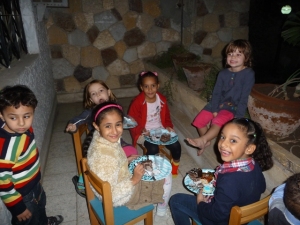
Baby Party Kids

All in all it was a great night. Our Egyptian friends had a chance to meet Alexander and we were able to share in Egypt’s unique cultural traditions. Perhaps most importantly our child received a blessing, as did we, of an ever deeper sense of belonging.

Alexander and Daddy

Related Posts:

Categories
Personal

Before Egypt Votes, Christians Pray

Today Egypt witnessed a historic referendum over a highly disputed constitution. Two days earlier, Christians placed their nation in the hands of God.

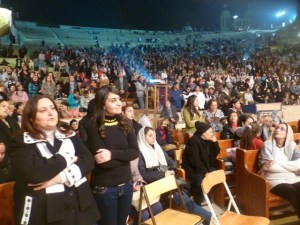
Many did so hoping for a miracle. Egypt’s churches earlier withdrew from the committee writing the constitution, finding their voice sidelined amidst an Islamist super-majority. Noteworthy, however, was that not one speaker prayed against the constitution. Instead, they asked God to be with Egypt, give her peace and stability, and bless Islamists in particular.

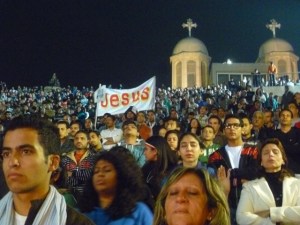
I will save more description for a few articles I hope to write in the coming days, but here is the essential fact: About 10,000 Christians from all Egyptian denominations interceded with God for their nation. Slightly less than half of these spent the whole night in prayer.

Here are the pictures, with links to video interspersed:

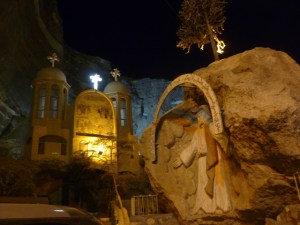
The entrance to a church, carved into a cave. It is a magnificent modern facility on an ancient Coptic site, where God saved his people by splitting the mountain in half.
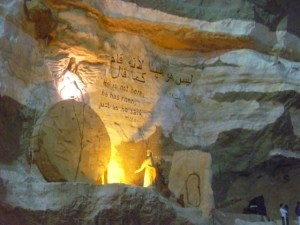
Throughout the area stone carvings illustrate Biblical scenes. This one overlooks those worshiping.
The church is led by Fr. Simaan (Simon), who serves the Christian garbage collectors among whom he built this church.
Most Egyptian Christians are Orthodox, and there has been tension between them and other denominations. Fr. Simaan's heart is for Christian unity, however, and he organizes many meetings with Rev. Sameh Maurice, lead pastor of the largest Protestant Church in the Middle East.
Most Egyptian Christians are Orthodox, and there has been tension between them and other denominations. Fr. Simaan’s heart is for Christian unity, however, and he organizes many meetings with Rev. Sameh Maurice, lead pastor of the largest Protestant Church in the Middle East.
Fr. Simaan's church is fully Orthodox - note the icons - but incorporates modern evangelical features such as a praise team.
Fr. Simaan’s church is fully Orthodox – note the icons – but incorporates modern evangelical features such as a praise team.

Please click here for a medley of Arabic praise songs from the meeting. It includes the crowd’s favorite – chanting Yesuu’ (Jesus) over and over again.

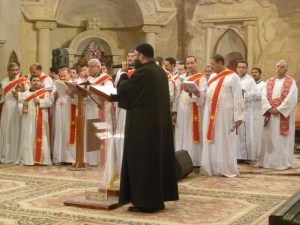
This particular choir was composed of members from various churches, of different denominations. All worship leaders, as well as speakers, however, were Orthodox.
An Orthodox mass is a solemn, holy event. Many, however, have learned how to shout to the Lord in praise.
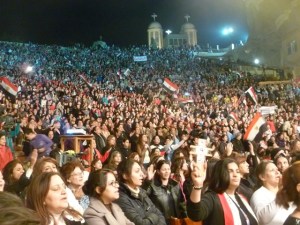
One of the purposes of the event, besides praying for Egypt, was to broadcast the love Copts have for their nation. Note how many Egyptian flags filled the auditorium.

Please click here for a variation on the above link. One of the speaking priests urged the audience to add the word ‘Masr’ (Egypt) to their ‘Jesus’ chant. Boisterously, they went back and forth.

Here are a few pictures showing the size of the crowd:

Crowd 5

Crowd 4

Crowd 6

The praise segment of the evening went from 6pm to about midnight. Thereafter the prayer took a more Coptic feel, with traditional hymns lasting until 6am, followed by morning mass.

Please click here to watch this choir perform and the crowd chant along.

Finally, this is about the size of the crowd that stayed to worship throughout the night.

Only God knows what is best for Egypt in terms of this current constitution. But may he honor the prayers of this community, of Muslims, and of Islamists, who pray for the peace of Egypt.

Categories
Personal

Clarity in the Midst of Mud: Taking Stock of Egypt’s Situation

Clarity in the Midst of Mud

I wish I was able to succinctly summarize what is happening in Egypt these days. Instead, I am a victim of information overload and competing media narratives. Bear with me and I’ll do my best.

On one side, the president and his Muslim Brotherhood supporters have claimed a conspiracy against them. On the other, liberals see the working of an Islamist plot to seize control of the state and enforce a religious agenda through their flawed constitution.

But if understood only this way, it enforces the narrative that Egypt is witnessing a struggle between Islamists and liberals. Supporters of democracy around the world might say, ‘Didn’t the Islamists win? Don’t they deserve their agenda? It appears they are not nearly the bogeymen we thought them to be.’

Yes and no. Morsi won the election by the smallest of margins, and many of his supporters did so mainly to oppose the other candidate, of whom they feared a return to the former regime. The main youth movement of the revolution, called April 6, and his primary Islamist competitor for the presidency, Aboul Fotouh, now campaign against him and this constitution, after earlier lending their support.

One major complaint is the constitution and its formation. Liberals withdrew from the writing process, believing it was dominated by Islamists. Morsi then preached conspiracy to assume (allegedly temporary) dictatorial powers to preempt the courts from striking it down before a referendum. Amid the outrage Morsi gave up these powers but kept in place all decisions he took while possessing them. Among them was control over public prosecution and immunizing the constitution from judicial review.

The other major complaint is the conduct of Islamists during the protests against Morsi’s decisions. Though the Brotherhood swears innocence, they sent pro-Morsi demonstrators to an area occupied by the opposition. When violence erupted, they claimed to be the victims. Certainly their headquarters were attacked across the country, and they assert members of their group were killed. But testimony and video is plentiful that during the clashes they apprehended their opponents and, well, extracted confessions.

Furthermore, Islamists are camped outside the Supreme Constitutional Court, leading judges to suspend work at the offense toward and interference in the judiciary. They also surround Media Production City, where satellite channels and their popular talk shows are produced. They demand the media be cleansed for spreading lies about them, but so far, both Islamist sit-ins have been peaceful. They state, however, they are ready to act if Morsi is unseated.

Is there an effort to do so? Demonstrators have certainly chanted for his regime to fall like Mubarak’s, but political leaders say they wish only to delay or cancel the referendum and achieve a consensual constitution. For the reasons given above though, they claim his legitimacy is either gone or hanging by a thread. And, it is evident some in the liberal media speak with extreme hyperbole and perhaps manipulate the narrative in their favor.

So today, two rival, thousands-strong demonstrations are set to square off within a distance of several city blocks. Protestors will march to and encamp at the presidential palace in Heliopolis; supporters will gather in nearby Nasr City. Both sides assure their intentions are peaceful and will keep separate to avoid sparking violence. Yet just this morning the ongoing sit-in protest at Tahrir was attacked by unknown assailants.

Islamists insist the protests against the constitution are manufactured and reflective of a small minority of Egyptians. Morsi shows no sign of backing down, insisting to hold the referendum in four days. Indeed, no matter their numbers, it seems opponents can do little to stop what they believe to be an illegitimate process. Unless the army intervenes or social strife erupts, their only recourse will be to vote ‘no’.

It is hard to imagine good liberals justifying either military intervention or national riots to achieve their goals. It is also hard to imagine what Islamists have to gain by assaulting their opponents, as they own the status quo momentum. Perhaps the hardcore and corrupt old regime supporters have had a hand. Islamists certainly claim this, as they paint with broad strokes accusing them of collusion with the liberals. Presented evidence, meanwhile, is scant.

But despite the assurances of all, the threat of violence is in the air. Each side warns of violence if Egypt continues down this path, yet Egypt continues all the same. Perhaps nothing will come of today’s events but passionate demonstrations. Maybe there is only a narrative of violence, either to scare others from participation or tarnish reputations. Or, perhaps, further turmoil will soon ensue.

Above I warned about interpreting events as a continuing contest between liberals and Islamists. Taking much from the analysis that followed, many others prefer the description as a struggle between the cultures of democracy and authoritarianism.

But here is where you start to drown. Each event has so many subplots and possible interpretations. Narratives come through media, or experts, or partisans – all tinged, if not outright colored, by bias, unnamed sources, and simply lack of complete information. Throw in the strategic importance of Egypt in world politics, and the story is complicated even further.

So is it all a mess? Well, that is another proposed narrative. Is it a power struggle? There is another. Is it a fight for freedom? Take your pick.

But as you pick, I advise you to pick according to what is right and good, with all humility. As much as I struggle to define this, I excuse you from the certainty necessary to speak in these terms. The following days may change Egypt for years to come; let us pray that which is best for her people prevails.

Related Posts:

Categories
Personal

Little Pink Chicks

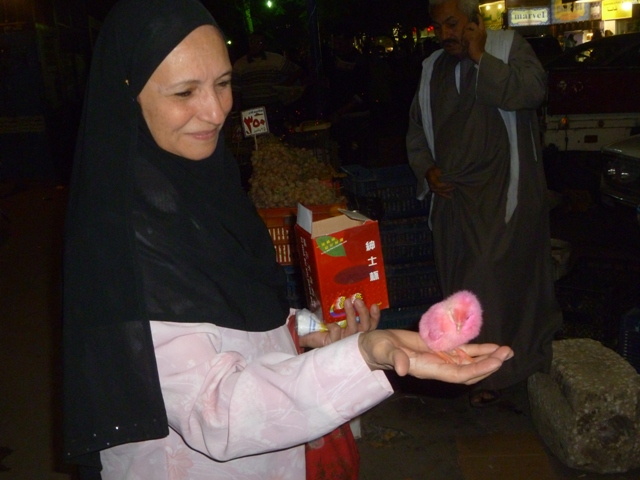
We had not noticed it in years past, somehow, but apparently it is the season for pink chicks in Egypt. Really, they are hard to miss.

Mixed among the cutlery, shoes, and fruit offered by illegal street vendors up and down the road leading to the local Maadi metro station are tiny little chicks crowded into plastic boxes. They sell for a pound apiece, the equivalent of eighteen US pennies. They fit snuggly into the palm of a hand.

Many are also painted pink. Demonstrated by the interest taken by our children, this serves to attract customers.

Street vendors have proliferated since the revolution as police have stopped enforcing whatever codes prevented them from being there. They crowd the sidewalk, spill over into the street, and generally increase pedestrian and vehicular traffic. It is practically bedlam in front of the metro station, as taxis congregate as well, awaiting customers.

The vendors are nice enough and do not impose or shout out prices. Elsewhere, tourist market peddlers are notorious for calling out their wares, hoping to prey on naïve foreigners and help separate them from their money. Most seek to be funny, but the economic situation forces the hand of both groups of aspiring entrepreneurs. It is hard not to be sympathetic when the poverty rate exceeds 40%.

A friend tells us, though, that chicks-as-gifts have been popular since she was a girl. The pink seems to be a recent novelty, but Egyptian kids have always loved having an alive toy. Most die after a few days; lack of proper care is certainly a contributing factor.

Laugh, cry, or shrug it off? How would you respond?

Update: My friend tells me that sometimes street vendors will place the chicks on a heated surface, then market them as dancing chicks from Tanzania. But she also tells me that many Egyptians will raise these chicks, and eventually benefit from either a mature rotisserie or egg-laying hen.

Related Posts:

  • Sheep – December 15, 2009
Categories
Personal

Naming Alexander

Our daughter Emma Hope Casper is six years old and in first grade in the Egyptian private school system. As a foreigner, she is different in many ways from all of her fellow students, yet shares one important commonality.

She is known as Emma Jayson.

A few days ago we invited readers to come along side us as we considered six name choices for our newborn son. Your comments were very helpful, and gave us much food for thought. We are pleased to announce today the birth of Alexander Jayson Charles Casper, born November 6, at 12:30pm, weighing 8.15 pounds.

In that post we mentioned our son’s middle name was already decided. My name is Jayson Charles Casper, and like most Americans, I have only three names. My own father, however, made the somewhat unusual choice to give his own name as my middle.

The Egyptian pattern, and that of many Arabs, is to honor family lineage in the naming of their children. For either a boy or a girl, there is often an element of choice in the first name. But then for both a boy and a girl, the second name is taken from the father, the third from the grandfather, and the fourth and final name from the great-grandfather.

Practically speaking the name is often shortened to just the first two, and this is why my daughter is now known as Emma Jayson in school.

The idea of honoring my own family lineage was attractive to us, as was the idea of honoring this Egyptian sense of family belonging. As my father included his own name in mine, I will do the same with my son. Yet we will lengthen his name to four, extending the generational heritage. The last name, of course, will remain Casper, as we have our own national, cultural – and above all familial – traditions to honor.

Alexander will be free to do as he wishes, but imagining this pattern into the future is winsome.

As for Emma, she too is free. We will have to gauge the value of the challenge in correcting administrative records to describe her as Emma Hope Casper, but as she matures, her identity will increasingly be her own. And, should future circumstances dictate, the Egyptian/Arab pattern of marriage is for the wife to retain her own name.

Of course, we are only partially free. We are shaped by the values and principles bestowed upon us – or neglected – by our families. There was no measure of compunction in the naming of Alexander, yet I am pleased to believe the roots of this choice were sown thirty-eight years ago.

Our son and daughters will surely make future choices we find suspect, and we must gauge the level of responsibility we bear at that time. Our hope, however, is that the values and principles we give them now will inform these choices, even when we disagree.

If so, we trust these disagreements will be few; not from their correspondence with our will, but from the needlessness of concern.

Their choices, God willing, will be honorable.

Related Posts:

Categories
Personal

To Name Our Son in Egypt

Come November 6, I will no longer be Abu Talaat Banat – the father of three girls. Though it is not so prevalent in Egypt, in good Arab fashion I will soon be Abu ….. – the father of the name of our first-born son.

So what name will we choose? The rule is that it must work in both Arabic and English, and we prefer as well there be a connection to Egypt. Of course, it has to sound nice and have a pleasant meaning as well. Here are the choices that have made the cut, in alphabetical order:

Alexander, Jeremiah, Matthew, Nathan/Nathaniel, Osama, and Thomas.

Allow us to share some of our rationale below. Please feel free to share your opinion or prediction at the end. Who knows, maybe it will sway us.

Alexander

Arabic: Iskander – we really like the sound of this, and can imagine calling him ‘Iskander’ even around the house.

Egypt: Egypt’s second largest city – Alexandria – was named after Alexander the Great.

Bible: There are a couple Alexanders of ill repute in the Bible, but Alexander was also the son of Simon of Cyrene, who carried Jesus’ cross. Cyrene, near modern Benghazi in Libya, was associated with Egypt in history. Church history connects this Alexander with St. Mark – the founder of the Coptic Church – as heralding from the same region.

Family/Friends: Alexander is my second brother’s middle name. As with all family connections to follow, we’re not sure if this would be a positive honoring or a negative stealing – in case he wanted to use his name for any future sons of his own. Alexandria is also my mother’s middle name.

Drawbacks: Though the name nobly means ‘defender of men’, the best known Alexander was hardly such. He was a man of war and creator of empire. Of course, much of Western civilization derives from his Hellenization of Europe and the Mediterranean, but bloodshed is not the best legacy to grant a son.

More trivially, though he was my favorite sitcom character growing up, Alex from ‘Family Ties’ is not the best role model either.

Jeremiah

Arabic: Armia – It is a bit awkward in Arabic but is known in Egypt through the Coptic population. I think we would most likely call him ‘Jeremiah’ even among Egyptian friends.

Egypt: There is a Coptic bishop named Armia who is a member of the Holy Synod and was a secretary to Pope Shenouda.

But a greater connection comes through the Biblical prophet, who at the end of his life was carried captive to Egypt, where he presumably died, perhaps at the hands of his own people.

Bible: The book of Jeremiah is my favorite Old Testament book. Jeremiah puts forward an example of faithfulness to a task even when failure is promised. His personal pathos is matched only by God’s faithfulness to him in return – through his presence, not through success.

Family/Friends: We have a few friends named Jeremy, but know of no one named Jeremiah. Perhaps this in itself is a plus.

Drawbacks: The Biblical Jeremiah is known as ‘the weeping prophet’. While the above description shows our appreciation for this aspect of his character, it also could be a difficult legacy to bequeath.

Matthew

Arabic: Matta – Unlike many Arabic equivalents this is simple and easy for non-native speakers to pronounce.

Egypt: Matta al-Miskeen – Matthew the Poor – is a well-known and controversial Coptic monk. Now deceased, he was a prolific writer, fully Orthodox, but appreciated by Protestants. He also dared to criticize Pope Shenouda in his early years over the politicization of the papacy. I’ve always had a soft spot for sincere troublemakers.

Bible: The Gospel of Matthew is perhaps my favorite New Testament book, containing the Sermon on the Mount. Jesus’ choice of Matthew as a disciple, when he was from the hated Roman-collaborating tax collectors, is an inspiring act.

Family/Friends – Matthew is my father’s middle name.

Drawbacks: Our daughter Hannah complained a boy in her kindergarten class named Matthew was naughty.

Nathan / Nathaniel

Arabic: Nasaan / Nasana’eel – These are not particularly well known as names in Arabic, even among Christians, despite their Biblical origin.

Egypt: His martyrdom anniversary is celebrated on the first day of the Coptic New Year.

Bible: Nathan was an Old Testament prophet in the court of David who had the courage to rebuke his king and the wisdom to do so in a manner yielding his repentance.

Nathaniel is the alternate name for Bartholomew (in John’s Gospel), one of the twelve disciples, of whom Jesus said there was no guile.

Family/Friends: A few Nathans were friends from university days.

Drawbacks: Both Biblical characters provide good examples, but the pronouncement of being guileless was preceded by Nathaniel’s prejudice against Jesus’ hometown. Transparency is a virtue, but can lead to lack of tact. Picking straws, here, of course.

Osama

Arabic: Osama is Arabic, with no English equivalent. It is related to being exalted, as in the heavens, and is one of the words for ‘lion’. It is used by both Muslims and Christians. Does not Osama bin Jayson have a nice ring to it?

Egypt: Many of Osama bin Laden’s closest advisors were Egyptian, as is his successor in al-Qaeda, Ayman al-Zawahiri.

Bible: No direct connection, but the choice of this name comes from the example of Isaiah, who named his son Maher-Shalal-Hash-Baz, which means ‘quick to the plunder, swift to the spoil,’ and was connected to his prophetic ministry. Poor kid.

Yet the idea is that those who love us will also love our son. Those who love our son will love him in his entirety, including his name. Perhaps those who love him – and his name – will also come to love his notorious namesake and his imitators. At the very least we hope our son in this legacy can redeem a name, and perhaps even dent the association with a war on terror which has done so much harm to this world.

Family/Friends: A wise counselor and Muslim friend in Egypt is named Osama.

Drawbacks: These are obvious, really. Poor kid.

Thomas

Arabic: Toma or Tomas – We get mixed up between the Arabic and the Coptic equivalent, but both are well known in Egypt and easy to pronounce.

Egypt: Bishop Thomas is a well-known bishop in the Coptic Church, beloved by both Orthodox and Protestants.

The Apostle Thomas is also beloved by Egyptians because he is the sole disciple believed to have witnessed the assumption of Mary into heaven.

Bible: Best known as ‘Doubting Thomas’ for failing to believe the report of Jesus’ resurrection, he is less known for his great courage. As opposition to Jesus was mounting, Thomas told the disciples, ‘Let us also go [to Jerusalem] that we might die with him.’

Family/Friends: Thomas is the middle name of my third brother. It is also the favorite choice of our daughters, who picked it themselves.

Drawbacks: The doubting heritage is not best, even though courage in the midst of doubt is admirable. Thomas also means ‘twin’, which is unfortunately (?) not the case with our son to be.

So, these are our choices. The middle name can make a difference, of course, which we have chosen but will not share at this time.

For review: Alexander, Jeremiah, Matthew, Nathan/Nathaniel, Osama, and Thomas.

The name may or may not follow the pattern of our daughters, but for reference they are:

  • Emma Hope
  • Hannah Mercy
  • Layla Peace

With Layla’s name we played a similar game on our blog. For a long while it was the most viewed post we have written, and remains the most commented.

Currently, the most viewed post is about the assault on the US Embassy in Cairo. What do you say we knock that one off its perch, and celebrate something more seemly? In any case, we hope you and your friends will have as much fun with this as we will.

We look forward to sharing the good news to come.

Categories
Personal

Bishop Thomas: Almost a Jonah

In typical Coptic Orthodox clerical fashion with his flowing black gown and long white beard, you would never know Bishop Thomas was almost a Jonah.

The Jonah of old is characterized for his rebellion against God. He was commanded to preach to the people of Nineveh, went instead on a boat to Tarshish in the opposite direction, and met up along the way with a famous whale.

A point often missed in the story applies equally well to the case of Bishop Thomas: Jonah was a man of God already, at the point of his calling. He was a prophet with a well established ministry in Israel.

Bishop Thomas, meanwhile, was a missionary monk serving in Kenya. He had already dedicated his life to God, when, at the age of thirty, God interrupted.

The interruption came through Pope Shenouda, head of the Coptic Orthodox Church, now deceased. He identified Thomas for the position of bishop of Qusia in Upper Egypt, giving him one day to prepare for his ordination.

Thomas actually said no to the pope – an almost unheard of boldness in clerical circles. Yet his spiritual father encouraged him to wait and pray before making any final decision.

At the cathedral in Cairo Thomas knelt alone before the altar of God and cried the tears of resistance. He begged God to take this burden from him. The word ‘bishop’ implied title, respect and responsibility of men. Thomas preferred his quiet, unknown service among the Africans.

It was then God revealed to Thomas exactly where he was kneeling.

In the Coptic language, ‘anafora’ means ‘offering’ – that placed in sacrifice upon the altar. Thomas pictured himself no longer weeping beside the altar, but surrendered upon it.

God showed him a bishop was not a hand to rule over people, but a hand to come beneath them to lift them up. With this his heart rested and he accepted the mission – to own the work of a bishop, and not the title.

Moving to Qusia his vision – in particular the word ‘anafora’ – remained with him. He purchased empty land along the Cairo-Alexandria desert highway over two hundred miles from his parish. Here he oversaw a reclamation project he named Anafora, an offering of spiritual retreat for all who were in need.

Anafora became a retreat center open to all Christian denominations, local and foreign. It also provided employment for the people of Qusia suffering from a difficult job market. These he formed into a team able to administer the center independently in democratic manner. He teaches them even to positively say ‘no’ to the bishop, as he once did in error to the pope.

Anafora is being developed additionally into an education and training center for personal capacity building. Its focus is on women’s development, but also on men, to allow their wives to develop. Furthermore, Bishop Thomas is creating a life-size Biblical panorama to aid in scriptural education, as well as a school of mission to train in service for fields abroad. Currently France is asking for trained Arabic speakers, in cooperation with the University of Lyon.

Jonah, though he repented, remained a bitter servant even after seeing the harvest of his preaching in Nineveh. In contrast, Bishop Thomas did not succumb to rebellion but embraced the call of God. He remains full of joy in the life God has given him, a servant to all he comes across.

A whale can chasten, but not transform. Only God can change a heart.

Related Posts:

Categories
Personal

My First Deodorant Purchase in Years

It’s not as bad as it sounds, but for this first time in I don’t know how many years I asked my wife to buy me some deodorant.

This does not represent a confession of guilt for failing to fit in. My Egyptian friend tells me most men on the street do not use deodorant; after many rides on the crowded summer Metro I can attest there may be validity to his words. Deodorant seems to be available only in pharmacies, and imported brands predominate, at a cost of three or four American dollars. It is simply beyond the price range for many Egyptians, over 40% of whom live below the poverty line. Besides, if everyone smells, your personal odor is a non-issue. In many ways, it seems a better, less self-conscious way to live.

But my sense of belonging does not stretch so far as to offend a neighbor’s nose. Rather, it is a shared sense of frugality.

The last time we enjoyed an extended stay in America we made liberal use of the Sunday coupons, clipping every one on basic personal hygiene. If timed well with regular sales and double or triple value coupon weeks, it is a relatively simple matter to obtain deodorant, toothpaste, and other items at no cost or a few pennies.

The last of my accumulated stash ran out yesterday.

We hope to spend some time in America this upcoming summer. Coupon donations are gladly accepted. Feel free to keep your deodorant.

Related Posts:

Categories
Personal

Building a Nation: America, Israel, and the Sins of History

Modern Israel suffers from the fact it started too late.

Israel, the Zionist project, was created as homeland for the Jewish people. Otherwise known as Israeli nationalism, it reflects the primary concept upon which modern international relations are built. Mostly homogenous populations in a given territory live within agreed upon borders.

There are messy points on the world map, but for the most part, the nation-state system has worked very well.

The messiest point, unfortunately, is Israel.

The problem with the nation-state system is that it was designed and enforced by the established powers of the world. These nations moved through a long evolution of subduing native populations, often by force. They forged borders through wars against the ‘other’, and instilled a master narrative of identity grounded in the togetherness of ‘us’.

Africa was outside this system, as its borders were drawn by colonial powers who exploited tribal identities. Once independent, these new nations rushed headlong into the effort to create a broader sense of nationalism. In some cases it worked, in others, it still does not even today.

More important with Israel, however, is the case of the Ottoman Empire.

The Ottomans were an Islamic empire ruled by Turkish blood. They presided over a vast swath of land; to preserve their dominance they allowed local communities a great degree of self-rule. These were not on the whole territorially-defined communities, however, they were ethnic groups living here and there, often inter-mixed with the local population of whatever area they dwelled in. It was, especially in the cities, a diverse and cosmopolitan system. It was an empire, and it attracted businessmen and craftsmen from around the world.

The defeat of the Ottoman Empire ushered in the already developing but not yet codified nation-state system. Following World War I the various ethnic communities lost their system of sponsorship, as newly freed lands adopted the ways of nationalism, stressing homogenous population.

The modern state of Turkey was attacked by Greece; having failed, Greeks in Turkey repatriated, and Turks in Greece did the same. This is also the era of the Armenian massacres; minority populations around the region suddenly found themselves without a home.

The unsettledness continued in the interwar period, and began afresh when regional states acquired greater degrees of independence following World War II. Nasser’s nationalism – well suited for displacing the last vestiges of British imperialism – also resulted in the exodus of Egypt’s Greeks and Jews. Egypt became for the Egyptians (Copts included) just as France was for the French and Germany for the Germans.

Egypt became like the nations of the world.

Israel, however, only began its national project at this time.

With the collapse of the Ottoman Empire emigration of Jews to Palestine increased steadily, as Zionism became a political concept. Aided by the horrors of the Holocaust, the world acceded to the concept of a Jewish homeland. Between the two world wars the tension of Jewish immigration was mitigated somewhat by colonial control. After WWII, however, the British wiped their hands of the problem and gave it to the United Nations.

The UN sought a partition plan, but amid Arab objections sanctioned Israel as a nation in 1948. It was only then that Israel could begin the process of entering the world system – crafting a mostly homogenous state in a given territory with agreed upon borders.

Only the territory was not homogenous – Arabs outnumbered Jews in the land as a whole. And today, post-1967, the territory has no agreed upon borders.

Though the nation-state system has been largely successful, this is why Israel is one of its messiest challenges.

The United States of America, meanwhile, is one of its top successes. Borders are well defined. There is little colonial baggage. Not only is the population mostly homogenous, but minorities within have adopted the overarching national narrative and identity. All are Americans, equal in rights and duties.

Except it is not true; the narrative blinds many to the historical reality of how America became a nation-state.

It is not true because Indians, Native Americans, can live within special jurisdictions scattered throughout the fifty states. This provision is part of assuaging the national guilt which systematically appropriated their lands for a rapidly growing native and immigrant population. Many Americans realize this, of course, but it is too late to change anything, and it is best not talked about much. Why bring up the sins of the past?

But with Israel, these are the sins of the present.

Americans might be able to ask themselves what they would have done differently if they lived in the days of Manifest Destiny and ‘Westward Ho!’ The moral compass presently lauded might have made a difference in securing justice for Native American peoples, if history could be revisited.

Israel is not America, of course. Americans have no right to lecture, let alone interfere, in Israeli-Palestinian issues.

Yet given the great groundswell of American support for Israel, especially among those who consider themselves moral, it is fair to ask if a review is in order.

Again, Israel suffers only from timing.

The United States and other great countries in the nation-state system were not hampered by thorny issues of human rights and UN resolutions. These countries formed their states far from the eye of a critical press and universal declarations. Today, reformed, they issue their moral pronouncements on the conduct of others.

Hypocrisy aside, Israel’s conduct is worthy of question. Israel proper, largely, can lay claim to having built its nation. Arabs will cry foul over the historical process of native displacement, but today Israel is a mostly homogenous population in a given territory. As such, it is a member in good standing of the international community.

Except for its borders.

In contravention to the rules of the international community, Israel maintains its firm control of the occupied territories of the West Bank, Gaza, and the Golan Heights. In contravention to the rules of the international community, Israel maintains its policy of transferring settlers into these territories and appropriating land.

Both Jews and Palestinians, as people, should have the right to a secure life and self-governance.

At issue is that the system of the nation-state has now outlawed the means of creating a nation. Israel is only imitating those who have gone before; perhaps Palestinians would do similarly if given the chance. Certainly some Arabs wish for the Jews to all go back to where they came from.

But for those watching of moral compass, these are the days of Manifest Destiny and ‘Westward Ho!’ If we can imagine what we would have done differently then, we must consider what we will do differently now.

Otherwise, history will repeat itself. Native Americans and Palestinians will weep together.

Note: This essay was written following the viewing of the documentary ‘With God on our Side’. Click here to watch a three minute clip from the film exposing the Separation Barrier. It was built ostensibly to prevent terrorism, and perhaps it did. Yet it was built not on the border, but on occupied territory, nudging the still-undefined boundaries of Israel further to the east. Produced mostly for Christians, the film is highly recommended.

Related Posts:

Categories
Personal

The Episcopal Church of Egypt Requests an International Declaration against the Defamation of Religions

Bishop Mouneer Anis

15 September 2012

Dear Secretary Ban Ki-Moon,

In view of the current inflamed situation in several countries in response to the production of a film in the USA which evidently intends to offend our Muslim brothers and sisters by insulting the Prophet Mohammad, and in view of the fact in recent years similar offensive incidents have occurred in some European countries which evoked massive and violent responses worldwide, we hereby suggest that an international declaration be negotiated that outlaws the intentional and deliberate insulting or defamation of persons (such as prophets), symbols, texts and constructs of belief deemed holy by people of faith.

This suggested declaration should not, in any way, be seen as contradictory to the freedom of expression that is enshrined in Article 19 of the Universal Declaration of Human Rights. However, it should encourage all people (including controllers of media) to be responsible and restraining in expressing or promoting offensive or malicious opinions with regard to the religions of the world, especially in today’s climate whereby those opinions and expressions may be rapidly and widely spread through many media.

We are suggesting such a declaration in order to avoid the possibility of further violence in the future – violence that may easily lead to wars between nations and conflicts between people from different cultural or philosophical backgrounds or followers of different faiths. It may be suggested that some of the violent responses experienced in the last few years are out of proportion to the original, offensive and insulting acts. However, it is a fact that people in different parts of the world react differently, especially when it comes to matters of faith. Hence, there is a need to take this suggested declaration under serious consideration.

Finally, as people living here in the Middle East, we see that the way ahead for peaceful coexistence and religious harmony is through mutual respect and love. Such, Sir, is the motivation behind suggesting this declaration.

May God bless you!

Please click here to access the original pdf of the letter, distributed publicly with Egyptian Anglican Church newsletter.

Categories
Personal

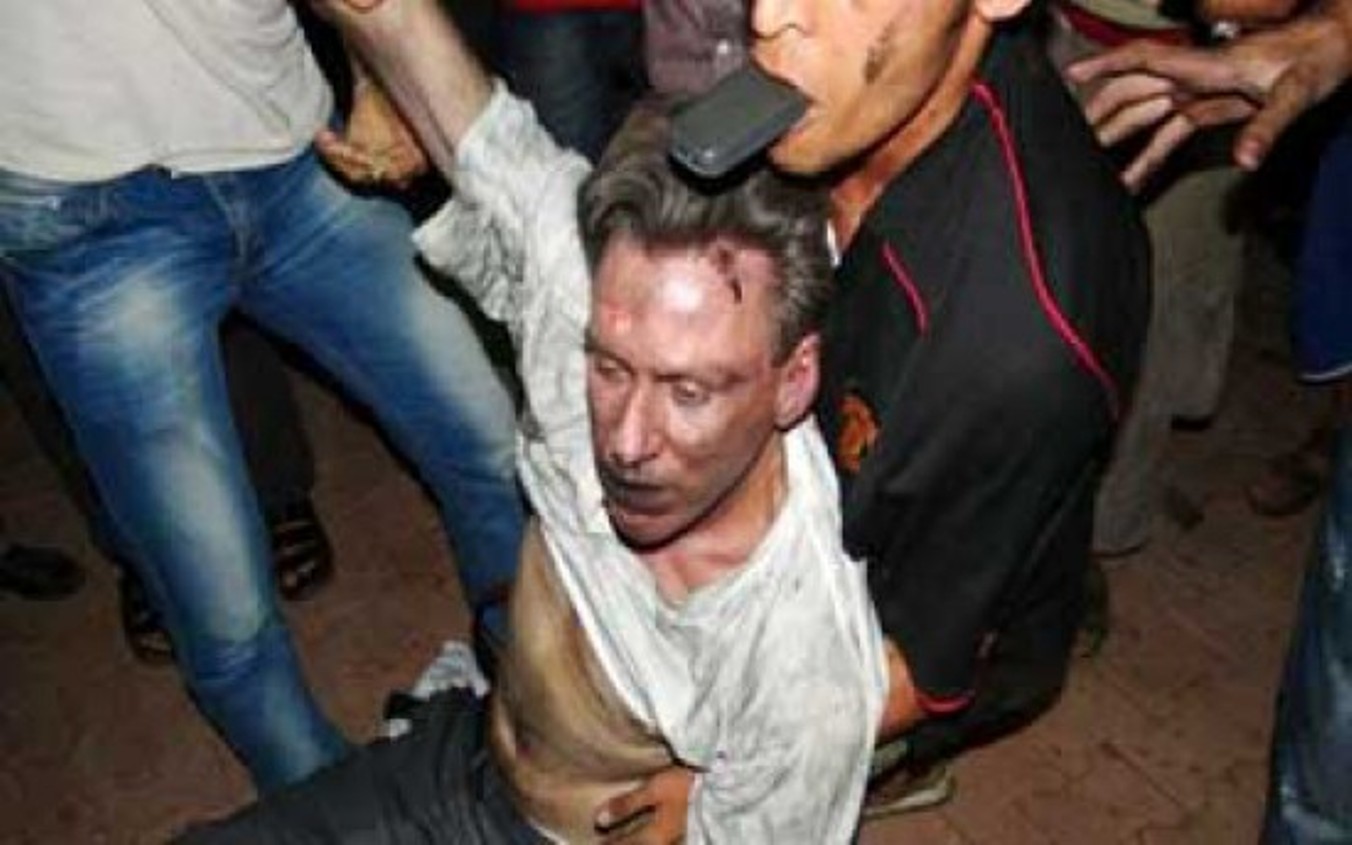
Reflections on Egypt and Libya: The Body as Bloody Canvas

As noted yesterday, I was at the protest at the US Embassy in Cairo. Really, it struck me very much as a non-event. Similar to when the Israeli Embassy was stormed last year, it seems like the work of a small few, looking to make trouble, perhaps even allowed to do so. It fits in with the manipulations all around this country, and hard to tie to any one party.

I am not pleased it happened, of course, but I can accept it. The burning of the American flag is simply a political statement. I have long learned to live with diatribes against American foreign policy, and watching a flag burn is in several ways easier to digest than someone arguing with you over why America hates Muslims, or something of the like.

But when I learned this afternoon that the American ambassador to Libya was killed in a vicious attack on the consulate there, it was a different matter entirely. My stomach sank and my day was placed on hold, as the facts settled in. Burn the flag, curse my nation, do as you wish. Many times, there is a semblance of legitimacy, if not justification, behind their frustration.

But do not kill.

Yesterday I stated I was somewhat uncomfortable among the protestors. It was mostly in the beginning, when their chants were most vociferous and individuals melted into a collective whole. After a while, it was fine, as I realized they were more summoning the will to protest than driven by rage. I always feel somewhat ashamed when I take note of my reticence; these are people who must be engaged as people. In 99% of the cases, simple human decency wins the day and creates a relationship, however temporary. It is my job and joy to serve them, to help their perspectives become understandable.

But in that 1% humanity is lost and the person becomes a canvas to paint a political message in blood.

That is Libya, and it is a reminder of what is at stake, of the depths of human depravity. Yet the blood for that canvas flows from the heart, which must bleed differently if misunderstandings and antipathies are to be overcome. This is Egypt, at least for now.

But it is Libya also, and every corner of the globe. If the heart does not bleed differently life-as-existence will continue but life-as-abundance will stagnate and die.

Unless the seed falls to the ground and dies it will produce no fruit; but if it dies it will bring forth a harvest. The heart may in the 1% bleed on a canvas, but it must bleed differently in the 99%.

It is said this is true of the American ambassador. May he rest in peace.

Related Posts: 

Categories
Personal

Church Photography by Alexandria Muslims

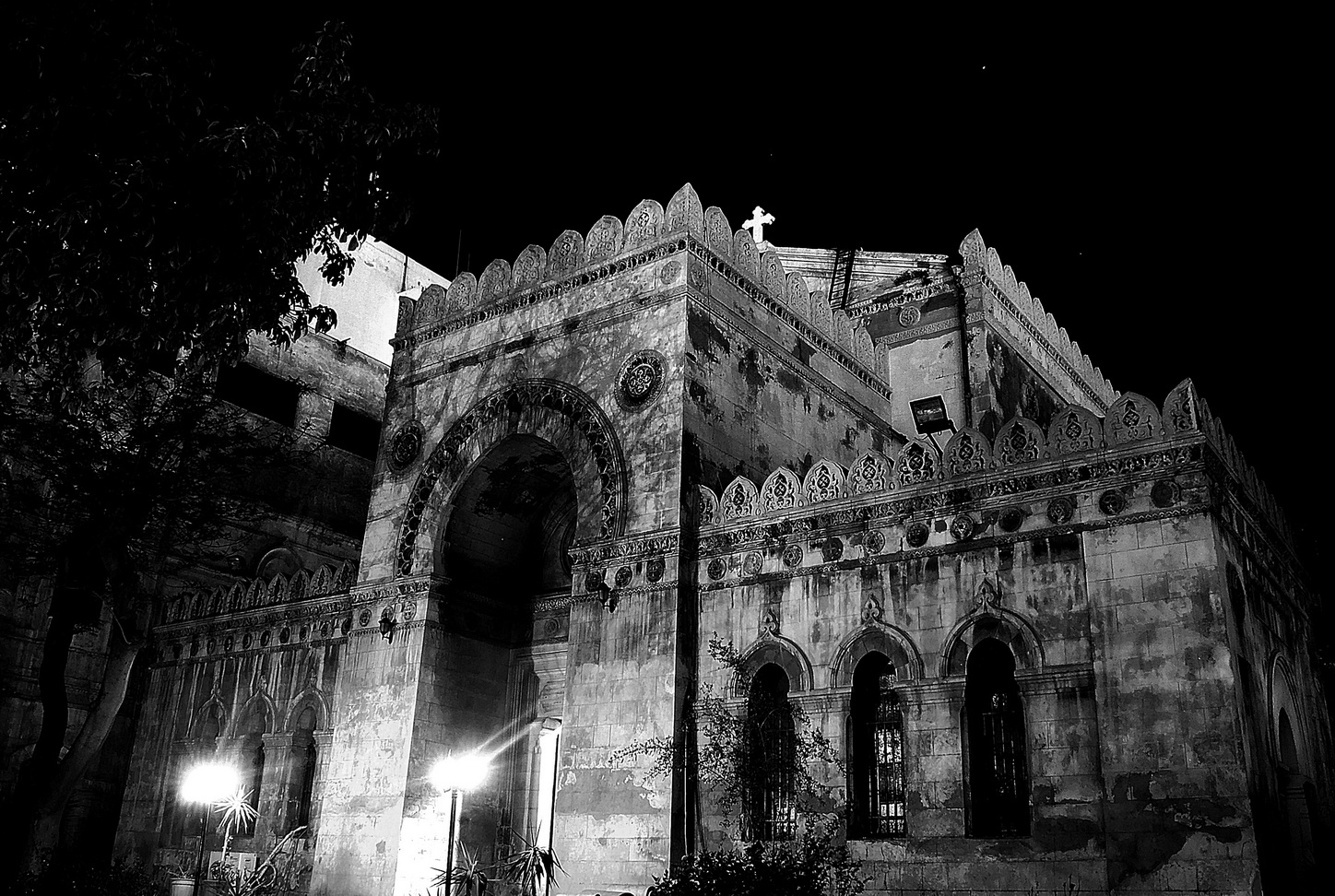
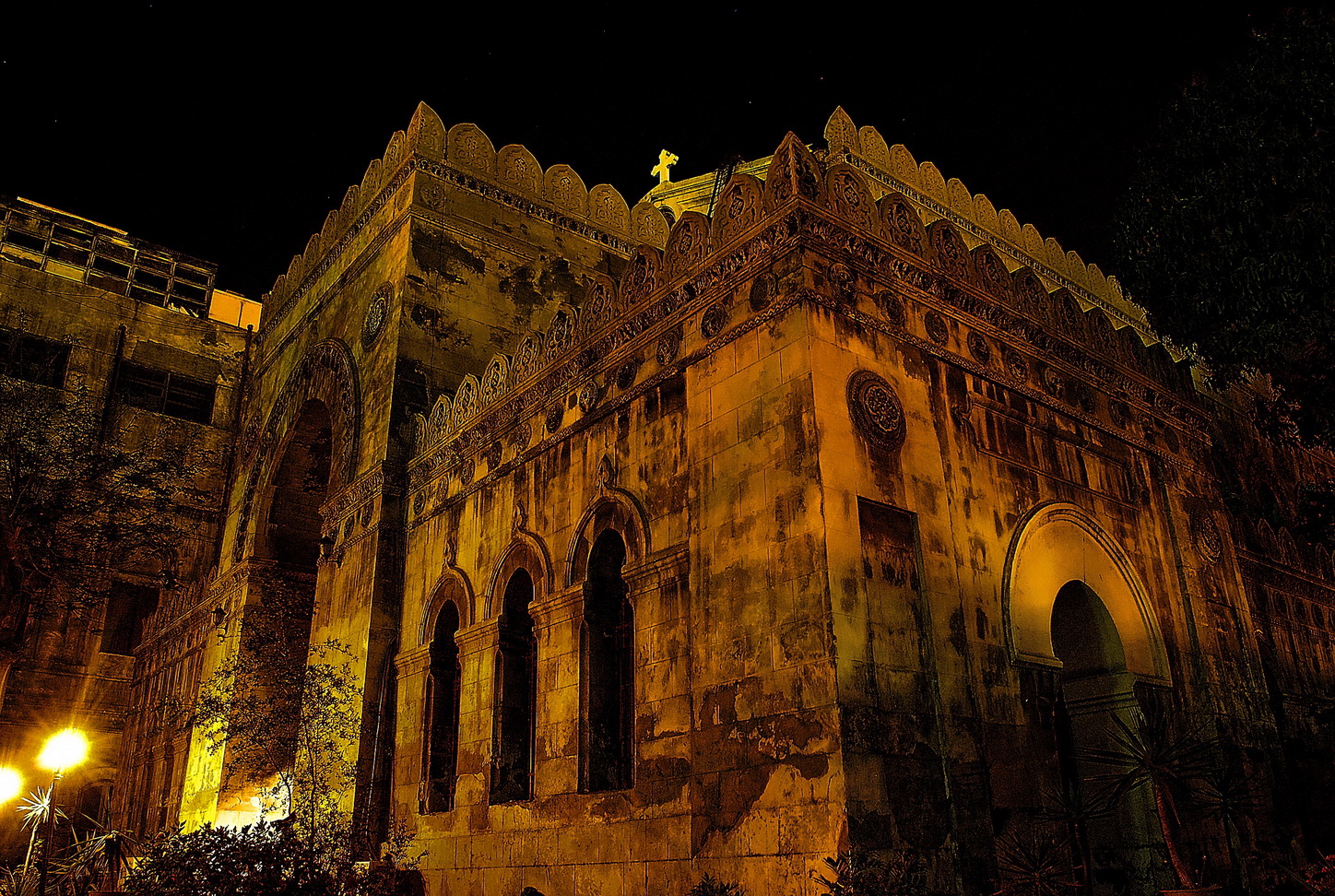
One of the more unique churches in Egypt is located in Alexandria, home of St. Mark’s Anglican Pro-Cathedral. St. Mark is cherished among Egyptian Christians as the apostle who brought the Gospel to Alexandria, from which it spread throughout the Nile Basin and North Africa. A ‘pro’ cathedral is a parish church that serves as a temporary or co-cathedral in a diocese. The primary Anglican cathedral in Egypt is the Church of All Saints located in Zamalek, Cairo.

The first reason for the uniqueness of the church in Alexandria is its history. Its cornerstone was laid on December 17, 1839 following an agreement between the ruler of Egypt, Mohamed Ali, and Queen Victoria, who provided extensive donations for its construction. Various delays complicated completion, however, and its first service was not held until Christmas, 1854. St. Mark’s also received the services of the first Egyptian ordained as an Anglican priest, Girgis Bishay, in 1925.

From Left: St. Anthony, St. Athanasius, and Origin

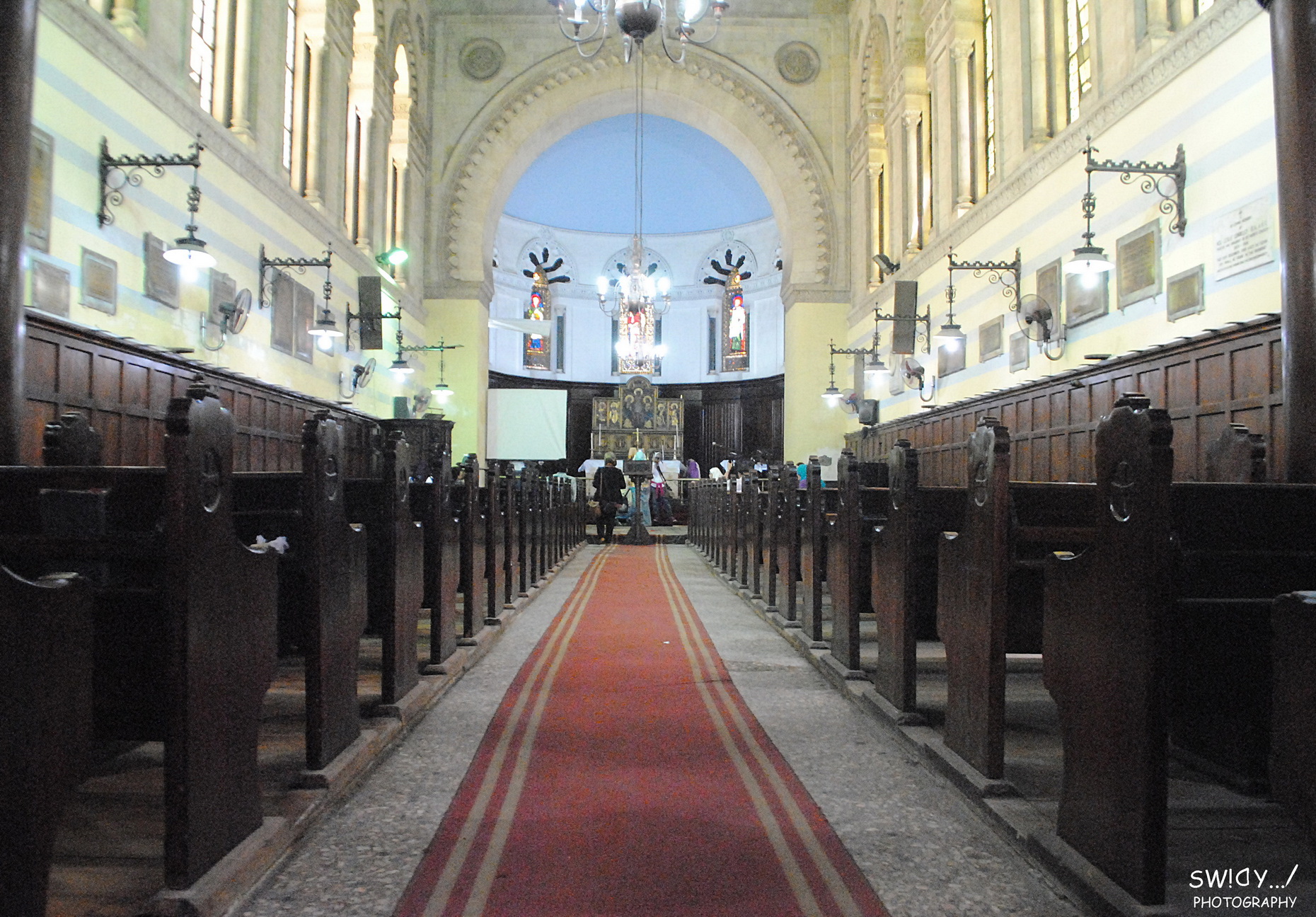
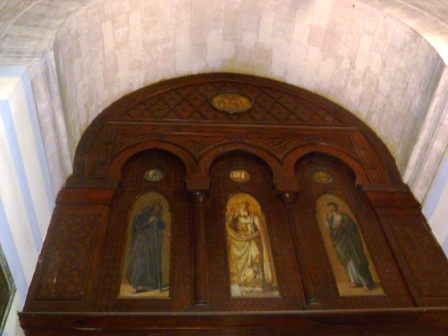
The second reason for the uniqueness of the church is its interior design. Straddling the Protestant and Catholic traditions, in imitation of local Orthodox the church is full of icons. The entrance to the sanctuary his headed by the icons of heralded Egyptians St. Anthony (the founder of monasticism), St. Athanasius (defined the canon of scripture), and Origen (the controversial Biblical exegete). Behind the altar St. George and St. Patrick represent the eastern and western reaches of Christianity, while David and Andrew represent the unity of Old and New Testaments in the Bible.

From Left: St. George, St. Patrick, David, and Andrew

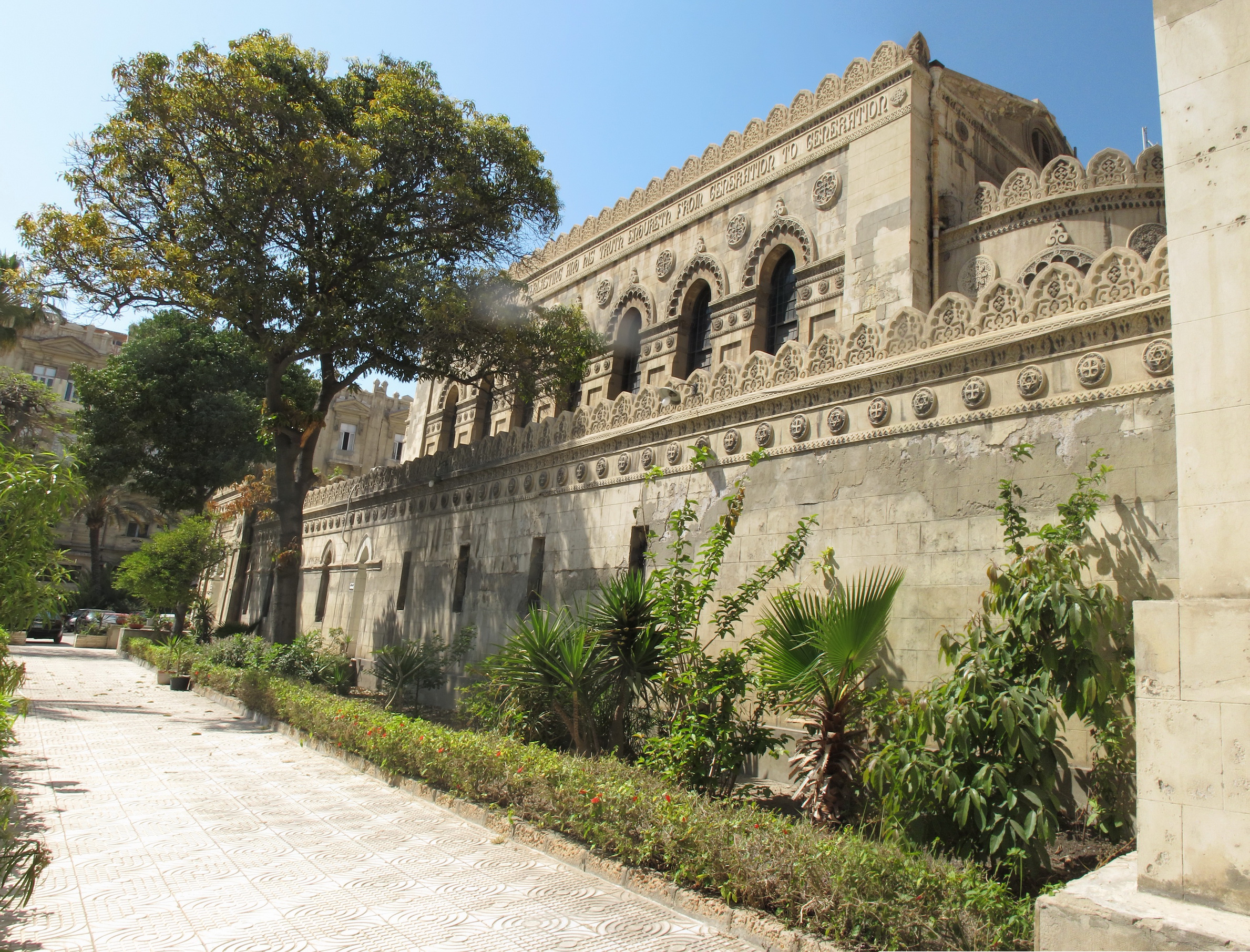
The third reason for the uniqueness of the church is its architecture. Though clearly a church, it honors both the Egyptian Jewish and Muslim communities. The archways and other elements draw from Islamic patterns, while the Star of David is prominently chiseled both into external stone and internal woodwork. The Jews of Egypt have almost entirely disappeared, leaving these marks either a memory of past realities or a possible current source of sectarian misunderstanding.

Star of David Alternating between Crosses

The final reason to highlight the uniqueness of the church comes from its contemporary example. St. Mark’s has opened its doors to house a community cultural center. A church lay leader oversees a team of Muslim artists, who train anyone who comes in drawing, photography, acting, fine arts, and other disciplines.

I wrote about this effort for Christianity Today here, but have wanted to show more of their product than that site allowed. Namely, I hoped to feature the pictures of the church taken entirely by local amateur and professional Muslim photographers.

For those who missed that article and are wondering what the big deal is, in Egypt, this is a very unique happening. While Muslim-Christian interpersonal relations are often fine, people do not ‘hang out’ in the house of worship in the opposite faith. The church, especially, has been a haven of escape for the Coptic community, with its social service centers largely serving only their own.

Muslims, meanwhile, while having Christian friends, often know little to nothing about the faith of their fellow citizens. Soon I would like to return to Alexandria to ask these photographers to comment on their pictures, what the experience meant to them, and what their pictures represent of Muslim-Christian relations (if anything). It would then be submitted as an article for Orient and Occident, the online magazine of the Anglican Church in Egypt.

Please laugh and notice the difference in quality between these photographs below, and mine above. Fortunately, though God is honored by all things beautiful, he judges primarily from the heart.

Related Posts:

Categories
Personal

New Feature: Arabic and Analysis

In our last post I described our hope to provide readers with an easy way to access the Egyptian news, and gave a preview of trying to do the same with Arabic language links.

Well, perhaps encouraged by the relative ease of getting the English links online, I got all excited and gave analysis links as well.

The Arabic links are provided near-daily by a friend who sends them by email, but would prefer to stay behind the scenes and not mention his name. He especially follows news that concerns the Muslim Brotherhood and Salafis, concerned there is an effort to turn Egypt into an Islamic state. I cannot vouch for the reporting standards of every article to which he links, but it is a very useful picture of an angle of Egyptian developments.
The analysis links will come less frequently, provided by Issandr el-Amrani, who maintains the outstanding regional blog – The Arabist. He has given his permission to copy the links he provides on a more or less weekly basis. These include noteworthy events, but also the best of what people are writing about Egypt and the region. Please explore his own commentary regularly as well on his site.

The Arabic page proved a bit more difficult to work with, so if there is a reevaluation down the road that feature might be the first to go. But I love the idea of being semi-bilingual, so I hope it is not too time consuming. As always, please note your preferences, and perhaps we can try this for a month or so and see where it goes.


Related Posts:

Categories
Personal

New Feature: News Links

An Egyptian friend of mine, Paul Attallah, provides a near-daily service of linking to the major news headlines pertaining to Egypt. He also provides his own commentary, which tends towards suspicion of the post-revolution transition and the ambitions of the Muslim Brotherhood.

The thoughts and links are his own, but they provide both a good glimpse into how many Coptic Christians view Egypt these days. He has granted his permission for me to paste his work here, which I hope will be a service for those who would like to take a quick glance at the daily news, and click where a story takes your attention. He often provides English summary translation for the Arabic links as well.

As I am able, I will delete, copy, and paste his work as he sends out his email updates. I will place them in the menu bar with an updated date for new postings.

Right now I am looking at this as a bit of an experiment. I value my friend’s work but I’m not sure how valuable it will be to regular readers of this blog, or, if it might help attract new readers. Please let me know what you think, and if you might like to access his links regularly.

I have another friend who provides a similar service wholly in Arabic. He has also given his permission for me to share, but I think I’ll evaluate this effort first. Please let me know if you’d be interested. I trust that visitors to this blog span the spectrum of limited Egypt knowledge to specialists, but I desire to treat you both the same: I write what I learn and hope it is helpful. But I have to mind my own time as well.

It’s a start, and your feedback is valuable, so thanks. Please click here to access the page if you did not see it above.

Related Posts:

Categories
Personal

Will Islamism Yield to Christianity?

I was invited to comment on an article posted on the Mission of God blog, concerning the inevitability of the Arab Spring turning Islamist, and then the rejection of Islamism for Christianity. Please click here for the video post; my response (slightly edited) follows below.

I think Dr. Cashin’s core point is correct: A system that does not allow questioning of itself cannot stand. But there were a few points which lacked sufficient nuance. A great number of the Arabs in their revolution (at least in Egypt) did not choose Islamists out of love for Islam, but because they were the only viable alternative. While many others did so because they believed (or were told) it was God’s will, what is happening is not a massive choice for Islam.

Now, the MB in Egypt may well become a dictatorial force. Some signs are there as is the lack of organized opposition. Yet this is more likely to be along the lines of a Mubarak-NDP system than an Iranian imitation.

But, there are other indications which suggest the Islamism of the MB is akin to Protestantism, causing a shaking of the traditional religious establishments, such as the Azhar. I don’t predict an open, liberal system for Egypt, nor a full freedom for religious contemplation, but it could happen.

The recent Pew Survey of the world’s Muslims suggests that the level of religiosity among younger Muslims is much less than of the older generation. And while I maintain suspicion over MB promises to lead Egypt into democracy, I do imagine the economic and educational systems will improve. These factors are more likely to free the societies from the constraints of religious dogma, much like happened in European Christendom.

So, yes, if the MB seeks to impose religious hegemony over Egypt, it will eventually fail. But will this result in a massive turning to Christianity? It is fair to imagine, simply speaking sociologically – not in terms of faith claims in either direction – and as Dr. Cashin states, Iran provides an interesting case study. But the more likely result is the general turning away from religion – a process already underway among many youths. The nominal holding of a faith is far easier than the deliberate acceptance of another. The MB will bring an Islamic religious revival to many, but it will only hold if they foster freedom.

Dr. Cashin’s point is that they cannot – Islam as a religion constrains them. It is a fair point and there are examples to back him up. But Europe’s Christian culture also constrained questioning of Christianity, and if OT examples are used there are good Biblical texts that forbid religion from being questioned. Yet society moved on. Will it in the Arab world? It will be messy, but I think the answer is ultimately yes. Perhaps in this Dr. Cashin and I are agreed, but I leave open the possibility for the MB to be a partner in the process.

A very useful discussion though, and there are few certainties at all.

Related Posts:

Categories
Personal

Orient and Occident Magazine

Orient and Occident Magazine is a publication of the Anglican Diocese of Egypt, North Africa, and the Horn of Africa. I have been working with the church on the project for a little under a year, and am proud to announce the first issue is now complete and online.

O&O is scheduled to be an online, quarterly, bilingual magazine. Its goal is to serve primarily Arab Christians of the region in providing articles that consider the intersection of the values of faith and the issues of society.

Many Christians have a strong sense of spirituality; many others are active in political life or defense of their community. Orient and Occident seeks to bring these worlds together – what practical difference should Christian values make for the good of all?

Love, peace, forgiveness, mercy, grace, justice. By no means are these Christian values alone. Orient and Occident also welcomes Muslim and non-religious writers to contribute – and seeks their readership – so that these values might increasingly find expression in the public lives of the region’s people.

Of course, there will be disagreement over how these values should be expressed. Orient and Occident will strive to welcome all opinions. It aims to take no editorial stand, except to insist on a perspective shaped by the values of faith.

The articles of the summer edition include:

  • It All Began Here (the Anglican Church and the Middle East)
  • Tunisian Christians and the Arab Spring (how they contributed, that they exist)
  • My Story with the Thug (necessary introspection of a societal crisis)
  • Political Choices and the Confusion of Believers (facing a presidential vote)
  • Religious Pluralism in Egypt in the Near Future (on Protestantism and Islamism)
  • The Truth No One Talks About (sectarian tension and its roots)
  • Two Cities (Augustine’s vision and Egyptian reality)
  • Caravan Reflections (contemplating a recent art exhibition)
  • Poisons We Love (on the dangers of sugar)
  • The Killer of Dreams (short story on parental expectations)
  • Two Faced (on political and religious hypocrisy)

In addition to articles, Orient and Occident features Christian bloggers from the Arab world. As these post new material to their site, O&O will automatically feature it in chronological order. Currently there are 17 bloggers featured, but we hope this number will grow as our magazine becomes better known.

Please click here to visit Orient and Occident, the English version. We hope you will enjoy it; please share widely to help this idea become better known.

Categories
Personal

Syrian Rebel Bribes Way Out of Prison, Runs Revolutionary Cairo Tent

Amin Kazkaz

A few days ago I posted an update about Syria, adding a few reflections. A few days after that, I met a Syrian.

Amin Kazkaz is a lawyer from the city of Hama, one of the flashpoints of the uprising. He had been working in the United Arab Emirates but returned to participate in Syria’s revolution.

Participation for Kazkaz meant armed revolt. On the eve of Ramadan 2011, one year ago, he was arrested in his city – with weapons. This information was volunteered and there was no hesitation in his voice.

Hama, reminded Kazkaz, was not the lead city in the revolution. Residents remembered the crackdown by Syrian authorities in 1982 during an insurrection led by the Muslim Brotherhood. Yet when other cities such as Deraa began meeting resistance for their peaceful protest the people of Hama felt compelled to join in as well.

Kazkaz spent twenty-five days in jail before his wealthy grandfather was able to intercede. A landowner, he bribed prison officials with 1.5 million Syrian pounds ($23,000 US) to free his grandson and erase his name from the national database. The warden opened Kazkaz’s cell and told him he had six hours to leave the country or risk re-arrest.

Immediately, with only the clothes on his back and items confiscated by the prison, he hired a taxi to take him to Damascus. From there he hired another taxi to cross the border into Amman, Jordan. Once settled, he arranged for his family to send him his private belongings.

In Jordan Kazkaz sought medical treatment for injuries suffered during combat and imprisonment, but then returned to the United Arab Emirates where he maintained residency. By this time, however, the UAE was rejecting Syrians within its borders and his residency was denied.

On a formal level the UAE and several nations of the Gulf condemned the Syrian regime for its crackdown and broke off all relations. This included agreements allowing freedom of movement between its citizens. On an informal level, however, Kazkaz stated that a major pro-regime Syrian businessman was active in the UAE and worked behind the scenes to keep Syrian dissidents out as well.

Kazkaz was forced to return to Jordan, but finding it too expensive he transferred to Egypt. This was five months ago; Egypt continues its policy of easy entry for Arab nationals. No visa is required but his passport is stamped with three month validity.

Egyptian policemen, he notes, are very sympathetic to the Syrian cause. At times he, like other Syrians, is questioned now that his residency has expired. Police look at the passport, note the nationality, hear the story, wish him well, and send him on his way.

For the last two months in Egypt Kazkaz has assumed responsibility to oversee the ‘Syrian tent’. The tent was erected at the Qasr al-Nile entrance to Tahrir Square during the ongoing revolutionary activity following the resignation of Mubarak. It serves as a point of awareness and support for cross-pollination in the Arab Spring. Syrians in Egypt visit regularly.

So do Egyptians; though I wondered for what purpose. A day or two earlier Syrian television announced the death of two Egyptians in a suburb of Damascus, where fighting had been intense. What were they doing there?

That evening the family of the Blind Sheikh was hosting a press conference at their open sit-in outside the US Embassy. My article on this event is here. In previous visits to his family I witnessed their fierce prayers against the Assad regime of Syria. Al-Gama’a al-Islamiyya – the Blind Sheikh’s organization – has forsworn violence as a tool of Egyptian political change. Yet I wondered if they would encourage, or at least be aware of, Egyptians to go to Syria to join the jihad.

‘Of course there are’, said Mohamed Omar Abdel Rahman, the Blind Sheikh’s son. ‘But al-Gama’a has nothing to do with them, though it supports the Syrian cause morally. They are individual Muslims – Islamists – only.’

As the sit-in location is only five minutes from the Syrian tent I paid them a short visit first, meeting Kazkaz and hearing his story above. Upon mentioning the names of the two Egyptians, which he didn’t know, his response was quick.

‘I have met 200-300 Egyptians at this tent who have inquired how to join our fight in Syria,’ he said. ‘But we do not allow any foreign fighters in our revolution.’

Kazkaz explained the Syrian revolution was a Syrian cause, but furthermore, involving foreigners would be counterproductive. Not only would it damage their legitimacy but also foreigners do not know the lay of the land. They would be killed in their ignorance and perhaps take Syrians with them.

The only foreigners he has seen are five Iranian snipers he helped capture in Hama.

Yet Kazkaz’s final words, though not at all contradictory, suggest there may be ways for foreign fighters to infiltrate. There are for foreign media.

He offered me personal escort across the border to take a first-hand look at the fighting and to meet the leaders of the Free Syrian Army. All I would have to do is get a visa to Turkey, and he would coordinate everything. He plans to return to Syria within a few weeks.

The time with Kazkaz was insufficient to ask him the following questions:

  • How did you obtain your weapon? How long was peaceful protest underway before you started to use it?
  • To what degree is sectarianism a part of the Syrian revolution? What do you think should become of the Alawite community?
  • To what degree are Christians participating actively on either side?
  • What role do you wish for Islam in a free Syria if you are successful?
  • Are foreign powers equipping you with weapons and support?
  • Do you desire intervention from NATO or an Arab transnational force?
  • What did you do with the Iranians you captured?

As I have mentioned before, it is too difficult to understand Syria through the media alone. Kazkaz’s experience is partisan and that of only one man, but it is first-hand. As such, it is the first I have received.

Related Posts:

Categories
Personal

A Protestant Pastor with President Morsy

I am currently working on an article summing up the Coptic reaction to President Morsy’s first days in office. Unfortunately, the publisher’s word count means squeezing out a few otherwise indicative quotes.

One interesting quote that didn’t make the cut is from Rev. Mina el-Badry, a Protestant pastor from Minya in Upper Egypt. Responding to my inquiry, he said:

‘Morsy is our president; we are all with him and all behind him, as we want the nation to stabilize. It is not up to Copts to oppose the president – these are political issues. Some will oppose him and some will support him, but as Egyptians.

‘I believe all power and all sovereignty is for God, and he knows best how to protect us – whether the president is Morsy or anyone else.’

The conventional wisdom in Egypt is that Copts are very concerned about Morsy’s presidency, despite encouraging rhetoric I will highlight soon. Yet also important to note are spiritually oriented thoughts such as these. It will be interesting to follow the evolution of Egyptian Christian thinking toward Islamist rule as the years go by … if indeed they have that long.

Note: Ha. I meant by that last statement if Islamists will rule that long. A second glance revealed it could be read if Egyptian Christians survive that long. Which way did you read it, and what might that reading communicate? Gulp. Of me I wonder if it reveals a subliminal schizophrenia.


Related Posts: