I got in a taxi on Thursday and within a few minutes of conversation the driver asked my nationality. This has been a sensitive question recently; last week an American near the embassy answered in the positive and was stabbed in the neck for his troubles. ‘I hate America,’ the assailant confessed afterwards.
For the taxi driver, however, it was an opportunity of a different sort. After I owned up to my nationality he leaned over to his glove compartment and…
… pulled out a sheet of paper.
In fact it was one of many, some signed, most not yet. The driver was preaching the merits of a new campaign to oust President Morsi, and wanted me to convey the message to America. As I mentioned in Friday Prayers yesterday, they aim to collect fifteen million signatures to their petition, vaulting over the total number of votes cast for Morsi in the presidential elections. They claim two million to date.
Their grand finale is planned for June 30, at the presidential palace, one year to the day in which Morsi took office.
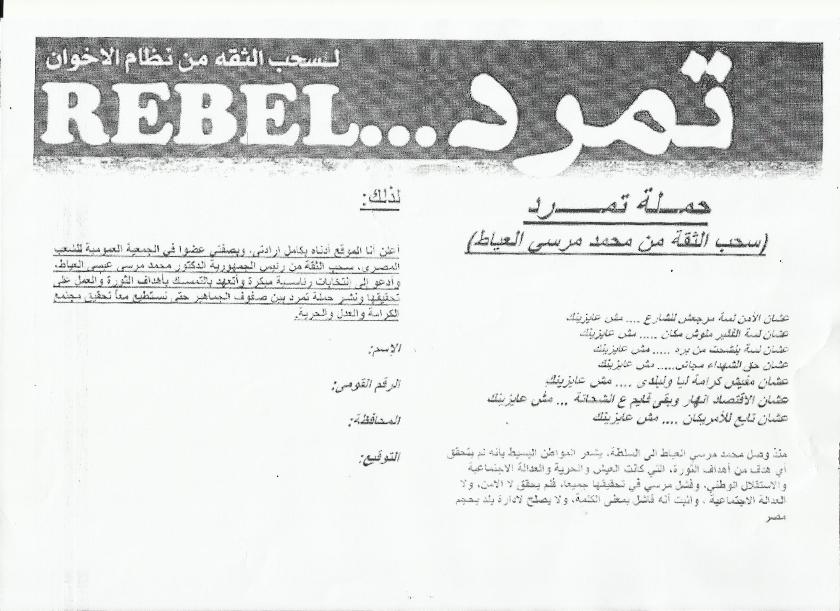
Here is the translation of their flyer:
REBEL
To withdraw confidence from the Brotherhood regime
The Rebellion Campaign
(to withdraw confidence from Mohamed Morsi ….)
Because security has not yet returned to the street … we don’t want you
Because the poor still do not have a place … we don’t want you
Because we are still begging from abroad … we don’t want you
Because the rights of the martyrs still have not been fulfilled … we don’t want you
Because there is still no dignity for myself or my country … we don’t want you
Because the economy has collapsed and is built upon begging … we don’t want you
Because you follow the Americans … we don’t want you
Since Mohamed Morsi the … came to power, the simple citizen has felt that not one goal of the revolution has been achieved – for bread, freedom, social justice, and national independence. Morsi has failed to realize them all. No security, no social justice – he is a demonstrated failure in the complete sense of the word. It is not fitting for him to administrate a nation of Egypt’s weight.
Therefore:
I, the undersigned, from my free and complete will, as a member of the general assembly of the Egyptian people, withdraw confidence from the president of the republic, the dictator Mohamed Morsi, and call for early presidential elections. I pledge to hold firmly to the goals of the revolution and to work on their behalf, spreading the Rebellion Campaign among the masses until we are able to achieve social dignity, justice, and freedom.
John Stott was an Anglican writer and student of the Scriptures.
Christianity Today reprinted a sermon he gave on “Four Ways Christians can influence the world.”
Then, someone asked on Twitter, and @Copticorphans retweeted: “How does this apply to Copts in Egypt?” How can Copts move “beyond mere survival” to more truly become salt and light in society around them?
The blog then goes on to provide an excerpt of the sermon, which can be found here and is worth reading no matter what country you reside in.
The tweet, however, was mine.
In my best effort of humblebrag, I currently have 361 followers on Twitter. Please click here if you would like to increase the number, and here to read my reflection upon joining Twitter for the first time, in April 2011.
I am still slow to own a smart phone, though they are readily available in Egypt. Perhaps soon; after all, we’ll all have them in a few years. But because of this my tweeting is usually reserved for offering comments as I read articles on the internet, primarily of Egyptian news. I imagine most of these disappear into cyberspace; sometimes someone’s retweet makes me smile.
But that tweet, about John Stott, found an audience. It was then turned into a blog post on one of the most popular Coptic charity organizations. From there, who knows? It is bread upon the water.
One of my hopes for the Copts is that they might find the courage and faith to emerge from an often insular mentality, serving and blessing their society. Perhaps the cards are stacked against them as a minority, but salt is always a minority in the food it preserves.
But if they realize this, they can also be light, of which minority/majority makes no difference at all. Light, once lit, dispels darkness. It is its very nature.
One small tweet, but it found the administrator of a blog. From there it found readers of a blog. And from there perhaps it stimulated conversations among Copts around the world.
All humblebrag, perhaps, or a narcissistic search for relevancy. But perhaps it is also a reminder that within the scope of influence we have, we should speak. Ideas have power, but they must be heard.
Or tweeted. The world is changing, and surely tweeting will never be a substitute for ordinary human communication. But as a means among many, why not?
A horrible account of vigilantism mixed with politics, from Ahram Online:
Security sources told Ahram Online that hundreds of El-Qataweya village residents ransacked the house of Freedom and Justice Party (FJP) leader, Rabie Lasheen, in the early hours of Friday, setting his furniture and three cars on fire apart from killing his son. Revenge was their motive.
Lasheen’s son, Youssef, was accused of shooting a 28-year-old man merely for insulting his father in a Facebook post for his affiliation with the FJP. An auto rickshaw (tok tok) driver in his 40s was accidentally gunned down too.
The revengeful mob, including members of both men’s families, dragged Lasheen’s son to the street and used bladed weapons while assaulting him, according to Al-Ahram’s daily correspondent. The assistants then left him for dead in the street.
The Freedom and Justice Party issued a terse statement denying the killing was political. It must have been the most difficult press release they have written in some time.
The region where this murder(s) took place has witnessed several examples of mob violence against alleged criminals in recent months. Other governorates, including Cairo, have not descended into such chaos.
I won’t say it is ominous as much as it is sad. If the reporting above is accurate, it is a vivid illustration of the downward spiral of sin, metastasizing like cancer deeper and deeper into tragedy.
I wished to find a better word than sin. Ambition isn’t enough, and sin seems too harsh. Sin makes it sound like he/they deserved it. But small or large, well or ill-intentioned, is there a better description for what is ailing the nation? It just eats away at everything, and so many share in the blame.
Fans of Jon Stewart probably have already seen this video, but here is a ten minute segment in which he lambasts Egypt’s president for the arrest warrant given to his friend, and clone, Bassem Youssef.
It is quite funny, and biting, as is the exchange of criticism issued by the US Embassy in Cairo, the Muslim Brotherhood’s Freedom and Justice Party, and the Office of the Presidency, which insists it has nothing to do with the suit. Have a look at Salama Moussa’s blog for a good run-down of the situation.
Check out this article also, by HA Heller, describing the international public relations nightmare Egypt has stumbled into. Arresting a comedian… It is comic in its own right, and Egyptians love their humor.
If you’d like a look at me in action, a friend found this video from a few months ago. I simply stand, and mouth the words to the Nicene Creed along with the rest of the Syrian Orthodox congregation.
The occasion was the installment of Pope Tawadros; representatives of this sister Oriental Orthodox Church were in attendance. Before traveling back to their own countries in Syria, Lebanon, and Iraq, they had a joint service together in downtown Cairo.
My appearance is at about the 7:00 minute mark. It is worth a few minutes of your time, just to enjoy the different and vibrant color schemes of each church. In attendance with me was the former head of the Middle East Council of Churches, who I’m sure could explain the differences.
I remember at the time thinking I would write about the experience, but other projects placed it on the back burner until it was forgotten. But now I recall the fun, the boredom, the familiarity, and the small differences between these ancient adherents of the faith and their Coptic brothers I have come to know.
On the one hand, they seem utterly irrelevant. They are small, declining churches surrounded by violence and conflict. They have funny hats and peculiar beards. They did have a good time together, as did the small congregation of a hundred or so worshipers.
But of what value are these churches, these dresses, these colors, to the people of Syria, Lebanon, and Iraq? What difference does this faith make to those suffering, to societies in collapse, the remaining faithful?
Perhaps the question can be what good is this faith anywhere? Does it transform, does it serve, does it save? There is no peculiarity to the Arab world.
But this faith is ancient, and those privileged to existentially wonder about it from the comforts of Western experience would do well to learn. I only wish I knew what the lesson is.
Is that the point? There are Christians in this world in the lap of luxury, and others in the deepest poverty. There are some who preside over the greatest military power in history, and others who are stomped upon by the weapons of war.
The world has made it possible for these worlds to connect, only adding to the complication. But for centuries it was such, and each slice of the Christian world had only slight knowledge of the extended family.
So what good does it do Syria to have a Christian costume party in Cairo? What good does it do America to have a Christian rock concert in a movie theater? What good does it do you to see a transplanted American in their mix, who assaults you with these questions?? What good does it do them that I was there at all?
Of course, each of these questions presupposes the ‘good’ of Christianity is for this world. It is, right? I would so like it to be.
But the Oriental Orthodox churches remind amid their colors and pomp and circumstance that worship probably has very little relevance to what good this world needs. More poignantly for me and probably most readers here, what I as an individual need.
But with God you cannot say it is what he needs, either. So what is the point?
Still, I have no lesson. Can faith and humility be ok with this? They must, lest you throw it all away.
Here, there is no certainty, there is no peculiarity, there is no victory. God can grant them each at other times if he wishes.
Instead, we wonder, we reflect, we appreciate. If all is well, we share, we worship.
If we like, we wear funny colors, or do interpretive dance.
And if he leads, we welcome marauding militias, or sign petitions against hovering drones.
And if he leads, we fight against oppressive regimes, or lobby against oppressive taxes.
But in the end, together, we mouth the Nicene Creed.
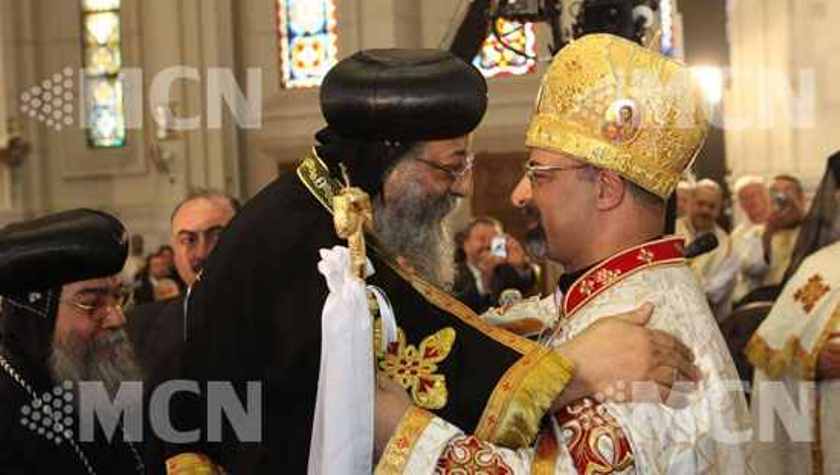
Pope Tawadros II noted the word patriarch has three meanings; the first is fatherhood, as the patriarch is a father who carries the feelings of fatherhood which stem from the work of the Holy Spirit towards each one, adding humans need this feeling of fatherhood every day.
“The second meaning is love, which is the main need of humans,” Pope Tawadros II continued. He acknowledged the world is currently hungry for the true love God planted in their lives to present to everyone.
The third meaning, Pope Tawadros II remarked, is service, adding the priority for the patriarch is to be a servant but that service means humans should serve everyone.
The Coptic patriarch added that washing the feet is one of the traditions established in the monasteries to express humility. He said their service comes from a heart of love and fatherhood to meet the needs of everyone, including marginalized people, tired people, the old and young. Service, he stressed, is the work of the patriarch.
These are good words. The new Coptic Catholic Pope is named Ibrahim Isaac. He replaces Antonious Naguib, who retired for health reasons, but is currently in the Vatican enclave due to his status as a cardinal.
The article is not clear about all that took place during the ceremony, but Pope Tawadros’ words could have been even more powerful if accompanied by the symbol he mentioned.
Imagine if he had stooped to wash the feet of the new Coptic Catholic Pope.
The Coptic Orthodox Church represents the overwhelming majority of Egyptian Christians. Interdenominational relations have ebbed and flowed over the years with Catholic and Protestants, but Pope Tawadros appears intent on fostering unity. As mentioned previously, he has helped facilitate the Egyptian Council of Churches. Each denomination will have equal weight and rotational leadership. It is a humble concession on the part of the Orthodox.
Pope Ibrahim Isaac also spoke of the connection between leadership and service, according to MCN:
During his speech at the inauguration, Pope Isaac remarked that the Holy Bible teaches us authority is there to serve, taking after Christ and his teachings.
It is a common practice in the Coptic Orthodox Church for the leadership to wash the feet of the people, in a special ceremony once (perhaps more?) a year. Perhaps the Coptic Catholics do similarly, I don’t know.
But on this occasion, if only Pope Tawadros had washed the feet of his counterpart – equal in ecclesiastic authority but so much less influential in Egypt. This is no criticism, only imagination. But to demonstrate this teaching on such an occasion would have been noteworthy. In Christianity, the greater serves the less.
Even just in writing that sentence the protest issues: Shouldn’t Christianity make all people equal?
Yes, and it does. But the world does not. Therefore, those who are invested with authority and privilege of position must do all they can to demonstrate their humility. They must overturn the way of the world, however rife with hypocrisy the statement may be, if they are not careful. Washing the feet can easily become the new pride. It is proved otherwise away from the cameras, in demonstrated service away from the eyes of the world.
If only to continue imagining, might also the Grand Sheikh of the Azhar wash the feet of Pope Tawadros? Here, we are crossing religions which maintain their own traditions. It is not a proper comparison.
But the Sheikh of the Azhar has consented to a similar humble concession. He has helped facilitate the Family House, in which he and the heads of all Christian denominations meet regularly to maintain good relations and solve sectarian conflicts.
Muslims represent the overwhelming majority of Egyptians, yet the Grand Sheikh is outnumbered.
In the world, everyone knows where power lies. This reality will not change because of humble participation in councils, nor in symbolic gestures like foot washing. People in power also have it in their interest to appear humble, which actually increases their effectiveness.
But to lift up the lesser, to honor, and to give more power even at your own expense – this is of God. “He must become greater, I must become less,” said John the Baptist of Jesus. Jesus, meanwhile, said of those who follow him, “They will do greater works than these.”
Egypt’s spiritual leadership, Muslim and Orthodox, appear to heed this pattern. God only knows, but may he similarly equip Pope Ibrahim Isaac, and make him a shepherd to his people.
The popular dance craze not only reaches Egypt, but targets the Muslim Brotherhood. This version was performed outside their headquarters in Cairo.
It is quite amateur, but expresses a popular urban youth sentiment that Islamist government is out to limit freedom and instill a more religiously conservative society. This dance, including other Western and Arab songs, is a pelvic thrust in their direction.
Is the Harlem Shake a better recourse than debates, seminars, and elections? If nothing else it demonstrates the utter creativity of Egyptians in undermining their leaders.
My life in Cairo is spent mostly in our house and the surrounding area of Maadi, which is about half an hour from the famous Tahrir Square. Friends and family in the states get nervous when they see the violence and flare-ups in Egypt, but the reality for me is generally far removed. Last week, however, we needed to take a family trip through the heart of the uprising.
Our destination was the American Embassy in Garden City, normally only a five-minute walk from the Square. Our son, Alexander, was born in Cairo three months ago, and it has taken us this long to secure an appointment with the embassy for his “Certificate of Birth Abroad” (the equivalent of a US birth certificate) and his first passport. We originally had an appointment at the embassy on the 29th of January, but that was a particularly unstable week around the embassy due to ongoing clashes, and so it closed for several days. All appointments were postponed. We were hoping for calm now, so we could get this process started. I didn’t like not having a passport for our baby, as I wasn’t sure what would happen if we were forced to travel.
Since our two oldest girls were still on school break, we ended up taking the whole family downtown for our adventure. We left our house around 8am with the hopes of arriving in time for our 9am appointment. Of course, when you are two adults accompanied by three smaller walkers, plus a baby slung snuggly on your chest, it takes a bit longer than normal to get places. We had an uneventful walk from our house to the closest metro station.
Unfortunately we were traveling during rush hour which meant the metro was packed. Emma, our oldest, gets a little nervous getting on and off the metro. She seems to have a fear of our family being split up as some of us get on the train, and others get shut out behind the door. This has never happened to us, but I understand her fear considering getting on and off the metro can be a real battle due to the sheer number of people.
As we saw the train approach, we noticed that the cars were all quite full. When the train stopped and the doors opened, we quickly pushed our way in, crowding together with those already in the car. The trip from our station to downtown is about 20 minutes, and it looked at first, like we would all be standing for that whole time. But as is common in Egypt, others in the car noticed our small children, and offered me and my baby-in-carrier a seat. I put Layla on one knee and Hannah on the other until a few minutes later, another seat was offered to Emma and Hannah.
As we rode along, I looked around me and realized there were no other women that I could see in this particular car. In fact, I was totally surrounded by men. I was really glad my husband was among them. Not only was I surrounded, though, but the men had made a barrier of space between me with my kids and everyone on the train. That was much appreciated considering that where we were standing earlier, there was no space around anyone. My thoughts went to the many articles I have been reading of violent attacks on women in Tahrir Square. They sound awful, and the men involved sound like barbarians. This, on the other hand, was an example of what my family usually experiences: considerate people who look out for the sick, elderly, and moms with young children.
When we arrived at Sadat station, the metro stop under Tahrir Square, I was glad to notice the absence of tear gas. I have never actually experienced tear gas, but Jayson has on several occasions, and so have some other family members when he has taken them to visit the Square. I had heard that over the last week, the tear gas was quite palatable in the station, and I was most concerned for our three-month old son if there were any lingering fumes. I was glad not to notice any.
We exited the metro, Jayson carrying Hannah and Layla, Alexander strapped to me, and Emma holding tightly to my hand. We quickly escaped the traffic that was exiting with us, regrouped in an open space, and walked toward the turnstiles. We then followed the crowd through the narrow door, up the steps, and into the open air.
I looked around and saw the white tents covering the center of the traffic circle. We considered taking a family picture, but, being that we were an American couple with three blonde daughters and a new baby, we didn’t want to linger and attract any more attention than we naturally do wherever we go in Cairo. We headed toward the embassy.
Photo from a few months ago; no cars dare park in the area now.
Normally this walk would take us only 5 minutes, even with the little ones in tow. However, due to the recent fighting, several walls have been constructed over the last few weeks. These walls are made of large concrete blocks, each one is probably 3 feet by 3 feet. The blocks are then stacked 3 or 4 high, and they cover the entrance to streets, blocking the thoroughfares to cars and people. This meant we had to walk out to the road which runs along the Nile, past the Semiramsis Hotel, which was sadly boarded up at every door and window due to the attacks from last week.
We walked two more blocks until we finally came to a road without a wall. Turning left, we walked another block to the road the embassy is on. People were milling about normally, and we noticed several police trucks and tens of riot police walking around, perhaps preparing for coming protests. The line at the embassy, on the non-American services side, was perhaps slightly shorter than normal, but long, as always. On the American services side, however, we got right inside once we showed the guard our appointment paper.
The embassy is a comfortable place to sit as you first wait for your number to be called, and then for the staff to get your paperwork started once you’ve submitted it. The girls enjoyed playing various games in the spacious waiting area. It is one of the few places in Cairo that I have seen a water fountain … the kind you drink from. The embassy also had done a good job preparing us for exactly what forms we would need to get the birth certificate and passport. We were able to submit the papers without any trouble, and look forward to seeing Alexander’s passport in a couple weeks.
Once the work was done, we headed back outside after grabbing our cell phones from security, and decided to walk back to a different metro stop since the Tahrir stop wasn’t as close as it used to be. Jayson is much more familiar with downtown than I am, so he led the way and eventually we found the stop were looking for.
The ride back home on the metro was a lot less-crowded. The whole family got a seat and we were glad to have accomplished what we set out to do. It even included a glimpse of the downtown scene.
Reversing these dynamics requires efforts on two fronts. Politically, the key is mutual acceptance of two realities: that the Brotherhood’s electoral victories give their rule legitimacy, but that a historic, complex transition in a challenging security and economic context requires exercise of power to be tempered by meaningful consensus-building.
Several steps would help: an end to opposition calls for the president to step down and agreement by Morsi that the constitution, whose adoption was marred by boycotts and low voter turn-out, ought to be revised to allay the apprehensions of non-Islamists and notably the Coptic community. Likewise, the process for designing the elections law — another topic of sharp disagreement, especially on district boundaries and the representation of women — should be revisited to reflect broader agreement among factions. Finally, in the wake of approaching parliamentary elections, parties should seek to form a national coalition, a result that would serve both the Muslim Brotherhood (which would gain from the opposition becoming a responsible stakeholder) and the opposition (which would be better positioned to impede what it views as efforts to institute single party rule).
Very good analysis (if you read the whole thing), and workable solutions. The main monkey wrench could prove to be the Salafis. Amending the constitution implies making it more liberal and less religious. If the Brotherhood signs off on this the Salafis could turn against them quickly, and it is unlikely middle-ground liberals would come to their electoral rescue.
The concerning point is that the best path to power for the Salafis could be in a full chaotic rupture of society, requiring a full military-religious partnership simply to restore order. Certainly not publicly, but does the Brotherhood implicitly threaten the liberals that they (the MB) are the best bet going? Otherwise, we turn the Salafis on you?
But if this is part of the Brotherhood negotiation tactic, it will certainly ring hollow for liberals when the MB turns consistently to Salafis for support. Their rubber-band-like moves from the right to the center must be wearisome to the opposition. What does the Brotherhood want, and what do they represent, truly?
Not that the opposition plays clean or consistently, either, as the article makes clear. But the constitution has soiled all trust and destroyed the middle ground. It would be a shame if the constitution itself is, in fact, the best middle ground that can be obtained. Ugh, as illiberal as portions of it might become.
This study was published about five months ago; I came across it now. Very interesting statistics:
While the great stretch of land from south of the Egyptian capital, Cairo to Lake Nasser on the border with Sudan, the area known as Upper Egypt, has only 40 percent of the country’s population, it is where 80 percent of the severe poverty is concentrated.
Consider also these figures:
More than half the population of Upper Egypt is under the age of 29, and one third are between the ages of 15 and 29.
Upper Egypt is predominantly rural with 75 percent of its young people living in rural areas.
Upper Egypt accounts for only 40 percent of the country’s population but 60 percent of those living in poverty and 80 percent of those living in severe poverty.
The country poorest 1,000 villages are almost all concentrated in three governorates in Upper Egypt.
Over one third of all young people in Upper Egypt are in the poorest wealth quintile.
The official youth unemployment rate in Upper Egypt is 16 percent, which does not count the ‘jobless,’ those neither employed nor seeking work, a state that describes almost half of all young people in Upper Egypt.
70 percent of young women in upper Egypt are jobless.
Illiteracy rates for young people in Upper Egypt are at 17 percent, higher than the national average, with illiteracy rates for females more than twice those of males.
Less than 4 percent of illiterate females are employed.
Returns on education in Upper Egypt are high, with labor force participation rates for female university graduates as high as 58 percent, higher than the national average of 47 percent, and 84 percent for male university graduates.
Almost all young women in Upper Egypt with no formal education are jobless.
While it is perhaps fitting the World Bank did not make a point to inquire about the religious affiliation of these youth, it would have been useful to see the results of a scientific study. It did state in the footnotes that nearly 6% of Upper Egyptians are non-Muslims, without providing a link to source or methodology. It also called Upper Egypt one of the areas with greater Coptic concentration.
Certainly Christians here will dispute these numbers, which indicate a weakened, slowly dwindling presence. If their greatest concentrations in numbers reach only 6%, what of the rest of the nation?
Well, most emigrants from Upper Egypt wind up in Cairo or Alexandria, so perhaps scientific studies might show these cities with the greatest concentrations nowadays. It should be a simple matter to establish census figures – every Egyptian has his religion printed on his ID card – but it is too politically and religiously controversial.
On the one hand, it doesn’t matter – Egyptians are Egyptians regardless of religion. On the other hand, it means everything – if 15-20% they are grossly marginalized; if 5-6% their rights are still important but their claims are greatly diminished. Will the state and/or the church have the courage to take this issue on transparently? Or is it best for everyone if it remains purposefully ignored?
On a closing, unrelated note, I was surprised to see a link to my report on the attack on the Coptic sit-in at Maspero. I’m glad that was helpful to the World Bank.
Samir, an anchor for the Sports and Youth radio station, was hosting a live show on Sunday at 2 am. The program proposed several political issues to discuss with the audience, and one caller allegedly insulted Morsy on the airwaves. The call was cut short by the show’s control personnel, and then Samir thanked the caller and said she would resume the show.
The anchor reported that after her show ended, she was surprised to find that she would be investigated on defamation charges for thanking a caller who insulted Morsy. The Egyptian Radio and Television Union is penalizing Samir by deducting her monthly incentives and banning her from presenting programs alone.
Egypt Independent is an independent newspaper which generally maintains a slant toward liberalism and away from the Islamist trend. Could there be an element of embellishment here?
If not, it is still important to note that an investigation has been launched, not a conviction, thought it appears company discipline has already been applied.
But taking the story at face value, it reinforces what many say is a disturbing encroachment on the practice of press freedom. Surely the press has many excesses, but to punish a host for good manners? The cause for concern is legitimate.
Albert Saber recently fled Egypt on the eve of his conviction to a three year prison sentence for blasphemy. He is of Christian background, but is a public atheist. The following are quotes from the article, do read the whole thing.
How did you decide to become an atheist?
My journey towards this decision was in the period between 2001 and 2005. I had decided that I would not simply inherit religion. Faith here is hereditary; if your parents are Christian, you’re Christian. You have it written on your birth certificate before you can even think. And it is the same for Muslims.
In 2001 I decided to read about other religions. My thinking at the time was that I was born a Christian but I had not actually decided that for myself nor had I considered other religions. I felt like there could be a chance that my religion is the wrong one and that God would punish me for it since I did not seek out all the options first.
I spoke to a lot of people, including religious leaders and clerics from several faiths, I read a lot of books, and eventually I realised that religion was merely a way to find God, but that there were so many different religions, and even inside each religion there were many sects, so why did each claim a monopoly on God? Why did they all claim they were going to heaven and everyone else was not?
The circle then started to get wider. When I first started this journey I felt that religion could be easily disputed but I still believed in the existence of a god, so I had a limit, which was the existence of a creator deity. After reading and researching the issue I started to break out of this limit and think that there might not even be a god at all. I eventually decided that it did not make sense to me and I became an atheist.
Did you face any difficulties in the decision to go public with it?
The Islamists in university subjected me to three assassination attempts.
Their leader and I had a political discussion once on the train and we became friends, I did not know who he was but my friends told me later.
After that I started to gain a reputation for my views that are critical of religion, mostly because of what I said in comparative religion classes. The Islamist youth leader decided that I was too dangerous.
He started sending members of his group after me, they constantly tried to start fights with me so that they could beat me up but I would not rise to their taunts and my friends were also looking out for me.
How, realistically, can Egypt become a secular state, especially in light of Islamist domination of the public sphere?
We have a movement here in Egypt called “secularists” for example and they take to the streets and raise awareness about the issue. I believe in confrontation. I used to debate Muslim Brotherhood members on secularism before the presidential elections.
However, the way to achieve state secularism is through raising awareness. It is the same way we were able to revolt. We raised awareness amongst the people that we are not just silly youth and that our demands were for their benefit. Eventually they joined us or at least stopped opposing us.
Everyone in Egypt is talking politics right now. We should start political campaigns explaining what the word “secularism” actually means. We need to explain separation of religion and state and how the state is an institution and cannot adopt a specific religion. We need to explain things like dictatorship of the majority and how democracy also means protecting the rights of minorities.
Will Muslim Brotherhood rule lead to a religious state, or will it backfire and lead the people to reject religious rule and form a secular state?
I think this has already started. As soon as the Brotherhood appeared openly on the political scene they needed allies such as the Salafis, Al-Jama’a Al-Islamiya, and jihadist groups. They all allied because they speak in the name of religion.
These allies started making a lot of mistakes due to their political inexperience. The people started to reject their domination and move towards secularism. The people are now much more critical of religious leaders and feel that they no longer have a monopoly on religion.
This will lead to a secular state without the people even calling it that.
Egypt’s Grand Mufti Ali Gomaa has approved a death sentence delivered in absentia for seven Coptic Egyptian expats accused of producing and acting a movie deemed insulting to Islam.
The declaration was made Tuesday by a judge at the Cairo Criminal Court.
Egypt’s State Security Court had sentenced the defendants in November to death and referred the verdict to the mufti for approval.
I hope politics did not come into this decision. The Mufti is generally known as a wise and moderate figure, who enjoys friendship with many Christian leaders. Among them is Bishop Mouneer of the Anglican Church, who has called for the criminalization of defamation of religion at the UN, but certainly not the death penalty.
The politics could come because the Mufti (as well as the Grand Sheikh of al-Azhar) are targeted figures by the emerging Islamist parties who are salivating over control of Egypt’s religious institutions. Both the Mufti and the Grand Sheikh are holdovers from the Mubarak era. The Mufti may not feel comfortable standing in the way of this decision and watching the Islamists explode. Given that all the accused are resident outside of Egypt, perhaps he feels the damage is limited.
Only the damage will come to Islam in the eyes of the West. Does Islam truly call for the death of all who insult its prophet? Yes, the film was offensive and insulting – its round and absolute condemnation is necessary.
But the Mufti’s decision sets a precedent in the new Egypt. As the new constitution calls for the religious institutions to have a greater role in determining legislation, it is a moderate figure who first authorized one of Islam’s most controversial rulings.
The eyes of the West will be offended, but the real damage to Islam may well resoundlocally.
“We ran to the crisis meeting point on the 4th floor and barricaded ourselves in,” Samak describes, “it unfolded so quickly we followed all our security measures, but no guards of hotels in Egypt are armed. We had to secure guests and colleagues.”
Meanwhile revolutionaries outside the hotel attempted to prevent the thugs from entering the building, reports Ahram Online journalist Karim Hafez who was at the scene.
“When they realised these groups were trying to loot the hotel, protesters shot fire crackers at them as they attacked the building and tried to push them away from the area but these groups were armed with birdshot bullets,” says Hafez.
The assailants also attempted to steal the ATM in front of the hotel.
Journalist Mohammed Mare, who witnessed the event, recounted on his Twitter account that four people arrived in a Lancer car with no licence plate behind the protesters and fired the shots to scare protesters away, before storming the hotel.
The attackers shot at employees and continued to destroy the building for approximately three hours before security forces arrived.
So far there have been no confirmed injuries.
“We are the frontline, I’m still a bit shaky, and the situation is still not resolved. Clashes are starting again,” Samak says, who thanked the revolutionaries that “stood by us last night,” via the hotel’s Twitter account, adding “you are awesome.”
One of my pictures from the previous post is of the entrance to this hotel. One detail I neglected to mention was the pungent effect of tear gas still in the air. I could barely keep my eyes open as I walked through the area. Strangely, this was also true at the Nile River bridge – I would have expected the open air to have dispersed it by then.
This story helps show the complications of Egypt’s situation. Moments earlier these protestors were going hard against the police. But it was the protestors, and not the police, who intervened to save the hotel. [I recall seeing another statement saying the two cooperated to fight back the thugs.]
Egypt’s opposition seems to be banking on the chaos to reverse the president’s extra-legal gains, cause damage to his political chances and reputation, or else have the army step in and reset the situation entirely. Dialogue is so necessary at this moment, but they also have so little reason to trust its fairness. It is a dilemma.
But the opposition in all likelihood does not control the street. A possible outcome is for the president to do what so many Egyptians lament Mubarak is no longer around to do: Crackdown and ensure security.
If this scenario emerges, will it revolution be completely reversed? Will there be another one party system with a handful of loyal opposition parties?
It is far too complicated to say so, and history never repeats itself exactly. But these days, most political parties and ordinary citizens are nervous, expecting the worst. Its just that they define ‘worst’ differently.
An uprooted tree on the Nile Cornish, just outside of Tahrir Square. Muslim rules of war forbid the wanton destruction of nature.
Egypt has just witnessed some of the fiercest clashes in the revolutionary era, as many protestors appear radicalized. There are still peaceful demonstrations, to be sure, but even these appear to be violently resisted by police. It is hard to blame the police, though, as the lines are blurred.
I missed out on the latest battles. I spent January 25 in Helwan, a city to the south of Cairo at the end of the Metro line. The Muslim Brotherhood was conducting an outreach campaign to counter-program the message of demonstrations and unrest offered in Tahrir. I planned to take the Metro downtown to see these protestors, but on the way the car stopped and sat for five minutes – at the very stop nearest our home in Maadi.
Demonstrators in Tahrir had cut the tracks, causing a backup. Rather than waiting what could be an hour or more, based on previous examples, I left and went home, seeking to catch up on the news of the day, and perhaps go down after a bit.
A minute later, before I was able to exit the station, the Metro started up again. Perhaps it was propitious I had left.
These pictures taken this morning are from my first visit back to Tahrir. The worst clashes occurred in the Suez Canal cities of Port Said, Ismailia, and Suez, where a state of emergency has been declared. It is hard to know precisely what happened anywhere – the consequence of sitting home and following news updates and Twitter bylines. But the pictures to follow give a disturbing indication of where Egypt stands at the moment.
Is this the last gasp of resistance to a new order, or a sign of worse things yet to come? Please pray for Egypt, either way.
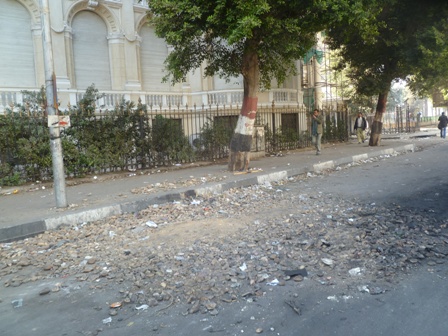
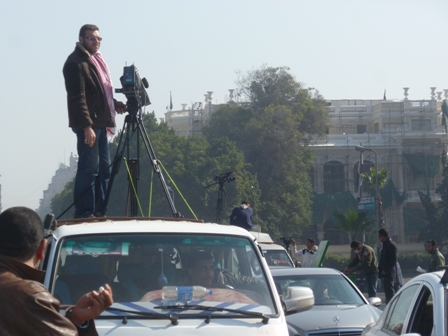
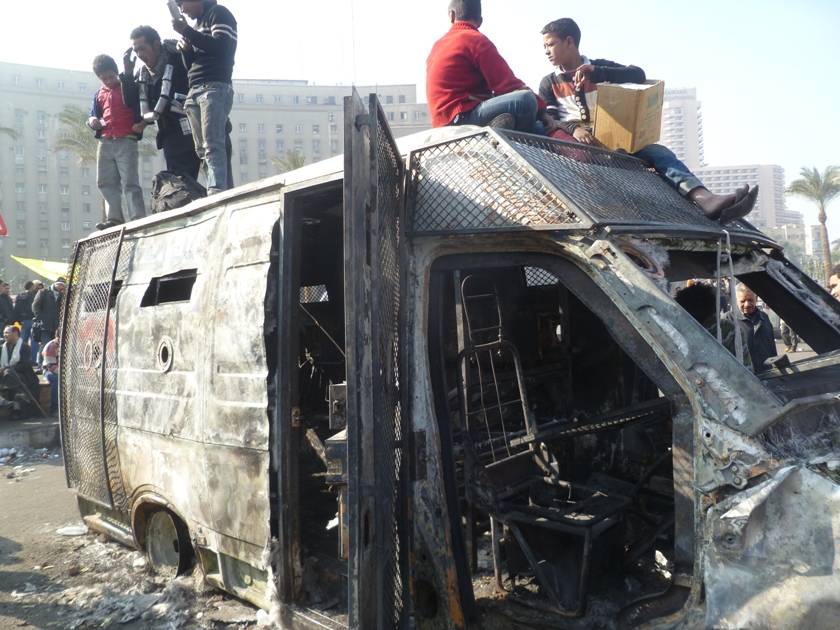
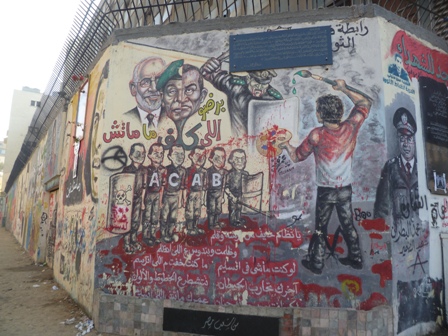
The worst clashes took place on the Nile Cornish. This rock pile is on the road leading there from Tahrir, where protestors would retreat to reload for their volleys against the police.At one point during the fighting, armed criminals broke in to the Semiramsis Hotel, smashing this door. According to reports, protestors intervened and beat them off.Outside on the Cornish clean up crews were hard at work collecting the debris, preparing the road for traffic.Traffic into Tahrir, however, was blocked by these makeshift barricades.And on the bridge across the Nile leading into Tahrir, group of protestors were trying to block traffic, as they had over the previous few days. This attempt petered out after about five minutes.Meanwhile, camera crews were already in place, awaiting the next round of violence.Back in Tahrir, things were calm, as protestors celebrated their previous night’s capture off a police van.Even the local Pizza Hut was open for business – sort of.Protestors opened their very own Revolution Museum in the center circle of the Tahrir roundabout.The celebrated statue of Omar Makram had a new round of graffiti.And the walls were updated with the pictures of the latest martyrs and targets of political rejection. Here, the Muslim Brotherhood’s General Guide hovers behind a split image of Mubarak and former army head General Tantawi. A plaque has been affixed bearing a verse from the Quran.But at some point since my last visit a huge Egyptian flag had been draped on the side of this building. Perhaps it can be read as a sign of hope.
This is a useful follow-up to the previous post on diplomacy:
Perhaps the only viable way to get the state to function is for the Brothers to offer the opposition enough reassurance that major political forces together could reach consensus on the illegitimacy of violent protest. If Egypt’s political forces acted in unison — a general appeal for order, or for justice to take its course, or for disputes to be resolved in parliament rather than in the street — these have a powerful calming effect. The Interior Ministry, for example, has called for such an appeal to “patriotic forces” to calm Port Said.
The opposition would probably not try to coax protesters out of Tahrir, nor would it be necessary — the square can probably remain an open-air museum of the revolution as the state rebuilds itself elsewhere. But a joint appeal for order would at least contain street violence and push Egypt’s flare-ups of violence to become less frequent and bloody.
The opposition knows however that to stand alongside the Brothers would be handing Morsi a major concession. The National Salvation Front has demanded as the price for its cooperation that a committee be empowered to amend the constitution. If Morsi’s objective in pushing through the constitution in December was to provide some security for his administration — ie, to prevent the Supreme Court’s from topping off its dissolution of parliament by pushing Morsi out of office, as Brothers said they suspected might happen — then perhaps he would take that risk.
But the first articles targeted would be ones that circumscribe civil rights with religion. The Brothers have in theory agreed to revisiting the constitution. If the Brothers are committed to aggressively Islamicizing society, or if they are worried about having their Islamic credentials challenged by the Salafis, they aren’t going to give the opposition what it wants.
This is an excellent analysis of why the opposition is being somewhat mum on all the street violence. Conspiracy will say they started it, but they are not standing in the way. In fact, rightly in a sense, they lay the burden of responsibility on the state. Ongoing violence is a function of state ineptitude and political intransigence.
So after sidelining the opposition to get what they wanted (i.e. the constitution), Morsi now calls them back for dialogue – but as above – will he be willing to pay the price? It is as if the opposition is saying: You cheated to get your constitution, we’ll cheat to take it back.
Islamists may say the opposition has been cheating from the beginning, but this only opens up the conspiracies even further, which most liberals are happy to slap back at the Brotherhood. It gets Egypt nowhere.
The only thing that will, as the author suggests, is consensus. Can it be found? If not, what is the price?
Effective diplomacy — the kind that produced Nixon’s breakthrough with China, an end to the Cold War on American terms, or the Dayton peace accord in Bosnia — requires patience, persistence, empathy, discretion, boldness and a willingness to talk to the enemy.
This last point is crucial. One must always talk, and listen. Yes, even the fact of talking grants a measure of legitimacy, and it can be said this should not be freely offered. One reason why Hamas refuses to acknowledge the Jewish State of Israel is that they feel this is must be an end result of negotiation, not its starting point. But even so, Israel and Hamas have been communicating for years, through back channels.
Speaking of Hamas:
Breakthrough diplomacy is not conducted with friends. It is conducted with the likes of the Taliban, the ayatollahs and Hamas. It involves accepting that in order to get what you want you have to give something. The central question is: What do I want to get out of my rival and what do I have to give to get it? Or, put the way Nixon put it in seeking common ground with Communist China: What do we want, what do they want, and what do we both want?
Earlier in the article the author mentioned Egypt as a mini-success of Obama’s diplomacy, and he may have a point. Many here in Egypt’s opposition see the current situation as a negotiated settlement between the US, the military, and the Muslim Brotherhood. Each one has gotten something that they want. The opposition, meanwhile, feels left out in the cold.
But here is where diplomacy’s rubber meets the road. For the idealist, it is painful. But did the opposition get what it wants? There is the beginnings of a democratic system which can be continually contested. They just didn’t win.
Maybe. But to voice their complaint, what did the Brotherhood get? Access to the reigns of power has limits – the army is off limits, as is any real tension with Israel – but comes with great privilege. Some see this privilege extending to be able to manipulate the situation (democratic as it may remain) for their own benefit. What does this give America? As goes the theory, stability in the region.
So, diplomacy, if this picture is true, is it good enough?
For America, perhaps. The task of international diplomacy is to secure the interests, and not the ideals, of the home nation. If Egyptians only get a manipulated democracy that allows the US to check off the accomplishments of its own internal ideals, of what major concern is this to America?
But that is no reason for the Egyptian opposition to accept the situation. They have their own diplomacy to worry about. And part of diplomacy is overstating your case in negotiation. It is conceivable they have quite exaggerated the manipulations of the Brotherhood.
But do the events of yesterday, the second anniversary of the revolution, suggest that the opposition is abandoning diplomacy?
Diplomacy achieves an imperfect solution, but tends to avert war and violence, which usually are far less perfect for all parties involved. But goodness, is it maddening.
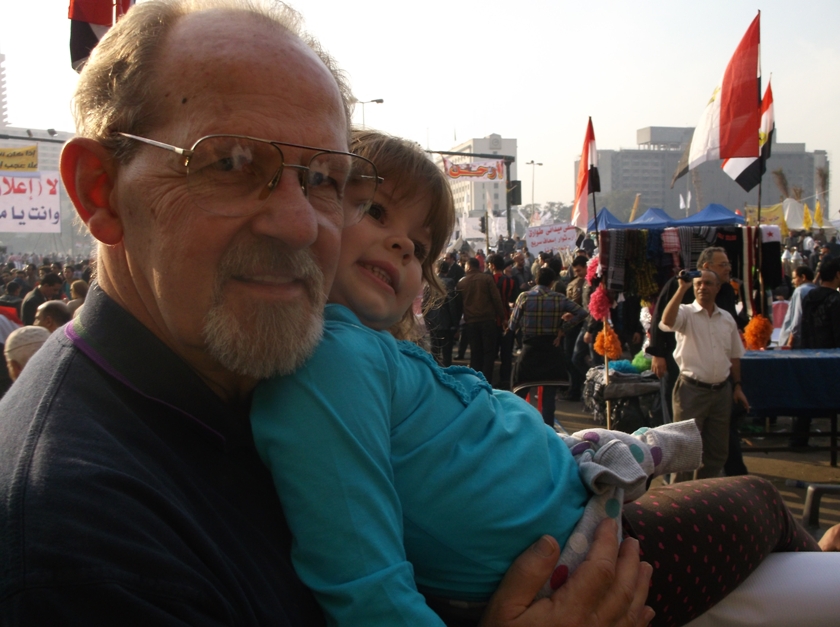
With Egypt on the eve of another potentially massive demonstration, it is time to pull these pictures out from the archive. They are from the day I took my four year old daughter and her grandfather to Tahrir. I didn’t post them immediately, as I didn’t want to scare the rest of the extended family. And to set hearts at ease, I don’t plan to take anyone tomorrow.
It is hard to recall all the events of Tahrir, but on that occasion there were once again clashes – the night before. My parents were visiting to help assist with the birth of our new son; of course my father had to see the famous square. The best time to avoid violence is morning, when all are exhausted from fighting through the night.
‘I smell nail polish remover,’ said Hannah, my daughter. She was sort of right; I had never noticed how it resembled the scent of lingering tear gas.
‘What pretty decorations,’ she said. I looked all around, wondering if she was referring to the graffiti, some of which is rather creative.
‘No, the shiny ones,’ and she pointed toward the middle of the road. Ah, barbed wire.
With a local protestor
Some lessons I explained, others were left unsaid. My children are getting quite an education in Egypt.
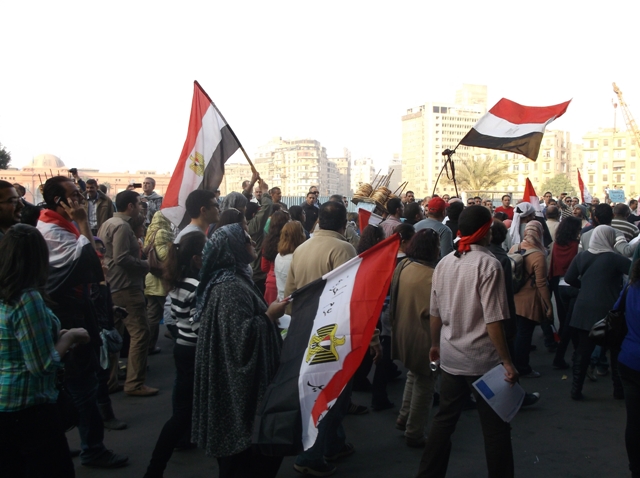
As for my father, he was particularly impressed by an incoming march as we exited the square along Kasr al-Nile Bridge. ‘Such passion,’ he remarked. We even got a quick glance of Hamdeen Sabbahi’s silver locks as he accompanied the procession to Tahrir.
(Sabbahi not visible)
As for tomorrow, the two year anniversary of the start of the revolution, expectations are meaningless. Tahrir could be packed, or victim of protest fatigue and sullen resignation. It could spark a second revolution against the Muslim Brotherhood, or descend violently into anarchy and chaos.
Here’s hoping for a protest without nail polish and decorations.
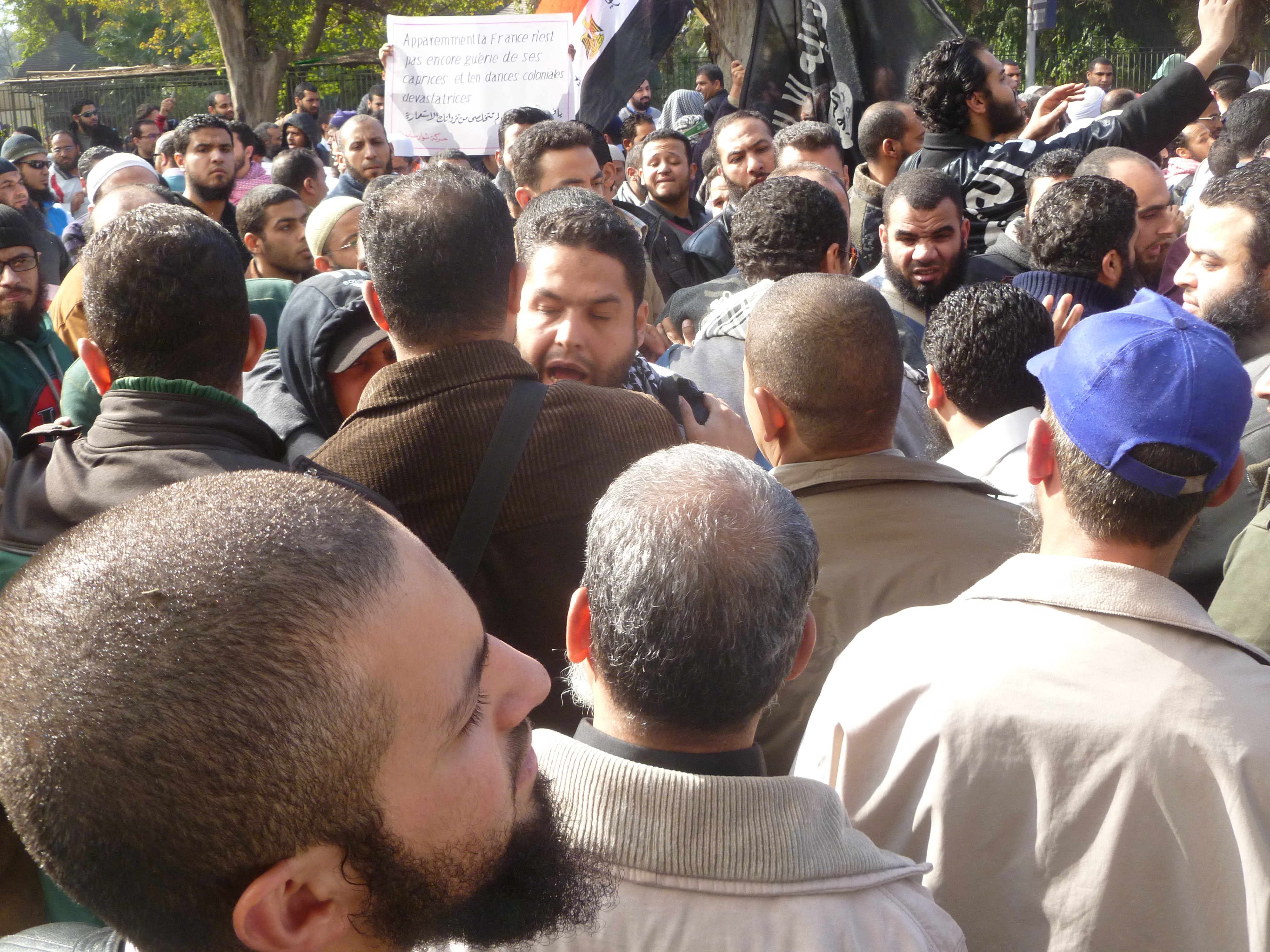
There are several strands of Salafism in Egypt, and the differences are not easy to understand. The group which is called Salafi-Jihadi – they do not necessarily call themselves this – is differentiated easily by the second part of their moniker. While many Salafis have joined the political, democratic process in Egypt, these reject it outright. Instead, they favor the continuation of a violent struggle against the Egyptian regime, of which they see the Muslim Brotherhood and other Salafis as selling out to the world anti-Islamic system.
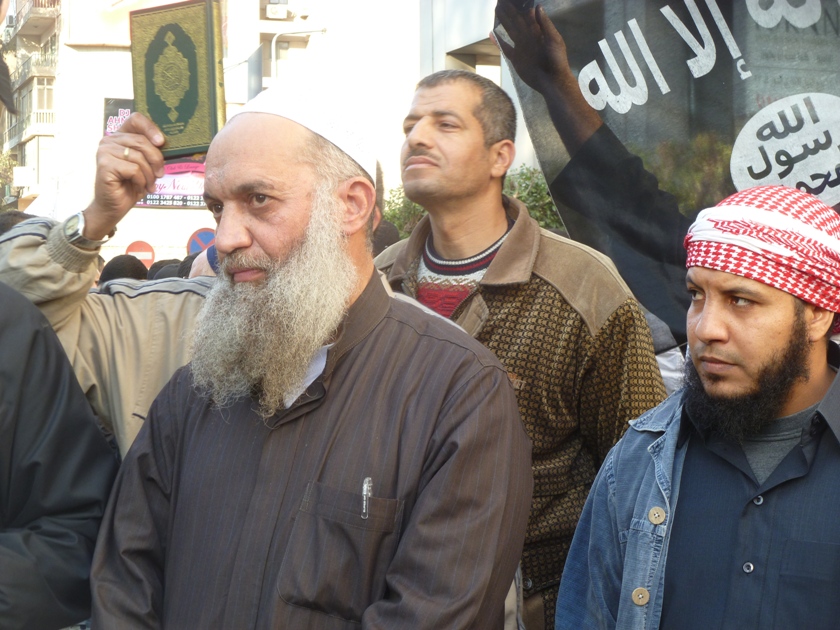
This group held a protest on January 18 against the French military intervention in Mali. In Mali criminal-cum-jihadists have piggybacked onto a tribal Tuareg rebellion in the north. The central government, along with many surrounding Arab and African nations, has sanctioned France’s effort to resist them through force of arms. Salafi-Jihadists, however, support them due to their desire to implement sharia law.
I hope to write more about Salafi-Jihadis soon, but for now, please enjoy the protest through these pictures and video.
Click here for the first video. It is only two minutes long because it represents the length of time necessary for their full march to approach the site. There were only a couple hundred protestors in total.
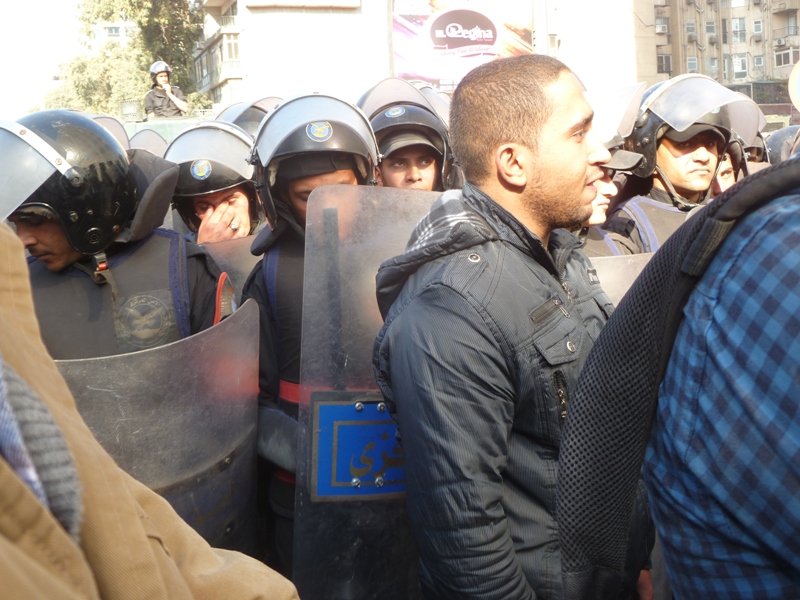
Click here for the second video. It also is only two minutes because this was about the length of time the protestors jostled with police who had set up a barricade preventing them from reaching the embassy. After that they accepted their place about 100 yards further down the street.
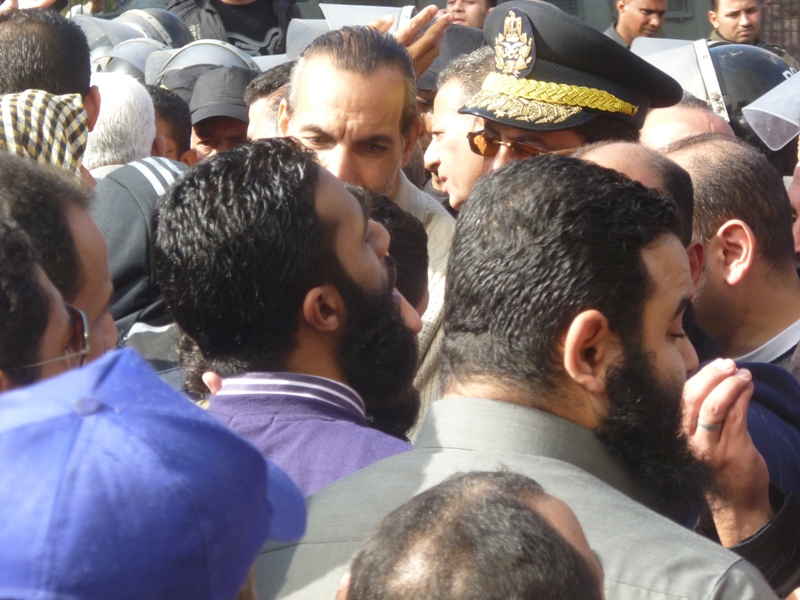
Next to the man in the police cap is Ezzat al-Salamony. He is a leader with the Islamic Group, not the Salafi-Jihadis, and worked to restrain the crowd. He later gave a rousing speech against the French, though, calling for jihad in the lands of the infidels.
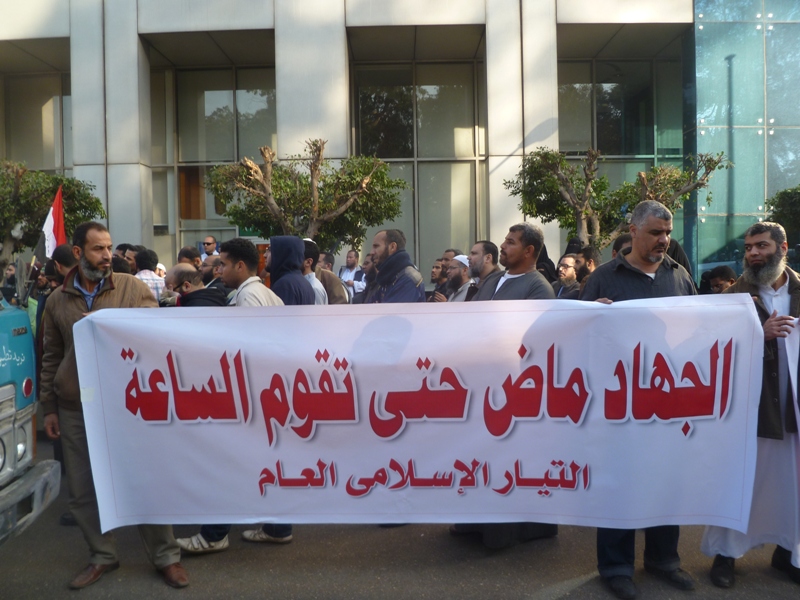
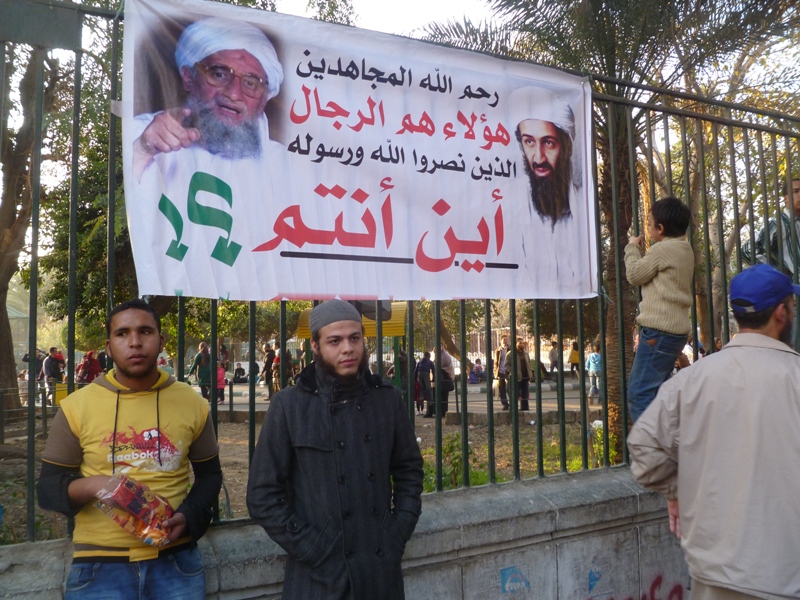
Eventually a car drove up with speakers to serve as a platform for speakers. The police maintained their line, but were left in peace from then on.As speakers condemned France, other protestors set up their banners. This one reads: Jihad will continue until the Day of Judgment.After a little while the star of the show arrived. Mohamed al-Zawahiri is the brother of Ayman, the leader of al-Qaeda. Everyone pressed around him.As he hung around for hours, eventually the crowds dissipated around him. Here is awaits giving an interview to al-Jazeera.Around 5pm, the police relented and allowed the protestors to advance and demonstrate in front of the embassy, though the police presence guarded it and otherwise surrounded them. Graffiti and other banners were hung in the area, this one across the street on the wall of the Giza Zoo. Pictured are Osama bin Laden and Mohamed’s brother Ayman. The sign reads: God have mercy on the jihadists. They are the men who gave victory to God and his prophet. Where are you?!
‘The church in Egypt is better resourced to participate in society than in other countries of the Arab world, whereas in Palestine/Israel it constitutes only 1% of the population,’ says Stephen Sizer, a renowned critic of Christian Zionism, who presented a series of lectures in Cairo, including at the Anglican Cathedral.
Sizer is an Anglican minister from the UK and directs most of his energy combating US evangelical Christians who find Biblical warrant for supporting the Zionist policies of Israel. Instead, Biblical theology should direct the Christian to support the oppressed and stand for justice, on both sides of the separation wall.
Yet local expressions of theology have failed Palestinian Christians as well. In an interview with Orient and Occident Sizer suspects a similar deficiency among many Egyptian Copts.
‘Theology that says, “Stay out of politics and worship quietly; don’t get in the way or cause problems” will lead only to a victim mentality,’ maintains Sizer. ‘We have to get out of our ghetto and show the rule of law applies to everyone.’
Please click here to continue reading the article on Orient and Occident.
Orient and Occident is the bilingual online magazine of the Egyptian Anglican Church, of which I am privileged to be the editor. We seek to highlight voices who are able to articulate how the values of faith – Christian in particular, shared widely with Islam – can be lived practically in society, and in particular the Arab world. We welcome contributions from Christians and Muslims alike.
Please click here to view the Winter edition homepage in English, and here in Arabic. This season’s edition also features the following articles:
While on this blog Julie and I always appreciate your sharing of our thoughts about Egypt, we would like to invite you particularly to share any of these articles you find enjoyable or challenging. We hope Orient and Occident will be a service to the Arab world – both by inspiring its readers inside and by sharing a vision with the world outside. Thanks for any small steps you can take to help it be better known.











 Jayson Casper