Categories
Personal

Dorosy in the Wizard of Oooz

Wizard of Oz
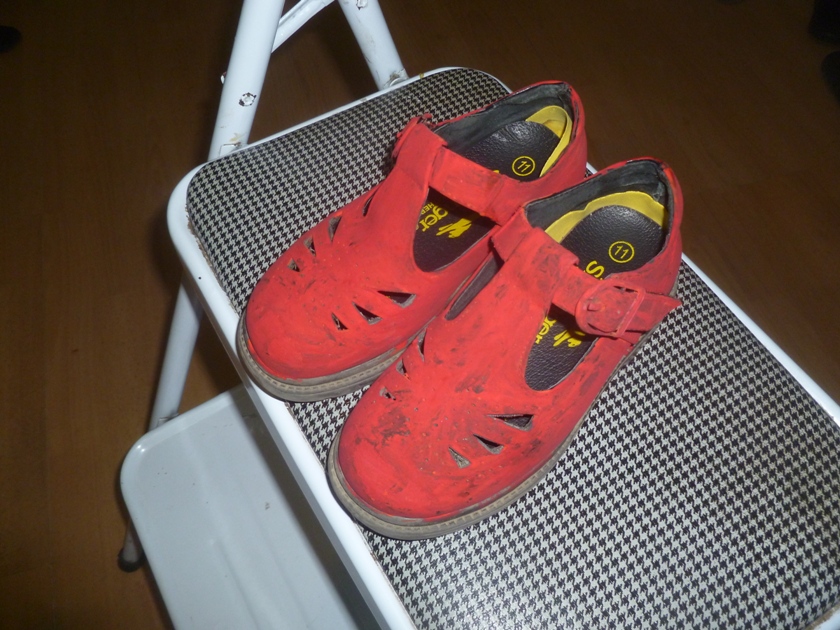
Homemade Ruby Red Slippers for the Show

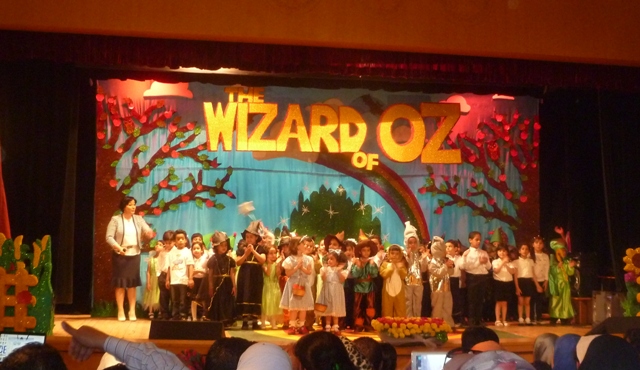
At the end of the school year – and yes, somehow in Egypt, we are already at the end – our girls’ school puts on an assembly for parents that includes an English language play.

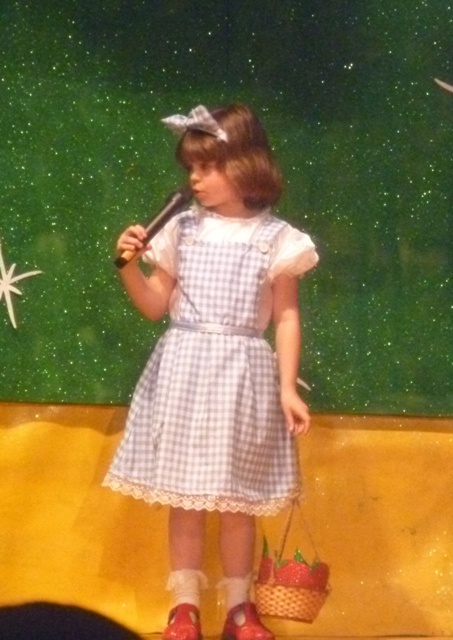
This year Hannah, our kindergartener, has been selected for the leading role in the Wizard of Oz.

But when we say it is in English, we mean Egyptian English. We suspect Hannah was chosen because she is the only native English speaker in her class. Nonetheless, she memorized – and pronounces – the lines as they were taught to her by her teachers.

In fact, she memorized everyone’s lines. Here is an exclusive preview of her performance, running through the script in about five minutes.

And just in case, we provide subtitles if her accent cannot be fully understood. Don’t worry, she speaks good American English also.

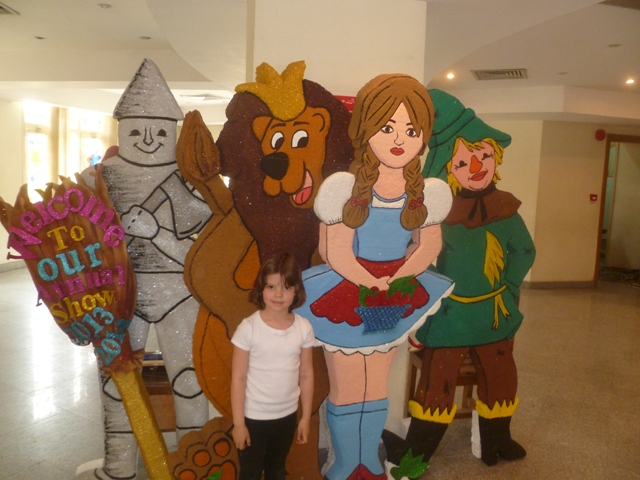
Finally, here are some pictures from the big event:

Hannah as Dorothy

Oz Stage

And, though it is hard to understand, a snippet from the actual performance:

Flowers, everyone, for the leading lady.

Hannah After

Categories
Personal

Belonging, to Bassem Sabry

Bassem Sabry

Few people reading this reflection know Bassem Sabry, of course. I didn’t know him myself. We may have exchanged tweets two or three times over the past three years. But when I saw the news of his death – on that same Twitter medium – it filled me with dread. They’re keeping score, I thought, and they’re coming to get you.

Sabry was one of the first Egyptian voices of the revolution I became familiar with. He kept a popular blog in the early days when people still weren’t sure what was happening, if it was good or bad, or where it was going. Sabry believed it was good, was never wild in his predictions, but had a keen sense of what was happening. In those confusing days, still confusing now, his was a lucid analysis that was simultaneously authentic. He was here, living it.

As was I.

My situation was much different, to be sure. He was a participant, an advocate, one whose level-headed hope was contagious. Mine sought to convey the situation correctly, weigh between differing explanations, but be tinged all the while with a positive sympathy that sought to identify with all sides, to the degree possible. Among many, I identified with Bassem.

But it is a mark of the psychological weight of Egypt in these days that I briefly identified too far. The first report I read said Bassem, aged 31, died in a fall from his balcony window.

Cairo is a city of high rise apartments, with balconies overlooking both narrow, crowded streets and wide expanses overlooking the Nile. Rich or poor, the balcony equates as one of the few places that can lift one above and give safe outside space above the bustling, often chaotic world below.

Safe, however, is only a matter of speaking. Every mother fears for her children, no matter how high the wall. Our one-and-a-half year old is proving quite adept at climbing, combining stools and chairs to rappel himself up onto heights he has no business reaching.

But those in Egypt are also aware that the balcony has been a not-infrequent place of untimely, suspicious death. The stories are not necessary to tell here, but rumors circulate of celebrity accidents from years earlier, or from sectarian tensions, or or or.

How does a 31 year old fall from a balcony?

The next day’s reports related from his friends that Bassem suffered a diabetic dizzy spell that caused him to lose his balance and fall. None of the numerous tributes I have read suspect foul play.

He just died. In Egypt, these days, that is strange enough.

People die every week now in scenes no less unnatural than falling from a balcony. Protestors are shot. Policemen are bombed. And despite the simplicity of these sentences there are the conspiracies that swirl and complicate. Demonstrators shoot their own colleagues to enrage and further the cause. The state blows up its own security to demonize the opposition. And on and on.

So a situation that is evil in its own right becomes even more sordid by the alleged manipulations and deceptions. Those who are good, as Bassem appeared, are easy to imagine as having been eliminated. He would not be the first on this imaginary list.

Of course, I imagine myself as good as well. And given the handful of foreigners who have also suffered as witnesses to the revolution, it is easy for the imagination to extrapolate in fear. They, whoever they are, are keeping watch.

But this is a psychology, not the reality in which I live. The reader outside Egypt should know that I and my family pass each day in safety. We have kind friends and normal lives.

This weekend there were reports of clashes in Helwan, an industrial city to the south of Cairo. I was there that afternoon. I enjoyed tea with a friend and then an uneventful church service. At one point the television showed footage, and my friend quickly inquired about which neighborhood. Everyone else was calm and went about their business. A ten minute microbus ride could have brought us to the two or three street radius of troubles; everywhere else in this poor, lower-class district was fine.

Yet at the same time, Egypt suffered four bombings yesterday and another handful of protestors died. All is not well, even though it is.

Living in this tension takes a toll. It is a good toll, one I am privileged to be able to offer. It is fulfilling, exhilarating, and offers much temptation to pride and self-importance. It conjures drama and imagines conspiracies, even as it dispels them. It suffers, while remaining apart. It makes a difference, while making none. Negotiating these tensions is essential for peace of mind; trying to do so can drive you crazy.

For there are thousands of Egyptians striving for the success of their interpretation of the revolution, and thousands more wishing they would all go away. And there are hundreds of foreigners offering better and more courageous analysis, and hundreds more who just live here and get along.

I, whatever I am and offer, am a drop in the bucket.

As was Bassem Sabry. His was a larger and more influential drop, but now he is gone and the world marches on. The world is less without him, as it will one day be less without me, and you, and your neighbor, and everyone else.

But Bassem lived well, analyzed well, explained well, did his best to politick well, but above all, gave hope. For those who have any sense of belonging to Bassem, this is the worthy imitation.

May he rest in peace, and inspire us all.

Categories
Personal

Ostrich Eggs and Coptic Easter

On Easter in much of the Christian world, believers celebrate Jesus’ resurrection by painting chicken eggs in various colors. The tradition is old and has been extensively secularized, enjoyed now without a necessary reference to faith.

In Egypt it is the same; one day after Easter is Shem al-Naseem, an ancient Pharaonic holiday enjoyed by both Muslims and Christians. Both enjoy painting eggs and other traditions that are not as common in the West, such as eating near-raw, salty fish. It is good not everything translates across cultures.

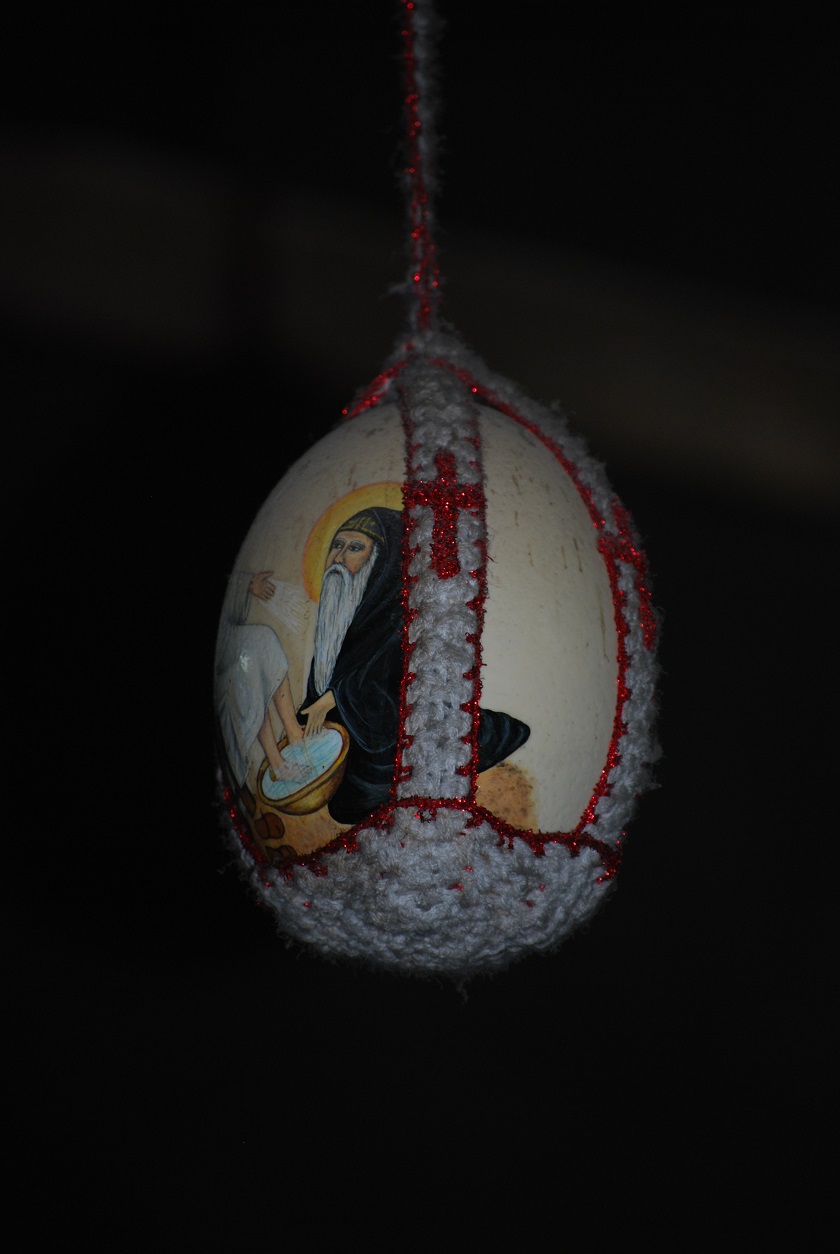
But imagine the artistry – or, envisioning children, the mess – if an ostrich egg was used instead. A bigger canvas invites more elaborate design, as seen in this egg hung from a church in the Monastery of St. Bishoy in Wadi Natroun.

Bishoy Ostrich Egg

St. Bishoy is the one pictured, washing the feet of Jesus according to one of the Coptic traditions. It is hung today in front of the altar as a reminder of God. This is common in many Coptic churches and meshes with other Egyptian traditions carried over into the Christian era.

Four ostrich eggs hung from the church in St. Makarios Monastery in Wadi Natroun.

In ancient Egyptian mythology the ostrich had an association with Amenti, the jackal-headed goddess of the dead. The egg in many cultures symbolizes easily the emergence of life from death, and the Coptic church took it as a pointer toward resurrection. Additionally the ostrich was believed to hatch her eggs through intense staring and concentration, a fitting description of the spiritual life and the attitude of worship recommended at mass.

So if you paint your eggs this Easter, wherever you are, cherish your own traditions, marvel at others, and remember how much we share without even knowing it.

The opening picture and much research for this post are received with thanks to Viveka Anderton.

Categories
Personal

Yalla Maadi Clean-Up Day

Following the success of the January 25, 2011 revolution, Egypt witnessed a great wave of civic activism. One of the most popular manifestations was in campaigns to clean the city streets, often accompanied by vibrant artwork and pro-Egypt graffiti. But as the enthusiasm waned and the political situation became more and more polarized, citizens went back to their lives as normal. Worse, the official public services of police and trash collection broke down as main streets were transformed into garbage dumps. Every now and again a faithful public servant or enterprising resident might try to clean things up, but it was a losing battle nationwide.

So it is with encouragement we joined a group of Maadi ladies on a local clean-up campaign they advertised on Facebook. Among many Egyptians the mood is brighter following the removal of President Morsi and his Muslim Brotherhood, and the anticipated presidency of army general Abdel Fattah al-Sisi. Others, of course, are horrified at the turn the nation has taken, due either to their approval of the Islamist agenda or their advocacy of liberal principles violated in the crackdown against it. But for a great number, after the chaos and disintegration of the past three years, they just want things to go back to normal. With this hope dawning, the spark of civic activism returned.

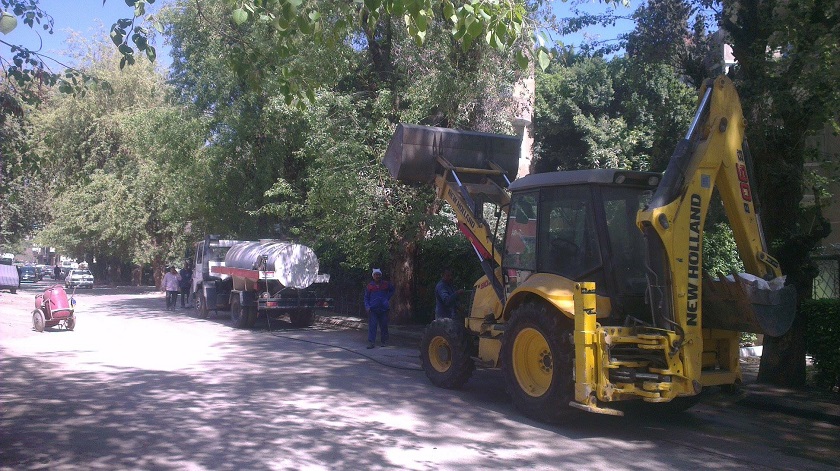
But only a spark. The Facebook page yielded a few volunteers, but did animate the local municipality. The mayor made a public appearance and authorized the use of heavy equipment to remove built-up dust and trash along street curbs in our few block section of the neighborhood. At least for these past few days, since March 22, the spark of the ladies’ initiative has resulted in the sparkle of a clean community.

But that sparkle may only be in our eyes who now wish to see things more beautiful than they were. Likely, things will go back to normal once again, though there is hope that police and trash collectors are now providing more faithful service. But the normal was never beautiful in and of itself; if there was beauty it was because neighbors had a stake in the uniqueness of the Maadi area. Trash is still thrown on the street, and worse, building code violations continue as highrises impinge upon the villas and family apartments mixed in with tree-lined sidewalks. Maadi benefits from its upper-class standing, so few real complaints can be issued when poorer sectors push against the posh.

But whether upper or lower class, the beauty of a neighborhood is in the eyes of its residents, and how they collectively view and tend to their immediate area. The ladies of Maadi were encouraged by their opening salvo; there is talk of continuing the practice once a month. Yalla Maadi, let’s have more join in next time. God knows where the revolution will take Egypt next, but ownership of the streets never rests with a political power beyond the imagination, or apathy, of those who walk them.

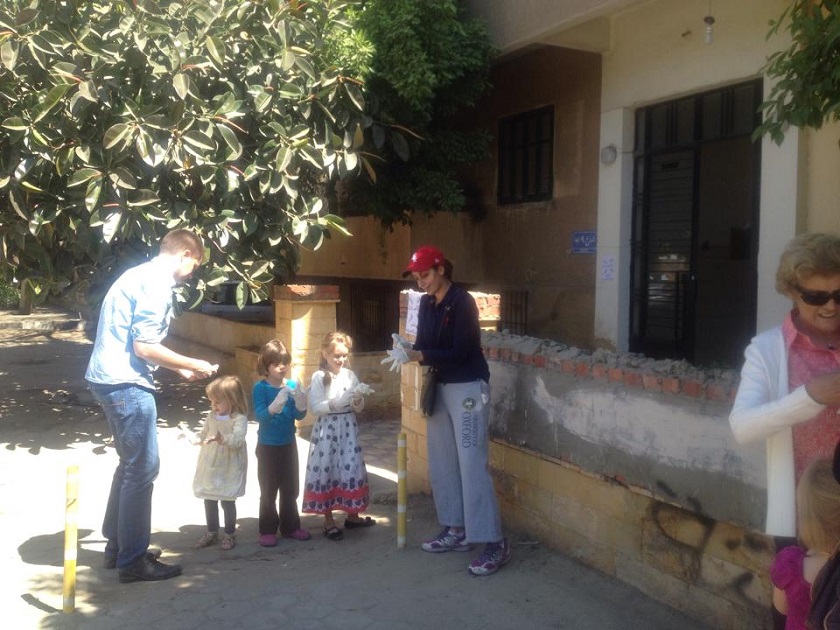
It just depends on initiative. Here are a few pictures to honor those who got us moving.

Getting ready, from the Facebook page.
Getting ready (from the Facebook page)
Perhaps more effective than the children, but less inspiring (from Facebook)
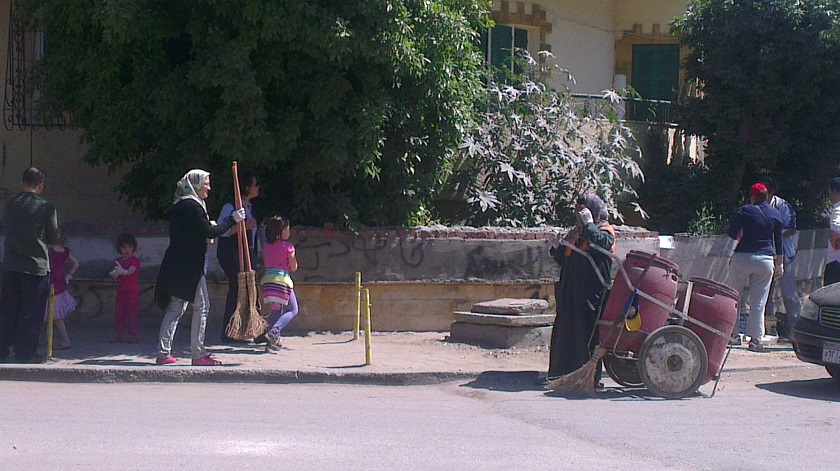
But first the streets needed to be swept
First the streets needed to be swept
Hannah Clean-Up Day
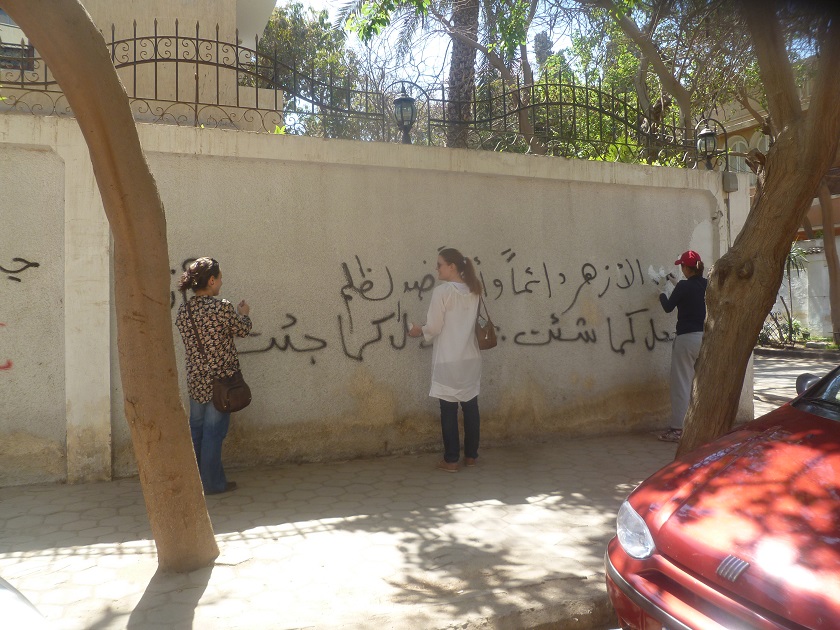
Then the curbs of Road 73 were painted
Others painted over recent graffiti sprayed on the walls of local residences
The local trash collectors lent their aid (from Facebook)
Then we walked down the street to start again

Please click here to like the Yalla Maadi Facebook page, and for fellow locals, get notification for future events. Hope to see you there.

Categories
Personal

Launching a Monthly Newsletter

Sense of Belonging

As readers of this blog, we hope you have enjoyed coverage of events, profiles of newsmakers, and occasional glimpses into the life of an American family in Egypt. In most of what we write we strive to provide the context, for without this only incomplete images are conveyed, which may leave lasting misimpressions.

In support of the full picture, then, we are offering a free monthly newsletter to recap recent events and offer a preview of the month ahead. Here is a preview of the introduction and conclusion:

If February was a game of waiting, March in Egypt may see the wheels begin to turn. In which direction is both a matter of debate and of further waiting.

The primary wait continues. General Abdel Fattah al-Sisi, the defense minister and head of the army, still has not declared his intention to run for president. Of less note but perhaps crucial convergence, the interim president has still not issued the presidential elections law. This is expected in a matter of days and is already twice delayed, but perhaps Sisi is waiting until it is finalized.

Also twice delayed has been the return of students to school, from kindergarten through university. Swine flu has killed a handful and is the official reason their vacation continues since mid-January. March 9 is the target return date, but speculation has been rife the closure is due to expected student protests, as the campuses had witnessed the most vibrant anti-regime demonstrations through the end of the mid-term season.

Pro-Morsi demonstrations on the whole, however, have been subsiding. To be sure they continue, but they are largely ignored by both domestic and international press. Lesser numbers may be due to fatigue, resignation, or simply the fact that thousands of their number have been arrested.

But both are involved in the fight against terrorism, which also is expected to continue in March. Having only targeted security forces, they have now switched to tourists. Also added are Egyptians abroad; Copts in Libya have been ruthlessly murdered. The general onus of accusation remains on the Muslim Brotherhood despite their denials, and judicial trials are continuing.

But just when things in Egypt appear quiet, something surprising is inevitably around the corner. If the wheels do actually begin to spin, perhaps this will be surprising enough.

If interested to receive the full newsletter tomorrow and subsequent issues around the first of each month, please click here. You can also sign up to receive a weekly summary of blog posts, and/or email delivery each time a new post is published.

Thank you for following along with our hopefully sympathetic analysis. We hope this offering will lead to better understanding and contribute positively to developments in Egypt, in however small a way.

Categories
Personal

Churches Burn, Christians Sing

This video – with transliterated subtitles – was produced by a church choir in Minya, Upper Egypt, a region which witnessed several severe church burnings. They stand within one church’s charred remains, and sing about love and forgiveness.

May they truly live these words.

Many Christians have spoken that if these heinous attacks are the price they must pay to secure a civil state of free and equal citizenship, they are willing. But are they willing also not just to forgive alleged Islamists who committed these crimes, but also reach out to them in love and understanding? Right now, their temptation is to celebrate the upswing of their fortunes and join in the condemnation, if not demonization, of all things Islamist.

For a view of some of these crimes, please see this video, recently released by the Bible Society showing the attack on its branches in Minya and Asyut.

Yes, if they wish, condemn all things Islamist, but not all people Islamist. This is the test of their song: All crimes notwithstanding, can they differentiate between actions, ideas, and the people themselves? The love of which they sing demands they stand against the tide and seek transparent justice for all currently accused.

And then, amidst it all, to forgive. This is far easier in song than in deed, but meditation in song can transform the heart. Can it transform the Copts? Can it transform the nation? The outlook is bleak, therefore, keep singing…

Categories
Personal

Repackaging January 25

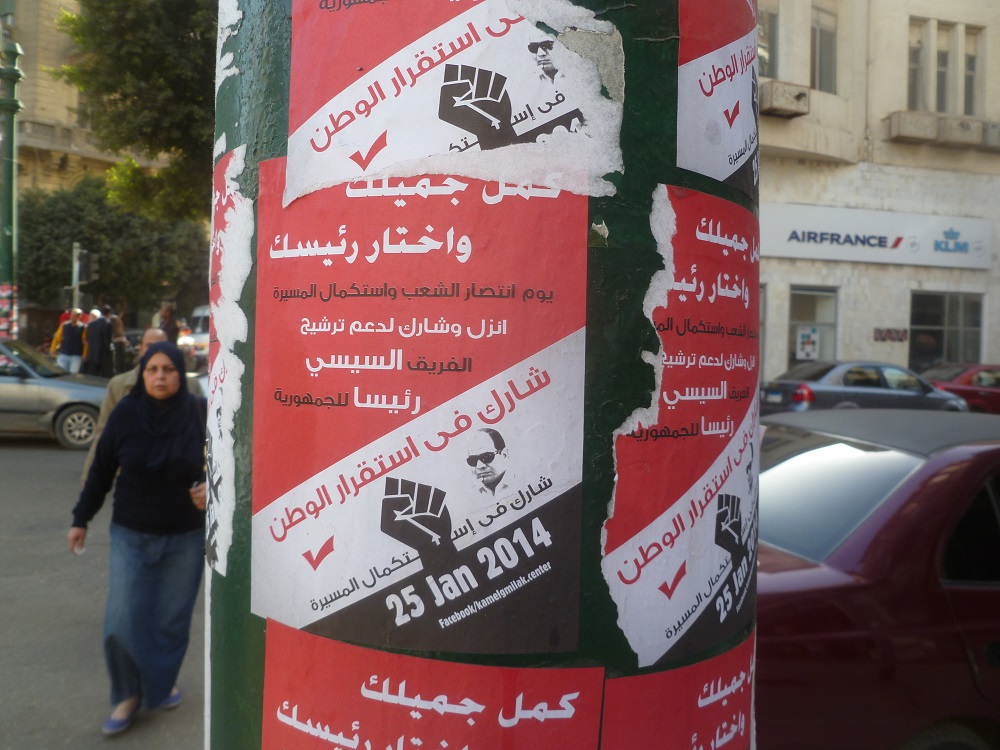
Sisi for President

General Abdel Fattah al-Sisi is an unannounced, unofficial candidate for president, but the announced, but still unofficial campaign for him to run has long been strong. Immediately after deposing President Morsi on July 3 he denied any intention for seeking office, but has since expressed an openness without declaring himself either way, though he dropped strong hints he would run if the constitution was ratified with strong turnout.

It has, and Sisi-mania has persisted, with many politicians offering their unqualified support should he decide to announce his candidacy. There is even a lawsuit filed to compel him to run for president.

The above poster is a new initiative in this direction. It translates:

Complete the good you have done and choose your president

‘The good’ represents the massive demonstrations on June 30 which demanded early elections to remove Morsi as president. June 30 has been billed as a new revolution, but also as a corrective extension of the original January 25 uprising against President Mubarak. To others, June 30 is the counter-revolution, less against Morsi than for the state/regime which had buckled in 2011, but not collapsed.

So within this mix, the translation continues:

The day of the people’s victory and of completing the path

Take to the streets and share in supporting the nomination of

General Sisi

President of the Republic

25 January 2014

It is unknown whether or not General Sisi is behind this effort or if other state forces desire him, or, if it represents simply the will of a great portion of the populace. Almost all observers predict that if Sisi were to run for president he would win in a landslide.

Will January 25, therefore, be repackaged as the launching pad for the next president of Egypt? If so, will the original revolution lose more of its luster among a weary population, or, if not and, will the June 30 extension restore much of what January 25 meant to topple? Mubarak, of course, was a president from the ranks of the military.

January 25 was originally selected as the start-date for the revolution because of its coincidence with the national observance of Police Day. It was a protest against the police state and its brutality, but also against corruption in general throughout the regime.

Incidentally, the Interior Ministry has called on the public to rally in Tahrir on this day – without mentioning Sisi specifically. He has also floated the idea that Police Day be moved to June 30, to coincide with the revolution against President Morsi.

Let us suppose General Sisi removes his uniform, runs for president, and wins his mandate. This may reflect very poorly on Egypt abroad, giving ammunition to those who call what happened on July 3 a coup d’etat, however popular. He has the right to run, of course, but is it wise?

That may all depend on the type of president he will be. Will he restore the Mubarak state and rule similarly with token appreciation for parliamentary politics? Or will he honor the original revolutionary demands and reform both the police and the culture of politics, presiding over a true and ongoing democratic transition? Might he perhaps, with his military background and popular backing, be the only one who can accomplish this?

Doubters say the manner in which he has presided over Egypt since July 3 reflect a very low possibility of the latter. The violent crackdown against the Muslim Brotherhood, the controversial protest law, and the media campaign to tarnish original revolutionary icons all suggest resuscitation of the dominant state. Furthermore, electoral flexibility passed by the constitutional assembly to the interim president – viewed in this framework as Sisi’s puppet – allow great maneuverability to shape the coming parliament along conciliatory lines.

But throughout the previous three years there has been a lingering sentiment, now a fully raging fire, that Egypt, especially through the Muslim Brotherhood, has been the victim of a conspiracy. Morsi, it is said, won his victory through fraud and foreign pressure, recalling the Brotherhood monitors who declared his victory long before the official results were counted. Judges who participated in the alleged charade are now being investigated.

Egypt’s judiciary – alternately reviled and respected among the people – will have to judge these matters. Their decision either way will be filtered through the lens of some conspiracy. But it reminds of the question ongoing since revolutionary trials began: Who killed the protestors? Has the judicial system let murders off the hook? Were police shooting in defense of stations attacked throughout the country? Or was there simply a lack of sufficient evidence to rule against anyone?

And though many analysts dismiss these thoughts as the knee-jerk reaction of any autocratic regime that comes under popular pressure, conspiracy theorists have a powerful retort. Look at Syria, Libya, and Iraq before that. Their states and armies are all victims of foreign interference. Shall we allow Egypt to fall next?

Or, through Sisi, is it falling now? Pro-Morsi forces are also calling for mass demonstrations on January 25, at Tahrir Square and throughout Egypt. They are now warning of civil war, even as they mobilize.

The general is at the nexus of many attempts to define January 25 amid ongoing Egyptian turmoil. The success of January 25, 2014 to push Sisi to the presidency, as well as the manner in which he may eventually govern, will define the ultimate packaging of the revolution.

Categories
Personal

Egypt’s Referendum: Picture of the Day

Bomb and Shisha

As Egypt votes on its new constitution, this picture sums things up very well. Shortly before polls opened an unknown individual drove past a courtroom in Giza and threw a small bomb. No one died and injuries were few, and turnout in the nearby polling stations was reported afterwards as stronger than usual.

This is a testimony to Egyptian voters, but the picture captures a different image. Across the street from the courtroom is a local cafe, and customers sit stoically smoking shisha amid bomb debris scattered in the street. It is unknown if they cast a ballot.

Early reports say that nine have died in scattered protests, but that they day has generally proceeded calmly. There have been many pictures of long lines outside polling stations; there have also been many pictures of empty ones. Conventional wisdom says turnout in support of the constitution will be strongest in urban areas, while rural ones may be more inclined to boycott.

But perhaps these shisha smokers represent the nation in general, sitting idly by despite the turmoil. If the turnout is impressive, this characterization will have to be revised. If the turnout is poor, Morsi supporters will say the country rejected the ‘coup’. But throughout the past three years, waves of protests and politicians have jostled over slogans of change and promises of stability, while Egypt soldiers on.

At this moment, I have no estimate of turnout. The polling station on the way to Layla’s preschool had a long line at the beginning of the day, but was empty by her pickup in early afternoon. Whether large or small it will offer a political message, an important indicator that pundits will analyze.

The constitution will pass – that is not in question. It will provide a legal basis for continuing the transition and lead into presidential and parliamentary elections. Will the promised stability come? Or is more trouble on the horizon?

Either way, these two men will sit there, emblematic of the mass of Egyptians who want life to get back to normal. May they soon be offered that privilege, enjoyed by so many around the world.

(image via @glcarlstrom)

Categories
Personal

Extra Time: Not Four Minutes, but Two Plus Two

From Ahram Online, with a hilarious photo of Egyptian political reality in the national soccer league:

Two Plus Two

Even the referee is smiling…

For those not knowing the peculiarities of soccer, the only one who knows when the match ends is the referee. Its length is 90 minutes, but the official has discretion to add on ‘extra time’ to make up for time lost to injuries, excessive goal celebrations, etc. To signal an approximation to the players, with a few minutes left before the 90 minute mark, the referee will raise his fingers to indicate how much extra time he will allow.

For those not knowing the peculiarities of Egypt, the hand held aloft with four fingers is the adopted symbol for a mix of protestors who are some variety of pro-Morsi, Muslim Brotherhood, anti-army, anti-coup, or sympathetic with the lives lost in August when a protest camp at the ‘Fourth’ Mosque in Cairo was violently dispersed by the government.

Technically, the mosque is named after an 8th Century female Sufi saint, whose first name happens to mean ‘Fourth’.

But raising the four fingers can get one in trouble these days. A few sports figures have been suspended for flashing the sign, following a goal celebration or after a Kung Fu victory.

This referee, apparently, did not want any  misunderstandings:

Atef El-Afi, who was refereeing an Egyptian league game between Gouna and El-Entag El-Harby, thought twice about how to signal that four minutes of time added on would be played.

He eventually decided to use both hands to do so, with each making a two-fingered sign.

“There is no place for politics in football. I just didn’t want to be misunderstood,” El-Afi told Egyptian sports website FilGoal.

“None of the Egyptian Football Association officials asked us [referees] to make any certain signs. We just want to avoid using anything that might be interpreted as political signs.”

Oh, and there is also this puppet being investigated as a terrorist mouthpiece, but that is a story for another day…

Categories
Personal

Poetry on the Third Anniversary of the Alexandria Church Bombing

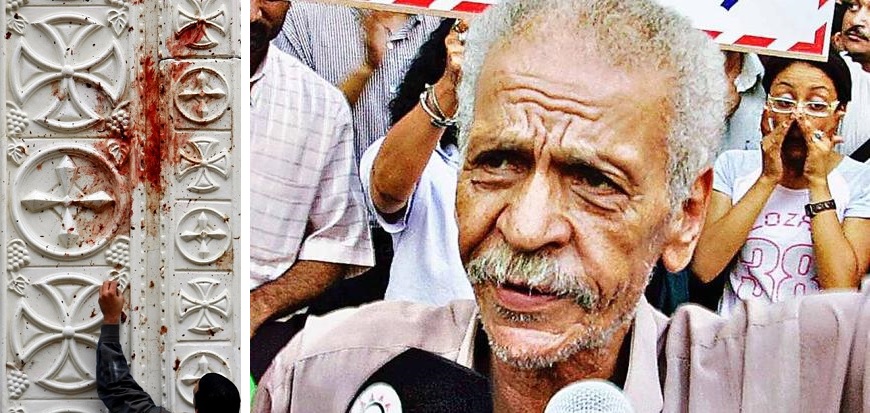
Blood on the church wall in Alexandria (L); Poet Ahmed Fouad Negm (R)

At midnight of New Year’s Eve celebrations at the Two Saints Coptic Orthodox Church in Alexandria, Egypt, a bomb exploded as the crowd began to exit, killing 23. The horrific event birthed a tremendous display of Muslim-Christian unity, as a week later on Coptic Christmas churches were packed with Muslims showing solidarity, willing to die with their Christian friends should a similar attack happen again. The local priest in Maadi said that Christmas was the ‘happiest of his life‘.

The unity following the bombing spilled over into the January 25 revolution, giving a power to the demonstrations that has long since dissipated. But at the time it was contagious, capturing domestic and world attention alike, launching the Arab Spring after its birth in Tunisia.

One of the celebrants was Ahmed Fouad Negm, known in Egypt as ‘the poet of the people’ and a firm revolutionary supporter. He died this month on December 3, but is mentioned here for his poem lamenting the Alexandria attack. Thanks to Paul Attallah for bringing this beautiful work to my attention:

These people say God is love

And we all know how dangerous love is.

So, victorious hero, you had to murder helpless women,

Unarmed pensioners and innocent children to save us all

From the terrible possibility of love.

Botros and Mina should be killed.

Their brothers are already dead in Sinai

And their sons danced at your wedding

And offered their condolences at the funerals.

Marie and Aunt Thérèse deserve to die.

They are people of little virtue.

They always smile in a certain way

And say: Welcome. We value your visit.

And what about your Uncle Hanna?

Whatever the dispute, he intervenes to defend you.

He is so keen on reconciliation

That he cannot be admitted into paradise

You had better murder Sami Nagui Nagib too.

To be honest, I have my doubts about him.

He might be one of them.

He might even have a cross tattooed on his arm.

No, even better, bomb Shubra;

The Kit Kat and Opera House Squares;

Make a grave of the crater in each of these places.

The locals can take it as a warning.

Our God is called The Generous One.

One day you may appear before Him.

You will stand in His presence

And He will ask: What did these people do to you?

For what crime did you kill them who and how and why?

So tell me, hero, how will you respond, what will you say?

May God comfort the families of the victims, bring to justice the culprits, and protect Egypt from similar violence this Christmas season.

Categories
Personal

Not Quite Home for Christmas

Lonely Christmas

I have lived overseas now for about eight years.  We have lived in three different countries, but even so, I feel quite at home here in Egypt, where we have been for four years.  We have lots of friends and my life is busy with four young kids.  For me, living overseas is the norm.  While I love so many things about America, and I would love to live in the same state, or even town, as my family, I am perfectly content living as an expat.

But there are times when homesickness strikes.  Times when you just wish you could be two places at once, or that you could travel over the ocean as easily, and cheaply, as driving from New Jersey to Pennsylvania.  And one of those times is the holidays.  Particularly Christmas.

The family I grew up in still gets together on Christmas despite growing from the original 7 to now 29 people.  And if I sit and think about that too long, especially at the time they are actually gathering, which is usually when I am sleeping here, that can make me sad.  I would love to be with my family on Christmas.  But of course, I am with my family on Christmas as I celebrate with my husband and kids.  What is the difference?

The last few years I have felt that Christmas has snuck up on me.  We celebrate American Thanksgiving, and before I can think about it, I have to have the Christmas Advent calendar up in order to count down to the 25th.  Meanwhile, here in Egypt, the official holiday of Christmas isn’t until January 7, according to the Coptic calendar.  And while you can see lots of Christmas trees and wrapping paper on display at local shops, there isn’t exactly the festive atmosphere that you would find in the States.  One of the biggest reasons the 25th almost comes without notice is that my girls have a regular school day and are either studying for or taking their mid-term exams.  The church where we worship has begun Christmas choir practice for the girls, but their program will be on New Year’s Eve.

And so I am learning what I need to do personally to make Christmas special for me and my family in our home here in Egypt.  I need people and special celebrations.  If we aren’t invited to others’ celebrations, then I need to host celebrations for us (or maybe for me!)  I need to bake and enjoy the time spent in the kitchen with my kids, as that is one of my favorite memories from Christmases in Pennsylvania… all the kitchen preparation beforehand.  I need to listen to Christmas music and make an effort to teach my kids the carols they should know.  We need to attend Christmas productions and concerts at local churches.  And we need to set new traditions that make our Christmases ones that our children will one day miss.

This year I am hoping to host three Christmas teas.  What is easier, and tastier, than making a bunch of Christmas sweets, and inviting others to join and indulge?  One group will be teachers from my daughter’s Egyptian school, where I have begun teaching on a very part-time basis.  This is an experiment and something totally new for them.  Another group will be of Egyptian Christian friends.  Again, a bit of an experiment, but we can celebrate the holiday together, perhaps for some of them in a new way.  And the last group will be of other foreign moms like me.  This will be the most naturally comfortable and possibly the tastiest as they provide some of their favorite traditional sweets.

No matter where we are, if with my husband and our children gathered together, we are home. And this home is now Egypt.  It requires some adjustments and creativity, and perhaps some courage to step out and try new things.  One of our Egyptian traditions is sailing on a felucca on the Nile River on Christmas morning. It is very different from the craziness that ensues when 17 grandchildren descend on my parents’ house on Christmas day.  But these are special times and new memories that we make ourselves. Perhaps one day our own children will have a longing for Egypt. But we pray they will be able to celebrate wherever they are, even if not quite home.

Categories
Personal

Unintended Recipients of Generosity

Generosity

‘Make sure your kids come to Sunday School tomorrow,’ their teacher told Julie. Snug in bed, my wife ignored her first call at 10:45pm, but then picked up on her second effort at 11:00. Egyptians are well known as night owls, though they don’t usually call us so late.

‘There will be special visitors,’ she told Julie in Arabic, but the key word to follow was in an unclear English. ‘They will give each child books.’

Great, we thought. Emma and Hannah both have been making progress in their Arabic reading, and now they would be receiving additional age-appropriate materials we could use at home. Only we weren’t sure she said books. It might have been boox.

Regardless, it was nice to be invited. She didn’t want our children to miss out.

Upon our arrival in Egypt four years ago we began attending the Coptic Orthodox Church, which we discovered had a wonderful Sunday School program. Coptic laity is required to complete a year-and-a-half long training course before they serve officially in any capacity. We kept a close eye on content, especially early on, as we were still learning the intricacies of Orthodoxy. But we appreciated the spirit and love with which they teach, and our kids’ participation helped us as parents feel part of the community. Besides, David and Goliath is the same in any tradition, and on the occasions they taught about specific saints it was a learning process for us, too.

But this teacher was calling from the Arabic Evangelical Church. Her earnestness was in part due to the fact our kids hadn’t gone there since we came back to Egypt after a summer in America. This wasn’t the first time she called to inquire.

The Evangelical Church is more akin to our American heritage, but consistent with the night owl nature of Egyptians, their services don’t begin until after our kids go to bed. So we never became part of that community, though we discovered their Sunday School program began right after the one at the Orthodox Church ended. The two are about ten minutes away walking distance, and our kids are not the only ones who attend both.

They, and we, appreciate this Sunday School also, but churches across Egypt changed over the summer. President Morsi was deposed, hundreds of his supporters were killed when their protest site was cleared, and the next day dozens of churches across the nation were attacked. Nearly every Friday since then, Morsi supporters have marched through the streets. Many have been peaceful, a few have been involved in unclear violence, but all have sprayed graffiti on every nearby wall or sign. Anti-Christian slogans have been commonplace, blaming them for siding with the popular revolt against the Islamist president.

As a result, many churches have moved up their service times so that people can get home before Friday demonstrations begin, just in case sectarian violence rears its ugly head. And here it is necessary to clarify that in Christian Egypt, Sunday School takes place on Friday. The weekend is Friday and Saturday, and most churches hold their main services coinciding with the Muslim day of prayer, when everyone is off.

This meant the Evangelical Church now held its Sunday School at the same time as the Orthodox Church. We had to choose, and our Egypt roots were stronger in the latter. The teacher called us regularly to invite us back, and we apologetically explained our situation.

But this time there were boox.

The teacher assured we just had to get there before a certain time, so we booked out of the Orthodox Church and made our way. Hannah, especially, led the charge pushing the stroller beside me. When we arrived we noticed a few other new faces, perhaps like our own.

That is, in the sense of ‘not regular attenders’ rather than ‘foreigners’. The open area outside the church was filled with Egyptian mothers dressed in the traditional village garb of a long robe and head covering. Granted, we haven’t attended for a while, but this Evangelical Church is more generally frequented by the middle-to-upper class residents of Maadi, the upscale Cairo district where we live. Not far away are lower-to-middle class areas, too, but village dress is not the norm for this church. Maybe they were there also for the boox?

Now, Egypt unfortunately is not known for its love of literacy. We began to suspect the teacher was not promising books, but a box. As the first few children left their classes, we saw we were right.

We didn’t know how right, though Julie started to wonder. Were these boxes from Samaritan’s Purse?
Operation Christmas Child

Samaritan’s Purse is an American based Christian charity, and one of their signature campaigns is Operation Christmas Child. Kindhearted people in churches across the country fill shoeboxes with toys for underprivileged children around the world, who might not otherwise receive anything for Christmas.

And out marched our three girls with huge smiles.

I’m sure Samaritan’s Purse orchestrates with churches throughout the country, distributing many boxes in poor areas. 40 percent of Egyptians live below the poverty line, so there are certainly many needy. But dollar store type toys are readily available in Egypt, and the Orthodox Church does a very good job of making Christmas special, here celebrated on January 7. Toys and treats are given freely even in rural village churches, and families sacrifice to make sure their kids have new clothes for the holidays.

I’m not saying the charity is unnecessary, but it was odd to see Samaritan’s Purse in Maadi. And it was fully ironic that a generous Florida mother sent her shoebox across the ocean to be received by our five year old daughter. Her toys were not even the made-in-China variety; Hannah got an electronic battle hamster that darts across the floor.

Perhaps God’s generosity is similar. He makes his rain fall on the just and the unjust. He gives full wage to those who work but a few hours, while praising others for contentment with the crumbs that fall from their master’s table.

We can trouble ourselves – and perhaps we should more often – why God’s generosity seems instead withheld from those who need it most. Or, we can take the lesson and apply it with whatever we have, to whoever we meet. When we visited that poor, rural church, our children were honored also. There is a similar ministry here in Cairo that gives Christmas gifts to the children of local Sudanese refugees. Perhaps the value of the Florida mother’s gift was to prompt imitation in our family to them.

In one sense we are to bless those we know in need; in another, we are to cast our bread upon the waters. We were unintended recipients of generosity, and while laughable, it is humbling. Therefore, let us be generous also, by nature, so that blessing comes to all who cross our path, many of whom will be unintended.
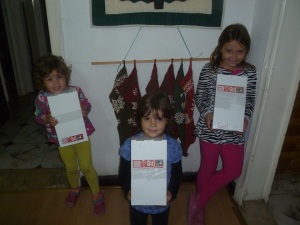
 Girls with OCC Gifts

Categories
Personal

60 Minutes on the Copts of Egypt

60 Minutes Copts

On Sunday and Monday this week I noticed an unusual spike in the views of this blog. A post I had written in April 2012 was attracting far more traffic than normal. Entitled ‘Applying the Cross (On Your Wrist)‘, all sorts of search engines were directing queries my way, looking for ‘Coptic crosses’, ‘Coptic tattoo’, and the like. Later they day I think I found out why.

On Sunday, the popular American television news magazine ’60 Minutes’ ran a segment on Coptic Christians. One of the more poignant snapshots was of a little girl being tattooed with a small cross on her right wrist. That location featured is in a popular cave church located in the garbage collecting district of Cairo, and I had profiled the tattoo man in the post linked above.

In a post two years earlier I wrote a similar article about my then four year old daughter, who drew a cross on her wrist at her Coptic preschool. ‘Emma’s Saliib‘, with ‘saliib’ the Arabic word for ‘cross’, has a few cute pictures if you are interested.

But of the program in question, CBS did a very nice job describing the Coptic community – true to form without being overdone. Please click here to watch their 15 minute segment.

And finally, if you would like more information about Bishop Thomas, who spoke about the response of Christians after their churches were burned, here is a profile, entitled ‘Almost a Jonah‘.

Having lived here for four years now, we are very partial to the Coptic community, noticing both its faithfulness and flaws. 60 Minutes made me proud.

http://www.cbsnews.com/videos/the-coptic-christians-of-egypt/

Categories
Personal

Safwat Hegazi, Body Double?

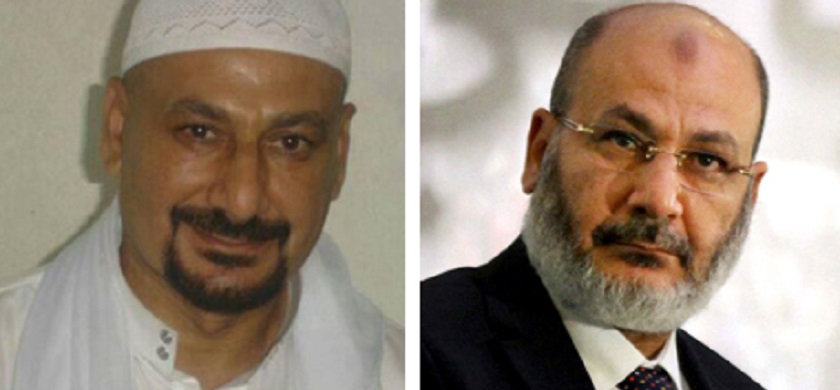
Safwat Hegazi (R, L?)

In late August and early September I published an article and two other posts about Safwat Hegazi, one of the more controversial Islamist supporters of Mohamed Morsi.

The article collected links and information about his often inflammatory speeches and public statements, calling him a Bellwether of Egyptian Islamism.

The second linked to a full article describing an interview conducted by Arab West Report at the Rabaa al-Adawiya protest site. In it he comes across as very reasonable, denying any membership in the Muslim Brotherhood.

And the third was a link to a very surprising video confession by Hegazi about his regretful association with these protests, sad to see them provoking bloodshed. That post expressed a bit of shock leading to the title, Safwat Hegazi, Stool Pigeon?

Several weeks later in a conversation with a Salafi friend, we discussed Hegazi. ‘That video,’ he said confidently, ‘was faked. Hegazi might be dead or he might be in custody, but that video looked nothing like him.’

It made me recall my initial surprise, both in his confession and appearance.

Hegazi’s trial has now begun, in which he declared the released photos were fake:

Egyptian hardline Islamist preacher Safwat Hegazy said Saturday during his ongoing trial that photos of him following his arrest released by Egypt’s Interior Ministry were fabricated, according to the Muslim Brotherhood’s Freedom and Justice Party website.

Hegazy, who appeared in court on Saturday along with FJP leader Mohamed El-Beltagy – both charged with inciting violence – reportedly said photos released online by the ministry upon his arrest in August were fake.

The photos showed him with a shaved beard and only a dyed-black goatee. Hegazy stated that he never shaved his beard prior to his arrest.

The allegedly fabricated photos of Hegazy stirred public confusion following their release over the significant changes in his appearance since his detainment. It was widely believed that he had changed his appearance to avoid detection.

Hegazy appeared in photos of Saturday’s court session with his trademark white beard.

The confusion continues. Were the released videos and pictures real, an attempt at character assassination, or irrelevant either because of his overall innocence or outstanding guilt?

But there is another twist besides:

Judges of Cairo Criminal Court recused themselves Saturday from the trial of Muslim Brotherhood leading figure Mohamed El-Beltagy and Islamist preacher Safwat Hegazy, saying it has felt unease over the case.

No further explanation was given. Was the unease due to an obvious miscarriage of justice, or fear of Islamist supporters if they carried out justice?Or, was it simply from an inability to conduct the trial, as in this related case:

A second panel of judges has withdrawn from the trial of Muslim Brotherhood leaders accused of inciting the killing of protesters.

The defendants refused to recognise the court, dubbed it “void” and “illegitimate,” and chanted “down with the military rule.”

The judges said they were unable to conduct the trial properly.

Like many questions of the revolution, we will have to wait and see, but waiting often takes a long time…

Categories
Personal

Our Little Ones Watch a Protest

Rabaa Child
From a protest elsewhere in Maadi

The other day Emma’s best friend, Karoleen, and her younger brother, Boula, came over to play at our home following church. As the kids were gathered around the table working on crafts, I heard the familiar sounds of a protest approaching. A fair number have passed near the house in recent months, although they usually go down the main street perpendicular to ours. Since we live on the ground floor, we usually don’t get a good look despite the noise, but this time they turned and came in full view.

We had been looking for an opportunity to film a protest for a recent video we made about the changes in our neighborhood since we returned from a summer in America. So I dropped the construction paper I was cutting up for one of my daughters, grabbed the camera and ran to our play room, which is a glass-enclosed porch. This gave me the best view I could get of the marchers.

I opened the window and screen, just enough to stick the camera out, but I still felt conspicuous. I didn’t really want to attract any attention from the protesters, but I was willing to risk a bit for a decent line of sight. As they marched, I noticed that some of them looked at our house, but not, as best I could tell, in my direction.

But it was then I heard the shouts and screams from my own kids and their friends in the other room, as they watched the protest go by from our living room windows. That’s why they were looking our way.

Two weeks earlier a protest had gone past Karoleen’s house, about ten streets away from our home, while Emma and Hannah were playing there. Her mom told me afterward that it made Emma concerned, even for us in case the protest came towards our home. But Karoleen’s family lives on the 7th floor of her apartment building, far above the action.

So as I was filming, I was simultaneously hoping the kids weren’t too afraid now that they were outside our window. As it turns out I had nothing to worry about. The kids loved it.

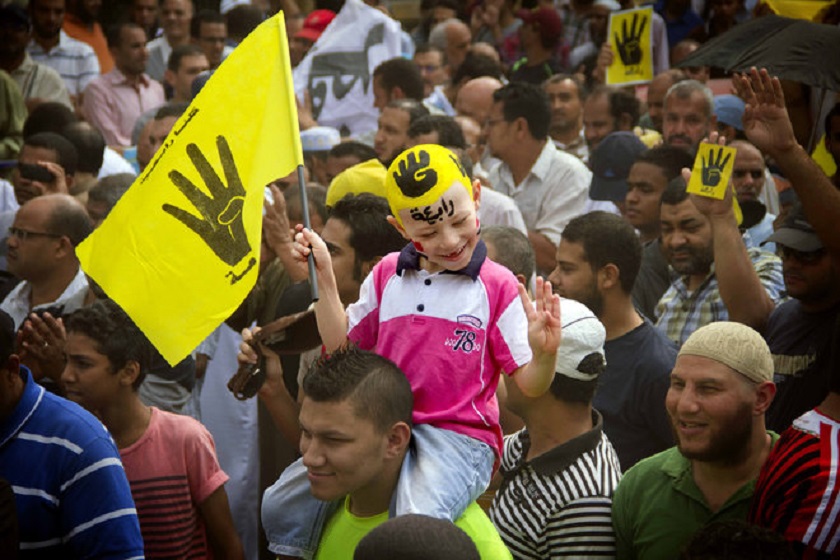
They noticed the bright yellow hand signs, though they didn’t know what they meant. They especially took interest in the kids who were marching along in the protest. There were balloons and chanting, which sounded more like cheering to them. In this particular march, there was nothing to be afraid of. It was a friendly, jovial atmosphere.

When I returned to the table the kids talked excitedly about what they had seen. The planned craft was abandoned as they used the construction paper to make protest banners. Theirs, however, bore the name ‘Sisi’ as opposed to ‘Morsi’, in favor of the current military leader who many see as a hero. They teased each other about being ‘for Morsi’ as they bantered around the table. I didn’t realize what fun it would be for them to have political discussions, though this was not the first time our children had taken sides.

In the end, I got the video we had been looking for, and the kids received some unexpected entertainment. We appreciated the peacefulness of the protest, and wound up happy they turned down our street.

It wasn’t until later we were less pleased, noticing the graffiti they had sprayed on our walls. ‘Sisi is a killer,’ they wrote, and, ‘Against Oppression.’ The latter is a message we won’t mind our children seeing every day, but the first one is not so nice. Of course, neither was the explanation we had to give about the yellow signs, commemorating the hundreds of pro-Morsi protestors who were killed when their campsite was cleared.

Our kids, of course, pay little attention to the graffiti. It will be the image of the protest that will stay in their mind, which we invite you to share in also.

'Sisi is a Killer'
‘Sisi is a Killer’
'Against Oppression'
‘Against Oppression’
Categories
Personal

Salafi Muslims and American Thanksgiving

Salafi Thanksgiving

From Christianity Today, a very interesting article about an evangelical historian who challenges the received traditions of the Puritans:

In 1623, Plymouth Colony Governor William Bradford proclaimed the first Thanksgiving. “The great Father,” he declared, “has given us this year an abundant harvest…and granted us freedom to worship God according to the dictates of our own conscience.” He directed the Pilgrims to gather that November, “the third year since ye Pilgrims landed on ye Plymouth Rock, there to listen to ye Pastor and render Thanksgiving to ye Almighty God for all his blessings.”

Except Bradford didn’t write that. Someone—we don’t know who—fabricated this “proclamation” in the late 20th century.

The author takes note of how American Christians are at a bit of a crisis point concerning their national history:

American evangelicals seem to have reached a crisis point over the study of history, especially the history of the American founding. For decades, many evangelicals have turned to popular history writers who have presented America, especially of the colonial and Revolutionary era, as a straightforwardly Christian nation.

But take the popular belief that the pilgrims came to America in search of religious freedom. It is not wrong, he argues, but subject to misinterpretation:

He demonstrates that the quest for “religious freedom,” in the modern sense, did not really animate the Pilgrims. Yes, they wanted to find a place where they could worship God according to Scripture and the dictates of conscience. But they had already discovered those conditions in Holland, where a number of English dissenters had gone in the early 1600s.

The most pressing concern that led the Plymouth Separatists to leave Holland was that they found the Netherlands “a hard place to maintain their English identity and an even harder place to make a living.” They did not worry so much about religious persecution (at least not since they left England), but about “spiritual danger and decline.” They worried about the cultural corruption they saw around them in foreign Dutch culture, and struggled to find profitable employment that could nourish their common identity. America seemed to offer both better opportunity and a place to preserve their sense of covenanted community.

And, just to throw in one ugly incident:

We should remember, McKenzie cautions, than not long after the first Thanksgiving—which was indeed a peaceful, if tense meal between the English and their Wampanoag neighbors—the Pilgrims launched a preemptive assault on local Massachusetts Indians that resulted in violence and bitter resentments. The English even placed the severed head of one Native American on a pike outside their fort. Recalling this is telling the truth, not revisionist history.

What does any of this have to do with Salafi Muslims? Nothing at all, except by way of similarity.

The word ‘Salaf’ in Arabic means ‘forefathers’, and Salafi Muslims honor in particular the first three generations of Muslims. This was the golden age of Islam, when the community lived the teachings of the Prophet Muhammad. In all current religious interpretation – even in political and cultural matters – Salafis believe Muslims should study this period and apply its lessons accordingly to modern life.

Many Muslims honor this heritage without calling for the same level of imitation as Salafis. But most all of the faithful prefer not to open this history of these forefathers to questioning.

There are two issues at stake. The ancient challenge was given by Shia Muslims who said the community went wrong right after the death of Muhammad. Leadership, they say, should have been passed to Ali, within family lines. It was only the political scheming of these forefathers that prevented his immediate succession, and it was their further scheming that resulted in the loss of his role as caliph.

Sunni Muslims were the political and numerical victors of early Muslim in-fighting. But the Shia challenge contributed to the sanctification of these early generations who established the caliphate. They were also the assemblers of Muhammad’s sunna, his words and deeds not found in the Qur’an, so demonstrating their honesty was paramount. Just as Muslims find it terribly difficult to accept a word spoken against Muhammad, so do Salafi Muslims, and many beside, take offense if the Companions of Muhammad are questioned.

The modern challenge questions this sacred history as well. Using mostly Muslim sources, increasing numbers of historians are dissembling the received traditions about the development of the early Muslim communities. And similar to scholars who try to trace the human origins of the Bible, some also find other than divine influences in the Qur’an. The consequences can be dire for those engaged in revisionist history, or, let historians judge, telling the truth.

History, of course, is often deeply contested. Defining the past is a good way of determining the future.

For American Christians, revisiting the history of Thanksgiving is not nearly as threatening as the accusation that the Trinity was invented at the Council of Nicea, for example. But for a people confident in the idea that God has blessed America, there is often the implicit assumption that he has done so – from his sovereign purposes, of course – but also because of the Christian faithfulness of America’s founders. There is also often the modern application, with political overtones, that if America returns to her Christian heritage God’s blessing will come again.

It may well. ‘If my people, who are called by my name, will humble themselves and pray and seek my face and turn from their wicked ways, then will I hear from heaven and will forgive their sin and will heal their land,’ God said to Israel. Americans Christians consider themselves part of the family of God, his people. Should the land of America be considered a possible heir to this promise?

Either way, both American Christians and Salafis must face up to any possible ‘fabrications’ of their history. If this is a crisis point for evangelicals, it is hardly a blip on the radar for Salafis. But both groups have invested heavily in the sacred narrative of their secular traditions. As the author closes in his article:

The temptation toward idol-making seems much more pressing with the titans of America’s national history, those who line the mall in Washington, D.C. Jefferson, Lincoln, Washington: These are the ones that, despite limited evidence of orthodoxy, many of us want—or need—to be evangelical Christians, just like us. We desperately need help to know how to think about those Founders.

Similarly, what will Salafis do with the four ‘rightly guided caliphs’ – Abu Bakr, Omar, Uthman, and Ali? There were fine Muslims, surely, but what does it say that three of them were killed? What of other leaders who opposed Muhammad until the near-end, and then switched sides? Muslims are not ignorant of these controversies; in fact, Salafis study them diligently. But no one should go beyond the limits of the historic evaluation given to the Companions of Muhammad; no one should tar their reputation.

I must stop short of proscription for either community. This post began as an attempt to draw parallels between two communities not often associated together. But I am a historian of neither narrative, so I dare not make pronouncements that can be easily countered by the studied. Neither am I a theologian, certainly not of Islam to make cavalier statements about how to interpret God in their history.

But I hold as a conviction that fidelity to God requires fidelity to truth, come what may. The shaping of pious myths may aid in the development of social and cultural faith, but they are acts, ultimately, of manipulators. ‘God will bring to light what is hidden in darkness and will expose the motives of the heart.’

He may take a long time in doing so, but this Thanksgiving, let us be thankful that God will guide us into all truth.

Categories
Personal

Where Fur Meets Faith

I Paw Moses

Since I began contributing articles to Christianity Today my name and email have been linked into a database used by many to promote their cause, article idea, new book, or, in this case… canine apparel. I can unsubscribe anytime I’d like, but every once in a while interesting things come across the board. This one, however, is worth sharing. Perhaps in some odd way it will help their business:

TEMPLE OF DOG…WHERE FUR MEETS FAITH

Temple of Dog, a manufacturer of dog apparel and toys, has launched a fun faith-based line of cotton shirts. With sayings like “Kiss me, I’m Chewish,” and “Boneified Christian” these canine tees are great for faithful Fido to show off his faith! And, just in time for Halloween and the holidays, your furry friends can sport a slew of festive tees, like “Fleas Navidad” and “Yappy Yamaka.” Temple of Dog provides pure tail-wagging canine couture.

Temple of Dog (TOD), a manufacturer of dog apparel, toys and cards, today announced the launch of their faith-based line of cotton dog shirts, offering dog owners a variety of sku’s and sizes designed within the Jewish, Christian, Buddhist and Mormon disciplines.

They weren’t interested in the Muslim market? Perhaps they did their research well; many Muslims consider dogs to be unclean.

“The idea started as a ‘chocolate-meets-peanut butter’ moment,” explained co-founder Cynthia P.  Jenkins. “Blending one’s personal dogma with his or her dog is a match made in heaven.”

Dog and dogma… Clever, or way too obvious?

The American Pet Products Association reports that Americans will spend $55.3 billion on their pets this year, a 7.9% increase over 2012. Halloween pet spending accounts for $371 million and the average holiday shopper averages $46 per pet. To that end, Temple of Dog will be adding additional religions and products to their line this month, including: “Yappy Yamaka” and “Fleas Navidad” greeting cards; “Doggie Lama” and “Latter Day Saint” dog shirts; and “Let’s Nosh!” and “My Bowl Runneth Over” bowls.

“Our pets – along with our faiths – are essentially recession-proof,” said Gardenswartz and Jenkins. “Our only limitation is the real estate on a dog’s body.”

In just about every culture the religious temple has also been a marketplace – it’s where people congregate. See my previous article on atheism if your disgust runneth over.

If not, click here for more information. Jesus also said to use worldly wealth to make friends for yourself, so perhaps Temple of Dog should be saluted instead!

Temple of Dog

Categories
Personal

Changes in the Neighborhood

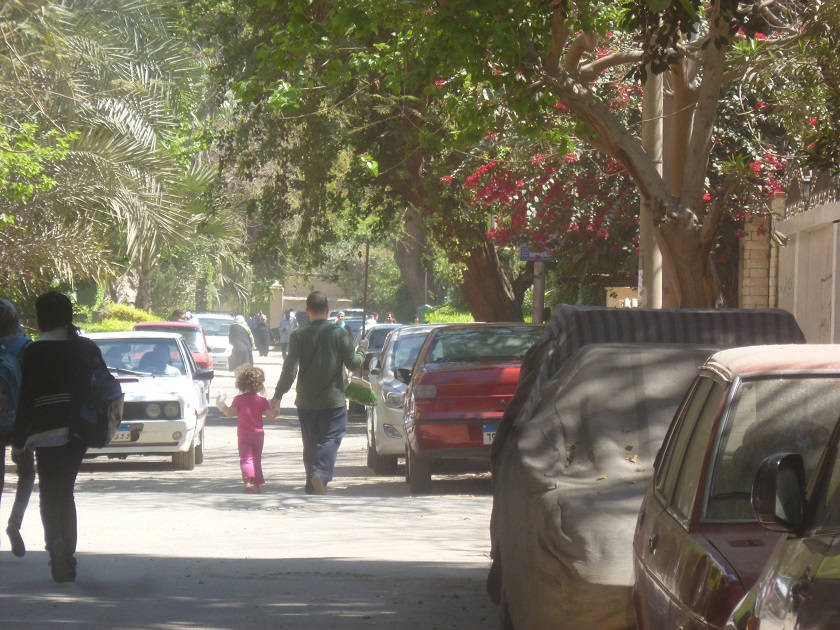
Maadi Street

We spent a good part of this past summer in the United States, far away from the explosive political situation. As we prepared to return, nearly everyone asked a similar question: Is it safe?

It was a fair question. Hundreds of supporters of the deposed president were killed while security dispersed their sit-in. Dozens of churches across the country were attacked, with many burned. It was a volatile situation.

But it was also a geographically limited situation. As we inquired about our own neighborhood of Maadi, we were constantly assured that things were safe and that violence was taking place in known locations.

After several weeks back, we made this video showing local slices of life. There have been changes, and we note them. But we also hope you get the idea that life moves as normal. We’re glad also you get a small window into this our normal life, and can rest assured we are doing well.

Categories
Personal

Surveying Foreign Christian Residents in Egypt on the Interpretation of Political Events

St. John's Church Maadi

In Egypt’s current political struggle both sides are using the media to highlight their interpretation of events. State media is accused of turning the nation against the democratically elected president and his backers in the Muslim Brotherhood. Meanwhile, anti-Islamists target Western media in particular of having a bias toward the Brotherhood, against the military, and neglect the popular role in Morsi’s overthrow.

This survey was designed to test one overlapping segment within this struggle to establish a media narrative: foreign Christian residents.

Two assumptions were made of this community. First, they would be sympathetic to local Coptic opinion, which is strongly anti-Islamist. Second, they would be consumers of Western media and generally trust their journalistic professionalism.

Thirty-three individuals were surveyed, including both leaders and laity of the Catholic and Protestant foreign communities of Egypt. They were asked fifteen questions concerning recent political events beginning with the election of Mohamed Morsi as president. Each question was provided various options, reflecting the opinions and conspiracies of both camps.

Participants were allowed to choose more than one answer, if multiple interpretations were possible. They were asked only to choose according to their leanings and perceptions, not according to an elusive certainty or proof. Not all participants answered each question. In the results which follow, this explains why some percentages are provided with the qualifier ‘among those responding’.

Here are the questions as they were posed to participants:

1.      Did Mohamed Morsi legitimately win the presidential election?
2.      Were Egypt’s political problems caused by:
The desire of the Muslim Brotherhood to dominate
The deliberate non-cooperation of opposition parties
Normal competition after a revolution
3.      Were Egypt’s economic problems caused by:
Morsi’s mismanagement
State sabotage of gas and supplies
Continuing deterioration since the revolution
4.      Did Western powers support Morsi because:
He was the legitimately elected president
They desired the Muslim Brotherhood to replace Mubarak
They desired Islamist rule to weaken Egypt
They desired to discredit Islamism by letting it rule temporarily
5.      Did Morsi and the Brotherhood desire:
To turn Egypt into an Islamic state
To recreate the Mubarak regime
To shepherd in a civil democracy
6.      Was the Rebellion (tamarrud) Campaign:
A grass-roots movement expressing popular rejection
Aided by the military/state/businessmen
A conspiracy to end the Morsi presidency early
7.      Should the military have:
Intervened to depose Morsi as actually happened
Waited longer to see how things would develop
Not intervened at all
8.      Was the military action a coup d’etat?
9.      Was the removal of Morsi:
Mostly positive for Egypt
Mostly negative for Egypt
Both positive and negative in different ways
Necessary for Egypt
10. Should the Rabaa al-Adawiya protest site:
Have been dispersed
Have been relocated to another area
Have been left to protest indefinitely
11. Why did so many people die:
Because of deliberate excess force used by the security services
Because of poor training in crowd control
Because of pro-Morsi armed resistance
12. Were the widespread attacks on Christians and their churches:
Orchestrated by the Muslim Brotherhood
A spontaneous reaction by pro-Morsi supporters
The action of criminals exploiting the situation
A conspiracy by the state to tarnish the Islamists
13. Should the Muslim Brotherhood:
Be labeled as a terrorist organization, banned, and prosecuted
Be invited into national reconciliation
Be allowed to participate in the new democratic roadmap
Be forbidden from politics but allowed a social role
14. Does the military desire:
To rule directly (perhaps through a retired general)
To have influence and guardianship from behind the scenes
To maintain its economic privileges
To secure a true and open democratic transition
To destroy the Muslim Brotherhood
To prevent Islamist rule in general
15. Will the coming months/years in Egypt witness:
The development of an emerging democracy
The return of an autocratic state
New economic prosperity
Continued economic deterioration
A reversal back to Islamist rule (democratic or otherwise)
Low-level, but violent Islamic insurgency
War (either civil or regional)


Each possibility was given a ‘yes’ or ‘no’ choice to indicate the perception of the participant.

Here are the key findings:

Did Mohamed Morsi legitimately win the presidential election?

  • 52% said yes, 48% said no, roughly mirroring his percentage of winning

Egypt’s political problems were caused by:

  • 97% of all surveyed believed it was due to the MB’s desire to dominate
  • 45% also blamed deliberate non-cooperation on the part of the opposition
  • 36% attributed it to normal competition after a revolution

Egypt’s economic problems were caused by:

  • 82% blamed Morsi’s mismanagement
  • 42% also blamed a state policy of sabotage
  • 82% believed the poor economy following the revolution played a role

Western powers supported Morsi because:

  • 73% believed it was because they recognized him as the legitimately elected leader
  • 24% believed they desired the MB to continue Mubarak’s policies, with 9% support for other conspiracy theories

The political desire of the Muslim Brotherhood was:

  • 100% to turn Egypt into an Islamic state
  • 0% to turn Egypt into a civil democracy

The Tamarud Campaign was:

  • 82% believed it to be a grass roots campaign
  • But 67% believed it also to be sponsored by the army, state, or businessmen
  • Even so, respondents divided evenly if it was a conspiracy to remove Morsi from power, though only 30% of everyone surveyed indicated this

On military intervention to depose Morsi:

  • 70% agree with their decision to do so, as opposed to waiting longer or doing nothing
  • But 47% call it a coup anyway, while 53% believe it does not deserve that label
  • 93% of those responding believe this action was mostly positive for Egypt
  • 75% find that it was also somewhat negative
  • 85% believed it was necessary

On dispersing the pro-Morsi sit-in:

  • 79% agreed with the decision to do so
  • 88% believe that many people died due to the MB’s decision to resist with arms
  • 45% also believed the security forces deliberately used excess force
  • 48% believed poor training on the part of the security forces contributed

On the subsequent attacks on churches:

  • 76% believe these were orchestrated by the Muslim Brotherhood
  • 58% believe it was a spontaneous action by Morsi supporters
  • 48% also thought criminal elements were involved
  • 9% believe it was at least also a state conspiracy to make Islamists look bad

The Muslim Brotherhood should be:

  • 42% believed it should be labeled a terrorist organization and banned
  • Only 27% opposed this designation
  • Responders were roughly divided between inviting them to national reconciliation and allowing them political participation in the new elections, with slightly more positive response

The military desires:

  • Of those responding, 59% did not believe the military wants to rule directly
  • But 73% believe they want to maintain significant influence behind the scenes, and 52% to maintain their economic interests (0% opposition to this idea)
  • Of responders, 60% believe the military wants to conduct an open democratic transition, but 40% do not
  • 48% believe they want to destroy the Muslim Brotherhood, and 61% believe they want to prevent Islamist rule in general

The future holds:

  • 48% of all and 73% of responders are confident a real democracy will begin to emerge
  • At the same time, of those responding, half fear the return of another autocratic system
  • 55% believe the economy will continue to deteriorate, with only 27% predicting new prosperity
  • Only 3% predict a return to Islamist rule, but 79% predict a continued low-level Islamist insurgency
  • 9% predict war in Egypt’s near-term future

In quick summary, therefore, this sample of foreign Christian residents of Egypt indicates the community largely accepts the anti-Islamist narrative concerning the Muslim Brotherhood, while at the same time displaying significant, but not universal, distrust about the role and intentions of the military and state.

Determining whether their perceptions are correct or incorrect was not the goal of this survey. Rather, results indicate the following possibilities:

  • Foreign Christian residents are disproportionately influenced by local anti-Islamist sentiment or their own anti-Islamist inclinations
  • Western media has not exhibited sufficient pro-Islamist bias to sway their interpretation of events, but has contributed to a distrust of local actors
  • As residents, these foreign Christians are well placed to interpret local events.

Other interpretations are also possible, including combinations of these three.

Western media is understood to be professional in its coverage, though subject to the ability to find suitable local spokesmen to convey perspectives. Most actors in Egypt are polarized and subject to their own biases.

Egyptian state media, however professional, is understood to be the voice of the government, and independent media has been drawn into the local dispute. Pro-Islamist media has largely been shut down.

In wading between the two, one further assumption is necessary concerning foreign Christian residents: They will represent the truth as they perceive it. The value of this survey consists therein.

Categories
Personal

Humble Wrestling: The Only Solution for Islamists and Christians?

I believe events like this conference in Jordan, excerpted below, are absolutely necessary, even if they don’t really go anywhere. But agreement can never be achieved unless they go at all. Here, from al-Monitor, is an example illustrating absolutely different worldviews:

So an obvious question was posed to the Islamists: Do you accept, alongside your Islamic laws and alongside the personal status laws for other communities, that in your countries there is also one civil personal status law that is optional? In other words, do you accept that a person is given the choice to either follow the laws of his sect or leave his sect and resort to the civil law under the confines and protection of the state?

Faced with this question, the Islamists did not hesitate to assert their absolute refusal of the proposal: a civil law, even if optional, is forbidden — a person may not leave his religion. By “person” they mean a “Muslim,” because current laws allow non-Muslims to convert to Islam. Sometimes they even encourage it as a means to either escape harassment or obtain a government job reserved for Muslims, in addition to dozens of other reasons.

In lieu of agreement, the article states attendees suffered ‘a vicious cycle of pleasantries’. Such a description characterizes much inter-religious dialogue, and is useful in its own right. Pleasantries can lead to friendship.

But what is necessary, especially in Egypt, is for Christians and Islamists to wrestle over the future of their nation. Christians may not be able to force their way, but if Islamists were to seek their blessing, and do all that is necessary to get it, they just might succeed.

The Islamists did not hesitate to confirm they have the right to reach power as they see it and practice it. They kept repeating the following mantra: “We will only resort to democracy that emanates from the ballot box.” Many tried to explain to them that democracy is not just the ballot box, but the Islamists did not pay them much attention. The Islamists’ main concern was to assert their rejection of what happened in Egypt and confront the rule of the “coupists,” as they call Gen. Abdel Fattah al-Sisi’s rule, against the legitimate authorities. Regarding the concerns of their fellow Christian citizens, it seemed to a large extent to not be part of their concerns today or tomorrow.

Unfortunately, this has largely been Egypt’s experience.

It is hard for anyone to be humble. Many Islamists might find it even more difficult to seek this Christian blessing, as they see themselves as the possessors of the completed and perfected faith, and furthermore, they are numerically superior. How arrogant, they might think, of Christians not to yield. Don’t we give them protection under sharia law?

Ah, but this means little to them:

One last example that illustrates the dialogue’s difficulties was the discussion about personal status laws in countries dominated by Islamists. The Islamists usually try to show that they are open to other groups by supporting, as a rule, that other sects are given their own personal status laws — whereby every sect is given its own laws governing marriage, divorce, inheritance, adoption, transfer of ownership and other family matters. But at the same time, the Islamists insist that Islamic law is a “major” or a “principal” source of legislation of the state. Discussion by Christian participants at the conference showed that this rule is not sufficient, fair or balanced. In fact, it often conceals a gradual process to subdue non-Muslim citizens in those countries by degrading the minorities’ demographic and geographic presence, Islamicizing society and eliminating pluralism.

Islamists either smile slyly at this complaint, choose to ignore it, or else they cannot even comprehend it – confident in their understanding of God’s will in sharia law as best both for them and for Christians. True humility is harder for the one who believes that he already humbly and generously gives to his ‘lesser’. They have a point, but humility does not prove points. It loves and embraces.

So what should humility look like for the Christians? No one must ever abandon principles and convictions. Humility is not a game of power and pressure. Rather, it must come in an acknowledgment that Islamism is a strong societal impulse, and those who possess it are their fellow citizens.

Here is where it is easy, and necessary, for me to duck out of the discussion. If both sides came humbly, what would they decide? Here, I have no say. Even in asking both sides to come to the table I have nearly gone to far. Why should they yield even that initial bargaining position, when sides are viewed in mutual distrust?

I don’t know, and I can’t convince them. All I can do is trust that it is ‘right’. All I can hope for is that God would honor it, and dishonor all who seek first their particular benefit.

After all, the status quo is not working. Christians are often ignored or used as pawns, and Islamists have failed to successfully establish their project anywhere there is religious diversity.

It is not dialogue that is necessary, though it is helpful. It is wrestling. It is the sort that, like Jacob with the angel, would not let go until he secures a blessing. It is the sort that engages in respect and will not cease until it is mutual.

I don’t know, maybe that is not humility at all. But humility might be able to avoid Jacob’s fate. Though he obtained his blessing, he lived the rest of his life with a dislocated hip.

Christians and Islamists have dislocated far more. Perhaps it cannot be otherwise. Perhaps their ideas are completely incompatible.

Fair enough. Ideas cannot be humble, they can only seek their own. But people are more flexible. People can wrestle.

People can bless. It is time Christians and Islamists begin this strategy with one another, even if unilaterally.