As we mix and mingle with Orthodox Christians in Egypt, it is not irregular to discover items in the faith that do not square exactly with what we were taught in Protestant circles in America. This week, while at an end of year conference for the Coptic Bible Institute I have been attending, I learned that Jesus baptized the twelve disciples.
This probably isn’t a make-or-break point of theology, but John 4:1-2 appears to say the opposite:
The Pharisees heard that Jesus was gaining and baptizing more disciples than John, although in fact it was not Jesus who baptized, but his disciples.
The point came up in a discussion of John 13, where Jesus washes his disciples’ feet. When Peter protests, Jesus states he must do this for Peter to have a share with him. Peter then swings to the opposite pendulum:
Then, Lord, not just my feet but my hands and my head as well!
But Jesus rebutted:
A person who has had a bath needs only to wash his feet; his whole body is clean. And you are clean…
The key point to the story is what does the ‘bath’ connote? According to Orthodox theology, it is baptism, by immersion, which makes one pure before God.
Protestants, by comparison, tend to believe that baptism is only a pictorial representation of one’s new identity as a Christian. As one descends into the water, he mirrors Jesus’ death, and when he comes out, he mirrors his resurrection. It is not the water that makes one pure, it is the faith expressed in Jesus which leads one to obey his command to be baptized.
This is not the site to build systematic theology, but it should be noted that Protestant explanation, though justifiable logically and Biblically, does not fit well with Jesus’ simile of a ‘bath’. Nor does it account well for this verse, from Acts 22:16, where the just-converted Paul is told:
Now, what are you waiting for? Get up, be baptized and wash your sins away.
Before one leans toward Orthodox opinion, however, we must return to the washing of Peter’s feet. The ‘bath’, for them, is baptism, and through it Peter became clean. But when? The gospels give no indication of Jesus ever baptizing. Many of his disciples were baptized first by John, but both Orthodox and Protestants agree this was a baptism of repentance from sin, in preparation for Jesus’ ministry, of whom John said would baptize with the Holy Spirit.
I am certainly not acquainted well with the details of Orthodox baptismal theology, but I learned that the traditions of the church state that Jesus did indeed baptize the twelve disciples. Jesus instructed his disciples to baptize, initiating them in a rite which they were to pass on to others. Logically then, Jesus must have baptized them, inaugurating the movement. Besides, it is baptism that makes one clean, and the disciples needed to be clean in order eventually to multiply the church.
Perhaps the verse quoted above, in which Jesus did not baptize, does not read absolutely. It could be that the Pharisees believed Jesus baptized this great number of followers, but that they were wrong about the multitude, even if right about the twelve. I don’t think it reads naturally that way, but it is possible.
The larger issue seems that Jesus himself defines what made the disciples clean only a short while later. In John 15:3 he states:
You are already clean because of the word I have spoken to you.
Again, perhaps there is a puzzle in determining what this ‘word’ is, but it does not seem to be the baptismal ‘bath’. If anything, it would seem to align better with Protestant thought that it is faith in the word of Jesus that grants an individual salvation, making him clean before God.
Granted, this is only a very superficial treatment of a deep and often debated theological point. There are other sections of the Bible that can be marshaled in defense of baptismal purification, but on my first look, it does not seem to ground well in the story of Peter and the washing of feet, nor in the discipleship experience of the twelve.
Protestants tend to dismiss tradition too easily. Yet without second level study, I wonder if the tradition of Jesus baptizing the twelve was necessary to backtrack a developed theology of baptismal purification into the ministry of Jesus. Then again, just because a story isn’t told in the Bible does not mean it did not happen. John makes this clear at the end of his gospel:
Jesus did many other things as well. If everyone one of them were written down, I suppose that even the whole world would not have room for the books that would be written.
Besides, who would know better about these non-recorded acts than ‘tradition’, preserved and passed down through the community of the church?
Those who have studied well on either side of the issue are invited to state their case in the comments of this post. For the rest, and perhaps especially for them, we do well to take care our developed views do not dictate understandings upon the written text. It is there to speak to us, not for us to speak through it.
For those outside the traditions of the Bible, the point is much the same. We cannot live life without adopting overarching explanations for our experiences. These explanations may well be right; we should take confidence in our best efforts to understand. We should teach what we learn, so the other may benefit. Yet humility must triumph, lest knowledge become cemented, along with the ‘other’, defined in opposition.
Humility is a chief point of the story. Jesus, the one who had the greatest claim on overarching explanations, stooped to serve those who knew less. Yet it takes humility also to be served; this is a trait Peter had in short supply. Eager to prove he had the situation figured out, he nearly rejected the one who could teach him the most, oddly enough, in deference to him.
Yet it was this interplay which gave us the story in the first place. As we live our messy lives one with the other, as long as we hold on to our togetherness, we will learn. So doing, we will teach others.
Along the way, may we all become clean, even as we disagree as to how this happens.
Translation: May 27; underneath is a list of demands
Tomorrow, May 27, could be a portentous day in the development of Egypt, post-revolution. Or, it could come to nothing. Activists, largely those among the earliest demonstrators at Tahrir Square, have returned to social media to call for a 2ndDay of Rage, in order to protest a slowing pace of reform from the ruling military council and interim government. A Facebook page asking for participation attracted 27,000 supporters, but of which only 5,000 said they would participate.
While there have been protests nearly every day since Mubarak stepped down as president, none have been as controversial as this one. The Muslim Brotherhood has declared it will not take part, and has in fact publically condemned the effort. Meanwhile, on the opposite side of the political spectrum, Naguib Siwarus, a wealthy Coptic businessman and founder of the liberal Free Egyptians Party, has also spoken against the demonstration.
At issue is not so much the list of demands; in fact, participants have not exactly put together a unified call. Rather, it is felt that the target of protest is directed at the ruling military council. Many activists have been careful not to directly point their finger at the army, but the understood complaint is reminiscent of the early revolutionary struggle. Protests since the revolution have tended to be about particular issues.
The fear is obvious: The army received unwavering popular support for its role in the revolution, refusing to fire on the people. In light of the violence in Libya, Syria, and elsewhere, Egyptians have been very grateful for army neutrality. Yet the 2nd Day of Rage threatens to drive a wedge between the army and the people. In fact, this is the chief accusation against the activists. If we cannot look to the army to guide our transition, to whom will we turn? The conservative Muslim Salafis, in this regard, have returned to their pre-revolutionary rhetoric – demonstrating against the leader is against Islamic sharia. The Muslim Brotherhood has labeled the activists ‘secularists and communists’, terms sure to draw rejection from a God-fearing population. Rumors are about that the hand of Israel and America are driving participation.
The demands of the activists do suggest dissatisfaction with the military council’s governance. They are frustrated with the slow pace of trials against leading regime figures, especially Mubarak, who only two days earlier was referred to prosecution. They condemn the use of military tribunals, of which human rights activists say up to 10,000 citizens have been subject since the revolution, many of which have been protestors. They call for the replacement of the military council with transitional civilian leadership drawn from all segments of society. Furthermore, they ask for the drafting of a new constitution prior to legislative elections, so as to secure a free and democratic society into which new representatives can be chosen.
This last notion in particular can be judged as somewhat partisan politics. One reason the Muslim Brotherhood is understood to oppose the march is that they are due to fare well in the legislative elections, and will have superior representation from which will constitute the body to craft a new constitution afterwards. Some activists have gone as far to suspect background deals between the military and the Muslim Brotherhood, but this is denied by both parties. Indeed, the Brotherhood seeks to assure Egyptians they seek participation with all political forces, to achieve a civil state. Yet figures from the Brotherhood periodically mention phrases such as ‘sharia law’, and make many wonder if their openness is a temporary strategy rather than a democratic commitment. The Brotherhood, for its part, states there is a media campaign to discredit them and twist words out of context.
With ‘only’ 5,000 people committed to the demonstration, however, will there be much ado at all? Egyptians are tired of protest, focused on the ongoing security lapses and deteriorating economy. If left alone, will the efforts of the activists simply fizzle out?
Perhaps. Yet some activists have been stating that the security lapses and an overemphasis on economy issues is part of the military strategy to slow down revolutionary gains. Youth activists complain they have been squeezed out of the decision making process, as most government pronouncements are issued from behind closed doors. A recent national dialogue has begun, in which many youth were invited. Upon arrival, however, they found senior representation including figures from the disgraced Mubarak regime. Most left in protest, and the dialogue ended abruptly.
Some steam may have been gained today, as four activists were arrested by the military police for distributing flyers calling for participation in the 2nd Day of Rage. The activists’ twitter campaigns went on high alert, mobilizing people immediately to go to their place of detention. They were released later in the day, but individual tweets proclaimed the arrests did the greatest favor for the call to demonstrate. Links to pictures of the flyers rapidly filled cyberspace.
Yet so did a foreboding sense of dread. One activist feared May 27 would come to represent the day the revolution died. Others tried to bring levity by calling on protestors to use humor, as they did so effectively in the beginning. Given the expected high temperatures, some wished to turn Tahrir Square into a beach scene.
On its official Facebook page, the Supreme Council for the Armed Forces stated clearly it would not fire on protestors. Yet it warned that certain shadowy groups might try to infiltrate and bring trouble. The message concluded by stating the army would not be present during the demonstrations, but would be guarding other essential government institutions.
Activists took this as a message that they would be left on their own. One of the young revolutionary groups, the April 6 Movement, declared it would take responsibility for securing the peaceful nature of the demonstration, to prevent any violent infiltrators from sabotage. Yet with the prevalence of ‘thugs’ who have attacked demonstrators previously, might these descend upon activists?
On the one hand, it is feared. On the other, it is feared as a scare tactic to limit participation. Tomorrow has the air of uncertainty that existed on January 24, when Police Day demonstrations were expected. Some of the same questions exist: Will this only be an expression of young, middle to upper class frustration? Will the street care, let alone join in? Regardless, for that protest 80,000 Facebook users committed to participate; the 2nd Day of Rage pales in comparison to previous mobilization.
No one is expecting a 2nd Revolution, though some activists are using that language. What is their expectation, however? How will they know if they win? If their fears are true, and the revolution is being thwarted, can this effort reverse the tide?
My guess is that the 2nd Day of Rage will make a loud protest, but eventually fizzle out. If there is bloodshed, however, will that change the equation? Or, will the popular perception be that they turned against the army, are working against the necessary stabilization of the economy, and will deserve what they get? The former regime tried such a strategy during the infamous ‘Battle of the Camel’; it failed miserably. Conditions are different now; most are still positive about the revolution and thankful for the army. Public relations are probably against the activists.
Does it deserve to be? It has only been four months since the revolution began. Former figures, including Mubarak’s sons, have been sent to prison. Elections are promised, and most analysts believe the military has absolutely no intention of staying in power long term. Meanwhile, security is weakened, as is the economy. The military proved itself trustworthy during the revolution; should it be given the benefit of the doubt during the transition? After all, it has undertaken governance and policing – two tasks absolutely necessary but for which it is ill equipped.
Tomorrow we will see. Yet positions appear to be hardening, creating fissures in the widespread revolutionary unity. Perhaps it was inevitable; it is also dangerous. No one accounts the revolution to be completed yet; might it derail as groups begin to fight for their own vision of success?
It is a very difficult balance fighting for what you believe in, holding others accountable, and maintaining unity at the same time. Perhaps it is too herculean to expect, but it can be pleaded for. May prayers be directed toward safety, sense of partnership, and ultimate freedom and justice to come to Egypt. The nation is still in need.
Much of the political discourse following President Obama’s speech concerning the Arab Spring centered on his direct statement that the 1967 lines should serve as the starting point for negotiations between Israel and Palestine. His phrasing included ‘with mutually agreed swaps of land’, but was largely ignored in the subsequent hubbub. Commentators noticed that the 1967 lines, though serving as the basis of American policy for decades, had never been so publically stated by a US president.
Yet Prime Minister Netanyahu made a public statement, which, though serving as the basis of Israeli policy for decades, I had not remembered being stated so unequivocally. He proclaimed, ‘The Palestinian refugee problem will be solved outside the borders of Israel.”
Within the context of various political responses to this issue, I simply wish to remind readers of the very human lives involved in the refugee issue. Some of these were our friends when we lived in Jordan.
During the 1948 war following the declaration of the State of Israel by the United Nations, the first wave of refugees was created. War creates chaos and destruction; in the midst of this many ordinary Palestinians, with no stake in the fighting, chose to flee.
Yet many others, also with no stake in the fighting, were forced from their homes as whole villages were uprooted under threat of death. This was not a systematic Israeli policy, but neither were these isolated incidents. Yet while international law calls for the right of refugees to return to their homes, official Israeli policy following the war forbade this. Currently, it is treated as a negotiation point; that is, until Netanyahu made explicit what had previously been assumed. The ‘demographic realities’ of Palestinian refugees threaten the existence of Israel as a ‘Jewish’ state.
Among our friends in Jordan not all desired to return. Muhammad, a barber, told me his family now possessed Jordanian citizenship and had a decent middle-class life, with his children in school. He had great sympathy for the refugees struggling in camps, still possessing the keys to their grandfathers’ homes, but for himself, why would he leave? Besides, the homes for those keys no longer exist, long since turned into modern Israeli settlements.
Many say the poverty of the Palestinian refugee camps is due to Arab exploitation. Wishing to maintain an issue with which to accuse Israel, these governments fail in their humanitarian duties to incorporate Palestinian citizens into their own national fabric. These claims appear largely true. There are few saints in this dispute.
Yet there are human beings. These were the pawns in a struggle which originally were swept aside in effort to secure a Jewish predominance in the new state of Israel. They are the pawns who exist in squalor while the politics of peace rumble onward to nowhere. They will remain the pawns of a policy that denies their rights under international law, under auspices of demographic politics. Perhaps a compromise of settlement in an eventual Palestinian state will satisfy. Even so, the moral struggle is compromised as well.
What should be thought of the rhetoric of a ‘Jewish’ state? This is a difficult question since ‘Jewish’ reflects both ethnicity and religion. Many Jews in Israel are secular or atheist. Many Israeli citizens are of Arab ethnicity, Jewish, Christian, or Muslim. Does a Jewish state correspond to the unquestioned legitimacy of a French state or an Egyptian state? Does it parallel the nationalistic hopes of a Kurdish state or a Palestinian state?
Demographic realities are changing the world, challenging the ethnic block notions of nationalism on which current world politics were assembled. In certain parts of the US, ‘white’ no longer represents a majority of the population, especially as the Hispanic population increases through immigration and higher birth rates. In France, the Muslim population increases rapidly, threatening (potentially) its secular foundation. Meanwhile, certain smaller emirates in the Gulf have only a fraction of the population as national citizens, the rest being foreign workers. What do these realities spell for national heritage, and its preservation?
Americans, conceptually, can swallow demographic changes easier than other nations, as we embrace the alternate descriptions of ‘melting pot’ and ‘salad bowl’. Though degrees of diversity are debated in these expressions, both imagine that the end result is a common endeavor toward national values of freedom, liberty, and democracy.
Along American history we have swept away an indigenous people, questioned if we can integrate Catholics or blacks, but in the end our values triumphed over our prejudices. Yet currently we wonder about the threat to so significant a national identity marker as language. Can we allow demographic changes to supplant, or at least saddle alongside, our English tongue?
Along existing notions of statehood, it seems right that the ‘Jews’ should have a nation. Yet it seems wrong that they engineer their demographics to maintain an ethnic (or religious) majority for themselves. Critics of Israel invoke apartheid South Africa; though the comparison is not fair, does the policy of denying ‘right of return’ resemble a similar insistence on maintenance of ethnic power?
Israel is in a very difficult position. They can yield to a Palestinian state, in which they lose control over the area and open themselves to security threats. Or, they can simply annex the land they now occupy and lose the population battle, putting tension between their twin values of ‘Jewish’ and ‘democracy’, in which one might have to yield to the other.
Instead, it appears the policy is to maintain the status quo, no matter how much President Obama declares it to be ‘unsustainable’. Certainly Fatah and Hamas, as well as the other Arab states, share complicity in the problem. Hamas’ charter and other language to ‘wipe Israel off the map’ do not contribute to fruitful negotiations.
Yet while Palestinians suffer internally and in refugee camps, Israel profits through continued expansion of settlements and superior access to water resources. Yes, it risks nurturing the hatred given to an occupier, as well as international approbation. Yet so far, these have not been enough to push her towards a settled peace. Yet, having been invaded multiple times, on what basis can Israel trust a peace?
Yes, Israel’s position is difficult, but so is that of the ordinary Palestinian individual. Since 1948 the thousands of refugees have now become millions. Can Israel be expected to absorb these? It is the hard work of politics that does not allow sentimental morality to dictate solutions. Yet when the hard work systematically denies people their rights, and this on the basis of dubiously moral ‘demographic realities’, perhaps the sentimentality should be given more sympathy. In whatever position you take on Israel, remember the refugee who simply wants to go home.
Unfortunately, over the years on both sides, ‘home’ has become for many a zero sum game.
Onlookers view the burnt Virgin Mary Church in Imbaba
The sectarian attacks in Imbaba on May 7-8 have been widely written about and criticized. Indeed, it was a horrible blemish on Egypt that reeled the nation. Consensus seems to say that the action was planned and executed by Salafi Muslims at the behest of some interest outside of Imbaba. That is, the attack and burning of the church did not spring from neighborhood issues. How far outside of Imbaba is debated, but though the spark came from elsewhere, the fire burned internally. Amidst the condemnations, it is necessary to note it consumed also local Muslim efforts at peace.
These observations were taken from a thorough investigation conducted by the Egyptian Initiative for Personal Rights. This organization has often written about sectarian tensions; in this case, their chief criticism falls on the security forces for failing to get involved to stop the fighting. Yet the testimony they assemble is enlightening. Their report (Arabic only) can be found here.
The basic story is that a group of Salafi Muslims assembled at the St. Mina Church in Imbaba, responding to a request from a spurned Muslim husband that his wife, a Coptic convert to Islam, was being held inside. They demanded to search the premises, Copts began assembling to defend the church, and eventually more and more Muslims filed in, causing multiple deaths and over two hundred injuries. The woman in question did indeed flee from her Muslim husband, was a convert to Islam, but was not present in the church. The episode was a lie propagated to launch an attack on the Christian landmarks of Imbaba.
That the episode was a lie was an early discovery, not of the church or the security forces, but of a Salafi Muslim imam of Imbaba. He heard the story from the belligerent Salafi crowd which originated from outside the area, but announced it to the ordinary people gathering as a falsehood. In what seems to be an unfortunate coincidence, as he was declaring his opinion gunshots were fired, perhaps from the Christian side, if only in the air to dismiss the crowds. Quickly things began to spiral out of control.
Yet not before several other attempts were made to quiet the situation. Local youths banded together and began chanting, ‘Muslim, Christian, one hand!’ while a woman fully covered in niqab shouted, ‘What is happening to Egyptians? Weren’t we all united in Tahrir?’ Yet a group of Salafis broke into their ranks and scattered them, shouting, ‘There is no god but God, and the Christians are the enemies of God!’
Meanwhile, another bearded resident of Imbaba began shouting at them, quoting from the Qur’an, ‘Fitna (spreading religious strife) is worse than killing.’ He continued, ‘Whoever spreads fitna will go to Hell!’, and began to chant, ‘Muslim, Christian, one hand!’
Yet the Salafi group urged the local population otherwise. ‘The Christians have gotten too big for their britches; how can you allow the minority to rule over the majority?’ ‘Muslims, why are you silent? Thirty or forty Muslims have died, and you are silent as the Christians beat us?’
Within the tumult these voices triumphed. By this time Christian families had taken to defend the church and their homes by climbing their roofs and throwing down objects on the attackers. It was probably easy for the ordinary Muslims of Imbaba to get swept up in the rapidly boiling sectarian conflict.
This is not an apology for them. They are guilty for allowing rumor and propaganda to tilt their hearts against their Christian neighbors. This post is only to highlight that there were brave Muslim voices who tried to speak up for the unity of their community. Had this been only a local altercation perhaps they would have succeeded. That it came from outside, from Salafis bent on igniting fitna, it quickly overran and silenced the local voice of reason and tolerance.
In this light, careful encouragement of restraint on the part of the Christians does not exactly hit the mark. If someone is insistent on causing trouble, perhaps there is little that can be done. Yet another aspect of the EIPR report shows how Christians did respond in ways to defend other areas of Imbaba.
Before too long news of the attacks were broadcast on the Christian satellite channel, al-Tariq (The Way). Christians were informed of the efforts to attack all the churches of Imbaba, and urged to assemble in them for their defense. Thousands did, some even coming from other areas. They witnessed small groups of Salafi Muslims driving around in Jeeps, yet when they saw the churches full of people, they passed by. At one location where Salafis still tried to enter and cause damage, they apprehended two and turned them over to the military police. Yet at another location, the Salafis found no Christian crowd, only two church workers behind locked doors. As described in an earlier report, after shooting off the lock, they killed one, another was saved through intervention of a local Muslim, and then they burned the church.
What can one say in retrospect that could have staved off disaster? As EIPR highlighted, the failures of the security forces gave open hand to the assailants. Yet if Christians had not been so quick to fight back, might the Salafi imam’s pronouncement of a lie had been heard? Or would the damage suffered by their community been even greater?
Yet if it is true that outside forces are stimulating conflict in areas more likely to suffer outbreak, how can citizens, both Muslim and Christian, be better prepared should it happen again, elsewhere? Many Christians say privately that Islam in the heart of a Muslim will have him always side against the Christian when conflict arises. This was one of the calls of the Salafi assailants: ‘Muslims, defend your Islam!’ In a crisis situation with limited information, can the ordinary members of a neighborhood resist such a call? Many will rally in the open squares after a tragedy, condemning it and proclaiming, ‘Muslim, Christian, one hand!’ Yet for those, as in Imbaba, who proclaim it into the face of a developing tragedy, can they prove it true and prevent the horrors?
I cannot speak well for what is necessary on the Muslim side. Should I have opportunity to speak with the Salafi sheikh in Imbaba who proclaimed the lie, I will ask him. Yet Christians must overcome their privately confessed fears, and begin public assertions of trust. They must get into their neighborhoods, make relationships, and win friends. All voices in Imbaba have stated that previously relations in Imbaba between Muslims and Christians were fine. I’m sure this is true, but they were not ‘fine’ enough.
Maybe Christians will say they have tried, and it doesn’t help. Perhaps. But it should be remembered, there are thousands of villages and neighborhoods in Egypt that have not ignited in sectarian strife. From fear of Imbaba, knowledgeable that outside forces are at work, ‘fine’ must become ‘strong’, and ‘mutually respectful’. It may not be enough, if some are bent on sowing seeds of fitna. But the effort at resistance cannot be any less than this.
My daughter Emma is soon to be five years old – getting old enough to enjoy the occasional Daddy – daughter date. The idea came up when I was invited by friends at the Coptic Bible Institute I attend to go to the Monastery of the Archangel Gabriel in the Fayyoum region of Egypt. This post will be mostly pictures from our adventure.
Many Copts enjoy taking weekend trips to the dozens of monasteries scattered throughout Egypt, mostly in desert regions. Besides being a fun getaway, they honor their Christian heritage, taking blessing from the ascetic monks and ancient relics. I have joined them on quite a few trips so far, and wrote once about the ‘miracle stories’ that abound in their faith.
It is fun to take the whole family along, but as our youngest is no longer an infant but not yet a toddler, packing three daughters along can be cumbersome. Fayyoum is only an hour and a half away, but as they often like to squeeze several monasteries into a trip, it is common to leave early in the morning, have breakfast and lunch on site, and not return until late in the evening. Coptic children often come along, but we have found we have different priorities in terms of naps and bedtimes.
So, given that this was mostly a fun trip, we thought perhaps Emma could come along too. She missed mommy at points along the way, doesn’t like the attention given to her as a four year old American sideshow in an ocean of Egyptian-ness, but had a good time all the same. Nothing a little monastery ice cream can’t fix.
Rashad, who organizes most of the monastery trips I go on. Each begins with readings from the Coptic Orthodox prayer book, but he also serves as MC for games, quizzes, and gift exchanges along the way.The entranceway to the monasteryThe monastery courtyard. To the left are the old churches; unfortunately, I did not get any pictures as we were there for early morning mass. To the right will lead to the next set of pictures...The monastic cells, where 50 monks are resident, passing their time in prayer, unless they continue to the left of this picture ...... to pray in the caves of the mountains. It is said that the Hebrew patriarch Jacob prayed in these mountains when he came to Egypt.The entrance to one cave in particular, where monks have prayed for centuries.Emma, standing in the small cave window.Father David, who gave us our tour, was born into a wealthy family in Maadi, where we live. During university studies he went often to this monastery where he felt God's presence. After graduation, he took his vows, and has been living here for eight years now.He also sold us the ice cream from the monastery canteen, where he provides his physical labor.Our next stop was not to a monastery proper, but to a monastery which also serves as the bishopric for all Fayyoum churches.The gate to the bishopric. Note in the pictures how the economic state of the location has risen. It is not uncommon for Copts to make donations, even to send money abroad, to modernize their churches and monasteries. The fact that the Monastery of the Archangel Gabriel was so relatively run down was pleasantly surprising. I felt it reflected the state of the monastery from perhaps a hundred years ago, or longer.The iconostasis at the main bishopric church.The seating area of the main bishopric church.Relics from the martyr Stephen, as told in the Acts of the Apostles. The bishopric church had its walls lined with relics of saints, both local and from far abroad. The wealthier a church is, the more relics it tends to have.Relics of Abd al-Masih al-Manahari. As opposed to Stephen, he died only a few decades ago, in the Minia district of Egypt to the south of Fayyoum.
I wrote about Abd al-Masih al-Manahari previously, click here for an account of his life and the process of transforming an ordinary pious man into a saint.
Our group took time at the bishopric to chant a praise hymn to the memory of St. Abram. His relics are visible behind the group, while the words of the hymn are placed on the wall in front of them.Our last stop took us to Lake Fayyoum. I knew of this body of water but was overwhelmed by its size, deep in the desert of Western Egypt.Emma and I enjoyed dipping our feet in the lake ...... and she later convinced me to go knee deep (but not swim).Working on Egyptian schedule, we had lunch at around 4pm, as Rashad brought along food for everyone.Emma enjoyed a bumper car ride with a youth from our group.Bidding farewell for the long ride home. We arrived back in Maadi around 8pm. A fun time was had by all.
Yesterday while visiting the Copts at Maspero, Ramy Kamel, General Coordinator of the Maspero Youth Union, beamed with a smile on his face. ‘The sit-in will end tomorrow. They have agreed to our demands.’
Today I saw Kamel again, sitting dejectedly on the sidewalk. ‘There is one church that is not yet opened. They agreed to it, but Salafis are blockading it. If we can’t trust the government to follow through on their demands due to Islamic opposition, what can we do moving forward?’
In a previous report I wrote more comprehensively about the demands of the MYU, but in negotiation it came down to this: Originally, the MYU requested 250 closed churches to be reopened, and that their arrested colleagues from their first sit-in be released. The government stated the opening of 16 churches was possible, and agreed to retry the Copts (and their Muslim colleagues) in custody.
The MYU then agreed to suspend the sit-in provided the sixteen churches were opened within a week, and three churches opened immediately. The St. Yu’annis Church in Beni Mazar did open, and priests and people entered to conduct officially licensed prayers. The bishopric church in Maghagha was approved, but there was a minor official who seemed to be holding things up, but the MYU did not seem overly concerned about problems there.
The issue, it came down to, concerned the Holy Virgin and St. Abram Church in Ain Shams. Agreement was given to open it, but then it was announced Salafis had surrounded the church to prevent it from happening.
This information was provided by Fr. Mattias Nasr, spokesman for the MYU, during a press conference announced earlier in the day. From the expectations of Rami Kamel and others, Copts had begun disassembling their tents, taking down their banners, and cleaning up the area. Now, all was in question again.
Remains of disassembled tents and banners at Maspero
Many press personnel came in expectation of a closing word that the sit-in was over. The crowd of Copts, however, would have none of this talk, and shouted down the preliminary speakers, including George Ishaq of Kefaya, a veteran reform activist from years before the revolution. He and others spoke of the political compromises necessary in securing rights, especially when 80% of their demands had been met. Not only did the people declare they weren’t leaving – many MYU organizers led them in chanting from the stage. It was a rather disjointed scene.
Fr. Mattias quieted the crowd, and stated that no, the sit-in is not suspended, not until each of the promised three churches are opened.
With this announcement the press conference ended, but information was still coming in real time. The MYU announced over the loudspeaker only a quarter hour later that the promise given to open the Ain Shams Church was oral; the sit-in would continue at least until it was signed and sealed on paper.
I left the area and tried to find my way to the Holy Virgin and St. Abram Church in Ain Shams, which is located on the metro line in northeast Cairo. I learned the church was in an area called Ezbet Atif, and hoped I could find my way from there.
One of the advantages of most Muslim women in Egypt wearing the hijab is that if you are looking for a Christian, you can usually identify their bare-headed women. This woman and her son did not know where the church was, but did bring me to one nearby where surely someone could direct me better.
They did, and helped arrange transportation in a tuk-tuk, a three wheel vehicle operating like a taxi but in crowded city streets.
In my imagination Ain Shams was an urban area, but locating the church in Ezbet Atif reminded me of perhaps a more rural area outside the city. In learning that Salafis were blockading the church, I imagined a ring of people holding their ground in an open area, and that I might be able to speak to someone on the edge to gain their perspective.
As the tuk-tuk driver weaved his way through Ain Shams, I realized the area was even more urban than I imagined. Streets were narrow and crowded; this was a low income area where I had little experience, and stuck out like a sore thumb. Yet along the way the driver told me that Muslims and Christians are one people, and that all get along. He did not know much about the closed church, but he had heard the rumors of the army getting involved somewhere in the area.
I asked him about Salafis. I told him, yes, I’ve lived here a while now, and I know that Muslims and Christians have good relations. But people are saying that Salafis, at least some of them, are making trouble. Do you know of their activity here?
He did not know exactly, but did speak against Salafis as pursuing their individual interest as opposed to that of the nation at large. They are troublemakers, he stated, and may well be being paid to be troublemakers.
Eventually we reached the location, or at least what appeared to be from the commotion. We drove past five or six riot police with shields and batons, walking steadily toward the area but seemingly without strict instructions. The tuk-tuk then could progress no further due to the crowd; when he asked to continue to take me to the church he was told this was impossible; prayer rugs had been lain on the ground, filling the street.
My visit was very short, so any statements must be couched in utmost caution. The carefree tuk-tuk driver suddenly became very concerned for my safety, urging me to get back in so as to take me back to the other church. Why? I asked; he said he would explain along the way.
There was a crowd, and there was tension. But I saw little potential for violence and no sign of the military (though it was possible they were there). When the tuk-tuk initially stopped, a bearded youth in jeans and a button-down shirt took my hand, sensing me immediately to be a journalist.
‘You want to see the church? Come with me. Look. There is no church. There is only a mosque, and the people are praying here. The Christians are trying to make problems, that is all.’
I admit I saw no church. Certainly not the type of church I imagined, that could be surrounded in blockade. The narrow street had all buildings tightly aligned, several stories tall. There was no steeple raised above them, but it was entirely possible one of the buildings was the closed Holy Virgin and St. Abram Church. After all, it was not time for prayers; why would so many people be in the area? Usually only Friday prayers will bring the excess of worshippers that require prayer mats laid on the streets. Today was Thursday.
The youth who took my hand was friendly, and spoke to me in English. I felt comfortable moving forward, but the tuk-tuk driver was not. I pulled away from the youth to pay the driver, but he insisted I get back in the vehicle and move away. Now, I was getting uncomfortable, but around me all seemed calm. Better to trust the local voice, I thought, and we drove away unhampered.
The driver explained that the group there would not be friendly to anyone seeking to photograph the church. I tried to ask him what made him so startled, but I think he misunderstood my question. ‘I am not scared,’ he said. ‘I could leave you there and drive away and be fine, but I am scared for you. They have laid down their prayer mats to fill the street, so that no one can enter the church. They mean business.’
I was very disappointed; thankful for an honest Egyptian guide, but again wondering about principles. I wrote earlier about hesitations in joining the Salafi crowd that protested the killing of bin Laden at the US Embassy. All there was calm also, just like in this crowd, assembled to make their point known, but people all the same. I was approaching seeking information; I have trust in myself to behave in honorable ways, giving honor to all around. I wanted not just their statement; I wanted their trust. Who will go to them and win this, when so many reject them?
Besides, the one who grabbed my hand to lead me wanted me to see the truth, at least his version of it. ‘Don’t be scared,’ he said, seeking to be reassuring. Quickly scanning the crowd, the majority of people seemed to be ordinary lower class Egyptians, not Salafis. These, it is said and is generally true, grow long beards and wear white robes and sandals. They could well have been there, but I did not see them.
Certainly the wise voice is to trust those around you. Time will permit later for learning and relationships. On the way back a Muslim woman in hijab got in the tuk-tuk as well, and my presence as a foreigner sparked conversation between the three of us.
She did not know the area exactly, but did verify there was a church there. Closed or not closed she wasn’t sure, but spoke of their being a problem between steeple and minaret. Specifically, Muslims believed the church would ring its bells during the Islamic call to prayer. This was the only information she had to offer, besides affirming that yes, in general, Muslims and Christians had fine relationships as neighbors. Many of her best friends, she said, were Christians.
We arrived back and I offered the driver double fare, for going and returning. He asked if I had change. ‘We agreed on the price’, he said, ‘I took you back out of concern, not for fare.’ I gave him a bit extra, and thanked him for his help.
Again, my impressions were far too brief to be substantiated. I may well have been on the wrong street. Yet much of this story seems wrong all over.
It is good and right for Christians as citizens to seek equal treatment. Let us suppose the church in Ain Shams was closed improperly. Yet before this, it should be mentioned that many churches in Egypt are built sidestepping the law, rather than in accordance with it. Christians rightly complain the law is a discriminatory encumbrance, and yes, many Egyptians sidestep the law when they feel it unjustly works against them. This is only to say that in the protests of Maspero, Copts demanded the rule of law. It could be that, if applied, not only this church but hundreds of others would need to be closed for their original contravention.
Yet put this aside. At the church which helped arrange my tuk-tuk, I asked how many churches were in Ain Shams. The gentleman there did not give me a number, but listed them one after the other, reaching eight or nine. Ain Shams is a very populated area, and I have no figures on the percentage of Christians. Yet it cannot be said they are without a church.
Maspero and Ain Shams seem a world apart. It is right for the Christians there to demand their churches be opened, but at what cost? Must they demand the army now come and evict these protestors, likely using violence against them? The army has promised not to use violence to evict Copts from their sit-in, and Copts rightfully complained when they reportedly met with violence when ending the sit-in the first time. Must the government’s hand be forced to choose?
Copts desire to see the government choose them over the Salafis, as they interpret events since the revolution to be pointedly in favor of Islamist forces over secular ones, and certainly Christian ones. Right or wrong, they want validation. They feel like they have won in Maspero; if the government does not open the Ain Shams church, they will feel betrayed, and mount even more evidence the government is against them.
It would seem there should be a more Christian way. It is wrong that matters have come to a head; it is wrong that the government is forced to adjudicate in the manner. Again, it is right for Coptic citizens to demand; but is it best for Christian believers to do so?
In their defense, the MYU has consistently stated this is a political action on behalf of citizenship, not a sectarian push for particular rights. Yet now that the heart of the issue is the opening of one church, how political does it remain?
If only Christians might go to the various Salafi sheikhs, make relationships, and seek their intervention. Perhaps Copts will say they have tried; indeed, these churches have been closed a long time and Muslim voices are not loud in clamoring for them to open. Yet the manner of argument has often been confrontational. Many Muslims have joined the Maspero protests, yet for the ordinary ones, opening the church now might seem like giving in to demands, not establishing civil rights. That is not the way the MYU wants the issue to be viewed. Sadly, I think it is viewed this way.
Egypt is at odds with itself, and not just on religious issues. Labor groups, even doctors, are making demands, demands that are probably just. How can these work together to satisfy all?
I am afraid the only answer is trust, and that seems to be in short supply. No, no one should be trusted on face value, but as relationships are built, trust can be gained. Perhaps a small party from the MYU can visit the nearest Salafi mosque, and just listen, asking nothing. All the while, let their political action continue.
Politics, though, makes for compromise and betrayal. Relationships make for trust and consensus. It is hard, currently, for Copts to offer this; they feel they have been let down so many times. Faith, however, demands they continue. If they are able, if they can overcome themselves, perhaps they can lead all Egypt forward. May it so be.
Update: Jielis van Baalen, a Dutch journalist friend, visited the area of the Ain Shams church after I left. He did not reach it due to the large crowds, and stated a local café owner pulled him in to the shop concerned for his safety. Jielis reported seeing few police, no army, but many traditional Salafi outfits. Some of those who moved about were armed. Inside the café was a mixed group of Muslims and Christians. They stated their great annoyance at developments, as many of those wandering around were not from the area. Muslims and Christians get along well, they stated. No one had any issue with the church being opened. After a short while, he also decided to leave.
If Jielis is correct, then it would appear the government would have an obligation to defeat armed gangs imposing their will. This is different than local opposition to a church. The government has stated it will not allow anyone to sow sectarian discord, and has labeled the source of such discord to be counterrevolutionary forces, tied to the former regime. If Ain Shams is an example of this, then the words of the government will be put to the test, in this case in honor of their agreement with the MYU.
I was present at the Friday, May 13 million man demonstration in Tahrir Square. It has become commonplace for activists of all sorts to call for ‘million man’ demonstrations these days. While impressive in size, it was nowhere near the crowds assembled in Tahrir during the revolution. Rather, about one-third to one-quarter of the square was filled, which has been one of the largest gatherings since the revolutionary days.
Participation was fueled in two directions. In the works had been a solidarity demonstration in advance of May 15, the establishment of the state of Israel, which is called the nakba, or ‘catastrophe’, throughout the Arab world. Egypt has been excited with the newfound independence of its foreign policy, which is widely credited with urging the recent Fatah-Hamas reconciliation.
The other direction came after the horrible attacks on churches in Imbaba. These have been condemned by all sectors of Egyptian society, and many activists and political groups called for Friday to be an assertion of ‘national unity’, the catch phrase that declares Muslims and Christians in Egypt to be one people. It is, depending on perspective, a lofty goal, an essential fact, or an empty expression.
It is laudable to demonstrate for national unity, and it is laudable to demonstrate for Palestinian rights. Bringing the two together, in this instance, left a very bad taste in my mouth.
The main stage activities began with a Christian ‘church’ service, followed by Muslim Friday prayers, and a number of statements by religious, political, and activist leaders. I put church in quotes, unpleasantly mindful of the sarcasm, but recognizing the difficulty of the speakers. Apparently representing evangelical traditions, though with one Orthodox priest speaking prominently, their time consisted of efforts to connect with the crowd through chants that mostly fell flat, praise hymns that no one recognized, and assertions of national unity and Palestinian solidarity against Israeli oppression.
Most Arab Christians recognize the Palestinian people as having legitimate rights, and the Israeli government of having oppressed the occupied territories. Yet to an overwhelmingly Muslim audience, significantly representing Islamist groups such as the Muslim Brotherhood and al-Jama’a al-Islamiya, it appeared their main objective was to present their credentials as Palestine supporters. Little was spoken that could be understood as Christian-particular, though one speaker did urge those present to remember the cause for justice must be joined by truth and love.
Contrast their effort with Islamic Friday prayers, which was a masterful performance by the speakers. Islamic to the core, they wowed the audience, weaving assertions of national unity and Palestinian solidarity with cries to continue the revolution and purge the remnants of the Mubarak regime from the nation. The official Friday prayer speaker called for a civil state, and brought many in the audience to tears as he implored God to protect the revolution, save it from religious division, and spread it to other Arab states.
The next speaker represented the Salafi perspective, which equally condemned the Imbaba attacks and promoted national unity. There was little that would represent any of the recent controversial Salafi statements, such as opposition to democracy or the eventual return of the caliphate. There was much anti-Israel rhetoric, however, calling for millions of Egyptians, Muslims and Christians, to pray in their holy sites in Palestine, proclaiming Jerusalem to be their capital alone.
Other speakers continued on the same lines as those above, and I have little argument with either cause, inasmuch as Egyptians have the right to express these perspectives. Two disconcerting trends emerged, however.
First, it seemed that national unity was being built upon the back of a common enemy. Yes, Muslims and Christians can come together to condemn Israel, but will this solve the real domestic, if sometimes exaggerated, issues that produce sectarian conflict? Furthermore, speakers adopted the ‘national unity as fact’ perspective, blaming all problems on ‘the remnants of the NDP and security forces’ for instigating chaos in counter-revolution. There may well be manipulating forces at play in Imbaba and elsewhere; the proclamation of the truth in this conspiracy only masks over real tension. Yet it was not just lingering Mubarak cronies who are to blame; these, it was said, were working, as before, at the behest of Israel and the United States.
Yes, it would seem Israel would benefit from a divided, weakened Egypt. Yes, Israel has manipulated sectarian tension previously, at least within its own borders.[1] Is there evidence of it here in Egypt? I have seen little, but this is the nature of conspiracy. It may well be true, but it is believed as mantra. In the end, it does no good, since it closes the mind and turns a blind eye to one’s own faults.
Second, flowing from this, there was a distinct lack of civility in discussing the issues. Perhaps it is the nature of politics, populist politics in particular. While the speakers generally did not use incendiary words, the chanters from the stage led reprehensible, inflammatory cadence. ‘We demand expulsion of the ambassador of pigs.’ ‘We are going to Tel Aviv as a million martyrs.’ Though not everywhere or fully representative of the crowd, Israeli flags were burned, and an effigy was hung.
There was also the presence of a green headband-wearing ‘Army of Muhammad’. These proclaimed the eventual formation of an Islamic army that would liberate Palestine. In conversation with one adherent, he made several nuances that delay quick rejection. First, the Arab Spring has taught us that we can have a peaceful army. We will march to Israel, though there will be bloodshed wrought against us. Second, Palestinians are strong enough to win liberation on their own. We must support them by becoming strong ourselves, so as to pressure Israel, not to attack it. Third, we are a distinctive Islamic army, remembering the great Islamic victory over the Jews in Medina. But we will march side-by-side with our Christian brothers in support of this cause.
In this youth there was civility, and it showed in his discussions with Christian protestors who engaged him about the issues of Egypt and national unity. Though both sides championed the same phrase, there was deep division in understanding the problems at hand. One wanted an Islamic state which would protect Christians, the other wanted a civil state which would protect Christians, and others. They could not come together on essentials, but they departed friendly, after giving ear to the explanations of the other.
Perhaps this encounter should give me pause in my uneasiness. The rhetoric of the day was both lofty and base. One worthy cause was emptied of depth; the other was adorned with contempt for an enemy. Yet the people involved – even from extreme interpretations – discussed. There was no violence, no aggression, only the inflammation of public words. This gave me much pause, and interestingly, the Christians were not very good at it (though the Orthodox priest was better). Yet in personal conduct, even with those of completely opposite persuasion, there was peaceful exchange.
If only such exchanges might be had more often – between Muslims and Christians, even with Zionists. Alas, people do not often talk about that which divides them. An event such as this, as uncomfortable as it was to my Western Christian sensibilities, at least gets people talking, and puts them in one arena so as to discuss together. May all have the bravery to stay there, and keep alive the dialogue.
translation: Muslim, Christian – one hand; the people, the army – one hand; Fath, Hamas – one hand
the Palestinian flag, carried through the crowd
an Orthodox priest addressing the crowd
sitting to listen to the Friday sermon in the heat of midday sun; my neighbor shared his newspaper with me, and several others
prostrating during Friday prayers; see some standing away from the crowd; among them, I was asked to politely sit
cheering for Palestine during the speech of a popular Salafi preacher
a side stage rally for Palestine, with a Christian to the left and an ‘Army of Muhammad’ Muslim to the right
an effigy of the State of Israel
burning and stomping on the Israeli flag
the ‘Army of Muhammad’ supporter described in the text…
… and 2nd and 3rd from the left are the two Christians who discussed national unity with him
(note: this last picture was taken from a visit to Maspiro, I hope to post a second text on the attacks tomorrow)
[1] See ‘The Body and the Blood’, Charles Sennot, formerly a journalist for the Boston Globe, for examples he has documented.
translation: We reject violence…peaceful…peaceful (R); Don’t believe the lying media (L)
The past week has presented opportunity to reflect on interactions with Muslims here in Egypt. More precisely, the reflection has been on my demeanor within these interactions.
On the whole, we are very comfortable and happy to be living in Egypt. We enjoy good relations with friends and neighbors, Muslims and Christians. We do, through the church, have a disproportionate number of Christian friends, but having been several years now in the Arab world, we know the goodness of the Muslims we live among.
Why then has this sense of belonging felt compromised in the last week?
On the one hand the reasons are obvious. My work placed me at a pro-bin Laden demonstration one day, and in an area torn apart by religious strife on another. Following the death of bin Laden warnings were dire his supporters would retaliate, especially against Americans. Following attempts to investigate the religious strife in Imbaba, a CNN reporter told his story of having to run for his life from angry mobs. Tensions are high; there is no room for a cavalier spirit.
Yet is there room for belonging? If so, what would it look like? This is the central question for us, not whether a report can be written or a story conveyed. Can we do these jobs with concern for and commitment to those with whom we interact?
I felt the compromise most on Friday, when I visited both the bin Laden demonstration and the Coptic Orthodox Cathedral. At the cathedral Copts were awaiting the coming of Salafi Muslim protestors; due to several factors, including the bin Laden rally, they never came.
Yet while the Copts demonstrated anyway, I moved among them freely. I asked questions, I took pictures, I shot video – I had nary a thought of concern. I was not demonstrating with them; in fact, I felt quite at odds with what they were doing. But I felt at home; I felt comfortable. I trusted them.
Contrast this to my feelings at the bin Laden protest. It started earlier when I visited the mosque from whence the protest began. I stood at a distance, I held aloof from security, I scoured the area for a place of protection – I had nary a thought of tranquility. I was not watching opposed to them; in fact, I felt sympathy with their effort to honor the dead in defiance of Western scorn. But I felt foreign; I felt alone. I feared their reaction to me as an American.
Fear is not the right word, not if interpreted in terms of safety. But this feeling was amplified later that day when I arrived at their protest in front of the American Embassy. With the Copts, with Christians, I had no thought other than to jump right in. Here, with Salafi Muslims, I kept my distance, watching from the other side of the street. Again, there was no fear – the demonstration was peaceful, and soldiers kept watch of the proceedings – but there was also no belonging.
Perhaps the distinction of religion makes the difference. We aim for a sense of belonging to Egypt; we have a double sense with the Christians here. That second level of belonging is missing with Muslims, particularly with Muslims who practice in confidence. There is no opposition; on the contrary, there is great admiration. We wish to befriend these, learn from them, and should any opposition be found on their account, we wish to overcome it.
This was my attitude visiting Imbaba, but there were Christian sources to pursue first. Our interview was with the priest of the church, and we spent our time within its burned out walls. When certain youthful Copts had a run-in with the army outside, and then their fury was unleashed back inside within ecclesiastic safety, I was overcome with the weight of the situation. The day before, twelve people were killed as churches were attacked. Many feel the army did little to protect them. Witnessing their rage, I was initially paralyzed, but knew there was a place for me to have a role. It is my church also. It is not my struggle, but these are brothers in faith. Eventually, I did my best to offer words of calm and comfort. Again, I felt at home.
After we conducted our interview, I suggested to my Egyptian colleagues that we seek the army’s help in arranging a meeting with a Muslim sheikh. The area was still tense, and it would likely not be right to simply wander around, especially with me as a foreigner. They hesitated; there were time factors involved to be sure. But they too were nervous about the tension in the area, unsure of how they, as Copts, would be received. In the end we returned home.
Our report would have been better if we had Muslim sources to match, but that was not my chief concern, and may have marked a difference of emphasis between me and my colleagues. If I struggle with my lack of second-level belonging to Egyptian Muslims, many Copts, who should bear first-level belonging as Egyptian citizens, lack it altogether. Fine. Many on both sides are polarized, and in this text I am not reflecting upon them.
In this instance I sensed the divisions in the neighborhood, perhaps extending to the world, and wished to overcome it. In the middle of strife, I wished an uninvited American could sit down with, seek the opinion of, and honor the Salafi sheikh in front of him. Who will ever read what I write? Yet there was a chance to build relationships of peace with one in an area currently in need, with one in whom no natural bond existed.
This is the valor I can sometimes summon, but part of my language above gives me away. I stated: It would likely not be right to simply wander around, especially with me as a foreigner.
Why should I have not walked right into the middle of the pro-bin Laden demonstration? Why do I assume I would have little welcome in Imbaba? The external reasons are obvious, and should not be treated lightly. Yet it is the internal reasons which concern me. Where is my sense of belonging?
It is natural to be comfortable with those of like nature. With Egyptian Christians there is a like nature of faith, and with Egyptians in general we have discovered a like nature of humanity.
With both of these groups, however, and especially from my essential nature as an American, there is an assumed and created nature of enmity. Yes, every group defines itself at least partially in opposition to the other, and there is little harm here. Yet my group has demonized bin Laden and his supporters. My group – both American and Egyptian – sit either fearful or suspicious of Salafi Muslims. This, through belonging, is nurtured in my heart also.
Therefore, it is only through belonging that it can be nurtured out. Yes, those groups are demonized because they demonize us; yet which is first, the chicken or the egg? In the end, both become food: Do you prefer to be rotisserie or scrambled?
I have a fear that the label ‘Salafi’ is being appropriated in popular usage to generalize a community and minimize their humanity. Not all Salafis are violent, perhaps most are not. This is an item I must discover through research and relationships. They may bear an ideology many would be right to oppose; they themselves must be treated with dignity and the diversity present in their thought. ‘Salafi’ risks becoming like ‘terrorist’ or ‘Muslim extremist’ – catchphrases utilized to instill fear and rejection, while the content of the label remains nebulous and ill-defined.
We must resist all labels, even as we acknowledge their reality. If we can find in our hearts the desire to belong to those with whom we naturally do not, maybe one day we will. This, perhaps, is the path of peace.
The Church of the Virgin Mary in Imbaba was burned deliberately by Salafi Muslims, in an effort to spread division in society and culminate ultimately in an Islamic state. This is the testimony of Fr. Mityas Eliyas, priest of the church, in an interview with Arab West Report.
The Event
The attack began at St. Mina Church, two kilometers away from the Church of the Virgin Mary. An originally small group of approximately thirty Salafi Muslims and their sheikhsarrived and demanded to search the church, looking for Abeer, a supposed Coptic convert to Islam held against her will. Church guards consulted by phone with the priests of St. Mina, who authorized the sheikhs to search the church. When they found nothing, they exited but protested further, asserting the church had secret rooms in which she was kept. From here, the basic narrative is known. Scuffles broke out between the armed group and eventually hundreds of local Copts, who had come to its defense making a human chain. The number of assailants multiplied rapidly, and the conflict resulted in twelve deaths and over 200 injuries.
Fr. Mityas then relates the particular story at the Church of the Virgin Mary, which was constructed in 1969, and where he has served since 1981. Approximately 50% of the population around the church is Christian, in his estimation. His testimony comes from eyewitnesses in the church, though he himself was not present until after the fire was ablaze.
While the altercations were concentrated originally at St. Mina Church, three Salafi Muslims came to the Church of the Virgin Mary and began pounding on the doors. Getting no response from the guards inside, they shot at the locks, and eventually used an iron bar to pry open the gate. One guard, Salah, had his throat cut. From the other, Malak, they demanded he turn over the weapons cache of the church. In addition to rumors about captive Coptic women converts to Islam being held in churches and monasteries, rumors exist that Copts keep weapons in their houses of worship. In the 1970s and periodically since then there has been a pernicious rumor that the churches of Upper Egypt, in Asyut in particular, were storing weapons in preparation for violent efforts to overthrow local government and declare a Coptic state in the region.
Malak insisted there were no weapons, so they accosted him and seized his papers and cash (the equivalent of approximately $300 US). By this time, however, neighbors became aware of the altercation, and local Muslims rescued Malak from harm.
Eyewitnesses report that Salafi Muslims had cartons of flammable material with them, though whether this was gasoline or Molotov cocktails was not known to Fr. Mityas. What is clear is the damage done. The Church of the Virgin Mary occupies a relatively small amount of surface area, but ascends six stories tall. The ground floor houses a simple chapel, with the main sanctuary above it. This sanctuary has two levels of balcony seating, creating a stadium effect in which worshippers are able to look down on proceedings. Above these are two stories of general office space.
The bottom chapel, including the altar and iconostasis, was incredibly charred. The main sanctuary had extensive damage, reaching up to each balcony. Heavy soot plastered the walls. All electrical and mechanical equipment was destroyed; all books and papers were burned. Salah, the church guard, was found ‘as charcoal’, as Fr. Mityas insisted his description be rendered. Remarkably, despite the damage, Sunday, the day after the attack, the church still conducted Holy Communion.
The following are pictures of the fire damage:
The Political Response
Since the attacks, Egypt has rallied to condemn the sectarian outbreak in Imbaba. Mohamed el-Baradei, a presidential candidate, and other civil leaders participated in a 2000 person march through Imbaba to demonstrate solidarity with victims. They asserted the now common chant, ‘Muslim, Christians, one hand!’
Meanwhile, Sheikh Mazhar Shahin, imam of the Omar Makram Mosque near Tahrir Square, visited Maspero and joined the Coptic demonstration there. He stated that Egypt must resurrect the popular committees which protected mosques and churches during the revolution. Safwat Higazi, a Salafi leader, stated the attackers were ‘thugs, not Muslims’. The Muslim Brotherhood, for its part, condemned intolerance and secret hands trying to spread chaos in society. The liberal Wafd Party echoes this claim.
Within Imbaba, Sheikh Muhammad Ali of the Toba Mosque relates his version of the story. He was approached by the husband of Abeer, but did not believe his story. He told Muslims around him the man was a liar, and this group left, chanting Muslims and Christians are one hand. When he went with an official to the church to inform them the issue was concluded, local Christians assumed they were trying to enter the church, and began pelting them with bottles from the balconies. Soon thereafter, gunfire erupted, and the situation spiraled out of control.
The ‘secret hands’ mentioned by the Muslim Brotherhood have been identified by the ruling Supreme Council of the Armed Forces. A military source has revealed the discovery of a plot by remnants of the former regime to plunge the country into civil war through inciting sectarian tensions. 190 people have been arrested, and the death penalty has been threatened. Among the arrested are Abeer’s husband, and a local Christian café owner. The Copt is accused of firing his gun into the air to disperse gathered Muslims, which set off the protests.
The local governorate has pledged that it will rebuild the church, starting within ten days, in an operation that will take three months and over one million US dollars. Victims will be compensated: approximately $1000 US for those killed and $400 US for the injured. Security is being increased at all churches in the governorate.
Claims exist that the Salafi movement in Egypt is funded by Wahhabi Muslim states from the Gulf. The attacks, however, have been condemned by both Saudi Arabia and the United Arab Emirates.
The Explanation
Fr. Mityas has another explanation. He states Abeer, seven months ago, converted to Islam as she married a Muslim, but then ran away from him and returned to Christianity. The whole Imbaba episode, then, developed from the following lie: A call went to Abeer’s husband by someone from the area, stating Abeer claimed she was being held in the church against her will, asking for help to escape. The attack was planned, Fr. Mityas believed, and had no relation to the Camilia Shehata interview a few hours earlier, in which she, though believed by Salafis to be captive in a monastery, declared publically her Christianity. Some have argued the Imbaba troubles gained steam in spontaneous reaction to her appearance on television. Sheikh Muhammad Zughbi, however, seized on the story of Abeer, went on television, and swore three times to God: I will take the people and we will storm the churches and monasteries.
Fr. Mityas posited the slaughter of Salah and the theft of money from Malak was to make the attack appear perpetrated by thugs, rather than Salafis, who are understood to be pious, however strict. Salafis, he said, have a strategy of playacting. While one will light a fire, another will come behind him and help put it out.
Their strategy, Fr. Mityas stated, was to spread sectarian conflict, but then work after the fact to repair relations. This was seen in the instances of previous conflict blamed on Salafis, such as in Qena, where an appointed Christian governor was refused, and in Atfih, where another church had been burned. In each instance Salafi leaders were sent by authorities to settle the situation and preach tolerance. Their message of tolerance, however, is one of protection: Islam guarantees the sanctity of Christians. The implied message, states Fr. Mityas, is that in a democratic civil state there is chaos.
While not blaming the ruling military council directly, Fr. Mityas states that Salafis have been given room to operate. Criticism is leveled, however, for continuing the policy of balance and ‘reconciliation’ conducted by Sadat and Mubarak. If a Muslim is arrested, a corresponding Christian must be arrested. Ultimately, justice is given to none when religious leaders are assembled to pronounce reconciliation, and culprits are released. Indeed, states Fr. Mityas, of the 190 individuals arrested in Imbaba, several were Christians who were taken out of their homes, having never been anywhere near the church. He was, however, was unaware of the total number of Christians taken into custody. Yet he asks, ‘Where is the spirit of 25 January? Where is the rule of law?’
Unfortunately, Arab West Report was unable to visit any Muslim sources during the visit to Imbaba.
The Religious Response
Fr. Mityas insisted that as Christians, Copts should never carry weapons except in the army when called upon to defend their country. ‘We never encourage anyone to violence; we have a religion of love.’
Yet Fr. Mityas also spoke that many people will spiritualize the message of Jesus to his disciples, in which he exhorted them to sell their cloak and buy a sword in Luke 22. Though he later commanded the sword to be left in its place, the principle put forward is that Christians should not allow themselves to be seen as weak. Instead, their enemies must view them as strong. ‘He must know you have a sword, while he also knows you will not use it against him.’
In the context of rumors about Christians possessing weapons, Fr. Mityas made absolutely clear he was not encouraging Copts to arm themselves. Rather, he stated that Copts must be strong in society, not weak, and from this strength their love and virtues would be better respected.
For example, one can only love the enemy from a position of strength. Fr. Mityas stated there were three commands given for how to perform this love, according to Luke 6. First, do good to those who hate you. Second, bless those who curse you. Third, pray for those who mistreat you. This can only be attempted by one who is strong, even if his enemy attacks him.
Fr. Mityas declared that over time, if you offer love, the enemy will feel it and be affected. If blessing and prayer are done in the individual heart, however, only doing good can extend this love so as to be felt. This is done in three ways: by offering food to him if hungry, service if in need, and words of kindness in every instance. This does not result in becoming friends, he clarified. ‘Can I be friends with Muhammad Zughbi? But I can love him and pray for him.’
Yet Fr. Mityas stated it is not true that the only means of positively affecting the enemy are through doing good. Prayer on his behalf can lead him to change his religion, his morals, or his nature. This is God’s work, but the strong Christian can ask God for it to be done.
Are there strong Christians in Imbaba for this to happen? Fr. Mityas stated that he, first and foremost, needed to repent. The church, however, has a weak faith, it has unrepentant sin, and has love which has failed to be expressed. ‘We can blame no one else,’ he said, ‘we are at fault with ourselves.’
As a prime example he listed the Christian man who engaged in a relationship with a Muslim woman in Atfih. This small personal sin later exploded, resulting in the local church being burned. ‘If we all lived as we were supposed to, then lions would be transformed into lambs.’
Epilogue
Upon our arrival in Imbaba we were escorted though the military cordon which cut off traffic from the main road and surrounded the church on the corner of the street. Only a few short moments after sitting down to interview the priest, a flare up began outside. A Coptic passerby raised his mobile phone and took a picture of the church with the soldiers surrounding it. Immediately the soldiers accosted him, a few other Copts became involved, and the priest exited to try and calm the situation and usher everyone inside. The altercation lasted about five minutes, with shouts, commotion, and accusations of abusive treatment. (From my limited vantage point, there was none, though individuals were forcibly detained while resisting.)
When the situation settled outside, it exploded inside. Two Copts raged incessantly against the army, proclaiming they did nothing wrong. Their friends held them back, shouting back at them to calm down, but the pent up rage present in the community had everyone on edge. It was a good fifteen or twenty minutes until peace presided.
The Coptic photographer was released shortly thereafter, and two senior army officials entered the church and apologized to Fr. Mityas for what took place.
There are lions about everywhere, yet there are many lambs among them. May love and right-doing be the purpose of all, that at the very least, the two may lie together.
(translation: I want my sister Camilia, before they kill her; We demand the release of Muslim women captive in the churches; Save us!)
Last Friday, April 29, thousands of Salafi Muslims marched through the Abbasiya neighborhood of Cairo, demanding the release of Camilia Shehata, a Coptic woman believed to have converted to Islam but now allegedly held by the church in one of its monasteries. The rally proceeded from the Fath Mosque to the Noor Mosque, and no altercations were reported, to my knowledge.
During their march they passed by the Coptic Orthodox Cathedral, residence of Pope Shenouda III, and chanted slogans against him.
On Monday a call went out to summon Copts to stage a protest in the cathedral on Friday, in anticipation of another Salafi march. Organizers insist their demonstration will be peaceful, but in light of believed security inadequacies these Copts believe their numbers will be necessary to guard the cathedral space against anticipated Salafi trespassing, or worse. The Coptic effort will alert police and military authorities, so that they might provide the necessary security.
In speaking with some Coptic friends who encourage this popular defense, they say that Salafis are dangerous, prone to violence, kidnap women, and believe the cathedral to be located on originally Muslim land. Yet have there been threats against the cathedral? Their testimony is yes.
I have no confirmation of this, but I have seen the power of rumor to wreak destruction. Only since the revolution, a church in Atfih, south of Cairo, was attacked, at least in part, when local residents believed those inside were casting spells against them. Later in the Muqattam neighborhood of Cairo during a Coptic protest against this attack, rumors spread they would burn a mosque in revenge. This, at least in part, led to gangs of Muslims coming to the area and attacking Copts, their shops, and factories.
Perhaps the Salafi demonstration will pass by the cathedral again, and perhaps they will cast insults and accusations on the Pope, and Christians in general. Last week, however, there were no assaults on church property; do they plan this now?
The problem is that Salafi protests have been escalating steadily since the revolution. Many make no secret of their distaste for democracy and a civil state, calling for the complete application of sharia law. They have had clashes with Sufi Muslims over the destruction of shrines at gravesites, and with the authorities over which imams speak from the mosque. Coptic fear for the cathedral is natural. When thousands of demonstrators are active and angry, it takes only a small spark to start a mob.
My fear is that in the presence of thousands of Copts, this small spark is all the more likely.
What if insults are traded back and forth? What if one side throws a stone? Rumors have been widespread that recent sectarian tension has been manufactured by remnants of the former regime looking to spread instability. What if both sides behave themselves but infiltrators make problems? I fear that despite their published intentions, Copts may bring about the tragedy they seek to avoid.
Perhaps I am wrong. Perhaps a well controlled Coptic demonstration inside and outside the cathedral will fill the space otherwise able to be occupied by Salafis. Perhaps police and military security will provide an adequate cordon between the two sides, allowing a Salafi march to simply pass by, or linger, but with no altercations possible. Perhaps it is good that Copts are taking responsibility in their own hands, rather than simply deferring, as in the past, to the church and the state.
Perhaps all will be fine, but I fear otherwise. Even if there is no clash, would such a demonstration be conducive for better relations, or for the testimony of their faith? Alarmism is never useful, but if it engenders prayer, then good may prevail. May the Salafis pray as well, and may whatever justice resides in their cause come to pass. But may God guide both toward understanding, tolerance, forgiveness, and peace. The largely non-religious revolution exhibited national unity; may the powers of religion not tear it apart.
The wicked plot against the righteous and gnash their teeth at them; but the Lord laughs at the wicked, for he knows their day is coming. (Psalm 37:12-13)
As surely as I live, declares the Sovereign Lord, I take no pleasure in the death of the wicked. (Ezekiel 33:11)
As news of the death of Osama bin Laden rippled through the American consciousness, people of God must now contemplate which attribute of God to imitate. Many citizens rejoiced as the man responsible for the death of thousands of Americans on September 11, 2001 has received the judgment articulated to Noah: Whoever sheds the blood of man, by man shall his blood be shed. Justice is established; is this right warrant for celebration?
As a reminder of the dangers in spontaneity, Americans were horrified by images of pockets of Muslims around the world who danced in the streets when the Twin Towers fell. Equivalency is not suggested, but perceptions are telling: Some Muslims viewed 9/11 as comeuppance to a superpower aligned against their people, allowing the innocents as a casualty of war. Regretfully, some Americans have scant consciousness of the thousands of casualties in Afghanistan resulting, ostensibly, from the pursuit of bin Laden. Each will be judged in the intentions of their heart, not the reactions of the other. Yet the question of reception is fair: Crowds evidence the instinctual manifestation of the values of a people; what now will others see in us?
God is perfect in his judgment; as man rebels against his moral will God responds in both righteous sovereignty and empathetic longing. His laugh is at the futility of sin seeking imposition of an order other than his own. His lament is over the finality of such sin. As Ezekiel continues plaintively from the above: …but rather that they turn from their ways and live. Turn! Turn from your evil ways! Why will you die?
The American demonstrators can be forgiven their collective exhale at the sense of closure following senseless loss of life and a ten year war on terror. Furthermore, continued vigilance against those who threaten the innocent is demanded. Reflection on these celebrations, however, may give time for pause. What values do we pursue chiefly and model to the world? Justice, of course, is among them. Can there be room, even primacy, for mercy, forgiveness, and love?
President Obama rightly reemphasized this action was not against Islam. In doing so he pays tribute to an American value of fairness, refusing to attribute wrongly the sins of another. Governments may or may not be held to different standards of morality than individuals, but is there a way for the latter, at the least, to extend the value of goodness? Creative thinking is needed, but how might we view bin Laden and his ilk through the lens of transformation? How might the enemy hear, and then receive from us the call of Ezekiel?
The Bible closes with a scene from heaven, in which its inhabitants are urged, concerning the destruction of wicked Babylon: Rejoice over her, O heaven! Rejoice, saints and apostles and prophets! God has judged her for the way she treated you.
We are not in heaven yet. In this world, the overarching power of perspective can blind us to our own sins, blind us to the way we have treated others. Without the absolute wisdom of the end, we should not be so quick to assume the position of saints and apostles. Rather, as Jesus commended: Lord, have mercy on me, a sinner. When we have received the ‘Well done, you good and faithful servant’, perhaps then, and only then, can we laugh along with God.
Until then, the proverb speaks best: Do not gloat when your enemy falls; when he stumbles do not let your heart rejoice, for the Lord will see and disapprove and turn his wrath away from him.
From God’s perspective, the heart of triumph and rejoicing will lose the war on terror. Be careful, America.
Today was our first Friday back at the regular worship services at St. Mark’s Coptic Orthodox church. We came back to Egypt almost three weeks ago now, but due to special services because of Easter, plus our own trip to Portugal, we didn’t have a regular Friday until today.
We’ve seen some of our friends and others who know us during this time, but when we went to church today, it seemed that almost everyone we know from there showed up. The first friends we saw were across the balcony from us and Emma enjoyed waving to them. We met up with them a little later down at the villa where they were eating breakfast before Sunday school. We parted ways to take the kids to their respective classes and I sat with the girls a few minutes to get their snacks ready. Emma was asking me to stay with her for a few minutes, and I realized she might have trouble this morning after a couple months away from this environment. While I prepared their juice boxes, the teacher was welcoming us back, asking us if we traveled to America due to the Revolution, asking if we left because we were afraid, and probably multiple other questions that I didn’t quite understand due to the language. I answered as best as I could, assuring him that we weren’t afraid, but had a complicated visa situation, and then I ran into almost the same conversation as one of the female teachers passed me on my way out.
When I left the classroom and returned to the table where I had left the carseat, I found another friend I hadn’t yet seen since we’d been back. She greeted me warmly, commented on how Layla had grown, welcomed us back from our travels and asked how we were all doing. I only spoke with her a couple minutes before Emma came out from her class asking me to come back in and sit with them. I sat her on my lap a minute to talk to her, but this quickly turned dangerous as Layla, who was on my other knee, pulled a few strands of Emma’s hair out. Since she was already upset about the class, she immediately started crying. About that time, one of the nuns whom I’ve talked to a number of times, saw me and came to say hi. And of course, she asked what was wrong with Emma. At the same time, the teacher who brought her out to me asked what was wrong, and several kids were staring at her as she cried. I really couldn’t answer them all at once, nor was it super easy to explain to everyone standing around, so I just turned my attention to her. She told me she was scared and we talked about why. She didn’t really have a reason, but at 4 1/2, it’s hard to understand moving between cultures and what might make you feel uncomfortable for no obvious reason. We walked back into the classroom together, and I had to ask another little girl to switch seats so Emma could sit next to Hannah before I left again.
This time, Layla and I made it a little farther. I went around the corner of the building where the adult Sunday School class meets, and from what I understood, was planning a party today. Several people greeted me warmly when they saw me, welcomed me back from travels and asked how everyone was doing. They weren’t long conversations, but it was nice to be missed. A few minutes later, Emma showed up with her teacher. I agreed to sit in her class for five minutes before I returned to my own.
I sat there for a few minutes before yet another friend greeted me, welcomed me back to Egypt, asked how all of us were doing, and apologized for not calling to get together sometime, etc. I was beginning to feel like we maybe knew TOO many people here as we kept having the same conversation over and over again.
Once again I left the kids’ classroom and headed back to the adults’ classroom, but on my way out of the first room, I notice the box of chocolate-filled croissants that would be given to the kids at the completion of the class. I made a mental note to use that as my ultimatum for Emma if she chose to leave again. My tea was a drinkable temperature at this point, and as I started to drink, two things happened. First of all, a friend from class came to me to fill me in on the game we were currently playing. When she did, Layla reached for her, so she took Layla with her back to the front of the class. I had hoped I could get Layla to nap during this class, but could see that was not going to happen. Secondly, another friend, who is also a neighbor and had visited me a few times since we’d been back, walked into the class and greeted me warmly. I was feeling very popular! And only a couple minutes later, Emma was back, and this time, Hannah was with her. This time it didn’t take too long to convince them that they should return to class. I told them if they don’t stay until the end, they will not get cake. It worked; they went back and stayed until I picked them up.
Around 11am, the party ended and it was time to buy lunch, find a place to sit and pick up the girls. Jayson usually joins us at the villa around this time as church is also letting out, but it is a bit stressful at times especially because the tables and chairs are often filled by the time I come out of the class. And now that the weather is warmer, sitting in a shaded spot is a necessity. As I came out of class, I ran into Jayson coming into the villa, and he ran into some friends who started the conversation: “Welcome back, happy holidays, how are you, how are the girls, were you traveling, were you afraid, etc.” I left the car seat with him and took Layla to buy food and pick up the girls since they are in the same basic area. Fortunately the line was quite short since church got out a little early so I didn’t have to wait long to order and pay, but unfortunately, the usually ordinary food I ordered was apparently a specialty today and had to be made fresh. This meant a long wait. In the meantime, the girls finished class and I sent them out to find Jayson while I waited for the food. Hannah came back a few minutes later and said she hadn’t found him. I hoped that Emma had.
While waiting for the food, a friend who I had seen in the kids’ class came to say we could sit with them, and then she waited for the food with me. We finally got it and walked outside to find their table very close to the door. Right next to them was a couple we knew through mutual friends, and then it turned out the mutual friends were sitting there too. As we went to sit down, we realized we needed more chairs so my friend continued to bring chairs as our tables kind of grew into one big one. Jayson enjoyed a conversation with the husbands in the group while I handed out our falafel sandwiches to the girls and hung onto Layla. My friend was trying to get her 3 year old son to eat his sandwich, but he just kept running away. Fortunately, the villa is enclosed and pretty safe. That is, unless her son decides to run out the gate toward the street, which he did once.
It was as we were sitting here, girls eating, guys talking, kids running around, that I realized we had had a full morning of activity. It was stressful at times as Layla wouldn’t sleep and the girls wouldn’t stay in their class, but we were really starting to belong here. Maybe. We had been gone for over two months, and people noticed. Some people told me they tried to call my cell phone several times but it was shut off. People welcomed us back, and gave us a spot at their table. There have been weeks in the past when I couldn’t find a place to sit on a Friday. People were friendly, yes, some of them, at least, but not offering for us to share their table. Today, we were surrounded by friends on all sides, and sharing the table with three families. At times today it was overwhelming when people were approaching from all sides, and conversations repeated themselves, but in the end, it felt good.
We finished eating and the clock told us it was time to get to the next Sunday School class for the kids at the Evangelical Arabic church, so we tried to excuse ourselves. Our friends immediately offered us a ride despite the fact that we were five people, a double stroller, umbrella stroller, car seat and a couple bags! I doubted everything would fit in their car, and we were more than ready to walk the 15 minutes to the next church, but they insisted, and in the end, we all fit in their car. Belonging. If it means a place at the table and a ride home, we’re making big strides!
Over the past few weeks I have been playing around with Twitter, and I can’t say I have it figured out yet, or that I spend too much time trying. I have discovered a somewhat useful practice, though, that entertains me if no one else. Every day I read the news and take notes about subjects and personalities I am following, and when thoughts are coherent enough I enjoy turning this into a blog post. Un-coherent thoughts, though, as well as first impressions, work well with Twitter. These micro-musings can be found on the right hand column of this blog, as well as with anyone who might deign to ‘follow’ me. It seems like a narcissistic world, but that can be said of blogging as well, I suppose. The legitimate hope is that those interested in the topics I read might be able to read along with me if I highlight an article.
If you do, please enjoy. And if you like, here is our handle: jnjcasper. Ironically, and with a degree of coy self-satisfaction, I can’t even offer instructions on what to do with that to follow me, but those of you interested probably already know.
Update: Well, that wasn’t too hard to figure out. To the right is a simple button to press. I guess I have to lose the coyness now. Oh well.
Yesterday was the ancient Egyptian holiday of Shem al-Naseem, translated ‘smelling the breeze’, which is a national observance the day after Orthodox Easter. It is the custom for all Egyptians, Muslim and Christian, to eat raw, salty fish, and go out and about, enjoying the pleasant spring weather. We decided to join the festivities, choosing Tahrir Square as our location of picnic.
We headed out early by Egyptian standards, hoping to avoid anticipated throngs of breeze-smellers, mostly sure they were not scheduled to be joined by demonstrators. On our way down in the metro we saw evidence of the popular campaign to remove the mark of Mubarak from public display, extended in this example also to his predecessor:
Tahrir Square is located at the metro station named ‘Sadat’, which in this graffiti artist’s conception is to be renamed ‘Martyrs’. Mubarak station, meanwhile, is poignantly rechristened ‘Blood of the Martyrs’. Nasser station escaped his erasure.
Our arrival at the square coincided with the end of a military band performance, followed by the dispersal of gifts. By the time we arrived the scene was somewhat chaotic, and a later report stated the effort fell flat, and that people tried to abscond with extra gifts. Still, there were several military personnel lingering around the central grassy circle, shaking hands and taking pictures with passers-by. In the background of the photo below is also seen the Egyptian Museum to the right, site of the fierce Battle of the Camel, and to the right is the burned out remains of the headquarters of the now disbanded National Democratic Party:
We were correct that the holiday would pass without demonstrations. The biggest crowd seemed to be a gathered remnant from the military musical performance, gathered around two banners. The first extols the current military and interim government leadership, while the second, to the right, provides a long list of former government figures ‘for sale’, in reference to ongoing corruption investigations against them:
As we noted in a previous post, there were many examples of revolutionary graffiti. Here is a sampling:
(translation: Live the Revolution)
(translation: I love my country. The blue writing seems to list the names of those who died in the uprising.)
(translation: Lift your head high, you are an Egyptian!)
(translation: Oh God, protector of he who reforms. Smaller print in blue: God, make this country safe.)
(translation: Martyrs Square)
Walking around the square it was clear there was a new normalcy, rather than a return to normalcy. While some iconic restaurants had been restored and reopened following the looting of the revolution:
Others remained boarded up:
Meanwhile there were new business ventures of all varieties:
Including a mobile face painter:
After our tour of the square we settled down for our picnic, but Emma was still troubled by the attention her Egyptian-ness received:
Hannah, meanwhile, was less affected, and simply enjoyed her Oreos:
Our Shem al-Naseem celebration continued that afternoon, as we were invited to join with a family we know from the Coptic Church. Though details would be good to verify, I learned that eating fish served as a reminder of Jesus’ post-Easter meal with his disciples, mentioned in Luke 24:42, verifying the reality of his physical resurrection. That the fish is raw and salty is in continuance with the Pharaohnic practice, before modern refrigeration. The fish is actually from a catch three months old, for if they heavily salted the more recent supply, they would all get sick.
Fortunately, for foreigners, those with high blood pressure, and others of broader taste, the spread also included selections leftover from the Easter meal the day before. Many, however, chose to eat nothing but the fish. Go figure.
As I spoke with those there, one person in particular showed me photos he had taken from the revolution, many of which were of phenomenal quality depicting both the violence and the celebration. He did so not as a paid photographer, but as an involved citizen, wishing to know the reality of what was happening in his country. What he saw, at least in his interpretation, contradicted the standard narrative.
During the aforementioned Battle of the Camel, news outlets depicted the demonstrators as recipients of violence against a sizeable, but clearly outnumbered group of pro-Mubarak ‘thugs’. His pictures, however, showed thousands of Mubarak supporters, consisting of what appeared to be ordinary people, without weapons. Across the way, aside the Egyptian Museum, stood a small crowd of demonstrators, many with rocks or cement chunks in their hands. He stated that the violence was initiated by the demonstrators, some of whom then went up to the roofs and threw stones down on the pro-Mubarak crowd. Official implications had pro-government forces on the roofs, hurling stones on the demonstrators. Indeed, some of his pictures were of individual protestors, wearing makeshift helmets of plastic, towels, and even bread.
In another photo he captured a tank, with graffiti etched upon, reading, ‘Down with Mubarak’. The image was from the first days in which the army occupied the square, and was welcomed exuberantly by the crowds. This gentleman enters the slogan as evidence that the army was not neutral, but was with the protestors from the beginning. Early worries were that the army, while not killing protestors, was still biased toward the government, as they stood idly by when the ‘thugs’ attacked. Yet as this individual alters the narrative of violence, he also believes that had the army been neutral, they would not have allowed government equipment to be turned into the canvas of the revolution.
This person states that he is neither with one side or the other, seeing both as suspect, even though there were good people involved in the demonstrations. He finds that their early successes were subsequently hijacked by the Muslim Brotherhood and others, who have conducted secret deals with the military. Further evidence of this alliance is found in the number of sectarian incidents which have taken place since the revolution, in which the military has not prosecuted Muslim offenders, but continues the Mubarak era practice of ‘reconciliation sessions’.
Aspects of this testimony were disputed by others there, especially the point about the rooftop attacks. Most, however, did not contradict the concern about the intentions of the military. As I proffered other explanations, stating that a confluence of interests does not necessarily imply an alliance, and furthermore, the co-religious sentiment from the Alexandria bombing onward still carries over and offers hope of a better future, I was gently rebuked. I have been here less than two years; we Christians, however, have been here during fourteen centuries of Islam. My hope is not echoed.
Testimony has been gathered from the confessions of pro-Mubarak thugs, which I have written about before. Yet it is true that a number of the initial pro-Mubarak demonstrations did consist of ordinary people. It is also true that members of the Muslim Brotherhood were credited with the primary defense of Tahrir Square. Their ‘expertise’ had been forged in numbers of confrontations with the government, while the majority of common protestors had never seen violence. As for the military, they have stated they will not allow sectarian tensions to divide the people. Their role, as is obvious, is vital in determining the coming political realities. Their makeup is generally stated as secular, and equally obvious is their reliance on and training by the United States military. Will they then lean Islamist? Democratic Islamic transformation in Turkey has not jeopardized their US-NATO alliance, and the Muslim Brotherhood has pointed to Turkey as a model for the coming Egyptian state. Claims and counterclaims abound. Where does reality lie?
It is good to be back in Egypt. While news can be followed from anywhere, contact with people is essential for comprehension. The tea leaves multiply with alternate testimonies; smelling them correctly, amidst the breezes of Egypt, is the task at hand.
Most Arabs I have met have been quick to distinguish between the American people and the American government. That is, while much criticism exists toward American foreign policy, this does not prevent most Arab people from having positive relationships with the American individuals they meet. We, of course, can be the beneficiaries, even in the times we seek to make understandable the policies in question.
Arabs will ask, however, why do the American people allow US foreign policy to go unchecked? There is not a lot of anger behind this question, since they live under governments which take little regard for the will of the people. America, though, is different, and most wish they enjoyed the freedom Americans have to influence national political choices. The solution they propose is that the average American must not know, or be concerned about, what goes on outside US borders, beyond the impact it might have on the American economy.
Fair enough; it may or may not be true. I, however, counter with the idea that while the average American may or may not know the details of the impact of US foreign policy in the nations affected, most are concerned to believe that the US is a force for good in this world. That is, we care about democracy, human rights, and the economic improvement of impoverished areas. As long as US policy can be explained in this light, it can enjoy popular support.
There is now statistical evidence to support my assertion.
The University of Maryland administered a poll surveying American attitudes toward the recent uprisings in the Arab world. 65% believed that increasing democratization in the region would be mostly positive for the United States, and 76% believed it would be so in the long run. Perhaps most telling is the fact that 57% ‘would want to see a country become more democratic, even if this resulted in the country being more likely to oppose U.S. policies.’
It is worthy to note that these opinions focus on the principle – democracy – rather than on the events themselves. Only 51% believed the recent uprisings were likely to lead to increased democracy. Americans can be appreciated for their realism; the outcome in the Arab world is far from clear. Yet the results of this poll demonstrate that we are, at heart, a people that care for the good of the world, even if interpreted through the lens of our own values. Policy makers must determine first and foremost the national interest, but if they fail to convince the people their decision is also beneficial for the foreign nation in question, they are unlikely to win popular support. As the poll suggests, we desire the prioritization of our principles over our interest. Undoubtedly there were many reasons to enter World War I, but the rallying cry was ‘to make the world safe for democracy.’ This sentiment is still pervasive today.
Our reality may not always match our rhetoric, but the fact of our believed benevolence should be noted, both in Washington, and on the Arab street.
Julie and I walked around town today, for the first time since our return to Egypt. We were eager to see the changes in our area after the revolution, and took our camera along to share our observations. Much, of course, was the same, but there were many reminders that things have changed. First, the graffiti:
This is the wall to our neighboring apartment building. Before, it had always been as blank and dull as every other wall in the city. Now, evidence of national pride is brimming over everywhere, even if slightly less artistically on a house a few doors down:
The graffiti continues on public walls:
(translation: Egypt)
… trees:
… inside the subway:
(translation: Martyrs of 25 January [the date of the first demonstration, which has come to label the revolution])
… and even on the garbage dumpsters:
It has been said that this is the first revolution in history that has cleaned up after itself.
The trend continues in advertising:
(translation: May God preserve you, Egypt [advertising Etisalat, a mobile phone service provider])
(translation: Egypt Needs You: Donate your Blood [advertising Risala, a local NGO])
… and while some new shops have opened in town:
… others have since closed down:
(to the lower left had been a Playmobile store)
Some signs extol the virtue of national unity:
(translation: If I was not an Egyptian, I would wish to be)
… while others promote a particular political/religious vision:
(translation: This country is ours; from this day onward I will honor our Lord in my work; the Muslim Brotherhood [note: ‘ours’ means ‘the people of Egypt’ as opposed to the group itself])
Before the revolution, the Muslim Brotherhood had been a banned, but tolerated, organization. Never would their slogans have been allowed public display for very long. They, like others, are now enjoying a greater freedom of operation. Meanwhile, and not necessarily conversely, others place the Islamic crescent and Christian cross side by side, alongside a heart to validate and honor the two religions of one people.
Finally, there is a reminder of violence and instability:
… as our neighbor to the other side has extended his wall six feet higher.
We are glad to be back, hearing the reactions of friends and strangers to the events of the past two months. Mostly all is positive, yet the visual complements the written word of their testimony, which we hope to convey as events continue to unfold. Accomplishments become permanent the more they are translated into memorials. After a scant eight weeks, the popular effort has already begun.
The thought of loving your enemy with any practicality at all is nearly unfathomable for most people. Though Christians may be among the few to state the effort is even commendable, it is safe to gather that many hold the virtue as proof their faith is more sublime than others, rather than as a lived habit or lifestyle choice. But who can blame them? How does one even begin to consider what might be done otherwise? Perhaps one can curb retaliation, but to actively do good? Anticipated consequences immediately shut down all efforts. These are obvious enough – evil advancing as the victim enables – but there are unanticipated consequences as well, as shall be seen with one man who tried.
In Egypt there is no public, or even private, talk of enemies. Christians are in a minority position, and though they encounter various difficulties as a community, they also know that using a pejorative term like ‘enemy’ would only make matters worse. Yet there is an undertone of sentiment that throws its frustration in various directions – Muslims, Islam as a system, government – in a manner not far from common understandings of ‘enemy’. This is not true of all, of course, and may not even be justified. But it exists.
Many Christians strive to secure their rights by promoting a secular state and open civil society. As such, the political enemy, or at least boogeyman, is the Muslim Brotherhood. In Egyptian politics the Brotherhood is known as a somewhat moderate Islamist movement, forswearing violence in their effort to shape an Islamic society and state. There are other movements less so, though the government has stamped most of them out. Yet Christians and Muslim secularists consistently hold the Brotherhood as the foil against their democratic reform efforts. For Christians the reason is clear, even if the reality is not necessarily so: A Brotherhood triumph will make Christians second class citizens.
Christians are not without cause in fearing the Brotherhood, but like many political movements, it is difficult to sort out the rhetoric from the reality. Muslim Brothers today do not speak out against Christians, and claim they desire an open civil society as well. Is this a temporary ploy to curry favor and secure power, after which their true colors will be seen? This is the fear. Certainly there is valid enough fear to understand why Christians engage the group as if they are the enemy. Again, though, the term is never invoked.
One man, however, refuses this wholesale rejection. Rafik Habib is the son of a now-deceased prominent evangelical Christian leader. Samuel Habib directed CEOSS, the Coptic Evangelical Organization for Social Services. This group enjoys a good reputation in Egypt, both for its work among the evangelical poor, but also for their cross-service to other Christians and the Muslim community.
Rafik, however, directed his efforts toward academia. Specifically, he wished to uncover the core culture of Egypt, made up of different strands from Pharaohnic, Mediterranean, and Arab influences. Additionally, he made purposeful effort to dialogue with the Islamist elements of Egypt, entertaining the question of the place of Christians in an Islamic state.
His findings will be summarized in the post to follow. I had the chance to interview Rafik Habib, and an intern from Arab West Report wrote the summary of our conversation. As a preview, however, suffice it to say that nearly no Christian in Egypt sympathizes with him, nor shares his perspective on interreligious matters of governance. It has been wondered if he is, in fact, a Muslim himself.
In his confession, he is not, he is a Christian. Yet his effort to engage ‘the enemy’ of many of his co-religionists has marginalized him among his own community. When I met him I had the feeling I was speaking with a man alone. Alone with his convictions, to be sure; a source of strength that was also apparent.
What was not apparent was if he was alone in his love. Rafik Habib did not explain himself in this terminology, preferring to stay in the technical language of academia. Therefore, while I might read this motivation into his conduct, it would be unfair to attribute it to him.
If it was not love, however, it was conduct not far removed, unless deeper and more cynical explanations become unearthed. Regardless, two consequences are revealed in his life.
One, he has suffered rejection from his own kind. There are certainly different types of love, one of which focuses on the self-preservation of the group. This love is real, and will protect the group, even sacrificially, when its interests are threatened. The love that reaches out to the other, however, can be seen to jeopardize the group, removing barriers of distinction. The bridge of love, extending to an enemy, can be burned from either direction.
Two, though this will be seen more clearly in the interview to follow, Rafik has been changed through his interactions. Love is often said to be blind; perhaps, but it also has eyes to see what others cannot. This consequence can help justify one’s group in their rejection, but can also weigh heavily on the individual seeking to love. Bearing the burden of a new version of reality can be a troubling task. It can be hard to serve two masters, especially when they are at odds with one other.
Christians, and lovers of God from different confessions, have only one master. Yet that master wishes them to have many objects of their service. The decision to love may result in rejection, but will almost certainly result in the transformation of self. The promise, however, is that it may also result in the transformation of the other. Be it the enemy or the group, the one who loves must be prepared to suffer. It may well be, as Jesus demonstrates for Christians, that the suffering is essential. Egyptian Christians and Islamists alike, as humanity everywhere, stand in need of transformation. May many more, like Rafik Habib, stand accordingly.
Note: This article is based on an interview conducted with Habib before the revolution. I would very much like to follow up with him upon our return to Egypt, to see how he interprets the current situation.
In the aftermath of the Egyptian revolution, many have wondered about the strength of the Islamist movement, and whether or not it would come to power in free elections. A more vital question concerns whether or not it would cede power in subsequent elections, should the population so desire. Yet the diversity within the Islamist movement is often not appreciated. In recent days various groups with Islamic identities illustrate this reality.
The Muslim Brotherhood
The most recognizable organization, at least to Western political awareness, is the Muslim Brotherhood. Founded in the 1920s, this grandfather of the Islamic movement has had a distinct evolution. Both a social organization to call Muslims to God and provide for the needs of the poor, as well as a political institution dedicated to creating a state based on God’s law, the Brotherhood early on violently confronted the state and assassinated public figures. Yet for decades now it has renounced violence, yet still found itself at odds with an autocratic state, resulting in an official ban. As such, Brotherhood activity tended toward a policy of preservation, which caused the once dynamic organization to gentrify and become reactionary in contemporary politics. This helps explain their reticence to join the revolution, as well as their decision to negotiate with the Mubarak regime during its final days in power.
These decisions, however, caused great internal division within the Muslim Brotherhood. Younger members enrolled in the revolutionary struggle, and are credited with a lead role in the defense of Tahrir during the Battle of the Camel, when pro-Mubarak thugs sought to displace the protesters from the square. These younger members have now organized a reformation conference, which has been denounced by senior leadership. The youth claim they are not trying to break rank, but to revitalize the Brotherhood. They argue for greater leadership inclusion of Muslim Sisters, and express divergent views on whether or not the Brotherhood should found a formal political party. Senior leadership has established the Freedom and Justice Party, which is widely viewed as a simple political extension of the Brotherhood. Yet some youths argued that politics must be kept separate so the Brotherhood can focus on its social mission. If a party emerges, it must represent Islamist thought, to be sure, but must include a minimum quota for Christian members as well. One liberal Islamist, Abdel Munim Abdel Futuh, has already violated senior leadership’s dictate that all Brotherhood members must support the Freedom and Justice Party, by announcing the launch of an independent party, Nahdat Masr (Egypt’s Renaissance). Yet perhaps the dominant theme of the youth conference was a call for greater internal democratization. They accuse the group of mirroring the autocracy of the state, even as they rallied against it.
Al-Jama’a al-Islamiyya
Internal democracy, however, is exactly the proclamation of a long suppressed Islamic movement, al-Jama’a al-Islamiyya. During the 1970s when the Muslim Brotherhood renounced violence, al-Jama’a vowed to continue the jihad against the state, and suffered accordingly. They and other extremist groups were pursued ruthlessly by the state security apparatus, and effectively disarmed by the 1990s. Though made marginal, its leadership, led by Akram Zuhdi, also maneuvered into a non-violent posture.
Following the revolution, however, al-Jama’a reentered the political scene, seeking to be part of the emerging system. A key preliminary step is the revitalization of its internal organization. General assembly elections have begun, starting at the local level and proceeding until full governorate positions are chosen by members across the country. Leadership has announced these elections will be fully supervised by Egyptian civil society organizations, which has not been true of the Brotherhood, nor of the Egyptian state. Yet leadership will not consist of Akram Zuhdi, who has resigned from his role following cantankerous internal debates about the direction of the group. He states that he wishes to return to the function of calling people to God; does this signal a reversal of al-Jama’a’s orientation? Perhaps the democratic trend is assuaging, but what of the departure of a dovish leading figure?
The Salafis
If a democratic spirit is emerging in the two Islamic groups mentioned above, it is actively opposed by a third association, the Salafi movement. Similar to and influenced by Wahhabism in Saudi Arabia, the Salafi call is to imitation of Muhammad and his contemporaries in their cultural and political outlook. Politically, this means submission to the ruling powers, and unlike the Brotherhood, Salafis cooperated with the Mubarak regime, even if they would recognize aspects of his governance as un-Islamic. In turn, their preachers were allowed to operate certain mosques, and freedom was given to demonstrate against certain policies of the Coptic Church.
During the recent referendum on constitutional amendments, Salafi preachers urged a ‘yes’ vote, corresponding to the perceived will of the military. Yet they argued their position not on reasoned political grounds, but on the fact that it was God’s will, which should not be opposed. Recently, they have been distributing flyers stating that democracy itself is a perversion of God’s law, taken instead from non-Muslim sources. It is the Islamic scriptural sources, they say, which constitute political authority, and not the will of the people. As such, they oppose a civil state, whereas many Muslim Brotherhood members support it, variously defined. Yet perhaps paradoxically, certain Salafi leading figures have announced their intention to form a political party and advocate for their position. If some fear a reversal of democracy, their apprehensions may have legitimacy here.
The Sufis
In contrast to the above groups, the Sufi movement has historically maintained an inclusive focus. Generally seen to prefer a spiritual over a literal interpretation of religion, Sufis rarely reject other Muslims as apostate, and often have welcoming perspectives on the legitimacy of Christian faith as well. Fittingly, Sufi leader Mohamed Alaa Abul Azayem has called for an initiative to unite these various and divergent streams of the Islamic movement. Though Sufis tend to reject the mixing of religion and politics, Azayem believes they share the commitment of the Brotherhood and the Salafis to call believers to God. He also believes politics has a role in society, and as such has founded his own party, called Tahrir (Liberation).
The Church
Though The Coptic Orthodox Church represents Christian interests, there is interplay with the Islamic movements, though initiative sometimes comes from the outside. The Muslim Brotherhood, especially, is aware of the fear that should they gain power, they will return Copts to a dhimmi-like second class status. As such, sincerely or not (most Coptic Christians believe their assertions to be insincere), many proclaim their desire for a civil state in which Copts would be equal citizens. A major debate within Brotherhood circles currently is whether or not a Copt should be allowed to be president, not whether or not he or she should be allowed a vote.
Within their effort to assuage these fears, the Brotherhood has stated it will conduct official dialogue with the youth of the Orthodox Church. Though Pope Shenouda has denied negotiations have taken place, Brotherhood members state this only represents a misunderstanding, and that discussions will indeed take place. Meanwhile, Pope Shenouda has officially welcomed dialogue with the Azhar, the chief institution of Sunni Islam, but also with the Salafis. The church argues forcibly for a civil state, yet it finds itself intertwined in the politics of Islamist groups as well.
Egypt has now entered the difficult period of post-revolutionary politics. The future is not yet clear, though outlines are emerging in preparation for legislative elections, likely held in September. Islamic groups do not represent all Muslims, nor are they monolithic. Their share in a democratic future is certain, their victory is not. The cooperation, or lack of, which emerges between Islamist, secular, and to a lesser but influential degree, Christian orientations may play a deciding role in the outcome. May God guide all to mutual respect, understanding, and love, even as each legitimately, and hopefully genuinely, pursues its vision of God’s will.
The pace of popular protest and change in the Middle East has been bewildering. In such cases limited information, new realities, and subtle biases make the resort to conspiracy theory understandable. Tunisia caught everyone by surprise. When the demonstrations erupted in Egypt suddenly a connection was seen, and widely feared. Who was running the show? What forces were at work?
We had the privilege of being eyewitnesses to much of what took place in Egypt, and we can state that if there were greater forces at work, we did not see them. But, this is the nature of conspiracy theory; it is below the surface, unseen.
Conspiracy theories work off of truths, and therefore have merit. But they also tend to look for unified solutions, and I would argue this often betrays them. Life is complex; multiple forces are at work, a grand narrative is near impossible.
Yet while due to our experiences I believe we have a decent handle on the complexity of Egypt, the situation in Bahrain is beyond me. The Egyptian English website of the popular independent newspaper al-Masry al-Youm carries two articles on the situation there. The first is an analysis of the return of ‘stability’ as the protests have largely come to a halt. It seems that security forces have succeeded in driving back the momentum of the demonstrators, and may be undertaking a quiet crackdown against key leaders.
The second is an interview with Dr. Abdullatif al-Mahmood, the spokesman for the National Unity Gathering proposed by the government to lead dialogue between oppositional forces. The situation has certainly moved past dialogue as a solution, but some of his words may betray his status as a neutral, trusted interlocutor.
The problem with the Shias is that most of them have no loyalty to the homeland. Their loyalty to the sect and its plots comes first. How can we trust them when they put up pictures of Khomeini everywhere they go when he was the military leader of Iran, as well as the religious and secular political leader? How can the state trust them?
A quick primer on the issues at stake: Bahrain has been ruled by a Sunni monarchy for the past two hundred years, supported by Saudi Arabia and other Gulf states. It rules, however, over a majority Shia population. I am unable to say if its rule has been just, or if it has been successful in developing a sense of national unity. Nor am I able to say if the Shia population is loyal to Iran, or if there has been Iranian interference in Bahraini sovereignty. In his interview Dr. al-Mahmood raises interesting points, which are worthy for consideration.
Yet now we run into the problem of lack of familiarity and information. Can his words be trusted? Within the article he makes this startling accusation:
This is all within the framework of a US plan to create a vast Shia state loyal to Iran in the Gulf and in Iraq.
Al-Masry: How is the US aiming for the region to become governed by Shias loyal to Iran, despite the hostility between the two countries?
Al-Mahmood: This is not true. The truth is that there is no hostility between Iran and the US. There are mutual interests and roles between the two. International relations are governed by interests and not by good or bad relations.
And the conspiracy theory deepens. But it deepens in an unexpected way. Not only is this particular uprising (at least) directed by Iran, it is orchestrated in conjunction with the United States.
Before outright dismissal, where might the truth in such an assertion lie? The United States’ interest lies firmly, if uneasily, with Saudi Arabia as the dominant regional power, if only for the open pipeline of oil supplies. Moreover, media coverage of Bahraini protests, from both al-Jazeera and CNN, has been significantly less than what was given to Egypt. Furthermore, US administration comments took President Mubarak harshly to task, whereas pressure on Bahrain’s monarchy has not moved significantly beyond the call to respect human rights. When Gulf Cooperation Council forces landed in Bahrain to help pacify the situation, the US hardly blinked. This conveys the conventional wisdom in Bahrain. Saudi interests dominate, especially since it has a minority population of Shia, and the first domino must not fall. The US will back Saudi Arabia, especially in curbing an Iranian urge to increase its regional influence.
Where then is the deeper, conspiratorial narrative? If it exists, it could go like this. In this part of the world I have heard just enough US-Iran rumors as well as assumed Western anti-Islamic biases to see a logic:
If united, the Arab world, or, variously constructed, the Islamic world could be a powerful competition to Western hegemony. Following World War I and the abolition of the Ottoman Caliphate, the Western powers, namely Britain and France, divided the region into little nation-states. These were reared on the principles of nationalism, in order to give them separate identities and keep them squabbling among themselves. The British, it is said, also nurtured radical Islamic ideologies (Muslim Brotherhood in Egypt and Wahabbism in Saudi Arabia) to further divide internal populations along religious lines. Extending the thought, the state of Israel was also planted to be a thorn in the side of the Arab world.
The biggest fault line in the Middle East, however, is the Sunni-Shia divide. (I have even heard one voice saying that modern Shiism itself is a British invention.) 90% of the world’s Muslims are Sunni, and the remaining 10% is concentrated in Iran and Iraq, with pockets elsewhere such as Lebanon, Syria, and the Arabian Peninsula. Shia Islam believes that Islamic leadership should remain within the family of Muhammad, whereas Sunni Islam developed a political theology that was more egalitarian, or, interpreted differently, justified obedience to whoever usurped leadership in the Muslim community. At one point in history a minority Shia power emerged from Tunisia and ruled much of the Arab Sunni population from Egypt. Today, it is minority Sunni governments which rule over Shia populations in Bahrain, and formerly, in Saddam-era Iraq and previously.
Returning to the conspiracy theory, then, in terms of good relations with the Islamic world and unhampered flow of oil, the US would do well to favor Sunni nations such as Saudi Arabia. Yet, if the US inherits what was (if indeed it was) British policy of divide-and-conquer, under-the-table arrangements to strengthen the minority Shia and promote Iranian interests can make sense too. After all, Iran has abundant petrol resources also, as does Bahrain.
Crazy, you might say? Isn’t Iran ruled by a maniacal despot bent on the destruction of Israel and the Great Satan of America? It certainly seems so. Does anyone believe Iran is not seeking nuclear weapons, despite their statements to the contrary? But, in the Middle East, there has often been a vast difference between public posturing and private sentiment. Could it not be so in the US as well?
Egypt is seen as a bulwark in defense of the Israeli state, being a signatory to the Camp David Accords. With the fall of Mubarak many worry that an anti-Israeli popular sentiment may undue this historic peace. Yet what is often not realized is that all the while Mubarak reaped the benefits of US support upon which preservation of peace hinged, his administration allowed if not promoted the popular sentiment against normalization of the Egyptian-Israeli relationship. The same can possibly also be seen in Syria, where President Assad’s popularity is supported by a strong anti-Israel rhetoric. Yet some analysis sees Israel currently worried if the ongoing demonstrations there unseat this ‘enemy’.
Could the official and popular sentiment in the United States against Iran also be manufactured? If so, it would provide the administration cover to maintain good ties with Saudi Arabia while it fans the flames of Shia-Sunni conflict, laying the groundwork in case a formal shift in ties to Iran ever becomes necessary. Such a scenario is easy to imagine: Saudi Arabians have links to al-Qaeda, and the nation has little semblance of democracy or respect for human rights. Iran, meanwhile, is also undergoing popular demonstrations. Should these topple Ahmedinijad, or at the least lead to a coup d’etat, might we find among the Persians a better civilizational friend? Would not the virtues of their people compare favorably to the (now labeled) backward Bedouin terrorists and debauched sheikhs of Saudi Arabia?
I am not arguing for the conspiracy theory by any means. But all conspiracy theories, at some level, make sense. What I am putting forward, especially as it concerns Bahrain, is that I don’t know much of anything. This ignorance, plus a little knowledge, is fertile ground for conspiracy. But just because you’re paranoid, doesn’t mean they’re not after you, either.
Unfortunately, this is where our world is these days. In time the confusion will dissipate and we will get used to the new realities, becoming comfortable in our illusion of understanding. Yet paradoxically, it is understanding that is vitally necessary. What I have written above is a narrative current in the Middle East. I hope I have carried it forward in a manner respecting its plausibility. Why? Not so that we might lend it credence, but so that we understand and better respect those who hold to it. They are struggling to make sense of the rapid pace of change as much as we are.
Or, they may be manipulators. If so, better understanding will help us to navigate a tricky world of power and self-interest. Those committed to good must be able to see clearly through deceit and ill motivation. Yet they themselves must not yield to the power of an overarching conspiracy theory, neglecting the complexity of each situation. Where demonstrated manipulation exists, it must be rejected. Yet they themselves must know their own heart, that in their commitment to good they are often tempted similarly to smaller manipulations. At least, they are believed smaller. Are others any different?
Among the demonstrators in Bahrain are human rights activists who appear to be committed to democracy and liberal principles of government. Perhaps they are not, or perhaps these are being manipulated by others with more sinister motivations. It is hard to know the right from the wrong. May we have humility in all we profess, conviction to profess what is good, and hope that the profession of good may be mirrored even by those of whom we doubt. Above all, perhaps faith is necessary, that God will sort out our human mess, and redeem every impulse of good, so that all intertwine in a mosaic of his good, just, and eternal principles. May we aid, and not stand in the way.
There is nothing, or more properly rendered, no one in this photo that suggests Egyptian-ness. Perhaps we are not blue-eyed and blond, and thus may not stand out immediately as foreigners in a crowd. But any casual glance from a local resident would eye us as ‘khawaga’ – a dialectical word stating that one is not from around here, yet lives here all the same.
The only suggestion of Egyptian-ness comes from our assertion: We are foreigners, but we wish to live with a sense of belonging to the people here. We do not belong, nor can we, ultimately. Yet we hope that our lives will intertwine with theirs that we might contribute to the greater good of all.
This idea is one we have written about before, but this post generated from the need to update the ‘About the Caspers’ section of this blog, especially the photo. Our third daughter, Layla, was born in Egypt eleven months ago, yet we still pictured ourselves as a family of four. Laziness and procrastination, really – but who clicks on the sidebar links anyway?
The above picture was selected as the best representation of our family, even though Layla has grown considerably since then. Yet the careful reader will notice something which illustrates our efforts to belong will forever run into unintended faux pas. Layla’s foot is extended, sole-showing.
The reader may remember the confusion in the Western world when then-President Bush visited Iraq only to be greeted by a shoe-throwing assailant. Or, he or she may remember the images from Tahrir Square where the protesters removed their shoes and held them high in defiance of President Mubarak. Even in Mauritania, where adults routinely sit on cushions six inches or less from the ground, one of the first lessons I learned was never to extend your legs in the direction of someone sitting opposite you in the room. Showing the sole of your foot or shoe is among the biggest insults in the Arab world.
Layla does not know this, but we do. Should we then discard this photo lest we offend any Arab readership? Perhaps. But it seemed better to use it specifically, in humble demonstration of our sense of, and not true or essential, belonging. We stand in a long line of khawaga; some have been honorable, some have not. We hope our heart and conduct might make this designation as limited as possible, increasing our ‘sense of’ all the more. To the degree we achieve, Layla can enjoy. Even if her parents keep stepping on her feet.


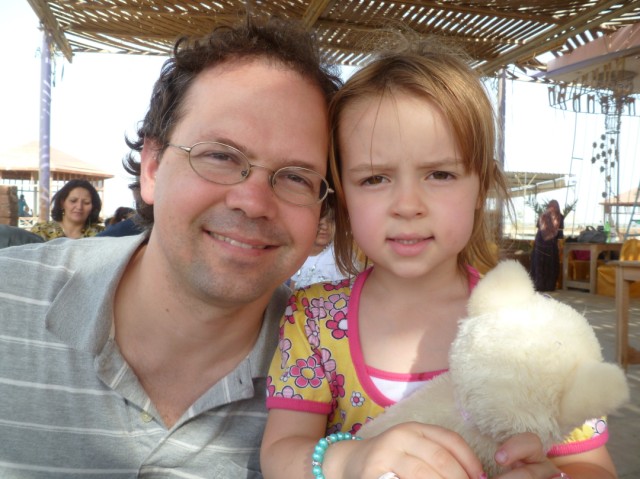


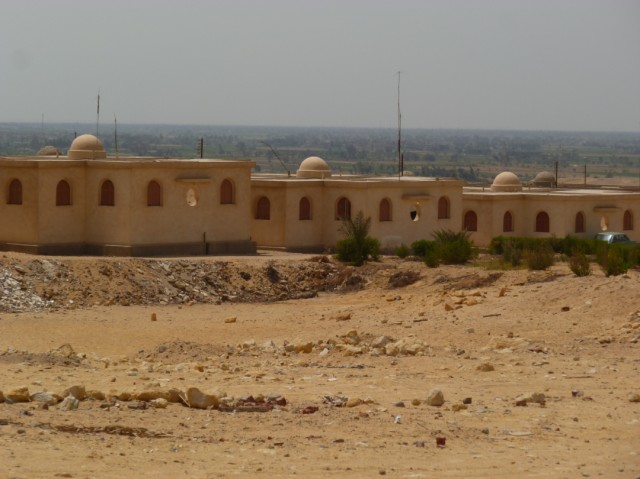


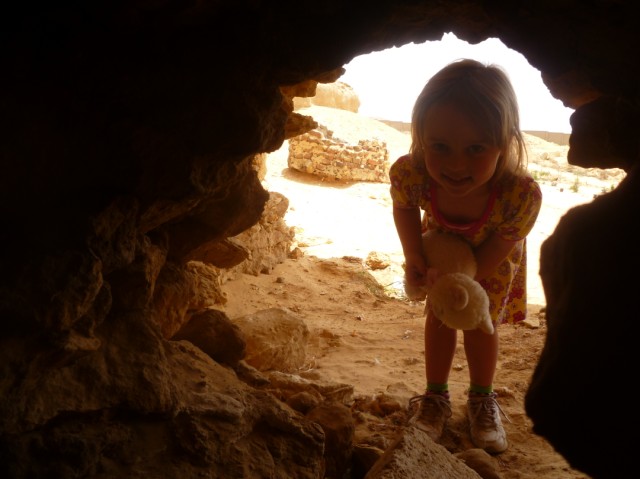

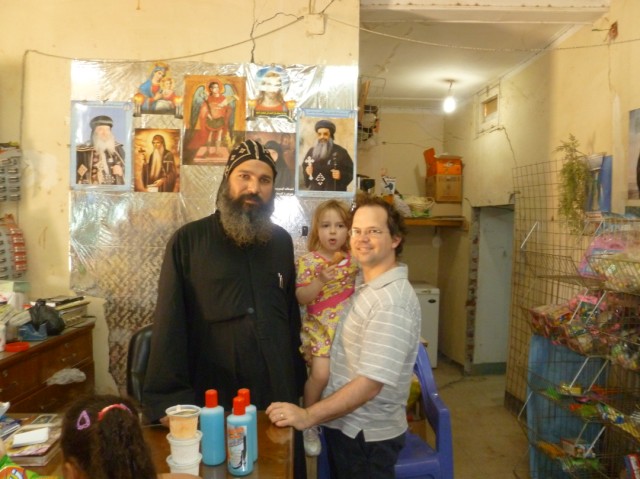
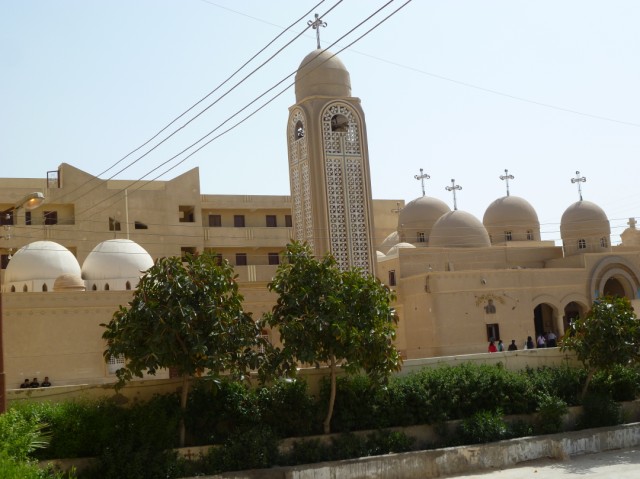


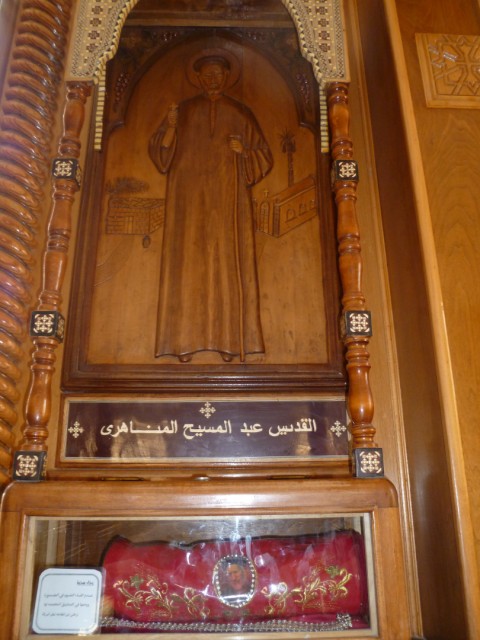


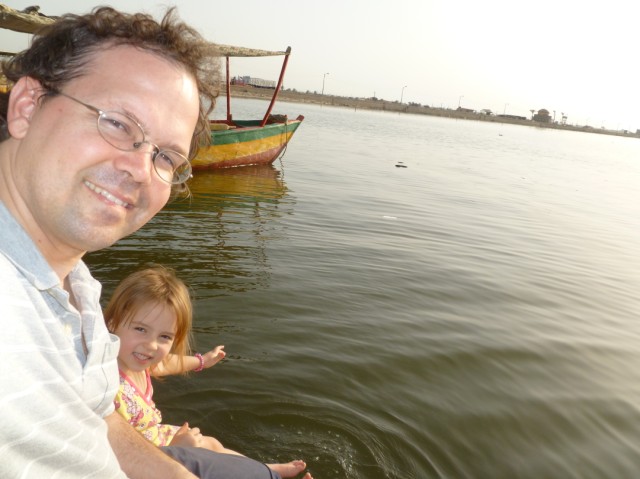


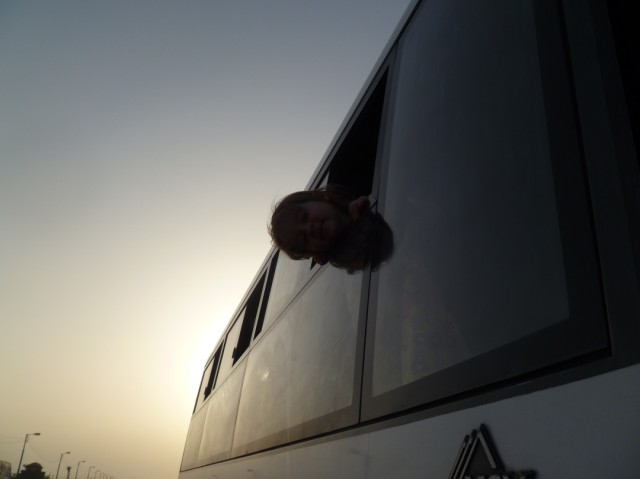

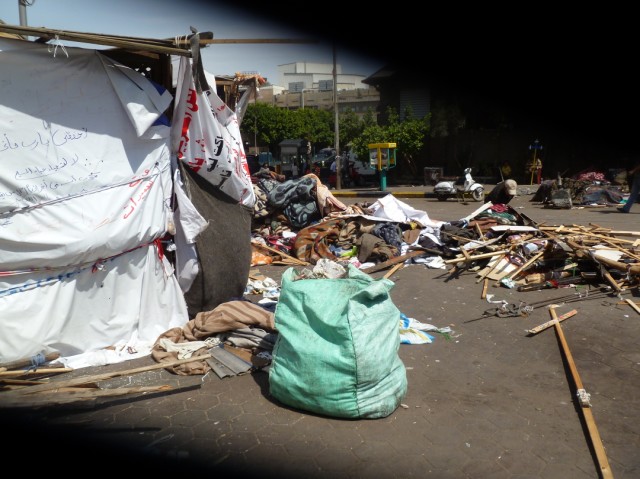


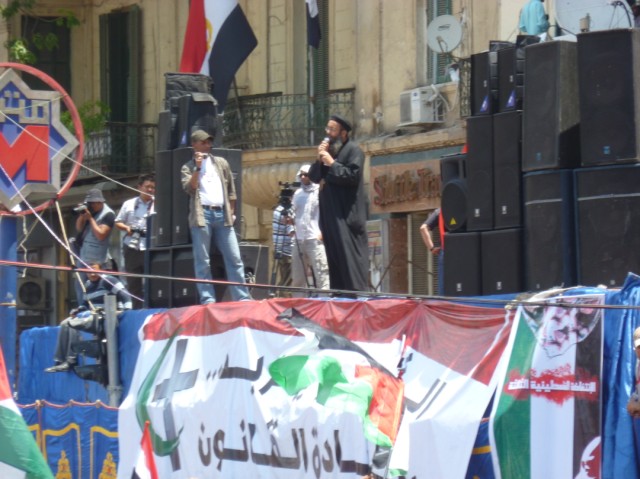


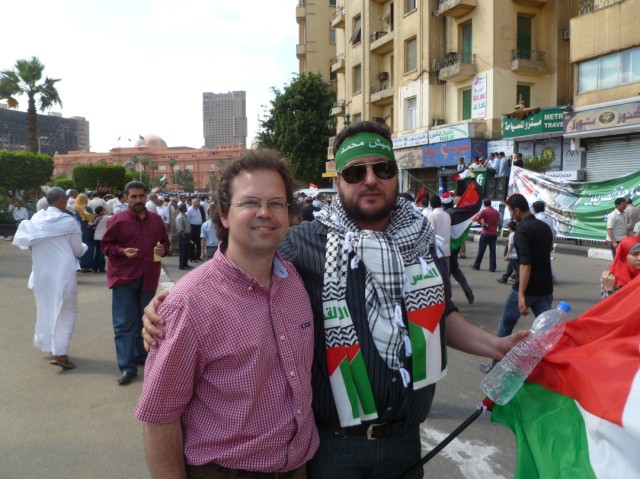

 translation: We reject violence…peaceful…peaceful (R); Don’t believe the lying media (L)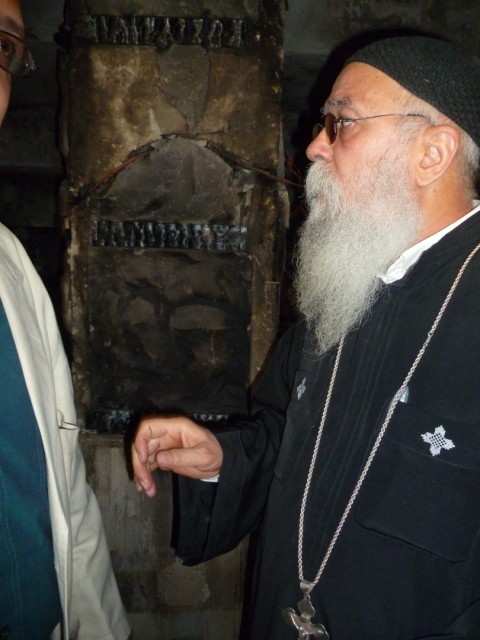

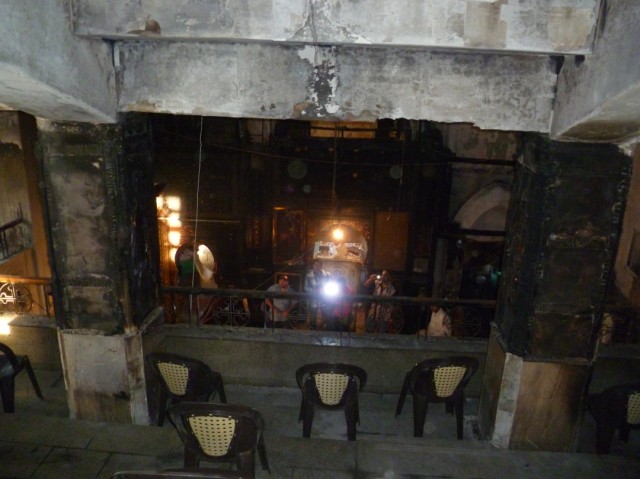


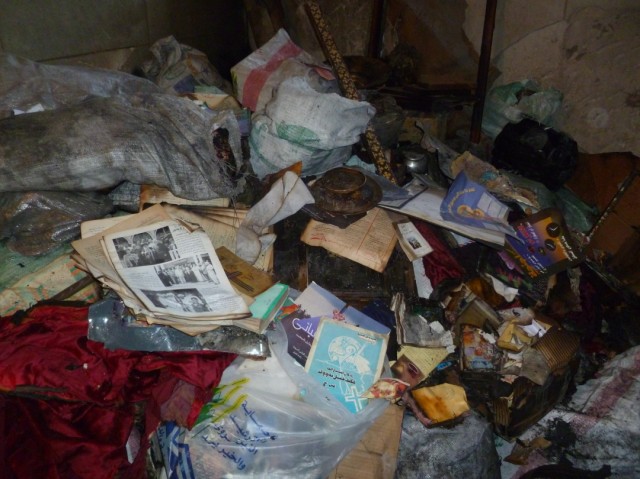




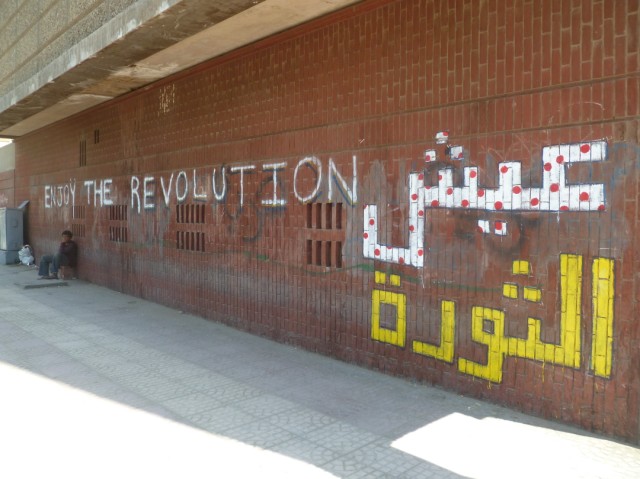
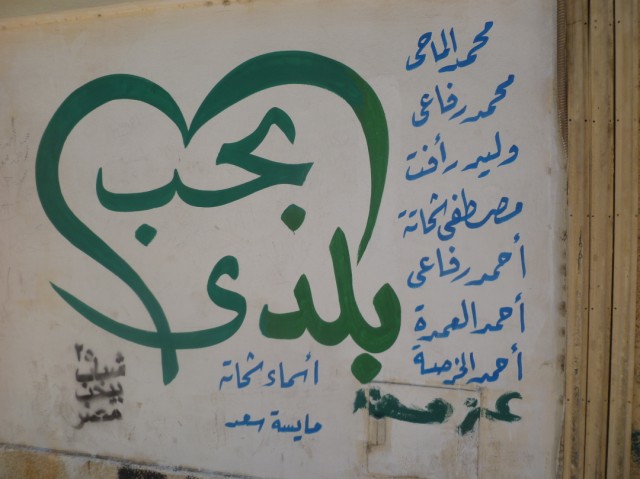
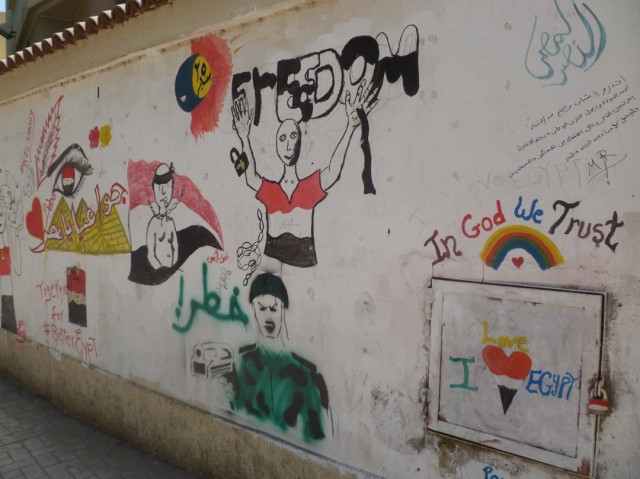
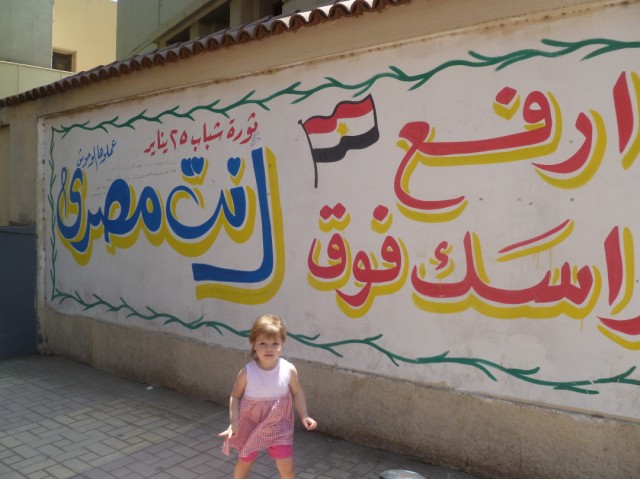

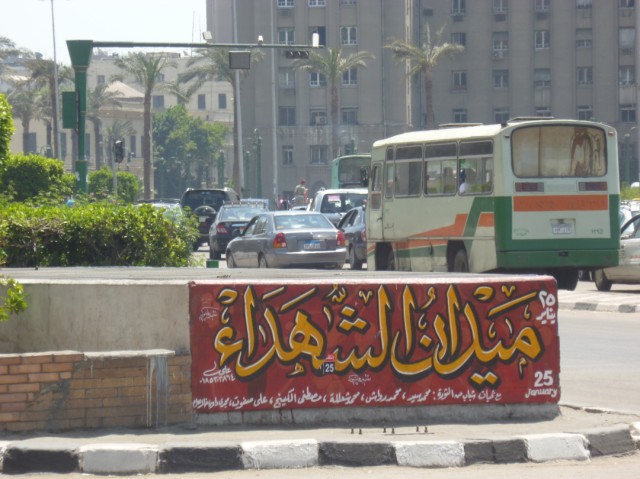


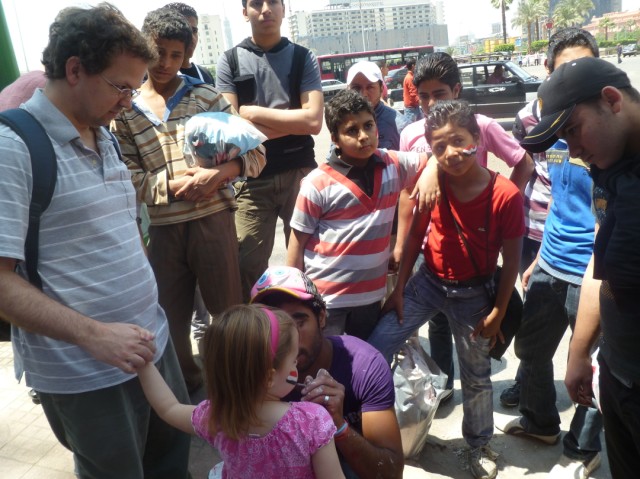



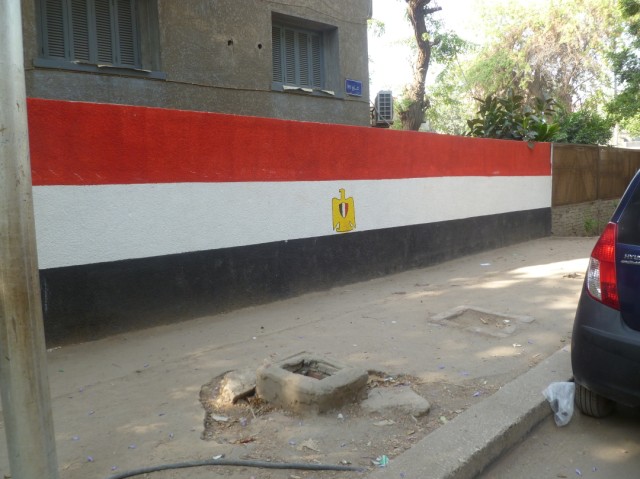
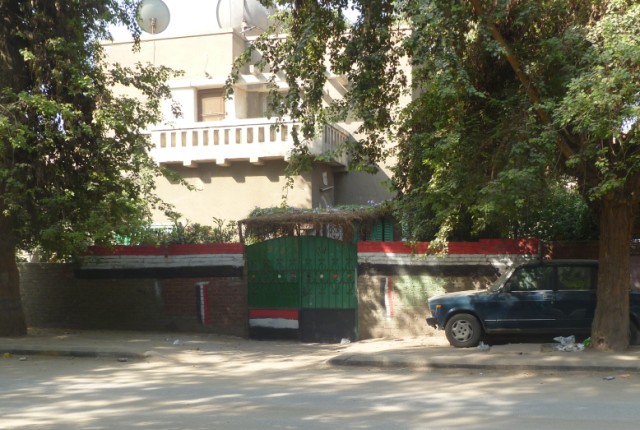


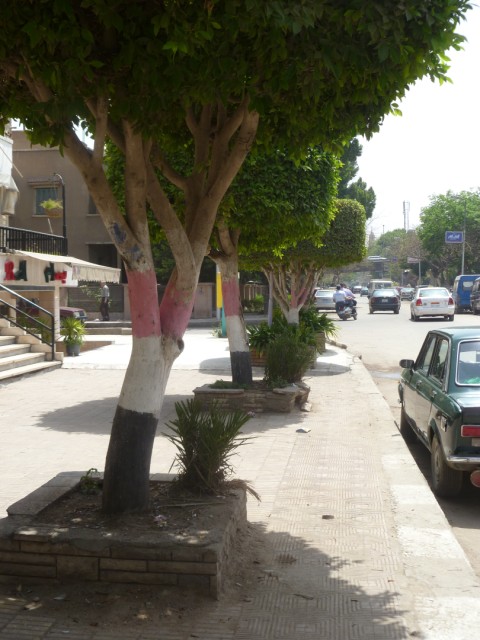



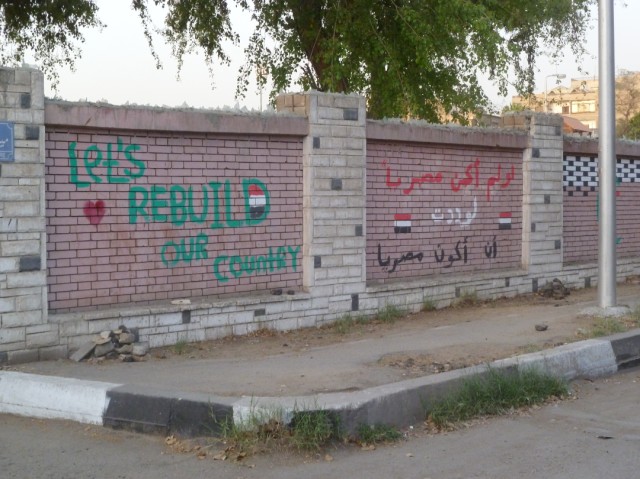


 Jayson Casper