Categories
Middle East Middle East Institute Published Articles

A Conversation with al-Gama’a al-Islamiya’s Hani Nour Eddin – Part One, Background

Hani Nour Eddin

A few months ago, before President Morsi was deposed, I had the chance to interview Hani Nour el-Din, a member of al-Gama’a al-Islamiya who was elected to the most recent parliament. His group is still considered a terrorist organization by the United States, but they formally gave up violence as a doctrinal strategy in the early 2000s.

This fact – indeed question – is very important now that Islamists find themselves outside the political spectrum. They gave up violence at a time when there was still no means to enter Egyptian politics. The revolution opened up political space, but now it appears closed. Will the group decide they made a mistake – that the only way to transform Egypt into a political state is through a violent seizing of power?

This is a very necessary question to put to al-Gama’a al-Islamiya now. But in the meanwhile, here is a window into the group’s thinking while they were on the winning side.

The interview was reduced and published by the Middle East Institute. Please click here to read the article.

But here on the blog I will post parts of the interview that had to be trimmed for space. Part One here will concern Nour Eddin’s personal history before his group gave up violence. Part Two, in a few days, will concern his views on violence, whether or not the party truly has abandoned the principle. Please enjoy.

Please introduce yourself to us:

My name is Hany Nour Eddin and I represent the Building and Development Party and serve on its high council, and was a member of parliament in 2011 before it was dissolved. I got to know IG in university, when I joined it and engaged in a number of student activities and preaching campaigns. After university I was arrested and spent many years in prison. This is where I became better acquainted with the group’s leadership.

I have read about this experience, and you maintain your innocence. What happened during this clash with police?

Here in Suez we were giving lectures in opposition to Hosni Mubarak and his remaining in the presidency. It was around 1993 and the GI organized a campaign called ‘No to Mubarak’. The state line was to forbid any opposition to the renewal of his presidency. We organized a large exhibition against him and spoke about the damage he was doing to the country, whether politically, economically, or otherwise. So he gave the order to security to stop the campaign, and to do so forcefully.

A large number of police arrived and we understood we needed to withdraw, but were surprised at the gunfire that began as we were doing so. One the bullets struck an officer accidentally, and a campaign was launched against us accusing us of killing him.

Who did kill him?

Someone from security, as the bullet hit him from behind. Part of their tactic was to disperse the crowd with gunfire, but he was hit from close range. Afterwards we all started getting arrested.

What was your role in GI at this time? Did you organize the exhibition?

Yes, I supervised it, collecting pictures and articles to help educate the people. The level of arrests practically stopped the work of GI in Suez, except for taking care of the families of those incarcerated.

So if you were imprisoned unjustly, why were you released later on?

When we were arrested they wanted to dissolve the Islamist movements, and especially our operations, targeting even our preachers. A violent clash took place between us and the police which became an armed struggle, targeting leaders on both sides, including Mubarak himself on many occasions.

By 1974 we realized the struggle was shedding the blood of the nation in general, and not just of the GI. We wanted to overthrow the state, but our violence was met by greater violence by the regime. We considered that we were defending ourselves, but it resulted in oppression and hostility, which reached even our families and relatives. It was not good.

So we undertook a campaign in the prisons, suggesting a unilateral cease-fire, stopping all violence against the regime, both inside and outside Egypt. It is important to note the whole time, even from outside, we targeted only Egypt and were working on its behalf alone. This is opposed to al-Qaeda, for example; we specified our conflict and goals were only against the regime. By 1979 we launched the non-violent initiative officially, opposing all violence against the regime, whether in the media or with weapons.

For a period of time we tried to send this message to GI members internationally, while we waited for a response from the government. Unfortunately the regime did many things to undermine our credibility, representing us falsely. But by 2000-01 they accepted the initiative. We published our ‘Revisions’, publicizing them first in the prisons and then internationally. They began releasing us from the prisons, and I got out in 2005.

So you found normal work to do?

Yes, after the necessary legal procedures, I returned to my job in the Suez Canal Company. I have a BA in Agriculture but my work with them is administrative.

But you have the time to take off work and talk to me today?

(Laughing) Yes, it’s normal, it’s ok.

So from 2005 until the revolution, what were you doing for GI?

We chose to work in preaching, rather than in organization. We would meet in mosques, talk to the people, and engage in social work – helping the poor, the orphans.

Were you a preacher in the mosque?

Sometimes, but not much. I served on the Shura Council of the GI in our governorate.

Served? But not any more?

Since we started the political party it has taken my priority and I left the Shura Council. Politics is different than preaching and social work. But we agreed to keep the party as the political arm of the GI for about two years until its administration is complete and mature. Then it will become independent, and when the appropriate laws are passed the GI will register legally also.

Please click here to continue reading the interview at Middle East Institute.
Categories
Christian Century Middle East Published Articles

Making Sense of Egypt’s Popular ‘Coup’

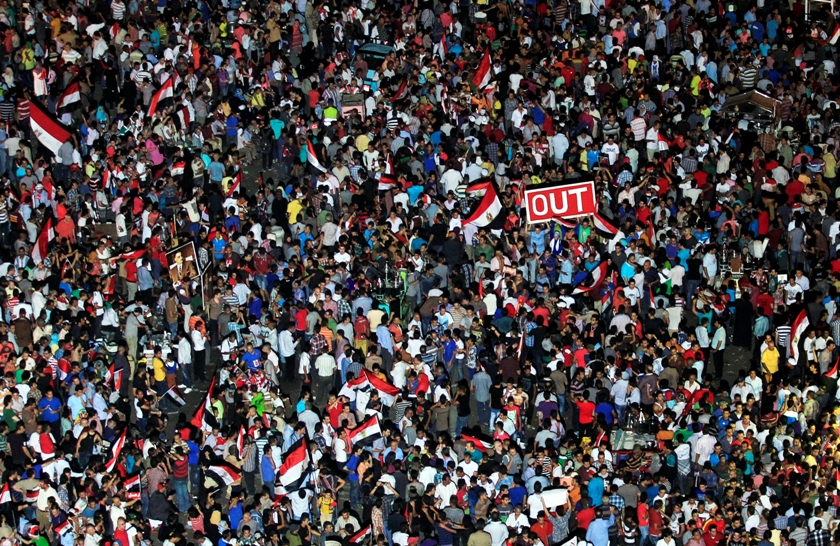
June 30 Demonstrations

From my recent article at Christian Century. It walks through the transition which brought Morsi to power and thereafter deposed him. Here is an excerpt from the conclusion, focusing on the position of Christians:

As for the nation’s Christians, they view the military intervention as salvation. Coptic Orthodox Pope Tawadros, who had pledged upon his ascension to the papacy to stay out of politics, appeared side by side with Egypt’s chief Muslim leader to back the move. Protestants appreciated this as a public signal of Christian equality, while the Anglican bishop rejoiced Egypt was now free of the ‘repressive rule’ of the Brotherhood.

But are such public celebrations wisdom? In the fluid chaos of Egypt’s transition, who is to say the situation will not flip again? Copts are very careful to align with the nation’s moderate Muslims; dare they align with an extra-constitutional putsch against a large swath of religiously conservative neighbors? As citizens they are free, but as an ever-vulnerable religious minority will they find sufficient protection in the army and a hopeful emerging civil democratic order?

Perhaps they have no choice. Perhaps they see more clearly than anyone the issues at stake under Islamist rule. Only a year and a half earlier they suffered their greatest massacre at the hands of the army, when a Coptic protest was crushed under military tanks. Still, they took refuge.

This is the same question now faced by Egyptians as a whole, and as such the transition becomes more of a revolution proper. Islamist or civil; religious or secular – inasmuch as these are false dichotomies they also represent the current struggle. All that is lacking for a true revolution is violence; for the sake of Muslims and Christians together, may this development not come to pass.

Please click here to read the whole article at Christian Century.

Categories
Christianity Today Middle East Published Articles

Egyptian Christians Killed After President’s Ouster

Copts Killed

From my article in Christianity Today, published July 9, describing both Christians and Muslims killed in a worrisome escalation of violence. But this excerpt concerns another matter for Christians in particular: Should they have joined the revolt in the first place, on Biblical grounds?

Bishop Mouneer also called the [military] action an answer to prayer, which raises certain theological questions. In Romans 13 Paul writes that Christians are to be subject to the governing authorities. Does Christian participation in a popular uprising strain this interpretation?

“The leader must support human rights,” said Bishop Marcos. “Because Morsi did not it was acceptable to work against him.”

A more nuanced position is articulated by Rev. Emad Mikhail, president of the Alexandria School of Theology.

“The Bible in the first century does not address the situation of free expression as we have in many places today,” he said. “There was no voting and no means to change the system except through violent action.

“If we vote out a president [as in modern elections] this is not understood to violate Romans 13. I consider peaceful demonstrations to be like a vote.”

Please click here to read the whole article at Christianity Today.

Categories
Middle East Published Articles Relevant Magazine

Who Should Christians Support in Egypt?

Obama Egypt

From my recent article in Relevant Magazine:

When push comes to shove, as it has in Egypt, who should American Christians support? The recent military move to oust an elected president was almost universally backed by Egyptian Coptic Christians, which make up roughly ten percent of the population. But the move, called by many a military coup, also violates our profound democratic sensibilities. With forty-two dead today at the hands of the army – which claims it was attacked first by armed terrorists – basic issues of humanity are also in play.

‘Our citizenship is in heaven,’ writes the apostle Paul, seemingly elevating our Christian brotherhood above national ties or ideological convictions. But, he writes elsewhere, ‘Let everyone be subject to the governing authorities, for there is no authority except that which God has established.’

President Muhammad Morsi, of the Muslim Brotherhood, was removed from office on July 3 following massive protests against his rule. The proximity to America’s Independence Day only heightens the tension of this question, demanding an introspection we are often loathe to consider. Before we sit in judgment on Egypt, was our own revolution contrary to God’s teaching?

But does not the Bible also demand a commitment to justice and solidarity with the rights of the oppressed? Certainly, and Egyptian Christians would be quick to assert the necessity of the putsch, not just for their own cause, but for millions of Egyptian Muslims beside.

The article then summarizes the situation in Egypt, and concludes:

Perhaps the most important question is this: No matter their fears, would aggrieved non-Islamists have done better to work within the system, no matter how flawed?

This last question is of political strategy, and Egypt’s Christians have clearly answered ‘no’. What now of American Christians?

It is important to note that American democracy – though also flawed for much of our history – has peacefully rotated power for over two centuries. Egypt is still trying to find its feet after a revolution. The American constitution, after all, followed thirteen years after independence.

Egypt currently is a political mess; within chaos, minorities are vulnerable. Christians have been used by all sides as a talking point. Liberals highlight their difficulties, the Muslim Brotherhood pays lip service to their equality, Islamist allies scapegoat them in conspiracies, and the old regime propaganda – ever present – erects the extremist boogeyman to maintain order.

Within this picture, American Christians have little to identify with. Our two options mirror our dual identity: As Americans, esteem the democracy; as Christians, condemn the persecution. Unfortunately, neither option correctly describes Egypt. Either one is a false choice.

What then, is the Biblical choice? Consider these words of Paul, perhaps to balance his advice given above: ‘But everything exposed by the light becomes visible, for it is light that makes everything visible. This is why it is said: “Wake up, O sleeper, rise from the dead, and Christ will shine on you.”’

The American Christian responsibility is not to take sides, nor to assert abstract principles. It is to find out what is happening, and support the light.

Whether through influence in Washington, or through influence in prayer, American Christian hope must be that Egypt will rise from the dead.

Does this latest episode help or hinder? Make Egypt visible, and then judge accordingly.

Please click here to read the whole article at Relevant Magazine.

Categories
Christianity Today Middle East Published Articles

Egyptian Christians Brace for (and Debate) New Round of Protests

From my June 28 article published on Christianity Today:

Frustrated Egyptians will take to the streets June 30, on the one year anniversary of President Morsi’s inauguration. Dubbed the ‘Rebellion Campaign’, the grassroots movement announced the collection of fifteen million signatures to depose the president and demand early elections.

“The situation in Egypt is very serious,” wrote Bishop Mouneer Hanna of the Anglican Diocese of Egypt. “I do not know where this situation will take us. I feel that Egypt is at the verge of violent demonstrations, another revolution, or civil war.”

‘Rebellion’ organizers pledged their demonstrations will be non-violent, but Muslim Brotherhood leaders warn a violent turn – perhaps organized by supporters of the former regime – will undue the successes of the Egyptian revolution. Yet they insist on holding counter-demonstrations in advance of June 30, setting the stage for clashes between the two sides.

Please click here to read the full (brief) article on Christianity Today.

Categories
Arab West Report Middle East Published Articles

Islamism in Asyut: Conversation with a Local Journalist

Islamism in Asyut

From my recent article in Arab West Report:

Among the difficulties in assessing the news of Egypt is the Cairo-centrism of journalism. A problem plaguing the nation in general, all major newspapers operate from the capital attracting the best talent away from other regions in search of promotions and a better life. Quality of information suffers; many newspapers simply investigate local developments through phone calls.

Finding a well-connected regional Egyptian journalist, therefore, is a contact to be treasured. On a recent visit to Upper Egypt Arab West Report met Mamduh Sarur, who appears to fit the bill.

Our conversation centered on the presence and nature of Islamic movements in the region:

Sarur confirms the existence of organized, trained groups of young men connected to the Islamist movements, especially al-Jama’ah al-Islamiya. In the opposition media these are often labeled ‘militias’, which Islamist consistently deny having. Al-Jama’ah al-Islamiya prefers to call them ‘popular committees’ using the terminology applied to each neighborhood in Egypt when they self-organized after the police vanished from the streets on January 28, 2011, during the revolution.

With his own eyes Sarur states to have seen these groups brandishing swords as they paraded through the streets. But he insists the Islamist leadership is practical and often floats test balloons before enacting their agenda. This is one of them, and reflects coordination between different Islamist organs.

Here is an example:

The talk of coordination between Islamist groups, therefore, requires nuance to see the divisions within that are either exploited by the Brotherhood or else a result of their charade. Al-Jama’ah al-Islamiya, for example, ran against the Brotherhood in alliance with the Nour Party during parliamentary elections. But Sarur asked, who funded al-Jama’ah al-Islamiya’s political arm – the Building and Development Party – in their campaign? Unlike the relatively wealthy Brotherhood, al-Jama’ah al-Islamiya leadership spent their years in prison, and upon release were continually harassed by security. The answer, he stated, was simple: Funding came from Brotherhood sources.

The mastermind is Brotherhood deputy guide and chief financier Khairat al-Shater. He plays the Islamist movements like chess pieces, moving different agents about in order to keep his organization above the fray. Hazim Abu Isma’il, for example, ostensibly operated independently as he led efforts to besiege Media Production City in protest of the opposition media. In reality they work closely together, and Abu Isma’il’s father was a Muslim Brotherhood stalwart. Al-Jama’ah al-Islamiya, meanwhile, took the lead in protesting against judges, and in particular the High Constitutional Court. As this activity damaged the reputation of their political arm, Asem Abd al-Majed recently resigned from the Building and Development Party in order to operate ‘independently’ against the counter-revolution. Sarur fully expects him to be appointed by Mursi to some government position in due time.

And here is what appears to be a more sinister example:

But one of the darker sides of Islamist symbiosis, if not coordination, concerns the economic pressures placed on the Copts. Many of the criminal, thug, and arms dealing elements in Upper Egypt come from the now-settled Bedouins as opposed to the traditional agricultural Egyptians of the Nile, Sarur explained. But al-Jama’ah al-Islamiya has a relationship with them. When a thug comes and illegally appropriates Coptic land, the owner will go to al-Jama’ah al-Islamiya because he knows they can solve the issue – as opposed to going to the police or the courts, which will take forever with uncertain outcome. Al-Jama’ah al-Islamiya takes a percentage of the land or a sum of money for their ‘mediation’, but there is not much else the set upon Copt can do.

Please click here to read the whole article at Arab West Report.


Categories
Arab West Report Middle East Published Articles

Mapping the Coptic Movements: Activism in a Revolutionary Setting

Coptic Activism

From my recent article at Arab West Report, an extensive, interview-based effort into the diversity of Coptic activist movements:

One of the distinguishing sub-themes of the Egyptian revolution which began on January 25, 2011, has been the proliferation of Coptic movements. Largely, though not entirely, contained in the church during the Mubarak era, Christian Egyptians joined their Muslim counterparts as ‘one hand’ to challenge the authority for the sake of ‘freedom, bread, and social justice’. After successfully deposing the president, many of these Christian Egyptians continued their revolutionary posture.

For years Copts presented their demands to the state primarily through the person of Pope Shenouda. When pressed to demonstrate for their demands, either by events or by clergy, they did so mostly within the confines of church walls. The revolution changed this equation, however, and the unity expressed in overthrowing Mubarak gave Copts a new sense of participation in rebuilding Egypt.

Some Christian participation remained along the lines of revolutionary values, enveloped fully in the youth movements that populated Tahrir Square. Others began sensing a threat to their full participation from the emergence and ascendency of Islamists groups, and rallied behind a liberal and civil cause.

Still others took the opportunities of the revolution to organize and demonstrate for particular Coptic issues. Though there is significant overlap between Coptic demands and those for a civil state, these movements are characterized by Coptic peculiarity, even though many boast the participation of Muslims, who tend to be liberal in outlook. This category is shaped by a desire for Copts to assert their rights as Copts, leaving the church to take to the street and integrate with society.

Yet as they do so they highlight the tensions of religious identity. Insisting upon their right as citizens to demonstrate, they move beyond citizenship and appear to many as sectarian. Conscious to defeat this charge, Coptic movements stress their belonging to Egypt, and their work on its behalf. The question is fair if they do more harm than good, but this question may miss the point if indeed, as they claim, it is equality they seek. When pursuing that which is right, popular reception is a secondary concern.

This paper seeks to analyze in particular the Coptic movements which adopt Coptic issues. It will discuss the pre-revolutionary history of Coptic activism, trace its development after the fall of Mubarak, and continue to the present with the current attempt to gather these movements together in what is called the Coptic Consultative Council.

The paper will then provide a map of these movements along with the names of key participants to the extent that current research allows. Then it will profile of a limited number of these groups, describing their leadership structure and spheres of activity. Finally, it will examine the questions of foreign funding and interference.

From the conclusion:

In closing, two remarks from the interviewees are useful. Sameh Saad stated the normal person works to earn a living and then goes home to enjoy his family and rest. The activist, meanwhile, sacrifices from his personal life in order to achieve success in a larger cause.

Similarly, Ehab Aziz stated that no one will give you your rights while you are sitting on the couch. You have to work hard to achieve them.

While many questions circulate around the Coptic movements – from finances, to cooperation, to the wisdom of separating from the larger Egyptian cause – the above observations must be remembered. They are balanced by the remark of Gaziri that they also have a tendency to exaggerate their issues.

In all these matters Coptic activists resemble activists around the world, exhibiting significant sacrifice and dedication in pursuit of their goals, understood to be righteous. Yet besides pressuring the government to fulfill their rights, they face also the challenge of awakening a religious community long accustomed to acquiescence to the status quo.

Further research is necessary to better understand their reality, their excesses, and their triumphs. But in the above description they must be commended. Their existence represents one of the many successes of the revolution.

Please click here to read the full, 19 page document at Arab West Report.


Categories
Arab West Report Middle East Published Articles

With the Holy Family in Upper Egypt: A Pictorial Travelogue

From April 25-28 I traveled with Arab West Report through a few Upper Egyptian Holy Family sites, places Mary, Joseph, and Jesus are recorded to have stayed according to Coptic tradition. This travelogue will share some of the insights and anecdotes learned along the way, by means of pictures taken at each location.

Please click here for the full commentary at Arab West Report. This posting represents the third of the articles I was able to write following the trip; I will only post the photos not used in writing about a cancelled Palm Sunday march through streets of a mostly Christian village, or about local perspectives of Copts toward the elephant in the room – emigration.

But the Arab West Report article is a good nine pages long featuring 35 photos. Most only have a paragraph or two of reflection, so it is easy reading. Here it will easier – pictures with a sentence or two. Please enjoy both here and there.

With professional photographers Norbert Schiller and Dana Smillie. Lining up a picture of a monk at Dronka Monastery, purported to be the southernmost extent of the Holy Family in Egypt.
This is a Holy Family Tree at Sarabamoun Monastery, near Dayrut. Coptic tradition says they paused to rest under its shade. The white papers represent the prayers of pilgrims seeking intercession.
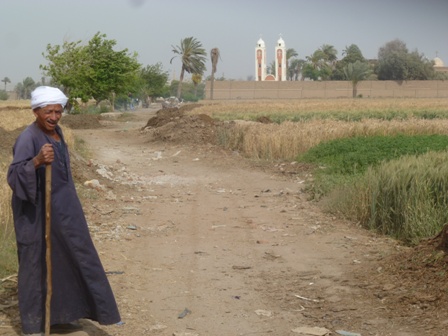
The large tree in the upper right is the Holy Family Tree. The Sarabamoun Monastery is quaintly isolated in agricultural land. Here, a local farmer pauses by the side of the road.
The village of Saragna is 90% Christian and on the way to perhaps the most holy Holy Family Site, Dayr al-Muharraq. It is a very traditional village built on the ancient pattern, extending out circularly from a high point above the elevation of the Nile flood, now halted by the Awsan Dam.
The mayor and his deputy of Saragna. He is the 4th generation in his family to hold the position.
Homes in Saragna pushing up against the massive new church recently built. Some homes were purchased and destroyed to make room.
The greatly expanded Church of the Virgin Mary in Saragna. It cost just shy of $900,000, but had much free volunteer labor offered by residents. Most of the money came from Saragna men working abroad who tithed their earnings.
The inside of the Saragna Church sanctuary. It is beautiful.
The inside of the beautiful Saragna Church sanctuary.
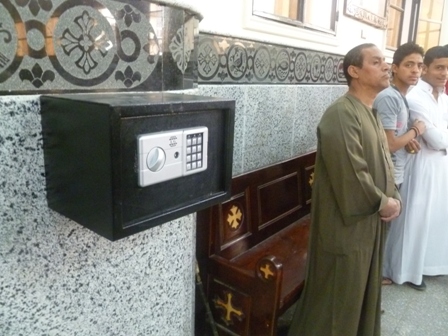
The Saragna church is modern in every sense of the word. Here the traditional wooden offering box is replaced and made more secure by electronic safe.
The Monastery of Dayr al-Muharraq is esteemed as the southernmost extent of the Holy Family in Egypt. If this seems to contradict what I wrote earlier, you're paying good attention. The walls are built to resemble the walls of Jerusalem, seeking to establish itself as an alternate pilgrimage site.
The Monastery of Dayr al-Muharraq is esteemed as the southernmost extent of the Holy Family in Egypt. If this seems to contradict what I wrote earlier, you’re paying good attention. Do read on below. The walls are built to resemble the walls of Jerusalem, seeking to establish itself as an alternate pilgrimage site.
Another example of the walls. For some reason I found this monastery strangely modern. It seemed more like a colonial villa compound than a place of asceticism.
Almost all Coptic monasteries have been modernized. Here inside you can see the old versus the new.
But here is old. It was great fun to watch the monks worship and interact.
But here is old. It was great fun to watch the monks worship and interact. About 100 are resident in the monastery.
Here a monk chants from the prayer book, joining his colleagues in unison.
The chants were in the ancient language of Coptic, still used somewhat in the masses of Egypt but known only by a small group of specialized practitioners, such as in this monastery.
I love this photo. Monks in Egypt are strangely free to join or not join communal worship as they see fit. It is a very individualistic calling, largely left to one's sense of how to walk with God.
I love this photo. Monks in Egypt are strangely free to join or not join communal worship as they see fit. It is a very individualistic calling, largely left to one’s sense of how to walk with God.
On the way to the Holy Family site of Qusair we passed by a new but very traditional village. The women, Muslim, are doing dishes in the Nile.
To get to the small chapel in a cave we had to cross by a traditional sailboat.
To get to the small chapel in a cave we had to cross the Nile in a traditional sailboat.
Upon arrival we were met by tens of Muslim women coming out of their homes and cheering. As it turns out, arriving just after us was a released prisoner returning home for the first time in six years. The priests joined in the celebration.
Upon returning north on the way to Palestine (from whichever location), the Holy Family rested in this cave before sailing the Nile. A small church is now inside; the priests lead weekly mass at 5am on Sunday.
But we saw also the expansion of the site. The priests are preparing to host a summer festival for the first time, trying to increase the pilgrim awareness of this site. I fear it may ruin its pristine nature and tranquility.
But can anything ruin this tranquility? This photo looks down from the cave upon the small distance we walked from the Nile.
Returning now to the first scene, this is the Dronka Monastery on the edge of the Asyut Mountains. The connection with the Holy Family tradition is tenuous, and only accepted by church hierarchy in the 1970s. It has since been massively expanded from...
Returning now to the first scene, this is the Dronka Monastery on the edge of the Asyut Mountains. The connection with the Holy Family tradition is tenuous, and only accepted by church hierarchy in the 1970s. It has since been massively expanded from…
... this cave, where the Virgin Mary is said to have appeared in an apparition. (Is that redundant?)
… this cave, where the Virgin Mary is said to have appeared in an apparition. (Is that redundant?)
Looking out from the monastery at the village and farmland below. It is said the Holy Family tradition emerged here when local businessmen had a falling out with the monks of Dayr al-Muharraq Monastery. In the AWR article I provide a somewhat extended reflection on how possible pious fraud can both strengthen and damage the faith of Coptic Christians.
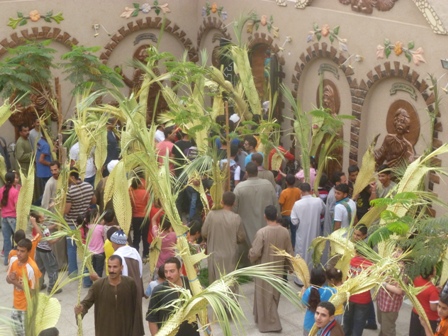
Concluding our trip was the celebration of Palm Sunday at the church in Saragna. Here, in defiance of the priest's decision to cancel the street parade, Coptic youth go out the gate as opposed to into the service. Please read that article for further context, but fortunately, no trouble occurred.
Concluding our trip was the celebration of Palm Sunday at the church in Saragna. Here, in defiance of the priest’s decision to cancel the street parade, Coptic youth go out the gate as opposed to into the service. Please read that article for further context, but fortunately, no trouble occurred.
This is a good photo to close with, Coptic street vendors making palm leaves outside a church in Asyut. The little cross the man on the right is holding sold for $1.

The trip took in far too much in far too little time to really feel like I learned about these sites and the reality of Christian life in Upper Egypt. But I am very thankful for this first opportunity, hopeful for far better understanding in the future. Please click here for a few more photos and fuller commentary.

Categories
Atlantic Council Middle East Published Articles

Emigration at Easter: Fight, Flight, and Resignation

From my latest article in Egypt Source, culling attitudes on emigration from a recent trip to Upper Egypt:

Sara Shuhdi
Sara Shuhdi

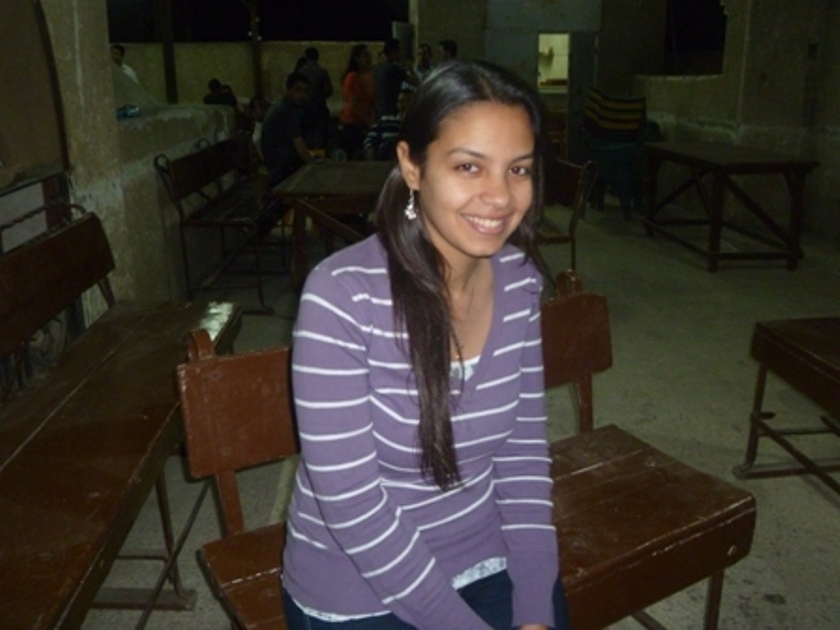
“I have nightmares every couple of days,” said Sara Shuhdi, a 23 year old assistant professor of analytical chemistry at the German University of Cairo. “I don’t see a bright future for Egypt; maybe it would be better for me if I left.”

Fifty-five days of fasting concluded on Coptic Easter, celebrated this year on May 5 according to the eastern calendar. Always a period of reflection and joy for Egyptian Christians, this year the community is deeper in the former and subdued in the latter.

Here are the photos of each person sharing, with a quote from each:

Fr. Seraphim, an Orthodox priest in Dayrut

“Of course we must stay here,” he said. “Our history, family, and churches are here – we cannot leave Egypt.”

Emad Awny, a businessman in Asyut

“The civil current – Muslims and Christians together – must provide a different way of thought and raise consciousness through business,” he said, “especially in poorer areas susceptible to extremism and ignorance.”

Fr. Kyrillos, an Orthodox priest in Saragna

“Twenty years ago, I tried to convince Copts not to emigrate, but now because of the bad economy I bless them if they want to go.”

Bishop Thomas of Qussia

“I raised people here, trained them, and watched them grow and become productive members of society,” he said. “And then they leave? It is sad.

“I can’t prevent them but I encourage them to stay. I try to speak to their conscience to make their land a better place. Why would someone leave their home and become a foreigner forever?”

The article concludes with a stinging quote by Bishop Thomas for the conscience of humanity; please click here to read the whole article at Egypt Source.

Categories
Lapido Media Middle East Published Articles

Coptic Palm Sunday Street Parade Axed to Keep the Peace

Bishop Thomas among the revelers

This article was first published on Lapido Media:

Joyous Copts raised palm leaves and shouts of welcome as Bishop Thomas, dressed in his regal red clerical robe, entered the Church of the Virgin Mary in Saragna, 325 kilometers south of Cairo.

But departing from tradition he arrived by car for the first time this year. For years local Copts would first parade him through the streets of the 90 percent Christian village.

For the first time in this Upper Egyptian diocese, the ancient parade on 28 April remained within church grounds to control the behavior of Christian youth.

‘It used to be that all churches would parade in the streets, but because of the pressures of the last few decades in most places it has stopped,’ explains Thomas.

Saragna was the last village of his diocese to maintain the parade. ‘We are mostly Christians here, so all is well,’ says Ramiz Ikram, the fourth generation Coptic mayor.

‘Some Muslims complain due to their fanaticism, but we don’t march in their areas so as not to make problems.’

Fr. Kyrillos of Saragna

But according to Fr Kyrillos Girgis, a Cairo-trained medical doctor who has served as priest in the village for 23 years, local youth recently began shouting offensive anti-Muslim chants.

He threatened to bar them from communion for a year, but eventually had to stop the procession entirely.

This past Sunday, as everywhere else in Egypt according to the Eastern religious calendar, palms were raised within church grounds instead of in the streets as of old. (Please click here for video.)

Bishop Thomas remains positive however. ‘The challenging religious situation in Egypt reinforces our religious identity,’ he says ‘and today we enjoy being in the kingdom of God.’

Fr Kyrillos can also see the silver lining in the dark clouds gathering over this country.  He is leading a vast expansion of the Church of the Virgin Mary, tripling its size and adding a second sanctuary.

The greatly expanded Church of the Virgin Mary in Saragna

Local authorities licensed the expansion before the revolution, along with construction of new churches in the roughly 50 percent Christian villages of Titaliya and Manshia.

‘We have good relations with security and with local people,’ said Thomas, ‘We prefer to obtain proper permissions because we do not want to take any risks.’

Illegal construction

Outside of his diocese, however, other bishops are less risk averse. The 22,000-strong village of Bayadia which is more than 90 percent Christian, had a single church for six different denominations, despite many applications for building permission.

‘We felt great injustice under Mubarak,’ said Orthodox priest Fr Girgis, ‘because we had only one church despite being the great majority of Christians.’

His solution was illegal construction of four more churches. Other denominations followed suit, and Bayadia now has fourteen churches.  In the nearby village of Dair Abu Hinnis which is 100 percent Christian, Fr Bemwa boasts of an increase of from five to ten churches since the revolution.

Bishop Thomas explains it can take up to fifteen years to gain a church building permit, whether from bureaucracy or discrimination.

Many priests take matters into their own hands.

With the collapse of government, this is increasingly the norm in Egypt. The Ministry of Housing and Local Development announced recently the existence of more than five million unlicensed buildings. A BBC report earlier this year documented the post-revolutionary surge in building, including many that have already collapsed.

But when Christians attempt such illegal church construction in Muslim majority villages, there is often resistance. Sometimes this is the case even when permits exist.

‘As long as it is a primarily Christian area there is no problem to build,’ said Cornelis Hulsman, editor-in-chief of Arab West Report (AWR). ‘But when it is in a mostly Muslim area it can cause clashes if neighbours are opposed.’

AWR investigated an attack on a church in Aswan in October 2011, and a February 2013 attack in Fayyoum. In both cases Muslims had been offended when local houses used for worship were expanded or renovated.

But on Palm Sunday, Egyptian Copts celebrate the success of a community which has maintained Christian roots since the visit of the Holy Family fleeing from Palestine.

The faithful flock to pilgrimage sites, such as the rural Serabamoun Monastery, believed by local Christians to house a tree which provided shade to Jesus and Mary.

Fr. Seraphim, offering a loaf of communion bread

Fr Seraphim, Coptic priest in the nearby city of Daryut, said, ‘Christians in Egypt have seen more persecution in the past than we see now.

‘And of course you have to make use of the opportunity: there is no government.’


Categories
Arab West Report Middle East Published Articles

An Unnecessary Constitution

The word in Arabic, dostour, means constitution
The word in Arabic, al-dostour, means ‘the constitution’

From my recent article on Arab West Report:

The new Egyptian constitution was unnecessary from the start, says Ragy Sulayman of the Free Egyptians Party (FEP). The 1971 constitution, with added amendments, would have served just fine.

Sulayman is the founding lawyer who brought the liberal FEP into existence following the January 25 revolution. A member of the party’s political office, he also heads its legal and constitutional committees. Though the FEP declined participation in writing the constitution in protest of the lack of sufficient women and Coptic representation, they actively opposed the final draft. Rather than delving into the problems of content, Sulayman preferred to describe how the process was flawed from the beginning.

The basic problem is that though nearly all segments of society agreed on the need for a new constitution following the success of the revolution, there was no unified justification for why. This lack of consensus would come to polarize the political scene, made worse by the initial decisions of the suddenly ruling military council.

His main critique of the text of the constitution is interesting, for he does not take aim at its increased religious language but its virtual replication of the old system:

Once formed, however, the Constituent Assembly proved uncreative and unprepared to write a new constitution. First of all, they failed to conduct any social studies to determine the problems of the Egyptian people and take them into account. But second of all, the new draft largely patterned itself off the 1971 constitution, often using the exact same wording. The only significant divergence, which Sulayman admits as substantial, is the transformation from a presidential system of government to a parliamentary.

Even the religious aspects of the constitution do not represent a radical change in parliamentary procedure. Watching the Muslim Brotherhood’s majority Freedom and Justice Party deal with recent legislation concerning Islamic bonds, it is clear they intended the Azhar to play only a consultative role when the Supreme Constitutional Court is brought a case. Sulayman agrees with this interpretation, actually, though the Azhar has insisted on prior review. But parliamentary procedures under the old system also called for sharia-compliant legislation, with a designated committee to seek the opinion of the Azhar on relevant draft laws. Even the controversial Article 219, defining the principles of sharia, does not significantly alter the system.

This convinces Sulayman the increased religious language of the constitution was mainly a campaign tool – coupled with efforts to convince the population of a yes vote for ‘stability’ – to ratify the document by referendum. A rushed process hammered through a flawed constitution to a population misled by propaganda. The Egyptian people were denied a chance to achieve a national charter worthy of their aspirations.

Elsewhere Sulayman takes note of a significant divergence from the old system, in which a mixed presidential-parliamentary system replaces the former presidential.

Overall his critique seems fair, but if the 1971 constitution would have been fine, why does he criticize the new draft patterning off of it? Especially if he approves (seemingly) of the new governing relationship between president and parliament?

I suppose it is due to the hodge-podge nature in which everything was done, but please click here for the full article on Arab West Report and decide for yourself.


Categories
Atlantic Council Middle East Published Articles

Doublespeak beyond Boston: Revealing the Brotherhood’s Arabic Rhetoric

Essam Erian Facebook

From my new article in Egypt Source:

As the world community condemned the recent bombings in Boston, the Muslim Brotherhood’s political arm joined the chorus.

“The Freedom and Justice Party categorically rejects as intolerable the bombings committed in the US city of Boston,” reported Ikhwanweb, the official English website of the Muslim Brotherhood. “The FJP offers heartfelt sympathies and solemn condolences to the American people and the families of the victims and wishes a speedy recovery to the injured.”

But, as many have complained, in Arabic the thought was different, expressed by a prominent leader on Facebook:

Erian proceeds to establish a timeline of suspicious violence, from Mali to Syria to Somalia to Kurdistan. No further mention is made of Boston, and he is led to questioning.

“Who disturbed democratic transformations, despite the difficult transition from despotism, corruption, poverty, hatred, and intolerance to freedom, justice tolerance, development, human dignity, and social justice?

“Who planted Islamophobia through research, the press, and the media?

“Who funded the violence?”

Erian’s musings on conspiracy are nowhere to be found on the Brotherhood’s English language websites.

But the focus of the article is to highlight a new blog which is translating questionable material on Brotherhood websites, both current and from their archive. It turns up gems like this one:

For example, an FJP article described “a growing case of hatred of the majority of Copts towards Islamists in general,” and “the Coptic spirit of hatred for everything Islamic.” The article concerned anti-Brotherhood chants during the funeral, but failed to condemn the subsequent attacks on the mourners exiting the cathedral.

From the conclusion, describing the blog’s grand goals, but subtle methods:

“Part of our appeal is that we make it very neutral – not in selection, but in translation,” said Carr. “We’re challenging the Muslim Brotherhood, but in an indirect way, we want it to be subtle.”

It is both subtle and a challenge, but Dabh and Carr are committed, expecting either the best – or the worst.

“We’ll continue until the Brotherhood falls or we fall,” said Carr. With a laugh she continued, “Or get shot.”

Please click here to read the full article on Egypt Source, and here to visit the mbinenglish website.

Categories
Christianity Today Middle East Published Articles

Conversion Confusion

Conversion Confusion Image

From my latest article in Christianity Today, from the April edition and published online on the 18th:

Nadia Mohamed Ali was raised in a Christian home, but when she married Mustafa Mohamed Abdel-Wahab in 1990, she converted to Islam. After his death, she obtained new identity cards—required under Egyptian law—that declared her and her seven children Christians.

Then came the ruling by a criminal court this January: “Egyptian Court Sentences Family to 15 Years for Converting to Christianity” read the Western headlines. Several U.S. religious freedom watchers declared Ali’s sentence a “real disaster” that “underscores the growing problem of religious intolerance” under Egypt’s new, Muslim Brotherhood-backed government. A shocking headline, indeed.

A cut-and-dry case of religious persecution? Not quite.

“They were imprisoned for fraud, not for conversion,” says Mamdouh Nakhla, founder of the Word Center for Human Rights in Cairo. The Coptic lawyer claims the family paid government workers to forge new identity cards. They registered their religion as Christian under Ali’s maiden name so that she could obtain her inheritance.

There is an underground market for such fraud:

“I was introduced to a certain priest—now deceased—who knew a certain Christian who works in the Civil Registry,” says Sheikh Saber (using his Muslim name, not his forged Christian identity). “He takes the bribe and distributes the money around for assistance in covering it up.” In 2003 Saber obtained new IDS, birth certificates, and a marriage license for his family. The cost of this illegal “service” now runs up to $2,500 per person.

The article proceeds to discuss in some depth the role of inter-religious love affairs and marriage in conversion, to which difficult social conditions also contribute. But there are accusations the conversions are not just a product of sociology:
Meanwhile, some Muslims target Coptic Christians for marriage to convert them. “The Coptic people are downtrodden,” says Isaiah Lamei, a priest who provides pastoral care for troubled Copts. “Muslims take advantage and get them to sign papers of conversion [so Copts can] fix their problems.”

Every year, Lamei ministers to 30-40 families in his diocese that have been approached by Muslims offering such “help.” “These problems can be emotional or financial,” he says. He estimates that in his diocese every year, “two or three convert to Islam.”

It’s hard to verify whether Muslims really marry Copts just to draw them into Islam. But it’s also hard to verify the sincerity of Muslim conversions to Christianity.

“We must be cautious,” says Cornelis Hulsman, editor in chief of the Arab West Report. “I have met converts who are sincere, and I’ve met converts who have other interests.”

Nakhla agrees. “Some converts come to me and say they want to marry a Christian. Or they request money, or work, or an apartment,” he says.

From time immemorial mankind has known of the power of religion in both fraud and piety, manipulation and sincerity. It is frustrating to navigate the divide.

Examples of grace and ‘ungrace’ abound, but in service of both mankind and God, toward whom religion is said to direct, the navigation is necessary.

Please click here to read the full article on Christianity Today.

Categories
Atlantic Council Middle East Published Articles

Women’s Rights through the Printed Word: Extending Liberal Values to Ordinary Women

Tahani al-Gibali
Tahani al-Gibali

From my recent article on Egypt Source:

If liberal values are going to spread in Egyptian society, politics is not the answer. Women are.

“The normal woman has a job, goes to market, and raises her family, but she is not part of a political party,” said Youssef Habib, editor-in-chief of the newly launched women’s magazine Lu’lu’a, or Pearl.

“Most Egyptian women think they are simply a servant in the home,” he continued. “We say no, you are a partner, and you are very important.”

Part of the research for this article included attending a festive gala with prominent Egyptian female personalities, and included the stinging quip below:

The name Lu’lu’a is drawn in comparison with the Egyptian woman. Like the sand in the shell which endures great pressure, she emerges beautiful. This point was made by Fatima Naout, the social and political commentator and self-described godmother of the magazine who is a hero of the liberal cause.

Naout headlined a gala affair hosted by Lu’lu’a to celebrate the launch of the magazine’s first bimonthly edition. Honored guests included luminaries such as Tahani al-Gibali, Lamis Gaber, and Farida al-Shobashi, in addition to Samira Qilada, mother of a January 25 martyred daughter.

Angham al-Gammal, a female co-founder of the magazine with Habib and Latif, also insists the magazine is non-political and does not belong to any particular trend. However true in intention, as Naout spoke of Maryam, Qilada’s daughter, she betrayed the sympathies of almost all in attendance.

“The martyrs have already taken their reward. They have gone to the place of beauty, justice, truth, and light,” she said, “a place where there are no Muslim Brothers.”

But the magazine is also a social initiative with a strong, though controversial message:

Latif hopes to take the subjects of the magazine directly to marginalized communities in at least one meeting per month. As such, he described Lu’lu’a as an initiative more than a simple business venture. Their team recently held an awareness meeting with over 150 teachers and 500 students from four private girls-only high schools. They discussed the importance of self-esteem and education, and the dangers of sexual harassment and early marriage.

Early marriage, in fact, is the cover story for issue one, and received the condemnation of Gaber, whose journalistic commentary includes calling the hijab a devaluation of women.

“If you want to silence a people,” she addressed the gathering, “silence the women, marry them early, and a whole generation will emerge ignorant.”

But lest a conservative public receive this message as godless, the editors assert they have a religious vision as well:

The magazine also seeks to accord with Egyptian religiosity, unwilling to cede the discourse on women to Islamists.

“Our core vision,” said Latif, “is that God created the woman and her value comes from him.”

From the conclusion, holding up the magazine as an example of Egyptian liberals trying to touch the people, whereas political leaders are often seen as elite:

Indeed, the revolution changed Egypt, but more is needed to transform the people. If liberal politics falter here, liberal Egyptians must extend the message themselves – socially.

Please click here to read the whole article at Egypt Source.


Categories
Arab West Report Middle East Published Articles

From Khosus to the Cathedral: New Attacks on Copts

Attack on Coptic Funeral

From my article on Arab West Report, on the recent attack on the Coptic Orthodox Cathedral:

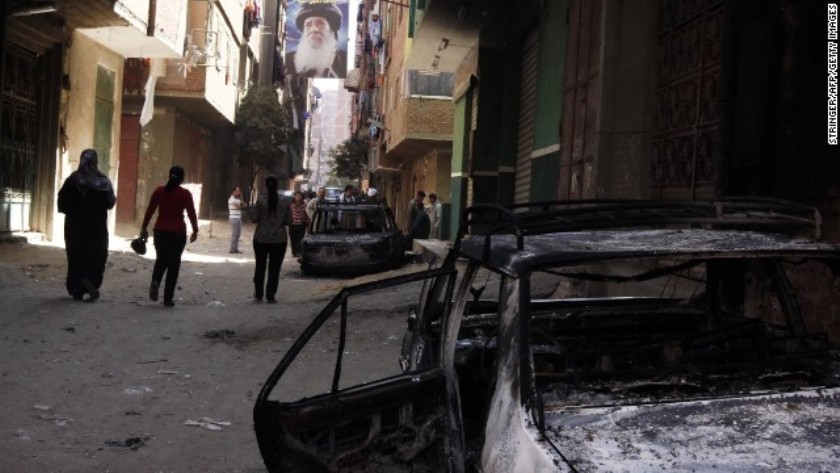
Sectarian violence struck Egypt again on Friday, April 6, as at least four Christians and one Muslim were killed in an incident in Khusūs, in the governorate of Qalyubia, to the north of Cairo. Clashes continued on Sunday, and spread to the Coptic Orthodox Cathedral in downtown Cairo, where a funeral procession was attacked by unknown assailants. Religious and political leaders have condemned the violence and called for calm, but much about the original incident remains unclear.

The report aggregates information from varied local media sources, with links provided. But the unique contribution is the report of an investigative reporter who visited and spoke with local sources. His testimony is quite specific:

Many of these details are difficult to sort, but investigative reporter Rā’id Sharqāwī visited the area and offers a possible explanation. He collected testimony saying Muslim youths drew the Nazi swastika on the wall, and were confronted by authorities. A crowd gathered, as is common during disputes, and drew in local residents including members of a prominent Christian family living opposite the Azhar institution.

A younger member of this family confronted the Muslim youth, asking him why he was drawing offensive symbols on the wall. In the heated exchange this Christian drew his gun and shot the Muslim, killing him. This produced great tumult in the area, and took place around 12 noon.

The Christians, however, were not killed until around 4pm, and in a manner Sharqāwī found mysterious and perhaps conspiratorial. A group of men armed with automatic weapons drove in from outside the area on motorcycles and fired, somewhat randomly, at a group of assembled Christians. At this time stores were broken into and looted; Sharqāwī surmised it was an organized effort to take advantage of the chaos. The situation was not helped by the diffusion of rumors throughout the village, that each religious community was attacking the other.

The article continues by summarizing details of the attack on the Coptic Orthodox Cathedral, the seat of the pope, during a funeral procession for the slain Copts. It was an ugly, ugly incident. The response of the presidency will be closely monitored, but in immediate rhetoric he declares the attack on the cathedral was an attack on himself. Most Copts would say this is well and good, but nearly all previous, smaller scale attacks on Christians have gone unpunished.

Meanwhile, the Muslim Brotherhood protests and claims conspiracy against the stability of the state. This is from the conclusion:

Is there a conspiracy leveled against the Brotherhood to spark sectarian tension and drive the country to chaos? Or, must they invent a conspiracy to cover over the latent sectarian tension which exists and erupted naturally, in order to blame hidden hands for the failures of their governance? These questions are far beyond the scope of this report or any subsequent investigations. But they are the questions asked accusingly by both sides of the Egyptian street.

The nation is awash in conspiracy, allegation, and rumor, and who can say it does not exist? But it is hoped this report provides a first step at least in gathering the purported facts, to prevent manipulations based on only a sampling of the above.

Please click here to read a high ranking Coptic bishop’s spiritual response to recent events, and my brief reflection. Please click here to read the full article at Arab West Report. May God protect Egypt.

Categories
Arab West Report Middle East Published Articles

Fox News: Were Christians Tortured in a Cairo Mosque?

Fox News

From my recent report on Arab West Report:

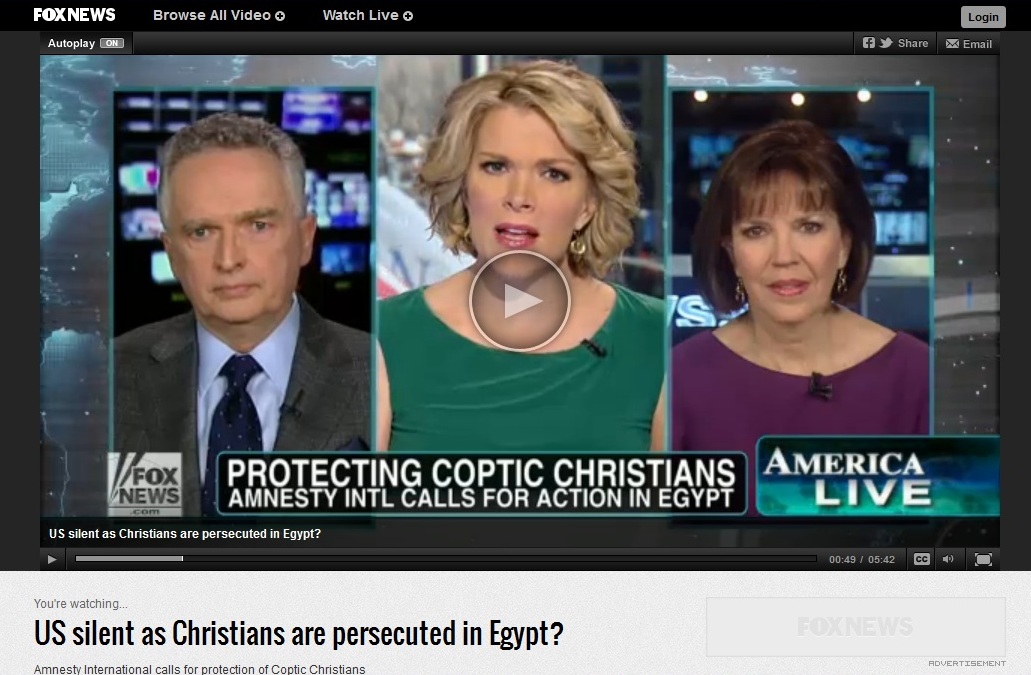
On March 28, 2013 Fox News broadcast an incendiary video report entitled, ‘US Silent as Christians are Persecuted in Egypt?’ It is understood that media relies on a level of sensationalism in order to attract the viewer or reader to a story. Yet this report moves beyond sensationalism to distortion, in which elements of truth are stretched to create an impression far removed from reality.

I watched this report after friends and family brought it to my attention. I’m sorry to say it made my blood boil. Several months ago I published a report on AWR examining if the Muslim Brotherhood was crucifying its opponents, but this alleged incident was reported only by fringe and internet-based sources. Here, we’re talking Fox News! Certainly it is known that the station has a conservative bent, but this video makes it seem as if they are pushing an agenda.

Egyptian news coverage is generally of poor quality, un-sourced, and designed to shape opinion rather than inform. Here, Fox News does its best impression. I have heard similar descriptions of US stations MSNBC, and to a lesser degree, CNN, only from the liberal side. I am fearful the American public has entered an era in which news is meant to entertain and confirm opinions, rather than to educate and challenge them.

I am also dreading this aspect of being back in America for an upcoming visit.

Of course, something very terrible appears to have taken place in this mosque in Cairo, and to a Christian in particular. From al-Monitor:

During the clashes that erupted last Friday [March 22] between the Muslim Brotherhood and protesters in Mokattam, the Brotherhood arrested left-wing activist Kamal Khalil and detained him inside a mosque. He saw a number of demonstrators stripped of their clothes and brutally flogged in the mosque, to the point that most of them lost consciousness. Brotherhood members were using a big whip to strike their victims. Khalil asked the flogger [about it], who replied: “It’s a Sudanese whip. I soaked it in oil a while ago. … A single strike can cut through skin.”

Luckily, Khalil recognized his neighbor from among the Brotherhood members, who intervened and prevented him from being tortured. Yet, Khalil posted his testimony about the Brotherhood’s slaughterhouse on the website of Al-Bedaiah newspaper. Soon after, the testimonies from victims published in newspapers confirmed that they had been brutally tortured. Amir Ayad, a demonstrator, revealed that when the Brotherhood found out that he was a Copt, they increased the severity of his torture, pushing him to the brink of death as they called him a “Christian dog.”

But excerpting from my report:

0:50

Broadcaster leads with words, ‘We were not able to independently confirm this reporting by Mideast Christian News’ which claims ‘Islamic hardliners stormed a mosque in suburban Cairo and turned it into a torture chamber for Christians’

If news is not able to be confirmed by a reputable news agency, it should not be repeated, and certainly not the lead story. At least they mention this detail up front.

Mideast Christian News did not report about a torture chamber for Christians, however, as best I could research following their newsfeed. On March 23 they ran an article featuring testimony from Amir Ayad, a Coptic activist. He related how he was ambushed by the Muslim Brotherhood during the clashes and tortured in a mosque in Muqattam.

Muqattam is the suburban Cairo neighborhood mentioned by Fox News. It hosts the headquarters of the Muslim Brotherhood and as such was the site of an anti-Brotherhood protest. The administration of the mosque in question publically confirmed that Islamist activists took over the facilities and turned it into a detention center.

A similar incident took place during the clashes at the presidential palace in protest of President Mursī’s declaration immunizing his decisions from judicial review during the controversy over the drafting of Egypt’s constitution. Muslim Brotherhood members attacked a small but peaceful sit-in at the palace, which led into large-scale confrontations between the two sides. During the clashes the Muslim Brotherhood also created detention centers in adjacent facilities, though not in a mosque.

Details and testimony about what happened at both events is contradictory, but it appears likely the Brotherhood or supporting Islamists assumed police-like prerogative to apprehend protestors – perhaps rioters – on the opposing side. Furthermore, there is no reason to dismiss the testimony of Ayad that he was tortured; the article includes a picture of him in the hospital suffering from multiple wounds.

The protest at the Brotherhood headquarters, however, was not a Christian protest, it was political. Ayad, as a Christian, was detained, perhaps along with other Christian protesters. The great majority of protestors, and therefore detainees, however, were Muslim, consistent with the makeup of Egyptian society.

For Fox News to report this incident as a mosque transformed into a torture center for Christians – with none of the context of these recent clashes – is an egregious distortion of a story terrible in its own right.

And finally, showing an element of the Fox News report which is absolutely contrary to reality, and would be known by anyone who spent any time in Egypt at all apart from the pyramids:

3:15

Peters continues, saying Miller went to the Coptic quarter where the Christians live. It’s a shabby slum where they are third-class – not second-class – citizens

It is fair to ask what Miller believes is the difference between a second- and third-class citizen. Clearly this is only a rhetorical device. But it is in service either of wanton ignorance or clear distortion. There is no ‘Christian quarter’ in Egypt or any of its cities. Christians are spread everywhere throughout the country.

Perhaps he was referring to the district of Shubra in Cairo, which has a large percentage of Coptic residents. Shubra is a lower- to lower-middle-class neighborhood, but it is hardly a slum. If it is, it is equally populated by Christians and Muslims together.

Or perhaps he had in mind Heliopolis, which also has a large percentage of Coptic residents, but is one of the wealthier districts of the city. In either case, these areas are characterized by the best relations between Muslims and Christians, as they grew up together in an integrated community. They are far from second-class citizens. They are neighbors.

Please click here to watch the original video, and here to read the rest of my point-by-enraged-point rebuttal (and occasional agreement).


Categories
Arab West Report Middle East Published Articles

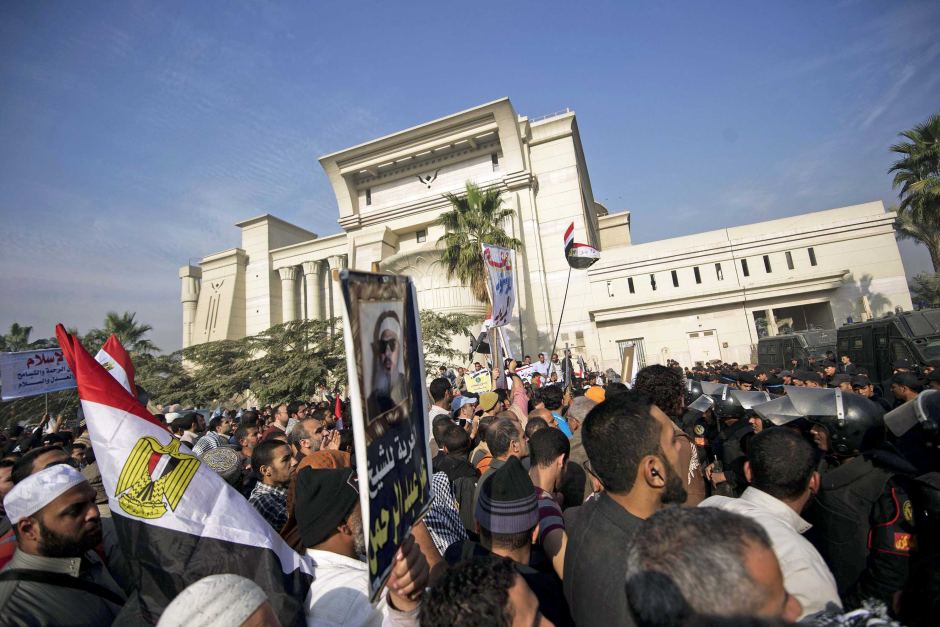
Independence of the Egyptian Judiciary

The Supreme Constitutional Court, under protest by Islamists, December, 2012.

From my recent article on Arab West Report:

The Egyptian transition following the 2011 January 25th revolution has been fraught with controversy; among many has been the reform of the judiciary system. While the 1971 constitution guaranteed an independent judiciary, the following year President Sadat presided over the passing of law 46 which moved many judicial proceedings – including appointments, transfers, and inspections – to the executive branch through oversight of the Ministry of Justice. President Mubarak continued use of these privileges to ensure a regime-friendly judiciary.

Though the reform of the judiciary was not chief among the primary demands of the revolution, many reformist judges had long been seeking to expose these executive abuses. The tensions came to the fore during the transitional period, as the judiciary became a battleground between the revolutionary popular will and what was interpreted as pro-regime rulings from the court.

Though published recently, this article was written September of last year after Mursi assumed the presidency, but before his full-on clashes with the judiciary. In this light the following recommendations are noteworthy, as many anti-Islamists look to the courts to curb presidential power and prerogative:

The first guarantee [of judicial independence] is for security of tenure. Judges must understand their position is safe, not subject to removal for rulings issued against the government. Second, the judge and court system as a whole must enjoy financial security. All necessary resources must be made available for the smooth functioning of justice. Third, there must be sufficient guarantees for individuals in the justice system. A culture of rights ensures the public demand for judicial independence, making it more difficult for the government to infringe upon it.

Unfortunately, Binnie noted, the current Egyptian arrangement does not lend itself to judicial independence. First, the body tasked with inspecting judges is within the executive Ministry of Justice. This allows the executive branch to offer rewards to compliant judges – such as promotions or post-retirement ambassadorships – while penalizing judges who buck the system by assigning them judgeships in remote locations.

Second, there is a threat to the independence of the judiciary if there is not sufficient public confidence in the system. Binnie noted that even if independence is achieved, the courts can operate as an ‘old boy’s network’, appointing from their own circles rather than drawing from the diversity of society. The presence of women is particularly helpful, he noted, but a comment from the audience helped demonstrate his point. Egypt boasts only 42 women judges, but 39 of these are the daughters of established judges.

Third, the presence of a parallel court system undermines judicial independence. Even the best system will fail, Binnie noted, if the government can simply bypass it. With separate jurisdictions for military, security, and emergency courts – each able to try civilians – Egyptian justice suffers. Binnie noted that some drafts of the coming constitution do not sufficient guarantee rights during periods of national emergency, threatening to perpetuate the current system into the post-revolutionary era.

The constitution limited the use of military courts, but it did not eliminate their jurisdiction of civilians. Still, this has not been a practical issue since the end of direct military rule. Noting the importance of public confidence, it is at an all time low. Islamists have none at all, while non-Islamist revolution supporters still see it as in service of the regime in concept, if in particularity the identity of the regime is still under contention. Meanwhile, courts across the country issue rulings that send advocates of human rights up in arms.

But consider these examples, the latter of which was held as a pro-revolution step only a few months ago. If implemented now it would cause shockwaves:

In Egypt, moving from an autocratic tradition, enshrinement in the constitution is necessary. This must be done in detail, lest the situation resemble Russia where vagueness in wording has allowed erosion of judicial independence. Experts expect it may take years to reverse Russia’s political culture of judges as servants of the executive branch.

A positive example could perhaps be taken from the experience of Bosnia. Political leaders took the decision to sack all judges, and then require them to reapply for their positions in competition with new applicants. In the end, 70% of judges were reinstated, but two significant results were produced. First, this measure resulted in a great sense of public confidence in the governing system. Second, the judges themselves ‘bought into’ the new program from the necessity of keeping their jobs. It also reset their orientation, as most judges everywhere, Lund believes, desire independence.

As with much of the state infrastructure, bold reforms are necessary, but political conditions do not permit the unity needed for orchestration. It is a shame polarization has reached such a point.

Please click here to read the whole article on Arab West Report.

Categories
Christianity Today Middle East Published Articles

Is Coptic Evangelism in Africa Really on the Rise?

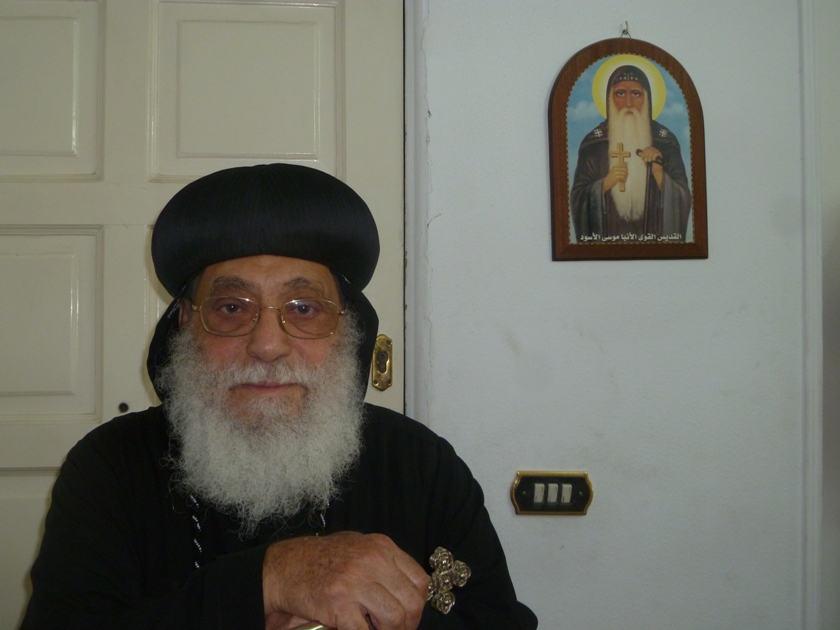
Bishop Antonious Marcos, missionary bishop for Africa. Behind him is a picture of the Coptic saint know as St. Moses the black.
Bishop Antonious Marcos, missionary bishop for Africa. He served first in Kenya and now in South Africa. Behind him is a picture of the Coptic saint known as St. Moses the black.

From my latest article on Christianity Today, published March 28, 2013:

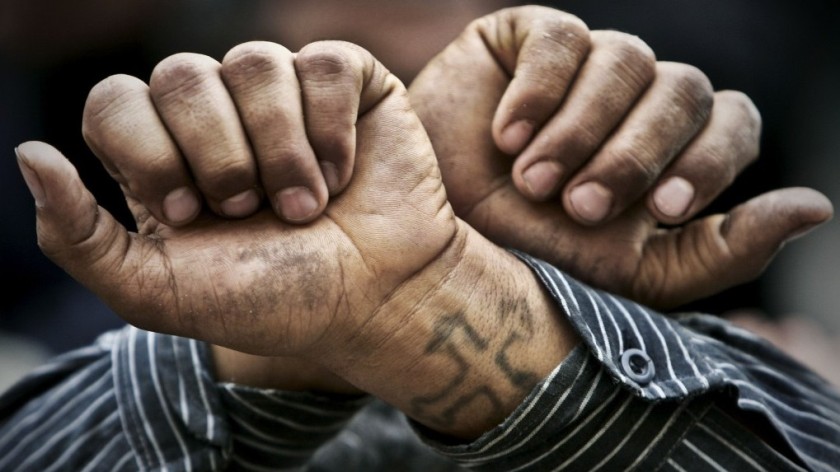
Many Egyptian Christians wear their faith on their sleeve—literally. The cross tattooed on the wrist of Coptic Orthodox believers is a public display which marks their identity for all to see.

Such a quiet witness usually avoids reproach. But recently in Libya, radical Muslim militias detained dozens of expatriate Christians in Benghazi. Amid allegations that captors seared off such tattoos with acid, one Christian died from medical complications during the ordeal, and a Libyan church was repeatedly attacked.

Accusations of evangelism have been at the heart of a series of recent incidents of violence—including the first Coptic martyrs of the modern era—against Copts in Libya, Sudan, and Egypt. Which raises the question: Are Copts starting to recover their missionary heritage?

This article was co-written with a colleague from Sudan, who mentioned the following incident:

Last December, two Coptic Orthodox priests were arrested after baptizing a female convert from Islam. Since the arrests, stories about arrests of Westerners and other Christians attempting to spread the faith circulated in media linked to the state security apparatus, although the accuracy of the reports is hard to ascertain.

Though some Sudanese Copts have enjoyed business success under the Islamist government of President Omar al-Bashir, other denominations have seen their churches destroyed either by mobs or by the state, which cites the breaching of planning laws. With the independence of South Sudan removing the great majority of the nation’s Christians, Bashir has promised a 100-percent Islamic constitution.

Tensions are high also in some Egyptian villages:

There are signs Muslims feel threatened in Egypt as well. Recently churches have been attacked in Beni Suef and Aswan over female converts to Christianity alleged to be hidden inside. Generally this is understood as a Muslim community effort to save face when a woman breaks community traditions or runs away with a lover. Others think true faith might have a role.

“It is an untold story that every now and then a Muslim can be convinced and convert to Christianity,” said Youssef Sidhom, editor-in-chief of the Coptic newspaper Watani. “It is always done secretly, but somehow here it became public. In Upper Egypt especially, this creates a social scandal regardless of the direction of the conversion.”

But far from politically and religiously sensitive conversions in Muslim lands, the Coptic Orthodox Church maintains missionary bishoprics in sub-Saharan Africa:

The reality is the Coptic Orthodox Church remains committed to planting churches—just not in the direction of Muslims. In the 1970s, Pope Shenouda consecrated the first of two bishops for service in sub-Saharan Africa. Today, 65 churches serve more than 400,000 Copts in Kenya, Zambia, Congo, and other nations.

“The early riches of the Orthodox tradition are spreading again in Africa,” said Antonious Marcos, appointed missionary bishop to Kenya in 1976 and now based in South Africa. “Our church is a missionary church, because it was started by a non-Egyptian: John Mark.”

This was a very interesting article to research and write, showing a side of Coptic Christians often not well known in the West. As for the question in the title, are they recovering their evangelistic impulse: Well, they are accused, it seems some are, and reality is just as murky as with Christians around the world.

Please click here to read the full article on Christianity Today.

Categories
Arab West Report Middle East Published Articles

George Messiha and the Constitutional Assembly

George Messiha
George Messiha

From my recent article in Arab West Report:

George Messiha is young, an up-and-coming member of the political scene. In an effort to increase the representation of youth and Copts, the ruling Supreme Council of the Armed Forces appointed him to serve in the elected parliament. After the dissolution of this body by the Supreme Constitutional Court, Messiha returned to general Wafd Party politics, but also participated in a delegation to the Netherlands arranged by AWR editor-in-chief, Cornelis Hulsman. Members from each political trend participated, including Amr Darrag of the Muslim Brotherhood, who spoke proudly of the good work being done in the Constituent Assembly.

Messiha was already selected as one of fifty alternate members, but listening to Darrag convinced him to play a role once it became clear many non-Islamist figures were resigning in protest over the failure to achieve consensus. On October 16, 2012, he submitted his name for election to the body, and became one of nine replacement members tasked with completing the constitutional draft.

Unfortunately, his own experiences as a non-Islamist liberal did not match the impressions he obtained from the presentations of Darrag in The Netherlands.

The article is somewhat lengthy, but provides a very good overview of each member in the Constituent Assembly which wrote Egypt’s constitution. The point is to determine if the writing of the national charter was ‘dominated’ by Islamists, as it is often portrayed.

According to Messiha, 55% of the original members were Islamist in orientation. Following the mass withdrawal of many non-Islamists near the close of the process, the final count was 75%.

This article is not meant to be the final word. Arab West Report is currently producing a book on the Egyptian constitution; the question of member orientation is being put also to Islamists, both independent and affiliated with their official parties.

Holding judgment until then, here is the conclusion from the discussion with Messiha:

The Egyptian constitution reflects work inclusive of substantial non-Islamist participation. Many of the articles were discussed, argued, and formalized as divergent interests compromised and found agreement. But the charge that this is an ‘Islamist dominated’ constitution is also true. It is the product of a clear super-majority which approved the final text, recommending its presentation to the people in a referendum. Rightly or wrongly, non-Islamists felt themselves marginalized, and abandoned the process.

Whether it could have been otherwise is another story.

Please click here to read the whole article at Arab West Report.

Categories
Arab West Report Middle East Published Articles

Interview with Dr. Essam al-Haddad, Presidential Advisor

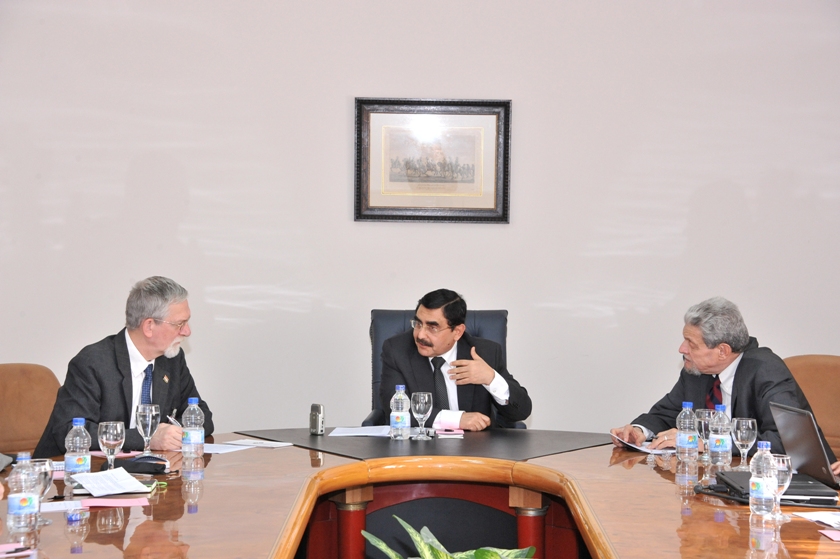
Essam al-Haddad, with Hulsman (L) and Schleiffer (R)

The following is an excerpt from an interview I was privileged to be a part of with Arab West Report. We visited the presidential palace in Heliopolis to meet with Essam al-Haddad, President Morsi’s advisor on foreign and security affairs.

Visiting the palace itself is a strange experience. The walls are covered with anti-Morsi graffiti and lined with barbed wire due to recent clashes in the vicinity. It is a good symbol of the current state of Egypt. An Islamist occupies the top office but faces significant backlash, as the state appears to be breaking down, unable to maintain the respect necessary for such a vital institution. Can you imagine if the White House was similarly afflicted?

Here is Haddad’s take on this, including his explanation on why the conspiracy against Morsi has not yet been brought to light:

Dr. Essam Al-Haddad: The amount of violence against security which was not experienced before, has reached a level where security is now responding but with tear gas and water cannons. But for each rule there are exceptions. Our position is that there is no tolerance for violence against peaceful demonstrations and there is no tolerance for violent demonstrators who are attacking either other people or institutions. So the balance is very tight.

However, if there are any documented incidents of violation, we are taking this very seriously on two sides. First, it has to be investigated and those accountable need to be brought to justice. Second, strategic measures need to be taken to ensure it won’t happen again within the ministry and within the officers. And in this case we would say that we have experienced that the level of restraints, self-restraints by the police is not seen in the Egyptian public for years.

And I invited you to come here to see how we are operating within Ithahadiya [Presidential Palace]. By night on Friday Ithahadiya is attacked by Molotov cocktails and graffiti on walls and everything. Nobody is doing anything to them. So because they are not allowed to carry bullets, the police force, they are only allowed to use tear gas and water cannons. So this is what is going on in the police. But if things are going more violent from some of the violent demonstrators then they have to take action. The rule is using the acceptable level of force in order to stop this from going on.

Any violation of these acts, whether those who have been here in Ithahadiya or anywhere else, will be investigated and those who have been considered accountable will be brought to justice. This is the rule we are working on. Going back to the other side where we have experienced women harassment, huge women harassment at Tahrir Square, there have been claims that these had been organized by the FJP and the MB. This is nonsense, complete nonsense. We have information now that these people are paid by the day, sometimes by hour to demonstrate and to do whatever damage in any part they are and we even know that the fee reaches nearly 1000LE for a day and if they are wounded they could get up until 1500LE, so it is a good job.

Prof. Abdallah Schleiffer: If you have this information why don’t you bring them to charge?
Dr. Essam Al-Haddad: Because this information is not 100% on record. Like drug trafficking, you can see that this person is giving that person an amount of drug to be used and he is selling it and he is getting the price. If you don’t have the license from the public security…

Prof. Abdallah Schleiffer: But you could simply arrest the perpetrators, because there are groups who are fighting them and they could testify evidence, because, again, this is where there is a credibility problem. I have no reason to doubt you at all.

Dr. Essam Al-Haddad: We had a revolution 2 years ago. The dictatorship has been there for 30 years with all its levels of corruption. And people are now experiencing a totally new atmosphere that they are free to do whatever they want and there is no security apparatus enforcing law on them. And they feel this as an opportunity to do whatever they want.

I have been to South Africa for nearly five years after the Apartheid rulers. I was not in Johannesburg, but in Cape Town. I was not allowed to go outside the five-star hotel where I was staying without having a stick and without being warned. When I went around the streets of the five-star hotel everyone was holding a stick. And this was five years after the Apartheid regime.

You don’t have a complete change in such a short time. I always say, you need nine months to have a baby. Can you have a baby in less than nine months? Sometimes, maybe. But you need two years to start to speak two words. And another ten, thirteen years to be mature in order to be a responsible person. This is traditional of course. You cannot expect that after a full collapse and a full blown over of the regime, things would go back to normal immediately.

And you have a counter revolution going against you. But what I can say, we know very well where we are going. And we expect that this time will come and we are determined to carry on building our institutions. And carry on in the reforms we are trying to make in order to make the environment more acceptable and attractive for investors. This is how we want to do it.

Drs. Cornelis Hulsman: The issues we mentioned thus far are all issues for which you need consensus building. How would you find a consensus in Egypt to address all these issues that are of major importance to Egypt because a consensus will help to address this?

Dr. Essam Al-Haddad: Yes you are right, it is important, we are trying our best. Mr. President has invited for dialogue, once, a second, a third time. His invitation was that everything could be discussed, no constraints. You can discuss whatever. But what we are seeing from the other side is that we will not sit unless you are meeting this condition. So, it is a conditional dialogue. “No we will not sit with you ‘cause you are not credible enough”, “no we will not accept this, no we will not accept that.”

Our experience is that, not only experience, our information is that there are elements who are not willing to enter the dialogue, but they are only willing to delay the democratic process. This is their point. Whenever there is an election, they say this is not the right time for an election. If there is a referendum, they will say that this is not the right time for a referendum. If there is any sort of action building democratic institutions in order to go forward there is a sincere trial to hamper and to obstruct it.

This is what we see so in order to archive consensus within this environment, it is not that easy to reach a 100% consensus. But you have to reach out and to open the door and whoever will be joining you will carry on with them. And those who are sending their own agents inside the country and playing outside and sending money, there is more than country and business man who are intervening in our country to avert whatever is going on.

Prof. Abdallah Schleiffer: There is a credibility problem. What countries are you talking about? When you are talking about foreign countries intervening, especially since that is a phrase that has been used over sixty years, so it has a very negative, when I hear that it is like I am hearing…

Drs. Cornelis Hulsman: Mubarak.

Prof. Abdallah Schleiffer: Mubarak or Qadafi. Is there any way you could clarify that? What countries are intervening? I understand why you do not want to, but just asking whether you can.

Dr. Essam Al-Haddad: We do not want to spoil the relations with this country, because this is a brotherly country, which is scared of what is going on here. We prefer to keep it calm. And to avoid it, with the hope that they would realize that intervening in the internal affairs of Egypt is not at ease.

Please click here to read the full interview at Arab West Report.

Related Posts: