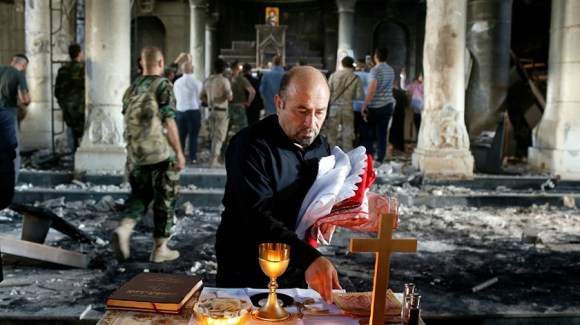
Ahmed Jadallah / Reuters Preparation for Qaraqosh’s first Sunday mass since the Iraqi Christian town was recaptured from ISIS (October 30, 2016).
This article was first published at Christianity Today on January 30, 2017.
Married in December to a Syrian woman with American citizenship, Fadi Hallisso went to Beirut to apply for a green card.
A Syrian Christian, Hallisso has worked with refugees in Lebanon since 2012. Funded by different American agencies, he was no stranger to the US government. He even testified about the situation in Syria to the US State Department and to Harvard Divinity School.
But this week, Hallisso was told he was no longer welcome to apply. The new US administration said so.
“It is very humiliating to be put in the category of potential terrorist,” said Hallisso. “Just because I carry a certain passport.”
As more details of President Donald Trump’s new security policies emerge—including a promise to prioritize Christian refugees for resettlement in America—much appears lost in translation.
“This executive order has created a new atmosphere very hostile to people in the region,” said Chawkat Moucarry, World Vision’s director for interfaith relations—and Hallisso’s uncle. “Unwritten rules seem to be implemented as a result.”
Is Trump’s executive order on refugees a de facto “Muslim ban”? Is it not? Is it prudent? Is it overdue? As American Christians debate these questions from the small towns of Middle America to the nation’s major airports, so also Arab Christians are trying to figure out what is going on.
“I read the executive order,” said Adeeb Awad, chief editor of al-Nashra, the monthly magazine of the Presbyterian Synod of Syria and Lebanon. He remarked…
Please click here to read the full article at Christianity Today.
In 2008 a Moroccan man and his 17-year old wife immigrated to America. Not long after she filed a restraining order against him, claiming her husband was raping her. The husband did not deny their sexual relations were non-consensual, but said that in his religion, the wife was supposed to submit and do all that he desired of her. The New Jersey judge found that given his understanding of Islam, he did not intend to commit a crime, and was therefore innocent. The restraining order was denied.
Cases like this set off alarm bells that shariah law is coming to America, and in fact is already here. Called “creeping shariah,” this case is given as just one further example of the United States nation forsaking its heritage in an effort to be politically correct and yield to the pressures of local Muslims to live by their own laws, and not our own.
But according to Eugene Volokh, a conservative law scholar at UCLA, it is quite the opposite. Where US judges have made reference to shariah law, they do so within parameters long established in American legal precedent. He notes, importantly, that the judge in the New Jersey case made a legal error, overturned by a higher court which granted the restraining order.
In the effort to understand this controversial and inflammatory subject, his explanation proved very helpful. Here is a list of what is and is not allowed in the American judicial system:
Allowed: Distribution of inheritance according to religious motivation
Not: Asking the court to divide inheritance according to shariah law
US law allows freedom of contract and disposition of property. One may divide one’s property in a will according to whim, or ask a religious scholar to divide it according to shariah law. But the court does not accept competency to interpret religious laws, and would reject a request asking it to do so.
Allowed: Application of foreign law to determine marriage or overseas injury
Not: Specifics of foreign law against US code or procedural discrimination of testimony
US law will accept that two foreign individuals are married if they were legally married according to the law of their country of emigration. If in foreign nations marriage is determined according to shariah, then US courts must take this into consideration for the determination of marriage in a domestic dispute. Foreign acceptance of polygamy, however, has no application in US courts.
Similarly, if an American is injured abroad and sues a company with representation in America, tort laws are determined by the nation in which the injury occurred. But should foreign tort laws limit the value of female testimony, as for example in some understandings of shariah, this has no carry-over consideration in the American lawsuit.
Allowed: Exemption from work rules for religious reasons
Not: Unless it imposes ‘undue hardship’ on an employer or is against government interest
US law permits reasonable accommodation for religious belief, evaluated on a case-by-case basis. So wearing a hijab at work or taking time from the work day to pray may or may not be granted, based on the nature of the employment in question. A famous ruling allowing Muslim taxi drivers to decline a customer carrying alcohol may or may not have been judged correctly, but what is important is that it was based on existing American precedent, not in understanding what is right in Islamic shariah.
Allowed: Granting accommodation to students or clients that impose only modest costs on the granting institution
Not: Evaluation of these requests on the basis of which religious group asks for them
US law allows public and private institutions to better serve citizens and customers by appealing to their religious sentiments, as long as this does not damage the public interest as a whole. Banks have offered sharia-compliant loans, for example, and schools with high density Muslim populations have granted a full day off on holidays rather than just excusing Muslim students. Examples of this sort apply equally to all religious petitions, and must not be judged on the basis of which religion benefits.
Allowed: Efforts to legislate Islamic morality in heavily populated Muslim areas
Not: Unless it violates the Free Speech Code or Equal Protection Clause
US law permits citizens to lobby government to pass laws reflective of morality. In local areas therefore, Muslims are as free as others to pass legislation barring alcohol, for example. Should any locality, however, seek to encode restrictions on “blasphemy” or limit the rights of women, it will stand in clear violation of existing US law and be struck down by the courts.
In addition to Volokh’s analysis, New York attorney Sadakat Kadri wrote in Heaven on Earth: A Journey through Shari’a Law from the Deserts of Ancient Arabia to the Streets of the Modern Muslim World, that US federal arbitration law has been on the books since 1925.
Arbitration law has legitimized religious tribunals for Christian conciliators and the Jewish Beth Din, giving them force of law to issue legally binding decisions. To deny similar right to Muslims, within the context above, would require reforming that law to impact all religious communities.
There are many cases offered by those who warn of creeping sharia, and each must be evaluated on its own merits. There may be examples–many or few–in which the above descriptions have been violated. The above is offered to all who have been affected by the clamor that “the Muslims are coming.”
Indeed, they are already here and are coming as citizens within a nation of laws. They are undoubtedly changing the demographic and culture of our country, as every set of immigrants has done before. That they are Muslims, outside of the general Christian heritage of most previous groups, does add a different application of the American guarantee of freedom of religion. It may also result in these newer Americans who, either unaware or rejecting of American liberty, seek to illegally restrict individuals in their own communities.
But throughout the nation’s history the constitution and bill of rights has worked remarkably well. It should be trusted to continue, no matter the unfamiliarity of those who believe also in shariah. The United States will honor them within reason, and curb any excess that violates our order. On many issues worthy debate must take place. But we must not let fear or demagoguery permit generalization or discrimination.
Let the law decide.
This article was first published at the Zwemer Center.
As Christians involve themselves – for good and for bad – in the divisive politics and cultural struggles of our nation, it is assumed they do so to preserve and advance a moral ethic consistent with Scripture.
Unfortunately, it can be easy to forget one of the central marks of this morality: ‘Do unto others, as you would have others do unto you.’
This command, and it is necessary to remember it is an active imperative, concerns many issues of the day. I would submit that current Muslim-Christian relations illustrate this selective memory, and the Middle East provides a useful mirror.
In the Arab world it is Christians who are the great minority. How do they describe their situation? Much like in America, there is considerable nuance.
It must be said at the outset that the comparison will not be exact. The US enshrines religious freedom for the individual and forbids a religious test for public office. While these concepts are not absent from the Arab world, they are mixed in with many constitutions that enshrine Islam as the religion of the state and sharia law as the basis of legislation. At the official level these articles can complicate matters considerably.
But what about the popular level?
To be certain there is a spirit that, while tolerating Christianity, strives to preserve and advance the Islamization of society. Some conservative Muslims argue that Christians should not be greeted on their holidays, lest it imply endorsement of false theology. Others warn their children against playing with Christians at school. And many Christians complain of discrimination that is mixed in with a general culture of nepotism.
But Christians the region over also speak of neighborly relations with normal people who happen to be Muslims. Post-Arab spring, many Arab governments are going out of their way to combat extremism that has crept into society. And as reflected in my recent article in Christianity Today, many Arab Christians are comfortable saying they and their fellow Muslim citizens worship the same God.
Yet the article also described an undercurrent of frustration, that Christians feel internally compelled to seek common theological ground in order to secure common societal acceptance. The more some push the distinctiveness of Christianity, the more they fear either government or popular response.
Within the diversity of these Arab responses there is also advice for America and the West: Limit the presence of Muslims in your midst.
The complaint is not so much against Muslims as a people, but of Islam as a religion. The more devout the practice, they say, the greater the enthusiasm to enact its superiority – not just in the afterlife, but to bring this world into conformity as well. As evidence, they simply point to their own societies.
Whatever is made of the ‘same God’ debate, Islam and Christianity are different religions. But different also is the historical fusion between these religions and their respective societies. It is good to learn from our Arab brothers and sisters in Christ about their experience with Islam where they are the minority. But the point here is not so much to arm with argument but to invite readers to flip the script and see within it a mirror to their own society.
How might American Muslims feel about our current social and political climate? Would they say most neighbors treat them well? Would they complain they have to accommodate their faith to a dominant culture? Would they state a concern over discrimination or a fear of rejection?
Many Arab Christians have responded to their challenges by withdrawing into their own communities. Are American Muslims tempted to do the same?
And what of the warning some Arab Christians issue about Islam? How similar is it to some Muslim warnings about decadent Western society and the Christianity that is powerless to arrest it? Or, others argue, the Christianity that is in league with colonialism or Zionism or consumer capitalism to radically alter the fabric of Muslim society?
Let every charge be answered, and every religious ideology be examined. But let every American Christian return to the imperative of Christ:
“Do unto others as you would have others do unto you.“
Consider the situation in which Middle Eastern Christians live and ask, how would you like this ‘you’ to be treated?
It is not argued that treating American Muslims well will necessarily make any difference to the Egyptian Copt, the Lebanese Maronite, or the Iraqi Assyrian. But any mistreatment of Western Muslims is often reported in the regional press, and gives fuel to those with an axe to grind.
The Golden Rule is not about quid pro quo. It is fulfillment of the law of Christ, who served those who loved him not. Please be mindful, for concerning Muslims it is often we who so rarely love.
Theresa, the nine-months-pregnant wife of a Coptic Orthodox juice stand owner, could not hide her admiration when told how a Christian professor had donned a hijab in solidarity with Muslims facing prejudice in America.
“It is a beautiful thing she has done, going beyond the norm to better approach others,” she said.
“But it would not work here.”
Her comment came on the heels of her husband Hani’s discomfort. He called the symbolic act “extreme.”
In doing so, the humble man mixing mango and strawberry mirrored the reactions of most regional evangelical and Orthodox theologians to the core question of the Wheaton College dispute: not Hawkins’s hijab, but her “same God” explanation for it. All commended her intentions, but only one—the Palestinian head of a seminary—praised it as a stand for justice.
One pastor called it “excessive.” A bishop, “unnecessary.” And therein lies the rub. Whether considering donning the hijab in solidarity or debating if Muslims and Christians worship the same God, Arab Christians operate in a vastly different religious context.
Only recently have American Christians had to deal with issues raised by Muslims in their midst. The 9/11 tragedy birthed a political culture that seeks unity through theological terms, said Salim Munayer, head of the lauded Musalaha reconciliation ministry in Jerusalem.
“But among Muslims and Christians in the Middle East, the discussion is not over whether we worship the same God,” he said, “but rather Muslims challenging us that we worship one God at all.”
Please click here to read the full article at Christianity Today, and here for CT’s op-ed on the controversy so far.
All press is good press. Perhaps not always true, it is often a maxim of politics. A day after the backlash over his ‘a Muslim should not be president’ comment, Ben Carson announced windfall fundraising of one million dollars.
But perhaps it is also a maxim of religion? With the name of Islam dragged through the mud of Republican politicking and right-wing punditry, the Council for American-Islamic Relations (CAIR) seized the media spotlight and announced a campaign to freely distribute the Quran to citizens and civic leaders alike.
Back in 2001, CAIR chairman Nihad Awad reported that 34,000 Americans converted to Islam after the attacks of September 11.
It is a very natural phenomena. Media loves a negative story, which draws attention to an otherwise obscure issue. People begin to investigate, and discover the issue is not as completely negative as first reported, or stems from an extreme fringe. Then the counter-narrative emerges, in which the issue is hailed as good, or at least complicated. Conflicted over the original outrage, a moderating tone enters the issue into the mainstream.
From here, the politicking – or proselytizing – continues with precious momentum.
If conservative American evangelicals are not already concerned about Ben Carson’s comments, perhaps they should consider another pillar of culture war outrage: gay marriage.
I was raised in the 1980s. My first memory of homosexuals was local news coverage of a gay pride parade in some northeastern city, as transvestites and drag queens shouted at the cameras in an otherworldly display of an underground subculture I could never have imagined. The TV announcer could barely contain his chuckle, if I remember correctly.
Sitcoms and movies were rife with mocking humor. The AIDS scare lent credence to cries of God’s judgment. But over time society discovered the human behind the identity. Media attitudes shifted, both shaping and reflecting public opinion. The louder the protest, the greater the spotlight. Today the Supreme Court declares marriage equality.
Consider the distance traveled in three short decades. Imagine Islam in America three decades to come.
Note that in the examples above no statement is offered on the merit of Carson’s comment nor the appropriateness of gay marriage. There is a place in America for worthy debate on the morality and policy of queer issues. There is a place to discuss the nature of Islam and its compatibility with American values.
At least there should be. The fact this space is shrinking is perhaps commensurate with the retributive empowerment of the previously marginalized. May the conservative American evangelical reflect, and where necessary, repent.
But consider also the sub-Christian flaw in my argument above, quite akin to much popular discourse about Islam. The motivation is fear. Perfect love will not permit this.
Punditry highlights the illiberal character of sharia law and links the savagery of ISIS to the Quran and Islamic history. But it equates this otherwise worthy research with Islam in its entirety. Worse, it suspects imitation within every Muslim. Beware, it cries, lest one day we see Syria in Springfield.
My argument risks being similar. Beware, I cry, lest the crassness of your rhetoric win ground for Islam.
There is a better way. The conservative American evangelical must win ground for Muslims.
Islam is a religion, an idea, a way of life. Let it be praised or criticized according to its merits. But the better way is to do so with respect, humility, and hope. Muslims around the world deserve honest assessment of their faith. Whether of its religious, social, or political aspects, Christians should speak.
But Muslims in America deserve much more from their Christian neighbors. The better way is to bless, rather than demonize. To secure rights, rather than restrict them. To speak up in their defense, rather than rally a political base.
Conservative American evangelicals should be the first to depoliticize this issue entirely.
What this argument lacks is sufficient consideration of the proper place of denunciation. There is truth that is opposed to error. There are valid interests opposed to vile manipulations. There are Muslims in America and the world with political agendas to match any lobby from the right or the left.
There is a place for religion in politics. But great care should be taken against the politicization of religion. America has navigated this minefield for centuries, and Islam provides a particular challenge.
“But no religious test shall ever be required as a qualification to any office or public trust under the United States,” says the constitution. Let American citizens vote as they wish, from any, all, or no religious motivation.
But let American Christians both engage and transcend the politics of the day to embrace a kingdom greater than the republic. Their obligation is to help all participate in both.
This article was first published at the Zwemer Center.
Al Jazeera America received a major boost this week in its controversial attempt to build a U.S. audience. But the Qatar-based news station, whose channel will now be carried by Time Warner Cable, is not the only Middle East satellite giant coming to penetrate the market.
Soon the Arab world’s top Christian broadcaster, SAT-7, will also start reaching into American homes.
Unlike Al Jazeera, which aims to reach 48 million U.S. homes, 17-year-veteran SAT-7 is aiming for only four million. This is the estimated number of Arabs in the United States and Canada.
“Since the start of the Arab uprisings in 2011, there has been an acceleration in the number of Arabs—especially Christian Arabs—leaving their homelands for North America,” Terry Ascott, SAT-7’s founder and CEO, told CT. “Launching now is a response to the growing number of people who are leaving and want to stay in touch with home.”
Please click here to read the rest of the article at Christianity Today.
Growing up I lived the first 18 years of my life in the same house, only moving to go to college. My mom has lived in the same town her entire life, and all four of my siblings still live within 20 minutes of that town. I didn’t grow up saying too many good-byes for the first 18 years of my life. The second 18 years, however, were quite opposite. College, grad school, first job, marriage, and then life overseas; lots of changes and lots of moves. Since my husband and I first moved overseas, we have lived in three different countries, four different cities, and five different apartments.
While not every expat moves often, saying good-bye to people and places is a common part of the expat lifestyle. Even if you are one who stays put in the same foreign country for many years, you must still say good-bye to the others who filter through year after year. And then add factors like childbirth, children’s schooling, medical needs and a revolution, and there are good-byes all over the place.
Good-byes are a reality for us, but they don’t have to be a negative aspect of expat living. Before traveling overseas, my husband and I took a course in grief counseling. We didn’t exactly realize it at the time, but it was great training for this lifestyle. Every good-bye is a loss. And every loss causes grief. Sure there are some losses more painful than others, but all losses are felt at 100%. Given this reality, how can we keep from shutting ourselves off to new friendships or new opportunities that we know may eventually require another farewell?
Stay ‘complete’ in your relationships
You never know when a relationship could end or be interrupted. There were people I could not physically say good-bye to when the revolution occurred two years ago. I didn’t anticipate needing to say good-bye, and so I wasn’t complete in all my relationships. I wasn’t able to tell people I was thankful for them, or that I loved them, or that I was glad they were in my life because….
On the other side of that spectrum, we have to deal with the difficulties that come between us and another person. If we work through the problems, we won’t let the pain of a strained relationship be a burden to carry into our next assignment.
We’ve all heard people lament, “I just wish I had said this to her before she died.” Or, “If only I told him I loved him before he left.” Living with those ‘unsaid statements’ makes you less free to join in a new relationship. Communicating them does not remove the pain of saying good-bye, but it does help to heal the pain.
Say ‘good-bye’ to people, places and things
This is one of the most practical points I took from the training those many years ago. Don’t be afraid to say good-bye. Embrace it. Hug. Cry. Say the words you hold within you. Saying something simple instead, like “See you later,” mayseem like it will hurt less, but if you know the good-bye is for a significant period of time, you must say it.
This is especially true for our children. We hate to see them hurting as they say good-bye to yet another friend. Sometimes we try to comfort them by telling them we can visit their friend next year, or maybe the friend will visit us again. But instead of offering such hope, which often proves false, grieve with your children. Agree with them that saying good-bye is really hard, that the friend they just said good-bye to can’t be replaced. That’s it. You don’t need to make promises or try to make it hurt less. Let them grieve and help them to say good-bye well.
Saying good-bye to places was a new concept for me, but we have done it in every flat we’ve lived in since living overseas. I am sure our 9-month old daughter doesn’t remember our apartment in Tunisia, but we still walked with her through each room of the flat and said good-bye to the rooms. We talked about what we enjoyed doing in those rooms or how we would miss them. It may seem trivial, but if you think about it, you can probably vividly picture some special places in the home where you grew up.
While the flat you have lived in for the last year may not seem as significant as your childhood home, it is still good to treat it as a place to say good-bye to. Again, for your children, you may not know what their special memories are in that place.
For some, Cairo is a tough place to live. As you move onto your next assignment, or return home, you may do so with a sense of relief. And yet, living here has changed you. The people you’ve met have affected you, for good or for bad. Even if you joyfully skip through you apartment on moving day, and say good riddance to your bawwab as you walk out of the building, it would still be good to close off those relationships and places completely.
Life overseas is exciting: It is a chance to visit ancient sites, interact with people so different from yourselves, perhaps also to help the poorest of the poor. But it also has its challenges, and the ‘good-byes’ are among the greatest. Learn to be complete in every relationship and say good-bye well, and this challenge will be just a little bit easier.
Today Glen Beck led a rally in Washington, DC on the steps of the Lincoln Memorial where Martin Luther King, Jr. gave his famous ‘I have a dream’ speech. In fact, today was the anniversary of that speech, which came to symbolize the struggle and eventual triumph of the civil rights movement. Beck denied he knew about the congruity of dates until after he planned the rally, but this denial has not stopped many from labeling this rally as an offense to the legacy of King.
I will confess to not following this issue too closely. I understand Beck to be a conservative and religion-friendly newscaster, but do not know exactly what he does or does not support in detail, outside of the fairly obvious battle lines in American politics. Furthermore, I have no insight as to whether or not he is playing games with the civil rights history of our nation, but I do also see what appears to be a highly symbolic convergence of imagery. Is he honoring the legacy, exploiting and redefining it, or just, as he confessed, ignorant of the whole matter?
Perhaps given that I have not closely followed this controversy, I can easily connect it to another controversy I have not followed closely: the Ground Zero mosque. (It is an advantage of living overseas that the headline dominating news stories in the US are received with considerably fewer decibels.)
In both cases it is clear that those engaged in the controversial activity have the right to do so. Glen Beck obtained the necessary permits to conduct a rally on national property, and the mosque/community center organizers own the land on which they seek to build and have received zoning clearance to do so.
It is also clear that those who are protesting do not challenge the legality of these endeavors, but their appropriateness. Many African-Americans and their then-liberal supporters in the civil rights struggle do not share the conservative worldview of Glen Beck. They find it offensive that he advance his agenda on the same day, at the very spot that their hero’s dream is most enshrined.
Meanwhile, many New Yorkers and Americans of all stripes have defined Ground Zero as sacred ground, after the devastating attacks perpetrated there in the name of Islam. Most of these would not oppose a mosque being built elsewhere, regardless of what they think of Islam as a religion. Why, however, build it there? Even if the mosque represents Islam of another stripe, why plant its flag at the gate of such an atrocity?
The response of an individual to the sense of appropriateness may vary, as may the ‘logical’ assessment of these claims. What is disturbing in both cases, however, is that opponents are seeking either to stop or sully the endeavors through loud and distant protest. Consider: If those in favor agreed their efforts were inappropriate, would they have undertaken them? And since they do not, will they be convinced by rancor and misinformed assumptions of intent, cast from afar?
Certainly the masses feel helpless. What can a patriot in Virginia do to influence Imam Faisal in New York? How can an activist in California effect Beck in DC? Let the cry be heard in the media, on the radio, in a blog. None of this, however, has any influence on law. Worse, it has contrary affect on the people involved.
Opposition and controversy, especially when loud and public, generally serves only to cement someone in their opinions. If there is a way forward, however, imagining for a moment that these endeavors are not appropriate, it can only be found in engagement. It is possible to change the mind of a friend. Very little in the public discourse concerning either Glen Beck or Ground Zero, however, is contributing toward bridge building. On the contrary, all seems polarizing.
Here in Egypt there is a similar, though not identical, issue surrounding church building. The law is ambiguous; there is no formal discrimination but the process of gaining approval is universally acknowledged as difficult. In places a church can be constructed quickly and easily; in others the plans labor for years waiting for the governor (the governor!) to give his approval.
Oftentimes Christians decide to go ahead and build anyway (as will Muslims, at times, with a mosque), knowing that if they can get the building up then the government will not knock it down. There is far less public relations damage for a stalled authorization process than for the demolition of a house of worship. The former will languish on the desk of a bureaucrat; the latter may attract international condemnation.
Very few Egyptian Muslims would argue that there is no place for a church in a Muslim nation. It is not uncommon, however, to hear their protest that this church is too close to a mosque, or that the church steeple equals or exceeds the height of the tallest minaret in a village. Frustrated by delays in authorization Christians will often proceed without consulting their Muslim neighbors. Feeling threatened or dishonored, Muslims have sometimes reacted in violence, damaging the building that has been constructed as an affront.
Many Christians and Muslims will argue that the situation must be remedied by law – that is, a clear and impartial system must be created to govern the building of all houses of worship. There is much merit in this discussion. Unfortunately, many of these same advocates for religious freedom stop there. They press the need for legal reform, but do not continue to engage the opposite community on the ground, in real relationships.
For people on the ground, however, the issue of church building is not one of law, but of appropriateness. The law may force their hand, but this only results in furthering community tension. Neither Muslims nor Christians profit from this situation. Yet since few Muslims would oppose the right of Christians to build a church, overcoming the issue of its appropriateness can only be done through engagement.
The din of struggle and opposition will always be heard over the quiet, dogged pursuit of relationship. In both the cases of Glen Beck and Ground Zero, there may have been extensive efforts at engagement that have gone unreported, since engagement is not conducted in front of cameras.
At the same time, engagement is insincere if it is only seeking its own interest. I might sit down with my opponent once for tea to hear his argument, but if he only repeats his position each and every time, I will no longer invite him over. Engagement is willing to see the other side, validate, and appeals in humility to that which it desires.
Many today, both inside and outside of Egypt believe that sectarian tension is increasing rapidly. This is due to the same phenomena that dominate media coverage of Glen Beck and Ground Zero. These polarizing images ignore the many efforts at racial reconciliation engaged in by both liberals and conservatives. They ignore the fact that most Muslims in America live a normal middle class lifestyle in complete peace and tolerance with their neighbors.
Similarly, most Muslims and Christians in Egypt live together in peace. Where there is tension it must be addressed. Where an issue arises the media must cover it. In the face of real difficulties in certain places, though, the assertion of peace may ring hollow. If so, it does reflect a growing pattern, not of tension, but of disengagement. While percentage-wise the troubles are few, the level of harmonious interaction between Muslims and Christians decreases ever so slightly, but steadily.
This is the risk America now faces in the issues of Glen Beck and Ground Zero. Polarizing voices and opinions only serve to lessen consensus and engagement. On either racial or religious grounds, the genuine peace which exists between all Americans may ring increasingly hollow. If so, it is because these normal Americans have disengaged from their diverse communities, finding fellowship only with their kin.
Though God is often portrayed as the one with the loudest voice of all, silencing his opposition by power of miracle, he is also characterized by stillness and whisper. Jesus spoke of God’s Spirit as a gentle wind, with man knowing not from whence it came or where it is going. Many today in pursuit of their agendas
usurp God’s right of bombastic pronouncement. We would do better to search instead for his whisper, finding places where he is at work, but quietly, and ignored by most of those around.
Note: This post today was originally written in February of 2010, but never published on the blog, only at Arab West Report. I was reminded of it by the controversy in recent weeks concerning the proposed Muslim community center / mosque at Ground Zero. The leader of the project visited Egypt several months ago, and I attended his lecture. Imam Faisal Abdul Raouf was not a household name at that time, though the Ground Zero plans were already contemplated, if not underway.
The essay which follows has nothing to do with his Ground Zero plans, but addresses the larger question of the place of Islam in the West. The post is a bit lengthy, but I hope you progress through to the end to read along with my efforts to look inward at the psyche of America, indeed my own misgivings and hope, in order to find the best way forward. I wish that in light of the issues being raised at Ground Zero, my conclusion might help us find that way.
On a lighter note before we begin, I have experimented with placing a survey at two places in the post. I’ll be very interested to see your vote, and will look forward to any comments you have to offer. Thanks.
In recent days I have had the opportunity to encounter a picture of Islam as a message of love and tolerance from two very different Muslim voices, Imam Faisal Abdul Raouf and Sheikh Ahmad al-Sayih. Imam Faisal is head of the Cordoba Initiative, an independent organization seeking to promote international understanding and acceptance between the Western and Islamic worlds. He is the son of Egyptian sheikhs from al-Azhar, but was educated in Great Britain and served many years as an imam in a New York City mosque. He visited Egypt and presented his work at the Sawy Culture Wheel, sponsored by the US Embassy, in which he outlined his vision, distributed an Arabic translation of his book, and sought to recruit support and partners for his international organization. A summary of his presentation can be found here.
Sheikh Ahmad, meanwhile, is an Egyptian sheikh from al-Azhar, now retired. He has taught in Egypt, Qatar, and Saudi Arabia, and currently is concerned to combat the growing Wahhabi influence on Islam, both in Egypt and worldwide. He believes this is a corruption of Islam as it tends to reject the religious other, whereas Islam in its essence is the same message as that which was revealed in the earlier religions. Sheikh Ahmad is from the region near Nag Hamadi, where six Christian young men were recently killed exiting Christmas mass, along with one Muslim police officer, and has spoken out against this crime. I interviewed him in this context, hoping both to better understand the situation and gain counsel on how to assist in peacemaking there. A summary of this interview can be found here.
This essay will be an attempt to compare and contrast these two Muslim voices based on the reactions they produce, first in their Arabic audience, second in me, as a Western Christian. Though I was unable to interview Imam Faisal, the question and answer period of his presentation revealed the controversy his ideas elicited from the predominantly Egyptian audience. Conversely, though I have not personally witnessed the effect of Sheikh Ahmad’s teachings on Egyptian public opinion, he himself highlighted much of the controversy he has engendered. As mentioned above, both men preach a message of Islamic love and tolerance. Why should love and tolerance produce any controversy at all?
This essay will begin from the starting point of Islam as a world religion, and therefore like all its peers it is comprised of vast and flexible source material. Believers in Islam can find ample texts to support a variety of positions, and while each may argue with the other over best interpretations, inasmuch as they work from the same basis and maintain the accepted boundaries of faith—themselves open to dispute at times—they represent a message which is intrinsically Islamic. As a non-Muslim it is not my place to comment on the message of love and tolerance as opposed to extremist thought; it will be the perspective here that Islam, like all religions, can support many emphases, which can be highlighted or downplayed according to the person, movement, culture, or age.
Both Imam Faisal and Sheikh Ahmad highlight Islam as a message of love and tolerance. They differ widely, however, in their presentation and audience. Imam Faisal, though born to Azhari Egyptian parents is thoroughly comfortable in the Western cultural world, to which he speaks primarily. His English pronunciation is perfect and his dress impeccable. He declared that his motivation to help Americans understand Islam grew exponentially after the attacks of September 11, 2001, when he and his community were put to the test in defending their faith against the actions of Islamic terrorists. He discovered that America was not necessarily against Islam, but needed to see an Islam which was not a threat, first to its safety, second to its cultural values. In the course of explaining the true message of Islam over and over he saw also the need for Muslims in the West to practice their faith within this culture, so as to win a place of natural being and acceptance. Concerning the controversy in Switzerland over the building of minarets, he urged Swiss Muslims to build Swiss mosques, acceptable to the culture so as to become part of the established and normal landscape. His message was for Islam to become Swiss. He noted, also, that in his presentations he discovered a growing Western hunger for spirituality, which many were finding in Islam.
Sheikh Ahmad, meanwhile, speaks no English whatsoever, dresses like a traditional Azhari scholar, and converses even informally in Arabic diction fit for the Friday pulpit. Through his many years teaching in the Persian Gulf states he became very familiar with Wahhabi teaching, which he grew more and more to find was poisoning the precious Islamic message of love and tolerance. He writes and speaks extensively to expose the false foundations of Wahhabi thought, which he finds grounded in some of the traditions of the Prophet Muhammad, most of which his scholarly study has found to be baseless. Among these traditions is source material for violent and separatist preaching highlighted by some Muslims today, which in actuality, he believes, were composed when the later Islamic community was growing apart from the Christian milieu of the fading Byzantine Empire which it had largely conquered. His message was to return to the original preaching of Muhammad, which emphasized the community with and respect for other religions, Christianity in particular. He had special praise for the monks of Makarius Monastery in Egypt, in whom he found the real Islamic spirit of love and tolerance.
The controversy of Sheikh Ahmad’s views is found in his calling into question many of the inherited traditions of Islam. In doing so he disturbs the traditional acceptance which many Muslims have given to the traditions in general, potentially prompting a reevaluation of the faith, as so much currently accepted as Islam is built from this source. Sheikh Ahmad declares, actually, that 60% of current Islam stems from faulty traditions, and therefore must be jettisoned. This is not an easy message for ordinary Muslims to hear.
The controversy Imam Faisal’s views produced was different, as he questioned not the religious sources of Islam, but its cultural ones. Though only a quarter of the world’s Muslims are Arabs, its foundations are still largely Arabic, certainly through the language, and also through the culture of Arabia which birthed the faith and established its early patterns, generally accepted as normative. Imam Faisal, however, highlighted that in history Muslims have always adapted their faith to the local culture, and urges Muslims today to do the same in the West. If Islam there remains foreign—Arab, Pakistani, etc.—it will not become accepted. Though not as controversial as the source criticism of Sheikh Ahmad, for the Muslims of Egypt attending the Sawy Culture Wheel presentation, proud of their self-identity as leaders of the Arab world, this is not an easy message to hear.
Therefore, though the vast majority of the Egyptian Muslim audience of both Muslim voices would agree with the message of Islam as love and tolerance, the manner of establishment was discomforting for many. One called into question the accepted cultural basis of the religion, the other the accepted religious basis. The discomfort should not be surprising, for most believers of any religion inherit their values without much thought or questioning. For these, Islam is love and tolerance. Practitioners of religion, however, especially those who are forced to consider their faith outside its comfortable context, must deal with the faith in its entirety and complexity. Imam Faisal has found the fear of Islam in the West to be tied to the foreignness of the culture of its adherents. By removing the cultural component the message of love and tolerance is better received. Sheikh Ahmad, however, has found that Islam is threatened by Wahhabi emphasis on certain traditions. By invalidating this religious component the message of love and tolerance is better established. Yet in explaining why Islam is a message of love and tolerance to those who already believe this, they cause ordinary believers to think about their received faith, and examine it. This is not an easy process to bear, and controversy is the natural result.
Thinking about received traditions is not limited to Egyptian Muslims, and this Western Christian found himself in similar territory. This next section of the essay is meant as exploration of psyche, and not necessarily evaluation of ideas, certainly not confidence of convictions. Yet as I was interacting with both Muslim voices I found myself drawn to and favorable toward one, while I was questioning of and guarded against the other. I wonder which the reader, especially the Muslim reader, might suspect of me before I continue. In which ways have my biases been experienced so far?
It is important to emphasize that the message of Islam as love and tolerance is an easy one for the Western Christian to accept, and the promotion of this message within Islam would certainly call for rejoicing. The Western Christian, inasmuch as he or she knows Islam, either condemns it as a religion of violence or commends it as a religion of peace and tolerance. The more generally educated Western Christian comment on Islam may be seen in that thought with which I began this essay: Islam is composed of vast and flexible source material, from which self-described Muslim voices draw both messages. The Western Christian may or may not be as conscious that both the Western and the Christian traditions are similarly variable, but this fact is true of almost all world systems of thought. It is impossible for worldviews to hold historical and international sway unless they are of this nature.
Therefore, the Western Christian of any ideology would be glad to find love and tolerance promoted within Islam. For the Westerner, this means that adherents of the religion will not threaten us, in either our safety or our cultural values. For the Christian, this means that the dominant expression of faith can find common ground in what is often seen as a rival, and thus oppositional, religion. In theory, though practice is always a different and more difficult matter, joint declarations of love and tolerance presents Islam as an ally of both.
Yet the voice of Sheikh Ahmad is much easier to digest. From this point forward I must state that I am describing my own palpitations of heart; though I believe these to be representative of an average Western (or at least American) Christian, I can speak with no certainty about this matter. Each is invited to speak for himself.
Sheikh Ahmad dares to critique the received traditions of Islam, commenting directly on the sources which promote interpretations of violence. Should the Western Christian crassly rejoice in the long awaited exposure of Islam, he or she does so poorly. Sheikh Ahmad is purifying Islam from what he believes are false accretions from pure religion; yet what remains is still pure Islam. Still, he speaks to the Western Christian fear that violence, though certainly not the only message of Islam, exists truly within the heart of this faith. By stating it does not, he puts his foreign audience at ease. We have no idea if he is or is not correct in his assessment, but we are glad to hear it nonetheless.
Drawing only from the presentation of Imam Faisal, combining with experiences of other Western Muslim preachers, this thorny issue of sources is often left unaddressed. The message of love and tolerance is appreciated, but if background issues of both textual and historical violence remain only in the background, the Western Christian remains wary. Is love and tolerance the message of Islam when it is a minority faith, or in a weakened state, which will give way to sources, emphasized currently by some adherents of Islam, which highlight differences and propose superiority, when its foundations are stronger? Put another way, is Islam about love and tolerance in its essence, or is this a means to attract enough support until power is adequately accumulated? At that point, of course, love and tolerance will not disappear, but other messages may come out from the background. All religions must answer this question; given the complex relationship between the Western Christian and the Islamic worlds throughout history, it is asked contemporarily of Islam. Perhaps Muslims should also ask it of us.
The question I wished to pose to Imam Faisal during his presentation was this: Pope John Paul II had been a leading critic of Western violence, as in the current Iraqi war. He has also strongly condemned and apologized for Christian uses of violence, as in the Crusades, Inquisitions, and Christianization of Latin America. Most Muslims and you today condemn the attacks of September 11; are Muslims in general, and are you in particular, ready to condemn those who have committed violence in the name of Islamic empire, common to all empires, as being against the nature of true Islamic faith? Specifically, were the wars of Islamic expansion (al-futuhat al-Islamiya), in violation of Islam? Middle Age believers of both faiths mixed religion and empire without apology. Many 21st Century Christians now apologize for this; are 21st Century Muslims able to do the same?
I wavered considerably in asking this question. In the end I decided against it, for I felt I would be asking not of sincere inquiry, but of combativeness and challenge. The question may be valid, but I would not have been asking from a proper spirit. Furthermore, my question would rightly be seen as a trap. If he were to answer ‘no’, he would undue his message of love and tolerance in the eyes of the West, authenticating the suspicion of it being the message of Islam as minority or weakened faith alone. Yet if he were to answer ‘yes’, especially given his Egyptian audience, he would likely unleash a torrent of controversy, as Muslims rightly celebrate their golden ages of civilizational superiority. Yet would Islam in essence declare the manner of establishing this civilization as faulty, flawed, and sinful?
Yet there is another, more pernicious question that gets raised in the heart of the Western Christian, one which undermines his own values of love and tolerance. The message of Sheikh Ahmad is more easily digested because Sheikh Ahmad, no matter the symmetry of his values and those of the Western Christian, remains ‘other’. He remains foreign. Imam Faisal, on the other hand, is a Westerner. He is one of us, but he is a Western Muslim. Does being a Westerner overpower his Muslim identity, making it easier to accept him as ‘us’? Or is his Western state simply a garb under which beats a Muslim soul, making his acceptance more difficult, threatening to group him with ‘them’? Yet, regardless of his constitution, why do these questions concern us so?
The values of Western Christian civilization have in recent ages extended a welcome to people of all faiths. Freedom of religion is a cherished and inviolable right, and nations of the West added to their melting pot Muslims, Hindus, Buddhists, Jews, Sikhs, and allowed all to build their houses of worship, practice their rites, and even spread their religious beliefs. Perhaps America has integrated these communities better than Europe, but all have held that religion should not be a barrier to welcome and participation in society. If the reality falls short of the rhetoric it reveals the sublime ideal for which to aim.
Yet despite the declining significance of religion in Western life the cultural foundation maintains its Christian basis. This is an understated value for Westerners in general, though it is present below the surface, but it is cherished by the Western Christian. The inclusion of foreign faiths has not bothered either group, for until now they have been welcomed as full participants in society—but here is the unspoken reality—as long as their faiths remain foreign. The Muslim in the West is generally free to construct a mosque, conduct his prayers, and fast as he wishes. Yet these values, no matter if the response is of condescension or respect, remain imported, cherished by a welcomed ethnic group, but belonging to them and not to us. This Muslim may play on the work sports team, join in the national day neighborhood celebrations, and attend parent-teacher meetings at school. He is free to be an Arab, or Pakistani, or whatever citizen of the West. His Islam, or his Buddhism, or whatever, is his own, and not ours.
This is a very delicate matter, and it would not be spoken like this publically. The discourse esteems the right of religion, and the Westerner, including the Western Christian, will rejoice that the Muslim is free to have his or her Islam. Imam Faisal, however, has recognized that the natural result of immigration is transformation of culture; his efforts threaten to disturb the balance by making Islam ‘ours’.
This is not an accusation against him; in his focus and words he is very wise. More so, his discourse is inevitable. As long as communities of Muslims exist in the West, no matter their place of origin, there will emerge a Western Islam. This speaks back to the opening premise of religion as being vast and flexible. Western values and Islamic values have been and will increasingly negotiate together to produce a new, and viable, interpretation of the religion, one which will likely express itself in congruity with the greater host culture. Imam Faisal wishes to speed up this process, but it will happen with or without him. All families wish to live in peace with those around them; as Muslim families live in peace with Western culture, they will invariably be shaped by it. Their expression of Islam will likewise bend to this reality. In dominant Islamic cultures the purists, though they be misnamed, may protest, as was seen at the presentation of Imam Faisal, but these cries will be futile, falling on the deaf ears of an emerging Muslim community.
The careful reader, however, will notice that the second half of the familiar couplet has fallen out of the last paragraph. This is what will happen in the West, but what is the effect on the Western Christian? He can only be confronted by his schizophrenia. As a Westerner he is powerless to protest, for the process of assimilation is a cherished part of his being. His own ancestors negotiated this path long ago, between Protestants, Catholics, and Jews, and of which he or she is a result. Yet as a Western Christian this assimilation of other religious groups undermines the particular Christian nature of the culture. Perhaps with Islam this is felt more deeply because of ingrained historical attitudes between the faiths. If Islam becomes Western then it becomes ‘us’. Yet there is that within Christianity, as with exclusivist tendencies in all religions, to restrict ‘us’ to those likeminded. The Western Christian has no problem inviting the Muslim to become ‘us’ in a Western sense, but this entails leaving Islam as his personal, foreign expression of faith.
This is further complicated by uncertainties about Imam Faisal, here and hereafter used as an expression of Western Islamic preaching. Is he a missionary? He is free to be, of course; Western Christian values demand this. When the odd Westerner converts to Islam and dons a traditional robe, grows a long beard, and changes his name to Muhammad so-and-so, this causes little concern, for every individual is free, and he has clearly left many expressions of his culture to adopt those of the peculiar foreigners. Yet Imam Faisal is urging Western Muslims to become, and presumably to remain in the case of a convert, Western. It is more of a challenge to accept the reality of Jeremy Smithson, Muslim, wearing a three piece suit, or perhaps jeans, t-shirt, and baseball cap.
Therefore Imam Faisal is open to the challenge: Is his bridge building work done in order to make fertile ground for Islam, so that over time Islam becomes part of the Western cultural identity, and more and more Westerners find peace within its fold? Again, it is his right, but is this his message? If it is, is it admitted? The Westerner may feel the suspicion under the surface, whereas the Western Christian may be immediately more defensive. Yet how can one know? It is uncharitable to toss around accusations, and as a Westerner, the Christian cannot protest. He can only lament the declining status of his faith within his own culture, at least inasmuch as Christianity is the primary, or among the leading, informants of the culture.
Of course there are several other options available. The Western Christian can adjust and resign himself to the inevitable social demographic patterns of life. He or she can renew internal Christian energy and seek re-evangelization of the culture and the inhabitants thereof. He or she can become angry and hostile toward these new Muslim interlopers, and seek the defamation of their faith, warning of the hidden agenda behind the slogans of love and tolerance. At least, this can be done within the allowable limits of Western culture. Passing special favor onto a man like Sheikh Ahmad might be seen as a clever passive-aggressive expression of this last option.
I dare not choose between these options listed, but if there is a path to be proclaimed as ideal, it may have to decouple two of the often used expressions of this essay. The first to be dissolved is ‘Western Christian’. In doing so it leaves each identity free to be honest with its own nature, and exposes the unholy alliance between the two. Western Christian culture is the last remaining remnant of Western Christendom, which coupled Christian faith with temporal power. It is not as if there was no good produced from this union; the humanistic values of the West were ultimately formed in negotiation between faith and power. Perhaps the same could be said of the great and tolerant Islamic civilizations of history. Yet in clinging to the desire for Christian culture the Western Christian is longing for superiority, dominance, and control. Though never to be expressed in this way, when spoken in these terms it exposes the distinct unchristian nature of this desire.
This does not mean that Western and Christian should become oppositional; on the contrary they make keen allies. Yet why should not Islam, or Hinduism, or Buddhism also become allies in this endeavor? Most Western Christians have already transformed the once despised Jews into participants in an acclaimed ‘Judeo-Christian culture’. The questions posed to Islam in this essay are essential for determining if indeed this religion can become an ally in the equation, but is there any reason to suspect that possessors of a vast and flexible religious heritage could not become as such?
The second decoupling involves the epithet ‘love and tolerance’. Tolerance is a negative virtue. It speaks to the right to leave one alone to do as he wishes and to believe what he will, provided respect is granted similarly for the rights of others. As such, it is the perfect, correct, and cherished value of Western culture. The Western Christian, however, needs to evaluate where his truest identity lies. Christianity speaks not of tolerance—though it is not absent from the discourse—but of love. Love extends welcome. Love shares resources. Love forgives faults. Love hopes for the best. Love humbles itself. Love sacrifices for the success of others. Love is willing to perish rather than deny its nature.
It is difficult to translate these sentiments into practical reality, but I believe this is the necessary attitude Western Christians must adopt toward the emerging Muslim communities within their midst, as well as toward Islam worldwide, and all other religious adherents beside. If in the end these prove themselves ungracious recipients then this is the risk associated with love itself. It is poured upon all, worthy and unworthy. Christians should be conscious of their own tradition which declares them to be unworthy recipients of the love of God; how then can they be miserly toward others? If these take such love and trample upon it, undoing the very nature of the societies which welcomed them then this is the risk associated with love itself. Christians should be conscious of their own tradition in which Christ, in obedience to love became obedient to death, even death on a cross.
At this the Western Christian will long again for the Western nature of his identity; after all, from this base of power he or she can find protection. The answer of God, however, is resurrection and redemption. This hope, however, is only in God; it is the attitude of Christ which Christians must hold.
Within this arrangement the Christian, now potentially free of his limiting couplet, must face the question earlier posed to Imam Faisal: Are you a missionary? The Christian is free to be, of course, inasmuch as anyone is free to be a salesman for a preferred commodity. In fact, the commodity is valuable, both for the individual and for the world. It would do well to be marketed. Love, however, seeks not its own. The Christian must consider long and hard his motivations. Is a desire to see one’s faith in the lives of others emerging from the natural and human desire for strength, importance, and triumph, however defined? If so, these are the very attitudes denounced by Christian faith. If not from love nothing is gained, though mountains be moved in the process. Given the vagaries of the human condition, who can confess to a pure heart? God is gracious; he will redeem all which comes from love, and allow all else to be burned as chaff. Where in this equation falls the desire to see ‘love’ proclaimed by the lips of others? May each Christian, may each human, submit this question only to God.
It is imagined, not unreasonably, that Sheikh Ahmad, Imam Faisal, and the author of this essay trust that within ourselves there is the desire to please God; though this be submitted to him, it is only through our actions these desires become of use to people around us. Please judge, but be charitable. May we all extend such charity to one another.





 Jayson Casper