Categories
Americas Christianity Today Published Articles

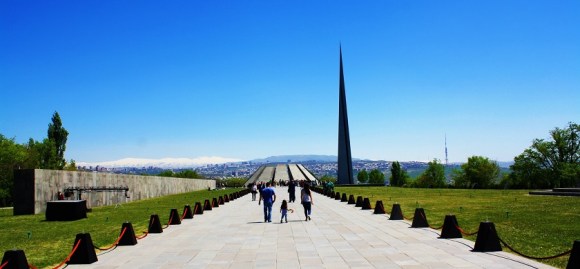
Senate’s Genocide Vote Not the Only Good News for Armenian Christians

Armenian Genocide Memorial

This article was first published at Christianity Today, on December 13, 2019.

Following years of frustration, Armenian Christians worldwide received a double blessing this week.

For the first time in its history, the US Senate recognized the Armenian Genocide. And after 11 years of practical vacancy, the Armenian community in Istanbul, Turkey, elected a new patriarch.

“It is very emotional for the Armenian world, and anyone who wants to see the truth incarnated,” Paul Haidostian, president of evangelical Haigazian University in Beirut, Lebanon—the only Armenian university in the diaspora—told CT concerning the resolution.

“But it is very obvious this was the opportune moment to be bipartisan.”

Led by Sen. Ted Cruz, a Republican from Texas, the unanimous passage yesterday drove his co-sponsor Sen. Robert Menendez to tears.

“I’m thankful that this resolution has passed at a time in which there are still survivors of the genocide,” said the Democrat from New Jersey, pausing for 20 seconds before being able to continue. “[They] will be able to see that…

Please click here to read the full article at Christianity Today.

Categories
Americas Christianity Today Published Articles

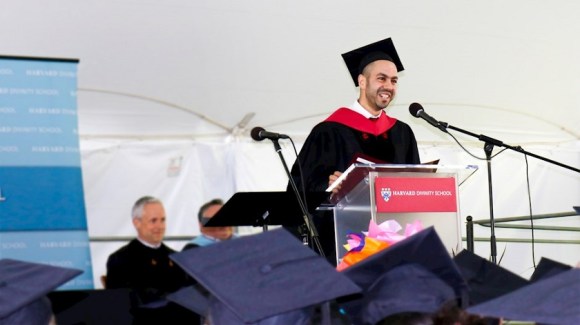
The Road from Damascus: How an Evangelical Syrian Spoke at Harvard’s Commencement

Tony Alkhoury
Image: Courtesy of Tony Alkhoury

This article was first published at Christianity Today on November 7.

Following Turkey’s recent incursion into Syria and establishment of a “safe zone” in coordination with Russia, the beleaguered nation faces another refugee crisis. According to the United Nations, 6.7 million Syrians have registered with their High Commission for Refugees. Turkey hosts the largest share, with 3.4 million, followed by Lebanon with 1 million.

The United States: 21,645, according to official State Department figures, from the start of the Syrian civil war in 2011. Of those, 536 were admitted in the last 12 months.

Of the total, 21,245 are Muslim, compared to only 211 Christians, including five Protestants. Tony Alkhoury is not one of them. But his is a story of potential for those allowed in.

Born in Homs and an evangelical Christian, he is 1 of 450 Syrians in the US on an active student visa.

In Arabic, Alkhoury’s family name means “the priest.” Currently pursuing a PhD in practical theology at Fuller Seminary, in 2016 he began a unique cross-cultural ministry adventure—at Harvard University.

Through it drove the divinity student to the depths of depression, it ended with rapturous applause.

“I want to live, I want to love, and I want to be loved,” he told the student body, which selected him to deliver the commencement address this past May. “I want to fight to keep hope and make meaning of all the things that I do not have control over.”

In the prime of his life, Alkhoury witnessed the destruction of Syria. America might have been a refuge for many, until President Donald Trump’s travel ban.

Syrian visas reached a high point of 15,479 in 2016, the year of Alkhoury’s arrival. In January 2017, Trump issued his executive order banning citizens of initially seven Muslim-majority nations—challenged consistently in the courts and modified to include non-Muslim countries—and the number dipped to 3,024. In 2018, it fell to 41.

The meaning of it all, for which Alkhoury has long been seeking, has been years in the making.

Born in 1984 to Orthodox parents, he attended the local Alliance church in Homs. In 2005, he felt a call to full-time ministry.

Alkhoury became a youth pastor, volunteering also in peacemaking initiatives. Initially excited by the Arab Spring…

Please click here to read the full article at Christianity Today.

Categories
Americas Christianity Today Published Articles

When You are Persecuted in One Place, Flee to Another. But Not to America

Flee to America

This article was first published at Christianity Today on November 5.

Zero.

The United States did not resettle a single refugee in October.

According to 30 years of records from World Relief, last month was the first time a calendar month went empty. For the past five years, the October average was 4,945 refugees resettled.

Among those impacted: persecuted Christians.

The humanitarian arm of the National Association of Evangelicals tracked the number of arrivals from the 10 countries identified by the US State Department as Countries of Particular Concern for violating religious freedom. The 5,024 Christians whose cases were accepted in fiscal year 2019 is a decrease of two-thirds from the 15,341 who were accepted in fiscal 2015. A maximum of 5,000 is allotted for victims of religious persecution in fiscal 2020—for all religions and countries.

Resettlements of non-Christians are also declining. For the same time period, Yazidi refugees from Syria and Iraq have declined 91 percent. Jewish refugees from Iran have declined 97 percent. And Muslim refugees from Burma have declined 76 percent.

“This isn’t just heartbreaking—it’s unjust,” stated Scott Arbeiter, president of World Relief, noting the State Department announced a limit of 18,000 refugees for fiscal 2020.

“I urge the administration to reconsider its approach and set a cap that better represents the compassion and hospitality of the American people.”

But Secretary of State Mike Pompeo defended the policy.

“Addressing the core problems that drive refugees away from their homes helps more people more rapidly than resettling them in the United States,” he stated, pointing out an estimated backlog of one million asylum cases.

“Helping displaced people as close to their homes as possible,” stated Pompeo, noting the $9.3 million the US has spent to alleviate humanitarian crises, “better facilitates their eventual safe and voluntary return.”

The Religious Liberty Partnership, birthed at a Lausanne Movement gathering and now numbering Christian organizations from 20 countries, has highlighted three biblical responses to persecution: accept and endure (2 Tim. 3:10–13); challenge and resist (Acts 22:25–29); or flee (Acts 9:23–25).

Jesus says the same in Matthew 10:23 (NIV): “When you are persecuted in one place, flee to another. Truly I tell you, you will not finish going through the towns of Israel before the Son of Man comes.”

But with Christian attention focused this past weekend on the International Day of Prayer for the Persecuted Church, the RLP document—reaffirmed with the Refugee Highway Partnership (RHP), a partner of the World Evangelical Alliance, in 2017—suggests that the clear choice of the local leaders who shepherd the displaced echoes Pompeo.

“Amongst church leaders across the Middle East, there is a strong consensus that indigenous Christians should…

Please click here to read the full article at Christianity Today.

Categories
Americas Christianity Today Published Articles

Will US Genocide Resolution Satisfy Armenian Christians?

Armenian Genocide Memorial
(from the Armenian Genocide Museum-Institute)

This article was first published at Christianity Today, on November 1.

Armenian Americans breathed a sigh of relief this week when the US House of Representatives overwhelmingly approved Resolution 296 to recognize the Armenian Genocide.

Around 1.5 million Armenians were killed between 1915 and 1923, as the defeated Ottoman Empire transitioned into the modern Republic of Turkey. Less than half a million survived.

The resolution also mentions the Greek, Assyrian, Chaldean, Syriac, Aramean, Maronite, and other Christian victims who lived in Asia Minor and other Ottoman provinces at the time.

If the House legislation is passed in the Senate and signed by President Donald Trump, the United States will be committed to commemorate the genocide, to reject its denial, and to educate people about it in order to prevent similar atrocities in the future.

But if Armenian Americans are finally pleased, the diaspora in the Middle East—much closer to the Turks and the lands taken from their ancestors—demurs.

“It certainly heals some small aspect of our century-long national wound,” said Paul Haidostian, president of the evangelical Haigazian University—the only Armenian university in the diaspora—in Beirut, Lebanon.

“There is some sense of relief. But it should not be exaggerated.”

Nor should it be underestimated, he told CT. All Armenians…

Please click here to read the full article at Christianity Today.

Categories
Americas Christianity Today Published Articles

Duke-UNC Middle East Studies Center Flagged for Anti-Christian Bias

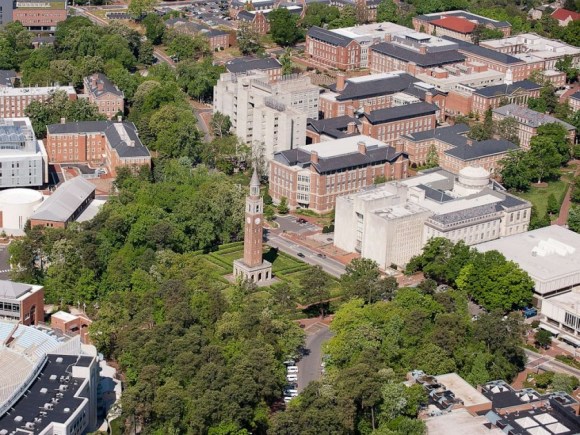
UNC-Duke
Lance King/Getty Images: An aerial view of the University of North Carolina campus including the Morehead-Patterson Bell Tower (center) on April 21, 2013 in Chapel Hill, North Carolina.

This article was first published at Christianity Today, on September 27.

Certain evangelicals have long complained about bias in American universities. The government may now be doing something about it, as Secretary of Education Betsy DeVos examines a prominent Middle East studies program for downplaying Christianity and other non-Muslim faiths.

A three-page letter sent by the Department of Education chastised the Duke-University of North Carolina Consortium for Middle East Studies (CMES), jointly administered by the two universities, for its “considerable emphasis placed on understanding the positive aspects of Islam.”

The complaint also found “an absolute absence of any similar focus on the positive aspects of Christianity, Judaism, or any other religion or belief system in the Middle East.”

At stake is the Duke-UNC consortium’s status as a “national resource center,” a term created by Title VI of the 1965 Higher Education Act. It authorizes Congress…

The school had its response:

The Duke-UNC consortium, though it agreed to establish an advisory board in compliance with the ministry’s letter, ultimately defended its Middle East program.

Enrollment in Urdu studies ranks first in the nation, they wrote in reply. Arabic and Turkish rank eighth. It listed the many events held on Middle East minorities, saying “positive appreciation … suffuses” their outreach activities.

And whereas government employment lags behind academia, if counting also the Title VI emphasis on business, 30 percent of graduates work in that field.

Meanwhile the items deemed inappropriate by the ministry were a small percentage of over 100 organized each year, none of which were supported by federal funds.

The academic establishment also came out in their defense, calling the inquiry “unprecedented and counterproductive.” Nineteen scholarly societies, including the American Academy of Religion, the Middle East Studies Association, and the Society of Biblical Literature, published a joint reply…

Please click here to read the full article at Christianity Today, including three evangelical professors who give their perspective.

Categories
Americas Christianity Today Published Articles

In UN Speech, Trump Announces New Religious Freedom Initiatives

Trump United Nations
UN Photo/Manuel Elias Secretary-General António Guterres and Donald Trump, President of the United States of America, attend the Global Call to Protect Religious Freedom briefing. (23 September 2019)

This article was first published at Christianity Today on September 23.

Speaking before the United Nations today, President Trump praised the country’s religious freedom record and cited figures that suggest the rest of the world has much work to do, as he announced new funding to protect religious sites as well as business partnerships to fuel the cause.

“Our nation was founded on the idea that our rights do not come from government, but from God,” said Trump. “Regrettably, the freedom enjoyed in America is rare in the world.”

Trump said he had asked Vice President Mike Pence to double-check the figure of 80 percent of the world’s population living in areas that restrict religious freedom. According to Pew Research, 83 percent of the population lives in places with “high” or “very high” restrictions, mostly targeting religious minorities.

“Today, with one clear voice, the US calls on the nations of the world to end religious persecution,” Trump said.

Pence stated that Trump was the first world leader to chair a meeting on religious freedom at the United Nations.

Seeking international consensus on religious freedom, he called out Iran, Iraq, China, Venezuela, and Nicaragua for their violations and mentioned the terrorist tragedies that struck down Jews in Pittsburgh, Muslims in New Zealand, and Christians in Sri Lanka.

Under Trump’s leadership, Pence said, the United States passed the Genocide Recovery and Persecution Response Act to protect religious minorities in the Middle East, and the State Department’s International Religious Freedom Fund dispersed 435 rapid response grants since 2018, aiding 2,000 victims of persecution. A year ago, the Trump administration doubled its funding for Christians and religious minorities returning to Iraq.

“As President, protecting religious freedom is one of my highest priorities, and always has been,” said Trump, who today pledged an additional $25 million to protect religious sites and relics around the world that are under threat. He urged the global community join in “measures to prevent the intentional destruction of religious sites and relics,” including attacks on houses of worship…

Please click here to read the full article at Christianity Today.

Categories
Americas Christianity Today Published Articles

Evangelicals Who Distrust Muslims Likely Don’t Know Muslims

Ramadan IHOP
How IHOP Became a Ramadan Favorite — image: Jason Hoffman/Thrillist

This article was first published at Christianity Today on September 12.

Earlier this week, a Baptist church in Michigan canceled an event titled, “9/11 Forgotten? Is Michigan Surrendering to Islam?” due to pushback from fellow Christians and politicians.

The pastor of Bloomfield Hills Baptist Church identifies as an Islamophobe and organized the gathering because he sees Islam as a growing threat in the US, The Washington Post reported.

While some fellow white evangelicals share his suspicions, research has shown that those who know Muslims in their communities tend to hold more positive views and are more likely to see commonalities between their two faiths.

“The personal relationships with Muslims, that’s a game changer,” Todd Green, Luther College professor and former Islamophobia adviser to the US State Department, told ThePost. “It tends to make you less Islamophobic.”

Yet surveys from various sources have noted the friendship gap between evangelicals and their Muslim neighbors. More than a third (35%) of white evangelicals knew a Muslim personally in a 2017 Pew Research Center release, fewer than any other religious group, and evangelicals surveyed rated Muslims more negatively than other faiths.

The Southern Baptist-affiliated LifeWay Research found in 2017 that 17 percent of those with evangelical beliefs reported having a Muslim friend, while the Foundation for Ethnic Understanding (FFEU) reported this year that only 22 percent of evangelicals say they interact frequently with Muslims.

FFEU, led by a rabbi seeking to improve Muslim-Jewish relations, also noted that 1 in 3 evangelicals with frequent interaction with Muslims viewed Islam as similar to their own faith compared to 1 in 4 evangelicals overall.

The latest research from the Institute for Social Policy and Understanding (ISPU), a prominent American Muslim organization, offers another look at the relationship between the two faiths.

The 2019 ISPU poll, released last spring, surveyed a representative sample of the US population along with a sample of Muslims and of Jews. The results may not offer as precise a picture of other religious subgroups due the higher margin of error, but still gives a valuable snapshot at broad trends between the faiths.

Here are five takeaways for evangelicals from one of the leading indicators of Muslim community sentiment in America.

1. White evangelicals lag behind in knowing and befriending Muslims; Jews excel.

When asked, “Do you know a Muslim personally?” 35 percent of evangelicals and 44 percent of Protestants said yes…

Please click here to read the full article at Christianity Today.

Categories
Americas Christianity Today Published Articles

When Islam is Not a Religion in America

Asma Uddin

This article was first published at Christianity Today on September 9.

Is Islam a religion?

This question is regularly posed by populists seeking to restrict Muslims in America. If Islam is not a religion—if it is a militant ideological system, for example—then some argue it is not subject to First Amendment protection.

At stake is the protection of religious liberty, writes lawyer Asma T. Uddin in When Islam Is Not a Religion: Inside America’s Fight for Religious Freedom. Her new book details recent legal cases involving Muslims, arguing that restrictions on one faith community affect the freedom of all.

Formerly a legal counsel with Becket, a leading religious liberty law firm, Uddin has worked with the US State Department to advocate against the former United Nations resolution on the defamation of religion, which was seen by many as an attempt at international cover for blasphemy laws. And through the Legal Training Institute, she has worked to extend the American understanding of religious liberty to several Middle Eastern, North African, and Southeast Asian countries.

Uddin, a Muslim of Pakistani descent, has worked on religious liberty cases at the federal and Supreme Court levels—including the Hobby Lobby and Hosanna-Tabor victories praised by conservative Christians—defending evangelicals, Catholics, Jews, Native Americans, and Muslims. Christianity Today, which recently editorialized on why religious freedom isn’t just for Christians, spoke with her on the sidelines of the recent US State Department Ministerial to Advance Religious Freedom.

CT: American evangelicals are often concerned that Christians have their religious liberty threatened around the world, often in Muslim-majority nations. The focus of your book is Muslim religious liberty, threatened in the United States. What sorts of challenges do Muslims face in America?

Uddin: I think it’s important to point out that the book doesn’t just look at attacks on Muslims. The book looks broadly at the attack on religious freedom, seen through the prism of attacks on Muslims. I discuss violence against churches, synagogues, and Sikh temples.

But in terms of threats to Muslim religious freedom specifically, I look at the nationwide anti-mosque controversy, which started in earnest after the so-called “Ground Zero mosque” fiasco. From there, it spread to Murfreesboro, Tennessee, which was the first community to be affected while attempting to build a mosque. That’s where the claim was made that Islam is not a religion.

To this day, there are ongoing struggles to build mosques. It’s not just litigation, but also arson and fire bombing. There is even a question about Muslim cemeteries, to the point where American Muslims are unable to bury their dead. That’s the challenge we’re facing to our human dignity…

Please click here to read the full interview at Christianity Today.

Categories
Americas Christianity Today Published Articles

From DC to Mecca, Should ‘Human Dignity’ Be the New ‘Religious Freedom’?

Ministerial
Speakers address participants at a general session on Different Faiths Advancing Religious Freedom Together at the Ministerial to Advance Religious Freedom at the U.S. Department of State in Washington D.C. on July 17, 2019. [State Department photo / Public Domain]
This article was first published at Christianity Today, on July 22, 2019.

In his opening remarks at the second US Ministerial to Advance Religious Freedom, Secretary of State Mike Pompeo welcomed almost 1,000 participants from civil society and more than 100 invited foreign delegations. He challenged every major world religion and secular society—and also invited them in.

“We all agree that fighting so that each person is free to believe, free to assemble, and to teach the tenets of his or her own faith is not optional,” said Pompeo. “Indeed, it is a moral imperative that this be permitted.”

But do all actually agree? A change in human rights language might make the difference.

And could Saudi Arabia improbably become the next champion…?

Please click here to read the full article at Christianity Today.

Categories
Americas Christianity Today Published Articles

Should Christians Praise Partial Religious Freedom?

Partial Religious Freedom
Image: Illustration by Cornelia Li

This article was first published in the June print edition of Christianity Today.

…The tension over praising limited gains is also a factor in Uzbekistan, a Muslim-majority secular nation whose citizens have the right to convert but which the United States has designated a Country of Particular Concern (CPC) since 2006 over religious freedom violations.

At the US State Department’s inaugural Ministerial for Advancing Religious Freedom in July 2018, Uzbek leaders outlined how they were streamlining registration for religious groups and reviewing a law that restricted religion. Last December, the Central Asian nation was removed from the CPC list—only the second nation to ever come off—and put on a watch list instead. But it ranks No. 17 on Open Doors’ list of countries where it’s hardest to be Christian.

Chris Seiple, president emeritus of the Institute for Global Engagement, has worked behind the scenes for 20 years to promote religious freedom in the nation he did his dissertation on. He says activists should publish a list of nations showing the most progress, not just the greatest offenders.

Relational diplomacy involves public praise for small, tangible steps to build trust while communicating practical ways to improve in private, he said. There is a secret to engaging authoritarian contexts: create a rumor so that reality follows…

Please click here to read the full article at Christianity Today.

Categories
Americas Christianity Today Published Articles

Pew: US Christians Like the Israeli and Palestinian People More Than Their Governments

Pew Israel Palestine
(via Vox)

This article was originally published at Christianity Today, on April 24, 2019.

When it comes to the longstanding Israeli-Palestinian conflict, do American evangelicals favor one side or the other?

Research Center finds one-third actually feel favorable toward both—when it comes to their peoples. And one-third feel unfavorable toward both governments.

Politico Magazine recently profiled Telos, an evangelical group dedicated to changing the narrative on Israel. “Christian faith communities persistently advocate for one-sided postures towards the conflict,” states the group, whose name means purpose in Greek, on its website. “Our telos is the freedom, security, and dignity of every human being in the Holy Land.”

But the profile prompted a strong critique from Mark Tooley of the Institute on Religion and Democracy (IRD), who describes such “ambivalence” as actually harming both Israelis and Palestinians. Without solid evangelical support buttressing the US alliance with Israel, all sides will only entrench and deepen the conflict, he argues—making negotiation less likely.

“Impartiality and avoiding polemical stances are now de rigeur in much of nouveau Evangelicalism, so the Telos appeal has resonance,” he wrote on IRD’s blog. “Aren’t Christians supposed to be on everybody’s side?”

Pew’s new survey aimed to measure exactly that.

For decades, Pew has asked which side Americans sympathized with more: Israel or the Palestinians? But this year, researchers recognized a problem: this approach compared a country (Israel) with a people (Palestinians).

It was not apples-to-apples, nor did it allow for respondents to signal sympathy for both. So this year, they instead used separate questions asking about a favorable or unfavorable opinion toward the Israelis and the Palestinians as peoples, as well as toward their respective governments.

About 1 in 3 evangelical church attendees (34%) reported favorable opinions of both peoples.

However, the weight is still on the Israeli side…

Please click here to read the full article at Christianity Today.

Categories
Americas Christianity Today Published Articles

Will Trump’s ‘Deal of the Century’ on Israel-Palestine Please Evangelicals?

Trump Deal Century Israel Palestine Evangelical
Image: Illustration by Rick Szuecs / Source image: Senior Airman Delano Scott / JBA via CT

This article was first published at Christianity Today, on April 12, 2019.

When it comes to Israel, nearly all evangelicals hold dear the biblical maxim: Pray for the peace of Jerusalem.

But what does it mean after a fiercely contested election?

President Donald Trump will soon propose his vision of practical exegesis.

Two years in the making, Trump’s “Deal of the Century” is slated to be released soon, now that Israel has reelected Prime Minister Benjamin Netanyahu. His Likud party secured a virtual tie with challenger Benny Gantz’s Blue and White party, but Bibi’s right-wing coalition will push him over the top.

Neither leading candidate made the peace process with Palestinians a major plank of their campaign as the entire Israeli electorate has shifted to the right, emphasizing security over negotiation.

Other American presidents have tried and failed to advance official US policy of a two-state solution. But while Trump has brought a new energy—and unpredictability—to forge an elusive peace between Israelis and Palestinians, he may face two very skeptical partners.

Even so, Trump has shaken the system.

Last year in May, he moved the US embassy to Jerusalem.

In February, he stopped US funding to Palestinian aid programs.

Last month, he recognized Israeli sovereignty over the Golan Heights.

And more than any president prior, he has courted evangelical opinion. LifeWay Research shows that 67 percent of American adults with evangelical beliefs have positive perceptions toward Israel, with 80 percent believing Abraham’s covenant is for all time.

But while analysts have panned Trump’s decisions as decidedly one-sided against the Palestinians, he has dangled his own deal-making reputation as—at times—a warning to the Israelis.

“Israel will have to pay a higher price,” he said after ordering the embassy’s relocation, for the Palestinians “will get something very good, because it’s their turn next.”

What does Trump expect? And will it cost him his carefully cultivated evangelical support?

Details of his plan have not been publicly released, but in February US officials Jared Kushner and Jason Greenblatt toured Arab capitals seeking support.

A month later Greenblatt, Trump’s chief legal officer and special representative for international negotiations, checked in with US evangelicals in a special meeting at the White House.

Axios reported that several “raised concerns.”

CT surveyed 11 evangelical leaders—7 from the US and 4 from the Middle East—to take their pulse on expectations and gauge their red lines.

“Don’t divide Jerusalem, It would disappoint me if that was President Trump’s decision,” said…

Please click here to read the full article at Christianity Today.

Related: The attempt to bring Judeo-Christian politics to Israel

Categories
Americas Christianity Today Published Articles

US Catholics Now as Concerned About Persecution as Climate Change

Aid to the Church in Need Iraq
Decapitated statue of Our Lady in the destroyed St Addai’s Church, Karemles, northern Iraq, via ACN-UK.

This article was first published at Christianity Today, on March 22.

American Catholics are growing more concerned about the fate of the world—and with it, Christian persecution.

More than 9 in 10 now identify persecution as either “very” or “somewhat” severe. This is roughly the same percentage as an identical poll last year, both sponsored by the US branch of Catholic charity Aid to the Church in Need (ACN). But over the last 12 months, the share choosing the “very severe” category rose from 40 percent to 46 percent.

And their level of concern went with it, rising 9 percentage points. Last year, 49 percent of Catholics described themselves as “very concerned.” This year, 58 percent.

The poll surveys 1,000 American Catholics across the spectrums of age, politics, and piety, conducted by McLaughlin & Associates.

It showed that intense Catholic concern is growing on several global issues. Those “very concerned” about human trafficking rose from 72 percent to 82 percent. Poverty climbed from 68 percent to 74 percent. The refugee issue jumped from 50 percent to 60 percent. And climate change nudged forward from 55 percent to 57 percent.

So while those unconcerned about Christian persecution fell by half (from 18% to 9%), overall the “church in need” only ranked No. 4 among the list of issues.

But last year, it was…

Please click here to read the full article at Christianity Today.

Categories
Americas Christianity Today Published Articles

Should Christians Quote Muhammad?

This article was first published in the January print edition of Christianity Today.

Christians Quote Muhammad

Christians breathed a sigh of relief last October when Pakistan’s Supreme Court acquitted Asia Bibi, a Christian mother of five on death row, of blasphemy charges against Islam. What many might not have noticed was the Islamic rationale.

Whether or not she spoke against Muhammad, Bibi was insulted first as a Christian, wrote the judge. And on this, the Qur‘an is clear: Do not insult those that invoke other than Allah, lest they insult Allah in enmity without knowledge.

The verdict also quoted Islam’s prophet himself: “Whoever is cruel and hard on a non-Muslim minority, or curtails their rights … I will complain against the person on the Day of Judgment.”

And finally, it referenced an ancient treaty that Muhammad signed with the monks of Mount Sinai: “Christians are my citizens, and by God, I hold out against anything that displeases them.… No one of the Muslims is to disobey this covenant till the Last Day.”

Today it can seem like Muslims violate this covenant the world over. But does the Bibi decision validate those who insist that Islam rightly practiced is a religion of peace? And should Christians join Muslims to share verses that comprise the Islamic case for religious freedom?

CT surveyed more than a dozen evangelical experts engaged with Muslims or scholarship on Islam who reflected on three key questions when considering interpretations of Islam that favor religious freedom.

[These questions are: Is it true? Is it helpful? Is it enough?]

Please click here to read the full article at Christianity Today.

Also: click here to read my related Christianity Today article about The Covenants of the Prophet Muhammad with the Christians of the World, the book which describes the Sinai treaty mentioned above, and others.

Finally, here is a sidebar from the Should Christians Quote Muhammad article, identifying sources in the Islamic tradition on which the evangelical scholars reflected.

Quranic verses regarding Christians:

• Q5:82 – You will find the nearest of them in affection to the believers those who say, “We are Christians.” That is because among them are priests and monks and because they are not arrogant.

• Q2:62 – Indeed, those who believed and those who were Jews or Christians or Sabeans those who believed in Allah and the Last Day and did righteousness—will have their reward with their Lord, and no fear will there be concerning them, nor will they grieve.

• Q22:40 – And were it not that Allah checks the people, some by means of others, there would have been demolished monasteries, churches, synagogues, and mosques in which the name of Allah is much mentioned.

• Q29:46 – And do not argue with the People of the Scripture except in a way that is best.

• Q2:256 – There shall be no compulsion in religion. The right course has become clear from the wrong.

Texts used in Supreme Court of Pakistan acquittal of Asia Bibi:

• Christians are my citizens, and by God, I hold out against anything that displeases them. No compulsion is to be on them … The Muslims are to fight for them … Their churches are to be respected. No one of the Muslims is to disobey this covenant till the Last Day (Covenant with the Monks of Mount Sinai)

• “Beware! Whoever is cruel and hard on a non-Muslim minority, or curtails their rights, or burdens them with more than they can bear, or takes anything from them against their free will; I [Prophet Muhammad] will complain against the person on the Day of Judgment.” (Abu Dawud)

• Q6:108 – “And do not insult those they invoke other than Allah, lest they insult Allah in enmity without knowledge. Thus We have made pleasing to every community their deeds. Then to their Lord is their return, and He will inform them about what they used to do.”


Categories
Americas Christianity Today Published Articles

Bearing False Witness

Eid and Taqiyya
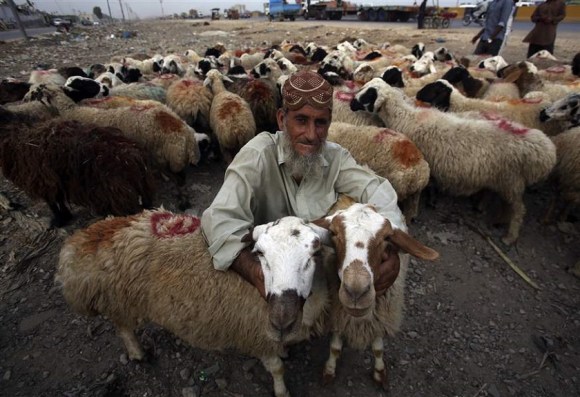
An Afghan refugee vendor waits for customers to sell his sheep at cattle market set up for the upcoming Muslim festival Eid al-Adha in Karachi, Pakistan, Thursday, Aug. 16, 2018. / AP

This excerpt was first published at Christianity Today on August 24.

So what if a Muslim invites you to a celebration? The lamb might be tasty, but should Christians be wary?

Statistics show they already are.

The 2018 American Muslim Poll from the Institute for Social Policy and Understanding (ISPU) found only 36 percent of white evangelicals believe Muslims are committed to the well-being of America.

And according to the Pew Research Center, 50 percent of self-identified white evangelicals believe there is a “great deal” or “fair amount” of support for extremism among Muslims living in America. This is often connected to a fear of Shari’ah law.

Yet according to the 2017l ISPU poll, only 10 percent said Shari’ah should play a legal role in their community.

Are the rest lying? Or are evangelicals predisposed to assume they are?

Taqiyya is an Arabic word that has come to mean “dissimulation,” said Martin Accad, chief academic officer of Arab Baptist Theological Seminary in Lebanon and associate professor of Islamic Studies at Fuller Theological Seminary. It is a contested allowance in Islam to conceal your true faith if under personal duress.

But in much anti-Muslim discourse, taqiyya has been redefined into a religious obligation for Muslims to lie to non-Muslims not simply for survival, Accad said, but to serve the expansionist agenda of their religious community.

Without knowing the term, the concept is creeping into Christian consciousness.

And Accad wants to nip it in the bud…

Please click here to read the full article at Christianity Today.

Categories
Americas Biola Published Articles

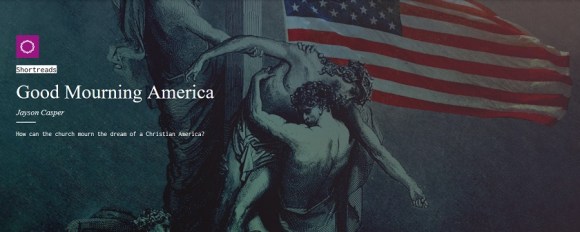
Good Mourning America

Good Mourning America

This article was originally published at The Table, of Biola University’s Center for Christian Thought.

In the days leading up to our presidential election, it seemed quite clear that Christians were not happy. But the ennui went beyond politics toward a greater sense that America was changing.

The unhappiness was rooted in good reason. Our principles were lambasted as backward, our policy stances were labeled as bigoted, personalities were labeled as bigots, and our politics were lowered into bouts of bravado. There seemed little for Christians to celebrate, save the requisite reference to our Lord and Savior Jesus Christ.

And then Trump won. Some rejoiced, while others cringed. But I suggest whether salve or acid, the underlying sentiment remains fundamentally unchanged.

With our eyes on the world and our changing national fortunes, we appear marked by vindication or frustration, tempted to pride or anger, either way ready to lash out ineffectively at our culture at large. Since apparently Jesus cannot keep us happy, perhaps with him we should try being sad?

But being sad is no cure all, either. Some of different temperament instead yield to depression, tempted to flagellation, ready to grumble unhelpfully at our Christian culture at large.

Being sad is an emotional response, much like being angry. Whether red, blue, or annoyed we are reacting to circumstances, and we should not be too harsh with ourselves. God has given us our emotions, and they are wonderful tools to tell us something is wrong, or at least, different.

For America is different, in her religious composition. Perhaps America is also wrong, in her moral choices. But God invites us first to examine ourselves, requiring of all a greater humility. But to get there, a step beyond sadness is needed, evoking a suffering we are conditioned to dread.

As American Christians, we must choose to mourn that which is different, and that which may also be wrong.

Mourning, unfortunately, carries with it the connotation of defeat, of finality. We know what it means to mourn over the death of a loved one, but here we must mourn over the death of an idea.

I posit that for so many Americans, our fundamental unhappiness stems from an inability to let go of our dream of a Christ-centered nation.

Nor should we. But to find peace we must understand what it means to mourn, to grieve. In the loss of a loved one, we recognize the fact that he or she is gone. The suffering comes not from the death primarily, but from every unfulfilled expectation, every lost hope, every dream for the future that will now never be. Mourning is the necessary surrender thereof.

America is changing, we Christians feel. But we have been reluctant to admit she has already changed. Denial is often the first resistance to grief, pushing off the uncomfortable mourning. Poll after poll bears out the fact, however, that Christianity is losing its national prominence.

Christianity Today recently ran a series analyzing the trends, and one of the most poignant is this: In a 1967 Gallop survey, two percent of Americans identified themselves with no religion; in 2015, a Pew survey finds the now-ascendant “nones” at 23 percent.

Nearly one-quarter of Americans have no religious affiliation. That is a fact very near to a flatline.

Proper mourning, however, must identify the body. Though we cannot be happy, Jesus is still Lord and Savior. It is not Christianity that has died, and neither the church. The polls bear out this fact as well.

A Gallop survey in 1940 found 37 percent of Americans saying “yes” when asked if they attend church weekly. In 2015, the number dropped all the way to an astounding, wait for it, 36 percent.

Church going Americans are as numerous now as they have long been. What has changed, then? Where have the nones come from? In 1972 a GSS survey found mainline Christians to be 28 percent of the population. By 2014, they were only 12 percent. And as the former standard bearers of Christian civil religion eroded, evangelical Christians have grown to 23 percent.

Nearly one-quarter of Americans are evangelical Christians. That too is a fact, but it is not a pulse. Christianity in America is not dead, but Christian America? Yes.

At this point, it must become personal. I have my story to tell, but that is not what I mean. Every death is mourned differently by every bereaved. Two sons of a deceased mother will each grieve uniquely, for they had different hopes, dreams, and expectations for the life they no longer share with her. One cannot say to the other, “I know how you feel,” no matter the similarity of experience, nor the true comfort they can exchange.

The author of the Christianity Today series reflects on these religious demographic changes and says it may not be a bad thing. As nominal Christian expression recedes it gives the church more opportunity to correctly present the gospel life of discipleship.

Perhaps he is right. Of the 70 percent (according to a 2014 Pew survey) of Americans who identify as Christian, he divides them into rough statistical thirds: Cultural, due to birth and inherited identity; Congregational, due to communal attachment; and Convictional, due to belief and practice.

I do not disagree with his assessment nor the necessity of distinction. An evangelical reading of the Bible emphasizes the eternal importance of personal faith and practice. But as one in his category of convictional Christians, I mourn over our separation from the whole.

Perhaps I am wrong to mourn. Many evangelicals of my youth warned instead to mourn over those who falsely understood themselves to be Christians just because they were born into a household that attends church that way. One must be “born again,” said Jesus. Perhaps those who emphasize this message find vindication they have fewer mainline Christians to mourn over?

Likely not. Their sentiment is genuine, and their concern is real. Their witness comes from the heart. They love their fellow man, and they love America beside. For many, transforming the former is a means to preserve the latter. Some need patience, to endure their zeal. Others give praise, as their lives have been changed.

I, however, rightly belong to all three of the author’s categories. I was born into a Christian home. I value belonging to a Christian people. I adhere to time-honored Christian convictions.

Evangelical faith cherishes and nurtures all three. But I find the statistics are ripping away two-thirds of those who might otherwise be counted with me. And with them is ripped away the Christian ethos of America.

This is the death that I mourn—the hollowed out corpse of a once Christian nation. With it dies the expectation of my country’s inherent goodness, the hope of nominals still near to the gospel, and the dream of enduring Christ-infused values.

But again, some might rejoice that true faith is made clear. “We should be less American, and more Christian,” is a statement increasingly heard from many in the pews. Once more, I do not disagree.

But another tool to postpone mourning is improper substitution. Less apt if comparing to the death of a loved one, consider the reaction if your dog dies, or your girlfriend breaks up with you. How many people offer false comfort with the well intentioned words, “Just get another one?” And perhaps you will, wanting the replacement to fit the hopes you had for the old. Rarely does it work.

The dream of a Christ-honoring culture cannot be replaced by substituting out America for a more singular Christian priority. Likely a needed corrective, but it does not address the pain.

Nor do the more common reactions of striving harder and fighting back. How many people have you met who numb the loss of a loved one by drowning themselves in activity? Even if done to honor the deceased, it leaves unaddressed the underlying grief.

Many evangelical thinkers have outlined their “what do we do now?” strategies. Some say we should embrace our role as a prophetic minority. Others suggest we must reclaim the institutions of cultural influence. Some recommend a renewal in the church. Others encourage a revived evangelism.

Each is likely a fine way forward. But not yet. Wait. Rest. Mourn. Identify the dream you had, cry, and humbly suffer. Then, let it go.

What Christians attained in America past may or may not have been God’s will. Undoubtedly it fell short of his ideal. In so many ways, it was good. And as long as we live here, we have obligations to seek her best.

But the fact at this moment is that America is moving on from her Christian heritage. Perhaps I am wrong, but it is sorrowful that something so precious is being lost, a glue that holds much together.

Yet a loss fully mourned brings healing. Healing brings wholeness. Christ brings completeness. From here, God can give us new hopes, dreams, and expectations for ourselves and our nation, fitting a new reality.

American Christians—triumphant or frustrated, depressed or angry, denying or striving, of any and all statistical categories—should dream with him. The nones are waiting, as is Jesus, our Lord and Savior.



Categories
Americas Christianity Today Published Articles

Christians Could Return to the Middle East, Thanks to Trump (Deportations)

Iraq Trump Deportation

This article was originally published in the October print edition of Christianity Today, co-authored with Griffin Jackson.

When Haitham Jazrawi started working at Kirkuk Presbyterian Church in Iraq in 1991, there were 72 families. Today, there are still 72 families—but only two of the originals remain. During his 26-year tenure as caretaker and then pastor, Jazrawi has seen a turnover of more than 300 families due to emigration.

Such an outward flow has been the norm in churches across the Middle East. In Iraq and Syria, countries ravaged by years of war and the terror of the Islamic State, roughly two-thirds of Christians have fled.

Among Jazrawi’s congregants, 50 percent are internally displaced from elsewhere in Iraq. “They come as refugees from inside our country,” said the Kirkuk pastor, “from the Nineveh Valley, from Nineveh, from other villages and cities.”

Soon, they may also come from outside of Iraq. With the Trump administration threatening to deport more than 1,400 Iraqis, hundreds of whom are Christians, a rare irony may present itself: the forced movement of Christians into the Middle East.

This summer, hundreds of Iraqis were behind bars in holding centers around the United States, slated for deportation to Iraq. The majority were Christians, and most were rounded up in Detroit in a massive June raid executed by Immigration and Customs Enforcement (ICE).

“Not only would they be breaking up families that have been here for decades,” said Nathan Kalasho, a local advocate for the detainees, “but they would be sending an already targeted minority to a country that no longer welcomes them…”

Please click here to read the full article at Christianity Today.

Categories
Americas Christianity Today Published Articles

What Arab Leaders Think of USAID Funding Persecuted Christians

This article first published at Christianity Today on November 2, 2017.

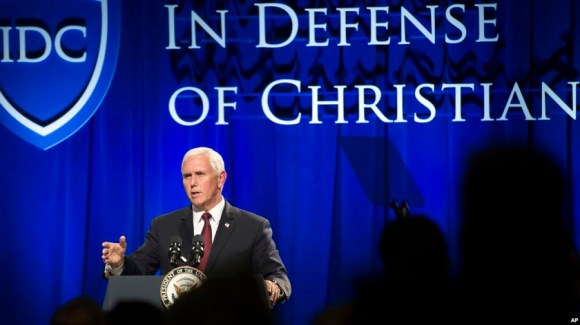
USAID Christians
Vice President Mike Pence addresses the In Defense of Christians’ fourth-annual national advocacy summit in Washington, Oct. 25, 2017. Credit: AP, via VOA News.

Here are a few excerpts from my new article.

First, the reason:

Zalal Life distributed 300 food baskets and bottles of water. The government of Hungary donated $2 million in aid for reconstruction. The United Nations wasn’t there.

“People are not happy with the UN; they are using money for administration,” said Bahro. “The help is coming from churches and Christian organizations.”

Second, the condition:

“If the US can help Christian organizations directly, it will be good—if it can be done without discrimination,” he said.

“They must serve Muslims and other minorities also. We live together, and want to remain together in our communities.”

Third, the complication:

“Having the US transfer funds directly to persecuted Christians could be a good thing, but American politics will surely mingle in,” the Israeli Arab Christian said.

“They will want to brag about the aid to show their success, and to prove to the Christian Right that [President Donald Trump] delivers on his promises.”

Fourth, the danger:

Farouk Hammo, pastor of the Presbyterian church in Baghdad, agreed. “The bottom line is that we do not recommend direct aid from the States to Christians,” he said.

“It will agitate our Muslim brothers negatively against the Christian community.”

Fifth, the reality:

But the Jordanian leader respects Trump and is cautiously in support of the USAID policy change if done well, as it will empower the church to do the ministry.

“Maybe we will be targeted more,” he said. “But in some countries, it can’t get worse.”

Sixth, the possibility:

If USAID offered to help, Bitar would accept it—if it is not conditioned on any political agenda. He has little fear of local reaction.

“Muslims will be happy,” he said. “They like to send their children to schools run by Christians.”

Finally, the outcome:

Amid conflicting Christian reactions and unknown Muslim response, the policy change represents a new approach. Will it make things better or worse?

“Here in our area, the Kurdish Muslims trust Christians,” Bahro said. “In Arab areas, I don’t know.”

Please click here to read the full article at Christianity Today.


Categories
Americas Published Articles Religion Unplugged

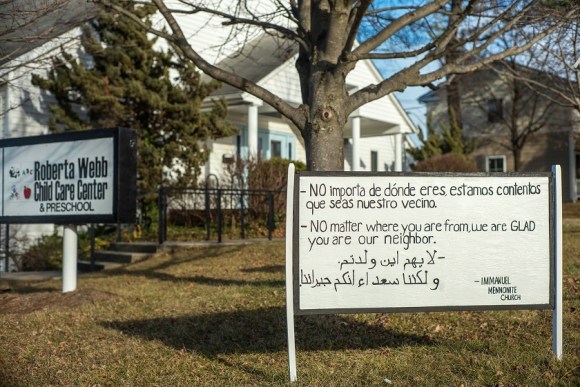
Small Town Offers ‘Sign’ of Welcome to Refugees in the United States

Mennonite Welcome Sign
(via http://www.welcomeyourneighbors.org)

This article was originally published at The Media Project.

Biking one day in the city of Harrisonburg, Virginia, nestled in a valley in the Shenandoah Mountains of the eastern U.S., 33-year-old Pastor Matthew Bucher tumbled and fell.

Bloody and sore, he found himself in front of the local mosque. He looked up and read a sign.

“No matter where you are from, we’re glad you’re our neighbor,” it read in English, Spanish, and Arabic.

Bucher understood because he had written that sign – in all three languages.

“Suddenly, I knew the hope the sign offers,” he said. “I was the one in need of help, switching roles.”

The sign was born 15 months earlier, during the August, 2015, Republican presidential debate. Anti-immigrant hectoring was a prominent feature, and Bucher led his small congregation at Immanuel Mennonite Church to do something about it. 

Rather than filling neighborhood yards with political signs backing one candidate or another, Bucher’s church created a sign of their own.

“I was shocked at the rhetoric used against immigrants,” he said. “So I thought to put out a sign of welcome. Spanish speakers in the church helped, as did Arabic friends.”

That first sign in front of his church two years ago has since multiplied into an estimated 100,000-plus throughout the country, said Bucher.

The sign is recent, but its heritage extends back almost four centuries. 

Mennonite Christians know what it means to be strangers. Driven from Switzerland in the 17th century, the persecuted Anabaptist community, from which the Mennonites descend, found refuge in Pennsylvania. One hundred years later many of those families relocated to the Shenandoah Valley.

Bucher, a Pennsylvania native, became the pastor of Immanuel Mennonite one year before the presidential debate. But from 2007-2011, he lived as a stranger himself, the only American in the small, Upper Egyptian city of Qusia, 170 miles south of Cairo. Teaching English in partnership with a Coptic Orthodox bishop, his sojourn was a transformative experience.

“I received hospitality in Egypt, and here in Virginia I have been accepted and trusted as a pastor,” he said. “I want to extend that (hospitality), just as Jesus did. He and his parents were cared for as refugees, too.”

Harrisonburg is a fitting place for hospitality. Census data states the population of 50,000 residents is 16.7 percent foreign-born. Students in the public schools come from 46 countries, including Iraq, Jordan, Honduras, Mexico, and Ukraine.

Yet there have been only four police officers killed in the line of duty in the town since 1959. Nicknamed “The Friendly City” since the 1930s, Harrisonburg is also an official Church World Service refugee resettlement community.

“Listening to the current American national dialogue. . . one would assume that mixing nationalities, religions and ethnic groups in such close quarters would produce enough emotional tinder to fuel a blaze of angry divisions and open fighting in the streets,” wrote resident Andrew Perrine in the Washington Post. “Yet it does not.”

Instead, Bucher’s signs have found a home. The green, blue, and orange background was chosen so as not to correspond with any national flag, and 300 signs were initially distributed through six area Mennonite churches in March 2016. Another 300 were sold later at a local fair, next to the church’s tamale stand. By October, one month before presidential elections, another 1,000 were printed.

They sold out within a week.

That month the church created a Facebook page. Overwhelmed by interest, in December they created a website. Signs sell for $21.95, including shipping, but a free download is provided to print locally.

Money from proceeds is donated to the Mennonite Central Committee, the local New Bridges Immigrant Resource Center, and the Roberta Webb Child Care Center hosted at Immanuel.

Anyone selling in their own communities (usually for $10 with local pickup) is encouraged to donate to the charity of their choice. Unless they just give them away, as did a 68-year-old Buddhist, Kathy Ching.

Ching arrived from China in 1974 and ran a restaurant in Lansdale, Pennsylvania, for 40 years. During that time she helped 15 employees immigrate to the U.S., but now says of President Donald Trump, “He’s not letting people in.”

“Why do they want to come to America?” asked Ching. “Because their own countries are in trouble, and they want freedom.”

She learned of the sign through a neighbor, and purchased four at St. John’s United Church of Christ.

Pat Rieker made them available. A longtime member of St. John’s, Rieker was so pained at the anti-immigrant sentiment in America she felt her health was suffering. Feeling she had to do something, she mobilized her church after seeing the signs at nearby Plains Mennonite.

“It made me feel I was spreading some kind of message of hope and inclusion amid an atmosphere of hate,” she said. “To me, this is not the message of Christianity.”

Plains Mennonite in Hatfield, Pennsylvania, was one of the first in the area to display and distribute the signs. Associate Pastor Paula Stoltzfus had family and friends in Harrisonburg and followed the campaign on social media. She informed the church, and with a history of welcoming refugees from Sudan, Iraq, and the Congo, it mobilized easily.

“It was an idea whose time had come, reminding us to be a good neighbor,” said Pastor Mike Derstine. “This should not be a political issue but an expression of our faith.”

Similar grassroots stories have now resulted in 70 volunteer distribution centers in 32 U.S. states. Two churches in Idaho have circulated over 500 signs. In Portland, Oregon, the sign appeared at a memorial for two men who were killed in May while intervening to stop a white extremist harassing a young Muslim woman.

In addition to the signs at the local mosque in Harrisonburg, Bucher has sold to the synagogue and several atheists. Though the initial distribution moved through Mennonite churches, he estimates they only total 30-40 percent of total reach.

“I never asked my friends what religion they are. It doesn’t matter,” said Ching. “We are of different religions, but we all have a good heart.”

Yet it is Bucher’s Anabaptist heritage and Christian commitment that drive his particular service. His church’s motto is: Real people following Jesus’ radical call to love and service.

One local Baptist church pastor asked to meet him, suspicious of a liberal agenda. In the tense discussion that followed a spilled glass of tea helped them break the ice. But the conversation only turned once the pastor became convinced this Mennonite really did love Jesus.

“We must speak of power and privilege, sure. But many on the other side cannot accept Trump or his followers, either,” Bucher said. “Stand against violence and bad leadership, yes. March and demonstrate, yes.

“But be transformed by the love of God. Change is hard, but it is what we are called to do together.”

Bucher tells a story from Lancaster, Pennsylvania, a traditionally rural Mennonite community now with a majority non-Mennonite city center. The municipality has resettled 20 times more refugees than the rest of the United States.

A lady put one of Bucher’s signs out on her lawn. She came home one day and found a Syrian on her front steps. Speaking no English, the hijabed woman took her neighbor by the hand and led her across the street into her own home.

Opening up the computer, she typed in Google Translate.

“Thank you so much,” read the neighbor. “Your sign made us feel welcome. We are glad this is what America is about.”


Categories
Americas Christianity Today Published Articles

What Arab Church Leaders Think of Trump Prioritizing Persecuted Christian Refugees

qaraqosh-christians
Ahmed Jadallah / Reuters Preparation for Qaraqosh’s first Sunday mass since the Iraqi Christian town was recaptured from ISIS (October 30, 2016).

This article was first published at Christianity Today on January 30, 2017.

Married in December to a Syrian woman with American citizenship, Fadi Hallisso went to Beirut to apply for a green card.

A Syrian Christian, Hallisso has worked with refugees in Lebanon since 2012. Funded by different American agencies, he was no stranger to the US government. He even testified about the situation in Syria to the US State Department and to Harvard Divinity School.

But this week, Hallisso was told he was no longer welcome to apply. The new US administration said so.

“It is very humiliating to be put in the category of potential terrorist,” said Hallisso. “Just because I carry a certain passport.”

As more details of President Donald Trump’s new security policies emerge—including a promise to prioritize Christian refugees for resettlement in America—much appears lost in translation.

“This executive order has created a new atmosphere very hostile to people in the region,” said Chawkat Moucarry, World Vision’s director for interfaith relations—and Hallisso’s uncle. “Unwritten rules seem to be implemented as a result.”

Is Trump’s executive order on refugees a de facto “Muslim ban”? Is it not? Is it prudent? Is it overdue? As American Christians debate these questions from the small towns of Middle America to the nation’s major airports, so also Arab Christians are trying to figure out what is going on.

“I read the executive order,” said Adeeb Awad, chief editor of al-Nashra, the monthly magazine of the Presbyterian Synod of Syria and Lebanon. He remarked…

Please click here to read the full article at Christianity Today.