Categories
Personal

Corridor 18, Plot 86 – A Coptic Funeral

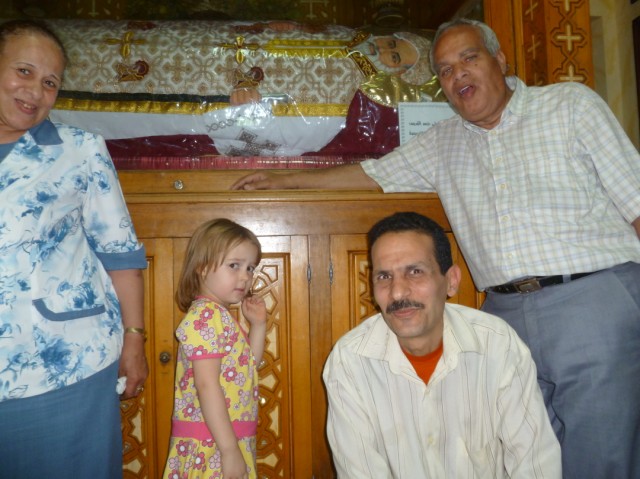
I woke up this morning to a troubled phone call from a friend. His mother, with whom he is very close and of whom he is the primary caretaker, died sometime during the night. There were only a few hours until the whirlwind of a Coptic funeral began.

My friend, at the level of my daughter, during happier times

He told me the prayer service would begin at 11:30am, and I arrived with mutual friends having met coincidentally at the microbus line taking us into a poorer area of Maadi. St. George’s Coptic Orthodox Church is a smaller structure sandwiched between commercial buildings along the route, and was where my friend and his family worshiped for many years. We sat in the courtyard waiting for the main group to arrive.

Around noon the family entered. The women were dressed completely in black; several were wailing. The men were more subdued, and a number carried the casket into the church, placing it on a platform in front of the iconostasis, behind which is the sacramental altar. When the priest arrived, mass began.

Mass followed its basic structure, including recitations of the Lord’s Prayer and the Nicene Creed. One gentleman read from the resurrection passage of I Corinthians 15, while my friend labored valiantly through the reading in John where Jesus states he is the resurrection and the life. The priest reminded that all will die, and our reaction should be to prepare now to face judgment. The traditional Egyptian funeral greeting – ‘the remainder (of the deceased’s life) to your life’ – is suspect, however, as it posits a life ended before its time. Death is only a door to eternity, he clarified, in which there is no remainder.

At the close of prayers all exited, with the men carrying the casket to load into the hearse. Surely enough, its license plate read ‘Cairo, under request’. This was explained to me previously in the context of the Coptic protest march from Shubra to Maspero, in which some wore white garb stenciled with the hearse’s label signaling their readiness for martyrdom. Prophetically, many of the protestors did die; a moving memorial tribute march occurred yesterday. A video news clip can be seen here.

My friends and I followed the hearse in a taxi, going downtown to Old Cairo to the Latin Cemetery. As best I could tell, there were no plots in the earth. Instead the grounds were filled with mausoleums, the cheapest of which could be purchased for 30,000 LE, approximately $5,000 US. Each unit then became the property of the family to be passed down through the generations. Caskets would be piled on top of each other until they would dry rot with the passing of time. They would then be removed, the bones inside placed in a box which would then be interred in a common area, with no special marking. Interestingly, many names in this ceremony were of foreign origin – Italian, French – though Egyptian names were prevalent also. Catholic in origin, the cemetery accepted anyone. Somewhere in history my friend’s Orthodox ancestors purchased space – in corridor 18, plot 86.

When the mourners arrived they either did not know this number or else did not know how to navigate the grounds. One in charge then quickly led the pallbearers who hustled under the weight of the heavy casket. Once there, what appeared as chaos erupted. The casket was carried into the crypt, as the wailing of the women began again. One of the male relatives had to be physically removed from inside, not wishing to depart from the beloved matriarch. Other men cried out, including my friend: Goodbye, mama. Everything happened so fast, and then the door was shut.

Whoever did so then reapplied the plastic-bag-like covering to the lock, to avoid corrosion so another body might enter, at the next appointed time. Mourning individuals huddled together, still inconsolable, but calm settled over the majority. When the priest arrived (though he had no responsibility), the men formed a greeting line around the corner from corridor 18. We walked quickly through, shaking the hands of each. We whispered condolences, but nothing of ‘remainder’. Following the lead of friends, I kissed my friend on both cheeks.

With this, everyone left. The time was about 2:00pm. The intensity of grieving must stem from the compacted burial schedule. The mother died sometime during the night; prayers were lifted by noon; she was buried only two hours later.

I cannot say why culture or religion dictates such a rapid process, but its implications were observed following the deaths at the Maspero protest. Church tradition and priests seeking to be helpful urged the families of the victims to take their bodies quickly and bury their dead. Activists on hand, however, assumed the terrible task of convincing grieving loved ones to delay these rites and have their dead undergo autopsy. As such, public record now indicates the number of dead by gunshot or crushing, under the weight of government armored personnel carriers. Fears existed these would otherwise have been swept under the rug.

My friend’s mother was no victim; there was no need for an autopsy. She was simply a kind woman who received the devotion of her family, and the appreciation of us as foreigners who were blessed on occasion by her hospitality. Women of her kin will continue to wear black for some time, and in forty days a commemoration service will be held. The moment of grief is explosive, but time is allotted for more gradual mourning.

Yet my friend is confident that death is only a door to eternity. When he called me with the news he stated, with broken voice, that his mother had ‘relocated’. With Muslims, the standard and commendable reply is, ‘God have mercy upon her.’ Copts have their own special phrase, connoting something like, ‘God prepare her for Paradise.’

The mourning is no less severe, nor the need for consolation. Hope, however, springs eternal. ‘I go to prepare a place for you…’

Categories
Prayers

Friday Prayers for Egypt

God,

Advance prayers are necessary this week, God, as a possibly crucial next stage approaches. Elections are on the horizon, but a closer hurdle looms. A proposal exists that would shape the next constitution, granting the military an influential role, while limiting the influence of the elected parliament. As Egypt never clearly defined the eventual outcome of its democratic transition, some liberals find the effort to be a belated, but necessary guidepost. Other liberals, and nearly all Islamists, find it as an effort to shift transitional authority from the people to the military, essentially undoing the result of the March referendum.

There is push and pull among all political forces, God. Surely these maintain concern both for the nation and their own interests. Yet Islamists are threatening a major demonstration against the proposal on the coming Friday. Extreme scenarios include a Tehran moment when the revolution swings religious, or a major crackdown on the Islamist movement. The greater likelihood is that neither side possesses the strength necessary to assert its will; compromises will be reached sufficient to avert any crisis. This is politics, and it is fair.

But it is also dangerous, God. Give wisdom this week to leaders on all sides. Help understanding to be reached through consensus, not raw power, and certainly not violence.

Move Egypt forward, God. Lead her to a government that reflects the will of the people. Lead the people to a will that reflects your own. Grant Egypt safe and transparent elections. Grant her a stable, effective, and representative government. Give her honest men and women who put the interests of others before their own.

Hold to account, God, all who allow the balance of own and national interests to go askew. Keep Egypt from evil. Give faith, hope, courage, and conviction to those who must stand for what is right. May these be as many as possible – the citizenry in general – even as they may disagree on its terms. Honor them, God, and grant them success.

Give grace this week, God. Extend it through elections. Protect Egypt; keep her safe as you make her strong.

Amen.

Categories
Personal

The Political Education of a Sandmonkey

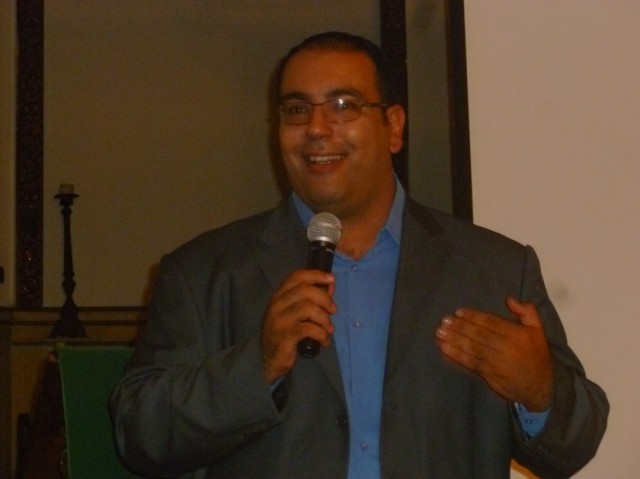
Mahmoud Salem, the Sandmonkey

As a result of the Arab Spring and the fall of Mubarak, Egypt is witnessing a surge in political participation as young revolutionaries enroll in the political process. One such figure is Mahmoud Salem, otherwise known from his blog as ‘Sandmonkey’. Salem was an early activist against Mubarak, using social media such as Facebook and Twitter, in which he tongue-in-cheek labeled himself a ‘micro-celebrity’. Since then his fame has grown electronically, having over 50,000 followers. By contrast, NBA superstar Deron Williams of the New Jersey Nets has only 33,000.

As the democratic transition has stuttered in Egypt, Salem realized the necessary commitment now was not activism alone but political and civil society participation. Though discouraged by current post-revolutionary conditions, he decided to run for office in the People’s Assembly, from his home district of Heliopolis, seeking to do something good for his son for the future of Egypt. This remark came from a political stump speech delivered in Heliopolis on November 3. The invitation was issued to the Sandmonkey, fittingly, through Twitter.

Disappointingly, nowhere near the 50,000 followers of Salem attended. By my count there were only twenty-six Egyptians, joined by fifteen foreigners. Salem spoke for about twenty minutes, answered questions for another twenty, and then left quickly at 9pm to get to another meeting.

Perhaps it served as a dry run. It is not an easy thing to run for office, or to become a politician. Until learning of the reasons for his quick exit, I figured he was either disappointed by the turnout or else reticent to ‘press the flesh’ and interact with potential voters, however few. At least he had one more notch on his belt in making campaign speeches, imagined to be much more difficult than writing an engaging blog post.

During his presentation Salem spoke of his hopes for Egypt as well as his focus on the local district of Heliopolis. The chief problem the country faces, on both the national and local level, is poor administration of work. This is seen currently in three areas: security, economy, and transparency.

In terms of security, Salem spoke of his efforts to interact with local policemen, though as a unit the police force is widely despised. They told him there has not been a great increase in crime, as popularly believed, but that the police feel impotent after the revolution to police as before. They requested, and Salem supports, an effort to equip them with cameras so that their interactions with the people are recorded. Such evidence would keep police from abusing their position, as well as protect from the abuse of false accusation. Salem also spoke of the popular committees which defended their neighborhoods during the revolution. These must continue and expand their work, representing positive community participation upon which the new Egypt should be built.

In terms of economy, Salem concentrated on the local needs of Heliopolis. Though the district is comparatively well off, it suffers as the money to pay government services throughout Egypt is collected almost entirely from the tax base of Cairo and Alexandria. More money must be retained locally, as garbage collection and hospital care in Heliopolis stands in need of improvement.

In terms of transparency, Salem spoke of the problems of bureaucracy, in which he like many hates going to government offices. The people are underpaid, and thus seek bribes, as the labyrinth-like process scuttles confused applicants from one line to the next. Instead, a simple 1-2-3-4 order should be established everywhere, to streamline movement and pay only at the end.

The question and answer period was dominated with concerns about the sectarian tensions in Egypt. Salem spoke of the role of the state, especially in the 70s when President Sadat gave a religious veneer to government that continued, to a lesser degree, under Mubarak. But he also spoke of the role of society, lamenting the poor integration of Muslims and Christians, as well as the poor understanding Muslims have of Christianity – a problem generally not reciprocated, he believed. His general advice was to encourage Copts to participate in society and politics, stating they would achieve their rights if only they properly mobilized. There are an estimated 400,000 to 600,000 Muslim Brothers in Egypt, he stated, if their extended family members are counted. By contrast, he counts twelve million Copts.

I attended this event curious to see what an activist looked like. Young, middle class, social media friendly Egyptians are credited with driving the revolution, but are increasingly marginalized and accused of serving foreign agendas. What is the reality with Sandmonkey? I have read his blog in the past and been impressed by his analysis; it was hoped a face to face encounter would be more telling.

I was surprised by his appearance. I had assumed an ‘activist’ would be a grizzled combatant. Instead, he appeared more akin to a teddy bear. His normalcy was appreciated, as was his speaking demeanor. Salem was comfortable addressing the room, but not polished, and certainly not charismatic. While admitting the difficulty in addressing a handful of people, there was little that was magnetic in his presentation. Void of rhetoric, he simply spoke what he believed, and of what he was doing to study and improve the lot of his country. He was very much a non-politician.

Conversation after the event mirrored my appreciation for his style and person, but added a resignation that he was likely to fail. I was more hopeful, if only from faith. It is true that he does not speak the language of the street and would be hard pressed to win over large crowds. Yet if he met the person on the street, could he not win him over through sincerity of heart? Can he do so sufficiently to win Heliopolis? That is the art of politics.

It is an art that surely Salem is learning on the fly. Sandmonkey has 50,000 votes won in Egypt and abroad, but the tens of thousands of Heliopolis residents need much more than a Twitter account. Salem knows this, and has thrown his hat in the ring to pursue the transformation. He, and many activists like him will soon discover if they have what it takes – experiencing now what may only pay off in the future. Win or lose, it is a necessary process for Egypt, but also a test for the revolutionary generation. They overcame their apathy and political restraints in January 2011; can they mobilize and strengthen civil society in November, in 2012, and beyond? Mahmoud Salem is among those leading the charge.

Also see: Optimism from an Egyptian Sandmonkey, written following one of his blog posts from June 2011.

Categories
Prayers

Friday Prayers for Egypt

God,

How good and pleasant it is for brothers to live together in unity. Elections in Egypt need not fracture unity, nor the writing of a new constitution. Yet they may. Perhaps they have. Or perhaps they will forge a new unity.

Foundations are being laid, God. Grant the people a firm cornerstone of a constitution. Give them a clean and pure political process to build upon. So much is important in these coming days. Strengthen the people to stand for the good of Egypt. Awaken them to take hold of the destiny of their nation. Focus their discernment to sort right from wrong. Purify their heart in innocence and wisdom, to find what it is you desire for this country.

God, cause all those who manipulate and seek their own to be exposed. Rebuke them, God, to prevent their machinations. Bring them to confession, and then to restoration. Let unity prevail, even as agendas clash. May good triumph; may it love and honor all who stand against it.

God, bless Egypt. Give her rulers wisdom, her people determination. Guide her in the days to come.

Amen.

Categories
Arab West Report Middle East Published Articles

Video Analysis of Maspero: Part Five and Conclusion

To read the Introduction, please click here. For Part One, click here. For Part Two, click here. For Part Three, click here. For Part Four, click here.


Corpses Gathered in Hospitals or Elsewhere

Video Thirty-Four: Martyrs of Maspero 2  (Three minutes)

Video footage is from inside the Coptic Hospital, where many injured and dead were taken. The halls are crowded with people with a steady murmur in the air.

0:10        Person sitting on side of hallway with an obvious but not life threatening head wound

0:20        Dead body lying on floor; it appears his throat has been cut and has bruises to his head

0:37        To his left is another body which appears to be alive, with someone attending him

0:47        A cover is removed from a bloody corpse with horrific head wounds

1:08        A pool of blood is shown on the floor

1:20        Another corpse is shown lying on the ground with a head wound

1:50        Video switches to another hallway, where another corpse is lying on the floor

2:20        Camera returns to the corpse of 0:47, from this angle it appears he could have been run over by an APC


Video Thirty-Five: Special for al-Shuruk: Corpses at the Entrance to the January 25 Building at Maspero (Three minutes)

Video footage is from inside a hallway of the building housing at the aforementioned January 25 TV studio, which was stormed by military personnel.

0:03        Two dead bodies are lying side by side, the one to the right appears to have wounds in his shoulder and head

0:36        A man standing against the wall has blood dripping from his head, but appears ok

0:52        Another corpse is shown with a heavy wound to his head

1:15        Moving up a short flight of steps, a man is lying on the ground writhing with a pool of blood under his leg

1:30        A man crouches over a body on the floor who appears to be alive; pools of blood are all around

1:44        Video switches to another angle, showing three dead bodies lying in a hallway


Analysis: None necessary. These people were killed brutally.


Compiled Footage

The final three videos assemble footage from throughout the day, as compiled by their author. Important events therein not highlighted earlier will be identified by minute.


Video Thirty-Six: The Egyptian Army Runs Over the Copts with APCs in front of Maspero (One minute)

0:01        An APC speeding through traffic, swerving, but slowing as it approached a person directly so as not to run him over

0:17        People surrounding a soldier, beating him, as a priest tries to intervene and bring him to safety (clearer footage of that shown in video nine earlier)

0:56        A military vehicle is shown burning, perched up on top of a road divider


Video Thirty-Seven: Shubra – Maspero March, October 9, 2011, Graphic (Eleven minutes)

0:09        Footage from the march from Shubra under the bridge when attacked from above, some protestors throw stones back at them, many take cover under the bridge, no weapons or clubs are evident

3:55        Pieces of a man’s skull are held in a cloth up to the camera, people say he was crushed by a ‘tank’ (APC, presumably)

4:21        Crying women and children from inside the Coptic Hospital

4:38        Dead bodies on the floor, one is covered with a picture of Jesus, another – Michael Mossad – has his hand clasped by his fiancé, Vivian Magdy

5:15        A man identifies himself as Ibrahim Azouz, states that when they arrived at Maspero the army fired into the first row of people, a little latter the APCs went swerving through the people on the street, driving over some, it’s horrible, it’s the army, the army that is supposed to protect us, they kill us like animals

6:00        Distraught men are shouting and weeping

6:50        A man identifies himself as from Ezbat al-Nakhl,and as the brother of Mina inside who they killed, who killed him? Mohamed Tantawi, the field marshal, the Lord will take revenge on him, and not just him, all of them

7:28        Scenes from the funeral at the Coptic Orthodox Cathedral in Abbasiya, Cairo


Video Thirty-Eight: Most Important Heated Scenes from the Events of Maspero – Panorama (Nine minutes)

0:40        Close up view of the pickup truck proceeding from the Shubra march, it has loudspeakers and a priest riding upon it, with several other passengers

3:33        A man stumbles in view of the camera, bearing a head wound of some sort, someone calls for water and pours it on his head

6:20        Dead bodies strewn on the pavement

6:55        Another view of the skull in the cloth, presented by a priest, the boy carrying it identifies himself as Samih Gerges, his brother, perhaps age 12; priest says Fr. Philopater and Fr. Mityas have also been subjected to beatings, and were attacked; a car later pulls up and the priest gets in and they drive away


Final Analysis

The central and most important question to be determined from events of Maspero is this: Who shot and killed the victims? Unfortunately, on this point the video evidence is silent. No footage has been located to show either that protestors fired on the armed forces, or that military personnel fired on protestors. The causes of their death, from the standpoint of video, cannot be determined.

This does not mean that either side is innocent of the charge. Many testimonies exist stating the army opened fire, and the ‘confession’ of the soldier on the bus (in video 21) must be investigated.

From the other direction, the military council maintains the death of an unstated number of their men, as testified to by the soldiers on State TV. Their refusal to release names is announced as due to the threat of loss of morale among troops and increased tension within the nation. However legitimate these concerns, they do not aid the cause of investigation.

The presence of a third party cannot be dismissed on video evidence, neither can accusations of sniper activity, which would presumably be off camera. For further determination more footage is needed, either from amateur video, television networks such as German TV, or the closed captioned cameras at Maspero itself. These latter cameras have recently come to light through the human rights lawyer Amir Salem, who obtained their footage from the January 25 revolution.

Though video evidence is not able to absolve protestors absolutely, available footage demonstrates the vast majority of protestors were peaceful and unarmed (videos 2, 3, 5, 6). They were attacked previously in their march, yet failed to respond with any of the arms they are accused of possessing. Yet it must be noted that individuals within the march are witnessed carrying instruments which could be used as clubs (video 5), which are evidently not the crosses carried by many demonstrators.

Evidence is also slim which establishes protestors as the initiators of violence in general. Yet it is also clear that some demonstrators behaved in a provoking manner with the military police, striking at them and throwing stones at their lines (video 8). Once events unraveled, however, there are many scenes of protestors violently assaulting military personnel (videos 9, 18, 19). While it may plausibly be argued that violence was escalated as thugs entered the scene – cautiously established by video 15 – within the chaos there are images of protestors with crosses striking at the military, as well as a man wearing a martyr’s robe who tosses a large stone on a helpless soldier (video 9). Ultimately, however, video is unable to determine who among the rioters in question was a demonstrator or a thug, a Muslim or a Christian.

Considering the military role in violence, video cautiously establishes that a cordon was established to prevent the march from Shubrā from meeting up with the protest at Maspero (videos 7, 8, 13), which was then dispersed forcefully (videos 6, 7, 9). The manner this was done appears consistent with previous military efforts to disperse protests, sit-in or otherwise, and does not betray any predisposition for lethal violence.

Even the use of APCs to disperse lingering protestors does not necessarily betray such predisposition. Video does not establish well why the rioting ensued following the dispersal of protest. Equally plausible – in terms of video – are that frustrated protestors lashed out at the army, the military initiated sustained violence for its own purposes, or that a third party played one side against the other. Yet within this chaos there is footage both of APCs which carefully maneuver through the crowds so as not to strike protestors (videos 14, 18) as well as footage that depicts intention to kill (videos 9, 11). While it is plausible to imagine some had orders to inflict casualties, it is also plausible to imagine casualties resulting from individual soldiers, either panicked or enraged at events.

Yet other evidence raises questions which the military council must provide answers for, besides that of the soldier’s statement from the bus. Why did a driver move an empty military bus into the middle of the road, and then leave it there (video 17)? Why were so many military vehicles present which were left unattended, and thereafter set ablaze (video 13)? What was the soldier doing in the midst of the crowd, milling about unaccosted (video 9)?

Similarly, there are questions for the leadership of the Coptic protests to answer. How is it that demonstrators and their leaders were unaware of those in their midst with clubs (video 5)? Having been attacked under the bridge in the procession from Shubra (video 37), why was there not adequate caution about possible violence at Maspero? What were the intentions of Fr. Philopater in waving the procession towards the police cordon (video 8)? Why were some protestors dressed as martyrs, and who encouraged them to do so (video 2)?

Perhaps the greatest questions need to be posed to state media. In the episode at Maspero, did they act as a mouthpiece for the military council, independently, or at the behest of a third party? Was the footage of interviewed soldiers legitimate? Even if so, how was such inciting coverage allowed to be broadcast unedited (videos 23-25)? Why was a call issued for citizens to defend the army? Who wrote the news brief Rasha Magdy read on air (video 29)? Who issued the correction only one soldier was killed (video 33)? Why were the announced dead soldiers declared ‘martyrs’ (video 24, 29, 30)?

In conclusion, most of these questions posed are unable to be answered conclusively though video. Perhaps the analysis of eyewitness testimony and further investigations will contribute insight, though this is beyond the scope of this report. It is of concern that current investigations are conducted under military jurisdiction, bypassing the civil judiciary or an independently established commission.

For now, this effort is simply to collect existing evidence located on video, and present it openly for all who wish to investigate further. It is hoped to prevent all sides from selective interpretation of events in ignorance, willful or otherwise, of a counter-narrative to their favored account. Ultimately, it is hoped that the truth of events will come to light – partially through this analysis – so that justice and reconciliation may be pursued from a firm foundation.

The events at Maspero received a sectarian coloring, deservedly or otherwise. Christians in Egypt received alleged confirmation that the army is against them, or at least willing to exploit them, in deference to a larger Muslim constituency. Muslims in Egypt received alleged confirmation that Copts are disloyal, seek privileges beyond their due, and are potentially armed. If unchecked, these colorings threaten to undo Egypt at its seams. Muslims and Christians must be keen to forge good relations to confront these allegations.

To repeat, ultimate responsibility and culpability in the events of Maspero are not established through video evidence. The above colorings, therefore, must be studied in light of available evidence, but not assumed via predispositions where evidence is lacking. Evidence points to infractions from all sides; all are guilty, to one degree or another.

Yet this report must conclude with the most important question unanswered: Who shot the victims? Until this truth is established, all suspicions remain open. Unfortunately, this allows all colorings to linger. For the sake of Egypt, national unity, and basic justice, an answer must be found.


To read the Introduction, please click here. For Part One, click here. For Part Two, click here. For Part Three, click here. For Part Four, click here. To read the full report in pdf, click here.

Categories
Arab West Report Middle East Published Articles

Video Analysis of Maspero: Part Four

For the Introduction, please click here. For Part One, click here. For Part Two, click here. For Part Three, click here.

Media Coverage

Video Twenty-Three: Live Testimony from Injured Soldiers in Maspero (Two minutes)

Early on during the events of Maspero, State TV aired an interview with injured soldiers. It appears that the audio testimony does not match the lips of those speaking, but it is unclear if this is only from a delay in transmission. The news banner reads, ‘Scenes revealing the injured among the armed forces who have been transferred to the medical care room in Maspero.’

0:01        Soldier sitting on hospital bed, coughing

0:20        A man in civilian clothes is pictured lying down on bed, pants sprinkled with what appears to be blood

0:22        He says Christians threw stones gathered from the Maspero building and fired bullets at the soldiers, he went to help an officer and took a tissue and money from his pocket, when a Christian twisted his arm and took the money

0:50        First soldier says his colleague died right next to him, Christians hit them with stones and live gunfire, even though they were there to protect them, they were standing there talking to the Christians and then they attacked us off guard, Christians are ‘sons of dogs’


Video Twenty-Four: Revealing the Truth about the Copts on October 9 (Three minutes)

Another State TV feed from the same room showing injured soldiers, this video is a fuller treatment that begins slightly before the previous. It has similar issues with matching audio to soldier’s lips. It appears there are three soldiers in hospital beds. The news banner reads, ‘One martyr and twenty injured after Coptic protestors open fire on them at Maspero.’

0:10        Two soldiers videoed sitting quietly on the ground, they wave the camera away and cover their faces

0:22        As the camera moves, there appears to be a soldier lying in a bed to the left of the soldier described above who was sprinkled in blood

0:23        Camera pans to the left of the soldiers lying on hospital beds, showing a room full of soldiers and doctors

0:31        Some are attending to a soldier sitting in a wheelchair and treating his leg

0:50        This soldier is carried to the hospital bed, is treated by doctors, and sits up coughing to match the beginning of video twenty-three above

1:27        Video cuts and shifts to the soldier sprinkled in blood, same interview as above

2:05        Camera moves to the left to the soldier in a bed next to the one sprinkled in blood, same interview as above


Video Twenty-Five: Meeting the Injured Soldiers from the Armed Forces in front of Maspero, Watch what they say about Copts, and a word from Gen. Hamdī Badīn (Three minutes)

This video feed is from al-Hayat TV, a private station, apparently from within the same medical room at the Maspero building. The scene is much calmer as are the statements from injured soldiers, who do not appear to be the same ones speaking earlier.

0:19        Interview with soldier lying on hospital bed with a patch under his left eye; states they were standing at the Maspero building when the other march arrived, which attacked them with rocks, glass, Molotovs, and live ammunition, I tried to help my friend and took him to the 6th floor, but he died

0:55        Interview with another soldier lying in a hospital bed; there were about six hundred people at Maspero, crossing over the street when the march arrived, they joined together and attacked us with rocks and glass, and we had no orders to interact with them, a few soldiers died and we’re in the hospital, but praise God

1:45        Interview with another soldier, with a patch stretching from between his eyes, over his nose, and onto his cheek; says they were standing at Maspero but had orders to withdraw, drove the APCs in circles around the area, but people attacked us with gas and we couldn’t breathe and my eyes started to tear, we got down and then they surrounded us and beat us

2:28        Interview with another soldier on a hospital bed; says they were there protecting the demonstrators but then they came with Molotovs in a truck and began attacking us with machine guns, and I was shot in the back

2:45        Gen. Hamdī Badīn visits the injured soldiers, says what happened was an effort of someone to divide our one nation into Muslim and Christian, or this place and that place, to make us weaker, what each of you have suffered should be considered a medal on your chest


Video Twenty-Six: Violent Clashes between Security Forces and Coptic Protestors (Ten minutes)

This video is taken directly from State TV as the events unfolded.  It is an eerie broadcast with long periods of silence. The news banner states, ‘Breaking: Protesting Copts in front of the Maspero Building Block the Cornish Road.’

0:10        Traces the origin of events to the troubles of the church in Marīnāb

0:20        Announcer states there were warning shots from the military police to evacuate the demonstration which developed into acts of rioting

0:50        Says the protestors blocked the Cornish Road completely

1:15        States the protest began peacefully with chants and slogans for their demands but developed quickly into clashes between the demonstrator and the armed forces

1:40        Introduces Emad Gad, a Coptic researcher from the Ahram Center for Strategic Studies

1:50        Gad states what happened is a crime of which Gen. Tantawi and the military council is responsible, for I have seen how the APCs were driving through the crowds and running them over; the demonstrators were not armed, but were run over and shot with live ammunition, whoever did this should be tried and held accountable as a crime against humanity

2:40        In response the announcer says that events developed into clashes and throwing stones and Molotovs after beginning peacefully, Gad replies it developed so because of the army!

3:12        A whisper is heard, but it is inaudible

3:30        A voice whispers ‘Cut, cut’

3:40        Announcer acknowledges Gad’s anger but cuts him off from continuing, thanking him for his comments

3:50        Recaps events in which Coptic demands over Marinab concerning a guesthouse which is alleged to be the Church of St. George, and for a unified law for building houses of worship descended into clashes with the burning of military vehicles

4:50        Period of silence from the announcer

5:08        Begins recapping events again, saying some Copts threw stones at the army and police who were guarding the Maspero Building, the escalation began when they blocked the Cornish Road completely

6:55        Another period of silence

7:15        Announces that several fire trucks have arrived to put out the fires

7:35        Time is shown on screen as 6:55pm, and the news banner changes to ‘Coptic protestors in front of the Maspero Building throw stones at the army and police assigned to guard it’

8:00        Silence continues until the introduction of ‘Alī Jum‘ah, a villager from Marīnāb and eyewitness to the events there

8:25        Jum‘ah is not there, so announcer repeats the basic news story

9:00        Jum‘ah gets reconnected, is asked his opinion about what is taking place, and whether or not Marinab warrants all this escalation

9:20        Jum‘ah answers that Marinab Muslims and Christians are currently living in complete peace and security, we are negotiating things and there is nothing to warrant what is taking place here

9:50        Announcer asks his reaction to what he sees on the screen of throwing rocks at the army and burning vehicles, he answers we live in peace but the video ends before he finishes speaking


Video Twenty-Seven: Storming the January 25 TV Channel and Cutting their Broadcast of Covering the Demonstrations (One minute)

This video is taken from the live feed of the January 25 TV station with offices in the Maspero area. It opens with a woman screaming and several voices in the background. It was stated the army entered to search for demonstrators hiding in the offices. As it turns out, they were, but were not found. The video on screen is from an elevated position down onto the empty Cornish, with cars driving through at night. It also says the transmission is ‘live’. The banner states, ‘Gen. Sāmih Sayf al-Yazl, security expert’, presumably the guest at the time the offices were entered.

0:15        Someone says, ‘There is no one here’

0:25        Woman whimpers terrified and continues amidst background chatter

1:05        Silence, until a voice (the woman’s?) says that’s enough everyone, the silence then continues until the end


Video Twenty-Eight: The Moment the Headquarters of al-Hurra TV Station were Stormed (Fifteen minutes)

Again, video feed is taken directly from the station’s broadcast, transmitted from the Maspero area. In a similar set-up, the army entered searching for demonstrators. Before the entry al-Hurra had two screens, one of which was a live transmission of events, the other providing the feed from State TV. The announcer maintains his nerve impressively. The news banner reads, ‘Breaking News: Cairo clashes: Injuries suffered in violent confrontations between Coptic demonstrators and security forces

0:17        Live video from al-Hurra cameras switches to generic feed from Cairo streets

0:18        News banner adjusted to read, ‘State TV: Tens injured in confrontations between Coptic demonstrators and security forces’

0:20        Announcer states individuals from the army have entered the studio

0:33        Announcer tells people in studio (presumably army), we are on air, and, I’m Egyptian!

0:43        Announcer raises his voice as tension rises in the studio

0:53        Video feed switches to al-Hurra’s live broadcast only

1:00        Video switches to announcer who states the soldiers are in the studio, raising their weapons, searching for demonstrators

1:20        Tries to calm the situation down and tells the soldiers to search the studio as they wish

2:55        Announcer spent time trying to regain composure and update viewers on proceedings; news banner changes, ‘Individuals from the Egyptian army storm the al-Hurra studio’

3:23        Announcer continues the conversation with the previous telephone guest

3:40        Video feed switches to that of State TV, time shown on bottom as 7:57pm as news scroll begins

4:42        News banner adds the following, ‘…searching for demonstrators’

6:27        News banner now reads, ‘Coptic protestors set fire to Egyptian army vehicles’

6:40        News banner announces, ‘State TV announces the death of a soldier from the army in confrontations with the Copts’

7:05        News banner reads, ‘Tens injured and military vehicles burned in Coptic confrontations with Egyptian security

7:20        News banner reads, ‘Coptic demonstrators in violent confrontations with security forces in front of State TV building’

7:54        Two live feeds restored to the broadcast, al-Hurra’s feed of an onramp with individuals milling about as traffic passes by above

8:12        News banner reads, ‘Heavy gunfire in Coptic demonstrator confrontations with Egyptian security forces

14:14     Phone conversation continues as the news banner recycles the above headlines, then the announcer apologizes saying for security reasons we have to stop, I don’t know if we’re on air or not

14:20     News banner reads, ‘Individuals from the Egyptian army storm the al-Hurra studio’

14:40     Screen goes blank as announcers repeats, we’re on the air?

14:48     Transmission cuts off as the program logo comes on screen, and video ends


Video Twenty-Nine: Egyptian Television Inciting Egyptians against the Copts (Three minutes)

Announcer Rasha Magdy has come under fire for her description of events on State TV. This broadcast is from the independent channel OnTV, owned by Coptic businessman Naguib Sawiris, which was transmitting the State TV feed.

0:06        News banner reads, ‘Breaking: Coptic protestors throw stones and Molotovs at soldiers from above the October bridge, and burn …’ (rest illegible)

0:15        Praises the Egyptian army for its past accomplishments, and how the people stood with it, stating we should be celebrating this spirit from the days following October 6 (a national holiday commemorating the war which liberated Sinai)

0:25        States the events of Maspero show that everything has changed; what is happening to Egypt? In whose interest is this?

0:55        Announces that as of this moment there are at least three martyrs and twenty injured, all of which are from the army’s soldiers – not from the hand of Israel, or of an enemy, but of a group from the children of this country

1:15        This army stood by the revolution, and protected the revolution, refusing to fire on any Egyptian, it is now being fired upon

1:32        Any group from Egyptian society, no matter what their demands or however legitimate, to build a building or not build a building, does it deserve to burn the nation in its entirety?

2:25        May Egypt fear God, may your area fear God, we have endured a lot

2:37        There appears to be a cut in the video, switching to what appears to be Rasha Magdy now reading the official news briefing, but perhaps it is not a splice, as the video maintains continuity

2:38        Three soldiers killed and thirty injured as Coptic demonstrators gathered in front of the Maspero building fire upon them; eyewitnesses confirm that hundreds of Coptic demonstrators, who blocked the Cornish Road, threw stones and Molotovs on the army and police who were assigned to guard the Maspero building; the army and police are attempting to secure the area and disperse the protestors, mounting iron barriers in front of Maspero and locking all the doors to prevent it from being stormed

3:21        Video switches to a talk show on OnTV in which a guest, George Ishak of the Kifāyah movement, accuses Rasha Magdy of inciting viewers against the Copts, especially when she said, ‘May Egypt fear God’


Video Thirty: Surprising Video, for the First Time the State TV Announcer who was Accused of Inciting Against the Copts States on Air the Comedy in Television as Muna al-Shazalī Makes Clear (Fourteen minutes)

Muna al-Shazalī is a talk show host on the channel Dream2. In this episode she hosts a number of prominent Egyptian personalities and conducts a phone interview with Rasha Majdī.

0:37        Magdy states the announcer is the last stage in the operation of news production, there are a number of people who pass on the news, whether written or otherwise, before it reaches me

1:12        I want to confess that what happened was a mistake of the media, it is necessary that if I present one side, I must also present the other, and this did not happen

1:40        In my coverage I said ‘group of people’, not ‘group of Copts’

2:00        That which was written below about the Copts was prepared by the editor, by a certain responsible one

2:20        In response to clarification, Magdy states no one who works in television can take a single step or print any news on the screen without authorization (implied, from the state)

2:40        Yes, there were mistakes, but they were not the mistakes of the editors or the announcers, they were the mistakes of those who manage the matter underneath it all

3:00        We are not newly trained announcers, we know that if you present one side you must present the other

4:53        After restatement from al-Shazalī, Magdy clarifies that the responsible person is in the media production, not the state

5:50        If I go, the problem will remain, it rests with those responsible for media production who leave us lost in our work

6:10        Did you know that this responsible person stated that he is innocent from what was announced? Fine, then state who wrote that news!

6:30        I received the news from MENA (Middle East News Agency, the office news agency of Egypt)

7:10        In answer to a question asking Magdy to demonstrate her innocence from inciting the people, she states, the only thing that I stated in my own words that has been taken as incitement is ‘May Egypt fear God, where are the wise men of Egypt’, but I maintain this statement and it is my right to do so

8:30        In response to words from Emad Gad appreciating what Magdy said, she replies I only stated ‘a group of Egyptians’ since I had no information on what was happening or who was hitting who, I sit in the studio, I have no guests, and I don’t know what happened, when I saw that news was contradictory, I stated ‘a group of people’, when I spoke of the three martyrs from the army, this was the only news that came to me from MENA, and I read it, there was no incitement from me

12:40     After conversation between studio guests, Magdy returns and states she and a number of her colleagues are very frustrated with those who leave the announcer to be responsible for what is stated on the news, don’t blame me when you leave me lost and then say you are the reason for what happened

13:50     Al-Shazalī concludes the phone conversation by stating it is Magdy right to bring a lawsuit against the person who provided her with the news


Video Thirty-One: Middle East News Agency Denies what the Announcer Rasha Magdy Said (Eight minutes)

In this video Ali Hassan, deputy editor-in-chief of MENA, is asked by telephone by a talk show host about the comments of Rasha Magdy, in which she laid blame for her broadcast at the feet of his news agency.

3:00        Announcer asks ‘Alī Hassan, about the news banner which stated Coptic protestors set fire to military vehicles and also fired upon the soldiers

3:23        Hassan answers, MENA did not publish this news, nor does it know anything about it, and Rasha Magdy should bring the evidence she has to prove what she said; furthermore, Magdy is known for a poor reputation from the revolution when she announced there were no demonstrators in Tahrir on January 28


Video Thirty-Two: Families from Septia Support the Army Against Armed Coptic Demonstrators (Two minutes)

Video footage is from al-Arabia channel, at 1:00 the announcer states that families from Septia have come to support the army, and that the army is present among many civilians. The announcer states ‘this is told to me’, but this is presented in place of charges leveled against State TV claiming it asked ‘honorable citizens’ to go to the street to support the army. I was unable to find video evidence of this though it was reported in many outlets. CIDT managing director Hani Labib stated he watched State TV that evening and heard it announced.


Video Thirty-Three: The Program? Bāsim Yūsif: Maspero … Ground of Hypocrisy, Part One (Eleven minutes)

Bāsim Yūsif is a comedic news producer along the lines of John Stewart in the United States on the Daily Show. In this episode he assembles video footage from the media coverage of the event. Of importance here is the footage at 8:45 from State TV in which the announcer makes a correction: ‘Viewers, as a correction to the news we presented recently, one soldier from the armed forces has died a martyr, and not three soldiers, with twenty injured after Coptic protestors fired upon them at the Maspero building’.

Analysis: Taking the statements of the injured soldiers at face value, they provide powerful testimony that Copts were involved in striking the armed forces. It should be noted, though, that none of the soldiers presenting testimony have visible injuries. Regardless of the credibility of their testimony, however, presentation of this footage on State TV could only have had an incendiary effect on events, effectively mobilizing sentiment against the Coptic demonstrators, if not Copts in general – ‘Copts are sons of dogs’. It appears certain that citizens did go to Maspero, though video cannot confirm why.

As for the presentation of Rasha Magdy, in light of her confession afterwards she appears to be innocent of incitement against the Copts. Where it appears she is reading the news, accusation is leveled against the Coptic demonstrators that they killed three soldiers. Her own commentary before this, however, is much more judicious, though still full of shock at what is taking place. Yet she makes clear the official news comes from official sources.

Yet the testimony of ‘Alī Hassan raises more questions. ‘Amr al-Masrī, a journalist in MENA, confirms Hassan’s words, stating that while MENA received word directly from the military council that three soldiers had died, it published no information about Coptic demonstrators being the ones who killed them. If indeed Magdy was reading, then, who gave her that statement?

This makes the later correction all the more confusing. It could be as time passes that corrections are made to increase the number of dead. Yet how is it possible for official news to be mistaken in that two officially martyred soldiers are now alive?

It is impossible to say from video evidence if the entry of the army into the studios of January 25 TV and al-Hurra had any impact on the content of broadcasting. In fact, it has been demonstrated there were protestors hiding out at least in the January 25 offices, justifying the soldiers’ entrance and search. Yet it can be noted that the live video broadcast did change during their presence, and that the news banner underneath became more clear in labeling ‘Coptic demonstrators’ behind the confrontations in a manner consistent with State TV. To note: January 25 TV is understood to be an initiative supported by Islamists, and al-Hurra is understood to be an initiative supported by the United States government.


For the Introduction, please click here. For Part One, click here. For Part Two, click here. For Part Three, click here. To read the entire report in pdf, click here.

Categories
Arab West Report Middle East Published Articles

Video Analysis of Maspero: Part Three

For the Introduction, please click here. For Part One, click here. For Part Two, click here.

Scenes of General Chaos

Video Thirteen: The Christians began Attacking the Army, I wish We Focus and See who Steals the APCs and Drives Over the Copts (Three minutes)

Video taken from the State TV feed. It may represent the continuation of scenes described above where the march from Shubrā arrived at Maspero and was met by a cordon of riot police, as the pickup truck appears to be the same. The screen displays the headline, ‘Coptic protestors throw stones at the army and police assigned to protect the Maspero building’.

0:10        Protestors and the pickup truck advance slowly, pushing back the police cordon; clashes are not obvious, neither are the crowds very large, most are simply lingering in the area

0:55        The police cordon has reestablished itself and is not being met with consistent aggression

1:10        One person seems to run at the cordon and attack a policeman, it ends quickly as he retreats

1:33        Scene jumps forward in time, APCs drive on the Nile side of the Cornish but away from any proximity to protestors

2:15        Army police are seen moving away from the area to the north, towards Maspero, as the camera shifts south protestors are seen attacking unmanned army jeeps

2:30        An APC drives along the Cornish between protestors where the attack on the vehicles is ongoing

2:53        Opening footage is replayed again


Video Fourteen: Soldiers Strike the Protestors and Break Cars to Cast Blame on the Protestors (Three minutes)

This video continues the scene from video twelve in the APC section, and provides another angle from the ending scene of video ten, in which police are striking at protestors shielding themselves behind parked cars. The video is very dark and unclear, but again depicts well the chaos of the event.

0:05        An APC drives down the road as protestors swing clubs at it

0:15        Another APC advances, slowly enough for a person to run out of its way

0:33        A contingent of riot police charge toward those gathered in the street

0:40        The cameraman moves behind a parked car up against a wall, and a policeman follows striking at him and others with his baton

1:00        Scene of a car with its back windshield smashed out, no one witnessed doing so; women’s voices heard nearby

1:15        Policeman gathered between the cars and the walls, not clear what they are doing

1:40        Voice of one standing by chanting ‘Kyrie Eleison’

1:50        Video goes dark, but sounds heard of smashing in the vicinity of the cars

2:25        Gathering of police around the cars, not clear what they are doing but they do not appear under duress


Video Fifteen: Vehicle Carrying Thugs in front of Maspero (One minute)

Video taken from the television feed of al-Arabiya. At the 0:10 second mark the footage shows a pickup truck pull behind an army transport vehicle. Many of those standing around are carrying obvious planks of wood. Those in the truck also seem so armed, but one of the people appears to be carrying a cross. If thugs, they represent a segment among lower classes who engage in mercenary violence, often for political purposes. This phenomenon is well known in Egypt, and accusations exist under Mubarak the state made common use of what in Arabic is termed ‘baltajiyyah’.


Video Sixteen: Killing of a Christian during the Events of Maspero (One minute)

This video is filmed from among the protestors during sounds of gunfire. The purported death is not on video, and while the footage is apparently real, the screams at the time of death may have been sliced into earlier footage. It is unclear, but if real suggests the death of a protestor while warning shots, claimed to be blanks, were being fired into the air. If spliced, then the death is still presumably real but the timing and cause is uncertain.

0:10        Familiar chant of ‘Peaceful, peaceful’ as in earlier videos, some motioning protestors forward

0:20        Sound of gunfire in the distance

0:38        Filming gets chaotic and focuses toward the ground

0:41        If spliced, it occurs here

0:42        Woman screaming and presumably shot body filmed lying on the pavement


Video Seventeen: Army APCs Break through the Maspero Sit-in, Terrifying Scenes of the Dead (Four minutes)

This video is filmed from within the general chaos, including graphic pictures of slain protestors.

0:05        APC mounts median to change directions, as another one continued down the stretch of road; protestors largely on the sidewalks

0:11        Military transport bus, empty, drives into the median and stops unprompted, driver not pictured; several people seen with wooden planks, clubs

0:30        Pickup truck parked stationary in the street, with several people sitting inside motionless, several holding crosses; was this is vehicle which came in the march?

0:43        Body seen on the ground, then carried by protestors in a blanket; person appears to have been shot in the head

1:12        As people scurry about, a priest is pictured with his back to the camera

1:30        Many people run away from the general scene towards the south, reason unknown

1:39        Scene switches as the video shows footage from another angle; running away continues as an APC drives slowly down the street; cars are seen undamaged parked alongside road, some people carry wooden planks

2:15        Someone is heard screaming from the ground, people gather around as an APC drives quickly back in the other direction, sending people rushing to the sidewalk

2:50        Scene switches again, a priest is seen briefly, from across the street a cheer goes up as it seems people have stormed an APC

3:18        A person walking enters the video, he has a very bloody face; remain scenes are of people milling around


Video Eighteen: Events of Maspero, Scenes not Shown Before (Two minutes)

Video footage here was taken from the German TV feed, filming from their elevated offices at Maspero.

0:04        Camera view is from a high position, looking down on a crowd of gathered demonstrators

0:10        A couple people strike the military bus with objects, a man tries to push them away

0:22        Elevated footage of four fires, presumably set to area vehicles

0:25        Altercation between people and riot police, swinging clubs at them, one person swinging a cross

0:33        An APC driving road with protestors on the sides, swerving to avoid something lying in the road

0:38        People surround an open top army vehicle which had crashed into the military bus; the soldier is crouching down inside to hide while people swing clubs at its sides; one person climbs on top and hurls a large stone down upon him as another swats at him with a cross from down below

1:03        Footage of an army vehicle on fire as people linger around it

1:15        Two soldiers jump down from a stalled army vehicle and take off running as people chase; one stumbles and is surrounded by people beating him with sticks

1:28        Another scene of burning vehicles, with a soldier surrounded and accosted by those around


Full transcript of the German commentary:

Thomas Stephan is the commentator. Translation provided by Cornelis Hulsman, editor-in-chief of Arab West Report.

“The images are from in front of our studio, an escalating demonstration. Demonstrators are armed with sticks and who carry crosses. Coptic Christians protested and are hitting a bus because this probably carried military police. They protect the state television and the Ministry of Information. There are horrible scenes. The military seem helpless in the face of this aggression. Soldiers become victims and are crushed. Their fate: unknown. Military are trying to divide the masses with vehicles. Useless! An open (army) car drives into a burning bus. What is happening here is horrible. Soldiers are falling. No mercy. A man takes a stone and… [on the footage one sees him throwing a stone at the soldier who was  alone and was trying to hide. Someone else tries to beat him with a cross]. Soldiers find no ways to stop the mob. Those who fall into the hands of the mob are screwed. An APC gets stuck in the crowd. Hateful rejoicing is heard. What is the origin of this outbreak of violence?  Is it a response of Copts placed in a second rank status about which they complain so often? Is it from the hate of the military that had just tried to end a Coptic demonstration? The APC is set afire. Soldiers get close [to the burning APC]; the locked up soldier get hope. They run for their lives and are caught, beaten, and trampled upon. Allegedly three soldiers were killed this night, at least 30 were wounded. Smoke and teargas is in the air. Only slowly the military are able to drive the mob away. Cairo is burning this night. Many thought after the revolution that it would improve. But the images of this night, immediately in front of our studio, make people hesitate. There was much hate!”

Comment from Hulsman:  The German TV crew has seen a lot of hate and must have much more footage. The commentary is their interpretation of what they have seen. It is obvious from this footage that the mob was full of anger and hate and used violence against individual defenseless soldiers. Their conclusion that ‘Cairo is burning this night,’ should not be taken literally. It was quiet in Al-Ma‘ādī and other parts of Cairo but at the scene of the clashes it was burning and people, Christians as well as Muslims, were deeply hurt.


Video Nineteen: Egyptian Ministry of Health: 24 Dead in Clashes between Copts and the Armed Forces and Police (Two minutes)

This video is directly from the al-Arabiya website as a news story, it shows several scenes of chaos that unfolded.

0:15        A priest attempts to lead a soldier to safety away from angered crowds

0:30        An elevated camera angle, perhaps of the Shubrā demonstration approach to Maspero

0:58        Scene of a vehicle burning on the median of the Cornish

1:30        Soldier jumps down from a vehicle to be met by an angry mob striking at him

1:40        Announcer states Muslims entered into the clashes so as to support the army, warns of the possibility of sectarian sedition in the country


Video Twenty: Maspero 9 October 2011, Part Two (Ten minutes)

This video continues the series from video nine, focusing on the aftermath of violence when people were still milling around in the streets though the situation had calmed considerably.

0:30        Gunshot heard as people react terrified, seemingly different sound than earlier warning shots; camera switches to show person lying on ground, perhaps shot, unsure if in sequence

1:10        Calmer scenes, video taken of a man supported by two others, whose foot appears to be broken

1:23        Crowd of people charging down a street under a bridge, as soldiers run away from them

1:45        Another person staggering down the path, hopping, as his foot is bloodied

2:00        Crowd of people marching with raised crosses, chanting the Nicene Creed

2:43        Tear gas fired from police at a distance

3:00        People, some of whom identify as Muslims, call the army ‘infidels’, one is holding a gas mask, shaking it as if he found it or seized it, saying they fired at us and even attacked a priest

4:00        Crowds chanting, ‘The people want the downfall of the field marshal,’ and, ‘Muslim, Christian, one hand,’ and, ‘Fall, fall, military government’

5:00        Group of people pull an injured or dead colleague in a blanket down the street

5:16        Najīb Jabrā’īl, prominent Coptic activist and lawyer, is videoed holding a strip of bullets, as people around him shot the army shot him, and show a bloody leg – he appears otherwise ok

5:45        Another body is carried down the street in a blanket

6:15        A motorbike drives an injured or dead person down the street, whose leg is very bloody from an apparent gunshot wound

6:26        Video shifts to inside the Coptic Hospital, where many bodies were taken; similar or same as videos to be shown and commented on below; emotive music begins to play in background


Video Twenty-One: An Egyptian Soldier Brags about Killing a Maspero Protestor with a Bullet (One minute)

As an army transport bus filled with soldiers departs the Maspero area after calm is restored, they are cheered by a crowd of onlookers. One of the solders puts his head out and speaks to the crowd at 0:21. Much of what he says is not understandable, but among his words are, ‘He took a bullet in his chest’. The man appears to be bragging, and an onlooker shakes his hand and calls out, ‘You’re a man!’ The crowd claps enthusiastically.

Video Twenty-Two: Priests Declare the Army to be Infidels and Incite toward Killing Soldiers (One minute)

This video takes the reaction of priests after calm has been restored. They have strong words for what took place, declaring at 0:08, ‘This army is not Egyptian.’ At 0:15 another priest speaks, ‘We are demanding our rights, are these our rights? They are infidels. They are not Egyptians at all. They don’t have any religion.’ At 0:31 the scene shifts to demonstrators calling for the fall of the field marshal.


Analysis: These are very disturbing scenes. It is clear that violence escalated very rapidly. It may be that thugs entered the scene and led violence, but while there is little to absolve the majority Christian protestors of responsibility, there is little to directly identify them with blame them, either. What is clear is that many present were attacking soldiers as they found them. It is also clear many seem to be standing around, while smaller numbers commit violence.

The footage apparently depicting a priest seeking to help an injured soldier is given fuller treatment in video nine above, yet the response of the priests at the end is lamentable, if understandable in the heat of them moment. The call of the soldier from the bus may be damning; though he does not say he shot personally, nor who was shot, the implication appears to be an admission of responsibility that he killed a demonstrator. This also could come from the heat of the moment or from self-defense, but it must be understood in light of the official statement afterwards that soldiers were unarmed. Those surrounding the bus are unlikely to have been Copts, and may have been either hired thugs or Muslim residents from nearby areas. If the latter, they came either to defend the army (as explained below), or as curious witnesses to the events unfolding.


For the Introduction, please click here. For Part One, click here. For Part Two, click here. To read the full report in pdf, click here.

Categories
Arab West Report Middle East Published Articles

Video Analysis of Maspero: Part Two

For the Introduction, click here. For Part One, click here.

The Beginnings of Violence

Video Six: The Coptic Protest in front of Maspero (Five minutes)

This is the best video I could find which seems to locate the outbreak of violence. There are several hundred protestors standing outside the Maspero building, and the camera is elevated and seemingly in front of the building. The Nile Cornish road is open with traffic flowing slowly, but consistently. There are police assembled on the other side of the road. Bambuser, which the service hosting this video, provides a live feed directly from event to internet, and stores it thereafter.

0:22        Following a speaker, the crowd cheers as if a normal moment in a demonstration

1:00        Camera angle widens to show traffic progressing along the Cornish

1:15        The attention of protestors is turned to the north, and they begin clapping excitedly

2:05        Chant leaders tells crowd to ‘welcome’, but the rest of the audio is inaudible

2:25        Chants of ‘Million-man, million-man’ begin among protestors[1]

2:38        It appears some protestors move into the Cornish towards the police

2:45        Attention of protestors turns to the south, and it appears the march from Shubrā has arrived

2:55        It appears another group, carrying a banner, arrives from the north

3:05        A van is able to drive very slowly toward the south, showing one lane of the Cornish still open

3:15        All protestors are turned to the west, facing the river, with raised hands chanting

3:22        It appears the police stationed across the street move forward into the demonstration, causing those in front of them to pull back slightly

3:35        The Cornish is cleared completely, showing that at first protestors filled one lane

3:55        Another contingent of police emerge from the east, apparently from near the Maspero building

4:05        The scene is filled with black clad riot police, which move in tandem to the south

4:18        The sound of gunfire begins, and all fall further back to the east, down a side street, as the police pursue

4:45        Camera flashes back to the Cornish, which has traffic flowing through

5:19        There appears to be another gathering, though unclear, to the south in the corner of the screen

Video Seven: The Army Beginning to Open Fire in Maspero (Two minutes)

This video is taken from inside the gathered crowd at Maspero. It is less clear than the first, but provides another angle on events.

0:15        Traffic is flowing on the Cornish

0:20        Some people apparently move toward the police across the Cornish

0:40        It appears that helmeted riot police stand at attention near the protestors as if making a cordon

1:07        Camera circles behind to show the Maspero building

1:19        Cries go out from the protestors with the sounds of gunfire in the background

Video Eight: Fr. Philopater, a Few Minutes before the Clashes at Maspero (Three minutes)

This video shows the approach of the march from Shubrā, now meeting up with the main protestors. They come from the south, and meet a cordon of police officers which block their way. Small altercations break out, but the video ends before anything conclusive is determined.

0:05        A pickup truck is with the approaching protestors, perhaps the same one as earlier

0:10        Some protestors are moving back away from the direction of the march

0:15        Fr. Philopater appears, waving people forward toward the direction of Maspero, someone yells, ‘Don’t move back, go forward’

0:35        The road opens up, to show a gap between assembled protestors at the front lines and others falling back a bit

0:38        Two cars move against the demonstrators, showing Cornish traffic is still nominally flowing

0:55        Side view of Fr. Philopater, still motioning protestors onward

1:10        Sounds of gunfire, direction indeterminable

1:44        Picture of man wearing purple with a plank of wood, near him is a dissembled banner from which it possibly could have came

2:00        Demonstrators find the path blocked by military police wearing helmets and with riot shields

2:11        Man wearing a white shirt kicks at police shields

2:14        Altercation between demonstrators and police, police swing batons at protestors

2:26        Protestor wearing black throwing something in the direction of the police, behind him one wearing purple does the same

Video Nine: Maspero 9 October 2011, Part One (Eleven minutes)

This video is assembled and edited, but shows a remarkable narrative from within the events beginning with the demonstration at Maspero, showing many of the above scenes (and those afterwards with APCs and general chaos) from a street-level, as-it-was-happening angle.

0:48        View of the protest at the Maspero building, with a closer angle to the front lines at the Cornish near the military police; crowd is engaged, chanting, ‘Raise your head high, you are an Egyptian’

1:00        A raised plank of wood is seen moving forward in the crowd, towards the police, but the camera turns before any outcome, if there was one

1:17        Video shows the protestors have moved into one lane of traffic on the Cornish, but not crossed to the opposite lane; APCs parked, but few soldiers immediately visible

1:22        First sound of gunfire, location unknown, then scene changes

1:25        A bit darker, but traffic still flowing, so this scene must be not long after earlier one ended; several police seen beating a protestor on the ground in the median of the Cornish

1:30        Cameraman runs away toward the south, perspective now appears to be from the side of the march; much gunfire heard

2:20        Chants of ‘Peaceful, peaceful’ emerge from protestors – same location as video from earlier, but from a different angle?

2:30        Protestors lying down in the road in a line, do not appear injured but rather making a passive protest, perhaps

3:10        Military riot policeman charging at demonstrator swinging baton violently at him

3:26        Protestor swings a whip – perhaps his belt – over his head in a threatening manner towards police, then withdraws

3:54        APC appears in motion, plows into the back of an army jeep, pushing people at front of jeep backwards

4:20        Scene in which people stand on APC and throw huge stones down on soldier inside, while others swing at him from outside with clubs, a cross; one of those on top is wearing the white martyr’s robe seen at the beginning of the Shubrā march

4:42        Great care needed here: It appears one in the crowd attacking a passing APC is wearing army fatigues and their standard red cap; he raises his baton nearer to people than the vehicle, but scene switches; he does not appear under duress nor are people attacking him, at 4:50 appears again standing around in middle of scene, and moving at 4:56

4:49        APC drives toward Maspero, appears to ‘jump’ in the street

5:00        As chaos continues, people are seen lying on the street, obviously injured but unsure of nature, though one case seems connected to the APC which just drove past

5:30        Large crowd beating on stalled APC with iron circular clubs – resembling those broken off the wall of the Foreign Ministry fence which I saw from when the sit-in was dispersed a few days earlier

5:45        Second APC speeds alongside it, plowing over many; crushed bodies seen in its wake

6:40        Police chase crowd of people down the Cornish to the south, some appear to jump into the Nile

6:50        Police retreat, people throw rocks at them, policeman throws back a cross

8:50        Priest conveying a soldier to safety as people surround and try to continue to beat him

9:43        Someone strikes at the priest and soldier from behind, not sure who he hits, but priest goes to the ground covering the soldier, crowd surrounds them there without attacking

Analysis: The protest gathering at Maspero appeared to be peaceful, but then something caused an apparent advance toward the military. It may well have been the arrival of the Shubrā demonstration march, but this is not certain. In any case, from the angle of Maspero it does not appear that the demonstrators attacked the police, rather, perhaps responding to provocation or nerves, the police charged into the protest and dismissed it forcefully. From the other direction, it appears the police had no intention to allow the demonstration from Maspero to join the already stationed protest, and cordoned it off. There is evidence of some protestors responding violently, though most people are standing around innocently.

Fr. Philopater is a controversial figure. He speaks clearly that his presence as a priest does not represent church endorsement, yet his status as a priest helps give religious legitimacy to many Coptic participants. His claim to end the procession ‘inside Maspero’ could have only been exaggerated language use for effect, though it is easy to understand its reception as a threat. Later on, as he encouraged the crowd to advance in front of the police cordon, he may have been seeking only to assert the will of the protest to join together. There is no video evidence he encouraged violence in this effort.

Armored Personnel Carriers (APCs) Driving along the Cornish

Video Ten: Maspero (Two minutes)

This video is taken directly from the television coverage of al-Arabiya. It shows APCs driving through the crowds, apparently seeking to disperse the protest.

0:10        APC driving along a mostly open road, with people throwing objects at it from the side

0:20        The speed of the APC can be gauged at a wider angle, and suddenly it turns 180 degrees, over the dividing median when people are standing; it does not appear anyone is struck

0:35        The APC is obviously swerving through the people, including riot police which evade its path; again, objects appear to be tossed at the vehicle

0:55        Video switches to riot police striking at protestors hiding behind parked cars

Video Eleven: CNN BBC RT: Christians Copts Genocide by Muslim Egyptian Army, Run over them with Army Tanks (One minute)

No timeline is necessary for this video, as it is a loop depicting a scene in which an APC plows through a crowd of people standing unaware, shown earlier. A group of protestors have mounted an APC stalled on the median, and are striking at it with sticks. Those standing around on the road doing nothing are hit by an APC at high speed, running over at least two.


Video Twelve: Most Dangerous Video showing Running Over Copts with Jeeps and APCs, and Killing with Army Bullets (Three minutes)

This video is taken from within the crowds as APCs and Army Jeeps were driving through. It demonstrates the chaos of the scene as well as the aggressive behavior of people there.

0:17        As the cameraman walks through the crowds, some begin chanting ‘Peaceful, peaceful’

0:45        An empty stationary military transport bus is being struck by people with different objects

0:55        Shots of gunfire are heard

1:00        The first APC rolls through, only a few feet from the cameraman, a second follows behind; speed of vehicles does not seem overly fast

1:15        A third APC drives across the same stretch of road along the Cornish

2:00        People seen vandalizing a parked army jeep; mix of those holding crosses or signs from the demonstration with those clearly holding clubs, sticks

2:10        Another APC drives through, as people strike at it with clubs and sticks as it goes by

2:25        Army jeep pushing another jeep forward through the crowds, second jeep veers toward the people and nearly runs someone over before stopping short

2:30        People, with both clubs and crosses, run towards the stopped vehicle rapidly as video ends abruptly

Analysis: Different pictures are presented in each video, and unfortunately chronology cannot be determined. It appears the APCs were conducting an organized mission to drive through the protestors in order to disperse them. It also is clear these APCs were met with aggression, though video suggests the drivers also meted out aggression of their own. Certainly the chaos of the scene was overwhelming and it is impossible from this footage to determine, on the one hand, if there was a policy of running over protestors, or on the other hand, if those crushed resulted accidentally from drivers who lost their nerve. Evidence can be marshaled from these videos to support either conclusion.

For the Introduction, click here. For Part One, click here. For the full report in pdf, click here.

[1] This chant emerged during the protests of the revolution, which witnessed massive gatherings in Tahrir Square. It has been repeated since, even in demonstrations significantly less than one million strong.

Categories
Prayers

Friday Prayers for Egypt

God,

Where is Egypt these days? What does the landscape suggest? Tunisia just completed successful elections, for which thanks is given. May Egypt soon do the same, for which support is asked. Is Egypt on the same path? Can she come to consensus?

This month may be telling, God. Legislative elections are scheduled for the end of November. Though fears abound for postponement, there is nothing definitive to suggest it. Candidacies have been received across the nation, alliances have formed, broken, and repositioned, and the nation even entertains the question of Egyptians voting abroad. Signs are good, though competition may be fierce.

How fierce, God? In the past violence at the polling station was near commonplace, when little was at stake. Now, the winners will have the greatest share in writing the new constitution. Either from parties seeking their interest, or others seeking sabotage, might violence increase this year? God, may it not be so. May the workers of evil be held in check.

Other signs are worrisome, too. Certainly the police must have a large share in keeping security. Yet this last week has witnessed sustained protests from low ranking police officers, demanding the reform of their own organization. They even threaten to leave elections unguarded if their plea is ignored. Meanwhile, there are infrequent allegations of abuse and corruption from inside the security agencies. Is the police force stable enough to keep the peace? If not, is the army capable of doing the job? Can the people be counted on to secure elections themselves?

In the instability present, some people have sought to secure themselves first and foremost. Lower class residents of a certain area have stormed an unfinished public housing sector, appropriating the location for themselves. Even if their cause is just, the nation can ill handle the masses taking justice into their own hands. Yet with so many focused on bread, do they have the will to focus on elections?

God, the task before the police is difficult. Given so much rein to flaunt the law, how can they learn to maintain control otherwise? And surely, some will not be keen to reform and abide by the law. Yet for the honest and decent policemen, their profession is held in such contempt as to invite violence on themselves. Much mercy is needed, God. Visit the police stations across the country, and redeem them. On January 28, they received rebuke and destruction. Now, they need healing from the hand of a tough love. Supply the people necessary to achieve this, God, but supervise the process and bring it to completion. Egypt is in need.

Similarly, God, Egyptians are in need. The revolution cannot solve every problem quickly, and perhaps it has multiplied others. Held back by oppression, the people carried on nobly. Now, though it feels unjust to ask, may they hold themselves back by patriotism, and carry on nobly for the nation. Their causes will be aided by just governance, which depends on elections and the formation of a new polity. Bless the people, God; grant them peace and stability. Fill their stomachs, find them jobs, and give them a will to determine the path of their nation.

God, give wisdom to all to know what is required of them. May some protest, and others rebuke them. May some politic, and others remain uncompromising. Take it all, God, and bless it. Create from it the mechanisms of governance, in a functioning civil society. Within this month, and afterwards, may people find the way you intend. May it be for the good of all.

Amen.

Categories
Arab West Report Middle East Published Articles

Video Analysis of Maspero: Part One

On October 9, 2011 at least twenty-seven people were killed and over three hundred injured, following a largely Coptic demonstration culminating at the Egyptian Radio and TV Building at Maspero, in downtown Cairo. Clashes began at roughly 6:30pm and lasted long into the night, involving the military police, central security riot squads, demonstrators, ordinary citizens, and perhaps paid thugs.

Four main explanations have since emerged:

One Party Blaming the Other:

  • Coptic demonstrators were frustrated at recent perceived slights from the military council against their community, and at least a segment of them attacked the armed forces with stones, Molotov cocktails, and gunfire. They may also have attempted to storm and occupy the Maspero building.
  • The military council has come under increasing criticism for its handling of the democratic transition, and may even be undermining it seeking to stay in power. As such they attacked the peaceful demonstration and used State TV to blame and demonize the Copts, playing a sectarian card in order to unite the majority population behind them.

No Blame Offered for Premeditated Violence:

  •  Both military police and Coptic demonstrators were caught off guard when an unknown third party infiltrated the protest and fired on both soldiers and protestors alike. This may have been from an internal enemy, such as the remnants of the former regime or radical groups seeking to drive a wedge between the army and the people (or perhaps Christians), or external, from any number of nations wishing chaos to prevail in Egypt.
  • A series of misunderstandings and mistakes complicated and aggravated an already tense situation, in which no one is guilty of premeditated aggression but in which all parties succumbed to the use of violence and demonization.

The following report will analyze video evidence to describe what took place on the night of October 9, relying on video evidence uploaded to the internet, largely on YouTube. A few limitations must be noted:

  •  While videos have been sorted into a general timeframe, it is not possible to establish a complete sequence of events.
  • It is not possible to guarantee the integrity of these videos. Where editing or manipulation may be involved it will be noted appropriately.
  • The collection of videos followed an extensive search process, but one which cannot be described as exhaustive. Important videos may have been overlooked, and accusations exist that some videos have been removed from YouTube. This is the testimony of Hānī Labīb, managing director of the Center for Intercultural Dialogue and Translation, commenting on a television program on which he was a guest. The broadcast was originally on YouTube, but is now missing.

It is also the testimony of AWR executive secretary Diana Maher Ghālī, conveying the sentiment of Vivian Majdī, fiancé of Michael Mus‘ad, who was killed in the protest. Majdī told Ghālī she is in possession of videos uploaded to YouTube which have now been removed. To note, I attended two press conferences hosted by groups critical of the military council version of events, one of which included Vivian Majdī. Their videos presented did not differ significantly from the ones to follow, nor did they speak of videos being removed. If additional videos can be obtained later an update will be provided, and if readers are in possession of additional evidence they are welcome to submit it for review.

This report will not consider the evidence of written testimony, though it acknowledges its essential value. Witnesses on either side provide partial perspective, may color their testimony, or outright fabricate accounts. A full investigation must include all such evidence, weighing carefully all perspectives. Yet this report focuses only on video, which together convey images independent of explanation.

The analysis will seek to present the reader with what is visible in the videos, avoiding speculation or implications. Additional background material will be provided as necessary. It is not imagined that any of the four scenarios listed above will be confirmed through this process, but these overarching narratives will inform what follows. Links will be provided for all videos, and the reader is invited to explore the evidence on his or her own. Videos will be titled according to their original posting, and sorted into the following categories:

  • The Initial March from Shubrā
  • The Beginnings of Violence
  • Armored Personnel Carriers (APCs) Driving along the Cornish
  • Scenes of General Chaos
  • Media Coverage
  • Corpses Gathered in Hospitals or Elsewhere
  • Compiled Footage

As noted above, the issue of chronology is important, and impacts especially categories three and four. This report, based on video evidence alone, leaves exact determination of instigation in these categories open for further research.

The Initial March from Shubrā

Video One: Philopater will Lead a March the Likes of which Egypt has Never Seen, which will Conclude Inside Maspero (Five minutes)

Fr. Philopater is a priest of the Coptic Orthodox Church, a member of the Maspero Youth Union, and one of the principle organizers of the demonstration. During this video he is speaking publically in church and inviting attendees to join the march the next day. Shubrā is a suburb of Cairo with a disproportionately high percentage of Christians. ‘Maspero’ is the name given to the Radio and Television Building in Cairo, which has for decades been under heavy security to prevent non-state entities from entering by force and broadcasting unofficial messages.

0:10        We love the armed forces and we love the army, since they are from us

1:15        Copts will never surrender their rights

1:30        Honor us with your presence tomorrow at Shubrā Circle at 3pm, for a march the likes of which Egypt has never seen

1:50        We will conclude our march inside Maspero

2:15        We will not be able to take our rights except with the moderate Muslims of Egypt

3:15        They say you are a minority; no, we are the majority – not as Christians, but as true Copts and moderate Muslims, against the forces of backwardness who are foreigners here in Egypt and the minority

Video Two: The Gathering of Protestors in Shubrā Circle, Demonstrating they have No Weapons and Not Even a Glass of Water (Three minutes)

This video provides a panoramic view of the protestors from their gathering point in Shubrā. Hundreds of people, including many women, are seen standing, milling about, simply waiting for the march to begin. No weapons are visible, though several people carry wooden crosses. To be noted, generally in demonstrations the chant leaders are chosen by the organizing party, and therefore their calls are sanctioned. While spontaneous chants often develop as well, anyone who deviates from the general sentiment of the crowd is shouted down.

0:50        Small chant of ‘Illegitimate’ begins among some protestors

1:22        Camera zooms on a group of protestors wearing white, with a slogan written in red saying ‘Prepared for Martyrdom’. The phrase used for ‘prepared’ is commonly found on hearses during funeral processions

2:00        The group in white marches off in a line, apparently signaling the start of the march

2:35        A chant begins calling for the downfall of the field marshal, military council head Gen. Tantāwī

Video Three: The Coptic March at Shubrā Circle (Thirteen minutes)

Despite the title locating this video at Shubrā, it is actually a compilation of several scenes from along the march route, including two interviews. All scenes appear to be free of weapons, with many women and children present.

1:00        Chanting against the military council, at one point calling ‘Dictator, dictator’

2:07        Scene switches, opening with Fr. Philopater, Fr. Mityās, and a monk walking together amidst the people

2:25        Scene switches again, the march is joined by two vehicles, among the chants are ‘The People Want the Fall of the Field Marshal’

3:27        Scene switches to an interview with Fr. Mityās, listing Coptic complaints and how they suffer attacks no one is brought to justice over, but that even sometimes, like with the Aswan governor, we are incited against; it makes us feel like this isn’t Egypt

6:00        Fr. Mityās describes demonstrations as an available and legitimate means of protest for all to express their opinions

6:34        Scene switches as the march continues under a bridge, much darker in this scene

7:40        Protestor speaking earlier in the day describing participants (Copts without Restrictions, Free Copts)

8:30        We are called a minority or a foreign entity, no we are the original inhabitants of the land

9:00        If we are not heard today after this march, we will have to study all possible, legitimate means to achieve our rights

9:20        Our demands: a committee to study the event of Marīnāb Church, arrest of all criminals in the proceedings, immediate rebuilding of the church, resignation of the Aswan governor (we will protest every day for this, and even sit-in, since he has transgressed our holy places and our possessions)

12:25     Scene switches to two more general scenes of protest and marching

(Note: Along the way, the protest march was attacked at an underpass by civilians throwing stones and glass. Footage is included in video thirty-seven, at minute 0:09.)


Video Four: The Reason Behind the Event of October 9 at Maspero (Two minutes)

This video features the main priests and the monk among the organizers of the march, and includes incendiary comments from the monk. His identity is unknown to AWR at this time.

0:15        Protestor chanting ‘We are the owners of this land’

0:30        What are the demands of the march? Monk answers: For the governor to give his resignation (and other demands listed above). If he doesn’t, he knows what will happen. If he doesn’t respond in 48 hours he will die a heinous death

Video Five: The Size of the March before the Clashes Clearly Showing No Weapons, as the Army had Said (Ten Minutes)

In this video the march has been underway for some time, and it is darker outside. The scene is captured by a camera filming from above on an onramp to a bridge. It appears to be right next to the Hilton Hotel leading into the Nile Cornish a few hundred meters from Maspero. If correct, this video leads directly into the clashes to be described below. Many women and children are present. Some of those clothed in white are at the front, which is very sparse at the opening.

1:38        A lone man is seen with a plank of wood using it as a walking stick

1:50        Another person seems to have a similar plank of wood, and nearby is another with a stick

2:25        Another person appears to be carrying a plank of wood, walking along the wall by himself

3:04        Another person is walking with a stick

3:50        Chant of ‘Kyrie Eleison’ (Lord have mercy) begins, an oft repeated hymn in church

4:20        Another person is visible to the left of the screen using a walking stick

4:45        Chant of ‘Raise your Head High, You’re a Copt’ begins

4:50        Two people waive objects above their heads during the chanting

5:25        A pickup truck drives down the procession with people aboard chanting the Lord’s Prayer

6:00        The procession begins to get much denser, showing the extent of the size of demonstration

6:45        The chant of ‘Illegitimate’ begins

Analysis: The march was very large, included women and children, and appeared to be peaceful at every stage along its path. Protestors were very frustrated with the current situation, and many chants were against the military council. The vast majority was certainly without weapons, though many carried crosses; though unclear it does seem that a few in the procession had planks or sticks which could be used violently.

Note: To download the full report in pdf, please click here. For  Part Two, click here.
Categories
Arab West Report Middle East Published Articles

Video Analysis of Maspero: Introduction

October 9 witnessed riots in Cairo that led to the death of at least twenty-seven people and the injury of over 300, mostly from Egypt’s Coptic Christian community. The conflict followed a peaceful march from the neighborhood of Shubra, with its high percentage of Coptic residents, to the Radio and TV Building in Maspero, which has become the location of choice for Coptic protests following the revolution. Early on in the coverage state media announced Coptic protestors had assaulted the army assigned to guard the Maspero building with stones, Molotov cocktails, and live ammunition, killing at least three. Yet when the dust had settled nearly all dead were Copts, with many witnesses laying blame upon the military for the entire event. Since then, speculation has posited the presence of a third party which may have set the two sides upon each other. The investigation is still ongoing, undertaken by the military prosecution.

This report does not seek to answer fully the ultimate question of responsibility, yet it treats in detail one of the main sources of evidence: Video testimony. Uploaded to YouTube are accounts filmed by eyewitnesses, television channels, and State TV. In all, this report has collected thirty-seven videos, beginning with initial march from Shubra, the onset of violence, the ensuing chaos, media coverage, and ending with images of the dead bodies strewn across the floor. A link for each video is provided, and minute-by-minute commentary explains the scene.

Simple analysis will accompany each section of videos, with a final assessment of video evidence provided at the end. Though presumably a transparent rendering of events, video is limited in establishing final judgment, if only because not all evidence is filmed. Eyewitness testimony and forensic reports must also be granted a hearing, which is beyond the scope of this report. Instead, the text places the events before its readers, allowing them their independent evaluation.

Yet it is hoped as well this effort will establish a common ground of analysis in what has become fiercely divided ground of controversy. Individual videos, in isolation, threaten to distort the overall picture, which otherwise could be exploited to serve a partisan narrative. It is not a question of seeking ‘balance’ or equal guilt; when twenty-seven people die justice is demanded. Rather, it is an effort to place all video evidence possible before the public view. As tensions are already enflamed, the situation needs sober judgment; the truth will come out of its own accord. This report is intended as a contribution – for the sake of justice, and the sake of Egypt. These are difficult times; may the nation know peace.

For Part One, please click here. For the full report in pdf, click here.

Categories
Arab West Report Middle East Published Articles

Coptic Iconography: From the Pharaonic Age to the Arab Spring

Magdy William is one of the world’s premier Coptic iconographers, having studied under the renowned reviver of the long neglected art, Isaac Fanous. William discussed his craft, its history, and spiritual impact during an exhibition hosted by St. John’s Episcopal Church in Maadi, Cairo, on October 21, 2011, under the sponsorship of Rev. Paul-Gordon Chandler. Jessica Wright served as curator for over fifty commissioned pieces, and provided translation for William’s presentation, entitled ‘The Making of Coptic Icons’. The event was part of ‘The Eternal Eye’, an exhibition desiring a new Egyptian society, which honors all its religious diversity. Bishop Daniel, bishop of Maadi and assistant to His Holiness Shenouda III, pope of the Coptic Orthodox Church, opened the event.

Rev. Chandler, Bishop Daniel, and Magdy William

There is a direct connection, William states, between Coptic icons – indeed all icons – and the artistic heritage of Egyptian Pharaohs. When a Pharaoh died, his portrait was drawn and placed on his sarcophagus to lead his spirit back to his body at the resurrection. The portrait was idealized, imagining his appearance at age 25 – the prime of life, but intended to be faithful in representation. So also do Coptic icons not seek to be a realistic picture of a saint, but to convey his spiritual reality to both teach and impact the viewer.

Production of icons also mirrors its Pharaonic history. Only natural pigments are employed, to preserve color for thousands of years as witnessed in the pyramids and royal tombs. William first prepares a piece of wood to use as the base, covering it with gelatin and then a cotton cloth. After an initial twenty-four hours he removes the cloth along with any excess, and reapplies the hot gelatin mixture. He repeats this process ten times over five days to smooth it properly for application.

Thereafter William applies a thin gold leaf over the wood, and adds first the darker colors. To this broad lines are added shaping the landscape for where lighter colors are added. A black outline then completes the picture to highlight distinction, and a final varnish covers the icon for preservation. It is a detailed process, and William is a perfectionist.

Jessica Wright, curator and translator

Early Christians in Egypt, like elsewhere, often worshipped in tombs, caves, or secret places, but drew their holy images upon the walls. Icons developed, at least in part, as a way to make their images mobile should their worship locations be discovered. Demonstrating continuity of culture, Egyptian Christians imitated the style and production of their heritage, and exported the use of icons throughout the Christian world.

This process came to an abrupt halt after the 6th Century when icons came under fire as idolatry, and many were burned as the art declined in Egypt. Elsewhere, however, Christian emperors became great sponsors of iconography, as Byzantium and Russia developed their own distinct styles. Yet except for a revival during the Fatimid period, Egyptian iconography stagnated until the 18th Century.

During this time Egypt produced only poor quality icons, as local rulers and patrons sponsored art and architecture from within their religious traditions, drawing the best artists away from the church. Seeking to outfit their community the Coptic Orthodox Church recruited Armenian iconographers, who produced worthy material on Egyptian soil.

This arrangement continued until 1965, when Pope Cyril sent Isaac Fanous to study iconography from a Russian living in Paris. He received a PhD, as well as a blessing from the Russian, who told him we received this tradition from you, and now we give it back. Returning to Egypt, Fanous revived indigenous Egyptian iconography, founding the neo-Coptic school, which William joined in 1986.

At the time William was an artist of a different sort; he created the templates for promotional movie posters, which were then mass distributed. He credits his wife for helping him turn to art of a more spiritual variety, which he called a transformation.

William was keen to impress that Copts do not worship their icons, which serve to remind of the person or event depicted. It is a lesson, recalling Biblical tales or stories of the saints, which among millions of illiterate Egyptians impart the values and knowledge of divine history. But it is more than a lesson; it is communion. Copts believe the spirits of the saints are present in prayer, drawing the believer into a wider fellowship. This is one reason icons are prominent in Orthodox churches, and many Copts set up a prayer corner with an icon in their homes.

Stories abound as well of the intercession of the saints being multiplied as an icon is contemplated, resulting in miracles of healing or fertility. Some icons are celebrated as having cried tears, which drip from their painted eyes. Such miracles happen around the world, not just in Egypt, William asserts, and is due to the choice of God, having nothing to do with the skill of the iconographer.

An exhibition attendee, contemplating an icon of St. Macarious

Today, many in the Western Christian world have turned their eye to the East, seeking additional sources of spirituality which ring with authenticity and history in a material and disjointed age. Stories of miracles may cause these sons of the Enlightenment to pause, but for Copts they are simply the continuation of the faith, for which God has worked miracles through his saints throughout the ages.

Regardless, the continuity of history is source of great comfort for Copts, especially in this current age, as Egypt and Egyptian Christians are facing an unknown future. Many fear the worst, worrying that sectarianism, even persecution, could be on the horizon.

If so, icons are a worthy reminder of God’s ultimate triumph. What are St. George, St. Mina, and even Jesus, but martyrs of earlier ages? Yet their icons are serene, reflecting the idealized portrait of their eternal restoration. The Coptic Orthodox Church is a martyrs’ church, from whose blood the seed of faith has sprouted. If Copts today fear, then a greater contemplation of their artistic heritage is recommended.

Icons are a tool to aid in connecting with the divine, and divine comfort and rebuke vary from age to age and from person to person. Magdy William is only one in a long chain of men who assist others in their path to God. Though his rendition of each saint varies slightly from the next, the eternal eye binds them as humanity, universalizing the individual, placing him in the divine story and spiritual reality of God. God’s means are many, yet the icon is there for all who wish to enter in.


Related Posts:

Categories
Prayers

Friday Prayers for Egypt

God,

Things are still in a bit of a daze. There have been no escalations since Maspero, no multiplied scenes of sectarian tension, as best I have heard. Thank you for this, God. Thank you for the wise and calming words from different sectors of society. Thank you for the outrage which preoccupied many. God, may this tragedy pass.

But may it not be neglected or set aside. Bring the guilty to justice, God; heal wounds of body and spirit. The investigation is ongoing, and so much is unclear. The accusations leveled against Copts, even if not broadened to all, may still cause them to shrink back from society and into the church. They may still cause Muslims to wonder about the Coptic community and leadership. God, remove suspicions and grant transparency. Open hearts to receive each other. May the religions not only resist efforts to divide, but also find strength to build. May the initiative be led by love.

God, grant wisdom to the governing powers. May they with prudence handle the demands of the people, especially original ones for freedom, dignity, and social justice. May they stamp out corruption, restore security, revive the economy, and, enable a thorough investigation. May they receive the support of the people, while held to real accountability. Honor them, God, for their service; guide them in your holy fear.

If issues following Maspero are to be moved to the political arena, then make the parties capable. Squabbles are natural; may they reflect the burdens of members rather than the ambition of leaders. Help Egypt to craft a system where all is in the open; may governance stem from legitimate representatives. May Egypt win such honor soon.

God, so much is confusing, for so many. Give Egypt hope. If you grant answers, grant also tranquility. Yet above all, give Egypt love, for love covers over a multitude of sins. Egypt’s sins are many, God, and you are the gracious and merciful. Bring repentance, and bring healing. For the sake of those killed, both now and before, bring resurrection.

Amen.


Categories
Personal

Maspero Youth Union Press Conference: Photos

Today the Maspero Youth Union conducted a press conference to put forth its version of events of what took place the evening of October 9, when at least 27 people were killed and over 300 injured in clashes following a largely Coptic peaceful demonstration. The MYU assembled testimonies and video evidence to demonstrate the innocence of the Copts in contradiction to the early official narrative. They also place blame squarely on the shoulders of the army. A good summary of the conference can be read here, at al-Masry al-Youm English Edition.

While in attendance I took a few pictures, and will provide short descriptions of the people below.

From L to R: Nader Shukry, Emad Gad, Khaled el-Belashi

Nader Shukry is a prominent Coptic journalist who writes for Watani newspaper, a Coptic daily. Emad Gad is a political strategist at the Ahram Center for Strategic Studies, as well as a founder of the Egyptian Social Democratic Party. Khaled el-Belashi is the editor-in-chief of the Badeel Newspaper, and made his offices available for the press conference. The Arabic in the banner behind them states the title of the press conference: Crushing Egypt.

Tony, member of the MYU

Tony spoke on behalf of his friend Mina Daniel, a prominent revolutionary activist, and Copt, who was killed during the events at Maspero. His tee-shirt reads: We are all Mina Daniel, the Guevara of Egypt.

Vivian Magdy

Vivian was the fiancee of Michael Mossad, a member of MYU who was also killed during the events of Maspero. Her picture with his dead body has circulated widely in Egypt since then:

The video evidence presented by the MYU was largely available on the internet on YouTube. I am currently working on a report for Arab West Report which assembles the bulk of relevant video and provides commentary on what is visible, what is not, and what it may infer. I hope this report will be finished and available in the next few days, so if interested, please check back over the weekend or early next week.

Note: This report is now completed, and available in five parts. Please click the link below for the introduction.

Categories
Personal

Friend’s Brother Killed by US Drone

Translation: Conference of Supporters for the Imprisioned Scholar, Dr. Omar Abdel Rahman; No to killing civilians or innocent; No to persecuting Muslims or religious scholars; On the 10th Anniversary of September 11, 2001

I should take care with a word like ‘friend’. It may well be this line of work promotes a false intimacy between the subject and the interviewer. My goal is to learn, to honor, and then to share. A friendship, however, is self-contained; others may be invited in, but there is never an inside-out. If the subject has a message to share, he is inclined to be friendly, that it be given justly. I know this. All the same, the power of this line of work lies in the crafting of relationships. They may be false; I aim for them to be true. I aim also to maintain objectivity, while seeking to incline my heart.

Ahmed Omar Abdel Rahman was killed in Afghanistan on October 14, 2011, by an American drone. One of thirteen sons of the ‘Blind Sheikh’, he and his brother Mohamed followed the encouragement of his father to travel to Afghanistan to fight against the Soviet occupation. Ultimately successful in league with a chorus of such mujahideen, both foreign and local, the Egyptian contingent discovered they could no longer go home. In absentia, Egypt convicted them of plotting to overthrow the Mubarak government, at least in association with groups like al-Jama’a al-Islamiya, of which the Blind Sheikh is the spiritual head.

Mohamed was captured by the Americans when the superpowers passed the baton, and was extradited to Egypt in 2003. He spent four years in a secret underground prison in Nasr City, Cairo, with all communication between him and his family halted. Afterwards he was transferred to a public prison in Tora to the south of Cairo, current home of former Mubarak regime figures deposed since the revolution. Mohamed, however, was never a fellow inmate, as his release was granted in August 2010. He reentered society and decided to continue his education, pursuing a degree in historical literature at Cairo University.

Mohamed joined in the events of the revolution, but thereafter dedicated himself to a further goal – gaining the release of his father, the Blind Sheikh, from an American prison. It is within these efforts I met him, as well as his brother Abdullah, at a sit-in protest outside the American Embassy in downtown Cairo.

Omar Abdel Rahman, the Blind Sheikh, was imprisoned in 1993 as part of the plot to blow up the World Trade Center. He is kept, at least some of the time, in solitary confinement, though he is able to communicate with his family in Egypt. He is now old, and perhaps dying. His family sits-in day and night on the pavement outside the embassy asking the United States to allow him to return home, and for Egypt to help plead his cause.

Mohamed and Abdullah not only ask his release on humanitarian grounds, but also because they maintain his innocence. Abdel Rahman freely criticized the government of Mubarak during his residency in America. Fearing America might facilitate a triumphant return home as France allegedly did with the Ayatollah Khomeini, the Mubarak regime sent agents to the United States to incriminate Abdel Rahman. His sons argue their father never advocated violence against civilians, and is wrongly charged. In exchange for doing away with this political menace, Mubarak promised to toe the American line on Israel and other issues of concern.

I have not yet investigated these claims, nor the original case. Neither am I fully aware of the activities of Mohamed and the now deceased Ahmed in Afghanistan. Mohamed tells me they stood on the sidelines during the internecine conflict that enveloped the nation after the Soviet pullout. He states as well they were never in league with Osama bin Laden and al-Qaeda, and that their father condemned the attacks of September 11. I will need to have further conversations on these matters, as well as do my homework.

Originally, I had planned on holding the content of these early conversations until I was more fully prepared. Then the newsflash: Their brother was dead.

I have been long troubled by the use of drones, which have increased significantly during the administration of President Obama. The issue surfaced in American political consciousness when al-Qaeda strategist Anwar al-Awlaki, an American citizen, was killed by a drone in Yemen. Meanwhile a Reuters report revealed the existence of a secret government council connected to the National Security Council, which places American citizens on a ‘kill list’ to be submitted to the president. Additionally, Turkish President Erdogan states the United States has agreed to give drones to his nation, and Saudi Arabia has asked for them. Currently, Israel flies drones over its border with Egypt.

Few Americans would lodge complaints against the nature of person killed so far in drone attacks. The profile is of the terrorist, al-Qaeda member, dedicated to killing innocent civilians. I will inquire if this was true of Ahmed.

Furthermore, there can be a logic to the use of drones. Scattered in caves in far away, unfriendly nations, such militants oversee operations that directly threaten American soil. Drones are cheaper in both expense and human lives. Our soldiers need not risk the operation necessary to apprehend the criminal.

Yet I argue this is exactly why the use of drones is dangerous. A virtue of democracy is that it is less likely to promote war, as the nation’s citizens must commit to bear the cost of its own sons’ lives. The use of drones breaks this link, placing the decision to kill squarely in the hands of the government. Yes, the government is still accountable, but it is a step removed from requiring a popular mandate. Elected representatives, we trust, are judicious in who they label an enemy, or at least in their appointment of military and intelligence officials bequeathed with this task, however extra-judicial it may be. Is there adequate monitoring? Is there transparency? If the public is largely separate from decision making, are their checks on who may be killed? Without a contingent of American troops also suffering casualties, who will care, or even know, that Ahmed is now dead?

To some degree at least, I do. Upon hearing the news I called Mohamed and Abdullah and offered my condolences. They were not grieved; they believe he died in the path of God and is now a martyr in paradise. All the same, I will render my social duty and pay them a visit soon.

The question is, will I be rendering a duty of friendship? Am I being played? Was Ahmed a terrorist? Was Mohamed? Is he still? I don’t yet know, but neither do I yet feel it.

All I have experienced so far are two men among many, with families and children, who have sat outside the American Embassy since August for the sake of their father. This is a noble act, whether or not they and their father are ignoble men. I hold the questions above as a check for my objectivity. I write with this in mind, but also with an inclined heart. I have not yet fully learned, so I cannot yet fully share. But I can honor, and I wish this plea against the use of drones to be a mark of what may become a friendship. It may be false; I aim for it to be true.

Categories
Personal

Statistics on Religious Perspectives in Egypt

On September 25 al-Masry al-Youm published a very interesting survey on religious perspectives conducted by the Information and Decision Support Center of the Egyptian Cabinet of Ministers. Here are a few of the significant findings; keep in mind that Christians make up between 6-11% of the population:

  • 73% of Egyptians are religious and pray regularly.
  • 38% are open to friendships with those of other religions, while 62% are not
  • 87% would not mind having a neighbor from another religion, while 13% would
  • 78% believe there are no problems between Muslims and Christians, while 19% say there are
  • 16% wish to omit the reference to religion on the national ID card, while 76% favor it
  • 58% stated they would not vote for a president of a religion different than their own, while 36% said they would
  • 37% stated they would not vote for a parliamentary candidate different than their own, while 60% said they would
  • 65% stated they would not be affected if a cleric endorsed a certain candidate, 16% said they would consider it, and 14% said they would follow it
  • 25% stated they support the Muslim Brotherhood, 25% said they are indifferent to it, and 21% said they opposed it

Please note there are other interesting statistics in the article, but I did not include them because the percentage totals seemed to be in error. Imagining this to be the error of the article, it should add an additional grain of salt to the above figures, beyond that which should be given to statistics in general.

Observations

Should the statistics presented be accurate, however, it sheds light on Egyptian society and political questions.

  • It confirms that Egyptians are very religious in nature, which has been documented elsewhere.
  • It confirms the statement that Muslims and Christians live peacefully as neighbors in mixed communities, but confirms also the suspicion that their relationships are not very strong.
  • Assuming, perhaps wrongly, that many Christians would be among the 19% claiming interreligious problems, it illustrates a large number of Muslims, though certainly the minority, agree with them.
  • It lends confirmation that religion and identity are strongly intertwined, as the percentage of religiosity roughly equals the percentage wishing religion to remain an official national designation.
  • It illustrates a high percentage of the population is uncomfortable with political leadership being in the hands of a different religion, yet mostly at the level of the head of state. In Islamic history, while the caliph was necessarily a Muslim, members of other religions have often served as high level functionaries in government. It appears the majority of the population translates this notion into acceptance of interreligious parliamentary representation.
  • It counters the notion that religious clerics exert a great influence on the voting patterns of the population. During the March 19 referendum passed overwhelmingly by the population, opponents complained that many clerics urged their communities to vote yes, even declaring such a vote to be an Islamic duty. While 14% acceptance of a clerical endorsement is still large, it by no means characterizes the Egyptian people.
  • It confirms the strong popular base of the Muslim Brotherhood while illustrating also a similarly large opposition to their program. Upcoming elections may well be determined by which group successfully mobilizes their supporters and recruits the middle ground. With committed and organized members, however, these statistics may confirm that the Muslim Brotherhood has an advantage in the competition.


Categories
Prayers

Friday Prayers for Egypt: Maspero

God,

So much has gone wrong. Over twenty are dead, over three hundred are injured, and hard questions are being put to the nation. The confirmed dead are almost if not all Christians, the result of a peaceful protest morphing somehow into a bloody confrontation. Some dead are also military, as the army announces but declines to make public the details. The army states its men were not armed with live ammunition; many of those dead are of gunshot wounds. The others were crushed by speeding, swerving military vehicles, which the army neither confirms nor denies, but notes the panic of their men as they were under attack. The army had never killed its own people, and such, was a hero of the revolution. This sanctity is now under question.

The army maintains its innocence and states it was under fire itself, either from armed Coptic revolutionaries or infiltrators in their midst. Initial media put heavy blame on the Copts, even inviting citizens to descend to defend the army. Many did, and clashes continued long into the night. Now, some are claiming the army staged the incident and plays a sectarian card. Others see the old Mubarak regime at work, and some wonder about Coptic belligerence. It is a horrible time in Egypt.

God, you are at your best in redeeming the horrible. Reveal yourself and heal these wounds. Bring comfort to the families of those lost; have mercy on those who killed them. May justice be discovered; may perpetrators be brought to light. Help Egypt to emerge from this tragedy a stronger nation, more unified, more focused.

May the Muslims of Egypt rush to the aid of the Copts, even should investigations prove some had a hand in wrongdoing. May they embrace them as fellow citizens, neighbors, friends – at the least as yet unknown human beings. May events lead to a flowering of relations, realizing the power and necessity of national unity. May Muslims prove the worth of their religion.

May the Christians of Egypt bear events with patience. May they hurt deeply, and from their depths, forgive. May they respond positively, engaging society and Muslims with all their strengths. May they embrace Egypt, and dedicate themselves to her rebuilding. May they pray for the leaders of their nation, even as some doubt the official narrative. May they find their errors, wherever they exist. May they love freely and creatively. May Christians prove the worth of their religion.

God, help Egypt to mourn. Give her citizens time to breathe, time to recover, time to think, time to heal, and time to recommit to the national cause. Help Egypt remember and recall its energy and vibrancy from the revolution. May these days pass. From such trials, may Egypt humble herself. God, from here, as you have promised, raise her up.

God, foil all who wish Egypt to serve their particular interests. Yet bless them, God. Bless them as their selfishness leads to bloodshed. Bless them as they risk tearing a nation at its seams. Bless them as they make families weep. Bless them as they lead others to sin. Bless them, God; it is the only recourse to ask for, that leads to other than more violence and hatred.

Who is doing this, God? Stop them. Stop them. Stop them. Forgive them.

Amen.

Categories
Personal

In Aftermath of Maspero, a Muslim holds a Cross

Just to pass on briefly, with no verified authenticity or knowledge of details, here is a picture taken of a solidarity demonstration over Christian deaths at Maspero. If a Salafi, as the original link asserts, it would represent a very necessary coming together of two sides almost completely isolated from each other. May they be brought closer, though through other means than this.

Categories
Arab West Report Aslan Media Middle East Published Articles

Clashes, Deaths at Coptic Protest in Maspero

Scene from the Violen Dispersal of the Protest

Egyptian State TV confirms 23 dead and over 170 injured in clashes between largely Coptic protestors, unknown assailants, and Egyptian military police on October 9, 2011. Protestors began their march from the heavily Christian neighborhood of Shubra at 5pm, culminating at the Egyptian Radio and TV Building in Maspero in downtown Cairo. The peaceful march was scheduled to end at 8pm, but was attacked at various stages along the route by unknown opposition.

I received word of the protest earlier in the day. Having witnessed the Coptic attempt at a sit-in at Maspero five days earlier, which was eventually dispersed by the army, I wished again to get a sense for the manner in which Copts were expressing their grievances. These largely centered on the burning of a purported church in the village of Marinab, in Edfu, in the Aswan governorate on September 30. Many Copts believe the interim government to be lax in protecting their community and securing equality of citizenship; what is certain is that a lack of security throughout the country has led to abuses.

I arrived by metro to Tahrir Square near Maspero at 7pm. Coming up from the underground I received a phone call from a colleague asking if I was on my way, and to be careful, as a protestor had been shot. Stunned by her statement, I immediately noticed the tension in the air as the metro entrance area was surrounded by Egyptians – many of them presumably Copts from lack of head coverings – pale, and in shock. Many had tears in their eyes. Shortly thereafter I did as well.

This group stated with vehemence they had been attacked by the army, emphasizing it was the army, and not simple thugs. People had been shot and armored vehicles had run over protestors as they swerved through the crowd. Some claimed there were snipers. Confusion reigned, and it was hard to know what was happening.

Only a few minutes later a group of protestors marched by where I was standing on their way to Tahrir Square. They were carrying what appeared to be dead body, chanting against Field Marshal Muhammad Tantawi, head of the ruling military council. I saw no signs of blood, but the body was inert.

I moved northward along the side of the Egyptian Museum toward Abdel Munim Riyadh Square, site of a major bus station. Hundreds of Egyptians were milling about, simply watching events unfold. From a distance I could see clashes between protestors and police taking place on the 6 October Bridge, both sides throwing rocks back and forth.

Ahead of me at an intersection of the Cornish Road along the Nile River several protestors were angrily destroying stop lights and street signs. A scuffle broke out around a taxi – it seemed two people were simply fighting to get in and drive away. Several of those standing around carried planks in their hands. Others carried crosses. The former were presumably informal members of ‘neighborhood committees’ which had been formed after the revolution to combat looting. The latter were presumably remnants of the protest, now scattered about.

One of these latter was an older gentleman from the church I attend in Maadi, Cairo. He was livid, but despondent. ‘Let the whole country get enflamed,’ he said. ‘It will serve them right. Do you see what is happening! They are killing us!’ I tried to comfort, and remind. ‘No, remember your faith. Let love hold in your heart. Copts must now be peacemakers.’ It was of little use, as we stood and watched another clash take place on the bridge. Comfort was better. I put my arm around him and cried. ‘I’m sorry for what is taking place. God protect Egypt.’ A moment later a stranger noticed me and asked if I was a foreigner. ‘Why are you here?’ he demanded. I kept quiet, said I was only watching, and moved away.

It should be noted that although I use the word ‘protestors’ throughout the text, it was impossible to tell Muslim from Christian, protestor from bystander from ‘thug’. Who was committing violence, and who was suffering it, was impossible to say.

This fact makes interpretation of events near impossible as well. A phone call to my wife allowed me to receive updates from the news and Twitter. Reports were conflicting. Wildly different numbers of dead were being reported, from two or three to thirty or fifty. Furthermore, there were reports that army personnel were also killed. Some said that Christians had machine guns. Others reported that State TV announced the army was under attack, and urged Egyptians to come into the streets to defend it. The largely activist and liberal Twitter community understood that official media was blaming the protestors for what happened, saying that they fired first.

I cannot say the truth of what took place, for I arrived no more than fifteen minutes or so late to the scene, and was never in a front line position. Yet before too long an acquaintance from the Maspero Youth Union recognized me and gave me his version of events. He stated there were 10,000 Copts and Muslim supporters in the march from Shubra, which was met with violence when their path was blocked. He blamed thugs sent by the army, but also that people were pelting them with rocks and glass from apartment buildings along the road. Eventually, they were able to proceed again. He insisted the group did not plan for a sit-in, but was ready to disperse freely at 8pm. Upon arrival at Maspero, however, the army began attacking immediately, he maintained. People were shot in the head, and others were run over by military vehicles. I discovered later that one member of the Maspero Youth Union, Michael Mossad, was among those killed.

As he was relating events tear gas was fired on the bridge, and he left to go check in on events. From time to time waves of protestors fell back, and gradually security regained control of the area, pushing everyone back toward the direction of Tahrir Square. Suddenly a fire engine sped through the area and was pelted by rocks as it went by. Whether or not this caused the driver to lose control of the vehicle, it swerved, hopped over the central median, struck one or two people along the way, and crashed into a street light. Waves of protestors then descended upon it, but I could not tell if they were beating the driver or pulling him from the wreck. Several climbed on top and began vandalizing. A car fire raged shortly thereafter on the other side of the street.

Contrary to media reports, however, I did not witness ‘clashes’ in Abdel Munim Riyadh Square between protestors and others. There was much tension, sounds of occasional gunfire, and tear gas lobbed throughout the area, but I never witnessed actual fighting except at a distance. The area is large, however, so I am hopeful if it took place I was stationed in the safer locations.

Contrary to other media reports, I did not witness large reactionary protests in Tahrir Square. Egyptians were all over, and at times small bands of protestors would march and chant slogans against the military council. Yet when I was present there was certainly not a mass gathering in response to what took place. I wandered a bit more throughout the area, before leaving to go home around 9pm.

As news continues to unfold there will be much to confirm amidst the rumors. There are reports the military entered media offices preventing transmission of live feeds. There are reports of clashes outside the Coptic Hospital where many injured are being treated. There are reports liquor stores – owned by Christians – are being attacked downtown. Meanwhile, Prime Minister Essam Sharaf has called for an emergency cabinet meeting tomorrow, and has posted on his Facebook page:

What took place was not a confrontation between Muslims and Christians but an attempt to create chaos and ignite sectarian sedition, which is not fitting for the children of the nation who were and will remain ‘one hand’ against the powers of destruction and extremism. Application of the law is the ideal solution for all of Egypt’s problems. I urge all children of the nation who are keen for its future not to answer those who call for sectarian sedition. This is a fire which will consume us all, without distinction.

These are wise words. May they prove true especially now and in the days to come. God protect Egypt.

Categories
Personal

Marinab, Maspero, and Faith on the Earth

Please note: The following was written a few days ago following a largely Coptic protest at Maspero. Obviously, it must be reconsidered in light of the horrible events of this evening, in which several were killed. All the same, this should do well to set the context for what happened today.


Outraged at the burning of a church in Marinab in the governorate of Aswan, over 1000 Copts and Muslim supporters marched in Cairo on October 4, 2011 from the heavily mixed Muslim-Christian neighborhoods of Shubra to the Court of Cassation in Ramsis. Afterwards, several hundred moved to the Egyptian Radio and TV Building in nearby Maspero, announcing a sit-in at the site of several previous Coptic protests.

The Setting

Unfortunately, the immediate spark that ignited this protest in Marinab is not at all clear. Many if not most demonstrators believed otherwise. A common interpretation claims  extremist, likely Salafi, Muslims surrounded a church and torched it, besieging their minority Christian neighbors in an effort to keep them from having a place of worship and perhaps to drive them from the area. This despite the fact that local Copts possessed official documents authorizing building renovation.

A full report on what transpired will be published soon, based on the findings of Cornelis Hulsman and Lamis Yahia during a visit to Marinab. What is emerging, though, is a far more complicated tale. While it appears the Christians of the village may have had authorization, this may have been gained on false pretenses. Or, it could have come through a ‘deal’ made between the governor and the deputy priest of the bishop to keep quiet a conversion case – which often result in sectarian tension – in exchange for authorization to construct a church. Stay tuned for full analysis of documents and testimonies, but regardless, the burning of the building occurred on a slow boil.

Christians in Marinab had long used a nondescript structure as a church, which was well known to the Muslims of the village. Negotiations had been underway to tear down the building and replace it with a formal church building. Muslims objected not to the conducting of religious rites but to the physical markings of church architecture. Confident in their authorization, the Christians began to build. Then, in light of the security void in the region following the revolution, they began to exceed their mandate.

Muslims brought this to the attention of authorities: Christians exceeded the approved height of the structure, and added four unauthorized domes to the roof – typical of Coptic Orthodox architecture. This was not disputed by local Copts, and they began to dismantle. Two of the domes were removed and the walls lowered. Copts stated this required careful, painstaking effort, lest the building collapse. Muslims felt they were moving slowly, stalling, and perhaps deliberately leaving some domes untouched.

On Friday, September 30, something set the Muslim community off, which will require more investigation. Perhaps fearful Christians would circumvent agreements and get away with it, a group of 200-300 youths took the matter into their own hands, using simple tools to tear down the building. This eventually swelled into around 1000 strong, and security looked on doing nothing. At some point some Muslims arrived with gasoline, and used it to set the structure ablaze. As the church-to-be is in a densely populated area of the Christian ‘quarter’, the flames spread and consumed much inventory in the neighboring warehouse. Christian properties were also damaged, and looting took place. The general sense – which can be disputed – is that Muslims wished to target the church, and some wayward youths engaged in violent excess. It is clear, however, that Muslims could have done far more damage to Marinab Christians had they wished, and did not do so.

There is nothing redeemable in the actions of these Muslims, as their Islamic chauvinism led them first to oppose a physical Christian imprint on their village, and then to take the law into their own hands. Yet perhaps law is a misnomer, for it seems both Christians and Muslims abused its absence. Application of law had long been a neglected feature of Egypt; after the revolution the ongoing security void is a deep mystery.

The Protest

It is this lack of government that gives legitimacy to the Coptic protest at Maspero. Marinab is the third church to be attacked since the revolution, following Atfih and Imbaba. Christian hopes raised during the revolution, which appeared to portend a new spirit of cooperation and national unity, are being dashed as frustrations with the former regime re-circulate, and perhaps increase. Yet the response of anger to the Marinab attacks reflects a lack of understanding and a jumping to conclusions. Neither the state nor the church provided (or were able to provide) the depth of complexity and shared complicity which led to the unjustified Muslim attack, however much both groups felt they needed to take the matter into their own hands. Yet a simple narrative of persecution and extremist opposition is more easily digestible.

Unfortunately, it is a narrative which is polarizing, even as it bears marks of true suffering. It is a tale that isolates Christians, even as it is self-fulfilling. It was also clearly evident at the Maspero protests.

I was in attendance with Cornelis Hulsman, who supplies many of the remarks which follow. I also know a few of the Coptic organizers, and find them to be good people who are not manipulators. Yet that might not be true of all.

Whether or not they possessed a true history of the Marinab conflict, Fr. Philopater, Fr. Mityas, and Fr. Abram Suriyani, a monk, are all Coptic Orthodox clerics with strained ties to church hierarchy. They, along with other priests from Shubra, Ma’asara, Beni Mazar and elsewhere, appeared to be coordinators. While they were celebrated by many, followed by large gatherings, one protestor in particular upbraided the priests as bringing trouble on the Copts. He said this while repeating the frequently heard Coptic chauvinism of being ‘pure-bred’ from the Pharaohs, as opposed to the Muslims of mixed Arab blood.

Since the revolution there has been a movement among Christians to rejoin society as opposed to remaining walled in the church leaving Pope Shenouda to represent Coptic interests. This, I find, has been a largely positive development, even as it imitates the popular activist techniques of protests and sit-ins. The above priests appear to reflect this trend, and constantly remind both Copts and media their presence does not infer church sanction of the event. I do not know the priests well, and must be reticent to cast accusations. Yet an activist by nature is often single-minded; as he may have the tendency to neglect greater context, he may also face the temptation to simplify a narrative. This is no sin, yet it may not reflect wisdom.

Their fellow activist, Rami Kamel, general coordinator for the Maspero Youth Union, received a phone call from the office of Prime Minister Essam Sharaf, seeking to know their demands and sit for dialogue. He refused, stating he would offer demands the next morning. At another point during the evening Fr. Philopater was removed by security, apparently for negotiations, but later returned and the sit-in continued. The entire time the Maspero area was surrounded by military police and central security; veterans of public demonstrations we know – one an activist, the other security – conjectured appearances suggested they would violently clear the area.

Meanwhile, the Maspero Youth Union had drawn up and printed demands, reflecting a simplified and exaggerated narrative. It stated, for example, that though noble Egyptians have followed the news of the Marinab church, ‘we Copts follow with weeping hearts as our churches are daily exposed to burning and destruction’.

Furthermore, a threat was issued: ‘We know full well that the events of Marinab will not be the last as long as the military council and those running the country remain incapable of protecting Egyptian Copts’ churches and the lives of their sons. … As such, we have no choice but to struggle for our just cause by taking all possible measures of political escalation until we gain all of our squandered rights.’ They then list the following six demands:

  1. Arrest of criminals who incited and caused the incident (in Marinab).
  2. Resignation of the Aswan governor and investigation into his inflammatory statement to the media against the feelings of Copts, and of his lie about the truth of what happened.
  3. Immediate investigation of Officer Ahmed Fathi, security detective in Edfu, and the security director of Aswan, and their collusion in the sinful aggression.
  4. Rebuilding the church of Marinab on state expense.
  5. Rapid issuance of a unified law for building houses of worship, as well as laws to criminalize incitement and sectarian discrimination.
  6. Setting a specific timetable to implement the above mentioned demands.

The October 4 sit-in was in fact an escalation, though no more than the Maspero Youth Union had organized in the past, and no more than countless other groups have done since the revolution. Taking up residence in front of the Radio and TV Building, 1000 Copts lingered here and there, unimposing in terms of sheer mass, but blocking the busy Cornish Road along the Nile River all the same. Hundreds of security personnel actually stopped the traffic, with tension in the air if their presence was to deter an attack against the Copts, as happened during their last sit-in, or in fact to remove them.

A sit-in protest requires large numbers to solidify presence, and a few Copts murmured their disappointment at the turnout. They pressed forward all the same, but most appeared subdued, even dulled to the effort. Some said people were getting tired of protesting.

Not all. There appeared to be a group of fifty or so, never organized as such exactly, but asserting themselves right at the front lines of the security cordon. There they would chant in their faces, provocatively – ‘Muslim, Christian, one hand!’ or even ‘the people want the fall of the field general!’ (i.e. Tantawi, the head of the ruling military council). One protestor even went as far as to slap a policeman in the face. Showing great restraint, the army removed him without incident.

The restraint did not last, and the agitators continued. Earlier in the day Fr. Philopater urged the Copts to be peaceful, and several stated security was itching for conflict as an excuse to remove the protestors, and slander their reputation in the process. Yvonne Mossad, a media coordinator for the Maspero Youth Union, showed great courage to put herself in the middle of nearly every run-in, urging Copts to back down. They did not always, and in one flare-up the military police began hitting a protestor with his shield, and gunshots were fired into the air.

This was about 12:30am, and we had already made the decision to begin leaving in order to catch the last metro at 1:00. At the sound of gunfire everyone scampered chaotically, but things calmed down again. We left, hoping for the best, hoping the sit-in would proceed peacefully. As it turns out, I wish we had stayed, though it was probably for the best we left.

According to media reports the sit-in was dispersed forcibly around 1:00am. Other sit-ins have been dispersed by security, so there is nothing anti-Coptic in the government response. Force, to be sure, is required when resistance is met, even if that resistance is passive. Having left the area, we cannot comment on the behavior of the protestors. One video circulating afterwards on the internet, however, clearly shows an excess of violence. Even if the man in question was one of the agitators, surely an internal military investigation will be forthcoming.

Reflection

In a certain town there was a judge who neither feared God nor cared about men. And there was a widow in that town who kept coming to him with the plea, ‘Grant me justice against my adversary.’

For some time he refused. But finally he said to himself, ‘Even though I don’t fear God or care about men, yet because this widow keeps bothering me, I will see that she gets justice, so that she won’t eventually wear me out with her coming!’

And the Lord said, ‘Listen to what the unjust judge says. And will not God bring about justice for his chosen ones, who cry out to him day and night? Will he keep putting them off? I tell you, he will see that they get justice, and quickly. However, when the Son of Man comes, will he find faith on the earth?’ (Luke 18:2-8)

What then for the Copts of Egypt? How should those in Marinab be judged, or in Maspero, for that matter?

Let us imagine the Coptic villagers to be completely innocent in this case – victims – as investigations may yet conclude. Certainly their situation is not easy, and one Muslim in Marinab allegedly told his neighbor, ‘May God rest the soul of Islam. If we let this church be erected then Islam is buried in this village.’ Testimony on both sides seems to point to a shared causation, if of a different manner, between Muslims and Christians, but in such an atmosphere, Christians may wonder if they are equal citizens under the law. Difficulty in building churches has been long established.

The history and commonality of this difficulty should not numb the reader, as if it is a normal, simple inconvenience. Add to this slight the tales of discrimination, educational and media bias, and the pressures of a growing extremism, and the picture is painted of the Copts as the widow in the parable, calling out for justice. The sit-in at Maspero was not just about Marinab, it was about accumulation of grievances and frustrations. It is the experience of a community; legitimate or not it is the perception of many. Not a few Muslims agree with them as well; there are issues between Muslims and Christians in Egypt.

Allow a minute for the conspiracy to be advanced to undo this statement. Under Mubarak, many say, the security apparatus would play with religious tensions for political gain. These many now attribute the attacks in Atfih, Imbaba, and elsewhere to the remnants of the Mubarak system seeking to preserve their power base by discrediting the revolution. Enflaming Muslim-Christian tensions is among the best ways to do so both home and abroad. Noteworthy is the fact that the Aswan governor was a Mubarak appointee who maintained his job. Could the church insistence in building a church – with domes – come from subtle suggestions quite aware it could spark tensions? Could the individuals who brought the gas to burn the church simply have been paid thugs – as well as those who thereafter looted? It is unlikely investigations will uncover anything of the sort, but within a confusing post-revolutionary setting, questions of all natures are asked, and linger.

Either way – under a dominant Islamic chauvinism or a lingering security conspiracy – Copts have been crying out for justice for a long time. The parable encourages them to continue, for God is not an unjust judge. Surely he will grant respite – quickly, it assures – and without a begrudging heart. Do Copts believe this? Or has God proved himself unjust, unhearing, uncaring? Many Copts seem to believe God hears and answers better in America or Europe, for they are leaving their villages for cities, their cities for the capital, and the capital for refuge abroad. As one Copt stated in Maspero, ‘Egypt is rubbish; a garbage country!’ However difficult the plight, this is the voice of one having long given up on God; is he not the judge of every nation?

It is not that Copts must only pray. It is right for them to strive politically. It may even be right for them to demonstrate. Yet the question of Jesus must cut them to the marrow: When the Son of Man comes, will he find faith on the earth?

Did the Copts in Marinab call out for justice, or did they seek to manipulate for their interest? Did the youths at Maspero carry forward the cries of previous generations, or did they take justice into their own hands? Yes, both are dealing with reality as best they can, as normal efforts, they find, are frustrated. Yet are they acting from faith? Are they acting in accordance with faith? Faith changes reality. Or, is God unjust?

It is a frightening question. Answers are not easy. It calls for humility and introspection. It calls for creativity and action. It calls for hope and love.

The Jews to whom Jesus addressed his parable were waiting for the restoration of the kingdom. They are still waiting. Their picture of justice – a people governing their own land – is surely commendable, but was ultimately faulty. They cried to God for centuries; some abandoned this for increased moral purity, others for political escalation, still others for isolation from society. Each of these responses is current to some degree in Egypt today. Yet all of them failed. The kingdom never came.

At least not as they expected it. Jesus’ kingdom was of the spirit, and it remains established around the world, including Egypt. What does God intend, then, as justice for the Copts? It remains to be seen. It is proper for Copts to pursue all manner of human justice, as long as they recognize this is not necessarily the same as the vision of God. His justice – whatever its fulfillment – is coming quickly. It only remains for Copts, and all Egyptians, to maintain faith on the earth, and to act accordingly.