In the darkest days of the revolution, the police disappeared from the streets and neighborhoods across Egypt banded together to protect their properties. As criminals fled prisons, this spontaneous action contained the chaos and rallied the nation in support of Tahrir Square. Though many died, your grace was present, and Egypt avoided the fate of many of its neighbors. In less than three weeks, the revolution won.
Today, that opinion is deeply in question by many, even as circumstances tenuously repeat. In the two years that followed security was not restored, crime continued unabated, and political struggles began dripping into political violence. With police under attack and accused of attacking, many went on strike.
There are too many agendas at play to sort, God, but here is the recent development. The public prosecutor reminded the nation the penal code allows for citizens to make arrests under certain conditions, and Islamist groups responded by saying they would organize citizens to defend state institutions and curb crime.
God, bless the people of Egypt who will stand against crime and vandalism. Bless the Islamist leaders in their role of community organizers. Bless the prosecutor general, who reminded the people of their share in keeping the peace.
But God, so much seems wrong and manipulated. If this is a result of the media tarnishing good citizenship, then expose their discrediting campaign. May the people of Egypt take the reins of their nation, and steer it to the right path. As normal people act, God, multiply their effectiveness.
Yes, God, the police appear negligent, and fix this problem first and foremost. Wherever the will is lacking – officers or rank and file – strengthen their hand to police firmly and justly. Protect citizens, property, and institutions alike, through all official channels.
But has crime exploded exponentially in the last week? Is Egypt about to be burned to the ground? Or are Islamists flexing their muscles and seeking legitimacy as a power on the streets? Believing the conspiracy – not without evidence – that the police are against them, are they laying the groundwork for a parallel force?
This, even, amid accusations and denials they seek to infiltrate the Ministry of Interior, and amid ‘sources’ in the military harshly warning against the paragraph above.
God, may it not be. Egypt is in deep need of reform and an Islamist government presides over every institution. Grant the president wisdom to make hard and honest choices. Grant him thick skin to withstand the relentless criticism he faces no matter which way he chooses. Grant him advisors who will accurately represent the reality on the ground. Without these, God, he is lost.
May Egypt neither be lost with him, nor dependent upon him for her salvation. But protect him and use him, God, in service of the nation.
But in the end, strengthen each and every Egyptian community. In security and prosperity, grow this nation anew.
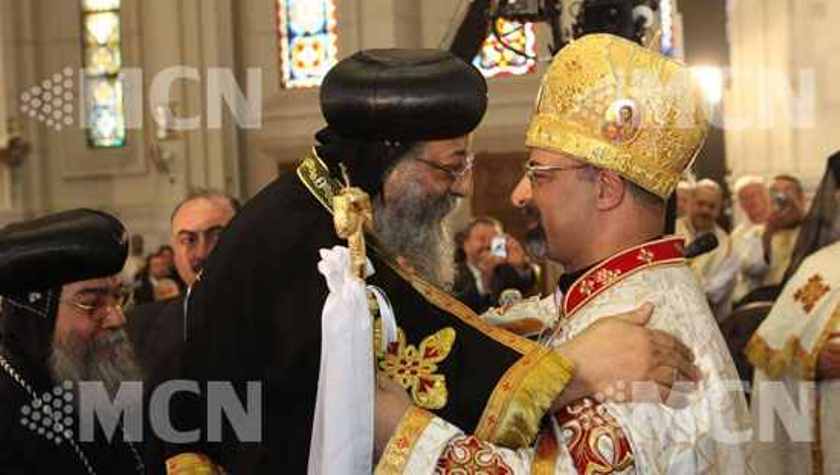
Pope Tawadros II noted the word patriarch has three meanings; the first is fatherhood, as the patriarch is a father who carries the feelings of fatherhood which stem from the work of the Holy Spirit towards each one, adding humans need this feeling of fatherhood every day.
“The second meaning is love, which is the main need of humans,” Pope Tawadros II continued. He acknowledged the world is currently hungry for the true love God planted in their lives to present to everyone.
The third meaning, Pope Tawadros II remarked, is service, adding the priority for the patriarch is to be a servant but that service means humans should serve everyone.
The Coptic patriarch added that washing the feet is one of the traditions established in the monasteries to express humility. He said their service comes from a heart of love and fatherhood to meet the needs of everyone, including marginalized people, tired people, the old and young. Service, he stressed, is the work of the patriarch.
These are good words. The new Coptic Catholic Pope is named Ibrahim Isaac. He replaces Antonious Naguib, who retired for health reasons, but is currently in the Vatican enclave due to his status as a cardinal.
The article is not clear about all that took place during the ceremony, but Pope Tawadros’ words could have been even more powerful if accompanied by the symbol he mentioned.
Imagine if he had stooped to wash the feet of the new Coptic Catholic Pope.
The Coptic Orthodox Church represents the overwhelming majority of Egyptian Christians. Interdenominational relations have ebbed and flowed over the years with Catholic and Protestants, but Pope Tawadros appears intent on fostering unity. As mentioned previously, he has helped facilitate the Egyptian Council of Churches. Each denomination will have equal weight and rotational leadership. It is a humble concession on the part of the Orthodox.
Pope Ibrahim Isaac also spoke of the connection between leadership and service, according to MCN:
During his speech at the inauguration, Pope Isaac remarked that the Holy Bible teaches us authority is there to serve, taking after Christ and his teachings.
It is a common practice in the Coptic Orthodox Church for the leadership to wash the feet of the people, in a special ceremony once (perhaps more?) a year. Perhaps the Coptic Catholics do similarly, I don’t know.
But on this occasion, if only Pope Tawadros had washed the feet of his counterpart – equal in ecclesiastic authority but so much less influential in Egypt. This is no criticism, only imagination. But to demonstrate this teaching on such an occasion would have been noteworthy. In Christianity, the greater serves the less.
Even just in writing that sentence the protest issues: Shouldn’t Christianity make all people equal?
Yes, and it does. But the world does not. Therefore, those who are invested with authority and privilege of position must do all they can to demonstrate their humility. They must overturn the way of the world, however rife with hypocrisy the statement may be, if they are not careful. Washing the feet can easily become the new pride. It is proved otherwise away from the cameras, in demonstrated service away from the eyes of the world.
If only to continue imagining, might also the Grand Sheikh of the Azhar wash the feet of Pope Tawadros? Here, we are crossing religions which maintain their own traditions. It is not a proper comparison.
But the Sheikh of the Azhar has consented to a similar humble concession. He has helped facilitate the Family House, in which he and the heads of all Christian denominations meet regularly to maintain good relations and solve sectarian conflicts.
Muslims represent the overwhelming majority of Egyptians, yet the Grand Sheikh is outnumbered.
In the world, everyone knows where power lies. This reality will not change because of humble participation in councils, nor in symbolic gestures like foot washing. People in power also have it in their interest to appear humble, which actually increases their effectiveness.
But to lift up the lesser, to honor, and to give more power even at your own expense – this is of God. “He must become greater, I must become less,” said John the Baptist of Jesus. Jesus, meanwhile, said of those who follow him, “They will do greater works than these.”
Egypt’s spiritual leadership, Muslim and Orthodox, appear to heed this pattern. God only knows, but may he similarly equip Pope Ibrahim Isaac, and make him a shepherd to his people.
From Ahram Online, following up on a story in which Muslims surrounded a church in Kom Ombo, Aswan, to demand the release of a local woman they believed was held against her will, forced to convert to Christianity:
A sheikh addressed a crowd of men in Kom Ombo to explain the events and dispel any rumours that had been circulating.
“Some say that she had a relationship with a man [who convinced her to convert] and others claim that a woman used to visit her and talk to her about Christianity,” he began.
He said that a man from Cairo, a former Muslim and Christian convert, communicated with her via the internet and the phone.
Allegedly, the divorcee in her mid-30s, had expressed thoughts about converting to Christianity.
“He told her that no one will be able to help, not even Christians, except one priest in Cairo who is [expelled from the Church] because he’s been attempting to convert Muslims,” the sheikh said.
The crowd reacted angrily to this information, interrupting the Sheik.
“When we sat with [Church leaders] they told us that they [do not encourage] such acts and explained to us that this priest is expelled from the Church,” he continued.
“This is a mere financial issue, the [man] came and told her ‘I will help you’ in exchange for EGP 3,500’
“We will bring the man here so that everyone can take revenge on him,” he added.
The sheikh then talked to the crowds about Islamic values and presented some counter-arguments to issues in the Christian religion that affected the girl during her absence.
“The woman told us that she was not fully convinced of several things she was told [by Christians] including the concept of the Trinity,” he said.
“She came and talked to us clearly, she said ‘I do not know if I am right or wrong,'” he added.
“We asked her to write down every point of confusion and we replied to all her concerns – everything has an answer in our religion.”
The sheikh said that curiosity had prompted the woman to leave; it is not known exactly where she had been staying during the past week.
“The woman’s brother had found a Christian hymn on her phone; when we asked her about it, the she said that she had asked for it… She obviously was… You see, the devil manipulates people’s minds. She was curious,” he said.
As the sheikh spoke, men from the crowds raised questions and points of concern to them.
“Do people who [encourage others to convert to Christianity] work through the internet?” one asked.
“Look, so that you know, the nearest person on such a network is from Luxor and the rest are from Cairo and Alexandria, they log on with fake names and we can’t –” but he quickly reassures, “We will get to them all.”
“Because we have already found three of them,” he added.
Additionally, the sheikh responded to the crowds several times saying, “Anyone involved will be held to account.”
This is a fascinating transcript. Very often in Egypt conversions in either direction are due to non-religious reasons such as love affairs, escaping difficult family situations, or securing a better financial situation.
Here, however, this woman appears to have simply been attracted to Christianity, likely through her association with Christian friends.
That which the imam speaks of also likely exists. Both religions have those who promote conversion on the internet, as well as individuals working to gain converts. In Egypt, of course, only the Muslim efforts are welcome.
The church probably had nothing to do with the woman, but needed to present official denials anyway. To placate the people, the imam needed to promise investigations and justice, even retribution.
In the West we would say ‘that poor woman’, and so we should. There appears no conspiracy here, just an individual with religious curiosity and inter-religious friends. Such trouble.
But here, they say ‘that poor family’, over what this innocent curiosity has done to the community. Such a description would apply equally if a Copt was found exploring Islam, though the scope here is much wider.
In both responses there is virtue, but where in all this, if anywhere, is God most pleased? The Muslim and the Christian may have very different answers, let alone the Egyptian and the Westerner.
It is a shame, I think, we have to know about this incident at all. And I’m the one sharing it. It is just too descriptive of Egyptian reality on the subject of conversion.
The dynamic is changing in Egypt, but it is happening outside of Cairo. Violence and civil disobedience characterize Delta and Suez Canal cities, while police themselves go on strike throughout the nation. In fact in Port Said they were ordered of the street.
There is little to commend here, God. Surely the grievances are many, and perhaps many are just. But as protestors attack police, the police demand better weapons. Some of the latter protest against ‘Brotherhoodization’ of the police force; others to be allowed to grow their beards.
In much of Egypt life carries on, but it is as if the state is breaking. Why is the presidential palace covered in graffiti? Why are major roads shut down for hours by rowdy youth? Why is the best solution for popular anger against police abuse to stop policing a city entirely?
These are questions for the administration, God, and give them wisdom to handle their many challenges. But the issues are deeper. Egypt was a police state, and the revolution broke it. Perhaps the police are ill equipped to do their job otherwise. Perhaps freedom and human rights have entered the equation, but without experience in balancing with law and order.
If so, God, there are lessons to be learned. May they be learned quickly. Give the Ministry of the Interior a wise and strong figure to reform from within, and facilitate accountability from the outside.
But if not, God, the conspiracies speak. Are the police ignoring the president and working to undermine him? Or have they yielded their old tools to a new regime more than willing to repress? Is the counterrevolution drawing Egypt into more and more chaos to kill revolutionary ideals and garnish popular support for the return of an iron hand? Or is the Islamist idea to secure their project on the ashes of the republican system?
May these be far from the truth, God, however much they are whispered. But fix the country, though only with righteousness. Remove those who retard her, though only with justice.
Give Egypt leaders who can do this; equip the people to ensure it.
God, sponsor their work, and bring it to completion. Keep Egypt safe, secure, and free.
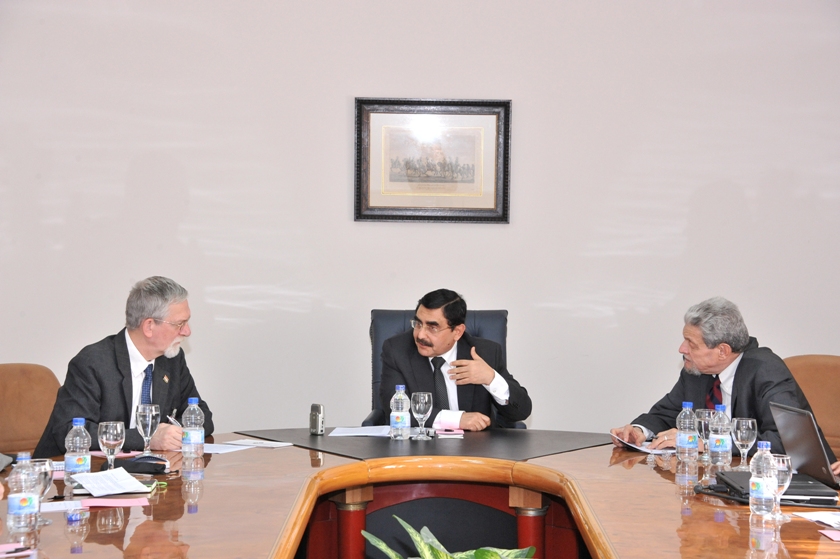
Essam al-Haddad, with Hulsman (L) and Schleiffer (R)
The following is an excerpt from an interview I was privileged to be a part of with Arab West Report. We visited the presidential palace in Heliopolis to meet with Essam al-Haddad, President Morsi’s advisor on foreign and security affairs.
Visiting the palace itself is a strange experience. The walls are covered with anti-Morsi graffiti and lined with barbed wire due to recent clashes in the vicinity. It is a good symbol of the current state of Egypt. An Islamist occupies the top office but faces significant backlash, as the state appears to be breaking down, unable to maintain the respect necessary for such a vital institution. Can you imagine if the White House was similarly afflicted?
Here is Haddad’s take on this, including his explanation on why the conspiracy against Morsi has not yet been brought to light:
Dr. Essam Al-Haddad: The amount of violence against security which was not experienced before, has reached a level where security is now responding but with tear gas and water cannons. But for each rule there are exceptions. Our position is that there is no tolerance for violence against peaceful demonstrations and there is no tolerance for violent demonstrators who are attacking either other people or institutions. So the balance is very tight.
However, if there are any documented incidents of violation, we are taking this very seriously on two sides. First, it has to be investigated and those accountable need to be brought to justice. Second, strategic measures need to be taken to ensure it won’t happen again within the ministry and within the officers. And in this case we would say that we have experienced that the level of restraints, self-restraints by the police is not seen in the Egyptian public for years.
And I invited you to come here to see how we are operating within Ithahadiya [Presidential Palace]. By night on Friday Ithahadiya is attacked by Molotov cocktails and graffiti on walls and everything. Nobody is doing anything to them. So because they are not allowed to carry bullets, the police force, they are only allowed to use tear gas and water cannons. So this is what is going on in the police. But if things are going more violent from some of the violent demonstrators then they have to take action. The rule is using the acceptable level of force in order to stop this from going on.
Any violation of these acts, whether those who have been here in Ithahadiya or anywhere else, will be investigated and those who have been considered accountable will be brought to justice. This is the rule we are working on. Going back to the other side where we have experienced women harassment, huge women harassment at Tahrir Square, there have been claims that these had been organized by the FJP and the MB. This is nonsense, complete nonsense. We have information now that these people are paid by the day, sometimes by hour to demonstrate and to do whatever damage in any part they are and we even know that the fee reaches nearly 1000LE for a day and if they are wounded they could get up until 1500LE, so it is a good job.
Prof. Abdallah Schleiffer: If you have this information why don’t you bring them to charge? Dr. Essam Al-Haddad: Because this information is not 100% on record. Like drug trafficking, you can see that this person is giving that person an amount of drug to be used and he is selling it and he is getting the price. If you don’t have the license from the public security…
Prof. Abdallah Schleiffer: But you could simply arrest the perpetrators, because there are groups who are fighting them and they could testify evidence, because, again, this is where there is a credibility problem. I have no reason to doubt you at all.
…
Dr. Essam Al-Haddad: We had a revolution 2 years ago. The dictatorship has been there for 30 years with all its levels of corruption. And people are now experiencing a totally new atmosphere that they are free to do whatever they want and there is no security apparatus enforcing law on them. And they feel this as an opportunity to do whatever they want.
I have been to South Africa for nearly five years after the Apartheid rulers. I was not in Johannesburg, but in Cape Town. I was not allowed to go outside the five-star hotel where I was staying without having a stick and without being warned. When I went around the streets of the five-star hotel everyone was holding a stick. And this was five years after the Apartheid regime.
You don’t have a complete change in such a short time. I always say, you need nine months to have a baby. Can you have a baby in less than nine months? Sometimes, maybe. But you need two years to start to speak two words. And another ten, thirteen years to be mature in order to be a responsible person. This is traditional of course. You cannot expect that after a full collapse and a full blown over of the regime, things would go back to normal immediately.
And you have a counter revolution going against you. But what I can say, we know very well where we are going. And we expect that this time will come and we are determined to carry on building our institutions. And carry on in the reforms we are trying to make in order to make the environment more acceptable and attractive for investors. This is how we want to do it.
…
Drs. Cornelis Hulsman: The issues we mentioned thus far are all issues for which you need consensus building. How would you find a consensus in Egypt to address all these issues that are of major importance to Egypt because a consensus will help to address this?
Dr. Essam Al-Haddad: Yes you are right, it is important, we are trying our best. Mr. President has invited for dialogue, once, a second, a third time. His invitation was that everything could be discussed, no constraints. You can discuss whatever. But what we are seeing from the other side is that we will not sit unless you are meeting this condition. So, it is a conditional dialogue. “No we will not sit with you ‘cause you are not credible enough”, “no we will not accept this, no we will not accept that.”
Our experience is that, not only experience, our information is that there are elements who are not willing to enter the dialogue, but they are only willing to delay the democratic process. This is their point. Whenever there is an election, they say this is not the right time for an election. If there is a referendum, they will say that this is not the right time for a referendum. If there is any sort of action building democratic institutions in order to go forward there is a sincere trial to hamper and to obstruct it.
This is what we see so in order to archive consensus within this environment, it is not that easy to reach a 100% consensus. But you have to reach out and to open the door and whoever will be joining you will carry on with them. And those who are sending their own agents inside the country and playing outside and sending money, there is more than country and business man who are intervening in our country to avert whatever is going on.
Prof. Abdallah Schleiffer: There is a credibility problem. What countries are you talking about? When you are talking about foreign countries intervening, especially since that is a phrase that has been used over sixty years, so it has a very negative, when I hear that it is like I am hearing…
Drs. Cornelis Hulsman: Mubarak.
Prof. Abdallah Schleiffer: Mubarak or Qadafi. Is there any way you could clarify that? What countries are intervening? I understand why you do not want to, but just asking whether you can.
Dr. Essam Al-Haddad: We do not want to spoil the relations with this country, because this is a brotherly country, which is scared of what is going on here. We prefer to keep it calm. And to avoid it, with the hope that they would realize that intervening in the internal affairs of Egypt is not at ease.
Please click here to read the full interview at Arab West Report.
In Egypt, sectarian conflict can be dizzying. When news breaks it explodes – Muslim mobs, churches burned, priests attacked. When the news crests it collapses – Muslim denials, church agreement, security clampdown. Only when the news settles can the situation be understood – however incomplete, contradictory, and subject to enduring confusion.
The recent incident at the Church of St. George in Sarsena, Fayoum, approximately 100 kilometers southwest of Cairo, contains all the above elements.
This is a somewhat lengthy report, but the basic summary (disputed) is this: A church in a small village was bothersome to its Muslim neighbor. Perhaps this was because the priest was looking to expand the building, perhaps because of the noise of the mass, perhaps because he simply did not want a church as a neighbor.
During a priest-arranged reconciliation session between the two, the family of the neighbor appears to have attacked the church with stones and handmade firebombs. During a second reconciliation session to settle this development, the attack began again. Eventually, the church agreed to a number of restrictions on its noise and future expansion, but was allowed to remain on it current plot of land.
This is the basic summary. The full report shows how this understanding developed, wading through the different versions which circulated in the media, including the denial of the local bishop that anything happened at all. The report also includes testimony from researchers who visited the village firsthand, as well as the account of the local priest.
Here is the conclusion:
At this point it is important to recall Allam’s editorial. Exaggeration and sensationalism do not serve the Coptic cause, let alone the cause of justice. Initial reports of hundreds of attackers, thrust from the mosque, recall the worst examples of sectarian tension since the revolution. As the reality appears much simpler, though still serious, media attention prompted immediate denial from the church.
The church denial now casts all in suspicion. Fr. Dimyadios appears a crusading priest. Nader Shukry appears an activist first, a journalist second. Coptic-focused news outlets appear more bent on discrediting Muslims than on reporting truth. Even the mostly corroborating testimony of the judicious EIPR appears doubtful – are they making a mountain of a molehill in service of their distaste for Islamist governance?
Of course, all the above may be true, even if only in degree. But EIPR’s Ibrahim states why this case is relevant, even in its less than exaggerated details.
“The law must apply to all,” he said. “The customary, traditional solution is only a temporary solution.
“Letting go of your rights through reconciliation sessions only provides encouragement to those who transgress, and shows Christians are less than full citizens.”
That is, unless nothing happened at all. Such is sectarian tension in Egypt.
The popular dance craze not only reaches Egypt, but targets the Muslim Brotherhood. This version was performed outside their headquarters in Cairo.
It is quite amateur, but expresses a popular urban youth sentiment that Islamist government is out to limit freedom and instill a more religiously conservative society. This dance, including other Western and Arab songs, is a pelvic thrust in their direction.
Is the Harlem Shake a better recourse than debates, seminars, and elections? If nothing else it demonstrates the utter creativity of Egyptians in undermining their leaders.
As with many things in Egypt, just because this opposition boycott is announced, does not mean it is final. But as for now the upcoming parliamentary elections will be without drama, unless you are an Islamist, seeing how the spoils will be divided. The primary indicator of worth will be how many people go to the polls.
But wisdom, God, is greatly contested. Should the opposition cede all branches of government to Islamists? Will this result in Islamists greater empowerment, or further discrediting? Or, is it sour grapes in advance, worried they would not win anyway?
Or should they run, accept any losses, but build a democratic process? This is well and good if all is fair; do opposition claims to the contrary ring shrill or true?
God, give Egypt ideas. If all the opposition serves is obstruction, of what value are they? Islamism has been an idea for a long time; finally it is being tested. Judge and prove its worth, God. Save Egypt from its specter if failure is coming, but is this the only way to dull its lure among the religiously-minded?
But if it is of great worth, God, may they endure these present tribulations. Develop their leaders into statesmen, figures who serve beyond themselves to bring hope and prosperity to all. The learning curve is steep and the obstacles are many. Amid all scenarios, God, may right prevail.
Especially as much is wrong, even if there is disagreement over identification. But you can bring order out of chaos, strength out of weakness, life out of death. Even evil cannot escape your purposes, which you transform into the greater good. God, Egypt longs for these days to come.
Help her then to join your redemption. May Egyptians lessen their desire for control, esteem their weakness, and die unto themselves. May they humble themselves, not just that you may lift them up, but that you, your name, and your way receive all due.
But do not make them wait for a miracle. In fact, chastise those who are. May they work hard, argue, and create. Give stomach to endure all difficulty; give heart to love their homeland.
Give mind to boycott, or not. Yes, God, give them elections; give Egypt sovereignty. But give them bread, freedom, and social justice too. Help Egypt to sort out the proper order.
February 18, 2013 may prove a monumental day in the modern history of Egyptian Christianity. Heads of the five largest denominations – Coptic Orthodox, Catholic, Protestant, Greek Orthodox, and Anglican – created the Egyptian Council of Churches. Since the dawn of Catholic and Protestant missions in the 17th and 18th Centuries, Egypt’s Christians stand united.
“I believe history will record this day as we celebrate the establishment of a council for all churches of Egypt,” said Pope Tawadros II of the Coptic Orthodox Church, which boasts approximately 90 percent of all Egyptian Christians. “I think such a step was delayed for years.”
The rest is a brief summary, in which participants actively deny any political role for the council, closing instead with these words of faith:
“The Lord has answered prayers which have been offered for thirty years,” said Baiady. “Our diversity must become a source of richness rather than a struggle.
“Unity is built on fruitful, humble love which favors the other over the self.”
Please click here to read the whole article, containing quotes also from the Catholic and Anglican representatives. It is a good step, a formal admission to the unity asserted by most Christians I know here.
Help Egypt rebuild her political institutions. Help her to do so wisely, and justly.
The law to set regulations for parliamentary elections meandered all week. A first draft was partially declared unconstitutional by the Supreme Court. Amendments were made, but then bypassed the court lest it find further flaws, only postponing the crisis. Accusations of unfairness and gerrymandering abound; many in the opposition threaten a boycott.
And among the most unusual provisions is the fact the elections will be conducted over a four week period.
Added to the political controversies are feuds between the Muslim Brotherhood and the Salafi Nour Party, and disputed attacks on a church in Fayoum. On all accounts the facts are unclear but acrimony appears from all sides. It was a quiet week in Egypt, but tensions simmer.
Lower the boil, God. What is this stalemate producing? Where are you bringing Egypt? Must one side eventually defeat the other completely? Is this preferable to honest compromise?
God, grant the people representatives; give them a working parliament. But may those who populate it come truly from the popular will. Minimize electoral machinery and manipulative campaigning. But have a groundwork laid now in which all can agree on the rules of the game. But God, it seems impossible. Rules were disregarded long ago.
So, perhaps, were sincere political relationships. Heal the rifts between Islamists, and furthermore between all political powers. Where these rifts are caused by transgression, may justice cleanse. Restore the reputation of anyone falsely tarnished; sully the reputation of anyone escaping accountability. Sort out the categories, God, but moreover, reconcile. Egypt needs all.
This includes her Muslims and Christians. God, return this village to its previous anonymity. If there is fanaticism driving events, rebuke its partisans. If there is exaggeration, rebuke as well. Help each to love his neighbor as himself, seeking first the interests of others. Establish humility, but give each his right. Spare the village from further troubles, and may similar happenings not repeat elsewhere.
God, coddle Egypt, if you must. Be a mother who calms a disquiet spirit and a flailing temper. Hold her until she can breathe again freely. But prepare her to roar, righteously. May that day come soon.
Cynics throughout Egypt could only smirk. Thousands of Islamists protested against the recent wave of political violence, answering the call of one of its most notorious perpetrators, the Jama’a Islamiya. Throughout the 1990s they led an armed campaign against the Mubarak regime, as well as targeting tourists in a bid to discredit the state.
In the early 2000s, beaten and discredited themselves, the Jama’a Islamiya issued its famous ‘Revisions’. Jailed leaders reconsidered their violent philosophy, publishing tomes on the errors of their way. They also reconciled with the government, securing release from prison for many. Since then the group has largely laid low, at least until the revolution.
Like others in the formerly forbidden Islamist trend, the Jama’a Islamiya took advantage of new political freedom to form a party, Building and Development. They allied with the Salafi Nour Party but played second fiddle, offering their popular support especially in Upper Egypt in exchange for a handful of parliamentary seats. But as Egypt descended into a morass of political chaos and violence, it was the Jama’a Islamiya which took the lead in condemnation. The question is, why?
Cynical reasons abound.
The article then seeks to expose some of these cynical reasons through the testimony of protestors:
“When the Jama’a Islamiya says ‘no’ to violence, we have more credibility than anyone else,” said Sharaf al-Din al-Gibali, a party leader in Fayoum. “Why? We engaged in an armed struggle with the regime for over ten years. We finally realized violence is not a suitable path to power, under any circumstances.”
In fact, it is concern for the opposition that is a large part of their motivation. “We have tried this path already,” he continued, “so for those who are trying it now we are worried for them.”
But then other testimony reinforces the cynical:
“What is happening now is the empowerment of Islamists and if God wills he will help us soon to rise against Israel,” said Mohamed Ahmed, an unaffiliated clothes merchant who leans in support of the Jama’a Islamiya. “We are against violence among ourselves; God has forbidden a Muslim to shed the blood of another.”
By ‘among ourselves’ Ahmed meant all Egyptians, even though he labeled the opposition as troublemakers. He believed Mahmoud Shaaban’s recent fatwa authorizing their death was near-appropriate.
“ElBaradei and the others spread corruption in the land and call for rebellion against the authorized leader,” using a traditional phrase from Sunni Muslim jurisprudence. “Sheikh Shaaban simply mentioned the hadith that says such as these deserve death, but those with him on the program convinced him this issue must go to the Azhar.”
Ahmed has a distaste for politics in general, but the times are changing. “There is a jurisprudence of reality; if the people now want ballot boxes, we will use them,” he said.
“We entered into political parties to be able to reach the ability to govern, and not just preach. If you only preach they can shut you down.”
Please click here to read the whole article at EgyptSource.
From Ahram Online, an op-ed arguing on behalf of Islamists, that Islam is essentially political:
A final point. Some of the opposition figures keep invoking the term “political Islam,” as if the term were a source of shame to Islamists.
Well, political Islam is not the invention of the Muslim Brotherhood or other Islamists. It is rather solidly rooted in Islam and its holy scripture, the Quran.
I am not going to discuss certain arguments made by anti-Islam secularists who claim that the rule of Sharia is not a must upon Muslims and that Muslims might opt for modern Western-style democracy without violating the tenets of their faith. These arguments are quite nonsense, even for first grade Muslim children.
But I do want to point out that one cannot reject political Islam as a matter of principle, without rejecting Islam itself.
Yes, one might disagree with certain Islamist modalities, behaviours and interpretations. We all reject violence and terror committed in the name of religion. And we all would like to see a kinder and gentler practice of Islam everywhere.
But we must never allow ourselves as Muslims to compromise the main principles of our faith in order to appear more in tune with the age, and more acceptable to the West.
As a non-Muslim, it is never wise to argue what Islam is or is not. This, ultimately, is for Muslims to decide. But just as many demonize Islam saying it is a terrorist and illiberal religion, others assert the opposite, making it a personal faith akin to the Christianity of the West.
Religion and culture easily bleed together; certainly many Western Muslims do practice a personal faith. This voice, however, asserts that Islam is inherently political. It may be (and is) able to live peacefully as a minority faith, but it is not content here.
Consider a similar example: Does the word ‘Jew’ represent a faith or an ethnicity? Many Jews are agnostic or atheist; some convert to Christianity yet still consider themselves Jews. Perhaps there are few converts to Judaism outside of the ethnicity, but the line is sufficiently blurred to be confusing. Are you an anti-Semite if you deny the historicity of Moses?
Along the same lines, is Islam a faith or an ideology? Many Muslims are non-political, but does the faith demand more? Those who have claimed the mantle of leadership in the Arab Spring overwhelmingly say yes. Do they distort their religion? Or, do they compromise the many western Muslims who are forced to defend themselves from polemicists suspicious of them as a fifth column?
Judaism was birthed as the religion of a chosen family, marked by circumcision, wary of outsiders. Islam was birthed as the religion of a state, marked by confessions of loyalty, enveloping the outsider. Each one today houses the paradoxes of its emergence.
Can anyone attempt a similar consideration of Christianity?
The new realities of Egypt, buttressed by its new constitution, place religion front and center in politics and policy. This means a new and developed importance to all her religious leaders.
The newest of these is the mufti, elected for the first time by the council of senior scholars in the Azhar. The Azhar, of course, holds prominence among all sheikhs, first in history, now in law. The institution must be consulted on all matters which touch the Islamic sharia.
But the mufti also is influential. He heads Dar al-Ifta’, responsible for issuing hundreds of religious rulings each day, as Muslims inquire. These range from the mundane to the controversial; in the past, even the presidential.
As could be anticipated, God, the position was contested. A prominent Muslim Brother was a nominee, a less well-known Brother finished second. Not much is known widely about the winner, though he is suspected to be generally non-political. He may not be able to remain so much longer.
Give him wisdom, God. But give even greater wisdom to Egypt. Do you desire those who speak in your name to influence and possibly determine the path of the state? Will this bring the best scholars forward, or corrupt those who dare advance?
In light of his appointment, bless him and all others who serve you through their religious traditions. Political or otherwise, they help shape the worldview and ethics of many in Egypt.
For the pope of the Coptic Orthodox Church, guide his stewardship of Egypt’s Christians. Give him wisdom to spiritually guide his community amid the many challenges Egypt faces. Give him discernment for when his guidance must also be political – or if it should never be. May he be a man of peace and unity; bless him especially among his family of bishops. Help them to encourage their flock toward humility, grace, and love.
For Egyptian Christian priests and pastors of other denominations, encourage them in their particulars while remaining organic with the whole. May they honor and respect the Orthodox, even as they present alternatives. May their interactions mutually benefit the spirituality of all communities.
For the Grand Sheikh of al-Azhar, the Grand Mufti, and local imams within their oversight, grant them understanding of the changing nature of Egypt. May they lead their faithful in piety and prayer. May they study their sources to encourage right conduct toward state and society. May they present a vision of Islam that corresponds with your desire. Bless them and aid them in enriching the fabric of Muslim and interreligious relations.
For the Supreme Guide of the Muslim Brotherhood and Salafi sheikhs that have emerged politically, honor their insistence that values of religion belong in the public square. Guide them in their interactions with those who define this differently, that consensus and respect might result. Bless their efforts to encourage Egyptians to be upright, faithful, and God-fearing. May they nurture a renaissance that blesses all.
God, may all the above know your will for themselves and their communities. Endow Egypt with the virtue of faith; spare her the vice of fanaticism.
Help Egyptians to know the difference, to know you, and to know what you require of them – in this world and the next.
Egypt is not Lebanon. Though the political transition leads increasingly to polarization and bouts of violence, almost no one seriously warns of a fate resembling Lebanon in the 1970-80s. Lebanon is a conglomeration of religious sects concentrated in distinct geographical areas and topographical terrain. Egypt is one people, with Muslims and Christians interspersed everywhere along the flatbed of the Nile.
Even so, former combatants from Lebanon’s civil war – now reconciled – are very concerned.
Muhi al-Din Shihab was a leader in one of the Sunni militias, while Assaad Chaftari was the number two man in the Falange, a Christian militia.
“We wanted to kill the Lebanese ‘other’, which was primarily the Christian,” he [Shihab] said. “But as the war went on we discovered more and more ‘others’ we had to fight – Israel, multinational forces, and various Islamic sects.”
…
“I went to see the Christian quarters and saw the results of the violence,” he said. “I had seen them as the enemy, as conspirers with Israel and sons of the Crusaders.
“But I was surprised to see how ignorant I was. Most of them were opposed to Israel. They were not wealthier than we were; they were not semi-French. They were Arabs just like we were.
“I thought I was engaged in jihad,” he said, “but who else was responsible for this bloodshed?”
Chaftari also tells his story:
“Our civil war was built on the prejudicial thoughts each one had toward the other,” Shaftarī said. “We thought Lebanon was ours because the French gave it to us, while they thought of Lebanon only as a transitory country until the Muslim ummah is established.
“We viewed Muslims as our guests. We called them our brothers, but accepted them as lesser brothers.”
…
“Eventually I looked in the mirror and stopped seeing myself as good and perfect.
“Instead, I saw the ‘other’ in the mirror. He had a name, a life, and a family. Like me, he loved Lebanon.”
But the most insightful comment concerning Egypt was a confession by Chaftari:
“I deliberately created spins and lies, especially filtering the data about our enemies,” he said. “I disregarded what did not help my cause and accepted, amplified, and spread data that confirmed my political vision of the others. I did this because I believed it was necessary to create fear of the other.
“Then I would turn fear into hate, and use hate to turn people in fighting machines.”
The article then briefly considers the contradictory narratives when Muslim Brotherhood members and opposition protestors clashed at the presidential palace in December:
Obviously, someone is lying. It is not the point here to determine the guiltiest party – there is testimony and video evidence aplenty on the internet. But like in Lebanon, locked in desperate political struggle, parties play fast and loose with the truth to support their objectives. It is an all too common human characteristic.
May God bring all guilty parties to account, but then, as in Lebanon with Shihab and Chaftari, to reconciliation. Lebanon has yet to fully recover, and Egypt is yet nowhere near its example.
The parallel, however, is worrisome.
Please click here to read the full article on Arab West Report.
From EgyptSource, a personal testimony of growing up in the Muslim Brotherhood:
The Guidance and Light School, in which I spent my third year of preparatory school after our return from Kuwait, was a Brotherhood school which my father helped establish. Since the 1980s, schooling and educational services had become a key aspect of Brotherhood activities and a means of proselytizing. We followed the same curriculum as the public schools, except that we took two additional courses twice per week; one was entitled ‘The Holy Quran’ and the other was a mixture of Islamic stories and proverbs. The only other change was that Music class was replaced with another class titled ‘Hymns.’
Except for drums and tambourines, musical instruments were banned and discouraged. Flyers and posters hung on the school’s walls warning about the dangers of listening to stringed instruments. The hymns which we were forced to memorize consisted of the most widely known nationalist melodies and songs except any mentions of ‘Egypt’ were replaced with ‘Islam.’ The school was of course populated with the children of local Muslim Brotherhood leaders in addition to other Muslim students of diverse backgrounds.
Only now do I realize that until the age of fourteen, I had never once met a Christian. I was in an exclusive world with its own moral values, worldviews, and perspectives on what it meant to be a good person.
There are many similarities to traditional Christian upbringing in the United States. I never found it to be as insular as described here, but there are parallels. It is important to remember that there is a good and proper place for the inculcation of values, which should happen early before being balanced by a broad and diverse education. Of course, it matters what values are being inculcated.
Here is an example of what the author learned, and why he finally broke from the group:
A Brother brought several copies of the newspaper Elshaab and placed them beside him. Like any other meeting, that day’s session began with one Brother reciting from the Holy Quran, followed by a second interpreting a hadith, and a third explaining an aspect of Islamic jurisprudence. Then the Brother opened the newspaper and read it aloud to the group.
He read that the Egyptian Ministry of Culture had published a novel by the Syrian writer Haidar Haidar. Aside from sexual references, the novel contained heretical insults directed at God and the Prophet Muhammad (Peace be upon him). In response, preparations for public rallies were made which would protest the publication of the novel and demand it be burned.
Word for word, this is what the Brother demanded, and I instantly objected. At that time I was the group’s writer, and I refused to write any chants which called for the burning of this book or any other book for that matter.
To this day, I do not know what compelled me to take this firm stance.
I showed one of them some excerpts from Haidar Haidar’s novel which were published in Elshaab. From what I read, I found his writings ridiculous, but I insisted that this in no way justified it being burned. I entered into a long discussion with the Brothers which developed into shouting. The argument between me and the group’s leader grew increasingly sharp, and in an angry outburst he forbade me from taking such a stance. The argument grew even more hostile, and he told me, “Either give up these books you read and your stance on them, or do not meet with us!”
I left the room, and never went back.
I remember growing up in a culture where the ‘secular humanists’ were out to destroy religion, where popular music was a tool of the devil, and I felt like a rebel because I did a report on Jean-Paul Sarte in high school.
Looking back, I am very thankful for my upbringing, which was full of love and nurture. I went to youth group, memorized Bible verses, attended Christian summer camps, and idealized Ronald Reagan. I recognize in my adult worldview many shades of agreement with the pronouncements of danger I received growing up. I can only imagine many of the Muslim Brothers have similar experiences and warm memories. I’m sure this author does.
There are many points to compare and contrast, and I hope to do so later on in a full essay. But I’m glad to read this very human picture of what it is like to grow up in the Brotherhood. Please do read the whole article.
My life in Cairo is spent mostly in our house and the surrounding area of Maadi, which is about half an hour from the famous Tahrir Square. Friends and family in the states get nervous when they see the violence and flare-ups in Egypt, but the reality for me is generally far removed. Last week, however, we needed to take a family trip through the heart of the uprising.
Our destination was the American Embassy in Garden City, normally only a five-minute walk from the Square. Our son, Alexander, was born in Cairo three months ago, and it has taken us this long to secure an appointment with the embassy for his “Certificate of Birth Abroad” (the equivalent of a US birth certificate) and his first passport. We originally had an appointment at the embassy on the 29th of January, but that was a particularly unstable week around the embassy due to ongoing clashes, and so it closed for several days. All appointments were postponed. We were hoping for calm now, so we could get this process started. I didn’t like not having a passport for our baby, as I wasn’t sure what would happen if we were forced to travel.
Since our two oldest girls were still on school break, we ended up taking the whole family downtown for our adventure. We left our house around 8am with the hopes of arriving in time for our 9am appointment. Of course, when you are two adults accompanied by three smaller walkers, plus a baby slung snuggly on your chest, it takes a bit longer than normal to get places. We had an uneventful walk from our house to the closest metro station.
Unfortunately we were traveling during rush hour which meant the metro was packed. Emma, our oldest, gets a little nervous getting on and off the metro. She seems to have a fear of our family being split up as some of us get on the train, and others get shut out behind the door. This has never happened to us, but I understand her fear considering getting on and off the metro can be a real battle due to the sheer number of people.
As we saw the train approach, we noticed that the cars were all quite full. When the train stopped and the doors opened, we quickly pushed our way in, crowding together with those already in the car. The trip from our station to downtown is about 20 minutes, and it looked at first, like we would all be standing for that whole time. But as is common in Egypt, others in the car noticed our small children, and offered me and my baby-in-carrier a seat. I put Layla on one knee and Hannah on the other until a few minutes later, another seat was offered to Emma and Hannah.
As we rode along, I looked around me and realized there were no other women that I could see in this particular car. In fact, I was totally surrounded by men. I was really glad my husband was among them. Not only was I surrounded, though, but the men had made a barrier of space between me with my kids and everyone on the train. That was much appreciated considering that where we were standing earlier, there was no space around anyone. My thoughts went to the many articles I have been reading of violent attacks on women in Tahrir Square. They sound awful, and the men involved sound like barbarians. This, on the other hand, was an example of what my family usually experiences: considerate people who look out for the sick, elderly, and moms with young children.
When we arrived at Sadat station, the metro stop under Tahrir Square, I was glad to notice the absence of tear gas. I have never actually experienced tear gas, but Jayson has on several occasions, and so have some other family members when he has taken them to visit the Square. I had heard that over the last week, the tear gas was quite palatable in the station, and I was most concerned for our three-month old son if there were any lingering fumes. I was glad not to notice any.
We exited the metro, Jayson carrying Hannah and Layla, Alexander strapped to me, and Emma holding tightly to my hand. We quickly escaped the traffic that was exiting with us, regrouped in an open space, and walked toward the turnstiles. We then followed the crowd through the narrow door, up the steps, and into the open air.
I looked around and saw the white tents covering the center of the traffic circle. We considered taking a family picture, but, being that we were an American couple with three blonde daughters and a new baby, we didn’t want to linger and attract any more attention than we naturally do wherever we go in Cairo. We headed toward the embassy.
Photo from a few months ago; no cars dare park in the area now.
Normally this walk would take us only 5 minutes, even with the little ones in tow. However, due to the recent fighting, several walls have been constructed over the last few weeks. These walls are made of large concrete blocks, each one is probably 3 feet by 3 feet. The blocks are then stacked 3 or 4 high, and they cover the entrance to streets, blocking the thoroughfares to cars and people. This meant we had to walk out to the road which runs along the Nile, past the Semiramsis Hotel, which was sadly boarded up at every door and window due to the attacks from last week.
We walked two more blocks until we finally came to a road without a wall. Turning left, we walked another block to the road the embassy is on. People were milling about normally, and we noticed several police trucks and tens of riot police walking around, perhaps preparing for coming protests. The line at the embassy, on the non-American services side, was perhaps slightly shorter than normal, but long, as always. On the American services side, however, we got right inside once we showed the guard our appointment paper.
The embassy is a comfortable place to sit as you first wait for your number to be called, and then for the staff to get your paperwork started once you’ve submitted it. The girls enjoyed playing various games in the spacious waiting area. It is one of the few places in Cairo that I have seen a water fountain … the kind you drink from. The embassy also had done a good job preparing us for exactly what forms we would need to get the birth certificate and passport. We were able to submit the papers without any trouble, and look forward to seeing Alexander’s passport in a couple weeks.
Once the work was done, we headed back outside after grabbing our cell phones from security, and decided to walk back to a different metro stop since the Tahrir stop wasn’t as close as it used to be. Jayson is much more familiar with downtown than I am, so he led the way and eventually we found the stop were looking for.
The ride back home on the metro was a lot less-crowded. The whole family got a seat and we were glad to have accomplished what we set out to do. It even included a glimpse of the downtown scene.
Dozens of Copts assembled in front of the governorate building, over incidents such as these:
Adel Wadie Fahmi said his house was seized by eight thugs, who forged contracts to prove ownership of the house land, and asked him to pay two million Egyptian pounds, roughly 300,000 USD, to give the house back to him. Fahmi said that he filed a report with the Samalout police.
The security services inspected Fahmi’s house and managed to arrest one of the thugs and Samalout prosecutor remanded him in custody for 15 days pending investigation, but Fahmi’s house has yet to be restored to him.
Medhat Lewis Guirguis said a group of thugs demolished a wall encircling a plot he owns, and when he objected they showed him a false contract of their ownership of the land. Said thugs called on Guirguis to pay 450,000 pounds to leave the land. Upon filing a report with Samalout police, five of the accused were arrested and imprisoned for 15 days pending investigation. Guirguis, however, has received new threats urging him to pay the required amount.
Other incidents are listed as well. The above is a good example of wishing you could be in all places at once. Many stories described as kidnapping reflect simply a young woman who has run away with a lover. Even when this is the case, however, there are often breaches of law that go ignored by authorities. If someone was there, they could better investigate.
So we are left with this investigation, which probably is only a recounting of the claims of those demonstrating. Might some be claiming sectarian discrimination over simple land disputes, perhaps even if they are in the wrong?
Maybe, but there is no joy in being a cynic. Rather, this demonstration is a warning about the real possibility of sectarian aggression against Copts, especially in Upper Egypt. The region has always been rather lawless; amid further decline, might some encroach further, taking advantage of lax enforcement and a slow or absent judiciary, to enrich themselves at the expense of Copts?
Do similar instances happen among Muslims, but are as infrequently reported in the regular press and altogether ignored in Christian-focused publications such as this one? Does Islamist dominance of the public square mean such incidences against Christians will be less rebuffed than normal? Why should it, are there not simple matters of right and wrong at stake? Do Islamists care only about advancing their fellow Muslims? Or should they not be men of principle more than the earlier administrations, and take a stand to investigate and stop such transgression?
So many questions. Would I be able to know better the answers if I was there? I am in Cairo, and there is so much here I don’t know, so why would it be different?
But I wish someone did, and there was a publication that could be trusted. Thank you, MidEast Christian News, for bringing these stories to attention, but I wish you investigated more thoroughly.
From EgyptSource, arguing this is the best bet for the opposition, where dialogue should become shura (official consultation):
On the first point, the prevailing opinion – which may even be the consensus – is that Shura is mandatory. Hence, in Islam, the ruler must resort to Shura to obtain the opinion of experts, politicians, and scholars. National dialogue, in fact, is a form of Shura. The second point, and this is the crux of the matter, revolves around the results of the Shura — whether this opinion is binding on the ruler or merely “a consultative opinion” (in contemporary jargon) or “a guiding opinion” (in the vocabulary of Islamic jurisprudence). This issue has many nuances, and this article lacks room to address all of them, but the prevailing opinion among jurists and Islamic scholars is that Shura is binding on the ruler. This means that the opinion resulting from consultation or dialogue is a binding opinion on the ruler, and he must enact it regardless of whether the opinion was the consensus or majority opinion of those consulted.
Curious to see if the opposition sees it this way, as an opportunity. Curious further to see if Morsi does, as an obligation.
There is no way around political discourse in Egypt involving Islam. The question for secularists is how much does even useful recourse to Islam establish the playing ground on Islamist footing?
The popular image of Salafi Muslims in Egypt is of a lower-class, older generation, perhaps limited in educational achievement. This is not their fault, many might patronizingly sympathize, as President Mubarak is blamed for letting the school system rot to keep the population ignorant, poor, and non-threatening to his rule. It is commonly stated as well he allowed the Salafi trend to prosper at the expense of the Muslim Brotherhood, because their religious orientation preached obedience to the Muslim ruler, no matter his flaws.
However useful this description may be, it does not comprise the whole of Egyptian Salafism, and a clear example is Ahmad al-Qadri.
At the time of this interview Qadri was an advisor to the Salafi Nour Party in energy affairs. He is now the official English language spokesman for the Salafi Watan Party, which recently split away. These political developments can be read here, but this article is more a profile of him and his worldview.
Here, for example, he describes how he became a Salafi:
For Qadri, his grayness was exposed by life abroad. He studied for his PhD at Strathclyde University in the UK from 2006-2009, and immediately found the local Muslim community to be either black or white, secular or religious. The psychology of minority status pushed immigrant Muslims either to seek integration with the larger culture, or else to dive deeply into their own religious heritage. Glasgow as a city was about 17% Muslim – mostly Pakistani – while the university could be as much as 30%.
From the beginning Qadri was tested. The university committee to welcome new students served wine at their reception. Women freely extended their hands to greet him. Upon polite refusal – as an ordinary Egyptian Muslim, not as a fanatic – he was politely asked why, and what relation Islam had to such social awkwardness.
These experiences pushed him to read subjects he cared little about while growing up. His personal studies led him to the books and YouTube sermons of popular Egyptian Salafi scholars like Muhammad Hassān and Muhammad ‘Abd al-Maqsūd. By 2007 he started growing out his beard. He eventually became vice-president of the Muslim Students Association at his university, which was composed primarily of Salafi students from the Persian Gulf and North Africa.
Qadri differentiates between Islamist groups, especially highlighting mainstream Salafis perspective on jihadists:
Even so, Salafis should be differentiated from other Islamist groups, though all agree on the necessity of applying sharia law. The Muslim Brotherhood has a Salafi orientation, but desires to change society from the top. For this reason they seek political power. The problem will be, however, if they do not perform well society will reject them. This may cause the loss of the whole sharia project.
There are other Islamists who have sought to live according to sharia law in other ways – ways rejected by Salafis. Some, such as Takfir wa Hijrah (Excommunication and Exodus), curse society as non-Muslim and form isolated communities to themselves. Some such groups then move further along into advocating violence to overthrow the government and seize power. Such jihadis are also ‘Salafi’ in the manner of viewing Islam through the lens of the Qur’an and Hadith, but are rejected by the mainstream Salafi movement. Salafi leaders such as ‘Imād ‘Abd al-Ghaffūr and Yūsrī Hammād have traveled to Sinai where many extremist have taken refuge to convince tribal leaders and the youth the jihadi perspective is wrong. Jihadis themselves, however, cannot be talked to at all, as Qadri finds them unwilling to accept anyone as a Muslim except themselves.
His views on religious defamation and the freedom of conversion seem to bounce back and forth between liberal and conservative notions, but where liberal they are surprising and muddle the waters:
Additionally, Salafis support a law against denigration of religions which would apply equally to Christians and Jews. This law, however, would not prevent conversion from one religion to another, or to none at all. Nor would such a law apply to the conversation, or even the printing, of one religion respectfully describing the other. A Christian can freely communicate that for them, Islam is a false religion and Muhammad was a liar. Several years ago a highly visible convert to Christianity, Muhammad Hijāzī, created a stir in the media. Salafi groups raised no case against him.
In this area Qadri was more difficult to understand, for he stated as well that there should be censorship of thoughts that harm the Islamic religion to keep sectarian strife from society. He also defended the case brought against Nasr Abu Zayd, who was sued for his academic writings on Islam. The court referred the case to the Azhar, which ruled they proved him a non-Muslim. As such, he was ordered to divorce his wife, and he fled to the Netherlands for asylum leaving his wife behind.
In explanation, Qadri stated a Muslim is free to become a non-Muslim, but if so he forfeits his rights. A family should be protected from the shame of having their daughter be married to a non-Muslim at any point in her life. Furthermore, the apostate will lose his Islamic inheritance rights. Yet he is free to join another creed, and even free to publish his reasons why.
This privilege does not extend to non-monotheistic religions, however. A Muslim may become a Buddhist in his heart, but no community of Buddhists may build a temple in Egypt. The same applies to Shi’a Islam.
Finally, from the conclusion, asking rhetorically the common doubt toward all articulate Islamsts:
Qadri presents these opinions as shared by the Egyptian Salafi community, many of which are not young, know no English, and are far more comfortable conversing over ancient texts. Is this accurate? Or has Qadri learned the art of speaking to the West, having been tested in the hallowed halls of Scotland academia?
Perhaps there are generational gaps. Perhaps there are educational gaps. Among all peoples there are frauds and charlatans, politicians and propagandists. The testimony here is only that Qadri was a very nice, pleasant individual, who appeared to speak sincerely and passionately about his faith. Judgment on the Salafi movement can only be rendered upon how they benefit – or damage – Egypt, but in his demeanor it is hoped that the Salafi community will demonstrate Qadri to be a standard representative.
Please click here to read the full article on Arab West Report.
The gunshot rang out from Tunisia, but its reverberations are felt here too. There, an outspoken opponent of Islamists was killed outside his home; here, a sheikh pronounced legality on the same for Egypt’s opposition, calling them out by name.
Egyptian Islamist politicians immediately condemned the killing, even those whose organizations committed assassinations in the past. Many called to prosecute the sheikh, and the president spoke firmly against any political violence. But is all well?
No. On the small scale, younger activists have been killed in and around the various protests at Tahrir and the presidential palace. While clashes have been ongoing, their mourning friends give evidence they were targeted. Some blame the Islamists, but here all firm evidence is lacking.
God, the prayer is obvious, keep all safe. But assassination casts a long shadow. Strengthen and encourage those of like mind to the deceased, that they may not shirk back in fear. Challenge those who promote a culture of domination to the exclusion of others. May the political system continue along in development.
For those who target, God, bring justice. For those who condemn, rightly, may they do more. Help them to not just to disassociate with such vile acts, but assist in exposing this ugly underbelly.
But God, the cynic notes a winner does not profit from assassination. The right words may be spoken, the right deeds offered, but is the heart still hard? Only you can know, so forgive the cynic. Among the opposition, soften their hearts to receive condolences. Help them to embrace all that is right rather than wallowing in the mire of bitter frustration.
And certainly, keep any of their sympathizers from equal reaction and retaliation.
God, it is a sad development for the region. Reverse it. Have Egyptians build up and not destroy; give life, rather than kill. Resurrect what is dying; revive what is stagnating.
May Egypt come alive with hope and expectation. So much works against this, God, but strengthen her soul. May conscience triumph over interest, and may all soon be well.





 Jayson Casper