Categories
Prayers

Friday Prayers for Egypt: Deja vu, Reversed

Flag Cross Quran

God,

The scenario in Egypt has flipped. The opposition previously accused Islamists of making a deal with the military to come to power, democratically. Now Islamists see a secular/liberal alliance with the army, with President Morsi pushed out, undemocratically.

The opposition debated whether or not to participate in politics after Morsi’s extra-legal efforts to pass a constitution. Now Islamists appear ready to refuse participation in politics after the extra-legal deposing of the president.

Islamists accused the opposition of giving political cover to violence during ongoing street protests during Morsi’s presidency. Now Islamists insist their protest to restore Morsi is peaceful, but they say violence throughout Egypt will continue until he is reinstated.

God, is it fair to laugh in prayer? If crying has run its course, does laughter suggest a surrender to irony, or worse, a gloating over just desserts? But Islamists only stand accused of cheating on their way to power; clearly, in losing Morsi, they were cheated, however revolutionary the claim may be.

God, perhaps for some you are finally in the process of exposing the sins of Islamists. For others, you are just beginning to expose the sins of the current victors. But none can honestly say you have put things right. With deep divisions between Egyptians, with vitriol exchanged instead of conversation or discourse, Egypt is not in a healthy place.

How is it to be fixed, God? Bring the nation to a place of consensus. A zero sum game is being waged and the possible consequences are dire. Keep Egypt from civil war; keep her from terrorism and sabotage.

But keep her also far from injustice. God, give wisdom to Islamist leadership. May their advocacy of nonviolence be a true and precious principle. Perhaps you are testing them, God, may they emerge from their trial pure and refined.

Give wisdom also to the interim president and those who benefit from his presence. Help them to bring the country together and reconcile with the aggrieved. Put together a good government who will rule well.

God, outcomes pleasing to all seem like an impossibility, and every week the chance appears more and more remote. But will your salvation come? Or will you let this war of attrition eventually purge one of the opponents? If the latter, God, may it be the least righteous who see their support fade from the Egyptian people.

But the former is better, so may it be. Let poor ideas morph, change, and dissipate, but let poor men be redeemed. May differing men find ways to embrace despite differing ideas.

Else, God, Egypt may see this déjà vu all over again, and again, and again – for years to come. Spare her; have mercy, and may she prosper.

Amen.


Categories
Personal

Men on Motorcycles

Men on Motorcycles

From the New Yorker, providing an account of the dawn killings between the military and pro-Morsi protestors:

Fifty-one dead at dawn. A doctor who said he preferred not to give his name lives in an apartment building that overlooks the Republican Guard barracks in Cairo. He told me he woke for the dawn prayer before 4 A.M. Shortly afterward, he heard gunfire and went onto his neighbor’s balcony for a better view.

“I saw that the Army retreated about ten metres and began to fire tear-gas cannisters, about ten or fifteen of them,” he said. “I couldn’t see if the other side [the protesters] was shooting, but I heard people through megaphones encouraging jihad. Then I saw four to six motorcycles coming from the direction of the Rabaa intersection to the Republican Guard barracks. Some people were still praying, some were not, because the dawn prayer had finished by then. The men on the motorcycles were all masked, and it was hard to see them through the dark and the tear-gas smoke, but they seemed to be shooting, they were coming from behind the protesters, so they were shooting toward the protesters and the Army. Then the Army started firing. And the protestors were firing. I saw firing from both sides.” As for details, though—what they were firing, whether it was one or two protesters or something more organized—he said that it was dark and that he couldn’t exactly tell.

Men on motorcycles. It is a maddening detail, constantly repeated over the past two and a half years. It has parallels even in the January 25 incidents of snipers firing into Tahrir Square. Back then it was widely suspected to be the police, but to this day no one knows – as no one has been convicted.

If it was the police trying to disperse the crowds, it was a woefully unsuccessful strategy. If anything, the crowds increased and the nation turned against the government. The result, coupled with continual suspicion against the Muslim Brotherhood, made people argue the opposite: Snipers were with Hamas, who acted on behalf of the Brotherhood to help the revolution succeed. Here and there since then, the theory goes, Hamas reappeared to do the dirty work.

Liberal revolutionary activists I know hate this theory, as they believe it is old regime propaganda to let themselves off the hook. Even so, the commission which studied post-revolutionary transgressions on the part of the military – also often assumed to be old regime partial – gave its report to President Morsi, who let it sit on his desk. Did he hold it as leverage to use against the army? Leaked pages suggested their wrongdoing. Or did he hold it because Hamas was implicated therein? To this day – though the day is still early – we do not know.

What is in the report? And who rode the motorcycles? Was it Muslim Brotherhood sponsored, seeking to provoke the army and paint them as killing innocent civilian protestors? Was it the army itself, raising a false flag against the Brotherhood to paint them as extremists and justify jailing their leaders? Was it jihadists seeking to create chaos? Was it foreign powers wishing to do the same? Every conspiracy floats well in a sea of obscurity; they sink where transparent systems are in place.

So is Egypt trying to build one, or protect the old sea of mud? To close, here is the explanation offered  by a friend:

First: MB ignored completely the Egyptian people who asked Morsi to leave as if they are just ghosts. They want to put in equation: MB and the military. It had been always the MB strategy: We (the civil state) vs. the army (military regime) and always neglected the Egyptian people as if there is a vacuum outside these two entities.

Second: Ignoring the Egyptian people we reach this conclusion: the army toppled Morsy and his regime.

Third: Reaching this result we get a new equation: Fighting the army is a national and religious duty.

Fourth: MB international mass media (CNN, Jazira and I would say Euro news) must confirm this equation putting the Egyptian army at the same ignoble level as the Syrian army.

Fifth: This will bring us to the big game in Sinai. The big battle against this “dirty” army will be deployed in Sinai.

Beltagui threatened that violence in Sinai will continue in case Morsy will not return.

It means that if you will not give us Egypt again we will get Sinai and establish our Emirate with the help of Hamas and all jihadists. Something is better than nothing.

Natanayahu asked all Israel citizens to leave Sinai immediately.

The Egyptian army sent military reinforcements to Gaza borders.

Another link

Many attacks against el Arish security forces (the last point that must be reached by Hamas militias to get their alternative homeland)

A priest assassinated in el Arish.

It seems that Russia supports the Egyptian army with a “military satellite” to track the militias in Sinai.

Most probably the scenario they want to implement is to establish an Egyptian sub-state on the area Gaza/Arish under Morsi’s legitimacy (the legitimate president of Egypt). This State will be blessed by Israel and US.

Most probably, this is the reason why US don’t want to announce officially if what happened in Egypt is or is not a coup. They are keeping this card to the last moment.

It was not in US “best interests” to decide yet whether the armed overthrow of the country’s elected president amounted to a coup or not.

If Hamas will get this area (Gaza/Arist) and will establish their new State, US will announce that 30th of January had been a coup. If Hamas and all other Jihadists will fail, US will announce that it was not a coup.

Suez Canal

On the other side, the army deployed military forces in Suez, Ismailia, Port Said and Suez Canal is under strict control.

Closing Suez Canal would be an excellent argument to allow international forces to occupy this vital passage. In this case, the Egyptian army will have problems to go to Sinai and will help the Jihadists to do whatever they want.

This is my reading of the events. I hope that I am wrong. No doubt that the best thing to do to stop this “crescendo” is to announce clearly, loudly and officially that 30th of June had not been a coup but the revolution of a people who are looking for their freedom.

Judge for yourself, but to reach a place of stability, Egypt needs to know who rode the motorcycles.

Categories
Christian Century Middle East Published Articles

Making Sense of Egypt’s Popular ‘Coup’

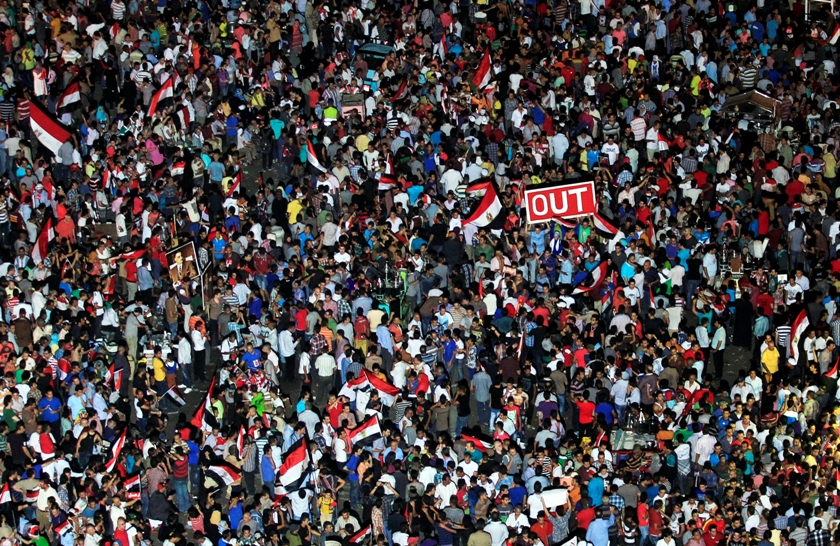
June 30 Demonstrations

From my recent article at Christian Century. It walks through the transition which brought Morsi to power and thereafter deposed him. Here is an excerpt from the conclusion, focusing on the position of Christians:

As for the nation’s Christians, they view the military intervention as salvation. Coptic Orthodox Pope Tawadros, who had pledged upon his ascension to the papacy to stay out of politics, appeared side by side with Egypt’s chief Muslim leader to back the move. Protestants appreciated this as a public signal of Christian equality, while the Anglican bishop rejoiced Egypt was now free of the ‘repressive rule’ of the Brotherhood.

But are such public celebrations wisdom? In the fluid chaos of Egypt’s transition, who is to say the situation will not flip again? Copts are very careful to align with the nation’s moderate Muslims; dare they align with an extra-constitutional putsch against a large swath of religiously conservative neighbors? As citizens they are free, but as an ever-vulnerable religious minority will they find sufficient protection in the army and a hopeful emerging civil democratic order?

Perhaps they have no choice. Perhaps they see more clearly than anyone the issues at stake under Islamist rule. Only a year and a half earlier they suffered their greatest massacre at the hands of the army, when a Coptic protest was crushed under military tanks. Still, they took refuge.

This is the same question now faced by Egyptians as a whole, and as such the transition becomes more of a revolution proper. Islamist or civil; religious or secular – inasmuch as these are false dichotomies they also represent the current struggle. All that is lacking for a true revolution is violence; for the sake of Muslims and Christians together, may this development not come to pass.

Please click here to read the whole article at Christian Century.

Categories
Christianity Today Middle East Published Articles

Egyptian Christians Killed After President’s Ouster

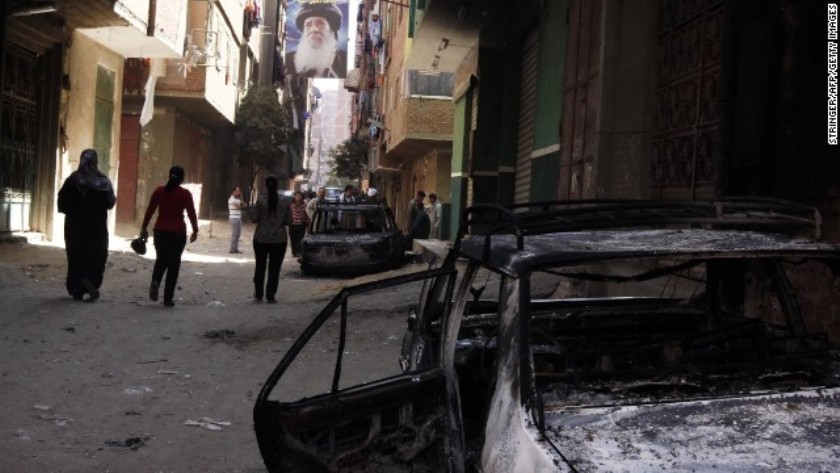
Copts Killed

From my article in Christianity Today, published July 9, describing both Christians and Muslims killed in a worrisome escalation of violence. But this excerpt concerns another matter for Christians in particular: Should they have joined the revolt in the first place, on Biblical grounds?

Bishop Mouneer also called the [military] action an answer to prayer, which raises certain theological questions. In Romans 13 Paul writes that Christians are to be subject to the governing authorities. Does Christian participation in a popular uprising strain this interpretation?

“The leader must support human rights,” said Bishop Marcos. “Because Morsi did not it was acceptable to work against him.”

A more nuanced position is articulated by Rev. Emad Mikhail, president of the Alexandria School of Theology.

“The Bible in the first century does not address the situation of free expression as we have in many places today,” he said. “There was no voting and no means to change the system except through violent action.

“If we vote out a president [as in modern elections] this is not understood to violate Romans 13. I consider peaceful demonstrations to be like a vote.”

Please click here to read the whole article at Christianity Today.

Categories
Middle East Published Articles Relevant Magazine

Who Should Christians Support in Egypt?

Obama Egypt

From my recent article in Relevant Magazine:

When push comes to shove, as it has in Egypt, who should American Christians support? The recent military move to oust an elected president was almost universally backed by Egyptian Coptic Christians, which make up roughly ten percent of the population. But the move, called by many a military coup, also violates our profound democratic sensibilities. With forty-two dead today at the hands of the army – which claims it was attacked first by armed terrorists – basic issues of humanity are also in play.

‘Our citizenship is in heaven,’ writes the apostle Paul, seemingly elevating our Christian brotherhood above national ties or ideological convictions. But, he writes elsewhere, ‘Let everyone be subject to the governing authorities, for there is no authority except that which God has established.’

President Muhammad Morsi, of the Muslim Brotherhood, was removed from office on July 3 following massive protests against his rule. The proximity to America’s Independence Day only heightens the tension of this question, demanding an introspection we are often loathe to consider. Before we sit in judgment on Egypt, was our own revolution contrary to God’s teaching?

But does not the Bible also demand a commitment to justice and solidarity with the rights of the oppressed? Certainly, and Egyptian Christians would be quick to assert the necessity of the putsch, not just for their own cause, but for millions of Egyptian Muslims beside.

The article then summarizes the situation in Egypt, and concludes:

Perhaps the most important question is this: No matter their fears, would aggrieved non-Islamists have done better to work within the system, no matter how flawed?

This last question is of political strategy, and Egypt’s Christians have clearly answered ‘no’. What now of American Christians?

It is important to note that American democracy – though also flawed for much of our history – has peacefully rotated power for over two centuries. Egypt is still trying to find its feet after a revolution. The American constitution, after all, followed thirteen years after independence.

Egypt currently is a political mess; within chaos, minorities are vulnerable. Christians have been used by all sides as a talking point. Liberals highlight their difficulties, the Muslim Brotherhood pays lip service to their equality, Islamist allies scapegoat them in conspiracies, and the old regime propaganda – ever present – erects the extremist boogeyman to maintain order.

Within this picture, American Christians have little to identify with. Our two options mirror our dual identity: As Americans, esteem the democracy; as Christians, condemn the persecution. Unfortunately, neither option correctly describes Egypt. Either one is a false choice.

What then, is the Biblical choice? Consider these words of Paul, perhaps to balance his advice given above: ‘But everything exposed by the light becomes visible, for it is light that makes everything visible. This is why it is said: “Wake up, O sleeper, rise from the dead, and Christ will shine on you.”’

The American Christian responsibility is not to take sides, nor to assert abstract principles. It is to find out what is happening, and support the light.

Whether through influence in Washington, or through influence in prayer, American Christian hope must be that Egypt will rise from the dead.

Does this latest episode help or hinder? Make Egypt visible, and then judge accordingly.

Please click here to read the whole article at Relevant Magazine.

Categories
Personal

The Man who Overthrew a President

From Ahram Online, perhaps the making of a hero, but the portrait of the man who designed the Rebel Campaign:

Far from being overawed, Badr was soon arguing with General Abdel-Fattah El-Sisi about the military’s roadmap for a political transition, and rejecting his suggestion that Morsi should call a referendum on his continued rule.

Millions of people were demonstrating for the recall of the president, not for a referendum, the activist told Sisi.

“I tell you, sir, you may be the general commander of the Egyptian army but the Egyptian people are your supreme commander, and they are immediately ordering you to side with their will and call an early presidential election,” he said.

The general surrendered. A bunch of kids in T-shirts had changed the course of the Arab world’s most populous nation by mobilising mass protests against the ruling Muslim Brotherhood, then threatening to turn on anyone who resists their demands.

“We own the streets because we stand with the people and the will of the people, and we will always do so,” Badr said.

Like many activists of the Facebook generation, he cut his political teeth in the uprising that toppled veteran autocrat Hosni Mubarak in 2011. He started working as a journalist and voted for Morsi a year ago but became disillusioned.

He told the generals that if they opted for a half-way solution, they would be lost. If they stuck to the referendum idea, he and his movement would walk out.

“I don’t have a blank cheque from the people,” he told Sisi. “People signed Tamarud’s petition for an early presidential election so I can’t go out and tell them anything else.

“If you are worried about the Brotherhood’s reaction, they will also refuse a referendum, so in that case you will lose both sides. Win the Egyptian people!”

A senior military source confirmed that Sisi dropped the idea of a referendum in deference to Tamarud’s argument.

Fascinating article, which includes speculation that the Rebel Campaign was eventually infiltrated by state security and old regime supporters.

But the Rebel Campaign did what many liberal politicians would or could not – work the street. The transition now is in the hands of politicians, and they will do well to remember where their authority comes from.

Categories
Prayers

Friday Prayers for Egypt: Victory and Defeat

Flag Cross QuranGod,

Must a prayer take sides? How can supporters and opponents of the president pray together now? Perhaps this is what must be asked: At the very least, let them seek you at the same time, if not for the same thing.

But if only platitudes, what can they agree upon? Establish democracy and sovereignty of the people, God; both sides claim they want this. Keep Egypt from the manipulation of foreign powers; both sides accuse the other of this. Prevent violence from spreading; all insist on being peaceful.

So then why have tens been killed and hundreds injured? God, perhaps thanks are given that these numbers are so low, given the stakes involved. May they go no higher.

But there appears no room left for consensus, God. The president is out; can he come back? These are the prayers of some while others see his removal as an answer to prayer.

But maybe each side can pray for the other. Where injustice has been done to Islamists, God, right their wrongs. Keep them from unlawful arrests and political marginalization. Restore their path to participation, even leadership if the people wish, and save them from the poison of bitter grudges. May they forgive and find mercy, both from and for themselves.

In their victory, God, give humility to the president’s opponents. Whatever mandate they have, help them realize great swaths of the people stand against this development. If there is justice to pursue against Islamists, may it be transparent. If there has been manipulation, expose them. With any democracy to come, may it be inclusive.

God, may this be only a severe hiccup on the way to consensus. Egypt must find a way to unite all its divergent peoples. Make this possible, and bring together honest men on all sides to create it.

Hold Egypt closely these days, God. Much can go very wrong. Give wisdom to the new president, especially in his interim status. May he be a man of peace and reconciliation, impossible though his task be to bear.

All politics may be dirty, God, but make Egypt clean. Heal her; as each side prays for what they find to be righteous, convict them to discover the sins of their own. Set all things right, God, set all things right.

Amen.


Categories
Christianity Today Middle East Published Articles

Egyptian Christians Brace for (and Debate) New Round of Protests

From my June 28 article published on Christianity Today:

Frustrated Egyptians will take to the streets June 30, on the one year anniversary of President Morsi’s inauguration. Dubbed the ‘Rebellion Campaign’, the grassroots movement announced the collection of fifteen million signatures to depose the president and demand early elections.

“The situation in Egypt is very serious,” wrote Bishop Mouneer Hanna of the Anglican Diocese of Egypt. “I do not know where this situation will take us. I feel that Egypt is at the verge of violent demonstrations, another revolution, or civil war.”

‘Rebellion’ organizers pledged their demonstrations will be non-violent, but Muslim Brotherhood leaders warn a violent turn – perhaps organized by supporters of the former regime – will undue the successes of the Egyptian revolution. Yet they insist on holding counter-demonstrations in advance of June 30, setting the stage for clashes between the two sides.

Please click here to read the full (brief) article on Christianity Today.

Categories
Prayers

Friday Prayers for Egypt: Rebellion, Legitimacy and Fire

Flag Cross Quran

God,

Watch over Egypt this weekend. Watch over her in what follows. Keep her future in your hands.

As the Rebellion campaign is in its final preparation hours for anticipated massive June 30 demonstrations at the presidential palace, other forces are also at work. An unrelated protest brought thousands and perhaps tens of thousands to Tahrir Square to demand President Morsi leave.

But pro-Morsi protestors have gathered in the tens and perhaps hundreds of thousands not far from the presidential palace, supporting his right to the remainder of his term. Meanwhile, especially in the Nile Delta, violence has flared as Muslim Brotherhood headquarters have been attacked in multiple cities.

Throughout the nation hundreds have been injured and a few have died. Many fear today was just a dry run, a dress rehearsal for the battle to come.

Each party, God, has pushed forward a D-Day scenario. How is it possible now for the right and the good on all sides to prevail? The president has electoral legitimacy, but from a constitution and post-revolutionary process many view as illegitimate. The opposition has legitimate grievances, but many of their supporters advance them in an illegitimate way. The president’s Islamist supporters claim religious legitimacy, but many speak as if they are fighting illegitimate infidels.

God, is it legitimate to be both sad and hopeful for Egypt? You are putting the nation through a crucible; tried by fire, will only the pure emerge?

May it be so. Fire proves the quality of men’s work. It tests their character and reveals their inner being. God, Egypt is in such great need of this evaluation. Give discernment to the people, and place sovereignty in their hands.

Or, God, is this your other fire? Is it punishment for sins collected, whether over long years or recent months? If so, be merciful. May your hand of judgment fall only on the deserving, and even for them, may it eventually redeem. Spare the innocent, shield the righteous, and aid the poor. Only you know their numbers, God, but do not pour your wrath upon the nation as a whole. She has suffered enough.

But God, perhaps there is no fire at all. Perhaps there is little legitimacy anywhere. Perhaps this is a drama construed simply for reshuffling the chairs of power. But may this not be so. Make life more than theater; honor men and their freedom of action. May manipulations and deception cease in Egypt.

God, bless the president. May he do what is wise and necessary for the peace and prosperity of the nation.

Amen.


Categories
Arab West Report Middle East Published Articles

Islamism in Asyut: Conversation with a Local Journalist

Islamism in Asyut

From my recent article in Arab West Report:

Among the difficulties in assessing the news of Egypt is the Cairo-centrism of journalism. A problem plaguing the nation in general, all major newspapers operate from the capital attracting the best talent away from other regions in search of promotions and a better life. Quality of information suffers; many newspapers simply investigate local developments through phone calls.

Finding a well-connected regional Egyptian journalist, therefore, is a contact to be treasured. On a recent visit to Upper Egypt Arab West Report met Mamduh Sarur, who appears to fit the bill.

Our conversation centered on the presence and nature of Islamic movements in the region:

Sarur confirms the existence of organized, trained groups of young men connected to the Islamist movements, especially al-Jama’ah al-Islamiya. In the opposition media these are often labeled ‘militias’, which Islamist consistently deny having. Al-Jama’ah al-Islamiya prefers to call them ‘popular committees’ using the terminology applied to each neighborhood in Egypt when they self-organized after the police vanished from the streets on January 28, 2011, during the revolution.

With his own eyes Sarur states to have seen these groups brandishing swords as they paraded through the streets. But he insists the Islamist leadership is practical and often floats test balloons before enacting their agenda. This is one of them, and reflects coordination between different Islamist organs.

Here is an example:

The talk of coordination between Islamist groups, therefore, requires nuance to see the divisions within that are either exploited by the Brotherhood or else a result of their charade. Al-Jama’ah al-Islamiya, for example, ran against the Brotherhood in alliance with the Nour Party during parliamentary elections. But Sarur asked, who funded al-Jama’ah al-Islamiya’s political arm – the Building and Development Party – in their campaign? Unlike the relatively wealthy Brotherhood, al-Jama’ah al-Islamiya leadership spent their years in prison, and upon release were continually harassed by security. The answer, he stated, was simple: Funding came from Brotherhood sources.

The mastermind is Brotherhood deputy guide and chief financier Khairat al-Shater. He plays the Islamist movements like chess pieces, moving different agents about in order to keep his organization above the fray. Hazim Abu Isma’il, for example, ostensibly operated independently as he led efforts to besiege Media Production City in protest of the opposition media. In reality they work closely together, and Abu Isma’il’s father was a Muslim Brotherhood stalwart. Al-Jama’ah al-Islamiya, meanwhile, took the lead in protesting against judges, and in particular the High Constitutional Court. As this activity damaged the reputation of their political arm, Asem Abd al-Majed recently resigned from the Building and Development Party in order to operate ‘independently’ against the counter-revolution. Sarur fully expects him to be appointed by Mursi to some government position in due time.

And here is what appears to be a more sinister example:

But one of the darker sides of Islamist symbiosis, if not coordination, concerns the economic pressures placed on the Copts. Many of the criminal, thug, and arms dealing elements in Upper Egypt come from the now-settled Bedouins as opposed to the traditional agricultural Egyptians of the Nile, Sarur explained. But al-Jama’ah al-Islamiya has a relationship with them. When a thug comes and illegally appropriates Coptic land, the owner will go to al-Jama’ah al-Islamiya because he knows they can solve the issue – as opposed to going to the police or the courts, which will take forever with uncertain outcome. Al-Jama’ah al-Islamiya takes a percentage of the land or a sum of money for their ‘mediation’, but there is not much else the set upon Copt can do.

Please click here to read the whole article at Arab West Report.


Categories
Prayers

Friday Prayers for Egypt: Confronting the Rebellion

Flag Cross Quran

God,

In advance of ‘Rebel’ protests on June 30, Egypt’s Islamists are not simply waiting to see what will happen. On the street and in the presidency they have taken a confrontational approach to the challenge. Today, after hundreds of thousands demonstrated in favor of President Morsi, the battle lines are clearly drawn. But what will ‘winning’ entail? What will it even look like?

If those gathered have their way, it will be an increasingly Islamic Egypt. A few days earlier Morsi replaced seventeen of the nation’s governors, appointing seven from the Muslim Brotherhood and one from the hardline al-Gama’a al-Islamiya. Several of these appointments sparked violent rejection.

And while officially the protest was simply in the name of democratic legitimacy and non-violence, some saw the coming launch of a truly Islamist revolution. Must one side thoroughly defeat the other?

The ball is now in the opposition’s court. The Rebel campaign claims to have collected over fifteen million signatures demanding early presidential elections – more than voted for Morsi in the first place. But can they match or exceed the Islamist numbers on the street? Do they need to? What if they succeed?

God, beyond the immediacy of the street, bless the new governors. Give them understanding of their region and the peculiarities of its needs. May they represent the people well.

God, honor the zeal of the demonstrators. Motivated either by democracy or their victory therein, many feel under threat of losing everything. Where influenced by fear or anger, God, comfort and condition them. May they stand firm in their convictions, but nurture love and acceptance of those believed to oppose their project.

But God, the days are ticking away. Will a dramatic show of forces lead Egypt down the path of mutual good? Is the show of forces necessary to bring political players back from the brink? Bring a solution, God, that is acceptable to all. May no one yield, but may all compromise. Either before or after the dramatics, bring Egypt to a place of peace.

But at the moment, each side confronts the other. Only you know if current and coming events are beneficial, God. But in whatever happens, secure Egypt’s good. Confrontation is within human nature, and part and parcel of politics. Just ensure it proves constructive.

Amen.


Categories
Prayers

Friday Prayers for Egypt: Rebel Positioning

Flag Cross Quran

God,

June 30 looms, and Egypt’s political players are getting ready. The bulk of opposition parties have signed on to a grassroots campaign to call for early presidential elections. Named ‘Rebel’, they have collected millions of signatures, seek a total of fifteen-plus, and plan a massive rally at the presidential palace on the anniversary of Morsi’s ascent to the presidency.

Islamists are dismissive, and some are defiant. The latter are calling for preemptive sit-ins at the palace two days earlier, and counter demonstrations the day of throughout the country. Some accuse the opposition of seeking violence to pin upon Islamists; others advocate any-means-necessary to protect the president’s legitimacy. The Muslim Brotherhood has not yet decided a course of action, but like all Islamists they decry the Rebel campaign as outside the law with no true bearing on constitutionally approved political practice.

The question of violence is a cloud upon the day. Each side accuses the other as the rhetoric escalates. Some warn of a civil war or a sectarian conflict, but is this a possible reality beyond the now normal rock-throwing clashes? Even if the stage is set for a major street battle, will it really escalate into war?

But violence may well occur, as it has already at an ongoing sit-in at the Ministry of Culture where liberal artists and intellectuals call for the dismissal of the newly appointed minister. In an effort to dismiss them, a party of Islamists protested, clashed, and was separated by police.

Every angle is plausible, God. The opposition could seek violence to discredit the Islamists, police, and government. The Islamists could seek violence to discredit a popular campaign. Unknown or old regime elements could seek violence to further the chaotic and unstable state of the country. And some might simply be rumoring violence to keep down the numbers.

The first hope is simple, God: Prevent the occurrence of violence. Bring Egypt’s political actors to consensus through dialogue, negotiation, shared values, and love of country. Let all in demonstrations and counter-demonstrations express their demands and pressure accordingly.

But help each to esteem their opponent as Egyptian, however different in mindset. If their lines meet on the 30th, give them fruitful exchange and winsome discussion. But God, so much worse is feared, and the hope feels like a pipe dream.

Surely there are some who desire violence, or in a lesser evil, play with the idea for political ends. God, when will the day of reckoning come for this sort? Did it already come through the revolution, and now is on its last legs? Or is it yet to come for some in power and some illegitimately seeking it? May it come soon, God, but may you spare Egypt the collateral damage.

But that perhaps is a prayer to come, God, and perhaps June 30 will begin the process. But for now, God, give wisdom to citizen and politician alike in positioning. Should they aid the campaign, resist it, or ignore it altogether? In any and all choices, may decisions be sincere and not calculating, based on principle and not manipulation.

There is a counterpart to the Rebel campaign, God. The Impartiality campaign also claims millions of signatures in support of President Morsi. Surely the vast majority of signatories on both sides are of pure motivation; may their will – however contradictory – be achieved, somehow.

God, solve the somehow. It has been two years since the revolution and the somehow remains elusive. Perhaps June 30 factors into your best will, perhaps not. But position Egypt on the path to peace, prosperity, and consensus. It is forever a path, and destination coordinates are debated. But as Egypt veers, correct her.

In this, may her people have the greatest share.

Amen.

Categories
Prayers

Friday Prayers for Egypt: Culture

Flag Cross QuranGod,

As earlier crises continue, another one lingers in the background, and it is hard to know if it is trivial or essential. As Egypt’s politicians agitate over the Ethiopia dam, and as the people continue to collect ‘rebellion’ signatures, the nation’s artists stage a revolt of their own.

President Morsi appointed a new minister of culture; immediately he began firing longtime heads of departments. He says the cultural scene is full of Mubarak-era corruption. Artists say he is implementing a Brotherhood plan to destroy Egyptian culture and replace it with one of their own – where art, creativity, and expression have little place. They currently occupy the ministry building in protest, where they stage a cultural event each night.

God, both scenarios can be imagined. Sort out the right from the wrong, and hold accountable those who err – past and present. But culture: Help Egypt find her way in this battle for her soul.

Culture is largely beyond the reach of manipulation, but not of influence. It is what the nation’s people are, and especially what they have been. It can change, and in modern times the change can sometimes outpace a people’s comfort.

Be merciful, God, and give comfort. Some Egyptians look at the loosening of traditional mores and balk. Others see a conservative stranglehold retarding thought and progress. Both blame the import of foreign cultural values, but both are Egyptian, trying to meld society in a preferred image. Both are fearful, though the revolution has flipped the status quo script, bringing religion-based forces to power.

Here it is hard to craft a unified prayer, God, as this division goes beyond politics. Culture is deeper than a plea for the national interest. For many, culture is not national at all. It can be reduced to sect or tribe, or merged into ubiquitous globalization. To ask for the preservation of ‘Egyptian’ culture itself is to take a side.

But the land called Egypt has people who collectively inhabit a culture, and that culture can either encourage or discourage the good you desire. God, this is so bland, but honor Egyptians with a life-giving culture. Define it as you wish, God, but may it reflect your values and not those imported from any other place.

As for the artists and the minister and the Brotherhood, God, give people wisdom to know what is at stake. Is it everything, or nothing?

But culture: It is the soul of Egypt. Ensure she comes through this revolution healthy.

Amen.

Categories
Personal

Egyptian Government Restores Antiquated Church

From Ahram Online, official promotion of Egypt’s Christian heritage:

On Wednesday, Mostafa Amin, secretary general of the Supreme Council of Antiquities (SCA), inaugurated the Abbey Church of the Apostles in Atfih town in Giza governorate after the completion of its restoration with a budget that reached LE6 million.

The opening came within the framework of a drive by the Ministry of State for Antiquities (MSA) to save the Coptic shrine and to open more sites to tourists, in order to encourage the tourism industry.

The church, like other Coptic and Islamic monuments located in rural areas, had suffered serious damage, including from high sub-soil water levels, high levels of humidity, and an outdated and decayed sewerage system installed 100 years ago.

It is one thing to show respect to buildings, another thing to honor people and their right to freedom of belief and expression. Negative examples of the latter have proliferated over the past two years, but this news is nonetheless encouraging, especially as it takes place in a diocese which experienced the first sectarian tensions after the revolution.

There, a church was burned due to village family tensions and rumors of witchcraft practiced inside. The army stood by and watched, but amid outrage and protests the government sought reconciliation, part of which was an agreement to rebuild the church. Whether or not the two efforts are related is not stated in the article.

Is the Egyptian government schizophrenic, then? Maybe. The current cabinet is composed of many technocrats joined by members of the Muslim Brotherhood. While many ministers carry out the functions of state as before, others appear to be actively ignoring incidents against Copts or pursuing legal action against them for defamation of Islam. The Ministers of the Interior, Justice, and the Public Prosecutor are not members of the Brotherhood, but were appointed by Morsi. Other ministers he simply inherited.

But the Minister of Antiquities, under whose authority this restoration project falls, was also a Morsi appointment. He is considered an Islamist, but is an expert in both the Coptic and Islamic heritage of Egypt. Was this project an ongoing one whose file he received near completion, or an example of his own initiative? Either way, it is a needed break from the ongoing flow of bad news.

Categories
Arab West Report Middle East Published Articles

Mapping the Coptic Movements: Activism in a Revolutionary Setting

Coptic Activism

From my recent article at Arab West Report, an extensive, interview-based effort into the diversity of Coptic activist movements:

One of the distinguishing sub-themes of the Egyptian revolution which began on January 25, 2011, has been the proliferation of Coptic movements. Largely, though not entirely, contained in the church during the Mubarak era, Christian Egyptians joined their Muslim counterparts as ‘one hand’ to challenge the authority for the sake of ‘freedom, bread, and social justice’. After successfully deposing the president, many of these Christian Egyptians continued their revolutionary posture.

For years Copts presented their demands to the state primarily through the person of Pope Shenouda. When pressed to demonstrate for their demands, either by events or by clergy, they did so mostly within the confines of church walls. The revolution changed this equation, however, and the unity expressed in overthrowing Mubarak gave Copts a new sense of participation in rebuilding Egypt.

Some Christian participation remained along the lines of revolutionary values, enveloped fully in the youth movements that populated Tahrir Square. Others began sensing a threat to their full participation from the emergence and ascendency of Islamists groups, and rallied behind a liberal and civil cause.

Still others took the opportunities of the revolution to organize and demonstrate for particular Coptic issues. Though there is significant overlap between Coptic demands and those for a civil state, these movements are characterized by Coptic peculiarity, even though many boast the participation of Muslims, who tend to be liberal in outlook. This category is shaped by a desire for Copts to assert their rights as Copts, leaving the church to take to the street and integrate with society.

Yet as they do so they highlight the tensions of religious identity. Insisting upon their right as citizens to demonstrate, they move beyond citizenship and appear to many as sectarian. Conscious to defeat this charge, Coptic movements stress their belonging to Egypt, and their work on its behalf. The question is fair if they do more harm than good, but this question may miss the point if indeed, as they claim, it is equality they seek. When pursuing that which is right, popular reception is a secondary concern.

This paper seeks to analyze in particular the Coptic movements which adopt Coptic issues. It will discuss the pre-revolutionary history of Coptic activism, trace its development after the fall of Mubarak, and continue to the present with the current attempt to gather these movements together in what is called the Coptic Consultative Council.

The paper will then provide a map of these movements along with the names of key participants to the extent that current research allows. Then it will profile of a limited number of these groups, describing their leadership structure and spheres of activity. Finally, it will examine the questions of foreign funding and interference.

From the conclusion:

In closing, two remarks from the interviewees are useful. Sameh Saad stated the normal person works to earn a living and then goes home to enjoy his family and rest. The activist, meanwhile, sacrifices from his personal life in order to achieve success in a larger cause.

Similarly, Ehab Aziz stated that no one will give you your rights while you are sitting on the couch. You have to work hard to achieve them.

While many questions circulate around the Coptic movements – from finances, to cooperation, to the wisdom of separating from the larger Egyptian cause – the above observations must be remembered. They are balanced by the remark of Gaziri that they also have a tendency to exaggerate their issues.

In all these matters Coptic activists resemble activists around the world, exhibiting significant sacrifice and dedication in pursuit of their goals, understood to be righteous. Yet besides pressuring the government to fulfill their rights, they face also the challenge of awakening a religious community long accustomed to acquiescence to the status quo.

Further research is necessary to better understand their reality, their excesses, and their triumphs. But in the above description they must be commended. Their existence represents one of the many successes of the revolution.

Please click here to read the full, 19 page document at Arab West Report.


Categories
Prayers

Friday Prayers for Egypt: Dam, Servicemen Voting

Flag Cross Quran

God,

Trouble in Egypt this week is long term, but there are always some to make it short. In an effort to develop domestic water and energy resources, Ethiopia began redirecting the Blue Nile in preparation for dam construction. Downstream, Egypt fears a reduction in water – a severe problem for a desert nation with a rapidly growing population.

Meanwhile, in domestic politics the High Constitutional Court ruled against the draft elections law, in part because it continues the previous disenfranchisement of military and police personnel. Yes, it seems all should have the right to vote. But in a nation undergoing a democratic transition, some fear the voting of servicemen might reverse recent revolutionary gains.

In fact, many Islamists see a conspiracy, and have called for a referendum to disband the High Court altogether. An even broader swath of political Egypt sees conspiracy in Ethiopia, declaring the dam to be an act of war.

God, perhaps principles mean little in politics and international relations. Interests often trump all, even if they must be disguised within principles. But where in these issues is the right and the just? Where is the balance, and who makes the determination?

God, develop and provide for Ethiopia, using the resources you have placed in her land. But Egypt is the gift of the Nile; forgiver her for being often a wasteful and ungrateful recipient. Teach her to conserve, but the issue is beyond proper management. According to studies a 50% increase in Nile water quota will be needed by 2050.

Help the government of both nations, along with all others in Nile Basin, to succeed in mutually fruitful negotiations. Water is life; if desperate men will fight and kill for it. But keep greed and rivalry from being a part of the equation, God. Give wisdom to the president to neglect this issue no longer. Egypt’s future is at stake, but may cooler heads prevail. Hard choices will be necessary and are more easily passed into the future. But curb any who wish to exploit this issue for short term gain.

And so, similarly, for the servicemen. It seems right that all should vote. But, where democratic culture does not yet exist, institutions often function as blocs; is it wise to invite the recently disempowered military and police into a democratic exercise, possibly manipulating it to their own ends? Abstract principles rarely exist in practical policy, God. What is best for Egypt?

But if there is an institution to distill issues into principles, it is the judiciary. Servicemen are citizens, and should not be discriminated against. But if the judiciary is corrupt, the corruption is deep; if motivated by interests, they are skilled in disguising through the language of law.

But in this are Islamists above board, God? Are they seizing on legitimate debate to remove a politicized opponent, or an obstacle to their domination? Are they motivated by principle, or interest? This question repeats itself over and over again since the revolution, God. Provide an answer to the people upon whom sovereignty depends.

Make this sovereignty real, God. In water and politics, have an informed people sort properly both interests and principles. Give them the faith necessary to do so according to your will.

Amen.

Categories
Personal

Egyptian Sumo Wrestling and Chess

From Ahram Online, providing a necessary break from politics to highlight Egyptian sporting success:

The first professional sumo wrestler from either Africa or the Arab world was given a boost Wednesday, winning promotion to the sport’s second highest division in Japan.

The Japan Sumo Association promoted 21-year-old Egyptian Abdel-Rahman Ahmed Shaalan, who goes by the ring name of “Osunaarashi” (Great Sandstorm), to the “jyuryo” division, made of wrestlers ranked between 43rd and 70th.

Meanwhile, Egypt is the top chess playing nation in Africa:

Egypt’s national chess team devoured almost all African Championship 2013 Open top spots, qualifying them for the World Cup in Norway in August.

The Egyptian team lead both men’s and women’s competitions held this year in Tunis from 17 – 27 May.

The first three places in the men’s competition were dominated by Egyptians, with Bassem Samir taking the crown, Ahmed Adly second and Essam El-Gindy third.

Likewise, in the women’s competition, Shorouq Nagi and Aya Moataz of Egypt nailed the top two slots.

And for those who didn’t know, though there is no recent article to highlight, Egyptians are among the best squash players in the world.

Congratulations, Egypt, we are very proud.

Categories
Personal

Torture: Why I Signed the ‘Rebel’ Campaign

From Ahram Online:

In order to justify removing a standing president, first an author must defend his democratic credentials. After an extended introduction, he writes:

This was last October, and up until that point I had been convinced that President Mohamed Morsi was the legitimate president of Egypt, and that even though I did not vote for him due to my conviction that neither his political experience, his mental capabilities nor his moral make-up qualifies him to rule Egypt, I still considered him not only to be a legitimate president, yet my personal president.

My respect for Mohamed Morsi stemmed from my awareness that his legitimacy emanated from the ballot box, from votes by citizens like myself, despite their different political inclinations. And I was looking forward to the day when another round of elections would come, and I would vote against him again, and hopefully bring him down, a thing which he makes easy for me by his poor administration and his deplorable record in the realms of security, economy, and politics.

So why then remove him now? In the opening the author described his chief reason for participating in the January 25 revolution was the systematic use of torture by the police force. Therefore, he is outraged because:

I expected that the Muslim Brotherhood, in particular, considering what they experienced in terms of oppression and injustice and torture at the hands of the past regime, would rush to restructure the security sector and put an end to the systemic torture still taking place in police stations, and to turn over those responsible for killing citizens to the authorities. Yet President Morsi and his Brotherhood opted to battle with the judiciary and the media, not the interior ministry, and they have turned a blind eye to daily horrors committed by the police.

Recall that January 25, the strategically chosen start date of the revolution, was the national holiday ‘Police Day‘. Many analysts suspect that the Muslim Brotherhood has played nice with the army and police and old regime in order to buy time to cement/protect their new found power. Some think they will still reform these sectors over the long term; others fear they only wish to replace the formerly ruling NDP and preserve the system.

Click here to see the Rebel Campaign petition translated into English.

Categories
Prayers

Friday Prayers for Egypt: Release

Flag Cross Quran

God,

With great relief and little wrangling, the abducted security personnel in Sinai were released this week. The president, political parties, and military all celebrated their peaceful transfer through the intervention of tribal chiefs in the area. No negotiation, no bloodshed – all celebrated a successful resolution.

Successful, that is, with two lingering uncertainties: No justice, no information. Officials declared the identities of the kidnappers are known but will not be released until a more appropriate time. And of the details in the media leading up to the release, officials admitted they used misinformation in order to confuse the criminals.

All this is fair enough, God. Thanks are to you for their release, accomplished through men and their necessary wiles. But amid the many accusations and conspiracies which surround Sinai, God, Egyptians long for clarity in all public affairs.

Are the president’s Islamist allies linked with extremists in the Sinai? Did they engineer the kidnapping and subsequent release to boost the president’s popularity or embarrass the army? Did the military and intelligence apparatus play the same role in order to create a crisis for the president and demonstrate their own indispensability? Are the two in cahoots to forge a new reality in the Sinai away from the old heavy hand of the police state and tribal manipulations? Or, was it just a random act of disaffected individuals? All these questions circulate.

They are a product of Egypt’s polarization and instability, God. Ease these issues and perhaps clarity can come.

But both now and then, God, give Egypt a new culture of transparency. Make public officials accountable to the people. Secure the release of information. Protect national security and the public order, but keep the limitations of freedom to the absolute minimum.

A little while ago a draft law for freedom of information was prepared, meeting with contradictory responses. Some hailed it as a new dawn for society; others claimed it couched draconian measures in liberal pronouncements.

God, deal with the text of any new law and the hearts of those who will implement it. May Egyptians know what goes on behind the scenes of their government, and may these scenes become clean and transparent.

God, deal with the Sinai in justice and development. Bring criminals to trial, extremists to repentance, and Bedouins to citizenship. May those responsible for the kidnapping be prosecuted openly, but may the region not suffer their crimes. Rather, integrate Egypt’s peoples together, and may the prosperity of your blessing be shared by all.

As you released the abducted from captivity, God, release Egypt from its captivity of unknowing. Perhaps you are enveloped in this cloud by nature of your being, but free the people and nation from the bonds of its yoke.

May they know both themselves and their maker. Release them, and in this knowledge make them free.

Amen.

Categories
Personal

Video: Hypocrisy, Honor, and the Egyptian Media

Though Islamists currently govern Egypt, they often behave as if they are still an oppressed minority subject to endless conspiracies. Among their chief targets of complaint is the independent media. Here, they have a point.

Riham Said receives a prominent Islamist lawyer, Sheikh Youssef al-Badri, on her show and proceeds to bait and berate him on what seems like an obscure point. The video is only a three minute clip, but the tenor of their conversation suggests it was a difficult interview throughout.

At heart is the issue of wearing a hijab, a head covering which reveals the full face. After the revolution several Islamists have demanded their interviewers wear a hijab, and Riham appears to relent, though she is not pleased.

But then she takes it off amid an argument, and reveals the amount of money Badri received to make an appearance on the show. It is good entertainment, but it looks also like a set-up. Certainly she showed little respect to Badri, an old man.

But then again, Badri appears to deserve little. He earned his reputation as as an activist lawyer. Long before the revolution he would bring lawsuits against prominent personalities who in his opinion violated sharia law. Often, the law (or at least the judge) agreed. He is a crusader and the scourge of Egypt’s intellectual class.

But perhaps he is also a hypocrite. Filming off air, he and Riham talk casually without her hijab, as they discuss whether or not she must wear it. But once the cameras are rolling, as she removes the head scarf Badri averts his vision, lest he improperly look at an uncovered woman. Furthermore he shouts about her betrayal of agreement amid boasts of his suit to shut down the whole station.

But his piety is public, and she exposes him. It is fair, I suppose; hypocrisy should be exposed. But perhaps one of the reasons Islamists detest the independent media is they violate the cultural values of honor and shame.

In traditional Egyptian understanding, sin is not a great problem unless it becomes known. Public morality is elevated over personal morality, and if an individual can conceal his or her deviant thoughts or behavior it does not embarrass the family or larger group. Everyone knows the arrangement; you protect me and I’ll protect you.

Independent media has its own objectives, which include entertainment, making money, and often, opposing Islamist politics. But to do so, they trash this unwritten understanding. Yes, Badri is exposed as a hypocrite, but Riham emerges as a woman with little honor.

Sometimes I find this balance to be difficult to maintain. In pursuing journalism I do not simply want a story. I want to tell the truth, but I also wish to honor those I speak with. Ideas and politics can be thoroughly opposed; their advocates must be treated with respect.

But what about a hypocrite? The honor and shame culture breeds hypocrisy, in my Western-developed sense of morality. There is much to be respected in covering over sin, but at the end of the day, sin will be exposed. Is it not the journalist to whom this burden falls?

Especially as a foreigner, lack of full understanding gives me pause, and knowledge of my own hypocrisy invokes the Golden Rule. There is a job to be done, but what manner of conduct results in the most good?

Randa embarrassed Badri, but Badri was rejected and hated by her audience from long before. Perhaps those outside her audience were also listening; maybe those outside Badri’s ideological camp but of non-liberal persuasion might see him in a new light. Let us consider that his activism is unbecoming and improper; did Riham’s behavior curb his influence? Did it damage an excessive Islamism?

What if she had simply ‘honored’ him? If she let him spew his viewpoints with deference perhaps he might have even have convinced some of her traditional audience. She would be hurting her own cause.

This is why honor is not enough. Riham showed little, and though she exposed Badri she comes off herself as brutish. She makes a point, and perhaps some are affected. But Badri remains an unchanged man.

What if instead of exposure or honor, Riham cultivated love for Badri? There would be no off-camera revelations, no set-up, no angry storming off the set. She would challenge him – pointedly and explicitly. But could she engage him and lead him to expose himself? Could she have sought to display his hypocrisy not to an audience, but to his own heart?

Maybe, and perhaps he would still have remained an unchanged man. Perhaps Riham would have lost rating points, and Badri maybe would even have gotten the better of her.

But this video brings out the worst of both. Hopefully Egyptian media – of all stripes – can find a better way.