Categories
Christianity Today Middle East Published Articles

Maamoul: The Easter Sweet Loved by Muslims, Christians, and Jews

Image: Noah Saob / Getty

Maamoul is a buttery cookie baked with semolina and stuffed with dates or nuts—usually walnuts or pistachios. Seasoned with a variety of spices, for centuries it has flavored the Easter holiday for Christians, the end of Ramadan for Muslims, and Purim for the Sephardic Jews of Jerusalem.

Three shapes are common: an elongated oval, a circular ring, and a rounded dome. Patterns are pressed into the dough by tweezer or with a traditional wooden mold, often in the shape of a sunburst and sometimes with a cross.

For Christians, the oval resembles the sponge given to Jesus to drink from. The ring, his crown of thorns. And the dome is shaped like his rock-hewn tomb, sealing its scented treasure within.

“Is that so?” asked Hoda Khoury, a Lebanese mother of three adult children, hard at work preparing the sweet. “That’s nice. That would make maamoul a Christian tradition.”

Not all believers know the deeper meaning.

Recipes vary, as do the names. Called kakh in Egypt, kleicha in Iraq, and kombe in southeast Turkey, experts have differing opinions on the cookie’s origin. Many find traces of Pharaonic or Mesopotamian beginnings, some suggesting the imprinted patterns reflect ancient worship of the sun.

Charles Perry, translator of the medieval Baghdad Cookery Book, says maamoul descends from the Persian kulachag, perhaps reflected in the Iraqi name today. Lebanese historian Charles El Hayek suggests the cookie may have originated in the Neolithic period but that the modern sharing of the sweet began in Fatimid Egypt (A.D. 909–1171).

Ultra-modern is the chocolate filling—promoted by Hershey’s Middle East.

But the tradition of maamoul distribution began in Cairo, Hayek said, when the Islamic caliph ended the Muslim month of fasting by giving cookies to the masses on Eid al-Fitr, stamped with the phrase “eat and be grateful.” Some were even stuffed with gold coins. Eventually the royal generosity was taken over by domestic households, and Hayek believes the modern maamoul recipe developed during the period of Ottoman rule over the Levant.

Khoury continues the tradition today.

Imitating her grandmother, she does double duty with the dough. The first batch of a few hundred maamoul reflects their life in Beirut, the recipe learned from neighbors when her grandfather moved the family to the capital in 1925, long before Khoury was born.

The second batch of a few hundred akraas—a similar half-moon–shaped sweet from her ancestral hamlet of Maghdouche—reflects the diversity of the Middle East’s many religious communities. The Greek Catholic town only 30 miles south of Beirut did not have maamoul at all. Perhaps this is why she did not know the Good Friday symbolism.

But the great quantity she bakes is measured out carefully.

“If we make too much, we have to eat them ourselves—and they are not very healthy,” Khoury said. “But we don’t mind tiring ourselves out; homemade is much more delicious.”

The Arabic word for maamoul means…

This article was originally published at Christianity Today, on March 28, 2024. Please click here to read the full text.
Categories
Christianity Today Europe Published Articles

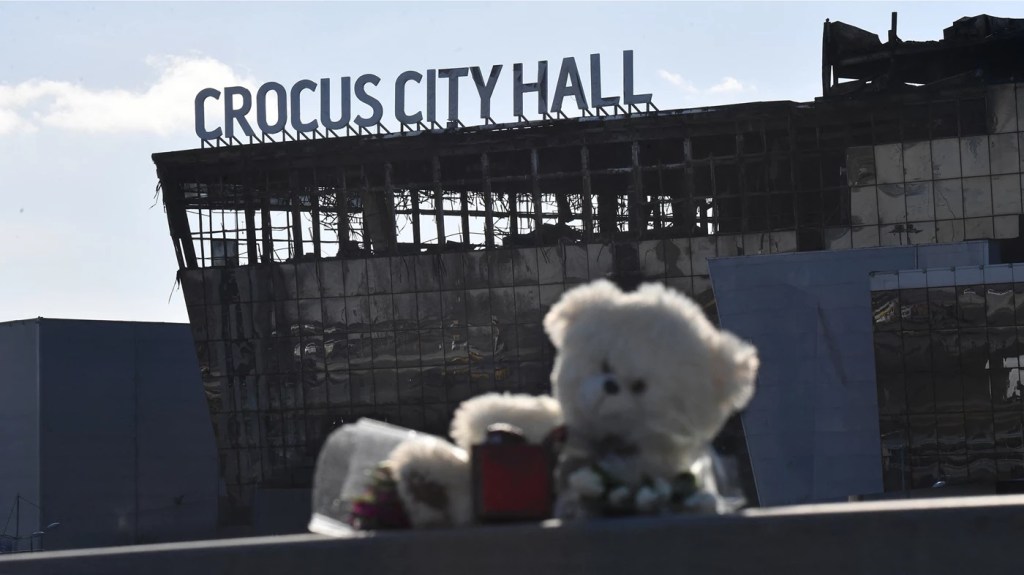
After Terrorists Kill 130, Russian Evangelicals Resist Revenge

Image: Olga Maltseva / Getty

Russian evangelicals used Sunday sermons to condemn a terrorist attack that killed more than 130 people at a Moscow concert hall.

As Russia’s Baptist union prayed for “God’s mercy and protection,” its Pentecostal union conveyed its “bitterness and sorrow.” Vitaly Vlasenko, general secretary of the Russian Evangelical Alliance, called it a “painful shock” that could unleash “unbridled revenge” against terrorism.

But many in Russia are wondering: Who are the terrorists?

The attack on Friday that killed at least 137 people at the 6,200-seat Crocus City Hall was claimed by the ISIS affiliate in Afghanistan’s Khorasan Province (ISIS-K), which seeks an Islamic caliphate in Central Asia. Its statement emphasized it was targeting Christians and came in the “natural framework” of its war against the enemies of Islam.

Earlier this month, the US embassy in Moscow had issued a warning to avoid large gatherings. American officials stated they shared their intelligence with Russia. On March 7, Russia said it thwarted an attack on a synagogue, and a few days prior, security services killed six ISIS-K terrorists during a shootout in the nation’s Muslim Caucasus region.

The group was also linked to the 2017 St. Petersburg metro bombing that killed 15.

ISIS-K was formed by extremists seeking a more violent path than the Pakistani Taliban in 2015, the same year Russia formally intervened in Syria to support President Bashar al-Assad. A Sunni group, ISIS and its affiliates oppose Assad’s Alawite faith as heretical and considers Shiite Muslims as apostate.

In January, ISIS-K killed 95 Iranians in Kerman at a memorial service for Qasem Soleimani, leader of the Islamic Revolutionary Guard Corps who was assassinated by the US in 2020. And as American forces withdrew from Afghanistan in 2021, an ISIS-K attack on the Kabul airport killed 13 US soldiers and 170 civilians.

Analysts stated, however, that ISIS-K was increasingly targeting Russia.

Russia has arrested 11 suspects, with four alleged gunmen from Tajikistan now on trial.

But President Vladimir Putin, reelected March 17 with 88 percent of a vote Western observers declared was neither free nor fair, did not mention Islamic terrorism when he declared a national day of mourning. Official statements of blame have been vague, while the deputy head of Russia’s security council openly speculated that if Ukraine was involved, its leaders “must be tracked down and killed without mercy.”

“Are you sure it’s ISIS?” asked Russia’s foreign ministry spokesperson, suggesting the group was being used as a “bogeyman.” The Russian ambassador to the US denied receiving any advance information from the US. And a nationalist media outlet urged the Kremlin to give Ukrainians 48 hours to evacuate major cities.

Just a few hours prior to the concert hall massacre, in a wide barrage against Ukraine’s civilian infrastructure, Russia had targeted its largest hydroelectric dam, leaving more than one million people without electricity.

Ukraine has denied any involvement in the terrorist attack.

Its military intelligence spokesperson, however, suggested instead that it was a “deliberate act of provocation” by Putin, while President Volodymyr Zelensky stated it was typical of such “thugs” to divert blame. He also alluded to unproven accusations that terrorist attacks in 1999 were a false flag operation, and that Putin considered his own citizens to be “expendables.”

The US stated that ISIS-K alone carried out the attack, with Ukraine uninvolved.

Russian evangelical sources did not comment on the mutual accusations. They emphasized the outpouring of prayer, sympathy for victims, and the need to trust God and resist any urge for revenge.

“Evil is spreading across the earth,” said Alexey Markevich, vice rector for academic affairs for Moscow Theological Seminary, who has criticized the war in Ukraine. “Lord, give us peace, and prevent any of us from being consumed by evil.”

Christians4Peace, an anonymous…

This article was originally published at Christianity Today, on March 25, 2024. Please click here to read the full text.

Categories
Christianity Today Published Articles

Who Restricts Religion More, Politicians or the People? Pew Crunched the Global Data.

Image: Spencer Platt / Getty / Edits by CT

Government restrictions on religion are at a global high.

Social hostility toward religion, however, has ticked downward.

So concludes the Pew Research Center in its 14th annual analysis of the extent to which 198 nations and territories—and their citizens—impinge on religious belief and practice.

Some sort of harassment of religious groups was recorded in all but eight.

The 2024 report, released earlier this month, draws primarily from more than a dozen UN, US, European, and civil society sources, and reflects conditions from 2021, the latest year with fully available data.

The global median on Pew’s 10-point scale of government restrictions reached 3.0 for the first time ever, continuing a steady rise since the baseline score of 1.8 in 2007. Overall, 55 nations (28%) recorded levels marked “very high” or “high,” only two lower than last year’s total of 57.

Nicaragua was highlighted for harassment of Catholic clergy.

Regional differences are apparent: The Middle East and North Africa (MENA) scored 5.9, up from its baseline score of 4.7. Asia-Pacific scored 4.2, up from 3.2. Europe scored 3.1, up from 1.7. Sub-Saharan Africa scored 2.6, up from 1.7. And the Americas scored 2.1, up from 1.0.

Pew’s 20 measures of government restrictions included efforts to “ban particular faiths, prohibit conversion, limit preaching, or give preferential treatment to one or more religious groups.”

Some pertained to COVID-19, such as Canada’s fines against open churches.

A further 13 measures for acts of religious hostility by individuals or groups included “religion-related armed conflict or terrorism, mob or sectarian violence, harassment over attire for religious reasons, and other forms of religion-related intimidation or abuse.”

Social hostilities toward religion continued to trend downward since a high of 2.0 in 2018, decreasing to 1.6, the lowest score since 1.2 in 2009. But 43 nations (22%) still recorded levels marked “very high” or “high,” though significantly fewer than the 65 offending nations in 2012.

Nigeria was cited for clashes between Muslim herders and Christian farmers.

The order of regional differences in social hostility…

This article was originally published at Christianity Today, on March 18, 2024. Please click here to read the full text.

Categories
Christianity Today Middle East Published Articles

‘Dune’ Centers Islamic Imagery. These Muslim-World Novels Center Christ.

Image: Illustration by Mallory Rentsch Tlapek / Source Images: Unsplash / WikiMedia Commons

Can you imagine if Dune took place in the ocean instead of the desert? One Christian novel does.

With Dune: Part Two now in theaters, moviegoers are once again treated to the cinematic spectacle of Frank Herbert’s popular sci-fi epic. Less known is how his 1965 novel bears witness to the influence of Muhammad.

And even less known are the efforts of Christians to translate their Muslim world experience into novels that communicate the gospel.

“We tend … not to recognize how much Islam has contributed to our culture,” stated Herbert in a 1976 radio interview. “But we owe Islam enormous debts of gratitude.”

The American author blended many religious themes into his six-volume series but deliberately filled his sand-infused apocalyptic landscape with tribal conflicts, Shiite concepts, and Bedouin-inspired characters. Hero Paul Atreides becomes the Mahdi, mirroring the Muslim messiah-like figure anticipated at the end of the world. And as he wins acceptance among the nomadic Fremen people, he takes the name Muad’Dib, adapted from an Arabic word for “teacher.”

Their desert religion is called Zensunni , mixing Islam with the Buddhism Herbert eventually adopted.

Dune is often credited as an inspiration for Star Wars and its Eastern cosmology. But there’s similar world-creating literature by three Muslim-world Christian workers writing in the genres of sci-fi, contemporary thriller, and young adult fiction.

Each bears witness to the love of Jesus.

“As far as I am aware, this is the first time that violent Islamists, followers of Jesus from Muslim backgrounds, and science fiction have been combined,” said Steve Holloway, author of Pelagia. “Conveying an Islamic story arc is one of the key motivations for writing the book.”

Set 40 years in the future, Pelagia tells the story of Ben Holden, a special forces agent turned professor of particle physics, and Suliman Battuta, a medical doctor and leader of a clan of nomadic “seasteaders” who herd tuna in the South Pacific Gyre, stretching from the coastlines of Chile to the Micronesian islands.

Holden’s scientist wife is murdered by the New Caliphate, a coalition of land-based Middle Eastern nations who want her project data for their jihadist aims. After surviving a later attack, Holden takes refuge with Battuta’s floating community of third-generation Yemeni followers of Isa al Masih, the Quranic name for Jesus the Messiah. Their status as apostates sets them in search of freedom of belief on the high seas.

Imagine the Wild West in submarines, with the fate of the world at stake.

The science of the novel is within humanity’s grasp today, said Holloway, whose book won the endorsement of Fish Farmer magazine, which called it a combination of films Captain Phillips and Minority Report. Currently overseeing a sea cucumber project in Indonesia, Holloway, senior strategy associate for Frontiers, served 12 years in a Southeast Asian nation where his team nurtured a small underground church as they researched ocean farming for the government, before expulsion from the country in 1998. A marine biologist, he read sci-fi as a kid and loved the world of Dune.

Motivated to show how followers of Jesus from Islamic communities flourish best in their original environment, he wrote Pelagia for a general global audience—including Muslims—and depicts austere jihadis with sympathy. There are no “cartoon bad guys” in his novel.

“It is more Tolkien than Lewis,” Holloway said. “Secular reviewers say it has a spiritual theme that doesn’t get in the way of a good story—I take this as a compliment.”

Yet it does have a conversion story, something missing from Someone Has to Die, book one in a trilogy written by Jim Baton, the pen name of a veteran Christian teacher serving in Indonesia. But whereas the futuristic setting of Pelagia is a step removed from Holloway’s ministry, Baton is still involved in the nitty-gritty of peacemaking.

His nom de plume means “bridge” in Indonesian.

“A thriller novel is perfect for our modern world of terrorism,” Baton said. “But I describe jihadists as human beings who have suffered, long for justice, and want the world to be a better place—and, that God loves them.”

In Someone Has to Die, Abdullah is a former terrorist seeking to atone for his past deeds by…

This article was originally published on February 29, 2024. Please click here to read the full text.

Categories
Christianity Today Middle East Published Articles

Petra Means Rock Churches: Jordan Permits Site’s First Prayers in 1,400 Years

Imagine yourself as Indiana Jones, traversing the narrow, nearly mile-long Siq gorge, with mountain cliffs towering on either side. Turning a corner then reveals the vast expanse of the ancient city of Petra and its majestic Treasury, the first-century rock-carved tomb of an ancient Nabatean king. You pass by the 121-foot-tall structure and its statues of Roman and Egyptian gods, making your way up a steep 800-step ascent to the equally impressive Monastery.

But before reaching Petra’s largest monument, you turn off the path into a different sort of ruin, mosaics lining the floor around half-sized recycled columns as incense wafts through the air. But unlike in the Harrison Ford movie, you do not meet an 11th-century knight preserved by the Holy Grail. Instead, the Greek Orthodox metropolitan of Jordan passes you a cup of Holy Communion.

In January, he offered the first Christian prayers in Petra in 1,400 years.

Other generations of film aficionados may prefer The Mummy Returns, Transformers: Revenge of the Fallen, or even Mortal Kombat: Annihilation. While onsite Hollywood productions provide revenue for Jordan, this is dwarfed by the $5.3 billion the country earns from its tourism industry. In 2022, Petra received 900,000 visitors, nearly one-quarter of the national total.

But now, the Hashemite kingdom is adding a religious component.

“It is a great blessing to be in this holy place in Petra,” said Archbishop Christoforus, before proceeding to offer the bread and wine. “We are not thinking of what surrounds us in stone, but of the saints and spiritual identity in its heritage, history, and civilization—and our great and blessed [Jordanian] homeland.”

In 2021, Jordan launched a five-year national tourism strategy with an emphasis on religious sites, including the Vatican-endorsed pilgrimage locations of Jesus’ baptism at Bethany-beyond-the-Jordan; Mount Nebo, from which Moses viewed the Promised Land; and Mukawir, home to a Herodian palace where John the Baptist may have been beheaded at the biblical Machaerus. Approximately 85 percent of tourists come for cultural and heritage purposes, and one-quarter of baptism site visitors travel from the United States.

With such tourists likely to visit Petra already, Jordan would like to extend their stay.

“Unfortunately, Petra is known mostly for its Treasury and Siq,” said Fares al-Braizat, chief of the Board of Commissioners of the Petra Regional Authority. “There is plenty more it can offer, and the churches are an additional discovery.”

Ten have been discovered so far, with excavations ongoing. But the fifth-century Byzantine cathedral was only discovered in 1990 and fully unearthed eight years later. Restoration has proceeded sufficiently not only to inspire Braizat to add Petra to Jordan’s list of Christian historical sites but also to revive the ancient city’s religious heritage. It only adds to the nation’s reputation as an open-air museum, he said.

Jordan’s evangelical community is appreciative.

“How can you have a historic church site and not bless it with prayer?” said David Rihani, president of the Jordanian Assemblies of God. “Petra shows that the government cares about the history of Christianity in this land.”

The biblical history is even longer. Petra may have been inhabited…

This article was originally published at Christianity Today on February 26, 2024. Please click here to read the full text.