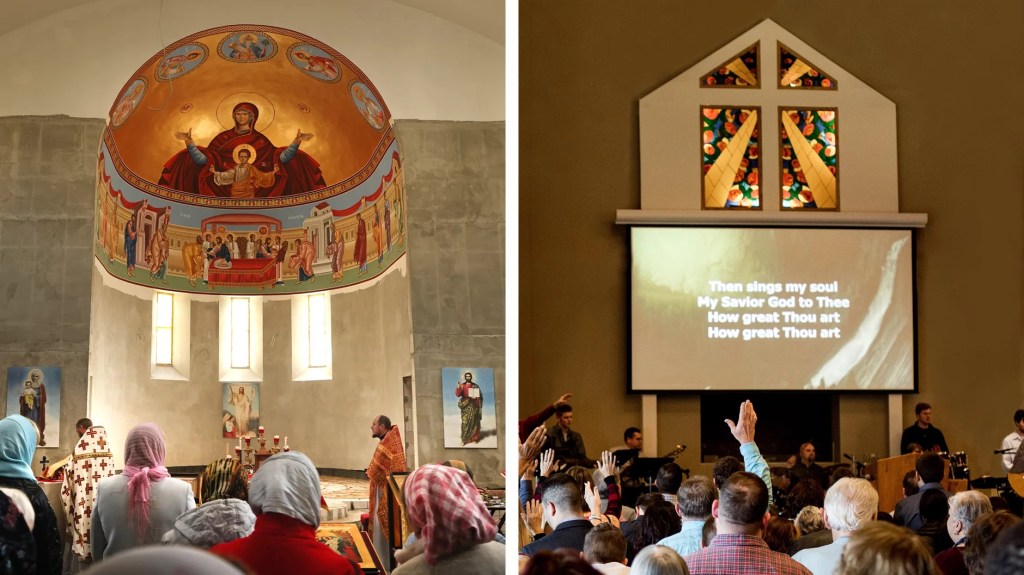
Are evangelicals and Orthodox allies in the faith?
While both confess the Nicene Creed, Orthodoxy’s smaller population in America remains obscure to most US believers, especially when compared with Catholics. Many think of Orthodoxy as a nominal religion with empty cathedrals in Eastern Europe and Russia.
Yet there is also an awareness of not-insignificant numbers of evangelical conversion to Orthodoxy, drawn by its ancient roots and sacramental practice.
Bradley Nassif knows both words. Raised in Kansas, where his Lebanese immigrant grandparents helped establish St. Mary’s Antiochian Orthodox Church, his spiritual transformation came through his local congregation, a Billy Graham sermon, and participation in a high school Bible study. But though he remained in his church of origin, he became an academic director at Fuller Seminary and is now professor of New Testament and Orthodox-Protestant dialogue at the California-based Antiochian House of Studies.
Oxford University professor John McGuckin said that Nassif, a leader in the Lausanne-Orthodox Initiative (LOI), is “the leading world expert” on Orthodox-Evangelical dialogue. CT talked with Nassif about his 2021 book, The Evangelical Theology of the Orthodox Church.
You have said, “I am Orthodox, and therefore evangelical.” How does Orthodoxy address the general markers of evangelical faith?
Eastern Orthodoxy embraces the classic Bebbington quadrilateral of biblicism, crucicentrism, conversionism, and activism, but transcends it through a maximalist vision of the Incarnation in its liturgical, sacramental, and spiritual life. The gospel permeates the church—not only about Jesus dying for our sins and the need for personal faith but including the whole story of Jesus from creation to consummation. This implies that the fullness, the catholicity, of the faith is formally present in the Orthodox church. So, yes, I am Orthodox, and therefore evangelical, in an incarnational, Trinitarian, wholistic sense of the word gospel.
What are the most significant theological differences between us?
Many are found in the way we appropriate the past and in our understanding of the nature of the church. Evangelicals and Orthodox share a common interest in Christian history, but the Orthodox are more organically linked to the past than our evangelical brothers and sisters, whose communities are only loosely connected to the fullness of the faith and polity of historic Christianity.
Evangelicals seem unaware that the early church is the Orthodox church. The congregations they meet in the pages of antiquity are treated as if they were an invisible body of believers, instead of a visible community of local Orthodox churches. Those churches shared the same faith and sacraments, led by bishops in communion with each other in apostolic succession, continuing to the present day.
In contrast, evangelicals stress the invisible body of Christ as the basis of unity and seem content to permit the visible disunity that exists in Christianity today. The Orthodox, however, maintain that this is a detrimental counter-witness to the truth of the gospel.
Another critical difference in mindset lies in the hermeneutics of biblical interpretation. We agree on the Bible as the source of divine revelation and the standard by which all claimed Christian belief must be evaluated. But we disagree on the role of the Christian community in testing our exegetical conclusions, in light of the apostolic tradition that has been handed down in the life of the church. The Holy Spirit inspired not only the writing of the Scriptures but also their interpretation.
That difference helps to account for why Orthodox churches have escaped the destructive aspects of liberal Protestant theology that permeate mainline denominations and progressive circles today. A reliance on Holy Tradition keeps biblical interpreters from an idolatrous confidence in their own exegetical conclusions, by testing them against the common faith of the wider Christian community.
Can there yet be an ancient and preserved consensus of error?
Not everything received from the past is of equal value or necessarily true. The Orthodox mind “follows the holy Fathers,” as stated in the preamble of the Chalcedonian Definition (A.D. 451), but it does not merely appeal to the past as if that alone is the source of truth. Antiquity itself is no proof of truth; it may simply be old error! To “follow the holy Fathers” is to embrace not only their witness to the faith, but also their method of theological reasoning.
For example…
This article was originally published at Christianity Today, on December 1, 2023. Please click here to read the full text.
 Jayson Casper
3 replies on “The Orthodox Church Is More Evangelical Than You Think”
WoW
LikeLike
I am Antiochian Orthodox
LikeLike
May evangelical Christian’s come into the fullness of the Church.
LikeLike