Categories
Christianity Today Middle East Published Articles

Can a Lebanese Seminary Move Beyond the Liberal-Conservative Impasse?

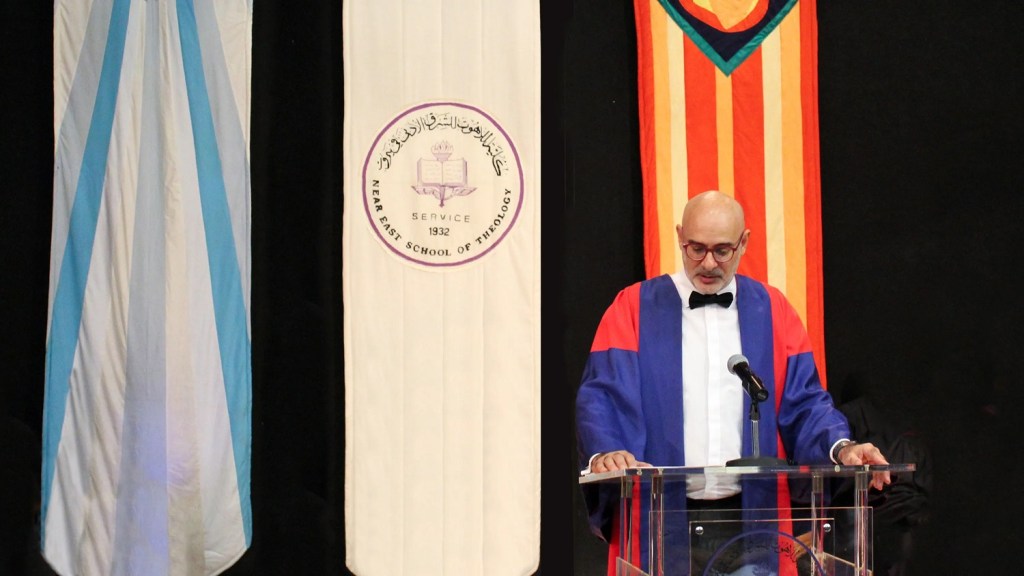
Courtesy of Near East School of Theology

The oldest Protestant seminary in the Middle East has a new vision.

Officially founded in 1932 but with origins dating back to the 19th-century missionary movement, the Near East School of Theology (NEST) is operated by the Presbyterian, Anglican, Lutheran, and Armenian Evangelical denominations.

Installed this week, its 11th president is a nondenominational Lebanese evangelical.

Martin Accad, formerly academic dean at Arab Baptist Theological Seminary (ABTS), was installed on Sunday at the historic institution’s Beirut campus. He graduated from NEST in 1996 with a bachelor of theology degree, eventually earning his PhD from the University of Oxford. Awarded scholarships by the World Council of Churches and the evangelical Langham Partnership, Accad is a locally controversial theologian who, like NEST, straddles the liberal-conservative dichotomy.

Author of Sacred Misinterpretation: Reaching Across the Christian-Muslim Divide, Accad has urged believers to approach Islam in a manner that avoids the twin pitfalls of syncretism and polemics. But before joining NEST he resigned his prior academic position at ABTS to apply his biblical convictions within Lebanon’s contested political scene. Creating a research center, his last four years have been spent in pursuit of reconciliation between Lebanon’s often-divided sectarian communities.

Accad will now bring his vision to a new generation of Middle East seminarians.

Although doing public theology is novel for the institution, NEST has long sought, with some struggle, to balance the two streams of its early predecessors’ commitments to evangelistic outreach and service-oriented witness. Its founding in 1932 resulted from a merger of two programs, each with its own distinctives.

One stream of NEST’s roots dates to 1856, when American missionaries began what Accad describes as a discipleship training program in the mountains of Lebanon. Along with providing pastoral development, it functioned as a mission station for sharing the gospel in local villages with non-Protestant Christians and diverse Muslim communities. Its remote location was also designed to isolate these early “seminarians” from the corruption of city life in Beirut.

American outreach to Armenians and Arabs in the Ottoman Empire (modern-day Turkey) led to the creation of similar schools beginning in 1839. After the Armenian genocide in World War I, these efforts relocated to Athens where they coalesced into a seminary that adopted an ecumenical, Enlightenment-informed model, emphasizing the importance of social service. This was especially true in its approach to Islam—sympathetic and comparative with an eye toward reconciliation.

The merger of these two programs created NEST, which eventually settled in the cosmopolitan Hamra neighborhood of Lebanon’s capital. Although it is situated near three historic Protestant liberal arts colleges—now known as the American University of Beirut (AUB), the Lebanese American University (LAU), and the Armenian-led Haigazian University—early cooperation was shattered by the Lebanese civil war in 1975 and has not been re-established.

Accad wants to restore this collaboration and embody an integration of scholarship and discipleship. CT spoke with him about Protestant distinctives, “electric shock” pedagogy, and how to understand the mainline-evangelical divide in the Middle East.

Why does serving as president of NEST appeal to you?

We need to rethink what it means to be a seminary student today. This question is a key issue globally, but especially in the Middle East. Ideally, the seminary leads the church to be relevant in society. This requires beginning with society and determining its needs. And then the seminary addresses the church—what does the pastor need? Finally, it works backward and designs a program to fit this profile.

Historically, NEST has been an ordination track. This is the traditional model, and it is still necessary if the church believes that it is. But I want to explore with the churches their vision for seminary training, for congregational service, and for regional witness—and how NEST can help prepare leaders to implement this vision.

How do you plan to prepare leaders to serve the church?

Nontraditional, focused tracks are becoming the way people want to learn. Accrediting bodies speak of micro-credentials that may contribute toward academic goals but have value in and of themselves and fit into the bigger puzzle of what students want to do with their lives.

But this system of training should not be only for evangelicals. I want NEST to attract…

This article was originally published at Christianity Today on September 27, 2024. Please click here to read the full text.
Categories
Christianity Today Middle East Published Articles

As Churches Offer Refuge, Sudanese Christians Refine Theology of War

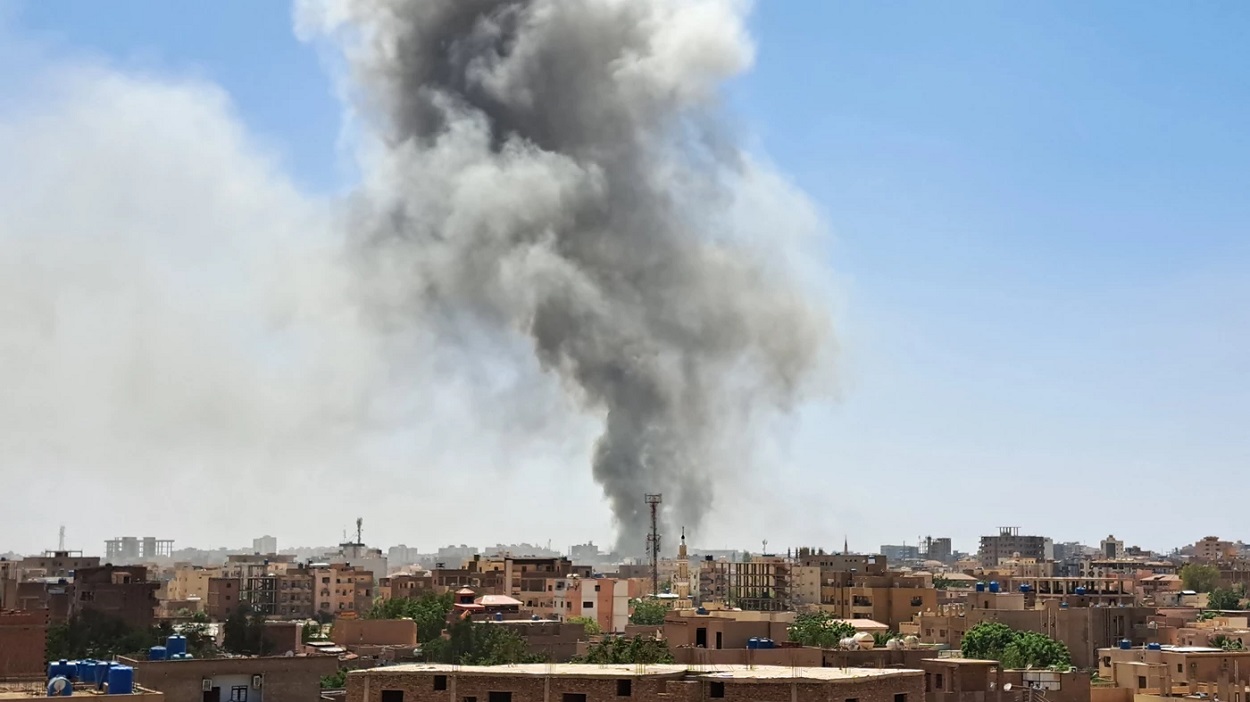
Image: Ahmed Satti / Anadolu Agency / Getty Images

Hajj Atiya, an elderly Sudanese woman living in Khartoum, was already ill.

And then the war started.

“The planes bombed from above, the bullets were flying below,” she said. “We stayed in our house, afraid, while all outside was boom, boom, boom.”

All she had in the house was flour, to bake bread. At least she had that.

Mariam, who came to Khartoum from the Nuba Mountains to get medicine, went several days without water. And then a bomb hit the neighboring building, which collapsed upon her own.

“Whenever the airplanes disappeared overhead, we ran outside in search of food,” she said. “But we had to hide behind buildings to avoid the gunfire, with corpses strewn on our right and left.”

An unnamed doorman had it still worse.

“For ten days we couldn’t leave our home,” he said. “The shops are closed, and soldiers are in the streets.”

Every Sudanese of means in his Kafouri neighborhood of Khartoum had left town at the first sign of violence, which began April 15. He and the other guards were left behind to protect the properties. But the building owner, when the doorman called to ask for money or help, hung up on him.

Mariam found someone willing to provide transport out of the capital. But she couldn’t afford the 50-cent fare. All she had was oil and soap.

Atiya had only one option left.

“I prayed to God: Save us,” she said. “God answered, and someone came to take us away.”

Somehow, each escaped with their families 85 miles southeast to Wad Madani. Atiya found a place to rest under a tree. Mariam spent the night on the street. But each now numbers among the 122 families staying in two local evangelical schools, with dozens more sleeping in the city’s churches.

“The war is ongoing, and the people keep coming,” said Edward Hussein, an evangelical pastor. “The situation is difficult, and it is only getting worse.”

Only scant support has come from abroad. But local believers donated funds, food, and beds from their own homes. Until now, every arriving family has been given an aid package that includes lentils, flour, sugar, oil, tea, and soap.

But for how long?

“If the situation continues, what can we do?” asked Habil Thomas, country director for Nigeria-based Calvary Ministries. “God is the only one who can intervene, as we pray for peace in Khartoum and all Sudan.”

So far, Wad Madani has been spared.

Located three hours from Khartoum along the banks of the Blue Nile, the capital of Gezira state governs an agricultural center once anticipated to become a new breadbasket of Africa. While development has stalled, the abundance of crops and relatively lower cost of living—coupled with employment opportunities on the farms—has drawn many here to safety.

Because Khartoum is destroyed.

“If the fighting doesn’t stop, it will be a humanitarian crisis,” said Ezekiel Kondo, Anglican archbishop of Sudan. “Nobody can help anyone else here, because all are helpless.” His residence in All Saints Cathedral was situated one block from…

This article was originally published at Christianity Today, on May 12, 2023. Please click here to read the full text.
Categories
Christianity Today Europe Published Articles

Russian Christians Make Theological Case for Peace

Image: John Moore / Getty Images

On an Advent Sunday in a small Protestant church in St. Petersburg, a Russian pastor nervously approached the pulpit. While his senior leadership was publicly neutral about the war, he was about to preach from the Sermon on the Mount against the invasion of Ukraine.

And in the pews before him was another potential land mine.

A congregant had been bringing along a childhood friend, who happened to be a Wagner Group mercenary. Wounded during combat for Russia’s private paramilitary company, the man was not there to spy. Yet while the pastor knew his close-knit congregation well, he could not predict the fallout from his message.

Relations remained good with the pastor’s mentor afterward, while the mercenary recovered and returned to the front lines. For now, the pastor has been left free to continue in ministry and—whether known to the intelligence services or not—in clandestine theological work against the war.

“Of course, we could go out and protest, but this would get you in jail,” he said, requesting anonymity. “For us, the most effective means are to work within your spheres of influence—and ours are very small.”

Over the course of the yearlong conflict, only a tiny minority of Russian Christian leaders have voiced complaint publicly. The response from authorities has been uneven: Minor church figures have been fined or jailed, while others continue to use their names on social media.

But no major denomination in Russia has condemned the war outright.

The St. Petersburg pastor, along with about 25 of his scattered multifaith colleagues, desired to confront their silence at the biblical source. Christianity Today spoke with three of them, on condition of anonymity, for insight into the antiwar movement.

The group released its declaration to “all Christians of Russia” in advance of Christmas.

“We are terrified by the fact that many church officials and theologians … are distorting the truth of the Holy Scriptures,” the Russian Christians stated via their Christians4Peace website and Telegram channel. “[But] we are convinced that participation in this war—on the side of the aggressor—is unacceptable for any Christian.”

The provided Russian and Ukrainian downloads of the declaration include an appendix with an extended theological treatise. Last summer, the pastor and a few like-minded friends began a study group on…

This article was originally published at Christianity Today on March 17, 2023. Please click here to read the full text.

Categories
Christianity Today Middle East Published Articles

Calvin of Arabia: Protestant Theology Translated into Arabic

John Calvin Arabic
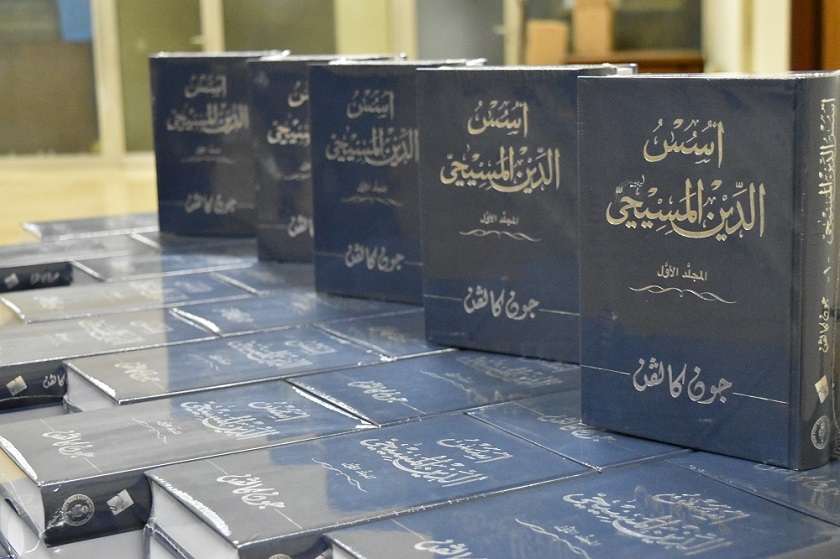
Translation: Foundations of the Christian Religion, vol. 1, John Calvin. (via LSESD)

This article first appeared in the December edition of Christianity Today.

Most of the theological writings that shaped Western society over the last 500 years cannot be found on Middle Eastern bookshelves. Few Arabs have ever read anything from John Calvin, Jonathan Edwards, or Karl Barth.

The reason is simple: Almost none of the Protestant canon has been translated into Arabic.

The dearth of Christian religious texts in the world’s fourth-largest language is especially pronounced within Protestantism, which developed in European languages such as Latin, French, German, and English. The Reformation has barely broken into the Arabic-speaking world, dominated by Islam and where most local Christians—whose numbers are dwindling fast—are inheritors of Orthodox or Catholic theologies.

Nearly a decade ago, George Sabra, president of the Near East School of Theology (NEST) in Beirut, had the notion to translate perhaps the most influential writing of the Reformation, John Calvin’s Institutes of the Christian Religion, into Arabic for the first time.

Written by my colleague Griffin Paul Jackson, I contributed a section on Catholic efforts:

After years of checking thousands of footnotes, Sabra—who settled on a Baptist publisher based in Egypt for his 1,500-page tome—has realized the weight of clear, quality translation. But he’s not the only one counting the cost.

For Middle East Catholics, less than one percent of key texts are available in Arabic, said John Khalil, a priest who works at the Dominican Institute for Oriental Studies in Cairo. “Our bishops can access works in Italian or French,” he said. “But having nothing in Arabic results in fewer theologians. It is a problem.”

Khalil recently secured permission to publish translated and original Christian works, naming his imprint after Aquinas. He has begun revision of the Summa Theologica, translating volume two and hoping to complete the rest in the near future.

But the problem is not just with the classics. Few modern theological works have been translated into Arabic either. Only one book is available from the leading theologians behind the Second Vatican Council.

Khalil’s primary interest is social justice, and in May he published the first Arabic translation of Gustavo Gutiérrez’s benchmark A Theology of Liberation. A handful of books about liberation theology exist in Arabic, but until now, no original texts.

But even these pushed Christians toward participation in Tahrir Square demonstrations that led to the overthrow of Egypt’s government in 2011. One celebrated martyr of the revolution, Mina Daniel, was a leader in Khalil’s study group.

Since then, however, many Christians have soured on such theology. Khalil hopes translation can make a difference.

“I don’t imagine we will become like Latin America,” he said, “but I hope we will at least stop blaming our young people who are struggling for justice. Religion should criticize every political system, and the church must have a prophetic voice.”

Please click here to read the full article at Christianity Today.