
The demonstrations and violence surrounding the anti-Muhammad film Innocence of Muslims reveals two worlds which could not be further apart.
The West cherishes freedom of expression and allows religious ideas to be subject to debate, denial, and even ridicule.
Meanwhile, efforts to enshrine blasphemy provisions in Egypt’s new constitution are well underway, surely to receive a boost from this most recent outcry.
Those most offended took to the streets and unleashed the vilest invectives against those who insulted their prophet. Lapido filmed people at the US embassy in Cairo who were noisy, though not riotous.
Of the involvement of a supposed Israeli-American Sam Bacile (now known to be an alias for an American Copt Nakhoula Bacile Nakhoula) the crowd shouted, ‘Khyber, Khyber, oh you Jews! The army of Muhammad will return!’ Khyber refers to Muhammad’s victorious 629 AD siege of a Jewish oasis in the Arabian Peninsula, where he imposed the jizia tax for the first time.
Of the involvement of Coptic-American Maurice Sadek in the movie’s promotion, the crowd shouted, ‘Copts of the diaspora are pigs!’ A sign held aloft declared, ‘We are all bin Laden, you [Coptic] dogs of the diaspora.’
And besides the ubiquitous ‘Allahu Akbar!’ protestors chanted, ‘With our lives and our blood we will redeem you, oh Islam!’
Lapido Media spoke with two Islamists about the recent protests, in a bid to understand.
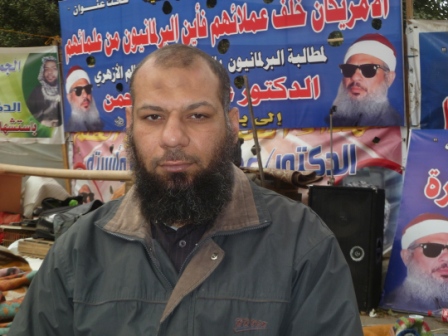
Mohamed Omar Abdel Rahman of the Islamic Group received Lapido the evening of the first day’s protest, when the flag of the US embassy was removed and burned.
His family has maintained a sit-in protest on the opposite side of the embassy for over a year, demanding the release of their father, Omar Abdel Rahman. Better known as the Blind Sheikh, he is in prison in America over his role in the 1993 World Trade Centre bombings.
Abdel Rahman is not a religious scholar, but a veteran jihadist from the wars in Afghanistan.
‘For any offence against Islam,’ he said, ‘the Muslim has the right to defend himself against the one who says it, and shouting “our lives and our blood” displays his love of his religion.
‘It does not mean to kill an embassy employee, but if the filmmaker comes to Egypt, he will be torn limb from limb. This is permitted in Islam.’
Concerning the signs praising bin Laden and calling foreign Copts ‘dogs’ and ‘pigs’, Abdel Rahman stated this was not meant literally, but ‘to scare them’.
‘They want to destroy Egypt and are its enemies, so this frightening is permitted in Islam.’
Asked about condemning all foreign Copts without distinction, Abdel Rahman stated this was a misunderstanding of Arabic rhetoric, where the general was meant to convey the particular, and exaggerate the grievance.
The use of insults was also misunderstood by the West, conveying not literal figuring but contempt.
‘This also is allowed in Islam,’ he stated, when invited to compare such contempt with the Qur’anic verse extolling ‘good preaching’ against a non-Muslim challenger.
‘Everything has its time and place,’ said Abdel Rahman. ‘It makes no sense to issue simple good preaching during jihad. If someone is attacking you, you resist and fight back, you do not just say a good word.’
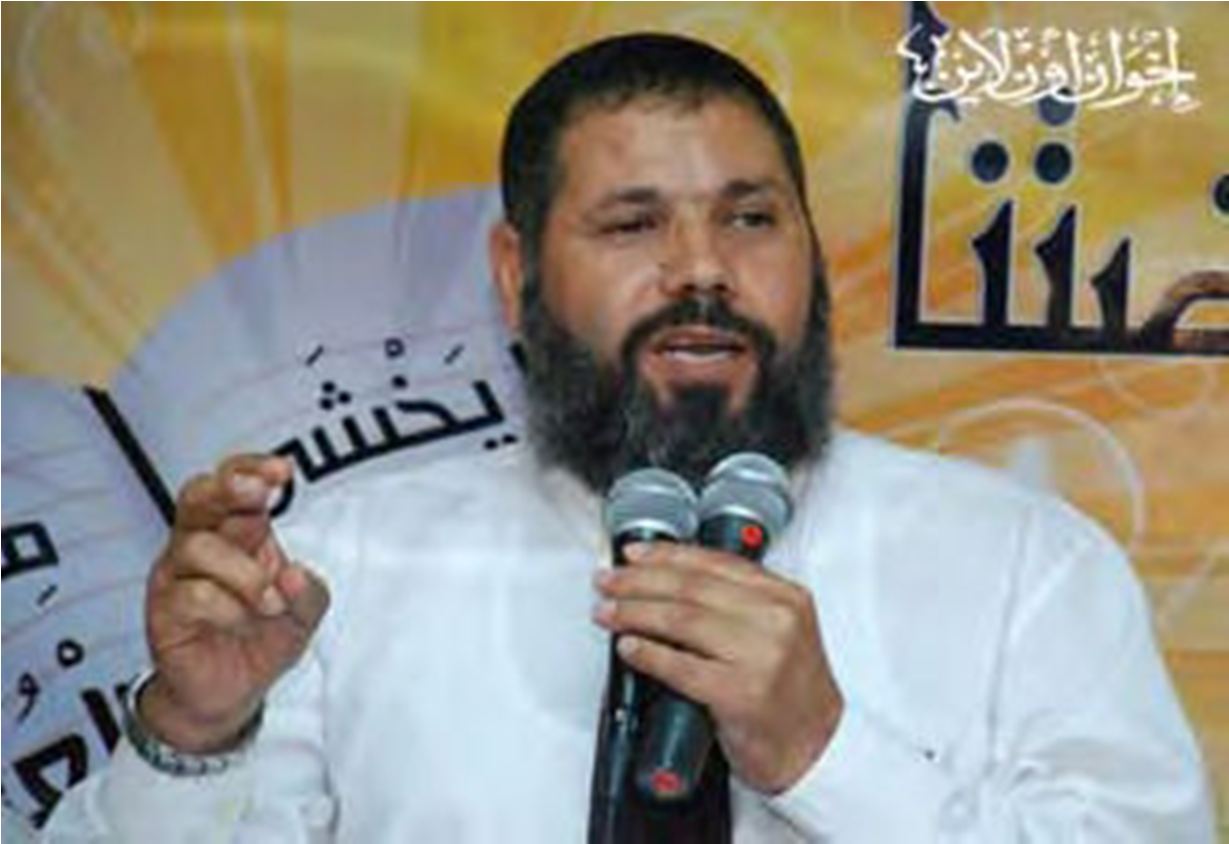
Lapido then asked Abdel Rahman al-Barr, a member of the Muslim Brotherhood’s Guidance Bureau specializing in the shariah, to comment in a written interview.
By this time the American ambassador to Libya had been murdered, the embassy and school attacked in Tunisia, with outbreaks of violence in many other parts of the Muslim world.
‘Religion is one of the sanctities that man will protect and defend with all he has, even if this leads to giving his life,’ he said.
‘In the case of this offensive film it is necessary to announce refusal, condemnation, and anger with the most powerful expressions.’
To explain what makes this a religious obligation, al-Barr drew from a well-known tradition of the prophet.
‘Islam requires the Muslim to reject error and seek to change it with his hand, if he is able. If he cannot he must reject it with his tongue, and demonstrations are one of the ways to do so.’
Al-Barr noted that many of the demonstrators were ‘common people’, and Egypt did not have a culture of demonstrating. He hinted that the slogans used might be questionable.
‘Islamic morality is moderate in both satisfaction and anger,’ he said. ‘Powerful expressions of anger must respect justice. The Qur’an says: “God does not like the public mention of evil except by one who has been wronged” (4:148).
‘So if a man is oppressed he may use forceful phrases to express this oppression, but without triviality or debasement.’
Al-Barr blamed the media for taking an obscure film and throwing it in the face of Muslims. He gave no credence to the idea that religious scholars had a share in the blame for the excesses which took place, but did suggest some regret.
‘It is natural the scholars could not stay silent in the face of this rejected crime. Personally, if it was in my power I would not have given this subject any importance because it is a vile work.’
Instead, ultimate blame lay elsewhere, indicating the vast difference in cultural perspectives.
He concluded: ‘We request the government which allowed this film to appear – that is, the United States of America – to prevent [its showing] and to hold those who made it accountable, as they have instigated hatred and incited animosity between peoples.’
This article was first published on Lapido Media on September 19, 2012
Related Posts
- Does God Permit a Muslim to Break a Promise? – May 7, 2012
- Gamal Nassar on the Muslim Brotherhood – December 11, 2011
- Egyptian Demonstrations and the Muslim Brotherhood – February 11, 2011

 Jayson Casper