This article was originally published at Christianity Today, on April 25, 2019.
In most Sunday schools, the question is an academic exercise.
“How many of you are willing to die for Christ?” asked the teacher on Easter morning. Every one of the children dutifully raised their hands.
A few minutes later, the Sri Lankan class descended to Zion Church’s main service, passing through an outside courtyard where a stranger was speaking with church leaders. He had discovered there was no Easter morning Mass at the nearby Catholic church in Batticaloa, and was wondering when the service would begin here. He asked about the healing service.
Observers report he was sweating profusely. A pastor invited him to take off his backpack. Then, an explosion—many inside thought it was the generator.
Half the children died on the spot.
“All the children had responded [to their teacher’s question] by putting their hands up, and signaled their fresh dedication to Jesus by lighting a symbolic candle,” recounts a seminary leader [full testimony in sidebar below]. “For so many of those children, it would be their final act of worship.”
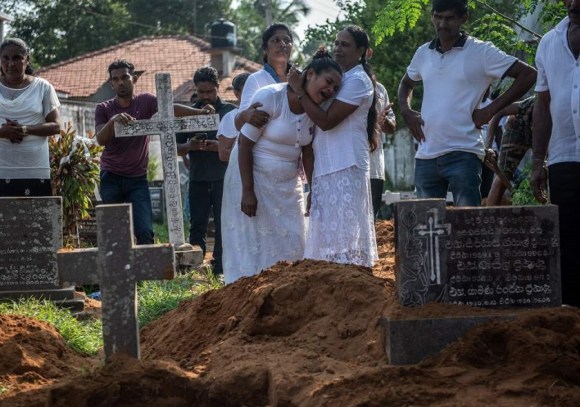
In total, at least 26 worshipers—including 16 children—were killed and 100 injured at Zion, a charismatic congregation in the Fellowship of Free Churches in Sri Lanka. Two Catholic churches in and near Colombo on the island nation’s opposite coast were also attacked by suicide bombers that morning, along with three hotels. The death toll currently stands at 253, revised down from 359.
But this is not the only Christian tragedy.
Sri Lankan authorities have now arrested 76 local Muslim extremists and one Syrian, placing the blame on the National Thowheeth Jama’ath (NTJ) movement. ISIS has claimed responsibility, calling it revenge for the massacre at a New Zealand mosque last month.
In response, gangs of young Christian men are now marauding Muslim neighborhoods. People have been assaulted. Shops have been destroyed. Hundreds of Pakistani refugees—mostly Ahmadis, a persecuted minority themselves—have fled the area around St. Sebastian’s, the Catholic church in Negombo where more than 100 worshipers perished.
“How we process this new reality and respond will determine the character and the witness of the Church of Jesus Christ in Sri Lanka,” Ivor Poobalan, principal of evangelical Colombo Theological Seminary, told CT…
Please click here to read the full article at Christianity Today.
American Catholics are growing more concerned about the fate of the world—and with it, Christian persecution.
More than 9 in 10 now identify persecution as either “very” or “somewhat” severe. This is roughly the same percentage as an identical poll last year, both sponsored by the US branch of Catholic charity Aid to the Church in Need (ACN). But over the last 12 months, the share choosing the “very severe” category rose from 40 percent to 46 percent.
And their level of concern went with it, rising 9 percentage points. Last year, 49 percent of Catholics described themselves as “very concerned.” This year, 58 percent.
The poll surveys 1,000 American Catholics across the spectrums of age, politics, and piety, conducted by McLaughlin & Associates.
It showed that intense Catholic concern is growing on several global issues. Those “very concerned” about human trafficking rose from 72 percent to 82 percent. Poverty climbed from 68 percent to 74 percent. The refugee issue jumped from 50 percent to 60 percent. And climate change nudged forward from 55 percent to 57 percent.
So while those unconcerned about Christian persecution fell by half (from 18% to 9%), overall the “church in need” only ranked No. 4 among the list of issues.
But last year, it was…
Please click here to read the full article at Christianity Today.
Many have been impressed by the forgiveness Coptic Christians have offered to their enemies. Beheaded, ambushed, churches bombed, shot in cold blood – they have not retaliated. Instead, though anger boils, they pray for their persecutors.
In the links above you can explore the opportunities I have had to write about this suffering community, and in one article I partially translated a poem circulated on social media that one Copt directed to ISIS. The Arabic original is here, and the full translation is below:
I will not speak (as some have done)
And curse your religion whatever its name.
I have come that it be known:
My fathers’ religion and what it proclaims.
My fathers’ religion has love at its heart,
The meaning of which will call you to peace.
My fathers’ religion, right from the start
Offers forbearance that conflict will cease.
Your hatred and killing in no way suffices
To stop us from loving and praying for you.
My father’s religion, oh dear Uncle ISIS,
Is not a weapon to pierce you straight through.
I wish that you could come to see
Or just one time the answer seek.
That while you bomb and murder, we
Stay strong as if a mountain peak.
My fathers’ religion of spirit consists.
It is not a body whose end is the dust.
And for the spirit—despite death persists—
Awaiting are loved ones residing in trust.
My fathers’ religion, if you could discern,
Offers each wounded the medic of life.
Tomorrow when you will repent and return,
You will come to know just who is the Christ.
It is a phenomenal sentiment. Which is why I was surprised – and then cut to the core – when my Egyptian friend helping me translate it called it: Haughty.
When I showed him my translation he said: Well done. It is even more arrogant than the original.
My friend is a Muslim, but non-practicing, with a respectful dismissal of religion in general. Perhaps one can say such a person of any background might be offended by strong claims of religious conviction. I have previously written critically when it is labeled bigotry.
I don’t think this is true of my friend. He has a generous heart and speaks tongue-in-cheek. But while I cannot judge the heart of the one who wrote the poem, I can discern the heart of the one who translated it.
And my friend is right.
It is my job to represent what I understand to be the reality of Egypt. This poem, I believe, is an authentic expression of the Coptic community.
But it is more than that. It is an expression of the way I would like the Coptic community to be. Many are not there. Many struggle. Yet many of them hold as an ideal that this is what their Christianity calls for.
So the poem represents also my conviction, but once again more. It represents my triumphalism, my sense of the moral superiority of Christianity. I have written about this before, and it is not necessarily damning. We all judge deficient that which we find to be false.
These days, much of the world says this should not be done with religion. Fair enough. It is hard to weigh between metaphysical matters. Even so, is it not right to let each religion be tested according to its merits, its morals, and its history? Few issues are as important, once one believes in an eternity.
But set all that aside. When I translated the poem I was rejoicing in more than my conviction, I was rejoicing in my identity. When I shared it in the article I was not just encouraging fellow Christian readers with the example of brothers-in-faith. I was encouraging also an us-versus-them mentality.
The ‘them’ is everyone else. There is nothing in it particularly against Islam, but Islam is the context. In Egypt, Christians are surrounded. In America, we are media saturated. I wish to be of generous heart toward Muslims and their faith. This too, with the yearning expressed in the poem, is part of what I understand to be Christianity.
But is that yearning for the glory of God, or the wholeness of my fellow man? Too often, it is the yearning for a pat on the back, the placement on a pedestal. And who better to offer, than a forgiving, grieving woman turned into an icon? Do I truly care for her in the loss of her son or husband? Or do I care for the message we can make out of her?
This is haughtiness. This is arrogance. My friend knows me well, and I’m afraid he exposed me. At the least, he helped God reveal.
Perhaps a bit of Arabic and Egyptian context is helpful. The opening line of the poem, my friend explained, recalls a verse from the popular poet Gamal Bakheet. “Their fathers’ religion, what is its name?” was written at the time of the 2011 revolution, and is a thinly veiled jibe at the Muslim Brotherhood. (See his Arabic recital here.)
The poem speaks of “our fathers’ religion” in the context of sublime values. It praises not only Islam, but also Christianity and Judaism – and even the non-monotheistic religions. And it criticizes those outsiders who want to bring something more defined, more exclusive, and more politically instrumental to Egypt.
My friend has no love for the Muslim Brotherhood, but his father – of whom he speaks respectfully – was a regional leader.
There is another context, even more illustrative. “Your fathers’ religion” is a common insult in Egypt. You can say it to anyone, regardless of their faith, to curse them and their whole ancestry.
In this light, the Coptic poem dips deep into Egyptian waters. It says it will not curse – but even in mentioning the phrase it practically does. It is a redirect, yes, to speak instead of “my fathers’ religion.” But it is soaked in the context from which it emerges. How many Copts have heard this expression hurled by wayward Muslims?
So let us salute them all the more, when they rise above and bless those who go far beyond insult. But remember, and be chastened by, the inherent temptation to pride.
The Bible tells a story of Abraham coming back from a battle, reclaiming his goods taken during a regional war. Upon meeting a friendly king he receives a blessing and yields a tenth of the spoils.
New Testament commentary establishes this king as a prefiguration of Jesus, establishing his covenant of grace as superior to the covenant of law that would be developed through Abraham’s descendants.
For the non-Christian reader, allow the logic to be complicated. But note the verse concerning Abraham and the king. “And without doubt, the lesser person is blessed by the greater.”
How easy it is, when we rightly note and idealistically contemplate the near-impossible calling to bless the enemy, to put ourselves in that superior posture. How easy it is to imagine ourselves in a greater community.
How easy it is to be haughty.
Is the poem a healthy encouragement and impassioned exhortation, or an arrogant celebration and smug self-validation? Only the poet knows.
The translator? The question hits too close to home. It is better to lean toward repentance.
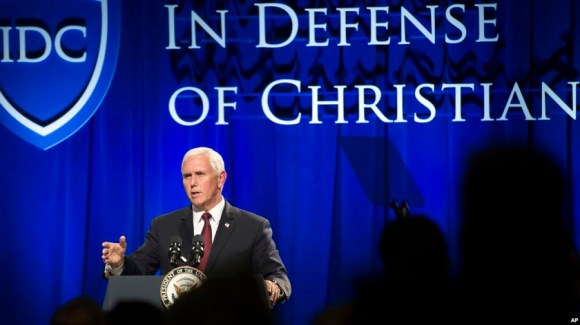
Vice President Mike Pence addresses the In Defense of Christians’ fourth-annual national advocacy summit in Washington, Oct. 25, 2017. Credit: AP, via VOA News.
Here are a few excerpts from my new article.
First, the reason:
Zalal Life distributed 300 food baskets and bottles of water. The government of Hungary donated $2 million in aid for reconstruction. The United Nations wasn’t there.
“People are not happy with the UN; they are using money for administration,” said Bahro. “The help is coming from churches and Christian organizations.”
Second, the condition:
“If the US can help Christian organizations directly, it will be good—if it can be done without discrimination,” he said.
“They must serve Muslims and other minorities also. We live together, and want to remain together in our communities.”
Third, the complication:
“Having the US transfer funds directly to persecuted Christians could be a good thing, but American politics will surely mingle in,” the Israeli Arab Christian said.
“They will want to brag about the aid to show their success, and to prove to the Christian Right that [President Donald Trump] delivers on his promises.”
Fourth, the danger:
Farouk Hammo, pastor of the Presbyterian church in Baghdad, agreed. “The bottom line is that we do not recommend direct aid from the States to Christians,” he said.
“It will agitate our Muslim brothers negatively against the Christian community.”
Fifth, the reality:
But the Jordanian leader respects Trump and is cautiously in support of the USAID policy change if done well, as it will empower the church to do the ministry.
“Maybe we will be targeted more,” he said. “But in some countries, it can’t get worse.”
Sixth, the possibility:
If USAID offered to help, Bitar would accept it—if it is not conditioned on any political agenda. He has little fear of local reaction.
“Muslims will be happy,” he said. “They like to send their children to schools run by Christians.”
Finally, the outcome:
Amid conflicting Christian reactions and unknown Muslim response, the policy change represents a new approach. Will it make things better or worse?
“Here in our area, the Kurdish Muslims trust Christians,” Bahro said. “In Arab areas, I don’t know.”
Please click here to read the full article at Christianity Today.
The images are horrific. Fr. Samaan Shehata, a 45-year-old Coptic Orthodox priest lay dead on the ground, stabbed and beaten by a young man wielding a meat cleaver.
Blood dripped down his face into his long, black beard. Dirt discolored his flowing, black robe. His cross pendant rested peacefully on his chest, eerily imitated in the cross-like stabbing etched onto his forehead.
Many details remain unknown, but early indications point to extremism. Fr. Samaan was from Beni Suef, visiting a family in Cairo 150 kilometers north in a lower-class, urban suburb of Cairo.
It may well be he was targeted only for the clothes he was wearing – in Egypt, a clear indication of his religious profession.
He was left a public spectacle. So far, no claim of responsibility, no message of intention. There are possible hints circulating of mental instability.
Perhaps. Outright murder is rare in Egypt. Despite the increased terrorism suffered by Copts in recent years, this killing is unusual. There is a chance it was random.
But few think so. Coptic social media immediately proclaimed Fr. Simaan a martyr, adding him to the growing scroll.
The image, however, may have lasting effect, reinforcing a decades-old message: The streets are not the place for priests…
Please click here to read the rest of the article at World Watch Monitor.
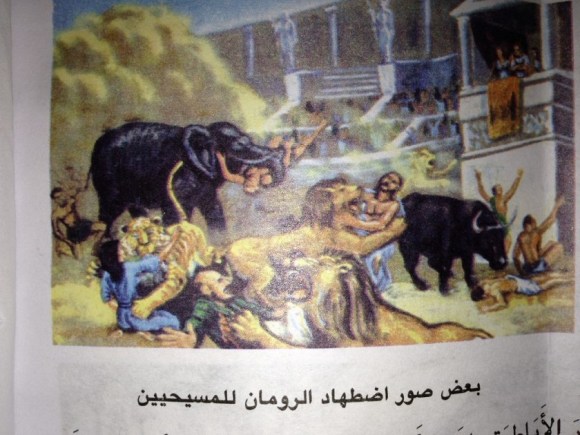
Translation: Some pictures of the Roman persecution of Christians. Via Mada Masr.
There is a general understanding that Egypt’s Christians are marginalized in the educational curriculum.
An additional idea is that this came during an Islamization period in the 1970s, or perhaps during Nasser’s presidency.
A researcher examined this question and described them on Mada Masr. Here is his evaluation:
Based on an analysis of Egyptian history textbooks from 1890 until the academic year 2016/2017, it is clear that Egyptian history is narrated from a perspective that values an Arab Muslim identity over other perspectives and voices.
While the tone generally revers and paints Christianity in a positive light, the narrative as a whole is exclusionary in both explicit and subtle ways.
The article as a whole is insightful, and here is an example — of how textbooks changed:
Current history textbooks do not include explicit derogatory references to Christianity or Christians — as some of the earlier textbooks did. In fact, they include extremely positive mentions, albeit concise.
For instance, in explaining why ancient Egyptians embraced Christianity, a 2016 textbook explains that they were attracted by its values of justice, equality, mercy, empathy, tolerance, renouncement of worldly pleasures, and valuing of the afterlife.[11]
However, we need to also be cognizant of more subtle ways that might give value to one identity while diminishing or silencing others. In addition to continuing to use explicit and extensive Muslim referents as highlighted above, more subtle exclusions can also be found in current textbooks.
For instance, they use the word “Arab” to characterize countries such as Egypt and Lebanon even before they had been taken over by Arab Muslim armies. Such references give the historically inaccurate and false impression that these countries have always embraced an Arab identity, eclipsing the richness of their pre-existing civilizations and cultures.[12]
Additionally, several of these history textbooks have continued to address students as if they are all Muslim. For instance, an 1893 history textbook explains that the religious story of David and his son Solomon “must be learned by all Muslims.”[13]
Similarly, a 1988 history textbook encourages students to learn about the annual Muslim pilgrimage to Mecca by asking their relatives who might have performed it.[14]
In discussing civic engagement, current textbooks encourage students to be proud of our Islamic principles and values that encourage us to volunteer in the community and peacefully co-exist with others different from ourselves.[15]
In Egypt it is sometimes necessary to ask the religion of the researcher, often indicated by name. Ehaab Abdou — I believe these names are shared by Muslims and Christians alike.
What is important, however, is quality. The article is too brief to fully evaluate, but he claims a comprehensive scope of research. I don’t have the background in the subject to know if he left out damning specifics; other Egyptians, please weigh in.
The one thing I noticed is that he did not specifically state he evaluated textbooks in the Azhar educational curriculum. Copts sometimes claim this is a source of bias against them.
But on the whole, the article appears to be an evenhanded treatment of a controversial subject.
Few things are as important as the education of our children — and ourselves.
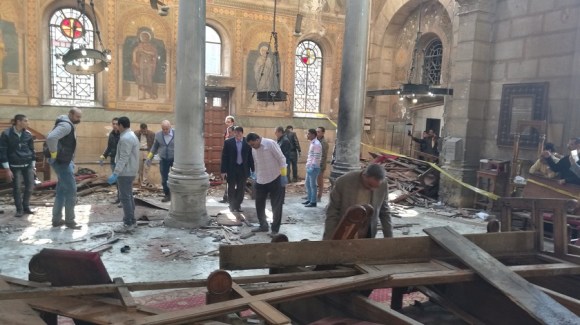
Egypt’s Coptic Christians are in a state of mourning after a suicide bomber killed at least 25 people at a Cairo church on Sunday.
“Egypt always tends to rally around Christians at moments like this,” said Jayson Casper, CT’s Middle East correspondent. “But over time, [ISIS is] trying to hammer and hammer and hammer the Christians in Egypt and put so much pressure on the internal government that it itself may collapse.”
But even when suffering does come, the Coptic Church “is equipped to deal with it,” said Casper.
“They can say, ‘This has always happened to us in our history. It is how God has treated us and he perseveres with us through it.’”
While the attack was the worst to target Copts since the 2011 New Year’s bombing of a church in Alexandria that killed 23 people, the population has been the victim of sectarian violence for years. In 2015, ISIS, who also claimed responsibility for the latest attack, beheaded 21 Coptic Christians in Libya.
Casper joined assistant editor Morgan Lee and editor-in-chief Mark Galli this week to discuss the fascinating and important history of Coptic Christians, how the Egyptian church relates to a changing government, and why this most recent attack is unique.
Please click here to listen to the podcast at Christianity Today (38 minutes).
“There has been a bombing at the cathedral,” said the pastor at the local Methodist church in a lower-class area of downtown Cairo. “Several are dead, and we pray for our nation.”
It took me a moment to comprehend, but the gravity of his words indicated more than a simple illustration. I opened my cell phone to check the news and saw the bold headline: 25 dead and 49 injured in an attack on the Coptic Orthodox cathedral. The spiritual center of Egyptian Christianity had been mercilessly violated.
Only a few minutes earlier, the sermon considered John the Baptist and how his life of faithfulness ended with his head on a platter. Here again now was another modern Egyptian example of martyrdom, one more in a long line since the similar bombing of a church in Alexandria six years earlier. Several women sobbed quietly, as the men sat in stunned silence.
But a little later as they exited the service, the collective sense felt more like resignation. The men exchanged pleasantries and went home; the women lingered a little longer in conversation. What was unthinkable at the start of the Arab Spring had become unsurprising. In Alexandria 23 Copts died when a car bomb went off outside the church, but that attack, at least, soon gave way to the hope of a new revolution. The cathedral atrocity gives no inspiration, as Egypt remains muddled in a regional fog of war and terrorism.
In-between the two bombings were the 2013 revenge attacks on dozens of churches throughout the nation, as frustrated Islamists blamed Christians for the overthrow of the Muslim Brotherhood-affiliated President Mohamed Morsi. And the usual stream of sectarian incidents continued apace, as the state failed to hold accountable the mob violence of Muslims objecting to a church in their village, or an interfaith love affair, or any other typical but ill-justified collective form of Coptic punishment. It has been a rough stretch for Egypt’s Christians.
But not nearly as rough as the Christians of Iraq and Syria, or the Muslims of Libya, Yemen, and elsewhere have endured—and the Copts know this. They stand behind their Muslim Brotherhood-vanquishing president, and give much slack to a government they know is under tremendous pressure. Everywhere they turn it seems some new conspiracy is bent on dragging Egypt into the Middle East morass. The economy is in shambles, tourism is nonexistent, and save for the mandatory utterances of support following terrorism, they feel the international community never speaks except in censure. For this reason many have expressed favor at the election of Donald Trump. He likes our president, they say, and at least he’ll leave us alone.
For Copts are tired of being treated as pawns. A few days before the bombing, Foreign Policy ran a story entitled, “How Egypt’s Copts Fell Out of Love with President Sisi.” Even Chuck Colson’s Breakpoint piled on, ostensibly seeking to help by demanding the US president support Egypt’s Christians. “Meet the new persecutor,” said the article subtitle, “same as the old one.” Some on the left seem intent on buttressing the narrative of Copts in the way of a deserved Islamist democratic future. Some on the right seem intent on painting Muslims as sharia-inspired agents of Christian antipathy.
Both articles do well to draw on actual Coptic voices, and important ones. The news they convey is vital to learn in a world where, unless made a pawn, the Copt is often ignored. But they miss the nuance of the Coptic reality. Perhaps they can be forgiven for not knowing enough; perhaps they are guilty of pushing an agenda.
Back in Egypt, the Copts are well aware of incumbent discrimination and state weakness. But they cheer on a president who attends Christmas mass with the pope, and a military that rebuilds the churches Islamists destroyed. A new law for church building may or may not fully address the issues surrounding freedom of worship, but at least this regime—the first in 160 years—issued a law at all.
And following every tragedy, the common Muslim tends to open his or her bosom. Private taxi services Uber and Careem offered free rides to the hospital for blood donations. Many have missed the fact this bombing took place on the birthday of Islam’s prophet, a traditional day of merriment. The attack was therefore an assault on Muslims as well, Christians note. A popular cartoon draws the traditional holiday doll in the black clothes of mourning, as behind her stands a somber crucifix.
Thus between the kindness of the Egyptian soul and the sectarianism latent in an identity-driven society, the Copt is left waiting for national transformation. The rhetoric of the current regime seeks to revive a spirit of Egyptian nationalism, if only it can sludge through current challenges to reach a modicum of stability. Every maltreated Copt who fails to obtain justice is another reminder of how far the country has to go. And the cathedral bombing is another example of the powerful forces that stand against an idealized future.
But from the demonized past and lingering present, the Muslim Brotherhood condemns the bombing in one breath and blames it on regime-church collaboration in another. As long as this is the alternative, Copts find their best option in the preservation of a strong-handed government and a nominally secular society. Some in their community continue faithfully to agitate for human rights and a less political role for the church. Many agree but feel security and economy must be prioritized. Most hope for an open society of enlightened Egyptians, if only a generation away.
The Methodist church sermon that ended with John’s head on a platter began with the miracle that led to his birth. Elderly Zachariah and sterile Elizabeth likely long gave up hope of a child, the pastor surmised. Even so, “Your prayer has been heard,” said the angel. God is faithful, even when his people falter. John, the pastor noted, also doubted the one he baptized.
Where in this parable are Egypt’s Copts? Soon to be beheaded, or of pious prayers fulfilled? Likely somewhere in between, still inclined to pray for their nation.
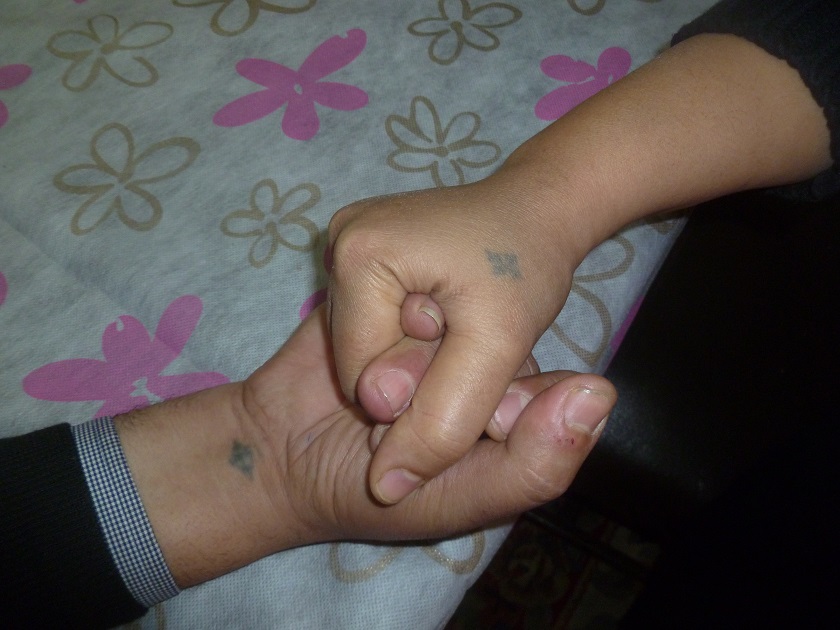
The hands of husband and wife, otherwise unidentified in the article
From my recent article for Aid to the Church in Need:
Life is not easy for Christians in Egypt, and the strain is taking its toll. Beyond the reports of churches burned and homes attacked, there is also a more subtle hardship affecting ordinary families. While not universal, mistreatment and discrimination are unfortunately all too common.
“Every day we leave our house, not knowing what will happen,” says Girgis, an Egyptian Catholic who preferred not to use his real name.
His wife, however, has the irritating stories:
“The other day, I was climbing into the (public transportation) van with my two children as usual,” Maria tells her story, “and I called out the name of my neighborhood just to confirm. But the driver said he wasn’t going there, so I got out to ride in the correct one.”
“But then a Muslim woman came on board and asked for the same neighborhood, and the driver let her in, taking the last place. I was outraged and complained, but the man replied, ‘I’m free to let in who I like and force out who I like.’”
Within the past year, similar incidents happened half a dozen times. It is not a daily occurrence, but it leaves a painful wound, especially when repeated with such regularity.
The wife gives other examples, and the following is her testimony from the conclusion:
“I try to be a Christian,” she said. “I try to be kind, but I also try to show the person this behavior is not appropriate.”
It often makes little difference. In fact, witnesses to her mistreatment usually downplay what happens, telling her it’s ok, or not to worry about it.
She does have good relations with Muslims in her apartment building; she even freely tutored a neighbor’s child in French, without charging the family. Yet, as a family, they have few if any real Muslim friends, the couple affirms.
Girgis views the situation of Egypt’s Christians as follows: “There are two types of persecution: Physical, when you are threatened with death, and mental, which is worse.”
“If you are killed, it’s over. But if you are subject to mistreatment it may drive you to kill yourself. We are made to feel inferior. This is the persecution that is present in Egypt.”
In saying so, Girgis made clear to me that the burning of churches and attacks on families are not best understood as persecution, but as the result of political and social struggles. Rather, it is the incessant needling as described in the interview they see as the persecution Egyptian Copts generally face.
I am happy to tell their story, for I have heard many similar complaints from others. It reveals a slice of life that is true.
My only concern is that their story be received as the only truth. I have heard other Copts tell me of generally warm relations with Muslims, and of friendships that are real and genuine. Within the article I hope this sentiment is expressed.
The reality is a mix, and the deep Coptic frustration with the sectarianism of many of Egypt – even if it doesn’t touch them personally – is worthy to convey. But somewhat paradoxically, it is very difficult to get sense of this sectarianism as an outsider. Within the Coptic community it sometimes feels like groupthink; within the Muslim community it is often denied completely.
Of course, there is no one community for either religion. One Muslim I know heads an NGO for combating religious discrimination. Another I know, from the same neighborhood as the wife in the article, told me he sees Coptic women everywhere and they get on just fine.
Some Copts may suffer a setback at work and attribute it to anti-Christian bias. And while some Muslims at least rhetorically, if not worse, make Christians feel inferior, many others are likely just ignorant of what others suffer.
The partial solution is to tell each others stories.
Alas, I made several attempts to conclude this post with a practical result of what comes next – and failed. It is strange; I am glad to convey this family’s struggle, and yet feel conflicted at the same time. I don’t want such an example to be used to misrepresent Egypt, even while this example does represent Egypt. Just not entirely. But what can an article convey? Go read a book! Or better, an encyclopedia. Perhaps you can enroll in a Middle Eastern Studies masters program instead.
But that is my burden. It is my job to help tell Egypt’s story correctly, and to do so within the criteria of each publisher. I trust that if you read this blog consistently you trust my effort to give the big picture. But in any individual article, published in any individual source – the work stands alone to be judged. Or rather, to judge Egypt. Please click here to read the whole article at Aid to the Church in Need, and judge accordingly.
And as for solutions? What comes next? I trust the telling of stories is helpful, but how?
Dozens of Copts assembled in front of the governorate building, over incidents such as these:
Adel Wadie Fahmi said his house was seized by eight thugs, who forged contracts to prove ownership of the house land, and asked him to pay two million Egyptian pounds, roughly 300,000 USD, to give the house back to him. Fahmi said that he filed a report with the Samalout police.
The security services inspected Fahmi’s house and managed to arrest one of the thugs and Samalout prosecutor remanded him in custody for 15 days pending investigation, but Fahmi’s house has yet to be restored to him.
Medhat Lewis Guirguis said a group of thugs demolished a wall encircling a plot he owns, and when he objected they showed him a false contract of their ownership of the land. Said thugs called on Guirguis to pay 450,000 pounds to leave the land. Upon filing a report with Samalout police, five of the accused were arrested and imprisoned for 15 days pending investigation. Guirguis, however, has received new threats urging him to pay the required amount.
Other incidents are listed as well. The above is a good example of wishing you could be in all places at once. Many stories described as kidnapping reflect simply a young woman who has run away with a lover. Even when this is the case, however, there are often breaches of law that go ignored by authorities. If someone was there, they could better investigate.
So we are left with this investigation, which probably is only a recounting of the claims of those demonstrating. Might some be claiming sectarian discrimination over simple land disputes, perhaps even if they are in the wrong?
Maybe, but there is no joy in being a cynic. Rather, this demonstration is a warning about the real possibility of sectarian aggression against Copts, especially in Upper Egypt. The region has always been rather lawless; amid further decline, might some encroach further, taking advantage of lax enforcement and a slow or absent judiciary, to enrich themselves at the expense of Copts?
Do similar instances happen among Muslims, but are as infrequently reported in the regular press and altogether ignored in Christian-focused publications such as this one? Does Islamist dominance of the public square mean such incidences against Christians will be less rebuffed than normal? Why should it, are there not simple matters of right and wrong at stake? Do Islamists care only about advancing their fellow Muslims? Or should they not be men of principle more than the earlier administrations, and take a stand to investigate and stop such transgression?
So many questions. Would I be able to know better the answers if I was there? I am in Cairo, and there is so much here I don’t know, so why would it be different?
But I wish someone did, and there was a publication that could be trusted. Thank you, MidEast Christian News, for bringing these stories to attention, but I wish you investigated more thoroughly.




 Jayson Casper