Categories
Christianity Today Europe Middle East Published Articles

Shaken Yet Stirred: Turkish Christians Advise Moroccan Church on Earthquake Aid

Image: Courtesy of First Hope Association (FHA)

Help for Morocco is coming from Turkey. While humble in scope, the biggest impact may be on the church.

First Hope Association (FHA), a Turkish Christian disaster relief agency that provided aid after the massive earthquake that struck southeast Turkey in February, was granted permission to assist in Morocco after its own devastating quake. A four-person team arrived in Marrakesh last week.

Consistent with its Turkish policy, FHA serves all victims without discrimination, in cooperation with the local church. Connecting with a house church network in southern Morocco, the Turkish believers have distributed $30,000 worth of clothes, blankets, and hygiene kits in four mountain villages not yet reached by other aid.

“Our country has gone through the same hardships and difficulties, so we came to help and support,” said Demokan Kileci, FHA board chairman. “This is an amazing opportunity for God’s church here to show his compassion and love.”

In many ways, the parallels are striking.

Morocco and Turkey are both Muslim-majority nations, and they both have small Protestant communities that largely emerged from an Islamic background. The churches in both nations suffered in their respective earthquakes but also rallied support to aid in overall relief. And while enduring varying degrees of ostracism, the believers’ solidarity with fellow citizens has begun to win each a slowly increasing level of social respect.

“Their expression of love was immediate, without any thought of self,” said Tim Ligon, pastor of Marrakesh International Protestant Church, of the local believers he has partnered with in relief. “They counted no cost but responded with everything they had.”

But there is one major difference between the nations: Morocco does not recognize an indigenous Christian faith, while Turkey affords its people freedom of religion—including religious conversion.

Turkish Christians shared their story of faith to CT in hope that the small believing community in Morocco might profit from their experience. For there is another parallel between the nations that Turkish Protestants have taken significant steps to overcome: a history of internal division.

“The Bible tells us that spiritual power comes in unity,” said Ali Kalkandelen, president of Turkey’s Association of Protestant Churches (TeK). “It won’t be easy, but if Moroccan believers support one another and see the church as one body, the Lord will bless them, and fruit will come.”

Moroccan sources uniformly told CT about their love for Jesus and respect for King Mohammed VI, the Moroccan monarch and head of state. They also would like to see their faith recognized equally alongside Islam and Judaism.

But beyond these shared views, the sources had many different perspectives.

Some spoke of a government that discriminated against them and would not help displaced Christians. Others said the government was helping everyone and generally left the believers alone.

Some said their witness employs the Arabic word for “Lord” to hint at their distinction from Islam. Others said they say “Allah” to connect with normal Muslim use. Some distribute literature; others foreswear it as illegal. Some speak of their Christian faith to the media; others are suspicious of those who make it public.

Some said there was good cooperation between Moroccan churches and that donations should go to local believers working in the field. Others said there was distrust between the churches and that donations should be given through the national bank.

In some sense, each of these perspectives could be true. Experiences differ, as do theology and outlooks on mission. But there are Christians who exaggerate their earthquake and overall ministry for the sake of financial support, said some, while others said there were self-professed “Christians” who were not true believers at all. To any who would criticize, Jack Wald counseled…

This article was originally published at Christianity Today, on September 27, 2023. Please click here to read the full text.

Categories
Christianity Today Middle East Published Articles

Morocco Earthquake Moves Marginalized Churches to Christian Charity

Image: Carl Court / Getty

Local and foreign Christians have joined in relief efforts following last week’s massive earthquake in Morocco.

Nearly 3,000 people have died, with more than 5,000 injured. Registering 6.8 on the Richter scale, it is the North African nation’s most powerful quake since 1969 and its deadliest since 1960.

But far from the epicenter near the historic city of Marrakesh, gathered believers all had the same question.

“No one ever asks of disasters, ‘Why did it happen to them?’” said Youssef Ahmed, a senior member of Tangier Northern Church, 350 miles away. “But when it hits you, everyone wants to know God’s will.”

The house church service went much longer than usual.

Although Morocco only recognizes Islam and Judaism as domestic faiths, local believers generally say the government permits them to worship quietly in their homes—under a protective but thorough surveillance. Alcohol and pork, forbidden by sharia, are also freely available in the country. About 15 percent of citizens declare themselves nonreligious, while only 25 percent express trust in clerical leadership.

“We are not restricted in Morocco,” said Ahmed. “Just don’t be a nuisance.”

The latest US State Department report on Morocco indicates that, while “undermining the Islamic religion” is punishable with up to five years in prison, there are no known cases of Christians running afoul of the law.

But that Sunday, the former Muslims had other concerns on their mind.

“Why did it happen? We cannot know. Was it because of sin? We cannot know. Was it a test, like with Job? We cannot know,” said Ahmed, who led the lengthy discussion. “All we know is that God allowed it to happen, and his ways are righteous. We keep our faith in him.”

Encouraged in their walk, they went out to serve.

The congregation is a part of the 36-member Union of Christian Churches, which Ahmed founded in 2010. Congregants traveled south with supplies to see what they could do.

Attempting to reach isolated villages in the Atlas Mountains, where many mud-brick homes were destroyed, they were turned back by roadblocks which permitted only relatives to enter. Continuing on to Jemaa al-Fnaa Square in Marrakesh, they encountered a mass of humanity camped out in fear of continuing aftershocks. They quickly joined in with the multitude of Moroccans—and tourists—distributing water and blankets.

Much of the 9th-century UNESCO World Heritage site was undamaged, including the medieval Kotoubia Mosque which overlooks the square. But a less famous minaret had collapsed, as had portions of the 12th-century city wall. Badly damaged also was the earth-and-stone Tinmel Mosque, built by the Almohad dynasty in an Atlas Mountain valley 60 miles away before the Berber caliphate conquered Marrakesh and moved onward to Spain.

One Moroccan pastor estimates the church today is…

This article was originally published at Christianity Today, on September 15, 2023. Please click here to read the full text.

Categories
Christianity Today Middle East Published Articles

Moroccan Christians Welcome End of a Decade of Islamist Government

Man walking past voting wall, Marrakesh, Morocco

For the first time in his life, Rachid Imounan cast a vote—and overturned Morocco’s Islamist-oriented government.

He is not alone.

Turnout surged to 50 percent as liberals routed the Justice and Development Party (PJD), which led the North African nation’s parliament the past 10 years. Its share of the 395-seat legislature dropped from 125 to 13.

The PJD finished eighth overall.

“We thank Jesus, the Islamists are gone,” said Imounan, a church planter who lives in the southern city of Agadir. “God answered our prayers, and now we have the government we wanted.”

Aziz Akhannouch of the National Rally of Independents (RNI) was sworn in as prime minister by King Mohamed VI on September 11, after his party captured 102 seats. He is tasked with forming a coalition government to guide Morocco through its current economic downturn.

A constitutional monarchy, Morocco has held multi-party elections since its independence in 1956. But to stave off protests during the Arab Spring, in 2011 the king instituted reforms and transferred significant power to the prime minister.

Mohamed VI retains final say over several government positions, however, and is revered as “Commander of the Faithful” as a direct descendant of Islam’s founding prophet Mohammed.

Christians described “liberal” parties as those that favor freedom—excepting challenges toward the person and position of the king, whose authority is respected by all political entities. Islamists, meanwhile, wished to impose sharia law, cover women, and remove pork and alcohol from neighborhood supermarkets.

“Akhannouch is a businessman. Whether you worship the sun or the moon, he doesn’t care,” said Youssef Ahmed, one of Morocco’s few second-generation Christians.

“He won’t persecute anyone.” Open Doors ranks Morocco…

This article was originally published at Christianity Today on September 21, 2021. Please click here to read the full text.
Categories
Christianity Today Middle East Published Articles

After Israel, Will Morocco Normalize with Christians?

Image: Illustration by Mallory Rentsch / Source Images: Fadel Senna / Getty Images/ Nagesh Badu / Fabio Santaniello Bruun / Unsplash / WikiMedia Commons

An excerpt, which follows an introduction about the three nations which signed the Abraham Accords to normalize with Israel:

This month, the fourth, Morocco, was granted US recognition of its longstanding claim to the Western Sahara, a mostly desert region on the northwest coast of Africa, which seeks independence.

But absent from the accords is any emphasis on religious freedom, despite the Trump administration making it a central feature of its foreign policy. And in relation to Christians, each nation has a unique situation.

The Emirates is officially 100 percent Muslim, though it facilitates the worship of its majority population of migrant workers. And following normalization, the UAE relaxed its sharia-based laws.

Bahrain has a native Christian population of about 1,000 people, descended from communities in Lebanon, Syria, and India. Three years ago, its king signed a declaration esteeming individual “freedom of [religious] choice” as a “divine gift.”

Sudan’s Christians, though only 3 percent of the population, are indigenous citizens. And following the 2019 popular revolution, Sudan implemented religious reforms, including repeal of its apostasy law.

Morocco is in between.

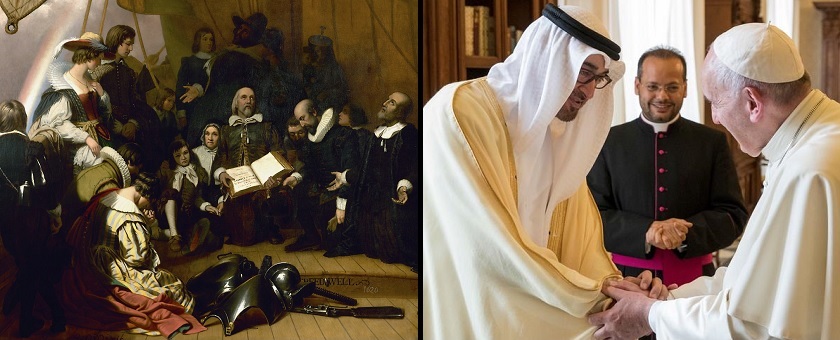
Long lauded for its treatment of local Jews, Morocco’s constitution recognizes Judaism and considers the 3,000-strong community as an integral part of its society. And during last year’s visit by Pope Francis, King Muhammad VI interpreted his official title of “Commander of the Faithful” as “the Commander of all believers … [including] Moroccan Jews and Christians from other countries, who are living in Morocco.”

But the omission stood out.

“He didn’t mention us,” said Zouhair Doukali, a Moroccan Christian.

“I want the government to recognize all minorities, so that we can live as Moroccan citizens.”

Estimates of the North African nation’s unofficial Christian citizens vary widely, from 5,000 to 50,000. Foreign-resident Christians are estimated at about 30,000 Catholics and 10,000 Protestants, who enjoy religious freedom in legally registered churches.

But whereas the UAE and Sudan have been improving their religious freedom image, Morocco has moved backwards, according to a new report on blasphemy laws by the US Commission on International Religious Freedom (USCIRF).

One of eight nations to have expanded blasphemy provisions since USCIRF’s last report, in 2018 Morocco doubled its fines and jail terms. It also expanded the law’s jurisdiction from only official publishers to include any individuals in public or online forums.

And proselytizing, described as “shaking the faith of a Muslim,” can be punished with up to three years in prison.

Open Doors ranks Morocco No. 26 on its World Watch List of the 50 countries where it is hardest to be a Christian.

But unlike the UAE, where conversion is illegal and can meet the death penalty, Morocco assigns no penalties for conversion. The government has said so publicly.

“There is no persecution in Morocco,” stated spokesman Mustapha El Khalfi, “and there is no discrimination on the basis of faith.”

Moroccan Christian sources agree there is no state persecution. Over the past decade, the government has largely left converts alone. And since all are assumed to be Muslim, there are no issues marrying other believers. (Marriage in Morocco is a matter of civil registration, whereas in some Arab states it has a religious character and Muslims may not enter into Christian marriage.)

Some Christians, however, want full human rights…

This article was originally published at Christianity Today, on January 8, 2021. Please click here to read the full text.
Categories
Excerpts

Giving Thanks, for Khartoum and Kennedy

Thanksgiving Khartoum Kennedy
via Mormon Newsroom and Mohamed Al Hammadi / Crown Prince Court – Abu Dhabi

Happy Thanksgiving to all American friends. Religious freedom is one item of gratitude, as well as positive signs it may be developing around the world.

Consider again these promising signs I’ve been privileged to report on the past two years:

Arab Gulf — Why Christianity is Surging in the Heart of Islam

Indonesia — World’s Biggest Muslim Organization Wants to Protect Christians

Morocco — Arab Christians and the Marrakesh Declaration

Egypt — Let My People Build

Bahrain — Saudi Arabia’s Neighbor Defends Religious Freedom of Individuals

Saudi Arabia — The Game of Thrones Christians Should be Watching

Italy — Muslims Work for Religious Freedom


Not all is rosy, of course, and some nations pretend nothing is wrong.

Sudan is one of them. But in recent engagement, the United States has religious freedom on the agenda for improvement of ties and removal of sanctions.

As Crux has reported:

A leading U.S. diplomat visiting Sudan said the United States is willing to work with the Sudanese government to help it achieve the conditions necessary to remove its designation as a “Country of Particular Concern” in the U.S. State Department’s annual International Religious Freedom Report.

Deputy Secretary of State John J. Sullivan was speaking on Nov. 17 at the Al-Neelain Mosque in Omdurman, located on the western bank of the Nile River, which separates it from the national capital.

Sullivan said “supporting human rights, including religious freedom, has been, and will continue to be, a critical part of the United States’ bilateral engagement with Sudan.”

The event at the mosque included leading Muslim and Christian clergy. Sudan is 97 percent Muslim, and the small Christian community has faced harassment, especially since the predominantly Christian and animist south of the country became the independent state of South Sudan in 2011.

The State Department’s 2016 International Religious Freedom Report cited reports of government arresting, detaining, or intimidating Christian clergy and church members, denying permits for the construction of new churches, closing or demolishing existing churches and attempting to close church schools, restricting non-Muslim religious groups and missionaries from operating in or entering the country, and censoring religious materials and leaders.

There is always room for cynicism, and perhaps frequently it is warranted.

Does the United States care more for counterterrorism and military contracts, and will let this item slide if progress is seen elsewhere?

Will Sudan put on a nice face and make superficial improvements, only to squeeze non-Muslim communities once the diplomats leave?

Maybe. But this Thanksgiving, let not cynicism be a landing place. Even the public rhetoric of religious freedom is something to celebrate. It sets a tone; attitudes can adjust over time.

And as the US ambassador told his Sudanese audience, it took a while in America.

“I am the grandson of Irish-Catholic immigrants who arrived in Boston, Massachusetts in the 1880s. At the time they arrived – and for many decades that followed – Catholics in the United States faced widespread prejudice based on their religion,” he said.

“When John F. Kennedy – another Catholic from my home state – ran for president of the United States in 1960, he even had to give a prominent speech to reassure the nation that his faith was compatible with the duties of the office of president.”

Sullivan said recalling such history “seems quaint” today, but added it took many decades – “it was not easy” – to reach the point where it is “nearly unthinkable” that one’s status as a Catholic in the United States would serve as a disadvantage to a person’s ambitions for life.

“The American experience in this regard underscores that respect for the human dignity of every person – regardless of religious belief or origin – is a key component of not only protecting human rights, but also fostering a society that can flourish, build upon each other’s strengths, and move forward together,” he said.

America has had flaws, too. She still has some, and may be developing others.

But today, around the table, give thanks to God for what exists — both at home and abroad.

Those who love God do not need freedom to follow their faith. But ample facilitation makes our world a better place.

Appreciate, and pray for more. And then, enjoy your turkey.

Categories
Christianity Today Middle East Published Articles

Arab Christians and the Marrakesh Declaration

Marrakesh-Declaration

This article was first published at Christianity Today in the April print edition.

With the lilt characteristic of a Southern megachurch pastor, Bob Roberts Jr. introduced the most significant Muslim statement on religious freedom in 1,400 years.

“I am a Texan, an evangelical, and a Baptist,” the NorthWood Church leader told the crowd of more than 250 leading Muslim clerics from around the world. “You have made my job to build bridges so much easier. You have gathered to call people to change.” He drew hearty applause.

The Marrakesh Declaration, launched in Morocco this January, is a clear English-Arabic condemnation of terrorism and a pledge to better promote religious liberty.

“It is a very promising initiative. You could even say it is groundbreaking,” said Medhat Sabry, the Anglican Communion’s dean for Morocco and one of several non-Muslim observers (alongside Roberts) to the declaration’s signing. “But it is way too early to tell.”

This is because—from Cairo to Amman to Nazareth to Baghdad—the news caused barely a ripple in Christian communities in the Middle East and North Africa, whom the document is meant to comfort. Some Arab Christians saw a headline in the local news. Others didn’t hear of it at all.

Please click here to read the full article at Christianity Today.