Categories
Prayers

Friday Prayers for Egypt: Rebellion, Legitimacy and Fire

Flag Cross Quran

God,

Watch over Egypt this weekend. Watch over her in what follows. Keep her future in your hands.

As the Rebellion campaign is in its final preparation hours for anticipated massive June 30 demonstrations at the presidential palace, other forces are also at work. An unrelated protest brought thousands and perhaps tens of thousands to Tahrir Square to demand President Morsi leave.

But pro-Morsi protestors have gathered in the tens and perhaps hundreds of thousands not far from the presidential palace, supporting his right to the remainder of his term. Meanwhile, especially in the Nile Delta, violence has flared as Muslim Brotherhood headquarters have been attacked in multiple cities.

Throughout the nation hundreds have been injured and a few have died. Many fear today was just a dry run, a dress rehearsal for the battle to come.

Each party, God, has pushed forward a D-Day scenario. How is it possible now for the right and the good on all sides to prevail? The president has electoral legitimacy, but from a constitution and post-revolutionary process many view as illegitimate. The opposition has legitimate grievances, but many of their supporters advance them in an illegitimate way. The president’s Islamist supporters claim religious legitimacy, but many speak as if they are fighting illegitimate infidels.

God, is it legitimate to be both sad and hopeful for Egypt? You are putting the nation through a crucible; tried by fire, will only the pure emerge?

May it be so. Fire proves the quality of men’s work. It tests their character and reveals their inner being. God, Egypt is in such great need of this evaluation. Give discernment to the people, and place sovereignty in their hands.

Or, God, is this your other fire? Is it punishment for sins collected, whether over long years or recent months? If so, be merciful. May your hand of judgment fall only on the deserving, and even for them, may it eventually redeem. Spare the innocent, shield the righteous, and aid the poor. Only you know their numbers, God, but do not pour your wrath upon the nation as a whole. She has suffered enough.

But God, perhaps there is no fire at all. Perhaps there is little legitimacy anywhere. Perhaps this is a drama construed simply for reshuffling the chairs of power. But may this not be so. Make life more than theater; honor men and their freedom of action. May manipulations and deception cease in Egypt.

God, bless the president. May he do what is wise and necessary for the peace and prosperity of the nation.

Amen.


Categories
Prayers

Friday Prayers for Egypt: Confronting the Rebellion

Flag Cross Quran

God,

In advance of ‘Rebel’ protests on June 30, Egypt’s Islamists are not simply waiting to see what will happen. On the street and in the presidency they have taken a confrontational approach to the challenge. Today, after hundreds of thousands demonstrated in favor of President Morsi, the battle lines are clearly drawn. But what will ‘winning’ entail? What will it even look like?

If those gathered have their way, it will be an increasingly Islamic Egypt. A few days earlier Morsi replaced seventeen of the nation’s governors, appointing seven from the Muslim Brotherhood and one from the hardline al-Gama’a al-Islamiya. Several of these appointments sparked violent rejection.

And while officially the protest was simply in the name of democratic legitimacy and non-violence, some saw the coming launch of a truly Islamist revolution. Must one side thoroughly defeat the other?

The ball is now in the opposition’s court. The Rebel campaign claims to have collected over fifteen million signatures demanding early presidential elections – more than voted for Morsi in the first place. But can they match or exceed the Islamist numbers on the street? Do they need to? What if they succeed?

God, beyond the immediacy of the street, bless the new governors. Give them understanding of their region and the peculiarities of its needs. May they represent the people well.

God, honor the zeal of the demonstrators. Motivated either by democracy or their victory therein, many feel under threat of losing everything. Where influenced by fear or anger, God, comfort and condition them. May they stand firm in their convictions, but nurture love and acceptance of those believed to oppose their project.

But God, the days are ticking away. Will a dramatic show of forces lead Egypt down the path of mutual good? Is the show of forces necessary to bring political players back from the brink? Bring a solution, God, that is acceptable to all. May no one yield, but may all compromise. Either before or after the dramatics, bring Egypt to a place of peace.

But at the moment, each side confronts the other. Only you know if current and coming events are beneficial, God. But in whatever happens, secure Egypt’s good. Confrontation is within human nature, and part and parcel of politics. Just ensure it proves constructive.

Amen.


Categories
Prayers

Friday Prayers for Egypt: Rebel Positioning

Flag Cross Quran

God,

June 30 looms, and Egypt’s political players are getting ready. The bulk of opposition parties have signed on to a grassroots campaign to call for early presidential elections. Named ‘Rebel’, they have collected millions of signatures, seek a total of fifteen-plus, and plan a massive rally at the presidential palace on the anniversary of Morsi’s ascent to the presidency.

Islamists are dismissive, and some are defiant. The latter are calling for preemptive sit-ins at the palace two days earlier, and counter demonstrations the day of throughout the country. Some accuse the opposition of seeking violence to pin upon Islamists; others advocate any-means-necessary to protect the president’s legitimacy. The Muslim Brotherhood has not yet decided a course of action, but like all Islamists they decry the Rebel campaign as outside the law with no true bearing on constitutionally approved political practice.

The question of violence is a cloud upon the day. Each side accuses the other as the rhetoric escalates. Some warn of a civil war or a sectarian conflict, but is this a possible reality beyond the now normal rock-throwing clashes? Even if the stage is set for a major street battle, will it really escalate into war?

But violence may well occur, as it has already at an ongoing sit-in at the Ministry of Culture where liberal artists and intellectuals call for the dismissal of the newly appointed minister. In an effort to dismiss them, a party of Islamists protested, clashed, and was separated by police.

Every angle is plausible, God. The opposition could seek violence to discredit the Islamists, police, and government. The Islamists could seek violence to discredit a popular campaign. Unknown or old regime elements could seek violence to further the chaotic and unstable state of the country. And some might simply be rumoring violence to keep down the numbers.

The first hope is simple, God: Prevent the occurrence of violence. Bring Egypt’s political actors to consensus through dialogue, negotiation, shared values, and love of country. Let all in demonstrations and counter-demonstrations express their demands and pressure accordingly.

But help each to esteem their opponent as Egyptian, however different in mindset. If their lines meet on the 30th, give them fruitful exchange and winsome discussion. But God, so much worse is feared, and the hope feels like a pipe dream.

Surely there are some who desire violence, or in a lesser evil, play with the idea for political ends. God, when will the day of reckoning come for this sort? Did it already come through the revolution, and now is on its last legs? Or is it yet to come for some in power and some illegitimately seeking it? May it come soon, God, but may you spare Egypt the collateral damage.

But that perhaps is a prayer to come, God, and perhaps June 30 will begin the process. But for now, God, give wisdom to citizen and politician alike in positioning. Should they aid the campaign, resist it, or ignore it altogether? In any and all choices, may decisions be sincere and not calculating, based on principle and not manipulation.

There is a counterpart to the Rebel campaign, God. The Impartiality campaign also claims millions of signatures in support of President Morsi. Surely the vast majority of signatories on both sides are of pure motivation; may their will – however contradictory – be achieved, somehow.

God, solve the somehow. It has been two years since the revolution and the somehow remains elusive. Perhaps June 30 factors into your best will, perhaps not. But position Egypt on the path to peace, prosperity, and consensus. It is forever a path, and destination coordinates are debated. But as Egypt veers, correct her.

In this, may her people have the greatest share.

Amen.

Categories
Personal

Egyptian Government Restores Antiquated Church

From Ahram Online, official promotion of Egypt’s Christian heritage:

On Wednesday, Mostafa Amin, secretary general of the Supreme Council of Antiquities (SCA), inaugurated the Abbey Church of the Apostles in Atfih town in Giza governorate after the completion of its restoration with a budget that reached LE6 million.

The opening came within the framework of a drive by the Ministry of State for Antiquities (MSA) to save the Coptic shrine and to open more sites to tourists, in order to encourage the tourism industry.

The church, like other Coptic and Islamic monuments located in rural areas, had suffered serious damage, including from high sub-soil water levels, high levels of humidity, and an outdated and decayed sewerage system installed 100 years ago.

It is one thing to show respect to buildings, another thing to honor people and their right to freedom of belief and expression. Negative examples of the latter have proliferated over the past two years, but this news is nonetheless encouraging, especially as it takes place in a diocese which experienced the first sectarian tensions after the revolution.

There, a church was burned due to village family tensions and rumors of witchcraft practiced inside. The army stood by and watched, but amid outrage and protests the government sought reconciliation, part of which was an agreement to rebuild the church. Whether or not the two efforts are related is not stated in the article.

Is the Egyptian government schizophrenic, then? Maybe. The current cabinet is composed of many technocrats joined by members of the Muslim Brotherhood. While many ministers carry out the functions of state as before, others appear to be actively ignoring incidents against Copts or pursuing legal action against them for defamation of Islam. The Ministers of the Interior, Justice, and the Public Prosecutor are not members of the Brotherhood, but were appointed by Morsi. Other ministers he simply inherited.

But the Minister of Antiquities, under whose authority this restoration project falls, was also a Morsi appointment. He is considered an Islamist, but is an expert in both the Coptic and Islamic heritage of Egypt. Was this project an ongoing one whose file he received near completion, or an example of his own initiative? Either way, it is a needed break from the ongoing flow of bad news.

Categories
Personal

Amr Hamzawy on the MB Shadow Government

From Arabist, translating an article by political commentator and liberal politician Amr Hamzawy:

The bifurcation of Egypt’s government into an official and unofficial administration – as has been noted before – is at the root of a serious crisis that is blighting the chances for democratic transition and the rule of law. One half of this dual administration is made up of the president, his team of advisors and his government as the executive wing on one hand and the Freedom and Justice Party as the legislative wing on the other. Meanwhile, the other half of this administration is composed of the Muslim Brotherhood and the shadowy figures that they have placed in influential political and executive positions that involve direct, decision-making authority. This dual administration now holds sway over the Egyptian state, its institutions and agencies, while giving birth to disastrous mix-ups and derailing plans to reform the state, to implement transparency and freedom of information, and to ensure accountability and equal opportunity.

If this has been noted before, it is often overlooked as part of the current reality of Egyptian politics. But not just in government is it noted that Western governments engage the wrong actor, but within the MB structures as well:

They give support to the idea of fixing the relationship between religion and politics, then they elevate the Muslim Brotherhood over the Freedom and Justice Party — that was founded as the Brotherhood’s political wing — through their ongoing communication with decision-makers in the Brotherhood concerning Shura Council legislation, economic and social issues, matters related to aid, etc. This is despite the fact that all these issues fall within the Freedom and Justice Party’s purview, not to mention that of the official administration consisting of President Mohamed Morsi, his team and his government.

I have had several non-political Egyptian liberals tell me they do not want to see President Morsi fail, but to fulfill his mandate and then be voted out of office. They say as well they do not oppose political Islam as a concept, but wish to see them active through the registered Freedom and Justice Party, rather than through the nebulous Muslim Brotherhood.

Basically, they want politics up front, legal, and transparent. Hamzawy is convinced it is not happening, and in fact, the West is abetting the very opposite.

Categories
Personal

A Signature Rebellion

I got in a taxi on Thursday and within a few minutes of conversation the driver asked my nationality. This has been a sensitive question recently; last week an American near the embassy answered in the positive and was stabbed in the neck for his troubles. ‘I hate America,’ the assailant confessed afterwards.

For the taxi driver, however, it was an opportunity of a different sort. After I owned up to my nationality he leaned over to his glove compartment and…

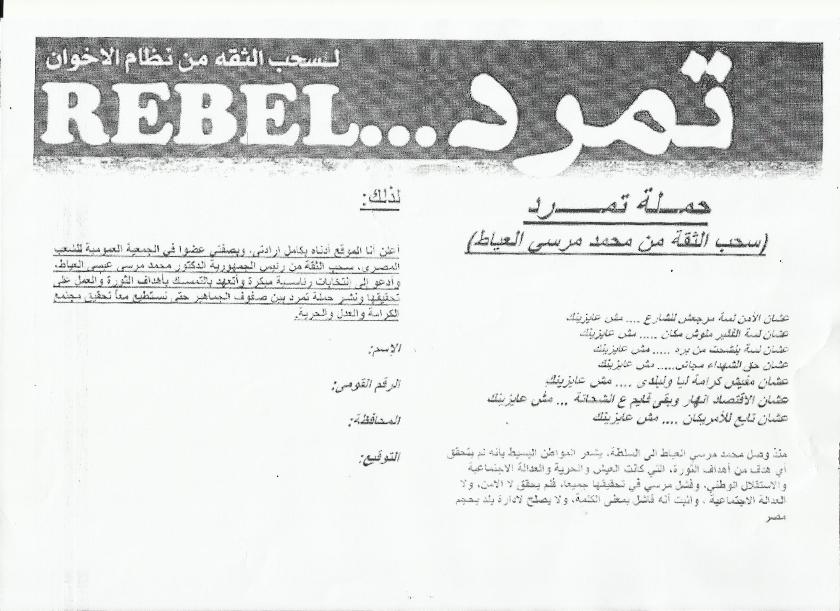
Rebellion Flyer

… pulled out a sheet of paper.

In fact it was one of many, some signed, most not yet. The driver was preaching the merits of a new campaign to oust President Morsi, and wanted me to convey the message to America. As I mentioned in Friday Prayers yesterday, they aim to collect fifteen million signatures to their petition, vaulting over the total number of votes cast for Morsi in the presidential elections. They claim two million to date.

Their grand finale is planned for June 30, at the presidential palace, one year to the day in which Morsi took office.

Here is the translation of their flyer:

REBEL

To withdraw confidence from the Brotherhood regime

The Rebellion Campaign

(to withdraw confidence from Mohamed Morsi ….)

Because security has not yet returned to the street … we don’t want you

Because the poor still do not have a place … we don’t want you

Because we are still begging from abroad … we don’t want you

Because the rights of the martyrs still have not been fulfilled … we don’t want you

Because there is still no dignity for myself or my country … we don’t want you

Because the economy has collapsed and is built upon begging … we don’t want you

Because you follow the Americans … we don’t want you

Since Mohamed Morsi the … came to power, the simple citizen has felt that not one goal of the revolution has been achieved – for bread, freedom, social justice, and national independence. Morsi has failed to realize them all. No security, no social justice – he is a demonstrated failure in the complete sense of the word. It is not fitting for him to administrate a nation of Egypt’s weight.

Therefore:

I, the undersigned, from my free and complete will, as a member of the general assembly of the Egyptian people, withdraw confidence from the president of the republic, the dictator Mohamed Morsi, and call for early presidential elections. I pledge to hold firmly to the goals of the revolution and to work on their behalf, spreading the Rebellion Campaign among the masses until we are able to achieve social dignity, justice, and freedom.

Name:

National Number:

Governorate:

Signature:

Would you sign?

Categories
Prayers

Friday Prayers for Egypt: Sinai, Rebellion

Flag Cross Quran

God,

Egypt is not quite rumbling again; bubbling is more like it, though the bubbles can grow bigger. Security apprehended alleged terrorists plotting to blow up the US and French embassies, while their colleagues in the Sinai abduct seven security officers.

In Cairo a small protest in Tahrir threatens a creative escalation. The ‘rebellion’ campaign is collecting signatures to demand the departure of President Morsi. The have announced two million so far; they aim for fifteen – more than the total ballots cast in Morsi’s favor – by June 30, the day he assumed office. On that date they will return in mass to the presidential palace.

Many Islamists complain there is no legal legitimacy to their action. Of course they are right, but there was no legality to the demonstrations which deposed Mubarak either. It is the symbolism which is important – if they can get the numbers.

Terrorists, though, do not need numbers. They need space, materials, and determination alone. Few dispute their illegality, but along similar lines, the symbolism is important.

God, amid Egypt’s many problems, few prayers have been necessary concerning terrorism. For this thanks is necessary; terrorism has been a constant in Syria, with appearances in Tunisia and Libya as well. For all deserved criticism of the security void there has been vigilance on this front. May it continue; free the abducted personnel and give the authorities wisdom and perseverance in the Sinai.

And of rebellion? Surely the name is not that pleasing, God. Is the campaign? Is it honest? Does it use the memory and practice of demonstrations past simply for political pressure? Or is the real end game to remove the popularly elected leader? If so, by what mechanism?

It is good to have popular means of accountability and activism, but it is troublesome many feel this is the only avenue for political participation. Frustrations are high and shared ideals are broken amid widespread polarization. But does Egypt need another uprising? Can it stomach one?

God, you know what is behind the scenes, if anything. But may those putting their signatures to paper be represented well. May the opposition be properly empowered. May the president fulfill the demands of the people. May the civil political arena widen.

Give patience and determination to the ‘rebels’, God; urgency and flexibility to the president.

Give constriction and repentance to the terrorists, God; space and vision to the president.

For Egypt, God, give all of the above, merged together in sovereignty, prosperity, and peace. May the bubbles turn out beautiful.

Amen.


Categories
Prayers

Friday Prayers for Egypt: Activists, Shuffle

Flag Cross Quran

God,

The news is not new, but it is current. This last week has seen another spate of activist arrests, coupled with yet another shuffle in the cabinet. The themes are on repeat with only names differing. But names can make all the difference.

One of the activists’ names is Ahmed Maher, founder of the principle youth movement behind the revolution. Having supported Morsi during the run-off presidential elections, he is now provisionally detained by the Morsi-appointed prosecutor general for ‘inciting protests’. A prominent Islamist, Hazem Abu Ismail, is under investigation as well, for roughly the same charge. As far as names go, these are major ones.

There are new names in the cabinet also. These are not so prominently noteworthy, but they include two judges and three additional Muslim Brothers. The longstanding call by the opposition for an inclusive cabinet was not answered; will this one prove more effective?

God, may it be so. Placing politics aside, the government must work. Increase the leadership and capability of each minister to nurture growth in each sector of society. Give them boldness to tackle the economic issues facing Egypt, with wisdom especially on the IMF loan. Their jobs cannot be easy.

But inasmuch as this cabinet is not reflective of societal consensus, God, may the playing of politics work as well. Opposition pressure must demand tangible results; government plans must stimulate opposition counter-proposals. Help the interplay to enliven debate in society about the direction Egypt must take. May both government and opposition fully represent the people.

But where politics leads to a scaling back of freedom, God, help the people to demand more. Perhaps these activists crossed a line. They live on the edge of the permissible, God, and need your wisdom deeply. The quest for justice is easily derailed by a single poor decision.

Of course, perhaps they made none and are simply targeted as a political nuisance. Give the government strength in its legitimacy, God, to accept protest, and as necessary, reform.

Activists and ministers are almost by nature at odds, but they are both Egyptians, both working for the betterment of Egypt. Help society to grasp this, God. Perhaps if it does then leadership will follow.

May the names of the nation be men of principle. As they shuffle, in and out of prison or of office, may these principles remain.

Amen.

Categories
Excerpts

On US Policy toward Egypt

From the Washington Post, in an op-ed from Nathan Brown, a respected Egypt expert:

The U.S. message to Morsi should no longer be “We’re with you, watch out for some details around the edges.” Instead, Obama officials should be telling Egyptian leaders: We’re extremely concerned about your violations of core political and legal principles; we can’t be the partner we would like to be, and the partner Egypt needs, if you undermine the fulfillment of Egyptians’ democratic aspirations.

Putting this message into practice will require much sharper, clearer public responses by the White House and State Department to violations of basic democratic and rule-of-law norms. It will mean an end to justifying the Brotherhood’s negative political steps. And the United States should indicate that the possibility of new aid is not isolated from domestic Egyptian political realities.

This tougher line should not be coupled with an embrace of the opposition. U.S. policy should be based on firm support of core democratic principles, not on playing favorites.

Recalibrating the current policy line will require careful nuance. It has to be clear that the United States is not turning against the Brotherhood but is siding more decisively with democracy.

Earlier in the article Brown goes through the litany of Brotherhood illiberal and anti-democratic decisions. Here, he puts forward what is necessary to counter the widely believed Egyptian liberal and Coptic Christian conspiracy which says the US is ‘backing’ Morsi.

Brown’s words seek to hold on to the ideal in difficult geopolitical times. It is always best to do what is right, and call others to do the same. Messy and impractical, often, and with uncertain results. But it is always best.

Categories
Prayers

Friday Prayers for Egypt: A Call to Purge

Flag Cross Quran

God,

Another protest was assaulted, this time one called for by Islamists. An otherwise peaceful demonstration calling to purge the judiciary was met by violence, when then lasted long into the night.

Not all Islamists participated; some believed such a protest would not help matters. Perhaps others remembered their own earlier criticism that continued demonstrations only serve to destabilize Egypt. This was a Muslim Brotherhood project, and it cost them Morsi’s minister of justice, an independent Islamist, who resigned in a protest of his own.

But if it is their project, what are they developing? What would a purge of the judiciary look like? The complaint is that many judges are of the Mubarak era, corrupt and aligned with the old order. The conspiracy claimed is that they are actively opposing the Islamist project, seeking to keep the nation in limbo by preventing development of democratic institutions on flimsy pretexts.

But the only proposal floated in the media currently is to lower the retirement age for judges, removing a few thousand of the most senior. Is such an across the board move a purge worthy of the name, eliminating corruption? Or does Brotherhood leadership have something else in mind?

God, it all seems clumsy and obvious. Certainly the justice minister thinks so. But in every sector of the old regime there was corruption. Mubarak manipulated the judges to the extent he could, but the judiciary was still relatively independent. He was unable to fully ply his will, and many opposed his policies. Surely there are good men among the senior judges.

Of course, many are also deeply suspicious of the Islamist project, which has shown willingness to step outside the law when circumstances merited. Where is the line between judicial pretext and blind justice? Are they subverting democracy, or catching Islamists when they try to cut corners?

Furthermore, are justices protecting former regime officers tried for the killing of revolutionaries? Or are they courageously issuing verdicts of innocence where insufficient evidence is presented? Someone killed hundreds; why do we still not know who?

No consensus exists for a straightforward purge of the judiciary, God. But to some degree the call is correct. Let the matter be in your hands. From good intention or ill, politicians may force a change. May it be that the sins of the guilty fall on the guilty. Protect the institution of the judiciary. Protect the honest judges. But for those who compromised themselves – no matter the commonness of their failing – may the guardians of Egypt’s law be clean moving forward.

But God, keep the process from being dirty.

Amen.

Categories
Excerpts

‘Fight Club’ and Egyptian Sectarianism

Fight Club

From the blog Tabula Sara, her conclusion:

The first rule of sectarianism: you do not talk about sectarianism.

In most of my writings I seek to counter inflammatory headlines about Coptic persecution. There is almost always an initial incident stemming from ordinary community disputes, of which a Christian can be at fault as easily as a Muslim.

There is almost always a context in which the incident is understandable, due to cultural peculiarities which outdate any current political leader.

But there is also a narrative that strings together almost every incident, which is frightening. Here, Tabula Sara outlines the sectarianism of Egypt in four easy steps:

There are typically four stages to a full-on sectarian crisis in Egypt. First, you have the long, hard, arduous work of actually spreading sectarian venom in society. Luckily, there is no shortage of people willing to take that noble task upon themselves.

Anyhow, after the successful spread of such rhetoric, the second stage of a sectarian crisis can begin. All it needs is a little spark, nothing big: a girl and a boy who happen to be from different religious background are rumored to be in love, a fight between two merchants, a facebook status update, a scribble on a wall etc.

In between her first two stages she absolves the political leadership while appropriately holding them accountable at the same time:

The majority of people who are involved in these attacks are arguably not paid to do so, nor ordered to so by some political figure. They are people whose minds are saturated enough with that venomous broth which has been slowly simmering in society for a long time. It is not Mubarak or Morsi who order these attacks, as some like to believe. Yes, they bear some responsibility for either leaving criminals unpunished or actively promoting sectarianism, but the fact of the matter is that sectarianism is well-founded in society so it doesn’t need a top-down approach.

She then continues:

So the violence happens, the third stage can commence. No sectarianism without victim-blaming. The circle is full when the incendiary rhetoric that was used in stage one is repeated again, this time to justify the violence or to claim it was the Copts themselves who are at fault (or whichever community is attacked).

Finally, the fourth and most important stage of any sectarian crisis commences. It is the part in which a lovely state representative with a wide smile tells us there is no sectarianism in Egypt. He then recounts stories from his youth in which he used to have a Muslim/Christian neighbor with whom he used to play in the street, or alternately, depending on the level of apparent tolerance needed, in whose house he used to eat during feasts and special occasions.

Unfortunately, in conversations aplenty, these stages are evident.

Fight Club is an organized conspiracy, and I don’t believe Tabula Sara is making this exact comparison. She is right at the edge, though, for ‘sectarianism’ has such a life of its own it is almost an entity itself. Like a cancer, it spreads and destroys, but has no earthly master, only pawns and victims.

Fight Club ends in redemption and victory, but only after death and resurrection, and amid much ambiguous destruction. Will Egypt follow the same path? Would that be good, or bad?

Please click here to read the whole article at Tabula Sara, including examples of her four stages.

Categories
Arab West Report Middle East Published Articles

From Khosus to the Cathedral: New Attacks on Copts

Attack on Coptic Funeral

From my article on Arab West Report, on the recent attack on the Coptic Orthodox Cathedral:

Sectarian violence struck Egypt again on Friday, April 6, as at least four Christians and one Muslim were killed in an incident in Khusūs, in the governorate of Qalyubia, to the north of Cairo. Clashes continued on Sunday, and spread to the Coptic Orthodox Cathedral in downtown Cairo, where a funeral procession was attacked by unknown assailants. Religious and political leaders have condemned the violence and called for calm, but much about the original incident remains unclear.

The report aggregates information from varied local media sources, with links provided. But the unique contribution is the report of an investigative reporter who visited and spoke with local sources. His testimony is quite specific:

Many of these details are difficult to sort, but investigative reporter Rā’id Sharqāwī visited the area and offers a possible explanation. He collected testimony saying Muslim youths drew the Nazi swastika on the wall, and were confronted by authorities. A crowd gathered, as is common during disputes, and drew in local residents including members of a prominent Christian family living opposite the Azhar institution.

A younger member of this family confronted the Muslim youth, asking him why he was drawing offensive symbols on the wall. In the heated exchange this Christian drew his gun and shot the Muslim, killing him. This produced great tumult in the area, and took place around 12 noon.

The Christians, however, were not killed until around 4pm, and in a manner Sharqāwī found mysterious and perhaps conspiratorial. A group of men armed with automatic weapons drove in from outside the area on motorcycles and fired, somewhat randomly, at a group of assembled Christians. At this time stores were broken into and looted; Sharqāwī surmised it was an organized effort to take advantage of the chaos. The situation was not helped by the diffusion of rumors throughout the village, that each religious community was attacking the other.

The article continues by summarizing details of the attack on the Coptic Orthodox Cathedral, the seat of the pope, during a funeral procession for the slain Copts. It was an ugly, ugly incident. The response of the presidency will be closely monitored, but in immediate rhetoric he declares the attack on the cathedral was an attack on himself. Most Copts would say this is well and good, but nearly all previous, smaller scale attacks on Christians have gone unpunished.

Meanwhile, the Muslim Brotherhood protests and claims conspiracy against the stability of the state. This is from the conclusion:

Is there a conspiracy leveled against the Brotherhood to spark sectarian tension and drive the country to chaos? Or, must they invent a conspiracy to cover over the latent sectarian tension which exists and erupted naturally, in order to blame hidden hands for the failures of their governance? These questions are far beyond the scope of this report or any subsequent investigations. But they are the questions asked accusingly by both sides of the Egyptian street.

The nation is awash in conspiracy, allegation, and rumor, and who can say it does not exist? But it is hoped this report provides a first step at least in gathering the purported facts, to prevent manipulations based on only a sampling of the above.

Please click here to read a high ranking Coptic bishop’s spiritual response to recent events, and my brief reflection. Please click here to read the full article at Arab West Report. May God protect Egypt.

Categories
Excerpts

On the Message of Bishop Raphael to Coptic Mourners

From Ahram Online, during the funeral sermon for Copts killed in sectarian violence in Khosus, but before the attack on the cathedral itself:

“This deep wound, which is not the first of its kind, leaves me with three messages in my heart,” said Rafael.

“One is to the heavens…We [Copts] believe in heavens’ justice…Christ taught us that he avenges the blood of the martyrs and that the martyrs’ blood is not forgotten by God,” he said, to which mourners responded by chanting: “With our souls and blood, we will protect the cross.”

“My second message is directed to Egypt: We will not leave…governments cannot rule by shedding blood,” Rafael added, to which mourners responded: “We will not leave; this is our country!”

“My third message is directed at Egypt’s Copts: We shall not abandon our faith,” the Bishop concluded. “The bloodshed only makes us embrace our faith even more… We will not compromise our religious ethics, which call us to love all.”

Bishop Raphael is the general bishop for the region of central Cairo, and was one of three candidates for the papacy following the death of Pope Shenouda. His first message is one of patience, but the people responded aggressively.

His second message was of anger, and is odd. The government did not kill the Copts of Khosus, though most Copts are very frustrated with President Morsi and the failure to properly investigate sectarian attacks since the revolution. Perhaps he refers to the bloodshed in Egypt under Morsi’s administration in general. Whatever his meaning, the people responded with a haughty and defiant assertion of their status as the original Egyptians.

His third message must set everything right, and the response of the people is not given. Perhaps that is appropriate, as the next stage is not yet written. Egyptian Christians are facing a tremendous challenge, and their spontaneous reaction was to return violence against attackers and security forces alike.

There is a legitimacy of defending the cathedral; enough has happened in Egypt so far to have made them fear the worst. But it is their call to Christian ethics, to love, which must take hold of clergy and laity alike.

It is no guarantee of success, but it is the way of their faith. Will God prove faithful? If so, how? It is not usually in ways which equate with our comfort.

Rarely, however, has so much been asked of believers.

Categories
Arab West Report Middle East Published Articles

Independence of the Egyptian Judiciary

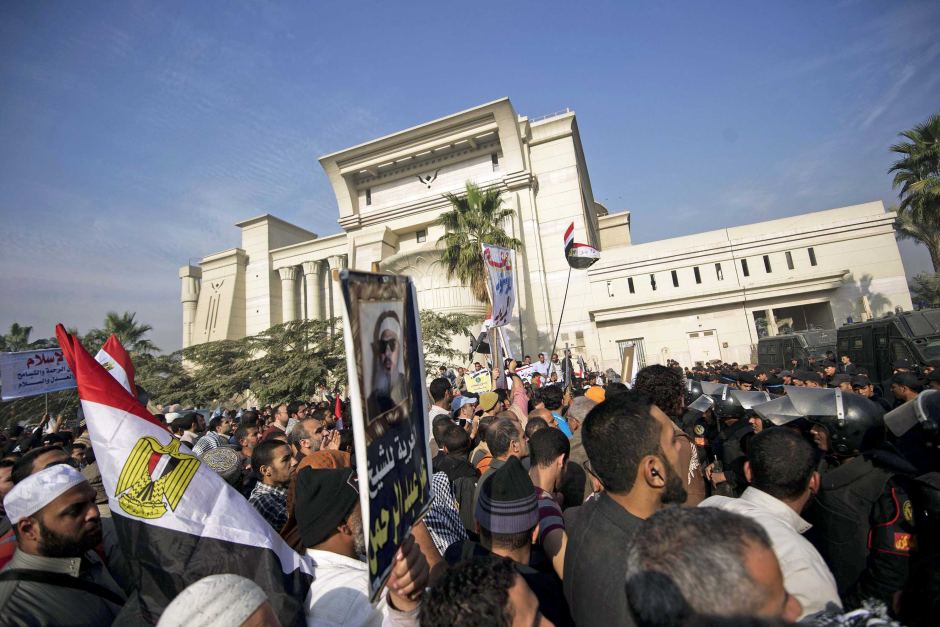
The Supreme Constitutional Court, under protest by Islamists, December, 2012.

From my recent article on Arab West Report:

The Egyptian transition following the 2011 January 25th revolution has been fraught with controversy; among many has been the reform of the judiciary system. While the 1971 constitution guaranteed an independent judiciary, the following year President Sadat presided over the passing of law 46 which moved many judicial proceedings – including appointments, transfers, and inspections – to the executive branch through oversight of the Ministry of Justice. President Mubarak continued use of these privileges to ensure a regime-friendly judiciary.

Though the reform of the judiciary was not chief among the primary demands of the revolution, many reformist judges had long been seeking to expose these executive abuses. The tensions came to the fore during the transitional period, as the judiciary became a battleground between the revolutionary popular will and what was interpreted as pro-regime rulings from the court.

Though published recently, this article was written September of last year after Mursi assumed the presidency, but before his full-on clashes with the judiciary. In this light the following recommendations are noteworthy, as many anti-Islamists look to the courts to curb presidential power and prerogative:

The first guarantee [of judicial independence] is for security of tenure. Judges must understand their position is safe, not subject to removal for rulings issued against the government. Second, the judge and court system as a whole must enjoy financial security. All necessary resources must be made available for the smooth functioning of justice. Third, there must be sufficient guarantees for individuals in the justice system. A culture of rights ensures the public demand for judicial independence, making it more difficult for the government to infringe upon it.

Unfortunately, Binnie noted, the current Egyptian arrangement does not lend itself to judicial independence. First, the body tasked with inspecting judges is within the executive Ministry of Justice. This allows the executive branch to offer rewards to compliant judges – such as promotions or post-retirement ambassadorships – while penalizing judges who buck the system by assigning them judgeships in remote locations.

Second, there is a threat to the independence of the judiciary if there is not sufficient public confidence in the system. Binnie noted that even if independence is achieved, the courts can operate as an ‘old boy’s network’, appointing from their own circles rather than drawing from the diversity of society. The presence of women is particularly helpful, he noted, but a comment from the audience helped demonstrate his point. Egypt boasts only 42 women judges, but 39 of these are the daughters of established judges.

Third, the presence of a parallel court system undermines judicial independence. Even the best system will fail, Binnie noted, if the government can simply bypass it. With separate jurisdictions for military, security, and emergency courts – each able to try civilians – Egyptian justice suffers. Binnie noted that some drafts of the coming constitution do not sufficient guarantee rights during periods of national emergency, threatening to perpetuate the current system into the post-revolutionary era.

The constitution limited the use of military courts, but it did not eliminate their jurisdiction of civilians. Still, this has not been a practical issue since the end of direct military rule. Noting the importance of public confidence, it is at an all time low. Islamists have none at all, while non-Islamist revolution supporters still see it as in service of the regime in concept, if in particularity the identity of the regime is still under contention. Meanwhile, courts across the country issue rulings that send advocates of human rights up in arms.

But consider these examples, the latter of which was held as a pro-revolution step only a few months ago. If implemented now it would cause shockwaves:

In Egypt, moving from an autocratic tradition, enshrinement in the constitution is necessary. This must be done in detail, lest the situation resemble Russia where vagueness in wording has allowed erosion of judicial independence. Experts expect it may take years to reverse Russia’s political culture of judges as servants of the executive branch.

A positive example could perhaps be taken from the experience of Bosnia. Political leaders took the decision to sack all judges, and then require them to reapply for their positions in competition with new applicants. In the end, 70% of judges were reinstated, but two significant results were produced. First, this measure resulted in a great sense of public confidence in the governing system. Second, the judges themselves ‘bought into’ the new program from the necessity of keeping their jobs. It also reset their orientation, as most judges everywhere, Lund believes, desire independence.

As with much of the state infrastructure, bold reforms are necessary, but political conditions do not permit the unity needed for orchestration. It is a shame polarization has reached such a point.

Please click here to read the whole article on Arab West Report.

Categories
Excerpts

The Police as Part of the January 25 Revolution

From Ahram Online, reporting President Morsi’s visit to the central security force headquarters, in what must surely be a typo:

“You are the protectors of the country’s inside and outside safety [said Morsi]. The police were part of the successful crossing of the Suez Canal in the 1973 war and also part of the January 25 Revolution,” he added.

The initial demands of Egypt’s 25 January uprising, intentionally organised on the same day as the annual police day, included an end to police brutality and the State Security apparatus run by the Mubarak regime.

Much of the speech was commendable, encouraging them during difficult times:

“Any obstacles you’re facing, we will get through them – together,” he stressed.

He continued: “You are the watchful eye of the homeland. The country’s best interest needs your efforts and sacrifices.”

“You all know that our Egypt is going through a critical period, but with the aid of God and cooperation of the police and military, we will be able to pass through this phase.”

But he included also a reference to foreign interference – an old tactic of Mubarak, unless, of course, it is actually true:

“Beware, our outside enemy is seeking to create division among us, and we must not allow it,” President Morsi said in his opening speech.

One recent tweet criticized Morsi, saying he promised to visit Port Said, then only addressed them on TV, and the next day honored the institution which shot them.

Morsi’s job with the police is incredibly complex, but the January 25 comment is over the top. The revolution’s initial central focus was the end of the police state. Perhaps Morsi will get to this eventually, but here, he calls them heroes.

I can only imagine the rest of the speech gave more context, but the revision of history is not a firm foundation for social and institutional change. Yes, summon forth their better natures, but clean the skeletons in the closet, too.

Categories
Arab West Report Middle East Published Articles

Interview with Dr. Essam al-Haddad, Presidential Advisor

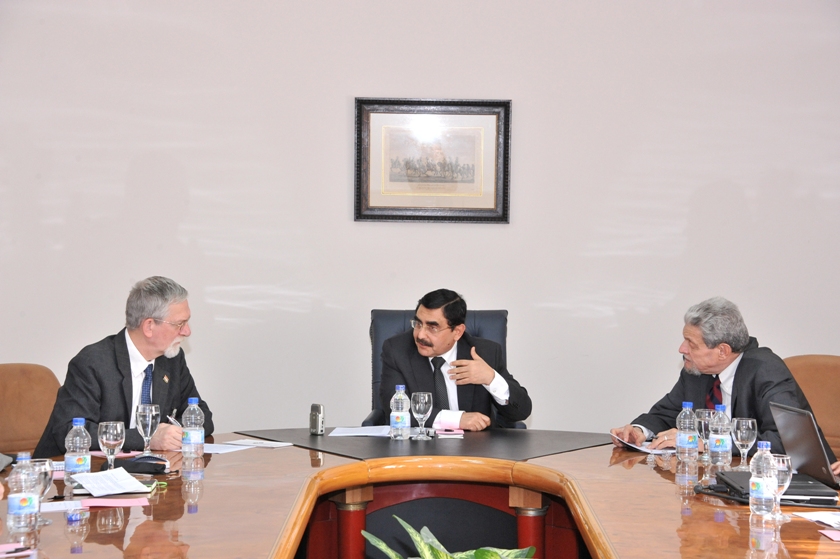
Essam al-Haddad, with Hulsman (L) and Schleiffer (R)

The following is an excerpt from an interview I was privileged to be a part of with Arab West Report. We visited the presidential palace in Heliopolis to meet with Essam al-Haddad, President Morsi’s advisor on foreign and security affairs.

Visiting the palace itself is a strange experience. The walls are covered with anti-Morsi graffiti and lined with barbed wire due to recent clashes in the vicinity. It is a good symbol of the current state of Egypt. An Islamist occupies the top office but faces significant backlash, as the state appears to be breaking down, unable to maintain the respect necessary for such a vital institution. Can you imagine if the White House was similarly afflicted?

Here is Haddad’s take on this, including his explanation on why the conspiracy against Morsi has not yet been brought to light:

Dr. Essam Al-Haddad: The amount of violence against security which was not experienced before, has reached a level where security is now responding but with tear gas and water cannons. But for each rule there are exceptions. Our position is that there is no tolerance for violence against peaceful demonstrations and there is no tolerance for violent demonstrators who are attacking either other people or institutions. So the balance is very tight.

However, if there are any documented incidents of violation, we are taking this very seriously on two sides. First, it has to be investigated and those accountable need to be brought to justice. Second, strategic measures need to be taken to ensure it won’t happen again within the ministry and within the officers. And in this case we would say that we have experienced that the level of restraints, self-restraints by the police is not seen in the Egyptian public for years.

And I invited you to come here to see how we are operating within Ithahadiya [Presidential Palace]. By night on Friday Ithahadiya is attacked by Molotov cocktails and graffiti on walls and everything. Nobody is doing anything to them. So because they are not allowed to carry bullets, the police force, they are only allowed to use tear gas and water cannons. So this is what is going on in the police. But if things are going more violent from some of the violent demonstrators then they have to take action. The rule is using the acceptable level of force in order to stop this from going on.

Any violation of these acts, whether those who have been here in Ithahadiya or anywhere else, will be investigated and those who have been considered accountable will be brought to justice. This is the rule we are working on. Going back to the other side where we have experienced women harassment, huge women harassment at Tahrir Square, there have been claims that these had been organized by the FJP and the MB. This is nonsense, complete nonsense. We have information now that these people are paid by the day, sometimes by hour to demonstrate and to do whatever damage in any part they are and we even know that the fee reaches nearly 1000LE for a day and if they are wounded they could get up until 1500LE, so it is a good job.

Prof. Abdallah Schleiffer: If you have this information why don’t you bring them to charge?
Dr. Essam Al-Haddad: Because this information is not 100% on record. Like drug trafficking, you can see that this person is giving that person an amount of drug to be used and he is selling it and he is getting the price. If you don’t have the license from the public security…

Prof. Abdallah Schleiffer: But you could simply arrest the perpetrators, because there are groups who are fighting them and they could testify evidence, because, again, this is where there is a credibility problem. I have no reason to doubt you at all.

Dr. Essam Al-Haddad: We had a revolution 2 years ago. The dictatorship has been there for 30 years with all its levels of corruption. And people are now experiencing a totally new atmosphere that they are free to do whatever they want and there is no security apparatus enforcing law on them. And they feel this as an opportunity to do whatever they want.

I have been to South Africa for nearly five years after the Apartheid rulers. I was not in Johannesburg, but in Cape Town. I was not allowed to go outside the five-star hotel where I was staying without having a stick and without being warned. When I went around the streets of the five-star hotel everyone was holding a stick. And this was five years after the Apartheid regime.

You don’t have a complete change in such a short time. I always say, you need nine months to have a baby. Can you have a baby in less than nine months? Sometimes, maybe. But you need two years to start to speak two words. And another ten, thirteen years to be mature in order to be a responsible person. This is traditional of course. You cannot expect that after a full collapse and a full blown over of the regime, things would go back to normal immediately.

And you have a counter revolution going against you. But what I can say, we know very well where we are going. And we expect that this time will come and we are determined to carry on building our institutions. And carry on in the reforms we are trying to make in order to make the environment more acceptable and attractive for investors. This is how we want to do it.

Drs. Cornelis Hulsman: The issues we mentioned thus far are all issues for which you need consensus building. How would you find a consensus in Egypt to address all these issues that are of major importance to Egypt because a consensus will help to address this?

Dr. Essam Al-Haddad: Yes you are right, it is important, we are trying our best. Mr. President has invited for dialogue, once, a second, a third time. His invitation was that everything could be discussed, no constraints. You can discuss whatever. But what we are seeing from the other side is that we will not sit unless you are meeting this condition. So, it is a conditional dialogue. “No we will not sit with you ‘cause you are not credible enough”, “no we will not accept this, no we will not accept that.”

Our experience is that, not only experience, our information is that there are elements who are not willing to enter the dialogue, but they are only willing to delay the democratic process. This is their point. Whenever there is an election, they say this is not the right time for an election. If there is a referendum, they will say that this is not the right time for a referendum. If there is any sort of action building democratic institutions in order to go forward there is a sincere trial to hamper and to obstruct it.

This is what we see so in order to archive consensus within this environment, it is not that easy to reach a 100% consensus. But you have to reach out and to open the door and whoever will be joining you will carry on with them. And those who are sending their own agents inside the country and playing outside and sending money, there is more than country and business man who are intervening in our country to avert whatever is going on.

Prof. Abdallah Schleiffer: There is a credibility problem. What countries are you talking about? When you are talking about foreign countries intervening, especially since that is a phrase that has been used over sixty years, so it has a very negative, when I hear that it is like I am hearing…

Drs. Cornelis Hulsman: Mubarak.

Prof. Abdallah Schleiffer: Mubarak or Qadafi. Is there any way you could clarify that? What countries are intervening? I understand why you do not want to, but just asking whether you can.

Dr. Essam Al-Haddad: We do not want to spoil the relations with this country, because this is a brotherly country, which is scared of what is going on here. We prefer to keep it calm. And to avoid it, with the hope that they would realize that intervening in the internal affairs of Egypt is not at ease.

Please click here to read the full interview at Arab West Report.

Related Posts:

Categories
Excerpts

National Dialouge According to Islamic Sharia

From EgyptSource, arguing this is the best bet for the opposition, where dialogue should become shura (official consultation):

On the first point, the prevailing opinion – which may even be the consensus – is that Shura is mandatory. Hence, in Islam, the ruler must resort to Shura to obtain the opinion of experts, politicians, and scholars. National dialogue, in fact, is a form of Shura. The second point, and this is the crux of the matter, revolves around the results of the Shura — whether this opinion is binding on the ruler or merely “a consultative opinion” (in contemporary jargon) or “a guiding opinion” (in the vocabulary of Islamic jurisprudence). This issue has many nuances, and this article lacks room to address all of them, but the prevailing opinion among jurists and Islamic scholars is that Shura is binding on the ruler. This means that the opinion resulting from consultation or dialogue is a binding opinion on the ruler, and he must enact it regardless of whether the opinion was the consensus or majority opinion of those consulted.

Curious to see if the opposition sees it this way, as an opportunity. Curious further to see if Morsi does, as an obligation.

There is no way around political discourse in Egypt involving Islam. The question for secularists is how much does even useful recourse to Islam establish the playing ground on Islamist footing?

Categories
Personal

After Caller Insults Morsi, Radio Host Investigated for Defamation

From Egypt Independent:

Samir, an anchor for the Sports and Youth radio station, was hosting a live show on Sunday at 2 am. The program proposed several political issues to discuss with the audience, and one caller allegedly insulted Morsy on the airwaves. The call was cut short by the show’s control personnel, and then Samir thanked the caller and said she would resume the show.

The anchor reported that after her show ended, she was surprised to find that she would be investigated on defamation charges for thanking a caller who insulted Morsy. The Egyptian Radio and Television Union is penalizing Samir by deducting her monthly incentives and banning her from presenting programs alone.

Egypt Independent is an independent newspaper which generally maintains a slant toward liberalism and away from the Islamist trend. Could there be an element of embellishment here?

If not, it is still important to note that an investigation has been launched, not a conviction, thought it appears company discipline has already been applied.

But taking the story at face value, it reinforces what many say is a disturbing encroachment on the practice of press freedom. Surely the press has many excesses, but to punish a host for good manners? The cause for concern is legitimate.

Related Posts:

Categories
Prayers

Friday Prayers for Egypt: Second Anniversary

Flag Cross Quran

God,

Who will win? Who is fighting? Is the revolution discredited? Is the revolution succeeding? Does this aid Morsi and the Brotherhood? Will it overthrow him/them? Is the National Salvation Front orchestrating? Are they carried along? Is chaos coming?  Is a crackdown coming? Is Egypt being destroyed? Is the old regime being destroyed? Who will win?

God, when so much has been wrong – when so much is wrong – it is not easy to put right. But right can only be built with right. There has been right – there is right – in Egypt. But it has not all been right. A good bit of right doing has been done wrong.

But where, God? Call out righteousness and justice and proclaim it to the people. Anoint men of clear conscience and pure heart to place pure good above all else. Men who will not compromise on the right. Men who will accept failure over hypocrisy. Men who will stand aside that principle may triumph over personality. If these men are already here, God, aid and support them.

Ah, but are such thoughts hopelessly idealistic? Are they futile and self-defeating? Do they pave the way for men of cunning and ambition?

God, bless politics. Bless revolution. Bless every good intention men possess.

Give wisdom. Give courage. Give the power necessary to the necessary people.

But also purge.

Purge good men from the evil within them. Purge good movements from those who seek profit. Purge good ideas from flaw and error. And as purging is always painful, be merciful.

But then restore. May no purge be permanent. May none be excluded. May Egypt rise in cooperation of all her people, all her movements, all her ideas.

God, prayer is not the place for the hard work to make this possible; this is for men in all their counsel. But might it be? If they pray, will you bless Egypt with this solution? If only some pray, will you give it anyway?

God, give Egypt this solution, and give it quickly. Spare her more trouble, but do not leave her with only partial good. Remake her to reflect your perfection, through only that which is good and right. And as long as she falls short, may she repent, regroup, and try again.

Who will win, God? May it be according to your righteous knowledge, however messy it must be to those waiting, striving, and suffering.

Amen.

Categories
Christianity Today Middle East Published Articles

What Egypt’s Christians Think of Hastily Completed Constitution

Christian Constitution

From my recent article on Christianity Today:

Addressing the nation in a televised interview Thursday, President Mohamed Morsi welcomed the sudden completion of Egypt’s draft constitution after months of gridlock.

Amid public outcry against his decision last week to grant himself immunity from judicial review, Morsi praised the constitution’s speedy completion as a necessary step in order to end the nation’s transition to democracy and reestablish separate executive, legislative, and judicial authority.

He also dismissed questions about the legitimacy of the document, especially given the withdrawal of Christian and many liberal members of the assembly drafting it.

“The withdrawal of the church from the constitutional assembly is nothing to worry about,” Morsi said. “It’s important to me that they be part of it, but not to worry.”

The article features the voice of Rev. Safwat el-Baiady, president of the Protestant Churches of Egypt, one of the church’s official representatives who withdrew from the constitutional assembly. His perspective is given on the more controversial articles, including the role of sharia law, the Azhar, and society in determining both law and social morality.

Please click here to finish reading at Christianity Today.

Related Articles: